AB 2994: Building standards: public restroom stalls: disability access.
- Session Year: 2017-2018
- House: Assembly
- Latest Version Date: 2018-08-31
The California Building Standards Law provides for the adoption of building standards by state agencies by requiring all state agencies that adopt or propose any building standard to submit the building standard to the California Building Standards Commission for approval or adoption.
This bill would require the Division of the State Architect to review the existing disability access standards for public restroom stalls and to develop and propose to the commission for consideration updated standards on the required number of ambulatory accessible stalls in public restrooms.
The California Building Standards Law provides for the adoption of building standards by state agencies by requiring all state agencies that adopt or propose any building standard to submit the building standard to the California Building Standards Commission for approval or adoption.
This bill would require the commission, in the next triennial adoption process of the California Building Standards Code, to adopt standards requiring newly constructed public restrooms to be equipped with grab bars. Division of the State Architect to review the existing disability access standards for public restroom stalls and to develop and propose to the commission for consideration updated standards on the required number of ambulatory accessible stalls in public restrooms.
The federal Americans with Disabilities Act of 1990 and the California Building Standards Code require that specified buildings, structures, and facilities be accessible to, and usable by, persons with disabilities. Existing law requires a person and specified others that own or manage a commercial place of public amusement, as defined, that is constructed or renovated, as specified, after a certain date to install and maintain at least one adult changing station, as defined.This bill would also require a commercial place of public amusement newly constructed on or after January 1, 2025, to include the installation and maintenance of an ambulatory accessible toilet compartment that meets the standards set forth in the most recent edition of the California Building Standards Code, as specified.The California Building Standards Law provides for the adoption of building standards by state agencies by requiring all state agencies that adopt or propose any building standard to submit the building standard to the California Building Standards Commission for approval or adoption.
This bill would require the commission, in the next triennial adoption process of the California Building Standards Code, to adopt standards requiring newly constructed public restrooms to be equipped with grab bars.
The federal Americans with Disabilities Act of 1990 and the California Building Standards Code require that specified buildings, structures, and facilities be accessible to, and usable by, persons with disabilities. Existing law requires a person and specified others that own or manage a commercial place of public amusement, as defined, that is constructed or renovated, as specified, after a certain date to install and maintain at least one adult changing station, as defined.
This bill would also require a commercial place of public amusement newly constructed on or after January 1, 2025, to include the installation and maintenance of an ambulatory accessible toilet compartment that meets the standards set forth in the 2016 most recent edition of the California Building Standards Code, as specified.
The California Building Standards Law provides for the adoption of building standards by state agencies by requiring all state agencies that adopt or propose any building standard to submit the building standard to the California Building Standards Commission for approval or adoption.
This bill would require the commission, in the next triennial adoption process of the California Building Standards Code, to adopt standards requiring newly constructed public restrooms to be equipped with grab bars.
The federal Americans with Disabilities Act of 1990 and the California Building Standards Code require that specified buildings, structures, and facilities be accessible to, and usable by, persons with disabilities. Existing law requires a person and specified others that own or manage a commercial place of public amusement, as defined, that is constructed or renovated, as specified, after a certain date to install and maintain at least one adult changing station, as defined.
This bill would also require a commercial place of public amusement newly constructed on or after January 1, 2025, to include the installation and maintenance of an ambulatory accessible toilet compartment that meets the standards set forth in the 2016 California Building Standards Code, as specified.
The California Building Standards Law provides for the adoption of building standards by state agencies by requiring all state agencies that adopt or propose any building standard to submit the building standard to the California Building Standards Commission for approval or adoption.
This bill would require the commission, in the next triennial adoption process of the California Building Standards Code, to adopt standards requiring newly constructed public restrooms to be equipped with grab bars.
The Division of the State Architect shall review the accessibility standards for public restrooms and shall, as part of the next triennial update of the California Building Standards Code (Title 24 of the California Code of Regulations) adopted after January 1, 2020, develop and propose for consideration by the commission updated standards on the number of required ambulatory accessible stalls in public restrooms.
The Division of the State Architect shall review the accessibility standards for public restrooms and shall, as part of the next triennial update of the California Building Standards Code (Title 24 of the California Code of Regulations) adopted after January 1, 2020, develop and propose for consideration by the commission updated standards on the number of required ambulatory accessible stalls in public restrooms.
SECTION 1.Section 18941.12 is added to the Health and Safety Code, to read:18941.12.The commission shall, commencing with the next triennial edition of the California Building Standards Code (Title 24 of the California Code of Regulations) adopted after January 1, 2019, adopt, approve, codify, and publish mandatory building standards that require newly constructed public restrooms to be equipped with grab bars. The standards adopted shall conform to the current requirements of the Americans with Disabilities Act of 1990 and applicable state requirements.SEC. 2.Section 19952.5 of the Health and Safety Code is amended to read:19952.5.(a)A person, private firm, organization, or corporation that owns or manages a commercial place of public amusement shall install and maintain at least one adult changing station for persons with a physical disability that is accessible to both men and women when the facility is open to the public, if either of the following occur:(1)The commercial place of public amusement is newly constructed on or after January 1, 2020.(2)(A)When an existing commercial place of public amusement is renovated on or after January 1, 2025, and requires a permit or the estimated cost of the renovation is ten thousand dollars ($10,000) or more.(B)A commercial place of public amusement with an enclosed restroom facility or other similar private facility with an adult changing table in use before January 1, 2025, shall be deemed to comply with this paragraph.(b)A facility shall ensure that the entrance to each adult changing station has conspicuous signage indicating the location of the station, and, if the facility has a central directory, shall ensure that the central directory indicates the location of the adult changing station.(c)A commercial place of public amusement that is newly constructed on or after January 1, 2025, shall include the installation and maintenance of an ambulatory accessible toilet compartment that meets the standards set forth in the most recent edition of the California Building Standards Code (Title 24 of the California Code of Regulations). (d)For purposes of this section, all of the following definitions shall apply:(1)Commercial place of public amusement means an auditorium, convention center, cultural complex, exhibition hall, permanent amusement park, sports arena, or theater or movie house for which the maximum occupancy is determined to be 2,500 or more people. Commercial place of public amusement does not include any public or private higher education facility or district agricultural association.(2)Adult changing station means an adult changing table placed within an enclosed restroom facility or other similar private facility that is for use by persons with physical disabilities who need help with diapering.(3)Physical disability means a mental or physical disability, as described in Section 12926 of the Government Code.The commission shall, commencing with the next triennial edition of the California Building Standards Code (Title 24 of the California Code of Regulations) adopted after January 1, 2019, adopt, approve, codify, and publish mandatory building standards that require newly constructed public restrooms to be equipped with grab bars. The standards adopted shall conform to the current requirements of the Americans with Disabilities Act of 1990 and applicable state requirements.
SEC. 2.Section 19952.5 of the Health and Safety Code is amended to read:19952.5.(a)A person, private firm, organization, or corporation that owns or manages a commercial place of public amusement shall install and maintain at least one adult changing station for persons with a physical disability that is accessible to both men and women when the facility is open to the public, if either of the following occur:
(1)The commercial place of public amusement is newly constructed on or after January 1, 2020.
(2)(A)When an existing commercial place of public amusement is renovated on or after January 1, 2025, and requires a permit or the estimated cost of the renovation is ten thousand dollars ($10,000) or more.
(B)A commercial place of public amusement with an enclosed restroom facility or other similar private facility with an adult changing table in use before January 1, 2025, shall be deemed to comply with this paragraph.
(b)A facility shall ensure that the entrance to each adult changing station has conspicuous signage indicating the location of the station, and, if the facility has a central directory, shall ensure that the central directory indicates the location of the adult changing station.
(c)A commercial place of public amusement that is newly constructed on or after January 1, 2025, shall include the installation and maintenance of an ambulatory accessible toilet compartment that meets the standards set forth in Section 604.8.2 of Chapter 11B of the 2016 the most recent edition of the California Building Standards Code (Title 24 of the California Code of Regulations).
(d)For purposes of this section, all of the following definitions shall apply:
(1)Commercial place of public amusement means an auditorium, convention center, cultural complex, exhibition hall, permanent amusement park, sports arena, or theater or movie house for which the maximum occupancy is determined to be 2,500 or more people. Commercial place of public amusement does not include any public or private higher education facility or district agricultural association.
(2)Adult changing station means an adult changing table placed within an enclosed restroom facility or other similar private facility that is for use by persons with physical disabilities who need help with diapering.
(3)Physical disability means a mental or physical disability, as described in Section 12926 of the Government Code.
The commission shall, commencing with the next triennial edition of the California Building Standards Code (Title 24 of the California Code of Regulations) adopted after January 1, 2019, adopt, approve, codify, and publish mandatory building standards that require newly constructed public restrooms to be equipped with grab bars. The standards adopted shall conform to the current requirements of the Americans with Disabilities Act of 1990 and applicable state requirements.
SEC. 2.Section 19952.5 of the Health and Safety Code is amended to read:19952.5.(a)A person, private firm, organization, or corporation that owns or manages a commercial place of public amusement shall install and maintain at least one adult changing station for persons with a physical disability that is accessible to both men and women when the facility is open to the public, if either of the following occur:
(1)The commercial place of public amusement is newly constructed on or after January 1, 2020.
(2)(A)When an existing commercial place of public amusement is renovated on or after January 1, 2025, and requires a permit or the estimated cost of the renovation is ten thousand dollars ($10,000) or more.
(B)A commercial place of public amusement with an enclosed restroom facility or other similar private facility with an adult changing table in use before January 1, 2025, shall be deemed to comply with this paragraph.
(b)A facility shall ensure that the entrance to each adult changing station has conspicuous signage indicating the location of the station, and, if the facility has a central directory, shall ensure that the central directory indicates the location of the adult changing station.
(c)A commercial place of public amusement that is newly constructed on or after January 1, 2025, shall include the installation and maintenance of an ambulatory accessible toilet compartment that meets the standards set forth in Section 604.8.2 of Chapter 11B of the 2016 California Building Standards Code (Title 24 of the California Code of Regulations).
(c)(d)For purposes of this section, all of the following definitions shall apply:
(1)Commercial place of public amusement means an auditorium, convention center, cultural complex, exhibition hall, permanent amusement park, sports arena, or theater or movie house for which the maximum occupancy is determined to be 2,500 or more people. Commercial place of public amusement does not include any public or private higher education facility or district agricultural association.
(2)Adult changing station means an adult changing table placed within an enclosed restroom facility or other similar private facility that is for use by persons with physical disabilities who need help with diapering.
(3)Physical disability means a mental or physical disability, as described in Section 12926 of the Government Code.
The commission shall, commencing with the next triennial edition of the California Building Standards Code (Title 24 of the California Code of Regulations) adopted after January 1, 2019, adopt, approve, codify, and publish mandatory building standards that require newly constructed public restrooms to be equipped with grab bars. The standards adopted shall conform to the current requirements of the Americans with Disabilities Act of 1990 and applicable state requirements.
|
Date
|
Status
|
|---|---|
| Sep 21, 2018 | Vetoed by Governor. |
| Sep 7, 2018 | Enrolled and presented to the Governor at 2:30 p.m. |
| Aug 29, 2018 | Senate amendments concurred in. To Engrossing and Enrolling. |
| Aug 24, 2018 | In Assembly. Concurrence in Senate amendments pending. May be considered on or after August 26 pursuant to Assembly Rule 77. |
| Aug 24, 2018 | Read third time. Passed. Ordered to the Assembly. |
| Aug 8, 2018 | Read second time. Ordered to third reading. |
| Aug 7, 2018 | From committee: Do pass. (Ayes 7. Noes 0.) (August 6). |
| Jun 21, 2018 | Read second time and amended. Re-referred to Com. on APPR. |
| Jun 20, 2018 | From committee: Amend, and do pass as amended and re-refer to Com. on APPR. with recommendation: To Consent Calendar. (Ayes 12. Noes 0.) (June 19). |
| May 30, 2018 | Referred to Com. on T. & H. |
| May 17, 2018 | In Senate. Read first time. To Com. on RLS. for assignment. |
| May 17, 2018 | Read third time. Passed. Ordered to the Senate. |
| May 10, 2018 | Read second time. Ordered to Consent Calendar. |
| May 9, 2018 | From committee: Do pass. To Consent Calendar. (Ayes 16. Noes 0.) (May 9). |
| May 1, 2018 | Re-referred to Com. on APPR. |
| Apr 30, 2018 | Read second time and amended. |
| Apr 26, 2018 | From committee: Amend, and do pass as amended and re-refer to Com. on APPR. (Ayes 16. Noes 0.) (April 24). |
| Apr 19, 2018 | Re-referred to Com. on B. & P. |
| Apr 18, 2018 | From committee chair, with author's amendments: Amend, and re-refer to Com. on B. & P. Read second time and amended. |
| Mar 12, 2018 | Referred to Com. on B. & P. |
| Feb 17, 2018 | From printer. May be heard in committee March 19. |
| Feb 16, 2018 | Read first time. To print. |
|
Date
|
Description
|
Location
|
Votes
|
|
|---|---|---|---|---|
| Aug 29, 2018 | AB 2994 HOLDEN Concurrence in Senate Amendments | Assembly Floor |
Passed |
|
| Aug 24, 2018 | Assembly 3rd Reading AB2994 Holden By Portantino | Senate Floor |
Passed |
|
| Aug 6, 2018 | Do pass | Senate Standing Committee on Appropriations |
Passed |
|
| Jun 19, 2018 | Do pass as amended, but first amend, and re-refer to the Committee on [Appropriations] with the recommendation: To Consent Calendar | Senate Standing Committee on Transportation and Housing |
Passed |
|
| May 17, 2018 | AB 2994 HOLDEN Consent Calendar Second Day Regular Session | Assembly Floor |
Passed |
|
| May 9, 2018 | Do pass. To Consent Calendar. | Assembly Standing Committee on Appropriations |
Passed |
|
| Apr 24, 2018 | Do pass as amended and be re-referred to the Committee on [Appropriations] | Assembly Standing Committee on Business and Professions |
Passed |
This list shows positions taken on this bill by organizations on the date displayed, which is linked to the original source.
Positions by individuals are not included.
|
Organization
|
Position
|
Date
|
|---|---|---|
| Association Of Regional Center Agencies | ** Support | Aug 8, 2018 |
| California Senior Legislature | ** Support | Aug 8, 2018 |
| Disability Rights California | ** Support | Aug 8, 2018 |
| National Multiple Sclerosis Society | ** Support | Aug 8, 2018 |
GOVERNOR'S VETO
GV Bill Id:AB 2994
Author:(Holden)
As Enrolled Ver:September 7, 2018
2/3 vote
ASSEMBLY: | (May 17, 2018) | SENATE: | 39-0 | (August 24, 2018) |
(vote not relevant)
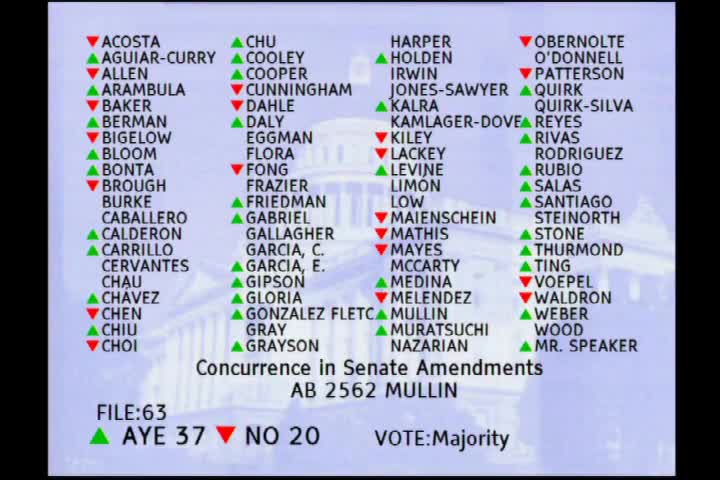
ASSEMBLY: | 78-0 | (August 29, 2018) |
|
|
|
Original Committee Reference: B. & P.
SUMMARY: This bill would require the Division of the State Architect (DSA) to develop and propose updated standards on the number of required ambulatory accessible stalls in public restrooms as part of the next triennial update of the California Building Standards Code adopted after January 1, 2020.
The Senate amendments delete the Assembly version of this bill, and instead:
This bill would require the DSA to review the accessibility standards for public restrooms. As part of the next triennial Building Standards Code (BSC) update after January 1, 2020, the DSA would be required to develop and propose for consideration by the BSC updated standards on the number of required ambulatory accessible stalls in public restrooms.
EXISTING LAW:
The California Building Standards Law, authorizes the BSC to approve and adopt building standards through a triennial rulemaking process to revise and update the California Building Standards Code. There are approximately twenty state agencies that develop building standards for submittal to the BSC for review, approval, and adoption. In the absence of a designated state agency, the BSC is required to adopt specific building standards, as prescribed. The most recent update to the Building Standards Code went into effect on January 1, 2017.
Existing law directs the State Architect to develop and submit proposed regulations and building standards to the BSC for approval and adoption for the purpose of making public buildings, public accommodations, commercial buildings, public housing, and related facilities accessible to and usable by persons with disabilities.
Ambulatory accessible toilet stalls are stalls that have grab bars on both sides of the toilet to enable safe access to the toilet, and are slightly larger than normal stalls but smaller than wheelchair accessible stalls. The current Building Standards Code requires that at least 5% of stalls in each restroom be wheelchair accessible, and that every restroom must have at least one wheelchair accessible stall. In addition, when there are six or more stalls (or urinals + stalls) in a restroom, there must be the same number of ambulatory accessible stalls as wheelchair accessible stalls. Restrooms with fewer than six stalls are not required to have any ambulatory accessible stalls, but restrooms with six to 20 stalls (or urinals + stalls), must have at least one wheelchair accessible and one ambulatory accessible stall.
FISCAL EFFECT: One-time costs to the DSA of approximately $75,000 to amend the standards for ambulatory stall requirements. Costs to review existing public restroom accessibility standards would be absorbable as part of DSA's standard obligations under the Triennial Adoption Cycle. (Disability Access Account)
Minor and absorbable costs to the Building Standards Commission (BSC) to consider and adopt updated standards on ambulatory accessible stalls in public restrooms during the 2021 triennial rulemaking cycle. (Building Standards Administration Revolving Fund)
COMMENTS:
Purpose. The author states that ambulatory stalls provide independence and quality of life for disabled and elderly individuals in the state. This bill requires DSA to review current standards and to propose updated standards to hopefully increase the number of ambulatory stalls in public restrooms in California.
Danger of Unintentional Falls. According to the Center for Disease Control and Prevention (CDC), millions of Americans age 65 and older fall each year. One out of every five falls causes a serious injury. The death rate as a result of unintentional falls in adults age 65 and older has steadily increased from 2005-2014.[1] With 10,000 older Americans turning 65 every day, the CDC expects the number of fall-related injuries and deaths to continue to increase in the coming years resulting in increases in healthcare costs. This is of specific concern to California, as it has the largest population of people over the age of 60 in the country, and the elderly population is expected to grow more than twice as fast as the total population.[2] One recommendation to prevent slips and falls is installing grab bars in bathrooms to offer stability when showering or using a toilet.[3]
Current Building Codes. Grab bars are currently required in the state's building standards for public restrooms through compliance with the International Building Code and ADA standards. They are required to be installed in wheelchair accessible toilet stalls, wheelchair accessible restrooms, and in ambulatory accessible toilet stalls. Ambulatory accessible toilet stalls are stalls that have grab bars on both sides of the toilet to enable safe access to the toilet, and are slightly larger than normal stalls but smaller than wheelchair accessible stalls.
Current standards require that in public restrooms, at least 5% but no less than one of the stalls per restroom have to be wheelchair accessible. Thus, restrooms that have one stall or if it's just one toilet in the room, those toilets must be wheelchair accessible and have grab bars. If six or more stalls (or urinals + stalls) are present in the restroom, then there must be the same number of ambulatory accessible stalls as wheelchair accessible stalls. Therefore, in restrooms with two to five stalls (or urinals + stalls), at least one stall is required to be wheelchair accessible, and for restrooms with six to 20 stalls (or urinals + stalls), at least one stall is required to be wheelchair accessible and one must be ambulatory accessible.
Proper Avenue for Developing New Accessibility Standards. There is an existing process for reviewing and considering for adoption of new building standards. BSC considers for adoption proposed standards from agencies on a triennial cycle to update the Code, through a public process and technical review. The DSA is the agency with the responsibility and expertise to develop and propose new accessibility standards, such as requiring additional ambulatory accessible stalls. This bill follows this process by requiring the appropriate agency, DSA, to review current standards and to develop and propose updated standards on the required number of ambulatory accessible stalls in public restrooms for consideration by the BSC during the next triennial adoption cycle.
According to the analysis released by the Committee on Transportation and Housing the author agreed to amend the bill to instead have DSA review current standards and develop and propose updated standards on the requirements for the number of ambulatory accessible stalls in public restrooms to the BSC for consideration during the next triennial code adoption cycle.
This bill requires the Division of the State Architect to develop and propose to the California Building Standards Commission, updated standards on the required number of ambulatory accessible stalls in public restrooms.
California's existing accessibility standards exceed the federal requirements and are often regarded as a national model. This bill requires the State Architect to review the existing standards, and regardless of the outcome, provide additional ones. I don't think that's warranted.
Analysis Prepared by: Danielle Sires / B. & P. / (916) 319-3301 FN: 0005279
CONCURRENCE IN SENATE AMENDMENTS
CSA1 Bill Id:AB 2994
Author:(Holden)
As Amended Ver:June 21, 2018
Majority vote
ASSEMBLY: | 73-0 | (May 17, 2018) | SENATE: | 39-0 | (August 24, 2018) |
Original Committee Reference: B. & P.
SUMMARY: This bill would require the Division of the State Architect (DSA) to develop and propose updated standards on the number of required ambulatory accessible stalls in public restrooms as part of the next triennial update of the California Building Standards Code adopted after January 1, 2020.
The Senate amendments delete the Assembly version of this bill, and instead:
This bill would require the DSA to review the accessibility standards for public restrooms. As part of the next triennial Building Standards Code (BSC) update after January 1, 2020, the DSA would be required to develop and propose for consideration by the BSC updated standards on the number of required ambulatory accessible stalls in public restrooms.
EXISTING LAW:
The California Building Standards Law, authorizes the BSC to approve and adopt building standards through a triennial rulemaking process to revise and update the California Building Standards Code. There are approximately twenty state agencies that develop building standards for submittal to the BSC for review, approval, and adoption. In the absence of a designated state agency, the BSC is required to adopt specific building standards, as prescribed. The most recent update to the Building Standards Code went into effect on January 1, 2017.
Existing law directs the State Architect to develop and submit proposed regulations and building standards to the BSC for approval and adoption for the purpose of making public buildings, public accommodations, commercial buildings, public housing, and related facilities accessible to and usable by persons with disabilities.
Ambulatory accessible toilet stalls are stalls that have grab bars on both sides of the toilet to enable safe access to the toilet, and are slightly larger than normal stalls but smaller than wheelchair accessible stalls. The current Building Standards Code requires that at least 5% of stalls in each restroom be wheelchair accessible, and that every restroom must have at least one wheelchair accessible stall. In addition, when there are six or more stalls (or urinals + stalls) in a restroom, there must be the same number of ambulatory accessible stalls as wheelchair accessible stalls. Restrooms with fewer than six stalls are not required to have any ambulatory accessible stalls, but restrooms with six to 20 stalls (or urinals + stalls), must have at least one wheelchair accessible and one ambulatory accessible stall.
FISCAL EFFECT: One-time costs to the DSA of approximately $75,000 to amend the standards for ambulatory stall requirements. Costs to review existing public restroom accessibility standards would be absorbable as part of DSA's standard obligations under the Triennial Adoption Cycle. (Disability Access Account)
Minor and absorbable costs to the Building Standards Commission (BSC) to consider and adopt updated standards on ambulatory accessible stalls in public restrooms during the 2021 triennial rulemaking cycle. (Building Standards Administration Revolving Fund)
COMMENTS:
Purpose. The author states that ambulatory stalls provide independence and quality of life for disabled and elderly individuals in the state. This bill requires DSA to review current standards and to propose updated standards to hopefully increase the number of ambulatory stalls in public restrooms in California.
Danger of Unintentional Falls. According to the Center for Disease Control and Prevention (CDC), millions of Americans age 65 and older fall each year. One out of every five falls causes a serious injury. The death rate as a result of unintentional falls in adults age 65 and older has steadily increased from 2005-2014.[1] With 10,000 older Americans turning 65 every day, the CDC expects the number of fall-related injuries and deaths to continue to increase in the coming years resulting in increases in healthcare costs. This is of specific concern to California, as it has the largest population of people over the age of 60 in the country, and the elderly population is expected to grow more than twice as fast as the total population.[2] One recommendation to prevent slips and falls is installing grab bars in bathrooms to offer stability when showering or using a toilet.[3]
Current Building Codes. Grab bars are currently required in the state's building standards for public restrooms through compliance with the International Building Code and ADA standards. They are required to be installed in wheelchair accessible toilet stalls, wheelchair accessible restrooms, and in ambulatory accessible toilet stalls. Ambulatory accessible toilet stalls are stalls that have grab bars on both sides of the toilet to enable safe access to the toilet, and are slightly larger than normal stalls but smaller than wheelchair accessible stalls.
Current standards require that in public restrooms, at least 5% but no less than one of the stalls per restroom have to be wheelchair accessible. Thus, restrooms that have one stall or if it's just one toilet in the room, those toilets must be wheelchair accessible and have grab bars. If six or more stalls (or urinals + stalls) are present in the restroom, then there must be the same number of ambulatory accessible stalls as wheelchair accessible stalls. Therefore, in restrooms with two to five stalls (or urinals + stalls), at least one stall is required to be wheelchair accessible, and for restrooms with six to 20 stalls (or urinals + stalls), at least one stall is required to be wheelchair accessible and one must be ambulatory accessible.
Proper Avenue for Developing New Accessibility Standards. There is an existing process for reviewing and considering for adoption of new building standards. BSC considers for adoption proposed standards from agencies on a triennial cycle to update the Code, through a public process and technical review. The DSA is the agency with the responsibility and expertise to develop and propose new accessibility standards, such as requiring additional ambulatory accessible stalls. This bill follows this process by requiring the appropriate agency, DSA, to review current standards and to develop and propose updated standards on the required number of ambulatory accessible stalls in public restrooms for consideration by the BSC during the next triennial adoption cycle.
According to the analysis released by the Committee on Transportation and Housing the author agreed to amend the bill to instead have DSA review current standards and develop and propose updated standards on the requirements for the number of ambulatory accessible stalls in public restrooms to the BSC for consideration during the next triennial code adoption cycle.
Analysis Prepared by: Danielle Sires / B. & P. / (916) 319-3301 FN: 0003912
Office of Senate Floor Analyses (916) 651-1520 Fax: (916) 327-4478 | AB |
THIRD READING
Bill No: AB 2994
:
SENATE TRANS. & HOUSING COMMITTEE: 12-0, 6/19/18
AYES: Beall, Cannella, Dodd, Gaines, Galgiani, McGuire, Morrell, Roth, Skinner, Vidak, Wieckowski, Wiener
NO VOTE RECORDED: Allen
SENATE APPROPRIATIONS COMMITTEE: 7-0, 8/6/18
AYES: Portantino, Bates, Beall, Bradford, Hill, Nielsen, Wiener
ASSEMBLY FLOOR: 73-0, 5/17/18 (Consent) - See last page for vote
SOURCE: California Senior Legislature
DIGEST:
This bill requires the Division of the State Architect (DSA) to review current standards for public restrooms and to propose for consideration by the Building Standards Commission (BSC) updated standards on the required number of ambulatory accessible stalls in public restrooms.
Existing law:
- Authorizes the BSC to approve and adopt building standards. Every three years, BSC undertakes a building standards rulemaking to revise and update the Code.
- Requires proposed building standards that are submitted to BSC for consideration to be accompanied by an analysis, completed by the appropriate state agency, that justifies approval based on the following criteria:
- The building standard does not conflict with, overlap, or duplicate other building standards;
- The proposed standard is within the parameters of the agency's jurisdiction;
- The public interest requires the adoption of the building standard;
- The standard is not unreasonable, arbitrary, unfair, or capricious;
- The cost to the public is reasonable, based on the overall benefit to be derived from the building standard;
- The standard is not unnecessarily ambiguous or vague; and
- The applicable national specifications, published standards, and model codes have been appropriately incorporated into the standard.
- Requires BSC to receive proposed building standards from a state agency for consideration in the triennial code adoption cycle. Requires BSC to adopt regulations governing the procedures for the triennial adoption cycle, which must include adequate provision of the following:
- Public participation in the development of standards;
- Notice in written form to the public of the proposed building standards with justifications;
- Technical review of the proposed building standards and accompanying justification by advisory boards of BSC; and
- Time for review of recommendations by the advisory boards prior to BSC taking action
- Requires the DSA to develop and submit proposed building standards to the BSC for adoption, regarding making buildings, structures, curbs, and related facilities accessible to and usable by persons with disabilities.
- Requires that California’s building standards for disability access are not a lesser standard than the federal standards pursuant to the Americans with Disability Act of 1990 (ADA).
This bill requires the DSA to review the accessibility standards for public restrooms and, as part of the next triennial update of the Code adopted after January 1, 2020, to develop and propose for consideration by the BSC updated standards on the required number of ambulatory accessible stalls in public restrooms.
Comments
- Purpose. The author states that ambulatory stalls provide independence and quality of life for disabled and elderly individuals in the state. This bill requires DSA to review current standards and to propose updated standards to hopefully increase the number of ambulatory stalls in public restrooms in California.
- Danger of Unintentional Falls. According to the Center for Disease Control and Prevention (CDC), millions of Americans age 65 and older fall each year. One out of every five falls causes a serious injury. The death rate as a result of unintentional falls in adults age 65 and older has steadily increased from 2005-2014.[1] With 10,000 older Americans turning 65 every day, the CDC expects the number of fall-related injuries and deaths to continue to increase in the coming years resulting in increases in healthcare costs. This is of specific concern to California, as it has the largest population of people over the age of 60 in the country, and the elderly population is expected to grow more than twice as fast as the total population.[2] One recommendation to prevent slips and falls is installing grab bars in bathrooms to offer stability when showering or using a toilet.[3]
- Current Building Codes. Grab bars are currently required in the state’s building standards for public restrooms through compliance with the International Building Code and ADA standards. They are required to be installed in wheelchair accessible toilet stalls, wheelchair accessible restrooms, and in ambulatory accessible toilet stalls. Ambulatory accessible toilet stalls are stalls that have grab bars on both sides of the toilet to enable safe access to the toilet, and are slightly larger than normal stalls but smaller than wheelchair accessible stalls.
Current standards require that in public restrooms, at least 5% but no less than one of the stalls per restroom have to be wheelchair accessible. Thus, restrooms that have one stall or if it’s just one toilet in the room, those toilets must be wheelchair accessible and have grab bars. If six or more stalls (or urinals + stalls) are present in the restroom, then there must be the same number of ambulatory accessible stalls as wheelchair accessible stalls. Therefore, in restrooms with two to five stalls (or urinals + stalls), at least one stall is required to be wheelchair accessible, and for restrooms with six to 20 stalls (or urinals + stalls), at least one stall is required to be wheelchair accessible and one must be ambulatory accessible.
- Proper Avenue for Developing New Accessibility Standards. There is an existing process for reviewing and considering for adoption of new building standards. BSC considers for adoption proposed standards from agencies on a triennial cycle to update the Code, through a public process and technical review. The DSA is the agency with the responsibility and expertise to develop and propose new accessibility standards, such as requiring additional ambulatory accessible stalls. This bill follows this process by requiring the appropriate agency, DSA, to review current standards and to develop and propose updated standards on the required number of ambulatory accessible stalls in public restrooms for consideration by the BSC during the next triennial adoption cycle.
FISCAL EFFECT: Appropriation: Fiscal Com.: Local:
According to the Senate Appropriations Committee:
- One-time costs to the DSA of approximately $75,000 to amend the standards for ambulatory stall requirements. Costs to review existing public restroom accessibility standards would be absorbable as part of DSA’s standard obligations under the Triennial Adoption Cycle. (Disability Access Account)
- Minor and absorbable costs to the BSC to consider and adopt updated standards on ambulatory accessible stalls in public restrooms during the 2021 triennial rulemaking cycle. (Building Standards Administration Revolving Fund)
California Senior Legislature (source)
Association of Regional Center Agencies
Disability Rights California
National Multiple Sclerosis Society
None received
ASSEMBLY FLOOR: 73-0, 5/17/18
AYES: Acosta, Aguiar-Curry, Travis Allen, Arambula, Baker, Berman, Bigelow, Bloom, Bonta, Brough, Burke, Caballero, Calderon, Carrillo, Cervantes, Chau, Chávez, Chen, Chiu, Choi, Chu, Cooley, Cooper, Cunningham, Dahle, Daly, Eggman, Flora, Fong, Frazier, Friedman, Gallagher, Eduardo Garcia, Gipson, Gloria, Gonzalez Fletcher, Gray, Grayson, Harper, Holden, Irwin, Jones-Sawyer, Kalra, Kamlager-Dove, Kiley, Lackey, Levine, Limón, Low, Maienschein, Mathis, Mayes, McCarty, Medina, Mullin, Nazarian, Obernolte, O'Donnell, Patterson, Quirk, Quirk-Silva, Reyes, Rodriguez, Rubio, Salas, Mark Stone, Thurmond, Ting, Voepel, Waldron, Weber, Wood, Rendon
NO VOTE RECORDED: Cristina Garcia, Melendez, Muratsuchi, Santiago, Steinorth
8/8/18 12:45:34
**** END ****
SENATE COMMITTEE ON APPROPRIATIONS
Senator Anthony Portantino, Chair
2017 - 2018 Regular Session
AB 2994 (Holden) - Building standards: public restroom stalls: disability access
Version: June 21, 2018 | Policy Vote: T. & H. 12 - 0 |
Urgency: No | Mandate: No |
Hearing Date: August 6, 2018 | Consultant: Mark McKenzie |
This bill does not meet the criteria for referral to the Suspense File.
Bill Summary:
AB 2994 would require the Division of the State Architect (DSA) to develop and propose updated standards on the number of required ambulatory accessible stalls in public restrooms as part of the next triennial update of the California Building Standards Code adopted after January 1, 2020.
Fiscal Impact:
- One-time costs to the DSA of approximately $75,000 to amend the standards for ambulatory stall requirements. Costs to review existing public restroom accessibility standards would be absorbable as part of DSA’s standard obligations under the Triennial Adoption Cycle. (Disability Access Account)
- Minor and absorbable costs to the Building Standards Commission (BSC) to consider and adopt updated standards on ambulatory accessible stalls in public restrooms during the 2021 triennial rulemaking cycle. (Building Standards Administration Revolving Fund)
Background:
Existing law, the California Building Standards Law, authorizes the BSC to approve and adopt building standards through a triennial rulemaking process to revise and update the California Building Standards Code. There are approximately twenty state agencies that develop building standards for submittal to the BSC for review, approval, and adoption. In the absence of a designated state agency, the BSC is required to adopt specific building standards, as prescribed. The most recent update to the Building Standards Code went into effect on January 1, 2017.
Existing law directs the State Architect to develop and submit proposed regulations and building standards to the BSC for approval and adoption for the purpose of making public buildings, public accommodations, commercial buildings, public housing, and related facilities accessible to and usable by persons with disabilities.
Ambulatory accessible toilet stalls are stalls that have grab bars on both sides of the toilet to enable safe access to the toilet, and are slightly larger than normal stalls but smaller than wheelchair accessible stalls. The current Building Standards Code requires that at least 5% of stalls in each restroom be wheelchair accessible, and that every restroom must have at least one wheelchair accessible stall. In addition, when there are six or more stalls (or urinals + stalls) in a restroom, there must be the same number of ambulatory accessible stalls as wheelchair accessible stalls. Restrooms with fewer than six stalls are not required to have any ambulatory accessible stalls, but restrooms with six to 20 stalls (or urinals + stalls), must have at least one wheelchair accessible and one ambulatory accessible stall.
Proposed Law:
AB 2994 would require the DSA to review the accessibility standards for public restrooms. As part of the next triennial Building Standards Code update after January 1, 2020, the DSA would be required to develop and propose for consideration by the BSC updated standards on the number of required ambulatory accessible stalls in public restrooms.
Related Legislation:
AB 662 (Bonilla), Chap. 742/2015, required a commercial place of amusement with a capacity of 2,500 or more persons that is constructed or renovated after specified dates to have at least one adult changing station for persons with
-- END --
SENATE COMMITTEE ON TRANSPORTATION AND HOUSING
Senator Jim Beall, Chair
2017 - 2018 Regular
Bill No: Hearing Date: 6/19/2018
Author: | Holden | ||
Version: | 4/30/2018 | ||
Urgency: | No | Fiscal: | Yes |
Consultant: | Jeffery Song | ||
SUBJECT:
DIGEST: This bill requires the California Building Standard Commission (BSC) to adopt standards requiring newly constructed restrooms to be equipped with grab bars in the next triennial edition of the California Building Standards Code (Code). It also requires a commercial place of public amusement that is constructed on or after January 1, 2025, to install and maintain an ambulatory accessible toilet compartment.
ANALYSIS:
Existing law:
- Authorizes the BSC to approve and adopt building standards. Every three years, BSC undertakes a building standards rulemaking to revise and update the Code.
- Requires proposed building standards that are submitted to BSC for consideration to be accompanied by an analysis, completed by the appropriate state agency, that justifies approval based on the following criteria:
a) The building standard does not conflict with, overlap, or duplicate other building standards;
b) The proposed standard is within the parameters of the agency's jurisdiction;
c) The public interest requires the adoption of the building standard;
d) The standard is not unreasonable, arbitrary, unfair, or capricious;
e) The cost to the public is reasonable, based on the overall benefit to be derived from the building standard;
f) The standard is not unnecessarily ambiguous or vague; and
g) The applicable national specifications, published standards, and model codes have been appropriately incorporated into the standard.
- Requires BSC to receive proposed building standards from a state agency for consideration in the triennial code adoption cycle. Requires BSC to adopt regulations governing the procedures for the triennial adoption cycle, which must include adequate provision of the following:
a) Public participation in the development of standards;
b) Notice in written form to the public of the proposed building standards with justifications;
c) Technical review of the proposed building standards and accompanying justification by advisory boards of BSC; and
d) Time for review of recommendations by the advisory boards prior to BSC taking action
- Requires the Division of State Architect (DSA) to develop and submit proposed building standards to the BSC for adoption, regarding making buildings, structures, curbs, and related facilities accessible to and usable by persons with disabilities.
- Requires that California’s building standards for disability access are not a lesser standard than the federal standards pursuant to the Americans with Disability Act of 1990 (ADA).
- Defines a commercial place of public amusement as an auditorium, convention center, cultural complex, exhibition hall, permanent amusement park, sports arena, or theater, or movie house for which the maximum occupancy is determined to be 2,500 or more people, and does not include any public or private higher education facility or district agricultural association.
This bill:
- Requires the BSC to adopt, approve, codify, and publish mandatory building standards that require newly constructed public restrooms to be equipped with grab bars, commencing with the next triennial edition of the Code and requires the standards to conform to ADA and applicable state requirements.
- Requires a commercial place of public amusement constructed on or after January 1, 2025 to install and maintain an ambulatory accessible toilet compartment that meets the standards set forth in the most recent edition of the California Building Standards Code.
COMMENTS
- Purpose. The author states that ambulatory stalls provide independence and quality of life for disabled and elderly individuals in the state. This bill requires a commercial place of public amusement newly constructed on or after January 1, 2025, to include an ambulatory stall that meets the standards set forth in the Code and requires the adoption of building standards that require newly-constructed public restrooms be equipped with grab bars.
- Danger of Unintentional Falls. According to the Center for Disease Control and Prevention (CDC), millions of Americans age 65 and older fall each year. One out of every five falls causes a serious injury. The death rate as a result of unintentional falls in adults age 65 and older has steadily increased from 2005-2014.[1] With 10,000 older Americans turning 65 every day, the CDC expects the number of fall-related injuries and deaths to continue to increase in the coming years resulting in increases in healthcare costs. This is of specific concern to California, as it has the largest population of people over the age of 60 in the country, and the elderly population is expected to grow more than twice as fast as the total population.[2]
One recommendation to prevent slips and falls is installing grab bars in bathrooms to offer stability when showering or using a toilet.[3] This bill requires the adoption of building standards that would require newly constructed public restrooms to be equipped with grab bars.
- Grab Bars in Public Restrooms. Grab bars are already required in the state’s building standards for public restrooms through compliance with the International Building Code (IBC) and ADA standards. Grab bars are bars for the purpose of being grasped by the hand for support. They are required to be installed in wheelchair accessible toilet stalls, wheelchair accessible restrooms, and in ambulatory accessible toilet stalls. Ambulatory accessible toilet stalls are stalls that have grab bars on both sides of the toilet to enable safe access to the toilet, and are slightly larger than normal stalls but smaller than wheelchair accessible stalls.
Currently, the Code requires that at least 5% but no less than one of the stalls per restroom be wheelchair accessible. This means that for public restrooms that have one stall or if it’s just one toilet in the room, it must be wheelchair accessible. Additionally, where six or more stalls (or urinals + stalls) are present in the restroom, there have to be the same number of ambulatory accessible stalls as wheelchair accessible stalls. Therefore, in restrooms with two to five stalls (or urinals + stalls), at least one stall must be wheelchair accessible and none ambulatory, and for restrooms with six to 20 stalls (or urinals + stalls), at least one stall must be wheelchair accessible and one must be ambulatory accessible.
- Already Happening. A commercial place of public amusement is a term for auditoriums, sports arenas, etc. that have a maximum occupancy of 2,500 or more people. This term was created by AB 662 (Bonilla, 2015), which requires at least one adult changing station to be installed in these commercial places, as defined. This bill requires a new commercial place of public amusement to also have an ambulatory accessible toilet compartment. The supporters of the bill state that this is necessary for greater inclusion of elderly people and people with disabilities into community life and participation in activities like sporting events and concerts. However, these places generally have restrooms that have six or more stalls, and so under existing building standards, these restrooms would each have at least one ambulatory accessible stall as well as at least one fully wheelchair accessible stall. It is not clear what this provision of the bill would do. The author has agreed to amend the bill to delete this provision.
- Correct Avenue for Developing Accessibility Standards. This bill requires the adoption of building standards that would require newly constructed public restrooms to be equipped with grab bars. Current accessibility building standards for public restrooms in the state are consistent with federal ADA guidelines, and it is unclear whether requiring the adoption of a greater standard, such as requiring grab bars in all new public restrooms, is needed for the state. There is a process for reviewing and considering for adoption of new building standards, like those desired in the bill. Under existing law, BSC considers for adoption proposed standards from agencies on a triennial cycle to update the Code, through a public process and technical review. The Division of the State Architect (DSA) is the agency with the responsibility and expertise to develop and propose new accessibility standards. The author has agreed to amend the bill to instead have DSA review current standards and develop and propose updated standards on the requirements for the number of ambulatory accessible stalls in public restrooms to the BSC for consideration during the next triennial code adoption cycle.
Related Legislation:
AB 662 (Bonilla, Chapter 742, Statutes of 2015) —required a commercial place of public amusement to install and maintain at least one adult changing station, for persons with disabilities, accessible to men and women, to assist in the changing of diapers.
Assembly Votes
Floor 73 -0
Approps 16-0
B&P 16-0
FISCAL EFFECT: Appropriation: No Fiscal Com.: Yes Local: No
POSITIONS: (Communicated to the committee before noon on Wednesday,
June 13, 2018.)
SUPPORT:
California Senior Legislature (sponsor)
Association of Regional Center Agencies
Disability Rights California
National Multiple Sclerosis Society
OPPOSITION:
None received.
-- END --
Date of Hearing: May 9, 2018
ASSEMBLY COMMITTEE ON APPROPRIATIONS
Lorena Gonzalez Fletcher, Chair
ABPCA Bill Id:AB 2994
Author:(Holden) – As Amended Ver:April 30, 2018
Policy Committee: | Business and Professions | Vote: | 16 - 0 |
|
| ||
|
|
Urgency: No State Mandated Local Program: No Reimbursable: No
SUMMARY:
This bill requires the California Building Standards Commission (CBSC) to adopt standards requiring newly constructed restrooms to be equipped with grab bars in the next triennial edition of the California Building Standards Code. It also requires a commercial place of public amusement that is constructed on or after January 1, 2025, to install and maintain an ambulatory accessible toilet compartment.
FISCAL EFFECT:
- Minor and absorbable costs (Special Revolving Fund) to the CBSC to develop the specified regulations.
- Minor and absorbable costs to the Division of the State Architect to incorporate additional requirements into its proposed building standards in the next triennial adoption cycle.
COMMENTS:
- Purpose. This bill is sponsored by the California Senior Legislature and seeks to improve both the accessibility and safety of public restrooms. The bill would achieve this by requiring all newly constructed public restrooms to be fitted with ADA-compliant grab bars and requiring a place of public amusement, such as auditoriums, convention centers, exhibition halls, sports arenas, and theaters, to install and maintain an ambulatory accessible toilet compartment. According to the author:
In order to ensure that added safety is provided in new construction, [this bill] moves forward the intent for a much safer experience for the senior population that may not need the extra space of an ADA-compliant bathroom stall, but need the security of grab bars for stability.
- Background. According to the Centers for Disease Control and Prevention (CDC), millions of Americans age 65 and older fall each year, and the death rate as a result of unintentional falls in adults age 65 and older steadily increased from 2005-2014. In 2015, the CDC reported that the total medical cost for all falls was more than $50 billion, 75% of which was covered by Medicare and Medicaid.
With 10,000 older Americans turning 65 every day, the CDC expects the number of fall-related injuries and deaths to continue to increase in the coming years resulting in increases in healthcare costs unless preventive measures are taken.
- Prior Legislation. AB 662 (Bonilla) Chapter 742, Statutes of 2015, requires a commercial place of public amusement that is required to provide over 13 water closets to meet public health and safety requirements to install and maintain at least one adult changing station, for persons with disabilities, accessible to men and women, to assist in the changing of diapers.
Analysis Prepared by: Jennifer Swenson / APPR. / (916) 319-2081
Date of Hearing: April 24, 2018
ASSEMBLY COMMITTEE ON BUSINESS AND PROFESSIONS
Evan Low, Chair
ABPCA Bill Id:AB 2994
Author:(Holden) – As Amended Ver:April 18, 2018
SUBJECT: Building standards: public restrooms: grab bars: ambulatory accessible toilet compartments.
SUMMARY: Requires the California Building Standards Commission to adopt standards requiring newly constructed restrooms to be equipped with grab bars in the next triennial edition of the California Building Standards Code, and also requires a commercial place of public amusement that is constructed on or after January 1, 2025 to install and maintain an ambulatory accessible toilet compartment.
EXISTING LAW:
- Requires that public facilities have a particular number of water closets based on total occupancy using a formula listed in the Plumbing Code based on the number of male and female occupants. (California Code of Regulations (CCR) Title 24, Part 5, Chapter 4, Section 422.1)
- Specifies that theaters, concert halls, and auditoriums with fixed seating and sporting facilities with spectator seating and amusement parks, grandstands, and stadiums, are required to have three (3) water closets for male occupants up to 400 and eight (8) water closets for female occupants up to 400 and also requires one additional toilet for every 500 men and for every 125 women beyond 400. (CCR Title 24, Part 5, Chapter 4, Section 422.1)
- Defines grab bars as a bar for the purpose of being grasped by the hand for support. (CCR Title 24, Part 2, Volume 1, Chapter 2, Section 202)
- Specifies that grab bars in toilet facilities shall comply Section 11B-609. (CCR Title 24, Part 2, Volume 1, Chapter 11-B, Section 11B-609.1)
- Defines a commercial place of public amusement as an auditorium, convention center, cultural complex, exhibition hall, permanent amusement park, sports arena, or theater or movie house for which the maximum occupancy is determined to be 2,500 or more people, and does not include any public or private higher education facility or district agricultural association. (Health and Safety Code (HSC) Section 19952.5)
- Specifies that the center line of an ambulatory accessible toilet compartment shall be 17 inches (432 mm) minimum and 19 inches (483 mm) maximum from the side wall or partition. (CCR Title 24, Part 2, Volume 1, Chapter 11-B, Section 11B-604.2)
THIS BILL:
- Requires the California Building Standards Commission to adopt, approve, codify, and publish mandatory building standards that require newly constructed public restrooms to be equipped with grab bars, commencing with the next triennial edition of the California Building Standards Code, and requires the standards to conform with the Americans with Disabilities Act of 1990 (ADA) and applicable state requirements; and
- Requires a commercial place of public amusement constructed on or after January 1, 2025 to install and maintain an ambulatory accessible toilet compartment that meets the standards set forth in Section 11B-604.8.2 of Chapter 11B of the 2016 California Building Standards Code.
FISCAL EFFECT: Unknown. This bill has been keyed fiscal by Legislative Counsel.
COMMENTS:
Purpose. This bill is sponsored by the California Senior Legislature. According to the author, “[this bill] requires that commercial places of public amusement constructed on or after 2025 have to install and maintain an ambulatory accessible toilet compartment, as defined in Building Standards Code. In order to ensure that added safety is provided in new construction, [this bill] moves forward the intent for a much safer experience for the senior population that may not need the extra space of an ADA-compliant bathroom stall, but need the security of grab bars for stability.”
Background. According to the Centers for Disease Control and Prevention (CDC), millions of Americans age 65 and older fall each year. The CDC has compiled statistics regarding older Americans falling. According to the CDC, one out of every four older people falls each year; falling doubles an older person’s chances of falling again; one out of every five falls causes a serious injury; 2.8 million older people are treated in hospital emergency departments each year; over 800,000 patients are hospitalized because of a fall each year; at least 300,000 older people are hospitalized for hip fractures, more than 95% of which are caused by falling; and falls are the most common cause of traumatic brain injuries.
The CDC has further stated that a serious injury caused by falling may result in difficulty getting around, the performance of daily activities, and the maintenance of an independent living lifestyle. This altered lifestyle can then result in older persons becoming weaker and less active – which increases their chances of falling again.
In 2015, the CDC reported that the total medical cost for all falls was more than $50 billion, 75% of which was covered by Medicare and Medicaid.
As shown in the CDC graphic to the right, the death rate as a result of unintentional falls in adults age 65 and older steadily increased from 2005-2014. With 10,000 older Americans turning 65 every day, the CDC expects the number of fall-related injuries and deaths to continue to increase in the coming years resulting in increases in healthcare costs unless preventive measures are taken.
This bill intends to provide for two such preventive measures. First, by requiring the California Building Standards Commission to adopt standards requiring all newly constructed public restrooms to be fitted with ADA-compliant grab bars in the next triennial edition of the California Building Standards Code. Second, by requiring a place of public amusement that is newly constructed on or after January 1, 2025 to install and maintain an ambulatory accessible toilet compartment, this bill will allow all people, but particularly the elderly and disabled, the use of grab bars and the extra space of an ADA-compliant bathroom stall for safety and stability. This will help to prevent unintentional falls and allow the elderly the ability to maintain their independent lifestyles with less fear of falling and being seriously injured.
Current Related Legislation. N/A
Prior Related Legislation. AB 662 (Bonilla) Chapter 742, Statutes of 2015, requires a commercial place of public amusement that is required to provide over 13 water closets, to meet public health and safety requirements to install and maintain at least one adult changing station, for persons with disabilities, accessible to men and women, to assist in the changing of diapers.
ARGUMENTS IN SUPPORT:
The Association of Regional Center Agencies writes, “[t]his bill is both a simple and rational next step in improving both accessibility and safety for public restrooms. It is not merely individuals with limited strength or mobility impairments who benefit from grab bars. Anyone, of any age and any level of fitness, can have a momentary lapse and lose their balance. A grab bar provides a measure of safety that, in the unforgiving context of a bathroom’s hard surfaces, can be literally lifesaving.”
The California Senior Legislature writes, “[t]his bill would require the Building Standards Commission, in the next triennial adoption process of the California Building Standards Code, to adopt standards requiring newly constructed public restrooms to be equipped with grab bars. Public restrooms equipped with grab bars will enable seniors to maintain their independence.”
Disability Rights California writes, “[t]he inclusion of people with disabilities in community life and participation in activities such as sporting events, concerts, and other forms of entertainment enhances quality of life. To participate, however, requires adequate accessible restrooms. By including grab bars in newly constructed restrooms and an ambulatory accessible toilet compartment in buildings such as auditoriums, convention centers, exhibition halls, sports arenas, and theaters, people with disabilities are ensured access, and can take care of basic needs while also preventing injury and meeting their disability related needs.”
ARGUMENTS IN OPPOSITION:
None
AMENDMENTS:
- On page 3, between lines 6 and 7, strike “Section 604.8.2 of Chapter 11B of the 2016” and insert: “the most recent edition of the”
REGISTERED SUPPORT:
Association of Regional Center Agencies
California Senior Legislature
Disability Rights California
REGISTERED OPPOSITION:
None on file
Analysis Prepared by: Danielle Sires / B. & P. / (916) 319-3301, Nicholas Scotti / B. & P. / (916) 319-3301
Discussed in Hearing
 1MIN
Assembly Floor
 2MIN
Senate Floor
 1MIN
Senate Standing Committee on Appropriations
 5MIN
Assembly Standing Committee on Business and Professions
Bill Author

Bill Co-Author(s):