AB 3002: Disability access requirements: information.
- Session Year: 2017-2018
- House: Assembly
- Latest Version Date: 2018-09-22
Existing law establishes the California Commission on Disability Access within the Department of General Services. The commission is charged with preventing or minimizing problems of compliance by California businesses by providing educational services and recommending programs to enable persons with disabilities to obtain full and equal access to public facilities.
Existing law requires the State Architect to establish a program for the voluntary certification by the state of any person who meets criteria as a Certified Access Specialist (CASp). This position requires certain knowledge and training on standards governing access to buildings for persons with disabilities.
Existing law also requires each city, county, or city and county to provide applicants for a business license or equivalent instrument or permit with certain information regarding compliance with disability access provisions under federal and state law, including information on legal obligations from specified state agencies.
This bill would additionally require the above local jurisdictions issuing building permits for commercial construction or business licenses to make available a notice containing specified information regarding disability access. The bill would also require a local agency to provide the informational notice to an applicant for a commercial building permit or a business license. The bill, among other things, would require this informational notice to be translated into specified languages and to include specified information on compliance requirements under both state and federal law and an advisory strongly encouraging the applicant to obtain a CASp consultation and inspection. The bill would define commercial property for these purposes. The bill would require the State Architect to develop a model notice for local agencies to use to comply with these provisions, as specified. The bill would include related legislative findings. By imposing new requirements on local government agencies, the bill would create a state-mandated local program.
The California Constitution requires the state to reimburse local agencies and school districts for certain costs mandated by the state. Statutory provisions establish procedures for making that reimbursement.
This bill would provide that, if the Commission on State Mandates determines that the bill contains costs mandated by the state, reimbursement for those costs shall be made pursuant to the statutory provisions noted above.
Existing law establishes the California Commission on Disability Access within the Department of General Services. The commission is charged with preventing or minimizing problems of compliance by California businesses by providing educational services and recommending programs to enable persons with disabilities to obtain full and equal access to public facilities.
Existing law requires the State Architect to establish a program for the voluntary certification by the state of any person who meets criteria as a Certified Access Specialist (CASp). This position requires certain knowledge and training on standards governing access to buildings for persons with disabilities.
Existing law also requires each city, county, or city and county to provide applicants for a business license or equivalent instrument or permit with certain information regarding compliance with disability access provisions under federal and state law, including information on legal obligations from specified state agencies.
This bill would additionally require the above local jurisdictions issuing building permits for commercial construction or business licenses to make available a notice containing specified information regarding disability access. The bill would also require a local building inspector or planning department agency to provide the informational notice to an applicant for a commercial building permit, as specified. permit or a business license. The bill, among other things, would require this informational notice to be translated into specified languages and to include specified information on compliance requirements under both state and federal law and an advisory strongly encouraging the applicant to obtain a CASp consultation and inspection. The bill would define commercial property for these purposes. The bill would require the State Architect to develop a model notice for local agencies to use to comply with these provisions, as specified. The bill would include related legislative findings. By imposing new requirements on local government agencies, the bill would create a state-mandated local program.
The California Constitution requires the state to reimburse local agencies and school districts for certain costs mandated by the state. Statutory provisions establish procedures for making that reimbursement.
This bill would provide that, if the Commission on State Mandates determines that the bill contains costs mandated by the state, reimbursement for those costs shall be made pursuant to the statutory provisions noted above.
Existing law establishes the California Commission on Disability Access within the Department of General Services. The commission is charged with preventing or minimizing problems of compliance by California businesses by providing educational services and recommending programs to enable persons with disabilities to obtain full and equal access to public facilities.
Existing law requires the State Architect to establish a program for the voluntary certification by the state of any person who meets criteria as a Certified Access Specialist (CASp). This position requires certain knowledge and training on standards governing access to buildings for persons with disabilities. Existing law also requires each city, county, or city and county to provide applicants for a business license or equivalent instrument or permit with certain information regarding compliance with disability access provisions under federal and state law, including information on legal obligations from specified state agencies.This bill would additionally require the above local jurisdictions issuing building permits for commercial construction to make available a notice containing specified information regarding disability access. The bill would also require a local building inspector or planning department to provide the informational notice to an applicant for a commercial building permit, as specified. The bill, among other things, would require this informational notice to be translated into specified languages and to include information on compliance requirements under both state and federal law and an advisory strongly encouraging the applicant to obtain a CASp inspection. The bill would define commercial property for these purposes. The bill would require the State Architect to develop a model notice for local agencies to use to comply with these provisions, as specified. The bill would include related legislative findings. By imposing new requirements on local government agencies, the bill would create a state-mandated local program.
The California Constitution requires the state to reimburse local agencies and school districts for certain costs mandated by the state. Statutory provisions establish procedures for making that reimbursement.
This bill would provide that, if the Commission on State Mandates determines that the bill contains costs mandated by the state, reimbursement for those costs shall be made pursuant to the statutory provisions noted above.
Existing law establishes the California Commission on Disability Access within the Department of General Services. The commission is charged with preventing or minimizing problems of compliance by California businesses by providing educational services and recommending programs to enable persons with disabilities to obtain full and equal access to public facilities.
Existing law requires the State Architect to establish a program for the voluntary certification by the state of any person who meets criteria as a Certified Access Specialist (CASp). This position requires certain knowledge and training on standards governing access to buildings for persons with disabilities.
Existing law also requires each city, county, or city and county to provide applicants for a business license or equivalent instrument or permit with certain information regarding compliance with disability access provisions under federal and state law, including information on legal obligations from specified state agencies.
This bill would additionally require the above local jurisdictions issuing building permits for renovation or new commercial construction to provide, prior to approval of the accompanying building plan by a local building inspector or planning department, an informational notice directly attached to the applicants application for a building permit make available a notice containing specified information. information regarding disability access. The bill would also require a local building inspector or planning department to provide the informational notice to an applicant for a commercial building permit, as specified. The bill, among other things, would require this informational notice to include information on compliance requirements under both state and federal law and an advisory strongly encouraging the applicant to obtain a CASp inspection. The bill would define commercial property for these purposes. The bill would include related legislative findings. By imposing new requirements on local government agencies, the bill would create a state-mandated local program.
The California Constitution requires the state to reimburse local agencies and school districts for certain costs mandated by the state. Statutory provisions establish procedures for making that reimbursement.
This bill would provide that, if the Commission on State Mandates determines that the bill contains costs mandated by the state, reimbursement for those costs shall be made pursuant to the statutory provisions noted above.
Existing law establishes the California Commission on Disability Access within the Department of General Services. The commission is charged with preventing or minimizing problems of compliance by California businesses by providing educational services and recommending programs to enable persons with disabilities to obtain full and equal access to public facilities.
Existing law requires the State Architect to establish a program for the voluntary certification by the state of any person who meets criteria as a Certified Access Specialist (CASp). This position requires certain knowledge and training on standards governing access to buildings for persons with disabilities. Existing law also requires a commercial property owner or lessor to state on every lease form or rental agreement executed on or after January 1, 2017, whether or not the premises have undergone inspection by a CASp. each city, county, or city and county to provide applicants for a business license or equivalent instrument or permit with certain information regarding compliance with disability access provisions under federal and state law, including information on legal obligations from specified state agencies. This bill would make nonsubstantive changes to that provision.This bill would additionally require the above local jurisdictions issuing building permits for renovation or new construction to provide, prior to approval of the accompanying building plan by a local building inspector or planning department, an informational notice directly attached to the applicants application for a building permit containing specified information. The bill, among other things, would require this informational notice to include information on compliance requirements under both state and federal law and an advisory strongly encouraging the applicant to obtain a CASp inspection. The bill would include related legislative findings. By imposing new requirements on local government agencies, the bill would create a state-mandated local program.
The California Constitution requires the state to reimburse local agencies and school districts for certain costs mandated by the state. Statutory provisions establish procedures for making that reimbursement.
This bill would provide that, if the Commission on State Mandates determines that the bill contains costs mandated by the state, reimbursement for those costs shall be made pursuant to the statutory provisions noted above.
Existing law requires the State Architect to establish a program for the voluntary certification by the state of any person who meets criteria as a Certified Access Specialist (CASp). This position requires certain knowledge and training on standards governing access to buildings for persons with disabilities.
Existing law also requires a commercial property owner or lessor to state on every lease form or rental agreement executed on or after January 1, 2017, whether or not the premises have undergone inspection by a CASp.
This bill would make nonsubstantive changes to that provision.
It is the intent of the Legislature, in enacting this act, to increase compliance with the federal Americans with Disabilities Act of 1990 (42 U.S.C. Sec. 12101 et seq.) and the state Unruh Civil Rights Act (Section 51 of the Civil Code) by owners and tenants of commercial property used for public accommodation or business purposes and to facilitate that compliance by increasing awareness of these laws and the resources available to aid with compliance, resulting in more public accommodations and businesses being accessible to all persons, regardless of physical disability.
SEC. 2.Section 4469.5 is added to the Government Code, to read:4469.5.(a)In addition to the information required by Section 4469, each city, county, or city and county that issues business licenses, building permits for additions, alterations, and structural repairs to commercial property, or building permits for new construction of commercial property, shall make readily available, and, upon submission to the city, county, or city and county of an application for a business license or building permit, shall provide to the applicant, an informational notice to the applicant containing all of the following:
(1)General information about the compliance requirements pursuant to the federal Americans with Disabilities Act of 1990 (42 U.S.C. Sec. 12101 et seq.) and the states disability access laws.
(2)An advisory to the applicant for a building permit that strongly encourages the applicant to do both of the following:
(A)Obtain a consultation by a Certified Access Specialist (CASp) before alteration or construction in order for the property to be in compliance with disability access laws after the work is completed, so that the applicant can benefit from the advantages of compliance.
(B)Obtain an inspection by a Certified Access Specialist (CASp) after alteration or construction in order to benefit from the legal protections afforded business and property owners under the Construction-Related Accessibility Compliance Act (Part 2.52 (commencing with Section 55.51) of Division 1 of the Civil Code).
(3)An advisory to the applicant for a business license that strongly encourages the applicant to do both of the following:
(A)Obtain a consultation by a Certified Access Specialist (CASp) before engaging in business on the premises in order for the property to be in compliance with disability access laws, so that the applicant can benefit from the advantages of compliance.
(B)Obtain an inspection by a Certified Access Specialist (CASp) after beginning to engage in business on the premises in order to benefit from the legal protections afforded business and property owners under the Construction-Related Accessibility Compliance Act (Part 2.52 (commencing with Section 55.51) of Division 1 of the Civil Code).
(4)Information about how to locate CASp inspectors, including a link to the Internet Web site of the State Architect where CASp inspectors are listed, pursuant to Section 4459.8, by geographic area in which they provide or intend to provide services and information about how to obtain CASp services.
(5)A notice of the federal and state programs that are available to assist small businesses with disability compliance and access expenditures, including, but not limited to, Section 44 of the Internal Revenue Code (disabled access credit for eligible small businesses); Section 190 of the Internal Revenue Code (deduction for expenditures to remove architectural and transportation barriers); the California Capital Access Program Americans with Disabilities Act Financing Program (CalCAP/ADA); and the Disabled Access Credit for Eligible Small Businesses specified in Sections 17053.42 and 23642 of the Revenue and Taxation Code.
(6)A link to the homepage and the resource page of the California Commission on Disability Access.
(b)The informational notice specified in subdivision (a) shall be translated and made available in all of the languages specified in paragraph (3) of subdivision (a) of Section 1632 of the Civil Code and shall be provided to the applicant in whichever format the building permit or business license application is required to be submitted.
(c)For purposes of this section, the term commercial property means property that is operating, or is intended to be operated, as a place of public accommodation as defined in Section 202 of Title 24 of the California Code of Regulations, or as a facility to which the general public is invited at those premises.
(d)(1)The Division of the State Architect shall develop a model notice that local agencies can use to comply with the requirements of this section.
(2)The Division of the State Architect shall post the model notice on the publicly available portion of the divisions Internet Web site.
SEC. 3.The Legislature finds and declares that promoting uniform statewide compliance with construction-related accessibility requirements set forth in the federal Americans with Disabilities Act of 1990 (42 U.S.C. Sec. 12101 et seq.) and state disability law is a matter of statewide concern and is not a municipal affair as that term is used in Section 5 of Article XI of the California Constitution. Therefore, this act shall apply to all cities, including charter cities.
SEC. 4.If the Commission on State Mandates determines that this act contains costs mandated by the state, reimbursement to local agencies and school districts for those costs shall be made pursuant to Part 7 (commencing with Section 17500) of Division 4 of Title 2 of the Government Code.
It is the intent of the Legislature, in enacting this act, to increase compliance with the federal Americans with Disabilities Act of 1990 (42 U.S.C. Sec. 12101 et seq.) and the state Unruh Civil Rights Act (Section 51 of the Civil Code) by owners and tenants of commercial property used for public accommodation or business purposes and to facilitate that compliance by increasing awareness of these laws and the resources available to aid with compliance, resulting in more public accommodations and businesses being accessible to all persons, regardless of physical disability.
SEC. 2.Section 4469.5 is added to the Government Code, to read:4469.5.(a)In addition to the information required by Section 4469, each city, county, or city and county that issues business licenses, building permits for additions, alterations, and structural repairs to commercial property, or building permits for new construction of commercial property, shall make readily available, and, upon submission to the city, county, or city and county of an application for either type of permit to a local building inspector or planning department, the local building inspector or planning department a business license or building permit, shall provide to the applicant, an informational notice to the applicant containing all of the following:
(1)General information about the compliance requirements pursuant to the federal Americans with Disabilities Act of 1990 (42 U.S.C. Sec. 12101 et seq.) and the states disability access laws.
(2)An advisory that the permit applicant is strongly encouraged to obtain an inspection to the applicant for a building permit that strongly encourages the applicant to do both of the following:
(A)Obtain a consultation by a Certified Access Specialist (CASp) prior to before alteration or construction in order to ensure that for the property will to be in compliance with disability access laws after the work is completed, and so that the applicant can benefit from the advantages of compliance.
(B)Obtain an inspection by a Certified Access Specialist (CASp) after alteration or construction in order to benefit from the legal protections afforded business and property owners under the Construction-Related Accessibility Compliance Act (Part 2.52 (commencing with Section 55.51) of Division 1 of the Civil Code).
(3)An advisory to the applicant for a business license that strongly encourages the applicant to do both of the following:
(A)Obtain a consultation by a Certified Access Specialist (CASp) before engaging in business on the premises in order for the property to be in compliance with disability access laws, so that the applicant can benefit from the advantages of compliance.
(B)Obtain an inspection by a Certified Access Specialist (CASp) after beginning to engage in business on the premises in order to benefit from the legal protections afforded business and property owners under the Construction-Related Accessibility Compliance Act (Part 2.52 (commencing with Section 55.51) of Division 1 of the Civil Code).
(3)(4)Information about how to locate CASp inspectors, including a link to the Internet Web site of the State Architect where CASp inspectors are listed, pursuant to Section 4459.8, by geographic area in which they provide or intend to provide services and information about how to obtain CASp services.
(4)(5)A notice of the federal and state programs that are available to assist small businesses with disability compliance and access expenditures, including, but not limited to, Section 44 of the Internal Revenue Code (disabled access credit for eligible small businesses); Section 190 of the Internal Revenue Code (deduction for expenditures to remove architectural and transportation barriers); the California Capital Access Program Americans with Disabilities Act Financing Program (CalCAP/ADA); and the Disabled Access Credit for Eligible Small Businesses specified in Sections 17053.42 and 23642 of the Revenue and Taxation Code.
(5)(6)A link to the homepage and the resource page of the California Commission on Disability Access.
(b)The informational notice specified in subdivision (a) shall be translated and made available in all of the languages specified in paragraph (3) of subdivision (a) of Section 1632 of the Civil Code and shall be provided to the applicant in whichever format the building permit or business license application is required to be submitted.
(c)For purposes of this section, the term commercial property means property that is operating, or is intended to be operated, as a place of public accommodation as defined in Section 202 of Title 24 of the California Code of Regulations, or as a facility to which the general public is invited at those premises.
(d)(1)The Division of the State Architect shall develop a model notice that local agencies can use to comply with the requirements of this section.
(2)The Division of the State Architect shall post the model notice on the publicly available portion of the divisions Internet Web site.
SEC. 3.The Legislature finds and declares that promoting uniform statewide compliance with construction-related accessibility requirements set forth in the federal Americans with Disabilities Act of 1990 (42 U.S.C. Sec. 12101 et seq.) and state disability law is a matter of statewide concern and is not a municipal affair as that term is used in Section 5 of Article XI of the California Constitution. Therefore, this act shall apply to all cities, including charter cities.
SEC. 4.If the Commission on State Mandates determines that this act contains costs mandated by the state, reimbursement to local agencies and school districts for those costs shall be made pursuant to Part 7 (commencing with Section 17500) of Division 4 of Title 2 of the Government Code.
It is the intent of the Legislature, in enacting this act, to increase compliance with the federal Americans with Disabilities Act of 1990 (42 U.S.C. Sec. 12101 et seq.) and the state Unruh Civil Rights Act (Section 51 of the Civil Code) by owners and tenants of commercial property used for public accommodation or business purposes and to facilitate that compliance by increasing awareness of these laws and the resources available to aid with compliance, resulting in more public accommodations and businesses being accessible to all persons, regardless of physical disability.
SEC. 2.Section 4469.5 is added to the Government Code, to read:4469.5.(a)In addition to the information required by Section 4469, each city, county, or city and county that issues building permits for additions, alterations, and structural repairs to commercial property, or building permits for new construction of commercial property, shall make readily available, and, upon submission of an application for either type of permit to a local building inspector or planning department, the local building inspector or planning department shall provide to the applicant, an informational notice containing the following:
(1)General information about the compliance requirements pursuant to the federal Americans with Disabilities Act of 1990 (42 U.S.C. Sec. 12101 et seq.) and the states disability access laws.
(2)An advisory that the permit applicant is strongly encouraged to obtain an inspection by a Certified Access Specialist (CASp) prior to alteration or construction in order to ensure that the property will be in compliance with the laws after the work is performed, and enjoy disability access laws after the work is completed, and that the applicant can benefit from the advantages of compliance.
(3)Information about how to locate CASp inspectors, including a link to the Internet Web site of the State Architect where CASp inspectors are listed, pursuant to Section 4459.8, by geographic area in which they provide or intend to provide services and information about how to obtain CASp services.
(4)A notice of the federal and state programs that are available to assist small businesses with disability compliance and access expenditures, including, but not limited to, Section 44 of the Internal Revenue Code (disabled access credit for eligible small businesses); Section 190 of the Internal Revenue Code (deduction for expenditures to remove architectural and transportation barriers); the California Capital Access Program Americans with Disabilities Act Financing Program (CalCAP/ADA); and the Disabled Access Credit for Eligible Small Businesses specified in Sections 17053.42 and 23642 of the Revenue and Taxation Code.
(5)A link to the home page homepage and the resource page of the California Commission on Disability Access.
(b)The informational notice specified in subdivision (a) shall be translated and made available in all of the languages specified in paragraph (3) of subdivision (a) of Section 1632 of the Civil Code and shall be provided to the applicant in whichever format the permit application is required to be submitted.
(c)For purposes of this section, the term commercial property means property that is operating, or is intended to be operated, as a place of public accommodation as defined in Section 202 of Title 24 of the California Code of Regulations, or as a facility to which the general public is invited at those premises.
(d)(1)The Division of the State Architect shall develop a model notice that local agencies can use to comply with the requirements of this section.
(2)The Division of the State Architect shall post the model notice on the publicly available portion of the divisions Internet Web site.
SEC. 3.The Legislature finds and declares that promoting uniform statewide compliance with construction-related accessibility requirements set forth in the federal Americans with Disabilities Act of 1990 (42 U.S.C. Sec. 12101 et seq.) and state disability law is a matter of statewide concern and is not a municipal affair as that term is used in Section 5 of Article XI of the California Constitution. Therefore, this act shall apply to all cities, including charter cities.
SEC. 4.If the Commission on State Mandates determines that this act contains costs mandated by the state, reimbursement to local agencies and school districts for those costs shall be made pursuant to Part 7 (commencing with Section 17500) of Division 4 of Title 2 of the Government Code.
It is the intent of the Legislature, in enacting this act, to increase compliance with the federal Americans with Disabilities Act of 1990 (42 U.S.C. Sec. 12101 et seq.) and the state Unruh Civil Rights Act (Section 51 of the Civil Code) by owners and tenants of commercial property used for public accommodation or business purposes and to facilitate that compliance by increasing awareness of these laws and the resources available to aid with compliance. compliance, resulting in more public accommodations and businesses being accessible to all persons, regardless of physical disability.
SEC. 2.Section 4469.5 is added to the Government Code, to read:4469.5.(a)In addition to the information required by Section 4469, each city, county, or city and county that issues a building permit for renovation or new construction shall provide, prior to approval of the accompanying building plan by a local building inspector or planning department, an informational notice directly attached to the applicants application for a building permit building permits for additions, alterations, and structural repairs to commercial property, or building permits for new construction of commercial property, shall make readily available, and, upon submission of an application for either type of permit to a local building inspector or planning department, the local building inspector or planning department shall provide to the applicant, an informational notice containing the following:
(1)Information on General information about the compliance requirements pursuant to the federal Americans with Disabilities Act of 1990 (42 U.S.C. Sec. 12101 et seq.) and the states disability access laws.
(2)An advisory that the permit applicant is strongly encouraged to obtain an inspection by a Certified Access Specialist (CASp) prior to alteration or construction to ensure that the property will be in compliance with the laws after the work is performed, and of enjoy the advantages of compliance.
(3)The names of local CASp inspectors Information about how to locate CASp inspectors, including a link to the Internet Web site of the State Architect where CASp inspectors are listed, pursuant to Section 4459.8, by geographic area in which they provide or intend to provide services and information on about how to obtain their CASp services.
(4)A notice of the federal and state programs that are available to assist small businesses with disability compliance and access expenditures, including, but not limited to, Section 44 of the Internal Revenue Code (disabled access credit for eligible small businesses); Section 190 of the Internal Revenue Code (deduction for expenditures to remove architectural and transportation barriers); the California Capital Access Program Americans with Disabilities Act Financing Program (CalCAP/ADA); and the Disabled Access Credit for Eligible Small Businesses specified in Sections 17053.42 and 23642 of the Revenue and Taxation Code.
(5)A link to the home page and the resource page of the California Commission on Disability Access.
(b)The informational notice specified in subdivision (a) shall be provided to the applicant in whichever format the permit application is required to be submitted.
(c)For purposes of this section, the term commercial property means property that is operating, or is intended to be operated, as a place of public accommodation as defined in Section 202 of Title 24 of the California Code of Regulations, or as a facility to which the general public is invited at those premises.
SEC. 3.The Legislature finds and declares that promoting uniform statewide compliance with construction-related accessibility requirements set forth in the federal Americans with Disabilities Act of 1990 (42 U.S.C. Sec. 12101 et seq.) and state disability law is a matter of statewide concern and is not a municipal affair as that term is used in Section 5 of Article XI of the California Constitution. Therefore, this act shall apply to all cities, including charter cities.
SEC. 4.If the Commission on State Mandates determines that this act contains costs mandated by the state, reimbursement to local agencies and school districts for those costs shall be made pursuant to Part 7 (commencing with Section 17500) of Division 4 of Title 2 of the Government Code.
It is the intent of the Legislature, in enacting this act, to increase compliance with the federal Americans with Disabilities Act of 1990 (42 U.S.C. Sec. 12101 et seq.) and the state Unruh Civil Rights Act (Section 51 of the Civil Code) by owners and tenants of property used for public purposes and to facilitate that compliance by increasing awareness of these laws and the resources available to aid with compliance.
SEC. 2.Section 4469.5 is added to the Government Code, to read:4469.5.(a)In addition to the information required by Section 4469, each city, county, or city and county that issues a building permit for renovation or new construction shall provide, prior to approval of the accompanying building plan by a local building inspector or planning department, an informational notice directly attached to the applicants application for a building permit containing the following:
(1)Information on the compliance requirements pursuant to the federal Americans with Disabilities Act of 1990 (42 U.S.C. Sec. 12101 et seq.) and the states disability access laws.
(2)An advisory that the permit applicant is strongly encouraged to obtain an inspection by a Certified Access Specialist (CASp) prior to alteration or construction to ensure that the property will be in compliance with the laws after the work is performed, and of the advantages of compliance.
(3)The names of local CASp inspectors and information on how to obtain their services.
(4)A notice of the federal and state programs that are available to assist small businesses with disability compliance and access expenditures, including, but not limited to, Section 44 of the Internal Revenue Code (disabled access credit for eligible small businesses); Section 190 of the Internal Revenue Code (deduction for expenditures to remove architectural and transportation barriers); the California Capital Access Program Americans with Disabilities Act Financing Program (CalCAP/ADA); and the Disabled Access Credit for Eligible Small Businesses specified in Sections 17053.42 and 23642 of the Revenue and Taxation Code.
(5)A link to the home page and the resource page of the California Commission on Disability Access.
(b)The informational notice specified in subdivision (a) shall be provided to the applicant in whichever format the permit application is required to be submitted.
SEC. 3.The Legislature finds and declares that promoting uniform statewide compliance with construction-related accessibility requirements set forth in the federal Americans with Disabilities Act of 1990 (42 U.S.C. Sec. 12101 et seq.) and state disability law is a matter of statewide concern and is not a municipal affair as that term is used in Section 5 of Article XI of the California Constitution. Therefore, this act shall apply to all cities, including charter cities.
SEC. 4.If the Commission on State Mandates determines that this act contains costs mandated by the state, reimbursement to local agencies and school districts for those costs shall be made pursuant to Part 7 (commencing with Section 17500) of Division 4 of Title 2 of the Government Code.
SECTION 1.Section 1938 of the Civil Code is amended to read:1938.(a)A commercial property owner or lessor shall state on each lease form or rental agreement executed on or after January 1, 2017, whether or not the subject premises have undergone inspection by a Certified Access Specialist (CASp).(b)If the subject premises have undergone inspection by a CASp and, to the best of the commercial property owners or lessors knowledge, there have been no modifications or alterations completed or commenced between the date of the inspection and the date of the lease or rental agreement which have impacted the subject premises compliance with construction-related accessibility standards, the commercial property owner or lessor shall provide, prior to execution of the lease or rental agreement, a copy of any report prepared by the CASp with an agreement from the prospective lessee or tenant that information in the report shall remain confidential, except as necessary for the tenant to complete repairs and corrections of violations of construction-related accessibility standards that the lessee or tenant agrees to make.(c)Making any repairs or modifications necessary to correct violations of construction-related accessibility standards that are noted in a CASp report is presumed to be the responsibility of the commercial property owner or lessor, unless otherwise mutually agreed upon by the commercial property owner or lessor and the lessee or tenant. The prospective lessee or tenant shall have the opportunity to review any CASp report prior to execution of the lease or rental agreement. If the report is not provided to the prospective lessee or tenant at least 48 hours prior to execution of the lease or rental agreement, the prospective lessee or tenant shall have the right to rescind the lease or rental agreement, based upon the information contained in the report, for 72 hours after execution of the agreement.(d)If the subject premises have been issued an inspection report by a CASp, as described in paragraph (1) of subdivision (a) of Section 55.53, indicating that it meets applicable standards, as defined in paragraph (4) of subdivision (a) of Section 55.52, the commercial property owner or lessor shall provide a copy of the current disability access inspection certificate and any inspection report to the lessee or tenant not already provided pursuant to subdivision (b) within seven days of the date of the execution of the lease form or rental agreement.(e)If the subject premises have not been issued a disability access inspection certificate, as described in subdivision (e) of Section 55.53, the commercial property owner or lessor shall state the following on the lease form or rental agreement:A Certified Access Specialist (CASp) can inspect the subject premises and determine whether the subject premises comply with all of the applicable construction-related accessibility standards under state law. Although state law does not require a CASp inspection of the subject premises, the commercial property owner or lessor may not prohibit the lessee or tenant from obtaining a CASp inspection of the subject premises for the occupancy or potential occupancy of the lessee or tenant, if requested by the lessee or tenant. The parties shall mutually agree on the arrangements for the time and manner of the CASp inspection, the payment of the fee for the CASp inspection, and the cost of making any repairs necessary to correct violations of construction-related accessibility standards within the premises.(f)As used in this section, commercial property means property that is offered for rent or lease to persons operating, or intending to operate, a place of public accommodation as defined in Section 202 of Chapter 2 of Part 2 of Title 24 of the California Code of Regulations, or a facility to which the general public is invited, at those premises.(a)A commercial property owner or lessor shall state on every each lease form or rental agreement executed on or after January 1, 2017, whether or not the subject premises have undergone inspection by a Certified Access Specialist (CASp).
(b)If the subject premises have undergone inspection by a CASp and, to the best of the commercial property owners or lessors knowledge, there have been no modifications or alterations completed or commenced between the date of the inspection and the date of the lease or rental agreement which have impacted the subject premises compliance with construction-related accessibility standards, the commercial property owner or lessor shall provide, prior to execution of the lease or rental agreement, a copy of any report prepared by the CASp with an agreement from the prospective lessee or tenant that information in the report shall remain confidential, except as necessary for the tenant to complete repairs and corrections of violations of construction-related accessibility standards that the lessee or tenant agrees to make.
(c)Making any repairs or modifications necessary to correct violations of construction-related accessibility standards that are noted in a CASp report is presumed to be the responsibility of the commercial property owner or lessor, unless otherwise mutually agreed upon by the commercial property owner or lessor and the lessee or tenant. The prospective lessee or tenant shall have the opportunity to review any CASp report prior to execution of the lease or rental agreement. If the report is not provided to the prospective lessee or tenant at least 48 hours prior to execution of the lease or rental agreement, the prospective lessee or tenant shall have the right to rescind the lease or rental agreement, based upon the information contained in the report, for 72 hours after execution of the agreement.
(d)If the subject premises have been issued an inspection report by a CASp, as described in paragraph (1) of subdivision (a) of Section 55.53, indicating that it meets applicable standards, as defined in paragraph (4) of subdivision (a) of Section 55.52, the commercial property owner or lessor shall provide a copy of the current disability access inspection certificate and any inspection report to the lessee or tenant not already provided pursuant to subdivision (b) within seven days of the date of the execution of the lease form or rental agreement.
(e)If the subject premises have not been issued a disability access inspection certificate, as described in subdivision (e) of Section 55.53, the commercial property owner or lessor shall state the following on the lease form or rental agreement:
A Certified Access Specialist (CASp) can inspect the subject premises and determine whether the subject premises comply with all of the applicable construction-related accessibility standards under state law. Although state law does not require a CASp inspection of the subject premises, the commercial property owner or lessor may not prohibit the lessee or tenant from obtaining a CASp inspection of the subject premises for the occupancy or potential occupancy of the lessee or tenant, if requested by the lessee or tenant. The parties shall mutually agree on the arrangements for the time and manner of the CASp inspection, the payment of the fee for the CASp inspection, and the cost of making any repairs necessary to correct violations of construction-related accessibility standards within the premises.
(f)As used in this section, commercial property means property that is offered for rent or lease to persons operating, or intending to operate, a place of public accommodation as defined in Title 24 of the California Code of Regulations, Part 2, Chapter 2, Section 202, Section 202 of Chapter 2 of Part 2 of Title 24 of the California Code of Regulations, or a facility to which the general public is invited, at those premises.
|
Date
|
Status
|
|---|---|
| Sep 22, 2018 | Chaptered by Secretary of State - Chapter 680, Statutes of 2018. |
| Sep 22, 2018 | Approved by the Governor. |
| Sep 11, 2018 | Enrolled and presented to the Governor at 4:30 p.m. |
| Aug 30, 2018 | Senate amendments concurred in. To Engrossing and Enrolling. |
| Aug 29, 2018 | In Assembly. Concurrence in Senate amendments pending. |
| Aug 29, 2018 | Read third time. Passed. Ordered to the Assembly. |
| Aug 27, 2018 | Read second time. Ordered to third reading. |
| Aug 24, 2018 | Read third time and amended. Ordered to second reading. |
| Jul 3, 2018 | Read second time. Ordered to third reading. |
| Jul 2, 2018 | From committee: Be ordered to second reading pursuant to Senate Rule 28.8. |
| Jun 14, 2018 | Read second time and amended. Re-referred to Com. on APPR. |
| Jun 13, 2018 | From committee: Amend, and do pass as amended and re-refer to Com. on APPR. (Ayes 7. Noes 0.) (June 12). |
| May 10, 2018 | Referred to Com. on JUD. |
| Apr 30, 2018 | In Senate. Read first time. To Com. on RLS. for assignment. |
| Apr 30, 2018 | Read third time. Passed. Ordered to the Senate. |
| Apr 19, 2018 | Read second time. Ordered to third reading. |
| Apr 18, 2018 | From committee: Do pass. (Ayes 12. Noes 0.) (April 18). |
| Apr 9, 2018 | Re-referred to Com. on APPR. |
| Apr 5, 2018 | Read second time and amended. |
| Apr 4, 2018 | From committee: Amend, and do pass as amended and re-refer to Com. on APPR. (Ayes 9. Noes 0.) (April 3). |
| Apr 2, 2018 | Re-referred to Com. on JUD. |
| Mar 22, 2018 | Referred to Com. on JUD. |
| Feb 17, 2018 | From printer. May be heard in committee March 19. |
| Feb 16, 2018 | Read first time. To print. |
|
Date
|
Description
|
Location
|
Votes
|
|
|---|---|---|---|---|
| Aug 30, 2018 | AB 3002 GRAYSON Concurrence in Senate Amendments | Assembly Floor |
Passed |
|
| Aug 29, 2018 | Assembly 3rd Reading AB3002 Grayson et al. By Monning | Senate Floor |
Passed |
|
| Jun 12, 2018 | Do pass as amended, but first amend, and re-refer to the Committee on [Appropriations] | Senate Standing Committee on Judiciary |
Passed |
|
| Apr 30, 2018 | AB 3002 GRAYSON Assembly Third Reading | Assembly Floor |
Passed |
|
| Apr 18, 2018 | Do pass. | Assembly Standing Committee on Appropriations |
Passed |
|
| Apr 3, 2018 | Do pass as amended and be re-referred to the Committee on [Appropriations] | Assembly Standing Committee on Judiciary |
Passed |
This list shows positions taken on this bill by organizations on the date displayed, which is linked to the original source.
Positions by individuals are not included.
|
Organization
|
Position
|
Date
|
|---|---|---|
| Association Of Regional Center Agencies | ** Support | Aug 27, 2018 |
| California Advocates for Nursing Home Reform | ** Support | Aug 27, 2018 |
| California Foundation For Independent Living Centers | ** Support | Aug 27, 2018 |
| California Grocers Association | ** Support | Aug 27, 2018 |
| Disability Rights California | ** Support | Aug 27, 2018 |
| National Multiple Sclerosis Society | ** Support | Aug 27, 2018 |
CONCURRENCE IN SENATE AMENDMENTS
CSA1 Bill Id:AB 3002
Author:(Grayson)
As Amended Ver:August 24, 2018
Majority vote
ASSEMBLY: | 73-1 | (April 30, 2018) | SENATE: | 39-0 | (August 29, 2018) |
Original Committee Reference: JUD.
SUMMARY: In order to promote compliance with the Americans with Disabilities Act (ADA) and the Unruh Civil Rights Act, including by increasing awareness about the Certified Access Specialist (CASp) Program, requires that additional information about construction-related accessibility laws and how to comply with those laws is provided to applicants for business licenses and building permits. Specifically, this bill:
- States, in uncodified language, that it is the intent of the Legislature, in enacting this act, to increase compliance with the federal ADA of 1990 and the state Unruh Civil Rights Act (Unruh) by owners and tenants of property used for public purposes and to facilitate that compliance by increasing awareness of these laws and the resources available to aid with compliance.
- Requires each city, county, or city and county that issues a business license, a building permit for "additions, alterations, and structural repairs" of existing construction, or for new construction to provide, at the time when the permit application for renovation or existing commercial property or new construction of such property is submitted, an informational notice directly attached to the applicant's application for a business license of building permit containing the all of the following:
- General information on the compliance requirements pursuant to the ADA and the state's disability laws.
- An advisory to the applicant for a building permit that strongly encourages the applicant to do both of the following
- Obtain a consultation by a Certified Access Specialist (CASp) before alteration or construction to ensure that the property will be in compliance with the laws after the work is completed so that the applicant can benefit from the advantages of compliance.
- Obtain an inspection by a Certified Access Specialist (CASp) after alteration or construction in order to benefit from the legal protections afforded business and property owners under the Construction-Related Accessibility Compliance Act (Civil Code, Division 1, Part 2.52 (commencing with Section 55.51)).
- An advisory to the applicant for a business license that strongly encourages the applicant to do both of the following:
- Obtain a consultation by a Certified Access Specialist (CASp) before engaging in business on the premises in order for the property to be in compliance with disability access laws, so that the applicant can benefit from the advantages of compliance.
- Obtain an inspection by a Certified Access Specialist (CASp) after beginning to engage in business on the premises in order to benefit from the legal protections afforded business and property owners under the Construction-Related Accessibility Compliance Act (Civil Code Division 1, Part 2.52 (commencing with Section 55.51)).
- Information about how to locate a CASp, including a link to the Internet web site of the State Architect where CASp inspectors are listed by geographic area in which they provide or intend to provide services and information about how to obtain CASp services.
- A notice of the federal and state programs that are available to assist small businesses with disability compliance and access expenditures, including, but not limited to, Internal Revenue Code, Section 44(disabled access credit for eligible small businesses); Internal Revenue Code, Section 190 (deduction for expenditures to remove architectural and transportation barriers); the California Capital Access Program Americans with Disabilities Act Financing Program (CalCAP/ADA); and the Disabled Access Credit for Eligible Small Businesses specified in the Revenue and Taxation Code Sections 17053.42 and 23642.
- A link to the home page and the resource page of the California Commission on Disability Access.
- Provides that the informational notice described above must be translated and made available in all of the languages specified in Civil Code Section 1632(a)(3) and provided to the applicant in whichever format the building permit or business license application is required to be submitted.
- Makes the following Legislative findings and declarations: promoting uniform statewide compliance with construction-related accessibility requirements set forth in the federal Americans with Disabilities Act of 1990 (Title 42 United States Code Section 12101 et seq.) and state disability law is a matter of statewide concern and is not a municipal affair as that term is used in the California Constitution, Article XI, Section 5. Therefore, this act shall apply to all cities, including charter cities.
- Provides that if the Commission on State Mandates determines that this act contains costs mandated by the state, reimbursement to local agencies and school districts for those costs shall be made pursuant to Government Code, Title 2, Division 4, Part 7 (commencing with Section 17500).
- Defines "commercial property" to mean "property that is offered for rent or lease to persons operating, or intending to operate, a place of public accommodation as defined in Title 24 of the California Code of Regulations, Part 2, Chapter 2, Section 202, or a facility to which the general public is invited, at those premises."
- Requires the Division of the State Architect to do both of the following:
- Develop a model notice that local agencies can use to comply with the requirements of this section.
- Post the model notice on the publicly available portion of the division's Internet Web site.
The Senate amendments:
- Make the bill's provisions applicable to business licenses, as well as building permits.
- Require the State Architect to develop a model notice of the advisories described in the bill and make the model notice available on its Internet Web site.
- Require the informational notices described in the bill to be translated and made available in all of the languages specified in Civil Code Section 1632(a)(3).
- Make a number of conforming and clarifying changes.
FISCAL EFFECT: According to the Senate Appropriations Committee, pursuant to Senate Rule 28.8, negligible state costs.
COMMENTS: According to the author, this bill "is a proactive measure that provides helpful resources and information to business owners to increase their compliance with the ADA and related disabled access laws and regulations."
[W]hile businesses have the responsibility to provide full and equal access to public facilities as required by these laws and regulations, they sometimes don't get adequate advance information in their planning and construction preparation. This failure to take into consideration the laws' requirements during the initial construction phases could result in lengthy litigation and mandate further expensive modifications to their facilities if found to be not in compliance. . . .The key is getting this information into the hands of business owners early in their planning process before a shovel hits the ground.
This bill offers proactive protection against ADA litigation. The Judiciary Committee has considered many bills that are reactive to the problem of public accommodations being subject to civil liability because of their failure to comply with state and federal construction-related accessibility laws, generally seeking to limit the rights of disabled consumers, or provide relief from civil damages, to businesses after civil complaints are filed against them. This bill, on the other hand, is proactive, in that it seeks to provide commercial property owners and tenants who operate or seek to operate a public accommodation and seek either a business license or a building permit with additional information about their legal responsibilities, as well as resources for where to seek help and financial assistance to bring their premises into compliance with state and federal law.
Who Creates Informational Materials? The bill requires that specific information about state and federal construction-related accessibility laws and resources for business owners must be provided to certain applicants for business licenses and building permits. As originally passed by the Assembly, the bill did not specify, however, who was responsible for creating the educational materials required to be made available to license and permit applicants. The Senate amendments require the Division of the State Architect, which is familiar with both state and federal construction-related accessibility laws and building standards, to prepare the model notices described in the bill which include all of the information specified in the bill and to make the model notices available on its Internet Web site.
Analysis Prepared by: Alison Merrilees / JUD. / (916) 319-2334 FN: 0005079 FN:
Office of Senate Floor Analyses (916) 651-1520 Fax: (916) 327-4478 | AB |
THIRD READING
Bill No: AB 3002
:
SENATE JUDICIARY COMMITTEE: 7-0, 6/12/18
AYES: Jackson, Moorlach, Anderson, Hertzberg, Monning, Stern, Wieckowski
SENATE APPROPRIATIONS COMMITTEE: Senate Rule 28.8
ASSEMBLY FLOOR: 73-1, 4/30/18 - See last page for vote
SUBJECT: Disability access requirements: information
DIGEST:
This bill promotes disability access at commercial businesses and places of public accommodation by requiring local government agencies to provide building permit applicants with an advisory about federal and state disability access laws, encouragement to obtain an inspection from a Certified Access Specialist (CASp), information about how to contact a CASp, and notice regarding the availability of state and federal programs to assist small businesses with disability access expenditures.
Senate Floor Amendments of 8/24/18 extend the advisory to applicants for business licenses, as well.
Existing law:
- Provides, under the federal Americans with Disabilities Act (ADA), that no individual shall be discriminated against on the basis of disability in the full and equal enjoyment of the goods, services, facilities, privileges, advantages, or accommodations of any place of public accommodation by any person who owns, leases, or leases to, or operates a place of public accommodation. (42 U.S.C. Sec. 12182.)
- Provides, pursuant to the state Unruh Civil Rights Act (Unruh Act), that all persons, regardless of sex, race, color, religion, ancestry, national origin, disability or medical condition, are entitled to the full and equal accommodations, advantages, facilities, privileges, or services in all business establishments of every kind whatsoever. (Civ. Code Sec. 51.)
- Subjects a person who violates the ADA or the Unruh Act to actual damages incurred by an injured party, treble the actual damages but not less than $4,000, and any attorney’s fees as the court may determine to be proper. (Civ. Code Sec. 52(a).)
- Provides that individuals with disabilities or medical conditions have the same right as the general public to the full and free use of the streets, highways, sidewalks, walkways, public buildings, medical facilities, including hospitals, clinics and physicians’ offices, public facilities and other public places. (Civ. Code Sec. 54(a).)
- Provides that a violation of an individual’s rights under the ADA constitutes a violation of state law. (Civ. Code Sec. 54(c).)
- Entitles individuals with disabilities to full and equal access to public accommodations, applicable alike to all persons and subject only to the conditions and limitations established by law or regulation. (Civ. Code Sec. 54.1(a).)
- Entitles individuals with disabilities to full and equal access to all housing accommodations offered for rent or lease, subject to conditions and limitations established by law. (Civ. Code Sec. 54.1(b).)
- Defines “commercial property,” for purposes of a requirement for owners and lessors of commercial property to provide information about the ADA and CASp inspections to prospective tenants, to mean “property that is offered for rent or lease to persons operating, or intending to operate, a place of public accommodation as defined in Title 24 of the California Code of Regulations, Part 2, Chapter 2, Section 202, or a facility to which the general public is invited, at those premises.” (Civ. Code Sec. 1938 (f).)
- Establishes the California Commission on Disability Access (Commission), an independent state agency composed of 17 members, with the general responsibility for monitoring disability access compliance in California, and the authority to hold hearings and make recommendations to the Legislature for necessary changes to existing state law in order to facilitate implementation of state and federal laws on disability access. (Gov. Code Sec. 8299 et seq.)
- Requires the Commission to use its funding, as appropriate, to provide information about preventing or minimizing compliance problems among California businesses, and recommending programs to enable persons with disabilities to obtain full and equal access to public facilities. (Gov. Code Sec. 8299.05.)
- Makes it a priority for the Commission to provide educational resources to promote and facilitate disability access compliance. (Gov. Code Sec. 8299.06.)
- Requires the State Architect to establish the CASp program and develop the specified criteria to have a person qualify as a CASp. (Civ. Code Sec. 55.52; Gov. Code Sec. 4459.5.)
This bill:
- Expresses the intent of the Legislature to increase compliance with the ADA and the Unruh Act by owners and tenants of property used for public purposes and to facilitate that compliance by increasing awareness of these laws and the resources available to aid with compliance.
- Requires each city, county, or city and county to provide all of the following information to commercial building permit and business license applicants:
- general information on the compliance requirements pursuant to the ADA and Unruh Act;
- an advisory that encourages commercial building permit applicants to consult with a CASp prior to alteration or construction to ensure that the property will be in compliance with the laws after the work is performed, and that encourages commercial building permit applicants to obtain a CASp inspection after alteration or construction in order to obtain the legal benefits associated with such an inspection;
- an advisory that encourages business license applicants to consult with a CASp prior to engaging in business on the premises to ensure compliance with disability access laws, and that encourage business license applicants to obtain a CASp inspection after beginning to engage in business in order to obtain the legal benefits associated with such an inspection;
- information about how to locate a CASp, including a link to the Division of the State Architect (DSA) Web site where information about CASps doing business in specific areas, and how to obtain their services;
- a notice about specified federal and state programs that are available to assist small businesses with disability compliance and access expenditures; and
- a link to the home page and the resource page of the Commission.
- Requires local governments to provide the indicated information in the same format in which the permit or license application is submitted.
- Defines “commercial property” as meaning “property that is offered for rent or lease to persons operating, or intending to operate, a place of public accommodation as defined in Title 24 of the California Code of Regulations, Part 2, Chapter 2, Section 202, or a facility to which the general public is invited, at those premises.”
- Applies to all cities, including charter cities, and makes the following legislative findings and declarations: promoting uniform statewide compliance with construction-related accessibility requirements set forth in the ADA (Title 42 United States Code Section 12101 et seq.) and state disability law is a matter of statewide concern and is not a municipal affair as that term is used in the California Constitution, Article XI, Section 5.
Background
Modern disability law requires that new construction and renovations of a certain scale ensure a certain level of accessibility to people of all physical ability and disability. The requirements vary according to a variety of factors. Even for experienced architects and builders, the rules can be complex. In 2003, responding to the need for specialists who could review existing facilities and assess the construction of new facilities, California enacted legislation creating the CASp program, under the auspices of the DSA. (SB 262, Kuehl, Chapter 872, Statutes of 2003.) Under the CASp program, anyone interested can seek state recognition as a certified access specialist by meeting certain specified criteria.
According to the Department of General Services, a CASp is: “a professional who has passed an examination and has been certified by the State of California to have specialized knowledge of the applicability of state and federal construction-related accessibility standards. A CASp will know which standards apply to your property based on the age of your facility and its history of improvements.”[1] Obtaining a CASp inspection thus allows a business owner to know whether the physical layout of the business complies with disability access laws and, if not, what adjustments need to be made to it. The program benefits the disabled community by increasing accessibility around the state. At the same time, the program assists businesses to avoid costly lawsuits by helping to ensure that the businesses are compliant with accessibility requirements.
This bill seeks to increase awareness about the CASp program by requiring local government agencies to provide commercial building permit and business license applicants with information about federal and state disability access laws, encouragement to consult with and obtain an inspection from a CASp, information about how to contact a CASp, and notice regarding the availability of state and federal programs to assist small businesses with disability access expenditures.
Legal impact of the CASp program
Disability access laws allow aggrieved plaintiffs to sue businesses and other entities if their facilities violate building and construction codes that are designed to ensure that everyone can partake of public accommodations on an equal basis. On the one hand, these laws have sometimes been criticized for diverting resources to legal costs that could otherwise be spent on making the necessary changes. These criticisms have been exacerbated by the perception that some disability access attorneys engage in “gotcha” lawsuits, in which plaintiffs go out searching for even minor accessibility violations and then demand hefty penalties and fees in addition to accessibility upgrades. On the other hand, without some teeth behind these laws, the pace of progress toward greater disability access would almost certainly be slower.
The CASp program is part of an ongoing state effort to incentivize and facilitate California businesses and other entities to take proactive steps to ensure full accessibility, rather than merely responding to litigation. The availability of certified access specialists enables businesses to check for themselves whether or not their facilities are fully compliant with the applicable accessibility laws, rather than finding out through a lawsuit. Originally, having a CASp inspection only benefited businesses and entities by informing them of any violations, thus enabling them to take steps to cure them. More recent laws have gone farther and connected CASp inspections with certain legal benefits. Specifically, undergoing a CASp inspection now entitles the business to “qualified defendant” status, which can reduce the business’ liability exposure in the event that the business is sued in relation to disability access. (Civ. Code Sec. 55.56(g).) “While a licensed design professional, such as an architect or engineer, can provide you an access compliance evaluation of your facility, only a CASp can provide services that offer you “qualified defendant” status in a construction-related accessibility lawsuit.”[2]
FISCAL EFFECT: Appropriation: Fiscal Com.: Local:
Association of Regional Center Agencies
California Advocates for Nursing Home Reform
California Foundation for Independent Living Centers
California Grocers Association
Disability Rights California
National Multiple Sclerosis Society
OPPOSITION: (Verified 8/27/18)
None received
ARGUMENTS IN SUPPORT: According to the author:
While businesses have the responsibility to provide full and equal access to public facilities as required by disability access laws and regulations, they sometimes do not receive adequate advance information in their planning and construction preparation.
This failure to take into consideration the laws’ requirements during the initial construction phases could result in lengthy litigation and mandate further expensive modifications to their facilities if found not to be in compliance.
The key is getting this information into the hands of business owners early in their planning process before a shovel hits the ground. AB 3002 is a proactive measure that provides helpful resources and information to business owners to increase their compliance with the ADA and related disabled access laws and regulations.
In support, Disability Rights California (DRC) writes, “DRC supports AB 3002 because it advances disability access compliance. It is a proactive measure that provides resources and information to businesses to comply with the law and promotes equal access for individuals with disabilities. As such, this bill is a step in the right direction and helps to protect the civil rights of individuals with disabilities.”
ASSEMBLY FLOOR: 73-1, 4/30/18
AYES: Acosta, Aguiar-Curry, Arambula, Baker, Berman, Bigelow, Bloom, Bonta, Burke, Caballero, Calderon, Carrillo, Cervantes, Chau, Chávez, Chen, Chiu, Choi, Chu, Cooley, Cooper, Cunningham, Dahle, Daly, Eggman, Flora, Fong, Frazier, Friedman, Gallagher, Eduardo Garcia, Gipson, Gloria, Gonzalez Fletcher, Gray, Grayson, Holden, Irwin, Jones-Sawyer, Kalra, Kamlager-Dove, Kiley, Lackey, Levine, Limón, Low, Maienschein, Mathis, Mayes, McCarty, Medina, Melendez, Mullin, Muratsuchi, Nazarian, O'Donnell, Patterson, Quirk, Quirk-Silva, Reyes, Rodriguez, Rubio, Salas, Santiago, Steinorth, Mark Stone, Thurmond, Ting, Voepel, Waldron, Weber, Wood, Rendon
NOES: Travis Allen
NO VOTE RECORDED: Brough, Cristina Garcia, Harper, Obernolte
8/27/18 19:50:36
**** END ****
What is a CASp? California Department of General Services <http://www.dgs.ca.gov/dsa/Programs/
programCert/casp/consumerfaq.aspx#faq1> (as of June 23, 2017). ↑
What is a CASp? California Department of General Services <http://www.dgs.ca.gov/dsa/Programs/
programCert/casp/consumerfaq.aspx#faq1> (as of June 23, 2017). ↑
Office of Senate Floor Analyses (916) 651-1520 Fax: (916) 327-4478 | AB |
THIRD READING
Bill No: AB 3002
:
SENATE JUDICIARY COMMITTEE: 7-0, 6/12/18
AYES: Jackson, Moorlach, Anderson, Hertzberg, Monning, Stern, Wieckowski
SENATE APPROPRIATIONS COMMITTEE: Senate Rule 28.8
ASSEMBLY FLOOR: 73-1, 4/30/18 - See last page for vote
DIGEST:
This bill promotes disability access at commercial businesses and places of public accommodation by requiring local governments to provide building permit applicants with information about federal and state disability access laws, encouragement to obtain an inspection from a Certified Access Specialist (CASp), information about how to contact a CASp, and notice regarding the availability of state and federal programs to assist small businesses with disability access expenditures.
Existing law:
- Provides, under the federal Americans with Disabilities Act (ADA), that no individual shall be discriminated against on the basis of disability in the full and equal enjoyment of the goods, services, facilities, privileges, advantages, or accommodations of any place of public accommodation by any person who owns, leases, or leases to, or operates a place of public accommodation. (42 U.S.C. Sec. 12182.)
- Provides, pursuant to the state Unruh Civil Rights Act (Unruh Act), that all persons, regardless of sex, race, color, religion, ancestry, national origin, disability or medical condition, are entitled to the full and equal accommodations, advantages, facilities, privileges, or services in all business establishments of every kind whatsoever. (Civ. Code Sec. 51.)
- Subjects a person who violates the ADA or the Unruh Act to actual damages incurred by an injured party, treble the actual damages but not less than $4,000, and any attorney’s fees as the court may determine to be proper. (Civ. Code Sec. 52(a).)
- Provides that individuals with disabilities or medical conditions have the same right as the general public to the full and free use of the streets, highways, sidewalks, walkways, public buildings, medical facilities, including hospitals, clinics and physicians’ offices, public facilities and other public places. (Civ. Code Sec. 54(a).)
- Provides that a violation of an individual’s rights under the ADA constitutes a violation of state law. (Civ. Code Sec. 54(c).)
- Entitles individuals with disabilities to full and equal access to public accommodations, applicable alike to all persons and subject only to the conditions and limitations established by law or regulation. (Civ. Code Sec. 54.1(a).)
- Entitles individuals with disabilities to full and equal access to all housing accommodations offered for rent or lease, subject to conditions and limitations established by law. (Civ. Code Sec. 54.1(b).)
- Defines “commercial property,” for purposes of a requirement for owners and lessors of commercial property to provide information about the ADA and CASp inspections to prospective tenants, to mean “property that is offered for rent or lease to persons operating, or intending to operate, a place of public accommodation as defined in Title 24 of the California Code of Regulations, Part 2, Chapter 2, Section 202, or a facility to which the general public is invited, at those premises.” (Civ. Code Sec. 1938 (f).)
- Establishes the California Commission on Disability Access (Commission), an independent state agency composed of 17 members, with the general responsibility for monitoring disability access compliance in California, and the authority to hold hearings and make recommendations to the Legislature for necessary changes to existing state law in order to facilitate implementation of state and federal laws on disability access. (Gov. Code Sec. 8299 et seq.)
- Requires the Commission to use its funding, as appropriate, to provide information about preventing or minimizing compliance problems among California businesses, and recommending programs to enable persons with disabilities to obtain full and equal access to public facilities. (Gov. Code Sec. 8299.05.)
- Makes it a priority for the Commission to provide educational resources to promote and facilitate disability access compliance. (Gov. Code Sec. 8299.06.)
- Requires the State Architect to establish the CASp program and develop the specified criteria to have a person qualify as a CASp. (Civ. Code Sec. 55.52; Gov. Code Sec. 4459.5.)
This bill:
- Expresses the intent of the Legislature to increase compliance with the ADA and the Unruh Act by owners and tenants of property used for public purposes and to facilitate that compliance by increasing awareness of these laws and the resources available to aid with compliance.
- Requires each city, county, or city and county to provide all of the following information to commercial building permit applicants when they seek permits to make “additions, alterations, and structural repairs” to existing facilities, or to undertake new construction:
- general information on the compliance requirements pursuant to the ADA and Unruh Act;
- an advisory that the permit applicant is strongly encouraged to obtain an inspection by a CASp prior to alteration or construction to ensure that the property will be in compliance with the laws after the work is performed, and of the advantages of compliance;
- information about how to locate a CASp, including a link to the Division of the State Architect (DSA) Web site where information about CASps doing business in specific areas, and how to obtain their services;
- a notice about specified federal and state programs that are available to assist small businesses with disability compliance and access expenditures; and
- a link to the home page and the resource page of the Commission.
- Requires local governments to provide the indicated information in the same format in which the permit application is submitted.
- Defines “commercial property” as meaning “property that is offered for rent or lease to persons operating, or intending to operate, a place of public accommodation as defined in Title 24 of the California Code of Regulations, Part 2, Chapter 2, Section 202, or a facility to which the general public is invited, at those premises.”
- Applies to all cities, including charter cities, and makes the following legislative findings and declarations: promoting uniform statewide compliance with construction-related accessibility requirements set forth in the ADA (Title 42 United States Code Section 12101 et seq.) and state disability law is a matter of statewide concern and is not a municipal affair as that term is used in the California Constitution, Article XI, Section 5.
Background
Modern disability law requires that new construction and renovations of a certain scale ensure a certain level of accessibility to people of all physical ability and disability. The requirements vary according to a variety of factors. Even for experienced architects and builders, the rules can be complex. In 2003, responding to the need for specialists who could review existing facilities and assess the construction of new facilities, California enacted legislation creating the CASp program, under the auspices of the DSA. (SB 262, Kuehl, Chapter 872, Statutes of 2003.) Under the CASp program, anyone interested can seek state recognition as a certified access specialist by meeting certain specified criteria.
According to the Department of General Services, a CASp is: “a professional who has passed an examination and has been certified by the State of California to have specialized knowledge of the applicability of state and federal construction-related accessibility standards. A CASp will know which standards apply to your property based on the age of your facility and its history of improvements.”[1] Obtaining a CASp inspection thus allows a business owner to know whether the physical layout of the business complies with disability access laws and, if not, what adjustments need to be made to it. The program benefits the disabled community by increasing accessibility around the state. At the same time, the program assists businesses to avoid costly lawsuits by helping to ensure that the businesses are compliant with accessibility requirements.
This bill seeks to increase awareness about the CASp program by requiring local government agencies to provide building permit applicants with information about federal and state disability access laws, encouragement to obtain an inspection from a CASp, information about how to contact a CASp, and notice regarding the availability of state and federal programs to assist small businesses with disability access expenditures.
Legal impact of the CASp program
Disability access laws allow aggrieved plaintiffs to sue businesses and other entities if their facilities violate building and construction codes that are designed to ensure that everyone can partake of public accommodations on an equal basis. On the one hand, these laws have sometimes been criticized for diverting resources to legal costs that could otherwise be spent on making the necessary changes. These criticisms have been exacerbated by the perception that some disability access attorneys engage in “gotcha” lawsuits, in which plaintiffs go out searching for even minor accessibility violations and then demand hefty penalties and fees in addition to accessibility upgrades. On the other hand, without some teeth behind these laws, the pace of progress toward greater disability access would almost certainly be slower.
The CASp program is part of an ongoing state effort to incentivize and facilitate California businesses and other entities to take proactive steps to ensure full accessibility, rather than merely responding to litigation. The availability of certified access specialists enables businesses to check for themselves whether or not their facilities are fully compliant with the applicable accessibility laws, rather than finding out through a lawsuit. Originally, having a CASp inspection only benefited businesses and entities by informing them of any violations, thus enabling them to take steps to cure them. More recent laws have gone farther and connected CASp inspections with certain legal benefits. Specifically, undergoing a CASp inspection now entitles the business to “qualified defendant” status, which can reduce the business’ liability exposure in the event that the business is sued in relation to disability access. (Civ. Code Sec. 55.56(g).) “While a licensed design professional, such as an architect or engineer, can provide you an access compliance evaluation of your facility, only a CASp can provide services that offer you “qualified defendant” status in a construction-related accessibility lawsuit.”[2]
FISCAL EFFECT: Appropriation: Fiscal Com.: Local:
Association of Regional Center Agencies
California Advocates for Nursing Home Reform
California Foundation for Independent Living Centers
California Grocers Association
Disability Rights California
National Multiple Sclerosis Society
None received
ARGUMENTS IN SUPPORT: According to the author:
While businesses have the responsibility to provide full and equal access to public facilities as required by disability access laws and regulations, they sometimes do not receive adequate advance information in their planning and construction preparation.
This failure to take into consideration the laws’ requirements during the initial construction phases could result in lengthy litigation and mandate further expensive modifications to their facilities if found not to be in compliance.
The key is getting this information into the hands of business owners early in their planning process before a shovel hits the ground. AB 3002 is a proactive measure that provides helpful resources and information to business owners to increase their compliance with the ADA and related disabled access laws and regulations.
In support, Disability Rights California (DRC) writes, “DRC supports AB 3002 because it advances disability access compliance. It is a proactive measure that provides resources and information to businesses to comply with the law and promotes equal access for individuals with disabilities. As such, this bill is a step in the right direction and helps to protect the civil rights of individuals with disabilities.”
ASSEMBLY FLOOR: 73-1, 4/30/18
AYES: Acosta, Aguiar-Curry, Arambula, Baker, Berman, Bigelow, Bloom, Bonta, Burke, Caballero, Calderon, Carrillo, Cervantes, Chau, Chávez, Chen, Chiu, Choi, Chu, Cooley, Cooper, Cunningham, Dahle, Daly, Eggman, Flora, Fong, Frazier, Friedman, Gallagher, Eduardo Garcia, Gipson, Gloria, Gonzalez Fletcher, Gray, Grayson, Holden, Irwin, Jones-Sawyer, Kalra, Kamlager-Dove, Kiley, Lackey, Levine, Limón, Low, Maienschein, Mathis, Mayes, McCarty, Medina, Melendez, Mullin, Muratsuchi, Nazarian, O'Donnell, Patterson, Quirk, Quirk-Silva, Reyes, Rodriguez, Rubio, Salas, Santiago, Steinorth, Mark Stone, Thurmond, Ting, Voepel, Waldron, Weber, Wood, Rendon
NOES: Travis Allen
NO VOTE RECORDED: Brough, Cristina Garcia, Harper, Obernolte
Prepared by: Timothy Griffiths / JUD. / (916) 651-4113
7/3/18 15:32:07
**** END ****
What is a CASp? California Department of General Services <http://www.dgs.ca.gov/dsa/Programs/
programCert/casp/consumerfaq.aspx#faq1> (as of June 23, 2017). ↑
What is a CASp? California Department of General Services <http://www.dgs.ca.gov/dsa/Programs/
programCert/casp/consumerfaq.aspx#faq1> (as of June 23, 2017). ↑
Senator Hannah-Beth Jackson, Chair
2017-2018 Regular Session
Bill No: AB 3002 (Author:Grayson)
Version: April 5, 2018
Hearing Date: June 12, 2018
Fiscal: Yes
Urgency: No
Consultant: TSG
SUBJECT
Disability access requirements: information
DESCRIPTION
This bill would promote disability access at commercial businesses and places of public accommodation by requiring local governments to provide building permit applicants with information about federal and state disability access laws, encouragement to obtain an inspection from a Certified Access Specialist (CASp), information about how to contact a CASp, and notice regarding the availability of state and federal programs to assist small businesses with disability access expenditures.
BACKGROUND
Modern disability law requires that new construction and renovations of a certain scale ensure a certain level of accessibility to people of all physical ability and disability. The requirements vary according to a variety of factors. Even for experienced architects and builders, the rules can be complex. In 2003, responding to the need for specialists who could review existing facilities and assess the construction of new facilities, California enacted legislation creating the Certified Access Specialist Program, or CASp, under the auspices of the Division of the State Architect. (SB 262, Kuehl, Ch. 872, Stats. 2003.) Under the CASp program, anyone interested can seek state recognition as a certified access specialist by meeting certain specified criteria.
According to the Department of General Services, a CASp is: “a professional who has passed an examination and has been certified by the State of California to have specialized knowledge of the applicability of state and federal construction-related accessibility standards. A CASp will know which standards apply to your property based on the age of your facility and its history of improvements.”[1] Obtaining a CASp inspection thus allows a business owner to know whether the physical layout of the business complies with disability access laws and, if not, what adjustments need to be made to it. The program benefits the disabled community by increasing accessibility around the state. At the same time, the program assists businesses to avoid costly lawsuits by helping to ensure that the businesses are compliant with accessibility requirements.
This bill seeks to increase awareness about the CASp program by requiring local government agencies to provide building permit applicants with information about federal and state disability access laws, encouragement to obtain an inspection from a CASp, information about how to contact a CASp, and notice regarding the availability of state and federal programs to assist small businesses with disability access expenditures.
CHANGES TO EXISTING LAW
Existing law, under the federal Americans with Disabilities Act (ADA), provides that no individual shall be discriminated against on the basis of disability in the full and equal enjoyment of the goods, services, facilities, privileges, advantages, or accommodations of any place of public accommodation by any person who owns, leases, or leases to, or operates a place of public accommodation. (42 U.S.C. Sec. 12182.)
Existing law, pursuant to the state Unruh Civil Rights Act (Unruh), provides that all persons, regardless of sex, race, color, religion, ancestry, national origin, disability or medical condition, are entitled to the full and equal accommodations, advantages, facilities, privileges, or services in all business establishments of every kind whatsoever. (Civ. Code Sec. 51.)
Existing law subjects a person who violates the ADA or the Unruh Act to actual damages incurred by an injured party, treble the actual damages but not less than $4,000, and any attorney’s fees as the court may determine to be proper. (Civ. Code Sec. 52(a).)
Existing law provides that individuals with disabilities or medical conditions have the same right as the general public to the full and free use of the streets, highways, sidewalks, walkways, public buildings, medical facilities, including hospitals, clinics and physicians’ offices, public facilities and other public places. (Civ. Code Sec. 54(a).)
Existing law provides that a violation of an individual’s rights under the ADA constitutes a violation of state law. (Civ. Code Sec. 54(c).)
Existing law entitles individuals with disabilities to full and equal access to public accommodations, applicable alike to all persons and subject only to the conditions and limitations established by law or regulation. (Civ. Code Sec. 54.1(a).)
Existing law entitles individuals with disabilities to full and equal access to all housing accommodations offered for rent or lease, subject to conditions and limitations established by law. (Civ. Code Sec. 54.1(b).)
Existing law defines “commercial property,” for purposes of a requirement for owners and lessors of commercial property to provide information about the ADA and CASp inspections to prospective tenants, to mean “property that is offered for rent or lease to persons operating, or intending to operate, a place of public accommodation as defined in Title 24 of the California Code of Regulations, Part 2, Chapter 2, Section 202, or a facility to which the general public is invited, at those premises.” (Civ. Code Sec. 1938 (f).)
Existing law establishes the California Commission on Disability Access, an independent state agency composed of 17 members, with the general responsibility for monitoring disability access compliance in California, and the authority to hold hearings and make recommendations to the Legislature for necessary changes to existing state law in order to facilitate implementation of state and federal laws on disability access. (Gov. Code Sec. 8299 et seq.)
Existing law requires the Commission to use its funding, as appropriate, to provide information about preventing or minimizing compliance problems among California businesses, and recommending programs to enable persons with disabilities to obtain full and equal access to public facilities. (Gov. Code Sec. 8299.05.)
Existing law makes it a priority for the Commission to provide educational resources to promote and facilitate disability access compliance. (Gov. Code Sec. 8299.06.)
Existing law requires the State Architect to establish the Certified Access Specialist Program (CASp) and develop the specified criteria to have a person qualify as a certified access specialist. (Civ. Code Sec. 55.52; Gov. Code Sec. 4459.5.)
This bill would express the intent of the Legislature to increase compliance with the federal ADA of 1990 and the State Unruh Civil Rights Act (Unruh) by owners and tenants of property used for public purposes and to facilitate that compliance by increasing awareness of these laws and the resources available to aid with compliance.
This bill would require each city, county, or city and county to provide all of the following information to commercial building permit applicants when they seek permits to make “additions, alterations, and structural repairs” to existing facilities, or to undertake new construction:
- general information on the compliance requirements pursuant to the ADA and Unruh Act;
- an advisory that the permit applicant is strongly encouraged to obtain an inspection by a Certified Access Specialist (CASp) prior to alteration or construction to ensure that the property will be in compliance with the laws after the work is performed, and of the advantages of compliance;
- information about how to locate a CASp, including a link to the DSA website where information about CASps doing business in specific areas, and to obtain their services;
- a notice about specified federal and state programs that are available to assist small businesses with disability compliance and access expenditures; and
- a link to the home page and the resource page of the California Commission on Disability Access.
This bill would require local governments to provide the indicated information in the same format in which the permit application is submitted.
This bill would define “commercial property” as meaning “property that is offered for rent or lease to persons operating, or intending to operate, a place of public accommodation as defined in Title 24 of the California Code of Regulations, Part 2, Chapter 2, Section 202, or a facility to which the general public is invited, at those premises.”
This bill would apply to all cities, including charter cities, and would make the following Legislative findings and declarations: promoting uniform statewide compliance with construction-related accessibility requirements set forth in the federal Americans with Disabilities Act of 1990 (Title 42 United States Code Section 12101 et seq.) and state disability law is a matter of statewide concern and is not a municipal affair as that term is used in the California Constitution, Article XI, Section 5.
COMMENT
1. Stated need for the bill
According to the author:
While businesses have the responsibility to provide full and equal access to public facilities as required by disability access laws and regulations, they sometimes do not receive adequate advance information in their planning and construction preparation.
This failure to take into consideration the laws’ requirements during the initial construction phases could result in lengthy litigation and mandate further expensive modifications to their facilities if found not to be in compliance.
The key is getting this information into the hands of business owners early in their planning process before a shovel hits the ground. AB 3002 is a proactive measure that provides helpful resources and information to business owners to increase their compliance with the ADA and related disabled access laws and regulations.
In support, Disability Rights California (DRC) writes:
DRC supports AB 3002 because it advances disability access compliance. It is a proactive measure that provides resources and information to businesses to comply with the law and promotes equal access for individuals with disabilities. As such, this bill is a step in the right direction and helps to protect the civil rights of individuals with disabilities.
2. Legal impact of the CASp program
Disability access laws allow aggrieved plaintiffs to sue businesses and other entities if their facilities violate building and construction codes that are designed to ensure that everyone can partake of public accommodations on an equal basis. On the one hand, these laws have sometimes been criticized for diverting resources to legal costs that could otherwise be spent on making the necessary changes. These criticisms have been exacerbated by the perception that some disability access attorneys engage in “gotcha” lawsuits, in which plaintiffs go out searching for even minor accessibility violations and then demand hefty penalties and fees in addition to accessibility upgrades. On the other hand, without some teeth behind these laws, the pace of progress toward greater disability access would almost certainly be slower.
The CASp program is part of an ongoing state effort to incentivize and facilitate California businesses and other entities to take proactive steps to ensure full accessibility, rather than merely responding to litigation. The availability of certified access specialists enables businesses to check for themselves whether or not their facilities are fully compliant with the applicable accessibility laws, rather than finding out through a lawsuit. Originally, having a CASp inspection only benefited businesses and entities by informing them of any violations, thus enabling them to take steps to cure them. More recent laws have gone farther and connected CASp inspections with certain legal benefits. Specifically, undergoing a CASp inspection now entitles the business to “qualified defendant” status, which can reduce the business’ liability exposure in the event that the business is sued in relation to disability access. (Civ. Code Sec. 55.56(g).) “While a licensed design professional, such as an architect or engineer, can provide you an access compliance evaluation of your facility, only a CASp can provide services that offer you “qualified defendant” status in a construction-related accessibility lawsuit.”[2]
3. Development of a model notice might reduce burden on local agencies
This bill mandates that local governments provide building permit applicants with a set of information regarding disability access laws and the availability of resources to help businesses comply with those laws. While the required information is not especially complex, developing the notice would require effort, resources, and legal review to ensure accuracy and compliance. Since the information is not geographically specific, it may make sense to assign a state entity to produce a model notice that local permitting agencies could then rely upon to comply with their new obligations under this bill. The Assembly Committee on Judiciary made a similar suggestion, but the present version of the bill does not incorporate any such provision.
The California Commission on Disability Access (CCDA) would be one obvious choice to this role, but it has limited resources with which to take on such a task. The Division of the State Architect (DSA), which is housed within the Department of General Services, oversees the CASp program and may be better situated to take on the project.
4. Opportunity to provide greater language access
As is well known and well documented, California is an extraordinarily diverse state. A large fraction of our state’s population was born in places where English is not the primary language spoken. The Legislature has found that:
approximately 15.2 million Californians speak a language other than English at home, based on data from combined years 2009 through 2011. This compares to approximately 19.6 million people who speak only English at home. Among the Californians who speak a language other than English at home, approximately 8.4 million speak English very well, and another 3 million speak English well. The remaining 3.8 million Californians surveyed do not speak English well or do not speak English at all. Among this group, the five languages other than English that are most widely spoken at home are Spanish, Chinese, Tagalog, Vietnamese, and Korean. These five languages are spoken at home by approximately 3.5 million of the 3.8 million Californians with limited or no English proficiency, who speak a language other than English at home. (Civ. Code Sec. 1632(a)(3).)
According to a 2007 study by the Board of Equalization, thousands of these Limited English Proficient (LEP) Californians own and operate their own businesses. [3] In light of these numbers, the fact that LEP-owned businesses have sometimes been the target of unscrupulous attorneys,[4] and the relatively low cost of a one-time translation, the author may wish to consider amending the bill to require translation of the notice envisioned in the bill into each of the Civil Code Section 1632 languages: Spanish, Chinese, Tagalog, Vietnamese, and Korean.
5. Proposed Amendments
In order to address the issues set forth in the analysis, above, the author has offered to incorporate amendments into the bill that would:
- assign to the Division of the State Architect the task of developing a model notice that local permitting agencies can use to comply with the requirements of the bill;
- require translation of the notice into the languages specified by Civil Code Section 1632 so as to help ensure that Limited English Proficient business owners are informed of their rights and responsibilities under disability access law, as well as the benefits available to them through the CASp program; and
- add Assemblymember Carrillo as a co-author.
The specific amendments are as follows:
Amendment 1
In the heading, in line 2, strike out “Cooley” insert:
Carrillo, Cooley,
Amendment 2
On page 3, in line 22, after “construction” insert:
in order
Amendment 3
On page 3, in lines 23 and 24, strike out “the laws after the work is performed, and enjoy” and insert:
disability access laws after the work is completed, and that the applicant can benefit from
Amendment 4
On page 4, in line 1, strike out “home page” and insert:
homepage
Amendment 5
On page 4, in line 4, after “be” insert:
translated and made available in all of the languages specified in paragraph (3) of subdivision (a) of Section 1632 of the Civil Code and shall be
Amendment 6
On page 4, between lines 10 and 11, insert:
(d) (1) The Division of the State Architect shall develop a model notice that local agencies can use to comply with the requirements of this section.
(2) The Division of the State Architect shall post the model notice on the publicly available portion of the division’s Internet Web site.
Support: Association of Regional Center Agencies; California Advocates for Nursing Home Reform; California Foundation for Independent Living Centers; California Grocers Association; Disability Rights California; National Multiple Sclerosis Society
Opposition: None known
HISTORY
Source: Author
Related Pending Legislation: None known
Prior Legislation:
AB 111 (Committee on Budget, Ch. 19, Stats. 2017) brought the California Commission on Disability Access under the auspices of the Department of General Services.
AB 1148 (Steinorth, Ch. 87, Stats. 2017) defined the term “commercial property” to mean property that is offered for rent or lease to persons operating, or intending to operate, a place of public accommodation as specified or facility to which the general public is invited, at those premises.
AB 1379 (Thurmond, Ch. 667, Stats. 2017) extended and temporarily increased the fee on business licenses that funds the CASp program.
SB 269 (Roth, Ch. 13, Stats. 2016) protected a business with 50 or fewer employees from liability for minimum statutory damages in a construction-related accessibility claim during the 120-day period immediately after the business has obtained an inspection of its premises by a CASp. SB 269 also established a presumption that certain “technical violations” of construction-related accessibility standards (such as faded paint on parking spaces or missing signage) do not constitute grounds for a complaint under the Unruh Civil Rights Act or the Disabled Persons Act as long as those violations are corrected within 15 days of notification to the business owner.
AB 2093 (Steinorth, Ch. 379, Stats. 2016) required a commercial property owner to state on every lease form or rental agreement executed after January 1, 2017, whether or not the property being leased has undergone inspection by a CASp, and created a process by which tenants and lessees could access the resulting report or arrange with the lessor to have the property inspected.
AB 2873 (Thurmond, 2016) would have required, as of January 1, 2018, that all building inspectors employed or retained by a local agency who conduct permitting and plan check services to review for compliance with state construction-related accessibility standards by a place of public accommodation with respect to new construction, including, but not limited to, projects relating to tenant improvements that may impact access shall be certified access specialists. AB 2873 died on the Senate Floor.
AB 1342 (Steinorth, 2015) would have required applicants for CASp certification or renewal to provide to the DSA the name of the city, county, or city and county in which the applicant intends to provide or has provided services, and would have required the DSA to post that information on the DSA Web site. Governor Brown vetoed AB 1342 based on his belief that the issue was more appropriately addressed through the budget process.
AB 1521 (Assembly Committee on the Judiciary, Ch. 755, Stats. 2015) imposed special pre-filing requirements on “high-frequency litigants” (HFLs)—plaintiffs who file more than 10 or more complaints in one year and attorneys who represent 10 or more high frequency litigant plaintiffs—and post-settlement reporting requirements on all attorneys who file construction-related accessibility claims.
SB 1186 (Steinberg, Ch. 383, Stats. 2012) required a one-dollar additional fee to be paid by any applicant for a local business license, permit or similar instrument when it is issued or renewed during the period January 1, 2013, to December 31, 2018. SB 1186 divides the revenue generated from this between the local entity that collected the funds and the DSA. The local agency retains 70 percent of the revenue for local CASp training and certification and to support compliance with disability access laws. The DSA receives the remaining 30 percent for oversight of the CASp program.
SB 1608 (Corbett, Ch. 549, Stats. 2008) established the California Commission on Disability Access for certain purposes relating to disability access, and required the commission to conduct studies and make reports to the Legislature, as specified. The bill appropriated $80,000 from the General Fund to the commission, available May 1, 2009, to fund its startup. SB 1608 also provided for early evaluation of lawsuits if the defendant had the place of public accommodation at issue inspected and determined to meet applicable physical access standards by a CASp prior to the filing of the complaint.
SB 262 (Kuehl, Ch. 872, Stats. 2003) created the Certified Access Specialist program (CASp). The purpose of this bill was to meet the public’s need for experienced and trained individuals to assess buildings and sites for compliance with applicable state and federal construction-related accessibility standards.
Prior Vote:
Assembly Floor (Ayes 73, Noes 1)
Assembly Appropriations Committee (Ayes 12, Noes 0)
Assembly Judiciary Committee (Ayes 9, Noes 0)
**************
What is a CASp? California Department of General Services <http://www.dgs.ca.gov/dsa/Programs/
programCert/casp/consumerfaq.aspx#faq1> (as of June 23, 2017). ↑
What is a CASp? California Department of General Services <http://www.dgs.ca.gov/dsa/Programs/
programCert/casp/consumerfaq.aspx#faq1> (as of June 23, 2017). ↑
Lindley, California’s Foreign Language Speakers and Business Owners Not Proficient in English -
2005 Estimates (April 2007) California State Board of Equalization <https://www.boe.ca.gov/pdf/eeo_
contextreport.pdf> (as of May 17, 2018). ↑
See, e.g., Gafni, Serial ADA Lawsuit Filer Striking Bay Area (Aug. 11, 2016) San Jose Mercury News < https://www.mercurynews.com/2016/04/10/serial-ada-lawsuit-filer-striking-bay-area/> (as of May 17, 2018). ↑
ASSEMBLY THIRD READING
ATR Bill Id:
Author:(Grayson)
As Amended Ver:April 5, 2018
Majority vote
Committee | Votes | Ayes | Noes |
Judiciary | 9-0 | Mark Stone, Chau, Chiu, Gonzalez Fletcher, Holden, Kalra, Kiley, Maienschein, Reyes | |
Appropriations | 12-0 | Gonzalez Fletcher, Bigelow, Bloom, Bonta, Calderon, Carrillo, Chau, McCarty, Friedman, Gallagher, Nazarian, Reyes |
SUMMARY: In order to promote compliance with the Americans with Disabilities Act (ADA) and the Unruh Civil Rights Act, including where to obtain resources for information about the Certified Access Specialist (CASp) Program, requires that additional information about construction-related accessibility laws and how to comply with those laws is provided to applicants for building permits. Specifically, this bill:
- States, in uncodified language, that it is the intent of the Legislature, in enacting this act, to increase compliance with the federal ADA of 1990 and the state Unruh Civil Rights Act (Unruh) by owners and tenants of property used for public purposes and to facilitate that compliance by increasing awareness of these laws and the resources available to aid with compliance.
- Requires each city, county, or city and county that issues a building permit for "additions, alterations, and structural repairs" of existing construction, or for new construction to provide, at the time when the permit application for renovation or existing commercial property or new construction of such property is submitted, an informational notice directly attached to the applicant's application for a building permit containing the following:
- General information on the compliance requirements pursuant to the ADA and Unruh.
- An advisory that the permit applicant is strongly encouraged to obtain an inspection by a Certified Access Specialist (CASp) prior to alteration or construction to ensure that the property will be in compliance with the laws after the work is performed, and of the advantages of compliance.
- Information about how to locate a CASp, including a link to the DSA website where information about CASps doing business in specific areas, and to obtain their services.
- A notice of the federal and state programs that are available to assist small businesses with disability compliance and access expenditures, including, but not limited to, Internal Revenue Code, Section 44(disabled access credit for eligible small businesses); Internal Revenue Code, Section 190 (deduction for expenditures to remove architectural and transportation barriers); the California Capital Access Program Americans with Disabilities Act Financing Program (CalCAP/ADA); and the Disabled Access Credit for Eligible Small Businesses specified in the Revenue and Taxation Code Sections 17053.42 and 23642.
- A link to the home page and the resource page of the California Commission on Disability Access.
- Provides that the informational notice described above must be provided to the applicant in whichever format the permit application is required to be submitted.
- Makes the following Legislative findings and declarations: promoting uniform statewide compliance with construction-related accessibility requirements set forth in the federal Americans with Disabilities Act of 1990 (Title 42 United States Code Section 12101 et seq.) and state disability law is a matter of statewide concern and is not a municipal affair as that term is used in the California Constitution, Article XI, Section 5. Therefore, this act shall apply to all cities, including charter cities.
- Provides that if the Commission on State Mandates determines that this act contains costs mandated by the state, reimbursement to local agencies and school districts for those costs shall be made pursuant to Government Code, Title 2, Division 4, Part 7 (commencing with Section 17500).
- Defines "commercial property" to mean "property that is offered for rent or lease to persons operating, or intending to operate, a place of public accommodation as defined in Title 24 of the California Code of Regulations, Part 2, Chapter 2, Section 202, or a facility to which the general public is invited, at those premises."
FISCAL EFFECT: According to the Assembly Appropriations committee, negligible state costs, if any.
COMMENTS: According to the author, this bill "is a proactive measure that provides helpful resources and information to business owners to increase their compliance with the ADA and related disabled access laws and regulations."
[W]hile businesses have the responsibility to provide full and equal access to public facilities as required by these laws and regulations, they sometimes don't get adequate advance information in their planning and construction preparation. This failure to take into consideration the laws' requirements during the initial construction phases could result in lengthy litigation and mandate further expensive modifications to their facilities if found to be not in compliance. . . .The key is getting this information into the hands of business owners early in their planning process before a shovel hits the ground.
This bill offers proactive protection against ADA litigation. The Judiciary Committee has considered many bills that are reactive to the problem of public accommodations being subject to civil liability because of their failure to comply with state and federal construction-related accessibility laws, generally seeking to limit the rights of disabled consumers, or provide relief from civil damages, to businesses after civil complaints are filed against them. This bill, on the other hand, is proactive, in that it seeks to provide commercial property owners and tenants who operate or seek to operate a public accommodation with additional information about their legal responsibilities, as well as resources for where to seek help and financial assistance to bring their premises into compliance with state and federal law.
Who Creates Informational Materials? The bill requires that specific information about state and federal construction-related accessibility laws and resources for business owners must be provided to certain applicants for building permits. The bill does not specify, however, who is responsible for creating the educational materials required to be distributed. Some of the information is straightforward, such as a "link to the home page and the resource page of the California Commission on Disability Access." But other information is either complex or subjective, such as "Information on the compliance requirements pursuant to the ADA and Unruh," or "federal and state programs that are available to assist small businesses with disability compliance and access expenditures."
The California Commission on Disability Access (CCDA) is a state entity with the expertise to create educational materials like those envisioned by the bill. The mission of the CCDA, according to the commission's website, is to do the following:
[P]romote disability access in California through dialogue and collaboration with stakeholders including, but not limited to, the disability and business communities as well as all levels of government.
In order to achieve this mission the CCDA is authorized by California Government Code Sections 14985-14985.11 to act as an information resource; to research and prepare advisory reports of findings to the Legislature on issues related to disability access, compliance inspections and continuing education; to increase coordination between stakeholders; to make recommendations to promote compliance with federal, and state laws and regulations; and to provide uniform information about programmatic and architectural disability access requirements to the stakeholders.
However, CCDA has a small staff and a small budget and does not necessarily have the resources to produce the informational materials that are required by the bill.
Analysis Prepared by: Alison Merrilees / JUD. / (916) 319-2334 FN: 0002724
Date of Hearing: April 18, 2018
ASSEMBLY COMMITTEE ON APPROPRIATIONS
Lorena Gonzalez Fletcher, Chair
ABPCA Bill Id:AB 3002
Author:(Grayson) – As Amended Ver:April 5, 2018
Policy Committee: | Judiciary | Vote: | 9 - 0 |
Urgency: No State Mandated Local Program: Yes Reimbursable: No
SUMMARY:
This bill requires each local building permitting agency to provide information regarding requirements and resources to enable compliance with the Americans with Disabilities Act (ADA) and the state’s disability access laws. Specifically, this bill:
- Requires a local entity that issues building permits for existing or new commercial property to make available and provide to an applicant upon submission of an application for a permit notice of:
- General information about compliance with the ADA and the state’s disability laws.
- An advisory that the applicant is strongly encouraged to obtain inspection of the alteration or construction by a Certified Access Specialist (CASp) prior to work and information about how to locate CASp inspectors.
- Notice of public programs to assist small businesses with ADA-related expenditures.
- A link to the homepage of the California Commission on Disability Access.
- Requires the notice described above to be sent to the applicant in whichever format the permit application is required to be submitted.
FISCAL EFFECT:
Negligible state costs, if any.
COMMENTS:
- Purpose. The author describes this bill as “a proactive measure that provides helpful resources and information to business owners to increase their compliance with the ADA and related disabled access laws and regulations.”
- CASps. The Certified Access Specialist (CASp) program was created by SB 262 (Kuehl), Chapter 872, Statutes of 2003. A CASp is a professional who has passed an examination and has been certified by the State of California to have specialized knowledge of the applicability of state and federal construction-related accessibility standards. According to the State Architect, only a CASp can provide services that offer qualified defendant status in a construction-related accessibility lawsuit. The State Architect maintains an online listing of CASps, which can be sorted by geographical region.
- No reimbursable state mandate, but no state expertise either. The California Constitution generally requires the state to reimburse local government for the costs of new programs or increased levels of service mandated by the state. However, there are several exemptions to this requirement, including if the new program or service can be paid for through fees, designated state funds, or offsetting savings. Because a local building permitting agency can recover its costs through permitting fees, this analysis assumes this bill does not create a reimbursable state mandate.
Nonetheless, it is not always easy to determine whether a new program or service is a reimbursable state mandate. The determination is made by the Commission on State Mandates, a quasi-judicial state agency that hears and decides test claims alleging that the Legislature or a state agency imposed a reimbursable state-mandated program on local agencies, school districts, or community college districts.
While the bill might not entail state costs, nor does it enlist state expertise. State law establishes the Commission on Disability Access (CDA). The CDA describes itself as promoting disability access by, among other activities, acting as an information resource and providing uniform information about programmatic and architectural disability access requirements. The CDA seems well positioned, if not well funded, to develop and standardize the information this bill requires local building permitting agencies to distribute. However, the bill prescribes no role for the CDA. Presumably, each local permitting agency will ensure the materials it distributes are accurate, helpful, and comprehensive. Inevitably, the work products of the implementing agencies will vary.
Analysis Prepared by: Jay Dickenson / APPR. / (916) 319-2081
Date of Hearing: April 3, 2018
ASSEMBLY COMMITTEE ON JUDICIARY
Mark Stone, Chair
ABPCA Bill Id:AB 3002
Author:(Grayson) – As Amended Ver:March 22, 2018
SUBJECT: DISABILITY ACCESS REQUIREMENTS: INFORMATION
KEY ISSUE: SHOULD BUILDING DEPARTMENTS BE REQUIRED TO PROVIDE INFORMATIONAL MATERIALS REGARDING COMPLIANCE WITH CONSTRUCTION-RELATED ACCESSIBILITY STANDARDS TO PERSONS WHO APPLY FOR PERMITS FOR THE CONSTRUCTION OR RENOVATION OF BUILDINGS?
SYNOPSIS
Under the twenty-eight year-old federal Americans with Disabilities Act (ADA), a business that constitutes a place of public accommodation (e.g., many places of lodging, entertainment, recreation, restaurants, bars, theaters, stores, health clubs, etc.) is prohibited from discriminating on the basis of disability if its operations affect interstate commerce. Compliance, something disabled consumers should be able to count on as they go about their daily lives, also has the added benefit to businesses of helping them to avoid ADA litigation. One significant way to increase compliance with state and federal construction-related accessibility standards is the Certified Access Specialist (CASp) program. In 2003, Senate Bill 262 (Kuehl, Chapter 872, Statutes of 2003) created the CASp program to meet the public's need for experienced, trained, and tested individuals who can inspect buildings and sites for compliance with applicable state and federal construction-related accessibility standards. Since then, a number of bills have expanded the use and effect of CASp inspections. However, no significant new financial resources have been provided to small businesses or to the CASp program, in order to bring businesses into compliance with the law.
In order to increase information to owners and tenants of public accommodations about compliance with the ADA and Unruh, including where to obtain resources for information about the Certified Access Specialist (CASp) Program, this author-sponsored bill requires that specific information is provided to applicants for building permits. Specifically, the bill requires that the following information is provided to applicants for building permits for renovation and new construction: a) Information on the compliance requirements pursuant to the ADA and Unruh; b) An advisory that the permit applicant is strongly encouraged to obtain an inspection by a CASp prior to alteration or construction to ensure that the property will be in compliance with the laws after the work is performed, and of the advantages of compliance; c) The names of local CASp inspectors and information on how to obtain their services; d) A notice of the federal and state programs that are available to assist small businesses with disability compliance and access expenditures; and e) A link to the home page and the resource page of the California Commission on Disability Access.
The analysis raises a question about what entity should prepare the informational materials envisioned by the bill, some of which are technical and complex. While the California Commission on Disability Access may have the expertise to do so, they do not necessarily have the resources. Those fiscal issues can be analyzed by the Assembly Appropriations Committee, where the bill will be referred should it pass this Committee. The analysis also discusses possible clarifying amendments that it may wish to recommend to the author. The proposed amendments would clarify, among other things, that the requirements of the bill only apply to commercial property that operates or is intended to operate as a public accommodation. This author-sponsored bill is supported by Disability Rights California and the California Advocates for Nursing Home Reform and has no opposition on file.
SUMMARY: In order to promote compliance with the ADA and Unruh, including where to obtain resources for information about the Certified Access Specialist (CASp) Program, requires that additional information about construction-related accessibility laws and how to comply with those laws is provided to applicants for building permits. Specifically, this bill:
- States, in uncodified language, that it is the intent of the Legislature, in enacting this act, to increase compliance with the federal Americans with Disabilities Act of 1990 and the state Unruh Civil Rights Act by owners and tenants of property used for public purposes and to facilitate that compliance by increasing awareness of these laws and the resources available to aid with compliance.
- Requires each city, county, or city and county that issues a building permit for renovation or new construction to provide, prior to approval of the accompanying building plan for renovation or new construction of commercial property by a local building inspector or planning department, an informational notice directly attached to the applicant’s application for a building permit containing the following:
- Information on the compliance requirements pursuant to the ADA and Unruh.
- An advisory that the permit applicant is strongly encouraged to obtain an inspection by a Certified Access Specialist (CASp) prior to alteration or construction to ensure that the property will be in compliance with the laws after the work is performed, and of the advantages of compliance.
- The names of local CASp inspectors and information on how to obtain their services.
- A notice of the federal and state programs that are available to assist small businesses with disability compliance and access expenditures, including, but not limited to, Section 44 of the Internal Revenue Code (disabled access credit for eligible small businesses); Section 190 of the Internal Revenue Code (deduction for expenditures to remove architectural and transportation barriers); the California Capital Access Program Americans with Disabilities Act Financing Program (CalCAP/ADA); and the Disabled Access Credit for Eligible Small Businesses specified in Sections 17053.42 and 23642 of the Revenue and Taxation Code.
- A link to the home page and the resource page of the California Commission on Disability Access.
- Provides that the informational notice described above must be provided to the applicant in whichever format the permit application is required to be submitted.
- Makes the following Legislative findings and declarations: promoting uniform statewide compliance with construction-related accessibility requirements set forth in the federal Americans with Disabilities Act of 1990 (42 U.S.C. Sec. 12101 et seq.) and state disability law is a matter of statewide concern and is not a municipal affair as that term is used in Section 5 of Article XI of the California Constitution. Therefore, this act shall apply to all cities, including charter cities.
- Provides that if the Commission on State Mandates determines that this act contains costs mandated by the state, reimbursement to local agencies and school districts for those costs shall be made pursuant to Part 7 (commencing with Section 17500) of Division 4 of Title 2 of the Government Code.
EXISTING LAW:
- Pursuant to federal law, under the Americans with Disabilities Act (ADA), provides that no individual shall be discriminated against on the basis of disability in the full and equal enjoyment of the goods, services, facilities, privileges, advantages, or accommodations of any place of public accommodation by any person who owns, leases, or leases to, or operates a place of public accommodation. (42 U.S.C. Section 12182.)
- Pursuant to the Unruh Civil Rights Act (Unruh), provides that all persons, regardless of sex, race, color, religion, ancestry, national origin, disability or medical condition, are entitled to the full and equal accommodations, advantages, facilities, privileges, or services in all business establishments of every kind whatsoever. A violation of the ADA also constitutes a violation of Unruh. A violation of this section subjects a person to actual damages incurred by an injured party, treble actual damages but not less than $4,000, and any attorney’s fees as the court may determine to be proper. (Civil Code Section 51 et seq. All further statutory references are to the California Civil Code, unless otherwise indicated.)
- Provides that individuals with disabilities or medical conditions have the same right as the general public to the full and free use of the streets, highways, sidewalks, walkways, public buildings, medical facilities, including hospitals, clinics and physicians’ offices, public facilities and other public places. It also provides that a violation of an individual’s rights under the ADA constitutes a violation of state law. (Section 54.)
- Provides that individuals with disabilities shall be entitled to full and equal access to public accommodations, subject only to the conditions and limitations established by law, or state or federal regulation, and applicable alike to all persons. It further provides that individuals with disabilities shall be entitled to full and equal access to all housing accommodations offered for rent or lease, subject to conditions and limitations established by law. (Section 54.1.)
- Defines “commercial property,” for purposes of a requirement for owners and lessors of commercial property to provide information about the ADA and CASp inspections to prospective tenants, to mean “property that is offered for rent or lease to persons operating, or intending to operate, a place of public accommodation as defined in Title 24 of the California Code of Regulations, Part 2, Chapter 2, Section 202, or a facility to which the general public is invited, at those premises.” (Section 1938 (f).)
- Provides for a California Commission on Disability Access, an independent state agency composed of 17 members, with the general responsibility for monitoring disability access compliance in California, and the authority to hold hearings and make recommendations to the Legislature for necessary changes to existing state law in order to facilitate implementation of state and federal laws on disability access. (Gov. Code Sec. 8299 et seq.)
- Requires the Commission to use its funding, as appropriate, to provide information about preventing or minimizing compliance problems among California businesses, and recommending programs to enable persons with disabilities to obtain full and equal access to public facilities. (Gov. Code Section 8299.05.)
- Makes it a priority for the Commission to provide educational resources to promote and facilitate disability access compliance. (Gov. Code Section 8299.06.)
- Requires the State Architect to establish the Certified Access Specialist Program (CASp) and develop the specified criteria to have a person qualify as a certified access specialist. (Section 55.52; Gov. Code Section 4459.5.)
- Provides for the certification process in which an applicant may become a certified access specialist. Further provides that the Division of the State Architect (DSA) shall require each applicant to pay fees that are reasonably necessary to implement the certified access specialist program, including processing, registration, and publishing a list of certified access specialists. (Gov. Code Section 4459.8.)
FISCAL EFFECT: As currently in print this bill is keyed fiscal.
COMMENTS: Under the twenty-eight year-old federal Americans with Disabilities Act (ADA), a business that constitutes a place of public accommodation (e.g., many places of lodging, entertainment, recreation, restaurants, bars, theaters, stores, health clubs, government facilities, etc.) is prohibited from discriminating on the basis of disability if its operations affect interstate commerce. Prohibited discrimination can take a number of forms, such as denial of participation in the facility, or a service, benefit, or good of the business; denial of equal participation in a good, service, or facility; or provision of a different or separate facility, service or good (unless necessary to provide services and the like that are as effective as that provided to others). Compliance with construction-related accessibility laws, something upon which disabled consumers should be able to rely on as they go about their daily lives, also has the added benefit to businesses of deterring costly litigation.
Author’s Statement. According to the author, this bill “is a proactive measure that provides helpful resources and information to business owners to increase their compliance with the ADA and related disabled access laws and regulations.”
[W]hile businesses have the responsibility to provide full and equal access to public facilities as required by these laws and regulations, they sometimes don’t get adequate advance information in their planning and construction preparation. This failure to take into consideration the laws’ requirements during the initial construction phases could result in lengthy litigation and mandate further expensive modifications to their facilities if found to be not in compliance. . . .The key is getting this information into the hands of business owners early in their planning process before a shovel hits the ground.
The CASp Program. The Certified Access Specialist Program (CASp) is a program that trains and certifies specialists in assessing whether physical structures such as schools, parks, and shopping malls, comply with the applicable disability access laws.
According to the Department of General Services, a Certified Access Specialist (CASp) is: “a professional who has passed an examination and has been certified by the State of California to have specialized knowledge of the applicability of state and federal construction-related accessibility standards. A CASp will know which standards apply to your property based on the age of your facility and its history of improvements.” Obtaining a CASp inspection thus allows a business owner to know whether the physical layout of the business complies with disability access laws and, if not, what adjustments need to be made to it. The program benefits the disabled community by increasing accessibility around the state. At the same time, the program assists businesses to avoid costly lawsuits by helping to ensure that the businesses are compliant with accessibility requirements.
The CASp program is funded through a fee on local business licenses, permits, or equivalent instruments. Existing law requires that anyone taking out or renewing a local business license, permit, or equivalent instrument, has to pay one additional dollar. (Gov. Code Sec. 4467 (a).) The city, county, or city and county gets to retain 70 percent of the resulting revenue, which it must use primarily to train and retain certified access specialists in that jurisdiction. (Ibid.) The remaining 30 percent of the revenue goes to the Division of the State Architect (DSA) for deposit into the Disability Access and Education Revolving Fund. (Ibid.) These laws are set to expire on December 31, 2018.
Legislative Efforts to Encourage and Expand the CASp program. In response to complaints that small businesses were the victims of lawsuits by highly litigious plaintiffs and attorneys that filed civil complaints alleging violations of disability access laws as a business practice, rather than a response to a denial of access, the Legislature has enacted a number of laws to encourage compliance with construction-related accessibility standards and provide additional tools and resources to small businesses, including numerous measures dealing with the CASp program.
In 2003, Senate Bill 262 (Kuehl), Chap. 872, Stats. 2003, created the CASp program. Five years later, Senate Bill 1608 (Corbett), Chap. 549, Stats. 2008, among other things, provided for an early evaluation conference regarding a filed complaint if the defendant is a qualified defendant who had the identified place of public accommodation inspected and determined to meet applicable physical access standards by a CASp prior to the filing of the complaint.
Four years after that, the Legislature approved Senate Bill 1186 (Steinberg, Chap. 383, Stats. 2012), which required a one-dollar additional fee to be paid by any applicant for a local business license, permit or similar instrument when it is issued or renewed, collected by the issuing jurisdiction (city, county, or city and county), to fund the CASp program. The fee assisted local jurisdictions in supporting the CASp program, and provided the State Architect with funds to maintain oversight of the CASp program.
More recently, the Legislature adopted a number of measures to encourage small businesses to obtain CASp inspections. For example, AB 1521 (Committee on Judiciary), Chap. 755, Stats. 2015, which required that additional information and legal resources, including about the CASp program, is provided to business owners who are served with complaints for violating a construction-related accessibility law so they can minimize their liability for ADA violations or respond to a meritless lawsuit filed against them. AB 1521 also required attorneys who file construction-related accessibility claims to notify the California Commission on Disability Access about how their claims are resolved. AB 1230 (Gomez), Chapter 787, Stats. 2015, was also signed into law, establishing the California Americans With Disabilities Act Small Business Capital Access Loan Program within the California Capital Access Loan Program in order to create a self-sustaining program to provide loans to assist small businesses in financing the costs of projects that alter or retrofit existing small business facilities according to certain criteria, to comply with the ADA.
SB 269 (Roth and Vidak), Chap. 13, Stats. 2016, enacted several reforms to increase ADA compliance and financial security to small businesses. Specifically, in one of its most significant provisions that is also relevant to this bill, SB 269 protects a business with 50 or fewer employees from liability for minimum statutory damages in a construction-related accessibility claim for the 120-day period after the business has obtained an inspection of its premises by a CASp, allowing the business to identify and correct violations during that period. That same year, AB 2093 (Steinorth), Chap. 379, Stats. 2016, required a commercial property owner to state on every lease form or rental agreement executed after January 1, 2017, whether or not the property being leased has undergone inspection by a CASp, and required a commercial property owner to provide additional information to the tenant or lessor about the condition of the rented or leased property.
Funding for the CASp program was revised and extended by AB 1379 (Thurmond), Chap. 667, Stats. 2017, which required, from January 1, 2018, through December 31, 2023, any applicant for a local business license or equivalent instrument or permit, and any applicant for the renewal of a business license or equivalent instrument or permit, to pay an additional fee of four dollars ($4), up from one dollar, for that license, instrument, or permit. At the same time, the bill allowed local jurisdictions to retain a larger percentage of the revenue – 90 percent -- generated by the fees for CASp training and disability access purposes. Finally, where the local jurisdiction does not charge for business licenses, AB 1379 imposed the CASp fee on building permits. After five years, the fees will revert back to the pre-AB 1379 fee of one dollar and the local rate of retention will return to the pre-AB 1379 amount of 70 percent.
This bill offers proactive protection against ADA litigation. The Committee has considered many bills that are reactive to the problem of public accommodations being subject to civil liability because of their failure to comply with state and federal construction-related accessibility laws, generally seeking to limit the rights of disabled consumers, or provide relief from civil damages, to businesses after civil complaints are filed against them. This bill, on the other hand, is proactive, similar to many of the bills mentioned above, in that it seeks to provide commercial property owners and tenants who operate or seek to operate a public accommodation with additional information about their legal responsibilities, as well as resources for where to seek help and financial assistance to bring their premises into compliance with state and federal law.
Who Creates Informational Materials? The bill requires that specific information about state and federal construction-related accessibility laws and resources for business owners must be provided to certain applicants for building permits. The bill does not specify, however, who is responsible for creating the educational materials required to be distributed. Some of the information is straightforward, such as a “link to the home page and the resource page of the California Commission on Disability Access.” But other information is either complex or subjective, such as “Information on the compliance requirements pursuant to the ADA and Unruh,” or “federal and state programs that are available to assist small businesses with disability compliance and access expenditures.”
The California Commission on Disability Access (CCDA) is a state entity with the expertise to create educational materials like those envisioned by the bill. The mission of the CCDA, according to the commission’s website, is to do the following:
[P]romote disability access in California through dialogue and collaboration with stakeholders including, but not limited to, the disability and business communities as well as all levels of government.
In order to achieve this mission the CCDA is authorized by California Government Code Sections 14985-14985.11 to act as an information resource; to research and prepare advisory reports of findings to the Legislature on issues related to disability access, compliance inspections and continuing education; to increase coordination between stakeholders; to make recommendations to promote compliance with federal, and state laws and regulations; and to provide uniform information about programmatic and architectural disability access requirements to the stakeholders.
However, CCDA has a small staff and a small budget and does not necessarily have the resources to produce the informational materials that are required by the bill.
Amendments the Committee May Want to Suggest to the Author. While this bill has the worthy goal of providing building permit applicants with more information about construction-related accessibility standards in an effort to encourage compliance with those standards, some of the wording of the bill is not as clear or specific as it could be for a number of reasons.
- The current language of the bill does not make it clear which type of property is subject to the requirement to provide information to a construction/remodeling permit applicant. The bill should make clear that its requirements only apply to “commercial property” that is operated or intended to be operated as a public accommodation. It would be confusing to provide the information to applicants who don’t need it (such as those applying for permits to remodel their own homes).
The term “commercial property” could be modeled on the language in Government Code Section 1938 (f) which applies to commercial property offered for rent or lease as a public accommodation: “As used in this section, “commercial property” means property that is offered for rent or lease to persons operating, or intending to operate, a place of public accommodation as defined in Title 24 of the California Code of Regulations, Part 2, Chapter 2, Section 202, or a facility to which the general public is invited, at those premises.”
- The current language of the bill may be overbroad in terms of the information that must be provided about the ADA (i.e. do heights of mirrors need to be included?). The bill should make it clear that only “general” information about the ADA and state building standards must be provided.
- The language of the bill in print only requires information about “local” CASps to be provided, without defining what “local” means or how the information is to be located. At the same time it is unclear why the bill should limit the names that are provided to those CASps who are local, such as doing business in the same county where the building department is located. A CASp doing business in the adjacent county may be less expensive than a local CASp. The bill could require that information is provided to the applicant about how to locate a CASp, including a link to the DSA website where information about CASps doing business in specific areas is provided.
- The term “renovation” that is used in the bill is not used in the State Building Code. Instead, the Building Code uses the words “additions, alterations, and structural repairs” to clarify the types of renovations that are required to be made in compliance with current construction-related accessibility standards. Arguably, the bill should use those terms. (See https://www.corada.com/links/california-dsa-valuation-threshold-for-alterations-structural-repairs-or-additions-to-existing-buildings)
- The language of the bill in print requires the information to be “attached to the application.” This may not be feasible, especially if the application is submitted electronically. Also, the language in print just requires the information to be provided to the applicant “prior to approval” of the permit application without specifying when it should be provided. The bill could be silent about how the information is provided (giving flexibility to local building departments) while also being more specific about the information being provided to the applicant at the time when the permit application is submitted.
The Committee may wish to consider inquiring of the author whether the amendments described above are acceptable.
Other Related Previous Legislation: AB 1148 (Steinorth) Chap. 87, Stats. 2017, defined the term "commercial property" to mean property that is offered for rent or lease to persons operating, or intending to operate, a place of public accommodation as specified or facility to which the general public is invited, at those premises.
AB 1608 (Corbett), Chap. 549, Stats. 2008, among other things, established the California Commission on Disability Access for certain purposes relating to disability access, and required the commission to conduct studies and make reports to the Legislature, as specified. The bill appropriated $80,000 from the General Fund to the commission, available May 1, 2009, to fund its startup.
AB 2873 (Thurmond, 2016) would have required, as of January 1, 2018, that all building inspectors employed or retained by a local agency who conduct permitting and plan check services to review for compliance with state construction-related accessibility standards by a place of public accommodation with respect to new construction, including, but not limited to, projects relating to tenant improvements that may impact access shall be certified access specialists.
REGISTERED SUPPORT / OPPOSITION:
Support
California Advocates for Nursing Home Reform
Disability Rights California
Opposition
None on file
Analysis Prepared by: Alison Merrilees / JUD. / (916) 319-2334
Discussed in Hearing
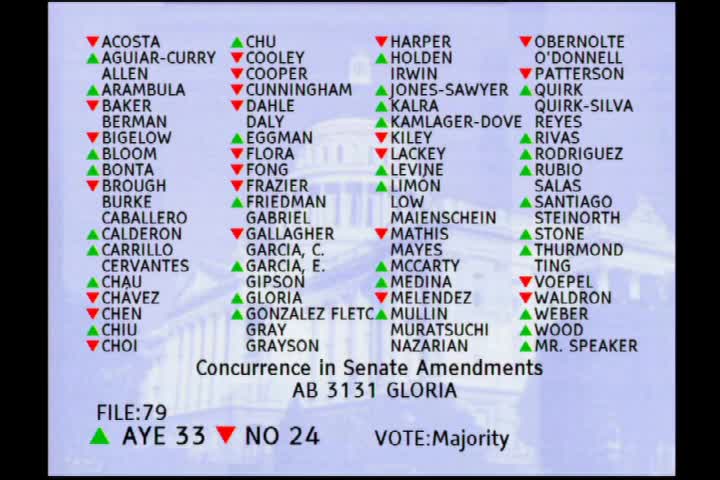 49SEC
Assembly Floor
 1MIN
Senate Floor
 3MIN
Senate Standing Committee on Judiciary
 1MIN
Assembly Floor
 2MIN
Assembly Standing Committee on Appropriations
 5MIN
Assembly Standing Committee on Judiciary
Bill Author



