AB 3112: Controlled substances: butane.
- Session Year: 2017-2018
- House: Assembly
- Latest Version Date: 2018-09-20
Existing law prohibits or restricts the sale of certain consumer goods, including items that contain certain chemicals, within the state for public health or safety reasons. Violations of these provisions are subject to criminal or civil penalties, as specified.
This bill would make it unlawful to sell to any customer any quantity of nonodorized butane. The bill would exempt from the prohibition certain consumer items such as lighters and small containers of nonodorized butane used to refill these items. The bill would authorize a civil penalty to be assessed for the violation of these provisions. The bill would authorize specified local and state officials to bring a civil action to enforce these provisions.
This bill would become operative on July 1, 2019.
Existing law prohibits or restricts the sale of certain consumer goods, including items that contain certain chemicals, within the state for public health or safety reasons. Violations of these provisions are subject to criminal or civil penalties, as specified.
This bill would make it unlawful to sell to any customer any quantity of nonodorized butane. The bill would exempt from the prohibition certain consumer items such as lighters and small containers of nonodorized butane used to refill these items. The bill would authorize a civil penalty to be assessed for the violation of these provisions. The bill would authorize specified local and state officials to bring a civil action to enforce these provisions.
(a)Except as otherwise provided in subdivision (b), it is unlawful for a manufacturer, wholesaler, reseller, retailer, or other person or entity to sell to any customer any quantity of nonodorized butane.
(b)The limitations in subdivisions (a) shall not apply to any of the following transactions:
(1)Butane sold to manufacturers, wholesalers, resellers, or retailers solely for the purpose of resale.
(2)Butane sold to a person for use in a lawful commercial enterprise, including, but not limited to, a volatile solvent extraction activity licensed under Division 10 (commencing with Section 26000) of the Business and Professions Code or a medical cannabis collective or cooperative described in subdivision (b) of Section 11362.775 of this code, operating in compliance with all applicable state licensing requirements and local regulations governing that type of business.
(3)The sale of pocket lighters, utility lighters, grill lighters, torch lighters, butane gas appliances, refill canisters, gas cartridges, or other products that contain or use nonodorized butane and contain less than 150 milliliters of butane.
(4)The sale of any product in which butane is used as an aerosol propellant.
(c)(1)Any person or business that violates subdivision (a) is subject to a civil penalty of two thousand five hundred dollars ($2,500).
(2)The Attorney General, a city attorney, a county counsel, or a district attorney may bring a civil action to enforce this section.
(3)The civil penalty shall be deposited into the General Fund if the action is brought by the Attorney General. If the action is brought by a city attorney, the civil penalty shall be paid to the treasurer of the city in which the judgment is entered. If the action is brought by a county counsel or district attorney, the civil penalty shall be paid to the treasurer of the county in which the judgment is entered.
(d)As used in this section, the following definitions shall apply:
(1)Customer means any person or entity other than those described in paragraphs (1) and (2) of subdivision (b) that purchases or acquires nonodorized butane from a seller during a transaction.
(2)Nonodorized butane means iso-butane, n-butane, butane, or a mixture of butane and propane of any power that may also use the words refined, pure, purified, premium, or filtered, to describe the butane or butane mixture, which does not contain ethyl mercaptan or a similar odorant.
(3)Sell or sale means to furnish, give away, exchange, transfer, deliver, surrender, distribute, or supply, in exchange for money or any other consideration.
(4)Seller means any person, business entity, or employee thereof that sells nonodorized butane to any customer within this state.
(e)This section shall become operative on July 1, 2019.
(a)Except as otherwise provided in subdivision (b), it is unlawful for a manufacturer, wholesaler, reseller, retailer, or other person or entity to sell to any customer any quantity of nonodorized butane.
(b)The limitations in subdivisions (a) shall not apply to any of the following transactions:
(1)Butane sold to manufacturers, wholesalers, resellers, or retailers solely for the purpose of resale.
(2)Butane sold to a person for use in a lawful commercial enterprise, including, but not limited to, a volatile solvent extraction activity licensed under Division 10 (commencing with Section 26000) of the Business and Professions Code or a medical cannabis collective or cooperative described in subdivision (b) of Section 11362.775 of this code, operating in compliance with all applicable state licensing requirements and local regulations governing that type of business.
(3)The sale of pocket lighters, utility lighters, grill lighters, torch lighters, butane gas appliances, refill canisters, gas cartridges, or other products that contain or use nonodorized butane and contain less than 150 milliliters of butane.
(4)The sale of any product in which butane is used as an aerosol propellant.
(c)(1)Any person or business that violates subdivision (a) is subject to a civil penalty of two thousand five hundred dollars ($2,500).
(2)The Attorney General, a city attorney, a county counsel, or a district attorney may bring a civil action to enforce this section.
(3)The civil penalty shall be deposited into the General Fund if the action is brought by the Attorney General. If the action is brought by a city attorney, the civil penalty shall be paid to the treasurer of the city in which the judgment is entered. If the action is brought by a county counsel, counsel or district attorney, the civil penalty shall be paid to the treasurer of the county in which the judgment is entered.
(d)As used in this section, the following definitions shall apply:
(1)Customer means any person or entity other than those described in paragraphs (1) and (2) of subdivision (b) that purchases or acquires nonodorized butane from a seller during a transaction.
(2)Nonodorized butane means iso-butane, n-butane, butane, or a mixture of butane and propane of any power that may also use the words refined, pure, purified, premium, or filtered, to describe the butane or butane mixture, which does not contain ethyl mercaptan or a similar odorant.
(3)Sell or sale means to furnish, give away, exchange, transfer, deliver, surrender, distribute, or supply, in exchange for money or any other consideration.
(4)Seller means any person, business entity, or employee thereof that sells nonodorized butane to any customer within this state.
(e)This section shall become operative on July 1, 2019.
(a)Except as otherwise provided in subdivision (b), it is unlawful for a manufacturer, wholesaler, reseller, retailer, or other person or entity to sell to any customer any quantity of nonodorized butane.
(b)The limitations in subdivisions (a) shall not apply to any of the following transactions:
(1)Butane sold to manufacturers, wholesalers, resellers, or retailers solely for the purpose of resale.
(2)Butane sold to a person for use in a lawful commercial enterprise, including, but not limited to, a volatile solvent extraction activity licensed under Division 10 (commencing with Section 26000) of the Business and Professions Code or a medical cannabis collective or cooperative described in subdivision (b) of Section 11362.775 of this code, operating in compliance with all applicable state licensing requirements and local regulations governing that type of business.
(3)The sale of pocket lighters, utility lighters, grill lighters, torch lighters, butane gas appliances, refill canisters, gas cartridges, or other products that contain or use nonodorized butane and contain less than 150 milliliters of butane.
(4)The sale of any product in which butane is used as an aerosol propellant.
(c)(1)Any person or business that violates subdivision (a) or (b) is subject to a civil penalty of two thousand five hundred dollars ($2,500).
(2)The Attorney General, a city attorney, a county counsel, or a district attorney may bring a civil action to enforce this section.
(3)The civil penalty shall be deposited into the General Fund if the action is brought by the Attorney General. If the action is brought by a city attorney, the civil penalty shall be paid to the treasurer of the city in which the judgment is entered. If the action is brought by a county counsel, the civil penalty shall be paid to the treasurer of the county in which the judgment is entered.
(d)As used in this section, the following definitions shall apply:
(1)Customer means any person or entity other than those described in paragraphs (1) and (2) of subdivision (b) that purchases or acquires nonodorized butane from a seller during a transaction.
(2)Nonodorized butane means iso-butane, n-butane, butane, or a mixture of butane and propane of any power that may also use the words refined, pure, purified, premium, or filtered, to describe the butane or butane mixture, which does not contain ethyl mercaptan or a similar odorant.
(3)Sell or sale means to furnish, give away, exchange, transfer, deliver, surrender, distribute, or supply, in exchange for money or any other consideration.
(4)Seller means any person, business entity, or employee thereof that sells nonodorized butane to any customer within this state.
|
Date
|
Status
|
|---|---|
| Sep 20, 2018 | Chaptered by Secretary of State - Chapter 595, Statutes of 2018. |
| Sep 20, 2018 | Approved by the Governor. |
| Sep 7, 2018 | Enrolled and presented to the Governor at 2:30 p.m. |
| Aug 29, 2018 | Senate amendments concurred in. To Engrossing and Enrolling. |
| Aug 27, 2018 | In Assembly. Concurrence in Senate amendments pending. May be considered on or after August 29 pursuant to Assembly Rule 77. |
| Aug 27, 2018 | Read third time. Passed. Ordered to the Assembly. |
| Aug 20, 2018 | Read second time. Ordered to third reading. |
| Aug 17, 2018 | Read second time and amended. Ordered returned to second reading. |
| Aug 6, 2018 | In committee: Referred to APPR. suspense file. |
| Jul 3, 2018 | From committee chair, with author's amendments: Amend, and re-refer to committee. Read second time, amended, and re-referred to Com. on APPR. |
| Jun 20, 2018 | From committee: Do pass and re-refer to Com. on APPR. with recommendation: To Consent Calendar. (Ayes 7. Noes 0.) (June 19). Re-referred to Com. on APPR. |
| Jun 13, 2018 | From committee: Do pass and re-refer to Com. on JUD. with recommendation: To Consent Calendar. (Ayes 7. Noes 0.) (June 12). Re-referred to Com. on JUD. |
| May 17, 2018 | Referred to Coms. on PUB. S. and JUD. |
| May 3, 2018 | In Senate. Read first time. To Com. on RLS. for assignment. |
| May 3, 2018 | Read third time. Passed. Ordered to the Senate. |
| Apr 26, 2018 | Read second time. Ordered to Consent Calendar. |
| Apr 25, 2018 | From committee: Do pass. To Consent Calendar. (Ayes 17. Noes 0.) (April 25). |
| Apr 10, 2018 | From committee: Do pass and re-refer to Com. on APPR. with recommendation: To Consent Calendar. (Ayes 10. Noes 0.) (April 10). Re-referred to Com. on APPR. |
| Apr 4, 2018 | From committee: Do pass and re-refer to Com. on JUD. with recommendation: To Consent Calendar. (Ayes 7. Noes 0.) (April 3). Re-referred to Com. on JUD. |
| Mar 12, 2018 | Referred to Coms. on PUB. S. and JUD. |
| Feb 17, 2018 | From printer. May be heard in committee March 19. |
| Feb 16, 2018 | Read first time. To print. |
|
Date
|
Description
|
Location
|
Votes
|
|
|---|---|---|---|---|
| Aug 29, 2018 | AB 3112 GRAYSON Concurrence in Senate Amendments | Assembly Floor |
Passed |
|
| Aug 27, 2018 | Assembly 3rd Reading AB3112 Grayson By Skinner | Senate Floor |
Passed |
|
| Aug 16, 2018 | Do pass as amended | Senate Standing Committee on Appropriations |
Passed |
|
| Aug 6, 2018 | Placed on suspense file | Senate Standing Committee on Appropriations |
Passed |
|
| Jun 19, 2018 | Do pass, but first be re-referred to the Committee on [Appropriations] with the recommendation: To Consent Calendar | Senate Standing Committee on Judiciary |
Passed |
|
| Jun 12, 2018 | Do pass, but first be re-referred to the Committee on [Judiciary] with the recommendation: To Consent Calendar | Senate Standing Committee on Public Safety |
Passed |
|
| May 3, 2018 | AB 3112 GRAYSON Consent Calendar Second Day Regular Session | Assembly Floor |
Passed |
|
| Apr 25, 2018 | Do pass. To Consent Calendar. | Assembly Standing Committee on Appropriations |
Passed |
|
| Apr 10, 2018 | Do pass and be re-referred to the Committee on [Appropriations] with recommendation: To Consent Calendar | Assembly Standing Committee on Judiciary |
Passed |
|
| Apr 3, 2018 | Do pass and be re-referred to the Committee on [Judiciary] with recommendation: To Consent Calendar | Assembly Standing Committee on Public Safety |
Passed |
This list shows positions taken on this bill by organizations on the date displayed, which is linked to the original source.
Positions by individuals are not included.
|
Organization
|
Position
|
Date
|
|---|---|---|
| California Association Of Code Enforcement Officers | ** Support | Aug 20, 2018 |
| California Cannabis Industry Association | ** Support | Aug 20, 2018 |
| California College And University Police Chiefs Association | ** Support | Aug 20, 2018 |
| California Narcotics Officers Association | ** Support | Aug 20, 2018 |
| California Police Chiefs Association | ** Support | Aug 20, 2018 |
| California Professional Firefighters | ** Support | Aug 20, 2018 |
| California Retailers Association | ** Support | Aug 20, 2018 |
| Caliva | ** Support | Aug 20, 2018 |
| Lighter Association | ** Support | Aug 20, 2018 |
| Los Angeles County Professional Peace Officers Association | ** Support | Aug 20, 2018 |
| Rural County Representatives of California | ** Support | Aug 20, 2018 |
| The Lighter Association, Inc. | ** Support | Apr 6, 2018 |
CONCURRENCE IN SENATE AMENDMENTS
CSA1 Bill Id:AB 3112
Author:(Grayson)
As Amended Ver:August 17, 2018
Majority vote
ASSEMBLY: | 71-0 | (May 3, 2018) | SENATE: | 39-0 | (August 27, 2018) |
Original Committee Reference: PUB. S.
SUMMARY: Makes it unlawful for a manufacturer, wholesaler, reseller, or retailer, to sell non-odorized butane to a customer, but would exempt from the prohibition certain consumer items such as lighters and small containers of non-odorized butane used to refill these items. This bill would authorize a civil penalty to be assessed for the violations specified.
The Senate amendments:
- Make the provisions of this bill effective July 1, 2019.
- Clarify that fines from civil actions brought by a district attorney shall be paid to the treasurer of the county in which the judgment is entered.
- Make technical changes.
EXISTING LAW:
- Requires any manufacturer, wholesaler, retailer, or other person or entity in this state that sells to any person or entity in this state or any other state any quantity of sodium cyanide, potassium cyanide, cyclohexanone, bromobenzene, magnesium turnings, mercuric chloride, sodium metal, lead acetate, palladium black, hydrogen chloride gas, trichlorofluoromethane (fluorotrichloromethane), dichlorodifluoromethane, 1,1,2-trichloro-1,2,2-trifluoroethane (trichlorotrifluoroethane), sodium acetate, or acetic anhydride to do the following:
- In any face-to-face or will-call sale, the seller shall prepare a bill of sale which identifies the date of sale, cost of sale, method of payment, the specific items and quantities purchased and the proper purchaser identification information, all of which shall be entered onto the bill of sale;
- Requires the seller to retain the original bill of sale containing the purchaser identification information for five years, and present the bill of sale upon demand by any law enforcement officer; and
- Specifies that "proper purchaser identification" includes a valid driver's license or other official and valid state-issued identification of the purchaser that contains a photograph of the purchaser, and includes the address of the purchaser, the motor vehicle license number of the motor vehicle used by the purchaser at the time of purchase, a description of how the substance is to be used, and other specified information.
- Specifies that notwithstanding any other law, in all sales other than face-to-face or will-call sales the seller shall maintain for a period of five years the following sales information: the name and address of the purchaser, date of sale, product description, cost of product, method of payment, method of delivery, delivery address, and valid identifying information. Requires the seller, upon the request of any law enforcement officer or any authorized representative of the Attorney General, produce a report or record of sale containing the information in a readily presentable manner.
- Requires, if a common carrier is used, the seller maintain a manifest regarding the delivery in for a period of five years.
- Requires any manufacturer, wholesaler, retailer, or other person or entity in this state that purchases any item listed in Health and Safety Code Section 11107.1(a) shall do the following:
- Provide on the record of purchase information on the source of the items purchased, the date of purchase, a description of the specific items, the quantities of each item purchased, and the cost of the items purchased; and
- Retain the record of purchase for three years in a readily presentable manner and present the record of purchase upon demand to any law enforcement officer or authorized representative of the Attorney General.
- Specifies that a first violation for failing to record and maintain the required information is a misdemeanor.
- States that a person who has previously been convicted of such a violation shall, upon a subsequent conviction thereof, be punished by imprisonment in a county jail not exceeding one year, by a fine not exceeding $100,000, or both the fine and imprisonment.
- States that except as otherwise provided by law, every person who manufactures, produces, or prepares, either directly or indirectly by chemical extraction or independently by means of chemical synthesis, any controlled substance as specified, including marijuana, shall be punished by imprisonment pursuant to realignment for three, five, or seven years and by a fine not exceeding $50,000.
- States that the fact that a person under 16 years of age resided in a structure in which a violation of this section involving methamphetamine occurred shall be considered a factor in aggravation by the sentencing court.
- Specifies that any person who has under his or her management or control any building, room, space, or enclosure, who knowingly rents, leases, or makes available for use, the building, room, space, or enclosure for the purpose of unlawfully manufacturing, storing, or distributing any controlled substance for sale or distribution shall be punished by imprisonment in the county jail for not more than one year, or up to three years in the county jail pursuant to realignment.
- States that subject to certain qualifications, it shall be lawful under state and local law, and shall not be a violation of state or local law, for persons 21 years of age or older to possess, process, transport, purchase, obtain, or give away to persons 21 years of age or older without any compensation whatsoever, not more than eight grams of marijuana in the form of concentrated cannabis, including as contained in marijuana products.
- Provides that it is crime to manufacture concentrated cannabis using a volatile solvent punishable by imprisonment for three, five, or seven years, unless done in accordance with a specified license.
AS PASSED BY THE ASSEMBLY, this bill:
- Specified that it is unlawful for a manufacturer, wholesaler, reseller, retailer, or other person or entity to sell to any customer any quantity of non-odorized butane, except as otherwise provided in this bill.
- Stated that the prohibition on the sale of non-odorized butane shall not apply to any of the following transactions:
- Butane sold to manufacturers, wholesalers, resellers, or retailers solely for the purpose of resale;
- Butane sold to a person for use in a lawful commercial enterprise, including, but not limited to, a volatile solvent extraction activity licensed as specified, or a medical cannabis collective or cooperative, operating in compliance with all applicable state licensing requirements and local regulations governing that type of business;
- The sale of pocket lighters, utility lighters, grill lighters, torch lighters, butane gas appliances, refill canisters, gas cartridges, or other products that contain or use non-odorized butane and contain less than 150 milliliters of butane; and,
- The sale of any product in which butane is used as an aerosol propellant.
- Provided that any person or business that violates the provisions of this bill is subject to a civil penalty of $2,500.
- Stated that the Attorney General, a city attorney, a county counsel, or a district attorney may bring a civil action to enforce this section.
- Specified where the civil penalty shall be deposited, depending on which organization brings the civil action.
- Defined the following terms for purposes of this bill:
- ''Customer'' means ''any person or entity other than those exempted from this bill, that purchases or acquires non-odorized butane from a seller during a transaction'';
- ''Non-odorized butane'' means ''iso-butane, n-butane, butane, or a mixture of butane and propane of any power that may also use the words "refined," "pure," "purified," "premium," or "filtered," to describe the butane or butane mixture, which does not contain ethyl mercaptan or a similar odorant'';
- ''Sell'' or ''sale'' means "to furnish, give away, exchange, transfer, deliver, surrender, distribute, or supply, in exchange for money or any other consideration"; and,
- ''Seller'' means ''any person, business entity, or employee thereof that sells non-odorized butane to any customer within this state.''
FISCAL EFFECT: According to the Senate Appropriations Committee:
- Unknown, potentially-significant workload cost pressures to the court to adjudicate actions filed for selling nonodorized butane that otherwise would not have been filed absent the ability to seek civil penalties provided by this bill. While the superior courts are not funded on a workload basis, an increase in workload could result in delayed court services and would put pressure on the General Fund to fund additional staff and resources. For example, the 2018 Budget Act appropriated $64 million from the General Fund to backfill continued reduction in fine and penalty revenue for trial court operations. (General Fund*)
- Minor and absorbable costs to the Department of Justice.
*Trial Court Trust Fund
COMMENTS: According to the author, "Last year, this committee heard AB 1120 by our colleague Assemblyman Cooper. That bill required an odorant to butane canisters over 150 milliliters and also required that retailers provide recordkeeping of all butane sales and the creation of a statewide data tracking system for butane sales. Governor Brown’s veto included his concern over the costs associated with the data tracking system and that the bill needs to be more narrowly tailored. This legislation addresses these concerns by removing the state wide data tracking system and the retailer’s record keeping requirement. However, my bill continues to require the biggest deterrent to the illegal use of butane, the adding of an odorant to butane canisters over 150 milliliters. The addition of an odorant will be a disincentive to people who want to use butane canisters for criminal activity of making marijuana honey oil. Finally, this legislation continues the protections that were contained in AB 1120 by providing exemptions for business to business sale and the use of butane already contained in consumer products like lighters, utility lighters, and camping appliances, among other products."
Analysis Prepared by: David Billingsley / PUB. S. / (916) 319-3744 FN: 0004494
Office of Senate Floor Analyses (916) 651-1520 Fax: (916) 327-4478 | AB 3112 |
THIRD READING
Bill No: AB 3112
Amended: 8/17/18 in Senate
SENATE PUBLIC SAFETY COMMITTEE: 7-0, 6/12/18
AYES: Skinner, Anderson, Bradford, Jackson, Mitchell, Stone, Wiener
SENATE JUDICIARY COMMITTEE: 7-0, 6/19/18
AYES: Jackson, Moorlach, Anderson, Hertzberg, Monning, Stern, Wieckowski
SENATE APPROPRIATIONS COMMITTEE: 7-0, 8/16/18
AYES: Portantino, Bates, Beall, Bradford, Hill, Nielsen, Wiener
ASSEMBLY FLOOR: 71-0, 5/3/18 (Consent) - See last page for vote
SUBJECT: Controlled substances: butane
DIGEST:
This bill makes it unlawful for a manufacturer, wholesaler, reseller, or retailer to sell non-odorized butane to a customer, except as specified, and authorizes a civil penalty to be assessed for the violations specified.
Existing federal law:
- Provides very detailed restrictions and requirements for the retail sale of ephedrine, pseudoephedrine, norpseudoephedrine or phenylpropanolamine. These restrictions include, in part, restrictions on the amount of that may be purchased per transaction, restrictions on the amount of that may be purchased in a 30-day period, record keeping requirements for the seller, and identification requirements for the purchaser.
- Provides penalties for violations of the purchase limits, distribution limits, and recording requirements. (21 U.S.C. §§ 830(e), 841(c), & 844(a).)
Existing state law:
- Requires any person or entity that sells, transfers, or otherwise furnishes specified substances, including pseudoephedrine, to a person or entity to submit a report to the Department of Justice (DOJ) for each transaction. Requires the report to include the identification information about the purchaser. (Health & Saf. Code, § 11100, subd. (a).)
- Requires any person or entity that sells or transfers one of specified substances, including pseudoephedrine, to any person or business entity to obtain the purchaser’s proper identification, as specified, and a letter of authorization from the purchaser which includes the purchaser’s business license number or Drug Enforcement Agency (DEA) registration number, the address of the business, and a full description of how the substance is to be used. Requires the information toi be retained “in a readily available manner” for three years. (Health & Saf. Code, § 11100, subd. (c)(1)(A).)
- Requires any manufacturer, wholesaler, retailer, or other person or entity that sells, transfers, or otherwise furnishes specified substances to a person or business entity to, not less than 21 days prior to delivery of the substance, submit a report of the transaction, which includes the specified identification information, to DOJ. (Health & Saf. Code, § 11100, subd. (d)(1).)
- Provides that any person required to submit a report to DOJ who fails to submit a report or who knowingly submits a report with false or fictitious information shall be punished by imprisonment in a county jail not exceeding six months, by a fine not exceeding $5,000, or by both the fine and imprisonment. A subsequent violation is punishable by a prison term of 16 months, two years or three years, or by a county jail term of up to one year, a fine of up to $100,000, or both such fine and imprisonment. (Health & Saf. Code, § 11100, subd. (f).)
- Provides that it is unlawful for any manufacturer, wholesaler, retailer, or other person to sell, transfer, or otherwise furnish specified substances to a person under 18 years of age. Existing law further provides that it is unlawful for any person under 18 years of age to possess any of those specified substances. (Health & Saf. Code, § 11100, subds. (g)(1) & (g)(2).)
- Provides that it is unlawful for a retailer to sell in a single transaction more than three packages, or nine grams, of a product that he or she knows to contain ephedrine, pseudoephedrine, norpseudoephedrine, or phenylpropanolamine. This offense is a misdemeanor, punishable by a county jail term of up to six months, a fine of up to $1,000, or both. (Health & Saf. Code, § 11100, subd. (g)(3).)
- Requires DOJ to provide a common reporting form for specified substances subject to a reporting requirement and specifies the information that must be included in the form. (Health & Saf. Code, § 11101.)
- Provides that any manufacturer, wholesaler, retailer, or other person or entity that sells, transfers, or otherwise furnishes specified substances with knowledge or the intent that the recipient will use the substance to unlawfully manufacture a controlled substance is guilty of a felony. (Health & Saf. Code, § 11104, subd. (a).)
- Provides that any manufacturer, wholesaler, retailer, or other person or entity that sells, transfers, or otherwise furnishes any laboratory glassware or apparatus, any chemical reagent or solvent, or any combination thereof, or specified chemical substances, with knowledge that the recipient will use the goods or chemical substance to unlawfully manufacture a controlled substance, is guilty of a misdemeanor. (Health & Saf. Code, § 11104, subd. (b).)
- Requires any manufacturer, wholesaler, retailer, or other person or entity that sells to any person or entity any laboratory glassware or apparatus, any chemical reagents or solvents, or any combination thereof, where the value of the goods exceeds $100, to prepare a bill of sale with specified information. The bill of sale is required to be retained for five years, as specified. The bill of sale must be presented to law enforcement or any authorized representative of the Attorney General upon request. A violation of these provisions is a misdemeanor. (Health & Saf. Code, § 11107.)
- Requires any manufacturer, wholesaler, retailer, or other person or entity in this state that sells to any person or entity any quantity specified substances to prepare a bill of sale and to include specified information. Requires the seller to retain the bill of sale for five years and to present the bill of sale upon demand by any law enforcement officer. (Health & Saf. Code, § 11107.1, subd. (a)(1)(A) & (a)(1)(C).)
- Requires any manufacturer, wholesaler, retailer, or other person or entity that purchases specified chemical substances to retain the record of purchase for three years and to include specified information in the record. (Health & Saf. Code, § 11107.1, subds. (b)(1) & (b)(2).)
- Provides, subject to other provisions of law, that it is lawful under state and local law for persons 21 years of age or older to possess, process, transport, purchase, obtain, or give away to persons 21 years of age or older without any compensation whatsoever, not more than eight grams of marijuana in the form of concentrated cannabis, including as contained in marijuana products. (Health & Saf. Code, § 11362.1, subd. (a)(1).)
- Provides that it is unlawful to manufacture concentrated cannabis using a volatile solvent unless done in accordance with a specified license. Provides this conduct is punishable by imprisonment for three, five, or seven years. (Health & Saf. Code, §§ 11362.3, subd. (a)(6) & 11362.4, subd. (d).)
This bill:
- Provides that in it is unlawful for a manufacturer, wholesaler, reseller, retailer, or other person or entity to sell to any customer any quantity of nonodorized butane, except as otherwise provided.
- Provides that the prohibition on the sale of butane does not apply to any of the following transactions:
- Butane sold to manufacturers, wholesalers, resellers, or retailers solely for the purpose of resale.
- Butane sold to a person for use in a lawful commercial enterprise, including, but not limited to, a volatile solvent extraction activity licensed as specified, or a medical cannabis collective or cooperative, operating in compliance with all applicable state licensing requirements and local regulations governing that type of business.
- The sale of pocket lighters, utility lighters, grill lighters, torch lighters, butane gas appliances, refill canisters, gas cartridges, or other products that contain or use nonodorized butane and contain less than 150 milliliters of butane.
- The sale of any product in which butane is used as an aerosol propellant.
- Provides that any person or business that violates the prohibition on the sale of butane is subject to a civil penalty of $2,500.
- Provides that the Attorney General, a city attorney, a county counsel, or a district attorney may bring a civil action to enforce this bill.
- Provides that the civil penalty be deposited into the General Fund if the action is brought by the Attorney General, to the treasurer of the city in which the judgment is entered if the action is brought by a city attorney, or to the treasurer of the county in which the judgment is entered if the action is brought by a county counsel or district attorney.
- Defines customer as any person or entity that purchases or acquires nonodorized butane from a seller during a transaction, except as specified.
- Defines nonodorized butane as iso-butane, n-butane, butane, or a mixture of butane and propane of any power that may also use the words “refined,” “pure,” “purified,” “premium,” or “filtered,” to describe the butane or butane mixture, which does not contain ethyl mercaptan or a similar odorant.
- Defines sell or sale as to furnish, give away, exchange, transfer, deliver, surrender, distribute, or supply, in exchange for money or any other consideration.
- Defines seller as any person, business entity, or employee thereof that sells nonodorized butane to any customer within this state.
- Provides that the provisions of this bill will become operative on July 1, 2019.
Background
Butane is a hydrocarbon and a highly flammable, colorless, odorless, easily liquefied gas. It is commonly used as fuel for cigarette lighters and portable stoves, a propellant in aerosols, a heating fuel, a refrigerant, and in the manufacture of a wide range of products. When blended with propane and other hydrocarbons, it may be referred to commercially as liquefied petroleum gas (LPG).
Uses of Butane in Cannabis-Related Operations
Butane honey oil (BHO) is the end product of the process of using butane to extract THC and other cannabinoids from marijuana leaves and flowers. The process typically involves placing raw plant material into a tube, usually glass, stainless steel or PVC. The tube is open at one end and has some type of filter at the other. A solvent, typically liquid butane, is then shot through the top of the tube and quickly dissolves the cannabinoids in marijuana. A solution of cannabinoids, waxes, and oil dissolved in butane comes out of the other end. The butane is then removed from the butane/cannabis wax solution via evaporation. The remaining BHO has a texture that varies from glass-like to oily. The substance, usually golden amber, hardens into a thin layer that can be broken into pieces smaller than a pea, heated and consumed using a specially designed bong. Post extraction treatments include washing with alcohol, whipping, and other steps to remove the butane smell, remove the plant waxes, and alter the appearance. (See <https://www.theweedblog.com/what-is-marijuana-butane-hash-oil-bho-and-is-it-safe/ ; <http://www.oregonlive.com/marijuana/index.ssf/2014/05/butane_hash_oil_glossary_of_te.html [as of Jun. 4, 2018].) A Web site providing instructions on how to manufacture BHO recommends using 10 ounces of butane per one ounce of marijuana. (<http://www.ilovegrowingmarijuana.com/making-marijuana-bho-safely/ [as of Jul. 4, 2017].)
Butane can also be used to power carbon dioxide generators that help indoor marijuana plants grow, and some growers rely on tanks of butane gas or propane to avoid using large amounts of metered gas that could draw attention to the utility company. (<http://www.latimes.com/nation/nationnow/la-na-pot-labs-20161001-snap-story.html [as of Jun. 4, 2018].)
Incidents of Marijuana Lab Explosions
There have been a number of marijuana lab explosions across the country in recent years. (<http://www.latimes.com/nation/nationnow/la-na-pot-labs-20161001-snap-story.html [as of Jun. 4, 2018].) These explosions have caused injuries, deaths, and serious damage to homes, apartments, motels, and other structures. (<http://abc7.com/news/man-severely-burned-in-drug-lab-explosion-in-pasadena/1831735/ ; <http://www.foxla.com/news/local-news/215288932-story ; <http://www.ocregister.com/2017/06/08/this-marijuana-regulation-could-prevent-explosions/ ; <http://www.theunion.com/news/local-news/man-burned-in-suspected-butane-honey-oil-lab-explosion-sent-to-hospital-authorities-say/# [as of Jun. 4, 2018].) Following a BHO lab explosion in April 2017, a detective with the L.A. IMPACT drug task force reported that “a third of the labs we go to of this type have already blown up.” (<http://ktla.com/2017/06/18/2-suspects-injured-during-marijuana-honey-oil-lab-explosion-in-south-el-monte/ [as of Jun. 4, 2018].)
FISCAL EFFECT: Appropriation: No Fiscal Com.: Yes Local: No
According to the Senate Appropriations Committee:
- Unknown, potentially-significant workload cost pressures to the court to adjudicate actions filed for selling nonodorized butane that otherwise would not have been filed absent the ability to seek civil penalties provided by this bill. While the superior courts are not funded on a workload basis, an increase in workload could result in delayed court services and would put pressure on the General Fund to fund additional staff and resources. For example, the 2018 Budget Act appropriated $64 million from the General Fund to backfill continued reduction in fine and penalty revenue for trial court operations. (General Fund*)
- Minor and absorbable costs to DOJ.
*Trial Court Trust Fund
Lighter Association (source)
California Association of Code Enforcement Officers
California Cannabis Industry Association
California College and University Police Chiefs Association
California Narcotics Officers Association
California Police Chiefs Association
California Professional Firefighters
California Retailers Association
CMG/Caliva
Los Angeles County Professional Peace Officers Association
Rural County Representatives of California
OPPOSITION: (Verified 8/16/18)
None received
ASSEMBLY FLOOR: 71-0, 5/3/18
AYES: Acosta, Aguiar-Curry, Arambula, Baker, Berman, Bigelow, Bloom, Bonta, Brough, Burke, Calderon, Carrillo, Cervantes, Chau, Chávez, Chen, Chiu, Chu, Cooley, Cooper, Cunningham, Dahle, Daly, Eggman, Flora, Fong, Frazier, Friedman, Gallagher, Eduardo Garcia, Gipson, Gloria, Gonzalez Fletcher, Gray, Harper, Holden, Irwin, Jones-Sawyer, Kalra, Kamlager-Dove, Kiley, Lackey, Levine, Limón, Low, Maienschein, Mathis, Mayes, McCarty, Medina, Melendez, Mullin, Muratsuchi, Nazarian, Obernolte, O'Donnell, Patterson, Quirk, Reyes, Rodriguez, Rubio, Salas, Santiago, Steinorth, Mark Stone, Thurmond, Ting, Waldron, Weber, Wood, Rendon
NO VOTE RECORDED: Travis Allen, Caballero, Choi, Cristina Garcia, Grayson, Quirk-Silva, Voepel
Prepared by: Stephanie Jordan / PUB. S. /
8/20/18 16:25:18
**** END ****
SENATE COMMITTEE ON APPROPRIATIONS
Senator Anthony Portantino, Chair
2017 - 2018 Regular Session
AB 3112 (Grayson) - Controlled substances: butane
Version: July 3, 2018 | Policy Vote: PUB. S. 7 - 0, JUD. 7 - 0 |
Urgency: No | Mandate: No |
Hearing Date: August 16, 2018 | Consultant: Shaun Naidu |
Bill Summary:
AB 3112 would make unlawful the sale of nonordorized butane, except as specified.
*********** ANALYSIS ADDENDUM – SUSPENSE FILE ***********
The following information is revised to reflect amendments
adopted by the committee on August 16, 2018
Fiscal Impact:
- Unknown, potentially-significant workload cost pressures to the court to adjudicate actions filed for selling nonodorized butane that otherwise would not have been filed absent the ability to seek civil penalties provided by this bill. While the superior courts are not funded on a workload basis, an increase in workload could result in delayed court services and would put pressure on the General Fund to fund additional staff and resources. For example, the 2018 Budget Act appropriated $64 million from the General Fund to backfill continued reduction in fine and penalty revenue for trial court operations. (General Fund*)
- Minor and absorbable costs to the Department of Justice.
*Trial Court Trust Fund
Author Amendments:
Specify where penalties recovered by district attorneys are deposited.
-- END --
SENATE COMMITTEE ON
Senator Anthony Portantino, Chair
2017 - 2018 Regular Session
AB 3112 (Grayson) - Controlled substances: butane
Version: | Policy Vote: |
Urgency: | Mandate: |
Hearing Date: | Consultant: |
This bill meets the criteria for referral to the Suspense File.
Bill Summary:
AB 3112 would make unlawful the sale of nonordorized butane, except as specified.
Fiscal Impact:
- Unknown, potentially-significant workload cost pressures to the court to adjudicate actions filed for selling nonodorized butane that otherwise would not have been filed absent the ability to seek civil penalties provided by this bill. While the superior courts are not funded on a workload basis, an increase in workload could result in delayed court services and would put pressure on the General Fund to fund additional staff and resources. For example, the 2018 Budget Act appropriated $64 million from the General Fund to backfill continued reduction in fine and penalty revenue for trial court operations. (General Fund*)
- Minor and absorbable costs to the Department of Justice.
*Trial Court Trust Fund
Background:
Butane is a highly-flammable, colorless, odorless, easily-liquefied gas. It is used commonly as fuel for cigarette lighters and portable stoves, a propellant in aerosols, a heating fuel, a refrigerant, and in the manufacture of a wide range of products. Illicitly, it also is used to make butane honey oil, a waxy concentrated marijuana extract. Butane is used because, unlike other liquids, it is non-detectable by sight or smell.
Proposed Law:
This bill would:
- Make it unlawful to sell to any customer any quantity of nonodorized butane, except as follows:
- To manufacturers, wholesalers, resellers, or retailers solely for the purpose of resale.
- To a person for use in a lawful commercial enterprise, including, but not limited to, a licensed volatile solvent extraction activity or a medical cannabis collective or cooperative, as described, operating in compliance with all applicable state licensing requirements and local regulations governing that type of business.
- The sale of pocket lighters, utility lighters, grill lighters, torch lighters, butane gas appliances, refill canisters, gas cartridges, or other products that contain or use nonodorized butane and contain less than 150 milliliters of butane.
- The sale of any product in which butane is used as an aerosol propellant.
- Provide for a civil penalty of $2,500 for a violation of the ban on selling. The Attorney General, a city attorney, a county counsel, or a district attorney would be allowed to file the civil action.
- Provide that the civil penalty be deposited into the General Fund if the action was brought by the Attorney General, paid to the city treasurer if the action was brought by a city attorney, and paid to the county treasurer if the action was brought by a county counsel.
- Define specified terms.
Prior Legislation:
AB 1120 (Cooper, 2017) would have, among other things, directed the Department of Justice to develop and maintain, contingent on the availability of funding, an electronic database to track the amount of butane purchased by individual customers. AB 1120 was vetoed by the governor because he believed that the “bill [took] a very expensive approach that may not ultimately solve the problem. … [and that] any additional legislation aimed at curbing illegal butane use should be more narrowly tailored, and not place a uniform limit on an industry that has many other legitimate uses.”
Staff Comments:
The fiscal impact of this bill to the court cannot be known with certainty, as the actual impact will be dependent on numerous factors, including, but not limited to, the frequency with which a person is accused of unlawfully selling nonodorized butane, the complexity of alleged violations, if parties settle matters prior to litigation, and the factors unique to each case. It costs the court a little over $2,600, on average, in personnel and resources to adjudicate a limited civil case, which likely would be the type of case an action filed pursuant to the act would be. It costs about $7,010 to operate a courtroom for one day. So if the civil action created by this bill led to more than nineteen new cases, or a few complex case that took longer than seven days that otherwise would not have been brought, the cost pressures of this bill to the court would surpass the Suspense File threshold.
Recommended Amendments:
This bill would allow the Attorney General, a city attorney, a county counsel, or a district attorney to bring a civil action for the unlawful selling of nonodorized butane. It also would specify where civil penalties recovered by the Attorney General, a city attorney, or a county counsel would be directed. It does not, however, indicate where penalties recovered by a district attorney would be deposited. One could assume that it would be deposited with the county treasurer, as is the case with a county counsel who recovers a penalty. The author may wish to specify where civil penalties should be deposited if recovered by a district attorney to avoid any potential confusion and to bring uniformity to the measure.
-- END --
Senator Hannah-Beth Jackson, Chair
2017-2018 Regular Session
Bill No: AB 3112 (Author:Grayson)
Version: February 16, 2018
Hearing Date: June 19, 2018
Fiscal: Yes
Urgency: No
Consultant: MEC
SUBJECT
Controlled substances: butane
DESCRIPTION
In an effort to deter the sale of a dangerous substance, this bill would generally prohibit the sale of nonodorized butane and subject a violator to a $2,500 civil penalty through a civil enforcement action brought by the Attorney General, city attorney, county counsel, or district attorney.
BACKGROUND
Butane is used for a variety of legitimate purposes. For example, Butane is used in lighters and portable camping stoves. An increasingly common and extremely hazardous use of butane is in the creation of butane honey oil (BHO). BHO is created through the use of butane to separate oil from marijuana. Butane canisters are pressurized, contain highly flammable gas, and pose an explosive threat when they are subject to high heat. According to the California Professional Firefighters, State Council of the International Association of Fire Fighters (CPF), there have been reports of burn injuries and deaths due to butane use in honey oil production. As explained by the CPF:
Initial BHO lab explosions can lead to secondary explosions and fires and, in states with legalized use and availability of marijuana, such as California, these incidents appear to be increasing. Secondary hazards associated with such explosions include exposing firefighters to toxic carcinogens at high levels due to the materials involved. The off gassing and smoke venting from a BHO lab explosion is highly toxic. Every time firefighters enter a structure fire, they are confronted with a haze of toxins and compounds released by smoldering products. When burned, butane and other combustible materials used in the extraction of honey oil can contribute to the already high rates of certain cancer among firefighters.
This bill balances the need to ensure legitimate and safe uses of butane continue with the need to curtail the dangerous use of butane. The bill would make it unlawful to sell nonodorized butane, except for legitimate purposes such as pocket lighters and gas appliances and other products that contain less than 150 milliliters of butane. Under the provisions of the bill a person or business that violates the prohibition would be subject to a civil penalty of $2500. The Attorney General, a city attorney, a county counsel, or a district attorney could bring the civil enforcement action.
This bill passed out of the Senate Committee on Public Safety with a unanimous vote.
CHANGES TO EXISTING LAW
Existing law requires any manufacturer, wholesaler, retailer, or other person or entity in this state that sells to any person or entity in this state or any other state any quantity of sodium cyanide, potassium cyanide, cyclohexanone, bromobenzene, magnesium turnings, mercuric chloride, sodium metal, lead acetate, palladium black, hydrogen chloride gas, trichlorofluoromethane (fluorotrichloromethane), dichlorodifluoromethane, 1,1,2-trichloro-1,2,2-trifluoroethane (trichlorotrifluoroethane), sodium acetate, or acetic anhydride to do the following:
- in any face-to-face or will-call sale, requires the seller to prepare a bill of sale which identifies the date of sale, cost of sale, method of payment, the specific items and quantities purchased, and the proper purchaser identification information, all of which shall be entered onto the bill of sale;
- requires the seller to retain the original bill of sale containing the purchaser identification information for five years, and present the bill of sale upon demand by any law enforcement officer; and
- specifies that “proper purchaser identification” includes a valid driver’s license or other official and valid state-issued identification of the purchaser that contains a photograph of the purchaser, and includes the address of the purchaser, the motor vehicle license number of the motor vehicle used by the purchaser at the time of purchase, a description of how the substance is to be used, and other specified information. (Health & Saf. Code Sec. 11107.1.)
Existing law provides that any person or entity that sells or transfers one of a list of specified chemical precursors to methamphetamine, including pseudoephedrine, must obtain the purchaser’s proper identification, as specified, and a letter of authorization from the purchaser which includes the purchaser’s business license number or United States Drug Enforcement Agency registration, the address of the business and a description of how the chemical is to be used. The information must be retained “in a readily available manner” for three years. (Health & Saf. Code Sec. 11100.)
Existing law provides that it is unlawful for a retailer to sell in a single transaction more than three packages, or nine grams, of a product that he or she knows to contain ephedrine, pseudoephedrine, norpseudoephedrine, or phenylpropanolamine. This offense is a misdemeanor, punishable by a county jail term of up to six months, a fine of up to $1,000, or both. (Health & Saf. Code Sec. 11100.)
Existing law requires recording and tracking of transactions involving laboratory glassware, apparatus and chemical reagents where the value of the material exceeds $100. The purchaser must present valid identification. The bill of sale must be retained for three years, as specified. The document must be presented to law enforcement upon request. A violation of these provisions is a misdemeanor punishable by imprisonment in a county jail not exceeding 6 months, by a fine not exceeding $1,000, or both. (Health & Saf. Sec. 11107.)
Existing law provides that, except as otherwise provided by law, every person who manufactures, produces, or prepares, either directly or indirectly by chemical extraction or independently by means of chemical synthesis, any controlled substance as specified, including marijuana, shall be punished by imprisonment pursuant to realignment for three, five, or seven years and by a fine not exceeding $50,000. (Health & Saf. Code Sec. 11379.6.)
Existing law specifies that any person who has under his or her management or control any building, room, space, or enclosure, who knowingly rents, leases, or makes available for use, the building, room, space, or enclosure for the purpose of unlawfully manufacturing, storing, or distributing any controlled substance for sale or distribution shall be punished by imprisonment in the county jail for not more than one year, or up to three years in the county jail pursuant to realignment. (Health & Saf. Code Sec. 11366.5.)
Existing law provides that it is a crime to manufacture concentrated cannabis using a volatile solvent punishable by imprisonment for three, five, or seven years, unless done in accordance with a specified license. (Health & Saf. Code Sec. 11362.3 and 11362.4.)
Existing law provides that a collective or cooperative that manufactures medical cannabis products may produce cannabis products using processes that are solventless, employ only nonflammable and nontoxic solvents, or use flammable solvents in an entirely closed loop system. (Health & Saf. Code Sec. 11362.775.)
This bill would provide that it is unlawful for a manufacturer, wholesaler, reseller, retailer, or other person or entity to sell to any customer any quantity of nonodorized butane, except as specified.
This bill would provide that the prohibition against selling nonodorized butane shall not apply to any of the following transactions:
- butane sold to manufacturers, wholesalers, resellers, or retailers solely for the purpose of resale;
- butane sold to a person for use in a lawful commercial enterprise, including, but not limited to, a volatile solvent extraction activity licensed under Division 10 (commencing with Section 26000) of the Business and Professions Code or a medical cannabis collective or cooperative described in subdivision (b) of Section 11362.775 of this code, operating in compliance with all applicable state licensing requirements and local regulations governing that type of business;
- the sale of pocket lighters, utility lighters, grill lighters, torch lighters, butane gas appliances, refill canisters, gas cartridges, or other products that contain or use nonodorized butane and contain less than 150 milliliters of butane; or
- the sale of any product in which butane is used as an aerosol propellant.
This bill would provide that a person or business that violates the prohibition is subject to a civil penalty of $2,500.
This bill would provide that the Attorney General, a city attorney, a county counsel, or a district attorney may bring a civil enforcement action.
This bill would provide that the civil penalty shall be deposited into the General Fund if the action is brought by the Attorney General.
This bill would provide that if the action is brought by a city attorney, the civil penalty shall be paid to the treasurer of the city in which the judgment is entered.
This bill would provide that if the action is brought by a county counsel, the civil penalty shall be paid to the treasurer of the county in which the judgment is entered.
This bill would define the following terms for purposes of the provisions of the bill:
- “Customer” means any person or entity that purchases or acquires nonodorized butane from a seller during a transaction, as specified;
- “Nonodorized butane” means iso-butane, n-butane, butane, or a mixture of butane and propane of any power that may also use the words “refined,” “pure,” “purified,” “premium,” or “filtered,” to describe the butane or butane mixture, which does not contain ethyl mercaptan or a similar odorant;
- “Sell” or “sale” means to furnish, give away, exchange, transfer, deliver, surrender, distribute, or supply, in exchange for money or any other consideration;
- “Seller” means any person, business entity, or employee thereof that sells nonodorized butane to any customer within this state.
COMMENT
1. Stated need for the bill
According to the author:
Governor Brown’s veto [of AB 1120 by Assemblymember Cooper] included his concern over the costs associated with the data tracking system and that the bill needs to be more narrowly tailored. This legislation addresses these concerns by removing the state wide data tracking system and the retailer’s record keeping requirement. However, my bill continues to require the biggest deterrent to the illegal use of butane, the adding of an odorant to butane canisters over 150 milliliters. The addition of an odorant will be a disincentive to people who want to use butane canisters for criminal activity of making marijuana honey oil. Finally, this legislation continues the protections that were contained in AB 1120 by providing exemptions for business to business sale and the use of butane already contained in consumer products like lighters, utility lighters, and camping appliances, among other products.
2. Curbing the unregulated creation of honey oil
As explained by the California Professional Firefighters, in support of the bill:
Butane honey oil (BHO) or “honey oil,” is a cannabis product produced by filling a cylindrical glass or stainless steel canister with marijuana and then flooding the canister with a solvent – usually butane. The butane strips the plant matter of its cannabinoid-containing oils, resulting in a mixture of psychotropic plant oil and chemicals that must then be purified in order to remove traces of the butane. Butane is necessary for the production of BHO. It can be purchased over-the-counter in 8-ounce cans and while the extraction process typically uses on whole can, it’s likely that dozens or even hundreds of cans of butane are on site where BHO is being produced, thereby significantly increasing fire and life safety risks.
According to the author, the following highlight the need for AB 3112:
- December, 2016, two Los Angeles-area men are critically injured after a portion of their home suspected of being used as a honey oil lab explodes.
- May 2015, a Nevada City, CA man is thought to have caused an explosion in his home’s kitchen, which injured his baby and fiancée. Investigators suspect that honey oil production caused the blast.
- April 2015, a 33-year-old Redding, CA man dies after honey oil production caused an explosion inside a detached garage adjacent to the main residence. The man was one of five who suffered burn injuries as a result of the explosion, which almost completely destroyed the garage.
- January 2013, three people suffer life-threatening burns after being injured in a San Diego, CA hotel room explosion where butane was ignited by a man in the room who lit a cigarette.
Butane is chosen in honey oil production because it is odorless and ensures that the honey oil is not tainted with a taste from additives that are found in other gases, such as propane. Prohibiting the sale of odorless butane to those engaged in illicit honey oil production will arguably lead to less use of butane in honey oil production and less fires and accidents that impact those engaged in production, their families, neighbors, and the public servants charged with protecting them.
Support: California Association of Code Enforcement Officers; California Cannabis Industry Association; California College and University Police Chiefs Association; CMG/Caliva; California Narcotic Officers Association; California Professional Firefighters; California Retailers Association; Lighter Association; Los Angeles County Professional Peace Officers Association; Rural County Representatives of California
Opposition: None Known
HISTORY
Source: Lighter Association
Related Pending Legislation: None Known
Prior Legislation: AB 1120 (Cooper, 2017) This bill would direct the Department of Justice to develop and maintain, contingent on the availability of funding, an electronic database to track the amount of butane purchased by individual customers. This bill would allow the imposition of a civil penalty of $2,500, if a manufacturer, wholesaler, reseller, retailer, or other person or entity sells a quantity of nonodorized butane that would cause the customer to exceed 600 milliliters of nonodorized butane in any 30-day period, with specified exemptions. This bill would state that the prohibition on butane sales shall not be enforced until a database has been developed. This bill would require any seller of any quantity of nonodorized butane to record specified information about the purchaser and the sale, except as specified. The bill was vetoed by Governor Brown.
Prior Vote:
Senate Public Safety Committee (Ayes 7, Noes 0)
Assembly Floor (Ayes 71, Noes 0)
Assembly Appropriations Committee (Ayes 17, Noes 0)
Assembly Judiciary Committee (Ayes 10, Noes 0)
Assembly Public Safety Committee (Ayes 7, Noes 0)
**************
SENATE COMMITTEE ON PUBLIC SAFETY
Senator Nancy Skinner, Chair
2017 - 2018 Regular
Bill No: AB 3112 Hearing Date: June 12, 2018
Author: | Grayson | ||
Version: | February 16, 2018 | ||
Urgency: | No | Fiscal: | Yes |
Consultant: | SJ | ||
Subject: Controlled Substances: Butane
HISTORY
Source: Lighter Association
Prior Legislation: AB 1120 (Cooper), vetoed in 2017
AB 1244 (Voepel), not heard in Assembly privacy 2017-2018 legislative session
AB 772 (Baker), not heard in Assembly Public Safety 2015-2016 legislative session
AB 849 (Bonilla), vetoed 2015
SB 212 (Mendoza), Ch. 141, Stats. of 2015
SB 276 (Vasconcellos), Ch. 369, Stats. of 2003
Support: California Cannabis Industry Association; California Association of Code Enforcement Officers; California College and University Police Chiefs Association; California Narcotics Officers Association; California Police Chiefs Association; California Professional Firefighters; California Retailers Association; CMG/Caliva; Los Angeles County Professional Peace Officers Association; Rural County Representatives of California
Opposition: None known
Assembly Floor Vote: 71 - 0
PURPOSE
The purpose of this bill is to make it unlawful for a manufacturer, wholesaler, reseller, or retailer to sell non-odorized butane to a customer, except as specified, and to authorize a civil penalty to be assessed for the violations specified.
Existing law requires any person or entity that sells, transfers, or otherwise furnishes specified substances, including pseudoephedrine, to a person or entity to submit a report to the Department of Justice (DOJ) for each transaction. The report must include the identification information about the purchaser. (Health & Saf. Code, § 11100, subd. (a).)
Existing law requires any person or entity that sells or transfers one of specified substances, including pseudoephedrine, to any person or business entity to obtain the purchaser’s proper identification, as specified, and a letter of authorization from the purchaser which includes the purchaser’s business license number or Drug Enforcement Agency (DEA) registration number, the address of the business, and a full description of how the substance is to be used. The information must be retained “in a readily available manner” for three years. (Health & Saf. Code, § 11100, subd. (c)(1)(A).)
Existing law requires any manufacturer, wholesaler, retailer, or other person or entity that sells, transfers, or otherwise furnishes specified substances to a person or business entity to, not less than 21 days prior to delivery of the substance, submit a report of the transaction, which includes the specified identification information, to DOJ. (Health & Saf. Code, § 11100, subd. (d)(1).)
Existing law provides that any person required to submit a report to DOJ who fails to submit a report or who knowingly submits a report with false or fictitious information shall be punished by imprisonment in a county jail not exceeding six months, by a fine not exceeding $5,000, or by both the fine and imprisonment. A subsequent violation is punishable by a prison term of 16 months, two years or three years, or by a county jail term of up to one year, a fine of up to $100,000, or both such fine and imprisonment. (Health & Saf. Code, § 11100, subd. (f).)
Existing law provides that it is unlawful for any manufacturer, wholesaler, retailer, or other person to sell, transfer, or otherwise furnish specified substances to a person under 18 years of age. Existing law further provides that it is unlawful for any person under 18 years of age to possess any of those specified substances. (Health & Saf. Code, § 11100, subds. (g)(1) & (g)(2).)
Existing law provides that it is unlawful for a retailer to sell in a single transaction more than three packages, or nine grams, of a product that he or she knows to contain ephedrine, pseudoephedrine, norpseudoephedrine, or phenylpropanolamine. This offense is a misdemeanor, punishable by a county jail term of up to six months, a fine of up to $1,000, or both. (Health & Saf. Code, § 11100, subd. (g)(3).)
Existing law requires DOJ to provide a common reporting form for specified substances subject to a reporting requirement. The reporting form is required to include at least the following information:
- Name of the substance.
- Quantity of the substance sold, transferred, or furnished.
- The date the substance was sold, transferred, or furnished.
- The name and address of the person buying or receiving such substance.
- The name and address of the manufacturer, wholesaler, retailer, or other person selling, transferring, or furnishing such substance. (Health & Saf. Code, § 11101.)
Existing law provides that any manufacturer, wholesaler, retailer, or other person or entity that sells, transfers, or otherwise furnishes specified substances with knowledge or the intent that the recipient will use the substance to unlawfully manufacture a controlled substance is guilty of a felony. (Health & Saf. Code, § 11104, subd. (a).)
Existing law provides that any manufacturer, wholesaler, retailer, or other person or entity that sells, transfers, or otherwise furnishes any laboratory glassware or apparatus, any chemical reagent or solvent, or any combination thereof, or specified chemical substances, with knowledge that the recipient will use the goods or chemical substance to unlawfully manufacture a controlled substance, is guilty of a misdemeanor. (Health & Saf. Code, § 11104, subd. (b).)
Existing law requires any manufacturer, wholesaler, retailer, or other person or entity that sells to any person or entity any laboratory glassware or apparatus, any chemical reagents or solvents, or any combination thereof, where the value of the goods exceeds $100, to prepare a bill of sale with specified information, including the proper purchaser identification information. The bill of
sale is required to be retained for five years, as specified. The bill of sale must be presented to law enforcement or any authorized representative of the Attorney General upon request. A violation of these provisions is a misdemeanor. (Health & Saf. Code, § 11107.)
Existing law requires any manufacturer, wholesaler, retailer, or other person or entity in this state that sells to any person or entity any quantity of sodium cyanide, potassium cyanide, cyclohexanone, bromobenzene, magnesium turnings, mercuric chloride, sodium metal, lead acetate, palladium black, hydrogen chloride gas, trichlorofluoromethane (fluorotrichloromethane), dichlorodifluoromethane, 1,1,2-trichloro-1,2,2-trifluoroethane (trichlorotrifluoroethane), sodium acetate, or acetic anhydride to do the following:
- In any face-to-face or will-call sale, the seller is required to prepare a bill of sale which identifies the date of sale, cost of sale, method of payment, the specific items and quantities purchased and the proper purchaser identification information. The seller is required to sign the bill of sale. (Health & Saf. Code, § 11107.1, subd. (a)(1)(A).)
- Requires the seller to retain the original bill of sale containing the purchaser identification information for five years, and present the bill of sale upon demand by any law enforcement officer; and (Health & Saf. Code, § 11107.1, subd. (a)(1)(C).)
- Specifies that “proper purchaser identification” includes a valid driver’s license or other official and valid state-issued identification of the purchaser that contains a photograph of the purchaser, and includes the address of the purchaser, the motor vehicle license number of the motor vehicle used by the purchaser at the time of purchase, a description of how the substance is to be used, the signature of the purchaser, and other specified information. (Health & Saf. Code, § 11107.1, subd. (a)(1)(B).).
Existing law requires the seller to maintain the following sales information for all sales other than face-to-face or will-call sales: the name and address of the purchaser, date of sale, product description, cost of product, method of payment, method of delivery, delivery address, and valid identifying information. The seller is required to maintain this information for five years. (Health & Saf. Code, § 11107.1, subd. (a)(2)(A).)
Existing law specifies that “valid identifying information” includes two or more of the following: federal tax identification number; resale tax identification number; city or county business license number; license issued by the State Department of Public Health; registration number issued by the federal DEA; precursor business permit number issued by the Department of Justice; driver’s license; or other identification issued by a state. (Health & Saf. Code, § 11107.1, subd. (a)(2)(B).)
Existing law requires the seller, upon the request of any law enforcement officer or any authorized representative of the Attorney General, produce a report or record of sale containing the information in a readily presentable manner. (Health & Saf. Code, § 11107.1, subd. (a)(2)(C).)
Existing law requires, if a common carrier is used, the seller to maintain a manifest regarding the delivery in a readily presentable manner for five years. (Health & Saf. Code, § 11107.1, subd. (a)(2)(D).)
Existing law requires any manufacturer, wholesaler, retailer, or other person or entity that purchases specified chemical substances to do the following:
- Provide on the record of purchase information on the source of the items purchased, the date of purchase, a description of the specific items, the quantities of each item purchased, and the cost of the items purchased; and
- Retain the record of purchase for three years in a readily presentable manner and present the record of purchase upon demand to any law enforcement officer or authorized representative of the Attorney General. (Health & Saf. Code, § 11107.1, subds. (b)(1) & (b)(2).)
Existing law provides that a first violation for failing to record and maintain the required information is a misdemeanor. A subsequent conviction shall be punished by imprisonment in a county jail not exceeding one year, by a fine not exceeding $100,000, or both the fine and imprisonment. (Health & Saf. Code, § 11107.1, subds. (c)(1) & (c)(2).)
Existing law provides that every person who manufactures, compounds, converts, produces, derives, processes, or prepares, either directly or indirectly by chemical extraction or independently by means of chemical synthesis, specified controlled substance, including marijuana, shall be punished by imprisonment for three, five, or seven years and by a fine not exceeding $50,000. (Health & Saf. Code, § 11379.6, subd. (a).)
Existing law provides that the fact that a person under 16 years of age resided in a structure in which a violation of this section involving methamphetamine occurred shall be considered a factor in aggravation by the sentencing court. (Health & Saf. Code, § 11379.6, subd. (b).)
Existing law provides that the fact that a violation of this section involving methamphetamine occurred within 200 feet of an occupied residence or any structure where another person was present at the time the offense was committed may be considered a factor in aggravation by the sentencing court. (Health & Saf. Code, § 11379.6, subd. (c).)
Existing law specifies that any person who has under his or her management or control any building, room, space, or enclosure, who knowingly rents, leases, or makes available for use, the building, room, space, or enclosure for the purpose of unlawfully manufacturing, storing, or distributing any controlled substance for sale or distribution shall be punished by imprisonment in the county jail for not more than one year, or for imprisonment for 16 months, two years or three years in the county jail. (Health & Saf. Code, § 11366.5, subd. (a).)
Existing law provides, subject to other provisions of law, that it is lawful under state and local law for persons 21 years of age or older to possess, process, transport, purchase, obtain, or give away to persons 21 years of age or older without any compensation whatsoever, not more than eight grams of marijuana in the form of concentrated cannabis, including as contained in marijuana products. (Health & Saf. Code, § 11362.1, subd. (a)(1).)
Existing law provides that it is unlawful to manufacture concentrated cannabis using a volatile solvent unless done in accordance with a specified license. This is punishable by imprisonment for three, five, or seven years. (Health & Saf. Code, §§ 11362.3, subd. (a)(6) & 11362.4, subd. (d).)
Existing federal law provides very detailed restrictions and requirements for the retail sale of ephedrine, pseudoephedrine, norpseudoephedrine or phenylpropanolamine. These restrictions include, in part, restrictions on the amount of that may be purchased per transaction, restrictions on the amount of that may be purchased in a 30-day period, record keeping requirements for the seller, and identification requirements for the purchaser. Existing federal law provides penalties for violations of the purchase limits, distribution limits, and recording requirements. (21 U.S.C. §§ 830(e), 841(c), & 844(a).)
This bill provides that in it is unlawful for a manufacturer, wholesaler, reseller, retailer, or other person or entity to sell to any customer any quantity of nonodorized butane, except as otherwise provided.
This bill provides that the prohibition on the sale of butane does not apply to any of the following transactions:
- Butane sold to manufacturers, wholesalers, resellers, or retailers solely for the purpose of resale.
- Butane sold to a person for use in a lawful commercial enterprise, including, but not limited to, a volatile solvent extraction activity licensed as specified, or a medical cannabis collective or cooperative, operating in compliance with all applicable state licensing requirements and local regulations governing that type of business.
- The sale of pocket lighters, utility lighters, grill lighters, torch lighters, butane gas appliances, refill canisters, gas cartridges, or other products that contain or use nonodorized butane and contain less than 150 milliliters of butane.
- The sale of any product in which butane is used as an aerosol propellant.
This bill provides that any person or business that violates the prohibition on the sale of butane is subject to a civil penalty of $2,500.
This bill provides that the Attorney General, a city attorney, a county counsel, or a district attorney may bring a civil action to enforce this section.
This bill provides that the civil penalty be deposited into the General Fund if the action is brought by the Attorney General, to the treasurer of the city in which the judgment is entered if the action is brought by a city attorney, or to the treasurer of the county in which the judgment is entered if the action is brought by a county counsel.
This bill defines customer as any person or entity that purchases or acquires nonodorized butane from a seller during a transaction, except as specified.
This bill defines nonodorized butane as iso-butane, n-butane, butane, or a mixture of butane and propane of any power that may also use the words “refined,” “pure,” “purified,” “premium,” or “filtered,” to describe the butane or butane mixture, which does not contain ethyl mercaptan or a similar odorant.
This bill defines sell or sale as to furnish, give away, exchange, transfer, deliver, surrender, distribute, or supply, in exchange for money or any other consideration.
This bill defines seller as any person, business entity, or employee thereof that sells nonodorized butane to any customer within this state.
COMMENTS
- Need for This Bill
According to the author:
According to the U.S. Fire Administration, home-grown labs that use butane to separate and extract hash oil from marijuana are a dangerous and growing trend, particularly on the West Coast and in states where marijuana is legal or decriminalized. Fires and explosions in these illicit death traps blow out windows, eviscerate buildings and create a risk to life and limb comparable to (and in some cases exceeding) those created by methamphetamine labs. For example, in April 2015, the California Alliance of Drug-Endangered Children reported that 41 marijuana lab deaths had occurred in California between 2011 and April 2015. . . .
Additionally, BHO lab explosions can lead to secondary explosions and fires which put even more innocent lives at risk. Additionally, public safety personnel are exposed to high levels of toxic carcinogens. . . .
. . .
Last year, this committee heard AB 1120 by our colleague Assemblyman Cooper. That bill required an odorant to butane canisters over 150 milliliters and also required that retailers provide recordkeeping of all butane sales and the creation of a statewide data tracking system for butane sales. Governor Brown’s veto included his concern over the costs associated with the data tracking system and that the bill needs to be more narrowly tailored. This legislation addresses these concerns by removing the state wide data tracking system and the retailer’s record keeping requirement. However, this bill continues to require the biggest deterrent to the illegal use of butane, the adding of an odorant to butane canisters over 150 milliliters. The addition of an odorant will be a disincentive to people who want to use butane canisters for criminal activity of making marijuana honey oil. Finally, this legislation continues the protections that were contained in AB 1120 by providing exemptions for business to business sale and the use of butane already contained in consumer products like lighters, utility lighters, and camping appliances, among other products.
- Butane and Its Commercial Uses
Butane is a hydrocarbon and a highly flammable, colorless, odorless, easily liquefied gas. It is commonly used as fuel for cigarette lighters and portable stoves, a propellant in aerosols, a heating fuel, a refrigerant, and in the manufacture of a wide range of products. When blended with propane and other hydrocarbons, it may be referred to commercially as liquefied petroleum gas (LPG).
- Uses of Butane in Cannabis-Related Operations
Butane honey oil (BHO) is the end product of the process of using butane to extract THC and other cannabinoids from marijuana leaves and flowers. The process typically involves placing raw plant material into a tube, usually glass, stainless steel or PVC. The tube is open at one end and has some type of filter at the other. A solvent, typically liquid butane, is then shot through the top of the tube and quickly dissolves the cannabinoids in marijuana. A solution of cannabinoids, waxes, and oil dissolved in butane comes out of the other end. The butane is then
removed from the butane/cannabis wax solution via evaporation. The remaining BHO has a texture that varies from glass-like to oily. The substance, usually golden amber, hardens into a thin layer that can be broken into pieces smaller than a pea, heated and consumed using a specially designed bong. Post extraction treatments include washing with alcohol, whipping, and other steps to remove the butane smell, remove the plant waxes, and alter the appearance. (See <https://www.theweedblog.com/what-is-marijuana-butane-hash-oil-bho-and-is-it-safe/> ; <http://www.oregonlive.com/marijuana/index.ssf/2014/05/butane_hash_oil_glossary_of_te.html [as of Jun. 4, 2018].) A website providing instructions on how to manufacture BHO recommends using 10 ounces of butane per one ounce of marijuana. (<http://www.ilovegrowingmarijuana.com/making-marijuana-bho-safely/> [as of Jul. 4, 2017].)
Butane can also be used to power carbon dioxide generators that help indoor marijuana plants grow, and some growers rely on tanks of butane gas or propane to avoid using large amounts of metered gas that could draw attention to the utility company. (<http://www.latimes.com/nation/nationnow/la-na-pot-labs-20161001-snap-story.html> [as of Jun. 4, 2018].)
- Incidents of Marijuana Lab Explosions
There have been a number of marijuana lab explosions across the country in recent years. (<http://www.latimes.com/nation/nationnow/la-na-pot-labs-20161001-snap-story.html> [as of Jun. 4, 2018].) These explosions have caused injuries, deaths, and serious damage to homes, apartments, motels, and other structures. (<http://abc7.com/news/man-severely-burned-in-drug-lab-explosion-in-pasadena/1831735/>; <http://www.foxla.com/news/local-news/215288932-story>; <http://www.ocregister.com/2017/06/08/this-marijuana-regulation-could-prevent-explosions/>; <http://www.theunion.com/news/local-news/man-burned-in-suspected-butane-honey-oil-lab-explosion-sent-to-hospital-authorities-say/#> [as of Jun. 4, 2018].) Following a BHO lab explosion in April 2017, a detective with the L.A. IMPACT drug task force reported that “a third of the labs we go to of this type have already blown up.” (<http://ktla.com/2017/06/18/2-suspects-injured-during-marijuana-honey-oil-lab-explosion-in-south-el-monte/> [as of Jun. 4, 2018].)
- Concentrated Cannabis and Proposition 64
California voters approved Proposition 64, the Adult Use of Marijuana Act, in November 2016. After the passage of Proposition 64, it is now legal for an individual over 21 years of age to possess less than 4 grams of concentrated cannabis, which includes BHO. However, it is still illegal for individuals to manufacture BHO without a license. If manufacturing BHO without a license, an individual could be sentenced to three, five, or seven years of imprisonment upon conviction.
- What This Bill Does
This bill allows the sale of non-odorized butane for legal commercial activity for the following transactions:
- Butane sold to manufacturers, wholesalers, resellers, or retailers solely for the purpose of resale;
- Butane sold to a person for use in a lawful commercial enterprise, including, but not limited to, a volatile solvent extraction activity licensed as specified, or a medical cannabis collective or cooperative, operating in compliance with all applicable state licensing requirements and local regulations governing that type of business; and,
- The sale of pocket lighters, utility lighters, grill lighters, torch lighters, butane gas appliances, refill canisters, gas cartridges, or other products that contain or use non-odorized butane and contain less than 150 milliliters of butane; and
- The sale of any product in which butane is used as an aerosol propellant.
- Governor’s Veto of AB 1120
AB 1120 (Cooper) would have required a person or business to record specified information about the sale of non-odorized butane, including the identity of the customer, and to maintain that information for 2 years. AB 1120 would have required, subject to available funds, that the DOJ create a database of butane sales. After the database was operational, it would have made it unlawful to sell to any one customer more than 600 milliliters of non-odorized butane in a 30-day period or to sell any quantity of non-odorized butane to a customer that would cause the customer to exceed 600 milliliters of non-odorized butane purchased from all sellers in a 30-day period.
In his veto message, Governor Brown wrote:
“I empathize with the author’s intent to address the tragic explosions that can occur at illegal butane hash-oil production sites. Unfortunately, I believe this bill takes a very expansive approach that may not ultimately solve the problem. The Department of Public Health is currently working on regulations that will be finalized at the end of this year that move this type of production out of the shadows and into a safe and regulated environment. I believe any additional legislation aimed at curbing illegal butane use should be more narrowly tailored, and not place a uniform limit on an industry that has many other legitimate uses.”
- Argument in Support
According to the Lighter Association:
AB 3112, narrows the scope of AB 1120 (Cooper) of last year that was requested by Governor Brown in his veto message of that bill.
Specifically, AB 3112 will require the sale of butane refillable canisters of 150 milliliters to contain an odorant while providing exemptions for business to business ales and for consumer products that are already sold with internal butane fuel including, lighters, torchers, appliances, etc. In addition, the Governor’s veto message also raised the expensive nature of AB 1120. AB 3112 eliminates most of the costs associated with AB 1120 by removing the record keeping and reporting requirements for retail establishments and eliminating the establishment of a statewide data base for all butane sales. This change also addresses and resolves the concerns of collecting and personal information of consumers by the retailers.
AB 3112 will help reduce the illegal use of butane while still preserving the lawful sale for use in consumer products.
-- END --
Date of Hearing: April 25, 2018
ASSEMBLY COMMITTEE ON APPROPRIATIONS
Lorena Gonzalez Fletcher, Chair
ABPCA Bill Id:AB 3112
Author:(Grayson) – As Introduced Ver:February 16, 2018
Policy Committee: | Public Safety | Vote: | 7 - 0 |
Judiciary | 10 - 0 |
Urgency: No State Mandated Local Program: No Reimbursable: No
SUMMARY:
This bill prohibits the sale of most forms of nonodorized butane with the exception of some consumer items, including pocket lighters, and imposes a civil penalty on any entity that violates the prohibition. Specifically, this bill:
- Prohibits a manufacturer, wholesaler, reseller, retailer, or other person or entity from selling to any customer any quantity of nonodorized butane, except as specifically exempted.
- Permits the attorney general (AG), a city attorney, a county counsel, or a district attorney to bring a civil action to enforce the prohibition on the sale of butane and imposes a $2,500 civil penalty.
- Provides that all civil penalty revenue be deposited in the General Fund or with the treasurer of the city or county bringing the action to impose the penalty.
FISCAL EFFECT:
Negligible fiscal impact.
COMMENTS:
Background and purpose. This bill prohibits the sale of odorless butane, a substance that is highly unstable when improperly used. The most frequent illicit use of butane is the extraction of THC and other cannabinoids from marijuana leaves and flowers. When improperly performed, utilizing butane to make hash oil, commonly referred to as honey oil, results in the significant risk of an explosion. To eliminate the risk, the author introduced this bill and states in support:
Last year, [the Legislature] heard AB 1120 by Assemblyman Cooper. That bill required an odorant to butane canisters over 150 milliliters and also required that retailers provide recordkeeping of all butane sales and the creation of a statewide data tracking system for butane sales. Governor Brown’s veto included his concern over the costs associated with the data tracking system and that the bill needs to be more narrowly tailored. This legislation addresses these concerns by removing the statewide data tracking system and the retailer’s record keeping requirement.
Analysis Prepared by: Jessica Peters / APPR. / (916) 319-2081
Date of Hearing: April 10, 2018
ASSEMBLY COMMITTEE ON JUDICIARY
Mark Stone, Chair
ABPCA Bill Id:AB 3112
Author:(Grayson) – As Introduced Ver:February 16, 2018
PROPOSED CONSENT
SUBJECT: Controlled substances: butane
KEY ISSUE: SHOULD THE SALE OF MOST FORMS OF NONODORIZED BUTANE BE PROHIBITED IN ORDER TO PREVENT ITS USE IN ILLEGAL AND DANGEROUS BUTANE HASH OIL PRODUCTION?
SYNOPSIS
This non-controversial bill seeks to prohibit most large quantity sales of nonodorized butane in order to minimize the products use in illegal honey oil production, while permitting the continued sale of small quantities of butane in most consumer products. Honey oil is the result of using highly flammable butane to extract THC and other cannabinoids from cannabis buds in order to produce synthetic marijuana. While this practice is legal for certain commercial marijuana cooperatives using proper safety techniques, it is illegal for unlicensed and unregulated entities to create honey oil using butane. The homemade production of honey oil is illegal because when conducted improperly, the production of honey oil results in fugitive emissions of butane gas that can ignite, and cause a catastrophic explosion, when coming into contact with standard household appliances, including pilot lights on stoves and heaters.
This bill seeks to remedy the potential cost issues that resulted in its predecessor, AB 1120 (Cooper, 2016), to be vetoed by Governor Brown. By eliminating AB 1120’s costly data management and recordkeeping requirements, the author believes this bill achieves the goal of limiting the potential for butane to be used in illegal honey oil production while minimizing costs to the State and retailers. This bill is sponsored by the Lighter Association and is supported by retail organizations, several cannabis industry organizations, rural counties, and firefighters who note that the bill promotes public safety and strikes a balance in controlling the sales of large quantities of nonodorized butane while permitting consumer sales of small quantities of butane found in lighters, camping stoves, and cooking torches. This bill has no known opposition.
SUMMARY: Prohibits the sale of most forms of nonodorized butane with the exception of some consumer items, including pocket lighters, and imposes a civil penalty on any entity that violates the prohibition. Specifically, this bill:
- Prohibits a manufacturer, wholesaler, reseller, retailer, or other person or entity from selling to any customer any quantity of nonodorized butane, unless the butane sale qualifies for an exemption as provided in 2), below.
- Exempts the following transactions from the prohibition on the sale of nonodorized butane:
- Butane sold to manufacturers, wholesalers, resellers, or retailers solely for the purpose of resale;
- Butane sold for the use in a lawful commercial enterprise, including the extraction of volatile solvents and the production of medical marijuana;
- Butane associated with the sale of pocket lighters, utility lighters, grill lighters, torch lighters, butane gas appliances, refill canisters, gas cartridges, or other products that contain or use nonodorized butane and contain less than 150 milliliters of butane.
- Permits the Attorney General, a city attorney, a county counsel, or a district attorney to bring a civil action to enforce the prohibition on the sale of butane.
- Imposes a $2,500 civil penalty for any party determined to be in violation of the prohibition on the sale of butane.
- Provides that all civil penalty revenue be deposited in the General Fund or with the treasurer of the city or county bringing the action to impose the penalty.
- Defines the following terms for purposes of this bill:
- “Customer” means any person or entity, other than those exempted from this bill, that purchases or acquires nonodorized butane from a seller during a transaction;
- “Nonodorized butane” means iso-butane, n-butane, butane, or a mixture of butane and propane of any power that may also use the words “refined,” “pure,” “purified,” “premium,” or “filtered,” to describe the butane or butane mixture, which does not contain ethyl mercaptan or a similar odorant;
- “Sell” or “sale” means to furnish, give away, exchange, transfer, deliver, surrender, distribute, or supply, in exchange for money or any other consideration; and,
- “Seller” means any person, business entity, or employee thereof that sells nonodorized butane to any customer within this state.
EXISTING LAW:
- Requires any manufacturer, wholesaler, retailer, or other person or entity in this state that sells to any person or entity in this state or any other state any quantity of sodium cyanide, potassium cyanide, cyclohexanone, bromobenzene, magnesium turnings, mercuric chloride, sodium metal, lead acetate, palladium black, hydrogen chloride gas, trichlorofluoromethane (fluorotrichloromethane), dichlorodifluoromethane, 1,1,2-trichloro-1,2,2-trifluoroethane (trichlorotrifluoroethane), sodium acetate, or acetic anhydride to do the following:
- In any face-to-face or will-call sale, requires the seller to prepare a bill of sale which identifies the date of sale, cost of sale, method of payment, the specific items and quantities purchased and the proper purchaser identification information, all of which shall be entered onto the bill of sale;
- Requires the seller to retain the original bill of sale containing the purchaser identification information for five years, and present the bill of sale upon demand by any law enforcement officer; and
- Specifies that "proper purchaser identification" includes a valid driver's license or other official and valid state-issued identification of the purchaser that contains a photograph of the purchaser, and includes the address of the purchaser, the motor vehicle license number of the motor vehicle used by the purchaser at the time of purchase, a description of how the substance is to be used, and other specified information. (Health & Safety Code Section 11107.1. Unless otherwise noted all further references are to this code.)
- Provides that any person or entity that sells or transfers one of a list of specified chemical precursors to methamphetamine, including pseudoephedrine, must obtain the purchaser’s proper identification, as specified, and a letter of authorization from the purchaser which includes the purchaser’s business license number or United States Drug Enforcement Agency registration, the address of the business and a description of how the chemical is to be used. The information must be retained “in a readily available manner” for three years. (Section 11100.)
- Provides that it is unlawful for a retailer to sell in a single transaction more than three packages, or nine grams, of a product that he or she knows to contain ephedrine, pseudoephedrine, norpseudoephedrine, or phenylpropanolamine. This offense is a misdemeanor, punishable by a county jail term of up to six months, a fine of up to $1,000, or both. (Id.)
- Requires recording and tracking of transactions involving laboratory glassware, apparatus and chemical reagents where the value of the material exceeds $100. The purchaser must present valid identification. The bill of sale must be retained for three years, as specified. The document must be presented to law enforcement upon request. A violation of these provisions is a misdemeanor punishable by imprisonment in a county jail not exceeding 6 months, by a fine not exceeding $1,000, or both. (Section 11107.)
- States that, except as otherwise provided by law, every person who manufactures, produces, or prepares, either directly or indirectly by chemical extraction or independently by means of chemical synthesis, any controlled substance as specified, including marijuana, shall be punished by imprisonment pursuant to realignment for three, five, or seven years and by a fine not exceeding $50,000. (Section 11379.6.)
- Specifies that any person who has under his or her management or control any building, room, space, or enclosure, who knowingly rents, leases, or makes available for use, the building, room, space, or enclosure for the purpose of unlawfully manufacturing, storing, or distributing any controlled substance for sale or distribution shall be punished by imprisonment in the county jail for not more than one year, or up to three years in the county jail pursuant to realignment. (Section 11366.5.)
- Provides that it is a crime to manufacture concentrated cannabis using a volatile solvent punishable by imprisonment for three, five, or seven years, unless done in accordance with a specified license. (Sections 11362.3 and 11362.4.)
- Provides that a collective or cooperative that manufactures medical cannabis products may produce cannabis products using processes that are solventless, employ only nonflammable and nontoxic solvents, or use flammable solvents in an entirely closed loop system. (Section 11362.775.)
FISCAL EFFECT: As currently in print this bill is keyed fiscal.
COMMENTS: This bill seeks to prohibit sales of odorless butane, a substance that when improperly used in certain chemical extraction processes can be highly unstable. The most frequent illicit use of butane is the extraction of THC and other cannabinoids from marijuana leaves and flowers. When improperly performed, utilizing butane to make hash oil, commonly referred to as honey oil, results in the significant risk of an explosion. To eliminate the risk, the author introduced this bill and states in support:
Last year, this (the Legislature) heard AB 1120 by Assemblyman Cooper. That bill required an odorant to butane canisters over 150 milliliters and also required that retailers provide recordkeeping of all butane sales and the creation of a statewide data tracking system for butane sales. Governor Brown’s veto included his concern over the costs associated with the data tracking system and that the bill needs to be more narrowly tailored. This legislation addresses these concerns by removing the state wide data tracking system and the retailer’s record keeping requirement. However, my bill continues to require the biggest deterrent to the illegal use of butane, the adding of an odorant to butane canisters over 150 milliliters. The addition of an odorant will be a disincentive to people who want to use butane canisters for criminal activity of making marijuana honey oil. Finally, this legislation continues the protections that were contained in AB 1120 by providing exemptions for business to business sale and the use of butane already contained in consumer products like lighters, utility lighters, and camping appliances, among other products.
Honey Oil - It’s not always so sweet. Butane hash oil is the wax (or honey) like substance that is produced when butane is pushed through tubs, or other vessels, containing marijuana buds. The process produces a mixture of butane, cannabinoid particles, THC, and oils. This mixture is then heated in order to evaporate butane from the rest of the mixture. This process leaves the extracted cannabinoid material and THC behind which is then washed and processed to remove any remnants of the butane. When performed safely this process generates the THC necessary for a litany of legal marijuana products including vaporizers. Recognizing this use, the Legislature enacted AB 2679 (Cooley, Chap. 828, Stats. 2016), that provided a legal process for licensed marijuana businesses and research entitles to create honey oil in 2016. The law requires legal production to utilize closed loop systems to prevent butane gas from escaping into the processing facility. When performed within a closed system and applying other safety measure, the process poses minimal risk and can be performed safely in an industrial or research setting. However, when unlicensed individuals produce honey oil without proper safety precautions, fugitive emissions of butane gas can occur and potentially catastrophic explosions can result.
Mixing fire and oil, what could possibly go wrong? Butane is a highly flammable mixture of hydrocarbons that is separated from oil during the refining process. Butane is an unscented gas at room temperature but can be easily liquefied under pressure. When not exposed to significant temperatures, butane is relatively stable. These properties, in conjunction with its high flammability, make butane an ideal product for consumer products like lighters, camping stoves, and cooking torches.
The risk of honey oil production occurs when an ad hoc, improperly ventilated, open system exposes the fugitive butane gas emissions to high temperatures or potential ignition sources. If a closed system is not used, or if the butane is not properly vented, the gas can build up and ignite when exposed to a heat or ignition source. Given that many amateur honey oil producers utilize their home as a production venue, ventilation is typically poor and ignition sources are rampant. Household ignition sources include the butane heating device itself, common household flame sources like a stove’s pilot light, or static energy from an electrical outlet. If significant quantities of butane gas are present, the ignition can create a massive explosion. In a 2016 interview with the Riverside Press-Enterprise, a spokesman for the Department of Forestry and Fire Protection’s Riverside County unit noted that the vast majority of honey oil explosions can be traced to the ignition of butane. That same article noted that butane explosions can quickly produce third degree burns on any person in the vicinity of the explosion, including areas adjacent to the home from which the explosion originated. (Tadayon, Ali, “Marijuana ‘honey oil’ labs OK under new California law,” The Press-Enterprise, 16 Oct. 2016.)
Continued attempts to regulate honey oil labs. Although individuals have been creating homemade honey oil in ad hoc set-ups since the 1970’s, in the last decade a rise in illegal honey oil labs causing deadly explosions and fires in residential neighborhoods prompted the Legislature to regulate the practice. In 2015, the Legislature moved to strengthen the prohibition on chemical extractions of controlled substance when it enacted SB 212 (Mendoza, Chap. 141, Stats. 2015) which provided that extraction of controlled substances within 200 feet of an inhabited dwelling was an aggravating factor in criminal sentencing. Last year, to further reduce the risk of butane being used in illegal honey oil production, the Legislature passed AB 1120 (Cooper, 2016) that would have provided many of the same restrictions proposed by this bill, in addition to a robust sales monitoring and tracking system. That bill was vetoed by Governor Brown who noted that while he “empathize[d] with the author's intent to address the tragic explosions that can occur at illegal butane hash-oil production sites…this bill takes a very expensive approach that may not ultimately solve the problem.”
As noted by the author, this bill seeks to address the issues presented by Governor Brown’s veto message. This bill eliminates the costly data tracking and record retention requirements of AB 1120, while retaining the requirements that butane purchased in large quantities contain an odorant and that purchase size limitations be imposed. This approach is similar to approaches adopted by the State and federal government in regulating inputs for methamphetamine production. For example, the quantity restrictions on butane purchased for consumer use is similar to the restrictions placed on purchases of the popular allergy medicine pseudoephedrine, which limits purchases to quantities that cannot readily be converted into methamphetamine.
Unlike other statutes related to synthetic drug production, this bill imposes civil penalties. Unlike the criminal penalties associated with the prohibitions on the production of honey oil, and other synthetic controlled substance production, this bill imposes civil liability on the sellers of butane. This approach is generally appropriate. Unlike the criminal prohibitions on production, which are targeted at individual producers of illicit substances, this bill treats violations of the sales provisions like a regulatory infraction. This is generally in keeping with the State’s approach to regulating numerous day-to-day business sales practices.
Furthermore, this bill appropriately vests enforcement powers in the Attorney General and various city and county counsel offices. For non-criminal matters, the law is enforced by a regulatory entity or private citizens enforcing their rights as private attorneys general. This bill does not involve the vindication of important individual rights, and as noted above, is essentially a statutorily enacted regulation on business practices. Such practices are typically enforced by State or local regulators, and as such, the vesting civil enforcement power in the Attorney General and local government counsels is an appropriate means to enforce this bill.
ARGUMENTS IN SUPPORT: This bill is sponsored by the Lighter Association, a nationwide trade association of manufacturers and distributors of butane products, who would be regulated under the terms of this bill. In support of the measure, the Lighter Association argues that this bill reduces many of the costs associated with prior efforts to regulate butane sales and that:
This legislation will assist in protecting the general public and property, as well as our firefighters and law enforcement from potential fires and explosions that result from the illegal use of butane to produce butane honey oil.
Additionally, writing in support, the Rural County Representatives of California (RCRC) note that honey oil production disproportionately impacts rural areas of California and that this bill will reduce the quantity of potentially hazardous waste being disposed of in rural landfills. They note:
As the number of these illegal manufacturing [operations] grows, highly flammable butane canisters are also finding their way into local landfills and recycling facilities, which pose additional safety and environmental issues.
RCRC supports efforts that help rural counties address the proliferation of Honey Oil manufacturing, and we believe AB 3112 would help local law enforcement, firefighters, and medical personnel by restricting the illegal use of butane.
REGISTERED SUPPORT / OPPOSITION:
Support
The Lighter Association, Inc. (sponsor)
California Cannabis Industry Association
California Professional Firefighters
California Retailers Association
CMG/Caliva
Rural County Representatives of California
Opposition
None on file
Analysis Prepared by: Nicholas Liedtke / JUD. / (916) 319-2334
Date of Hearing: April 3, 2018
Counsel: David Billingsley
ASSEMBLY COMMITTEE ON
Reginald Byron Jones-Sawyer, Sr., Chair
ABPCA Bill Id:
Author:() – As Ver:
SUMMARY:
Makes it unlawful for a manufacturer, wholesaler, reseller, or retailer, to sell non-odorized butane to a customer, but would exempt from the prohibition certain consumer items such as lighters and small containers of non-odorized butane used to refill these items. This bill would authorize a civil penalty to be assessed for the violations specified. Specifically, this bill:
- Specifies that it is unlawful for a manufacturer, wholesaler, reseller, retailer, or other person or entity to sell to any customer any quantity of non-odorized butane, except as otherwise provided in this bill.
- States that the prohibition on the sale of non-odorized butane shall not apply to any of the following transactions:
- Butane sold to manufacturers, wholesalers, resellers, or retailers solely for the purpose of resale;
- Butane sold to a person for use in a lawful commercial enterprise, including, but not limited to, a volatile solvent extraction activity licensed as specified, or a medical cannabis collective or cooperative, operating in compliance with all applicable state licensing requirements and local regulations governing that type of business;
- The sale of pocket lighters, utility lighters, grill lighters, torch lighters, butane gas appliances, refill canisters, gas cartridges, or other products that contain or use non-odorized butane and contain less than 150 milliliters of butane; and,
- The sale of any product in which butane is used as an aerosol propellant.
- Butane sold to manufacturers, wholesalers, resellers, or retailers solely for the purpose of resale;
- Provides that any person or business that violates the provisions of this bill is subject to a civil penalty of $2,500.
- States that the Attorney General, a city attorney, a county counsel, or a district attorney may bring a civil action to enforce this section.
- Specifies where the civil penalty shall be deposited, depending on which organization brings the civil action.
- Defines the following terms for purposes of this bill:
- “Customer” means “any person or entity other than those exempted from this bill, that purchases or acquires non-odorized butane from a seller during a transaction”;
- “Non-odorized butane” means “iso-butane, n-butane, butane, or a mixture of butane and propane of any power that may also use the words “refined,” “pure,” “purified,” “premium,” or “filtered,” to describe the butane or butane mixture, which does not contain ethyl mercaptan or a similar odorant”;
- “Sell” or “sale” means “to furnish, give away, exchange, transfer, deliver, surrender, distribute, or supply, in exchange for money or any other consideration”; and,
- “Seller” means “any person, business entity, or employee thereof that sells non-odorized butane to any customer within this state.”
- “Customer” means “any person or entity other than those exempted from this bill, that purchases or acquires non-odorized butane from a seller during a transaction”;
EXISTING LAW:
- Requires any manufacturer, wholesaler, retailer, or other person or entity in this state that sells to any person or entity in this state or any other state any quantity of sodium cyanide, potassium cyanide, cyclohexanone, bromobenzene, magnesium turnings, mercuric chloride, sodium metal, lead acetate, palladium black, hydrogen chloride gas, trichlorofluoromethane (fluorotrichloromethane), dichlorodifluoromethane, 1,1,2-trichloro-1,2,2-trifluoroethane (trichlorotrifluoroethane), sodium acetate, or acetic anhydride to do the following:
- In any face-to-face or will-call sale, the seller shall prepare a bill of sale which identifies the date of sale, cost of sale, method of payment, the specific items and quantities purchased and the proper purchaser identification information, all of which shall be entered onto the bill of sale; (Health & Saf. Code, § 11107.1, subd. (a)(1)(A).)
- Requires the seller to retain the original bill of sale containing the purchaser identification information for five years, and present the bill of sale upon demand by any law enforcement officer; and (Health & Saf. Code, § 11107.1, subd. (a)(1)(C).)
- Specifies that "proper purchaser identification" includes a valid driver's license or other official and valid state-issued identification of the purchaser that contains a photograph of the purchaser, and includes the address of the purchaser, the motor vehicle license number of the motor vehicle used by the purchaser at the time of purchase, a description of how the substance is to be used, and other specified information. (Health & Saf. Code, § 11107.1, subd. (a)(1)(B).).
- In any face-to-face or will-call sale, the seller shall prepare a bill of sale which identifies the date of sale, cost of sale, method of payment, the specific items and quantities purchased and the proper purchaser identification information, all of which shall be entered onto the bill of sale; (Health & Saf. Code, § 11107.1, subd. (a)(1)(A).)
- Specifies that notwithstanding any other law, in all sales other than face-to-face or will-call sales the seller shall maintain for a period of five years the following sales information: the name and address of the purchaser, date of sale, product description, cost of product, method of payment, method of delivery, delivery address, and valid identifying information. (Health & Saf. Code, § 11107.1, subd. (a)(2)(A).)
- Requires the seller, upon the request of any law enforcement officer or any authorized representative of the Attorney General, produce a report or record of sale containing the information in a readily presentable manner. (Health & Saf. Code, § 11107.1, subd. (a)(1)(C).)
- Requires, if a common carrier is used, the seller maintain a manifest regarding the delivery in for a period of five years. (Health & Saf. Code, § 11107.1, subd. (a)(1)(D).)
- Requires any manufacturer, wholesaler, retailer, or other person or entity in this state that purchases any item listed in subdivision (a) of Section 11107.1 shall do the following:
- Provide on the record of purchase information on the source of the items purchased, the date of purchase, a description of the specific items, the quantities of each item purchased, and the cost of the items purchased; and (Health & Saf. Code, § 11107.1, subd. (b)(1).)
- Retain the record of purchase for three years in a readily presentable manner and present the record of purchase upon demand to any law enforcement officer or authorized representative of the Attorney General. (Health & Saf. Code, § 11107.1, subd. (b)(2).)
- Specifies that a first violation for failing to record and maintain the required information is a misdemeanor. (Health & Saf. Code, § 11107.1, subd. (c)(1).)
- States that a person who has previously been convicted of such a violation shall, upon a subsequent conviction thereof, be punished by imprisonment in a county jail not exceeding one year, by a fine not exceeding one hundred thousand dollars ($100,000), or both the fine and imprisonment. (Health & Saf. Code, § 11107.1, subd. (c)(2).)
- Provides that any person or entity that sells or transfers one of a list of specified chemical precursors, including pseudoephedrine, must obtain the purchaser’s proper identification, as specified, and a letter of authorization from the purchaser which includes the purchaser’s business license number or Drug Enforcement Agency (DEA) registration, the address of the business and a description of how the chemical is to be used. The information must be retained “in a readily available manner” for three years. (Health & Saf. Code, § 11100, subd. (c).)
- Requires any person or entity that sells, transfers, or otherwise furnishes a specified chemical precursor to another person or entity must submit a report to DOJ, generally within 21 days, of each transaction. The report must include the identification information about the purchaser. (Health & Saf. Code, § 11100, subd. (d).)
- Provides that violation of restricted chemical reporting requirements (for transferring or obtaining restricted chemicals) is a misdemeanor. A first-time violation is punishable by a county jail term of up to six months, a fine of up to $5,000, or both. A subsequent violation is an alternate felony-misdemeanor, punishable by a prison term of 16 months, two years or three years for a felony, a county jail term of up to one year, a fine of up to $100,000, or both such fine and imprisonment. (Health & Saf. Code, § 11100, subd. (f).)
- Requires specified recording and tracking of transactions involving laboratory glassware, apparatus and chemical reagents where the value of the material exceeds $100. The purchaser must present valid identification. The bill of sale must be retained for three years, as specified. The document must be presented to law enforcement upon request A violation of these provisions is a misdemeanor punishable by imprisonment in a county jail not exceeding 6 months, by a fine not exceeding $1,000, or both. (Health & Saf. Code, § 11107.)
- Provides that it is unlawful for a retailer to sell in a single transaction more than three packages, or nine grams, of a product that he or she knows to contain ephedrine, pseudoephedrine, norpseudoephedrine, or phenylpropanolamine. This offense is a misdemeanor, punishable by a county jail term of up to six months, a fine of up to $1,000, or both. (Health and Saf. Code, § 11100, subd. (g)(3).)
- States that except as otherwise provided by law, every person who manufactures, produces, or prepares, either directly or indirectly by chemical extraction or independently by means of chemical synthesis, any controlled substance as specified, including marijuana, shall be punished by imprisonment pursuant to realignment for three, five, or seven years and by a fine not exceeding fifty thousand dollars ($50,000). (Health & Saf. Code, § 11379.6, subd. (a).)
- States that the fact that a person under 16 years of age resided in a structure in which a violation of this section involving methamphetamine occurred shall be considered a factor in aggravation by the sentencing court. (Health & Saf. Code, § 11379.6, subd. (b).)
- Specifies that any person who has under his or her management or control any building, room, space, or enclosure, who knowingly rents, leases, or makes available for use, the building, room, space, or enclosure for the purpose of unlawfully manufacturing, storing, or distributing any controlled substance for sale or distribution shall be punished by imprisonment in the county jail for not more than one year, or up to three years in the county jail pursuant to realignment. (Health & Saf. Code, § 11366.5, subd. (a.)
- States that subject to certain qualifications, it shall be lawful under state and local law, and shall not be a violation of state or local law, for persons 21 years of age or older to possess, process, transport, purchase, obtain, or give away to persons 21 years of age or older without any compensation whatsoever, not more than eight grams of marijuana in the form of concentrated cannabis, including as contained in marijuana products. (Health and Saf. Code, § 11362.1, subd. (a)(1).)
- Provides that it is crime to manufacture concentrated cannabis using a volatile solvent punishable by imprisonment for three, five, or seven years, unless done in accordance with a specified license. (Health and Saf. Code, § 11362.3, subd. (a)(6) and § 11362.4, subd. (d))
FISCAL EFFECT:
Unknown
COMMENTS:
- Author's Statement: According to the author, "Last year, this committee heard AB 1120 by our colleague Assemblyman Cooper. That bill required an odorant to butane canisters over 150 milliliters and also required that retailers provide recordkeeping of all butane sales and the creation of a statewide data tracking system for butane sales. Governor Brown’s veto included his concern over the costs associated with the data tracking system and that the bill needs to be more narrowly tailored. This legislation addresses these concerns by removing the state wide data tracking system and the retailer’s record keeping requirement. However, my bill continues to require the biggest deterrent to the illegal use of butane, the adding of an odorant to butane canisters over 150 milliliters. The addition of an odorant will be a disincentive to people who want to use butane canisters for criminal activity of making marijuana honey oil. Finally, this legislation continues the protections that were contained in AB 1120 by providing exemptions for business to business sale and the use of butane already contained in consumer products like lighters, utility lighters, and camping appliances, among other products.”
- Commercial Uses of Butane: Butane is commonly used as a fuel. Butane is a gas at room temperature. Butane is colorless, flammable, and easily liquefied. Its common uses include lighter fluid, butane torches (crème brulee), and fuel for camping stoves. In camping sizes the fuel canisters are frequently 8 ounces (236 milliliters) in size.
- Butane Honey Oil or Butane Hash Oil: Butane honey oil (BHO) is a waxy concentrated cannabis extract made by pushing liquid butane (which liquefies easily) through a tube packed with marijuana. Butane is a chemical solvent made from petroleum and natural gas. Liquid butane quickly dissolves the cannabinoids in marijuana. A solution of cannabinoids, waxes, and oil dissolved in butane comes out the other end. The butane/cannabis wax solution is evaporated, and the remaining BHO has a texture that varies from glass-like to oily. Post extraction treatments include washing with alcohol, whipping, and other steps to remove the butane smell, remove the plant waxes, and alter the appearance. (www.medicalmarijuana.com/what-is-bho-and-is-it-safe/)
Butane honey oil is the end product of the process of using butane to extract THC and other cannabinoids from marijuana leaves and flowers. The process typically involves placing raw plant material into a tube, usually glass, stainless steel or PVC. The tube is open at one end and has some type of filter at the other. A solvent, typically butane, is then shot through the top of the tube and collected as it filters through the bottom. The result is a liquid that’s collected in a container. The butane is then removed from the mixture using heat and sometimes a vacuum pump or vacuum oven. The substance, usually golden amber, hardens into a thin layer that can be broken into pieces smaller than a pea, heated and consumed using a specially designed bong, a portable device called a hash pen or an e-cigarette that’s been outfitted for hash. (http://www.oregonlive.com/marijuana/index.ssf/2014/05/butane_hash_oil_glossary_of_te.html) Manufacturers of butane honey oil generally use non-odorized butane as a solvent in order to avoid a smell associated with odorized butane. - Dangers of Home Production of Butane Honey Oil: BHO production can result in explosions and fires because of the volatile nature of butane. Large quantities of butane, ranging from a few dozen to over a thousand pressurized 400-mL canisters have been found inside of BHO labs.
Butane is odorless, colorless, heavier than air, and it has a flammable range of 1.8–8.4 percent. Common ignition sources are open flame (cigarette lighters, pilot lights, gas stovetops, etc.) and electrical arcing. Butane can escape from a BHO lab, migrate low to the ground toward a distant ignition source, and flash back to the BHO lab. The associated flash fire and subsequent explosion can cause significant structural damage. Sheetrock can be lifted from ceilings, windows and doors can be blown out of their frames, and load-bearing walls can be blown off of foundations, resulting in structural collapse.
Exploding butane canisters can contribute to fire intensity, and crews fighting these fires report they are difficult to extinguish. There is also the potential for a boiling liquid expanding vapor explosion as these smaller canisters or larger cylinders are exposed to fire. (www.firehouse.com/safety-health/article/12318268/butane-hash-labsan-explosive-threat-firefighter-training)
- Concentrated Cannabis and Proposition 64: In November 2016, California voters approved Proposition 64. Proposition 64 provides, among other things, that individuals over 21 can possess less than one ounce of marijuana and less than 4 grams of concentrated cannabis. Butane Honey Oil is a form of concentrated cannabis. After the passage of Proposition 64, it is no longer illegal for an individual to possess less than 4 grams of butane honey oil. However, it is still illegal for individuals to manufacture butane honey oil. Under California law, producing concentrated cannabis is a form of drug “manufacturing.” Even after Proposition 64, it is a felony for an individual to manufacture concentrated cannabis, including butane honey oil. An individual convicted of manufacturing butane honey oil faces three, five, or seven years of imprisonment. Because Proposition 64 allows individuals to possess concentrated cannabis, it also provides an exception to the prohibition on manufacturing concentrated cannabis for manufacturers that are licensed by the state. Such manufacturers are able to produce concentrated cannabis in controlled environments to ensure that the production process is safe.
- AB 1120 (Cooper) and Governor’s Veto: AB 1120 (Cooper), would have required a person or business to record specified information about the sale of non-odorized butane, including the identity of the customer and to maintain that information for 2 years. AB 1120 would have required, subject to available funds, that the Department of Justice create a database of butane. After the database system described above was operational, it would have made it unlawful to sell to any one customer more than 600 milliliters of non-odorized butane in a 30-day period or to sell any quantity of non-odorized butane to a customer that would cause the customer to exceed 600 milliliters of non-odorized butane purchased from all sellers in a 30-day period.
Governor Brown vetoed AB 1120. Governor Brown’s veto message stated, “I empathize with the author’s intent to address the tragic explosions that can occur at illegal butane hash-oil production sites. Unfortunately, I believe this bill takes a very expansive approach that may not ultimately solve the problem. The Department of Public Health is currently working on regulations that will be finalized at the end of this year that move this type of production out of the shadows and into a safe and regulated environment. I believe any additional legislation aimed at curbing illegal butane use should be more narrowly tailored, and not place a uniform limit on an industry that has many other legitimate uses.”
- This Bill Allows the Sale of Non-Odorized Butane for Legal Commercial Activity for the following transactions:
- Butane sold to manufacturers, wholesalers, resellers, or retailers solely for the purpose of resale;
- Butane sold to a person for use in a lawful commercial enterprise, including, but not limited to, a volatile solvent extraction activity licensed as specified, or a medical cannabis collective or cooperative, operating in compliance with all applicable state licensing requirements and local regulations governing that type of business; and,
- The sale of pocket lighters, utility lighters, grill lighters, torch lighters, butane gas appliances, refill canisters, gas cartridges, or other products that contain or use non-odorized butane and contain less than 150 milliliters of butane; and
- The sale of any product in which butane is used as an aerosol propellant.
- Butane sold to manufacturers, wholesalers, resellers, or retailers solely for the purpose of resale;
- Argument in Support: According to the Lighter Association, “AB 3112, narrows the scope of AB 1120 (Cooper) of last year that was requested by Governor Brown in his veto message of that bill.
“Specifically, AB 3112 will require the sale of butane refillable canisters of 150 milliliters to contain an odorant while providing exemptions for business to business ales and for consumer products that are already sold with internal butane fuel including, lighters, torchers, appliances, etc. In addition, the Governor’s veto message also raised the expensive nature of AB 1120. AB 3112 eliminates most of the costs associated with AB 1120 by removing the record keeping and reporting requirements for retail establishments and eliminating the establishment of a statewide data base for all butane sales. This change also addresses and resolves the concerns of collecting and personal information of consumers by the retailers.
“AB 3112 will help reduce the illegal use of butane while still preserving the lawful sale for use in consumer products.” - Prior Legislation:
- AB 1120 (Cooper), would have required a person or entity that sells of nonodorized butane to a customer, to record specified information about the transaction, including the identity of the customer and to maintain that information for two years. AB 1120 was vetoed by the Governor.
- AB 1244 (Voepel), would have prohibited the sale of butane, unless odor was added. AB 1244 was never heard in the Assembly privacy and Consumer Protection Committee.
- AB 772 (Baker), of the 2015-2016 Legislative Session, would have added butane to the list of substances for which sellers are required to record the date of sale and purchaser’s information and retain that information for five years. AB 772 was never heard in the Assembly Public Safety Committee.
- AB 849 (Bonilla), of the 2015-2016 Legislative Session, would have provided that a person who recklessly causes an explosion is guilty of a felony punishable by imprisonment for two, four, or six years, if the explosion caused great bodily injury, or a misdemeanor punishable by imprisonment in a county jail for up to one year.
- SB 212 (Mendoza), Chapter 141, Statutes of 2015, authorized the sentencing court to consider the fact that a violation involving methamphetamine occurred within 200 feet of an occupied residence as a factor in aggravation, except when a specified enhancement is pled and proved. SB 212 specifically authorized the sentencing court to consider the fact that a violation of this section involving the use of a volatile solvent to chemically extract concentrated cannabis occurred within 300 feet of an occupied residence as a factor in aggravation.
- SB 276 (Vasconcellos), Chapter 369, Statutes of 2003, added red phosphorous to the list of chemical substances for which a report to the Department of Justice (DOJ) is required. Required that information regarding the letter of authorization and identification, as well as the manifest of any common carrier used, must be retained/maintained in a readily available manner for three years.
- AB 1120 (Cooper), would have required a person or entity that sells of nonodorized butane to a customer, to record specified information about the transaction, including the identity of the customer and to maintain that information for two years. AB 1120 was vetoed by the Governor.
REGISTERED SUPPORT / OPPOSITION:
Support
Lighter Association (Sponsor)
California Retailers Association
Rural County Representatives of California
Opposition
None
Analysis Prepared by:
Discussed in Hearing
 45SEC
Assembly Floor
1MIN
Assembly Floor
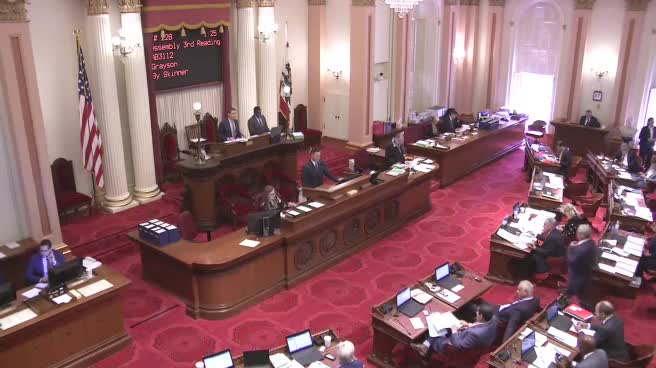 1MIN
Senate Floor
 1H
Senate Standing Committee on Appropriations
Bill Author

Bill Co-Author(s):