AB 3131: Law enforcement agencies: military equipment: funding, acquisition, and use.
- Session Year: 2017-2018
- House: Assembly
- Latest Version Date: 2018-09-04
Existing law designates the Department of General Services as the agency for the State of California responsible for distribution of federal surplus personal property, excepting food commodities, and requires the department to, among other things, do all things necessary to the execution of its powers and duties as the state agency for the distribution of federal personal surplus property, excepting food commodities, in accordance with specified federal law. Existing law, the Federal Surplus Property Acquisition Law of 1945, authorizes a local agency, as defined, to acquire surplus federal property without regard to any law which requires posting of notices or advertising for bids, inviting or receiving bids, or delivery of purchases before payment, or which prevents the local agency from bidding on federal surplus property. Existing federal law authorizes the Department of Defense to transfer surplus personal property, including arms and ammunition, to federal or state agencies for use in law enforcement activities, subject to specified conditions, at no cost to the acquiring agency.
This bill would require a law enforcement agency, defined to include specified state and local entities, to publish a military equipment use policy prior to taking certain actions relating to the funding, acquisition, or use of military equipment, as defined. The bill would also impose similar publishing requirements for the continued use of military equipment acquired prior to January 1, 2019. The bill would require that the governing body of a law enforcement agency consider a proposed military equipment use policy at a regular meeting held pursuant to specified open meeting laws. The bill would also require that a law enforcement agency prepare and make public an annual report for each piece of military equipment for as long as the military equipment is in use and to hold a community engagement meeting within 30 days of the public release of that report, as provided.
The bill would require the state agency that has signed a current memorandum of agreement with the federal Defense Logistics Agency for the purpose of administering a state program for acquiring surplus military equipment, pursuant to specified federal law, to develop by January 31, 2019, and annually update a list of military equipment, as specified, and post the list on its Internet Web site. The bill would also include findings that the changes proposed by this bill address a matter of statewide concern rather than a municipal affair and, therefore, apply to all cities, including charter cities.
By adding to the duties of local officials with respect to the funding, acquisition, and use of military equipment, this bill would impose a state-mandated local program.
The California Constitution requires the state to reimburse local agencies and school districts for certain costs mandated by the state. Statutory provisions establish procedures for making that reimbursement.
This bill would provide that, if the Commission on State Mandates determines that the bill contains costs mandated by the state, reimbursement for those costs shall be made pursuant to the statutory provisions noted above.
Existing law designates the Department of General Services as the agency for the State of California responsible for distribution of federal surplus personal property, excepting food commodities, and requires the department to, among other things, do all things necessary to the execution of its powers and duties as the state agency for the distribution of federal personal surplus property, excepting food commodities, in accordance with specified federal law. Existing law, the Federal Surplus Property Acquisition Law of 1945, authorizes a local agency, as defined, to acquire surplus federal property without regard to any law which requires posting of notices or advertising for bids, inviting or receiving bids, or delivery of purchases before payment, or which prevents the local agency from bidding on federal surplus property. Existing federal law authorizes the Department of Defense to transfer surplus personal property, including arms and ammunition, to federal or state agencies for use in law enforcement activities, subject to specified conditions, at no cost to the acquiring agency.
This bill would require a law enforcement agency, defined to include specified state and local entities, to obtain approval of the applicable governing body, by adoption of a military equipment use policy, as specified, by ordinance at a regular meeting held pursuant to specified open meeting laws, publish a military equipment use policy prior to taking certain actions relating to the funding, acquisition, or use of military equipment, as defined. The bill would also require similar approval impose similar publishing requirements for the continued use of military equipment acquired prior to January 1, 2019. The bill would allow the governing body to approve the funding, acquisition, or use of military equipment within its jurisdiction only if it determines that the military equipment meets specified standards. The bill would require the governing body to annually review the ordinance, and to either disapprove a renewal of the authorization for the type of military equipment authorized by the ordinance or amend the military equipment use policy if it determines, based on an annual military equipment report prepared by the law enforcement agency, as provided, that a piece of the military equipment of that type does not comply with the above-described standards for approval. The bill would require that the governing body of a law enforcement agency consider a proposed military equipment use policy at a regular meeting held pursuant to specified open meeting laws. The bill would also require that a law enforcement agency prepare and make public an annual report for each piece of military equipment for as long as the military equipment is in use and to hold a community engagement meeting within 30 days of the public release of that report, as provided.
The bill would require the state agency that has signed a current memorandum of agreement with the federal Defense Logistics Agency for the purpose of administering a state program for acquiring surplus military equipment, pursuant to specified federal law, to develop by January 31, 2019, and annually update a list of military equipment, as specified, and post the list on its Internet Web site. The bill would also include findings that the changes proposed by this bill address a matter of statewide concern rather than a municipal affair and, therefore, apply to all cities, including charter cities.
By adding to the duties of local officials with respect to the funding, acquisition, and use of military equipment, this bill would impose a state-mandated local program.
The California Constitution requires local agencies, for the purpose of ensuring public access to the meetings of public bodies and the writings of public officials and agencies, to comply with a statutory enactment that amends or enacts laws relating to public records or open meetings and contains findings demonstrating that the enactment furthers the constitutional requirements relating to this purpose.This bill would make legislative findings to that effect.The California Constitution requires the state to reimburse local agencies and school districts for certain costs mandated by the state. Statutory provisions establish procedures for making that reimbursement.This bill would provide that no reimbursement is required by this act for a specified reason.The California Constitution requires the state to reimburse local agencies and school districts for certain costs mandated by the state. Statutory provisions establish procedures for making that reimbursement.
This bill would provide that, if the Commission on State Mandates determines that the bill contains costs mandated by the state, reimbursement for those costs shall be made pursuant to the statutory provisions noted above.
Existing law designates the Department of General Services as the agency for the State of California responsible for distribution of federal surplus personal property, excepting food commodities, and requires the department to, among other things, do all things necessary to the execution of its powers and duties as the state agency for the distribution of federal personal surplus property, excepting food commodities, in accordance with specified federal law. Existing law, the Federal Surplus Property Acquisition Law of 1945, authorizes a local agency, as defined, to acquire surplus federal property without regard to any law which requires posting of notices or advertising for bids, inviting or receiving bids, or delivery of purchases before payment, or which prevents the local agency from bidding on federal surplus property. Existing federal law authorizes the Department of Defense to transfer surplus personal property, including arms and ammunition, to federal or state agencies for use in law enforcement activities, subject to specified conditions, at no cost to the acquiring agency.
This bill would require a law enforcement agency, defined to include specified state and local entities, to obtain approval of the applicable governing body, by adoption of a military equipment impact statement and a military equipment use policy, as specified, by ordinance at a regular meeting held pursuant to specified open meeting laws, prior to taking certain actions relating to the funding, acquisition, or use of military equipment, as defined. The bill would also require similar approval for the continued use of military equipment acquired prior to January 1, 2019. The bill would allow the governing body to approve the funding, acquisition, or use of military equipment within its jurisdiction only if it determines that the military equipment meets specified standards. The bill would require the governing body to annually review the ordinance, and to either disapprove a renewal of the authorization for a piece of the type of military equipment authorized by the ordinance or amend the military equipment use policy if it determines, based on an annual military equipment report prepared by the law enforcement agency, as provided, that a piece of the military equipment of that type does not comply with the above-described standards for approval.
The bill would require the Attorney General state agency that has signed a current memorandum of agreement with the federal Defense Logistics Agency for the purpose of administering a state program for acquiring surplus military equipment, pursuant to specified federal law, to develop by January 31, 2019, and annually update a list of military equipment, as specified, and post the list on its Internet Web site. The bill would authorize any person to bring a civil action to enforce its provisions. The bill would also include findings that the changes proposed by this bill address a matter of statewide concern rather than a municipal affair and, therefore, apply to all cities, including charter cities.
By adding to the duties of local officials with respect to the funding, acquisition, and use of military equipment, this bill would impose a state-mandated local program.
The California Constitution requires local agencies, for the purpose of ensuring public access to the meetings of public bodies and the writings of public officials and agencies, to comply with a statutory enactment that amends or enacts laws relating to public records or open meetings and contains findings demonstrating that the enactment furthers the constitutional requirements relating to this purpose.
This bill would make legislative findings to that effect.
The California Constitution requires the state to reimburse local agencies and school districts for certain costs mandated by the state. Statutory provisions establish procedures for making that reimbursement.
This bill would provide that no reimbursement is required by this act for a specified reason.
Existing law designates the Department of General Services as the agency for the State of California responsible for distribution of federal surplus personal property, excepting food commodities, and requires the department to, among other things, do all things necessary to the execution of its powers and duties as the state agency for the distribution of federal personal surplus property, excepting food commodities, in accordance with specified federal law. Existing law, the Federal Surplus Property Acquisition Law of 1945, authorizes a local agency, as defined, to acquire surplus federal property without regard to any law which requires posting of notices or advertising for bids, inviting or receiving bids, or delivery of purchases before payment, or which prevents the local agency from bidding on federal surplus property. Existing federal law authorizes the Department of Defense to transfer surplus personal property, including arms and ammunition, to federal or state agencies for use in law enforcement activities, subject to specified conditions, at no cost to the acquiring agency.
This bill would require a law enforcement agency, defined to include specified state and local entities, to obtain approval of the applicable governing body, by adoption of a military equipment impact statement and a military equipment use policy, as specified, by ordinance at a regular meeting held pursuant to specified open meeting laws, prior to taking certain actions relating to the funding, acquisition, or use of military equipment, as defined. The bill would also require similar approval for the continued use of military equipment acquired prior to January 1, 2019. The bill would allow the governing body to approve the funding, acquisition, or use of military equipment within its jurisdiction only if it determines that the military equipment meets specified standards. The bill would require the governing body to annually review the ordinance, and to either disapprove a renewal of the authorization for a piece of military equipment or amend the military equipment use policy if it determines, based on an annual military equipment report prepared by the law enforcement agency, as provided, that the military equipment does not comply with the above-described standards for approval.
The bill would require the Attorney General to develop by January 31, 2019, and annually update a list of military equipment, as specified, and post the list on its Internet Web site. The bill would authorize any person to bring a civil action to enforce its provisions. The bill would also include findings that the changes proposed by this bill address a matter of statewide concern rather than a municipal affair and, therefore, apply to all cities, including charter cities.
By adding to the duties of local officials with respect to the funding, acquisition, and use of military equipment, this bill would impose a state-mandated local program.
The California Constitution requires local agencies, for the purpose of ensuring public access to the meetings of public bodies and the writings of public officials and agencies, to comply with a statutory enactment that amends or enacts laws relating to public records or open meetings and contains findings demonstrating that the enactment furthers the constitutional requirements relating to this purpose.
This bill would make legislative findings to that effect.
The California Constitution requires the state to reimburse local agencies and school districts for certain costs mandated by the state. Statutory provisions establish procedures for making that reimbursement.
This bill would provide that no reimbursement is required by this act for a specified reason.
Existing law generally governs the investigation and control of crimes and criminals, and directs the Attorney General to arrange peace officer training regarding the use of approved crime investigation equipment. Existing law requires the governing board of a school district to prohibit its school police department from receiving surplus military equipment, unless specified conditions are satisfied.This bill would state the intent of the Legislature to enact legislation to promote transparency and public welfare in decisions regarding the funding, acquisition, and deployment of military equipment by police and sheriffs departments.Existing law generally governs the investigation and control of crimes and criminals, and directs the Attorney General to arrange peace officer training regarding the use of approved crime investigation equipment. Existing law requires the governing board of a school district to prohibit its school police department from receiving surplus military equipment, unless specified conditions are satisfied.
This bill would state the intent of the Legislature to enact legislation to promote transparency and public welfare in decisions regarding the funding, acquisition, and deployment of military equipment by police and sheriffs departments.
The Legislature finds and declares all of the following:
(a)The acquisition of military equipment and its deployment in our communities can adversely impact the publics safety and welfare, including significant risks to civil rights, civil liberties, and physical and psychological well-being, and incur significant financial costs.
(b)The public has a right to know about any funding, acquisition, or use of military equipment by state or local government officials, as well as a right to participate in any government agencys decision to fund, acquire, or use such equipment.
(c)Decisions regarding whether and how military equipment is funded, acquired, or used should give strong consideration to the publics welfare, safety, civil rights, and civil liberties, and should be based on meaningful public input.
(d)Legally enforceable safeguards, including transparency, oversight, and accountability measures, must be in place to protect the publics welfare, safety, civil rights, and civil liberties before military equipment is funded, acquired, or used.
(e)The lack of a public forum to discuss the acquisition of military equipment jeopardizes the relationship police have with the community, which can be undermined when law enforcement is seen as an occupying force rather than a public safety service.
7071.For purposes of this chapter, the following definitions shall apply:
(a)Governing body means the elected body that oversees a law enforcement agency or, if there is no elected body that directly oversees the law enforcement agency, the appointed body that oversees a law enforcement agency. In the case of a law enforcement agency of a county, including a sheriffs department or a district attorneys office, governing body means the board of supervisors of the county.
(b)Law enforcement agency means any of the following:
(1)A police department, including the police department of a transit agency, school district, or any campus of the University of California, the California State University, or the California Community Colleges.
(2)A sheriffs department.
(3)A district attorneys office.
(4)A county probation department.
(5)The Department of the California Highway Patrol.
(6)The Department of Justice.
(c)Military equipment means equipment that is militaristic in nature and includes, but is not limited to, all of the following:
(1)Wheeled armored vehicles that are either built or modified to provide ballistic protection to their occupants, including a mine-resistant ambush protected (MRAP) vehicle or an armored personnel carrier.
(2)Wheeled tactical vehicles that are either built to operate both onroad and offroad in supporting military operations, such as a high mobility multipurpose wheeled vehicle (HMMWV), commonly referred to as a Humvee, a two and one-half-ton truck, or a five-ton truck, or built with a breaching or entry apparatus attached.
(3)Tracked armored vehicles that provide ballistic protection to their occupants and utilize a tracked system instead of wheels for forward motion.
(4)Command and control vehicles that are either built or modified to facilitate the operational control and direction of public safety units.
(5)Weaponized aircraft, vessels, or vehicles of any kind, whether manned or unmanned.
(6)Breaching apparatus designed to provide rapid entry into a building or through a secured doorway, including equipment that is mechanical, such as a battering ram, ballistic, such as a slug, or that is explosive in nature.
(7)Firearms of .50 caliber or greater.
(8)Ammunition of .50 caliber or greater.
(9)Specialized firearms and ammunition of less than .50 caliber, including assault weapons as defined in Section 30515 of the Penal Code, with the exception of other service weapons and ammunition of less than .50 caliber that are issued to officers, agents, or employees of a law enforcement agency.
(10)Any firearm or firearm accessory, excluding the service weapons described in paragraph (9), that is designed to launch small projectiles, including, but not limited to, a grenade launcher or a riot gun used to disperse chemical agents.
(11)Any large knife designed to be attached to the muzzle of a rifle, shotgun, or long gun for purposes of hand-to-hand combat.
(12)Explosives and pyrotechnics, including grenades referred to as flashbang grenades and explosive breaching tools.
(13)Riot batons, riot helmets, and riot shields, but excluding service-issued telescopic or fixed-length straight batons.
(14)Sonic weapons, including the Long Range Acoustic Device sound cannon.
(15)Any other equipment as determined by the state coordinator pursuant to Section 7074.
(d)Military equipment use policy means a publicly released, legally enforceable written document governing the use of military equipment by a law enforcement agency that addresses, at a minimum, all of the following:
(1)The specific purpose or purposes that each type of military equipment is intended to achieve.
(2)The purposes and reasons for which the law enforcement agency proposes to use each type of military equipment.
(3)The specific capabilities and authorized uses of military equipment, the legal and procedural rules that govern each authorized use, and the potential uses of the military equipment that are prohibited.
(4)The course of training that must be completed before any officer, agent, or employee of the law enforcement agency is allowed to use each specific type of military equipment to ensure the full protection of the publics welfare, safety, civil rights, and civil liberties and full adherence to the military equipment use policy.
(5)The mechanisms to ensure compliance with the military equipment use policy, including which independent persons or entities have oversight authority, and what legally enforceable sanctions are put in place for violations of the policy.
(6)The procedures by which members of the public may register complaints or concerns or submit questions about the use of each specific type of military equipment, and how the law enforcement agency will ensure that each complaint, concern, or question receives a response in a timely manner.
(e)State coordinator means the state agency that has signed a current memorandum of agreement with the federal Defense Logistics Agency for the purpose of administering a state program for acquiring surplus military equipment pursuant to Section 2576a of Title 10 of the United States Code.
7072.(a)(1)A law enforcement agency shall publish a military equipment use policy prior to engaging in any of the following:
(A)Requesting military equipment made available pursuant to Section 2576a of Title 10 of the United States Code.
(B)Seeking funds for military equipment, including, but not limited to, applying for a grant, soliciting or accepting private, local, state, or federal funds, in-kind donations, or other donations or transfers.
(C)Acquiring military equipment either permanently or temporarily, including by borrowing or leasing.
(D)Collaborating with another law enforcement agency, including commanding, controlling, or otherwise directing that agency or its personnel, in the deployment or other use of military equipment within the territorial jurisdiction of the governing body. This provision shall not apply to aircraft used in a search-and-rescue operation or in the context of a natural disaster.
(E)Using any new or existing military equipment for a purpose, in a manner, or by a person not previously approved by the governing body pursuant to this chapter.
(F)Soliciting or responding to a proposal for, or entering into an agreement with, any other person or entity to seek funds for, apply to receive, acquire, use, or collaborate in the use of, military equipment.
(2)No later than May 1, 2019, a law enforcement agency seeking to continue the use of any military equipment that was acquired prior to January 1, 2019, shall publish a military equipment use policy in accordance with this section.
(b)The governing body of a law enforcement agency shall consider a proposed military equipment use policy as an agenda item for an open session of a regular meeting and provide for public comment in accordance with, the Bagley-Keene Open Meeting Act (Article 9 (commencing with Section 11120) of Chapter 1 of Part 1 of Division 3 of Title 2) or the Ralph M. Brown Act (Chapter 9 (commencing with Section 54950) of Part 1 of Division 2 of Title 5), as applicable.
(c)In order to facilitate public participation, any proposed or final military equipment use policy shall be made publicly available on the Internet Web site of the relevant law enforcement agency for 30 days prior to the hearing and for as long as the military equipment is available for use. In the case of a state agency lacking a governing body, the law enforcement agency shall publish the military equipment use policy on its Internet Web site 30 days prior to taking any action described in paragraph (1) or (2) of subdivision (a).
7073.(a)A law enforcement agency, other than the Department of the California Highway Patrol and the Department of Justice, that takes any action pursuant to Section 7072 shall submit to the governing body an annual military equipment report for each piece of military equipment acquired or used pursuant to Section 7072 within one year of that action, and annually thereafter for as long as the military equipment is available for use. The Department of the California Highway Patrol and the Department of Justice shall draft an annual military equipment report for each piece of military equipment acquired or used pursuant to Section 7072 within one year of that action, and annually thereafter for as long as the military equipment is available for use. The law enforcement agency shall also make each annual military equipment report required by this section publicly available on its Internet Web site for as long as the military equipment is available for use. The annual military equipment report shall, at a minimum, include the following information for the immediately preceding calendar year for each piece of military equipment:
(1)A summary of how the military equipment was used.
(2)If applicable, a breakdown of where the military equipment was used geographically by individual census tract, as defined in the relevant year by the United States Census Bureau. For each census tract, the law enforcement agency shall report the number of days the military equipment was used and what percentage of those daily reported uses were authorized by warrant and by nonwarrant forms of court authorization.
(3)A summary of any complaints or concerns received concerning the military equipment.
(4)The results of any internal audits, any information about violations of the military equipment use policy, and any actions taken in response.
(5)An analysis of any discriminatory, disparate, any other adverse impacts that the use of military equipment may have had on the publics safety, welfare, civil rights, and civil liberties and on any community or group, including, but not limited to, those protected by the First, Fourth, and Fourteenth Amendments to the United States Constitution.
(6)The total annual cost for each piece of military equipment, including acquisition, personnel, training, transportation, maintenance, storage, upgrade, and other ongoing costs, and from what source funds will be provided for the military equipment in the calendar year following submission of the annual military equipment report.
(b)Within 30 days of submitting and publicly releasing an annual military equipment report pursuant to this section, the law enforcement agency shall hold at least one well-publicized and conveniently located community engagement meeting, at which the general public may discuss and ask questions regarding the annual military equipment report and the law enforcement agencys funding, acquisition, or use of military equipment.
7074.(a)The state coordinator, by January 31, 2019, shall develop a list of military equipment that warrants public input pursuant to this chapter. The state coordinator shall post this list on his or her Internet Web site and update it at least annually.
(b)The list required by this section shall include, at a minimum, the military equipment expressly listed in paragraphs (1) to (15), inclusive, of subdivision (c) of Section 7071.
(c)The state coordinator shall make available on its Internet Web site a form by which members of the public may submit suggestions for equipment to be included as military equipment on the list required by this section.
7075.The Legislature finds and declares that this chapter addresses a matter of statewide concern rather than a municipal affair as that term is used in Section 5 of Article XI of the California Constitution. Therefore, this chapter applies to all cities, including charter cities and shall supersede any inconsistent provisions in the charter of any city, county, or city and county.
SEC. 2.If the Commission on State Mandates determines that this act contains costs mandated by the state, reimbursement to local agencies and school districts for those costs shall be made pursuant to Part 7 (commencing with Section 17500) of Division 4 of Title 2 of the Government Code.
The Legislature finds and declares all of the following:
(a)The acquisition of military equipment and its deployment in our communities can adversely impact the publics safety and welfare, including significant risks to civil rights, civil liberties, and physical and psychological well-being, and incur significant financial costs.
(b)The public has a right to know about any funding, acquisition, or use of military equipment by state or local government officials, as well as a right to participate in any government agencys decision to fund, acquire, or use such equipment.
(c)Decisions regarding whether and how military equipment is funded, acquired, or used should give strong consideration to the publics welfare, safety, civil rights, and civil liberties, and should be based on meaningful public input.
(d)Legally enforceable safeguards, including transparency, oversight, and accountability measures, must be in place to protect the publics welfare, safety, civil rights, and civil liberties before military equipment is funded, acquired, or used.
(e)The lack of a public forum to discuss the acquisition of military equipment jeopardizes the relationship police have with the community, which can be undermined when law enforcement is seen as an occupying force rather than a public safety service.
7071.For purposes of this chapter, the following definitions shall apply:
(a)Governing body means the elected body that oversees a law enforcement agency or, if there is no elected body that directly oversees the law enforcement agency, the appointed body that oversees a law enforcement agency. In the case of a law enforcement agency of a county, including a sheriffs department or a district attorneys office, governing body means the board of supervisors of the county.
(b)Law enforcement agency means any of the following:
(1)A police department, including the police department of a transit agency, school district, or any campus of the University of California, the California State University, or the California Community Colleges.
(2)A sheriffs department.
(3)A district attorneys office.
(4)A county probation department.
(5)The Department of the California Highway Patrol.
(6)The Department of Justice.
(7)Any other state or local agency authorized to conduct criminal investigations or prosecutions.(c)Military equipment means equipment that is militaristic in nature and includes, but is not limited to, all of the following:
(1)Powered aircraft with a crew aboard, such as an airplane, that use a fixed wing for lift.(2)Powered aircraft with a crew aboard that use a rotary wing for lift, such as a helicopter.(3)Unmanned, remotely piloted, powered aerial vehicles. (4)(1)Wheeled armored vehicles that are either built or modified to provide ballistic protection to their occupants, including a mine-resistant ambush protected (MRAP) vehicle or an armored personnel carrier.
(5)(2)Wheeled tactical vehicles that are either built to operate both onroad and offroad in supporting military operations, such as a high mobility multipurpose wheeled vehicle (HMMWV), commonly referred to as a Humvee, a two and one-half-ton truck, or a five-ton truck, or built with a breaching or entry apparatus attached.
(6)(3)Tracked armored vehicles that provide ballistic protection to their occupants and utilize a tracked system instead of wheels for forward motion.
(7)(4)Command and control vehicles that are either built or modified to facilitate the operational control and direction of public safety units.
(8)(5)Weaponized aircraft, vessels, or vehicles of any kind. kind, whether manned or unmanned.
(9)(6)Breaching apparatus designed to provide rapid entry into a building or through a secured doorway, including equipment that is mechanical, such as a battering ram, ballistic, such as a slug, or that is explosive in nature.
(10)(7)Firearms of .50 caliber or greater.
(11)(8)Ammunition of .50 caliber or greater.
(12)(9)Specialized firearms and ammunition of less than .50 caliber, including assault weapons as defined in Section 30515 of the Penal Code, with the exception of other service weapons and ammunition of less than .50 caliber that are issued to officers, agents, or employees of a law enforcement agency.
(13)(10)Any firearm or firearm accessory, excluding the service weapons described in paragraph (12), (9), that is designed to launch small projectiles, including, but not limited to, a grenade launcher or a riot gun used to disperse chemical agents.
(14)(11)Any large knife designed to be attached to the muzzle of a rifle, shotgun, or long gun for purposes of hand-to-hand combat.
(15)(12)Explosives and pyrotechnics, including grenades referred to as flashbang grenades and explosive breaching tools.
(16)(13)Riot batons, riot helmets, and riot shields, but excluding service-issued telescopic or fixed-length straight batons.
(17)(14)Sonic weapons, including the Long Range Acoustic Device sound cannon.
(18)Camouflage uniforms, other than uniforms with woodland or desert patterns or solid color uniforms. (19)(15)Any other equipment as determined by the state coordinator pursuant to Section 7074.
(d)Military equipment use policy means a publicly released, legally enforceable written document governing the use of military equipment by a law enforcement agency that addresses, at a minimum, all of the following:
(1)The specific purpose or purposes that each type of military equipment is intended to achieve.
(2)The purposes and reasons for which the law enforcement agency proposes to use each type of military equipment.
(3)The specific capabilities and authorized uses of military equipment, the legal and procedural rules that govern each authorized use, and the potential uses of the military equipment that are prohibited.
(4)The course of training that must be completed before any officer, agent, or employee of the law enforcement agency is allowed to use each specific type of military equipment to ensure the full protection of the publics welfare, safety, civil rights, and civil liberties and full adherence to the military equipment use policy.
(5)The mechanisms to ensure compliance with the military equipment use policy, including which independent persons or entities have oversight authority, and what legally enforceable sanctions are put in place for violations of the policy.
(6)The procedures by which members of the public may register complaints or concerns or submit questions about the use of each specific type of military equipment, and how the law enforcement agency will ensure that each complaint, concern, or question receives a response in a timely manner.
(e)State coordinator means the state agency that has signed a current memorandum of agreement with the federal Defense Logistics Agency for the purpose of administering a state program for acquiring surplus military equipment pursuant to Section 2576a of Title 10 of the United States Code.
7072.(a)(1)A law enforcement agency shall obtain approval of the governing body, by an ordinance adopting a military equipment use policy at a regular meeting of the governing body held pursuant to the Bagley-Keene Open Meeting Act (Article 9 (commencing with Section 11120) of Chapter 1 of Part 1 of Division 3 of Title 2) or the Ralph M. Brown Act (Chapter 9 (commencing with Section 54950) of Part 1 of Division 2 of Title 5), as applicable, publish a military equipment use policy prior to engaging in any of the following:
(A)Requesting military equipment made available pursuant to Section 2576a of Title 10 of the United States Code.
(B)Seeking funds for military equipment, including, but not limited to, applying for a grant, soliciting or accepting private, local, state, or federal funds, in-kind donations, or other donations or transfers.
(C)Acquiring military equipment either permanently or temporarily, including by borrowing or leasing.
(D)Collaborating with another law enforcement agency, including commanding, controlling, or otherwise directing that agency or its personnel, in the deployment or other use of military equipment within the territorial jurisdiction of the governing body. This provision shall not apply to aircraft used in a search-and-rescue operation or in the context of a natural disaster.
(E)Using any new or existing military equipment for a purpose, in a manner, or by a person not previously approved by the governing body pursuant to this chapter.
(F)Soliciting or responding to a proposal for, or entering into an agreement with, any other person or entity to seek funds for, apply to receive, acquire, use, or collaborate in the use of, military equipment.
(2)No later than May 1, 2019, a law enforcement agency seeking to continue the use of any military equipment that was acquired prior to January 1, 2019, shall commence a governing body approval process in accordance with this section. If the governing body does not approve the continuing use of military equipment, including by adoption pursuant to this subdivision of military equipment use policy submitted pursuant to subdivision (b), within 180 days of submission of the proposed military equipment use policy to the governing body, the law enforcement agency shall cease its use of the military equipment until it receives the approval of the governing body publish a military equipment use policy in accordance with this section.
(b)In seeking the approval of the governing body pursuant to subdivision (a), a law enforcement agency shall submit a proposed military equipment use policy to the governing body and make those documents available on the law enforcement agencys Internet Web site at least 30 days prior to any public hearing concerning the military equipment at issue.(c)(b)The governing body of a law enforcement agency shall consider a proposed military equipment use policy as an agenda item for an open session of a regular meeting and provide for public comment in accordance with, the Bagley-Keene Open Meeting Act (Article 9 (commencing with Section 11120) of Chapter 1 of Part 1 of Division 3 of Title 2) or the Ralph M. Brown Act (Chapter 9 (commencing with Section 54950) of Part 1 of Division 2 of Title 5), as applicable.
(d)(1)The governing body shall only approve a request to fund, acquire, or use military equipment pursuant to this chapter if it determines all of the following:(A)The military equipment is needed despite available alternatives.(B)The proposed military equipment use policy will safeguard the publics welfare, safety, civil rights, and civil liberties.(C)The use of military equipment will not be used based on race, national origin, religion, sexual orientation, gender, gender identity, political viewpoint, or disability, or disproportionately impact any community or group.(D)The use of military equipment is the most cost-effective option among all available alternatives.(2)(c)In order to facilitate public participation, any proposed or final military equipment use policy shall be made publicly available on the Internet Web site of the relevant law enforcement agency for 30 days prior to the hearing and for as long as the military equipment is available for use. In the case of a state agency lacking a governing body, the law enforcement agency shall publish the military equipment use policy on its Internet Web site 30 days prior to taking any action described in paragraph (1) or (2) of subdivision (a).
(3)The funding, acquisition, or use of military equipment by a law enforcement agency shall not be permitted without the express approval of the governing body, including adoption of a military equipment use policy submitted pursuant to subdivision (b).(e)(1)The governing body shall review any ordinance that it has adopted pursuant to this section approving the funding, acquisition, or use of military equipment at least annually and, subject to paragraph (2), vote on whether to renew the ordinance at a regular meeting held pursuant to the Bagley-Keene Open Meeting Act (Article 9 (commencing with Section 11120) of Chapter 1 of Part 1 of Division 3 of Title 2) or the Ralph M. Brown Act (Chapter 9 (commencing with Section 54950) of Part 1 of Division 2 of Title 5), as applicable.(2)The governing body shall determine, based on the annual military equipment report submitted pursuant to Section 7073, whether each piece of military equipment identified in that report has complied with the standards for approval set forth in subdivision (d). If the governing body determines that a piece of military equipment identified in that annual military equipment report has not complied with the standards for approval set forth in subdivision (d), the governing body shall either disapprove a renewal of the authorization for any piece of that type of military equipment or require modifications to the military equipment use policy in a manner that will resolve the lack of compliance.7073.(a)A law enforcement agency that receives approval for the funding, acquisition, or use of military equipment agency, other than the Department of the California Highway Patrol and the Department of Justice, that takes any action pursuant to Section 7072 shall submit to the governing body an annual military equipment report for each piece of military equipment approved by the governing body within one year of approval, acquired or used pursuant to Section 7072 within one year of that action, and annually thereafter for as long as the military equipment is available for use. The Department of the California Highway Patrol and the Department of Justice shall draft an annual military equipment report for each piece of military equipment acquired or used pursuant to Section 7072 within one year of that action, and annually thereafter for as long as the military equipment is available for use. The law enforcement agency shall also make each annual military equipment report required by this section publicly available on its Internet Web site for as long as the military equipment is available for use. The annual military equipment report shall, at a minimum, include the following information for the immediately preceding calendar year for each piece of military equipment:
(1)A summary of how the military equipment was used.
(2)If applicable, a breakdown of where the military equipment was used geographically by individual census tract, as defined in the relevant year by the United States Census Bureau. For each census tract, the law enforcement agency shall report the number of days the military equipment was used and what percentage of those daily reported uses were authorized by warrant and by nonwarrant forms of court authorization.
(3)A summary of any complaints or concerns received concerning the military equipment.
(4)The results of any internal audits, any information about violations of the military equipment use policy, and any actions taken in response.
(5)An analysis of any discriminatory, disparate, any other adverse impacts that the use of military equipment may have had on the publics safety, welfare, civil rights, and civil liberties and on any community or group, including, but not limited to, those protected by the First, Fourth, and Fourteenth Amendments to the United States Constitution.
(6)The total annual cost for each piece of military equipment, including acquisition, personnel, training, transportation, maintenance, storage, upgrade, and other ongoing costs, and from what source funds will be provided for the military equipment in the calendar year following submission of the annual military equipment report.
(b)Within 30 days of submitting and publicly releasing an annual military equipment report pursuant to this section, the law enforcement agency shall hold at least one well-publicized and conveniently located community engagement meeting, at which the general public may discuss and ask questions regarding the annual military equipment report and the law enforcement agencys funding, acquisition, or use of military equipment.
7074.(a)The state coordinator, by January 31, 2019, shall develop a list of military equipment that warrants public input pursuant to this chapter. The state coordinator shall post this list on his or her Internet Web site and update it at least annually.
(b)The list required by this section shall include, at a minimum, the military equipment expressly listed in paragraphs (1) to (19), (15), inclusive, of subdivision (c) of Section 7071.
(c)The state coordinator shall make available on its Internet Web site a form by which members of the public may submit suggestions for equipment to be included as military equipment on the list required by this section.
7075.The Legislature finds and declares that this chapter addresses a matter of statewide concern rather than a municipal affair as that term is used in Section 5 of Article XI of the California Constitution. Therefore, this chapter applies to all cities, including charter cities and shall supersede any inconsistent provisions in the charter of any city, county, or city and county.
SEC. 2.The Legislature finds and declares that Section 1 of this act, which adds Chapter 12.8 (commencing with Section 7070) to Division 7 of Title 1 of the Government Code, furthers, within the meaning of paragraph (7) of subdivision (b) of Section 3 of Article I of the California Constitution, the purposes of that constitutional section as it relates to the right of public access to the meetings of local public bodies or the writings of local public officials and local agencies. Pursuant to paragraph (7) of subdivision (b) of Section 3 of Article I of the California Constitution, the Legislature makes the following findings:Requiring local agencies to hold public meetings prior to the acquisition of military equipment further exposes that activity to public scrutiny and enhances public access to information concerning the conduct of the peoples business. SEC. 3.No reimbursement is required by this act pursuant to Section 6 of Article XIII B of the California Constitution because the only costs that may be incurred by a local agency or school district under this act would result from a legislative mandate that is within the scope of paragraph (7) of subdivision (b) of Section 3 of Article I of the California Constitution.SEC. 2.If the Commission on State Mandates determines that this act contains costs mandated by the state, reimbursement to local agencies and school districts for those costs shall be made pursuant to Part 7 (commencing with Section 17500) of Division 4 of Title 2 of the Government Code.
The Legislature finds and declares all of the following:
(a)The acquisition of military equipment and its deployment in our communities can adversely impact the publics safety and welfare, including significant risks to civil rights, civil liberties, and physical and psychological well-being, and incur significant financial costs.
(b)The public has a right to know about any funding, acquisition, or use of military equipment by state or local government officials, as well as a right to participate in any government agencys decision to fund, acquire, or use such equipment.
(c)Decisions regarding whether and how military equipment is funded, acquired, or used should give strong consideration to the publics welfare, safety, civil rights, and civil liberties, and should be based on meaningful public input.
(d)Legally enforceable safeguards, including transparency, oversight, and accountability measures, must be in place to protect the publics welfare, safety, civil rights, and civil liberties before military equipment is funded, acquired, or used.
(e)The lack of a public forum to discuss the acquisition of military equipment jeopardizes the relationship police have with the community, which can be undermined when law enforcement is seen as an occupying force rather than a public safety service.
7071.For purposes of this chapter, the following definitions shall apply:
(a)Governing body means the elected body that oversees a law enforcement agency or, if there is no elected body that directly oversees the law enforcement agency, the appointed body that oversees a law enforcement agency. In the case of a law enforcement agency of a county, including a sheriffs department or a district attorneys office, governing body means the board of supervisors of the county.
(b)Law enforcement agency means any of the following:
(1)A police department, including the police department of a transit agency, school district, or any campus of the University of California, the California State University, or the California Community Colleges.
(2)A sheriffs department.
(3)A district attorneys office.
(4)A county probation department.
(5)The Department of the California Highway Patrol.
(6)The Department of Justice.
(7)Any other state or local agency authorized to conduct criminal investigations or prosecutions.
(c)Military equipment means equipment that is militaristic in nature and includes, but is not limited to, all of the following:
(1)Powered aircraft with a crew aboard, such as an airplane, that use a fixed wing for lift.
(2)Powered aircraft with a crew aboard that use a rotary wing for lift, such as a helicopter.
(3)Unmanned, remotely piloted, powered aerial vehicles.
(4)Wheeled armored vehicles that are either built or modified to provide ballistic protection to their occupants, including a mine-resistant ambush protected (MRAP) vehicle or an armored personnel carrier.
(5)Wheeled tactical vehicles that are either built to operate both onroad and offroad in supporting military operations, such as a high mobility multipurpose wheeled vehicle (HMMWV), commonly referred to as a Humvee, a two and one-half-ton truck, or a five-ton truck, or built with a breaching or entry apparatus attached.
(6)Tracked armored vehicles that provide ballistic protection to their occupants and utilize a tracked system instead of wheels for forward motion.
(7)Command and control vehicles that are either built or modified to facilitate the operational control and direction of public safety units.
(8)Weaponized aircraft, vessels, or vehicles of any kind.
(9)Breaching apparatus designed to provide rapid entry into a building or through a secured doorway, including equipment that is mechanical, such as a battering ram, ballistic, such as a slug, or that is explosive in nature.
(10)Firearms of .50 caliber or greater.
(11)Ammunition of .50 caliber or greater.
(12)Specialized firearms and ammunition of less than .50 caliber, including assault weapons as defined in Section 30515 of the Penal Code, with the exception of other service weapons and ammunition of less than .50 caliber that are issued to officers, agents, or employees of a law enforcement agency.
(13)Any firearm or firearm accessory, excluding the service weapons described in paragraph (12), that is designed to launch small projectiles, including, but not limited to, a grenade launcher or a riot gun used to disperse chemical agents.
(14)Any large knife designed to be attached to the muzzle of a rifle, shotgun, or long gun for purposes of hand-to-hand combat.
(15)Explosives and pyrotechnics, including grenades referred to as flashbang grenades and explosive breaching tools.
(16)Riot batons, riot helmets, and riot shields, but excluding service-issued telescopic or fixed-length straight batons.
(17)Sonic weapons, including the Long Range Acoustic Device sound cannon.
(18)Camouflage uniforms, other than uniforms with woodland or desert patterns or solid color uniforms.
(19)Any other equipment as determined by the Attorney General state coordinator pursuant to Section 7074.
(d)Military equipment impact statement means a publicly released, legally enforceable written document that includes, at a minimum, all of the following:(1)A description of each piece of military equipment, the quantity sought, its capabilities, expected lifespan, intended uses and effects, and how it works, including product descriptions from the manufacturer of the military equipment.(2)The purposes and reasons for which the law enforcement agency proposes to use each piece of military equipment.(3)The fiscal impact of each piece of military equipment, including the initial costs of obtaining the equipment, the costs of each proposed use, the costs of potential adverse impacts, and the annual, ongoing costs of the equipment, including operating, training, transportation, storage, maintenance, and upgrade costs.(4)An assessment specifically identifying any potential impacts that the use of military equipment might have on the welfare, safety, civil rights, and civil liberties of the public, and what specific affirmative measures will be implemented to safeguard the public from potential adverse impacts.(5)Alternative method or methods by which the law enforcement agency can accomplish the purposes for which the military equipment is proposed to be used, the annual costs of alternative method or methods, and the potential impacts of alternative method or methods on the welfare, safety, civil rights, and civil liberties of the public.(e)(d)Military equipment use policy means a publicly released, legally enforceable written document governing the use of military equipment by a law enforcement agency that addresses, at a minimum, all of the following:
(1)The specific purpose or purposes that each piece type of military equipment is intended to achieve.
(2)The purposes and reasons for which the law enforcement agency proposes to use each type of military equipment.
(2)(3)The specific capabilities and authorized uses of military equipment, the legal and procedural rules that govern each authorized use, and the potential uses of the military equipment that are prohibited.
(3)(4)The course of training that must be completed before any officer, agent, or employee of the law enforcement agency is allowed to use each specific type of military equipment to ensure the full protection of the publics welfare, safety, civil rights, and civil liberties and full adherence to the military equipment use policy.
(4)(5)The mechanisms to ensure compliance with the military equipment use policy, including which independent persons or entities have oversight authority, and what legally enforceable sanctions are put in place for violations of the policy.
(5)(6)The procedures by which members of the public may register complaints or concerns or submit questions about the use of each specific type of military equipment, and how the law enforcement agency will ensure that each complaint, concern, or question receives a response in a timely manner.
(e)State coordinator means the state agency that has signed a current memorandum of agreement with the federal Defense Logistics Agency for the purpose of administering a state program for acquiring surplus military equipment pursuant to Section 2576a of Title 10 of the United States Code.
7072.(a)(1)A law enforcement agency shall obtain approval of the governing body, by an ordinance adopting a military equipment impact statement and a military equipment use policy at a regular meeting of the governing body held pursuant to the Bagley-Keene Open Meeting Act (Article 9 (commencing with Section 11120) of Chapter 1 of Part 1 of Division 3 of Title 2) or the Ralph M. Brown Act (Chapter 9 (commencing with Section 54950) of Part 1 of Division 2 of Title 5), as applicable, prior to engaging in any of the following:
(A)Requesting military equipment made available pursuant to Section 2576a of Title 10 of the United States Code.
(B)Seeking funds for military equipment, including, but not limited to, applying for a grant, soliciting or accepting private, local, state, or federal funds, in-kind donations, or other donations or transfers.
(C)Acquiring military equipment either permanently or temporarily, including by borrowing or leasing.
(D)Collaborating with another law enforcement agency, including commanding, controlling, or otherwise directing that agency or its personnel, in the deployment or other use of military equipment within the territorial jurisdiction of the governing body. This provision shall not apply to aircraft used in a search-and-rescue operation or in the context of a natural disaster.
(E)Using any new or existing military equipment for a purpose, in a manner, or by a person not previously approved by the governing body pursuant to this chapter.
(F)Soliciting or responding to a proposal for, or entering into an agreement with, any other person or entity to seek funds for, apply to receive, acquire, use, or collaborate in the use of, military equipment.
(2)No later than May 1, 2019, a law enforcement agency seeking to continue the use of any military equipment that was acquired prior to January 1, 2019, shall commence a governing body approval process in accordance with this section. If the governing body does not approve the continuing use of military equipment, including by adoption pursuant to this subdivision of a military equipment impact statement and military equipment use policy submitted pursuant to subdivision (b), within 180 days of submission of the proposed military equipment impact statement and military equipment use policy to the governing body, the law enforcement agency shall cease its use of the military equipment until it receives the approval of the governing body in accordance with this section.
(b)In seeking the approval of the governing body pursuant to subdivision (a), a law enforcement agency shall submit a proposed military equipment impact statement and military equipment use policy to the governing body and make those documents available on the law enforcement agencys Internet Web site at least 30 days prior to any public hearing concerning the military equipment at issue.
(c)The governing body shall consider a proposed military equipment impact statement use policy as an agenda item for an open session of a regular meeting and provide for public comment in accordance with, the Bagley-Keene Open Meeting Act (Article 9 (commencing with Section 11120) of Chapter 1 of Part 1 of Division 3 of Title 2) or the Ralph M. Brown Act (Chapter 9 (commencing with Section 54950) of Part 1 of Division 2 of Title 5), as applicable.
(d)(1)The governing body shall only approve a request to fund, acquire, or use military equipment pursuant to this chapter if it determines all of the following:
(A)The military equipment is needed despite available alternatives.
(B)The proposed military equipment impact statement and military equipment use policy will safeguard the publics welfare, safety, civil rights, and civil liberties.
(C)The use of military equipment will not be used based on race, national origin, religion, sexual orientation, gender, gender identity, political viewpoint, or disability, or disproportionately impact any community or group.
(D)The use of military equipment is the most cost-effective option among all available alternatives.
(2)In order to facilitate public participation, any proposed or final military equipment impact statement and military equipment use policy shall be made publicly available on the Internet Web site of the relevant law enforcement agency for as long as the military equipment is available for use.
(3)If the military equipment impact statement identifies a risk of potential adverse impacts on the publics welfare, safety, civil rights, or civil liberties, the approval for the funding, acquisition, or use of military equipment by the governing body pursuant to this section shall not be deemed an acquiescence to those impacts, but instead an acknowledgment of the risk of those impacts and the need to avoid them proactively.(4)(3)The funding, acquisition, or use of military equipment by a law enforcement agency shall not be permitted without the express approval of the governing body, including adoption of a military equipment impact statement and military equipment use policy submitted pursuant to subdivision (b).
(e)(1)The governing body shall review any ordinance that it has adopted pursuant to this section approving the funding, acquisition, or use of military equipment at least annually and, subject to paragraph (2), vote on whether to renew the ordinance at a regular meeting held pursuant to the Bagley-Keene Open Meeting Act (Article 9 (commencing with Section 11120) of Chapter 1 of Part 1 of Division 3 of Title 2) or the Ralph M. Brown Act (Chapter 9 (commencing with Section 54950) of Part 1 of Division 2 of Title 5), as applicable.
(2)The governing body shall determine, based on the annual military equipment report submitted pursuant to Section 7073, whether each piece of military equipment identified in that report has complied with the standards for approval set forth in subdivision (d). If the governing body determines that a piece of military equipment identified in that annual military equipment report has not complied with the standards for approval set forth in subdivision (d), the governing body shall either disapprove a renewal of the authorization for that any piece of that type of military equipment or require modifications to the military equipment use policy in a manner that will resolve the lack of compliance.
7073.(a)A law enforcement agency that receives approval for the funding, acquisition, or use of military equipment pursuant to Section 7072 shall submit to the governing body an annual military equipment report for each piece of military equipment approved by the governing body within one year of approval, and annually thereafter for as long as the military equipment is available for use. The law enforcement agency shall also make each annual military equipment report required by this section publicly available on its Internet Web site for as long as the military equipment is available for use. The annual military equipment report shall, at a minimum, include the following information for the immediately preceding calendar year for each piece of military equipment:
(1)A summary of how the military equipment was used.
(2)If applicable, a breakdown of where the military equipment was used geographically by individual census tract, as defined in the relevant year by the United States Census Bureau. For each census tract, the law enforcement agency shall report the number of days the military equipment was used and what percentage of those daily reported uses were authorized by warrant and by nonwarrant forms of court authorization.
(3)A summary of any complaints or concerns received concerning the military equipment.
(4)The results of any internal audits, any information about violations of the military equipment use policy, and any actions taken in response.
(5)An analysis of any discriminatory, disparate, any other adverse impacts that the use of military equipment may have had on the publics safety, welfare, civil rights, and civil liberties and on any community or group, including, but not limited to, those protected by the First, Fourth, and Fourteenth Amendments to the United States Constitution.
(6)The total annual cost for each piece of military equipment, including acquisition, personnel, training, transportation, maintenance, storage, upgrade, and other ongoing costs, and from what source funds will be provided for the military equipment in the calendar year following submission of the annual military equipment report.
(b)Within 30 days of submitting and publicly releasing an annual military equipment report pursuant to this section, the law enforcement agency shall hold at least one well-publicized and conveniently located community engagement meeting, at which the general public may discuss and ask questions regarding the annual military equipment report and the law enforcement agencys funding, acquisition, or use of military equipment.
7074.(a)The Attorney General, state coordinator, by January 31, 2019, shall develop a list of military equipment that warrants public input pursuant to this chapter. The Attorney General state coordinator shall post this list on his or her Internet Web site and update it at least annually.
(b)The list required by this section shall include, at a minimum, the military equipment expressly listed in paragraphs (1) to (19), inclusive, of subdivision (c) of Section 7071.
(c)The Attorney General state coordinator shall make available on his or her its Internet Web site a form by which members of the public may submit suggestions for equipment to be included as military equipment on the list required by this section.
7075.(a)Notwithstanding any other law, any person may enforce this article by bringing a civil action seeking injunctive relief, declaratory relief, a writ of mandate, or other relief in a court of competent jurisdiction.(b)In any action brought to enforce this article pursuant to this section, the court shall award costs and reasonable attorneys fees to a prevailing plaintiff.7076.7075.The Legislature finds and declares that this chapter addresses a matter of statewide concern rather than a municipal affair as that term is used in Section 5 of Article XI of the California Constitution. Therefore, this chapter applies to all cities, including charter cities and shall supersede any inconsistent provisions in the charter of any city, county, or city and county.
SEC. 2.The Legislature finds and declares that Section 1 of this act, which adds Chapter 12.8 (commencing with Section 7070) to Division 7 of Title 1 of the Government Code, furthers, within the meaning of paragraph (7) of subdivision (b) of Section 3 of Article I of the California Constitution, the purposes of that constitutional section as it relates to the right of public access to the meetings of local public bodies or the writings of local public officials and local agencies. Pursuant to paragraph (7) of subdivision (b) of Section 3 of Article I of the California Constitution, the Legislature makes the following findings:
Requiring local agencies to hold public meetings prior to the acquisition of military equipment further exposes that activity to public scrutiny and enhances public access to information concerning the conduct of the peoples business.
SEC. 3.No reimbursement is required by this act pursuant to Section 6 of Article XIII B of the California Constitution because the only costs that may be incurred by a local agency or school district under this act would result from a legislative mandate that is within the scope of paragraph (7) of subdivision (b) of Section 3 of Article I of the California Constitution.
The Legislature finds and declares all of the following:
(a)The acquisition of military equipment and its deployment in our communities can adversely impact the publics safety and welfare, including significant risks to civil rights, civil liberties, and physical and psychological well-being, and incur significant financial costs.
(b)The public has a right to know about any funding, acquisition, or use of military equipment by state or local government officials, as well as a right to participate in any government agencys decision to fund, acquire, or use such equipment.
(c)Decisions regarding whether and how military equipment is funded, acquired, or used should give strong consideration to the publics welfare, safety, civil rights, and civil liberties, and should be based on meaningful public input.
(d)Legally enforceable safeguards, including transparency, oversight, and accountability measures, must be in place to protect the publics welfare, safety, civil rights, and civil liberties before military equipment is funded, acquired, or used.
(e)The lack of a public forum to discuss the acquisition of military equipment jeopardizes the relationship police have with the community, which can be undermined when law enforcement is seen as an occupying force rather than a public safety service.
7071.For purposes of this chapter, the following definitions shall apply:
(a)Governing body means the elected body that oversees a law enforcement agency or, if there is no elected body that directly oversees the law enforcement agency, the appointed body that oversees a law enforcement agency. In the case of a law enforcement agency of a county, including a sheriffs department or a district attorneys office, governing body means the board of supervisors of the county.
(b)Law enforcement agency means any of the following:
(1)A police department, including the police department of a transit agency, school district, or any campus of the University of California, the California State University, or the California Community Colleges.
(2)A sheriffs department.
(3)A district attorneys office.
(4)A county probation department.
(5)The Department of the California Highway Patrol.
(6)The Department of Justice.
(7)Any other state or local agency authorized to conduct criminal investigations or prosecutions.
(c)Military equipment means equipment that is militaristic in nature and includes, but is not limited to, all of the following:
(1)Powered aircraft with a crew aboard, such as an airplane, that use a fixed wing for lift.
(2)Powered aircraft with a crew aboard that use a rotary wing for lift, such as a helicopter.
(3)Unmanned, remotely piloted, powered aerial vehicles.
(4)Wheeled armored vehicles that are either built or modified to provide ballistic protection to their occupants, including a mine-resistant ambush protected (MRAP) vehicle or an armored personnel carrier.
(5)Wheeled tactical vehicles that are either built to operate both onroad and offroad in supporting military operations, such as a high mobility multipurpose wheeled vehicle (HMMWV), commonly referred to as a Humvee, a two and one-half-ton truck, or a five-ton truck, or have built with a breaching or entry apparatus attached.
(6)Tracked armored vehicles that provide ballistic protection to their occupants and utilize a tracked system instead of wheels for forward motion.
(7)Command and control vehicles that are either built or modified to facilitate the operational control and direction of public safety units.
(8)Weaponized aircraft, vessels, or vehicles of any kind.
(9)Breaching apparatus designed to provide rapid entry into a building or through a secured doorway, including equipment that is mechanical, such as a battering ram, ballistic, such as a slug, or that is explosive in nature.
(10)Firearms of .50 caliber or greater.
(11)Ammunition of .50 caliber or greater.
(12)Specialized firearms and ammunition of less than .50 caliber, other than including assault weapons as defined in Section 30515 of the Penal Code, with the exception of other service weapons and ammunition of less than .50 caliber that are issued to officers, agents, or employees of a law enforcement agency.
(13)Any firearm or firearm accessory accessory, excluding the service weapons described in paragraph (12), that is designed to launch small, explosive projectiles. small projectiles, including, but not limited to, a grenade launcher or a riot gun used to disperse chemical agents.
(14)Any large knife designed to be attached to the muzzle of a rifle, shotgun, or long gun for purposes of hand-to-hand combat.
(15)Explosives and pyrotechnics, including grenades referred to as flashbang grenades and explosive breaching tools.
(16)Riot batons, riot helmets, and riot shields, but excluding service-issued telescopic or fixed-length straight batons.
(17)Long-range acoustic devices.(17)Sonic weapons, including the Long Range Acoustic Device sound cannon.
(18)Camouflage uniforms, other than uniforms with woodland or desert patterns or solid color uniforms.
(19)Any other equipment as determined by the Attorney General pursuant to Section 7074.
(d)Military equipment impact statement means a publicly released, legally enforceable written document that includes, at a minimum, all of the following:
(1)A description of each piece of military equipment, the quantity sought, its capabilities, expected lifespan, intended uses and effects, and how it works, including product descriptions from the manufacturer of the military equipment.
(2)The purposes and reasons for which the law enforcement agency proposes to use each piece of military equipment.
(3)The fiscal impact of each piece of military equipment, including the initial costs of obtaining the equipment, the costs of each proposed use, the costs of potential adverse impacts, and the annual, ongoing costs of the equipment, including operating, training, transportation, storage, maintenance, and upgrade costs.
(4)An assessment specifically identifying any potential impacts that the use of military equipment might have on the welfare, safety, civil rights, and civil liberties of the public, and what specific affirmative measures will be implemented to safeguard the public from potential adverse impacts.
(5)Alternative method or methods by which the law enforcement agency can accomplish the purposes for which the military equipment is proposed to be used, the annual costs of alternative method or methods, and the potential impacts of alternative method or methods on the welfare, safety, civil rights, and civil liberties of the public.
(e)Military equipment use policy means a publicly released, legally enforceable written document governing the use of military equipment by a law enforcement agency that addresses, at a minimum, all of the following:
(1)The specific purpose or purposes that each piece of military equipment is intended to achieve.
(2)The specific capabilities and authorized uses of military equipment, the legal and procedural rules that govern each authorized use, and the potential uses of the military equipment that are prohibited.
(3)The course of training that must be completed before any officer, agent, or employee of the law enforcement agency is allowed to use each specific type of military equipment to ensure the full protection of the publics welfare, safety, civil rights, and civil liberties and full adherence to the military equipment use policy.
(4)The mechanisms to ensure compliance with the military equipment use policy, including which independent persons or entities have oversight authority, and what legally enforceable sanctions are put in place for violations of the policy.
(5)The procedures by which members of the public may register complaints or concerns or submit questions about the use of each specific type of military equipment, and how the law enforcement agency will ensure that each complaint, concern, or question receives a response in a timely manner.
7072.(a)(1)A law enforcement agency shall obtain approval of the governing body, by an ordinance adopting a military equipment impact statement and a military equipment use policy at a regular meeting of the governing body held pursuant to the Bagley-Keene Open Meeting Act (Article 9 (commencing with Section 11120) of Chapter 1 of Part 1 of Division 3 of Title 2) or the Ralph M. Brown Act (Chapter 9 (commencing with Section 54950) of Part 1 of Division 2 of Title 5), as applicable, prior to engaging in any of the following:
(A)Requesting military equipment made available pursuant to Section 2576a of Title 10 of the United States Code.
(B)Seeking funds for military equipment, including, but not limited to, applying for a grant, soliciting or accepting private, local, state, or federal funds, in-kind donations, or other donations or transfers.
(C)Acquiring military equipment either permanently or temporarily, including by borrowing or leasing.
(D)Collaborating with another law enforcement agency agency, including commanding, controlling, or otherwise directing that agency or its personnel, in the deployment or other use of military equipment within the territorial jurisdiction of the governing body. This provision shall not apply to aircraft used in a search-and-rescue operation or in the context of a natural disaster.
(E)Using any new or existing military equipment for a purpose, in a manner, or by a person not previously approved by the governing body pursuant to this chapter.
(F)Soliciting or responding to a proposal for, or entering into an agreement with, any other person or entity to seek funds for, apply to receive, acquire, use, or collaborate in the use of, military equipment.
(2)No later than May 1, 2019, a law enforcement agency seeking to continue the use of any military equipment that was acquired prior to January 1, 2019, shall commence a governing body approval process in accordance with this section. If the governing body does not approve the continuing use of military equipment, including by adoption pursuant to this subdivision of a military equipment impact statement and military equipment use policy submitted pursuant to subdivision (b), within 180 days of submission of the proposed military equipment impact statement and military equipment use policy to the governing body, the law enforcement agency shall cease its use of the military equipment until it receives the approval of the governing body in accordance with this section.
(b)In seeking the approval of the governing body pursuant to subdivision (a), a law enforcement agency shall submit a proposed military equipment impact statement and military equipment use policy to the governing body and make those documents available on the law enforcement agencys Internet Web site at least 30 days prior to any public hearing concerning the military equipment at issue.
(c)The governing body shall consider a proposed military equipment impact statement as an agenda item for an open session of a regular meeting and provide for public comment in accordance with, the Bagley-Keene Open Meeting Act (Article 9 (commencing with Section 11120) of Chapter 1 of Part 1 of Division 3 of Title 2) or the Ralph M. Brown Act (Chapter 9 (commencing with Section 54950) of Part 1 of Division 2 of Title 5), as applicable.
(d)(1)The governing body shall only approve a request to fund, acquire, or use military equipment pursuant to this chapter if it determines all of the following:
(A)The military equipment is needed despite available alternatives.
(B)The proposed military equipment impact statement and military equipment use policy will safeguard the publics welfare, safety, civil rights, and civil liberties.
(C)The use of military equipment will not be used based on race, national origin, religion, sexual orientation, gender, gender identity, political viewpoint, or disability, or disproportionately impact any community or group.
(D)The use of military equipment is the most cost-effective option among all available alternatives.
(2)In order to facilitate public participation, any proposed or final military equipment impact statement and military equipment use policy shall be made publicly available on the Internet Web site of the relevant law enforcement agency for as long as the military equipment is available for use.
(3)If the military equipment impact statement identifies a risk of potential adverse impacts on the publics welfare, safety, civil rights, or civil liberties, the approval for the funding, acquisition, or use of military equipment by the governing body pursuant to this section shall not be deemed an acquiescence to those impacts, but instead an acknowledgment of the risk of those impacts and the need to avoid them proactively.
(4)The funding, acquisition, or use of military equipment by a law enforcement agency shall not be permitted without the express approval of the governing body, including adoption of a military equipment impact statement and military equipment use policy submitted pursuant to subdivision (b).
(e)(1)The governing body shall review any ordinance that it has adopted pursuant to this section approving the funding, acquisition, or use of military equipment at least annually and, subject to paragraph (2), vote on whether to renew the ordinance at a regular meeting held pursuant to the Bagley-Keene Open Meeting Act (Article 9 (commencing with Section 11120) of Chapter 1 of Part 1 of Division 3 of Title 2) or the Ralph M. Brown Act (Chapter 9 (commencing with Section 54950) of Part 1 of Division 2 of Title 5), as applicable.
(2)The governing body shall determine, based on the annual military equipment report submitted pursuant to Section 7073, whether each piece of military equipment identified in that report has complied with the standards for approval set forth in subdivision (d). If the governing body determines that a piece of military equipment identified in that annual military equipment report has not complied with the standards for approval set forth in subdivision (d), the governing body shall either disapprove a renewal of the authorization for that piece of military equipment or require modifications to the military equipment use policy in a manner that will resolve the lack of compliance.
7073.(a)A law enforcement agency that receives approval for the funding, acquisition, or use of military equipment pursuant to Section 7072 shall submit to the governing body an annual military equipment report for each piece of military equipment approved by the governing body within one year of approval, and annually thereafter for as long as the military equipment is available for use. The law enforcement agency shall also make each annual military equipment report required by this section publicly available on its Internet Web site for as long as the military equipment is available for use. The annual military equipment report shall, at a minimum, include the following information for the immediately preceding calendar year for each piece of military equipment:
(1)A summary of how the military equipment was used.
(2)If applicable, a breakdown of where the military equipment was used geographically by individual census tract, as defined in the relevant year by the United States Census Bureau. For each census tract, the law enforcement agency shall report the number of days the military equipment was used and what percentage of those daily reported uses were authorized by warrant and by nonwarrant forms of court authorization.
(3)A summary of any complaints or concerns received concerning the military equipment.
(4)The results of any internal audits, any information about violations of the military equipment use policy, and any actions taken in response.
(5)An analysis of any discriminatory, disparate, any other adverse impacts that the use of military equipment may have had on the publics safety, welfare, civil rights, and civil liberties and on any community or group, including, but not limited to, those protected by the First, Fourth, and Fourteenth Amendments to the United States Constitution.
(6)The total annual cost for each piece of military equipment, including acquisition, personnel, training, transportation, maintenance, storage, upgrade, and other ongoing costs, and from what source funds will be provided for the military equipment in the calendar year following submission of the annual military equipment report.
(b)Within 30 days of submitting and publicly releasing an annual military equipment report pursuant to this section, the law enforcement agency shall hold at least one well-publicized and conveniently located community engagement meeting, at which the general public may discuss and ask questions regarding the annual military equipment report and the law enforcement agencys funding, acquisition, or use of military equipment.
7074.(a)The Attorney General, by January 31, 2019, shall develop a list of military equipment that warrants public input pursuant to this chapter. The Attorney General shall post this list on his or her Internet Web site and update it at least annually.
(b)The list required by this section shall include, at a minimum, the military equipment expressly listed in paragraphs (1) to (18), (19), inclusive, of subdivision (c) of Section 7071.
(c)The Attorney General shall make available on his or her Internet Web site a form by which members of the public may submit suggestions for equipment to be included as military equipment on the list required by this section.
7075.(a)Notwithstanding any other law, any person may enforce this article by bringing a civil action seeking injunctive relief, declaratory relief, a writ of mandate, or other relief in a court of competent jurisdiction.
(b)In any action brought to enforce this article pursuant to this section, the court shall award costs and reasonable attorneys fees to a prevailing plaintiff.
7076.The Legislature finds and declares that this chapter addresses a matter of statewide concern rather than a municipal affair as that term is used in Section 5 of Article XI of the California Constitution. Therefore, this chapter applies to all cities, including charter cities and shall supersede any inconsistent provisions in the charter of any city, county, or city and county.
SEC. 2.The Legislature finds and declares that Section 1 of this act, which adds Chapter 12.8 (commencing with Section 7070) to Division 7 of Title 1 of the Government Code, furthers, within the meaning of paragraph (7) of subdivision (b) of Section 3 of Article I of the California Constitution, the purposes of that constitutional section as it relates to the right of public access to the meetings of local public bodies or the writings of local public officials and local agencies. Pursuant to paragraph (7) of subdivision (b) of Section 3 of Article I of the California Constitution, the Legislature makes the following findings:
Requiring local agencies to hold public meetings prior to the acquisition of military equipment further exposes that activity to public scrutiny and enhances public access to information concerning the conduct of the peoples business.
SEC. 3.No reimbursement is required by this act pursuant to Section 6 of Article XIII B of the California Constitution because the only costs that may be incurred by a local agency or school district under this act would result from a legislative mandate that is within the scope of paragraph (7) of subdivision (b) of Section 3 of Article I of the California Constitution.
The Legislature finds and declares all of the following:
(a)The acquisition of military equipment and its deployment in our communities can adversely impact the publics safety and welfare, including significant risks to civil rights, civil liberties, and physical and psychological well-being, and incur significant financial costs.
(b)The public has a right to know about any funding, acquisition, or use of military equipment by state or local government officials, as well as a right to participate in any government agencys decision to fund, acquire, or use such equipment.
(c)Decisions regarding whether and how military equipment is funded, acquired, or used should give strong consideration to the publics welfare, safety, civil rights, and civil liberties, and should be based on meaningful public input.
(d)Legally enforceable safeguards, including transparency, oversight, and accountability measures, must be in place to protect the publics welfare, safety, civil rights, and civil liberties before military equipment is funded, acquired, or used.
(e)The lack of a public forum to discuss the acquisition of military equipment jeopardizes the relationship police have with the community, which can be undermined when law enforcement is seen as an occupying force rather than a public safety service.
7071.For purposes of this chapter, the following definitions shall apply:
(a)Governing body means the elected body that oversees a law enforcement agency or, if there is no elected body that directly oversees the law enforcement agency, the appointed body that oversees a law enforcement agency. In the case of a law enforcement agency of a county, including a sheriffs department or a district attorneys office, governing body means the board of supervisors of the county.
(b)Law enforcement agency means any of the following:
(1)A police department, including the police department of a transit agency, school district, or any campus of the University of California, the California State University, or California Community Colleges.
(2)A sheriffs department.
(3)A district attorneys office.
(4)A county probation department.
(5)The Department of the California Highway Patrol.
(6)The Department of Justice.
(7)Any other state or local agency authorized to conduct criminal investigations or prosecutions.
(c)Military equipment means equipment that is militaristic in nature and includes, but is not limited to, all of the following:
(1)Powered aircraft with a crew aboard, such as an airplane, that use a fixed wing for lift.
(2)Powered aircraft with a crew aboard that use a rotary wing for lift, such as a helicopter.
(3)Unmanned, remotely piloted, powered aerial vehicles.
(4)Wheeled armored vehicles that are either built or modified to provide ballistic protection to their occupants, including a mine-resistant ambush protected (MRAP) vehicle or an armored personnel carrier.
(5)Wheeled tactical vehicles that are either built to operate both onroad and offroad in supporting military operations, such as a high mobility multipurpose wheeled vehicle (HMMWV), commonly referred to as a Humvee, a two and one-half-ton truck, a five-ton truck, or have a breaching or entry apparatus attached.
(6)Tracked armored vehicles that provide ballistic protection to their occupants and utilize a tracked system instead of wheels for forward motion.
(7)Command and control vehicles that are either built or modified to facilitate the operational control and direction of public safety units.
(8)Weaponized aircraft, vessels, or vehicles of any kind.
(9)Breaching apparatus designed to provide rapid entry into a building or through a secured doorway, including equipment that is mechanical, such as a battering ram, ballistic, such as a slug, or explosive in nature.
(10)Firearms of .50 caliber or greater.
(11)Ammunition of .50 caliber or greater.
(12)Specialized firearms and ammunition of less than .50 caliber, other than service weapons and ammunition of less than .50 caliber that are issued to officers, agents, or employees of a law enforcement agency.
(13)Any firearm or firearm accessory that is designed to launch small, explosive projectiles.
(14)Any large knife designed to be attached to the muzzle of a rifle, shotgun, or long gun for purposes of hand-to-hand combat.
(15)Explosives and pyrotechnics, including grenades referred to as flashbang grenades and explosive breaching tools.
(16)Riot batons, riot helmets, and riot shields, but excluding service-issued telescopic or fixed-length straight batons.
(17)Long-range acoustic devices.
(18)Camouflage uniforms, other than uniforms with woodland or desert patterns or solid color uniforms.
(19)Any other equipment as determined by the Attorney General pursuant to Section 7074.
(d)Military equipment impact statement means a publicly released, legally enforceable written document that includes, at a minimum, all of the following:
(1)A description of each piece of military equipment, the quantity sought, its capabilities, expected lifespan, intended uses and effects, and how it works, including product descriptions from the manufacturer of the military equipment.
(2)The purposes and reasons for which the law enforcement agency proposes to use each piece of military equipment.
(3)The fiscal impact of each piece of military equipment, including the initial costs of obtaining the equipment, the costs of each proposed use, the costs of potential adverse impacts, and the annual, ongoing costs of the equipment, including operating, training, transportation, storage, maintenance, and upgrade costs.
(4)An assessment specifically identifying any potential impacts that the use of military equipment might have on the welfare, safety, civil rights, and civil liberties of the public, and what specific affirmative measures will be implemented to safeguard the public from potential adverse impacts.
(5)Alternative method or methods by which the law enforcement agency can accomplish the purposes for which the military equipment is proposed to be used, the annual costs of alternative method or methods, and the potential impacts of alternative method or methods on the welfare, safety, civil rights, and civil liberties of the public.
(e)Military equipment use policy means a publicly released, legally enforceable written document governing the use of military equipment by a law enforcement agency that addresses, at a minimum, all of the following:
(1)The specific purpose or purposes that each piece of military equipment is intended to achieve.
(2)The specific capabilities and authorized uses of military equipment, the legal and procedural rules that govern each authorized use, and the potential uses of the military equipment that are prohibited.
(3)The course of training that must be completed before any officer, agent, or employee of the law enforcement agency is allowed to use each specific type of military equipment to ensure the full protection of the publics welfare, safety, civil rights, and civil liberties and full adherence to the military equipment use policy.
(4)The mechanisms to ensure compliance with the military equipment use policy, including which independent persons or entities have oversight authority, and what legally enforceable sanctions are put in place for violations of the policy.
(5)The procedures by which members of the public may register complaints or concerns or submit questions about the use of each specific type of military equipment, and how the law enforcement agency will ensure that each complaint, concern, or question receives a response in a timely manner.
7072.(a)(1)A law enforcement agency shall obtain approval of the governing body, by an ordinance adopting a military equipment impact statement and a military equipment use policy at a regular meeting of the governing body held pursuant to the Bagley-Keene Open Meeting Act (Article 9 (commencing with Section 11120) of Chapter 1 of Part 1 of Division 3 of Title 2) or the Ralph M. Brown Act (Chapter 9 (commencing with Section 54950) of Part 1 of Division 2 of Title 5), as applicable, prior to engaging in any of the following:
(A)Requesting military equipment made available pursuant to Section 2576a of Title 10 of the United States Code.
(B)Seeking funds for military equipment, including, but not limited to, applying for a grant, soliciting or accepting private, local, state, or federal funds, in-kind donations, or other donations or transfers.
(C)Acquiring military equipment either permanently or temporarily, including by borrowing or leasing.
(D)Collaborating with another law enforcement agency in the deployment or other use of military equipment within the territorial jurisdiction of the governing body.
(E)Using any new or existing military equipment for a purpose, in a manner, or by a person not previously approved by the governing body pursuant to this chapter.
(F)Soliciting or responding to a proposal for, or entering into an agreement with, any other person or entity to seek funds for, apply to receive, acquire, use, or collaborate in the use of, military equipment.
(2)No later than May 1, 2019, a law enforcement agency seeking to continue the use of any military equipment that was acquired prior to January 1, 2019, shall commence a governing body approval process in accordance with this section. If the governing body does not approve the continuing use of military equipment, including by adoption pursuant to this subdivision of a military equipment impact statement and military equipment use policy submitted pursuant to subdivision (b), within 180 days of submission of the proposed military equipment impact statement and military equipment use policy to the governing body, the law enforcement agency shall cease its use of the military equipment until it receives the approval of the governing body in accordance with this section.
(b)In seeking the approval of the governing body pursuant to subdivision (a), a law enforcement agency shall submit a proposed military equipment impact statement and military equipment use policy to the governing body and make those documents available on the law enforcement agencys Internet Web site at least 30 days prior to any public hearing concerning the military equipment at issue.
(c)The governing body shall consider a proposed military equipment impact statement as an agenda item for an open session of a regular meeting and provide for public comment in accordance with, the Bagley-Keene Open Meeting Act (Article 9 (commencing with Section 11120) of Chapter 1 of Part 1 of Division 3 of Title 2) or the Ralph M. Brown Act (Chapter 9 (commencing with Section 54950) of Part 1 of Division 2 of Title 5), as applicable.
(d)(1)The governing body shall only approve a request to fund, acquire, or use military equipment pursuant to this chapter if it determines all of the following:
(A)The military equipment is needed despite available alternatives.
(B)The proposed military equipment impact statement and military equipment use policy will safeguard the publics welfare, safety, civil rights, and civil liberties.
(C)The use of military equipment will not be used based on race, national origin, religion, sexual orientation, gender, gender identity, political viewpoint, or disability, or disproportionately impact any community or group.
(D)The use of military equipment is the most cost-effective option among all available alternatives.
(2)In order to facilitate public participation, any proposed or final military equipment impact statement and military equipment use policy shall be made publicly available on the Internet Web site of the relevant law enforcement agency for as long as the military equipment is available for use.
(3)If the military equipment impact statement identifies a risk of potential adverse impacts on the publics welfare, safety, civil rights, or civil liberties, the approval for the funding, acquisition, or use of military equipment by the governing body pursuant to this section shall not be deemed an acquiescence to those impacts, but instead an acknowledgment of the risk of those impacts and the need to avoid them proactively.
(4)The funding, acquisition, or use of military equipment by a law enforcement agency shall not be permitted without the express approval of the governing body, including adoption of a military equipment impact statement and military equipment use policy submitted pursuant to subdivision (b).
(e)(1)The governing body shall review any ordinance that it has adopted pursuant to this section approving the funding, acquisition, or use of military equipment at least annually and, subject to paragraph (2), vote on whether to renew the ordinance at a regular meeting held pursuant to the Bagley-Keene Open Meeting Act (Article 9 (commencing with Section 11120) of Chapter 1 of Part 1 of Division 3 of Title 2) or the Ralph M. Brown Act (Chapter 9 (commencing with Section 54950) of Part 1 of Division 2 of Title 5), as applicable.
(2)The governing body shall determine, based on the annual military equipment report submitted pursuant to Section 7073, whether each piece of military equipment identified in that report has complied with the standards for approval set forth in subdivision (d). If the governing body determines that a piece of military equipment identified in that annual military equipment report has not complied with the standards for approval set forth in subdivision (d), the governing body shall either disapprove a renewal of the authorization for that piece of military equipment or require modifications to the military equipment use policy in a manner that will resolve the lack of compliance.
7073.(a)A law enforcement agency that receives approval for the funding, acquisition, or use of military equipment pursuant to Section 7072 shall submit to the governing body an annual military equipment report for each piece of military equipment approved by the governing body within one year of approval, and annually thereafter for as long as the military equipment is available for use. The law enforcement agency shall also make each annual military equipment report required by this section publicly available on its Internet Web site for as long as the military equipment is available for use. The annual military equipment report shall, at a minimum, include the following information for the immediately preceding calendar year for each piece of military equipment:
(1)A summary of how the military equipment was used.
(2)If applicable, a breakdown of where the military equipment was used geographically by individual census tract, as defined in the relevant year by the United States Census Bureau. For each census tract, the law enforcement agency shall report the number of days the military equipment was used and what percentage of those daily reported uses were authorized by warrant and by nonwarrant forms of court authorization.
(3)A summary of any complaints or concerns received concerning the military equipment.
(4)The results of any internal audits, any information about violations of the military equipment use policy, and any actions taken in response.
(5)An analysis of any discriminatory, disparate, any other adverse impacts that the use of military equipment may have had on the publics safety, welfare, civil rights, and civil liberties and on any community or group, including, but not limited to, those protected by the First, Fourth, and Fourteenth Amendments to the United States Constitution.
(6)The total annual cost for each piece of military equipment, including acquisition, personnel, training, transportation, maintenance, storage, upgrade, and other ongoing costs, and from what source funds will be provided for the military equipment in the calendar year following submission of the annual military equipment report.
(b)Within 30 days of submitting and publicly releasing an annual military equipment report pursuant to this section, the law enforcement agency shall hold at least one well-publicized and conveniently located community engagement meeting, at which the general public may discuss and ask questions regarding the annual military equipment report and the law enforcement agencys funding, acquisition, or use of military equipment.
7074.(a)The Attorney General, by January 31, 2019, shall develop a list of military equipment that warrants public input pursuant to this chapter. The Attorney General shall post this list on his or her Internet Web site and update it at least annually.
(b)The list required by this section shall include, at a minimum, the military equipment expressly listed in paragraphs (1) to (18), inclusive, of subdivision (c) of Section 7071.
(c)The Attorney General shall make available on his or her Internet Web site a form by which members of the public may submit suggestions for equipment to be included as military equipment on the list required by this section.
7075.(a)Notwithstanding any other law, any person may enforce this article by bringing a civil action seeking injunctive relief, declaratory relief, a writ of mandate, or other relief in a court of competent jurisdiction.
(b)In any action brought to enforce this article pursuant to this section, the court shall award costs and reasonable attorneys fees to a prevailing plaintiff.
7076.The Legislature finds and declares that this chapter addresses a matter of statewide concern rather than a municipal affair as that term is used in Section 5 of Article XI of the California Constitution. Therefore, this chapter applies to all cities, including charter cities and shall supersede any inconsistent provisions in the charter of any city, county, or city and county.
SEC. 2.The Legislature finds and declares that Section 1 of this act, which adds Chapter 12.8 (commencing with Section 7070) to Division 7 of Title 1 of the Government Code, furthers, within the meaning of paragraph (7) of subdivision (b) of Section 3 of Article I of the California Constitution, the purposes of that constitutional section as it relates to the right of public access to the meetings of local public bodies or the writings of local public officials and local agencies. Pursuant to paragraph (7) of subdivision (b) of Section 3 of Article I of the California Constitution, the Legislature makes the following findings:
Requiring local agencies to hold public meetings prior to the acquisition of military equipment further exposes that activity to public scrutiny and enhances public access to information concerning the conduct of the peoples business.
SEC. 3.No reimbursement is required by this act pursuant to Section 6 of Article XIII B of the California Constitution because the only costs that may be incurred by a local agency or school district under this act would result from a legislative mandate that is within the scope of paragraph (7) of subdivision (b) of Section 3 of Article I of the California Constitution.
SECTION 1.It is the intent of the Legislature to enact legislation to promote transparency and public welfare in decisions regarding the funding, acquisition, and deployment of military equipment by police and sheriffs departments.It is the intent of the Legislature to enact legislation to promote transparency and public welfare in decisions regarding the funding, acquisition, and deployment of military equipment by police and sheriffs departments.
|
Date
|
Status
|
|---|---|
| Sep 27, 2018 | Vetoed by Governor. |
| Sep 11, 2018 | Enrolled and presented to the Governor at 4:30 p.m. |
| Aug 30, 2018 | Senate amendments concurred in. To Engrossing and Enrolling. |
| Aug 29, 2018 | In Assembly. Concurrence in Senate amendments pending. |
| Aug 29, 2018 | Read third time. Passed. Ordered to the Assembly. |
| Aug 27, 2018 | Read second time. Ordered to third reading. |
| Aug 24, 2018 | Read third time and amended. Ordered to second reading. |
| Aug 7, 2018 | Read second time. Ordered to third reading. |
| Aug 6, 2018 | From committee: Be ordered to second reading pursuant to Senate Rule 28.8. |
| Jul 3, 2018 | Read second time and amended. Re-referred to Com. on APPR. |
| Jul 2, 2018 | From committee: Amend, and do pass as amended and re-refer to Com. on APPR. (Ayes 5. Noes 1.) (June 27). |
| Jun 20, 2018 | From committee: Do pass and re-refer to Com. on GOV. & F. (Ayes 5. Noes 2.) (June 19). Re-referred to Com. on GOV. & F. |
| Jun 13, 2018 | Referred to Coms. on PUB. S. and GOV. & F. |
| Jun 4, 2018 | In Senate. Read first time. To Com. on RLS. for assignment. |
| May 31, 2018 | Read third time. Passed. Ordered to the Senate. |
| May 29, 2018 | Assembly Rule 69(b) suspended. |
| May 24, 2018 | Read second time. Ordered to third reading. |
| May 23, 2018 | From committee: Do pass. (Ayes 11. Noes 5.) (May 23). |
| Apr 25, 2018 | From committee: Do pass and re-refer to Com. on APPR. (Ayes 5. Noes 2.) (April 24). Re-referred to Com. on APPR. |
| Apr 19, 2018 | From committee: Do pass and re-refer to Com. on PUB. S. (Ayes 6. Noes 3.) (April 18). Re-referred to Com. on PUB. S. |
| Apr 2, 2018 | Re-referred to Com. on L. GOV. |
| Mar 22, 2018 | Referred to Coms. on L. GOV. and PUB. S. |
| Feb 17, 2018 | From printer. May be heard in committee March 19. |
| Feb 16, 2018 | Read first time. To print. |
|
Date
|
Description
|
Location
|
Votes
|
|
|---|---|---|---|---|
| Aug 30, 2018 | AB 3131 GLORIA Concurrence in Senate Amendments | Assembly Floor |
Passed |
|
| Aug 29, 2018 | Assembly 3rd Reading AB3131 Gloria et al. By Hill | Senate Floor |
Passed |
|
| Jun 27, 2018 | Do pass as amended, but first amend, and re-refer to the Committee on [Appropriations] | Senate Standing Committee on Governance and Finance |
Passed |
|
| Jun 19, 2018 | Do pass, but first be re-referred to the Committee on [Governance and Finance] | Senate Standing Committee on Public Safety |
Passed |
|
| May 31, 2018 | AB 3131 GLORIA Assembly Third Reading | Assembly Floor |
Passed |
|
| May 29, 2018 | AB 3131 GLORIA Assembly Third Reading Amend By GLORIA Set #1 | Assembly Floor |
Passed |
|
| May 23, 2018 | Do pass. | Assembly Standing Committee on Appropriations |
Passed |
|
| Apr 24, 2018 | Do pass and be re-referred to the Committee on [Appropriations] | Assembly Standing Committee on Public Safety |
Passed |
|
| Apr 18, 2018 | Do pass and be re-referred to the Committee on [Public Safety] | Assembly Standing Committee on Local Government |
Passed |
This list shows positions taken on this bill by organizations on the date displayed, which is linked to the original source.
Positions by individuals are not included.
|
Organization
|
Position
|
Date
|
|---|---|---|
| 1 Private Individual | ** Support | Apr 23, 2018 |
| A New PATH | ** Support | Aug 27, 2018 |
| Alliance San Diego | ** Support | Aug 27, 2018 |
| American Civil Liberties Union of California | ** Support | Aug 27, 2018 |
| American Friends Service Committee | ** Support | Aug 27, 2018 |
| American Solidarity Movement | ** Support | Aug 27, 2018 |
| Anti-police Terror Project | ** Support | Aug 27, 2018 |
| Asian American Advancing Justice - CA | * Support | May 23, 2018 |
| Association for LA Deputy Sheriffs | * Against | Jun 27, 2018 |
| Association Of Orange County Deputy Sheriffs | ** Against | Aug 27, 2018 |
| Burbank Indivisible Against Hate | ** Support | Aug 27, 2018 |
| California Church Impact | ** Support | Apr 23, 2018 |
| California Council of Churches Impact | ** Support | Aug 27, 2018 |
| California District Attorneys Association | * Against | Apr 24, 2018 |
| California Immigrant Policy Center | ** Support | Aug 27, 2018 |
| California Immigrant Youth Justice Alliance | ** Support | Aug 27, 2018 |
| California Police Chiefs Association | ** Against | Aug 27, 2018 |
| California Public Defenders Association | ** Support | Aug 27, 2018 |
| California State Conference of the NAACP | ** Support | Aug 27, 2018 |
| California State Sheriffs' Association | ** Against | Aug 27, 2018 |
| Californians United for a Responsible Budget | ** Support | Aug 27, 2018 |
| Campaign Zero | ** Support | Aug 27, 2018 |
| Change Begins With Me | ** Support | Aug 27, 2018 |
| Chief Probation Officers Of California | ** Against | Aug 27, 2018 |
| City of Berkeley | ** Support | Aug 27, 2018 |
| Cloverdale Indivisible | ** Support | Aug 27, 2018 |
| Council on American-Islamic Relations | ** Support | Aug 27, 2018 |
| Courage Campaign | ** Support | Aug 27, 2018 |
| Democracy Winters | ** Support | Aug 27, 2018 |
| Drug Policy Alliance | ** Support | Apr 23, 2018 |
| Electronic Frontier Foundation | * Support | Apr 24, 2018 |
| Ella Baker Center for Human Rights and Drug Policy Alliance | * Support | Apr 24, 2018 |
| Fair Chance Project | ** Support | Aug 27, 2018 |
| Faith in the Valley | ** Support | Aug 27, 2018 |
| Fraternal Order of Police | ** Against | Aug 27, 2018 |
| Friends Committee On Legislation Of California | ** Support | Aug 27, 2018 |
| Indivisible - Auburn | ** Support | Aug 27, 2018 |
| Indivisible - Blossom Manor Los Gatos | ** Support | Aug 27, 2018 |
| Indivisible - Central Contra Costa County | ** Support | Aug 27, 2018 |
| Indivisible - Colusa County | ** Support | Aug 27, 2018 |
| Indivisible - East Bay | ** Support | Aug 27, 2018 |
| Indivisible - Healdsburg | ** Support | Aug 27, 2018 |
| Indivisible - La Resisters | ** Support | Aug 27, 2018 |
| Indivisible - Marin | ** Support | Aug 27, 2018 |
| Indivisible - Sacramento | ** Support | Aug 27, 2018 |
| Indivisible - San Diego | ** Support | Aug 27, 2018 |
| Indivisible - San Diego Central | ** Support | Aug 27, 2018 |
| Indivisible - Sausalito | ** Support | Aug 27, 2018 |
| Indivisible - Sherman Oaks | ** Support | Aug 27, 2018 |
| Indivisible - State Strong | ** Support | Aug 27, 2018 |
| Indivisible - Ventura | ** Support | Aug 27, 2018 |
| Indivisible - Watu | ** Support | Aug 27, 2018 |
| Invisible Sacramento | * Support | Apr 18, 2018 |
| Invisible Yolo | * Support | Apr 18, 2018 |
| Justice Teams Network | ** Support | Apr 17, 2018 |
| LA County Professional Peace Officers Assocation | * Against | Jun 27, 2018 |
| lawyers' committee for civil rights | ** Support | Aug 27, 2018 |
| Legal Services for Prisoners with Children | ** Support | Aug 27, 2018 |
| Lockwood Per Sisters | ** Support | Aug 27, 2018 |
| Lockwood Persisters | ** Support | Apr 23, 2018 |
| Long Beach Police Officer'S Association | ** Against | Apr 23, 2018 |
| Long Beach Police Officers Association | ** Against | Aug 27, 2018 |
| Los Angeles County Professional Peace Officers Association | ** Against | Aug 27, 2018 |
| Los Angeles Police Protective League | * Against | Jun 27, 2018 |
| Media Alliance | ** Support | Aug 27, 2018 |
| Mexican American Legal Defense and Educational Fund | ** Support | Aug 27, 2018 |
| Oakland Privacy | ** Support | Aug 27, 2018 |
| Orange County Congregation Community Organization | ** Support | Aug 27, 2018 |
| Orinda Progressive Action Alliance | ** Support | Aug 27, 2018 |
| Peace Officers Research Association Of California | ** Against | Aug 27, 2018 |
| PICO California | ** Support | Aug 27, 2018 |
| Progressive Orinda Action Alliance | ** Support | Apr 23, 2018 |
| Public Health Justice Collective | ** Support | Aug 27, 2018 |
| PURPOSE | ** Against | Jun 18, 2018 |
| Riverside Sherrifs' Association | * Against | Apr 24, 2018 |
| Root and Rebound | ** Support | Aug 27, 2018 |
| Sacramento County Deputy Sheriffs' Association | ** Against | Aug 27, 2018 |
| San Diego Immigrant Rights Consortium | ** Support | Aug 27, 2018 |
| San Diego Indivisible Downtown | ** Support | Aug 27, 2018 |
| San Diego Organizing Project | ** Support | Aug 27, 2018 |
| santa cruz indivisible | ** Support | Aug 27, 2018 |
| Southeast Asia Resource Action | ** Support | Apr 23, 2018 |
| Southeast Asia Resource Action Center | ** Support | Aug 27, 2018 |
| The Resistance - Northridge Indivisible | ** Support | Aug 27, 2018 |
| Together We Will - Los Gatos | ** Support | Aug 27, 2018 |
| Transgender, Gender-variant, Intersex Justice Project | ** Support | Aug 27, 2018 |
| United Farm Workers | ** Support | Aug 27, 2018 |
| Voices for Progress | ** Support | Aug 27, 2018 |
GOVERNOR'S VETO
GV Bill Id:AB 3131
Author:(Gloria and Chiu)
As Enrolled Ver:September 11, 2018
2/3 vote
ASSEMBLY: | 41-34 | (May 31, 2018) | SENATE: | 22-16 | (August 29, 2018) |
ASSEMBLY: | 42-36 | (August 30, 2018) |
Original Committee Reference: L. GOV.
SUMMARY: Establishes requirements that must be met before a law enforcement agency may take a number of specified actions related to the acquisition and use of military equipment.
The Senate amendments:
- Delete "any other state or local agency authorized to conduct criminal investigations or prosecutions" from the bill's definition of "law enforcement agency."
- Make the following changes to the bill's definition of "military equipment:"
- Remove "powered aircraft with a crew aboard, such as an airplane, that use a fixed wing for lift;"
- Remove "powered aircraft with a crew aboard that use a rotary wing for lift, such as a helicopter;"
- Remove "unmanned, remotely piloted, powered aerial vehicles;"
- Clarify that "weaponized aircraft, vessels, or vehicles of any kind" include those that are manned or unmanned; and,
- Remove "camouflage uniforms, other than uniforms with woodland or desert patterns or solid color uniforms."
- Delete the bill's requirements on the Attorney General and assign these responsibilities to the state coordinator, which is defined as the state agency that has signed a current memorandum of agreement with the federal Defense Logistics Agency (DLA) for the purpose of administering a state program for acquiring surplus military equipment pursuant to United States Code Title 10, Section 2576(a) (also known as the 1033 Program).
- Remove references to "military equipment impact statement" (impact statement) and all requirements related to the impact statement.
- Remove a requirement that the military equipment use policy (use policy) address the specific purpose or purposes that each piece of military equipment is intended to achieve and, instead, require the use policy to address the specific purpose or purposes that each type of military equipment is intended to achieve.
- Require the use policy to address the purposes and reasons for which a law enforcement agency proposes to use each type of military equipment.
- Remove a requirement that law enforcement agencies obtain approval from their respective governing bodies before engaging in the bill's specified actions related to the acquisition and use of military equipment and, instead, require law enforcement agencies to publish a use policy before engaging in those actions, and make conforming changes.
- Require governing bodies to consider a proposed use policy as an agenda item for an open session of a regular meeting and provide for public comment in accordance with the Bagley-Keene Open Meeting Act (Bagley-Keene Act) or the Ralph M. Brown Act (Brown Act), as applicable.
- Delete language that allows a private right of action to enforce the bill's provisions.
- Make additional technical and clarifying changes.
FISCAL EFFECT: According to the Senate Appropriations Committee, pursuant to Senate Rule 28.8, negligible state costs.
COMMENTS:
- Author's Statement. According to the author, "President Obama recognized the need to improve Federal support for the appropriate use, acquisition, and transfer of controlled equipment by law enforcement agencies. Under his Executive Order #13688, stakeholders convened and developed a number of recommendations to, among other things, harmonize federal acquisition processes. Yet, last August under the current federal administration, Executive Order #13688 was rescinded along with any semblance of oversight of the 1033 Program.
"AB 3131 is necessary because the lack of a public forum to discuss the acquisition of military equipment jeopardizes the relationship police have with the community which can be undermined when law enforcement is seen as an occupying force rather than a public safety service."
- Background. While the militarization of local police departments has been in news headlines for several years, starting with the unrest in Ferguson, Missouri, it is not new. It has been researched and written about for at least the past two decades, having its roots in the law enforcement response to the social unrest of the 1960s, and the development of Special Weapons and Tactics (SWAT) units. There has been a dramatic expansion in the use of SWAT teams since then, with a significant increase in their use for drug raids, as noted in an article released by the United States (U.S.) Department of Justice in December 2013 entitled "Will the Growing Militarization of Our Police Doom Community Policing?" The article also cites the use of battle dress uniforms and stress training as contributors to the increased militarization of local police practices.
The American Civil Liberties Union (ACLU) released a comprehensive report in June of 2014 entitled, "War Comes Home: The Excessive Militarization of American Policing," which recommends that state legislatures and municipalities "impose meaningful restraints on the use of SWAT" and notes that there needs to be greater documentation, transparency, and accountability on how the police are spending tax dollars. The report also includes a laundry list of recommendations for local agencies, primarily directed at best practices in the use of SWAT teams.
- 1033 Program. The Department of Defense (DOD) 1033 Program allows surplus U.S. military equipment to be transferred to municipal police departments free of charge. The 1033 Program is named for the section of the National Defense Authorization Act of 1997 that granted permanent authority to the Secretary of Defense to transfer defense material to federal and state agencies for use in law enforcement, particularly those associated with counter-drug and counter-terrorism activities.
According to the DLA, which administers the 1033 Program, "Since its inception, the program has transferred more than $6.8 billion worth of property. In 2017, $504 million worth of property (based on initial acquisition cost) was transferred to law enforcement agencies. Requisitions cover the gamut of items used by America's military – clothing and office supplies, tools and rescue equipment, vehicles, rifles, and other small arms. Of all the excess equipment provided through the program, only 5% are small arms and less than one percent are tactical vehicles. More than 7,000 law enforcement agencies have enrolled in the program.
"For states to participate in the program, they must each set up a business relationship with DLA through a Memorandum of Agreement (MOA). Each participating state's governor is required to appoint a State Coordinator to ensure the program is used correctly by the participating law enforcement agencies. The State Coordinators are expected to maintain property accountability records and to investigate any alleged misuse of property, and in certain cases, to report violations of the MOA to DLA. State Coordinators are aggressive in suspending law enforcement agencies who abuse the program.
"Additionally, DLA has a compliance review program. The program's objective is to have (DLA's) Law Enforcement Support Office staff visit each state coordinator and assist him or her in ensuring that property accountability records are properly maintained, minimizing the potential for fraud, waste and abuse."
Law enforcement agencies also purchase equipment with their own money and/or with federal grants, in addition to equipment acquired through the 1033 Program.
- Office of Emergency Services. The Governor's Office of Emergency Services (OES) administers the 1033 Program for the state. According to the OES website, "California law enforcement agencies that wish to acquire and/or retain property acquired through the Federal Law Enforcement Office (LESO) Program (previously known as the 1033 and/or 1208 Federal Excess Property Program) must be certified and currently authorized, through the State Coordinator's Office and the LESO to use the LESO Program….Certification paperwork is required annually and whenever a participating agency's Chief Executive Official Changes."
- Executive Order #13688. President Obama in 2015 issued Executive Order #13688, which commissioned a report to identify changes to the 1033 process in order to minimize the potential negative effects of deploying surplus military equipment. The report recommended, among other steps, that certain equipment be either prohibited from being provided to local agencies through the 1033 process, or subject to stricter controls, as follows:
Prohibited Equipment | Controlled Equipment |
|
|
President Trump rescinded this order in August of last year.
Military equipment, as defined in this bill, is nearly identical to the prohibited or controlled equipment contained in these recommendations.
- Bill Summary. This bill establishes requirements that law enforcement agencies and their governing bodies must follow before undertaking specified actions related to the acquisition and use of military equipment. This bill is sponsored by the American Civil Liberties Union of California, the Friends Committee on Legislation of California, and Indivisible CA: StateStrong.
- The bill contains the following parts:
- Requirements on Law Enforcement Agencies:
- Use Policy. This bill requires law enforcement agencies to publish a use policy before doing any of the following: requesting military equipment under the 1033 Program; seeking funds for or acquiring military equipment, as specified; collaborating with another law enforcement agency in deploying military equipment, with specified exemptions; using any military equipment for a purpose, in a manner, or by a person not previously approved in accordance with this bill's requirements; and, soliciting or responding to a proposal for, or entering an agreement with, any other person or entity to seek funds for, apply to receive, acquire, use or collaborate in the use of military equipment.
- Requirements on Law Enforcement Agencies:
- The bill contains the following parts:
Any proposed or final use policy must be made available on the relevant law enforcement agency's website for 30 days before any public hearing concerning the equipment, and for as long as the equipment is available for use, as specified;
The use policy must address the following: the specific purpose or purposes that each type of military equipment is intended to achieve; the purposes and reasons for which the law enforcement agency proposes to use each type of military equipment; the specific capabilities and uses of the equipment, the legal and procedural rules that govern each authorized use, and the potential uses of the equipment that are prohibited; training that must be completed before equipment can be used to ensure the full protection of the public's welfare, safety, civil rights, and civil liberties and full adherence to the use policy; mechanisms to ensure compliance with the use policy; and, procedures the public may follow to register complaints, concerns or questions about the use of the equipment and how the agency will ensure a timely response;
- Annual Report and Community Engagement. A law enforcement agency, other than the Department of the California Highway Patrol (CHP) and the Department of Justice (DOJ), that takes any of this bill's specified actions related to the acquisition and use of military equipment must submit to its governing body an annual report for each piece of equipment acquired or used within one year of that action and annually thereafter as long as the equipment is available for use. CHP and DOJ must draft this report, and all law enforcement agencies must post this report on their websites for as long as the equipment is available for use. The agency must hold a well-publicized and conveniently located community engagement meeting within 30 days of submitting and publicly releasing the report;
The report must include specified information for the immediately preceding calendar year for each piece of equipment, including: how it was used; where it was used, broken down by census tract; a summary of complaints or concerns regarding the equipment; the results of any audits, information about violations of the use policy and any responses taken; an analysis of any adverse impacts on public safety, welfare, civil rights, civil liberties and any community or group; and, the total annual cost for each piece of equipment;
- Continued Use of Equipment. Law enforcement agencies must publish a use policy by May 1, 2019, in order to continue using military equipment acquired before January 1, 2019;
- Requirements on Governing Bodies. Governing bodies must consider a proposed use policy submitted by a law enforcement agency as an agenda item for open session at a regular meeting and provide for public comment in accordance with the Bagley-Keene Act or the Brown Act;
- Requirements on the State Coordinator. The state coordinator (effectively the OES) must develop a list of military equipment that warrants public input pursuant to this bill by January 31, 2019, and update it at least annually. The list must include, at a minimum, the military equipment expressly listed in this bill's definition of military equipment (which, in turn, must include any additional equipment the state coordinator adds to the list). The state coordinator must post on its website this list, as well as a form by which members of the public may submit suggestions for equipment to be included as military equipment on the list;
- This bill applies to the following entities:
- Law enforcement agencies include:
- A police department, including the police department of a transit agency, school district, or any campus of the University of California, the California State University, or the California Community Colleges;
- A sheriff's department;
- A district attorney's office;
- A county probation department;
- The Department of the California Highway Patrol; and,
- The Department of Justice.
- Governing bodies include the elected body that oversees a law enforcement agency or, if there is no elected body that directly oversees the law enforcement agency, the appointed body that oversees a law enforcement agency. In the case of a law enforcement agency of a county, including a sheriff's department or a district attorney's office, "governing body" means the board of supervisors of the county; and,
- Charter cities. This bill provides that it addresses a matter of statewide concern rather than a municipal affair and, therefore, applies to all cities, including charter cities and shall supersede any inconsistent provisions in the charter of any city, county, or city and county.
- Law enforcement agencies include:
- Previous Legislation. AB 36 (Campos) of 2015 prohibited local agencies, except local law enforcement agencies that are directly under the control of an elected officer, from applying to receive specified surplus military equipment from the federal government, unless the legislative body of the local agency approved the acquisition at a regular meeting held pursuant to the Brown Act. AB 36 was vetoed with the following message:
Transparency is important between law enforcement and the communities they serve, but it must be tempered by security considerations before revealing law enforcement equipment shortages in a public hearing. This bill fails to strike the proper balance. Moreover, the bill is unnecessary, as President Obama's Executive Order 13688 will implement a similar requirement for governing bodies to grant approval of surplus military equipment.
SB 242 (Monning), Chapter 79, Statutes of 2015, required a school district's police department to obtain approval from its governing board prior to receiving federal surplus military equipment.
- Arguments in Support. The American Civil Liberties Union of California, co-sponsor of this measure, writes, "American neighborhoods are increasingly being policed by peace officers armed with the weapons and tactics of war. Local law enforcement agencies can acquire surplus U.S. military equipment from the U.S. Department of Defense's 1033 Program, including armored tanks, grenade launchers, and assault rifles. They can also purchase the same types of equipment from private companies, often with the use of federal grants. But there is an absence of transparency and civilian decision-making at the local level for the acquisition and use of this equipment, despite the use of local tax dollars for maintenance of these weapons, and their impact on local communities...AB 3131 provides the authority to impose appropriate rules for its use."
- Arguments in Opposition. The California State Sheriffs' Association, in opposition, states, "As a practical matter, the acquisition of military surplus property often requires bidders to respond quickly without the opportunity to engage a legislative body regarding each purchase. Even if the bill only applies to the first time an agency seeks to acquire certain equipment, AB 3131 would still severely disadvantage California agencies in their attempted participation. Additionally, the type of property contemplated by this bill is exceedingly vast and includes items commonly used by law enforcement such as breaching apparatus and riot helmets and shields and also allows the state coordinator to add 'any other equipment' deemed appropriate.
"However, even if this measure were amended to address its deficiencies in terms of what equipment is included, we would remain opposed. AB 3131 interferes with the ability of independently elected constitutional officers to acquire equipment at a cost savings for deployment for law enforcement purposes. Duly elected sheriffs are certainly capable of responding to the concerns of their constituents when it comes to the purchasing and deployment of appropriate equipment should they arise. Even though language specifically requiring governing body approval prior to acquisition has been deleted, the amended version requires the adoption of a use policy, consideration by the governing body of that policy, and annual reporting. This last requirement mandates that law enforcement not only describe how and where such equipment was used, but also an '…analysis of any discriminatory, disparate, any other adverse impacts that the use of military equipment may have had on the public's safety, welfare, civil rights, and civil liberties and on any community or group…' These provisions are unnecessarily burdensome and presuppose inappropriately that law enforcement's use of specified equipment and technology necessarily negatively impacts communities."
This bill establishes requirements that must be met before a law enforcement agency may take a number of specified actions related to the acquisition and use of "military" equipment.
The list of equipment contemplated by this bill is overbroad-broader than that covered by now-repealed Executive Order 13688 which was the basis for AB 36 (Campos) in 2015, which I also vetoed. The current list not only includes items that are clearly "militaristic in style," but many that are commonly used by law enforcement and do not merit additional barriers to their acquisition.
In my view this bill creates an unnecessary bureaucratic hurdle without commensurate public benefit, and I cannot sign it.
Analysis Prepared by: Angela Mapp / L. GOV. / (916) 319-3958 FN: 0005343
CONCURRENCE IN SENATE AMENDMENTS
CSA1 Bill Id:AB 3131
Author:(Gloria and Chiu)
As Amended Ver:August 24, 2018
Majority vote
ASSEMBLY: | 41-34 | (May 31, 2018) | SENATE: | 22-16 | (August 29, 2018) |
Original Committee Reference: L. GOV.
SUMMARY: Establishes requirements that must be met before a law enforcement agency may take a number of specified actions related to the acquisition and use of military equipment.
The Senate amendments:
- Delete "any other state or local agency authorized to conduct criminal investigations or prosecutions" from the bill's definition of "law enforcement agency."
- Make the following changes to the bill's definition of "military equipment:"
- Remove "powered aircraft with a crew aboard, such as an airplane, that use a fixed wing for lift;"
- Remove "powered aircraft with a crew aboard that use a rotary wing for lift, such as a helicopter;"
- Remove "unmanned, remotely piloted, powered aerial vehicles;"
- Clarify that "weaponized aircraft, vessels, or vehicles of any kind" include those that are manned or unmanned; and,
- Remove "camouflage uniforms, other than uniforms with woodland or desert patterns or solid color uniforms."
- Delete the bill's requirements on the Attorney General and assign these responsibilities to the state coordinator, which is defined as the state agency that has signed a current memorandum of agreement with the federal Defense Logistics Agency (DLA) for the purpose of administering a state program for acquiring surplus military equipment pursuant to United States Code Title 10, Section 2576(a) (also known as the 1033 Program).
- Remove references to "military equipment impact statement" (impact statement) and all requirements related to the impact statement.
- Remove a requirement that the military equipment use policy (use policy) address the specific purpose or purposes that each piece of military equipment is intended to achieve and, instead, require the use policy to address the specific purpose or purposes that each type of military equipment is intended to achieve.
- Require the use policy to address the purposes and reasons for which a law enforcement agency proposes to use each type of military equipment.
- Remove a requirement that law enforcement agencies obtain approval from their respective governing bodies before engaging in the bill's specified actions related to the acquisition and use of military equipment and, instead, require law enforcement agencies to publish a use policy before engaging in those actions, and make conforming changes.
- Require governing bodies to consider a proposed use policy as an agenda item for an open session of a regular meeting and provide for public comment in accordance with the Bagley-Keene Open Meeting Act (Bagley-Keene Act) or the Ralph M. Brown Act (Brown Act), as applicable.
- Delete language that allows a private right of action to enforce the bill's provisions.
- Make additional technical and clarifying changes.
FISCAL EFFECT: According to the Senate Appropriations Committee, pursuant to Senate Rule 28.8, negligible state costs.
COMMENTS:
- Author's Statement. According to the author, "President Obama recognized the need to improve Federal support for the appropriate use, acquisition, and transfer of controlled equipment by law enforcement agencies. Under his Executive Order #13688, stakeholders convened and developed a number of recommendations to, among other things, harmonize federal acquisition processes. Yet, last August under the current federal administration, Executive Order #13688 was rescinded along with any semblance of oversight of the 1033 Program.
"AB 3131 is necessary because the lack of a public forum to discuss the acquisition of military equipment jeopardizes the relationship police have with the community which can be undermined when law enforcement is seen as an occupying force rather than a public safety service."
- Background. While the militarization of local police departments has been in news headlines for several years, starting with the unrest in Ferguson, Missouri, it is not new. It has been researched and written about for at least the past two decades, having its roots in the law enforcement response to the social unrest of the 1960s, and the development of Special Weapons and Tactics (SWAT) units. There has been a dramatic expansion in the use of SWAT teams since then, with a significant increase in their use for drug raids, as noted in an article released by the United States (U.S.) Department of Justice in December 2013 entitled "Will the Growing Militarization of Our Police Doom Community Policing?" The article also cites the use of battle dress uniforms and stress training as contributors to the increased militarization of local police practices.
The American Civil Liberties Union (ACLU) released a comprehensive report in June of 2014 entitled, "War Comes Home: The Excessive Militarization of American Policing," which recommends that state legislatures and municipalities "impose meaningful restraints on the use of SWAT" and notes that there needs to be greater documentation, transparency, and accountability on how the police are spending tax dollars. The report also includes a laundry list of recommendations for local agencies, primarily directed at best practices in the use of SWAT teams.
- 1033 Program. The Department of Defense (DOD) 1033 Program allows surplus U.S. military equipment to be transferred to municipal police departments free of charge. The 1033 Program is named for the section of the National Defense Authorization Act of 1997 that granted permanent authority to the Secretary of Defense to transfer defense material to federal and state agencies for use in law enforcement, particularly those associated with counter-drug and counter-terrorism activities.
According to the DLA, which administers the 1033 Program, "Since its inception, the program has transferred more than $6.8 billion worth of property. In 2017, $504 million worth of property (based on initial acquisition cost) was transferred to law enforcement agencies. Requisitions cover the gamut of items used by America's military – clothing and office supplies, tools and rescue equipment, vehicles, rifles, and other small arms. Of all the excess equipment provided through the program, only 5% are small arms and less than one percent are tactical vehicles. More than 7,000 law enforcement agencies have enrolled in the program.
"For states to participate in the program, they must each set up a business relationship with DLA through a Memorandum of Agreement (MOA). Each participating state's governor is required to appoint a State Coordinator to ensure the program is used correctly by the participating law enforcement agencies. The State Coordinators are expected to maintain property accountability records and to investigate any alleged misuse of property, and in certain cases, to report violations of the MOA to DLA. State Coordinators are aggressive in suspending law enforcement agencies who abuse the program.
"Additionally, DLA has a compliance review program. The program's objective is to have (DLA's) Law Enforcement Support Office staff visit each state coordinator and assist him or her in ensuring that property accountability records are properly maintained, minimizing the potential for fraud, waste and abuse."
Law enforcement agencies also purchase equipment with their own money and/or with federal grants, in addition to equipment acquired through the 1033 Program.
- Office of Emergency Services. The Governor's Office of Emergency Services (OES) administers the 1033 Program for the state. According to the OES website, "California law enforcement agencies that wish to acquire and/or retain property acquired through the Federal Law Enforcement Office (LESO) Program (previously known as the 1033 and/or 1208 Federal Excess Property Program) must be certified and currently authorized, through the State Coordinator's Office and the LESO to use the LESO Program….Certification paperwork is required annually and whenever a participating agency's Chief Executive Official Changes."
- Executive Order #13688. President Obama in 2015 issued Executive Order #13688, which commissioned a report to identify changes to the 1033 process in order to minimize the potential negative effects of deploying surplus military equipment. The report recommended, among other steps, that certain equipment be either prohibited from being provided to local agencies through the 1033 process, or subject to stricter controls, as follows:
Prohibited Equipment | Controlled Equipment |
|
|
President Trump rescinded this order in August of last year.
Military equipment, as defined in this bill, is nearly identical to the prohibited or controlled equipment contained in these recommendations.
- Bill Summary. This bill establishes requirements that law enforcement agencies and their governing bodies must follow before undertaking specified actions related to the acquisition and use of military equipment. This bill is sponsored by the American Civil Liberties Union of California, the Friends Committee on Legislation of California, and Indivisible CA: StateStrong.
- The bill contains the following parts:
- Requirements on Law Enforcement Agencies:
- Use Policy. This bill requires law enforcement agencies to publish a use policy before doing any of the following: requesting military equipment under the 1033 Program; seeking funds for or acquiring military equipment, as specified; collaborating with another law enforcement agency in deploying military equipment, with specified exemptions; using any military equipment for a purpose, in a manner, or by a person not previously approved in accordance with this bill's requirements; and, soliciting or responding to a proposal for, or entering an agreement with, any other person or entity to seek funds for, apply to receive, acquire, use or collaborate in the use of military equipment.
- Requirements on Law Enforcement Agencies:
- The bill contains the following parts:
Any proposed or final use policy must be made available on the relevant law enforcement agency's website for 30 days before any public hearing concerning the equipment, and for as long as the equipment is available for use, as specified;
The use policy must address the following: the specific purpose or purposes that each type of military equipment is intended to achieve; the purposes and reasons for which the law enforcement agency proposes to use each type of military equipment; the specific capabilities and uses of the equipment, the legal and procedural rules that govern each authorized use, and the potential uses of the equipment that are prohibited; training that must be completed before equipment can be used to ensure the full protection of the public's welfare, safety, civil rights, and civil liberties and full adherence to the use policy; mechanisms to ensure compliance with the use policy; and, procedures the public may follow to register complaints, concerns or questions about the use of the equipment and how the agency will ensure a timely response;
- Annual Report and Community Engagement. A law enforcement agency, other than the Department of the California Highway Patrol (CHP) and the Department of Justice (DOJ), that takes any of this bill's specified actions related to the acquisition and use of military equipment must submit to its governing body an annual report for each piece of equipment acquired or used within one year of that action and annually thereafter as long as the equipment is available for use. CHP and DOJ must draft this report, and all law enforcement agencies must post this report on their websites for as long as the equipment is available for use. The agency must hold a well-publicized and conveniently located community engagement meeting within 30 days of submitting and publicly releasing the report;
The report must include specified information for the immediately preceding calendar year for each piece of equipment, including: how it was used; where it was used, broken down by census tract; a summary of complaints or concerns regarding the equipment; the results of any audits, information about violations of the use policy and any responses taken; an analysis of any adverse impacts on public safety, welfare, civil rights, civil liberties and any community or group; and, the total annual cost for each piece of equipment;
- Continued Use of Equipment. Law enforcement agencies must publish a use policy by May 1, 2019, in order to continue using military equipment acquired before January 1, 2019;
- Requirements on Governing Bodies. Governing bodies must consider a proposed use policy submitted by a law enforcement agency as an agenda item for open session at a regular meeting and provide for public comment in accordance with the Bagley-Keene Act or the Brown Act;
- Requirements on the State Coordinator. The state coordinator (effectively the OES) must develop a list of military equipment that warrants public input pursuant to this bill by January 31, 2019, and update it at least annually. The list must include, at a minimum, the military equipment expressly listed in this bill's definition of military equipment (which, in turn, must include any additional equipment the state coordinator adds to the list). The state coordinator must post on its website this list, as well as a form by which members of the public may submit suggestions for equipment to be included as military equipment on the list;
- This bill applies to the following entities:
- Law enforcement agencies include:
- A police department, including the police department of a transit agency, school district, or any campus of the University of California, the California State University, or the California Community Colleges;
- A sheriff's department;
- A district attorney's office;
- A county probation department;
- The Department of the California Highway Patrol; and,
- The Department of Justice.
- Governing bodies include the elected body that oversees a law enforcement agency or, if there is no elected body that directly oversees the law enforcement agency, the appointed body that oversees a law enforcement agency. In the case of a law enforcement agency of a county, including a sheriff's department or a district attorney's office, "governing body" means the board of supervisors of the county; and,
- Charter cities. This bill provides that it addresses a matter of statewide concern rather than a municipal affair and, therefore, applies to all cities, including charter cities and shall supersede any inconsistent provisions in the charter of any city, county, or city and county.
- Law enforcement agencies include:
- Previous Legislation. AB 36 (Campos) of 2015 prohibited local agencies, except local law enforcement agencies that are directly under the control of an elected officer, from applying to receive specified surplus military equipment from the federal government, unless the legislative body of the local agency approved the acquisition at a regular meeting held pursuant to the Brown Act. AB 36 was vetoed with the following message:
Transparency is important between law enforcement and the communities they serve, but it must be tempered by security considerations before revealing law enforcement equipment shortages in a public hearing. This bill fails to strike the proper balance. Moreover, the bill is unnecessary, as President Obama's Executive Order 13688 will implement a similar requirement for governing bodies to grant approval of surplus military equipment.
SB 242 (Monning), Chapter 79, Statutes of 2015, required a school district's police department to obtain approval from its governing board prior to receiving federal surplus military equipment.
- Arguments in Support. The American Civil Liberties Union of California, co-sponsor of this measure, writes, "American neighborhoods are increasingly being policed by peace officers armed with the weapons and tactics of war. Local law enforcement agencies can acquire surplus U.S. military equipment from the U.S. Department of Defense's 1033 Program, including armored tanks, grenade launchers, and assault rifles. They can also purchase the same types of equipment from private companies, often with the use of federal grants. But there is an absence of transparency and civilian decision-making at the local level for the acquisition and use of this equipment, despite the use of local tax dollars for maintenance of these weapons, and their impact on local communities...AB 3131 provides the authority to impose appropriate rules for its use."
- Arguments in Opposition. The California State Sheriffs' Association, in opposition, states, "As a practical matter, the acquisition of military surplus property often requires bidders to respond quickly without the opportunity to engage a legislative body regarding each purchase. Even if the bill only applies to the first time an agency seeks to acquire certain equipment, AB 3131 would still severely disadvantage California agencies in their attempted participation. Additionally, the type of property contemplated by this bill is exceedingly vast and includes items commonly used by law enforcement such as breaching apparatus and riot helmets and shields and also allows the state coordinator to add 'any other equipment' deemed appropriate.
"However, even if this measure were amended to address its deficiencies in terms of what equipment is included, we would remain opposed. AB 3131 interferes with the ability of independently elected constitutional officers to acquire equipment at a cost savings for deployment for law enforcement purposes. Duly elected sheriffs are certainly capable of responding to the concerns of their constituents when it comes to the purchasing and deployment of appropriate equipment should they arise. Even though language specifically requiring governing body approval prior to acquisition has been deleted, the amended version requires the adoption of a use policy, consideration by the governing body of that policy, and annual reporting. This last requirement mandates that law enforcement not only describe how and where such equipment was used, but also an '…analysis of any discriminatory, disparate, any other adverse impacts that the use of military equipment may have had on the public's safety, welfare, civil rights, and civil liberties and on any community or group…' These provisions are unnecessarily burdensome and presuppose inappropriately that law enforcement's use of specified equipment and technology necessarily negatively impacts communities."
Analysis Prepared by: Angela Mapp / L. GOV. / (916) 319-3958 FN: 0005046
Office of Senate Floor Analyses (916) 651-1520 Fax: (916) 327-4478 | AB |
THIRD READING
Bill No: AB 3131
:
SENATE PUBLIC SAFETY COMMITTEE: 5-2, 6/19/18
AYES: Skinner, Bradford, Jackson, Mitchell, Wiener
NOES: Anderson, Stone
SENATE GOVERNANCE & FIN. COMMITTEE: 5-1, 6/27/18
AYES: McGuire, Beall, Hernandez, Hertzberg, Lara
NOES: Moorlach
NO VOTE RECORDED: Nguyen
SENATE APPROPRIATIONS COMMITTEE: Senate Rule 28.8
ASSEMBLY FLOOR: 41-34, 5/31/18 - See last page for vote
SUBJECT: Law enforcement agencies: military equipment: funding, acquisition, and use
DIGEST:
This bill establishes requirements that must be met before a law enforcement agency may take a number of specified actions related to the acquisition and use of military equipment.
Senate Floor Amendments of 8/24/18 (1) remove the requirement that a law enforcement agency obtain approval from a governmental body, and instead require publication of a military equipment use policy; (2) delete the provisions requiring a governing body approve use of military equipment if they determine that the equipment meet specific standards; (3) delete the requirement that a governing body annually review the ordinance; (4) require that governing bodies of a law enforcement agency consider a proposed military equipment use policy at a regular meeting held pursuant to specified meeting laws; (5) require that a law enforcement agency publicize an annual report for each piece of military equipment, as specified; (6) remove specified aircrafts, and camouflage uniforms from the definition of military equipment; and (7) specify particular annual reporting requirements the California Highway Patrol and the California Department of Justice.
Existing law:
- Allows a local agency to acquire surplus property from the federal government without regard to any law which requires posting of notices or advertising for bids, inviting or receiving of bids, or delivery of purchases before payment, or which prevents the local agency from entering a bid in its behalf at any sale of federal surplus property. (Gov. Code, § 54142.)
- Authorizes the United States Department of Defense to transfer surplus personal property, including arms and ammunition, to federal or state agencies for use in law enforcement activities, subject to specified conditions, at no cost to the acquiring agency. (10 U.S.C. § 2576a.)
This bill:
- Requires a law enforcement agency to publish a military equipment use policy prior to engaging in any of the following:
- Requesting military equipment made available pursuant to Title 10 United States Code Section 2576a (commonly referred to as the 1033 Program);
- Seeking funds for military equipment, including, but not limited to, applying for a grant, soliciting or accepting private, local, state, or federal funds, in-kind donations, or other donations or transfers;
- Acquiring military equipment either permanently or temporarily, including by borrowing or leasing;
- Collaborating with another law enforcement agency, including commanding, controlling, or otherwise directing that agency or its personnel, in the deployment or other use of military equipment within the territorial jurisdiction of the governing body. This provision shall not apply to aircraft used in a search-and-rescue operation or in the context of a natural disaster;
- Using any new or existing military equipment for a purpose, in a manner, or by a person not previously approved by the governing body pursuant to this chapter; and,
- Soliciting or responding to a proposal for, or entering into an agreement with, any other person or entity to seek funds for, apply to receive, acquire, use, or collaborate in the use of, military equipment.
- Requires, no later than May 1, 2019, a law enforcement agency seeking to continue the use of any military equipment that was acquired prior to January 1, 2019, to publish a military use policy in accordance with this section.
- Requires, in order to facilitate public participation, any use policy to be made publicly available on the website of the relevant law enforcement agency for 30 days prior to the hearing and for as long as the military equipment is available for use. In the case of a state agency lacking a governing body, the law enforcement agency shall publish the military equipment use policy on its website for 30 days prior to taking any action specified.
- Requires a law enforcement agency, other than the Department of the California Highway Patrol (CHP) and the Department of Justice (DOJ) that takes action pursuant to the provisions of this bill as specified, shall submit to the governing body an annual report for each piece of military equipment within one year of acquisition, and annually thereafter for as long as the military equipment is available for use. The CHP and DOJ shall draft an annual military equipment report for each piece of military equipment acquired or used within one year of that action, and annually thereafter as specified. The law enforcement agency shall also make each annual report publicly available on its website for as long as the military equipment is available for use.
- Requires the annual report mandated by this bill to include the following information for the immediately preceding calendar year for each piece of military equipment:
- A summary of how the military equipment was used;
- If applicable, a breakdown of where the military equipment was used geographically by individual census tract, as defined in the relevant year by the United States Census Bureau. For each census tract, the law enforcement agency shall report the number of days the military equipment was used and what percentage of those daily reported uses were authorized by warrant and by non-warrant forms of court authorization;
- A summary of any complaints or concerns received concerning the military equipment;
- The results of any internal audits, any information about violations of the military equipment use policy, and any actions taken in response;
- An analysis of any discriminatory, disparate, any other adverse impacts that the use of military equipment may have had on the public's safety, welfare, civil rights, and civil liberties and on any community or group, including, but not limited to, those protected by the First, Fourth, and 14th Amendments to the United States Constitution; and,
- The total annual cost for each piece of military equipment, including acquisition, personnel, training, transportation, maintenance, storage, upgrade, and other ongoing costs, and from what source funds will be provided for the military equipment in the calendar year following submission of the annual military equipment report.
- Requires a law enforcement agency, within 30 days of submitting and publicly releasing an annual report pursuant to this bill, to hold at least one well-publicized and conveniently located community engagement meeting, at which the general public may discuss and ask questions regarding the annual report and the law enforcement agency's funding, acquisition, or use of military equipment.
- Requires the state coordinator to do the following:
- By January 31, 2019, develop a list of military equipment that warrants public input pursuant to this bill.
- Post this list on his or her website and update it at least annually; and,
- Make available on the coordinator's website a form by which members of the public may submit suggestions for equipment to be included as military equipment on the list.
- Specifies that “state coordinator” means the state agency that has signed the current memorandum of agreement with the federal Defense Logistics Agency for purpose of administering a state program for acquiring surplus military equipment pursuant to specified federal law.
- Expresses a number of findings and declarations regarding the adverse impacts that the acquisition of military equipment and its deployment in our communities can create on the public's safety and welfare, and the public's right to know about and participate in any government agency's decision to fund, acquire, or use such equipment.
- Finds and declares that this bill addresses a matter of statewide concern rather than a municipal affair as that term is used in the California Constitution Article XI Section 5. Therefore, this chapter applies to all cities, including charter cities and shall supersede any inconsistent provisions in the charter of any city, county, or city and county.
Background
On August 28, 2017, President Trump signed Executive Order (EO) 13809. The new EO rescinded an EO 13688 as well as the recommendations of the Law Enforcement Equipment Working Group. United States Attorney General Sessions explained that “Those restrictions went too far, we will not put superficial concerns above public safety.” Attorney General Sessions further stated that the president was doing “all he can to restore law and order and support our police across America.” (https://www.nytimes.com/2017/08/28/us/politics/trump-police-military-surplus-equipment.html.)
This bill does not reintroduce all of the protocols imposed by EO 13688. Instead it seems to take something of a middle ground between the relatively strict regulation under the Obama administration and the relatively relaxed regulation currently in place. For example, this bill does not contain any prohibited equipment, opting instead to consider all military equipment as “controlled.” The procedures and protocols this bill would establish are aimed at fostering more transparency, awareness, and involvement of local communities – not just law enforcement – in the acquisition and use of surplus military gear. Without EO 13688 in place, part of the Governor’s prior veto message may no longer be applicable to legislation such as this.
FISCAL EFFECT: Appropriation: Fiscal Com.: Local:
A New Path
Alliance San Diego
American Civil Liberties Union of California
American Friends Service Committee
American Solidarity Movement
Anti-Police Terror Project
Burbank Indivisible Against Hate
California Council of Churches IMPACT
California Immigrant Policy Center
California Immigrant Youth Justice Alliance
California Public Defenders Association
California State Conference of the NAACP
Californians United for a Responsible Budget
Campaign Zero
CD4 Indivisible Network
Change Begins with ME
City of Berkeley
Cloverdale Indivisible
Council on American-Islamic Relations
Courage Campaign
Defending Our Future – Indivisible in CA 52nd
Democracy Winters
Fair Chance Project
Faith in the Valley
Friends Committee on Legislation of California
Indivisible – Auburn
Indivisible – Blossom Manor Los Gatos
Indivisible – CA 25th District
Indivisible – CA 33rd District
Indivisible – CA 39th District
Indivisible – CA 43rd
Indivisible – CA 49th District
Indivisible – CA 50th District
Indivisible – Central Contra Costa County
Indivisible – Colusa County
Indivisible – East Bay
Indivisible – Healdsburg
Indivisible – LA Resisters
Indivisible – Marin
Indivisible – Sacramento
Indivisible – San Diego
Indivisible – San Diego Central
Indivisible – Sausalito
Indivisible – Sherman Oaks
Indivisible – State Strong
Indivisible – Ventura
Indivisible – Watu
Lawyers’ Committee for Civil Rights
Legal Services for Prisoners with Children
Lockwood per Sisters
Mexican American Legal Defense and Educational Fund
Media Alliance
Oakland Privacy
Orange County Congregation Community Organization
Orinda Progressive Action Alliance
PICO California
Public Health Justice Collective
Root and Rebound
San Diego Immigrant Rights Consortium
San Diego Indivisible Downtown
San Diego Organizing Project
Santa Cruz Indivisible
Southeast Asia Resource Action Center
The Resistance – Northridge Indivisible
Together We Will – Los Gatos
Transgender, Gender-variant, Intersex Justice Project
United Farm Workers
Voices for Progress
OPPOSITION: (Verified 8/24/18)
Association of Orange County Deputy Sheriffs
California Police Chiefs Association
California State Sheriffs’ Association
Chief Probation Officers of California
Fraternal Order of Police
Long Beach Police Officers Association
Los Angeles County Professional Peace Officers Association
Peace Officers Research Association of California
Sacramento County Deputy Sheriffs’ Association
ASSEMBLY FLOOR: 41-34, 5/31/18
AYES: Aguiar-Curry, Arambula, Berman, Bloom, Bonta, Burke, Caballero, Calderon, Carrillo, Chau, Chiu, Chu, Eggman, Friedman, Cristina Garcia, Eduardo Garcia, Gipson, Gloria, Gonzalez Fletcher, Holden, Jones-Sawyer, Kalra, Kamlager-Dove, Levine, Limón, Low, McCarty, Medina, Mullin, Nazarian, Quirk, Reyes, Rodriguez, Rubio, Santiago, Mark Stone, Thurmond, Ting, Weber, Wood, Rendon
NOES: Acosta, Travis Allen, Baker, Bigelow, Brough, Chávez, Chen, Choi, Cooley, Cooper, Cunningham, Dahle, Daly, Flora, Fong, Frazier, Gallagher, Gray, Grayson, Harper, Irwin, Kiley, Lackey, Mathis, Mayes, Melendez, Muratsuchi, Obernolte, O'Donnell, Patterson, Salas, Steinorth, Voepel, Waldron
NO VOTE RECORDED: Cervantes, Maienschein, Quirk-Silva
8/27/18 19:51:34
**** END ****
Office of Senate Floor Analyses (916) 651-1520 Fax: (916) 327-4478 | AB |
THIRD READING
Bill No: AB 3131
:
SENATE PUBLIC SAFETY COMMITTEE: 5-2, 6/19/18
AYES: Skinner, Bradford, Jackson, Mitchell, Wiener
NOES: Anderson, Stone
SENATE GOVERNANCE & FIN. COMMITTEE: 5-1, 6/27/18
AYES: McGuire, Beall, Hernandez, Hertzberg, Lara
NOES: Moorlach
NO VOTE RECORDED: Nguyen
SENATE APPROPRIATIONS COMMITTEE: Senate Rule 28.8
ASSEMBLY FLOOR: 41-34, 5/31/18 - See last page for vote
SUBJECT: Law enforcement agencies: military equipment: funding, acquisition, and use
DIGEST:
This bill establishes requirements that must be met before a law enforcement agency may take a number of specified actions related to the acquisition and use of military equipment.
Existing law:
- Allows a local agency to acquire surplus property from the federal government without regard to any law which requires posting of notices or advertising for bids, inviting or receiving of bids, or delivery of purchases before payment, or which prevents the local agency from entering a bid in its behalf at any sale of federal surplus property. (Gov. Code, § 54142.)
- Authorizes the United States Department of Defense to transfer surplus personal property, including arms and ammunition, to federal or state agencies for use in law enforcement activities, subject to specified conditions, at no cost to the acquiring agency. (10 U.S.C. § 2576a.)
This bill:
- Requires a law enforcement agency to obtain approval of its governing body, by a military equipment use policy (use policy) at a regular meeting held pursuant to the Bagley-Keene Open Meeting Act (Bagley-Keene Act) or the Ralph M. Brown Act (Brown Act) prior to engaging in any of the following:
- Requesting military equipment made available pursuant to Title 10 United States Code Section 2576a (commonly referred to as the 1033 Program);
- Seeking funds for military equipment, including, but not limited to, applying for a grant, soliciting or accepting private, local, state, or federal funds, in-kind donations, or other donations or transfers;
- Acquiring military equipment either permanently or temporarily, including by borrowing or leasing;
- Collaborating with another law enforcement agency, including commanding, controlling, or otherwise directing that agency or its personnel, in the deployment or other use of military equipment within the territorial jurisdiction of the governing body. This provision shall not apply to aircraft used in a search-and-rescue operation or in the context of a natural disaster;
- Using any new or existing military equipment for a purpose, in a manner, or by a person not previously approved by the governing body pursuant to this chapter; and,
- Soliciting or responding to a proposal for, or entering into an agreement with, any other person or entity to seek funds for, apply to receive, acquire, use, or collaborate in the use of, military equipment.
- Requires, no later than May 1, 2019, a law enforcement agency seeking to continue the use of any military equipment that was acquired prior to January 1, 2019, to commence a governing body approval process in accordance with the requirements of this bill. If the governing body does not approve the continuing use of military equipment, including by use policy submitted pursuant to 3), below, within 180 days of submission of the proposed use policy to the governing body, the law enforcement agency must cease its use of the military equipment until it receives the approval of the governing body in accordance with the requirements of this bill.
- Requires a law enforcement agency, in seeking the approval of the governing body pursuant to 1), above, to submit a proposed use policy to the governing body and make those documents available on the law enforcement agency's Internet Web site (website) at least 30 days prior to any public hearing concerning the military equipment at issue.
- Requires the governing body to only approve a request to fund, acquire, or use military equipment pursuant to this bill if it determines all of the following:
- The military equipment is needed despite available alternatives;
- The use of military equipment will not be used based on race, national origin, religion, sexual orientation, gender, gender identity, political viewpoint, or disability, or disproportionately impact any community or group; and,
- The use of military equipment is the most cost-effective option among all available alternatives.
- Requires, in order to facilitate public participation, any use policy to be made publicly available on the website of the relevant law enforcement agency for as long as the military equipment is available for use.
- Requires the governing body to review any ordinance that it has adopted pursuant to this bill approving the funding, acquisition, or use of military equipment at least annually and, subject to 10), below, vote on whether to renew the ordinance at a regular meeting held pursuant to the Bagley-Keene Act or the Brown Act, as applicable.
- Requires the governing body to determine, based on the annual military equipment report (annual report) submitted pursuant to 11), below, whether each piece of military equipment identified in that report has complied with the standards for approval set forth in 5), above. If the governing body determines that a piece of military equipment identified in that annual report has not complied with these standards for approval, the governing body shall either disapprove a renewal of the authorization for that piece of military equipment or require modifications to the use policy in a manner that will resolve the lack of compliance.
- Requires a law enforcement agency that receives approval for the funding, acquisition, or use of military equipment pursuant to the requirements of this bill to submit to the governing body an annual report for each piece of military equipment approved by the governing body within one year of approval, and annually thereafter for as long as the military equipment is available for use. The law enforcement agency shall also make each annual report publicly available on its website for as long as the military equipment is available for use.
- Requires the annual report mandated by this bill to include the following information for the immediately preceding calendar year for each piece of military equipment:
- A summary of how the military equipment was used;
- If applicable, a breakdown of where the military equipment was used geographically by individual census tract, as defined in the relevant year by the United States Census Bureau. For each census tract, the law enforcement agency shall report the number of days the military equipment was used and what percentage of those daily reported uses were authorized by warrant and by non-warrant forms of court authorization;
- A summary of any complaints or concerns received concerning the military equipment;
- The results of any internal audits, any information about violations of the military equipment use policy, and any actions taken in response;
- An analysis of any discriminatory, disparate, any other adverse impacts that the use of military equipment may have had on the public's safety, welfare, civil rights, and civil liberties and on any community or group, including, but not limited to, those protected by the First, Fourth, and 14th Amendments to the United States Constitution; and,
- The total annual cost for each piece of military equipment, including acquisition, personnel, training, transportation, maintenance, storage, upgrade, and other ongoing costs, and from what source funds will be provided for the military equipment in the calendar year following submission of the annual military equipment report.
- Requires a law enforcement agency, within 30 days of submitting and publicly releasing an annual report pursuant to this bill, to hold at least one well-publicized and conveniently located community engagement meeting, at which the general public may discuss and ask questions regarding the annual report and the law enforcement agency's funding, acquisition, or use of military equipment.
- Requires the state coordinator to do the following:
- By January 31, 2019, develop a list of military equipment that warrants public input pursuant to this bill.
- Post this list on his or her website and update it at least annually; and,
- Make available on the coordinator's website a form by which members of the public may submit suggestions for equipment to be included as military equipment on the list.
- Specifies that “state coordinator” means the state agency that has signed the current memorandum of agreement with the federal Defense Logistics Agency for purpose of administering a state program for acquiring surplus military equipment pursuant to specified federal law.
- Expresses a number of findings and declarations regarding the adverse impacts that the acquisition of military equipment and its deployment in our communities can create on the public's safety and welfare, and the public's right to know about and participate in any government agency's decision to fund, acquire, or use such equipment.
- Finds and declares that this bill addresses a matter of statewide concern rather than a municipal affair as that term is used in the California Constitution Article XI Section 5. Therefore, this chapter applies to all cities, including charter cities and shall supersede any inconsistent provisions in the charter of any city, county, or city and county.
- Finds and declares that this bill furthers, within the meaning of the California Constitution Article 1, Section 3(b), paragraph (7), the purposes of that constitutional section as it relates to the right of public access to the meetings of local public bodies or the writings of local public officials and local agencies, and declares, pursuant to the California Constitution Article 1, Section 3(b), paragraph (7), the Legislature makes the following findings: Requiring local agencies to hold public meetings prior to the acquisition of military equipment further exposes that activity to public scrutiny and enhances public access to information concerning the conduct of the people's business.
- Provides that no reimbursement is required by this bill because the only costs that may be incurred by a local agency or school district under this bill will result from a legislative mandate that is within the scope of the California Constitution Article 1, Section 3(b), paragraph (7).
Background
On August 28, 2017, President Trump signed Executive Order (EO) 13809. The new EO rescinded an EO 13688 as well as the recommendations of the Law Enforcement Equipment Working Group. United States Attorney General Sessions explained that “Those restrictions went too far, we will not put superficial concerns above public safety.” Attorney General Sessions further stated that the president was doing “all he can to restore law and order and support our police across America.” (https://www.nytimes.com/2017/08/28/us/politics/trump-police-military-surplus-equipment.html.)
This bill does not reintroduce all of the protocols imposed by EO 13688. Instead it seems to take something of a middle ground between the relatively strict regulation under the Obama administration and the relatively relaxed regulation currently in place. For example, this bill does not contain any prohibited equipment, opting instead to consider all military equipment as “controlled.” The procedures and protocols this bill would establish are aimed at fostering more transparency, awareness, and involvement of local communities – not just law enforcement – in the acquisition and use of surplus military gear. Without EO 13688 in place, part of the Governor’s prior veto message may no longer be applicable to legislation such as this.
FISCAL EFFECT: Appropriation: Fiscal Com.: Local:
A New Path
Alliance San Diego
American Civil Liberties Union of California
American Friends Service Committee
American Solidarity Movement
Anti-Police Terror Project
Burbank Indivisible Against Hate
California Council of Churches IMPACT
California Immigrant Policy Center
California Immigrant Youth Justice Alliance
California Public Defenders Association
California State Conference of the NAACP
Californians United for a Responsible Budget
Campaign Zero
CD4 Indivisible Network
Change Begins with ME
City of Berkeley
Cloverdale Indivisible
Council on American-Islamic Relations
Courage Campaign
Defending Our Future – Indivisible in CA 52nd
Democracy Winters
Fair Chance Project
Faith in the Valley
Friends Committee on Legislation of California
Indivisible – Auburn
Indivisible – Blossom Manor Los Gatos
Indivisible – CA 25th District
Indivisible – CA 33rd District
Indivisible – CA 39th District
Indivisible – CA 43rd
Indivisible – CA 49th District
Indivisible – CA 50th District
Indivisible – Central Contra Costa County
Indivisible – Colusa County
Indivisible – East Bay
Indivisible – Healdsburg
Indivisible – LA Resisters
Indivisible – Marin
Indivisible – Sacramento
Indivisible – San Diego
Indivisible – San Diego Central
Indivisible – Sausalito
Indivisible – Sherman Oaks
Indivisible – State Strong
Indivisible – Ventura
Indivisible – Watu
Lawyers’ Committee for Civil Rights
Legal Services for Prisoners with Children
Lockwood per Sisters
Mexican American Legal Defense and Educational Fund
Media Alliance
Oakland Privacy
Orange County Congregation Community Organization
Orinda Progressive Action Alliance
PICO California
Public Health Justice Collective
Root and Rebound
San Diego Immigrant Rights Consortium
San Diego Indivisible Downtown
San Diego Organizing Project
Santa Cruz Indivisible
Southeast Asia Resource Action Center
The Resistance – Northridge Indivisible
Together We Will – Los Gatos
Transgender, Gender-variant, Intersex Justice Project
United Farm Workers
Voices for Progress
Association of Orange County Deputy Sheriffs
California Police Chiefs Association
California State Sheriffs’ Association
Chief Probation Officers of California
Fraternal Order of Police
Long Beach Police Officers Association
Los Angeles County Professional Peace Officers Association
Peace Officers Research Association of California
Sacramento County Deputy Sheriffs’ Association
ARGUMENT IN SUPPORT: According to the Friends Committee on Legislation of California, “Local communities are increasingly being policed by law enforcement agencies armed with military weapons and tactics employed by the military during combat operations. Military equipment is obtained through the Pentagon’s 1033 program, with preference given for fighting the failed War on Drugs, or directly from private companies through federal grants, and may include armored tanks, grenade launchers and assault weapons.
“Following the tragic events in Ferguson, Missouri in 2014, the Obama administration sharply curtailed the transfer of surplus weapons to local law enforcement agencies. Regretfully, this action was reversed last year by the Trump administration.
“The traditional police mission of to serve and protect is quite different than that of military combat operations. The acquisition of this equipment, along with the training and tactics employed to utilize this equipment, undermines community policing by transforming our neighborhoods into war zones, especially in communities of color. When the police are seen by community residents as an occupying force, then public trust is eroded and relationships become further polarized to the detriment of public safety. This transformation is taking place rapidly under the radar without public input or oversight.
“Healthy communities are built from the ground up with active citizen participation. AB 3131 simply requires that local law enforcement agencies obtain approval from their governing bodies prior to receiving or deploying military equipment. Doing so will create transparency and provide for meaningful, informed public input. This in turn makes citizens into stakeholders rather than bystanders, which promotes community and cooperation instead of polarization.”
ARGUMENT IN OPPOSITION: According to the California State Sheriffs’ Association, “As a practical matter, the acquisition of military surplus property often requires bidders to respond quickly without the opportunity to obtain approval by a legislative body for each purchase.
“Even if the bill only applies to the first time an agency seeks to acquire certain equipment, AB 3131 would severely disadvantage California agencies in its attempted participation. Additionally, the type of property contemplated by this bill is exceedingly vast and includes items commonly used by law enforcement including helicopters and fixed-wing aircraft. Also, the bill’s language is vague at best as it attempts to exclude the acquisition of any firearm or firearm accessory that is designed to launch small, explosive projectiles – a definition that arguably includes all firearms.
“However, even if this measure were amended to address its deficiencies in terms of what equipment is included, we would remain opposed. AB 3131 interferes with the ability of independently elected constitutional officers to acquire equipment at a cost savings for deployment for law enforcement purposes. Duly elected sheriffs are certainly capable of responding to concerns by their constituents when it comes to the purchasing and deployment of appropriate equipment should they arise.”
ASSEMBLY FLOOR: 41-34, 5/31/18
AYES: Aguiar-Curry, Arambula, Berman, Bloom, Bonta, Burke, Caballero, Calderon, Carrillo, Chau, Chiu, Chu, Eggman, Friedman, Cristina Garcia, Eduardo Garcia, Gipson, Gloria, Gonzalez Fletcher, Holden, Jones-Sawyer, Kalra, Kamlager-Dove, Levine, Limón, Low, McCarty, Medina, Mullin, Nazarian, Quirk, Reyes, Rodriguez, Rubio, Santiago, Mark Stone, Thurmond, Ting, Weber, Wood, Rendon
NOES: Acosta, Travis Allen, Baker, Bigelow, Brough, Chávez, Chen, Choi, Cooley, Cooper, Cunningham, Dahle, Daly, Flora, Fong, Frazier, Gallagher, Gray, Grayson, Harper, Irwin, Kiley, Lackey, Mathis, Mayes, Melendez, Muratsuchi, Obernolte, O'Donnell, Patterson, Salas, Steinorth, Voepel, Waldron
NO VOTE RECORDED: Cervantes, Maienschein, Quirk-Silva
8/8/18 10:42:10
**** END ****
SENATE COMMITTEE ON GOVERNANCE AND FINANCE
Senator Mike McGuire, Chair
2017 - 2018 Regular
Bill No: | AB 3131 | Hearing Date: | 6/27/18 |
Author: | Gloria | Tax Levy: | No |
Version: | 5/29/18 | Fiscal: | Yes |
Consultant: | Favorini-Csorba | ||
Law enforcement agencies: military equipment: funding, acquisition, and use
Requires specified law enforcement agencies to receive approval from their governing body before acquiring military equipment.
Background
The Brown Act. The Ralph M. Brown Act (Brown Act) requires the meetings of local governments’ legislative bodies to be “open and public,” thereby ensuring people’s access to information so that they may retain control over the public agencies that serve them. The Brown Act includes many requirements that legislative bodies must meet, such as noticing hearings and posting agendas prior to meetings.
The Brown Act only applies to local legislative bodies. State boards and commissions must instead follow the Bagley-Keene Open Meeting Act (Bagley-Keene Act), which requires these bodies to publicly notice their meetings, prepare agendas, accept public testimony, and
conduct their meetings in public, unless specifically authorized by the Act to meet in closed session.
State and federal surplus property laws. The California Federal Surplus Property Law of 1945 allows a local agency, defined as any county, city, municipal corporation, or public district, to acquire surplus federal property without having to comply with state laws that require certain actions to be taken when procuring equipment, such as bidding or contracting processes.
Section 2576(a) of Title 10 the United States Code allows the Department of Defense (DoD) to transfer surplus military equipment, including arms, ammunition, and armored vehicles, to federal, state, and local agencies for use in law enforcement activities, particularly for counter-drug and counter-terrorism activities. This program is commonly referred to as the 1033 Program. The Defense Logistics Agency (DLA) administers the 1033 Program and develops rules and policies for the use of the property. Under the program, the local agencies only pay the cost of transporting the equipment to their jurisdiction.
Acquiring surplus military equipment. In order for states to participate in the program, a state’s governor is required to appoint a “state coordinator” to ensure the program is used correctly by the participating law enforcement agencies. The state coordinator signs a memorandum of agreement (MOA) with the DLA that lays out the terms of the property transfers as well as requirements that the state coordinators and local law enforcement agencies that receive the equipment must meet. The state coordinators are expected to maintain property accountability records and to investigate any alleged misuse of property, and in certain cases, to report violations to DLA. Law enforcement agencies that misuse property or otherwise abuse the program are suspended from applying for equipment. In California, the Office of Emergency Services acts as the state coordinator.
Under the 1033 program, a local agency must wait for the equipment to become available through the DoD’s process for disposing of equipment. This process first involves offering surplus military equipment to other branches of the military or other federal agencies. If a piece of equipment goes unclaimed by those agencies, local law enforcement agencies have six to 12 days to claim it. Once that period elapses, local agencies can no longer claim it. This process is repeated for each individual piece of surplus military equipment, meaning that there is a rotating inventory of new equipment that becomes available to local agencies—and a limited time period for them to claim it.
Types of surplus military equipment. The DLA maintains a list of surplus military equipment that is considered “controlled equipment.” All equipment transferred to local agencies through the 1033 program is considered controlled equipment for the first year of use. After the first year, equipment that is not exclusively military in nature, such as office equipment, clothing, fire protection equipment, and medical equipment, is removed from the controlled equipment list and becomes the property of a local law enforcement agency. Equipment with a uniquely military purpose is permanently listed as controlled and remains the property of the US military, on loan to the local agency. This equipment includes weapons, ammunition, night vision equipment, vehicles, watercraft, and aircraft.
Based on DLA data, California law enforcement agencies received a total of $152 million in controlled equipment through the 1033 program between 2006 and April 2014. This amount includes $92 million for equipment with an exclusively military purpose, including 32 combat vehicles, and $60 million for equipment with non-military applications.
Following a high-profile deployment of surplus military equipment in Ferguson, MO, citizen concerns over the militarization of the police department increased. In response, President Obama issued Executive Order #13688, which commissioned a report to identify changes to the 1033 process in order to minimize the potential negative effects of deploying surplus military equipment in communities. The report recommended, among other steps, that certain equipment be either prohibited from being provided to local agencies through the 1033 process, or subject to stricter controls, as follows:
Prohibited Equipment | Controlled Equipment |
|
|
Subsequently, federal guidelines were adopted to prevent the acquisition by law enforcement agencies (LEAs), and procedures were established for the acquisition and use of items on the Controlled Equipment list.
The report also contained recommendations for LEAs that acquired equipment on the Controlled Equipment List, which were also subsequently adopted. Accordingly, LEAs acquiring surplus military equipment were required to adopt general policing standards and specific standards for the use of controlled equipment, mandate annual training on the use of controlled equipment (including training on the LEA’s policies on controlled equipment and how to use the equipment in specified scenarios), and keep records on the acquisition and use of controlled equipment. Finally, LEAs were required to complete an “after-action review” in cases where misuse of military equipment was alleged that includes:
- An identification of the controlled equipment used, such as categories and number of units of controlled equipment used;
- A description of the law enforcement operation involving the controlled equipment;
- An identification of LEA personnel who used the equipment and, if possible, civilians involved in the incident; and
- The result of controlled equipment use, such as arrests, use‐of‐force, victim extraction, or injuries.
AB 36 (Campos, 2015). Following the issuance of the Executive Order in 2015, the Legislature approved AB 36 (Campos, 2015). AB 36 would have prohibited local law enforcement agencies—except sheriffs—from applying to receive specified surplus military equipment from the federal government, unless the legislative body of the local agency approves the acquisition at a regular meeting held pursuant to the Brown Act. Specifically, AB 36 would have required the California Office of Emergency Services (OES) to develop lists of prohibited and controlled military equipment that correspond to the listing in the Executive Order, with items added to the list as needed. AB 36 would have also blocked local agencies from acquiring those prohibited items and required the local agency’s legislative body to adopt an ordinance or resolution authorizing the local law enforcement agency in that jurisdiction to apply for controlled items. AB 36 would have required the ordinance or resolution to include a list of the types of surplus military equipment that the local LEA acquires and required the legislative body to renew the ordinance or resolution annually.
However, Governor Brown vetoed the bill, stating:
“This bill requires a local agency governing body to hold a public meeting prior to the acquisition of certain surplus military equipment. Transparency is important between law enforcement and the communities they serve, but it must be tempered by security considerations before revealing law enforcement equipment shortages in a public hearing. This bill fails to strike the proper balance. Moreover, the bill is unnecessary, as President Obama's Executive Order 13688 will implement a similar requirement for governing bodies to grant approval of surplus military equipment.”
Executive Order #13688 rescinded. On August 28, 2017, President Trump signed Executive Order #13809, which rescinded the prior Executive Order and the policies adopted requiring standards and training for the use of controlled equipment. Concerned that local law enforcement agencies may now acquire prohibited and controlled equipment with little scrutiny, certain social justice groups want to compel law enforcement agencies in California to comply with standards similar to those resulting from the Obama-era Executive Order.
Proposed Law
Assembly Bill 3131 requires specified state and local LEAs to obtain approval of its governing body to acquire or use specified military equipment. Specifically, a LEA must receive approval from its governing body, via an ordinance adopting a military equipment impact statement (impact statement) and a military equipment use policy (use policy) at a regular meeting held pursuant to the Bagley-Keene Act or the Brown Act, prior to engaging in any of the following:
- Requesting military equipment made available pursuant to the 1033 Program;
- Seeking funds for military equipment, including, but not limited to: applying for a grant; soliciting or accepting private, local, state, or federal funds; in-kind donations; or other donations or transfers;
- Acquiring military equipment either permanently or temporarily, including by borrowing or leasing;
- Collaborating with another LEA in the deployment or other use of military equipment within the jurisdiction of the governing body. This provision does not apply to aircraft used in a search-and-rescue operation or in the context of a natural disaster;
- Using any new or existing military equipment for a purpose, in a manner, or by a person not previously approved by the governing body; and,
- Soliciting or responding to a proposal for, or entering into an agreement with, any other entity to acquire or otherwise participate in the use of military equipment.
AB 3131 requires the following LEAs to comply with its provisions:
- A police department, including the police department of a transit agency, school district, or any campus of the University of California, the California State University, or the California Community Colleges;
- A sheriff's department;
- A district attorney's office;
- A county probation department;
- The Department of the California Highway Patrol;
- The Department of Justice; and
- Any other state or local agency authorized to conduct criminal investigations or prosecutions.
As defined in the bill, “governing body” means the elected body that oversees a law enforcement agency or, if there is no elected body that directly oversees the law enforcement agency, the appointed body that oversees a law enforcement agency. AB 3131 specifies that the governing body for a district attorney or sheriff’s office is the county board of supervisors.
Impact statement and use policy. AB 3131 requires a LEA seeking the approval to acquire or use military equipment must submit to the governing body a proposed impact statement and a use policy. AB 3131 requires the impact statement to be a publicly released, legally enforceable written document that includes, at a minimum, all of the following:
- A description of each piece of military equipment, the quantity sought, its capabilities, expected lifespan, intended uses and effects, and how it works, including product descriptions from the manufacturer of the military equipment;
- The purposes and reasons for which the law enforcement agency proposes to use each piece of military equipment;
- The fiscal impact of each piece of military equipment, including the initial costs of obtaining the equipment, the costs of each proposed use, the costs of potential adverse impacts, and the annual, ongoing costs of the equipment, including operating, training, transportation, storage, maintenance, and upgrade costs;
- An assessment specifically identifying any potential impacts that the use of military equipment might have on the welfare, safety, civil rights, and civil liberties of the public, and what specific affirmative measures will be implemented to safeguard the public from potential adverse impacts; and
- An alternative method or methods by which the law enforcement agency can accomplish the purposes for which the military equipment is proposed to be used, the annual costs of an alternative method or methods, and the potential impacts of an alternative method or methods on the welfare, safety, civil rights, and civil liberties of the public.
AB 3131 requires the use policy to be a publicly released, legally enforceable written document governing the use of military equipment by a law enforcement agency that addresses, at a minimum, all of the following:
- The specific purpose or purposes that each piece of military equipment is intended to achieve;
- The specific capabilities and authorized uses of military equipment, the legal and procedural rules that govern each authorized use, and the potential uses of the military equipment that are prohibited;
- Training requirements for the use of each specific type of military equipment;
- Mechanisms to ensure compliance with the use policy; and
- The procedures by which members of the public may register complaints or concerns or submit questions about the use of each specific type of military equipment, and how the LEA will ensure that each complaint, concern, or question receives a response in a timely manner.
The LEA must make those documents available on its website at least 30 days prior to any public hearing concerning the military equipment at issue. Any proposed or final impact statement and use policy must also be available on the LEA’s website while military equipment is available for use.
Governing body approval. AB 3131 requires the governing body to consider a proposed impact statement in an open meeting under the Bagley-Keene Act or the Brown Act, as applicable. A governing body may only approve a request to fund, acquire, or use military equipment if it determines all of the following:
- The military equipment is needed despite available alternatives;
- The proposed impact statement and use policy will safeguard the public's welfare, safety, civil rights, and civil liberties;
- The use of military equipment will not be used based on race, national origin, religion, sexual orientation, gender, gender identity, political viewpoint, or disability, or disproportionately impact any community or group; and
- The use of military equipment is the most cost-effective option among all available alternatives.
In addition, if the impact statement identifies a risk of potential adverse impacts on the public's welfare, safety, civil rights, or civil liberties, the approval for the funding, acquisition, or use of military equipment by the governing body pursuant to this bill shall not be deemed an acquiescence to those impacts, but instead an acknowledgment of the risk of those impacts and the need to avoid them proactively.
AB 3131 prohibits the funding, acquisition, or use of military equipment without the express approval of the governing body through the adoption of an impact statement and use policy. In addition, AB 3131 requires, no later than May 1, 2019, a LEA seeking to continue the use of any military equipment that was acquired prior to the bill becoming effective, to seek approval of its governing body in accordance with the provisions of the bill. If the governing body does not approve the continuing use of military equipment within 180 days of submission of the proposed impact statement and use policy to the governing body, the law enforcement agency must cease its use of the military equipment until it receives the approval of the governing body.
Annual report. AB 3131 requires the governing body to review any ordinance that it has adopted approving the funding, acquisition, or use of military equipment at least annually and renew the ordinance at an open meeting. A LEA that receives authorization to fund, acquire, or use military equipment must submit to the governing body an annual report that includes specified information on the use of each piece of military equipment in the preceding year. Specifically, the annual report must include:
- A summary of how the military equipment was used;
- Where the military equipment was used geographically, by census tract;
- The number of days the equipment was used in each census tract and what percentage of those uses were authorized by warrant and by non-warrant forms of court authorization;
- A summary of any complaints or concerns received concerning the military equipment;
- The results of any internal audits, any information about violations of the military equipment use policy, and any actions taken in response;
- An analysis of adverse impacts that the use of military equipment may have had on the public and any community or group; and
- The total annual cost for each piece of military equipment and from what source of funds will be provided for the military equipment in the calendar year following submission of the annual military equipment report.
Each annual report must be publicly available on the LEA’s website for as long as the military equipment is available for use. Within 30 days of submitting and publicly releasing an annual report, the LEA must hold at least one well-publicized and conveniently located community engagement meeting, at which the general public may discuss and ask questions regarding the annual report and the LEA’s funding, acquisition, or use of military equipment.
Annual review and renewal. AB 3131 requires the governing body to determine, based on an annual report, whether each piece of military equipment identified in that report has complied with the standards for approval set forth in the use policy. If the governing body determines that a piece of military equipment identified in that annual report has not complied with these standards for approval, the governing body must either disapprove a renewal of the authorization for that piece of military equipment or require modifications to the use policy in a manner that will resolve the lack of compliance.
Duties for the Attorney General. AB 3131 requires the Attorney General (AG), by January 31, 2019, to develop a list of military equipment that includes certain items specified in the bill. These items correspond to those on the prohibited and controlled equipment lists adopted under Executive Order #13688, plus unmanned aerial vehicles (drones), sonic weapons, and any other items identified by the AG. AB 3131 requires the AG to update this list at least annually, post this list on his or her website, and make available on the AG's website a form by which members of the public may submit suggestions for equipment to be included as military equipment on the list.
Private right to action. AB 3131 establishes a private right of action by allowing any person to enforce this bill by bringing a civil action seeking injunctive relief, declaratory relief, a writ of mandate, or other relief in a court of competent jurisdiction. In any action brought, the court must award costs and reasonable attorneys’ fees to a prevailing plaintiff.
AB 3131 includes findings and declarations to support its purposes.
State Revenue Impact
No estimate.
Comments
1. Purpose of the bill. According to the author, “President Obama recognized the need to improve Federal support for the appropriate use, acquisition, and transfer of controlled equipment by law enforcement agencies. Under his Executive Order #13688, stakeholders convened and developed a number of recommendations to, among other things, harmonize federal acquisition processes. Yet, last August under the current federal administration, Executive Order #13688 was rescinded along with any semblance of oversight of the 1033 Program. AB 3131 is necessary because the lack of a public forum to discuss the acquisition of military equipment jeopardizes the relationship police have with the community which can be undermined when law enforcement is seen as an occupying force rather than a public safety service.”
2. So special. Sheriffs are constitutionally created offices and are directly elected by the people. Although the board of supervisors may supervise the official conduct of county officers, require them faithfully to discharge their duties, and approve the budgets for those offices, the board may not direct or control the day-to-day operations of a county department. As a county officer, sheriffs are subject to this supervision, but state law also prohibits the board from obstructing the investigative function of the sheriff of the county. AB 3131 requires LEAs, including elected sheriffs, to receive approval of their governing body. Accordingly, AB 3131 may interfere with the ability of sheriffs to acquire needed law enforcement equipment. As elected officials, sheriffs are responsive to their constituents and are well positioned to respond to their concerns regarding the use of any equipment in the line of duty. The Committee may wish to consider whether it is appropriate to include sheriffs in this bill.
3. Weapons free. AB 3131 requires LEAs to receive authorization for each individual piece of military equipment. However, items made available at low cost to LEAs through the 1033 program do not become available in a predictable fashion: instead they become available for only a short period of time before losing availability. By requiring authorization and the associated documentation for each piece of equipment, the bill may unintentionally hinder or prohibit the acquisition of equipment through the 1033 program, even if other pieces of the same type of equipment are currently authorized by the governing body. The Committee may wish to consider amending AB 3131’s authorization, impact statement, and use policy to only apply to types of equipment, instead of each piece.
4. Let’s be clear. The Committee may wish to consider amending AB 3131 to make the following clarifications to the bill:
- Local agencies often take actions by means other than ordinances, particularly when not acting legislatively. The Committee may wish to consider amending AB 3131 to allow the governing body of local agencies to approve the acquisition and use of military equipment by ordinance, resolution, or other formal action.
- AB 3131 only requires the adoption of the impact statement, but not the use policy, in an open meeting. The Committee may wish to consider amending AB 3131 to require both documents to be adopted in an open meeting.
5. What’s the difference? AB 3131 contains some similar provisions to AB 36, but also incorporates many requirements from the policies adopted under President Obama’s Executive Order. Relative to AB 36, major differences include that AB 3131:
- Does not prohibit the acquisition of any items, including those on the prohibited list;
- Applies its requirement to gain authorization from the applicable governing body to all potential acquisitions of military equipment, not just equipment acquired through the 1033 program;
- Requires substantial additional reporting and documentation, including the impact statement, use policy, and annual report. However, the use policy and annual report correspond closely with the previous requirements under Executive Order #13688;
- Requires approval for each piece of military equipment, instead of providing for a standing authorization to acquire military equipment;
- Constrains the conditions under which a governing body can authorize the acquisition or use of military equipment;
- Applies to state law enforcement agencies and sheriffs;
- Allows a private right to action to enforce its terms;
- Tasks the AG with developing a list instead of OES.
These provisions place substantial additional responsibilities on local law enforcement agencies and open them up to costly litigation. In addition, OES—not the Attorney General—is the liaison between the federal government and local law enforcement for purposes of the 1033 program. As such, OES may have more expertise in identifying the appropriate items to include on a list of military equipment. To better align AB 3131 with the practices that LEAs had previously adopted under Executive Order #13688, and to lessen the impact on LEAs, the Committee may wish to consider amending AB 3131 to:
- Delete the private right to action; and
- Delete the requirement for the impact statement, but incorporate those required pieces of the impact statement that speak to the use of equipment into the use policy.
6. Mandate. The California Constitution generally requires the state government to reimburse the costs of new or expanded state mandated local programs. Because AB 3131 adds to the duties of local officials with respect to the funding, acquisition, and use of military equipment, the Legislative Counsel’s Office says that AB 3131 creates a new state-mandated local program. But this bill disclaims the state's responsibility for reimbursing local agencies for this new requirement with a finding that the act ensures the public’s right of access to information about the conduct of their governmental agencies. That’s consistent with the California Constitution because California voters eliminated the state’s responsibility to pay local governments for compliance with the Brown Act and its amendments in 2012 (Proposition 42).
7. Charter city. The California Constitution allows cities that adopt charters to control their own “municipal affairs.” In all other matters, charter cities must follow the general, statewide laws. Because the Constitution doesn't define “municipal affairs,” the courts determine whether a topic is a municipal affair or whether it's an issue of statewide concern. AB 3131 says that its statutory provisions apply to charter cities. To support this assertion, the bill includes a legislative finding that its provisions are a matter of statewide concern, but does not include a rationale. The Committee may wish to consider amending AB 3131 to specify the basis for its assertion that it addresses a matter of statewide concern.
8. Incoming! The Senate Public Safety Committee approved AB 3131 at its June 19th meeting on a vote of 5-2. The Senate Governance and Finance Committee is hearing AB 3131 as the committee of second reference.
Assembly Actions
Assembly Local Government Committee: 6-3
Assembly Public Safety Committee: 5-2
Assembly Appropriations Committee: 11-5
Assembly Floor: 41-34
Support and Opposition
(6/25/18)
Support: Friends Committee on Legislation of California (co-sponsor); Indivisible CA: StateStrong (co-sponsor); American Civil Liberties Union of California (co-sponsor); Burbank Indivisible Against Hate; California Church IMPACT; California Immigrant Policy Center; California Immigrant Youth Justice Alliance; California Public Defenders Association; California State Conference of the NAACP; California Voices for Progress; Californians United for a Responsible Budget; Campaign Zero; CD4 Indivisible Network; Change Begins With ME, Indivisible in California Assembly District 78; Cloverdale Indivisible; Council of American-Islamic Relations, California; Courage Campaign; Defending Our Future; Indivisible in CA, 52nd District; Democracy Winters; Drug Policy Alliance; Ella Baker Center for Human Rights; Fair Chance Project; Faith in the Valley; Indivisible 49; Indivisible Auburn CA; Indivisible Blossom Manor Los Gatos; Indivisible CA-25 Simi Valley Porter Ranch; Indivisible CA 33; Indivisible CA-39; Indivisible CA-50; Indivisible Central Contra Costa County; Indivisible Colusa County; Indivisible East Bay; Indivisible Healdsburg; Indivisible Los Angeles, CA-43; Indivisible Marin; Indivisible Sacramento; Indivisible San Diego Districts 52/53; Indivisible Sausalito; Indivisible Ventura; Indivisible Watu; Indivisible San Diego Central; Kate Harrison, Berkeley City Councilmember; LA Registers Indivisible; Lawyers’ Committee for Civil Rights of the San Francisco Bay Area; Legal Services for Prisoners with Children; Lockwood per Sisters; Media Alliance; Mexican American Legal Defense and Educational Fund (MALDEF); Oakland Privacy; Orange County Congregation-Community Organization; Orinda Progressive Action Alliance; PICO California; Public Health Justice Collective; Root & Rebound; San Diego Immigrant Rights Consortium; San Diego Indivisible Downtown; San Diego Organizing Project; Santa Cruz Indivisible; Southeast Asian Resource Action Center; The Indivisibles of Sherman Oaks; The Resistance-Northridge, Indivisible; Together We Will-Los Gatos; Transgender, Gender Variant and Intersex Justice Project; United Farm Workers (UFW); Women Against gun Violence.
Opposition: Association of Orange County Deputy Sheriffs; California Police Chiefs Association, Inc.; California State Sheriffs’ Association; Fraternal Order of Police; Long Beach Police Officers Association; Los Angeles County Professional Peace Officers Association; Peace Officers Research Association of California; Sacramento County Deputy Sheriffs’ Association;
-- END --
SENATE COMMITTEE ON PUBLIC SAFETY
Senator Nancy Skinner, Chair
2017 - 2018 Regular
Bill No: AB 3131 Hearing Date: June 19, 2018
Author: | Gloria | ||
Version: | May 29, 2018 | ||
Urgency: | No | Fiscal: | Yes |
Consultant: | GC | ||
Subject: Law Enforcement Agencies: Military Equipment: Funding, Acquisition, and Use
HISTORY
Source: American Civil Liberties Union of California
Prior Legislation: AB 36 (Campos), 2015, vetoed
SB 242 (Monning), Ch. 79, Stats of 2015
Support: Alliance San Diego; American Civil Liberties Union of California; American Friends Service Committee; American Solidarity Movement; Anti-Police Terror Project; Burbank Indivisible Against Hate; California Council of Churches IMPACT; California Immigrant Policy Center; California Immigrant Youth Justice Alliance; California Public Defenders Association; California State Conference of the NAACP; Californians United for a Responsible Budget; Campaign Zero; CD4 Indivisible Network; Change Begins with ME; City of Berkeley; Cloverdale Indivisible; Council on American-Islamic Relations; Courage Campaign; Defending Our Future – Indivisible in CA 52nd; Democracy Winters; Fair Chance Project; Faith in the Valley; Friends Committee on Legislation of California; Indivisible – Auburn; Indivisible – Blossom Manor Los Gatos; Indivisible – CA 25th District; Indivisible – CA 33rd District; Indivisible – CA 39th District; Indivisible – CA 43rd; Indivisible – CA 49th District; Indivisible – CA 50th District; Indivisible – Central Contra Costa County; Indivisible – Colusa County; Indivisible – Healdsburg; Indivisible – East Bay; Indivisible – LA Resisters; Indivisible – Marin; Indivisible – Sacramento; Indivisible – San Diego; Indivisible – San Diego Central; Indivisible – Sausalito; Indivisible – Sherman Oaks; Indivisible – State Strong; Indivisible – Ventura; Indivisible – Watu; Lawyers’ Committee for Civil Rights; Legal Services for Prisoners with Children; Lockwood per Sisters; MALDEF; Media Alliance; A New Path;
Oakland Privacy; Orange County Congregation Community Organization; Orinda Progressive Action Alliance; PICO California; Public Health Justice Collective; The Resistance – Northridge Indivisible; Root and Rebound; San Diego Indivisible Downtown; San Diego Immigrant Rights Consortium; San Diego Organizing Project; Santa Cruz Indivisible; Southeast Asia Resource Action Center; Together We Will – Los Gatos; Transgender, Gender-variant, Intersex Justice Project; United Farm Workers; Voices for Progress
Opposition: Association of Orange County Deputy Sheriffs; California Police Chiefs; California State Sheriffs’ Association; Chief Probation Officers of California; Fraternal Order of Police; Long Beach Police Officers Association; Sacramento County Deputy Sheriffs’ Association; Los Angeles County Professional Peace Officers Association; Peace Officers Research Association of California (PORAC)
Assembly Floor Vote: 41 - 34
PURPOSE
The purpose of this bill is to establish requirements that must be met before a law enforcement agency may take a number of specified actions related to the acquisition and use of military equipment.
Existing law allows a local agency to acquire surplus property from the federal government without regard to any law which requires posting of notices or advertising for bids, inviting or receiving of bids, or delivery of purchases before payment, or which prevents the local agency from entering a bid in its behalf at any sale of federal surplus property. (Gov. Code, § 54142.)
Existing law authorizes the United States Department of Defense (DOD) to transfer surplus personal property, including arms and ammunition, to federal or state agencies for use in law enforcement activities, subject to specified conditions, at no cost to the acquiring agency. (10 U.S.C. § 2576a.)
This bill requires a law enforcement agency to obtain approval of its governing body, by an ordinance adopting a military equipment impact statement (impact statement) and a military equipment use policy (use policy) at a regular meeting held pursuant to the Bagley-Keene Open Meeting Act (Bagley-Keene Act) or the Ralph M. Brown Act (Brown Act) prior to engaging in any of the following:
- Requesting military equipment made available pursuant to Title 10 United States Code Section 2576a (commonly referred to as the 1033 Program);
- Seeking funds for military equipment, including, but not limited to, applying for a grant, soliciting or accepting private, local, state, or federal funds, in-kind donations, or other donations or transfers;
- Acquiring military equipment either permanently or temporarily, including by borrowing or leasing;
- Collaborating with another law enforcement agency, including commanding, controlling, or otherwise directing that agency or its personnel, in the deployment or other use of military equipment within the territorial jurisdiction of the governing body. This provision shall not apply to aircraft used in a search-and-rescue operation or in the context of a natural disaster;
- Using any new or existing military equipment for a purpose, in a manner, or by a person not previously approved by the governing body pursuant to this chapter; and,
- Soliciting or responding to a proposal for, or entering into an agreement with, any other person or entity to seek funds for, apply to receive, acquire, use, or collaborate in the use of, military equipment.
This bill requires, no later than May 1, 2019, a law enforcement agency seeking to continue the use of any military equipment that was acquired prior to January 1, 2019, to commence a governing body approval process in accordance with the requirements of this bill. If the governing body does not approve the continuing use of military equipment, including by adoption of an impact statement and use policy submitted pursuant to 3), below, within 180 days of submission of the proposed impact statement and use policy to the governing body, the law enforcement agency must cease its use of the military equipment until it receives the approval of the governing body in accordance with the requirements of this bill.
This bill requires a law enforcement agency, in seeking the approval of the governing body pursuant to 1), above, to submit a proposed impact statement and use policy to the governing body and make those documents available on the law enforcement agency's Internet Web site (website) at least 30 days prior to any public hearing concerning the military equipment at issue.
This bill requires the governing body to consider a proposed impact statement as an agenda item for an open session of a regular meeting and provide for public comment in accordance with the Bagley-Keene Act or the Brown Act, as applicable.
This bill requires the governing body to only approve a request to fund, acquire, or use military equipment pursuant to this bill if it determines all of the following:
- The military equipment is needed despite available alternatives;
- The proposed impact statement and use policy will safeguard the public's welfare, safety, civil rights, and civil liberties;
- The use of military equipment will not be used based on race, national origin, religion, sexual orientation, gender, gender identity, political viewpoint, or disability, or disproportionately impact any community or group; and,
- The use of military equipment is the most cost-effective option among all available alternatives.
This bill requires, in order to facilitate public participation, any proposed or final impact statement and use policy to be made publicly available on the website of the relevant law enforcement agency for as long as the military equipment is available for use.
This bill provides that, if the impact statement identifies a risk of potential adverse impacts on the public's welfare, safety, civil rights, or civil liberties, the approval for the funding, acquisition, or use of military equipment by the governing body pursuant to this bill shall not be deemed an acquiescence to those impacts, but instead an acknowledgment of the risk of those impacts and the need to avoid them proactively.
This bill prohibits the funding, acquisition, or use of military equipment by a law enforcement agency without the express approval of the governing body, including adoption of an impact statement and use policy submitted to the governing body pursuant to the requirements of this bill.
This bill requires the governing body to review any ordinance that it has adopted pursuant to this bill approving the funding, acquisition, or use of military equipment at least annually and, subject to 10), below, vote on whether to renew the ordinance at a regular meeting held pursuant to the Bagley-Keene Act or the Brown Act, as applicable.
This bill requires the governing body to determine, based on the annual military equipment report (annual report) submitted pursuant to 11), below, whether each piece of military equipment identified in that report has complied with the standards for approval set forth in 5), above. If the governing body determines that a piece of military equipment identified in that annual report has not complied with these standards for approval, the governing body shall either disapprove a renewal of the authorization for that piece of military equipment or require modifications to the use policy in a manner that will resolve the lack of compliance.
This bill requires a law enforcement agency that receives approval for the funding, acquisition, or use of military equipment pursuant to the requirements of this bill to submit to the governing body an annual report for each piece of military equipment approved by the governing body within one year of approval, and annually thereafter for as long as the military equipment is available for use. The law enforcement agency shall also make each annual report publicly available on its website for as long as the military equipment is available for use.
This bill requires the annual report mandated by this bill to include the following information for the immediately preceding calendar year for each piece of military equipment:
1) A summary of how the military equipment was used;
2) If applicable, a breakdown of where the military equipment was used geographically by individual census tract, as defined in the relevant year by the United States Census Bureau. For each census tract, the law enforcement agency shall report the number of days the military equipment was used and what percentage of those daily reported uses were authorized by warrant and by non-warrant forms of court authorization;
3) A summary of any complaints or concerns received concerning the military equipment;
4) The results of any internal audits, any information about violations of the military equipment use policy, and any actions taken in response;
- An analysis of any discriminatory, disparate, any other adverse impacts that the use of military equipment may have had on the public's safety, welfare, civil rights, and civil liberties and on any community or group, including, but not limited to, those protected by the First, Fourth, and 14th Amendments to the United States Constitution; and,
- The total annual cost for each piece of military equipment, including acquisition, personnel, training, transportation, maintenance, storage, upgrade, and other ongoing costs, and from what source funds will be provided for the military equipment in the calendar year following submission of the annual military equipment report.
This bill requires a law enforcement agency, within 30 days of submitting and publicly releasing an annual report pursuant to this bill, to hold at least one well-publicized and conveniently located community engagement meeting, at which the general public may discuss and ask questions regarding the annual report and the law enforcement agency's funding, acquisition, or use of military equipment.
This bill requires the Attorney General (AG) to do the following:
1) By January 31, 2019, develop a list of military equipment that warrants public input pursuant to this bill. The list shall include, at a minimum, the military equipment expressly listed in 16)(c), below;
2) Post this list on his or her website and update it at least annually; and,
3) Make available on the AG's website a form by which members of the public may submit suggestions for equipment to be included as military equipment on the list.
This bill allows any person to enforce this bill by bringing a civil action seeking injunctive relief, declaratory relief, a writ of mandate, or other relief in a court of competent jurisdiction. In any action brought, the court shall award costs and reasonable attorneys' fees to a prevailing plaintiff.
This bill provides the following definitions:
1) "Governing body" means the elected body that oversees a law enforcement agency or, if there is no elected body that directly oversees the law enforcement agency, the appointed body that oversees a law enforcement agency. In the case of a law enforcement agency of a county, including a sheriff's department or a district attorney's office, "governing body" means the board of supervisors of the county;
2) "Law enforcement agency" means any of the following:
- A police department, including the police department of a transit agency, school district, or any campus of the University of California, the California State University, or the California Community Colleges;
- A sheriff's department;
- A district attorney's office;
- A county probation department;
- The Department of the California Highway Patrol;
- The Department of Justice; or,
- Any other state or local agency authorized to conduct criminal investigations or prosecutions;
3) "Military equipment" means equipment that is militaristic in nature and includes, but is not limited to, all of the following:
- Powered aircraft with a crew aboard, such as an airplane, that use a fixed wing for lift;
- Powered aircraft with a crew aboard that use a rotary wing for lift, such as a helicopter;
- Unmanned, remotely piloted, powered aerial vehicles;
- Wheeled armored vehicles that are either built or modified to provide ballistic protection to their occupants, including a mine-resistant ambush protected (MRAP) vehicle or an armored personnel carrier;
- Wheeled tactical vehicles that are either built to operate both onroad and offroad in supporting military operations, such as a high mobility multipurpose wheeled vehicle (HMMWV), commonly referred to as a Humvee, a two and one-half-ton truck, or a five-ton truck, or built with a breaching or entry apparatus attached;
- Tracked armored vehicles that provide ballistic protection to their occupants and utilize a tracked system instead of wheels for forward motion;
- Command and control vehicles that are either built or modified to facilitate the operational control and direction of public safety units;
- Weaponized aircraft, vessels, or vehicles of any kind;
- Breaching apparatus designed to provide rapid entry into a building or through a secured doorway, including equipment that is mechanical, such as a battering ram, ballistic, such as a slug, or that is explosive in nature;
- Firearms of .50 caliber or greater;
- Ammunition of .50 caliber or greater;
- Specialized firearms and ammunition of less than .50 caliber, including assault weapons as defined in Section 30515 of the Penal Code, with the exception of other service weapons and ammunition of less than .50 caliber that are issued to officers, agents, or employees of a law enforcement agency;
- Any firearm or firearm accessory, excluding the service weapons described in xii), above, that is designed to launch small projectiles, including, but not limited to, a grenade launcher or a riot gun used to disperse chemical agents;
- Any large knife designed to be attached to the muzzle of a rifle, shotgun, or long gun for purposes of hand-to-hand combat;
- Explosives and pyrotechnics, including grenades referred to as flashbang grenades and explosive breaching tools;
- Riot batons, riot helmets, and riot shields, but excluding service-issued telescopic or fixed-length straight batons;
- Sonic weapons, including the Long Range Acoustic Device sound cannon;
- Camouflage uniforms, other than uniforms with woodland or desert patterns or solid color uniforms; and,
- Any other equipment as determined by the AG pursuant to 14), above;
4) "Military equipment impact statement" means a publicly released, legally enforceable written document that includes, at a minimum, all of the following:
- A description of each piece of military equipment, the quantity sought, its capabilities, expected lifespan, intended uses and effects, and how it works, including product descriptions from the manufacturer of the military equipment;
- The purposes and reasons for which the law enforcement agency proposes to use each piece of military equipment;
- The fiscal impact of each piece of military equipment, including the initial costs of obtaining the equipment, the costs of each proposed use, the costs of potential adverse impacts, and the annual, ongoing costs of the equipment, including operating, training, transportation, storage, maintenance, and upgrade costs;
- An assessment specifically identifying any potential impacts that the use of military equipment might have on the welfare, safety, civil rights, and civil liberties of the public, and what specific affirmative measures will be implemented to safeguard the public from potential adverse impacts; and,
- Alternative method or methods by which the law enforcement agency can accomplish the purposes for which the military equipment is proposed to be used, the annual costs of alternative method or methods, and the potential impacts of alternative method or methods on the welfare, safety, civil rights, and civil liberties of the public;
5) "Military equipment use policy" means a publicly released, legally enforceable written document governing the use of military equipment by a law enforcement agency that addresses, at a minimum, all of the following:
- The specific purpose or purposes that each piece of military equipment is intended to achieve;
- The specific capabilities and authorized uses of military equipment, the legal and procedural rules that govern each authorized use, and the potential uses of the military equipment that are prohibited;
- The course of training that must be completed before any officer, agent, or employee of the law enforcement agency is allowed to use each specific type of military equipment to ensure the full protection of the public's welfare, safety, civil rights, and civil liberties and full adherence to the military equipment use policy;
- The mechanisms to ensure compliance with the use policy, including which independent persons or entities have oversight authority, and what legally enforceable sanctions are put in place for violations of the policy; and,
- The procedures by which members of the public may register complaints or concerns or submit questions about the use of each specific type of military equipment, and how the law enforcement agency will ensure that each complaint, concern, or question receives a response in a timely manner.
This bill expresses a number of findings and declarations regarding the adverse impacts that the acquisition of military equipment and its deployment in our communities can create on the public's safety and welfare, and the public's right to know about and participate in any government agency's decision to fund, acquire, or use such equipment.
This bill finds and declares that this bill addresses a matter of statewide concern rather than a municipal affair as that term is used in the California Constitution Article XI Section 5. Therefore, this chapter applies to all cities, including charter cities and shall supersede any inconsistent provisions in the charter of any city, county, or city and county.
This bill finds and declares that this bill furthers, within the meaning of the California Constitution Article 1, Section 3(b), paragraph (7), the purposes of that constitutional section as it relates to the right of public access to the meetings of local public bodies or the writings of local public officials and local agencies, and declares, pursuant to the California Constitution Article 1, Section 3(b), paragraph (7), the Legislature makes the following findings: Requiring local agencies to hold public meetings prior to the acquisition of military equipment further exposes that activity to public scrutiny and enhances public access to information concerning the conduct of the people's business.
This bill provides that no reimbursement is required by this bill because the only costs that may be incurred by a local agency or school district under this bill would result from a legislative mandate that is within the scope of the California Constitution Article 1, Section 3(b), paragraph (7).
COMMENTS
1. Need for This Bill
President Obama recognized the need to improve Federal support for the appropriate use, acquisition, and transfer of controlled equipment by law enforcement agencies. Under his Executive Order #13688, stakeholders convened and developed a number of recommendations to, among other things, harmonize federal acquisition processes. Yet, last August under the current federal administration, Executive Order #13688 was rescinded along with any semblance of oversight of the 1033 Program.
AB 3131 is necessary because the lack of a public forum to discuss the acquisition of military equipment jeopardizes the relationship police have with the community which can be undermined when law enforcement is seen as an occupying force rather than a public safety service.
2. 1033 Program Authorized Transfer of Military Equipment to Law Enforcement
The National Defense Authorization Act authorizes the Secretary of Defense to transfer excess property that it determines suitable for use in law enforcement activities to federal, state, and local law enforcement jurisdictions. This is referred to as the 1033 Program. The Defense Logistics Agency (DLA) Law Enforcement Support Office is assigned to determine whether property is suitable for use by these agencies. The DLA defines law enforcement activities as those performed by government agencies whose primary function is the enforcement of applicable federal, state, and local laws and whose compensated law enforcement officers have powers of arrest and apprehension. The law enforcement agencies must be authorized and certified annually to participate.
The Governor’s Office of Emergency Services implements the 1033 Program in California and conducts management and oversight of the program through the California Public Safety Procurement Program. The Office of Emergency Services also provides support and technical assistance to law enforcement agencies participating (or interested in participating) in the program.
3. Military Equipment Provided to Local Law Enforcement Agencies from 2006 to 2015
Openthebooks.com conducted research about the distribution of military hardware to local law enforcement agencies around the country between 2006-2015. The results of the research is reflected in a report entitled “The Militarization of Local Police Departments.” [1]
The report stated that $2.2 billion worth of military gear including helicopters and airplanes, armored trucks and cars, tens of thousands of M16/M14 rifles, thousands of bayonets, mine detectors, and many other types of weaponry was distributed to local law enforcement agencies across the country, between 2006-2015.
In California, Openbooks.com found that 18,794 Department of Defense transactions transferring weaponry including nearly 7,500 trades involving M16/M14 rifles. The police for the University of California at Berkeley accepted the delivery of 14 M16/M14 rifles. 1,105 M16/M14 rifles (5.56mm and 7.62mm) and two Mine-Resistant Vehicles acquired by the Los Angeles County Sheriff. (Id.)
According to the Openbooks.com report, California ranked 3rd, after Florida and Texas, in the total value of DOD surplus gear that it received. (Id.) The total value of military equipment received by California in the 2006 - 2015 time period was estimated to be in excess of $160 million. (Id.).
4. Executive Order 13688
On January 16, 2015, President Obama issued Executive Order (EO) 13688.[2] EO 13688 established the federal interagency Law Enforcement Equipment Working Group (LEEWG) to develop recommendations to improve federal support for the appropriate use, acquisition and transfer of controlled equipment by state, local and tribal LEAs. The LEEWG consulted with stakeholders from law enforcement, civil liberties, social justice, local government and other fields to review and provide recommendations about the following topics:
- How to harmonize program requirements for “consistent and transparent policies.”
- Relevant training needed to operate certain types of equipment or vehicles.
- Policies to ensure LEAs “address appropriate use and employment of controlled equipment” and adopt policies protecting civil rights and civil liberties.
Operating under EO 13688, the LEEWG identified items that had significant impact on community trust. Two separate lists were established: the Prohibited Equipment List and the Controlled Equipment List. Each list was reviewed periodically. Items on the prohibited equipment list could not be purchased using federal funding streams or acquired via property transfer from federal agencies. Those items included tracked armored vehicles, weaponized aircraft, and grenade launchers.
The purpose of the Controlled Items List was not to preclude law enforcement agencies from purchasing items, but rather to encourage them to carefully consider the appropriateness of acquiring such equipment. Items on the Controlled Equipment List could be purchased with, or acquired from federal sources if the agency meets certain reporting and training requirements and other policies. Items on the Controlled Equipment List included wheeled armored vehicles, breaching apparatus, and riot gear.
In sum, prohibited equipment was unable to be acquired by local law enforcement agencies under EO 13688, and procedures were established for the acquisition and use of items on the Controlled Equipment List. After review of the EO, the LEEWG issued recommendations to law enforcements groups that acquired equipment on the Controlled Equipment List.[3] Those recommendations included the following requirements:
- Law Enforcement Agencies (LEA) were to adopt:
- General Policing Standards – includes policies on (a) Community Policing, (b) Constitutional Policing, and (c) Community Input and Impact Considerations;
- Specific Controlled Equipment Standards – includes policies specifically related to (a) Appropriate Use of Controlled Equipment; (b) Supervision of Use; (c) Effectiveness Evaluation; (d) Auditing and Accountability; and (e) Transparency and Notice Considerations.
- Record‐Keeping Requirement – Upon request, LEAs must provide a copy of the General Policing Standards and Specific Controlled Equipment Standards, and any related policies and protocols, to the Federal agency that supplied the equipment/funds.
- General Policing Standards – includes policies on (a) Community Policing, (b) Constitutional Policing, and (c) Community Input and Impact Considerations;
- LEAs were to adopt training procedures:
- Required Annual Training on Protocols – On an annual basis, all LEA personnel who may use or authorize use of controlled equipment must be trained on the LEA’s General Policing Standards and Specific Controlled Equipment Standards.
- Required Operational and Technical Training – LEA personnel who use controlled equipment must be properly trained on, and have achieved technical proficiency in, the operation or utilization of the controlled equipment at issue.
- Scenario‐Based Training – To the extent possible, LEA trainings related to controlled equipment should include scenario‐based training that combines constitutional and community policing principles with equipment‐specific training. LEA personnel authorizing or directing the use of controlled equipment should have enhanced scenario‐ based training to examine, deliberate, and review the circumstances in which controlled equipment should or should not be used.
- Record‐Keeping Requirement – LEAs must retain comprehensive training records, either in the personnel file of the officer who was trained or by the LEA’s training division or equivalent entity, for a period of at least three (3) years, and must provide a copy of these records, upon request, to the Federal agency that supplied the equipment/funds. (Id. at pp. 38-39.)
- Required Annual Training on Protocols – On an annual basis, all LEA personnel who may use or authorize use of controlled equipment must be trained on the LEA’s General Policing Standards and Specific Controlled Equipment Standards.
In addition to policy and training implementation, the LEEWG recommended strict procedures for acquisition, sale/transfer, and oversight of compliance in implementation. (Id. at pp. 40-42.)
5. 2015 Veto Message from the Governor
Following the issuance of EO 13688 in 2015, the California Legislature passed AB 36 (Campos). AB 36 would have prohibited local agencies, except local law enforcement agencies that are directly under the control of an elected officer, from applying to receive specified surplus military equipment from the federal government, unless the legislative body of the local agency approves the acquisition at a regular meeting held pursuant to the Ralph M. Brown Act (Brown Act).
However the bill was vetoed by the Governor. In his veto message, the Governor stated:
This bill requires a local agency governing body to hold a public meeting prior to the acquisition of certain surplus military equipment.
Transparency is important between law enforcement and the communities they serve, but it must be tempered by security considerations before revealing law enforcement equipment shortages in a public hearing. This bill fails to strike the proper balance.
Moreover, the bill is unnecessary, as President Obama's Executive Order 13688 will implement a similar requirement for governing bodies to grant approval of surplus military equipment.
However, as discussed below, EO 13688 was rescinded.
6. Repeal of Executive Order 13688
On August 28, 2017, President Trump signed Executive Order 13809. The new executive order rescinded an EO 13688 as well as the recommendations of the LEEWG. United States Attorney General Sessions explained that “Those restrictions went too far, we will not put superficial concerns above public safety.” Attorney General Sessions further stated that the president was doing “all he can to restore law and order and support our police across America.” (https://www.nytimes.com/2017/08/28/us/politics/trump-police-military-surplus-equipment.html.)
This bill would not reintroduce all of the protocols imposed by EO 13688. Instead it seems to take something of a middle ground between the relatively strict regulation under the Obama administration and the relatively relaxed regulation currently in place. For example, this bill does not contain any prohibited equipment, opting instead to consider all military equipment as “controlled.” The procedures and protocols this bill would establish are aimed at fostering more transparency, awareness, and involvement of local communities – not just law enforcement – in the acquisition and use of surplus military gear. Without EO 13688 in place, part of the Governor’s prior veto message may no longer be applicable to legislation such as this.
7. Argument in Support
According to the Friends Committee on Legislation:
Local communities are increasingly being policed by law enforcement agencies armed with military weapons and tactics employed by the military during combat operations. Military equipment is obtained through the Pentagon’s 1033 program, with preference given for fighting the failed War on Drugs, or directly from private companies through federal grants, and may include armored tanks, grenade launchers and assault weapons.
Following the tragic events in Ferguson, Missouri in 2014, the Obama administration sharply curtailed the transfer of surplus weapons to local law enforcement agencies. Regretfully, this action was reversed last year by the Trump administration.
The traditional police mission of to serve and protect is quite different than that of military combat operations. The acquisition of this equipment, along with the training and tactics employed to utilize this equipment, undermines community policing by transforming our neighborhoods into war zones, especially in communities of color. When the police are seen by community residents as an occupying force, then public trust is eroded and relationships become further polarized to the detriment of public safety. This transformation is taking place rapidly under the radar without public input or oversight.
Healthy communities are built from the ground up with active citizen participation. AB 3131 simply requires that local law enforcement agencies obtain approval from their governing bodies prior to receiving or deploying military equipment. Doing so will create transparency and provide for meaningful, informed public input. This in turn makes citizens into stakeholders rather than bystanders, which promotes community and cooperation instead of polarization.
8. Argument in Opposition
According to the California State Sheriffs’ Association:
As a practical matter, the acquisition of military surplus property often requires bidders to respond quickly without the opportunity to obtain approval by a legislative body for each purchase. Even if the bill only applies to the first time an agency seeks to acquire certain equipment, AB 3131 would severely disadvantage California agencies in its attempted participation. Additionally, the type of property contemplated by this bill is exceedingly vast and includes items commonly used by law enforcement including helicopters and fixed-wing aircraft. Also, the bill’s language is vague at best as it attempts to exclude the acquisition of any firearm or firearm accessory that is designed to launch small, explosive projectiles – a definition that arguably includes all firearms.
However, even if this measure were amended to address its deficiencies in terms of what equipment is included, we would remain opposed. AB 3131 interferes with the ability of independently elected constitutional officers to acquire equipment at a cost savings for deployment for law enforcement purposes. Duly elected sheriffs are certainly capable of responding to concerns by their constituents when it comes to the purchasing and deployment of appropriate equipment should they arise.
-- END –
(https://www.openthebooks.com/assets/1/7/OTB_SnapshotReport_MilitarizationPoliceDepts.pdf.) The report was published in May, 2016. (Id.) ↑
(https://www.gpo.gov/fdsys/pkg/DCPD-201500033/pdf/DCPD-201500033.pdf.) ↑
(https://www.bja.gov/publications/LEEWG_Report_Final.pdf.) ↑
ASSEMBLY THIRD READING
ATR Bill Id:AB 3131
Author:(Gloria and Chiu)
As Amended Ver:May 29, 2018
Majority vote
Committee | Votes | Ayes | Noes |
Local Government | 6-3 | Aguiar-Curry, Bloom, Caballero, Cooley, Grayson, Mark Stone | Waldron, Lackey, Voepel |
Public Safety | 5-2 | Jones-Sawyer, Carrillo, Kamlager-Dove, Quirk, Santiago | Lackey, Kiley |
Appropriations | 11-5 | Gonzalez Fletcher, Bloom, Calderon, Carrillo, Chau, Eggman, Friedman, Eduardo Garcia, Nazarian, Quirk, Reyes | Bigelow, Mathis, Fong, Gallagher, Obernolte |
SUMMARY: Establishes requirements that must be met before a law enforcement agency may take a number of specified actions related to the acquisition and use of military equipment. Specifically, this bill:
- Requires a law enforcement agency to obtain approval of its governing body, by an ordinance adopting a military equipment impact statement (impact statement) and a military equipment use policy (use policy) at a regular meeting held pursuant to the Bagley-Keene Open Meeting Act (Bagley-Keene Act) or the Ralph M. Brown Act (Brown Act) prior to engaging in any of the following:
- Requesting military equipment made available pursuant to Title 10 United States Code Section 2576a (commonly referred to as the 1033 Program);
- Seeking funds for military equipment, including, but not limited to, applying for a grant, soliciting or accepting private, local, state, or federal funds, in-kind donations, or other donations or transfers;
- Acquiring military equipment either permanently or temporarily, including by borrowing or leasing;
- Collaborating with another law enforcement agency, including commanding, controlling, or otherwise directing that agency or its personnel, in the deployment or other use of military equipment within the territorial jurisdiction of the governing body. This provision shall not apply to aircraft used in a search-and-rescue operation or in the context of a natural disaster;
- Using any new or existing military equipment for a purpose, in a manner, or by a person not previously approved by the governing body pursuant to this chapter; and,
- Soliciting or responding to a proposal for, or entering into an agreement with, any other person or entity to seek funds for, apply to receive, acquire, use, or collaborate in the use of, military equipment.
- Requires, no later than May 1, 2019, a law enforcement agency seeking to continue the use of any military equipment that was acquired prior to January 1, 2019, to commence a governing body approval process in accordance with the requirements of this bill. If the governing body does not approve the continuing use of military equipment, including by adoption of an impact statement and use policy submitted pursuant to 3), below, within 180 days of submission of the proposed impact statement and use policy to the governing body, the law enforcement agency must cease its use of the military equipment until it receives the approval of the governing body in accordance with the requirements of this bill.
- Requires a law enforcement agency, in seeking the approval of the governing body pursuant to 1), above, to submit a proposed impact statement and use policy to the governing body and make those documents available on the law enforcement agency's Internet Web site (website) at least 30 days prior to any public hearing concerning the military equipment at issue.
- Requires the governing body to consider a proposed impact statement as an agenda item for an open session of a regular meeting and provide for public comment in accordance with the Bagley-Keene Act or the Brown Act, as applicable.
- Requires the governing body to only approve a request to fund, acquire, or use military equipment pursuant to this bill if it determines all of the following:
- The military equipment is needed despite available alternatives;
- The proposed impact statement and use policy will safeguard the public's welfare, safety, civil rights, and civil liberties;
- The use of military equipment will not be used based on race, national origin, religion, sexual orientation, gender, gender identity, political viewpoint, or disability, or disproportionately impact any community or group; and,
- The use of military equipment is the most cost-effective option among all available alternatives.
- Requires, in order to facilitate public participation, any proposed or final impact statement and use policy to be made publicly available on the website of the relevant law enforcement agency for as long as the military equipment is available for use.
- Provides that, if the impact statement identifies a risk of potential adverse impacts on the public's welfare, safety, civil rights, or civil liberties, the approval for the funding, acquisition, or use of military equipment by the governing body pursuant to this bill shall not be deemed an acquiescence to those impacts, but instead an acknowledgment of the risk of those impacts and the need to avoid them proactively.
- Prohibits the funding, acquisition, or use of military equipment by a law enforcement agency without the express approval of the governing body, including adoption of an impact statement and use policy submitted to the governing body pursuant to the requirements of this bill.
- Requires the governing body to review any ordinance that it has adopted pursuant to this bill approving the funding, acquisition, or use of military equipment at least annually and, subject to 10), below, vote on whether to renew the ordinance at a regular meeting held pursuant to the Bagley-Keene Act or the Brown Act, as applicable.
- Requires the governing body to determine, based on the annual military equipment report (annual report) submitted pursuant to 11), below, whether each piece of military equipment identified in that report has complied with the standards for approval set forth in 5), above. If the governing body determines that a piece of military equipment identified in that annual report has not complied with these standards for approval, the governing body shall either disapprove a renewal of the authorization for that piece of military equipment or require modifications to the use policy in a manner that will resolve the lack of compliance.
- Requires a law enforcement agency that receives approval for the funding, acquisition, or use of military equipment pursuant to the requirements of this bill to submit to the governing body an annual report for each piece of military equipment approved by the governing body within one year of approval, and annually thereafter for as long as the military equipment is available for use. The law enforcement agency shall also make each annual report publicly available on its website for as long as the military equipment is available for use.
- Requires the annual report mandated by this bill to include the following information for the immediately preceding calendar year for each piece of military equipment:
- A summary of how the military equipment was used;
- If applicable, a breakdown of where the military equipment was used geographically by individual census tract, as defined in the relevant year by the United States Census Bureau. For each census tract, the law enforcement agency shall report the number of days the military equipment was used and what percentage of those daily reported uses were authorized by warrant and by non-warrant forms of court authorization;
- A summary of any complaints or concerns received concerning the military equipment;
- The results of any internal audits, any information about violations of the military equipment use policy, and any actions taken in response;
- An analysis of any discriminatory, disparate, any other adverse impacts that the use of military equipment may have had on the public's safety, welfare, civil rights, and civil liberties and on any community or group, including, but not limited to, those protected by the First, Fourth, and 14th Amendments to the United States Constitution; and,
- The total annual cost for each piece of military equipment, including acquisition, personnel, training, transportation, maintenance, storage, upgrade, and other ongoing costs, and from what source funds will be provided for the military equipment in the calendar year following submission of the annual military equipment report.
- Requires a law enforcement agency, within 30 days of submitting and publicly releasing an annual report pursuant to this bill, to hold at least one well-publicized and conveniently located community engagement meeting, at which the general public may discuss and ask questions regarding the annual report and the law enforcement agency's funding, acquisition, or use of military equipment.
- Requires the Attorney General (AG) to do the following:
- By January 31, 2019, develop a list of military equipment that warrants public input pursuant to this bill. The list shall include, at a minimum, the military equipment expressly listed in 16)(c), below;
- Post this list on his or her website and update it at least annually; and,
- Make available on the AG's website a form by which members of the public may submit suggestions for equipment to be included as military equipment on the list.
- Allows any person to enforce this bill by bringing a civil action seeking injunctive relief, declaratory relief, a writ of mandate, or other relief in a court of competent jurisdiction. In any action brought, the court shall award costs and reasonable attorneys' fees to a prevailing plaintiff.
- Provides the following definitions:
- "Governing body" means the elected body that oversees a law enforcement agency or, if there is no elected body that directly oversees the law enforcement agency, the appointed body that oversees a law enforcement agency. In the case of a law enforcement agency of a county, including a sheriff's department or a district attorney's office, "governing body" means the board of supervisors of the county;
- "Law enforcement agency" means any of the following:
- A police department, including the police department of a transit agency, school district, or any campus of the University of California, the California State University, or the California Community Colleges;
- A sheriff's department;
- A district attorney's office;
- A county probation department;
- The Department of the California Highway Patrol;
- The Department of Justice; or,
- Any other state or local agency authorized to conduct criminal investigations or prosecutions;
- "Military equipment" means equipment that is militaristic in nature and includes, but is not limited to, all of the following:
- Powered aircraft with a crew aboard, such as an airplane, that use a fixed wing for lift;
- Powered aircraft with a crew aboard that use a rotary wing for lift, such as a helicopter;
- Unmanned, remotely piloted, powered aerial vehicles;
- Wheeled armored vehicles that are either built or modified to provide ballistic protection to their occupants, including a mine-resistant ambush protected (MRAP) vehicle or an armored personnel carrier;
- Wheeled tactical vehicles that are either built to operate both onroad and offroad in supporting military operations, such as a high mobility multipurpose wheeled vehicle (HMMWV), commonly referred to as a Humvee, a two and one-half-ton truck, or a five-ton truck, or built with a breaching or entry apparatus attached;
- Tracked armored vehicles that provide ballistic protection to their occupants and utilize a tracked system instead of wheels for forward motion;
- Command and control vehicles that are either built or modified to facilitate the operational control and direction of public safety units;
- Weaponized aircraft, vessels, or vehicles of any kind;
- Breaching apparatus designed to provide rapid entry into a building or through a secured doorway, including equipment that is mechanical, such as a battering ram, ballistic, such as a slug, or that is explosive in nature;
- Firearms of .50 caliber or greater;
- Ammunition of .50 caliber or greater;
- Specialized firearms and ammunition of less than .50 caliber, including assault weapons as defined in Section 30515 of the Penal Code, with the exception of other service weapons and ammunition of less than .50 caliber that are issued to officers, agents, or employees of a law enforcement agency;
- Any firearm or firearm accessory, excluding the service weapons described in xii), above, that is designed to launch small projectiles, including, but not limited to, a grenade launcher or a riot gun used to disperse chemical agents;
- Any large knife designed to be attached to the muzzle of a rifle, shotgun, or long gun for purposes of hand-to-hand combat;
- Explosives and pyrotechnics, including grenades referred to as flashbang grenades and explosive breaching tools;
- Riot batons, riot helmets, and riot shields, but excluding service-issued telescopic or fixed-length straight batons;
- Sonic weapons, including the Long Range Acoustic Device sound cannon;
- Camouflage uniforms, other than uniforms with woodland or desert patterns or solid color uniforms; and,
- Any other equipment as determined by the AG pursuant to 14), above;
- "Military equipment impact statement" means a publicly released, legally enforceable written document that includes, at a minimum, all of the following:
- A description of each piece of military equipment, the quantity sought, its capabilities, expected lifespan, intended uses and effects, and how it works, including product descriptions from the manufacturer of the military equipment;
- The purposes and reasons for which the law enforcement agency proposes to use each piece of military equipment;
- The fiscal impact of each piece of military equipment, including the initial costs of obtaining the equipment, the costs of each proposed use, the costs of potential adverse impacts, and the annual, ongoing costs of the equipment, including operating, training, transportation, storage, maintenance, and upgrade costs;
- An assessment specifically identifying any potential impacts that the use of military equipment might have on the welfare, safety, civil rights, and civil liberties of the public, and what specific affirmative measures will be implemented to safeguard the public from potential adverse impacts; and,
- Alternative method or methods by which the law enforcement agency can accomplish the purposes for which the military equipment is proposed to be used, the annual costs of alternative method or methods, and the potential impacts of alternative method or methods on the welfare, safety, civil rights, and civil liberties of the public;
- "Military equipment use policy" means a publicly released, legally enforceable written document governing the use of military equipment by a law enforcement agency that addresses, at a minimum, all of the following:
- The specific purpose or purposes that each piece of military equipment is intended to achieve;
- The specific capabilities and authorized uses of military equipment, the legal and procedural rules that govern each authorized use, and the potential uses of the military equipment that are prohibited;
- The course of training that must be completed before any officer, agent, or employee of the law enforcement agency is allowed to use each specific type of military equipment to ensure the full protection of the public's welfare, safety, civil rights, and civil liberties and full adherence to the military equipment use policy;
- The mechanisms to ensure compliance with the use policy, including which independent persons or entities have oversight authority, and what legally enforceable sanctions are put in place for violations of the policy; and,
- The procedures by which members of the public may register complaints or concerns or submit questions about the use of each specific type of military equipment, and how the law enforcement agency will ensure that each complaint, concern, or question receives a response in a timely manner.
- Expresses a number of findings and declarations regarding the adverse impacts that the acquisition of military equipment and its deployment in our communities can create on the public's safety and welfare, and the public's right to know about and participate in any government agency's decision to fund, acquire, or use such equipment.
- Finds and declares that this bill addresses a matter of statewide concern rather than a municipal affair as that term is used in the California Constitution Article XI Section 5. Therefore, this chapter applies to all cities, including charter cities and shall supersede any inconsistent provisions in the charter of any city, county, or city and county.
- Finds and declares that this bill furthers, within the meaning of the California Constitution Article 1, Section 3(b), paragraph (7), the purposes of that constitutional section as it relates to the right of public access to the meetings of local public bodies or the writings of local public officials and local agencies, and declares, pursuant to the California Constitution Article 1, Section 3(b), paragraph (7), the Legislature makes the following findings: Requiring local agencies to hold public meetings prior to the acquisition of military equipment further exposes that activity to public scrutiny and enhances public access to information concerning the conduct of the people's business.
- Provides that no reimbursement is required by this bill because the only costs that may be incurred by a local agency or school district under this bill would result from a legislative mandate that is within the scope of the California Constitution Article 1, Section 3(b), paragraph (7).
FISCAL EFFECT: According to the Assembly Appropriations Committee:
- Minor costs to the AG, approximately $27,000 (General Fund (GF)) in fiscal year 2018-19 and $12,000 (GF) ongoing, for various activities associated with developing and maintaining the annual list of military equipment on its website.
- Local mandate costs would fall under Proposition 42 and, thus, are not reimbursable. Proposition 42 was passed by voters on June 3, 2014, and requires all local governments to comply with the Public Records Act and the Brown Act and with any subsequent changes to those acts. Proposition 42 also eliminated reimbursement to local agencies for costs of complying with the Public Records Act and the Brown Act.
- Negligible costs to the Governor's Office of Emergency Services (OES), which administers the federal military equipment surplus program for the state with federal funding.
COMMENTS:
- Author's Statement. According to the author, "President Obama recognized the need to improve Federal support for the appropriate use, acquisition, and transfer of controlled equipment by law enforcement agencies. Under his Executive Order #13688, stakeholders convened and developed a number of recommendations to, among other things, harmonize federal acquisition processes. Yet, last August under the current federal administration, Executive Order #13688 was rescinded along with any semblance of oversight of the 1033 Program.
"AB 3131 is necessary because the lack of a public forum to discuss the acquisition of military equipment jeopardizes the relationship police have with the community which can be undermined when law enforcement is seen as an occupying force rather than a public safety service."
- Background. While the militarization of local police departments has been in news headlines for several years, starting with the unrest in Ferguson, Missouri, it is not new. It has been researched and written about for at least the past two decades, having its roots in the law enforcement response to the social unrest of the 1960s, and the development of Special Weapons and Tactics (SWAT) units. There has been a dramatic expansion in the use of SWAT teams since then, with a significant increase in their use for drug raids, as noted in an article released by the United States (U.S.) Department of Justice in December 2013 entitled "Will the Growing Militarization of Our Police Doom Community Policing?" The article also cites the use of battle dress uniforms and stress training as contributors to the increased militarization of local police practices.
The American Civil Liberties Union (ACLU) released a comprehensive report in June of 2014 entitled, "War Comes Home: The Excessive Militarization of American Policing," which recommends that state legislatures and municipalities "impose meaningful restraints on the use of SWAT" and notes that there needs to be greater documentation, transparency, and accountability on how the police are spending tax dollars. The report also includes a laundry list of recommendations for local agencies, primarily directed at best practices in the use of SWAT teams.
- 1033 Program. The Department of Defense (DOD) 1033 Program allows surplus U.S. military equipment to be transferred to municipal police departments free of charge. The 1033 Program is named for the section of the National Defense Authorization Act of 1997 that granted permanent authority to the Secretary of Defense to transfer defense material to federal and state agencies for use in law enforcement, particularly those associated with counter-drug and counter-terrorism activities.
According to the Defense Logistics Agency (DLA), which administers the 1033 Program, "Since its inception, the program has transferred more than $6.8 billion worth of property. In 2017, $504 million worth of property (based on initial acquisition cost) was transferred to law enforcement agencies. Requisitions cover the gamut of items used by America's military – clothing and office supplies, tools and rescue equipment, vehicles, rifles, and other small arms. Of all the excess equipment provided through the program, only 5% are small arms and less than one percent are tactical vehicles. More than 7,000 law enforcement agencies have enrolled in the program.
"For states to participate in the program, they must each set up a business relationship with DLA through a Memorandum of Agreement (MOA). Each participating state's governor is required to appoint a State Coordinator to ensure the program is used correctly by the participating law enforcement agencies. The State Coordinators are expected to maintain property accountability records and to investigate any alleged misuse of property, and in certain cases, to report violations of the MOA to DLA. State Coordinators are aggressive in suspending law enforcement agencies who abuse the program.
"Additionally, DLA has a compliance review program. The program's objective is to have (DLA's) Law Enforcement Support Office staff visit each state coordinator and assist him or her in ensuring that property accountability records are properly maintained, minimizing the potential for fraud, waste and abuse."
Law enforcement agencies also purchase equipment with their own money and/or with federal grants, in addition to equipment acquired through the 1033 Program.
- Office of Emergency Services. The Governor's Office of Emergency Services (OES) administers the 1033 Program for the state. According to the OES website, "California law enforcement agencies that wish to acquire and/or retain property acquired through the Federal Law Enforcement Office (LESO) Program (previously known as the 1033 and/or 1208 Federal Excess Property Program) must be certified and currently authorized, through the State Coordinator's Office and the LESO to use the LESO Program….Certification paperwork is required annually and whenever a participating agency's Chief Executive Official Changes."
- Executive Order #13688. President Obama in 2015 issued Executive Order #13688, which commissioned a report to identify changes to the 1033 process in order to minimize the potential negative effects of deploying surplus military equipment. The report recommended, among other steps, that certain equipment be either prohibited from being provided to local agencies through the 1033 process, or subject to stricter controls, as follows:
Prohibited Equipment | Controlled Equipment |
|
|
President Trump rescinded this order in August of last year.
Military equipment, as defined in this bill, is nearly identical to the prohibited or controlled equipment contained in these recommendations.
- Bill Summary. This bill establishes requirements that law enforcement agencies and their governing bodies must follow before undertaking specified actions regarding military equipment. This bill is sponsored by the American Civil Liberties Union of California, the Friends Committee on Legislation of California, and Indivisible CA: StateStrong.
- The bill contains the following parts:
- Requirements on Law Enforcement Agencies:
- Approval From Governing Body. This bill requires law enforcement agencies to obtain approval from their governing bodies, via an ordinance adopting an impact statement and use policy at a regular meeting, before doing any of the following: requesting military equipment under the 1033 Program; seeking funds for or acquiring military equipment; collaborating with another law enforcement agency in deploying military equipment; using any military equipment in a manner or by a person not previously approved in accordance with this bill's requirements; and, soliciting or responding to a proposal for, or entering an agreement with, any other person or entity to seek funds for, apply to receive, acquire, use or collaborate in the use of military equipment;
- Impact Statement and Use Policy. A law enforcement agency must submit a proposed impact statement and use policy to its governing body and make those documents available on the agency's website at least 30 days before any public hearing concerning the equipment. These documents, either proposed or final, must remain on the agency's website for as long as the equipment is available for use;
- Requirements on Law Enforcement Agencies:
- The bill contains the following parts:
The proposed impact statement must include a number of elements, including specified information about each piece of equipment, the purposes for its use, its fiscal impact, potential impacts of its use and measures to safeguard the public from potential adverse impacts, and alternatives the agency can pursue instead of using military equipment;
The proposed use policy must address the purposes for each piece of military equipment, capabilities and uses of the equipment, training that must be completed before equipment can be used, mechanisms to ensure compliance with the use policy, and procedures the public may follow to register complaints, concerns or questions about the use of the equipment and how the agency will ensure a timely response;
- Annual Report and Community Engagement. A law enforcement agency that receives approval for funding, acquisition or use of military equipment must submit to its governing body within one year of approval and annually thereafter an annual report for each piece of equipment approved. This report must also be posted on the agency's website for as long as the equipment is available for use. The agency must hold a well-publicized and conveniently located community engagement meeting within 30 days of submitting and publicly releasing the report;
The report must include specified information for the prior calendar year for each piece of equipment, including: how it was used; where it was used, broken down by census tract; a summary of complaints or concerns regarding the equipment; the results of any audits, information about violations of the use policy and any responses taken; an analysis of any adverse impacts on public safety, welfare, civil rights, civil liberties and any community or group; and the total annual cost for each piece of equipment;
- Continued Use of Equipment. Law enforcement agencies must complete the approval process created by this bill in order to continue using military equipment acquired before January 1, 2019;
- Requirements on Governing Bodies. Governing bodies must consider a proposed impact statement submitted by a law enforcement agency as an agenda item for open session at a regular meeting and provide for public comment, and can only approve a request to fund, acquire, or use military equipment if it makes specified determinations as outlined in the bill. Governing bodies must also determine whether each piece of military equipment in a law enforcement agency's annual report complies with these determinations. If not, the governing body must disapprove a renewal of authorization for that piece of equipment or require modifications to the use policy that will resolve the lack of compliance. Any ordinance adopted, pursuant to the bill, must be reviewed at least annually and renewed via a vote at a regular meeting;
- Requirements on the AG. The AG must develop a list of military equipment that warrants public input pursuant to this bill by January 31, 2019, and update it at least annually. The list must include, at a minimum, the military equipment expressly listed in this bill's definition of military equipment (which, in turn, must include any additional equipment the AG adds to the list). The AG must post on his or her website this list, as well as a form by which members of the public may submit suggestions for equipment to be included as military equipment on the list;
- Other Provisions. This bill also includes these additional provisions:
- The funding, acquisition, or use of military equipment by a law enforcement agency is expressly prohibited without governing body approval in accordance with this bill's provisions;
- If an impact statement identifies a risk of potential adverse impacts on the public's welfare, safety, civil rights, or civil liberties, the approval for the funding, acquisition, or use of military equipment by a governing body, pursuant to this bill, shall not be deemed an acquiescence to those impacts, but instead, an acknowledgment of the risk of those impacts and the need to avoid them proactively; and,
- Any person may enforce this bill by bringing a civil action seeking injunctive relief, declaratory relief, a writ of mandate, or other relief in a court of competent jurisdiction. In any action brought, the court shall award costs and reasonable attorneys' fees to a prevailing plaintiff.
- This bill would apply to the following entities:
- Law enforcement agencies include:
- A police department, including the police department of a transit agency, school district, or any campus of the University of California, the California State University, or the California Community Colleges;
- A sheriff's department;
- A district attorney's office;
- A county probation department;
- The Department of the California Highway Patrol;
- The Department of Justice; and,
- Any other state or local agency authorized to conduct criminal investigations or prosecutions;
- Governing bodies include the elected body that oversees a law enforcement agency or, if there is no elected body that directly oversees the law enforcement agency, the appointed body that oversees a law enforcement agency. In the case of a law enforcement agency of a county, including a sheriff's department or a district attorney's office, "governing body" means the board of supervisors of the county; and,
- Charter cities. This bill provides that it addresses a matter of statewide concern rather than a municipal affair and, therefore, applies to all cities, including charter cities and shall supersede any inconsistent provisions in the charter of any city, county, or city and county.
- Law enforcement agencies include:
- Policy Considerations. The Legislature may wish to consider the following policy issues:
- School District Requirements. SB 242 (Monning), Chapter 79, Statutes of 2015, required a school district's police department to obtain approval from its governing board prior to receiving federal surplus military equipment. The Legislature may wish to ask the author if the provisions of this bill should apply to school districts.
- Collaboration During Active Incidents. This bill requires law enforcement agencies to obtain approval from their governing bodies before collaborating with another law enforcement agency in deploying military equipment. It is not clear how this requirement could affect an active incident to which multiple law enforcement agencies respond concurrently. Even if each law enforcement agency individually complies with this bill's provisions and receives approval for the use of military equipment, do they still need additional approval to deploy this equipment in a situation where multiple agencies "collaborate" in responding to the same incident? The Legislature may wish to ask the author to discuss this provision.
- Previous Legislation. AB 36 (Campos) of 2015 prohibited local agencies, except local law enforcement agencies that are directly under the control of an elected officer, from applying to receive specified surplus military equipment from the federal government, unless the legislative body of the local agency approved the acquisition at a regular meeting held pursuant to the Brown Act. AB 36 was vetoed with the following message:
Transparency is important between law enforcement and the communities they serve, but it must be tempered by security considerations before revealing law enforcement equipment shortages in a public hearing. This bill fails to strike the proper balance. Moreover, the bill is unnecessary, as President Obama's Executive Order 13688 will implement a similar requirement for governing bodies to grant approval of surplus military equipment.
SB 242 (Monning), Chapter 79, Statutes of 2015, required a school district's police department to obtain approval from its governing board prior to receiving federal surplus military equipment.
- Proposition 42. Proposition 42 was passed by voters on June 3, 2014, and requires all local governments to comply with the Public Records Act and the Brown Act and with any subsequent changes to those Acts. Proposition 42 also eliminated reimbursement to local agencies for costs of complying with the Public Records Act and the Brown Act.
This bill contains language that says that the Legislature finds and declares that this bill furthers the purpose of the California Constitution as it relates to the right of public access to the meetings of local public bodies or the writings of local public officials and local agencies. Pursuant to the Constitution Article I Section 3 subdivision (b) paragraph (7), the bill also includes a finding that states, "This act ensures that more Californians can meaningfully participate in the meetings of legislative bodies of local agencies." This bill specifies that no reimbursement for local agencies to implement the bill's provisions is necessary because "the only costs that may be incurred by a local agency or school district…would result from a legislative mandate that is within the scope of paragraph (7) of subdivision (b) of Section 3 of Article I of the California Constitution."
- Arguments in Support. The American Civil Liberties Union of California, co-sponsor of this measure, writes, "American neighborhoods are increasingly being policed by peace officers armed with the weapons and tactics of war. Local law enforcement agencies can acquire surplus U.S. military equipment from the U.S. Department of Defense's 1033 Program, including armored tanks, grenade launchers, and assault rifles. They can also purchase the same types of equipment from private companies, often with the use of federal grants. But there is an absence of transparency and civilian decision-making at the local level for the acquisition and use of this equipment, despite the use of local tax dollars for maintenance of these weapons, and their impact on local communities...AB 3131 provides the authority to impose appropriate rules for its use."
- Arguments in Opposition. The Fraternal Order of Police, the Association of Orange County Deputy Sheriffs, the Long Beach Police Officers Association, and the Sacramento County Deputy Sheriffs' Association, in opposition, state, "While we understand the author's intent, this approval process is unnecessary as it is already done through the normal annual budget process in each jurisdiction. However, even if the specific purchases had to be approved in open forum by the elected body, it is overly burdensome to require law enforcement agencies to request approval annually and require additional reporting requirements that are redundant and duplicative. Without additional funding, law enforcement agencies throughout the state do not have the resources to comply with these requirements."
Analysis Prepared by: Angela Mapp / L. GOV. / (916) 319-3958 FN: 0003386
ASSEMBLY THIRD READING
ATR Bill Id:AB 3131
Author:(Gloria and Chiu)
As Amended Ver:March 22, 2018
Majority vote
Committee | Votes | Ayes | Noes |
Local Government | 6-3 | Aguiar-Curry, Bloom, Caballero, Cooley, Grayson, Mark Stone | Waldron, Lackey, Voepel |
Public Safety | 5-2 | Jones-Sawyer, Carrillo, Kamlager-Dove, Quirk, Santiago | Lackey, Kiley |
Appropriations | 11-5 | Gonzalez Fletcher, Bloom, Calderon, Carrillo, Chau, Eggman, Friedman, Eduardo Garcia, Nazarian, Quirk, Reyes | Bigelow, Mathis, Fong, Gallagher, Obernolte |
SUMMARY: Establishes requirements that must be met before a law enforcement agency may take a number of specified actions related to the acquisition and use of military equipment. Specifically, this bill:
- Requires a law enforcement agency to obtain approval of its governing body, by an ordinance adopting a military equipment impact statement (impact statement) and a military equipment use policy (use policy) at a regular meeting held pursuant to the Bagley-Keene Open Meeting Act (Bagley-Keene Act) or the Ralph M. Brown Act (Brown Act) prior to engaging in any of the following:
- Requesting military equipment made available pursuant to Title 10 United States Code Section 2576a (commonly referred to as the 1033 Program);
- Seeking funds for military equipment, including, but not limited to, applying for a grant, soliciting or accepting private, local, state, or federal funds, in-kind donations, or other donations or transfers;
- Acquiring military equipment either permanently or temporarily, including by borrowing or leasing;
- Collaborating with another law enforcement agency in the deployment or other use of military equipment within the territorial jurisdiction of the governing body;
- Using any new or existing military equipment for a purpose, in a manner, or by a person not previously approved by the governing body pursuant to this chapter; and,
- Soliciting or responding to a proposal for, or entering into an agreement with, any other person or entity to seek funds for, apply to receive, acquire, use, or collaborate in the use of, military equipment.
- Requires, no later than May 1, 2019, a law enforcement agency seeking to continue the use of any military equipment that was acquired prior to January 1, 2019, to commence a governing body approval process in accordance with the requirements of this bill. If the governing body does not approve the continuing use of military equipment, including by adoption of an impact statement and use policy submitted pursuant to 3), below, within 180 days of submission of the proposed impact statement and use policy to the governing body, the law enforcement agency must cease its use of the military equipment until it receives the approval of the governing body in accordance with the requirements of this bill.
- Requires a law enforcement agency, in seeking the approval of the governing body pursuant to 1), above, to submit a proposed impact statement and use policy to the governing body and make those documents available on the law enforcement agency's Internet Web site (website) at least 30 days prior to any public hearing concerning the military equipment at issue.
- Requires the governing body to consider a proposed impact statement as an agenda item for an open session of a regular meeting and provide for public comment in accordance with the Bagley-Keene Act or the Brown Act, as applicable.
- Requires the governing body to only approve a request to fund, acquire, or use military equipment pursuant to this bill if it determines all of the following:
- The military equipment is needed despite available alternatives;
- The proposed impact statement and use policy will safeguard the public's welfare, safety, civil rights, and civil liberties;
- The use of military equipment will not be used based on race, national origin, religion, sexual orientation, gender, gender identity, political viewpoint, or disability, or disproportionately impact any community or group; and,
- The use of military equipment is the most cost-effective option among all available alternatives.
- Requires, in order to facilitate public participation, any proposed or final impact statement and use policy to be made publicly available on the website of the relevant law enforcement agency for as long as the military equipment is available for use.
- Provides that, if the impact statement identifies a risk of potential adverse impacts on the public's welfare, safety, civil rights, or civil liberties, the approval for the funding, acquisition, or use of military equipment by the governing body pursuant to this bill shall not be deemed an acquiescence to those impacts, but instead an acknowledgment of the risk of those impacts and the need to avoid them proactively.
- Prohibits the funding, acquisition, or use of military equipment by a law enforcement agency without the express approval of the governing body, including adoption of an impact statement and use policy submitted to the governing body pursuant to the requirements of this bill.
- Requires the governing body to review any ordinance that it has adopted pursuant to this bill approving the funding, acquisition, or use of military equipment at least annually and, subject to 10), below, vote on whether to renew the ordinance at a regular meeting held pursuant to the Bagley-Keene Act or the Brown Act, as applicable.
- Requires the governing body to determine, based on the annual military equipment report (annual report) submitted pursuant to 11), below, whether each piece of military equipment identified in that report has complied with the standards for approval set forth in 5), above. If the governing body determines that a piece of military equipment identified in that annual report has not complied with these standards for approval, the governing body shall either disapprove a renewal of the authorization for that piece of military equipment or require modifications to the use policy in a manner that will resolve the lack of compliance.
- Requires a law enforcement agency that receives approval for the funding, acquisition, or use of military equipment pursuant to the requirements of this bill to submit to the governing body an annual report for each piece of military equipment approved by the governing body within one year of approval, and annually thereafter for as long as the military equipment is available for use. The law enforcement agency shall also make each annual report publicly available on its website for as long as the military equipment is available for use.
- Requires the annual report mandated by this bill to include the following information for the immediately preceding calendar year for each piece of military equipment:
- A summary of how the military equipment was used;
- If applicable, a breakdown of where the military equipment was used geographically by individual census tract, as defined in the relevant year by the United States Census Bureau. For each census tract, the law enforcement agency shall report the number of days the military equipment was used and what percentage of those daily reported uses were authorized by warrant and by non-warrant forms of court authorization;
- A summary of any complaints or concerns received concerning the military equipment;
- The results of any internal audits, any information about violations of the military equipment use policy, and any actions taken in response;
- An analysis of any discriminatory, disparate, any other adverse impacts that the use of military equipment may have had on the public's safety, welfare, civil rights, and civil liberties and on any community or group, including, but not limited to, those protected by the First, Fourth, and 14th Amendments to the United States Constitution; and,
- The total annual cost for each piece of military equipment, including acquisition, personnel, training, transportation, maintenance, storage, upgrade, and other ongoing costs, and from what source funds will be provided for the military equipment in the calendar year following submission of the annual military equipment report.
- Requires a law enforcement agency, within 30 days of submitting and publicly releasing an annual report pursuant to this bill, to hold at least one well-publicized and conveniently located community engagement meeting, at which the general public may discuss and ask questions regarding the annual report and the law enforcement agency's funding, acquisition, or use of military equipment.
- Requires the Attorney General (AG) to do the following:
- By January 31, 2019, develop a list of military equipment that warrants public input pursuant to this bill. The list shall include, at a minimum, the military equipment expressly listed in 16)(b), below;
- Post this list on his or her website and update it at least annually; and,
- Make available on the AG's website a form by which members of the public may submit suggestions for equipment to be included as military equipment on the list.
- Allows any person to enforce this bill by bringing a civil action seeking injunctive relief, declaratory relief, a writ of mandate, or other relief in a court of competent jurisdiction. In any action brought, the court shall award costs and reasonable attorneys' fees to a prevailing plaintiff.
- Provides the following definitions:
- "Governing body" means the elected body that oversees a law enforcement agency or, if there is no elected body that directly oversees the law enforcement agency, the appointed body that oversees a law enforcement agency. In the case of a law enforcement agency of a county, including a sheriff's department or a district attorney's office, "governing body" means the board of supervisors of the county;
- "Law enforcement agency" means any of the following:
- A police department, including the police department of a transit agency, school district, or any campus of the University of California, the California State University, or California Community Colleges;
- A sheriff's department;
- A district attorney's office;
- A county probation department;
- The Department of the California Highway Patrol;
- The Department of Justice; or,
- Any other state or local agency authorized to conduct criminal investigations or prosecutions;
- "Military equipment" means equipment that is militaristic in nature and includes, but is not limited to, all of the following:
- Powered aircraft with a crew aboard, such as an airplane, that use a fixed wing for lift;
- Powered aircraft with a crew aboard that use a rotary wing for lift, such as a helicopter;
- Unmanned, remotely piloted, powered aerial vehicles;
- Wheeled armored vehicles that are either built or modified to provide ballistic protection to their occupants, including a mine-resistant ambush protected (MRAP) vehicle or an armored personnel carrier;
- Wheeled tactical vehicles that are either built to operate both onroad and offroad in supporting military operations, such as a high mobility multipurpose wheeled vehicle (HMMWV), commonly referred to as a Humvee, a two and one-half-ton truck, a five-ton truck, or have a breaching or entry apparatus attached;
- Tracked armored vehicles that provide ballistic protection to their occupants and utilize a tracked system instead of wheels for forward motion;
- Command and control vehicles that are either built or modified to facilitate the operational control and direction of public safety units;
- Weaponized aircraft, vessels, or vehicles of any kind;
- Breaching apparatus designed to provide rapid entry into a building or through a secured doorway, including equipment that is mechanical, such as a battering ram, ballistic, such as a slug, or explosive in nature;
- Firearms of .50 caliber or greater;
- Ammunition of .50 caliber or greater;
- Specialized firearms and ammunition of less than .50 caliber, other than service weapons and ammunition of less than .50 caliber that are issued to officers, agents, or employees of a law enforcement agency;
- Any firearm or firearm accessory that is designed to launch small, explosive projectiles;
- Any large knife designed to be attached to the muzzle of a rifle, shotgun, or long gun for purposes of hand-to-hand combat;
- Explosives and pyrotechnics, including grenades referred to as flashbang grenades and explosive breaching tools;
- Riot batons, riot helmets, and riot shields, but excluding service-issued telescopic or fixed-length straight batons;
- Long-range acoustic devices;
- Camouflage uniforms, other than uniforms with woodland or desert patterns or solid color uniforms; and,
- Any other equipment as determined by the AG pursuant to 14), above;
- "Military equipment impact statement" means a publicly released, legally enforceable written document that includes, at a minimum, all of the following:
- A description of each piece of military equipment, the quantity sought, its capabilities, expected lifespan, intended uses and effects, and how it works, including product descriptions from the manufacturer of the military equipment;
- The purposes and reasons for which the law enforcement agency proposes to use each piece of military equipment;
- The fiscal impact of each piece of military equipment, including the initial costs of obtaining the equipment, the costs of each proposed use, the costs of potential adverse impacts, and the annual, ongoing costs of the equipment, including operating, training, transportation, storage, maintenance, and upgrade costs;
- An assessment specifically identifying any potential impacts that the use of military equipment might have on the welfare, safety, civil rights, and civil liberties of the public, and what specific affirmative measures will be implemented to safeguard the public from potential adverse impacts; and,
- Alternative method or methods by which the law enforcement agency can accomplish the purposes for which the military equipment is proposed to be used, the annual costs of alternative method or methods, and the potential impacts of alternative method or methods on the welfare, safety, civil rights, and civil liberties of the public;
- "Military equipment use policy" means a publicly released, legally enforceable written document governing the use of military equipment by a law enforcement agency that addresses, at a minimum, all of the following:
- The specific purpose or purposes that each piece of military equipment is intended to achieve;
- The specific capabilities and authorized uses of military equipment, the legal and procedural rules that govern each authorized use, and the potential uses of the military equipment that are prohibited;
- The course of training that must be completed before any officer, agent, or employee of the law enforcement agency is allowed to use each specific type of military equipment to ensure the full protection of the public's welfare, safety, civil rights, and civil liberties and full adherence to the military equipment use policy;
- The mechanisms to ensure compliance with the use policy, including which independent persons or entities have oversight authority, and what legally enforceable sanctions are put in place for violations of the policy; and,
- The procedures by which members of the public may register complaints or concerns or submit questions about the use of each specific type of military equipment, and how the law enforcement agency will ensure that each complaint, concern, or question receives a response in a timely manner.
- Expresses a number of findings and declarations regarding the adverse impacts that the acquisition of military equipment and its deployment in our communities can create on the public's safety and welfare, and the public's right to know about and participate in any government agency's decision to fund, acquire, or use such equipment.
- Finds and declares that this bill addresses a matter of statewide concern rather than a municipal affair as that term is used in the California Constitution Article XI Section 5. Therefore, this chapter applies to all cities, including charter cities and shall supersede any inconsistent provisions in the charter of any city, county, or city and county.
- Finds and declares that this bill furthers, within the meaning of the California Constitution Article 1, Section 3(b), paragraph (7), the purposes of that constitutional section as it relates to the right of public access to the meetings of local public bodies or the writings of local public officials and local agencies, and declares, pursuant to the California Constitution Article 1, Section 3(b), paragraph (7), the Legislature makes the following findings: Requiring local agencies to hold public meetings prior to the acquisition of military equipment further exposes that activity to public scrutiny and enhances public access to information concerning the conduct of the people's business.
- Provides that no reimbursement is required by this bill because the only costs that may be incurred by a local agency or school district under this bill would result from a legislative mandate that is within the scope of the California Constitution Article 1, Section 3(b), paragraph (7).
FISCAL EFFECT: According to the Assembly Appropriations Committee:
- Minor costs to the AG, approximately $27,000 (General Fund (GF)) in fiscal year 2018-19 and $12,000 (GF) ongoing, for various activities associated with developing and maintaining the annual list of military equipment on its website.
- Local mandate costs would fall under Proposition 42 and, thus, are not reimbursable. Proposition 42 was passed by voters on June 3, 2014, and requires all local governments to comply with the Public Records Act and the Brown Act and with any subsequent changes to those acts. Proposition 42 also eliminated reimbursement to local agencies for costs of complying with the Public Records Act and the Brown Act.
- Negligible costs to the Governor's Office of Emergency Services (OES), which administers the federal military equipment surplus program for the state with federal funding.
COMMENTS:
- Author's Statement. According to the author, "President Obama recognized the need to improve Federal support for the appropriate use, acquisition, and transfer of controlled equipment by law enforcement agencies. Under his Executive Order #13688, stakeholders convened and developed a number of recommendations to, among other things, harmonize federal acquisition processes. Yet, last August under the current federal administration, Executive Order #13688 was rescinded along with any semblance of oversight of the 1033 Program.
"AB 3131 is necessary because the lack of a public forum to discuss the acquisition of military equipment jeopardizes the relationship police have with the community which can be undermined when law enforcement is seen as an occupying force rather than a public safety service."
- Background. While the militarization of local police departments has been in news headlines for several years, starting with the unrest in Ferguson, Missouri, it is not new. It has been researched and written about for at least the past two decades, having its roots in the law enforcement response to the social unrest of the 1960s, and the development of Special Weapons and Tactics (SWAT) units. There has been a dramatic expansion in the use of SWAT teams since then, with a significant increase in their use for drug raids, as noted in an article released by the United States (U.S.) Department of Justice in December 2013 entitled "Will the Growing Militarization of Our Police Doom Community Policing?" The article also cites the use of battle dress uniforms and stress training as contributors to the increased militarization of local police practices.
The American Civil Liberties Union (ACLU) released a comprehensive report in June of 2014 entitled, "War Comes Home: The Excessive Militarization of American Policing," which recommends that state legislatures and municipalities "impose meaningful restraints on the use of SWAT" and notes that there needs to be greater documentation, transparency, and accountability on how the police are spending tax dollars. The report also includes a laundry list of recommendations for local agencies, primarily directed at best practices in the use of SWAT teams.
- 1033 Program. The Department of Defense (DOD) 1033 Program allows surplus U.S. military equipment to be transferred to municipal police departments free of charge. The 1033 Program is named for the section of the National Defense Authorization Act of 1997 that granted permanent authority to the Secretary of Defense to transfer defense material to federal and state agencies for use in law enforcement, particularly those associated with counter-drug and counter-terrorism activities.
According to the Defense Logistics Agency (DLA), which administers the 1033 Program, "Since its inception, the program has transferred more than $6.8 billion worth of property. In 2017, $504 million worth of property (based on initial acquisition cost) was transferred to law enforcement agencies. Requisitions cover the gamut of items used by America's military – clothing and office supplies, tools and rescue equipment, vehicles, rifles, and other small arms. Of all the excess equipment provided through the program, only 5% are small arms and less than one percent are tactical vehicles. More than 7,000 law enforcement agencies have enrolled in the program.
"For states to participate in the program, they must each set up a business relationship with DLA through a Memorandum of Agreement (MOA). Each participating state's governor is required to appoint a State Coordinator to ensure the program is used correctly by the participating law enforcement agencies. The State Coordinators are expected to maintain property accountability records and to investigate any alleged misuse of property, and in certain cases, to report violations of the MOA to DLA. State Coordinators are aggressive in suspending law enforcement agencies who abuse the program.
"Additionally, DLA has a compliance review program. The program's objective is to have (DLA's) Law Enforcement Support Office staff visit each state coordinator and assist him or her in ensuring that property accountability records are properly maintained, minimizing the potential for fraud, waste and abuse."
Law enforcement agencies also purchase equipment with their own money and/or with federal grants, in addition to equipment acquired through the 1033 Program.
- Office of Emergency Services. The Governor's Office of Emergency Services (OES) administers the 1033 Program for the state. According to the OES website, "California law enforcement agencies that wish to acquire and/or retain property acquired through the Federal Law Enforcement Office (LESO) Program (previously known as the 1033 and/or 1208 Federal Excess Property Program) must be certified and currently authorized, through the State Coordinator's Office and the LESO to use the LESO Program….Certification paperwork is required annually and whenever a participating agency's Chief Executive Official Changes."
- Executive Order #13688. President Obama in 2015 issued Executive Order #13688, which commissioned a report to identify changes to the 1033 process in order to minimize the potential negative effects of deploying surplus military equipment. The report recommended, among other steps, that certain equipment be either prohibited from being provided to local agencies through the 1033 process, or subject to stricter controls, as follows:
Prohibited Equipment | Controlled Equipment |
|
|
President Trump rescinded this order in August of last year.
Military equipment, as defined in this bill, is nearly identical to the prohibited or controlled equipment contained in these recommendations, with the addition of long-range acoustic devices and any additional equipment the AG adds to the list pursuant to this bill's requirements.
- Bill Summary. This bill establishes requirements that law enforcement agencies and their governing bodies must follow before undertaking specified actions regarding military equipment. This bill is sponsored by the American Civil Liberties Union of California, the Friends Committee on Legislation of California, and Indivisible CA: StateStrong.
- The bill contains the following parts:
- Requirements on Law Enforcement Agencies:
- Approval From Governing Body. This bill requires law enforcement agencies to obtain approval from their governing bodies, via an ordinance adopting an impact statement and use policy at a regular meeting, before doing any of the following: requesting military equipment under the 1033 Program; seeking funds for or acquiring military equipment; collaborating with another law enforcement agency in deploying military equipment; using any military equipment in a manner or by a person not previously approved in accordance with this bill's requirements; and, soliciting or responding to a proposal for, or entering an agreement with, any other person or entity to seek funds for, apply to receive, acquire, use or collaborate in the use of military equipment;
- Impact Statement and Use Policy. A law enforcement agency must submit a proposed impact statement and use policy to its governing body and make those documents available on the agency's website at least 30 days before any public hearing concerning the equipment. These documents, either proposed or final, must remain on the agency's website for as long as the equipment is available for use;
- Requirements on Law Enforcement Agencies:
- The bill contains the following parts:
The proposed impact statement must include a number of elements, including specified information about each piece of equipment, the purposes for its use, its fiscal impact, potential impacts of its use and measures to safeguard the public from potential adverse impacts, and alternatives the agency can pursue instead of using military equipment;
The proposed use policy must address the purposes for each piece of military equipment, capabilities and uses of the equipment, training that must be completed before equipment can be used, mechanisms to ensure compliance with the use policy, and procedures the public may follow to register complaints, concerns or questions about the use of the equipment and how the agency will ensure a timely response;
- Annual Report and Community Engagement. A law enforcement agency that receives approval for funding, acquisition or use of military equipment must submit to its governing body within one year of approval and annually thereafter an annual report for each piece of equipment approved. This report must also be posted on the agency's website for as long as the equipment is available for use. The agency must hold a well-publicized and conveniently located community engagement meeting within 30 days of submitting and publicly releasing the report;
The report must include specified information for the prior calendar year for each piece of equipment, including: how it was used; where it was used, broken down by census tract; a summary of complaints or concerns regarding the equipment; the results of any audits, information about violations of the use policy and any responses taken; an analysis of any adverse impacts on public safety, welfare, civil rights, civil liberties and any community or group; and the total annual cost for each piece of equipment;
- Continued Use of Equipment. Law enforcement agencies must complete the approval process created by this bill in order to continue using military equipment acquired before January 1, 2019;
- Requirements on Governing Bodies. Governing bodies must consider a proposed impact statement submitted by a law enforcement agency as an agenda item for open session at a regular meeting and provide for public comment, and can only approve a request to fund, acquire, or use military equipment if it makes specified determinations as outlined in the bill. Governing bodies must also determine whether each piece of military equipment in a law enforcement agency's annual report complies with these determinations. If not, the governing body must disapprove a renewal of authorization for that piece of equipment or require modifications to the use policy that will resolve the lack of compliance. Any ordinance adopted, pursuant to the bill, must be reviewed at least annually and renewed via a vote at a regular meeting;
- Requirements on the AG. The AG must develop a list of military equipment that warrants public input pursuant to this bill by January 31, 2019, and update it at least annually. The list must include, at a minimum, the military equipment expressly listed in this bill's definition of military equipment (which, in turn, must include any additional equipment the AG adds to the list). The AG must post on his or her website this list, as well as a form by which members of the public may submit suggestions for equipment to be included as military equipment on the list;
- Other Provisions. This bill also includes these additional provisions:
- The funding, acquisition, or use of military equipment by a law enforcement agency is expressly prohibited without governing body approval in accordance with this bill's provisions;
- If an impact statement identifies a risk of potential adverse impacts on the public's welfare, safety, civil rights, or civil liberties, the approval for the funding, acquisition, or use of military equipment by a governing body, pursuant to this bill, shall not be deemed an acquiescence to those impacts, but instead, an acknowledgment of the risk of those impacts and the need to avoid them proactively; and,
- Any person may enforce this bill by bringing a civil action seeking injunctive relief, declaratory relief, a writ of mandate, or other relief in a court of competent jurisdiction. In any action brought, the court shall award costs and reasonable attorneys' fees to a prevailing plaintiff.
- This bill would apply to the following entities:
- Law enforcement agencies include:
- A police department, including the police department of a transit agency, school district, or any campus of the University of California, the California State University, or California Community Colleges;
- A sheriff's department;
- A district attorney's office;
- A county probation department;
- The Department of the California Highway Patrol;
- The Department of Justice; and,
- Any other state or local agency authorized to conduct criminal investigations or prosecutions;
- Governing bodies include the elected body that oversees a law enforcement agency or, if there is no elected body that directly oversees the law enforcement agency, the appointed body that oversees a law enforcement agency. In the case of a law enforcement agency of a county, including a sheriff's department or a district attorney's office, "governing body" means the board of supervisors of the county; and,
- Charter cities. This bill provides that it addresses a matter of statewide concern rather than a municipal affair and, therefore, applies to all cities, including charter cities and shall supersede any inconsistent provisions in the charter of any city, county, or city and county.
- Law enforcement agencies include:
- Policy Considerations. The Legislature may wish to consider the following policy issues:
- School District Requirements. SB 242 (Monning), Chapter 79, Statutes of 2015, required a school district's police department to obtain approval from its governing board prior to receiving federal surplus military equipment. The Legislature may wish to ask the author if the provisions of this bill should apply to school districts.
- Collaboration During Active Incidents. This bill requires law enforcement agencies to obtain approval from their governing bodies before collaborating with another law enforcement agency in deploying military equipment. It is not clear how this requirement could affect an active incident to which multiple law enforcement agencies respond concurrently. Even if each law enforcement agency individually complies with this bill's provisions and receives approval for the use of military equipment, do they still need additional approval to deploy this equipment in a situation where multiple agencies "collaborate" in responding to the same incident? The Legislature may wish to ask the author to discuss this provision.
- Previous Legislation. AB 36 (Campos) of 2015 prohibited local agencies, except local law enforcement agencies that are directly under the control of an elected officer, from applying to receive specified surplus military equipment from the federal government, unless the legislative body of the local agency approved the acquisition at a regular meeting held pursuant to the Brown Act. AB 36 was vetoed with the following message:
Transparency is important between law enforcement and the communities they serve, but it must be tempered by security considerations before revealing law enforcement equipment shortages in a public hearing. This bill fails to strike the proper balance. Moreover, the bill is unnecessary, as President Obama's Executive Order 13688 will implement a similar requirement for governing bodies to grant approval of surplus military equipment.
SB 242 (Monning), Chapter 79, Statutes of 2015, required a school district's police department to obtain approval from its governing board prior to receiving federal surplus military equipment.
- Proposition 42. Proposition 42 was passed by voters on June 3, 2014, and requires all local governments to comply with the Public Records Act and the Brown Act and with any subsequent changes to those Acts. Proposition 42 also eliminated reimbursement to local agencies for costs of complying with the Public Records Act and the Brown Act.
This bill contains language that says that the Legislature finds and declares that this bill furthers the purpose of the California Constitution as it relates to the right of public access to the meetings of local public bodies or the writings of local public officials and local agencies. Pursuant to the Constitution Article I Section 3 subdivision (b) paragraph (7), the bill also includes a finding that states, "This act ensures that more Californians can meaningfully participate in the meetings of legislative bodies of local agencies."
This bill specifies that no reimbursement for local agencies to implement the bill's provisions is necessary because "the only costs that may be incurred by a local agency or school district…would result from a legislative mandate that is within the scope of paragraph (7) of subdivision (b) of Section 3 of Article I of the California Constitution."
- Arguments in Support. The American Civil Liberties Union of California, co-sponsor of this measure, writes, "American neighborhoods are increasingly being policed by peace officers armed with the weapons and tactics of war. Local law enforcement agencies can acquire surplus U.S. military equipment from the U.S. Department of Defense's 1033 Program, including armored tanks, grenade launchers, and assault rifles. They can also purchase the same types of equipment from private companies, often with the use of federal grants. But there is an absence of transparency and civilian decision-making at the local level for the acquisition and use of this equipment, despite the use of local tax dollars for maintenance of these weapons, and their impact on local communities...AB 3131 provides the authority to impose appropriate rules for its use."
- Arguments in Opposition. The Fraternal Order of Police, the Association of Orange County Deputy Sheriffs, the Long Beach Police Officers Association, and the Sacramento County Deputy Sheriffs' Association, in opposition, state, "While we understand the author's intent, this approval process is unnecessary as it is already done through the normal annual budget process in each jurisdiction. However, even if the specific purchases had to be approved in open forum by the elected body, it is overly burdensome to require law enforcement agencies to request approval annually and require additional reporting requirements that are redundant and duplicative. Without additional funding, law enforcement agencies throughout the state do not have the resources to comply with these requirements."
Analysis Prepared by: Angela Mapp / L. GOV. / (916) 319-3958 FN: 0002998
Date of Hearing: May 23, 2018
ASSEMBLY COMMITTEE ON APPROPRIATIONS
Lorena Gonzalez Fletcher, Chair
ABPCA Bill Id:AB 3131
Author:(Gloria) – As Amended Ver:March 22, 2018
Policy Committee: | Local Government | Vote: | 6 - 3 |
Public Safety | 5 - 2 | ||
|
|
Urgency: No State Mandated Local Program: Yes Reimbursable: No
SUMMARY:
This bill requires a local law enforcement agency to obtain approval of its governing body -- by adoption of a military equipment impact statement and a military equipment use policy -- by ordinance at a regularly scheduled meeting held pursuant to open meeting laws, prior to seeking funding for, acquiring, or using military equipment under the federal military equipment surplus program. This bill applies similar approval requirments for the continued use of military equipment acquired prior to January 1, 2019. The bill also requires the attorney general (AG) to develop, by January 31, 2019, and annually update a list of military equipment, as specified, and post the list on its website.
FISCAL EFFECT:
- Minor costs to the AG, approximately $27,000 (GF) in FY 2018-19 and $12,000 (GF) ongoing, for various activities associated with developing and maintaining the annual list of military equipment on its website.
- Local mandate costs would fall under Proposition 42 and, thus, are not reimbursable. Proposition 42 was passed by voters on June 3, 2014, and requires all local governments to comply with the Public Records Act and the Brown Act and with any subsequent changes to those acts. Proposition 42 also eliminated reimbursement to local agencies for costs of complying with the Public Records Act and the Brown Act.
- Negligible costs to the Governor’s Office of Emergency Services (OES), which administers the federal military equipment surplus program for the state with federal funding.
COMMENTS:
- Purpose. This bill seeks to provide greater transparency and accountability in military equipment acquisition. According to the author,
AB 3131 is necessary because the lack of a public forum to discuss the acquisition of military equipment jeopardizes the relationship police have with the community which can be undermined when law enforcement is seen as an occupying force rather than a public safety service.
- Background. The Department of Defense 1033 Program allows surplus U.S. military equipment to be transferred to municipal police departments free of charge. The 1033 Program is named for the section of the National Defense Authorization Act of 1997 that granted permanent authority to the Secretary of Defense to transfer defense material to federal and state agencies for use in law enforcement, particularly those associated with counter-drug and counter-terrorism activities. According to the Defense Logistics Agency (DLA), which federally administers the 1033 Program:
Since its inception, the program has transferred more than $6.8 billion worth of property.
In 2017, $504 million worth of property (based on initial acquisition cost) was transferred to law enforcement agencies. Requisitions cover the gamut of items used by America’s military – clothing and office supplies, tools and rescue equipment, vehicles, rifles, and other small arms. Of all the excess equipment provided through the program, only five percent are small arms and less than one percent are tactical vehicles. More than 7,000 law enforcement agencies have enrolled in the program.
According to the OES website:
California law enforcement agencies that wish to acquire and/or retain property acquired through the [1033] Program must be certified and currently authorized through the State Coordinator's Office and the [1033] Program to use program….Certification paperwork is required annually and whenever a participating agency's chief executive official changes.
OES maintains an inventory of tracked 1033 equipment for California agencies and entities and indicates there is over $161 million in 1033 Program surplus property in use in the state.
- Arguments in Support. The American Civil Liberties Union of California, co-sponsor of this measure, writes:
American neighborhoods are increasingly being policed by peace officers armed with the weapons and tactics of war. Local law enforcement agencies can acquire surplus U.S. military equipment from the U.S. Department of Defense’s 1033 Program, including armored tanks, grenade launchers, and assault rifles. They can also purchase the same types of equipment from private companies, often with the use of federal grants. But there is an absence of transparency and civilian decision-making at the local level for the acquisition and use of this equipment, despite the use of local tax dollars for maintenance of these weapons, and their impact on local communities...AB 3131 provides the authority to impose appropriate rules for its use.
- Arguments in Opposition. The Fraternal Order of Police, the Association of Orange County Deputy Sheriffs, the Long Beach Police Officers Association, and the Sacramento County Deputy Sheriffs’ Association, in opposition, state:
While we understand the author’s intent, this approval process is unnecessary as it is already done through the normal annual budget process in each jurisdiction. However, even if the specific purchases had to be approved in open forum by the elected body, it is overly burdensome to require law enforcement agencies to request approval annually and require additional reporting requirements that are redundant and duplicative. Without additional funding, law enforcement agencies throughout the state do not have the resources to comply with these requirements.
- Prior Legislation. AB 36 (Campos), of the 2015-16 legislative session, would have prohibited local agencies, except local law enforcement agencies that are directly under the control of an elected officer, from applying to receive specified surplus military equipment from the federal government, unless the legislative body of the local agency approved the acquisition at a regular meeting held pursuant to the Brown Act. AB 36 was vetoed with the following message:
Transparency is important between law enforcement and the communities they serve, but it must be tempered by security considerations before revealing law enforcement equipment shortages in a public hearing. This bill fails to strike the proper balance. Moreover, the bill is unnecessary, as President Obama's Executive Order 13688 will implement a similar requirement for governing bodies to grant approval of surplus military equipment.
SB 242 (Monning), Chapter 79, Statutes of 2015, requires a school district's police department to obtain approval from its governing board prior to receiving federal surplus military equipment.
Analysis Prepared by: Jennifer Swenson / APPR. / (916) 319-2081
Date of Hearing:
Counsel: Matthew Fleming
ASSEMBLY COMMITTEE ON PUBLIC SAFETY
Reginald Byron Jones-Sawyer, Sr., Chair
ABPCA Bill Id:AB 3131
Author:(Gloria) – As Amended Ver:March 22, 2018
SUMMARY: Requires local law enforcement agencies to follow specific procedures to obtain approval from local government prior to the acquisition or use of federal surplus military equipment. Specifically, this bill:
- Declares the Legislature’s findings as follows:
- The acquisition of military equipment and its deployment can adversely impact the public’s safety and welfare, affect rights and liberties, and incur significant costs;
- The public has a right to know about funding, acquisition and use of military equipment by local law enforcement and the right to participate in any decision to fund, acquire, or use military equipment;
- Decisions to use military equipment should consider the public interest and be based upon public input;
- Enforceable safeguards must be put into place before military equipment is funded, acquired, or used; and
- The lack of public involvement in the acquisition of military equipment jeopardizes the community’s relationship with the police.
- The acquisition of military equipment and its deployment can adversely impact the public’s safety and welfare, affect rights and liberties, and incur significant costs;
- Defines the following terms:
- “Governing body” means the elected body that oversees a law enforcement agency or, if there is no elected body that directly oversees the law enforcement agency, the appointed body that oversees a law enforcement agency;
- “Law enforcement agency” means any of the following:
- Police departments, including transit agency, school district, university and community college police;
- Sheriffs departments;
- District Attorneys’ Offices;
- County Probation Departments;
- The California Highway Patrol;
- The Department of Justice; and
- Any other agency authorized to conduct criminal investigations or prosecutions.
- Police departments, including transit agency, school district, university and community college police;
- “Military equipment” includes the following:
- Airplanes;
- Helicopters;
- Drones;
- Armored personnel carriers (wheeled armored vehicles);
- Tanks (tracked armored vehicles);
- Any kind of weaponized aircraft, vessel, or vehicle;
- Breaching apparatus such as battering rams and explosives;
- Firearms .50 caliber and above;
- Ammunition .50 caliber and above;
- Specialized firearms and ammunition less than .50 caliber that is not a service weapon;
- Any firearm or accessory that is designed to launch explosive projectiles;
- Any large knife designed to be attached to a firearm;
- Grenades and flashbang grenades;
- Riot gear;
- Long range acoustic devices;
- Camouflage uniforms not including woodland or desert patterns;
- Any other equipment determined by the Attorney General.
- Airplanes;
- “Military Impact Statement” is a publicly released, legally enforceable document that contains:
- A description of all military equipment and its specifications;
- Reasons for which the law enforcement agency proposes to use the equipment;
- Fiscal impact of the acquisition, use, storage, training, etc. of the equipment;
- An assessment of the use of the equipment on the public interest along with a statement of the impact of alternative methods; and
- Alternative methods by which law enforcement can accomplish the purposes proposed and the associated costs.
- “Military Equipment Use Policy” is a publicly released, legally enforceable document that contains:
- The specific purpose or purposes that the military equipment intends to achieve; and
- The specific capabilities and authorized uses of the military equipment as well as rules for how and when it can be used;
- The training required before an individual can use the equipment;
- The way in which compliance with use policies will be enforced; and
- The procedure by which the public can file complaints, concerns, or questions about the use and how the law enforcement agency will respond in a timely manner.
- The specific purpose or purposes that the military equipment intends to achieve; and
- “Governing body” means the elected body that oversees a law enforcement agency or, if there is no elected body that directly oversees the law enforcement agency, the appointed body that oversees a law enforcement agency;
- Requires a law enforcement agency to obtain the approval of the governing body and adopt a military equipment impact statement and a military equipment use policy at a regular meeting held pursuant to the Bagley-Keene Open Meeting Act or the Ralph M. Brown Act, prior to doing any of the following:
- Requesting military equipment;
- Seeking funds for military equipment;
- Acquiring military equipment;
- Collaborating with another law enforcement agency to deploy military equipment in the governing body’s jurisdiction;
- Using any new or existing military equipment without approval under these provisions;
- Soliciting or responding to a proposal, agreeing with any other person or entity to seek funds for, apply to receive, acquire, use, or collaborate in the use of, military equipment.
- Requesting military equipment;
- Requires a law enforcement agency that acquired military equipment prior to January 1, 2019 to seek approval from the governing body in accordance with these provisions no later than May 1, 2019. Requires the law enforcement agency to cease use of the military equipment if the governing body does not approve of the use within 180 days.
- Requires a law enforcement agency to make its proposed military equipment impact statement and use policy available to the public at least 30 days prior to any hearing concerning the equipment at issue.
- Requires the governing body to consider the proposed military impact statement as an agenda item at a regular meeting held pursuant to the Bagley-Keene Open Meeting Act or the Ralph M. Brown Act.
- Requires the governing body to approve the request for military equipment only if all of the following conditions are met:
- It is needed despite available alternatives;
- The impact statement and use policy will safeguard the public interest;
- The use of the equipment will not be discriminatory as specified; and
- The use is the most cost-effective alternative.
- It is needed despite available alternatives;
- Requires the military impact statement to be available to the public on the law enforcement agency website.
- Specifies that the adoption of a military impact statement that contains risks to the public interest will be an acknowledgement of the risks and a need to attempt to proactively avoid them.
- Requires the express approval of the governing body to adopt a military impact statement and use policy.
- Requires an annual review by the governing body of the adoption of any military impact statement and use policy pursuant to these provisions at a regular meeting held pursuant to the Bagley-Keene Open Meeting Act or the Ralph M. Brown Act, and a vote on whether to renew them.
- Requires the governing body to determine whether the law enforcement agency is complying with its military impact statement and use policy as to each piece of equipment it has acquired or used.
- Requires the governing body to either deny the renewal of the military impact statement and use policy or demand modifications to resolve any lack of compliance.
- Requires the law enforcement agency to submit an annual military equipment report for each piece of military equipment and make it available to the public.
- Requires that the military equipment report include a summary of how each piece of equipment was used, geographic location of the use, a summary of complaints or concerns, results of internal audits or violations of the use policy, analysis of any discriminatory practices, and the cost of the use of the equipment.
- Requires the law enforcement agency to hold a public community meeting and allow the general public to discuss and ask questions about the equipment report within 30 days of its submission.
- Requires the Attorney General to develop a list of military equipment that warrants public input and publish the list on the DOJ internet website by January 1, 2019.
- Requires the DOJ to make a form available on its website to allow members of the public to submit suggestions for equipment use on the website.
- Specifies that any person may enforce these provisions by bringing a civil lawsuit in the appropriate jurisdiction.
- Specifies that these provisions apply to all cities in the State of California, including charter cities, and that these provisions supersede any conflicting provisions in the charter of any city, county, or city and county.
EXISTING LAW:
- Allows a local agency to acquire surplus property from the federal government without regard to any law which requires posting of notices or advertising for bids, inviting or receiving of bids, or delivery of purchases before payment, or which prevents the local agency from entering a bid in its behalf at any sale of federal surplus property. (Gov. Code, § 54142.)
- Authorizes the United States Department of Defense (DOD) to transfer surplus personal property, including arms and ammunition, to federal or state agencies for use in law enforcement activities, subject to specified conditions, at no cost to the acquiring agency. (10 U.S.C. § 2576a.)
FISCAL EFFECT:
Unknown
COMMENTS:
- Author's Statement: According to the author, “President Obama recognized the need to improve Federal support for the appropriate use, acquisition, and transfer of controlled equipment by law enforcement agencies. Under his Executive Order #13688, stakeholders convened and developed a number of recommendations to, among other things, harmonize federal acquisition processes. Yet, last August under the current federal administration, Executive Order #13688 was rescinded along with any semblance of oversight of the 1033 Program.
“AB 3131 is necessary because the lack of a public forum to discuss the acquisition of military equipment jeopardizes the relationship police have with the community which can be undermined when law enforcement is seen as an occupying force rather than a public safety service.”
- The 1033 Program: The National Defense Authorization Act authorizes the Secretary of Defense to transfer excess property that it determines suitable for use in law enforcement activities to federal, state, and local law enforcement jurisdictions. This is referred to as the 1033 Program. The Defense Logistics Agency (DLA) Law Enforcement Support Office is assigned to determine whether property is suitable for use by these agencies. The DLA defines law enforcement activities as those performed by government agencies whose primary function is the enforcement of applicable federal, state, and local laws and whose compensated law enforcement officers have powers of arrest and apprehension. The law enforcement agencies must be authorized and certified annually to participate.
The Governor’s Office of Emergency Services implements the 1033 Program in California and conducts management and oversight of the program through the California Public Safety Procurement Program. The Office of Emergency Services also provides support and technical assistance to law enforcement agencies participating (or interested in participating) in the program.
- Military Equipment Provided to Local Law Enforcement Agencies from 2006 to 2015: Openthebooks.com conducted research about the distribution of military hardware to local law enforcement agencies around the country between 2006-2015. The results of the research is reflected in a report entitled “The Militarization of Local Police Departments.” (https://www.openthebooks.com/assets/1/7/OTB_SnapshotReport_MilitarizationPoliceDepts.pdf.) The report was published in May, 2016. (Id.)
The report stated that $2.2 billion worth of military gear including helicopters and airplanes, armored trucks and cars, tens of thousands of M16/M14 rifles, thousands of bayonets, mine detectors, and many other types of weaponry was distributed to local law enforcement agencies across the country, between 2006-2015.
In California, Openbooks.com found that 18,794 Department of Defense transactions transferring weaponry including nearly 7,500 trades involving M16/M14 rifles. The police for the University of California at Berkeley accepted the delivery of 14 M16/M14 rifles. 1,105 M16/M14 rifles (5.56mm and 7.62mm) and two Mine-Resistant Vehicles acquired by the Los Angeles County Sheriff. (Id.)
According to the Openbooks.com report, California ranked 3rd, after Florida and Texas, in the total value of DOD surplus gear that it received. (Id.) The total value of military equipment received by California in the 2006 - 2015 time period was estimated to be in excess of $160 million. (Id.).
- Executive Order 13688: On January 16, 2015, President Obama issued Executive Order (EO) 13688. (https://www.gpo.gov/fdsys/pkg/DCPD-201500033/pdf/DCPD-201500033.pdf.) EO 13688 established the federal interagency Law Enforcement Equipment Working Group (LEEWG) to develop recommendations to improve federal support for the appropriate use, acquisition and transfer of controlled equipment by state, local and tribal LEAs. The LEEWG consulted with stakeholders from law enforcement, civil liberties, social justice, local government and other fields to review and provide recommendations about the following topics:
- How to harmonize program requirements for “consistent and transparent policies.”
- Relevant training needed to operate certain types of equipment or vehicles.
- Policies to ensure LEAs “address appropriate use and employment of controlled equipment” and adopt policies protecting civil rights and civil liberties.
Operating under EO 13688, the LEEWG identified items that had significant impact on community trust. Two separate lists were established: the Prohibited Equipment List and the Controlled Equipment List. Each list was reviewed periodically. Items on the prohibited equipment list could not be purchased using federal funding streams or acquired via property transfer from federal agencies. Those items included tracked armored vehicles, weaponized aircraft, and grenade launchers.
The purpose of the Controlled Items List was not to preclude law enforcement agencies from purchasing items, but rather to encourage them to carefully consider the appropriateness of acquiring such equipment. Items on the Controlled Equipment List could be purchased with, or acquired from federal sources if the agency meets certain reporting and training requirements and other policies. Items on the Controlled Equipment List included wheeled armored vehicles, breaching apparatus, and riot gear.
In sum, prohibited equipment was unable to be acquired by local law enforcement agencies under EO 13688, and procedures were established for the acquisition and use of items on the Controlled Equipment List. After review of the EO, the LEEWG issued recommendations to law enforcements groups that acquired equipment on the Controlled Equipment List. (https://www.bja.gov/publications/LEEWG_Report_Final.pdf.) Those recommendations included the following requirements:
- Law Enforcement Agencies (LEA) were to adopt:
- General Policing Standards – includes policies on (a) Community Policing, (b) Constitutional Policing, and (c) Community Input and Impact Considerations;
- Specific Controlled Equipment Standards – includes policies specifically related to (a) Appropriate Use of Controlled Equipment; (b) Supervision of Use; (c) Effectiveness Evaluation; (d) Auditing and Accountability; and (e) Transparency and Notice Considerations.
- Record‐Keeping Requirement – Upon request, LEAs must provide a copy of the General Policing Standards and Specific Controlled Equipment Standards, and any related policies and protocols, to the Federal agency that supplied the equipment/funds.
- General Policing Standards – includes policies on (a) Community Policing, (b) Constitutional Policing, and (c) Community Input and Impact Considerations;
- LEAs were to adopt training procedures:
- Required Annual Training on Protocols – On an annual basis, all LEA personnel who may use or authorize use of controlled equipment must be trained on the LEA’s General Policing Standards and Specific Controlled Equipment Standards.
- Required Operational and Technical Training – LEA personnel who use controlled equipment must be properly trained on, and have achieved technical proficiency in, the operation or utilization of the controlled equipment at issue.
- Scenario‐Based Training – To the extent possible, LEA trainings related to controlled equipment should include scenario‐based training that combines constitutional and community policing principles with equipment‐specific training. LEA personnel authorizing or directing the use of controlled equipment should have enhanced scenario‐ based training to examine, deliberate, and review the circumstances in which controlled equipment should or should not be used.
- Record‐Keeping Requirement – LEAs must retain comprehensive training records, either in the personnel file of the officer who was trained or by the LEA’s training division or equivalent entity, for a period of at least three (3) years, and must provide a copy of these records, upon request, to the Federal agency that supplied the equipment/funds. (Id. at pp. 38-39.)
- Required Annual Training on Protocols – On an annual basis, all LEA personnel who may use or authorize use of controlled equipment must be trained on the LEA’s General Policing Standards and Specific Controlled Equipment Standards.
In addition to policy and training implementation, the LEEWG recommended strict procedures for acquisition, sale/transfer, and oversight of compliance in implementation. (Id. at pp. 40-42.)
- 2015 Veto Message from the Governor: Following the issuance of EO 13688 in 2015, the California Legislature passed AB 36 (Campos). AB 36 would have prohibited local agencies, except local law enforcement agencies that are directly under the control of an elected officer, from applying to receive specified surplus military equipment from the federal government, unless the legislative body of the local agency approves the acquisition at a regular meeting held pursuant to the Ralph M. Brown Act (Brown Act). However the bill was vetoed by the Governor. In his veto message, the Governor stated, “This bill requires a local agency governing body to hold a public meeting prior to the acquisition of certain surplus military equipment.
“Transparency is important between law enforcement and the communities they serve, but it must be tempered by security considerations before revealing law enforcement equipment shortages in a public hearing. This bill fails to strike the proper balance.
“Moreover, the bill is unnecessary, as President Obama's Executive Order 13688 will implement a similar requirement for governing bodies to grant approval of surplus military equipment.”
However, as discussed below, EO 13688 was rescinded.
- Repeal of Executive Order 13688: On August 28, 2017, President Trump signed Executive Order 13809. The new executive order rescinded an EO 13688 as well as the recommendations of the LEEWG. United States Attorney General Sessions explained that “Those restrictions went too far, we will not put superficial concerns above public safety.” Attorney General Sessions further stated that the president was doing “all he can to restore law and order and support our police across America.” (https://www.nytimes.com/2017/08/28/us/politics/trump-police-military-surplus-equipment.html.)
This bill would not reintroduce all of the protocols imposed by EO 13688. Instead it seems to take something of a middle ground between the relatively strict regulation under the Obama administration and the relatively relaxed regulation currently in place. For example, this bill does not contain any prohibited equipment, opting instead to consider all military equipment as “controlled.” The procedures and protocols this bill would establish are aimed at fostering more transparency, awareness, and involvement of local communities – not just law enforcement – in the acquisition and use of surplus military gear. Without EO 13688 in place, part of the Governor’s prior veto message may no longer be applicable to legislation such as this.
- Argument in Support: According to Friends Committee on Legislation: “Local communities are increasingly being policed by law enforcement agencies armed with military weapons and tactics employed by the military during combat operations. Military equipment is obtained through the Pentagon’s 1033 program, with preference given for fighting the failed War on Drugs, or directly from private companies through federal grants, and may include armored tanks, grenade launchers and assault weapons.
“Following the tragic events in Ferguson, Missouri in 2014, the Obama administration sharply curtailed the transfer of surplus weapons to local law enforcement agencies. Regretfully, this action was reversed last year by the Trump administration.
“The traditional police mission of to serve and protect is quite different than that of military combat operations. The acquisition of this equipment, along with the training and tactics employed to utilize this equipment, undermines community policing by transforming our neighborhoods into war zones, especially in communities of color. When the police are seen by community residents as an occupying force, then public trust is eroded and relationships become further polarized to the detriment of public safety. This transformation is taking place rapidly under the radar without public input or oversight.
“Healthy communities are built from the ground up with active citizen participation. AB 3131 simply requires that local law enforcement agencies obtain approval from their governing bodies prior to receiving or deploying military equipment. Doing so will create transparency and provide for meaningful, informed public input. This in turn makes citizens into stakeholders rather than bystanders, which promotes community and cooperation instead of polarization.”
- Argument in Opposition: According to the California State Sheriffs Association: “As a practical matter, the acquisition of military surplus property often requires bidders to respond quickly without the opportunity to obtain approval by a legislative body for each purchase. Even if the bill only applies to the first time an agency seeks to acquire certain equipment, AB 3131 would severely disadvantage California agencies in its attempted participation. Additionally, the type of property contemplated by this bill is exceedingly vast and includes items commonly used by law enforcement including helicopters and fixed-wing aircraft. Also, the bill’s language is vague at best as it attempts to exclude the acquisition of any firearm or firearm accessory that is designed to launch small, explosive projectiles – a definition that arguably includes all firearms.
“However, even if this measure were amended to address its deficiencies in terms of what equipment is included, we would remain opposed. AB 3131 interferes with the ability of independently elected constitutional officers to acquire equipment at a cost savings for deployment for law enforcement purposes. Duly elected sheriffs are certainly capable of responding to concerns by their constituents when it comes to the purchasing and deployment of appropriate equipment should they arise.”
- Prior Legislation:
- AB 36 (Campos) of the 2015-2016 Legislative Session would have prohibited local agencies, except local law enforcement agencies that are directly under the control of an elected officer, from applying to receive specified surplus military equipment from the federal government, unless the legislative body of the local agency approves the acquisition at a regular meeting held pursuant to the Ralph M. Brown Act (Brown Act). AB 36 was vetoed by the Governor.
- SB 242 (Monning), Chapter 79, Statutes of 2015, required a school district's police department to obtain approval from its governing board prior to receiving federal surplus military equipment.
- AB 36 (Campos) of the 2015-2016 Legislative Session would have prohibited local agencies, except local law enforcement agencies that are directly under the control of an elected officer, from applying to receive specified surplus military equipment from the federal government, unless the legislative body of the local agency approves the acquisition at a regular meeting held pursuant to the Ralph M. Brown Act (Brown Act). AB 36 was vetoed by the Governor.
REGISTERED SUPPORT / OPPOSITION:
Support
American Civil Liberties Union (Co-Sponsor)
Friends Committee on Legislation (Co-Sponsor)
Indivisible California: StateStrong (Co-Sponsor)
American Friends Service Committee
American Solidarity Movement
A New PATH (Parents for Addiction Treatment and Healing)
Anti Police-Terror Project
Asian Americans Advancing Justice
Burbank Indivisible Against Hate
California Church IMPACT
California Immigrant Policy Center
California Immigrant Youth Justice Alliance
Californians United for a Responsible Budget
Campaign Zero
CD4 Indivisible Network
Change Begins with ME
Cloverdale Indivisible
Council on American-Islamic Relations
Courage Campaign
Democracy Winters
Drug Policy Alliance
Faith in the Valley
Defending Our Future, Indivisible
Ella Baker Center for Human Rights
Fair Chance Project
Indivisible Auburn
Indivisible Blossom Manor Los Gatos
Indivisible CA-33
Indivisible CA-39
Indivisible CA-43
Indivisible CA-49
Indivisible CA-50
Indivisible CA-52/53
Indivisible Central Contra Costa County
Indivisible Colusa County
Indivisible East Bay
Indivisible Healdsburg
Indivisible Marin
Indivisible Northridge – The Resistance
Indivisible Sacramento
Indivisible San Diego Central
Indivisible San Diego Downtown
Indivisible Santa Cruz
Indivisible Sausalito
Indivisible Simi Valley Porter Ranch
Indivisible Sherman Oaks
Indivisible Ventura
Indivisible Watu
Legal Services for Prisoners with Children
Lockwood perSisters
Mexican American Legal Defense and Educational Fund
Media Alliance
Oakland Privacy
Orange County Congregation Community Organization
PICO California
Progressive Orinda Action Alliance
Public Health Justice Collective
Root and Rebound
San Diego Organizing Project
Southeast Asia Resource Action
Together We Will – Los Gatos
United Farm Workers
1 Private Individual
Opposition
California State Sheriff’s Association
Fraternal Order of Police
Los Angeles County Professional Peace Officers Association
Long Beach Police Officer’s Association
Orange County Deputy Sheriffs Association
Sacramento County Deputy Sheriffs Association
Analysis Prepared by:
Matthew Fleming / PUB. S. / (916) 319-3744
Date of Hearing: April 18, 2018
ASSEMBLY COMMITTEE ON LOCAL GOVERNMENT
Cecilia Aguiar-Curry, Chair
ABPCA Bill Id:AB 3131 (
Author:Gloria) – As Amended Ver:March 22, 2018
SUBJECT: Law enforcement agencies: military equipment: funding, acquisition, and use.
SUMMARY: Establishes requirements that must be met before a law enforcement agency may take a number of specified actions related to the acquisition and use of military equipment. Specifically, this bill:
- Requires a law enforcement agency to obtain approval of its governing body, by an ordinance adopting a military equipment impact statement (impact statement) and a military equipment use policy (use policy) at a regular meeting held pursuant to the Bagley-Keene Open Meeting Act (Bagley-Keene Act) or the Ralph M. Brown Act (Brown Act) prior to engaging in any of the following:
- Requesting military equipment made available pursuant to Section 2576a of Title 10 of the United States Code (commonly referred to as the 1033 Program);
- Seeking funds for military equipment, including, but not limited to, applying for a grant, soliciting or accepting private, local, state, or federal funds, in-kind donations, or other donations or transfers;
- Acquiring military equipment either permanently or temporarily, including by borrowing or leasing;
- Collaborating with another law enforcement agency in the deployment or other use of military equipment within the territorial jurisdiction of the governing body;
- Using any new or existing military equipment for a purpose, in a manner, or by a person not previously approved by the governing body pursuant to this chapter; and,
- Soliciting or responding to a proposal for, or entering into an agreement with, any other person or entity to seek funds for, apply to receive, acquire, use, or collaborate in the use of, military equipment.
- Requires, no later than May 1, 2019, a law enforcement agency seeking to continue the use of any military equipment that was acquired prior to January 1, 2019, to commence a governing body approval process in accordance with the requirements of this bill. If the governing body does not approve the continuing use of military equipment, including by adoption of an impact statement and use policy submitted pursuant to 3), below, within 180 days of submission of the proposed impact statement and use policy to the governing body, the law enforcement agency must cease its use of the military equipment until it receives the approval of the governing body in accordance with the requirements of this bill.
- Requires a law enforcement agency, in seeking the approval of the governing body pursuant to 1), above, to submit a proposed impact statement and use policy to the governing body and make those documents available on the law enforcement agency's Internet Web site (website) at least 30 days prior to any public hearing concerning the military equipment at issue.
- Requires the governing body to consider a proposed impact statement as an agenda item for an open session of a regular meeting and provide for public comment in accordance with the Bagley-Keene Act or the Brown Act, as applicable.
- Requires the governing body to only approve a request to fund, acquire, or use military equipment pursuant to this bill if it determines all of the following:
- The military equipment is needed despite available alternatives;
- The proposed impact statement and use policy will safeguard the public’s welfare, safety, civil rights, and civil liberties;
- The use of military equipment will not be used based on race, national origin, religion, sexual orientation, gender, gender identity, political viewpoint, or disability, or disproportionately impact any community or group; and,
- The use of military equipment is the most cost-effective option among all available alternatives.
- Requires, in order to facilitate public participation, any proposed or final impact statement and use policy to be made publicly available on the website of the relevant law enforcement agency for as long as the military equipment is available for use.
- Provides that, if the impact statement identifies a risk of potential adverse impacts on the public's welfare, safety, civil rights, or civil liberties, the approval for the funding, acquisition, or use of military equipment by the governing body pursuant to this bill shall not be deemed an acquiescence to those impacts, but instead an acknowledgment of the risk of those impacts and the need to avoid them proactively.
- Prohibits the funding, acquisition, or use of military equipment by a law enforcement agency without the express approval of the governing body, including adoption of an impact statement and use policy submitted to the governing body pursuant to the requirements
of this bill. - Requires the governing body to review any ordinance that it has adopted pursuant to this bill approving the funding, acquisition, or use of military equipment at least annually and, subject to 10), below, vote on whether to renew the ordinance at a regular meeting held pursuant to the Bagley-Keene Act or the Brown Act, as applicable.
- Requires the governing body to determine, based on the annual military equipment report (annual report) submitted pursuant to 11), below, whether each piece of military equipment identified in that report has complied with the standards for approval set forth in 5), above.
If the governing body determines that a piece of military equipment identified in that annual report has not complied with these standards for approval, the governing body shall either disapprove a renewal of the authorization for that piece of military equipment or require modifications to the use policy in a manner that will resolve the lack of compliance. - Requires a law enforcement agency that receives approval for the funding, acquisition, or use of military equipment pursuant to the requirements of this bill to submit to the governing body an annual report for each piece of military equipment approved by the governing body within one year of approval, and annually thereafter for as long as the military equipment is available for use. The law enforcement agency shall also make each annual report publicly available on its website for as long as the military equipment is available for use.
- Requires the annual report mandated by this bill to include the following information for the immediately preceding calendar year for each piece of military equipment:
- A summary of how the military equipment was used;
- If applicable, a breakdown of where the military equipment was used geographically
by individual census tract, as defined in the relevant year by the United States Census Bureau. For each census tract, the law enforcement agency shall report the number
of days the military equipment was used and what percentage of those daily reported
uses were authorized by warrant and by non-warrant forms of court authorization; - A summary of any complaints or concerns received concerning the military equipment;
- The results of any internal audits, any information about violations of the military equipment use policy, and any actions taken in response;
- An analysis of any discriminatory, disparate, any other adverse impacts that the use of military equipment may have had on the public's safety, welfare, civil rights, and civil liberties and on any community or group, including, but not limited to, those protected by the First, Fourth, and Fourteenth Amendments to the United States Constitution; and,
- The total annual cost for each piece of military equipment, including acquisition, personnel, training, transportation, maintenance, storage, upgrade, and other ongoing costs, and from what source funds will be provided for the military equipment in the calendar year following submission of the annual military equipment report.
- Requires a law enforcement agency, within 30 days of submitting and publicly releasing an annual report pursuant to this bill, to hold at least one well-publicized and conveniently located community engagement meeting, at which the general public may discuss and ask questions regarding the annual report and the law enforcement agency’s funding, acquisition, or use of military equipment.
- Requires the Attorney General (AG) to do the following:
- By January 31, 2019, develop a list of military equipment that warrants public input pursuant to this bill. The list shall include, at a minimum, the military equipment expressly listed in 16)(b), below;
- Post this list on his or her website and update it at least annually; and,
- Make available on the AG's website a form by which members of the public may submit suggestions for equipment to be included as military equipment on the list.
- Allows any person to enforce this bill by bringing a civil action seeking injunctive relief, declaratory relief, a writ of mandate, or other relief in a court of competent jurisdiction. In any action brought, the court shall award costs and reasonable attorneys' fees to a prevailing plaintiff.
- Provides the following definitions:
- "Governing body" means the elected body that oversees a law enforcement agency or,
if there is no elected body that directly oversees the law enforcement agency, the appointed body that oversees a law enforcement agency. In the case of a law enforcement agency of a county, including a sheriff's department or a district attorney's office, "governing body" means the board of supervisors of the county; - "Law enforcement agency" means any of the following:
- A police department, including the police department of a transit agency, school district, or any campus of the University of California, the California State University, or California Community Colleges;
- A sheriff's department;
- A district attorney's office;
- A county probation department;
- The Department of the California Highway Patrol;
- The Department of Justice; or,
- Any other state or local agency authorized to conduct criminal investigations or prosecutions;
- "Military equipment" means equipment that is militaristic in nature and includes, but is not limited to, all of the following:
- Powered aircraft with a crew aboard, such as an airplane, that use a fixed wing for lift;
- Powered aircraft with a crew aboard that use a rotary wing for lift, such as a helicopter;
- Unmanned, remotely piloted, powered aerial vehicles;
- Wheeled armored vehicles that are either built or modified to provide ballistic protection to their occupants, including a mine-resistant ambush protected (MRAP) vehicle or an armored personnel carrier;
- Wheeled tactical vehicles that are either built to operate both onroad and offroad in supporting military operations, such as a high mobility multipurpose wheeled vehicle (HMMWV), commonly referred to as a Humvee, a two and one-half-ton truck,
a five-ton truck, or have a breaching or entry apparatus attached; - Tracked armored vehicles that provide ballistic protection to their occupants and utilize a tracked system instead of wheels for forward motion;
- Command and control vehicles that are either built or modified to facilitate the operational control and direction of public safety units;
- Weaponized aircraft, vessels, or vehicles of any kind;
- Breaching apparatus designed to provide rapid entry into a building or through a secured doorway, including equipment that is mechanical, such as a battering ram, ballistic, such as a slug, or explosive in nature;
- Firearms of .50 caliber or greater;
- Ammunition of .50 caliber or greater;
- Specialized firearms and ammunition of less than .50 caliber, other than service weapons and ammunition of less than .50 caliber that are issued to officers, agents,
or employees of a law enforcement agency; - Any firearm or firearm accessory that is designed to launch small, explosive projectiles;
- Any large knife designed to be attached to the muzzle of a rifle, shotgun, or long gun for purposes of hand-to-hand combat;
- Explosives and pyrotechnics, including grenades referred to as flashbang grenades and explosive breaching tools;
- Riot batons, riot helmets, and riot shields, but excluding service-issued telescopic or fixed-length straight batons;
- Long-range acoustic devices;
- Camouflage uniforms, other than uniforms with woodland or desert patterns or solid color uniforms; and,
- Any other equipment as determined by the AG pursuant to 14), above;
- "Military equipment impact statement" means a publicly released, legally enforceable written document that includes, at a minimum, all of the following:
- A description of each piece of military equipment, the quantity sought, its capabilities, expected lifespan, intended uses and effects, and how it works, including product descriptions from the manufacturer of the military equipment;
- The purposes and reasons for which the law enforcement agency proposes to use each piece of military equipment;
- The fiscal impact of each piece of military equipment, including the initial costs of obtaining the equipment, the costs of each proposed use, the costs of potential adverse impacts, and the annual, ongoing costs of the equipment, including operating, training, transportation, storage, maintenance, and upgrade costs;
- An assessment specifically identifying any potential impacts that the use of military equipment might have on the welfare, safety, civil rights, and civil liberties of the public, and what specific affirmative measures will be implemented to safeguard the public from potential adverse impacts; and,
- Alternative method or methods by which the law enforcement agency can accomplish the purposes for which the military equipment is proposed to be used, the annual costs of alternative method or methods, and the potential impacts of alternative method or methods on the welfare, safety, civil rights, and civil liberties of the public;
- "Military equipment use policy" means a publicly released, legally enforceable written document governing the use of military equipment by a law enforcement agency that addresses, at a minimum, all of the following:
- The specific purpose or purposes that each piece of military equipment is intended to achieve;
- The specific capabilities and authorized uses of military equipment, the legal and procedural rules that govern each authorized use, and the potential uses of the military equipment that are prohibited;
- The course of training that must be completed before any officer, agent, or employee of the law enforcement agency is allowed to use each specific type of military equipment to ensure the full protection of the public’s welfare, safety, civil rights, and civil liberties and full adherence to the military equipment use policy;
- The mechanisms to ensure compliance with the use policy, including which independent persons or entities have oversight authority, and what legally enforceable sanctions are put in place for violations of the policy; and,
- The procedures by which members of the public may register complaints or concerns or submit questions about the use of each specific type of military equipment, and how the law enforcement agency will ensure that each complaint, concern, or question receives a response in a timely manner.
- "Governing body" means the elected body that oversees a law enforcement agency or,
- Expresses a number of findings and declarations regarding the adverse impacts that the acquisition of military equipment and its deployment in our communities can create on the public's safety and welfare, and the public's right to know about and participate in any government agency's decision to fund, acquire, or use such equipment.
- Finds and declares that this bill addresses a matter of statewide concern rather than a municipal affair as that term is used in Section 5 of Article XI of the California Constitution. Therefore, this chapter applies to all cities, including charter cities and shall supersede any inconsistent provisions in the charter of any city, county, or city and county.
- Finds and declares that this bill furthers, within the meaning of paragraph (7) of subdivision (b) of Section 3 of Article I of the California Constitution, the purposes of that constitutional section as it relates to the right of public access to the meetings of local public bodies or the writings of local public officials and local agencies, and declares, pursuant to paragraph (7) of subdivision (b) of Section 3 of Article I of the California Constitution, the Legislature makes the following findings: Requiring local agencies to hold public meetings prior to the acquisition of military equipment further exposes that activity to public scrutiny and enhances public access to information concerning the conduct of the people’s business.
- Provides that no reimbursement is required by this bill because the only costs that may be incurred by a local agency or school district under this bill would result from a legislative mandate that is within the scope of paragraph (7) of subdivision (b) of Section 3 of Article I of the California Constitution.
EXISTING LAW:
- Requires, pursuant to the Brown Act, that all meetings of a legislative body, as defined, of a local agency be open and public and all persons permitted to attend, unless a closed session is authorized.
- Defines "legislative body" to mean:
- The governing body of a local agency or any other local body created by state or federal statute;
- A commission, committee, board, or other body of a local agency, whether permanent or temporary, decision-making or advisory, created by charter, ordinance, resolution, or formal action of a legislative body. However, advisory committees, composed solely of the members of the legislative body that are less than a quorum of the legislative body are not legislative bodies, except that standing committees of a legislative body, irrespective of their composition, which have a continuing subject matter jurisdiction, or a meeting schedule fixed by charter, ordinance, resolution, or formal action of a legislative body are legislative bodies for purposes of the Brown Act;
- A board, commission, committee, or other multimember body that governs a private corporation, limited liability company, or other entity that either:
- Is created by the elected legislative body in order to exercise authority that may lawfully be delegated by the elected governing body to a private corporation, limited liability company, or other entity; or,
- Receives funds from a local agency and the membership of whose governing body includes a member of the legislative body of the local agency appointed to that governing body as a full voting member by the legislative body of the local agency.
- Authorizes the Department of Defense (DOD), pursuant to Section 2576a of Title 10 of the United States Code, to transfer surplus personal property, including arms and ammunition, to federal or state agencies for use in law enforcement activities, subject to specified conditions, at no cost to the acquiring agency. This program is commonly referred to as the 1033 Program.
- Allows, pursuant to California's Federal Surplus Property Law, a local agency, as defined, to acquire surplus federal property without regard to any law that requires posting of notices or advertising for bids, inviting or receiving bids, delivery of purchases before payment, or that prevents the local agency from bidding on federal surplus property.
- Defines "local agency" as used in California's Federal Surplus Property Law to mean county, city, municipal corporation, or public district.
FISCAL EFFECT: This bill is keyed fiscal.
COMMENTS:
- Author's Statement. According to the author, "President Obama recognized the need to improve Federal support for the appropriate use, acquisition, and transfer of controlled equipment by law enforcement agencies. Under his Executive Order #13688, stakeholders convened and developed a number of recommendations to, among other things, harmonize federal acquisition processes. Yet, last August under the current federal administration, Executive Order #13688 was rescinded along with any semblance of oversight of the 1033 Program.
"AB 3131 is necessary because the lack of a public forum to discuss the acquisition of military equipment jeopardizes the relationship police have with the community which can be undermined when law enforcement is seen as an occupying force rather than a public safety service."
- Background. While the militarization of local police departments has been in news headlines for several years, starting with the unrest in Ferguson, Missouri, it is not new. It has been researched and written about for at least the past two decades, having its roots in the law enforcement response to the social unrest of the 1960s, and the development of Special Weapons and Tactics (SWAT) units. There has been a dramatic expansion in the use of SWAT teams since then, with a significant increase in their use for drug raids, as noted in an article released by the U.S. Department of Justice in December 2013 entitled “Will the Growing Militarization of Our Police Doom Community Policing?” The article also cites the use of battle dress uniforms and stress training as contributors to the increased militarization of local police practices.
The ACLU released a comprehensive report in June entitled, “War Comes Home: The Excessive Militarization of American Policing," which recommends that state legislatures and municipalities “impose meaningful restraints on the use of SWAT” and notes that there needs to be greater documentation, transparency, and accountability on how the police are spending tax dollars. The report also includes a laundry list of recommendations for local agencies, primarily directed at best practices in the use of SWAT teams.
- 1033 Program. The DOD 1033 Program allows surplus U.S. military equipment to be transferred to municipal police departments free of charge. The 1033 Program is named for the section of the National Defense Authorization Act of 1997 that granted permanent authority to the Secretary of Defense to transfer defense material to federal and state agencies for use in law enforcement, particularly those associated with counter-drug and counter-terrorism activities.
According to the Defense Logistics Agency (DLA), which administers the 1033 Program, "Since its inception, the program has transferred more than $6.8 billion worth of property.
In 2017, $504 million worth of property (based on initial acquisition cost) was transferred to law enforcement agencies. Requisitions cover the gamut of items used by America’s military – clothing and office supplies, tools and rescue equipment, vehicles, rifles, and other small arms. Of all the excess equipment provided through the program, only five percent are small arms and less than one percent are tactical vehicles. More than 7,000 law enforcement agencies have enrolled in the program.
"For states to participate in the program, they must each set up a business relationship with DLA through a Memorandum of Agreement (MOA). Each participating state’s governor is required to appoint a State Coordinator to ensure the program is used correctly by the participating law enforcement agencies. The State Coordinators are expected to maintain property accountability records and to investigate any alleged misuse of property, and in certain cases, to report violations of the MOA to DLA. State Coordinators are aggressive in suspending law enforcement agencies who abuse the program.
"Additionally, DLA has a compliance review program. The program’s objective is to have (DLA's) Law Enforcement Support Office staff visit each state coordinator and assist him or her in ensuring that property accountability records are properly maintained, minimizing the potential for fraud, waste and abuse."
Law enforcement agencies also purchase equipment with their own money and/or with federal grants, in addition to equipment acquired through the 1033 Program.
- Office of Emergency Services. The Governor's Office of Emergency Services (OES) administers the 1033 Program for the state. According to the OES website, "California law enforcement agencies that wish to acquire and/or retain property acquired through the Federal Law Enforcement Office (LESO) Program (previously known as the 1033 and/or 1208 Federal Excess Property Program) must be certified and currently authorized, through the State Coordinator's Office and the LESO to use the LESO Program….Certification paperwork is required annually and whenever a participating agency's Chief Executive Official Changes."
- Executive Order #13688. President Obama in 2015 issued Executive Order #13688, which commissioned a report to identify changes to the 1033 process in order to minimize the potential negative effects of deploying surplus military equipment. The report recommended, among other steps, that certain equipment be either prohibited from being provided to local agencies through the 1033 process, or subject to stricter controls, as follows:
Prohibited Equipment | Controlled Equipment |
|
|
President Trump rescinded this order in August of last year.
Military equipment, as defined in this bill, is nearly identical to the prohibited or controlled equipment contained in these recommendations, with the addition of long-range acoustic devices and any additional equipment the AG adds to the list pursuant to this bill's requirements.
- Bill Summary. This bill establishes requirements that law enforcement agencies and their governing bodies must follow before undertaking specified actions regarding military equipment. This bill is sponsored by the American Civil Liberties Union of California, the Friends Committee on Legislation of California, and Indivisible CA: StateStrong.
- The bill contains the following parts:
- Requirements on Law Enforcement Agencies:
- Approval From Governing Body. This bill requires law enforcement agencies to obtain approval from their governing bodies, via an ordinance adopting an impact statement and use policy at a regular meeting, before doing any of the following: requesting military equipment under the 1033 Program; seeking funds for or acquiring military equipment; collaborating with another law enforcement agency in deploying military equipment; using any military equipment in a manner or by a person not previously approved in accordance with this bill's requirements; and, soliciting or responding to a proposal for, or entering an agreement with, any other person or entity to seek funds for, apply to receive, acquire, use or collaborate in the use of military equipment;
- Impact Statement and Use Policy. A law enforcement agency must submit a proposed impact statement and use policy to its governing body and make those documents available on the agency's website at least 30 days before any public hearing concerning the equipment. These documents, either proposed or final, must remain on the agency's website for as long as the equipment is available for use;
- Requirements on Law Enforcement Agencies:
- The bill contains the following parts:
The proposed impact statement must include a number of elements, including specified information about each piece of equipment, the purposes for its use, its fiscal impact, potential impacts of its use and measures to safeguard the public from potential adverse impacts, and alternatives the agency can pursue instead of using military equipment;
The proposed use policy must address the purposes for each piece of military equipment, capabilities and uses of the equipment, training that must be completed before equipment can be used, mechanisms to ensure compliance with the use policy, and procedures the public may follow to register complaints, concerns or questions about the use of the equipment and how the agency will ensure a timely response;
- Annual Report and Community Engagement. A law enforcement agency that receives approval for funding, acquisition or use of military equipment must submit to its governing body within one year of approval and annually thereafter an annual report for each piece of equipment approved. This report must also be posted on the agency's website for as long as the equipment is available for use. The agency must hold a well-publicized and conveniently located community engagement meeting within 30 days of submitting and publicly releasing the report;
The report must include specified information for the prior calendar year for each piece of equipment, including: how it was used; where it was used, broken down by census tract; a summary of complaints or concerns regarding the equipment; the results of any audits, information about violations of the use policy and any responses taken; an analysis of any adverse impacts on public safety, welfare, civil rights, civil liberties and any community or group; and the total annual cost for each piece of equipment;
- Continued Use of Equipment. Law enforcement agencies must complete the approval process created by this bill in order to continue using military equipment acquired before January 1, 2019;
- Requirements on Governing Bodies. Governing bodies must consider a proposed impact statement submitted by a law enforcement agency as an agenda item for open session at a regular meeting and provide for public comment, and can only approve a request to fund, acquire, or use military equipment if it makes specified determinations as outlined in the bill. Governing bodies must also determine whether each piece of military equipment in a law enforcement agency's annual report complies with these determinations. If not, the governing body must disapprove a renewal of authorization for that piece of equipment or require modifications to the use policy that will resolve the lack of compliance. Any ordinance adopted, pursuant to the bill, must be reviewed at least annually and renewed via a vote at a regular meeting;
- Requirements on the AG. The AG must develop a list of military equipment that warrants public input pursuant to this bill by January 31, 2019, and update it at least annually. The list must include, at a minimum, the military equipment expressly listed in this bill's definition of military equipment (which, in turn, must include any additional equipment the AG adds to the list). The AG must post on his or her website this list, as well as a form by which members of the public may submit suggestions for equipment to be included as military equipment on the list;
- Other Provisions. This bill also includes these additional provisions:
- The funding, acquisition, or use of military equipment by a law enforcement agency is expressly prohibited without governing body approval in accordance with this bill's provisions;
- If an impact statement identifies a risk of potential adverse impacts on the public's welfare, safety, civil rights, or civil liberties, the approval for the funding, acquisition, or use of military equipment by a governing body, pursuant to this bill, shall not be deemed an acquiescence to those impacts, but instead, an acknowledgment of the risk of those impacts and the need to avoid them proactively; and,
- Any person may enforce this bill by bringing a civil action seeking injunctive relief, declaratory relief, a writ of mandate, or other relief in a court of competent jurisdiction. In any action brought, the court shall award costs and reasonable attorneys' fees to a prevailing plaintiff.
- This bill would apply to the following entities:
- Law enforcement agencies include:
- A police department, including the police department of a transit agency, school district, or any campus of the University of California, the California State University, or California Community Colleges;
- A sheriff's department;
- A district attorney's office;
- A county probation department;
- The Department of the California Highway Patrol;
- The Department of Justice; and,
- Any other state or local agency authorized to conduct criminal investigations or prosecutions;
- Governing bodies include the elected body that oversees a law enforcement agency or, if there is no elected body that directly oversees the law enforcement agency, the appointed body that oversees a law enforcement agency. In the case of a law enforcement agency of a county, including a sheriff's department or a district attorney's office, "governing body" means the board of supervisors of the county; and,
- Charter cities. This bill provides that it addresses a matter of statewide concern rather than a municipal affair and, therefore, applies to all cities, including charter cities and shall supersede any inconsistent provisions in the charter of any city, county, or city and county.
- Law enforcement agencies include:
- Policy Considerations. The Committee may wish to consider the following policy issues:
- School District Requirements. SB 242 (Monning), Chapter 79, Statutes of 2015, required a school district's police department to obtain approval from its governing board prior to receiving federal surplus military equipment. The Committee may wish to ask the author if the provisions of this bill should apply to school districts.
- Collaboration During Active Incidents. This bill requires law enforcement agencies to obtain approval from their governing bodies before collaborating with another law enforcement agency in deploying military equipment. It is not clear how this requirement could affect an active incident to which multiple law enforcement agencies respond concurrently. Even if each law enforcement agency individually complies with this bill's provisions and receives approval for the use of military equipment, do they still need additional approval to deploy this equipment in a situation where multiple agencies "collaborate" in responding to the same incident? The Committee may wish to ask the author to discuss this provision.
- Previous Legislation. AB 36 (Campos) of 2015 prohibited local agencies, except local law enforcement agencies that are directly under the control of an elected officer, from applying to receive specified surplus military equipment from the federal government, unless the legislative body of the local agency approved the acquisition at a regular meeting held pursuant to the Brown Act. AB 36 was vetoed with the following message:
"Transparency is important between law enforcement and the communities they serve, but it must be tempered by security considerations before revealing law enforcement equipment shortages in a public hearing. This bill fails to strike the proper balance. Moreover, the bill is unnecessary, as President Obama's Executive Order 13688 will implement a similar requirement for governing bodies to grant approval of surplus military equipment."
SB 242 (Monning), Chapter 79, Statutes of 2015, required a school district's police department to obtain approval from its governing board prior to receiving federal surplus military equipment.
- Proposition 42. Proposition 42 was passed by voters on June 3, 2014, and requires all local governments to comply with the Public Records Act and the Brown Act and with any subsequent changes to those Acts. Proposition 42 also eliminated reimbursement to local agencies for costs of complying with the Public Records Act and the Brown Act.
This bill contains language that says that the Legislature finds and declares that this bill furthers the purpose of the California Constitution as it relates to the right of public access to the meetings of local public bodies or the writings of local public officials and local agencies. Pursuant to paragraph (7) of subdivision (b) of Section 3 of Article I of the Constitution, the bill also includes a finding that states, "This act ensures that more Californians can meaningfully participate in the meetings of legislative bodies of local agencies."
This bill specifies that no reimbursement for local agencies to implement the bill's provisions is necessary because "the only costs that may be incurred by a local agency or school district…would result from a legislative mandate that is within the scope of paragraph (7)
of subdivision (b) of Section 3 of Article I of the California Constitution."
- Arguments in Support. The American Civil Liberties Union of California, co-sponsor of this measure, writes, "American neighborhoods are increasingly being policed by peace officers armed with the weapons and tactics of war. Local law enforcement agencies can acquire surplus U.S. military equipment from the U.S. Department of Defense’s 1033 Program, including armored tanks, grenade launchers, and assault rifles. They can also purchase the same types of equipment from private companies, often with the use of federal grants. But there is an absence of transparency and civilian decision-making at the local level for the acquisition and use of this equipment, despite the use of local tax dollars for maintenance of these weapons, and their impact on local communities...AB 3131 provides the authority to impose appropriate rules for its use."
- Arguments in Opposition. The Fraternal Order of Police, the Association of Orange County Deputy Sheriffs, the Long Beach Police Officers Association, and the Sacramento County Deputy Sheriffs’ Association, in opposition, state, "While we understand the author’s intent, this approval process is unnecessary as it is already done through the normal annual budget process in each jurisdiction. However, even if the specific purchases had to be approved in open forum by the elected body, it is overly burdensome to require law enforcement agencies to request approval annually and require additional reporting requirements that are redundant and duplicative. Without additional funding, law enforcement agencies throughout the state do not have the resources to comply with these requirements."
- Double-Referral. This bill is double-referred to the Public Safety Committee.
REGISTERED SUPPORT / OPPOSITION:
Support
American Civil Liberties Union of California [CO-SPONSOR]
Friends Committee on Legislation of California [CO-SPONSOR]
Indivisible CA: StateStrong [CO-SPONSOR]
American Friends Service Committee
American Solidarity Movement
A New PATH
Anti Police-Terror Project
Burbank Indivisible Against Hate
California Council of Churches IMPACT
California Immigrant Policy Center
California Immigrant Youth Justice Alliance
Californians United for a Responsible Budget
Campaign Zero
Support (continued)
CD4 Indivisible Network
Change Begins With Me, Indivisible in California Assembly District 78
Cloverdale Indivisible
Council on American-Islamic Relations, California
Courage Campaign
Defending Our Future, Indivisible in CA 52nd District
Ella Baker Center for Human Rights
Fair Chance Project
Indivisible Auburn CA
Indivisible Blossom Manor Los Gatos
Indivisible CA-25 Simi Valley Porter Ranch
Indivisible California District 33
Indivisible CA 39
Indivisible Los Angeles, CA-43
Indivisible 49
Indivisible CA 50
Indivisible Central Contra Costa County
Indivisible Colusa County
Indivisible East Bay
Indivisible Healdsburg
Indivisible Marin
Indivisible Sacramento
Indivisible: San Diego Central
Indivisible San Diego Districts 52/53
Indivisible Sausalito
Indivisible Ventura
Indivisible Watu
Justice Teams Network
LA Resisters Indivisible
Legal Services for Prisoners with Children
Lockwood perSisters
Media Alliance
Oakland Privacy
Orange County Congregation Community Organization
Orinda Progressive Action Alliance
PICO California
Root & Rebound
San Diego Indivisible Downtown
San Diego Organizing Project
Santa Cruz Indivisible
Southeast Asia Resource Action Center
The Indivisibles of Sherman Oaks
The Resistance – Northridge, Indivisible
Together We Will – Los Gatos
Opposition
Association of Orange County Deputy Sheriffs
California State Sheriffs' Association
Fraternal Order of Police
Long Beach Police Officers Association
Los Angeles County Professional Peace Officers Association
Sacramento County Deputy Sheriffs’ Association
Analysis Prepared by: Angela Mapp / L. GOV. / (916) 319-3958
Discussed in Hearing
 4MIN
Assembly Floor
 8MIN
Senate Floor
 11MIN
Senate Standing Committee on Governance and Finance
 8MIN
Senate Standing Committee on Public Safety
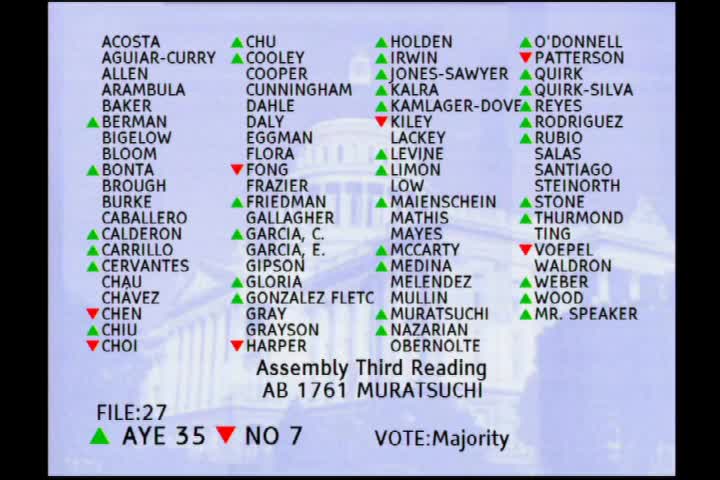 22MIN
Assembly Floor
 1MIN
Assembly Floor
 1MIN
Assembly Standing Committee on Appropriations
 19MIN
Assembly Standing Committee on Public Safety


Bill Co-Author(s):
