AB 3168: Outdoor advertising displays: publicly owned property.
- Session Year: 2017-2018
- House: Assembly
- Latest Version Date: 2018-09-29
(1)The Outdoor Advertising Act regulates the placement of advertising signs adjacent to and within specified distances of certain highways. The act prohibits advertising displays from being placed or maintained on property adjacent to a section of a freeway that has been landscaped, with certain exceptions, and defines landscaped freeway for these purposes to mean a section or sections of a freeway that is now, or later may be, improved by the planting at least on one side or on the median of the freeway right-of-way of lawns, trees, shrubs, flowers, or other ornamental vegetation requiring reasonable maintenance.
This bill would narrow the prohibition of the act to instead prohibit, except as specified, placing or maintaining advertising displays on property adjacent to a 1,000-foot or greater section of a freeway that has been landscaped with at least an average width of 20 feet, as defined, of landscaping or that includes trees on Department of Transportation-owned property at the same or elevated grade of the main-traveled way if the advertising display is designed to be viewed primarily by persons traveling on the main-traveled way of the landscaped freeway. The bill would require the department to determine the average width using a specified formula, would provide that all existing classifications are to remain in effect until the department receives a request for a new classification review in accordance with its regulations, and would authorize the department to charge a fee not to exceed $500, as specified, to conduct a classification review.
(2)The Outdoor Advertising Act provides that planting for the purpose of soil erosion control; traffic safety requirements, including light screening; reduction of fire hazards; or traffic noise abatement does not change the character of a freeway to a landscaped freeway.
This bill would expand that exemption by including planting for the purposes of covering soundwalls or fences.
(3)The Outdoor Advertising Act does not prohibit a governmental entity from entering into a relocation agreement or the Department of Transportation from allowing any legally permitted advertising display to be increased in height at its permitted location or relocated if a noise attenuation barrier has been erected in front of the display or if a building, construction, or structure, as specified, has been or is then being erected by any government entity that obstructs the displays visibility within 500 feet of the display and the relocation of the display or increase in the height of the display would not cause a reduction in federal aid highway funds or an increase in the number of displays within the jurisdiction of a governmental entity that does not conform to the act.
This bill would expand that exception by instead providing that the act does not prohibit any governmental entity from entering into a relocation agreement or the department from allowing any lawfully erected display to be increased in height at its permitted location or to be relocated provided the height increase or relocation would not cause a reduction in federal aid highway funds or an increase in the number of displays within the state that does not conform to the act. The bill would authorize a relocated advertising display to be converted to a message center pursuant to a relocation agreement. The bill would require the department to issue a permit, without any additional consideration, for any display that is being placed pursuant to a relocation agreement with another government entity if the relocated display conforms with specified provisions.
(1)The Outdoor Advertising Act regulates the placement of advertising signs adjacent to and within specified distances of certain highways. The act prohibits advertising displays from being placed or maintained on property adjacent to a section of a freeway that has been landscaped, with certain exceptions, and defines landscaped freeway for these purposes to mean a section or sections of a freeway that is now, or hereafter later may be, improved by the planting at least on one side or on the median of the freeway right-of-way of lawns, trees, shrubs, flowers, or other ornamental vegetation requiring reasonable maintenance.
This bill would narrow the prohibition of the act to instead prohibit, except as specified, placing or maintaining advertising displays on property adjacent to a 1,000-foot or greater section of a freeway that has been landscaped with at least an average width of 20 feet feet, as defined, of landscaping or that includes trees on department-owned Department of Transportation-owned property at the same or elevated grade of the main-traveled way if the advertising display is designed to be viewed primarily by persons traveling on the main-traveled way of the landscaped freeway. The bill would require the department to determine the average width using a specified formula, would provide that all existing classifications are to remain in effect until the department receives a request for a new classification review in accordance with its regulations, and would authorize the department to charge a fee not to exceed $500, as specified, to conduct a classification review.
(2)The Outdoor Advertising Act provides that planting for the purpose of soil erosion control, control; traffic safety requirements, including light screening, screening; reduction of fire hazards, hazards; or traffic noise abatement, abatement does not change the character of a freeway to a landscaped freeway.
This bill would expand that exemption by including planting for the purposes of covering soundwalls or fences.
(3)The Outdoor Advertising Act does not prohibit a governmental entity from entering into a relocation agreement or the Department of Transportation from allowing any legally permitted advertising display to be increased in height at its permitted location or relocated if a noise attenuation barrier has been erected in front of the display or if a building, construction, or structure, including, but not limited to, a barrier, bridge, overpass, or underpass, as specified, has been or is then being erected by any government entity that obstructs the displays visibility within 500 feet of the display and the relocation of the display or increase in the height of the display would not cause a reduction in federal aid highway funds or an increase in the number of displays within the jurisdiction of a governmental entity which that does not conform to the act.
This bill would expand that exception by instead providing that the act does not prohibit any governmental entity from entering into a relocation agreement or the department from allowing any legally permitted lawfully erected display to be increased in height at its permitted location, converted to a message center, location or to be relocated provided the height increase, conversion, increase or relocation would not cause a reduction in federal aid highway funds or an increase in the number of displays within the state which that does not conform to the act. The bill would authorize a relocated advertising display to be converted to a message center pursuant to a relocation agreement. The bill would require the department to issue a permit, without any additional consideration, for any display that is being placed pursuant to a relocation agreement with another government entity if the relocated display conforms with specified provisions.
(1)The Outdoor Advertising Act regulates placement of advertising signs adjacent to and within specified distances of certain highways. The act prohibits advertising displays from being placed or maintained on property adjacent to a section of a freeway that has been landscaped, with certain exceptions, and defines landscaped freeway for these purposes to mean a section or sections of a freeway that is now, or hereafter may be, improved by the planting at least on one side or on the median of the freeway right-of-way of lawns, trees, shrubs, flowers, or other ornamental vegetation requiring reasonable maintenance.
This bill would narrow the prohibition of the act to instead prohibit, except as specified, placing or maintaining advertising displays on property adjacent to a section of a freeway that has been landscaped with at least an average width of 20 feet of landscaping on department-owned property at the same or elevated grade of the main-traveled way if the advertising display is designed to be viewed primarily by persons traveling on the main-traveled way of the landscaped freeway.
(2)The Outdoor Advertising Act provides that planting for the purpose of soil erosion control, traffic safety requirements, including light screening, reduction of fire hazards, or traffic noise abatement, does not change the character of a freeway to a landscaped freeway.
This bill would expand that exemption by including planting for purposes of covering sound walls soundwalls or fences.
(3)The Outdoor Advertising Act does not prohibit a governmental entity from entering into a relocation agreement or the Department of Transportation from allowing any legally permitted advertising display to be increased in height at its permitted location or relocated if a noise attenuation barrier has been erected in front of the display or if a building, construction, or structure, including, but not limited to, a barrier, bridge, overpass, or underpass, has been or is then being erected by any government entity that obstructs the displays visibility within 500 feet of the display and the relocation of the display or increase in height of the display would not cause a reduction in federal aid highway funds or an increase in the number of displays within the jurisdiction of a governmental entity which does not conform to the act.
This bill would expand that exception by instead providing that the act does not prohibit any governmental entity from entering into a relocation agreement or the department from allowing any legally permitted display to be increased in height at its permitted location, converted to a changeable message sign, message center, or to be relocated provided the height increase, conversion, or relocation would not cause a reduction in federal aid highway funds or an increase in the number of displays within the state which does not conform to the act.
(1)The Outdoor Advertising Act regulates placement of advertising signs adjacent to and within specified distances of certain highways. The act prohibits advertising displays from being placed or maintained on property adjacent to a section of a freeway that has been landscaped, with certain exceptions, and defines landscaped freeway for these purposes to mean a section or sections of a freeway that is now, or hereafter may be, improved by the planting at least on one side or on the median of the freeway right-of-way of lawns, trees, shrubs, flowers, or other ornamental vegetation requiring reasonable maintenance.
This bill would narrow the prohibition of the act to instead prohibit, except as specified, placing or maintaining advertising displays on property adjacent to a 2,000-foot or greater section of a freeway that has been landscaped with at least an average width of 20 feet of landscaping on department-owned property at the same or elevated grade of the main-traveled way if the advertising display is designed to be viewed primarily by persons traveling on the main-traveled way of the landscaped freeway.
(2)The Outdoor Advertising Act provides that planting for the purpose of soil erosion control, traffic safety requirements, including light screening, reduction of fire hazards, or traffic noise abatement, does not change the character of a freeway to a landscaped freeway.
This bill would expand that exemption by including planting for purposes of covering sound walls or fences.
(3)The Outdoor Advertising Act does not prohibit a governmental entity from entering into a relocation agreement or the Department of Transportation from allowing any legally permitted advertising display to be increased in height at its permitted location or relocated if a noise attenuation barrier has been erected in front of the display or if a building, construction, or structure, including, but not limited to, a barrier, bridge, overpass, or underpass, has been or is then being erected by any government entity that obstructs the displays visibility within 500 feet of the display and the relocation of the display or increase in height of the display would not cause a reduction in federal aid highway funds or an increase in the number of displays within the jurisdiction of a governmental entity which does not conform to the act.
This bill would expand that exception by instead providing that the act does not prohibit any governmental entity from entering into a relocation agreement or the department from allowing any legally permitted display to be increased in height at its permitted location, converted to a changeable message sign, or to be relocated provided the height increase, conversion, or relocation would not cause a reduction in federal aid highway funds or an increase in the number of displays within the state which does not conform to the act.
(1)The Outdoor Advertising Act regulates placement of advertising signs adjacent to and within specified distances of certain highways. The act prohibits advertising displays from being placed or maintained on property adjacent to a section of a freeway that has been landscaped, with certain exceptions. exceptions, and defines landscaped freeway for these purposes to mean a section or sections of a freeway that is now, or hereafter may be, improved by the planting at least on one side or on the median of the freeway right-of-way of lawns, trees, shrubs, flowers, or other ornamental vegetation requiring reasonable maintenance.
This bill would exempt from these provisions an outdoor advertising display erected or built on publicly owned property if specified conditions are met, including, among other things, that a governmental agency has ownership and control over the subject property and adopts a resolution, ordinance, or other appropriate legally binding document that declares that the property is exempt from the acts provisions and forwards the document to the Department of Transportation. narrow the prohibition of the act to instead prohibit, except as specified, placing or maintaining advertising displays on property adjacent to a 2,000-foot or greater section of a freeway that has been landscaped with at least an average width of 20 feet of landscaping on department-owned property at the same or elevated grade of the main-traveled way if the advertising display is designed to be viewed primarily by persons traveling on the main-traveled way of the landscaped freeway.
(2)The Outdoor Advertising Act provides that planting for the purpose of soil erosion control, traffic safety requirements, including light screening, reduction of fire hazards, or traffic noise abatement, does not change the character of a freeway to a landscaped freeway.
This bill would expand that exemption by including planting for purposes of covering sound walls or fences.
(3)The Outdoor Advertising Act does not prohibit a governmental entity from entering into a relocation agreement or the Department of Transportation from allowing any legally permitted advertising display to be increased in height at its permitted location or relocated if a noise attenuation barrier has been erected in front of the display or if a building, construction, or structure, including, but not limited to, a barrier, bridge, overpass, or underpass, has been or is then being erected by any government entity that obstructs the displays visibility within 500 feet of the display and the relocation of the display or increase in height of the display would not cause a reduction in federal aid highway funds or an increase in the number of displays within the jurisdiction of a governmental entity which does not conform to the act.
This bill would expand that exception by instead providing that the act does not prohibit any governmental entity from entering into a relocation agreement or the department from allowing any legally permitted display to be increased in height at its permitted location, converted to a changeable message sign, or to be relocated provided the height increase, conversion, or relocation would not cause a reduction in federal aid highway funds or an increase in the number of displays within the state which does not conform to the act.
The Outdoor Advertising Act regulates placement of advertising signs adjacent to and within specified distances of certain highways. The act prohibits advertising displays from being placed or maintained on property adjacent to a section of a freeway that has been landscaped, with certain exceptions.
This bill would exempt from these provisions an outdoor advertising display erected or built on publicly owned property if specified conditions are met, including, among other things, that a governmental agency has ownership and control over the subject property and adopts a resolution, ordinance, or other appropriate legally binding document that declares that the property is exempt from the acts provisions and forwards the document to the Department of Transportation.
Existing law generally provides for the testing of bovine animals for bovine tuberculosis, the establishment of tuberculosis control areas, and the regulation of tuberculosis exposed or reacting cattle. Existing law authorizes the inspectors or agents of the Department of Food and Agriculture or the United States Department of Agriculture to enter upon any premises, except dwelling houses, to carry out provisions relating to bovine tuberculosis. Existing law prohibits a person from obstructing, hampering, or interfering with the agents or inspectors while they are enforcing these provisions.This bill would make nonsubstantive changes in these provisions.Existing law generally provides for the testing of bovine animals for bovine tuberculosis, the establishment of tuberculosis control areas, and the regulation of tuberculosis exposed or reacting cattle. Existing law authorizes the inspectors or agents of the Department of Food and Agriculture or the United States Department of Agriculture to enter upon any premises, except dwelling houses, to carry out provisions relating to bovine tuberculosis. Existing law prohibits a person from obstructing, hampering, or interfering with the agents or inspectors while they are enforcing these provisions.
This bill would make nonsubstantive changes in these provisions.
(a)Landscaped freeway means a section or sections of a freeway that is now, or hereafter may be, improved by the planting at least on one side or on the median of the freeway right-of-way of lawns, trees, shrubs, flowers, or other ornamental vegetation requiring reasonable maintenance.
(b)Planting for the purpose of soil erosion control; traffic safety requirements, including light screening; reduction of fire hazards; covering soundwalls or fences; or traffic noise abatement shall not change the character of a freeway to a landscaped freeway.
(c)Notwithstanding subdivision (a), if an agreement to relocate advertising displays from within one area of a city or county to an area adjacent to a freeway right-of-way has been entered into between a city or county and the owner of an advertising display, then a landscaped freeway shall not include the median of a freeway right-of-way.
SEC. 2.Section 5440 of the Business and Professions Code is amended to read:5440.(a)Except as otherwise provided in this article, no advertising display may be placed or maintained on property adjacent to a 1,000-foot or greater section of a freeway that has been landscaped with at least an average width of 20 feet of landscaping or that includes trees, on department-owned property at the same or elevated grade of the main-traveled way if the advertising display is designed to be viewed primarily by persons traveling on the main-traveled way of the landscaped freeway.
(b)The department shall determine the average width by dividing the square footage of a landscaped area by its length.
(c)(1)All existing classifications shall remain in effect until the department receives a request for a new classification review in accordance with applicable regulations.
(2)The department may charge a fee in an amount not to exceed the reasonable costs incurred by the department in conducting a classification review and not to exceed five hundred dollars ($500).
(d)For purposes of this section, average width of 20 feet means that over any 1,000-foot section freeway there averages at least 20 feet of total property contiguous to all sides of the main traveled way between the outer edge of the shoulders and the freeway right-of-way boundaries, including median plantings, that otherwise meets the definition of a landscaped freeway in Section 5216.
SEC. 3.Section 5443 of the Business and Professions Code is amended to read:5443.Nothing in this article prohibits either of the following:
(a)Any county from designating the districts or zones in which advertising displays may be placed or prohibited as part of a county land use or zoning ordinance.
(b)(1)Any governmental entity from entering into a relocation agreement pursuant to Section 5412 or the department from allowing any lawfully erected display to be increased in height at its permitted location or to be relocated provided the height increase or relocation would not cause a reduction in federal aid highway funds as provided in Section 131 of Title 23 of the United States Code or an increase in the number of displays within the state that does not conform to this article. Any increase in height permitted under this subdivision shall not be more than that necessary to restore the visibility of the display to the main-traveled way. An advertising display relocated pursuant to this subdivision shall comply with all of the provisions of Article 6 (commencing with Section 5350).
(2)A relocated advertising display may be converted to a message center pursuant to a relocation agreement. The department shall issue a permit, without any additional consideration, for any display that is being placed pursuant to a relocation agreement with another governmental entity if the relocated display conforms with the provisions of this section.
(a)Landscaped freeway means a section or sections of a freeway that is now, or hereafter may be, improved by the planting at least on one side or on the median of the freeway right-of-way of lawns, trees, shrubs, flowers, or other ornamental vegetation requiring reasonable maintenance.
(b)Planting for the purpose of soil erosion control, control; traffic safety requirements, including light screening, screening; reduction of fire hazards, hazards; covering soundwalls or fences, fences; or traffic noise abatement, abatement shall not change the character of a freeway to a landscaped freeway.
(c)Notwithstanding subdivision (a), if an agreement to relocate advertising displays from within one area of a city or county to an area adjacent to a freeway right-of-way has been entered into between a city or county and the owner of an advertising display, then a landscaped freeway shall not include the median of a freeway right-of-way.
SEC. 2.Section 5440 of the Business and Professions Code is amended to read:5440.(a)Except as otherwise provided in this article, no advertising display may be placed or maintained on property adjacent to a 1,000-foot or greater section of a freeway that has been landscaped with at least an average width of 20 feet of landscaping landscaping or that includes trees, on department-owned property at the same or elevated grade of the main-traveled way if the advertising display is designed to be viewed primarily by persons traveling on the main-traveled way of the landscaped freeway.
(b)The department shall determine the average width by dividing the square footage of a landscaped area by its length.
(c)(1)All existing classifications shall remain in effect until the department receives a request for a new classification review in accordance with applicable regulations.
(2)The department may charge a fee in an amount not to exceed the reasonable costs incurred by the department in conducting a classification review and not to exceed five hundred dollars ($500).
(d)For purposes of this section, average width of 20 feet means that over any 1,000-foot section freeway there averages at least 20 feet of total property contiguous to all sides of the main traveled way between the outer edge of the shoulders and the freeway right-of-way boundaries, including median plantings, that otherwise meets the definition of a landscaped freeway in Section 5216.
SEC. 3.Section 5443 of the Business and Professions Code is amended to read:5443.Nothing in this article prohibits either of the following:
(a)Any county from designating the districts or zones in which advertising displays may be placed or prohibited as part of a county land use or zoning ordinance.
(b)(1)Any governmental entity from entering into a relocation agreement pursuant to Section 5412 or the department from allowing any legally permitted lawfully erected display to be increased in height at its permitted location, converted to a message center, location or to be relocated provided the height increase, conversion, increase or relocation would not cause a reduction in federal aid highway funds as provided in Section 131 of Title 23 of the United States Code or an increase in the number of displays within the state which that does not conform to this article. Any increase in height permitted under this subdivision shall not be more than that necessary to restore the visibility of the display to the main-traveled way. An advertising display relocated pursuant to this subdivision shall comply with all of the provisions of Article 6 (commencing with Section 5350).
(2)A relocated advertising display may be converted to a message center pursuant to a relocation agreement. The department shall issue a permit, without any additional consideration, for any display that is being placed pursuant to a relocation agreement with another governmental entity if the relocated display conforms with the provisions of this section.
(a)Landscaped freeway means a section or sections of a freeway that is now, or hereafter may be, improved by the planting at least on one side or on the median of the freeway right-of-way of lawns, trees, shrubs, flowers, or other ornamental vegetation requiring reasonable maintenance.
(b)Planting for the purpose of soil erosion control, traffic safety requirements, including light screening, reduction of fire hazards, covering sound walls soundwalls or fences, or traffic noise abatement, shall not change the character of a freeway to a landscaped freeway.
(c)Notwithstanding subdivision (a), if an agreement to relocate advertising displays from within one area of a city or county to an area adjacent to a freeway right-of-way has been entered into between a city or county and the owner of an advertising display, then a landscaped freeway shall not include the median of a freeway right-of-way.
SEC. 2.Section 5440 of the Business and Professions Code is amended to read:5440.Except as otherwise provided in this article, no advertising display may be placed or maintained on property adjacent to a section of a freeway that has been landscaped with at least an average width of 20 feet of landscaping on department-owned property at the same or elevated grade of the main-traveled way if the advertising display is designed to be viewed primarily by persons traveling on the main-traveled way of the landscaped freeway.
SEC. 3.Section 5443 of the Business and Professions Code is amended to read:5443.Nothing in this article prohibits either of the following:
(a)Any county from designating the districts or zones in which advertising displays may be placed or prohibited as part of a county land use or zoning ordinance.
(b)Any governmental entity from entering into a relocation agreement pursuant to Section 5412 or the department from allowing any legally permitted display to be increased in height at its permitted location, converted to a changeable message sign, message center, or to be relocated provided the height increase, conversion, or relocation would not cause a reduction in federal aid highway funds as provided in Section 131 of Title 23 of the United States Code or an increase in the number of displays within the state which does not conform to this article. Any increase in height permitted under this subdivision shall not be more than that necessary to restore the visibility of the display to the main-traveled way. An advertising display relocated pursuant to this subdivision shall comply with all of the provisions of Article 6 (commencing with Section 5350).
(a)Landscaped freeway means a section or sections of a freeway that is now, or hereafter may be, improved by the planting at least on one side or on the median of the freeway right-of-way of lawns, trees, shrubs, flowers, or other ornamental vegetation requiring reasonable maintenance.
(b)Planting for the purpose of soil erosion control, traffic safety requirements, including light screening, reduction of fire hazards, covering sound walls or fences, or traffic noise abatement, shall not change the character of a freeway to a landscaped freeway.
(c)Notwithstanding subdivision (a), if an agreement to relocate advertising displays from within one area of a city or county to an area adjacent to a freeway right-of-way has been entered into between a city or county and the owner of an advertising display, then a landscaped freeway shall not include the median of a freeway right-of-way.
SEC. 2.Section 5440 of the Business and Professions Code is amended to read:5440.Except as otherwise provided in this article, no advertising display may be placed or maintained on property adjacent to a 2,000-foot or greater section of a freeway that has been landscaped with at least an average width of 20 feet of landscaping on department-owned property at the same or elevated grade of the main-traveled way if the advertising display is designed to be viewed primarily by persons traveling on the main-traveled way of the landscaped freeway.
SEC. 3.Section 5443 of the Business and Professions Code is amended to read:5443.Nothing in this article prohibits either of the following:
(a)Any county from designating the districts or zones in which advertising displays may be placed or prohibited as part of a county land use or zoning ordinance.
(b)Any governmental entity from entering into a relocation agreement pursuant to Section 5412 or the department from allowing any legally permitted display to be increased in height at its permitted location, converted to a changeable message sign, or to be relocated provided the height increase, conversion, or relocation would not cause a reduction in federal aid highway funds as provided in Section 131 of Title 23 of the United States Code or an increase in the number of displays within the state which does not conform to this article. Any increase in height permitted under this subdivision shall not be more than that necessary to restore the visibility of the display to the main-traveled way. An advertising display relocated pursuant to this subdivision shall comply with all of the provisions of Article 6 (commencing with Section 5350).
(a)Landscaped freeway means a section or sections of a freeway that is now, or hereafter may be, improved by the planting at least on one side or on the median of the freeway right-of-way of lawns, trees, shrubs, flowers, or other ornamental vegetation requiring reasonable maintenance.
(b)Planting for the purpose of soil erosion control, traffic safety requirements, including light screening, reduction of fire hazards, covering sound walls or fences, or traffic noise abatement, shall not change the character of a freeway to a landscaped freeway.
(c)Notwithstanding subdivision (a), if an agreement to relocate advertising displays from within one area of a city or county to an area adjacent to a freeway right-of-way has been entered into between a city or county and the owner of an advertising display, then a landscaped freeway shall not include the median of a freeway right-of-way.
SEC. 2.Section 5440 of the Business and Professions Code is amended to read:5440.Except as otherwise provided in this article, no advertising display may be placed or maintained on property adjacent to a 2,000-foot or greater section of a freeway that has been landscaped with at least an average width of 20 feet of landscaping on department-owned property at the same or elevated grade of the main-traveled way if the advertising display is designed to be viewed primarily by persons traveling on the main-traveled way of the landscaped freeway.
SEC. 3.Section 5443 of the Business and Professions Code is amended to read:5443.Nothing in this article prohibits either of the following:
(a)Any county from designating the districts or zones in which advertising displays may be placed or prohibited as part of a county land use or zoning ordinance.
(b)Any governmental entity from entering into a relocation agreement pursuant to Section 5412 or the department from allowing any legally permitted display to be increased in height at its permitted location location, converted to a changeable message sign, or to be relocated if a noise attenuation barrier is erected in front of the display or if a building, construction, or structure, including, but not limited to, a barrier, bridge, overpass, or underpass, has been or is then being erected by any government entity that obstructs the displays visibility within 500 feet of the display and that relocated display or that action of the department provided the height increase, conversion, or relocation would not cause a reduction in federal aid highway funds as provided in Section 131 of Title 23 of the United States Code or an increase in the number of displays within the jurisdiction of a governmental entity state which does not conform to this article. Any increase in height permitted under this subdivision shall not be more than that necessary to restore the visibility of the display to the main-traveled way. An advertising display relocated pursuant to this subdivision shall comply with all of the provisions of Article 6 (commencing with Section 5350).
SECTION 1.Section 5443.1 is added to the Business and Professions Code, to read:5443.1.The provisions of this article shall not apply to an outdoor advertising display erected or built on publicly owned property, if both of the following conditions are met:(a)A governmental agency has ownership and control over the subject property and adopts a resolution, ordinance, or other appropriate legally binding document that declares that the property is exempt from this article and forwards it to the Department of Transportation.(b)The display complies with any other applicable ordinances or regulations of the governmental agency.The provisions of this article shall not apply to an outdoor advertising display erected or built on publicly owned property, if both of the following conditions are met:
(a)A governmental agency has ownership and control over the subject property and adopts a resolution, ordinance, or other appropriate legally binding document that declares that the property is exempt from this article and forwards it to the Department of Transportation.
(b)The display complies with any other applicable ordinances or regulations of the governmental agency.
SECTION 1.Section 9931 of the Food and Agricultural Code is amended to read:9931.To carry out the provisions of this chapter, the inspectors or agents of the department or the United States Department of Agriculture, may, at any time or place, enter upon any premises, except dwelling houses. A person shall not obstruct, hamper, or interfere with the agents or inspectors while they are enforcing the provisions of this chapter.To carry out the provisions of this chapter, the inspectors or agents of the department or the United States Department of Agriculture, may may, at any time or place, enter upon any premises, except dwelling houses. No person shall A person shall not obstruct, hamper, or interfere with the agents or inspectors while they are enforcing the provisions of this chapter.
|
Date
|
Status
|
|---|---|
| Sep 29, 2018 | Chaptered by Secretary of State - Chapter 926, Statutes of 2018. |
| Sep 29, 2018 | Approved by the Governor. |
| Sep 11, 2018 | Enrolled and presented to the Governor at 4:30 p.m. |
| Aug 30, 2018 | Senate amendments concurred in. To Engrossing and Enrolling. |
| Aug 29, 2018 | In Assembly. Concurrence in Senate amendments pending. |
| Aug 29, 2018 | Read third time. Passed. Ordered to the Assembly. |
| Aug 27, 2018 | Read second time. Ordered to third reading. |
| Aug 24, 2018 | Read third time and amended. Ordered to second reading. |
| Aug 17, 2018 | Read second time. Ordered to third reading. |
| Aug 6, 2018 | In committee: Referred to APPR. suspense file. |
| Jun 18, 2018 | Read second time and amended. Re-referred to Com. on APPR. |
| Jun 14, 2018 | From committee: Amend, and do pass as amended and re-refer to Com. on APPR. (Ayes 12. Noes 0.) (June 12). |
| May 30, 2018 | Referred to Com. on T. & H. |
| May 22, 2018 | In Senate. Read first time. To Com. on RLS. for assignment. |
| May 21, 2018 | Read third time. Passed. Ordered to the Senate. |
| May 17, 2018 | Read second time. Ordered to third reading. |
| May 16, 2018 | From committee: Do pass. (Ayes 17. Noes 0.) (May 16). |
| May 9, 2018 | In committee: Hearing postponed by committee. |
| Apr 26, 2018 | Re-referred to Com. on APPR. |
| Apr 25, 2018 | Read second time and amended. |
| Apr 24, 2018 | From committee: Amend, and do pass as amended and re-refer to Com. on APPR. (Ayes 21. Noes 0.) (April 18). |
| Apr 16, 2018 | Re-referred to Com. on G.O. |
| Apr 12, 2018 | From committee chair, with author's amendments: Amend, and re-refer to Com. on G.O. Read second time and amended. |
| Mar 21, 2018 | Re-referred to Com. on G.O. |
| Mar 20, 2018 | From committee chair, with author's amendments: Amend, and re-refer to Com. on G.O. Read second time and amended. |
| Mar 19, 2018 | Referred to Com. on G.O. |
| Feb 17, 2018 | From printer. May be heard in committee March 19. |
| Feb 16, 2018 | Read first time. To print. |
|
Date
|
Description
|
Location
|
Votes
|
|
|---|---|---|---|---|
| Aug 30, 2018 | AB 3168 RUBIO Concurrence in Senate Amendments | Assembly Floor |
Passed |
|
| Aug 29, 2018 | Assembly 3rd Reading AB3168 Rubio By Galgiani | Senate Floor |
Passed |
|
| Aug 16, 2018 | Do pass | Senate Standing Committee on Appropriations |
Passed |
|
| Aug 6, 2018 | Placed on suspense file | Senate Standing Committee on Appropriations |
Passed |
|
| Jun 12, 2018 | Do pass as amended, but first amend, and re-refer to the Committee on [Appropriations] | Senate Standing Committee on Transportation and Housing |
Passed |
|
| May 21, 2018 | AB 3168 RUBIO Assembly Third Reading | Assembly Floor |
Passed |
|
| May 16, 2018 | Do pass. | Assembly Standing Committee on Appropriations |
Passed |
|
| Apr 18, 2018 | Do pass as amended and be re-referred to the Committee on [Appropriations] | Assembly Standing Committee on Governmental Organization |
Passed |
This list shows positions taken on this bill by organizations on the date displayed, which is linked to the original source.
Positions by individuals are not included.
|
Organization
|
Position
|
Date
|
|---|---|---|
| Artesia City Of | * Support | Jun 12, 2018 |
| California State Outdoor Advertising Association | ** Support | Aug 28, 2018 |
| CalTrans | * Support | Jun 12, 2018 |
| Coalition to Ban Billboard Blight | ** Against | Aug 28, 2018 |
| Scenic America | ** Against | Aug 28, 2018 |
| Scenic San Diego | ** Against | Aug 28, 2018 |
CONCURRENCE IN SENATE AMENDMENTS
CSA1 Bill Id:AB 3168
Author:(Rubio)
As Amended Ver:August 24, 2018
Majority vote
ASSEMBLY: | 72-0 | (May 21, 2018) | SENATE: | 39-0 | (August 29, 2018) |
Original Committee Reference: G.O.
SUMMARY: Makes changes to the Outdoor Advertising Act as it relates to "Landscaped Freeways". Specifically, this bill:
- Adds "covering soundwalls or fences" to the exempted characteristics of a freeway that do not constitute landscaping.
- Adjusts the criteria for determining a landscaped freeway. Specifically, it requires at least 1,000-foot or greater section of a freeway that has been landscaped with an average width of 20 feet of landscaping on department-owned property at the same or elevated grade of the freeway way if the advertising display is designed to be viewed primarily by persons traveling on the main-traveled way of the landscaped freeway.
- Defines "average width of 20 feet" as any 1,000-foot section freeway that averages at least 20 feet of total property contiguous to all sides of the main traveled way between the outer edge of the shoulders and the freeway right-of-way boundaries, including median plantings, that otherwise meets the definition of a landscaped freeway
- Requires California Department of Transportation (Caltrans) determine the average width by dividing the square footage of a landscaped area by its length.
- Clarifies all existing landscape freeway classifications shall remain in effect until Caltrans receives a request for a new classification review in accordance with applicable regulations. Authorizes Caltrans to assess fees, no more than $500, in conducting a reclassification of currently designated landscape freeway.
- Expands the ability of Caltrans to allow any lawfully erected display to be increased in height at its permitted location, provided the height increase or conversion would not cause a reduction in federal aid highway funds or an increase in the number of displays within the state which does not conform to OAA.
- Expands the ability of a governmental entity to enter into a relocation agreement for a lawfully erected display with Caltrans, provided the relocation would not cause a reduction in federal aid highway funds or an increase in the number of displays within the state that does not conform to OAA.
- Allows a relocated advertising display may be converted to a message center pursuant to a relocation agreement. Requires Caltrans to issue a permit, without any additional consideration, for any display that is being placed pursuant to a relocation agreement with another governmental entity if the relocated display conforms with the provisions of this bill.
The Senate amendments:
- Provide more specificity for how Caltrans determines the average width of a landscaped freeway.
- Authorize Caltrans to assess fees, no more than $500, in conducting a reclassification of currently designated landscape freeway.
- Clarify when a static display may be converted to message center pursuant to a relocation agreement under this bill.
- Make technical and clarifying changes.
EXISTING LAW: Establishes the OAA, which regulates the placement of advertising displays adjacent to and within specified distances of highways that are part of the national system of interstate, defense highways, and federal-aid highways.
- Prohibits any advertising display from being placed or maintained on property adjacent to a section of a freeway that has been landscaped if the advertising display is designed to be viewed primarily by persons traveling on the main-traveled way of the landscaped freeway.
- Defines "Landscaped Freeway" as a section or sections of a freeway that is improved by the planting at least on one side or on the median of the freeway right-of-way of lawns, trees, shrubs, flowers, or other ornamental vegetation requiring reasonable maintenance.
- Clarifies planting for the purpose of soil erosion control, traffic safety requirements, including light screening, reduction of fire hazards, or traffic noise abatement does not change the character of a freeway to landscaped.
- Provides for limited exemptions to the prohibition on advertising along system and landscaped freeways, including exemptions for signs advertising the property's sale or lease, signs designating the premises or its owner, and signs advertising goods or services manufactured or produced on the property itself.
- Allows a governmental entity from entering into a relocation agreement or Caltrans from allowing any legally permitted advertising display to be increased in height at its permitted location or relocated if a noise attenuation barrier has been erected in front of the display or if a building, construction, or structure, including, but not limited to, a barrier, bridge, overpass, or underpass, has been or is then being erected by any government entity that obstructs the display's visibility within 500 feet of the display and the relocation of the display or increase in height of the display would not cause a reduction in federal aid highway funds or an increase in the number of displays within the jurisdiction of a governmental entity which does not conform to the act.
- Provides that the OAA generally does not apply to on premise advertising displays, which include those advertising the sale of the property upon which it is placed or that advertise the business conducted, services rendered, or goods produced or sold on the property. Local governments regulate on premise displays, except for certain safety requirements.
- Allows a single advertising structure exemption for each of several cities, including an exemption for advertising on street furniture in San Francisco, several billboards situated on the grounds of the Oakland-Alameda County Coliseum complex, and structures within the Mid-City Recovery Redevelopment Project Area within Los Angeles.
- Requires the Department of Transportation (Caltrans) to assess penalties for a violation of the OAA, as specified. If an advertising display is placed or maintained in a location that does not conform to the relevant statutes or local ordinances, and is not removed within thirty days of written notice from the department or the city or the county with land use jurisdiction over the property upon which the advertising display is located, a penalty of $10,000 plus $100 for each day the advertising display is placed or maintained after the department sends written notice shall be assessed and the gross revenues received by the violator shall be disgorged. Caltrans may also request recovery of its legal costs.
- Provides, by contractual agreement, for Caltrans to administer the federal Outdoor Advertising Control (OAC) program, which has restrictions similar to California's OAA program, including maximum sign size, sign spacing, location, illumination, and content. If the state fails to properly administer the federal program, the state shall lose 10% of its federal highway funding.
FISCAL EFFECT: According to Assembly Appropriations Committee, this bill contains negligible state costs.
COMMENTS:
Purpose of the bill: According to the author: "For decades, municipalities have had to seek legislative "carve outs" to allow them to erect billboards on a landscaped section of freeway within their jurisdiction. This approach is costly and increases the number of billboards currently permitted in California. AB 3168 gives cities flexibility to relocate permitted signage outside of municipal boundaries on to sections of landscaped freeway, still conforming to State and Federal regulations, while not adding any more new signage on California highways. AB 3168 will also resolve long-standing questions over whether plantings not visible from the freeway are adequate to constitute a "landscaped freeway" as defined in Code. Finally, it clarifies that landscaped freeway displays can be modified to modern digital signs on the same conditions as other freeway billboards."
Background: The state OAA regulates the placement of advertising displays (billboards) and signs along interstate or primary highways, landscaped freeways and similar specified highways. The OAA, along with related federal provisions, is intended, among other things, to promote highway beautification and provide a consistent framework for the regulation of advertising displays along freeways and highways. The OAA sets standards for the advertising structures, including their size, identification and location, and requires compliance with permit application procedures and conditions administered by Caltrans.
In order for an outdoor advertising display application to be considered for a permit adjacent to an Interstate or primary highway the following criteria laid out by the OAA and/or regulations adopted by Caltrans must be met:
- Display Location:
- Must be outside the right of way of any highway.
- Must be outside of any stream, or drainage channel.
- There must be an existing business activity within 1000 feet of proposed display location on either side of the highway.
- Location of property where display is to be placed must be zoned industrial or commercial.
- Must have current property owner consent, in writing, to place the display at desired location.
- Must have written permission (building permit) from the local government having jurisdiction where the display is to be located.
- Location may not be adjacent to a landscaped freeway.
- Location may not be adjacent to a scenic highway.
- If adjacent to a bonus segment of an Interstate freeway, copy, size, and spacing is more restrictive.
- Actual Display:
- Must be 500 feet from any other permitted display on same side of any highway that is a freeway.
- Must be 300 feet from any other permitted display on same side of any primary highway that is not a freeway in an unincorporated area.
- Must be 100 feet from any other permitted display on same side of any primary highway that is not a freeway and is within the limits of an incorporated city.
- Must be 500 feet from an interchange; intersection at grade or safety roadside rest if the highway is a freeway and the location is outside the limits of an incorporated city and outside the limits of an urban area.
- An electronic changeable message center display must meet the above spacing requirements and be 1000 feet from another electronic message center display.
- Maximum height for the advertising display area is, 25 feet in height and 60 feet in length, not to exceed an overall maximum of 1200 square feet.
Federal Highway Beautification Act of 1965: The Highway Beautification Act (HBA) was created to protect the public investment, promote the safety and recreational value of public travel, and to preserve the natural beauty of highways in the nation.
The HBA specifies that states have the responsibility to enforce provisions regarding the placement and maintenance of outdoor advertising signs, displays and devices along the Interstate and National Highway System. In 1968 Caltrans entered into a contractual agreement with the Federal Highway Administration (FHA) to implement and enforce the federal OAC program. Many of the OAA provisions are similar to those contained in federal law, originally established in 1965 through the HBA.
The penalty for failure to enforce federal law is severe: 10% of federal highway funds with the potential to apply the penalty retroactively. Presently, California receives $3.5 billion from the federal government, and stands to lose up to $350 million.
Landscaped Freeways: A Classified Landscaped Freeway is a section of freeway with planting that meets the criteria of Caltrans' Outdoor Advertising Regulations. It is used in the control and regulation of Outdoor Advertising Displays. A stretch of freeway designated landscaped is grounds for permit denial for an advertising display location. However, an administrative process exists within Caltrans to declassify a freeway as non-landscape, thus permitting a display if all other permit requirements are met. It is important to note that the FHA generally leaves the classification of Landscaped Freeways up to the state, meaning declassifying or exempting stretches of landscaped freeway to place advertisements will not result in potential loss of federal highway funds. Below are Caltrans' Outdoor Advertising Regulations (Sec. 2500-2513) that set criteria for a freeway to be designated landscaped:
- Landscaping is within State right-of-way.
- Landscaping is continuous (no gaps of more than 200 feet).
- Landscaping is ornamental (lawns, trees, shrubs, flowers, or other plantings designed primarily to improve the aesthetic appearance of the highway).
- Landscaping is at least 1000 feet long.
- Landscaping is on at least one side of the freeway.
- Landscaping requires reasonable maintenance.
There has been consternation among local governments and the outdoor advertising industry about the classification process and the regulations that ultimately decide whether a freeway is "landscaped." Their argument is that the standards have very little specificity, which makes the process too subjective based on which Caltrans official determines classification. Once an area is classified as landscaped, local governments or sign operators have to turn to the legislature to receive a one-off exemption. This bill seeks to add more clarity in statute to what freeways should be classified as landscaped. Specifically, it provides covering sound walls or fences with plants (e.g. ivy) as non-landscaped, clarifies that the distance of landscaping must be more than 2,000 feet, provides a 20 foot landscaping width requirement and requires landscaping to be visible from the freeway. It is very important to note, this bill does not allow any displays in a declassified area unless they comply with all other provisions of the OAA and obtain all necessary local permits. That said, by being more specific in statute and increasing the landscaped distance to 2,000 feet, this bill, if signed, will almost certainly open up stretches of landscaped freeway –that otherwise would not – to be legally permitted for outdoor advertising.
Permit Relocation: Current law allows "relocations" of billboard on landscaped freeways within the same jurisdiction. However, many smaller communities do not have existing billboards that they can relocate; likewise, there are communities that would prefer that displays within their communities are removed -- frequently because of public projects. Caltrans has taken advantage of this relocation provision, as their jurisdiction is the entire state, by allowing landscaped freeway displays to be "relocated" to different communities. Local communities do not have this option. This bill would allow a local government to relocate a legally permitted display from one landscaped freeway section to another.
In practice, a local government wanting to place a sign on a landscaped freeway would first go to Caltrans and request declassification. Once denied, under this bill, they would have the option to relocate an existing legal permit on a landscaped freeway to the desired location that had been denied declassification. If the local government does not have access to another permit they want to relocate, they would be able to look to other local communities and/or sign operators in other jurisdictions to partner with and relocate their permit to the local government's desired location. It is important to note that this process may only take place as long as the proposed location complies with all permitting requirements of the OAA and does not result in an increase in displays in the state.
Prior/Related Legislation: SB 405 (Mendoza), of the current legislative session. Exempts from the OAA advertising displays located in specific geographic areas in the City of Artesia. (Pending in the Assembly G.O. Committee)
SB 744 (Hueso) of the current legislative session. Creates an exemption to the OAA for several existing billboards in the County of Imperial provided the advertising displays are approved by either Caltrans or the FHA. (Pending in the Assembly G.O. Committee).
SB 459 (Portantino) of the current legislative session. Creates an exemption to the OAA for two existing billboards in the City of Upland provided the advertising displays are approved by either Caltrans or the FHA. (Held in the Senate Transportation and Housing Committee).
AB 1373 (Santiago), Chapter 853, Statutes of 2016. Created an exemption to the OAA in downtown Los Angeles provided the advertising displays are approved by either Caltrans or the FHA.
SB 1199 (Hall), Chapter 869, Statutes of 2016. Created an exemption to the OAA for two billboards in the City of Inglewood, provided that such billboards do not result in a reduction of federal funding.
SB 684 (Hill), Chapter 544, Statutes of 2013. Permitted existing advertising displays that advertised businesses and activities within the boundary limits of an RDA project to remain and be considered "on-premise displays" until January 1, 2023. The city or county could then apply to Caltrans for an extension, showing "good cause" beginning on January 1, 2022.
SB 31 (Padilla), Chapter 542, Statutes of 2013. Recasts the arena advertising exception to exempt from the OAA specified advertising displays authorized before January 1, 2019 by local ordinance, at a venue with a capacity of 15,000 seats or more that is capable of providing a permanent venue for professional sports.
SB 694 (Correa), Chapter 545, Statutes of 2013. Exempts from the Outdoor Advertising Act (OAA) advertising displays at current or future high-speed rail stations.
SB 402 (Vargas) of 2012. Would have created an exemption to the OAA for several existing billboards in the County of Imperial. (Held in Senate Rules).
AB 1570 (Salas) of 2010. Would have created an exemption to the OAA for several existing billboards in the County of Imperial. (Gut and amended in Senate).
AB 2339 (Solorio), Chapter 493, Statutes of 2008. This bill expanded the definition of an "on premise" display to include those displays advertising products, goods, or services sold on the premises of an arena of at least 5,000 seats and is located on public land, provided certain conditions were met.
AB 1499 (Benoit) of 2006. Would have created an exemption to the Act, to permit the City of Riverside to erect an outdoor advertising display along Highway 91 to promote economic activity for the Riverside Plaza. (Vetoed by Governor)
AB 801 (Jones) of 2006. Would have created an exemption from the Outdoor Advertising Act for one sign in the County of Sacramento. (Vetoed by Governor)
AB 2441 (Klehs) of 2006. Would have authorized an advertising display in the redevelopment zone of the City of San Leandro subject to specified conditions. (Vetoed by Governor)
AB 1518 (J. Horton) of 2006. Would have exempted, from the prohibition against placing advertising displays adjacent to landscaped freeways, any billboard located on property owned by the Lennox School District, subject to certain conditions. (Died pending Concurrence in Assembly)
AB 762 (Núñez), Chapter 725, Statutes of 2003. Creates an exemption to the OAA by allowing the National Latino Arts Council to place an advertisement on the roof of a not-for-profit educational academy.
SB 1480 (Speier), Chapter 972, Statutes of 2002, requires the applicant for a state billboard permit to have the written consent of the city or county with land use jurisdiction as well as the owner of the property site for the billboard
SB 190 (Perata), Chapter 54, Statutes of 2001. Exempted a certain development of highway advertising in Oakland from existing laws protecting landscaped highways permitted the City of Artesia to erect an advertising display alongside a landscaped highway. Permitted the City of Artesia to lease one billboard space adjacent to the 91 Freeway on city property.
Analysis Prepared by: Kenton Stanhope / G.O. / (916) 319-2531 FN: 0005171
Office of Senate Floor Analyses (916) 651-1520 Fax: (916) 327-4478 | AB |
THIRD READING
Bill No: AB 3168
:
SENATE TRANS. & HOUSING COMMITTEE: 12-0, 6/12/18
AYES: Beall, Cannella, Allen, Dodd, Gaines, Galgiani, McGuire, Roth, Skinner, Vidak, Wieckowski, Wiener
NO VOTE RECORDED: Morrell
SENATE APPROPRIATIONS COMMITTEE: 6-0, 8/16/18
AYES: Portantino, Beall, Bradford, Hill, Nielsen, Wiener
NO VOTE RECORDED: Bates
ASSEMBLY FLOOR: 72-0, 5/21/18 - See last page for vote
SUBJECT: Outdoor advertising displays: publicly owned property
DIGEST:
This bill makes it easier to permit an advertising display near state highways.
Senate Floor Amendments of 8/24/18 provide more specificity and authorize the Department of Transportation to assess fees for its work in identifying appropriate relocation areas.
ANALYSIS: Existing law establishes the Outdoor Advertising Act (OAA), which regulates the placement of advertising displays adjacent to and within specified distances of highways that are part of the national system of interstate, defense highways, and federal-aid highways as follows:
- Prohibits any advertising display from being placed or maintained on property adjacent to a section of a freeway that has been landscaped if the advertising display is designed to be viewed primarily by persons traveling on the main-traveled way of the landscaped freeway.
- Defines “Landscaped Freeway” as a section or sections of a freeway that is improved by the planting at least on one side or on the median of the freeway right-of-way of lawns, trees, shrubs, flowers, or other ornamental vegetation requiring reasonable maintenance.
- Provides for limited exemptions to the prohibition on advertising along system and landscaped freeways, including exemptions for signs advertising the property’s sale or lease, signs designating the premises or its owner, and signs advertising goods or services manufactured or produced on the property itself.
- Provides that the OAA generally does not apply to on premise advertising displays, which include those advertising the sale of the property upon which it is placed or that advertise the business conducted, services rendered, or goods produced or sold on the property.
- Allows a single advertising structure exemption for each of several cities, including an exemption for advertising on street furniture in San Francisco, several billboards situated on the grounds of the Oakland-Alameda County Coliseum complex, and structures within the Mid-City Recovery Redevelopment Project Area within Los Angeles.
- Requires the Department of Transportation (Caltrans) to assess penalties for a violation of the OAA, as specified. If an advertising display is placed or maintained in a location that does not conform to the relevant statutes or local ordinances, and is not removed within 30 days of written notice from the department or the city or the county with land use jurisdiction over the property upon which the advertising display is located, a penalty of $10,000 plus $100 for each day the advertising display is placed or maintained after the department sends written notice shall be assessed and the gross revenues received by the violator shall be disgorged. Caltrans may also request recovery of its legal costs.
- Provides, by contractual agreement, for Caltrans to administer the federal Outdoor Advertising Control (OAC) program, which has restrictions similar to California’s OAA program, including maximum sign size, sign spacing, location, illumination, and content. If the state fails to properly administer the federal program, the state shall lose 10% of its federal highway funding.
This bill:
- Clarifies the definition of “landscaped freeway” to exclude landscaping used to cover sound walls or fences.
- Limits the existing ban on advertising displays on property adjacent to a freeway to those cases where there exists at least an average width of 20 feet of landscaping on Caltrans property at the same or on an elevated grade to the main-traveled way, as defined, and authorizes Caltrans to assess a fee of up to $500 to determine whether the ban applies on any specific location.
- Expands the ability of a governmental entity to enter into a relocation agreement for a legally permitted advertisement display with Caltrans by allowing an advertising display to be increased in height at its permitted location, converted to a changeable message sign, or to be relocated from one landscaped freeway section to another.
- Expands the ability of Caltrans to allow any legally permitted display to be increased in height at its permitted location, converted to a changeable message sign (digital), provided the height increase or conversion would not cause a reduction in federal aid highway funds or an increase in the number of displays within the state which does not conform to OAA.
Comments
- Author’s statement. AB 3168 seeks to update provisions of the landscaped freeway provisions of the Outdoor Advertising Act. This bill will add objective criteria to the determination of what is a “landscaped freeway” and will allow for the relocation of existing landscaped signs in communities that want them, without adding to the presently existing number of displays along landscaped freeways.
- Looking good. The federal Highway Beautification Act of 1965 (HBA) was created to protect the public investment, promote the safety and recreational value of public travel, and to preserve the natural beauty of highways in the nation.
The HBA, who passage has been attributed to the efforts of Lady Bird Johnson, specifies that states have the responsibility to enforce provisions regarding the placement and maintenance of outdoor advertising signs, displays, and devices along the Interstate and National Highway System. In 1968, Caltrans entered into a contractual agreement with the Federal Highway Administration (FHA) to implement and enforce the federal OAC program. Many of the OAA provisions are similar to those contained in federal law, originally established in 1965 through the HBA. The penalty for failure to enforce federal law is severe: 10% of federal highway funds with the potential to apply the penalty retroactively. Presently, California receives $3.5 billion annually from the federal government, meaning that at least $350 million is at risk for failing to comply with the HBA.
- Landscaped freeways. In keeping with the policy of encouraging highway beautification, advertising is generally prohibited along freeways classified as “landscaped”, as defined in Caltrans Outdoor Advertising Regulations. The FHA generally leaves the determination of “landscaped” to the states, which provides some flexibility in permitting advertising. Caltrans has an administrative process to declassify a freeway as non-landscaped, thus permitting an advertising display if all other permit requirements are met. Some are concerned that Caltrans’ process is too rigid, which results in one-off legislation to exempt individual billboards or locations from the state rules (though never from the FHA requirements). This bill provides more flexibility to those rules, providing the outdoor advertising industry and local governments with more options for approving new advertising without the need for legislation.
- Loosening the rules. This bill loosens the existing regulations, provided that doing so does not result in a loss of federal highway funding, by
- Clarifying and limiting what can be considered as a landscaped highway.
- Making it easier to increase the height of a sign or replace an existing stationary sign with a digital display.
- Making it easier to relocate a sign by removing the existing restriction that signs may only be relocated within the jurisdiction of the city.
- No more bills. By clarifying and loosening existing laws and regulations on sign placement, this bill will lessen the pressure for individual exemptions to existing law and regulation. Caltrans will have more administrative flexibility to negotiate sign placement though still with the overall limitation of not increasing the number of signs. Currently Caltrans has permitted about 9,000 signs, down from about 36,000 signs 50 years ago.
- $$$. Traditional static billboards are being replaced with digital message centers for good reason: Revenue from a digital billboard is much higher than a static billboard because many more advertisements can be run and each advertisement costs more.
- Recent amendments. The recent floor amendments were negotiated with the Administration. They provide more specificity and authorize Caltrans to assess fees for its work in identifying appropriate relocation areas.
FISCAL EFFECT: Appropriation: Fiscal Com.: Local:
According to the Senate Appropriations Committee:
- Ongoing Caltrans administrative costs, potentially in the range of $147,000 to $294,000 annually, to consider requests to declassify freeway segments as landscaped for purposes of placing advertising displays. (State Highway Account)
California State Outdoor Advertising Association
OPPOSITION: (Verified 8/28/18)
Coalition to Ban Billboard Blight
Scenic America
Scenic San Diego
ASSEMBLY FLOOR: 72-0, 5/21/18
AYES: Acosta, Aguiar-Curry, Travis Allen, Arambula, Baker, Berman, Bigelow, Bloom, Bonta, Brough, Caballero, Calderon, Carrillo, Cervantes, Chau, Chávez, Chen, Chiu, Choi, Chu, Cooley, Cooper, Cunningham, Dahle, Flora, Fong, Frazier, Friedman, Gallagher, Gipson, Gloria, Gonzalez Fletcher, Grayson, Harper, Holden, Irwin, Jones-Sawyer, Kalra, Kamlager-Dove, Kiley, Lackey, Levine, Limón, Low, Maienschein, Mathis, Mayes, McCarty, Medina, Melendez, Mullin, Muratsuchi, Nazarian, Obernolte, O'Donnell, Patterson, Quirk, Quirk-Silva, Reyes, Rodriguez, Rubio, Salas, Santiago, Steinorth, Mark Stone, Thurmond, Ting, Voepel, Waldron, Weber, Wood, Rendon
NO VOTE RECORDED: Burke, Daly, Eggman, Cristina Garcia, Eduardo Garcia, Gray
8/28/18 15:43:24
**** END ****
Office of Senate Floor Analyses (916) 651-1520 Fax: (916) 327-4478 | AB |
THIRD READING
Bill No: AB 3168
:
SENATE TRANS. & HOUSING COMMITTEE: 12-0, 6/12/18
AYES: Beall, Cannella, Allen, Dodd, Gaines, Galgiani, McGuire, Roth, Skinner, Vidak, Wieckowski, Wiener
NO VOTE RECORDED: Morrell
SENATE APPROPRIATIONS COMMITTEE: 6-0, 8/16/18
AYES: Portantino, Beall, Bradford, Hill, Nielsen, Wiener
NO VOTE RECORDED: Bates
ASSEMBLY FLOOR: 72-0, 5/21/18 - See last page for vote
DIGEST:
This bill makes it easier to permit an advertising display near state highways.
ANALYSIS: Existing law establishes the Outdoor Advertising Act (OAA), which regulates the placement of advertising displays adjacent to and within specified distances of highways that are part of the national system of interstate, defense highways, and federal-aid highways as follows:
- Prohibits any advertising display from being placed or maintained on property adjacent to a section of a freeway that has been landscaped if the advertising display is designed to be viewed primarily by persons traveling on the main-traveled way of the landscaped freeway.
- Defines “Landscaped Freeway” as a section or sections of a freeway that is improved by the planting at least on one side or on the median of the freeway right-of-way of lawns, trees, shrubs, flowers, or other ornamental vegetation requiring reasonable maintenance.
- Provides for limited exemptions to the prohibition on advertising along system and landscaped freeways, including exemptions for signs advertising the property’s sale or lease, signs designating the premises or its owner, and signs advertising goods or services manufactured or produced on the property itself.
- Provides that the OAA generally does not apply to on premise advertising displays, which include those advertising the sale of the property upon which it is placed or that advertise the business conducted, services rendered, or goods produced or sold on the property.
- Allows a single advertising structure exemption for each of several cities, including an exemption for advertising on street furniture in San Francisco, several billboards situated on the grounds of the Oakland-Alameda County Coliseum complex, and structures within the Mid-City Recovery Redevelopment Project Area within Los Angeles.
- Requires the Department of Transportation (Caltrans) to assess penalties for a violation of the OAA, as specified. If an advertising display is placed or maintained in a location that does not conform to the relevant statutes or local ordinances, and is not removed within 30 days of written notice from the department or the city or the county with land use jurisdiction over the property upon which the advertising display is located, a penalty of $10,000 plus $100 for each day the advertising display is placed or maintained after the department sends written notice shall be assessed and the gross revenues received by the violator shall be disgorged. Caltrans may also request recovery of its legal costs.
- Provides, by contractual agreement, for Caltrans to administer the federal Outdoor Advertising Control (OAC) program, which has restrictions similar to California’s OAA program, including maximum sign size, sign spacing, location, illumination, and content. If the state fails to properly administer the federal program, the state shall lose 10% of its federal highway funding.
This bill:
- Clarifies the definition of “landscaped freeway” to exclude landscaping used to cover sound walls or fences.
- Limits the existing ban on advertising displays on property adjacent to a freeway to those cases where there exists at least an average width of 20 feet of landscaping on Caltrans property at the same or on an elevated grade to the main-traveled way.
- Expands the ability of a governmental entity to enter into a relocation agreement for a legally permitted advertisement display with Caltrans by allowing an advertising display to be increased in height at its permitted location, converted to a changeable message sign, or to be relocated from one landscaped freeway section to another.
- Expands the ability of Caltrans to allow any legally permitted display to be increased in height at its permitted location, converted to a changeable message sign (digital), provided the height increase or conversion would not cause a reduction in federal aid highway funds or an increase in the number of displays within the state which does not conform to OAA.
Comments
- Author’s Statement. AB 3168 seeks to update provisions of the landscaped freeway provisions of the Outdoor Advertising Act. This bill will add objective criteria to the determination of what is a “landscaped freeway” and will allow for the relocation of existing landscaped signs in communities that want them, without adding to the presently existing number of displays along landscaped freeways.
- Looking Good. The federal Highway Beautification Act of 1965 (HBA) was created to protect the public investment, promote the safety and recreational value of public travel, and to preserve the natural beauty of highways in the nation.
The HBA, who passage has been attributed to the efforts of Lady Bird Johnson, specifies that states have the responsibility to enforce provisions regarding the placement and maintenance of outdoor advertising signs, displays, and devices along the Interstate and National Highway System. In 1968, Caltrans entered into a contractual agreement with the Federal Highway Administration (FHA) to implement and enforce the federal OAC program. Many of the OAA provisions are similar to those contained in federal law, originally established in 1965 through the HBA. The penalty for failure to enforce federal law is severe: 10% of federal highway funds with the potential to apply the penalty retroactively. Presently, California receives $3.5 billion annually from the federal government, meaning that at least $350 million is at risk for failing to comply with the HBA.
- Landscaped Freeways. In keeping with the policy of encouraging highway beautification, advertising is generally prohibited along freeways classified as “landscaped”, as defined in Caltrans Outdoor Advertising Regulations. The FHA generally leaves the determination of “landscaped” to the states, which provides some flexibility in permitting advertising. Caltrans has an administrative process to declassify a freeway as non-landscaped, thus permitting an advertising display if all other permit requirements are met. Some are concerned that Caltrans’ process is too rigid, which results in one-off legislation to exempt individual billboards or locations from the state rules (though never from the FHA requirements). This bill provides more flexibility to those rules, providing the outdoor advertising industry and local governments with more options for approving new advertising without the need for legislation.
- Loosening the Rules. This bill loosens the existing regulations, provided that doing so does not result in a loss of federal highway funding, by
- Clarifying and limiting what can be considered as a landscaped highway.
- Making it easier to increase the height of a sign or replace an existing stationary sign with a digital display.
- Making it easier to relocate a sign by removing the existing restriction that signs may only be relocated within the jurisdiction of the city.
- No More Bills. By clarifying and loosening existing laws and regulations on sign placement, this bill will lessen the pressure for individual exemptions to existing law and regulation. Caltrans will have more administrative flexibility to negotiate sign placement though still with the overall limitation of not increasing the number of signs. Currently Caltrans has permitted about 9,000 signs, down from about 36,000 signs 50 years ago.
- $$$. Traditional static billboards are being replaced with digital message centers. And for good reason: revenue from a digital billboard is much higher than a static billboard because many more advertisements can be run and each advertisement costs more.
FISCAL EFFECT: Appropriation: Fiscal Com.: Local:
According to the Senate Appropriations Committee:
- Ongoing Caltrans administrative costs, potentially in the range of $147,000 to $294,000 annually, to consider requests to declassify freeway segments as landscaped for purposes of placing advertising displays. (State Highway Account)
California State Outdoor Advertising Association
OPPOSITION: (Verified 8/24/18)
Scenic San Diego
ASSEMBLY FLOOR: 72-0, 5/21/18
AYES: Acosta, Aguiar-Curry, Travis Allen, Arambula, Baker, Berman, Bigelow, Bloom, Bonta, Brough, Caballero, Calderon, Carrillo, Cervantes, Chau, Chávez, Chen, Chiu, Choi, Chu, Cooley, Cooper, Cunningham, Dahle, Flora, Fong, Frazier, Friedman, Gallagher, Gipson, Gloria, Gonzalez Fletcher, Grayson, Harper, Holden, Irwin, Jones-Sawyer, Kalra, Kamlager-Dove, Kiley, Lackey, Levine, Limón, Low, Maienschein, Mathis, Mayes, McCarty, Medina, Melendez, Mullin, Muratsuchi, Nazarian, Obernolte, O'Donnell, Patterson, Quirk, Quirk-Silva, Reyes, Rodriguez, Rubio, Salas, Santiago, Steinorth, Mark Stone, Thurmond, Ting, Voepel, Waldron, Weber, Wood, Rendon
NO VOTE RECORDED: Burke, Daly, Eggman, Cristina Garcia, Eduardo Garcia, Gray
8/24/18 9:12:22
**** END ****
SENATE COMMITTEE ON APPROPRIATIONS
Senator Anthony Portantino, Chair
2017 - 2018 Regular Session
AB 3168 (Rubio) - Outdoor advertising displays: publicly owned property
Version: June 18, 2018 | Policy Vote: T. & H. 12 - 0 |
Urgency: No | Mandate: No |
Hearing Date: August 6, 2018 | Consultant: Mark McKenzie |
This bill meets the criteria for referral to the Suspense File.
Bill Summary:
AB 3168 would revise the Outdoor Advertising Act (OAA) to facilitate the relocation and conversion of advertising displays adjacent to freeways. Specifically, the bill would narrow the definition of landscaped freeway and allow displays to be relocated, increased in height, or converted to a message center, if there is not a net increase in the number of displays statewide or a reduction of federal highway funds.
Fiscal Impact:
- Ongoing Caltrans administrative costs, potentially in the range of $147,000 to $294,000 annually, to consider requests to declassify freeway segments as landscaped for purposes of placing advertising displays. (State Highway Account)
Background:
The Outdoor Advertising Act (OAA) regulates the size, illumination, orientation, and location of advertising displays adjacent to and within specified distances of interstate or primary highways. The OAA, with some exceptions, specifically prohibits the placement of any advertising display on property adjacent to a section of landscaped freeway. State law generally does not apply to “on premise” advertising displays, including those that advertise the sale, lease, or exchange of property upon which it is placed and those that advertise the business conducted, services rendered, or the goods produced or sold on the property. Apart from certain safety requirements in state law, the regulation of “on-premise” displays is a local matter. Existing law also provides exemptions to the OAA for certain signs located in a handful of jurisdictions, all of which were explicitly authorized by the Legislature.
Existing law defines “landscaped freeway” as a section or sections of a freeway that is now, or may be in the future, improved by the planting on at least one side or on the median of a freeway right-of-way of lawns, trees, shrubs, flowers, or other ornamental vegetation requiring routine maintenance. Functional planting, such as vegetation for erosion control, traffic safety, reduction of fire hazards, and noise abatement, do not change the characterization of a freeway to be characterized as landscaped.
Existing law authorizes local governments to enter into relocation agreements with display owners to relocate lawfully erected displays within a jurisdiction. Existing law authorizes Caltrans to allow a legally permitted display to be increased in height or relocated if a sound barrier is erected in front of the display or if a building or other structure has been, or is being built by a government entity that obstructs the display’s visibility, but only if relocating or raising the display would not cause a reduction in federal aid highway funds or increase the number of displays within a jurisdiction.
Existing state regulations related to the administration of the OAA authorize a person to make a written request to Caltrans’ Chief Landscape Architect to classify as freeway or segment of freeway as landscaped, or to declassify a freeway or segment classified as landscaped. The request must be in writing and include a detailed statement of reasons supporting the proposed freeway reclassification. A Caltrans landscape architect must inspect the freeway or segment covered by the request and present findings to the Chief Landscape Architect, who makes the final determination whether to reclassify the freeway based on the criteria of the OAA and regulations. If a request to reclassify is denied, the person requesting reclassification may appeal the decision to the Caltrans Deputy Director Project Development, pursuant to specified regulations.
Proposed Law:
AB 3168 would make the following changes to the OAA to facilitate the relocation and conversion of advertising displays next to freeways:
- Require at least an average of 20 feet of landscaping on Caltrans property at the same or elevated grade of the main-traveled way in order for a freeway segment to be considered landscaped (for purposes of the prohibition against placing or maintaining an advertising display adjacent to a landscaped freeway).
- Specify that planting for the purpose of covering sound walls or fences is not sufficient to categorize a freeway as landscaped for purposes prohibiting advertising displays pursuant to the OAA.
- Authorize Caltrans to allow any legally permitted display to be converted to a message center, as specified, and delete the conditions that authorize a relocation or height increase only if a noise barrier, building, construction or structure has been or is being erected by any government entity that obstructs the display’s visibility.
- Authorize a display to be increased in height, converted to a message center, or relocated to the extent the action does not result in a reduction in federal funds or an increase the number of displays statewide, rather than authorizing an increase in height or relocation to the extent the action does not increase the number of displays within a jurisdiction or cause a reduction in federal funds.
Staff Comments:
By narrowing the definition of what constitutes a landscaped freeway, removing conditions for relocating or increasing the height of advertising displays, and allowing displays to be relocated to a site in a different jurisdiction and converted to message centers, this bill would provide opportunities for local governments to enter into agreements to relocate signs to communities that want them. Staff notes that while the bill will allow signs to be placed on more segments of freeways and facilitate relocation and conversion of advertising displays, the bill does not allow for a proliferation of signs on a statewide basis. Relaxing the current restrictions, however, may result in a concentration of advertising in cities and counties that opt to have more displays located within their jurisdictions, as long as the actions don’t result in a reduction in federal highway funds.
Caltrans indicates that it received 18 requests for declassifying freeway segments from landscaped to unlandscaped in the past year, and each request requires an average of 80 staff hours. The department expects this bill to significantly increase the number of declassification requests and could result in increased staffing costs in the range of $147,000 to $294,000 in a given year.
-- END --
SENATE COMMITTEE ON TRANSPORTATION AND HOUSING
Senator Jim Beall, Chair
2017 - 2018 Regular
Bill No: AB 3168 Hearing Date: 6/12/2018
Author: | Rubio | ||
Version: | 4/25/2018 | ||
Urgency: | No | Fiscal: | Yes |
Consultant: | Randy Chinn | ||
SUBJECT: Outdoor advertising displays: publicly owned property
DIGEST: This bill makes it easier to permit an advertising display near state highways.
ANALYSIS:
Existing law:
Establishes the Outdoor Advertising Act (OAA), which regulates the placement of advertising displays adjacent to and within specified distances of highways that are part of the national system of interstate, defense highways, and federal-aid highways as follows:
- Prohibits any advertising display from being placed or maintained on property adjacent to a section of a freeway that has been landscaped if the advertising display is designed to be viewed primarily by persons traveling on the main-traveled way of the landscaped freeway.
- Defines “Landscaped Freeway” as a section or sections of a freeway that is improved by the planting at least on one side or on the median of the freeway right-of-way of lawns, trees, shrubs, flowers, or other ornamental vegetation requiring reasonable maintenance.
- Provides for limited exemptions to the prohibition on advertising along system and landscaped freeways, including exemptions for signs advertising the property’s sale or lease, signs designating the premises or its owner, and signs advertising goods or services manufactured or produced on the property itself.
- Provides that the OAA generally does not apply to on premise advertising displays, which include those advertising the sale of the property upon which it is placed or that advertise the business conducted, services rendered, or goods produced or sold on the property.
- Allows a single advertising structure exemption for each of several cities, including an exemption for advertising on street furniture in San Francisco, several billboards situated on the grounds of the Oakland-Alameda County Coliseum complex, and structures within the Mid-City Recovery Redevelopment Project Area within Los Angeles.
- Requires the Department of Transportation (Caltrans) to assess penalties for a violation of the OAA, as specified. If an advertising display is placed or maintained in a location that does not conform to the relevant statutes or local ordinances, and is not removed within 30 days of written notice from the department or the city or the county with land use jurisdiction over the property upon which the advertising display is located, a penalty of $10,000 plus $100 for each day the advertising display is placed or maintained after the department sends written notice shall be assessed and the gross revenues received by the violator shall be disgorged. Caltrans may also request recovery of its legal costs.
- Provides, by contractual agreement, for Caltrans to administer the federal Outdoor Advertising Control (OAC) program, which has restrictions similar to California’s OAA program, including maximum sign size, sign spacing, location, illumination, and content. If the state fails to properly administer the federal program, the state shall lose 10% of its federal highway funding.
This bill:
- Clarifies the definition of “landscaped freeway” to exclude landscaping used to cover sound walls or fences.
- Limits the existing ban on advertising displays on property adjacent to a freeway to those cases where there exists at least an average width of 20 feet of landscaping on Caltrans property at the same or on an elevated grade to the main-traveled way.
- Expands the ability of a governmental entity to enter into a relocation agreement for a legally permitted advertisement display with Caltrans by allowing an advertising display to be increased in height at its permitted location, converted to a changeable message sign, or to be relocated from one landscaped freeway section to another.
- Expands the ability of Caltrans to allow any legally permitted display to be increased in height at its permitted location, converted to a changeable message sign (digital), provided the height increase or conversion would not cause a reduction in federal aid highway funds or an increase in the number of displays within the state which does not conform to OAA.
COMMENTS
- Author’s Statement. AB 3168 seeks to update provisions of the landscaped freeway provisions of the Outdoor Advertising Act. This bill will add objective criteria to the determination of what is a “landscaped freeway” and will allow for the relocation of existing landscaped signs in communities that want them, without adding to the presently existing number of displays along landscaped freeways.
- Looking Good. The federal Highway Beautification Act of 1965 (HBA) was created to protect the public investment, promote the safety and recreational value of public travel, and to preserve the natural beauty of highways in the nation.
The HBA, who passage has been attributed to the efforts of Lady Bird Johnson, specifies that states have the responsibility to enforce provisions regarding the placement and maintenance of outdoor advertising signs, displays, and devices along the Interstate and National Highway System. In 1968 Caltrans entered into a contractual agreement with the Federal Highway Administration (FHA) to implement and enforce the federal OAC program. Many of the OAA provisions are similar to those contained in federal law, originally established in 1965 through the HBA.
The penalty for failure to enforce federal law is severe: 10% of federal highway funds with the potential to apply the penalty retroactively. Presently, California receives $3.5 billion annually from the federal government, meaning that at least $350 million is at risk for failing to comply with the HBA.
- Landscaped Freeways. In keeping with the policy of encouraging highway beautification, advertising is generally prohibited along freeways classified as “landscaped”, as defined in Caltrans Outdoor Advertising Regulations. The FHA generally leaves the determination of “landscaped” to the states, which provides some flexibility in permitting advertising. Caltrans has an administrative process to declassify a freeway as non-landscaped, thus permitting an advertising display if all other permit requirements are met. Some are concerned that Caltrans’ process is too rigid, which results in one-off legislation to exempt individual billboards or locations from the state rules (though never from the FHA requirements). This bill provides more flexibility to those rules, providing the outdoor advertising industry and local governments with more options for approving new advertising without the need for legislation.
- Loosening the Rules. This bill loosens the existing regulations, provided that doing so does not result in a loss of federal highway funding, by
- Clarifying and limiting what can be considered as a landscaped highway.
- Making it easier to increase the height of a sign or replace an existing stationary sign with a digital display.
- Making it easier to relocate a sign by removing the existing restriction that signs may only be relocated within the jurisdiction of the city.
- No More Bills. By clarifying and loosening existing laws and regulations on sign placement, this bill will lessen the pressure for individual exemptions to existing law and regulation. Caltrans will have more administrative flexibility to negotiate sign placement though still with the overall limitation of not increasing the number of signs. Currently Caltrans has permitted about 9,000 signs, down from about 36,000 signs 50 years ago.
- $$$. Increasingly traditional static billboards are being replaced with digital message centers. And for good reason: revenue from a digital billboard is 8-10x higher than a static billboard, which can mean $500,000 annually.
- Technical Amendment. The phrase “changeable message sign” is not defined in law. The author may wish to consider replacing that phrase with “message center” on page 3, line 30.
Related Legislation:
AB 1405 (Mullin, 2017-2018 Legislative Session) — Establishes a statewide advertising program on state rights of way. Pending in the Senate Transportation and Housing Committee.
SB 405 (Mendoza, 2017-2018 Legislative Session) — Exempts from the OAA advertising displays located in specific geographic areas in the City of Artesia. Pending in the Assembly G.O. Committee.
SB 744 (Hueso, 2017- 2018 Legislative Session) — Creates an exemption to the OAA for several existing billboards in the County of Imperial provided the advertising displays are approved by either Caltrans or the FHA. Pending in the Assembly G.O. Committee.
SB 459 (Portantino, 2017- 2018 Legislative Session) — Creates an exemption to the OAA for two existing billboards in the City of Upland provided the advertising displays are approved by either Caltrans or the FHA. Held in the Senate Transportation and Housing Committee.
AB 1373 (Santiago, Chapter 853, Statutes of 2016) — Created an exemption to the OAA in downtown Los Angeles provided the advertising displays are approved by either Caltrans or the FHA.
SB 1199 (Hall, Chapter 869, Statutes of 2016) — Created an exemption to the OAA for two billboards in the City of Inglewood, provided that such billboards do not result in a reduction of federal funding.
SB 684 (Hill, Chapter 544, Statutes of 2013) — Permitted existing advertising displays that advertised businesses and activities within the boundary limits of an RDA project to remain and be considered “on-premise displays” until January 1, 2023. The city or county could then apply to Caltrans for an extension, showing “good cause” beginning on January 1, 2022.
SB 31 (Padilla, Chapter 542, Statutes of 2013) — Recasts the arena advertising exception to exempt from the OAA specified advertising displays authorized before January 1, 2019 by local ordinance, at a venue with a capacity of 15,000 seats or more that is capable of providing a permanent venue for professional sports.
SB 694 (Correa, Chapter 545, Statutes of 2013) — Exempts from the Outdoor Advertising Act (OAA) advertising displays at current or future high-speed rail stations.
FISCAL EFFECT: Appropriation: Fiscal Com.: Local:
Assembly Votes:
Governmental Organization: 21-0
Appropriations: 17-0
Floor: 72-0
POSITIONS: (Communicated to the committee before noon on Wednesday,
June 6, 2018.)
SUPPORT:
California State Outdoor Advertising Association
OPPOSITION:
None received.
-- END --
ASSEMBLY THIRD READING
ATR Bill Id:
Author:(Rubio)
As Amended Ver:April 25, 2018
Majority vote
Committee | Votes | Ayes | Noes |
Governmental Organization | 21-0 | Gray, Bigelow, Acosta, Aguiar-Curry, Berman, Bonta, Cooley, Cooper, Daly, Gallagher, Eduardo Garcia, Gipson, Gloria, Jones-Sawyer, Kiley, Lackey, Levine, Low, Rubio, Salas, Waldron | |
Appropriations | 17-0 | Gonzalez Fletcher, Bigelow, Bloom, Bonta, Brough, Calderon, Carrillo, Chau, Eggman, Fong, Friedman, Gallagher, Eduardo Garcia, Nazarian, Obernolte, Quirk, Reyes |
SUMMARY: Makes changes to the Outdoor Advertising Act (OAA) as it relates to "Landscaped Freeways". Specifically, this bill:
- Adds "covering sound walls or fences" to the exempted characteristics of a freeway that do not constitute landscaping.
- Adjusts the criteria for determining a landscaped freeway. Specifically, it requires at least an average width of 20 feet of landscaping on department-owned property at the same or elevated grade of the freeway way if the advertising display is designed to be viewed primarily by persons traveling on the main-traveled way of the landscaped freeway.
- Expands the ability of a governmental entity to enter into a relocation agreement for a legally permitted advertisement display with California Department of Transportation (Caltrans). Specifically, would allow a legally permitted display to be increased in height at its permitted location, converted to a changeable message sign or to be relocated from one landscaped freeway section to another.
- Expands the ability of Caltrans to allow any legally permitted display to be increased in height at its permitted location, converted to a changeable message sign (digital), provided the height increase or conversion would not cause a reduction in federal aid highway funds or an increase in the number of displays within the state which does not conform to OAA.
EXISTING LAW: Establishes the OAA, which regulates the placement of advertising displays adjacent to and within specified distances of highways that are part of the national system of interstate, defense highways, and federal-aid highways.
- Prohibits any advertising display from being placed or maintained on property adjacent to a section of a freeway that has been landscaped if the advertising display is designed to be viewed primarily by persons traveling on the main-traveled way of the landscaped freeway.
- Defines "Landscaped Freeway" as a section or sections of a freeway that is improved by the planting at least on one side or on the median of the freeway right-of-way of lawns, trees, shrubs, flowers, or other ornamental vegetation requiring reasonable maintenance.
- Clarifies planting for the purpose of soil erosion control, traffic safety requirements, including light screening, reduction of fire hazards, or traffic noise abatement does not change the character of a freeway to landscaped.
- Provides for limited exemptions to the prohibition on advertising along system and landscaped freeways, including exemptions for signs advertising the property's sale or lease, signs designating the premises or its owner, and signs advertising goods or services manufactured or produced on the property itself.
- Allows a governmental entity from entering into a relocation agreement or Caltrans from allowing any legally permitted advertising display to be increased in height at its permitted location or relocated if a noise attenuation barrier has been erected in front of the display or if a building, construction, or structure, including, but not limited to, a barrier, bridge, overpass, or underpass, has been or is then being erected by any government entity that obstructs the display's visibility within 500 feet of the display and the relocation of the display or increase in height of the display would not cause a reduction in federal aid highway funds or an increase in the number of displays within the jurisdiction of a governmental entity which does not conform to the act.
- Provides that the OAA generally does not apply to on premise advertising displays, which include those advertising the sale of the property upon which it is placed or that advertise the business conducted, services rendered, or goods produced or sold on the property. Local governments regulate on premise displays, except for certain safety requirements.
- Allows a single advertising structure exemption for each of several cities, including an exemption for advertising on street furniture in San Francisco, several billboards situated on the grounds of the Oakland-Alameda County Coliseum complex, and structures within the Mid-City Recovery Redevelopment Project Area within Los Angeles.
- Requires the Department of Transportation (Caltrans) to assess penalties for a violation of the OAA, as specified. If an advertising display is placed or maintained in a location that does not conform to the relevant statutes or local ordinances, and is not removed within 30 days of written notice from the department or the city or the county with land use jurisdiction over the property upon which the advertising display is located, a penalty of $10,000 plus $100 for each day the advertising display is placed or maintained after the department sends written notice shall be assessed and the gross revenues received by the violator shall be disgorged. Caltrans may also request recovery of its legal costs.
- Provides, by contractual agreement, for Caltrans to administer the federal Outdoor Advertising Control (OAC) program, which has restrictions similar to California's OAA program, including maximum sign size, sign spacing, location, illumination, and content. If the state fails to properly administer the federal program, the state shall lose 10% of its federal highway funding.
FISCAL EFFECT: According to Assembly Appropriations Committee, this bill contains negligible state costs.
COMMENTS:
Purpose of the bill: According to the author: "For decades, municipalities have had to seek legislative 'carve outs' to allow them to erect billboards on a landscaped section of freeway within their jurisdiction. This approach is costly and increases the number of billboards currently permitted in California. AB 3168 gives cities flexibility to relocate permitted signage outside of municipal boundaries on to sections of landscaped freeway, still conforming to State and Federal regulations, while not adding any more new signage on California highways. AB 3168 will also resolve long-standing questions over whether plantings not visible from the freeway are adequate to constitute a "landscaped freeway" as defined in Code. Finally, it clarifies that landscaped freeway displays can be modified to modern digital signs on the same conditions as other freeway billboards."
Background: The state OAA regulates the placement of advertising displays (billboards) and signs along interstate or primary highways, landscaped freeways and similar specified highways. The OAA, along with related federal provisions, is intended, among other things, to promote highway beautification and provide a consistent framework for the regulation of advertising displays along freeways and highways. The OAA sets standards for the advertising structures, including their size, identification and location, and requires compliance with permit application procedures and conditions administered by Caltrans.
In order for an outdoor advertising display application to be considered for a permit adjacent to an Interstate or primary highway the following criteria laid out by the OAA and/or regulations adopted by Caltrans must be met:
- Display Location:
- Must be outside the right of way of any highway.
- Must be outside of any stream, or drainage channel.
- There must be an existing business activity within 1000 feet of proposed display location on either side of the highway.
- Location of property where display is to be placed must be zoned industrial or commercial.
- Must have current property owner consent, in writing, to place the display at desired location.
- Must have written permission (building permit) from the local government having jurisdiction where the display is to be located.
- Location may not be adjacent to a landscaped freeway.
- Location may not be adjacent to a scenic highway.
- If adjacent to a bonus segment of an Interstate freeway, copy, size, and spacing is more restrictive.
- Actual Display:
- Must be 500 feet from any other permitted display on same side of any highway that is a freeway.
- Must be 300 feet from any other permitted display on same side of any primary highway that is not a freeway in an unincorporated area.
- Must be 100 feet from any other permitted display on same side of any primary highway that is not a freeway and is within the limits of an incorporated city.
- Must be 500 feet from an interchange; intersection at grade or safety roadside rest if the highway is a freeway and the location is outside the limits of an incorporated city and outside the limits of an urban area.
- An electronic changeable message center display must meet the above spacing requirements and be 1000 feet from another electronic message center display.
- Maximum height for the advertising display area is, 25 feet in height and 60 feet in length, not to exceed an overall maximum of 1200 square feet.
Federal Highway Beautification Act of 1965: The Highway Beautification Act (HBA) was created to protect the public investment, promote the safety and recreational value of public travel, and to preserve the natural beauty of highways in the nation.
The HBA specifies that states have the responsibility to enforce provisions regarding the placement and maintenance of outdoor advertising signs, displays and devices along the Interstate and National Highway System. In 1968 Caltrans entered into a contractual agreement with the Federal Highway Administration (FHA) to implement and enforce the federal OAC program. Many of the OAA provisions are similar to those contained in federal law, originally established in 1965 through the HBA.
The penalty for failure to enforce federal law is severe: 10% of federal highway funds with the potential to apply the penalty retroactively. Presently, California receives $3.5 billion from the federal government, and stands to lose up to $350 million.
Landscaped Freeways: A Classified Landscaped Freeway is a section of freeway with planting that meets the criteria of Caltrans' Outdoor Advertising Regulations. It is used in the control and regulation of Outdoor Advertising Displays. A stretch of freeway designated landscaped is grounds for permit denial for an advertising display location. However, an administrative process exists within Caltrans to declassify a freeway as non-landscape, thus permitting a display if all other permit requirements are met. It is important to note that the FHA generally leaves the classification of Landscaped Freeways up to the state, meaning declassifying or exempting stretches of landscaped freeway to place advertisements will not result in potential loss of federal highway funds. Below are Caltrans' Outdoor Advertising Regulations (Sec. 2500-2513) that set criteria for a freeway to be designated landscaped:
- Landscaping is within State right-of-way.
- Landscaping is continuous (no gaps of more than 200 feet).
- Landscaping is ornamental (lawns, trees, shrubs, flowers, or other plantings designed primarily to improve the aesthetic appearance of the highway).
- Landscaping is at least 1000 feet long.
- Landscaping is on at least one side of the freeway.
- Landscaping requires reasonable maintenance.
There has been consternation among local governments and the outdoor advertising industry about the classification process and the regulations that ultimately decide whether a freeway is "landscaped". Their argument is that the standards have very little specificity, which makes the process too subjective based on which Caltrans official determines classification. Once an area is classified as landscaped, local governments or sign operators have to turn to the legislature to receive a one-off exemption. This bill seeks to add more clarity in statute to what freeways should be classified as landscaped. Specifically, it provides covering sound walls or fences with plants (e.g. ivy) as non-landscaped, clarifies that the distance of landscaping must be more than 2,000 feet, provides a 20 foot landscaping width requirement and requires landscaping to be visible from the freeway. It is very important to note, this bill does not allow any displays in a declassified area unless they comply with all other provisions of the OAA and obtain all necessary local permits. That said, by being more specific in statute and increasing the landscaped distance to 2,000 feet, this bill, if signed, will almost certainly open up stretches of landscaped freeway –that otherwise would not – to be legally permitted for outdoor advertising.
Permit Relocation: Current law allows "relocations" of billboard on landscaped freeways within the same jurisdiction. However, many smaller communities do not have existing billboards that they can relocate; likewise, there are communities that would prefer that displays within their communities are removed -- frequently because of public projects. Caltrans has taken advantage of this relocation provision, as their jurisdiction is the entire state, by allowing landscaped freeway displays to be "relocated" to different communities. Local communities do not have this option. This bill would allow a local government to relocate a legally permitted display from one landscaped freeway section to another.
In practice, a local government wanting to place a sign on a landscaped freeway would first go to Caltrans and request declassification. Once denied, under this bill, they would have the option to relocate an existing legal permit on a landscaped freeway to the desired location that had been denied declassification. If the local government does not have access to another permit they want to relocate, they would be able to look to other local communities and/or sign operators in other jurisdictions to partner with and relocate their permit to the local government's desired location. It is important to note that this process may only take place as long as the proposed location complies with all permitting requirements of the OAA and does not result in an increase in displays in the state.
Prior/Related Legislation: SB 405 (Mendoza) of the current legislative session. Exempts from the OAA advertising displays located in specific geographic areas in the City of Artesia. (Pending in the Assembly G.O. Committee)
SB 744 (Hueso), of the current legislative session. Creates an exemption to the OAA for several existing billboards in the County of Imperial provided the advertising displays are approved by either Caltrans or the FHA. (Pending in the Assembly G.O. Committee).
SB 459 (Portantino), of the current legislative session. Creates an exemption to the OAA for two existing billboards in the City of Upland provided the advertising displays are approved by either Caltrans or the FHA. (Held in the Senate Transportation and Housing Committee).
AB 1373 (Santiago), Chapter 853, Statutes of 2016. Created an exemption to the OAA in downtown Los Angeles provided the advertising displays are approved by either Caltrans or the FHA.
SB 1199 (Hall), Chapter 869, Statutes of 2016. Created an exemption to the OAA for two billboards in the City of Inglewood, provided that such billboards do not result in a reduction of federal funding.
SB 684 (Hill), Chapter 544, Statutes of 2013. Permitted existing advertising displays that advertised businesses and activities within the boundary limits of a redevelopment agency (RDA) project to remain and be considered "on-premise displays" until January 1, 2023. The city or county could then apply to Caltrans for an extension, showing "good cause" beginning on January 1, 2022.
SB 31 (Padilla), Chapter 542, Statutes of 2013. Recasts the arena advertising exception to exempt from the OAA specified advertising displays authorized before January 1, 2019 by local ordinance, at a venue with a capacity of 15,000 seats or more that is capable of providing a permanent venue for professional sports.
SB 694 (Correa), Chapter 545, Statutes of 2013. Exempts from the (OAA) advertising displays at current or future high-speed rail stations.
SB 402 (Vargas), of 2011. Would have created an exemption to the OAA for several existing billboards in the County of Imperial. (Held in Senate Rules).
AB 1570 (Salas), of 2010. Would have created an exemption to the OAA for several existing billboards in the County of Imperial. (Substantially amended in Senate).
AB 2339 (Solorio), Chapter 493, Statutes of 2008. This bill expanded the definition of an "on premise" display to include those displays advertising products, goods, or services sold on the premises of an arena of at least 5,000 seats and is located on public land, provided certain conditions were met.
AB 1499 (Benoit) of 2006. Would have created an exemption to the Act, to permit the City of Riverside to erect an outdoor advertising display along Highway 91 to promote economic activity for the Riverside Plaza. (Vetoed by Governor)
AB 801 (Jones) of 2006. Would have created an exemption from the Outdoor Advertising Act for one sign in the County of Sacramento. (Vetoed by Governor)
AB 2441 (Klehs) of 2006. Would have authorized an advertising display in the redevelopment zone of the City of San Leandro subject to specified conditions. (Vetoed by Governor)
AB 1518 (J. Horton) of 2006. Would have exempted, from the prohibition against placing advertising displays adjacent to landscaped freeways, any billboard located on property owned by the Lennox School District, subject to certain conditions. (Failed passage pending Concurrence in Assembly)
AB 762 (Nunez), Chapter 725, Statutes of 2003. Creates an exemption to the OAA by allowing the National Latino Arts Council to place an advertisement on the roof of a not-for-profit educational academy.
SB 1480 (Speier), Chapter 972, Statutes of 2002, requires the applicant for a state billboard permit to have the written consent of the city or county with land use jurisdiction as well as the owner of the property site for the billboard
SB 190 (Perata) Chapter 54, Statutes of 2001. Exempted a certain development of highway advertising in Oakland from existing laws protecting landscaped highways permitted the City of Artesia to erect an advertising display alongside a landscaped highway. Permitted the City of Artesia to lease one billboard space adjacent to the 91 Freeway on city property.
Analysis Prepared by: Kenton Stanhope / G.O. / (916) 319-2531 FN: 0002980
Date of Hearing: May 16, 2018
ASSEMBLY COMMITTEE ON APPROPRIATIONS
Lorena Gonzalez Fletcher, Chair
ABPCA Bill Id:AB 3168
Author:(Rubio) – As Amended Ver:April 25, 2018
Policy Committee: | Governmental Organization | Vote: | 21 - 0 |
|
| ||
|
|
Urgency: No State Mandated Local Program: No Reimbursable: No
SUMMARY:
This bill makes assorted changes related to advertising displays on landscaped freeways. Specifically, this bill:
- Clarifies that planting done for covering sound walls or fences does not count when determining a landscape freeway
- Narrows the prohibition on advertising displays on landscaped freeways to apply only to landscaped freeways with at least an average width of 20 feet of landscaping on property owned by the California Department of Transportation (Caltrans).
- Allows a governmental entity to enter into a relocation agreement with another jurisdiction provided certain conditions are met and that it does not result in increase in the number of displays within the state.
FISCAL EFFECT:
Negligible state costs.
COMMENTS:
- Background. A landscaped freeway is typically a section of freeway landscaped in a specified way within the state right-of-way and is at least 1,000 feet long. The section must be continuous and the landscaping must be ornamental. Current law restricts any off-premise advertising display from being placed or maintained on property adjacent to landscaped freeway. Billboards on landscaped freeways may be allowed because they are exempted from current restrictions, such as an exemption provided for public-owned sports arenas, or the displays predate the classification of that segment of freeway.
- Purpose. According to the author, AB 3168 will give cities flexibility to relocate permitted signage outside of municipal boundaries on to sections of landscaped freeways. The California State Outdoor Advertising Association (CSOAA) argues that AB 3168 clarifies the criteria for what constitutes a landscaped freeway and makes it easier to relocate existing landscaped signs to communities that want them.
- Placing a sign on landscaped freeways. Current law allows relocation of a billboard on a landscaped freeway to other locations within the same jurisdiction. Under this bill, local governments could work with other jurisdictions to partner with and relocate a permit to another location. This process would be allowed only as long as the proposed location complies with all permitting requirements and does not result in an increase in displays in the state.
Analysis Prepared by: Luke Reidenbach / APPR. / (916) 319-2081
Date of Hearing: May 9, 2018
ASSEMBLY COMMITTEE ON APPROPRIATIONS
Lorena Gonzalez Fletcher, Chair
ABPCA Bill Id:AB 3168
Author:(Rubio) – As Amended Ver:April 25, 2018
Policy Committee: | Governmental Organization | Vote: | 21 - 0 |
|
| ||
|
|
Urgency: No State Mandated Local Program: No Reimbursable: No
SUMMARY:
This bill makes assorted changes related to advertising displays on landscaped freeways. Specifically, this bill:
- Clarifies that planting done for covering sound walls or fences does not count when determining a landscape freeway
- Narrows the prohibition on advertising displays on landscaped freeways to apply only to landscaped freeways with at least an average width of 20 feet of landscaping on property owned by the California Department of Transportation (Caltrans).
- Allows a governmental entity to enter into a relocation agreement with another jurisdiction provided certain conditions are met and that it does not result in increase in the number of displays within the state.
FISCAL EFFECT:
Negligible state costs.
COMMENTS:
- Background. A landscaped freeway is typically a section of freeway landscaped in a specified way within the state right-of-way and is at least 1,000 feet long. The section must be continuous and the landscaping must be ornamental. Current law restricts any off-premise advertising display from being placed or maintained on property adjacent to landscaped freeway. Billboards on landscaped freeways may be allowed because they are exempted from current restrictions, such as an exemption provided for public-owned sports arenas, or the displays predate the classification of that segment of freeway.
- Purpose. According to the author, AB 3168 will give cities flexibility to relocate permitted signage outside of municipal boundaries on to sections of landscaped freeways. The California State Outdoor Advertising Association (CSOAA) argues that AB 3168 clarifies the criteria for what constitutes a landscaped freeway and makes it easier to relocate existing landscaped signs to communities that want them.
- Placing a sign on landscaped freeways. Current law allows relocation of a billboard on a landscaped freeway to other locations within the same jurisdiction. Under this bill, local governments could work with other jurisdictions to partner with and relocate a permit to another location. This process would be allowed only as long as the proposed location complies with all permitting requirements and does not result in an increase in displays in the state.
Analysis Prepared by: Luke Reidenbach / APPR. / (916) 319-2081
Date of Hearing: April 18, 2018
ASSEMBLY COMMITTEE ON GOVERNMENTAL ORGANIZATION
Adam Gray, Chair
ABPCA Bill Id:AB 3168 (
Author:Rubio) – As Amended Ver:April 12, 2018
SUBJECT: Outdoor advertising displays: publicly owned property
SUMMARY: Makes changes to the Outdoor Advertising Act as it relates to “Landscaped Freeways”. Specifically, this bill:
- Adds “covering sound walls or fences” to the exempted characteristics of a freeway that do not constitute landscaping.
- Adjusts the criteria for determining a landscaped freeway. Specifically, it narrows the prohibition of placing or maintaining advertising displays on property adjacent to a 2,000 foot or greater section of a freeway that has been landscaped; requires at least an average width of 20 feet of landscaping on department-owned property at the same or elevated grade of the freeway way if the advertising display is designed to be viewed primarily by persons traveling on the main-traveled way of the landscaped freeway.
- Expands the ability of a governmental entity to enter into a relocation agreement for a legally permitted advertisement display with California Department of Transportation (Caltrans). Specifically, would allow a legally permitted display to be increased in height at its permitted location, converted to a changeable message sign or to be relocated from one landscaped freeway section to another.
- Expands the ability of Caltrans to allow any legally permitted display to be increased in height at its permitted location, converted to a changeable message sign (digital), provided the height increase or conversion would not cause a reduction in federal aid highway funds or an increase in the number of displays within the state which does not conform to OAA.
EXISTING LAW: Establishes the OAA, which regulates the placement of advertising displays adjacent to and within specified distances of highways that are part of the national system of interstate, defense highways, and federal-aid highways.
- Prohibits any advertising display from being placed or maintained on property adjacent to a section of a freeway that has been landscaped if the advertising display is designed to be viewed primarily by persons traveling on the main-traveled way of the landscaped freeway.
- Defines “Landscaped Freeway” as a section or sections of a freeway that is improved by the planting at least on one side or on the median of the freeway right-of-way of lawns, trees, shrubs, flowers, or other ornamental vegetation requiring reasonable maintenance.
- Clarifies planting for the purpose of soil erosion control, traffic safety requirements, including light screening, reduction of fire hazards, or traffic noise abatement does not change the character of a freeway to landscaped.
- Provides for limited exemptions to the prohibition on advertising along system and landscaped freeways, including exemptions for signs advertising the property’s sale or lease, signs designating the premises or its owner, and signs advertising goods or services manufactured or produced on the property itself.
- Allows a governmental entity from entering into a relocation agreement or Caltrans from allowing any legally permitted advertising display to be increased in height at its permitted location or relocated if a noise attenuation barrier has been erected in front of the display or if a building, construction, or structure, including, but not limited to, a barrier, bridge, overpass, or underpass, has been or is then being erected by any government entity that obstructs the display’s visibility within 500 feet of the display and the relocation of the display or increase in height of the display would not cause a reduction in federal aid highway funds or an increase in the number of displays within the jurisdiction of a governmental entity which does not conform to the act.
- Provides that the OAA generally does not apply to on premise advertising displays, which include those advertising the sale of the property upon which it is placed or that advertise the business conducted, services rendered, or goods produced or sold on the property. Local governments regulate on premise displays, except for certain safety requirements.
- Allows a single advertising structure exemption for each of several cities, including an exemption for advertising on street furniture in San Francisco, several billboards situated on the grounds of the Oakland-Alameda County Coliseum complex, and structures within the Mid-City Recovery Redevelopment Project Area within Los Angeles.
- Requires the Department of Transportation (Caltrans) to assess penalties for a violation of the OAA, as specified. If an advertising display is placed or maintained in a location that does not conform to the relevant statutes or local ordinances, and is not removed within thirty days of written notice from the department or the city or the county with land use jurisdiction over the property upon which the advertising display is located, a penalty of $10,000 plus $100 for each day the advertising display is placed or maintained after the department sends written notice shall be assessed and the gross revenues received by the violator shall be disgorged. Caltrans may also request recovery of its legal costs.
- Provides, by contractual agreement, for Caltrans to administer the federal Outdoor Advertising Control (OAC) program, which has restrictions similar to California’s OAA program, including maximum sign size, sign spacing, location, illumination, and content. If the state fails to properly administer the federal program, the state shall lose 10% of its federal highway funding.
FISCAL EFFECT: Unknown
COMMENTS:
Purpose of the bill: According to the author: “For decades, municipalities have had to seek legislative “carve outs” to allow them to erect billboards on a landscaped section of freeway within their jurisdiction. This approach is costly and increases the number of billboards currently permitted in California. AB 3168 gives cities flexibility to relocate permitted signage outside of municipal boundaries on to sections of landscaped freeway, still conforming to State and Federal regulations, while not adding any more new signage on California highways. AB 3168 will also resolve long-standing questions over whether plantings not visible from the freeway are adequate to constitute a "landscaped freeway" as defined in Code. Finally, it clarifies that landscaped freeway displays can be modified to modern digital signs on the same conditions as other freeway billboards."
Background: The state OAA regulates the placement of advertising displays (billboards) and signs along interstate or primary highways, landscaped freeways and similar specified highways. The OAA, along with related federal provisions, is intended, among other things, to promote highway beautification and provide a consistent framework for the regulation of advertising displays along freeways and highways. The OAA sets standards for the advertising structures, including their size, identification and location, and requires compliance with permit application procedures and conditions administered by Caltrans.
In order for an outdoor advertising display application to be considered for a permit adjacent to an Interstate or primary highway the following criteria laid out by the OAA and/or regulations adopted by Caltrans must be met:
- Display Location:
- Must be outside the right of way of any highway.
- Must be outside of any stream, or drainage channel.
- There must be an existing business activity within 1000 feet of proposed display location on either side of the highway.
- Location of property where display is to be placed must be zoned industrial or commercial.
- Must have current property owner consent, in writing, to place the display at desired location.
- Must have written permission (building permit) from the local government having jurisdiction where the display is to be located.
- Location may not be adjacent to a landscaped freeway.
- Location may not be adjacent to a scenic highway.
- If adjacent to a bonus segment of an Interstate freeway, copy, size, and spacing is more restrictive.
- Actual Display:
- Must be 500 feet from any other permitted display on same side of any highway that is a freeway.
- Must be 300 feet from any other permitted display on same side of any primary highway that is not a freeway in an unincorporated area.
- Must be 100 feet from any other permitted display on same side of any primary highway that is not a freeway and is within the limits of an incorporated city.
- Must be 500 feet from an interchange; intersection at grade or safety roadside rest if the highway is a freeway and the location is outside the limits of an incorporated city and outside the limits of an urban area.
- An electronic changeable message center display must meet the above spacing requirements and be 1000 feet from another electronic message center display.
- Maximum height for the advertising display area is, 25 feet in height and 60 feet in length, not to exceed an overall maximum of 1200 square feet.
Federal Highway Beautification Act of 1965: The Highway Beautification Act (HBA) was created to protect the public investment, promote the safety and recreational value of public travel, and to preserve the natural beauty of highways in the nation.
The HBA specifies that states have the responsibility to enforce provisions regarding the placement and maintenance of outdoor advertising signs, displays and devices along the Interstate and National Highway System. In 1968 Caltrans entered into a contractual agreement with the Federal Highway Administration (FHA) to implement and enforce the federal OAC program. Many of the OAA provisions are similar to those contained in federal law, originally established in 1965 through the HBA.
The penalty for failure to enforce federal law is severe: 10% of federal highway funds with the potential to apply the penalty retroactively. Presently, California receives $3.5 billion from the federal government, and stands to lose up to $350 million.
Landscaped Freeways: A Classified Landscaped Freeway is a section of freeway with planting that meets the criteria of Caltrans’ Outdoor Advertising Regulations. It is used in the control and regulation of Outdoor Advertising Displays. A stretch of freeway designated landscaped is grounds for permit denial for an advertising display location. However, an administrative process exists within Caltrans to declassify a freeway as non-landscape, thus permitting a display if all other permit requirements are met. It is important to note that the FHA generally leaves the classification of Landscaped Freeways up to the state, meaning declassifying or exempting stretches of landscaped freeway to place advertisements will not result in potential loss of federal highway funds. Below are Caltrans’ Outdoor Advertising Regulations (Sec. 2500-2513) that set criteria for a freeway to be designated landscaped:
- Landscaping is within State right-of-way.
- Landscaping is continuous (no gaps of more than 200 feet).
- Landscaping is ornamental (lawns, trees, shrubs, flowers, or other plantings designed primarily to improve the aesthetic appearance of the highway).
- Landscaping is at least 1000 feet long.
- Landscaping is on at least one side of the freeway.
- Landscaping requires reasonable maintenance.
There has been consternation among local governments and the outdoor advertising industry about the classification process and the regulations that ultimately decide whether a freeway is “landscaped”. Their argument is that the standards have very little specificity, which makes the process too subjective based on which Caltrans official determines classification. Once an area is classified as landscaped, local governments or sign operators have to turn to the legislature to receive a one-off exemption. This bill seeks to add more clarity in statute to what freeways should be classified as landscaped. Specifically, it provides covering sound walls or fences with plants (e.g. ivy) as non-landscaped, clarifies that the distance of landscaping must be more than 2,000 feet, provides a 20 foot landscaping width requirement and requires landscaping to be visible from the freeway. It is very important to note, this bill does not allow any displays in a declassified area unless they comply with all other provisions of the OAA and obtain all necessary local permits. That said, by being more specific in statute and increasing the landscaped distance to 2,000 feet, this bill, if signed, will almost certainly open up stretches of landscaped freeway –that otherwise would not – to be legally permitted for outdoor advertising.
Permit Relocation: Current law allows "relocations" of billboard on landscaped freeways within the same jurisdiction. However, many smaller communities do not have existing billboards that they can relocate; likewise, there are communities that would prefer that displays within their communities are removed -- frequently because of public projects. Caltrans has taken advantage of this relocation provision, as their jurisdiction is the entire state, by allowing landscaped freeway displays to be "relocated" to different communities. Local communities do not have this option. This bill would allow a local government to relocate a legally permitted display from one landscaped freeway section to another.
In practice, a local government wanting to place a sign on a landscaped freeway would first go to Caltrans and request declassification. Once denied, under this bill, they would have the option to relocate an existing legal permit on a landscaped freeway to the desired location that had been denied declassification. If the local government does not have access to another permit they want to relocate, they would be able to look to other local communities and/or sign operators in other jurisdictions to partner with and relocate their permit to the local government’s desired location. It is important to note that this process may only take place as long as the proposed location complies with all permitting requirements of the OAA and does not result in an increase in displays in the state.
Support: The California State Outdoor Advertising Association (CSOAA) writes in support: “CSOAA is pleased to support AB 3168 (Rubio), a measured approach that updates the state's Landscaped Freeway provisions in the Outdoor Advertising Act (OAA). This bill will accomplish two important goals: 1) adding objective criteria to the determination of what is a "landscaped freeway" and, 2) making it easier to relocate existing landscaped signs in communities that want them, without adding to the presently existing number of displays along landscaped freeways.
This bill will help standardized Landscaped Freeways determinations throughout the state, save millions in condemnation costs and give cities that desire displays a pathway to obtain them. CSOAA is proud to support AB 3168 and urges an AYE vote.”
Author Amendments: The author has offered and will take amendments in committee to strike the provision in the current version of the bill (April 12, 2018) requiring landscaping to be continuous for more than 2000 feet to be classified as a “Landscaped Freeway”. As noted above, current Caltrans regulations, among others things, require landscaping to be continuous for more than 1,000 feet. Increasing to 2000 feet could potentially lead to declassifications of landscaped freeways. Any freeway currently classified as landscaped that is between 1000 and 2000 feet could be declassified and receive a state permit for a display. The intent of the author and the bill was never to increase the number of displays in California, as demonstrated by the amendment below:
BPC Sec. 5440. Except as otherwise provided in this article, no advertising display may be placed or maintained on property adjacent to a 2,000-foot or greater section of a freeway that has been landscaped with at least an average width of 20 feet of landscaping on department-owned property at the same or elevated grade of the main-traveled way if the advertising display is designed to be viewed primarily by persons traveling on the main-traveled way of the landscaped freeway.
Prior/Related Legislation: SB 405 (Mendoza), 2017-2018 Legislative Session. Exempts from the OAA advertising displays located in specific geographic areas in the City of Artesia. (Pending in the Assembly G.O. Committee)
SB 744 (Hueso), 2017- 2018 Legislative Session. Creates an exemption to the OAA for several existing billboards in the County of Imperial provided the advertising displays are approved by either Caltrans or the FHA. (Pending in the Assembly G.O. Committee).
SB 459 (Portantino), 2017- 2018 Legislative Session. Creates an exemption to the OAA for two existing billboards in the City of Upland provided the advertising displays are approved by either Caltrans or the FHA. (Held in the Senate Transportation and Housing Committee).
AB 1373 (Santiago), Chapter 853, Statutes of 2016. Created an exemption to the OAA in downtown Los Angeles provided the advertising displays are approved by either Caltrans or the FHA.
SB 1199 (Hall), Chapter 869, Statutes of 2016. Created an exemption to the OAA for two billboards in the City of Inglewood, provided that such billboards do not result in a reduction of federal funding.
SB 684 (Hill), Chapter 544, Statutes of 2013. Permitted existing advertising displays that advertised businesses and activities within the boundary limits of an RDA project to remain and be considered “on-premise displays” until January 1, 2023. The city or county could then apply to Caltrans for an extension, showing “good cause” beginning on January 1, 2022.
SB 31 (Padilla), Chapter 542, Statutes of 2013. Recasts the arena advertising exception to exempt from the OAA specified advertising displays authorized before January 1, 2019 by local ordinance, at a venue with a capacity of 15,000 seats or more that is capable of providing a permanent venue for professional sports.
SB 694 (Correa), Chapter 545, Statutes of 2013. Exempts from the Outdoor Advertising Act (OAA) advertising displays at current or future high-speed rail stations.
SB 402 (Vargas), 2011-2012 Legislative Session. Would have created an exemption to the OAA for several existing billboards in the County of Imperial. (Held in Senate Rules).
AB 1570 (Salas), 2009-2010 Legislative Session. Would have created an exemption to the OAA for several existing billboards in the County of Imperial. (Gut and amended in Senate).
AB 2339 (Solorio), Chapter 493, Statutes of 2008. This bill expanded the definition of an "on premise" display to include those displays advertising products, goods, or services sold on the premises of an arena of at least 5,000 seats and is located on public land, provided certain conditions were met.
AB 1499 (Benoit) of 2005-2006 Legislative Session. Would have created an exemption to the Act, to permit the City of Riverside to erect an outdoor advertising display along Highway 91 to promote economic activity for the Riverside Plaza. (Vetoed by Governor)
AB 801 (Jones) of 2005-2006 Legislative Session. Would have created an exemption from the Outdoor Advertising Act for one sign in the County of Sacramento. (Vetoed by Governor)
AB 2441 (Klehs) of 2005-2006 Legislative Session. Would have authorized an advertising display in the redevelopment zone of the City of San Leandro subject to specified conditions. (Vetoed by Governor)
AB 1518 (J. Horton) of 2005-2006 Legislative Session. Would have exempted, from the prohibition against placing advertising displays adjacent to landscaped freeways, any billboard located on property owned by the Lennox School District, subject to certain conditions. (Died pending Concurrence in Assembly)
AB 762 (Nunez), Chapter 725, Statutes of 2003. Creates an exemption to the OAA by allowing the National Latino Arts Council to place an advertisement on the roof of a not-for-profit educational academy.
SB 1480 (Speier), Chapter 972, Statutes of 2002, requires the applicant for a state billboard permit to have the written consent of the city or county with land use jurisdiction as well as the owner of the property site for the billboard
SB 190 (Perata) Chapter 54, Statutes of 2001. Exempted a certain development of highway advertising in Oakland from existing laws protecting landscaped highways permitted the City of Artesia to erect an advertising display alongside a landscaped highway. Permitted the City of Artesia to lease one billboard space adjacent to the 91 Freeway on city property.
REGISTERED SUPPORT / OPPOSITION:
Support
California State Outdoor Advertising Association
Opposition
None on file.
Analysis Prepared by: Kenton Stanhope / G.O. / (916) 319-2531
Discussed in Hearing
 54SEC
Assembly Floor
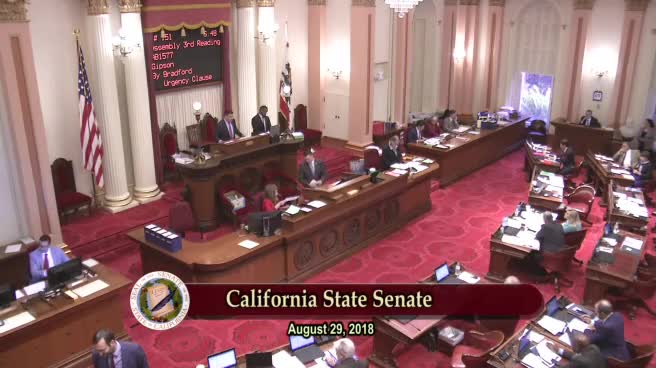 2MIN
Senate Floor
 1H
Senate Standing Committee on Appropriations
 9MIN
Senate Standing Committee on Transportation and Housing
 1MIN
Assembly Floor
 1MIN
Assembly Standing Committee on Appropriations
 4MIN
Assembly Standing Committee on Governmental Organization
Bill Author

Bill Co-Author(s):