AB 3188: School accountability: local control and accountability plans: state priorities: pupil achievement.
- Session Year: 2017-2018
- House: Assembly
- Latest Version Date: 2018-09-04
Existing law requires the governing board of each school district to adopt a local control and accountability plan and requires the governing board of a school district to update its local control and accountability plan before July 1 of each year. Existing law requires a local control and accountability plan to include, among other things, a description of the annual goals to be achieved for each state priority, as specified, for all pupils and certain subgroups of pupils. The states delineated priorities include, among others, pupil achievement as measured by, and as applicable, among other things, the percentage of pupils who have successfully completed courses that satisfy the requirements for entrance to the University of California and the California State University, or career technical education sequences or programs of study that align with State Board of Education-approved career technical education standards and frameworks, as prescribed.
This bill instead would require pupil achievement to be measured by, and as applicable, among other things required by existing law, the percentage of pupils who have successfully completed (1) courses that satisfy the requirements for entrance to the University of California and the California State University; (2) career technical education sequences or programs of study that align with state board-approved career technical education standards and frameworks, as prescribed; or (3) to the extent possible, both (1) and (2). To the extent this bill would impose additional duties on school districts in regard to local control and accountability plans, the bill would impose a state-mandated local program.
This bill would incorporate additional changes to Section 52060 of the Education Code proposed by SB 874, AB 1840, and AB 2878, to be operative only if this bill and one or more of those bills are enacted and this bill is enacted last.
The California Constitution requires the state to reimburse local agencies and school districts for certain costs mandated by the state. Statutory provisions establish procedures for making that reimbursement.
This bill would provide that, if the Commission on State Mandates determines that the bill contains costs mandated by the state, reimbursement for those costs shall be made pursuant to the statutory provisions noted above.
Existing law requires the governing board of each school district to adopt a local control and accountability plan and requires the governing board of a school district to update its local control and accountability plan before July 1 of each year. Existing law requires a local control and accountability plan to include, among other things, a description of the annual goals to be achieved for each state priority, as specified, for all pupils and certain subgroups of pupils. The states delineated priorities include, among others, pupil achievement as measured by, and as applicable, among other things, the percentage of pupils who have successfully completed courses that satisfy the requirements for entrance to the University of California and the California State University, or career technical education sequences or programs of study that align with State Board of Education-approved career technical education standards and frameworks, as prescribed.
This bill instead would require pupil achievement to be measured by, and as applicable, among other things required by existing law, the percentage of pupils who have successfully completed (1) courses that satisfy the requirements for entrance to the University of California and the California State University; or (2) career technical education sequences or programs of study that align with state board-approved career technical education standards and frameworks, as prescribed; or (3) to the extent possible, both (1) and (2). To the extent this bill would impose additional duties on school districts in regard to local control and accountability plans, the bill would impose a state-mandated local program.
This bill would incorporate additional changes to Section 52060 of the Education Code proposed by SB 874, AB 1840, and AB 2878 2878, to be operative only if this bill and AB 2878 one or more of those bills are enacted and this bill is enacted last.
The California Constitution requires the state to reimburse local agencies and school districts for certain costs mandated by the state. Statutory provisions establish procedures for making that reimbursement.
This bill would provide that, if the Commission on State Mandates determines that the bill contains costs mandated by the state, reimbursement for those costs shall be made pursuant to the statutory provisions noted above.
Existing law requires the governing board of each school district to adopt a local control and accountability plan and requires the governing board of a school district to update its local control and accountability plan before July 1 of each year. Existing law requires a local control and accountability plan to include, among other things, a description of the annual goals to be achieved for each state priority, as specified, for all pupils and certain subgroups of pupils. The states delineated priorities include, among others, pupil achievement as measured by, and as applicable, among other things, the percentage of pupils who have successfully completed courses that satisfy the requirements for entrance to the University of California and the California State University, or career technical education sequences or programs of study that align with State Board of Education-approved career technical education standards and frameworks, as prescribed.
This bill instead would require pupil achievement to be measured by, and as applicable, among other things required by existing law, the percentage of pupils who have successfully completed (1) courses that satisfy the requirements for entrance to the University of California and the California State University; or (2) career technical education sequences or programs of study that align with state board-approved career technical education standards and frameworks, as prescribed; or (3) to the extent possible, both (1) and (2). To the extent this bill would impose additional duties on school districts in regard to local control and accountability plans, the bill would impose a state-mandated local program.
This bill would incorporate additional changes to Section 52060 of the Education Code proposed by AB 2878 to be operative only if this bill and AB 2878 are enacted and this bill is enacted last.
The California Constitution requires the state to reimburse local agencies and school districts for certain costs mandated by the state. Statutory provisions establish procedures for making that reimbursement.
This bill would provide that, if the Commission on State Mandates determines that the bill contains costs mandated by the state, reimbursement for those costs shall be made pursuant to the statutory provisions noted above.
Existing law requires the governing board of each school district to adopt a local control and accountability plan and requires the governing board of a school district to update its local control and accountability plan before July 1 of each year. Existing law requires a local control and accountability plan to include, among other things, a description of the annual goals to be achieved for each state priority, as specified, for all pupils and certain subgroups of pupils. The states delineated priorities include, among others, pupil achievement as measured by, and as applicable, among other things, the percentage of pupils who have successfully completed courses that satisfy the requirements for entrance to the University of California and the California State University, or career technical education sequences or programs of study that align with State Board of Education-approved career technical education standards and frameworks, as prescribed.
This bill instead would require pupil achievement to be measured by, and as applicable, among other things required by existing law, the percentage of pupils who have successfully completed (1) courses that satisfy the requirements for entrance to the University of California and the California State University; or (2) career technical education sequences or programs of study that align with state board-approved career technical education standards and frameworks, as prescribed; or (3) to the extent possible, both (1) and (2). To the extent this bill would impose additional duties on school districts in regard to local control and accountability plans, the bill would impose a state-mandated local program.
The California Constitution requires the state to reimburse local agencies and school districts for certain costs mandated by the state. Statutory provisions establish procedures for making that reimbursement.
This bill would provide that, if the Commission on State Mandates determines that the bill contains costs mandated by the state, reimbursement for those costs shall be made pursuant to the statutory provisions noted above.
Existing law requires that a pupil subject to compulsory full-time education or to compulsory continuation education who is absent from school without a valid excuse 3 full days in one school year or tardy or absent for more than a 30-minute period during the schoolday without a valid excuse on 3 occasions in one school year, or any combination thereof, be classified as a truant and requires that the pupil be reported to the attendance supervisor or to the superintendent of the school district.This bill would make nonsubstantive changes in that provision.Existing law requires that a pupil subject to compulsory full-time education or to compulsory continuation education who is absent from school without a valid excuse 3 full days in one school year or tardy or absent for more than a 30-minute period during the schoolday without a valid excuse on 3 occasions in one school year, or any combination thereof, be classified as a truant and requires that the pupil be reported to the attendance supervisor or to the superintendent of the school district.
This bill would make nonsubstantive changes in that provision.
(a)On or before July 1, 2014, the governing board of each school district shall adopt a local control and accountability plan using a template adopted by the state board.
(b)A local control and accountability plan adopted by the governing board of a school district shall be effective for a period of three years, and shall be updated on or before July 1 of each year.
(c)A local control and accountability plan adopted by the governing board of a school district shall include, for the school district and each school within the school district, both of the following:
(1)A description of the annual goals, for all pupils and each subgroup of pupils identified pursuant to Section 52052, to be achieved for each of the state priorities identified in subdivision (d) and for any additional local priorities identified by the governing board of the school district. For purposes of this article, a subgroup of pupils identified pursuant to Section 52052 shall be a numerically significant pupil subgroup as specified in subdivision (a) of Section 52052.
(2)A description of the specific actions the school district will take during each year of the local control and accountability plan to achieve the goals identified in paragraph (1), including the enumeration of any specific actions necessary for that year to correct any deficiencies in regard to the state priorities listed in paragraph (1) of subdivision (d). The specific actions shall not supersede the provisions of existing local collective bargaining agreements within the jurisdiction of the school district.
(d)All of the following are state priorities:
(1)The degree to which the teachers of the school district are appropriately assigned in accordance with Section 44258.9, and fully credentialed in the subject areas, and, for the pupils they are teaching, every pupil in the school district has sufficient access to the standards-aligned instructional materials as determined pursuant to Section 60119, and school facilities are maintained in good repair, as defined in subdivision (d) of Section 17002.
(2)Implementation of the academic content and performance standards adopted by the state board, including how the programs and services will enable English learners to access the common core academic content standards adopted pursuant to Section 60605.8 and the English language development standards adopted pursuant to former Section 60811.3, as that section read on June 30, 2013, or former Section 60811.4, as that section read on June 30, 2016, for purposes of gaining academic content knowledge and English language proficiency.
(3)Parental involvement, including efforts the school district makes to seek parent input in making decisions for the school district and each individual schoolsite, and including how the school district will promote parental participation in programs for unduplicated pupils and individuals with exceptional needs.
(4)Pupil achievement, as measured by all of the following, as applicable:
(A)Statewide assessments administered pursuant to Article 4 (commencing with Section 60640) of Chapter 5 of Part 33 or any subsequent assessment, as certified by the state board.
(B)The percentage of pupils who have successfully completed: (i) courses that satisfy the requirements for entrance to the University of California and the California State University; (ii) career technical education sequences or programs of study that align with state board-approved career technical education standards and frameworks, including, but not limited to, those described in subdivision (a) of Section 52302, subdivision (a) of Section 52372.5, or paragraph (2) of subdivision (e) of Section 54692; or (iii) to the extent possible, both (i) and (ii).
(C)The percentage of English learner pupils who make progress toward English proficiency as measured by the California English Language Development Test or any subsequent assessment of English proficiency, as certified by the state board.
(D)The English learner reclassification rate.
(E)The percentage of pupils who have passed an advanced placement examination with a score of 3 or higher.
(F)The percentage of pupils who participate in, and demonstrate college preparedness pursuant to, the Early Assessment Program, as described in Chapter 6 (commencing with Section 99300) of Part 65 of Division 14 of Title 3, or any subsequent assessment of college preparedness.
(5)Pupil engagement, as measured by all of the following, as applicable:
(A)School attendance rates.
(B)Chronic absenteeism rates.
(C)Middle school dropout rates.
(D)High school dropout rates.
(E)High school graduation rates.
(6)School climate, as measured by all of the following, as applicable:
(A)Pupil suspension rates.
(B)Pupil expulsion rates.
(C)Other local measures, including surveys of pupils, parents, and teachers on the sense of safety and school connectedness.
(7)The extent to which pupils have access to, and are enrolled in, a broad course of study that includes all of the subject areas described in Section 51210 and subdivisions (a) to (i), inclusive, of Section 51220, as applicable, including the programs and services developed and provided to unduplicated pupils and individuals with exceptional needs, and the programs and services that are provided to benefit these pupils as a result of the funding received pursuant to Section 42238.02, as implemented by Section 42238.03.
(8)Pupil outcomes, if available, in the subject areas described in Section 51210 and subdivisions (a) to (i), inclusive, of Section 51220, as applicable.
(e)For purposes of the descriptions required by subdivision (c), the governing board of a school district may consider qualitative information, including, but not limited to, findings that result from school quality reviews conducted pursuant to subdivision (b) of Section 52052 or any other reviews.
(f)To the extent practicable, data reported in a local control and accountability plan shall be reported in a manner consistent with how information is reported on a school accountability report card.
(g)The governing board of a school district shall consult with teachers, principals, administrators, other school personnel, local bargaining units of the school district, parents, and pupils in developing a local control and accountability plan.
(h)A school district may identify local priorities, goals in regard to the local priorities, and the method for measuring the school districts progress toward achieving those goals.
SEC. 1.1.Section 52060 of the Education Code is amended to read:52060.(a)On or before July 1, 2014, the governing board of each school district shall adopt a local control and accountability plan using a template adopted by the state board.
(b)A local control and accountability plan adopted by the governing board of a school district shall be effective for a period of three years, and shall be updated on or before July 1 of each year.
(c)A local control and accountability plan adopted by the governing board of a school district shall include, for the school district and each school within the school district, both of the following:
(1)A description of the annual goals, for all pupils and each subgroup of pupils identified pursuant to Section 52052, to be achieved for each of the state priorities identified in subdivision (d) and for any additional local priorities identified by the governing board of the school district. For purposes of this article, a subgroup of pupils identified pursuant to Section 52052 shall be a numerically significant pupil subgroup as specified in subdivision (a) of Section 52052.
(2)A description of the specific actions the school district will take during each year of the local control and accountability plan to achieve the goals identified in paragraph (1), including the enumeration of any specific actions necessary for that year to correct any deficiencies in regard to the state priorities listed in paragraph (1) of subdivision (d). The specific actions shall not supersede the provisions of existing local collective bargaining agreements within the jurisdiction of the school district.
(d)All of the following are state priorities:
(1)The degree to which the teachers of the school district are appropriately assigned in accordance with Section 44258.9, and fully credentialed in the subject areas, and, for the pupils they are teaching, every pupil in the school district has sufficient access to the standards-aligned instructional materials as determined pursuant to Section 60119, and school facilities are maintained in good repair, as defined in subdivision (d) of Section 17002.
(2)Implementation of the academic content and performance standards adopted by the state board, including how the programs and services will enable English learners to access the common core academic content standards adopted pursuant to Section 60605.8 and the English language development standards adopted pursuant to former Section 60811.3, as that section read on June 30, 2013, or former Section 60811.4, as that section read on June 30, 2016, for purposes of gaining academic content knowledge and English language proficiency.
(3)(A)Parental involvement and family engagement, including efforts the school district makes to seek parent input in making decisions for the school district and each individual schoolsite, and including how the school district will promote parental participation in programs for unduplicated pupils and individuals with exceptional needs.
(B)Family engagement may include, but need not be limited to, efforts by the school district and each individual schoolsite to apply research-based practices, such as welcoming all families into the school community, engaging in effective two-way communication, supporting pupil success, and empowering families to advocate for equity and access. Family engagement may include, but need not be limited to, treating families as partners to inform, influence, and create practices and programs that support pupil success and collaboration with families and the broader community, expand pupil learning opportunities and community services, and promote civic participation.
(4)Pupil achievement, as measured by all of the following, as applicable:
(A)Statewide assessments administered pursuant to Article 4 (commencing with Section 60640) of Chapter 5 of Part 33 or any subsequent assessment, as certified by the state board.
(B)The percentage of pupils who have successfully completed: (i) courses that satisfy the requirements for entrance to the University of California and the California State University; (ii) career technical education sequences or programs of study that align with state board-approved career technical education standards and frameworks, including, but not limited to, those described in subdivision (a) of Section 52302, subdivision (a) of Section 52372.5, or paragraph (2) of subdivision (e) of Section 54692; or (iii) to the extent possible, both (i) and (ii).
(C)The percentage of English learner pupils who make progress toward English proficiency as measured by the California English Language Development Test or any subsequent assessment of English proficiency, as certified by the state board.
(D)The English learner reclassification rate.
(E)The percentage of pupils who have passed an advanced placement examination with a score of 3 or higher.
(F)The percentage of pupils who participate in, and demonstrate college preparedness pursuant to, the Early Assessment Program, as described in Chapter 6 (commencing with Section 99300) of Part 65 of Division 14 of Title 3, or any subsequent assessment of college preparedness.
(5)Pupil engagement, as measured by all of the following, as applicable:
(A)School attendance rates.
(B)Chronic absenteeism rates.
(C)Middle school dropout rates.
(D)High school dropout rates.
(E)High school graduation rates.
(6)School climate, as measured by all of the following, as applicable:
(A)Pupil suspension rates.
(B)Pupil expulsion rates.
(C)Other local measures, including surveys of pupils, parents, and teachers on the sense of safety and school connectedness.
(7)The extent to which pupils have access to, and are enrolled in, a broad course of study that includes all of the subject areas described in Section 51210 and subdivisions (a) to (i), inclusive, of Section 51220, as applicable, including the programs and services developed and provided to unduplicated pupils and individuals with exceptional needs, and the programs and services that are provided to benefit these pupils as a result of the funding received pursuant to Section 42238.02, as implemented by Section 42238.03.
(8)Pupil outcomes, if available, in the subject areas described in Section 51210 and subdivisions (a) to (i), inclusive, of Section 51220, as applicable.
(e)For purposes of the descriptions required by subdivision (c), the governing board of a school district may consider qualitative information, including, but not limited to, findings that result from school quality reviews conducted pursuant to subdivision (b) of Section 52052 or any other reviews.
(f)To the extent practicable, data reported in a local control and accountability plan shall be reported in a manner consistent with how information is reported on a school accountability report card.
(g)The governing board of a school district shall consult with teachers, principals, administrators, other school personnel, local bargaining units of the school district, parents, and pupils in developing a local control and accountability plan.
(h)A school district may identify local priorities, goals in regard to the local priorities, and the method for measuring the school districts progress toward achieving those goals.
SEC. 1.2.Section 52060 of the Education Code is amended to read:52060.(a)On or before July 1, 2014, the governing board of each school district shall adopt a local control and accountability plan using a template adopted by the state board.
(b)A local control and accountability plan adopted by the governing board of a school district shall be effective for a period of three years, and shall be updated on or before July 1 of each year.
(c)A local control and accountability plan adopted by the governing board of a school district shall include, for the school district and each school within the school district, all of the information specified in the template adopted by the state board pursuant to Section 52064.
(d)All of the following are state priorities for purposes of a school districts local control and accountability plan:
(1)The degree to which the teachers of the school district are appropriately assigned in accordance with Section 44258.9, and fully credentialed in the subject areas, and, for the pupils they are teaching, every pupil in the school district has sufficient access to the standards-aligned instructional materials as determined pursuant to Section 60119, and school facilities are maintained in good repair, as defined in subdivision (d) of Section 17002.
(2)Implementation of the academic content and performance standards adopted by the state board, including how the programs and services will enable English learners to access the common core academic content standards adopted pursuant to Section 60605.8 and the English language development standards adopted pursuant to former Section 60811.3, as that section read on June 30, 2013, or former Section 60811.4, as that section read on June 30, 2016, for purposes of gaining academic content knowledge and English language proficiency.
(3)Parental involvement, including efforts the school district makes to seek parent input in making decisions for the school district and each individual schoolsite, and including how the school district will promote parental participation in programs for unduplicated pupils and individuals with exceptional needs.
(4)Pupil achievement, as measured by all of the following, as applicable:
(A)Statewide assessments administered pursuant to Article 4 (commencing with Section 60640) of Chapter 5 of Part 33 or any subsequent assessment, as certified by the state board.
(B)The percentage of pupils who have successfully completed: (i) courses that satisfy the requirements for entrance to the University of California and the California State University; (ii) career technical education sequences or programs of study that align with state board-approved career technical education standards and frameworks, including, but not limited to, those described in subdivision (a) of Section 52302, subdivision (a) of Section 52372.5, or paragraph (2) of subdivision (e) of Section 54692; or (iii) to the extent possible, both (i) and (ii).
(C)The percentage of English learner pupils who make progress toward English proficiency as measured by the English Language Proficiency Assessments for California or any subsequent assessment of English proficiency, as certified by the state board.
(D)The English learner reclassification rate.
(E)The percentage of pupils who have passed an advanced placement examination with a score of 3 or higher.
(F)The percentage of pupils who demonstrate college preparedness pursuant to the Early Assessment Program, as described in Chapter 6 (commencing with Section 99300) of Part 65 of Division 14 of Title 3, or any subsequent assessment of college preparedness.
(5)Pupil engagement, as measured by all of the following, as applicable:
(A)School attendance rates.
(B)Chronic absenteeism rates.
(C)Middle school dropout rates.
(D)High school dropout rates.
(E)High school graduation rates.
(6)School climate, as measured by all of the following, as applicable:
(A)Pupil suspension rates.
(B)Pupil expulsion rates.
(C)Other local measures, including surveys of pupils, parents, and teachers on the sense of safety and school connectedness.
(7)The extent to which pupils have access to, and are enrolled in, a broad course of study that includes all of the subject areas described in Section 51210 and subdivisions (a) to (i), inclusive, of Section 51220, as applicable, including the programs and services developed and provided to unduplicated pupils and individuals with exceptional needs, and the programs and services that are provided to benefit these pupils as a result of the funding received pursuant to Section 42238.02, as implemented by Section 42238.03.
(8)Pupil outcomes, if available, in the subject areas described in Section 51210 and subdivisions (a) to (i), inclusive, of Section 51220, as applicable.
(e)For purposes of the descriptions required by subdivision (b) of Section 52064, the governing board of a school district may consider qualitative information, including, but not limited to, findings that result from school quality reviews conducted pursuant to subdivision (b) of Section 52052 or any other reviews.
(f)To the extent practicable, data reported in a local control and accountability plan shall be reported in a manner consistent with how information is reported on the California School Dashboard maintained by the department pursuant to Section 52064.5.
(g)The governing board of a school district shall consult with teachers, principals, administrators, other school personnel, local bargaining units of the school district, parents, and pupils in developing a local control and accountability plan.
(h)A school district may identify local priorities, goals in regard to the local priorities, and the method for measuring the school districts progress toward achieving those goals.
SEC. 1.3.Section 52060 of the Education Code is amended to read:52060.(a)On or before July 1, 2014, the governing board of each school district shall adopt a local control and accountability plan using a template adopted by the state board.
(b)A local control and accountability plan adopted by the governing board of a school district shall be effective for a period of three years, and shall be updated on or before July 1 of each year.
(c)A local control and accountability plan adopted by the governing board of a school district shall include, for the school district and each school within the school district, all of the information specified in the template adopted by the state board pursuant to Section 52064.
(d)All of the following are state priorities for purposes of a school districts local control and accountability plan:
(1)The degree to which the teachers of the school district are appropriately assigned in accordance with Section 44258.9, and fully credentialed in the subject areas, and, for the pupils they are teaching, every pupil in the school district has sufficient access to the standards-aligned instructional materials as determined pursuant to Section 60119, and school facilities are maintained in good repair, as defined in subdivision (d) of Section 17002.
(2)Implementation of the academic content and performance standards adopted by the state board, including how the programs and services will enable English learners to access the common core academic content standards adopted pursuant to Section 60605.8 and the English language development standards adopted pursuant to former Section 60811.3, as that section read on June 30, 2013, or former Section 60811.4, as that section read on June 30, 2016, for purposes of gaining academic content knowledge and English language proficiency.
(3)(A)Parental involvement and family engagement, including efforts the school district makes to seek parent input in making decisions for the school district and each individual schoolsite, and including how the school district will promote parental participation in programs for unduplicated pupils and individuals with exceptional needs.
(B)Family engagement may include, but need not be limited to, efforts by the school district and each individual schoolsite to apply research-based practices, such as welcoming all families into the school community, engaging in effective two-way communication, supporting pupil success, and empowering families to advocate for equity and access. Family engagement may include, but need not be limited to, families as partners to inform, influence, and create practices and programs that support pupil success and collaboration with families and the broader community, expand pupil learning opportunities and community services, and promote civic participation.
(4)Pupil achievement, as measured by all of the following, as applicable:
(A)Statewide assessments administered pursuant to Article 4 (commencing with Section 60640) of Chapter 5 of Part 33 or any subsequent assessment, as certified by the state board.
(B)The percentage of pupils who have successfully completed: (i) courses that satisfy the requirements for entrance to the University of California and the California State University; (ii) career technical education sequences or programs of study that align with state board-approved career technical education standards and frameworks, including, but not limited to, those described in subdivision (a) of Section 52302, subdivision (a) of Section 52372.5, or paragraph (2) of subdivision (e) of Section 54692; or (iii) to the extent possible, both (i) and (ii).
(C)The percentage of English learner pupils who make progress toward English proficiency as measured by the English Language Proficiency Assessments for California or any subsequent assessment of English proficiency, as certified by the state board.
(D)The English learner reclassification rate.
(E)The percentage of pupils who have passed an advanced placement examination with a score of 3 or higher.
(F)The percentage of pupils who demonstrate college preparedness pursuant to the Early Assessment Program, as described in Chapter 6 (commencing with Section 99300) of Part 65 of Division 14 of Title 3, or any subsequent assessment of college preparedness.
(5)Pupil engagement, as measured by all of the following, as applicable:
(A)School attendance rates.
(B)Chronic absenteeism rates.
(C)Middle school dropout rates.
(D)High school dropout rates.
(E)High school graduation rates.
(6)School climate, as measured by all of the following, as applicable:
(A)Pupil suspension rates.
(B)Pupil expulsion rates.
(C)Other local measures, including surveys of pupils, parents, and teachers on the sense of safety and school connectedness.
(7)The extent to which pupils have access to, and are enrolled in, a broad course of study that includes all of the subject areas described in Section 51210 and subdivisions (a) to (i), inclusive, of Section 51220, as applicable, including the programs and services developed and provided to unduplicated pupils and individuals with exceptional needs, and the programs and services that are provided to benefit these pupils as a result of the funding received pursuant to Section 42238.02, as implemented by Section 42238.03.
(8)Pupil outcomes, if available, in the subject areas described in Section 51210 and subdivisions (a) to (i), inclusive, of Section 51220, as applicable.
(e)For purposes of the descriptions required by subdivision (b) of Section 52064, the governing board of a school district may consider qualitative information, including, but not limited to, findings that result from school quality reviews conducted pursuant to subdivision (b) of Section 52052 or any other reviews.
(f)To the extent practicable, data reported in a local control and accountability plan shall be reported in a manner consistent with how information is reported on the California School Dashboard maintained by the department pursuant to Section 52064.5.
(g)The governing board of a school district shall consult with teachers, principals, administrators, other school personnel, local bargaining units of the school district, parents, and pupils in developing a local control and accountability plan.
(h)A school district may identify local priorities, goals in regard to the local priorities, and the method for measuring the school districts progress toward achieving those goals.
SEC. 2.(a)Section 1.1 of this bill incorporates amendments to Section 52060 of the Education Code proposed by both this bill and Assembly Bill 2878. That section of this bill shall only become operative if (1) both bills are enacted and become effective on or before January 1, 2019, (2) each bill amends Section 52060 of the Education Code, (3) both Senate Bill 874 and Assembly Bill 1840 are not enacted or as enacted do not amend that section, and (4) this bill is enacted after Assembly Bill 2878, in which case Sections 1, 1.2, and 1.3 of this bill shall not become operative.
(b)Section 1.2 of this bill incorporates amendments to Section 52060 of the Education Code proposed by this bill, Senate Bill 874, and Assembly Bill 1840. That section of this bill shall only become operative if (1) this bill and one or both of Senate Bill 874 and Assembly Bill 1840 are enacted and become effective on or before January 1, 2019, (2) this bill and one or both of Senate Bill 874 and Assembly Bill 1840, as enacted, amends Section 52060 of the Education Code, (3) Assembly Bill 2878 is not enacted or as enacted does not amend that section, and (4) this bill is enacted last of these bills amending Section 52060 of the Education Code, in which case Section 52060 of the Education Code, as amended by either Senate Bill 874 or Assembly Bill 1840, whichever is operative, shall remain operative only until the operative date of this bill, at which time Section 1.2 of this bill shall become operative, and Sections 1, 1.1, and 1.3 of this bill shall not become operative.
(c)Section 1.3 of this bill incorporates amendments to Section 52060 of the Education Code proposed by this bill, Senate Bill 874, Assembly Bill 1840, and Assembly Bill 2878. That section of this bill shall only become operative if (1) this bill, Assembly Bill 2878, and one or both of Senate Bill 874 and Assembly Bill 1840 are enacted and become effective on or before January 1, 2019, (2) this bill, Assembly Bill 2878, and one or both of Senate Bill 874 and Assembly Bill 1840, as enacted, amends Section 52060 of the Education Code, and (3) this bill is enacted last of these bills amending Section 52060 of the Education Code, in which case Section 52060 of the Education Code, as amended by either Senate Bill 874 or Assembly Bill 1840, whichever is operative, shall remain operative only until the operative date of this bill, at which time Section 1.3 of this bill shall become operative, and Sections 1, 1.1, and 1.2 of this bill shall not become operative.
SEC. 3.If the Commission on State Mandates determines that this act contains costs mandated by the state, reimbursement to local agencies and school districts for those costs shall be made pursuant to Part 7 (commencing with Section 17500) of Division 4 of Title 2 of the Government Code.
(a)On or before July 1, 2014, the governing board of each school district shall adopt a local control and accountability plan using a template adopted by the state board.
(b)A local control and accountability plan adopted by the governing board of a school district shall be effective for a period of three years, and shall be updated on or before July 1 of each year.
(c)A local control and accountability plan adopted by the governing board of a school district shall include, for the school district and each school within the school district, both of the following:
(1)A description of the annual goals, for all pupils and each subgroup of pupils identified pursuant to Section 52052, to be achieved for each of the state priorities identified in subdivision (d) and for any additional local priorities identified by the governing board of the school district. For purposes of this article, a subgroup of pupils identified pursuant to Section 52052 shall be a numerically significant pupil subgroup as specified in subdivision (a) of Section 52052.
(2)A description of the specific actions the school district will take during each year of the local control and accountability plan to achieve the goals identified in paragraph (1), including the enumeration of any specific actions necessary for that year to correct any deficiencies in regard to the state priorities listed in paragraph (1) of subdivision (d). The specific actions shall not supersede the provisions of existing local collective bargaining agreements within the jurisdiction of the school district.
(d)All of the following are state priorities:
(1)The degree to which the teachers of the school district are appropriately assigned in accordance with Section 44258.9, and fully credentialed in the subject areas, and, for the pupils they are teaching, every pupil in the school district has sufficient access to the standards-aligned instructional materials as determined pursuant to Section 60119, and school facilities are maintained in good repair, as defined in subdivision (d) of Section 17002.
(2)Implementation of the academic content and performance standards adopted by the state board, including how the programs and services will enable English learners to access the common core academic content standards adopted pursuant to Section 60605.8 and the English language development standards adopted pursuant to former Section 60811.3, as that section read on June 30, 2013, or former Section 60811.4, as that section read on June 30, 2016, for purposes of gaining academic content knowledge and English language proficiency.
(3)Parental involvement, including efforts the school district makes to seek parent input in making decisions for the school district and each individual schoolsite, and including how the school district will promote parental participation in programs for unduplicated pupils and individuals with exceptional needs.
(4)Pupil achievement, as measured by all of the following, as applicable:
(A)Statewide assessments administered pursuant to Article 4 (commencing with Section 60640) of Chapter 5 of Part 33 or any subsequent assessment, as certified by the state board.
(B)The percentage of pupils who have successfully completed: (i) courses that satisfy the requirements for entrance to the University of California and the California State University; (ii) career technical education sequences or programs of study that align with state board-approved career technical education standards and frameworks, including, but not limited to, those described in subdivision (a) of Section 52302, subdivision (a) of Section 52372.5, or paragraph (2) of subdivision (e) of Section 54692; or (iii) to the extent possible, both (i) and (ii).
(C)The percentage of English learner pupils who make progress toward English proficiency as measured by the California English Language Development Test or any subsequent assessment of English proficiency, as certified by the state board.
(D)The English learner reclassification rate.
(E)The percentage of pupils who have passed an advanced placement examination with a score of 3 or higher.
(F)The percentage of pupils who participate in, and demonstrate college preparedness pursuant to, the Early Assessment Program, as described in Chapter 6 (commencing with Section 99300) of Part 65 of Division 14 of Title 3, or any subsequent assessment of college preparedness.
(5)Pupil engagement, as measured by all of the following, as applicable:
(A)School attendance rates.
(B)Chronic absenteeism rates.
(C)Middle school dropout rates.
(D)High school dropout rates.
(E)High school graduation rates.
(6)School climate, as measured by all of the following, as applicable:
(A)Pupil suspension rates.
(B)Pupil expulsion rates.
(C)Other local measures, including surveys of pupils, parents, and teachers on the sense of safety and school connectedness.
(7)The extent to which pupils have access to, and are enrolled in, a broad course of study that includes all of the subject areas described in Section 51210 and subdivisions (a) to (i), inclusive, of Section 51220, as applicable, including the programs and services developed and provided to unduplicated pupils and individuals with exceptional needs, and the programs and services that are provided to benefit these pupils as a result of the funding received pursuant to Section 42238.02, as implemented by Section 42238.03.
(8)Pupil outcomes, if available, in the subject areas described in Section 51210 and subdivisions (a) to (i), inclusive, of Section 51220, as applicable.
(e)For purposes of the descriptions required by subdivision (c), the governing board of a school district may consider qualitative information, including, but not limited to, findings that result from school quality reviews conducted pursuant to subdivision (b) of Section 52052 or any other reviews.
(f)To the extent practicable, data reported in a local control and accountability plan shall be reported in a manner consistent with how information is reported on a school accountability report card.
(g)The governing board of a school district shall consult with teachers, principals, administrators, other school personnel, local bargaining units of the school district, parents, and pupils in developing a local control and accountability plan.
(h)A school district may identify local priorities, goals in regard to the local priorities, and the method for measuring the school districts progress toward achieving those goals.
SEC. 1.5. 1.1.Section 52060 of the Education Code is amended to read:52060.(a)On or before July 1, 2014, the governing board of each school district shall adopt a local control and accountability plan using a template adopted by the state board.
(b)A local control and accountability plan adopted by the governing board of a school district shall be effective for a period of three years, and shall be updated on or before July 1 of each year.
(c)A local control and accountability plan adopted by the governing board of a school district shall include, for the school district and each school within the school district, both of the following:
(1)A description of the annual goals, for all pupils and each subgroup of pupils identified pursuant to Section 52052, to be achieved for each of the state priorities identified in subdivision (d) and for any additional local priorities identified by the governing board of the school district. For purposes of this article, a subgroup of pupils identified pursuant to Section 52052 shall be a numerically significant pupil subgroup as specified in subdivision (a) of Section 52052.
(2)A description of the specific actions the school district will take during each year of the local control and accountability plan to achieve the goals identified in paragraph (1), including the enumeration of any specific actions necessary for that year to correct any deficiencies in regard to the state priorities listed in paragraph (1) of subdivision (d). The specific actions shall not supersede the provisions of existing local collective bargaining agreements within the jurisdiction of the school district.
(d)All of the following are state priorities:
(1)The degree to which the teachers of the school district are appropriately assigned in accordance with Section 44258.9, and fully credentialed in the subject areas, and, for the pupils they are teaching, every pupil in the school district has sufficient access to the standards-aligned instructional materials as determined pursuant to Section 60119, and school facilities are maintained in good repair, as defined in subdivision (d) of Section 17002.
(2)Implementation of the academic content and performance standards adopted by the state board, including how the programs and services will enable English learners to access the common core academic content standards adopted pursuant to Section 60605.8 and the English language development standards adopted pursuant to former Section 60811.3, as that section read on June 30, 2013, or former Section 60811.4, as that section read on June 30, 2016, for purposes of gaining academic content knowledge and English language proficiency.
(3)(A)Parental involvement and family engagement, including efforts the school district makes to seek parent input in making decisions for the school district and each individual schoolsite, and including how the school district will promote parental participation in programs for unduplicated pupils and individuals with exceptional needs.
(B)Family engagement may include, but need not be limited to, efforts by the school district and each individual schoolsite to apply research-based practices, such as welcoming all families into the school community, engaging in effective two-way communication, supporting pupil success, and empowering families to advocate for equity and access. Family engagement may include, but need not be limited to, treating families as partners to inform, influence, and create practices and programs that support pupil success and collaboration with families and the broader community, expand pupil learning opportunities and community services, and promote civic participation.
(4)Pupil achievement, as measured by all of the following, as applicable:
(A)Statewide assessments administered pursuant to Article 4 (commencing with Section 60640) of Chapter 5 of Part 33 or any subsequent assessment, as certified by the state board.
(B)The percentage of pupils who have successfully completed: (i) courses that satisfy the requirements for entrance to the University of California and the California State University; (ii) career technical education sequences or programs of study that align with state board-approved career technical education standards and frameworks, including, but not limited to, those described in subdivision (a) of Section 52302, subdivision (a) of Section 52372.5, or paragraph (2) of subdivision (e) of Section 54692; or (iii) to the extent possible, both (i) and (ii).
(C)The percentage of English learner pupils who make progress toward English proficiency as measured by the California English Language Development Test or any subsequent assessment of English proficiency, as certified by the state board.
(D)The English learner reclassification rate.
(E)The percentage of pupils who have passed an advanced placement examination with a score of 3 or higher.
(F)The percentage of pupils who participate in, and demonstrate college preparedness pursuant to, the Early Assessment Program, as described in Chapter 6 (commencing with Section 99300) of Part 65 of Division 14 of Title 3, or any subsequent assessment of college preparedness.
(5)Pupil engagement, as measured by all of the following, as applicable:
(A)School attendance rates.
(B)Chronic absenteeism rates.
(C)Middle school dropout rates.
(D)High school dropout rates.
(E)High school graduation rates.
(6)School climate, as measured by all of the following, as applicable:
(A)Pupil suspension rates.
(B)Pupil expulsion rates.
(C)Other local measures, including surveys of pupils, parents, and teachers on the sense of safety and school connectedness.
(7)The extent to which pupils have access to, and are enrolled in, a broad course of study that includes all of the subject areas described in Section 51210 and subdivisions (a) to (i), inclusive, of Section 51220, as applicable, including the programs and services developed and provided to unduplicated pupils and individuals with exceptional needs, and the programs and services that are provided to benefit these pupils as a result of the funding received pursuant to Section 42238.02, as implemented by Section 42238.03.
(8)Pupil outcomes, if available, in the subject areas described in Section 51210 and subdivisions (a) to (i), inclusive, of Section 51220, as applicable.
(e)For purposes of the descriptions required by subdivision (c), the governing board of a school district may consider qualitative information, including, but not limited to, findings that result from school quality reviews conducted pursuant to subdivision (b) of Section 52052 or any other reviews.
(f)To the extent practicable, data reported in a local control and accountability plan shall be reported in a manner consistent with how information is reported on a school accountability report card.
(g)The governing board of a school district shall consult with teachers, principals, administrators, other school personnel, local bargaining units of the school district, parents, and pupils in developing a local control and accountability plan.
(h)A school district may identify local priorities, goals in regard to the local priorities, and the method for measuring the school districts progress toward achieving those goals.
SEC. 1.2.Section 52060 of the Education Code is amended to read:52060.(a)On or before July 1, 2014, the governing board of each school district shall adopt a local control and accountability plan using a template adopted by the state board.
(b)A local control and accountability plan adopted by the governing board of a school district shall be effective for a period of three years, and shall be updated on or before July 1 of each year.
(c)A local control and accountability plan adopted by the governing board of a school district shall include, for the school district and each school within the school district, both all of the following: information specified in the template adopted by the state board pursuant to Section 52064.
(1)A description of the annual goals, for all pupils and each subgroup of pupils identified pursuant to Section 52052, to be achieved for each of the state priorities identified in subdivision (d) and for any additional local priorities identified by the governing board of the school district. For purposes of this article, a subgroup of pupils identified pursuant to Section 52052 shall be a numerically significant pupil subgroup as specified in subdivision (a) of Section 52052. (2)A description of the specific actions the school district will take during each year of the local control and accountability plan to achieve the goals identified in paragraph (1), including the enumeration of any specific actions necessary for that year to correct any deficiencies in regard to the state priorities listed in paragraph (1) of subdivision (d). The specific actions shall not supersede the provisions of existing local collective bargaining agreements within the jurisdiction of the school district.(d)All of the following are state priorities: priorities for purposes of a school districts local control and accountability plan:
(1)The degree to which the teachers of the school district are appropriately assigned in accordance with Section 44258.9, and fully credentialed in the subject areas, and, for the pupils they are teaching, every pupil in the school district has sufficient access to the standards-aligned instructional materials as determined pursuant to Section 60119, and school facilities are maintained in good repair, as defined in subdivision (d) of Section 17002.
(2)Implementation of the academic content and performance standards adopted by the state board, including how the programs and services will enable English learners to access the common core academic content standards adopted pursuant to Section 60605.8 and the English language development standards adopted pursuant to former Section 60811.3, as that section read on June 30, 2013, or former Section 60811.4, as that section read on June 30, 2016, for purposes of gaining academic content knowledge and English language proficiency.
(3)Parental involvement, including efforts the school district makes to seek parent input in making decisions for the school district and each individual schoolsite, and including how the school district will promote parental participation in programs for unduplicated pupils and individuals with exceptional needs.
(4)Pupil achievement, as measured by all of the following, as applicable:
(A)Statewide assessments administered pursuant to Article 4 (commencing with Section 60640) of Chapter 5 of Part 33 or any subsequent assessment, as certified by the state board.
(B)The percentage of pupils who have successfully completed completed: (i) courses that satisfy the requirements for entrance to the University of California and the California State University, or University; (ii) career technical education sequences or programs of study that align with state board-approved career technical education standards and frameworks, including, but not limited to, those described in subdivision (a) of Section 52302, subdivision (a) of Section 52372.5, or paragraph (2) of subdivision (e) of Section 54692. 54692; or (iii) to the extent possible, both (i) and (ii).
(C)The percentage of English learner pupils who make progress toward English proficiency as measured by the California English Language Development Test Proficiency Assessments for California or any subsequent assessment of English proficiency, as certified by the state board.
(D)The English learner reclassification rate.
(E)The percentage of pupils who have passed an advanced placement examination with a score of 3 or higher.
(F)The percentage of pupils who participate in, and demonstrate college preparedness pursuant to, to the Early Assessment Program, as described in Chapter 6 (commencing with Section 99300) of Part 65 of Division 14 of Title 3, or any subsequent assessment of college preparedness.
(5)Pupil engagement, as measured by all of the following, as applicable:
(A)School attendance rates.
(B)Chronic absenteeism rates.
(C)Middle school dropout rates.
(D)High school dropout rates.
(E)High school graduation rates.
(6)School climate, as measured by all of the following, as applicable:
(A)Pupil suspension rates.
(B)Pupil expulsion rates.
(C)Other local measures, including surveys of pupils, parents, and teachers on the sense of safety and school connectedness.
(7)The extent to which pupils have access to, and are enrolled in, a broad course of study that includes all of the subject areas described in Section 51210 and subdivisions (a) to (i), inclusive, of Section 51220, as applicable, including the programs and services developed and provided to unduplicated pupils and individuals with exceptional needs, and the programs and services that are provided to benefit these pupils as a result of the funding received pursuant to Section 42238.02, as implemented by Section 42238.03.
(8)Pupil outcomes, if available, in the subject areas described in Section 51210 and subdivisions (a) to (i), inclusive, of Section 51220, as applicable.
(e)For purposes of the descriptions required by subdivision (c), (b) of Section 52064, the governing board of a school district may consider qualitative information, including, but not limited to, findings that result from school quality reviews conducted pursuant to subdivision (b) of Section 52052 or any other reviews.
(f)To the extent practicable, data reported in a local control and accountability plan shall be reported in a manner consistent with how information is reported on a school accountability report card. the California School Dashboard maintained by the department pursuant to Section 52064.5.
(g)The governing board of a school district shall consult with teachers, principals, administrators, other school personnel, local bargaining units of the school district, parents, and pupils in developing a local control and accountability plan.
(h)A school district may identify local priorities, goals in regard to the local priorities, and the method for measuring the school districts progress toward achieving those goals.
SEC. 1.3.Section 52060 of the Education Code is amended to read:52060.(a)On or before July 1, 2014, the governing board of each school district shall adopt a local control and accountability plan using a template adopted by the state board.
(b)A local control and accountability plan adopted by the governing board of a school district shall be effective for a period of three years, and shall be updated on or before July 1 of each year.
(c)A local control and accountability plan adopted by the governing board of a school district shall include, for the school district and each school within the school district, both all of the following: information specified in the template adopted by the state board pursuant to Section 52064.
(1)A description of the annual goals, for all pupils and each subgroup of pupils identified pursuant to Section 52052, to be achieved for each of the state priorities identified in subdivision (d) and for any additional local priorities identified by the governing board of the school district. For purposes of this article, a subgroup of pupils identified pursuant to Section 52052 shall be a numerically significant pupil subgroup as specified in subdivision (a) of Section 52052. (2)A description of the specific actions the school district will take during each year of the local control and accountability plan to achieve the goals identified in paragraph (1), including the enumeration of any specific actions necessary for that year to correct any deficiencies in regard to the state priorities listed in paragraph (1) of subdivision (d). The specific actions shall not supersede the provisions of existing local collective bargaining agreements within the jurisdiction of the school district.(d)All of the following are state priorities: priorities for purposes of a school districts local control and accountability plan:
(1)The degree to which the teachers of the school district are appropriately assigned in accordance with Section 44258.9, and fully credentialed in the subject areas, and, for the pupils they are teaching, every pupil in the school district has sufficient access to the standards-aligned instructional materials as determined pursuant to Section 60119, and school facilities are maintained in good repair, as defined in subdivision (d) of Section 17002.
(2)Implementation of the academic content and performance standards adopted by the state board, including how the programs and services will enable English learners to access the common core academic content standards adopted pursuant to Section 60605.8 and the English language development standards adopted pursuant to former Section 60811.3, as that section read on June 30, 2013, or former Section 60811.4, as that section read on June 30, 2016, for purposes of gaining academic content knowledge and English language proficiency.
(3)(A)Parental involvement, involvement and family engagement, including efforts the school district makes to seek parent input in making decisions for the school district and each individual schoolsite, and including how the school district will promote parental participation in programs for unduplicated pupils and individuals with exceptional needs.
(B)Family engagement may include, but need not be limited to, efforts by the school district and each individual schoolsite to apply research-based practices, such as welcoming all families into the school community, engaging in effective two-way communication, supporting pupil success, and empowering families to advocate for equity and access. Family engagement may include, but need not be limited to, families as partners to inform, influence, and create practices and programs that support pupil success and collaboration with families and the broader community, expand pupil learning opportunities and community services, and promote civic participation.
(4)Pupil achievement, as measured by all of the following, as applicable:
(A)Statewide assessments administered pursuant to Article 4 (commencing with Section 60640) of Chapter 5 of Part 33 or any subsequent assessment, as certified by the state board.
(B)The percentage of pupils who have successfully completed completed: (i) courses that satisfy the requirements for entrance to the University of California and the California State University, or University; (ii) career technical education sequences or programs of study that align with state board-approved career technical education standards and frameworks, including, but not limited to, those described in subdivision (a) of Section 52302, subdivision (a) of Section 52372.5, or paragraph (2) of subdivision (e) of Section 54692. 54692; or (iii) to the extent possible, both (i) and (ii).
(C)The percentage of English learner pupils who make progress toward English proficiency as measured by the California English Language Development Test Proficiency Assessments for California or any subsequent assessment of English proficiency, as certified by the state board.
(D)The English learner reclassification rate.
(E)The percentage of pupils who have passed an advanced placement examination with a score of 3 or higher.
(F)The percentage of pupils who participate in, and demonstrate college preparedness pursuant to, to the Early Assessment Program, as described in Chapter 6 (commencing with Section 99300) of Part 65 of Division 14 of Title 3, or any subsequent assessment of college preparedness.
(5)Pupil engagement, as measured by all of the following, as applicable:
(A)School attendance rates.
(B)Chronic absenteeism rates.
(C)Middle school dropout rates.
(D)High school dropout rates.
(E)High school graduation rates.
(6)School climate, as measured by all of the following, as applicable:
(A)Pupil suspension rates.
(B)Pupil expulsion rates.
(C)Other local measures, including surveys of pupils, parents, and teachers on the sense of safety and school connectedness.
(7)The extent to which pupils have access to, and are enrolled in, a broad course of study that includes all of the subject areas described in Section 51210 and subdivisions (a) to (i), inclusive, of Section 51220, as applicable, including the programs and services developed and provided to unduplicated pupils and individuals with exceptional needs, and the programs and services that are provided to benefit these pupils as a result of the funding received pursuant to Section 42238.02, as implemented by Section 42238.03.
(8)Pupil outcomes, if available, in the subject areas described in Section 51210 and subdivisions (a) to (i), inclusive, of Section 51220, as applicable.
(e)For purposes of the descriptions required by subdivision (c), (b) of Section 52064, the governing board of a school district may consider qualitative information, including, but not limited to, findings that result from school quality reviews conducted pursuant to subdivision (b) of Section 52052 or any other reviews.
(f)To the extent practicable, data reported in a local control and accountability plan shall be reported in a manner consistent with how information is reported on a school accountability report card. the California School Dashboard maintained by the department pursuant to Section 52064.5.
(g)The governing board of a school district shall consult with teachers, principals, administrators, other school personnel, local bargaining units of the school district, parents, and pupils in developing a local control and accountability plan.
(h)A school district may identify local priorities, goals in regard to the local priorities, and the method for measuring the school districts progress toward achieving those goals.
SEC. 2.Section 1.5 of this bill incorporates amendments to Section 52060 of the Education Code proposed by both this bill and Assembly Bill 2878. That section of this bill shall only become operative if (1) both bills are enacted and become effective on or before January 1, 2019, (2) each bill amends Section 52060 of the Education Code, and (3) this bill is enacted after Assembly Bill 2878, in which case Section 1 of this bill shall not become operative.SEC. 2.(a)Section 1.1 of this bill incorporates amendments to Section 52060 of the Education Code proposed by both this bill and Assembly Bill 2878. That section of this bill shall only become operative if (1) both bills are enacted and become effective on or before January 1, 2019, (2) each bill amends Section 52060 of the Education Code, (3) both Senate Bill 874 and Assembly Bill 1840 are not enacted or as enacted do not amend that section, and (4) this bill is enacted after Assembly Bill 2878, in which case Sections 1, 1.2, and 1.3 of this bill shall not become operative.
(b)Section 1.2 of this bill incorporates amendments to Section 52060 of the Education Code proposed by this bill, Senate Bill 874, and Assembly Bill 1840. That section of this bill shall only become operative if (1) this bill and one or both of Senate Bill 874 and Assembly Bill 1840 are enacted and become effective on or before January 1, 2019, (2) this bill and one or both of Senate Bill 874 and Assembly Bill 1840, as enacted, amends Section 52060 of the Education Code, (3) Assembly Bill 2878 is not enacted or as enacted does not amend that section, and (4) this bill is enacted last of these bills amending Section 52060 of the Education Code, in which case Section 52060 of the Education Code, as amended by either Senate Bill 874 or Assembly Bill 1840, whichever is operative, shall remain operative only until the operative date of this bill, at which time Section 1.2 of this bill shall become operative, and Sections 1, 1.1, and 1.3 of this bill shall not become operative.
(c)Section 1.3 of this bill incorporates amendments to Section 52060 of the Education Code proposed by this bill, Senate Bill 874, Assembly Bill 1840, and Assembly Bill 2878. That section of this bill shall only become operative if (1) this bill, Assembly Bill 2878, and one or both of Senate Bill 874 and Assembly Bill 1840 are enacted and become effective on or before January 1, 2019, (2) this bill, Assembly Bill 2878, and one or both of Senate Bill 874 and Assembly Bill 1840, as enacted, amends Section 52060 of the Education Code, and (3) this bill is enacted last of these bills amending Section 52060 of the Education Code, in which case Section 52060 of the Education Code, as amended by either Senate Bill 874 or Assembly Bill 1840, whichever is operative, shall remain operative only until the operative date of this bill, at which time Section 1.3 of this bill shall become operative, and Sections 1, 1.1, and 1.2 of this bill shall not become operative.
SEC. 3.If the Commission on State Mandates determines that this act contains costs mandated by the state, reimbursement to local agencies and school districts for those costs shall be made pursuant to Part 7 (commencing with Section 17500) of Division 4 of Title 2 of the Government Code.
(a)On or before July 1, 2014, the governing board of each school district shall adopt a local control and accountability plan using a template adopted by the state board.
(b)A local control and accountability plan adopted by the governing board of a school district shall be effective for a period of three years, and shall be updated on or before July 1 of each year.
(c)A local control and accountability plan adopted by the governing board of a school district shall include, for the school district and each school within the school district, both of the following:
(1)A description of the annual goals, for all pupils and each subgroup of pupils identified pursuant to Section 52052, to be achieved for each of the state priorities identified in subdivision (d) and for any additional local priorities identified by the governing board of the school district. For purposes of this article, a subgroup of pupils identified pursuant to Section 52052 shall be a numerically significant pupil subgroup as specified in subdivision (a) of Section 52052.
(2)A description of the specific actions the school district will take during each year of the local control and accountability plan to achieve the goals identified in paragraph (1), including the enumeration of any specific actions necessary for that year to correct any deficiencies in regard to the state priorities listed in paragraph (1) of subdivision (d). The specific actions shall not supersede the provisions of existing local collective bargaining agreements within the jurisdiction of the school district.
(d)All of the following are state priorities:
(1)The degree to which the teachers of the school district are appropriately assigned in accordance with Section 44258.9, and fully credentialed in the subject areas, and, for the pupils they are teaching, every pupil in the school district has sufficient access to the standards-aligned instructional materials as determined pursuant to Section 60119, and school facilities are maintained in good repair, as defined in subdivision (d) of Section 17002.
(2)Implementation of the academic content and performance standards adopted by the state board, including how the programs and services will enable English learners to access the common core academic content standards adopted pursuant to Section 60605.8 and the English language development standards adopted pursuant to former Section 60811.3, as that section read on June 30, 2013, or former Section 60811.4, as that section read on June 30, 2016, for purposes of gaining academic content knowledge and English language proficiency.
(3)Parental involvement, including efforts the school district makes to seek parent input in making decisions for the school district and each individual schoolsite, and including how the school district will promote parental participation in programs for unduplicated pupils and individuals with exceptional needs.
(4)Pupil achievement, as measured by all of the following, as applicable:
(A)Statewide assessments administered pursuant to Article 4 (commencing with Section 60640) of Chapter 5 of Part 33 or any subsequent assessment, as certified by the state board.
(B)The percentage of pupils who have successfully completed completed: (i) courses that satisfy the requirements for entrance to the University of California and the California State University, or University; (ii) career technical education sequences or programs of study that align with state board-approved career technical education standards and frameworks, including, but not limited to, those described in subdivision (a) of Section 52302, subdivision (a) of Section 52372.5, or paragraph (2) of subdivision (e) of Section 54692. 54692; or (iii) to the extent possible, both (i) and (ii).
(C)The percentage of English learner pupils who make progress toward English proficiency as measured by the California English Language Development Test or any subsequent assessment of English proficiency, as certified by the state board.
(D)The English learner reclassification rate.
(E)The percentage of pupils who have passed an advanced placement examination with a score of 3 or higher.
(F)The percentage of pupils who participate in, and demonstrate college preparedness pursuant to, the Early Assessment Program, as described in Chapter 6 (commencing with Section 99300) of Part 65 of Division 14 of Title 3, or any subsequent assessment of college preparedness.
(5)Pupil engagement, as measured by all of the following, as applicable:
(A)School attendance rates.
(B)Chronic absenteeism rates.
(C)Middle school dropout rates.
(D)High school dropout rates.
(E)High school graduation rates.
(6)School climate, as measured by all of the following, as applicable:
(A)Pupil suspension rates.
(B)Pupil expulsion rates.
(C)Other local measures, including surveys of pupils, parents, and teachers on the sense of safety and school connectedness.
(7)The extent to which pupils have access to, and are enrolled in, a broad course of study that includes all of the subject areas described in Section 51210 and subdivisions (a) to (i), inclusive, of Section 51220, as applicable, including the programs and services developed and provided to unduplicated pupils and individuals with exceptional needs, and the programs and services that are provided to benefit these pupils as a result of the funding received pursuant to Section 42238.02, as implemented by Section 42238.03.
(8)Pupil outcomes, if available, in the subject areas described in Section 51210 and subdivisions (a) to (i), inclusive, of Section 51220, as applicable.
(e)For purposes of the descriptions required by subdivision (c), the governing board of a school district may consider qualitative information, including, but not limited to, findings that result from school quality reviews conducted pursuant to subdivision (b) of Section 52052 or any other reviews.
(f)To the extent practicable, data reported in a local control and accountability plan shall be reported in a manner consistent with how information is reported on a school accountability report card.
(g)The governing board of a school district shall consult with teachers, principals, administrators, other school personnel, local bargaining units of the school district, parents, and pupils in developing a local control and accountability plan.
(h)A school district may identify local priorities, goals in regard to the local priorities, and the method for measuring the school districts progress toward achieving those goals.
SEC. 1.5.Section 52060 of the Education Code is amended to read:52060.(a)On or before July 1, 2014, the governing board of each school district shall adopt a local control and accountability plan using a template adopted by the state board.
(b)A local control and accountability plan adopted by the governing board of a school district shall be effective for a period of three years, and shall be updated on or before July 1 of each year.
(c)A local control and accountability plan adopted by the governing board of a school district shall include, for the school district and each school within the school district, both of the following:
(1)A description of the annual goals, for all pupils and each subgroup of pupils identified pursuant to Section 52052, to be achieved for each of the state priorities identified in subdivision (d) and for any additional local priorities identified by the governing board of the school district. For purposes of this article, a subgroup of pupils identified pursuant to Section 52052 shall be a numerically significant pupil subgroup as specified in subdivision (a) of Section 52052.
(2)A description of the specific actions the school district will take during each year of the local control and accountability plan to achieve the goals identified in paragraph (1), including the enumeration of any specific actions necessary for that year to correct any deficiencies in regard to the state priorities listed in paragraph (1) of subdivision (d). The specific actions shall not supersede the provisions of existing local collective bargaining agreements within the jurisdiction of the school district.
(d)All of the following are state priorities:
(1)The degree to which the teachers of the school district are appropriately assigned in accordance with Section 44258.9, and fully credentialed in the subject areas, and, for the pupils they are teaching, every pupil in the school district has sufficient access to the standards-aligned instructional materials as determined pursuant to Section 60119, and school facilities are maintained in good repair, as defined in subdivision (d) of Section 17002.
(2)Implementation of the academic content and performance standards adopted by the state board, including how the programs and services will enable English learners to access the common core academic content standards adopted pursuant to Section 60605.8 and the English language development standards adopted pursuant to former Section 60811.3, as that section read on June 30, 2013, or former Section 60811.4, as that section read on June 30, 2016, for purposes of gaining academic content knowledge and English language proficiency.
(3)(A)Parental involvement, involvement and family engagement, including efforts the school district makes to seek parent input in making decisions for the school district and each individual schoolsite, and including how the school district will promote parental participation in programs for unduplicated pupils and individuals with exceptional needs.
(B)Family engagement may include, but need not be limited to, efforts by the school district and each individual schoolsite to apply research-based practices, such as welcoming all families into the school community, engaging in effective two-way communication, supporting pupil success, and empowering families to advocate for equity and access. Family engagement may include, but need not be limited to, treating families as partners to inform, influence, and create practices and programs that support pupil success and collaboration with families and the broader community, expand pupil learning opportunities and community services, and promote civic participation.
(4)Pupil achievement, as measured by all of the following, as applicable:
(A)Statewide assessments administered pursuant to Article 4 (commencing with Section 60640) of Chapter 5 of Part 33 or any subsequent assessment, as certified by the state board.
(B)The percentage of pupils who have successfully completed completed: (i) courses that satisfy the requirements for entrance to the University of California and the California State University, or University; (ii) career technical education sequences or programs of study that align with state board-approved career technical education standards and frameworks, including, but not limited to, those described in subdivision (a) of Section 52302, subdivision (a) of Section 52372.5, or paragraph (2) of subdivision (e) of Section 54692. 54692; or (iii) to the extent possible, both (i) and (ii).
(C)The percentage of English learner pupils who make progress toward English proficiency as measured by the California English Language Development Test or any subsequent assessment of English proficiency, as certified by the state board.
(D)The English learner reclassification rate.
(E)The percentage of pupils who have passed an advanced placement examination with a score of 3 or higher.
(F)The percentage of pupils who participate in, and demonstrate college preparedness pursuant to, the Early Assessment Program, as described in Chapter 6 (commencing with Section 99300) of Part 65 of Division 14 of Title 3, or any subsequent assessment of college preparedness.
(5)Pupil engagement, as measured by all of the following, as applicable:
(A)School attendance rates.
(B)Chronic absenteeism rates.
(C)Middle school dropout rates.
(D)High school dropout rates.
(E)High school graduation rates.
(6)School climate, as measured by all of the following, as applicable:
(A)Pupil suspension rates.
(B)Pupil expulsion rates.
(C)Other local measures, including surveys of pupils, parents, and teachers on the sense of safety and school connectedness.
(7)The extent to which pupils have access to, and are enrolled in, a broad course of study that includes all of the subject areas described in Section 51210 and subdivisions (a) to (i), inclusive, of Section 51220, as applicable, including the programs and services developed and provided to unduplicated pupils and individuals with exceptional needs, and the programs and services that are provided to benefit these pupils as a result of the funding received pursuant to Section 42238.02, as implemented by Section 42238.03.
(8)Pupil outcomes, if available, in the subject areas described in Section 51210 and subdivisions (a) to (i), inclusive, of Section 51220, as applicable.
(e)For purposes of the descriptions required by subdivision (c), the governing board of a school district may consider qualitative information, including, but not limited to, findings that result from school quality reviews conducted pursuant to subdivision (b) of Section 52052 or any other reviews.
(f)To the extent practicable, data reported in a local control and accountability plan shall be reported in a manner consistent with how information is reported on a school accountability report card.
(g)The governing board of a school district shall consult with teachers, principals, administrators, other school personnel, local bargaining units of the school district, parents, and pupils in developing a local control and accountability plan.
(h)A school district may identify local priorities, goals in regard to the local priorities, and the method for measuring the school districts progress toward achieving those goals.
SEC. 2.Section 1.5 of this bill incorporates amendments to Section 52060 of the Education Code proposed by both this bill and Assembly Bill 2878. That section of this bill shall only become operative if (1) both bills are enacted and become effective on or before January 1, 2019, (2) each bill amends Section 52060 of the Education Code, and (3) this bill is enacted after Assembly Bill 2878, in which case Section 1 of this bill shall not become operative.
SEC. 2.SEC. 3.If the Commission on State Mandates determines that this act contains costs mandated by the state, reimbursement to local agencies and school districts for those costs shall be made pursuant to Part 7 (commencing with Section 17500) of Division 4 of Title 2 of the Government Code.
(a)On or before July 1, 2014, the governing board of each school district shall adopt a local control and accountability plan using a template adopted by the state board.
(b)A local control and accountability plan adopted by the governing board of a school district shall be effective for a period of three years, and shall be updated on or before July 1 of each year.
(c)A local control and accountability plan adopted by the governing board of a school district shall include, for the school district and each school within the school district, both of the following:
(1)A description of the annual goals, for all pupils and each subgroup of pupils identified pursuant to Section 52052, to be achieved for each of the state priorities identified in subdivision (d) and for any additional local priorities identified by the governing board of the school district. For purposes of this article, a subgroup of pupils identified pursuant to Section 52052 shall be a numerically significant pupil subgroup as specified in paragraphs (2) and (3) of subdivision (a) of Section 52052.
(2)A description of the specific actions the school district will take during each year of the local control and accountability plan to achieve the goals identified in paragraph (1), including the enumeration of any specific actions necessary for that year to correct any deficiencies in regard to the state priorities listed in paragraph (1) of subdivision (d). The specific actions shall not supersede the provisions of existing local collective bargaining agreements within the jurisdiction of the school district.
(d)All of the following are state priorities:
(1)The degree to which the teachers of the school district are appropriately assigned in accordance with Section 44258.9, and fully credentialed in the subject areas, and, for the pupils they are teaching, every pupil in the school district has sufficient access to the standards-aligned instructional materials as determined pursuant to Section 60119, and school facilities are maintained in good repair, as defined in subdivision (d) of Section 17002.
(2)Implementation of the academic content and performance standards adopted by the state board, including how the programs and services will enable English learners to access the common core academic content standards adopted pursuant to Section 60605.8 and the English language development standards adopted pursuant to former Section 60811.3, as that section read on June 30, 2013, or former Section 60811.4, as that section read on December 31, 2016, for purposes of gaining academic content knowledge and English language proficiency.
(3)Parental involvement, including efforts the school district makes to seek parent input in making decisions for the school district and each individual schoolsite, and including how the school district will promote parental participation in programs for unduplicated pupils and individuals with exceptional needs.
(4)Pupil achievement, as measured by all of the following, as applicable:
(A)Statewide assessments administered pursuant to Article 4 (commencing with Section 60640) of Chapter 5 of Part 33 or any subsequent assessment, as certified by the state board.
(B)The Academic Performance Index, as described in Section 52052.
(C)The percentage of pupils who have successfully completed completed: (i) courses that satisfy the requirements for entrance to the University of California and the California State University, or University; or (ii) career technical education sequences or programs of study that align with state board-approved career technical education standards and frameworks, including, but not limited to, those described in subdivision (a) of Section 52302, subdivision (a) of Section 52372.5, or paragraph (2) of subdivision (e) of Section 54692. 54692; or (iii) to the extent possible, both (i) and (ii).
(D)The percentage of English learner pupils who make progress toward English proficiency as measured by the California English Language Development Test or any subsequent assessment of English proficiency, as certified by the state board.
(E)The English learner reclassification rate.
(F)The percentage of pupils who have passed an advanced placement examination with a score of 3 or higher.
(G)The percentage of pupils who participate in, and demonstrate college preparedness pursuant to, the Early Assessment Program, as described in Chapter 6 (commencing with Section 99300) of Part 65 of Division 14 of Title 3, or any subsequent assessment of college preparedness.
(5)Pupil engagement, as measured by all of the following, as applicable:
(A)School attendance rates.
(B)Chronic absenteeism rates.
(C)Middle school dropout rates, as described in paragraph (3) of subdivision (a) of Section 52052.1.
(D)High school dropout rates.
(E)High school graduation rates.
(6)School climate, as measured by all of the following, as applicable:
(A)Pupil suspension rates.
(B)Pupil expulsion rates.
(C)Other local measures, including surveys of pupils, parents, and teachers on the sense of safety and school connectedness.
(7)The extent to which pupils have access to, and are enrolled in, a broad course of study that includes all of the subject areas described in Section 51210 and subdivisions (a) to (i), inclusive, of Section 51220, as applicable, including the programs and services developed and provided to unduplicated pupils and individuals with exceptional needs, and the programs and services that are provided to benefit these pupils as a result of the funding received pursuant to Section 42238.02, as implemented by Section 42238.03.
(8)Pupil outcomes, if available, in the subject areas described in Section 51210 and subdivisions (a) to (i), inclusive, of Section 51220, as applicable.
(e)For purposes of the descriptions required by subdivision (c), the governing board of a school district may consider qualitative information, including, but not limited to, findings that result from school quality reviews conducted pursuant to subparagraph (J) of paragraph (4) of subdivision (a) of Section 52052 or any other reviews.
(f)To the extent practicable, data reported in a local control and accountability plan shall be reported in a manner consistent with how information is reported on a school accountability report card.
(g)The governing board of a school district shall consult with teachers, principals, administrators, other school personnel, local bargaining units of the school district, parents, and pupils in developing a local control and accountability plan.
(h)A school district may identify local priorities, goals in regard to the local priorities, and the method for measuring the school districts progress toward achieving those goals.
SEC. 2.If the Commission on State Mandates determines that this act contains costs mandated by the state, reimbursement to local agencies and school districts for those costs shall be made pursuant to Part 7 (commencing with Section 17500) of Division 4 of Title 2 of the Government Code.
SECTION 1.Section 48260 of the Education Code is amended to read:48260.(a)A pupil subject to compulsory full-time education or to compulsory continuation education who is absent from school without a valid excuse for three full days in one school year or tardy or absent for more than a 30-minute period during the schoolday without a valid excuse on three occasions in one school year, or any combination thereof, shall be classified as a truant and shall be reported to the attendance supervisor or to the superintendent of the school district.(b)Notwithstanding subdivision (a), it is the intent of the Legislature that school districts shall not change the method of attendance accounting prescribed in existing law and shall not be required to employ period-by-period attendance accounting.(c)For purposes of this article, a valid excuse includes, but is not limited to, the reasons for which a pupil shall be excused from school pursuant to Sections 48205 and 48225.5 and may include other reasons that are within the discretion of school administrators and, based on the facts of the pupils circumstances, are deemed to constitute a valid excuse.(a)A pupil subject to compulsory full-time education or to compulsory continuation education who is absent from school without a valid excuse for three full days in one school year or tardy or absent for more than a 30-minute period during the schoolday without a valid excuse on three occasions in one school year, or any combination thereof, shall be classified as a truant and shall be reported to the attendance supervisor or to the superintendent of the school district.
(b)Notwithstanding subdivision (a), it is the intent of the Legislature that school districts shall not change the method of attendance accounting provided for prescribed in existing law and shall not be required to employ period-by-period attendance accounting.
(c)For purposes of this article, a valid excuse includes, but is not limited to, the reasons for which a pupil shall be excused from school pursuant to Sections 48205 and 48225.5 and may include other reasons that are within the discretion of school administrators and, based on the facts of the pupils circumstances, are deemed to constitute a valid excuse.
|
Date
|
Status
|
|---|---|
| Sep 27, 2018 | Vetoed by Governor. |
| Sep 11, 2018 | Enrolled and presented to the Governor at 4:30 p.m. |
| Aug 30, 2018 | Senate amendments concurred in. To Engrossing and Enrolling. |
| Aug 29, 2018 | In Assembly. Concurrence in Senate amendments pending. |
| Aug 29, 2018 | Read third time. Passed. Ordered to the Assembly. |
| Aug 27, 2018 | Read second time. Ordered to third reading. |
| Aug 24, 2018 | Action rescinded whereby the bill was read third time, passed, and to Assembly. |
| Aug 21, 2018 | In Senate. Held at Desk. |
| Aug 20, 2018 | Ordered to the Senate. |
| Aug 14, 2018 | In Assembly. Concurrence in Senate amendments pending. May be considered on or after August 16 pursuant to Assembly Rule 77. |
| Aug 13, 2018 | Read third time. Passed. Ordered to the Assembly. |
| Aug 8, 2018 | Read second time. Ordered to third reading. |
| Aug 7, 2018 | Read third time and amended. Ordered to second reading. |
| Jul 2, 2018 | From Consent Calendar. |
| Jun 26, 2018 | Read second time. Ordered to Consent Calendar. |
| Jun 25, 2018 | From committee: Be ordered to second reading file pursuant to Senate Rule 28.8 and ordered to Consent Calendar. |
| Jun 6, 2018 | From committee: Do pass and re-refer to Com. on APPR. with recommendation: To Consent Calendar. (Ayes 6. Noes 0.) (June 6). Re-referred to Com. on APPR. |
| May 17, 2018 | Referred to Com. on ED. |
| May 3, 2018 | In Senate. Read first time. To Com. on RLS. for assignment. |
| May 3, 2018 | Read third time. Passed. Ordered to the Senate. |
| Apr 26, 2018 | Read second time. Ordered to Consent Calendar. |
| Apr 25, 2018 | From committee: Do pass. To Consent Calendar. (Ayes 17. Noes 0.) (April 25). |
| Apr 12, 2018 | From committee: Do pass and re-refer to Com. on APPR. with recommendation: To Consent Calendar. (Ayes 7. Noes 0.) (April 11). Re-referred to Com. on APPR. |
| Mar 21, 2018 | Re-referred to Com. on ED. |
| Mar 20, 2018 | From committee chair, with author's amendments: Amend, and re-refer to Com. on ED. Read second time and amended. |
| Mar 19, 2018 | Referred to Com. on ED. |
| Feb 17, 2018 | From printer. May be heard in committee March 19. |
| Feb 16, 2018 | Read first time. To print. |
|
Date
|
Description
|
Location
|
Votes
|
|
|---|---|---|---|---|
| Aug 30, 2018 | AB 3188 THURMOND Concurrence in Senate Amendments | Assembly Floor |
Passed |
|
| Aug 29, 2018 | Assembly 3rd Reading AB3188 Thurmond By Pan | Senate Floor |
Passed |
|
| Aug 13, 2018 | Assembly 3rd Reading AB3188 Thurmond By Pan | Senate Floor |
Passed |
|
| Jun 6, 2018 | Do pass, but first be re-referred to the Committee on [Appropriations] with the recommendation: To Consent Calendar | Senate Standing Committee on Education |
Passed |
|
| May 3, 2018 | AB 3188 THURMOND Consent Calendar Second Day Regular Session | Assembly Floor |
Passed |
|
| Apr 25, 2018 | Do pass. To Consent Calendar. | Assembly Standing Committee on Appropriations |
Passed |
|
| Apr 11, 2018 | Do pass and be re-referred to the Committee on [Appropriations] with recommendation: To Consent Calendar | Assembly Standing Committee on Education |
Passed |
This list shows positions taken on this bill by organizations on the date displayed, which is linked to the original source.
Positions by individuals are not included.
|
Organization
|
Position
|
Date
|
|---|---|---|
| California Chamber Of Commerce | ** Support | Aug 27, 2018 |
| California State PTA | ** Support | Aug 27, 2018 |
| Center For Powerful Public Schools | ** Support | Aug 27, 2018 |
| Fight Crime: Invest in Kids | ** Support | Aug 27, 2018 |
| los angeles regional coalition for linked learning | ** Support | Aug 27, 2018 |
| Mt. Diablo Unified School District | ** Support | Aug 27, 2018 |
| Orange County Department Of Education | ** Support | Aug 27, 2018 |
| Project Lead the Way | ** Support | Aug 27, 2018 |
| Southwest California Legislative Council | ** Support | Aug 27, 2018 |
| William S. Hart Union High School District | ** Support | Aug 27, 2018 |
GOVERNOR'S VETO
GV Bill Id:AB 3188
Author:(Thurmond)
As Enrolled Ver:September 11, 2018
2/3 vote
ASSEMBLY: | 71-0 | (May 3, 2018) | SENATE: | 39-0 | (August 29, 2018) |
ASSEMBLY: | 79-0 | (August 30, 2018) |
|
|
|
Original Committee Reference: ED.
SUMMARY: Defines the Local Control and Accountability Plan (LCAP) "pupil achievement" priority to include, to the extent possible, the percentage of pupils who have successfully completed entrance requirements for the University of California (UC) and the California State University (CSU) and a career technical education sequence or program of study.
The Senate amendments Add double-jointing language to avoid chaptering out issues with AB 2878 (Chavez), SB 874 (Budget and Fiscal Review Committee), and SB 1840 (Budget and Fiscal Review Committee of the current legislative session.
EXISTING LAW: Defines the LCAP "pupil achievement" priority to include the percentage of pupils who have successfully completed entrance requirements for the UC and CSU or a career technical education sequence or program of study.
FISCAL EFFECT: According to the Senate Appropriations Committee, pursuant to Senate Rule 28.8, negligible state costs.
This bill requires all local schools to report on their student population that meets both the requirements for entrance to the University of California and the California State University, which include A-G requirements and career-technical education sequences.
Local schools already have the flexibility to report this data in their Local Control Accountability Plan and a number are already doing so.
Analysis Prepared by: Rick Pratt / ED. / (916) 319-2087 FN: 0005315
CONCURRENCE IN SENATE AMENDMENTS
CSA1 Bill Id:AB 3188
Author:(Thurmond)
As Amended Ver:August 24, 2018
Majority vote
ASSEMBLY: | 71-0 | (May 3, 2018) | SENATE: | 39-0 | (August 29, 2018) |
Original Committee Reference: ED.
SUMMARY: Defines the Local Control and Accountability Plan (LCAP) "pupil achievement" priority to include, to the extent possible, the percentage of pupils who have successfully completed entrance requirements for the University of California (UC) and the California State University (CSU) and a career technical education sequence or program of study.
The Senate amendments Add double-jointing language to avoid chaptering out issues with AB 2878 (Chavez), SB 874 (Budget and Fiscal Review Committee), and SB 1840 (Budget and Fiscal Review Committee), all of the current legislative session.
EXISTING LAW: Defines the LCAP "pupil achievement" priority to include the percentage of pupils who have successfully completed entrance requirements for the UC and CSU or a career technical education sequence or program of study.
FISCAL EFFECT: According to the Senate Appropriations Committee, pursuant to Senate Rule 28.8, negligible state costs.
Analysis Prepared by: Rick Pratt / ED. / (916) 319-2087 FN: 0005168
Office of Senate Floor Analyses (916) 651-1520 Fax: (916) 327-4478 | AB |
THIRD READING
Bill No: AB 3188
:
SENATE EDUCATION COMMITTEE: 6-0, 6/6/18
AYES: Allen, Wilk, Galgiani, Leyva, Pan, Vidak
SENATE APPROPRIATIONS COMMITTEE: Senate Rule 28.8
ASSEMBLY FLOOR: 71-0, 5/3/18 (Consent) - See last page for vote
DIGEST:
This bill defines the pupil achievement state priority to also include, to the extent possible, the percentage of students who have successfully completed courses that satisfy the entrance requirements for the University of California (UC) and the California State University (CSU) and a career technical education (CTE) sequence or program of study.
Senate Floor Amendments of 8/24/18 add double-jointing language to avoid chaptering issues with AB 1840 (Committee on Budget), AB 2878 (Chávez), and SB 874 (Committee on Budget and Fiscal Review).
Existing law:
1) Requires the governing board of each school district, each county board of education, and each charter school to adopt a local control and accountability plan (LCAP) using a template adopted by the state board. (Education Code §§ 47605, 52060, and 52066)
2) Requires an LCAP to include both of the following:
a) A description of the annual goals, for all pupils and each subgroup of pupils, to be achieved for each of the state priorities and for any additional local priorities.
b) A description of the specific actions the school district will take during each year of the LCAP to achieve those goals. (EC §§ 47605, 52060, and 52066)
3) Identifies eight state priorities for these purposes, including the academic achievement state priority, as measured by all of the following, as applicable:
a) Statewide Assessments.
b) The Academic Performance Index.
c) The percentage of pupils who have successfully completed courses that satisfy the requirements for entrance to the UC and the CSU, or CTE sequences or programs of study that align with state board-approved CTE standards and frameworks.
d) The percentage of English learner pupils who make progress toward English proficiency as measured by the California English Language Development Test or any subsequent assessment of English proficiency, as certified by the SBE.
e) The English learner reclassification rate.
f) The percentage of pupils who have passed an advanced placement (AP) examination with a score of 3 or higher.
g) The percentage of pupils who participate in, and demonstrate college preparedness pursuant to, the Early Assessment Program or any subsequent assessment of college preparedness. (EC §§ 52060 and 52066)
4) Requires the State Board of Education (SBE) to adopt evaluation rubrics on or before October 1, 2016, for all of the following purposes:
a) To assist a school district, county office of education, or charter school in evaluating its strengths, weaknesses, and areas that require improvement.
b) To assist a county superintendent of schools in identifying school districts and charter schools in need of technical assistance pursuant and the specific priorities upon which the technical assistance should be focused.
c) To assist the Superintendent of Public Instruction in identifying school districts for which intervention is warranted.
5) Requires the evaluation rubrics to reflect a holistic, multidimensional assessment of school district and individual schoolsite performance and to include all of the state priorities.
6) Requires the SBE, as part of the evaluation rubrics, to adopt standards for school district and individual schoolsite performance and expectations for improvement in regard to each of the state priorities.
This bill defines the pupil achievement state priority to also include, to the extent possible, the percentage of students who have successfully completed courses that satisfy the entrance requirements for the UC and the CSU and a CTE sequence or program of study.
- Need for the bill. According to the author, “Current law requires school districts to complete an LCAP to assess compliance with the state’s priorities regarding education, one of those priorities deals with “pupil achievement”. Currently these achievements are measured in a variety of ways, one of which is the number of “A-G” OR “CTE” courses completed while in high school. Because these two areas are separated and categorized as college-prep versus work-prep courses, existing law ignores the fact that exposure to both course sequences are beneficial to students. By treating these courses as an either/or option for students, we are unfairly categorizing students in a manner that has proven ineffective in our educational system. Today’s educational standards in California demand that we prepare students for both the workforce and college in a more practical way. AB 3188 supports these ideas and seeks to align reporting with a stated goal of the California public education system.”
- More revisions to the school accountability system? The LCAP template has been revised every year since it was adopted by the SBE for use in 2014-15, in response to concerns that the document is too long, too compliance-oriented, and difficult for parents and other members of the public to understand. For 2017-18, the template includes an executive summary, simplified instructions, and clearer formatting. Further, the SBE launched the California School Dashboard in March 2017, with local educational agencies (LEAs) evaluating their strengths and weaknesses based on their test scores, graduation rates, and other measures of student success. LEAs will complete their LCAPs based on their Dashboard reports for the first time in 2017-18, with student outcomes informing their goals and specific actions to be taken.
Each year the components of the state’s school accountability system change or are added, personnel LEAs seek guidance and professional development to make sure their local accountability and engagement processes respond accordingly.
3) School districts must establish goals and actions for the state priorities. As noted above, as part of their adoption of an annual LCAP, LEA must include a description of: (a) the annual goals to be achieved for each of the state priorities, and (b) the specific actions to be taken during each year of the plan to achieve the goals established. LEAs have the discretion to establish what their goals and specific actions will be, and which state priority areas those goals and actions will address. This bill requires LEAs, to the extent possible, establish goals and actions to ensure that pupils are complete both the CSU/UC entrance requirements and a CTE pathway. Previously, LEAs only needed to establish goals and actions to ensure that students were achieving at least one or the other.
Moreover, existing law requires the SBE to adopt evaluation rubrics to assist a school districts, county offices of education, and charter schools in evaluating their strengths, weaknesses, and areas that require improvement and, as part of the evaluation rubrics, to adopt standards for school district and individual schoolsite performance and expectations for improvement in regard to each of the state priorities, including academic achievement.
4) College and Career Readiness Indicator (CCI). The CCI, adopted by the SBE for state priorities 7 and 8, the extent to which pupils have access to, and are enrolled in, a broad course of study and pupil outcomes, respectively, assumes that some schools are already doing both. There are three levels that measure postsecondary preparedness in the CCI: Prepared, Approaching Prepared, and Not Prepared. A pupil is Prepared if they meet one of several different sets of requirements, including a high school diploma and completion of courses that meet the UC or the CSU A-G criteria plus one of the following criteria:
a) CTE Pathway completion.
b) Smarter Balanced Summative Assessments: At least a Level 3 "Standard Met" on English Language Development or Mathematics and at least a Level 2 "Standard Nearly Met" in the other subject area.
c) One semester/two-quarters of Dual Enrollment with a passing grade (Academic/CTE subjects).
d) Passing score on one AP Exam OR on one IB [International Baccalaureate] Exam.
Related/Prior Legislation
AB 2878 (Chavez, 2018) adds family engagement to the parental involvement state priority and specifies that family engagement may include, but need not be limited to, efforts by the school district and each individual school site make to apply research-based practices, as specified, and treating families as partners to inform, influence, and create practices and programs, as specified. AB 2878 is pending on the Senate floor.
AB 3233 (Kiley, 2018) requires grade 11 performance standards for the academic indicator on the California School Dashboard to incorporate results from the Smarter Balanced Summative Assessment, and authorizes an LEA that administers a nationally recognized high school assessment that meets specified federal requirements to all students in grade 11 to report those assessments on the California School Dashboard as a local academic indicator. AB 3233 is scheduled to be heard by the Senate Education Committee on June 27, 2018.
SB 390 (Mendoza, 2017) would have added consideration of the Model School Library Standards for California Public Schools, including how libraries and certificated teacher librarians can help improve the critical thinking, research skills, and digital citizenship of pupils, to the state priority areas that LEAs are required to address in their LCAPs. SB 390 was vetoed by Governor Brown, who stated:
This bill adds the implementation of the Model School Library Standards as a new state priority area under the local control funding formula that county offices of education and school districts must address in their local control accountability plans.
I believe this bill is unnecessary. The Model School Library Standards are already considered in these plans under priority two of the local control accountability plan.
AB 2443 (Baker, 2016) would have added the number of practicing school psychologists working on school climate issues to the indicators used to assess school climate for purposes of LCAPs. AB 2443 was held in the Assembly Appropriations Committee.
AB 1226 (Chavez, 2015) would have expanded the state priorities under the local control and accountability plans to include the degree to which the certificated instructional personnel of the school district are offered opportunities for professional development and growth. AB 1226 was held in the Assembly Appropriations Committee.
FISCAL EFFECT: Appropriation: Fiscal Com.: Local:
California Chamber of Commerce
California State PTA
Center for Powerful Public Schools
Fight Crime: Invest in Kids
Los Angeles Regional Coalition for Linked Learning
Mt. Diablo Unified School District
Orange County Department of Education
Project Lead the Way
Southwest California Legislative Council
William S. Hart Union High School District
One individual
OPPOSITION: (Verified 8/24/18)
None received
ASSEMBLY FLOOR: 71-0, 5/3/18
AYES: Acosta, Aguiar-Curry, Arambula, Baker, Berman, Bigelow, Bloom, Bonta, Brough, Burke, Calderon, Carrillo, Cervantes, Chau, Chávez, Chen, Chiu, Chu, Cooley, Cooper, Cunningham, Dahle, Daly, Eggman, Flora, Fong, Frazier, Friedman, Gallagher, Eduardo Garcia, Gipson, Gloria, Gonzalez Fletcher, Gray, Harper, Holden, Irwin, Jones-Sawyer, Kalra, Kamlager-Dove, Kiley, Lackey, Levine, Limón, Low, Maienschein, Mathis, Mayes, McCarty, Medina, Melendez, Mullin, Muratsuchi, Nazarian, Obernolte, O'Donnell, Patterson, Quirk, Reyes, Rodriguez, Rubio, Salas, Santiago, Steinorth, Mark Stone, Thurmond, Ting, Waldron, Weber, Wood, Rendon
NO VOTE RECORDED: Travis Allen, Caballero, Choi, Cristina Garcia, Grayson, Quirk-Silva, Voepel
8/27/18 19:51:34
**** END ****
CONCURRENCE IN SENATE AMENDMENTS
CSA1 Bill Id:AB 3188
Author:(Thurmond)
As Amended Ver:August 7, 2018
Majority vote
ASSEMBLY: | 71-0 | (May 3, 2018) | SENATE: | 37-0 | (August 13, 2018) |
Original Committee Reference: ED.
SUMMARY: Defines the Local Control and Accountability Plan (LCAP) "pupil achievement" priority to include, to the extent possible, the percentage of pupils who have successfully completed entrance requirements for the University of California (UC) and the California State University (CSU) and a career technical education sequence or program of study.
The Senate amendments add double-jointing language to avoid chaptering out issues with AB 2878 (Chavez) of the current legislative session.
EXISTING LAW: Defines the LCAP "pupil achievement" priority to include the percentage of pupils who have successfully completed entrance requirements for the UC and CSU or a career technical education sequence or program of study.
FISCAL EFFECT: According to the Senate Appropriations Committee, pursuant to Senate Rule 28.8, negligible state costs.
Analysis Prepared by: Rick Pratt / ED. / (916) 319-2087 FN: 0003913
Office of Senate Floor Analyses (916) 651-1520 Fax: (916) 327-4478 | AB |
THIRD READING
Bill No: AB 3188
:
SENATE EDUCATION COMMITTEE: 6-0, 6/6/18
AYES: Allen, Wilk, Galgiani, Leyva, Pan, Vidak
SENATE APPROPRIATIONS COMMITTEE: Senate Rule 28.8
ASSEMBLY FLOOR: 71-0, 5/3/18 (Consent) - See last page for vote
DIGEST:
This bill defines the pupil achievement state priority to also include, to the extent possible, the percentage of students who have successfully completed courses that satisfy the entrance requirements for the University of California (UC) and the California State University (CSU) and a career technical education (CTE) sequence or program of study.
Senate Floor Amendments of 8/7/18 add double-jointing language to avoid chaptering issues with AB 2878 (Chávez).
Existing law:
1) Requires the governing board of each school district, each county board of education, and each charter school to adopt a local control and accountability plan (LCAP) using a template adopted by the state board. (Education Code §§ 47605, 52060, and 52066)
2) Requires an LCAP to include both of the following:
a) A description of the annual goals, for all pupils and each subgroup of pupils, to be achieved for each of the state priorities and for any additional local priorities.
b) A description of the specific actions the school district will take during each year of the LCAP to achieve those goals. (EC §§ 47605, 52060, and 52066)
3) Identifies eight state priorities for these purposes, including the academic achievement state priority, as measured by all of the following, as applicable:
a) Statewide Assessments.
b) The Academic Performance Index.
c) The percentage of pupils who have successfully completed courses that satisfy the requirements for entrance to the UC and the CSU, or CTE sequences or programs of study that align with state board-approved CTE standards and frameworks.
d) The percentage of English learner pupils who make progress toward English proficiency as measured by the California English Language Development Test or any subsequent assessment of English proficiency, as certified by the SBE.
e) The English learner reclassification rate.
f) The percentage of pupils who have passed an advanced placement (AP) examination with a score of 3 or higher.
g) The percentage of pupils who participate in, and demonstrate college preparedness pursuant to, the Early Assessment Program or any subsequent assessment of college preparedness. (EC §§ 52060 and 52066)
4) Requires the State Board of Education (SBE) to adopt evaluation rubrics on or before October 1, 2016, for all of the following purposes:
a) To assist a school district, county office of education, or charter school in evaluating its strengths, weaknesses, and areas that require improvement.
b) To assist a county superintendent of schools in identifying school districts and charter schools in need of technical assistance pursuant and the specific priorities upon which the technical assistance should be focused.
c) To assist the Superintendent of Public Instruction in identifying school districts for which intervention is warranted.
5) Requires the evaluation rubrics to reflect a holistic, multidimensional assessment of school district and individual schoolsite performance and to include all of the state priorities.
6) Requires the SBE, as part of the evaluation rubrics, to adopt standards for school district and individual schoolsite performance and expectations for improvement in regard to each of the state priorities.
This bill defines the pupil achievement state priority to also include, to the extent possible, the percentage of students who have successfully completed courses that satisfy the entrance requirements for the UC and the CSU and a CTE sequence or program of study.
- Need for the bill. According to the author, “Current law requires school districts to complete an LCAP to assess compliance with the state’s priorities regarding education, one of those priorities deals with “pupil achievement”. Currently these achievements are measured in a variety of ways, one of which is the number of “A-G” OR “CTE” courses completed while in high school. Because these two areas are separated and categorized as college-prep versus work-prep courses, existing law ignores the fact that exposure to both course sequences are beneficial to students. By treating these courses as an either/or option for students, we are unfairly categorizing students in a manner that has proven ineffective in our educational system. Today’s educational standards in California demand that we prepare students for both the workforce and college in a more practical way. AB 3188 supports these ideas and seeks to align reporting with a stated goal of the California public education system.”
- More revisions to the school accountability system? The LCAP template has been revised every year since it was adopted by the SBE for use in 2014-15, in response to concerns that the document is too long, too compliance-oriented, and difficult for parents and other members of the public to understand. For 2017-18, the template includes an executive summary, simplified instructions, and clearer formatting. Further, the SBE launched the California School Dashboard in March 2017, with local educational agencies (LEAs) evaluating their strengths and weaknesses based on their test scores, graduation rates, and other measures of student success. LEAs will complete their LCAPs based on their Dashboard reports for the first time in 2017-18, with student outcomes informing their goals and specific actions to be taken.
Each year the components of the state’s school accountability system change or are added, personnel LEAs seek guidance and professional development to make sure their local accountability and engagement processes respond accordingly.
3) School districts must establish goals and actions for the state priorities. As noted above, as part of their adoption of an annual LCAP, LEA must include a description of: (a) the annual goals to be achieved for each of the state priorities, and (b) the specific actions to be taken during each year of the plan to achieve the goals established. LEAs have the discretion to establish what their goals and specific actions will be, and which state priority areas those goals and actions will address. This bill requires LEAs, to the extent possible, establish goals and actions to ensure that pupils are complete both the CSU/UC entrance requirements and a CTE pathway. Previously, LEAs only needed to establish goals and actions to ensure that students were achieving at least one or the other.
Moreover, existing law requires the SBE to adopt evaluation rubrics to assist a school districts, county offices of education, and charter schools in evaluating their strengths, weaknesses, and areas that require improvement and, as part of the evaluation rubrics, to adopt standards for school district and individual schoolsite performance and expectations for improvement in regard to each of the state priorities, including academic achievement.
4) College and Career Readiness Indicator (CCI). The CCI, adopted by the SBE for state priorities 7 and 8, the extent to which pupils have access to, and are enrolled in, a broad course of study and pupil outcomes, respectively, assumes that some schools are already doing both. There are three levels that measure postsecondary preparedness in the CCI: Prepared, Approaching Prepared, and Not Prepared. A pupil is Prepared if they meet one of several different sets of requirements, including a high school diploma and completion of courses that meet the UC or the CSU A-G criteria plus one of the following criteria:
a) CTE Pathway completion.
b) Smarter Balanced Summative Assessments: At least a Level 3 "Standard Met" on English Language Development or Mathematics and at least a Level 2 "Standard Nearly Met" in the other subject area.
c) One semester/two-quarters of Dual Enrollment with a passing grade (Academic/CTE subjects).
d) Passing score on one AP Exam OR on one IB [International Baccalaureate] Exam.
Related/Prior Legislation
AB 2878 (Chavez, 2018) adds family engagement to the parental involvement state priority and specifies that family engagement may include, but need not be limited to, efforts by the school district and each individual school site make to apply research-based practices, as specified, and treating families as partners to inform, influence, and create practices and programs, as specified. AB 2878 is scheduled to be heard by the Senate Appropriations committee on July 2, 2018.
AB 3233 (Kiley, 2018) requires grade 11 performance standards for the academic indicator on the California School Dashboard to incorporate results from the Smarter Balanced Summative Assessment, and authorizes an LEA that administers a nationally recognized high school assessment that meets specified federal requirements to all students in grade 11 to report those assessments on the California School Dashboard as a local academic indicator. AB 3233 is scheduled to be heard by the Senate Education Committee on June 27, 2018.
SB 390 (Mendoza, 2017) would have added consideration of the Model School Library Standards for California Public Schools, including how libraries and certificated teacher librarians can help improve the critical thinking, research skills, and digital citizenship of pupils, to the state priority areas that LEAs are required to address in their LCAPs. SB 390 was vetoed by Governor Brown, who stated:
This bill adds the implementation of the Model School Library Standards as a new state priority area under the local control funding formula that county offices of education and school districts must address in their local control accountability plans.
I believe this bill is unnecessary. The Model School Library Standards are already considered in these plans under priority two of the local control accountability plan.
AB 2443 (Baker, 2016) would have added the number of practicing school psychologists working on school climate issues to the indicators used to assess school climate for purposes of LCAPs. AB 2443 was held in the Assembly Appropriations Committee.
AB 1226 (Chavez, 2015) would have expanded the state priorities under the local control and accountability plans to include the degree to which the certificated instructional personnel of the school district are offered opportunities for professional development and growth. AB 1226 was held in the Assembly Appropriations Committee.
FISCAL EFFECT: Appropriation: Fiscal Com.: Local:
California Chamber of Commerce
California State PTA
Center for Powerful Public Schools
Fight Crime: Invest in Kids
Los Angeles Regional Coalition for Linked Learning
Mt. Diablo Unified School District
Orange County Department of Education
Project Lead the Way
Southwest California Legislative Council
William S. Hart Union High School District
One individual
None received
ASSEMBLY FLOOR: 71-0, 5/3/18
AYES: Acosta, Aguiar-Curry, Arambula, Baker, Berman, Bigelow, Bloom, Bonta, Brough, Burke, Calderon, Carrillo, Cervantes, Chau, Chávez, Chen, Chiu, Chu, Cooley, Cooper, Cunningham, Dahle, Daly, Eggman, Flora, Fong, Frazier, Friedman, Gallagher, Eduardo Garcia, Gipson, Gloria, Gonzalez Fletcher, Gray, Harper, Holden, Irwin, Jones-Sawyer, Kalra, Kamlager-Dove, Kiley, Lackey, Levine, Limón, Low, Maienschein, Mathis, Mayes, McCarty, Medina, Melendez, Mullin, Muratsuchi, Nazarian, Obernolte, O'Donnell, Patterson, Quirk, Reyes, Rodriguez, Rubio, Salas, Santiago, Steinorth, Mark Stone, Thurmond, Ting, Waldron, Weber, Wood, Rendon
NO VOTE RECORDED: Travis Allen, Caballero, Choi, Cristina Garcia, Grayson, Quirk-Silva, Voepel
8/8/18 10:42:11
**** END ****
Office of Senate Floor Analyses (916) 651-1520 Fax: (916) 327-4478 | AB |
THIRD READING
Bill No: AB 3188
:
SENATE EDUCATION COMMITTEE: 6-0, 6/6/18
AYES: Allen, Wilk, Galgiani, Leyva, Pan, Vidak
SENATE APPROPRIATIONS COMMITTEE: Senate Rule 28.8
ASSEMBLY FLOOR: 71-0, 5/3/18 (Consent) - See last page for vote
DIGEST:
This bill defines the pupil achievement state priority to also include, to the extent possible, the percentage of students who have successfully completed courses that satisfy the entrance requirements for the University of California (UC) and the California State University (CSU) and a career technical education (CTE) sequence or program of study.
Existing law:
1) Requires the governing board of each school district, each county board of education, and each charter school to adopt a local control and accountability plan (LCAP) using a template adopted by the state board. (Education Code §§ 47605, 52060, and 52066)
2) Requires an LCAP to include both of the following:
a) A description of the annual goals, for all pupils and each subgroup of pupils, to be achieved for each of the state priorities and for any additional local priorities.
b) A description of the specific actions the school district will take during each year of the LCAP to achieve those goals. (EC §§ 47605, 52060, and 52066)
3) Identifies eight state priorities for these purposes, including the academic achievement state priority, as measured by all of the following, as applicable:
a) Statewide Assessments.
b) The Academic Performance Index.
c) The percentage of pupils who have successfully completed courses that satisfy the requirements for entrance to the UC and the CSU, or CTE sequences or programs of study that align with state board-approved CTE standards and frameworks.
d) The percentage of English learner pupils who make progress toward English proficiency as measured by the California English Language Development Test or any subsequent assessment of English proficiency, as certified by the SBE.
e) The English learner reclassification rate.
f) The percentage of pupils who have passed an advanced placement (AP) examination with a score of 3 or higher.
g) The percentage of pupils who participate in, and demonstrate college preparedness pursuant to, the Early Assessment Program or any subsequent assessment of college preparedness. (EC §§ 52060 and 52066)
4) Requires the State Board of Education (SBE) to adopt evaluation rubrics on or before October 1, 2016, for all of the following purposes:
a) To assist a school district, county office of education, or charter school in evaluating its strengths, weaknesses, and areas that require improvement.
b) To assist a county superintendent of schools in identifying school districts and charter schools in need of technical assistance pursuant and the specific priorities upon which the technical assistance should be focused.
c) To assist the Superintendent of Public Instruction in identifying school districts for which intervention is warranted.
5) Requires the evaluation rubrics to reflect a holistic, multidimensional assessment of school district and individual schoolsite performance and to include all of the state priorities.
6) Requires the SBE, as part of the evaluation rubrics, to adopt standards for school district and individual schoolsite performance and expectations for improvement in regard to each of the state priorities.
This bill defines the pupil achievement state priority to also include, to the extent possible, the percentage of students who have successfully completed courses that satisfy the entrance requirements for the UC and the CSU and a CTE sequence or program of study.
- Need for the bill. According to the author, “Current law requires school districts to complete an LCAP to assess compliance with the state’s priorities regarding education, one of those priorities deals with “pupil achievement”. Currently these achievements are measured in a variety of ways, one of which is the number of “A-G” OR “CTE” courses completed while in high school. Because these two areas are separated and categorized as college-prep versus work-prep courses, existing law ignores the fact that exposure to both course sequences are beneficial to students. By treating these courses as an either/or option for students, we are unfairly categorizing students in a manner that has proven ineffective in our educational system. Today’s educational standards in California demand that we prepare students for both the workforce and college in a more practical way. AB 3188 supports these ideas and seeks to align reporting with a stated goal of the California public education system.”
- More revisions to the school accountability system? The LCAP template has been revised every year since it was adopted by the SBE for use in 2014-15, in response to concerns that the document is too long, too compliance-oriented, and difficult for parents and other members of the public to understand. For 2017-18, the template includes an executive summary, simplified instructions, and clearer formatting. Further, the SBE launched the California School Dashboard in March 2017, with local educational agencies (LEAs) evaluating their strengths and weaknesses based on their test scores, graduation rates, and other measures of student success. LEAs will complete their LCAPs based on their Dashboard reports for the first time in 2017-18, with student outcomes informing their goals and specific actions to be taken.
Each year the components of the state’s school accountability system change or are added, personnel LEAs seek guidance and professional development to make sure their local accountability and engagement processes respond accordingly.
3) School districts must establish goals and actions for the state priorities. As noted above, as part of their adoption of an annual LCAP, LEA must include a description of: (a) the annual goals to be achieved for each of the state priorities, and (b) the specific actions to be taken during each year of the plan to achieve the goals established. LEAs have the discretion to establish what their goals and specific actions will be, and which state priority areas those goals and actions will address. This bill requires LEAs, to the extent possible, establish goals and actions to ensure that pupils are complete both the CSU/UC entrance requirements and a CTE pathway. Previously, LEAs only needed to establish goals and actions to ensure that students were achieving at least one or the other.
Moreover, existing law requires the SBE to adopt evaluation rubrics to assist a school districts, county offices of education, and charter schools in evaluating their strengths, weaknesses, and areas that require improvement and, as part of the evaluation rubrics, to adopt standards for school district and individual schoolsite performance and expectations for improvement in regard to each of the state priorities, including academic achievement.
4) College and Career Readiness Indicator (CCI). The CCI, adopted by the SBE for state priorities 7 and 8, the extent to which pupils have access to, and are enrolled in, a broad course of study and pupil outcomes, respectively, assumes that some schools are already doing both. There are three levels that measure postsecondary preparedness in the CCI: Prepared, Approaching Prepared, and Not Prepared. A pupil is Prepared if they meet one of several different sets of requirements, including a high school diploma and completion of courses that meet the UC or the CSU A-G criteria plus one of the following criteria:
a) CTE Pathway completion.
b) Smarter Balanced Summative Assessments: At least a Level 3 "Standard Met" on English Language Development or Mathematics and at least a Level 2 "Standard Nearly Met" in the other subject area.
c) One semester/two-quarters of Dual Enrollment with a passing grade (Academic/CTE subjects).
d) Passing score on one AP Exam OR on one IB [International Baccalaureate] Exam.
Related/Prior Legislation
AB 2878 (Chavez, 2018) adds family engagement to the parental involvement state priority and specifies that family engagement may include, but need not be limited to, efforts by the school district and each individual school site make to apply research-based practices, as specified, and treating families as partners to inform, influence, and create practices and programs, as specified. AB 2878 is scheduled to be heard by the Senate Appropriations committee on July 2, 2018.
AB 3233 (Kiley, 2018) requires grade 11 performance standards for the academic indicator on the California School Dashboard to incorporate results from the Smarter Balanced Summative Assessment, and authorizes an LEA that administers a nationally recognized high school assessment that meets specified federal requirements to all students in grade 11 to report those assessments on the California School Dashboard as a local academic indicator. AB 3233 is scheduled to be heard by the Senate Education Committee on June 27, 2018.
SB 390 (Mendoza, 2017) would have added consideration of the Model School Library Standards for California Public Schools, including how libraries and certificated teacher librarians can help improve the critical thinking, research skills, and digital citizenship of pupils, to the state priority areas that LEAs are required to address in their LCAPs. SB 390 was vetoed by Governor Brown, who stated:
This bill adds the implementation of the Model School Library Standards as a new state priority area under the local control funding formula that county offices of education and school districts must address in their local control accountability plans.
I believe this bill is unnecessary. The Model School Library Standards are already considered in these plans under priority two of the local control accountability plan.
AB 2443 (Baker, 2016) would have added the number of practicing school psychologists working on school climate issues to the indicators used to assess school climate for purposes of LCAPs. AB 2443 was held in the Assembly Appropriations Committee.
AB 1226 (Chavez, 2015) would have expanded the state priorities under the local control and accountability plans to include the degree to which the certificated instructional personnel of the school district are offered opportunities for professional development and growth. AB 1226 was held in the Assembly Appropriations Committee.
FISCAL EFFECT: Appropriation: Fiscal Com.: Local:
California Chamber of Commerce
Center for Powerful Public Schools
Fight Crime: Invest in Kids
Los Angeles Regional Coalition for Linked Learning
Project Lead the Way
William S. Hart Union High School District
One individual
OPPOSITION: (Verified 6/26/18)
None received
ASSEMBLY FLOOR: 71-0, 5/3/18
AYES: Acosta, Aguiar-Curry, Arambula, Baker, Berman, Bigelow, Bloom, Bonta, Brough, Burke, Calderon, Carrillo, Cervantes, Chau, Chávez, Chen, Chiu, Chu, Cooley, Cooper, Cunningham, Dahle, Daly, Eggman, Flora, Fong, Frazier, Friedman, Gallagher, Eduardo Garcia, Gipson, Gloria, Gonzalez Fletcher, Gray, Harper, Holden, Irwin, Jones-Sawyer, Kalra, Kamlager-Dove, Kiley, Lackey, Levine, Limón, Low, Maienschein, Mathis, Mayes, McCarty, Medina, Melendez, Mullin, Muratsuchi, Nazarian, Obernolte, O'Donnell, Patterson, Quirk, Reyes, Rodriguez, Rubio, Salas, Santiago, Steinorth, Mark Stone, Thurmond, Ting, Waldron, Weber, Wood, Rendon
NO VOTE RECORDED: Travis Allen, Caballero, Choi, Cristina Garcia, Grayson, Quirk-Silva, Voepel
7/2/18 18:42:10
**** END ****
SENATE COMMITTEE ON EDUCATION
Senator Benjamin Allen, Chair
2017 - 2018 Regular
Bill No: Hearing Date: June 6, 2018
Author: | Thurmond | ||
Version: |
| ||
Urgency: | Fiscal: | ||
Consultant: | |||
Subject: .
SUMMARY
This bill defines the pupil achievement state priority to also include, to the extent possible, the percentage of students who have successfully completed courses that satisfy the entrance requirements for the University of California (UC) and the California State University (CSU) and a career technical education sequence or program of study.
BACKGROUND
Existing law:
1) Requires the governing board of each school district, each county board of education, and each charter school to adopt a local control and accountability plan (LCAP) using a template adopted by the state board. (Education Code §§ 47605, 52060, and 52066)
2) Requires a LCAP to include both of the following:
a) A description of the annual goals, for all pupils and each subgroup of pupils, to be achieved for each of the state priorities and for any additional local priorities
b) A description of the specific actions the school district will take during each year of the LCAP to achieve those goals. (EC §§ 47605, 52060, and 52066)
3) Identifies eight state priorities for these purposes, including the academic achievement state priority, as measured by all of the following, as applicable:
a) Statewide Assessments.
b) The Academic Performance Index.
c) The percentage of pupils who have successfully completed courses that satisfy the requirements for entrance to the UC and the CSU, or career technical education sequences or programs of study that align with state board-approved career technical education standards and frameworks.
d) The percentage of English learner pupils who make progress toward English proficiency as measured by the California English Language Development Test or any subsequent assessment of English proficiency, as certified by the State Board of Education (SBE).
e) The English learner reclassification rate.
f) The percentage of pupils who have passed an advanced placement examination with a score of 3 or higher.
g) The percentage of pupils who participate in, and demonstrate college preparedness pursuant to, the Early Assessment Program or any subsequent assessment of college preparedness. (EC §§ 52060 and 52066)
4) Requires the SBE to adopt evaluation rubrics on or before October 1, 2016, for all of the following purposes:
a) To assist a school district, county office of education, or charter school in evaluating its strengths, weaknesses, and areas that require improvement.
b) To assist a county superintendent of schools in identifying school districts and charter schools in need of technical assistance pursuant and the specific priorities upon which the technical assistance should be focused.
c) To assist the Superintendent of Public Instruction in identifying school districts for which intervention is warranted.
5) Requires the evaluation rubrics to reflect a holistic, multidimensional assessment of school district and individual schoolsite performance and to include all of the state priorities.
6) Requires the SBE, as part of the evaluation rubrics, to adopt standards for school district and individual schoolsite performance and expectations for improvement in regard to each of the state priorities.
ANALYSIS
This bill defines the pupil achievement state priority to also include, to the extent possible, the percentage of students who have successfully completed courses that satisfy the entrance requirements for the University of California and the California State University and a career technical education sequence or program of study.
STAFF COMMENTS
- Need for the bill. According to the author,” Current law requires school districts to complete a Local Control Accountability Plan (LCAP) to assess compliance with the state’s priorities regarding education, one of those priorities deals with “pupil achievement”. Currently these achievements are measured in a variety of ways, one of which is the number of “A-G” OR “CTE” courses completed while in high school. Because these two areas are separated and categorized as college-prep versus work-prep courses, existing law ignores the fact that exposure to both course sequences are beneficial to students. By treating these courses as an either/or option for students, we are unfairly categorizing students in a manner that has proven ineffective in our educational system. Today’s educational standards in California demand that we prepare students for both the workforce and college in a more practical way. AB 3188 supports these ideas and seeks to align reporting with a stated goal of the California public education system.”
- More revisions to the school accountability system? The local control and accountability plan (LCAP) template has been revised every year since it was adopted by the State Board of Education (SBE) for use in 2014-15, in response to concerns that the document is too long, too compliance-oriented, and difficult for parents and other members of the public to understand. For 2017-18, the template includes an executive summary, simplified instructions, and clearer formatting. Further, the State Board of Education launched the California School Dashboard in March 2017, with local educational agencies (LEAs) evaluating their strengths and weaknesses based on their test scores, graduation rates, and other measures of student success. LEAs will complete their LCAPs based on their Dashboard reports for the first time in 2017-18, with student outcomes informing their goals and specific actions to be taken.
Each year the components of the state’s school accountability system change or are added, personnel LEAs seek guidance and professional development to make sure their local accountability and engagement processes respond accordingly.
3) School districts must establish goals and actions for the state priorities. As noted above, as part of their adoption of an annual LCAP, LEA must include a description of: (1) the annual goals to be achieved for each of the state priorities, and (2) the specific actions to be taken during each year of the plan to achieve the goals established. LEAs have the discretion to establish what their goals and specific actions will be, and which state priority areas those goals and actions will address. This bill would require local educational agencies, to the extent possible, establish goals and actions to ensure that pupils are complete both the California State University/University of California entrance requirements and a Career and Technical Education (CTE) pathway. Previously LEAs only needed to establish goals and actions to ensure that students were achieving at least one or the other.
Moreover, existing law requires the SBE to adopt evaluation rubrics to assist a school districts, county offices of education, and charter schools in evaluating their strengths, weaknesses, and areas that require improvement and, as part of the evaluation rubrics, to adopt standards for school district and individual schoolsite performance and expectations for improvement in regard to each of the state priorities, including academic achievement.
4) College and Career Readiness indicator (CCI). The CCI, adopted by the SBE for state priorities 7 and 8, the extent to which pupils have access to, and are enrolled in, a broad course of study and pupil outcomes, respectively, assumes that some schools are already doing both. There are three levels that measure postsecondary preparedness in the College and Career Readiness indicator (CCI): Prepared, Approaching Prepared, and Not Prepared. A pupil is Prepared if they meet one of several different sets of requirements, including a high school diploma and completion of courses that meet the University of California (UC) or the California State University (CSU) A-G criteria plus one of the following criteria:
a) Career and Technical Education (CTE) Pathway completion.
b) Smarter Balanced Summative Assessments: At least a Level 3 "Standard Met" on English Language Development or Mathematics and at least a Level 2 "Standard Nearly Met" in the other subject area.
c) One semester/two-quarters of Dual Enrollment with a passing grade (Academic/CTE subjects).
d) Passing score on one AP Exam OR on one IB Exam.
5) Related and previous legislation. AB 2878 (Chavez, 2018) bill adds "family engagement" and a specific definition of family engagement to the “parental involvement” state priority area each schools district, charter school, or county office of education’s must address in their Local Control and Accountability Plan (LCAPs). AB 2878 is scheduled to be heard by this committee on June 13, 2018.
SB 390 (Mendoza, 2018) would have added consideration of the Model School Library Standards for California Public Schools, including how libraries and certificated teacher librarians can help improve the critical thinking, research skills, and digital citizenship of pupils, to the state priority areas that local educational agencies (LEAs) are required to address in their LCAPs. SB 390 was vetoed by Governor Brown, who stated:
“This bill adds the implementation of the Model School Library Standards as a new state priority area under the local control funding formula that county offices of education and school districts must address in their local control accountability plans.
I believe this bill is unnecessary. The Model School Library Standards are already considered in these plans under priority two of the local control accountability plan.”
AB 2443 (Baker, 2016) would have added the number of practicing school psychologists working on school climate issues to the indicators used to assess school climate for purposes of LCAPs. AB 2443 was held in the Assembly Appropriations Committee.
AB 1226 (Chavez, 2015) would have expanded the state priorities under the local control and accountability plans to include the degree to which the certificated instructional personnel of the school district are offered opportunities for professional development and growth. AB 1226 was held in the Assembly Appropriations Committee.
SUPPORT
Project Lead the Way
California Chamber of Commerce
Center for Powerful Public Schools
Fight Crime: Invest in Kids
Los Angeles Regional Coalition for Linked Learning
Project Lead the Way
William S. Hart Union High School District
OPPOSITION
None received
-- END --
Date of Hearing: April 25, 2018
ASSEMBLY COMMITTEE ON APPROPRIATIONS
Lorena Gonzalez Fletcher, Chair
ABPCA Bill Id:AB 3188
Author:(Thurmond) – As Amended Ver:March 20, 2018
Policy Committee: | Education | Vote: | 7 - 0 |
|
| ||
|
|
Urgency: No State Mandated Local Program: Yes Reimbursable: No
SUMMARY: This bill requires the Local Control and Accountability Plan (LCAP) "pupil achievement" priority area to include, to the extent possible, the percentage of pupils who have successfully completed entrance requirements for the University of California (UC) and the California State University (CSU) and a career technical education (CTE) sequence or program of study.
FISCAL EFFECT:
Potentially minor ongoing Proposition 98 General Fund costs for schools to separate existing data on the number of students who satisfy the requirements for entrance to the UC and CSU from existing data on the number of students who complete CTE sequences or programs. Costs to perform this activity likely would not be reimbursable because schools’ receipt of Local Control Funding Formula dollars is contingent on developing and updating LCAPs.
COMMENTS:
- Purpose. According to the author's office, this change will help encourage districts to prepare pupils for college and careers, instead of just one or the other.
- Background. Current law requires school districts, charter schools, and county offices of education to adopt and annually update an LCAP with the help of community stakeholders. The LCAP must include, among other things, a description of the annual goals to be achieved for eight state priority areas, for all students and certain subgroups of students. The eight priority areas include parental involvement, school climate, and pupil achievement.
Student progress in each state priority area is measured using certain metrics. State law requires schools to measure pupil achievement using the following metrics:
- Statewide assessments.
- The percentage of pupils who have successfully completed courses that satisfy the requirements for entrance to the UC and CSU or CTE sequences or programs of study that align with state board-approved career technical education standards and frameworks.
- The percentage of English learner pupils who make progress toward English proficiency as measured by the California English Language Development Test or any subsequent assessment of English proficiency, as certified by the state board.
- The English learner reclassification rate.
- The percentage of pupils who have passed an advanced placement examination with a score of three or higher.
- The percentage of pupils who participate in, and demonstrate college preparedness pursuant to, the Early Assessment Program or any subsequent assessment of college preparedness.
Analysis Prepared by: Natasha Collins / APPR. / (916) 319-2081
Date of Hearing: April 11, 2018
ASSEMBLY COMMITTEE ON EDUCATION
Patrick O'Donnell, Chair
ABPCA Bill Id:AB 3188 (
Author:Thurmond) – As Amended Ver:March 20, 2018
SUBJECT: School accountability: local control and accountability plans: state priorities: pupil achievement
SUMMARY: Defines the Local Control and Accountability Plan (LCAP) "pupil achievement" priority to include, to the extent possible, the percentage of pupils who have successfully completed entrance requirements for the University of California (UC) and the California State University (CSU) and a career technical education sequence or program of study.
EXISTING LAW: Defines the LCAP "pupil achievement" priority to include the percentage of pupils who have successfully completed entrance requirements for the UC and CSU or a career technical education sequence or program of study.
FISCAL EFFECT: Legislative Counsel has keyed this bill a state-mandated local program
COMMENTS: School districts are required to adopt and annually update LCAPs, which must address the following eight state priorities:
- The degree to which teachers are appropriately assigned;
- Implementation of state academic content and performance standards;
- Parental Involvement;
- Pupil achievement;
- Pupil engagement;
- School climate;
- The extent to which pupils have access to and are enrolled in a broad course of study; and
- Pupil outcomes.
For purposes of the LCAP, "pupil achievement" is measured by the following, as applicable:
- Statewide assessments;
- The percentage of pupils who have successfully completed courses that satisfy the requirements for entrance to the University of California and the California State University (a-g requirements), or career technical education CTE) sequences or programs of study that align with state board-approved career technical education standards and frameworks;
- The percentage of English learner pupils who make progress toward English proficiency as measured by the California English Language Development Test or any subsequent assessment of English proficiency, as certified by the state board;
- The English learner reclassification rate;
- The percentage of pupils who have passed an advanced placement examination with a score of 3 or higher; and
- The percentage of pupils who participate in, and demonstrate college preparedness pursuant to, the Early Assessment Program or any subsequent assessment of college preparedness.
As the figure below shows, this bill adds, to the extent possible, the percentage of pupils who have completed both, the a-g courses and a CTE course of study to the measures of pupil achievement. This is illustrated by the darker shaded intersection of the diagram below. The percentage of pupils that completed either the a-g courses or a CTE program would still be included as well.
Reason for the bill. According to the author's office, this change would encourage districts to prepare pupils for college and careers, instead of just one or the other.
REGISTERED SUPPORT / OPPOSITION:
Support
California Chamber of Commerce
Opposition
None received
Analysis Prepared by: Rick Pratt / ED. / (916) 319-2087
Discussed in Hearing
View Older Hearings
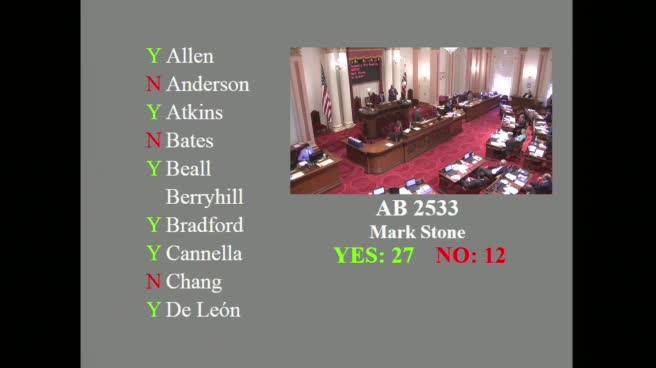
Bill Author

Bill Co-Author(s):