AB 3257: Natural resources.
- Session Year: 2017-2018
- House: Assembly
- Latest Version Date: 2018-09-11
(1)Existing law, the Surface Mining and Reclamation Act of 1975, prohibits a person, with exceptions, from conducting surface mining operations unless, among other things, a permit is obtained from, a specified reclamation plan is submitted to and approved by, and financial assurances for reclamation have been approved by the lead agency, as defined, for the operation of the surface mining operation. The act requires that the State Mining and Geology Board submit to the Legislature each year a report on the actions taken under the act during the preceding fiscal year, and requires the Division of Mine Reclamation in the Department of Conservation, at a minimum, to quarterly publish in the California Regulatory Notice Register, or otherwise make available upon request to the Department of General Services or any other state or local agency, a list identifying specified information pertaining to surface mining operations for which a report is required.
This bill would revise the information to be included in that list, and would require identification of all surface mining operations subject to the act that are reporting as newly permitted, active, or idle.
The act requires every lead agency to adopt ordinances for the review and approval of reclamation plans, financial assurances, and surface mining operation permits. Existing law requires that within 90 days of a surface mining operation becoming idle, as defined, the operator submit to the lead agency for review and approval an interim management plan, and requires the lead agency within 60 days of receipt of the interim management plan, or a longer period mutually agreed upon by the lead agency and the operator, to review and approve the plan in accordance with its ordinance and notify the operator in writing, or otherwise proceed as provided.
This bill would instead require the lead agency, within 45 days of receipt of the interim management plan, to review the plan in accordance with its ordinance, and if the plan satisfies specified requirements under the act, to forward the plan to the Supervisor of Mine Reclamation for comment. The bill would also revise certain procedures and requirements for the review and approval of interim management plans by the supervisor, as prescribed.
The act requires the lead agency to cause surface mining operations to be inspected at intervals of no more than 12 months, solely to determine whether the surface mining operation is in compliance with the act, and to, among other things, provide a notice of completion of inspection to the supervisor specifying, as applicable, certain information about aspects of the surface mining operation and a statement of the lead agencys intended response to any aspects of the surface mining operation found to be inconsistent with the act.
This bill would additionally require that the notice of completion of inspection include a statement as to whether the surface mining operation is out of compliance with an order to comply or stipulated order to comply issued by the lead agency. The bill would make related changes.
By imposing additional duties on a local government acting as a lead agency under the act, the bill would impose a state-mandated local program.
(2)Existing law requires the Attorney General to commence and prosecute to final judgment, and to defend, certain actions relating to the collection of specified charges in connection with oil and gas conservation laws, as provided in an obsolete provision.
This bill would delete obsolete references in these provisions.
(3)Existing law requires the Department of Forestry and Fire Protection to provide a report to the Legislature, including to the budget and fiscal committees of the Assembly and the Senate, that details the departments fire prevention activities, including any fire prevention activities performed by the department, and by counties pursuant to contract with the department, on lands designated as state responsibility areas. Existing law specifies the fire prevention activities in state responsibility areas that are required to be detailed in the report.
This bill would require the report to be additionally provided to the appropriate policy committees of the Assembly and the Senate and would require the fire prevention activities to be detailed in the report to also include funding sources and estimated amounts for certain categories of fire prevention activities, itemized by specified activity categories.
(4)The ZBerg-Nejedly Forest Practices Act of 1973 prohibits a person from conducting timber operations unless a timber harvesting plan prepared by a registered professional forester has been submitted for the operations to the department. The act requires the Board of Forestry and Fire Prevention to adopt district forest practice rules and regulations.
Existing law establishes certain timber operation requirements within the boundaries of special treatment areas, as defined, adjacent to wild, scenic, or recreational river segments.
Existing law authorizes a forest officer to issue a written timber operations stop order if, upon reasonable cause, the forest officer determines that a timber operation is being conducted or is about to be conducted in violation of forest practice laws and regulations, as provided. Existing law defines forest officer for these purposes as a registered professional forester employed by the department in a civil service classification of forester II or higher grade.
This bill would instead define forest officer as a registered professional forester employed by the department in a civil service classification of forester I or higher grade.
(5)The California Constitution requires the state to reimburse local agencies and school districts for certain costs mandated by the state. Statutory provisions establish procedures for making that reimbursement.
This bill would provide that no reimbursement is required by this act for a specified reason.
(1)Existing law, the Surface Mining and Reclamation Act of 1975, prohibits a person, with exceptions, from conducting surface mining operations unless, among other things, a permit is obtained from, a specified reclamation plan is submitted to and approved by, and financial assurances for reclamation have been approved by the lead agency, as defined, for the operation of the surface mining operation. The act requires that the State Mining and Geology Board submit to the Legislature each year a report on the actions taken under the act during the preceding fiscal year, and requires the Division of Mine Reclamation in the Department of Conservation, at a minimum, to quarterly publish in the California Regulatory Notice Register, or otherwise make available upon request to the Department of General Services or any other state or local agency, a list identifying specified information pertaining to surface mining operations for which a report is required.
This bill would revise the information to be included in that list, and would require identification of all surface mining operations subject to the act that are reporting as newly permitted, active, or idle and not reported pursuant to a specified provision. idle.
The act requires every lead agency to adopt ordinances for the review and approval of reclamation plans, financial assurances, and surface mining operation permits. Existing law requires that within 90 days of a surface mining operation becoming idle, as defined, the operator submit to the lead agency for review and approval an interim management plan, and requires the lead agency within 60 days of receipt of the interim management plan, or a longer period mutually agreed upon by the lead agency and the operator, to review and approve the plan in accordance with its ordinance and notify the operator in writing, or otherwise proceed as provided.
This bill would instead require the lead agency, within 45 days of receipt of the interim management plan, to review the plan in accordance with its ordinance, and if the plan satisfies specified requirements under the act, to forward the plan to the Supervisor of Mine Reclamation for comment. The bill would also revise certain procedures and requirements for the review and approval of interim management plans by the supervisor, as prescribed.
The act requires the lead agency to cause surface mining operations to be inspected at intervals of no more than 12 months, solely to determine whether the surface mining operation is in compliance with the act, and to, among other things, provide a notice of completion of inspection to the supervisor specifying, as applicable, certain information about aspects of the surface mining operation and a statement of the lead agencys intended response to any aspects of the surface mining operation found to be inconsistent with the act.
This bill would additionally require that the notice of completion of inspection include a statement as to whether the surface mining operation is out of compliance with an order to comply or stipulated order to comply issued by the lead agency. The bill would make related changes.
By imposing additional duties on a local government acting as a lead agency under the act, the bill would impose a state-mandated local program.
(2)Existing law requires the Attorney General to commence and prosecute to final judgment, and to defend, certain actions relating to the collection of specified charges in connection with oil and gas conservation laws, as provided in an obsolete provision.
This bill would delete obsolete references in these provisions.
(3)Existing law requires the Department of Forestry and Fire Protection to provide a report to the Legislature, including to the budget and fiscal committees of the Assembly and the Senate, that details the departments fire prevention activities, including any fire prevention activities performed by the department, and by counties pursuant to contract with the department, on lands designated as state responsibility areas. Existing law specifies the fire prevention activities in state responsibility areas that are required to be detailed in the report.
This bill would require the report to be additionally provided to the appropriate policy committees of the Assembly and the Senate and would require the fire prevention activities to be detailed in the report to also include funding sources and estimated amounts for certain categories of fire prevention activities, itemized by specified activity categories.
(4)The ZBerg-Nejedly Forest Practices Act of 1973 prohibits a person from conducting timber operations unless a timber harvesting plan prepared by a registered professional forester has been submitted for the operations to the department. The act requires the Board of Forestry and Fire Prevention to adopt district forest practice rules and regulations.
Existing law establishes certain timber operation requirements within the boundaries of special treatment areas, as defined, adjacent to wild, scenic, or recreational river segments.
Existing law authorizes a forest officer to issue a written timber operations stop order if, upon reasonable cause, the forest officer determines that a timber operation is being conducted or is about to be conducted in violation of forest practice laws and regulations, as provided. Existing law defines forest officer for these purposes as a registered professional forester employed by the department in a civil service classification of forester II or higher grade.
This bill would instead define forest officer as a registered professional forester employed by the department in a civil service classification of forester I or higher grade.
(5)The California Constitution requires the state to reimburse local agencies and school districts for certain costs mandated by the state. Statutory provisions establish procedures for making that reimbursement.
This bill would provide that no reimbursement is required by this act for a specified reason.
(1)Existing law, the Surface Mining and Reclamation Act of 1975, prohibits a person, with exceptions, from conducting surface mining operations unless, among other things, a permit is obtained from, a specified reclamation plan is submitted to and approved by, and financial assurances for reclamation have been approved by the lead agency, as defined, for the operation of the surface mining operation. The act requires that the State Mining and Geology Board submit to the Legislature each year a report on the actions taken under the act during the preceding fiscal year, and requires the Division of Mine Reclamation in the Department of Conservation, at a minimum, to quarterly publish in the California Regulatory Notice Register, or otherwise make available upon request to the Department of General Services or any other state or local agency, a list identifying specified information pertaining to surface mining operations for which a report is required.
This bill would revise the information to be included in that list, and would require identification of all surface mining operations subject to the act that are newly permitted, active, or idle and not reported pursuant to a specified provision.
The act requires every lead agency to adopt ordinances for the review and approval of reclamation plans, financial assurances, and surface mining operation permits. Existing law requires that within 90 days of a surface mining operation becoming idle, as defined, the operator submit to the lead agency for review and approval an interim management plan, and requires the lead agency within 60 days of receipt of the interim management plan, or a longer period mutually agreed upon by the lead agency and the operator, to review and approve the plan in accordance with its ordinance and notify the operator in writing, or otherwise proceed as provided.
This bill would instead require the lead agency, within 45 days of receipt of the interim management plan, to review the plan in accordance with its ordinance, and if the plan satisfies specified requirements under the act, to forward the plan to the Supervisor of Mine Reclamation for comment. The bill would also revise certain procedures and requirements for the review and approval of interim management plans by the supervisor, as prescribed.
The act requires the lead agency to cause surface mining operations to be inspected at intervals of no more than 12 months, solely to determine whether the surface mining operation is in compliance with the act, and to, among other things, provide a notice of completion of inspection to the supervisor specifying, as applicable, certain information about aspects of the surface mining operation and a statement of the lead agencys intended response to any aspects of the surface mining operation found to be inconsistent with the act.
This bill would additionally require that the notice of completion of inspection include a statement as to whether the surface mining operation is out of compliance with an order to comply or stipulated order to comply issued by the lead agency. The bill would make related changes.
By imposing additional duties on a local government acting as a lead agency under the act, the bill would impose a state-mandated local program.
(1)(2)Existing law requires the Attorney General to commence and prosecute to final judgment, and to defend, certain actions relating to the collection of specified charges in connection with oil and gas conservation laws, as provided in an obsolete provision.
This bill would delete obsolete references in these provisions.
(2)(3)Existing law requires the Department of Forestry and Fire Protection to provide a report to the Legislature, including to the budget and fiscal committees of the Assembly and the Senate, that details the departments fire prevention activities, including any fire prevention activities performed by the department, and by counties pursuant to contract with the department, on lands designated as state responsibility areas. Existing law specifies the fire prevention activities in state responsibility areas that are required to be detailed in the report.
This bill would require the report to be additionally provided to the appropriate policy committees of the Assembly and the Senate and would require the fire prevention activities to be detailed in the report to also include funding sources and estimated amounts for certain categories of fire prevention activities, itemized by specified activity categories.
(3)(4)The ZBerg-Nejedly Forest Practices Act of 1973 prohibits a person from conducting timber operations unless a timber harvesting plan prepared by a registered professional forester has been submitted for the operations to the department. The act requires the Board of Forestry and Fire Prevention to adopt district forest practice rules and regulations.
Existing law establishes certain timber operation requirements within the boundaries of special treatment areas, as defined, adjacent to wild, scenic, or recreational river segments.
Existing law authorizes a forest officer to issue a written timber operations stop order if, upon reasonable cause, the forest officer determines that a timber operation is being conducted or is about to be conducted in violation of forest practice laws and regulations, as provided. Existing law defines forest officer for these purposes as a registered professional forester employed by the department in a civil service classification of forester II or higher grade.
This bill would instead define forest officer as a registered professional forester employed by the department in a civil service classification of forester I or higher grade.
(5)The California Constitution requires the state to reimburse local agencies and school districts for certain costs mandated by the state. Statutory provisions establish procedures for making that reimbursement.
This bill would provide that no reimbursement is required by this act for a specified reason.
(1)Existing law requires the Attorney General to commence and prosecute to final judgment, and to defend, certain actions relating to the collection of specified charges in connection with oil and gas conservation laws, as provided in an obsolete provision.
This bill would delete obsolete references in these provisions.
(2)Existing law requires the Department of Forestry and Fire Protection to provide a report to the Legislature, including to the budget and fiscal committees of the Assembly and the Senate, that details the departments fire prevention activities, including any fire prevention activities performed by the department, and by counties pursuant to contract with the department, on lands designated as state responsibility areas. Existing law specifies the fire prevention activities in state responsibility areas that are required to be detailed in the report.
This bill would require the report to be additionally provided to the appropriate policy committees of the Assembly and the Senate and would require the fire prevention activities to be detailed in the report to also include funding sources and estimated amounts for certain categories of fire prevention activities, itemized by specified activity categories.
(3)The ZBerg-Nejedly Forest Practices Act of 1973 prohibits a person from conducting timber operations unless a timber harvesting plan prepared by a registered professional forester has been submitted for the operations to the department. The act requires the Board of Forestry and Fire Prevention to adopt district forest practice rules and regulations.
Existing law establishes certain timber operation requirements within the boundaries of special treatment areas, as defined, adjacent to wild, scenic, or recreational river segments.
Existing law authorizes a forest officer to issue a written timber operations stop order if, upon reasonable cause, the forest officer determines that a timber operation is being conducted or is about to be conducted in violation of forest practice laws and regulations, as provided. Existing law defines forest officer for these purposes as a registered professional forester employed by the department in a civil service classification of forester II or higher grade.
This bill would instead define forest officer as a registered professional forester employed by the department in a civil service classification of forester I or higher grade.
(1)Existing law requires the Attorney General to commence and prosecute to final judgment, and to defend, certain actions relating to the collection of specified changes charges in connection with oil and gas conservation laws, as provided in an obsolete provision.
This bill would repeal delete obsolete references in these provisions.
(2)Existing law requires the Department of Forestry and Fire Protection to provide a report to the Legislature, including to the budget and fiscal committees of the Assembly and the Senate, that details the departments fire prevention activities, including any fire prevention activities performed by the department, and by counties pursuant to contract with the department, on lands designated as state responsibility areas. Existing law specifies the fire prevention activities in state responsibility areas that are required to be detailed in the report.
This bill would require the report to be additionally provided to the appropriate policy committees of the Assembly and the Senate and would require the fire prevention activities to be detailed in the report to also include funding sources and amounts for certain categories of fire prevention activities, itemized by the individual activity specified activity categories.
(3)The ZBerg-Nejedly Forest Practices Act of 1973 prohibits a person from conducting timber operations unless a timber harvesting plan prepared by a registered professional forester has been submitted for the operations to the department. The act requires the Board of Forestry and Fire Prevention to adopt district forest practice rules and regulations.
Existing law establishes certain timber operation requirements within the boundaries of special treatment areas, as defined, adjacent to wild, scenic, or recreational river segments.
Existing law authorizes a forest officer to issue a written timber operations stop order if, upon reasonable cause, the forest officer determines that a timber operation is being conducted or is about to be conducted in violation of forest practice laws and regulations, as provided. Existing law defines forest officer for these purposes as a registered professional forester employed by the department in a civil service classification of forester II or higher grade.
This bill would instead define forest officer as a registered professional forester employed by the department in a civil service classification of forester I or higher grade.
(1)Existing law requires the Attorney General to commence and prosecute to final judgment, and to defend, certain actions relating to the collection of specified changes in connection with oil and gas conservation laws, as provided in an obsolete provision.
This bill would repeal these provisions.
(2)Existing law requires the Department of Forestry and Fire Protection to provide a report to the Legislature, including to the budget and fiscal committees of the Assembly and the Senate, that details the departments fire prevention activities, including any fire prevention activities performed by the department, and by counties pursuant to contract with the department, on lands designated as state responsibility areas. Existing law specifies the fire prevention activities in state responsibility areas that are required to be detailed in the report.
This bill would require the report to be additionally provided to the appropriate policy committees of the Assembly and the Senate and would require the fire prevention activities to be detailed in the report to also include funding sources and amounts for certain categories of fire prevention activities, itemized by the individual activity.
(a)Notwithstanding Section 10231.5 of the Government Code, the board shall submit to the Legislature on December 1 of each year a report on the actions taken pursuant to this chapter during the preceding fiscal year. The report shall include a statement of the actions, including legislative recommendations, that are necessary to carry out more completely the purposes and requirements of this chapter.
(b)For purposes of ensuring compliance with Sections 10295.5 and 20676 of the Public Contract Code, the Division of Mine Reclamation shall, at a minimum, quarterly publish in the California Regulatory Notice Register, or otherwise make available upon request to the Department of General Services or any other state or local agency, a list identifying all surface mining operations subject to this chapter and Section 2207 that are reporting as newly permitted, active, or idle, for which all of the following apply:
(1)A reclamation plan has been approved.
(2)A financial assurance mechanism that is at least equal to the current approved financial assurance cost estimate, as described in Section 2736, has been approved.
(3)A financial assurance cost estimate required under Section 2773.4 has been submitted, as indicated on a notice of completion of inspection submitted by the lead agency pursuant to subdivision (b) of Section 2774. Operators may also confirm submission of their annual financial assurance cost estimate as required by subparagraphs (A) and (B) of paragraph (1) of subdivision (d) of Section 2773.4 by providing a copy of the first page of the financial assurance cost estimate (FACE-1) form to the supervisor.
(4)The annual report required under Section 2207 has been submitted.
(5)All fees required under Section 2207, including all past-due fees, administrative penalties, and interest have been paid.
(6)The operation is not out of compliance with an order to comply or stipulated order to comply.
(c)Notwithstanding paragraphs (1) and (2) of subdivision (b), surface mining operations for which an appeal is pending before the board pursuant to subdivision (e) of Section 2770, if the appeal was not pending before the board for more than 180 days, shall be included on the list published pursuant to subdivision (b).
(d)A report submitted pursuant to subdivision (a) shall be submitted in compliance with Section 9795 of the Government Code.
(e)This section shall become operative January 1, 2019.
SEC. 2.Section 2770 of the Public Resources Code is amended to read:2770.(a)Except as provided in this section, a person shall not conduct surface mining operations unless a permit is obtained from, a reclamation plan has been submitted to and approved by, and financial assurances for reclamation have been approved by the lead agency for the operation pursuant to this article.
(b)A person with an existing surface mining operation who has vested rights pursuant to Section 2776 and who does not have an approved reclamation plan shall submit a reclamation plan to the lead agency not later than March 31, 1988. If a reclamation plan application is not on file by March 31, 1988, the continuation of the surface mining operation is prohibited until a reclamation plan is submitted to the lead agency. For the purposes of this subdivision, a reclamation plan existing prior to January 1, 2017, may consist of all or the appropriate sections of any plans or written agreements previously approved by the lead agency or another agency, together with any additional documents needed to substantially meet the requirements of Sections 2772 and 2773 and the lead agency surface mining ordinance adopted pursuant to subdivision (a) of Section 2774, provided that all documents, which together were proposed to serve as the reclamation plan, are submitted for approval to the lead agency in accordance with this chapter.
(c)[Reserved]
(d)[Reserved]
(e)(1)A person who can substantiate, based on the evidence of the record, that a lead agency has either (A) failed to act according to due process or has relied on considerations not related to the specific applicable requirements of Sections 2772, 2772.1, 2773, 2773.1, 2773.3, and 2773.4 and the lead agency surface mining ordinance adopted pursuant to subdivision (a) of Section 2774 in reaching a decision to deny approval of a reclamation plan or financial assurances for reclamation, or (B) failed to act within a reasonable time of receipt of a completed application may appeal that action or inaction to the board.
(2)The supervisor may appeal a lead agencys approval of a financial assurance cost estimate to the board if the supervisor has commented pursuant to Section 2773.4 that the financial assurance cost estimate is inadequate based on consideration of the following:
(A)Section 2773.1.
(B)Article 11 (commencing with Section 3800) of Subchapter 1 of Chapter 8 of Division 2 of Title 14 of the California Code of Regulations.
(C)The boards financial assurance guidelines adopted pursuant to subdivision (f) of Section 2773.1.
(3)If the approved financial assurance cost estimate applies to a reclamation plan approved for a new surface mining operation, an expanded surface mining operation, or an interim financial assurance cost estimate due to an order to comply, stipulated or otherwise, the operator shall provide a financial assurance mechanism pursuant to subdivision (e) of Section 2773.4 in the amount of the approved financial assurance cost estimate, notwithstanding an appeal filed pursuant to this subdivision and subject to modification pending the outcome of the appeal.
(4)If the approved financial assurance cost estimate is an update to an existing approved financial assurance cost estimate, the existing financial assurance mechanism shall remain in place and shall not be adjusted until a final determination by the board on the appeal filed pursuant to this subdivision.
(f)(1)The board may decline to hear an appeal if it determines that the appeal raises no substantial issues related to the lead agencys decision to deny the approval of a reclamation plan or financial assurance, or the timeliness in reviewing a completed application. Appeals filed by the supervisor shall be heard by the board.
(2)If the board takes up an appeal, the appeal shall be scheduled and heard at a public hearing within 45 days of the boards receipt of a complete administrative record, or a longer period as may be mutually agreed to by the board, the appellant, and the operator, or, if the appeal is filed by the supervisor, by the board, the supervisor, and the operator.
(g)(1)(A)When hearing an appeal filed pursuant to paragraph (1) or (2) of subdivision (e), the board shall determine whether the reclamation plan or the financial assurance cost estimate substantially meets the applicable requirements of Sections 2772, 2772.1, 2773, 2773.1, 2773.3, and 2773.4; Article 1 (commencing with Section 3500), Article 9 (commencing with Section 3700), and Article 11 (commencing with Section 3800) of Subchapter 1 of Chapter 8 of Division 2 of Title 14 of the California Code of Regulations; and the lead agencys surface mining ordinance adopted pursuant to subdivision (a) of Section 2774. The board shall approve or uphold a reclamation plan or financial assurance cost estimate determined to meet those applicable requirements. In any event, financial assurances for reclamation shall be sufficient to perform reclamation of lands remaining disturbed.
(B)For purposes of this subdivision, substantially means actual compliance in respect to the substance and form requirements essential to the objectives of this chapter.
(2)(A)A reclamation plan determined not to meet the applicable requirements of Sections 2772, 2772.1, 2773, 2773.1, 2773.3, and 2773.4; Article 1 (commencing with Section 3500), Article 9 (commencing with Section 3700), and Article 11 (commencing with Section 3800) of Subchapter 1 of Chapter 8 of Division 2 of Title 14 of the California Code of Regulations; and the lead agencys surface mining ordinance adopted pursuant to subdivision (a) of Section 2774 shall be returned to the operator with a notice of deficiencies. The operator shall be granted, once only, a period of 30 days or a longer period mutually agreed upon by the operator and the board to do both of the following:
(i)Correct the noted deficiencies.
(ii)Submit the revised reclamation plan to the lead agency for review and approval.
(B)Within 10 days of the hearing, the board shall provide notice via certified mail to the lead agency, the operator, and the Division of Mine Reclamation of the boards determination. The notice shall include instructions to the operator to submit to the lead agency for approval a revised reclamation plan consistent with the boards determination.
(3)(A)If the board determines the lead agencys approved financial assurance cost estimate does not meet the requirements of Sections 2773.1 and 2773.4, Article 11 (commencing with Section 3800) of Subchapter 1 of Chapter 8 of Division 2 of Title 14 of the California Code of Regulations, and the boards financial assurance guidelines adopted pursuant to subdivision (f) of Section 2773.1, the board shall note the deficiencies and, based on the record, include adequate cost estimates for each noted deficiency.
(B)Within 10 days of the hearing, the board shall provide notice via certified mail to the lead agency, the operator, and the Division of Mine Reclamation of the boards determination with instructions to the operator to submit to the lead agency for approval a revised financial assurance cost estimate consistent with the boards determination. The instructions shall include a reasonable submission deadline of not less than 30 days.
(C)The lead agency shall approve the revised financial assurance cost estimate. That approval shall supersede and void the prior approved financial assurance cost estimate.
(D)A financial assurance mechanism shall be established by the operator pursuant to subdivision (e) of Section 2773.4 following the approval of the financial assurance cost estimate.
(E)The failure of the operator to submit to the lead agency a revised financial assurance cost estimate consistent with the boards determination and deadline may be grounds for the issuance of an order to comply pursuant to subdivision (a) of Section 2774.1.
(h)(1)Within 90 days of a surface mining operation becoming idle, as defined in Section 2727.1, the operator shall submit an interim management plan to the lead agency for review. The review and approval of an interim management plan shall not be considered a project for purposes of the California Environmental Quality Act (Division 13 (commencing with Section 21000)). The approved interim management plan shall be considered an amendment to the surface mining operations approved reclamation plan for purposes of this chapter. The interim management plan shall only provide for necessary measures the operator will implement during its idle status to maintain the site in compliance with this chapter, including, but not limited to, all permit conditions.
(2)The interim management plan may remain in effect for a period not to exceed five years, at which time the lead agency shall do one of the following:
(A)Renew the interim management plan for an additional period not to exceed five years, which may be renewed for one additional five-year renewal period at the expiration of the first five-year renewal period, if the lead agency finds that the surface mining operator has complied fully with the interim management plan.
(B)Require the operator to commence reclamation in accordance with its approved reclamation plan.
(3)The financial assurances required by Section 2773.1 shall remain in effect during the period that the surface mining operation is idle. If the surface mining operation is still idle after the expiration of its interim management plan, the operator shall commence reclamation in accordance with its approved reclamation plan.
(4)(A)Within 45 days of the receipt of the interim management plan, the lead agency shall review the interim management plan in accordance with its ordinance adopted pursuant to subdivision (a) of Section 2774, and if the interim management plan satisfies the requirements of this section, forward the plan to the supervisor for comment. Otherwise, the lead agency shall notify the operator in writing of any deficiencies in the interim management plan. The operator shall have 30 days, or a longer period mutually agreed upon by the operator and the lead agency, to submit a revised interim management plan.
(B)The lead agency shall submit the interim management plan, including a revised interim management plan, to the supervisor for review and certify to the supervisor that the interim management plan is a complete submission and complies with all of the following requirements:
(i)The applicable requirements of this chapter.
(ii)Article 1 (commencing with Section 3500) and Article 9 (commencing with Section 3700) of Subchapter 1 of Chapter 8 of Division 2 of Title 14 of the California Code of Regulations, as applicable.
(iii)The lead agencys surface mining ordinance in effect at the time that the interim management plan is submitted to the supervisor for review, except if the board is the lead agency.
(C)After receipt of the certified complete interim management plan, the supervisor shall have 30 days to prepare written comments on the interim management plan, if he or she elects to do so.
(D)The lead agency shall review and evaluate written comments received from the supervisor relating to the interim management plan within a reasonable amount of time.
(E)The lead agency shall prepare a written response to the supervisors comments received pursuant to subparagraph (C) describing the disposition of the major issues raised by the comments. The lead agency shall submit its response to the supervisor and the operator at least 30 days prior to the intended approval of the interim management plan. The lead agencys response shall include either of the following:
(i)A description of how the lead agency proposes to adopt the supervisors comments to the interim management plan.
(ii)A detailed description of the reasons why the lead agency proposes not to adopt the supervisors comments.
(F)Where the supervisor has commented, the lead agency shall give the supervisor at least 30 days written notice of the time, place, and date of the hearing at which the interim management plan is scheduled to be approved by the lead agency, or, if no hearing is required by this chapter, the local ordinance, or other law, the lead agency shall provide 30 days written notice to the supervisor that the lead agency intends to approve the interim management plan.
(G)Within 30 days following the approval of the interim management plan, the lead agency shall provide the supervisor notice of the approval and a copy of the approved interim management plan.
(5)The lead agency shall approve or deny approval of the interim management plan within 60 days of receipt of the supervisors comments or within 90 days of submitting the interim management plan to the supervisor if no comments are received from the supervisor. If the lead agency denies approval of the interim management plan, the operator may appeal that action to the lead agencys governing body, which shall schedule a public hearing within 45 days of the filing of the appeal or a longer period mutually agreed upon by the operator and the governing body.
(6)Unless review of an interim management plan is pending before the lead agency or an appeal is pending before the lead agencys governing body, a surface mining operation that remains idle for over one year after becoming idle, as defined in Section 2727.1, without obtaining approval of an interim management plan shall be considered abandoned and the operator shall commence and complete reclamation in accordance with the approved reclamation plan.
(i)An enforcement action that may be brought against a surface mining operation for operating without an approved reclamation plan, financial assurance, or interim management plan shall be held in abeyance pending review pursuant to subdivision (b) or (h), or the resolution of an appeal filed with the board pursuant to subdivision (e), or with a lead agency governing body pursuant to subdivision (h).
SEC. 3.Section 2774 of the Public Resources Code, as amended by Section 16 of Chapter 51 of the Statutes of 2018, is amended to read:2774.(a)Every lead agency shall adopt ordinances in accordance with state policy that establish procedures for the review and approval of reclamation plans and financial assurances and the issuance of a permit to conduct surface mining operations, except that any lead agency without an active surface mining operation in its jurisdiction may defer adopting an implementing ordinance until the filing of a permit application. The ordinances shall establish procedures requiring at least one public hearing and shall be periodically reviewed by the lead agency and revised, as necessary, to ensure that the ordinances continue to be in accordance with state policy.
(b)(1)The lead agency shall cause surface mining operations to be inspected in intervals of no more than 12 months, solely to determine whether the surface mining operation is in compliance with this chapter. The lead agency shall cause an inspection to be conducted by a state-licensed geologist, state-licensed civil engineer, state-licensed landscape architect, state-licensed forester, or a qualified lead agency employee who has not been employed by the surface mining operation being inspected in any capacity during the previous 12 months, except that a qualified lead agency employee may inspect surface mining operations conducted by the local agency. All inspections shall be conducted using a form developed by the Division of Mine Reclamation and approved by the board that includes the professional licensing and disciplinary information of the person who conducted the inspection. The operator shall be solely responsible for the reasonable cost of the inspection. The lead agency shall provide a notice of completion of inspection to the supervisor within 90 days of conducting the inspection. The notice shall contain a statement regarding the surface mining operations compliance with this chapter and a copy of the completed inspection form, and shall specify, as applicable, all of the following:
(A)Aspects of the surface mining operation, if any, that were found to be inconsistent with this chapter but were corrected before the submission of the inspection form to the supervisor.
(B)Aspects of the surface mining operation, if any, that were found to be inconsistent with this chapter but were not corrected before the submission of the inspection form to the supervisor.
(C)A statement describing the lead agencys intended response to any aspects of the surface mining operation found to be inconsistent with this chapter but were not corrected before the submission of the inspection form to the supervisor.
(D)A statement as to whether the surface mining operation is out of compliance with an order to comply or stipulated order to comply issued by the lead agency.
(2)If the surface mining operation has a review of its reclamation plan, financial assurances, or an interim management plan pending under subdivision (b) or (h) of Section 2770, or an appeal pending before the board or lead agency governing body under subdivision (e) or (h) of Section 2770, the notice shall so indicate. The lead agency shall forward to the operator a copy of the notice, a copy of the completed inspection form, and any supporting documentation, including, but not limited to, any inspection report prepared by the geologist, civil engineer, landscape architect, forester, or qualified lead agency employee who conducted the inspection.
(c)If an operator does not request an inspection date on the annual report filed pursuant to Section 2207 or if the lead agency is unable to cause the inspection of a given surface mining operation on the date requested by the operator, the lead agency shall provide the operator with a minimum of five days written notice of a pending inspection or a lesser time period if agreed to by the operator.
(d)(1)No later than December 31, 2017, the Division of Mine Reclamation shall establish a training program for all surface mine inspectors. The program shall be designed to include a guidance document, developed by the Division of Mine Reclamation, in consultation with the board and stakeholders, to provide instruction and recommendations to surface mine inspectors performing inspections pursuant to subdivision (b).
(2)The training program shall include inspection workshops offered by the Division of Mine Reclamation in different regions of the state to provide practical application of the guidance document material.
(3)On and after July 1, 2020, all inspectors shall have on file with the lead agency and the Division of Mine Reclamation a certificate of completion of an inspection workshop. An inspector shall attend a workshop no later than five years after the date of his or her most recent certificate.
(4)The adoption of the guidance document by the Division of Mine Reclamation pursuant to this subdivision shall be subject to the requirements of the Administrative Procedure Act (Chapter 3.5 (commencing with Section 11340) of Part 1 of Division 3 of Title 2 of the Government Code).
SEC. 4.Section 2774.1 of the Public Resources Code is amended to read:2774.1.(a)(1)Except as provided in subdivision (i) of Section 2770, if the lead agency or the supervisor determines, based upon an annual inspection pursuant to Section 2774, or otherwise confirmed by an inspection of the surface mining operation, that a surface mining operation is not in compliance with this chapter, the lead agency or the supervisor may issue a notice of that violation to the operator by personal service or certified mail. If the lead agency issues the notice, the lead agency shall send a copy of the notice to the supervisor. The notice shall include both of the following:
(A)A description of the violation.
(B)Actions the operator shall take to correct the violation.
(2)(A)If a lead agency or the supervisor determines that the time to correct the noticed violation will exceed 30 days, the lead agency and the operator may enter into a stipulated order to comply, with notice sent to the supervisor. If the supervisor initiated the enforcement action, the supervisor, after consulting with the lead agency, may enter into a stipulated order to comply with the operator. The lead agency may, but need not, join the stipulated order with the supervisor.
(B)A stipulated order to comply shall include a schedule and time for compliance that the lead agency or the supervisor, as applicable, determines is reasonable after taking into account the actions and legal processes required to correct the violation.
(3)(A)If the operator does not comply with a notice issued pursuant to paragraph (1) within 30 days of being served the notice or commit to enter into a stipulated order to comply pursuant to paragraph (2) within 30 days of being served the notice, the lead agency or the supervisor may issue an order to comply by personal service or certified mail requiring the operator to comply with this chapter or, if the operator does not have an approved reclamation plan or financial assurances, cease all further surface mining activities. A lead agency shall, at the time of issuing an order to comply, provide a copy to the supervisor.
(B)An order to comply issued pursuant to this paragraph shall take effect 30 days following the service of the order to comply unless within those 30 days the operator appeals the order to comply and requests a hearing before the lead agency, if the lead agency issued the order, or the board, if the supervisor issued the order. An order to comply issued pursuant to this paragraph shall specify all of the following:
(i)Which aspects of the surface mining operation are inconsistent with this chapter.
(ii)A time for compliance that the lead agency or supervisor determines is reasonable, taking into account the seriousness of the alleged violation and any good faith efforts to comply with applicable requirements.
(iii)The actions and legal processes required to correct the alleged violation.
(C)An appeal filed pursuant to subparagraph (B) shall be noticed and heard at a public hearing within 45 days of the filing of the appeal or a longer period as may be mutually agreed upon by the operator and the lead agency, if the lead agency issued the order, or the operator and the supervisor, if the supervisor issued the order.
(b)[Reserved]
(c)An operator who violates or fails to comply with an order to comply issued under subdivision (a) after the orders effective date or who fails to submit a report or pay annual fees to the supervisor or lead agency as required by Section 2207, shall be subject to an order by the lead agency or the supervisor imposing an administrative penalty of not more than five thousand dollars ($5,000) per day, assessed from the original date of noncompliance with this chapter, including Section 2207, or from the date of the inspection when the violation was identified, at the discretion of the issuer of the notice of that violation. The penalty may be imposed administratively by the lead agency or the supervisor. In determining the amount of the administrative penalty, the lead agency or the supervisor shall take into consideration the nature, circumstances, extent, and gravity of the violation or violations, any prior history of violations, the degree of culpability, economic savings, if any, resulting from the violation, and any other matters justice may require. Orders setting administrative penalties shall become effective upon issuance of the assessment and payment shall be made to the lead agency or the supervisor within 30 days, unless the operator petitions the legislative body of the lead agency, the board, or the superior court for review as provided in Section 2774.2. An order shall be served by personal service or by certified mail upon the operator. Penalties collected by the supervisor shall not be used for purposes other than to cover the reasonable costs incurred by the department in implementing this chapter or Section 2207.
(d)(1)An operator who violates or fails to comply with an order to comply issued pursuant to paragraph (3) of subdivision (a) or a stipulated order to comply entered into pursuant to paragraph (2) of subdivision (a) after the orders effective date shall be removed from the list published by the Division of Mine Reclamation pursuant to subdivision (b) of Section 2717.
(2)If after a public hearing the board or lead agency denies an appeal by the operator pursuant to subparagraph (C) of paragraph (3) of subdivision (a), the operator shall be removed 10 working days following the denial of the appeal from the list published by the Division of Mine Reclamation pursuant to subdivision (b) of Section 2717.
(3)If the operator enters into a stipulated order to comply between the operator and the lead agency, if the lead agency issued the order, or the operator and the supervisor, if the supervisor issued the order, within 10 working days of the denial of the appeal and the stipulated order to comply is consistent with the order to comply upheld by the board or lead agency and includes a stipulated schedule for compliance, the operator shall remain on the list published by the Division of Mine Reclamation pursuant to subdivision (b) of Section 2717.
(4)Issuance of a notice pursuant to paragraph (1) of subdivision (a) or an order to comply or stipulated order to comply pursuant to paragraph (2) or (3) of subdivision (a) shall not disqualify an operator from eligibility for placement on the list published by the Division of Mine Reclamation pursuant to subdivision (b) of Section 2717, except in cases where an operator has failed to submit a financial assurance cost estimate to the lead agency or a financial assurance mechanism to the lead agency and supervisor, in accordance with Section 2773.4.
(e)If the lead agency or the supervisor determines that the surface mine is not in compliance with this chapter, so that the surface mine presents an imminent and substantial endangerment to the public health or the environment, the lead agency or the Attorney General, on behalf of the supervisor, may seek an order from a court of competent jurisdiction enjoining that operation.
(f)Upon a complaint by the supervisor, the department, or the board, the Attorney General may bring an action to recover administrative penalties under this section, and penalties under Section 2207, in any court of competent jurisdiction in this state against any person violating any provision of this chapter or Section 2207, or any regulation adopted pursuant to this chapter or Section 2207. The Attorney General may bring this action on his or her own initiative if, after examining the complaint and the evidence, he or she believes a violation has occurred. The Attorney General may also seek an order from a court of competent jurisdiction compelling the operator to comply with this chapter and Section 2207.
(g)(1)The lead agency has primary responsibility for enforcing this chapter and Section 2207. In cases where the board is not the lead agency pursuant to Section 2774.4, enforcement actions may be initiated by the supervisor pursuant to this section only after the violation has come to the attention of the supervisor and either of the following occurs:
(A)The lead agency has been notified by the supervisor in writing of the violation for at least 30 days, and has not taken appropriate enforcement action, which may include failing to issue an order to comply within a reasonable time after issuing a notice of violation.
(B)The supervisor determines that there is a violation that amounts to an imminent and substantial endangerment to the public health or safety, or to the environment.
(2)The supervisor shall comply with this section in initiating enforcement actions.
(h)Remedies under this section are in addition to, and do not supersede or limit, any and all other remedies, civil or criminal.
SEC. 5.Section 3427 of the Public Resources Code is amended to read:3427.The Attorney General shall commence and prosecute any such action to final judgment.
SEC. 6.Section 3432 of the Public Resources Code is amended to read:3432.The Attorney General shall defend the action.
The provisions of the Code of Civil Procedure relating to pleadings, proofs, trials, and appeals are applicable to these proceedings.
SEC. 7.Section 3774 of the Public Resources Code is amended to read:3774.The Attorney General shall commence and prosecute any such action to final judgment.
SEC. 8.Section 4137 of the Public Resources Code is amended to read:4137.(a)For purposes of this section, fire prevention activities include, but are not limited to, all of the following:
(1)Fire prevention education.
(2)Hazardous fuel reduction and vegetation management.
(3)Fire investigation.
(4)Civil cost recovery.
(5)Forest and fire law enforcement.
(6)Fire prevention engineering.
(7)Prefire planning.
(8)Risk analysis.
(9)Volunteer programs and partnerships.
(b)It is the intent of the Legislature that the year-round staffing and the extension of the workweek that has been provided to the department pursuant to memorandums of understanding with the state will result in significant increases in the departments current level of fire prevention activities. It is also the intent of the Legislature that the budgetary augmentations for year-round staffing not reduce the reimbursements that the department receives from contracts with local governments for the department to provide local fire protection and emergency services pursuant to Section 4144, commonly referred to as Amador agreements.
(c)On or before January 10 of each year, the department shall provide a report to the Legislature, including to the budget, fiscal, and appropriate policy committees of the Assembly and the Senate, in accordance with Section 9795 of the Government Code, detailing the departments fire prevention activities, including the increased activities described in subdivision (b). The report shall display the fire prevention activities of the previous fiscal year, as well as the information from previous reports for purposes of a comparison of data. The report shall include all of the following:
(1)Fire prevention activities performed by the department on lands designated as state responsibility areas, and by counties, where, pursuant to a contract with the department, a county has agreed to provide fire protection services in state responsibility areas within county boundaries on behalf of the department. The fire prevention activities included in the report pursuant to this paragraph shall include, but not be limited to, all of the following:
(A)The number of hours of fire prevention education performed.
(B)The number of defensible space inspections conducted, including statewide totals and totals for each region.
(C)The number of citations issued for noncompliance with Section 4291.
(D)The number of acres treated by mechanical fuel reduction.
(E)The number of acres treated by prescribed burns.
(F)The funding sources and estimated amounts for the fire prevention activities described in this paragraph, itemized by the activity categories described in subparagraphs (A) to (E), inclusive.
(G)Any other data or qualitative information deemed necessary by the department in order to provide the Legislature with a clear and accurate accounting of fire prevention activities, particularly with regard to variations from one year to the next.
(2)The fire prevention performance measures described in subparagraphs (A) to (G), inclusive, of paragraph (1) shall be reported for each region annually, including activities performed from December 15 to April 15, inclusive.
(3)Projected fire prevention activities for the following fiscal year.
(4)Information on each of the Amador contracts described in subdivision (b), including an annual update on the number of those contracts and reimbursements received from the contracts that are in effect.
SEC. 9.Section 4602.5 of the Public Resources Code is amended to read:4602.5.(a)This section provides an administrative procedure to suspend timber operations temporarily while judicial remedies are pursued pursuant to this article.
(b)An inspecting forest officer may issue a written timber operations stop order if, upon reasonable cause, the officer determines that a timber operation is being conducted or is about to be conducted in violation of this chapter or of forest practice rules adopted by the board pursuant to this chapter and that the violation or threatened violation would result in imminent and substantial harm to soil, water, or timber resources, or to fish and wildlife habitat. A stop order shall apply only to those acts or omissions that are the proximate cause of the violation or threatened violation. The stop order shall be effective immediately and throughout the next day.
(c)A supervising forest officer may, after an onsite investigation, extend a stop order issued pursuant to subdivision (b) for up to five days, excluding Saturday and Sunday, provided that he or she finds that the original stop order was issued upon reasonable cause. A stop order shall not be issued or extended for the same act or omission more than one time.
(d)(1)Each stop order shall identify the specific act or omission that constitutes the violation or threatened violation, any timber operation that is to be stopped, and any corrective or mitigative actions that may be required.
(2)The department may terminate the stop order if the responsible parties enter into a written agreement with the department assuring that the parties will resume operations in compliance with this chapter and the rules adopted by the board and will correct the violations. The department may require a reasonable cash deposit or bond payable to the department as a condition of compliance with the agreement.
(e)Notice of the issuance of a stop order or an extension of a stop order shall be deemed to have been made to all persons working on a timber operation when a copy of the written order is delivered to the person in charge of operations at the time the order is issued or, if no persons are present at that time, then by posting a copy of the order conspicuously on the yarder or log loading equipment at a currently active landing on the timber operations. If no persons are present at the site of the timber operation when the order is issued, the issuing officer shall deliver a copy of the order to the timber operator either in person or to the operators address of record prior to the commencement of the next working day.
(f)As used in this section, forest officer means a registered professional forester employed by the department in a civil service classification of forester I or higher grade.
(g)(1)Failure of the timber operator or an employee of the timber operator, after receiving notice, to comply with a stop order is a violation of this chapter and is punishable as provided in Section 4601; provided, however, that in all cases the timber operator, and not another person or the employee, shall be charged with this violation.
(2)In determining the penalty for any timber operator found guilty of violating a validly issued stop order, the court shall take into consideration all relevant circumstances, including, but not limited to, the following:
(A)The extent of harm to soil, water, or timber resources or to fish and wildlife habitat.
(B)Corrective action, if any, taken by the defendant.
(3)Each day or portion of the day that the violation continues shall constitute a new and separate offense.
(h)Nothing in this section shall prevent a timber operator from seeking an alternative writ as prescribed in Chapter 2 (commencing with Section 1084) of Title 1 of Part 3 of the Code of Civil Procedure, or as provided by any other provision of law.
SEC. 10.Section 5093.68 of the Public Resources Code is amended to read:5093.68.(a)Within the boundaries of special treatment areas adjacent to wild, scenic, or recreational river segments, all of the following provisions shall apply, in addition to any other applicable provision under this chapter or generally, whether by statute or regulation:
(1)A timber operator, whether licensed or not, is responsible for the actions of his or her employees. The registered professional forester who prepares and signs a timber harvesting plan, a timber management plan, or a notice of timber operations is responsible for its contents, but is not responsible for the implementation or execution of the plan or notice unless employed for that purpose.
(2)A registered professional forester preparing a timber harvesting plan shall certify that he or she or a qualified representative has personally inspected the plan area on the ground.
(b)In order to temporarily suspend timber operations that are being conducted within special treatment areas adjacent to wild, scenic, or recreational rivers designated pursuant to Section 5093.54, while judicial remedies are pursued pursuant to this section, an inspecting forest officer of the Department of Forestry and Fire Protection may issue a written timber operations stop order if, upon reasonable cause, the officer determines that a timber operation is being conducted, or is about to be conducted, in violation of Chapter 8 (commencing with Section 4511) of Part 2 of Division 4, or of rules and regulations adopted pursuant to those provisions, and that the violation or threatened violation would result in imminent and substantial damage to soil, water, or timber resources or to fish and wildlife habitat. A stop order shall apply only to those acts or omissions that are the proximate cause of the violation or that are reasonably foreseen would be the proximate cause of a violation. The stop order shall be effective immediately and throughout the next day.
(c)A supervising forest officer may, after an onsite investigation, extend a stop order issued pursuant to subdivision (b) for up to five days, excluding Saturday and Sunday, if the forest officer finds that the original stop order was issued upon reasonable cause. A stop order shall not be issued or extended for the same act or omission more than one time.
(d)Each stop order shall identify the specific act or omission that constitutes a violation or that, if foreseen, would constitute a violation, the specific timber operation that is to be stopped, and any corrective or mitigative actions that may be required.
(e)The Department of Forestry and Fire Protection may terminate the stop order if the timber operator enters into a written agreement with the department assuring that the timber operator will resume operations in compliance with Chapter 8 (commencing with Section 4511) of Part 2 of Division 4, and with the rules and regulations adopted pursuant to that chapter, and will correct any violation. The department may require a reasonable cash deposit or bond payable to the department as a condition of compliance with the agreement.
(f)Notice of the issuance of a stop order or an extension of a stop order shall be deemed to have been made to all persons working on the timber operation when a copy of the written order is delivered to the person in charge of operations at the time that the order is issued or, if no persons are present at that time, by posting a copy of the order conspicuously on the yarder or log loading equipment at a currently active landing on the timber operations site. If no person is present at the site when the order is issued, the issuing forest officer shall deliver a copy of the order to the timber operator either in person or to the operators address of record prior to the commencement of the next working day.
(g)As used in this section, forest officer means a registered professional forester employed by the Department of Forestry and Fire Protection in a civil service classification of forester I or higher grade.
(h)(1)Failure of the timber operator or an employee of the timber operator, after receiving notice pursuant to this section, to comply with a validly issued stop order is a violation of this section and is a misdemeanor punishable by a fine of not less than five hundred dollars ($500), or by imprisonment for not more than one year in the county jail, or both. The person shall also be subject to civil damages to the state not to exceed ten thousand dollars ($10,000) for each misdemeanor violation. However, in all cases, the timber operator, and not an employee of the operator or any other person, shall be charged with that violation. Each day or portion of the day that the violation continues shall constitute a new and separate offense.
(2)In determining the penalty for a timber operator guilty of violating a validly issued stop order, the court shall take into consideration all relevant circumstances, including, but not limited to, the following:
(A)The extent of harm to soil, water, or timber resources or to fish and wildlife habitat.
(B)Corrective action, if any, taken by the defendant.
(i)Nothing in this section prevents a timber operator from seeking an alternative writ as prescribed in Chapter 2 (commencing with Section 1084) of Title 1 of Part 3 of the Code of Civil Procedure, or as provided by any other provision of law.
(j)(1)If a timber operator believes that a forest officer lacked reasonable cause to issue or extend a stop order pursuant to this section, the timber operator may present a claim to the Department of General Services pursuant to Part 3 (commencing with Section 900) of Division 3.6 of Title 1 of the Government Code for compensation and damages resulting from the stopping of timber operations.
(2)If the Department of General Services finds that the forest officer lacked reasonable cause to issue or extend the stop order, the board shall award a sum of not less than one hundred dollars ($100), nor more than one thousand dollars ($1,000), per day for each day the order was in effect.
SEC. 11.No reimbursement is required by this act pursuant to Section 6 of Article XIIIB of the California Constitution because a local agency or school district has the authority to levy service charges, fees, or assessments sufficient to pay for the program or level of service mandated by this act, within the meaning of Section 17556 of the Government Code.
(a)Notwithstanding Section 10231.5 of the Government Code, the board shall submit to the Legislature on December 1 of each year a report on the actions taken pursuant to this chapter during the preceding fiscal year. The report shall include a statement of the actions, including legislative recommendations, that are necessary to carry out more completely the purposes and requirements of this chapter.
(b)For purposes of ensuring compliance with Sections 10295.5 and 20676 of the Public Contract Code, the Division of Mine Reclamation shall, at a minimum, quarterly publish in the California Regulatory Notice Register, or otherwise make available upon request to the Department of General Services or any other state or local agency, a list identifying all surface mining operations subject to this chapter and Section 2207 that are reporting as newly permitted, active, or idle, and not reported under subdivision (b) of Section 2207, idle, for which all of the following apply:
(1)A reclamation plan has been approved.
(2)A financial assurance mechanism that is at least equal to the current approved financial assurance cost estimate, as described in Section 2736, has been approved.
(3)A financial assurance cost estimate required under Section 2773.4 has been submitted, as indicated on a notice of completion of inspection submitted by the lead agency pursuant to subdivision (b) of Section 2774. Operators may also confirm submission of their annual financial assurance cost estimate as required by subparagraphs (A) and (B) of paragraph (1) of subdivision (d) of Section 2773.4 by providing a copy of the first page of the financial assurance cost estimate (FACE-1) form to the supervisor.
(4)The annual report required under Section 2207 has been submitted.
(5)All fees required under Section 2207, including all past-due fees, administrative penalties, and interest have been paid.
(6)The operation is not out of compliance with an order to comply or stipulated order to comply.
(c)Notwithstanding paragraphs (1) and (2) of subdivision (b), surface mining operations for which an appeal is pending before the board pursuant to subdivision (e) of Section 2770, if the appeal was not pending before the board for more than 180 days, shall be included on the list published pursuant to subdivision (b).
(d)A report submitted pursuant to subdivision (a) shall be submitted in compliance with Section 9795 of the Government Code.
(e)This section shall become operative January 1, 2019.
SEC. 2.Section 2770 of the Public Resources Code is amended to read:2770.(a)Except as provided in this section, a person shall not conduct surface mining operations unless a permit is obtained from, a reclamation plan has been submitted to and approved by, and financial assurances for reclamation have been approved by the lead agency for the operation pursuant to this article.
(b)A person with an existing surface mining operation who has vested rights pursuant to Section 2776 and who does not have an approved reclamation plan shall submit a reclamation plan to the lead agency not later than March 31, 1988. If a reclamation plan application is not on file by March 31, 1988, the continuation of the surface mining operation is prohibited until a reclamation plan is submitted to the lead agency. For the purposes of this subdivision, a reclamation plan existing prior to January 1, 2017, may consist of all or the appropriate sections of any plans or written agreements previously approved by the lead agency or another agency, together with any additional documents needed to substantially meet the requirements of Sections 2772 and 2773 and the lead agency surface mining ordinance adopted pursuant to subdivision (a) of Section 2774, provided that all documents, which together were proposed to serve as the reclamation plan, are submitted for approval to the lead agency in accordance with this chapter.
(c)[Reserved]
(d)[Reserved]
(e)(1)A person who can substantiate, based on the evidence of the record, that a lead agency has either (A) failed to act according to due process or has relied on considerations not related to the specific applicable requirements of Sections 2772, 2772.1, 2773, 2773.1, 2773.3, and 2773.4 and the lead agency surface mining ordinance adopted pursuant to subdivision (a) of Section 2774 in reaching a decision to deny approval of a reclamation plan or financial assurances for reclamation, or (B) failed to act within a reasonable time of receipt of a completed application may appeal that action or inaction to the board.
(2)The supervisor may appeal a lead agencys approval of a financial assurance cost estimate to the board if the supervisor has commented pursuant to Section 2773.4 that the financial assurance cost estimate is inadequate based on consideration of the following:
(A)Section 2773.1.
(B)Article 11 (commencing with Section 3800) of Subchapter 1 of Chapter 8 of Division 2 of Title 14 of the California Code of Regulations.
(C)The boards financial assurance guidelines adopted pursuant to subdivision (f) of Section 2773.1.
(3)If the approved financial assurance cost estimate applies to a reclamation plan approved for a new surface mining operation, an expanded surface mining operation, or an interim financial assurance cost estimate due to an order to comply, stipulated or otherwise, the operator shall provide a financial assurance mechanism pursuant to subdivision (e) of Section 2773.4 in the amount of the approved financial assurance cost estimate, notwithstanding an appeal filed pursuant to this subdivision and subject to modification pending the outcome of the appeal.
(4)If the approved financial assurance cost estimate is an update to an existing approved financial assurance cost estimate, the existing financial assurance mechanism shall remain in place and shall not be adjusted until a final determination by the board on the appeal filed pursuant to this subdivision.
(f)(1)The board may decline to hear an appeal if it determines that the appeal raises no substantial issues related to the lead agencys decision to deny the approval of a reclamation plan or financial assurance, or the timeliness in reviewing a completed application. Appeals filed by the supervisor shall be heard by the board.
(2)If the board takes up an appeal, the appeal shall be scheduled and heard at a public hearing within 45 days of the boards receipt of a complete administrative record, or a longer period as may be mutually agreed to by the board, the appellant, and the operator, or, if the appeal is filed by the supervisor, by the board, the supervisor, and the operator.
(g)(1)(A)When hearing an appeal filed pursuant to paragraph (1) or (2) of subdivision (e), the board shall determine whether the reclamation plan or the financial assurance cost estimate substantially meets the applicable requirements of Sections 2772, 2772.1, 2773, 2773.1, 2773.3, and 2773.4; Article 1 (commencing with Section 3500), Article 9 (commencing with Section 3700), and Article 11 (commencing with Section 3800) of Subchapter 1 of Chapter 8 of Division 2 of Title 14 of the California Code of Regulations; and the lead agencys surface mining ordinance adopted pursuant to subdivision (a) of Section 2774. The board shall approve or uphold a reclamation plan or financial assurance cost estimate determined to meet those applicable requirements. In any event, financial assurances for reclamation shall be sufficient to perform reclamation of lands remaining disturbed.
(B)For purposes of this subdivision, substantially means actual compliance in respect to the substance and form requirements essential to the objectives of this chapter.
(2)(A)A reclamation plan determined not to meet the applicable requirements of Sections 2772, 2772.1, 2773, 2773.1, 2773.3, and 2773.4; Article 1 (commencing with Section 3500), Article 9 (commencing with Section 3700), and Article 11 (commencing with Section 3800) of Subchapter 1 of Chapter 8 of Division 2 of Title 14 of the California Code of Regulations; and the lead agencys surface mining ordinance adopted pursuant to subdivision (a) of Section 2774 shall be returned to the operator with a notice of deficiencies. The operator shall be granted, once only, a period of 30 days or a longer period mutually agreed upon by the operator and the board to do both of the following:
(i)Correct the noted deficiencies.
(ii)Submit the revised reclamation plan to the lead agency for review and approval.
(B)Within 10 days of the hearing, the board shall provide notice via certified mail to the lead agency, the operator, and the Division of Mine Reclamation of the boards determination. The notice shall include instructions to the operator to submit to the lead agency for approval a revised reclamation plan consistent with the boards determination.
(3)(A)If the board determines the lead agencys approved financial assurance cost estimate does not meet the requirements of Sections 2773.1 and 2773.4, Article 11 (commencing with Section 3800) of Subchapter 1 of Chapter 8 of Division 2 of Title 14 of the California Code of Regulations, and the boards financial assurance guidelines adopted pursuant to subdivision (f) of Section 2773.1, the board shall note the deficiencies and, based on the record, include adequate cost estimates for each noted deficiency.
(B)Within 10 days of the hearing, the board shall provide notice via certified mail to the lead agency, the operator, and the Division of Mine Reclamation of the boards determination with instructions to the operator to submit to the lead agency for approval a revised financial assurance cost estimate consistent with the boards determination. The instructions shall include a reasonable submission deadline of not less than 30 days.
(C)The lead agency shall approve the revised financial assurance cost estimate. That approval shall supersede and void the prior approved financial assurance cost estimate.
(D)A financial assurance mechanism shall be established by the operator pursuant to subdivision (e) of Section 2773.4 following the approval of the financial assurance cost estimate.
(E)The failure of the operator to submit to the lead agency a revised financial assurance cost estimate consistent with the boards determination and deadline may be grounds for the issuance of an order to comply pursuant to subdivision (a) of Section 2774.1.
(h)(1)Within 90 days of a surface mining operation becoming idle, as defined in Section 2727.1, the operator shall submit an interim management plan to the lead agency for review. The review and approval of an interim management plan shall not be considered a project for purposes of the California Environmental Quality Act (Division 13 (commencing with Section 21000)). The approved interim management plan shall be considered an amendment to the surface mining operations approved reclamation plan for purposes of this chapter. The interim management plan shall only provide for necessary measures the operator will implement during its idle status to maintain the site in compliance with this chapter, including, but not limited to, all permit conditions.
(2)The interim management plan may remain in effect for a period not to exceed five years, at which time the lead agency shall do one of the following:
(A)Renew the interim management plan for an additional period not to exceed five years, which may be renewed for one additional five-year renewal period at the expiration of the first five-year renewal period, if the lead agency finds that the surface mining operator has complied fully with the interim management plan.
(B)Require the operator to commence reclamation in accordance with its approved reclamation plan.
(3)The financial assurances required by Section 2773.1 shall remain in effect during the period that the surface mining operation is idle. If the surface mining operation is still idle after the expiration of its interim management plan, the operator shall commence reclamation in accordance with its approved reclamation plan.
(4)(A)Within 45 days of the receipt of the interim management plan, the lead agency shall review the interim management plan in accordance with its ordinance adopted pursuant to subdivision (a) of Section 2774, and if the interim management plan satisfies the requirements of this section, forward the plan to the supervisor for comment. Otherwise, the lead agency shall notify the operator in writing of any deficiencies in the interim management plan. The operator shall have 30 days, or a longer period mutually agreed upon by the operator and the lead agency, to submit a revised interim management plan.
(B)The lead agency shall submit the interim management plan, including a revised interim management plan, to the supervisor for review and certify to the supervisor that the interim management plan is a complete submission and complies with all of the following requirements:
(i)The applicable requirements of this chapter.
(ii)Article 1 (commencing with Section 3500) and Article 9 (commencing with Section 3700) of Subchapter 1 of Chapter 8 of Division 2 of Title 14 of the California Code of Regulations, as applicable.
(iii)The lead agencys surface mining ordinance in effect at the time that the interim management plan is submitted to the supervisor for review, except if the board is the lead agency.
(C)After receipt of the certified complete interim management plan, the supervisor shall have 30 days to prepare written comments on the interim management plan, if he or she elects to do so.
(D)The lead agency shall review and evaluate written comments received from the supervisor relating to the interim management plan within a reasonable amount of time.
(E)The lead agency shall prepare a written response to the supervisors comments received pursuant to subparagraph (C) describing the disposition of the major issues raised by the comments. The lead agency shall submit its response to the supervisor and the operator at least 30 days prior to the intended approval of the interim management plan. The lead agencys response shall include either of the following:
(i)A description of how the lead agency proposes to adopt the supervisors comments to the interim management plan.
(ii)A detailed description of the reasons why the lead agency proposes not to adopt the supervisors comments.
(F)Where the supervisor has commented, the lead agency shall give the supervisor at least 30 days written notice of the time, place, and date of the hearing at which the interim management plan is scheduled to be approved by the lead agency, or, if no hearing is required by this chapter, the local ordinance, or other law, the lead agency shall provide 30 days written notice to the supervisor that the lead agency intends to approve the interim management plan.
(G)Within 30 days following the approval of the interim management plan, the lead agency shall provide the supervisor notice of the approval and a copy of the approved interim management plan.
(5)The lead agency shall approve or deny approval of the interim management plan within 60 days of receipt of the supervisors comments or within 90 days of submitting the interim management plan to the supervisor if no comments are received from the supervisor. If the lead agency denies approval of the interim management plan, the operator may appeal that action to the lead agencys governing body, which shall schedule a public hearing within 45 days of the filing of the appeal or a longer period mutually agreed upon by the operator and the governing body.
(6)Unless review of an interim management plan is pending before the lead agency or an appeal is pending before the lead agencys governing body, a surface mining operation that remains idle for over one year after becoming idle, as defined in Section 2727.1, without obtaining approval of an interim management plan shall be considered abandoned and the operator shall commence and complete reclamation in accordance with the approved reclamation plan.
(i)An enforcement action that may be brought against a surface mining operation for operating without an approved reclamation plan, financial assurance, or interim management plan shall be held in abeyance pending review pursuant to subdivision (b) or (h), or the resolution of an appeal filed with the board pursuant to subdivision (e), or with a lead agency governing body pursuant to subdivision (h).
SEC. 3.Section 2774 of the Public Resources Code, as amended by Section 16 of Chapter 51 of the Statutes of 2018, is amended to read:2774.(a)Every lead agency shall adopt ordinances in accordance with state policy that establish procedures for the review and approval of reclamation plans and financial assurances and the issuance of a permit to conduct surface mining operations, except that any lead agency without an active surface mining operation in its jurisdiction may defer adopting an implementing ordinance until the filing of a permit application. The ordinances shall establish procedures requiring at least one public hearing and shall be periodically reviewed by the lead agency and revised, as necessary, to ensure that the ordinances continue to be in accordance with state policy.
(b)(1)The lead agency shall cause surface mining operations to be inspected in intervals of no more than 12 months, solely to determine whether the surface mining operation is in compliance with this chapter. The lead agency shall cause an inspection to be conducted by a state-licensed geologist, state-licensed civil engineer, state-licensed landscape architect, state-licensed forester, or a qualified lead agency employee who has not been employed by the surface mining operation being inspected in any capacity during the previous 12 months, except that a qualified lead agency employee may inspect surface mining operations conducted by the local agency. All inspections shall be conducted using a form developed by the Division of Mine Reclamation and approved by the board that includes the professional licensing and disciplinary information of the person who conducted the inspection. The operator shall be solely responsible for the reasonable cost of the inspection. The lead agency shall provide a notice of completion of inspection to the supervisor within 90 days of conducting the inspection. The notice shall contain a statement regarding the surface mining operations compliance with this chapter and a copy of the completed inspection form, and shall specify, as applicable, all of the following:
(A)Aspects of the surface mining operation, if any, that were found to be inconsistent with this chapter but were corrected before the submission of the inspection form to the supervisor.
(B)Aspects of the surface mining operation, if any, that were found to be inconsistent with this chapter but were not corrected before the submission of the inspection form to the supervisor.
(C)A statement describing the lead agencys intended response to any aspects of the surface mining operation found to be inconsistent with this chapter but were not corrected before the submission of the inspection form to the supervisor.
(D)A statement as to whether the surface mining operation is out of compliance with an order to comply or stipulated order to comply issued by the lead agency.
(2)If the surface mining operation has a review of its reclamation plan, financial assurances, or an interim management plan pending under subdivision (b) or (h) of Section 2770, or an appeal pending before the board or lead agency governing body under subdivision (e) or (h) of Section 2770, the notice shall so indicate. The lead agency shall forward to the operator a copy of the notice, a copy of the completed inspection form, and any supporting documentation, including, but not limited to, any inspection report prepared by the geologist, civil engineer, landscape architect, forester, or qualified lead agency employee who conducted the inspection.
(c)If an operator does not request an inspection date on the annual report filed pursuant to Section 2207 or if the lead agency is unable to cause the inspection of a given surface mining operation on the date requested by the operator, the lead agency shall provide the operator with a minimum of five days written notice of a pending inspection or a lesser time period if agreed to by the operator.
(d)(1)No later than December 31, 2017, the Division of Mine Reclamation shall establish a training program for all surface mine inspectors. The program shall be designed to include a guidance document, developed by the Division of Mine Reclamation, in consultation with the board and stakeholders, to provide instruction and recommendations to surface mine inspectors performing inspections pursuant to subdivision (b).
(2)The training program shall include inspection workshops offered by the Division of Mine Reclamation in different regions of the state to provide practical application of the guidance document material.
(3)On and after July 1, 2020, all inspectors shall have on file with the lead agency and the Division of Mine Reclamation a certificate of completion of an inspection workshop. An inspector shall attend a workshop no later than five years after the date of his or her most recent certificate.
(4)The adoption of the guidance document by the Division of Mine Reclamation pursuant to this subdivision shall be subject to the requirements of the Administrative Procedure Act (Chapter 3.5 (commencing with Section 11340) of Part 1 of Division 3 of Title 2 of the Government Code).
SEC. 4.Section 2774.1 of the Public Resources Code is amended to read:2774.1.(a)(1)Except as provided in subdivision (i) of Section 2770, if the lead agency or the supervisor determines, based upon an annual inspection pursuant to Section 2774, or otherwise confirmed by an inspection of the surface mining operation, that a surface mining operation is not in compliance with this chapter, the lead agency or the supervisor may issue a notice of that violation to the operator by personal service or certified mail. If the lead agency issues the notice, the lead agency shall send a copy of the notice to the supervisor. The notice shall include both of the following:
(A)A description of the violation.
(B)Actions the operator shall take to correct the violation.
(2)(A)If a lead agency or the supervisor determines that the time to correct the noticed violation will exceed 30 days, the lead agency and the operator may enter into a stipulated order to comply, with notice sent to the supervisor. If the supervisor initiated the enforcement action, the supervisor, after consulting with the lead agency, may enter into a stipulated order to comply with the operator. The lead agency may, but need not, join the stipulated order with the supervisor.
(B)A stipulated order to comply shall include a schedule and time for compliance that the lead agency or the supervisor, as applicable, determines is reasonable after taking into account the actions and legal processes required to correct the violation.
(3)(A)If the operator does not comply with a notice issued pursuant to paragraph (1) within 30 days of being served the notice or commit to enter into a stipulated order to comply pursuant to paragraph (2) within 30 days of being served the notice, the lead agency or the supervisor may issue an order to comply by personal service or certified mail requiring the operator to comply with this chapter or, if the operator does not have an approved reclamation plan or financial assurances, cease all further surface mining activities. A lead agency shall, at the time of issuing an order to comply, provide a copy to the supervisor.
(B)An order to comply issued pursuant to this paragraph shall take effect 30 days following the service of the order to comply unless within those 30 days the operator appeals the order to comply and requests a hearing before the lead agency, if the lead agency issued the order, or the board, if the supervisor issued the order. An order to comply issued pursuant to this paragraph shall specify all of the following:
(i)Which aspects of the surface mining operation are inconsistent with this chapter.
(ii)A time for compliance that the lead agency or supervisor determines is reasonable, taking into account the seriousness of the alleged violation and any good faith efforts to comply with applicable requirements.
(iii)The actions and legal processes required to correct the alleged violation.
(C)An appeal filed pursuant to subparagraph (B) shall be noticed and heard at a public hearing within 45 days of the filing of the appeal or a longer period as may be mutually agreed upon by the operator and the lead agency, if the lead agency issued the order, or the operator and the supervisor, if the supervisor issued the order.
(b)[Reserved]
(c)An operator who violates or fails to comply with an order to comply issued under subdivision (a) after the orders effective date or who fails to submit a report or pay annual fees to the supervisor or lead agency as required by Section 2207, shall be subject to an order by the lead agency or the supervisor imposing an administrative penalty of not more than five thousand dollars ($5,000) per day, assessed from the original date of noncompliance with this chapter, including Section 2207, or from the date of the inspection when the violation was identified, at the discretion of the issuer of the notice of that violation. The penalty may be imposed administratively by the lead agency or the supervisor. In determining the amount of the administrative penalty, the lead agency or the supervisor shall take into consideration the nature, circumstances, extent, and gravity of the violation or violations, any prior history of violations, the degree of culpability, economic savings, if any, resulting from the violation, and any other matters justice may require. Orders setting administrative penalties shall become effective upon issuance of the assessment and payment shall be made to the lead agency or the supervisor within 30 days, unless the operator petitions the legislative body of the lead agency, the board, or the superior court for review as provided in Section 2774.2. An order shall be served by personal service or by certified mail upon the operator. Penalties collected by the supervisor shall not be used for purposes other than to cover the reasonable costs incurred by the department in implementing this chapter or Section 2207.
(d)(1)An operator who violates or fails to comply with an order to comply issued pursuant to paragraph (3) of subdivision (a) or a stipulated order to comply entered into pursuant to paragraph (2) of subdivision (a) after the orders effective date shall be removed from the list published by the Division of Mine Reclamation pursuant to subdivision (b) of Section 2717.
(2)If after a public hearing the board or lead agency denies an appeal by the operator pursuant to subparagraph (C) of paragraph (3) of subdivision (a), the operator shall be removed 10 working days following the denial of the appeal from the list published by the Division of Mine Reclamation pursuant to subdivision (b) of Section 2717.
(3)If the operator enters into a stipulated order to comply between the operator and the lead agency, if the lead agency issued the order, or the operator and the supervisor, if the supervisor issued the order, within 10 working days of the denial of the appeal and the stipulated order to comply is consistent with the order to comply upheld by the board or lead agency and includes a stipulated schedule for compliance, the operator shall remain on the list published by the Division of Mine Reclamation pursuant to subdivision (b) of Section 2717.
(4)Issuance of a notice pursuant to paragraph (1) of subdivision (a) or an order to comply or stipulated order to comply pursuant to paragraph (2) or (3) of subdivision (a) shall not disqualify an operator from eligibility for placement on the list published by the Division of Mine Reclamation pursuant to subdivision (b) of Section 2717, except in cases where an operator has failed to submit a financial assurance cost estimate to the lead agency or a financial assurance mechanism to the lead agency and supervisor, in accordance with Section 2773.4.
(e)If the lead agency or the supervisor determines that the surface mine is not in compliance with this chapter, so that the surface mine presents an imminent and substantial endangerment to the public health or the environment, the lead agency or the Attorney General, on behalf of the supervisor, may seek an order from a court of competent jurisdiction enjoining that operation.
(f)Upon a complaint by the supervisor, the department, or the board, the Attorney General may bring an action to recover administrative penalties under this section, and penalties under Section 2207, in any court of competent jurisdiction in this state against any person violating any provision of this chapter or Section 2207, or any regulation adopted pursuant to this chapter or Section 2207. The Attorney General may bring this action on his or her own initiative if, after examining the complaint and the evidence, he or she believes a violation has occurred. The Attorney General may also seek an order from a court of competent jurisdiction compelling the operator to comply with this chapter and Section 2207.
(g)(1)The lead agency has primary responsibility for enforcing this chapter and Section 2207. In cases where the board is not the lead agency pursuant to Section 2774.4, enforcement actions may be initiated by the supervisor pursuant to this section only after the violation has come to the attention of the supervisor and either of the following occurs:
(A)The lead agency has been notified by the supervisor in writing of the violation for at least 30 days, and has not taken appropriate enforcement action, which may include failing to issue an order to comply within a reasonable time after issuing a notice of violation.
(B)The supervisor determines that there is a violation that amounts to an imminent and substantial endangerment to the public health or safety, or to the environment.
(2)The supervisor shall comply with this section in initiating enforcement actions.
(h)Remedies under this section are in addition to, and do not supersede or limit, any and all other remedies, civil or criminal.
SEC. 5.Section 3427 of the Public Resources Code is amended to read:3427.The Attorney General shall commence and prosecute any such action to final judgment.
SEC. 6.Section 3432 of the Public Resources Code is amended to read:3432.The Attorney General shall defend the action.
The provisions of the Code of Civil Procedure relating to pleadings, proofs, trials, and appeals are applicable to these proceedings.
SEC. 7.Section 3774 of the Public Resources Code is amended to read:3774.The Attorney General shall commence and prosecute any such action to final judgment.
SEC. 8.Section 4137 of the Public Resources Code is amended to read:4137.(a)For purposes of this section, fire prevention activities include, but are not limited to, all of the following:
(1)Fire prevention education.
(2)Hazardous fuel reduction and vegetation management.
(3)Fire investigation.
(4)Civil cost recovery.
(5)Forest and fire law enforcement.
(6)Fire prevention engineering.
(7)Prefire planning.
(8)Risk analysis.
(9)Volunteer programs and partnerships.
(b)It is the intent of the Legislature that the year-round staffing and the extension of the workweek that has been provided to the department pursuant to memorandums of understanding with the state will result in significant increases in the departments current level of fire prevention activities. It is also the intent of the Legislature that the budgetary augmentations for year-round staffing not reduce the reimbursements that the department receives from contracts with local governments for the department to provide local fire protection and emergency services pursuant to Section 4144, commonly referred to as Amador agreements.
(c)On or before January 10 of each year, the department shall provide a report to the Legislature, including to the budget, fiscal, and appropriate policy committees of the Assembly and the Senate, in accordance with Section 9795 of the Government Code, detailing the departments fire prevention activities, including the increased activities described in subdivision (b). The report shall display the fire prevention activities of the previous fiscal year, as well as the information from previous reports for purposes of a comparison of data. The report shall include all of the following:
(1)Fire prevention activities performed by the department on lands designated as state responsibility areas, and by counties, where, pursuant to a contract with the department, a county has agreed to provide fire protection services in state responsibility areas within county boundaries on behalf of the department. The fire prevention activities included in the report pursuant to this paragraph shall include, but not be limited to, all of the following:
(A)The number of hours of fire prevention education performed.
(B)The number of defensible space inspections conducted, including statewide totals and totals for each region.
(C)The number of citations issued for noncompliance with Section 4291.
(D)The number of acres treated by mechanical fuel reduction.
(E)The number of acres treated by prescribed burns.
(F)The funding sources and estimated amounts for the fire prevention activities described in this paragraph, itemized by the activity categories described in subparagraphs (A) to (E), inclusive.
(G)Any other data or qualitative information deemed necessary by the department in order to provide the Legislature with a clear and accurate accounting of fire prevention activities, particularly with regard to variations from one year to the next.
(2)The fire prevention performance measures described in subparagraphs (A) to (G), inclusive, of paragraph (1) shall be reported for each region annually, including activities performed from December 15 to April 15, inclusive.
(3)Projected fire prevention activities for the following fiscal year.
(4)Information on each of the Amador contracts described in subdivision (b), including an annual update on the number of those contracts and reimbursements received from the contracts that are in effect.
SEC. 9.Section 4602.5 of the Public Resources Code is amended to read:4602.5.(a)This section provides an administrative procedure to suspend timber operations temporarily while judicial remedies are pursued pursuant to this article.
(b)An inspecting forest officer may issue a written timber operations stop order if, upon reasonable cause, the officer determines that a timber operation is being conducted or is about to be conducted in violation of this chapter or of forest practice rules adopted by the board pursuant to this chapter and that the violation or threatened violation would result in imminent and substantial harm to soil, water, or timber resources, or to fish and wildlife habitat. A stop order shall apply only to those acts or omissions that are the proximate cause of the violation or threatened violation. The stop order shall be effective immediately and throughout the next day.
(c)A supervising forest officer may, after an onsite investigation, extend a stop order issued pursuant to subdivision (b) for up to five days, excluding Saturday and Sunday, provided that he or she finds that the original stop order was issued upon reasonable cause. A stop order shall not be issued or extended for the same act or omission more than one time.
(d)(1)Each stop order shall identify the specific act or omission that constitutes the violation or threatened violation, any timber operation that is to be stopped, and any corrective or mitigative actions that may be required.
(2)The department may terminate the stop order if the responsible parties enter into a written agreement with the department assuring that the parties will resume operations in compliance with this chapter and the rules adopted by the board and will correct the violations. The department may require a reasonable cash deposit or bond payable to the department as a condition of compliance with the agreement.
(e)Notice of the issuance of a stop order or an extension of a stop order shall be deemed to have been made to all persons working on a timber operation when a copy of the written order is delivered to the person in charge of operations at the time the order is issued or, if no persons are present at that time, then by posting a copy of the order conspicuously on the yarder or log loading equipment at a currently active landing on the timber operations. If no persons are present at the site of the timber operation when the order is issued, the issuing officer shall deliver a copy of the order to the timber operator either in person or to the operators address of record prior to the commencement of the next working day.
(f)As used in this section, forest officer means a registered professional forester employed by the department in a civil service classification of forester I or higher grade.
(g)(1)Failure of the timber operator or an employee of the timber operator, after receiving notice, to comply with a stop order is a violation of this chapter and is punishable as provided in Section 4601; provided, however, that in all cases the timber operator, and not another person or the employee, shall be charged with this violation.
(2)In determining the penalty for any timber operator found guilty of violating a validly issued stop order, the court shall take into consideration all relevant circumstances, including, but not limited to, the following:
(A)The extent of harm to soil, water, or timber resources or to fish and wildlife habitat.
(B)Corrective action, if any, taken by the defendant.
(3)Each day or portion of the day that the violation continues shall constitute a new and separate offense.
(h)Nothing in this section shall prevent a timber operator from seeking an alternative writ as prescribed in Chapter 2 (commencing with Section 1084) of Title 1 of Part 3 of the Code of Civil Procedure, or as provided by any other provision of law.
SEC. 10.Section 5093.68 of the Public Resources Code is amended to read:5093.68.(a)Within the boundaries of special treatment areas adjacent to wild, scenic, or recreational river segments, all of the following provisions shall apply, in addition to any other applicable provision under this chapter or generally, whether by statute or regulation:
(1)A timber operator, whether licensed or not, is responsible for the actions of his or her employees. The registered professional forester who prepares and signs a timber harvesting plan, a timber management plan, or a notice of timber operations is responsible for its contents, but is not responsible for the implementation or execution of the plan or notice unless employed for that purpose.
(2)A registered professional forester preparing a timber harvesting plan shall certify that he or she or a qualified representative has personally inspected the plan area on the ground.
(b)In order to temporarily suspend timber operations that are being conducted within special treatment areas adjacent to wild, scenic, or recreational rivers designated pursuant to Section 5093.54, while judicial remedies are pursued pursuant to this section, an inspecting forest officer of the Department of Forestry and Fire Protection may issue a written timber operations stop order if, upon reasonable cause, the officer determines that a timber operation is being conducted, or is about to be conducted, in violation of Chapter 8 (commencing with Section 4511) of Part 2 of Division 4, or of rules and regulations adopted pursuant to those provisions, and that the violation or threatened violation would result in imminent and substantial damage to soil, water, or timber resources or to fish and wildlife habitat. A stop order shall apply only to those acts or omissions that are the proximate cause of the violation or that are reasonably foreseen would be the proximate cause of a violation. The stop order shall be effective immediately and throughout the next day.
(c)A supervising forest officer may, after an onsite investigation, extend a stop order issued pursuant to subdivision (b) for up to five days, excluding Saturday and Sunday, if the forest officer finds that the original stop order was issued upon reasonable cause. A stop order shall not be issued or extended for the same act or omission more than one time.
(d)Each stop order shall identify the specific act or omission that constitutes a violation or that, if foreseen, would constitute a violation, the specific timber operation that is to be stopped, and any corrective or mitigative actions that may be required.
(e)The Department of Forestry and Fire Protection may terminate the stop order if the timber operator enters into a written agreement with the department assuring that the timber operator will resume operations in compliance with Chapter 8 (commencing with Section 4511) of Part 2 of Division 4, and with the rules and regulations adopted pursuant to that chapter, and will correct any violation. The department may require a reasonable cash deposit or bond payable to the department as a condition of compliance with the agreement.
(f)Notice of the issuance of a stop order or an extension of a stop order shall be deemed to have been made to all persons working on the timber operation when a copy of the written order is delivered to the person in charge of operations at the time that the order is issued or, if no persons are present at that time, by posting a copy of the order conspicuously on the yarder or log loading equipment at a currently active landing on the timber operations site. If no person is present at the site when the order is issued, the issuing forest officer shall deliver a copy of the order to the timber operator either in person or to the operators address of record prior to the commencement of the next working day.
(g)As used in this section, forest officer means a registered professional forester employed by the Department of Forestry and Fire Protection in a civil service classification of forester I or higher grade.
(h)(1)Failure of the timber operator or an employee of the timber operator, after receiving notice pursuant to this section, to comply with a validly issued stop order is a violation of this section and is a misdemeanor punishable by a fine of not less than five hundred dollars ($500), or by imprisonment for not more than one year in the county jail, or both. The person shall also be subject to civil damages to the state not to exceed ten thousand dollars ($10,000) for each misdemeanor violation. However, in all cases, the timber operator, and not an employee of the operator or any other person, shall be charged with that violation. Each day or portion of the day that the violation continues shall constitute a new and separate offense.
(2)In determining the penalty for a timber operator guilty of violating a validly issued stop order, the court shall take into consideration all relevant circumstances, including, but not limited to, the following:
(A)The extent of harm to soil, water, or timber resources or to fish and wildlife habitat.
(B)Corrective action, if any, taken by the defendant.
(i)Nothing in this section prevents a timber operator from seeking an alternative writ as prescribed in Chapter 2 (commencing with Section 1084) of Title 1 of Part 3 of the Code of Civil Procedure, or as provided by any other provision of law.
(j)(1)If a timber operator believes that a forest officer lacked reasonable cause to issue or extend a stop order pursuant to this section, the timber operator may present a claim to the Department of General Services pursuant to Part 3 (commencing with Section 900) of Division 3.6 of Title 1 of the Government Code for compensation and damages resulting from the stopping of timber operations.
(2)If the Department of General Services finds that the forest officer lacked reasonable cause to issue or extend the stop order, the board shall award a sum of not less than one hundred dollars ($100), nor more than one thousand dollars ($1,000), per day for each day the order was in effect.
SEC. 11.No reimbursement is required by this act pursuant to Section 6 of Article XIIIB of the California Constitution because a local agency or school district has the authority to levy service charges, fees, or assessments sufficient to pay for the program or level of service mandated by this act, within the meaning of Section 17556 of the Government Code.
(a)Notwithstanding Section 10231.5 of the Government Code, the board shall submit to the Legislature on December 1 of each year a report on the actions taken pursuant to this chapter during the preceding fiscal year. The report shall include a statement of the actions, including legislative recommendations, that are necessary to carry out more completely the purposes and requirements of this chapter.
(b)For purposes of ensuring compliance with Sections 10295.5 and 20676 of the Public Contract Code, the Division of Mine Reclamation shall, at a minimum, quarterly publish in the California Regulatory Notice Register, or otherwise make available upon request to the Department of General Services or any other state or local agency, a list identifying all surface mining operations subject to this chapter and Section 2207 that are newly permitted, active, or idle, and not reported under subdivision (b) of Section 2207, for which all of the following apply:
(1)A reclamation plan has been approved.
(2)A financial assurance mechanism that is at least equal to the current approved financial assurance cost estimate, as described in Section 2736, has been approved.
(3)A financial assurance cost estimate required under Section 2773.4 has been submitted, as indicated on a notice of completion of inspection submitted by the lead agency pursuant to subdivision (b) of Section 2774. Operators may also confirm submission of their annual financial assurance cost estimate as required by subparagraphs (A) and (B) of paragraph (1) of subdivision (d) of Section 2773.4 by providing a copy of the first page of the financial assurance cost estimate (FACE-1) form to the supervisor.
(4)The annual report required under Section 2207 has been submitted.
(5)All fees required under Section 2207, including all past-due fees, administrative penalties, and interest have been paid.
(6)The operation is not out of compliance with an order to comply or stipulated order to comply.
(c)Notwithstanding paragraphs (1) and (2) of subdivision (b), surface mining operations for which an appeal is pending before the board pursuant to subdivision (e) of Section 2770, if the appeal was not pending before the board for more than 180 days, shall be included on the list published pursuant to subdivision (b).
(d)A report submitted pursuant to subdivision (a) shall be submitted in compliance with Section 9795 of the Government Code.
(e)This section shall become operative January 1, 2019.
SEC. 2.Section 2770 of the Public Resources Code is amended to read:2770.(a)Except as provided in this section, a person shall not conduct surface mining operations unless a permit is obtained from, a reclamation plan has been submitted to and approved by, and financial assurances for reclamation have been approved by the lead agency for the operation pursuant to this article.
(b)A person with an existing surface mining operation who has vested rights pursuant to Section 2776 and who does not have an approved reclamation plan shall submit a reclamation plan to the lead agency not later than March 31, 1988. If a reclamation plan application is not on file by March 31, 1988, the continuation of the surface mining operation is prohibited until a reclamation plan is submitted to the lead agency. For the purposes of this subdivision, a reclamation plan existing prior to January 1, 2017, may consist of all or the appropriate sections of any plans or written agreements previously approved by the lead agency or another agency, together with any additional documents needed to substantially meet the requirements of Sections 2772 and 2773 and the lead agency surface mining ordinance adopted pursuant to subdivision (a) of Section 2774, provided that all documents, which together were proposed to serve as the reclamation plan, are submitted for approval to the lead agency in accordance with this chapter.
(c)[Reserved]
(d)[Reserved]
(e)(1)A person who can substantiate, based on the evidence of the record, that a lead agency has either (A) failed to act according to due process or has relied on considerations not related to the specific applicable requirements of Sections 2772, 2772.1, 2773, 2773.1, 2773.3, and 2773.4 and the lead agency surface mining ordinance adopted pursuant to subdivision (a) of Section 2774 in reaching a decision to deny approval of a reclamation plan or financial assurances for reclamation, or (B) failed to act within a reasonable time of receipt of a completed application may appeal that action or inaction to the board.
(2)The supervisor may appeal a lead agencys approval of a financial assurance cost estimate to the board if the supervisor has commented pursuant to Section 2773.4 that the financial assurance cost estimate is inadequate based on consideration of the following:
(A)Section 2773.1.
(B)Article 11 (commencing with Section 3800) of Subchapter 1 of Chapter 8 of Division 2 of Title 14 of the California Code of Regulations.
(C)The boards financial assurance guidelines adopted pursuant to subdivision (f) of Section 2773.1.
(3)If the approved financial assurance cost estimate applies to a reclamation plan approved for a new surface mining operation, an expanded surface mining operation, or an interim financial assurance cost estimate due to an order to comply, stipulated or otherwise, the operator shall provide a financial assurance mechanism pursuant to subdivision (e) of Section 2773.4 in the amount of the approved financial assurance cost estimate, notwithstanding an appeal filed pursuant to this subdivision and subject to modification pending the outcome of the appeal.
(4)If the approved financial assurance cost estimate is an update to an existing approved financial assurance cost estimate, the existing financial assurance mechanism shall remain in place and shall not be adjusted until a final determination by the board on the appeal filed pursuant to this subdivision.
(f)(1)The board may decline to hear an appeal if it determines that the appeal raises no substantial issues related to the lead agencys decision to deny the approval of a reclamation plan or financial assurance, or the timeliness in reviewing a completed application. Appeals filed by the supervisor shall be heard by the board.
(2)If the board takes up an appeal, the appeal shall be scheduled and heard at a public hearing within 45 days of the boards receipt of a complete administrative record, or a longer period as may be mutually agreed to by the board, the appellant, and the operator, or, if the appeal is filed by the supervisor, by the board, the supervisor, and the operator.
(g)(1)(A)When hearing an appeal filed pursuant to paragraph (1) or (2) of subdivision (e), the board shall determine whether the reclamation plan or the financial assurance cost estimate substantially meets the applicable requirements of Sections 2772, 2772.1, 2773, 2773.1, 2773.3, and 2773.4; Article 1 (commencing with Section 3500), Article 9 (commencing with Section 3700), and Article 11 (commencing with Section 3800) of Subchapter 1 of Chapter 8 of Division 2 of Title 14 of the California Code of Regulations; and the lead agencys surface mining ordinance adopted pursuant to subdivision (a) of Section 2774. The board shall approve or uphold a reclamation plan or financial assurance cost estimate determined to meet those applicable requirements. In any event, financial assurances for reclamation shall be sufficient to perform reclamation of lands remaining disturbed.
(B)For purposes of this subdivision, substantially means actual compliance in respect to the substance and form requirements essential to the objectives of this chapter.
(2)(A)A reclamation plan determined not to meet the applicable requirements of Sections 2772, 2772.1, 2773, 2773.1, 2773.3, and 2773.4; Article 1 (commencing with Section 3500), Article 9 (commencing with Section 3700), and Article 11 (commencing with Section 3800) of Subchapter 1 of Chapter 8 of Division 2 of Title 14 of the California Code of Regulations; and the lead agencys surface mining ordinance adopted pursuant to subdivision (a) of Section 2774 shall be returned to the operator with a notice of deficiencies. The operator shall be granted, once only, a period of 30 days or a longer period mutually agreed upon by the operator and the board to do both of the following:
(i)Correct the noted deficiencies.
(ii)Submit the revised reclamation plan to the lead agency for review and approval.
(B)Within 10 days of the hearing, the board shall provide notice via certified mail to the lead agency, the operator, and the Division of Mine Reclamation of the boards determination. The notice shall include instructions to the operator to submit to the lead agency for approval a revised reclamation plan consistent with the boards determination.
(3)(A)If the board determines the lead agencys approved financial assurance cost estimate does not meet the requirements of Sections 2773.1 and 2773.4, Article 11 (commencing with Section 3800) of Subchapter 1 of Chapter 8 of Division 2 of Title 14 of the California Code of Regulations, and the boards financial assurance guidelines adopted pursuant to subdivision (f) of Section 2773.1, the board shall note the deficiencies and, based on the record, include adequate cost estimates for each noted deficiency.
(B)Within 10 days of the hearing, the board shall provide notice via certified mail to the lead agency, the operator, and the Division of Mine Reclamation of the boards determination with instructions to the operator to submit to the lead agency for approval a revised financial assurance cost estimate consistent with the boards determination. The instructions shall include a reasonable submission deadline of not less than 30 days.
(C)The lead agency shall approve the revised financial assurance cost estimate. That approval shall supersede and void the prior approved financial assurance cost estimate.
(D)A financial assurance mechanism shall be established by the operator pursuant to subdivision (e) of Section 2773.4 following the approval of the financial assurance cost estimate.
(E)The failure of the operator to submit to the lead agency a revised financial assurance cost estimate consistent with the boards determination and deadline may be grounds for the issuance of an order to comply pursuant to subdivision (a) of Section 2774.1.
(h)(1)Within 90 days of a surface mining operation becoming idle, as defined in Section 2727.1, the operator shall submit an interim management plan to the lead agency for review. The review and approval of an interim management plan shall not be considered a project for purposes of the California Environmental Quality Act (Division 13 (commencing with Section 21000)). The approved interim management plan shall be considered an amendment to the surface mining operations approved reclamation plan for purposes of this chapter. The interim management plan shall only provide for necessary measures the operator will implement during its idle status to maintain the site in compliance with this chapter, including, but not limited to, all permit conditions.
(2)The interim management plan may remain in effect for a period not to exceed five years, at which time the lead agency shall do one of the following:
(A)Renew the interim management plan for an additional period not to exceed five years, which may be renewed for one additional five-year renewal period at the expiration of the first five-year renewal period, if the lead agency finds that the surface mining operator has complied fully with the interim management plan.
(B)Require the operator to commence reclamation in accordance with its approved reclamation plan.
(3)The financial assurances required by Section 2773.1 shall remain in effect during the period that the surface mining operation is idle. If the surface mining operation is still idle after the expiration of its interim management plan, the operator shall commence reclamation in accordance with its approved reclamation plan.
(4)(A)Within 45 days of the receipt of the interim management plan, the lead agency shall review the interim management plan in accordance with its ordinance adopted pursuant to subdivision (a) of Section 2774, and if the interim management plan satisfies the requirements of this section, forward the plan to the supervisor for comment. Otherwise, the lead agency shall notify the operator in writing of any deficiencies in the interim management plan. The operator shall have 30 days, or a longer period mutually agreed upon by the operator and the lead agency, to submit a revised interim management plan.
(B)The lead agency shall submit the interim management plan, including a revised interim management plan, to the supervisor for review and certify to the supervisor that the interim management plan is a complete submission and complies with all of the following requirements:
(i)The applicable requirements of this chapter.
(ii)Article 1 (commencing with Section 3500) and Article 9 (commencing with Section 3700) of Subchapter 1 of Chapter 8 of Division 2 of Title 14 of the California Code of Regulations, as applicable.
(iii)The lead agencys surface mining ordinance in effect at the time that the interim management plan is submitted to the supervisor for review, except if the board is the lead agency.
(C)After receipt of the certified complete interim management plan, the supervisor shall have 30 days to prepare written comments on the interim management plan, if he or she elects to do so.
(D)The lead agency shall review and evaluate written comments received from the supervisor relating to the interim management plan within a reasonable amount of time.
(E)The lead agency shall prepare a written response to the supervisors comments received pursuant to subparagraph (C) describing the disposition of the major issues raised by the comments. The lead agency shall submit its response to the supervisor and the operator at least 30 days prior to the intended approval of the interim management plan. The lead agencys response shall include either of the following:
(i)A description of how the lead agency proposes to adopt the supervisors comments to the interim management plan.
(ii)A detailed description of the reasons why the lead agency proposes not to adopt the supervisors comments.
(F)Where the supervisor has commented, the lead agency shall give the supervisor at least 30 days written notice of the time, place, and date of the hearing at which the interim management plan is scheduled to be approved by the lead agency, or, if no hearing is required by this chapter, the local ordinance, or other law, the lead agency shall provide 30 days written notice to the supervisor that the lead agency intends to approve the interim management plan.
(G)Within 30 days following the approval of the interim management plan, the lead agency shall provide the supervisor notice of the approval and a copy of the approved interim management plan.
(5)The lead agency shall approve or deny approval of the interim management plan within 60 days of receipt of the supervisors comments or within 90 days of submitting the interim management plan to the supervisor if no comments are received from the supervisor. If the lead agency denies approval of the interim management plan, the operator may appeal that action to the lead agencys governing body, which shall schedule a public hearing within 45 days of the filing of the appeal or a longer period mutually agreed upon by the operator and the governing body.
(6)Unless review of an interim management plan is pending before the lead agency or an appeal is pending before the lead agencys governing body, a surface mining operation that remains idle for over one year after becoming idle, as defined in Section 2727.1, without obtaining approval of an interim management plan shall be considered abandoned and the operator shall commence and complete reclamation in accordance with the approved reclamation plan.
(i)An enforcement action that may be brought against a surface mining operation for operating without an approved reclamation plan, financial assurance, or interim management plan shall be held in abeyance pending review pursuant to subdivision (b) or (h), or the resolution of an appeal filed with the board pursuant to subdivision (e), or with a lead agency governing body pursuant to subdivision (h).
SEC. 3.Section 2774 of the Public Resources Code is amended to read:2774.(a)Every lead agency shall adopt ordinances in accordance with state policy that establish procedures for the review and approval of reclamation plans and financial assurances and the issuance of a permit to conduct surface mining operations, except that any lead agency without an active surface mining operation in its jurisdiction may defer adopting an implementing ordinance until the filing of a permit application. The ordinances shall establish procedures requiring at least one public hearing and shall be periodically reviewed by the lead agency and revised, as necessary, to ensure that the ordinances continue to be in accordance with state policy.(b)(1)The lead agency shall cause surface mining operations to be inspected in intervals of no more than 12 months, solely to determine whether the surface mining operation is in compliance with this chapter. The lead agency shall cause an inspection to be conducted by a state-licensed geologist, state-licensed civil engineer, state-licensed landscape architect, state-licensed forester, or a qualified lead agency employee who has not been employed by the surface mining operation being inspected in any capacity during the previous 12 months, except that a qualified lead agency employee may inspect surface mining operations conducted by the local agency. All inspections shall be conducted using a form developed by the Division of Mine Reclamation and approved by the board that includes the professional licensing and disciplinary information of the person who conducted the inspection. The operator shall be solely responsible for the reasonable cost of the inspection. The lead agency shall provide a notice of completion of inspection to the supervisor within 90 days of conducting the inspection. The notice shall contain a statement regarding the surface mining operations compliance with this chapter and a copy of the completed inspection form, and shall specify, as applicable, all of the following:(A)Aspects of the surface mining operation, if any, that were found to be inconsistent with this chapter but were corrected before the submission of the inspection form to the supervisor.(B)Aspects of the surface mining operation, if any, that were found to be inconsistent with this chapter but were not corrected before the submission of the inspection form to the supervisor.(C)A statement describing the lead agencys intended response to any aspects of the surface mining operation found to be inconsistent with this chapter but were not corrected before the submission of the inspection form to the supervisor.(D)A statement as to whether the surface mining operation is out of compliance with an order to comply or stipulated order to comply issued by the lead agency.(2)If the surface mining operation has a review of its reclamation plan, financial assurances, or an interim management plan pending under subdivision (b) or (h) of Section 2770, or an appeal pending before the board or lead agency governing body under subdivision (e) or (h) of Section 2770, the notice shall so indicate. The lead agency shall forward to the operator a copy of the notice, a copy of the completed inspection form, and any supporting documentation, including, but not limited to, any inspection report prepared by the geologist, civil engineer, landscape architect, forester, or qualified lead agency employee who conducted the inspection.(c)If an operator does not request an inspection date on the annual report filed pursuant to Section 2207 or if the lead agency is unable to cause the inspection of a given surface mining operation on the date requested by the operator, the lead agency shall provide the operator with a minimum of five days written notice of a pending inspection or a lesser time period if agreed to by the operator.(d)No later than July 1 of each year, the lead agency shall submit to the supervisor for each active or idle surface mining operation within the lead agencys jurisdiction the following information:(1)A copy of any permit or reclamation plan amendments, as applicable.(2)A statement that there have been no changes during the previous year, as applicable.(3)The date of each surface mining operations last inspection.(4)The date of each surface mining operations last financial assurance review pursuant to Section 2773.1 for each operation listed.(e)(1)No later than December 31, 2017, the Division of Mine Reclamation shall establish a training program for all surface mine inspectors. The program shall be designed to include a guidance document, developed by the Division of Mine Reclamation, in consultation with the board and stakeholders, to provide instruction and recommendations to surface mine inspectors performing inspections pursuant to subdivision (b).(2)The training program shall include inspection workshops offered by the Division of Mine Reclamation in different regions of the state to provide practical application of the guidance document material.(3)On and after July 1, 2020, all inspectors shall have on file with the lead agency and the Division of Mine Reclamation a certificate of completion of an inspection workshop. An inspector shall attend a workshop no later than five years after the date of his or her most recent certificate.(4)The adoption of the guidance document by the Division of Mine Reclamation pursuant to this subdivision shall be subject to the requirements of the Administrative Procedure Act (Chapter 3.5 (commencing with Section 11340) of Part 1 of Division 3 of Title 2 of the Government Code).SEC. 3.Section 2774 of the Public Resources Code, as amended by Section 16 of Chapter 51 of the Statutes of 2018, is amended to read:2774.(a)Every lead agency shall adopt ordinances in accordance with state policy that establish procedures for the review and approval of reclamation plans and financial assurances and the issuance of a permit to conduct surface mining operations, except that any lead agency without an active surface mining operation in its jurisdiction may defer adopting an implementing ordinance until the filing of a permit application. The ordinances shall establish procedures requiring at least one public hearing and shall be periodically reviewed by the lead agency and revised, as necessary, to ensure that the ordinances continue to be in accordance with state policy.
(b)(1)The lead agency shall cause surface mining operations to be inspected in intervals of no more than 12 months, solely to determine whether the surface mining operation is in compliance with this chapter. The lead agency shall cause an inspection to be conducted by a state-licensed geologist, state-licensed civil engineer, state-licensed landscape architect, state-licensed forester, or a qualified lead agency employee who has not been employed by the surface mining operation being inspected in any capacity during the previous 12 months, except that a qualified lead agency employee may inspect surface mining operations conducted by the local agency. All inspections shall be conducted using a form developed by the Division of Mine Reclamation and approved by the board that includes the professional licensing and disciplinary information of the person who conducted the inspection. The operator shall be solely responsible for the reasonable cost of the inspection. The lead agency shall provide a notice of completion of inspection to the supervisor within 90 days of conducting the inspection. The notice shall contain a statement regarding the surface mining operations compliance with this chapter and a copy of the completed inspection form, and shall specify, as applicable, all of the following:
(A)Aspects of the surface mining operation, if any, that were found to be inconsistent with this chapter but were corrected before the submission of the inspection form to the supervisor.
(B)Aspects of the surface mining operation, if any, that were found to be inconsistent with this chapter but were not corrected before the submission of the inspection form to the supervisor.
(C)A statement describing the lead agencys intended response to any aspects of the surface mining operation found to be inconsistent with this chapter but were not corrected before the submission of the inspection form to the supervisor.
(D)A statement as to whether the surface mining operation is out of compliance with an order to comply or stipulated order to comply issued by the lead agency.
(2)If the surface mining operation has a review of its reclamation plan, financial assurances, or an interim management plan pending under subdivision (b) or (h) of Section 2770, or an appeal pending before the board or lead agency governing body under subdivision (e) or (h) of Section 2770, the notice shall so indicate. The lead agency shall forward to the operator a copy of the notice, a copy of the completed inspection form, and any supporting documentation, including, but not limited to, any inspection report prepared by the geologist, civil engineer, landscape architect, forester, or qualified lead agency employee who conducted the inspection.
(c)If an operator does not request an inspection date on the annual report filed pursuant to Section 2207 or if the lead agency is unable to cause the inspection of a given surface mining operation on the date requested by the operator, the lead agency shall provide the operator with a minimum of five days written notice of a pending inspection or a lesser time period if agreed to by the operator.
(d)(1)No later than December 31, 2017, the Division of Mine Reclamation shall establish a training program for all surface mine inspectors. The program shall be designed to include a guidance document, developed by the Division of Mine Reclamation, in consultation with the board and stakeholders, to provide instruction and recommendations to surface mine inspectors performing inspections pursuant to subdivision (b).
(2)The training program shall include inspection workshops offered by the Division of Mine Reclamation in different regions of the state to provide practical application of the guidance document material.
(3)On and after July 1, 2020, all inspectors shall have on file with the lead agency and the Division of Mine Reclamation a certificate of completion of an inspection workshop. An inspector shall attend a workshop no later than five years after the date of his or her most recent certificate.
(4)The adoption of the guidance document by the Division of Mine Reclamation pursuant to this subdivision shall be subject to the requirements of the Administrative Procedure Act (Chapter 3.5 (commencing with Section 11340) of Part 1 of Division 3 of Title 2 of the Government Code).
SEC. 4.Section 2774.1 of the Public Resources Code is amended to read:2774.1.(a)(1)Except as provided in subdivision (i) of Section 2770, if the lead agency or the supervisor determines, based upon an annual inspection pursuant to Section 2774, or otherwise confirmed by an inspection of the surface mining operation, that a surface mining operation is not in compliance with this chapter, the lead agency or the supervisor may issue a notice of that violation to the operator by personal service or certified mail. If the lead agency issues the notice, the lead agency shall send a copy of the notice to the supervisor. The notice shall include both of the following:
(A)A description of the violation.
(B)Actions the operator shall take to correct the violation.
(2)(A)If a lead agency or the supervisor determines that the time to correct the noticed violation will exceed 30 days, the lead agency and the operator may enter into a stipulated order to comply, with notice sent to the supervisor. If the supervisor initiated the enforcement action, the supervisor, after consulting with the lead agency, may enter into a stipulated order to comply with the operator. The lead agency may, but need not, join the stipulated order with the supervisor.
(B)A stipulated order to comply shall include a schedule and time for compliance that the lead agency or the supervisor, as applicable, determines is reasonable after taking into account the actions and legal processes required to correct the violation.
(3)(A)If the operator does not comply with a notice issued pursuant to paragraph (1) within 30 days of being served the notice or commit to enter into a stipulated order to comply pursuant to paragraph (2) within 30 days of being served the notice, the lead agency or the supervisor may issue an order to comply by personal service or certified mail requiring the operator to comply with this chapter or, if the operator does not have an approved reclamation plan or financial assurances, cease all further surface mining activities. A lead agency shall, at the time of issuing an order to comply, provide a copy to the supervisor.
(B)An order to comply issued pursuant to this paragraph shall take effect 30 days following the service of the order to comply unless within those 30 days the operator appeals the order to comply and requests a hearing before the lead agency, if the lead agency issued the order, or the board, if the supervisor issued the order. An order to comply issued pursuant to this paragraph shall specify all of the following:
(i)Which aspects of the surface mining operation are inconsistent with this chapter.
(ii)A time for compliance that the lead agency or supervisor determines is reasonable, taking into account the seriousness of the alleged violation and any good faith efforts to comply with applicable requirements.
(iii)The actions and legal processes required to correct the alleged violation.
(C)An appeal filed pursuant to subparagraph (B) shall be noticed and heard at a public hearing within 45 days of the filing of the appeal or a longer period as may be mutually agreed upon by the operator and the lead agency, if the lead agency issued the order, or the operator and the supervisor, if the supervisor issued the order.
(b)[Reserved]
(c)An operator who violates or fails to comply with an order to comply issued under subdivision (a) after the orders effective date or who fails to submit a report or pay annual fees to the supervisor or lead agency as required by Section 2207, shall be subject to an order by the lead agency or the supervisor imposing an administrative penalty of not more than five thousand dollars ($5,000) per day, assessed from the original date of noncompliance with this chapter, including Section 2207, or from the date of the inspection when the violation was identified, at the discretion of the issuer of the notice of that violation. The penalty may be imposed administratively by the lead agency or the supervisor. In determining the amount of the administrative penalty, the lead agency or the supervisor shall take into consideration the nature, circumstances, extent, and gravity of the violation or violations, any prior history of violations, the degree of culpability, economic savings, if any, resulting from the violation, and any other matters justice may require. Orders setting administrative penalties shall become effective upon issuance of the assessment and payment shall be made to the lead agency or the supervisor within 30 days, unless the operator petitions the legislative body of the lead agency, the board, or the superior court for review as provided in Section 2774.2. An order shall be served by personal service or by certified mail upon the operator. Penalties collected by the supervisor shall not be used for purposes other than to cover the reasonable costs incurred by the department in implementing this chapter or Section 2207.
(d)(1)An operator who violates or fails to comply with an order to comply issued pursuant to paragraph (3) of subdivision (a) or a stipulated order to comply entered into pursuant to paragraph (2) of subdivision (a) after the orders effective date shall be removed from the list published by the Division of Mine Reclamation pursuant to subdivision (b) of Section 2717.
(2)If after a public hearing the board or lead agency denies an appeal by the operator pursuant to subparagraph (C) of paragraph (3) of subdivision (a), the operator shall be removed 10 working days following the denial of the appeal from the list published by the Division of Mine Reclamation pursuant to subdivision (b) of Section 2717.
(3)If the operator enters into a stipulated order to comply between the operator and the lead agency, if the lead agency issued the order, or the operator and the supervisor, if the supervisor issued the order, within 10 working days of the denial of the appeal and the stipulated order to comply is consistent with the order to comply upheld by the board or lead agency and includes a stipulated schedule for compliance, the operator shall remain on the list published by the Division of Mine Reclamation pursuant to subdivision (b) of Section 2717.
(4)Issuance of a notice pursuant to paragraph (1) of subdivision (a) or an order to comply or stipulated order to comply pursuant to paragraph (2) or (3) of subdivision (a) shall not disqualify an operator from eligibility for placement on the list published by the Division of Mine Reclamation pursuant to subdivision (b) of Section 2717, except in cases where an operator has failed to submit a financial assurance cost estimate to the lead agency or a financial assurance mechanism to the lead agency and supervisor, in accordance with Section 2773.4.
(e)If the lead agency or the supervisor determines that the surface mine is not in compliance with this chapter, so that the surface mine presents an imminent and substantial endangerment to the public health or the environment, the lead agency or the Attorney General, on behalf of the supervisor, may seek an order from a court of competent jurisdiction enjoining that operation.
(f)Upon a complaint by the supervisor, the department, or the board, the Attorney General may bring an action to recover administrative penalties under this section, and penalties under Section 2207, in any court of competent jurisdiction in this state against any person violating any provision of this chapter or Section 2207, or any regulation adopted pursuant to this chapter or Section 2207. The Attorney General may bring this action on his or her own initiative if, after examining the complaint and the evidence, he or she believes a violation has occurred. The Attorney General may also seek an order from a court of competent jurisdiction compelling the operator to comply with this chapter and Section 2207.
(g)(1)The lead agency has primary responsibility for enforcing this chapter and Section 2207. In cases where the board is not the lead agency pursuant to Section 2774.4, enforcement actions may be initiated by the supervisor pursuant to this section only after the violation has come to the attention of the supervisor and either of the following occurs:
(A)The lead agency has been notified by the supervisor in writing of the violation for at least 30 days, and has not taken appropriate enforcement action, which may include failing to issue an order to comply within a reasonable time after issuing a notice of violation.
(B)The supervisor determines that there is a violation that amounts to an imminent and substantial endangerment to the public health or safety, or to the environment.
(2)The supervisor shall comply with this section in initiating enforcement actions.
(h)Remedies under this section are in addition to, and do not supersede or limit, any and all other remedies, civil or criminal.
SEC. 5.Section 3427 of the Public Resources Code is amended to read:3427.The Attorney General shall commence and prosecute any such action to final judgment.
SEC. 6.Section 3432 of the Public Resources Code is amended to read:3432.The Attorney General shall defend the action.
The provisions of the Code of Civil Procedure relating to pleadings, proofs, trials, and appeals are applicable to these proceedings.
SEC. 7.Section 3774 of the Public Resources Code is amended to read:3774.The Attorney General shall commence and prosecute any such action to final judgment.
SEC. 8.Section 4137 of the Public Resources Code is amended to read:4137.(a)For purposes of this section, fire prevention activities include, but are not limited to, all of the following:
(1)Fire prevention education.
(2)Hazardous fuel reduction and vegetation management.
(3)Fire investigation.
(4)Civil cost recovery.
(5)Forest and fire law enforcement.
(6)Fire prevention engineering.
(7)Prefire planning.
(8)Risk analysis.
(9)Volunteer programs and partnerships.
(b)It is the intent of the Legislature that the year-round staffing and the extension of the workweek that has been provided to the department pursuant to memorandums of understanding with the state will result in significant increases in the departments current level of fire prevention activities. It is also the intent of the Legislature that the budgetary augmentations for year-round staffing not reduce the reimbursements that the department receives from contracts with local governments for the department to provide local fire protection and emergency services pursuant to Section 4144, commonly referred to as Amador agreements.
(c)On or before January 10 of each year, the department shall provide a report to the Legislature, including to the budget, fiscal, and appropriate policy committees of the Assembly and the Senate, in accordance with Section 9795 of the Government Code, detailing the departments fire prevention activities, including the increased activities described in subdivision (b). The report shall display the fire prevention activities of the previous fiscal year, as well as the information from previous reports for purposes of a comparison of data. The report shall include all of the following:
(1)Fire prevention activities performed by the department on lands designated as state responsibility areas, and by counties, where, pursuant to a contract with the department, a county has agreed to provide fire protection services in state responsibility areas within county boundaries on behalf of the department. The fire prevention activities included in the report pursuant to this paragraph shall include, but not be limited to, all of the following:
(A)The number of hours of fire prevention education performed.
(B)The number of defensible space inspections conducted, including statewide totals and totals for each region.
(C)The number of citations issued for noncompliance with Section 4291.
(D)The number of acres treated by mechanical fuel reduction.
(E)The number of acres treated by prescribed burns.
(F)The funding sources and estimated amounts for the fire prevention activities described in this paragraph, itemized by the activity categories described in subparagraphs (A) to (E), inclusive.
(G)Any other data or qualitative information deemed necessary by the department in order to provide the Legislature with a clear and accurate accounting of fire prevention activities, particularly with regard to variations from one year to the next.
(2)The fire prevention performance measures described in subparagraphs (A) to (G), inclusive, of paragraph (1) shall be reported for each region annually, including activities performed from December 15 to April 15, inclusive.
(3)Projected fire prevention activities for the following fiscal year.
(4)Information on each of the Amador contracts described in subdivision (b), including an annual update on the number of those contracts and reimbursements received from the contracts that are in effect.
SEC. 9.Section 4602.5 of the Public Resources Code is amended to read:4602.5.(a)This section provides an administrative procedure to suspend timber operations temporarily while judicial remedies are pursued pursuant to this article.
(b)An inspecting forest officer may issue a written timber operations stop order if, upon reasonable cause, the officer determines that a timber operation is being conducted or is about to be conducted in violation of this chapter or of forest practice rules adopted by the board pursuant to this chapter and that the violation or threatened violation would result in imminent and substantial harm to soil, water, or timber resources, or to fish and wildlife habitat. A stop order shall apply only to those acts or omissions that are the proximate cause of the violation or threatened violation. The stop order shall be effective immediately and throughout the next day.
(c)A supervising forest officer may, after an onsite investigation, extend a stop order issued pursuant to subdivision (b) for up to five days, excluding Saturday and Sunday, provided that he or she finds that the original stop order was issued upon reasonable cause. A stop order shall not be issued or extended for the same act or omission more than one time.
(d)(1)Each stop order shall identify the specific act or omission that constitutes the violation or threatened violation, any timber operation that is to be stopped, and any corrective or mitigative actions that may be required.
(2)The department may terminate the stop order if the responsible parties enter into a written agreement with the department assuring that the parties will resume operations in compliance with this chapter and the rules adopted by the board and will correct the violations. The department may require a reasonable cash deposit or bond payable to the department as a condition of compliance with the agreement.
(e)Notice of the issuance of a stop order or an extension of a stop order shall be deemed to have been made to all persons working on a timber operation when a copy of the written order is delivered to the person in charge of operations at the time the order is issued or, if no persons are present at that time, then by posting a copy of the order conspicuously on the yarder or log loading equipment at a currently active landing on the timber operations. If no persons are present at the site of the timber operation when the order is issued, the issuing officer shall deliver a copy of the order to the timber operator either in person or to the operators address of record prior to the commencement of the next working day.
(f)As used in this section, forest officer means a registered professional forester employed by the department in a civil service classification of forester I or higher grade.
(g)(1)Failure of the timber operator or an employee of the timber operator, after receiving notice, to comply with a stop order is a violation of this chapter and is punishable as provided in Section 4601; provided, however, that in all cases the timber operator, and not another person or the employee, shall be charged with this violation.
(2)In determining the penalty for any timber operator found guilty of violating a validly issued stop order, the court shall take into consideration all relevant circumstances, including, but not limited to, the following:
(A)The extent of harm to soil, water, or timber resources or to fish and wildlife habitat.
(B)Corrective action, if any, taken by the defendant.
(3)Each day or portion of the day that the violation continues shall constitute a new and separate offense.
(h)Nothing in this section shall prevent a timber operator from seeking an alternative writ as prescribed in Chapter 2 (commencing with Section 1084) of Title 1 of Part 3 of the Code of Civil Procedure, or as provided by any other provision of law.
SEC. 10.Section 5093.68 of the Public Resources Code is amended to read:5093.68.(a)Within the boundaries of special treatment areas adjacent to wild, scenic, or recreational river segments, all of the following provisions shall apply, in addition to any other applicable provision under this chapter or generally, whether by statute or regulation:
(1)A timber operator, whether licensed or not, is responsible for the actions of his or her employees. The registered professional forester who prepares and signs a timber harvesting plan, a timber management plan, or a notice of timber operations is responsible for its contents, but is not responsible for the implementation or execution of the plan or notice unless employed for that purpose.
(2)A registered professional forester preparing a timber harvesting plan shall certify that he or she or a qualified representative has personally inspected the plan area on the ground.
(b)In order to temporarily suspend timber operations that are being conducted within special treatment areas adjacent to wild, scenic, or recreational rivers designated pursuant to Section 5093.54, while judicial remedies are pursued pursuant to this section, an inspecting forest officer of the Department of Forestry and Fire Protection may issue a written timber operations stop order if, upon reasonable cause, the officer determines that a timber operation is being conducted, or is about to be conducted, in violation of Chapter 8 (commencing with Section 4511) of Part 2 of Division 4, or of rules and regulations adopted pursuant to those provisions, and that the violation or threatened violation would result in imminent and substantial damage to soil, water, or timber resources or to fish and wildlife habitat. A stop order shall apply only to those acts or omissions that are the proximate cause of the violation or that are reasonably foreseen would be the proximate cause of a violation. The stop order shall be effective immediately and throughout the next day.
(c)A supervising forest officer may, after an onsite investigation, extend a stop order issued pursuant to subdivision (b) for up to five days, excluding Saturday and Sunday, if the forest officer finds that the original stop order was issued upon reasonable cause. A stop order shall not be issued or extended for the same act or omission more than one time.
(d)Each stop order shall identify the specific act or omission that constitutes a violation or that, if foreseen, would constitute a violation, the specific timber operation that is to be stopped, and any corrective or mitigative actions that may be required.
(e)The Department of Forestry and Fire Protection may terminate the stop order if the timber operator enters into a written agreement with the department assuring that the timber operator will resume operations in compliance with Chapter 8 (commencing with Section 4511) of Part 2 of Division 4, and with the rules and regulations adopted pursuant to that chapter, and will correct any violation. The department may require a reasonable cash deposit or bond payable to the department as a condition of compliance with the agreement.
(f)Notice of the issuance of a stop order or an extension of a stop order shall be deemed to have been made to all persons working on the timber operation when a copy of the written order is delivered to the person in charge of operations at the time that the order is issued or, if no persons are present at that time, by posting a copy of the order conspicuously on the yarder or log loading equipment at a currently active landing on the timber operations site. If no person is present at the site when the order is issued, the issuing forest officer shall deliver a copy of the order to the timber operator either in person or to the operators address of record prior to the commencement of the next working day.
(g)As used in this section, forest officer means a registered professional forester employed by the Department of Forestry and Fire Protection in a civil service classification of forester I or higher grade.
(h)(1)Failure of the timber operator or an employee of the timber operator, after receiving notice pursuant to this section, to comply with a validly issued stop order is a violation of this section and is a misdemeanor punishable by a fine of not less than five hundred dollars ($500), or by imprisonment for not more than one year in the county jail, or both. The person shall also be subject to civil damages to the state not to exceed ten thousand dollars ($10,000) for each misdemeanor violation. However, in all cases, the timber operator, and not an employee of the operator or any other person, shall be charged with that violation. Each day or portion of the day that the violation continues shall constitute a new and separate offense.
(2)In determining the penalty for a timber operator guilty of violating a validly issued stop order, the court shall take into consideration all relevant circumstances, including, but not limited to, the following:
(A)The extent of harm to soil, water, or timber resources or to fish and wildlife habitat.
(B)Corrective action, if any, taken by the defendant.
(i)Nothing in this section prevents a timber operator from seeking an alternative writ as prescribed in Chapter 2 (commencing with Section 1084) of Title 1 of Part 3 of the Code of Civil Procedure, or as provided by any other provision of law.
(j)(1)If a timber operator believes that a forest officer lacked reasonable cause to issue or extend a stop order pursuant to this section, the timber operator may present a claim to the Department of General Services pursuant to Part 3 (commencing with Section 900) of Division 3.6 of Title 1 of the Government Code for compensation and damages resulting from the stopping of timber operations.
(2)If the Department of General Services finds that the forest officer lacked reasonable cause to issue or extend the stop order, the board shall award a sum of not less than one hundred dollars ($100), nor more than one thousand dollars ($1,000), per day for each day the order was in effect.
SEC. 11.No reimbursement is required by this act pursuant to Section 6 of Article XIIIB of the California Constitution because a local agency or school district has the authority to levy service charges, fees, or assessments sufficient to pay for the program or level of service mandated by this act, within the meaning of Section 17556 of the Government Code.
(a)Notwithstanding Section 10231.5 of the Government Code, the board shall submit to the Legislature on December 1 of each year a report on the actions taken pursuant to this chapter during the preceding fiscal year. The report shall include a statement of the actions, including legislative recommendations, that are necessary to carry out more completely the purposes and requirements of this chapter.
(b)For purposes of ensuring compliance with Sections 10295.5 and 20676 of the Public Contract Code, the Division of Mine Reclamation shall, at a minimum, quarterly publish in the California Regulatory Notice Register, or otherwise make available upon request to the Department of General Services or any other state or local agency, a list identifying all of the following: surface mining operations subject to this chapter and Section 2207 that are newly permitted, active, or idle, and not reported under subdivision (b) of Section 2207, for which all of the following apply:
(1)Surface mining operations for which a report is required and has been submitted pursuant to Section 2207 that indicates all of the following:(A)The reclamation plan and financial assurances have been approved pursuant to this chapter.(B)Compliance with state reclamation standards developed pursuant to Section 2773.(C)Compliance with the financial assurance guidelines developed pursuant to Section 2773.1.(D)The annual reporting fee has been submitted to the Division of Mine Reclamation.(2)Surface mining operations for which an appeal is pending before the board pursuant to subdivision (e) of Section 2770, if the appeal was not pending before the board for more than 180 days.(3)Surface mining operations for which an inspection is required and for which an inspection notice has been submitted by the lead agency pursuant to Section 2774 that indicates both compliance with the approved reclamation plan and that sufficient financial assurances, pursuant to Section 2773.1, have been approved and secured.(4)Surface mining operations to which an order to comply was issued pursuant to this chapter prior to January 1, 2019, and that is being complied with. An order to comply may have been stipulated to as follows:(A)By the Division of Mine Reclamation, lead agency, and operator if the enforcement action was initiated by the supervisor.(B)By the lead agency and the operator, with notice of the stipulation provided to the supervisor if the enforcement action was initiated by the lead agency.(1)A reclamation plan has been approved.
(2)A financial assurance mechanism that is at least equal to the current approved financial assurance cost estimate, as described in Section 2736, has been approved.
(3)A financial assurance cost estimate required under Section 2773.4 has been submitted, as indicated on a notice of completion of inspection submitted by the lead agency pursuant to subdivision (b) of Section 2774. Operators may also confirm submission of their annual financial assurance cost estimate as required by subparagraphs (A) and (B) of paragraph (1) of subdivision (d) of Section 2773.4 by providing a copy of the first page of the financial assurance cost estimate (FACE-1) form to the supervisor.
(4)The annual report required under Section 2207 has been submitted.
(5)All fees required under Section 2207, including all past-due fees, administrative penalties, and interest have been paid.
(6)The operation is not out of compliance with an order to comply or stipulated order to comply.
(c)Notwithstanding paragraphs (1) and (2) of subdivision (b), surface mining operations for which an appeal is pending before the board pursuant to subdivision (e) of Section 2770, if the appeal was not pending before the board for more than 180 days, shall be included on the list published pursuant to subdivision (b).
(c)(d)A report submitted pursuant to subdivision (a) shall be submitted in compliance with Section 9795 of the Government Code.
(d)(e)This section shall become operative January 1, 2019.
SEC. 2.Section 2770 of the Public Resources Code is amended to read:2770.(a)Except as provided in this section, a person shall not conduct surface mining operations unless a permit is obtained from, a reclamation plan has been submitted to and approved by, and financial assurances for reclamation have been approved by the lead agency for the operation pursuant to this article.
(b)A person with an existing surface mining operation who has vested rights pursuant to Section 2776 and who does not have an approved reclamation plan shall submit a reclamation plan to the lead agency not later than March 31, 1988. If a reclamation plan application is not on file by March 31, 1988, the continuation of the surface mining operation is prohibited until a reclamation plan is submitted to the lead agency. For the purposes of this subdivision, a reclamation plan existing prior to January 1, 2017, may consist of all or the appropriate sections of any plans or written agreements previously approved by the lead agency or another agency, together with any additional documents needed to substantially meet the requirements of Sections 2772 and 2773 and the lead agency surface mining ordinance adopted pursuant to subdivision (a) of Section 2774, provided that all documents, which together were proposed to serve as the reclamation plan, are submitted for approval to the lead agency in accordance with this chapter.
(c)[Reserved]
(d)[Reserved]
(e)(1)A person who can substantiate, based on the evidence of the record, that a lead agency has either (A) failed to act according to due process or has relied on considerations not related to the specific applicable requirements of Sections 2772, 2772.1, 2773, 2773.1, 2773.3, and 2773.4 and the lead agency surface mining ordinance adopted pursuant to subdivision (a) of Section 2774 in reaching a decision to deny approval of a reclamation plan or financial assurances for reclamation, or (B) failed to act within a reasonable time of receipt of a completed application may appeal that action or inaction to the board.
(2)The supervisor may appeal a lead agencys approval of a financial assurance cost estimate to the board if the supervisor has commented pursuant to Section 2773.4 that the financial assurance cost estimate is inadequate based on consideration of the following:
(A)Section 2773.1.
(B)Article 11 (commencing with Section 3800) of Subchapter 1 of Chapter 8 of Division 2 of Title 14 of the California Code of Regulations.
(C)The boards financial assurance guidelines adopted pursuant to subdivision (f) of Section 2773.1.
(3)If the approved financial assurance cost estimate applies to a reclamation plan approved for a new surface mining operation, an expanded surface mining operation, or an interim financial assurance cost estimate due to an order to comply, stipulated or otherwise, the operator shall provide a financial assurance mechanism pursuant to subdivision (e) of Section 2773.4 in the amount of the approved financial assurance cost estimate, notwithstanding an appeal filed pursuant to this subdivision and subject to modification pending the outcome of the appeal.
(4)If the approved financial assurance cost estimate is an update to an existing approved financial assurance cost estimate, the existing financial assurance mechanism shall remain in place and shall not be adjusted until a final determination by the board on the appeal filed pursuant to this subdivision.
(f)(1)The board may decline to hear an appeal if it determines that the appeal raises no substantial issues related to the lead agencys decision to deny the approval of a reclamation plan or financial assurance, or the timeliness in reviewing a completed application. Appeals filed by the supervisor shall be heard by the board.
(2)If the board takes up an appeal, the appeal shall be scheduled and heard at a public hearing within 45 days of the filing of the appeal, boards receipt of a complete administrative record, or a longer period as may be mutually agreed to by the board, the appellant, and the operator, or, if the appeal is filed by the supervisor, by the board, the supervisor, and the operator.
(g)(1)(A)When hearing an appeal filed pursuant to paragraph (1) or (2) of subdivision (e), the board shall determine whether the reclamation plan or the financial assurance cost estimate substantially meets the applicable requirements of Sections 2772, 2772.1, 2773, 2773.1, 2773.3, and 2773.4; Article 1 (commencing with Section 3500), Article 9 (commencing with Section 3700), and Article 11 (commencing with Section 3800) of Subchapter 1 of Chapter 8 of Division 2 of Title 14 of the California Code of Regulations; and the lead agencys surface mining ordinance adopted pursuant to subdivision (a) of Section 2774. The board shall approve or uphold a reclamation plan or financial assurance cost estimate determined to meet those applicable requirements. In any event, financial assurances for reclamation shall be sufficient to perform reclamation of lands remaining disturbed.
(B)For purposes of this subdivision, substantially means actual compliance in respect to the substance and form requirements essential to the objectives of this chapter.
(2)(A)A reclamation plan determined not to meet the applicable requirements of Sections 2772, 2772.1, 2773, 2773.1, 2773.3, and 2773.4; Article 1 (commencing with Section 3500), Article 9 (commencing with Section 3700), and Article 11 (commencing with Section 3800) of Subchapter 1 of Chapter 8 of Division 2 of Title 14 of the California Code of Regulations; and the lead agencys surface mining ordinance adopted pursuant to subdivision (a) of Section 2774 shall be returned to the operator with a notice of deficiencies. The operator shall be granted, once only, a period of 30 days or a longer period mutually agreed upon by the operator and the board to do both of the following:
(i)Correct the noted deficiencies.
(ii)Submit the revised reclamation plan to the lead agency for review and approval.
(B)Within 10 days of the hearing, the board shall provide notice via certified mail to the lead agency, the operator, and the Division of Mine Reclamation of the boards determination. The notice shall include instructions to the operator to submit to the lead agency for approval a revised reclamation plan consistent with the boards determination.
(3)(A)If the board determines the lead agencys approved financial assurance cost estimate does not meet the requirements of Sections 2773.1 and 2773.4, Article 11 (commencing with Section 3800) of Subchapter 1 of Chapter 8 of Division 2 of Title 14 of the California Code of Regulations, and the boards financial assurance guidelines adopted pursuant to subdivision (f) of Section 2773.1, the board shall note the deficiencies and, based on the record, include adequate cost estimates for each noted deficiency.
(B)Within 10 days of the hearing, the board shall provide notice via certified mail to the lead agency, the operator, and the Division of Mine Reclamation of the boards determination with instructions to the operator to submit to the lead agency for approval a revised financial assurance cost estimate consistent with the boards determination. The instructions shall include a reasonable submission deadline of not less than 30 days.
(C)The lead agency shall approve the revised financial assurance cost estimate. That approval shall supersede and void the prior approved financial assurance cost estimate.
(D)A financial assurance mechanism shall be established by the operator pursuant to subdivision (e) of Section 2773.4 following the approval of the financial assurance cost estimate.
(E)The failure of the operator to submit to the lead agency a revised financial assurance cost estimate consistent with the boards determination and deadline may be grounds for the issuance of an order to comply pursuant to subdivision (a) of Section 2774.1.
(h)(1)Within 90 days of a surface mining operation becoming idle, as defined in Section 2727.1, the operator shall submit an interim management plan to the lead agency for review and approval an interim management plan. review. The review and approval of an interim management plan shall not be considered a project for purposes of the California Environmental Quality Act (Division 13 (commencing with Section 21000)). The approved interim management plan shall be considered an amendment to the surface mining operations approved reclamation plan for purposes of this chapter. The interim management plan shall only provide for necessary measures the operator will implement during its idle status to maintain the site in compliance with this chapter, including, but not limited to, all permit conditions.
(2)The interim management plan may remain in effect for a period not to exceed five years, at which time the lead agency shall do one of the following:
(A)Renew the interim management plan for an additional period not to exceed five years, which may be renewed for one additional five-year renewal period at the expiration of the first five-year renewal period, if the lead agency finds that the surface mining operator has complied fully with the interim management plan.
(B)Require the operator to commence reclamation in accordance with its approved reclamation plan.
(3)The financial assurances required by Section 2773.1 shall remain in effect during the period that the surface mining operation is idle. If the surface mining operation is still idle after the expiration of its interim management plan, the operator shall commence reclamation in accordance with its approved reclamation plan.
(4)(A)Within 60 45 days of the receipt of the interim management plan or a longer period mutually agreed upon by the lead agency and the operator, plan, the lead agency shall review and approve the interim management plan in accordance with its ordinance adopted pursuant to subdivision (a) of Section 2774, so long as and if the interim management plan satisfies the requirements of this subdivision, and so notify the operator in writing. section, forward the plan to the supervisor for comment. Otherwise, the lead agency shall notify the operator in writing of any deficiencies in the interim management plan. The operator shall have 30 days, or a longer period mutually agreed upon by the operator and the lead agency, to submit a revised interim management plan.
(5)The lead agency shall approve or deny approval of the revised interim management plan within 60 days of receipt. If the lead agency denies approval of the revised interim management plan, the operator may appeal that action to the lead agencys governing body, which shall schedule a public hearing within 45 days of the filing of the appeal or a longer period mutually agreed upon by the operator and the governing body.(B)The lead agency shall submit the interim management plan, including a revised interim management plan, to the supervisor for review and certify to the supervisor that the interim management plan is a complete submission and complies with all of the following requirements:
(i)The applicable requirements of this chapter.
(ii)Article 1 (commencing with Section 3500) and Article 9 (commencing with Section 3700) of Subchapter 1 of Chapter 8 of Division 2 of Title 14 of the California Code of Regulations, as applicable.
(iii)The lead agencys surface mining ordinance in effect at the time that the interim management plan is submitted to the supervisor for review, except if the board is the lead agency.
(C)After receipt of the certified complete interim management plan, the supervisor shall have 30 days to prepare written comments on the interim management plan, if he or she elects to do so.
(D)The lead agency shall review and evaluate written comments received from the supervisor relating to the interim management plan within a reasonable amount of time.
(E)The lead agency shall prepare a written response to the supervisors comments received pursuant to subparagraph (C) describing the disposition of the major issues raised by the comments. The lead agency shall submit its response to the supervisor and the operator at least 30 days prior to the intended approval of the interim management plan. The lead agencys response shall include either of the following:
(i)A description of how the lead agency proposes to adopt the supervisors comments to the interim management plan.
(ii)A detailed description of the reasons why the lead agency proposes not to adopt the supervisors comments.
(F)Where the supervisor has commented, the lead agency shall give the supervisor at least 30 days written notice of the time, place, and date of the hearing at which the interim management plan is scheduled to be approved by the lead agency, or, if no hearing is required by this chapter, the local ordinance, or other law, the lead agency shall provide 30 days written notice to the supervisor that the lead agency intends to approve the interim management plan.
(G)Within 30 days following the approval of the interim management plan, the lead agency shall provide the supervisor notice of the approval and a copy of the approved interim management plan.
(5)The lead agency shall approve or deny approval of the interim management plan within 60 days of receipt of the supervisors comments or within 90 days of submitting the interim management plan to the supervisor if no comments are received from the supervisor. If the lead agency denies approval of the interim management plan, the operator may appeal that action to the lead agencys governing body, which shall schedule a public hearing within 45 days of the filing of the appeal or a longer period mutually agreed upon by the operator and the governing body.
(6)Unless review of an interim management plan is pending before the lead agency or an appeal is pending before the lead agencys governing body, a surface mining operation that remains idle for over one year after becoming idle, as defined in Section 2727.1, without obtaining approval of an interim management plan shall be considered abandoned and the operator shall commence and complete reclamation in accordance with the approved reclamation plan.
(i)An enforcement action that may be brought against a surface mining operation for operating without an approved reclamation plan, financial assurance, or interim management plan shall be held in abeyance pending review pursuant to subdivision (b) or (h), or the resolution of an appeal filed with the board pursuant to subdivision (e), or with a lead agency governing body pursuant to subdivision (h).
SEC. 3.Section 2774 of the Public Resources Code is amended to read:2774.(a)Every lead agency shall adopt ordinances in accordance with state policy that establish procedures for the review and approval of reclamation plans and financial assurances and the issuance of a permit to conduct surface mining operations, except that any lead agency without an active surface mining operation in its jurisdiction may defer adopting an implementing ordinance until the filing of a permit application. The ordinances shall establish procedures requiring at least one public hearing and shall be periodically reviewed by the lead agency and revised, as necessary, to ensure that the ordinances continue to be in accordance with state policy.
(b)(1)The lead agency shall cause surface mining operations to be inspected in intervals of no more than 12 months, solely to determine whether the surface mining operation is in compliance with this chapter. The lead agency shall cause an inspection to be conducted by a state-licensed geologist, state-licensed civil engineer, state-licensed landscape architect, state-licensed forester, or a qualified lead agency employee who has not been employed by the surface mining operation being inspected in any capacity during the previous 12 months, except that a qualified lead agency employee may inspect surface mining operations conducted by the local agency. All inspections shall be conducted using a form developed by the Division of Mine Reclamation and approved by the board that includes the professional licensing and disciplinary information of the person who conducted the inspection. The operator shall be solely responsible for the reasonable cost of the inspection. The lead agency shall provide a notice of completion of inspection to the supervisor within 90 days of conducting the inspection. The notice shall contain a statement regarding the surface mining operations compliance with this chapter and a copy of the completed inspection form, and shall specify, as applicable, all of the following:
(A)Aspects of the surface mining operation, if any, that were found to be inconsistent with this chapter but were corrected before the submission of the inspection form to the supervisor.
(B)Aspects of the surface mining operation, if any, that were found to be inconsistent with this chapter but were not corrected before the submission of the inspection form to the supervisor.
(C)A statement describing the lead agencys intended response to any aspects of the surface mining operation found to be inconsistent with this chapter but were not corrected before the submission of the inspection form to the supervisor.
(D)A statement as to whether the surface mining operation is out of compliance with an order to comply or stipulated order to comply issued by the lead agency.
(2)If the surface mining operation has a review of its reclamation plan, financial assurances, or an interim management plan pending under subdivision (b) or (h) of Section 2770, or an appeal pending before the board or lead agency governing body under subdivision (e) or (h) of Section 2770, the notice shall so indicate. The lead agency shall forward to the operator a copy of the notice, a copy of the completed inspection form, and any supporting documentation, including, but not limited to, any inspection report prepared by the geologist, civil engineer, landscape architect, forester, or qualified lead agency employee who conducted the inspection.
(c)If an operator does not request an inspection date on the annual report filed pursuant to Section 2207 or if the lead agency is unable to cause the inspection of a given surface mining operation on the date requested by the operator, the lead agency shall provide the operator with a minimum of five days written notice of a pending inspection or a lesser time period if agreed to by the operator.
(d)No later than July 1 of each year, the lead agency shall submit to the supervisor for each active or idle surface mining operation within the lead agencys jurisdiction the following information:
(1)A copy of any permit or reclamation plan amendments, as applicable.
(2)A statement that there have been no changes during the previous year, as applicable.
(3)The date of each surface mining operations last inspection.
(4)The date of each surface mining operations last financial assurance review pursuant to Section 2773.1 for each operation listed.
(e)(1)No later than December 31, 2017, the Division of Mine Reclamation shall establish a training program for all surface mine inspectors. The program shall be designed to include a guidance document, developed by the Division of Mine Reclamation, in consultation with the board and stakeholders, to provide instruction and recommendations to surface mine inspectors performing inspections pursuant to subdivision (b).
(2)The training program shall include inspection workshops offered by the Division of Mine Reclamation in different regions of the state to provide practical application of the guidance document material.
(3)On and after July 1, 2020, all inspectors shall have on file with the lead agency and the Division of Mine Reclamation a certificate of completion of an inspection workshop. An inspector shall attend a workshop no later than five years after the date of his or her most recent certificate.
(4)The adoption of the guidance document by the Division of Mine Reclamation pursuant to this subdivision shall be subject to the requirements of the Administrative Procedure Act (Chapter 3.5 (commencing with Section 11340) of Part 1 of Division 3 of Title 2 of the Government Code).
SEC. 4. Section 2774.1 of the Public Resources Code is amended to read:2774.1.(a)(1)Except as provided in subdivision (i) of Section 2770, if the lead agency or the supervisor determines, based upon an annual inspection pursuant to Section 2774, or otherwise confirmed by an inspection of the surface mining operation, that a surface mining operation is not in compliance with this chapter, the lead agency or the supervisor may issue a notice of that violation to the operator by personal service or certified mail. If the lead agency issues the notice, the lead agency shall send a copy of the notice to the supervisor. The notice shall include both of the following:
(A)A description of the violation.
(B)Actions the operator shall take to correct the violation.
(2)(A)If a lead agency or the supervisor determines that the time to correct the noticed violation will exceed 30 days, the lead agency and the operator may enter into a stipulated order to comply, with notice sent to the supervisor. If the supervisor initiated the enforcement action, the supervisor, after consulting with the lead agency, may enter into a stipulated order to comply with the operator. The lead agency may, but need not, join the stipulated order with the supervisor.
(B)A stipulated order to comply shall include a schedule and time for compliance that the lead agency or the supervisor, as applicable, determines is reasonable after taking into account the actions and legal processes required to correct the violation.
(3)(A)If the operator does not comply with a notice issued pursuant to paragraph (1) within 30 days of being served the notice or commit to enter into a stipulated order to comply pursuant to paragraph (2) within 30 days of being served the notice, the lead agency or the supervisor may issue an order to comply by personal service or certified mail requiring the operator to comply with this chapter or, if the operator does not have an approved reclamation plan or financial assurances, cease all further surface mining activities. A lead agency shall, at the time of issuing an order to comply, provide a copy to the supervisor.
(B)An order to comply issued pursuant to this paragraph shall take effect 30 days following the service of the order to comply unless within those 30 days the operator appeals the order to comply and requests a hearing before the lead agency, if the lead agency issued the order, or the board, if the supervisor issued the order. An order to comply issued pursuant to this paragraph shall specify all of the following:
(i)Which aspects of the surface mining operation are inconsistent with this chapter.
(ii)A time for compliance that the lead agency or supervisor determines is reasonable, taking into account the seriousness of the alleged violation and any good faith efforts to comply with applicable requirements.
(iii)The actions and legal processes required to correct the alleged violation.
(C)An appeal filed pursuant to subparagraph (B) shall be noticed and heard at a public hearing within 45 days of the filing of the appeal or a longer period as may be mutually agreed upon by the operator and the lead agency, if the lead agency issued the order, or the operator and the supervisor, if the supervisor issued the order.
(b)[Reserved]
(c)An operator who violates or fails to comply with an order to comply issued under subdivision (a) after the orders effective date or who fails to submit a report or pay annual fees to the supervisor or lead agency as required by Section 2207, shall be subject to an order by the lead agency or the supervisor imposing an administrative penalty of not more than five thousand dollars ($5,000) per day, assessed from the original date of noncompliance with this chapter, including Section 2207, or from the date of the inspection when the violation was identified, at the discretion of the issuer of the notice of that violation. The penalty may be imposed administratively by the lead agency or the supervisor. In determining the amount of the administrative penalty, the lead agency or the supervisor shall take into consideration the nature, circumstances, extent, and gravity of the violation or violations, any prior history of violations, the degree of culpability, economic savings, if any, resulting from the violation, and any other matters justice may require. Orders setting administrative penalties shall become effective upon issuance of the assessment and payment shall be made to the lead agency or the supervisor within 30 days, unless the operator petitions the legislative body of the lead agency, the board, or the superior court for review as provided in Section 2774.2. An order shall be served by personal service or by certified mail upon the operator. Penalties collected by the supervisor shall not be used for purposes other than to cover the reasonable costs incurred by the department in implementing this chapter or Section 2207.
(d)(1)An operator who violates or fails to comply with an order to comply issued pursuant to paragraph (3) of subdivision (a) or a stipulated order to comply entered into pursuant to paragraph (2) of subdivision (a) after the orders effective date shall be removed from the list published by the Division of Mine Reclamation pursuant to subdivision (b) of Section 2717.
(2)If after a public hearing the board or lead agency denies an appeal by the operator pursuant to subparagraph (C) of paragraph (3) of subdivision (a), the operator shall be removed 10 working days following the denial of the appeal from the list published by the Division of Mine Reclamation pursuant to subdivision (b) of Section 2717.
(3)If the operator enters into a stipulated order to comply between the operator and the lead agency, if the lead agency issued the order, or the operator and the supervisor, if the supervisor issued the order, within 10 working days of the denial of the appeal and the stipulated order to comply is consistent with the order to comply upheld by the board or lead agency and includes a stipulated schedule for compliance, the operator shall remain on the list published by the Division of Mine Reclamation pursuant to subdivision (b) of Section 2717.
(4)Issuance of a notice pursuant to paragraph (1) of subdivision (a) or an order to comply or stipulated order to comply pursuant to paragraph (2) or (3) of subdivision (a) shall not disqualify an operator from eligibility for placement on the list published by the Division of Mine Reclamation pursuant to subdivision (b) of Section 2717. 2717, except in cases where an operator has failed to submit a financial assurance cost estimate to the lead agency or a financial assurance mechanism to the lead agency and supervisor, in accordance with Section 2773.4.
(e)If the lead agency or the supervisor determines that the surface mine is not in compliance with this chapter, so that the surface mine presents an imminent and substantial endangerment to the public health or the environment, the lead agency or the Attorney General, on behalf of the supervisor, may seek an order from a court of competent jurisdiction enjoining that operation.
(f)Upon a complaint by the supervisor, the department, or the board, the Attorney General may bring an action to recover administrative penalties under this section, and penalties under Section 2207, in any court of competent jurisdiction in this state against any person violating any provision of this chapter or Section 2207, or any regulation adopted pursuant to this chapter or Section 2207. The Attorney General may bring this action on his or her own initiative if, after examining the complaint and the evidence, he or she believes a violation has occurred. The Attorney General may also seek an order from a court of competent jurisdiction compelling the operator to comply with this chapter and Section 2207.
(g)(1)The lead agency has primary responsibility for enforcing this chapter and Section 2207. In cases where the board is not the lead agency pursuant to Section 2774.4, enforcement actions may be initiated by the supervisor pursuant to this section only after the violation has come to the attention of the supervisor and either of the following occurs:
(A)The lead agency has been notified by the supervisor in writing of the violation for at least 30 days, and has not taken appropriate enforcement action, which may include failing to issue an order to comply within a reasonable time after issuing a notice of violation.
(B)The supervisor determines that there is a violation that amounts to an imminent and substantial endangerment to the public health or safety, or to the environment.
(2)The supervisor shall comply with this section in initiating enforcement actions.
(h)Remedies under this section are in addition to, and do not supersede or limit, any and all other remedies, civil or criminal.
SECTION 1.SEC. 5.Section 3427 of the Public Resources Code is amended to read:3427.The Attorney General shall commence and prosecute any such action to final judgment.
SEC. 2.SEC. 6.Section 3432 of the Public Resources Code is amended to read:3432.The Attorney General shall defend the action.
The provisions of the Code of Civil Procedure relating to pleadings, proofs, trials, and appeals are applicable to these proceedings.
SEC. 3.SEC. 7.Section 3774 of the Public Resources Code is amended to read:3774.The Attorney General shall commence and prosecute any such action to final judgment.
SEC. 4.SEC. 8.Section 4137 of the Public Resources Code is amended to read:4137.(a)For purposes of this section, fire prevention activities include, but are not limited to, all of the following:
(1)Fire prevention education.
(2)Hazardous fuel reduction and vegetation management.
(3)Fire investigation.
(4)Civil cost recovery.
(5)Forest and fire law enforcement.
(6)Fire prevention engineering.
(7)Prefire planning.
(8)Risk analysis.
(9)Volunteer programs and partnerships.
(b)It is the intent of the Legislature that the year-round staffing and the extension of the workweek that has been provided to the department pursuant to memorandums of understanding with the state will result in significant increases in the departments current level of fire prevention activities. It is also the intent of the Legislature that the budgetary augmentations for year-round staffing not reduce the reimbursements that the department receives from contracts with local governments for the department to provide local fire protection and emergency services pursuant to Section 4144, commonly referred to as Amador agreements.
(c)On or before January 10 of each year, the department shall provide a report to the Legislature, including to the budget, fiscal, and appropriate policy committees of the Assembly and the Senate, in accordance with Section 9795 of the Government Code, detailing the departments fire prevention activities, including the increased activities described in subdivision (b). The report shall display the fire prevention activities of the previous fiscal year, as well as the information from previous reports for purposes of a comparison of data. The report shall include all of the following:
(1)Fire prevention activities performed by the department on lands designated as state responsibility areas, and by counties, where, pursuant to a contract with the department, a county has agreed to provide fire protection services in state responsibility areas within county boundaries on behalf of the department. The fire prevention activities included in the report pursuant to this paragraph shall include, but not be limited to, all of the following:
(A)The number of hours of fire prevention education performed.
(B)The number of defensible space inspections conducted, including statewide totals and totals for each region.
(C)The number of citations issued for noncompliance with Section 4291.
(D)The number of acres treated by mechanical fuel reduction.
(E)The number of acres treated by prescribed burns.
(F)The funding sources and estimated amounts for the fire prevention activities described in subdivision (a), this paragraph, itemized by the activity categories described in subparagraphs (A) to (E), inclusive.
(G)Any other data or qualitative information deemed necessary by the department in order to provide the Legislature with a clear and accurate accounting of fire prevention activities, particularly with regard to variations from one year to the next.
(2)The fire prevention performance measures described in subparagraphs (A) to (G), inclusive, of paragraph (1) shall be reported for each region annually, including activities performed from December 15 to April 15, inclusive.
(3)Projected fire prevention activities for the following fiscal year.
(4)Information on each of the Amador contracts described in subdivision (b), including an annual update on the number of those contracts and reimbursements received from the contracts that are in effect.
SEC. 5.SEC. 9.Section 4602.5 of the Public Resources Code is amended to read:4602.5.(a)This section provides an administrative procedure to suspend timber operations temporarily while judicial remedies are pursued pursuant to this article.
(b)An inspecting forest officer may issue a written timber operations stop order if, upon reasonable cause, the officer determines that a timber operation is being conducted or is about to be conducted in violation of this chapter or of forest practice rules adopted by the board pursuant to this chapter and that the violation or threatened violation would result in imminent and substantial harm to soil, water, or timber resources, or to fish and wildlife habitat. A stop order shall apply only to those acts or omissions that are the proximate cause of the violation or threatened violation. The stop order shall be effective immediately and throughout the next day.
(c)A supervising forest officer may, after an onsite investigation, extend a stop order issued pursuant to subdivision (b) for up to five days, excluding Saturday and Sunday, provided that he or she finds that the original stop order was issued upon reasonable cause. A stop order shall not be issued or extended for the same act or omission more than one time.
(d)(1)Each stop order shall identify the specific act or omission that constitutes the violation or threatened violation, any timber operation that is to be stopped, and any corrective or mitigative actions that may be required.
(2)The department may terminate the stop order if the responsible parties enter into a written agreement with the department assuring that the parties will resume operations in compliance with this chapter and the rules adopted by the board and will correct the violations. The department may require a reasonable cash deposit or bond payable to the department as a condition of compliance with the agreement.
(e)Notice of the issuance of a stop order or an extension of a stop order shall be deemed to have been made to all persons working on a timber operation when a copy of the written order is delivered to the person in charge of operations at the time the order is issued or, if no persons are present at that time, then by posting a copy of the order conspicuously on the yarder or log loading equipment at a currently active landing on the timber operations. If no persons are present at the site of the timber operation when the order is issued, the issuing officer shall deliver a copy of the order to the timber operator either in person or to the operators address of record prior to the commencement of the next working day.
(f)As used in this section, forest officer means a registered professional forester employed by the department in a civil service classification of forester I or higher grade.
(g)(1)Failure of the timber operator or an employee of the timber operator, after receiving notice, to comply with a stop order is a violation of this chapter and is punishable as provided in Section 4601; provided, however, that in all cases the timber operator, and not another person or the employee, shall be charged with this violation.
(2)In determining the penalty for any timber operator found guilty of violating a validly issued stop order, the court shall take into consideration all relevant circumstances, including, but not limited to, the following:
(A)The extent of harm to soil, water, or timber resources or to fish and wildlife habitat.
(B)Corrective action, if any, taken by the defendant.
(3)Each day or portion of the day that the violation continues shall constitute a new and separate offense.
(h)Nothing in this section shall prevent a timber operator from seeking an alternative writ as prescribed in Chapter 2 (commencing with Section 1084) of Title 1 of Part 3 of the Code of Civil Procedure, or as provided by any other provision of law.
SEC. 6.SEC. 10.Section 5093.68 of the Public Resources Code is amended to read:5093.68.(a)Within the boundaries of special treatment areas adjacent to wild, scenic, or recreational river segments, all of the following provisions shall apply, in addition to any other applicable provision under this chapter or generally, whether by statute or regulation:
(1)A timber operator, whether licensed or not, is responsible for the actions of his or her employees. The registered professional forester who prepares and signs a timber harvesting plan, a timber management plan, or a notice of timber operations is responsible for its contents, but is not responsible for the implementation or execution of the plan or notice unless employed for that purpose.
(2)A registered professional forester preparing a timber harvesting plan shall certify that he or she or a qualified representative has personally inspected the plan area on the ground.
(b)In order to temporarily suspend timber operations that are being conducted within special treatment areas adjacent to wild, scenic, or recreational rivers designated pursuant to Section 5093.54, while judicial remedies are pursued pursuant to this section, an inspecting forest officer of the Department of Forestry and Fire Protection may issue a written timber operations stop order if, upon reasonable cause, the officer determines that a timber operation is being conducted, or is about to be conducted, in violation of Chapter 8 (commencing with Section 4511) of Part 2 of Division 4, or of rules and regulations adopted pursuant to those provisions, and that the violation or threatened violation would result in imminent and substantial damage to soil, water, or timber resources or to fish and wildlife habitat. A stop order shall apply only to those acts or omissions that are the proximate cause of the violation or that are reasonably foreseen would be the proximate cause of a violation. The stop order shall be effective immediately and throughout the next day.
(c)A supervising forest officer may, after an onsite investigation, extend a stop order issued pursuant to subdivision (b) for up to five days, excluding Saturday and Sunday, if the forest officer finds that the original stop order was issued upon reasonable cause. A stop order shall not be issued or extended for the same act or omission more than one time.
(d)Each stop order shall identify the specific act or omission that constitutes a violation or that, if foreseen, would constitute a violation, the specific timber operation that is to be stopped, and any corrective or mitigative actions that may be required.
(e)The Department of Forestry and Fire Protection may terminate the stop order if the timber operator enters into a written agreement with the department assuring that the timber operator will resume operations in compliance with Chapter 8 (commencing with Section 4511) of Part 2 of Division 4, and with the rules and regulations adopted pursuant to that chapter, and will correct any violation. The department may require a reasonable cash deposit or bond payable to the department as a condition of compliance with the agreement.
(f)Notice of the issuance of a stop order or an extension of a stop order shall be deemed to have been made to all persons working on the timber operation when a copy of the written order is delivered to the person in charge of operations at the time that the order is issued or, if no persons are present at that time, by posting a copy of the order conspicuously on the yarder or log loading equipment at a currently active landing on the timber operations site. If no person is present at the site when the order is issued, the issuing forest officer shall deliver a copy of the order to the timber operator either in person or to the operators address of record prior to the commencement of the next working day.
(g)As used in this section, forest officer means a registered professional forester employed by the Department of Forestry and Fire Protection in a civil service classification of forester I or higher grade.
(h)(1)Failure of the timber operator or an employee of the timber operator, after receiving notice pursuant to this section, to comply with a validly issued stop order is a violation of this section and is a misdemeanor punishable by a fine of not less than five hundred dollars ($500), or by imprisonment for not more than one year in the county jail, or both. The person shall also be subject to civil damages to the state not to exceed ten thousand dollars ($10,000) for each misdemeanor violation. However, in all cases, the timber operator, and not an employee of the operator or any other person, shall be charged with that violation. Each day or portion of the day that the violation continues shall constitute a new and separate offense.
(2)In determining the penalty for a timber operator guilty of violating a validly issued stop order, the court shall take into consideration all relevant circumstances, including, but not limited to, the following:
(A)The extent of harm to soil, water, or timber resources or to fish and wildlife habitat.
(B)Corrective action, if any, taken by the defendant.
(i)Nothing in this section prevents a timber operator from seeking an alternative writ as prescribed in Chapter 2 (commencing with Section 1084) of Title 1 of Part 3 of the Code of Civil Procedure, or as provided by any other provision of law.
(j)(1)If a timber operator believes that a forest officer lacked reasonable cause to issue or extend a stop order pursuant to this section, the timber operator may present a claim to the Department of General Services pursuant to Part 3 (commencing with Section 900) of Division 3.6 of Title 1 of the Government Code for compensation and damages resulting from the stopping of timber operations.
(2)If the Department of General Services finds that the forest officer lacked reasonable cause to issue or extend the stop order, the board shall award a sum of not less than one hundred dollars ($100), nor more than one thousand dollars ($1,000), per day for each day the order was in effect.
SEC. 11.No reimbursement is required by this act pursuant to Section 6 of Article XIIIB of the California Constitution because a local agency or school district has the authority to levy service charges, fees, or assessments sufficient to pay for the program or level of service mandated by this act, within the meaning of Section 17556 of the Government Code.
The Attorney General shall commence and prosecute any such action to final judgment.
SEC. 2.Section 3432 of the Public Resources Code is amended to read:3432.The Attorney General shall defend the action.
The provisions of the Code of Civil Procedure relating to pleadings, proofs, trials, and appeals are applicable to these proceedings.
SEC. 3.Section 3774 of the Public Resources Code is amended to read:3774.The Attorney General shall commence and prosecute any such action to final judgment.
SEC. 4.Section 4137 of the Public Resources Code is amended to read:4137.(a)For purposes of this section, fire prevention activities include, but are not limited to, all of the following:
(1)Fire prevention education.
(2)Hazardous fuel reduction and vegetation management.
(3)Fire investigation.
(4)Civil cost recovery.
(5)Forest and fire law enforcement.
(6)Fire prevention engineering.
(7)Prefire planning.
(8)Risk analysis.
(9)Volunteer programs and partnerships.
(b)It is the intent of the Legislature that the year-round staffing and the extension of the workweek that has been provided to the department pursuant to memorandums of understanding with the state will result in significant increases in the departments current level of fire prevention activities. It is also the intent of the Legislature that the budgetary augmentations for year-round staffing not reduce the reimbursements that the department receives from contracts with local governments for the department to provide local fire protection and emergency services pursuant to Section 4144, commonly referred to as Amador agreements.
(c)On or before January 10 of each year, the department shall provide a report to the Legislature, including to the budget, fiscal, and appropriate policy committees of the Assembly and the Senate, in accordance with Section 9795 of the Government Code, detailing the departments fire prevention activities, including the increased activities described in subdivision (b). The report shall display the fire prevention activities of the previous fiscal year, as well as the information from previous reports for purposes of a comparison of data. The report shall include all of the following:
(1)Fire prevention activities performed by the department on lands designated as state responsibility areas, and by counties, where, pursuant to a contract with the department, a county has agreed to provide fire protection services in state responsibility areas within county boundaries on behalf of the department. The fire prevention activities included in the report pursuant to this paragraph shall include, but not be limited to, all of the following:
(A)The number of hours of fire prevention education performed.
(B)The number of defensible space inspections conducted, including statewide totals and totals for each region.
(C)The number of citations issued for noncompliance with Section 4291.
(D)The number of acres treated by mechanical fuel reduction.
(E)The number of acres treated by prescribed burns.
(F)The funding sources and estimated amounts for the fire prevention activities described in subdivision (a), itemized by the activity categories described in subparagraphs (A) to (E), inclusive.
(G)Any other data or qualitative information deemed necessary by the department in order to provide the Legislature with a clear and accurate accounting of fire prevention activities, particularly with regard to variations from one year to the next.
(2)The fire prevention performance measures described in subparagraphs (A) to (G), inclusive, of paragraph (1) shall be reported for each region annually, including activities performed from December 15 to April 15, inclusive.
(3)Projected fire prevention activities for the following fiscal year.
(4)Information on each of the Amador contracts described in subdivision (b), including an annual update on the number of those contracts and reimbursements received from the contracts that are in effect.
SEC. 5.Section 4602.5 of the Public Resources Code is amended to read:4602.5.(a)This section provides an administrative procedure to suspend timber operations temporarily while judicial remedies are pursued pursuant to this article.
(b)An inspecting forest officer may issue a written timber operations stop order if, upon reasonable cause, the officer determines that a timber operation is being conducted or is about to be conducted in violation of this chapter or of forest practice rules adopted by the board pursuant to this chapter and that the violation or threatened violation would result in imminent and substantial harm to soil, water, or timber resources, or to fish and wildlife habitat. A stop order shall apply only to those acts or omissions that are the proximate cause of the violation or threatened violation. The stop order shall be effective immediately and throughout the next day.
(c)A supervising forest officer may, after an onsite investigation, extend a stop order issued pursuant to subdivision (b) for up to five days, excluding Saturday and Sunday, provided that he or she finds that the original stop order was issued upon reasonable cause. A stop order shall not be issued or extended for the same act or omission more than one time.
(d)(1)Each stop order shall identify the specific act or omission that constitutes the violation or threatened violation, any timber operation that is to be stopped, and any corrective or mitigative actions that may be required.
(2)The department may terminate the stop order if the responsible parties enter into a written agreement with the department assuring that the parties will resume operations in compliance with this chapter and the rules adopted by the board and will correct the violations. The department may require a reasonable cash deposit or bond payable to the department as a condition of compliance with the agreement.
(e)Notice of the issuance of a stop order or an extension of a stop order shall be deemed to have been made to all persons working on a timber operation when a copy of the written order is delivered to the person in charge of operations at the time the order is issued or, if no persons are present at that time, then by posting a copy of the order conspicuously on the yarder or log loading equipment at a currently active landing on the timber operations. If no persons are present at the site of the timber operation when the order is issued, the issuing officer shall deliver a copy of the order to the timber operator either in person or to the operators address of record prior to the commencement of the next working day.
(f)As used in this section, forest officer means a registered professional forester employed by the department in a civil service classification of forester I or higher grade.
(g)(1)Failure of the timber operator or an employee of the timber operator, after receiving notice, to comply with a stop order is a violation of this chapter and is punishable as provided in Section 4601; provided, however, that in all cases the timber operator, and not another person or the employee, shall be charged with this violation.
(2)In determining the penalty for any timber operator found guilty of violating a validly issued stop order, the court shall take into consideration all relevant circumstances, including, but not limited to, the following:
(A)The extent of harm to soil, water, or timber resources or to fish and wildlife habitat.
(B)Corrective action, if any, taken by the defendant.
(3)Each day or portion of the day that the violation continues shall constitute a new and separate offense.
(h)Nothing in this section shall prevent a timber operator from seeking an alternative writ as prescribed in Chapter 2 (commencing with Section 1084) of Title 1 of Part 3 of the Code of Civil Procedure, or as provided by any other provision of law.
SEC. 6.Section 5093.68 of the Public Resources Code is amended to read:5093.68.(a)Within the boundaries of special treatment areas adjacent to wild, scenic, or recreational river segments, all of the following provisions shall apply, in addition to any other applicable provision under this chapter or generally, whether by statute or regulation:
(1)A timber operator, whether licensed or not, is responsible for the actions of his or her employees. The registered professional forester who prepares and signs a timber harvesting plan, a timber management plan, or a notice of timber operations is responsible for its contents, but is not responsible for the implementation or execution of the plan or notice unless employed for that purpose.
(2)A registered professional forester preparing a timber harvesting plan shall certify that he or she or a qualified representative has personally inspected the plan area on the ground.
(b)In order to temporarily suspend timber operations that are being conducted within special treatment areas adjacent to wild, scenic, or recreational rivers designated pursuant to Section 5093.54, while judicial remedies are pursued pursuant to this section, an inspecting forest officer of the Department of Forestry and Fire Protection may issue a written timber operations stop order if, upon reasonable cause, the officer determines that a timber operation is being conducted, or is about to be conducted, in violation of Chapter 8 (commencing with Section 4511) of Part 2 of Division 4, or of rules and regulations adopted pursuant to those provisions, and that the violation or threatened violation would result in imminent and substantial damage to soil, water, or timber resources or to fish and wildlife habitat. A stop order shall apply only to those acts or omissions that are the proximate cause of the violation or that are reasonably foreseen would be the proximate cause of a violation. The stop order shall be effective immediately and throughout the next day.
(c)A supervising forest officer may, after an onsite investigation, extend a stop order issued pursuant to subdivision (b) for up to five days, excluding Saturday and Sunday, if the forest officer finds that the original stop order was issued upon reasonable cause. A stop order shall not be issued or extended for the same act or omission more than one time.
(d)Each stop order shall identify the specific act or omission that constitutes a violation or that, if foreseen, would constitute a violation, the specific timber operation that is to be stopped, and any corrective or mitigative actions that may be required.
(e)The Department of Forestry and Fire Protection may terminate the stop order if the timber operator enters into a written agreement with the department assuring that the timber operator will resume operations in compliance with Chapter 8 (commencing with Section 4511) of Part 2 of Division 4, and with the rules and regulations adopted pursuant to that chapter, and will correct any violation. The department may require a reasonable cash deposit or bond payable to the department as a condition of compliance with the agreement.
(f)Notice of the issuance of a stop order or an extension of a stop order shall be deemed to have been made to all persons working on the timber operation when a copy of the written order is delivered to the person in charge of operations at the time that the order is issued or, if no persons are present at that time, by posting a copy of the order conspicuously on the yarder or log loading equipment at a currently active landing on the timber operations site. If no person is present at the site when the order is issued, the issuing forest officer shall deliver a copy of the order to the timber operator either in person or to the operators address of record prior to the commencement of the next working day.
(g)As used in this section, forest officer means a registered professional forester employed by the Department of Forestry and Fire Protection in a civil service classification of forester I or higher grade.
(h)(1)Failure of the timber operator or an employee of the timber operator, after receiving notice pursuant to this section, to comply with a validly issued stop order is a violation of this section and is a misdemeanor punishable by a fine of not less than five hundred dollars ($500), or by imprisonment for not more than one year in the county jail, or both. The person shall also be subject to civil damages to the state not to exceed ten thousand dollars ($10,000) for each misdemeanor violation. However, in all cases, the timber operator, and not an employee of the operator or any other person, shall be charged with that violation. Each day or portion of the day that the violation continues shall constitute a new and separate offense.
(2)In determining the penalty for a timber operator guilty of violating a validly issued stop order, the court shall take into consideration all relevant circumstances, including, but not limited to, the following:
(A)The extent of harm to soil, water, or timber resources or to fish and wildlife habitat.
(B)Corrective action, if any, taken by the defendant.
(i)Nothing in this section prevents a timber operator from seeking an alternative writ as prescribed in Chapter 2 (commencing with Section 1084) of Title 1 of Part 3 of the Code of Civil Procedure, or as provided by any other provision of law.
(j)(1)If a timber operator believes that a forest officer lacked reasonable cause to issue or extend a stop order pursuant to this section, the timber operator may present a claim to the Department of General Services pursuant to Part 3 (commencing with Section 900) of Division 3.6 of Title 1 of the Government Code for compensation and damages resulting from the stopping of timber operations.
(2)If the Department of General Services finds that the forest officer lacked reasonable cause to issue or extend the stop order, the board shall award a sum of not less than one hundred dollars ($100), nor more than one thousand dollars ($1,000), per day for each day the order was in effect.
The Attorney General, as provided in section 3102, General shall commence and prosecute any such action to final judgment.
SEC. 2.Section 3432 of the Public Resources Code is amended to read:3432.The Attorney General, as provided in section 3102, General shall defend the action.
The provisions of the Code of Civil Procedure relating to pleadings, proofs, trials, and appeals are applicable to these proceedings.
SEC. 3.Section 3774 of the Public Resources Code is amended to read:3774.The Attorney General, as provided in Section 3102 of the Public Resources Code, General shall commence and prosecute any such action to final judgment.
SEC. 4.Section 4137 of the Public Resources Code is amended to read:4137.(a)For purposes of this section, fire prevention activities include, but are not limited to, all of the following:
(1)Fire prevention education.
(2)Hazardous fuel reduction and vegetation management.
(3)Fire investigation.
(4)Civil cost recovery.
(5)Forest and fire law enforcement.
(6)Fire prevention engineering.
(7)Prefire planning.
(8)Risk analysis.
(9)Volunteer programs and partnerships.
(b)It is the intent of the Legislature that the year-round staffing and the extension of the workweek that has been provided to the department pursuant to memorandums of understanding with the state will result in significant increases in the departments current level of fire prevention activities. It is also the intent of the Legislature that the budgetary augmentations for year-round staffing not reduce the reimbursements that the department receives from contracts with local governments for the department to provide local fire protection and emergency services pursuant to Section 4144, commonly referred to as Amador agreements.
(c)On or before January 10 of each year, the department shall provide a report to the Legislature, including to the budget, fiscal, and appropriate policy committees of the Assembly and the Senate, in accordance with Section 9795 of the Government Code, detailing the departments fire prevention activities, including the increased activities described in subdivision (b). The report shall display the fire prevention activities of the previous fiscal year, as well as the information from previous reports for purposes of a comparison of data. The report shall include all of the following:
(1)Fire prevention activities performed by the department on lands designated as state responsibility areas, and by counties, where, pursuant to a contract with the department, a county has agreed to provide fire protection services in state responsibility areas within county boundaries on behalf of the department. The fire prevention activities included in the report pursuant to this paragraph shall include, but not be limited to, all of the following:
(A)The number of hours of fire prevention education performed.
(B)The number of defensible space inspections conducted, including statewide totals and totals for each region.
(C)The number of citations issued for noncompliance with Section 4291.
(D)The number of acres treated by mechanical fuel reduction.
(E)The number of acres treated by prescribed burns.
(F)The funding sources and amounts for the fire prevention activities described in subdivision (a), itemized by the individual activity. activity categories described in subparagraphs (A) to (E), inclusive.
(G)Any other data or qualitative information deemed necessary by the department in order to provide the Legislature with a clear and accurate accounting of fire prevention activities, particularly with regard to variations from one year to the next.
(2)The fire prevention performance measures described in subparagraphs (A) to (G), inclusive, of paragraph (1) shall be reported for each region annually, including activities performed from December 15 to April 15, inclusive.
(3)Projected fire prevention activities for the following fiscal year.
(4)Information on each of the Amador contracts described in subdivision (b), including an annual update on the number of those contracts and reimbursements received from the contracts that are in effect.
SEC. 5.Section 4602.5 of the Public Resources Code is amended to read:4602.5.(a)This section provides an administrative procedure to suspend timber operations temporarily while judicial remedies are pursued pursuant to this article.
(b)An inspecting forest officer may issue a written timber operations stop order if, upon reasonable cause, the officer determines that a timber operation is being conducted or is about to be conducted in violation of this chapter or of forest practice rules adopted by the board pursuant to this chapter and that the violation or threatened violation would result in imminent and substantial harm to soil, water, or timber resources, or to fish and wildlife habitat. A stop order shall apply only to those acts or omissions that are the proximate cause of the violation or threatened violation. The stop order shall be effective immediately and throughout the next day.
(c)A supervising forest officer may, after an onsite investigation, extend a stop order issued pursuant to subdivision (b) for up to five days, excluding Saturday and Sunday, provided that he or she finds that the original stop order was issued upon reasonable cause. A stop order shall not be issued or extended for the same act or omission more than one time.
(d)(1)Each stop order shall identify the specific act or omission that constitutes the violation or threatened violation, any timber operation that is to be stopped, and any corrective or mitigative actions that may be required.
The(2)The department may terminate the stop order if the responsible parties enter into a written agreement with the department assuring that the parties will resume operations in compliance with this chapter and the rules adopted by the board and will correct the violations. The department may require a reasonable cash deposit or bond payable to the department as a condition of compliance with the agreement.
(e)Notice of the issuance of a stop order or an extension of a stop order shall be deemed to have been made to all persons working on a timber operation when a copy of the written order is delivered to the person in charge of operations at the time the order is issued or, if no persons are present at that time, then by posting a copy of the order conspicuously on the yarder or log loading equipment at a currently active landing on the timber operations. If no persons are present at the site of the timber operation when the order is issued, the issuing officer shall deliver a copy of the order to the timber operator either in person or to the operators address of record prior to the commencement of the next working day.
(f)As used in this section, forest officer means a registered professional forester employed by the department in a civil service classification of forester II I or higher grade.
(g)(1)Failure of the timber operator or an employee of the timber operator, after receiving notice, to comply with a stop order is a violation of this chapter and is punishable as provided in Section 4601; provided, however, that in all cases the timber operator, and not another person or the employee, shall be charged with this violation.
In(2)In determining the penalty for any timber operator found guilty of violating a validly issued stop order, the court shall take into consideration all relevant circumstances, including, but not limited to, the following:
(1)(A)The extent of harm to soil, water, or timber resources or to fish and wildlife habitat.
(2)(B)Corrective action, if any, taken by the defendant.
Each(3)Each day or portion thereof of the day that the violation continues shall constitute a new and separate offense.
(h)Nothing in this section shall prevent a timber operator from seeking an alternative writ as prescribed in Chapter 2 (commencing with Section 1084) of Title 1 of Part 3 of the Code of Civil Procedure, or as provided by any other provision of law.
SEC. 6.Section 5093.68 of the Public Resources Code is amended to read:5093.68.(a)Within the boundaries of special treatment areas adjacent to wild, scenic, or recreational river segments, all of the following provisions shall apply, in addition to any other applicable provision under this chapter or generally, whether by statute or regulation:
(1)A timber operator, whether licensed or not, is responsible for the actions of his or her employees. The registered professional forester who prepares and signs a timber harvesting plan, a timber management plan, or a notice of timber operations is responsible for its contents, but is not responsible for the implementation or execution of the plan or notice unless employed for that purpose.
(2)A registered professional forester preparing a timber harvesting plan shall certify that he or she or a qualified representative has personally inspected the plan area on the ground.
(b)In order to temporarily suspend timber operations that are being conducted within special treatment areas adjacent to wild, scenic, or recreational rivers designated pursuant to Section 5093.54, while judicial remedies are pursued pursuant to this section, an inspecting forest officer of the Department of Forestry and Fire Protection may issue a written timber operations stop order if, upon reasonable cause, the officer determines that a timber operation is being conducted, or is about to be conducted, in violation of Chapter 8 (commencing with Section 4511) of Part 2 of Division 4, or of rules and regulations adopted pursuant to those provisions, and that the violation or threatened violation would result in imminent and substantial damage to soil, water, or timber resources or to fish and wildlife habitat. A stop order shall apply only to those acts or omissions that are the proximate cause of the violation or that are reasonably foreseen would be the proximate cause of a violation. The stop order shall be effective immediately and throughout the next day.
(c)A supervising forest officer may, after an onsite investigation, extend a stop order issued pursuant to subdivision (b) for up to five days, excluding Saturday and Sunday, if the forest officer finds that the original stop order was issued upon reasonable cause. A stop order shall not be issued or extended for the same act or omission more than one time.
(d)Each stop order shall identify the specific act or omission that constitutes a violation or that, if foreseen, would constitute a violation, the specific timber operation that is to be stopped, and any corrective or mitigative actions that may be required.
(e)The Department of Forestry and Fire Protection may terminate the stop order if the timber operator enters into a written agreement with the department assuring that the timber operator will resume operations in compliance with the provisions of Chapter 8 (commencing with Section 4511) of Part 2 of Division 4, and with the rules and regulations adopted pursuant to those provisions, that chapter, and will correct any violation. The department may require a reasonable cash deposit or bond payable to the department as a condition of compliance with the agreement.
(f)Notice of the issuance of a stop order or an extension of a stop order shall be deemed to have been made to all persons working on the timber operation when a copy of the written order is delivered to the person in charge of operations at the time that the order is issued or, if no persons are present at that time, by posting a copy of the order conspicuously on the yarder or log loading equipment at a currently active landing on the timber operations site. If no person is present at the site when the order is issued, the issuing forest officer shall deliver a copy of the order to the timber operator either in person or to the operators address of record prior to the commencement of the next working day.
(g)As used in this section, forest officer means a registered professional forester employed by the Department of Forestry and Fire Protection in a civil service classification of forester II I or higher grade.
(h)(1)Failure of the timber operator or an employee of the timber operator, after receiving notice pursuant to this section, to comply with a validly issued stop order is a violation of this section and is a misdemeanor punishable by a fine of not less than five hundred dollars ($500), or by imprisonment for not more than one year in the county jail, or both. The person shall also be subject to civil damages to the state not to exceed ten thousand dollars ($10,000) for each misdemeanor violation. However, in all cases, the timber operator, and not an employee of the operator or any other person, shall be charged with that violation. Each day or portion thereof of the day that the violation continues shall constitute a new and separate offense.
(2)In determining the penalty for a timber operator guilty of violating a validly issued stop order, the court shall take into consideration all relevant circumstances, including, but not limited to, the following:
(A)The extent of harm to soil, water, or timber resources or to fish and wildlife habitat.
(B)Corrective action, if any, taken by the defendant.
(i)Nothing in this section prevents a timber operator from seeking an alternative writ as prescribed in Chapter 2 (commencing with Section 1084) of Title 1 of Part 3 of the Code of Civil Procedure, or as provided by any other provision of law.
(j)(1)If a timber operator believes that a forest officer lacked reasonable cause to issue or extend a stop order pursuant to this section, the timber operator may present a claim to the Department of General Services pursuant to Part 3 (commencing with Section 900) of Division 3.6 of Title 1 of the Government Code for compensation and damages resulting from the stopping of timber operations.
(2)If the Department of General Services finds that the forest officer lacked reasonable cause to issue or extend the stop order, the board shall award a sum of not less than one hundred dollars ($100), nor more than one thousand dollars ($1,000), per day for each day the order was in effect.
(a)For purposes of this section, fire prevention activities include, but are not limited to, all of the following:
(1)Fire prevention education.
(2)Hazardous fuel reduction and vegetation management.
(3)Fire investigation.
(4)Civil cost recovery.
(5)Forest and fire law enforcement.
(6)Fire prevention engineering.
(7)Prefire planning.
(8)Risk analysis.
(9)Volunteer programs and partnerships.
(b)It is the intent of the Legislature that the year-round staffing and the extension of the workweek that has been provided to the department pursuant to memorandums of understanding with the state will result in significant increases in the departments current level of fire prevention activities. It is also the intent of the Legislature that the budgetary augmentations for year-round staffing not reduce the reimbursements that the department receives from contracts with local governments for the department to provide local fire protection and emergency services pursuant to Section 4144, commonly referred to as Amador agreements.
(c)On or before January 10 of each year, the department shall provide a report to the Legislature, including the budget and fiscal to the budget, fiscal, and appropriate policy committees of the Assembly and the Senate, in accordance with Section 9795 of the Government Code, detailing the departments fire prevention activities, including the increased activities described in subdivision (b). The report shall display the fire prevention activities of the previous fiscal year, as well as the information from previous reports for purposes of a comparison of data. The report shall include all of the following:
(1)Fire prevention activities performed by the department on lands designated as state responsibility areas, and by counties, where, pursuant to a contract with the department, a county has agreed to provide fire protection services in state responsibility areas within county boundaries on behalf of the department. The fire prevention activities included in the report pursuant to this paragraph shall include, but not be limited to, all of the following:
(A)The number of hours of fire prevention education performed.
(B)The number of defensible space inspections conducted, including statewide totals and totals for each region.
(C)The number of citations issued for noncompliance with Section 4291.
(D)The number of acres treated by mechanical fuel reduction.
(E)The number of acres treated by prescribed burns.
(F)The funding sources and amounts for the fire prevention activities described in subdivision (a), itemized by the individual activity.
(F)(G)Any other data or qualitative information deemed necessary by the department in order to provide the Legislature with a clear and accurate accounting of fire prevention activities, particularly with regard to variations from one year to the next.
(2)The fire prevention performance measures described in subparagraphs (A) to (F), (G), inclusive, of paragraph (1) shall be reported for each region annually, including activities performed from December 15 to April 15, inclusive.
(3)Projected fire prevention activities for the following fiscal year.
(4)Information on each of the Amador contracts described in subdivision (b), including an annual update on the number of those contracts and reimbursements received from the contracts that are in effect.
|
Date
|
Status
|
|---|---|
| Sep 11, 2018 | Chaptered by Secretary of State - Chapter 349, Statutes of 2018. |
| Sep 11, 2018 | Approved by the Governor. |
| Sep 7, 2018 | Enrolled and presented to the Governor at 2:30 p.m. |
| Aug 29, 2018 | Senate amendments concurred in. To Engrossing and Enrolling. |
| Aug 27, 2018 | In Assembly. Concurrence in Senate amendments pending. May be considered on or after August 29 pursuant to Assembly Rule 77. |
| Aug 27, 2018 | Read third time. Passed. Ordered to the Assembly. |
| Aug 24, 2018 | Read second time. Ordered to third reading. |
| Aug 23, 2018 | Read third time and amended. Ordered to second reading. |
| Aug 22, 2018 | Ordered to third reading. |
| Aug 21, 2018 | Ordered to special consent calendar. |
| Aug 17, 2018 | From committee: Do pass. (Ayes 7. Noes 0.) (August 16). |
| Aug 17, 2018 | Read second time. Ordered to third reading. |
| Aug 13, 2018 | In committee: Referred to APPR. suspense file. |
| Aug 6, 2018 | In committee: Hearing postponed by committee. |
| Aug 6, 2018 | From committee chair, with author's amendments: Amend, and re-refer to committee. Read second time, amended, and re-referred to Com. on APPR. |
| Jun 26, 2018 | From committee: Do pass and re-refer to Com. on APPR. with recommendation: To Consent Calendar. (Ayes 9. Noes 0.) (June 26). Re-referred to Com. on APPR. |
| Jun 18, 2018 | From committee chair, with author's amendments: Amend, and re-refer to committee. Read second time, amended, and re-referred to Com. on N.R. & W. |
| Jun 13, 2018 | Referred to Com. on N.R. & W. |
| Jun 4, 2018 | In Senate. Read first time. To Com. on RLS. for assignment. |
| May 31, 2018 | Read third time. Passed. Ordered to the Senate. |
| May 29, 2018 | Read second time. Ordered to third reading. |
| May 25, 2018 | From committee: Amend, and do pass as amended. (Ayes 16. Noes 0.) (May 25). |
| May 2, 2018 | In committee: Set, first hearing. Referred to APPR. suspense file. |
| Apr 24, 2018 | From committee: Do pass and re-refer to Com. on APPR. with recommendation: To Consent Calendar. (Ayes 10. Noes 0.) (April 23). Re-referred to Com. on APPR. |
| Apr 17, 2018 | Re-referred to Com. on NAT. RES. |
| Apr 16, 2018 | From committee chair, with author's amendments: Amend, and re-refer to Com. on NAT. RES. Read second time and amended. |
| Apr 2, 2018 | Referred to Com. on NAT. RES. |
| Mar 21, 2018 | From printer. May be heard in committee April 20. |
| Mar 20, 2018 | Read first time. To print. |
|
Date
|
Description
|
Location
|
Votes
|
|
|---|---|---|---|---|
| Aug 29, 2018 | AB 3257 NAT. RES. Concurrence in Senate Amendments By MURATSUCHI | Assembly Floor |
Passed |
|
| Aug 27, 2018 | Assembly 3rd Reading AB3257 NAT. RES. (Muratsuchi) By Allen | Senate Floor |
Passed |
|
| Aug 16, 2018 | Do pass | Senate Standing Committee on Appropriations |
Passed |
|
| Aug 13, 2018 | Placed on suspense file | Senate Standing Committee on Appropriations |
Passed |
|
| Jun 26, 2018 | Do pass, but first be re-referred to the Committee on [Appropriations] with the recommendation: To Consent Calendar | Senate Standing Committee on Natural Resources and Water |
Passed |
|
| May 31, 2018 | AB 3257 NAT. RES. Assembly Third Reading | Assembly Floor |
Passed |
|
| May 25, 2018 | Do pass as amended. | Assembly Standing Committee on Appropriations |
Passed |
|
| Apr 23, 2018 | Do pass and be re-referred to the Committee on [Appropriations] with recommendation: To Consent Calendar | Assembly Standing Committee on Natural Resources |
Passed |
This list shows positions taken on this bill by organizations on the date displayed, which is linked to the original source.
Positions by individuals are not included.
CONCURRENCE IN SENATE AMENDMENTS
CSA1 Bill Id:AB 3257
Author:(Committee on Natural Resources)
As Amended Ver:August 23, 2018
Majority vote
ASSEMBLY: | 77-0 | (May 31, 2018) | SENATE: | 39-0 | (August 27, 2018) |
Original Committee Reference: NAT. RES.
SUMMARY: Makes a number of changes to provisions governing the operation of the Surface Mining and Reclamation Act of 1975 (SMARA); authorizes a civil servant with a Forester I classification to be certified as a Forest Officer and makes nonsubstantive technical changes; deletes references to obsolete sections of the Public Resources Code; and, requires the Department of Forestry and Fire Prevention (CAL FIRE) to additionally submit its report on fire prevention activities to the appropriate policy committees.
The Senate amendments:
- Require that the Division of Mining Reclamation (DMR) is provided with a copy of any issued order to comply (OTC).
- Stipulate that an operator of a mining operation shall not be eligible for the DMR list of approved operations when an operator has failed to submit a financial assurance cost estimate (FACE) to the lead agency or a financial assurance mechanism to the lead agency and supervisor following approval of the FACE.
- Require lead agencies to include a statement in the Notice of Completion of Inspection of whether the operation is out of compliance with an OTC, stipulated or not.
- Require the State Mining and Geology board to allow no more than 45 days from the receipt of a "complete administrative record" to schedule an appeal hearing.
- Specify a process for lead agencies approving an interim management plan (IMP).
- Make technical and clarifying changes to eligibility requirements for a Division of Mine Reclamation list.
EXISTING LAW:
- Establishes the DMR in the Department of Conservation, led by the Supervisor of Mine Reclamation (supervisor). SMARA prohibits a person, with certain exceptions, from conducting surface mining operations unless, among other things, a permit is obtained from, a specified reclamation plan is submitted to and approved by, and financial assurances for reclamation have been approved by the lead agency, as defined, for the operation of the surface mining operation.
- SMARA requires that the State Mining and Geology Board submit to the Legislature each year a report on the actions taken under SMARA during the preceding fiscal year, and requires the division, at a minimum, to quarterly publish in the California Regulatory Notice Register, or otherwise make available upon request, a list identifying particular information pertaining to certain surface mining operations, as specified.
- This list is an "AB 3098 list" (AB 3098, Sher, Chapter 1077, Statutes of 1992), and is available online at the division's web-site. According to the Department of Conservation, mining operations not on this list are precluded from selling sand, gravel, aggregates or other mined materials to state or local agencies.
- SMARA also requires every lead agency to adopt ordinances for the review and approval of reclamation plans, financial assurances, and surface mining operation permits.
- Within 90 days of a surface mining operation becoming idle, as defined, the operator must submit to the lead agency for review and approval an interim management plan, and requires the lead agency within 60 days of receipt of the interim management plan, or a longer time period mutually agreed upon by the lead agency and the operator, to review and approve the plan in accordance with its ordinance and notify the operator in writing, or otherwise proceed as provided.
- SMARA additionally requires the lead agency to cause the inspection of surface mining operations at intervals of no more than 12 months for compliance with SMARA, and to, among other things, provide a notice of completion of inspection to the supervisor specifying, as applicable, certain information about the surface mining operation and a statement of the lead agency's intended response to any SMARA-inconsistent aspects of the surface mining operation.
- SMARA requires that the State Mining and Geology Board submit to the Legislature each year a report on the actions taken under SMARA during the preceding fiscal year, and requires the division, at a minimum, to quarterly publish in the California Regulatory Notice Register, or otherwise make available upon request, a list identifying particular information pertaining to certain surface mining operations, as specified.
- Requires CAL FIRE to submit, on or before January 10 of each year, a report detailing fire prevention activities to the budget and fiscal committees of the Assembly and Senate.
- Under the Z'Berg-Nejedly Forest Practices Act of 1973, a person is prohibited from conducting timber operations unless a timber harvesting plan prepared by a registered professional forester has been submitted for the operations to CAL FIRE.
- Defines a Forest Officer as a Registered Professional Forester (RPF) employed by CAL FIRE in a civil service classification of Forester II or higher.
- Authorizes an inspecting forest officer to issue a written timber stop order if, upon reasonable cause, the officer determines that a timber operation is being conducted or is about to be conducted in violation of forest practice rules adopted by the state Board of Forestry and Fire Protection and that the violation or threatened violation would result in imminent and substantial harm to soil, water, or timber resources, or to fish and wildlife habitat.
- Specifies that a stop order shall apply only to those acts or omissions that are the proximate cause of the violation or threatened violation, and that the stop order shall be effective immediately and throughout the next day.
FISCAL EFFECT: According to the Senate Appropriations Committee, this bill would result in $165,000 (General Fund) annually for CAL FIRE reporting requirements.
COMMENTS:
- Forest Officer Definition. CAL FIRE Forest Officers are RPFs with the civil service classification of Forester II or higher. Currently, there are 27 of these officers statewide, and they are the only CAL FIRE employees with the jurisdiction to write a 'timber operations stop order' if a timber operation would result in imminent and substantial harm to timber resources, soil, water, or fish and wildlife habitat. The requirement for all Forest Officers to be classified as Forester IIs or higher was enacted when only Forester IIs and above were required to be certified as RPFs. After November 5, 1996, Forester Is were also required to be certified as RPFs, which means that the statute is not up-to-date with current civil service requirements. This change would add 32 Forester Is to the existing 27 Forester IIs currently authorized to work as Forest Officers and issue timber operations stop orders. This would expand the ability for CAL FIRE to respond to situations that pose an imminent and substantial harm to timber resources, soil, water, or fish and wildlife habitat.
- Technical Changes. The bill also adds the requirement that CAL FIRE submit its annual report on forest health to relevant policy committees in addition to budget and fiscal committees, makes technical changes to delete references to an obsolete provision in the public resources code, and clarifies wording around reporting requirements for forest health activities.
Analysis Prepared by: Dylan Chapple / NAT. RES. / (916) 319-2092 FN: 0004972
Office of Senate Floor Analyses (916) 651-1520 Fax: (916) 327-4478 | AB |
THIRD READING
Bill No: AB 3257
:
SENATE NATURAL RES. & WATER COMMITTEE: 9-0, 6/26/18
AYES: Hertzberg, Stone, Allen, Hueso, Jackson, McGuire, Monning, Stern, Vidak
SENATE APPROPRIATIONS COMMITTEE: 7-0, 8/16/18
AYES: Portantino, Bates, Beall, Bradford, Hill, Nielsen, Wiener
ASSEMBLY FLOOR: 77-0, 5/31/18 - See last page for vote
DIGEST:
This bill makes various clarifying changes, including (1) modifications to the Department of Forestry and Fire Protection’s (CalFIRE’s) reporting requirements and (2) modifications to the Department of Conservation’s surface mining reclamation plan reporting requirements and interim management plan approval timeline, among other provisions.
Senate Floor Amendments 8/23/18 make a technical and clarifying change to eligibility requirements for a Division of Mine Reclamation list.
Existing law:
- Requires the Attorney General to commence and prosecute to final judgment, and to defend, certain actions relating to the collection of specified charges in connection with oil and gas conservation laws, as provided. Certain of these provisions are obsolete.
- Establishes CalFIRE in the Natural Resources Agency, and requires CalFIRE to provide a report to the Legislature, including to Assembly and Senate budget and fiscal committees, that details its fire prevention activities on lands designated as state responsibility areas (SRAs). Certain fire prevention activities performed by CalFIRE, and by counties pursuant to contract with CalFIRE in SRAs are required to be included.
- Prohibits, under the Z’Berg-Nejedly Forest Practices Act of 1973, a person from conducting timber operations unless a timber harvesting plan prepared by a registered professional forester has been submitted for the operations to CalFIRE.
- The Board of Forestry and Fire Prevention is required to adopt district forest practice rules and regulations. Certain timber operation requirements within the boundaries of special treatment areas, as defined, adjacent to wild, scenic, or recreational river segments are also established.
- A forest officer is authorized to issue a written timber operations stop order if, upon reasonable cause, the forest officer determines that a timber operation is being conducted in violation of forest practice laws and regulations, as provided. “Forest officers” are defined for these purposes as a registered professional forester employed by CalFIRE in a civil service classification of forester II or higher grade.
- Establishes the Division of Mine Reclamation (division) in the Department of Conservation, led by the Supervisor of Mine Reclamation (supervisor). The Surface Mining and Reclamation Act of 1975 (SMARA) prohibits a person, with certain exceptions, from conducting surface mining operations unless, among other things, a permit is obtained from, a specified reclamation plan is submitted to and approved by, and financial assurances for reclamation have been approved by the lead agency, as defined, for the operation of the surface mining operation.
- SMARA requires that the State Mining and Geology Board submit to the Legislature each year a report on the actions taken under SMARA during the preceding fiscal year, and requires the division, at a minimum, to quarterly publish in the California Regulatory Notice Register, or otherwise make available upon request, a list identifying particular information pertaining to certain surface mining operations, as specified. This list is an “AB 3098 list” (AB 3098, Sher, Chapter 1077, Statutes of 1992), and is available online at the division’s web-site. According to the Department of Conservation, mining operations not on this list are precluded from selling sand, gravel, aggregates or other mined materials to state or local agencies.
- SMARA also requires every lead agency to adopt ordinances for the review and approval of reclamation plans, financial assurances, and surface mining operation permits. Within 90 days of a surface mining operation becoming idle, as defined, the operator must submit to the lead agency for review and approval an interim management plan, and requires the lead agency within 60 days of receipt of the interim management plan, or a longer time period mutually agreed upon by the lead agency and the operator, to review and approve the plan in accordance with its ordinance and notify the operator in writing, or otherwise proceed as provided.
- SMARA additionally requires the lead agency to cause the inspection of surface mining operations at intervals of no more than 12 months for compliance with SMARA, and to, among other things, provide a notice of completion of inspection to the supervisor specifying, as applicable, certain information about the surface mining operation and a statement of the lead agency’s intended response to any SMARA-inconsistent aspects of the surface mining operation.
This bill is the Assembly Natural Resources Committee omnibus bill and makes numerous technical and clarifying changes to appropriate law. Specifically, this bill:
- Deletes obsolete references to the Attorney General’s authority and obligations related to oil and gas conservation laws.
- Requires CalFIRE’s annual fire prevention activities report to be additionally provided to the appropriate legislative policy committees of both houses, and expands the fire prevention activities to be detailed in the report to also include funding sources and estimated amounts for certain specified categories of fire prevention activities. These categories include, for example, the number of acres treated by mechanical fuel reduction, and the number of acres treated by prescribed burns, among other things.
- Re-defines “forest officers” as a registered professional forester employed by CalFIRE in a civil service classification of forester I or higher grade.
- Revises certain information and eligibility requirements for inclusion on the AB 3098 list under SMARA.
- Requires, under SMARA, the lead agency, within 45 days or receipt of the interim management plan, to review the plan in accordance with its ordinance, and, if the plan satisfies certain SMARA requirements, to forward the plan to the supervisor for comment, as specified. Certain existing provisions are revised. For example, the operator and the lead agency cannot negotiate a longer time period for interim management plan review. Additionally, other procedures and requirements for the review and approval of interim management plans by the supervisor are also revised. These include, for example, how the lead agency will respond to the supervisor’s comments, certain notice requirements to the supervisor regarding lead agency approval of an interim management plan, and certain appeal timelines and procedures, among other things.
- Requires, additionally, under SMARA, that the notice of completion of inspection include a statement as to whether the surface mining operation is out of compliance with an order to comply or stipulated order to comply issued by the lead agency. The lead agency at the time of issuing an order to comply would be required to provide a copy to the supervisor.
- Makes additional technical and clarifying changes to existing law.
- Imposes a state-mandated local program, and provide for no reimbursement, as specified.
Comments
Conforms job classifications to existing Professional Forester registration requirements. Since late 1996, Forester Is have been required to register as Professional Foresters. Forester IIs were already required to register. According to the Assembly Natural Resources Committee’s bill analysis, this change increases the number of personnel able to, for example, issue stop orders in the event of imminent harm for timber harvesting operations from 27 to 59.
Revises eligibility and requirements for AB 3098 list. The applicable provisions clean-up existing AB 3098 list requirements and procedures to help ensure that there is an objective and verifiable approach to maintenance of the list.
FISCAL EFFECT: Appropriation: Fiscal Com.: Local:
According to the Senate Appropriations Committee, this bill results in $165,000 (General Fund) annually for the CalFire reporting requirements.
None received
OPPOSITION: (Verified 8/23/18)
None received
ARGUMENTS IN SUPPORT: According to the author, “AB 3257 is the Assembly Natural Resources Committee bill. AB 3257 updates the Public Resources Code to allow for civil servants with Forester 1 classifications to be certified as Forest Officers, harmonizing statute with current civil service requirements, which will assist statewide efforts to protect timber resources. AB 3257 also requires CalFIRE to submit additional fiscal information as part of its annual report on fire prevention activities and make updates to the Public Resources Code sections related to the Surface Mining and Reclamation Act.”
ASSEMBLY FLOOR: 77-0, 5/31/18
AYES: Acosta, Aguiar-Curry, Travis Allen, Arambula, Baker, Berman, Bigelow, Bloom, Bonta, Brough, Burke, Caballero, Calderon, Carrillo, Cervantes, Chau, Chávez, Chen, Chiu, Choi, Chu, Cooley, Cooper, Cunningham, Daly, Eggman, Flora, Fong, Frazier, Friedman, Gallagher, Cristina Garcia, Eduardo Garcia, Gipson, Gloria, Gonzalez Fletcher, Gray, Grayson, Harper, Holden, Irwin, Jones-Sawyer, Kalra, Kamlager-Dove, Kiley, Lackey, Levine, Limón, Low, Maienschein, Mathis, Mayes, McCarty, Medina, Melendez, Mullin, Muratsuchi, Nazarian, Obernolte, O'Donnell, Patterson, Quirk, Quirk-Silva, Reyes, Rodriguez, Rubio, Salas, Santiago, Steinorth, Mark Stone, Thurmond, Ting, Voepel, Waldron, Weber, Wood, Rendon
NO VOTE RECORDED: Dahle
8/24/18 14:57:15
**** END ****
Office of Senate Floor Analyses (916) 651-1520 Fax: (916) 327-4478 | AB |
THIRD READING
Bill No: AB 3257
:
SENATE NATURAL RES. & WATER COMMITTEE: 9-0, 6/26/18
AYES: Hertzberg, Stone, Allen, Hueso, Jackson, McGuire, Monning, Stern, Vidak
SENATE APPROPRIATIONS COMMITTEE: 7-0, 8/16/18
AYES: Portantino, Bates, Beall, Bradford, Hill, Nielsen, Wiener
ASSEMBLY FLOOR: 77-0, 5/31/18 - See last page for vote
DIGEST:
This bill makes various clarifying changes, including (1) modifications to the Department of Forestry and Fire Protection’s (CalFIRE’s) reporting requirements and (2) modifications to the Department of Conservation’s surface mining reclamation plan reporting requirements and interim management plan approval timeline, among other provisions.
Existing law:
- Requires the Attorney General to commence and prosecute to final judgment, and to defend, certain actions relating to the collection of specified charges in connection with oil and gas conservation laws, as provided. Certain of these provisions are obsolete.
- Establishes CalFIRE in the Natural Resources Agency, and requires CalFIRE to provide a report to the Legislature, including to Assembly and Senate budget and fiscal committees, that details its fire prevention activities on lands designated as state responsibility areas (SRAs). Certain fire prevention activities performed by CalFIRE, and by counties pursuant to contract with CalFIRE in SRAs are required to be included.
- Prohibits, under the Z’Berg-Nejedly Forest Practices Act of 1973, a person from conducting timber operations unless a timber harvesting plan prepared by a registered professional forester has been submitted for the operations to CalFIRE.
- The Board of Forestry and Fire Prevention is required to adopt district forest practice rules and regulations. Certain timber operation requirements within the boundaries of special treatment areas, as defined, adjacent to wild, scenic, or recreational river segments are also established.
- A forest officer is authorized to issue a written timber operations stop order if, upon reasonable cause, the forest officer determines that a timber operation is being conducted in violation of forest practice laws and regulations, as provided. “Forest officers” are defined for these purposes as a registered professional forester employed by CalFIRE in a civil service classification of forester II or higher grade.
- Establishes the Division of Mine Reclamation (division) in the Department of Conservation, led by the Supervisor of Mine Reclamation (supervisor). The Surface Mining and Reclamation Act of 1975 (SMARA) prohibits a person, with certain exceptions, from conducting surface mining operations unless, among other things, a permit is obtained from, a specified reclamation plan is submitted to and approved by, and financial assurances for reclamation have been approved by the lead agency, as defined, for the operation of the surface mining operation.
- SMARA requires that the State Mining and Geology Board submit to the Legislature each year a report on the actions taken under SMARA during the preceding fiscal year, and requires the division, at a minimum, to quarterly publish in the California Regulatory Notice Register, or otherwise make available upon request, a list identifying particular information pertaining to certain surface mining operations, as specified. This list is an “AB 3098 list” (AB 3098, Sher, Chapter 1077, Statutes of 1992), and is available online at the division’s web-site. According to the Department of Conservation, mining operations not on this list are precluded from selling sand, gravel, aggregates or other mined materials to state or local agencies.
- SMARA also requires every lead agency to adopt ordinances for the review and approval of reclamation plans, financial assurances, and surface mining operation permits. Within 90 days of a surface mining operation becoming idle, as defined, the operator must submit to the lead agency for review and approval an interim management plan, and requires the lead agency within 60 days of receipt of the interim management plan, or a longer time period mutually agreed upon by the lead agency and the operator, to review and approve the plan in accordance with its ordinance and notify the operator in writing, or otherwise proceed as provided.
- SMARA additionally requires the lead agency to cause the inspection of surface mining operations at intervals of no more than 12 months for compliance with SMARA, and to, among other things, provide a notice of completion of inspection to the supervisor specifying, as applicable, certain information about the surface mining operation and a statement of the lead agency’s intended response to any SMARA-inconsistent aspects of the surface mining operation.
This bill is the Assembly Natural Resources Committee omnibus bill and makes numerous technical and clarifying changes to appropriate law. Specifically, this bill:
- Deletes obsolete references to the Attorney General’s authority and obligations related to oil and gas conservation laws.
- Requires CalFIRE’s annual fire prevention activities report to be additionally provided to the appropriate legislative policy committees of both houses, and expands the fire prevention activities to be detailed in the report to also include funding sources and estimated amounts for certain specified categories of fire prevention activities. These categories include, for example, the number of acres treated by mechanical fuel reduction, and the number of acres treated by prescribed burns, among other things.
- Re-defines “forest officers” as a registered professional forester employed by CalFIRE in a civil service classification of forester I or higher grade.
- Revises certain information and eligibility requirements for inclusion on the AB 3098 list under SMARA.
- Requires, under SMARA, the lead agency, within 45 days or receipt of the interim management plan, to review the plan in accordance with its ordinance, and, if the plan satisfies certain SMARA requirements, to forward the plan to the supervisor for comment, as specified. Certain existing provisions are revised. For example, the operator and the lead agency cannot negotiate a longer time period for interim management plan review. Additionally, other procedures and requirements for the review and approval of interim management plans by the supervisor are also revised. These include, for example, how the lead agency will respond to the supervisor’s comments, certain notice requirements to the supervisor regarding lead agency approval of an interim management plan, and certain appeal timelines and procedures, among other things.
- Requires, additionally, under SMARA, that the notice of completion of inspection include a statement as to whether the surface mining operation is out of compliance with an order to comply or stipulated order to comply issued by the lead agency. The lead agency at the time of issuing an order to comply would be required to provide a copy to the supervisor.
- Makes additional technical and clarifying changes to existing law.
- Imposes a state-mandated local program, and provide for no reimbursement, as specified.
Comments
Conforms job classifications to existing Professional Forester registration requirements. Since late 1996, Forester Is have been required to register as Professional Foresters. Forester IIs were already required to register. According to the Assembly Natural Resources Committee’s bill analysis, this change increases the number of personnel able to, for example, issue stop orders in the event of imminent harm for timber harvesting operations from 27 to 59.
Revises eligibility and requirements for AB 3098 list. The applicable provisions clean-up existing AB 3098 list requirements and procedures to help ensure that there is an objective and verifiable approach to maintenance of the list.
FISCAL EFFECT: Appropriation: Fiscal Com.: Local:
According to the Senate Appropriations Committee, this bill results in $165,000 (General Fund) annually for the CalFire reporting requirements.
None received
OPPOSITION: (Verified 8/16/18)
None received
ARGUMENTS IN SUPPORT: According to the author, “AB 3257 is the Assembly Natural Resources Committee bill. AB 3257 updates the Public Resources Code to allow for civil servants with Forester 1 classifications to be certified as Forest Officers, harmonizing statute with current civil service requirements, which will assist statewide efforts to protect timber resources. AB 3257 also requires CalFIRE to submit additional fiscal information as part of its annual report on fire prevention activities and make updates to the Public Resources Code sections related to the Surface Mining and Reclamation Act.”
ASSEMBLY FLOOR: 77-0, 5/31/18
AYES: Acosta, Aguiar-Curry, Travis Allen, Arambula, Baker, Berman, Bigelow, Bloom, Bonta, Brough, Burke, Caballero, Calderon, Carrillo, Cervantes, Chau, Chávez, Chen, Chiu, Choi, Chu, Cooley, Cooper, Cunningham, Daly, Eggman, Flora, Fong, Frazier, Friedman, Gallagher, Cristina Garcia, Eduardo Garcia, Gipson, Gloria, Gonzalez Fletcher, Gray, Grayson, Harper, Holden, Irwin, Jones-Sawyer, Kalra, Kamlager-Dove, Kiley, Lackey, Levine, Limón, Low, Maienschein, Mathis, Mayes, McCarty, Medina, Melendez, Mullin, Muratsuchi, Nazarian, Obernolte, O'Donnell, Patterson, Quirk, Quirk-Silva, Reyes, Rodriguez, Rubio, Salas, Santiago, Steinorth, Mark Stone, Thurmond, Ting, Voepel, Waldron, Weber, Wood, Rendon
NO VOTE RECORDED: Dahle
8/18/18 14:59:05
**** END ****
SENATE COMMITTEE ON APPROPRIATIONS
Senator Anthony Portantino, Chair
2017 - 2018 Regular Session
AB 3257 (Committee on Natural Resources) - Natural resources
Version: August 6, 2018 | Policy Vote: N.R. & W. 9 - 0 |
Urgency: No | Mandate: Yes |
Hearing Date: August 13, 2018 | Consultant: Ashley Ames |
This bill meets the criteria for referral to the Suspense File.
Bill Summary:
This bill would make various clarifying changes, including (1) modifications to the Department of Forestry and Fire Protection (CalFire)’s reporting requirements and (2) modifications to the Department of Conservation (DOC)’s mine reclamation plan reporting requirements and interim management plan approval timeline.
Fiscal Impact:
This bill would result in $165,000 (General Fund) annually for the CalFire reporting requirements.
Proposed Law:
This bill is the Assembly Natural Resources Committee omnibus bill and would make numerous technical and clarifying changes to appropriate law. This bill would:
- Delete obsolete references to the Attorney General’s authority and obligations related to oil and gas conservation laws.
- Require CalFIRE’s annual fire prevention activities report to be additionally provided to the appropriate legislative policy committees of both houses, and expand the fire prevention activities to be detailed in the report to also include funding sources and estimated amounts for certain specified categories of fire prevention activities.
- These categories include, for example, the number of acres treated by mechanical fuel reduction, and the number of acres treated by prescribed burns, among other things.
- Re-define “forest officers” as a registered professional forester employed by CalFIRE in a civil service classification of forester I or higher grade.
- Revise certain information and eligibility requirements for inclusion on the AB 3098 list under SMARA.
- Require, under SMARA, the lead agency, within 45 days or receipt of the interim management plan, to review the plan in accordance with its ordinance, and, if the plan satisfies certain SMARA requirements, to forward the plan to the supervisor for comment, as specified.
- Certain existing provisions are revised. For example, the operator and the lead agency cannot negotiate a longer time period for interim management plan review. Additionally, other procedures and requirements for the review and approval of interim management plans by the supervisor are also revised. These include, for example, how the lead agency will respond to the supervisor’s comments, certain notice requirements to the supervisor regarding lead agency approval of an interim management plan, and certain appeal timelines and procedures, among other things.
- Additionally require, under SMARA, that the notice of completion of inspection include a statement as to whether the surface mining operation is out of compliance with an order to comply or stipulated order to comply issued by the lead agency.
- The lead agency at the time of issuing an order to comply would be required to provide a copy to the supervisor.
- Make additional technical and clarifying changes to existing law.
- Impose a state-mandated local program, and provide for no reimbursement, as specified.
-- END --
SENATE COMMITTEE ON NATURAL RESOURCES AND WATER
Senator Robert Hertzberg, Chair
2017 - 2018 Regular
Bill No: AB 3257 Hearing Date: June 26, 2018
Author: | |||
Version: |
| ||
Urgency: | Fiscal: | ||
Consultant: | |||
Subject: Natural resources
BACKGROUND AND EXISTING LAW
Existing law:
- Requires the Attorney General to commence and prosecute to final judgment, and to defend, certain actions relating to the collection of specified charges in connection with oil and gas conservation laws, as provided.
- Certain of these provisions are obsolete.
- Establishes the Department of Forestry and Fire Protection (CalFIRE) in the Natural Resources Agency, and requires CalFIRE to provide a report to the Legislature, including to Assembly and Senate budget and fiscal committees, that details its fire prevention activities on lands designated as state responsibility areas (SRAs).
- Certain fire prevention activities performed by CalFIRE, and by counties pursuant to contract with CalFIRE in SRAs are required to be included.
- Prohibits, under the Z’Berg-Nejedly Forest Practices Act of 1973, a person from conducting timber operations unless a timber harvesting plan prepared by a registered professional forester has been submitted for the operations to CalFIRE.
- The Board of Forestry and Fire Prevention is required to adopt district forest practice rules and regulations. Certain timber operation requirements within the boundaries of special treatment areas, as defined, adjacent to wild, scenic, or recreational river segments are also established.
- A forest officer is authorized to issue a written timber operations stop order if, upon reasonable cause, the forest officer determines that a timber operation is being conducted in violation of forest practice laws and regulations, as provided. “Forest officers” are defined for these purposes as a registered professional forester employed by CalFIRE in a civil service classification of forester II or higher grade.
- Establishes the Division of Mine Reclamation (division) in the Department of Conservation, led by the Supervisor of Mine Reclamation (supervisor). The Surface Mining and Reclamation Act of 1975 (SMARA) prohibits a person, with certain exceptions, from conducting surface mining operations unless, among other things, a permit is obtained from, a specified reclamation plan is submitted to and approved by, and financial assurances for reclamation have been approved by the lead agency, as defined, for the operation of the surface mining operation.
- SMARA requires that the State Mining and Geology Board submit to the Legislature each year a report on the actions taken under SMARA during the preceding fiscal year, and requires the division, at a minimum, to quarterly publish in the California Regulatory Notice Register, or otherwise make available upon request, a list identifying particular information pertaining to certain surface mining operations, as specified.
- This list is an “AB 3098 list” (AB 3098, Sher, Chapter 1077, Statutes of 1992), and is available online at the division’s web-site. According to the Department of Conservation, mining operations not on this list are precluded from selling sand, gravel, aggregates or other mined materials to state or local agencies.
- SMARA also requires every lead agency to adopt ordinances for the review and approval of reclamation plans, financial assurances, and surface mining operation permits.
- Within 90 days of a surface mining operation becoming idle, as defined, the operator must submit to the lead agency for review and approval an interim management plan, and requires the lead agency within 60 days of receipt of the interim management plan, or a longer time period mutually agreed upon by the lead agency and the operator, to review and approve the plan in accordance with its ordinance and notify the operator in writing, or otherwise proceed as provided.
- SMARA additionally requires the lead agency to cause the inspection of surface mining operations at intervals of no more than 12 months for compliance with SMARA, and to, among other things, provide a notice of completion of inspection to the supervisor specifying, as applicable, certain information about the surface mining operation and a statement of the lead agency’s intended response to any SMARA-inconsistent aspects of the surface mining operation.
- SMARA requires that the State Mining and Geology Board submit to the Legislature each year a report on the actions taken under SMARA during the preceding fiscal year, and requires the division, at a minimum, to quarterly publish in the California Regulatory Notice Register, or otherwise make available upon request, a list identifying particular information pertaining to certain surface mining operations, as specified.
PROPOSED LAW
This bill is the Assembly Natural Resources Committee omnibus bill and would make numerous technical and clarifying changes to appropriate law. This bill would:
- Delete obsolete references to the Attorney General’s authority and obligations related to oil and gas conservation laws.
- Require CalFIRE’s annual fire prevention activities report to be additionally provided to the appropriate legislative policy committees of both houses, and expand the fire prevention activities to be detailed in the report to also include funding sources and estimated amounts for certain specified categories of fire prevention activities.
- These categories include, for example, the number of acres treated by mechanical fuel reduction, and the number of acres treated by prescribed burns, among other things.
- Re-define “forest officers” as a registered professional forester employed by CalFIRE in a civil service classification of forester I or higher grade.
- Revise certain information and eligibility requirements for inclusion on the AB 3098 list under SMARA.
- Require, under SMARA, the lead agency, within 45 days or receipt of the interim management plan, to review the plan in accordance with its ordinance, and, if the plan satisfies certain SMARA requirements, to forward the plan to the supervisor for comment, as specified.
- Certain existing provisions are revised. For example, the operator and the lead agency cannot negotiate a longer time period for interim management plan review. Additionally, other procedures and requirements for the review and approval of interim management plans by the supervisor are also revised. These include, for example, how the lead agency will respond to the supervisor’s comments, certain notice requirements to the supervisor regarding lead agency approval of an interim management plan, and certain appeal timelines and procedures, among other things.
- Additionally require, under SMARA, that the notice of completion of inspection include a statement as to whether the surface mining operation is out of compliance with an order to comply or stipulated order to comply issued by the lead agency.
- The lead agency at the time of issuing an order to comply would be required to provide a copy to the supervisor.
- Make additional technical and clarifying changes to existing law.
- Impose a state-mandated local program, and provide for no reimbursement, as specified.
ARGUMENTS IN SUPPORT
According to the author, “AB 3257 is the Assembly Natural Resources Committee bill. AB 3257 updates the Public Resources Code to allow for civil servants with Forester 1 classifications to be certified as Forest Officers, harmonizing statute with current civil service requirements, which will assist statewide efforts to protect timber resources. AB 3257 also requires CalFIRE to submit additional fiscal information as part of its annual report on fire prevention activities and make updates to the Public Resources Code sections related to the Surface Mining and Reclamation Act.”
ARGUMENTS IN OPPOSITION
None received
COMMENTS
Conforms to existing Professional Forester registration requirements. Since late 1996, Forester Is have been required to register as Professional Foresters. Forester IIs were already required to register. According to the Assembly Natural Resources Committee’s bill analysis, this increases the number of personnel able to, for example, issue stop orders in the event of imminent harm for timber harvesting operations from 27 to 59.
Revise eligibility and requirements for AB 3098 list. These provisions clean-up existing AB 3098 list requirements and procedures to help ensure that there is an objective and verifiable approach to maintenance of the list.
SUPPORT
None Received
OPPOSITION
None Received
-- END --
ASSEMBLY THIRD READING
ATR Bill Id:AB 3257
Author:(Committee on Natural Resources)
As Amended Ver:May 25, 2018
Majority vote
Committee | Votes | Ayes | Noes |
Natural Resources | 10-0 | Muratsuchi, Acosta, Chau, Eggman, Flora, Limón, McCarty, Melendez, Mark Stone, Reyes | |
Appropriations | 16-0 | Gonzalez Fletcher, Bigelow, Bloom, Bonta, Calderon, Carrillo, Chau, Eggman, Fong, Friedman, Gallagher, Eduardo Garcia, Nazarian, Obernolte, Quirk, Reyes |
|
SUMMARY: Authorizes a civil servant with a Forester I classification to be certified as a Forest Officer and makes nonsubstantive technical changes; deletes references to obsolete sections of the Public Resources Code; and, requires the Department of Forestry and Fire Prevention (CAL FIRE) to additionally submit its report on fire prevention activities to the appropriate policy committees.
EXISTING LAW:
- Requires CAL FIRE to submit, on or before January 10 of each year, a report detailing fire prevention activities to the budget and fiscal committees of the Assembly and Senate.
- Under the Z'Berg-Nejedly Forest Practices Act of 1973, a person is prohibited from conducting timber operations unless a timber harvesting plan prepared by a registered professional forester has been submitted for the operations to CAL FIRE.
- Defines a Forest Officer as a Registered Professional Forester (RPF) employed by CAL FIRE in a civil service classification of Forester II or higher.
- Authorizes an inspecting forest officer to issue a written timber stop order if, upon reasonable cause, the officer determines that a timber operation is being conducted or is about to be conducted in violation of forest practice rules adopted by the state Board of Forestry and Fire Protection and that the violation or threatened violation would result in imminent and substantial harm to soil, water, or timber resources, or to fish and wildlife habitat.
- Specifies that a stop order shall apply only to those acts or omissions that are the proximate cause of the violation or threatened violation, and that the stop order shall be effective immediately and throughout the next day.
COMMENTS: CAL FIRE Forest Officers are RPFs with the civil service classification of Forester II or higher. Currently, there are 27 of these officers statewide, and they are the only CAL FIRE employees with the jurisdiction to write a 'timber operations stop order' if a timber operation would result in imminent and substantial harm to timber resources, soil, water, or fish and wildlife habitat. The requirement for all Forest Officers to be classified as Forester IIs or higher was enacted when only Forester IIs and above were required to be certified as RFPs. After November 5, 1996, Forester Is were also required to be certified as RPFs, which means that the statute is not up-to-date with current civil service requirements. This change would add 32 Forester Is to the existing 27 Forester IIs currently authorized to work as Forest Officers and issue timber operations stop orders. This would expand the ability for CAL FIRE to respond to situations that pose an imminent and substantial harm to timber resources, soil, water, or fish and wildlife habitat.
The bill also adds the requirement that CAL FIRE submit its annual report on forest health to relevant policy committees in addition to budget and fiscal committees, including information on the estimated costs of these efforts, makes technical changes to delete references to an obsolete provision in the public resources code, and clarifies wording around reporting requirements for forest health activities.
FISAL EFFECT: According to the Assembly Appropriations Committee, costs are absorbable.
Analysis Prepared by: Dylan Chapple / NAT. RES. / (916) 319-2092 FN: 0003371
Date of Hearing: May 2, 2018
ASSEMBLY COMMITTEE ON APPROPRIATIONS
Lorena Gonzalez Fletcher, Chair
ABPCA Bill Id:AB 3257
Author:(Committee on Natural Resources) – As Amended Ver:April 16, 2018
Policy Committee: | Natural Resources | Vote: | 10 - 0 |
|
| ||
|
|
Urgency: No State Mandated Local Program: No Reimbursable: No
SUMMARY:
This omnibus committee bill:
- Authorizes a civil servant with a Forester I classification or higher to be certified as a forest officer for specified purposes.
- Requires CAL FIRE, when submitting its annual report to the Legislature (budget and fiscal committees) on fire activities to include the appropriate policy committees of both houses, and expands the activities detailed in the report to include funding sources and amounts for specified fire prevention activity categories.
- Makes various nonsubstantive technical changes.
FISCAL EFFECT:
Potential unknown significant costs associated with the increased reporting requirements.
COMMENTS:
Rationale. Currently, CAL FIRE forest officers are registered professional foresters (RPFs) with the civil service classification of Forester II or higher. There are 27 of these officers statewide, and they are the only CAL FIRE employees with the legal ability to write a timber-operations-stop-order if a timber operation would result in imminent and substantial harm to timber resources, soil, water, or fish and wildlife habitat.
The existing law requirement for all forest officers to be classified as Forester IIs or higher was enacted when only Forester IIs and above were allowed to be certified as RFPs. The change in this bill will add 32 Forester Is to the existing 27 Forester IIs currently authorized to work as forest officers.
This bill also adds the requirement for CAL FIRE to submit its annual report on forest health to the relevant policy committees in the Legislature and expands the details required in the report.
Analysis Prepared by: Jennifer Galehouse / APPR. / (916) 319-2081
Date of Hearing: April 23, 2018
ASSEMBLY COMMITTEE ON NATURAL RESOURCES
Al Muratsuchi, Acting Chair
ABPCA Bill Id:AB 3257 (
Author:Committee on Natural Resources) – As Amended Ver:April 16, 2018
SUBJECT: Natural resources
SUMMARY: Authorizes a civil servant with a Forester I classification to be certified as a Forest Officer and makes nonsubstantive technical changes; deletes references to obsolete sections of the Public Resources Code; and, requires the Department of Forestry and Fire Prevention (CAL FIRE) to additionally submit its report on fire prevention activities to the appropriate policy committees.
EXISTING LAW:
- Requires CAL FIRE to submit, on or before January 10 of each year, a report detailing fire prevention activities to the budget and fiscal committees of the Assembly and Senate.
- Under the Z’Berg-Nejedly Forest Practices Act of 1973, a person is prohibited from conducting timber operations unless a timber harvesting plan prepared by a registered professional forester has been submitted for the operations to CAL FIRE.
- Defines a Forest Officer as a Registered Professional Forester (RPF) employed by CAL FIRE in a civil service classification of Forester II or higher.
- Authorizes an inspecting forest officer to issue a written timber stop order if, upon reasonable cause, the officer determines that a timber operation is being conducted or is about to be conducted in violation of forest practice rules adopted by the state Board of Forestry and Fire Protection and that the violation or threatened violation would result in imminent and substantial harm to soil, water, or timber resources, or to fish and wildlife habitat.
- Specifies that a stop order shall apply only to those acts or omissions that are the proximate cause of the violation or threatened violation, and that the stop order shall be effective immediately and throughout the next day.
FISCAL EFFECT: Unknown
COMMENTS:
- Forest Officer Definition. CAL FIRE Forest Officers are RPFs with the civil service classification of Forester II or higher. Currently, there are 27 of these officers statewide, and they are the only CAL FIRE employees with the jurisdiction to write a ‘timber operations stop order’ if a timber operation would result in imminent and substantial harm to timber resources, soil, water, or fish and wildlife habitat. The requirement for all Forest Officers to be classified as Forester IIs or higher was enacted when only Forester IIs and above were required to be certified as RFPs. After November 5, 1996, Forester Is were also required to be certified as RPFs, which means that the statute is not up-to-date with current civil service requirements. This change would add 32 Forester Is to the existing 27 Forester IIs currently authorized to work as Forest Officers and issue timber operations stop orders. This would expand the ability for CAL FIRE to respond to situations that pose an imminent and substantial harm to timber resources, soil, water, or fish and wildlife habitat.
- Technical Changes. The bill also adds the requirement that CAL FIRE submit its annual report on forest health to relevant policy committees in addition to budget and fiscal committees, makes technical changes to delete references to an obsolete provision in the public resources code, and clarifies wording around reporting requirements for forest health activities.
REGISTERED SUPPORT / OPPOSITION:
Support
None
Opposition
None
Analysis Prepared by: Dylan Chapple / NAT. RES. /
Discussed in Hearing
 53SEC
Assembly Floor
 2MIN
Senate Floor
 1H
Senate Standing Committee on Appropriations
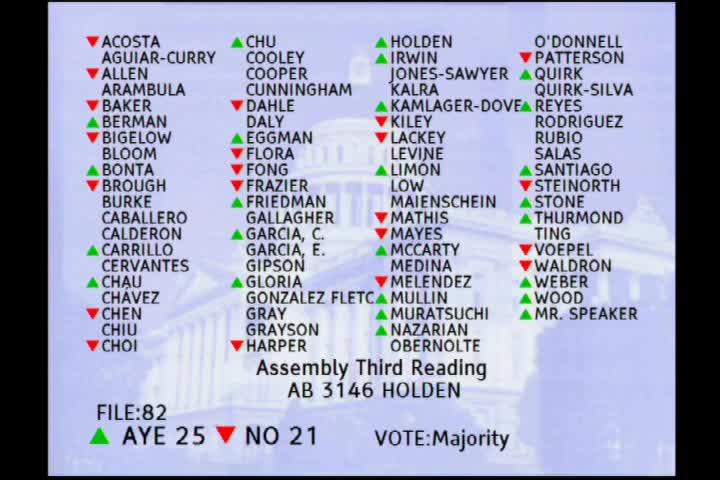 2MIN
Assembly Floor
Bill Author
Bill Co-Author(s):