AB 3261: Cannabis.
- Session Year: 2017-2018
- House: Assembly
- Latest Version Date: 2018-09-20
(1)The Control, Regulate and Tax Adult Use of Marijuana Act (AUMA), an initiative measure approved as Proposition 64 at the November 8, 2016, statewide general election, authorizes a person who obtains a state license under AUMA to engage in commercial adult-use cannabis activity pursuant to that license and applicable local ordinances. The Medicinal and Adult-Use Cannabis Regulation and Safety Act (MAUCRSA), among other things, consolidates the licensure and regulation of commercial medicinal and adult-use cannabis activities, and renamed the Bureau of Marijuana Control the Bureau of Cannabis Control.
This bill would make nonsubstantive changes to reflect the name change of the Bureau of Cannabis Control, and would make other conforming changes to reflect the consolidation of the licensure and regulation of commercial medicinal and adult-use cannabis activities.
(2)MAUCRSA defines various terms for purposes of the act. MAUCRSA also allows the issuance of a microbusiness license for the cultivation of cannabis on an area less than 10,000 square feet and to act as a licensed distributor, Level 1 manufacturer, and retailer, provided the licensee can demonstrate compliance with all requirements imposed by MAUCRSA on licensed cultivators, distributors, Level 1 manufacturers, and retailers to the extent the licensee engages in such activities.
This bill would define a microbusiness for purposes of the act consistent with that licensing authorization and make other related nonsubstantive changes.
(3)MAUCRSA defines an applicant for purposes of the act to be an owner applying for a state license. That act requires, when applying for a state license, among other things, each owner to electronically submit to the Department of Justice fingerprint images for specified purposes.
This bill would make a clarifying change to the fingerprint requirement.
(4)MAUCRSA requires the Department of Food and Agriculture, in consultation with the Bureau of Cannabis Control, to establish a track and trace program for reporting the movement of cannabis and cannabis products throughout the distribution chain that utilizes a unique identifier to be issued for each cannabis plant. MAUCRSA requires the Department of Food and Agriculture, in consultation with the State Board of Equalization, to ensure that the track and trace program can track and trace the amount of the cannabis cultivation tax imposed by AUMA and to create an electronic database containing the electronic shipping manifests to facilitate the administration of the track and trace program.
Existing law, on July 1, 2017, transferred to the California Department of Tax and Fee Administration the various duties, powers, and responsibilities of the State Board of Equalization except for those duties, powers, and responsibilities imposed or conferred upon the board by the California Constitution, as specified. That transfer of duties, powers, and responsibilities includes the administration of the cannabis excise tax and cannabis cultivation tax.
This bill would make a nonsubstantive, conforming change to MAUCRSA to reflect the transfer of duties, powers, and responsibilities of the board to the California Department of Tax and Fee Administration.
(5)This bill would incorporate additional changes to Section 27 of the Business and Professions Code proposed by SB 1483 and SB 1491 to be operative only if this bill and either or both SB 1483 and SB 1491 are enacted and this bill is enacted last.
The bill would incorporate additional changes to Section 26051.5 of the Business and Professions Code proposed by AB 2799 and AB 2980 to be operative only if this bill and either or both AB 2799 and AB 2980 are enacted and this bill is enacted last.
This bill would make its proposed changes to Section 26070 of the Business and Professions Code inoperative if AB 2255 is enacted.
The bill would make its proposed changes to Section 101 of the Business and Professions Code inoperative if AB 3110, SB 1482, SB 1483, or any combination thereof, is enacted.
(1)The Control, Regulate and Tax Adult Use of Marijuana Act (AUMA), an initiative measure approved as Proposition 64 at the November 8, 2016, statewide general election, authorizes a person who obtains a state license under AUMA to engage in commercial adult-use cannabis activity pursuant to that license and applicable local ordinances. The Medicinal and Adult-Use Cannabis Regulation and Safety Act (MAUCRSA), among other things, consolidates the licensure and regulation of commercial medicinal and adult-use cannabis activities, and renamed the Bureau of Marijuana Control the Bureau of Cannabis Control.
This bill would make a nonsubstantive change changes to reflect the name change of the Bureau of Cannabis Control, and would make other conforming changes to reflect the consolidation of the licensure and regulation of commercial medicinal and adult-use cannabis activities.
(2)MAUCRSA defines various terms for purposes of the act. MAUCRSA also allows the issuance of a microbusiness license for the cultivation of cannabis on an area less than 10,000 square feet and to act as a licensed distributor, Level 1 manufacturer, and retailer, provided the licensee can demonstrate compliance with all requirements imposed by MAUCRSA on licensed cultivators, distributors, Level 1 manufacturers, and retailers to the extent the licensee engages in such activities.
This bill would define microbusiness a microbusiness for purposes of the act. act consistent with that licensing authorization and make other related nonsubstantive changes.
(3)MAUCRSA defines an applicant for purposes of the act to be an owner applying for a state license. That act requires, when applying for a state license, among other things, each owner to electronically submit to the Department of Justice fingerprint images for specified purposes.
This bill would make a clarifying change to the fingerprint requirement.
(3)(4)MAUCRSA requires the Department of Food and Agriculture, in consultation with the Bureau of Cannabis Control, to establish a track and trace program for reporting the movement of cannabis and cannabis products throughout the distribution chain that utilizes a unique identifier to be issued for each cannabis plant. MAUCRSA requires the Department of Food and Agriculture, in consultation with the State Board of Equalization, to ensure that the track and trace program can track and trace the amount of the cannabis cultivation tax imposed by AUMA and to create an electronic database containing the electronic shipping manifests to facilitate the administration of the track and trace program.
Existing law, on July 1, 2017, transferred to the California Department of Tax and Fee Administration the various duties, powers, and responsibilities of the State Board of Equalization except for those duties, powers, and responsibilities imposed or conferred upon the board by the California Constitution, as specified. That transfer of duties, powers, and responsibilities includes the administration of the cannabis excise tax and cannabis cultivation tax.
This bill would make a nonsubstantive, conforming change to MAUCRSA to reflect the transfer of duties, powers, and responsibilities of the board to the California Department of Tax and Fee Administration.
(1)The Control, Regulate and Tax Adult Use of Marijuana Act of 2016 (AUMA), an initiative measure approved as Proposition 64 at the November 8, 2016, statewide general election, authorizes a person who obtains a state license under AUMA to engage in commercial adult-use cannabis activity pursuant to that license and applicable local ordinances. The Medicinal and Adult-Use Cannabis Regulation and Safety Act (MAUCRSA), among other things, consolidates the licensure and regulation of commercial medicinal and adult-use cannabis activities. activities, and renamed the Bureau of Marijuana Control the Bureau of Cannabis Control.
This bill would make a nonsubstantive change to reflect the name change of the Bureau of Cannabis Control, and would make other conforming changes to reflect the consolidation of the licensure and regulation of commercial medicinal and adult-use cannabis activities.
MAUCRSA(2)MAUCRSA defines various terms for purposes of the act.
This bill would define microbusiness for purposes of the act.
MAUCRSA(3)MAUCRSA requires the Department of Food and Agriculture, in consultation with the Bureau of Cannabis Control, to establish a track and trace program for reporting the movement of cannabis and cannabis products throughout the distribution chain that utilizes a unique identifier to be issued for each cannabis plant. MAUCRSA requires the Department of Food and Agriculture, in consultation with the State Board of Equalization, to ensure that the track and trace program can track and trace the amount of the cannabis cultivation tax imposed by AUMA and to create an electronic database containing the electronic shipping manifests to facilitate the administration of the track and trace program.
Existing law, on July 1, 2017, transferred to the California Department of Tax and Fee Administration the various duties, powers, and responsibilities of the State Board of Equalization except for those duties, powers, and responsibilities imposed or conferred upon the board by the California Constitution, as specified. That transfer of duties, powers, and responsibilities includes the administration of the cannabis excise tax and cannabis cultivation tax.
This bill would make a nonsubstantive, conforming change to MAUCRSA to reflect the transfer of duties, powers, and responsibilities of the board to the California Department of Tax and Fee Administration.
The Control, Regulate and Tax Adult Use of Marijuana Act of 2016 (AUMA), an initiative measure approved as Proposition 64 at the November 8, 2016, statewide general election, authorizes a person who obtains a state license under AUMA to engage in commercial adult-use cannabis activity pursuant to that license and applicable local ordinances. The Medicinal and Adult-Use Cannabis Regulation and Safety Act (MAUCRSA), among other things, consolidates the licensure and regulation of commercial medicinal and adult-use cannabis activities.
MAUCRSA defines various terms for purposes of the act.
This bill would define microbusiness for purposes of the act.
MAUCRSA requires the Department of Food and Agriculture, in consultation with the Bureau of Cannabis Control, to establish a track and trace program for reporting the movement of cannabis and cannabis products throughout the distribution chain that utilizes a unique identifier to be issued for each cannabis plant. MAUCRSA requires the Department of Food and Agriculture, in consultation with the State Board of Equalization, to ensure that the track and trace program can track and trace the amount of the cannabis cultivation tax imposed by AUMA and to create an electronic database containing the electronic shipping manifests to facilitate the administration of the track and trace program.
Existing law, on July 1, 2017, transferred to the California Department of Tax and Fee Administration the various duties, powers, and responsibilities of the State Board of Equalization except for those duties, powers, and responsibilities imposed or conferred upon the board by the California Constitution, as specified. That transfer of duties, powers, and responsibilities includes the administration of the cannabis excise tax and cannabis cultivation tax.
This bill would make a nonsubstantive, conforming change to MAUCRSA to reflect the transfer of duties, powers, and responsibilities of the board to the California Department of Tax and Fee Administration.
(a)Each entity specified in subdivisions (c), (d), and (e) shall provide on the Internet information regarding the status of every license issued by that entity in accordance with the California Public Records Act (Chapter 3.5 (commencing with Section 6250) of Division 7 of Title 1 of the Government Code) and the Information Practices Act of 1977 (Chapter 1 (commencing with Section 1798) of Title 1.8 of Part 4 of Division 3 of the Civil Code). The public information to be provided on the Internet shall include information on suspensions and revocations of licenses issued by the entity and other related enforcement action, including accusations filed pursuant to the Administrative Procedure Act (Chapter 3.5 (commencing with Section 11340) of Part 1 of Division 3 of Title 2 of the Government Code) taken by the entity relative to persons, businesses, or facilities subject to licensure or regulation by the entity. The information may not include personal information, including home telephone number, date of birth, or social security number. Each entity shall disclose a licensees address of record. However, each entity shall allow a licensee to provide a post office box number or other alternate address, instead of his or her home address, as the address of record. This section shall not preclude an entity from also requiring a licensee, who has provided a post office box number or other alternative mailing address as his or her address of record, to provide a physical business address or residence address only for the entitys internal administrative use and not for disclosure as the licensees address of record or disclosure on the Internet.
(b)In providing information on the Internet, each entity specified in subdivisions (c) and (d) shall comply with the Department of Consumer Affairs guidelines for access to public records.
(c)Each of the following entities within the Department of Consumer Affairs shall comply with the requirements of this section:
(1)The Board for Professional Engineers, Land Surveyors, and Geologists shall disclose information on its registrants and licensees.
(2)The Bureau of Automotive Repair shall disclose information on its licensees, including auto repair dealers, smog stations, lamp and brake stations, smog check technicians, and smog inspection certification stations.
(3)The Bureau of Electronic and Appliance Repair, Home Furnishings, and Thermal Insulation shall disclose information on its licensees and registrants, including major appliance repair dealers, combination dealers (electronic and appliance), electronic repair dealers, service contract sellers, and service contract administrators.
(4)The Cemetery and Funeral Bureau shall disclose information on its licensees, including cemetery brokers, cemetery salespersons, cemetery managers, crematory managers, cemetery authorities, crematories, cremated remains disposers, embalmers, funeral establishments, and funeral directors.
(5)The Professional Fiduciaries Bureau shall disclose information on its licensees.
(6)The Contractors State License Board shall disclose information on its licensees and registrants in accordance with Chapter 9 (commencing with Section 7000) of Division 3. In addition to information related to licenses as specified in subdivision (a), the board shall also disclose information provided to the board by the Labor Commissioner pursuant to Section 98.9 of the Labor Code.
(7)The Bureau for Private Postsecondary Education shall disclose information on private postsecondary institutions under its jurisdiction, including disclosure of notices to comply issued pursuant to Section 94935 of the Education Code.
(8)The California Board of Accountancy shall disclose information on its licensees and registrants.
(9)The California Architects Board shall disclose information on its licensees, including architects and landscape architects.
(10)The State Athletic Commission shall disclose information on its licensees and registrants.
(11)The State Board of Barbering and Cosmetology shall disclose information on its licensees.
(12)The State Board of Guide Dogs for the Blind shall disclose information on its licensees and registrants.
(13)The Acupuncture Board shall disclose information on its licensees.
(14)The Board of Behavioral Sciences shall disclose information on its licensees, including licensed marriage and family therapists, licensed clinical social workers, licensed educational psychologists, and licensed professional clinical counselors.
(15)The Dental Board of California shall disclose information on its licensees.
(16)The State Board of Optometry shall disclose information on its licensees and registrants.
(17)The Board of Psychology shall disclose information on its licensees, including psychologists, psychological assistants, and registered psychologists.
(18)The Veterinary Medical Board shall disclose information on its licensees, registrants, and permitholders.
(d)The State Board of Chiropractic Examiners shall disclose information on its licensees.
(e)The Structural Pest Control Board shall disclose information on its licensees, including applicators, field representatives, and operators in the areas of fumigation, general pest and wood destroying pests and organisms, and wood roof cleaning and treatment.
(f)The Bureau of Cannabis Control shall disclose information on its licensees.
(g)Internet for the purposes of this section has the meaning set forth in paragraph (6) of subdivision (f) of Section 17538.
SEC. 1.1.Section 27 of the Business and Professions Code is amended to read:27.(a)Each entity specified in subdivisions (c), (d), and (e) shall provide on the Internet information regarding the status of every license issued by that entity in accordance with the California Public Records Act (Chapter 3.5 (commencing with Section 6250) of Division 7 of Title 1 of the Government Code) and the Information Practices Act of 1977 (Chapter 1 (commencing with Section 1798) of Title 1.8 of Part 4 of Division 3 of the Civil Code). The public information to be provided on the Internet shall include information on suspensions and revocations of licenses issued by the entity and other related enforcement action, including accusations filed pursuant to the Administrative Procedure Act (Chapter 3.5 (commencing with Section 11340) of Part 1 of Division 3 of Title 2 of the Government Code) taken by the entity relative to persons, businesses, or facilities subject to licensure or regulation by the entity. The information may not include personal information, including home telephone number, date of birth, or social security number. Each entity shall disclose a licensees address of record. However, each entity shall allow a licensee to provide a post office box number or other alternate address, instead of his or her home address, as the address of record. This section shall not preclude an entity from also requiring a licensee, who has provided a post office box number or other alternative mailing address as his or her address of record, to provide a physical business address or residence address only for the entitys internal administrative use and not for disclosure as the licensees address of record or disclosure on the Internet.
(b)In providing information on the Internet, each entity specified in subdivisions (c) and (d) shall comply with the Department of Consumer Affairs guidelines for access to public records.
(c)Each of the following entities within the Department of Consumer Affairs shall comply with the requirements of this section:
(1)The Board for Professional Engineers, Land Surveyors, and Geologists shall disclose information on its registrants and licensees.
(2)The Bureau of Automotive Repair shall disclose information on its licensees, including auto repair dealers, smog stations, lamp and brake stations, smog check technicians, and smog inspection certification stations.
(3)The Bureau of Household Goods and Services shall disclose information on its licensees and registrants, including major appliance repair dealers, combination dealers (electronic and appliance), electronic repair dealers, service contract sellers, and service contract administrators.
(4)The Cemetery and Funeral Bureau shall disclose information on its licensees, including cemetery brokers, cemetery salespersons, cemetery managers, crematory managers, cemetery authorities, crematories, cremated remains disposers, embalmers, funeral establishments, and funeral directors.
(5)The Professional Fiduciaries Bureau shall disclose information on its licensees.
(6)The Contractors State License Board shall disclose information on its licensees and registrants in accordance with Chapter 9 (commencing with Section 7000) of Division 3. In addition to information related to licenses as specified in subdivision (a), the board shall also disclose information provided to the board by the Labor Commissioner pursuant to Section 98.9 of the Labor Code.
(7)The Bureau for Private Postsecondary Education shall disclose information on private postsecondary institutions under its jurisdiction, including disclosure of notices to comply issued pursuant to Section 94935 of the Education Code.
(8)The California Board of Accountancy shall disclose information on its licensees and registrants.
(9)The California Architects Board shall disclose information on its licensees, including architects and landscape architects.
(10)The State Athletic Commission shall disclose information on its licensees and registrants.
(11)The State Board of Barbering and Cosmetology shall disclose information on its licensees.
(12)The State Board of Guide Dogs for the Blind shall disclose information on its licensees and registrants.
(13)The Acupuncture Board shall disclose information on its licensees.
(14)The Board of Behavioral Sciences shall disclose information on its licensees, including licensed marriage and family therapists, licensed clinical social workers, licensed educational psychologists, and licensed professional clinical counselors.
(15)The Dental Board of California shall disclose information on its licensees.
(16)The State Board of Optometry shall disclose information on its licensees and registrants.
(17)The Board of Psychology shall disclose information on its licensees, including psychologists, psychological assistants, and registered psychologists.
(18)The Veterinary Medical Board shall disclose information on its licensees, registrants, and permitholders.
(d)The State Board of Chiropractic Examiners shall disclose information on its licensees.
(e)The Structural Pest Control Board shall disclose information on its licensees, including applicators, field representatives, and operators in the areas of fumigation, general pest and wood destroying pests and organisms, and wood roof cleaning and treatment.
(f)The Bureau of Cannabis Control shall disclose information on its licensees.
(g)Internet for the purposes of this section has the meaning set forth in paragraph (6) of subdivision (f) of Section 17538.
SEC. 1.2.Section 27 of the Business and Professions Code is amended to read:27.(a)Each entity specified in subdivisions (c), (d), and (e) shall provide on the Internet information regarding the status of every license issued by that entity in accordance with the California Public Records Act (Chapter 3.5 (commencing with Section 6250) of Division 7 of Title 1 of the Government Code) and the Information Practices Act of 1977 (Chapter 1 (commencing with Section 1798) of Title 1.8 of Part 4 of Division 3 of the Civil Code). The public information to be provided on the Internet shall include information on suspensions and revocations of licenses issued by the entity and other related enforcement action, including accusations filed pursuant to the Administrative Procedure Act (Chapter 3.5 (commencing with Section 11340) of Part 1 of Division 3 of Title 2 of the Government Code) taken by the entity relative to persons, businesses, or facilities subject to licensure or regulation by the entity. The information may not include personal information, including home telephone number, date of birth, or social security number. Each entity shall disclose a licensees address of record. However, each entity shall allow a licensee to provide a post office box number or other alternate address, instead of his or her home address, as the address of record. This section shall not preclude an entity from also requiring a licensee, who has provided a post office box number or other alternative mailing address as his or her address of record, to provide a physical business address or residence address only for the entitys internal administrative use and not for disclosure as the licensees address of record or disclosure on the Internet.
(b)In providing information on the Internet, each entity specified in subdivisions (c) and (d) shall comply with the Department of Consumer Affairs guidelines for access to public records.
(c)Each of the following entities within the Department of Consumer Affairs shall comply with the requirements of this section:
(1)The Board for Professional Engineers, Land Surveyors, and Geologists shall disclose information on its registrants and licensees.
(2)The Bureau of Automotive Repair shall disclose information on its licensees, including auto repair dealers, smog stations, lamp and brake stations, smog check technicians, and smog inspection certification stations.
(3)The Bureau of Electronic and Appliance Repair, Home Furnishings, and Thermal Insulation shall disclose information on its licensees and registrants, including major appliance repair dealers, combination dealers (electronic and appliance), electronic repair dealers, service contract sellers, and service contract administrators.
(4)The Cemetery and Funeral Bureau shall disclose information on its licensees, including cemetery brokers, cemetery salespersons, cemetery managers, crematory managers, cemetery authorities, crematories, cremated remains disposers, embalmers, funeral establishments, and funeral directors.
(5)The Professional Fiduciaries Bureau shall disclose information on its licensees.
(6)The Contractors State License Board shall disclose information on its licensees and registrants in accordance with Chapter 9 (commencing with Section 7000) of Division 3. In addition to information related to licenses as specified in subdivision (a), the board shall also disclose information provided to the board by the Labor Commissioner pursuant to Section 98.9 of the Labor Code.
(7)The Bureau for Private Postsecondary Education shall disclose information on private postsecondary institutions under its jurisdiction, including disclosure of notices to comply issued pursuant to Section 94935 of the Education Code.
(8)The California Board of Accountancy shall disclose information on its licensees and registrants.
(9)The California Architects Board shall disclose information on its licensees, including architects and landscape architects.
(10)The State Athletic Commission shall disclose information on its licensees and registrants.
(11)The State Board of Barbering and Cosmetology shall disclose information on its licensees.
(12)The State Board of Guide Dogs for the Blind shall disclose information on its licensees and registrants.
(13)The Acupuncture Board shall disclose information on its licensees.
(14)The Board of Behavioral Sciences shall disclose information on its licensees and registrants.
(15)The Dental Board of California shall disclose information on its licensees.
(16)The State Board of Optometry shall disclose information on its licensees and registrants.
(17)The Board of Psychology shall disclose information on its licensees, including psychologists, psychological assistants, and registered psychologists.
(18)The Veterinary Medical Board shall disclose information on its licensees, registrants, and permitholders.
(d)The State Board of Chiropractic Examiners shall disclose information on its licensees.
(e)The Structural Pest Control Board shall disclose information on its licensees, including applicators, field representatives, and operators in the areas of fumigation, general pest and wood destroying pests and organisms, and wood roof cleaning and treatment.
(f)The Bureau of Cannabis Control shall disclose information on its licensees.
(g)Internet for the purposes of this section has the meaning set forth in paragraph (6) of subdivision (f) of Section 17538.
SEC. 1.3.Section 27 of the Business and Professions Code is amended to read:27.(a)Each entity specified in subdivisions (c), (d), and (e) shall provide on the Internet information regarding the status of every license issued by that entity in accordance with the California Public Records Act (Chapter 3.5 (commencing with Section 6250) of Division 7 of Title 1 of the Government Code) and the Information Practices Act of 1977 (Chapter 1 (commencing with Section 1798) of Title 1.8 of Part 4 of Division 3 of the Civil Code). The public information to be provided on the Internet shall include information on suspensions and revocations of licenses issued by the entity and other related enforcement action, including accusations filed pursuant to the Administrative Procedure Act (Chapter 3.5 (commencing with Section 11340) of Part 1 of Division 3 of Title 2 of the Government Code) taken by the entity relative to persons, businesses, or facilities subject to licensure or regulation by the entity. The information may not include personal information, including home telephone number, date of birth, or social security number. Each entity shall disclose a licensees address of record. However, each entity shall allow a licensee to provide a post office box number or other alternate address, instead of his or her home address, as the address of record. This section shall not preclude an entity from also requiring a licensee, who has provided a post office box number or other alternative mailing address as his or her address of record, to provide a physical business address or residence address only for the entitys internal administrative use and not for disclosure as the licensees address of record or disclosure on the Internet.
(b)In providing information on the Internet, each entity specified in subdivisions (c) and (d) shall comply with the Department of Consumer Affairs guidelines for access to public records.
(c)Each of the following entities within the Department of Consumer Affairs shall comply with the requirements of this section:
(1)The Board for Professional Engineers, Land Surveyors, and Geologists shall disclose information on its registrants and licensees.
(2)The Bureau of Automotive Repair shall disclose information on its licensees, including auto repair dealers, smog stations, lamp and brake stations, smog check technicians, and smog inspection certification stations.
(3)The Bureau of Household Goods and Services shall disclose information on its licensees and registrants, including major appliance repair dealers, combination dealers (electronic and appliance), electronic repair dealers, service contract sellers, and service contract administrators.
(4)The Cemetery and Funeral Bureau shall disclose information on its licensees, including cemetery brokers, cemetery salespersons, cemetery managers, crematory managers, cemetery authorities, crematories, cremated remains disposers, embalmers, funeral establishments, and funeral directors.
(5)The Professional Fiduciaries Bureau shall disclose information on its licensees.
(6)The Contractors State License Board shall disclose information on its licensees and registrants in accordance with Chapter 9 (commencing with Section 7000) of Division 3. In addition to information related to licenses as specified in subdivision (a), the board shall also disclose information provided to the board by the Labor Commissioner pursuant to Section 98.9 of the Labor Code.
(7)The Bureau for Private Postsecondary Education shall disclose information on private postsecondary institutions under its jurisdiction, including disclosure of notices to comply issued pursuant to Section 94935 of the Education Code.
(8)The California Board of Accountancy shall disclose information on its licensees and registrants.
(9)The California Architects Board shall disclose information on its licensees, including architects and landscape architects.
(10)The State Athletic Commission shall disclose information on its licensees and registrants.
(11)The State Board of Barbering and Cosmetology shall disclose information on its licensees.
(12)The State Board of Guide Dogs for the Blind shall disclose information on its licensees and registrants.
(13)The Acupuncture Board shall disclose information on its licensees.
(14)The Board of Behavioral Sciences shall disclose information on its licensees and registrants.
(15)The Dental Board of California shall disclose information on its licensees.
(16)The State Board of Optometry shall disclose information on its licensees and registrants.
(17)The Board of Psychology shall disclose information on its licensees, including psychologists, psychological assistants, and registered psychologists.
(18)The Veterinary Medical Board shall disclose information on its licensees, registrants, and permitholders.
(d)The State Board of Chiropractic Examiners shall disclose information on its licensees.
(e)The Structural Pest Control Board shall disclose information on its licensees, including applicators, field representatives, and operators in the areas of fumigation, general pest and wood destroying pests and organisms, and wood roof cleaning and treatment.
(f)The Bureau of Cannabis Control shall disclose information on its licensees.
(g)Internet for the purposes of this section has the meaning set forth in paragraph (6) of subdivision (f) of Section 17538.
SEC. 2.Section 101 of the Business and Professions Code, as added by Section 4 of Chapter 828 of the Statutes of 2017, is amended to read:101.The department is comprised of the following:
(a)The Dental Board of California.
(b)The Medical Board of California.
(c)The State Board of Optometry.
(d)The California State Board of Pharmacy.
(e)The Veterinary Medical Board.
(f)The California Board of Accountancy.
(g)The California Architects Board.
(h)The Bureau of Barbering and Cosmetology.
(i)The Board for Professional Engineers, Land Surveyors, and Geologists.
(j)The Contractors State License Board.
(k)The Bureau for Private Postsecondary Education.
(l)The Bureau of Electronic and Appliance Repair, Home Furnishings, and Thermal Insulation.
(m)The Board of Registered Nursing.
(n)The Board of Behavioral Sciences.
(o)The State Athletic Commission.
(p)The Cemetery and Funeral Bureau.
(q)The State Board of Guide Dogs for the Blind.
(r)The Bureau of Security and Investigative Services.
(s)The Court Reporters Board of California.
(t)The Board of Vocational Nursing and Psychiatric Technicians.
(u)The Landscape Architects Technical Committee.
(v)The Division of Investigation.
(w)The Bureau of Automotive Repair.
(x)The Respiratory Care Board of California.
(y)The Acupuncture Board.
(z)The Board of Psychology.
(aa)The California Board of Podiatric Medicine.
(ab)The Physical Therapy Board of California.
(ac)The Arbitration Review Program.
(ad)The Physician Assistant Committee.
(ae)The Speech-Language Pathology and Audiology and Hearing Aid Dispensers Board.
(af)The California Board of Occupational Therapy.
(ag)The Osteopathic Medical Board of California.
(ah)The Naturopathic Medicine Committee.
(ai)The Dental Hygiene Committee of California.
(aj)The Professional Fiduciaries Bureau.
(ak)The State Board of Chiropractic Examiners.
(al)The Bureau of Real Estate Appraisers.
(am)The Structural Pest Control Board.
(an)The Bureau of Cannabis Control.
(ao)Any other boards, offices, or officers subject to its jurisdiction by law.
(ap)This section shall become operative on July 1, 2018.
SEC. 3.Section 2525 of the Business and Professions Code is amended to read:2525.(a)It is unlawful for a physician and surgeon who recommends cannabis to a patient for a medical purpose to accept, solicit, or offer any form of remuneration from or to a facility issued a state license pursuant to Division 10 (commencing with Section 26000), if the physician and surgeon or his or her immediate family have a financial interest in that facility.
(b)For the purposes of this section, financial interest shall have the same meaning as in Section 650.01.
(c)A violation of this section shall be a misdemeanor punishable by up to one year in county jail and a fine of up to five thousand dollars ($5,000) or by civil penalties of up to five thousand dollars ($5,000) and shall constitute unprofessional conduct.
SEC. 4.Section 26001.1 is added to the Business and Professions Code, to read:26001.1.In addition to the definitions listed in Section 26001, for purposes of this division, microbusiness means a person holding a license issued under paragraph (3) of subdivision (a) of Section 26070.
SEC. 5.Section 26051.5 of the Business and Professions Code is amended to read:26051.5.(a)An applicant for any type of state license issued pursuant to this division shall do all of the following:
(1)Require that each owner electronically submit to the Department of Justice fingerprint images and related information required by the Department of Justice of all applicants for any type of state license issued pursuant to this division, for the purpose of obtaining information as to the existence and content of a record of state or federal convictions and state and federal arrests, and also information as to the existence and content of a record of state or federal convictions and arrests for which the Department of Justice establishes that the person is free on bail or on his or her recognizance pending trial or appeal.
(A)Notwithstanding any other law, the Bureau of Cannabis Control, the Department of Food and Agriculture, and the State Department of Public Health may obtain and receive, at their discretion, criminal history information from the Department of Justice and the Federal Bureau of Investigation for an applicant for any state license under this division, including any license established by a licensing authority by regulation pursuant to subdivision (b) of Section 26012.
(B) When received, the Department of Justice shall transmit fingerprint images and related information received pursuant to this section to the Federal Bureau of Investigation for the purpose of obtaining a federal criminal history records check. The Department of Justice shall review the information returned from the Federal Bureau of Investigation and compile and disseminate a response to the licensing authority.
(C)The Department of Justice shall provide a response to the licensing authority pursuant to paragraph (1) of subdivision (p) of Section 11105 of the Penal Code.
(D)The licensing authority shall request from the Department of Justice subsequent notification service, as provided pursuant to Section 11105.2 of the Penal Code, for applicants.
(E)The Department of Justice shall charge the applicant a fee sufficient to cover the reasonable cost of processing the requests described in this paragraph.
(2)Provide evidence of the legal right to occupy and use the proposed location and provide a statement from the landowner of real property or that landowners agent where the commercial cannabis activity will occur, as proof to demonstrate the landowner has acknowledged and consented to permit commercial cannabis activities to be conducted on the property by the tenant applicant.
(3)Provide evidence that the proposed location is in compliance with subdivision (b) of Section 26054.
(4)Provide a statement, signed by the applicant under penalty of perjury, that the information provided is complete, true, and accurate.
(5)(A)For an applicant with 20 or more employees, provide a statement that the applicant will enter into, or demonstrate that it has already entered into, and abide by the terms of a labor peace agreement.
(B)For the purposes of this paragraph, employee does not include a supervisor.
(C)For the purposes of this paragraph, supervisor means an individual having authority, in the interest of the applicant, to hire, transfer, suspend, lay off, recall, promote, discharge, assign, reward, or discipline other employees, or responsibility to direct them or to adjust their grievances, or effectively to recommend such action, if, in connection with the foregoing, the exercise of that authority is not of a merely routine or clerical nature, but requires the use of independent judgment.
(6)Provide the applicants valid sellers permit number issued pursuant to Part 1 (commencing with Section 6001) of Division 2 of the Revenue and Taxation Code or indicate that the applicant is currently applying for a sellers permit.
(7)Provide any other information required by the licensing authority.
(8)For an applicant seeking a cultivation license, provide a statement declaring the applicant is an agricultural employer, as defined in the Alatorre-Zenovich-Dunlap-Berman Agricultural Labor Relations Act of 1975 (Part 3.5 (commencing with Section 1140) of Division 2 of the Labor Code), to the extent not prohibited by law.
(9)Pay all applicable fees required for licensure by the licensing authority.
(10)Provide proof of a bond to cover the costs of destruction of cannabis or cannabis products if necessitated by a violation of licensing requirements.
(b)An applicant shall also include in the application a detailed description of the applicants operating procedures for all of the following, as required by the licensing authority:
(1)Cultivation.
(2)Extraction and infusion methods.
(3)The transportation process.
(4)Inventory procedures.
(5)Quality control procedures.
(6)Security protocols.
(7)For applicants seeking licensure to cultivate, the source or sources of water the applicant will use for cultivation, as provided in subdivisions (a) to (c), inclusive, of Section 26060.1. For purposes of this paragraph, cultivation as used in Section 26060.1 shall have the same meaning as defined in Section 26001. The Department of Food and Agriculture shall consult with the State Water Resources Control Board and the Department of Fish and Wildlife in the implementation of this paragraph.
(c)The applicant shall also provide a complete detailed diagram of the proposed premises wherein the license privileges will be exercised, with sufficient particularity to enable ready determination of the bounds of the premises, showing all boundaries, dimensions, entrances and exits, interior partitions, walls, rooms, and common or shared entryways, and include a brief statement or description of the principal activity to be conducted therein, and, for licenses permitting cultivation, measurements of the planned canopy, including aggregate square footage and individual square footage of separate cultivation areas, if any, roads, water crossings, points of diversion, water storage, and all other facilities and infrastructure related to the cultivation.
(d)Provide a complete list of every person with a financial interest in the person applying for the license as required by the licensing authority. For purposes of this subdivision, persons with a financial interest does not include persons whose only interest in a licensee is an interest in a diversified mutual fund, blind trust, or similar instrument.
SEC. 5.1.Section 26051.5 of the Business and Professions Code is amended to read:26051.5.(a)An applicant for any type of state license issued pursuant to this division shall do all of the following:
(1)Require that each owner electronically submit to the Department of Justice fingerprint images and related information required by the Department of Justice of all applicants for any type of state license issued pursuant to this division, for the purpose of obtaining information as to the existence and content of a record of state or federal convictions and state and federal arrests, and also information as to the existence and content of a record of state or federal convictions and arrests for which the Department of Justice establishes that the person is free on bail or on his or her recognizance pending trial or appeal.
(A)Notwithstanding any other law, the Bureau of Cannabis Control, the Department of Food and Agriculture, and the State Department of Public Health may obtain and receive, at their discretion, criminal history information from the Department of Justice and the Federal Bureau of Investigation for an applicant for any state license under this division, including any license established by a licensing authority by regulation pursuant to subdivision (b) of Section 26012.
(B) When received, the Department of Justice shall transmit fingerprint images and related information received pursuant to this section to the Federal Bureau of Investigation for the purpose of obtaining a federal criminal history records check. The Department of Justice shall review the information returned from the Federal Bureau of Investigation and compile and disseminate a response to the licensing authority.
(C)The Department of Justice shall provide a response to the licensing authority pursuant to paragraph (1) of subdivision (p) of Section 11105 of the Penal Code.
(D)The licensing authority shall request from the Department of Justice subsequent notification service, as provided pursuant to Section 11105.2 of the Penal Code, for applicants.
(E)The Department of Justice shall charge the applicant a fee sufficient to cover the reasonable cost of processing the requests described in this paragraph.
(2)Provide evidence of the legal right to occupy and use the proposed location and provide a statement from the landowner of real property or that landowners agent where the commercial cannabis activity will occur, as proof to demonstrate the landowner has acknowledged and consented to permit commercial cannabis activities to be conducted on the property by the tenant applicant.
(3)Provide evidence that the proposed location is in compliance with subdivision (b) of Section 26054.
(4)Provide a statement, signed by the applicant under penalty of perjury, that the information provided is complete, true, and accurate.
(5)(A)For an applicant with 20 or more employees, provide a statement that the applicant will enter into, or demonstrate that it has already entered into, and abide by the terms of a labor peace agreement.
(B)For the purposes of this paragraph, employee does not include a supervisor.
(C)For the purposes of this paragraph, supervisor means an individual having authority, in the interest of the applicant, to hire, transfer, suspend, lay off, recall, promote, discharge, assign, reward, or discipline other employees, or responsibility to direct them or to adjust their grievances, or effectively to recommend such action, if, in connection with the foregoing, the exercise of that authority is not of a merely routine or clerical nature, but requires the use of independent judgment.
(6)Provide the applicants valid sellers permit number issued pursuant to Part 1 (commencing with Section 6001) of Division 2 of the Revenue and Taxation Code or indicate that the applicant is currently applying for a sellers permit.
(7)Provide any other information required by the licensing authority.
(8)For an applicant seeking a cultivation license, provide a statement declaring the applicant is an agricultural employer, as defined in the Alatorre-Zenovich-Dunlap-Berman Agricultural Labor Relations Act of 1975 (Part 3.5 (commencing with Section 1140) of Division 2 of the Labor Code), to the extent not prohibited by law.
(9)Pay all applicable fees required for licensure by the licensing authority.
(10)Provide proof of a bond to cover the costs of destruction of cannabis or cannabis products if necessitated by a violation of licensing requirements.
(11)(A)Provide a statement, upon initial application and application for renewal, that the applicant employs, or will employ within one year of receiving or renewing a license, one supervisor and one employee who have successfully completed a Cal-OSHA 30-hour general industry outreach course offered by a training provider that is authorized by an OSHA Training Institute Education Center to provide the course. This paragraph shall not be construed to alter or amend existing requirements for employers to provide occupational safety and health training to employees.
(B)An applicant with only one employee shall not be subject to subparagraph (A).
(C)For purposes of this paragraph employee has the same meaning as provided in subparagraph (B) of paragraph (5) and supervisor has the same meaning as provided in subparagraph (C) of paragraph (5).
(b)An applicant shall also include in the application a detailed description of the applicants operating procedures for all of the following, as required by the licensing authority:
(1)Cultivation.
(2)Extraction and infusion methods.
(3)The transportation process.
(4)Inventory procedures.
(5)Quality control procedures.
(6)Security protocols.
(7)For applicants seeking licensure to cultivate, the source or sources of water the applicant will use for cultivation, as provided in subdivisions (a) to (c), inclusive, of Section 26060.1. For purposes of this paragraph, cultivation as used in Section 26060.1 shall have the same meaning as defined in Section 26001. The Department of Food and Agriculture shall consult with the State Water Resources Control Board and the Department of Fish and Wildlife in the implementation of this paragraph.
(c)The applicant shall also provide a complete detailed diagram of the proposed premises wherein the license privileges will be exercised, with sufficient particularity to enable ready determination of the bounds of the premises, showing all boundaries, dimensions, entrances and exits, interior partitions, walls, rooms, and common or shared entryways, and include a brief statement or description of the principal activity to be conducted therein, and, for licenses permitting cultivation, measurements of the planned canopy, including aggregate square footage and individual square footage of separate cultivation areas, if any, roads, water crossings, points of diversion, water storage, and all other facilities and infrastructure related to the cultivation.
(d)Provide a complete list of every person with a financial interest in the person applying for the license as required by the licensing authority. For purposes of this subdivision, persons with a financial interest does not include persons whose only interest in a licensee is an interest in a diversified mutual fund, blind trust, or similar instrument.
SEC. 5.2.Section 26051.5 of the Business and Professions Code is amended to read:26051.5.(a)An applicant for any type of state license issued pursuant to this division shall do all of the following:
(1)Require that each owner electronically submit to the Department of Justice fingerprint images and related information required by the Department of Justice of all applicants for any type of state license issued pursuant to this division, for the purpose of obtaining information as to the existence and content of a record of state or federal convictions and state and federal arrests, and also information as to the existence and content of a record of state or federal convictions and arrests for which the Department of Justice establishes that the person is free on bail or on his or her recognizance pending trial or appeal.
(A)Notwithstanding any other law, the Bureau of Cannabis Control, the Department of Food and Agriculture, and the State Department of Public Health may obtain and receive, at their discretion, criminal history information from the Department of Justice and the Federal Bureau of Investigation for an applicant for any state license under this division, including any license established by a licensing authority by regulation pursuant to subdivision (b) of Section 26012.
(B) When received, the Department of Justice shall transmit fingerprint images and related information received pursuant to this section to the Federal Bureau of Investigation for the purpose of obtaining a federal criminal history records check. The Department of Justice shall review the information returned from the Federal Bureau of Investigation and compile and disseminate a response to the licensing authority.
(C)The Department of Justice shall provide a response to the licensing authority pursuant to paragraph (1) of subdivision (p) of Section 11105 of the Penal Code.
(D)The licensing authority shall request from the Department of Justice subsequent notification service, as provided pursuant to Section 11105.2 of the Penal Code, for applicants.
(E)The Department of Justice shall charge the applicant a fee sufficient to cover the reasonable cost of processing the requests described in this paragraph.
(2)Provide evidence of the legal right to occupy and use the proposed location and provide a statement from the landowner of real property or that landowners agent where the commercial cannabis activity will occur, as proof to demonstrate the landowner has acknowledged and consented to permit commercial cannabis activities to be conducted on the property by the tenant applicant.
(3)Provide evidence that the proposed location is in compliance with subdivision (b) of Section 26054.
(4)Provide a statement, signed by the applicant under penalty of perjury, that the information provided is complete, true, and accurate.
(5)(A)For an applicant with 20 or more employees, provide a statement that the applicant will enter into, or demonstrate that it has already entered into, and abide by the terms of a labor peace agreement.
(B)For the purposes of this paragraph, employee does not include a supervisor.
(C)For the purposes of this paragraph, supervisor means an individual having authority, in the interest of the applicant, to hire, transfer, suspend, lay off, recall, promote, discharge, assign, reward, or discipline other employees, or responsibility to direct them or to adjust their grievances, or effectively to recommend such action, if, in connection with the foregoing, the exercise of that authority is not of a merely routine or clerical nature, but requires the use of independent judgment.
(6)Provide the applicants valid sellers permit number issued pursuant to Article 2 (commencing with Section 6066) of Chapter 2 of Part 1 of Division 2 of the Revenue and Taxation Code or indicate that the applicant is currently applying for a sellers permit.
(7)Provide any other information required by the licensing authority.
(8)For an applicant seeking a cultivation license, provide a statement declaring the applicant is an agricultural employer, as defined in the Alatorre-Zenovich-Dunlap-Berman Agricultural Labor Relations Act of 1975 (Part 3.5 (commencing with Section 1140) of Division 2 of the Labor Code), to the extent not prohibited by law.
(9)Pay all applicable fees required for licensure by the licensing authority.
(10)Provide proof of a bond to cover the costs of destruction of cannabis or cannabis products if necessitated by a violation of licensing requirements.
(b)An applicant shall also include in the application a detailed description of the applicants operating procedures for all of the following, as required by the licensing authority:
(1)Cultivation.
(2)Extraction and infusion methods.
(3)The transportation process.
(4)Inventory procedures.
(5)Quality control procedures.
(6)Security protocols.
(7)For applicants seeking licensure to cultivate, the source or sources of water the applicant will use for cultivation, as provided in subdivisions (a) to (c), inclusive, of Section 26060.1. For purposes of this paragraph, cultivation as used in Section 26060.1 shall have the same meaning as defined in Section 26001. The Department of Food and Agriculture shall consult with the State Water Resources Control Board and the Department of Fish and Wildlife in the implementation of this paragraph.
(c)(1)The applicant shall also provide a complete detailed diagram of the proposed premises wherein the license privileges will be exercised, with sufficient particularity to enable ready determination of the bounds of the premises, showing all boundaries, dimensions, entrances and exits, interior partitions, walls, rooms, and common or shared entryways, and include a brief statement or description of the principal activity to be conducted therein, and, for licenses permitting cultivation, measurements of the planned canopy, including aggregate square footage and individual square footage of separate cultivation areas, if any, roads, water crossings, points of diversion, water storage, and all other facilities and infrastructure related to the cultivation.
(2)Nothing in paragraph (1) shall be construed to prohibit two or more licensed premises from sharing common use areas, such as a bathroom, breakroom, locker room, hallway, or loading dock, wherein no license privileges will be exercised so long as all licensees comply with the requirements of this division.
(d)Provide a complete list of every person with a financial interest in the person applying for the license as required by the licensing authority. For purposes of this subdivision, persons with a financial interest does not include persons whose only interest in a licensee is an interest in a diversified mutual fund, blind trust, or similar instrument.
SEC. 5.3.Section 26051.5 of the Business and Professions Code is amended to read:26051.5.(a)An applicant for any type of state license issued pursuant to this division shall do all of the following:
(1)Require that each owner electronically submit to the Department of Justice fingerprint images and related information required by the Department of Justice of all applicants for any type of state license issued pursuant to this division, for the purpose of obtaining information as to the existence and content of a record of state or federal convictions and state and federal arrests, and also information as to the existence and content of a record of state or federal convictions and arrests for which the Department of Justice establishes that the person is free on bail or on his or her recognizance pending trial or appeal.
(A)Notwithstanding any other law, the Bureau of Cannabis Control, the Department of Food and Agriculture, and the State Department of Public Health may obtain and receive, at their discretion, criminal history information from the Department of Justice and the Federal Bureau of Investigation for an applicant for any state license under this division, including any license established by a licensing authority by regulation pursuant to subdivision (b) of Section 26012.
(B) When received, the Department of Justice shall transmit fingerprint images and related information received pursuant to this section to the Federal Bureau of Investigation for the purpose of obtaining a federal criminal history records check. The Department of Justice shall review the information returned from the Federal Bureau of Investigation and compile and disseminate a response to the licensing authority.
(C)The Department of Justice shall provide a response to the licensing authority pursuant to paragraph (1) of subdivision (p) of Section 11105 of the Penal Code.
(D)The licensing authority shall request from the Department of Justice subsequent notification service, as provided pursuant to Section 11105.2 of the Penal Code, for applicants.
(E)The Department of Justice shall charge the applicant a fee sufficient to cover the reasonable cost of processing the requests described in this paragraph.
(2)Provide evidence of the legal right to occupy and use the proposed location and provide a statement from the landowner of real property or that landowners agent where the commercial cannabis activity will occur, as proof to demonstrate the landowner has acknowledged and consented to permit commercial cannabis activities to be conducted on the property by the tenant applicant.
(3)Provide evidence that the proposed location is in compliance with subdivision (b) of Section 26054.
(4)Provide a statement, signed by the applicant under penalty of perjury, that the information provided is complete, true, and accurate.
(5)(A)For an applicant with 20 or more employees, provide a statement that the applicant will enter into, or demonstrate that it has already entered into, and abide by the terms of a labor peace agreement.
(B)For the purposes of this paragraph, employee does not include a supervisor.
(C)For the purposes of this paragraph, supervisor means an individual having authority, in the interest of the applicant, to hire, transfer, suspend, lay off, recall, promote, discharge, assign, reward, or discipline other employees, or responsibility to direct them or to adjust their grievances, or effectively to recommend such action, if, in connection with the foregoing, the exercise of that authority is not of a merely routine or clerical nature, but requires the use of independent judgment.
(6)Provide the applicants valid sellers permit number issued pursuant to Article 2 (commencing with Section 6066) of Chapter 2 of Part 1 of Division 2 of the Revenue and Taxation Code or indicate that the applicant is currently applying for a sellers permit.
(7)Provide any other information required by the licensing authority.
(8)For an applicant seeking a cultivation license, provide a statement declaring the applicant is an agricultural employer, as defined in the Alatorre-Zenovich-Dunlap-Berman Agricultural Labor Relations Act of 1975 (Part 3.5 (commencing with Section 1140) of Division 2 of the Labor Code), to the extent not prohibited by law.
(9)Pay all applicable fees required for licensure by the licensing authority.
(10)Provide proof of a bond to cover the costs of destruction of cannabis or cannabis products if necessitated by a violation of licensing requirements.
(11)(A)Provide a statement, upon initial application and application for renewal, that the applicant employs, or will employ within one year of receiving or renewing a license, one supervisor and one employee who have successfully completed a Cal-OSHA 30-hour general industry outreach course offered by a training provider that is authorized by an OSHA Training Institute Education Center to provide the course. This paragraph shall not be construed to alter or amend existing requirements for employers to provide occupational safety and health training to employees.
(B)An applicant with only one employee shall not be subject to subparagraph (A).
(C)For purposes of this paragraph employee has the same meaning as provided in subparagraph (B) of paragraph (5) and supervisor has the same meaning as provided in subparagraph (C) of paragraph (5).
(b)An applicant shall also include in the application a detailed description of the applicants operating procedures for all of the following, as required by the licensing authority:
(1)Cultivation.
(2)Extraction and infusion methods.
(3)The transportation process.
(4)Inventory procedures.
(5)Quality control procedures.
(6)Security protocols.
(7)For applicants seeking licensure to cultivate, the source or sources of water the applicant will use for cultivation, as provided in subdivisions (a) to (c), inclusive, of Section 26060.1. For purposes of this paragraph, cultivation as used in Section 26060.1 shall have the same meaning as defined in Section 26001. The Department of Food and Agriculture shall consult with the State Water Resources Control Board and the Department of Fish and Wildlife in the implementation of this paragraph.
(c)(1)The applicant shall also provide a complete detailed diagram of the proposed premises wherein the license privileges will be exercised, with sufficient particularity to enable ready determination of the bounds of the premises, showing all boundaries, dimensions, entrances and exits, interior partitions, walls, rooms, and common or shared entryways, and include a brief statement or description of the principal activity to be conducted therein, and, for licenses permitting cultivation, measurements of the planned canopy, including aggregate square footage and individual square footage of separate cultivation areas, if any, roads, water crossings, points of diversion, water storage, and all other facilities and infrastructure related to the cultivation.
(2)Nothing in paragraph (1) shall be construed to prohibit two or more licensed premises from sharing common use areas, such as a bathroom, breakroom, locker room, hallway, or loading dock, wherein no license privileges will be exercised so long as all licensees comply with the requirements of this division.
(d)Provide a complete list of every person with a financial interest in the person applying for the license as required by the licensing authority. For purposes of this subdivision, persons with a financial interest does not include persons whose only interest in a licensee is an interest in a diversified mutual fund, blind trust, or similar instrument.
SEC. 6.Section 26067 of the Business and Professions Code is amended to read:26067.(a)The department, in consultation with the bureau, shall establish a track and trace program for reporting the movement of cannabis and cannabis products throughout the distribution chain that utilizes a unique identifier pursuant to Section 26069, secure packaging, and is capable of providing information that captures, at a minimum, all of the following:
(1)The licensee receiving the product.
(2)The transaction date.
(3)The cultivator from which the product originates, including the associated unique identifier pursuant to Section 26069.
(b)(1)The department, in consultation with the California Department of Tax and Fee Administration, shall create an electronic database containing the electronic shipping manifests to facilitate the administration of the track and trace program, which shall include, but not be limited to, the following information:
(A)The variety and quantity or weight of products shipped.
(B)The estimated times of departure and arrival.
(C)The variety and quantity or weight of products received.
(D)The actual time of departure and arrival.
(E)A categorization of the product.
(F)The license number and the unique identifier pursuant to Section 26069 issued by the licensing authority for all licensees involved in the shipping process, including, but not limited to, cultivators, manufacturers, distributors, and dispensaries.
(2)(A)The database shall be designed to flag irregularities for all licensing authorities in this division to investigate. All licensing authorities pursuant to this division may access the database and share information related to licensees under this chapter, including social security and individual taxpayer identifications notwithstanding Section 30.
(B)The department shall immediately inform the bureau upon the finding of an irregularity or suspicious finding related to a licensee, applicant, or commercial cannabis activity for investigatory purposes.
(3)Licensing authorities and state and local agencies may, at any time, inspect shipments and request documentation for current inventory.
(4)The bureau shall have 24-hour access to the electronic database administered by the department. The California Department of Tax and Fee Administration shall have read access to the electronic database for the purpose of taxation and regulation of cannabis and cannabis products.
(5)The department shall be authorized to enter into memoranda of understandings with licensing authorities for data sharing purposes, as deemed necessary by the department.
(6)Information received and contained in records kept by the department or licensing authorities for the purposes of administering this chapter are confidential and shall not be disclosed pursuant to the California Public Records Act (Chapter 3.5 (commencing with Section 6250) of Division 7 of Title 1 of the Government Code), except as necessary for authorized employees of the State of California or any city, county, or city and county to perform official duties pursuant to this division or a local ordinance.
(7)Upon the request of a state or local law enforcement agency, licensing authorities shall allow access to or provide information contained within the database to assist law enforcement in their duties and responsibilities pursuant to this division.
SEC. 7.Section 26068 of the Business and Professions Code is amended to read:26068.(a)The department, in consultation with the bureau and the California Department of Tax and Fee Administration, shall ensure that the track and trace program can also track and trace the amount of the cultivation tax due pursuant to Part 14.5 (commencing with Section 34010) of Division 2 of the Revenue and Taxation Code. The track and trace program shall include an electronic seed to sale software tracking system with data points for the different stages of commercial activity, including, but not limited to, cultivation, harvest, processing, distribution, inventory, and sale.
(b)The department, in consultation with the bureau, shall ensure that licensees under this division are allowed to use third-party applications, programs, and information technology systems to comply with the requirements of the expanded track and trace program described in subdivision (a) to report the movement of cannabis and cannabis products throughout the distribution chain and communicate the information to licensing agencies as required by law.
(c)Any software, database, or other information technology system utilized by the department to implement the expanded track and trace program shall support interoperability with third-party cannabis business software applications and allow all licensee-facing system activities to be performed through a secure application programming interface (API) or comparable technology that is well documented, bi-directional, and accessible to any third-party application that has been validated and has appropriate credentials. The API or comparable technology shall have version control and provide adequate notice of updates to third-party applications. The system should provide a test environment for third-party applications to access that mirrors the production environment.
SEC. 8.The heading of Chapter 7 (commencing with Section 26070) of Division 10 of the Business and Professions Code is amended to read:7.Retailers, Distributors, and MicrobusinessesSEC. 9.Section 26070 of the Business and Professions Code is amended to read:26070.Retailers, Distributors, and Microbusinesses.
(a)State licenses to be issued by the bureau related to the sale and distribution of cannabis and cannabis products are as follows:
(1)Retailer, for the retail sale and delivery of cannabis or cannabis products to customers. A retailer shall have a licensed premises which is a physical location from which commercial cannabis activities are conducted. A retailers premises may be closed to the public. A retailer may conduct sales exclusively by delivery.
(2)Distributor, for the distribution of cannabis and cannabis products. A distributor licensee shall be bonded and insured at a minimum level established by the licensing authority.
(3)(A)Microbusiness, for the cultivation of cannabis on an area less than 10,000 square feet and to act as a licensed distributor, Level 1 manufacturer, and retailer under this division, provided such licensee can demonstrate compliance with all requirements imposed by this division on licensed cultivators, distributors, Level 1 manufacturers, and retailers to the extent the licensee engages in such activities. Microbusiness licenses that authorize cultivation of cannabis shall include the license conditions described in subdivision (b) of Section 26060.1.
(B)In coordination with each other, the licensing authorities shall establish a process by which an applicant for a microbusiness license can demonstrate compliance with all the requirements under this division for the activities that will be conducted under the license.
(C)The bureau may enter into interagency agreements with licensing authorities to implement and enforce the provisions of this division related to microbusinesses. The costs of activities carried out by the licensing authorities as requested by the bureau pursuant to the interagency agreement shall be calculated into the application and licensing fees collected pursuant to this division, and shall provide for reimbursement to state agencies for associated costs as provided for in the interagency agreement.
(b)The bureau shall establish minimum security and transportation safety requirements for the commercial distribution and delivery of cannabis and cannabis products. Except as provided in subdivision (d) of Section 26110, the transportation of cannabis and cannabis products shall only be conducted by persons holding a distributor license under this division or employees of those persons. Transportation safety standards established by the bureau shall include, but not be limited to, minimum standards governing the types of vehicles in which cannabis and cannabis products may be distributed and delivered and minimum qualifications for persons eligible to operate such vehicles.
(c)The driver of a vehicle transporting or transferring cannabis or cannabis products shall be directly employed by a licensee authorized to transport or transfer cannabis or cannabis products.
(d)Notwithstanding any other law, all vehicles transporting cannabis and cannabis products for hire shall be required to have a valid motor carrier permit pursuant to Chapter 2 (commencing with Section 34620) of Division 14.85 of the Vehicle Code. The Department of the California Highway Patrol shall have authority over the safe operation of these vehicles, including, but not limited to, requiring licensees engaged in the transportation of cannabis or cannabis products to participate in the Basic Inspection of Terminals (BIT) program pursuant to Section 34501.12 of the Vehicle Code.
(e)Prior to transporting cannabis or cannabis products, a licensed distributor shall do both of the following:
(1)Complete an electronic shipping manifest as prescribed by the licensing authority. The shipping manifest shall include the unique identifier, pursuant to Section 26069, issued by the Department of Food and Agriculture for the original cannabis product.
(2)Securely transmit the manifest to the bureau and the licensee that will receive the cannabis product. The bureau shall inform the Department of Food and Agriculture of information pertaining to commercial cannabis activity for the purpose of the track and trace program identified in Section 26067.
(f)During transportation, the licensed distributor shall maintain a physical copy of the shipping manifest and make it available upon request to agents of the Department of Consumer Affairs and law enforcement officers.
(g)The licensee receiving the shipment shall maintain each electronic shipping manifest and shall make it available upon request to the Department of Consumer Affairs and any law enforcement officers.
(h)Upon receipt of the transported shipment, the licensee receiving the shipment shall submit to the licensing authority a record verifying receipt of the shipment and the details of the shipment.
(i)Transporting, or arranging for or facilitating the transport of, cannabis or cannabis products in violation of this chapter is grounds for disciplinary action against the license.
(j)Licensed retailers and microbusinesses, and licensed nonprofits under Section 26070.5, shall implement security measures reasonably designed to prevent unauthorized entrance into areas containing cannabis or cannabis products and theft of cannabis or cannabis products from the premises. These security measures shall include, but not be limited to, all of the following:
(1)Prohibiting individuals from remaining on the licensees premises if they are not engaging in activity expressly related to the operations of the retailer.
(2)Establishing limited access areas accessible only to authorized personnel.
(3)Other than limited amounts of cannabis used for display purposes, samples, or immediate sale, storing all finished cannabis and cannabis products in a secured and locked room, safe, or vault, and in a manner reasonably designed to prevent diversion, theft, and loss.
(k)A retailer shall notify the licensing authority and the appropriate law enforcement authorities within 24 hours after discovering any of the following:
(1)Significant discrepancies identified during inventory. The level of significance shall be determined by the bureau.
(2)Diversion, theft, loss, or any criminal activity pertaining to the operation of the retailer.
(3)Diversion, theft, loss, or any criminal activity by any agent or employee of the retailer pertaining to the operation of the retailer.
(4)The loss or unauthorized alteration of records related to cannabis or cannabis products, registered qualifying patients, primary caregivers, or retailer employees or agents.
(5)Any other breach of security.
(l)Beginning January 1, 2018, a licensee may sell cannabis or cannabis products that have not been tested for a limited and finite time as determined by the bureau. The cannabis or cannabis products must have a label affixed to each package containing the cannabis or cannabis products that clearly states This product has not been tested as required by the Medicinal and Adult-Use Cannabis Regulation and Safety Act and must comply with any other requirement as determined by the bureau.
SEC. 10.Section 26161 of the Business and Professions Code is amended to read:26161.(a)Every sale or transport of cannabis or cannabis products from one licensee to another licensee must be recorded on a sales invoice or receipt. Sales invoices and receipts may be maintained electronically and must be filed in such manner as to be readily accessible for examination by employees of the licensing authorities or California Department of Tax and Fee Administration and shall not be commingled with invoices covering other commodities.
(b)Each sales invoice required by subdivision (a) shall include the name and address of the seller and shall include the following information:
(1)Name and address of the purchaser.
(2)Date of sale and invoice number.
(3)Kind, quantity, size, and capacity of packages of cannabis or cannabis products sold.
(4)The cost to the purchaser, together with any discount applied to the price as shown on the invoice.
(5)The place from which transport of the cannabis or cannabis product was made unless transport was made from the premises of the licensee.
(6)Any other information specified by the licensing authority.
SEC. 11.Section 26211 of the Business and Professions Code is amended to read:26211.(a)Funds for the initial establishment and support of the regulatory activities under this division, including the public information program described in subdivision (c), and for the activities of the State Board of Equalization under Part 14.5 (commencing with Section 34010) of Division 2 of the Revenue and Taxation Code until July 1, 2017, or until the 2017 Budget Act is enacted, whichever occurs later, shall be advanced from the General Fund and shall be repaid by the initial proceeds from fees collected pursuant to this division, any rule or regulation adopted pursuant to this division, or revenues collected from the tax imposed by Sections 34011 and 34012 of the Revenue and Taxation Code, by January 1, 2025.
(1)Funds advanced pursuant to this subdivision shall be appropriated to the bureau, which shall distribute the moneys to the appropriate licensing authorities, as necessary to implement the provisions of this division, and to the State Board of Equalization, as necessary, to implement the provisions of Part 14.5 (commencing with Section 34010) of Division 2 of the Revenue and Taxation Code.
(2)Within 45 days of November 9, 2016, the date this section became operative:
(A)The Director of Finance shall determine an amount of the initial advance from the General Fund to the Cannabis Control Fund that does not exceed thirty million dollars ($30,000,000); and
(B)There shall be advanced a sum of five million dollars ($5,000,000) from the General Fund to the State Department of Health Care Services to provide for the public information program described in subdivision (c).
(b)Notwithstanding subdivision (a), the Legislature shall provide sufficient funds to the Cannabis Control Fund to support the activities of the bureau, state licensing authorities under this division, and the California Department of Tax and Fee Administration to support its activities under Part 14.5 (commencing with Section 34010) of Division 2 of the Revenue and Taxation Code. It is anticipated that this funding will be provided annually beginning on July 1, 2017.
(c)The State Department of Health Care Services shall establish and implement a public information program no later than September 1, 2017. This public information program shall, at a minimum, describe the provisions of the Control, Regulate and Tax Adult Use of Marijuana Act of 2016, the scientific basis for restricting access of cannabis and cannabis products to persons under the age of 21 years, describe the penalties for providing access to cannabis and cannabis products to persons under the age of 21 years, provide information regarding the dangers of driving a motor vehicle, boat, vessel, aircraft, or other vehicle used for transportation while impaired from cannabis use, the potential harms of using cannabis while pregnant or breastfeeding, and the potential harms of overusing cannabis or cannabis products.
SEC. 12.(a)Section 1.1 of this bill incorporates amendments to Section 27 of the Business and Professions Code proposed by both this bill and Senate Bill 1483. That section of this bill shall only become operative if (1) both bills are enacted and become effective on or before January 1, 2019, (2) each bill amends Section 27 of the Business and Professions Code, and (3) Senate Bill 1491 is not enacted or as enacted does not amend that section, and (4) this bill is enacted after Senate Bill 1483, in which case Sections 1, 1.2 and 1.3 of this bill shall not become operative.
(b)Section 1.2 of this bill incorporates amendments to Section 27 of the Business and Professions Code proposed by both this bill and SB 1491. That section of this bill shall only become operative if (1) both bills are enacted and become effective on or before January 1, 2019, (2) each bill amends Section 27 of the Business and Professions Code, (3) Senate Bill 1483 is not enacted or as enacted does not amend that section, and (4) this bill is enacted after Senate Bill 1491 in which case Sections 1, 1.1 and 1.3 of this bill shall not become operative.
(c)Section 1.3 of this bill incorporates amendments to Section 27 of the Business and Professions Code proposed by this bill, Senate Bill 1483, and Senate Bill 1491. That section of this bill shall only become operative if (1) all three bills are enacted and become effective on or before January 1, 2019, (2) all three bills amend Section 27 of the Business and Professions Code, and (3) this bill is enacted after Senate Bill 1483 and Senate Bill 1491, in which case Sections 1, 1.1 and 1.2 of this bill shall not become operative.
SEC. 13.(a)Section 5.1 of this bill incorporates amendments to Section 26051.5 of the Business and Professions Code proposed by both this bill and Assembly Bill 2799. That section of this bill shall only become operative if (1) both bills are enacted and become effective on or before January 1, 2019, (2) each bill amends Section 26051.5 of the Business and Professions Code, (3) Assembly Bill 2980 is not enacted or as enacted does not amend that section, and (4) this bill is enacted after Assembly Bill 2799, in which case Sections 5, 5.2, and 5.3 of this bill shall not become operative.
(b)Section 5.2 of this bill incorporates amendments to Section 26051.5 of the Business and Professions Code proposed by both this bill and Assembly Bill 2980. That section of this bill shall only become operative if (1) both bills are enacted and become effective on or before January 1, 2019, (2) each bill amends Section 26051.5 of the Business and Professions Code, (3) Assembly Bill 2799 is not enacted or as enacted does not amend that section, and (4) this bill is enacted after Assembly Bill 2980 in which case Sections 5, 5.1, and 5.3 of this bill shall not become operative.
(c)Section 5.3 of this bill incorporates amendments to Section 26051.5 of the Business and Professions Code proposed by this bill, Assembly Bill 2799, and Assembly Bill 2980. That section of this bill shall only become operative if (1) all three bills are enacted and become effective on or before January 1, 2019, (2) all three bills amend Section 26051.5 of the Business and Professions Code, and (3) this bill is enacted after Assembly Bill 2799 and Assembly Bill 2980, in which case Sections 5, 5.1, and 5.2 of this bill shall not become operative.
SEC. 14.Section 2 of this bill, which amends Section 101 of the Business and Professions Code, shall not become operative if Assembly Bill 3110, Senate Bill 1482, or Senate Bill 1483, or any combination thereof, is enacted, becomes effective on or before January 1, 2019, and amends Section 101 of the Business and Professions Code, regardless of the order of chaptering.
SEC. 15.Section 9 of this bill, which amends Section 26070 of the Business and Professions Code, shall not become operative if (1) Assembly Bill 2255 is enacted and effective on or before January 1, 2019, regardless of whether Assembly Bill 2255 is enacted before or after this bill, and (2) each bill amends Section 26070 of the Business and Professions Code.
(a)Each entity specified in subdivisions (c), (d), and (e) shall provide on the Internet information regarding the status of every license issued by that entity in accordance with the California Public Records Act (Chapter 3.5 (commencing with Section 6250) of Division 7 of Title 1 of the Government Code) and the Information Practices Act of 1977 (Chapter 1 (commencing with Section 1798) of Title 1.8 of Part 4 of Division 3 of the Civil Code). The public information to be provided on the Internet shall include information on suspensions and revocations of licenses issued by the entity and other related enforcement action, including accusations filed pursuant to the Administrative Procedure Act (Chapter 3.5 (commencing with Section 11340) of Part 1 of Division 3 of Title 2 of the Government Code) taken by the entity relative to persons, businesses, or facilities subject to licensure or regulation by the entity. The information may not include personal information, including home telephone number, date of birth, or social security number. Each entity shall disclose a licensees address of record. However, each entity shall allow a licensee to provide a post office box number or other alternate address, instead of his or her home address, as the address of record. This section shall not preclude an entity from also requiring a licensee, who has provided a post office box number or other alternative mailing address as his or her address of record, to provide a physical business address or residence address only for the entitys internal administrative use and not for disclosure as the licensees address of record or disclosure on the Internet.
(b)In providing information on the Internet, each entity specified in subdivisions (c) and (d) shall comply with the Department of Consumer Affairs guidelines for access to public records.
(c)Each of the following entities within the Department of Consumer Affairs shall comply with the requirements of this section:
(1)The Board for Professional Engineers, Land Surveyors, and Geologists shall disclose information on its registrants and licensees.
(2)The Bureau of Automotive Repair shall disclose information on its licensees, including auto repair dealers, smog stations, lamp and brake stations, smog check technicians, and smog inspection certification stations.
(3)The Bureau of Electronic and Appliance Repair, Home Furnishings, and Thermal Insulation shall disclose information on its licensees and registrants, including major appliance repair dealers, combination dealers (electronic and appliance), electronic repair dealers, service contract sellers, and service contract administrators.
(4)The Cemetery and Funeral Bureau shall disclose information on its licensees, including cemetery brokers, cemetery salespersons, cemetery managers, crematory managers, cemetery authorities, crematories, cremated remains disposers, embalmers, funeral establishments, and funeral directors.
(5)The Professional Fiduciaries Bureau shall disclose information on its licensees.
(6)The Contractors State License Board shall disclose information on its licensees and registrants in accordance with Chapter 9 (commencing with Section 7000) of Division 3. In addition to information related to licenses as specified in subdivision (a), the board shall also disclose information provided to the board by the Labor Commissioner pursuant to Section 98.9 of the Labor Code.
(7)The Bureau for Private Postsecondary Education shall disclose information on private postsecondary institutions under its jurisdiction, including disclosure of notices to comply issued pursuant to Section 94935 of the Education Code.
(8)The California Board of Accountancy shall disclose information on its licensees and registrants.
(9)The California Architects Board shall disclose information on its licensees, including architects and landscape architects.
(10)The State Athletic Commission shall disclose information on its licensees and registrants.
(11)The State Board of Barbering and Cosmetology shall disclose information on its licensees.
(12)The State Board of Guide Dogs for the Blind shall disclose information on its licensees and registrants.
(13)The Acupuncture Board shall disclose information on its licensees.
(14)The Board of Behavioral Sciences shall disclose information on its licensees, including licensed marriage and family therapists, licensed clinical social workers, licensed educational psychologists, and licensed professional clinical counselors.
(15)The Dental Board of California shall disclose information on its licensees.
(16)The State Board of Optometry shall disclose information on its licensees and registrants.
(17)The Board of Psychology shall disclose information on its licensees, including psychologists, psychological assistants, and registered psychologists.
(18)The Veterinary Medical Board shall disclose information on its licensees, registrants, and permitholders.
(d)The State Board of Chiropractic Examiners shall disclose information on its licensees.
(e)The Structural Pest Control Board shall disclose information on its licensees, including applicators, field representatives, and operators in the areas of fumigation, general pest and wood destroying pests and organisms, and wood roof cleaning and treatment.
(f)The Bureau of Cannabis Control shall disclose information on its licensees.
(g)Internet for the purposes of this section has the meaning set forth in paragraph (6) of subdivision (f) of Section 17538.
SEC. 1.1.Section 27 of the Business and Professions Code is amended to read:27.(a)Each entity specified in subdivisions (c), (d), and (e) shall provide on the Internet information regarding the status of every license issued by that entity in accordance with the California Public Records Act (Chapter 3.5 (commencing with Section 6250) of Division 7 of Title 1 of the Government Code) and the Information Practices Act of 1977 (Chapter 1 (commencing with Section 1798) of Title 1.8 of Part 4 of Division 3 of the Civil Code). The public information to be provided on the Internet shall include information on suspensions and revocations of licenses issued by the entity and other related enforcement action, including accusations filed pursuant to the Administrative Procedure Act (Chapter 3.5 (commencing with Section 11340) of Part 1 of Division 3 of Title 2 of the Government Code) taken by the entity relative to persons, businesses, or facilities subject to licensure or regulation by the entity. The information may not include personal information, including home telephone number, date of birth, or social security number. Each entity shall disclose a licensees address of record. However, each entity shall allow a licensee to provide a post office box number or other alternate address, instead of his or her home address, as the address of record. This section shall not preclude an entity from also requiring a licensee, who has provided a post office box number or other alternative mailing address as his or her address of record, to provide a physical business address or residence address only for the entitys internal administrative use and not for disclosure as the licensees address of record or disclosure on the Internet.
(b)In providing information on the Internet, each entity specified in subdivisions (c) and (d) shall comply with the Department of Consumer Affairs guidelines for access to public records.
(c)Each of the following entities within the Department of Consumer Affairs shall comply with the requirements of this section:
(1)The Board for Professional Engineers, Land Surveyors, and Geologists shall disclose information on its registrants and licensees.
(2)The Bureau of Automotive Repair shall disclose information on its licensees, including auto repair dealers, smog stations, lamp and brake stations, smog check technicians, and smog inspection certification stations.
(3)The Bureau of Electronic and Appliance Repair, Home Furnishings, and Thermal Insulation Household Goods and Services shall disclose information on its licensees and registrants, including major appliance repair dealers, combination dealers (electronic and appliance), electronic repair dealers, service contract sellers, and service contract administrators.
(4)The Cemetery and Funeral Bureau shall disclose information on its licensees, including cemetery brokers, cemetery salespersons, cemetery managers, crematory managers, cemetery authorities, crematories, cremated remains disposers, embalmers, funeral establishments, and funeral directors.
(5)The Professional Fiduciaries Bureau shall disclose information on its licensees.
(6)The Contractors State License Board shall disclose information on its licensees and registrants in accordance with Chapter 9 (commencing with Section 7000) of Division 3. In addition to information related to licenses as specified in subdivision (a), the board shall also disclose information provided to the board by the Labor Commissioner pursuant to Section 98.9 of the Labor Code.
(7)The Bureau for Private Postsecondary Education shall disclose information on private postsecondary institutions under its jurisdiction, including disclosure of notices to comply issued pursuant to Section 94935 of the Education Code.
(8)The California Board of Accountancy shall disclose information on its licensees and registrants.
(9)The California Architects Board shall disclose information on its licensees, including architects and landscape architects.
(10)The State Athletic Commission shall disclose information on its licensees and registrants.
(11)The State Board of Barbering and Cosmetology shall disclose information on its licensees.
(12)The State Board of Guide Dogs for the Blind shall disclose information on its licensees and registrants.
(13)The Acupuncture Board shall disclose information on its licensees.
(14)The Board of Behavioral Sciences shall disclose information on its licensees, including licensed marriage and family therapists, licensed clinical social workers, licensed educational psychologists, and licensed professional clinical counselors.
(15)The Dental Board of California shall disclose information on its licensees.
(16)The State Board of Optometry shall disclose information on its licensees and registrants.
(17)The Board of Psychology shall disclose information on its licensees, including psychologists, psychological assistants, and registered psychologists.
(18)The Veterinary Medical Board shall disclose information on its licensees, registrants, and permitholders.
(d)The State Board of Chiropractic Examiners shall disclose information on its licensees.
(e)The Structural Pest Control Board shall disclose information on its licensees, including applicators, field representatives, and operators in the areas of fumigation, general pest and wood destroying pests and organisms, and wood roof cleaning and treatment.
(f)The Bureau of Medical Cannabis Regulation Control shall disclose information on its licensees.
(g)Internet for the purposes of this section has the meaning set forth in paragraph (6) of subdivision (f) of Section 17538.
SEC. 1.2.Section 27 of the Business and Professions Code is amended to read:27.(a)Each entity specified in subdivisions (c), (d), and (e) shall provide on the Internet information regarding the status of every license issued by that entity in accordance with the California Public Records Act (Chapter 3.5 (commencing with Section 6250) of Division 7 of Title 1 of the Government Code) and the Information Practices Act of 1977 (Chapter 1 (commencing with Section 1798) of Title 1.8 of Part 4 of Division 3 of the Civil Code). The public information to be provided on the Internet shall include information on suspensions and revocations of licenses issued by the entity and other related enforcement action, including accusations filed pursuant to the Administrative Procedure Act (Chapter 3.5 (commencing with Section 11340) of Part 1 of Division 3 of Title 2 of the Government Code) taken by the entity relative to persons, businesses, or facilities subject to licensure or regulation by the entity. The information may not include personal information, including home telephone number, date of birth, or social security number. Each entity shall disclose a licensees address of record. However, each entity shall allow a licensee to provide a post office box number or other alternate address, instead of his or her home address, as the address of record. This section shall not preclude an entity from also requiring a licensee, who has provided a post office box number or other alternative mailing address as his or her address of record, to provide a physical business address or residence address only for the entitys internal administrative use and not for disclosure as the licensees address of record or disclosure on the Internet.
(b)In providing information on the Internet, each entity specified in subdivisions (c) and (d) shall comply with the Department of Consumer Affairs guidelines for access to public records.
(c)Each of the following entities within the Department of Consumer Affairs shall comply with the requirements of this section:
(1)The Board for Professional Engineers, Land Surveyors, and Geologists shall disclose information on its registrants and licensees.
(2)The Bureau of Automotive Repair shall disclose information on its licensees, including auto repair dealers, smog stations, lamp and brake stations, smog check technicians, and smog inspection certification stations.
(3)The Bureau of Electronic and Appliance Repair, Home Furnishings, and Thermal Insulation shall disclose information on its licensees and registrants, including major appliance repair dealers, combination dealers (electronic and appliance), electronic repair dealers, service contract sellers, and service contract administrators.
(4)The Cemetery and Funeral Bureau shall disclose information on its licensees, including cemetery brokers, cemetery salespersons, cemetery managers, crematory managers, cemetery authorities, crematories, cremated remains disposers, embalmers, funeral establishments, and funeral directors.
(5)The Professional Fiduciaries Bureau shall disclose information on its licensees.
(6)The Contractors State License Board shall disclose information on its licensees and registrants in accordance with Chapter 9 (commencing with Section 7000) of Division 3. In addition to information related to licenses as specified in subdivision (a), the board shall also disclose information provided to the board by the Labor Commissioner pursuant to Section 98.9 of the Labor Code.
(7)The Bureau for Private Postsecondary Education shall disclose information on private postsecondary institutions under its jurisdiction, including disclosure of notices to comply issued pursuant to Section 94935 of the Education Code.
(8)The California Board of Accountancy shall disclose information on its licensees and registrants.
(9)The California Architects Board shall disclose information on its licensees, including architects and landscape architects.
(10)The State Athletic Commission shall disclose information on its licensees and registrants.
(11)The State Board of Barbering and Cosmetology shall disclose information on its licensees.
(12)The State Board of Guide Dogs for the Blind shall disclose information on its licensees and registrants.
(13)The Acupuncture Board shall disclose information on its licensees.
(14)The Board of Behavioral Sciences shall disclose information on its licensees, including licensed marriage and family therapists, licensed clinical social workers, licensed educational psychologists, and licensed professional clinical counselors. licensees and registrants.
(15)The Dental Board of California shall disclose information on its licensees.
(16)The State Board of Optometry shall disclose information on its licensees and registrants.
(17)The Board of Psychology shall disclose information on its licensees, including psychologists, psychological assistants, and registered psychologists.
(18)The Veterinary Medical Board shall disclose information on its licensees, registrants, and permitholders.
(d)The State Board of Chiropractic Examiners shall disclose information on its licensees.
(e)The Structural Pest Control Board shall disclose information on its licensees, including applicators, field representatives, and operators in the areas of fumigation, general pest and wood destroying pests and organisms, and wood roof cleaning and treatment.
(f)The Bureau of Medical Cannabis Regulation Control shall disclose information on its licensees.
(g)Internet for the purposes of this section has the meaning set forth in paragraph (6) of subdivision (f) of Section 17538.
SEC. 1.3.Section 27 of the Business and Professions Code is amended to read:27.(a)Each entity specified in subdivisions (c), (d), and (e) shall provide on the Internet information regarding the status of every license issued by that entity in accordance with the California Public Records Act (Chapter 3.5 (commencing with Section 6250) of Division 7 of Title 1 of the Government Code) and the Information Practices Act of 1977 (Chapter 1 (commencing with Section 1798) of Title 1.8 of Part 4 of Division 3 of the Civil Code). The public information to be provided on the Internet shall include information on suspensions and revocations of licenses issued by the entity and other related enforcement action, including accusations filed pursuant to the Administrative Procedure Act (Chapter 3.5 (commencing with Section 11340) of Part 1 of Division 3 of Title 2 of the Government Code) taken by the entity relative to persons, businesses, or facilities subject to licensure or regulation by the entity. The information may not include personal information, including home telephone number, date of birth, or social security number. Each entity shall disclose a licensees address of record. However, each entity shall allow a licensee to provide a post office box number or other alternate address, instead of his or her home address, as the address of record. This section shall not preclude an entity from also requiring a licensee, who has provided a post office box number or other alternative mailing address as his or her address of record, to provide a physical business address or residence address only for the entitys internal administrative use and not for disclosure as the licensees address of record or disclosure on the Internet.
(b)In providing information on the Internet, each entity specified in subdivisions (c) and (d) shall comply with the Department of Consumer Affairs guidelines for access to public records.
(c)Each of the following entities within the Department of Consumer Affairs shall comply with the requirements of this section:
(1)The Board for Professional Engineers, Land Surveyors, and Geologists shall disclose information on its registrants and licensees.
(2)The Bureau of Automotive Repair shall disclose information on its licensees, including auto repair dealers, smog stations, lamp and brake stations, smog check technicians, and smog inspection certification stations.
(3)The Bureau of Electronic and Appliance Repair, Home Furnishings, and Thermal Insulation Household Goods and Services shall disclose information on its licensees and registrants, including major appliance repair dealers, combination dealers (electronic and appliance), electronic repair dealers, service contract sellers, and service contract administrators.
(4)The Cemetery and Funeral Bureau shall disclose information on its licensees, including cemetery brokers, cemetery salespersons, cemetery managers, crematory managers, cemetery authorities, crematories, cremated remains disposers, embalmers, funeral establishments, and funeral directors.
(5)The Professional Fiduciaries Bureau shall disclose information on its licensees.
(6)The Contractors State License Board shall disclose information on its licensees and registrants in accordance with Chapter 9 (commencing with Section 7000) of Division 3. In addition to information related to licenses as specified in subdivision (a), the board shall also disclose information provided to the board by the Labor Commissioner pursuant to Section 98.9 of the Labor Code.
(7)The Bureau for Private Postsecondary Education shall disclose information on private postsecondary institutions under its jurisdiction, including disclosure of notices to comply issued pursuant to Section 94935 of the Education Code.
(8)The California Board of Accountancy shall disclose information on its licensees and registrants.
(9)The California Architects Board shall disclose information on its licensees, including architects and landscape architects.
(10)The State Athletic Commission shall disclose information on its licensees and registrants.
(11)The State Board of Barbering and Cosmetology shall disclose information on its licensees.
(12)The State Board of Guide Dogs for the Blind shall disclose information on its licensees and registrants.
(13)The Acupuncture Board shall disclose information on its licensees.
(14)The Board of Behavioral Sciences shall disclose information on its licensees, including licensed marriage and family therapists, licensed clinical social workers, licensed educational psychologists, and licensed professional clinical counselors. licensees and registrants.
(15)The Dental Board of California shall disclose information on its licensees.
(16)The State Board of Optometry shall disclose information on its licensees and registrants.
(17)The Board of Psychology shall disclose information on its licensees, including psychologists, psychological assistants, and registered psychologists.
(18)The Veterinary Medical Board shall disclose information on its licensees, registrants, and permitholders.
(d)The State Board of Chiropractic Examiners shall disclose information on its licensees.
(e)The Structural Pest Control Board shall disclose information on its licensees, including applicators, field representatives, and operators in the areas of fumigation, general pest and wood destroying pests and organisms, and wood roof cleaning and treatment.
(f)The Bureau of Medical Cannabis Regulation Control shall disclose information on its licensees.
(g)Internet for the purposes of this section has the meaning set forth in paragraph (6) of subdivision (f) of Section 17538.
SEC. 2.Section 101 of the Business and Professions Code, as added by Section 4 of Chapter 828 of the Statutes of 2017, is amended to read:101.The department is comprised of the following:
(a)The Dental Board of California.
(b)The Medical Board of California.
(c)The State Board of Optometry.
(d)The California State Board of Pharmacy.
(e)The Veterinary Medical Board.
(f)The California Board of Accountancy.
(g)The California Architects Board.
(h)The Bureau of Barbering and Cosmetology.
(i)The Board for Professional Engineers, Land Surveyors, and Geologists.
(j)The Contractors State License Board.
(k)The Bureau for Private Postsecondary Education.
(l)The Bureau of Electronic and Appliance Repair, Home Furnishings, and Thermal Insulation.
(m)The Board of Registered Nursing.
(n)The Board of Behavioral Sciences.
(o)The State Athletic Commission.
(p)The Cemetery and Funeral Bureau.
(q)The State Board of Guide Dogs for the Blind.
(r)The Bureau of Security and Investigative Services.
(s)The Court Reporters Board of California.
(t)The Board of Vocational Nursing and Psychiatric Technicians.
(u)The Landscape Architects Technical Committee.
(v)The Division of Investigation.
(w)The Bureau of Automotive Repair.
(x)The Respiratory Care Board of California.
(y)The Acupuncture Board.
(z)The Board of Psychology.
(aa)The California Board of Podiatric Medicine.
(ab)The Physical Therapy Board of California.
(ac)The Arbitration Review Program.
(ad)The Physician Assistant Committee.
(ae)The Speech-Language Pathology and Audiology and Hearing Aid Dispensers Board.
(af)The California Board of Occupational Therapy.
(ag)The Osteopathic Medical Board of California.
(ah)The Naturopathic Medicine Committee.
(ai)The Dental Hygiene Committee of California.
(aj)The Professional Fiduciaries Bureau.
(ak)The State Board of Chiropractic Examiners.
(al)The Bureau of Real Estate Appraisers.
(am)The Structural Pest Control Board.
(an)The Bureau of Cannabis Control.
(ao)Any other boards, offices, or officers subject to its jurisdiction by law.
(ap)This section shall become operative on July 1, 2018.
SEC. 3.Section 2525 of the Business and Professions Code is amended to read:2525.(a)It is unlawful for a physician and surgeon who recommends cannabis to a patient for a medical purpose to accept, solicit, or offer any form of remuneration from or to a facility issued a state license pursuant to Division 10 (commencing with Section 26000), if the physician and surgeon or his or her immediate family have a financial interest in that facility.
(b)For the purposes of this section, financial interest shall have the same meaning as in Section 650.01.
(c)A violation of this section shall be a misdemeanor punishable by up to one year in county jail and a fine of up to five thousand dollars ($5,000) or by civil penalties of up to five thousand dollars ($5,000) and shall constitute unprofessional conduct.
SEC. 4.Section 26001 of the Business and Professions Code is amended to read:26001.For purposes of this division, the following definitions shall apply:(a)A-license means a state license issued under this division for cannabis or cannabis products that are intended for adults who are 21 years of age and older and who do not possess a physicians recommendation.(b)A-licensee means any person holding a license under this division for cannabis or cannabis products that are intended for adults who are 21 years of age and older and who do not possess a physicians recommendation.(c)Applicant means an owner applying for a state license pursuant to this division.(d)Batch means a specific quantity of homogeneous cannabis or cannabis product that is one of the following types:(1)Harvest batch. Harvest batch means a specifically identified quantity of dried flower or trim, leaves, and other cannabis plant matter that is uniform in strain, harvested at the same time, and, if applicable, cultivated using the same pesticides and other agricultural chemicals, and harvested at the same time.(2)Manufactured cannabis batch. Manufactured cannabis batch means either of the following:(A)An amount of cannabis concentrate or extract that is produced in one production cycle using the same extraction methods and standard operating procedures.(B)An amount of a type of manufactured cannabis produced in one production cycle using the same formulation and standard operating procedures.(e)Bureau means the Bureau of Cannabis Control within the Department of Consumer Affairs, formerly named the Bureau of Marijuana Control, the Bureau of Medical Cannabis Regulation, and the Bureau of Medical Marijuana Regulation.(f)Cannabis means all parts of the plant Cannabis sativa Linnaeus, Cannabis indica, or Cannabis ruderalis, whether growing or not; the seeds thereof; the resin, whether crude or purified, extracted from any part of the plant; and every compound, manufacture, salt, derivative, mixture, or preparation of the plant, its seeds, or resin. Cannabis also means the separated resin, whether crude or purified, obtained from cannabis. Cannabis does not include the mature stalks of the plant, fiber produced from the stalks, oil or cake made from the seeds of the plant, any other compound, manufacture, salt, derivative, mixture, or preparation of the mature stalks (except the resin extracted therefrom), fiber, oil, or cake, or the sterilized seed of the plant which is incapable of germination. For the purpose of this division, cannabis does not mean industrial hemp as defined by Section 11018.5 of the Health and Safety Code.(g)Cannabis accessories has the same meaning as in Section 11018.2 of the Health and Safety Code.(h)Cannabis concentrate means cannabis that has undergone a process to concentrate one or more active cannabinoids, thereby increasing the products potency. Resin from granular trichomes from a cannabis plant is a concentrate for purposes of this division. A cannabis concentrate is not considered food, as defined by Section 109935 of the Health and Safety Code, or a drug, as defined by Section 109925 of the Health and Safety Code.(i)Cannabis products has the same meaning as in Section 11018.1 of the Health and Safety Code.(j)Child resistant means designed or constructed to be significantly difficult for children under five years of age to open, and not difficult for normal adults to use properly.(k)Commercial cannabis activity includes the cultivation, possession, manufacture, distribution, processing, storing, laboratory testing, packaging, labeling, transportation, delivery or sale of cannabis and cannabis products as provided for in this division.(l)Cultivation means any activity involving the planting, growing, harvesting, drying, curing, grading, or trimming of cannabis.(m)Cultivation site means a location where cannabis is planted, grown, harvested, dried, cured, graded, or trimmed, or a location where any combination of those activities occurs.(n)Customer means a natural person 21 years of age or older or a natural person 18 years of age or older who possesses a physicians recommendation, or a primary caregiver.(o)Day care center has the same meaning as in Section 1596.76 of the Health and Safety Code.(p)Delivery means the commercial transfer of cannabis or cannabis products to a customer. Delivery also includes the use by a retailer of any technology platform.(q)Director means the Director of Consumer Affairs.(r)Distribution means the procurement, sale, and transport of cannabis and cannabis products between licensees.(s)Dried flower means all dead cannabis that has been harvested, dried, cured, or otherwise processed, excluding leaves and stems.(t)Edible cannabis product means cannabis product that is intended to be used, in whole or in part, for human consumption, including, but not limited to, chewing gum, but excluding products set forth in Division 15 (commencing with Section 32501) of the Food and Agricultural Code. An edible cannabis product is not considered food, as defined by Section 109935 of the Health and Safety Code, or a drug, as defined by Section 109925 of the Health and Safety Code.(u)Fund means the Cannabis Control Fund established pursuant to Section 26210.(v)Kind means applicable type or designation regarding a particular cannabis variant or cannabis product type, including, but not limited to, strain name or other grower trademark, or growing area designation.(w)Labeling means any label or other written, printed, or graphic matter upon a cannabis product, upon its container or wrapper, or that accompanies any cannabis product.(x)Labor peace agreement means an agreement between a licensee and any bona fide labor organization that, at a minimum, protects the states proprietary interests by prohibiting labor organizations and members from engaging in picketing, work stoppages, boycotts, and any other economic interference with the applicants business. This agreement means that the applicant has agreed not to disrupt efforts by the bona fide labor organization to communicate with, and attempt to organize and represent, the applicants employees. The agreement shall provide a bona fide labor organization access at reasonable times to areas in which the applicants employees work, for the purpose of meeting with employees to discuss their right to representation, employment rights under state law, and terms and conditions of employment. This type of agreement shall not mandate a particular method of election or certification of the bona fide labor organization.(y)License means a state license issued under this division, and includes both an A-license and an M-license, as well as a testing laboratory license.(z)Licensee means any person holding a license under this division, regardless of whether the license held is an A-license or an M-license, and includes the holder of a testing laboratory license.(aa)Licensing authority means the state agency responsible for the issuance, renewal, or reinstatement of the license, or the state agency authorized to take disciplinary action against the licensee.(ab)Live plants means living cannabis flowers and plants, including seeds, immature plants, and vegetative stage plants.(ac)Local jurisdiction means a city, county, or city and county.(ad)Lot means a batch or a specifically identified portion of a batch.(ae)M-license means a state license issued under this division for commercial cannabis activity involving medicinal cannabis.(af)M-licensee means any person holding a license under this division for commercial cannabis activity involving medicinal cannabis.(ag)Manufacture means to compound, blend, extract, infuse, or otherwise make or prepare a cannabis product.(ah)Manufacturer means a licensee that conducts the production, preparation, propagation, or compounding of cannabis or cannabis products either directly or indirectly or by extraction methods, or independently by means of chemical synthesis, or by a combination of extraction and chemical synthesis at a fixed location that packages or repackages cannabis or cannabis products or labels or relabels its container.(ai)Medicinal cannabis or medicinal cannabis product means cannabis or a cannabis product, respectively, intended to be sold for use pursuant to the Compassionate Use Act of 1996 (Proposition 215), found at Section 11362.5 of the Health and Safety Code, by a medicinal cannabis patient in California who possesses a physicians recommendation.(aj)Microbusiness means a person holding a license issued under paragraph (3) of subdivision (a) of Section 26070.(ak)Nursery means a licensee that produces only clones, immature plants, seeds, and other agricultural products used specifically for the propagation and cultivation of cannabis.(al)Operation means any act for which licensure is required under the provisions of this division, or any commercial transfer of cannabis or cannabis products.(am)Owner means any of the following:(1)A person with an aggregate ownership interest of 20 percent or more in the person applying for a license or a licensee, unless the interest is solely a security, lien, or encumbrance.(2)The chief executive officer of a nonprofit or other entity.(3)A member of the board of directors of a nonprofit.(4)An individual who will be participating in the direction, control, or management of the person applying for a license.(an)Package means any container or receptacle used for holding cannabis or cannabis products.(ao)Person includes any individual, firm, partnership, joint venture, association, corporation, limited liability company, estate, trust, business trust, receiver, syndicate, or any other group or combination acting as a unit, and the plural as well as the singular.(ap)Physicians recommendation means a recommendation by a physician and surgeon that a patient use cannabis provided in accordance with the Compassionate Use Act of 1996 (Proposition 215), found at Section 11362.5 of the Health and Safety Code.(aq)Premises means the designated structure or structures and land specified in the application that is owned, leased, or otherwise held under the control of the applicant or licensee where the commercial cannabis activity will be or is conducted. The premises shall be a contiguous area and shall only be occupied by one licensee.(ar)Primary caregiver has the same meaning as in Section 11362.7 of the Health and Safety Code.(as)Purchaser means the customer who is engaged in a transaction with a licensee for purposes of obtaining cannabis or cannabis products.(at)Sell, sale, and to sell include any transaction whereby, for any consideration, title to cannabis or cannabis products is transferred from one person to another, and includes the delivery of cannabis or cannabis products pursuant to an order placed for the purchase of the same and soliciting or receiving an order for the same, but does not include the return of cannabis or cannabis products by a licensee to the licensee from whom the cannabis or cannabis product was purchased.(au)Testing laboratory means a laboratory, facility, or entity in the state that offers or performs tests of cannabis or cannabis products and that is both of the following:(1)Accredited by an accrediting body that is independent from all other persons involved in commercial cannabis activity in the state.(2)Licensed by the bureau.(av)Unique identifier means an alphanumeric code or designation used for reference to a specific plant on a licensed premises and any cannabis or cannabis product derived or manufactured from that plant.(aw)Youth center has the same meaning as in Section 11353.1 of the Health and Safety Code.SEC. 5.Section 26051.5 of the Business and Professions Code is amended to read:26051.5.(a)An applicant for any type of state license issued pursuant to this division shall do all of the following:(1)Require that each owner electronically submit to the Department of Justice fingerprint images and related information required by the Department of Justice for the purpose of obtaining information as to the existence and content of a record of state or federal convictions and arrests, and information as to the existence and content of a record of state or federal convictions and arrests for which the Department of Justice establishes that the person is free on bail or on his or her own recognizance, pending trial or appeal.(A)Notwithstanding any other law, the Bureau of Cannabis Control, the Department of Food and Agriculture, and the State Department of Public Health may obtain and receive, at their discretion, criminal history information from the Department of Justice and the United States Federal Bureau of Investigation for an applicant for any state license under this division, including any license established by a licensing authority by regulation pursuant to subdivision (b) of Section 26012.(B)The Department of Justice shall forward to the United States Federal Bureau of Investigation all requests for federal criminal history record information received pursuant to this section. The Department of Justice shall review the information returned from the United States Federal Bureau of Investigation and compile and disseminate a response to the licensing authority.(C)The Department of Justice shall provide a response to the licensing authority pursuant to paragraph (1) of subdivision (p) of Section 11105 of the Penal Code.(D)The licensing authority shall request from the Department of Justice subsequent notification service, as provided pursuant to Section 11105.2 of the Penal Code, for applicants.(E)The Department of Justice shall charge the applicant a fee sufficient to cover the reasonable cost of processing the requests described in this paragraph.(2)Provide evidence of the legal right to occupy and use the proposed location and provide a statement from the landowner of real property or that landowners agent where the commercial cannabis activity will occur, as proof to demonstrate the landowner has acknowledged and consented to permit commercial cannabis activities to be conducted on the property by the tenant applicant.(3)Provide evidence that the proposed location is in compliance with subdivision (b) of Section 26054.(4)Provide a statement, signed by the applicant under penalty of perjury, that the information provided is complete, true, and accurate.(5)(A)For an applicant with 20 or more employees, provide a statement that the applicant will enter into, or demonstrate that it has already entered into, and abide by the terms of a labor peace agreement.(B)For the purposes of this paragraph, employee does not include a supervisor.(C)For the purposes of this paragraph, supervisor means an individual having authority, in the interest of the applicant, to hire, transfer, suspend, lay off, recall, promote, discharge, assign, reward, or discipline other employees, or responsibility to direct them or to adjust their grievances, or effectively to recommend such action, if, in connection with the foregoing, the exercise of that authority is not of a merely routine or clerical nature, but requires the use of independent judgment.(6)Provide the applicants valid sellers permit number issued pursuant to Part 1 (commencing with Section 6001) of Division 2 of the Revenue and Taxation Code or indicate that the applicant is currently applying for a sellers permit.(7)Provide any other information required by the licensing authority.(8)For an applicant seeking a cultivation license, provide a statement declaring the applicant is an agricultural employer, as defined in the Alatorre-Zenovich-Dunlap-Berman Agricultural Labor Relations Act of 1975 (Part 3.5 (commencing with Section 1140) of Division 2 of the Labor Code), to the extent not prohibited by law.(9)Pay all applicable fees required for licensure by the licensing authority.(10)Provide proof of a bond to cover the costs of destruction of cannabis or cannabis products if necessitated by a violation of licensing requirements.(b)An applicant shall also include in the application a detailed description of the applicants operating procedures for all of the following, as required by the licensing authority:(1)Cultivation.(2)Extraction and infusion methods.(3)The transportation process.(4)Inventory procedures.(5)Quality control procedures.(6)Security protocols.(7)For applicants seeking licensure to cultivate, the source or sources of water the applicant will use for cultivation, as provided in subdivisions (a) to (c), inclusive, of Section 26060.1. For purposes of this paragraph, cultivation as used in Section 26060.1 shall have the same meaning as defined in Section 26001. The Department of Food and Agriculture shall consult with the State Water Resources Control Board and the Department of Fish and Wildlife in the implementation of this paragraph.(c)The applicant shall also provide a complete detailed diagram of the proposed premises wherein the license privileges will be exercised, with sufficient particularity to enable ready determination of the bounds of the premises, showing all boundaries, dimensions, entrances and exits, interior partitions, walls, rooms, and common or shared entryways, and include a brief statement or description of the principal activity to be conducted therein, and, for licenses permitting cultivation, measurements of the planned canopy, including aggregate square footage and individual square footage of separate cultivation areas, if any, roads, water crossings, points of diversion, water storage, and all other facilities and infrastructure related to the cultivation.(d)Provide a complete list of every person with a financial interest in the person applying for the license as required by the licensing authority. For purposes of this subdivision, persons with a financial interest does not include persons whose only interest in a licensee is an interest in a diversified mutual fund, blind trust, or similar instrument.SEC. 4.Section 26001.1 is added to the Business and Professions Code, to read:26001.1.In addition to the definitions listed in Section 26001, for purposes of this division, microbusiness means a person holding a license issued under paragraph (3) of subdivision (a) of Section 26070.
SEC. 5.Section 26051.5 of the Business and Professions Code is amended to read:26051.5.(a)An applicant for any type of state license issued pursuant to this division shall do all of the following:
(1)Require that each owner of the applicant electronically submit to the Department of Justice fingerprint images and related information required by the Department of Justice of all applicants for any type of state license issued pursuant to this division, for the purpose of obtaining information as to the existence and content of a record of state or federal convictions and state and federal arrests, and also information as to the existence and content of a record of state or federal convictions and arrests for which the Department of Justice establishes that the person is free on bail or on his or her recognizance pending trial or appeal.
(A)Notwithstanding any other law, the Bureau of Cannabis Control, the Department of Food and Agriculture, and the State Department of Public Health may obtain and receive, at their discretion, criminal history information from the Department of Justice and the Federal Bureau of Investigation for an applicant for any state license under this division, including any license established by a licensing authority by regulation pursuant to subdivision (b) of Section 26012.
(B) When received, the Department of Justice shall transmit fingerprint images and related information received pursuant to this section to the Federal Bureau of Investigation for the purpose of obtaining a federal criminal history records check. The Department of Justice shall review the information returned from the Federal Bureau of Investigation and compile and disseminate a response to the licensing authority.
(C)The Department of Justice shall provide a response to the licensing authority pursuant to paragraph (1) of subdivision (p) of Section 11105 of the Penal Code.
(D)The licensing authority shall request from the Department of Justice subsequent notification service, as provided pursuant to Section 11105.2 of the Penal Code, for applicants.
(E)The Department of Justice shall charge the applicant a fee sufficient to cover the reasonable cost of processing the requests described in this paragraph.
(2)Provide evidence of the legal right to occupy and use the proposed location and provide a statement from the landowner of real property or that landowners agent where the commercial cannabis activity will occur, as proof to demonstrate the landowner has acknowledged and consented to permit commercial cannabis activities to be conducted on the property by the tenant applicant.
(3)Provide evidence that the proposed location is in compliance with subdivision (b) of Section 26054.
(4)Provide a statement, signed by the applicant under penalty of perjury, that the information provided is complete, true, and accurate.
(5)(A)For an applicant with 20 or more employees, provide a statement that the applicant will enter into, or demonstrate that it has already entered into, and abide by the terms of a labor peace agreement.
(B)For the purposes of this paragraph, employee does not include a supervisor.
(C)For the purposes of this paragraph, supervisor means an individual having authority, in the interest of the applicant, to hire, transfer, suspend, lay off, recall, promote, discharge, assign, reward, or discipline other employees, or responsibility to direct them or to adjust their grievances, or effectively to recommend such action, if, in connection with the foregoing, the exercise of that authority is not of a merely routine or clerical nature, but requires the use of independent judgment.
(6)Provide the applicants valid sellers permit number issued pursuant to Part 1 (commencing with Section 6001) of Division 2 of the Revenue and Taxation Code or indicate that the applicant is currently applying for a sellers permit.
(7)Provide any other information required by the licensing authority.
(8)For an applicant seeking a cultivation license, provide a statement declaring the applicant is an agricultural employer, as defined in the Alatorre-Zenovich-Dunlap-Berman Agricultural Labor Relations Act of 1975 (Part 3.5 (commencing with Section 1140) of Division 2 of the Labor Code), to the extent not prohibited by law.
(9)Pay all applicable fees required for licensure by the licensing authority.
(10)Provide proof of a bond to cover the costs of destruction of cannabis or cannabis products if necessitated by a violation of licensing requirements.
(b)An applicant shall also include in the application a detailed description of the applicants operating procedures for all of the following, as required by the licensing authority:
(1)Cultivation.
(2)Extraction and infusion methods.
(3)The transportation process.
(4)Inventory procedures.
(5)Quality control procedures.
(6)Security protocols.
(7)For applicants seeking licensure to cultivate, the source or sources of water the applicant will use for cultivation, as provided in subdivisions (a) to (c), inclusive, of Section 26060.1. For purposes of this paragraph, cultivation as used in Section 26060.1 shall have the same meaning as defined in Section 26001. The Department of Food and Agriculture shall consult with the State Water Resources Control Board and the Department of Fish and Wildlife in the implementation of this paragraph.
(c)The applicant shall also provide a complete detailed diagram of the proposed premises wherein the license privileges will be exercised, with sufficient particularity to enable ready determination of the bounds of the premises, showing all boundaries, dimensions, entrances and exits, interior partitions, walls, rooms, and common or shared entryways, and include a brief statement or description of the principal activity to be conducted therein, and, for licenses permitting cultivation, measurements of the planned canopy, including aggregate square footage and individual square footage of separate cultivation areas, if any, roads, water crossings, points of diversion, water storage, and all other facilities and infrastructure related to the cultivation.
(d)Provide a complete list of every person with a financial interest in the person applying for the license as required by the licensing authority. For purposes of this subdivision, persons with a financial interest does not include persons whose only interest in a licensee is an interest in a diversified mutual fund, blind trust, or similar instrument.
SEC. 5.1.Section 26051.5 of the Business and Professions Code is amended to read:26051.5.(a)An applicant for any type of state license issued pursuant to this division shall do all of the following:
(1)Require that each owner of the applicant electronically submit to the Department of Justice fingerprint images and related information required by the Department of Justice of all applicants for any type of state license issued pursuant to this division, for the purpose of obtaining information as to the existence and content of a record of state or federal convictions and state and federal arrests, and also information as to the existence and content of a record of state or federal convictions and arrests for which the Department of Justice establishes that the person is free on bail or on his or her recognizance pending trial or appeal.
(A)Notwithstanding any other law, the Bureau of Cannabis Control, the Department of Food and Agriculture, and the State Department of Public Health may obtain and receive, at their discretion, criminal history information from the Department of Justice and the Federal Bureau of Investigation for an applicant for any state license under this division, including any license established by a licensing authority by regulation pursuant to subdivision (b) of Section 26012.
(B) When received, the Department of Justice shall transmit fingerprint images and related information received pursuant to this section to the Federal Bureau of Investigation for the purpose of obtaining a federal criminal history records check. The Department of Justice shall review the information returned from the Federal Bureau of Investigation and compile and disseminate a response to the licensing authority.
(C)The Department of Justice shall provide a response to the licensing authority pursuant to paragraph (1) of subdivision (p) of Section 11105 of the Penal Code.
(D)The licensing authority shall request from the Department of Justice subsequent notification service, as provided pursuant to Section 11105.2 of the Penal Code, for applicants.
(E)The Department of Justice shall charge the applicant a fee sufficient to cover the reasonable cost of processing the requests described in this paragraph.
(2)Provide evidence of the legal right to occupy and use the proposed location and provide a statement from the landowner of real property or that landowners agent where the commercial cannabis activity will occur, as proof to demonstrate the landowner has acknowledged and consented to permit commercial cannabis activities to be conducted on the property by the tenant applicant.
(3)Provide evidence that the proposed location is in compliance with subdivision (b) of Section 26054.
(4)Provide a statement, signed by the applicant under penalty of perjury, that the information provided is complete, true, and accurate.
(5)(A)For an applicant with 20 or more employees, provide a statement that the applicant will enter into, or demonstrate that it has already entered into, and abide by the terms of a labor peace agreement.
(B)For the purposes of this paragraph, employee does not include a supervisor.
(C)For the purposes of this paragraph, supervisor means an individual having authority, in the interest of the applicant, to hire, transfer, suspend, lay off, recall, promote, discharge, assign, reward, or discipline other employees, or responsibility to direct them or to adjust their grievances, or effectively to recommend such action, if, in connection with the foregoing, the exercise of that authority is not of a merely routine or clerical nature, but requires the use of independent judgment.
(6)Provide the applicants valid sellers permit number issued pursuant to Part 1 (commencing with Section 6001) of Division 2 of the Revenue and Taxation Code or indicate that the applicant is currently applying for a sellers permit.
(7)Provide any other information required by the licensing authority.
(8)For an applicant seeking a cultivation license, provide a statement declaring the applicant is an agricultural employer, as defined in the Alatorre-Zenovich-Dunlap-Berman Agricultural Labor Relations Act of 1975 (Part 3.5 (commencing with Section 1140) of Division 2 of the Labor Code), to the extent not prohibited by law.
(9)Pay all applicable fees required for licensure by the licensing authority.
(10)Provide proof of a bond to cover the costs of destruction of cannabis or cannabis products if necessitated by a violation of licensing requirements.
(11)(A)Provide a statement, upon initial application and application for renewal, that the applicant employs, or will employ within one year of receiving or renewing a license, one supervisor and one employee who have successfully completed a Cal-OSHA 30-hour general industry outreach course offered by a training provider that is authorized by an OSHA Training Institute Education Center to provide the course. This paragraph shall not be construed to alter or amend existing requirements for employers to provide occupational safety and health training to employees.
(B)An applicant with only one employee shall not be subject to subparagraph (A).
(C)For purposes of this paragraph employee has the same meaning as provided in subparagraph (B) of paragraph (5) and supervisor has the same meaning as provided in subparagraph (C) of paragraph (5).
(b)An applicant shall also include in the application a detailed description of the applicants operating procedures for all of the following, as required by the licensing authority:
(1)Cultivation.
(2)Extraction and infusion methods.
(3)The transportation process.
(4)Inventory procedures.
(5)Quality control procedures.
(6)Security protocols.
(7)For applicants seeking licensure to cultivate, the source or sources of water the applicant will use for cultivation, as provided in subdivisions (a) to (c), inclusive, of Section 26060.1. For purposes of this paragraph, cultivation as used in Section 26060.1 shall have the same meaning as defined in Section 26001. The Department of Food and Agriculture shall consult with the State Water Resources Control Board and the Department of Fish and Wildlife in the implementation of this paragraph.
(c)The applicant shall also provide a complete detailed diagram of the proposed premises wherein the license privileges will be exercised, with sufficient particularity to enable ready determination of the bounds of the premises, showing all boundaries, dimensions, entrances and exits, interior partitions, walls, rooms, and common or shared entryways, and include a brief statement or description of the principal activity to be conducted therein, and, for licenses permitting cultivation, measurements of the planned canopy, including aggregate square footage and individual square footage of separate cultivation areas, if any, roads, water crossings, points of diversion, water storage, and all other facilities and infrastructure related to the cultivation.
(d)Provide a complete list of every person with a financial interest in the person applying for the license as required by the licensing authority. For purposes of this subdivision, persons with a financial interest does not include persons whose only interest in a licensee is an interest in a diversified mutual fund, blind trust, or similar instrument.
SEC. 5.2Section 26051.5 of the Business and Professions Code is amended to read:26051.5.(a)An applicant for any type of state license issued pursuant to this division shall do all of the following:
(1)Require that each owner of the applicant electronically submit to the Department of Justice fingerprint images and related information required by the Department of Justice of all applicants for any type of state license issued pursuant to this division, for the purpose of obtaining information as to the existence and content of a record of state or federal convictions and state and federal arrests, and also information as to the existence and content of a record of state or federal convictions and arrests for which the Department of Justice establishes that the person is free on bail or on his or her recognizance pending trial or appeal.
(A)Notwithstanding any other law, the Bureau of Cannabis Control, the Department of Food and Agriculture, and the State Department of Public Health may obtain and receive, at their discretion, criminal history information from the Department of Justice and the Federal Bureau of Investigation for an applicant for any state license under this division, including any license established by a licensing authority by regulation pursuant to subdivision (b) of Section 26012.
(B) When received, the Department of Justice shall transmit fingerprint images and related information received pursuant to this section to the Federal Bureau of Investigation for the purpose of obtaining a federal criminal history records check. The Department of Justice shall review the information returned from the Federal Bureau of Investigation and compile and disseminate a response to the licensing authority.
(C)The Department of Justice shall provide a response to the licensing authority pursuant to paragraph (1) of subdivision (p) of Section 11105 of the Penal Code.
(D)The licensing authority shall request from the Department of Justice subsequent notification service, as provided pursuant to Section 11105.2 of the Penal Code, for applicants.
(E)The Department of Justice shall charge the applicant a fee sufficient to cover the reasonable cost of processing the requests described in this paragraph.
(2)Provide evidence of the legal right to occupy and use the proposed location and provide a statement from the landowner of real property or that landowners agent where the commercial cannabis activity will occur, as proof to demonstrate the landowner has acknowledged and consented to permit commercial cannabis activities to be conducted on the property by the tenant applicant.
(3)Provide evidence that the proposed location is in compliance with subdivision (b) of Section 26054.
(4)Provide a statement, signed by the applicant under penalty of perjury, that the information provided is complete, true, and accurate.
(5)(A)For an applicant with 20 or more employees, provide a statement that the applicant will enter into, or demonstrate that it has already entered into, and abide by the terms of a labor peace agreement.
(B)For the purposes of this paragraph, employee does not include a supervisor.
(C)For the purposes of this paragraph, supervisor means an individual having authority, in the interest of the applicant, to hire, transfer, suspend, lay off, recall, promote, discharge, assign, reward, or discipline other employees, or responsibility to direct them or to adjust their grievances, or effectively to recommend such action, if, in connection with the foregoing, the exercise of that authority is not of a merely routine or clerical nature, but requires the use of independent judgment.
(6)Provide the applicants valid sellers permit number issued pursuant to Part 1 Article 2 (commencing with Section 6001) 6066) of Chapter 2 of Part 1 of Division 2 of the Revenue and Taxation Code or indicate that the applicant is currently applying for a sellers permit.
(7)Provide any other information required by the licensing authority.
(8)For an applicant seeking a cultivation license, provide a statement declaring the applicant is an agricultural employer, as defined in the Alatorre-Zenovich-Dunlap-Berman Agricultural Labor Relations Act of 1975 (Part 3.5 (commencing with Section 1140) of Division 2 of the Labor Code), to the extent not prohibited by law.
(9)Pay all applicable fees required for licensure by the licensing authority.
(10)Provide proof of a bond to cover the costs of destruction of cannabis or cannabis products if necessitated by a violation of licensing requirements.
(b)An applicant shall also include in the application a detailed description of the applicants operating procedures for all of the following, as required by the licensing authority:
(1)Cultivation.
(2)Extraction and infusion methods.
(3)The transportation process.
(4)Inventory procedures.
(5)Quality control procedures.
(6)Security protocols.
(7)For applicants seeking licensure to cultivate, the source or sources of water the applicant will use for cultivation, as provided in subdivisions (a) to (c), inclusive, of Section 26060.1. For purposes of this paragraph, cultivation as used in Section 26060.1 shall have the same meaning as defined in Section 26001. The Department of Food and Agriculture shall consult with the State Water Resources Control Board and the Department of Fish and Wildlife in the implementation of this paragraph.
(c)(1)The applicant shall also provide a complete detailed diagram of the proposed premises wherein the license privileges will be exercised, with sufficient particularity to enable ready determination of the bounds of the premises, showing all boundaries, dimensions, entrances and exits, interior partitions, walls, rooms, and common or shared entryways, and include a brief statement or description of the principal activity to be conducted therein, and, for licenses permitting cultivation, measurements of the planned canopy, including aggregate square footage and individual square footage of separate cultivation areas, if any, roads, water crossings, points of diversion, water storage, and all other facilities and infrastructure related to the cultivation.
(2)Nothing in paragraph (1) shall be construed to prohibit two or more licensed premises from sharing common use areas, such as a bathroom, breakroom, locker room, hallway, or loading dock, wherein no license privileges will be exercised so long as all licensees comply with the requirements of this division.
(d)Provide a complete list of every person with a financial interest in the person applying for the license as required by the licensing authority. For purposes of this subdivision, persons with a financial interest does not include persons whose only interest in a licensee is an interest in a diversified mutual fund, blind trust, or similar instrument.
SEC. 5.3.Section 26051.5 of the Business and Professions Code is amended to read:26051.5.(a)An applicant for any type of state license issued pursuant to this division shall do all of the following:
(1)Require that each owner of the applicant electronically submit to the Department of Justice fingerprint images and related information required by the Department of Justice of all applicants for any type of state license issued pursuant to this division, for the purpose of obtaining information as to the existence and content of a record of state or federal convictions and state and federal arrests, and also information as to the existence and content of a record of state or federal convictions and arrests for which the Department of Justice establishes that the person is free on bail or on his or her recognizance pending trial or appeal.
(A)Notwithstanding any other law, the Bureau of Cannabis Control, the Department of Food and Agriculture, and the State Department of Public Health may obtain and receive, at their discretion, criminal history information from the Department of Justice and the Federal Bureau of Investigation for an applicant for any state license under this division, including any license established by a licensing authority by regulation pursuant to subdivision (b) of Section 26012.
(B) When received, the Department of Justice shall transmit fingerprint images and related information received pursuant to this section to the Federal Bureau of Investigation for the purpose of obtaining a federal criminal history records check. The Department of Justice shall review the information returned from the Federal Bureau of Investigation and compile and disseminate a response to the licensing authority.
(C)The Department of Justice shall provide a response to the licensing authority pursuant to paragraph (1) of subdivision (p) of Section 11105 of the Penal Code.
(D)The licensing authority shall request from the Department of Justice subsequent notification service, as provided pursuant to Section 11105.2 of the Penal Code, for applicants.
(E)The Department of Justice shall charge the applicant a fee sufficient to cover the reasonable cost of processing the requests described in this paragraph.
(2)Provide evidence of the legal right to occupy and use the proposed location and provide a statement from the landowner of real property or that landowners agent where the commercial cannabis activity will occur, as proof to demonstrate the landowner has acknowledged and consented to permit commercial cannabis activities to be conducted on the property by the tenant applicant.
(3)Provide evidence that the proposed location is in compliance with subdivision (b) of Section 26054.
(4)Provide a statement, signed by the applicant under penalty of perjury, that the information provided is complete, true, and accurate.
(5)(A)For an applicant with 20 or more employees, provide a statement that the applicant will enter into, or demonstrate that it has already entered into, and abide by the terms of a labor peace agreement.
(B)For the purposes of this paragraph, employee does not include a supervisor.
(C)For the purposes of this paragraph, supervisor means an individual having authority, in the interest of the applicant, to hire, transfer, suspend, lay off, recall, promote, discharge, assign, reward, or discipline other employees, or responsibility to direct them or to adjust their grievances, or effectively to recommend such action, if, in connection with the foregoing, the exercise of that authority is not of a merely routine or clerical nature, but requires the use of independent judgment.
(6)Provide the applicants valid sellers permit number issued pursuant to Part 1 Article 2 (commencing with Section 6001) 6066) of Chapter 2 of Part 1 of Division 2 of the Revenue and Taxation Code or indicate that the applicant is currently applying for a sellers permit.
(7)Provide any other information required by the licensing authority.
(8)For an applicant seeking a cultivation license, provide a statement declaring the applicant is an agricultural employer, as defined in the Alatorre-Zenovich-Dunlap-Berman Agricultural Labor Relations Act of 1975 (Part 3.5 (commencing with Section 1140) of Division 2 of the Labor Code), to the extent not prohibited by law.
(9)Pay all applicable fees required for licensure by the licensing authority.
(10)Provide proof of a bond to cover the costs of destruction of cannabis or cannabis products if necessitated by a violation of licensing requirements.
(11)(A)Provide a statement, upon initial application and application for renewal, that the applicant employs, or will employ within one year of receiving or renewing a license, one supervisor and one employee who have successfully completed a Cal-OSHA 30-hour general industry outreach course offered by a training provider that is authorized by an OSHA Training Institute Education Center to provide the course. This paragraph shall not be construed to alter or amend existing requirements for employers to provide occupational safety and health training to employees.
(B)An applicant with only one employee shall not be subject to subparagraph (A).
(C)For purposes of this paragraph employee has the same meaning as provided in subparagraph (B) of paragraph (5) and supervisor has the same meaning as provided in subparagraph (C) of paragraph (5).
(b)An applicant shall also include in the application a detailed description of the applicants operating procedures for all of the following, as required by the licensing authority:
(1)Cultivation.
(2)Extraction and infusion methods.
(3)The transportation process.
(4)Inventory procedures.
(5)Quality control procedures.
(6)Security protocols.
(7)For applicants seeking licensure to cultivate, the source or sources of water the applicant will use for cultivation, as provided in subdivisions (a) to (c), inclusive, of Section 26060.1. For purposes of this paragraph, cultivation as used in Section 26060.1 shall have the same meaning as defined in Section 26001. The Department of Food and Agriculture shall consult with the State Water Resources Control Board and the Department of Fish and Wildlife in the implementation of this paragraph.
(c)(1)The applicant shall also provide a complete detailed diagram of the proposed premises wherein the license privileges will be exercised, with sufficient particularity to enable ready determination of the bounds of the premises, showing all boundaries, dimensions, entrances and exits, interior partitions, walls, rooms, and common or shared entryways, and include a brief statement or description of the principal activity to be conducted therein, and, for licenses permitting cultivation, measurements of the planned canopy, including aggregate square footage and individual square footage of separate cultivation areas, if any, roads, water crossings, points of diversion, water storage, and all other facilities and infrastructure related to the cultivation.
(2)Nothing in paragraph (1) shall be construed to prohibit two or more licensed premises from sharing common use areas, such as a bathroom, breakroom, locker room, hallway, or loading dock, wherein no license privileges will be exercised so long as all licensees comply with the requirements of this division.
(d)Provide a complete list of every person with a financial interest in the person applying for the license as required by the licensing authority. For purposes of this subdivision, persons with a financial interest does not include persons whose only interest in a licensee is an interest in a diversified mutual fund, blind trust, or similar instrument.
SEC. 6.Section 26067 of the Business and Professions Code is amended to read:26067.(a)The department, in consultation with the bureau, shall establish a track and trace program for reporting the movement of cannabis and cannabis products throughout the distribution chain that utilizes a unique identifier pursuant to Section 26069, secure packaging, and is capable of providing information that captures, at a minimum, all of the following:
(1)The licensee receiving the product.
(2)The transaction date.
(3)The cultivator from which the product originates, including the associated unique identifier pursuant to Section 26069.
(b)(1)The department, in consultation with the California Department of Tax and Fee Administration, shall create an electronic database containing the electronic shipping manifests to facilitate the administration of the track and trace program, which shall include, but not be limited to, the following information:
(A)The variety and quantity or weight of products shipped.
(B)The estimated times of departure and arrival.
(C)The variety and quantity or weight of products received.
(D)The actual time of departure and arrival.
(E)A categorization of the product.
(F)The license number and the unique identifier pursuant to Section 26069 issued by the licensing authority for all licensees involved in the shipping process, including, but not limited to, cultivators, manufacturers, distributors, and dispensaries.
(2)(A)The database shall be designed to flag irregularities for all licensing authorities in this division to investigate. All licensing authorities pursuant to this division may access the database and share information related to licensees under this chapter, including social security and individual taxpayer identifications notwithstanding Section 30.
(B)The department shall immediately inform the bureau upon the finding of an irregularity or suspicious finding related to a licensee, applicant, or commercial cannabis activity for investigatory purposes.
(3)Licensing authorities and state and local agencies may, at any time, inspect shipments and request documentation for current inventory.
(4)The bureau shall have 24-hour access to the electronic database administered by the department. The California Department of Tax and Fee Administration shall have read access to the electronic database for the purpose of taxation and regulation of cannabis and cannabis products.
(5)The department shall be authorized to enter into memoranda of understandings with licensing authorities for data sharing purposes, as deemed necessary by the department.
(6)Information received and contained in records kept by the department or licensing authorities for the purposes of administering this chapter are confidential and shall not be disclosed pursuant to the California Public Records Act (Chapter 3.5 (commencing with Section 6250) of Division 7 of Title 1 of the Government Code), except as necessary for authorized employees of the State of California or any city, county, or city and county to perform official duties pursuant to this division or a local ordinance.
(7)Upon the request of a state or local law enforcement agency, licensing authorities shall allow access to or provide information contained within the database to assist law enforcement in their duties and responsibilities pursuant to this division.
SEC. 7.Section 26068 of the Business and Professions Code is amended to read:26068.(a)The department, in consultation with the bureau and the California Department of Tax and Fee Administration, shall ensure that the track and trace program can also track and trace the amount of the cultivation tax due pursuant to Part 14.5 (commencing with Section 34010) of Division 2 of the Revenue and Taxation Code. The track and trace program shall include an electronic seed to sale software tracking system with data points for the different stages of commercial activity, including, but not limited to, cultivation, harvest, processing, distribution, inventory, and sale.
(b)The department, in consultation with the bureau, shall ensure that licensees under this division are allowed to use third-party applications, programs, and information technology systems to comply with the requirements of the expanded track and trace program described in subdivision (a) to report the movement of cannabis and cannabis products throughout the distribution chain and communicate the information to licensing agencies as required by law.
(c)Any software, database, or other information technology system utilized by the department to implement the expanded track and trace program shall support interoperability with third-party cannabis business software applications and allow all licensee-facing system activities to be performed through a secure application programming interface (API) or comparable technology that is well documented, bi-directional, and accessible to any third-party application that has been validated and has appropriate credentials. The API or comparable technology shall have version control and provide adequate notice of updates to third-party applications. The system should provide a test environment for third-party applications to access that mirrors the production environment.
SEC. 8.The heading of Chapter 7 (commencing with Section 26070) of Division 10 of the Business and Professions Code is amended to read:7.Retailers, Distributors, and MicrobusinessesSEC. 9.Section 26070 of the Business and Professions Code is amended to read:26070.Retailers, Distributors, and Microbusinesses.
(a)State licenses to be issued by the bureau related to the sale and distribution of cannabis and cannabis products are as follows:
(1)Retailer, for the retail sale and delivery of cannabis or cannabis products to customers. A retailer shall have a licensed premises which is a physical location from which commercial cannabis activities are conducted. A retailers premises may be closed to the public. A retailer may conduct sales exclusively by delivery.
(2)Distributor, for the distribution of cannabis and cannabis products. A distributor licensee shall be bonded and insured at a minimum level established by the licensing authority.
(3)(A)Microbusiness, for the cultivation of cannabis on an area less than 10,000 square feet and to act as a licensed distributor, Level 1 manufacturer, and retailer under this division, provided such licensee can demonstrate compliance with all requirements imposed by this division on licensed cultivators, distributors, Level 1 manufacturers, and retailers to the extent the licensee engages in such activities. Microbusiness licenses that authorize cultivation of cannabis shall include the license conditions described in subdivision (b) of Section 26060.1.
(B)In coordination with each other, the licensing authorities shall establish a process by which an applicant for a microbusiness license can demonstrate compliance with all the requirements under this division for the activities that will be conducted under the license.
(C)The bureau may enter into interagency agreements with licensing authorities to implement and enforce the provisions of this division related to microbusinesses. The costs of activities carried out by the licensing authorities as requested by the bureau pursuant to the interagency agreement shall be calculated into the application and licensing fees collected pursuant to this division, and shall provide for reimbursement to state agencies for associated costs as provided for in the interagency agreement.
(b)The bureau shall establish minimum security and transportation safety requirements for the commercial distribution and delivery of cannabis and cannabis products. Except as provided in subdivision (d) of Section 26110, the transportation of cannabis and cannabis products shall only be conducted by persons holding a distributor license under this division or employees of those persons. Transportation safety standards established by the bureau shall include, but not be limited to, minimum standards governing the types of vehicles in which cannabis and cannabis products may be distributed and delivered and minimum qualifications for persons eligible to operate such vehicles.
(c)The driver of a vehicle transporting or transferring cannabis or cannabis products shall be directly employed by a licensee authorized to transport or transfer cannabis or cannabis products.
(d)Notwithstanding any other law, all vehicles transporting cannabis and cannabis products for hire shall be required to have a valid motor carrier permit pursuant to Chapter 2 (commencing with Section 34620) of Division 14.85 of the Vehicle Code. The Department of the California Highway Patrol shall have authority over the safe operation of these vehicles, including, but not limited to, requiring licensees engaged in the transportation of cannabis or cannabis products to participate in the Basic Inspection of Terminals (BIT) program pursuant to Section 34501.12 of the Vehicle Code.
(e)Prior to transporting cannabis or cannabis products, a licensed distributor shall do both of the following:
(1)Complete an electronic shipping manifest as prescribed by the licensing authority. The shipping manifest shall include the unique identifier, pursuant to Section 26069, issued by the Department of Food and Agriculture for the original cannabis product.
(2)Securely transmit the manifest to the bureau and the licensee that will receive the cannabis product. The bureau shall inform the Department of Food and Agriculture of information pertaining to commercial cannabis activity for the purpose of the track and trace program identified in Section 26067.
(f)During transportation, the licensed distributor shall maintain a physical copy of the shipping manifest and make it available upon request to agents of the Department of Consumer Affairs and law enforcement officers.
(g)The licensee receiving the shipment shall maintain each electronic shipping manifest and shall make it available upon request to the Department of Consumer Affairs and any law enforcement officers.
(h)Upon receipt of the transported shipment, the licensee receiving the shipment shall submit to the licensing authority a record verifying receipt of the shipment and the details of the shipment.
(i)Transporting, or arranging for or facilitating the transport of, cannabis or cannabis products in violation of this chapter is grounds for disciplinary action against the license.
(j)Licensed retailers and microbusinesses, and licensed nonprofits under Section 26070.5, shall implement security measures reasonably designed to prevent unauthorized entrance into areas containing cannabis or cannabis products and theft of cannabis or cannabis products from the premises. These security measures shall include, but not be limited to, all of the following:
(1)Prohibiting individuals from remaining on the licensees premises if they are not engaging in activity expressly related to the operations of the retailer.
(2)Establishing limited access areas accessible only to authorized personnel.
(3)Other than limited amounts of cannabis used for display purposes, samples, or immediate sale, storing all finished cannabis and cannabis products in a secured and locked room, safe, or vault, and in a manner reasonably designed to prevent diversion, theft, and loss.
(k)A retailer shall notify the licensing authority and the appropriate law enforcement authorities within 24 hours after discovering any of the following:
(1)Significant discrepancies identified during inventory. The level of significance shall be determined by the bureau.
(2)Diversion, theft, loss, or any criminal activity pertaining to the operation of the retailer.
(3)Diversion, theft, loss, or any criminal activity by any agent or employee of the retailer pertaining to the operation of the retailer.
(4)The loss or unauthorized alteration of records related to cannabis or cannabis products, registered qualifying patients, primary caregivers, or retailer employees or agents.
(5)Any other breach of security.
(l)Beginning January 1, 2018, a licensee may sell cannabis or cannabis products that have not been tested for a limited and finite time as determined by the bureau. The cannabis or cannabis products must have a label affixed to each package containing the cannabis or cannabis products that clearly states This product has not been tested as required by the Medicinal and Adult-Use Cannabis Regulation and Safety Act and must comply with any other requirement as determined by the bureau.
SEC. 10.Section 26161 of the Business and Professions Code is amended to read:26161.(a)Every sale or transport of cannabis or cannabis products from one licensee to another licensee must be recorded on a sales invoice or receipt. Sales invoices and receipts may be maintained electronically and must be filed in such manner as to be readily accessible for examination by employees of the licensing authorities or California Department of Tax and Fee Administration and shall not be commingled with invoices covering other commodities.
(b)Each sales invoice required by subdivision (a) shall include the name and address of the seller and shall include the following information:
(1)Name and address of the purchaser.
(2)Date of sale and invoice number.
(3)Kind, quantity, size, and capacity of packages of cannabis or cannabis products sold.
(4)The cost to the purchaser, together with any discount applied to the price as shown on the invoice.
(5)The place from which transport of the cannabis or cannabis product was made unless transport was made from the premises of the licensee.
(6)Any other information specified by the licensing authority.
SEC. 11.Section 26211 of the Business and Professions Code is amended to read:26211.(a)Funds for the initial establishment and support of the regulatory activities under this division, including the public information program described in subdivision (c), and for the activities of the State Board of Equalization under Part 14.5 (commencing with Section 34010) of Division 2 of the Revenue and Taxation Code until July 1, 2017, or until the 2017 Budget Act is enacted, whichever occurs later, shall be advanced from the General Fund and shall be repaid by the initial proceeds from fees collected pursuant to this division, any rule or regulation adopted pursuant to this division, or revenues collected from the tax imposed by Sections 34011 and 34012 of the Revenue and Taxation Code, by January 1, 2025.
(1)Funds advanced pursuant to this subdivision shall be appropriated to the bureau, which shall distribute the moneys to the appropriate licensing authorities, as necessary to implement the provisions of this division, and to the State Board of Equalization, as necessary, to implement the provisions of Part 14.5 (commencing with Section 34010) of Division 2 of the Revenue and Taxation Code.
(2)Within 45 days of November 9, 2016, the date this section became operative:
(A)The Director of Finance shall determine an amount of the initial advance from the General Fund to the Cannabis Control Fund that does not exceed thirty million dollars ($30,000,000); and
(B)There shall be advanced a sum of five million dollars ($5,000,000) from the General Fund to the State Department of Health Care Services to provide for the public information program described in subdivision (c).
(b)Notwithstanding subdivision (a), the Legislature shall provide sufficient funds to the Cannabis Control Fund to support the activities of the bureau, state licensing authorities under this division, and the California Department of Tax and Fee Administration to support its activities under Part 14.5 (commencing with Section 34010) of Division 2 of the Revenue and Taxation Code. It is anticipated that this funding will be provided annually beginning on July 1, 2017.
(c)The State Department of Health Care Services shall establish and implement a public information program no later than September 1, 2017. This public information program shall, at a minimum, describe the provisions of the Control, Regulate and Tax Adult Use of Marijuana Act of 2016, the scientific basis for restricting access of cannabis and cannabis products to persons under the age of 21 years, describe the penalties for providing access to cannabis and cannabis products to persons under the age of 21 years, provide information regarding the dangers of driving a motor vehicle, boat, vessel, aircraft, or other vehicle used for transportation while impaired from cannabis use, the potential harms of using cannabis while pregnant or breastfeeding, and the potential harms of overusing cannabis or cannabis products.
SEC. 12.(a)Section 1.1 of this bill incorporates amendments to Section 27 of the Business and Professions Code proposed by both this bill and Senate Bill 1483. That section of this bill shall only become operative if (1) both bills are enacted and become effective on or before January 1, 2019, (2) each bill amends Section 27 of the Business and Professions Code, and (3) Senate Bill 1491 is not enacted or as enacted does not amend that section, and (4) this bill is enacted after Senate Bill 1483, in which case Sections 1, 1.2 and 1.3 of this bill shall not become operative.
(b)Section 1.2 of this bill incorporates amendments to Section 27 of the Business and Professions Code proposed by both this bill and SB 1491. That section of this bill shall only become operative if (1) both bills are enacted and become effective on or before January 1, 2019, (2) each bill amends Section 27 of the Business and Professions Code, (3) Senate Bill 1483 is not enacted or as enacted does not amend that section, and (4) this bill is enacted after Senate Bill 1491 in which case Sections 1, 1.1 and 1.3 of this bill shall not become operative.
(c)Section 1.3 of this bill incorporates amendments to Section 27 of the Business and Professions Code proposed by this bill, Senate Bill 1483, and Senate Bill 1491. That section of this bill shall only become operative if (1) all three bills are enacted and become effective on or before January 1, 2019, (2) all three bills amend Section 27 of the Business and Professions Code, and (3) this bill is enacted after Senate Bill 1483 and Senate Bill 1491, in which case Sections 1, 1.1 and 1.2 of this bill shall not become operative.
SEC. 13.(a)Section 5.1 of this bill incorporates amendments to Section 26051.5 of the Business and Professions Code proposed by both this bill and Assembly Bill 2799. That section of this bill shall only become operative if (1) both bills are enacted and become effective on or before January 1, 2019, (2) each bill amends Section 26051.5 of the Business and Professions Code, (3) Assembly Bill 2980 is not enacted or as enacted does not amend that section, and (4) this bill is enacted after Assembly Bill 2799, in which case Sections 5, 5.2, and 5.3 of this bill shall not become operative.
(b)Section 5.2 of this bill incorporates amendments to Section 26051.5 of the Business and Professions Code proposed by both this bill and Assembly Bill 2980. That section of this bill shall only become operative if (1) both bills are enacted and become effective on or before January 1, 2019, (2) each bill amends Section 26051.5 of the Business and Professions Code, (3) Assembly Bill 2799 is not enacted or as enacted does not amend that section, and (4) this bill is enacted after Assembly Bill 2980 in which case Sections 5, 5.1, and 5.3 of this bill shall not become operative.
(c)Section 5.3 of this bill incorporates amendments to Section 26051.5 of the Business and Professions Code proposed by this bill, Assembly Bill 2799, and Assembly Bill 2980. That section of this bill shall only become operative if (1) all three bills are enacted and become effective on or before January 1, 2019, (2) all three bills amend Section 26051.5 of the Business and Professions Code, and (3) this bill is enacted after Assembly Bill 2799 and Assembly Bill 2980, in which case Sections 5, 5.1, and 5.2 of this bill shall not become operative.
SEC. 14.Section 2 of this bill, which amends Section 101 of the Business and Professions Code, shall not become operative if Assembly Bill 3110, Senate Bill 1482, or Senate Bill 1483, or any combination thereof, is enacted, becomes effective on or before January 1, 2019, and amends Section 101 of the Business and Professions Code, regardless of the order of chaptering.
SEC. 15.Section 9 of this bill, which amends Section 26070 of the Business and Professions Code, shall not become operative if (1) Assembly Bill 2255 is enacted and effective on or before January 1, 2019, regardless of whether Assembly Bill 2255 is enacted before or after this bill, and (2) each bill amends Section 26070 of the Business and Professions Code.
(a)Each entity specified in subdivisions (c), (d), and (e) shall provide on the Internet information regarding the status of every license issued by that entity in accordance with the California Public Records Act (Chapter 3.5 (commencing with Section 6250) of Division 7 of Title 1 of the Government Code) and the Information Practices Act of 1977 (Chapter 1 (commencing with Section 1798) of Title 1.8 of Part 4 of Division 3 of the Civil Code). The public information to be provided on the Internet shall include information on suspensions and revocations of licenses issued by the entity and other related enforcement action, including accusations filed pursuant to the Administrative Procedure Act (Chapter 3.5 (commencing with Section 11340) of Part 1 of Division 3 of Title 2 of the Government Code) taken by the entity relative to persons, businesses, or facilities subject to licensure or regulation by the entity. The information may not include personal information, including home telephone number, date of birth, or social security number. Each entity shall disclose a licensees address of record. However, each entity shall allow a licensee to provide a post office box number or other alternate address, instead of his or her home address, as the address of record. This section shall not preclude an entity from also requiring a licensee, who has provided a post office box number or other alternative mailing address as his or her address of record, to provide a physical business address or residence address only for the entitys internal administrative use and not for disclosure as the licensees address of record or disclosure on the Internet.
(b)In providing information on the Internet, each entity specified in subdivisions (c) and (d) shall comply with the Department of Consumer Affairs guidelines for access to public records.
(c)Each of the following entities within the Department of Consumer Affairs shall comply with the requirements of this section:
(1)The Board for Professional Engineers, Land Surveyors, and Geologists shall disclose information on its registrants and licensees.
(2)The Bureau of Automotive Repair shall disclose information on its licensees, including auto repair dealers, smog stations, lamp and brake stations, smog check technicians, and smog inspection certification stations.
(3)The Bureau of Electronic and Appliance Repair, Home Furnishings, and Thermal Insulation shall disclose information on its licensees and registrants, including major appliance repair dealers, combination dealers (electronic and appliance), electronic repair dealers, service contract sellers, and service contract administrators.
(4)The Cemetery and Funeral Bureau shall disclose information on its licensees, including cemetery brokers, cemetery salespersons, cemetery managers, crematory managers, cemetery authorities, crematories, cremated remains disposers, embalmers, funeral establishments, and funeral directors.
(5)The Professional Fiduciaries Bureau shall disclose information on its licensees.
(6)The Contractors State License Board shall disclose information on its licensees and registrants in accordance with Chapter 9 (commencing with Section 7000) of Division 3. In addition to information related to licenses as specified in subdivision (a), the board shall also disclose information provided to the board by the Labor Commissioner pursuant to Section 98.9 of the Labor Code.
(7)The Bureau for Private Postsecondary Education shall disclose information on private postsecondary institutions under its jurisdiction, including disclosure of notices to comply issued pursuant to Section 94935 of the Education Code.
(8)The California Board of Accountancy shall disclose information on its licensees and registrants.
(9)The California Architects Board shall disclose information on its licensees, including architects and landscape architects.
(10)The State Athletic Commission shall disclose information on its licensees and registrants.
(11)The State Board of Barbering and Cosmetology shall disclose information on its licensees.
(12)The State Board of Guide Dogs for the Blind shall disclose information on its licensees and registrants.
(13)The Acupuncture Board shall disclose information on its licensees.
(14)The Board of Behavioral Sciences shall disclose information on its licensees, including licensed marriage and family therapists, licensed clinical social workers, licensed educational psychologists, and licensed professional clinical counselors.
(15)The Dental Board of California shall disclose information on its licensees.
(16)The State Board of Optometry shall disclose information on its licensees and registrants.
(17)The Board of Psychology shall disclose information on its licensees, including psychologists, psychological assistants, and registered psychologists.
(18)The Veterinary Medical Board shall disclose information on its licensees, registrants, and permitholders.
(d)The State Board of Chiropractic Examiners shall disclose information on its licensees.
(e)The Structural Pest Control Board shall disclose information on its licensees, including applicators, field representatives, and operators in the areas of fumigation, general pest and wood destroying pests and organisms, and wood roof cleaning and treatment.
(f)The Bureau of Medical Cannabis Regulation Control shall disclose information on its licensees.
(g)Internet for the purposes of this section has the meaning set forth in paragraph (6) of subdivision (f) of Section 17538.
SECTION 1.SEC. 2.Section 101 of the Business and Professions Code, as added by Section 4 of Chapter 828 of the Statutes of 2017, is amended to read:101.The department is comprised of the following:
(a)The Dental Board of California.
(b)The Medical Board of California.
(c)The State Board of Optometry.
(d)The California State Board of Pharmacy.
(e)The Veterinary Medical Board.
(f)The California Board of Accountancy.
(g)The California Architects Board.
(h)The Bureau of Barbering and Cosmetology.
(i)The Board for Professional Engineers, Land Surveyors, and Geologists.
(j)The Contractors State License Board.
(k)The Bureau for Private Postsecondary Education.
(l)The Bureau of Electronic and Appliance Repair, Home Furnishings, and Thermal Insulation.
(m)The Board of Registered Nursing.
(n)The Board of Behavioral Sciences.
(o)The State Athletic Commission.
(p)The Cemetery and Funeral Bureau.
(q)The State Board of Guide Dogs for the Blind.
(r)The Bureau of Security and Investigative Services.
(s)The Court Reporters Board of California.
(t)The Board of Vocational Nursing and Psychiatric Technicians.
(u)The Landscape Architects Technical Committee.
(v)The Division of Investigation.
(w)The Bureau of Automotive Repair.
(x)The Respiratory Care Board of California.
(y)The Acupuncture Board.
(z)The Board of Psychology.
(aa)The California Board of Podiatric Medicine.
(ab)The Physical Therapy Board of California.
(ac)The Arbitration Review Program.
(ad)The Physician Assistant Committee.
(ae)The Speech-Language Pathology and Audiology and Hearing Aid Dispensers Board.
(af)The California Board of Occupational Therapy.
(ag)The Osteopathic Medical Board of California.
(ah)The Naturopathic Medicine Committee.
(ai)The Dental Hygiene Committee of California.
(aj)The Professional Fiduciaries Bureau.
(ak)The State Board of Chiropractic Examiners.
(al)The Bureau of Real Estate Appraisers.
(am)The Structural Pest Control Board.
(an)The Bureau of Cannabis Control.
(ao)Any other boards, offices, or officers subject to its jurisdiction by law.
(ap)This section shall become operative on July 1, 2018.
SEC. 2.SEC. 3.Section 2525 of the Business and Professions Code is amended to read:2525.(a)It is unlawful for a physician and surgeon who recommends cannabis to a patient for a medical purpose to accept, solicit, or offer any form of remuneration from or to a facility issued a state license pursuant to Division 10 (commencing with Section 26000), if the physician and surgeon or his or her immediate family have a financial interest in that facility.
(b)For the purposes of this section, financial interest shall have the same meaning as in Section 650.01.
(c)A violation of this section shall be a misdemeanor punishable by up to one year in county jail and a fine of up to five thousand dollars ($5,000) or by civil penalties of up to five thousand dollars ($5,000) and shall constitute unprofessional conduct.
SEC. 3.SEC. 4.Section 26001 of the Business and Professions Code is amended to read:26001.For purposes of this division, the following definitions shall apply:
(a)A-license means a state license issued under this division for cannabis or cannabis products that are intended for adults who are 21 years of age and older and who do not possess a physicians recommendation.
(b)A-licensee means any person holding a license under this division for cannabis or cannabis products that are intended for adults who are 21 years of age and older and who do not possess a physicians recommendation.
(c)Applicant means an owner applying for a state license pursuant to this division.
(d)Batch means a specific quantity of homogeneous cannabis or cannabis product that is one of the following types:
(1)Harvest batch. Harvest batch means a specifically identified quantity of dried flower or trim, leaves, and other cannabis plant matter that is uniform in strain, harvested at the same time, and, if applicable, cultivated using the same pesticides and other agricultural chemicals, and harvested at the same time.
(2)Manufactured cannabis batch. Manufactured cannabis batch means either of the following:
(A)An amount of cannabis concentrate or extract that is produced in one production cycle using the same extraction methods and standard operating procedures.
(B)An amount of a type of manufactured cannabis produced in one production cycle using the same formulation and standard operating procedures.
(e)Bureau means the Bureau of Cannabis Control within the Department of Consumer Affairs, formerly named the Bureau of Marijuana Control, the Bureau of Medical Cannabis Regulation, and the Bureau of Medical Marijuana Regulation.
(f)Cannabis means all parts of the plant Cannabis sativa Linnaeus, Cannabis indica, or Cannabis ruderalis, whether growing or not; the seeds thereof; the resin, whether crude or purified, extracted from any part of the plant; and every compound, manufacture, salt, derivative, mixture, or preparation of the plant, its seeds, or resin. Cannabis also means the separated resin, whether crude or purified, obtained from cannabis. Cannabis does not include the mature stalks of the plant, fiber produced from the stalks, oil or cake made from the seeds of the plant, any other compound, manufacture, salt, derivative, mixture, or preparation of the mature stalks (except the resin extracted therefrom), fiber, oil, or cake, or the sterilized seed of the plant which is incapable of germination. For the purpose of this division, cannabis does not mean industrial hemp as defined by Section 11018.5 of the Health and Safety Code.
(g)Cannabis accessories has the same meaning as in Section 11018.2 of the Health and Safety Code.
(h)Cannabis concentrate means cannabis that has undergone a process to concentrate one or more active cannabinoids, thereby increasing the products potency. Resin from granular trichomes from a cannabis plant is a concentrate for purposes of this division. A cannabis concentrate is not considered food, as defined by Section 109935 of the Health and Safety Code, or a drug, as defined by Section 109925 of the Health and Safety Code.
(i)Cannabis products has the same meaning as in Section 11018.1 of the Health and Safety Code.
(j)Child resistant means designed or constructed to be significantly difficult for children under five years of age to open, and not difficult for normal adults to use properly.
(k)Commercial cannabis activity includes the cultivation, possession, manufacture, distribution, processing, storing, laboratory testing, packaging, labeling, transportation, delivery or sale of cannabis and cannabis products as provided for in this division.
(l)Cultivation means any activity involving the planting, growing, harvesting, drying, curing, grading, or trimming of cannabis.
(m)Cultivation site means a location where cannabis is planted, grown, harvested, dried, cured, graded, or trimmed, or a location where any combination of those activities occurs.
(n)Customer means a natural person 21 years of age or older or a natural person 18 years of age or older who possesses a physicians recommendation, or a primary caregiver.
(o)Day care center has the same meaning as in Section 1596.76 of the Health and Safety Code.
(p)Delivery means the commercial transfer of cannabis or cannabis products to a customer. Delivery also includes the use by a retailer of any technology platform.
(q)Director means the Director of Consumer Affairs.
(r)Distribution means the procurement, sale, and transport of cannabis and cannabis products between licensees.
(s)Dried flower means all dead cannabis that has been harvested, dried, cured, or otherwise processed, excluding leaves and stems.
(t)Edible cannabis product means cannabis product that is intended to be used, in whole or in part, for human consumption, including, but not limited to, chewing gum, but excluding products set forth in Division 15 (commencing with Section 32501) of the Food and Agricultural Code. An edible cannabis product is not considered food, as defined by Section 109935 of the Health and Safety Code, or a drug, as defined by Section 109925 of the Health and Safety Code.
(u)Fund means the Cannabis Control Fund established pursuant to Section 26210.
(v)Kind means applicable type or designation regarding a particular cannabis variant or cannabis product type, including, but not limited to, strain name or other grower trademark, or growing area designation.
(w)Labeling means any label or other written, printed, or graphic matter upon a cannabis product, upon its container or wrapper, or that accompanies any cannabis product.
(x)Labor peace agreement means an agreement between a licensee and any bona fide labor organization that, at a minimum, protects the states proprietary interests by prohibiting labor organizations and members from engaging in picketing, work stoppages, boycotts, and any other economic interference with the applicants business. This agreement means that the applicant has agreed not to disrupt efforts by the bona fide labor organization to communicate with, and attempt to organize and represent, the applicants employees. The agreement shall provide a bona fide labor organization access at reasonable times to areas in which the applicants employees work, for the purpose of meeting with employees to discuss their right to representation, employment rights under state law, and terms and conditions of employment. This type of agreement shall not mandate a particular method of election or certification of the bona fide labor organization.
(y)License means a state license issued under this division, and includes both an A-license and an M-license, as well as a testing laboratory license.
(z)Licensee means any person holding a license under this division, regardless of whether the license held is an A-license or an M-license, and includes the holder of a testing laboratory license.
(aa)Licensing authority means the state agency responsible for the issuance, renewal, or reinstatement of the license, or the state agency authorized to take disciplinary action against the licensee.
(ab)Live plants means living cannabis flowers and plants, including seeds, immature plants, and vegetative stage plants.
(ac)Local jurisdiction means a city, county, or city and county.
(ad)Lot means a batch or a specifically identified portion of a batch.
(ae)M-license means a state license issued under this division for commercial cannabis activity involving medicinal cannabis.
(af)M-licensee means any person holding a license under this division for commercial cannabis activity involving medicinal cannabis.
(ag)Manufacture means to compound, blend, extract, infuse, or otherwise make or prepare a cannabis product.
(ah)Manufacturer means a licensee that conducts the production, preparation, propagation, or compounding of cannabis or cannabis products either directly or indirectly or by extraction methods, or independently by means of chemical synthesis, or by a combination of extraction and chemical synthesis at a fixed location that packages or repackages cannabis or cannabis products or labels or relabels its container.
(ai)Medicinal cannabis or medicinal cannabis product means cannabis or a cannabis product, respectively, intended to be sold for use pursuant to the Compassionate Use Act of 1996 (Proposition 215), found at Section 11362.5 of the Health and Safety Code, by a medicinal cannabis patient in California who possesses a physicians recommendation.
(aj)Microbusiness means a person holding a license issued under paragraph (3) of subdivision (a) of Section 26070.
(ak)Nursery means a licensee that produces only clones, immature plants, seeds, and other agricultural products used specifically for the propagation and cultivation of cannabis.
(al)Operation means any act for which licensure is required under the provisions of this division, or any commercial transfer of cannabis or cannabis products.
(am)Owner means any of the following:
(1)A person with an aggregate ownership interest of 20 percent or more in the person applying for a license or a licensee, unless the interest is solely a security, lien, or encumbrance.
(2)The chief executive officer of a nonprofit or other entity.
(3)A member of the board of directors of a nonprofit.
(4)An individual who will be participating in the direction, control, or management of the person applying for a license.
(an)Package means any container or receptacle used for holding cannabis or cannabis products.
(ao)Person includes any individual, firm, partnership, joint venture, association, corporation, limited liability company, estate, trust, business trust, receiver, syndicate, or any other group or combination acting as a unit, and the plural as well as the singular.
(ap)Physicians recommendation means a recommendation by a physician and surgeon that a patient use cannabis provided in accordance with the Compassionate Use Act of 1996 (Proposition 215), found at Section 11362.5 of the Health and Safety Code.
(aq)Premises means the designated structure or structures and land specified in the application that is owned, leased, or otherwise held under the control of the applicant or licensee where the commercial cannabis activity will be or is conducted. The premises shall be a contiguous area and shall only be occupied by one licensee.
(ar)Primary caregiver has the same meaning as in Section 11362.7 of the Health and Safety Code.
(as)Purchaser means the customer who is engaged in a transaction with a licensee for purposes of obtaining cannabis or cannabis products.
(at)Sell, sale, and to sell include any transaction whereby, for any consideration, title to cannabis or cannabis products is transferred from one person to another, and includes the delivery of cannabis or cannabis products pursuant to an order placed for the purchase of the same and soliciting or receiving an order for the same, but does not include the return of cannabis or cannabis products by a licensee to the licensee from whom the cannabis or cannabis product was purchased.
(au)Testing laboratory means a laboratory, facility, or entity in the state that offers or performs tests of cannabis or cannabis products and that is both of the following:
(1)Accredited by an accrediting body that is independent from all other persons involved in commercial cannabis activity in the state.
(2)Licensed by the bureau.
(av)Unique identifier means an alphanumeric code or designation used for reference to a specific plant on a licensed premises and any cannabis or cannabis product derived or manufactured from that plant.
(aw)Youth center has the same meaning as in Section 11353.1 of the Health and Safety Code.
SEC. 5.Section 26051.5 of the Business and Professions Code is amended to read:26051.5.(a)An applicant for any type of state license issued pursuant to this division shall do all of the following:
(1)Require that each owner of the applicant electronically submit to the Department of Justice fingerprint images and related information required by the Department of Justice for the purpose of obtaining information as to the existence and content of a record of state or federal convictions and arrests, and information as to the existence and content of a record of state or federal convictions and arrests for which the Department of Justice establishes that the person is free on bail or on his or her own recognizance, pending trial or appeal.
(A)Notwithstanding any other law, the Bureau of Cannabis Control, the Department of Food and Agriculture, and the State Department of Public Health may obtain and receive, at their discretion, criminal history information from the Department of Justice and the United States Federal Bureau of Investigation for an applicant for any state license under this division, including any license established by a licensing authority by regulation pursuant to subdivision (b) of Section 26012.
(B)The Department of Justice shall forward to the United States Federal Bureau of Investigation all requests for federal criminal history record information received pursuant to this section. The Department of Justice shall review the information returned from the United States Federal Bureau of Investigation and compile and disseminate a response to the licensing authority.
(C)The Department of Justice shall provide a response to the licensing authority pursuant to paragraph (1) of subdivision (p) of Section 11105 of the Penal Code.
(D)The licensing authority shall request from the Department of Justice subsequent notification service, as provided pursuant to Section 11105.2 of the Penal Code, for applicants.
(E)The Department of Justice shall charge the applicant a fee sufficient to cover the reasonable cost of processing the requests described in this paragraph.
(2)Provide evidence of the legal right to occupy and use the proposed location and provide a statement from the landowner of real property or that landowners agent where the commercial cannabis activity will occur, as proof to demonstrate the landowner has acknowledged and consented to permit commercial cannabis activities to be conducted on the property by the tenant applicant.
(3)Provide evidence that the proposed location is in compliance with subdivision (b) of Section 26054.
(4)Provide a statement, signed by the applicant under penalty of perjury, that the information provided is complete, true, and accurate.
(5)(A)For an applicant with 20 or more employees, provide a statement that the applicant will enter into, or demonstrate that it has already entered into, and abide by the terms of a labor peace agreement.
(B)For the purposes of this paragraph, employee does not include a supervisor.
(C)For the purposes of this paragraph, supervisor means an individual having authority, in the interest of the applicant, to hire, transfer, suspend, lay off, recall, promote, discharge, assign, reward, or discipline other employees, or responsibility to direct them or to adjust their grievances, or effectively to recommend such action, if, in connection with the foregoing, the exercise of that authority is not of a merely routine or clerical nature, but requires the use of independent judgment.
(6)Provide the applicants valid sellers permit number issued pursuant to Part 1 (commencing with Section 6001) of Division 2 of the Revenue and Taxation Code or indicate that the applicant is currently applying for a sellers permit.
(7)Provide any other information required by the licensing authority.
(8)For an applicant seeking a cultivation license, provide a statement declaring the applicant is an agricultural employer, as defined in the Alatorre-Zenovich-Dunlap-Berman Agricultural Labor Relations Act of 1975 (Part 3.5 (commencing with Section 1140) of Division 2 of the Labor Code), to the extent not prohibited by law.
(9)Pay all applicable fees required for licensure by the licensing authority.
(10)Provide proof of a bond to cover the costs of destruction of cannabis or cannabis products if necessitated by a violation of licensing requirements.
(b)An applicant shall also include in the application a detailed description of the applicants operating procedures for all of the following, as required by the licensing authority:
(1)Cultivation.
(2)Extraction and infusion methods.
(3)The transportation process.
(4)Inventory procedures.
(5)Quality control procedures.
(6)Security protocols.
(7)For applicants seeking licensure to cultivate, the source or sources of water the applicant will use for cultivation, as provided in subdivisions (a) to (c), inclusive, of Section 26060.1. For purposes of this paragraph, cultivation as used in Section 26060.1 shall have the same meaning as defined in Section 26001. The Department of Food and Agriculture shall consult with the State Water Resources Control Board and the Department of Fish and Wildlife in the implementation of this paragraph.
(c)The applicant shall also provide a complete detailed diagram of the proposed premises wherein the license privileges will be exercised, with sufficient particularity to enable ready determination of the bounds of the premises, showing all boundaries, dimensions, entrances and exits, interior partitions, walls, rooms, and common or shared entryways, and include a brief statement or description of the principal activity to be conducted therein, and, for licenses permitting cultivation, measurements of the planned canopy, including aggregate square footage and individual square footage of separate cultivation areas, if any, roads, water crossings, points of diversion, water storage, and all other facilities and infrastructure related to the cultivation.
(d)Provide a complete list of every person with a financial interest in the person applying for the license as required by the licensing authority. For purposes of this subdivision, persons with a financial interest does not include persons whose only interest in a licensee is an interest in a diversified mutual fund, blind trust, or similar instrument.
SEC. 4.SEC. 6.Section 26067 of the Business and Professions Code is amended to read:26067.(a)The department, in consultation with the bureau, shall establish a track and trace program for reporting the movement of cannabis and cannabis products throughout the distribution chain that utilizes a unique identifier pursuant to Section 26069, secure packaging, and is capable of providing information that captures, at a minimum, all of the following:
(1)The licensee receiving the product.
(2)The transaction date.
(3)The cultivator from which the product originates, including the associated unique identifier pursuant to Section 26069.
(b)(1)The department, in consultation with the California Department of Tax and Fee Administration, shall create an electronic database containing the electronic shipping manifests to facilitate the administration of the track and trace program, which shall include, but not be limited to, the following information:
(A)The variety and quantity or weight of products shipped.
(B)The estimated times of departure and arrival.
(C)The variety and quantity or weight of products received.
(D)The actual time of departure and arrival.
(E)A categorization of the product.
(F)The license number and the unique identifier pursuant to Section 26069 issued by the licensing authority for all licensees involved in the shipping process, including, but not limited to, cultivators, manufacturers, distributors, and dispensaries.
(2)(A)The database shall be designed to flag irregularities for all licensing authorities in this division to investigate. All licensing authorities pursuant to this division may access the database and share information related to licensees under this chapter, including social security and individual taxpayer identifications notwithstanding Section 30.
(B)The department shall immediately inform the bureau upon the finding of an irregularity or suspicious finding related to a licensee, applicant, or commercial cannabis activity for investigatory purposes.
(3)Licensing authorities and state and local agencies may, at any time, inspect shipments and request documentation for current inventory.
(4)The bureau shall have 24-hour access to the electronic database administered by the department. The California Department of Tax and Fee Administration shall have read access to the electronic database for the purpose of taxation and regulation of cannabis and cannabis products.
(5)The department shall be authorized to enter into memoranda of understandings with licensing authorities for data sharing purposes, as deemed necessary by the department.
(6)Information received and contained in records kept by the department or licensing authorities for the purposes of administering this chapter are confidential and shall not be disclosed pursuant to the California Public Records Act (Chapter 3.5 (commencing with Section 6250) of Division 7 of Title 1 of the Government Code), except as necessary for authorized employees of the State of California or any city, county, or city and county to perform official duties pursuant to this division or a local ordinance.
(7)Upon the request of a state or local law enforcement agency, licensing authorities shall allow access to or provide information contained within the database to assist law enforcement in their duties and responsibilities pursuant to this division.
SEC. 5.SEC. 7.Section 26068 of the Business and Professions Code is amended to read:26068.(a)The department, in consultation with the bureau and the California Department of Tax and Fee Administration, shall ensure that the track and trace program can also track and trace the amount of the cultivation tax due pursuant to Part 14.5 (commencing with Section 34010) of Division 2 of the Revenue and Taxation Code. The track and trace program shall include an electronic seed to sale software tracking system with data points for the different stages of commercial activity, including, but not limited to, cultivation, harvest, processing, distribution, inventory, and sale.
(b)The department, in consultation with the bureau, shall ensure that licensees under this division are allowed to use third-party applications, programs, and information technology systems to comply with the requirements of the expanded track and trace program described in subdivision (a) to report the movement of cannabis and cannabis products throughout the distribution chain and communicate the information to licensing agencies as required by law.
(c)Any software, database, or other information technology system utilized by the department to implement the expanded track and trace program shall support interoperability with third-party cannabis business software applications and allow all licensee-facing system activities to be performed through a secure application programming interface (API) or comparable technology that is well documented, bi-directional, and accessible to any third-party application that has been validated and has appropriate credentials. The API or comparable technology shall have version control and provide adequate notice of updates to third-party applications. The system should provide a test environment for third-party applications to access that mirrors the production environment.
SEC. 8.The heading of Chapter 7 (commencing with Section 26070) of Division 10 of the Business and Professions Code is amended to read:7.Retailers and DistributorsRetailers, Distributors, and MicrobusinessesSEC. 9.Section 26070 of the Business and Professions Code is amended to read:26070.Retailers and Distributors. Retailers, Distributors, and Microbusinesses.
(a)State licenses to be issued by the bureau related to the sale and distribution of cannabis and cannabis products are as follows:
(1)Retailer, for the retail sale and delivery of cannabis or cannabis products to customers. A retailer shall have a licensed premises which is a physical location from which commercial cannabis activities are conducted. A retailers premises may be closed to the public. A retailer may conduct sales exclusively by delivery.
(2)Distributor, for the distribution of cannabis and cannabis products. A distributor licensee shall be bonded and insured at a minimum level established by the licensing authority.
(3)(A)Microbusiness, for the cultivation of cannabis on an area less than 10,000 square feet and to act as a licensed distributor, Level 1 manufacturer, and retailer under this division, provided such licensee can demonstrate compliance with all requirements imposed by this division on licensed cultivators, distributors, Level 1 manufacturers, and retailers to the extent the licensee engages in such activities. Microbusiness licenses that authorize cultivation of cannabis shall include the license conditions described in subdivision (b) of Section 26060.1.
(B)In coordination with each other, the licensing authorities shall establish a process by which an applicant for a microbusiness license can demonstrate compliance with all the requirements under this division for the activities that will be conducted under the license.
(C)The bureau may enter into interagency agreements with licensing authorities to implement and enforce the provisions of this division related to microbusinesses. The costs of activities carried out by the licensing authorities as requested by the bureau pursuant to the interagency agreement shall be calculated into the application and licensing fees collected pursuant to this division, and shall provide for reimbursement to state agencies for associated costs as provided for in the interagency agreement.
(b)The bureau shall establish minimum security and transportation safety requirements for the commercial distribution and delivery of cannabis and cannabis products. Except as provided in subdivision (d) of Section 26110, the transportation of cannabis and cannabis products shall only be conducted by persons holding a distributor license under this division or employees of those persons. Transportation safety standards established by the bureau shall include, but not be limited to, minimum standards governing the types of vehicles in which cannabis and cannabis products may be distributed and delivered and minimum qualifications for persons eligible to operate such vehicles.
(c)The driver of a vehicle transporting or transferring cannabis or cannabis products shall be directly employed by a licensee authorized to transport or transfer cannabis or cannabis products.
(d)Notwithstanding any other law, all vehicles transporting cannabis and cannabis products for hire shall be required to have a valid motor carrier permit pursuant to Chapter 2 (commencing with Section 34620) of Division 14.85 of the Vehicle Code. The Department of the California Highway Patrol shall have authority over the safe operation of these vehicles, including, but not limited to, requiring licensees engaged in the transportation of cannabis or cannabis products to participate in the Basic Inspection of Terminals (BIT) program pursuant to Section 34501.12 of the Vehicle Code.
(e)Prior to transporting cannabis or cannabis products, a licensed distributor shall do both of the following:
(1)Complete an electronic shipping manifest as prescribed by the licensing authority. The shipping manifest shall include the unique identifier, pursuant to Section 26069, issued by the Department of Food and Agriculture for the original cannabis product.
(2)Securely transmit the manifest to the bureau and the licensee that will receive the cannabis product. The bureau shall inform the Department of Food and Agriculture of information pertaining to commercial cannabis activity for the purpose of the track and trace program identified in Section 26067.
(f)During transportation, the licensed distributor shall maintain a physical copy of the shipping manifest and make it available upon request to agents of the Department of Consumer Affairs and law enforcement officers.
(g)The licensee receiving the shipment shall maintain each electronic shipping manifest and shall make it available upon request to the Department of Consumer Affairs and any law enforcement officers.
(h)Upon receipt of the transported shipment, the licensee receiving the shipment shall submit to the licensing authority a record verifying receipt of the shipment and the details of the shipment.
(i)Transporting, or arranging for or facilitating the transport of, cannabis or cannabis products in violation of this chapter is grounds for disciplinary action against the license.
(j)Licensed retailers and microbusinesses, and licensed nonprofits under Section 26070.5, shall implement security measures reasonably designed to prevent unauthorized entrance into areas containing cannabis or cannabis products and theft of cannabis or cannabis products from the premises. These security measures shall include, but not be limited to, all of the following:
(1)Prohibiting individuals from remaining on the licensees premises if they are not engaging in activity expressly related to the operations of the retailer.
(2)Establishing limited access areas accessible only to authorized personnel.
(3)Other than limited amounts of cannabis used for display purposes, samples, or immediate sale, storing all finished cannabis and cannabis products in a secured and locked room, safe, or vault, and in a manner reasonably designed to prevent diversion, theft, and loss.
(k)A retailer shall notify the licensing authority and the appropriate law enforcement authorities within 24 hours after discovering any of the following:
(1)Significant discrepancies identified during inventory. The level of significance shall be determined by the bureau.
(2)Diversion, theft, loss, or any criminal activity pertaining to the operation of the retailer.
(3)Diversion, theft, loss, or any criminal activity by any agent or employee of the retailer pertaining to the operation of the retailer.
(4)The loss or unauthorized alteration of records related to cannabis or cannabis products, registered qualifying patients, primary caregivers, or retailer employees or agents.
(5)Any other breach of security.
(l)Beginning January 1, 2018, a licensee may sell cannabis or cannabis products that have not been tested for a limited and finite time as determined by the bureau. The cannabis or cannabis products must have a label affixed to each package containing the cannabis or cannabis products that clearly states This product has not been tested as required by the Medicinal and Adult-Use Cannabis Regulation and Safety Act and must comply with any other requirement as determined by the bureau.
SEC. 6.SEC. 10.Section 26161 of the Business and Professions Code is amended to read:26161.(a)Every sale or transport of cannabis or cannabis products from one licensee to another licensee must be recorded on a sales invoice or receipt. Sales invoices and receipts may be maintained electronically and must be filed in such manner as to be readily accessible for examination by employees of the licensing authorities or California Department of Tax and Fee Administration and shall not be commingled with invoices covering other commodities.
(b)Each sales invoice required by subdivision (a) shall include the name and address of the seller and shall include the following information:
(1)Name and address of the purchaser.
(2)Date of sale and invoice number.
(3)Kind, quantity, size, and capacity of packages of cannabis or cannabis products sold.
(4)The cost to the purchaser, together with any discount applied to the price as shown on the invoice.
(5)The place from which transport of the cannabis or cannabis product was made unless transport was made from the premises of the licensee.
(6)Any other information specified by the licensing authority.
SEC. 7.SEC. 11.Section 26211 of the Business and Professions Code is amended to read:26211.(a)Funds for the initial establishment and support of the regulatory activities under this division, including the public information program described in subdivision (c), and for the activities of the State Board of Equalization under Part 14.5 (commencing with Section 34010) of Division 2 of the Revenue and Taxation Code until July 1, 2017, or until the 2017 Budget Act is enacted, whichever occurs later, shall be advanced from the General Fund and shall be repaid by the initial proceeds from fees collected pursuant to this division, any rule or regulation adopted pursuant to this division, or revenues collected from the tax imposed by Sections 34011 and 34012 of the Revenue and Taxation Code, by January 1, 2025.
(1)Funds advanced pursuant to this subdivision shall be appropriated to the bureau, which shall distribute the moneys to the appropriate licensing authorities, as necessary to implement the provisions of this division, and to the State Board of Equalization, as necessary, to implement the provisions of Part 14.5 (commencing with Section 34010) of Division 2 of the Revenue and Taxation Code.
(2)Within 45 days of November 9, 2016, the date this section became operative:
(A)The Director of Finance shall determine an amount of the initial advance from the General Fund to the Cannabis Control Fund that does not exceed thirty million dollars ($30,000,000); and
(B)There shall be advanced a sum of five million dollars ($5,000,000) from the General Fund to the State Department of Health Care Services to provide for the public information program described in subdivision (c).
(b)Notwithstanding subdivision (a), the Legislature shall provide sufficient funds to the Cannabis Control Fund to support the activities of the bureau, state licensing authorities under this division, and the California Department of Tax and Fee Administration to support its activities under Part 14.5 (commencing with Section 34010) of Division 2 of the Revenue and Taxation Code. It is anticipated that this funding will be provided annually beginning on July 1, 2017.
(c)The State Department of Health Care Services shall establish and implement a public information program no later than September 1, 2017. This public information program shall, at a minimum, describe the provisions of the Control, Regulate and Tax Adult Use of Marijuana Act of 2016, the scientific basis for restricting access of cannabis and cannabis products to persons under the age of 21 years, describe the penalties for providing access to cannabis and cannabis products to persons under the age of 21 years, provide information regarding the dangers of driving a motor vehicle, boat, vessel, aircraft, or other vehicle used for transportation while impaired from cannabis use, the potential harms of using cannabis while pregnant or breastfeeding, and the potential harms of overusing cannabis or cannabis products.
The department is comprised of the following:
(a)The Dental Board of California.
(b)The Medical Board of California.
(c)The State Board of Optometry.
(d)The California State Board of Pharmacy.
(e)The Veterinary Medical Board.
(f)The California Board of Accountancy.
(g)The California Architects Board.
(h)The Bureau of Barbering and Cosmetology.
(i)The Board for Professional Engineers, Land Surveyors, and Geologists.
(j)The Contractors State License Board.
(k)The Bureau for Private Postsecondary Education.
(l)The Bureau of Electronic and Appliance Repair, Home Furnishings, and Thermal Insulation.
(m)The Board of Registered Nursing.
(n)The Board of Behavioral Sciences.
(o)The State Athletic Commission.
(p)The Cemetery and Funeral Bureau.
(q)The State Board of Guide Dogs for the Blind.
(r)The Bureau of Security and Investigative Services.
(s)The Court Reporters Board of California.
(t)The Board of Vocational Nursing and Psychiatric Technicians.
(u)The Landscape Architects Technical Committee.
(v)The Division of Investigation.
(w)The Bureau of Automotive Repair.
(x)The Respiratory Care Board of California.
(y)The Acupuncture Board.
(z)The Board of Psychology.
(aa)The California Board of Podiatric Medicine.
(ab)The Physical Therapy Board of California.
(ac)The Arbitration Review Program.
(ad)The Physician Assistant Committee.
(ae)The Speech-Language Pathology and Audiology and Hearing Aid Dispensers Board.
(af)The California Board of Occupational Therapy.
(ag)The Osteopathic Medical Board of California.
(ah)The Naturopathic Medicine Committee.
(ai)The Dental Hygiene Committee of California.
(aj)The Professional Fiduciaries Bureau.
(ak)The State Board of Chiropractic Examiners.
(al)The Bureau of Real Estate Appraisers.
(am)The Structural Pest Control Board.
(an)The Bureau of Medical Cannabis Regulation. Cannabis Control.
(ao)Any other boards, offices, or officers subject to its jurisdiction by law.
(ap)This section shall become operative on July 1, 2018.
SEC. 2.Section 2525 of the Business and Professions Code is amended to read:2525.(a)It is unlawful for a physician and surgeon who recommends cannabis to a patient for a medical purpose to accept, solicit, or offer any form of remuneration from or to a facility issued a state license pursuant to Chapter 3.5 (commencing with Section 19300) of Division 8, Division 10 (commencing with Section 26000), if the physician and surgeon or his or her immediate family have a financial interest in that facility.
(b)For the purposes of this section, financial interest shall have the same meaning as in Section 650.01.
(c)A violation of this section shall be a misdemeanor punishable by up to one year in county jail and a fine of up to five thousand dollars ($5,000) or by civil penalties of up to five thousand dollars ($5,000) and shall constitute unprofessional conduct.
SECTION 1.SEC. 3.Section 26001 of the Business and Professions Code is amended to read:26001.For purposes of this division, the following definitions shall apply:
(a)A-license means a state license issued under this division for cannabis or cannabis products that are intended for adults who are 21 years of age and older and who do not possess a physicians recommendation.
(b)A-licensee means any person holding a license under this division for cannabis or cannabis products that are intended for adults who are 21 years of age and older and who do not possess a physicians recommendation.
(c)Applicant means an owner applying for a state license pursuant to this division.
(d)Batch means a specific quantity of homogeneous cannabis or cannabis product that is one of the following types:
(1)Harvest batch. Harvest batch means a specifically identified quantity of dried flower or trim, leaves, and other cannabis plant matter that is uniform in strain, harvested at the same time, and, if applicable, cultivated using the same pesticides and other agricultural chemicals, and harvested at the same time.
(2)Manufactured cannabis batch. Manufactured cannabis batch means either of the following:
(A)An amount of cannabis concentrate or extract that is produced in one production cycle using the same extraction methods and standard operating procedures.
(B)An amount of a type of manufactured cannabis produced in one production cycle using the same formulation and standard operating procedures.
(e)Bureau means the Bureau of Cannabis Control within the Department of Consumer Affairs, formerly named the Bureau of Marijuana Control, the Bureau of Medical Cannabis Regulation, and the Bureau of Medical Marijuana Regulation.
(f)Cannabis means all parts of the plant Cannabis sativa Linnaeus, Cannabis indica, or Cannabis ruderalis, whether growing or not; the seeds thereof; the resin, whether crude or purified, extracted from any part of the plant; and every compound, manufacture, salt, derivative, mixture, or preparation of the plant, its seeds, or resin. Cannabis also means the separated resin, whether crude or purified, obtained from cannabis. Cannabis does not include the mature stalks of the plant, fiber produced from the stalks, oil or cake made from the seeds of the plant, any other compound, manufacture, salt, derivative, mixture, or preparation of the mature stalks (except the resin extracted therefrom), fiber, oil, or cake, or the sterilized seed of the plant which is incapable of germination. For the purpose of this division, cannabis does not mean industrial hemp as defined by Section 11018.5 of the Health and Safety Code.
(g)Cannabis accessories has the same meaning as in Section 11018.2 of the Health and Safety Code.
(h)Cannabis concentrate means cannabis that has undergone a process to concentrate one or more active cannabinoids, thereby increasing the products potency. Resin from granular trichomes from a cannabis plant is a concentrate for purposes of this division. A cannabis concentrate is not considered food, as defined by Section 109935 of the Health and Safety Code, or a drug, as defined by Section 109925 of the Health and Safety Code.
(i)Cannabis products has the same meaning as in Section 11018.1 of the Health and Safety Code.
(j)Child resistant means designed or constructed to be significantly difficult for children under five years of age to open, and not difficult for normal adults to use properly.
(k)Commercial cannabis activity includes the cultivation, possession, manufacture, distribution, processing, storing, laboratory testing, packaging, labeling, transportation, delivery or sale of cannabis and cannabis products as provided for in this division.
(l)Cultivation means any activity involving the planting, growing, harvesting, drying, curing, grading, or trimming of cannabis.
(m)Cultivation site means a location where cannabis is planted, grown, harvested, dried, cured, graded, or trimmed, or a location where any combination of those activities occurs.
(n)Customer means a natural person 21 years of age or older or a natural person 18 years of age or older who possesses a physicians recommendation, or a primary caregiver.
(o)Day care center has the same meaning as in Section 1596.76 of the Health and Safety Code.
(p)Delivery means the commercial transfer of cannabis or cannabis products to a customer. Delivery also includes the use by a retailer of any technology platform.
(q)Director means the Director of Consumer Affairs.
(r)Distribution means the procurement, sale, and transport of cannabis and cannabis products between licensees.
(s)Dried flower means all dead cannabis that has been harvested, dried, cured, or otherwise processed, excluding leaves and stems.
(t)Edible cannabis product means cannabis product that is intended to be used, in whole or in part, for human consumption, including, but not limited to, chewing gum, but excluding products set forth in Division 15 (commencing with Section 32501) of the Food and Agricultural Code. An edible cannabis product is not considered food, as defined by Section 109935 of the Health and Safety Code, or a drug, as defined by Section 109925 of the Health and Safety Code.
(u)Fund means the Cannabis Control Fund established pursuant to Section 26210.
(v)Kind means applicable type or designation regarding a particular cannabis variant or cannabis product type, including, but not limited to, strain name or other grower trademark, or growing area designation.
(w)Labeling means any label or other written, printed, or graphic matter upon a cannabis product, upon its container or wrapper, or that accompanies any cannabis product.
(x)Labor peace agreement means an agreement between a licensee and any bona fide labor organization that, at a minimum, protects the states proprietary interests by prohibiting labor organizations and members from engaging in picketing, work stoppages, boycotts, and any other economic interference with the applicants business. This agreement means that the applicant has agreed not to disrupt efforts by the bona fide labor organization to communicate with, and attempt to organize and represent, the applicants employees. The agreement shall provide a bona fide labor organization access at reasonable times to areas in which the applicants employees work, for the purpose of meeting with employees to discuss their right to representation, employment rights under state law, and terms and conditions of employment. This type of agreement shall not mandate a particular method of election or certification of the bona fide labor organization.
(y)License means a state license issued under this division, and includes both an A-license and an M-license, as well as a testing laboratory license.
(z)Licensee means any person holding a license under this division, regardless of whether the license held is an A-license or an M-license, and includes the holder of a testing laboratory license.
(aa)Licensing authority means the state agency responsible for the issuance, renewal, or reinstatement of the license, or the state agency authorized to take disciplinary action against the licensee.
(ab)Live plants means living cannabis flowers and plants, including seeds, immature plants, and vegetative stage plants.
(ac)Local jurisdiction means a city, county, or city and county.
(ad)Lot means a batch or a specifically identified portion of a batch.
(ae)M-license means a state license issued under this division for commercial cannabis activity involving medicinal cannabis.
(af)M-licensee means any person holding a license under this division for commercial cannabis activity involving medicinal cannabis.
(ag)Manufacture means to compound, blend, extract, infuse, or otherwise make or prepare a cannabis product.
(ah)Manufacturer means a licensee that conducts the production, preparation, propagation, or compounding of cannabis or cannabis products either directly or indirectly or by extraction methods, or independently by means of chemical synthesis, or by a combination of extraction and chemical synthesis at a fixed location that packages or repackages cannabis or cannabis products or labels or relabels its container.
(ai)Medicinal cannabis or medicinal cannabis product means cannabis or a cannabis product, respectively, intended to be sold for use pursuant to the Compassionate Use Act of 1996 (Proposition 215), found at Section 11362.5 of the Health and Safety Code, by a medicinal cannabis patient in California who possesses a physicians recommendation.
(aj)Microbusiness means a person holding a license issued under paragraph (3) of subdivision (a) of Section 26070.
(ak)Nursery means a licensee that produces only clones, immature plants, seeds, and other agricultural products used specifically for the propagation and cultivation of cannabis.
(al)Operation means any act for which licensure is required under the provisions of this division, or any commercial transfer of cannabis or cannabis products.
(am)Owner means any of the following:
(1)A person with an aggregate ownership interest of 20 percent or more in the person applying for a license or a licensee, unless the interest is solely a security, lien, or encumbrance.
(2)The chief executive officer of a nonprofit or other entity.
(3)A member of the board of directors of a nonprofit.
(4)An individual who will be participating in the direction, control, or management of the person applying for a license.
(an)Package means any container or receptacle used for holding cannabis or cannabis products.
(ao)Person includes any individual, firm, partnership, joint venture, association, corporation, limited liability company, estate, trust, business trust, receiver, syndicate, or any other group or combination acting as a unit, and the plural as well as the singular.
(ap)Physicians recommendation means a recommendation by a physician and surgeon that a patient use cannabis provided in accordance with the Compassionate Use Act of 1996 (Proposition 215), found at Section 11362.5 of the Health and Safety Code.
(aq)Premises means the designated structure or structures and land specified in the application that is owned, leased, or otherwise held under the control of the applicant or licensee where the commercial cannabis activity will be or is conducted. The premises shall be a contiguous area and shall only be occupied by one licensee.
(ar)Primary caregiver has the same meaning as in Section 11362.7 of the Health and Safety Code.
(as)Purchaser means the customer who is engaged in a transaction with a licensee for purposes of obtaining cannabis or cannabis products.
(at)Sell, sale, and to sell include any transaction whereby, for any consideration, title to cannabis or cannabis products is transferred from one person to another, and includes the delivery of cannabis or cannabis products pursuant to an order placed for the purchase of the same and soliciting or receiving an order for the same, but does not include the return of cannabis or cannabis products by a licensee to the licensee from whom the cannabis or cannabis product was purchased.
(au)Testing laboratory means a laboratory, facility, or entity in the state that offers or performs tests of cannabis or cannabis products and that is both of the following:
(1)Accredited by an accrediting body that is independent from all other persons involved in commercial cannabis activity in the state.
(2)Licensed by the bureau.
(av)Unique identifier means an alphanumeric code or designation used for reference to a specific plant on a licensed premises and any cannabis or cannabis product derived or manufactured from that plant.
(aw)Youth center has the same meaning as in Section 11353.1 of the Health and Safety Code.
SEC. 2.SEC. 4.Section 26067 of the Business and Professions Code is amended to read:26067.(a)The department, in consultation with the bureau, shall establish a track and trace program for reporting the movement of cannabis and cannabis products throughout the distribution chain that utilizes a unique identifier pursuant to Section 26069, secure packaging, and is capable of providing information that captures, at a minimum, all of the following:
(1)The licensee receiving the product.
(2)The transaction date.
(3)The cultivator from which the product originates, including the associated unique identifier pursuant to Section 26069.
(b)(1)The department, in consultation with the California Department of Tax and Fee Administration, shall create an electronic database containing the electronic shipping manifests to facilitate the administration of the track and trace program, which shall include, but not be limited to, the following information:
(A)The variety and quantity or weight of products shipped.
(B)The estimated times of departure and arrival.
(C)The variety and quantity or weight of products received.
(D)The actual time of departure and arrival.
(E)A categorization of the product.
(F)The license number and the unique identifier pursuant to Section 26069 issued by the licensing authority for all licensees involved in the shipping process, including, but not limited to, cultivators, manufacturers, distributors, and dispensaries.
(2)(A)The database shall be designed to flag irregularities for all licensing authorities in this division to investigate. All licensing authorities pursuant to this division may access the database and share information related to licensees under this chapter, including social security and individual taxpayer identifications notwithstanding Section 30.
(B)The department shall immediately inform the bureau upon the finding of an irregularity or suspicious finding related to a licensee, applicant, or commercial cannabis activity for investigatory purposes.
(3)Licensing authorities and state and local agencies may, at any time, inspect shipments and request documentation for current inventory.
(4)The bureau shall have 24-hour access to the electronic database administered by the department. The California Department of Tax and Fee Administration shall have read access to the electronic database for the purpose of taxation and regulation of cannabis and cannabis products.
(5)The department shall be authorized to enter into memoranda of understandings with licensing authorities for data sharing purposes, as deemed necessary by the department.
(6)Information received and contained in records kept by the department or licensing authorities for the purposes of administering this chapter are confidential and shall not be disclosed pursuant to the California Public Records Act (Chapter 3.5 (commencing with Section 6250) of Division 7 of Title 1 of the Government Code), except as necessary for authorized employees of the State of California or any city, county, or city and county to perform official duties pursuant to this division or a local ordinance.
(7)Upon the request of a state or local law enforcement agency, licensing authorities shall allow access to or provide information contained within the database to assist law enforcement in their duties and responsibilities pursuant to this division.
SEC. 3.SEC. 5.Section 26068 of the Business and Professions Code is amended to read:26068.(a)The department, in consultation with the bureau and the California Department of Tax and Fee Administration, shall ensure that the track and trace program can also track and trace the amount of the cultivation tax due pursuant to Part 14.5 (commencing with Section 34010) of Division 2 of the Revenue and Taxation Code. The track and trace program shall include an electronic seed to sale software tracking system with data points for the different stages of commercial activity, including, but not limited to, cultivation, harvest, processing, distribution, inventory, and sale.
(b)The department, in consultation with the bureau, shall ensure that licensees under this division are allowed to use third-party applications, programs, and information technology systems to comply with the requirements of the expanded track and trace program described in subdivision (a) to report the movement of cannabis and cannabis products throughout the distribution chain and communicate the information to licensing agencies as required by law.
(c)Any software, database, or other information technology system utilized by the department to implement the expanded track and trace program shall support interoperability with third-party cannabis business software applications and allow all licensee-facing system activities to be performed through a secure application programming interface (API) or comparable technology that is well documented, bi-directional, and accessible to any third-party application that has been validated and has appropriate credentials. The API or comparable technology shall have version control and provide adequate notice of updates to third-party applications. The system should provide a test environment for third-party applications to access that mirrors the production environment.
SEC. 4.SEC. 6.Section 26161 of the Business and Professions Code is amended to read:26161.(a)Every sale or transport of cannabis or cannabis products from one licensee to another licensee must be recorded on a sales invoice or receipt. Sales invoices and receipts may be maintained electronically and must be filed in such manner as to be readily accessible for examination by employees of the licensing authorities or California Department of Tax and Fee Administration and shall not be commingled with invoices covering other commodities.
(b)Each sales invoice required by subdivision (a) shall include the name and address of the seller and shall include the following information:
(1)Name and address of the purchaser.
(2)Date of sale and invoice number.
(3)Kind, quantity, size, and capacity of packages of cannabis or cannabis products sold.
(4)The cost to the purchaser, together with any discount applied to the price as shown on the invoice.
(5)The place from which transport of the cannabis or cannabis product was made unless transport was made from the premises of the licensee.
(6)Any other information specified by the licensing authority.
SEC. 5.SEC. 7.Section 26211 of the Business and Professions Code is amended to read:26211.(a)Funds for the initial establishment and support of the regulatory activities under this division, including the public information program described in subdivision (c), and for the activities of the State Board of Equalization under Part 14.5 (commencing with Section 34010) of Division 2 of the Revenue and Taxation Code until July 1, 2017, or until the 2017 Budget Act is enacted, whichever occurs later, shall be advanced from the General Fund and shall be repaid by the initial proceeds from fees collected pursuant to this division, any rule or regulation adopted pursuant to this division, or revenues collected from the tax imposed by Sections 34011 and 34012 of the Revenue and Taxation Code, by January 1, 2025.
(1)Funds advanced pursuant to this subdivision shall be appropriated to the bureau, which shall distribute the moneys to the appropriate licensing authorities, as necessary to implement the provisions of this division, and to the State Board of Equalization, as necessary, to implement the provisions of Part 14.5 (commencing with Section 34010) of Division 2 of the Revenue and Taxation Code.
(2)Within 45 days of November 9, 2016, the date this section became operative:
(A)The Director of Finance shall determine an amount of the initial advance from the General Fund to the Cannabis Control Fund that does not exceed thirty million dollars ($30,000,000); and
(B)There shall be advanced a sum of five million dollars ($5,000,000) from the General Fund to the State Department of Health Care Services to provide for the public information program described in subdivision (c).
(b)Notwithstanding subdivision (a), the Legislature shall provide sufficient funds to the Cannabis Control Fund to support the activities of the bureau, state licensing authorities under this division, and the California Department of Tax and Fee Administration to support its activities under Part 14.5 (commencing with Section 34010) of Division 2 of the Revenue and Taxation Code. It is anticipated that this funding will be provided annually beginning on July 1, 2017.
(c)The State Department of Health Care Services shall establish and implement a public information program no later than September 1, 2017. This public information program shall, at a minimum, describe the provisions of the Control, Regulate and Tax Adult Use of Marijuana Act of 2016, the scientific basis for restricting access of cannabis and cannabis products to persons under the age of 21 years, describe the penalties for providing access to cannabis and cannabis products to persons under the age of 21 years, provide information regarding the dangers of driving a motor vehicle, boat, vessel, aircraft, or other vehicle used for transportation while impaired from cannabis use, the potential harms of using cannabis while pregnant or breastfeeding, and the potential harms of overusing cannabis or cannabis products.
For purposes of this division, the following definitions shall apply:
(a)A-license means a state license issued under this division for cannabis or cannabis products that are intended for adults who are 21 years of age and older and who do not possess a physicians recommendation.
(b)A-licensee means any person holding a license under this division for cannabis or cannabis products that are intended for adults who are 21 years of age and older and who do not possess a physicians recommendation.
(c)Applicant means an owner applying for a state license pursuant to this division.
(d)Batch means a specific quantity of homogeneous cannabis or cannabis product that is one of the following types:
(1)Harvest batch. Harvest batch means a specifically identified quantity of dried flower or trim, leaves, and other cannabis plant matter that is uniform in strain, harvested at the same time, and, if applicable, cultivated using the same pesticides and other agricultural chemicals, and harvested at the same time.
(2)Manufactured cannabis batch. Manufactured cannabis batch means either of the following:
(A)An amount of cannabis concentrate or extract that is produced in one production cycle using the same extraction methods and standard operating procedures.
(B)An amount of a type of manufactured cannabis produced in one production cycle using the same formulation and standard operating procedures.
(e)Bureau means the Bureau of Cannabis Control within the Department of Consumer Affairs, formerly named the Bureau of Marijuana Control, the Bureau of Medical Cannabis Regulation, and the Bureau of Medical Marijuana Regulation.
(f)Cannabis means all parts of the plant Cannabis sativa Linnaeus, Cannabis indica, or Cannabis ruderalis, whether growing or not; the seeds thereof; the resin, whether crude or purified, extracted from any part of the plant; and every compound, manufacture, salt, derivative, mixture, or preparation of the plant, its seeds, or resin. Cannabis also means the separated resin, whether crude or purified, obtained from cannabis. Cannabis does not include the mature stalks of the plant, fiber produced from the stalks, oil or cake made from the seeds of the plant, any other compound, manufacture, salt, derivative, mixture, or preparation of the mature stalks (except the resin extracted therefrom), fiber, oil, or cake, or the sterilized seed of the plant which is incapable of germination. For the purpose of this division, cannabis does not mean industrial hemp as defined by Section 11018.5 of the Health and Safety Code.
(g)Cannabis accessories has the same meaning as in Section 11018.2 of the Health and Safety Code.
(h)Cannabis concentrate means cannabis that has undergone a process to concentrate one or more active cannabinoids, thereby increasing the products potency. Resin from granular trichomes from a cannabis plant is a concentrate for purposes of this division. A cannabis concentrate is not considered food, as defined by Section 109935 of the Health and Safety Code, or a drug, as defined by Section 109925 of the Health and Safety Code.
(i)Cannabis products has the same meaning as in Section 11018.1 of the Health and Safety Code.
(j)Child resistant means designed or constructed to be significantly difficult for children under five years of age to open, and not difficult for normal adults to use properly.
(k)Commercial cannabis activity includes the cultivation, possession, manufacture, distribution, processing, storing, laboratory testing, packaging, labeling, transportation, delivery or sale of cannabis and cannabis products as provided for in this division.
(l)Cultivation means any activity involving the planting, growing, harvesting, drying, curing, grading, or trimming of cannabis.
(m)Cultivation site means a location where cannabis is planted, grown, harvested, dried, cured, graded, or trimmed, or a location where any combination of those activities occurs.
(n)Customer means a natural person 21 years of age or older or a natural person 18 years of age or older who possesses a physicians recommendation, or a primary caregiver.
(o)Day care center has the same meaning as in Section 1596.76 of the Health and Safety Code.
(p)Delivery means the commercial transfer of cannabis or cannabis products to a customer. Delivery also includes the use by a retailer of any technology platform.
(q)Director means the Director of Consumer Affairs.
(r)Distribution means the procurement, sale, and transport of cannabis and cannabis products between licensees.
(s)Dried flower means all dead cannabis that has been harvested, dried, cured, or otherwise processed, excluding leaves and stems.
(t)Edible cannabis product means cannabis product that is intended to be used, in whole or in part, for human consumption, including, but not limited to, chewing gum, but excluding products set forth in Division 15 (commencing with Section 32501) of the Food and Agricultural Code. An edible cannabis product is not considered food, as defined by Section 109935 of the Health and Safety Code, or a drug, as defined by Section 109925 of the Health and Safety Code.
(u)Fund means the Cannabis Control Fund established pursuant to Section 26210.
(v)Kind means applicable type or designation regarding a particular cannabis variant or cannabis product type, including, but not limited to, strain name or other grower trademark, or growing area designation.
(w)Labeling means any label or other written, printed, or graphic matter upon a cannabis product, upon its container or wrapper, or that accompanies any cannabis product.
(x)Labor peace agreement means an agreement between a licensee and any bona fide labor organization that, at a minimum, protects the states proprietary interests by prohibiting labor organizations and members from engaging in picketing, work stoppages, boycotts, and any other economic interference with the applicants business. This agreement means that the applicant has agreed not to disrupt efforts by the bona fide labor organization to communicate with, and attempt to organize and represent, the applicants employees. The agreement shall provide a bona fide labor organization access at reasonable times to areas in which the applicants employees work, for the purpose of meeting with employees to discuss their right to representation, employment rights under state law, and terms and conditions of employment. This type of agreement shall not mandate a particular method of election or certification of the bona fide labor organization.
(y)License means a state license issued under this division, and includes both an A-license and an M-license, as well as a testing laboratory license.
(z)Licensee means any person holding a license under this division, regardless of whether the license held is an A-license or an M-license, and includes the holder of a testing laboratory license.
(aa)Licensing authority means the state agency responsible for the issuance, renewal, or reinstatement of the license, or the state agency authorized to take disciplinary action against the licensee.
(ab)Live plants means living cannabis flowers and plants, including seeds, immature plants, and vegetative stage plants.
(ac)Local jurisdiction means a city, county, or city and county.
(ad)Lot means a batch or a specifically identified portion of a batch.
(ae)M-license means a state license issued under this division for commercial cannabis activity involving medicinal cannabis.
(af)M-licensee means any person holding a license under this division for commercial cannabis activity involving medicinal cannabis.
(ag)Manufacture means to compound, blend, extract, infuse, or otherwise make or prepare a cannabis product.
(ah)Manufacturer means a licensee that conducts the production, preparation, propagation, or compounding of cannabis or cannabis products either directly or indirectly or by extraction methods, or independently by means of chemical synthesis, or by a combination of extraction and chemical synthesis at a fixed location that packages or repackages cannabis or cannabis products or labels or relabels its container.
(ai)Medicinal cannabis or medicinal cannabis product means cannabis or a cannabis product, respectively, intended to be sold for use pursuant to the Compassionate Use Act of 1996 (Proposition 215), found at Section 11362.5 of the Health and Safety Code, by a medicinal cannabis patient in California who possesses a physicians recommendation.
(aj)Microbusiness means a person holding a license issued under paragraph (3) of subdivision (a) of Section 26070.
(aj)(ak)Nursery means a licensee that produces only clones, immature plants, seeds, and other agricultural products used specifically for the propagation and cultivation of cannabis.
(ak)(al)Operation means any act for which licensure is required under the provisions of this division, or any commercial transfer of cannabis or cannabis products.
(al)(am)Owner means any of the following:
(1)A person with an aggregate ownership interest of 20 percent or more in the person applying for a license or a licensee, unless the interest is solely a security, lien, or encumbrance.
(2)The chief executive officer of a nonprofit or other entity.
(3)A member of the board of directors of a nonprofit.
(4)An individual who will be participating in the direction, control, or management of the person applying for a license.
(am)(an)Package means any container or receptacle used for holding cannabis or cannabis products.
(an)(ao)Person includes any individual, firm, partnership, joint venture, association, corporation, limited liability company, estate, trust, business trust, receiver, syndicate, or any other group or combination acting as a unit, and the plural as well as the singular.
(ao)(ap)Physicians recommendation means a recommendation by a physician and surgeon that a patient use cannabis provided in accordance with the Compassionate Use Act of 1996 (Proposition 215), found at Section 11362.5 of the Health and Safety Code.
(ap)(aq)Premises means the designated structure or structures and land specified in the application that is owned, leased, or otherwise held under the control of the applicant or licensee where the commercial cannabis activity will be or is conducted. The premises shall be a contiguous area and shall only be occupied by one licensee.
(aq)(ar)Primary caregiver has the same meaning as in Section 11362.7 of the Health and Safety Code.
(ar)(as)Purchaser means the customer who is engaged in a transaction with a licensee for purposes of obtaining cannabis or cannabis products.
(as)(at)Sell, sale, and to sell include any transaction whereby, for any consideration, title to cannabis or cannabis products is transferred from one person to another, and includes the delivery of cannabis or cannabis products pursuant to an order placed for the purchase of the same and soliciting or receiving an order for the same, but does not include the return of cannabis or cannabis products by a licensee to the licensee from whom the cannabis or cannabis product was purchased.
(at)(au)Testing laboratory means a laboratory, facility, or entity in the state that offers or performs tests of cannabis or cannabis products and that is both of the following:
(1)Accredited by an accrediting body that is independent from all other persons involved in commercial cannabis activity in the state.
(2)Licensed by the bureau.
(au)(av)Unique identifier means an alphanumeric code or designation used for reference to a specific plant on a licensed premises and any cannabis or cannabis product derived or manufactured from that plant.
(av)(aw)Youth center has the same meaning as in Section 11353.1 of the Health and Safety Code.
SEC. 2.Section 26067 of the Business and Professions Code is amended to read:26067.(a)The department, in consultation with the bureau, shall establish a track and trace program for reporting the movement of cannabis and cannabis products throughout the distribution chain that utilizes a unique identifier pursuant to Section 26069, secure packaging, and is capable of providing information that captures, at a minimum, all of the following:
(1)The licensee receiving the product.
(2)The transaction date.
(3)The cultivator from which the product originates, including the associated unique identifier pursuant to Section 26069.
(b)(1)The department, in consultation with the State Board of Equalization, California Department of Tax and Fee Administration, shall create an electronic database containing the electronic shipping manifests to facilitate the administration of the track and trace program, which shall include, but not be limited to, the following information:
(A)The variety and quantity or weight of products shipped.
(B)The estimated times of departure and arrival.
(C)The variety and quantity or weight of products received.
(D)The actual time of departure and arrival.
(E)A categorization of the product.
(F)The license number and the unique identifier pursuant to Section 26069 issued by the licensing authority for all licensees involved in the shipping process, including, but not limited to, cultivators, manufacturers, distributors, and dispensaries.
(2)(A)The database shall be designed to flag irregularities for all licensing authorities in this division to investigate. All licensing authorities pursuant to this division may access the database and share information related to licensees under this chapter, including social security and individual taxpayer identifications notwithstanding Section 30.
(B)The department shall immediately inform the bureau upon the finding of an irregularity or suspicious finding related to a licensee, applicant, or commercial cannabis activity for investigatory purposes.
(3)Licensing authorities and state and local agencies may, at any time, inspect shipments and request documentation for current inventory.
(4)The bureau shall have 24-hour access to the electronic database administered by the department. The State Board of Equalization California Department of Tax and Fee Administration shall have read access to the electronic database for the purpose of taxation and regulation of cannabis and cannabis products.
(5)The department shall be authorized to enter into memoranda of understandings with licensing authorities for data sharing purposes, as deemed necessary by the department.
(6)Information received and contained in records kept by the department or licensing authorities for the purposes of administering this chapter are confidential and shall not be disclosed pursuant to the California Public Records Act (Chapter 3.5 (commencing with Section 6250) of Division 7 of Title 1 of the Government Code), except as necessary for authorized employees of the State of California or any city, county, or city and county to perform official duties pursuant to this division or a local ordinance.
(7)Upon the request of a state or local law enforcement agency, licensing authorities shall allow access to or provide information contained within the database to assist law enforcement in their duties and responsibilities pursuant to this division.
SEC. 3.Section 26068 of the Business and Professions Code is amended to read:26068.(a)The department, in consultation with the bureau and the State Board of Equalization, California Department of Tax and Fee Administration, shall ensure that the track and trace program can also track and trace the amount of the cultivation tax due pursuant to Part 14.5 (commencing with Section 34010) of Division 2 of the Revenue and Taxation Code. The track and trace program shall include an electronic seed to sale software tracking system with data points for the different stages of commercial activity, including, but not limited to, cultivation, harvest, processing, distribution, inventory, and sale.
(b)The department, in consultation with the bureau, shall ensure that licensees under this division are allowed to use third-party applications, programs, and information technology systems to comply with the requirements of the expanded track and trace program described in subdivision (a) to report the movement of cannabis and cannabis products throughout the distribution chain and communicate the information to licensing agencies as required by law.
(c)Any software, database, or other information technology system utilized by the department to implement the expanded track and trace program shall support interoperability with third-party cannabis business software applications and allow all licensee-facing system activities to be performed through a secure application programming interface (API) or comparable technology that is well documented, bi-directional, and accessible to any third-party application that has been validated and has appropriate credentials. The API or comparable technology shall have version control and provide adequate notice of updates to third-party applications. The system should provide a test environment for third-party applications to access that mirrors the production environment.
SEC. 4.Section 26161 of the Business and Professions Code is amended to read:26161.(a)Every sale or transport of cannabis or cannabis products from one licensee to another licensee must be recorded on a sales invoice or receipt. Sales invoices and receipts may be maintained electronically and must be filed in such manner as to be readily accessible for examination by employees of the licensing authorities or State Board of Equalization California Department of Tax and Fee Administration and shall not be commingled with invoices covering other commodities.
(b)Each sales invoice required by subdivision (a) shall include the name and address of the seller and shall include the following information:
(1)Name and address of the purchaser.
(2)Date of sale and invoice number.
(3)Kind, quantity, size, and capacity of packages of cannabis or cannabis products sold.
(4)The cost to the purchaser, together with any discount applied to the price as shown on the invoice.
(5)The place from which transport of the cannabis or cannabis product was made unless transport was made from the premises of the licensee.
(6)Any other information specified by the licensing authority.
SEC. 5.Section 26211 of the Business and Professions Code is amended to read:26211.(a)Funds for the initial establishment and support of the regulatory activities under this division, including the public information program described in subdivision (c), and for the activities of the State Board of Equalization under Part 14.5 (commencing with Section 34010) of Division 2 of the Revenue and Taxation Code until July 1, 2017, or until the 2017 Budget Act is enacted, whichever occurs later, shall be advanced from the General Fund and shall be repaid by the initial proceeds from fees collected pursuant to this division, any rule or regulation adopted pursuant to this division, or revenues collected from the tax imposed by Sections 34011 and 34012 of the Revenue and Taxation Code, by January 1, 2025.
(1)Funds advanced pursuant to this subdivision shall be appropriated to the bureau, which shall distribute the moneys to the appropriate licensing authorities, as necessary to implement the provisions of this division, and to the State Board of Equalization, as necessary, to implement the provisions of Part 14.5 (commencing with Section 34010) of Division 2 of the Revenue and Taxation Code.
(2)Within 45 days of November 9, 2016, the date this section became operative:
(A)The Director of Finance shall determine an amount of the initial advance from the General Fund to the Cannabis Control Fund that does not exceed thirty million dollars ($30,000,000); and
(B)There shall be advanced a sum of five million dollars ($5,000,000) from the General Fund to the State Department of Health Care Services to provide for the public information program described in subdivision (c).
(b)Notwithstanding subdivision (a), the Legislature shall provide sufficient funds to the Cannabis Control Fund to support the activities of the bureau, state licensing authorities under this division, and the State Board of Equalization California Department of Tax and Fee Administration to support its activities under Part 14.5 (commencing with Section 34010) of Division 2 of the Revenue and Taxation Code. It is anticipated that this funding will be provided annually beginning on July 1, 2017.
(c)The State Department of Health Care Services shall establish and implement a public information program no later than September 1, 2017. This public information program shall, at a minimum, describe the provisions of the Control, Regulate and Tax Adult Use of Marijuana Act of 2016, the scientific basis for restricting access of cannabis and cannabis products to persons under the age of 21 years, describe the penalties for providing access to cannabis and cannabis products to persons under the age of 21 years, provide information regarding the dangers of driving a motor vehicle, boat, vessel, aircraft, or other vehicle used for transportation while impaired from cannabis use, the potential harms of using cannabis while pregnant or breastfeeding, and the potential harms of overusing cannabis or cannabis products.
|
Date
|
Status
|
|---|---|
| Sep 20, 2018 | Chaptered by Secretary of State - Chapter 599, Statutes of 2018. |
| Sep 20, 2018 | Approved by the Governor. |
| Sep 7, 2018 | Enrolled and presented to the Governor at 2:30 p.m. |
| Aug 29, 2018 | Assembly Rule 77 suspended. |
| Aug 28, 2018 | In Assembly. Concurrence in Senate amendments pending. May be considered on or after August 30 pursuant to Assembly Rule 77. |
| Aug 28, 2018 | Read third time. Passed. Ordered to the Assembly. |
| Aug 27, 2018 | Read second time. Ordered to third reading. |
| Aug 24, 2018 | Action rescinded whereby the bill was read third time, passed, and to Assembly. |
| Jul 5, 2018 | In Senate. Held at Desk. |
| Jul 5, 2018 | Ordered to the Senate. |
| Jul 3, 2018 | In Assembly. Concurrence in Senate amendments pending. May be considered on or after July 5 pursuant to Assembly Rule 77. |
| Jul 2, 2018 | Read third time. Passed. Ordered to the Assembly. |
| Jun 27, 2018 | Read second time. Ordered to Consent Calendar. |
| Jun 26, 2018 | From committee: Do pass. To Consent Calendar. (Ayes 9. Noes 0.) (June 25). |
| Jun 19, 2018 | From committee chair, with author's amendments: Amend, and re-refer to committee. Read second time, amended, and re-referred to Com. on B., P. & E.D. |
| May 24, 2018 | Referred to Com. on B., P. & E.D. |
| May 15, 2018 | In Senate. Read first time. To Com. on RLS. for assignment. |
| May 14, 2018 | Read third time. Passed. Ordered to the Senate. |
| May 9, 2018 | Read second time. Ordered to Consent Calendar. |
| May 8, 2018 | From committee: Do pass. To Consent Calendar. (Ayes 16. Noes 0.) (May 8). |
| May 3, 2018 | Re-referred to Com. on B. & P. |
| May 2, 2018 | From committee chair, with author's amendments: Amend, and re-refer to Com. on B. & P. Read second time and amended. |
| Apr 12, 2018 | Referred to Com. on B. & P. |
| Apr 3, 2018 | From printer. May be heard in committee May 3. |
| Apr 2, 2018 | Read first time. To print. |
|
Date
|
Description
|
Location
|
Votes
|
|
|---|---|---|---|---|
| Aug 29, 2018 | AB 3261 LOW Concurrence in Senate Amendments | Assembly Floor |
Passed |
|
| Aug 28, 2018 | Assembly 3rd Reading AB3261 Low By Hill | Senate Floor |
Passed |
|
| Jul 2, 2018 | Consent Calendar AB3261 | Senate Floor |
Passed |
|
| Jun 25, 2018 | Do pass and be ordered to the Consent Calendar | Senate Standing Committee on Business, Professions and Economic Development |
Passed |
|
| May 14, 2018 | AB 3261 B. & P. Consent Calendar Second Day By LOW | Assembly Floor |
Passed |
|
| May 8, 2018 | Do pass. To Consent Calendar. | Assembly Standing Committee on Business and Professions |
Passed |
This list shows positions taken on this bill by organizations on the date displayed, which is linked to the original source.
Positions by individuals are not included.
|
Organization
|
Position
|
Date
|
|---|---|---|
| American Association For Laboratory Accreditation | ** Support | Aug 27, 2018 |
CONCURRENCE IN SENATE AMENDMENTS
CSA1 Bill Id:AB 3261
Author:(Low)
As Amended Ver:August 24, 2018
Majority vote
ASSEMBLY: | 76-0 | (May 14, 2018) | SENATE: | 38-0 | (August 28, 2018) |
Original Committee Reference: B. & P.
SUMMARY: Defines "microbusiness" and makes other non-substantive, conforming changes for the purposes of cleaning up statute and clarifying the legislative intent of the Medicinal and Adult-Use Cannabis Regulation and Safety Act (MAUCRSA).
The Senate amendments add additional clarifying and technical, non-substantive provisions in the interest in cleaning up cannabis statutes.
EXISTING LAW:
- Establishes the Bureau of Cannabis Control, also referred to as the Bureau of Medical Cannabis Regulation (Bureau), under the Department of Consumer Affairs (DCA), to establish a comprehensive system to control and regulate the, distribution, transport, storage, processing, and sale of cannabis products. (Business and Professions Code (BPC) Section 26000 et seq.)
- Defines terms related to cannabis regulation (BPC Section 26001)
THIS BILL:
- Incorporates the existing design of "microbusiness" from Section 26070 into definitions section of the act
- Clarifies that the California Department of Tax and Fee Administration (CDTFA) is the tax authority for cannabis and strikes previous references to the State Board of Equalization that no longer characterize appropriate involvement in tax collection.
- Clarifies appropriate code cross-references from existing law in conformity with the merging of the Adult Use of Marijuana Act (AUMA) and the Medical Cannabis Regulation and Safety Act (MCRSA) into one system, known as the Medicinal and Adult-Use Cannabis Regulation and Safety Act (MAUCRSA).
- Makes other conforming and non-substantive changes
FISCAL EFFECT: None
COMMENTS:
Purpose. This bill is sponsored by the Assembly Committee on Business and Professions as part of its oversight and regulation of the Bureau and the cannabis industry. The legislative changes reflected in this bill are technical and conforming in nature.
Background. History of Legal Cannabis in California. In 1996, California voters passed Proposition 215, legalizing the use of medical cannabis (MC) in the state. In October 2015, nearly 20 years after the authorization of the use of MC, Governor Jerry Brown signed into law a trio of bills [AB 243 (Wood), Chapter 688, Statutes of 2015, AB 266 (Bonta, Cooley, Jones-Sawyer, Lackey, and Wood), Chapter 689, Statutes of 2015, and SB 643 (McGuire), Chapter 719, Statutes of 2015] collectively known as the Medical Cannabis Regulation and Safety Act (MCRSA). MCRSA established the state’s first comprehensive regulatory framework for MC.
In 2016, the voters of California passed Proposition 64, the Adult Use of Marijuana Act (AUMA) to legalize the recreational use of cannabis in the state by 2018. In June 2017, AUMA and MCRSA were combined via the budget process to form one system for the regulation of cannabis, MAUCRSA.
The combination of two large regulatory systems into one provides opportunities for clean-up to errors in the underlying code. In an effort to clarify existing law and to ensure conformity in the code, the committee has inserted language into this bill to move the existing definition of "microbusiness" to the definitions section of the statute, clarify the appropriate cross-references to other statutes, and makes other technical and clarifying changes.
Analysis Prepared by: Jimmy Fremgen / B. & P. / (916) 319-3301 FN: 0005102
Office of Senate Floor Analyses (916) 651-1520 Fax: (916) 327-4478 | AB |
CONSENT
Bill No: AB 3261
:
SENATE BUS., PROF. & ECON. DEV. COMMITTEE: 9-0, 6/25/18
AYES: Hill, Fuller, Allen, Dodd, Galgiani, Glazer, Hernandez, Pan, Wilk
ASSEMBLY FLOOR: 76-0, 5/14/18 (Consent) - See last page for vote
DIGEST:
This bill makes several minor, non-substantive, and technical changes to the Medicinal and Adult-Use Cannabis Regulation and Safety Act (MAUCRSA).
Senate Floor Amendments of 8/24/18 add double jointing language to resolve conflicts with SB 1483 (Hill), SB 1491 (Hill), AB 2980 (Gipson), AB 2799 (Jones-Sawyer), SB 1482 (Hill), AB 3110 (Mullin), AB 2255 (Lackey).
Existing law:
- Establishes the Bureau of Cannabis Control (Bureau) under the Department of Consumer Affairs (DCA) to regulate the medical and adult-use cannabis industry. (Business and Professions Code (BPC) § 26010)
- Defines terms related to the regulation of medical and adult-use cannabis.
(BPC § 26001)
This bill:
- Replaces obsolete references to the Bureau of Medical Cannabis Regulation with the correct references to the Bureau of Cannabis Control.
- Updates code cross-references in existing law following the merging of the Control, Regulate and Tax Adult Use of Marijuana Act (AUMA) and the Medical Cannabis Regulation and Safety Act (MCRSA) into MAUCRSA.
- Adds an existing definition for “microbusiness” as it related to the regulation of medicinal and adult-use cannabis to the definitions section of MAUCRSA.
- Clarifies that the California Department of Tax and Fee Administration, not the State Board of Equalization, is the tax authority for cannabis.
- Makes other non-substantive and technical changes.
1996, California became the first state to legalize medical cannabis when voters approved Proposition 215, the Compassionate Use Act, which exempted patients and their primary caregivers from criminal liability under state law for the possession and cultivation of cannabis. In 2015, the Legislature passed a series of bills establishing the Medical Marijuana Regulation and Safety Act, which created a comprehensive state licensing system for the commercial cultivation, manufacture, retail sale, transport, distribution, delivery, and testing of medical marijuana. The next year, voters passed Proposition 64, the AUMA, legalizing the distribution, sale, and possession of cannabis for adult use. MCRSA and AUMA were later combined in June 2017 to form one system for the regulation of medical and adult-use cannabis under the MAUCRSA.
FISCAL EFFECT: Appropriation: Fiscal Com.: Local:
American Association for Laboratory Accreditation
OPPOSITION: (Verified 8/27/18)
None received
ARGUMENTS IN SUPPORT: The American Association for Laboratory Accreditation writes that this bill “supports quality in testing to ensure the reliability of products and results.”
ASSEMBLY FLOOR: 76-0, 5/14/18
AYES: Acosta, Aguiar-Curry, Arambula, Baker, Berman, Bigelow, Bloom, Bonta, Brough, Burke, Caballero, Calderon, Carrillo, Cervantes, Chau, Chávez, Chen, Chiu, Choi, Chu, Cooley, Cooper, Cunningham, Dahle, Daly, Eggman, Flora, Fong, Frazier, Friedman, Gallagher, Eduardo Garcia, Gipson, Gloria, Gonzalez Fletcher, Gray, Grayson, Harper, Holden, Irwin, Jones-Sawyer, Kalra, Kamlager-Dove, Kiley, Lackey, Levine, Limón, Low, Maienschein, Mathis, Mayes, McCarty, Medina, Melendez, Mullin, Muratsuchi, Nazarian, Obernolte, O'Donnell, Patterson, Quirk, Quirk-Silva, Reyes, Rodriguez, Rubio, Salas, Santiago, Steinorth, Mark Stone, Thurmond, Ting, Voepel, Waldron, Weber, Wood, Rendon
NO VOTE RECORDED: Travis Allen, Cristina Garcia
8/27/18 19:51:32
**** END ****
CONCURRENCE IN SENATE AMENDMENTS
CSA1 Bill Id:AB 3261
Author:(Low)
As Amended Ver:June 19, 2018
Majority vote
ASSEMBLY: | 76-0 | (May 14, 2018) | SENATE: | 37-0 | (July 2, 2018) |
Original Committee Reference: B. & P.
SUMMARY: Defines "microbusiness" and makes other non-substantive, conforming changes for the purposes of cleaning up statute and clarifying the legislative intent of the Medicinal and Adult-Use Cannabis Regulation and Safety Act (MAUCRSA).
The Senate amendments make additional clarifying and conforming changes to cannabis law.
EXISTING LAW:
- Establishes the Bureau of Cannabis Control, also referred to as the Bureau of Medical Cannabis Regulation (Bureau), under the Department of Consumer Affairs (DCA), to establish a comprehensive system to control and regulate the, distribution, transport, storage, processing, and sale of cannabis products. (Business and Professions Code (BPC) Section 26000 et seq.)
- Defines terms related to cannabis regulation. (BPC Section 26001)
FISCAL EFFECT: None
COMMENTS:
Purpose. This bill is sponsored by the Assembly Committee on Business and Professions as part of its oversight and regulation of the Bureau and the cannabis industry. The legislative changes reflected in this bill are technical and conforming in nature.
Background. History of Legal Cannabis in California. In 1996, California voters passed Proposition 215, legalizing the use of medical cannabis (MC) in the state. In October 2015, nearly 20 years after the authorization of the use of MC, Governor Jerry Brown signed into law a trio of bills [AB 243 (Wood), Chapter 688, Statutes of 2015, AB 266 (Bonta, et al.), Chapter 689, Statutes of 2015, and SB 643 (McGuire), Chapter 719, Statutes of 2015] collectively known as the Medical Cannabis Regulation and Safety Act (MCRSA). MCRSA established the state’s first comprehensive regulatory framework for MC.
In 2016, the voters of California passed Proposition 64, the Adult Use of Marijuana Act (AUMA) to legalize the recreational use of cannabis in the state by 2018. In June 2017, AUMA and MCRSA were combined via the budget process to form one system for the regulation of cannabis, MAUCRSA.
The combination of two large regulatory systems into one provides opportunities for clean-up to errors in the underlying code. In an effort to clarify existing law and to ensure conformity in the code, the committee has inserted language into this bill to move the existing definition of "microbusiness" to the definitions section of the statute, clarify the appropriate cross-references to other statutes, and makes other technical and clarifying changes.
Analysis Prepared by: Jimmy Fremgen / B. & P. / (916) 319-3301 FN: 0003617
Office of Senate Floor Analyses (916) 651-1520 Fax: (916) 327-4478 | AB |
CONSENT
Bill No: AB 3261
:
SENATE BUS., PROF. & ECON. DEV. COMMITTEE: 9-0, 6/25/18
AYES: Hill, Fuller, Allen, Dodd, Galgiani, Glazer, Hernandez, Pan, Wilk
ASSEMBLY FLOOR: 76-0, 5/14/18 (Consent) - See last page for vote
DIGEST:
This bill makes several minor, non-substantive, or technical changes to the Medicinal and Adult-Use Cannabis Regulation and Safety Act (MAUCRSA).
Existing law:
- Establishes the Bureau of Cannabis Control (Bureau) under the Department of Consumer Affairs (DCA) to regulate the medical and adult-use cannabis industry. (Business and Professions Code (BPC) § 26010)
- Defines terms related to the regulation of medical and adult-use cannabis.
(BPC § 26001)
This bill:
- Replaces obsolete references to the Bureau of Medical Cannabis Regulation with the correct references to the Bureau of Cannabis Control.
- Updates code cross-references in existing law following the merging of the Control, Regulate and Tax Adult Use of Marijuana Act (AUMA) and the Medical Cannabis Regulation and Safety Act (MCRSA) into MAUCRSA.
- Adds an existing definition for “microbusiness” as it related to the regulation of medicinal and adult-use cannabis to the definitions section of MAUCRSA.
- Clarifies that the California Department of Tax and Fee Administration, not the State Board of Equalization, is the tax authority for cannabis.
- Makes other non-substantive or technical changes.
1996, California became the first state to legalize medical cannabis when voters approved Proposition 215, the Compassionate Use Act, which exempted patients and their primary caregivers from criminal liability under state law for the possession and cultivation of cannabis. In 2015, the Legislature passed a series of bills establishing the Medical Marijuana Regulation and Safety Act, which created a comprehensive state licensing system for the commercial cultivation, manufacture, retail sale, transport, distribution, delivery, and testing of medical marijuana. The next year, voters passed Proposition 64, the AUMA, legalizing the distribution, sale, and possession of cannabis for adult use. MCRSA and AUMA were later combined in June 2017 to form one system for the regulation of medical and adult-use cannabis under the MAUCRSA.
FISCAL EFFECT: Appropriation: Fiscal Com.: Local:
American Association for Laboratory Accreditation
OPPOSITION: (Verified 6/27/18)
None received
ARGUMENTS IN SUPPORT: The American Association for Laboratory Accreditation writes that this bill “supports quality in testing to ensure the reliability of products and results.”
ASSEMBLY FLOOR: 76-0, 5/14/18
AYES: Acosta, Aguiar-Curry, Arambula, Baker, Berman, Bigelow, Bloom, Bonta, Brough, Burke, Caballero, Calderon, Carrillo, Cervantes, Chau, Chávez, Chen, Chiu, Choi, Chu, Cooley, Cooper, Cunningham, Dahle, Daly, Eggman, Flora, Fong, Frazier, Friedman, Gallagher, Eduardo Garcia, Gipson, Gloria, Gonzalez Fletcher, Gray, Grayson, Harper, Holden, Irwin, Jones-Sawyer, Kalra, Kamlager-Dove, Kiley, Lackey, Levine, Limón, Low, Maienschein, Mathis, Mayes, McCarty, Medina, Melendez, Mullin, Muratsuchi, Nazarian, Obernolte, O'Donnell, Patterson, Quirk, Quirk-Silva, Reyes, Rodriguez, Rubio, Salas, Santiago, Steinorth, Mark Stone, Thurmond, Ting, Voepel, Waldron, Weber, Wood, Rendon
NO VOTE RECORDED: Travis Allen, Cristina Garcia
6/27/18 14:54:37
**** END ****
SENATE COMMITTEE ON
BUSINESS, PROFESSIONS AND ECONOMIC DEVELOPMENT
Senator Jerry Hill, Chair
2017 - 2018 Regular
Bill No: AB 3261 Hearing Date: June 25, 2018
Author: | Low | ||
Version: |
| ||
Urgency: | Fiscal: | ||
Consultant: | |||
Subject: Cannabis
SUMMARY:
Makes several minor, non-substantive, or technical changes to the Medicinal and Adult-Use Cannabis Regulation and Safety Act (MAUCRSA).
Existing law:
- Establishes the Bureau of Cannabis Control (Bureau) under the Department of Consumer Affairs (DCA) to regulate the medical and adult-use cannabis industry. (Business and Professions Code. (BPC § 26010)
- Defines terms related to the regulation of medical and adult-use cannabis.
(BPC § 26001)
This bill:
- Replaces obsolete references to the Bureau of Medical Cannabis Regulation with the correct references to the Bureau of Cannabis Control.
- Updates code cross-references in existing law following the merging of the Control, Regulate and Tax Adult Use of Marijuana Act (AUMA) and the Medical Cannabis Regulation and Safety Act (MCRSA) into MAUCRSA.
- Adds an existing definition for “microbusiness” as it related to the regulation of medicinal and adult-use cannabis to the definitions section of MAUCRSA.
- Clarifies that the California Department of Tax and Fee Administration, not the State Board of Equalization, is the tax authority for cannabis.
- Makes other non-substantive or technical changes.
FISCAL EFFECT:
This bill is not keyed fiscal by Legislative Counsel.
COMMENTS:
- Purpose. The Author is the sponsor of this bill. According to the Author, this bill is part of the Assembly Committee on Business and Professions “oversight and regulation of the Bureau and the cannabis industry. The legislative changes reflected in the bill are technical and conforming in nature.”
The combination of the MCRSA and the AUMA into the MAUCRSA provided “opportunities for clean-up to errors in the underlying code. In an effort to clarify existing law and to ensure conformity in the code, the committee has inserted language into this bill to move the existing definitions of ‘microbusiness’ to the definitions section of the statute, clarify the appropriate cross-references to other statutes, and make other technical and clarifying changes.”
- Regulation of Cannabis in California. In 1996, California became the first state to legalize medical cannabis when voters approved Proposition 215, the Compassionate Use Act, which exempted patients and their primary caregivers from criminal liability under state law for the possession and cultivation of cannabis. In 2015, the Legislature passed a series of bills establishing the MMRSA, which created a comprehensive state licensing system for the commercial cultivation, manufacture, retail sale, transport, distribution, delivery, and testing of medical marijuana. The next year, voters passed Proposition 64, the AUMA, legalizing the distribution, sale, and possession of cannabis for adult use. MCRSA and AUMA were later combined in June 2017 to form one system for the regulation of medical and adult-use cannabis under the MAUCRSA.
- Previous Related Legislation. SB 94 (Committee on Budget and Fiscal Review, Chapter 27, Statutes of 2017) combined AUMA and MCRSA into one system for the regulation of cannabis under the MAUCRSA.
AB 243 (Wood, Chapter 688, Statues of 2015), AB 266 (Bonta, Chapter 689, Statues of 2015), SB 643 (McGuire, Chapter 719, Statues of 2015), collectively known as the MCRSA, established the state’s first comprehensive regulatory framework for medical cannabis.
- Arguments in Support. The American Association for Laboratory Accreditation writes that this bill “supports quality in testing to ensure the reliability of products and results.”
SUPPORT AND OPPOSITION:
Support:
American Association for Laboratory Accreditation
Opposition:
None on file as of June 20, 2018.
-- END --
Date of Hearing:
ASSEMBLY COMMITTEE ON BUSINESS AND PROFESSIONS
Evan Low, Chair
ABPCA Bill Id:AB 3261
Author:(Committee on Business and Professions) – As Amended Ver:May 3, 2018
SUBJECT: Cannabis.
SUMMARY: Defines “microbusiness” and makes other non-substantive, conforming changes for the purposes of cleaning up statute and clarifying the legislative intent of the Medicinal and Adult-Use Cannabis Regulation and Safety Act (MAUCRSA).
EXISTING LAW:
- Establishes the Bureau of Cannabis Control, also referred to as the Bureau of Medical Cannabis Regulation (Bureau), under the Department of Consumer Affairs (DCA), to establish a comprehensive system to control and regulate the, distribution, transport, storage, processing, and sale of cannabis products. (Business and Professions Code (BPC) Section 26000 et seq.)
- Defines terms related to cannabis regulation (BPC Section 26001)
THIS BILL:
- Incorporates the existing design of “microbusiness” from Section 26070 into definitions section of the act
- Clarifies that the California Department of Tax and Fee Administration (CDTFA) is the tax authority for cannabis and strikes previous references to the State Board of Equalization that no longer characterize appropriate involvement in tax collection.
- Clarifies appropriate code cross-references from existing law in conformity with the merging of the Adult Use of Marijuana Act (AUMA) and the Medical Cannabis Regulation and Safety Act (MCRSA) into one system, known as the Medicinal and Adult-Use Cannabis Regulation and Safety Act (MAUCRSA).
- Makes other conforming and non-substantive changes
FISCAL EFFECT: Unknown. This bill is keyed fiscal by legislative counsel.
COMMENTS:
Purpose. This bill is sponsored by the Assembly Committee on Business and Professions as part of its oversight and regulation of the Bureau and the cannabis industry. The legislative changes reflected in this bill are technical and conforming in nature.
Background. History of Legal Cannabis in California. In 1996, California voters passed Proposition 215, legalizing the use of medical cannabis (MC) in the state. In October 2015, nearly 20 years after the authorization of the use of MC, Governor Jerry Brown signed into law a trio of bills [AB 243 (Wood), Chapter 688, Statutes of 2015, AB 266 (Bonta, Cooley, Jones-Sawyer, Lackey, and Wood), Chapter 689, Statutes of 2015, and SB 643 (McGuire), Chapter 719, Statutes of 2015] collectively known as the Medical Cannabis Regulation and Safety Act (MCRSA). MCRSA established the state’s first comprehensive regulatory framework for MC.
In 2016, the voters of California passed Proposition 64, the Adult Use of Marijuana Act (AUMA) to legalize the recreational use of cannabis in the state by 2018. In June 2017, AUMA and MCRSA were combined via the budget process to form one system for the regulation of cannabis, MAUCRSA.
The combination of two large regulatory systems into one provides opportunities for clean-up to errors in the underlying code. In an effort to clarify existing law and to ensure conformity in the code, the committee has inserted language into this bill to move the existing definition of “microbusiness” to the definitions section of the statute, clarify the appropriate cross-references to other statutes, and makes other technical and clarifying changes.
Prior Related Legislation. SB 94 (Committee on Budget and Fiscal Review, Chapter 27, Statutes of 2017) of the current legislative session combined AUMA and MCRSA into one system for the regulation of cannabis, resulting in MAUCRSA.
ARGUMENTS IN SUPPORT:
None on file
ARGUMENTS IN OPPOSITION:
None on file
REGISTERED SUPPORT:
None on file
REGISTERED OPPOSITION:
None on file
Analysis Prepared by: Jimmy Fremgen / B. & P. / (916) 319-3301
Discussed in Hearing
View Older Hearings
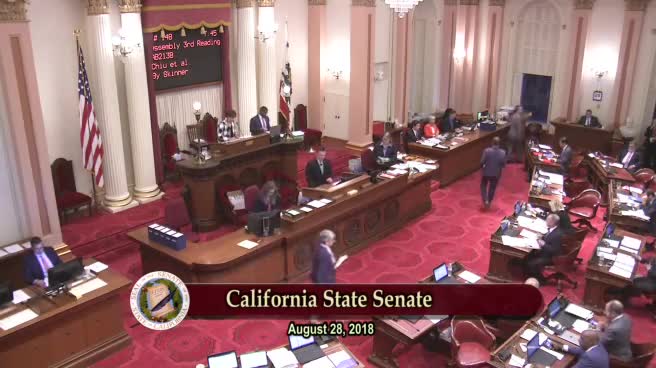
Bill Author

Bill Co-Author(s):