AB 343: Public postsecondary education: holders of certain special immigrant visas.
- Session Year: 2017-2018
- House: Assembly
- Latest Version Date: 2017-10-05
(1)Existing law establishes the California State University, the California Community Colleges, and the University of California as the 3 segments of public postsecondary education in this state. Existing law exempts specified students from paying nonresident tuition at the California State University and the California Community Colleges, as specified.
This bill would express legislative findings and declarations relating to persons provided with special immigrant visa status due to their displacement because of wars taking place in their home countries. The bill would exempt students who have been granted special immigrant visas pursuant to a specified federal statute, or are refugees admitted to the United States under a specified federal statute, and who, upon entering the United States, settled in California, from paying nonresident tuition at the California Community Colleges. The bill would also authorize a community college district to report a student, who is exempt from nonresident tuition under this bill and who is enrolled as a student of that district, as a full-time equivalent student for apportionment purposes.
To the extent that this bill would place additional requirements on community college districts to exempt those students from nonresident tuition, the bill would impose a state-mandated local program.
(2)The California Constitution requires the state to reimburse local agencies and school districts for certain costs mandated by the state. Statutory provisions establish procedures for making that reimbursement.
This bill would provide that, if the Commission on State Mandates determines that the bill contains costs mandated by the state, reimbursement for those costs shall be made pursuant to the statutory provisions noted above.
(1)Existing law establishes the California State University, the California Community Colleges, and the University of California as the 3 segments of public postsecondary education in this state. Existing law exempts specified students from paying nonresident tuition at the California State University and the California Community Colleges, as specified.
This bill would express legislative findings and declarations relating to persons provided with special immigrant visa status due to their displacement because of wars taking place in their home countries. The bill would exempt students who have been granted special immigrant visas pursuant to a specified federal statute, or are refugees admitted to the United States under a specified federal statute, and who, upon entering the United States, settled in California, from paying nonresident tuition at the California State University and the California Community Colleges. The bill would request the Regents of the University of California to adopt policies that would be consistent with this provision. California Community Colleges.
To the extent that this bill would place additional requirements on community college districts to exempt those students from nonresident tuition, the bill would impose a state-mandated local program.
(2)The California Constitution requires the state to reimburse local agencies and school districts for certain costs mandated by the state. Statutory provisions establish procedures for making that reimbursement.
This bill would provide that, if the Commission on State Mandates determines that the bill contains costs mandated by the state, reimbursement for those costs shall be made pursuant to the statutory provisions noted above.
(1)Existing law establishes the California State University, the California Community Colleges, and the University of California as the 3 segments of public postsecondary education in this state. Existing law exempts specified students from paying nonresident tuition at the California State University and the California Community Colleges, and establishes financial aid programs for students, as specified. Existing law also requires the governing board of each community college district to charge resident students an enrollment fee of $46 per unit per semester and to waive that fee for specified students.
Existing law provides that students who are victims of trafficking, domestic violence, and other serious crimes who have been granted a specified status under federal law are exempt from paying nonresident tuition at the California State University and the California Community Colleges, and are eligible to apply for, and participate in, all student financial aid programs and scholarships administered by a public postsecondary educational institution or the State of California, to the same extent as individuals who are admitted to the United States as refugees under a specified federal law. Existing law also requests the University of California to adopt policies that are consistent with those provisions. Existing law also requires community college districts to waive the fees of those students to the same extent as individuals who are admitted to the United States as refugees under the specified federal law.This bill would express legislative findings and declarations relating to persons provided with special immigrant visa status due to their displacement because of wars taking place in their home countries. The bill would exempt students who have been granted special immigrant visas pursuant to a specified federal statute statute, or are refugees admitted to the United States under a specified federal statute, from paying nonresident tuition at the California State University and the California Community Colleges, and would make those students eligible to apply for and participate in all student financial aid program and scholarships administered by a public postsecondary educational institution or the State of California, to the same extent as individuals who are admitted to the United States as refugees pursuant to a specified federal statute. Colleges. The bill would request the Regents of the University of California to adopt policies that would be consistent with this provision. The bill would also require community college districts to waive the fees of these students to the same extent as the above-described refugees.
To the extent that this bill would place additional requirements on community college districts to exempt those students from nonresident tuition, to administer financial aid programs and scholarships, and to provide fee waivers to those students, the bill would impose a state-mandated local program.
(2)The California Constitution requires the state to reimburse local agencies and school districts for certain costs mandated by the state. Statutory provisions establish procedures for making that reimbursement.
This bill would provide that, if the Commission on State Mandates determines that the bill contains costs mandated by the state, reimbursement for those costs shall be made pursuant to the statutory provisions noted above.
(1)Existing law establishes the California State University, the California Community Colleges, and the University of California as the 3 segments of public postsecondary education in this state. Existing law exempts specified students from paying nonresident tuition at the California State University and the California Community Colleges, and establishes financial aid programs for students, as specified. Existing law also requires the governing board of each community college district to charge resident students an enrollment fee of $46 per unit per semester and to waive that fee for specified students.
Existing law provides that students who are victims of trafficking, domestic violence, and other serious crimes who have been granted a specified status under federal law are exempt from paying nonresident tuition at the California State University and the California Community Colleges, and are eligible to apply for, and participate in, all student financial aid programs and scholarships administered by a public postsecondary educational institution or the State of California, to the same extent as individuals who are admitted to the United States as refugees under a specified federal law. Existing law also requests the University of California to adopt policies that are consistent with those provisions. Existing law also requires community college districts to waive the fees of those students to the same extent as individuals who are admitted to the United States as refugees under the specified federal law.
This bill would exempt students who have been granted special immigrant visas pursuant to a specified federal statute from paying nonresident tuition at the California State University and the California Community Colleges, and would make those students eligible to apply for and participate in all student financial aid program and scholarships administered by a public postsecondary educational institution or the State of California, to the same extent as individuals who are admitted to the United States as refugees pursuant to a specified federal statute. The bill would request the Regents of the University of California to adopt policies that would be consistent with this provision. The bill would also require community college districts to waive the fees of these students to the same extent as the above-described refugees.
To the extent that this bill would place additional requirements on community college districts to exempt those students from nonresident tuition, to administer financial aid programs and scholarships, and to provide fee waivers to those students, the bill would impose a state-mandated local program.
(2)The California Constitution requires the state to reimburse local agencies and school districts for certain costs mandated by the state. Statutory provisions establish procedures for making that reimbursement.
This bill would provide that, if the Commission on State Mandates determines that the bill contains costs mandated by the state, reimbursement for those costs shall be made pursuant to the statutory provisions noted above.
(a)The Legislature finds and declares all of the following:
(1)The wars in Afghanistan, Iraq, Syria, and other countries have displaced many families, causing many of them to flee their homes in search of a better life. Between 2011 and March 2017, more than 36,000 refugees entered California, with nearly 8,000 of them entering in 2016.
(2)Under the National Defense Authorization Act for Fiscal Year 2006, certain Afghan and Iraqi nationals were provided special immigrant status in the United States. Through the end of 2015, more than 37,000 individuals were granted special immigrant visa (SIV) status under this program. Between 2011 and March 2017, 9,200 SIV holders resettled in California.
(3)Many of these families have escaped war and persecution in order to improve the lives of their families, but encounter numerous barriers, such as the cost of higher education, when assimilating into the United States. Access to institutions of higher education will ensure that students from these families are able to pursue their educational goals and rebuild and improve their lives and the lives of their families.
(b)Notwithstanding any other law:
(1)A student of the California Community Colleges who has a special immigrant visa that has been granted a status under Section 1244 of Public Law 110-181 or under Public Law 109-163, or is a refugee admitted to the United States under Section 1157 of Title 8 of the United States Code, and who, upon entering the United States, settled in California, shall be exempt from paying the nonresident tuition fee required by Section 76140 for the length of time he or she lives in this state up to the minimum time necessary to become a resident.
(2)A community college district may report a student, who is exempt from nonresident tuition pursuant to this section and who is enrolled as a student in that district, as a full-time equivalent student for apportionment purposes.
SEC. 2.If the Commission on State Mandates determines that this act contains costs mandated by the state, reimbursement to local agencies and school districts for those costs shall be made pursuant to Part 7 (commencing with Section 17500) of Division 4 of Title 2 of the Government Code.
(a)The Legislature finds and declares all of the following:
(1)The wars in Afghanistan, Iraq, Syria, and other countries have displaced many families, causing many of them to flee their homes in search of a better life. Between 2011 and March 2017, more than 36,000 refugees entered California, with nearly 8,000 of them entering in 2016.
(2)Under the National Defense Authorization Act for Fiscal Year 2006, certain Afghan and Iraqi nationals were provided special immigrant status in the United States. Through the end of 2015, more than 37,000 individuals were granted special immigrant visa (SIV) status under this program. Between 2011 and March 2017, 9,200 SIV holders resettled in California.
(3)Many of these families have escaped war and persecution in order to improve the lives of their families, but encounter numerous barriers, such as the cost of higher education, when assimilating into the United States. Access to institutions of higher education will ensure that students from these families are able to pursue their educational goals and rebuild and improve their lives and the lives of their families.
(b)Notwithstanding any other law, a law:
(1)A student of the California Community Colleges who has a special immigrant visa that has been granted a status under Section 1244 of Public Law 110-181 or under Public Law 109-163, or is a refugee admitted to the United States under Section 1157 of Title 8 of the United States Code, and who, upon entering the United States, settled in California, shall be exempt from paying the nonresident tuition fee required by Section 76140 for the length of time he or she lives in this state up to the minimum time necessary to become a resident.
(2)A community college district may report a student, who is exempt from nonresident tuition pursuant to this section and who is enrolled as a student in that district, as a full-time equivalent student for apportionment purposes.
SEC. 2.If the Commission on State Mandates determines that this act contains costs mandated by the state, reimbursement to local agencies and school districts for those costs shall be made pursuant to Part 7 (commencing with Section 17500) of Division 4 of Title 2 of the Government Code.
(a)The Legislature finds and declares all of the following:
(1)The wars in Afghanistan, Iraq, Syria, and other countries have displaced many families, causing many of them to flee their homes in search of a better life. Between 2011 and March 2017, more than 36,000 refugees entered California, with nearly 8,000 of them entering in 2016.
(2)Under the National Defense Authorization Act for Fiscal Year 2006, certain Afghani Afghan and Iraqi nationals were provided special immigrant status in the United States. Through the end of 2015, more than 37,000 individuals were granted special immigrant visa (SIV) status under this program. Between 2011 and March 2017, 9,200 SIV holders have resettled in California.
(3)Many of these families have escaped war and persecution in order to improve the lives of their families, but encounter numerous barriers, such as the cost of higher education, when assimilating into the United States. Access to institutions of higher education will ensure that students from these families are able to pursue their educational goals and rebuild and improve their lives and the lives of their families.
(b)Notwithstanding any other law, a student of the California Community Colleges or the California State University who has a special immigrant visa that has been granted a status under Section 1244 of Public Law 110-181 or under Public Law 109-163, or is a refugee admitted to the United States under Section 1157 of Title 8 of the United States Code, shall be entitled to resident classification only for the purpose of determining the amount of tuition and fees. The Regents of the University of California are requested to adopt policies that are consistent with this subdivision. and who, upon entering the United States, settled in California, shall be exempt from paying the nonresident tuition fee required by Section 76140 for the length of time he or she lives in this state up to the minimum time necessary to become a resident.
SEC. 2.If the Commission on State Mandates determines that this act contains costs mandated by the state, reimbursement to local agencies and school districts for those costs shall be made pursuant to Part 7 (commencing with Section 17500) of Division 4 of Title 2 of the Government Code.
(a)The Legislature finds and declares all of the following:
(1)The wars in Afghanistan, Iraq, Syria, and other countries have displaced many families, causing many of them to flee their homes in search of a better life. Between 2011 and March 2017, more than 36,000 refugees entered California, with nearly 8,000 of them entering in 2016.
(2)Under the National Defense Authorization Act for Fiscal Year 2006, certain Afghani and Iraqi nationals were provided special immigrant status in the United States. Through the end of 2015, more than 37,000 individuals were granted special immigrant visa (SIV) status under this program. Between 2011 and March 2017, 9,200 SIV holders have resettled in California.
(3)Many of these families have escaped war and persecution in order to improve the lives of their families, but encounter numerous barriers, such as the cost of higher education, when assimilating into the United States. Access to institutions of higher education will ensure that students from these families are able to pursue their educational goals and rebuild and improve their lives and the lives of their families.
(b)Notwithstanding any other law, a student of the California Community Colleges or the California State University who has a special immigrant visa that has been granted a status under Section 1244 of Public Law 110-181 or under Public Law 109-163, or is a refugee admitted to the United States under Section 1157 of Title 8 of the United States Code, shall be entitled to resident classification only for the purpose of determining the amount of tuition and fees. The Regents of the University of California are requested to adopt policies that are consistent with this subdivision.
SECTION 1.Section 68122.3 is added to the Education Code, to read:68122.3.(a)Notwithstanding any other law, a student who has a special immigrant visa that has been granted a status under Section 1244 of Public Law 110-181 or Public Law 109-163 shall be exempt from paying nonresident tuition at the California State University and the California Community Colleges to the same extent as individuals who are admitted to the United States as refugees under Section 1157 of Title 8 of the United States Code.(b)The Regents of the University of California are requested to adopt policies that are consistent with subdivision (a).SEC. 2.Section 69504.7 is added to the Education Code, to read:69504.7.(a)Notwithstanding any other law, a student who has a special immigrant visa that has been granted a status under Section 1244 of Public Law 110-181 or Public Law 109-163 shall be eligible to apply for, and participate in, all student financial aid programs and scholarships administered by a public postsecondary educational institution or the State of California to the same extent as individuals who are admitted to the United States as refugees under Section 1157 of Title 8 of the United States Code.(b)The Regents of the University of California are requested to adopt policies that are consistent with subdivision (a).SEC. 3.Section 76301.3 is added to the Education Code, to read:76301.3.Notwithstanding any other law, a community college district shall waive the fees of a student who has a special immigrant visa that has been granted a status under Section 1244 of Public Law 110-181 or Public Law 109-163 to the same extent as individuals who are admitted to the United States as refugees under Section 1157 of Title 8 of the United States Code.SEC. 4.SEC. 2.If the Commission on State Mandates determines that this act contains costs mandated by the state, reimbursement to local agencies and school districts for those costs shall be made pursuant to Part 7 (commencing with Section 17500) of Division 4 of Title 2 of the Government Code.
(a)Notwithstanding any other law, a student who has a special immigrant visa that has been granted a status under Section 1244 of Public Law 110-181 or Public Law 109-163 shall be exempt from paying nonresident tuition at the California State University and the California Community Colleges to the same extent as individuals who are admitted to the United States as refugees under Section 1157 of Title 8 of the United States Code.
(b)The Regents of the University of California are requested to adopt policies that are consistent with subdivision (a).
SEC. 2.Section 69504.7 is added to the Education Code, to read:69504.7.(a)Notwithstanding any other law, a student who has a special immigrant visa that has been granted a status under Section 1244 of Public Law 110-181 or Public Law 109-163 shall be eligible to apply for, and participate in, all student financial aid programs and scholarships administered by a public postsecondary educational institution or the State of California to the same extent as individuals who are admitted to the United States as refugees under Section 1157 of Title 8 of the United States Code.
(b)The Regents of the University of California are requested to adopt policies that are consistent with subdivision (a).
SEC. 3.Section 76301.3 is added to the Education Code, to read:76301.3.Notwithstanding any other law, a community college district shall waive the fees of a student who has a special immigrant visa that has been granted a status under Section 1244 of Public Law 110-181 or Public Law 109-163 to the same extent as individuals who are admitted to the United States as refugees under Section 1157 of Title 8 of the United States Code.
SEC. 4.If the Commission on State Mandates determines that this act contains costs mandated by the state, reimbursement to local agencies and school districts for those costs shall be made pursuant to Part 7 (commencing with Section 17500) of Division 4 of Title 2 of the Government Code.
|
Date
|
Status
|
|---|---|
| Oct 5, 2017 | Chaptered by Secretary of State - Chapter 491, Statutes of 2017. |
| Oct 5, 2017 | Approved by the Governor. |
| Sep 18, 2017 | Enrolled and presented to the Governor at 4 p.m. |
| Sep 11, 2017 | Senate amendments concurred in. To Engrossing and Enrolling. |
| Sep 6, 2017 | In Assembly. Concurrence in Senate amendments pending. May be considered on or after September 8 pursuant to Assembly Rule 77. |
| Sep 6, 2017 | Read third time. Passed. Ordered to the Assembly. |
| Sep 5, 2017 | Read second time. Ordered to third reading. |
| Sep 1, 2017 | From committee: Do pass. (Ayes 7. Noes 0.) (September 1). |
| Jul 17, 2017 | In committee: Referred to APPR. suspense file. |
| Jul 11, 2017 | From committee chair, with author's amendments: Amend, and re-refer to committee. Read second time, amended, and re-referred to Com. on APPR. |
| Jun 28, 2017 | From committee: Do pass and re-refer to Com. on APPR. (Ayes 6. Noes 0.) (June 27). Re-referred to Com. on APPR. |
| Jun 14, 2017 | From committee: Do pass and re-refer to Com. on JUD. (Ayes 7. Noes 0.) (June 14). Re-referred to Com. on JUD. |
| May 24, 2017 | Referred to Coms. on ED. and JUD. |
| May 15, 2017 | In Senate. Read first time. To Com. on RLS. for assignment. |
| May 15, 2017 | Read third time. Passed. Ordered to the Senate. (Ayes 65. Noes 0. Page 1525.) |
| May 4, 2017 | Read second time. Ordered to third reading. |
| May 3, 2017 | From committee: Do pass. (Ayes 12. Noes 0.) (May 3). |
| Apr 24, 2017 | Re-referred to Com. on APPR. |
| Apr 20, 2017 | Read second time and amended. |
| Apr 19, 2017 | From committee: Amend, and do pass as amended and re-refer to Com. on APPR. (Ayes 12. Noes 0.) (April 18). |
| Apr 6, 2017 | Re-referred to Com. on HIGHER ED. |
| Apr 5, 2017 | From committee chair, with author's amendments: Amend, and re-refer to Com. on HIGHER ED. Read second time and amended. |
| Mar 28, 2017 | In committee: Hearing postponed by committee. |
| Feb 21, 2017 | Referred to Com. on HIGHER ED. |
| Feb 8, 2017 | From printer. May be heard in committee March 10. |
| Feb 7, 2017 | Read first time. To print. |
|
Date
|
Description
|
Location
|
Votes
|
|
|---|---|---|---|---|
| Sep 11, 2017 | AB 343 MCCARTY Concurrence in Senate Amendments | Assembly Floor |
Passed |
|
| Sep 6, 2017 | Assembly 3rd Reading AB343 McCarty et al. By Pan | Senate Floor |
Passed |
|
| Sep 1, 2017 | Do pass | Senate Standing Committee on Appropriations |
Passed |
|
| Jul 17, 2017 | Placed on suspense file | Senate Standing Committee on Appropriations |
Passed |
|
| Jun 27, 2017 | Do pass, but first be re-referred to the Committee on [Appropriations] | Senate Standing Committee on Judiciary |
Passed |
|
| Jun 14, 2017 | Do pass, but first be re-referred to the Committee on [Judiciary] | Senate Standing Committee on Education |
Passed |
|
| May 15, 2017 | AB 343 MCCARTY Assembly Third Reading | Assembly Floor |
Passed |
|
| May 3, 2017 | Do pass. | Assembly Standing Committee on Appropriations |
Passed |
|
| Apr 18, 2017 | Do pass as amended and be re-referred to the Committee on [Appropriations] | Assembly Standing Committee on Higher Education |
Passed |
This list shows positions taken on this bill by organizations on the date displayed, which is linked to the original source.
Positions by individuals are not included.
|
Organization
|
Position
|
Date
|
|---|---|---|
| Alliance for Boys and Men of Color | ** Support | Sep 2, 2017 |
| Associated Students Incorporated of California State University of Sacramento | * Support | Apr 18, 2017 |
| California Community College of Cosumnes River College | * Support | Apr 18, 2017 |
| California Health Advocates | ** Support | Sep 2, 2017 |
| California Immigrant Policy Center | ** Support | Sep 2, 2017 |
| California Teachers Association | ** Support | Sep 2, 2017 |
| Community College | * Support | Jun 14, 2017 |
| Community College League of California | ** Support | Sep 2, 2017 |
| Foothill-De Anza Community College District | ** Support | Sep 2, 2017 |
| International Rescue Committee | ** Support | Sep 2, 2017 |
| Los Rios Community College District | ** Support | Sep 2, 2017 |
| National Association of Social Workers | ** Support | Sep 2, 2017 |
| National Association Of Social Workers, California Chapter | * Support | Jun 14, 2017 |
| opening doors inc. | ** Support | Sep 2, 2017 |
| Partnership for the Advancement of New Americans | ** Support | Sep 2, 2017 |
| Refugee | * Support | Jun 14, 2017 |
| sacramento refugee resettlement agencies | ** Support | Jun 13, 2017 |
| Sacramento Refugee Resettlement Organizations | ** Support | Sep 2, 2017 |
| San Diego Community College District | ** Support | Sep 2, 2017 |
| San Jose Evergreen Community College District | ** Support | Sep 2, 2017 |
| South Orange County Community College District | ** Support | Sep 2, 2017 |
| The Coalition for Humane Immigrant Rights | * Support | Apr 18, 2017 |
| The Sacramento Food Bank And Family Services | ** Support | Sep 2, 2017 |
| undefined | * Support | Apr 18, 2017 |
CONCURRENCE IN SENATE AMENDMENTS
CSA1 Bill Id:AB 343
Author:(McCarty, et al.)
As Amended Ver:July 11, 2017
Majority vote
ASSEMBLY: | 65-0 | (May 15, 2017) | SENATE: | 38-0 | (September 6, 2017) |
Original Committee Reference: HIGHER ED.
SUMMARY: Exempts California Community College (CCC) students who are refugees or special immigrant visa (SIV) holders from paying nonresident student fees.
The Senate amendments provide that a community college district may report refugee or SIV students who are enrolled in that district as full-time equivalent students for apportionment purposes.
EXISTING LAW:
Federal law:
- Provides eligibility for SIVs to certain Iraqi and Afghan nationals who worked directly with the U.S. Armed Forces, as interpreters, translators, or otherwise. Upon admission to the U.S., holders of SIVs are granted lawful permanent resident (LPR) status under the Immigration and Nationality Act (INA).
- The INA, as amended by the Refugee Act of 1980, also authorizes the admission and resettlement of refugees, which comprise a category of humanitarian admissions and are persons unwilling or unable to return to their home countries "because of persecution or a well-founded fear of persecution on account of race, religion, nationality, membership in a particular social group, or political opinion." After one year of refugee status in the U.S., refugees are required to apply to adjust to LPR status.
- Requires institutions of higher education, under the Veterans Access, Choice, and Accountability Act of 2014 and in order to remain approved for federal GI Bill programs, to charge in-state tuition and fees to qualifying veterans and their dependents, termed "covered individuals". Generally, a covered individual is someone who lives in the state where the institution is located, regardless of their formal state of residence, and enrolls in the school within three years of discharge from active duty service of 90 days or more.
State law:
- Makes the following definitions:
- "Resident" is a student who has residence in California for more than one year immediately preceding the residence determination date (Education Code (EC) Section 68017).
- "Resident classification" means classification as a resident at the University of California (UC), the California State University (CSU), or the CCC (EC Section 68022).
- "Residence determination date" is a date established by the university or community college district governing boards for each semester or quarter to determine a student's residence (EC Section 68023).
- Requires each student to be classified as a resident or nonresident (EC Section 68040).
- Requires the segment governing boards to adopt regulations for determining a student's residence classification, which are to include provisions requiring the financial independence of a student classified as a nonresident and seeking reclassification as a resident as a factor to be considered in the determination of residency, and establishes financial independence criteria (EC Section 68044).
- Requires a student classified as a nonresident to pay nonresident tuition in addition to other tuition and fees required by the institution (EC Section 68050).
- Exempts an Armed Forces member—stationed in the state on active duty for more than one year immediately prior to being discharged—from nonresident tuition at CSU and the CCC for the length of time he or she lives in the state after being discharged up to the minimum time necessary to become a resident (EC Section 68075.5(a)).
- Exempts specified California nonresidents from paying nonresident tuition at UC, CSU, and CCC, also known as the AB 540 nonresident tuition waiver (Firebaugh), Chapter 814, 2001, if they meet all of the following:
- Attended a California high school for three or more years;
- Graduated from a California high school or attained an equivalent degree;
- Registered or attended an accredited California higher education institution beginning after fall of the 2001-02 academic year; and,
- If an alien without lawful immigration status, has filed an affidavit stating that the student has filed an application to legalize his or her immigration status or will file such an application as soon as he or she is eligible to so do (EC Section 68130.5).
- Exempts students who are victims of trafficking, domestic violence, and other serious crimes who have been granted a "T" or "U" visa under specified federal law from paying nonresident tuition to the same extent as refugees (EC Section 68122).
FISCAL EFFECT: According to the Senate Appropriations Committee, the CCC Chancellor’s Office (CCCCO) estimates that by allowing community college districts to report SIV holders or refugee students are exempt from paying nonresident tuition as a full-time equivalent student for apportionment purposes, this bill would result in additional Proposition 98 General Fund costs of approximately $2.2 million. The CCCCO also indicates that any loss of nonresident tuition revenue from these students is likely to be minimal because few of these students would be able to afford the nonresident tuition rate
COMMENTS: Purpose. This bill exempts CCC students who are refugees and SIV holders from paying nonresident fees, meaning that they would be eligible to pay resident fees and not be subject to additional nonresident fee charges. For 2016-17 CCC resident fees are $46/unit, while nonresident fees are $211/unit. Under normal circumstances, someone has to reside in California for one year before becoming eligible for resident tuition. This bill waives this one-year residency requirement. The author believes this will ensure that SIV students are able to pursue their education, rebuild, and improve their lives and the lives of their families.
To note, these particular SIVs and refugees residing in California are already eligible for state's student financial aid programs, as well as for federal financial aid programs.
SIVs. In January 2006, the 109th Congress enacted the first of a series of legislative provisions to enable certain Iraqi and Afghan nationals to become U.S. lawful permanent residents (LPRs) based on their service to the U.S. government in Iraq or Afghanistan, respectively. Specifically, these individuals were made eligible for special immigrant visas (SIVs); a category of permanent employment-based admissions under the INA, whereby upon admission to the United States, holders of SIVs are immediately granted LPR status. An LPR is a non-citizen who has been granted authorization to live and work in the United States on a permanent basis. As proof of that status, a person is granted a permanent resident card, commonly called a "green card."
There are three SIV programs for Iraqi and Afghan nationals. One is a permanent program for certain Iraqis and Afghans who have worked for at least one year as translators or interpreters. This program is currently capped at 50 principal aliens (excluding spouses and children) per year. The other two SIV programs—for other Iraqis and Afghans, respectively, are temporary. Each program had an annual cap on the number of principal aliens (excluding spouses and dependents) who could receive an SIV annually over a five-year period. Current authority provides for the issuance of no more than 2,500 visas to principal Iraqi applicants after January 1, 2014 and no more than 8,500 SIVs to principal Afghan applicants after December 19, 2014.
Through the end of the 2015 federal fiscal year, more than 37,000 individuals were granted special immigrant status under the three SIV programs. Principal applicants accounted for about 15,000 of the total and the remaining 22,000 were dependent spouses and children.
Refugees. The admissions process for refugees is separate from and different than the process for immigrants. Each year, the President submits a report to Congress, which contains the Administration's proposed worldwide refugee ceiling and allocations among regions of the world for the upcoming federal fiscal year (FFY). Following congressional consultations, the President issues a determination setting refugee number for that year. Recent annual totals are: FFYs 2013 through 2015 (70,000 annually); FFY 2016 (85,000) and FFY 2017 (110,000). Upon entry, refugees are eligible for transitional assistance activities, including cash and medical assistance for up to eight months and various social services to help refugees become socially and economically self-sufficient.
Policy Issue. This bill raises a fundamental policy question as to whether someone who is not a U.S. citizen (in this case, an SIV holder or refugee) should immediately be exempted from nonresident tuition charges when such a benefit is not provided to U.S. citizens residing outside California (except certain veterans), and who, if moving into the state, would have to wait one year in order to obtain residency status (if they are also financially independent).
As a practical matter, it does not seem likely, given the difficult life circumstances SIV holders and refugees encounter prior to coming to the U.S. and all of the challenges involved with adjusting to a new environment and culture, that they would seek to apply to and attend either a UC or CSU campus within their first year in the state. Given the CCC's open enrollment policy, however, there could be some SIV holders and refugees who would seek such opportunity within that first year, though they could be dissuaded by the relatively high cost of CCC nonresident fees. This bill, therefore, provides an immediate nonresident tuition exemption for SIV holders and refugees only at the community colleges.
Prior Legislation. AB 1899 (Mitchell), Chapter 509, Statutes of 2012, exempted from nonresident tuition and provided eligibility for student financial aid benefits, to the same extent as refugees, to students who are victims of trafficking, domestic violence, and other serious crimes who have been granted a "T" or "U" visa under specified federal law.
Analysis Prepared by: Jeanice Warden / HIGHER ED. / (916) 319-3960 FN: 0001902
Office of Senate Floor Analyses (916) 651-1520 Fax: (916) 327-4478 | AB |
THIRD READING
Bill No: AB 343
:
SENATE EDUCATION COMMITTEE: 7-0, 6/14/17
AYES: Allen, Wilk, Galgiani, Leyva, Mendoza, Pan, Vidak
SENATE JUDICIARY COMMITTEE: 6-0, 6/27/17
AYES: Jackson, Moorlach, Anderson, Hertzberg, Stern, Wieckowski
NO VOTE RECORDED: Monning
SENATE APPROPRIATIONS COMMITTEE: 7-0, 9/1/17
AYES: Lara, Bates, Beall, Bradford, Hill, Nielsen, Wiener
ASSEMBLY FLOOR: 65-0, 5/15/17 - See last page for vote
DIGEST:
This bill exempts a Special Immigrant Visa (SIV) holder or is a refugee who has settled in California from paying nonresident tuition at a California Community College (CCC).
Existing federal law:
- Provides eligibility for SIVs to certain Iraqi and Afghan nationals who worked directly with the U.S. Armed Forces, as interpreters, translators, or otherwise. Upon admission to the U.S., holders of SIVs are granted lawful permanent resident status under the Immigration and Nationality Act. (§1244 of Public Law 110-181 and Public Law 109-163)
- Authorizes, under the Immigration and Nationality Act, as amended by the Refugee Act of 1980, the admission and resettlement of refugees, which comprise a category of humanitarian admissions and are persons unwilling or unable to return to their home countries "because of persecution or a well-founded fear of persecution on account of race, religion, nationality, membership in a particular social group, or political opinion." After one year of refugee status in the U.S., refugees are required to apply to adjust to lawful permanent resident status. (8 U.S. Code § 1157).
Existing state law:
- Makes the following definitions:
- "Resident" is a student who has residence in California for more than one year immediately preceding the residence determination date. (Education Code (EC) § 68017.)
- "Resident classification" means classification as a resident at the University of California (UC), the California State University (CSU), or the CCC. (EC § 68022.)
- "Residence determination date" is a date established by the university or community college district governing boards for each semester or quarter to determine a student's residence. (EC § 68023.)
- Requires each student to be classified as a resident or nonresident. (EC § 68040.)
- Requires the segment governing boards to adopt regulations for determining a student's residence classification, which are to include provisions requiring the financial independence of a student classified as a nonresident and seeking reclassification as a resident as a factor to be considered in the determination of residency, and establishes financial independence criteria. (EC § 68044.)
- Requires a student classified as a nonresident to pay nonresident tuition in addition to other tuition and fees required by the institution. (EC § 68050.)
- Exempts an Armed Forces member—stationed in the state on active duty for more than one year immediately prior to being discharged—from nonresident tuition at CSU and the CCC for the length of time he or she lives in the state after being discharged up to the minimum time necessary to become a resident. (EC § 68075.5(a).)
- Exempts specified California nonresidents from paying nonresident tuition at UC, CSU, and CCC, also known as the AB 540 nonresident tuition waiver (Firebaugh), Chapter 814, 2001, if they meet all of the following: (EC § 68130.5.)
- Attended a California high school for three or more years;
- Graduated from a California high school or attained an equivalent degree;
- Registered or attended an accredited California higher education institution beginning after fall of the 2001-02 academic year; and,
- If an alien without lawful immigration status, has filed an affidavit stating that the student has filed an application to legalize his or her immigration status or will file such an application as soon as he or she is eligible to so do.
- Exempts students who are victims of trafficking, domestic violence, and other serious crimes who have been granted a "T" or "U" visa under specified federal law from paying nonresident tuition to the same extent as refugees. (EC § 68122.)
This bill:
- Exempts a student who is a special immigrant visa holder from Iraq and Afghanistan and refugees as defined, who upon entering the United States settle in California, from paying nonresident fees at a CCC up to the minimum time necessary to become a resident.
- Provides that a community college district may report these students who are enrolled in that district as a full-time equivalent student for apportionment purposes.
- Makes various findings and declarations relative to the number of refugees and special immigrant visa holders who have resettled in California and the barriers they face when assimilating into the country.
Comments
- Need for the bill. According to the author, “a large number of refugees have come to California. The largest numbers of refugees are in the counties of Monterey, San Diego and Sacramento. Many of these families have escaped war and persecution in order to improve the lives of their family, but encounter numerous barriers when assimilating into the United States such as the cost of higher education.” This bill seeks to ensure Iraqi and Afghani SIV immigrants and refugees access to higher education by granting these individuals immediate residency status for purposes of paying nonresident tuition at a CCC.
- Who is eligible? Individuals who meet the following criteria are eligible for the exemption granted by this bill:
- Special Immigrant Visas. A report by the Congressional Research Service report on, “Iraqi and Afghan SIV Programs,” notes, Congress enacted a series of legislative provisions since 2006 to enable certain Iraqi and Afghan nationals to become U.S. lawful permanent residents. These provisions make certain Iraqis and Afghans who have worked as translators or interpreters, or who were employed by, or on behalf of, the U.S. government in Iraq or Afghanistan, eligible for special immigrant visas. There are three SIV programs, two of the three are temporary and cap the total number of visas issued for the life of the program. The remaining program is permanent with a cap of 50 visas per year. Through the end of 2015, more than 37,000 individuals were granted special immigrant status under those programs. Approximately 2,009 of those individuals settled in California in 2015.
- Refugees. Unlike special immigrants, refugees comprise a category of humanitarian admissions under the Immigration and Nationality Act. As defined in the Immigration and Nationality Act, a refugee is a person who is unwilling or unable to return to his or her country, “because of persecution or a well-founded fear of persecution on account of race, religion, nationality, membership in a particular social group, or political opinion.” After one year in refugee status they are required to apply to adjust to legal permit resident status. Some individuals may be eligible to apply for both refugee status and for classification under the Iraqi or Afghan SIV programs. In 2016, according to the California Department of Social Services-Refugee Programs Bureau, 7,908 refugees arrived in California.
- Non-resident/resident tuition at California Community Colleges. Current law establishes the requirements for determining residency for purposes of paying the lower-cost resident student fees at CCC, which generally includes a demonstration that the student has resided in California for more than one year. Those who do not qualify for resident tuition pay the higher-cost non-resident student fees. At CCCs, non-resident students pay roughly on average $234 per unit, whereas California-resident students pay $46 per unit. Currently, refugees and SIV immigrants living in California would not be eligible to pay resident tuition unless he/she could prove they were living in California for one-year, as is the requirement for the general student population. After meeting the one-year statutory residency requirement, this group of students is eligible to apply for institutional financial aid, Cal Grants, and Board of Governors fee waivers. This bill waives the one-year requirement for those with special immigrant status and refugees.
- Existing exemptions to non-resident fees. Various exemptions to non-resident fees charged are provided under current law, including to students who qualify for the AB 540 nonresident tuition waiver and a student who is a dependent of a member of the Armed Forces of the United States. The committee may wish to consider whether a similar privilege should be extended to refugees and SIV immigrants.
FISCAL EFFECT: Appropriation: Fiscal Com.: Local:
According to the Senate Appropriations Committee, “The Chancellor’s Office estimates that by allowing community college districts to report SIV holders or refugee students are exempt from paying nonresident tuition as a full-time equivalent student for apportionment purposes, this bill would result in additional Proposition 98 General Fund costs of approximately $2.2 million. The Chancellor’s Office also indicates that any loss of nonresident tuition revenue from these students is likely to be minimal because few of these students would be able to afford the nonresident tuition rate.”
Alliance for Boys and Men of Color
California Health Advocates
California Immigrant Policy Center
California Teachers Association
Community College League of California
Foothill-De Anza Community College District
International Rescue Committee
Los Rios Community College District
National Association of Social Workers
Opening Doors Inc.
Partnership for the Advancement of New Americans
Sacramento Refugee Resettlement Organizations
San Diego Community College District
San Jose Evergreen Community College District
South Orange County Community College District
The Sacramento Food Bank and Family Services
None received
ASSEMBLY FLOOR: 65-0, 5/15/17
AYES: Acosta, Aguiar-Curry, Arambula, Baker, Berman, Bloom, Bocanegra, Bonta, Burke, Caballero, Calderon, Cervantes, Chau, Chávez, Chiu, Choi, Chu, Cooley, Cooper, Cunningham, Dababneh, Eggman, Flora, Fong, Friedman, Cristina Garcia, Eduardo Garcia, Gipson, Gloria, Gomez, Gonzalez Fletcher, Gray, Irwin, Jones-Sawyer, Kalra, Kiley, Lackey, Levine, Limón, Low, Maienschein, Mathis, McCarty, Medina, Mullin, Muratsuchi, Nazarian, O'Donnell, Patterson, Quirk, Quirk-Silva, Reyes, Ridley-Thomas, Rodriguez, Rubio, Salas, Santiago, Steinorth, Mark Stone, Thurmond, Ting, Voepel, Weber, Wood, Rendon
NO VOTE RECORDED: Travis Allen, Bigelow, Brough, Chen, Dahle, Daly, Frazier, Gallagher, Grayson, Harper, Holden, Mayes, Melendez, Obernolte, Waldron
9/2/17 13:37:32
**** END ****
SENATE COMMITTEE ON APPROPRIATIONS
Senator Ricardo Lara, Chair
2017 - 2018 Regular Session
AB 343 (McCarty) - Public postsecondary education: holders of certain special immigrant visas
Version: July 11, 2017 | Policy Vote: ED. 7 - 0, JUD. 6 - 0 |
Urgency: No | Mandate: Yes |
Hearing Date: July 17, 2017 | Consultant: Lenin Del Castillo |
This bill meets the criteria for referral to the Suspense File.
Bill Summary:
This bill exempts a Special Immigrant Visa (SIV) holder or is a refugee who has settled in California from paying nonresident tuition at a California Community College (CCC).
Fiscal Impact:
The Chancellor’s Office estimates that by allowing community college districts to report SIV holders or refugee students are exempt from paying nonresident tuition as a full-time equivalent student for apportionment purposes, this bill would result in additional Proposition 98 General Fund costs of approximately $2.2 million. The Chancellor’s Office also indicates that any loss of nonresident tuition revenue from these students is likely to be minimal because few of these students would be able to afford the nonresident tuition rate.
Background:
Federal law provides eligibility for SIVs to certain Iraqi and Afghan nationals who worked directly with the U.S. Armed Forces, as interpreters, translators, or otherwise. Upon admission to the U.S., holders of SIVs are granted lawful permanent resident status under the Immigration and Nationality Act. The Immigration and Nationality Act, as amended by the Refugee Act of 1980, also authorizes the admission and resettlement of refugees, which comprise a category of humanitarian admissions and are persons unwilling or unable to return to their home countries "because of persecution or a well-founded fear of persecution on account of race, religion, nationality, membership in a particular social group, or political opinion." After one year of refugee status in the U.S., refugees are required to apply to adjust to lawful permanent resident status.
Existing state law requires the segment governing boards to adopt regulations for determining a student's residence classification, which are to include provisions requiring the financial independence of a student classified as a nonresident and seeking reclassification as a resident as a factor to be considered in the determination of residency, and establishes financial independence criteria. It also requires a student classified as a nonresident to pay nonresident tuition in addition to other tuition and fees required by the institution.
Further, existing law exempts an Armed Forces member—stationed in the state on active duty for more than one year immediately prior to being discharged—from nonresident tuition at California State University (CSU) and the CCCs for the length of time he or she lives in the state after being discharged up to the minimum time necessary to become a resident. Existing law also exempts specified California nonresidents from paying nonresident tuition at University of California, CSU, and CCCs, also known as the AB 540 nonresident tuition waiver (Firebaugh), Chapter 814, 2001, if they meet specified criteria.
Proposed Law:
This bill exempts a student who is a special immigrant visa holder from Iraq and Afghanistan and refugees as defined, who upon entering the United States settle in California, from paying nonresident fees at a CCC up to the minimum time necessary to become a resident. Further, this bill provides that a community college district may report these students who are enrolled in that district as a full-time equivalent student for apportionment purposes.
This bill also makes various findings and declarations relative to the number of refugees and special immigrant visa holders who have resettled in California and the barriers they face when assimilating into the country.
-- END --
Senator Hannah-Beth Jackson, Chair
2017-2018 Regular Session
Bill No: AB 343 (Author:McCarty)
Version: April 20, 2017
Hearing Date: June 27, 2017
Fiscal: Yes
Urgency: No
Consultant: TSG
SUBJECT
Public postsecondary education: holders of certain special immigrant visas
DESCRIPTION
Under existing law, people moving to California must pay higher, out-of-state tuition fees to attend California community college until they establish residency, a process that usually takes one year. This bill would exempt refugees and Special Immigrant Visa (SIV) holders resettling in California from paying this higher, nonresident rate.
BACKGROUND
In legal terms, refugees are people who are unwilling or unable to return to their home countries because of a well-founded fear of being persecuted there on the grounds of their race, religion, nationality, membership in a particular social group, or political opinion. (8 U.S.C. Sec. 1101(a)(43).) SIV holders are Afghani or Iraqi nationals who assisted the U.S. military in those nations, who would be at risk of persecution in their home countries as a result, and who have, for those reasons, been granted special permission to emigrate to the United States, along with their spouses and children. (Public Law 110-181 Sec. 1244 and Public Law 109-163 Sec. 1244.)
While refugees and SIV holders have escaped persecution to resettle in the United States, making the transition is not always smooth or simple. Some resettlement help is available, in the form of cash aid, assistance locating housing, job training, and short-term health care insurance coverage. Absent special circumstances, however, refugees and SIV holders are quickly expected to fend for themselves; most of the resettlement assistance programs last less than a year. Refugee cash assistance, for example, is only available for eight months after a refugee or SIV holder arrives.
According to the sponsors of this bill, access to educational opportunities can play a key role in a successful transition. Many refugees and SIV holders have specialized skills and training. To utilize these talents to work in the United States, however, these individuals often have to learn California-specific rules and obtain California licensing or certifications. Community colleges are one important resource for obtaining the necessary training. Other refugees and SIV holders may arrive with less professional experience and fewer easily-transferable skills. For these individuals, community college coursework can provide training that makes it easier to find a job. Attending classes also exposes new arrivals to other people, allowing them to build a community. At the same time, the presence of refugees and SIV holders on community colleges contributes international perspective to the campus experience.
Anyone moving to California must establish legal residency in the state before they are eligible to pay in-state tuition to attend one of California public post-secondary educational institutions. (Ed. Code Sec. 68050.) Generally, it takes one year to establish legal residency. Thus, most people moving to California, including arriving refugees and SIV holders, must either pay non-resident tuition for their first year enrolled in a California public college or university, or wait a year before enrolling. To make it more affordable for refugees and SIV holders to attend California community colleges, even in their first 365 days in the country, this bill would exempt them from paying nonresident tuition rate from day one.
This bill passed out of the Senate Committee on Education by a 7-0 vote.
CHANGES TO EXISTING LAW
Existing law makes certain Iraqi and Afghan nationals who worked directly with the U.S. Armed Forces as interpreters or translators, eligible for a Special Immigrant Visa. Upon admission to the U.S., holders of SIVs are granted lawful permanent resident status under the Immigration and Nationality Act. (Public Law 110-181 Sec. 1244 and Public Law 109-163 Sec. 1244.)
Existing law authorizes the admission and resettlement of refugees, which comprise a category of humanitarian admissions and are persons unwilling or unable to return to their home countries “because of persecution or a well-founded fear of persecution on account of race, religion, nationality, membership in a particular social group, or political opinion.” (8 U.S.C. Secs. 1101(a)(43) and 1157.)
Existing law defines “resident” as a student who has residence in California for more than one year immediately preceding the residence determination date. (Ed. Code Sec. 68017.)
Existing law defines “resident classification” to mean classification as a resident at the University of California (UC), the California State University (CSU), or the CCC. (Ed. Code Sec. 68022.)
Existing law defines “residence determination date” as the date established by the university or community college district governing boards for each semester or quarter to determine a student’s residence. (Ed. Code Sec. 68023.)
Existing law requires each student to be classified as a resident or nonresident. (Ed. Code Sec. 68040.)
Existing law requires the segment governing boards to adopt regulations for determining a student’s residence classification, which are to include provisions requiring the financial independence of a student classified as a nonresident and seeking reclassification as a resident as a factor to be considered in the determination of residency, and establishes financial independence criteria. (Ed. Code Sec. 68044.)
Existing law requires a student classified as a nonresident to pay nonresident tuition in addition to other tuition and fees required by the institution. (Ed. Code Sec. 68050.)
Existing law exempts an Armed Forces member—stationed in the state on active duty for more than one year immediately prior to being discharged—from nonresident tuition at California State University (CSU) and the California Community Colleges (CCC) for the length of time that member lives in the state after being discharged up to the minimum time necessary to become a resident. (Ed. Code Sec. 68075.5(a).)
Existing law exempts specified California nonresidents from paying nonresident tuition at University of California (UC), CSU, and CCC, if they meet all of the following:
- attended a California high school for three or more years;
- graduated from a California high school or attained an equivalent degree;
- registered or attended an accredited California higher education institution beginning after fall of the 2001-02 academic year; and,
- if an alien without lawful immigration status, has filed an affidavit stating that the student has filed an application to legalize his or her immigration status or will file such an application as soon as he or she is eligible to so do. (Ed. Code Sec. 68130.5.)
Existing law exempts students who have been granted a “T” or “U” visa under federal law as victims of trafficking, domestic violence, and other serious crimes, from paying nonresident tuition to the same extent as refugees. (Ed. Code Sec. 68122.)
This bill would find and declare all of the following:
- the wars in Afghanistan, Iraq, Syria, and other countries have displaced many families, causing many of them to flee their homes in search of a better life;
- between 2011 and March 2017, more than 36,000 refugees entered California, with nearly 8,000 of them entering in 2016;
- under the National Defense Authorization Act for Fiscal Year 2006, certain Afghan and Iraqi nationals were provided special immigrant status in the United States;
- through the end of 2015, more than 37,000 individuals were granted special immigrant visa (SIV) status under this program;
- between 2011 and March 2017, 9,200 SIV holders resettled in California;
- many of these families have escaped war and persecution in order to improve the lives of their families, but encounter numerous barriers, such as the cost of higher education, when assimilating into the United States; and
- access to institutions of higher education will ensure that students from these families are able to pursue their educational goals and rebuild and improve their lives and the lives of their families.
This bill would exempt refugees and SIV holders who, upon entering the United States, settled in California, from paying nonresident tuition for the length of time they live in this state up to the minimum time necessary to become a resident.
COMMENT
1. Stated need for the bill
According to the author:
Many refugees and Special Immigrant Visa holders (SIV) are calling California their new home. These individuals have escaped war and persecution in their home country or are SIVs who assisted the U.S. Military or State Department and put their lives and the lives of their family in danger during the conflicts in Iraq and Afghanistan. AB 343 will help our newest Californians pursue their education goals, contribute and acculturate to CA to improve their lives and the lives of their family.
In support, the Foothill – DeAnza, Los Rios, San Diego, and South Orange County Community College Districts write:
Recently, many refugees and individuals with SIVs have come to California. Many of these families have escaped war and persecution to improve the lives of their family. However, once here, they encounter numerous barriers such as the cost of higher education. This measure would eliminate this barrier for a group of immigrants that have come to the United States under very specific circumstances. This measure will increase access to higher education for these immigrants and help them to start a better life.
There are a limited number of students to which these provisions would apply and the benefits to California and its local communities far outweighs the small cost in implementing this measure.
In further support, California Health+ Advocates writes:
AB 343 ensures that special immigrant visa holders and refugees are able to attend college in California without having to pay for out of state tuition, allowing them to have a more affordable education and increase California’s workforce, which is particularly important for the medical field… As a health system that is committed to speaking our patients’ language, honoring their traditions, and valuing their experience, we rely on healthcare providers and staff who themselves are immigrants.
In further support, four refugee resettlement agencies write:
Through our work resettling refugees, we see many professionals who were highly trained in their home country, face educational and career obstacles that prevent transferring their skills. Many have never had the opportunity to pursue higher education in their home country and would otherwise be unable to pursue education in their new home due to out-of-state tuition and fees and inability to seek financial aid. By ensuring SIV’s access to affordable education, they will be able to acquire critical job training, career technical skills, and credentials essential to employment.
2. Resident versus nonresident community college tuition rates
Resident tuition for California community colleges for the academic year 2016-2017 was $46 per unit. Nonresident tuition was $211 per unit. While the number of units will vary by the specific needs and schedule of each student, the average course load of all California community college students in 2011-12 was 12 units, according to the California Community Colleges Chancellor’s Office.[1] Thus, the value of the tuition exemption proposed by this bill should average about $1,980 per semester.
3. Existing law ties tuition rates for “T” and “U” visa holders to rates for refugees
Existing California law exempts “T” and “U” visa holders from having to pay nonresident tuition at California community colleges “to the same extent as refugees.” (Education Code Section 68122.) The U.S. government grants “T” visas to survivors of human trafficking under certain circumstances and it gives “U” visas to survivors of domestic violence and other serious crimes under slightly different circumstances.
Currently, refugees generally have to pay out-of-state tuition rates until they have established residency. The only exception to this would be in the unlikely, but plausible event that the refugee qualifies for in-state tuition under Education Code 68130.5, otherwise known as AB 540 (Firebaugh, Ch. 814, Stats. 2001), which exempts student from paying nonresident tuition in California if they attended three years of high school in California, graduated from a California high school (or obtained an equivalent degree), and have enrolled in a California institution of higher education. Education Code Section 68122 puts U and T visa holders on the same footing: they have to pay out-of-state tuition for the first 365 days they reside in California, unless they qualify for in-state tuition under AB 540.
Since Education Code 68122 ties the tuition rates for “T” and “U” visa holders to the tuition rates for refugees, any change to tuition rates for refugees will extend to T and U visa holders as well. Thus, if this bill is enacted, T and U visas holders would also become exempt from paying nonresident tuition during their first 365 days in California.
Support: California Health+ Advocates; California Immigrant Policy Center; California Teachers Association; Foothill – De Anza Community College District; International Rescue Committee; Los Rios Community College District; National Association of Social Workers – California Chapter; Opening Doors, Inc.; Partnership for the Advancement of New Americans; Sacramento Food Bank and Family Services; San Diego Community College District; San Jose – Evergreen Community College District; South Orange County Community College District; World Relief
Opposition: None known
HISTORY
Source: Author
Related Pending Legislation:
AB 349 (McCarty, 2017) would give state civil service hiring preference, second only to U.S. military veterans, to SIV holders who achieve a passing score on a civil service exam. AB 349 is currently pending consideration before the Senate Judiciary Committee.
Prior Legislation:
AB 13 (Conway, Chapter 639, Statutes of 2014) required California Community Colleges and the California State University to allow people on active U.S. military duty and stationed in California to pay resident tuition rates. AB 13 also requests that the University of California adopt similar policies.
SB 420 (Walters, 2014) would have expanded resident classification for the purpose of determining tuition and fees to include every student who is a member of the armed forces reserve and every student who is a dependent child or dependent spouse of a member of the armed forces reserve. SB 420 was never heard in the Senate Committee on Education.
SB 290 (Knight, Chapter 696, Statutes of 2013) exempted California Community College students, and California State University undergraduate students, from paying nonresident tuition if they are a member of the Armed Forces of the United States stationed in this state on active duty for more than one year.
AB 1899 (Mitchell, Chapter 509, Statutes of 2012) exempted “T” visa holders (certain survivors of human trafficking) and “U” visa holders (certain survivors of domestic violence and other serious crimes) from nonresident tuition and provided them with eligibility for student financial aid benefits to the same extent as refugees.
AB 2478 (Hayashi, Chapter 405, Statutes of 2012) extended resident classification for up to one year to California Community College students who were stationed in California on active duty for more than one year immediately prior to being discharged.
AB 540 (Firebaugh, Chapter 814, Statutes of 2001) waived nonresident tuition payment for students: (1) who attended a California high school for three or more years; (2) who graduated from a California high school or attained an equivalent degree; (3) who registers or attends an accredited California higher education institution beginning after fall of the 2001-02 academic year; and, (4) who, if an alien without lawful immigration status, files an affidavit stating that the student has filed an application to legalize his or her immigration status or will file such an application as soon as he or she is eligible to so do.
Prior Vote:
Senate Education Committee (Ayes 7, Noes 0)
Assembly Floor (Ayes 65, Noes 0)
Assembly Appropriations Committee (Ayes 12, Noes 0)
Assembly Higher Education Committee (Ayes 12, Noes 0)
**************
California Community Colleges Key Facts, California Community Colleges Chancellor’s Office <http://californiacommunitycolleges.cccco.edu/PolicyInAction/KeyFacts.aspx> (as of June 16, 2017). ↑
SENATE COMMITTEE ON EDUCATION
Senator Benjamin Allen, Chair
2017 - 2018 Regular
Bill No: AB 343 Hearing Date: June 14, 2017
Author: | |||
Version: | April 20, 2017 | ||
Urgency: | No | Fiscal: | Yes |
Consultant: | Olgalilia Ramirez | ||
Subject: Public postsecondary education: holders of certain special immigrant visas
NOTE: This bill has been referred to the Committees on Education and Judiciary. A "do pass" motion should include referral to the Committee on Judiciary.
SUMMARY
This bill exempts a Special Immigrant Visa (SIV) holder or is a refugee who has settled in California from paying nonresident tuition at a California Community College (CCC).
BACKGROUND
Existing Law:
- Under federal law, provides eligibility for SIVs to certain Iraqi and Afghan nationals who worked directly with the U.S. Armed Forces, as interpreters, translators, or otherwise. Upon admission to the U.S., holders of SIVs are granted lawful permanent resident status under the Immigration and Nationality Act. (§1244 of Public Law 110-181 and Public Law 109-163)
- Under federal law, the Immigration and Nationality Act, as amended by the Refugee Act of 1980, also authorizes the admission and resettlement of refugees, which comprise a category of humanitarian admissions and are persons unwilling or unable to return to their home countries "because of persecution or a well-founded fear of persecution on account of race, religion, nationality, membership in a particular social group, or political opinion." After one year of refugee status in the U.S., refugees are required to apply to adjust to lawful permanent resident status. (8 U.S. Code § 1157).
- Under state law, makes the following definitions:
- "Resident" is a student who has residence in California for more than one year immediately preceding the residence determination date. (Education Code (EC) § 68017.)
- "Resident classification" means classification as a resident at the University of California (UC), the California State University (CSU), or the CCC. (EC § 68022.)
- "Residence determination date" is a date established by the university or community college district governing boards for each semester or quarter to determine a student's residence. (EC § 68023.)
- Requires each student to be classified as a resident or nonresident. (EC § 68040.)
- Requires the segment governing boards to adopt regulations for determining a student's residence classification, which are to include provisions requiring the financial independence of a student classified as a nonresident and seeking reclassification as a resident as a factor to be considered in the determination of residency, and establishes financial independence criteria. (EC § 68044.)
- Requires a student classified as a nonresident to pay nonresident tuition in addition to other tuition and fees required by the institution. (EC § 68050.)
- Exempts an Armed Forces member—stationed in the state on active duty for more than one year immediately prior to being discharged—from nonresident tuition at California State University (CSU) and the California Community Colleges (CCC) for the length of time he or she lives in the state after being discharged up to the minimum time necessary to become a resident. (EC § 68075.5(a).)
- Exempts specified California nonresidents from paying nonresident tuition at University of California (UC) , CSU, and CCC, also known as the AB 540 nonresident tuition waiver (Firebaugh), Chapter 814, 2001, if they meet all of the following: (EC § 68130.5.)
- Attended a California high school for three or more years;
- Graduated from a California high school or attained an equivalent degree;
- Registered or attended an accredited California higher education institution beginning after fall of the 2001-02 academic year; and,
- If an alien without lawful immigration status, has filed an affidavit stating that the student has filed an application to legalize his or her immigration status or will file such an application as soon as he or she is eligible to so do.
- Exempts students who are victims of trafficking, domestic violence, and other serious crimes who have been granted a "T" or "U" visa under specified federal law from paying nonresident tuition to the same extent as refugees. (EC § 68122.)
ANALYSIS
This bill exempts a special immigrant visa holder or is a refugee who has settled in California from paying nonresident tuition at a CCC. Specifically, it:
- Exempts a student who is a special immigrant visa holder from Iraq and Afghanistan and refugees as defined, who upon entering the United States settle in California, from paying nonresident fees at a CCC up to the minimum time necessary to become a resident.
- Makes various findings and declarations relative to the number of refugees and special immigrant visa holders who have resettled in California and the barriers they face when assimilating into the country.
STAFF COMMENTS
- Need for the bill. According to the author, “a large number of refugees have come to California. The largest numbers of refugees are in the counties of Monterey, San Diego and Sacramento. Many of these families have escaped war and persecution in order to improve the lives of their family, but encounter numerous barriers when assimilating into the United States such as the cost of higher education.” This bill seeks to ensure Iraqi and Afghani Special Immigrant Visa (SIV) immigrants and refugees access to higher education by granting these individuals immediate residency status for purposes of paying nonresident tuition at a California Community College (CCC).
- Who is eligible? Individuals who meet the following criteria are eligible for the exemption granted by this bill:
- Special Immigrant Visas. A report by the Congressional Research Service report on, “Iraqi and Afghan SIV Programs,” notes, Congress enacted a series of legislative provisions since 2006 to enable certain Iraqi and Afghan nationals to become U.S. lawful permanent residents. These provisions make certain Iraqis and Afghans who have worked as translators or interpreters, or who were employed by, or on behalf of, the U.S. government in Iraq or Afghanistan, eligible for special immigrant visas. There are three SIV programs, two of the three are temporary and cap the total number of visas issued for the life of the program. The remaining program is permanent with a cap of 50 visas per year. Through the end of 2015, more than 37,000 individuals were granted special immigrant status under those programs. Approximately 2,009 of those individuals settled in California in 2015.
- Refugees. Unlike special immigrants, refugees comprise a category of humanitarian admissions under the Immigration and Nationality Act. As defined in the Immigration and Nationality Act, a refugee is a person who is unwilling or unable to return to his or her country, “because of persecution or a well-founded fear of persecution on account of race, religion, nationality, membership in a particular social group, or political opinion.” After one year in refugee status they are required to apply to adjust to legal permit resident status. Some individuals may be eligible to apply for both refugee status and for classification under the Iraqi or Afghan SIV programs. In 2016, according to the California Department of Social Services-Refugee Programs Bureau, 7,908 refugees arrived in California.
- Non-resident/resident tuition at California Community Colleges. Current law establishes the requirements for determining residency for purposes of paying the lower-cost resident student fees at CCC, which generally includes a demonstration that the student has resided in California for more than one year. Those who do not qualify for resident tuition pay the higher-cost non-resident student fees. At CCCs, non-resident students pay roughly on average $234 per unit, whereas California-resident students pay $46 per unit. Currently, refugees and Special Immigrant Visa (SIV) immigrants living in California would not be eligible to pay resident tuition unless he/she could prove they were living in California for one-year, as is the requirement for the general student population. After meeting the one-year statutory residency requirement, this group of students is eligible to apply for institutional financial aid, Cal Grants, and Board of Governors (BOG) fee waivers. This bill waives the one-year requirement for those with special immigrant status and refugees.
- Existing exemptions to non-resident fees. Various exemptions to non-resident fees charged are provided under current law, including to students who qualify for the AB 540 nonresident tuition waiver and a student who is a dependent of a member of the Armed Forces of the United States. The committee may wish to consider whether a similar privilege should be extended to refugees and SIV immigrants.
Staff notes, the Assembly Appropriations Committee analysis comments that the California Community College Chancellor’s Office does not anticipate revenue losses due to a reduced amount of nonresident tuition fees collected as a result of this bill.
SUPPORT
Alliance for Boys and Men of Color
California Health Advocates
California Immigrant Policy Center
California Teachers Association
Community College League of California
Foothill-De Anza Community College District
Los Rios Community College District
National Association of Social Workers
Partnership for the Advancement of New Americans
Sacramento Refugee Resettlement Agencies
San Diego Community College District
San Jose Evergreen Community College District
South Orange County Community College District
OPPOSITION
None received
-- END --
ASSEMBLY THIRD READING
ATR Bill Id:
Author:(McCarty)
As Amended Ver:April 20, 2017
Majority vote
Committee | Votes | Ayes | Noes |
Higher Education | 12-0 | Medina, Baker, Arambula, Bloom, Chávez, Choi, Irwin, Kiley, Low, Quirk-Silva, Santiago, Weber | |
Appropriations | 12-0 | Gonzalez Fletcher, Bloom, Bocanegra, Bonta, Calderon, Chau, Eggman, Fong, Friedman, Eduardo Garcia, Muratsuchi, Reyes |
SUMMARY: Exempts California Community College (CCC) students who are refugees or special immigrant visa (SIV) holders from paying nonresident student fees. Specifically, this bill:
- Finds and declares that between 2011 and March 2017:
- More than 36,000 refugees entered California, including 8,000 in 2016.
- More than 37,000 individuals were granted SIVs, and 9,200 SIV holders have resettled in California.
- Exempts SIV holders from Iraq and Afghanistan and refugees, who upon entering the United States (U.S.) settled in California, from paying nonresident CCC student fees up to the minimum time necessary to become a resident.
EXISTING LAW:
Federal law:
- Provides eligibility for SIVs to certain Iraqi and Afghan nationals who worked directly with the U.S. Armed Forces, as interpreters, translators, or otherwise. Upon admission to the U.S., holders of SIVs are granted lawful permanent resident (LPR) status under the Immigration and Nationality Act (INA).
- The INA, as amended by the Refugee Act of 1980, also authorizes the admission and resettlement of refugees, which comprise a category of humanitarian admissions and are persons unwilling or unable to return to their home countries "because of persecution or a well-founded fear of persecution on account of race, religion, nationality, membership in a particular social group, or political opinion." After one year of refugee status in the U.S., refugees are required to apply to adjust to LPR status.
- Requires institutions of higher education, under the Veterans Access, Choice, and Accountability Act of 2014 and in order to remain approved for federal GI Bill programs, to charge in-state tuition and fees to qualifying veterans and their dependents, termed "covered individuals". Generally, a covered individual is someone who lives in the state where the institution is located, regardless of their formal state of residence, and enrolls in the school within three years of discharge from active duty service of 90 days or more.
State law:
- Makes the following definitions:
- "Resident" is a student who has residence in California for more than one year immediately preceding the residence determination date. (Education Code (EC) Section 68017.)
- "Resident classification" means classification as a resident at the University of California (UC), the California State University (CSU), or the CCC. (EC Section 68022.)
- "Residence determination date" is a date established by the university or community college district governing boards for each semester or quarter to determine a student's residence. (EC Section 68023.)
- Requires each student to be classified as a resident or nonresident. (EC Section 68040.)
- Requires the segment governing boards to adopt regulations for determining a student's residence classification, which are to include provisions requiring the financial independence of a student classified as a nonresident and seeking reclassification as a resident as a factor to be considered in the determination of residency, and establishes financial independence criteria. (EC Section 68044.)
- Requires a student classified as a nonresident to pay nonresident tuition in addition to other tuition and fees required by the institution. (EC Section 68050.)
- Exempts an Armed Forces member—stationed in the state on active duty for more than one year immediately prior to being discharged—from nonresident tuition at CSU and the CCC for the length of time he or she lives in the state after being discharged up to the minimum time necessary to become a resident. (EC Section 68075.5(a).)
- Exempts specified California nonresidents from paying nonresident tuition at UC, CSU, and CCC, also known as the AB 540 nonresident tuition waiver (Firebaugh), Chapter 814, 2001, if they meet all of the following: (EC Section 68130.5.)
- Attended a California high school for three or more years;
- Graduated from a California high school or attained an equivalent degree;
- Registered or attended an accredited California higher education institution beginning after fall of the 2001-02 academic year; and,
- If an alien without lawful immigration status, has filed an affidavit stating that the student has filed an application to legalize his or her immigration status or will file such an application as soon as he or she is eligible to so do.
- Exempts students who are victims of trafficking, domestic violence, and other serious crimes who have been granted a "T" or "U" visa under specified federal law from paying nonresident tuition to the same extent as refugees. (EC Sect. 68122.)
FISCAL EFFECT: According to the Assembly Appropriations Committee, minor cost, if any. The CCC Chancellor's Office does not anticipate revenue losses due to a reduced amount of nonresident tuition fees collected.
COMMENTS:
Purpose. This bill exempts CCC students who are refugees and SIV holders from paying nonresident fees, meaning that they would be eligible to pay resident fees and not be subject to additional nonresident fee charges. For 2016-17 CCC resident fees are $46/unit, while nonresident fees are $211/unit. Under normal circumstances, someone has to reside in California for one year before becoming eligible for resident tuition. This bill waives this one-year residency requirement. The author believes this will ensure that SIV students are able to pursue their education, rebuild, and improve their lives and the lives of their families. It should be noted that these SIVs and refugees residing in California are already eligible for state's student financial aid programs, as well as for federal financial aid programs.
SIVs. In January 2006, the 109th Congress enacted the first of a series of legislative provisions to enable certain Iraqi and Afghan nationals to become U.S. lawful permanent residents (LPRs) based on their service to the U.S. government in Iraq or Afghanistan, respectively. Specifically, these individuals were made eligible for special immigrant visas (SIVs); a category of permanent employment-based admissions under the INA, whereby upon admission to the United States, holders of SIVs are immediately granted LPR status. An LPR is a non-citizen who has been granted authorization to live and work in the United States on a permanent basis. As proof of that status, a person is granted a permanent resident card, commonly called a "green card."
There are three SIV programs for Iraqi and Afghan nationals. One is a permanent program for certain Iraqis and Afghans who have worked for at least one year as translators or interpreters. This program is currently capped at 50 principal aliens (excluding spouses and children) per year. The other two SIV programs—for other Iraqis and Afghans, respectively, are temporary. Each program had an annual cap on the number of principal aliens (excluding spouses and dependents) who could receive an SIV annually over a five-year period. Current authority provides for the issuance of no more than 2,500 visas to principal Iraqi applicants after January 1, 2014 and no more than 8,500 SIVs to principal Afghan applicants after December 19, 2014.
Through the end of the 2015 federal fiscal year, more than 37,000 individuals were granted special immigrant status under the three SIV programs. Principal applicants accounted for about 15,000 of the total and the remaining 22,000 were dependent spouses and children.
Refugees. The admissions process for refugees is separate from and different than the process for immigrants. Each year, the President submits a report to Congress, which contains the Administration's proposed worldwide refugee ceiling and allocations among regions of the world for the upcoming federal fiscal year (FFY). Following congressional consultations, the President issues a determination setting refugee number for that year. Recent annual totals are: FFYs 2013 through 2015 (70,000 annually); FFY 2016 (85,000) and FFY 2017 (110,000). Upon entry, refugees are eligible for transitional assistance activities, including cash and medical assistance for up to eight months and various social services to help refugees become socially and economically self-sufficient.
Policy Issue. This bill raises a fundamental policy question as to whether someone who is not a U.S. citizen (in this case, an SIV holder or refugee) should immediately be exempted from nonresident tuition charges when such a benefit is not provided to U.S. citizens residing outside California (except certain veterans), and who, if moving into the state, would have to wait one year in order to obtain residency status (if they are also financially independent).
As a practical matter, it does not seem likely, given the difficult life circumstances SIV holders and refugees encounter prior to coming to the U.S. and all of the challenges involved with adjusting to a new environment and culture, that they would seek to apply to and attend either a UC or CSU campus within their first year in the state. Given the CCC's open enrollment policy, however, there could be some SIV holders and refugees who would seek such opportunity within that first year, though they could be dissuaded by the relatively high cost of CCC nonresident fees. This bill, therefore, provides an immediate nonresident tuition exemption for SIV holders and refugees only at the community colleges.
Prior Legislation. AB 1899 (Mitchell), Chapter 509, Statutes of 2012, exempted from nonresident tuition and provided eligibility for student financial aid benefits, to the same extent as refugees, to students who are victims of trafficking, domestic violence, and other serious crimes who have been granted a "T" or "U" visa under specified federal law.
Analysis Prepared by: Chuck Nicol / HIGHER ED. / (916) 319-3960 FN: 0000240
Date of Hearing: May 3, 2017
ASSEMBLY COMMITTEE ON APPROPRIATIONS
Lorena Gonzalez Fletcher, Chair
ABPCA Bill Id:AB 343
Author:(McCarty) – As Amended Ver:April 20, 2017
Policy Committee: | Higher Education | Vote: | 12 - 0 |
Urgency: No State Mandated Local Program: Yes Reimbursable: No
SUMMARY:
This bill exempts persons who are either Iraqi or Afghan refugees, or holders of a special immigrant visa (SIV) from the California residence requirement to qualify for in-state tuition as a California Community College (CCC) student.
FISCAL EFFECT:
Minor cost, if any. The CCC Chancellor’s Office does not anticipate revenue losses due to a reduced amount of nonresident tuition fees collected.
COMMENTS:
- Background. Existing federal law provides eligibility for SIVs to certain Iraqi and Afghan nationals who worked directly with the U.S. Armed Forces, as interpreters, translators, or otherwise. Through the end of the 2015 federal fiscal year, more than 37,000 individuals were granted special immigrant status under the three SIV programs. Principal applicants accounted for about 15,000 of the total and the remaining 22,000 were dependent spouses and children.
Upon admission to the U.S., holders of SIVs are granted lawful permanent resident (LPR) status under the Immigration and Nationality Act (INA). The INA, as amended by the Refugee Act of 1980, also authorizes the admission and resettlement of refugees, which comprise a category of humanitarian admissions and are persons unwilling or unable to return to their home countries “because of persecution or a well-founded fear of persecution on account of race, religion, nationality, membership in a particular social group, or political opinion.” After one year of refugee status in the U.S., refugees are required to apply to adjust to LPR status. Federal law requires institutions of higher education, under the Veterans Access, Choice, and Accountability Act of 2014 and in order to remain approved for federal GI Bill programs, to charge in-state tuition and fees to qualifying veterans and their dependents, termed "covered individuals". Generally, a covered individual is someone who lives in the state where the institution is located, regardless of their formal state of residence, and enrolls in the school within three years of discharge from active duty service of 90 days or more.
State law requires each student to be classified as a resident or nonresident and requires students to be residents of California for more than one year in order to qualify for in-state tuition. California state law exempts an Armed Forces member—stationed in the state on active duty for more than one year immediately prior to being discharged—from nonresident tuition at CSU and the CCC for the length of time he or she lives in the state after being discharged up to the minimum time necessary to become a resident.
- Purpose. This bill provides SIVs and refugees with resident classification, meaning that they would be eligible to pay resident tuition/fees and not be subject to additional nonresident tuition/fee charges. Under normal circumstances, someone has to reside in California for one year before becoming eligible for resident tuition. AB 343 waives this one-year residency requirement. The author believes this will ensure that SIV students are able to pursue their education, rebuild, and improve their lives and the lives of their families. It should be noted that these SIVs and refugees residing in California are already eligible for state's student financial aid programs, as well as for federal financial aid programs.
Analysis Prepared by: Daisy Gonzales / APPR. / (916) 319-2081
Date of Hearing: April 18, 2017
ASSEMBLY COMMITTEE ON HIGHER EDUCATION
Jose Medina, Chair
ABPCA Bill Id:AB 343 (
Author:McCarty) – As Amended Ver:April 5, 2017
SUBJECT: Public postsecondary education: holders of certain special immigrant visas
SUMMARY: Extends eligibility for California residence classification, for tuition/fee purposes only, to persons having certain special immigrant visas (SIVs) or having refugee status. Specifically, this bill:
- Fines and declares that between 2011 and March 2017:
- More than 36,000 refugees entered California, including 8,000 in 2016.
- More than 37,000 individuals were granted SIVs, and 9,200 SIV holders have resettled in California.
- More than 36,000 refugees entered California, including 8,000 in 2016.
- Provides residence classification—thus waiving the one-year residency requirement to qualify for in-state tuition at the California State University (CSU) and California Community College (CCC)—for students who are either refugees or Iraqi or Afghan SIVs who worked for or on behalf of the U.S. Government, and their dependents.
- Requests that the Regents of the University of California (UC) adopt policies consistent with (1).
EXISTING LAW:
Federal law:
- Provides eligibility for SIVs to certain Iraqi and Afghan nationals who worked directly with the U.S. Armed Forces, as interpreters, translators, or otherwise. Upon admission to the U.S., holders of SIVs are granted lawful permanent resident (LPR) status under the Immigration and Nationality Act (INA).
- The INA, as amended by the Refugee Act of 1980, also authorizes the admission and resettlement of refugees, which comprise a category of humanitarian admissions and are persons unwilling or unable to return to their home countries “because of persecution or a well-founded fear of persecution on account of race, religion, nationality, membership in a particular social group, or political opinion.” After one year of refugee status in the U.S., refugees are required to apply to adjust to LPR status.
- Requires institutions of higher education, under the Veterans Access, Choice, and Accountability Act of 2014 and in order to remain approved for federal GI Bill programs, to charge in-state tuition and fees to qualifying veterans and their dependents, termed "covered individuals". Generally, a covered individual is someone who lives in the state where the institution is located, regardless of their formal state of residence, and enrolls in the school within three years of discharge from active duty service of 90 days or more.
State law:
- Makes the following definitions:
- "Resident" is a student who has residence in California for more than one year immediately preceding the residence determination date. (Education Code (EC) Section 68017.)
- "Resident classification" means classification as a resident at UC, CSU, or the CCC. (EC Sect. 68022.)
- "Residence determination date" is a date established by the university or community college district governing boards for each semester or quarter to determine a student's residence. (EC Sect. 68023.)
- "Resident" is a student who has residence in California for more than one year immediately preceding the residence determination date. (Education Code (EC) Section 68017.)
- Requires each student to be classified as a resident or nonresident. (EC Sect. 68040.)
- Requires the segment governing boards to adopt regulations for determining a student's residence classification, which are to include provisions requiring the financial independence of a student classified as a nonresident and seeking reclassification as a resident as a factor to be considered in the determination of residency, and establishes financial independence criteria. (EC Sect. 68044.)
- Requires a student classified as a nonresident to pay nonresident tuition in addition to other tuition and fees required by the institution. (EC Sect. 68050.)
- Exempts an Armed Forces member—stationed in the state on active duty for more than one year immediately prior to being discharged—from nonresident tuition at CSU and the CCC for the length of time he or she lives in the state after being discharged up to the minimum time necessary to become a resident. (EC Sect. 68075.5(a).)
- Exempts specified California nonresidents from paying nonresident tuition at UC, CSU, and CCC, also known as the AB 540 nonresident tuition waiver, if they meet all of the following: (EC Sect. 68130.5.)
- Attended a California high school for three or more years;
- Graduated from a California high school or attained an equivalent degree;
- Registered or attended an accredited California higher education institution beginning after fall of the 2001-02 academic year; and,
- If an alien without lawful immigration status, has filed an affidavit stating that the student has filed an application to legalize his or her immigration status or will file such an application as soon as he or she is eligible to so do.
- Exempts students who are victims of trafficking, domestic violence, and other serious crimes who have been granted a "T" or "U" visa under specified federal law from paying nonresident tuition to the same extent as refugees. (EC Sect. 68122.)
FISCAL EFFECT: Unknown
COMMENTS:
Purpose. This bill, for purposes of determining tuition/fee charges at UC, CSU, and the CCC, provides SIVs and refugees with resident classification, meaning that they would be eligible to pay resident tuition/fees and not be subject to additional nonresident tuition/fee charges. Under normal circumstances, someone has to reside in California for one year before becoming eligible for resident tuition. AB 343 waives this one-year residency requirement. The author believes this will ensure that SIV students are able to pursue their education, rebuild, and improve their lives and the lives of their families. It should be noted that these SIVs and refugees residing in California are already eligible for state's student financial aid programs, as well as for federal financial aid programs.
SIVs. In January 2006, the 109th Congress enacted the first of a series of legislative provisions to enable certain Iraqi and Afghan nationals to become U.S. lawful permanent residents (LPRs) based on their service to the U.S. government in Iraq or Afghanistan, respectively. Specifically, these individuals were made eligible for special immigrant visas (SIVs); a category of permanent employment-based admissions under the INA, whereby upon admission to the United States, holders of SIVs are immediately granted LPR status. An LPR is a non-citizen who has been granted authorization to live and work in the United States on a permanent basis. As proof of that status, a person is granted a permanent resident card, commonly called a "green card."
There are three SIV programs for Iraqi and Afghan nationals. One is a permanent program for certain Iraqis and Afghans who have worked for at least one year as translators or interpreters. This program is currently capped at 50 principal aliens (excluding spouses and children) per year. The other two SIV programs—for other Iraqis and Afghans, respectively, are temporary. Each program had an annual cap on the number of principal aliens (excluding spouses and dependents) who could receive and SIV annually over a five-year period. Current authority provides for the issuance of no more than 2,500 visas to principal Iraqi applicants after January 1, 2014 and no more than 8,500 SIVs to principal Afghan applicants after December 19, 2014.
Through the end of the 2015 federal fiscal year, more than 37,000 individuals were granted special immigrant status under the three SIV programs. Principal applicants accounted for about 15,000 of the total and the remaining 22,000 were dependent spouses and children.
Refugees. The admissions process for refugees is separate from and different than the process for immigrants. Each year, the President submits a report to Congress, which contains the Administration's proposed worldwide refugee ceiling and allocations among regions of the world for the upcoming federal fiscal year (FFY). Following congressional consultations, the President issues a determination setting refugee number for that year. Recent annual totals are: FFYs 2013 through 2015 (70,000 annually); FFY 2016 (85,000) and FFY 2017 (110,000). Upon entry, refugees are eligible for transitional assistance activities, including cash and medical assistance for up to eight months and various social services to help refugees become socially and economically self-sufficient.
Resident/Nonresident Tuition and Fees. Tuition and mandatory systemwide fees for full-time UC and CSU undergraduate students and per credit fees for CCC students in 2016-17 are as follows:
Resident | Nonresident | |
UC | $12,294 | $36,948 |
CSU | 5,472 | 16,632 |
CCC | $46 per unit | $211 per unit |
Policy Issue. This bill raises a fundamental policy question as to whether someone who is not a U.S. citizen (in this case, an SIV or refugee) should be provided the benefit of immediate California residency status, for purposes of receiving in-state tuition, when such a benefit is not provided to U.S. citizens residing outside California (except certain veterans), and who, if moving into the state, would have to wait one year in order to obtain residency status (if they are also financially independent). Moreover, as written, the bill provides the residency benefit to any SIV or refugee, including those that settle in the U.S. outside of California.
As a practical matter, it does not seem likely, given the difficult life circumstances SIVs and refugees encounter prior to coming to the U.S. and all of the challenges involved with adjusting to a new environment and culture, that they would seek to apply to and attend either a UC or CSU campus within their first year in the state. Given the CCC's open enrollment policy, however, there could be some SIVs and refugees who would seek such opportunity within that first year, though they could be dissuaded by the relatively high cost of CCC nonresident fees, as shown in the table above.
Recommendation. If the Committee is comfortable with the policy presented by this bill to provide a unique benefit to SIVs and refugees, staff recommends applying the bill only to the community colleges. In addition, staff recommends that the bill clarify that it applies only to SIVs and refugees who first settle in California and that it will provide a waiver of nonresident student fees rather than providing residency status.
Prior Legislation. AB 1899 (Mitchell)/Chapter 509, Statutes of 2012, exempted from nonresident tuition and provided eligibility for student financial aid benefits, to the same extent as refugees, to students who are victims of trafficking, domestic violence, and other serious crimes who have been granted a "T" or "U" visa under specified federal law.
REGISTERED SUPPORT / OPPOSITION:
Support
California Health+ Advocates
California Teachers Association
National Association of Social Workers – California Chapter
Partnership for the Advancement of New Americans
Opposition
None on file.
Analysis Prepared by: Chuck Nicol / HIGHER ED. / (916) 319-3960
Discussed in Hearing
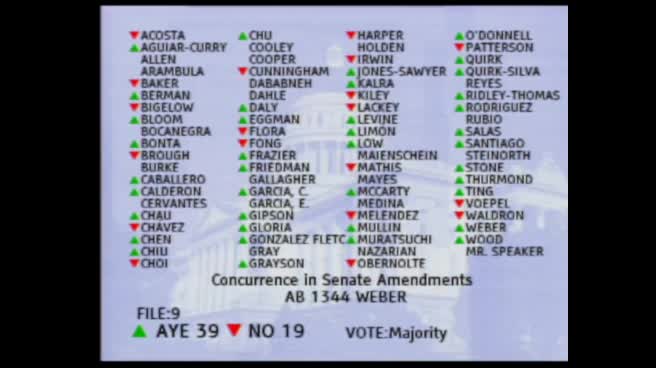 50SEC
Assembly Floor
 4MIN
Senate Floor
 1H
Senate Standing Committee on Appropriations
 7MIN
Senate Standing Committee on Judiciary
 9MIN
Senate Standing Committee on Education
 2MIN
Assembly Floor
 3MIN
Assembly Standing Committee on Appropriations
 7MIN


