AB 360: The State Bar: pro bono legal assistance: veterans.
- Session Year: 2017-2018
- House: Assembly
- Latest Version Date: 2017-10-02
The State Bar Act declares that it has been the tradition of those licensed to practice law in this state to provide voluntary pro bono legal services to those who cannot afford the help of a lawyer, and that, in view of their expertise in areas that critically affect the lives and well-being of members of the public, lawyers are uniquely situated to provide invaluable assistance in order to benefit those who might otherwise be unable to assert or protect their interests.
This bill would require the State Bar of California to administer a program to coordinate pro bono civil legal assistance to veterans and their families who otherwise cannot afford legal services. The bill would also require the State Bar to provide resources and educational materials to attorneys and the public by, among other things, compiling a list of local bar associations, legal aid organizations, veterans service providers, and volunteer attorneys willing to provide pro bono legal services to veterans and posting the list on its Internet Web site, and by conducting a statewide survey of programs that provide civil legal assistance to veterans in order to identify whether and where there is a need for legal advice clinics, publishing a report and recommendations based upon its findings, and posting the report on its Internet Web site.
The State Bar Act declares that it has been the tradition of those licensed to practice law in this state to provide voluntary pro bono legal services to those who cannot afford the help of a lawyer, and that, in view of their expertise in areas that critically affect the lives and well-being of members of the public, lawyers are uniquely situated to provide invaluable assistance in order to benefit those who might otherwise be unable to assert or protect their interests.
This bill would require the State Bar of California to administer a program to provide coordinate pro bono civil legal assistance to veterans and their families who otherwise cannot afford legal services. The bill would also require the State Bar to provide resources and educational materials to attorneys and the public by, among other things, compiling a list of local bar associations, legal aid organizations, veterans service providers, and volunteer attorneys willing to provide pro bono legal services to veterans and posting the list on its Internet Web site, and by conducting a statewide survey of programs that provide civil legal assistance to veterans in order to identify whether and where there is a need for legal advice clinics, publishing a report and recommendations based upon its findings, and posting the report on its Internet Web site.
The State Bar Act declares that it has been the tradition of those licensed to practice law in this state to provide voluntary pro bono legal services to those who cannot afford the help of a lawyer, and that, in view of their expertise in areas that critically affect the lives and well-being of members of the public, lawyers are uniquely situated to provide invaluable assistance in order to benefit those who might otherwise be unable to assert or protect their interests.
This bill would require the State Bar of California to administer a program to provide pro bono civil legal assistance to veterans and their families who otherwise cannot afford legal services.
Existing law defines veterans and induction period for the purposes of the various programs bestowing benefits upon veterans, including, among others, educational assistance for dependents of veterans.This bill would make technical, nonsubstantive changes to those definitions.Existing law defines veterans and induction period for the purposes of the various programs bestowing benefits upon veterans, including, among others, educational assistance for dependents of veterans.
This bill would make technical, nonsubstantive changes to those definitions.
(a)The State Bar shall administer a program to coordinate pro bono civil legal assistance to veterans and their families who otherwise cannot afford legal services.
(b)The State Bar shall engage with local bar associations, legal aid organizations, veterans service providers, and volunteer attorneys and encourage those groups to provide legal services throughout the state.
(c) The State Bar shall provide resources and educational materials to attorneys and the public in order to support the purposes of this section by, among other things, doing the following:
(1)Compiling a list of local bar associations, legal aid organizations, veterans service providers, and volunteer attorneys willing to provide pro bono legal services to veterans, organized by city and county, and posting the list on its Internet Web site.
(2)Conducting a statewide survey of programs that provide civil legal assistance to veterans in order to identify whether and where there is a need for legal advice clinics, publishing a report and recommendations based upon its findings no later than December 31, 2018, and posting the report on its Internet Web site.
(a)The State Bar shall administer a program to provide coordinate pro bono civil legal assistance to veterans and their families who otherwise cannot afford legal services.
(b)The State Bar shall engage in a collaborative effort with local bar associations, legal aid organizations, veterans service providers, and volunteer attorneys to host legal advice clinics and encourage those groups to provide legal services throughout the state.
(c) The State Bar shall provide resources and educational materials to attorneys and the public in order to support the purposes of this section. section by, among other things, doing the following:
(d)Notwithstanding Section 11005 of the Government Code, the State Bar may accept donations of personal property, including cash or other gifts, to be used for the purposes of this section.(1)Compiling a list of local bar associations, legal aid organizations, veterans service providers, and volunteer attorneys willing to provide pro bono legal services to veterans, organized by city and county, and posting the list on its Internet Web site.
(2)Conducting a statewide survey of programs that provide civil legal assistance to veterans in order to identify whether and where there is a need for legal advice clinics, publishing a report and recommendations based upon its findings no later than December 31, 2018, and posting the report on its Internet Web site.
(a)The State Bar shall administer a program to provide pro bono civil legal assistance to veterans and their families who otherwise cannot afford legal services.
(b)The State Bar shall engage in a collaborative effort with local bar associations, legal aid organizations, veterans service providers, and volunteer attorneys to host legal advice clinics throughout the state.
(c)The State Bar shall provide resources and educational materials to support the purposes of this section.
(d)Notwithstanding Section 11005 of the Government Code, the State Bar may accept donations of personal property, including cash or other gifts, to be used for the purposes of this section.
SECTION 1.Section 890 of the Military and Veterans Code is amended to read:890.For purposes of this article:(a)Veterans means any of the following:(1)Any person who served in the Army, Navy, or Marine Corps of the United States and was killed in action or died as a result of war service in the World War since April 6, 1917.(2)Any member of the Army, Navy, Coast Guard, or Marine Corps of the United States, or any of their auxiliaries, including, but not limited to, the Philippine Commonwealth Army, the Regular Scouts (Old Scouts), and the Special Philippine Scouts (New Scouts), who was killed in action in World War II on or after December 7, 1941, and prior to January 1, 1947, or who died at any time as a result of war service during that period.(3)Any member of the Armed Forces of the United States who was killed in action during any period of hostilities in which the United States is engaged, or who died or was totally disabled at any time as a result of active service during that period or during the induction period.(4)Any person who, at the time of entry into the Armed Forces of the United States, was a resident of this state and was subsequently declared by the United States government to be missing in action, captured in the line of duty by hostile forces, or forcibly detained or interned in the line of duty by a foreign government or power.(b)Dependent of a veteran means the natural or adopted child of a veteran, or stepchild of a veteran as defined by the United States Department of Veterans Affairs for compensation purposes, the unmarried surviving spouse of a veteran, or the spouse of a totally disabled veteran.(c)Induction period means both of the following:(1)The period beginning September 16, 1940, and ending December 6, 1941, and the period beginning January 1, 1947, and ending June 26, 1950.(2)The period beginning February 1, 1955, and ending the day before the first day thereafter on which individuals (other than individuals liable for induction by reason of a prior deferment) are no longer liable for induction for training and service into the Armed Forces under the Universal Military Training and Service Act.As used in For purposes of this article:
(a)Veterans means any of the following: (1) any
(1)Any person who served in the Army, Navy, or Marine Corps of the United States and was killed in action or died as a result of war service in the World War since April 6, 1917; (2) any 1917.
(2)Any member of the Army, Navy, Coast Guard, or Marine Corps of the United States, or any of their auxiliaries, including, but not limited to, the Philippine Commonwealth Army, the Regular Scouts (Old Scouts), and the Special Philippine Scouts (New Scouts), who was killed in action in World War II on or after December 7, 1941, and prior to January 1, 1947, or who died at any time as a result of war service during such period; (3) any that period.
(3)Any member of the armed forces Armed Forces of the United States who was killed in action during any period of hostilities in which the United States is engaged, or who died or was totally disabled at any time as a result of active service during any such that period or during the induction period; or (4) any period.
(4)Any person who, at the time of entry into the armed forces Armed Forces of the United States, was a resident of this state and was subsequently declared by the United States government to be missing in action, captured in the line of duty by hostile forces, or forcibly detained or interned in the line of duty by a foreign government or power.
(b)Dependent of a veteran means the natural or adopted child of a veteran, or stepchild of a veteran as defined by the United States Department of Veterans Affairs for compensation purposes, the unmarried surviving spouse of a veteran, or the spouse of a totally disabled veteran.
(c)Induction period means (1) the both of the following:
(1)The period beginning September 16, 1940, and ending December 6, 1941, and the period beginning January 1, 1947, and ending June 26, 1950, and (2) the 1950.
(2)The period beginning on February 1, 1955, and ending on the day before the first day thereafter on which individuals (other than individuals liable for induction by reason of a prior deferment) are no longer liable for induction for training and service into the armed forces Armed Forces under the Universal Military Training and Service Act.
|
Date
|
Status
|
|---|---|
| Oct 2, 2017 | Chaptered by Secretary of State - Chapter 401, Statutes of 2017. |
| Oct 2, 2017 | Approved by the Governor. |
| Sep 7, 2017 | Enrolled and presented to the Governor at 3 p.m. |
| Aug 31, 2017 | In Assembly. Ordered to Engrossing and Enrolling. |
| Aug 31, 2017 | Read third time. Passed. Ordered to the Assembly. |
| Aug 23, 2017 | Ordered to special consent calendar. |
| Jul 20, 2017 | Read second time. Ordered to third reading. |
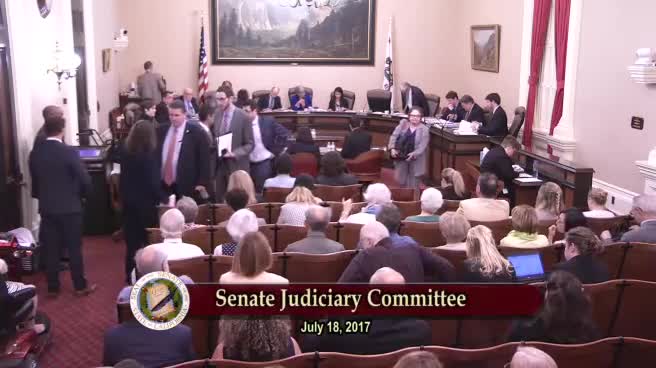
| Jul 19, 2017 | From committee: Do pass. (Ayes 7. Noes 0.) (July 18). |
| May 24, 2017 | Referred to Com. on JUD. |
| May 11, 2017 | In Senate. Read first time. To Com. on RLS. for assignment. |
| May 11, 2017 | Read third time. Passed. Ordered to the Senate. (Ayes 77. Noes 0. Page 1483.) |
| May 4, 2017 | Read second time. Ordered to Consent Calendar. |
| May 3, 2017 | Read second time and amended. Ordered returned to second reading. |
| May 2, 2017 | From committee: Amend, and do pass as amended. To Consent Calendar. (Ayes 11. Noes 0.) (May 2). |
| Mar 22, 2017 | Re-referred to Com. on JUD. |
| Mar 21, 2017 | From committee chair, with author's amendments: Amend, and re-refer to Com. on JUD. Read second time and amended. |
| Mar 20, 2017 | Referred to Com. on JUD. |
| Feb 9, 2017 | From printer. May be heard in committee March 11. |
| Feb 8, 2017 | Read first time. To print. |
|
Date
|
Description
|
Location
|
Votes
|
|
|---|---|---|---|---|
| Aug 31, 2017 | Special Consent Calendar # AB360 | Senate Floor |
Passed |
|
| Jul 18, 2017 | Do pass | Senate Standing Committee on Judiciary |
Passed |
|
| May 11, 2017 | AB 360 MURATSUCHI Consent Calendar Second Day | Assembly Floor |
Passed |
|
| May 2, 2017 | Do pass as amended. To Consent Calendar. | Assembly Standing Committee on Judiciary |
Passed |
This list shows positions taken on this bill by organizations on the date displayed, which is linked to the original source.
Positions by individuals are not included.
|
Organization
|
Position
|
Date
|
|---|---|---|
| Association Of The United States Army, Northern California | ** Support | Aug 17, 2017 |
| California Association of Veteran Service Agencies | ** Support | Aug 17, 2017 |
Office of Senate Floor Analyses (916) 651-1520 Fax: (916) 327-4478 | AB |
THIRD READING
Bill No: AB 360
:
SENATE JUDICIARY COMMITTEE: 7-0, 7/18/17
AYES: Jackson, Moorlach, Anderson, Hertzberg, Monning, Stern, Wieckowski
ASSEMBLY FLOOR: 77-0, 5/11/17 (Consent) - See last page for vote
DIGEST:
This bill requires the State Bar to administer a program to coordinate pro bono civil legal assistance to veterans and their families who otherwise cannot afford legal services.
Existing law:
- Requires all attorneys who practice law in California to be members of the State Bar and establishes the State Bar for the purpose of regulating the legal profession. (Bus. & Prof. Code Sec. 6000 et seq.)
- Authorizes the State Bar to increase the annual membership fees by an additional $40, to be allocated only for purposes of providing voluntary support for nonprofit organizations that provide free legal services to persons of limited means. Members have the option of deducting the $40 from the annual membership fee if they elect not to have the amount allocated for the purposes of legal services.[1] (Bus. & Prof. Code Secs. 6033, 6140.03.)
- Provides that: it has been the tradition of those learned in the law and licensed to practice law in this state to provide voluntary pro bono legal services to those who cannot afford the help of a lawyer; every lawyer authorized and privileged to practice law in California is expected to make a contribution; and in the circumstances where it may not be feasible for a lawyer to directly provide pro bono services, the lawyer may instead fulfill their individual pro bono ethical commitment, in part, by providing support to organizations providing free legal services to persons of limited means, as specified. (Bus. & Prof. Code Sec. 6073.)
- Requires that a contract with the state for legal services that exceeds $50,000 shall include a certification by the contracting law firm that the firm agrees to make a good faith effort to provide, during the duration of the contract, a minimum number of pro bono legal services, or an equivalent amount of financial contributions to qualified legal services projects and support centers, as specified. In awarding a contract with the state for legal services that exceeds $50,000, the awarding department shall consider the efforts of a contracting law firm to provide pro bono legal services, as specified. (Bus. & Prof. Code Sec. 6072.)
- Defines “pro bono legal services”, for purposes of the section relating to contracts with the state for legal services that exceed $50,000, as the provision of legal services: at no fee or substantially reduced fee to groups or organizations seeking to secure or protect civil rights, civil liberties, or public rights; without fee or expectation of fee to persons who are indigent or of limited means; or without fee or expectation of fee to charitable, religious, civic, community, governmental, and educational organizations in matters designed primarily to address the economic, health, and social needs of persons who are indigent or of limited means.
This bill:
- Requires the State Bar to administer a program to coordinate pro bono civil legal assistance to veterans and their families who otherwise cannot afford legal services.
- Requires the State Bar to engage with local bar associations, legal aid organizations, veterans service providers, and volunteer attorneys to encourage those groups to provide legal services throughout the state.
- Requires the State Bar to provide resources and educational materials to attorneys and the public in order to support the purposes of this new pro bono civil legal assistance program by, among other things, doing the following:
- compiling a list of local bar associations, legal aid organizations, veterans service providers, and volunteer attorneys willing to provide pro bono legal services to veterans, organized by city and county, and posting the list on its Internet Web site; and
- conducting a statewide survey of programs that provide civil legal assistance to veterans in order to identify whether and where there is a need for legal advice clinics, publishing a report and recommendations based upon the findings no later than December 31, 2018, and posting the report on the State Bar’s Internet Web site.
Background
In 1963, the United States Supreme Court decided Gideon v. Wainright (1963) 372 U.S. 335, in which it unanimously ruled that state courts are required under the Sixth Amendment of the Constitution to provide counsel in criminal cases for defendants unable to afford their own attorneys.
The U.S. Supreme Court, however, has declined to extend the right to counsel to indigents in civil proceedings. In Lassiter v. Department of Social Services (1981) 452 U.S. 18, the Court affirmed that an indigent litigant’s right to an appointed counsel applies only when the litigant may be deprived of his or her personal liberty. Consequently, the United States mainly relies upon limited legal services and pro bono programs to provide indigent litigants representation in civil matters.
Existing law provides that it has been the tradition of those learned in the law and licensed to practice law in this state to provide voluntary pro bono legal services to those who cannot afford the help of a lawyer; that every lawyer authorized and privileged to practice law in California is expected to make a contribution; that in some circumstances, it may not be feasible for a lawyer to directly provide pro bono services; and that in those circumstances, a lawyer may instead fulfill his or her individual pro bono ethical commitment, in part, by providing financial support to organizations providing free legal services to persons of limited means.
In recent years, there has been a growing movement to provide legal counsel as a matter of right to indigent litigants in matters where basic human needs are at stake. Proponents argue that meaningful access to the civil justice system is largely dependent upon legal representation, and that the likelihood of a just result is significantly increased by competent representation. In recognition of the need for indigent civil litigants in California to be represented by legal counsel, the State of California enacted a pilot project, the Sargent Shriver Civil Counsel Act, in selected courts to provide legal representation to low-income parties in civil matters involving critical issues affecting basic human needs.
Last year, the Senate Judiciary Committee passed SB 1257 (Block, 2016) that would have required any person who applies to become a licensed California attorney to complete at least 50 hours of pro bono service prior to admission with the State Bar of California. The Committee also passed AB 2085 (Irwin, 2016), which would have created the Office of Military Legal Assistance within the Military Department upon appropriation by the Legislature. Both bills were vetoed by the Governor.
In an effort to provide attorneys in civil matters to an especially vulnerable group, this bill requires the State Bar to administer a program to coordinate pro bono civil legal assistance to veterans and their families who otherwise cannot afford legal services.
Comments
The author writes:
AB 360 would require the California State Bar to coordinate a program to provide free civil legal assistance to veterans and their families who otherwise could not afford legal services.
By identifying where legal services for veterans are most needed, and encouraging a cooperative effort across disciplines to provide legal services to veterans who otherwise could not afford them, this bill takes an important step toward the goal of helping veterans to access the services for which they qualify and ultimately to help reduce poverty and other significant challenges facing our state’s veterans.
In support, the California Association of Veteran Service Agencies (CASVA) explains:
Several of the CAVSA Agencies are locally active in supporting Veteran Treatment Courts to offer veterans an alternative to case proceedings that address underlying problems which contribute to criminal activity or other court involvement. At risk veterans not only need legal assistance to manage their way to and through a Veteran Treatment court they also need legal assistance to secure veterans housing, health care, disability, and other benefits.
Our most vulnerable at risk veterans simply cannot afford the legal support necessary to access these services and the result will often be unused services and prolonged involvement in the court system.
We believe that the requirements included in AB 360 will provide much needed legal assistance and increase veterans access to supportive services and reduce engagement in our courts and our prisons.
In support, the Association of the United States Army (AUSA), Northern California writes:
Homeless and low-income veterans often need legal assistance to secure veterans housing, health care, disability, and other benefits. California is home to nearly 1.9 million veterans, by far the largest veteran population in the country. The state is home to nearly 26 percent of all homeless veterans in the country. Los Angeles County alone accounts for 10 percent of the nation’s homeless veterans.
Veterans are an especially vulnerable population that could benefit from the help of pro bono attorneys to aid them in understanding the benefits they are entitled to and advocate for them to receive the benefits. Veterans face depression, anxiety, post-traumatic stress disorder, and substance abuse at higher rates than their civilian peers. (California Research Bureau Senior Policy Analyst, Rebecca E. Blanton, Overview of Veterans in California: March 2013 Testimony before the Joint Hearing of the Assembly Committee on Veterans Affairs and the Assembly Committee on Housing and Community Development, p. 3.) 26.2 percent of veterans report having a disability. (Id. at 4) Veterans face a bigger challenge finding and maintaining stable housing than their civilian counterparts and are over-represented in the homeless population. (Id.) Veterans living in poverty are more likely to move into homelessness than their civilian peers. (Id.) In fact, California has the most homeless veterans of any state, as nearly 26 percent of all U.S. homeless veterans live in California. (Id. at 11.) California’s veterans also use fewer benefits than do their peers at the national level. (Id. at 6) And, overall, veterans in general are unaware of federal benefits. (Id.) These benefits include the home loan guaranty program, education and training benefits, and VA healthcare. (Id. at 6-7.) This bill helps veterans by requiring the State Bar to administer a program to coordinate pro bono civil legal assistance to veterans and their families who otherwise cannot afford legal services. These attorneys could aid California’s indigent veterans and their families in accessing services for which they qualify which can ultimately help reduce poverty and other challenges faced by our veterans.
FISCAL EFFECT: Appropriation: Fiscal Com.: Local:
Association of the United States Army, Northern California
California Association of Veteran Service Agencies
OPPOSITION: (Verified 7/21/17)
None received
ASSEMBLY FLOOR: 77-0, 5/11/17
AYES: Acosta, Aguiar-Curry, Travis Allen, Arambula, Baker, Berman, Bigelow, Bloom, Bocanegra, Bonta, Brough, Burke, Caballero, Calderon, Cervantes, Chau, Chávez, Chen, Chiu, Choi, Chu, Cooley, Cooper, Cunningham, Dababneh, Daly, Eggman, Flora, Fong, Frazier, Friedman, Gallagher, Cristina Garcia, Eduardo Garcia, Gipson, Gloria, Gomez, Gonzalez Fletcher, Gray, Grayson, Harper, Holden, Irwin, Jones-Sawyer, Kalra, Kiley, Lackey, Levine, Limón, Low, Maienschein, Mathis, Mayes, McCarty, Medina, Melendez, Mullin, Muratsuchi, Nazarian, Obernolte, Quirk, Quirk-Silva, Reyes, Ridley-Thomas, Rodriguez, Rubio, Salas, Santiago, Steinorth, Mark Stone, Thurmond, Ting, Voepel, Waldron, Weber, Wood, Rendon
NO VOTE RECORDED: Dahle, O'Donnell, Patterson
Prepared by: Margie Estrada / JUD. / (916) 651-4113
8/17/17 11:22:09
1 For the year of 2016, members of the State Bar contributed $5,980,120 through this check off. So far for the year of 2017, the amount was $6,256,669. In the year 2016, 149,503 attorneys contributed the $40. To date, for the year 2017, 156,417 attorneys have contributed the $40. There are currently 188,188 active and 58,622 inactive members of the State Bar. ↑
Senator Hannah-Beth Jackson, Chair
2017-2018 Regular Session
Bill No: AB 360 (Author:Muratsuchi)
Version: May 3, 2017
Hearing Date: July 18, 2017
Fiscal: No
Urgency: No
Consultant: MEC
SUBJECT
The State Bar: pro bono legal assistance: veterans
DESCRIPTION
This bill would require the State Bar to administer a program to coordinate pro bono civil legal assistance to veterans and their families who otherwise cannot afford legal services.
BACKGROUND
In 1963, the United States Supreme Court decided Gideon v. Wainright (1963) 372 U.S. 335, in which it unanimously ruled that state courts are required under the Sixth Amendment of the Constitution to provide counsel in criminal cases for defendants unable to afford their own attorneys.
The U.S. Supreme Court, however, has declined to extend the right to counsel to indigents in civil proceedings. In Lassiter v. Department of Social Services (1981) 452 U.S. 18, the Court affirmed that an indigent litigant’s right to an appointed counsel applies only when the litigant may be deprived of his or her personal liberty. Consequently, the United States mainly relies upon limited legal services and pro bono programs to provide indigent litigants representation in civil matters.
Existing law provides that it has been the tradition of those learned in the law and licensed to practice law in this state to provide voluntary pro bono legal services to those who cannot afford the help of a lawyer; that every lawyer authorized and privileged to practice law in California is expected to make a contribution; that in some circumstances, it may not be feasible for a lawyer to directly provide pro bono services; and that in those circumstances, a lawyer may instead fulfill his or her individual pro bono ethical commitment, in part, by providing financial support to organizations providing free legal services to persons of limited means.
In recent years, there has been a growing movement to provide legal counsel as a matter of right to indigent litigants in matters where basic human needs are at stake. Proponents argue that meaningful access to the civil justice system is largely dependent upon legal representation, and that the likelihood of a just result is significantly increased by competent representation. In recognition of the need for indigent civil litigants in California to be represented by legal counsel, the State of California enacted a pilot project, the Sargent Shriver Civil Counsel Act, in selected courts to provide legal representation to low-income parties in civil matters involving critical issues affecting basic human needs.
Last year, this committee passed SB 1257 (Block, 2016) that would have required any person who applies to become a licensed California attorney to complete at least 50 hours of pro bono service prior to admission with the State Bar of California. This committee also passed AB 2085 (Irwin, 2016), which would have created the Office of Military Legal Assistance within the Military Department upon appropriation by the Legislature. Both bills were vetoed by the Governor.
In an effort to provide attorneys in civil matters to an especially vulnerable group, this bill would require the State Bar to administer a program to coordinate pro bono civil legal assistance to veterans and their families who otherwise cannot afford legal services.
CHANGES TO EXISTING LAW
Existing law requires all attorneys who practice law in California to be members of the State Bar and establishes the State Bar for the purpose of regulating the legal profession. (Bus. & Prof. Code Sec. 6000 et seq.)
Existing law authorizes the State Bar to increase the annual membership fees by an additional $40, to be allocated only for purposes of providing voluntary support for nonprofit organizations that provide free legal services to persons of limited means. Members have the option of deducting the $40 from the annual membership fee if they elect not to have the amount allocated for the purposes of legal services.[1] (Bus. & Prof. Code Secs. 6033, 6140.03.)
Existing law provides that: it has been the tradition of those learned in the law and licensed to practice law in this state to provide voluntary pro bono legal services to those who cannot afford the help of a lawyer; every lawyer authorized and privileged to practice law in California is expected to make a contribution; and in the circumstances where it may not be feasible for a lawyer to directly provide pro bono services, the lawyer may instead fulfill their individual pro bono ethical commitment, in part, by providing support to organizations providing free legal services to persons of limited means, as specified. (Bus. & Prof. Code Sec. 6073.)
Existing law requires that a contract with the state for legal services that exceeds $50,000 shall include a certification by the contracting law firm that the firm agrees to make a good faith effort to provide, during the duration of the contract, a minimum number of pro bono legal services, or an equivalent amount of financial contributions to qualified legal services projects and support centers, as specified. In awarding a contract with the state for legal services that exceeds $50,000, the awarding department shall consider the efforts of a contracting law firm to provide pro bono legal services, as specified. (Bus. & Prof. Code Sec. 6072.)
Existing law, for purposes of the section relating to contracts with the state for legal services that exceed fifty thousand dollars, defines “pro bono legal services” as the provision of legal services: at no fee or substantially reduced fee to groups or organizations seeking to secure or protect civil rights, civil liberties, or public rights; without fee or expectation of fee to persons who are indigent or of limited means; or without fee or expectation of fee to charitable, religious, civic, community, governmental, and educational organizations in matters designed primarily to address the economic, health, and social needs of persons who are indigent or of limited means.
This bill would require the State Bar to administer a program to coordinate pro bono civil legal assistance to veterans and their families who otherwise cannot afford legal services.
This bill would require the State Bar to engage with local bar associations, legal aid organizations, veterans service providers, and volunteer attorneys to encourage those groups to provide legal services throughout the state.
This bill would require the State Bar to provide resources and educational materials to attorneys and the public in order to support the purposes of this new pro bono civil legal assistance program by, among other things, doing the following:
- compiling a list of local bar associations, legal aid organizations, veterans service providers, and volunteer attorneys willing to provide pro bono legal services to veterans, organized by city and county, and posting the list on its Internet Web site; and
- conducting a statewide survey of programs that provide civil legal assistance to veterans in order to identify whether and where there is a need for legal advice clinics, publishing a report and recommendations based upon the findings no later than December 31, 2018, and posting the report on the State Bar’s Internet Web site.
COMMENT
1. Stated need for the bill
According to the author:
AB 360 would require the California State Bar to coordinate a program to provide free civil legal assistance to veterans and their families who otherwise could not afford legal services.
By identifying where legal services for veterans are most needed, and encouraging a cooperative effort across disciplines to provide legal services to veterans who otherwise could not afford them, this bill takes an important step toward the goal of helping veterans to access the services for which they qualify and ultimately to help reduce poverty and other significant challenges facing our state’s veterans.
In support, the California Association of Veteran Service Agencies (CASVA) explains:
Several of the CAVSA Agencies are locally active in supporting Veteran Treatment Courts to offer veterans an alternative to case proceedings that address underlying problems which contribute to criminal activity or other court involvement. At risk veterans not only need legal assistance to manage their way to and through a Veteran Treatment court they also need legal assistance to secure veterans housing, health care, disability, and other benefits.
Our most vulnerable at risk veterans simply cannot afford the legal support necessary to access these services and the result will often be unused services and prolonged involvement in the court system.
We believe that the requirements included in AB 360 will provide much needed legal assistance and increase veterans access to supportive services and reduce engagement in our courts and our prisons.
In support, the Association of the United States Army (AUSA), Northern California writes:
Homeless and low-income veterans often need legal assistance to secure veterans housing, health care, disability, and other benefits. California is home to nearly 1.9 million veterans, by far the largest veteran population in the country. The state is home to nearly 26 percent of all homeless veterans in the country. Los Angeles County alone accounts for 10 percent of the nation’s homeless veterans.
2. Indigent veterans are an especially vulnerable population in need of legal help
Veterans are an especially vulnerable population that could benefit from the help of pro bono attorneys to aid them in understanding the benefits they are entitled to and advocate for them to receive the benefits. Veterans face depression, anxiety, post-traumatic stress disorder (PTSD), and substance abuse at higher rates than their civilian peers. (California Research Bureau Senior Policy Analyst, Rebecca E. Blanton, Overview of Veterans in California: March 2013 Testimony before the Joint Hearing of the Assembly Committee on Veterans Affairs and the Assembly Committee on Housing and Community Development, p. 3.) 26.2 percent of veterans report having a disability. (Id. at 4) Veterans face a bigger challenge finding and maintaining stable housing than their civilian counterparts and are over-represented in the homeless population. (Id.) Veterans living in poverty are more likely to move into homelessness than their civilian peers. (Id.) In fact, California has the most homeless veterans of any state, as nearly 26 percent of all U.S. homeless veterans live in California. (Id. at 11.) California’s veterans also use fewer benefits than do their peers at the national level. (Id. at 6) And, overall, veterans in general are unaware of federal benefits. (Id.) These benefits include the home loan guaranty program, education and training benefits, and VA healthcare. (Id. at 6-7.) This bill would help veterans by requiring the State Bar to administer a program to coordinate pro bono civil legal assistance to veterans and their families who otherwise cannot afford legal services. These attorneys could aid California’s indigent veterans and their families in accessing services for which they qualify which can ultimately help reduce poverty and other challenges faced by our veterans.
Support: California Association of Veteran Service Agencies; The Association of the United States Army, Northern California
Opposition: None Known
HISTORY
Source: Author
Related Pending Legislation:
SB 36 (Jackson, 2017) would authorize the State Bar to collect membership dues and would reform the State Bar. This bill is currently in the Assembly Committee on Judiciary.
SB 316 (Wieckowski, 2017) would require attorneys to annually report the hours of pro bono legal services performed and the amount of money contributed to specified organizations (including legal aid organizations) to the State Bar of California. This bill is currently in the Assembly Appropriations Committee.
AB 386 (Gonzalez Fletcher, 2017) would create a program within the Department of Social Services to provide legal services to deported veterans. This bill is currently in the Senate Appropriations Committee.
Prior Legislation:
SB 1257 (Block, 2016) would have required those who apply to become licensed California attorneys, with certain exceptions, to complete at least 50 hours of pro bono legal service, as defined, prior to admission with the State Bar. This bill was vetoed by the Governor.
AB 2085 (Irwin, 2016) would have created the Office of Military Legal Assistance within the Military Department upon appropriation by the Legislature. The bill was vetoed by the Governor.
Prior Vote:
Assembly Floor (Ayes 77, Noes 0)
Assembly Judiciary Committee (Ayes 11, Noes 0)
**************
For the year of 2016, members of the State Bar contributed $5,980,120 through this check off. So far for the year of 2017, the amount was $6,256,669. In the year 2016, 149,503 attorneys contributed the $40. To date, for the year 2017, 156,417 attorneys have contributed the $40. There are currently 188,188 active and 58,622 inactive members of the State Bar. ↑
Date of Hearing: May 2, 2017
ASSEMBLY COMMITTEE ON JUDICIARY
Mark Stone, Chair
ABPCA Bill Id:AB 360
Author:(Muratsuchi) – As Amended Ver:March 21, 2017
PROPOSED CONSENT (As Proposed to be Amended)
SUBJECT: THE STATE BAR: PRO BONO LEGAL ASSISTANCE: VETERANS
KEY ISSUE: should the calIfOrnia state bar be required to administer a program to coordinate free civil legal assistance to veterans and TO DO A NUMBER OF OTHER THINGS DESIGNED TO PROVIDE LEGAL ASSISTANCE TO VETERANS AND their families who OFTEN NEED, BUT CAnnot afford, TO PAY FOR legal services?
SYNOPSIS
California is home to the largest veteran population in the country, and also has a disproportionately large number of the nation’s homeless veterans. Veterans face a broad range of challenges as they transition back into their daily lives as civilians, including unique physical and mental health problems, a high likelihood of becoming homeless, and a lack of awareness about benefits to which they are entitled. Evidence suggests that when veterans are made aware of the benefits available to them, they are more likely to access those benefits, which in turn provides them with the assistance they need. The State Legislature has undertaken several successful efforts to help increase veteran access to benefits. However, veterans often lack access to assistance in the legal realm that may help to connect them with services–such as housing, education, financial support, and healthcare--to which they are entitled.
As currently in print, the bill would require the State Bar of California (State Bar) to administer a program that would have local bar associations, among others, to provide direct pro bono civil legal assistance to veterans, but did not provide any funding for the State Bar to do so, potentially jeopardizing the State Bar’s ability to conduct its other regulatory duties and raising feasibility questions, given the fact that the State Bar would have no authority to require such services to be provided. The bill also allowed the State Bar, notwithstanding state law that prohibits the state from accepting gifts, to accept donations of personal property, including cash or other gifts, to be used for the purposes of the bill. It is possible that this requirement would have interfered with the Bar’s existing efforts to fund other legal services programs.
In response to these concerns, but with the goal of still providing access to legal aid for veterans, the author proposes to amend the bill so that it would merely require the State Bar to encourage local bar associations, legal organizations, veterans’ service providers, and volunteer attorneys to provide legal services throughout the state. It will also require the State Bar to provide educational materials to attorneys and the public to carry out this goal by, among other things, doing the following: (1) posting a list of those organizations willing to provide pro bono legal services to veterans, categorized by city and county, on its internet website, and (2) conducting a statewide survey of programs that provide civil legal assistance to veterans in order to better identify where there is a need for legal advice clinics, publishing a report and recommendations based upon its findings no later than December 31, 2018, and posting the report on its internet website. Those amendments are reflected in the summary and analysis of the bill, below. As a result of this effort to increase access to pro bono legal services, veterans will be better prepared when coming into contact with the legal system. There is no known opposition to this bill.
SUMMARY: Encourages legal service organizations to provide pro bono legal assistance to veterans across the state. Specifically, this bill:
- Requires the State Bar of California (State Bar) to administer a program to coordinate pro bono civil legal assistance to veterans and their families who otherwise cannot afford legal services.
- Requires the State Bar to engage with local bar associations, legal aid organizations, veterans service providers, and volunteer attorneys and encourage those groups to provide legal services throughout the state.
- Requires the State Bar to provide resources and educational materials to attorneys and the public in order to support the purposes of this bill by, among other things, doing the following:
- Compiling a list of local bar associations, legal aid organizations, veterans service providers, and volunteer attorneys willing to provide pro bono legal services to veterans, organized by city and county, and posting the list on its internet website.
- Conducting a statewide survey of programs that provide civil legal assistance to veterans in order to identify whether and where there is a need for legal advice clinics, publishing a report and recommendations based upon its findings no later than December 31, 2018, and posting the report on its internet website.
EXISTING LAW:
1) Establishes the State Bar of California as a public corporation. (Business and Professions Code Section 6001. All further statutory references are to this code, unless otherwise indicated.)
2) Authorizes the State Bar of California in 2016 to collect funds through annual membership fees at a sum not exceeding three hundred fifteen dollars ($315) minus a ten dollar ($10) rebate. (Section 6140.)
3) Authorizes the State Bar of California to raise revenue in addition to that provided in section 6140 and other statutory provisions by any lawful means, including, but not limited to, the creation of foundations or not-for-profit corporations. (Section 6001.)
4) Provides that it has been the tradition of those learned in the law and licensed to practice law in this state to provide voluntary and pro bono legal services to those who cannot afford the help of a lawyer. Every lawyer authorized and privileged to practice law in California is expected to make a contribution. (Section 6073.)
FISCAL EFFECT: As currently in print this bill is keyed non-fiscal.
COMMENTS: California is home to nearly 1.9 million veterans, giving it the largest veteran population in the country by far. The population is diverse and facing increasing challenges as it comes to grips with the broader, looming societal perils of economic stagnation and a lack of preparedness for the needs of an aging demographic. Veterans disproportionately suffer from mental health problems, with large numbers of veterans living in poverty. Twenty-six percent of the nation’s homeless veterans live in California, and ten percent of the nation’s homeless veterans live in Los Angeles. Approximately one percent of all California veterans are homeless.
A particular area of concern for veterans is health. In her 2013 testimony before the Joint Hearing of the Assembly Committee on Veterans Affairs and the Assembly Committee on Housing and Community Development, Senior Policy Analyst, Rebecca E. Blanton, noted that approximately 26.2 percent of veterans report having a disability, and of those, 32.1 percent said the disability had interfered with their potential for getting or holding a job. Veterans also face various, unique physical and behavioral health concerns, including hearing impairment—which alone affects 63 percent of the veterans— in addition to vision loss, orthopedic injuries, and traumatic brain injury. Finally, veterans suffer from depression, anxiety, post-traumatic stress disorder (PTSD), and substance abuse at rates higher than the civilian population.
Veterans are over-represented in the homeless population, and those veterans living in poverty are more likely to become homeless than civilians. Women veterans are more likely to be single parents, and of the 10,700 single mothers with children aged thirteen or younger, 94 percent make less than $40,000 per year—a number less than twice the federal poverty standard for a family of three. More than half of these women reported no income in 2012.
Veterans in California utilize fewer benefits than their peers at the national level. This is because some states have better outreach programs to connect veterans to the benefits they are entitled to receive. Additionally, California has some of the longest wait times for approval of benefits in the nation. Data shows that veterans make use of benefits to which they are entitled when they are aware they have them. Thus, one way to begin to address the momentous issues veterans face is to create a program intending to connect veterans with available free legal assistance.
Past Legislative Efforts to Assist Veterans. The Legislature has attempted to assist veterans in identifying and accessing the benefits to which they are entitled. For example, a bill from 2016, AB 2085 (Irwin), would have created the Office of Military Legal Assistance within the Military Department upon appropriation by the Legislature. That bill, however, was vetoed by Governor Brown. AB 1401 (Baker 2016), Chapter 254, Statutes of 2016, requires the Office of the Adjunct General (OAG) to annually make a number of documents available to each member of the California National Guard, the State Military Reserve, and the Naval Militia who does not have a baccalaureate degree, including the following: (1) A copy of the enrollment fee waiver application of the Board of Governors of the California Community Colleges; (2) A copy of the Free Application for Federal Student Aid (FAFSA); (3) A copy of the latest brochure or information relative to the current federal Post-9/11 GI Bill; (4) A copy of the latest brochure or information relative to the California National Guard Education Assistance Award Program; and (5) The contact information for a County Veterans Service Officer or the division responsible within the California Department of Veterans Affairs for higher education or the California National Guard. AB 1401 also requires the OAG to provide assistance, as necessary, to help service members complete the forms made available to them. In other words, the bill intended to provide assistance and information about educational opportunities and rights to active service members in the hope that they will take advantage of those opportunities when they become veterans.
This Bill Intends to Offer Assistance to Veterans in a Different Form: Legal Assistance. Similar to past efforts, this bill intends to assist veterans, but it does so by specifically targeting access to legal services. It would require the State Bar of California to administer a program to coordinate pro bono legal service assistance for indigent veterans. Increased access to information about their benefits, in addition to increased services which are free of charge, have been shown to help veterans who face seemingly insurmountable challenges in this state. This bill would extend that aid to the legal services realm, which would be instrumental in ensuring veterans are accessing the benefits to which they are entitled and are represented when coming into contact with the legal system. According to the author of this bill, “The State Bar has traditionally encouraged attorneys licensed to practice law in California to provide voluntary free legal services to those who cannot afford a lawyer. This bill would institutionalize the State Bar’s commitment to provide legal assistance to veterans.”
Author’s Amendments. As currently in print, the bill would require the State Bar of California (State Bar) to administer a program that would have local bar associations, among others, to provide direct pro bono civil legal assistance to veterans, but did not provide any funding for the State Bar to do so, potentially jeopardizing the State Bar’s ability to conduct its other regulatory duties and raising feasibility questions, given the fact that the State Bar would have no authority to require such services to be provided. The bill also allowed the State Bar, notwithstanding state law that prohibits the state from accepting gifts, to accept donations of personal property, including cash or other gifts, to be used for the purposes of the bill. It is possible that this requirement would have interfered with the Bar’s existing efforts to fund other legal services programs.
In response to these concerns, but with the goal of still providing access to legal aid for veterans, the author proposes to amend the bill so that it would merely require the State Bar to encourage local bar associations, legal organizations, veterans’ service providers, and volunteer attorneys to provide legal services throughout the state. It will also require the State Bar to provide educational materials to attorneys and the public to carry out this goal by (1) posting a list of those organizations willing to provide pro bono legal services to veterans, categorized by city and county, on its internet website, and (2) conducting a statewide survey of programs that provide civil legal assistance to veterans in order to better identify where there is a need for legal advice clinics, publishing a report and recommendations based upon its findings no later than December 31, 2018, and posting the report on its internet website. By identifying where legal services for veterans are most needed, and encouraging a cooperative effort across disciplines to provide legal services to veterans who otherwise could not afford them, this bill takes an important step toward the goal of helping veterans to access the services for which they qualify and ultimately to help reduce poverty and other significant challenges facing our state’s veterans.
6074. (a) The State Bar shall administer a program to provide coordinate pro bono civil legal assistance to veterans and their families who otherwise cannot afford legal services.
(b) The State Bar shall engage in a collaborative effort with local bar associations, legal aid organizations, veterans service providers, and volunteer attorneys to host legal advice clinics and encourage those groups to provide legal services throughout the state.
(c) The State Bar shall provide resources and educational materials to attorneys and the public in order to support the purposes of this section by, among other things, doing the following:
(1) Compiling a list of local bar associations, legal aid organizations, veterans service providers, and volunteer attorneys willing to provide pro bono legal services to veterans, organized by city and county, and posting the list on its internet website.
(2) Conducting a statewide survey of programs that provide civil legal assistance to veterans in order to identify whether and where there is a need for legal advice clinics, publishing a report and recommendations based upon its findings no later than December 31, 2018, and posting the report on its internet website.
(d) Notwithstanding Section 11005 of the Government Code, the State Bar may accept donations of personal property, including cash or other gifts, to be used for the purposes of this section.
ARGUMENTS IN SUPPORT: The Association of the United States Army (AUSA), Northern California, supports AB 360 because “[h]omeless and low-income veterans often need legal assistance to secure veterans housing, health care, disability, and other benefits.”
The California Association of Veteran Service Agencies (CAVSA) writes in support of the bill: “Our most vulnerable at risk veterans simply cannot afford the legal support necessary to access these [veteran] services and the result will often be unused services and prolonged involvement in the court system. We believe that the requirements included in AB 360 will provide much needed legal assistance and increase veterans access to supportive services and reduce engagement in our courts and our prisons.”
PAST RELATED LEGISLATION: AB 388 (Chang), Chapter 692, Statutes of 2015, provides that entities receiving funds through the California Veterans Housing and Homeless Prevention Bond Act of 2014 are using them in the most effective manner possible to prevent veteran homelessness and aid those veterans who are already homeless. It requires the department to submit an annual report to the Governor and both houses of the legislature on the operations and accomplishments during the previous fiscal year.
AB 151 (Olsen), Chapter 689, Statutes of 2013, authorizes the governing board of any county to grant financial assistance, relief, and support to a disabled veteran.
AB 1093 (Davis, 2011), would have required California Community Colleges, and encouraged the University of California, to establish a Military and Veterans Benefits Office on each of its respective offices to better serve veteran students and help them understand their benefits. AB 1093 died in the Assembly Higher Education Committee.
REGISTERED SUPPORT / OPPOSITION:
Support
The Association of the United States Army, Northern California
California Association of Veteran Service Agencies
Opposition
None on file
Analysis Prepared by: Lusine Chinkezian and Alison Merrilees / JUD. / (916) 319-2334
Bill Author

Bill Co-Author(s):
