AB 369: Appeals: child custody orders or judgments.
- Session Year: 2017-2018
- House: Assembly
- Latest Version Date: 2017-07-10
Existing law specifies that an appeal, other than in a limited civil case, is to the court of appeal. Existing law authorizes an appeal to be taken from certain judicial actions including a judgment, an order granting or dissolving an injunction, or an order appointing a receiver.
This bill would additionally authorize an appeal to be taken from a final order or judgment in a bifurcated proceeding regarding child custody or visitation rights.
Existing law specifies that an appeal, other than in a limited civil case, is to the court of appeal. Existing law authorizes an appeal to be taken from certain judicial actions including a judgment, an order granting or dissolving an injunction, or an order appointing a receiver.
This bill would additionally authorize an appeal to be taken from a final child custody order or judgment in a bifurcated proceeding. proceeding regarding child custody or visitation rights.
Existing law specifies that an appeal, other than in a limited civil case, is to the court of appeal. Existing law authorizes an appeal to be taken from certain judicial actions including a judgment, an order granting or dissolving an injunction, or an order appointing a receiver.
This bill would additionally authorize an appeal to be taken from a final child custody order or judgment in a bifurcated proceeding.
(a)An appeal, other than in a limited civil case, is to the court of appeal. An appeal, other than in a limited civil case, may be taken from any of the following:
(1)From a judgment, except an interlocutory judgment, other than as provided in paragraphs (8), (9), and (11), or a judgment of contempt that is made final and conclusive by Section 1222.
(2)From an order made after a judgment made appealable by paragraph (1).
(3)From an order granting a motion to quash service of summons or granting a motion to stay the action on the ground of inconvenient forum, or from a written order of dismissal under Section 581d following an order granting a motion to dismiss the action on the ground of inconvenient forum.
(4)From an order granting a new trial or denying a motion for judgment notwithstanding the verdict.
(5)From an order discharging or refusing to discharge an attachment or granting a right to attach order.
(6)From an order granting or dissolving an injunction, or refusing to grant or dissolve an injunction.
(7)From an order appointing a receiver.
(8)From an interlocutory judgment, order, or decree, made or entered in an action to redeem real or personal property from a mortgage thereof, or a lien thereon, determining the right to redeem and directing an accounting.
(9)From an interlocutory judgment in an action for partition determining the rights and interests of the respective parties and directing partition to be made.
(10)From an order made appealable by the Probate Code or the Family Code.
(11)From an interlocutory judgment directing payment of monetary sanctions by a party or an attorney for a party if the amount exceeds five thousand dollars ($5,000).
(12)From an order directing payment of monetary sanctions by a party or an attorney for a party if the amount exceeds five thousand dollars ($5,000).
(13)From an order granting or denying a special motion to strike under Section 425.16.
(14)From a final order or judgment in a bifurcated proceeding regarding child custody or visitation rights.
(b)Sanction orders or judgments of five thousand dollars ($5,000) or less against a party or an attorney for a party may be reviewed on an appeal by that party after entry of final judgment in the main action, or, at the discretion of the court of appeal, may be reviewed upon petition for an extraordinary writ.
(a)An appeal, other than in a limited civil case, is to the court of appeal. An appeal, other than in a limited civil case, may be taken from any of the following:
(1)From a judgment, except an interlocutory judgment, other than as provided in paragraphs (8), (9), and (11), or a judgment of contempt that is made final and conclusive by Section 1222.
(2)From an order made after a judgment made appealable by paragraph (1).
(3)From an order granting a motion to quash service of summons or granting a motion to stay the action on the ground of inconvenient forum, or from a written order of dismissal under Section 581d following an order granting a motion to dismiss the action on the ground of inconvenient forum.
(4)From an order granting a new trial or denying a motion for judgment notwithstanding the verdict.
(5)From an order discharging or refusing to discharge an attachment or granting a right to attach order.
(6)From an order granting or dissolving an injunction, or refusing to grant or dissolve an injunction.
(7)From an order appointing a receiver.
(8)From an interlocutory judgment, order, or decree, made or entered in an action to redeem real or personal property from a mortgage thereof, or a lien thereon, determining the right to redeem and directing an accounting.
(9)From an interlocutory judgment in an action for partition determining the rights and interests of the respective parties and directing partition to be made.
(10)From an order made appealable by the Probate Code or the Family Code.
(11)From an interlocutory judgment directing payment of monetary sanctions by a party or an attorney for a party if the amount exceeds five thousand dollars ($5,000).
(12)From an order directing payment of monetary sanctions by a party or an attorney for a party if the amount exceeds five thousand dollars ($5,000).
(13)From an order granting or denying a special motion to strike under Section 425.16.
(14)From a final child custody order or judgment in a bifurcated proceeding. proceeding regarding child custody or visitation rights.
(b)Sanction orders or judgments of five thousand dollars ($5,000) or less against a party or an attorney for a party may be reviewed on an appeal by that party after entry of final judgment in the main action, or, at the discretion of the court of appeal, may be reviewed upon petition for an extraordinary writ.
(a)An appeal, other than in a limited civil case, is to the court of appeal. An appeal, other than in a limited civil case, may be taken from any of the following:
(1)From a judgment, except (A) an interlocutory judgment, other than as provided in paragraphs (8), (9), and (11), or (B) a judgment of contempt that is made final and conclusive by Section 1222.
(2)From an order made after a judgment made appealable by paragraph (1).
(3)From an order granting a motion to quash service of summons or granting a motion to stay the action on the ground of inconvenient forum, or from a written order of dismissal under Section 581d following an order granting a motion to dismiss the action on the ground of inconvenient forum.
(4)From an order granting a new trial or denying a motion for judgment notwithstanding the verdict.
(5)From an order discharging or refusing to discharge an attachment or granting a right to attach order.
(6)From an order granting or dissolving an injunction, or refusing to grant or dissolve an injunction.
(7)From an order appointing a receiver.
(8)From an interlocutory judgment, order, or decree, hereafter made or entered in an action to redeem real or personal property from a mortgage thereof, or a lien thereon, determining the right to redeem and directing an accounting.
(9)From an interlocutory judgment in an action for partition determining the rights and interests of the respective parties and directing partition to be made.
(10)From an order made appealable by the provisions of the Probate Code or the Family Code.
(11)From an interlocutory judgment directing payment of monetary sanctions by a party or an attorney for a party if the amount exceeds five thousand dollars ($5,000).
(12)From an order directing payment of monetary sanctions by a party or an attorney for a party if the amount exceeds five thousand dollars ($5,000).
(13)From an order granting or denying a special motion to strike under Section 425.16.
(14)From a final child custody order or judgment in a bifurcated proceeding.
(b)Sanction orders or judgments of five thousand dollars ($5,000) or less against a party or an attorney for a party may be reviewed on an appeal by that party after entry of final judgment in the main action, or, at the discretion of the court of appeal, may be reviewed upon petition for an extraordinary writ.
|
Date
|
Status
|
|---|---|
| Jul 10, 2017 | Chaptered by Secretary of State - Chapter 41, Statutes of 2017. |
| Jul 10, 2017 | Approved by the Governor. |
| Jun 29, 2017 | Enrolled and presented to the Governor at 12:30 p.m. |
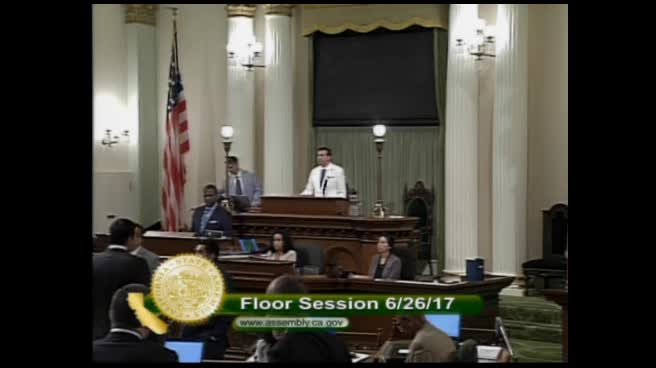
| Jun 26, 2017 | Senate amendments concurred in. To Engrossing and Enrolling. (Ayes 75. Noes 0. Page 2343.). |
| Jun 20, 2017 | In Assembly. Concurrence in Senate amendments pending. May be considered on or after June 22 pursuant to Assembly Rule 77. |
| Jun 19, 2017 | Read third time. Passed. Ordered to the Assembly. (Ayes 33. Noes 0. Page 1611.). |
| Jun 14, 2017 | Read second time. Ordered to Consent Calendar. |
| Jun 13, 2017 | From committee: Do pass. To Consent Calendar. (Ayes 7. Noes 0.) (June 13). |
| May 26, 2017 | From committee chair, with author's amendments: Amend, and re-refer to committee. Read second time, amended, and re-referred to Com. on JUD. |
| May 10, 2017 | Referred to Com. on JUD. |
| Mar 20, 2017 | In Senate. Read first time. To Com. on RLS. for assignment. |
| Mar 20, 2017 | Read third time. Passed. Ordered to the Senate. (Ayes 76. Noes 0. Page 647.) |
| Mar 15, 2017 | Read second time. Ordered to Consent Calendar. |
| Mar 14, 2017 | From committee: Do pass. To Consent Calendar. (Ayes 11. Noes 0.) (March 14). |
| Feb 21, 2017 | Referred to Com. on JUD. |
| Feb 10, 2017 | From printer. May be heard in committee March 12. |
| Feb 9, 2017 | Read first time. To print. |
|
Date
|
Description
|
Location
|
Votes
|
|
|---|---|---|---|---|
| Jun 26, 2017 | AB 369 WALDRON Concurrence in Senate Amendments | Assembly Floor |
Passed |
|
| Jun 19, 2017 | Consent Calendar 2nd AB369 | Senate Floor |
Passed |
|
| Jun 13, 2017 | Do pass and be ordered to the Consent Calendar | Senate Standing Committee on Judiciary |
Passed |
|
| Mar 20, 2017 | AB 369 WALDRON Consent Calendar Second Day Regular Session | Assembly Floor |
Passed |
|
| Mar 14, 2017 | Do pass. To Consent Calendar. | Assembly Standing Committee on Judiciary |
Passed |
This list shows positions taken on this bill by organizations on the date displayed, which is linked to the original source.
Positions by individuals are not included.
|
Organization
|
Position
|
Date
|
|---|---|---|
| California Conference of Bar Associations | ** Support | Jun 14, 2017 |
CONCURRENCE IN SENATE AMENDMENTS
CSA1 Bill Id:AB 369
Author:(Waldron)
As Amended Ver:May 26, 2017
Majority vote
ASSEMBLY: | 76-0 | (March 20, 2017) | SENATE: | 33-0 | (June 19, 2017) |
Original Committee Reference: JUD.
SUMMARY: Allows an appeal to be taken from a final order or judgment in a bifurcated family law proceeding regarding child custody or visitation rights.
The Senate amendments are technical and clarifying.
EXISTING LAW:
- Allows a court in a dissolution proceeding, upon a noticed motion, to sever and grant an early and separate trial on the issue of the status of the marriage apart from other issues. (Family Code (FAM) Section 2337(a). Unless stated otherwise, all further statutory references are to that code.)
- Provides that a judgment granting a dissolution of the status of the marriage must expressly reserve jurisdiction for later determination of all other pending issues. (FAM Section 2337(e))
- Permits a court in a dissolution action to separately try one or more issues before trial of the other issues if resolution of the bifurcated issue is likely to simplify the determination of the other issues. Issues that may appropriately be tried separately in advance include:
- The validity of a postnuptial or premarital agreement;
- Date of separation;
- Date to use for valuation of assets;
- Whether property is separate or community;
- How to apportion increase in value of a business;
- Existence or value of business or professional goodwill;
- Termination of status of a marriage or domestic partnership;
- Child custody and visitation;
- Child or spousal support;
- Attorney's fees and costs;
- Division of property and debts;
- Reimbursement claims; or
- Other issues specific to a family law case. (California Rules of Court, Rule of Court 5.390)
- Provides that if a court has bifurcated issues for separate trial or hearing in advance of the disposition of the entire case, a court of appeal may order an issue transferred to it for hearing and decision when the trial court that heard the issue and certifies that the appeal is appropriate; and requires certification to be in accordance with rules promulgated by the Judicial Council, which detail steps to take to seek the required certificate for appeal. (FAM Section 2025; California Rules of Court, Rule 5.392)
- Allows appeals to be made from specified actions, including an appeal from an order made appealable by the provisions of the Family Code. (Code of Civil Procedure Section 904.1)
FISCAL EFFECT: None
COMMENTS: Bifurcation, a common practice in family law proceedings, allows a court to resolve some of the issues in a case, while reserving resolution of the remaining issues for a later date. For example, in a marital dissolution case, a court might bifurcate and resolve the issue of terminating marital status, and reserve remaining issues such as custody, property division, and spousal support for the future. In this example, bifurcation allows the parties to continue on with their lives and remarry while the court works with the parties to resolve those outstanding issues.
Courts like bifurcation because it tends to promote resolution among the parties. Bifurcation simplifies the case, determines other issues, and even encourages dialogue between parties. Indeed, as one court has stated, "[t]he inability to resolve issues frequently inhibits the ability of the parties to settle other issues. If it appears that the resolution of a pivotal issue by a bifurcated trial of that issue will enable the parties to settle all other issues, bifurcation is to be encouraged." (In re Marriage of Wolfe (1985) 173 Cal.App.3d 889, 894.)
Typically, when there is a final judgment in a case and all issues have been resolved at the trial court level, the case can be appealed. However, when issues are bifurcated, by definition, some of the issues will be fully resolved by the trial court before the entire case is resolved. Existing law provides that if a case has been bifurcated, an appeal is not automatic. Rather, a court of appeal may order an issue transferred to it for hearing and decision only when the trial court that heard all of the underlying issues and certifies that the appeal is appropriate. The certification that there is probable cause for immediate appellate review can be provided by the court in the underlying order. If the trial court does not the certification, a party may ask the court to do so. However, given that the vast majority of family law litigants are unrepresented, these extra steps to seek appellate review may be very difficult for many litigants to complete. While failure to get an immediate review does not preclude an ultimate review by the appellate court, such resolution could take years while the other issues in the case are resolved.
This bill allows a final order in a bifurcated family law proceeding regarding child custody or visitation rights to be appealable immediately, without the need for certification from the trial court. The bill does not allow a broad right to appeal on every bifurcated issue. Rather, it focuses solely on critical child custody decisions. Given how critical child custody decisions are for the safety, well-being and stability of children, it is imminently reasonable to allow for immediate appeal of a final child custody order in a bifurcated family law proceeding, without the need for any additional hurdles to the appellate review.
Analysis Prepared by: Leora Gershenzon / JUD. / (916) 319-2334 FN: 0000959
Office of Senate Floor Analyses (916) 651-1520 Fax: (916) 327-4478 | AB |
CONSENT
Bill No: AB 369
:
SENATE JUDICIARY COMMITTEE: 7-0, 6/13/17
AYES: Jackson, Moorlach, Anderson, Hertzberg, Monning, Stern, Wieckowski
ASSEMBLY FLOOR: 76-0, 3/20/17 (Consent) - See last page for vote
SOURCE: California Conference of Bar Associations
DIGEST:
This bill adds a final order or judgment in a bifurcated proceeding regarding child custody or visitation rights to be added to the list of judicial actions that may be appealed.
Existing law:
- Provides that a court may, upon a noticed motion, sever and grant an early and separate trial on the issue of the status of the marriage apart from other issues in a dissolution proceeding. (Fam. Code Sec. 2337(a).)
- Provides that a judgment granting dissolution of the status of a marriage must expressly reserve jurisdiction for later determination of all other pending issues. (Fam. Code Sec. 2337(e).)
- Provides, in the California Rules of Court, that a court may, in a dissolution action; separately try one or more issues before trial of the other issues if resolution of the bifurcated issue is likely to simplify the determination of the other issues. Issues that may be tried separately in advance include:
- the validity of a postnuptial or premarital agreement;
- date of separation;
- date to use for valuation of assets;
- whether property is separate or community;
- how to apportion an increase in the value of a business;
- existence or value of business or professional goodwill;
- termination of status of a marriage or domestic partnership;
- child custody or visitation;
- child or spousal support;
- attorney’s fees and costs;
- division of property and debts;
- reimbursement claims; or
- other issues specific to a family law case. (California Rules of Court, Rule 5.390.)
- Provides that if the court has ordered an issue, or issue bifurcated for separate trial, or hearing in advance of the disposition of the entire case, a court of appeal may order an issue transferred to it for hearing and decision when the court that heard the issue certifies that the appeal is appropriate. Certification shall be in accordance with rules promulgated by the Judicial Council. (Fam. Code Sec. 2025.)
- Provides, in the California Rules of Court, the steps that must be followed for a bifurcated issue to be eligible for immediate appellate review. This rule provides that the order deciding the bifurcated issue may include an order certifying that there is probable cause for immediate appellate review of the issue. Or, within 10 days after the clerk serves the order, a party may notice a motion asking the court to certify that there is probable cause for immediate appellate review. This certificate of probable cause must state that the immediate appellate review is desirable, and that final resolution of the issue:
- is likely to lead to settlement of the entire case;
- will simplify remaining issues;
- will conserve the courts’ resources; or
- will benefit the well-being of a child of the marriage or the parties. (California Rules of Court, Rule 5.392(b)-(c).)
- Provides, in the California Rules of Court, that if a certificate is granted, a party may, within 15 days after the court service of the notice of the order granting it, serve and file in the Court of Appeal a motion to appeal the decision on the bifurcated issues; and specifies what the motion must contain. (California Rules of Court, Rule 5.392(d).)
- Provides that appeals to the Court of Appeal may be made from the following specified actions:
- from a judgment, except (A) an interlocutory judgment or (B) a judgment of contempt that is made final and conclusive;
- from an order made after a judgment;
- from an order granting a motion to quash service of summons or granting a motion to stay the action on the ground of inconvenient forum, or from a written order of dismissal following an order granting a motion to dismiss the action on the ground of inconvenient forum;
- from an order granting a new trial or denying a motion for judgment notwithstanding the verdict;
- from an order discharging or refusing to discharge an attachment or granting a right to attach an order;
- from an order granting or dissolving an injunction, or refusing to grant or dissolve an injunction;
- from an order appointing a receiver;
- from an interlocutory judgment, order, or decree, hereafter made or entered in an action to redeem real or personal property from a mortgage thereof, or a lien thereon, determining the right to redeem and directing an accounting;
- from an interlocutory judgment in an action for partition determining the rights and interests of the respective parties and directing partition to be made;
- from an order made appealable by the provision of the Probate Code or the Family Code;
- from an interlocutory judgment directing payment of monetary sanctions by a party or an attorney for a party if the amount exceeds five thousand dollars;
- from an order directing payment of monetary sanction, by a party or an attorney for a party if the amount exceeds five thousand dollars; or
- from an order granting or denying a special motion to strike. (Code Civ. Proc. Sec. 904.1.)
This bill provides that an appeal may be made from a final order or judgment in a bifurcated proceeding regarding child custody or visitation rights.
Comments
Purpose of this bill. AB 369 specifies that an order or judgment for child custody in a bifurcated family law proceeding is immediately appealable. If a final order or judgment for child custody in a bifurcated proceeding is not immediately appealable, the parent challenging the order or judgment will have to await entry of a final judgment on all other disputed issues in the case, which can delay appeal of the custody determination literally for years, with potentially profound impact on the welfare of the child or children.
Appeal of bifurcated cases. Existing law provides that if a case has been bifurcated, a final order can be appealed before all matters have been settled only if the court certifies that the appeal is appropriate. (Fam. Code Sec. 2025.) According to the California Rules of Court, this certification must be included in the Court’s final order or within ten days of receiving the final order, a party may notice a motion asking the court for certification. The California Conference of Bar Associations (CCBA), sponsor of this bill, has heard concern from their members that as more parties represent themselves in family law matters, there will be fewer certifications for immediate appeal issued as the parties will lack the legal knowledge necessary to acquire such certification.
By adding “a final order or judgment in a bifurcated proceeding regarding child custody or visitation rights” to Section 904.1 of the Code of Civil Procedure, this bill allows all final orders or judgments regarding child custody or visitation rights to be immediately appealed. This has the potential to increase access to justice for all parties in family law proceedings regardless of whether they have the means to hire counsel or are representing themselves.
Limiting this change to child custody and visitation proceedings. As currently written, this bill only adds final orders or judgments regarding child custody and visitation to Section 904.1 of the Code of Civil Procedure. Under California Rules of Court Rule 5.390, child custody and visitation are not the only issues that may be bifurcated for an earlier trial. However, child custody and visitation are often the issues that need a more immediate decision to be made. Rather than keep critical decisions regarding where the child will reside and what visitation with the non-custodial parent will look like, family law courts allow for bifurcation of these issues so that they will not be bogged down by the time it often takes to settle financial issues. Moreover, this ensures child custody decisions are not used as a pawn for the separating of a couple’s property and financial matters.
As stated by the Author, without changes made by this bill, parents may “have to await entry of a final judgment on all other disputed issues in the case, which can delay appeal of the custody determination literally for years, with potentially profound impact on the welfare of the child or children.” By focusing the change made by this bill on the critical issues of child custody and visitation decisions, this bill limits the bifurcated decisions eligible for immediate appeal to those with the most lasting consequences.
FISCAL EFFECT: Appropriation: Fiscal Com.: Local:
California Conference of Bar Associations (source)
The Executive Committee of the Family Law Section of the State Bar of California
OPPOSITION: (Verified 6/13/17)
None received
ASSEMBLY FLOOR: 76-0, 3/20/17
AYES: Acosta, Aguiar-Curry, Travis Allen, Arambula, Baker, Berman, Bigelow, Bloom, Bocanegra, Bonta, Brough, Burke, Caballero, Calderon, Cervantes, Chau, Chávez, Chen, Chiu, Choi, Chu, Cooley, Cooper, Cunningham, Dababneh, Daly, Eggman, Flora, Fong, Frazier, Friedman, Gallagher, Cristina Garcia, Eduardo Garcia, Gipson, Gloria, Gomez, Gonzalez Fletcher, Gray, Grayson, Harper, Irwin, Kalra, Kiley, Lackey, Levine, Limón, Low, Maienschein, Mathis, Mayes, McCarty, Medina, Melendez, Mullin, Muratsuchi, Nazarian, Obernolte, O'Donnell, Patterson, Quirk, Quirk-Silva, Reyes, Rodriguez, Rubio, Salas, Santiago, Steinorth, Mark Stone, Thurmond, Ting, Voepel, Waldron, Weber, Wood, Rendon
NO VOTE RECORDED: Dahle, Holden, Jones-Sawyer, Ridley-Thomas
6/14/17 15:44:52
**** END ****
Senator Hannah-Beth Jackson, Chair
2017-2018 Regular Session
Bill No: AB 369 (Author:Waldron)
Version: May 26, 2017
Hearing Date: June 13, 2017
Fiscal: No
Urgency: No
Consultant: MS
SUBJECT
Appeals: child custody orders or judgments
DESCRIPTION
This bill would add a final order or judgment in a bifurcated proceeding regarding child custody or visitation rights to be added to the list of judicial actions that may be appealed.
BACKGROUND
Bifurcation allows a court to resolve some of the issues in a case, while reserving resolution of the remaining issues for a later date. Bifurcation tends to promote quicker resolution among the parties as it simplifies the case and can encourage dialogue between parties. In divorce proceedings, bifurcation allows the court to sever and grant an early and separate trial on the issue of the status of the marriage apart from other issues. (Fam. Code Sec. 2337(a).) This allows the court to issue decisions on different timelines related to the dissolution of the status of the marriage.
Typically, a ruling or order cannot be appealed until all issues have been resolved by the trial court and a final judgment has been issued. Despite the fact that in a bifurcated case, some issues will be fully resolved before the entire case is resolved, an appeal cannot typically be made until all matters are fully resolved. Under Section 2025 of the Family Code, an order related to a bifurcated issue may be heard by the court of appeal if the trial court certifies that the appeal is appropriate. To achieve such certification the specific steps detailed in Rule 5.392 of the California Rules of Court must be followed. Specifically, this rule requires the order on the bifurcated issue must certify that there is probable cause for appeal. This certificate of probable cause must state that the immediate appellate review is desirable, and that final resolution of the issue:
- is likely to lead to settlement of the entire case;
- will simplify remaining issues;
- will conserve the courts’ resources; or
- will benefit the well-being of a child of the marriage or the parties.
As more individuals represent themselves on family law matters, fewer parties have the legal knowledge necessary to be aware of the requirements of Section 2025 of the Family Code. This bill would thus add bifurcated proceedings regarding child custody or visitation rights to the list of judicial acts that may be appealed. This would make final judgments or orders on custody or visitation matters eligible for immediate appeal, even if other aspects of the same case did not yet have a final decision or order rendered without a certification requirement.
CHANGES TO EXISTING LAW
Existing law provides that a court may, upon a noticed motion, sever and grant an early and separate trial on the issue of the status of the marriage apart from other issues in a dissolution proceeding. (Fam. Code Sec. 2337(a).)
Existing law provides that a judgment granting dissolution of the status of a marriage must expressly reserve jurisdiction for later determination of all other pending issues. (Fam. Code Sec. 2337(e).)
Existing California Rules of Court provides that a court may, in a dissolution action; separately try one or more issues before trial of the other issues if resolution of the bifurcated issue is likely to simplify the determination of the other issues. Issues that may be tried separately in advance include:
- the validity of a postnuptial or premarital agreement;
- date of separation;
- date to use for valuation of assets;
- whether property is separate or community;
- how to apportion an increase in the value of a business;
- existence or value of business or professional goodwill;
- termination of status of a marriage or domestic partnership;
- child custody or visitation;
- child or spousal support;
- attorney’s fees and costs;
- division of property and debts;
- reimbursement claims; or
- other issues specific to a family law case. (California Rules of Court, Rule 5.390.)
Existing law provides that if the court has ordered an issue, or issue bifurcated for separate trial, or hearing in advance of the disposition of the entire case, a court of appeal may order an issue transferred to it for hearing and decision when the court that heard the issue certifies that the appeal is appropriate. Certification shall be in accordance with rules promulgated by the Judicial Council. (Fam. Code Sec. 2025.)
Existing California Rules of Court provides the steps that must be followed for a bifurcated issue to be eligible for immediate appellate review. This rule provides that the order deciding the bifurcated issue may include an order certifying that there is probable cause for immediate appellate review of the issue. Or, within 10 days after the clerk serves the order, a party may notice a motion asking the court to certify that there is probable cause for immediate appellate review. This certificate of probable cause must state that the immediate appellate review is desirable, and that final resolution of the issue:
- is likely to lead to settlement of the entire case;
- will simplify remaining issues;
- will conserve the courts’ resources; or
- will benefit the well-being of a child of the marriage or the parties. (California Rules of Court, Rule 5.392(b)-(c).)
Existing California Rules of Court provides that if a certificate is granted, a party may, within 15 days after the court service of the notice of the order granting it, serve and file in the Court of Appeal a motion to appeal the decision on the bifurcated issues; and specifies what the motion must contain. (California Rules of Court, Rule 5.392(d).)
Existing law provides that appeals to the Court of Appeal may be made from the following specified actions:
- from a judgment, except (A) an interlocutory judgment or (B) a judgment of contempt that is made final and conclusive;
- from an order made after a judgment;
- from an order granting a motion to quash service of summons or granting a motion to stay the action on the ground of inconvenient forum, or from a written order of dismissal following an order granting a motion to dismiss the action on the ground of inconvenient forum;
- from an order granting a new trial or denying a motion for judgment notwithstanding the verdict;
- from an order discharging or refusing to discharge an attachment or granting a right to attach an order;
- from an order granting or dissolving an injunction, or refusing to grant or dissolve an injunction;
- from an order appointing a receiver;
- from an interlocutory judgment, order, or decree, hereafter made or entered in an action to redeem real or personal property from a mortgage thereof, or a lien thereon, determining the right to redeem and directing an accounting;
- from an interlocutory judgment in an action for partition determining the rights and interests of the respective parties and directing partition to be made;
- from an order made appealable by the provision of the Probate Code or the Family Code;
- from an interlocutory judgment directing payment of monetary sanctions by a party or an attorney for a party if the amount exceeds five thousand dollars;
- from an order directing payment of monetary sanction, by a party or an attorney for a party if the amount exceeds five thousand dollars; or
- from an order granting or denying a special motion to strike. (Code Civ. Proc. Sec. 904.1.)
This bill would provide that an appeal may be made from a final order or judgment in a bifurcated proceeding regarding child custody or visitation rights.
COMMENT
- Stated need for this bill
According to the author:
AB 369 would specify that an order or judgment for child custody in a bifurcated family law proceeding is immediately appealable. If a final order or judgment for child custody in a bifurcated proceeding is not immediately appealable, the parent challenging the order or judgment will have to await entry of a final judgment on all other disputed issues in the case, which can delay appeal of the custody determination literally for years, with potentially profound impact on the welfare of the child or children.
- Appeal of bifurcated cases
Existing law provides that if a case has been bifurcated, a final order can be appealed before all matters have been settled only if the court certifies that the appeal is appropriate. (Fam. Code Sec. 2025.) According to the California Rules of Court, this certification must be included in the Court’s final order or within ten days of receiving the final order, a party may notice a motion asking the court for certification. The California Conference of Bar Associations (CCBA), sponsor of this bill, has heard concern from their members that as more parties represent themselves in family law matters, there will be fewer certifications for immediate appeal issued as the parties will lack the legal knowledge necessary to acquire such certification.
According to the CCBA:
In many family law cases, the various issues are bifurcated so that time-critical issues – particularly custody determinations – can be resolved immediately, and not be held back pending resolution of other matters like property division. However, even though custody determinations are critical to the well-being of the children in a dissolution, and also are considered “final” by the family court with respect to subsequent orders to modify – those orders are not immediately appealable under statute when a case has been bifurcated because they do not dispose of all issues. Instead, a parent who wishes to appeal a custody determination in a bifurcated case must successfully negotiate a complex, convoluted process of certification of appeal under Family Code §2025 to have his or her appeal heard. For a parent appearing in pro per, as is the case with 80% or more family litigants these days, the process often presents an insurmountable hurdle.
AB 369 resolves this problem by amending [Code of Civil Procedure] §904.1 to add “a final child custody order or judgment in a bifurcated proceeding” to the list of final orders that are immediately appealable. This small, narrow, but critical addition to the statute will be of immense benefit to the children of dissolution in California, who will be spared additional and unnecessary dislocation after possibly years because of the current inability to immediately appeal a custody decision.
By adding “a final order or judgment in a bifurcated proceeding regarding child custody or visitation rights” to Section 904.1 of the Code of Civil Procedure, this bill allows all final orders or judgments regarding child custody or visitation rights to be immediately appealed. This has the potential to increase access to justice for all parties in family law proceedings regardless of whether they have the means to hire counsel or are representing themselves.
- Limiting this change to child custody and visitation proceedings
As currently written, this bill would only add final orders or judgments regarding child custody and visitation to Section 904.1 of the Code of Civil Procedure. Under California Rules of Court Rule 5.390, child custody and visitation are not the only issues that may be bifurcated for an earlier trial. However, child custody and visitation are often the issues that need a more immediate decision to be made. Rather than keep critical decisions regarding where the child will reside and what visitation with the non-custodial parent will look like, family law courts allow for bifurcation of these issues so that they will not be bogged down by the time it often takes to settle financial issues. Moreover, this ensures child custody decisions are not used as a pawn for the separating of a couple’s property and financial matters.
As stated by the Author, without changes made by this bill, parents may “have to await entry of a final judgment on all other disputed issues in the case, which can delay appeal of the custody determination literally for years, with potentially profound impact on the welfare of the child or children.” By focusing the change made by this bill on the critical issues of child custody and visitation decisions, this bill limits the bifurcated decisions eligible for immediate appeal to those with the most lasting consequences.
Support: The Executive Committee of the Family Law Section of the State Bar of California
Opposition: None Known
HISTORY
Source: California Conference of Bar Associations
Related Pending Legislation: None Known
Prior Legislation:
AB 1701 (Patterson, Ch. 763, Stats. 2014) made several changes to adoption processes and adoptive placement considerations, including one that provided the court shall retain discretion to bifurcate any case, and shall do so whenever it is necessary to protect the interests of a party or a child who is the subject of the proceeding.
AB 1050 (Ma, Ch. 187, Stats. 2009) required the family court to consider and give due weight to the wishes of a child in making an order granting or modifying custody or visitation, if the child is of sufficient age and capacity to form an intelligent preference as to custody or visitation. The bill required the court to permit a child who is 14 years of age or older to address the court regarding custody or visitation, unless the court determines that doing so is not in the child’s best interests, and, in that case, the bill would require the court to state its reasons for that finding on the record. The bill would require the court to provide alternative means of obtaining input from the child and other information regarding the child’s preferences if the court precludes the calling of any child as a witness.
AB 861 (Tran, Ch. 141, Stats. 2007) revised, recast, and expanded the conditions a court may impose when severing the issue of marital status from the property division, and other issues, in a dissolution proceeding. These conditions, intended to preserve the economic rights and community property interests of the parties, have been affected by recent changes to the Probate Code that void a nonprobate transfer of assets, made by a decedent during marriage to a former spouse, absent clear and convincing evidence that the transferor spouse intended to maintain the designation of the transferee spouse as the beneficiary.
Prior Vote:
Assembly Floor (Ayes 76, Noes 0)
Assembly Judiciary Committee (Ayes 11, Noes 0)
**************
Date of Hearing: March 14, 2017
ASSEMBLY COMMITTEE ON JUDICIARY
Mark Stone, Chair
ABPCA Bill Id:AB 369
Author:(Waldron) – As Introduced Ver:February 9, 2017
PROPOSED CONSENT
SUBJECT: BIFURCATED FAMILY LAW PROCEEDINGS: APPEAL OF child custody orders or judgments
KEY ISSUE: IN A BIFURCATED FAMILY LAW PROCEEDING WHERE A FINAL CHILD CUSTODY ORDER IS ISSUED PRIOR TO COMPLETION OF THE entire case, SHOULD THE CUSTODY ORDER BE SUBJECT TO IMMEDIATE APPEAL?
SYNOPSIS
Bifurcation, a common practice in a dissolution proceeding, allows a court to resolve some of the issues in a case, while reserving resolution of remaining issues for a later date. Courts like bifurcation because it tends to promote quicker resolution among the parties. Bifurcation simplifies the case, determines other issues, and even encourages dialogue between parties.
Typically, a case can be appealed when all issues have been resolved by the trial court and a final judgment has been issued. However, when cases are bifurcated, by definition, some of the issues will be fully resolved by the trial court before the entire case is resolved. Existing law provides that if a case has been bifurcated, an appeal is not automatic. Rather, a court of appeal may order an issue transferred to it for appeal only after the trial court that heard the issue has certified that an appeal is appropriate. Given that the vast majority of family law litigants are unrepresented, these extra steps to seek appellate review may be very difficult for many litigants to complete. While failure to get an immediate review does not preclude ultimate review by the appellate court, such review could take years while the other issues in the case are resolved.
This bill, sponsored by the California Conference of Bar Associations, allows a final child custody order in a bifurcated family law proceeding to be appealable immediately, without the need for certification from the trial court. Child custody decisions necessarily impact children's safety, well-being and need for stability. The author notes that without the right to an immediate appeal, final resolution of the child custody case could be delayed for years to the detriment of the child. There is no reported opposition to this bill.
SUMMARY: Allows an appeal to be taken from a final child custody order or judgment in a bifurcated, family law proceeding.
EXISTING LAW:
- Allows a court in a dissolution proceeding, upon a noticed motion, to sever and grant an early and separate trial on the issue of the status of the marriage apart from other issues. (Family Code Section 2337 (a). Unless stated otherwise, all further statutory references are to that code.)
- Provides that a judgment granting a dissolution of the status of the marriage must expressly reserve jurisdiction for later determination of all other pending issues. (Section 2337 (e).)
- Permits a court in a dissolution action to separately try one or more issues before trial of the other issues if resolution of the bifurcated issue is likely to simplify the determination of the other issues. Issues that may appropriately be tried separately in advance include:
- The validity of a postnuptial or premarital agreement;
- Date of separation;
- Date to use for valuation of assets;
- Whether property is separate or community;
- How to apportion increase in value of a business;
- Existence or value of business or professional goodwill;
- Termination of status of a marriage or domestic partnership;
- Child custody and visitation;
- Child or spousal support;
- Attorney's fees and costs;
- Division of property and debts;
- Reimbursement claims; or
- Other issues specific to a family law case. (California Rules of Court, Rule of Court 5.390.)
- Provides that if a court has bifurcated issues for separate trial or hearing in advance of the disposition of the entire case, a court of appeal may order an issue transferred to it for hearing and decision when the trial court that heard the issue and certifies that the appeal is appropriate; and requires certification to be in accordance with rules promulgated by the Judicial Council, which detail steps to take to seek the required certificate for appeal. (Section 2025; California Rules of Court, Rule 5.392.)
- Allows appeals to be made from specified actions, including an appeal from an order made appealable by the provisions of the Family Code. (Code of Civil Procedure Section 904.1.)
FISCAL EFFECT: As currently in print this bill is keyed non-fiscal.
COMMENTS: Bifurcation, a common practice in family law proceedings, allows a court to resolve some of the issues in a case, while reserving resolution of the remaining issues for a later date. For example, in a marital dissolution case, a court might bifurcate and resolve the issue of terminating marital status, and reserve remaining issues such as custody, property division, and spousal support for the future. In this example, bifurcation allows the parties to continue on with their lives and remarry while the court works with the parties to resolve those outstanding issues.
Courts like bifurcation because it tends to promote resolution among the parties. Bifurcation simplifies the case, determines other issues, and even encourages dialogue between parties. Indeed, as one court has stated, “[t]he inability to resolve issues frequently inhibits the ability of the parties to settle other issues. If it appears that the resolution of a pivotal issue by a bifurcated trial of that issue will enable the parties to settle all other issues, bifurcation is to be encouraged.” (In re Marriage of Wolfe (1985) 173 Cal.App.3d 889, 894.)
Typically, when there is a final judgment in a case and all issues have been resolved at the trial court level, the case can be appealed. However, when issues are bifurcated, by definition, some of the issues will be fully resolved by the trial court before the entire case is resolved. Existing law provides that if a case has been bifurcated, an appeal is not automatic. Rather, a court of appeal may order an issue transferred to it for hearing and decision only when the trial court that heard all of the underlying issues and certifies that the appeal is appropriate. The certification that there is probable cause for immediate appellate review can be provided by the court in the underlying order. If the trial court does not the certification, a party may ask the court to do so. However, given that the vast majority of family law litigants are unrepresented, these extra steps to seek appellate review may be very difficult for many litigants to complete. While failure to get an immediate review does not preclude an ultimate review by the appellate court, such resolution could take years while the other issues in the case are resolved.
This bill allows a final child custody order in a bifurcated family law proceeding to be appealable immediately, without the need for certification from the trial court. This bill does not allow a broad right to appeal on every bifurcated issue. Rather, it focuses solely on critical child custody decisions. The author writes that if "a final order or judgment for child custody in a bifurcated proceeding is not immediately appealable, the parent who wishes to challenge the order or judgment either will have to negotiate the complex, convoluted process of certifying a motion to appeal under FC §2025, or await entry of a final judgment on all other disputed issues in the case. That can delay appeal of the custody determination for literally years, to the potential detriment of the children." Given how critical child custody decisions are for the safety, well-being and stability of children, it is imminently reasonable to allow for immediate appeal of a final child custody order in a bifurcated family law proceeding, without the need for any additional hurdles to the appellate review.
REGISTERED SUPPORT / OPPOSITION:
Support
California Conference of Bar Associations (sponsor)
Opposition
None on file
Analysis Prepared by: Leora Gershenzon / JUD. / (916) 319-2334
Bill Author

Bill Co-Author(s):