AB 398: California Global Warming Solutions Act of 2006: market-based compliance mechanisms: fire prevention fees: sales and use tax manufacturing exemption.
- Session Year: 2017-2018
- House: Assembly
- Latest Version Date: 2017-07-25
(1)The California Global Warming Solutions Act of 2006 establishes the State Air Resources Board as the state agency responsible for monitoring and regulating sources emitting greenhouse gases. The act requires the state board to approve a statewide greenhouse gas emissions limit equivalent to the statewide greenhouse gas emissions level in 1990 to be achieved by 2020 and to ensure that statewide greenhouse gas emissions are reduced to at least 40% below the 1990 level by 2030. The act authorizes the state board to include the use of market-based compliance mechanisms.
The act requires the state board to prepare and approve a scoping plan for achieving the maximum technologically feasible and cost-effective reductions in greenhouse gas emissions and to update the scoping plan at least once every 5 years.
The act authorizes the state board to adopt a regulation that establishes a system of market-based declining annual aggregate emissions limits for sources or categories of sources that emit greenhouse gases, applicable from January 1, 2012, to December 31, 2020, inclusive, as specified.
This bill would require the state board, no later than January 1, 2018, to update the scoping plan, as specified. The bill would require all greenhouse gas rules and regulations adopted by the state board to be consistent with the scoping plan.
This bill would, until January 1, 2031, extend the applicability of a regulation that establishes a system of market-based declining annual aggregate emissions limits for sources or categories of sources that emit greenhouse gases to December 31, 2030.
This bill would, until January 1, 2031, require the state board to include specified price ceilings, price containment points, offset credit compliance limits, and industry assistance factors for allowance allocation as part of a regulation that establishes a system of market-based declining annual aggregate emissions limits for sources or categories of sources that emit greenhouse gases from January 1, 2021, to December 31, 2030, inclusive. The bill, until January 1, 2031, additionally would require the state board to develop approaches to increase offset projects in the state and to make specified reports to the Legislature as part of that regulation.
This bill would, until January 1, 2031, establish the Compliance Offsets Protocol Task Force, with a specified membership, to provide guidance to the state board in approving new offset protocols for a market-based compliance mechanism for the purposes of increasing offset projects with direct environmental benefits in the state while prioritizing disadvantaged communities, Native American or tribal lands, and rural and agricultural regions.
This bill would, until January 1, 2031, establish the Independent Emissions Market Advisory Committee with a specified membership and would require the advisory committee to at least annually hold a public meeting and report to both the state board and the Joint Legislative Committee on Climate Change Policies on the environmental and economic performance of a specified market-based compliance mechanism and other relevant climate policies.
This bill would, until January 1, 2031, require the California Workforce Development Board, in consultation with the state board, to submit a specified report to the Legislature, no later than January 1, 2019, on the need for increased education, career technical education, job training, and workforce development resources or capacity to help industry, workers, and communities transition to economic and labor-market changes related to specified statewide greenhouse gas emissions reduction goals.
This bill would, until January 1, 2031, require the Legislative Analysts Office to annually report to the Legislature on the economic impacts and benefits of specified greenhouse gas emissions targets.
(2)Existing law requires all moneys, except for fines and penalties, collected by the state board as part of a market-based compliance mechanism to be deposited in the Greenhouse Gas Reduction Fund and to be available upon appropriation. Existing law continuously appropriates 60% of the annual proceeds of the fund for transit, affordable housing, sustainable communities, and high-speed rail purposes.
This bill would declare the intent of the Legislature that moneys collected pursuant to the market-based compliance mechanism be appropriated in accordance with a specified order of priorities.
(3)Existing law provides that the California Global Warming Solutions Act of 2006 does not limit or expand the existing authority of air pollution control and air quality management districts.
This bill instead would, until January 1, 2031, prohibit an air district from adopting or implementing an emission reduction rule for carbon dioxide from stationary sources that are also subject to a specified market-based compliance mechanism.
(4)Existing law provides that the state has the primary financial responsibility for preventing and suppressing fires in areas that the State Board of Forestry and Fire Protection has determined are state responsibility areas, as defined. Existing law requires that a fire prevention fee be charged on each habitable structure on a parcel that is within a state responsibility area, to be used for specified fire prevention activities.
This bill, until January 1, 2031, would suspend the fire prevention fee. The bill would declare that it is the intent of the Legislature that moneys derived from the auction or sale of allowances pursuant to the market-based compliance mechanism described under (1) replace the fire prevention fee to continue the funding of the fire prevention activities. The bill would repeal those provisions requiring the payment of the fire prevention fee on January 1, 2031.
(5)Existing law, commencing July 1, 2017, provides that the California Department of Tax and Fee Administration is responsible for the administration of the Sales and Use Tax Law, which was previously administered by the State Board of Equalization.
Existing sales and use tax laws impose taxes on retailers measured by the gross receipts from the sale of tangible personal property sold at retail in this state, or on the storage, use, or other consumption in this state of tangible personal property purchased from a retailer for storage, use, or other consumption in this state, and provide various exemptions from those taxes.
Existing law exempts from those taxes, on and after July 1, 2014, and before July 1, 2022, the gross receipts from the sale of, and the storage, use, or other consumption of, qualified tangible personal property purchased by a qualified person for use primarily in manufacturing, processing, refining, fabricating, or recycling of tangible personal property, as specified; qualified tangible personal property purchased for use by a qualified person to be used primarily in research and development, as provided; qualified tangible personal property purchased for use by a qualified person to be used primarily to maintain, repair, measure, or test any qualified tangible personal property, as provided; and qualified tangible personal property purchased by a contractor purchasing that property for use in the performance of a construction contract for the qualified person, that will use that property as an integral part of specified processes.
This bill would, on and after July 1, 2014, and before July 1, 2030, additionally exempt from those taxes qualified tangible personal property purchased for use by a qualified person to be used primarily in the generation or production, as defined, or storage and distribution, as defined, of electric power or purchased for use by a contractor for the qualified person, as specified. The bill, on and after January 1, 2018, and until July 1, 2030, would also exempt from those taxes special purpose buildings and foundations used for the generation or production or storage and distribution of electric power. The bill, on and after January 1, 2018, and until July 1, 2030, would expand the definition of qualified person to include, among others, a person primarily engaged in the business of electric power generation.
Under existing law, no later than each March 1 next following a calendar year for which these provisions provide an exemption, the California Department of Tax and Fee Administration is required to provide to the Joint Legislative Budget Committee a report of the total dollar amount of exemptions taken for the immediately preceding calendar year.
This bill would require the department to also provide that exemption report to the Department of Finance. The bill would require the total dollar amount, as reported by the department, with the concurrence of the Department of Finance, to be transferred from the Greenhouse Gas Reduction Fund to the General Fund, as provided.
This bill would also make various nonsubstantive and conforming changes and would repeal this exemption on January 1, 2031.
(6)This bill would declare that it is to take effect immediately as an urgency statute.
(1)The California Global Warming Solutions Act of 2006 establishes the State Air Resources Board as the state agency responsible for monitoring and regulating sources emitting greenhouse gases. The act requires the state board to approve a statewide greenhouse gas emissions limit equivalent to the statewide greenhouse gas emissions level in 1990 to be achieved by 2020 and to ensure that statewide greenhouse gas emissions are reduced to at least 40% below the 1990 level by 2030. The act authorizes the state board to include the use of market-based compliance mechanisms.
The act requires the state board to prepare and approve a scoping plan for achieving the maximum technologically feasible and cost-effective reductions in greenhouse gas emissions and to update the scoping plan at least once every 5 years.
The act authorizes the state board to adopt a regulation that establishes a system of market-based declining annual aggregate emissions limits for sources or categories of sources that emit greenhouse gases, applicable from January 1, 2012, to December 31, 2020, inclusive, as specified.
This bill would require the state board, no later than January 1, 2018, to update the scoping plan, as specified. The bill would require all greenhouse gas rules and regulations adopted by the state board to be consistent with the scoping plan.
This bill would, until January 1, 2031, extend the applicability of a regulation that establishes a system of market-based declining annual aggregate emissions limits for sources or categories of sources that emit greenhouse gases to December 31, 2030.
This bill would, until January 1, 2031, require the state board to include specified price ceilings, price containment points, offset credit compliance limits, and industry assistance factors for allowance allocation as part of a regulation that establishes a system of market-based declining annual aggregate emissions limits for sources or categories of sources that emit greenhouse gases from January 1, 2021, to December 31, 2030, inclusive. The bill, until January 1, 2031, additionally would require the state board to develop approaches to increase offset projects in the state and to make specified reports to the Legislature as part of that regulation.
This bill would, until January 1, 2031, establish the Compliance Offsets Protocol Task Force, with a specified membership, to provide guidance to the state board in approving new offset protocols for a market-based compliance mechanism for the purposes of increasing offset projects with direct environmental benefits in the state while prioritizing disadvantaged communities, Native American or tribal lands, and rural and agricultural regions.
This bill would, until January 1, 2031, establish the Independent Emissions Market Advisory Committee with a specified membership and would require the advisory committee to at least annually hold a public meeting and report to both the state board and the Joint Legislative Committee on Climate Change Policies on the environmental and economic performance of a specified market-based compliance mechanism and other relevant climate policies.
This bill would, until January 1, 2031, require the California Workforce Development Board, in consultation with the state board, to submit a specified report to the Legislature, no later than January 1, 2019, on the need for increased education, career technical education, job training, and workforce development resources or capacity to help industry, workers, and communities transition to economic and labor-market changes related to specified statewide greenhouse gas emissions reduction goals.
This bill would, until January 1, 2031, require the Legislative Analysts Office to annually report to the Legislature on the economic impacts and benefits of specified greenhouse gas emissions targets.
(2)Existing law requires all moneys, except for fines and penalties, collected by the state board as part of a market-based compliance mechanism to be deposited in the Greenhouse Gas Reduction Fund and to be available upon appropriation. Existing law continuously appropriates 60% of the annual proceeds of the fund for transit, affordable housing, sustainable communities, and high-speed rail purposes.
This bill would declare the intent of the Legislature that moneys collected pursuant to the market-based compliance mechanism be appropriated in accordance with a specified order of priorities.
(3)Existing law provides that the California Global Warming Solutions Act of 2006 does not limit or expand the existing authority of air pollution control and air quality management districts.
This bill instead would, until January 1, 2031, prohibit an air district from adopting or implementing an emission reduction rule for carbon dioxide from stationary sources that are also subject to a specified market-based compliance mechanism.
(4)Existing law provides that the state has the primary financial responsibility for preventing and suppressing fires in areas that the State Board of Forestry and Fire Protection has determined are state responsibility areas, as defined. Existing law requires that a fire prevention fee be charged on each habitable structure on a parcel that is within a state responsibility area, to be used for specified fire prevention activities.
This bill, until January 1, 2031, would suspend the fire prevention fee. The bill would declare that it is the intent of the Legislature that moneys derived from the auction or sale of allowances pursuant to the market-based compliance mechanism described under (1) replace the fire prevention fee to continue the funding of the fire prevention activities. The bill would repeal those provisions requiring the payment of the fire prevention fee on January 1, 2030. 2031.
(5)Existing law, commencing July 1, 2017, provides that the California Department of Tax and Fee Administration is responsible for the administration of the Sales and Use Tax Law, which was previously administered by the State Board of Equalization.
Existing sales and use tax laws impose taxes on retailers measured by the gross receipts from the sale of tangible personal property sold at retail in this state, or on the storage, use, or other consumption in this state of tangible personal property purchased from a retailer for storage, use, or other consumption in this state, and provide various exemptions from those taxes.
Existing law exempts from those taxes, on and after July 1, 2014, and before July 1, 2022, the gross receipts from the sale of, and the storage, use, or other consumption of, qualified tangible personal property purchased by a qualified person for use primarily in manufacturing, processing, refining, fabricating, or recycling of tangible personal property, as specified; qualified tangible personal property purchased for use by a qualified person to be used primarily in research and development, as provided; qualified tangible personal property purchased for use by a qualified person to be used primarily to maintain, repair, measure, or test any qualified tangible personal property, as provided; and qualified tangible personal property purchased by a contractor purchasing that property for use in the performance of a construction contract for the qualified person, that will use that property as an integral part of specified processes.
This bill would, on and after July 1, 2014, and before July 1, 2030, additionally exempt from those taxes qualified tangible personal property purchased for use by a qualified person to be used primarily in the generation or production, as defined, or storage and distribution, as defined, of electric power or purchased for use by a contractor for the qualified person, as specified. The bill, on and after January 1, 2018, and until July 1, 2030, would also exempt from those taxes special purpose buildings and foundations used for the generation or production or storage and distribution of electric power. The bill, on and after January 1, 2018, and until July 1, 2030, would expand the definition of qualified person to include, among others, a person primarily engaged in the business of electric power generation.
Under existing law, no later than each March 1 next following a calendar year for which these provisions provide an exemption, the California Department of Tax and Fee Administration is required to provide to the Joint Legislative Budget Committee a report of the total dollar amount of exemptions taken for the immediately preceding calendar year.
This bill would require the department to also provide that exemption report to the Department of Finance. The bill would require the total dollar amount, as reported by the department, with the concurrence of the Department of Finance, to be transferred from the Greenhouse Gas Reduction Fund to the General Fund, as provided.
This bill would also make various nonsubstantive and conforming changes and would repeal this exemption on January 1, 2031.
(6)This bill would declare that it is to take effect immediately as an urgency statute.
(1)The California Global Warming Solutions Act of 2006 establishes the State Air Resources Board as the state agency responsible for monitoring and regulating sources emitting greenhouse gases. The act requires the state board to approve a statewide greenhouse gas emissions limit equivalent to the statewide greenhouse gas emissions level in 1990 to be achieved by 2020 and to ensure that statewide greenhouse gas emissions are reduced to at least 40% below the 1990 level by 2030. The act authorizes the state board to include the use of market-based compliance mechanisms.
The act requires the state board to prepare and approve a scoping plan for achieving the maximum technologically feasible and cost-effective reductions in greenhouse gas emissions and to update the scoping plan at least once every 5 years.
The act authorizes the state board to adopt a regulation that establishes a system of market-based declining annual aggregate emissions limits for sources or categories of sources that emit greenhouse gases, applicable from January 1, 2012, to December 31, 2020, inclusive, as specified.
This bill would require the state board, no later than January 1, 2018, to update the scoping plan, as specified. The bill would require all greenhouse gas rules and regulations adopted by the state board to be consistent with the scoping plan.
This bill would, until January 1, 2031, extend the applicability of a regulation that establishes a system of market-based declining annual aggregate emissions limits for sources or categories of sources that emit greenhouse gases to December 31, 2030.
This bill would, until January 1, 2031, require the state board to include specified price ceilings, price containment points, offset credit compliance limits, and industry assistance factors for allowance allocation as part of a regulation that establishes a system of market-based declining annual aggregate emissions limits for sources or categories of sources that emit greenhouse gases from January 1, 2021, to December 31, 2030, inclusive. The bill, until January 1, 2031, additionally would require the state board to develop approaches to increase offset projects in the state and to make specified reports to the Legislature as part of that regulation.
This bill would, until January 1, 2031, establish the Compliance Offsets Protocol Task Force, with a specified membership, to provide guidance to the state board in approving new offset protocols for a market-based compliance mechanism for the purposes of increasing offset projects with direct environmental benefits in the state while prioritizing disadvantaged communities, Native American or tribal lands, and rural and agricultural regions.
This bill would, until January 1, 2031, establish the Independent Emissions Market Advisory Committee with a specified membership and would require the advisory committee to at least annually hold a public meeting and report to both the state board and the Joint Legislative Committee on Climate Change Policies on the environmental and economic performance of a specified market-based compliance mechanism and other relevant climate policies.
This bill would, until January 1, 2031, require the California Workforce Development Board, in consultation with the state board, to submit a specified report to the Legislature, no later than January 1, 2019, on the need for increased education, career technical education, job training, and workforce development resources or capacity to help industry, workers, and communities transition to economic and labor-market changes related to specified statewide greenhouse gas emissions reduction goals.
This bill would, until January 1, 2031, require the Legislative Analysts Office to annually report to the Legislature on the economic impacts and benefits of specified greenhouse gas emissions targets.
(2)Existing law requires all moneys, except for fines and penalties, collected by the state board as part of a market-based compliance mechanism to be deposited in the Greenhouse Gas Reduction Fund and to be available upon appropriation. Existing law continuously appropriates 60% of the annual proceeds of the fund for transit, affordable housing, sustainable communities, and high-speed rail purposes.
This bill would declare the intent of the Legislature that moneys collected pursuant to the market-based compliance mechanism be appropriated in accordance with a specified order of priorities.
(3)Existing law provides that the California Global Warming Solutions Act of 2006 does not limit or expand the existing authority of air pollution control and air quality management districts.
This bill instead would, until January 1, 2031, prohibit an air district from adopting or implementing an emission reduction rule for carbon dioxide from stationary sources that are also subject to a specified market-based compliance mechanism.
(4)Existing law provides that the state has the primary financial responsibility for preventing and suppressing fires in areas that the State Board of Forestry and Fire Protection has determined are state responsibility areas, as defined. Existing law requires that a fire prevention fee be charged on each habitable structure on a parcel that is within a state responsibility area, to be used for specified fire prevention activities.
This bill, until January 1, 2031, would suspend the fire prevention fee. The bill would declare that it is the intent of the Legislature that moneys derived from the auction or sale of allowances pursuant to the market-based compliance mechanism described under (1) replace the fire prevention fee to continue the funding of the fire prevention activities. The bill would repeal those provisions requiring the payment of the fire prevention fee on January 1, 2030.
(5)Existing law, commencing July 1, 2017, provides that the California Department of Tax and Fee Administration is responsible for the administration of the Sales and Use Tax Law, which was previously administered by the State Board of Equalization.
Existing sales and use tax laws impose taxes on retailers measured by the gross receipts from the sale of tangible personal property sold at retail in this state, or on the storage, use, or other consumption in this state of tangible personal property purchased from a retailer for storage, use, or other consumption in this state, and provide various exemptions from those taxes.
Existing law exempts from those taxes, on and after July 1, 2014, and before July 1, 2022, the gross receipts from the sale of, and the storage, use, or other consumption of, qualified tangible personal property purchased by a qualified person for use primarily in manufacturing, processing, refining, fabricating, or recycling of tangible personal property, as specified; qualified tangible personal property purchased for use by a qualified person to be used primarily in research and development, as provided; qualified tangible personal property purchased for use by a qualified person to be used primarily to maintain, repair, measure, or test any qualified tangible personal property, as provided; and qualified tangible personal property purchased by a contractor purchasing that property for use in the performance of a construction contract for the qualified person, that will use that property as an integral part of specified processes.
This bill would, on and after July 1, 2014, and before July 1, 2030, additionally exempt from those taxes qualified tangible personal property purchased for use by a qualified person to be used primarily in the generation or production, as defined, or storage and distribution, as defined, of electric power or purchased for use by a contractor for the qualified person, as specified. The bill, on and after January 1, 2018, and until July 1, 2030, would also exempt from those taxes special purpose buildings and foundations used for the generation or production or storage and distribution of electric power. The bill, on and after January 1, 2018, and until July 1, 2030, would expand the definition of qualified person to include, among others, a person primarily engaged in the business of electric power generation.
Under existing law, no later than each March 1 next following a calendar year for which these provisions provide an exemption, the California Department of Tax and Fee Administration is required to provide to the Joint Legislative Budget Committee a report of the total dollar amount of exemptions taken for the immediately preceding calendar year.
This bill would require the department to also provide that exemption report to the Department of Finance. The bill would require the total dollar amount, as reported by the department, with the concurrence of the Department of Finance, to be transferred from the Greenhouse Gas Reduction Fund to the General Fund, as provided.
This bill would also make various nonsubstantive and conforming changes and would repeal this exemption on January 1, 2031.
(6)This bill would declare that it is to take effect immediately as an urgency statute.
Existing law imposes various limitations on emissions of air contaminants for the control of air pollution from vehicular and nonvehicular sources. Existing law generally designates the State Air Resources Board as the state agency with the primary responsibility for the control of vehicular air pollution, and air pollution control and air quality management districts with the primary responsibility for the control of air pollution from all sources other than vehicular sources.This bill would require the state board to appoint a dedicated ombudsman to respond to requests for data and analyses that are not readily available to the public and would require those requests to be processed in a timely manner.This bill would authorize the air districts to coordinate efforts with the state board to compile data on the emissions of air pollution, including the emissions of greenhouse gases.The California Global Warming Solutions Act of 2006 establishes the state board as the state agency responsible for monitoring and regulating sources of emissions of greenhouse gases. The act authorizes the state board to include the use of market-based compliance mechanisms. Existing law requires all moneys, except for fines and penalties, collected by the state board from a market-based compliance mechanism to be deposited in the Greenhouse Gas Reduction Fund and to be available upon appropriation by the Legislature. Existing law requires the Department of Finance to annually submit a report to the appropriate committees of the Legislature on the status of the projects funded with moneys from the fund.This bill would require the department to include additional information in its annual report to the Legislature, including, among other things, the greenhouse gas emissions reductions attributable to each project and the geographic location, industry sector, and number of employees of the business entities, as defined, receiving moneys from the fund. The bill would require state agencies expending moneys from the fund to condition the acceptance of those moneys on the recipient providing information necessary to meet the reporting requirements.Existing law establishes the State Air Resources Board, air quality management districts, and air pollution control districts to address the emissions of air pollution. Existing law designates the air districts with the primary responsibility for the control of air pollution from sources other than mobile sources. Existing law designated the state board with the primary responsibility for the control of air pollution from mobile sources. imposes various limitations on emissions of air contaminants for the control of air pollution from vehicular and nonvehicular sources. Existing law generally designates the State Air Resources Board as the state agency with the primary responsibility for the control of vehicular air pollution, and air pollution control and air quality management districts with the primary responsibility for the control of air pollution from all sources other than vehicular sources.
This bill would require the state board to appoint a dedicated ombudsman to respond to requests for data and analyses that are not readily available to the public and would require those requests to be processed in a timely manner.
This bill would require the state board to hold annually one or more hearings in conjunction, singularly or in combination, with specified air districts. The bill would require the state board and all of authorize the air districts to coordinate efforts with the state board to share compile data on the emissions of air pollution, including the emissions of greenhouse gases. By adding to the duties of air districts, this bill would impose a state-mandated local program.
The California Global Warming Solutions Act of 2006 establishes the state board as the state agency responsible for monitoring and regulating sources of emissions of greenhouse gases. The act authorizes the state board to include the use of market-based compliance mechanisms. Existing law requires all moneys, except for fines and penalties, collected by the state board from a market-based compliance mechanism to be deposited in the Greenhouse Gas Reduction Fund and to be available upon appropriation by the Legislature. Existing law requires the Department of Finance to annually submit a report to the appropriate committees of the Legislature on the status of the projects funded with moneys from the fund.
This bill would require the department to include additional information in its annual report to the Legislature, including, among other things, the greenhouse gas emissions reductions attributable to each project and the geographic location, industry sector, and number of employees of the business entities, as defined, receiving moneys from the fund. The bill would require state agencies expending moneys from the fund to condition the acceptance of those moneys on the recipient providing information necessary to meet the reporting requirements.
The California Constitution requires the state to reimburse local agencies and school districts for certain costs mandated by the state. Statutory provisions establish procedures for making that reimbursement.This bill would provide that, if the Commission on State Mandates determines that the bill contains costs mandated by the state, reimbursement for those costs shall be made pursuant to the statutory provisions noted above.Existing law establishes the State Air Resources Board, air quality management districts, and air pollution control districts to address the emissions of air pollution. Existing law designates the air districts with the primary responsibility for the control of air pollution from sources other than mobile sources. Existing law designated the state board with the primary responsibility for the control of air pollution from mobile sources.
This bill would require the state board to appoint a dedicated ombudsman to respond to requests for data and analyses that are not readily available to the public and would require those requests to be processed in a timely manner.
This bill would require the state board to hold annually one or more hearings in conjunction, singularly or in combination, with one or more specified air districts. By requiring the state board and the air districts to jointly hold hearings, this bill would impose additional duties on the air districts, thereby would impose a state-mandated local program. The bill would require the state board and all of the districts to coordinate efforts to share data on the emissions of air pollution, including the emissions of greenhouse gases. The bill would require the state board to appoint a dedicated ombudsman to respond to requests for data and analyses that are not readily available to the public and would require those requests to be processed in a timely manner. By adding to the duties of air districts, this bill would impose a state-mandated local program.
The California Global Warming Solutions Act of 2006 establishes the state board as the state agency responsible for monitoring and regulating sources of emissions of greenhouse gases. The act authorizes the state board to include the use of market-based compliance mechanisms. Existing law requires all moneys, except for fines and penalties, collected by the state board from a market-based compliance mechanism to be deposited in the Greenhouse Gas Reduction Fund and to be available upon appropriation by the Legislature. Existing law requires the Department of Finance to annually submit a report to the appropriate committees of the Legislature on the status of the projects funded with moneys from the fund.
This bill would require the department to include additional information in its annual report to the Legislature, including, among other things, the greenhouse gas emissions reductions attributable to each project and the geographic location, industry sector, and number of employees of the business entities, as defined, receiving moneys from the fund. The bill would require state agencies expending moneys from the fund to condition the acceptance of those moneys on the recipient providing information necessary to meet the reporting requirements.
The California Constitution requires the state to reimburse local agencies and school districts for certain costs mandated by the state. Statutory provisions establish procedures for making that reimbursement.
This bill would provide that, if the Commission on State Mandates determines that the bill contains costs mandated by the state, reimbursement for those costs shall be made pursuant to the statutory provisions noted above.
Existing law establishes the State Air Resources Board, air quality management districts, and air pollution control districts to address the emissions of air pollution. Existing law designates the air districts with the primary responsibility for control of air pollution from sources other than mobile sources. Existing law designated the state board with the primary responsibility for control of air pollution from mobile sources.
This bill would require the state board to hold annually one or more hearings in conjunction, singularly or in combination, with one or more specified air districts. By requiring the state board and the air districts to jointly hold hearings, this bill would impose additional duties on the air districts, thereby would impose a state-mandated local program. The bill would require the state board and districts to coordinate efforts to share data on the emissions of air pollution, including the emissions of greenhouse gases. The bill would require the state board to appoint a dedicated ombudsman to respond to requests for data and analyses that are not readily available to the public and would require those requests to be processed in a timely manner.
The California Global Warming Solutions Act of 2006 establishes the State Air Resources Board state board as the state agency responsible for monitoring and regulating sources of emissions of greenhouse gases. The act authorizes the state board to include the use of market-based compliance mechanisms. Existing law requires all moneys, except for fines and penalties, collected by the state board from a market-based compliance mechanism to be deposited in the Greenhouse Gas Reduction Fund and to be available upon appropriation by the Legislature. Existing law requires the Department of Finance to annually submit a report to the appropriate committees of the Legislature on the status of the projects funded with moneys from the fund.
This bill would require the department to include additional information in its annual report to the Legislature, including, among other things, the greenhouse gas emissions reductions attributable to each project and the geographic location, industry sector, and number of employees of the business entities, as defined, receiving moneys from the fund. The bill would require state agencies expending moneys from the fund to condition the acceptance of those moneys on the recipient providing information necessary to meet the reporting requirements.
The California Constitution requires the state to reimburse local agencies and school districts for certain costs mandated by the state. Statutory provisions establish procedures for making that reimbursement.
This bill would provide that, if the Commission on State Mandates determines that the bill contains costs mandated by the state, reimbursement for those costs shall be made pursuant to the statutory provisions noted above.
The California Global Warming Solutions Act of 2006 establishes the State Air Resources Board as the state agency responsible for monitoring and regulating sources of emissions of greenhouse gases. The act authorizes the state board to include the use of market-based compliance mechanisms. Existing law requires all moneys, except for fines and penalties, collected by the state board from a market-based compliance mechanism to be deposited in the Greenhouse Gas Reduction Fund and to be available upon appropriation by the Legislature. Existing law requires the Department of Finance to annually submit a report to the appropriate committees of the Legislature on the status of the projects funded with moneys from the fund.
This bill would require the department to include additional information in its annual report to the Legislature, including, among other things, the greenhouse gas emissions reductions attributable to each project and the geographic location, industry sector, and number of employees of the business entities, as defined, receiving moneys from the fund. The bill would require state agencies expending moneys from the fund to condition the acceptance of those moneys on the recipient providing information necessary to meet the reporting requirements.
The Legislature finds and declares all of the following:
(a)Global warming poses a serious threat to the economic well-being, public health, natural resources, and the environment of California. The potential adverse impacts of global warming include the exacerbation of air quality problems, a reduction in the quality and supply of water to the state from the Sierra snowpack, a rise in sea levels resulting in the displacement of thousands of coastal businesses and residences, damage to marine ecosystems and the natural environment, and an increase in the incidences of infectious diseases, asthma, and other human health-related problems.
(b)Global warming will have detrimental effects on some of Californias largest industries, including agriculture, wine, tourism, skiing, recreational and commercial fishing, and forestry. It will also increase the strain on electricity supplies necessary to meet the demand for summer air-conditioning in the hottest parts of the state.
(c)California has long been a national and international leader on energy conservation and environmental stewardship efforts, including the areas of air quality protections, energy efficiency requirements, renewable energy standards, natural resource conservation, and greenhouse gas emission standards for passenger vehicles. The program established by this division will continue this tradition of environmental leadership by placing California at the forefront of national and international efforts to reduce emissions of greenhouse gases.
(d)National and international actions are necessary to fully address the issue of global warming. However, action taken by California to reduce emissions of greenhouse gases will have far-reaching effects by encouraging other states, the federal government, and other countries to act.
(e)By exercising a global leadership role, California will also position its economy, technology centers, financial institutions, and businesses to benefit from national and international efforts to reduce emissions of greenhouse gases. More importantly, investing in the development of innovative and pioneering technologies will assist California in achieving statewide greenhouse gas emissions targets established by this division and will provide an opportunity for the state to take a global economic and technological leadership role in reducing emissions of greenhouse gases.
(f)It is the intent of the Legislature that the State Air Resources Board coordinate with state agencies, as well as consult with the environmental justice community, industry sectors, business groups, academic institutions, environmental organizations, and other stakeholders in implementing this division.
(g)It is the intent of the Legislature that the State Air Resources Board consult with the Public Utilities Commission in the development of emissions reduction measures, including limits on emissions of greenhouse gases applied to electricity and natural gas providers regulated by the Public Utilities Commission in order to ensure that electricity and natural gas providers are not required to meet duplicative or inconsistent regulatory requirements.
(h)It is the intent of the Legislature that the State Air Resources Board design emissions reduction measures to meet the statewide emissions limits for greenhouse gases established pursuant to this division in a manner that minimizes costs and maximizes benefits for Californias economy, improves and modernizes Californias energy infrastructure and maintains electric system reliability, maximizes additional environmental and economic cobenefits for California, and complements the states efforts to improve air quality.
(i)It is the intent of the Legislature that the State Air Resources Board extend the market-based compliance mechanism adopted pursuant to subdivision (c) of Section 38562 from January 1, 2021, to December 31, 2030, inclusive, in a manner that effectively reduces greenhouse gas emissions; minimizes any adverse impacts on state consumers, businesses, and the economy; and continues elements of the current program that protect state utility ratepayers.
(j)It is the intent of the Legislature that the Climate Action Team established by the Governor to coordinate the efforts set forth under Executive Order S-3-05 continue its role in coordinating overall climate policy.
(k)This section shall remain in effect only until January 1, 2031, and as of that date is repealed.
SEC. 2.Section 38501 is added to the Health and Safety Code, to read:38501.(a)Global warming poses a serious threat to the economic well-being, public health, natural resources, and the environment of California. The potential adverse impacts of global warming include the exacerbation of air quality problems, a reduction in the quality and supply of water to the state from the Sierra snowpack, a rise in sea levels resulting in the displacement of thousands of coastal businesses and residences, damage to marine ecosystems and the natural environment, and an increase in the incidences of infectious diseases, asthma, and other human health-related problems.
(b)Global warming will have detrimental effects on some of Californias largest industries, including agriculture, wine, tourism, skiing, recreational and commercial fishing, and forestry. It will also increase the strain on electricity supplies necessary to meet the demand for summer air-conditioning in the hottest parts of the state.
(c)California has long been a national and international leader on energy conservation and environmental stewardship efforts, including the areas of air quality protections, energy efficiency requirements, renewable energy standards, natural resource conservation, and greenhouse gas emission standards for passenger vehicles. The program established by this division will continue this tradition of environmental leadership by placing California at the forefront of national and international efforts to reduce emissions of greenhouse gases.
(d)National and international actions are necessary to fully address the issue of global warming. However, action taken by California to reduce emissions of greenhouse gases will have far-reaching effects by encouraging other states, the federal government, and other countries to act.
(e)By exercising a global leadership role, California will also position its economy, technology centers, financial institutions, and businesses to benefit from national and international efforts to reduce emissions of greenhouse gases. More importantly, investing in the development of innovative and pioneering technologies will assist California in achieving the 2020 statewide limit on emissions of greenhouse gases established by this division and will provide an opportunity for the state to take a global economic and technological leadership role in reducing emissions of greenhouse gases.
(f)It is the intent of the Legislature that the State Air Resources Board coordinate with state agencies, as well as consult with the environmental justice community, industry sectors, business groups, academic institutions, environmental organizations, and other stakeholders in implementing this division.
(g)It is the intent of the Legislature that the State Air Resources Board consult with the Public Utilities Commission in the development of emissions reduction measures, including limits on emissions of greenhouse gases applied to electricity and natural gas providers regulated by the Public Utilities Commission in order to ensure that electricity and natural gas providers are not required to meet duplicative or inconsistent regulatory requirements.
(h)It is the intent of the Legislature that the State Air Resources Board design emissions reduction measures to meet the statewide emissions limits for greenhouse gases established pursuant to this division in a manner that minimizes costs and maximizes benefits for Californias economy, improves and modernizes Californias energy infrastructure and maintains electric system reliability, maximizes additional environmental and economic cobenefits for California, and complements the states efforts to improve air quality.
(i)It is the intent of the Legislature that the Climate Action Team established by the Governor to coordinate the efforts set forth under Executive Order S-3-05 continue its role in coordinating overall climate policy.
(j)This section shall become operative on January 1, 2031.
SEC. 3.Section 38505.5 is added to the Health and Safety Code, to read:38505.5.(a)District has the same meaning as in Section 39025.
(b)This section shall remain in effect only until January 1, 2031, and as of that date is repealed.
SEC. 4.Section 38562 of the Health and Safety Code is amended to read:38562.(a)On or before January 1, 2011, the state board shall adopt greenhouse gas emissions limits and emissions reduction measures by regulation to achieve the maximum technologically feasible and cost-effective reductions in greenhouse gas emissions in furtherance of achieving the statewide greenhouse gas emissions limit, to become operative beginning on January 1, 2012.
(b)In adopting regulations pursuant to this section and Part 5 (commencing with Section 38570), to the extent feasible and in furtherance of achieving the statewide greenhouse gas emissions limit, the state board shall do all of the following:
(1)Design the regulations, including distribution of emissions allowances where appropriate, in a manner that is equitable, seeks to minimize costs and maximize the total benefits to California, and encourages early action to reduce greenhouse gas emissions.
(2)Ensure that activities undertaken to comply with the regulations do not disproportionately impact low-income communities.
(3)Ensure that entities that have voluntarily reduced their greenhouse gas emissions prior to the implementation of this section receive appropriate credit for early voluntary reductions.
(4)Ensure that activities undertaken pursuant to the regulations complement, and do not interfere with, efforts to achieve and maintain federal and state ambient air quality standards and to reduce toxic air contaminant emissions.
(5)Consider cost-effectiveness of these regulations.
(6)Consider overall societal benefits, including reductions in other air pollutants, diversification of energy sources, and other benefits to the economy, environment, and public health.
(7)Minimize the administrative burden of implementing and complying with these regulations.
(8)Minimize leakage.
(9)Consider the significance of the contribution of each source or category of sources to statewide emissions of greenhouse gases.
(c)(1)Unless otherwise required by context, terms in this subdivision shall have the definitions that apply pursuant to Section 95802 of Title 17 of the California Code of Regulations, as they read on January 1, 2017.
(2)The state board may adopt a regulation that establishes a system of market-based declining annual aggregate emissions limits for sources or categories of sources that emit greenhouse gases, applicable from January 1, 2012, to December 31, 2030, inclusive, that the state board determines will achieve the maximum technologically feasible and cost-effective reductions in greenhouse gas emissions, in the aggregate, from those sources or categories of sources. In adopting a regulation applicable from January 1, 2021, to December 31, 2030, inclusive, pursuant to this subdivision, the state board shall do all of the following:
(A)(i)Establish a price ceiling. In establishing the price ceiling, the state board shall consider, using the best available science, all of the following:
(I)The need to avoid adverse impacts on resident households, businesses, and the states economy.
(II)The 2020 tier prices of the allowance price containment reserve.
(III)The full social cost associated with emitting a metric ton of greenhouse gases.
(IV)The auction reserve price.
(V)The potential for environmental and economic leakage.
(VI)The cost per metric ton of greenhouse gas emissions reductions to achieve the statewide emissions targets established in Sections 38550 and 38566.
(ii)To implement the price ceiling, the state board shall develop a mechanism that consists of both of the following:
(I)Allowances remaining in the allowance price containment reserve as of December 31, 2020, shall be utilized solely for the purpose of sale at the price ceiling established by this section.
(II)If the allowances from the allowance price containment reserve are exhausted, the state board shall offer covered entities additional metric tons at the price ceiling if needed for compliance. All moneys generated pursuant to this clause shall be expended by the state board to achieve emissions reductions, on at least a metric ton for metric ton basis, that are real, permanent, quantifiable, verifiable, enforceable by the state board and in addition to any greenhouse gas emission reduction otherwise required by law or regulation and any other greenhouse gas emission reduction that otherwise would occur.
(B)Establish two price containment points at levels below the price ceiling. The state board shall offer to covered entities nontradable allowances for sale at these price containment points. The price containment points shall be established using two-thirds, divided equally, of the allowances in the allowance price containment reserve as of December 31, 2017.
(C)Require that current vintage allowances designated by the state board for auction that remain unsold in the auction holding account for more than 24 months to be transferred to the allowance price containment reserve.
(D)Evaluate and address concerns related to overallocation in the state boards determination of the number of available allowances for years 2021 to 2030, inclusive, as appropriate.
(E)(i)Establish offset credit limits according to the following:
(I)From January 1, 2021, to December 31, 2025, inclusive, a total of 4 percent of a covered entitys compliance obligation may be met by surrendering offset credits of which no more than one-half may be sourced from projects that do not provide direct environmental benefits in state.
(II)From January 1, 2026, to December 31, 2030, inclusive, a total of 6 percent of a covered entitys compliance obligation may be met by surrendering offset credits of which no more than one-half may be sourced from projects that do not provide direct environmental benefits in the state.
(ii)For purposes of this subparagraph, direct environmental benefits in the state are the reduction or avoidance of emissions of any air pollutant in the state or the reduction or avoidance of any pollutant that could have an adverse impact on waters of the state.
(F)Develop approaches to increase offset projects in the state considering guidance provided by the Compliance Offsets Protocol Task Force, established pursuant to Section 38591.1.
(G)Set industry assistance factors for allowance allocation commencing in 2021 at the levels applicable in the compliance period of 2015 to 2017, inclusive. The state board shall apply a declining cap adjustment factor to the industry allocation equivalent to the overall statewide emissions declining cap using the methodology from the compliance period of 2015 to 2017, inclusive.
(H)Establish allowance banking rules that discourage speculation, avoid financial windfalls, and consider the impact on complying entities and volatility in the market.
(I)Report to the Legislature, by December 31, 2025, on the progress toward meeting the greenhouse gas emissions reduction targets established pursuant to Sections 38550 and 38566 and the leakage risk posed by the regulation. The state board shall include recommendations to the Legislature on necessary statutory changes to the program to reduce leakage, including the potential for a border carbon adjustment, while maintaining the states ability to reach its targets.
(J)(i)Report to the Legislature, in consultation with the Independent Emissions Market Advisory Committee, established pursuant to Section 38591.2, if two consecutive auctions exceed the lower of the price containment levels established pursuant to subparagraph (B). The report shall assess the potential for allowance prices to reach the price ceiling for multiple auctions.
(ii)A report submitted to the Legislature pursuant to this section shall be submitted in compliance with Section 9795 of the Government Code.
(K)Report to the relevant fiscal and policy committees of the Legislature, including the Joint Committee on Climate Change Policies, on all of the following:
(i)Updates to the scoping plan prepared pursuant to Section 38561 prior to adopting the update.
(ii)Updates on the implementation of the scoping plan prepared pursuant to Section 38561.
(iii)Updates on the implementation of the market-based compliance mechanism adopted pursuant to this subdivision.
(d)Any regulation adopted by the state board pursuant to this part or Part 5 (commencing with Section 38570) shall ensure all of the following:
(1)The greenhouse gas emission reductions achieved are real, permanent, quantifiable, verifiable, and enforceable by the state board.
(2)For regulations pursuant to Part 5 (commencing with Section 38570), the reduction is in addition to any greenhouse gas emission reduction otherwise required by law or regulation, and any other greenhouse gas emission reduction that otherwise would occur.
(3)If applicable, the greenhouse gas emission reduction occurs over the same time period and is equivalent in amount to any direct emission reduction required pursuant to this division.
(e)The state board shall rely upon the best available economic and scientific information and its assessment of existing and projected technological capabilities when adopting the regulations required by this section.
(f)The state board shall consult with the Public Utilities Commission in the development of the regulations as they affect electricity and natural gas providers in order to minimize duplicative or inconsistent regulatory requirements.
(g)The state board may revise regulations adopted pursuant to this section and adopt additional regulations to further the provisions of this division.
(h)This section shall remain in effect only until January 1, 2031, and as of that date is repealed, unless a later enacted statute which is enacted before that date, deletes or extends that date.
SEC. 5.Section 38562 is added to the Health and Safety Code, to read:38562.(a)On or before January 1, 2011, the state board shall adopt greenhouse gas emissions limits and emissions reduction measures by regulation to achieve the maximum technologically feasible and cost-effective reductions in greenhouse gas emissions in furtherance of achieving the statewide greenhouse gas emissions limit, to become operative beginning on January 1, 2012.
(b)In adopting regulations pursuant to this section and Part 5 (commencing with Section 38570), to the extent feasible and in furtherance of achieving the statewide greenhouse gas emissions limit, the state board shall do all of the following:
(1)Design the regulations, including distribution of emissions allowances where appropriate, in a manner that is equitable, seeks to minimize costs and maximize the total benefits to California, and encourages early action to reduce greenhouse gas emissions.
(2)Ensure that activities undertaken to comply with the regulations do not disproportionately impact low-income communities.
(3)Ensure that entities that have voluntarily reduced their greenhouse gas emissions prior to the implementation of this section receive appropriate credit for early voluntary reductions.
(4)Ensure that activities undertaken pursuant to the regulations complement, and do not interfere with, efforts to achieve and maintain federal and state ambient air quality standards and to reduce toxic air contaminant emissions.
(5)Consider cost-effectiveness of these regulations.
(6)Consider overall societal benefits, including reductions in other air pollutants, diversification of energy sources, and other benefits to the economy, environment, and public health.
(7)Minimize the administrative burden of implementing and complying with these regulations.
(8)Minimize leakage.
(9)Consider the significance of the contribution of each source or category of sources to statewide emissions of greenhouse gases.
(c)In furtherance of achieving the statewide greenhouse gas emissions limit, the state board may adopt a regulation that establishes a system of market-based declining annual aggregate emissions limits for sources or categories of sources that emit greenhouse gases, applicable from January 1, 2012, to December 31, 2020, inclusive, that the state board determines will achieve the maximum technologically feasible and cost-effective reductions in greenhouse gas emissions, in the aggregate, from those sources or categories of sources.
(d)Any regulation adopted by the state board pursuant to this part or Part 5 (commencing with Section 38570) shall ensure all of the following:
(1)The greenhouse gas emission reductions achieved are real, permanent, quantifiable, verifiable, and enforceable by the state board.
(2)For regulations pursuant to Part 5 (commencing with Section 38570), the reduction is in addition to any greenhouse gas emission reduction otherwise required by law or regulation, and any other greenhouse gas emission reduction that otherwise would occur.
(3)If applicable, the greenhouse gas emission reduction occurs over the same time period and is equivalent in amount to any direct emission reduction required pursuant to this division.
(e)The state board shall rely upon the best available economic and scientific information and its assessment of existing and projected technological capabilities when adopting the regulations required by this section.
(f)The state board shall consult with the Public Utilities Commission in the development of the regulations as they affect electricity and natural gas providers in order to minimize duplicative or inconsistent regulatory requirements.
(g)The state board may revise regulations adopted pursuant to this section and adopt additional regulations to further the provisions of this division.
(h)This section shall become operative on January 1, 2031.
SEC. 6.Section 38590.1 is added to the Health and Safety Code, to read:38590.1.(a)It is the intent of the Legislature that moneys collected from the auction or sale of allowances pursuant to a market-based compliance mechanism established pursuant to the California Global Warming Solutions Act of 2006 (Division 25.5 (commencing with Section 38500)) shall be appropriated to include, but need not be limited to, the following priorities at the time an expenditure plan is adopted:
(1)Air toxic and criteria air pollutants from stationary and mobile sources.
(2)Low- and zero-carbon transportation alternatives.
(3)Sustainable agricultural practices that promote the transitions to clean technology, water efficiency, and improved air quality.
(4)Healthy forests and urban greening.
(5)Short-lived climate pollutants.
(6)Climate adaptation and resiliency.
(7)Climate and clean energy research.
(b)This section shall remain in effect only until January 1, 2031, and as of that date is repealed unless a later enacted statute that is enacted on or before that date deletes or extends that date.
SEC. 7.Section 38591.1 is added to the Health and Safety Code, to read:38591.1.(a)The Compliance Offsets Protocol Task Force is hereby established to provide guidance to the state board in approving new offset protocols for a market-based compliance mechanism for the purposes of increasing offset projects with direct environmental benefits in the state while prioritizing disadvantaged communities, Native American or tribal lands, and rural and agricultural regions. The state board shall appoint members to the Compliance Offsets Protocol Task Force to include a representative from each stakeholder group, including, but not limited to, all of the following:
(1)Scientists.
(2)Air pollution control and air quality management districts.
(3)Carbon market experts.
(4)Tribal representatives.
(5)Environmental Justice advocates.
(6)Labor and Workforce representatives.
(7)Forestry experts.
(8)Agriculture experts.
(9)Environmental advocates.
(10)Conservation advocates.
(11)Dairy experts.
(b)This section shall remain in effect only until January 1, 2031, and as of that date is repealed.
SEC. 8.Section 38591.2 is added to the Health and Safety Code, to read:38591.2.(a)The Independent Emissions Market Advisory Committee is hereby established within the California Environmental Protection Agency.
(b)(1)(A)The committee shall be composed of at least five experts on emissions trading market design appointed according to the following:
(i)Three members appointed by the Governor.
(ii)One member appointed by the Senate Committee on Rules.
(iii)One member appointed by the Speaker of the Assembly.
(B)The committee shall include a representative from the Legislative Analysts Office.
(2)The committee members shall meet all of the following requirements:
(A)Have academic, nonprofit, and other relevant backgrounds.
(B)Lack financial conflicts of interest with entities subject to the regulation adopted by the state board pursuant to subdivision (c) of Section 38562.
(c)The committee, at least annually, shall hold a public meeting and report to both the state board and the Joint Legislative Committee on Climate Change Policies on the environmental and economic performance of the regulation adopted by the state board pursuant to subdivision (c) of Section 38562 and other relevant climate policies.
(d)This section shall remain in effect only until January 1, 2031, and as of that date is repealed.
SEC. 9.Section 38591.3 is added to the Health and Safety Code, to read:38591.3.(a)No later than January 1, 2019, the California Workforce Development Board, in consultation with the state board, shall report to the Legislature on the need for increased education, career technical education, job training, and workforce development resources or capacity to help industry, workers, and communities transition to economic and labor-market changes related to statewide greenhouse gas emissions reduction goals, pursuant to Sections 38550 and 38566, and the scoping plan, adopted pursuant to Section 38561. The California Workforce Development Board shall ensure that the report aligns, as appropriate, with Californias Unified Strategic Workforce Development Plan, developed by the California Workforce Development Board. The California Workforce Development Board and the state board shall work in consultation with all of the following:
(1)State Department of Education.
(2)California Community Colleges.
(3)Trustees of the California State University.
(4)Regents of the University of California.
(5)Governors Office of Business and Economic Development.
(6)Interested stakeholders.
(b)The report to the Legislature shall address all of the following:
(1)Creating and retaining jobs and stimulating economic activity in the state.
(2)Imbedding workforce training and employment services in infrastructure investments so that services more directly connect to the jobs created.
(3)The use of community benefits agreements, community workforce agreements, and project labor agreements that connect workforce services and job training directly to jobs impacted or jobs created.
(4)Preparing the states students with relevant career technical education that responds to business and industry demands.
(5)Developing worker retraining programs to assist the existing workforce with the necessary tools to upgrade their skills.
(6)Responding to the job creation and workforce needs of the states new and emerging industries, including emerging technologies that will result in greater greenhouse gas emissions reductions.
(7)Developing job training programs to assist specific populations, such as at-risk youth, displaced workers, veterans, the formerly incarcerated, and others facing barriers to employment.
(8)Opportunities for community-based organizations to partner with local workforce agencies to improve the labor-market outcomes of targeted disadvantaged populations.
(9)Targeting workforce development programs and activities in disadvantaged communities, as identified pursuant to Section 39711, and communities that are located near entities regulated by the state board pursuant to this division.
(10)Identifying and leveraging state and federal funding resources to implement the recommendations made in the report consistent with the regulatory purposes of this division.
(c)This section shall remain in effect only until January 1, 2031, and as of that date is repealed.
SEC. 10.Section 38592.5 is added to the Health and Safety Code, to read:38592.5.(a)(1)No later than January 1, 2018, the state board shall update the scoping plan, prepared pursuant to Section 38561, to achieve the greenhouse gas emissions reductions required pursuant to Section 38566. The state board shall designate the market-based compliance mechanism adopted pursuant to subdivision (c) of Section 38562 as the rule for petroleum refineries and oil and gas production facilities to achieve their greenhouse gas emissions reductions.
(2)All greenhouse gas rules and regulations adopted by the state board shall be consistent with the updated scoping plan.
(3)Nothing in this section shall limit the state boards authority to adopt, maintain, or revise any other measure, including, but not limited to, any of the following:
(A)Measures governing methane and fugitive emissions at refineries and oil and gas facilities.
(B)Advanced clean cars program adopted by the state board.
(C)Low-Carbon Fuel Standard regulations (Subarticle 7 (commencing with Section 95480) of Article 4 of Subchapter 10 of Chapter 1 of Division 3 of Title 17 of the California Code of Regulations).
(D)Regulations addressing short-lived climate pollutants.
(E)Implementation of the sustainable freight action plan released in July 2015 pursuant to Executive Order B-32-15.
(b)This section shall remain in effect only until January 1, 2031, and as of that date is repealed, unless a later enacted statute, which is enacted before January 1, 2031, deletes or extends that date.
SEC. 11.Section 38592.6 is added to the Health and Safety Code, to read:38592.6.(a)The Legislative Analysts Office shall, until January 1, 2030, annually report to the Legislature on the economic impacts and benefits of the greenhouse gas emissions targets established pursuant to Sections 38550 and 38566.
(b)This section shall remain in effect only until January 1, 2031, and as of that date is repealed, unless a later enacted statute, which is enacted before January 1, 2031, deletes or extends that date.
SEC. 12.Section 38594 of the Health and Safety Code is amended to read:38594.(a)Except as provided in subdivision (b), nothing in this division shall limit or expand the existing authority of any district.
(b)A district shall not adopt or implement an emission reduction rule for carbon dioxide from stationary sources that are also subject to a market-based compliance mechanism adopted by the state board pursuant to subdivision (c) of Section 38562.
(c)Nothing in this section affects in any manner the authority of a district to adopt or implement, as applicable, any of the following:
(1)A rule, regulation, standard, or requirement authorized or required for a district to adopt under Division 26 (commencing with Section 39000) for purposes other than to reduce carbon dioxide from sources subject to a market-based compliance mechanism adopted by the state board pursuant to subdivision (c) of Section 38562.
(2)A rule, regulation, standard, or requirement authorized pursuant to a law affecting emissions associated with landfills, refrigerants, natural gas or methane, volatile organic compounds, or a rule required to comply with the federal Clean Air Act (42 U.S.C. Sec. 7401 et seq.) or regulations implementing that act.
(3)A rule, regulation, standard, or requirement authorized pursuant to a law to reduce vehicle trips, vehicle miles traveled, parking, or vehicular air emissions, including, but not limited to, a rule adopted pursuant to Chapter 728 of the Statutes of 2008.
(4)A rule, regulation, standard, or requirement established pursuant to the California Environmental Quality Act (Division 13 (commencing with Section 21000) of the Public Resources Code).
(5)A rule, regulation, standard, or requirement adopted by any state agency.
(d)This section shall become inoperative if the state board repeals the market-based compliance mechanism adopted by the state board pursuant to subdivision (c) of Section 38562. The state board shall notify the Secretary of State if this section becomes inoperative.
(e)This section shall remain in effect only until January 1, 2031, and as of that date is repealed.
SEC. 13.Section 38594 is added to the Health and Safety Code, to read:38594.(a)Nothing in this division shall limit or expand the existing authority of any district, as defined in Section 39025.
(b)This section shall become operative on January 1, 2031.
SEC. 14.Section 4213.05 is added to the Public Resources Code, to read:4213.05.(a)Commencing with the 201718 fiscal year, the fire prevention fee imposed pursuant to Section 4212 shall be suspended, effective July 1, 2017. Any moneys held in reserve in the State Responsibility Area Fire Responsibility Fund shall be appropriated by the Legislature in a manner consistent with subdivision (d) of Section 4214.
(b)It is the intent of the Legislature that moneys derived from the auction or sale of allowances pursuant to a market-based compliance mechanism established pursuant to Division 25.5 (commencing with Section 38500) of the Health and Safety Code shall be used to replace the moneys that would have otherwise been collected under Section 4212 to continue fire prevention activities.
(c)This section shall become inoperative on January 1, 2031.
SEC. 15.Article 3 (commencing with Section 4229) is added to Chapter 1.5 of Part 2 of Division 4 of the Public Resources Code, to read:3.Repeal4229.This chapter shall remain in effect only until January 1, 2031, and as of that date is repealed, unless a later enacted statute that is enacted on or before January 1, 2031, deletes or extends that date.
SEC. 16.Section 6377.1 of the Revenue and Taxation Code is amended to read:6377.1.(a)Except as provided in subdivision (e), on or after July 1, 2014, and before July 1, 2030, there are exempted from the taxes imposed by this part the gross receipts from the sale of, and the storage, use, or other consumption in this state of, any of the following:
(1)Qualified tangible personal property purchased for use by a qualified person to be used primarily in any stage of the manufacturing, processing, refining, fabricating, or recycling of tangible personal property, beginning at the point any raw materials are received by the qualified person and introduced into the process and ending at the point at which the manufacturing, processing, refining, fabricating, or recycling has altered tangible personal property to its completed form, including packaging, if required.
(2)Qualified tangible personal property purchased for use by a qualified person to be used primarily in research and development.
(3)Qualified tangible personal property purchased for use by a qualified person to be used primarily to maintain, repair, measure, or test any qualified tangible personal property described in paragraph (1) or (2).
(4)Qualified tangible personal property purchased for use by a contractor purchasing that property for use in the performance of a construction contract for the qualified person, that will use that property as an integral part of the manufacturing, processing, refining, fabricating, or recycling process, the generation or production, or storage and distribution, of electric power, or as a research or storage facility for use in connection with those processes.
(5)Qualified tangible personal property purchased for use by a qualified person to be used primarily in the generation or production, or storage and distribution, of electric power.
(b)For purposes of this section:
(1)Department means the California Department of Tax and Fee Administration.
(2)Fabricating means to make, build, create, produce, or assemble components or tangible personal property to work in a new or different manner.
(3)Generation or production means the activity of making, producing, creating, or converting electric power from sources other than a conventional power source, as defined in Section 2805 of the Public Utilities Code.
(4)Manufacturing means the activity of converting or conditioning tangible personal property by changing the form, composition, quality, or character of the property for ultimate sale at retail or use in the manufacturing of a product to be ultimately sold at retail. Manufacturing includes any improvements to tangible personal property that result in a greater service life or greater functionality than that of the original property.
(5)Primarily means 50 percent or more of the time.
(6)Process means the period beginning at the point at which any raw materials are received by the qualified person and introduced into the manufacturing, processing, refining, fabricating, or recycling activity of the qualified person and ending at the point at which the manufacturing, processing, refining, fabricating, or recycling activity of the qualified person has altered tangible personal property to its completed form, including packaging, if required. Raw materials shall be considered to have been introduced into the process when the raw materials are stored on the same premises where the qualified persons manufacturing, processing, refining, fabricating, or recycling activity is conducted. Raw materials that are stored on premises other than where the qualified persons manufacturing, processing, refining, fabricating, or recycling activity is conducted shall not be considered to have been introduced into the manufacturing, processing, refining, fabricating, or recycling process.
(7)Processing means the physical application of the materials and labor necessary to modify or change the characteristics of tangible personal property.
(8)(A)Qualified person means:
(i)Prior to January 1, 2018, a person that is primarily engaged in those lines of business described in Codes 3111 to 3399, inclusive, 541711, or 541712 of the North American Industry Classification System (NAICS) published by the United States Office of Management and Budget (OMB), 2012 edition.
(ii)On and after January 1, 2018, and before July 1, 2030, a person that is primarily engaged in those lines of business described in Codes 3111 to 3399, inclusive, 22111 to 221118, inclusive, 221122, 541711, or 541712 of the North American Industry Classification System (NAICS) published by the United States Office of Management and Budget (OMB), 2012 edition.
(B)Notwithstanding subparagraph (A), qualified person shall not include either of the following:
(i)Prior to January 1, 2018, an apportioning trade or business that is required to apportion its business income pursuant to subdivision (b) of Section 25128 or a trade or business conducted wholly within this state that would be required to apportion its business income pursuant to subdivision (b) of Section 25128 if it were subject to apportionment pursuant to Section 25101.
(ii)On and after January 1, 2018, and before July 1, 2030, an apportioning trade or business, other than a trade or business described in paragraph (1) of subdivision (c) of Section 25128, that is required to apportion its business income pursuant to subdivision (b) of Section 25128, or a trade or business, other than a trade or business described in paragraph (1) of subdivision (c) of Section 25128, conducted wholly within this state that would be required to apportion its business income pursuant to subdivision (b) of Section 25128 if it were subject to apportionment pursuant to Section 25101.
(9)(A)Qualified tangible personal property includes, but is not limited to, all of the following:
(i)Machinery and equipment, including component parts and contrivances such as belts, shafts, moving parts, and operating structures.
(ii)Equipment or devices used or required to operate, control, regulate, or maintain the machinery, including, but not limited to, computers, data-processing equipment, and computer software, together with all repair and replacement parts with a useful life of one or more years therefor, whether purchased separately or in conjunction with a complete machine and regardless of whether the machine or component parts are assembled by the qualified person or another party.
(iii)Tangible personal property used in pollution control that meets standards established by this state or any local or regional governmental agency within this state.
(iv)(I)Prior to January 1, 2018, special purpose buildings and foundations used as an integral part of the manufacturing, processing, refining, fabricating, or recycling process, or that constitute a research or storage facility used during those processes. Buildings used solely for warehousing purposes after completion of those processes are not included.
(II)On and after January 1, 2018, and before July 1, 2030, special purpose buildings and foundations used as an integral part of the manufacturing, processing, refining, fabricating, or recycling process, or that constitute a research or storage facility used during those processes, or the generation or production or storage and distribution of electric power. Buildings used solely for warehousing purposes after completion of those processes are not included.
(B)Qualified tangible personal property shall not include any of the following:
(i)Consumables with a useful life of less than one year.
(ii)Furniture, inventory, and equipment used in the extraction process, or equipment used to store finished products that have completed the manufacturing, processing, refining, fabricating, or recycling process.
(iii)Tangible personal property used primarily in administration, general management, or marketing.
(10)Refining means the process of converting a natural resource to an intermediate or finished product.
(11)Research and development means those activities that are described in Section 174 of the Internal Revenue Code or in any regulations thereunder.
(12)Storage and distribution means storing or distributing through the electric grid, but not transmission of, electric power to consumers regardless of source.
(13)(A)Useful life for tangible personal property that is treated as having a useful life of one or more years for state income or franchise tax purposes shall be deemed to have a useful life of one or more years for purposes of this section. Useful life for tangible personal property that is treated as having a useful life of less than one year for state income or franchise tax purposes shall be deemed to have a useful life of less than one year for purposes of this section. For the purposes of this paragraph, tangible personal property that is deducted under Sections 17201 and 17255 or Section 24356 shall be deemed to have a useful life of one or more years.
(B)The board shall cancel any outstanding and unpaid deficiency determination and any related penalties and interest and shall not issue any deficiency determination or notice of determination, with respect to unpaid sales and use tax on qualified property with a useful life, as defined in subparagraph (A), that was purchased or leased on or after July 1, 2014, and before January 1, 2018. Any amounts paid by a qualified person pursuant to such determination shall be refunded by the department to the qualified person. Any cancellation or refund described in this subparagraph is contingent upon a qualified person making a request to the department, in a manner prescribed by the department, by June 30, 2018.
(c)An exemption shall not be allowed under this section unless the purchaser furnishes the retailer with an exemption certificate, completed in accordance with any instructions or regulations as the department may prescribe, and the retailer retains the exemption certificate in its records and furnishes it to the department upon request.
(d)(1)Notwithstanding the Bradley-Burns Uniform Local Sales and Use Tax Law (Part 1.5 (commencing with Section 7200)) and the Transactions and Use Tax Law (Part 1.6 (commencing with Section 7251)), the exemption established by this section shall not apply with respect to any tax levied by a county, city, or district pursuant to, or in accordance with, either of those laws.
(2)Notwithstanding subdivision (a), the exemption established by this section shall not apply with respect to any tax levied pursuant to Section 6051.2, 6051.5, 6201.2, or 6201.5, pursuant to Section 35 of Article XIII of the California Constitution, or any tax levied pursuant to Section 6051 or 6201 that is deposited in the State Treasury to the credit of the Local Revenue Fund 2011 pursuant to Section 6051.15 or 6201.15.
(e)(1)The exemption provided by this section shall not apply to either of the following:
(A)Any tangible personal property purchased during any calendar year that exceeds two hundred million dollars ($200,000,000) of purchases of qualified tangible personal property for which an exemption is claimed by a qualified person under this section. For purposes of this subparagraph, in the case of a qualified person that is required to be included in a combined report under Section 25101 or authorized to be included in a combined report under Section 25101.15, the aggregate of all purchases of qualified personal property for which an exemption is claimed pursuant to this section by all persons that are required or authorized to be included in a combined report shall not exceed two hundred million dollars ($200,000,000) in any calendar year.
(B)The sale or storage, use, or other consumption of property that, within one year from the date of purchase, is removed from California, converted from an exempt use under subdivision (a) to some other use not qualifying for exemption, or used in a manner not qualifying for exemption.
(2)If a purchaser certifies in writing to the seller that the tangible personal property purchased without payment of the tax will be used in a manner entitling the seller to regard the gross receipts from the sale as exempt from the sales tax, and the purchase exceeds the two-hundred-million-dollar ($200,000,000) limitation described in subparagraph (A) of paragraph (1), or within one year from the date of purchase, the purchaser removes that property from California, converts that property for use in a manner not qualifying for the exemption, or uses that property in a manner not qualifying for the exemption, the purchaser shall be liable for payment of sales tax, with applicable interest, as if the purchaser were a retailer making a retail sale of the tangible personal property at the time the tangible personal property is so purchased, removed, converted, or used, and the cost of the tangible personal property to the purchaser shall be deemed the gross receipts from that retail sale.
(f)This section shall apply to leases of qualified tangible personal property classified as continuing sales and continuing purchases in accordance with Sections 6006.1 and 6010.1. The exemption established by this section shall apply to the rentals payable pursuant to the lease, provided the lessee is a qualified person and the tangible personal property is used in an activity described in subdivision (a).
(g)(1)Upon the effective date of this section, the Department of Finance shall estimate the total dollar amount of exemptions that will be taken for each calendar year, or any portion thereof, for which this section provides an exemption.
(2)(A)No later than each March 1 next following a calendar year for which this section provides an exemption, the department shall provide to the Joint Legislative Budget Committee and to the Department of Finance a report of the total dollar amount of exemptions taken under this section for the immediately preceding calendar year. The report shall compare the total dollar amount of exemptions taken under this section for that calendar year with the departments estimate for that same calendar year. If that total dollar amount taken is less than the estimate for that calendar year, the report shall identify options for increasing exemptions taken so as to meet estimated amounts.
(B)No later than June 30 of that same calendar year, that total dollar amount, notwithstanding subparagraph (A) of paragraph (13) of subdivision (b), as reported by the department, with the concurrence of the Department of Finance, shall be transferred from the Greenhouse Gas Reduction Fund to the General Fund.
(h)This section is repealed on January 1, 2031.
SEC. 17.This act is an urgency statute necessary for the immediate preservation of the public peace, health, or safety within the meaning of Article IV of the California Constitution and shall go into immediate effect. The facts constituting the necessity are:
To secure a greater reduction in greenhouse gas emissions to prevent catastrophic climate change, it is necessary for this act to take effect immediately.
The Legislature finds and declares all of the following:
(a)Global warming poses a serious threat to the economic well-being, public health, natural resources, and the environment of California. The potential adverse impacts of global warming include the exacerbation of air quality problems, a reduction in the quality and supply of water to the state from the Sierra snowpack, a rise in sea levels resulting in the displacement of thousands of coastal businesses and residences, damage to marine ecosystems and the natural environment, and an increase in the incidences of infectious diseases, asthma, and other human health-related problems.
(b)Global warming will have detrimental effects on some of Californias largest industries, including agriculture, wine, tourism, skiing, recreational and commercial fishing, and forestry. It will also increase the strain on electricity supplies necessary to meet the demand for summer air-conditioning in the hottest parts of the state.
(c)California has long been a national and international leader on energy conservation and environmental stewardship efforts, including the areas of air quality protections, energy efficiency requirements, renewable energy standards, natural resource conservation, and greenhouse gas emission standards for passenger vehicles. The program established by this division will continue this tradition of environmental leadership by placing California at the forefront of national and international efforts to reduce emissions of greenhouse gases.
(d)National and international actions are necessary to fully address the issue of global warming. However, action taken by California to reduce emissions of greenhouse gases will have far-reaching effects by encouraging other states, the federal government, and other countries to act.
(e)By exercising a global leadership role, California will also position its economy, technology centers, financial institutions, and businesses to benefit from national and international efforts to reduce emissions of greenhouse gases. More importantly, investing in the development of innovative and pioneering technologies will assist California in achieving statewide greenhouse gas emissions targets established by this division and will provide an opportunity for the state to take a global economic and technological leadership role in reducing emissions of greenhouse gases.
(f)It is the intent of the Legislature that the State Air Resources Board coordinate with state agencies, as well as consult with the environmental justice community, industry sectors, business groups, academic institutions, environmental organizations, and other stakeholders in implementing this division.
(g)It is the intent of the Legislature that the State Air Resources Board consult with the Public Utilities Commission in the development of emissions reduction measures, including limits on emissions of greenhouse gases applied to electricity and natural gas providers regulated by the Public Utilities Commission in order to ensure that electricity and natural gas providers are not required to meet duplicative or inconsistent regulatory requirements.
(h)It is the intent of the Legislature that the State Air Resources Board design emissions reduction measures to meet the statewide emissions limits for greenhouse gases established pursuant to this division in a manner that minimizes costs and maximizes benefits for Californias economy, improves and modernizes Californias energy infrastructure and maintains electric system reliability, maximizes additional environmental and economic cobenefits for California, and complements the states efforts to improve air quality.
(i)It is the intent of the Legislature that the State Air Resources Board extend the market-based compliance mechanism adopted pursuant to subdivision (c) of Section 38562 from January 1, 2021, to December 31, 2030, inclusive, in a manner that effectively reduces greenhouse gas emissions; minimizes any adverse impacts on state consumers, businesses, and the economy; and continues elements of the current program that protect state utility ratepayers.
(j)It is the intent of the Legislature that the Climate Action Team established by the Governor to coordinate the efforts set forth under Executive Order S-3-05 continue its role in coordinating overall climate policy.
(k)This section shall remain in effect only until January 1, 2031, and as of that date is repealed.
SEC. 2.Section 38501 is added to the Health and Safety Code, to read:38501.(a)Global warming poses a serious threat to the economic well-being, public health, natural resources, and the environment of California. The potential adverse impacts of global warming include the exacerbation of air quality problems, a reduction in the quality and supply of water to the state from the Sierra snowpack, a rise in sea levels resulting in the displacement of thousands of coastal businesses and residences, damage to marine ecosystems and the natural environment, and an increase in the incidences of infectious diseases, asthma, and other human health-related problems.
(b)Global warming will have detrimental effects on some of Californias largest industries, including agriculture, wine, tourism, skiing, recreational and commercial fishing, and forestry. It will also increase the strain on electricity supplies necessary to meet the demand for summer air-conditioning in the hottest parts of the state.
(c)California has long been a national and international leader on energy conservation and environmental stewardship efforts, including the areas of air quality protections, energy efficiency requirements, renewable energy standards, natural resource conservation, and greenhouse gas emission standards for passenger vehicles. The program established by this division will continue this tradition of environmental leadership by placing California at the forefront of national and international efforts to reduce emissions of greenhouse gases.
(d)National and international actions are necessary to fully address the issue of global warming. However, action taken by California to reduce emissions of greenhouse gases will have far-reaching effects by encouraging other states, the federal government, and other countries to act.
(e)By exercising a global leadership role, California will also position its economy, technology centers, financial institutions, and businesses to benefit from national and international efforts to reduce emissions of greenhouse gases. More importantly, investing in the development of innovative and pioneering technologies will assist California in achieving the 2020 statewide limit on emissions of greenhouse gases established by this division and will provide an opportunity for the state to take a global economic and technological leadership role in reducing emissions of greenhouse gases.
(f)It is the intent of the Legislature that the State Air Resources Board coordinate with state agencies, as well as consult with the environmental justice community, industry sectors, business groups, academic institutions, environmental organizations, and other stakeholders in implementing this division.
(g)It is the intent of the Legislature that the State Air Resources Board consult with the Public Utilities Commission in the development of emissions reduction measures, including limits on emissions of greenhouse gases applied to electricity and natural gas providers regulated by the Public Utilities Commission in order to ensure that electricity and natural gas providers are not required to meet duplicative or inconsistent regulatory requirements.
(h)It is the intent of the Legislature that the State Air Resources Board design emissions reduction measures to meet the statewide emissions limits for greenhouse gases established pursuant to this division in a manner that minimizes costs and maximizes benefits for Californias economy, improves and modernizes Californias energy infrastructure and maintains electric system reliability, maximizes additional environmental and economic cobenefits for California, and complements the states efforts to improve air quality.
(i)It is the intent of the Legislature that the Climate Action Team established by the Governor to coordinate the efforts set forth under Executive Order S-3-05 continue its role in coordinating overall climate policy.
(j)This section shall become operative on January 1, 2031.
SEC. 3.Section 38505.5 is added to the Health and Safety Code, to read:38505.5.(a)District has the same meaning as in Section 39025.
(b)This section shall remain in effect only until January 1, 2031, and as of that date is repealed.
SEC. 4.Section 38562 of the Health and Safety Code is amended to read:38562.(a)On or before January 1, 2011, the state board shall adopt greenhouse gas emissions limits and emissions reduction measures by regulation to achieve the maximum technologically feasible and cost-effective reductions in greenhouse gas emissions in furtherance of achieving the statewide greenhouse gas emissions limit, to become operative beginning on January 1, 2012.
(b)In adopting regulations pursuant to this section and Part 5 (commencing with Section 38570), to the extent feasible and in furtherance of achieving the statewide greenhouse gas emissions limit, the state board shall do all of the following:
(1)Design the regulations, including distribution of emissions allowances where appropriate, in a manner that is equitable, seeks to minimize costs and maximize the total benefits to California, and encourages early action to reduce greenhouse gas emissions.
(2)Ensure that activities undertaken to comply with the regulations do not disproportionately impact low-income communities.
(3)Ensure that entities that have voluntarily reduced their greenhouse gas emissions prior to the implementation of this section receive appropriate credit for early voluntary reductions.
(4)Ensure that activities undertaken pursuant to the regulations complement, and do not interfere with, efforts to achieve and maintain federal and state ambient air quality standards and to reduce toxic air contaminant emissions.
(5)Consider cost-effectiveness of these regulations.
(6)Consider overall societal benefits, including reductions in other air pollutants, diversification of energy sources, and other benefits to the economy, environment, and public health.
(7)Minimize the administrative burden of implementing and complying with these regulations.
(8)Minimize leakage.
(9)Consider the significance of the contribution of each source or category of sources to statewide emissions of greenhouse gases.
(c)(1)Unless otherwise required by context, terms in this subdivision shall have the definitions that apply pursuant to Section 95802 of Title 17 of the California Code of Regulations, as they read on January 1, 2017.
(2)The state board may adopt a regulation that establishes a system of market-based declining annual aggregate emissions limits for sources or categories of sources that emit greenhouse gases, applicable from January 1, 2012, to December 31, 2030, inclusive, that the state board determines will achieve the maximum technologically feasible and cost-effective reductions in greenhouse gas emissions, in the aggregate, from those sources or categories of sources. In adopting a regulation applicable from January 1, 2021, to December 31, 2030, inclusive, pursuant to this subdivision, the state board shall do all of the following:
(A)(i)Establish a price ceiling. In establishing the price ceiling, the state board shall consider, using the best available science, all of the following:
(I)The need to avoid adverse impacts on resident households, businesses, and the states economy.
(II)The 2020 tier prices of the allowance price containment reserve.
(III)The full social cost associated with emitting a metric ton of greenhouse gases.
(IV)The auction reserve price.
(V)The potential for environmental and economic leakage.
(VI)The cost per metric ton of greenhouse gas emissions reductions to achieve the statewide emissions targets established in Sections 38550 and 38566.
(ii)To implement the price ceiling, the state board shall develop a mechanism that consists of both of the following:
(I)Allowances remaining in the allowance price containment reserve as of December 31, 2020, shall be utilized solely for the purpose of sale at the price ceiling established by this section.
(II)If the allowances from the allowance price containment reserve are exhausted, the state board shall offer covered entities additional metric tons at the price ceiling if needed for compliance. All moneys generated pursuant to this clause shall be expended by the state board to achieve emissions reductions, on at least a metric ton for metric ton basis, that are real, permanent, quantifiable, verifiable, enforceable by the state board and in addition to any greenhouse gas emission reduction otherwise required by law or regulation and any other greenhouse gas emission reduction that otherwise would occur.
(B)Establish two price containment points at levels below the price ceiling. The state board shall offer to covered entities nontradable allowances for sale at these price containment points. The price containment points shall be established using two-thirds, divided equally, of the allowances in the allowance price containment reserve as of December 31, 2017.
(C)Require that current vintage allowances designated by the state board for auction that remain unsold in the auction holding account for more than 24 months to be transferred to the allowance price containment reserve.
(D)Evaluate and address concerns related to overallocation in the state boards determination of the number of available allowances for years 2021 to 2030, inclusive, as appropriate.
(E)(i)Establish offset credit limits according to the following:
(I)From January 1, 2021, to December 31, 2025, inclusive, a total of 4 percent of a covered entitys compliance obligation may be met by surrendering offset credits of which no more than one-half may be sourced from projects that do not provide direct environmental benefits in state.
(II)From January 1, 2026, to December 31, 2030, inclusive, a total of 6 percent of a covered entitys compliance obligation may be met by surrendering offset credits of which no more than one-half may be sourced from projects that do not provide direct environmental benefits in the state.
(ii)For purposes of this subparagraph, direct environmental benefits in the state are the reduction or avoidance of emissions of any air pollutant in the state or the reduction or avoidance of any pollutant that could have an adverse impact on waters of the state.
(F)Develop approaches to increase offset projects in the state considering guidance provided by the Compliance Offsets Protocol Task Force, established pursuant to Section 38591.1.
(G)Set industry assistance factors for allowance allocation commencing in 2021 at the levels applicable in the compliance period of 2015 to 2017, inclusive. The state board shall apply a declining cap adjustment factor to the industry allocation equivalent to the overall statewide emissions declining cap using the methodology from the compliance period of 2015 to 2017, inclusive.
(H)Establish allowance banking rules that discourage speculation, avoid financial windfalls, and consider the impact on complying entities and volatility in the market.
(I)Report to the Legislature, by December 31, 2025, on the progress toward meeting the greenhouse gas emissions reduction targets established pursuant to Sections 38550 and 38566 and the leakage risk posed by the regulation. The state board shall include recommendations to the Legislature on necessary statutory changes to the program to reduce leakage, including the potential for a border carbon adjustment, while maintaining the states ability to reach its targets.
(J)(i)Report to the Legislature, in consultation with the Independent Emissions Market Advisory Committee, established pursuant to Section 38591.2, if two consecutive auctions exceed the lower of the price containment levels established pursuant to subparagraph (B). The report shall assess the potential for allowance prices to reach the price ceiling for multiple auctions.
(ii)A report submitted to the Legislature pursuant to this section shall be submitted in compliance with Section 9795 of the Government Code.
(K)Report to the relevant fiscal and policy committees of the Legislature, including the Joint Committee on Climate Change Policies, on all of the following:
(i)Updates to the scoping plan prepared pursuant to Section 38561 prior to adopting the update.
(ii)Updates on the implementation of the scoping plan prepared pursuant to Section 38561.
(iii)Updates on the implementation of the market-based compliance mechanism adopted pursuant to this subdivision.
(d)Any regulation adopted by the state board pursuant to this part or Part 5 (commencing with Section 38570) shall ensure all of the following:
(1)The greenhouse gas emission reductions achieved are real, permanent, quantifiable, verifiable, and enforceable by the state board.
(2)For regulations pursuant to Part 5 (commencing with Section 38570), the reduction is in addition to any greenhouse gas emission reduction otherwise required by law or regulation, and any other greenhouse gas emission reduction that otherwise would occur.
(3)If applicable, the greenhouse gas emission reduction occurs over the same time period and is equivalent in amount to any direct emission reduction required pursuant to this division.
(e)The state board shall rely upon the best available economic and scientific information and its assessment of existing and projected technological capabilities when adopting the regulations required by this section.
(f)The state board shall consult with the Public Utilities Commission in the development of the regulations as they affect electricity and natural gas providers in order to minimize duplicative or inconsistent regulatory requirements.
(g)The state board may revise regulations adopted pursuant to this section and adopt additional regulations to further the provisions of this division.
(h)This section shall remain in effect only until January 1, 2031, and as of that date is repealed, unless a later enacted statute which is enacted before that date, deletes or extends that date.
SEC. 5.Section 38562 is added to the Health and Safety Code, to read:38562.(a)On or before January 1, 2011, the state board shall adopt greenhouse gas emissions limits and emissions reduction measures by regulation to achieve the maximum technologically feasible and cost-effective reductions in greenhouse gas emissions in furtherance of achieving the statewide greenhouse gas emissions limit, to become operative beginning on January 1, 2012.
(b)In adopting regulations pursuant to this section and Part 5 (commencing with Section 38570), to the extent feasible and in furtherance of achieving the statewide greenhouse gas emissions limit, the state board shall do all of the following:
(1)Design the regulations, including distribution of emissions allowances where appropriate, in a manner that is equitable, seeks to minimize costs and maximize the total benefits to California, and encourages early action to reduce greenhouse gas emissions.
(2)Ensure that activities undertaken to comply with the regulations do not disproportionately impact low-income communities.
(3)Ensure that entities that have voluntarily reduced their greenhouse gas emissions prior to the implementation of this section receive appropriate credit for early voluntary reductions.
(4)Ensure that activities undertaken pursuant to the regulations complement, and do not interfere with, efforts to achieve and maintain federal and state ambient air quality standards and to reduce toxic air contaminant emissions.
(5)Consider cost-effectiveness of these regulations.
(6)Consider overall societal benefits, including reductions in other air pollutants, diversification of energy sources, and other benefits to the economy, environment, and public health.
(7)Minimize the administrative burden of implementing and complying with these regulations.
(8)Minimize leakage.
(9)Consider the significance of the contribution of each source or category of sources to statewide emissions of greenhouse gases.
(c)In furtherance of achieving the statewide greenhouse gas emissions limit, the state board may adopt a regulation that establishes a system of market-based declining annual aggregate emissions limits for sources or categories of sources that emit greenhouse gases, applicable from January 1, 2012, to December 31, 2020, inclusive, that the state board determines will achieve the maximum technologically feasible and cost-effective reductions in greenhouse gas emissions, in the aggregate, from those sources or categories of sources.
(d)Any regulation adopted by the state board pursuant to this part or Part 5 (commencing with Section 38570) shall ensure all of the following:
(1)The greenhouse gas emission reductions achieved are real, permanent, quantifiable, verifiable, and enforceable by the state board.
(2)For regulations pursuant to Part 5 (commencing with Section 38570), the reduction is in addition to any greenhouse gas emission reduction otherwise required by law or regulation, and any other greenhouse gas emission reduction that otherwise would occur.
(3)If applicable, the greenhouse gas emission reduction occurs over the same time period and is equivalent in amount to any direct emission reduction required pursuant to this division.
(e)The state board shall rely upon the best available economic and scientific information and its assessment of existing and projected technological capabilities when adopting the regulations required by this section.
(f)The state board shall consult with the Public Utilities Commission in the development of the regulations as they affect electricity and natural gas providers in order to minimize duplicative or inconsistent regulatory requirements.
(g)The state board may revise regulations adopted pursuant to this section and adopt additional regulations to further the provisions of this division.
(h)This section shall become operative on January 1, 2031.
SEC. 6.Section 38590.1 is added to the Health and Safety Code, to read:38590.1.(a)It is the intent of the Legislature that moneys collected from the auction or sale of allowances pursuant to a market-based compliance mechanism established pursuant to the California Global Warming Solutions Act of 2006 (Division 25.5 (commencing with Section 38500)) shall be appropriated to include, but need not be limited to, the following priorities at the time an expenditure plan is adopted:
(1)Air toxic and criteria air pollutants from stationary and mobile sources.
(2)Low-and Low- and zero-carbon transportation alternatives.
(3)Sustainable agricultural practices that promote the transitions to clean technology, water efficiency, and improved air quality.
(4)Healthy forests and urban greening.
(5)Short-lived climate pollutants.
(6)Climate adaptation and resiliency.
(7)Climate and clean energy research.
(b)This section shall remain in effect only until January 1, 2031, and as of that date is repealed unless a later enacted statute that is enacted on or before that date deletes or extends that date.
SEC. 7.Section 38591.1 is added to the Health and Safety Code, to read:38591.1.(a)The Compliance Offsets Protocol Task Force is hereby established to provide guidance to the state board in approving new offset protocols for a market-based compliance mechanism for the purposes of increasing offset projects with direct environmental benefits in the state while prioritizing disadvantaged communities, Native American or tribal lands, and rural and agricultural regions. The state board shall appoint members to the Compliance Offsets Protocol Task Force to include a representative from each stakeholder group, including, but not limited to, all of the following:
(1)Scientists.
(2)Air pollution control and air quality management districts.
(3)Carbon market experts.
(4)Tribal representatives.
(5)Environmental Justice advocates.
(6)Labor and Workforce representatives.
(7)Forestry experts.
(8)Agriculture experts.
(9)Environmental advocates.
(10)Conservation advocates.
(11)Dairy experts.
(b)This section shall remain in effect only until January 1, 2031, and as of that date is repealed.
SEC. 8.Section 38591.2 is added to the Health and Safety Code, to read:38591.2.(a)The Independent Emissions Market Advisory Committee is hereby established within the California Environmental Protection Agency.
(b)(1)(A)The committee shall be composed of at least five experts on emissions trading market design appointed according to the following:
(i)Three members appointed by the Governor.
(ii)One member appointed by the Senate Committee on Rules.
(iii)One member appointed by the Speaker of the Assembly.
(B)The committee shall include a representative from the Legislative Analysts Office.
(2)The committee members shall meet all of the following requirements:
(A)Have academic, nonprofit, and other relevant backgrounds.
(B)Lack financial conflicts of interest with entities subject to the regulation adopted by the state board pursuant to subdivision (c) of Section 38562.
(c)The committee, at least annually, shall hold a public meeting and report to both the state board and the Joint Legislative Committee on Climate Change Policies on the environmental and economic performance of the regulation adopted by the state board pursuant to subdivision (c) of Section 38562 and other relevant climate policies.
(d)This section shall remain in effect only until January 1, 2031, and as of that date is repealed.
SEC. 9.Section 38591.3 is added to the Health and Safety Code, to read:38591.3.(a)No later than January 1, 2019, the California Workforce Development Board, in consultation with the state board, shall report to the Legislature on the need for increased education, career technical education, job training, and workforce development resources or capacity to help industry, workers, and communities transition to economic and labor-market changes related to statewide greenhouse gas emissions reduction goals, pursuant to Sections 38550 and 38566, and the scoping plan, adopted pursuant to Section 38561. The California Workforce Development Board shall ensure that the report aligns, as appropriate, with Californias Unified Strategic Workforce Development Plan, developed by the California Workforce Development Board. The California Workforce Development Board and the state board shall work in consultation with all of the following:
(1)State Department of Education.
(2)California Community Colleges.
(3)Trustees of the California State University.
(4)Regents of the University of California.
(5)Governors Office of Business and Economic Development.
(6)Interested stakeholders.
(b)The report to the Legislature shall address all of the following:
(1)Creating and retaining jobs and stimulating economic activity in the state.
(2)Imbedding workforce training and employment services in infrastructure investments so that services more directly connect to the jobs created.
(3)The use of community benefits agreements, community workforce agreements, and project labor agreements that connect workforce services and job training directly to jobs impacted or jobs created.
(4)Preparing the states students with relevant career technical education that responds to business and industry demands.
(5)Developing worker retraining programs to assist the existing workforce with the necessary tools to upgrade their skills.
(6)Responding to the job creation and workforce needs of the states new and emerging industries, including emerging technologies that will result in greater greenhouse gas emissions reductions.
(7)Developing job training programs to assist specific populations, such as at-risk youth, displaced workers, veterans, the formerly incarcerated, and others facing barriers to employment.
(8)Opportunities for community-based organizations to partner with local workforce agencies to improve the labor-market outcomes of targeted disadvantaged populations.
(9)Targeting workforce development programs and activities in disadvantaged communities, as identified pursuant to Section 39711, and communities that are located near entities regulated by the state board pursuant to this division.
(10)Identifying and leveraging state and federal funding resources to implement the recommendations made in the report consistent with the regulatory purposes of this division.
(c)This section shall remain in effect only until January 1, 2031, and as of that date is repealed.
SEC. 10.Section 38592.5 is added to the Health and Safety Code, to read:38592.5.(a)(1)No later than January 1, 2018, the state board shall update the scoping plan, prepared pursuant to Section 38561, to achieve the greenhouse gas emissions reductions required pursuant to Section 38566. The state board shall designate the market-based compliance mechanism adopted pursuant to subdivision (c) of Section 38562 as the rule for petroleum refineries and oil and gas production facilities to achieve their greenhouse gas emissions reductions.
(2)All greenhouse gas rules and regulations adopted by the state board shall be consistent with the updated scoping plan.
(3)Nothing in this section shall limit the state boards authority to adopt, maintain, or revise any other measure, including, but not limited to, any of the following:
(A)Measures governing methane and fugitive emissions at refineries and oil and gas facilities.
(B)Advanced clean cars program adopted by the state board.
(C)Low-Carbon Fuel Standard regulations (Subarticle 7 (commencing with Section 95480) of Article 4 of Subchapter 10 of Chapter 1 of Division 3 of Title 17 of the California Code of Regulations).
(D)Regulations addressing short-lived climate pollutants.
(E)Implementation of the sustainable freight action plan released in July 2015 pursuant to Executive Order B-32-15.
(b)This section shall remain in effect only until January 1, 2031, and as of that date is repealed, unless a later enacted statute, which is enacted before January 1, 2031, deletes or extends that date.
SEC. 11.Section 38592.6 is added to the Health and Safety Code, to read:38592.6.(a)The Legislative Analysts Office shall, until January 1, 2030, annually report to the Legislature on the economic impacts and benefits of the greenhouse gas emissions targets established pursuant to Sections 38550 and 38566.
(b)This section shall remain in effect only until January 1, 2031, and as of that date is repealed, unless a later enacted statute, which is enacted before January 1, 2031, deletes or extends that date.
SEC. 12.Section 38594 of the Health and Safety Code is amended to read:38594.(a)Except as provided in subdivision (b), nothing in this division shall limit or expand the existing authority of any district.
(b)A district shall not adopt or implement an emission reduction rule for carbon dioxide from stationary sources that are also subject to a market-based compliance mechanism adopted by the state board pursuant to subdivision (c) of Section 38562.
(c)Nothing in this section affects in any manner the authority of a district to adopt or implement, as applicable, any of the following:
(1)A rule, regulation, standard, or requirement authorized or required for a district to adopt under Division 26 (commencing with Section 39000) for purposes other than to reduce carbon dioxide from sources subject to a market-based compliance mechanism adopted by the state board pursuant to subdivision (c) of Section 38562.
(2)A rule, regulation, standard, or requirement authorized pursuant to a law affecting emissions associated with landfills, refrigerants, natural gas or methane, volatile organic compounds, or a rule required to comply with the federal Clean Air Act (42 U.S.C. Sec. 7401 et seq.) or regulations implementing that act.
(3)A rule, regulation, standard, or requirement authorized pursuant to a law to reduce vehicle trips, vehicle miles traveled, parking, or vehicular air emissions, including, but not limited to, a rule adopted pursuant to Chapter 728 of the Statutes of 2008.
(4)A rule, regulation, standard, or requirement established pursuant to the California Environmental Quality Act (Division 13 (commencing with Section 21000) of the Public Resources Code).
(5)A rule, regulation, standard, or requirement adopted by any state agency.
(d)This section shall become inoperative if the state board repeals the market-based compliance mechanism adopted by the state board pursuant to subdivision (c) of Section 38562. The state board shall notify the Secretary of State if this section becomes inoperative.
(e)This section shall remain in effect only until January 1, 2031, and as of that date is repealed.
SEC. 13.Section 38594 is added to the Health and Safety Code, to read:38594.(a)Nothing in this division shall limit or expand the existing authority of any district, as defined in Section 39025.
(b)This section shall become operative on January 1, 2031.
SEC. 14.Section 4213.05 is added to the Public Resources Code, to read:4213.05.(a)Commencing with the 201718 fiscal year, the fire prevention fee imposed pursuant to Section 4212 shall be suspended, effective July 1, 2017. Any moneys held in reserve in the State Responsibility Area Fire Responsibility Fund shall be appropriated by the Legislature in a manner consistent with subdivision (d) of Section 4214.
(b)It is the intent of the Legislature that moneys derived from the auction or sale of allowances pursuant to a market-based compliance mechanism established pursuant to Division 25.5 (commencing with Section 38500) of the Health and Safety Code shall be used to replace the moneys that would have otherwise been collected under Section 4212 to continue fire prevention activities.
(c)This section shall become inoperative on January 1, 2031.
SEC. 15.Article 3 (commencing with Section 4229) is added to Chapter 1.5 of Part 2 of Division 4 of the Public Resources Code, to read:3.Repeal4229.This chapter shall remain in effect only until January 1, 2031, and as of that date is repealed, unless a later enacted statute that is enacted on or before January 1, 2031, deletes or extends that date.
SEC. 16.Section 6377.1 of the Revenue and Taxation Code is amended to read:6377.1.(a)Except as provided in subdivision (e), on or after July 1, 2014, and before July 1, 2030, there are exempted from the taxes imposed by this part the gross receipts from the sale of, and the storage, use, or other consumption in this state of, any of the following:
(1)Qualified tangible personal property purchased for use by a qualified person to be used primarily in any stage of the manufacturing, processing, refining, fabricating, or recycling of tangible personal property, beginning at the point any raw materials are received by the qualified person and introduced into the process and ending at the point at which the manufacturing, processing, refining, fabricating, or recycling has altered tangible personal property to its completed form, including packaging, if required.
(2)Qualified tangible personal property purchased for use by a qualified person to be used primarily in research and development.
(3)Qualified tangible personal property purchased for use by a qualified person to be used primarily to maintain, repair, measure, or test any qualified tangible personal property described in paragraph (1) or (2).
(4)Qualified tangible personal property purchased for use by a contractor purchasing that property for use in the performance of a construction contract for the qualified person, that will use that property as an integral part of the manufacturing, processing, refining, fabricating, or recycling process, the generation or production, or storage and distribution, of electric power, or as a research or storage facility for use in connection with those processes.
(5)Qualified tangible personal property purchased for use by a qualified person to be used primarily in the generation or production, or storage and distribution, of electric power.
(b)For purposes of this section:
(1)Department means the California Department of Tax and Fee Administration.
(2)Fabricating means to make, build, create, produce, or assemble components or tangible personal property to work in a new or different manner.
(3)Generation or production means the activity of making, producing, creating, or converting electric power from sources other than a conventional power source, as defined in Section 2805 of the Public Utilities Code.
(4)Manufacturing means the activity of converting or conditioning tangible personal property by changing the form, composition, quality, or character of the property for ultimate sale at retail or use in the manufacturing of a product to be ultimately sold at retail. Manufacturing includes any improvements to tangible personal property that result in a greater service life or greater functionality than that of the original property.
(5)Primarily means 50 percent or more of the time.
(6)Process means the period beginning at the point at which any raw materials are received by the qualified person and introduced into the manufacturing, processing, refining, fabricating, or recycling activity of the qualified person and ending at the point at which the manufacturing, processing, refining, fabricating, or recycling activity of the qualified person has altered tangible personal property to its completed form, including packaging, if required. Raw materials shall be considered to have been introduced into the process when the raw materials are stored on the same premises where the qualified persons manufacturing, processing, refining, fabricating, or recycling activity is conducted. Raw materials that are stored on premises other than where the qualified persons manufacturing, processing, refining, fabricating, or recycling activity is conducted shall not be considered to have been introduced into the manufacturing, processing, refining, fabricating, or recycling process.
(7)Processing means the physical application of the materials and labor necessary to modify or change the characteristics of tangible personal property.
(8)(A)Qualified person means:
(i)Prior to January 1, 2018, a person that is primarily engaged in those lines of business described in Codes 3111 to 3399, inclusive, 541711, or 541712 of the North American Industry Classification System (NAICS) published by the United States Office of Management and Budget (OMB), 2012 edition.
(ii)On and after January 1, 2018, and before July 1, 2030, a person that is primarily engaged in those lines of business described in Codes 3111 to 3399, inclusive, 22111 to 221118, inclusive, 221122, 541711, or 541712 of the North American Industry Classification System (NAICS) published by the United States Office of Management and Budget (OMB), 2012 edition.
(B)Notwithstanding subparagraph (A), qualified person shall not include either of the following:
(i)Prior to January 1, 2018, an apportioning trade or business that is required to apportion its business income pursuant to subdivision (b) of Section 25128 or a trade or business conducted wholly within this state that would be required to apportion its business income pursuant to subdivision (b) of Section 25128 if it were subject to apportionment pursuant to Section 25101.
(ii)On and after January 1, 2018, and before July 1, 2030, an apportioning trade or business, other than a trade or business described in paragraph (1) of subdivision (c) of Section 25128, that is required to apportion its business income pursuant to subdivision (b) of Section 25128, or a trade or business, other than a trade or business described in paragraph (1) of subdivision (c) of Section 25128, conducted wholly within this state that would be required to apportion its business income pursuant to subdivision (b) of Section 25128 if it were subject to apportionment pursuant to Section 25101.
(9)(A)Qualified tangible personal property includes, but is not limited to, all of the following:
(i)Machinery and equipment, including component parts and contrivances such as belts, shafts, moving parts, and operating structures.
(ii)Equipment or devices used or required to operate, control, regulate, or maintain the machinery, including, but not limited to, computers, data-processing equipment, and computer software, together with all repair and replacement parts with a useful life of one or more years therefor, whether purchased separately or in conjunction with a complete machine and regardless of whether the machine or component parts are assembled by the qualified person or another party.
(iii)Tangible personal property used in pollution control that meets standards established by this state or any local or regional governmental agency within this state.
(iv)(I)Prior to January 1, 2018, special purpose buildings and foundations used as an integral part of the manufacturing, processing, refining, fabricating, or recycling process, or that constitute a research or storage facility used during those processes. Buildings used solely for warehousing purposes after completion of those processes are not included.
(II)On and after January 1, 2018, and before July 1, 2030, special purpose buildings and foundations used as an integral part of the manufacturing, processing, refining, fabricating, or recycling process, or that constitute a research or storage facility used during those processes, or the generation or production or storage and distribution of electric power. Buildings used solely for warehousing purposes after completion of those processes are not included.
(B)Qualified tangible personal property shall not include any of the following:
(i)Consumables with a useful life of less than one year.
(ii)Furniture, inventory, and equipment used in the extraction process, or equipment used to store finished products that have completed the manufacturing, processing, refining, fabricating, or recycling process.
(iii)Tangible personal property used primarily in administration, general management, or marketing.
(10)Refining means the process of converting a natural resource to an intermediate or finished product.
(11)Research and development means those activities that are described in Section 174 of the Internal Revenue Code or in any regulations thereunder.
(12)Storage and distribution means storing or distributing through the electric grid, but not transmission of, electric power to consumers regardless of source.
(13)(A)Useful life for tangible personal property that is treated as having a useful life of one or more years for state income or franchise tax purposes shall be deemed to have a useful life of one or more years for purposes of this section. Useful life for tangible personal property that is treated as having a useful life of less than one year for state income or franchise tax purposes shall be deemed to have a useful life of less than one year for purposes of this section. For the purposes of this paragraph, tangible personal property that is deducted under Sections 17201 and 17255 or Section 24356 shall be deemed to have a useful life of one or more years.
(B)The board shall cancel any outstanding and unpaid deficiency determination and any related penalties and interest and shall not issue any deficiency determination or notice of determination, with respect to unpaid sales and use tax on qualified property with a useful life, as defined in subparagraph (A), that was purchased or leased on or after July 1, 2014, and before January 1, 2018. Any amounts paid by a qualified person pursuant to such determination shall be refunded by the department to the qualified person. Any cancellation or refund described in this subparagraph is contingent upon a qualified person making a request to the department, in a manner prescribed by the department, by June 30, 2018.
(c)An exemption shall not be allowed under this section unless the purchaser furnishes the retailer with an exemption certificate, completed in accordance with any instructions or regulations as the department may prescribe, and the retailer retains the exemption certificate in its records and furnishes it to the department upon request.
(d)(1)Notwithstanding the Bradley-Burns Uniform Local Sales and Use Tax Law (Part 1.5 (commencing with Section 7200)) and the Transactions and Use Tax Law (Part 1.6 (commencing with Section 7251)), the exemption established by this section shall not apply with respect to any tax levied by a county, city, or district pursuant to, or in accordance with, either of those laws.
(2)Notwithstanding subdivision (a), the exemption established by this section shall not apply with respect to any tax levied pursuant to Section 6051.2, 6051.5, 6201.2, or 6201.5, pursuant to Section 35 of Article XIII of the California Constitution, or any tax levied pursuant to Section 6051 or 6201 that is deposited in the State Treasury to the credit of the Local Revenue Fund 2011 pursuant to Section 6051.15 or 6201.15.
(e)(1)The exemption provided by this section shall not apply to either of the following:
(A)Any tangible personal property purchased during any calendar year that exceeds two hundred million dollars ($200,000,000) of purchases of qualified tangible personal property for which an exemption is claimed by a qualified person under this section. For purposes of this subparagraph, in the case of a qualified person that is required to be included in a combined report under Section 25101 or authorized to be included in a combined report under Section 25101.15, the aggregate of all purchases of qualified personal property for which an exemption is claimed pursuant to this section by all persons that are required or authorized to be included in a combined report shall not exceed two hundred million dollars ($200,000,000) in any calendar year.
(B)The sale or storage, use, or other consumption of property that, within one year from the date of purchase, is removed from California, converted from an exempt use under subdivision (a) to some other use not qualifying for exemption, or used in a manner not qualifying for exemption.
(2)If a purchaser certifies in writing to the seller that the tangible personal property purchased without payment of the tax will be used in a manner entitling the seller to regard the gross receipts from the sale as exempt from the sales tax, and the purchase exceeds the two-hundred-million-dollar ($200,000,000) limitation described in subparagraph (A) of paragraph (1), or within one year from the date of purchase, the purchaser removes that property from California, converts that property for use in a manner not qualifying for the exemption, or uses that property in a manner not qualifying for the exemption, the purchaser shall be liable for payment of sales tax, with applicable interest, as if the purchaser were a retailer making a retail sale of the tangible personal property at the time the tangible personal property is so purchased, removed, converted, or used, and the cost of the tangible personal property to the purchaser shall be deemed the gross receipts from that retail sale.
(f)This section shall apply to leases of qualified tangible personal property classified as continuing sales and continuing purchases in accordance with Sections 6006.1 and 6010.1. The exemption established by this section shall apply to the rentals payable pursuant to the lease, provided the lessee is a qualified person and the tangible personal property is used in an activity described in subdivision (a).
(g)(1)Upon the effective date of this section, the Department of Finance shall estimate the total dollar amount of exemptions that will be taken for each calendar year, or any portion thereof, for which this section provides an exemption.
(2)(A)No later than each March 1 next following a calendar year for which this section provides an exemption, the department shall provide to the Joint Legislative Budget Committee and to the Department of Finance a report of the total dollar amount of exemptions taken under this section for the immediately preceding calendar year. The report shall compare the total dollar amount of exemptions taken under this section for that calendar year with the departments estimate for that same calendar year. If that total dollar amount taken is less than the estimate for that calendar year, the report shall identify options for increasing exemptions taken so as to meet estimated amounts.
(B)No later than June 30 of that same calendar year, that total dollar amount, notwithstanding subparagraph (A) of paragraph (13) of subdivision (b), as reported by the department, with the concurrence of the Department of Finance, shall be transferred from the Greenhouse Gas Reduction Fund to the General Fund.
(h)This section is repealed on January 1, 2031.
SEC. 17.This act is an urgency statute necessary for the immediate preservation of the public peace, health, or safety within the meaning of Article IV of the California Constitution and shall go into immediate effect. The facts constituting the necessity are:
To secure a greater reduction in greenhouse gas emissions to prevent catastrophic climate change, it is necessary for this act to take effect immediately.
The Legislature finds and declares all of the following:
(a)Global warming poses a serious threat to the economic well-being, public health, natural resources, and the environment of California. The potential adverse impacts of global warming include the exacerbation of air quality problems, a reduction in the quality and supply of water to the state from the Sierra snowpack, a rise in sea levels resulting in the displacement of thousands of coastal businesses and residences, damage to marine ecosystems and the natural environment, and an increase in the incidences of infectious diseases, asthma, and other human health-related problems.
(b)Global warming will have detrimental effects on some of Californias largest industries, including agriculture, wine, tourism, skiing, recreational and commercial fishing, and forestry. It will also increase the strain on electricity supplies necessary to meet the demand for summer air-conditioning in the hottest parts of the state.
(c)California has long been a national and international leader on energy conservation and environmental stewardship efforts, including the areas of air quality protections, energy efficiency requirements, renewable energy standards, natural resource conservation, and greenhouse gas emission standards for passenger vehicles. The program established by this division will continue this tradition of environmental leadership by placing California at the forefront of national and international efforts to reduce emissions of greenhouse gases.
(d)National and international actions are necessary to fully address the issue of global warming. However, action taken by California to reduce emissions of greenhouse gases will have far-reaching effects by encouraging other states, the federal government, and other countries to act.
(e)By exercising a global leadership role, California will also position its economy, technology centers, financial institutions, and businesses to benefit from national and international efforts to reduce emissions of greenhouse gases. More importantly, investing in the development of innovative and pioneering technologies will assist California in achieving the 2020 statewide limit on emissions of greenhouse gases established by statewide greenhouse gas emissions targets established by this division and will provide an opportunity for the state to take a global economic and technological leadership role in reducing emissions of greenhouse gases.
(f)It is the intent of the Legislature that the State Air Resources Board coordinate with state agencies, as well as consult with the environmental justice community, industry sectors, business groups, academic institutions, environmental organizations, and other stakeholders in implementing this division.
(g)It is the intent of the Legislature that the State Air Resources Board consult with the Public Utilities Commission in the development of emissions reduction measures, including limits on emissions of greenhouse gases applied to electricity and natural gas providers regulated by the Public Utilities Commission in order to ensure that electricity and natural gas providers are not required to meet duplicative or inconsistent regulatory requirements.
(h)It is the intent of the Legislature that the State Air Resources Board design emissions reduction measures to meet the statewide emissions limits for greenhouse gases established pursuant to this division in a manner that minimizes costs and maximizes benefits for Californias economy, improves and modernizes Californias energy infrastructure and maintains electric system reliability, maximizes additional environmental and economic co-benefits cobenefits for California, and complements the states efforts to improve air quality.
(i)It is the intent of the Legislature that the State Air Resources Board extend the market-based compliance mechanism adopted pursuant to subdivision (c) of Section 38562 from January 1, 2021, to December 31, 2030, inclusive, in a manner that effectively reduces greenhouse gas emissions; minimizes any adverse impacts on state consumers, businesses, and the economy; and continues elements of the current program that protect state utility ratepayers.
(i)(j)It is the intent of the Legislature that the Climate Action Team established by the Governor to coordinate the efforts set forth under Executive Order S-3-05 continue its role in coordinating overall climate policy.
(k)This section shall remain in effect only until January 1, 2031, and as of that date is repealed.
SEC. 2.Section 38501 is added to the Health and Safety Code, to read:38501.(a)Global warming poses a serious threat to the economic well-being, public health, natural resources, and the environment of California. The potential adverse impacts of global warming include the exacerbation of air quality problems, a reduction in the quality and supply of water to the state from the Sierra snowpack, a rise in sea levels resulting in the displacement of thousands of coastal businesses and residences, damage to marine ecosystems and the natural environment, and an increase in the incidences of infectious diseases, asthma, and other human health-related problems.
(b)Global warming will have detrimental effects on some of Californias largest industries, including agriculture, wine, tourism, skiing, recreational and commercial fishing, and forestry. It will also increase the strain on electricity supplies necessary to meet the demand for summer air-conditioning in the hottest parts of the state.
(c)California has long been a national and international leader on energy conservation and environmental stewardship efforts, including the areas of air quality protections, energy efficiency requirements, renewable energy standards, natural resource conservation, and greenhouse gas emission standards for passenger vehicles. The program established by this division will continue this tradition of environmental leadership by placing California at the forefront of national and international efforts to reduce emissions of greenhouse gases.
(d)National and international actions are necessary to fully address the issue of global warming. However, action taken by California to reduce emissions of greenhouse gases will have far-reaching effects by encouraging other states, the federal government, and other countries to act.
(e)By exercising a global leadership role, California will also position its economy, technology centers, financial institutions, and businesses to benefit from national and international efforts to reduce emissions of greenhouse gases. More importantly, investing in the development of innovative and pioneering technologies will assist California in achieving the 2020 statewide limit on emissions of greenhouse gases established by this division and will provide an opportunity for the state to take a global economic and technological leadership role in reducing emissions of greenhouse gases.
(f)It is the intent of the Legislature that the State Air Resources Board coordinate with state agencies, as well as consult with the environmental justice community, industry sectors, business groups, academic institutions, environmental organizations, and other stakeholders in implementing this division.
(g)It is the intent of the Legislature that the State Air Resources Board consult with the Public Utilities Commission in the development of emissions reduction measures, including limits on emissions of greenhouse gases applied to electricity and natural gas providers regulated by the Public Utilities Commission in order to ensure that electricity and natural gas providers are not required to meet duplicative or inconsistent regulatory requirements.
(h)It is the intent of the Legislature that the State Air Resources Board design emissions reduction measures to meet the statewide emissions limits for greenhouse gases established pursuant to this division in a manner that minimizes costs and maximizes benefits for Californias economy, improves and modernizes Californias energy infrastructure and maintains electric system reliability, maximizes additional environmental and economic cobenefits for California, and complements the states efforts to improve air quality.
(i)It is the intent of the Legislature that the Climate Action Team established by the Governor to coordinate the efforts set forth under Executive Order S-3-05 continue its role in coordinating overall climate policy.
(j)This section shall become operative on January 1, 2031.
SEC. 3.Section 38505.5 is added to the Health and Safety Code, to read:38505.5.(a)District has the same meaning as in Section 39025.
(b)This section shall remain in effect only until January 1, 2031, and as of that date is repealed.
SEC. 4.Section 38562 of the Health and Safety Code is amended to read:38562.(a)On or before January 1, 2011, the state board shall adopt greenhouse gas emission emissions limits and emission emissions reduction measures by regulation to achieve the maximum technologically feasible and cost-effective reductions in greenhouse gas emissions in furtherance of achieving the statewide greenhouse gas emissions limit, to become operative beginning on January 1, 2012.
(b)In adopting regulations pursuant to this section and Part 5 (commencing with Section 38570), to the extent feasible and in furtherance of achieving the statewide greenhouse gas emissions limit, the state board shall do all of the following:
(1)Design the regulations, including distribution of emissions allowances where appropriate, in a manner that is equitable, seeks to minimize costs and maximize the total benefits to California, and encourages early action to reduce greenhouse gas emissions.
(2)Ensure that activities undertaken to comply with the regulations do not disproportionately impact low-income communities.
(3)Ensure that entities that have voluntarily reduced their greenhouse gas emissions prior to the implementation of this section receive appropriate credit for early voluntary reductions.
(4)Ensure that activities undertaken pursuant to the regulations complement, and do not interfere with, efforts to achieve and maintain federal and state ambient air quality standards and to reduce toxic air contaminant emissions.
(5)Consider cost-effectiveness of these regulations.
(6)Consider overall societal benefits, including reductions in other air pollutants, diversification of energy sources, and other benefits to the economy, environment, and public health.
(7)Minimize the administrative burden of implementing and complying with these regulations.
(8)Minimize leakage.
(9)Consider the significance of the contribution of each source or category of sources to statewide emissions of greenhouse gases.
(c)In furtherance of achieving the statewide greenhouse gas emissions limit, by January 1, 2011, the(c)(1)Unless otherwise required by context, terms in this subdivision shall have the definitions that apply pursuant to Section 95802 of Title 17 of the California Code of Regulations, as they read on January 1, 2017.
(2)The state board may adopt a regulation that establishes a system of market-based declining annual aggregate emission emissions limits for sources or categories of sources that emit greenhouse gas emissions, gases, applicable from January 1, 2012, to December 31, 2020, 2030, inclusive, that the state board determines will achieve the maximum technologically feasible and cost-effective reductions in greenhouse gas emissions, in the aggregate, from those sources or categories of sources. In adopting a regulation applicable from January 1, 2021, to December 31, 2030, inclusive, pursuant to this subdivision, the state board shall do all of the following:
(A)(i)Establish a price ceiling. In establishing the price ceiling, the state board shall consider, using the best available science, all of the following:
(I)The need to avoid adverse impacts on resident households, businesses, and the states economy.
(II)The 2020 tier prices of the allowance price containment reserve.
(III)The full social cost associated with emitting a metric ton of greenhouse gases.
(IV)The auction reserve price.
(V)The potential for environmental and economic leakage.
(VI)The cost per metric ton of greenhouse gas emissions reductions to achieve the statewide emissions targets established in Sections 38550 and 38566.
(ii)To implement the price ceiling, the state board shall develop a mechanism that consists of both of the following:
(I)Allowances remaining in the allowance price containment reserve as of December 31, 2020, shall be utilized solely for the purpose of sale at the price ceiling established by this section.
(II)If the allowances from the allowance price containment reserve are exhausted, the state board shall offer covered entities additional metric tons at the price ceiling if needed for compliance. All moneys generated pursuant to this clause shall be expended by the state board to achieve emissions reductions, on at least a metric ton for metric ton basis, that are real, permanent, quantifiable, verifiable, enforceable by the state board and in addition to any greenhouse gas emission reduction otherwise required by law or regulation and any other greenhouse gas emission reduction that otherwise would occur.
(B)Establish two price containment points at levels below the price ceiling. The state board shall offer to covered entities nontradable allowances for sale at these price containment points. The price containment points shall be established using two-thirds, divided equally, of the allowances in the allowance price containment reserve as of December 31. 2017.
(C)Require that current vintage allowances designated by the state board for auction that remain unsold in the auction holding account for more than 24 months to be transferred to the allowance price containment reserve.
(D)Evaluate and address concerns related to overallocation in the state boards determination of the number of available allowances for years 2021 to 2030, inclusive, as appropriate.
(E)(i)Establish offset credit limits according to the following:
(I)From January 1, 2021, to December 31, 2025, inclusive, a total of 4 percent of a covered entitys compliance obligation may be met by surrendering offset credits of which no more than one-half may be sourced from projects that do not provide direct environmental benefits in state.
(II)From January 1, 2026, to December 31, 2030, inclusive, a total of 6 percent of a covered entitys compliance obligation may be met by surrendering offset credits of which no more than one-half may be sourced from projects that do not provide direct environmental benefits in the state.
(ii)For purposes of this subparagraph, direct environmental benefits in the state are the reduction or avoidance of emissions of any air pollutant in the state or the reduction or avoidance of any pollutant that could have an adverse impact on waters of the state.
(F)Develop approaches to increase offset projects in the state considering guidance provided by the Compliance Offsets Protocol Task Force, established pursuant to Section 38591.1.
(G)Set industry assistance factors for allowance allocation commencing in 2021 at the levels applicable in the compliance period of 2015 to 2017, inclusive. The state board shall apply a declining cap adjustment factor to the industry allocation equivalent to the overall statewide emissions declining cap using the methodology from the compliance period of 2015 to 2017, inclusive.
(H)Establish allowance banking rules that discourage speculation, avoid financial windfalls, and consider the impact on complying entities and volatility in the market.
(I)Report to the Legislature, by December 31, 2025, on the progress toward meeting the greenhouse gas emissions reduction targets established pursuant to Sections 38550 and 38566 and the leakage risk posed by the regulation. The state board shall include recommendations to the Legislature on necessary statutory changes to the program to reduce leakage, including the potential for a border carbon adjustment, while maintaining the states ability to reach its targets.
(J)(i)Report to the Legislature, in consultation with the Independent Emissions Market Advisory Committee, established pursuant to Section 38591.2, if two consecutive auctions exceed the lower of the price containment levels established pursuant to subparagraph (B). The report shall assess the potential for allowance prices to reach the price ceiling for multiple auctions.
(ii)A report submitted to the Legislature pursuant to this section shall be submitted in compliance with Section 9795 of the Government Code.
(K)Report to the relevant fiscal and policy committees of the Legislature, including the Joint Committee on Climate Change Policies, on all of the following:
(i)Updates to the scoping plan prepared pursuant to Section 38561 prior to adopting the update.
(ii)Updates on the implementation of the scoping plan prepared pursuant to Section 38561.
(iii)Updates on the implementation of the market-based compliance mechanism adopted pursuant to this subdivision.
(d)Any regulation adopted by the state board pursuant to this part or Part 5 (commencing with Section 38570) shall ensure all of the following:
(1)The greenhouse gas emission reductions achieved are real, permanent, quantifiable, verifiable, and enforceable by the state board.
(2)For regulations pursuant to Part 5 (commencing with Section 38570), the reduction is in addition to any greenhouse gas emission reduction otherwise required by law or regulation, and any other greenhouse gas emission reduction that otherwise would occur.
(3)If applicable, the greenhouse gas emission reduction occurs over the same time period and is equivalent in amount to any direct emission reduction required pursuant to this division.
(e)The state board shall rely upon the best available economic and scientific information and its assessment of existing and projected technological capabilities when adopting the regulations required by this section.
(f)The state board shall consult with the Public Utilities Commission in the development of the regulations as they affect electricity and natural gas providers in order to minimize duplicative or inconsistent regulatory requirements.
(g)After January 1, 2011, the The state board may revise regulations adopted pursuant to this section and adopt additional regulations to further the provisions of this division.
(h)This section shall remain in effect only until January 1, 2031, and as of that date is repealed, unless a later enacted statute which is enacted before that date, deletes or extends that date.
SEC. 5.Section 38562 is added to the Health and Safety Code, to read:38562.(a)On or before January 1, 2011, the state board shall adopt greenhouse gas emissions limits and emissions reduction measures by regulation to achieve the maximum technologically feasible and cost-effective reductions in greenhouse gas emissions in furtherance of achieving the statewide greenhouse gas emissions limit, to become operative beginning on January 1, 2012.
(b)In adopting regulations pursuant to this section and Part 5 (commencing with Section 38570), to the extent feasible and in furtherance of achieving the statewide greenhouse gas emissions limit, the state board shall do all of the following:
(1)Design the regulations, including distribution of emissions allowances where appropriate, in a manner that is equitable, seeks to minimize costs and maximize the total benefits to California, and encourages early action to reduce greenhouse gas emissions.
(2)Ensure that activities undertaken to comply with the regulations do not disproportionately impact low-income communities.
(3)Ensure that entities that have voluntarily reduced their greenhouse gas emissions prior to the implementation of this section receive appropriate credit for early voluntary reductions.
(4)Ensure that activities undertaken pursuant to the regulations complement, and do not interfere with, efforts to achieve and maintain federal and state ambient air quality standards and to reduce toxic air contaminant emissions.
(5)Consider cost-effectiveness of these regulations.
(6)Consider overall societal benefits, including reductions in other air pollutants, diversification of energy sources, and other benefits to the economy, environment, and public health.
(7)Minimize the administrative burden of implementing and complying with these regulations.
(8)Minimize leakage.
(9)Consider the significance of the contribution of each source or category of sources to statewide emissions of greenhouse gases.
(c)In furtherance of achieving the statewide greenhouse gas emissions limit, the state board may adopt a regulation that establishes a system of market-based declining annual aggregate emissions limits for sources or categories of sources that emit greenhouse gases, applicable from January 1, 2012, to December 31, 2020, inclusive, that the state board determines will achieve the maximum technologically feasible and cost-effective reductions in greenhouse gas emissions, in the aggregate, from those sources or categories of sources.
(d)Any regulation adopted by the state board pursuant to this part or Part 5 (commencing with Section 38570) shall ensure all of the following:
(1)The greenhouse gas emission reductions achieved are real, permanent, quantifiable, verifiable, and enforceable by the state board.
(2)For regulations pursuant to Part 5 (commencing with Section 38570), the reduction is in addition to any greenhouse gas emission reduction otherwise required by law or regulation, and any other greenhouse gas emission reduction that otherwise would occur.
(3)If applicable, the greenhouse gas emission reduction occurs over the same time period and is equivalent in amount to any direct emission reduction required pursuant to this division.
(e)The state board shall rely upon the best available economic and scientific information and its assessment of existing and projected technological capabilities when adopting the regulations required by this section.
(f)The state board shall consult with the Public Utilities Commission in the development of the regulations as they affect electricity and natural gas providers in order to minimize duplicative or inconsistent regulatory requirements.
(g)The state board may revise regulations adopted pursuant to this section and adopt additional regulations to further the provisions of this division.
(h)This section shall become operative on January 1, 2031.
SEC. 6.Section 38590.1 is added to the Health and Safety Code, to read:38590.1.(a)It is the intent of the Legislature that moneys collected from the auction or sale of allowances pursuant to a market-based compliance mechanism established pursuant to the California Global Warming Solutions Act of 2006 (Division 25.5 (commencing with Section 38500)) shall be appropriated to include, but need not be limited to, the following priorities at the time an expenditure plan is adopted:
(1)Air toxic and criteria air pollutants from stationary and mobile sources.
(2)Low-and zero-carbon transportation alternatives.
(3)Sustainable agricultural practices that promote the transitions to clean technology, water efficiency, and improved air quality.
(4)Healthy forests and urban greening.
(5)Short-lived climate pollutants.
(6)Climate adaptation and resiliency.
(7)Climate and clean energy research.
(b)This section shall remain in effect only until January 1, 2031, and as of that date is repealed unless a later enacted statute that is enacted on or before that deletes or extends that date.
SEC. 7.Section 38591.1 is added to the Health and Safety Code, to read:38591.1.(a)The Compliance Offsets Protocol Task Force is hereby established to provide guidance to the state board in approving new offset protocols for a market-based compliance mechanism for the purposes of increasing offset projects with direct environmental benefits in the state while prioritizing disadvantaged communities, Native American or tribal lands, and rural and agricultural regions. The state board shall appoint members to the Compliance Offsets Protocol Task Force to include a representative from each stakeholder group, including, but not limited to, all following:
(1)Scientists.
(2)Air pollution control and air quality management districts.
(3)Carbon market experts.
(4)Tribal representatives.
(5)Environmental Justice advocates.
(6)Labor and Workforce representatives.
(7)Forestry experts.
(8)Agriculture experts.
(9)Environmental advocates.
(10)Conservation advocates.
(11)Dairy experts.
(b)This section shall remain in effect only until January 1, 2031, and as of that date is repealed.
SEC. 8.Section 38591.2 is added to the Health and Safety Code, to read:38591.2.(a)The Independent Emissions Market Advisory Committee is hereby established within the California Environmental Protection Agency.
(b)(1)(A)The committee shall be composed of at least five experts on emissions trading market design appointed according to the following:
(i)Three members appointed by the Governor.
(ii)One member appointed by the Senate Committee on Rules.
(iii)One member appointed by the Speaker of the Assembly.
(B)The committee shall include a representative from the Legislative Analysts Office.
(2)The committee members shall meet all of the following requirements:
(A)Have academic, nonprofit, and other relevant backgrounds.
(B)Lack financial conflicts of interest with entities subject to the regulation adopted by the state board pursuant to subdivision (c) of Section 38562.
(c)The committee, at least annually, shall hold a public meeting and report to both the state board and the Joint Legislative Committee on Climate Change Policies on the environmental and economic performance of the regulation adopted by the state board pursuant to subdivision (c) of Section 38562 and other relevant climate policies.
(d)This section shall remain in effect only until January 1, 2031, and as of that date is repealed.
SEC. 9.Section 38591.3 is added to the Health and Safety Code, to read:38591.3.(a)No later than January 1, 2019, the California Workforce Development Board, in consultation with the state board, shall report to the Legislature on the need for increased education, career technical education, job training, and workforce development resources or capacity to help industry, workers, and communities transition to economic and labor-market changes related to statewide greenhouse gas emissions reduction goals, pursuant to Sections 38550 and 38566, and the scoping plan, adopted pursuant to Section 38561. The California Workforce Development Board shall ensure that the report aligns, as appropriate, with Californias Unified Strategic Workforce Development Plan, developed by the California Workforce Development Board. The California Workforce Development Board and the state board shall work in consultation with all of the following:
(1)State Department of Education.
(2)California Community Colleges.
(3)Trustees of the California State University.
(4)Regents of the University of California.
(5)Governors Office of Business and Economic Development.
(6)Interested stakeholders.
(b)The report to the Legislature shall address all of the following:
(1)Creating and retaining jobs and stimulating economic activity in the state.
(2)Imbedding workforce training and employment services in infrastructure investments so that services more directly connect to the jobs created.
(3)The use of community benefits agreements, community workforce agreements, and project labor agreements that connect workforce services and job training directly to jobs impacted or jobs created.
(4)Preparing the states students with relevant career technical education that responds to business and industry demands.
(5)Developing worker retraining programs to assist the existing workforce with the necessary tools to upgrade their skills.
(6)Responding to the job creation and workforce needs of the states new and emerging industries, including emerging technologies that will result in greater greenhouse gas emissions reductions.
(7)Developing job training programs to assist specific populations, such as at-risk youth, displaced workers, veterans, the formerly incarcerated, and others facing barriers to employment.
(8)Opportunities for community-based organizations to partner with local workforce agencies to improve the labor-market outcomes of targeted disadvantaged populations.
(9)Targeting workforce development programs and activities in disadvantaged communities, as identified pursuant to Section 39711, and communities that are located near entities regulated by the state board pursuant to this division.
(10)Identifying and leveraging state and federal funding resources to implement the recommendations made in the report consistent with the regulatory purposes of this division.
(c)This section shall remain in effect only until January 1, 2031, and as of that date is repealed.
SEC. 10.Section 38592.5 is added to the Health and Safety Code, to read:38592.5.(a)(1)No later than January 1, 2018, the state board shall update the scoping plan, prepared pursuant to Section 38561, to achieve the greenhouse gas emissions reductions required pursuant to Section 38566. The state board shall designate the market-based compliance mechanism adopted pursuant to subdivision (c) of Section 38562 as the rule for petroleum refineries and oil and gas production facilities to achieve their greenhouse gas emissions reductions.
(2)All greenhouse gas rules and regulations adopted by the state board shall be consistent with the updated scoping plan.
(3)Nothing in this section shall limit the state boards authority to adopt, maintain, or revise any other measure, including, but not limited to, any of the following:
(A)Measures governing methane and fugitive emissions at refineries and oil and gas facilities.
(B)Advanced clean cars program adopted by the state board.
(C)Low-Carbon Fuel Standard regulations (Subarticle 7 (commencing with Section 95480) of Article 4 of Subchapter 10 of Chapter 1 of Division 3 of Title 17 of the California Code of Regulations).
(D)Regulations addressing short-lived climate pollutants.
(E)Implementation of the sustainable freight action plan released in July 2015 pursuant to Executive Order B-32-15.
(b)This section shall remain in effect only until January 1, 2031, and as of that date is repealed, unless a later enacted statute, which is enacted before January 1, 2031, deletes or extends that date.
SEC. 11.Section 38592.6 is added to the Health and Safety Code, to read:38592.6.(a)The Legislative Analysts Office shall, until January 1, 2030, annually report to the Legislature on the economic impacts and benefits of the greenhouse gas emissions targets established pursuant to Sections 38550 and 38566.
(b)This section shall remain in effect only until January 1, 2031, and as of that date is repealed, unless a later enacted statute, which is enacted before January 1, 2031, deletes or extends that date.
SEC. 12.Section 38594 of the Health and Safety Code is amended to read:38594.Nothing (a)Except as provided in subdivision (b), nothing in this division shall limit or expand the existing authority of any district, as defined in Section 39025. district.
(b)A district shall not adopt or implement an emission reduction rule for carbon dioxide from stationary sources that are also subject to a market-based compliance mechanism adopted by the state board pursuant to subdivision (c) of Section 38562.
(c)Nothing in this section affects in any manner the authority of a district to adopt or implement, as applicable, any of the following:
(1)A rule, regulation, standard, or requirement authorized or required for a district to adopt under Division 26 (commencing with Section 39000) for purposes other than to reduce carbon dioxide from sources subject to a market-based compliance mechanism adopted by the state board pursuant to subdivision (c) of Section 38562.
(2)A rule, regulation, standard, or requirement authorized pursuant to a law affecting emissions associated with landfills, refrigerants, natural gas or methane, volatile organic compounds, or a rule required to comply with the federal Clean Air Act (42 U.S.C. Sec. 7401 et seq.) or regulations implementing that act.
(3)A rule, regulation, standard, or requirement authorized pursuant to a law to reduce vehicle trips, vehicle miles traveled, parking, or vehicular air emissions, including, but not limited to, a rule adopted pursuant to Chapter 728 of the Statutes of 2008.
(4)A rule, regulation, standard, or requirement established pursuant to the California Environmental Quality Act (Division 13 (commencing with Section 21000) of the Public Resources Code).
(5)A rule, regulation, standard, or requirement adopted by any state agency.
(d)This section shall become inoperative if the state board repeals the market-based compliance mechanism adopted by the state board pursuant to subdivision (c) of Section 38562. The state board shall notify the Secretary of State if this section becomes inoperative.
(e)This section shall remain in effect only until January 1, 2031, and as of that date is repealed.
SEC. 13.Section 38594 is added to the Health and Safety Code, to read:38594.(a)Nothing in this division shall limit or expand the existing authority of any district, as defined in Section 39025.
(b)This section shall become operative on January 1, 2031.
SEC. 14.Section 4213.05 is added to the Public Resources Code, to read:4213.05.(a)Commencing with the 201718 fiscal year, the fire prevention fee imposed pursuant to Section 4212 shall be suspended, effective July 1, 2017. Any moneys held in reserve in the State Responsibility Area Fire Responsibility Fund shall be appropriated by the Legislature in a manner consistent with subdivision (d) of Section 4214.
(b)It is the intent of the Legislature that moneys derived from the auction or sale of allowances pursuant to a market-based compliance mechanism established pursuant to Division 25.5 (commencing with Section 38500) of the Health and Safety Code shall be used to replace the moneys that would have otherwise been collected under Section 4212 to continue fire prevention activities.
(c)This section shall become inoperative on January 1, 2031.
SEC. 15.Article 3 (commencing with Section 4229) is added to Chapter 1.5 of Part 2 of Division 4 of the Public Resources Code, to read:3.Repeal4229.This chapter shall remain in effect only until January 1, 2031, and as of that date is repealed, unless a later enacted statute that is enacted on or before January 1, 2031, deletes or extends that date.
SEC. 16.Section 6377.1 of the Revenue and Taxation Code is amended to read:6377.1.(a)Except as provided in subdivision (e), on or after July 1, 2014, and before July 1, 2022, July 1, 2030, there are exempted from the taxes imposed by this part the gross receipts from the sale of, and the storage, use, or other consumption in this state of, any of the following:
(1)Qualified tangible personal property purchased for use by a qualified person to be used primarily in any stage of the manufacturing, processing, refining, fabricating, or recycling of tangible personal property, beginning at the point any raw materials are received by the qualified person and introduced into the process and ending at the point at which the manufacturing, processing, refining, fabricating, or recycling has altered tangible personal property to its completed form, including packaging, if required.
(2)Qualified tangible personal property purchased for use by a qualified person to be used primarily in research and development.
(3)Qualified tangible personal property purchased for use by a qualified person to be used primarily to maintain, repair, measure, or test any qualified tangible personal property described in paragraph (1) or (2).
(4)Qualified tangible personal property purchased for use by a contractor purchasing that property for use in the performance of a construction contract for the qualified person, that will use that property as an integral part of the manufacturing, processing, refining, fabricating, or recycling process, the generation or production, or storage and distribution, of electric power, or as a research or storage facility for use in connection with those processes.
(5)Qualified tangible personal property purchased for use by a qualified person to be used primarily in the generation or production, or storage and distribution, of electric power.
(b)For purposes of this section:
(1)Department means the California Department of Tax and Fee Administration.
(1)(2)Fabricating means to make, build, create, produce, or assemble components or tangible personal property to work in a new or different manner.
(3)Generation or production means the activity of making, producing, creating, or converting electric power from sources other than a conventional power source, as defined in Section 2805 of the Public Utilities Code.
(2)(4)Manufacturing means the activity of converting or conditioning tangible personal property by changing the form, composition, quality, or character of the property for ultimate sale at retail or use in the manufacturing of a product to be ultimately sold at retail. Manufacturing includes any improvements to tangible personal property that result in a greater service life or greater functionality than that of the original property.
(3)(5)Primarily means 50 percent or more of the time.
(4)(6)Process means the period beginning at the point at which any raw materials are received by the qualified person and introduced into the manufacturing, processing, refining, fabricating, or recycling activity of the qualified person and ending at the point at which the manufacturing, processing, refining, fabricating, or recycling activity of the qualified person has altered tangible personal property to its completed form, including packaging, if required. Raw materials shall be considered to have been introduced into the process when the raw materials are stored on the same premises where the qualified persons manufacturing, processing, refining, fabricating, or recycling activity is conducted. Raw materials that are stored on premises other than where the qualified persons manufacturing, processing, refining, fabricating, or recycling activity is conducted shall not be considered to have been introduced into the manufacturing, processing, refining, fabricating, or recycling process.
(5)(7)Processing means the physical application of the materials and labor necessary to modify or change the characteristics of tangible personal property.
(6)(8)(A)Qualified person means means:
(i)Prior to January 1, 2018, a person that is primarily engaged in those lines of business described in Codes 3111 to 3399, inclusive, 541711, or 541712 of the North American Industry Classification System (NAICS) published by the United States Office of Management and Budget (OMB), 2012 edition.
(ii)On and after January 1, 2018, and before July 1, 2030, a person that is primarily engaged in those lines of business described in Codes 3111 to 3399, inclusive, 22111 to 221118, inclusive, 221122, 541711, or 541712 of the North American Industry Classification System (NAICS) published by the United States Office of Management and Budget (OMB), 2012 edition.
(B)Notwithstanding subparagraph (A), qualified person shall not include either of the following:
(i)An Prior to January 1, 2018, an apportioning trade or business that is required to apportion its business income pursuant to subdivision (b) of Section 25128. 25128 or a trade or business conducted wholly within this state that would be required to apportion its business income pursuant to subdivision (b) of Section 25128 if it were subject to apportionment pursuant to Section 25101.
(ii)A trade or business On and after January 1, 2018, and before July 1, 2030, an apportioning trade or business, other than a trade or business described in paragraph (1) of subdivision (c) of Section 25128, that is required to apportion its business income pursuant to subdivision (b) of Section 25128, or a trade or business, other than a trade or business described in paragraph (1) of subdivision (c) of Section 25128, conducted wholly within this state that would be required to apportion its business income pursuant to subdivision (b) of Section 25128 if it were subject to apportionment pursuant to Section 25101.
(7)(9)(A)Qualified tangible personal property includes, but is not limited to, all of the following:
(i)Machinery and equipment, including component parts and contrivances such as belts, shafts, moving parts, and operating structures.
(ii)Equipment or devices used or required to operate, control, regulate, or maintain the machinery, including, but not limited to, computers, data-processing equipment, and computer software, together with all repair and replacement parts with a useful life of one or more years therefor, whether purchased separately or in conjunction with a complete machine and regardless of whether the machine or component parts are assembled by the qualified person or another party.
(iii)Tangible personal property used in pollution control that meets standards established by this state or any local or regional governmental agency within this state.
(iv)Special (I)Prior to January 1, 2018, special purpose buildings and foundations used as an integral part of the manufacturing, processing, refining, fabricating, or recycling process, or that constitute a research or storage facility used during those processes. Buildings used solely for warehousing purposes after completion of those processes are not included.
(II)On and after January 1, 2018, and before July 1, 2030, special purpose buildings and foundations used as an integral part of the manufacturing, processing, refining, fabricating, or recycling process, or that constitute a research or storage facility used during those processes, or the generation or production or storage and distribution of electric power. Buildings used solely for warehousing purposes after completion of those processes are not included.
(B)Qualified tangible personal property shall not include any of the following:
(i)Consumables with a useful life of less than one year.
(ii)Furniture, inventory, and equipment used in the extraction process, or equipment used to store finished products that have completed the manufacturing, processing, refining, fabricating, or recycling process.
(iii)Tangible personal property used primarily in administration, general management, or marketing.
(8)(10)Refining means the process of converting a natural resource to an intermediate or finished product.
(9)(11)Research and development means those activities that are described in Section 174 of the Internal Revenue Code or in any regulations thereunder.
(12)Storage and distribution means storing or distributing through the electric grid, but not transmission of, electric power to consumers regardless of source.
(10)(13)Useful life for tangible personal property that is treated as having a useful life of one or more years for state income or franchise tax purposes shall be deemed to have a useful life of one or more years for purposes of this section. Useful life for tangible personal property that is treated as having a useful life of less than one year for state income or franchise tax purposes shall be deemed to have a useful life of less than one year for purposes of this section.
(c)An exemption shall not be allowed under this section unless the purchaser furnishes the retailer with an exemption certificate, completed in accordance with any instructions or regulations as the board department may prescribe, and the retailer retains the exemption certificate in its records and furnishes it to the board department upon request.
(d)(1)Notwithstanding the Bradley-Burns Uniform Local Sales and Use Tax Law (Part 1.5 (commencing with Section 7200)) and the Transactions and Use Tax Law (Part 1.6 (commencing with Section 7251)), the exemption established by this section shall not apply with respect to any tax levied by a county, city, or district pursuant to, or in accordance with, either of those laws.
(2)Notwithstanding subdivision (a), the exemption established by this section shall not apply with respect to any tax levied pursuant to Section 6051.2, 6051.5, 6201.2, or 6201.5, pursuant to Section 35 of Article XIII of the California Constitution, or any tax levied pursuant to Section 6051 or 6201 that is deposited in the State Treasury to the credit of the Local Revenue Fund 2011 pursuant to Section 6051.15 or 6201.15.
(e)(1)The exemption provided by this section shall not apply to either of the following:
(A)Any tangible personal property purchased during any calendar year that exceeds two hundred million dollars ($200,000,000) of purchases of qualified tangible personal property for which an exemption is claimed by a qualified person under this section. For purposes of this subparagraph, in the case of a qualified person that is required to be included in a combined report under Section 25101 or authorized to be included in a combined report under Section 25101.15, the aggregate of all purchases of qualified personal property for which an exemption is claimed pursuant to this section by all persons that are required or authorized to be included in a combined report shall not exceed two hundred million dollars ($200,000,000) in any calendar year.
(B)The sale or storage, use, or other consumption of property that, within one year from the date of purchase, is removed from California, converted from an exempt use under subdivision (a) to some other use not qualifying for exemption, or used in a manner not qualifying for exemption.
(2)If a purchaser certifies in writing to the seller that the tangible personal property purchased without payment of the tax will be used in a manner entitling the seller to regard the gross receipts from the sale as exempt from the sales tax, and the purchase exceeds the two-hundred-million-dollar ($200,000,000) limitation described in subparagraph (A) of paragraph (1), or within one year from the date of purchase, the purchaser removes that property from California, converts that property for use in a manner not qualifying for the exemption, or uses that property in a manner not qualifying for the exemption, the purchaser shall be liable for payment of sales tax, with applicable interest, as if the purchaser were a retailer making a retail sale of the tangible personal property at the time the tangible personal property is so purchased, removed, converted, or used, and the cost of the tangible personal property to the purchaser shall be deemed the gross receipts from that retail sale.
(f)This section shall apply to leases of qualified tangible personal property classified as continuing sales and continuing purchases in accordance with Sections 6006.1 and 6010.1. The exemption established by this section shall apply to the rentals payable pursuant to the lease, provided the lessee is a qualified person and the tangible personal property is used in an activity described in subdivision (a).
(g)(1)Upon the effective date of this section, the Department of Finance shall estimate the total dollar amount of exemptions that will be taken for each calendar year, or any portion thereof, for which this section provides an exemption.
(2)(A)No later than each March 1 next following a calendar year for which this section provides an exemption, the board department shall provide to the Joint Legislative Budget Committee and to the Department of Finance a report of the total dollar amount of exemptions taken under this section for the immediately preceding calendar year. The report shall compare the total dollar amount of exemptions taken under this section for that calendar year with the departments estimate for that same calendar year. If that total dollar amount taken is less than the estimate for that calendar year, the report shall identify options for increasing exemptions taken so as to meet estimated amounts.
(B)No later than June 30 of that same calendar year, that total dollar amount, as reported by the department, with the concurrence of the Department of Finance, shall be transferred from the Greenhouse Gas Reduction Fund to the General Fund.
(h)This section is repealed on January 1, 2023. 2031.
SEC. 17.This act is an urgency statute necessary for the immediate preservation of the public peace, health, or safety within the meaning of Article IV of the California Constitution and shall go into immediate effect. The facts constituting the necessity are:
To secure a greater reduction in greenhouse gas emissions to prevent catastrophic climate change, it is necessary for this act to take effect immediately.
SECTION 1.Section 39518 is added to the Health and Safety Code, to read:39518.(a)The state board shall appoint a dedicated ombudsman to respond to requests for data and analyses that are not readily available to the public.(b)The state board shall process requests for data and analyses in a timely manner.SEC. 2.Section 39619.10 is added to the Health and Safety Code, to read:39619.10.The districts may coordinate efforts with the state board to compile data on the emissions of air pollution, including the emissions of greenhouse gases, consistent with Section 39607.SEC. 3.Section 39720 of the Health and Safety Code is amended to read:39720.(a)Notwithstanding Section 10231.5 of the Government Code, the Department of Finance shall submit an annual report to the appropriate committees of the Legislature on the status of projects funded pursuant to this part and their outcomes.(b)(1)The report, at a minimum, shall include all of the following:(A)The greenhouse gas emissions reductions attributable to each project.(B)The environmental and public health benefits, as applicable, attributable to each project.(C)Actions and outcomes from those actions taken to assist residents of disadvantaged communities, as identified pursuant to Section 39711, and other target populations with the business, employment, and training opportunities offered through activities funded in whole or in part with moneys from the fund.(D)The geographic location, industry sector, and number of employees of the business entities receiving moneys from the fund.(E)The number of jobs created, including wage levels, by the business entities receiving moneys from the fund. Wage levels shall be reported in ranges determined by the state board in consultation with the California Environmental Protection Agency.(F)The amount of other public or private moneys leveraged with investments from the fund.(2)The California Workforce Development Board and the Governors Office of Business and Economic Development may identify the other target populations referenced in subparagraph (C) of paragraph (1).(3)Subparagraphs (D) and (E) of paragraph (1) shall apply only to investments made after February 1, 2018.(c)State agencies expending moneys pursuant to this chapter shall condition the acceptance of those moneys on the recipient providing the information necessary to meet the reporting requirements of this section. Program data received for the purposes of meeting the requirements of this section shall be available to the public and may be provided separately from the report.(d)A report submitted pursuant to subdivision (a) shall be submitted in compliance with Section 9795 of the Government Code.(e)The Secretary for Environmental Protection shall post a link to the report on the states primary climate change and Greenhouse Gas Reduction Fund Internet Web site, as determined by the secretary.(f)For purposes of this section, the following definitions apply:(1)Business entity means any firm operating in the state as a nonprofit, sole proprietorship, general partnership, limited partnership, limited liability partnership, limited liability company, or corporation.(2)Target populations means communities and groups of individuals that experience high levels of unemployment or poverty.(a)The state board shall appoint a dedicated ombudsman to respond to requests for data and analyses that are not readily available to the public.
(b)The state board shall process requests for data and analyses in a timely manner.
SEC. 2.Section 39619.10 is added to the Health and Safety Code, to read:39619.10.(a)The state board shall annually hold one or more public hearings in conjunction, singularly or in combination, with all of the following districts:(1)The bay district.(2)The south coast district.(3)The Imperial Valley Air Pollution Control District.(4)The Sacramento district.(5)The San Joaquin Valley Unified Air Pollution Control District.(b)The state board and all of the39619.10.The districts shall may coordinate efforts with the state board to share compile data on the emissions of air pollution, including the emissions of greenhouse gases. gases, consistent with Section 39607.
SEC. 3.Section 39720 of the Health and Safety Code is amended to read:39720.(a)Notwithstanding Section 10231.5 of the Government Code, the Department of Finance shall submit an annual report to the appropriate committees of the Legislature on the status of projects funded pursuant to this part and their outcomes.
(b)(1)The report, at a minimum, shall include all of the following:
(A)The greenhouse gas emissions reductions attributable to each project.
(B)The environmental and public health benefits, as applicable, attributable to each project.
(C)Actions and outcomes from those actions taken to assist residents of disadvantaged communities, as identified pursuant to Section 39711, and other target populations with the business, employment, and training opportunities offered through activities funded in whole or in part with moneys from the fund.
(D)The geographic location, industry sector, and number of employees of the business entities receiving moneys from the fund.
(E)The number of jobs created, including wage levels, by the business entities receiving moneys from the fund. Wage levels shall be reported in ranges determined by the state board in consultation with the California Environmental Protection Agency.
(F)The amount of other public or private moneys leveraged with investments from the fund.
(2)The California Workforce Development Board and the Governors Office of Business and Economic Development may identify the other target populations referenced in subparagraph (C) of paragraph (1).
(3)Subparagraphs (D) and (E) of paragraph (1) shall apply only to investments made after February 1, 2018.
(c)State agencies expending moneys pursuant to this chapter shall condition the acceptance of those moneys on the recipient providing the information necessary to meet the reporting requirements of this section. Program data received for the purposes of meeting the requirements of this section shall be available to the public and may be provided separately from the report.
(d)A report submitted pursuant to subdivision (a) shall be submitted in compliance with Section 9795 of the Government Code.
(e)The Secretary for Environmental Protection shall post a link to the report on the states primary climate change and Greenhouse Gas Reduction Fund Internet Web site, as determined by the secretary.
(f)For purposes of this section, the following definitions apply:
(1)Business entity means any firm operating in the state as a nonprofit, sole proprietorship, general partnership, limited partnership, limited liability partnership, limited liability company, or corporation.
(2)Target populations means communities and groups of individuals that experience high levels of unemployment or poverty.
SEC. 4.If the Commission on State Mandates determines that this act contains costs mandated by the state, reimbursement to local agencies and school districts for those costs shall be made pursuant to Part 7 (commencing with Section 17500) of Division 4 of Title 2 of the Government Code.(a)The state board shall appoint a dedicated ombudsman to respond to requests for data and analyses that are not readily available to the public.
(b)The state board shall process requests for data and analyses in a timely manner.
SEC. 2.Section 39619.10 is added to the Health and Safety Code, to read:39619.10.(a)The state board shall annually hold one or more public hearings in conjunction, singularly or in combination, with all of the following districts:
(1)The bay district.
(2)The south coast district.
(3)The Imperial Valley Air Pollution Control District.
(4)The Sacramento district.
(5)The San Joaquin Valley Unified Air Pollution Control District.
(b)The state board and all of the districts shall coordinate efforts to share data on the emissions of air pollution, including the emissions of greenhouse gases.
SEC. 3.Section 39720 of the Health and Safety Code is amended to read:39720.(a)Notwithstanding Section 10231.5 of the Government Code, the Department of Finance shall submit an annual report to the appropriate committees of the Legislature on the status of projects funded pursuant to this part and their outcomes.
(b)(1)The report, at a minimum, shall include all of the following:
(A)The greenhouse gas emissions reductions attributable to each project.
(B)The environmental and public health benefits, as applicable, attributable to each project.
(C)Actions and outcomes from those actions taken to assist residents of disadvantaged communities, as identified pursuant to Section 39711, and other target populations with the business, employment, and training opportunities offered through activities funded in whole or in part with moneys from the fund.
(D)The geographic location, industry sector, and number of employees of the business entities receiving moneys from the fund.
(E)The number of jobs created, including wage levels, by the business entities receiving moneys from the fund. Wage levels shall be reported in ranges determined by the state board in consultation with the California Environmental Protection Agency.
(F)The amount of other public or private moneys leveraged with investments from the fund.
(2)The California Workforce Development Board and the Governors Office of Business and Economic Development may identify the other target populations referenced in subparagraph (C) of paragraph (1).
(3)Subparagraphs (D) and (E) of paragraph (1) shall apply only to investments made after February 1, 2018.
(c)State agencies expending moneys pursuant to this chapter shall condition the acceptance of those moneys on the recipient providing the information necessary to meet the reporting requirements of this section. Program data received for the purposes of meeting the requirements of this section shall be available to the public and may be provided separately from the report.
(d)A report submitted pursuant to subdivision (a) shall be submitted in compliance with Section 9795 of the Government Code.
(e)The Secretary for Environmental Protection shall post a link to the report on the states primary climate change and Greenhouse Gas Reduction Fund Internet Web site, as determined by the secretary.
(f)For purposes of this section, the following definitions apply:
(1)Business entity means any firm operating in the state as a nonprofit, sole proprietorship, general partnership, limited partnership, limited liability partnership, limited liability company, or corporation.
(2)Target populations means communities and groups of individuals that experience high levels of unemployment or poverty.
SEC. 4.If the Commission on State Mandates determines that this act contains costs mandated by the state, reimbursement to local agencies and school districts for those costs shall be made pursuant to Part 7 (commencing with Section 17500) of Division 4 of Title 2 of the Government Code.
(a)The state board shall appoint a dedicated ombudsman to respond to requests for data and analyses that are not readily available to the public.
(b)The state board shall process requests for data and analyses in a timely manner.
SEC. 2.Section 39619.10 is added to the Health and Safety Code, to read:39619.10.(a)The state board shall annually hold one or more public hearings in conjunction, singularly or in combination, with all of the following districts:
(1)The bay district.
(2)The south coast district.
(3)The Imperial Valley Air Pollution Control District.
(4)The Sacramento district.
(5)The San Joaquin Valley Unified Air Pollution Control District.
(b)The state board and the districts shall coordinate efforts to share data on the emissions of air pollution, including the emissions of greenhouse gases.
SECTION 1.SEC. 3.Section 39720 of the Health and Safety Code is amended to read:39720.(a)Notwithstanding Section 10231.5 of the Government Code, the Department of Finance shall submit an annual report to the appropriate committees of the Legislature on the status of projects funded pursuant to this part and their outcomes.
(b)(1)The report, at a minimum, shall include all of the following:
(A)The greenhouse gas emissions reductions attributable to each project.
(B)The environmental and public health benefits, as applicable, attributable to each project.
(C)Actions and outcomes from those actions taken to assist residents of disadvantaged communities, as identified pursuant to Section 39711, and other target populations with the business, employment, and training opportunities offered through activities funded in whole or in part with moneys from the fund.
(D)The geographic location, industry sector, and number of employees of the business entities receiving moneys from the fund.
(E)The number of jobs created, including wage levels, by the business entities receiving moneys from the fund. Wage levels shall be reported in ranges determined by the state board in consultation with the California Environmental Protection Agency.
(F)The amount of other public or private moneys leveraged with investments from the fund.
(2)The California Workforce Development Board and the Governors Office of Business and Economic Development may identify the other target populations referenced in subparagraph (C) of paragraph (1).
(3)Subparagraphs (D) and (E) of paragraph (1) shall apply only to investments made after February 1, 2018.
(c)State agencies expending moneys pursuant to this chapter shall condition the acceptance of those moneys on the recipient providing the information necessary to meet the reporting requirements of this section. Program data received for the purposes of meeting the requirements of this section shall be available to the public and may be provided separately from the report.
(d)A report submitted pursuant to subdivision (a) shall be submitted in compliance with Section 9795 of the Government Code.
(e)The Secretary for Environmental Protection shall post a link to the report on the states primary climate change and Greenhouse Gas Reduction Fund Internet Web site, as determined by the secretary.
(f)For purposes of this section, the following definitions apply:
(1)Business entity means any firm operating in the state as a nonprofit, sole proprietorship, general partnership, limited partnership, limited liability partnership, limited liability company, or corporation.
(2)Target populations means communities and groups of individuals that experience high levels of unemployment or poverty.
SEC. 4.If the Commission on State Mandates determines that this act contains costs mandated by the state, reimbursement to local agencies and school districts for those costs shall be made pursuant to Part 7 (commencing with Section 17500) of Division 4 of Title 2 of the Government Code.
(a)Notwithstanding Section 10231.5 of the Government Code, the Department of Finance shall submit a an annual report on or before March 1, 2014, and annually thereafter, to the appropriate committees of the Legislature on the status of projects funded pursuant to this part and their outcomes.
(b)(1)The report, at a minimum, shall include all of the following:
(A)The greenhouse gas emissions reductions attributable to each project.
(B)The environmental and public health benefits, as applicable, attributable to each project.
(C)Actions and outcomes from those actions taken to assist residents of disadvantaged communities, as identified pursuant to Section 39711, and other target populations with the business, employment, and training opportunities offered through activities funded in whole or in part with moneys from the fund.
(D)The geographic location, industry sector, and number of employees of the business entities receiving moneys from the fund.
(E)The number of jobs created, including wage levels, by the business entities receiving moneys from the fund. Wage levels shall be reported in ranges determined by the state board in consultation with the California Environmental Protection Agency.
(F)The amount of other public or private moneys leveraged with investments from the fund.
(2)The California Workforce Development Board and the Governors Office of Business and Economic Development may identify the other target populations referenced in subparagraph (C) of paragraph (1).
(3)Subparagraphs (D) and (E) of paragraph (1) shall apply only to investments made after February 1, 2018.
(c)State agencies expending moneys pursuant to this chapter shall condition the acceptance of those moneys on the recipient providing the information necessary to meet the reporting requirements of this section. Program data received for the purposes of meeting the requirements of this section shall be available to the public and may be provided separately from the report.
(b)(d)A report submitted pursuant to subdivision (a) shall be submitted in compliance with Section 9795 of the Government Code.
(e)The Secretary for Environmental Protection shall post a link to the report on the states primary climate change and Greenhouse Gas Reduction Fund Internet Web site, as determined by the secretary.
(f)For purposes of this section, the following definitions apply:
(1)Business entity means any firm operating in the state as a nonprofit, sole proprietorship, general partnership, limited partnership, limited liability partnership, limited liability company, or corporation.
(2)Target populations means communities and groups of individuals that experience high levels of unemployment or poverty.
REVISIONS: HeadingLine 3.|
Date
|
Status
|
|---|---|
| Jul 25, 2017 | Chaptered by Secretary of State - Chapter 135, Statutes of 2017. |
| Jul 25, 2017 | Approved by the Governor. |
| Jul 18, 2017 | Enrolled and presented to the Governor at 12:45 p.m. |
| Jul 17, 2017 | In Assembly. Concurrence in Senate amendments pending. May be considered on or after July 19 pursuant to Assembly Rule 77. |
| Jul 17, 2017 | Assembly Rule 63 suspended. (Ayes 50. Noes 19. Page 2585.) |
| Jul 17, 2017 | From committee: Do pass. (Ayes 5. Noes 2.) (July 17). |
| Jul 14, 2017 | From committee chair, with author's amendments: Amend, and re-refer to committee. Read second time, amended, and re-referred to Com. on APPR. |
| Jul 13, 2017 | From committee: Do pass and re-refer to Com. on APPR. (Ayes 5. Noes 2.) (July 13). Re-referred to Com. on APPR. |
| Jul 13, 2017 | Joint Rule 62(a) suspended. (Ayes 27. Noes 11. Page 2012.) |
| Jul 10, 2017 | From committee chair, with author's amendments: Amend, and re-refer to committee. Read second time, amended, and re-referred to Com. on EQ. |
| Jun 14, 2017 | Referred to Com. on EQ. |
| Jun 5, 2017 | In Senate. Read first time. To Com. on RLS. for assignment. |
| Jun 1, 2017 | Read third time. Passed. Ordered to the Senate. (Ayes 75. Noes 0. Page 2085.) |
| May 30, 2017 | Read second time. Ordered to third reading. |
| May 26, 2017 | From committee: Amend, and do pass as amended. (Ayes 16. Noes 0.) (May 26). |
| May 17, 2017 | In committee: Set, first hearing. Referred to APPR. suspense file. |
| Apr 18, 2017 | Re-referred to Com. on APPR. |
| Apr 17, 2017 | Read second time and amended. |
| Apr 6, 2017 | From committee: Amend, and do pass as amended and re-refer to Com. on APPR. (Ayes 10. Noes 0.) (April 3). |
| Mar 29, 2017 | Re-referred to Com. on NAT. RES. |
| Mar 28, 2017 | From committee chair, with author's amendments: Amend, and re-refer to Com. on NAT. RES. Read second time and amended. |
| Mar 13, 2017 | Coauthors revised. |
| Feb 21, 2017 | Referred to Com. on NAT. RES. |
| Feb 10, 2017 | From printer. May be heard in committee March 12. |
| Feb 9, 2017 | Read first time. To print. |
|
Date
|
Description
|
Location
|
Votes
|
|
|---|---|---|---|---|
| Jul 17, 2017 | AB 398 GARCIA, E. Concurrence - Urgency Added | Assembly Floor |
Passed |
|
| Jul 17, 2017 | Assembly 3rd Reading AB398 Eduardo Garcia By De Le | Senate Floor |
Passed |
|
| Jul 17, 2017 | Do pass | Senate Standing Committee on Appropriations |
Passed |
|
| Jul 13, 2017 | Do pass, but first be re-referred to the Committee on [Appropriations] | Senate Standing Committee on Environmental Quality |
Passed |
|
| Jun 1, 2017 | AB 398 GARCIA, E. Assembly Third Reading | Assembly Floor |
Passed |
|
| May 26, 2017 | Do pass as amended. | Assembly Standing Committee on Appropriations |
Passed |
|
| Apr 3, 2017 | Do pass as amended and be re-referred to the Committee on [Appropriations] | Assembly Standing Committee on Natural Resources |
Passed |
This list shows positions taken on this bill by organizations on the date displayed, which is linked to the original source.
Positions by individuals are not included.
|
Organization
|
Position
|
Date
|
|---|---|---|
| 1 individual | ** Against | Jul 12, 2017 |
| 1 individual | ** Support | Jul 12, 2017 |
| Advanced Energy Economy | ** Support | Jul 17, 2017 |
| american fire sprinkler association, california chapters | ** Against | Jul 17, 2017 |
| American Lung Association | ** Support | Jul 17, 2017 |
| american vets | ** Against | Jul 17, 2017 |
| Apostolic Faith Center | ** Against | Jul 17, 2017 |
| Arguments In Opposition: | ** Against | Jul 17, 2017 |
| Asian Pacific Environmental Network | ** Against | Jul 17, 2017 |
| Bay Area Air Quality Management District | * Against | Jul 17, 2017 |
| bicep | ** Support | Jul 17, 2017 |
| boeing company | ** Support | Jul 17, 2017 |
| California Air Pollution Control Officers Association | * Against | Jul 17, 2017 |
| California Air Resources Board | * Indeterminate | Jul 17, 2017 |
| California Biomass Energy Alliance | ** Support | Jul 17, 2017 |
| California Business Roundtable | ** Support | Jul 17, 2017 |
| California Chamber Of Commerce | ** Support | Jul 17, 2017 |
| California Communities Against Toxics | ** Against | Jul 17, 2017 |
| California Council For Environmental And Economic Balance | ** Support | Jul 17, 2017 |
| California Electric Transportation Coalition | ** Support | Jul 17, 2017 |
| California Environmental Justice Alliance | * Against | Jul 17, 2017 |
| California Interfaith Power & Light | ** Support | Jul 17, 2017 |
| California Kids IAQ | ** Against | Jul 17, 2017 |
| California League Of Conservation Voters | ** Support | Jul 17, 2017 |
| California Manufacturers & Technology Association | ** Support | Jul 17, 2017 |
| California Metals Coalition | ** Support | Jul 17, 2017 |
| California Natural Gas Vehicle Coalition | ** Support | Jul 17, 2017 |
| California Professional Firefighters | ** Support | Jul 17, 2017 |
| California Safe Schools | ** Against | Jul 17, 2017 |
| California Steel Industries, Inc. | ** Support | Jul 17, 2017 |
| Calportland Company | ** Support | Jul 17, 2017 |
| Caterpillar, Inc. | ** Support | Jul 17, 2017 |
| Center For Biological Diversity | ** Against | Jul 17, 2017 |
| Center for Community Action and Environmental Justice | ** Against | Jul 17, 2017 |
| Center on Race, Poverty & the Environment | ** Against | Jul 17, 2017 |
| Central Coast Alliance United for a Sustainable Economy | ** Against | Jul 17, 2017 |
| Ceres | ** Support | Jul 17, 2017 |
| Clean Energy | ** Support | Jul 17, 2017 |
| Coalition for a Safe Environment | ** Against | Jul 17, 2017 |
| coalition for sustainable cement manufacturing & environment | ** Support | Jul 17, 2017 |
| Coalition of Merit Shop Contractors | * Against | Jul 17, 2017 |
| Communities for a Better Environment | ** Against | Jul 17, 2017 |
| Community Dreams | ** Against | Jul 17, 2017 |
| Del Amo Action Committee | ** Against | Jul 17, 2017 |
| Desert Citizens Against Pollution | ** Against | Jul 17, 2017 |
| Dignity Health | ** Support | Jul 17, 2017 |
| dow chemical company | ** Support | Jul 17, 2017 |
| EMERGE | ** Against | Jul 17, 2017 |
| Environmental Defense Fund | ** Support | Jul 17, 2017 |
| Environmental Entrepreneurs | ** Support | Jul 17, 2017 |
| Environmental Health Coalition | ** Against | Jul 17, 2017 |
| Foster Poultry Farms | ** Support | Jul 17, 2017 |
| Gerdau Steel | ** Support | Jul 17, 2017 |
| Graphic Packaging International Inc. | ** Support | Jul 17, 2017 |
| Hilmar Cheese Company | ** Support | Jul 17, 2017 |
| Independent Energy Producers Association | ** Support | Jul 17, 2017 |
| Independent Roofing Contractors of California, Inc. | ** Against | Jul 17, 2017 |
| Industrial Environmental Association | ** Support | Jul 17, 2017 |
| j.g. boswell tomato company, llc | ** Support | Jul 17, 2017 |
| Leadership Counsel for Justice and Accountability | ** Against | Jul 17, 2017 |
| los gatos tomato products | ** Support | Jul 17, 2017 |
| Lung Force | ** Support | Jul 17, 2017 |
| Lutheran Office Of Public Policy - California | ** Support | Jul 17, 2017 |
| Manufacturers Council of the Central Valley | ** Support | Jul 17, 2017 |
| Metro Gold Line Foothill Extension Construction Authority | ** Support | Jul 17, 2017 |
| Mothers of East Los Angeles | ** Against | Jul 17, 2017 |
| naacp san pedro-wilmington branch #1069 | ** Against | Jul 17, 2017 |
| Natural Resources Defense Counsel | ** Support | Jul 17, 2017 |
| Nature Conservancy | ** Support | Jul 17, 2017 |
| NextGen California | ** Support | Jul 17, 2017 |
| One individual | ** Support | Jul 17, 2017 |
| Orange County Business Council | ** Support | Jul 17, 2017 |
| oregon state representative ken helm | ** Support | Jul 17, 2017 |
| oregon state senator michael dembrow | ** Support | Jul 17, 2017 |
| Owens-Illinois, Inc. | ** Support | Jul 17, 2017 |
| Pacific Gas And Electric Company | ** Support | Jul 17, 2017 |
| Physicians for Social Responsibility - Los Angeles | ** Against | Jul 17, 2017 |
| Plumbing-Heating-Cooling Contractors Association of California | ** Against | Jul 17, 2017 |
| PODER | ** Against | Jul 17, 2017 |
| procter & gamble company | ** Support | Jul 17, 2017 |
| Sacramento Metropolitan Air Quality Management District | ** Against | Jul 17, 2017 |
| San Diego Gas & Electric Company | ** Support | Jul 17, 2017 |
| San Joaquin Valley Air Pollution Control District | ** Against | Jul 17, 2017 |
| San Pedro & Peninsula Homeowners Coaltion | ** Against | Jul 17, 2017 |
| Searles Valley Minerals | ** Support | Jul 17, 2017 |
| Sierra Club California | ** Against | Jul 17, 2017 |
| Silicon Valley Leadership Group | ** Support | Jul 17, 2017 |
| Society for Positive Action | ** Against | Jul 17, 2017 |
| solar turbines inc. | ** Support | Jul 17, 2017 |
| South Coast Air Quality Management District | ** Against | Jul 17, 2017 |
| Southern California Edison | ** Support | Jul 17, 2017 |
| Southern California Gas Company | ** Support | Jul 17, 2017 |
| Southern California Public Power Authority | ** Support | Jul 17, 2017 |
| St. Philomena Social Justice Ministry | ** Against | Jul 17, 2017 |
| State Building and Construction Trades Council, AFL-CIO | ** Support | Jul 17, 2017 |
| Strategic Concepts in Organizing and Policy Education | ** Against | Jul 17, 2017 |
| UCLA | * Support | Jul 13, 2017 |
| Union Of Concerned Scientists | ** Support | Jul 17, 2017 |
| VALLEY INDUSTRY AND COMMERCE ASSOCIATION | ** Support | Jul 17, 2017 |
| Valley Vision | ** Support | Jul 17, 2017 |
| vista metals corp. | ** Support | Jul 17, 2017 |
| Western Electrical Contractors Association | ** Against | Jul 17, 2017 |
| Western Growers Association | * Neutral | Jul 17, 2017 |
| Western Wood Preservers Institute | ** Support | Jul 17, 2017 |
| Wilmington Improvement Network | ** Against | Jul 17, 2017 |
SENATE COMMITTEE ON APPROPRIATIONS
Senator Ricardo Lara, Chair
2017 - 2018 Regular Session
AB 398 (Eduardo Garcia) - California Global Warming Solutions Act of 2006: market-based compliance mechanisms: fire prevention fees: sales and use tax manufacturing exemption
Version: July 14, 2017 | Policy Vote: E.Q. 5 - 2 |
Urgency: Yes | Mandate: No |
Hearing Date: July 17, 2017 | Consultant: Narisha Bonakdar |
This bill meets the criteria for referral to the Suspense File.
Bill Summary: AB 398 make numerous, substantive changes to the California Global Warming Solutions Act of 2006, including the following:
- Requires the Air Resources Board (ARB), no later than January 1, 2018, to update the scoping plan, and requires all greenhouse gas rules and regulations adopted by ARB to be consistent with the scoping plan.
- Extends ARB’s authority to establish and utilize, through regulations, a market-based mechanism
- Specifically authorizes a system of market-based declining annual aggregate emissions limits for sources or categories of sources that emit greenhouse gases (cap-and-trade) until December 31, 2030.
- Extends, and expands upon, the 3.94 percent state sales and use tax (SUT) exemption available to qualified manufacturers and specified research and development firms for an additional eight years, until July 1, 2030.
- Clarifies the definition of useful life to ensure that businesses that expensed some qualifying purchases also receive the SUT exemption.
- Effective 2017-18, suspends the fire prevention fee and repeals the fire prevention fee statutes on January 1, 2031.
Fiscal Impact:
- Unknown significant revenue, likely in the hundreds of millions of dollars annually (Greenhouse Gas Reduction Fund).
- The Air Resources Board (ARB) estimates one-time costs of $1 million (Greenhouse Gas Reduction Fund or Cost of Implementation Fund) and annual staffing costs of up to $350,000 (Greenhouse Gas Reduction Fund or Cost of Implementation Fund).
- The California Department of Tax and Fee Administration (CDTFA) estimates that this bill’s expansion of the SUT exemption related to electric power generation and agricultural businesses would result in an annual General Fund revenue loss of $89 million.
- Unknown, likely significant revenue loss resulting from useful life language that likely expands the number of business that qualify for the SUT exemption.
- The suspension of the fire prevention fee revenues would reduce revenues by $83 million annually beginning in 2017-18 (State Responsibility Area Fire Prevention Fund).
- However, this bill would replace all these revenues with proceeds from the Greenhouse Gas Reduction Fund (GGRF); specifically, the bill would not result in lower General Fund revenues. Additionally, the bill would backfill the General Fund reduction associated with the current-law SUT manufacturing exemption with GGRF funds. Thus, the net revenue impact to the General Fund resulting from this bill would be an increase of about $180 million annually.
- CDTFA’s administrative costs to implement the bill have yet to be determined, but would likely be in the hundreds of thousands of dollars annually, and would also likely be funded by the GGRF.
- The California Workforce Development Board (CWDB) would incur one-time costs of $521,000 to produce the report specified in the bill, the funding for which would likely come from the GGRF.
Background:
Implementing AB 32: The California Global Warming Solutions Act of 2006.
In addition to calling on the ARB to inventory GHGs in California and approve a statewide GHG emissions limit, to be achieved by December 31, 2020, equivalent to the level of 1990 emissions, AB 32 (Núñez, Pavley, Chapter 488, Statutes of 2006) also requires ARB to (1) implement regulations that achieve the maximum technologically feasible and cost-effective reduction of GHG emissions, (2) identify and adopt regulations for discrete early-action measures, and (3) prepare and approve a Scoping Plan, to be updated every five years, to achieve the maximum technologically feasible and cost-effective reduction of GHG emissions by 2020.
The statute also specifies that ARB may include market-based compliance mechanisms. The Legislature defined “market-based compliance mechanism” as either (1) “a system of market-based declining annual aggregate emissions limitations for sources or categories of sources that emit greenhouse gases”, or (2) “greenhouse gas emissions exchanges, banking, credits, and other transactions, governed by rules and protocols established by the state board, that result in the same greenhouse gas emission reduction, over the same time period, as direct compliance with a greenhouse gas emission limit or emission reduction measure adopted by the state board pursuant to this division.”
The Legislature further specified that prior to the inclusion of any market-based compliance mechanism in the regulations, the ARB was required to (1) “consider the potential for direct, indirect, and cumulative emission impacts from these mechanisms, including localized impacts in communities that are already adversely impacted by air pollution,” (2) “design any market-based compliance mechanism to prevent any increase in the emissions of toxic air contaminants or criteria air pollutants,” and (3) “maximize additional environmental and economic benefits for California, as appropriate.”
The cap-and-trade program was recommended in the Scoping Plan as a central approach to flexibly and iteratively reduce emissions over time. Pursuant to legal authority under AB 32, ARB adopted cap-and-trade regulations and those regulations were approved on December 13, 2011.
Beginning on January 1, 2013, the cap-and-trade regulation sets a firm, declining cap on total GHG emissions from sources that make up approximately 85% of all statewide GHG emissions. Sources included under the cap are termed “covered” entities. The cap is enforced by requiring each covered entity to surrender one “compliance instrument” for every emissions unit (i.e., metric ton of carbon dioxide equivalent) that it emits at the end of a compliance period.
Over time, the cap declines, resulting in GHG emission reductions. Two forms of compliance instruments are used: allowances and offsets. Allowances are generated by the state in an amount equal to the cap and may be “banked” (i.e., allowing current allowances to be used for future compliance). An offset is a credit for a real, verified, permanent, and enforceable emission reduction project from a source outside a capped sector (e.g., a certified carbon-storing forestry project). Offsets may be used to satisfy up to 8% of a covered entity’s compliance obligation. Some fraction of allowances are allocated freely to covered entities, a small portion is set aside as part of an allowance price-containment reserve, and the rest is auctioned off quarterly.
Use of Cap-and-Trade Auction Revenue. Since November 2012, ARB has conducted eight California-only and nine joint California-Québec cap-and-trade auctions. To date, $3.4 billion has been appropriated by the Legislature to 12 state agencies that have distributed $1.2 billion to projects that have been completed or are under way.
Existing state law specifies that the auction revenues must be used to facilitate the achievement of measurable GHG emissions reductions and outlines various categories of allowable expenditures. Statute further requires the Department of Finance to develop a three-year investment plan for the auction proceeds, which are deposited in the GGRF.
Proceeds from cap-and-trade auctions provide an opportunity for the state to invest in projects that help California achieve its climate goals and provide benefits to disadvantaged communities. Several bills provide legislative direction for the expenditure of auction proceeds including SB 535 (de León, Chapter 830, Statutes of 2012), AB 1532 (J. Pérez, Chapter 807, Statutes of 2012), SB 1018 (Committee on Budget and Fiscal Review, Chapter 39, Statutes of 2012), SB 862 (Committee on Budget and Fiscal Review, Chapter 36, Statutes of 2014), and AB 1550 (Gomez, Chapter 369, Statutes of 2016).
These statutes also require a state agency to prepare a description of 1) proposed expenditures, 2) how they will further the regulatory purposes of AB 32, 3) how they will achieve specified greenhouse gas emission reductions, 4) how the agency considered other objectives of that act, and 5) how the agency will document expenditure results.
Sales and use Tax Exemptions
. Except where a specific exemption or exclusion is provided, current law imposes the SUT on all retailers for the privilege of selling tangible personal property (TPP) at retail in California, or on the storage, use, or other consumption in this state of TPP purchased from a retailer.
After CDTFA collects SUT revenue ($51 billion in 2014-15), it allocates the money to various state and local funds. Roughly half—collected from an approximately 3.94 percent rate—goes to the General Fund and can be spent on any state program, such as education, health care, and criminal justice. Another 1.25 percent, known as the Bradley-Burns rate, goes to cities and counties for general purposes. Three sales tax funds have uniform state rates and support specified programs—an approximately 1.1 percent rate for 2011 realignment (county-administered criminal justice, mental health, and social service programs); a 0.5 percent rate for 1991 realignment (county-administered health and social services programs); and a 0.5 percent rate for city and county public safety programs pursuant to Proposition 172 (1993). Additionally, some local governments levy optional local rates—known as Transactions and Use Taxes (TUTs)—and a small portion of these funds are used for general purposes. As of January 1, 2017, the average statewide SUT rate was 8.21 percent.
State law fully exempts many items from SUT (such as prescription drugs, food, electricity, and poultry litter), while other items are exempted from the state sales tax, but not the local share, such as farm equipment and machinery, diesel fuel used for farming and food processing, teleproduction and postproduction equipment, timber harvesting equipment and machinery, and racehorse breeding stock. Partial SUT exemptions are difficult for both retailers and the CDTFA, and complicate return preparation and processing. Moreover, errors attributable to these partial exemptions occur frequently, resulting in additional return processing workload for CDTFA.
In 2013, the Legislature reformed California’s economic development policies; specifically, it eliminated enterprise zones and other geographically-targeted economic development areas, and instead allowed three new tax benefits:
- Tax credits for wages paid by taxpayers to qualified employees within former enterprise zones, and other areas that suffer from high levels of poverty and unemployment. The credit sunsets in 2019.
- The California Competes Tax Credit, an income tax credit available to businesses who want to come, stay, or grow in the State. Tax credit agreements up to an annually capped amount are (1) negotiated by the Governor’s Office of Business and Economic Development (GO-Biz), and (2) approved by a statutorily created “California Competes Tax Credit Committee,” consisting of the State Treasurer, the Director of the Department of Finance (DOF), the Director of GO-Biz, and one appointee each by the Senate Committee on Rules and the Speaker of the Assembly.
- A partial (the 3.9375 rate that flows to the General Fund) SUT exemption on purchases of manufacturing equipment made by taxpayers within specific North American Industrial Classification System (NAICS) codes, capped at $200 million annually per taxpayer, effective July 1, 2014, and ending July 1, 2022. This SUT exemption largely superseded existing programs, as they applied to almost all the same taxpayers. Thus, instead of applying to the California Alternative Energy and Advanced Transportation Financing Authority (CAEATFA), taxpayers simply print a resale certificate from CDTFA’s internet site, and present it to the retailer to purchase the property sales-tax free. One restriction of the SUT exemption is that any property treated as having a “useful life” of less than one year is not eligible.
DOF is empowered to reduce the amount of credits the California Competes Tax Credit Committee can allocate to ensure that the above three new tax benefits do not result in a revenue loss that exceeds $750 million in a given fiscal year, which was the estimated revenue gain from eliminating tax benefits from enterprise zones and similar areas. Thus, the goal of eliminating enterprise zones and replacing them with the three new tax benefits described above was to ensure revenue neutrality. However, if the amount of foregone revenue from the three new tax benefits falls below $750 million, current law neither enacts a new tax expenditure nor requires expansion of the existing ones; instead, CDTFA must identify options for increasing SUT exemptions to meet estimated amounts as part of existing reporting requirements to the Joint Legislative Budget Committee. FTB must do likewise as part of its annual report regarding the wage credit. DOF has not reported that an adjustment is necessary, as the estimated fiscal loss of the new employee hiring credit ($3.9 million in 2014; $1.7 million in 2015), the SUT exemption (an estimated $180 million in 2018-19), and California Competes Tax Credits added up to significantly less than $750 million in both fiscal years.
The California Department of Forestry and Fire Protection (CalFIRE) provides wildland fire protection on non-federal lands in California beyond city boundaries. Toward this end, the State Board of Forestry and Fire Protection designates State Responsibility Areas (SRAs) every five years. SRAs are generally defined to include most nonfederal timberlands, rangelands and watersheds thinly populated and not within the boundaries of a city. Over 31 million acres, much privately owned, are located in SRA. In the past, SRA lands were largely unpopulated. In recent years, however, local governments have allowed increased housing development in SRAs but at a level of density that maintains the state's obligation to provide wildland fire protection.
In 2010, the Legislature imposed the fire prevention fee on owners of structures in SRAs to pay for the State’s costs of protecting SRAs against fires, and directed the CDTFA to collect it in accordance with the state’s Fee Collection Procedures Law. The fee (adjusted annually for inflation) is $152.33 per structure in 2014-15, though 90 percent of structures located in SRAs are also covered by a local fire protection agency, and consequently receive a $35 reduction in the fee. The fee is due and payable 30 days from the date of assessment from CDTFA (the date printed on the bill).
While CDTFA collects the fee, it does not determine the fee’s amount nor which payers it impacts. Instead, CalFIRE determines both. CDTFA can neither redetermine the fee, nor accept a claim for refund unless the determination has been set aside by CalFIRE, or a court reviews CalFIRE’s determination. Currently, owners of structures in SRAs can petition for redetermination within 30 days after service of notice of determination; after that, the amount becomes final. If the owner petitions for redetermination within the 30 day period, CalFIRE must make a determination in writing, and can eliminate the fee if finds the fee doesn’t apply.
The Legislative Analyst's Office (LAO) attributes much of the increase in CalFIRE's fire protection costs to increased housing development in SRA. The LAO notes that as housing development in SRAs has increased, the department has spent greater resources responding to events other than wildfires for which the state is not legally responsible, such as structural fires and medical emergencies. Because the LAO concludes that much of CalFIRE's nonwildfire activities provide private benefits, LAO has long recommended a fee on owners of private land in SRA to pay for a portion of CalFIRE's fire protection costs.
Proposed Law:
This bill:
- Requires ARB, no later than January 1, 2018, to update the scoping plan, as specified and requires all greenhouse gas rules and regulations adopted by ARB to be consistent with the scoping plan.
- Extends ARB’s authority to establish and utilize, through regulations, a market-based mechanism, specifically authorizes a system of market-based declining annual aggregate emissions limits for sources or categories of sources that emit greenhouse gases (cap-and-trade) until December 31, 2030.
- Requires ARB to include specified price ceilings, price containment points, offset credit compliance limits, and industry assistance factors for allowance allocation as part of the regulation.
- Requires ARB to develop approaches to increase offset projects in the state and to make specified reports to the Legislature as part of the regulation.
- Reduces the amount of offsets to 4% between 2020 and 2025 and 6% between 2025 and 2030.
- Requires 50% of all offsets to be in California.
- Declares the intent of the Legislature that moneys collected pursuant to the market-based compliance mechanism be appropriated in accordance with a specified order of priorities.
- Establishes, until January 1, 2031, the Compliance Offsets Protocol Task Force, the Independent Emissions Market Advisory Committee and the California Workforce Development Board, to conduct meetings, advise and report to ARB and the Legislature on matters related to specific provisions and impacts of the regulations.
- Requires, until January 1, 2031, the Legislative Analyst’s Office (LAO) to annually report to the Legislature on the economic impacts and benefits of specified greenhouse gas emissions targets.
- Prohibits an AQMD from adopting or implementing an emission reduction rule for carbon dioxide from stationary sources that are also subject to a specified market-based compliance mechanism.
- Suspends the SRA fee until January 1, 2031 and then repeals the fee as of that date.
- Declares that it is the intent of the Legislature that moneys derived from the auction or sale of allowances pursuant to the market-based compliance mechanism replace the fire prevention fee to continue the funding of the fire prevention activities.
- From July 1 2014 to July 1, 2030, provides additional tax exemptions for qualified tangible personal property purchased for use by a qualified person to be used primarily in the generation or production or storage and distribution of electric power or purchased for use by a contractor for the qualified person.
- From 1, 2018 to July 1, 2030, provides additional tax exemptions for special purpose buildings and foundations used for the generation or production or storage and distribution of electric power.
- From 1, 2018 to July 1, 2030, expands the definition of qualified person to include, among others, a person primarily engaged in the business of electric power generation.
- Requires the California Department of Tax and Fee Administration to provide the exemption report and requires the total dollar amount, as reported by the department, with the concurrence of the Department of Finance, to be transferred from GGRF to the General Fund, as provided.
- Clarifies the definition of useful life to ensure that businesses that expensed some qualifying purchases also receive the SUT exemption.
- Makes various nonsubstantive and conforming changes and repeals this tax exemption on January 1, 2031.
Related Legislation:
SB 600 (Galgiani, 2017) and SB 13 (Gaines, 2017) both would have expanded the SUT exemption for manufactured goods. Both bills were held under submission on the Suspense File of this Committee.
AB 617 (C. Garcia, 2017) among other things, requires ARB to establish a uniform, statewide system for stationary sources to report their emissions of criteria pollutants and toxic air contaminants; creates an expedited schedule for certain facilities covered under the state’s cap-and-trade program to implement best achievable retrofit control technology for criteria pollutants and toxic air contaminants; requires ARB to establish a clearinghouse of information on best achievable control technology and best achievable retrofit control technology; increases civil and criminal penalties for certain types of emissions; and creates community emissions reduction programs for communities with a heavy exposure to criteria pollutants and toxic air contaminants. AB 617 is pending hearing in the Senate Environmental Quality Committee.
SB 775 (Wieckowski, 2017) requires ARB to adopt regulations for a cap-and-trade program post 2020 that would prohibit free allowances and offsets, prohibit allowance banking, put a price ceiling and floor on the cost of allowances that changes predictably over time, and establish an Economic Competitiveness Assurance Program to protect trade-impacted industries in the state and reduce leakage. SB 775 would also establish the California Climate Infrastructure Fund meant to assist the state and local communities to adjust to the changing environment, California Climate Dividend Fund to provide money directly to all Californians on a quarterly basis, and the California Climate and Clean Energy Research Fund to fund scientific research. SB 775 is in the Senate Environmental Quality Committee.
SB 32 (Pavley, Chapter 249, Statutes of 2016) requires ARB to ensure that statewide GHG emissions are reduced to at least 40% below the 1990 level by December 31, 2030.
AB 32 (Núñez, Pavley, Chapter 488, Statutes of 2006) establishes the California Global Warming Solutions Act of 2006, which requires ARB to monitor and regulate sources of GHG emissions that cause global warming in order to reduce emissions of GHG.
Staff Comments:
ARB fiscal. According to the ARB, “New tasks include preparing hearing materials and reports for the Legislature on the Scoping Plan and Cap‑and‑Trade Regulation, tracking implementation of measures in the Scoping Plan across multiple State agencies, and consulting with various boards and task forces on activities related to the Cap‑and‑Trade Regulation. CARB will also need to develop new software to track compliance for California entities subject to offset limits that are different from Quebec and Ontario, as well as create a new mechanism for implementing a price ceiling in the auction platform and sale of greenhouse gas emission allowances after exhaustion of the Allowance Price Containment Reserve. CARB estimates the cost of this work will be up to about $350,000 annually for personnel and up to $1 million in one‑time contract monies.”
Tax exemption. This bill adds businesses in several NAICS codes to the partial SUT exemption currently provided to manufacturers. CDTFA’s estimate of resulting revenue loss for 2018-19 is $85 million. The other $4 million in revenue loss is related to the bill’s extension of the exemption to certain agricultural businesses.
The CDTFA estimate assumes that all qualified TPP purchased by qualified persons will be claimed as partially exempt. To the extent amounts are not claimed, this estimate may be overstated.
The fire prevention fee program has over 700,000 accounts; thus, it is the second largest one that CDTFA administers (trailing only the SUT). As fire fee imposition is suspended, CDTFA program staff would be redirected, likely toward collection activities.
CWDB indicates that does not have the ability to produce the bill’s required report in-house. It estimates that it would need $400,000 to contract out the work, and one position to oversee the project. CWDB projects total costs of $521,000.
-- END --
Office of Senate Floor Analyses (916) 651-1520 Fax: (916) 327-4478 | AB |
THIRD READING
Bill No: AB 398
Author: , Senator De León (D), Cristina Garcia (D), Bloom (D), Chu (D), Dababneh (D), Gipson (D), Gonzalez Fletcher (D), Levine (D), Mullin (D), Muratsuchi (D), Nazarian (D), Quirk (D), Santiago (D), Weber (D), and Wood (D), et al.
Amended: 7/14/17 in Senate
SENATE ENVIRONMENTAL QUALITY COMMITTEE: 5-2, 7/13/17
AYES: Wieckowski, Hill, Lara, Skinner, Stern
NOES: Stone, Gaines
SENATE APPROPRIATIONS COMMITTEE: 5-2, 7/17/17
AYES: Lara, Beall, Bradford, Hill, Wiener
NOES: Bates, Nielsen
ASSEMBLY FLOOR: 75-0, 6/1/17 - See last page for vote
DIGEST:
- This bill (1) requires the Air Resources Board (ARB), no later than January 1, 2018, to update the scoping plan, (2) extends ARB’s authority to establish and utilize, through regulations, a market-based mechanism, specifically cap-and-trade, (3) requires ARB to include specified price ceilings, price containment points, offset credit compliance limits, and industry assistance factors for allowance allocation as part of the regulation, (4) requires additional reports and accountability to the Legislature, (5) prohibits an air quality management district (AQMD) from adopting or implementing an emission reduction rule for carbon dioxide from stationary sources that are also subject to cap-and-trade, (6) suspends the State Responsibility Area (SRA) Fire Prevention Fee on January 1, 2031, and then repeals the fee as of that date, (7) provides additional tax exemptions for qualified tangible personal property purchased for use by a qualified person, as specified, (8) provides the Greenhouse Gas Reduction Funds (GGRF) are to be transferred to the General Fund to offset the revenue loss to the state of this tax exemption, and (9) provides that it is the intent of the Legislature for GGRF to be used to fund the activities funded by the SRA Fire Prevention Fee.
Existing law:
- Establishes the ARB as the air pollution control agency in California to control emissions from mobile sources.
- Establishes local AQMDs as the air pollution control agencies to control emissions from stationary sources.
- Provides, under the California Global Warming Solutions Act of 2006, for the following:
- Establishes the ARB as the state agency responsible for monitoring and regulating sources emitting greenhouse gases (GHGs).
- Requires ARB to approve a statewide GHG emissions limit equivalent to the statewide GHG emissions level in 1990 to be achieved by 2020 (AB 32 cap) and to ensure that statewide GHG emissions are reduced to at least 40% below the 1990 level by 2030 (SB 32 cap).
- Requires ARB to prepare and approve a scoping plan for achieving the maximum technologically feasible and cost-effective reductions in GHG emissions and to update the scoping plan at least once every five years.
- Authorizes ARB to include the use of a market-based compliance mechanism, through the adoption of regulations, applicable from January 1, 2012, to December 31, 2020, inclusive, as specified.
- Provides that it may be a “system of market-based declining annual aggregate emissions limits for sources or categories of sources that emit greenhouse gases” or “greenhouse gas emissions exchanges, banking, credits, and other transactions, governed by rules and protocols established by the state board, that result in the same greenhouse gas emission reduction, over the same time period, as direct compliance with a greenhouse gas emission limit or emission reduction measure adopted by the state board pursuant to this division.”
- Sets, beginning on January 1, 2013 until December 31, 2020, a firm, declining cap (3% annually) on total GHG emissions from sources that make up approximately 85% of all statewide GHG emissions.
- Requires each covered entity to surrender one allowance for every metric ton of carbon dioxide equivalent (MTCO2e) that it emits at the end of a compliance period (currently three years).
- Allocates some fraction of allowances freely to covered entities, including to industries that would have their economic competiveness against out-of-state entities negatively impacted by the cost of compliance.
- Sets a small portion of allowances aside as part of an allowance price-containment reserve.
- Auctions the remaining allowances quarterly.
- Sets a price floor for auctioned allowances (currently $13.57), and requires reserve allowances to be sold if prices reach a specified level (currently approximately $50).
- Increases allowance price floor and ceiling at 5% per year plus inflation.
- Allows allowances, which are generated by the state in an amount equal to the cap, to be “banked” indefinitely by a covered entity for future compliance.
- Allows issued allowances to be traded among entities.
- Allows compliance for up to eight percent of MTCO2e emitted by a covered entity via the purchase of an “offset,” which is a credit for a real, verified, permanent, and enforceable emission reduction project from a source outside a capped sector.
- Requires all moneys, except for fines and penalties, collected by the state board as part of a market-based compliance mechanism to be deposited in the GGRF and to be available upon appropriation and continuously appropriates 60% of the annual proceeds of the fund for transit, affordable housing, sustainable communities, and high-speed rail purposes.
- Provides that GGRF must be used to facilitate the achievement of measurable GHG emissions reductions and outlines various categories of allowable expenditures.
- Requires that the SRA Fire Prevention Fee be charged on each habitable structure on a parcel that is within a state responsibility area, to be used for specified fire prevention activities.
- Provides, commencing July 1, 2017, that the California Department of Tax and Fee Administration is responsible for the administration of the Sales and Use Tax Law, which was previously administered by the State Board of Equalization.
- Imposes taxes on retailers measured by the gross receipts from the sale of tangible personal property sold at retail in this state, or on the storage, use, or other consumption in this state of tangible personal property purchased from a retailer for storage, use, or other consumption in this state, and provide various exemptions from those taxes.
- Exempts from those taxes, on and after July 1, 2014, and before July 1, 2022, the gross receipts from the sale of, and the storage, use, or other consumption of, qualified tangible personal property purchased by a qualified person for use primarily in manufacturing, processing, refining, fabricating, or recycling of tangible personal property, as specified.
- Requires, by March 1, the California Department of Tax and Fee Administration to provide to the Joint Legislative Budget Committee a report of the total dollar amount of exemptions taken for the immediately preceding calendar year.
This bill:
- Requires ARB, no later than January 1, 2018, to update the scoping plan, as specified and requires all GHG rules and regulations adopted by ARB to be consistent with the scoping plan.
- Extends ARB’s authority to establish and utilize, through regulations, a market-based mechanism, specifically authorizes a system of market-based declining annual aggregate emissions limits for sources or categories of sources that emit GHGs (cap-and-trade) until December 31, 2030.
- Requires ARB to include specified price ceilings, price containment points, offset credit compliance limits, and industry assistance factors for allowance allocation as part of the regulation.
- Requires ARB to develop approaches to increase offset projects in the state and to make specified reports to the Legislature as part of the regulation.
- Reduces the amount of offsets to 4% between 2020 and 2025 and 6% between 2025 and 2030.
- Requires 50% of all offsets to be in California.
- Declares the intent of the Legislature that moneys collected pursuant to the market-based compliance mechanism be appropriated in accordance with a specified order of priorities.
- Establishes, until January 1, 2031, the Compliance Offsets Protocol Task Force, the Independent Emissions Market Advisory Committee and the California Workforce Development Board, to conduct meetings, advise and report to ARB and the Legislature on matters related to specific provisions and impacts of the regulations.
- Requires, until January 1, 2031, the Legislative Analyst’s Office (LAO) to annually report to the Legislature on the economic impacts and benefits of specified GHG emissions targets.
- Prohibits an AQMD from adopting or implementing an emission reduction rule for carbon dioxide from stationary sources that are also subject to a specified market-based compliance mechanism.
- Suspends the SRA fee until January 1, 2031, and then repeals the fee as of that date.
- Declares that it is the intent of the Legislature that moneys derived from the auction or sale of allowances pursuant to the market-based compliance mechanism replace the fire prevention fee to continue the funding of the fire prevention activities.
- On and after July 1, 2014, and before July 1, 2030, provides additional tax exemptions for qualified tangible personal property purchased for use by a qualified person to be used primarily in the generation or production, as defined, or storage and distribution, as defined, of electric power or purchased for use by a contractor for the qualified person, as specified.
- Provides, on and after January 1, 2018, and until July 1, 2030, additional tax exemptions for special purpose buildings and foundations used for the generation or production or storage and distribution of electric power.
- Expands, on and after January 1, 2018, and until July 1, 2030, the definition of qualified person to include, among others, a person primarily engaged in the business of electric power generation.
- Requires the California Department of Tax and Fee Administration to provide the exemption report and requires the total dollar amount, as reported by the department, with the concurrence of the Department of Finance, to be transferred from GGRF to the General Fund, as provided.
- Makes various nonsubstantive and conforming changes and repeals this tax exemption on January 1, 2031.
Background
- Implementing AB 32: The California Global Warming Solutions Act of 2006. In addition to calling on the ARB to inventory GHGs in California (including carbon dioxide, methane, nitrous oxide, hydrofluorocarbons, perfluorocarbons, and sulfur hexafluoride) and approve a statewide GHG emissions limit, to be achieved by December 31, 2020, equivalent to the level of 1990 emissions, AB 32 (Núñez, Pavley, Chapter 488, Statutes of 2006) also requires ARB to (a) implement regulations that achieve the maximum technologically feasible and cost-effective reduction of GHG emissions, (b) identify and adopt regulations for discrete early-action measures, and (c) prepare and approve a Scoping Plan, to be updated every five years, to achieve the maximum technologically feasible and cost-effective reduction of GHG emissions by 2020.
The statute also specifies that ARB may include market-based compliance mechanisms. The Legislature defined “market-based compliance mechanism” as either (a) “a system of market-based declining annual aggregate emissions limitations for sources or categories of sources that emit greenhouse gases”, or (b) “greenhouse gas emissions exchanges, banking, credits, and other transactions, governed by rules and protocols established by the state board, that result in the same greenhouse gas emission reduction, over the same time period, as direct compliance with a greenhouse gas emission limit or emission reduction measure adopted by the state board pursuant to this division.”
The Legislature further specified that prior to the inclusion of any market-based compliance mechanism in the regulations, the ARB was required to (a) “consider the potential for direct, indirect, and cumulative emission impacts from these mechanisms, including localized impacts in communities that are already adversely impacted by air pollution,” (b) “design any market-based compliance mechanism to prevent any increase in the emissions of toxic air contaminants or criteria air pollutants,” and (c) “maximize additional environmental and economic benefits for California, as appropriate.”
The cap-and-trade program was recommended in the Scoping Plan as a central approach to flexibly and iteratively reduce emissions over time. Pursuant to legal authority under AB 32, ARB adopted cap-and-trade regulations and those regulations were approved on December 13, 2011.
Beginning on January 1, 2013, the cap-and-trade regulation sets a firm, declining cap on total GHG emissions from sources that make up approximately 85% of all statewide GHG emissions. Sources included under the cap are termed “covered” entities. The cap is enforced by requiring each covered entity to surrender one “compliance instrument” for every emissions unit (i.e., metric ton of carbon dioxide equivalent or MTCO2e) that it emits at the end of a compliance period.
Over time, the cap declines, resulting in GHG emission reductions. Two forms of compliance instruments are used: allowances and offsets. Allowances are generated by the state in an amount equal to the cap and may be “banked” (i.e., allowing current allowances to be used for future compliance). An offset is a credit for a real, verified, permanent, and enforceable emission reduction project from a source outside a capped sector (e.g., a certified carbon-storing forestry project). Offsets may be used to satisfy up to 8% of a covered entity’s compliance obligation. Some fraction of allowances are allocated freely to covered entities, a small portion is set aside as part of an allowance price-containment reserve, and the rest is auctioned off quarterly.
- Use of Cap-and-Trade Auction Revenue. Since November 2012, ARB has conducted eight California-only and nine joint California-Québec cap-and-trade auctions. To date, $3.4 billion has been appropriated by the Legislature to 12 state agencies that have distributed $1.2 billion to projects that have been completed or are under way.
Existing state law specifies that the auction revenues must be used to facilitate the achievement of measurable GHG emissions reductions and outlines various categories of allowable expenditures. Statute further requires the Department of Finance, in consultation with ARB and any other relevant state agency, to develop a three-year investment plan for the auction proceeds, which are deposited in the GGRF. ARB is required to develop guidance for administering agencies on reporting and quantifying methodologies for programs and projects funded through the GGRF to ensure the investments further the regulatory purposes of AB 32.
Proceeds from cap-and-trade auctions provide an opportunity for the state to invest in projects that help California achieve its climate goals and provide benefits to disadvantaged communities. Several bills in 2012, one in 2014, and one in 2016 provide legislative direction for the expenditure of auction proceeds including SB 535 (de León, Chapter 830, Statutes of 2012), AB 1532 (J. Pérez, Chapter 807, Statutes of 2012), SB 1018 (Committee on Budget and Fiscal Review, Chapter 39, Statutes of 2012), SB 862 (Committee on Budget and Fiscal Review, Chapter 36, Statutes of 2014), and AB 1550 (Gomez, Chapter 369, Statutes of 2016).
These statutes also require a state agency, prior to expending any money appropriated to it by the Legislature from the fund, to prepare a description of (a) proposed expenditures, (b) how they will further the regulatory purposes of AB 32, (c) how they will achieve specified GHG emission reductions, (d) how the agency considered other objectives of that act, and (e) how the agency will document expenditure results.
- LAO. In the LAO’s review of the Governor’s 2017-18 Budget released in February, LAO made the following recommendations:
- “Authorize Cap-and-Trade Beyond 2020 Because Likely Most Cost-Effective Approach. We recommend the Legislature authorize cap-and-trade (or a carbon tax) beyond 2020 because it is likely the most cost-effective approach to achieving the state’s 2030 GHG emissions target. If the Legislature approves cap-and-trade, we recommend the Legislature (1) strengthen the allowance price ceiling because there is potential for substantial price volatility associated with the lower cap and (2) provide clearer direction to ARB regarding the criteria that the board should use to determine whether complementary policies should be adopted. We also recommend the Legislature continue to take steps to ensure oversight and evaluation of major climate policies by establishing an independent expert committee.”
- “Approve With a Two-Thirds Vote to Ensure Ability to Design Effective Program. Although cap-and-trade could be extended with a simple majority vote, we recommend the Legislature approve cap-and-trade (or carbon tax) with a two-thirds vote because it would provide greater legal certainty and ensure ARB has the ability to design an effective program. For example, a two-thirds vote would provide legal certainty regarding ARB’s authority to auction allowances—a method for distributing allowances that is generally recommended by economists. A two-thirds vote would also allow the Legislature to remove the current requirement that cap-and-trade auction revenues can only be used on activities that reduce GHG emissions.”
- “Broaden Allowable Uses of Revenue to Include Other Legislative Priorities. With a two-thirds vote, we recommend the Legislature broaden the allowable uses of auction revenue because it would give the Legislature flexibility to use the funds on its highest priorities. The Legislature could use the funds to (1) offset higher energy costs for households and businesses by providing tax reductions or rebates; (2) promote other climate-related policy goals, such as climate adaptation activities; and/or (3) support other legislative priorities unrelated to climate policy. In our view, returning the revenue to businesses and consumers by reducing taxes or providing rebates could become a particularly important option if allowance prices—and, consequently energy costs for households and businesses—increase substantially in the future.”
Related/Prior Legislation
AB 617 (C. Garcia) requires, among other things, ARB to establish a uniform, statewide system for stationary sources to report their emissions of criteria pollutants and toxic air contaminants; creates an expedited schedule for certain facilities covered under the state’s cap-and-trade program to implement best achievable retrofit control technology for criteria pollutants and toxic air contaminants; requires ARB to establish a clearinghouse of information on best achievable control technology and best achievable retrofit control technology; increases civil and criminal penalties for certain types of emissions; and creates community emissions reduction programs for communities with a heavy exposure to criteria pollutants and toxic air contaminants. AB 617 is pending hearing in the Senate Environmental Quality Committee.
SB 775 (Wieckowski, 2017) requires ARB to adopt regulations for a cap-and-trade program post 2020 that would prohibit free allowances and offsets, prohibit allowance banking, put a price ceiling and floor on the cost of allowances that changes predictably over time, and establish an Economic Competitiveness Assurance Program to protect trade-impacted industries in the state and reduce leakage. SB 775 also establishes the California Climate Infrastructure Fund meant to assist the state and local communities to adjust to the changing environment, California Climate Dividend Fund to provide money directly to all Californians on a quarterly basis, and the California Climate and Clean Energy Research Fund to fund scientific research. SB 775 is in the Senate Environmental Quality Committee.
SB 32 (Pavley, Chapter 249, Statutes of 2016) required ARB to ensure that statewide GHG emissions are reduced to at least 40% below the 1990 level by December 31, 2030.
AB 32 (Núñez, Pavley, Chapter 488, Statutes of 2006) established the California Global Warming Solutions Act of 2006, which requires ARB to monitor and regulate sources of GHG emissions that cause global warming in order to reduce emissions of GHG, as specified.
FISCAL EFFECT: Appropriation: Fiscal Com.: Local:
American Lung Association
Boeing Company
California Biomass Energy Alliance
California Business Roundtable
California Chamber of Commerce
California Council for Environmental and Economic Balance
California Electric Transportation Coalition
California Interfaith Power & Light
California Labor Movement, OPEIU 29 AFL-CIO
California League of Conservation Voters
California Manufacturers & Technology Association
California Metals Coalition
California Natural Gas Vehicle Coalition
California Professional Firefighters
California Steel Industries, Inc.
CalPortland Company
Caterpillar, Inc.
CERES/BICEP
Clean Energy
Coalition for Sustainable Cement Manufacturing & Environment
Dignity Health
Dow Chemical Company
Environmental Defense Fund
Environmental Entrepreneurs (E2)
Foster Poultry Farms
Gerdau Steel
Graphic Packaging International Inc.
Hilmar Cheese Company
Independent Energy Producers Association
Industrial Environmental Association
J.G. Boswell Tomato Company, LLC
Los Angeles County Metropolitan Transportation Authority Board of Directors
Los Gatos Tomato Products
Lung Force
Lutheran Office of Public Policy – California
Manufacturers Council of the Central Valley
Metro Gold Line Foothill Extension Construction Authority
Natural Resources Defense Counsel
Nature Conservancy
NextGen California
Orange County Business Council
Oregon State Representative Ken Helm
Oregon State Senator Michael Dembrow
Owens-Illinois, Inc.
Pacific Gas and Electric Company
Procter & Gamble Company
San Diego Gas & Electric Company
Searles Valley Minerals
Silicon Valley Leadership Group
Solar Turbines Inc.
Southern California Edison
Southern California Gas Company
Southern California Public Power Authority
State Building and Construction Trades Council, AFL-CIO
Union of Concerned Scientists
Valley Industry and Commerce Association
Valley Vision
Vista Metals Corp.
Western Wood Preservers Institute
One individual
OPPOSITION:
(Verified 7/17/17)
American Fire Sprinkler Association, California Chapters
American Vets (AMVETS)
Apostolic Faith Center
Asian Pacific Environmental Network
Bay Area Air Quality Management District
California Air Pollution Control Officers Association
California Communities Against Toxics
California Environmental Justice Alliance
California Kids IAQ
California Safe Schools
Center for Biological Diversity
Center for Community Action and Environmental Justice
Center on Race, Poverty & the Environment
Central Coast Alliance United for a Sustainable Economy
Coalition for a Safe Environment
Communities for a Better Environment
Community Dreams
Del Amo Action Committee
Desert Citizens Against Pollution
EMERGE
Environmental Health Coalition
Independent Roofing Contractors of California, Inc.
Leadership Counsel for Justice and Accountability
Mothers of East Los Angeles
NAACP San Pedro-Wilmington Branch #1069
Plumbing-Heating-Cooling Contractors Association of California
Physicians for Social Responsibility – Los Angeles
PODER
Sacramento Metropolitan Air Quality Management District
San Joaquin Valley Air Pollution Control District
San Pedro & Peninsula Homeowners Coaltion
Sierra Club California
Society for Positive Action
South Coast Air Quality Management District
St. Philomena Social Justice Ministry
Strategic Concepts in Organizing and Policy Education
Western Electrical Contractors Association
Wilmington Improvement Network
2 individuals
ARGUMENTS IN SUPPORT:
Supporters argue that “AB 398 would continue successful climate policies by confirming the Air Resources Board’s authority to extend a market-based compliance mechanism beyond 2020, in concert with direct emissions reduction measures. The Cap and Trade program is an effective part of a larger suite of policies that reduce greenhouse gas emissions, advance health benefits, and allow compliance flexibility. The full complement of tools and benefits that the Cap and Trade program offers are an essential part to a post-2020 solution, and have been successful so far in reducing greenhouse gas emissions while supporting continued economic growth.”
Supporters believe that AB 398 improves on the current cap-and-trade system by:
- “Ratcheting down emissions cap to ensure compliance with SB 32 target in 2030
- Bulletproofing legal authority to charge polluters for their greenhouse gas emissions and invest the proceeds in scaling up clean energy, particularly in disadvantaged communities
- Preserving the platform to link to other states and regions to leverage and export California’s climate leadership in the fight against global climate change
- Reducing offsets to strengthen price signal and capture more in-state benefits
- Slashing oversupply of emissions permits to tighten the emissions cap post-2020”
Supporters argue that “AB 398 continues California’s leadership in addressing global climate change and supporting economic growth, while AB 617 is also responding to the urgent needs of our state’s most vulnerable communities. We appreciate the leadership of both authors and your leadership on these critical issues in extending and enhancing California’s successful suite of climate policies.”
ARGUMENTS IN OPPOSITION:
According to the opposition, “Environmental justice communities are on the front lines of climate change and will be hit first and worst by changing climatic conditions. Our communities - and the planet - need the most aggressive, effective greenhouse gas reduction policies as possible. And while we recognize that compromises must be made, especially to reach a 2/3 vote bill, we believe the bill in its current form contains far too many concessions to the various industries whose activities we are trying to - and must - curtail in order to stop climate change.
“We believe the following elements of the bill significantly undermine our ability to reach our climate goals and include far too many give-aways to industry:
- A rollback of both the state’s regulatory authority, which undermines the hard work completed last year through AB 197 by preventing direct regulations from ARB on oil & gas outside of the market-based mechanism.
- Preventing local air districts ability to independently regulate greenhouse gases from stationary sources, which would overturn years of work from community groups and BAAQMD on proposed refinery caps and may undermine numerous other air district climate change programs and regulations.
- The continued use of offsets and a carryover of reserve allowances from current program into 2030 program will undermine the SB 32 target. There are up to ~300 million tons of either carryover allowances or offsets being included in the proposed program. That's toward the high end of the reductions that will be required from cap-and-trade. Especially given the recent working paper from Severin Borenstien et al. that indicated a real chance of over-allocation in 2030, this is a real concern.
Free allowances more than double the level needed to prevent leakage and locks in industry assistance factors for the current period, leading to increased free allocation to industry in excess of what ARB currently recommends. This primarily benefits oil and gas because they receive 72% of the free allowances that industry gets. This also impacts the state’s ability to meet our SB 32 targets.
“If California is to maintain our climate leadership, we simply cannot tie the hands of our state and local authorities to enact GHG regulations. We need a program that helps us achieve our 2030 targets, not hinders that ability. In our analysis, the bill as in print now unfortunately does not help us meet our statutory requirements under AB 197 or SB 32, nor does it address the urgent crisis of climate change in a meaningful way.”
ASSEMBLY FLOOR: 75-0, 6/1/17
AYES: Acosta, Aguiar-Curry, Travis Allen, Arambula, Baker, Berman, Bigelow, Bloom, Bocanegra, Bonta, Brough, Burke, Caballero, Calderon, Cervantes, Chau, Chávez, Chen, Chiu, Cooley, Cooper, Cunningham, Dababneh, Dahle, Daly, Flora, Fong, Frazier, Friedman, Gallagher, Cristina Garcia, Eduardo Garcia, Gipson, Gloria, Gomez, Gonzalez Fletcher, Gray, Grayson, Harper, Holden, Irwin, Jones-Sawyer, Kalra, Kiley, Lackey, Levine, Limón, Low, Maienschein, Mathis, Mayes, McCarty, Medina, Melendez, Mullin, Muratsuchi, Nazarian, Obernolte, Patterson, Quirk, Quirk-Silva, Reyes, Rodriguez, Rubio, Salas, Santiago, Steinorth, Mark Stone, Thurmond, Ting, Voepel, Waldron, Weber, Wood, Rendon
NO VOTE RECORDED: Choi, Chu, Eggman, O'Donnell, Ridley-Thomas
7/17/17 15:33:16
**** END ****
(Without Reference to File)
CONCURRENCE IN SENATE AMENDMENTS
CSA1 Bill Id:AB 398
Author:(Eduardo Garcia, et al.)
As Amended Ver:July 14, 2017
2/3 vote. Urgency
ASSEMBLY: | 75-0 | (June 1, 2017) | SENATE: | 28-12 | (July 17, 2017) |
Original Committee Reference: NAT. RES.
SUMMARY: Extends the Air Resources Board's (ARB) cap and trade authority through 2030. Requires ARB to establish a price ceiling on greenhouse gas (GHG) emission allowances in consideration of specified factors, adds several new conditions governing the management and allocation of allowances, reduces limits on compliance offsets, requires ARB to designate the cap and trade regulation as the GHG emission reduction rule for petroleum refineries and oil and gas production facilities, prohibits an air district from adopting or implementing an emission reduction rule for carbon dioxide from stationary sources that are also subject to the cap and trade regulation, and make other related changes. Suspends the State Responsibility Area (SRA) fire prevention fee from July 1, 2017 to January 1, 2031, and sunsets the SRA fee thereafter. Extends and expands the existing manufacturer's partial sales and use tax exemption from July 1, 2022 to July 1, 2030.
The Senate amendments delete the Assembly version of the bill and add the following provisions:
- Extends ARB's cap and trade authority to 2030.
- Requires ARB, in adopting a cap and trade regulation applicable from 2021 to 2030, to do all of the following:
- Establish a price ceiling, considering all of the following:
- The need to avoid adverse impacts on resident households, businesses, and the state's economy.
- The 2020 tier prices of the allowance price containment reserve (APCR).
- The full social cost associated with emitting a metric ton of GHG.
- The auction reserve price.
- The potential for environmental and economic leakage.
- The cost per metric ton of GHG emissions reductions to achieve the 2030 statewide emissions targets.
- Develop a mechanism to implement the price ceiling that consists of both of the following:
- Utilize allowances remaining in the APCR as of December 31, 2020 solely for the purpose of sale at the price ceiling.
- If the allowances from the APCR are exhausted, additional metric tons shall be offered to covered entities at the price ceiling if needed for compliance. All moneys generated pursuant to this clause shall be expended by ARB to achieve emissions reductions, on at least a metric ton for metric ton basis, that are real, permanent, quantifiable, verifiable, enforceable by ARB, and in addition to any GHG emission reduction otherwise required by law or regulation and any other GHG emission reduction that otherwise would occur.
- Establish two price containment points at levels below the price ceiling (i.e., "speed bumps"). Requires ARB to offer to covered entities non-tradable allowances for sale at these speed bumps, which shall be established using two-thirds, divided equally, of the allowances in the APCR as of December 31, 2017.
- Transfer current vintage allowances designated for auction that remain unsold in the auction holding account for more than 24 months to the APCR.
- Evaluate and address concerns related to over-allocation in ARB's determination of the number of available allowances for years 2021 to 2030, inclusive, as appropriate.
- Establish offset credit limits. From January 1, 2021 to December 31, 2025, a total of 4%, and from January 1, 2026 to December 31, 2030, a total of 6%, of a covered entity's compliance obligation may be met by surrendering offset credits of which no more than one-half may be sourced from projects that do not provide direct environmental benefits in state (i.e., the reduction or avoidance of emissions of any air pollutant in the state or the reduction or avoidance of any pollutant that could have an adverse impact on waters of the state).
- Develop approaches to increase offset projects in the state considering guidance provided by the Compliance Offsets Protocol Task Force.
- Set industry assistance factors for allowance allocation commencing in 2021 at the levels applicable in the compliance period of 2015 to 2017, inclusive. ARB shall apply a declining cap adjustment factor to the industry allocation equivalent to the overall statewide emissions declining cap using the methodology from the compliance period of 2015 to 2017, inclusive.
- Establish allowance banking rules that discourage speculation, avoid financial windfalls, and consider the impact on complying entities and volatility in the market.
- Report to the Legislature, by December 31, 2025, on the progress toward meeting the 2030 GHG emissions reduction targets and the leakage risk posed by the regulation. ARB shall include recommendations to the Legislature on necessary statutory changes to the program to reduce leakage, including the potential for a border carbon adjustment, while maintaining the state's ability to reach its targets.
- Report to the Legislature, in consultation with the Independent Emissions Market Advisory Committee, if two consecutive auctions exceed the lower of the speed bump levels. The report shall assess the potential for allowance prices to reach the price ceiling for multiple auctions.
- Report to the relevant fiscal and policy committees of the Legislature, including the Joint Committee on Climate Change Policies, with updates on scoping plan adoption and implementation, as well as implementation of the cap and trade regulation.
- Establish a price ceiling, considering all of the following:
- Establishes the following priorities for expenditure of cap and trade auction revenue through 2030:
- Air toxic and criteria air pollutants from stationary and mobile sources.
- Low- and zero-carbon transportation alternatives.
- Sustainable agricultural practices that promote the transitions to clean technology, water efficiency, and improved air quality.
- Healthy forests and urban greening.
- Short-lived climate pollutants.
- Climate adaptation and resiliency.
- Climate and clean energy research.
- Establishes the Compliance Offsets Protocol Task Force, consisting of specified stakeholders, to provide guidance to ARB in approving new offset protocols for purposes of increasing offset projects with direct environmental benefits in the state while prioritizing disadvantaged communities.
- Establishes the Independent Emissions Market Advisory Committee (IEMAC) within the California Environmental Protection Agency, and requires the IEMAC to hold a public meeting at least annually and report to both ARB and the Joint Legislative Committee on Climate Change Policies on the environmental and economic performance of the cap and trade regulation and other relevant climate policies. Requires the IEMAC to be composed of at least five experts on emissions trading market design appointed according to the following:
- Three members appointed by the Governor.
- One member appointed by the Senate Committee on Rules.
- One member appointed by the Speaker of the Assembly.
- Requires IEMAC to include a representative from the Legislative Analyst's Office, and requires members to meet all of the following requirements:
- Have academic, nonprofit, and other relevant backgrounds.
- Lack financial conflicts of interest with entities subject to the cap and trade regulation.
- Requires the California Workforce Development Board, in consultation with ARB, no later than January 1, 2019, to report to the Legislature on the need for increased education, career technical education, job training, and workforce development resources or capacity to help industry, workers, and communities transition to economic and labor-market changes related to statewide GHG emissions reduction goals.
- Requires ARB, no later than January 1, 2018, to update the scoping plan and designate the cap and trade regulation as the rule for petroleum refineries and oil and gas production facilities to achieve their GHG emissions reductions. Requires all GHG rules and regulations adopted by ARB to be consistent with the updated scoping plan. Provides that nothing in this section shall limit ARB's authority to adopt, maintain, or revise any other measure, including, but not limited to, any of the following:
- Measures governing methane and fugitive emissions at refineries and oil and gas facilities.
- Advanced clean cars program adopted by ARB.
- Low-Carbon Fuel Standard regulations.
- Regulations addressing short-lived climate pollutants.
- Implementation of the sustainable freight action plan.
- Requires the Legislative Analyst's Office, until January 1, 2030, to annually report to the Legislature on the economic impacts and benefits of the 2030 GHG emissions targets.
- Prohibits an air district from adopting or implementing an emission reduction rule for carbon dioxide from stationary sources that are also subject to the cap and trade regulation. Provides that nothing in this section affects in any manner the authority of a district to adopt or implement, as applicable, any of the following:
- A rule, regulation, standard, or requirement authorized or required for a district to adopt under Division 26 (commencing with Health and Safety Code Section 39000) for purposes other than to reduce carbon dioxide from sources subject the cap and trade regulation.
- A rule, regulation, standard, or requirement authorized pursuant to a law affecting emissions associated with landfills, refrigerants, natural gas or methane, volatile organic compounds, or a rule required to comply with the federal Clean Air Act or regulations implementing that act.
- A rule, regulation, standard, or requirement authorized pursuant to a law to reduce vehicle trips, vehicle miles traveled, parking, or vehicular air emissions.
- A rule, regulation, standard, or requirement established pursuant to the California Environmental Quality Act.
- A rule, regulation, standard, or requirement adopted by any state agency.
- Provides that this section shall become inoperative if ARB repeals the cap and trade regulation.
- Adds a statement of legislative intent that ARB extend the cap and trade regulation from January 1, 2021, to December 31, 2030, inclusive, in a manner that effectively reduces GHG emissions; minimizes any adverse impacts on state consumers, businesses, and the economy; and continues elements of the current program that protect state utility ratepayers.
- Suspends the SRA fire prevention fee from July 1, 2017 to January 1, 2031, and sunsets the SRA fee thereafter. Declares the intent of the Legislature that cap and trade auction revenues be used to replace funds that would have otherwise been collected from the SRA fee.
- Extends the existing manufacturer's partial sales and use tax exemption from July 1, 2022 to July 1, 2030; broadens the scope of eligible individuals and tangible personal property to include generation or production, or storage and distribution, of electric power; removes the exclusion for an agricultural business activity; and requires the total dollar amount of exemptions, as reported by the Department of Tax and Fee Administration, with the concurrence of the Department of Finance, to be transferred from the Greenhouse Gas Reduction Fund (cap and trade auction revenues) to the General Fund.
- Sunsets each of the provisions above January 1, 2031.
- Takes effect immediately as an urgency measure (2/3 vote).
EXISTING LAW:
- Requires ARB to adopt a statewide GHG emissions limit equivalent to 1990 levels by 2020 and to adopt rules and regulations to achieve maximum technologically feasible and cost-effective GHG emission reductions.
- Requires ARB, in adopting rules and regulations to achieve the maximum technologically feasible and cost-effective GHG emissions reductions, to ensure that statewide GHG emissions are reduced to at least 40% below the 2020 statewide limit no later than December 31, 2030.
- Requires ARB, when it adopts regulations to achieve GHG emission reductions beyond the 2020 statewide limit, to consider social costs and prioritize direct emission reductions at large stationary, mobile, and other sources.
- Authorizes ARB, in furtherance of achieving the 2020 statewide limit, to adopt a regulation that establishes a system of market-based declining annual aggregate emission limits for sources or categories of sources that emit GHG emissions, applicable from
January 1, 2012, to December 31, 2020, to comply with GHG reduction regulations, once specified conditions are met. ARB has adopted a cap and trade regulation which applies to large industrial facilities and electricity generators emitting more than 25,000 metric tons of CO2 equivalent per year, as well as distributors of fuels, including gasoline, diesel, and natural gas.
- Requires ARB to prepare and approve a scoping plan, on or before January 1, 2009, and once every five years thereafter, for achieving the maximum technologically feasible and cost-effective reductions in GHG emissions from sources or categories of sources of GHGs by 2020.
- Requires any direct regulation or market-based compliance mechanism to achieve GHG reductions that are real, permanent, quantifiable, verifiable, and enforceable by ARB.
- Requires ARB to adopt methodologies for the quantification of voluntary GHG emission reductions, and adopt regulations to verify and enforce any voluntary GHG emission reductions that are used to comply with GHG emission limits established by ARB.
FISCAL EFFECT:
- Unknown significant revenue, likely in the hundreds of millions of dollars annually (Greenhouse Gas Reduction Fund).
- The ARB estimates one-time costs of $1 million (Greenhouse Gas Reduction Fund or Cost of Implementation Fund) and annual staffing costs of up to $350,000 (Greenhouse Gas Reduction Fund or Cost of Implementation Fund).
- The California Department of Tax and Fee Administration (CDTFA) estimates that this bill's expansion of the sales and use tax exemption (SUT) exemption related to electric power generation and agricultural businesses would result in an annual General Fund revenue loss of $89 million.
- Unknown, likely significant revenue loss resulting from useful life language that likely expands the number of business that qualify for the SUT exemption.
- The suspension of the fire prevention fee revenues would reduce revenues by $83 million annually beginning in 2017 to 18 (State Responsibility Area Fire Prevention Fund).
- However, this bill would replace all these revenues with proceeds from the Greenhouse Gas Reduction Fund (GGRF); specifically, the bill would not result in lower General Fund revenues. Additionally, the bill would backfill the General Fund reduction associated with the current-law SUT manufacturing exemption with GGRF funds. Thus, the net revenue impact to the General Fund resulting from this bill would be an increase of about $180 million annually.
- CDTFA's administrative costs to implement the bill have yet to be determined, but would likely be in the hundreds of thousands of dollars annually, and would also likely be funded by the GGRF.
- The California Workforce Development Board (CWDB) would incur one-time costs of $521,000 to produce the report specified in the bill, the funding for which would likely come from the GGRF.
COMMENTS:
- Cap and trade. The cap and trade regulation is an important element of ARB's strategy to achieve the 2020 statewide GHG limit. The regulation sets a statewide cap on GHG emissions from sources responsible for approximately 85% of California's GHG emissions (large industrial facilities and electricity generators emitting more than 25,000 metric tons of CO2 equivalent per year, as well as distributors of fuels, including gasoline, diesel, and natural gas). The cap declines at a rate of about 3% annually, ultimately arriving at the target emission level in 2020. To implement the regulation, ARB issues GHG emission allowances equal to the cap through a combination of free allocation to industrial facilities, consignment to electric and gas utilities on behalf of ratepayers, and quarterly auctions. ARB sets a price floor for auctioned allowances (currently $13.57), and maintains allowances in a price containment reserve, to be sold to mitigate price spikes if allowances prices reach a specified level (currently $50.69). Allowance price floor and ceiling escalate at 5% per year plus inflation.
Once issued, allowances may be traded among entities. At the end of each compliance period, covered entities are required to surrender enough allowances to match their emissions for the period.
ARB allocates free allowances to large industrial facilities. Allocation of allowances for most industrial sectors is set at about 90% of average emissions, based on benchmarks that reward efficient facilities. For most industrial sectors, distribution of allowances is updated annually according to the production at each facility.
ARB consigns allowances to electrical distribution and natural gas utilities, with the requirement that the value of allowances must be used to benefit ratepayers and achieve GHG emissions reduction. For electrical distribution utilities, free allocation is set at about 90% of average emissions. For natural gas utilities, free allocation is based on a 2011 supply benchmark.
- Offsets. In addition to allowances, voluntary, additional emission reductions from sources that are outside the cap, called offsets, can be used to meet up to 8% of a facility's compliance obligation. The 8% limit applies to total emissions, not the reduction obligation. In practice, a facility may increase its GHG emissions and purchase offsets (and/or allowances) to cover excess emissions. Unlike allowances sold at ARB's auctions, purchase of offsets generates no revenue for the state.
To assure that offsets achieve GHG reductions that are real, permanent, quantifiable, verifiable, additional, and enforceable, ARB recognizes only compliance offsets generated by sources that adhere to a compliance offset protocol adopted by ARB. To date, ARB has adopted protocols for the following six project types: livestock manure management, ozone depleting substances (ODS), urban forests, United States (U.S.) forests, mine methane capture (MMC), and rice cultivation. U.S. forests projects are the largest source of compliance offsets by far, followed by ODS, livestock, and MMC. No compliance offsets have been issued for urban forests or rice cultivation projects.
The majority (76%) of compliance offsets used to date have been generated by projects located outside of California. Arkansas accounts for about one-third of offsets, from large ODS projects. Another one-third are generated by forest projects in states such as Michigan, New Hampshire, and Ohio. California accounts for 24% of offsets, ranging from forest projects on the North Coast to appliance recycling (ODS) in Compton.
The use of offsets for compliance in the cap and trade regulation has been invented by ARB with little statutory guidance. While ARB has justified the reliance on compliance offsets as an opportunity for low-cost reductions from outside the cap, others have questioned how offsets, particularly from sources outside the state, might meet AB 32's (Núñez), Chapter 488, Statutes of 2006, requirements or otherwise produce benefits in California. ARB staff has recently suggested reducing the offset usage limit to support more air quality co-benefits.
- 2030 Scoping Plan. In January 2017, ARB published a scoping plan update, Proposed Strategy for Achieving California's 2030 Greenhouse Gas Target,[1]. The scoping plan update proposes the following major elements:
- SB 350 (De León), Chapter 547, Statutes of 2015: Achieve 50% Renewables Portfolio Standard (RPS), and double energy efficiency savings, by 2030;
- Low Carbon Fuel Standard (LCFS): Increased stringency (reducing carbon intensity 18% by 2030, up from 10% in 2020);
- Mobile Source Strategy (Cleaner Technology and Fuels Scenario): Maintain existing GHG standards for light- and heavy-duty vehicles. Put 4.2 million zero-emission vehicles (ZEVs) on the roads. Increase ZEV buses, delivery and other trucks;
- Sustainable Freight Action Plan: Improve freight system efficiency. Maximize use of near-zero emission vehicles and equipment powered by renewable energy. Deploy over 100,000 zero-emission trucks and equipment by 2030;
- Short-Lived Climate Pollutant (SLCP) Reduction Strategy: Reduce emissions of methane and hydrofluorocarbons 40% below 2013 levels by 2030. Reduce emissions of black carbon 50% below 2013 levels by 2030;
- SB 375 (Steinberg), Chapter 728, Statutes of 2008, Sustainable Communities Strategies: Increased stringency of 2035 targets;
- Post-2020 Cap-and-Trade Program. Declining caps, continued linkage with Québec, and linkage to Ontario, Canada. ARB will look for opportunities to strengthen the program to support more air quality co-benefits, including specific program design elements. In fall 2016, ARB staff described potential future amendments, including reducing the offset usage limit, redesigning the allocation strategy to reduce free allocation to support increased technology and energy investment at covered entities, and reducing allocation if the covered entity increases criteria or toxics emissions over some baseline. The scoping plan proposes a 20% reduction in GHG emissions from the refinery sector; and,
- By 2018, develop Integrated Natural and Working Lands Action Plan to secure California's land base as a net carbon sink.
The scoping plan update includes a proposed scenario and four alternatives:
- Proposed Scenario: Continuing the Cap-and-Trade Program combined with an additional 20% reduction of GHG emissions in the refinery sector;
- Alternative 1: Direct regulations on a wide variety of sectors, such as specific required reductions for all large GHG sources, more renewables, etc.;
- Alternative 2: A carbon tax to put a price on carbon, instead of the Cap-and-Trade Program;
- Alternative 3: All Cap-and-Trade. This would remove the refinery measure and keep the LCFS at 10%; and,
- Alternative 4: Cap-and-Tax. This would place a declining cap on industry and natural gas and fuel suppliers while also requiring them to pay a tax on each ton of GHG emitted.
- Much ado about preemption. The bill includes two new provisions which purport to limit the authority of ARB and air districts to require direct GHG emissions reductions for specified sources covered by the cap and trade regulation.
The first, Section 10, requires ARB to designate cap and trade as the rule for petroleum refineries and oil and gas production facilities to achieve their GHG emissions reductions. This is apparently intended to preempt the 20% GHG reduction from the refinery sector in the proposed 2030 Scoping Plan. It also appears to conflict with, but does not repeal, Section 38562.5 of the Health and Safety Code, added by AB 197 (E. Garcia), Chapter 250, Statutes of 2016, which requires ARB to prioritize direct emission reductions at large stationary, mobile, and other sources. At the same time, Section 10, does not say that cap and trade must be the only rule for petroleum refineries and oil and gas production facilities. In fact, it specifically confirms ARB's authority to adopt, maintain, or revise other measures, including measures governing methane and fugitive emissions at refineries and oil and gas facilities, the LCFS, and regulations addressing short-lived climate pollutants (e.g., methane, black carbon, and fluorinated gases). Nothing in the bill prohibits ARB from adjusting any of those regulations to achieve greater emission reductions from the oil and gas industry if necessary to achieve the 2030 target.
The second, Section 12, generally prohibits an air district from adopting or implementing an emission reduction rule for carbon dioxide from stationary sources that are also subject to the cap and trade regulation. There are several broad exceptions, including rules districts are authorized to adopt under state air pollution laws for purposes other than to reduce carbon dioxide and rules required to comply with the Clean Air Act. These exceptions apply even if there are incidental CO2 reductions attributable to an otherwise authorized air pollution rule. Though its effect is potentially broader, this provision is apparently intended to preempt the Bay Area Air Quality Management District's (BAAQMD) proposed Regulation 12, Rule 16, which would cap emission increases at refineries. However, it's not clear Section 12, which applies to emission reduction rules, does preempt the BAAQMD Regulation 12, Rule 16, which proposes to limit future emission increases, and does not require emission reductions.
In a July 11, 2017 letter to Alan Abbs, Executive Director of the California Pollution Control Officers Association, Richard Corey, Executive Officer of ARB, wrote regarding Section 12:
Importantly, AB 398 does not limit the existing authority of districts in any way with regard to emissions of any pollutant other than carbon dioxide. Districts maintain their full power and responsibility to regulate criteria and toxic air pollutants and must adopt new rules and enforce existing rules to do so, even if their rules have the incidental effect of reducing carbon dioxide emissions.
Analysis Prepared by: Lawrence Lingbloom / NAT. RES. / (916) 319-2092 FN: 0001205
https://www.arb.ca.gov/cc/scopingplan/2030sp_pp_final.pdf ↑
SENATE COMMITTEE ON ENVIRONMENTAL QUALITY
Senator Wieckowski, Chair
2017 - 2018 Regular
Bill No: AB 398
Author: | Eduardo Garcia | ||
Version: | 7/10/2017 | Hearing Date: | 7/13/2017 |
Urgency: | Yes | Fiscal: | Yes |
Consultant: | Rachel Machi Wagoner | ||
SUBJECT: California Global Warming Solutions Act of 2006: market-based compliance mechanisms: fire prevention fees: sales and use tax manufacturing exemption.
ANALYSIS:
Existing law:
- Establishes the Air Resources Board (ARB) as the air pollution control agency in California to control emissions from mobile sources.
- Establishes local Air Quality Management Districts (AQMDs) as the air pollution control agencies to control emissions from stationary sources.
- Under the California Global Warming Solutions Act of 2006,
- Establishes the State Air Resources Board (ARB) as the state agency responsible for monitoring and regulating sources emitting greenhouse gases.
- Requires ARB to approve a statewide greenhouse gas emissions limit equivalent to the statewide greenhouse gas emissions level in 1990 to be achieved by 2020 (AB 32 cap) and to ensure that statewide greenhouse gas emissions (GHG) are reduced to at least 40% below the 1990 level by 2030 (SB 32 cap).
- Requires ARB to prepare and approve a scoping plan for achieving the maximum technologically feasible and cost-effective reductions in greenhouse gas emissions and to update the scoping plan at least once every 5 years.
- Authorizes ARB to include the use of a market-based compliance mechanism, through the adoption of regulations, applicable from January 1, 2012, to December 31, 2020, inclusive, as specified.
- Provides that it may be a “system of market-based declining annual aggregate emissions limits for sources or categories of sources that emit greenhouse gases” or “greenhouse gas emissions exchanges, banking, credits, and other transactions, governed by rules and protocols established by the state board, that result in the same greenhouse gas emission reduction, over the same time period, as direct compliance with a greenhouse gas emission limit or emission reduction measure adopted by the state board pursuant to this division.”
- Sets, beginning on January 1, 2013 until December 31, 2020, a firm, declining cap (3% annually) on total GHG emissions from sources that make up approximately 85% of all statewide GHG emissions.
- Requires each covered entity to surrender one allowance for every metric ton of carbon dioxide equivalent (MTCO2e) that it emits at the end of a compliance period (currently three years).
- Allocates some fraction of allowances freely to covered entities, including to industries that would have their economic competiveness against out-of-state entities negatively impacted by the cost of compliance.
- Sets a small portion of allowances aside as part of an allowance price-containment reserve.
- Auctions the remaining allowances quarterly.
- Sets a price floor for auctioned allowances (currently $13.57), and requires reserve allowances to be sold if prices reach a specified level (currently approximately $50).
- Increases allowance price floor and ceiling at 5% per year plus inflation.
- Allows allowances, which are generated by the state in an amount equal to the cap, to be “banked” indefinitely by a covered entity for future compliance.
- Allows issued allowances to be traded among entities.
- Allows compliance for up to eight percent of MTCO2e emitted by a covered entity via the purchase of an “offset,” which is a credit for a real, verified, permanent, and enforceable emission reduction project from a source outside a capped sector.
- Requires all moneys, except for fines and penalties, collected by the state board as part of a market-based compliance mechanism to be deposited in the Greenhouse Gas Reduction Fund (GGRF) and to be available upon appropriation and continuously appropriates 60% of the annual proceeds of the fund for transit, affordable housing, sustainable communities, and high-speed rail purposes.
- Provides that GGRF must be used to facilitate the achievement of measurable GHG emissions reductions and outlines various categories of allowable expenditures.
- Requires that the State Responsibility Area (SRA) Fire Prevention Fee be charged on each habitable structure on a parcel that is within a state responsibility area, to be used for specified fire prevention activities.
- Commencing July 1, 2017, provides that the California Department of Tax and Fee Administration is responsible for the administration of the Sales and Use Tax Law, which was previously administered by the State Board of Equalization.
- Imposes taxes on retailers measured by the gross receipts from the sale of tangible personal property sold at retail in this state, or on the storage, use, or other consumption in this state of tangible personal property purchased from a retailer for storage, use, or other consumption in this state, and provide various exemptions from those taxes.
- Exempts from those taxes, on and after July 1, 2014, and before July 1, 2022, the gross receipts from the sale of, and the storage, use, or other consumption of, qualified tangible personal property purchased by a qualified person for use primarily in manufacturing, processing, refining, fabricating, or recycling of tangible personal property, as specified.
- Requires, by March 1, the California Department of Tax and Fee Administration to provide to the Joint Legislative Budget Committee a report of the total dollar amount of exemptions taken for the immediately preceding calendar year.
This bill:
- Requires ARB, no later than January 1, 2018, to update the scoping plan, as specified and requires all greenhouse gas rules and regulations adopted by ARB to be consistent with the scoping plan.
- Extends ARB’s authority to establish and utilize, through regulations, a market-based mechanism, specifically authorizes a system of market-based declining annual aggregate emissions limits for sources or categories of sources that emit greenhouse gases (cap-and-trade) until December 31, 2030.
- Requires ARB to include specified price ceilings, price containment points, offset credit compliance limits, and industry assistance factors for allowance allocation as part of the regulation.
- Requires ARB to develop approaches to increase offset projects in the state and to make specified reports to the Legislature as part of the regulation.
- Reduces the amount of offsets to 4% between 2020 and 2025 and 6% between 2025 and 2030.
- Requires 50% of all offsets to be in California.
- Declares the intent of the Legislature that moneys collected pursuant to the market-based compliance mechanism be appropriated in accordance with a specified order of priorities.
- Establishes, until January 1, 2031, the Compliance Offsets Protocol Task Force, the Independent Emissions Market Advisory Committee and the California Workforce Development Board, to conduct meetings, advise and report to ARB and the Legislature on matters related to specific provisions and impacts of the regulations.
- Requires, until January 1, 2031, the Legislative Analyst’s Office (LAO) to annually report to the Legislature on the economic impacts and benefits of specified greenhouse gas emissions targets.
- Prohibits an AQMD from adopting or implementing an emission reduction rule for carbon dioxide from stationary sources that are also subject to a specified market-based compliance mechanism.
- Suspends the SRA fee until January 1, 2031 and then repeals the fee as of that date.
- Declares that it is the intent of the Legislature that moneys derived from the auction or sale of allowances pursuant to the market-based compliance mechanism replace the fire prevention fee to continue the funding of the fire prevention activities.
- On and after July 1, 2014, and before July 1, 2030, provides additional tax exemptions for qualified tangible personal property purchased for use by a qualified person to be used primarily in the generation or production, as defined, or storage and distribution, as defined, of electric power or purchased for use by a contractor for the qualified person, as specified.
- On and after January 1, 2018, and until July 1, 2030, provides additional tax exemptions for special purpose buildings and foundations used for the generation or production or storage and distribution of electric power.
- On and after January 1, 2018, and until July 1, 2030, would expand the definition of qualified person to include, among others, a person primarily engaged in the business of electric power generation.
- Requires the California Department of Tax and Fee Administration to provide the exemption report and requires the total dollar amount, as reported by the department, with the concurrence of the Department of Finance, to be transferred from GGRF to the General Fund, as provided.
- Makes various nonsubstantive and conforming changes and would repeal this tax exemption on January 1, 2031.
Background
- Implementing AB 32: The California Global Warming Solutions Act of 2006. In addition to calling on the ARB to inventory GHGs in California (including carbon dioxide, methane, nitrous oxide, hydrofluorocarbons, perfluorocarbons, and sulfur hexafluoride) and approve a statewide GHG emissions limit, to be achieved by December 31, 2020, equivalent to the level of 1990 emissions, AB 32 (Núñez, Pavley, Chapter 488, Statutes of 2006) also requires ARB to (1) implement regulations that achieve the maximum technologically feasible and cost-effective reduction of GHG emissions, (2) identify and adopt regulations for discrete early-action measures, and (3) prepare and approve a Scoping Plan, to be updated every five years, to achieve the maximum technologically feasible and cost-effective reduction of GHG emissions by 2020.
The statute also specifies that ARB may include market-based compliance mechanisms. The Legislature defined “market-based compliance mechanism” as either (1) “a system of market-based declining annual aggregate emissions limitations for sources or categories of sources that emit greenhouse gases”, or (2) “greenhouse gas emissions exchanges, banking, credits, and other transactions, governed by rules and protocols established by the state board, that result in the same greenhouse gas emission reduction, over the same time period, as direct compliance with a greenhouse gas emission limit or emission reduction measure adopted by the state board pursuant to this division.”
The Legislature further specified that prior to the inclusion of any market-based compliance mechanism in the regulations, the ARB was required to (1) “consider the potential for direct, indirect, and cumulative emission impacts from these mechanisms, including localized impacts in communities that are already adversely impacted by air pollution,” (2) “design any market-based compliance mechanism to prevent any increase in the emissions of toxic air contaminants or criteria air pollutants,” and (3) “maximize additional environmental and economic benefits for California, as appropriate.”
The cap-and-trade program was recommended in the Scoping Plan as a central approach to flexibly and iteratively reduce emissions over time. Pursuant to legal authority under AB 32, ARB adopted cap-and-trade regulations and those regulations were approved on December 13, 2011.
Beginning on January 1, 2013, the cap-and-trade regulation sets a firm, declining cap on total GHG emissions from sources that make up approximately 85% of all statewide GHG emissions. Sources included under the cap are termed “covered” entities. The cap is enforced by requiring each covered entity to surrender one “compliance instrument” for every emissions unit (i.e., metric ton of carbon dioxide equivalent or MTCO2e) that it emits at the end of a compliance period.
Over time, the cap declines, resulting in GHG emission reductions. Two forms of compliance instruments are used: allowances and offsets. Allowances are generated by the state in an amount equal to the cap and may be “banked” (i.e., allowing current allowances to be used for future compliance). An offset is a credit for a real, verified, permanent, and enforceable emission reduction project from a source outside a capped sector (e.g., a certified carbon-storing forestry project). Offsets may be used to satisfy up to 8% of a covered entity’s compliance obligation. Some fraction of allowances are allocated freely to covered entities, a small portion is set aside as part of an allowance price-containment reserve, and the rest is auctioned off quarterly. - Use of Cap-and-Trade Auction Revenue. Since November 2012, ARB has conducted eight California-only and nine joint California-Québec cap-and-trade auctions. To date, $3.4 billion has been appropriated by the Legislature to 12 state agencies that have distributed $1.2 billion to projects that have been completed or are under way.
Existing state law specifies that the auction revenues must be used to facilitate the achievement of measurable GHG emissions reductions and outlines various categories of allowable expenditures. Statute further requires the Department of Finance, in consultation with ARB and any other relevant state agency, to develop a three-year investment plan for the auction proceeds, which are deposited in the GGRF. ARB is required to develop guidance for administering agencies on reporting and quantifying methodologies for programs and projects funded through the GGRF to ensure the investments further the regulatory purposes of AB 32.
Proceeds from cap-and-trade auctions provide an opportunity for the state to invest in projects that help California achieve its climate goals and provide benefits to disadvantaged communities. Several bills in 2012, one in 2014, and one in 2016 provide legislative direction for the expenditure of auction proceeds including SB 535 (de León, Chapter 830, Statutes of 2012), AB 1532 (J. Pérez, Chapter 807, Statutes of 2012), SB 1018 (Committee on Budget and Fiscal Review, Chapter 39, Statutes of 2012), SB 862 (Committee on Budget and Fiscal Review, Chapter 36, Statutes of 2014), and AB 1550 (Gomez, Chapter 369, Statutes of 2016).
These statutes also require a state agency, prior to expending any money appropriated to it by the Legislature from the fund, to prepare a description of 1) proposed expenditures, 2) how they will further the regulatory purposes of AB 32, 3) how they will achieve specified greenhouse gas emission reductions, 4) how the agency considered other objectives of that act, and 5) how the agency will document expenditure results.
- Legislative Analyst Office (LAO). In the LAO’s review of the Governor’s 2017-18 Budget released in February, LAO made the following recommendations:
- “Authorize Cap-and-Trade Beyond 2020 Because Likely Most Cost-Effective Approach. We recommend the Legislature authorize cap-and-trade (or a carbon tax) beyond 2020 because it is likely the most cost-effective approach to achieving the state’s 2030 GHG emissions target. If the Legislature approves cap-and-trade, we recommend the Legislature (1) strengthen the allowance price ceiling because there is potential for substantial price volatility associated with the lower cap and (2) provide clearer direction to ARB regarding the criteria that the board should use to determine whether complementary policies should be adopted. We also recommend the Legislature continue to take steps to ensure oversight and evaluation of major climate policies by establishing an independent expert committee.”
- “Approve With a Two-Thirds Vote to Ensure Ability to Design Effective Program. Although cap-and-trade could be extended with a simple majority vote, we recommend the Legislature approve cap-and-trade (or carbon tax) with a two-thirds vote because it would provide greater legal certainty and ensure ARB has the ability to design an effective program. For example, a two-thirds vote would provide legal certainty regarding ARB’s authority to auction allowances—a method for distributing allowances that is generally recommended by economists. A two-thirds vote would also allow the Legislature to remove the current requirement that cap-and-trade auction revenues can only be used on activities that reduce GHG emissions.”
- “Broaden Allowable Uses of Revenue to Include Other Legislative Priorities. With a two-thirds vote, we recommend the Legislature broaden the allowable uses of auction revenue because it would give the Legislature flexibility to use the funds on its highest priorities. The Legislature could use the funds to (1) offset higher energy costs for households and businesses by providing tax reductions or rebates; (2) promote other climate-related policy goals, such as climate adaptation activities; and/or (3) support other legislative priorities unrelated to climate policy. In our view, returning the revenue to businesses and consumers by reducing taxes or providing rebates could become a particularly important option if allowance prices—and, consequently energy costs for households and businesses—increase substantially in the future.”
Comments
- Ensuring Improvement - a Better Cap and Trade System: Evaluation of the current cap-and-trade system has shown distinct failings in ARB’s implementation of the current system to maximize California’s reduction of greenhouse gas (GHG) emissions.
California has achieved its 2020 targets, however the current cap-and-trade program has largely acted as a backstop to a suite of regulations in achieving GHG emissions reductions in the state. ARB estimates that between 70-80% of the GHG emissions reductions to date are due to command-and-control regulations, not cap-and-trade. Essentially, cap-and-trade has acted as a low carbon tax rather than as a mechanism to drive down GHG emissions largely due to aggressive, but achievable, regulations on sources of GHG emissions like cars, trucks, and refineries.
If cap-and-trade is to be an effective tool in reducing GHG emissions, ARB will need to fully comply with the statutory direction and intent of this bill and current statute.
- Allowance Banking and Oversupply. The current cap-and-trade program allows covered entities to bank allowances for future compliance, and there are more allowances in the system than are needed. Although conceived as a cost containment mechanism, this practice has caused swings in the revenue generated. Additionally, allowances bought today used for future compliance under the cap delay actual measures that reduce emissions.
AB 398 allows ARB to retain unlimited banking, which means that entities can purchase pre-2020 allowances, hold them, and use them for post-2020 compliance. Any unsold pre-2020 allowances are transferred to the pre-2020 Allowance Price Containment Reserve (APCR). All pre-2020 APCR allowances are fungible in the post-2020 market.
In a letter from the LAO date June 26, 2017 the LAO states that it “estimates that cumulative oversupply of allowances in California’s cap-and-trade program through 2020 could range from 100 million to 300 million allowances, with it mostly likely being roughly in the middle.”
AB 398 requires ARB to transfer 2/3 of the allowances in the pre-2020 APCR on Dec 31, 2017, to the two price containment points. If there are about 120 million allowances now in the APCR and likely will be in 2018 (since prices are extremely unlikely to rise to the APCR price between now and then, therefore no allowances will be sold by the end of the year), then AB 398 would transfer about 80 million pre-2020 allowances in the APCR into the post-2020 price containment points.
The current APCR is part of the current cap. This means transferring it to a future period is transferring part of the current pool of allowances, in this case, 80 million tons, to the 2021-2030 cap-and-trade.
However, AB 398 also requires that ARB evaluate and address concerns related to overallocation of allowances.
Overallocation is the difference between the cap, and allowances (but not offsets) surrendered for compliance. When there is overallocation cap-and-trade ceases to be an effective tool as the allowances replace the need to reduce emissions.
In order for this cap-and-trade system to work, ARB will need to ensure that the number of allowances provided and the price containment mechanisms are set at levels that do not result in overallocation. ARB’s evaluation needs to include an analysis of the extent to which the pre-2020 program allowance caps exceed emissions for that period and to account for this oversupply problem by reducing the post-2020 allowance cap levels accordingly. Additionally, ARB will need to account for the pre-2020 transferred or banked allowances in its consideration of oversupply.
- Meeting California’s 2030 Limit. Cap and trade and other policies should be designed to achieve the 2030 emissions limit, not a cumulative reduction goal for the 2021-2030 period.
ARB, in the Scoping Plan, has adopted the cumulative reductions approach.
This legislation increases the role of cap-and-trade, and provides for price ceilings and price containment points in order to provide greater price control.
However, under both AB 32 and this bill, ARB must adopt regulations to achieve the statewide emissions limit in 2030, not a cumulative reduction goal over the 2021-2030 period. In order to do this ARB must adopt regulations and a scoping plan that puts control measures in place that achieve actual emission reductions.
Allowing for an overreliance on allowances and offsets results in delays of true emission reductions. If ARB focuses on cumulative reductions in the Scoping Plan and cap-and-trade design processes, oversupply and banking will lead to delays in control measures being adopted, ultimately resulting in statewide emissions being substantially above the target in 2030.
The Scoping Plan and cap-and-trade regulations (and future Scoping Plans) must be directed at meeting the limits, as is established in law, not cumulative reductions.
- Leakage. Leakage is where emissions are reduced within a carbon market merely by being pushed outside the state.
There are criticisms that the current program has simply shipped some of the emissions out of state. While that might improve local air quality since air pollution is local, GHGs are a global pollutant. What is the point of reducing California GHG emissions if the effort does not result in a reduction of overall GHG emissions.
California is part of the western electricity grid, which spans from the Pacific Ocean to the Rocky Mountains. The state imports somewhere between a quarter and a third of its electricity from other states on that grid. California utility providers are subject to both California Renewable Portfolio Standard requirements (RPS) and AB 32/SB 32 caps. Utility companies that have contracts that include electricity generated by coal or other non-renewable resources are required to reduce carbon emissions by investing in renewable energy generation. However, rather than investing in new renewable resources there are two ways a utility can comply with this requirement: 1) It could sell its ownership stake in a coal plant and buy a stake in a natural gas plant or 2) it could shuffle power contracts away from coal plants to unspecified sources, which are treated as natural gas. In both cases the utility has reduced the emissions for which it is responsible, but GHG emissions have not declined. The same amount of “dirty energy” is still feeding into the western grid, just not on California utility books.
AB 32 and this bill require that regulations must “minimize leakage” and that emission reductions achieved under the program must be “real, permanent, quantifiable, verifiable and enforceable by the state board [ARB]”
An early guidance document by ARB regarding AB 32 states that “resource shuffling” is strictly prohibited. However, pursuant to ARB AB 32 regulations created a safe harbor that ultimately has allowed resource shuffling.
The leakage associated with resource shuffling is not insignificant. In the early months of the market, three coal plants were shuffled away, leaking between 30 and 60 million tons of carbon dioxide out of the market.
In a regulatory filing, one utility made its motivation very clear: one benefit of divesting from the coal plant, it said, is “relieving [the Los Angeles utility] from having to purchase emission credits.”
It is estimated that if utilities take advantage of all the loopholes provided, up to 100 percent of the carbon reductions in the early years of California’s carbon market could be illusory.
This makes renewable energy requirements and prevention of leakage crucial to a California cap-and-trade program.
AB 398 requires ARB to report to the Legislature by December 31, 2025 on the progress toward meeting the GHG emission reductions and report on the leakage risk posed by the regulation and make recommendations for statutory changes needed to reduce leakage.
The expectation of this legislation is that by the 2025 report ARB will have already implemented/ or be in the process of implementing any necessary regulatory and programmatic changes in order to ensure that the 2030 limits will be met.
For instance, a border carbon adjustment, which does not require new statutory authority, could be adopted to address leakage issues.
The 2025 report should include any necessary program changes and also any additional policy decisions ARB thinks it should implement using its own current authority.
- Offsetting the Impact to Californians. AB 398 provides several forms of relief to Californian businesses and residences to offset the impact on increased compliance costs.
In 2013, the Legislature enacted AB 93 (Committee on Budget) and SB 90 (Committee on Budget and Fiscal Review), which reformed California’s economic development policies by eliminating enterprise zones and other geographically-targeted economic development areas, instead allowing three new tax benefits:
- Tax credits for wages paid by taxpayers to qualified employees within former enterprise zones, and other areas that suffer from high levels of poverty and unemployment. The credit lasts from the 2014 taxable year until the 2019 taxable year.
- An exemption from the state share of the sales and use tax (3.9375%) on purchases of manufacturing equipment with useful life exceeding one year for federal and state income tax purposes made by taxpayers within specific North American Industrial Classification System codes, capped at $200 million annually per taxpayer, effective July 1, 2014, and ending July 1, 2022.
- The California Competes Tax Credit, where taxpayers apply to the California Competes Tax Credit Committee, who can then award various tax credits up to an annually capped amount. The Committee can grant $30 million in tax credits in 2013-14, $150 million in 2014-15, and $200 million for the 2015-16, 2016-17, and 2017-18 fiscal years, plus unallocated or recaptured credits from previous years.
According to the Board of Equalization, the sales and use tax exemption on manufacturing equipment resulted in revenue losses of $164.5 million in 2016.
According to the Department of Finance, in fiscal year 2016-17, it cost the state $210M. The Department of Finance expects that this number can be expected to increase to $220M in the current fiscal year under current law.
This bill extends from July 1, 2022 to July 1, 2030, the current sunset on the state sales tax (3.9375%) exemption on equipment used in manufacturing, research, and development. The measure expands the exemption to include equipment purchased for use in renewable energy generation, as well as electricity storage and distribution. The bill also removes the current prohibition on agricultural firms claiming the exemption. Additionally, the measure also requires the Greenhouse Gas Reduction Fund to transfer revenue sufficient to offset revenue losses resulting from the exemption.
Inclusion of electricity distribution, storage, and non-conventional generation will lead to additional tax expenditure - perhaps as large as $100M. Therefore, total impact on the GGRF is likely to be $300M or more.
The bill also suspends the SRA fee, effective July 1, 2017. The SRA fee is currently levied at the rate of $152.33 per habitable structure (defined as a building that can be occupied for residential use). The fee is reduced by $35 for owners of structures who are also within boundaries of a local fire protection agency. The fee, in effect since 2014, funds a variety of fire prevention services within the SRA. The bill states legislative intent to utilize Greenhouse Gas Reduction Fund revenues to replace moneys that would otherwise have been collected from the SRA fee which is approximately $80M per year through 2030.
Related/Prior Legislation
AB 617 (C. Garcia) among other things, requires ARB to establish a uniform, statewide system for stationary sources to report their emissions of criteria pollutants and toxic air contaminants; creates an expedited schedule for certain facilities covered under the state’s cap-and-trade program to implement best achievable retrofit control technology for criteria pollutants and toxic air contaminants; requires ARB to establish a clearinghouse of information on best achievable control technology and best achievable retrofit control technology; increases civil and criminal penalties for certain types of emissions; and creates community emissions reduction programs for communities with a heavy exposure to criteria pollutants and toxic air contaminants. AB 617 is pending hearing in the Senate Environmental Quality Committee.
SB 775 (Wieckowski, 2017) requires ARB to adopt regulations for a cap-and-trade program post 2020 that would prohibit free allowances and offsets, prohibit allowance banking, put a price ceiling and floor on the cost of allowances that changes predictably over time, and establish an Economic Competitiveness Assurance Program to protect trade-impacted industries in the state and reduce leakage. SB 775 would also establish the California Climate Infrastructure Fund meant to assist the state and local communities to adjust to the changing environment, California Climate Dividend Fund to provide money directly to all Californians on a quarterly basis, and the California Climate and Clean Energy Research Fund to fund scientific research. SB 775 is in the Senate Environmental Quality Committee.
SB 32 (Pavley, Chapter 249, Statutes of 2016) requires ARB to ensure that statewide GHG emissions are reduced to at least 40% below the 1990 level by December 31, 2030.
AB 32 (Núñez, Pavley, Chapter 488, Statutes of 2006) establishes the California Global Warming Solutions Act of 2006, which requires ARB to monitor and regulate sources of GHG emissions that cause global warming in order to reduce emissions of GHG, as specified.
SOURCE:
Author
SUPPORT:
American Lung Association
State Building and Construction Trades Council, AFL-CIO
California Interfaith Power & Light
California League of Conservation Voters
California Manufacturers & Technology Association
California Natural Gas Vehicle Coalition
CERES/BICEP
Clean Energy
Coalition for Sustainable Cement Manufacturing & Environment
Environmental Defense Fund
Lung Force
Lutheran Office of Public Policy - California
Metro Gold Line Foothill Extension Construction Authority
Natural Resources Defense Counsel
Nature Conservancy
NextGen California
Pacific Gas and Electric Company
Silicon Valley Leadership Group
Southern California Edison
Union of Concerned Scientist
1 Individual
OPPOSITION:
American Fire Sprinkler Association, California Chapters
Bay Area Air Quality Management District
California Environmental Justice Alliance
Center on Race, Poverty & the Environment
Communities for a Better Environment
Independent Roofing Contractors of California, Inc.
Plumbing-Heating-Cooling Contractors Association of California
Sacramento Metropolitan Air Quality Management District
San Joaquin Valley Air Pollution Control District
Sierra Club California
South Coast Air Quality Management District
Western Electrical Contractors Association
1 Individual
ARGUMENTS IN SUPPORT:
Supporters argue that “AB 398 would continue successful climate policies by confirming the Air Resources Board’s authority to extend a market-based compliance mechanism beyond 2020, in concert with direct emissions reduction measures. The Cap and Trade program is an effective part of a larger suite of policies that reduce greenhouse gas emissions, advance health benefits, and allow compliance flexibility. The full complement of tools and benefits that the Cap and Trade program offers are an essential part to a post-2020 solution, and have been successful so far in reducing greenhouse gas emissions while supporting continued economic growth.”
Supporters believe that AB 398 improves on the current cap-and-trade system by:
- “Ratcheting down emissions cap to ensure compliance with SB 32 target in 2030
- Bulletproofing legal authority to charge polluters for their greenhouse gas emissions and invest the proceeds in scaling up clean energy, particularly in disadvantaged communities
- Preserving the platform to link to other states and regions to leverage and export California’s climate leadership in the fight against global climate change
- Reducing offsets to strengthen price signal and capture more in-state benefits
- Slashing oversupply of emissions permits to tighten the emissions cap post-2020”
Supporters argue that “AB 398 continues California’s leadership in addressing global climate change and supporting economic growth, while AB 617 is also responding to the urgent needs of our state’s most vulnerable communities. We appreciate the leadership of both authors and your leadership on these critical issues in extending and enhancing California’s successful suite of climate policies.”
ARGUMENTS IN OPPOSITION:
According to the opposition, “Environmental justice communities are on the front lines of climate change and will be hit first and worst by changing climatic conditions. Our communities - and the planet - need the most aggressive, effective greenhouse gas reduction policies as possible. And while we recognize that compromises must be made, especially to reach a 2/3 vote bill, we believe the bill in its current form contains far too many concessions to the various industries whose activities we are trying to - and must - curtail in order to stop climate change.
“We believe the following elements of the bill significantly undermine our ability to reach our climate goals and include far too many give-aways to industry:
- A rollback of both the state’s regulatory authority, which undermines the hard work completed last year through AB 197 by preventing direct regulations from ARB on oil & gas outside of the market-based mechanism.
- Preventing local air districts ability to independently regulate greenhouse gases from stationary sources, which would overturn years of work from community groups and BAAQMD on proposed refinery caps and may undermine numerous other air district climate change programs and regulations.
- The continued use of offsets and a carryover of reserve allowances from current program into 2030 program will undermine the SB 32 target. There are up to ~300 million tons of either carryover allowances or offsets being included in the proposed program. That's toward the high end of the reductions that will be required from cap-and-trade. Especially given the recent working paper from Severin Borenstien et al. that indicated a real chance of over-allocation in 2030, this is a real concern.
Free allowances more than double the level needed to prevent leakage and locks in industry assistance factors for the current period, leading to increased free allocation to industry in excess of what ARB currently recommends. This primarily benefits oil and gas because they receive 72% of the free allowances that industry gets. This also impacts the state’s ability to meet our SB 32 targets.
“If California is to maintain our climate leadership, we simply cannot tie the hands of our state and local authorities to enact GHG regulations. We need a program that helps us achieve our 2030 targets, not hinders that ability. In our analysis, the bill as in print now unfortunately does not help us meet our statutory requirements under AB 197 or SB 32, nor does it address the urgent crisis of climate change in a meaningful way.”
-- END --
ASSEMBLY THIRD READING
ATR Bill Id:AB 398
Author:(Eduardo Garcia, et al.)
As Amended Ver:May 26, 2017
Majority vote
Committee | Votes | Ayes | Noes |
Natural Resources | 10-0 | Cristina Garcia, Acosta, Travis Allen, Chau, Eggman, Flora, Limón, McCarty, Muratsuchi, Mark Stone | |
Appropriations | 16-0 | Gonzalez Fletcher, Bigelow, Bloom, Bocanegra, Bonta, Brough, Calderon, McCarty, Quirk, Fong, Friedman, Gallagher, Eduardo Garcia, Gray, Muratsuchi, Reyes |
SUMMARY: Requires the Department of Finance (DOF) to include in its annual report to committees of the Legislature specified information relating to the economic impacts of Greenhouse Gas Reduction Fund (GGRF) expenditures. Specifically, this bill:
- Requires the Air Resources Board (ARB) to appoint a dedicated ombudsman to respond to requests for data and analyses that are not readily available to the public.
- Authorizes ARB and all air districts to coordinate efforts to share data on air emissions, including GHG emissions.
- Requires the annual report submitted by DOF on projects funded through GGRF to include the following information:
- GHG reductions attributable to each project;
- Actions and the outcomes of actions taken to assist residents of disadvantaged communities, and other target populations, as specified, with the business, employment, and training opportunities offered through activities funded through the GGRF;
- Geographic locations, industry sector, and number of employees of the business entities, as defined, receiving GGRF moneys;
- The number of jobs created, including wage levels reported in ranges, as specified, by the business entities receiving GGRF moneys; and,
- The amount of other public and private moneys leveraged with GGRF moneys.
- Requires that state agencies expending GGRF moneys condition the acceptance of those moneys on the recipient providing information necessary to meet the above reporting requirements.
- Requires the data received in order to meet the above reporting requirements be available to the public.
- Requires the Secretary of the California Environmental Protection Agency (CalEPA) to post a link to the report on specified websites.
- Specifies that target populations means communities and groups of individuals that experience high levels of unemployment or poverty, and authorizes the California Workforce Development Board (WDB) and the Governor's Office of Business and Economic Development (GO-Biz) to identify those populations.
EXISTING LAW:
- Requires ARB, pursuant to California Global Warming Solutions Act of 2006 [AB 32 (Nunez), Chapter 488, Statutes of 2006], to adopt a statewide greenhouse gas (GHG) emissions limit equivalent to 1990 levels by 2020 and adopt regulations to achieve maximum technologically feasible and cost-effective GHG emission reductions. AB 32 authorizes ARB to permit the use of market-based compliance mechanisms to comply with GHG reduction regulations once specified conditions are met. Requires ARB to approve a statewide GHG emissions limit equivalent to 40% below the 1990 level by 2030.
- Establishes the GGRF and requires all moneys, except for fines and penalties, collected by ARB from the auction or sale of allowances pursuant to a market-based compliance mechanism (i.e., the cap-and-trade program adopted by ARB under AB 32) to be deposited in the GGRF and available for appropriation by the Legislature.
- Establishes the GGRF Investment Plan and Communities Revitalization Act to set procedures for the investment of GHG allowance auction revenues. Authorizes a range of GHG reduction investments and establishes several policy objectives. Requires the Investment Plan to allocate:
- A minimum of 25% of the available moneys in the GGRF to projects located within, and that provide benefits to individuals living in, disadvantaged communities;
- A minimum of 5% of the available moneys in the GGRF to projects that benefit low-income households or to projects located within, and benefiting individuals living in, low-income communities; and,
- A minimum of 5% of the available moneys in the GGRF to projects that benefit low-income households that are outside of, but within 0.5 mile of, disadvantaged communities, or to projects located within the boundaries of, and benefiting individuals living in, low-income communities that are outside of, but within 0.5 mile of, disadvantaged communities.
FISCAL EFFECT: According to the Assembly Appropriations Committee, this bill has first-year ARB costs of approximately $712,000, second-year costs of approximately $544,000, and annual ongoing costs of $380,000 to include the additional data in the report (GGRF).
COMMENTS: The 2014-15 Budget Act allocated GGRF revenues for the 2014-15 fiscal year and established a long-term plan for the allocation of GGRF revenues beginning in fiscal year 2015-16. Thirty-five percent of GGRF is continuously appropriated for investments in transit, affordable housing, and sustainable communities. Twenty-five percent is continuously appropriated to continue the construction of the high-speed rail project. The remaining 40% is subject to annual appropriation by the Legislature for investments in programs that include low-carbon transportation, energy efficiency and renewable energy, and natural resources and waste diversion.
The 2017 Annual Report of Cap and Trade Auction Proceeds includes an analysis of funds spent within and benefiting disadvantaged communities, excluding high speed rail spending. According to the report, 34% of expenditures were for projects located within disadvantaged communities and 50% of the overall funding benefited disadvantaged communities.
There are a number of entities throughout state government designed to increase workforce and economic development efforts, with a particular emphasis on emerging technology, green jobs, and the green economy.
GO-Biz serves as California's single point of contact for economic development and job creation efforts. GO-Biz markets the business and investment opportunities available in California by working in partnership with local, regional, federal, and other state public and private institutions to encourage business development and investment in the state.
The iHub Program within GO-Biz designates iHubs (i.e., areas in the state) to stimulate partnerships, economic development, and job creation by leveraging assets to provide an innovation platform for startup businesses, economic development organizations, business groups, and venture capitalists. These assets include research parks, technology incubators, universities, and federal laboratories.
The Commission for Economic Development (CED), consisting of the Lieutenant Governor as Chairperson, three members appointed by each the Senate Committee on Rules and the Assembly Speaker, and ten members appointed by the Governor, was established to provide bipartisan legislative, executive branch and private sector support and guidance for the best possible overall economic development of the state.
The California Workforce Investment Board (CWIB) is charged with developing a unified, strategic planning process to coordinate various education, training, and employment programs into an integrated workforce development system that supports economic development. CWIB has adopted "sector strategies" as the statewide framework for workforce development and works with partners, including other state agencies, to support the emergence of effective statewide and regionally driven sector initiatives.
The Green Collar Jobs Council (GCJC) was created to address the workforce needs that accompany California's growing green economy under the purview of CWIB. GCJC makes recommendations and creates strategies for comprehensive and effective workforce training opportunities to help prepare California's current and future workforce to meet the skills demand from businesses supporting the energy efficiency and clean energy sectors. GCJC is also tasked with developing, collecting, analyzing, and distributing statewide and regional labor market data on California's new and emerging green industries workforce needs, trends, and job growth and identifying funding resources and making recommendations on how to expand and leverage these funds. CWIB is required to report annually to the Legislature on the status of GCJC activities, grants awarded, and its development and implementation of a green workforce strategic initiative.
The GCJC issued a Proposed Jobs and Workforce Development Program Elements for Carbon Reduction Investments in California in January 2014, which proposed "a common sense approach to workforce development and job creation for California's multiple public investments in carbon reduction initiatives under the umbrella of AB 32."
Analysis Prepared by: Elizabeth MacMillan / NAT. RES. / (916) 319-2092 FN: 0000844
Date of Hearing: May 17, 2017
ASSEMBLY COMMITTEE ON APPROPRIATIONS
Lorena Gonzalez Fletcher, Chair
ABPCA Bill Id:AB 398
Author:(Eduardo Garcia) – As Amended Ver:April 17, 2017
Policy Committee: | Natural Resources | Vote: | 10 - 0 |
|
| ||
|
|
Urgency: No State Mandated Local Program: Yes Reimbursable: Yes
SUMMARY:
This bill requires the annual report submitted by the Department of Finance (DOF) on projects funded through the Greenhouse Gas Reduction Fund (GGRF) to include specified additional information related to jobs and business, and requires the Secretary for Cal EPA to post a link to the report on its climate change website. Specifically, this bill requires the report to include the following information:
- GHG reductions attributable to each project;
- The environmental and public health benefits, as applicable, attributable to each project;
- Actions and the outcomes of actions taken to assist residents of disadvantaged communities, and other target populations, as specified, with the business, employment, and training opportunities offered through activities funded through the GGRF;
- Geographic locations, industry sector, and number of employees of the business entities receiving GGRF moneys;
- The number of jobs created, including wage levels reported in ranges, as specified, by the business entities receiving GGRF moneys; and,
- The amount of other public and private moneys leveraged with GGRF moneys.
This bill requires that state agencies expending GGRF moneys condition the acceptance of those moneys on the recipient providing information necessary to meet the above reporting requirements and authorizes the California Workforce Development Board and the Governor's Office of Business and Economic Development (GO-Biz) to identify other target populations.
Additionally, this bill:
- Requires the Air Resources Board (ARB) to appoint a dedicated ombudsman to respond to requests for data and analyses that are not readily available to the public.
- Requires ARB to annually hold one or more public meetings in conjunction with the following air districts:
- Bay Area Air Quality Management District;
- South Coast Air Quality Management District;
- Imperial Valley Air Pollution Control District;
- Sacramento Metro Air Quality Management District; and,
- San Joaquin Valley Air Pollution Control District.
- Requires ARB and the districts to coordinate efforts to share data on air emissions, including GHG emissions.
FISCAL EFFECT:
- Increase first-year ARB costs of approximately $712,000, second-year costs of approximately $544,000, and annual ongoing costs of $380,000 to include the additional data in the report (GGRF).
- Potential significant reimbursable State- mandated costs. For example, for one large air district, the data provisions may require 3 or 4 permanent engineers ($154K/yr) 2 years to perform the necessary inventory work totally totaling $1,232,000.
Additionally, this bill is unclear how ARB will coordinate hearings, whether that will be in the local district area, or in Sacramento. There will be travel costs for districts that have representatives on ARB if hearings are held outside of regular ARB board meetings and/or in various locations in California. No matter where hearings are held, districts will incur travel costs for staff to attend hearings as well as prepare for the hearings.
COMMENTS:
- Purpose. According to the author, "As California continues in its important work to reduce GHG emissions, state agencies have demonstrated great creativity in developing programs that provide co-benefits that help businesses and communities choose more sustainable actions. This bill ensures tracking the co-benefits and sheds light on the state's economic transformation to a lower carbon economy. "
- Background. The California Global Warming Solutions Act of 2006 (AB 32) requires ARB to adopt a statewide GHG emissions limit equivalent to 1990 levels by 2020 and adopt regulations, including market-based compliance mechanisms, to achieve maximum technologically feasible and cost-effective GHG emission reductions.
As part of the implementation of AB 32 market-based compliance measures, ARB adopted a cap-and-trade program that caps the allowable statewide emissions and provides for the auctioning of emission credits, the proceeds of which are quarterly deposited into the GGRF available for appropriation by the Legislature.
- Jobs and Economic Development Efforts. There are a number of entities throughout state government designed to increase workforce and economic development efforts, with a particular emphasis on emerging technology, green jobs, and the green economy.
- GO-Biz: GO-Biz serves as California’s single point of contact for economic development and job creation efforts.
- Commission for Economic Development (CED): CED, consisting of the Lieutenant Governor as Chairperson, three members appointed by each the Senate Committee on Rules and the Assembly Speaker, and ten members appointed by the Governor, was established to provide bipartisan legislative, executive branch and private sector support and guidance for the best possible overall economic development of the state.
- California Workforce Investment Board (CWIB): CWIB is charged with developing a unified, strategic planning process to coordinate various education, training, and employment programs into an integrated workforce development system that supports economic development.
- Green Collar Jobs Council (GCJC): GCJC was created to address the workforce needs that accompany California’s growing green economy under the purview of CWIB. GCJC makes recommendations and creates strategies for comprehensive and effective workforce training opportunities to help prepare California’s current and future workforce to meet the skills demand from businesses supporting the energy efficiency and clean energy sectors.
- Related Legislation. AB 2653 (E. Garcia), of the 2015-16 Legislative Session, from 2016 would have required the annual report submitted by DOF on projects funded through the GGRF to include specified additional information related to jobs and business. This bill was held in Senate Appropriations Committee.
Analysis Prepared by: Jennifer Galehouse / APPR. / (916) 319-2081
Date of Hearing: April 3, 2017
ASSEMBLY COMMITTEE ON NATURAL RESOURCES
Cristina Garcia, Chair
ABPCA Bill Id:AB 398 (
Author:Eduardo Garcia) – As Amended Ver:March 28, 2017
SUBJECT: Air pollution
SUMMARY: Requires the Department of Finance (DOF) to include in its annual report to committees of the Legislature specified information relating to the economic impacts of Greenhouse Gas Reduction Fund (GGRF) expenditures.
EXISTING LAW:
- Requires the Air Resources Board (ARB), pursuant to California Global Warming Solutions Act of 2006 [AB 32 (Nunez), Chapter 488, Statutes of 2006], to adopt a statewide greenhouse gas (GHG) emissions limit equivalent to 1990 levels by 2020 and adopt regulations to achieve maximum technologically feasible and cost-effective GHG emission reductions. AB 32 authorizes ARB to permit the use of market-based compliance mechanisms to comply with GHG reduction regulations once specified conditions are met. Requires ARB to approve a statewide GHG emissions limit equivalent to 40% below the 1990 level by 2030.
- Establishes the GGRF and requires all moneys, except for fines and penalties, collected by ARB from the auction or sale of allowances pursuant to a market-based compliance mechanism (i.e., the cap-and-trade program adopted by ARB under AB 32) to be deposited in the GGRF and available for appropriation by the Legislature.
- Establishes the GGRF Investment Plan and Communities Revitalization Act (Act) to set procedures for the investment of GHG allowance auction revenues. Authorizes a range of GHG reduction investments and establishes several policy objectives:
- Maximize economic, environmental, and public health benefits;
- Foster job creation;
- Complement efforts to improve air quality;
- Direct investment toward the most disadvantaged communities and households in the state;
- Provide opportunities for businesses, public agencies, nonprofits, and other community institutions to participate in and benefit from statewide efforts to reduce GHG emissions; and,
- Lessen the impacts and effects of climate change on the state's communities, economy, and environment.
- Maximize economic, environmental, and public health benefits;
- Specifies that moneys appropriated from the GGRF for investments may include funding to reduce GHG emissions through:
- Energy efficiency, clean and renewable energy generation, distributed renewable energy generation, transmission and storage, and other related actions;
- The development of state-of-the-art systems to move goods and freight, advanced technology vehicles and vehicle infrastructure, advanced biofuels, and low-carbon and efficient public transportation;
- Strategic planning and development of sustainable infrastructure projects;
- Investments in programs implemented by local and regional agencies, local and regional collaboratives, and nonprofit organizations coordinating with local governments; and,
- Funding research, development, and deployment of innovative technologies, measures, and practices related to programs and projects funded pursuant to the Act.
- Energy efficiency, clean and renewable energy generation, distributed renewable energy generation, transmission and storage, and other related actions;
- Requires the investment plan to allocate a minimum of 25% of the available moneys in the GGRF to projects that provide benefits to identified disadvantaged communities and a minimum of 10% of the available moneys in the GGRF to projects located within identified disadvantaged communities.
- Requires DOF to submit an annual report to the Legislature on the status of projects funded by GGRF moneys.
THIS BILL:
- Requires ARB to appoint a dedicated ombudsman to respond to requests for data and analyses that are not readily available to the public.
- Requires ARB to annually hold one or more public meetings in conjunction with the following air districts:
- Bay Area Air Quality Management District;
- South Coast Air Quality Management District;
- Imperial Valley Air Pollution Control District;
- Sacramento Metro Air Quality Management District; and,
- San Joaquin Valley Air Pollution Control District.
- Bay Area Air Quality Management District;
- Requires ARB and "the districts" to coordinate efforts to share data on air emissions, including GHG emissions.
- Requires the annual report submitted by DOF on projects funded through GGRF to include the following information:
- GHG reductions attributable to each project;
- Actions and the outcomes of actions taken to assist residents of disadvantaged communities, and other target populations, as specified, with the business, employment, and training opportunities offered through activities funded through the GGRF;
- Geographic locations, industry sector, and number of employees of the business entities, as defined, receiving GGRF moneys;
- The number of jobs created, including wage levels reported in ranges, as specified, by the business entities receiving GGRF moneys; and,
- The amount of other public and private moneys leveraged with GGRF moneys.
- GHG reductions attributable to each project;
- Requires that state agencies expending GGRF moneys condition the acceptance of those moneys on the recipient providing information necessary to meet the above reporting requirements.
- Requires the data received in order to meet the above reporting requirements be available to the public.
- Requires the Secretary of the California Environmental Protection Agency (CalEPA) to post a link to the report on specified websites.
- Specifies that target populations means communities and groups of individuals that experience high levels of unemployment or poverty, and authorizes the California Workforce Development Board (WDB) and the Governor’s Office of Business and Economic Development (GO-Biz) to identify those populations.
FISCAL EFFECT: Unknown; however, according to the Senate Appropriations Committee, a similar bill last year, AB 2653 (E. Garcia), had costs of approximately $780,000 to the GGRF for one year for staff costs; $200,000 ongoing costs for information technology and other contracts; and, unknown costs for data collection, tracking, and reporting.
COMMENTS:
- Author's statement:
As California continues in its important work to reduce GHG emissions, state agencies have demonstrated great creativity in developing programs that provide co-benefits that help businesses and communities choose more sustainable actions. This bill ensures tracking the co-benefits and sheds light on the state's economic transformation to a lower carbon economy.
- Existing GGRF funding and programs. The 2014-15 Budget Act allocated GGRF revenues for the 2014-15 fiscal year and established a long-term plan for the allocation of GGRF revenues beginning in fiscal year 2015-16. Thirty-five percent of GGRF is continuously appropriated for investments in transit, affordable housing, and sustainable communities. Twenty-five percent is continuously appropriated to continue the construction of the high-speed rail project. The remaining 40% is subject to annual appropriation by the Legislature for investments in programs that include low-carbon transportation, energy efficiency and renewable energy, and natural resources and waste diversion.
The 2017 Annual Report of Cap and Trade Auction Proceeds includes an analysis of funds spent within and benefiting disadvantaged communities, excluding high speed rail spending. According to the report, 34% of expenditures were for projects located within disadvantaged communities and 50% of the overall funding benefited disadvantaged communities.
Listed below are the major GGRF program areas and funding to date, totaling $3.385 billion:
- Sustainable Communities and Clean Transportation:
- High Speed Rail Authority, High Speed Rail Project, $800 million
- State Transit Assistance, Low-Carbon Transit Operations, $135 million
- Transportation Agency, Transit and Intercity Rail Capital Program, $381 million
- Strategic Growth Council, Affordable Housing and Sustainable Communities Program, $570 million
- Department of Transportation, Active Transportation, $10 million
- Strategic Growth Council, Transformative Climate Communities Program and Technical Assistance, $142 million
- Air Resources Board, Low Carbon Transportation, $695 million
- Short-Lived Climate Pollutants:
- Air Resources Board, Black Carbon Woodsmoke, $5 million
- Department of Resources Recycling and Recovery, Waste Diversion, $71 million
- Department of Food and Agriculture, Dairy Digesters and Alternative Fuels, $65 million
- Department of Food and Agriculture, Healthy Soils, $8 million
- Carbon Sequestration:
- Department of Forestry and Fire Protection, Healthy Forests, $49 million
- Department of Forestry and Fire Protection, Urban and Community Forestry, $33 million
- Department of Fish and Wildlife, Wetlands and Watershed Restoration, $30 million
- Natural Resources Agency, Urban Greening, $80 million
- Energy Efficiency/Renewable Energy:
- Department of Community Services and Development, Energy Efficiency Upgrades/Weatherization, $174 million
- Department of Water Resources, Water Use Efficiency, $70 million
- Department of Food and Agriculture, State Water Efficiency and Enhancement Program, $68 million
- Sustainable Communities and Clean Transportation:
The Governor's 2017-18 Budget proposes $2.155 billion in expenditures:
- Continuous Appropriations:
- High Speed Rail, Authority, $375 million
- Low Carbon Transit Operations, State Transit Assistance, $75 million
- Transit and Intercity Rail Capital Program, Transportation Agency, $150 million
- Affordable Housing and Sustainable Communities Program, Strategic Growth Council, $300 million
- Transportation Package, $500 million:
- Transportation Agency, Transit and Intercity Rail Capital Program
- Department of Transportation, Active Transportation
- Fifty Percent Reduction in Petroleum Use:
- Air Resources Board, Low Carbon Transportation, $363 million
- Transformational Climate Communities:
- Strategic Growth Council, Transformative Climate Communities and Technical Assistance and Outreach, $142 million
- Short-Lived Climate Pollutants, $95 million:
- Air Resources Board, Black Carbon Woodsmoke
- Department of Resources Recycling and Recovery, Waste Diversion
- Department of Food and Agriculture, Dairy Digesters
- Carbon Sequestration, $127.5 million:
- Department of Forestry and Fire Protection, Healthy Forests and Urban Greening
- Department of Food and Agriculture, Climate Smart Agriculture and Healthy Soils
- Natural Resources Agency, Urban Greening
- Energy Efficiency/Renewable Energy, $27.5 million:
- Department of Community Services and Development, Energy Efficiency Upgrades/Weatherization
- Department of Food and Agriculture, State Water Efficiency and Enhancement Program
- Continuous Appropriations:
- Jobs and Economic Development Efforts. There are a number of entities throughout state government designed to increase workforce and economic development efforts, with a particular emphasis on emerging technology, green jobs, and the green economy.
- GO-Biz: GO-Biz serves as California’s single point of contact for economic development and job creation efforts. GO-Biz markets the business and investment opportunities available in California by working in partnership with local, regional, federal, and other state public and private institutions to encourage business development and investment in the state.
- GO-Biz: GO-Biz serves as California’s single point of contact for economic development and job creation efforts. GO-Biz markets the business and investment opportunities available in California by working in partnership with local, regional, federal, and other state public and private institutions to encourage business development and investment in the state.
The iHub Program within GO-Biz designates iHubs (i.e., areas in the state) to stimulate partnerships, economic development, and job creation by leveraging assets to provide an innovation platform for startup businesses, economic development organizations, business groups, and venture capitalists. These assets include research parks, technology incubators, universities, and federal laboratories.
- Commission for Economic Development (CED): CED, consisting of the Lieutenant Governor as Chairperson, three members appointed by each the Senate Committee on Rules and the Assembly Speaker, and ten members appointed by the Governor, was established to provide bipartisan legislative, executive branch and private sector support and guidance for the best possible overall economic development of the state.
- California Workforce Investment Board (CWIB): CWIB is charged with developing a unified, strategic planning process to coordinate various education, training, and employment programs into an integrated workforce development system that supports economic development. CWIB has adopted “sector strategies” as the statewide framework for workforce development and works with partners, including other state agencies, to support the emergence of effective statewide and regionally driven sector initiatives.
- Green Collar Jobs Council (GCJC): GCJC was created to address the workforce needs that accompany California’s growing green economy under the purview of CWIB. GCJC makes recommendations and creates strategies for comprehensive and effective workforce training opportunities to help prepare California’s current and future workforce to meet the skills demand from businesses supporting the energy efficiency and clean energy sectors. GCJC is also tasked with developing, collecting, analyzing, and distributing statewide and regional labor market data on California’s new and emerging green industries workforce needs, trends, and job growth and identifying funding resources and making recommendations on how to expand and leverage these funds. CWIB is required to report annually to the Legislature on the status of GCJC activities, grants awarded, and its development and implementation of a green workforce strategic initiative.
The GCJC issued a Proposed Jobs and Workforce Development Program Elements for Carbon Reduction Investments in California in January 2014, which proposed “a common sense approach to workforce development and job creation for California’s multiple public investments in carbon reduction initiatives under the umbrella of AB 32.”
- Commission for Economic Development (CED): CED, consisting of the Lieutenant Governor as Chairperson, three members appointed by each the Senate Committee on Rules and the Assembly Speaker, and ten members appointed by the Governor, was established to provide bipartisan legislative, executive branch and private sector support and guidance for the best possible overall economic development of the state.
- Previous and related legislation:
- AB 151 (Burke) eliminates the December 31, 2020 limit on applicability of a market-based mechanism to reduce GHG emissions that may be adopted by ARB. Requires ARB to report to the Legislature on the need for increased education, career technical education, job training, and workforce development in ensuring that statewide GHG emissions are reduced to at least 40% by 2030. Establishes a Compliance Offsets Protocol Task Force to investigate, analyze, and provide guidance to ARB in approving new offset protocols for a market-based compliance mechanism. This bill has been referred to this committee.
- AB 2653 (E. Garcia) from 2016 would have required the annual report submitted by DOF on projects funded through the GGRF to include specified additional information related to jobs and business. This bill was held in Senate Appropriations Committee.
- Suggested amendment. The committee may wish to amend the bill to clarify that ARB and all air districts, not just those specified in the bill, are to coordinate efforts to share data on air emissions.
REGISTERED SUPPORT / OPPOSITION:
Support
None on file
Opposition
None on file
Analysis Prepared by: Elizabeth MacMillan / NAT. RES. /
Discussed in Hearing
 1H
Senate Standing Committee on Appropriations
 1H
Senate Floor
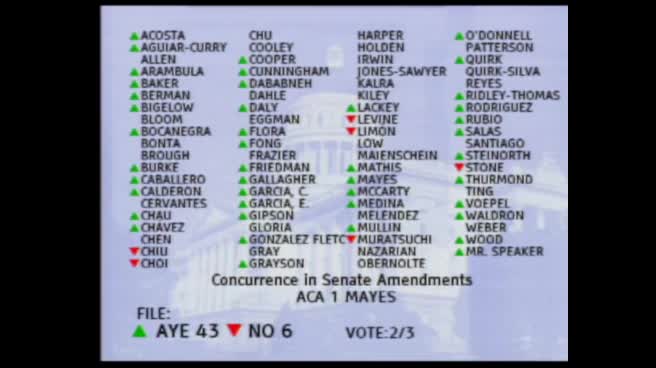 1H
Assembly Floor
 2H
Senate Standing Committee on Environmental Quality
 1H
Assembly Standing Committee on Natural Resources
 2MIN
Assembly Floor
 2MIN
Assembly Floor
 1H
Assembly Standing Committee on Appropriations
Bill Author



















Bill Co-Author(s):





