AB 44: Workers’ compensation: medical treatment: terrorist attacks: workplace violence.
- Session Year: 2017-2018
- House: Assembly
- Latest Version Date: 2017-10-13
Existing law establishes a workers compensation system, administered by the Administrative Director of the Division of Workers Compensation, to compensate an employee for injuries sustained in the course of his or her employment. Under existing law, an employer must provide reasonably required treatments, including, but not limited to, medical and surgical treatment, to cure or relieve an employees injuries sustained in the course of his or her employment.
This bill would require employers to provide immediate support from a nurse case manager to employees injured in the course of employment by an act of domestic terrorism, as defined, would require employer-appointed nurse case managers to assist claimants to obtain medically necessary medical treatments, as specified, and would require an employer to provide a prescribed notice to claimants, as specified. The bill would make its provisions applicable only if the Governor declares a state of emergency, as defined, in connection with the act of domestic terrorism.
This bill would make related legislative findings and declarations.
Existing law establishes a workers compensation system, administered by the Administrative Director of the Division of Workers Compensation, to compensate an employee for injuries sustained in the course of his or her employment. Under existing law, an employer must provide reasonably required treatments, including, but not limited to, medical and surgical treatment, to cure or relieve an employees injuries sustained in the course of his or her employment. Existing law requires an employer to establish a utilization review process to review, approve, modify, or deny a treatment claim.
This bill would require employers to provide immediately accessible advocacy services immediate support from a nurse case manager to employees injured in the course of employment by an act of domestic terrorism, as defined, would require employer-appointed advocates nurse case managers to assist employees and others claimants to obtain approval for medically necessary medical treatments, as specified, and would require an employer to provide a prescribed notice to claimants, as specified. The bill would make its provisions applicable only if the Governor declares a state of emergency, as defined, in connection with the act of domestic terrorism.
This bill would make related legislative findings and declarations.
Existing law establishes a workers compensation system, administered by the Administrative Director of the Division of Workers Compensation, to compensate an employee for injuries sustained in the course of his or her employment. Under existing law, an employer must provide reasonably required treatments, including, but not limited to, medical and surgical treatment, to cure or relieve an employees injuries sustained in the course of his or her employment. Existing law requires an employer to establish a utilization review process to review, approve, modify, or deny a treatment claim.
This bill would require employers to provide immediately accessible advocacy services to employees, including first responders, employees injured in the course of employment by an act of domestic terrorism, as defined, and would require employer-appointed advocates to assist employees and others to obtain approval for medical treatments, as specified. The bill would establish a disputable presumption that physician-requested treatment is appropriate, set parameters for approving or denying treatment, and create processes for when treatment is denied. The bill would apply retroactively to employees and first responders injured in an act of domestic terrorism before January 1, 2018. specified, and would require an employer to provide a prescribed notice to claimants, as specified. The bill would make its provisions applicable only if the Governor declares a state of emergency, as defined, in connection with the act of domestic terrorism.
Existing workers compensation law prohibits aggregate disability payments for a single injury occurring on or after April 19, 2004, causing temporary disability from extending for more than 104 compensable weeks, as specified. Existing law lists exempted injuries and conditions for which aggregate disability payments may be made for not more than 240 compensable weeks within a 5-year period.This bill would add injuries arising from an act of domestic terrorism to the list of injuries and conditions for which aggregate disability payments may be made for not more than 240 compensable weeks within a 5-year period.This bill would make related legislative findings and declarations.
Existing law establishes a workers compensation system, administered by the Administrative Director of the Division of Workers Compensation, to compensate an employee for injuries sustained in the course of his or her employment. Under existing law, an employer must provide reasonably required treatments, including, but not limited to, medical and surgical treatment, to cure or relieve an employees injuries sustained in the course of his or her employment. Existing law requires an employer to establish a utilization review process to review, approve, modify, or deny a treatment claim.
This bill would require employers to provide immediately accessible advocacy services to employees employees, including first responders, injured in the course of employment by an act of domestic terrorism, as defined, when the Governor has declared a state of emergency due to that act of domestic terrorism. and would require employer-appointed advocates to assist employees and others to obtain approval for medical treatments, as specified. The bill would establish a disputable presumption that physician-requested treatment is appropriate, set parameters for approving or denying treatment, and create processes for when treatment is denied. The bill would apply retroactively to employees and first responders injured in an act of domestic terrorism before January 1, 2018.
Existing workers compensation law prohibits aggregate disability payments for a single injury occurring on or after April 19, 2004, causing temporary disability from extending for more than 104 compensable weeks, as specified. Existing law lists exempted injuries and conditions for which aggregate disability payments may be made for not more than 240 compensable weeks within a 5-year period.
This bill would add injuries arising from an act of domestic terrorism to the list of injuries and conditions for which aggregate disability payments may be made for not more than 240 compensable weeks within a 5-year period.
Existing law establishes a workers compensation system, administered by the Administrative Director of the Division of Workers Compensation, to compensate an employee for injuries sustained in the course of his or her employment. Under existing law, an employer must provide reasonably required treatments, including, but not limited to, medical and surgical treatment, to cure or relieve an employees injuries sustained in the course of his or her employment.
This bill would require employers to provide immediately accessible advocacy services to employees injured in the course of employment by an act of domestic terrorism, as defined, when the Governor has declared a state of emergency due to that act of domestic terrorism.
Existing law establishes a workers compensation system, administered by the Administrative Director of the Division of Workers Compensation, to compensate an employee for injuries sustained in the course of his or her employment. Existing law requires every employer to establish a utilization review process, and defines utilization review as utilization review or utilization management functions that prospectively, retrospectively, or concurrently review and approve, modify, or deny, based in whole or in part on medical necessity to cure and relieve, treatment recommendations by physicians, prior to, retrospectively, or concurrent with providing medical treatment services. Existing law also provides for an independent medical review process to resolve disputes over utilization review decisions, as defined.This bill would exempt medical treatment for employees or first responders who sustain physical or psychological injury as a result of an act of terrorism or violence in the workplace, as defined, from the utilization review process and the independent medical review process, and would provide for an expedited proceeding before the Workers Compensation Appeals Board to resolve disputes regarding treatment. The bill would also apply retroactively to the employees and first responders injured in the San Bernardino terrorist attack of December 2, 2015, and any other employees or first responders injured by an act of terrorism or violence in the workplace that occurs prior to January 1, 2018.Existing workers compensation law generally requires employers to secure the payment of workers compensation, including medical treatment, for injuries incurred by their employees that arise out of, or in the course of, employment. Existing law prohibits aggregate disability payments for a single injury occurring on or after April 19, 2004, causing temporary disability from extending for more than 104 compensable weeks within a period of 2 years from the date of commencement of temporary disability payment. Existing law permits aggregate disability payments for certain injuries or conditions including, but not limited to, amputations, severe burns, and high-velocity eye injuries, to be made for not more than 240 compensable weeks within a period of 5 years from the date of the injury.This bill would add physical or psychological injury arising from an act of terrorism or violence in the workplace, as defined, to the list of injuries or conditions for which aggregate disability payments may be made for not more than 240 compensable weeks within a period of 5 years from the date of injury.Existing law establishes a workers compensation system, administered by the Administrative Director of the Division of Workers Compensation, to compensate an employee for injuries sustained in the course of his or her employment. Existing law requires every employer to establish a utilization review process, and defines utilization review as utilization review or utilization management functions that prospectively, retrospectively, or concurrently review and approve, modify, or deny, based in whole or in part on medical necessity to cure and relieve, treatment recommendations by physicians, prior to, retrospectively, or concurrent with providing medical treatment services. Existing law also provides for an independent medical review process to resolve disputes over utilization review decisions, as defined.
This bill would exempt medical treatment for employees or first responders who sustain physical or psychological injury as a result of an act of terrorism or violence in the workplace workplace, as defined, from the utilization review process and the independent medical review process, and would provide for an expedited proceeding before the Workers Compensation Appeals Board to resolve disputes regarding treatment. The bill would also apply retroactively to the employees and first responders injured in the San Bernardino terrorist attack of December 2, 2015, and any other employees or first responders injured by an act of terrorism or violence in the workplace that occurs prior to January 1, 2018.
Existing workers compensation law generally requires employers to secure the payment of workers compensation, including medical treatment, for injuries incurred by their employees that arise out of, or in the course of, employment. Existing law prohibits aggregate disability payments for a single injury occurring on or after April 19, 2004, causing temporary disability from extending for more than 104 compensable weeks within a period of 2 years from the date of commencement of temporary disability payment. Existing law permits aggregate disability payments for certain injuries or conditions including, but not limited to, amputations, severe burns, and high-velocity eye injuries, to be made for not more than 240 compensable weeks within a period of 5 years from the date of the injury.
This bill would add physical or psychological injury arising from an act of terrorism or violence in the workplace workplace, as defined, to the list of injuries on or conditions for which aggregate disability payments may be made for not more than 240 compensable weeks within a period of 5 years from the date of injury.
Existing law establishes a workers compensation system, administered by the Administrative Director of the Division of Workers Compensation, to compensate an employee for injuries sustained in the course of his or her employment. Existing law requires every employer to establish a utilization review process, and defines utilization review as utilization review or utilization management functions that prospectively, retrospectively, or concurrently review and approve, modify, or deny, based in whole or in part on medical necessity to cure and relieve, treatment recommendations by physicians, prior to, retrospectively, or concurrent with providing medical treatment services. Existing law also provides for an independent medical review process to resolve disputes over utilization review decisions, as defined.
This bill would exempt medical treatment for employees or first responders who sustain physical or psychological injury as a result of an act of terrorism or violence in the workplace from the utilization review process and the independent medical review process, and would provide for an expedited proceeding before the Workers Compensation Appeals Board to resolve disputes regarding treatment. The bill would also apply retroactively to the employees and first responders injured in the San Bernardino terrorist attack of December 2, 2015, and any other employees or first responders injured by an act of terrorism or violence in the workplace that occurs prior to January 1, 2018.
Existing workers compensation law generally requires employers to secure the payment of workers compensation, including medical treatment, for injuries incurred by their employees that arise out of, or in the course of, employment. Existing law prohibits aggregate disability payments for a single injury occurring on or after April 19, 2004, causing temporary disability from extending for more than 104 compensable weeks within a period of 2 years from the date of commencement of temporary disability payment. Existing law permits aggregate disability payments for certain injuries or conditions including, but not limited to, amputations, severe burns, and high-velocity eye injuries, to be made for not more than 240 compensable weeks within a period of 5 years from the date of the injury.
This bill would add physical or psychological injury arising from an act of terrorism or violence in the workplace to the list of injuries on conditions for which aggregate disability payments may be made for not more than 240 compensable weeks within a period of 5 years from the date of injury.
The Legislature finds and declares all of the following:
(a)Acts of domestic terrorism, such as the December 2, 2015, attack on the Inland Regional Center in San Bernardino, with the number and severity of the injuries inflicted upon people at work, can present unique issues for the workers compensation system.
(b)Victims of acts of domestic terrorism, as defined by Section 2331 of Title 18 of the United States Code, whose injuries arise out of and in the course of employment, are entitled to the full benefits of the workers compensation laws of this state, including medically necessary medical treatment, as defined by the medical treatment utilization schedule, for all accepted, diagnosed, physical and mental injuries, which may include counseling or other mental health services.
(c)Treatment provided to all injured workers, including mental health treatment and counseling services for psychological injuries and post-traumatic stress disorder, is provided by health care providers who are trained and qualified to treat those injuries, and providers who are not competent on the basis of training and experience to treat specific patients referred to the provider have a duty under existing law to refer the patient to a qualified provider.
(d)Because of the unique circumstances surrounding the number and severity of injuries that can be caused by a single act of domestic terrorism, and the extent to which the needs to provide this treatment quickly and comprehensively in potentially small service markets, it is appropriate to provide workers with injuries that result from an act of domestic terrorism with additional advocacy services, as provided by this bill.
SEC. 2.Section 4600.05 is added to the Labor Code, to read:4600.05.(a)An employer, as defined in Section 3300, shall provide immediate support from a nurse case manager for employees injured by an act of domestic terrorism, as defined in Section 2331 of Title 18 of the United States Code, whose injuries arise out of and in the course of employment, to assist injured employees in obtaining medically necessary medical treatment, as defined by the medical treatment utilization schedule adopted pursuant to Section 5307.27, and to assist providers of medical services in seeking authorization of medical treatment.
(b)(1)This section shall apply only if the Governor has declared a state of emergency pursuant to subdivision (b) of Section 8558 of the Government Code in connection with the act of domestic terrorism.
(2)Upon the issuance of a declaration pursuant to paragraph (1), an employer that has been notified of a claim for compensation arising out of the acts that resulted in the declaration shall provide a notice within three days to the claimant advising the claimant of medically necessary services provided pursuant to subdivision (a). In the case of a claim for compensation subject to this section that is filed after the declaration, the employer shall provide the notice to the claimant within three days. The notice shall be in the form adopted by the administrative director pursuant to subdivision (d).
(c)This section shall not alter the conditions for compensability of an injury, as described in Sections 3208.3 and 3600.
(d)The administrative director shall adopt regulations to implement this section, including, but not limited to, the definition of a nurse case managers qualifications, the scope and timing of immediate support from a nurse case manager, and the contents of the notice that employers shall provide to claimants.
The Legislature finds and declares all of the following:
(a)Domestic terrorist attacks, Acts of domestic terrorism, such as the December 2, 2015, attack on the Inland Regional Center in San Bernardino, with the number and severity of the injuries inflicted upon people at work, can present unique issues for the workers compensation system.
(b)Victims of acts of domestic terrorist attacks who are at work at the time of injury terrorism, as defined by Section 2331 of Title 18 of the United States Code, whose injuries arise out of and in the course of employment, are entitled to the full benefits of the workers compensation laws of this state, including treatment medically necessary medical treatment, as defined by the medical treatment utilization schedule, for all diagnosed accepted, diagnosed, physical and mental injuries to the full extent authorized by the law. injuries, which may include counseling or other mental health services.
(c)Treatment provided to all injured workers, including mental health treatment and counseling services for psychological injuries and post-traumatic stress disorder, is provided by health care providers who are trained and qualified to treat those injuries, and providers who are not competent on the basis of training and experience to treat specific patients referred to the provider have a duty under existing law to refer the patient to a qualified provider.
(d)Because of the unique circumstances surrounding the number and severity of injuries that can be caused by a single act of domestic terrorist act, terrorism, and the extent to which the needs to provide this treatment quickly and comprehensively in potentially small service markets, it is appropriate to provide workers with injuries that result from a an act of domestic terrorist attack terrorism with additional advocacy services, as provided by this bill.
SEC. 2.Section 4600.05 is added to the Labor Code, to read:4600.05.(a)All employers, An employer, as defined in Section 3300, shall provide immediately accessible advocacy services immediate support from a nurse case manager for employees injured in the course of employment by an act of domestic terrorism, as defined in Section 2331 of Title 18 of the United States Code, whose injuries arise out of and in the course of employment, to assist injured employees in obtaining medically necessary medical treatment treatment, as defined by the medical treatment utilization schedule adopted pursuant to Section 5307.27, and to assist providers of medical services in seeking authorization and payment of medical treatment. These advocacy services may be provided by the employer, the employers insurer, or the employers claims administrator.
(b)(1)This section shall apply only if the Governor has declared a state of emergency pursuant to subdivision (b) of Section 8558 of the Government Code in connection with the act of domestic terrorism.
(2)Upon the issuance of a declaration pursuant to paragraph (1), an employer that has a pending claim for compensation based on been notified of a claim for compensation arising out of the acts that resulted in the declaration shall provide a notice within three days to the claimant advising the claimant that of medically necessary services provided pursuant to subdivision (a) are available, and that counseling and mental health services for psychological injuries are among the benefits available to claimants. (a). In the case of a claim for compensation subject to this section that is filed after the declaration, the employer shall provide the notice to the claimant within three days. The notice shall be in the form adopted by the administrative director pursuant to subdivision (d).
(c)Nothing in this This section alters shall not alter the conditions for compensability of an injury, as described in Section 3600. Sections 3208.3 and 3600.
(d)The administrative director shall adopt regulations to implement this section. section, including, but not limited to, the definition of a nurse case managers qualifications, the scope and timing of immediate support from a nurse case manager, and the contents of the notice that employers shall provide to claimants.
The Legislature finds and declares all of the following:
(a)Domestic terrorist attacks, such as the December 2, 2015, attack on the Inland Regional Center in San Bernardino, with the number and severity of the injuries inflicted upon people at work, can present unique issues for the workers compensation system.
(b)Victims of domestic terrorist attacks who are at work at the time of injury are entitled to the full benefits of the workers compensation laws of this state, including treatment for all diagnosed physical and mental injuries to the full extent authorized by the law.
(c)Treatment provided to all injured workers, including mental health treatment and counseling services for psychological injuries and post-traumatic stress disorder, is provided by health care providers who are trained and qualified to treat those injuries, and providers who are not competent on the basis of training and experience to treat specific patients referred to the provider have a duty under existing law to refer the patient to a qualified provider.
(d)Because of the unique circumstances surrounding the number and severity of injuries that can be caused by a single domestic terrorist act, and the extent to which the needs to provide this treatment quickly and comprehensively in potentially small service markets, it is appropriate to provide workers with injuries that result from a domestic terrorist attack with additional advocacy services, as provided by this bill.
SECTION 1.SEC. 2.Section 4600.05 is added to the Labor Code, to read:4600.05.(a)All employers, as defined in Section 3300, shall provide immediately accessible advocacy services for employees, including first responders, employees injured in the course of employment by an act of domestic terrorism, as defined in Section 2331 of Title 18 of the United States Code, to assist injured employees in obtaining medical treatment and to assist providers of medical services in seeking authorization and payment of medical treatment. These advocacy services may be provided by the employer, the employers insurer, or the employers claims administrator.
(b)Medical treatment, including psychological counseling, requested by a physician treating an employee pursuant to subdivision (a) shall be presumed to be consistent with the guidelines adopted by the administrative director pursuant to Section 5307.27. This presumption is disputable and may be controverted by other evidence, but unless so controverted, the independent medical reviewer and the appeals board are bound to find in accordance with it. The absence of documentation is not sufficient to rebut this presumption if the documentation is in the possession of, or available to, the employer, the employers insurer, or the employers claims administrator.(c)The determination to authorize or deny requested medical treatment shall be made in a timely fashion that is appropriate for the nature of the employees condition, not to exceed five working days from the receipt of the request for authorization. If the treatment is denied, an independent medical review determination shall be issued no more than 45 days from the receipt of the request for authorization.(d)The advocate provided by the employer pursuant to subdivision (a) shall assist the employee, the employees physician, and the employees representative, if any, to obtain authorization for the requested medical treatment, shall ensure the independent medical review process described in subdivision (c) is initiated in a timely manner, and shall provide the independent medical reviewer a narrative explaining why the treatment should be authorized, including citing relevant medical records.(e)If the treatment is denied, or if the employer, insurer, or advocate provided by the employer pursuant to subdivision (a) fails to meet the timeframes or any other requirements of this section, the appeals board shall determine whether the requested treatment and all subsequently requested treatment and all subsequently requested treatment is medically necessary. An expedited hearing shall be held and the determination shall be made and filed within 30 days after the declaration of readiness is filed.(f)This section is not intended to alter the conditions for compensability of an injury, as defined in Section 3600.(g)The time limits in this section are mandatory. To the extent that the provisions of this section conflict with the provisions of Sections 4610 and 4610.5, the provisions in this section shall control.(h)The administrative director shall adopt regulations to implement this section no later than July 1, 2018.(i)This section, and subparagraph (J) of paragraph (3) of subdivision (c) of Section 4656 shall apply retroactively to the employees and first responders injured in the terrorist attack in San Bernardino on December 2, 2015, and any other employees or first responders injured by an act of domestic terrorism that occurred before January 1, 2018.(b)(1)This section shall apply only if the Governor has declared a state of emergency pursuant to subdivision (b) of Section 8558 of the Government Code in connection with the act of domestic terrorism.
(2)Upon the issuance of a declaration pursuant to paragraph (1), an employer that has a pending claim for compensation based on the acts that resulted in the declaration shall provide a notice within three days to the claimant advising the claimant that services provided pursuant to subdivision (a) are available, and that counseling and mental health services for psychological injuries are among the benefits available to claimants. In the case of a claim subject to this section that is filed after the declaration, the employer shall provide the notice to the claimant within three days. The notice shall be in the form adopted by the administrative director pursuant to subdivision (d).
(c)Nothing in this section alters the conditions for compensability of an injury, as described in Section 3600.
(d)The administrative director shall adopt regulations to implement this section.
SEC. 2.Section 4656 of the Labor Code is amended to read:4656.(a)Aggregate disability payments for a single injury occurring prior to January 1, 1979, causing temporary disability shall not extend for more than 240 compensable weeks within a period of five years from the date of the injury.(b)Aggregate disability payments for a single injury occurring on or after January 1, 1979, and prior to April 19, 2004, causing temporary partial disability shall not extend for more than 240 compensable weeks within a period of five years from the date of the injury.(c)(1)Aggregate disability payments for a single injury occurring on or after April 19, 2004, causing temporary disability shall not extend for more than 104 compensable weeks within a period of two years from the date of commencement of temporary disability payment.(2)Aggregate disability payments for a single injury occurring on or after January 1, 2008, causing temporary disability shall not extend for more than 104 compensable weeks within a period of five years from the date of injury.(3)Notwithstanding paragraphs (1) and (2), for an employee who suffers from the following injuries or conditions, aggregate disability payments for a single injury occurring on or after April 19, 2004, causing temporary disability shall not extend for more than 240 compensable weeks within a period of five years from the date of the injury:(A)Acute and chronic hepatitis B.(B)Acute and chronic hepatitis C.(C)Amputations.(D)Severe burns.(E)Human immunodeficiency virus (HIV).(F)High-velocity eye injuries.(G)Chemical burns to the eyes.(H)Pulmonary fibrosis.(I)Chronic lung disease.(J)Injuries arising from an act of domestic terrorism, as described in Section 4600.05.(a)All employers, as defined in Section 3300, shall provide immediately accessible advocacy services for employees employees, including first responders, injured in the course of employment by an act of domestic terrorism, as defined in Section 2331 of Title 18 of the United States Code, to assist injured employees in obtaining medical treatment and to assist providers of medical services in seeking authorization and payment of medical treatment. These advocacy services may be provided by the employer, the employers insurer, or the employers claims administrator.
(b)This section shall apply only when the Governor has declared a state of emergency pursuant to subdivision (b) of Section 8558 of the Government Code in connection with the act of domestic terrorism.(b)Medical treatment, including psychological counseling, requested by a physician treating an employee pursuant to subdivision (a) shall be presumed to be consistent with the guidelines adopted by the administrative director pursuant to Section 5307.27. This presumption is disputable and may be controverted by other evidence, but unless so controverted, the independent medical reviewer and the appeals board are bound to find in accordance with it. The absence of documentation is not sufficient to rebut this presumption if the documentation is in the possession of, or available to, the employer, the employers insurer, or the employers claims administrator.
(c)The determination to authorize or deny requested medical treatment shall be made in a timely fashion that is appropriate for the nature of the employees condition, not to exceed five working days from the receipt of the request for authorization. If the treatment is denied, an independent medical review determination shall be issued no more than 45 days from the receipt of the request for authorization.
(d)The advocate provided by the employer pursuant to subdivision (a) shall assist the employee, the employees physician, and the employees representative, if any, to obtain authorization for the requested medical treatment, shall ensure the independent medical review process described in subdivision (c) is initiated in a timely manner, and shall provide the independent medical reviewer a narrative explaining why the treatment should be authorized, including citing relevant medical records.
(e)If the treatment is denied, or if the employer, insurer, or advocate provided by the employer pursuant to subdivision (a) fails to meet the timeframes or any other requirements of this section, the appeals board shall determine whether the requested treatment and all subsequently requested treatment and all subsequently requested treatment is medically necessary. An expedited hearing shall be held and the determination shall be made and filed within 30 days after the declaration of readiness is filed.
(c)Nothing in this section is(f)This section is not intended to alter the conditions for compensability of an injury, as defined in Section 3600.
(g)The time limits in this section are mandatory. To the extent that the provisions of this section conflict with the provisions of Sections 4610 and 4610.5, the provisions in this section shall control.
(d)(h)The administrative director shall adopt regulations to implement this section. section no later than July 1, 2018.
(i)This section, and subparagraph (J) of paragraph (3) of subdivision (c) of Section 4656 shall apply retroactively to the employees and first responders injured in the terrorist attack in San Bernardino on December 2, 2015, and any other employees or first responders injured by an act of domestic terrorism that occurred before January 1, 2018.
SEC. 2.Section 4656 of the Labor Code is amended to read:4656.(a)Aggregate disability payments for a single injury occurring prior to January 1, 1979, causing temporary disability shall not extend for more than 240 compensable weeks within a period of five years from the date of the injury.
(b)Aggregate disability payments for a single injury occurring on or after January 1, 1979, and prior to April 19, 2004, causing temporary partial disability shall not extend for more than 240 compensable weeks within a period of five years from the date of the injury.
(c)(1)Aggregate disability payments for a single injury occurring on or after April 19, 2004, causing temporary disability shall not extend for more than 104 compensable weeks within a period of two years from the date of commencement of temporary disability payment.
(2)Aggregate disability payments for a single injury occurring on or after January 1, 2008, causing temporary disability shall not extend for more than 104 compensable weeks within a period of five years from the date of injury.
(3)Notwithstanding paragraphs (1) and (2), for an employee who suffers from the following injuries or conditions, aggregate disability payments for a single injury occurring on or after April 19, 2004, causing temporary disability shall not extend for more than 240 compensable weeks within a period of five years from the date of the injury:
(A)Acute and chronic hepatitis B.
(B)Acute and chronic hepatitis C.
(C)Amputations.
(D)Severe burns.
(E)Human immunodeficiency virus (HIV).
(F)High-velocity eye injuries.
(G)Chemical burns to the eyes.
(H)Pulmonary fibrosis.
(I)Chronic lung disease.
(J)Injuries arising from an act of domestic terrorism, as described in Section 4600.05.
(a)All employers, as defined in Section 3300, shall provide immediately accessible advocacy services for employees injured in the course of employment by an act of domestic terrorism, as defined in Section 2331 of Title 18 of the United States Code, to assist injured employees in obtaining medical treatment and to assist providers of medical services in seeking authorization and payment of medical treatment. These advocacy services may be provided by the employer, the employers insurer, or the employers claims administrator.
(b)This section shall apply only when the Governor has declared a state of emergency pursuant to subdivision (b) of Section 8558 of the Government Code in connection with the act of domestic terrorism.
(c)Nothing in this section is intended to alter the conditions for compensability of an injury, as defined in Section 3600.
(d)The administrative director shall adopt regulations to implement this section.
SECTION 1.Section 4610.7 is added to the Labor Code, to read:4610.7.(a)Sections 4610 and 4610.5 shall not apply to medical treatment for an employee or first responder who sustains physical or psychological injury as a result of an act of terrorism or violence in the workplace.(b)Disputes regarding treatment under this section shall be decided in an expedited proceeding, within 30 days after the declaration of readiness is filed, with a determination as to the rights of the parties made and served by the Workers Compensation Appeals Board.(c)This section shall apply retroactively to the employees and first responders injured in the San Bernardino terrorist attack of December 2, 2015, and any other employees or first responders injured by an act of terrorism or violence in the workplace that occurred prior to January 1, 2018.(d)For purposes of this section, the following terms have the following meanings:(1)Act of terrorism is the unlawful use of force and violence against persons or property to intimidate or coerce a government, the civilian population, or any segment thereof, in furtherance of political or social objectives.(2)Violence in the workplace means an assault against a person with a firearm or other dangerous weapon that results in serious bodily harm or psychological injury.SEC. 2.Section 4656 of the Labor Code is amended to read:4656.(a)Aggregate disability payments for a single injury occurring prior to January 1, 1979, causing temporary disability shall not extend for more than 240 compensable weeks within a period of five years from the date of the injury.(b)Aggregate disability payments for a single injury occurring on or after January 1, 1979, and prior to April 19, 2004, causing temporary partial disability shall not extend for more than 240 compensable weeks within a period of five years from the date of the injury.(c)(1)Aggregate disability payments for a single injury occurring on or after April 19, 2004, causing temporary disability shall not extend for more than 104 compensable weeks within a period of two years from the date of commencement of temporary disability payment.(2)Aggregate disability payments for a single injury occurring on or after January 1, 2008, causing temporary disability shall not extend for more than 104 compensable weeks within a period of five years from the date of injury.(3)Notwithstanding paragraphs (1) and (2), for an employee who suffers from the following injuries or conditions, aggregate disability payments for a single injury occurring on or after April 19, 2004, causing temporary disability shall not extend for more than 240 compensable weeks within a period of five years from the date of the injury:(A)Acute and chronic hepatitis B.(B)Acute and chronic hepatitis C.(C)Amputations.(D)Severe burns.(E)Human immunodeficiency virus (HIV).(F)High-velocity eye injuries.(G)Chemical burns to the eyes.(H)Pulmonary fibrosis.(I)Chronic lung disease.(J)Physical or psychological injury arising from an act of terrorism or violence in the workplace.(4)For purposes of this subdivision, the following terms have the following meanings:(A)Act of terrorism is the unlawful use of force and violence against persons or property to intimidate or coerce a government, the civilian population, or any segment thereof, in furtherance of political or social objectives.(B)Violence in the workplace means an assault against a person with a firearm or other dangerous weapon that results in serious bodily harm or psychological injury.(a)Sections 4610 and 4610.5 shall not apply to medical treatment for an employee or first responder who sustains physical or psychological injury as a result of an act of terrorism or violence in the workplace.
(b)Disputes regarding treatment under this section shall be decided in an expedited proceeding, within 30 days after the declaration of readiness is filed, with a determination as to the rights of the parties made and served by the Workers Compensation Appeals Board.
(c)This section shall apply retroactively to the employees and first responders injured in the San Bernardino terrorist attack of December 2, 2015, and any other employees or first responders injured by an act of terrorism or violence in the workplace that occurred prior to January 1, 2018.
(d)For purposes of this section, the following terms have the following meanings:
(1)Act of terrorism is the unlawful use of force and violence against persons or property to intimidate or coerce a government, the civilian population, or any segment thereof, in furtherance of political or social objectives.
(2)Violence in the workplace means an assault against a person with a firearm or other dangerous weapon that results in serious bodily harm or psychological injury.
SEC. 2.Section 4656 of the Labor Code is amended to read:4656.(a)Aggregate disability payments for a single injury occurring prior to January 1, 1979, causing temporary disability shall not extend for more than 240 compensable weeks within a period of five years from the date of the injury.
(b)Aggregate disability payments for a single injury occurring on or after January 1, 1979, and prior to April 19, 2004, causing temporary partial disability shall not extend for more than 240 compensable weeks within a period of five years from the date of the injury.
(c)(1)Aggregate disability payments for a single injury occurring on or after April 19, 2004, causing temporary disability shall not extend for more than 104 compensable weeks within a period of two years from the date of commencement of temporary disability payment.
(2)Aggregate disability payments for a single injury occurring on or after January 1, 2008, causing temporary disability shall not extend for more than 104 compensable weeks within a period of five years from the date of injury.
(3)Notwithstanding paragraphs (1) and (2), for an employee who suffers from the following injuries or conditions, aggregate disability payments for a single injury occurring on or after April 19, 2004, causing temporary disability shall not extend for more than 240 compensable weeks within a period of five years from the date of the injury:
(A)Acute and chronic hepatitis B.
(B)Acute and chronic hepatitis C.
(C)Amputations.
(D)Severe burns.
(E)Human immunodeficiency virus (HIV).
(F)High-velocity eye injuries.
(G)Chemical burns to the eyes.
(H)Pulmonary fibrosis.
(I)Chronic lung disease.
(J)Physical or psychological injury arising from an act of terrorism or violence in the workplace.
(4)For purposes of this subdivision, the following terms have the following meanings:
(A)Act of terrorism is the unlawful use of force and violence against persons or property to intimidate or coerce a government, the civilian population, or any segment thereof, in furtherance of political or social objectives.
(B)Violence in the workplace means an assault against a person with a firearm or other dangerous weapon that results in serious bodily harm or psychological injury.
(a)Sections 4610 and 4610.5 shall not apply to medical treatment for an employee or first responder who sustains physical or psychological injury as a result of an act of terrorism or violence in the workplace.
(b)Disputes regarding treatment under this section shall be decided in an expedited proceeding, within 30 days after the declaration of readiness is filed, with a determination as to the rights of the parties made and served by the Workers Compensation Appeals Board.
(c)This section shall apply retroactively to the employees and first responders injured in the San Bernardino terrorist attack of December 2, 2015, and any other employees or first responders injured by an act of terrorism or violence in the workplace that occurred prior to January 1, 2018.
SEC. 2.Section 4656 of the Labor Code is amended to read:4656.(a)Aggregate disability payments for a single injury occurring prior to January 1, 1979, causing temporary disability shall not extend for more than 240 compensable weeks within a period of five years from the date of the injury.
(b)Aggregate disability payments for a single injury occurring on or after January 1, 1979, and prior to April 19, 2004, causing temporary partial disability shall not extend for more than 240 compensable weeks within a period of five years from the date of the injury.
(c)(1)Aggregate disability payments for a single injury occurring on or after April 19, 2004, causing temporary disability shall not extend for more than 104 compensable weeks within a period of two years from the date of commencement of temporary disability payment.
(2)Aggregate disability payments for a single injury occurring on or after January 1, 2008, causing temporary disability shall not extend for more than 104 compensable weeks within a period of five years from the date of injury.
(3)Notwithstanding paragraphs (1) and (2), for an employee who suffers from the following injuries or conditions, aggregate disability payments for a single injury occurring on or after April 19, 2004, causing temporary disability shall not extend for more than 240 compensable weeks within a period of five years from the date of the injury:
(A)Acute and chronic hepatitis B.
(B)Acute and chronic hepatitis C.
(C)Amputations.
(D)Severe burns.
(E)Human immunodeficiency virus (HIV).
(F)High-velocity eye injuries.
(G)Chemical burns to the eyes.
(H)Pulmonary fibrosis.
(I)Chronic lung disease.
(J)Physical or psychological injury arising from an act of terrorism or violence in the workplace.
|
Date
|
Status
|
|---|---|
| Oct 13, 2017 | Chaptered by Secretary of State - Chapter 736, Statutes of 2017. |
| Oct 13, 2017 | Approved by the Governor. |
| Sep 20, 2017 | Enrolled and presented to the Governor at 4:30 p.m. |
| Sep 13, 2017 | Assembly Rule 77(a) suspended. |
| Sep 13, 2017 | In Assembly. Concurrence in Senate amendments pending. May be considered on or after September 15 pursuant to Assembly Rule 77. |
| Sep 12, 2017 | Read third time. Passed. Ordered to the Assembly. |
| Sep 11, 2017 | Read second time. Ordered to third reading. |
| Sep 7, 2017 | Read third time and amended. Ordered to second reading. |
| Aug 22, 2017 | Read second time. Ordered to third reading. |
| Aug 21, 2017 | From committee: Be ordered to second reading pursuant to Senate Rule 28.8. |
| Jul 17, 2017 | Read second time and amended. Re-referred to Com. on APPR. |
| Jul 13, 2017 | From committee: Amend, and do pass as amended and re-refer to Com. on APPR. (Ayes 5. Noes 0.) (July 12). |
| Jun 29, 2017 | From committee chair, with author's amendments: Amend, and re-refer to committee. Read second time, amended, and re-referred to Com. on L. & I.R. |
| Jul 10, 2017 | Joint Rule 62(a) suspended. (Page 1930.) |
| Jun 29, 2017 | In committee: Hearing postponed by committee. |
| Jun 20, 2017 | In committee: Set, first hearing. Hearing canceled at the request of author. |
| Jun 1, 2017 | In committee: Hearing postponed by committee. |
| May 24, 2017 | Referred to Com. on L. & I.R. |
| May 11, 2017 | In Senate. Read first time. To Com. on RLS. for assignment. |
| May 11, 2017 | Read third time. Passed. Ordered to the Senate. (Ayes 77. Noes 0. Page 1486.) |
| May 4, 2017 | Read second time. Ordered to Consent Calendar. |
| May 3, 2017 | From committee: Do pass. To Consent Calendar. (Ayes 16. Noes 0.) (May 3). |
| Apr 24, 2017 | Re-referred to Com. on APPR. |
| Apr 20, 2017 | Read second time and amended. |
| Apr 19, 2017 | From committee: Amend, and do pass as amended and re-refer to Com. on APPR. (Ayes 13. Noes 0.) (April 19). |
| Apr 17, 2017 | Re-referred to Com. on INS. |
| Apr 6, 2017 | From committee chair, with author's amendments: Amend, and re-refer to Com. on INS. Read second time and amended. |
| Jan 19, 2017 | Referred to Com. on INS. |
| Dec 6, 2016 | From printer. May be heard in committee January 5. |
| Dec 5, 2016 | Read first time. To print. |
|
Date
|
Description
|
Location
|
Votes
|
|
|---|---|---|---|---|
| Sep 13, 2017 | AB 44 Reyes Concurrence in Senate Amendments | Assembly Floor |
Passed |
|
| Sep 12, 2017 | Assembly 3rd Reading AB44 Reyes et al. By Leyva | Senate Floor |
Passed |
|
| Jul 12, 2017 | Do pass as amended, but first amend, and re-refer to the Committee on [Appropriations] | Senate Standing Committee on Labor and Industrial Relations |
Passed |
|
| May 11, 2017 | AB 44 REYES Consent Calendar Second Day Regular Session | Assembly Floor |
Passed |
|
| May 3, 2017 | Do pass. To Consent Calendar. | Assembly Standing Committee on Appropriations |
Passed |
|
| Apr 19, 2017 | Do pass as amended and be re-referred to the Committee on [Appropriations] | Assembly Standing Committee on Insurance |
Passed |
This list shows positions taken on this bill by organizations on the date displayed, which is linked to the original source.
Positions by individuals are not included.
|
Organization
|
Position
|
Date
|
|---|---|---|
| Acclamation Insurance Management Services | ** Against | Apr 18, 2017 |
| Allied Managed Care | ** Against | Apr 18, 2017 |
| American Insurance Association | ** Against | Apr 18, 2017 |
| Association Of California Insurance Companies | * Indeterminate | Apr 19, 2017 |
| Association of California of Insurance Companies | ** Against | Apr 18, 2017 |
| California Applicants' Attorneys Association | ** Support | Sep 9, 2017 |
| California Association Of Joint Powers Authorities | * Indeterminate | Apr 19, 2017 |
| California Chamber Of Commerce | ** Against | Apr 18, 2017 |
| California Coalition On Workers Compensation | * Indeterminate | Apr 19, 2017 |
| California Highway Patrol Association | * Support | Apr 19, 2017 |
| California Physical Therapy Association | ** Support | Apr 18, 2017 |
| California Professional Firefighters | ** Support | Sep 9, 2017 |
| California Society Of Industrial Medicine And Surgery | ** Support | Sep 9, 2017 |
| California State Association of Countries | * Indeterminate | Apr 19, 2017 |
| California Teamsters Public Affairs Council | ** Support | Sep 9, 2017 |
| County of San Bernardino | * Support | Apr 19, 2017 |
| League Of California Cities | ** Against | Apr 18, 2017 |
| Liberty Mutual Group | * Indeterminate | Apr 19, 2017 |
| Los Angeles County Professional Peace Officers Association | ** Support | Sep 9, 2017 |
| National Association of Mutual Insurance Companies | ** Against | Apr 18, 2017 |
| Peach officers Research Association of California | ** Support | Apr 18, 2017 |
| pease officers research association of california | ** Support | Sep 9, 2017 |
| San Diego County Court Employees Association | ** Support | Sep 9, 2017 |
| San Luis Obispo County Employees Association | ** Support | Sep 9, 2017 |
| the city of vista | ** Against | Jul 10, 2017 |
| The Organization of SMUD Employees | ** Support | Sep 9, 2017 |
| Zenith Insurance Company | * Indeterminate | Apr 19, 2017 |
CONCURRENCE IN SENATE AMENDMENTS
CSA1 Bill Id:AB 44
Author:(Reyes)
As Amended Ver:September 7, 2017
Majority vote
ASSEMBLY: | 77-0 | (May 11, 2017) | SENATE: | 40-0 | (September 12, 2017) |
Original Committee Reference: INS.
SUMMARY: Requires employers to provide nurse case manager services to employees who are injured as a result of an act of domestic terrorism.
The Senate amendments:
- Add legislative findings and declarations.
- Specify that the services to be provided to employees injured by an act of domestic terrorism must be provided by a nurse case manager.
- Clarify the timing of notices that the employer must provide to these employees.
- Expand the requirements on the Administrative Director of the Division or Workers' Compensation to include defining the qualifications of the nurse case manager, the scope of required nurse case manager services, and the contents of the notices.
- Adds additional technical and conforming amendments.
FISCAL EFFECT: According to the Senate Appropriations Committee, pursuant to Senate Rule 28.8, negligible state costs.
COMMENTS: The Senate amendments reflect refinements to the bill passed by the Assembly proposed by the Administration.
Analysis Prepared by: Mark Rakich / INS. / (916) 319-2086 FN: 0002179
Office of Senate Floor Analyses (916) 651-1520 Fax: (916) 327-4478 | AB |
THIRD READING
Bill No: AB 44
Amended: 9/7/17 in Senate
SENATE LABOR & IND. REL. COMMITTEE: 5-0, 7/12/17
AYES: Bradford, Stone, Atkins, Jackson, Mitchell
SENATE APPROPRIATIONS COMMITTEE: Senate Rule 28.8
ASSEMBLY FLOOR: 77-0, 5/11/17 (Consent) - See last page for vote
DIGEST:
This bill requires that advocacy services for injured workers who suffered an industrial injury due to an act of domestic terrorism.
Senate Floor Amendments of 9/7/17 provide nurse case managers in the event of an act of domestic terrorism for injured workers.
Existing law:
- Establishes a workers’ compensation system that provides benefits to an employee who suffers from an injury or illness that arises out of and in the course of employment, irrespective of fault. This system requires all employers to secure payment of benefits by either securing the consent of the Department of Industrial Relations (DIR) to self-insure or by securing insurance against liability from an insurance company duly authorized by the state.
- Provides that medical, surgical, chiropractic, acupuncture, and hospital treatment, including nursing, medicines, medical and surgical supplies, crutches, and apparatuses, including orthotic and prosthetic devices and services, that is reasonably required to cure or relieve the injured worker from the effects of his or her injury shall be provided by the employer. (Labor Code §4600)
- Requires the administrative director of the Division of Workers’ Compensation to create a Medical Treatment Utilization Schedule (MTUS), which is evidence-based, peer reviewed, and addresses, at a minimum, the frequency, duration, intensity, and appropriateness of all treatment procedures and modalities commonly performed in workers’ compensation cases. The MTUS is presumed to be correct, unless rebutted by a preponderance of evidence. (Labor Code §§5307.27 and 4604.5)
- Requires that all employers create a utilization review process, which is a process that prospectively, retrospectively, or concurrently review and approve, modify, delay, or deny, based in whole or in part on medical necessity to cure and relieve, treatment recommendations by physicians, prior to, retrospectively, or concurrent with the provision of medical treatment services. (Labor Code §4610)
- Provides that, with respect to medical treatment that is provided through a medical provider network (MPN), a health care organization (HCO), other employer directed provider, or a pre-designated physician, no prospective Utilization Review (UR) may be undertaken for the first 30 days of treatment, with specific exceptions. This provision does not take effect until January 1, 2018. (Labor Code §4610)
- Requires any UR organization to obtain accreditation from an accrediting entity specified by the Division of Workers’ Compensation (DWC), subject to exceptions for certain public entities that have internal systems approved by the DWC. The accreditation entity must be independent and non-profit. Until the rules are approved by the Administrative Director, the accreditation entity will be URAC. This provision does not take effect until January 1, 2018. (Labor Code §4610)
- Prohibits, explicitly, an employer or claims administrator from providing a UR organization with financial incentives to deny or modify treatment, requires financial interest disclosure of UR entities be shared with the Division of Workers’ Compensation (DWC), and requires an explicit policy preventing financial incentives to doctors or providers for the purposes of UR accreditation. This provision does not take effect until January 1, 2018. (Labor Code §4610)
This bill:
- Requires employers provide immediate support from a nurse case manager for employees injured in the course of employment by an act of domestic terrorism to assist injured employees in obtaining necessary medical treatment and to assist providers of medical services in seeking authorization and payment of medical treatment, which may include counseling and other mental health services.
- Defines “domestic terrorism” as activities that are dangerous acts that violate the law, occur in the United States, and appear to be intended to either intimidate or coerce a civilian population, influence the policy of a government by intimidation or coercion, or to affect the conduct of a government by mass destruction, assassination, or kidnapping.
- Provides that the above provisions apply only when the Governor has declared a state of emergency in connection with the act of domestic terrorism.
- Requires that the administrative director adopts regulations to implement this section including, but not limited to, the definition of a nurse case manager’s qualifications, the scope and timing of immediate support from a nurse case manager, and the contents of the notice that employers shall provide to claimants.
- Makes findings and declarations on the 2015 domestic terror attack in San Bernardino, California.
Comments
What is Utilization Review? In California’s workers’ compensation system, an employer or insurer cannot deny treatment. When an employer or insurer receives a request for medical treatment, the employer or insurer can either approve the treatment or, if the employer or insurer believes that a physician’s request for treatment is medically unnecessary or harmful, the employer or insurer must send the request to Utilization Review (see State Compensation Insurance Fund v. WCAB (Sandhagen), 44 CAL. 4TH 230 (2008)).
Utilization Review (UR) is the formal review process for medical treatment recommendations by physicians to see if the request for medical treatment is medically necessary. The full UR process varies by vendor, but it generally involves initial review by a non-physician, with higher level review(s) being conducted by a physician or physicians. Only a licensed physician who is competent to evaluate the specific clinical issues involved in the medical treatment services may modify, delay, or deny a request for medical treatment. If the UR physician does modify, delay, or deny the medical treatment, then the injured worker can appeal the decision to Independent Medical Review (IMR), which is a binding determination on medical necessity conducted by an independent, anonymous physician.
Taken together, the UR process and IMR process evince a single, coherent philosophy: medical disputes should be resolved by physicians and physicians alone. Not by judges or attorneys or claims adjusters or non-medically trained stakeholder. For the sake of fairness and equity to both injured workers and employers, the current system takes medical disputes out of the arbitrary and capricious world of litigation and places it four-square in an evidence-based, necessity-driven dispute resolution process.
UR by the Numbers: Recent Research on the Medical Dispute Process. Recently, UR has come under some scrutiny by stakeholders, many of whom argue that it is leading to a significant number of injured workers being denied care. This claim, however, is not currently supported by the data. In a 2015 report by the California Workers’ Compensation Institute (CWCI) to the Senate Labor and Industrial Relations Committee, CWCI found that only approximately 25% of medical treatment requests go through UR, with approximately 75% of the medical treatment requests approved. Once the approvals from UR and Independent Medical Review (IMR) are included, more than 94% of treatment is approved OVERALL in California’s workers’ compensation system.
However, even this high level of approval obscures the rarity of denied treatment. This is because medical disputes are not evenly distributed among providers: rather, medical disputes are highly concentrated among a small group of medical providers.
Specifically, research from CWCI shows that out of a population of 43,000 providers:
- In 2015-16, 9% of all utilization review (UR) decisions came from 10 individuals and the top 4% of providers account for 64% of all UR decisions.
- In 2015-16, 11% of all Independent Medical Review (IMR) decisions came from 10 individuals, and the top 4% of providers (499 individuals) account for 72% of all IMR decisions. 250 providers account for 58% of all IMR decisions.
This may suggest that, rather than a systemic phenomenon, medical disputes in the workers’ compensation system are a unique, concentrated phenomenon for a small group of medical providers.
The San Bernardino Terror Attack and UR: In response to media reports and constituent inquiries on denied care related to the San Bernardino terror attack, the Department of Industrial Relations conducted a holistic review of all treatment that had been provided and disputed related to the attack. As of the beginning of this year, when combining initial treatment approvals with UR decision approvals on treatment, the breakdown on approved, modified, and delayed treatment is as follows:
Total Approved: 90% (1,927 treatment decisions)
Modified Approval: 3% (73 treatment decisions)
Denied: 7% (144 treatment decisions)
Regarding the numbers above, the DIR report states the following:
“Without access to UR files and decisions it is difficult to make assumptions about what caused some requests to be accepted and others to be modified or denied by the County. However, a review of the IMR decisions, which are available, offers some insight. Typically, the problem identified in IMR decisions was a provider’s failure to provide an adequate clinical rationale or appropriate documentation to justify requests for extended or new prescriptions, extended or alternative therapies, or special equipment that veered away from standard medical treatment guidelines and limits. There also appear to have been a fair number of duplicate or overlapping requests. The fact that several requests were denied and then authorized upon further review suggests that better communication by providers to the County’s claims administrators and better documentation at the time requests were first submitted might have reduced the number of UR denials and IMR requests.”
AB 44 is designed to build off of the findings of the report and existing practices followed by San Bernardino County to require advocacy services in the event of a domestic terror attack to speed up treatment and minimize delays and denials of medical treatment through superior communication and coordination between medical providers and the employer.
FISCAL EFFECT: Appropriation: Fiscal Com.: Local:
American Federation of State, County and Municipal Employees, AFL-CIO
California Applicants’ Attorneys Association
California Professional Firefighters
California Society of Industrial Medicine and Surgery
California Teamsters Public Affairs Council
Los Angeles County Professional Peace Officers Association
Pease Officers Research Association of California
San Diego County Court Employees Association
San Luis Obispo County Employees Association
The Organization of SMUD Employees
OPPOSITION: (Verified 8/22/17)
None received
ARGUMENTS IN SUPPORT: Proponents note that the 2015 San Bernardino Terror Attack was a deeply traumatic experience for dozens of workers, necessitating both physical and psychological treatment through California’s workers’ compensation system. Proponents cite media reports which reported significant delays for injured workers, which proponents argue is profoundly unfair to the injured workers. Proponents believe that AB 44 will prevent similar challenges by requiring advocacy services in the event of a domestic terror attack, ensuring prompt and timely medical care. Proponents argue that such advocacy services, which could include a nurse case manager or ombudsman, will ensure that workers receive the care they need to return to work after injuries due to terrorist attacks.
ASSEMBLY FLOOR: 77-0, 5/11/17
AYES: Acosta, Aguiar-Curry, Travis Allen, Arambula, Baker, Berman, Bigelow, Bloom, Bocanegra, Bonta, Brough, Burke, Caballero, Calderon, Cervantes, Chau, Chávez, Chen, Chiu, Choi, Chu, Cooley, Cooper, Cunningham, Dababneh, Daly, Eggman, Flora, Fong, Frazier, Friedman, Gallagher, Cristina Garcia, Eduardo Garcia, Gipson, Gloria, Gomez, Gonzalez Fletcher, Gray, Grayson, Harper, Holden, Irwin, Jones-Sawyer, Kalra, Kiley, Lackey, Levine, Limón, Low, Maienschein, Mathis, Mayes, McCarty, Medina, Melendez, Mullin, Muratsuchi, Nazarian, Obernolte, Quirk, Quirk-Silva, Reyes, Ridley-Thomas, Rodriguez, Rubio, Salas, Santiago, Steinorth, Mark Stone, Thurmond,
Ting, Voepel, Waldron, Weber, Wood, Rendon
NO VOTE RECORDED: Dahle, O'Donnell, Patterson
9/9/17 13:52:25
**** END ****
Office of Senate Floor Analyses (916) 651-1520 Fax: (916) 327-4478 | AB |
THIRD READING
Bill No: AB 44
:
SENATE LABOR & IND. REL. COMMITTEE: 5-0, 7/12/17
AYES: Bradford, Stone, Atkins, Jackson, Mitchell
SENATE APPROPRIATIONS COMMITTEE: Senate Rule 28.8
ASSEMBLY FLOOR: 77-0, 5/11/17 (Consent) - See last page for vote
DIGEST:
This bill requires that advocacy services for injured workers who suffered an industrial injury due to an act of domestic terrorism.
Existing law:
- Establishes a workers’ compensation system that provides benefits to an employee who suffers from an injury or illness that arises out of and in the course of employment, irrespective of fault. This system requires all employers to secure payment of benefits by either securing the consent of the Department of Industrial Relations (DIR) to self-insure or by securing insurance against liability from an insurance company duly authorized by the state.
- Provides that medical, surgical, chiropractic, acupuncture, and hospital treatment, including nursing, medicines, medical and surgical supplies, crutches, and apparatuses, including orthotic and prosthetic devices and services, that is reasonably required to cure or relieve the injured worker from the effects of his or her injury shall be provided by the employer. (Labor Code §4600)
- Requires the administrative director of the Division of Workers’ Compensation to create a Medical Treatment Utilization Schedule (MTUS), which is evidence-based, peer reviewed, and addresses, at a minimum, the frequency, duration, intensity, and appropriateness of all treatment procedures and modalities commonly performed in workers’ compensation cases. The MTUS is presumed to be correct, unless rebutted by a preponderance of evidence. (Labor Code §§5307.27 and 4604.5)
- Requires that all employers create a utilization review process, which is a process that prospectively, retrospectively, or concurrently review and approve, modify, delay, or deny, based in whole or in part on medical necessity to cure and relieve, treatment recommendations by physicians, prior to, retrospectively, or concurrent with the provision of medical treatment services. (Labor Code §4610)
- Provides that, with respect to medical treatment that is provided through a medical provider network (MPN), a health care organization (HCO), other employer directed provider, or a pre-designated physician, no prospective Utilization Review (UR) may be undertaken for the first 30 days of treatment, with specific exceptions. This provision does not take effect until January 1, 2018. (Labor Code §4610)
- Requires any UR organization to obtain accreditation from an accrediting entity specified by the Division of Workers’ Compensation (DWC), subject to exceptions for certain public entities that have internal systems approved by the DWC. The accreditation entity must be independent and non-profit. Until the rules are approved by the Administrative Director, the accreditation entity will be URAC. This provision does not take effect until January 1, 2018. (Labor Code §4610)
- Prohibits, explicitly, an employer or claims administrator from providing a UR organization with financial incentives to deny or modify treatment, requires financial interest disclosure of UR entities be shared with the Division of Workers’ Compensation (DWC), and requires an explicit policy preventing financial incentives to doctors or providers for the purposes of UR accreditation. This provision does not take effect until January 1, 2018. (Labor Code §4610)
This bill:
- Requires employers provide immediately accessible advocacy services for employees injured in the course of employment by an act of domestic terrorism to assist injured employees in obtaining medical treatment and to assist providers of medical services in seeking authorization and payment of medical treatment.
- Defines “domestic terrorism” as activities that are dangerous acts that violate the law, occur in the United States, and appear to be intended to either intimidate or coerce a civilian population, influence the policy of a government by intimidation or coercion, or to affect the conduct of a government by mass destruction, assassination, or kidnapping.
- Permits the advocacy services to be provided by the employer, the employer’s insurer, or the employer’s claims administrator.
- Provides that the above provisions apply only when the Governor has declared a state of emergency in connection with the act of domestic terrorism.
- Makes findings and declarations on the 2015 domestic terror attack in San Bernardino, California.
Comments
What is Utilization Review? In California’s workers’ compensation system, an employer or insurer cannot deny treatment. When an employer or insurer receives a request for medical treatment, the employer or insurer can either approve the treatment or, if the employer or insurer believes that a physician’s request for treatment is medically unnecessary or harmful, the employer or insurer must send the request to Utilization Review (see State Compensation Insurance Fund v. WCAB (Sandhagen), 44 CAL. 4TH 230 (2008)).
Utilization Review (UR) is the formal review process for medical treatment recommendations by physicians to see if the request for medical treatment is medically necessary. The full UR process varies by vendor, but it generally involves initial review by a non-physician, with higher level review(s) being conducted by a physician or physicians. Only a licensed physician who is competent to evaluate the specific clinical issues involved in the medical treatment services may modify, delay, or deny a request for medical treatment. If the UR physician does modify, delay, or deny the medical treatment, then the injured worker can appeal the decision to Independent Medical Review (IMR), which is a binding determination on medical necessity conducted by an independent, anonymous physician.
Taken together, the UR process and IMR process evince a single, coherent philosophy: medical disputes should be resolved by physicians and physicians alone. Not by judges or attorneys or claims adjusters or non-medically trained stakeholder. For the sake of fairness and equity to both injured workers and employers, the current system takes medical disputes out of the arbitrary and capricious world of litigation and places it four-square in an evidence-based, necessity-driven dispute resolution process.
UR by the Numbers: Recent Research on the Medical Dispute Process. Recently, UR has come under some scrutiny by stakeholders, many of whom argue that it is leading to a significant number of injured workers being denied care. This claim, however, is not currently supported by the data. In a 2015 report by the California Workers’ Compensation Institute (CWCI) to the Senate Labor and Industrial Relations Committee, CWCI found that only approximately 25% of medical treatment requests go through UR, with approximately 75% of the medical treatment requests approved. Once the approvals from UR and Independent Medical Review (IMR) are included, more than 94% of treatment is approved OVERALL in California’s workers’ compensation system.
However, even this high level of approval obscures the rarity of denied treatment. This is because medical disputes are not evenly distributed among providers: rather, medical disputes are highly concentrated among a small group of medical providers.
Specifically, research from CWCI shows that out of a population of 43,000 providers:
- In 2015-16, 9% of all utilization review (UR) decisions came from 10 individuals and the top 4% of providers account for 64% of all UR decisions.
- In 2015-16, 11% of all Independent Medical Review (IMR) decisions came from 10 individuals, and the top 4% of providers (499 individuals) account for 72% of all IMR decisions. 250 providers account for 58% of all IMR decisions.
This may suggest that, rather than a systemic phenomenon, medical disputes in the workers’ compensation system are a unique, concentrated phenomenon for a small group of medical providers.
The San Bernardino Terror Attack and UR: In response to media reports and constituent inquiries on denied care related to the San Bernardino terror attack, the Department of Industrial Relations conducted a holistic review of all treatment that had been provided and disputed related to the attack. As of the beginning of this year, when combining initial treatment approvals with UR decision approvals on treatment, the breakdown on approved, modified, and delayed treatment is as follows:
Total Approved: 90% (1,927 treatment decisions)
Modified Approval: 3% (73 treatment decisions)
Denied: 7% (144 treatment decisions)
Regarding the numbers above, the DIR report states the following:
“Without access to UR files and decisions it is difficult to make assumptions about what caused some requests to be accepted and others to be modified or denied by the County. However, a review of the IMR decisions, which are available, offers some insight. Typically, the problem identified in IMR decisions was a provider’s failure to provide an adequate clinical rationale or appropriate documentation to justify requests for extended or new prescriptions, extended or alternative therapies, or special equipment that veered away from standard medical treatment guidelines and limits. There also appear to have been a fair number of duplicate or overlapping requests. The fact that several requests were denied and then authorized upon further review suggests that better communication by providers to the County’s claims administrators and better documentation at the time requests were first submitted might have reduced the number of UR denials and IMR requests.”
AB 44 is designed to build off of the findings of the report and existing practices followed by San Bernardino County to require advocacy services in the event of a domestic terror attack to speed up treatment and minimize delays and denials of medical treatment through superior communication and coordination between medical providers and the employer.
FISCAL EFFECT: Appropriation: Fiscal Com.: Local:
American Federation of State, County and Municipal Employees, AFL-CIO
California Applicants’ Attorneys Association
California Professional Firefighters
California Society of Industrial Medicine and Surgery
California Teamsters Public Affairs Council
Los Angeles County Professional Peace Officers Association
Pease Officers Research Association of California
San Diego County Court Employees Association
San Luis Obispo County Employees Association
The Organization of SMUD Employees
OPPOSITION: (Verified 8/22/17)
None received
ARGUMENTS IN SUPPORT: Proponents note that the 2015 San Bernardino Terror Attack was a deeply traumatic experience for dozens of workers, necessitating both physical and psychological treatment through California’s workers’ compensation system. Proponents cite media reports which reported significant delays for injured workers, which proponents argue is profoundly unfair to the injured workers. Proponents believe that AB 44 will prevent similar challenges by requiring advocacy services in the event of a domestic terror attack, ensuring prompt and timely medical care. Proponents argue that such advocacy services, which could include a nurse case manager or ombudsman, will ensure that workers receive the care they need to return to work after injuries due to terrorist attacks.
ASSEMBLY FLOOR: 77-0, 5/11/17
AYES: Acosta, Aguiar-Curry, Travis Allen, Arambula, Baker, Berman, Bigelow, Bloom, Bocanegra, Bonta, Brough, Burke, Caballero, Calderon, Cervantes, Chau, Chávez, Chen, Chiu, Choi, Chu, Cooley, Cooper, Cunningham, Dababneh, Daly, Eggman, Flora, Fong, Frazier, Friedman, Gallagher, Cristina Garcia, Eduardo Garcia, Gipson, Gloria, Gomez, Gonzalez Fletcher, Gray, Grayson, Harper, Holden, Irwin, Jones-Sawyer, Kalra, Kiley, Lackey, Levine, Limón, Low, Maienschein, Mathis, Mayes, McCarty, Medina, Melendez, Mullin, Muratsuchi, Nazarian, Obernolte, Quirk, Quirk-Silva, Reyes, Ridley-Thomas, Rodriguez, Rubio, Salas, Santiago, Steinorth, Mark Stone, Thurmond,
Ting, Voepel, Waldron, Weber, Wood, Rendon
NO VOTE RECORDED: Dahle, O'Donnell, Patterson
9/6/17 9:17:41
**** END ****
SENATE COMMITTEE ON LABOR AND INDUSTRIAL RELATIONS
Senator Steven Bradford, Chair
2017 - 2018 Regular
Bill No: AB 44 Hearing Date: July 12, 2017
Author: | Reyes | ||
Version: | June 29, 2017 | ||
Urgency: | No | Fiscal: | Yes |
Consultant: | Gideon L. Baum | ||
Subject: Workers’ compensation: medical treatment: terrorist attacks: workplace violence
KEY ISSUE
Should the Legislature require advocacy services for injured workers who suffered an industrial injury due to an act of domestic terrorism?
ANALYSIS
Existing law:
- Establishes a workers’ compensation system that provides benefits to an employee who suffers from an injury or illness that arises out of and in the course of employment, irrespective of fault. This system requires all employers to secure payment of benefits by either securing the consent of the Department of Industrial Relations to self-insure or by securing insurance against liability from an insurance company duly authorized by the state.
- Provides that medical, surgical, chiropractic, acupuncture, and hospital treatment, including nursing, medicines, medical and surgical supplies, crutches, and apparatuses, including orthotic and prosthetic devices and services, that is reasonably required to cure or relieve the injured worker from the effects of his or her injury shall be provided by the employer. (Labor Code §4600)
- Requires the administrative director of the Division of Workers’ Compensation to create a Medical Treatment Utilization Schedule (MTUS), which is evidence-based, peer reviewed, and addresses, at a minimum, the frequency, duration, intensity, and appropriateness of all treatment procedures and modalities commonly performed in workers’ compensation cases. The MTUS is presumed to be correct, unless rebutted by a preponderance of evidence. (Labor Code §§5307.27 and 4604.5)
- Requires that all employers create a utilization review process, which is a process that prospectively, retrospectively, or concurrently review and approve, modify, delay, or deny, based in whole or in part on medical necessity to cure and relieve, treatment recommendations by physicians, prior to, retrospectively, or concurrent with the provision of medical treatment services. (Labor Code §4610)
- Provides that, with respect to medical treatment that is provided through a medical provider network (MPN), a health care organization (HCO), other employer directed provider, or a pre-designated physician, no prospective Utilization Review (UR) may be undertaken for the first 30 days of treatment, with specific exceptions. This provision does not take effect until January 1, 2018. (Labor Code §4610)
- Requires any UR organization to obtain accreditation from an accrediting entity specified by the Division of Workers’ Compensation (DWC), subject to exceptions for certain public entities that have internal systems approved by the DWC. The accreditation entity must be independent and non-profit. Until the rules are approved by the Administrative Director, the accreditation entity will be URAC. This provision does not take effect until January 1, 2018. (Labor Code §4610)
- Explicitly prohibits an employer or claims administrator from providing a UR organization with financial incentives to deny or modify treatment, requires financial interest disclosure of UR entities be shared with the Division of Workers’ Compensation (DWC), and requires an explicit policy preventing financial incentives to doctors or providers for the purposes of UR accreditation. This provision does not take effect until January 1, 2018. (Labor Code §4610)
This bill:
- Requires employers provide immediately accessible advocacy services for employees injured in the course of employment by an act of domestic terrorism to assist injured employees in obtaining medical treatment and to assist providers of medical services in seeking authorization and payment of medical treatment.
- Defines “domestic terrorism” as activities that are dangerous acts that violate the law, occur in the United States, and appear to be intended to either intimidate or coerce a civilian population, influence the policy of a government by intimidation or coercion, or to affect the conduct of a government by mass destruction, assassination, or kidnapping.
- Permits the advocacy services to be provided by the employer, the employer’s insurer, or the employer’s claims administrator.
- Requires that all medical treatment, including psychological treatment, be presumed correct as per the MTUS. AB 44 makes this presumption rebuttable, but binds all UR and IMR decisions if the presumption is not rebutted.
- Requires that the absence of documentation from the medical provider is not sufficient to rebut the presumption of medical necessity if the documentation is in the possession of, or available to, the employer, the employer’s insurer, or the employer’s claims administrator.
- Decreases the timeline for the IMR process from 90 to 45 days and makes the timelines obligatory and binding.
- Requires that the advocacy services assist the employee, the employee’s physician, and the employee’s representative, if any, to obtain authorization for the requested medical treatment, ensures the independent medical review process is initiated in a timely manner, and provides the independent medical reviewer a narrative explaining why the treatment should be authorized, including citing relevant medical records.
- Extends the timeline for receiving Temporary Disability (TD) benefits from 104 weeks to 240 weeks for victims of domestic terrorism.
- Requires that, if medical treatment is denied, or if the employer, insurer, or advocate provided by the employer fails to meet the timeframes or any other requirements of this section, the appeals board shall determine whether the requested treatment and all subsequently requested treatment is medically necessary. An expedited hearing shall be held and the determination shall be made and filed within 30 days after the declaration of readiness is filed.
- Makes the TD extension and the medical necessity determination process described above retroactively apply to victims of the 2015 San Bernardino Terrorism attack and any other employees or first responders injured by an act of domestic terrorism that occurred before January 1, 2018.
COMMENTS
1. Committee Amendments
On June 29th, AB 44 was amended by the author. After reviewing the version of AB 44 which was initially heard by the Assembly Insurance Committee, it was determined that the new amendments were substantively the same as the language that was removed through amendments taken in the Assembly Insurance Committee. At that point, the author was notified that the bill would be held in Committee.
On July 7th, the author and Chair of this Committee agreed to revert the bill to its prior version, with some technical amendments, so that it could be heard. The amendments are as follows:
- On page 2, before line 1, insert:
The Legislature finds and declares:
- Domestic terrorist attacks, such as the December 2, 2015 attack on the Inland Regional Center in San Bernardino, with the number and severity of the injuries inflicted upon people at work, can present unique issues for the workers’ compensation system.
- Victims of domestic terrorist attacks who are at work at the time of injury are entitled to the full benefits of the workers’ compensation laws of this state, including treatment for all diagnosed physical and mental injuries to the full extent authorized by the law.
- Treatment provided to all injured workers, including mental health treatment and counseling services for psychological injuries, including post-traumatic stress disorder, is provided by health care providers who are trained and qualified to treat those injuries, and providers who are not competent on the basis of training and experience to treat specific patients referred to the provider have a duty under existing law to refer the patient to a qualified provider.
- Because of the unique circumstances surrounding the number and severity of injuries that can be caused by a single domestic terrorist act, and the extent to which the needs to provide this treatment quickly and comprehensively in potentially small service markets, it is appropriate to provide workers with injuries that result from a domestic terrorist attack with additional advocacy services, as provided by this bill.
- On page 2, after line 13, insert the following:
(b)(1) This section shall apply only when the Governor has declared a state of emergency pursuant to subdivision (b) of Section 8558 of the Government Code in connection with the act of domestic terrorism.
(2) Upon the issuance of a declaration pursuant to paragraph (1), any employer that has any pending claim for compensation based on the acts that resulted in the declaration shall within three (3) days provide a notice to the claimant advising the claimant that services provided pursuant to subdivision (a) are available, and that among the benefits available to claimants are counselling and mental health services for psychological injuries. In the case of a claim subject to this section that is filed subsequent to the declaration, the employer shall provide a notice to the claimant within three (3) days. The notice shall be in the form adopted by the administrative director pursuant to subdivision (d).
(c) Nothing in this section is intended to alter the conditions for compensability of an injury, as defined in Section 3600.
(d) The administrative director shall adopt regulations to implement this section.
(e) For purposes of this section, “immediately accessible advocacy services” means __________________.
- Strikes pages 3-5;
Additionally, Committee staff and the author’s office will continue to work on 3 outstanding issues:
- If first responders are covered by AB 44;
- Establishing a definition for “immediately accessible advocacy services”; and
- Determining if further legislative language is necessary on TD benefit duration for victims of the San Bernardino 2015 Terrorist Attack.
2. Need for this bill?
The author states the following:
“On December 2, 2015, terrorists attacked the Inland Regional Center in San Bernardino, CA leaving 14 people dead and many others seriously injured. Since that horrible day, survivors have faced numerous obstacles as they recovered from severe physical and psychological injuries. In the time that followed the attack, media reports revealed that several victims who suffered multiple gunshot wounds and severe mental trauma were denied, by a worker’s compensation physician, procedures and medication approved by their own personal physicians. These treatment denials only further exacerbated their injuries… Specifically, the claims were subject to the utilization review (UR) process which was originally designed to determine the appropriate and most cost effective course of medical treatment. For the San Bernardino attack victims the UR process was a source of anxiety, frustration and confusion as treatments were denied or delayed leading to further medical problems for the victims.
…
AB 44 requires all employers to provide advocacy services for employees injured as a result of an act of terrorism. These advocacy services will assist injured employees obtain the necessary medical treatment in the worker’s compensation system, as well as assist medical provider with authorization and payment of medical treatment.”
3. A Brief Word on Utilization Review (UR)
What is Utilization Review?
In California’s workers’ compensation system, an employer or insurer cannot deny treatment. When an employer or insurer receives a request for medical treatment, the employer or insurer can either approve the treatment or, if the employer or insurer believes that a physician’s request for treatment is medically unnecessary or harmful, the employer or insurer must send the request to Utilization Review (see State Compensation Insurance Fund v. WCAB (Sandhagen), 44 CAL. 4TH 230 (2008)).
Utilization Review (UR) is the formal review process for medical treatment recommendations by physicians to see if the request for medical treatment is medically necessary. The full UR process varies by vendor, but it generally involves initial review by a non-physician, with higher level review(s) being conducted by a physician or physicians. Only a licensed physician who is competent to evaluate the specific clinical issues involved in the medical treatment services may modify, delay, or deny a request for medical treatment. If the UR physician does modify, delay, or deny the medical treatment, then the injured worker can appeal the decision to Independent Medical Review (IMR), which is a binding determination on medical necessity conducted by an independent, anonymous physician.
Taken together, the UR process and IMR process evince a single, coherent philosophy: medical disputes should be resolved by physicians and physicians alone. Not by judges or attorneys or claims adjusters or non-medically trained stakeholder. For the sake of fairness and equity to both injured workers and employers, the current system takes medical disputes out of the arbitrary and capricious world of litigation and places it four-square in an evidence-based, necessity-driven dispute resolution process.
UR by the Numbers: Recent Research on the Medical Dispute Process
Recently, UR has come under some scrutiny by stakeholders, many of whom argue that it is leading to a significant number of injured workers being denied care. This claim, however, is not currently supported by the data. In a 2015 report by the California Workers’ Compensation Institute (CWCI) to this Committee, CWCI found that only approximately 25% of medical treatment requests go through UR, with approximately 75% of the medical treatment requests approved. Once the approvals from UR and Independent Medical Review (IMR) are included, more than 94% of treatment is approved OVERALL in California’s workers’ compensation system.
However, even this high level of approval obscures the rarity of denied treatment. This is because medical disputes are not evenly distributed among providers: rather, medical disputes are highly concentrated among a small group of medical providers.
Specifically, research from CWCI shows that out of a population of 43,000 providers:
- In 2015-16, 9% of all utilization review (UR) decisions came from 10 individuals and the top 4% of providers account for 64% of all UR decisions.
- In 2015-16, 11% of all Independent Medical Review (IMR) decisions came from 10 individuals, and the top 4% of providers (499 individuals) account for 72% of all IMR decisions. 250 providers account for 58% of all IMR decisions.
This may suggest that, rather than a systemic phenomenon, medical disputes in the workers’ compensation system are a unique, concentrated phenomenon for a small group of medical providers.
The San Bernardino Terror Attack and UR:
In response to media reports and constituent inquiries on denied care related to the San Bernardino terror attack, the Department of Industrial Relations conducted a holistic review of all treatment that had been provided and disputed related to the attack. As of the beginning of this year, when combining initial treatment approvals with UR decision approvals on treatment, the breakdown on approved, modified, and delayed treatment is as follows:
Total Approved: 90% (1,927 treatment decisions)
Modified Approval: 3% (73 treatment decisions)
Denied: 7% (144 treatment decisions)
Regarding the numbers above, the DIR report states the following:
“Without access to UR files and decisions it is difficult to make assumptions about what caused some requests to be accepted and others to be modified or denied by the County. However, a review of the IMR decisions, which are available, offers some insight. Typically, the problem identified in IMR decisions was a provider’s failure to provide an adequate clinical rationale or appropriate documentation to justify requests for extended or new prescriptions, extended or alternative therapies, or special equipment that veered away from standard medical treatment guidelines and limits. There also appear to have been a fair number of duplicate or overlapping requests. The fact that several requests were denied and then authorized upon further review suggests that better communication by providers to the County’s claims administrators and better documentation at the time requests were first submitted might have reduced the number of UR denials and IMR requests.”
(Emphasis added)
AB 44 is designed to build off of the findings of the report and existing practices followed by San Bernardino County to require advocacy services in the event of a domestic terror attack to speed up treatment and minimize delays and denials of medical treatment through superior communication and coordination between medical providers and the employer.
UR and SB 1160 (Mendoza), Chapter 868, Statutes of 2016
Last year, the Legislature passed and the Governor signed SB 1160, which was designed to speed up and improve the provision of medical care in the workers’ compensation system. SB 1160 included reforms to the UR process, specifically:
- Explicitly prohibits an employer or claims administrator from providing a UR organization with financial incentives to deny or modify treatment.
- Requires financial interest disclosure of UR entities be shared with the Division of Workers’ Compensation (DWC).
- Requires any UR organization to obtain accreditation from an accrediting entity specified by the DWC, subject to exceptions for certain public entities that have internal systems approved by the DWC. The accreditation entity must be independent and non-profit. Until the rules are approved by the AD, the accreditation entity will be URAC.
- Provides authority to the DWC to approve UR processes.
- Requires, through the URAC accreditation process, the availability of peer-to-peer communication in the event of a UR modification or denial.
- Requires the AD to develop a mandatory electronic system for sharing documents necessary to conduct UR.
SB 1160 was supported by a broad coalition, including employers and labor, and is currently being implemented by the Department of Industrial Relations and Division of Workers’ Compensation.
4. Proponent Arguments:
Proponents note that the 2015 San Bernardino Terror Attack was a deeply traumatic experience for dozens of workers, necessitating both physical and psychological treatment through California’s workers’ compensation system. Proponents cite media reports which reported significant delays for injured workers, which proponents argue is profoundly unfair to the injured workers. Proponents believe that AB 44 will prevent similar challenges by requiring advocacy services in the event of a domestic terror attack, ensuring prompt and timely medical care. Proponents argue that such advocacy services, which could include a nurse case manager or ombudsman, will ensure that workers receive the care they need to return to work after injuries due to terrorist attacks.
5. Opponent Arguments:
The April 20th version of AB 44 was unopposed, and therefore it is likely that the version of AB 44 after the Committee Amendments described above will also be unopposed. However, the version of AB 44 currently in print was viewed as problematic by a broad coalition of stakeholders for the reasons described above.
6. Prior Legislation:
SB 1160 (Mendoza), Chapter 868, Statutes of 2016, was discussed above.
SUPPORT
American Federation of State, County and Municipal Employees, AFL-CIO
California Applicants’ Attorneys Association
California Professional Firefighters
California Society of Industrial Medicine and Surgery
California Teamsters Public Affairs Council
Los Angeles County Professional Peace Officers Association
Pease Officers Research Association of California
San Diego County Court Employees Association
San Luis Obispo County Employees Association
The Organization of SMUD Employees
OPPOSITION
The City of Vista (Prior bill version)
-- END --
Date of Hearing: May 3, 2017
ASSEMBLY COMMITTEE ON APPROPRIATIONS
Lorena Gonzalez Fletcher, Chair
ABPCA Bill Id:AB 44
Author:(Reyes) – As Amended Ver:April 20, 2017
Policy Committee: | Insurance | Vote: | 13 - 0 |
|
|
Urgency: No State Mandated Local Program: No Reimbursable: No
SUMMARY:
This bill requires employers to provide immediately accessible advocacy services for employees injured in the course of employment by an act of domestic terrorism, pursuant to a state of emergency declaration by the Governor.
FISCAL EFFECT:
Minor and absorbable costs to the Department of Industrial Relations, Division of Workers' Compensation (DWC) to adopt regulations (Workers' Compensation Administration Revolving Fund).
COMMENTS:
- Purpose. This bill intends to improve advocacy services for individuals injured at work in a terrorist attack. According to the author, a December 2, 2015, terrorist attack in San Bernardino was the primary reason to pursue legislation to improve the process. Because the injuries occurred at a workplace, claims were subject to the utilization review (UR) process within workers' compensation, which was a source of anxiety, frustration, and confusion as treatments were denied or delayed leading to further medical problems for the victims. This bill will ensure individuals injured at work in a terrorist attack will have advocacy and navigation services available.
- Background. On December 2, 2015, 14 people were killed and many others were seriously injured in a mass shooting terrorist attack at the Inland Regional Center in San Bernardino, California. Because most of the victims were county employees attending a work-related function, workers’ compensation was the primary means through which medical care and other benefits were provided to victims. Media reports and other complaints about San Bernardino County’s handling of workers’ compensation claims led to a DWC evaluation of the county’s handling of its employees’ claims. It appears there were procedural and communication issues that led to the denial of claims, and the DWC evaluation indicates nurse case manager services were helpful in resolving the issues. Further, it indicates that having someone available throughout to facilitate the approval of claims and treatment requests between providers and claims administrators would likely reduce frustration experienced by some of the victims.
Analysis Prepared by: Lisa Murawski / APPR. / (916) 319-2081
Date of Hearing: April 19, 2017
ASSEMBLY COMMITTEE ON INSURANCE
Tom Daly, Chair
ABPCA Bill Id:AB 44 (
Author:Reyes) – As Amended Ver:April 6, 2017
SUBJECT: Workers’ compensation: medical treatment: terrorist attacks: workplace violence
SUMMARY: Provides that medical treatment disputes in cases involving terrorist attacks or workplace violence are to be resolved by workers’ compensation judges rather than medical experts. Specifically, this bill:
- Declares that utilization review (UR), and procedures to address disputes over UR decisions, shall not apply to physical or psychological injuries to employees and first responders that result from an act of terrorism or from violence in the workplace.
- Defines “act of terrorism” as the unlawful use of force and violence against persons or property to intimidate or coerce a government, the civilian population, or any segment thereof, in furtherance of political or social objectives.
- Defines “violence in the workplace” as an assault against a person with a firearm or other dangerous weapon that results in serious bodily harm or psychological injury.
- Provides that disputes over medical treatment for these injuries shall be decided in a proceeding before a workers’ compensation judge of the Workers’ Compensation Appeals Board (WCAB), within 30 days after a declaration of readiness is filed.
- Provides that employees with these injuries are eligible for up to 240 weeks of temporary disability (TD) benefits.
- States that the bill’s provisions shall apply retroactively to cover the employees and first responders injured during the December 2, 2015 terrorist attack in San Bernardino.
EXISTING LAW:
- Establishes a comprehensive system to provide benefits, including medical treatment and TD payments, to employees who are injured or suffer conditions that arise out of or in the course of employment.
- Provides that an employer (or the employer’s insurer) can challenge the appropriateness of medical treatment recommended by a treating physician through UR, a system whereby physicians with comparable expertise to the treating provider apply nationally recognized, peer-reviewed, evidence-based medical guidelines to determine whether the recommended treatment is appropriate. This is the only means by which an employer can say “no” to, or seek a modification of, medical treatment recommended for an injured worker.
- Establishes the independent medical review (IMR) system that operates as the employee’s appeal of a UR denial. The IMR system is operated by a vendor selected and regulated by the Division of Workers’ Compensation (DWC), and its review is conducted by qualified medical professionals. In most circumstances, a determination by IMR is final and binding on the parties.
- Provides that an injured worker is generally entitled to up to 104 weeks of TD benefits in a 5-year period following a work-related injury. TD benefits are designed to approximate the injured worker’s take home pay, subject to a cap that is currently a little under $1100 per week.
- Provides that certain employees who suffer certain catastrophic injuries, such as severe burns, HIV, hepatitis B or C, chronic lung disease, amputation, or serious injuries to the eyes, can receive up to 240 weeks of TB benefits.
FISCAL EFFECT: Undetermined
COMMENTS:
- Purpose. The purpose of AB 44 is to provide enhanced benefits and different dispute resolution procedures for employees who are injured as a result of acts of terrorism or workplace violence, as defined, than would otherwise be applicable to all other workplace injuries. According to the author, the December 2, 2015 terrorist attack in San Bernardino is the primary reason for the bill. The author states, “Due to the fact that these horrible events occurred at the workplace, the claims fell under the workers’ compensation system. Specifically, the claims were subject to the utilization review (UR) process which was originally designed to determine the appropriate and most cost effective course of treatment. For the San Bernardino attack victims the UR process was a source of anxiety, frustration and confusion as treatments were denied or delayed leading to further medical problems for the victims. The workers’ compensation system guidelines were drafted to address common workplace injuries, but are less clear when it comes to the catastrophic injuries that can arise from terrorism.”
- Litigation vs IMR. Two premises for the bill are that litigating medical disputes under the bill’s procedures will be faster for terror victims, and that the medical standards used in UR may not be appropriate for terror victims. It is unclear if either premise is valid. One of the reasons California moved to an IMR system was because litigation simply takes too long. Even the bill’s apparent 30-day hearing rule is misleading, because that time frame only applies after there is a declaration of readiness, which is only filed after discovery and other legal maneuvering has occurred. And despite the belief that guidelines used in UR may not be appropriate for terror victims’ injuries, gunshots are gunshots whether it is an armed robber or terrorist firing the weapon, and the medical standards that would be applied by the judges are the same standards that are applied in UR and IMR proceedings.
- Doctors making medical decisions. One of the most fundamental reforms adopted by SB 863 (De Leon), Statutes 2012, Chapter 363, was the independent medical review system. The underlying purpose of the IMR system is two-fold: 1) litigation takes too long, and 2) doctors, not judges and lawyers, should be making medical decisions. Procedurally, when a treating physician recommends treatment, the employer’s only option for review is UR. If UR denies or modifies the recommended treatment, the injured employee’s remedy is to seek review by IMR. IMR determinations are binding, and in most circumstances unreviewable by the WCAB.
Not surprisingly, applicants’ attorneys in general, and the California Applicants’ Attorneys Association (CAAA) in particular, have opposed and litigated the constitutionality of IMR. The Courts have consistently upheld the Legislature’s authority to establish the IMR system.
AB 44, a bill supported by CAAA, proposes to return to the old way of resolving medical disputes – having lawyers litigate the medical issues, with a workers’ compensation judge making the decision. Based on the DIR report, discussed above, it is not clear that a return to the old system is justified by the facts of the San Bernardino terrorist incident. What is clear is that CAAA prefers litigating than allowing medical experts to make medical decisions. However, no evidence has been presented that the bill’s proposal will result in faster dispute resolution. And history suggests that the opposite is true – litigating takes longer, despite good intentions for expedited hearings before an overburdened workers’ compensation litigation system. - DIR Report. Media reports and other complaints about San Bernardino County’s handling of workers’ compensation claims led the DWC to conduct an evaluation of the County’s handling of its employees’ claims, and report to the DIR on its findings. Based on the report to DIR, media reports, and statements made by County officials, the following appears to have occurred:
- After the attacks, the County referred its employees to a range of physicians, many of whom were not regular participants in the workers’ compensation system. Initially, recommended treatment was routinely approved. However, after a period of time, the County started to have its UR provider review treatment requests.
- The County erroneously believed that it had no choice but to follow the decisions of its UR provider.
- Despite prevailing in virtually all IMR appeals following UR denials of treatment, it became clear that the physicians who were not regular providers in the workers’ compensation system were doing a poor job of justifying treatment requests – something that is required by the workers’ compensation system, but which physicians in other practice areas are not commonly required to do.
- The County’s UR provider, unfortunately, relied too heavily on procedural correctness, and not enough on communication.
- After the County contracted for nurse case manager services, a sort of ombudsperson to liaise between physicians and the UR provider, better communication and less denied treatment resulted.
The report to DIR concludes with the statement that “We think this [the nurse case manager serving as ombudsperson] would be an appropriate first step when dealing with an incident of this nature and that having someone available throughout to facilitate the approval of claims and treatment requests between providers and claims administrators would likely reduce frustration experienced by some of the victims.” Thus, it does not appear that the experiences of some of the San Bernardino victims establishes a necessity to return to the old litigation approach to dispute resolution.
- Potential amendment. The author may wish to consider replacing the “lawyers and judges dispute resolution” proposal currently in the bill with an alternative that addresses the ombudsperson approach. Specifically, an amendment that mandates an employer to implement the nurse case manager/ombudsperson approach upon an appropriate declaration by the Governor would appear to better serve the needs of victims of a terrorist attack than a return to the failed litigation approach. Committee Staff has prepared language should the author or the Committee wish to pursue this approach.
- “Act of terrorism”. The bill, as amended, includes a definition of an act of terrorism. However, that definition does not include any procedure to determine if a particular incident satisfies the definition, nor does it delegate the determination to any public official. As a result, it remains unclear when, of if, after some incident of violence, whether any of the bill’s proposed
- “Violence in the workplace”. The bill, as amended, includes a definition of violence in the workplace that that would include virtually any incident where an individual employee is harmed by a weapon. It is not clear how the San Bernardino terrorist incident forms the basis for unique treatment of a victim of a convenience store robbery who is stabbed in the arm by the criminal.
- Extended TD benefits. The bill also provides enhanced TD benefits for any injury if the causation is due to an act of terrorism or workplace violence. Under current law, these enhanced TD benefits are designed to support a person for a longer recovery time because the nature of the injury or condition is catastrophic. Even in the cases covered by current law, if the injured worker becomes “permanent and stationary” (that is, the disabling effects of the injury are no longer improving, and are unlikely to improve), TD benefits end and the permanent disability (PD) rules take over. While some employees injured in either a terrorist attack or workplace violence incident will suffer very serious and potentially catastrophic injuries, the bill would provide this extended benefit to any injury. Should the nature or extent of injury be a criteria in granting the extended TD benefits?
REGISTERED SUPPORT / OPPOSITION:
Support
American Federation of State, County and Municipal Employees (AFSCME), AFL-CIO
California Applicants Attorneys Association (CAAA)
California Physical Therapy Association (CPTA)
California Professional Firefighters (CPF)
California Society of Industrial Medicine and Surgery
Los Angeles County Professional Peace Officers Association
Peach officers Research Association of California (PORAC)
San Diego County Court Employees Association
San Luis Obispo County Employees Association
SMUD Employees
Opposition
Acclamation Insurance Management Services (AIMS)
Allied Managed Care (AMC)
American Insurance Association
Association of California of Insurance Companies
California Association of Joint Powers Authorities (CAJPA)
California Chamber of Commerce
California Coalition on Workers' Compensation
League of California Cities
National Association of Mutual Insurance Companies
Analysis Prepared by: Mark Rakich / INS. /
Discussed in Hearing
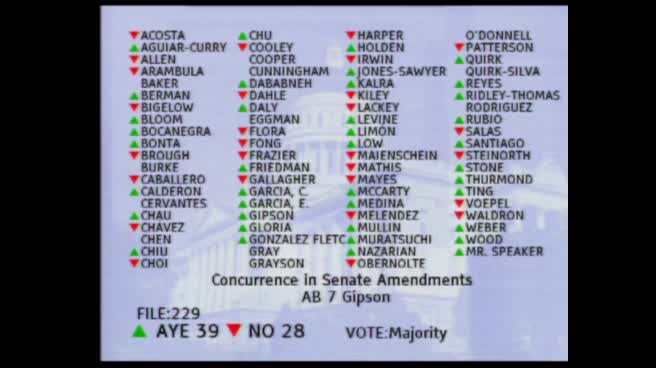 1MIN
Assembly Floor
 4MIN
Senate Floor
 51MIN














