AB 462: Mental Health Services Oversight and Accountability Commission: wage information data access.
- Session Year: 2017-2018
- House: Assembly
- Latest Version Date: 2017-10-02
Existing law, the Mental Health Services Act (MHSA), an initiative measure enacted by the voters as Proposition 63 at the November 2, 2004, statewide general election, establishes the Mental Health Services Oversight and Accountability Commission, which consists of 16 members, to oversee the administration of various parts of the act. Existing law authorizes the commission to undertake specified activities in carrying out its duties and responsibilities. Existing law authorizes the MHSA to be amended by a 2/3 vote of the Legislature if the amendments are consistent with, and further the purposes of, the MHSA, and also permits the Legislature to clarify procedures and terms of the MHSA by a majority vote.
Under existing law, the information obtained in the administration of the Unemployment Insurance Code is for the exclusive use and information of the Director of Employment Development in the discharge of his or her duties and is not open to the public. However, existing law permits the use of the information for specified purposes, and allows the director to require reimbursement for direct costs incurred.
This bill would declare the intent of the Legislature to authorize the commission to receive information held by other state agencies, as it relates to outcomes established under the MHSA or adopted by the commission under the MHSA for the purposes of monitoring those outcomes and improving the mental health system. The bill would authorize the Director of Employment Development to share information to enable the commission to receive quarterly wage data of mental health consumers served by the California public mental health system for the purpose of monitoring and evaluating employment outcomes to determine the effectiveness of those services.
This bill would declare that it clarifies procedures and terms of the Mental Health Services Act.
Existing law, the Mental Health Services Act (MHSA), an initiative measure enacted by the voters as Proposition 63 at the November 2, 2004, statewide general election, establishes the Mental Health Services Oversight and Accountability Commission, which consists of 16 members, to oversee the administration of various parts of the act. Existing law authorizes the commission to undertake specified activities in carrying out its duties and responsibilities. Existing law authorizes the MHSA to be amended by a 2/3 vote of the Legislature if the amendments are consistent with, and further the purposes of, the MHSA, and also permits the Legislature to clarify procedures and terms of the MHSA by a majority vote.
Under existing law, the information obtained in the administration of the Unemployment Insurance Code is for the exclusive use and information of the Director of Employment Development in the discharge of his or her duties and is not open to the public. However, existing law permits the use of the information for specified purposes, and allows the director to require reimbursement for direct costs incurred.
This bill would declare the intent of the Legislature to authorize the commission to receive information held by other state agencies, as it relates to outcomes established under the MHSA or adopted by the commission under the MHSA for the purposes of monitoring those outcomes and improving the mental health system. The bill would authorize the Director of Employment Development to share information to enable the commission to receive quarterly wage data to assist the commission in fulfilling its duties under the MHSA. of mental health consumers served by the California public mental health system for the purpose of monitoring and evaluating employment outcomes to determine the effectiveness of those services.
This bill would declare that it clarifies procedures and terms of the Mental Health Services Act.
Existing law, the Mental Health Services Act (MHSA), an initiative measure enacted by the voters as Proposition 63 at the November 2, 2004, statewide general election, establishes the Mental Health Services Oversight and Accountability Commission, which consists of 16 members, to oversee the administration of various parts of the act. Existing law authorizes the commission to undertake specified activities in carrying out its duties and responsibilities. Existing law authorizes the MHSA to be amended by a 2/3 vote of the Legislature if the amendments are consistent with, and further the purposes of, the MHSA, and also permits the Legislature to clarify procedures and terms of the MHSA by a majority vote.
Under existing law, the information obtained in the administration of the Unemployment Insurance Code is for the exclusive use and information of the Director of Employment Development in the discharge of his or her duties and is not open to the public. However, existing law permits the use of the information for specified purposes, and allows the director to require reimbursement for direct costs incurred.
This bill would declare the intent of the Legislature to authorize the commission to receive information held by other state agencies, as it relates to outcomes established under the MHSA or adopted by the commission under the MHSA for the purposes of monitoring those outcomes and improving the mental health system. The bill would authorize the Director of Employment Development to share information to enable the commission to receive quarterly wage data to assist the commission in fulfilling its duties under the MHSA.
This bill would declare that it clarifies procedures and terms of the Mental Health Services Act.
The director shall permit the use of any information in his or her possession to the extent necessary to enable the Mental Health Services Oversight and Accountability Commission to receive quarterly wage data of mental health consumers served by the California public mental health system for the purpose of monitoring and evaluating employment outcomes to determine the effectiveness of those services, and may require reimbursement for all direct costs incurred in providing any and all information specified in this section. The information shall be provided to the extent permitted under applicable federal statute and regulation.
SEC. 2.It is the intent of the Legislature to authorize the Mental Health Services Oversight and Accountability Commission to receive information held by other state agencies, as it relates to outcomes established under the Mental Health Services Act or adopted by the commission under the Mental Health Services Act for the purposes of monitoring those outcomes and improving the mental health system.
SEC. 3.The Legislature finds and declares that this act clarifies procedures and terms of the Mental Health Services Act within the meaning of Section 18 of the Mental Health Services Act.
All matter omitted in this version of the bill appears in the bill as introduced in the Assembly, February 13, 2017. (JR11)The director shall permit the use of any information in his or her possession to the extent necessary for any of the following purposes and may require reimbursement for all direct costs incurred in providing any and all information specified in this section, except information specified in subdivisions (a) to (e), inclusive:
(a)To enable the director or his or her representative to carry out his or her responsibilities under this code.
(b)To properly present a claim for benefits.
(c)To acquaint a worker or his or her authorized agent with his or her existing or prospective right to benefits.
(d)To furnish an employer or his or her authorized agent with information to enable him or her to fully discharge his or her obligations or safeguard his or her rights under this division or Division 3 (commencing with Section 9000).
(e)To enable an employer to receive a reduction in contribution rate.
(f)To enable federal, state, or local governmental departments or agencies, subject to federal law, to verify or determine the eligibility or entitlement of an applicant for, or a recipient of, public social services provided pursuant to Division 9 (commencing with Section 10000) of the Welfare and Institutions Code, or Part A of Subchapter IV of the federal Social Security Act (42 U.S.C. Sec. 601 et seq.), when the verification or determination is directly connected with, and limited to, the administration of public social services.
(g)To enable county administrators of general relief or assistance, or their representatives, to determine entitlement to locally provided general relief or assistance, when the determination is directly connected with, and limited to, the administration of general relief or assistance.
(h)To enable state or local governmental departments or agencies to seek criminal, civil, or administrative remedies in connection with the unlawful application for, or receipt of, relief provided under Division 9 (commencing with Section 10000) of the Welfare and Institutions Code or to enable the collection of expenditures for medical assistance services pursuant to Part 5 (commencing with Section 17000) of Division 9 of the Welfare and Institutions Code.
(i)To provide any a law enforcement agency with the name, address, telephone number, birth date, social security number, physical description, and names and addresses of present and past employers, of any a victim, suspect, missing person, potential witness, or person for whom a felony arrest warrant has been issued, when a request for this information is made by any an investigator or a peace officer as defined by Sections 830.1 and 830.2 of the Penal Code, or by any federal law enforcement officer to whom the Attorney General has delegated authority to enforce federal search warrants, as defined under Sections 60.2 and 60.3 of Title 28 of the Code of Federal Regulations, as amended, and when the requesting officer has been designated by the head of the law enforcement agency and requests this information in the course of and as a part of an investigation into the commission of a crime when there is a reasonable suspicion that the crime is a felony and that the information would lead to relevant evidence. The information provided pursuant to this subdivision shall be provided to the extent permitted by federal law and regulations, and to the extent the information is available and accessible within the constraints and configurations of existing department records. Any A person who receives any information under this subdivision shall make a written report of the information to the law enforcement agency that employs him or her, for filing under the normal procedures of that agency.
(1)This subdivision shall not be construed to authorize the release to any a law enforcement agency of a general list identifying individuals applying for or receiving benefits.
(2)The department shall maintain records pursuant to this subdivision only for periods required under regulations or statutes enacted for the administration of its programs.
(3)This subdivision shall not be construed as limiting the information provided to law enforcement agencies to that pertaining only to applicants for, or recipients of, benefits.
(4)The department shall notify all applicants for benefits that release of confidential information from their records will not be protected should there be a felony arrest warrant issued against the applicant or in the event of an investigation by a law enforcement agency into the commission of a felony.
(j)To provide public employee retirement systems in California with information relating to the earnings of any a person who has applied for or is receiving a disability income, disability allowance, or disability retirement allowance, from a public employee retirement system. The earnings information shall be released only upon written request from the governing board specifying that the person has applied for or is receiving a disability allowance or disability retirement allowance from its retirement system. The request may be made by the chief executive officer of the system or by an employee of the system so authorized and identified by name and title by the chief executive officer in writing.
(k)To enable the Division of Labor Standards Enforcement in the Department of Industrial Relations to seek criminal, civil, or administrative remedies in connection with the failure to pay, or the unlawful payment of, wages pursuant to Chapter 1 (commencing with Section 200) of Part 1 of Division 2 of, and Chapter 1 (commencing with Section 1720) of Part 7 of Division 2 of, the Labor Code.
(l)To enable federal, state, or local governmental departments or agencies to administer child support enforcement programs under Part D of Title IV of the federal Social Security Act (42 U.S.C. Sec. 651 et seq.).
(m)To provide federal, state, or local governmental departments or agencies with wage and claim information in its possession that will assist those departments and agencies in the administration of the Victims of Crime Program or in the location of victims of crime who, by state mandate or court order, are entitled to restitution that has been or can be recovered.
(n)To provide federal, state, or local governmental departments or agencies with information concerning any individuals who are or have been: an individual who is or has been:
(1)Directed by state mandate or court order to pay restitution, fines, penalties, assessments, or fees as a result of a violation of law.
(2)Delinquent or in default on guaranteed student loans or who owe repayment of funds received through other financial assistance programs administered by those agencies. The information released by the director for the purposes of this paragraph shall not include unemployment insurance benefit information.
(o)To provide an authorized governmental agency with any or and all relevant information that relates to any a specific workers compensation insurance fraud investigation. The information shall be provided to the extent permitted by federal law and regulations. For the purposes of this subdivision, authorized governmental agency means the district attorney of any county, the office of the Attorney General, the Contractors State License Board, the Department of Industrial Relations, and the Department of Insurance. An authorized governmental agency may disclose this information to the State Bar, the Medical Board of California, or any other licensing board or department whose licensee is the subject of a workers compensation insurance fraud investigation. This subdivision shall not prevent any an authorized governmental agency from reporting to any a board or department the suspected misconduct of any a licensee of that body.
(p)To enable the Director of Consumer Affairs, or his or her representatives, to access unemployment insurance quarterly wage data on a case-by-case basis to verify information on school administrators, school staff, and students provided by those schools who are being investigated for possible violations of Chapter 8 (commencing with Section 94800) of Part 59 of Division 10 of Title 3 of the Education Code.
(q)To provide employment tax information to the tax officials of Mexico, if a reciprocal agreement exists. For purposes of this subdivision, reciprocal agreement means a formal agreement to exchange information between national taxing officials of Mexico and taxing authorities of the State Board of Equalization, the Franchise Tax Board, and the Employment Development Department. Furthermore, the reciprocal agreement shall be limited to the exchange of information that is essential for tax administration purposes only. Taxing authorities of the State of California shall be granted tax information only on California residents. Taxing authorities of Mexico shall be granted tax information only on Mexican nationals.
(r)To enable city and county planning agencies to develop economic forecasts for planning purposes. The information shall be limited to businesses within the jurisdiction of the city or county whose planning agency is requesting the information, and shall not include information regarding individual employees.
(s)To provide the State Department of Developmental Services with wage and employer information that will assist in the collection of moneys owed by the recipient, parent, or any other legally liable individual for services and supports provided pursuant to Chapter 9 (commencing with Section 4775) of Division 4.5 of, and Chapter 2 (commencing with Section 7200) and Chapter 3 (commencing with Section 7500) of Division 7 of, the Welfare and Institutions Code.
(t)To provide the State Board of Equalization with employment tax information that will assist in the administration of tax programs. The information shall be limited to the exchange of employment tax information essential for tax administration purposes to the extent permitted by federal law and regulations.
(u)Nothing in this section shall This section shall not be construed to authorize or permit the use of information obtained in the administration of this code by any a private collection agency.
(v)The disclosure of the name and address of an individual or business entity that was issued an assessment that included penalties under Section 1128 or 1128.1 shall not be in violation of Section 1094 if the assessment is final. The disclosure may also include any of the following:
(1)The total amount of the assessment.
(2)The amount of the penalty imposed under Section 1128 or 1128.1 that is included in the assessment.
(3)The facts that resulted in the charging of the penalty under Section 1128 or 1128.1.
(w)To enable the Contractors State License Board to verify the employment history of an individual applying for licensure pursuant to Section 7068 of the Business and Professions Code.
(x)To provide any a peace officer with the Division of Investigation in the Department of Consumer Affairs information pursuant to subdivision (i) when the requesting peace officer has been designated by the chief of the Division of Investigation and requests this information in the course of and as part of an investigation into the commission of a crime or other unlawful act when there is reasonable suspicion to believe that the crime or act may be connected to the information requested and would lead to relevant information regarding the crime or unlawful act.
(y)To enable the Labor Commissioner of the Division of Labor Standards Enforcement in the Department of Industrial Relations to identify, pursuant to Section 90.3 of the Labor Code, unlawfully uninsured employers. The information shall be provided to the extent permitted by federal law and regulations.
(z)To enable the Chancellor of the California Community Colleges, in accordance with the requirements of Section 84754.5 of the Education Code, to obtain quarterly wage data, commencing January 1, 1993, on students who have attended one or more community colleges, to assess the impact of education on the employment and earnings of students, to conduct the annual evaluation of district-level and individual college performance in achieving priority educational outcomes, and to submit the required reports to the Legislature and the Governor. The information shall be provided to the extent permitted by federal statutes and regulations.
(aa)To enable the Public Employees Retirement System to seek criminal, civil, or administrative remedies in connection with the unlawful application for, or receipt of, benefits provided under Part 3 (commencing with Section 20000) of Division 5 of Title 2 of the Government Code.
(ab)To enable the State Department of Education, the University of California, the California State University, and the Chancellor of the California Community Colleges, pursuant to the requirements prescribed by the federal American Recovery and Reinvestment Act of 2009 (Public Law 111-5), to obtain quarterly wage data, commencing July 1, 2010, on students who have attended their respective systems to assess the impact of education on the employment and earnings of those students, to conduct the annual analysis of district-level and individual district or postsecondary education system performance in achieving priority educational outcomes, and to submit the required reports to the Legislature and the Governor. The information shall be provided to the extent permitted by federal statutes and regulations.
(ac)To provide the Agricultural Labor Relations Board with employee, wage, and employer information, for use in the investigation or enforcement of the Alatorre-Zenovich-Dunlap-Berman Agricultural Labor Relations Act of 1975 (Part 3.5 (commencing with Section 1140) of Division 2 of the Labor Code). The information shall be provided to the extent permitted by federal statutes and regulations.
(ad)(1)To enable the State Department of Health Care Services, the California Health Benefit Exchange, the Managed Risk Medical Insurance Board, and county departments and agencies to obtain information regarding employee wages, California employer names and account numbers, employer reports of wages and number of employees, and disability insurance and unemployment insurance claim information, for the purpose of:
(A)Verifying or determining the eligibility of an applicant for, or a recipient of, state health subsidy programs, limited to the Medi-Cal program, provided pursuant to Chapter 7 (commencing with Section 14000) of Part 3 of Division 9 of the Welfare and Institutions Code, and the Access for Infants and Mothers Program, provided pursuant to Part 6.3 (commencing with Section 12695) of Division 2 of the Insurance Code, when the verification or determination is directly connected with, and limited to, the administration of the state health subsidy programs referenced in this subparagraph.
(B)Verifying or determining the eligibility of an applicant for, or a recipient of, federal subsidies offered through the California Health Benefit Exchange, provided pursuant to Title 22 (commencing with Section 100500) of the Government Code, including federal tax credits and cost-sharing assistance pursuant to the federal Patient Protection and Affordable Care Act (Public Law 111-148), as amended by the federal Health Care and Education Reconciliation Act of 2010 (Public Law 111-152), when the verification or determination is directly connected with, and limited to, the administration of the California Health Benefit Exchange.
(C)Verifying or determining the eligibility of employees and employers for health coverage through the Small Business Health Options Program, provided pursuant to Section 100502 of the Government Code, when the verification or determination is directly connected with, and limited to, the administration of the Small Business Health Options Program.
(2)The information provided under this subdivision shall be subject to the requirements of, and provided to the extent permitted by, federal law and regulations, including Part 603 of Title 20 of the Code of Federal Regulations.
(ae)To provide any a peace officer with the Investigations Division of the Department of Motor Vehicles with information pursuant to subdivision (i), when the requesting peace officer has been designated by the Chief of the Investigations Division and requests this information in the course of, and as part of, an investigation into identity theft, counterfeiting, document fraud, or consumer fraud, and there is reasonable suspicion that the crime is a felony and that the information would lead to relevant evidence regarding the identity theft, counterfeiting, document fraud, or consumer fraud. The information provided pursuant to this subdivision shall be provided to the extent permitted by federal law and regulations, and to the extent the information is available and accessible within the constraints and configurations of existing department records. Any A person who receives any information under this subdivision shall make a written report of the information to the Investigations Division of the Department of Motor Vehicles, for filing under the normal procedures of that division.
(af)Until January 1, 2020, to enable the Department of Finance to prepare and submit the report required by Section 13084 of the Government Code that identifies all employers in California that employ 100 or more employees who receive benefits from the Medi-Cal program (Chapter 7 (commencing with Section 14000) of Part 3 of Division 9 of the Welfare and Institutions Code). The information used for this purpose shall be limited to information obtained pursuant to Section 11026.5 of the Welfare and Institutions Code and from the administration of personal income tax wage withholding pursuant to Division 6 (commencing with Section 13000) and the disability insurance program and may be disclosed to the Department of Finance only for the purpose of preparing and submitting the report and only to the extent not prohibited by federal law.
(ag)To provide, to the extent permitted by federal law and regulations, the Student Aid Commission with wage information in order to verify the employment status of an individual applying for a Cal Grant C award pursuant to subdivision (c) of Section 69439 of the Education Code.
(ah)To enable the Department of Corrections and Rehabilitation to obtain quarterly wage data of former inmates who have been incarcerated within the prison system in order to assess the impact of rehabilitation services or the lack of these services on the employment and earnings of these former inmates. Quarterly data for a former inmates employment status and wage history shall be provided for a period of one year, three years, and five years following release. The data shall only be used for the purpose of tracking outcomes for former inmates in order to assess the effectiveness of rehabilitation strategies on the wages and employment histories of those formerly incarcerated. The information shall be provided to the department to the extent not prohibited by federal law.
(ai)To enable federal, state, or local government departments or agencies, or their contracted agencies, subject to federal law, including the confidentiality, disclosure, and other requirements set forth in Part 603 of Title 20 of the Code of Federal Regulations, to evaluate, research, or forecast the effectiveness of public social services programs administered pursuant to Division 9 (commencing with Section 10000) of the Welfare and Institutions Code, or Part A of Subchapter IV of Chapter 7 of the federal Social Security Act (42 U.S.C. Sec. 601 et seq.), when the evaluation, research, or forecast is directly connected with, and limited to, the administration of the public social services programs.
(aj)To enable the California Workforce Development Board, the Chancellor of the California Community Colleges, the Superintendent of Public Instruction, the Department of Rehabilitation, the State Department of Social Services, the Bureau for Private Postsecondary Education, the Department of Industrial Relations, the Division of Apprenticeship Standards, and the Employment Training Panel to access any relevant quarterly wage data necessary for the evaluation and reporting of their respective program performance outcomes as required and permitted by various state and federal laws pertaining to performance measurement and program evaluation under the federal Workforce Innovation and Opportunity Act (Public Law 113-128); the workforce performance metrics dashboard pursuant to paragraph (1) of subdivision (i) of Section 14013; the Adult Education Block Grant Program consortia performance metrics pursuant to Section 84920 of the Education Code; the economic and workforce development program performance measures pursuant to Section 88650 of the Education Code; and the California Community Colleges Economic and Workforce Development Program performance measures established in Part 52.5 (commencing with Section 88600) of Division 7 of Title 3 of the Education Code.
(ak)To enable the Mental Health Services Oversight and Accountability Commission to receive quarterly wage data to assist the commission in fulfilling its duties under the Mental Health Services Act. The information shall be provided to the extent permitted under applicable federal statute and regulation.
SEC. 2.Section 5845 of the Welfare and Institutions Code is amended to read:5845.(a)The Mental Health Services Oversight and Accountability Commission is hereby established to oversee Part 3 (commencing with Section 5800), the Adult and Older Adult Mental Health System of Care Act; Part 3.1 (commencing with Section 5820), Human Resources, Education, and Training Programs; Part 3.2 (commencing with Section 5830), Innovative Programs; Part 3.6 (commencing with Section 5840), Prevention and Early Intervention Programs; and Part 4 (commencing with Section 5850), the Childrens Mental Health Services Act. The commission shall replace the advisory committee established pursuant to Section 5814. The commission shall consist of 16 voting members as follows:
(1)The Attorney General or his or her designee.
(2)The Superintendent of Public Instruction or his or her designee.
(3)The Chairperson of the Senate Health and Human Services Committee or another member of the Senate selected by the President pro Tempore of the Senate.
(4)The Chairperson of the Assembly Health Committee or another member of the Assembly selected by the Speaker of the Assembly.
(5)Two persons with a severe mental illness, a family member of an adult or senior with a severe mental illness, a family member of a child who has or has had a severe mental illness, a physician specializing in alcohol and drug treatment, a mental health professional, a county sheriff, a superintendent of a school district, a representative of a labor organization, a representative of an employer with less than 500 employees and a representative of an employer with more than 500 employees, and a representative of a health care services plan or insurer, all appointed by the Governor. In making appointments, the Governor shall seek individuals who have had personal or family experience with mental illness. At least one of the persons appointed pursuant to this paragraph shall have a background in auditing.
(b)Members shall serve without compensation, but shall be reimbursed for all actual and necessary expenses incurred in the performance of their duties.
(c)The term of each member shall be three years, to be staggered so that approximately one-third of the appointments expire in each year.
(d)In carrying out its duties and responsibilities, the commission may do all of the following:
(1)Meet at least once each quarter at any time and location convenient to the public as it may deem appropriate. All meetings of the commission shall be open to the public.
(2)Within the limit of funds allocated for these purposes, pursuant to the laws and regulations governing state civil service, employ staff, including any clerical, legal, and technical assistance as may appear necessary. The commission shall administer its operations separate and apart from the State Department of Health Care Services and the California Health and Human Services Agency.
(3)Establish technical advisory committees committees, such as a committee of consumers and family members.
(4)Employ all other appropriate strategies necessary or convenient to enable it to fully and adequately perform its duties and exercise the powers expressly granted, notwithstanding any authority expressly granted to any an officer or employee of state government.
(5)Enter into contracts.
(6)Obtain data and information from the State Department of Health Care Services, the Office of Statewide Health Planning and Development, or other state or local entities that receive Mental Health Services Act funds, for the commission to utilize in its oversight, review, training and technical assistance, accountability, and evaluation capacity regarding projects and programs supported with Mental Health Services Act funds.
(7)Participate in the joint state-county decisionmaking process, as contained in Section 4061, for training, technical assistance, and regulatory resources to meet the mission and goals of the states mental health system.
(8)Develop strategies to overcome stigma and discrimination, and accomplish all other objectives of Part 3.2 (commencing with Section 5830), 3.6 (commencing with Section 5840), and the other provisions of the act establishing this commission.
(9)At any time, advise the Governor or the Legislature regarding actions the state may take to improve care and services for people with mental illness.
(10)If the commission identifies a critical issue related to the performance of a county mental health program, it may refer the issue to the State Department of Health Care Services pursuant to Section 5655.
(11)Assist in providing technical assistance to accomplish the purposes of the Mental Health Services Act, Part 3 (commencing with Section 5800), and Part 4 (commencing with Section 5850) in collaboration with the State Department of Health Care Services and in consultation with the California Mental Health Directors Association.
(12)Work in collaboration with the State Department of Health Care Services and the California Mental Health Planning Council, and in consultation with the California Mental Health Directors Association, in designing a comprehensive joint plan for a coordinated evaluation of client outcomes in the community-based mental health system, including, but not limited to, parts listed in subdivision (a). The California Health and Human Services Agency shall lead this comprehensive joint plan effort.
(e)It is the intent of the Legislature to authorize the commission to receive information held by other state agencies, as it relates to outcomes established under the Mental Health Services Act or adopted by the commission under the act for the purposes of monitoring those outcomes and improving the mental health system.
SEC. 3.The Legislature finds and declares that this act clarifies procedures and terms of the Mental Health Services Act within the meaning of Section 18 of the Mental Health Services Act.
|
Date
|
Status
|
|---|---|
| Oct 2, 2017 | Chaptered by Secretary of State - Chapter 403, Statutes of 2017. |
| Oct 2, 2017 | Approved by the Governor. |
| Sep 18, 2017 | Enrolled and presented to the Governor at 4 p.m. |
| Sep 11, 2017 | Senate amendments concurred in. To Engrossing and Enrolling. |
| Sep 6, 2017 | In Assembly. Concurrence in Senate amendments pending. May be considered on or after September 8 pursuant to Assembly Rule 77. |
| Sep 6, 2017 | Read third time. Passed. Ordered to the Assembly. |
| Sep 5, 2017 | Read second time. Ordered to third reading. |
| Sep 1, 2017 | Read third time and amended. Ordered to second reading. |
| Jun 29, 2017 | From Consent Calendar. |
| Jun 27, 2017 | Read second time. Ordered to Consent Calendar. |
| Jun 26, 2017 | From committee: Be placed on second reading file pursuant to Senate Rule 28.8 and ordered to consent calendar. |
| Jun 8, 2017 | From committee: Do pass and re-refer to Com. on APPR. with recommendation: To Consent Calendar. (Ayes 9. Noes 0.) (June 7). Re-referred to Com. on APPR. |
| May 10, 2017 | Referred to Com. on HEALTH. |
| Apr 20, 2017 | In Senate. Read first time. To Com. on RLS. for assignment. |
| Apr 20, 2017 | Read third time. Passed. Ordered to the Senate. (Ayes 74. Noes 0. Page 1143.) |
| Apr 6, 2017 | Read second time. Ordered to Consent Calendar. |
| Apr 5, 2017 | From committee: Do pass. To Consent Calendar. (Ayes 17. Noes 0.) (April 5). |
| Mar 29, 2017 | From committee: Do pass and re-refer to Com. on APPR. with recommendation: To Consent Calendar. (Ayes 14. Noes 0.) (March 28). Re-referred to Com. on APPR. |
| Feb 27, 2017 | Referred to Com. on HEALTH. |
| Feb 14, 2017 | From printer. May be heard in committee March 16. |
| Feb 13, 2017 | Read first time. To print. |
|
Date
|
Description
|
Location
|
Votes
|
|
|---|---|---|---|---|
| Sep 11, 2017 | AB 462 THURMOND Concurrence in Senate Amendments | Assembly Floor |
Passed |
|
| Sep 6, 2017 | Assembly 3rd Reading AB462 Thurmond By Beall | Senate Floor |
Passed |
|
| Jun 7, 2017 | Do pass, but first be re-referred to the Committee on [Appropriations] with the recommendation: To Consent Calendar | Senate Standing Committee on Health |
Passed |
|
| Apr 20, 2017 | Favorable (Children, Families & Seniors Subcommittee) | Assembly Floor |
Passed |
|
| Apr 5, 2017 | Do pass. To Consent Calendar. | Assembly Standing Committee on Appropriations |
Passed |
|
| Mar 28, 2017 | Do pass and be re-referred to the Committee on [Appropriations] with recommendation: To Consent Calendar | Assembly Standing Committee on Health |
Passed |
This list shows positions taken on this bill by organizations on the date displayed, which is linked to the original source.
Positions by individuals are not included.
|
Organization
|
Position
|
Date
|
|---|---|---|
| California Association of Veteran Service Agencies | ** Support | Sep 5, 2017 |
| California Forward Action Fund | ** Support | Sep 5, 2017 |
| California Mental Health Planning Council | ** Support | Sep 5, 2017 |
| CaliforniaHealth+Advocates | ** Support | Sep 5, 2017 |
| Mental Health America of California | ** Support | Sep 5, 2017 |
| Mental Health Services Oversight and Accountability Commission | ** Support | Sep 5, 2017 |
| National Association of Social Workers California Chapter | ** Support | Sep 5, 2017 |
| United Advocates for Children and Families | ** Support | Sep 5, 2017 |
CONCURRENCE IN SENATE AMENDMENTS
CSA1 Bill Id:AB 462
Author:(Thurmond)
As Amended Ver:September 1, 2017
Majority vote
ASSEMBLY: | 74-0 | (April 20, 2017) | SENATE: | 40-0 | (September 6, 2017) |
Original Committee Reference: HEALTH
SUMMARY: Authorizes the Director of Employment Development Department (EDD) to share information with the Mental Health Services Oversight and Accountability Commission (the Commission) related to quarterly wage data to assist the Commission in fulfilling its duties under the Mental Health Services Act (MHSA), to the extent permitted under applicable federal statute and regulation. Declares it the intent of the Legislature to authorize the Commission to receive information held by other state agencies, as it relates to outcomes established under the MHSA, for purposes of monitoring outcomes and improving the mental health system.
The Senate amendments clarify that the Director of EDD be authorized to share information with the Commission, as specified, for the purpose of monitoring and evaluating employment outcomes to determine the effectiveness of those services, and permits EDD to require reimbursement for all direct costs incurred in providing any and all information.
FISCAL EFFECT: According to the Senate Appropriations Committee, pursuant to Senate Rule 28.8, negligible state costs.
COMMENTS: According to the author, California's MHSA, passed by voters in 2004, established the Commission to promote transformational change for California's mental health system and to develop the tools and strategies needed to ensure oversight and accountability. Among other goals, the MHSA identifies reducing unemployment as a key goal for mental health services as part of a broad range of other outcomes.
This bill authorizes the Director of the EDD to share specified employment-related information with the Commission, to the extent permitted under federal rules and regulations, to allow the Commission to better track employment outcomes for people receiving public mental health services. That information will also enable the Commission to evaluate the effectiveness of services intended to lead to employment and to report those results to the public and policymakers as part of the Commission's broad oversight role.
Information provided by the author also indicates that among people served by public mental health systems, unemployment is more than three times greater than unemployment for the general population. Half of those served in public mental health programs are not in the labor force, discouraged by public policy barriers, and have no prospects for work. Mental health advocates have called for improved strategies to measure and report employment outcomes for mental health clients. The author argues that without the EDD data, the Commission cannot evaluate whether the services under the MHSA are achieving the goal of decreasing unemployment for individuals living with mental illness.
- Proposition 63. Proposition 63 was passed by voters in November 2004. The MHSA imposes a 1% income tax on personal income in excess of $1 million and creates the 16 member Commission charged with overseeing the implementation of MHSA. The 2017-18 Governor's Budget projected that $1.34 billion would be deposited into the Mental Health Services Fund in fiscal year 2015-16. The MHSA addresses a broad continuum of prevention, early intervention and service needs as well as providing funding for infrastructure, technology and training needs for the community mental health system.
- EDD Wage Data. UI Code Section 1095 governs when and under what circumstances EDD may permit the use of otherwise confidential information within its possession, including wage data. Other entities that have access to wage data include Chancellor of the California Community Colleges, DHCS, the Department of Motor Vehicles, the Department of Corrections and Rehabilitation, Contractors' State License Board, the Agricultural Labor Relations Board, and the Public Employment Retirement System. The data may include information regarding unemployment claims and benefits, wages, and the receipt of public benefits. Generally, quarterly wage data is used by public social service agencies to determine trends in employment.
The Commission, sponsor of the bill, states that this bill will allow the Commission to receive employment information held by EDD to enable the Commission to document and monitor employment outcomes for persons with mental health needs. The MHSA identifies employment as a key outcome for mental health care. This bill will equip the Commission to develop the tools and standards needed to ensure that California's mental health consumers have access to the services and support needed to obtain and retain employment, a key aspect of a recovery-oriented mental health system.
The California Association of Veteran Services Agencies (CAVSA) states that the information authorized by this bill for transfer from the EDD to the Commission will allow the Commission to evaluate the effectiveness of services intended to lead to employment and to report those results to the public and policymakers as part of the Commission's broad oversight role. While CAVSA agencies provide extensive supportive services, including mental health and employment services, we often lack the data necessary to document why this gap for employment for veterans in need of mental health services still exists.
There is no opposition to this bill.
Analysis Prepared by: Paula Villescaz / HEALTH / (916) 319-2097 FN: 0001929
Office of Senate Floor Analyses (916) 651-1520 Fax: (916) 327-4478 | AB 462 |
THIRD READING
Bill No: AB 462
Amended: 9/1/17 in Senate
SENATE HEALTH COMMITTEE: 9-0, 6/7/17
AYES: Hernandez, Nguyen, Atkins, Leyva, Mitchell, Monning, Newman, Nielsen, Roth
SENATE APPROPRIATIONS COMMITTEE: Senate Rule 28.8
ASSEMBLY FLOOR: 74-0, 4/20/17 (Consent) - See last page for vote
SUBJECT: Mental Health Services Oversight and Accountability Commission: wage information data access
SOURCE: Mental Health Services Oversight and Accountability Commission
DIGEST:
This bill authorizes the Director of the Employment Development Department to share specified information with the Mental Health Services Oversight and Accountability Commission (MHSOAC) to receive quarterly wage data from consumers, as specified.
Senate Floor Amendments of 9/1/17 are technical and clarify that the MHSOAC is permitted to access wage information data for those who receive public mental health services for the purpose of determining the effectiveness of the services.
Existing law:
- Establishes the Mental Health Services Act (MHSA), enacted by voters in 2004 as Proposition 63, to provide funds to counties to expand services, develop innovative programs, and integrate service plans for mentally ill children, adults, and seniors through a 1% income tax on personal income above $1 million.
- Establishes the MHSOAC to oversee the implementation of the MHSA, develop strategies to overcome stigma, and advise the Governor and the Legislature on ways the state can improve care and services to people with mental illness.
- Requires the Department of Health Care Services (DHCS), pursuant to the MHSA and in coordination with counties, to establish a program designed to prevent mental illnesses from becoming severe and disabling, and requires the program to emphasize strategies to reduce the following negative outcomes that may result from untreated mental illness:
- Suicide;
- Incarcerations;
- School failure or dropout;
- Unemployment;
- Prolonged suffering;
- Homelessness; and,
- Removal of children from their homes.
- Provides for the Unemployment Insurance program, a federal-state program administered by the Employment Development Department (EDD), which provides weekly unemployment insurance payments for workers who lose their employment.
- Authorizes EDD to maintain the possession and control of, among other things, all records and papers held in the performance of the duties, powers, purposes, responsibilities, and jurisdiction that are vested in EDD. Provides that a person who knowingly accesses, uses, or discloses this confidential information without authorization is guilty of a misdemeanor.
- Allows EDD to share quarterly wage data with specified entities, including the Department of Motor Vehicles, California’s public colleges, the Department of Corrections and Rehabilitation (CDCR), and DHCS, for specified purposes, including the evaluation and reporting of their respective program performance outcomes.
This bill:
- Authorizes the Director of EDD to share quarterly wage data with the MHSOAC, to the extent permitted under applicable federal statute and regulations, of mental health consumers served by the California public mental health system for the purpose of monitoring and evaluating employment outcomes to determine the effectiveness of those services.
- Declares it the intent of the Legislature to authorize the MHSOAC to receive information held by other state agencies, as it relates to outcomes established under the MHSA, for purposes of monitoring outcomes and improving the mental health system.
Comments
- Author’s statement. According to the author, the MHSA established the MHSOAC to promote transformational change for California's mental health system and to develop the tools and strategies needed to ensure oversight and accountability. Among other goals, the MHSA identifies reducing unemployment as a key goal for mental health services as part of a broad range of other outcomes. This bill authorizes the Director of EDD to share specified employment-related information with the MHSOAC, to the extent permitted under federal rules and regulations, to allow for better tracking of employment outcomes for people receiving public mental health services. That information also will enable the MHSOAC to evaluate the effectiveness of services intended to lead to employment, and to report those results to the public and policymakers as part of the MHSOAC’s broad oversight role.
- MHSA. The MHSA requires each county mental health program to prepare and submit a three-year plan to DHCS that must be updated each year and approved by DHCS after review and comment by the MHSOAC. DHCS is required to provide guidelines to counties related to each component of the MHSA. In the three-year plans, counties are required to include a list of all programs for which MHSA funding is being requested and that identifies how the funds will be spent and which populations will be served. Counties also must submit their plans for approval to the MHSOAC before they can spend innovation program funds. The MHSA provides funding for programs within five components:
- Community Services and Supports (CSS): Provides direct mental health services to the severely and seriously mentally ill, such as mental health treatment, cost of health care treatment, and housing supports. Regulations require counties to direct the majority of its CSS funds to Full‑Service Partnerships (FSPs). FSPs are county coordinated plans, in collaboration with the client and the family, to provide the full spectrum of community services. These services consist of mental health services and supports, such as peer support and crisis intervention services; and non-mental health services and supports, such as food, clothing, housing, and the cost of medical treatment. Outside of FSPs, counties do not use CSS funds to assist with housing;
- Prevention and Early Intervention: Provides services to mental health clients in order to help prevent mental illness from becoming severe and disabling;
- Innovation: Provides services and approaches that are creative in an effort to address mental health clients’ persistent issues, such as improving services for underserved or unserved populations within the community;
- Capital Facilities and Technological Needs: Creates additional county infrastructure such as additional clinics and facilities and/or development of a technological infrastructure for the mental health system, such as electronic health records for mental health services; and
- Workforce Education and Training: Provides training for existing county mental health employees, outreach and recruitment to increase employment in the mental health system, and financial incentives to recruit or retain employees within the public mental health system.
- Employment rates and mental illness. According to a 2014 report, “Road to Recovery: Employment and Mental Illness,” by the National Alliance on Mental Illness (NAMI), one of the best steps in recovery from mental illness is a job, yet the national unemployment rate for those who receive public mental health services was approximately 80%. California’s rate, which ranked fifth-highest in the nation, was higher than the national average with a 90% unemployment rate among those with mental illness. The four other states with rates higher than California were Pennsylvania, Hawaii, West Virginia, and Maine. According to the NAMI report, about 60% of the 7.1 million people receiving public mental health services want to work, but less than 2% received supported employment opportunities provided by states. The NAMI report states that about six out of 10 people with mental illness could succeed at employment with appropriate supports, yet only 1.7% of people served in state mental health systems received supported employment services in 2012.
FISCAL EFFECT: Appropriation: No Fiscal Com.: Yes Local: No
Mental Health Services Oversight and Accountability Commission (source)
California Association of Veteran Service Agencies
California Forward Action Fund
CaliforniaHealth+Advocates
California Mental Health Planning Council
Mental Health America of California
National Association of Social Workers California Chapter
United Advocates for Children and Families
None received
ARGUMENTS IN SUPPORT: The sponsor and other supporters, largely mental health advocates, argue that intended outcomes of the MHSA include reducing incarcerations, school failure and dropout, unemployment, suicide, prolonged suffering, and homelessness for people living with mental illness. Supporters argue that this bill would enable the MHSOAC to document, monitor, and evaluate employment outcomes from those receiving services from the public mental health system, as well as ensure that mental health consumers have access to services and supports needed to obtain and retain employment, which is a key aspect of a recovery-oriented mental health system. The California Association of Veteran Service Agencies states that California is home to the lion’s share of the nation’s veterans, who continue to be affected by unemployment more than the general public due to physical and mental health injuries.
ASSEMBLY FLOOR: 74-0, 4/20/17
AYES: Acosta, Aguiar-Curry, Travis Allen, Arambula, Baker, Berman, Bigelow, Bloom, Bocanegra, Bonta, Burke, Caballero, Calderon, Cervantes, Chau, Chávez, Chen, Chiu, Chu, Cooley, Cooper, Cunningham, Dababneh, Dahle, Daly, Eggman, Flora, Fong, Frazier, Friedman, Cristina Garcia, Eduardo Garcia, Gipson, Gloria, Gomez, Gonzalez Fletcher, Gray, Grayson, Harper, Holden, Irwin, Jones-Sawyer, Kalra, Kiley, Lackey, Levine, Limón, Low, Maienschein, Mayes, McCarty, Medina, Melendez, Mullin, Muratsuchi, Nazarian, Obernolte, O'Donnell, Quirk, Quirk-Silva, Reyes, Rodriguez, Rubio, Salas, Santiago, Steinorth, Mark Stone, Thurmond, Ting, Voepel, Waldron, Weber, Wood, Rendon
NO VOTE RECORDED: Brough, Choi, Gallagher, Mathis, Patterson, Ridley-Thomas
Prepared by: Reyes Diaz / HEALTH / (916) 651-4111
9/5/17 18:57:11
**** END ****
Office of Senate Floor Analyses (916) 651-1520 Fax: (916) 327-4478 | AB 462 |
THIRD READING
Bill No: AB 462
Introduced: 2/13/17
SENATE HEALTH COMMITTEE: 9-0, 6/7/17
AYES: Hernandez, Nguyen, Atkins, Leyva, Mitchell, Monning, Newman, Nielsen, Roth
SENATE APPROPRIATIONS COMMITTEE: Senate Rule 28.8
ASSEMBLY FLOOR: 74-0, 4/20/17 (Consent) - See last page for vote
SUBJECT: Mental Health Services Oversight and Accountability Commission: wage information data access
SOURCE: Mental Health Services Oversight and Accountability Commission
DIGEST:
This bill authorizes the Director of the Employment Development Department to share specified information with the Mental Health Services Oversight and Accountability Commission (MHSOAC) to assist the MHSOAC in fulfilling its duties under the Mental Health Services Act.
Existing law:
- Establishes the Mental Health Services Act (MHSA), enacted by voters in 2004 as Proposition 63, to provide funds to counties to expand services, develop innovative programs, and integrate service plans for mentally ill children, adults, and seniors through a 1% income tax on personal income above $1 million.
- Establishes the MHSOAC to oversee the implementation of the MHSA, develop strategies to overcome stigma, and advise the Governor and the Legislature on ways the state can improve care and services to people with mental illness.
- Requires the Department of Health Care Services (DHCS), pursuant to the MHSA and in coordination with counties, to establish a program designed to prevent mental illnesses from becoming severe and disabling, and requires the program to emphasize strategies to reduce the following negative outcomes that may result from untreated mental illness:
- Suicide;
- Incarcerations;
- School failure or dropout;
- Unemployment;
- Prolonged suffering;
- Homelessness; and,
- Removal of children from their homes.
- Provides for the Unemployment Insurance program, a federal-state program administered by the Employment Development Department (EDD), which provides weekly unemployment insurance payments for workers who lose their employment.
- Authorizes EDD to maintain the possession and control of, among other things, all records and papers held in the performance of the duties, powers, purposes, responsibilities, and jurisdiction that are vested in EDD. Provides that a person who knowingly accesses, uses, or discloses this confidential information without authorization is guilty of a misdemeanor.
- Allows EDD to share quarterly wage data with specified entities, including the Department of Motor Vehicles, California’s public colleges, the Department of Corrections and Rehabilitation (CDCR), and DHCS, for specified purposes, including the evaluation and reporting of their respective program performance outcomes.
This bill:
- Authorizes the Director of EDD to share quarterly wage data with the MHSOAC, to the extent permitted under applicable federal statute and regulations, to assist in fulfilling its duties under the MHSA.
- Declares it the intent of the Legislature to authorize the MHSOAC to receive information held by other state agencies, as it relates to outcomes established under the MHSA, for purposes of monitoring outcomes and improving the mental health system.
Comments
- Author’s statement. According to the author, the MHSA established the MHSOAC to promote transformational change for California's mental health system and to develop the tools and strategies needed to ensure oversight and accountability. Among other goals, the MHSA identifies reducing unemployment as a key goal for mental health services as part of a broad range of other outcomes. This bill authorizes the Director of EDD to share specified employment-related information with the MHSOAC, to the extent permitted under federal rules and regulations, to allow for better tracking of employment outcomes for people receiving public mental health services. That information also will enable the MHSOAC to evaluate the effectiveness of services intended to lead to employment, and to report those results to the public and policymakers as part of the MHSOAC’s broad oversight role.
- MHSA. The MHSA requires each county mental health program to prepare and submit a three-year plan to DHCS that must be updated each year and approved by DHCS after review and comment by the MHSOAC. DHCS is required to provide guidelines to counties related to each component of the MHSA. In the three-year plans, counties are required to include a list of all programs for which MHSA funding is being requested and that identifies how the funds will be spent and which populations will be served. Counties also must submit their plans for approval to the MHSOAC before they can spend innovation program funds. The MHSA provides funding for programs within five components:
- Community Services and Supports (CSS): Provides direct mental health services to the severely and seriously mentally ill, such as mental health treatment, cost of health care treatment, and housing supports. Regulations require counties to direct the majority of its CSS funds to Full‑Service Partnerships (FSPs). FSPs are county coordinated plans, in collaboration with the client and the family, to provide the full spectrum of community services. These services consist of mental health services and supports, such as peer support and crisis intervention services; and non-mental health services and supports, such as food, clothing, housing, and the cost of medical treatment. Outside of FSPs, counties do not use CSS funds to assist with housing;
- Prevention and Early Intervention: Provides services to mental health clients in order to help prevent mental illness from becoming severe and disabling;
- Innovation: Provides services and approaches that are creative in an effort to address mental health clients’ persistent issues, such as improving services for underserved or unserved populations within the community;
- Capital Facilities and Technological Needs: Creates additional county infrastructure such as additional clinics and facilities and/or development of a technological infrastructure for the mental health system, such as electronic health records for mental health services; and
- Workforce Education and Training: Provides training for existing county mental health employees, outreach and recruitment to increase employment in the mental health system, and financial incentives to recruit or retain employees within the public mental health system.
- Employment rates and mental illness. According to a 2014 report, “Road to Recovery: Employment and Mental Illness,” by the National Alliance on Mental Illness (NAMI), one of the best steps in recovery from mental illness is a job, yet the national unemployment rate for those who receive public mental health services was approximately 80%. California’s rate, which ranked fifth-highest in the nation, was higher than the national average with a 90% unemployment rate among those with mental illness. The four other states with rates higher than California were Pennsylvania, Hawaii, West Virginia, and Maine. According to the NAMI report, about 60% of the 7.1 million people receiving public mental health services want to work, but less than 2% received supported employment opportunities provided by states. The NAMI report states that about six out of 10 people with mental illness could succeed at employment with appropriate supports, yet only 1.7% of people served in state mental health systems received supported employment services in 2012.
Related/Prior Legislation
AB 1134 (Gloria, 2017) authorizes the MHSOAC to establish a fellowship program for the purpose of providing an experiential learning opportunity for a mental health consumer and a mental health professional. AB 1134 passed out of the Senate Health Committee by a vote of 9-0 on June 14, 2017.
AB 860 (Cooley, 2017) authorizes the MHSOAC to conduct a fact-finding tour of a facility or location that is not open to the public, as specified. AB 860 passed out of the Senate Health Committee by a vote of 9-0 on June 21, 2017.
AB 850 (Chau, 2017) adds a Governor-appointed member to the MHSOAC who has knowledge and experience in reducing mental health disparities, especially for racial and ethnic communities. AB 850 passed out of the Senate Health Committee by a vote of 9-0 on June 7, 2017.
SB 1141 (Hancock, Chapter 751, Statutes of 2014) allowed CDCR to access EDD information to assess the impact of rehabilitation services on the employment and earnings of former inmates.
AB 908 (Bonilla, Chapter 553, Statutes of 2013) allowed the Department of Motor Vehicles to access EDD information in the course of identity theft investigations.
AB 174 (Monning, Chapter 815, Statutes of 2012) allowed, among other things, DHCS, the California Health Benefit Exchange, the Managed Risk Medical Insurance Board, and county departments and agencies to access EDD information, as specified.
SB 691 (Lieu, Chapter 832, Statutes of 2012) allowed the Contractors’ State License Board and the Agricultural Labor Relations Board to access EDD information, as specified.
AB 1844 (Hernandez, Chapter 369, Statutes of 2008) allowed, among other things, the Director of EDD to release specified information to the Public Employees’ Retirement System, as specified, in connection with the unlawful application for, or receipt of, benefits.
FISCAL EFFECT: Appropriation: No Fiscal Com.: Yes Local: No
Mental Health Services Oversight and Accountability Commission (source)
California Association of Veteran Service Agencies
California Forward Action Fund
CaliforniaHealth+Advocates
California Mental Health Planning Council
Mental Health America of California
National Association of Social Workers California Chapter
United Advocates for Children and Families
OPPOSITION: (Verified 6/27/17)
None received
ARGUMENTS IN SUPPORT: The sponsor and other supporters, largely mental health advocates, argue that intended outcomes of the MHSA include reducing incarcerations, school failure and dropout, unemployment, suicide, prolonged suffering, and homelessness for people living with mental illness. Supporters argue that this bill would enable the MHSOAC to document, monitor, and evaluate employment outcomes from those receiving services from the public mental health system, as well as ensure that mental health consumers have access to services and supports needed to obtain and retain employment, which is a key aspect of a recovery-oriented mental health system. The California Association of Veteran Service Agencies states that California is home to the lion’s share of the nation’s veterans, who continue to be affected by unemployment more than the general public due to physical and mental health injuries.
ASSEMBLY FLOOR: 74-0, 4/20/17
AYES: Acosta, Aguiar-Curry, Travis Allen, Arambula, Baker, Berman, Bigelow, Bloom, Bocanegra, Bonta, Burke, Caballero, Calderon, Cervantes, Chau, Chávez, Chen, Chiu, Chu, Cooley, Cooper, Cunningham, Dababneh, Dahle, Daly, Eggman, Flora, Fong, Frazier, Friedman, Cristina Garcia, Eduardo Garcia, Gipson, Gloria, Gomez, Gonzalez Fletcher, Gray, Grayson, Harper, Holden, Irwin, Jones-Sawyer, Kalra, Kiley, Lackey, Levine, Limón, Low, Maienschein, Mayes, McCarty, Medina, Melendez, Mullin, Muratsuchi, Nazarian, Obernolte, O'Donnell, Quirk, Quirk-Silva, Reyes, Rodriguez, Rubio, Salas, Santiago, Steinorth, Mark Stone, Thurmond, Ting, Voepel, Waldron, Weber, Wood, Rendon
NO VOTE RECORDED: Brough, Choi, Gallagher, Mathis, Patterson, Ridley-Thomas
Prepared by: Reyes Diaz / HEALTH / (916) 651-4111
6/29/17 10:40:38
**** END ****
SENATE COMMITTEE ON HEALTH
Senator Ed Hernandez, O.D., Chair
BILL NO: AB 462
AUTHOR: | Thurmond | ||
VERSION: | February 13, 2017 | ||
HEARING DATE: | June 7, 2017 | ||
CONSULTANT: | Reyes Diaz | ||
SUBJECT: Mental Health Services Oversight and Accountability Commission: wage information data access.
SUMMARY:
Authorizes the Director of the Employment Development Department to share specified information with the Mental Health Services Oversight and Accountability Commission (MHSOAC) to assist the MHSOAC in fulfilling its duties under the Mental Health Services Act.
Existing law:
- Establishes the Mental Health Services Act (MHSA), enacted by voters in 2004 as Proposition 63, to provide funds to counties to expand services, develop innovative programs, and integrate service plans for mentally ill children, adults, and seniors through a 1% income tax on personal income above $1 million.
- Establishes the MHSOAC to oversee the implementation of the MHSA, develop strategies to overcome stigma, and advise the Governor and the Legislature on ways the state can improve care and services to people with mental illness.
- Requires the Department of Health Care Services, pursuant to the MHSA and in coordination with counties, to establish a program designed to prevent mental illnesses from becoming severe and disabling, and requires the program to emphasize strategies to reduce the following negative outcomes that may result from untreated mental illness:
- Suicide;
- Incarcerations;
- School failure or dropout;
- Unemployment;
- Prolonged suffering;
- Homelessness; and,
- Removal of children from their homes.
- Provides for the Unemployment Insurance program, a federal-state program administered by the Employment Development Department (EDD), which provides weekly unemployment insurance payments for workers who lose their employment.
- Authorizes EDD to maintain the possession and control of, among other things, all records and papers held in the performance of the duties, powers, purposes, responsibilities, and jurisdiction that are vested in EDD. Provides that a person who knowingly accesses, uses, or discloses this confidential information without authorization is guilty of a misdemeanor.
- Allows EDD to share quarterly wage data with specified entities, including the Department of Motor Vehicles, California’s public colleges, the Department of Corrections and Rehabilitation (CDCR), and the Department of Health Care Services (DHCS), for specified purposes, including the evaluation and reporting of their respective program performance outcomes.
This bill:
- Authorizes the Director of EDD to share quarterly wage data with the MHSOAC, to the extent permitted under applicable federal statute and regulations, to assist in fulfilling its duties under the MHSA.
- Declares it the intent of the Legislature to authorize the MHSOAC to receive information held by other state agencies, as it relates to outcomes established under the MHSA, for purposes of monitoring outcomes and improving the mental health system.
FISCAL EFFECT:
According to the Assembly Appropriations Committee, the MHSOAC will likely incur costs in the range of $10,000 (Mental Health Services Fund) to reimburse EDD for data that will assist the MHSOAC in conducting ongoing research to evaluate the effectiveness of spending under the MHSA. The MHSOAC allocates about $2.7 million annually to various research projects.
PRIOR VOTES:
Assembly Floor: | 74 - 0 |
Assembly Appropriations Committee: | 17 - 0 |
Assembly Health Committee: | 14 - 0 |
COMMENTS:
- Author’s statement. According to the author, the MHSA established the MHSOAC to promote transformational change for California's mental health system and to develop the tools and strategies needed to ensure oversight and accountability. Among other goals, the MHSA identifies reducing unemployment as a key goal for mental health services as part of a broad range of other outcomes. This bill authorizes the Director of EDD to share specified employment-related information with the MHSOAC, to the extent permitted under federal rules and regulations, to allow for better tracking of employment outcomes for people receiving public mental health services. That information also will enable the MHSOAC to evaluate the effectiveness of services intended to lead to employment, and to report those results to the public and policymakers as part of the MHSOAC’s broad oversight role.
- MHSA. The MHSA requires each county mental health program to prepare and submit a three-year plan to DHCS that must be updated each year and approved by DHCS after review and comment by the MHSOAC. DHCS is required to provide guidelines to counties related to each component of the MHSA. In the three-year plans, counties are required to include a list of all programs for which MHSA funding is being requested and that identifies how the funds will be spent and which populations will be served. Counties also must submit their plans for approval to the MHSOAC before they can spend innovation program funds. The MHSA provides funding for programs within five components:
- Community Services and Supports (CSS): Provides direct mental health services to the severely and seriously mentally ill, such as mental health treatment, cost of health care treatment, and housing supports. Regulations require counties to direct the majority of its CSS funds to Full‑Service Partnerships (FSPs). FSPs are county coordinated plans, in collaboration with the client and the family, to provide the full spectrum of community services. These services consist of mental health services and supports, such as peer support and crisis intervention services; and non-mental health services and supports, such as food, clothing, housing, and the cost of medical treatment. Outside of FSPs, counties do not use CSS funds to assist with housing;
- Prevention and Early Intervention: Provides services to mental health clients in order to help prevent mental illness from becoming severe and disabling;
- Innovation: Provides services and approaches that are creative in an effort to address mental health clients’ persistent issues, such as improving services for underserved or unserved populations within the community;
- Capital Facilities and Technological Needs: Creates additional county infrastructure such as additional clinics and facilities and/or development of a technological infrastructure for the mental health system, such as electronic health records for mental health services; and
- Workforce Education and Training: Provides training for existing county mental health employees, outreach and recruitment to increase employment in the mental health system, and financial incentives to recruit or retain employees within the public mental health system.
- Employment rates and mental illness. According to a 2014 report, “Road to Recovery: Employment and Mental Illness,” by the National Alliance on Mental Illness (NAMI), one of the best steps in recovery from mental illness is a job, yet the national unemployment rate for those who receive public mental health services was approximately 80%. California’s rate, which ranked fifth-highest in the nation, was higher than the national average with a 90% unemployment rate among those with mental illness. The four other states with rates higher than California were Pennsylvania, Hawaii, West Virginia, and Maine. According to the NAMI report, about 60% of the 7.1 million people receiving public mental health services want to work, but less than 2% received supported employment opportunities provided by states. The NAMI report states that about six out of 10 people with mental illness could succeed at employment with appropriate supports, yet only 1.7% of people served in state mental health systems received supported employment services in 2012.
- Related legislation. AB 1134 (Gloria) would authorize the MHSOAC to establish a fellowship program for the purpose of providing an experiential learning opportunity for a mental health consumer and a mental health professional. AB 1134 is scheduled to be heard in this committee on June 7, 2017.
AB 860 (Cooley) would authorize the MHSOAC to conduct a fact-finding tour of a facility or location that is not open to the public, as specified. AB 860 is pending in this committee.
AB 850 (Chau) would add a Governor-appointed member to the MHSOAC who has knowledge and experience in reducing mental health disparities, especially for racial and ethnic communities. AB 850 is scheduled to be heard in this committee on June 7, 2017.
- Prior legislation. SB 1141 (Hancock, Chapter 751, Statutes of 2014) allows CDCR to access EDD information to assess the impact of rehabilitation services on the employment and earnings of former inmates.
AB 908 (Bonilla, Chapter 553, Statutes of 2013) allows the Department of Motor Vehicles to access EDD information in the course of identity theft investigations.
AB 174 (Monning, Chapter 815, Statutes of 2012) allows, among other things, DHCS, the California Health Benefit Exchange, the Managed Risk Medical Insurance Board, and county departments and agencies to access EDD information, as specified.
SB 691 (Lieu, Chapter 832, Statutes of 2012) allows the Contractors’ State License Board and the Agricultural Labor Relations Board to access EDD information, as specified.
AB 1844 (Hernandez, Chapter 369, Statutes of 2008) allows, among other things, the Director of EDD to release specified information to the Public Employees’ Retirement System, as specified, in connection with the unlawful application for, or receipt of, benefits.
- Support. The sponsor and other supporters, largely mental health advocates, argue that intended outcomes of the MHSA include reducing incarcerations, school failure and dropout, unemployment, suicide, prolonged suffering, and homelessness for people living with mental illness. Supporters argue that this bill would enable the MHSOAC to document, monitor, and evaluate employment outcomes from those receiving services from the public mental health system, as well as ensure that mental health consumers have access to services and supports needed to obtain and retain employment, which is a key aspect of a recovery-oriented mental health system. The California Association of Veteran Service Agencies states that California is home to the lion’s share of the nation’s veterans, who continue to be affected by unemployment more than the general public due to physical and mental health injuries.
SUPPORT AND OPPOSITION:
Support: Mental Health Services Oversight and Accountability Commission (sponsor)
California Association of Veteran Service Agencies
California Forward Action Fund
California Mental Health Planning Council
Mental Health America of California
National Association of Social Workers California Chapter
United Advocates for Children and Families
Oppose: None received
-- END --
Date of Hearing: April 5, 2017
ASSEMBLY COMMITTEE ON APPROPRIATIONS
Lorena Gonzalez Fletcher, Chair
ABPCA Bill Id:AB 462
Author:(Thurmond) – As Introduced Ver:February 13, 2017
Policy Committee: | Health | Vote: | 14 - 0 |
|
|
Urgency: No State Mandated Local Program: No Reimbursable: No
This bill authorizes the Employment Development Department (EDD) to provide quarterly wage data to the Mental Health Services Oversight and Accountability Commission (Commission), in order to assist the Commission in fulfilling its duties under the Mental Health Services Act (MHSA).
FISCAL EFFECT:
The Commission will likely incur costs in the range of $10,000 (Mental Health Services Fund) to reimburse EDD for data. The data will assist the Commission to conduct ongoing research to evaluate the effectiveness of spending under MHSA. The Commission allocates about $2.7 million annually to various research projects.
COMMENTS:
- Purpose. This bill allows EDD to provide wage data that will assist the Commission to examine employment outcomes for purposes of assessing the impact of MHSA-funded programs.
- Background. Proposition 63, also called the MHSA, was approved by voters in 2004 and enacted into law on January 1, 2005. It places a 1% tax on personal income above $1 million to fund community mental health services. Prior to making allocations to counties, up to 5% of total of annual revenues is set aside for administrative costs, which includes the Commission's annual operating costs. Counties use MHSA dollars to expand mental health services, provide prevention and early intervention services, offer innovative programs, and educate, train and retain mental health professionals. In 2017-18, the MHSA is projected to generate nearly $1.9 billion.
Wage data collected by EDD is a robust data source for research. EDD has established protocols to share data pursuant to existing privacy protections. This bill adds the Commission to a long list of entities with which EDD is statutorily authorized to share data.
Analysis Prepared by: Lisa Murawski / APPR. / (916) 319-2081
Date of Hearing: March 28, 2017
ASSEMBLY COMMITTEE ON HEALTH
Jim Wood, Chair
ABPCA Bill Id:AB 462
Author:(Thurmond) – As Introduced Ver:February 13, 2017
SUBJECT: Mental Health Services Oversight and Accountability Commission: wage information data access.
SUMMARY: Authorizes the Director of Employment Development Department (EDD) to share information with the Mental Health Services Oversight and Accountability Commission (the Commission) related to quarterly wage data to assist the Commission in fulfilling its duties under the Mental Health Services Act (MHSA), to the extent permitted under applicable federal statute and regulation. Declares it the intent of the Legislature to authorize the Commission to receive information held by other state agencies, as it relates to outcomes established under the MHSA, for purposes of monitoring outcomes and improving the mental health system.
EXISTING LAW:
- Establishes the MHSA, enacted by voters in 2004 as Proposition 63, to provide funds to counties to expand services, develop innovative programs, and integrate service plans for mentally ill children, adults, and seniors through a 1% income tax on personal income above $1 million.
- Requires the California Department of Health Care Services (DHCS), pursuant to the MHSA and in coordination with counties, to establish a program designed to prevent mental illnesses from becoming severe and disabling and requires the program to emphasize strategies to reduce the following negative outcomes that may result from untreated mental illness:
- Suicide;
- Incarcerations;
- School failure or dropout;
- Unemployment;
- Prolonged suffering;
- Homelessness; and,
- Removal of children from their homes.
- Provides for the Unemployment Insurance (UI) program, a federal-state program administered by EDD, which provides weekly unemployment insurance payments for workers who lose their job through no fault of their own.
- Requires every employer to keep and report to EDD true and accurate work records, including workers status (i.e., employed, on layoff or leave of absence), of the wages paid to each worker and other such information that the director of EDD deems necessary for administration of its programs.
- Authorizes the EDD to maintain the possession and control of, among other things, all records and papers held in the performance of the duties, powers, purposes, responsibilities, and jurisdiction that are vested in EDD. Provides that a person who knowingly accesses, uses, or discloses this confidential information without authorization is guilty of a misdemeanor.
- Permits the Director of EDD to use any of the information in his/her possession to the extent necessary for specified purposes and may require reimbursement for all direct costs incurred in providing any and all information to specified entities, with some exceptions.
- Allows EDD to share information for the following specified purposes, including:
- To provide any law enforcement agency with identifiable information and work history of a victim, suspect, missing person, potential witness, or persons with pending warrants.
- To provide public employee retirement systems in California with information relating to the earnings of any person who has applied for or is receiving an income or allowance.
- To enable the Division of Labor Standards Enforcement to seek criminal, civil, or administrative remedies in connection with the failure to pay wages.
- To enable federal, state or, local governmental departments or agencies to administer child support enforcement programs.
- To enable DHCS, the California Health Benefit Exchange (HBE), the Managed Risk Medical Insurance Board, and county departments and agencies to obtain information regarding employee wages, California employer names and account numbers, employer reports of wages and number of employees, and disability insurance and unemployment insurance claim information, for the purpose of verifying or determining the eligibility of an applicant for, or a recipient of, state health subsidy programs, including: the Medi-Cal program and the Access for Infants and Mothers Program; subsidies offered through the HBE, including federal tax credits and cost-sharing assistance pursuant to the federal Patient Protection and Affordable Care Act; and verifying or determining the eligibility of employees and employers for health coverage through the Small Business Health Options Program and when the verification or determination is directly connected with, and limited to, the administration of the state health programs, as specified.
- To enable the California Department of Education, the University of California, the California State University, and the Chancellor of the California Community Colleges to obtain quarterly wage data on students who have attended their respective systems to assess the impact of education on the employment and earnings of those students.
FISCAL EFFECT: This bill has not yet been analyzed by a fiscal committee.
COMMENTS:
1) PURPOSE OF THIS BILL. According to the author, California's MHSA, passed by voters in 2004, established the Commission to promote transformational change for California's mental health system and to develop the tools and strategies needed to ensure oversight and accountability. Among other goals, the MHSA identifies reducing unemployment as a key goal for mental health services as part of a broad range of other outcomes.
This bill authorizes the Director of the EDD to share specified employment-related information with the Commission, to the extent permitted under federal rules and regulations, to allow the Commission to better track employment outcomes for people receiving public mental health services. That information will also enable the Commission to evaluate the effectiveness of services intended to lead to employment and to report those results to the public and policymakers as part of the Commission's broad oversight role.
Information provided by the author also indicates that among people served by public mental health systems, unemployment is more than three times greater than unemployment for the general population. Half of those served in public mental health programs are not in the labor force, discouraged by public policy barriers, and have no prospects for work. Mental Health advocates have called for improved strategies to measure and report employment outcomes for mental health clients. The author argues that without the EDD data, the Commission cannot evaluate whether the services under the MHSA are achieving the goal of decreasing unemployment for individuals living with mental illness.
2) BACKGROUND.
- Proposition 63. Proposition 63 was passed by voters in November 2004. The MHSA imposes a 1% income tax on personal income in excess of $1 million and creates the 16 member Commission charged with overseeing the implementation of MHSA. The 2017-18 Governor’s Budget projected that $1.34 billion would be deposited into the Mental Health Services Fund in fiscal year 2015-16. The MHSA addresses a broad continuum of prevention, early intervention and service needs as well as providing funding for infrastructure, technology and training needs for the community mental health system.
- Commission. MHSA requires each county mental health department to prepare and submit a three-year plan to DHCS that must be updated each year and approved by DHCS after review and comment by the Commission. In their three-year plans, counties are required to include a list of all programs for which MHSA funding is being requested and that identifies how the funds will be spent and which populations will be served. Counties must submit their plans for approval to the Commission before the counties may spend certain categories of funding.
- Funding. The MHSA provides funding for programs within five components:
- Community Services and Supports: Provides direct mental health services to the severely and seriously mentally ill, such as mental health treatment, cost of health care treatment, and housing supports. Regulation requires counties to direct the majority of its Community Services and Supports funds to Full‑Service Partnerships (FSPs). FSPs are county coordinated plans, in collaboration with the client and the family to provide the full spectrum of community services. These services consist of mental health services and supports, such as peer support and crisis intervention services; and non‑mental health services and supports, such as food, clothing, housing, and the cost of medical treatment;
- Prevention and Early Intervention: Provides services to mental health clients in order to help prevent mental illness from becoming severe and to improve timely access for underserved populations. Prevention and early intervention programs emphasize strategies to reduce negative outcomes that may result from untreated mental illness: suicide, incarcerations, school failure or dropout, unemployment, prolonged suffering, homelessness, and removal of children from their homes;
- Innovation: Provides services and approaches that are creative in an effort to address mental health clients’ persistent issues, such as improving services for underserved or unserved populations within the community;
- Capital Facilities and Technological Needs: Creates additional county infrastructure such as additional clinics and facilities and/or development of a technology infrastructure for the mental health system, such as electronic health records for mental health services; and,
- Workforce Education and Training: Provides training for existing county mental health employees, outreach, and recruitment to increase employment in the mental health system, and financial incentives to recruit or retain employees within the public mental health system.
- EDD Wage Data. UI Code Section 1095 governs when and under what circumstances EDD may permit the use of otherwise confidential information within its possession, including wage data. Other entities that have access to wage data include Chancellor of the California Community Colleges, DHCS, the Department of Motor Vehicles, the Department of Corrections and Rehabilitation, Contractors’ State License Board, the Agricultural Labor Relations Board, and the Public Employment Retirement System. The data may include information regarding unemployment claims and benefits, wages, and the receipt of public benefits. Generally, quarterly wage data is used by public social service agencies to determine trends in employment.
- Proposition 63. Proposition 63 was passed by voters in November 2004. The MHSA imposes a 1% income tax on personal income in excess of $1 million and creates the 16 member Commission charged with overseeing the implementation of MHSA. The 2017-18 Governor’s Budget projected that $1.34 billion would be deposited into the Mental Health Services Fund in fiscal year 2015-16. The MHSA addresses a broad continuum of prevention, early intervention and service needs as well as providing funding for infrastructure, technology and training needs for the community mental health system.
3) SUPPORT. The Commission, sponsor of the bill, states that this bill will allow the Commission to receive employment information held by EDD to enable the Commission to document and monitor employment outcomes for persons with mental health needs. The MHSA identifies employment as a key outcome for mental health care. This bill will equip the Commission to develop the tools and standards needed to ensure that California's mental health consumers have access to the services and support needed to obtain and retain employment, a key aspect of a recovery-oriented mental health system.
The California Association of Veteran Services Agencies (CAVSA) states that the information authorized by this bill for transfer from the EDD to the Commission will allow the Commission to evaluate the effectiveness of services intended to lead to employment and to report those results to the public and policymakers as part of the Commission's broad oversight role. While CAVSA agencies provide extensive supportive services, including mental health and employment services, we often lack the data necessary to document why this gap for employment for veterans in need of mental health services still exists.
4) RELATED LEGISLATION.
a) AB 488 (Kiley) establishes the Mental Health Services Fund Transparency and Accountability Office within the California Health and Human Services Agency and would transfer various functions of DHCS under the MHSA to the office, as specified. AB 488 is pending in the Assembly Health Committee.
b) AB 727 (Nazarian) clarifies that counties may spend MHSA monies on housing assistance, as defined, for people in the target population identified in the MHSA. AB 727 is pending in the Assembly Health Committee.
- AB 850 (Chau) requires the Governor to appoint an additional member to the Commission who has knowledge and experience in reducing mental health disparities, especially for racial and ethnic communities. AB 850 is pending in the Assembly Health Committee.
- AB 860 (Cooley) authorizes the Commission to conduct a fact-finding tour of a facility or location that is not open to the public, as specified. AB 860 is pending in the Assembly Health Committee.
- AB 834 (Gloria) authorizes the Commission to establish a fellowship program for the purpose of providing an experiential learning opportunity for a mental health consumer and a mental health professional. AB 834 is pending in the Assembly Health Committee.
REGISTERED SUPPORT / OPPOSITION:
Support
Mental Health Services Oversight and Accountability Commission (sponsor)
California Association of Veteran Service Agencies
Opposition
None on file.
Analysis Prepared by: Paula Villescaz / HEALTH / (916) 319-2323
Discussed in Hearing
View Older Hearings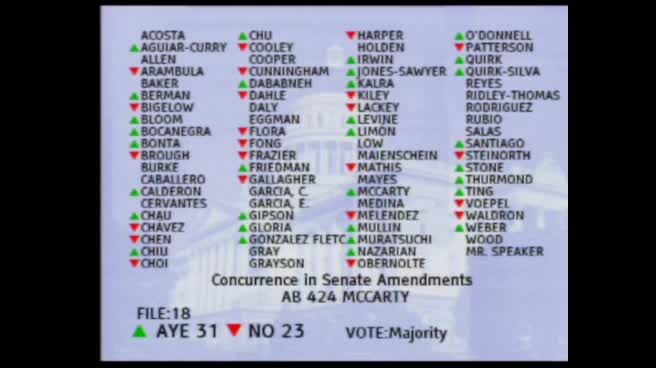
Bill Author

Bill Co-Author(s):