AB 474: Hazardous waste: spent brine solutions.
- Session Year: 2017-2018
- House: Assembly
- Latest Version Date: 2017-10-15
Existing law exempts from certain requirements of the Hazardous Waste Control Law wastes from the extraction, beneficiation, or processing of ores and minerals that are not subject to regulation under the federal Resource Conservation and Recovery Act of 1976, including spent brine solutions used to produce geothermal energy that meet specified requirements.
This bill would exempt spent brine solutions that are byproducts of the treatment of groundwater to meet California drinking water standards from those same requirements if certain conditions are met, including that the spent brine solutions are transferred for dewatering via a closed piping system to lined surface impoundments regulated by the California regional water quality control boards. The bill would require surface impoundments used for the treatment of spent brine solutions to maintain financial assurances consistent with requirements of the Hazardous Waste Control Law.
Existing law exempts from certain requirements of the Hazardous Waste Control Law wastes from the extraction, beneficiation, or processing of ores and minerals that are not subject to regulation under the federal Resource Conservation and Recovery Act of 1976, including spent brine solutions used to produce geothermal energy that meet specified requirements.
This bill would exempt spent brine solutions that are byproducts of the treatment of groundwater to meet California drinking water standards from those same requirements if certain conditions are met, including that the spent brine solutions are transferred for dewatering via a closed piping system to lined surface impoundments regulated by the California regional water quality control boards.
(a)Spent brine solutions that are byproducts from the treatment of groundwater to meet California drinking water standards are exempt from the requirements of this chapter if all of the following conditions are met:
(1)The treatment of these spent brine solutions by dewatering via a closed piping system to lined surface impoundments is specifically approved by the applicable regional water quality control board.
(2)The spent brine solutions are transferred for dewatering via a closed piping system to lined surface impoundments regulated by the California regional water quality control boards.
(3)The spent brine solutions are treated, prior to transfer to lined surface impoundments, with a technology that renders the spent brine solutions nonhazardous for all contaminants except selenium.
(4)Mitigation measures, which shall be approved by the Department of Fish and Wildlife, are used to prevent birds from coming into contact with spent brine solutions in lined surface impoundments containing hazardous levels of selenium.
(b)If spent brine solution that is exempt pursuant to subdivision (a) is relocated to an elevated location inside a lined surface impoundment for further dewatering, the waste from that spent brine solution shall be removed from the lined surface impoundment while it still contains sufficient moisture to prevent wind dispersion.
(c)Waste from spent brine solutions exempt pursuant to subdivision (a) shall be deemed generated at the time of removal from a lined surface impoundment and shall be managed pursuant to the requirements of this chapter if determined to be a hazardous waste.
(d)Operators of surface impoundments used for the treatment of spent brine solutions shall maintain financial assurances consistent with the requirements of this chapter.
(e)Untreated spent brine solutions shall be managed in accordance with this chapter.
(a)Spent brine solutions that are byproducts from the treatment of groundwater to meet California drinking water standards are exempt from the requirements of this chapter if all of the following conditions are met:
(1)The treatment of these spent brine solutions by dewatering via a closed piping system to lined surface impoundments is specifically approved by the State Water Resources Control Board. applicable regional water quality control board.
(2)The spent brine solutions are transferred for dewatering via a closed piping system to lined surface impoundments regulated by the California regional water quality control boards.
(3)The spent brine solutions are treated, prior to transfer to lined surface impoundments, with a technology that renders the spent brine solutions nonhazardous for all contaminants except selenium.
(4)Mitigation measures, which shall be approved by the Department of Fish and Wildlife, are used to prevent birds from coming into contact with spent brine solutions in lined surface impoundments containing hazardous levels of selenium.
(b)If spent brine solution that is exempt pursuant to subdivision (a) is relocated to an elevated location inside a lined surface impoundment for further dewatering, the waste from that spent brine solution shall be removed from the lined surface impoundment while it still contains sufficient moisture to prevent wind dispersion.
(c)Waste from spent brine solutions exempt pursuant to subdivision (a) shall be deemed generated at the time of removal from a lined surface impoundment and shall be managed pursuant to the requirements of this chapter if determined to be a hazardous waste.
(d)Operators of surface impoundments used for the treatment of spent brine solutions shall maintain financial assurances consistent with the requirements of this chapter.
(e)The management of untreated Untreated spent brine solutions shall be managed in accordance with this chapter.
(a)Spent brine solutions that are byproducts from the treatment of groundwater to meet California drinking water standards are exempt from the requirements of this chapter if all of the following conditions are met:
(1)The treatment of these spent brine solutions by dewatering via a closed piping system to lined surface impoundments is specifically approved by the State Water Resources Control Board.
(1)(2)The spent brine solutions are transferred for dewatering via a closed piping system to lined surface impoundments regulated by the California regional water quality control boards.
(2)(3)The spent brine solutions are treated, prior to transfer to lined surface impoundments, with a technology that renders the spent brine solutions nonhazardous for all contaminants except selenium.
(3)(4)Mitigation measures measures, which shall be approved by the Department of Fish and Wildlife, are used to prevent birds from coming into contact with spent brine solutions in lined surface impoundments containing hazardous levels of selenium.
(b)If spent brine solution that is exempt pursuant to subdivision (a) is relocated to an elevated location inside a lined surface impoundment for further dewatering, the waste from that spent brine solution shall be removed from the lined surface impoundment while it still contains sufficient moisture to prevent wind dispersion.
(c)Waste from spent brine solutions exempt pursuant to subdivision (a) shall be deemed generated at the time of removal from a lined surface impoundment and shall be managed pursuant to the requirements of this chapter if determined to be a hazardous waste.
(d)Operators of surface impoundments used for the treatment of spent brine solutions shall maintain financial assurances consistent with the requirements of this chapter.
(e)The management of untreated spent brine solutions shall be in accordance with this chapter.
(a)Spent brine solutions that are byproducts from the treatment of groundwater to meet California drinking water standards are exempt from the requirements of this chapter if all of the following conditions are met:
(1)The spent brine solutions are transferred for dewatering via a closed piping system to lined surface impoundments regulated by the California regional water quality control boards.
(2)The spent brine solutions are treated, prior to transfer to lined surface impoundments, with a technology that renders the spent brine solutions nonhazardous for all contaminants except selenium.
(3)Mitigation measures are used to prevent birds from coming into contact with spent brine solutions in lined surface impoundments containing hazardous levels of selenium.
(b)If spent brine solution that is exempt pursuant to subdivision (a) is relocated to an elevated location inside a lined surface impoundment for further dewatering, the waste from that spent brine solution shall be removed from the lined surface impoundment while it still contains sufficient moisture to prevent wind dispersion.
(c)Waste from spent brine solutions exempt pursuant to subdivision (a) shall be deemed generated at the time of removal from a lined surface impoundment and shall be managed pursuant to the requirements of this chapter if determined to be a hazardous waste.
|
Date
|
Status
|
|---|---|
| Oct 15, 2017 | Chaptered by Secretary of State - Chapter 840, Statutes of 2017. |
| Oct 15, 2017 | Approved by the Governor. |
| Sep 19, 2017 | Enrolled and presented to the Governor at 3 p.m. |
| Sep 11, 2017 | Senate amendments concurred in. To Engrossing and Enrolling. |
| Sep 6, 2017 | In Assembly. Concurrence in Senate amendments pending. May be considered on or after September 8 pursuant to Assembly Rule 77. |
| Sep 6, 2017 | Read third time. Passed. Ordered to the Assembly. |
| Sep 5, 2017 | Read second time. Ordered to third reading. |
| Sep 1, 2017 | From committee: Do pass. (Ayes 7. Noes 0.) (September 1). |
| Aug 21, 2017 | From committee chair, with author's amendments: Amend, and re-refer to committee. Read second time, amended, and re-referred to Com. on APPR. |
| Jul 10, 2017 | In committee: Referred to APPR. suspense file. |
| Jun 28, 2017 | Read second time and amended. Re-referred to Com. on APPR. |
| Jun 27, 2017 | From committee: Amend, and do pass as amended and re-refer to Com. on APPR. (Ayes 6. Noes 0.) (June 21). |
| Jun 8, 2017 | Referred to Com. on EQ. |
| May 30, 2017 | In Senate. Read first time. To Com. on RLS. for assignment. |
| May 30, 2017 | Read third time. Passed. Ordered to the Senate. (Ayes 77. Noes 0. Page 1819.) |
| May 26, 2017 | From committee: Do pass. (Ayes 17. Noes 0.) (May 26). |
| Apr 5, 2017 | In committee: Set, first hearing. Referred to APPR. suspense file. |
| Mar 21, 2017 | From committee: Do pass and re-refer to Com. on APPR. with recommendation: To Consent Calendar. (Ayes 7. Noes 0.) (March 21). Re-referred to Com. on APPR. |
| Feb 27, 2017 | Referred to Com. on E.S. & T.M. |
| Feb 14, 2017 | From printer. May be heard in committee March 16. |
| Feb 13, 2017 | Read first time. To print. |
|
Date
|
Description
|
Location
|
Votes
|
|
|---|---|---|---|---|
| Sep 11, 2017 | AB 474 GARCIA, E. Concurrence in Senate Amendments | Assembly Floor |
Passed |
|
| Sep 6, 2017 | Assembly 3rd Reading AB474 Eduardo Garcia By Hill | Senate Floor |
Passed |
|
| Sep 1, 2017 | Do pass | Senate Standing Committee on Appropriations |
Passed |
|
| Jul 10, 2017 | Placed on suspense file | Senate Standing Committee on Appropriations |
Passed |
|
| Jun 21, 2017 | Do pass as amended, but first amend, and re-refer to the Committee on [Appropriations] | Senate Standing Committee on Environmental Quality |
Passed |
|
| May 30, 2017 | AB 474 GARCIA, E. Assembly Third Reading | Assembly Floor |
Passed |
|
| May 26, 2017 | Do pass. | Assembly Standing Committee on Appropriations |
Passed |
|
| Mar 21, 2017 | Do pass and be re-referred to the Committee on [Appropriations] with recommendation: To Consent Calendar | Assembly Standing Committee on Environmental Safety and Toxic Materials |
Passed |
This list shows positions taken on this bill by organizations on the date displayed, which is linked to the original source.
Positions by individuals are not included.
|
Organization
|
Position
|
Date
|
|---|---|---|
| Association Of California Water Agencies | ** Support | Sep 3, 2017 |
| California Municipal Utilities Association | ** Support | Sep 3, 2017 |
| California Water Association | ** Support | Sep 3, 2017 |
| Coachella Valley Water District | ** Support | Sep 3, 2017 |
| Desert Water Agency | ** Support | Sep 3, 2017 |
| Rural County Representatives of California | ** Support | Sep 3, 2017 |
CONCURRENCE IN SENATE AMENDMENTS
CSA1 Bill Id:AB 474
Author:(Eduardo Garcia)
As Amended Ver:August 21, 2017
Majority vote
ASSEMBLY: | 77-0 | (May 30, 2017) | SENATE: | 40-0 | (September 6, 2017) |
Original Committee Reference: E.S. & T.M.
SUMMARY: Exempts spent brine solutions from hazardous waste requirements if the spent brine solution is a byproduct of the treatment process for drinking water and will be transferred to a surface impoundment regulated by the California regional water quality control boards (Regional Water Boards).
The Senate amendments:
1) Require the applicable Regional Water Board to approve the treatment of spent brine solutions by dewatering to lined surface impoundments.
2) Require operators of surface impoundments for the treatment of spent brine solution to maintain financial assurances consistent with the requirements of the Hazardous Waste Control Law (HWCL).
3) Require untreated spent brine solution to be managed in accordance with the HWCL.
EXISTING LAW:
- Exempts spent brine solutions from the requirements of the HWCL that are used to produce geothermal energy and that are transferred, via a closed piping system, to an adjacent facility for reclamation or processing to recover minerals or other commercial substances if the spent brine solutions are returned after processing and subsequently managed under the HWCL and are not a solid or semisolid hazardous residual.
- Establishes waste management requirements for waste treatment, storage, or disposal in landfills, surface impoundments, waste piles, and land treatment facilities. Authorizes Regional Water Boards to impose more stringent requirements to accommodate regional and site-specific conditions.
FISCAL EFFECT: According to the Senate Appropriations Committee, enactment of this bill could lead to unknown increased costs for the State Water Board to issue Waste Discharge Requirements (WDRs) depending on how many public water systems decide to manage their brines through evaporation ponds. There are thousands of public water systems in the state.
COMMENTS:
Need for the bill: According to the author, "AB 474 is sponsored by the Coachella Valley Water District (District) to permit a cost-effective and environmentally beneficial means of treating the waste products resulting from meeting the clean drinking water standards in areas affected by concentrations of Arsenic, Chromium 6 and potentially other undesirable minerals in the future. Without this legislation, the District and other agencies in California will face increasing costs and rigid regulations that would prevent the use of the most cost-effective engineering systems.
"Under AB 474, the District would be able to employ technologies that will efficiently remove the toxic waste in a way that is not under the regulations of the HWCL and instead employ a treatment plan that remains under the regulations of California regional water quality control boards, ensuring the protection of the public and the environment."
Hazardous waste exemption for geothermal brine: Geothermal wastes are exempt from regulation as hazardous waste under the Health and Safety Code Section 25143.1(a), which states, "Any geothermal waste resulting from drilling for geothermal resources is exempt from the requirements of this chapter because the disposal of these geothermal wastes is regulated by the Regional Water Boards." The hazardous waste exemption within this bill is modeled after the approach taken in existing law.
Many water agencies in California face challenges when treating their drinking water that is contaminated with arsenic, hexavalent chromium, and other contaminants. One of the key challenges is that the treatment technology used for treating drinking water often leads to some type of disposal issue of the waste that is produced from the treatment process. The use of surface water impounds is not new and is regulated by the Regional Water Boards throughout the state. This bill strikes a balance of providing flexibility to one set of requirements, the HWCL, in order to comply with state drinking water standards.
Analysis Prepared by: Josh Tooker / E.S. & T.M. / (916) 319-3965 FN: 0001891
Office of Senate Floor Analyses (916) 651-1520 Fax: (916) 327-4478 | AB |
THIRD READING
Bill No: AB 474
:
SENATE ENVIRONMENTAL QUALITY COMMITTEE: 6-0, 6/21/17
AYES: Wieckowski, Stone, Hill, Lara, Skinner, Stern
NO VOTE RECORDED: Gaines
SENATE APPROPRIATIONS COMMITTEE: 7-0, 9/1/17
AYES: Lara, Bates, Beall, Bradford, Hill, Nielsen, Wiener
ASSEMBLY FLOOR: 77-0, 5/30/17 - See last page for vote
SOURCE: Coachella Valley Water District
DIGEST:
This bill exempts from Hazardous Waste Control Law (HWCL), spent brine solutions (brine) that are the byproduct of groundwater treated to meet California drinking water standards (exempt brine) if specified treatment conditions are met.
ANALYSIS:
Existing law:
Under the California Safe Drinking Water Act of 1996:
- Requires the Office of Environmental Health Hazard Assessment (OEHHA) to perform risk assessments and adopt public health goals (PHGs) for contaminants in drinking water based exclusively on public health considerations.
- Requires the State Water Resources Control Board (SWRCB), Division of Drinking Water (Division), formerly within the Department of Public Health (DPH) to establish, regulate and enforce primary drinking water standards (State Maximum Contaminant Levels, or MCLs).
- Authorizes the Division to issue citations for the failure to comply with a requirement of the California Safe Drinking Water Act or any regulation, standard, permit or order issued thereunder. That citation often contains a specific directive for required corrective action.
- Requires the State Department of Health Services (succeeded by DPH and then SWRCB) to adopt a primary drinking water standard for hexavalent chromium by January 1, 2004.
- Authorizes SWRCB, until January 1, 2020, to grant a public water system additional time to meet the drinking water standard for hexavalent chromium by approving a compliance plan.
- Establishes waste management requirements for waste treatment, storage, or disposal in landfills, surface impoundments, waste piles, and land treatment facilities. Authorizes California Regional Water Quality Control Boards (regional boards) to impose more stringent requirements to accommodate regional and site-specific conditions.
Under HWCL:
- Requires the Department of Toxic Substances Control (DTSC) to regulate the management of hazardous wastes in California.
- Exempts spent brine solutions from the requirements of the HWCL that are used to produce geothermal energy and that are transferred, via a closed piping system, to an adjacent facility for reclamation or processing to recover minerals or other commercial substances if the spent brine solutions are returned after processing and subsequently managed under the HWCL and are not a solid or semisolid hazardous residual.
This bill exempts spent brine solutions from HWCL that are byproducts of the treatment of groundwater to meet California drinking water standards if specified conditions are met.
Background
- What is hexavalent chromium? Chromium is a natural element that occurs in two basic forms: chromium-3 and chromium-6. Chromium-3 is an essential nutrient with a daily amount of 50-200 micrograms/day for adults. While at very high doses it may have acute health effects, there is no evidence that it is carcinogenic. Chromium-6, on the other hand, is a known carcinogen.
Hexavalent chromium, also called chromium 6, came to the public’s attention with the 2000 release of the movie Erin Brockovich, which told the story of the hexavalent chromium contamination of the drinking water in Hinkley, California.
- Where does hexavalent chromium come from? Hexavalent chromium can be naturally occurring. In addition to natural sources, hexavalent chromium enters drinking water sources through discharges of dye and paint pigments, wood preservatives, chrome plating wastes, and leaching from hazardous waste sites. Communities near chromium waste disposal sites or chromium manufacturing and processing plants are at particular risk of exposure. Probably the most impacted people are workers exposed on the job.
Hexavalent chromium is a heavy metal used in producing pigments, leather tanning, electroplating, metal processing, wood preservation, and in alloys such as stainless steel. It was also used to inhibit corrosion in cooling towers -- the use that contaminated Hinkley’s water by the Pacific Gas and Electric Company.
Drinking water sources can become contaminated by leaks and discharges from industrial facilities and hazardous waste sites.
Since that time hexavalent chromium has been detected in 2,475 California drinking water sources. These sources are spread throughout 51 out of 58 counties.
- What are the health effects of hexavalent chromium? Hexavalent chromium is a carcinogen and a reproductive toxicant for both males and females. As a result, it was added to California’s Proposition 65 list of toxic substances in December 2008. Exposure to hexavalent chromium occurs through breathing, ingestion, and contact with the skin. Although most of the known health impacts are related to inhalation, there is now strong data linking ingestion of hexavalent chromium, such as through drinking water, to severe health effects. In addition to cancer and reproductive harm, short and long-term exposures can lead to eye and respiratory irritation, asthma attacks, nasal ulcers, dermal burns, anemia, acute gastroenteritis, vertigo, gastrointestinal hemorrhage, convulsions, ulcers, and damage or failure of the liver and kidneys.
In order to protect public health, and because the federal government had not adopted an MCL for hexavalent chromium, the California Legislature passed SB 351 (Ortiz, Chapter 602, Statutes of 2001), requiring the development of a state drinking water standard for hexavalent chromium by January 2004.
- Hexavalent Chromium PHG. In 2013, OEHHA published a PHG for hexavalent chromium of 0.02 parts per billion (ppb) or micrograms per liter (μg/L) in drinking water. OEHHA reviewed the available data on the toxicity of hexavalent chromium and has identified the PHG level as protective against all identified toxic effects from both oral and inhalation exposure to hexavalent chromium that may be present in drinking water.
- Hexavalent Chromium MCL. As part of the rulemaking process, in August 2013 DPH proposed an MCL for chromium-6 of 0.010 milligram per liter (equivalent to 10 μg/L). The public comment period closed in October 2013. DPH reviewed the comments submitted by interested parties and responded to them in the final statement of reasons, which is part of the final hexavalent MCL regulations package.
On April 15, 2014, DPH submitted the hexavalent chromium MCL regulations package to the Office of Administrative Law (OAL) for its review for compliance with the Administrative Procedure Act. On May 28, OAL approved the regulations, which were effective on July 1, 2014.
- Drinking water treatments for hexavalent chromium: The regulation that set the MCL for hexavalent chromium also identifies technologies that can be used to treat the drinking water for hexavalent chromium. The treatment technologies identified in the regulation are reverse osmosis or ion exchange (including anion exchanges). Reverse osmosis is a water treatment process that removes contaminants from water by using pressure to force water molecules through a semipermeable membrane. Ion exchange processes are reversible chemical reactions for removing dissolved ions from a solution and replacing them with other similarly charged ions. In an anion exchange, negatively charged ions are exchanged with negatively charged ions on the resin surface.
- Hazardous waste exemption for geothermal brine: Geothermal wastes are exempt from regulation as hazardous waste under the Health and Safety Code Section 25143.1(a) which states, “Any geothermal waste resulting from drilling for geothermal resources is exempt from the requirements of this chapter because the disposal of these geothermal wastes is regulated by the Regional Water Boards.” In 2006, SB 1294 (Ducheny, Chapter 143, Statutes of 2006) provided that any waste from the operation of a geothermal energy plant was exempt from regulation as a hazardous waste, in addition to the exemption for waste from drilling.
In 2012, AB 2205 (V. Manuel Pérez, Chapter 253, Statutes of 2012) clarified that wastes from the extraction, beneficiation, and processing of ores and minerals includes spent brine solutions that are used to produce geothermal energy and that are transferred, via a closed piping system, to an adjacent facility for reclamation, beneficiation, or processing to recover minerals or other commercial substances, if the spent brine solutions, and any liquid residuals derived from the solutions are: managed in accordance with specified provisions of the Code of Federal Regulations; returned after processing, via closed piping, and subsequently managed in accordance with the exemption under existing law; and, not solid or semisolid hazardous residuals. The hazardous waste exemption within AB 474 is modeled after the approach taken in AB 2205.
- Surface water impoundments: California regulations (23 CCR §2510 et. seq.) govern the waste management requirements for surface impoundments. These surface impoundments receive liquid wastes in lined ponds. The regulations authorize the regional boards to impose more stringent requirements to accommodate regional and site-specific conditions. Evaporation ponds are surface impoundments that are used to manage spent brine solutions, including those generated during the production of geothermal energy.
To comply with current drinking water standards, many public water systems use a Strong Base Anion (SBA) treatment system that transfers minerals containing arsenic and hexavalent chromium to spent brine solutions. The spent brine solution is treated so that it can be hauled to facilities that are authorized to dispose of the treated brine. For inland water agencies, this disposal process represents a significant operating cost for this treatment technology.
Evaporation ponds (surface impoundments) are an alternative to hauling the brine to disposal facilities and would provide the water agency with a local process to manage spent brine where there are a large number of wells contaminated with hexavalent chromium that require treatment to meet the MCL for hexavalent chromium.
Many water agencies in California face challenges when treating their drinking water that is contaminated with arsenic, hexavalent chromium, and other contaminants. One of the key challenges is that the treatment technology used for treating drinking water often leads to some type of disposal issue of the waste that is produced from the treatment process. It is important for water agencies to be able to provide clean, safe, and affordable drinking water to their residents; therefore, it is important for the state to provide some regulatory flexibility. The use of surface water impounds is not new and is regulated by the Regional Water Boards throughout the state. AB 474 strikes a balance of providing flexibility to one set of laws, the HWCL, in order to safely comply with state drinking water standards.
Comments
Purpose of Bill. According to the author, “AB 474 is sponsored by the Coachella Valley Water District to permit a cost-effective and environmentally beneficial means of treating the waste products resulting from meeting the clean drinking water standards in areas affected by concentrations of Arsenic, Chromium 6 and potentially other undesirable minerals in the future. Without this legislation, the District and other agencies in California will face increasing costs and rigid regulations that would prevent the use of the most cost-effective engineering systems.
“Under AB 474, the District would be able to employ technologies that will efficiently remove the toxic waste in a way that is not under the regulations of the HWCL and instead employ a treatment plan that remains under the regulations of California regional water quality control boards, ensuring the protection of the public and the environment. In addition, by transferring the treated waste in a closed piping system to lined and caged evaporative ponds (bird protection) the only time that the waste stream exceeds the standards of "toxicity" will be as the waste stream is dewatered and the toxic element of selenium exceeds the state standard. Once it is dewatered in the ponds, the waste product can be removed from the lined floor of the structure and instead of requiring transportation to the Pacific Ocean (an environmentally challengeable process) it would qualify for trucking and disposal in nearby solid waste dumps. The further environmental benefit of the process is that all electrical demand can be met by solar power.”
Related/Prior Legislation
SB 385 (Hueso, Chapter 272, Statutes of 2015) allowed the State Water Board to grant a public water system additional time to meet the drinking water standard for hexavalent chromium by approving a compliance plan.
AB 2205 (V. Manuel Pérez, Chapter 253, Statutes of 2012) allowed for the operation of ore and mineral extraction from geothermal energy facility waste without a specified hazardous waste treatment permit from DTSC.
FISCAL EFFECT: Appropriation: Fiscal Com.: Local:
According to the Senate Committee on Appropriations, AB 474 will have unknown increased costs for SWRCB to issue Waste Discharge Requirements (WDRs); the cost will depend on how many public water systems decide to manage their brines through evaporation ponds. There are thousands of public water systems in the state.
Coachella Valley Water District (source)
Association of California Water Agencies
California Municipal Utilities Association
California Water Association
Coachella Valley Water District
Desert Water Agency
Rural County Representatives of California
None received
ASSEMBLY FLOOR: 77-0, 5/30/17
AYES: Acosta, Aguiar-Curry, Travis Allen, Arambula, Baker, Berman, Bigelow, Bloom, Bocanegra, Bonta, Brough, Burke, Caballero, Calderon, Cervantes, Chávez, Chen, Chiu, Chu, Cooley, Cooper, Cunningham, Dababneh, Dahle, Daly, Flora, Fong, Frazier, Friedman, Gallagher, Cristina Garcia, Eduardo Garcia, Gipson, Gloria, Gomez, Gonzalez Fletcher, Gray, Grayson, Harper, Holden, Irwin, Jones-Sawyer, Kalra, Kiley, Lackey, Levine, Limón, Low, Maienschein, Mathis, Mayes, McCarty, Medina, Melendez, Mullin, Muratsuchi, Nazarian, Obernolte, O'Donnell, Patterson, Quirk, Quirk-Silva, Reyes, Ridley-Thomas, Rodriguez, Rubio, Salas, Santiago, Steinorth, Mark Stone, Thurmond, Ting, Voepel, Waldron, Weber, Wood, Rendon
NO VOTE RECORDED: Chau, Choi, Eggman
9/3/17 17:57:09
**** END ****
SENATE COMMITTEE ON
Senator Ricardo Lara, Chair
2017 - 2018 Regular Session
AB 474 (Eduardo Garcia) - Hazardous waste: spent brine solutions
Version: | Policy Vote: |
Urgency: | Mandate: |
Hearing Date: | Consultant: |
This bill meets the criteria for referral to the Suspense File.
Bill Summary:
AB 474 exempts from Hazardous Waste Control Law (HWCL), spent brine solutions (brine) that are the byproduct of groundwater treated to meet California drinking water standards (exempt brine) if specified treatment conditions are met.
Fiscal Impact:
- Unknown increased costs for the State Water Resources Control Board (SWRCB) to issue Waste Discharge Requirements (WDRs); the cost will depend on how many public water systems decide to manage their brines through evaporation ponds. There are thousands of public water systems in the state.
For example, if between four and eight WDRs were issued per year, the resulting annual cost increases would be between $140,000 and $560,000. All costs would be covered by fees.
- Ongoing minor and absorbable costs once WDRs are issued.
Background:
State and federal law. Several state and federal statutes and regulations jointly work to ensure safe drinking water and the hazardous waste management necessary to prevent drinking water contamination. Under the federal Safe Drinking Water Act (SDWA), the United States Environmental Protection Agency (US EPA) sets national health-based standards and testing requirements for drinking water quality and oversees implementing entities. California’s Porter-Cologne Water Quality Control Act established the SWRCB and the nine Regional Water Quality Control Boards to adopt and enforce state and local water quality control plans that contain the guiding policies for water pollution management in California. The Department of Toxic Substances Control (DTSC), pursuant to the Hazardous Waste Control Law (HWCL), regulates hazardous waste management.
Hazardous waste exemption for geothermal brine: Geothermal wastes are exempt from regulation as hazardous waste. In 2012, AB 2205 (V. Manuel Pérez, Chapter 253, Statutes of 2012) clarified that wastes from the extraction, beneficiation, and processing of ores and minerals includes spent brine solutions that are used to produce geothermal energy and that are transferred, via a closed piping system, to an adjacent facility for reclamation, beneficiation, or processing to recover minerals or other commercial substances, if the spent brine solutions, and any liquid residuals derived from the solutions are: managed in accordance with specified provisions of the Code of Federal Regulations; returned after processing, via closed piping, and subsequently managed in accordance with the exemption under existing law; and, not solid or semisolid hazardous residuals. The hazardous waste exemption within AB 474 is modeled after the approach taken in AB 2205.
Surface water impoundments: California regulations (23 CCR §2510 et. seq.) govern waste management requirements for surface impoundments that receive liquid wastes in lined ponds. The regulations authorize the regional boards to impose more stringent requirements to accommodate regional and site-specific conditions. Evaporation ponds are surface impoundments that are used to manage spent brine solutions, including those generated during the production of geothermal energy.
To comply with current drinking water standards, many public water systems use a Strong Base Anion (SBA) treatment system that transfers minerals containing arsenic and hexavalent chromium to spent brine solutions. The spent brine solution is treated so that it can be hauled to facilities that are authorized to dispose of the treated brine. For inland water agencies, this disposal process represents a significant operating cost for this treatment technology.
Evaporation ponds (surface impoundments) are an alternative to hauling the brine to disposal facilities and would provide the water agency with a local process to manage spent brine where there are a large number of wells contaminated with hexavalent chromium that require treatment to meet the MCL for hexavalent chromium.
Proposed Law:
This bill:
- Exempts from HWCL the brine byproduct of groundwater treated to meet California drinking water standards if all of the following conditions are met: (1) The brine is treated by and transferred for dewatering via a closed piping system to lined surface impoundments (impoundments) approved by the SWRCB and regulated by the regional water quality control boards; (2) The spent brine solutions are treated, prior to transfer to lined surface impoundments, with a technology that renders the spent brine solutions; and (3) The Department of Fish and Wildlife-approved mitigation measures are used to prevent birds from coming into contact with brine in impoundments.
- Requires that the waste from that brine is removed from the lined surface impoundment while it still contains sufficient moisture to prevent wind dispersion if it is relocated to an elevated location inside a lined surface impoundment for further dewatering.
- Requires that brine waste is managed pursuant to HWCLs if determined to be a hazardous waste.
- Requires operators of surface impoundments used to treat brine to maintain financial assurances consistent with HCWA.
Related Legislation:
SB 385 (Hueso Chapter 272, Statutes of 2015.) Allows the State Water Board to grant a public water system additional time to meet the drinking water standard for hexavalent chromium by approving a compliance plan.
AB 2205 (V. Manuel Pérez Chapter 253, Statutes of 2012.) Allows for the operation of ore and mineral extraction from geothermal energy facility waste without a specified hazardous waste treatment permit from DTSC.
Staff Comments:
Purpose of the bill. This bill is sponsored by the Coachella Valley Water District to permit the treating of the waste products resulting from meeting the clean drinking water standards in areas affected by concentrations of Arsenic, Chromium 6, and other undesirable minerals in the future. Without this legislation, the District and other agencies in California will face increasing costs and rigid regulations that would prevent the use of the most cost-effective engineering systems.
-- END --
SENATE COMMITTEE ON ENVIRONMENTAL QUALITY
Senator Wieckowski, Chair
2017 - 2018 Regular
Bill No: AB 474
Author: | Eduardo Garcia | ||
Version: | 2/13/2017 | Hearing Date: | 6/21/2017 |
Urgency: | No | Fiscal: | Yes |
Consultant: | Rachel Machi Wagoner | ||
SUBJECT: Hazardous waste: spent brine solutions.
ANALYSIS:
Existing law:
Under the California Safe Drinking Water Act of 1996:
- Requires the Office of Environmental Health Hazard Assessment (OEHHA) to perform risk assessments and adopt public health goals (PHGs) for contaminants in drinking water based exclusively on public health considerations.
- Requires the State Water Resources Control Board (SWRCB), Division of Drinking Water (Division), formerly within the Department of Public Health (DPH) to establish, regulate and enforce primary drinking water standards (State Maximum Contaminant Levels, or MCLs).
- Authorizes the Division to issue citations for the failure to comply with a requirement of the California Safe Drinking Water Act or any regulation, standard, permit or order issued thereunder. That citation often contains a specific directive for required corrective action.
- Requires the State Department of Health Services (succeeded by DPH and then SWRCB) to adopt a primary drinking water standard for hexavalent chromium by January 1, 2004.
- Authorizes SWRCB, until January 1, 2020, to grant a public water system additional time to meet the drinking water standard for hexavalent chromium by approving a compliance plan.
- Establishes waste management requirements for waste treatment, storage, or disposal in landfills, surface impoundments, waste piles, and land treatment facilities. Authorizes California Regional Water Quality Control Boards (regional boards) to impose more stringent requirements to accommodate regional and site-specific conditions.
Under the Hazardous Waste Control Law (HWCL),
- Requires the Department of Toxic Substances Control (DTSC) to regulate the management of hazardous wastes in California.
- Exempts spent brine solutions from the requirements of the HWCL that are used to produce geothermal energy and that are transferred, via a closed piping system, to an adjacent facility for reclamation or processing to recover minerals or other commercial substances if the spent brine solutions are returned after processing and subsequently managed under the HWCL and are not a solid or semisolid hazardous residual.
This bill exempts spent brine solutions from HWCL that are byproducts of the treatment of groundwater to meet California drinking water standards if all of the following conditions are met:
- The spent brine solutions are transferred for dewatering via a closed piping system to lined surface impoundments regulated by regional boards;
- The spent brine solutions are treated, prior to transfer to lined surface impoundments, with a technology that renders the spent brine solutions nonhazardous for all contaminants except selenium; and,
- Mitigation measures are used to prevent birds from coming into contact with spent brine solutions in lined surface impoundments containing hazardous levels of selenium.
- Allows a spent brine solution that is exempt under this bill to be relocated to an elevated location inside a lined surface impoundment for further dewatering, as long as the waste from the spent brine solution contains sufficient moisture to prevent wind dispersion.
- Requires waste from spent brine solutions to be managed under the requirements of the HWCL at the time of removal from a lined surface impoundment.
Background
- What is hexavalent chromium? Chromium is a natural element that occurs in two basic forms: chromium-3 and chromium-6. Chromium-3 is an essential nutrient with a daily amount of 50-200 micrograms/day for adults. While at very high doses it may have acute health effects, there is no evidence that it is carcinogenic. Chromium-6, on the other hand, is a known carcinogen.
Hexavalent chromium, also called chromium 6, came to the public’s attention with the 2000 release of the movie Erin Brockovich, which told the story of the hexavalent chromium contamination of the drinking water in Hinkley, California.
- Where does hexavalent chromium come from? Hexavalent chromium can be naturally occurring. In addition to natural sources, hexavalent chromium enters drinking water sources through discharges of dye and paint pigments, wood preservatives, chrome plating wastes, and leaching from hazardous waste sites. Communities near chromium waste disposal sites or chromium manufacturing and processing plants are at particular risk of exposure. Probably the most impacted people are workers exposed on the job.
Hexavalent chromium is a heavy metal used in producing pigments, leather tanning, electroplating, metal processing, wood preservation, and in alloys such as stainless steel. It was also used to inhibit corrosion in cooling towers -- the use that contaminated Hinkley’s water by the Pacific Gas and Electric Company.
Drinking water sources can become contaminated by leaks and discharges from industrial facilities and hazardous waste sites.
Since that time hexavalent chromium has been detected in 2,475 California drinking water sources. These sources are spread throughout 51 out of 58 counties.
- What are the health effects of hexavalent chromium? Hexavalent chromium is a carcinogen and a reproductive toxicant for both males and females. As a result, it was added to California’s Proposition 65 list of toxic substances in December 2008. Exposure to hexavalent chromium occurs through breathing, ingestion, and contact with the skin. Although most of the known health impacts are related to inhalation, there is now strong data linking ingestion of hexavalent chromium, such as through drinking water, to severe health effects. In addition to cancer and reproductive harm, short and long-term exposures can lead to eye and respiratory irritation, asthma attacks, nasal ulcers, dermal burns, anemia, acute gastroenteritis, vertigo, gastrointestinal hemorrhage, convulsions, ulcers, and damage or failure of the liver and kidneys.
In order to protect public health, and because the federal government had not adopted an MCL for hexavalent chromium, the California Legislature passed SB 351 (Ortiz, Chapter 602, Statutes of 2001), requiring the development of a state drinking water standard for hexavalent chromium by January 2004.
- Hexavalent Chromium PHG. In 2013, OEHHA published a PHG for hexavalent chromium of 0.02 parts per billion (ppb) or micrograms per liter (μg/L) in drinking water. OEHHA reviewed the available data on the toxicity of hexavalent chromium and has identified the PHG level as protective against all identified toxic effects from both oral and inhalation exposure to hexavalent chromium that may be present in drinking water.
- Hexavalent Chromium MCL. As part of the rulemaking process, in August 2013 DPH proposed an MCL for chromium-6 of 0.010 milligram per liter (equivalent to 10 μg/L). The public comment period closed in October 2013. DPH reviewed the comments submitted by interested parties and responded to them in the final statement of reasons, which is part of the final hexavalent MCL regulations package.
On April 15, 2014, DPH submitted the hexavalent chromium MCL regulations package to the Office of Administrative Law (OAL) for its review for compliance with the Administrative Procedure Act. On May 28, OAL approved the regulations, which were effective on July 1, 2014.
- Drinking water treatments for hexavalent chromium: The regulation that set the MCL for hexavalent chromium also identifies technologies that can be used to treat the drinking water for hexavalent chromium. The treatment technologies identified in the regulation are reverse osmosis or ion exchange (including anion exchanges). Reverse osmosis is a water treatment process that removes contaminants from water by using pressure to force water molecules through a semipermeable membrane. Ion exchange processes are reversible chemical reactions for removing dissolved ions from a solution and replacing them with other similarly charged ions. In an anion exchange, negatively charged ions are exchanged with negatively charged ions on the resin surface.
- Hazardous waste exemption for geothermal brine: Geothermal wastes are exempt from regulation as hazardous waste under the Health and Safety Code Section 25143.1(a) which states, “Any geothermal waste resulting from drilling for geothermal resources is exempt from the requirements of this chapter because the disposal of these geothermal wastes is regulated by the Regional Water Boards.” In 2006, SB 1294 (Ducheny, Chapter 143, Statutes of 2006) provided that any waste from the operation of a geothermal energy plant was exempt from regulation as a hazardous waste, in addition to the exemption for waste from drilling.
In 2012, AB 2205 (V. Manuel Pérez, Chapter 253, Statutes of 2012) clarified that wastes from the extraction, beneficiation, and processing of ores and minerals includes spent brine solutions that are used to produce geothermal energy and that are transferred, via a closed piping system, to an adjacent facility for reclamation, beneficiation, or processing to recover minerals or other commercial substances, if the spent brine solutions, and any liquid residuals derived from the solutions are: managed in accordance with specified provisions of the Code of Federal Regulations; returned after processing, via closed piping, and subsequently managed in accordance with the exemption under existing law; and, not solid or semisolid hazardous residuals. The hazardous waste exemption within AB 474 is modeled after the approach taken in AB 2205.
- Surface water impoundments: California regulations (23 CCR §2510 et. seq.) govern the waste management requirements for surface impoundments. These surface impoundments receive liquid wastes in lined ponds. The regulations authorize the regional boards to impose more stringent requirements to accommodate regional and site-specific conditions. Evaporation ponds are surface impoundments that are used to manage spent brine solutions, including those generated during the production of geothermal energy.
To comply with current drinking water standards, many public water systems use a Strong Base Anion (SBA) treatment system that transfers minerals containing arsenic and hexavalent chromium to spent brine solutions. The spent brine solution is treated so that it can be hauled to facilities that are authorized to dispose of the treated brine. For inland water agencies, this disposal process represents a significant operating cost for this treatment technology.
Evaporation ponds (surface impoundments) are an alternative to hauling the brine to disposal facilities and would provide the water agency with a local process to manage spent brine where there are a large number of wells contaminated with hexavalent chromium that require treatment to meet the MCL for hexavalent chromium.
Many water agencies in California face challenges when treating their drinking water that is contaminated with arsenic, hexavalent chromium, and other contaminants. One of the key challenges is that the treatment technology used for treating drinking water often leads to some type of disposal issue of the waste that is produced from the treatment process. It is important for water agencies to be able to provide clean, safe, and affordable drinking water to their residents; therefore, it is important for the state to provide some regulatory flexibility. The use of surface water impounds is not new and is regulated by the Regional Water Boards throughout the state. AB 474 strikes a balance of providing flexibility to one set of laws, the HWCL, in order to safely comply with state drinking water standards.
Comments
- Purpose of Bill. According to the author, “AB 474 is sponsored by the Coachella Valley Water District to permit a cost-effective and environmentally beneficial means of treating the waste products resulting from meeting the clean drinking water standards in areas affected by concentrations of Arsenic, Chromium 6 and potentially other undesirable minerals in the future. Without this legislation, the District and other agencies in California will face increasing costs and rigid regulations that would prevent the use of the most cost-effective engineering systems.
“Under AB 474, the District would be able to employ technologies that will efficiently remove the toxic waste in a way that is not under the regulations of the HWCL and instead employ a treatment plan that remains under the regulations of California regional water quality control boards, ensuring the protection of the public and the environment. In addition, by transferring the treated waste in a closed piping system to lined and caged evaporative ponds (bird protection) the only time that the waste stream exceeds the standards of "toxicity" will be as the waste stream is dewatered and the toxic element of selenium exceeds the state standard. Once it is dewatered in the ponds, the waste product can be removed from the lined floor of the structure and instead of requiring transportation to the Pacific Ocean (an environmentally challengeable process) it would qualify for trucking and disposal in nearby solid waste dumps. The further environmental benefit of the process is that all electrical demand can be met by solar power.”
- Exemption from Hazardous Waste Control Law. This bill exempts spent brine solutions from HWCL that are byproducts of the treatment of groundwater to meet California drinking water standards if the spent brine solutions are treated, prior to transfer to lined surface impoundments, with a technology that renders the spent brine solutions nonhazardous for all contaminants except selenium. It is known that most drinking water treatment is treating for multiple hazardous constituents. For many of these hazardous constituents, this type of treatment method may be inappropriate if the other constituents are not treated and handled appropriately. While the bill is clear that the spent brine solutions are exempt IF they are treated for all other hazardous waste constituents prior to transfer, an amendment should be taken to clarify that the spent brine is still considered hazardous waste prior to the transfer for the purposes of that treatment in order to ensure that DTSC continues to oversee and regulate that treatment and disposal of other hazardous constituents.
- Ensuring Mitigation Measures Protect the Environment. Additionally, this bill requires mitigation measures are used to prevent birds from coming into contact with spent brine solutions in lined surface impoundments containing hazardous levels of selenium in order for the water system to be eligible for this exemption. It is not clear who determines what the right mitigation measures would be for each of the potential environments where this treatment method would be used. As selenium can be very toxic to wildlife, particularly birds, the right mitigation measure should be determined by the state’s wildlife expert. An amendment should be taken to require mitigation measures, as approved by the Department of Fish and Wildlife.
- What happens to the environment once the pond is closed? Under HWCL, hazardous waste treatment sites are required to be insured or bonded for the cost of remediating the site post-closure. As this bill exempts these ponds from HWCL, it is not clear how it will be ensured that these sites are fully remediated to prevent future environmental damage.
- Is this the Right Solution for Every Water System? There are 2,475 California drinking water sources in 51 counties that are contaminated with hexavalent chromium in California. While this may be the right solution for some, it is not likely appropriate in all regions of the state. As current law requires that water systems that are currently out of compliance with the MCL for hexavalent chromium submit a plan and work with SWRCB to implement treatment solutions for hexavalent chromium, an amendment should be taken to clarify that this must be approved by SWRCB as an effective and appropriate solution for that system.
- Where are the responsible parties? As with many drinking water contaminants, hexavalent chromium is most often found in drinking water as a result of contamination of some industrial process. Removal of this contaminant will cost water systems, local governments, regional boards and the state of California and tax/rate payers a lot of money to remove this contaminant from drinking water sources. Additionally, these treatment ponds will have legacy impact on the environment. Are the water systems, state and regional boards doing enough to ensure that responsible parties are being held accountable?
Related/Prior Legislation
SB 385 (Hueso, Chapter 272, Statutes of 2015.) Allows the State Water Board to grant a public water system additional time to meet the drinking water standard for hexavalent chromium by approving a compliance plan.
AB 2205 (V. Manuel Pérez, Chapter 253, Statutes of 2012.) Allows for the operation of ore and mineral extraction from geothermal energy facility waste without a specified hazardous waste treatment permit from DTSC.
SOURCE:
Coachella Valley Water District
SUPPORT:
Association of California Water Agencies
California Municipal Utilities Association
California Water Association
Coachella Valley Water District
Desert Water Agency
OPPOSITION:
None received
-- END --
ASSEMBLY THIRD READING
ATR Bill Id:AB 474
Author:(Eduardo Garcia)
As Introduced Ver:February 13, 2017
Majority vote
Committee | Votes | Ayes | Noes |
Environmental Safety | 7-0 | Quirk, Dahle, Arambula, Chen, Cristina Garcia, Gomez, Holden | |
Appropriations | 17-0 | Gonzalez Fletcher, Bigelow, Bloom, Bocanegra, Bonta, Brough, Calderon, McCarty, Quirk, Fong, Friedman, Gallagher, Eduardo Garcia, Gray, Muratsuchi, Obernolte, Reyes |
|
SUMMARY: Exempts spent brine solutions from hazardous waste requirements, if the spent brine solution is a byproduct of the treatment process for drinking water and will be transferred to a surface impoundment regulated by the California Regional Water Quality Control Boards (Regional Water Boards).
EXISTING LAW:
- Exempts spent brine solutions from the requirements of the Hazardous Waste Control Law (HWCL) that are used to produce geothermal energy and that are transferred, via a closed piping system, to an adjacent facility for reclamation or processing to recover minerals or other commercial substances if the spent brine solutions are returned after processing and subsequently managed under the HWCL and are not a solid or semisolid hazardous residual. (Health and Safety Code (HSC) Section 25143.1)
- Establishes waste management requirements for waste treatment, storage, or disposal in landfills, surface impoundments, waste piles, and land treatment facilities. Authorizes Regional Water Boards to impose more stringent requirements to accommodate regional and site-specific conditions. (23 California Code of Regulations (CCR) Section 2510 et. seq.)
FISCAL EFFECT: According to the Assembly Appropriations Committee, enactment of this bill could result in, "unknown, increased costs for the State Water Resources Control Board (State Water Board) to issue Waste Discharge Requirements depending on how many public water systems decide to manage their brines through evaporation ponds. There are thousands of public water systems in the state. All costs are covered by fees."
COMMENTS: Need for the bill: According to the author, "AB 474 is sponsored by the Coachella Valley Water District (District) to permit a cost-effective and environmentally beneficial means of treating the waste products resulting from meeting the clean drinking water standards in areas affected by concentrations of Arsenic, Chromium 6 and potentially other undesirable minerals in the future. Without this legislation, the District and other agencies in California will face increasing costs and rigid regulations that would prevent the use of the most cost-effective engineering systems.
"Under AB 474, the District would be able to employ technologies that will efficiently remove the toxic waste in a way that is not under the regulations of the HWCL and instead employ a treatment plan that remains under the regulations of California regional water quality control boards, ensuring the protection of the public and the environment."
Hazardous waste exemption for geothermal brine: Geothermal wastes are exempt from regulation as hazardous waste under the Health and Safety Code Section 25143.1(a), which states, "Any geothermal waste resulting from drilling for geothermal resources is exempt from the requirements of this chapter because the disposal of these geothermal wastes is regulated by the Regional Water Boards." The hazardous waste exemption within this bill is modeled after the approach taken in existing law.
Drinking water standards for hexavalent chromium: A drinking water standard, called a maximum contaminant level (MCL), establishes a limit on the concentration of a contaminant in drinking water. MCLs are typically set at concentrations of "parts per million" (ppm) or "parts per billion" (ppb). The State Water Board is required by California law to set an (MCL) for hexavalent chromium and to set the MCL as close to the public health goal as possible, taking into account technical feasibility (e.g., detectability and treatment) and costs. On July 1, 2014, the State Water Board's MCL for hexavalent chromium, or chromium 6, in drinking water took effect, making California the first state in the nation to have an MCL for hexavalent chromium. The MCL for hexavalent chromium in drinking water is 10 ppb.
Drinking water treatments for hexavalent chromium: The regulation that set the MCL for hexavalent chromium also identifies technologies that can be used to treat the drinking water for hexavalent chromium. The treatment technologies identified in the regulation are reverse osmosis or ion exchange (including anion exchanges).
Surface water impoundments: California regulations (23 CCR Section 2510 et. seq.) govern the waste management requirements for surface impoundments. These surface impounds receive liquid wastes in lined ponds. Evaporation ponds are surface impoundments that are used to manage spent brine solutions, including those generated during the production of geothermal energy. To comply with current drinking water standards, many public water systems use a treatment system that transfers minerals containing arsenic and hexavalent chromium to spent brine solutions. The spent brine solution is treated so that it can be hauled to facilities that are authorized to dispose of the treated brine. For inland water agencies, this disposal process represents a significant operating cost for this treatment technology. Evaporation ponds (surface impoundments) are an alternative to hauling the brine to disposal facilities and would provide the water agency with a local process to manage spent brine where there are a large number of wells contaminated with hexavalent chromium that require treatment to meet the MCL for hexavalent chromium.
Many water agencies in California face challenges when treating their drinking water that is contaminated with arsenic, hexavalent chromium, and other contaminants. One of the key challenges is that the treatment technology used for treating drinking water often leads to some type of disposal issue of the waste that is produced from the treatment process. The use of surface water impounds is not new and is regulated by the Regional Water Boards throughout the state. This bill strikes a balance of providing flexibility to one set of laws, the HWCL, in order to safely comply with state drinking water standards.
Analysis Prepared by: Josh Tooker / E.S. & T.M. / (916) 319-3965 FN: 0000546
Date of Hearing: April 5, 2017
ASSEMBLY COMMITTEE ON APPROPRIATIONS
Lorena Gonzalez Fletcher, Chair
ABPCA Bill Id:AB 474
Author:(Eduardo Garcia) – As Introduced Ver:February 13, 2017
Policy Committee: | Environmental Safety and Toxic Materials | Vote: | 7 - 0 |
|
|
Urgency: No State Mandated Local Program: No Reimbursable: No
SUMMARY:
This bill exempts, from Hazardous Waste Control Law (HWCL), spent brine solutions that are byproducts of the treatment of groundwater to meet California drinking water standards if all the following conditions are met:
- The spent brine solutions are transferred for dewatering via a closed piping system to lined surface impoundments regulated by the Regional Water Quality Control Boards (Regional Boards).
- The spent brine solutions are treated, prior to transfer to lined surface impoundments, with a technology that renders it nonhazardous for all contaminants, except selenium.
- Mitigation measures are used to prevent birds from coming into contact with spent brine solutions in lined surface impoundments containing hazardous levels of selenium.
Additionally, this bill:
- Allows a spent brine solution that is exempt under this bill to be relocated to an elevated location inside a lined surface impoundment for further dewatering, as long as the waste from the spent brine solution contains sufficient moisture to prevent wind dispersion.
- Requires waste from spent brine solutions to be managed under the requirements of the HWCL at the time of removal from a lined surface impoundment if determined to be hazardous waste.
FISCAL EFFECT:
- Unknown increased costs for SWRCB to issue Waste Discharge Requirements (WDRs); the cost will depend on how many public water systems decide to manage their brines through evaporation ponds. There are thousands of public water systems in the state.
For example, if between four and eight WDRs were issued per year, the resulting annual cost increases would be between $140,000 and $560,000. All costs would be covered by fees.
- Ongoing minor and absorbable costs once WDRs are issued.
COMMENTS:
- Purpose. This bill is sponsored by the Coachella Valley Water District to permit the treating of the waste products resulting from meeting the clean drinking water standards in areas affected by concentrations of Arsenic, Chromium 6, and other undesirable minerals in the future. Without this legislation, the District and other agencies in California will face increasing costs and rigid regulations that would prevent the use of the most cost-effective engineering systems.
According to the author, under this bill, the water districts would be able to employ technologies that will efficiently remove the toxic waste in a way that is not under the regulations of the HWCL and instead employ a treatment plan that remains under the regulations of California regional water quality control boards, ensuring the protection of the public and the environment.
In addition, by transferring the treated waste in a closed piping system to lined and caged evaporative ponds (bird protection) the only time that the waste stream exceeds the standards of toxicity will be as the waste stream is dewatered and the toxic element of selenium exceeds the state standard. Once it is dewatered in the ponds, the waste product can be removed from the lined floor of the structure and instead of requiring transportation to the Pacific Ocean it would qualify for trucking and disposal in nearby solid waste dumps.
- Surface water process for Groundwater. California regulations govern the waste management requirements for surface impoundments. These surface impounds receive liquid wastes in lined ponds. The regulations authorize the Regional Boards to impose more stringent requirements to accommodate regional and site-specific conditions. Evaporation ponds are surface impoundments that are used to manage spent brine solutions, including those generated during the production of geothermal energy.
To comply with current drinking water standards, many public water systems use a Strong Base Anion (SBA) treatment system that transfers minerals containing arsenic and hexavalent chromium to spent brine solutions. The spent brine solution is treated so that it can be hauled to facilities that are authorized to dispose of the treated brine. For inland water agencies, this disposal process represents a significant operating cost for this treatment technology.
Evaporation ponds (surface impoundments) are an alternative to hauling the brine to disposal facilities and provide the water agency with a local process to manage spent brine where there are a large number of contaminated wells that require treatment to meet the standards for hexavalent chromium.
Many water agencies in California face challenges when treating their drinking water that is contaminated with arsenic, hexavalent chromium, and other contaminants. One of the key challenges is that the treatment technology used for treating drinking water often leads to some type of disposal issue of the waste that is produced from the treatment process. It is important for water agencies to be able to provide clean, safe, and affordable drinking water to their residents; therefore, it is important for the state to provide some regulatory flexibility.
The use of surface water impounds is not new and is regulated by the Regional Water Boards throughout the state. This bill strikes a balance of providing flexibility to one set of laws, the HWCL, in order to safely comply with state drinking water standards.
- Prior Legislation.
SB 385 (Hueso Chapter 272, Statutes of 2015.) Allows the State Water Board to grant a
public water system additional time to meet the drinking water standard for hexavalent chromium by approving a compliance plan.
AB 2205 (V. Manuel Pérez Chapter 253, Statutes of 2012.) Allows for the operation of ore and mineral extraction from geothermal energy facility waste without a specified hazardous waste treatment permit from DTSC.
Analysis Prepared by: Jennifer Galehouse / APPR. / (916) 319-2081
Date of Hearing: March 21, 2017
ASSEMBLY COMMITTEE ON ENVIRONMENTAL SAFETY AND TOXIC MATERIALS
Bill Quirk, Chair
ABPCA Bill Id:AB 474 (
Author:Eduardo Garcia) – As Introduced Ver:February 13, 2017
SUBJECT: Hazardous waste: spent brine solutions
SUMMARY: Exempts spent brine solutions from hazardous waste requirements, if the spent brine solution is a byproduct of the treatment process for drinking water and will be transferred to a surface impoundment regulated by the California Regional Water Quality Control Boards (Regional Water Boards). Specifically, this bill:
1) Exempts spent brine solutions from Hazardous Waste Control Law (HWCL) that are byproducts of the treatment of groundwater to meet California drinking water standards if all of the following conditions are met:
a) The spent brine solutions are transferred for dewatering via a closed piping system to lined surface impoundments regulated by the Regional Water Boards;
b) The spent brine solutions are treated, prior to transfer to lined surface impoundments, with a technology that renders the spent brine solutions nonhazardous for all contaminants except selenium; and,
c) Mitigation measures are used to prevent birds from coming into contact with spent brine solutions in lined surface impoundments containing hazardous levels of selenium.
2) Allows a spent brine solution that is exempt under this bill to be relocated to an elevated location inside a lined surface impoundment for further dewatering, as long as the waste from the spent brine solution contains sufficient moisture to prevent wind dispersion.
3) Requires waste from spent brine solutions to be managed under the requirements of the HWCL at the time of removal from a lined surface impoundment.
EXISTING LAW:
1) Authorizes the Department of Toxic Substances Control (DTSC) to regulate the management of hazardous wastes in California. (Health and Safety Code (HSC) § 25100 et. seq.)
2) Exempts spent brine solutions from the requirements of the HWCL that are used to produce geothermal energy and that are transferred, via a closed piping system, to an adjacent facility for reclamation or processing to recover minerals or other commercial substances if the spent brine solutions are returned after processing and subsequently managed under the HWCL and are not a solid or semisolid hazardous residual. (HSC § 25143.1)
3) Requires the Department of Health Services to establish a primary drinking water standard for hexavalent chromium on or before January 1, 2014. (HSC § 116365.5)
4) Requires the State Water Resources Control Board (State Water Board) to adopt primary drinking water standards for contaminants in drinking water that are based upon the criteria in the California Safe Drinking Water Act and are not less stringent than the national primary drinking water standards adopted by the United States Environmental Protection Agency (US EPA). (HSC § 116365)
5) Authorizes the State Water Board, until January 1, 2020, to grant a public water system additional time to meet the drinking water standard for hexavalent chromium by approving a compliance plan. (HSC § 116431)
6) Establishes waste management requirements for waste treatment, storage, or disposal in landfills, surface impoundments, waste piles, and land treatment facilities. Authorizes Regional Water Boards to impose more stringent requirements to accommodate regional and site-specific conditions. (23 California Code of Regulations (CCR) § 2510 et. seq.)
FISCAL EFFECT: Unknown.
COMMENTS:
Need for the bill: According to the author, "AB 474 is sponsored by the Coachella Valley Water District to permit a cost-effective and environmentally beneficial means of treating the waste products resulting from meeting the clean drinking water standards in areas affected by concentrations of Arsenic, Chromium 6 and potentially other undesirable minerals in the future. Without this legislation, the District and other agencies in California will face increasing costs and rigid regulations that would prevent the use of the most cost-effective engineering systems.
Under AB 474, the District would be able to employ technologies that will efficiently remove the toxic waste in a way that is not under the regulations of the HWCL and instead employ a treatment plan that remains under the regulations of California regional water quality control boards, ensuring the protection of the public and the environment. In addition, by transferring the treated waste in a closed piping system to lined and caged evaporative ponds (bird protection) the only time that the waste stream exceeds the standards of "toxicity" will be as the waste stream is dewatered and the toxic element of selenium exceeds the state standard. Once it is dewatered in the ponds, the waste product can be removed from the lined floor of the structure and instead of requiring transportation to the Pacific Ocean (an environmentally challengeable process) it would qualify for trucking and disposal in nearby solid waste dumps. The further environmental benefit of the process is that all electrical demand can be met by solar power. "
Hazardous waste exemption for geothermal brine: Geothermal wastes are exempt from regulation as hazardous waste under the Health and Safety Code Section 25143.1(a) which states, "Any geothermal waste resulting from drilling for geothermal resources is exempt from the requirements of this chapter because the disposal of these geothermal wastes is regulated by the Regional Water Boards." In 2006, Assembly Bill 1294 (Ducheny Chapter 143, Statutes of 2006) provided that any waste from the operation of a geothermal energy plant was exempt from regulation as a hazardous waste, in addition to the exemption for waste from drilling.
In 2012, AB 2205 (V. Manuel Pérez Chapter 253, Statutes of 2012) clarified that wastes from the extraction, beneficiation, and processing of ores and minerals includes spent brine solutions that are used to produce geothermal energy and that are transferred, via a closed piping system, to an adjacent facility for reclamation, beneficiation, or processing to recover minerals or other commercial substances, if the spent brine solutions, and any liquid residuals derived from the solutions are: managed in accordance with specified provisions of the Code of Federal Regulations; returned after processing, via closed piping, and subsequently managed in accordance with the exemption under existing law; and, not solid or semisolid hazardous residuals. The hazardous waste exemption within AB 474 is modeled after the approach taken in AB 2205.
What is hexavalent chromium?: Chromium is a heavy metal that occurs throughout the environment. The hexavalent form, chromium 6, is more toxic and has been known to cause cancer when inhaled. In recent scientific studies in laboratory animals, hexavalent chromium has also been linked to cancer when ingested. Much of the low level hexavalent chromium found in drinking water is naturally occurring, reflecting its presence in geological formations throughout the state. However, there are areas of contamination in California from historic industrial use, such as the manufacturing of textile dyes, wood preservation, leather tanning, and anti-corrosion coatings, where hexavalent chromium contaminated waste has migrated into the underlying groundwater.
Drinking water standards for hexavalent chromium: A drinking water standard, called a maximum contaminant level (MCL), establishes a limit on the concentration of a contaminant in drinking water. MCLs are typically set at concentrations of "parts per million" (ppm) or "parts per billion" (ppb). The State Water Board is required by California law to set an (MCL) for hexavalent chromium and to set the MCL as close to the public health goal as possible, taking into account technical feasibility (e.g., detectability and treatment), and costs. By law, California is required to adopt drinking water standards that are no less stringent than the US EPA’s federal standards. In addition, in the absence of a federal standard, California may establish its own drinking water standards.
Currently, there is no federal or state MCL specific to the hexavalent form of chromium. Hexavalent chromium is regulated in drinking water through the establishment of a Total Chromium MCL (hexavalent chromium is one of the forms of chromium making up Total Chromium). In California, the Total Chromium MCL is 50 ppb, while the federal MCL is 100 ppb. On July 1, 2014, the State Water Board’s MCL for hexavalent chromium, or chromium 6, in drinking water took effect, making California the first state in the nation to have an MCL for hexavalent chromium. The MCL for hexavalent chromium in drinking water is 10 parts per billion (ppb).
Drinking water treatments for hexavalent chromium: The regulation that set the MCL for hexavalent chromium also identifies technologies that can be used to treat the drinking water for hexavalent chromium. The treatment technologies identified in the regulation are reverse osmosis or ion exchange (including anion exchanges). Reverse osmosis is a water treatment process that removes contaminants from water by using pressure to force water molecules through a semipermeable membrane. Ion exchange processes are reversible chemical reactions for removing dissolved ions from a solution and replacing them with other similarly charged ions. In an anion exchange, negatively charged ions are exchanged with negatively charged ions on the resin surface.
Surface water impoundments: California regulations (23 CCR § 2510 et. seq.) govern the waste management requirements for surface impoundments. These surface impounds receive liquid wastes in lined ponds. The regulations authorize the Regional Boards to impose more stringent requirements to accommodate regional and site-specific conditions. Evaporation ponds are surface impoundments that are used to manage spent brine solutions, including those generated during the production of geothermal energy.
To comply with current drinking water standards, many public water systems use a Strong Base Anion (SBA) treatment system that transfers minerals containing arsenic and hexavalent chromium to spent brine solutions. The spent brine solution is treated so that it can be hauled to facilities that are authorized to dispose of the treated brine. For inland water agencies, this disposal process represents a significant operating cost for this treatment technology.
Evaporation ponds (surface impoundments) are an alternative to hauling the brine to disposal facilities and would provide the water agency with a local process to manage spent brine where there are a large number of wells contaminated with hexavalent chromium that require treatment to meet the MCL for hexavalent chromium.
Many water agencies in California face challenges when treating their drinking water that is contaminated with arsenic, hexavalent chromium, and other contaminants. One of the key challenges is that the treatment technology used for treating drinking water often leads to some type of disposal issue of the waste that is produced from the treatment process. It is important for water agencies to be able to provide clean, safe, and affordable drinking water to their residents; therefore, it is important for the state to provide some regulatory flexibility. The use of surface water impounds is not new and is regulated by the Regional Water Boards throughout the state. AB 474 strikes a balance of providing flexibility to one set of laws, the HWCL, in order to safely comply with state drinking water standards.
Related legislation:
1) SB 385 (Hueso Chapter 272, Statutes of 2015.) Allows the State Water Board to grant a public water system additional time to meet the drinking water standard for hexavalent chromium by approving a compliance plan.
2) AB 2205 (V. Manuel Pérez Chapter 253, Statutes of 2012.) Allows for the operation of ore and mineral extraction from geothermal energy facility waste without a specified hazardous waste treatment permit from DTSC.
REGISTERED SUPPORT / OPPOSITION:
Support
Association of California Water Agencies
California Municipal Utilities Association
California Water Association
Coachella Valley Water District
Opposition
None on file.
Analysis Prepared by: Josh Tooker / E.S. & T.M. /
Discussed in Hearing
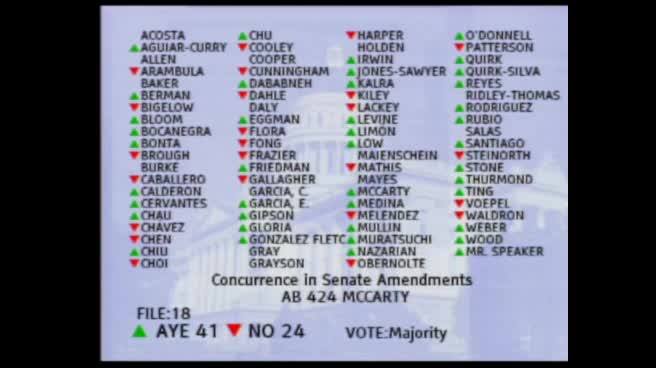 1MIN
Assembly Floor
 1MIN
Senate Floor
 1H
Senate Standing Committee on Appropriations
 3MIN
Senate Standing Committee on Environmental Quality
 45SEC
Assembly Floor
 1H
Assembly Standing Committee on Appropriations
Bill Author

Bill Co-Author(s):