AB 505: Medical Board of California: adjudication: expert testimony.
- Session Year: 2017-2018
- House: Assembly
- Latest Version Date: 2018-09-18
Existing law prohibits the use of expert testimony in matters brought by the Medical Board of California unless specified information is exchanged with counsel for the other party, and requires the exchange of the information to be completed 30 calendar days prior to the commencement date of the hearing or as specified.
This bill would authorize the administrative law judge to extend the time for the exchange of information, upon a motion based on a showing of good cause, for a period not to exceed 100 calendar days, as specified.
Existing law prohibits the use of expert testimony in matters brought by the Medical Board of California unless specified information is exchanged with counsel for the other party, and requires the exchange of the information to be completed 30 calendar days prior to the commencement date of the hearing or as specified.
This bill would authorize the administrative law judge to extend the time for disclosure, the exchange of information, upon a motion based on a showing of good cause, for a period not to exceed 100 calendar days, as specified.
Existing law prohibits the use of expert testimony in matters brought by the Medical Board of California unless specified information is exchanged with counsel for the other party, and requires the exchange of the information to be completed 30 calendar days prior to the commencement date of the hearing or as specified.
This bill would authorize the administrative law judge to extend the time for disclosure, upon a motion based on a showing of good cause, for a period not to exceed 100 calendar days, as specified.
Under existing law, a physician and surgeon whose matter has been heard by an administrative law judge, or whose default has been entered, and who is found guilty, or who has entered into a stipulation for disciplinary action with the Medical Board of California, is authorized to be subject to, among other things, license revocation, suspension, or probation, as specified. Existing law authorizes the board to discipline a licensee by placing him or her on probation subject to specified conditions.This bill would prohibit the board from entering into any stipulation for disciplinary action if the stipulation places a licensee on probation and the operative accusation includes specified acts.Under existing law, a physician and surgeon whose matter has been heard by an administrative law judge, or whose default has been entered, and who is found guilty, or who has entered into a stipulation for disciplinary action with the Medical Board of California, is authorized to be subject to, among other things, license revocation, suspension, or probation, as specified. Existing law authorizes the board to discipline a licensee by placing him or her on probation subject to specified conditions.
This bill would prohibit the board from entering into any stipulation for disciplinary action, including placing action if the stipulation places a licensee on probation, if probation and the operative accusation includes specified acts.
Under existing law, a physician and surgeon whose matter has been heard by an administrative law judge, or whose default has been entered, and who is found guilty, or who has entered into a stipulation for disciplinary action with the Medical Board of California, is authorized to be subject to, among other things, license revocation, suspension, or probation, as specified. Existing law authorizes the board to discipline a licensee by placing him or her on probation subject to specified conditions.
This bill would prohibit the board from entering into any stipulation for disciplinary action, including placing a licensee on probation, if the operative accusation includes specified acts.
(a)Notwithstanding any other provision of law, with respect to the use of expert testimony in matters brought by the Medical Board of California, no expert testimony shall be permitted by any party unless the following information is exchanged in written form with counsel for the other party, as ordered by the Office of Administrative Hearings:
(1)A curriculum vitae setting forth the qualifications of the expert.
(2)A complete expert witness report, which must include the following:
(A)A complete statement of all opinions the expert will express and the bases and reasons for each opinion.
(B)The facts or data considered by the expert in forming the opinions.
(C)Any exhibits that will be used to summarize or support the opinions.
(3)A representation that the expert has agreed to testify at the hearing.
(4)A statement of the experts hourly and daily fee for providing testimony and for consulting with the party who retained his or her services.
(b)The exchange of the information described in subdivision (a) shall be completed 30 calendar days prior to the originally scheduled commencement date of the hearing, or as determined by an administrative law judge when Section 11529 of the Government Code applies. Upon motion to extend the deadline based on a showing of good cause, the administrative law judge may extend the time for the exchange of information for a period not to exceed 100 calendar days cumulatively, but in no case shall the exchange take place less than 30 calendar days before the hearing date, whichever comes first.
(c)The Office of Administrative Hearings may adopt regulations governing the required exchange of the information described in this section.
(a)Notwithstanding any other provision of law, with respect to the use of expert testimony in matters brought by the Medical Board of California, no expert testimony shall be permitted by any party unless the following information is exchanged in written form with counsel for the other party, as ordered by the Office of Administrative Hearings:
(1)A curriculum vitae setting forth the qualifications of the expert.
(2)A complete expert witness report, which must include the following:
(A)A complete statement of all opinions the expert will express and the bases and reasons for each opinion.
(B)The facts or data considered by the expert in forming the opinions.
(C)Any exhibits that will be used to summarize or support the opinions.
(3)A representation that the expert has agreed to testify at the hearing.
(4)A statement of the experts hourly and daily fee for providing testimony and for consulting with the party who retained his or her services.
(b)The exchange of the information described in subdivision (a) shall be completed 30 calendar days prior to the originally scheduled commencement date of the hearing, or as determined by an administrative law judge when Section 11529 of the Government Code applies. Upon motion to extend the deadline based on a showing of good cause, the administrative law judge may extend the time for the disclosure exchange of information for a period not to exceed 100 calendar days cumulatively, but in no case shall the disclosure exchange take place less than 30 calendar days before the hearing date, whichever comes first.
(c)The Office of Administrative Hearings may adopt regulations governing the required exchange of the information described in this section.
(a)Notwithstanding any other provision of law, with respect to the use of expert testimony in matters brought by the Medical Board of California, no expert testimony shall be permitted by any party unless the following information is exchanged in written form with counsel for the other party, as ordered by the Office of Administrative Hearings:
(1)A curriculum vitae setting forth the qualifications of the expert.
(2)A complete expert witness report, which must include the following:
(A)A complete statement of all opinions the expert will express and the bases and reasons for each opinion.
(B)The facts or data considered by the expert in forming the opinions.
(C)Any exhibits that will be used to summarize or support the opinions.
(3)A representation that the expert has agreed to testify at the hearing.
(4)A statement of the experts hourly and daily fee for providing testimony and for consulting with the party who retained his or her services.
(b)The exchange of the information described in subdivision (a) shall be completed 30 calendar days prior to the originally scheduled commencement date of the hearing, or as determined by an administrative law judge when Section 11529 of the Government Code applies. Upon motion to extend the deadline based on a showing of good cause, the administrative law judge may extend the time for the disclosure of information for a period not to exceed 100 calendar days cumulatively, but in no case shall the disclosure take place less than 30 calendar days before the hearing date, whichever comes first.
(c)The Office of Administrative Hearings may adopt regulations governing the required exchange of the information described in this section.
SECTION 1.Section 2227.1 is added to the Business and Professions Code, to read:2227.1.Notwithstanding Sections 2227 and 2228, the board may not enter into any stipulation for disciplinary action if the stipulation places a licensee on probation and the operative accusation includes any of the following:(a)Felony conviction involving harm to patient safety or health.(b)Drug or alcohol abuse directly resulting in harm to patient safety or health.(c)Sexual act or sexual exploitation as defined in Section 726 and subdivision (a) of Section 729.Notwithstanding Sections 2227 and 2228, the board may not enter into any stipulation for disciplinary action, which includes placing action if the stipulation places a licensee on probation, if probation and the operative accusation includes any of the following:
(a)Felony conviction involving harm to patient safety or health.
(b)Drug or alcohol abuse directly resulting in harm to patient safety or health.
(c)Sexual act or sexual exploitation as defined in Section 726 and subdivision (a) of Section 729.
Notwithstanding Sections 2227 and 2228, the board may not enter into any stipulation for disciplinary action, which includes placing a licensee on probation, if the operative accusation includes any of the following:
(a)Felony conviction involving harm to patient safety or health.
(b)Drug or alcohol abuse directly resulting in harm to patient safety or health.
(c)Sexual act or sexual exploitation as defined in Section 726 and subdivision (a) of Section 729.
|
Date
|
Status
|
|---|---|
| Sep 18, 2018 | Chaptered by Secretary of State - Chapter 469, Statutes of 2018. |
| Sep 18, 2018 | Approved by the Governor. |
| Sep 6, 2018 | Enrolled and presented to the Governor at 3 p.m. |
| Aug 29, 2018 | Senate amendments concurred in. To Engrossing and Enrolling. |
| Aug 28, 2018 | From committee: That the Senate amendments be concurred in. (Ayes 18. Noes 0.) (August 28). |
| Aug 23, 2018 | Re-referred to Com. on B. & P. pursuant to Assembly Rule 77.2. |
| Aug 20, 2018 | In Assembly. Concurrence in Senate amendments pending. May be considered on or after August 22 pursuant to Assembly Rule 77. |
| Aug 20, 2018 | Read third time. Passed. Ordered to the Assembly. |
| Aug 6, 2018 | Ordered to third reading. |
| Aug 1, 2018 | Ordered to special consent calendar. |
| Jun 28, 2018 | Read second time and amended. Ordered to third reading. |
| Jun 27, 2018 | From committee: Amend, and do pass as amended. (Ayes 9. Noes 0.) (June 25). |
| Jun 20, 2018 | From committee chair, with author's amendments: Amend, and re-refer to committee. Read second time, amended, and re-referred to Com. on B., P. & E.D. |
| Jul 6, 2017 | In committee: Hearing postponed by committee. |
| Jun 14, 2017 | Referred to Com. on B., P. & E.D. |
| Jun 1, 2017 | In Senate. Read first time. To Com. on RLS. for assignment. |
| May 31, 2017 | Read third time. Passed. Ordered to the Senate. (Ayes 77. Noes 0. Page 1894.) |
| May 26, 2017 | From committee: Do pass. (Ayes 17. Noes 0.) (May 26). |
| May 3, 2017 | In committee: Set, first hearing. Referred to APPR. suspense file. |
| Apr 26, 2017 | From committee: Do pass and re-refer to Com. on APPR. with recommendation: To Consent Calendar. (Ayes 15. Noes 0.) (April 25). Re-referred to Com. on APPR. |
| Mar 28, 2017 | Re-referred to Com. on B. & P. |
| Mar 27, 2017 | From committee chair, with author's amendments: Amend, and re-refer to Com. on B. & P. Read second time and amended. |
| Feb 27, 2017 | Referred to Com. on B. & P. |
| Feb 14, 2017 | From printer. May be heard in committee March 16. |
| Feb 13, 2017 | Read first time. To print. |
|
Date
|
Description
|
Location
|
Votes
|
|
|---|---|---|---|---|
| Aug 29, 2018 | AB 505 CABALLERO Concurrence in Senate Amendments | Assembly Floor |
Passed |
|
| Aug 28, 2018 | With recommendation: That Senate amendments be concurred in. | Assembly Standing Committee on Business and Professions |
Passed |
|
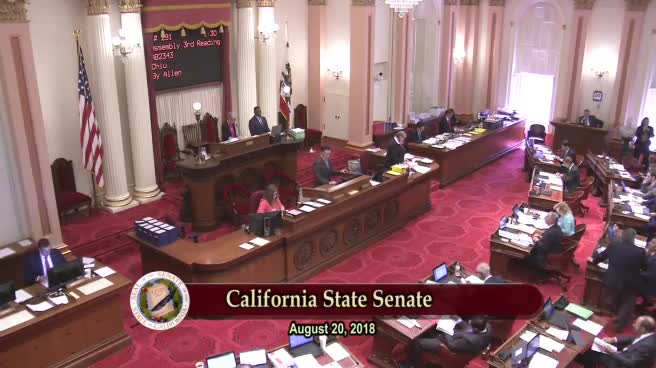
| Aug 20, 2018 | Assembly 3rd Reading AB505 Caballero By Glazer | Senate Floor |
Passed |
|
| Jun 25, 2018 | Do pass as amended | Senate Standing Committee on Business, Professions and Economic Development |
Passed |
|
| May 31, 2017 | AB 505 CABALLERO Assembly Third Reading | Assembly Floor |
Passed |
|
| May 26, 2017 | Do pass. | Assembly Standing Committee on Appropriations |
Passed |
|
| Apr 25, 2017 | Do pass and be re-referred to the Committee on [Appropriations] with recommendation: To Consent Calendar | Assembly Standing Committee on Business and Professions |
Passed |
This list shows positions taken on this bill by organizations on the date displayed, which is linked to the original source.
Positions by individuals are not included.
|
Organization
|
Position
|
Date
|
|---|---|---|
| California Medical Association | ** Support | Jun 29, 2018 |
CONCURRENCE IN SENATE AMENDMENTS
CSA2 Bill Id:AB 505
Author:(Caballero)
As Amended Ver:June 28, 2018
Majority vote
ASSEMBLY: |
| (May 31, 2017) | SENATE: | 39-0 | (August 20, 2018) |
(vote not relevant)
COMMITTEE VOTE: | 18-0 | (August 28, 2018) | RECOMMENDATION: | concur |
(B. & P.)
Original Committee Reference: B. & P.
SUMMARY: Authorizes an administrative law judge to extend the time for the exchange of information regarding the use of expert testimony in matters brought by the Medical Board of California, upon a motion based on a showing of good cause, for a period not to exceed 100 calendar days.
The Senate amendments strike the original language of the bill in its entirety and replace its contents with new language regarding expert testimony.
EXISTING LAW:
- Establishes the Medical Practice Act, which provides a framework for the state's licensure and regulation of physicians and surgeons. (Business and Professions Code Section (BPC) 2000 et)
- Establishes the Medical Board of California (MBC), a regulatory board within the Department of Consumer Affairs (DCA) comprised of 15 appointed members, including seven public members, subject to repeal on January 1, 2018. (BPC 2001)
- Establishes the Health Quality Enforcement Section (HQE) within the Department of Justice (DOJ), whose primary responsibility is to investigate and prosecute proceedings against licensees and applicants within the jurisdiction of MBC and other healing arts regulatory bodies. (Government Code Section 12529)
- Establishes the Health Quality Investigation Unit (HQIU) within the DCA's Division of Investigation, whose primary responsibility is to investigate violations of law within the jurisdiction of MBC and other healing arts regulatory bodies. (BPC 159.5)
- Requires all parties in a matter brought by MBC to exchange information with opposing counsel relating to any planned expert witness testimony no later than 30 days from the commencement date of the hearing where it will be presented. (BPC 2334)
FISCAL EFFECT: This bill is keyed non-fiscal by the Legislative Counsel.
COMMENTS: This bill is sponsored by the California Medical Association. According to the author, current law places an undue burden on defendant physicians regarding expert witness reports and testimony. The author asserts that current law doesn't allow for amendments to be made to the testimony, or for summary exchange, nor does it allow for a flexible timeline for exchange when the hearing date has changed.
Expert Witness Timelines. Language modifying the timelines governing the exchange of information regarding the use of expert testimony in cases brought by the MBC was considered in the MBC's latest sunset extension legislation; the reforms were proposed in response to recommendations made in the MBC's sunset report, which advocated for the MBC to be able to review information relevant to a case against a licensee earlier in the process prior to a hearing. These provisions were removed from the MBC's sunset bill to allow more time for stakeholders to discuss the appropriate way to allow for expedited exchanges of information without discouraging settlements or unduly burdening licensees during the disciplinary process. This bill represents a compromise reached by interested parties to address the issues laid out in the MBC's sunset report through a more moderated approach.
Analysis Prepared by: Robert Sumner / B. & P. / (916) 319-3301 FN: 0005081
Date of Hearing: August 28, 2018
ASSEMBLY COMMITTEE ON BUSINESS AND PROFESSIONS
Evan Low, Chair
ABPCA Bill Id:AB 505
Author:(Caballero) – As Amended Ver:June 28, 2018
Note: this bill was referred to this Committee pursuant to Assembly Rule 77.2. The Committee may recommend that the Assembly concur in the Senate amendments, recommend that the Assembly not concur in the Senate amendments, or hold the bill in the Committee.
SUBJECT: Medical Board of California: adjudication: expert testimony.
SUMMARY: Authorizes an administrative law judge (ALJ) to, upon request, extend the timeframe for the exchange of information regarding the use of expert testimony in matters brought by the Medical Board of California (MBC).
THE SENATE AMENDMENTS: Strike the original language of the bill in its entirety and replace its contents with new language regarding expert testimony.
EXISTING LAW:
- Establishes the Medical Practice Act, which provides a framework for the state’s licensure and regulation of physicians and surgeons. (Business and Professions Code (BPC) § 2000)
- Establishes the Medical Board of California (MBC), a regulatory board within the Department of Consumer Affairs comprised of 15 appointed members, including 7 public members. (BPC § 2001)
- Establishes the Health Quality Enforcement Section (HQE) within the Department of Justice, whose primary responsibility is to investigate and prosecute proceedings against licensees and applicants within the jurisdiction of the MBC and other healing arts regulatory bodies. (Government Code (GOV) § 12529)
- Establishes the Health Quality Investigation Unit (HQIU) within the DCA’s Division of Investigation, whose primary responsibility is to investigate violations of law within the jurisdiction of the MBC and other healing arts regulatory bodies. (BPC § 159.5)
- Finds and declares that the vertical enforcement model of investigation, which involves early collaboration between HQE attorneys and HQIU investigators, is in the best interests of the people of California, subject to repeal on January 1, 2019. (GOV § 12529.6)
- Prohibits the MBC from seeking from a physician and surgeon any investigation and prosecution costs for a disciplinary proceeding against that licensee. (BPC § 125.3)
- Requires all parties in a matter brought by the MBC to exchange information regarding any planned expert witness testimony no later than 30 days from the commencement date of the hearing where it will be presented. (BPC § 2334)
THIS BILL:
- Authorizes an ALJ to extend the timeframe for the exchange of information regarding the use of expert testimony in matters brought by the MBC, upon a motion based on a showing of good cause, for a period not to exceed 100 calendar days.
FISCAL EFFECT: This bill is keyed non-fiscal by the Legislative Counsel.
COMMENTS:
Purpose. This bill is sponsored by the California Medical Association (CMA). According to the author:
The Expert Reviewer Program was established by the Medical Board of California in 1994 for the purposes of supporting investigations being heard by the Board. These medical experts provide expert testimony relative to the case, as well as conduct professional competency, medical and psychiatric exams. However, current law requires this information to be provided to the other party within 30 days prior to the scheduled hearing, which can be difficult to complete given all of the requirements. AB 505 simply increases the time frame from 30 days to 100 days, based on a showing of good cause, and subject to the administrative law judge’s approval. It is important to note that this 100 day extension will not interfere with the other parties’ ability to evaluate the disclosure of the expert witness, because the disclosure will still have to take place at least 30 days prior to the hearing date. This additional time period will ensure both parties in a case have adequate time to prepare for an expert witness to testify, which is vital to protecting the right of due process, a standard we expect in any judicial system in the United States.
Background. The Medical Practice Act specifies the process through which the MBC may bring a disciplinary action against a physician and surgeon in conjunction with the requirements of the Administrative Procedure Act. Investigations by HQIU investigators, currently directed by deputy attorneys general within HQE, include consultation with expert witnesses who assist the MBC with demonstrating that a licensee failed to meet his or her professional standard of care or committed misconduct. Expert witnesses are also commonly retained by defense counsel for licensees seeking to counter the MBC’s arguments with evidence that a licensee acted appropriately. These witnesses regularly appear before an ALJ in matters that go to hearing.
Under current law, both parties in a matter brought by the MBC must exchange information about any expert witness testimony. During the MBC’s 2017 joint sunset review, the Senate Committee on Business, Professions and Economic Development and the Assembly Committee on Business and Professions noted the following statutory shortcomings in this disclosure process. In a section identified as Issue #23 in the MBC’s background paper, the Committees questioned whether amendments to the Medical Practice Act were necessary “to ensure MBC can respond in a timely fashion to information provided in expert witness reports.” The background paper discussed the issue as follows:
BPC Section 2334 specifically relates to expert testimony for MBC disciplinary cases. According to MBC the provisions in this section are beneficial to DAGs prosecuting MBC cases for a number of reasons. Upon receipt of an expert witness disclosure, DAGs can assess the qualifications of the respondent’s expert in relation to the expert MBC may be using. Further, DAGs are able to provide a respondent’s expert’s narrative for a case and opinions to the expert used by MBC to determine whether the expert’s previously expressed opinions change. Information contained in the expert witness reports can also assist MBC in determining necessary next steps for a case or can assist MBC’s own expert in their testimony before an ALJ. Since discovery is so limited in proceedings governed by the APA, this section of the BPC provides at least some information to MBC and DAGs that impact proceedings in these important quality-of-care cases.
According to MBC, in some instances, once MBC receives these reports, amendments to an initial accusation filed may be necessary, thus increasing the timeframe for disciplinary action to be taken and that consumer protection can be enhanced through changes to this section in the Act.
The staff recommendation for this issue was for the Committees to “consider amending the Act to ensure MBC has important information related to an enforcement case, according to a timeline that assists MBC in taking swift action.” In response, the MBC’s sunset vehicle, SB 798 (Hill), was signed into law containing reforms to the expert witness disclosure process. The bill revised the timeline for disclosure to require the exchange of information to be completed 30 calendar days prior to the originally scheduled commencement date of the hearing, or as determined by an administrative law judge. The bill also significantly expanded what the information must be exchanged, replacing a simple brief narrative statement with a “complete expert witness report.”
The complete expert witness report that must be exchanged by parties in matters brought by the MBC, as established in the Medical Practice Act by SB 798, must include the following:
- A curriculum vitae setting forth the qualifications of the expert.
- A complete expert witness report, which must include the following:
- A complete statement of all opinions the expert will express and the bases and reasons for each opinion.
- The facts or data considered by the expert in forming the opinions.
- Any exhibits that will be used to summarize or support the opinions.
(3) A representation that the expert has agreed to testify at the hearing.
(4) A statement of the expert’s hourly and daily fee for providing testimony and for consulting with the party who retained his or her services.
Stakeholders representing the physician and surgeon professional community expressed concerns with SB 798’s expansion of the required expert witness disclosure, as well as the accelerated timeline provided for exchange. Specifically, the CMA argued that because the MBC is typically in possession of greater resources in the hearing process, the exchange of information disadvantages physicians and surgeons who seek to defend themselves against accusations. Further, the CMA pointed out that obtaining expert witnesses tend to be one of the most expensive parts of preparing a defense, and that requiring reports to be exchanged earlier in the process disincentivizes early resolution in cases where a defendant would have entered into a settlement agreement to avoid taking on the expense of securing an expert witness.
This bill, which is sponsored by the CMA, was amended to correct the perceived imbalance between the MBC and defendant licensees that was created by the reforms to expert witness disclosure made in the MBC’s sunset bill. The bill would allow a licensee to petition an ALJ to allow for a longer timeframe for the expert witness report exchange following a motion based on a showing of good cause. This extension would be limited to no more than 100 calendar days.
Current Related Legislation. SB 1448 (Hill) would enact the Patient’s Right to Know Act of 2018 to require healing arts licensees on probation for certain offenses to provide their patients with information about their probation status prior to the patient’s first visit following the probationary order beginning July 1, 2019. This bill is pending on the Assembly Floor.
Prior Related Legislation. SB 798 (Hill, Chapter 775, Statutes of 2017) extended the sunset for the MBC and, among other things, expanded the information that must be included in an expert witness report and required reports to be exchanged no later than 30 calendar days prior to the originally scheduled commencement date of the hearing.
ARGUMENTS IN SUPPORT:
The California Medical Association is the sponsor of this legislation. The CMA states that “CMA opposed amending the process for submitting information about expert witness testimony, which significantly disadvantages the physicians during the MBC disciplinary process.” The CMA argues that “requiring a physician to provide a complete expert witness report within 90 days from the filing of an accusation is prejudicial and creates significant logistical challenges.” In response, the CMA explains that it believes that “the language in AB 505 corrects this problem and strikes the appropriate balance of interests when determining the timeline for expert witness reports to be disclosed to the parties.”
ARGUMENTS IN OPPOSITION:
None on file.
REGISTERED SUPPORT:
California Medical Association (Sponsor)
REGISTERED OPPOSITION:
None on file.
Analysis Prepared by: Robert Sumner / B. & P. / (916) 319-3301
CONCURRENCE IN SENATE AMENDMENTS
CSA1 Bill Id:AB 505
Author:(Caballero)
As Amended Ver:June 28, 2018
Majority vote
ASSEMBLY: | 77-0 | (May 31, 2017) | SENATE: | 39-0 | (August 20, 2018) |
Original Committee Reference: B. & P.
SUMMARY: Authorizes an administrative law judge to extend the time for the exchange of information regarding the use of expert testimony in matters brought by the Medical Board of California, upon a motion based on a showing of good cause, for a period not to exceed 100 calendar days.
The Senate amendments strike the original language of the bill in its entirety and replace its contents with new language regarding expert testimony.
EXISTING LAW:
- Establishes the Medical Practice Act, which provides a framework for the state's licensure and regulation of physicians and surgeons. (Business and Professions Code (BPC) Sections 2000 et seq.)
- Establishes the Medical Board of California (MBC), a regulatory board within the Department of Consumer Affairs (DCA) comprised of 15 appointed members, including 7 public members, subject to repeal on January 1, 2018. (BPC Section 2001)
- Establishes the Health Quality Enforcement Section (HQE) within the Department of Justice (DOJ), whose primary responsibility is to investigate and prosecute proceedings against licensees and applicants within the jurisdiction of MBC and other healing arts regulatory bodies. (Government Code (GOV) GOV Section 12529)
- Establishes the Health Quality Investigation Unit (HQIU) within the DCA's Division of Investigation, whose primary responsibility is to investigate violations of law within the jurisdiction of MBC and other healing arts regulatory bodies. (BPC Section 159.5)
- Requires all parties in a matter brought by MBC to exchange information with opposing counsel relating to any planned expert witness testimony no later than 30 days from the commencement date of the hearing where it will be presented. (BPC Section 2334)
FISCAL EFFECT: This bill is keyed non-fiscal by the Legislative Counsel.
COMMENTS: This bill is sponsored by the California Medical Association. According to the author, current law places an undue burden on defendant physicians regarding expert witness reports and testimony. The author asserts that current law doesn't allow for amendments to be made to the testimony, or for summary exchange, nor does it allow for a flexible timeline for exchange when the hearing date has changed.
Expert Witness Timelines. Language modifying the timelines governing the exchange of information regarding the use of expert testimony in cases brought by the MBC was considered in the MBC's latest sunset extension legislation; the reforms were proposed in response to recommendations made in the MBC's sunset report, which advocated for the MBC to be able to review information relevant to a case against a licensee earlier in the process prior to a hearing. These provisions were removed from the MBC's sunset bill to allow more time for stakeholders to discuss the appropriate way to allow for expedited exchanges of information without discouraging settlements or unduly burdening licensees during the disciplinary process. AB 505 represents a compromise reached by interested parties to address the issues laid out in the MBC's sunset report through a more moderated approach.
Analysis Prepared by: Robert Sumner / B. & P. / (916) 319-3301 FN: 0004464
Office of Senate Floor Analyses (916) 651-1520 Fax: (916) 327-4478 | AB |
THIRD READING
Bill No: AB 505
:
SENATE BUS., PROF. & ECON. DEV. COMMITTEE: 9-0, 6/25/18
AYES: Hill, Fuller, Allen, Dodd, Galgiani, Glazer, Hernandez, Pan, Wilk
ASSEMBLY FLOOR: 77-0, 5/31/17 - See last page for vote
SOURCE: California Medical Association
DIGEST:
This bill authorizes an Administrative Law Judge (ALJ) to extend the timeframe for expert witness testimony to be exchanged during disciplinary cases brought by the Medical Board of California (MBC), upon motion to extend the deadline based on a showing of good cause.
Existing law:
- Establishes the Medical Practice Act, which provides licensing and regulation of physicians and surgeons by the MBC until January 1, 2022.
- Prohibits the use of expert testimony by any party in matters brought by MBC unless specified information, including a complete expert witness report, is exchanged in written form with counsel for the other party, as ordered by the Office of Administrative Hearings (OAH). Requires the exchange of information at least 30 calendar days prior to the commencement of the hearing. Authorizes OAH to adopt regulations governing the required exchange of the information. (BPC § 2334)
This bill authorizes an ALJ to extend the timeframe for expert witness testimony to be exchanged during disciplinary cases brought by MBC, upon motion to extend the deadline based on a showing of good cause.
Background
MBC Enforcement. The enforcement process begins with a complaint. Complaints are received from the public, generated internally by MBC or based on information MBC receives from various entities through mandatory reports to MBC. Complaints that pertain to treatment provided by a physician, requires that patient medical records are obtained. Pursuant to BPC Section 2220.08, before a quality of care complaint is referred for further investigation, it must be reviewed by one or more medical experts with the pertinent education, training, and expertise to evaluate the specific standards of care issues raised by the complaint to determine if further field investigation is required.
For complaints that are subsequently investigated and meet the necessary legal prerequisites, a Deputy Attorney General (DAG) in the Office of the Attorney General drafts formal charges, known as an “Accusation”. An accusation is filed upon signature of the MBC executive director. A hearing before an ALJ is subsequently scheduled, at which point settlement negotiations take place between the DAG, physician and his or her attorney and MBC staff. Oftentimes these result in a stipulated settlement, similar to a plea bargain in criminal court, where a licensee admits to having violated charges set forth in the accusation and accepts penalties for those violations. If a licensee contests charges, the case is heard before an ALJ who subsequently drafts a proposed decision. This decision is reviewed by a panel of MBC members who either adopt the decision as proposed, adopt the decision with a reduced penalty, or adopt the decision with an increased penalty.
Exchange of Expert Witness Testimony. BPC Section 2334 relates to expert testimony for MBC disciplinary cases. According to MBC, during its prior sunset review oversight conducted by the Senate Business, Professions and Economic Development Committee, in coordination with the Assembly Business and Professions Committee, the provisions in this section are beneficial to DAGs prosecuting MBC cases for a number of reasons. Upon receipt of expert witness information, DAGs can assess the qualifications of the respondent’s expert in relation to the expert MBC may be using. Further, DAGs are able to provide a respondent’s expert’s narrative for a case and opinions to the expert used by MBC to determine whether the expert’s previously expressed opinions change. Information contained in the expert witness reports can also assist MBC in determining necessary next steps for a case or can assist MBC’s own expert in their testimony before an ALJ. According to MBC, since discovery is so limited in proceedings governed by the Administrative Procedures Act (APA), this section of the BPC provides at least some information to MBC and DAGs that impact proceedings in these important quality-of-care cases.
SB 798 (Hill, Chapter 775, Statutes of 2017) updated this section of law in order to enhance consumer protection. Prior to the passage of the bill, despite the MBC’s requirement that its own experts prepare expert witness reports that, under the APA, must be produced in discovery, respondents were not required to undergo this equal exchange of information by providing a full expert witness report. SB 798 prohibited the use of expert witness testimony in matters before MBC unless a complete expert witness report is received. The bill specified that a complete expert witness report must include a complete statement of all opinions the expert will express and the bases and reasons for each opinion (updated from the “brief narrative statement of the general substance of the testimony the expert is expected to give…” as the law previously stated), the facts or data considered by the expert in forming the opinions, and any exhibits that will be used to summarize or support the opinions.
MBC was also concerned about the late deadline by which information was exchanged prior to SB 798, noting that once expert witness reports were received, amendments to an initial accusation may be necessary, thus increasing the timeframe for disciplinary action to be taken which can negatively impact patient safety. To remedy this deficiency, SB 798 required the exchange of information to be completed 30 calendar days prior to the originally scheduled commencement date of the hearing. This bill authorizes an ALJ to extend this timeframe further upon motion based on a showing of good cause.
FISCAL EFFECT: Appropriation: Fiscal Com.: Local:
California Medical Association (source)
OPPOSITION: (Verified 6/28/18)
None received
ARGUMENTS IN SUPPORT: The California Medical Association believes that this bill strikes the correct balance between all interests without overburdening defendant physicians.
ASSEMBLY FLOOR: 77-0, 5/31/17
AYES: Acosta, Aguiar-Curry, Travis Allen, Arambula, Baker, Berman, Bigelow, Bloom, Bocanegra, Bonta, Brough, Burke, Caballero, Calderon, Cervantes, Chau, Chávez, Chen, Chiu, Chu, Cooley, Cooper, Cunningham, Dababneh, Dahle, Daly, Flora, Fong, Frazier, Friedman, Gallagher, Cristina Garcia, Eduardo Garcia, Gipson, Gloria, Gomez, Gonzalez Fletcher, Gray, Grayson, Harper, Holden, Irwin, Jones-Sawyer, Kalra, Kiley, Lackey, Levine, Limón, Low, Maienschein, Mathis, Mayes, McCarty, Medina, Mullin, Muratsuchi, Nazarian, Obernolte, O'Donnell, Patterson, Quirk, Quirk-Silva, Reyes, Ridley-Thomas, Rodriguez, Rubio, Salas, Santiago, Steinorth, Mark Stone, Thurmond, Ting, Voepel, Waldron, Weber, Wood, Rendon
NO VOTE RECORDED: Choi, Eggman, Melendez
6/29/18 12:03:05
**** END ****
SENATE COMMITTEE ON
BUSINESS, PROFESSIONS AND ECONOMIC DEVELOPMENT
Senator Jerry Hill, Chair
2017 - 2018 Regular
Bill No: AB 505 Hearing Date: June 25, 2018
Author: | Caballero | ||
Version: |
| ||
Urgency: | Fiscal: | ||
Consultant: | |||
Subject: Medical Board of California: adjudication: expert testimony
SUMMARY:
Authorizes an Administrative Law Judge (ALJ) to extend the timeframe for expert witness testimony to be exchanged during disciplinary cases brought by the Medical Board of California (MBC), upon motion to extend the deadline based on a showing of good cause.
Existing law:
- Establishes the Medical Practice Act, which provides licensing and regulation of physicians and surgeons by the MBC until January 1, 2022.
- Prohibits the use of expert testimony by any party in matters brought by MBC unless specified information, including a complete expert witness report, is exchanged in written form with counsel for the other party, as ordered by the Office of Administrative Hearings (OAH). Requires the exchange of information at least 30 calendar days prior to the commencement of the hearing. Authorizes OAH to adopt regulations governing the required exchange of the information. (BPC § 2334)
This bill authorizes an ALJ to extend the timeframe for expert witness testimony to be exchanged during disciplinary cases brought by MBC, upon motion to extend the deadline based on a showing of good cause.
FISCAL EFFECT:
Unknown. This bill is not keyed fiscal by Legislative Counsel.
COMMENTS:
- Purpose. The California Medical Association is the Sponsor of this bill. According to the Author, current law places an undue burden on defendant physicians regarding expert witness reports and testimony. The Author asserts that current law doesn’t allow for amendments to be made to the testimony, or for summary exchange, nor does it allow for a flexible timeline for exchange when the hearing date has changed.
- Background.
MBC Enforcement. The enforcement process begins with a complaint. Complaints are received from the public, generated internally by MBC or based on information MBC receives from various entities through mandatory reports to MBC. On average, MBC receives about 8,000 complaints per fiscal year. Complaints are received by MBC’s Central Complaint Unit which starts the process of determining next steps for a complaint. Complaints that pertain to treatment provided by a physician, requires that patient medical records are obtained. Pursuant to BPC Section 2220.08, before a quality of care complaint is referred for further investigation, it must be reviewed by one or more medical experts with the pertinent education, training, and expertise to evaluate the specific standards of care issues raised by the complaint to determine if further field investigation is required. MBC is required by law (BPC Section 129) to open a complaint within ten days of receipt and further required by law (BPC Section 2319) to set a goal of no more than 180 days between the time a complaint is received and the complaint is investigated.
For complaints that are subsequently investigated and meet the necessary legal prerequisites, a Deputy Attorney General (DAG) in the Office of the Attorney General (OAG) drafts formal charges, known as an “Accusation”. An accusation is filed upon signature of the MBC executive director. A hearing before an Administrative Law Judge (ALJ) is subsequently scheduled, at which point settlement negotiations take place between the DAG, physician and his or her attorney and MBC staff. Often times these result in a stipulated settlement, similar to a plea bargain in criminal court, where a licensee admits to having violated charges set forth in the accusation and accepts penalties for those violations. If a licensee contests charges, the case is heard before an ALJ who subsequently drafts a proposed decision. This decision is reviewed by a panel of MBC members who either adopt the decision as proposed, adopt the decision with a reduced penalty, or adopt the decision with an increased penalty. If probation is ordered, a copy of the final decision is referred to MBC’s Probation Unit for assignment to an inspector who monitors the licensees for compliance with the terms of probation.
The Board uses its Manual of Model Disciplinary Orders and Disciplinary Guidelines (Disciplinary Guidelines, 16 CCR section 1361) and the Uniform Standards for Substance-Abusing Licensees (Uniform Standards, 16 CCR section 1361.5) as the framework for determining the appropriate penalty for charges filed against a physician. BPC Section 2229 identifies that protection of the public shall be the highest priority for MBC, but also requires that wherever possible, the actions should be calculated to aid in the rehabilitation of the licensee. While the Disciplinary Guidelines and Uniform Standards frame the recommended penalty, the facts of each individual case may support a deviation from the guidelines.
Exchange of Expert Witness Testimony. BPC Section 2334 relates to expert testimony for MBC disciplinary cases. According to MBC, during its prior sunset review oversight conducted by the Senate Committee on Business, Professions and Economic Development, in coordination with the Assembly Committee on Business and Professions, the provisions in this section are beneficial to DAGs prosecuting MBC cases for a number of reasons. Upon receipt of expert witness information, DAGs can assess the qualifications of the respondent’s expert in relation to the expert MBC may be using. Further, DAGs are able to provide a respondent’s expert’s narrative for a case and opinions to the expert used by MBC to determine whether the expert’s previously expressed opinions change. Information contained in the expert witness reports can also assist MBC in determining necessary next steps for a case or can assist MBC’s own expert in their testimony before an ALJ. According to MBC, since discovery is so limited in proceedings governed by the Administrative Procedures Act (APA), this section of the BPC provides at least some information to MBC and DAGs that impact proceedings in these important quality-of-care cases.
SB 798 (Hill, Chapter 775, Statutes of 2017) updated this section of law in order to enhance consumer protection. Prior to the passage of the bill, despite the Board’s requirement that its own experts prepare expert witness reports that, under the APA, must be produced in discovery, respondents were not required to undergo this equal exchange of information by providing a full expert witness report. SB 798 prohibited the use of expert witness testimony in matters before MBC unless a complete expert witness report is received. The bill specified that a complete expert witness report must include a complete statement of all opinions the expert will express and the bases and reasons for each opinion (updated from the “brief narrative statement of the general substance of the testimony the expert is expected to give…” as the law previously stated), the facts or data considered by the expert in forming the opinions, and any exhibits that will be used to summarize or support the opinions.
MBC was also concerned about the late deadline by which information was exchanged prior to SB 798, noting that once expert witness reports were received, amendments to an initial accusation may be necessary, thus increasing the timeframe for disciplinary action to be taken which can negatively impact patient safety. To remedy this deficiency, SB 798 required the exchange of information to be completed 30 calendar days prior to the originally scheduled commencement date of the hearing. This bill authorizes an ALJ to extend this timeframe further upon motion based on a showing of good cause.
- Suggested Clarifying Amendment. The language in the bill currently refers to “disclosure of information”, while the entire code section is built upon the “exchange of information”. In order to more clearly conform to the provisions in this code section, the bill should be amended to refer to “exchange of information”.
SUPPORT AND OPPOSITION:
Support:
None on file as of June 20, 2018.
Opposition:
None on file as of June 20, 2018.
-- END --
ASSEMBLY THIRD READING
ATR Bill Id:AB 505
Author:(Caballero)
As Amended Ver:March 27, 2017
Majority vote
Committee | Votes | Ayes | Noes |
Business & Professions | 15-0 | Low, Brough, Arambula, Baker, Bloom, Chiu, Cunningham, Dahle, Eggman, Grayson, Holden, Irwin, Mullin, Steinorth, Ting | |
Appropriations | 17-0 | Gonzalez Fletcher, Bigelow, Bloom, Bocanegra, Bonta, Brough, Calderon, McCarty, Quirk, Fong, Friedman, Gallagher, Eduardo Garcia, Gray, Muratsuchi, Obernolte, Reyes |
|
SUMMARY: Prohibits the Medical Board of California (MBC) from entering into a stipulated settlement for a disciplinary action with a physician if the underlying accusations of the complaint allege a felony conviction resulting in harm to patient safety; drug or alcohol abuse directly resulting in harm to patient safety; or, sexual acts or sexual exploitation. Specifically, this bill:
Specifies that the MBC may not enter into any stipulation for disciplinary action, if the stipulation places a licensee on probation, and the operative accusation includes any of the following:
- Felony conviction involving harm to patient safety or health;
- Drug or alcohol abuse directly resulting in harm to patient safety or health; or,
- Sexual act or sexual exploitation.
FISCAL EFFECT: According to the Assembly Appropriations Committee, by reducing the number of cases that can enter into a stipulated judgment, this bill has the potential to significantly increase enforcement costs. The MBC projects costs to refer more cases to the Attorney General (AG) would be in the range of $3.5 to $4.4 million, and related costs to the Office of Administrative Hearings by $500,000 to $600,000 per year (reimbursed from the Contingent Fund of the Medical Board of California.)
COMMENTS:
Purpose. This bill is sponsored by the California Medical Association. According to the author, "AB 505 prohibits the Medical Board from entering into a stipulated settlement with a physician accused of certain enumerated violations unless there is a finding of fact by an administrative law judge after a full investigation by the board. These accusations include 1) felony convictions resulting in direct patient harm; 2) alcohol or drug abuse resulting in direct patient harm and 3) Sexual acts or sexual exploitation. This bill would effectively prohibit probation from being offered as a means to settle the enumerated accusations unless an investigation has been completed and reviewed by a judge."
Background. MBC Enforcement Data. According to information obtained from the MBC, in fiscal year 2015-2016, the Enforcement Program received 8,679 complaints against physicians and surgeons and unlicensed individuals alleged to be practicing medicine without a license. This was an increase of 412 complaints from the prior fiscal year. Since fiscal year 2012-2013, the MBC has seen a significant increase in complaints received. These complaints include allegations including excessive prescribing, gross negligence/incompetence, licensee self-abuse of drugs or alcohol, convictions of a crime and general unprofessional conduct.
Stipulated Settlements. According to information obtained from the Department of Consumer Affairs (DCA), stipulations are legal documents that typically contain admissions by the licensee to one or more violations of law and set forth a proposal for appropriate discipline. Appropriate discipline is based on the MBC's disciplinary guidelines which outline both minimum and maximum penalties for every violation of the Medical Practice Act.
Discipline comes in many forms and, depending on the admission(s) of misconduct, may include probation with terms and conditions, suspension, surrender of license, or even revocation. Minor violations are settled less stringently by way of reprimands, educational coursework or conferences, or perhaps an oral examination. Stipulations are negotiated between the licensee or his/her attorney and the MBC's legal representative from the Office of the Attorney General. Once a stipulation is agreed upon and signed by the licensee and the MBC's legal representative, the document is voted upon by the MBC. The MBC votes to either adopt the stipulation, reject it, or offer a counterproposal. If the licensee does not agree with the counterproposal, s/he has the right to request a formal hearing before an Administrative Law Judge.
Licensees who choose stipulated agreements over formal hearings waive their rights to further due process procedures and appeals and are legally bound by the terms of the penalty order, but in so doing, save time and money and often end up with the same penalty order that would result after a full administrative hearing. This bill would prohibit the option to enter into a stipulated settlement if the stipulation places a licensee on probation if the accusation includes felony conviction resulting in harm to patient safety; drug or alcohol abuse directly resulting in harm to patient safety; or, sexual acts or sexual exploitation.
Analysis Prepared by: Le Ondra Clark Harvey Ph.D. / B. & P. / (916) 319-3301 FN: 0000730
Date of Hearing: May 3, 2017
ASSEMBLY COMMITTEE ON APPROPRIATIONS
Lorena Gonzalez Fletcher, Chair
ABPCA Bill Id:AB 505
Author:(Caballero) – As Amended Ver:March 27, 2017
Policy Committee: | Business and Professions | Vote: | 15 - 0 |
|
|
Urgency: No State Mandated Local Program: No Reimbursable: No
SUMMARY:
This bill prohibits the Medical Board of California (MBC) from entering into a stipulation for disciplinary action if the stipulation places a licensee on probation and the operative accusation includes any of the following:
- Felony conviction involving harm to patient safety or health.
- Drug or alcohol abuse directly resulting in harm to patient safety or health.
- Sexual act or sexual exploitation, as defined.
FISCAL EFFECT:
By reducing the number of cases that can enter into a stipulated judgment, this bill has the potential to significantly increase enforcement costs. The MBC projects costs to refer more cases to the Attorney General (AG) would be in the range of $3.5 to $4.4 million, and related costs to the Office of Administrative Hearings by $500,000 to $600,000 per year (reimbursed from the Contingent Fund of the Medical Board of California).
COMMENTS:
- Purpose. This bill, sponsored by the California Medical Association, will effectively prohibit probation from being offered as a means to settle the enumerated accusations unless an investigation has been completed and reviewed by a judge.
- Background. Stipulations are legal documents that typically contain admissions by the licensee to one or more violations of law and set forth a proposal for appropriate discipline. Appropriate discipline is based on the MBC’s disciplinary guidelines, and for serious matters may include probation with terms and conditions, suspension, surrender of license, or even revocation. Stipulations are negotiated between the licensee or his/her attorney and the MBC’s legal representative from the Office of the AG. Once a stipulation is agreed upon and signed by the licensee and the MBC's legal representative, the document is voted upon by the MBC. The MBC votes to either adopt the stipulation, reject it, or offer a counterproposal. If the licensee does not agree with the counterproposal, s/he has the right to request a formal hearing before an administrative law judge. This bill would reduce the number of cases for which stipulation is an option.
Analysis Prepared by: Lisa Murawski / APPR. / (916) 319-2081
Date of Hearing: April 25, 2017
ASSEMBLY COMMITTEE ON BUSINESS AND PROFESSIONS
Evan Low, Chair
ABPCA Bill Id:AB 505
Author:(Caballero) – As Amended Ver:March 27, 2017
SUBJECT: Physicians and surgeons: probation.
SUMMARY: Prohibits the Medical Board of California (MBC) from entering into a stipulated settlement for a disciplinary action with a physician if the underlying accusations of the complaint allege a felony conviction resulting in harm to patient safety; drug or alcohol abuse directly resulting in harm to patient safety; or, sexual acts or sexual exploitation.
EXISTING LAW:
- Provides for the licensure and regulation of physicians and surgeons by MBC pursuant to the Medical Practice Act (Act). (BPC § 2000 et. seq.)
- Requires the MBC to disclose on the Internet specified information in its possession, custody, or control regarding licensed physicians and surgeons, including: any felony convictions reported to the MBC after January 3, 1991; or, any misdemeanor conviction that results in a disciplinary action or an accusation that is not subsequently withdrawn or dismissed. (BPC § 2027)
- Requires MBC to investigate complaints from the public, other licensees, health care facilities or from others as specified. (BPC § 2220)
- Requires MBC to prioritize its investigative and prosecutorial resources to ensure that physicians and surgeons representing the greatest threat of harm are identified and disciplined expeditiously. (BPC § 2220.05)
- Sets forth what the MBC may do in disciplining a physician (e.g., revoke or suspend a license, place a physician on probation, etc); further states that a licensee can "Have any other action taken in relation to discipline as part of an order as the board or administrative law judge may deem proper." (BPC § 2227)
- Requires the automatic suspension of a physician and surgeon's certificate during any time that the holder of the certificate is incarcerated after conviction of a felony, regardless of whether the conviction has been appealed. Requires the MBC, immediately upon receipt of the certified copy of the record of conviction, to determine whether the certificate of the physician and surgeon has been automatically suspended by virtue of his or her incarceration, and if so, the duration of that suspension. Requires the MBC to notify the physician and surgeon of the license suspension and of his or her right to elect to have the issue of penalty heard, as provided. (BPC § 2236.1)
THIS BILL:
- Specifies that the MBC may not enter into any stipulation for disciplinary action, if the stipulation places a licensee on probation, and the operative accusation includes any of the following:
- Felony conviction involving harm to patient safety or health;
- Drug or alcohol abuse directly resulting in harm to patient safety or health; or,
- Sexual act or sexual exploitation.
FISCAL EFFECT: Unknown. This bill has been keyed fiscal by the Legislative Counsel.
COMMENTS:
Purpose. This bill is sponsored by the California Medical Association. According to the author, “AB 505 prohibits the Medical Board from entering into a stipulated settlement with a physician accused of certain enumerated violations unless there is a finding of fact by an administrative law judge after a full investigation by the board. These accusations include 1) felony convictions resulting in direct patient harm; 2) alcohol or drug abuse resulting in direct patient harm and 3) Sexual acts or sexual exploitation. This bill would effectively prohibit probation from being offered as a means to settle the enumerated accusations unless an investigation has been completed and reviewed by a judge.”
Background. MBC Enforcement Data. According to information obtained from the MBC, in fiscal year 2015-2016, the Enforcement Program received 8,679 complaints against physicians and surgeons and unlicensed individuals alleged to be practicing medicine without a license. This was an increase of 412 complaints from the prior fiscal year. Since fiscal year 2012-2013, the MBC has seen a significant increase in complaints received. These complaints include allegations including excessive prescribing, gross negligence/incompetence, licensee self-abuse of drugs or alcohol, convictions of a crime and general unprofessional conduct.
Stipulated Settlements. According to information obtained from the Department of Consumer Affairs (DCA), stipulations are legal documents that typically contain admissions by the licensee to one or more violations of law and set forth a proposal for appropriate discipline. Appropriate discipline is based on the MBC’s disciplinary guidelines which outline both minimum and maximum penalties for every violation of the Medical Practice Act.
Discipline comes in many forms and, depending on the admission(s) of misconduct, may include probation with terms and conditions, suspension, surrender of license, or even revocation. Minor violations are settled less stringently by way of reprimands, educational coursework or conferences, or perhaps an oral examination. Stipulations are negotiated between the licensee or his/her attorney and the MBC’s legal representative from the Office of the Attorney General. Once a stipulation is agreed upon and signed by the licensee and the MBC's legal representative, the document is voted upon by the MBC. The MBC votes to either adopt the stipulation, reject it, or offer a counterproposal. If the licensee does not agree with the counterproposal, s/he has the right to request a formal hearing before an Administrative Law Judge.
Licensees who choose stipulated agreements over formal hearings waive their rights to further due process procedures and appeals and are legally bound by the terms of the penalty order, but in so doing, save time and money and often end up with the same penalty order that would result after a full administrative hearing. This bill would prohibit the option to enter into a stipulated settlement if the stipulation places a licensee on probation if the accusation includes felony conviction resulting in harm to patient safety; drug or alcohol abuse directly resulting in harm to patient safety; or, sexual acts or sexual exploitation.
ARGUMENTS IN SUPPORT:
The California Medical Association (sponsor) writes in support, “CMA believe AB 505 enhances the integrity of the profession by ensuring that serious allegations are fully investigated by an administrative law judge and probation can be offered only after a finding of fact. When serious allegations are leveled, it is important that they be treated in a manner that ensures public trust in the disciplinary process while maintain due process for physicians at the same time.”
ARGUMENTS IN OPPOSITION:
None on file.
REGISTERED SUPPORT:
California Medical Association (sponsor)
REGISTERED OPPOSITION:
None on file.
Analysis Prepared by: Le Ondra Clark Harvey Ph.D. / B. & P. / 916-319-3301

Bill Author

Bill Co-Author(s):