AB 524: Public utilities: fines and settlements: 2015 Butte Fire.
- Session Year: 2017-2018
- House: Assembly
- Latest Version Date: 2017-09-13
Existing law establishes the Public Utilities Commission and vests the commission with regulatory jurisdiction and authority over public utilities, including electrical corporations. Existing law places various responsibilities upon the commission to ensure that public utility services are provided in a manner that protects the public safety and the safety of utility employees.
This bill would appropriate moneys resulting from 2 specified citations, issued by the Public Utilities Commission to the Pacific Gas and Electric Company for violations relating to the 2015 Butte Fire, to the Department of Forestry and Fire Protection to be expended for the departments program known as the State Responsibility Area Fire Prevention Fund and Tree Mortality Grant Program.
This bill would declare that it is to take effect immediately as an urgency statute.
Existing law establishes the Public Utilities Commission and vests the commission with regulatory jurisdiction and authority over public utilities, including electrical corporations. Existing law places various responsibilities upon the commission to ensure that public utility services are provided in a manner that protects the public safety and the safety of utility employees.
This bill would appropriate moneys resulting from the collection of fines levied on, or settlement with, 2 specified citations, issued by the Public Utilities Commission to the Pacific Gas and Electric Company by the commission for violations relating to the 2015 Butte Fire Fire, to the Boards of Supervisors of the Counties of Amador and Calaveras in proportion to the acreage burnt by the fire in those counties. The bill would require the moneys to be expended for certain purposes. Department of Forestry and Fire Protection to be expended for the departments program known as the State Responsibility Area Fire Prevention Fund and Tree Mortality Grant Program.
This bill would declare that it is to take effect immediately as an urgency statute.
Existing law establishes the Public Utilities Commission and vests the commission with regulatory jurisdiction and authority over public utilities, including electrical corporations. Existing law places various responsibilities upon the commission to ensure that public utility services are provided in a manner that protects the public safety and the safety of utility employees.
This bill would appropriate moneys resulting from the collection of fines levied on, or settlement with, the Pacific Gas and Electric Company by the commission for the 2015 Butte Fire to the Boards of Supervisors of the Counties of Amador and Calaveras in proportion to the acreage burnt by the fire in those counties. The bill would require the moneys to be expended for certain purposes.
This bill would declare that it is to take effect immediately as an urgency statute.
The Personal Income Tax Law, in modified conformity with federal income tax laws, allows various deductions in computing the income that is subject to the taxes imposed by that law, including miscellaneous itemized deductions that are allowed only to the extent that the aggregate amount of those deductions exceeds 2% of adjusted gross income.This bill, upon appropriation of specified funds by the Legislature, for taxable years beginning on or after January 1, 2018, and before January 1, 2023, would allow a deduction for expenses paid or incurred by a taxpayer in the taxable year in connection with the removal of a dead or dying tree on real property owned by the taxpayer, as specified.This bill would take effect immediately as a tax levy.The Personal Income Tax Law, in modified conformity with federal income tax laws, allows various deductions in computing the income that is subject to the taxes imposed by that law, including miscellaneous itemized deductions that are allowed only to the extent that the aggregate amount of those deductions exceeds 2% of adjusted gross income.
This bill, upon appropriation of specified funds by the Legislature, for taxable years beginning on or after January 1, 2018, and before January 1, 2023, would allow a deduction for expenses paid or incurred by a taxpayer in the taxable year in connection with the removal of a dead or dying tree on real property owned by the taxpayer, as specified.
This bill would take effect immediately as a tax levy.
The Personal Income Tax Law, in modified conformity with federal income tax laws, allows various deductions in computing the income that is subject to the taxes imposed by that law, including miscellaneous itemized deductions that are allowed only to the extent that the aggregate amount of those deductions exceeds 2% of adjusted gross income.
This bill, for taxable years beginning on or after January 1, 2018, would allow a deduction for expenses paid or incurred by a taxpayer in the taxable year in connection with the removal of a dead or dying tree on real property owned by the taxpayer, as specified.
This bill would take effect immediately as a tax levy.
Moneys received by the Public Utilities Commission as a result of Citation D.16-09-055 E.17-04-001 and Citation D.16-09-005 E.17-04-002, issued on April 25, 2017, shall be transferred to the State Responsibility Area Fire Prevention Fund and are hereby appropriated to the Department of Forestry and Fire Protection to be expended for the departments program known as the State Responsibility Area Fire Prevention Fund and Tree Mortality Grant Program.
SEC. 2.This act is an urgency statute necessary for the immediate preservation of the public peace, health, or safety within the meaning of Article IV of the California Constitution and shall go into immediate effect. The facts constituting the necessity are:
To ensure sufficient funds are provided to the program known as the State Responsibility Area Fire Prevention Fund and Tree Mortality Grant Program, administered by the Department of Forestry and Fire Protection to reduce the risk of wildfire threats to habitable structures, it is necessary for this measure to take effect immediately.
Moneys received by the Public Utilities Commission as a result of Citation D.16-09-055 E.17-04-001 and Citation D.16-09-005 E.17-04-002, issued on April 25, 2017, are hereby appropriated to the Department of Forestry and Fire Protection to be expended for the departments program known as the State Responsibility Area Fire Prevention Fund and Tree Mortality Grant Program.
SEC. 2.This act is an urgency statute necessary for the immediate preservation of the public peace, health, or safety within the meaning of Article IV of the California Constitution and shall go into immediate effect. The facts constituting the necessity are:
To ensure sufficient funds are provided to the program known as the State Responsibility Area Fire Prevention Fund and Tree Mortality Grant Program, administered by the Department of Forestry and Fire Protection to reduce the risk of wildfire threats to habitable structures, it is necessary for this measure to take effect immediately.
SECTION 1.Moneys resulting from the collection of fines levied on, or settlement with, the Pacific Gas and Electric Company by the Public Utilities Commission for the 2015 Butte Fire in the Counties of Amador and Calaveras, are hereby appropriated to the boards of supervisors of those two counties in proportion to the respective acreage burnt by the 2015 Butte Fire in those counties. The boards of supervisors of those two counties shall expend the moneys, in order of priority, for the following purposes:(a)As matching funds by the county for recovery projects funded by the Federal Emergency Management Agency and the Office of Emergency Services.(b)For disaster recovery, maintenance, public health and safety, and community support resources in areas or neighborhoods directly impacted and adjacent to the areas burnt by the 2015 Butte Fire to encourage community resiliency and safety.(c)For fire prevention work, including the removal of trees destroyed by the western bark beetle on public and private properties in the county.SEC. 2.This act is an urgency statute necessary for the immediate preservation of the public peace, health, or safety within the meaning of Article IV of the California Constitution and shall go into immediate effect. The facts constituting the necessity are:To ensure the early recovery of areas devastated by the 2015 Butte Fire, it is necessary for this measure to take effect immediately.Moneys resulting from the collection of fines levied on, or settlement with, the Pacific Gas and Electric Company by the Public Utilities Commission for the 2015 Butte Fire in the Counties of Amador and Calaveras, are hereby appropriated to the boards of supervisors of those two counties in proportion to the respective acreage burnt by the 2015 Butte Fire in those counties. The boards of supervisors of those two counties shall expend the moneys, in order of priority, for the following purposes:
(a)As matching funds by the county for recovery projects funded by the Federal Emergency Management Agency and the Office of Emergency Services.
(b)For disaster recovery, maintenance, public health and safety, and community support resources in areas or neighborhoods directly impacted and adjacent to the areas burnt by the 2015 Butte Fire to encourage community resiliency and safety.
(c)For fire prevention work, including the removal of trees destroyed by the western bark beetle on public and private properties in the county.
SEC. 2.This act is an urgency statute necessary for the immediate preservation of the public peace, health, or safety within the meaning of Article IV of the California Constitution and shall go into immediate effect. The facts constituting the necessity are:
To ensure the early recovery of areas devastated by the 2015 Butte Fire, it is necessary for this measure to take effect immediately.
SECTION 1.Section 17209 is added to the Revenue and Taxation Code, to read:17209.(a)For each taxable year beginning on or after January 1, 2018, and before January 1, 2023, there shall be allowed as a deduction an amount equal to the qualified tree removal expenses paid or incurred by a taxpayer during the taxable year.(b)For purposes of this section, qualified tree removal expenses means expenses paid or incurred in connection with the removal of a dead or dying tree on real property owned by the taxpayer or by a person hired by the taxpayer.(c)This section shall become operative on the effective date of any budget measure specifically appropriating funds to the Franchise Tax Board for its costs of administering this section. (d)This section shall remain in effect only until December 1, 2023, and as of that date is repealed.SEC. 2.This act provides for a tax levy within the meaning of Article IV of the California Constitution and shall go into immediate effect.(a)For each taxable year beginning on or after January 1, 2018, and before January 1, 2023, there shall be allowed as a deduction an amount equal to the qualified tree removal expenses paid or incurred by a taxpayer during the taxable year.
(b)For purposes of this section, qualified tree removal expenses means expenses paid or incurred in connection with the removal of a dead or dying tree on real property owned by the taxpayer or by a person hired by the taxpayer.
(c)This section shall become operative on the effective date of any budget measure specifically appropriating funds to the Franchise Tax Board for its costs of administering this section.
(d)This section shall remain in effect only until December 1, 2023, and as of that date is repealed.
SEC. 2.This act provides for a tax levy within the meaning of Article IV of the California Constitution and shall go into immediate effect.
(a)For each taxable year beginning on or after January 1, 2018, there shall be allowed as a deduction an amount equal to the qualified tree removal expenses paid or incurred by a taxpayer during the taxable year.
(b)For purposes of this section, qualified tree removal expenses means expenses paid or incurred in connection with the removal of a dead or dying tree on real property owned by the taxpayer or by a person hired by the taxpayer.
SEC. 2.This act provides for a tax levy within the meaning of Article IV of the California Constitution and shall go into immediate effect.
|
Date
|
Status
|
|---|---|
| Jan 12, 2018 | Stricken from file. |
| Jan 3, 2018 | Consideration of Governor's veto pending. |
| Oct 2, 2017 | Vetoed by Governor. |
| Sep 19, 2017 | Enrolled and presented to the Governor at 3 p.m. |
| Sep 11, 2017 | Senate amendments concurred in. To Engrossing and Enrolling. |
| Sep 6, 2017 | In Assembly. Concurrence in Senate amendments pending. May be considered on or after September 8 pursuant to Assembly Rule 77. |
| Sep 6, 2017 | Read third time. Urgency clause adopted. Passed. Ordered to the Assembly. |
| Sep 5, 2017 | Read second time. Ordered to third reading. |
| Sep 1, 2017 | In committee: Referred to APPR. suspense file. |
| Aug 29, 2017 | From committee: Do pass and re-refer to Com. on APPR. (Ayes 10. Noes 0.) (August 29). Re-referred to Com. on APPR. |
| Aug 28, 2017 | Read second time and amended. Re-referred to Com. on E., U. & C. |
| Aug 24, 2017 | From committee: Amend, and do pass as amended and re-refer to Com. on E., U. & C. (Ayes 8. Noes 0.) (August 22). |
| Jul 17, 2017 | In committee: Set, first hearing. Hearing canceled at the request of author. |
| Jul 12, 2017 | Referred to Coms. on N.R. & W. and E., U. & C. |
| Jul 6, 2017 | In Senate. Read first time. To Com. on RLS. for assignment. |
| Jul 6, 2017 | Read third time. Urgency clause adopted. Passed. Ordered to the Senate. (Ayes 75. Noes 0. Page 2470.). |
| Jun 29, 2017 | Read second time. Ordered to third reading. |
| Jun 28, 2017 | From committee: Do pass. (Ayes 14. Noes 0.) (June 28). |
| Jun 12, 2017 | Re-referred to Com. on APPR. |
| Jun 8, 2017 | From committee chair, with author's amendments: Amend, and re-refer to Com. on APPR. Read second time and amended. |
| May 22, 2017 | From committee: Do pass and re-refer to Com. on APPR. (Ayes 14. Noes 0.) (May 22). Re-referred to Com. on APPR. |
| May 15, 2017 | Re-referred to Com. on U. & E. pursuant to Assembly Rule 96. |
| May 11, 2017 | Re-referred to Com. on APPR. |
| May 10, 2017 | From committee chair, with author's amendments: Amend, and re-refer to Com. on APPR. Read second time and amended. |
| Apr 19, 2017 | Re-referred to Com. on APPR. |
| Apr 18, 2017 | Read second time and amended. |
| Apr 17, 2017 | From committee: Amend, and do pass as amended and re-refer to Com. on APPR. (Ayes 6. Noes 2.) (April 3). |
| Mar 27, 2017 | In committee: Set, first hearing. Hearing canceled at the request of author. |
| Mar 20, 2017 | In committee: Hearing postponed by committee. |
| Feb 27, 2017 | Referred to Com. on REV. & TAX. |
| Feb 14, 2017 | From printer. May be heard in committee March 16. |
| Feb 13, 2017 | Read first time. To print. |
|
Date
|
Description
|
Location
|
Votes
|
|
|---|---|---|---|---|
| Sep 11, 2017 | AB 524 BIGELOW Concurrence in Senate Amendments | Assembly Floor |
Passed |
|
| Sep 6, 2017 | Assembly 3rd Reading AB524 Bigelow et al. By Berryhill Urgency Clause | Senate Floor |
Passed |
|
| Sep 1, 2017 | Do pass | Senate Standing Committee on Appropriations |
Passed |
|
| Sep 1, 2017 | Placed on suspense file | Senate Standing Committee on Appropriations |
Passed |
|
| Aug 29, 2017 | Do pass, but first be re-referred to the Committee on [Appropriations] | Senate Standing Committee on Energy, Utilities and Communications |
Passed |
|
| Aug 22, 2017 | Do pass as amended, but first amend, and re-refer to the Committee on [Energy, Utilities and Communications] | Senate Standing Committee on Natural Resources and Water |
Passed |
|
| Jul 6, 2017 | AB 524 BIGELOW Third Reading Urgency | Assembly Floor |
Passed |
|
| Jun 28, 2017 | Do pass. | Assembly Standing Committee on Appropriations |
Passed |
|
| May 22, 2017 | Do pass and be re-referred to the Committee on [Appropriations] | Assembly Standing Committee on Utilities and Energy |
Passed |
|
| Apr 3, 2017 | Do pass as amended and be re-referred to the Committee on [Appropriations] | Assembly Standing Committee on Revenue and Taxation |
Passed |
This list shows positions taken on this bill by organizations on the date displayed, which is linked to the original source.
Positions by individuals are not included.
|
Organization
|
Position
|
Date
|
|---|---|---|
| Amador County Board of Supervisors | ** Support | Sep 4, 2017 |
| Calaveras County Water District | ** Support | Sep 4, 2017 |
| California Tax Reform Association | ** Against | Mar 30, 2017 |
| Department Of Finance | ** Against | Sep 4, 2017 |
| Fresno County Board of Supervisors | ** Support | Sep 4, 2017 |
| Madera County Board of Supervisors | ** Support | Sep 4, 2017 |
| Rural County Representatives of California | ** Support | Sep 4, 2017 |
| Tuolumne County | * Support | Aug 29, 2017 |
GOVERNOR'S VETO
GV Bill Id:AB 524
Author:(Bigelow)
As Enrolled Ver:September 13, 2017
2/3 vote
ASSEMBLY: | 75-0 | (July 6, 2017) | SENATE: | 39-0 | (September 6, 2017) |
ASSEMBLY: | 79-0 | (September 11, 2017) |
Original Committee Reference: U. & E.
SUMMARY: This urgency bill redirects $8.3 million in funds resulting from citations issued by the California Public Utilities Commission (CPUC) to the Pacific Gas and Electrical Corporation (PG&E) for violations resulting from the 2015 Butte Fire to the State Responsibility Fire Prevention Fund and Tree Mortality Grant Program administered by Cal FIRE.
EXISTING LAW:
- Requires the CPUC to develop and implement a safety enforcement program applicable to gas corporations and electrical corporations (IOUs) which includes procedures for monitoring, data tracking and analysis, and investigations, as well as issuance of citations by commission staff, under the direction of the executive director. (Public Utilities Code Section 1702.5)
- Declares that any public utility that violates or fails to comply with any part or provision of any order, decision, decree, rule, direction, demand, or requirement of the PUC is subject to a penalty between $500 and $50,000 for each offense. (Public Utilities Code Section 2107)
- Directs all fines and penalties recovered by the CPUC in any action, together with the costs thereof, to the State General Fund. (Public Utilities Code Section 2104)
FISCAL EFFECT: According to the Senate Appropriations Committee, one-time redirection of $8 million in penalty revenue from the General Fund to the SRA Fund and the Program; unknown, likely around $50,000 (SRA Fund), to CalFIRE to administer the funds; and minor costs to the CPUC to transmit funds.
COMMENTS:
2015 Butte Fire. On September 9, 2015, the Butte Fire ignited near Butte Mountain Road in the city of Jackson in Amador County. The resulting tragedy burned 70,868 acres in Amador and Calaveras counties and destroyed a total of 921 structures including: 549 homes, 368 outbuildings, and four commercial properties. An additional 44 structures were damaged. Two people lost their lives and one was injured.
PG&E Citations. In April 2017, the PUC issued two staff citations to PG&E for several violations related to the Butte Fire. The PUC's Safety and Enforcement Division found that a Gray Pine tree contacted a PG&E 12-kilovolt overhead electric conductor and caused an ignition that started the fire. The PUC issued an $8 million citation to PG&E for violation of the PUC's General Order 95, Rule 31.1, for failing to maintain its 12 kV overhead conductors safely and properly. They reported that the violation began in January 2015, when PG&E and/or its contractors first failed to identify that the planned removal of two nearby trees would allow the subject Gray Pine tree to become hazardous and make contact with the PG&E 12 kV overhead conductor. Such contact occurred on September 9, 2015, and started the Butte Fire.
The second citation was issued to PG&E for a total of $300,000 for two violations. PG&E was cited $250,000 for failure to timely report to the PUC that its facilities may have been linked to the ignition of the Butte Fire. The PUC investigation found that PG&E became aware of this possible link no later than September 11, 2015, but did not notify the PUC until September 16, 2015, five days later. The PUC requires such notification within two hours of discovery during normal working hours, or within four hours outside of normal working hours. PG&E also was cited $50,000 for failing to maintain the minimum required clearance between the 12 kV conductor and the subject tree. The PUC's General Order 95, Rule 35 requires that a minimum clearance of at least 18 inches be maintained at all times.
State Responsibility Fire Prevention Fund (SRAFPF) and Tree Mortality (TM) Grant Program. The SRAFPF and TM grant program provides funding for projects related to the removal of dead or dying trees, hazardous fuel (vegetation) reduction, fire prevention education, and fire prevention planning. The 2016-17 program has $15.75 million available for projects to reduce the risk of fire ignition and fire spread, educate homeowners about wildfire risks, allow for strategic, long-term planning to reduce the risk of wildfires, or remove dead or dying trees that pose a threat to public health and safety.
Eligible grantees may be local entities including, but not limited to, local government, fire districts, community services districts, water districts, and special districts with State Responsibility Area (SRA) within their jurisdiction, or certified local conservation corps, Fire Safe Councils, or other nonprofit organizations organized under federal Internal Revenue Code Section 501(c)(3).
The Budget Act of 2017 (AB 97 (Ting), Chapter 14, Statutes of 2017) contains $10 million from the SRA fee revenue for tree mortality efforts at CalFIRE.
Arguments in support. Tree mortality is a tremendous threat in rural communities, and removal is crucial in preventing future catastrophic forest fires. This bill provides the means to do so by directing penalty monies accruing to the General Fund (because of contact with a dead tree and electric lines) to the State Responsibility Fire Prevention Fund and Tree Mortality Grant Program.
This bill transfers $8.3 million of penalty money from the General Fund for the State Responsibility Area Fire Prevention Fund and the Tree Mortality Grant Program.
The legislature added $220 million Greenhouse Gas Reduction Fund to the Budget Act of 2017 for programs designed to reduce fire risk, enhance community fire protection, and promote forest health. A portion of these funds will be used for projects that address the immediate impacts of the tree mortality state of emergency and prevent further spread of the epidemic. Furthermore, the Budget Act of 2017 included $6 million from the General Fund to assist counties in accessing emergency funding for tree mortality projects. Therefore, this bill is not needed.
Analysis Prepared by: Kellie Smith / U. & E. / (916) 319-2083 FN: 0002435
CONCURRENCE IN SENATE AMENDMENTS
CSA1 Bill Id:AB 524
Author:(Bigelow)
As Amended Ver:August 28, 2017
2/3 vote. Urgency
ASSEMBLY: | 75-0 | (July 6, 2017) | SENATE: | 39-0 | (September 6, 2017) |
Original Committee Reference: U. & E.
SUMMARY: This urgency bill redirects $8.3 million in funds resulting from citations issued by the California Public Utilities Commission (CPUC) to the Pacific Gas and Electrical Corporation (PG&E) for violations resulting from the 2015 Butte Fire to the State Responsibility Fire Prevention Fund and Tree Mortality Grant Program administered by Cal FIRE.
The Senate amendments are technical in nature and clarify the account to which funds would be transferred.
EXISTING LAW:
- Requires the CPUC to develop and implement a safety enforcement program applicable to gas corporations and electrical corporations (IOUs) which includes procedures for monitoring, data tracking and analysis, and investigations, as well as issuance of citations by commission staff, under the direction of the executive director. (Public Utilities Code Section 1702.5)
- Declares that any public utility that violates or fails to comply with any part or provision of any order, decision, decree, rule, direction, demand, or requirement of the PUC is subject to a penalty between $500 and $50,000 for each offense. (Public Utilities Code Section 2107)
- Directs all fines and penalties recovered by the CPUC in any action, together with the costs thereof, to the State General Fund. (Public Utilities Code Section 2104)
FISCAL EFFECT: According to the Senate Appropriations Committee, one-time redirection of $8 million in penalty revenue from the General Fund to the SRA Fund and the Program; unknown, likely around $50,000 (SRA Fund), to CalFIRE to administer the funds; and minor costs to the CPUC to transmit funds.
COMMENTS:
2015 Butte Fire. On September 9, 2015, the Butte Fire ignited near Butte Mountain Road in the city of Jackson in Amador County. The resulting tragedy burned 70,868 acres in Amador and Calaveras counties and destroyed a total of 921 structures including: 549 homes, 368 outbuildings, and four commercial properties. An additional 44 structures were damaged. Two people lost their lives and one was injured.
PG&E Citations. In April 2017, the PUC issued two staff citations to PG&E for several violations related to the Butte Fire. The PUC's Safety and Enforcement Division found that a Gray Pine tree contacted a PG&E 12-kilovolt overhead electric conductor and caused an ignition that started the fire. The PUC issued an $8 million citation to PG&E for violation of the PUC's General Order 95, Rule 31.1, for failing to maintain its 12 kV overhead conductors safely and properly. They reported that the violation began in January 2015, when PG&E and/or its contractors first failed to identify that the planned removal of two nearby trees would allow the subject Gray Pine tree to become hazardous and make contact with the PG&E 12 kV overhead conductor. Such contact occurred on September 9, 2015, and started the Butte Fire.
The second citation was issued to PG&E for a total of $300,000 for two violations. PG&E was cited $250,000 for failure to timely report to the PUC that its facilities may have been linked to the ignition of the Butte Fire. The PUC investigation found that PG&E became aware of this possible link no later than September 11, 2015, but did not notify the PUC until September 16, 2015, five days later. The PUC requires such notification within two hours of discovery during normal working hours, or within four hours outside of normal working hours. PG&E also was cited $50,000 for failing to maintain the minimum required clearance between the 12 kV conductor and the subject tree. The PUC's General Order 95, Rule 35 requires that a minimum clearance of at least 18 inches be maintained at all times.
State Responsibility Fire Prevention Fund (SRAFPF) and Tree Mortality (TM) Grant Program. The SRAFPF and TM grant program provides funding for projects related to the removal of dead or dying trees, hazardous fuel (vegetation) reduction, fire prevention education, and fire prevention planning. The 2016-17 program has $15.75 million available for projects to reduce the risk of fire ignition and fire spread, educate homeowners about wildfire risks, allow for strategic, long-term planning to reduce the risk of wildfires, or remove dead or dying trees that pose a threat to public health and safety.
Eligible grantees may be local entities including, but not limited to, local government, fire districts, community services districts, water districts, and special districts with State Responsibility Area (SRA) within their jurisdiction, or certified local conservation corps, Fire Safe Councils, or other nonprofit organizations organized under Section 501(c)(3) of the federal Internal Revenue Code.
The Budget Act of 2017 (Chapter 14, Statutes of 2017) contains $10 million from the SRA fee revenue for tree mortality efforts at CalFIRE.
Arguments in support. Tree mortality is a tremendous threat in rural communities, and removal is crucial in preventing future catastrophic forest fires. This bill provides the means to do so by directing penalty monies accruing to the General Fund (because of contact with a dead tree and electric lines) to the State Responsibility Fire Prevention Fund and Tree Mortality Grant Program.
Analysis Prepared by: Kellie Smith / U. & E. / (916) 319-2083 FN: 0001968
Office of Senate Floor Analyses (916) 651-1520 Fax: (916) 327-4478 | AB |
THIRD READING
Bill No: AB 524
:
SENATE NATURAL RES. & WATER COMMITTEE: 8-0, 8/22/17
AYES: Hertzberg, Stone, Allen, Atkins, Jackson, Monning, Stern, Vidak
NO VOTE RECORDED: Hueso
SENATE ENERGY, U. & C. COMMITTEE: 10-0, 8/29/17
AYES: Hueso, Morrell, Bradford, Hertzberg, Hill, McGuire, Skinner, Stern, Vidak, Wiener
NO VOTE RECORDED: Cannella
SENATE APPROPRIATIONS COMMITTEE: 7-0, 9/1/17
AYES: Lara, Bates, Beall, Bradford, Hill, Nielsen, Wiener
ASSEMBLY FLOOR: 75-0, 7/6/17 - See last page for vote
DIGEST:
This bill appropriates to the Department of Forestry and Fire Protection (CAL FIRE) monies from fines levied by the California Public Utilities Commission (CPUC) against Pacific Gas and Electric Company (PG&E) for safety violations associated with the 2015 Butte Fire. This bill transfers the monies to the State Responsibility Area Fire Prevention Fund (SRA Fund) and Tree Mortality Grant Program.
Existing law:
- Requires the Board of Forestry (Board) to classify all lands within the state for the purpose of determining areas in which the financial responsibility of preventing and suppressing fires is primarily the responsibility of the state.
- Authorizes the CPUC to fix rates, establish rules, examine records, issue subpoenas, administer oaths, take testimony, punish for contempt, and prescribe a uniform system of accounts for all public utilities, including electrical and gas corporations, subject to its jurisdiction. (Article 12 of the California Constitution)
- Provides the CPUC with general, broad authority to regulate every public utility in the state. (Public Utilities Code §701)
- Authorizes the CPUC to require a public utility to correct any rates, practices, equipment or behavior that is unjust, unreasonable, unsafe, improper, inadequate, or insufficient. (Public Utilities Code §761)
- Requires that all charges demanded or received by any public utility for any product, commodity or service be just and reasonable, and that every unjust or unreasonable charge is unlawful. (Public Utilities Code §451)
- Prohibits a gas corporation from recovering any fine or penalty in any rate approved by the CPUC. (Public Utilities Code §959)
- Provides the CPUC authority to levy fines against regulated entities for violation of law.
- Prevents, generally, the CPUC from distributing, expending, or encumbering any moneys received by the CPUC as a result of any commission proceeding or judicial action until the CPUC has notified the Director of the Department of Finance (DOF) and the Director of DOF provides notice to the chairpersons of the appropriate legislative budget subcommittees, except where statute expressly provides how the monies are to be paid or used. Requires penalties be deposited in the General Fund. (Public Utilities Code §2100 et seq.)
- Suspends, as of earlier this year (due to AB 398 (E. Garcia, Chapter 135, Statutes of 2017)), a fee imposed to pay for fire prevention activities in the regions of the state identified as state responsibility areas (SRAs).
This bill:
- Appropriates to CAL FIRE monies from fines levied by the CPUC against PG&E for safety violations associated with the 2015 Butte Fire. This bill transfers the monies to the SRA Fund and Tree Mortality Grant Program.
- Cites the risk of wildfire to justify its urgency measure status.
Background
According to the Senate Energy, Utilities and Communications Committee, existing law provides the CPUC with authority, both broad and specific, to regulate the state’s public utilities. Acting on this authority, and in response to severe dry conditions in the state, the CPUC in June of 2014 directed all electric investor-owned utilities to take remedial measures to reduce the likelihood of fires started by or threatening utility facilities. The CPUC, in consultation with CAL FIRE, has initiated a rulemaking to develop and adopt fire-threat maps and fire-safety regulations.
In September 2015, the Butte Fire ignited in Amador County. It burned more than 70,000 acres, destroyed 921 structures (549 homes, 368 outbuildings, and 4 commercial properties), damaged 44 structures, and resulted in two civilian fatalities and one injury. Based on its own investigation, the CPUC found that a gray pine tree contacted an overhead conductor owned by PG&E and caused an ignition that started the fire. A CAL FIRE investigation reached the same result.
In response, the CPUC issued an $8 million citation against PG&E. A second citation in the amount of $300,000 was issued for two violations. One violation was the failure to report promptly that PG&E’s facilities may have been linked to the ignition of the Butte Fire. The company waited five days to notify the CPUC. The second violation was for failing to maintain the minimum required distance between the conductor and the tree.
According to the Senate Energy, Utilities and Communications Committee, the CPUC has the authority to order PG&E to use the citation monies in ways that remedy the conditions that led to the harm. In the instance of the Butte Fire citation, however, the CPUC did not specify a use of the citation monies. In the absence of such direction, the citation monies are deposited in the state’s General Fund, which the Legislature may appropriate for any purpose.
The previously-collected SRA fee funded a variety of fire prevention activities including local assistance grants, grants to fire safe councils and other nonprofits, defensible space inspections, and other fire prevention projects. AB 398 (2017) included legislative intent to use collected cap-and-trade revenues to replace the monies that would otherwise have been collected by the suspended SRA fee to help ensure these fire prevention activities continue.
Comments
Nexus between the conditions that led to the Butte Fire and the proposed use of the citation monies. The SRA Fund and the Tree Mortality Grant Program fund projects that support local efforts to remove dead and dying trees posing a threat to public health and safety and that serve to reduce the threat of wildfires to habitable structures. Due to the recent severe drought and other factors, there are over 100 million dead or dying trees in the Sierra. These trees increase the likelihood of large wildfires, such as the Butte Fire.
There are related budget actions that will likely result in the removal of dead and dying trees in forest fire hazard areas. According to the Senate Energy, Utilities and Communications Committee’s bill analysis:
“[I]t is worth noting that the budget bill also requires the state’s electric utilities to each procure their proportionate share of 125 megawatts of generating capacity from bioenergy projects from the byproduct of sustainable forestry management, which includes removal of dead and dying trees in forest fire hazard areas. This procurement mandate creates a guaranteed market, in the near term, for forest waste resulting from dead and dying trees.”
“Clearly, funding the removal of dead and dying trees from the state’s forestlands is a priority. However, as mentioned above, there is no constraint on the Legislature’s authority to allocate the Butte Fire penalty monies to any legal purpose. It is worth asking whether additional funding for a CalFIRE program is the Legislature’s next highest priority use of funds.”
Related/Prior Legislation
SB 888 (Allen, Chapter 536, Statutes of 2016) required that fines levied by the CPUC for the leak at the Aliso Canyon natural gas storage facility be used solely for direct emissions reductions in furtherance of the achievement of the greenhouse gas emissions limit established by the California Global Warming Solutions Act of 2006 and other specified purposes.
SB 1028 (Hill, Chapter 598, Statutes of 2016) required the CPUC to adopt performance or risk-based safety rules and to prepare wildfire mitigation plans.
SB 174 (Lara, 2017) appropriates monies received by the CPUC as the result of a settlement with Southern California Edison in relation to recent power outages in the City of Long Beach to the City of Long Beach to be expended for public infrastructure projects that reduce the emissions of greenhouse gases or promote energy efficiency and that are located in, or benefitting, the areas affected by the outage. The bill is pending before the Assembly Utilities and Energy Committee.
FISCAL EFFECT: Appropriation: Fiscal Com.: Local:
According to the Senate Appropriations Committee:
- One-time redirection of $8 million in penalty revenue from the General Fund to the SRA Fund and the Tree Mortality Grant Program.
- Unknown, likely around $50,000 (SRA Fund), to CAL FIRE to administer the funds.
- Minor costs to the CPUC to transmit funds.
Amador County Board of Supervisors
Calaveras County Water District
Fresno County Board of Supervisors
Madera County Board of Supervisors
Rural County Representatives of California
Department of Finance
ARGUMENTS IN SUPPORT: According to the author, “Tree mortality is a tremendous threat in rural communities, and their removal is crucial in preventing future catastrophic forest fires. AB 524 provides the means to do so by directing the settlement monies to the State Responsibility Area Fire Prevention Fund and Tree Mortality Grant Program.”
ARGUMENTS IN OPPOSITION: The Department of Finance objects to this bill, contending it is “inconsistent with the enrolled budget bill” and that the budget already allocates $10 million to CalFIRE’s tree mortality program.
ASSEMBLY FLOOR: 75-0, 7/6/17
AYES: Acosta, Aguiar-Curry, Travis Allen, Arambula, Baker, Berman, Bigelow, Bloom, Bonta, Brough, Burke, Caballero, Cervantes, Chau, Chávez, Chen, Chiu, Choi, Chu, Cooley, Cooper, Cunningham, Dahle, Daly, Eggman, Flora, Fong, Frazier, Friedman, Gallagher, Cristina Garcia, Eduardo Garcia, Gipson, Gloria, Gomez, Gonzalez Fletcher, Gray, Grayson, Harper, Holden, Irwin, Jones-Sawyer, Kalra, Kiley, Levine, Limón, Low, Maienschein, Mathis, Mayes, Medina, Melendez, Mullin, Muratsuchi, Nazarian, Obernolte, O'Donnell, Patterson, Quirk, Quirk-Silva, Reyes, Ridley-Thomas, Rodriguez, Rubio, Salas, Santiago, Steinorth, Mark Stone, Thurmond, Ting, Voepel, Waldron, Weber, Wood, Rendon
NO VOTE RECORDED: Bocanegra, Calderon, Dababneh, Lackey, McCarty
9/4/17 12:19:15
**** END ****
SENATE COMMITTEE ON
Senator Ricardo Lara, Chair
2017 - 2018 Regular Session
AB 524 (Bigelow) - Public utilities: fines and settlements: 2015 Butte Fire
Version: | Policy Vote: |
Urgency: | Mandate: |
Hearing Date: | Consultant: |
This bill meets the criteria for referral to the Suspense File.
Bill Summary:
AB 524 appropriates to the Department of Forestry and Fire Protection (CalFIRE) monies from fines levied by the California Public Utilities Commission (CPUC) against Pacific Gas and Electric Company (PG&E) for safety violations associated with the 2015 Butte Fire. This bill transfers the monies to the State Responsibility Area Fire Prevention Fund (SRA Fund) and Tree Mortality Grant Program (Program).
Fiscal Impact:
- One-time redirection of $8 million in penalty revenue from the General Fund to the SRA Fund and the Program.
- Unknown, likely around $50,000 (SRA Fund), to CalFIRE to administer the funds.
- Minor costs to the CPUC to transmit funds.
Background:
Impetus for the bill. Acting on its authority to regulate the state’s public utilities, and in response to severe dry conditions in the state, shortly before the fire in June of 2014, the CPUC directed all electric investor-owned utilities (IOUs) to take remedial measures to reduce the likelihood of fires started by or threatening utility facilities.
On September 9, 2015, a gray pine came into contact with an overhead PG&E powerline in Amador County. This contact started what came to be known as “the Butte Fire,” which killed two people, burned 70,000 acres, destroyed hundreds of buildings and disrupted electric service.
As a result, the CPUC ordered PG&E to pay an $8 million penalty for violation of CPUC General Order 90.
The CPUC has authority to order PG&E to use the citation monies in ways that remedy the conditions that led to the harm; however, opted not to do so for Butte Fire citation. Absent such direction, the citation monies are deposited in the state’s General Fund.
Proposed Law:
This bill:
- Appropriates to CalFIRE monies from fines levied by the CPUC against PG&E for safety violations associated with the 2015 Butte Fire.
- Transfers the monies to the SRA Fund and Program.
- Specifies the need for an urgency measure.
Prior/Related Legislation
SB 888 (Allen, Chapter 536, Statutes of 2016) required that fines levied by the CPUC for the leak at the Aliso be used solely for direct emissions reductions in furtherance of the achievement of the greenhouse gas emissions limit established by the California Global Warming Solutions Act of 2006 and other specified purposes.
SB 174 (Lara, 2017) appropriates monies received by the CPUC as the result of a settlement with Southern California Edison in relation to recent power outages in the City of Long Beach to the City of Long Beach to be expended for public infrastructure projects that reduce the emissions of greenhouse gases or promote energy efficiency and that are located in, or benefitting, the areas affected by the outage. The bill is pending policy committee referral in the Assembly.
Staff Comments:
Significant redirection of funds from the General Fund. This bill directs approximately $8 million in one-time penalty revenue, which would otherwise be deposited into the General Fund, to certain two CalFIRE programs. While this is inconsistent with direction in Public Utilities Code absent CPUC action, staff notes that funds would be used in furtherance of fuel reduction and forest health, and that a precedent exists for the use of penalty revenue to benefit impacted communities.
The use of penalty revenue to benefit impacted communities. California Code governing the expenditures of penalty revenue collected for violations of state environmental and utilities laws vary significantly. Many sections of Public Utilities Code specifically require penalty revenues to be deposited into the General Fund. This differs from other state resources entities with similar authority to assess fines and penalties. The State Water Resources Control Board and the Department of Conservation’s Division of Oil Gas and Geothermal Resources can allocate up to 50 percent of penalty revenue for supplemental environmental projects that benefit impacted communities. Fish and Game Code designates penalty revenue from certain enforcement actions to specified funds or purposes (e.g., revenue from fishing license violations is deposited in the Fish and Game Preservation Fund and may only be used to fund the department’s secret witness program and fish passage violations allocate specified percentages of the total assessment to various state and local entities.
-- END --
SENATE COMMITTEE ON ENERGY, UTILITIES AND COMMUNICATIONS
Senator Ben Hueso, Chair
2017 - 2018 Regular
Bill No: AB 524 Hearing Date: 8/29/2017
Author: | Bigelow | ||
Version: | 8/28/2017 As Amended | ||
Urgency: | Yes | Fiscal: | Yes |
Consultant: | Jay Dickenson | ||
SUBJECT: Public utilities: fines and settlements: 2015 Butte Fire
DIGEST: This bill appropriates to the Department of Forestry and Fire Protection (Calfire) monies from fines levied by the CPUC against Pacific Gas and Electric Company (PG&E) for safety violations associated with the 2015 Butte Fire. This bill dedicates the monies to the State Responsibility Area Fire Prevention Fund and Tree Mortality Grant Program.
ANALYSIS:
Existing law:
- Authorizes the California Public Utilities Commission (CPUC) to fix rates, establish rules, examine records, issue subpoenas, administer oaths, take testimony, punish for contempt, and prescribe a uniform system of accounts for all public utilities, including electrical and gas corporations, subject to its jurisdiction. (Article 12 of the California Constitution)
- Provides the CPUC with general, broad authority to regulate every public utility in the state. (Public Utilities Code §701)
- Authorizes the CPUC to require a public utility to correct any rates, practices, equipment or behavior that is unjust, unreasonable, unsafe, improper, inadequate, or insufficient. (Public Utilities Code §761)
- Requires that all charges demanded or received by any public utility for any product, commodity or service be just and reasonable, and that every unjust or unreasonable charge is unlawful. (Public Utilities Code §451)
- Prohibits a gas corporation from recovering any fine or penalty in any rate approved by the CPUC. (Public Utilities Code §959)
- Provides the CPUC authority to levy fines against regulated entities for violation of law.
Generally prevents the CPUC from distributing, expending, or encumbering any moneys received by the CPUC as a result of any commission proceeding or judicial action until the CPUC has notified the Director of Finance and the Director of Finance provides notice to the chairpersons of the appropriate legislative budget subcommittees, except where statute expressly provides how the monies are to be paid or used. Requires penalties be deposited in the General Fund. (Public Utilities Code §2100 et seq.)
This bill appropriates to Calfire monies received by the CPUC as a result of fines levied against PG&E by the CPUC in relation to the Butte Fire, to be expended for Calfire’s State Responsibility Area Fire Prevention Fund and Tree Mortality Grant Program.
Background
Statute provides the CPUC with authority, both broad and specific, to regulate the state’s public utilities. Acting on this authority, and in response to severe dry conditions in the state, the CPUC in June of 2014 directed all electric investor-owned utilities (IOUs) to take remedial measures to reduce the likelihood of fires started by or threatening utility facilities.
In September 9 of 2015, a gray pine came into contact with an overhead PG&E powerline in Amador County. This contact started what came to be known as “the Butte Fire,” which killed two people, burned 70,000 acres, destroyed hundreds of buildings and disrupted electric service.[1]
In April of this year, the CPUC cited PG&E $8 million for violation of CPUC General Order 90, which reads, in part:
Electrical supply and communication systems shall be designed, constructed, and maintained for their intended use, regard being given to the conditions under which they are to be operated, to enable the furnishing of safe, proper, and adequate service. For all particulars not specified in these rules, design, construction, and maintenance should be done in accordance with accepted good practice for the given local conditions known at the time by those responsible for the design, construction, or maintenance of communication or supply lines and equipment.
The CPUC identified the violation as part of its investigation of the Butte Fire, which found:
Neither PG&E nor its contractors took appropriate steps to remedy the condition and consequences when two grey pine trees in a stand were removed. The appropriate steps were not taken to prevent a remaining grey pine tree from leaning and contacting the 12 kV overhead conductor. This failure created an unsafe and dangerous condition that resulted in the subject tree leaning and making contact with the 12 kV overhead conductor, thus causing a fire.[2]
The CPUC has authority to order PG&E to use the citation monies in ways that remedy the conditions that led to the harm. In the instance of the Butte Fire citation, however, the CPUC did not specify a use of the citation monies. In the absence of such direction, the citation monies are deposited in the state’s General Fund.
The link is tight between the conditions that led to the Butte Fire and the use of the citation monies proposed by this bill. AB 524 proposes to dedicate the $8 million in citation monies to Calfire’s State Responsibility Area Fire Prevention Fund and Tree Mortality Grant Program. This is a logical use of the monies. The CPUC fined PG&E because its actions lead to a large, deadly wildfire. The Sierra suffers from an inordinately large number of dead or dying trees, the presence of which increases the likelihood of large wildfires, such as the Butte Fire. The Calfire program funds projects supporting local efforts to remove dead and dying trees that pose a threat to public health and safety and for projects that reduce the wildfire threat to habitable structures.
However, the Legislature can dedicate these funds to any purpose it wants, regardless of whether there is a logical link between the purpose and the situation that led to the citation. Indeed, absent legislative direction, the citation monies would be deposited in the General Fund, from which the Legislature could expend the monies for any legal purpose, pursuant to the budget act. The Legislature can use the $8 million for Calfire’s tree mortality program; or it could use the $8 million of any other purpose. What the Legislature cannot do is use the $8 million twice.
The Department of Finance, writing in opposition to this bill, asserts that the budget bill allocates monies in the General Fund to “preserve the state’s core policy achievements, pay down debts and liabilities, and strengthen the rainy day fund.” Department of Finance goes on to note that the enrolled budget bill appropriates $10 million to Calfire’s State Responsibility Area Fire Prevention Fund and Tree Mortality Grant Program. Though Department of Finance’s opposition letter does not mention it, it is worth noting that the budget bill also requires the state’s electric utilities to each procure their proportionate share of 125 megawatts of generating capacity from bioenergy projects from the byproduct of sustainable forestry management, which includes removal of dead and dying trees in forest fire hazard areas. This procurement mandate creates a guaranteed market, in the near term, for forest waste resulting from dead and dying trees.
Clearly, funding the removal of dead and dying trees from the state’s forestlands is a priority. However, as mentioned above, there is no constraint on the Legislature’s authority to allocate the Butte Fire penalty monies to any legal purpose. It is worth asking whether additional funding for a Calfire’s program is the Legislature’s next highest priority use of funds.
Double Referral. This bill was heard in the Senate Committee on Natural Resources and Water on August 22nd and pass out on an 8-0 vote.
Prior/Related Legislation
SB 888 (Allen, Chapter 536, Statutes of 2016) required that fines levied by the CPUC for the leak at the Aliso be used solely for direct emissions reductions in furtherance of the achievement of the greenhouse gas emissions limit established by the California Global Warming Solutions Act of 2006 and other specified purposes.
SB 174 (Lara, 2017) appropriates monies received by the CPUC as the result of a settlement with Southern California Edison in relation to recent power outages in the City of Long Beach to the City of Long Beach to be expended for public infrastructure projects that reduce the emissions of greenhouse gases or promote energy efficiency and that are located in, or benefitting, the areas affected by the outage. The bill is pending policy committee referral in the Assembly.
FISCAL EFFECT: Appropriation: Yes Fiscal Com.: Yes Local: No
SUPPORT:
Calaveras County Water District
Rural County Representatives of California
OPPOSITION:
California Department of Finance
ARGUMENTS IN SUPPORT: According to the author:
Tree mortality is a tremendous threat in rural communities, and their removal is crucial in preventing future catastrophic forest fires. AB 524 provides the means to do so by directing the settlement monies to the State Responsibility Area Fire Prevention Fund and Tree Mortality Grant Program.
ARGUMENTS IN OPPOSITION: The Department of Finance objects to this bill, contending it is “inconsistent with the enrolled budget bill” and that the budget already allocates $10 million to Calfire’s tree mortality program.
-- END --
SENATE COMMITTEE ON NATURAL RESOURCES AND WATER
Senator Robert Hertzberg, Chair
2017 - 2018 Regular
Bill No: AB Hearing Date: August 22, 2017
Author: | Bigelow | ||
Version: | June 8, 2017 | ||
Urgency: | Yes | Fiscal: | Yes |
Consultant: | William Craven | ||
Subject: Public utilities: fines and settlements: 2015 Butte Fire
BACKGROUND AND EXISTING LAW
- Requires the Board of Forestry (Board) to classify all lands within the state for the purpose of determining areas in which the financial responsibility of preventing and suppressing fires is primarily the responsibility of the state.
- The California Public Utilities Commission (CPUC), through a rule-making process that began in 2007, has addressed fires related to utility poles. It has also initiated a new rulemaking, in consultation with the CalFire, to develop and adopt fire-threat maps and fire-safety regulations. In addition, last year, SB 1028 (Hill) required the CPUC to adopt performance or risk-based safety rules and to prepare wildfire mitigation plans. Those matters will be reviewed by the Senate Energy and Utilities Committee and are not in the jurisdiction of this committee.
- Directs all fines and penalties recovered by the CPUC in any action, together with the costs thereof, to the State General Fund. (Public Utilities Code § 2104)
- In September, 2015, the Butte Fire ignited in Amador County. It burned more than 70,000 acres, destroyed 921 structures (549 homes, 368 outbuildings, and 4 commercial properties), damaged 44 structures, and resulted in two civilian fatalities and one injury. Based on its own investigation, the CPUC found that a gray pine tree contacted an overhead conductor owned by Pacific Gas and Electric (PG&E) and caused an ignition that started the fire. A CalFire investigation had reached the same result. The CPUC issued an $8 million citation against PG&E. A second citation in the amount of $300,000 was issued for two violations. One violation was the failure to report promptly that PG&E’s facilities may have been linked to the ignition of the Butte Fire. The company waited 5 days to notify the CPUC. The second violation was for failing to maintain the minimum required distance between the conductor and the tree.
- Until earlier this year, when AB 398 (E. Garcia, c. 135, Stats. 2017) was signed into law as an urgency measure that extended the cap and trade program, state law had imposed a fee to pay for fire prevention activities in the regions of the state identified as state responsibility areas (SRA). AB 398 suspended that fee provision which funded a variety of fire prevention activities including local assistance grants, grants to fire safe councils and other nonprofits, defensible space inspections, and other fire prevention projects.
PROPOSED LAW
This urgency bill appropriates the moneys received from the two citations to CalFire to be expended for the program known as the State Responsibility Area Fire Prevention Fund and Tree Mortality Program.
ARGUMENTS IN SUPPORT
According to the author, “Tree mortality is a tremendous threat in rural communities, and their removal is crucial in preventing future catastrophic forest fires. AB 524 provides the means to do so by directing the settlement monies to the State Responsibility Area Fire Prevention Fund and Tree Mortality Grant Program.”
ARGUMENTS IN OPPOSITION
None received
COMMENTS
- Should the bill move forward, a technical amendment to correct the name of the receiving fund should note that it is the “State Responsibility Area Fire Prevention Fund” which in fact is used by CalFire to fund tree mortality projects. (Amendment 1). All suggested amendments will be taken in the next committee of referral, Energy, Utilities and Communications.
- While this Committee may determine that there is an adequate policy basis to support this bill, reducing the general fund by the amount of these fees may or may not be approved by Appropriations or the administration.
SUGGESTED AMENDMENTS
AMENDMENT 1
Page 2, line 6 and 13, correct the name of the fund to read: “State Responsibility Area Fire Prevention Fund.”
AMENDMENT 2
Add Assemblymembers Dahle and Obernolte as co-authors.
Double-referral The Rules Committee referred this bill to both the Committee on Natural Resources and Water and to the Committee on Energy, Utilities and Communications. Therefore, if this bill passes this committee, it will be referred to the Committee on Energy, Utilities and Communications, which will consider the issues within their jurisdiction.
SUPPORT
Calaveras County Water District
Rural County Representatives of California
OPPOSITION
None Received
SENATE COMMITTEE ON ENERGY, UTILITIES AND COMMUNICATIONS
Senator Ben Hueso, Chair
2017 - 2018 Regular
Bill No: Hearing Date: 7/18/2017
Author: | |||
Version: | As Amended | ||
Urgency: | Fiscal: | ||
Consultant: | |||
SUBJECT:
DIGEST: This bill appropriates to the Department of Forestry and Fire Protection (Calfire) monies from fines levied by the CPUC against Pacific Gas and Electric Company (PG&E) for safety violations associated with the 2015 Butte Fire. This bill dedicates the monies to the State Responsibility Area Fire Prevention Fund and Tree Mortality Grant Program.
ANALYSIS:
Existing law:
- Authorizes the California Public Utilities Commission (CPUC) to fix rates, establish rules, examine records, issue subpoenas, administer oaths, take testimony, punish for contempt, and prescribe a uniform system of accounts for all public utilities, including electrical and gas corporations, subject to its jurisdiction. (Article 12 of the California Constitution)
- Provides the CPUC with general, broad authority to regulate every public utility in the state. (Public Utilities Code §701)
- Authorizes the CPUC to require a public utility to correct any rates, practices, equipment or behavior that is unjust, unreasonable, unsafe, improper, inadequate, or insufficient. (Public Utilities Code §761)
- Requires that all charges demanded or received by any public utility for any product, commodity or service be just and reasonable, and that every unjust or unreasonable charge is unlawful. (Public Utilities Code §451)
- Prohibits a gas corporation from recovering any fine or penalty in any rate approved by the CPUC. (Public Utilities Code §959)
- Provides the CPUC authority to levy fines against regulated entities for violation of law.
Generally prevents the CPUC from distributing, expending, or encumbering any moneys received by the CPUC as a result of any commission proceeding or judicial action until the CPUC has notified the Director of Finance and the Director of Finance provides notice to the chairpersons of the appropriate legislative budget subcommittees, except where statute expressly provides how the monies are to be paid or used. Requires penalties be deposited in the General Fund. (Public Utilities Code §2100 et seq.)
This bill appropriates to Calfire monies received by the CPUC as a result of fines levied against PG&E by the CPUC in relation to the Butte Fire, to be expended for Calfire’s State Responsibility Area Fire Prevention Fund and Tree Mortality Grant Program.
Background
Statute provides the CPUC with authority, both broad and specific, to regulate the state’s public utilities. Acting on this authority, and in response to severe dry conditions in the state, the CPUC in June of 2014 directed all electric investor-owned utilities (IOUs) to take remedial measures to reduce the likelihood of fires started by or threatening utility facilities.
In September 9 of 2015, a gray pine came into contact with an overhead PG&E powerline in Amador County. This contact started what came to be known as “the Butte Fire,” which killed two people, burned 70,000 acres, destroyed hundreds of buildings and disrupted electric service.[1]
In April of this year, the CPUC cited PG&E $8 million for violation of CPUC General Order 90, which reads, in part:
Electrical supply and communication systems shall be designed, constructed, and maintained for their intended use, regard being given to the conditions under which they are to be operated, to enable the furnishing of safe, proper, and adequate service. For all particulars not specified in these rules, design, construction, and maintenance should be done in accordance with accepted good practice for the given local conditions known at the time by those responsible for the design, construction, or maintenance of communication or supply lines and equipment.
The CPUC identified the violation as part of its investigation of the Butte Fire, which found:
Neither PG&E nor its contractors took appropriate steps to remedy the condition and consequences when two grey pine trees in a stand were removed. The appropriate steps were not taken to prevent a remaining grey pine tree from leaning and contacting the 12 kV overhead conductor. This failure created an unsafe and dangerous condition that resulted in the subject tree leaning and making contact with the 12 kV overhead conductor, thus causing a fire.[2]
The CPUC has authority to order PG&E to use the citation monies in ways that remedy the conditions that led to the harm. In the instance of the Butte Fire citation, however, the CPUC did not specify a use of the citation monies. In the absence of such direction, the citation monies are deposited in the state’s General Fund.
The link is tight between the conditions that led to the Butte Fire and the use of the citation monies proposed by this bill. AB 524 proposes to dedicate the $8 million in citation monies to Calfire’s State Responsibility Area Fire Prevention Fund and Tree Mortality Grant Program. This is a logical use of the monies. The CPUC fined PG&E because its actions lead to a large, deadly wildfire. The Sierra suffers from an inordinately large number of dead or dying trees, the presence of which increases the likelihood of large wildfires, such as the Butte Fire. The Calfire program funds projects supporting local efforts to remove dead and dying trees that pose a threat to public health and safety and for projects that reduce the wildfire threat to habitable structures.
However, the Legislature can dedicate these funds to any purpose it wants, regardless of whether there is a logical link between the purpose and the situation that led to the citation. Indeed, absent legislative direction, the citation monies would be deposited in the General Fund, from which the Legislature could expend the monies for any legal purpose, pursuant to the budget act. The Legislature can use the $8 million for Calfire’s tree mortality program; or it could use the $8 million of any other purpose. What the Legislature cannot do is use the $8 million twice.
The Department of Finance, writing in opposition to this bill, asserts that the budget bill allocates monies in the General Fund to “preserve the state’s core policy achievements, pay down debts and liabilities, and strengthen the rainy day fund.” Department of Finance goes on to note that the enrolled budget bill appropriates $10 million to Calfire’s State Responsibility Area Fire Prevention Fund and Tree Mortality Grant Program. Though Department of Finance’s opposition letter does not mention it, it is worth noting that the budget bill also requires the state’s electric utilities to each procure their proportionate share of 125 megawatts of generating capacity from bioenergy projects from the byproduct of sustainable forestry management, which includes removal of dead and dying trees in forest fire hazard areas. This procurement mandate creates a guaranteed market, in the near term, for forest waste resulting from dead and dying trees.
Clearly, funding the removal of dead and dying trees from the state’s forestlands is a priority. However, as mentioned above, there is no constraint on the Legislature’s authority to allocate the Butte Fire penalty monies to any legal purpose. It is worth asking whether additional funding for a Calfire’s program is the Legislature’s next highest priority use of funds.
Double Referral. At the time of this writing, this bill is pending consideration in the Senate Committee on Natural Resources and Water. Should this bill be approved in that committee, it will be taken up for consideration in this committee.
Prior/Related Legislation
SB 888 (Allen, Chapter 536, Statutes of 2016) required that fines levied by the CPUC for the leak at the Aliso be used solely for direct emissions reductions in furtherance of the achievement of the greenhouse gas emissions limit established by the California Global Warming Solutions Act of 2006 and other specified purposes.
SB 174 (Lara) appropriates monies received by the CPUC as the result of a settlement with Southern California Edison in relation to recent power outages in the City of Long Beach to the City of Long Beach to be expended for public infrastructure projects that reduce the emissions of greenhouse gases or promote energy efficiency and that are located in, or benefitting, the areas affected by the outage. The bill is pending consideration by this committee.
FISCAL EFFECT: Appropriation: Fiscal Com.: Local:
SUPPORT:
Calaveras County Water District
Rural County Representatives of California
OPPOSITION:
California Department of Finance
ARGUMENTS IN SUPPORT: According to the author:
Tree mortality is a tremendous threat in rural communities, and their removal is crucial in preventing future catastrophic forest fires. AB 524 provides the means to do so by directing the settlement monies to the State Responsibility Area Fire Prevention Fund and Tree Mortality Grant Program.
ARGUMENTS IN OPPOSITION: The Department of Finance objects to this bill, contending it is “inconsistent with the enrolled budget bill” and that the budget already allocates $10 million to Calfire’s tree mortality program.
-- END --
ASSEMBLY THIRD READING
ATR Bill Id:AB 524
Author:(Bigelow)
As Amended Ver:June 8, 2017
2/3 vote. Urgency.
Committee | Votes | Ayes | Noes |
Revenue & Taxation | 6-2 | Ridley-Thomas, Brough, Burke, Chen, Gipson, Calderon | Dababneh, Quirk |
Utilities | 14-0 | Holden, Patterson, Chávez, Obernolte, Dahle, Eggman, Fong, Cristina Garcia, Eduardo Garcia, Muratsuchi, Quirk, Reyes, Santiago, Ting | |
Appropriations | 14-0 | Gonzalez Fletcher, Bigelow, Bloom, Bocanegra, Bonta, Limón, Chau, Eggman, Fong, Friedman, Gallagher, Muratsuchi, Obernolte, Reyes |
SUMMARY: This urgency bill redirects $8.3 million in funds resulting from citations (D.16-09-055, E.17-04-001 and D.16-09-005, E.17-04-002) issued by the California Public Utilities Commission (CPUC) to the Pacific Gas and Electrical Corporation (PG&E) for violations resulting from the 2015 Butte Fire to the State Responsibility Fire Prevention Fund and Tree Mortality Grant Program administered by CAL FIRE.
FISCAL EFFECT:
- Appropriates $8.3 million from the General Fund to CAL FIRE for the State Responsibility Fire Prevention Fund and Tree Mortality Grant Program. CPUC penalties are required to be deposited in the General Fund to maintain regulator neutrality and avoid potential bias in the assessment of penalties.
- Unknown CAL FIRE administrative costs, likely less than 5% of the total, or $415,000.
COMMENTS:
2015 Butte Fire. On September 9, 2015, the Butte Fire ignited near Butte Mountain Road in the city of Jackson in Amador County. The resulting tragedy burned 70,868 acres in Amador and Calaveras counties and destroyed a total of 921 structures including: 549 homes, 368 outbuildings, and four commercial properties. An additional 44 structures were damaged. Two people lost their lives and one was injured.
PG&E Citations. In April 2017, the PUC issued two staff citations to PG&E for several violations related to the Butte Fire. The PUC's Safety and Enforcement Division found that a Gray Pine tree contacted a PG&E 12-kilovolt overhead electric conductor and caused an ignition that started the fire. The PUC issued an $8 million citation to PG&E for violation of the PUC's General Order 95, Rule 31.1, for failing to maintain its 12 kV overhead conductors safely and properly. They reported that the violation began in January 2015, when PG&E and/or its contractors first failed to identify that the planned removal of two nearby trees would allow the subject Gray Pine tree to become hazardous and make contact with the PG&E 12 kV overhead conductor. Such contact occurred on September 9, 2015, and started the Butte Fire.
The second citation was issued to PG&E for a total of $300,000 for two violations. PG&E was cited $250,000 for failure to timely report to the PUC that its facilities may have been linked to the ignition of the Butte Fire. The PUC investigation found that PG&E became aware of this possible link no later than September 11, 2015, but did not notify the PUC until September 16, 2015, five days later. The PUC requires such notification within two hours of discovery during normal working hours, or within four hours outside of normal working hours. PG&E also was cited $50,000 for failing to maintain the minimum required clearance between the 12 kV conductor and the subject tree. The PUC's General Order 95, Rule 35 requires that a minimum clearance of at least 18 inches be maintained at all times.
State Responsibility Fire Prevention Fund (SRAFPF) and Tree Mortality (TM) Grant Program. The SRAFPF and TM grant program provides funding for projects related to the removal of dead or dying trees, hazardous fuel (vegetation) reduction, fire prevention education, and fire prevention planning. The 2016-17 program has $15.75 million available for projects to reduce the risk of fire ignition and fire spread, educate homeowners about wildfire risks, allow for strategic, long-term planning to reduce the risk of wildfires, or remove dead or dying trees that pose a threat to public health and safety.
Eligible grantees may be local entities including, but not limited to, local government, fire districts, community services districts, water districts, and special districts with State Responsibility Area (SRA) within their jurisdiction, or certified local conservation corps, Fire Safe Councils, or other nonprofit organizations organized under Section 501(c)(3) of the federal Internal Revenue Code.
AB 97 (Ting), Chapter 14, Statutes of 2017, the Budget Act of 2017, contains $10 million from the SRA fee revenue for tree mortality efforts at CAL FIRE.
Arguments in support. Tree mortality is a tremendous threat in rural communities, and removal is crucial in preventing future catastrophic forest fires. This bill provides the means to do so by directing penalty monies accruing to the General Fund (because of contact with a dead tree and electric lines) to the State Responsibility Fire Prevention Fund and Tree Mortality Grant Program.
Analysis Prepared by: Kellie Smith / U. & E. / (916) 319-2083 FN: 0001088
Date of Hearing: June 28, 2017
ASSEMBLY COMMITTEE ON APPROPRIATIONS
Lorena Gonzalez Fletcher, Chair
ABPCA Bill Id:AB 524
Author:(Bigelow) – As Amended Ver:June 8, 2017
Policy Committee: | Revenue and Taxation | Vote: | 6 - 2 |
Utilities and Energy | 14 - 0 | ||
|
|
Urgency: Yes State Mandated Local Program: No Reimbursable: No
SUMMARY:
This urgency bill redirects $8.3 million in funds resulting from citations (D. 16-09-055 E. 17-04-001 and D. 16-09-005 E. 17-04-002) issued by the California Public Utilities Commission (PUC) to the Pacific Gas and Electrical Corporation (PG&E) for violations resulting from the 2015 Butte Fire to the State Responsibility Fire Prevention Fund and Tree Mortality Grant Program administered by CAL FIRE.
FISCAL EFFECT:
- Appropriates $8.3 million from the General Fund to CAL FIRE for the State Responsibility Fire Prevention Fund and Tree Mortality Grant Program.
PUC penalties are required to be deposited in the General Fund to maintain regulator neutrality and avoid potential bias in the assessment of penalties.
- Unknown CAL FIRE administrative costs, likely less than 5% of the total, or $415,000.
COMMENTS:
- Purpose. According to the author, tree mortality is a tremendous threat in rural communities, and their removal is crucial in preventing future catastrophic forest fires. This bill provides the means to do so by directing penalty monies to the State Responsibility Fire Prevention Fund and Tree Mortality Grant Program.
- 2015 Butte Fire. On September 9, 2015, the Butte Fire ignited near Butte Mountain Road in the city of Jackson in Amador County. The resulting tragedy burned 70,868 acres in Amador and Calaveras counties and destroyed a total of 921 structures including: 549 homes, 368 outbuildings, and 4 commercial properties. An additional 44 structures were damaged. Two people lost their lives and one was injured.
- PG&E Citations. In April 2017, the PUC issued two staff citations to PG&E for several violations related to the Butte Fire. The PUC’s Safety and Enforcement Division found that a Gray Pine tree contacted a PG&E 12-kilovolt overhead electric conductor and caused an ignition that started the fire. The PUC issued an $8 million citation to PG&E for violation of the PUC’s General Order 95, Rule 31.1, for failing to maintain its 12 kV overhead conductors safely and properly. They reported that the violation began in January 2015, when PG&E and/or its contractors first failed to identify that the planned removal of two nearby trees would allow the subject Gray Pine tree to become hazardous and make contact with the PG&E 12 kV overhead conductor. Such contact occurred on September 9, 2015, and started the Butte Fire.
The second citation was issued to PG&E for a total of $300,000 for two violations. PG&E was cited $250,000 for failure to timely report to the PUC that its facilities may have been linked to the ignition of the Butte Fire. The PUC investigation found that PG&E became aware of this possible link no later than September 11, 2015, but did not notify the PUC until September 16, 2015, five days later. The PUC requires such notification within two hours of discovery during normal working hours, or within four hours outside of normal working hours. PG&E also was cited $50,000 for failing to maintain the minimum required clearance between the 12 kV conductor and the subject tree. The PUC’s General Order 95, Rule 35 requires that a minimum clearance of at least 18 inches be maintained at all times.
- State Responsibility Fire Prevention Fund (SRAFPF) and Tree Mortality (TM) Grant Program.
The SRAFPF and TM grant program provides funding for projects related to the removal of dead or dying trees, hazardous fuel (vegetation) reduction, fire prevention education, and fire prevention planning. The 2016-17 program has $15.75 million available for projects to reduce the risk of fire ignition and fire spread, educate homeowners about wildfire risks, allow for strategic, long-term planning to reduce the risk of wildfires, or remove dead or dying trees that pose a threat to public health and safety.
Eligible grantees may be local entities including, but not limited to, local government, fire districts, community services districts, water districts, and special districts with SRA within their jurisdiction, or certified local conservation corps, Fire Safe Councils, or other nonprofit organizations organized under Section 501(c)(3) of the federal Internal Revenue Code.
Native American Tribes are eligible for the TM grants but are generally not eligible for the SRFPF grants, but can work with local districts or non-profit organizations to include desired project work in a grant proposal.
AB 97 (Assembly Budget Committee), the 2017-18 Budget Act, contains $10 million from the SRA fee revenue for tree mortality efforts at CAL FIRE. AB 97 is awaiting signature by the Governor.
Analysis Prepared by: Jennifer Galehouse / APPR. / (916) 319-2081
Date of Hearing: May 22, 2017
ASSEMBLY COMMITTEE ON UTILITIES AND ENERGY
Chris Holden, Chair
ABPCA Bill Id:AB 524 (
Author:Bigelow) – As Amended Ver:May 10, 2017
SUBJECT: Public utilities: fines and settlements: 2015 Butte Fire
SUMMARY: This bill redirects any financial penalties assessed by the California Public Utilities Commission (CPUC), and accruing to Pacific Gas and Electric Company (PG&E) associated with the 2015 Butte Fire, to the counties of Amador and Calaveras (Counties) for specified purposes. Specifically, this bill:
- Appropriates any funds resulting from any current or future fines or settlements directed by the CPUC against PG&E for the 2015 Butte Fire to the boards of supervisors for the Counties.
- Requires the Counties to expend the funds in order of priority for the following purposes:
- Matching funds for recovery projects funded by the Federal Emergency Management Agency and the Office of Emergency Services;
- For disaster recovery, maintenance, public health and safety and community support for area directly impacted and adjacent to the areas burnt in the 2015 Butte Fire; and
- For fire prevention work on public and private property, including the removal of trees destroyed by the western bark beetle.
- Matching funds for recovery projects funded by the Federal Emergency Management Agency and the Office of Emergency Services;
EXISTING LAW:
- Requires the CPUC to develop and implement a safety enforcement program applicable to gas corporations and electrical corporations (IOUs) which includes procedures for monitoring, data tracking and analysis, and investigations, as well as issuance of citations by commission staff, under the direction of the executive director. (Public Utilities Code § 1702.5)
- Declares that any public utility that violates or fails to comply with any part or provision of any order, decision, decree, rule, direction, demand, or requirement of the PUC is subject to a penalty between $500 and $50,000 for each offense. (Public Utilities Code § 2107)
- Directs all fines and penalties recovered by the CPUC in any action, together with the costs thereof, to the State General Fund. (Public Utilities Code § 2104)
FISCAL EFFECT: This bill is keyed fiscal and will be referred to the Appropriations Committee for its review of the fiscal effect of this bill.
BACKGROUND:
2015 Butte Fire. On September 9, 2015 the Butte Fire ignited near Butte Mountain Road in the city of Jackson in Amador County. The resulting tragedy burned 70,868 acres in Amador and Calaveras counties and destroyed a total of 921 structures including: 549 homes, 368 outbuildings, and 4 commercial properties. An additional 44 structures were damaged. Two people lost their lives and one was injured.
The California Department of Forestry and Fire Prevention (CAL FIRE) concluded in its investigation that the fire was “caused when a Gray Pine contacted a PG&E powerline conductor which ignited portions of the tree. Burning embers from this contact with the conductor dropped into the fine dead fuels below the conductor.” It was also determined that PG&E and/or its sub-contractors had “conducted powerline vegetation management inspections and maintenance in 2014-15 within the area of origin. They identified (October 2014) and removed (January 2015) two Gray Pines on the outer edge of the pine stand on the north side of the powerline conductor.” The removal of trees in 2015 resulted in the failure of other exposed trees which triggered the fire when they made contact with PG&E powerlines. CAL FIRE reported that “it is known, when a stand is altered and captured interior trees are exposed to open spaces, they are prone to failure.”
CPUC Citations. In April 2017 the CPUC issued two staff citations to PG&E for several violations related to the Butte Fire. The CPUC’s Safety and Enforcement Division found that a Gray Pine tree contacted a PG&E 12-kilovolt overhead electric conductor and caused an ignition that started the fire, and agreed with the CAL FIRE assessment in this regard. The CPUC issued an $8 million citation to PG&E for violation of the CPUC’s General Order 95, Rule 31.1, for failing to maintain its 12 kV overhead conductors safely and properly. They reported that the violation began in January 2015, when PG&E and/or its contractors first failed to identify that the planned removal of two nearby trees would allow the subject Gray Pine tree to become hazardous and make contact with the PG&E 12 kV overhead conductor. Such contact occurred on September 9, 2015, and started the Butte Fire.
The second citation was issued to PG&E for a total of $300,000 for two violations. PG&E was cited $250,000 for failure to timely report to the CPUC that PG&E’s facilities may have been linked to the ignition of the Butte Fire. The CPUC investigation found that PG&E became aware of this possible link no later than September 11, 2015, but did not notify the CPUC until September 16, 2015, five days later. The CPUC requires such notification within two hours of discovery during normal working hours, or within four hours outside of normal working hours. PG&E also was cited $50,000 for failing to maintain the minimum required clearance between the 12 kV conductor and the subject tree. The CPUC’s General Order 95, Rule 35 requires that a minimum clearance of at least 18 inches be maintained at all times.
The citations were issued on April 25th; PG&E has 30 calendar days (until May 25, 2017) to pay the fines to the General Fund or contest the citations.
COMMENTS:
- Author’s Statement. The author states that “AB 524 is needed to remedy a crisis that has had lasting impacts on the 5th Assembly district. Calaveras and Amador are rural, remote counties with small populations and budgets. This funding would help ease the financial burden caused by the fire.”
- Recommended Allocations. Calaveras County, in which the majority of the fire damage occurred, has reported extensive costs including property tax revenue loss, debris removal and rebuilding efforts, tree debris removal and repair of roads, and meeting FEMA and California Disaster Assistance Act claiming and reimbursement requirements. Legislation in 2016 included legislative findings that Calaveras County would have an estimated county share of cost for Butte Fire response and recovery of $1.4 million. Other county budget reports note property tax revenue loss of $540,000 and millions of dollars in debris removal costs.
What is not clear however is the portion of these costs for which PG&E shareholders are liable and to what degree the Counties have already been reimbursed for some costs from other sources. Calaveras County budget reports from 2016 note a projected $10.2 million increase in revenues to the county “due to reimbursement from FEMA for the Butte Fire response and recovery.” The utility is still managing hundreds of claims (media reports in excess of 1,800) and litigation. It appears that the allocation of the fines in this bill would be duplicative of costs at least somewhat recoverable from the utility or that may have been recovered or are recoverable from other state or federal agencies.
A third use of the funds specified in the bill, which is clearly separate from costs directly related to the Butte Fire, is for fire prevention work on public and private properties in the Counties. This could be problematic in application. The county governments do not appear to have any existing programs to put these funds to use, or control over state and federal lands which may have the greatest impacts associated with tree mortality and other forest health issues. Additionally, other sponsoring organizations in Calaveras County have been approved by CAL FIRE for more than $866,000 in grants for the removal of dead or dying trees. Sponsoring organizations in Amador County were approved for approximately $400,000 in grants.
The affected counties do not appear to have fully exhausted all avenues for recovery of costs from state and federal agencies or third parties that may be civilly liable for the damages resulting from this fire. To ensure that the allocation of funds required by this bill do not unintentionally supplant other claims against PG&E for damages or duplicate recovery from other state and federal agencies, and that the funds can be effectively deployed to priority fire prevention efforts, the committee may wish to strike the allocations specified at page 2, lines 9-18 and instead direct the funds to the State Responsibility Area Fire Prevention Fund and Tree Mortality Grant Program under the jurisdiction of CAL FIRE which would increase local efforts to remove dead and dying trees that pose a threat to public health and safety and for projects that reduce the wildfire threat to habitable structures within State Responsibility Areas.
- Current & Future Fines. The bill provides that any fines or penalties accruing to PG&E as a result of the Butte Fire will be directed to the Counties. The issuance of the citations by the CPUC’s Safety Division staff in April does not prevent staff or the Commission from taking other remedial measures in the future which could also involve fines and penalties. This bill would automatically allocate any other fines or penalties from future enforcement action to the Counties without regard to the status of claims satisfied by other sources or the extent of those fines and penalties. To prevent that from occurring, the committee may wish to consider limiting the allocation of funds to the $8.3 million in fines for which PG&E is currently responsible as a result of the April 2017 citations.
- Purpose of General Fund Allocation. The CPUC has extensive authority to issue fines and penalties in enforcement actions against all regulated entities. Those penalties have long been required to be deposited to the State’s General Fund to maintain regulator neutrality and thwart potential bias in the assessment of the penalties. That is, if the penalties are deposited in the General Fund, there is no incentive to charge penalties based on enhancing utility or agency programs and priorities. However it has been unsuccessfully argued in the prior legislative sessions that allowing the penalties to be used for safety purposes instead will provide the greatest economic and safety benefit to ratepayers.
- Penalty & Use Nexus. The use of utility shareholder penalties was of significant interest after the 2010 San Bruno tragedy which resulted in $1.6 billion in penalties against PG&E. Legislative efforts to redirect those penalties from the General Fund were not successful. However, the CPUC ultimately allocated a portion of the fines paid by PG&E shareholders to offset the significant ratepayer costs for natural gas pipeline safety improvements. The penalty that was ultimately approved was $1.6 billion and was allocated to the following: $300 million to General Fund, $400 million bill credit, $850 million gas pipeline safety, and $50 million for other remedies.
- Related Legislation. SB 801, among its several provisions, would direct all fines or penalties by the CPUC or another state agency from a gas corporation as a result of the well failure at the Aliso Canyon natural gas storage facility, to offset the costs of energy storage procurement deployed as a result of the closure of the facility. Status: Senate Appropriations suspense file.
- Prior Legislation.
AB 2314 (Bigelow). Proposed to backfill an estimated $538,000 in property tax revenue losses to Calaveras County following the Butte Fire. Status: Held in Assembly Appropriations Committee, 2016.
SB 1118 (Berryhill). Proposed to add the County of Calaveras and Butte Fire in 2015 to the list of events for which the state share of state eligible costs is up to 100% under the California Disaster Assistance Act. Status: Held in Senate Appropriations Committee, 2016.
AB 478 (Hill). Required the CPUC to hold any fine or penalty levied against PG&E as a result its failure to maintain a safe gas pipeline system in a separate account to offset investments for gas pipeline replacement to be undertaken within PG&E’s service territory that would otherwise be recovered from the corporation’s ratepayers. Status: Held in Senate Appropriations Committee, 2012.
SB 1350 (Leno). Permitted the CPUC to use fines or penalties levied against a gas corporation to offset the cost of gas safety investments and expenses instead of depositing the fines in the General Fund. Status: Held in Senate Appropriations Committee, 2012.
REGISTERED SUPPORT / OPPOSITION:
Support
None on file.
Opposition
None on file.
Analysis Prepared by: Kellie Smith / U. & E. /
Date of Hearing: April 3, 2017
ASSEMBLY COMMITTEE ON REVENUE AND TAXATION
Sebastian Ridley-Thomas, Chair
ABPCA Bill Id:AB 524 (
Author:Bigelow) – As Introduced Ver:February 13, 2017
Majority vote. Tax levy. Fiscal committee.
SUBJECT: Personal income taxes: deduction: removal of dead or dying trees
SUMMARY: Allows a miscellaneous itemized deduction under the Personal Income Tax (PIT) Law for "qualified tree removal expenses" paid or incurred by a taxpayer during the taxable year. Specifically, this bill:
- Allows, on and after January 1, 2018, a miscellaneous itemized deduction under the PIT Law in an amount equal to "qualified tree removal expenses" paid or incurred by a taxpayer during the taxable year.
- Defines "qualified tree removal expenses" as expenses paid or incurred in connection with the removal of a dead or dying tree on real property owned by the taxpayer or by a person hired by the taxpayer.
- Takes immediate effect as a tax levy.
EXISTING LAW:
- Allows individuals to deduct certain expenses in computing the income subject to tax under the PIT Law. State and federal law allows standard deductions, a fixed dollar amount intended to approximate deductible living expenses, and itemized deductions for various specific expenses, including miscellaneous itemized deductions that are only allowed to the extent that they exceed 2% of adjusted gross income (AGI).
- Allows generally a deduction for casualty losses from damage, destruction, or loss of property from any sudden, unexpected, or unusual event, as specified, but generally prohibits a casualty loss deduction for property loss due to progressive deterioration. Expenses for removal of dead or dying trees are not generally deductible.
FISCAL EFFECT: The Franchise Tax Board (FTB) is unable to determine a revenue estimate because the determination is dependent upon how implementation concerns identified in its analysis of this bill are resolved.
COMMENTS:
- Author's Statement: The author has provided the following statement in support of this bill:
After five years of persistent drought, California is experiencing the unprecedented die off of trees due to bark beetle infestation. There is an estimated 102 million dead trees throughout the state. In the coming months and years, millions of additional drought-stressed trees are expected to die. Many of these trees are located in communities, in neighborhoods, and along personal property, posing a significant threat to public safety and critical infrastructure. Landowners in areas that have been devastated by tree mortality have very few options to mitigate the issue. The process of removing a dead tree is costly, typically including hiring someone to cut it down, remove it, and somehow dispose of it. AB 524 will incentivize landowners to take a proactive approach and treat their property while providing tax relief for the cost incurred for the removal of dead and dying trees.
- Arguments in Support: The Rural County Representatives of California states that "[m]any of the counties that are heavily impacted by the bark beetle epidemic are also among the most socio-economically challenged areas in the state" and that this bill would bring financial relief to "long-time residents [who] are struggling to pay for tree removal services, often tapping into retirement savings and other reserves in order to mitigate the impacts of this emergency."
- Arguments in Opposition: The California Tax Reform Association states that "[w]hile dead or dying trees may be a hazard, property owners are responsible for mitigating hazards to their property, and hazards which may spread to others as well." Furthermore, by providing a miscellaneous itemized deduction, "the bill most likely only benefits large landowners who would be most likely to have the means to remove dead trees without public subsidy."
- Committee Staff Comments:
- What is a "Tax Expenditure"? Existing law provides various credits, deductions, exclusions, and exemptions for particular taxpayer groups. In the late 1960s, United States Treasury officials began arguing that these features of the tax law should be referred to as "expenditures," since they are generally enacted to accomplish some governmental purpose and there is a determinable cost associated with each of them (in the form of forgone revenues). This bill would enact a new tax expenditure program in the form of a deduction for expenses paid in connection with the removal of dead or dying trees.
- Tax Expenditure vs. Direct Expenditure: As the Department of Finance notes in its annual Tax Expenditure Report, there are several key differences between tax expenditures and direct expenditures. First, tax expenditures are reviewed less frequently than direct expenditures once they are put in place. This can offer taxpayers greater certainty, but it can also result in tax expenditures remaining part of the tax code without demonstrating any public benefit. Second, there is generally no control over the amount of revenue losses associated with any given tax expenditure. Finally, it should also be noted that, once enacted, it takes a two-thirds vote to rescind an existing tax expenditure absent a sunset date.
This bill does not include a sunset date. The Committee may wish to consider including a sunset date to allow for proper legislative review of the benefits and costs of this tax expenditure in the future.
- Conformity Issues: California generally conforms to federal law regarding itemized deductions. In general, state conformity with federal law promotes greater simplicity and eases administration of complex tax laws. Federal law does not allow a specific deduction for expenses paid in connection with the removal of dead or dying trees, so the deduction proposed by this bill would bring California further out of conformity with federal law.
- Scope of This Deduction: As noted in the FTB's analysis of this bill, the definition of "qualified tree removal expenses" uses undefined phrases that could be broadly interpreted and lead to disputes between taxpayers and tax administrators. For example, this bill allows a deduction for costs "in connection with" the removal of a dead or dying tree, which could be argued to include costs associated with fencing and landscaping a property after the tree is removed. Further definition of "dead or dying" tree would also help counter claims that all trees are arguably dying. It is also unclear whether the deduction is limited to the taxpayer who owns the real property on which the dead or dying tree sits, or whether individuals hired by the taxpayer who also own real property with dead or dying trees removed at cost to the taxpayer also qualify for the deduction.
Additionally, there is no maximum deductible amount and the deduction would be allowed for tree removal expenses paid or incurred outside California. This bill may also lead to multiple tax benefits being claimed for the same item of expense if some costs associated with the removal of dead or dying trees qualify for other deductions such as casualty loss. Lastly, it is unclear whether a taxpayer who receives insurance reimbursement for tree removal expenses would have to account for that offset of costs in claiming the deduction. The author may wish to consider narrowing the scope of this deduction to ensure the benefit is clearly defined for taxpayers and administrators alike.
- Who Benefits? A taxpayer may reduce his or her AGI by the larger of either the standard deduction or the total of his or her allowed itemized deductions. As a result, this bill generally only benefits taxpayers who itemize deductions in lieu of taking the standard deduction and whose total miscellaneous deductions for the taxable year exceed 2% of their AGI. According to a Tax Foundation analysis of Internal Revenue Service data from the 2013 tax year, 68.5% of households chose to take the standard deduction, but higher income taxpayers were more likely to itemize deductions – only 6% of tax returns reporting less than $25,000 in income itemized deductions, whereas 93.5% of tax returns reporting more than $200,000 in income itemized deductions. The analysis notes that deductions are more valuable for households that fall into higher tax brackets and high-income households are likely to have greater expenditures, such as larger mortgage payments and charitable donations, which lead to sizeable itemized deductions. As such, the deduction allowed by this bill is most likely to benefit higher income taxpayers who itemize deductions.
- Tree Mortality Crisis: In October 2015, Governor Brown declared a state of emergency and issued an executive order in response to the tree mortality crisis. A Tree Mortality Task Force was also created to coordinate emergency protective actions and monitor ongoing conditions to address the tree mortality resulting from years of unprecedented drought and resulting bark beetle infestations on trees stressed from lack of precipitation. Thus far, over $10 million in state funds have been earmarked for grants for local projects to help combat tree mortality, focused on the removal of dead and dying trees around homes. Another $6 million in state funds have been used to buy equipment for removing dead and dying trees in high-hazard zones.[1] Additionally, the Little Hoover Commission is currently studying the state's response to the crisis and plans for recovery, including the intersection of tree die-offs with catastrophic wildfire, greenhouse gas emissions, and watershed health.
However, it is important to note that that this bill does not discern between taxpayers confronting tree mortality because of the drought and taxpayers confronting tree mortality because of personal negligence or other controllable factors. Instead of forgoing General Fund revenues in a manner that predominantly favors higher income taxpayers, the Committee may wish to consider whether funds would be better spent on grant programs such as those identified by the Tree Mortality Task Force, or other efforts that prioritize tree removal in high-hazard zones where the public faces the most risk from tree mortality.
REGISTERED SUPPORT / OPPOSITION:
Support
Rural County Representatives of California
Opposition
California Tax Reform Association
Analysis Prepared by: Irene Ho / REV. & TAX. / (916) 319-2098
Tree Mortality Task Force, "One Year Review and Status of Executive Order Directives," California Department of Forestry and Fire Protection. <http://www.fire.ca.gov/treetaskforce/downloads/TMTF_OneYearFactsheet.pdf> ↑
Date of Hearing: March 27, 2017
ASSEMBLY COMMITTEE ON REVENUE AND TAXATION
Sebastian Ridley-Thomas, Chair
ABPCA Bill Id:AB 524 (
Author:Bigelow) – As Introduced Ver:February 13, 2017
Majority vote. Tax levy. Fiscal committee.
SUBJECT: Personal income taxes: deduction: removal of dead or dying trees
SUMMARY: Allows a miscellaneous itemized deduction under the Personal Income Tax (PIT) Law for "qualified tree removal expenses" paid or incurred by a taxpayer during the taxable year. Specifically, this bill:
- Allows, on and after January 1, 2018, a miscellaneous itemized deduction under the PIT Law in an amount equal to "qualified tree removal expenses" paid or incurred by a taxpayer during the taxable year.
- Defines "qualified tree removal expenses" as expenses paid or incurred in connection with the removal of a dead or dying tree on real property owned by the taxpayer or by a person hired by the taxpayer.
- Takes immediate effect as a tax levy.
EXISTING LAW:
- Allows individuals to deduct certain expenses in computing the income subject to tax under the PIT Law. State and federal law allows standard deductions, a fixed dollar amount intended to approximate deductible living expenses, and itemized deductions for various specific expenses, including miscellaneous itemized deductions that are only allowed to the extent that they exceed 2% of adjusted gross income (AGI).
- Allows generally a deduction for casualty losses from damage, destruction, or loss of property from any sudden, unexpected, or unusual event, as specified, but generally prohibits a casualty loss deduction for property loss due to progressive deterioration. Expenses for removal of dead or dying trees are not generally deductible.
FISCAL EFFECT: The Franchise Tax Board (FTB) is unable to determine a revenue estimate because the determination is dependent upon how implementation concerns identified in its analysis of this bill are resolved.
COMMENTS:
- Author's Statement: The author has provided the following statement in support of this bill:
After five years of persistent drought, California is experiencing the unprecedented die off of trees due to bark beetle infestation. There is an estimated 102 million dead trees throughout the state. In the coming months and years, millions of additional drought-stressed trees are expected to die. Many of these trees are located in communities, in neighborhoods, and along personal property, posing a significant threat to public safety and critical infrastructure. Landowners in areas that have been devastated by tree mortality have very few options to mitigate the issue. The process of removing a dead tree is costly, typically including hiring someone to cut it down, remove it, and somehow dispose of it. AB 524 will incentivize landowners to take a proactive approach and treat their property while providing tax relief for the cost incurred for the removal of dead and dying trees.
- Arguments in Support: The Rural County Representatives of California states that "[m]any of the counties that are heavily impacted by the bark beetle epidemic are also among the most socio-economically challenged areas in the state" and that this bill would bring financial relief to "long-time residents [who] are struggling to pay for tree removal services, often tapping into retirement savings and other reserves in order to mitigate the impacts of this emergency."
- Arguments in Opposition: The California Tax Reform Association states that "[w]hile dead or dying trees may be a hazard, property owners are responsible for mitigating hazards to their property, and hazards which may spread to others as well." Furthermore, by providing a miscellaneous itemized deduction, "the bill most likely only benefits large landowners who would be most likely to have the means to remove dead trees without public subsidy."
- Committee Staff Comments:
- What is a "Tax Expenditure"? Existing law provides various credits, deductions, exclusions, and exemptions for particular taxpayer groups. In the late 1960s, United States Treasury officials began arguing that these features of the tax law should be referred to as "expenditures," since they are generally enacted to accomplish some governmental purpose and there is a determinable cost associated with each of them (in the form of forgone revenues). This bill would enact a new tax expenditure program in the form of a deduction for expenses paid in connection with the removal of dead or dying trees.
- Tax Expenditure vs. Direct Expenditure: As the Department of Finance notes in its annual Tax Expenditure Report, there are several key differences between tax expenditures and direct expenditures. First, tax expenditures are reviewed less frequently than direct expenditures once they are put in place. This can offer taxpayers greater certainty, but it can also result in tax expenditures remaining part of the tax code without demonstrating any public benefit. Second, there is generally no control over the amount of revenue losses associated with any given tax expenditure. Finally, it should also be noted that, once enacted, it takes a two-thirds vote to rescind an existing tax expenditure absent a sunset date.
This bill does not include a sunset date. The Committee may wish to consider including a sunset date to allow for proper legislative review of the benefits and costs of this tax expenditure in the future.
- Conformity Issues: California generally conforms to federal law regarding itemized deductions. In general, state conformity with federal law promotes greater simplicity and eases administration of complex tax laws. Federal law does not allow a specific deduction for expenses paid in connection with the removal of dead or dying trees, so the deduction proposed by this bill would bring California further out of conformity with federal law.
- Scope of This Deduction: As noted in the FTB's analysis of this bill, the definition of "qualified tree removal expenses" uses undefined phrases that could be broadly interpreted and lead to disputes between taxpayers and tax administrators. For example, this bill allows a deduction for costs "in connection with" the removal of a dead or dying tree, which could be argued to include costs associated with fencing and landscaping a property after the tree is removed. Further definition of "dead or dying" tree would also help counter claims that all trees are arguably dying. It is also unclear whether the deduction is limited to the taxpayer who owns the real property on which the dead or dying tree sits, or whether individuals hired by the taxpayer who also own real property with dead or dying trees removed at cost to the taxpayer also qualify for the deduction.
Additionally, there is no maximum deductible amount and the deduction would be allowed for tree removal expenses paid or incurred outside California. This bill may also lead to multiple tax benefits being claimed for the same item of expense if some costs associated with the removal of dead or dying trees qualify for other deductions such as casualty loss. Lastly, it is unclear whether a taxpayer who receives insurance reimbursement for tree removal expenses would have to account for that offset of costs in claiming the deduction. The author may wish to consider narrowing the scope of this deduction to ensure the benefit is clearly defined for taxpayers and administrators alike.
- Who Benefits? A taxpayer may reduce his or her AGI by the larger of either the standard deduction or the total of his or her allowed itemized deductions. As a result, this bill generally only benefits taxpayers who itemize deductions in lieu of taking the standard deduction and whose total miscellaneous deductions for the taxable year exceed 2% of their AGI. According to a Tax Foundation analysis of Internal Revenue Service data from the 2013 tax year, 68.5% of households chose to take the standard deduction, but higher income taxpayers were more likely to itemize deductions – only 6% of tax returns reporting less than $25,000 in income itemized deductions, whereas 93.5% of tax returns reporting more than $200,000 in income itemized deductions. The analysis notes that deductions are more valuable for households that fall into higher tax brackets and high-income households are likely to have greater expenditures, such as larger mortgage payments and charitable donations, which lead to sizeable itemized deductions. As such, the deduction allowed by this bill is most likely to benefit higher income taxpayers who itemize deductions.
- Tree Mortality Crisis: In October 2015, Governor Brown declared a state of emergency and issued an executive order in response to the tree mortality crisis. A Tree Mortality Task Force was also created to coordinate emergency protective actions and monitor ongoing conditions to address the tree mortality resulting from years of unprecedented drought and resulting bark beetle infestations on trees stressed from lack of precipitation. Thus far, over $10 million in state funds have been earmarked for grants for local projects to help combat tree mortality, focused on the removal of dead and dying trees around homes. Another $6 million in state funds have been used to buy equipment for removing dead and dying trees in high-hazard zones.[1] Additionally, the Little Hoover Commission is currently studying the state's response to the crisis and plans for recovery, including the intersection of tree die-offs with catastrophic wildfire, greenhouse gas emissions, and watershed health.
However, it is important to note that that this bill does not discern between taxpayers confronting tree mortality because of the drought and taxpayers confronting tree mortality because of personal negligence or other controllable factors. Instead of forgoing General Fund revenues in a manner that predominantly favors higher income taxpayers, the Committee may wish to consider whether funds would be better spent on grant programs such as those identified by the Tree Mortality Task Force, or other efforts that prioritize tree removal in high-hazard zones where the public faces the most risk from tree mortality.
REGISTERED SUPPORT / OPPOSITION:
Support
Rural County Representatives of California
Opposition
California Tax Reform Association
Analysis Prepared by: Irene Ho / REV. & TAX. / (916) 319-2098
Tree Mortality Task Force, "One Year Review and Status of Executive Order Directives," California Department of Forestry and Fire Protection. <http://www.fire.ca.gov/treetaskforce/downloads/TMTF_OneYearFactsheet.pdf> ↑
Discussed in Hearing
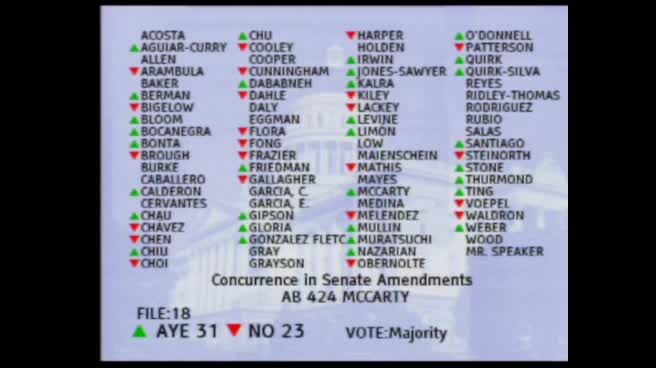 56SEC
Assembly Floor
 1MIN
Senate Floor
 1H
Senate Standing Committee on Appropriations
 6MIN
Senate Standing Committee on Energy, Utilities and Communications
 17MIN
Senate Standing Committee on Natural Resources and Water
 2MIN
Assembly Floor
 2MIN
Assembly Standing Committee on Appropriations
 6MIN
Assembly Standing Committee on Utilities and Energy
Bill Author