AB 544: Vehicles: high-occupancy vehicle lanes.
- Session Year: 2017-2018
- House: Assembly
- Latest Version Date: 2017-10-10
Existing federal law authorizes, until September 30, 2019, a state to allow low emission and energy-efficient vehicles, as specified, to use lanes designated for high-occupancy vehicles (HOVs). Existing federal law also authorizes, until September 30, 2025, a state to allow alternative fuel vehicles, as defined, and new qualified plug-in electric drive motor vehicles, as defined, to use those HOV lanes.
Existing state law authorizes the Department of Transportation to designate certain lanes for the exclusive use of HOVs. Existing law also authorizes super ultra-low emission vehicles (SULEV), ultra-low emission vehicles (ULEV), advanced technology partial zero-emission vehicles (AT PZEV), or transitional zero-emission vehicles (TZEV), as specified, that display a valid identifier issued by the Department of Motor Vehicles to use these HOV lanes until January 1, 2019, or until the date federal authorization expires, or until the Secretary of State receives a specified notice, whichever occurs first. Existing law makes the use by a driver of an HOV lane without those identifiers a crime. Existing law requires the Department of Transportation to remove individual HOV lanes, or portions of those lanes, during peak periods of congestion from access by vehicles displaying the identifiers if the department makes specified findings.
This bill would extend the authority of drivers of specified vehicles to use HOV lanes until the date federal authorization expires, or until the Secretary of State receives a specified notice, whichever occurs first. The bill would authorize the Department of Motor Vehicles to issue identifiers until the date federal authorization expires, or until the Secretary of State receives a certain notice, whichever occurs first.
The bill would make certain existing identifiers valid until January 1, 2019, would make certain identifiers issued on or after January 1, 2019, valid until January 1, 2022, and would make other identifiers issued on or after January 1, 2019, valid until January 1 of the 4th year after the year in which they were issued, as specified. The bill would provide, subject to exception, that a vehicle may not be issued an identifier more than once. The bill would additionally condition eligibility for the identifiers on the applicant not having received a rebate pursuant to the Clean Vehicle Rebate Project for a vehicle purchased on or after January 1, 2018, unless the applicant meets certain income restrictions. The bill would provide that if these provisions become inoperative, the driver of a vehicle with an otherwise valid decal, label, or other identifier would not be cited for a violation of the HOV lane provisions within 60 days of the date that those provisions became inoperative. The bill would make additional conforming changes.
The bill would repeal these provisions on September 30, 2025.
By extending the operation of an existing crime, this bill would impose a state-mandated local program.
The California Constitution requires the state to reimburse local agencies and school districts for certain costs mandated by the state. Statutory provisions establish procedures for making that reimbursement.
This bill would provide that no reimbursement is required by this act for a specified reason.
Existing federal law authorizes, until September 30, 2019, a state to allow low emission and energy-efficient vehicles, as specified, to use lanes designated for high-occupancy vehicles (HOVs). Existing federal law also authorizes, until September 30, 2025, a state to allow alternative fuel vehicles, as defined, and new qualified plug-in electric drive motor vehicles, as defined, to use those HOV lanes.
Existing state law authorizes the Department of Transportation to designate certain lanes for the exclusive use of HOVs. Existing law also authorizes super ultra-low emission vehicles (SULEV), ultra-low emission vehicles (ULEV), advanced technology partial zero-emission vehicles (AT PZEV), or transitional zero-emission vehicles (TZEV), as specified, that display a valid identifier issued by the Department of Motor Vehicles to use these HOV lanes until January 1, 2019, or until the date federal authorization expires, or until the Secretary of State receives a specified notice, whichever occurs first. Existing law makes the use by a driver of an HOV lane without those identifiers a crime. Existing law requires the Department of Transportation to remove individual HOV lanes, or portions of those lanes, during peak periods of congestion from access by vehicles displaying the identifiers if the department makes specified findings.
This bill would extend the authority of drivers of specified vehicles to use HOV lanes until the date federal authorization expires, or until the Secretary of State receives a specified notice, whichever occurs first. The bill would authorize the Department of Motor Vehicles to issue identifiers until the date federal authorization expires, or until the Secretary of State receives a certain notice, whichever occurs first.
The bill would make certain existing identifiers valid until January 1, 2019, would make certain identifiers issued on or after January 1, 2019, valid until January 1, 2022, and would make other identifiers issued on or after January 1, 2019, valid until January 1 of the 4th year after the year in which they were issued, as specified. The bill would make vehicles that have been issued an identifier before January 1, 2017, ineligible for those identifiers issued on and after 2017. provide, subject to exception, that a vehicle may not be issued an identifier more than once. The bill would additionally condition eligibility for the identifiers on the applicant not having received a rebate pursuant to the Clean Vehicle Rebate Project for a vehicle purchased on or after January 1, 2018, unless the applicant meets certain income restrictions. The bill would provide that if these provisions become inoperative, the driver of a vehicle with an otherwise valid decal, label, or other identifier would not be cited for a violation of the HOV lane provisions within 60 days of the date that those provisions became inoperative. The bill would make additional conforming changes.
The bill would repeal these provisions on September 30, 2025.
By extending the operation of an existing crime, this bill would impose a state-mandated local program.
The California Constitution requires the state to reimburse local agencies and school districts for certain costs mandated by the state. Statutory provisions establish procedures for making that reimbursement.
This bill would provide that no reimbursement is required by this act for a specified reason.
Existing federal law authorizes, until September 30, 2019, a state to allow low emission and energy-efficient vehicles, as specified, to use lanes designated for high-occupancy vehicles (HOVs). Existing federal law also authorizes, until September 30, 2025, a state to allow alternative fuel vehicles, as defined, and new qualified plug-in electric drive motor vehicles, as defined, to use those HOV lanes.
Existing state law authorizes the Department of Transportation to designate certain lanes for the exclusive use of HOVs. Existing law also authorizes super ultra-low emission vehicles (SULEV), ultra-low emission vehicles (ULEV), advanced technology partial zero-emission vehicles (AT PZEV), or transitional zero-emission vehicles (TZEV), as specified, that display a valid identifier issued by the Department of Motor Vehicles to use these HOV lanes until January 1, 2019, or until the date federal authorization expires, or until the Secretary of State receives a specified notice, whichever occurs first. Existing law makes the use by a driver of an HOV lane without those identifiers a crime. Existing law requires the Department of Transportation to remove individual HOV lanes, or portions of those lanes, during peak periods of congestion from access by vehicles displaying the identifiers if the department makes specified findings.
This bill would extend the authority of drivers of specified vehicles to use HOV lanes until the date federal authorization expires, or until the Secretary of State receives a specified notice, whichever occurs first. The bill would authorize the Department of Motor Vehicles to issue identifiers until the date federal authorization expires, or until the Secretary of State receives a certain notice, whichever occurs first.
The bill would make certain existing identifiers valid until January 1, 2019, would make certain identifiers issued on or after January 1, 2019, valid until January 1, 2022, and would make other identifiers issued on or after January 1, 2019, valid until January 1 of the 4th year after the year in which they were issued, as specified. The bill would make vehicles that have been issued an identifier before January 1, 2017, ineligible for those identifiers issued on and after 2017. The bill would additionally condition eligibility for the identifiers on the applicant not having applied for or received a rebate pursuant to the Clean Vehicle Rebate Project, Project for a vehicle purchased on or after January 1, 2018, unless the applicant meets certain income restrictions. The bill would provide that if these provisions become inoperative, the driver of a vehicle with an otherwise valid decal, label, or other identifier would not be cited for a violation of the HOV lane provisions within 60 days of the date that those provisions became inoperative. The bill would make additional conforming changes.
The bill would repeal these provisions on September 30, 2025.
By extending the operation of an existing crime, this bill would impose a state-mandated local program.
The California Constitution requires the state to reimburse local agencies and school districts for certain costs mandated by the state. Statutory provisions establish procedures for making that reimbursement.
This bill would provide that no reimbursement is required by this act for a specified reason.
Existing federal law authorizes, until September 30, 2019, a state to allow low emission and energy-efficient vehicles, as specified, to use lanes designated for high-occupancy vehicles (HOVs). Existing federal law also authorizes, until September 30, 2025, a state to allow alternative fuel vehicles, as defined, and new qualified plug-in electric drive motor vehicles, as defined, to use those HOV lanes.
Existing state law authorizes the Department of Transportation to designate certain lanes for the exclusive use of HOVs. Existing law also authorizes super ultra-low emission vehicles (SULEV), ultra-low emission vehicles (ULEV), advanced technology partial zero-emission vehicles (AT PZEV), or transitional zero-emission vehicles (TZEV), as specified, that display a valid identifier issued by the Department of Motor Vehicles to use these HOV lanes until January 1, 2019, or until the date federal authorization expires, or until the Secretary of State receives a specified notice, whichever occurs first. Existing law makes the use by a driver of an HOV lane without those identifiers a crime. Existing law requires the Department of Transportation to remove individual HOV lanes, or portions of those lanes, during peak periods of congestion from access by vehicles displaying the identifiers if the department makes specified findings.
This bill would extend the authority of drivers of specified vehicles to use HOV lanes until the date federal authorization expires, or until the Secretary of State receives a specified notice, whichever occurs first. The bill would provide that identifiers issued for those specified vehicles are valid until January 1, 2019. The bill would authorize the Department of Motor Vehicles to issue other identifiers until the date federal authorization expires, or until the Secretary of State receives a certain notice, whichever occurs first.
The bill would make new identifiers issued for SULEVs, AT PZEVs, and TZEVs certain existing identifiers valid until January 1, 2019, would make certain identifiers issued on or after January 1, 2019, valid until January 1, 2022, and would make other identifiers issued on or after January 1, 2019, valid until January 1 of the 4th year after the year in which they were issued. issued, as specified. The bill would additionally condition eligibility for the identifiers on the applicant not having applied for or received a rebate pursuant to the Clean Vehicle Rebate Project, unless the applicant meets certain income restrictions. The bill would provide that if these provisions become inoperative, the driver of a vehicle with an otherwise valid decal, label, or other identifier would not be cited for a violation of the HOV lane provisions within 60 days of the date that those provisions became inoperative. The bill would make additional conforming changes.
The bill would repeal these provisions on September 30, 2025.
By extending the operation of an existing crime, this bill would impose a state-mandated local program.
The California Constitution requires the state to reimburse local agencies and school districts for certain costs mandated by the state. Statutory provisions establish procedures for making that reimbursement.
This bill would provide that no reimbursement is required by this act for a specified reason.
Existing federal law authorizes, until September 30, 2019, a state to allow low emission and energy-efficient vehicles, as specified, to use lanes designated for high-occupancy vehicles (HOVs). Existing federal law also authorizes, until September 30, 2025, a state to allow alternative fuel vehicles, as defined, and new qualified plug-in electric drive motor vehicles, as defined, to use those HOV lanes.
Existing state law authorizes the Department of Transportation to designate certain lanes for the exclusive use of HOVs. Existing law also authorizes super ultra-low emission vehicles (SULEV), ultra-low emission vehicles (ULEV), advanced technology partial zero-emission vehicles (AT PZEV), or transitional zero-emission vehicles (TZEV), as specified, that display a valid identifier issued by the Department of Motor Vehicles to use these HOV lanes until January 1, 2019, or until the date federal authorization expires, or until the Secretary of State receives a specified notice, whichever occurs first. Existing law makes the use by a driver of an HOV lane without those identifiers a crime. Existing law requires the Department of Transportation to remove individual HOV lanes, or portions of those lanes, during peak periods of congestion from access by vehicles displaying the identifiers if the department makes specified findings.
This bill would extend the authority of drivers of specified vehicles to use HOV lanes until the date federal authorization expires, or until the Secretary of State receives a specified notice, whichever occurs first. The bill would provide that identifiers issued for those specified vehicles are valid until January 1, 2019. The bill would authorize the Department of Motor Vehicles to issue other identifiers until the date federal authorization expires, or until the Secretary of State receives a certain notice, whichever occurs first.
The bill would provide that make new identifiers issued for SULEVs, AT PZEVs, and TZEVs would be valid until January 1 of the 4th year after the year in which they were issued. The bill would additionally condition eligibility for the identifiers on the applicant not having applied for or received a rebate pursuant to the Clean Vehicle Rebate Project, unless the applicant meets certain income restrictions. The bill would provide that if these provisions become inoperative, the driver of a vehicle with an otherwise valid decal, label, or other identifier would not be cited for a violation of the HOV lane provisions within 60 days of the date that those provisions became inoperative. The bill would make additional conforming changes.
The bill would repeal these provisions on September 30, 2025.
By extending the operation of an existing crime, this bill would impose a state-mandated local program.
The California Constitution requires the state to reimburse local agencies and school districts for certain costs mandated by the state. Statutory provisions establish procedures for making that reimbursement.
This bill would provide that no reimbursement is required by this act for a specified reason.
Existing federal law authorizes, until September 30, 2019, a state to allow low emission and energy-efficient vehicles, as specified, to use lanes designated for high-occupancy vehicles (HOVs). Existing federal law also authorizes, until September 30, 2025, a state to allow alternative fuel vehicles, as defined, and new qualified plug-in electric drive motor vehicles, as defined, to use those HOV lanes.
Existing state law authorizes the Department of Transportation to designate certain lanes for the exclusive use of HOVs. Existing law also authorizes super ultra-low emission vehicles (SULEV), ultra-low emission vehicles (ULEV), advanced technology partial zero-emission vehicles (AT PZEV), or transitional zero-emission vehicles (TZEV), as specified, that display a valid identifier issued by the Department of Motor Vehicles to use these HOV lanes until January 1, 2019, or until the date federal authorization expires, or until the Secretary of State receives a specified notice, whichever occurs first. Existing law makes the use by a driver of an HOV lane without those identifiers a crime. Existing law requires the Department of Transportation to remove individual HOV lanes, or portions of those lanes, during peak periods of congestion from access by vehicles displaying the identifiers if the department makes specified findings.
This bill would extend the authority of drivers of specified vehicles to use HOV lanes until the date federal authorization expires, or until the Secretary of State receives a specified notice, whichever occurs first. The bill would provide that identifiers issued for those specified vehicles are valid until January 1, 2019. The bill would authorize the Department of Motor Vehicles to issue other identifiers until the date federal authorization expires, or until the Secretary of State receives a certain notice, whichever occurs first.
The bill would provide that new identifiers issued for SULEVs, AT PZEVs, and TZEVs would be valid until January 1 of the 4th year after the year in which they were issued. The bill would provide that if these provisions become inoperative, the driver of a vehicle with an otherwise valid decal, label, or other identifier would not be cited for a violation of the HOV lane provisions within 60 days of the date that those provisions became inoperative. The bill would make additional conforming changes.
By extending the operation of an existing crime, this bill would impose a state-mandated local program.
The California Constitution requires the state to reimburse local agencies and school districts for certain costs mandated by the state. Statutory provisions establish procedures for making that reimbursement.
This bill would provide that no reimbursement is required by this act for a specified reason.
Existing state law authorizes the Department of Transportation to designate certain lanes for the exclusive use of high-occupancy vehicles (HOVs). Existing law also authorizes super ultra-low emission vehicles, ultra-low emission vehicles, partial zero-emission vehicles, or transitional zero-emission vehicles, as specified, that display a valid identifier issued by the Department of Motor Vehicles to use these HOV lanes. This bill would make a technical, nonsubstantive change to these provisions.Existing state law authorizes the Department of Transportation to designate certain lanes for the exclusive use of high-occupancy vehicles (HOVs). Existing law also authorizes super ultra-low emission vehicles, ultra-low emission vehicles, partial zero-emission vehicles, or transitional zero-emission vehicles, as specified, that display a valid identifier issued by the Department of Motor Vehicles to use these HOV lanes.
This bill would make a technical, nonsubstantive change to these provisions.
(a)For purposes of implementing Section 21655.9, the department shall make available for issuance, for a fee determined by the department to be sufficient to reimburse the department for the reasonable costs incurred pursuant to this section, and pursuant to the eligibility provisions in subdivision (b), distinctive decals, labels, and other identifiers that clearly distinguish the following vehicles from other vehicles:
(1)A vehicle that meets the states super ultra-low emission vehicle (SULEV) standard for exhaust emissions and the federal inherently low-emission vehicle (ILEV) evaporative emission standard, as defined in Part 88 (commencing with Section 88.101-94) of Title 40 of the Code of Federal Regulations.
(2)A vehicle that was produced during the 2004 model year or earlier and meets the states ultra-low emission vehicle (ULEV) standard for exhaust emissions and the federal ILEV standard. A decal, label, or other identifier issued pursuant to this paragraph is valid until January 1, 2019.
(3)A vehicle that meets the states enhanced advanced technology partial zero-emission vehicle (enhanced AT PZEV) standard or transitional zero-emission vehicle (TZEV) standard.
(4)A decal, label, or other identifier issued pursuant to paragraph (1) or (3) before January 1, 2017, is valid until January 1, 2019.
(5)(A)A decal, label, or other identifier issued pursuant to paragraph (1) or (3) on or after January 1, 2017, and before January 1, 2019, is valid until January 1, 2019.
(B)A decal, label, or other identifier issued pursuant to paragraph (1) or (3) on or after January 1, 2019, for a vehicle that had been issued a decal, label, or other identifier pursuant to paragraph (1) or (3) between January 1, 2017, and January 1, 2019, is valid until January 1, 2022.
(6)Except as provided in subparagraph (B) of paragraph (5), a decal, label, or other identifier issued pursuant to paragraph (1) or (3) on or after January 1, 2019, is valid until January 1 of the fourth year after the year of issuance.
(7)Except as provided in subparagraph (B) of paragraph (5), a vehicle shall not be issued a decal, label, or other identifier more than once.
(b)(1)The department shall not issue a decal, label, or other identifier to an applicant who has received a consumer rebate pursuant to the Clean Vehicle Rebate Project, established as part of the Air Quality Improvement Program pursuant to Article 3 (commencing with Section 44274) of Chapter 8.9 of Part 5 of Division 26 of the Health and Safety Code, for a vehicle purchased on or after January 1, 2018, unless the rebate was issued to a buyer whose gross annual income falls below one hundred fifty thousand dollars ($150,000) for a person who files a tax return as a single person, two hundred four thousand dollars ($204,000) for a person who files a tax return as a head of household, and three hundred thousand dollars ($300,000) for a person who files a joint tax return.
(2)The department shall collaborate with the State Air Resources Board to establish procedures to implement this subdivision, including, but not limited to, all of the following:
(A)Amend the application form for a decal, label, or other identifier issued pursuant to this section and the application for a rebate under the Clean Vehicle Rebate Project to include a statement indicating that the applicant cannot participate in both programs unless the applicant meets the income restrictions in paragraph (1). Each application shall require the applicant to provide a signature to confirm that the applicant understands this condition.
(B)Notify consumers of the eligibility criteria and conditions using existing education and outreach efforts.
(C)Establish appropriate compliance and enforcement measures.
(D)Establish information sharing between the department and the board to implement the requirements of this subdivision.
(c)The department shall include a summary of the provisions of this section on each motor vehicle registration renewal notice, or on a separate insert, if space is available and the summary can be included without incurring additional printing or postage costs.
(d)The Department of Transportation shall remove individual HOV lanes, or portions of those lanes, during periods of peak congestion from the access provisions provided in subdivision (a), following a finding by the Department of Transportation as follows:
(1)The lane, or portion of the lane, exceeds a level of service C, as discussed in subdivision (b) of Section 65089 of the Government Code.
(2)The operation or projected operation of the vehicles described in subdivision (a) in these lanes, or portions of those lanes, will significantly increase congestion.
(3)The finding shall also demonstrate the infeasibility of alleviating the congestion by other means, including, but not limited to, reducing the use of the lane by noneligible vehicles or further increasing vehicle occupancy.
(e)The State Air Resources Board shall publish and maintain a list of all vehicles eligible for participation in the programs described in this section. The board shall provide that list to the department.
(f)(1)For purposes of subdivision (a), the Department of the California Highway Patrol and the department, in consultation with the Department of Transportation, shall design and specify the placement of the decal, label, or other identifier on the vehicle. Each decal, label, or other identifier issued for a vehicle shall display a unique number, which shall be printed on, or affixed to, the vehicle registration.
(2)Decals, labels, or other identifiers designed pursuant to this subdivision for a vehicle described in paragraph (3) of subdivision (a) and issued before January 1, 2019, shall be distinguishable from the decals, labels, or other identifiers that are designed for vehicles described in paragraphs (1) and (2) of subdivision (a).
(3)Decals, labels, or other identifiers issued pursuant to paragraph (1) or (3) of subdivision (a) before January 1, 2019, shall be distinguishable from the decals, labels, or other identifiers issued on or after January 1, 2019.
(g)If the Metropolitan Transportation Commission, serving as the Bay Area Toll Authority, grants toll-free and reduced-rate passage on toll bridges under its jurisdiction to a vehicle pursuant to Section 30102.5 of the Streets and Highways Code, it shall also grant the same toll-free and reduced-rate passage to a vehicle displaying a valid identifier issued by the department pursuant to paragraph (1) or (2) of subdivision (a).
(h)(1)Notwithstanding Section 21655.9, and except as provided in paragraph (2), a vehicle described in subdivision (a) that displays a valid decal, label, or identifier issued pursuant to this section shall be granted a toll-free or reduced-rate passage in high-occupancy toll lanes as described in Section 149.7 of the Streets and Highways Code unless prohibited by federal law.
(2)(A)Paragraph (1) does not apply to the imposition of a toll imposed for passage on a toll road or toll highway, that is not a high-occupancy toll lane as described in Section 149.7 of the Streets and Highways Code.
(B)Paragraph (1) does not apply to the imposition of a toll charged for crossing a state-owned bridge.
(i)If the Director of Transportation determines that federal law does not authorize the state to allow vehicles that are identified by distinctive decals, labels, or other identifiers on vehicles described in subdivision (a) to use highway lanes or highway access ramps for high-occupancy vehicles regardless of vehicle occupancy, the Director of Transportation shall submit a notice of that determination to the Secretary of State.
(j)This section shall become inoperative on the date the federal authorization pursuant to Section 166 of Title 23 of the United States Code expires, or the date the Secretary of State receives the notice described in subdivision (i), whichever occurs first.
(k)If this section becomes inoperative pursuant to subdivision (j) the driver of a vehicle with an otherwise valid decal, label, or other identifier issued pursuant to this section shall not be cited for a violation of Section 21655.9 within 60 days of the date that this section becomes inoperative.
(l)This section is repealed as of September 30, 2025.
SEC. 2.Section 21655.9 of the Vehicle Code is amended to read:21655.9.(a)(1)Whenever the Department of Transportation or a local authority authorizes or permits exclusive or preferential use of highway lanes or highway access ramps for high-occupancy vehicles pursuant to Section 21655.5, the use of those lanes or ramps shall also be extended to vehicles that are issued distinctive decals, labels, or other identifiers pursuant to Section 5205.5 regardless of vehicle occupancy or ownership.
(2)A local authority during periods of peak congestion shall suspend for a lane the access privileges extended pursuant to paragraph (1) for those vehicles issued distinctive decals, labels, or other identifiers pursuant to Section 5205.5, if a periodic review of lane performance by that local authority discloses both of the following factors regarding the lane:
(A)The lane, or a portion of the lane, exceeds a level of service C, as described in subdivision (b) of Section 65089 of the Government Code.
(B)The operation or projected operation of vehicles in the lane, or a portion of the lane, will significantly increase congestion.
(b)A person shall not drive a vehicle described in subdivision (a) of Section 5205.5 with a single occupant upon a high-occupancy vehicle lane pursuant to this section unless the decal, label, or other identifier issued pursuant to Section 5205.5 is properly displayed on the vehicle, and the vehicle registration described in Section 5205.5 is with the vehicle.
(c)A person shall not operate or own a vehicle displaying a decal, label, or other identifier, as described in Section 5205.5, if that decal, label, or identifier was not issued for that vehicle pursuant to Section 5205.5. A violation of this subdivision is a misdemeanor.
(d)If the provisions in Section 5205.5 authorizing the department to issue decals, labels, or other identifiers to hybrid and alternative fuel vehicles become inoperative, vehicles displaying those decals, labels, or other identifiers shall not access high-occupancy vehicle lanes without meeting the occupancy requirements otherwise applicable to those lanes.
(e)(1)This section shall become inoperative on the date the federal authorization pursuant to Section 166 of Title 23 of the United States Code expires, or the date the Secretary of State receives the notice described in subdivision (i) of Section 5205.5, whichever occurs first.
(2)With respect to a vehicle described in paragraph (2) of subdivision (a) of Section 5205.5, this section shall become inoperative on January 1, 2019.
(f)(1)The Department of Transportation shall prepare and submit a report to the Legislature on or before December 1, 2017, on the degradation status of high-occupancy vehicle lanes on the state highway system.
(2)The requirement that a report be submitted pursuant to paragraph (1) shall be inoperative on December 1, 2021, pursuant to Section 10231.5 of the Government Code.
(3)A report submitted pursuant to paragraph (1) shall be submitted in compliance with Section 9795 of the Government Code.
(g)This section is repealed as of September 30, 2025.
SEC. 3.No reimbursement is required by this act pursuant to Section 6 of Article XIIIB of the California Constitution because the only costs that may be incurred by a local agency or school district will be incurred because this act creates a new crime or infraction, eliminates a crime or infraction, or changes the penalty for a crime or infraction, within the meaning of Section 17556 of the Government Code, or changes the definition of a crime within the meaning of Section 6 of Article XIIIB of the California Constitution.
(a)For purposes of implementing Section 21655.9, the department shall make available for issuance, for a fee determined by the department to be sufficient to reimburse the department for the reasonable costs incurred pursuant to this section, and pursuant to the eligibility provisions in subdivision (b), distinctive decals, labels, and other identifiers that clearly distinguish the following vehicles from other vehicles:
(1)A vehicle that meets the states super ultra-low emission vehicle (SULEV) standard for exhaust emissions and the federal inherently low-emission vehicle (ILEV) evaporative emission standard, as defined in Part 88 (commencing with Section 88.101-94) of Title 40 of the Code of Federal Regulations.
(2)A vehicle that was produced during the 2004 model year or earlier and meets the states ultra-low emission vehicle (ULEV) standard for exhaust emissions and the federal ILEV standard. A decal, label, or other identifier issued pursuant to this paragraph is valid until January 1, 2019.
(3)A vehicle that meets the states enhanced advanced technology partial zero-emission vehicle (enhanced AT PZEV) standard or transitional zero-emission vehicle (TZEV) standard.
(4)A decal, label, or other identifier issued pursuant to paragraph (1) or (3) before January 1, 2017, is valid until January 1, 2019. A vehicle for which a decal, label, or other identifier was issued pursuant to paragraph (1) or (3) before January 1, 2017, is not eligible for a decal, label, or other identifier issued pursuant to paragraph (5) or (6).
(5)(A)A decal, label, or other identifier issued pursuant to paragraph (1) or (3) on or after January 1, 2017, and before January 1, 2019, is valid until January 1, 2019.
(B)A decal, label, or other identifier issued pursuant to paragraph (1) or (3) on or after January 1, 2019, for a vehicle that had been issued a decal, label, or other identifier pursuant to paragraph (1) or (3) between January 1, 2017, and January 1, 2019, is valid until January 1, 2022.
(6)Except as provided in subparagraph (B) of paragraph (5), a decal, label, or other identifier issued pursuant to paragraph (1) or (3) on or after January 1, 2019, is valid until January 1 of the fourth year after the year of issuance.
(7)Except as provided in subparagraph (B) of paragraph (5), a vehicle shall not be issued a decal, label, or other identifier more than once.
(b)(1)The department shall not issue a decal, label, or other identifier to an applicant who has received a consumer rebate pursuant to the Clean Vehicle Rebate Project, established as part of the Air Quality Improvement Program pursuant to Article 3 (commencing with Section 44274) of Chapter 8.9 of Part 5 of Division 26 of the Health and Safety Code, for a vehicle purchased on or after January 1, 2018, unless the rebate was issued to a buyer whose gross annual income falls below one hundred fifty thousand dollars ($150,000) for a person who files a tax return as a single person, two hundred four thousand dollars ($204,000) for a person who files a tax return as a head of household, and three hundred thousand dollars ($300,000) for a person who files a joint tax return.
(2)The department shall collaborate with the State Air Resources Board to establish procedures to implement this subdivision, including, but not limited to, all of the following:
(A)Amend the application form for a decal, label, or other identifier issued pursuant to this section and the application for a rebate under the Clean Vehicle Rebate Project to include a statement indicating that the applicant cannot participate in both programs unless the applicant meets the income restrictions in paragraph (1). Each application shall require the applicant to provide a signature to confirm that the applicant understands this condition.
(B)Notify consumers of the eligibility criteria and conditions using existing education and outreach efforts.
(C)Establish appropriate compliance and enforcement measures.
(D)Establish information sharing between the department and the board to implement the requirements of this subdivision.
(c)The department shall include a summary of the provisions of this section on each motor vehicle registration renewal notice, or on a separate insert, if space is available and the summary can be included without incurring additional printing or postage costs.
(d)The Department of Transportation shall remove individual HOV lanes, or portions of those lanes, during periods of peak congestion from the access provisions provided in subdivision (a), following a finding by the Department of Transportation as follows:
(1)The lane, or portion of the lane, exceeds a level of service C, as discussed in subdivision (b) of Section 65089 of the Government Code.
(2)The operation or projected operation of the vehicles described in subdivision (a) in these lanes, or portions of those lanes, will significantly increase congestion.
(3)The finding shall also demonstrate the infeasibility of alleviating the congestion by other means, including, but not limited to, reducing the use of the lane by noneligible vehicles or further increasing vehicle occupancy.
(e)The State Air Resources Board shall publish and maintain a list of all vehicles eligible for participation in the programs described in this section. The board shall provide that list to the department.
(f)(1)For purposes of subdivision (a), the Department of the California Highway Patrol and the department, in consultation with the Department of Transportation, shall design and specify the placement of the decal, label, or other identifier on the vehicle. Each decal, label, or other identifier issued for a vehicle shall display a unique number, which shall be printed on, or affixed to, the vehicle registration.
(2)Decals, labels, or other identifiers designed pursuant to this subdivision for a vehicle described in paragraph (3) of subdivision (a) and issued before January 1, 2019, shall be distinguishable from the decals, labels, or other identifiers that are designed for vehicles described in paragraphs (1) and (2) of subdivision (a).
(3)Decals, labels, or other identifiers issued pursuant to paragraph (1) or (3) of subdivision (a) before January 1, 2019, shall be distinguishable from the decals, labels, or other identifiers issued on or after January 1, 2019.
(g)(1)Except as provided in paragraph (2), for purposes of paragraph (1) or (3) of subdivision (a), the department shall issue distinctive decals, labels, or other identifiers that clearly distinguish a vehicle specified in paragraph (1) or (3) of subdivision (a).(2)The department may issue a decal, label, or other identifier for a vehicle that satisfies all of the following conditions:(A)The vehicle is of a type identified in paragraph (1) or (3) of subdivision (a).(B)The owner of the vehicle is the owner of a vehicle for which a decal, label, or other identifier was previously issued and that vehicle for which the decal, label, or other identifier was previously issued is determined by the department, on the basis of satisfactory proof submitted by the owner to the department, to be a nonrepairable vehicle or a total loss salvage vehicle.(C)The owner of the vehicle applied for a decal, label, or other identifier pursuant to this paragraph within six months of the date on which the vehicle for which a decal, label, or other identifier was previously issued is declared to be a nonrepairable vehicle or a total loss salvage vehicle.(h)(g)If the Metropolitan Transportation Commission, serving as the Bay Area Toll Authority, grants toll-free and reduced-rate passage on toll bridges under its jurisdiction to a vehicle pursuant to Section 30102.5 of the Streets and Highways Code, it shall also grant the same toll-free and reduced-rate passage to a vehicle displaying a valid identifier issued by the department pursuant to paragraph (1) or (2) of subdivision (a).
(i)(h)(1)Notwithstanding Section 21655.9, and except as provided in paragraph (2), a vehicle described in subdivision (a) that displays a valid decal, label, or identifier issued pursuant to this section shall be granted a toll-free or reduced-rate passage in high-occupancy toll lanes as described in Section 149.7 of the Streets and Highways Code unless prohibited by federal law.
(2)(A)Paragraph (1) does not apply to the imposition of a toll imposed for passage on a toll road or toll highway, that is not a high-occupancy toll lane as described in Section 149.7 of the Streets and Highways Code.
(B)Paragraph (1) does not apply to the imposition of a toll charged for crossing a state-owned bridge.
(j)(i)If the Director of Transportation determines that federal law does not authorize the state to allow vehicles that are identified by distinctive decals, labels, or other identifiers on vehicles described in subdivision (a) to use highway lanes or highway access ramps for high-occupancy vehicles regardless of vehicle occupancy, the Director of Transportation shall submit a notice of that determination to the Secretary of State.
(k)(j)This section shall become inoperative on the date the federal authorization pursuant to Section 166 of Title 23 of the United States Code expires, or the date the Secretary of State receives the notice described in subdivision (j), (i), whichever occurs first.
(l)(k)If this section becomes inoperative pursuant to subdivision (k), (j) the driver of a vehicle with an otherwise valid decal, label, or other identifier issued pursuant to this section shall not be cited for a violation of Section 21655.9 within 60 days of the date that this section becomes inoperative.
(m)(l)This section is repealed as of September 30, 2025.
SEC. 2.Section 21655.9 of the Vehicle Code is amended to read:21655.9.(a)(1)Whenever the Department of Transportation or a local authority authorizes or permits exclusive or preferential use of highway lanes or highway access ramps for high-occupancy vehicles pursuant to Section 21655.5, the use of those lanes or ramps shall also be extended to vehicles that are issued distinctive decals, labels, or other identifiers pursuant to Section 5205.5 regardless of vehicle occupancy or ownership.
(2)A local authority during periods of peak congestion shall suspend for a lane the access privileges extended pursuant to paragraph (1) for those vehicles issued distinctive decals, labels, or other identifiers pursuant to Section 5205.5, if a periodic review of lane performance by that local authority discloses both of the following factors regarding the lane:
(A)The lane, or a portion of the lane, exceeds a level of service C, as described in subdivision (b) of Section 65089 of the Government Code.
(B)The operation or projected operation of vehicles in the lane, or a portion of the lane, will significantly increase congestion.
(b)A person shall not drive a vehicle described in subdivision (a) of Section 5205.5 with a single occupant upon a high-occupancy vehicle lane pursuant to this section unless the decal, label, or other identifier issued pursuant to Section 5205.5 is properly displayed on the vehicle, and the vehicle registration described in Section 5205.5 is with the vehicle.
(c)A person shall not operate or own a vehicle displaying a decal, label, or other identifier, as described in Section 5205.5, if that decal, label, or identifier was not issued for that vehicle pursuant to Section 5205.5. A violation of this subdivision is a misdemeanor.
(d)If the provisions in Section 5205.5 authorizing the department to issue decals, labels, or other identifiers to hybrid and alternative fuel vehicles become inoperative, vehicles displaying those decals, labels, or other identifiers shall not access high-occupancy vehicle lanes without meeting the occupancy requirements otherwise applicable to those lanes.
(e)(1)This section shall become inoperative on the date the federal authorization pursuant to Section 166 of Title 23 of the United States Code expires, or the date the Secretary of State receives the notice described in subdivision (j) (i) of Section 5205.5, whichever occurs first.
(2)With respect to a vehicle described in paragraph (2) of subdivision (a) of Section 5205.5, this section shall become inoperative on January 1, 2019.
(f)(1)The Department of Transportation shall prepare and submit a report to the Legislature on or before December 1, 2017, on the degradation status of high-occupancy vehicle lanes on the state highway system.
(2)The requirement that a report be submitted pursuant to paragraph (1) shall be inoperative on December 1, 2021, pursuant to Section 10231.5 of the Government Code.
(3)A report submitted pursuant to paragraph (1) shall be submitted in compliance with Section 9795 of the Government Code.
(g)This section is repealed as of September 30, 2025.
SEC. 3.No reimbursement is required by this act pursuant to Section 6 of Article XIIIB of the California Constitution because the only costs that may be incurred by a local agency or school district will be incurred because this act creates a new crime or infraction, eliminates a crime or infraction, or changes the penalty for a crime or infraction, within the meaning of Section 17556 of the Government Code, or changes the definition of a crime within the meaning of Section 6 of Article XIIIB of the California Constitution.
(a)For purposes of implementing Section 21655.9, the department shall make available for issuance, for a fee determined by the department to be sufficient to reimburse the department for the reasonable costs incurred pursuant to this section, and pursuant to the eligibility provisions in subdivision (b), distinctive decals, labels, and other identifiers that clearly distinguish the following vehicles from other vehicles:
(1)A vehicle that meets the states super ultra-low emission vehicle (SULEV) standard for exhaust emissions and the federal inherently low-emission vehicle (ILEV) evaporative emission standard, as defined in Part 88 (commencing with Section 88.101-94) of Title 40 of the Code of Federal Regulations.
(2)A vehicle that was produced during the 2004 model year or earlier and meets the states ultra-low emission vehicle (ULEV) standard for exhaust emissions and the federal ILEV standard. A decal, label, or other identifier issued pursuant to this paragraph is valid until January 1, 2019.
(3)A vehicle that meets the states enhanced advanced technology partial zero-emission vehicle (enhanced AT PZEV) standard or transitional zero-emission vehicle (TZEV) standard.
(4)A decal, label, or other identifier issued pursuant to paragraph (1) or (3) before January 1, 2017, is valid until January 1, 2019. A vehicle for which a decal, label, or other identifier was issued pursuant to paragraph (1) or (3) before January 1, 2017, is not eligible for a decal, label, or other identifier issued pursuant to paragraph (5) or (6).
(5)(A)A decal, label, or other identifier issued pursuant to paragraph (1) or (3) on or after January 1, 2017, and before January 1, 2019, is valid until January 1, 2019.
(B)A decal, label, or other identifier issued pursuant to paragraph (1) or (3) on or after January 1, 2019, for a vehicle that had been issued a decal, label, or other identifier pursuant to paragraph (1) or (3) between January 1, 2017, and January 1, 2019, is valid until January 1, 2022.
(6)Except as provided in subparagraph (B) of paragraph (5), a decal, label, or other identifier issued pursuant to paragraph (1) or (3) on or after January 1, 2019, is valid until January 1 of the fourth year after the year of issuance.
(b)(1)In addition to the requirements in subdivision (a), an applicant is eligible for a decal, label, or other identifier issued pursuant to subdivision (a) if the applicant is the owner of the vehicle and has not applied for or received a consumer rebate pursuant to the Clean Vehicle Rebate Project, established as part of the Air Quality Improvement Program pursuant to Article 3 (commencing with Section 44274) of Chapter 8.9 of Part 5 of Division 26 of the Health and Safety Code, unless the rebate was or will be issued to a buyer whose annual income falls below one hundred fifty thousand dollars ($150,000) for a person who files a tax return as a single person, two hundred four thousand dollars ($204,000) for a person who files a tax return as a head of household, and three hundred thousand dollars ($300,000) for a person who files a joint tax return.(2) The department shall collaborate with the State Air Resources Board to establish procedures to implement this subdivision, including, but not limited to, amending the application form for a decal, label, or other identifier issued pursuant to this section, and amending the application for a rebate under the Clean Vehicle Rebate Project to include a statement indicating that an applicant cannot participate in both programs unless the applicant meets the income restrictions in paragraph (1). Each application shall require the applicant to provide a signature to confirm that the applicant understands this condition.(b)(1)The department shall not issue a decal, label, or other identifier to an applicant who has received a consumer rebate pursuant to the Clean Vehicle Rebate Project, established as part of the Air Quality Improvement Program pursuant to Article 3 (commencing with Section 44274) of Chapter 8.9 of Part 5 of Division 26 of the Health and Safety Code, for a vehicle purchased on or after January 1, 2018, unless the rebate was issued to a buyer whose annual income falls below one hundred fifty thousand dollars ($150,000) for a person who files a tax return as a single person, two hundred four thousand dollars ($204,000) for a person who files a tax return as a head of household, and three hundred thousand dollars ($300,000) for a person who files a joint tax return.
(2)The department shall collaborate with the State Air Resources Board to establish procedures to implement this subdivision, including, but not limited to, all of the following:
(A)Amend the application form for a decal, label, or other identifier issued pursuant to this section and the application for a rebate under the Clean Vehicle Rebate Project to include a statement indicating that the applicant cannot participate in both programs unless the applicant meets the income restrictions in paragraph (1). Each application shall require the applicant to provide a signature to confirm that the applicant understands this condition.
(B)Notify consumers of the eligibility criteria and conditions using existing education and outreach efforts.
(C)Establish appropriate compliance and enforcement measures.
(D)Establish information sharing between the department and the board to implement the requirements of this subdivision.
(c)The department shall include a summary of the provisions of this section on each motor vehicle registration renewal notice, or on a separate insert, if space is available and the summary can be included without incurring additional printing or postage costs.
(d)The Department of Transportation shall remove individual HOV lanes, or portions of those lanes, during periods of peak congestion from the access provisions provided in subdivision (a), following a finding by the Department of Transportation as follows:
(1)The lane, or portion of the lane, exceeds a level of service C, as discussed in subdivision (b) of Section 65089 of the Government Code.
(2)The operation or projected operation of the vehicles described in subdivision (a) in these lanes, or portions of those lanes, will significantly increase congestion.
(3)The finding shall also demonstrate the infeasibility of alleviating the congestion by other means, including, but not limited to, reducing the use of the lane by noneligible vehicles or further increasing vehicle occupancy.
(e)The State Air Resources Board shall publish and maintain a list of all vehicles eligible for participation in the programs described in this section. The board shall provide that list to the department.
(f)(1)For purposes of subdivision (a), the Department of the California Highway Patrol and the department, in consultation with the Department of Transportation, shall design and specify the placement of the decal, label, or other identifier on the vehicle. Each decal, label, or other identifier issued for a vehicle shall display a unique number, which shall be printed on, or affixed to, the vehicle registration.
(2)Decals, labels, or other identifiers designed pursuant to this subdivision for a vehicle described in paragraph (3) of subdivision (a) and issued before January 1, 2019, shall be distinguishable from the decals, labels, or other identifiers that are designed for vehicles described in paragraphs (1) and (2) of subdivision (a).
(3)Decals, labels, or other identifiers issued pursuant to paragraph (1) or (3) of subdivision (a) before January 1, 2019, shall be distinguishable from the decals, labels, or other identifiers issued on or after January 1, 2019.
(g)(1)Except as provided in paragraph (2), for purposes of paragraph (1) or (3) of subdivision (a), the department shall issue distinctive decals, labels, or other identifiers that clearly distinguish a vehicle specified in paragraph (1) or (3) of subdivision (a).
(2)The department may issue a decal, label, or other identifier for a vehicle that satisfies all of the following conditions:
(A)The vehicle is of a type identified in paragraph (1) or (3) of subdivision (a).
(B)The owner of the vehicle is the owner of a vehicle for which a decal, label, or other identifier was previously issued and that vehicle for which the decal, label, or other identifier was previously issued is determined by the department, on the basis of satisfactory proof submitted by the owner to the department, to be a nonrepairable vehicle or a total loss salvage vehicle.
(C)The owner of the vehicle applied for a decal, label, or other identifier pursuant to this paragraph within six months of the date on which the vehicle for which a decal, label, or other identifier was previously issued is declared to be a nonrepairable vehicle or a total loss salvage vehicle.
(h)If the Metropolitan Transportation Commission, serving as the Bay Area Toll Authority, grants toll-free and reduced-rate passage on toll bridges under its jurisdiction to a vehicle pursuant to Section 30102.5 of the Streets and Highways Code, it shall also grant the same toll-free and reduced-rate passage to a vehicle displaying a valid identifier issued by the department pursuant to paragraph (1) or (2) of subdivision (a).
(i)(1)Notwithstanding Section 21655.9, and except as provided in paragraph (2), a vehicle described in subdivision (a) that displays a valid decal, label, or identifier issued pursuant to this section shall be granted a toll-free or reduced-rate passage in high-occupancy toll lanes as described in Section 149.7 of the Streets and Highways Code unless prohibited by federal law.
(2)(A)Paragraph (1) does not apply to the imposition of a toll imposed for passage on a toll road or toll highway, that is not a high-occupancy toll lane as described in Section 149.7 of the Streets and Highways Code.
(B)Paragraph (1) does not apply to the imposition of a toll charged for crossing a state-owned bridge.
(j)If the Director of Transportation determines that federal law does not authorize the state to allow vehicles that are identified by distinctive decals, labels, or other identifiers on vehicles described in subdivision (a) to use highway lanes or highway access ramps for high-occupancy vehicles regardless of vehicle occupancy, the Director of Transportation shall submit a notice of that determination to the Secretary of State.
(k)This section shall become inoperative on the date the federal authorization pursuant to Section 166 of Title 23 of the United States Code expires, or the date the Secretary of State receives the notice described in subdivision (j), whichever occurs first.
(l)If this section becomes inoperative pursuant to subdivision (k), the driver of a vehicle with an otherwise valid decal, label, or other identifier issued pursuant to this section shall not be cited for a violation of Section 21655.9 within 60 days of the date that this section becomes inoperative.
(m)This section is repealed as of September 30, 2025.
SEC. 2.Section 21655.9 of the Vehicle Code is amended to read:21655.9.(a)(1)Whenever the Department of Transportation or a local authority authorizes or permits exclusive or preferential use of highway lanes or highway access ramps for high-occupancy vehicles pursuant to Section 21655.5, the use of those lanes or ramps shall also be extended to vehicles that are issued distinctive decals, labels, or other identifiers pursuant to Section 5205.5 regardless of vehicle occupancy or ownership.
(2)A local authority during periods of peak congestion shall suspend for a lane the access privileges extended pursuant to paragraph (1) for those vehicles issued distinctive decals, labels, or other identifiers pursuant to Section 5205.5, if a periodic review of lane performance by that local authority discloses both of the following factors regarding the lane:
(A)The lane, or a portion of the lane, exceeds a level of service C, as described in subdivision (b) of Section 65089 of the Government Code.
(B)The operation or projected operation of vehicles in the lane, or a portion of the lane, will significantly increase congestion.
(b)A person shall not drive a vehicle described in subdivision (a) of Section 5205.5 with a single occupant upon a high-occupancy vehicle lane pursuant to this section unless the decal, label, or other identifier issued pursuant to Section 5205.5 is properly displayed on the vehicle, and the vehicle registration described in Section 5205.5 is with the vehicle.
(c)A person shall not operate or own a vehicle displaying a decal, label, or other identifier, as described in Section 5205.5, if that decal, label, or identifier was not issued for that vehicle pursuant to Section 5205.5. A violation of this subdivision is a misdemeanor.
(d)If the provisions in Section 5205.5 authorizing the department to issue decals, labels, or other identifiers to hybrid and alternative fuel vehicles become inoperative, vehicles displaying those decals, labels, or other identifiers shall not access high-occupancy vehicle lanes without meeting the occupancy requirements otherwise applicable to those lanes.
(e)(1)This section shall become inoperative on the date the federal authorization pursuant to Section 166 of Title 23 of the United States Code expires, or the date the Secretary of State receives the notice described in subdivision (j) of Section 5205.5, whichever occurs first.
(2)With respect to a vehicle described in paragraph (2) of subdivision (a) of Section 5205.5, this section shall become inoperative on January 1, 2019.
(f)(1)The Department of Transportation shall prepare and submit a report to the Legislature on or before December 1, 2017, on the degradation status of high-occupancy vehicle lanes on the state highway system.
(2)The requirement that a report be submitted pursuant to paragraph (1) shall be inoperative on December 1, 2021, pursuant to Section 10231.5 of the Government Code.
(3)A report submitted pursuant to paragraph (1) shall be submitted in compliance with Section 9795 of the Government Code.
(g)This section is repealed as of September 30, 2025.
SEC. 3.No reimbursement is required by this act pursuant to Section 6 of Article XIIIB of the California Constitution because the only costs that may be incurred by a local agency or school district will be incurred because this act creates a new crime or infraction, eliminates a crime or infraction, or changes the penalty for a crime or infraction, within the meaning of Section 17556 of the Government Code, or changes the definition of a crime within the meaning of Section 6 of Article XIIIB of the California Constitution.
(a)For purposes of implementing Section 21655.9, the department shall make available for issuance, for a fee determined by the department to be sufficient to reimburse the department for the reasonable costs incurred pursuant to this section, and pursuant to the eligibility provisions in subdivision (b), distinctive decals, labels, and other identifiers that clearly distinguish the following vehicles from other vehicles:
(1)A vehicle that meets the states super ultra-low emission vehicle (SULEV) standard for exhaust emissions and the federal inherently low-emission vehicle (ILEV) evaporative emission standard, as defined in Part 88 (commencing with Section 88.101-94) of Title 40 of the Code of Federal Regulations.
(2)A vehicle that was produced during the 2004 model year or earlier and meets the states ultra-low emission vehicle (ULEV) standard for exhaust emissions and the federal ILEV standard. A decal, label, or other identifier issued pursuant to this paragraph is valid until January 1, 2019.
(3)A vehicle that meets the states enhanced advanced technology partial zero-emission vehicle (enhanced AT PZEV) standard or transitional zero-emission vehicle (TZEV) standard.
(4)A decal, label, or other identifier issued pursuant to paragraph (1) or (3) before January 1, 2018, 2017, is valid until January 1, 2019.
(5)(A)A decal, label, or other identifier issued pursuant to paragraph (1) or (3) on or after January 1, 2018, 2017, and before January 1, 2019, is valid until January 1, 2022. 2019.
(B)A decal, label, or other identifier issued pursuant to paragraph (1) or (3) on or after January 1, 2019, for a vehicle that had been issued a decal, label, or other identifier pursuant to paragraph (1) or (3) between January 1, 2017, and January 1, 2019, is valid until January 1, 2022.
(6)A Except as provided in subparagraph (B) of paragraph (5), a decal, label, or other identifier issued pursuant to paragraph (1) or (3) on or after January 1, 2019, is valid until January 1 of the fourth year after the year of issuance.
(b)(1)In addition to the requirements in subdivision (a), an applicant is eligible for a decal, label, or other identifier issued pursuant to subdivision (a) if the applicant is the owner of the vehicle and has not applied for or received a consumer rebate pursuant to the Clean Vehicle Rebate Project, established as part of the Air Quality Improvement Program pursuant to Article 3 (commencing with Section 44274) of Chapter 8.9 of Part 5 of Division 26 of the Health and Safety Code, unless the rebate was or will be issued to a buyer whose annual income falls below one hundred fifty thousand dollars ($150,000) for a person who files a tax return as a single person, two hundred four thousand dollars ($204,000) for a person who files a tax return as a head of household, and three hundred thousand dollars ($300,000) for a person who files a joint tax return.
(2)The department shall collaborate with the State Air Resources Board to establish procedures to implement this subdivision, including, but not limited to, amending the application form for a decal, label, or other identifier issued pursuant to this section, and amending the application for a rebate under the Clean Vehicle Rebate Project to include a statement indicating that an applicant cannot participate in both programs unless the applicant meets the income restrictions in paragraph (1). Each application shall require the applicant to provide a signature to confirm that the applicant understands this condition.
(c)The department shall include a summary of the provisions of this section on each motor vehicle registration renewal notice, or on a separate insert, if space is available and the summary can be included without incurring additional printing or postage costs.
(d)The Department of Transportation shall remove individual HOV lanes, or portions of those lanes, during periods of peak congestion from the access provisions provided in subdivision (a), following a finding by the Department of Transportation as follows:
(1)The lane, or portion of the lane, exceeds a level of service C, as discussed in subdivision (b) of Section 65089 of the Government Code.
(2)The operation or projected operation of the vehicles described in subdivision (a) in these lanes, or portions of those lanes, will significantly increase congestion.
(3)The finding shall also demonstrate the infeasibility of alleviating the congestion by other means, including, but not limited to, reducing the use of the lane by noneligible vehicles or further increasing vehicle occupancy.
(e)The State Air Resources Board shall publish and maintain a list of all vehicles eligible for participation in the programs described in this section. The board shall provide that list to the department.
(f)(1)For purposes of subdivision (a), the Department of the California Highway Patrol and the department, in consultation with the Department of Transportation, shall design and specify the placement of the decal, label, or other identifier on the vehicle. Each decal, label, or other identifier issued for a vehicle shall display a unique number, which shall be printed on, or affixed to, the vehicle registration.
(2)Decals, labels, or other identifiers designed pursuant to this subdivision for a vehicle described in paragraph (3) of subdivision (a) and issued before January 1, 2019, shall be distinguishable from the decals, labels, or other identifiers that are designed for vehicles described in paragraphs (1) and (2) of subdivision (a).
(3)Decals, labels, or other identifiers issued pursuant to paragraph (1) or (3) of subdivision (a) before January 1, 2019, shall be distinguishable from the decals, labels, or other identifiers issued on or after January 1, 2019.
(g)(1)Except as provided in paragraph (2), for purposes of paragraph (1) or (3) of subdivision (a), the department shall issue distinctive decals, labels, or other identifiers that clearly distinguish a vehicle specified in paragraph (1) or (3) of subdivision (a).
(2)The department may issue a decal, label, or other identifier for a vehicle that satisfies all of the following conditions:
(A)The vehicle is of a type identified in paragraph (1) or (3) of subdivision (a).
(B)The owner of the vehicle is the owner of a vehicle for which a decal, label, or other identifier was previously issued and that vehicle for which the decal, label, or other identifier was previously issued is determined by the department, on the basis of satisfactory proof submitted by the owner to the department, to be a nonrepairable vehicle or a total loss salvage vehicle.
(C)The owner of the vehicle applied for a decal, label, or other identifier pursuant to this paragraph within six months of the date on which the vehicle for which a decal, label, or other identifier was previously issued is declared to be a nonrepairable vehicle or a total loss salvage vehicle.
(h)If the Metropolitan Transportation Commission, serving as the Bay Area Toll Authority, grants toll-free and reduced-rate passage on toll bridges under its jurisdiction to a vehicle pursuant to Section 30102.5 of the Streets and Highways Code, it shall also grant the same toll-free and reduced-rate passage to a vehicle displaying a valid identifier issued by the department pursuant to paragraph (1) or (2) of subdivision (a).
(i)(1)Notwithstanding Section 21655.9, and except as provided in paragraph (2), a vehicle described in subdivision (a) that displays a valid decal, label, or identifier issued pursuant to this section shall be granted a toll-free or reduced-rate passage in high-occupancy toll lanes as described in Section 149.7 of the Streets and Highways Code unless prohibited by federal law.
(2)(A)Paragraph (1) does not apply to the imposition of a toll imposed for passage on a toll road or toll highway, that is not a high-occupancy toll lane as described in Section 149.7 of the Streets and Highways Code.
(B)Paragraph (1) does not apply to the imposition of a toll charged for crossing a state-owned bridge.
(j)If the Director of Transportation determines that federal law does not authorize the state to allow vehicles that are identified by distinctive decals, labels, or other identifiers on vehicles described in subdivision (a) to use highway lanes or highway access ramps for high-occupancy vehicles regardless of vehicle occupancy, the Director of Transportation shall submit a notice of that determination to the Secretary of State.
(k)This section shall become inoperative on the date the federal authorization pursuant to Section 166 of Title 23 of the United States Code expires, or the date the Secretary of State receives the notice described in subdivision (j), whichever occurs first.
(l)If this section becomes inoperative pursuant to subdivision (k), the driver of a vehicle with an otherwise valid decal, label, or other identifier issued pursuant to this section shall not be cited for a violation of Section 21655.9 within 60 days of the date that this section becomes inoperative.
(m)This section is repealed as of September 30, 2025.
SEC. 2.Section 21655.9 of the Vehicle Code is amended to read:21655.9.(a)(1)Whenever the Department of Transportation or a local authority authorizes or permits exclusive or preferential use of highway lanes or highway access ramps for high-occupancy vehicles pursuant to Section 21655.5, the use of those lanes or ramps shall also be extended to vehicles that are issued distinctive decals, labels, or other identifiers pursuant to Section 5205.5 regardless of vehicle occupancy or ownership.
(2)A local authority during periods of peak congestion shall suspend for a lane the access privileges extended pursuant to paragraph (1) for those vehicles issued distinctive decals, labels, or other identifiers pursuant to Section 5205.5, if a periodic review of lane performance by that local authority discloses both of the following factors regarding the lane:
(A)The lane, or a portion of the lane, exceeds a level of service C, as described in subdivision (b) of Section 65089 of the Government Code.
(B)The operation or projected operation of vehicles in the lane, or a portion of the lane, will significantly increase congestion.
(b)A person shall not drive a vehicle described in subdivision (a) of Section 5205.5 with a single occupant upon a high-occupancy vehicle lane pursuant to this section unless the decal, label, or other identifier issued pursuant to Section 5205.5 is properly displayed on the vehicle, and the vehicle registration described in Section 5205.5 is with the vehicle.
(c)A person shall not operate or own a vehicle displaying a decal, label, or other identifier, as described in Section 5205.5, if that decal, label, or identifier was not issued for that vehicle pursuant to Section 5205.5. A violation of this subdivision is a misdemeanor.
(d)If the provisions in Section 5205.5 authorizing the department to issue decals, labels, or other identifiers to hybrid and alternative fuel vehicles become inoperative, vehicles displaying those decals, labels, or other identifiers shall not access high-occupancy vehicle lanes without meeting the occupancy requirements otherwise applicable to those lanes.
(e)(1)This section shall become inoperative on the date the federal authorization pursuant to Section 166 of Title 23 of the United States Code expires, or the date the Secretary of State receives the notice described in subdivision (i) (j) of Section 5205.5, whichever occurs first.
(2)With respect to a vehicle described in paragraph (2) of subdivision (a) of Section 5205.5, this section shall become inoperative on January 1, 2019.
(f)(1)The Department of Transportation shall prepare and submit a report to the Legislature on or before December 1, 2017, on the degradation status of high-occupancy vehicle lanes on the state highway system.
(2)The requirement that a report be submitted pursuant to paragraph (1) shall be inoperative on December 1, 2021, pursuant to Section 10231.5 of the Government Code.
(3)A report submitted pursuant to paragraph (1) shall be submitted in compliance with Section 9795 of the Government Code.
(g)This section is repealed as of September 30, 2025.
SEC. 3.No reimbursement is required by this act pursuant to Section 6 of Article XIIIB of the California Constitution because the only costs that may be incurred by a local agency or school district will be incurred because this act creates a new crime or infraction, eliminates a crime or infraction, or changes the penalty for a crime or infraction, within the meaning of Section 17556 of the Government Code, or changes the definition of a crime within the meaning of Section 6 of Article XIIIB of the California Constitution.
(a)For purposes of implementing Section 21655.9, the department shall make available for issuance, for a fee determined by the department to be sufficient to reimburse the department for the reasonable costs incurred pursuant to this section, and pursuant to the eligibility provisions in subdivision (b), distinctive decals, labels, and other identifiers that clearly distinguish the following vehicles from other vehicles:
(1)A vehicle that meets the states super ultra-low emission vehicle (SULEV) standard for exhaust emissions and the federal inherently low-emission vehicle (ILEV) evaporative emission standard, as defined in Part 88 (commencing with Section 88.101-94) of Title 40 of the Code of Federal Regulations.
(2)A vehicle that was produced during the 2004 model year or earlier and meets the states ultra-low emission vehicle (ULEV) standard for exhaust emissions and the federal ILEV standard. A decal, label, or other identifier issued pursuant to this paragraph is valid until January 1, 2019.
(3)A vehicle that meets the states enhanced advanced technology partial zero-emission vehicle (enhanced AT PZEV) standard or transitional zero-emission vehicle (TZEV) standard.
(4)A decal, label, or other identifier issued pursuant to paragraph (1) or (3) before January 1, 2017, 2018, is valid until January 1, 2019.
(5)A decal, label, or other identifier issued pursuant to paragraph (1) or (3) on or after January 1, 2017, and before January 1, 2018, is valid until January 1, 2021. (6)(5)A decal, label, or other identifier issued pursuant to paragraph (1) or (3) on or after January 1, 2018, and before January 1, 2019, is valid until January 1, 2022.
(7)(6)A decal, label, or other identifier issued pursuant to paragraph (1) or (3) on or after January 1, 2019, is valid until January 1 of the fourth year after the year of issuance.
(b)(1)In addition to the requirements in subdivision (a), an applicant is eligible for a decal, label, or other identifier issued pursuant to subdivision (a) if the applicant is the owner of the vehicle and has not applied for or received a consumer rebate pursuant to the Clean Vehicle Rebate Project, established as part of the Air Quality Improvement Program pursuant to Article 3 (commencing with Section 44274) of Chapter 8.9 of Part 5 of Division 26 of the Health and Safety Code, unless the rebate was or will be issued to a buyer whose annual income falls below one hundred fifty thousand dollars ($150,000) for a person who files a tax return as a single person, two hundred four thousand dollars ($204,000) for a person who files a tax return as a head of household, and three hundred thousand dollars ($300,000) for a person who files a joint tax return.
(2)The department shall collaborate with the State Air Resources Board to establish procedures to implement this subdivision, including, but not limited to, amending the application form for a decal, label, or other identifier issued pursuant to this section, and amending the application for a rebate under the Clean Vehicle Rebate Project to include a statement indicating that an applicant cannot participate in both programs unless the applicant meets the income restrictions in paragraph (1). Each application shall require the applicant to provide a signature to confirm that the applicant understands this condition.
(b)(c)The department shall include a summary of the provisions of this section on each motor vehicle registration renewal notice, or on a separate insert, if space is available and the summary can be included without incurring additional printing or postage costs.
(c)(d)The Department of Transportation shall remove individual HOV lanes, or portions of those lanes, during periods of peak congestion from the access provisions provided in subdivision (a), following a finding by the Department of Transportation as follows:
(1)The lane, or portion of the lane, exceeds a level of service C, as discussed in subdivision (b) of Section 65089 of the Government Code.
(2)The operation or projected operation of the vehicles described in subdivision (a) in these lanes, or portions of those lanes, will significantly increase congestion.
(3)The finding shall also demonstrate the infeasibility of alleviating the congestion by other means, including, but not limited to, reducing the use of the lane by noneligible vehicles or further increasing vehicle occupancy.
(d)(e)The State Air Resources Board shall publish and maintain a list of all vehicles eligible for participation in the programs described in this section. The board shall provide that list to the department.
(e)(f)(1)For purposes of subdivision (a), the Department of the California Highway Patrol and the department, in consultation with the Department of Transportation, shall design and specify the placement of the decal, label, or other identifier on the vehicle. Each decal, label, or other identifier issued for a vehicle shall display a unique number, which shall be printed on, or affixed to, the vehicle registration.
(2)Decals, labels, or other identifiers designed pursuant to this subdivision for a vehicle described in paragraph (3) of subdivision (a) and issued before January 1, 2019, shall be distinguishable from the decals, labels, or other identifiers that are designed for vehicles described in paragraphs (1) and (2) of subdivision (a).
(3)Decals, labels, or other identifiers issued pursuant to paragraph (1) or (3) of subdivision (a) before January 1, 2019, shall be distinguishable from the decals, labels, or other identifiers issued on or after January 1, 2019.
(f)(g)(1)Except as provided in paragraph (2), for purposes of paragraph (1) or (3) of subdivision (a), the department shall issue distinctive decals, labels, or other identifiers that clearly distinguish a vehicle specified in paragraph (1) or (3) of subdivision (a).
(2)The department may issue a decal, label, or other identifier for a vehicle that satisfies all of the following conditions:
(A)The vehicle is of a type identified in paragraph (1) or (3) of subdivision (a).
(B)The owner of the vehicle is the owner of a vehicle for which a decal, label, or other identifier was previously issued and that vehicle for which the decal, label, or other identifier was previously issued is determined by the department, on the basis of satisfactory proof submitted by the owner to the department, to be a nonrepairable vehicle or a total loss salvage vehicle.
(C)The owner of the vehicle applied for a decal, label, or other identifier pursuant to this paragraph within six months of the date on which the vehicle for which a decal, label, or other identifier was previously issued is declared to be a nonrepairable vehicle or a total loss salvage vehicle.
(g)(h)If the Metropolitan Transportation Commission, serving as the Bay Area Toll Authority, grants toll-free and reduced-rate passage on toll bridges under its jurisdiction to a vehicle pursuant to Section 30102.5 of the Streets and Highways Code, it shall also grant the same toll-free and reduced-rate passage to a vehicle displaying a valid identifier issued by the department pursuant to paragraph (1) or (2) of subdivision (a).
(h)(i)(1)Notwithstanding Section 21655.9, and except as provided in paragraph (2), a vehicle described in subdivision (a) that displays a valid decal, label, or identifier issued pursuant to this section shall be granted a toll-free or reduced-rate passage in high-occupancy toll lanes as described in Section 149.7 of the Streets and Highways Code unless prohibited by federal law.
(2)(A)Paragraph (1) does not apply to the imposition of a toll imposed for passage on a toll road or toll highway, that is not a high-occupancy toll lane as described in Section 149.7 of the Streets and Highways Code.
(B)Paragraph (1) does not apply to the imposition of a toll charged for crossing a state-owned bridge.
(i)(j)If the Director of Transportation determines that federal law does not authorize the state to allow vehicles that are identified by distinctive decals, labels, or other identifiers on vehicles described in subdivision (a) to use highway lanes or highway access ramps for high-occupancy vehicles regardless of vehicle occupancy, the Director of Transportation shall submit a notice of that determination to the Secretary of State.
(j)(k)This section shall become inoperative on the date the federal authorization pursuant to Section 166 of Title 23 of the United States Code expires, or the date the Secretary of State receives the notice described in subdivision (i), (j), whichever occurs first.
(k)(l)If this section becomes inoperative pursuant to subdivision (j), (k), the driver of a vehicle with an otherwise valid decal, label, or other identifier issued pursuant to this section shall not be cited for a violation of Section 21655.9 within 60 days of the date that this section becomes inoperative.
(l)(m)This section is repealed as of September 30, 2025.
SEC. 2.Section 21655.9 of the Vehicle Code is amended to read:21655.9.(a)(1)Whenever the Department of Transportation or a local authority authorizes or permits exclusive or preferential use of highway lanes or highway access ramps for high-occupancy vehicles pursuant to Section 21655.5, the use of those lanes or ramps shall also be extended to vehicles that are issued distinctive decals, labels, or other identifiers pursuant to Section 5205.5 regardless of vehicle occupancy or ownership.
(2)A local authority during periods of peak congestion shall suspend for a lane the access privileges extended pursuant to paragraph (1) for those vehicles issued distinctive decals, labels, or other identifiers pursuant to Section 5205.5, if a periodic review of lane performance by that local authority discloses both of the following factors regarding the lane:
(A)The lane, or a portion of the lane, exceeds a level of service C, as described in subdivision (b) of Section 65089 of the Government Code.
(B)The operation or projected operation of vehicles in the lane, or a portion of the lane, will significantly increase congestion.
(b)A person shall not drive a vehicle described in subdivision (a) of Section 5205.5 with a single occupant upon a high-occupancy vehicle lane pursuant to this section unless the decal, label, or other identifier issued pursuant to Section 5205.5 is properly displayed on the vehicle, and the vehicle registration described in Section 5205.5 is with the vehicle.
(c)A person shall not operate or own a vehicle displaying a decal, label, or other identifier, as described in Section 5205.5, if that decal, label, or identifier was not issued for that vehicle pursuant to Section 5205.5. A violation of this subdivision is a misdemeanor.
(d)If the provisions in Section 5205.5 authorizing the department to issue decals, labels, or other identifiers to hybrid and alternative fuel vehicles become inoperative, vehicles displaying those decals, labels, or other identifiers shall not access high-occupancy vehicle lanes without meeting the occupancy requirements otherwise applicable to those lanes.
(e)(1)This section shall become inoperative on the date the federal authorization pursuant to Section 166 of Title 23 of the United States Code expires, or the date the Secretary of State receives the notice described in subdivision (i) of Section 5205.5, whichever occurs first.
(2)With respect to a vehicle described in paragraph (2) of subdivision (a) of Section 5205.5, this section shall become inoperative on January 1, 2019.
(f)(1)The Department of Transportation shall prepare and submit a report to the Legislature on or before December 1, 2017, on the degradation status of high-occupancy vehicle lanes on the state highway system.
(2)The requirement that a report be submitted pursuant to paragraph (1) shall be inoperative on December 1, 2021, pursuant to Section 10231.5 of the Government Code.
(3)A report submitted pursuant to paragraph (1) shall be submitted in compliance with Section 9795 of the Government Code.
(g)This section is repealed as of September 30, 2025.
SEC. 3.No reimbursement is required by this act pursuant to Section 6 of Article XIIIB of the California Constitution because the only costs that may be incurred by a local agency or school district will be incurred because this act creates a new crime or infraction, eliminates a crime or infraction, or changes the penalty for a crime or infraction, within the meaning of Section 17556 of the Government Code, or changes the definition of a crime within the meaning of Section 6 of Article XIIIB of the California Constitution.
(a)For purposes of implementing Section 21655.9, the department shall make available for issuance, for a fee determined by the department to be sufficient to reimburse the department for the reasonable costs incurred pursuant to this section, distinctive decals, labels, and other identifiers that clearly distinguish the following vehicles from other vehicles:
(1)A vehicle that meets the states super ultra-low emission vehicle (SULEV) standard for exhaust emissions and the federal inherently low-emission vehicle (ILEV) evaporative emission standard, as defined in Part 88 (commencing with Section 88.101-94) of Title 40 of the Code of Federal Regulations.
(2)A vehicle that was produced during the 2004 model year or earlier and meets the states ultra-low emission vehicle (ULEV) standard for exhaust emissions and the federal ILEV standard. A decal, label, or other identifier issued pursuant to this paragraph is valid until January 1, 2019.
(3)A vehicle that meets the states enhanced advanced technology partial zero-emission vehicle (enhanced AT PZEV) standard or transitional zero-emission vehicle (TZEV) standard.
(4)A decal, label, or other identifier issued pursuant to paragraph (1) or (3) before January 1, 2017, is valid until January 1, 2019.
(5)A decal, label, or other identifier issued pursuant to paragraph (1) or (3) on or after January 1, 2017, and before January 1, 2018, is valid until January 1, 2021.
(6)A decal, label, or other identifier issued pursuant to paragraph (1) or (3) on or after January 1, 2018, and before January 1, 2019, is valid until January 1, 2022.
(7)A decal, label, or other identifier issued pursuant to paragraph (1) or (3) on or after January 1, 2019, is valid until January 1 of the fourth year after the year of issuance.
(b)The department shall include a summary of the provisions of this section on each motor vehicle registration renewal notice, or on a separate insert, if space is available and the summary can be included without incurring additional printing or postage costs.
(c)The Department of Transportation shall remove individual HOV lanes, or portions of those lanes, during periods of peak congestion from the access provisions provided in subdivision (a), following a finding by the Department of Transportation as follows:
(1)The lane, or portion of the lane, exceeds a level of service C, as discussed in subdivision (b) of Section 65089 of the Government Code.
(2)The operation or projected operation of the vehicles described in subdivision (a) in these lanes, or portions of those lanes, will significantly increase congestion.
(3)The finding shall also demonstrate the infeasibility of alleviating the congestion by other means, including, but not limited to, reducing the use of the lane by noneligible vehicles or further increasing vehicle occupancy.
(d)The State Air Resources Board shall publish and maintain a list of all vehicles eligible for participation in the programs described in this section. The board shall provide that list to the department.
(e)(1)For purposes of subdivision (a), the Department of the California Highway Patrol and the department, in consultation with the Department of Transportation, shall design and specify the placement of the decal, label, or other identifier on the vehicle. Each decal, label, or other identifier issued for a vehicle shall display a unique number, which shall be printed on, or affixed to, the vehicle registration.
(2)Decals, labels, or other identifiers designed pursuant to this subdivision for a vehicle described in paragraph (3) of subdivision (a) and issued before January 1, 2019, shall be distinguishable from the decals, labels, or other identifiers that are designed for vehicles described in paragraphs (1) and (2) of subdivision (a).
(3)Decals, labels, or other identifiers issued pursuant to paragraph (1) or (3) of subdivision (a) before January 1, 2019, shall be distinguishable from the decals, labels, or other identifiers issued on or after January 1, 2019.
(f)(1)Except as provided in paragraph (2), for purposes of paragraph (1) or (3) of subdivision (a), the department shall issue distinctive decals, labels, or other identifiers that clearly distinguish a vehicle specified in paragraph (1) or (3) of subdivision (a).
(2)The department may issue a decal, label, or other identifier for a vehicle that satisfies all of the following conditions:
(A)The vehicle is of a type identified in paragraph (1) or (3) of subdivision (a).
(B)The owner of the vehicle is the owner of a vehicle for which a decal, label, or other identifier was previously issued and that vehicle for which the decal, label, or other identifier was previously issued is determined by the department, on the basis of satisfactory proof submitted by the owner to the department, to be a nonrepairable vehicle or a total loss salvage vehicle.
(C)The owner of the vehicle applied for a decal, label, or other identifier pursuant to this paragraph within six months of the date on which the vehicle for which a decal, label, or other identifier was previously issued is declared to be a nonrepairable vehicle or a total loss salvage vehicle.
(g)If the Metropolitan Transportation Commission, serving as the Bay Area Toll Authority, grants toll-free and reduced-rate passage on toll bridges under its jurisdiction to a vehicle pursuant to Section 30102.5 of the Streets and Highways Code, it shall also grant the same toll-free and reduced-rate passage to a vehicle displaying a valid identifier issued by the department pursuant to paragraph (1) or (2) of subdivision (a).
(h)(1)Notwithstanding Section 21655.9, and except as provided in paragraph (2), a vehicle described in subdivision (a) that displays a valid decal, label, or identifier issued pursuant to this section shall be granted a toll-free or reduced-rate passage in high-occupancy toll lanes as described in Section 149.7 of the Streets and Highways Code unless prohibited by federal law.
(2)(A)Paragraph (1) does not apply to the imposition of a toll imposed for passage on a toll road or toll highway, that is not a high-occupancy toll lane as described in Section 149.7 of the Streets and Highways Code.
(B)Paragraph (1) does not apply to the imposition of a toll charged for crossing a state-owned bridge.
(i)If the Director of Transportation determines that federal law does not authorize the state to allow vehicles that are identified by distinctive decals, labels, or other identifiers on vehicles described in subdivision (a) to use highway lanes or highway access ramps for high-occupancy vehicles regardless of vehicle occupancy, the Director of Transportation shall submit a notice of that determination to the Secretary of State.
(j)This section shall become inoperative on the date the federal authorization pursuant to Section 166 of Title 23 of the United States Code expires, or the date the Secretary of State receives the notice described in subdivision (i), whichever occurs first.
(k)If this section becomes inoperative pursuant to subdivision (j), the driver of a vehicle with an otherwise valid decal, label, or other identifier issued pursuant to this section shall not be cited for a violation of Section 21655.9 within 60 days of the date that this section becomes inoperative.
(l)This section is repealed as of September 30, 2025.
SEC. 2.Section 21655.9 of the Vehicle Code is amended to read:21655.9.(a)(1)Whenever the Department of Transportation or a local authority authorizes or permits exclusive or preferential use of highway lanes or highway access ramps for high-occupancy vehicles pursuant to Section 21655.5, the use of those lanes or ramps shall also be extended to vehicles that are issued distinctive decals, labels, or other identifiers pursuant to Section 5205.5 regardless of vehicle occupancy or ownership.
(2)A local authority during periods of peak congestion shall suspend for a lane the access privileges extended pursuant to paragraph (1) for those vehicles issued distinctive decals, labels, or other identifiers pursuant to Section 5205.5, if a periodic review of lane performance by that local authority discloses both of the following factors regarding the lane:
(A)The lane, or a portion of the lane, exceeds a level of service C, as described in subdivision (b) of Section 65089 of the Government Code.
(B)The operation or projected operation of vehicles in the lane, or a portion of the lane, will significantly increase congestion.
(b)A person shall not drive a vehicle described in subdivision (a) of Section 5205.5 with a single occupant upon a high-occupancy vehicle lane pursuant to this section unless the decal, label, or other identifier issued pursuant to Section 5205.5 is properly displayed on the vehicle, and the vehicle registration described in Section 5205.5 is with the vehicle.
(c)A person shall not operate or own a vehicle displaying a decal, label, or other identifier, as described in Section 5205.5, if that decal, label, or identifier was not issued for that vehicle pursuant to Section 5205.5. A violation of this subdivision is a misdemeanor.
(d)If the provisions in Section 5205.5 authorizing the department to issue decals, labels, or other identifiers to hybrid and alternative fuel vehicles become inoperative, vehicles displaying those decals, labels, or other identifiers shall not access high-occupancy vehicle lanes without meeting the occupancy requirements otherwise applicable to those lanes.
(e)(1)This section shall become inoperative on the date the federal authorization pursuant to Section 166 of Title 23 of the United States Code expires, or the date the Secretary of State receives the notice described in subdivision (i) of Section 5205.5, whichever occurs first.
(2)With respect to a vehicle described in paragraph (2) of subdivision (a) of Section 5205.5, this section shall become inoperative on January 1, 2019.
(f)(1)The Department of Transportation shall prepare and submit a report to the Legislature on or before December 1, 2017, on the degradation status of high-occupancy vehicle lanes on the state highway system.
(2)The requirement that a report be submitted pursuant to paragraph (1) shall be inoperative on December 1, 2021, pursuant to Section 10231.5 of the Government Code.
(3)A report submitted pursuant to paragraph (1) shall be submitted in compliance with Section 9795 of the Government Code.
(g)This section is repealed as of September 30, 2025.
SEC. 3.No reimbursement is required by this act pursuant to Section 6 of Article XIIIB of the California Constitution because the only costs that may be incurred by a local agency or school district will be incurred because this act creates a new crime or infraction, eliminates a crime or infraction, or changes the penalty for a crime or infraction, within the meaning of Section 17556 of the Government Code, or changes the definition of a crime within the meaning of Section 6 of Article XIIIB of the California Constitution.
(a)For purposes of implementing Section 21655.9, the department shall make available for issuance, for a fee determined by the department to be sufficient to reimburse the department for the actual reasonable costs incurred pursuant to this section, distinctive decals, labels, and other identifiers that clearly distinguish the following vehicles from other vehicles:
(1)A vehicle that meets Californias the states super ultra-low emission vehicle (SULEV) standard for exhaust emissions and the federal inherently low-emission vehicle (ILEV) evaporative emission standard, as defined in Part 88 (commencing with Section 88.101-94) of Title 40 of the Code of Federal Regulations.
(2)A vehicle that was produced during the 2004 model year or earlier and meets Californias the states ultra-low emission vehicle (ULEV) standard for exhaust emissions and the federal ILEV standard. A decal, label, or other identifier issued pursuant to this paragraph is valid until January 1, 2019.
(3)A vehicle that meets Californias the states enhanced advanced technology partial zero-emission vehicle (enhanced AT PZEV) standard or transitional zero-emission vehicle (TZEV) standard.
(4)A decal, label, or other identifier issued pursuant to paragraph (1) or (3) before January 1, 2017, is valid until January 1, 2019.
(5)A decal, label, or other identifier issued pursuant to paragraph (1) or (3) on or after January 1, 2017, and before January 1, 2018, is valid until January 1, 2021.
(6)A decal, label, or other identifier issued pursuant to paragraph (1) or (3) on or after January 1, 2018, and before January 1, 2019, is valid until January 1, 2022.
(7)A decal, label, or other identifier issued pursuant to paragraph (1) or (3) on or after January 1, 2019, is valid until January 1 of the fourth year after the year of issuance.
(b)The department shall include a summary of the provisions of this section on each motor vehicle registration renewal notice, or on a separate insert, if space is available and the summary can be included without incurring additional printing or postage costs.
(c)The Department of Transportation shall remove individual HOV lanes, or portions of those lanes, during periods of peak congestion from the access provisions provided in subdivision (a), following a finding by the Department of Transportation as follows:
(1)The lane, or portion thereof, of the lane, exceeds a level of service C, as discussed in subdivision (b) of Section 65089 of the Government Code.
(2)The operation or projected operation of the vehicles described in subdivision (a) in these lanes, or portions thereof, of those lanes, will significantly increase congestion.
(3)The finding shall also demonstrate the infeasibility of alleviating the congestion by other means, including, but not limited to, reducing the use of the lane by noneligible vehicles or further increasing vehicle occupancy.
(d)The State Air Resources Board shall publish and maintain a list of all vehicles eligible for participation in the programs described in this section. The board shall provide that list to the department.
(e)(1)For purposes of subdivision (a), the Department of the California Highway Patrol and the department, in consultation with the Department of Transportation, shall design and specify the placement of the decal, label, or other identifier on the vehicle. Each decal, label, or other identifier issued for a vehicle shall display a unique number, which shall be printed on, or affixed to, the vehicle registration.
(2)Decals, labels, or other identifiers designed pursuant to this subdivision for a vehicle described in paragraph (3) of subdivision (a) and issued before January 1, 2019, shall be distinguishable from the decals, labels, or other identifiers that are designed for vehicles described in paragraphs (1) and (2) of subdivision (a).
(3)Decals, labels, or other identifiers issued pursuant to paragraph (1) or (3) of subdivision (a) before January 1, 2019, shall be distinguishable from the decals, labels, or other identifiers issued on or after January 1, 2019.
(f)(1)Except as provided in paragraph (2), for purposes of paragraph (1) or (3) of subdivision (a), the department shall issue distinctive decals, labels, or other identifiers that clearly distinguish a vehicle specified in paragraph (1) or (3) of subdivision (a).
(2)The department may issue a decal, label, or other identifier for a vehicle that satisfies all of the following conditions:
(A)The vehicle is of a type identified in paragraph (1) or (3) of subdivision (a).
(B)The owner of the vehicle is the owner of a vehicle for which a decal, label, or other identifier described in paragraph (1) was previously issued and that vehicle for which the decal, label, or other identifier was previously issued is determined by the department, on the basis of satisfactory proof submitted by the owner to the department, to be a nonrepairable vehicle or a total loss salvage vehicle.
(C)The owner of the vehicle applied for a decal, label, or other identifier pursuant to this paragraph within six months of the date on which the vehicle for which a decal, label, or other identifier was previously issued is declared to be a nonrepairable vehicle or a total loss salvage vehicle.
(g)If the Metropolitan Transportation Commission, serving as the Bay Area Toll Authority, grants toll-free and reduced-rate passage on toll bridges under its jurisdiction to a vehicle pursuant to Section 30102.5 of the Streets and Highways Code, it shall also grant the same toll-free and reduced-rate passage to a vehicle displaying an a valid identifier issued by the department pursuant to paragraph (1) or (2) of subdivision (a).
(h)(1)Notwithstanding Section 21655.9, and except as provided in paragraph (2), a vehicle described in subdivision (a) that displays a valid decal, label, or identifier issued pursuant to this section shall be granted a toll-free or reduced-rate passage in high-occupancy toll lanes as described in Section 149.7 of the Streets and Highways Code unless prohibited by federal law.
(2)(A)Paragraph (1) does not apply to the imposition of a toll imposed for passage on a toll road or toll highway, that is not a high-occupancy toll lane as described in Section 149.7 of the Streets and Highways Code.
(B)On or before March 1, 2014, paragraph (1) does not apply to the imposition of a toll imposed for passage in lanes designated for tolls pursuant to the federally supported value pricing and transit development demonstration program operated pursuant to Section 149.9 of the Streets and Highways Code for State Highway Route 10 or 110.(C)(B)Paragraph (1) does not apply to the imposition of a toll charged for crossing a state-owned bridge.
(i)If the Director of Transportation determines that federal law does not authorize the state to allow vehicles that are identified by distinctive decals, labels, or other identifiers on vehicles described in subdivision (a) to use highway lanes or highway access ramps for high-occupancy vehicles regardless of vehicle occupancy, the Director of Transportation shall submit a notice of that determination to the Secretary of State.
(j)(1)With respect to a vehicle described in paragraph (3) of subdivision (a), this This section shall become inoperative on January 1, 2019, or the date the federal authorization pursuant to Section 166 of Title 23 of the United States Code expires, or the date the Secretary of State receives the notice described in subdivision (i), whichever occurs first.
(2)With respect to a vehicle described in paragraph (1) or paragraph (2) of subdivision (a), this section shall become inoperative on January 1, 2019.(k)If this section becomes inoperative pursuant to subdivision (j), the driver of a vehicle with an otherwise valid decal, label, or other identifier issued pursuant to this section shall not be cited for a violation of Section 21655.9 within 60 days of the date that this section becomes inoperative.
SEC. 2.Section 21655.9 of the Vehicle Code is amended to read:21655.9.(a)(1)If Whenever the Department of Transportation or a local authority authorizes or permits exclusive or preferential use of highway lanes or highway access ramps for high-occupancy vehicles pursuant to Section 21655.5, the use of those lanes or ramps shall also be extended to vehicles that are issued distinctive decals, labels, or other identifiers pursuant to Section 5205.5 regardless of vehicle occupancy or ownership.
(2)A local authority during periods of peak congestion shall suspend for a lane the access privileges extended pursuant to paragraph (1) for those vehicles issued distinctive decals, labels, or other identifiers pursuant to Section 5205.5, if a periodic review of lane performance by that local authority discloses both of the following factors regarding the lane:
(A)The lane, or a portion of the lane, exceeds a level of service C, as described in subdivision (b) of Section 65089 of the Government Code.
(B)The operation or projected operation of vehicles in the lane, or a portion of the lane, will significantly increase congestion.
(b)A person shall not drive a vehicle described in subdivision (a) of Section 5205.5 with a single occupant upon a high-occupancy vehicle lane pursuant to this section unless the decal, label, or other identifier issued pursuant to Section 5205.5 is properly displayed on the vehicle, and the vehicle registration described in Section 5205.5 is with the vehicle.
(c)A person shall not operate or own a vehicle displaying a decal, label, or other identifier, as described in Section 5205.5, if that decal, label, or identifier was not issued for that vehicle pursuant to Section 5205.5. A violation of this subdivision is a misdemeanor.
(d)If the provisions in Section 5205.5 authorizing the department to issue decals, labels, or other identifiers to hybrid and alternative fuel vehicles are repealed, become inoperative, vehicles displaying those decals, labels, or other identifiers shall not access high-occupancy vehicle lanes without meeting the occupancy requirements otherwise applicable to those lanes.
(e)(1)With respect to a vehicle described in paragraph (3) of subdivision (a) of Section 5205.5, this This section shall become inoperative on January 1, 2019, or the date the federal authorization pursuant to Section 166 of Title 23 of the United States Code expires, or the date the Secretary of State receives the notice described in subdivision (i) of Section 5205.5, whichever occurs first.
(2)With respect to a vehicle described in paragraph (1) or paragraph (2) of subdivision (a) of Section 5205.5, this section shall become inoperative on January 1, 2019.
(f)(1)The Department of Transportation shall prepare and submit a report to the Legislature on or before December 1, 2017, on the degradation status of high-occupancy vehicle lanes on the state highway system.
(2)The requirement that a report be submitted pursuant to paragraph (1) shall be inoperative on December 1, 2021, pursuant to Section 10231.5 of the Government Code.
(3)A report submitted pursuant to paragraph (1) shall be submitted in compliance with Section 9795 of the Government Code.
SEC. 3.No reimbursement is required by this act pursuant to Section 6 of Article XIIIB of the California Constitution because the only costs that may be incurred by a local agency or school district will be incurred because this act creates a new crime or infraction, eliminates a crime or infraction, or changes the penalty for a crime or infraction, within the meaning of Section 17556 of the Government Code, or changes the definition of a crime within the meaning of Section 6 of Article XIIIB of the California Constitution.
(a)For purposes of implementing Section 21655.9, the department shall make available for issuance, for a fee determined by the department to be sufficient to reimburse the department for the actual costs incurred pursuant to this section, distinctive decals, labels, and other identifiers that clearly distinguish the following vehicles from other vehicles:
(1)A vehicle that meets Californias super ultra-low emission vehicle (SULEV) standard for exhaust emissions and the federal inherently low-emission vehicle (ILEV) evaporative emission standard, as defined in Part 88 (commencing with Section 88.101-94) of Title 40 of the Code of Federal Regulations.
(2)A vehicle that was produced during the 2004 model year or earlier and meets Californias ultra-low emission vehicle (ULEV) standard for exhaust emissions and the federal ILEV standard.
(3)A vehicle that meets Californias enhanced advanced technology partial zero-emission vehicle (enhanced AT PZEV) standard or transitional zero-emission vehicle (TZEV) standard.
(b)The department shall include a summary of the provisions of this section on each motor vehicle registration renewal notice, or on a separate insert, if space is available and the summary can be included without incurring additional printing or postage costs.
(c)The Department of Transportation shall remove individual HOV lanes, or portions of those lanes, during periods of peak congestion from the access provisions provided in subdivision (a), following a finding by the Department of Transportation as follows:
(1)The lane, or portion thereof, exceeds a level of service C, as discussed in subdivision (b) of Section 65089 of the Government Code.
(2)The operation or projected operation of the vehicles described in subdivision (a) in these lanes, or portions thereof, will significantly increase congestion.
(3)The finding shall also demonstrate the infeasibility of alleviating the congestion by other means, including, but not limited to, reducing the use of the lane by noneligible vehicles or further increasing vehicle occupancy.
(d)The State Air Resources Board shall publish and maintain a listing list of all vehicles eligible for participation in the programs described in this section. The board shall provide that listing list to the department.
(e)(1)For purposes of subdivision (a), the Department of the California Highway Patrol and the department, in consultation with the Department of Transportation, shall design and specify the placement of the decal, label, or other identifier on the vehicle. Each decal, label, or other identifier issued for a vehicle shall display a unique number, which shall be printed on, or affixed to, the vehicle registration.
(2)Decals, labels, or other identifiers designed pursuant to this subdivision for a vehicle described in paragraph (3) of subdivision (a) shall be distinguishable from the decals, labels, or other identifiers that are designed for vehicles described in paragraphs (1) and (2) of subdivision (a).
(f)(1)Except as provided in paragraph (2), for purposes of paragraph (3) of subdivision (a), the department shall issue distinctive decals, labels, or other identifiers that clearly distinguish a vehicle specified in paragraph (3) of subdivision (a).
(2)The department may issue a decal, label, or other identifier for a vehicle that satisfies all of the following conditions:
(A)The vehicle is of a type identified in paragraph (3) of subdivision (a).
(B)The owner of the vehicle is the owner of a vehicle for which a decal, label, or other identifier described in paragraph (1) was previously issued and that vehicle for which the decal, label, or other identifier was previously issued is determined by the department, on the basis of satisfactory proof submitted by the owner to the department, to be a nonrepairable vehicle or a total loss salvage vehicle.
(C)The owner of the vehicle applied for a decal, label, or other identifier pursuant to this paragraph within six months of the date on which the vehicle for which a decal, label, or other identifier was previously issued is declared to be a nonrepairable vehicle or a total loss salvage vehicle.
(g)If the Metropolitan Transportation Commission, serving as the Bay Area Toll Authority, grants toll-free and reduced-rate passage on toll bridges under its jurisdiction to a vehicle pursuant to Section 30102.5 of the Streets and Highways Code, it shall also grant the same toll-free and reduced-rate passage to a vehicle displaying an identifier issued by the department pursuant to paragraph (1) or (2) of subdivision (a).
(h)(1)Notwithstanding Section 21655.9, and except as provided in paragraph (2), a vehicle described in subdivision (a) that displays a decal, label, or identifier issued pursuant to this section shall be granted a toll-free or reduced-rate passage in high-occupancy toll lanes as described in Section 149.7 of the Streets and Highways Code unless prohibited by federal law.
(2)(A)Paragraph (1) does not apply to the imposition of a toll imposed for passage on a toll road or toll highway, that is not a high-occupancy toll lane as described in Section 149.7 of the Streets and Highways Code.
(B)On or before March 1, 2014, paragraph (1) does not apply to the imposition of a toll imposed for passage in lanes designated for tolls pursuant to the federally supported value pricing and transit development demonstration program operated pursuant to Section 149.9 of the Streets and Highways Code for State Highway Route 10 or 110.
(C)Paragraph (1) does not apply to the imposition of a toll charged for crossing a state-owned bridge.
(i)If the Director of Transportation determines that federal law does not authorize the state to allow vehicles that are identified by distinctive decals, labels, or other identifiers on vehicles described in subdivision (a) to use highway lanes or highway access ramps for high-occupancy vehicles regardless of vehicle occupancy, the Director of Transportation shall submit a notice of that determination to the Secretary of State.
(j)(1)With respect to a vehicle described in paragraph (3) of subdivision (a), this section shall become inoperative on January 1, 2019, or the date the federal authorization pursuant to Section 166 of Title 23 of the United States Code expires, or the date the Secretary of State receives the notice described in subdivision (i), whichever occurs first.
(2)With respect to a vehicle described in paragraph (1) or paragraph (2) of subdivision (a), this section shall become inoperative on January 1, 2019.
|
Date
|
Status
|
|---|---|
| Oct 10, 2017 | Chaptered by Secretary of State - Chapter 630, Statutes of 2017. |
| Oct 10, 2017 | Approved by the Governor. |
| Sep 20, 2017 | Enrolled and presented to the Governor at 4:30 p.m. |
| Sep 13, 2017 | Assembly Rule 77(a) suspended. |
| Sep 13, 2017 | In Assembly. Concurrence in Senate amendments pending. May be considered on or after September 15 pursuant to Assembly Rule 77. |
| Sep 12, 2017 | Read third time. Passed. Ordered to the Assembly. |
| Sep 11, 2017 | Read second time. Ordered to third reading. |
| Sep 8, 2017 | Read third time and amended. Ordered to second reading. |
| Sep 5, 2017 | Read second time. Ordered to third reading. |
| Sep 1, 2017 | From committee: Amend, and do pass as amended. (Ayes 5. Noes 2.) (September 1). |
| Aug 21, 2017 | In committee: Referred to APPR. suspense file. |
| Jul 12, 2017 | From committee: Do pass and re-refer to Com. on APPR. (Ayes 12. Noes 0.) (July 11). Re-referred to Com. on APPR. |
| Jul 3, 2017 | From committee chair, with author's amendments: Amend, and re-refer to committee. Read second time, amended, and re-referred to Com. on T. & H. |
| Jun 14, 2017 | Referred to Com. on T. & H. |
| Jun 5, 2017 | In Senate. Read first time. To Com. on RLS. for assignment. |
| Jun 1, 2017 | Read third time. Passed. Ordered to the Senate. (Ayes 63. Noes 9. Page 2068.) |
| May 30, 2017 | Read second time and amended. Ordered returned to second reading. |
| May 26, 2017 | From committee: Amend, and do pass as amended. (Ayes 12. Noes 5.) (May 26). |
| May 17, 2017 | In committee: Set, first hearing. Referred to APPR. suspense file. |
| May 1, 2017 | Re-referred to Com. on APPR. |
| Apr 27, 2017 | Read second time and amended. |
| Apr 26, 2017 | From committee: Amend, and do pass as amended and re-refer to Com. on APPR. (Ayes 11. Noes 3.) (April 24). |
| Mar 22, 2017 | Re-referred to Com. on TRANS. |
| Mar 21, 2017 | From committee chair, with author's amendments: Amend, and re-refer to Com. on TRANS. Read second time and amended. |
| Mar 20, 2017 | Referred to Com. on TRANS. |
| Feb 14, 2017 | From printer. May be heard in committee March 16. |
| Feb 13, 2017 | Read first time. To print. |
|
Date
|
Description
|
Location
|
Votes
|
|
|---|---|---|---|---|
| Sep 13, 2017 | AB 544 Bloom Concurrence in Senate Amendments | Assembly Floor |
Passed |
|
| Sep 12, 2017 | Assembly 3rd Reading AB544 Bloom By Wieckowski | Senate Floor |
Passed |
|
| Sep 1, 2017 | Do pass as amended | Senate Standing Committee on Appropriations |
Passed |
|
| Aug 21, 2017 | Placed on suspense file | Senate Standing Committee on Appropriations |
Passed |
|
| Jul 11, 2017 | Do pass, but first be re-referred to the Committee on [Appropriations] | Senate Standing Committee on Transportation and Housing |
Passed |
|
| Jun 1, 2017 | AB 544 BLOOM Assembly Third Reading | Assembly Floor |
Passed |
|
| May 26, 2017 | Do pass as amended. | Assembly Standing Committee on Appropriations |
Passed |
|
| Apr 24, 2017 | Do pass as amended and be re-referred to the Committee on [Appropriations] | Assembly Standing Committee on Transportation |
Passed |
This list shows positions taken on this bill by organizations on the date displayed, which is linked to the original source.
Positions by individuals are not included.
|
Organization
|
Position
|
Date
|
|---|---|---|
| Alliance Of Automobile Manufacturers | ** Support | Sep 9, 2017 |
| Association Of Global Automakers (Aga) | * Support | Jul 11, 2017 |
| Association of Global Automakers | ** Support | Apr 21, 2017 |
| BMW Group | * Support | Jul 11, 2017 |
| California Electric Transportation Coalition | ** Support | Sep 9, 2017 |
| California New Car Dealers Association | ** Support | Sep 9, 2017 |
| California State Association Of Electrical Workers | ** Support | Sep 9, 2017 |
| Fiat Chrysler | * Support | Jul 11, 2017 |
| Global Automakers | ** Support | Sep 9, 2017 |
| Hyundai | ** Support | Apr 21, 2017 |
| Hyundai Motor Company | ** Support | Sep 9, 2017 |
| Plug In America | ** Against | Sep 9, 2017 |
CONCURRENCE IN SENATE AMENDMENTS
CSA1 Bill Id:AB 544
Author:(Bloom)
As Amended Ver:September 8, 2017
Majority vote
ASSEMBLY: | 63-9 | (June 1, 2017) | SENATE: | 32-5 | (September 12, 2017) |
Original Committee Reference: TRANS.
SUMMARY: Creates a new program (upon expiration of the existing program) to grant, until September 30, 2025, federal inherently low emission vehicles (ILEVs) and transitional zero-emission vehicles (TZEVs) access to high-occupancy vehicle (HOV) lanes for approximately a four-year period, regardless of vehicle occupancy level.
The Senate amendments:
- Make vehicles that have been issued an HOV access decal before January 1, 2017, ineligible for those decals issued on and after January 1, 2017.
- Ensure that HOV access decals issued between January 1, 2017, and January 1, 2019, are valid until 2022.
- Conditions eligibility to receive an HOV access decal on the applicant not having applied for or received a rebate pursuant to the Clean Vehicle Rebate Project, unless the applicant meets certain income criteria.
- Clarify processes with regard to issuing HOV access decals.
AS PASSED BY THE ASSEMBLY, this bill:
- Provided that, for white HOV decals issued for ILEVs and green HOV decals issued for TZEVs, the following expiration dates apply:
- Decals issued prior to January 1, 2018, are valid until January 1, 2019;
- Decals issued on or after January 1, 2018, and before January 1, 2019, are valid until January 1, 2022; and,
- Decals issued on or after January 1, 2019, are valid until January 1 of the fourth year after the year of issuance.
- Prohibited a car buyer from participating in both the HOV access program and the Clean Vehicle Rebate Project consumer rebate program, unless the buyer's annual income falls below specified levels.
- Provided for a 60-day enforcement transition period in the event that clean air vehicle access to HOV lanes is discontinued.
- Sunset the HOV access provisions for clean air vehicles on September 30, 2025 (consistent with federal authority), and makes other, non-substantive changes to related provisions.
FISCAL EFFECT: According to the Senate Appropriations Committee:
- The Department of Transportation (Caltrans) would incur ongoing administrative costs of approximately $125,000 annually for the duration of the extended operative date of the CAV program. Costs are attributable to continuing analysis and reporting activities required under federal law. (State Highway Account)
- The Department of Motor Vehicle (DMV) estimates costs of $2.4 million in 2018-19, $2.6 million in 2019-20, and $1.4 million annually thereafter until the program sunsets in 2025. Costs would be offset by decal fees. See staff comments. (Motor Vehicle Account)
- California Air Resources Board (ARB) estimates minor and absorbable costs to coordinate with DMV to determine whether an applicant for a decal has received a specified rebate and meets income eligibility requirements.
- Minor and absorbable enforcement costs to the California Highway Patrol.
COMMENTS: In 2012, Governor Brown issued an executive order laying the foundation for 1.5 million zero- or near-zero emission vehicles to be on California's roadways by 2025 (referred to as the ZEV mandate). In response, the California Air Resources Board (ARB) promulgated regulations requiring the largest automakers to derive 15% of their annual California sales from electric vehicles and other zero- or near-zero emissions vehicles by 2025. This equates to approximately 300,000 vehicles annually (based on total new car sales in 2016).
Transitioning to clean air vehicles presents some significant hurdles for consumers to overcome; for example, upfront costs are higher than internal combustion engine (ICE) vehicles. Moreover, electric vehicles, with their relatively limited miles-per-charge capability, often induce range anxiety. Given this, and given the importance of these vehicles in meeting climate change goals, federal and state governments offer incentives to spur the commercial success of these vehicles. Typical incentives include: reduced purchase prices, tax credits, rebates, sales tax exemptions, HOV access, and free parking. These incentive programs appear to have been somewhat successful in enticing consumers to purchase clean air vehicles over ICE vehicles. For example, in a survey report released in 2014 by the California Center for Sustainable Energy, 59% of respondents indicated that access to HOV lanes was an important motivation for purchasing a clean air vehicle.
An HOV lane, commonly referred to as a "carpool" or "diamond" lane, is part of a traffic management strategy designed to provide an incentive for commuters to form carpools by offering reduced travel times. The declared legislative intent in establishing these lanes is to relieve traffic congestion, conserve fuel, and reduce vehicular emissions.
The success of HOV lane access programs for clean air vehicles triggers concerns that allowing these additional cars in the HOV lanes may result in degraded performance of the lanes. The fear is that, if HOV lanes become sufficiently degraded, their benefits (i.e., traffic congestion relief, fuel conservation, and reduced emissions) will be lost and carpooling will be discouraged. Consequently, both state and federal existing law require Caltrans to monitor the performance of HOV lanes and to take action to remedy the degradation if it occurs. In light of this, last session's SB 838 (Committee on Budget and Fiscal Review), Chapter 339, Statutes of 2016, in addition to eliminating the cap on the number of green decals issued, directed Caltrans to prepare and submit a report to the Legislature by December 1, 2017, on the degradation status of HOV lanes on the state highway system.
The latest HOV performance monitoring report issued by Caltrans (based on 2014 data), indicates that in the first half of 2014, 59% of the HOV lanes were degraded. That number rose to 63% for the second half of 2014. According to Caltrans, the connection between clean air vehicles and degradation has yet to be established. Traffic counts indicate that clean air vehicles constitute a relatively small percentage of the peak hour HOV volume. For example, in Los Angeles and Ventura counties, clean air vehicles constituted up to 5% of the peak HOV traffic on individual freeway segments.
In response to the HOV lane performance monitoring and consistent with federal law, Caltrans submitted to the Federal Highway Administration (FHWA) an action plan to remedy the HOV lane degradation. That plan called for, among other strategies, increased enforcement, improved incident management response times, and improved detection. The action plan specifically stated that Caltrans would not be considering prohibiting clean air vehicles from HOV lanes at this time because: these vehicles constitute a very low percentage of the users of HOV lanes; and prohibiting these vehicles runs counter to the Governor's Executive Order that directs state agencies to take action to support and incentivize the purchase and use of these vehicles.
FHWA responded to Caltrans' proposed action plan, indicating that the plan did not adequately provide "proactive or tangible strategies to affect immediate mitigation for bringing the facilities into compliance or at least leading towards that goal." As a result, Caltrans will be considering other options (reportedly not including removal of clean air vehicles) to improve HOV lane performance, such as raising vehicle occupancy levels.
According to the author, the HOV lane access program is "invaluable to California reaching its ambitious greenhouse gas reductions goals. The green and white decals have had a demonstrated impact in motivating customers to choose zero emission vehicles and transitional zero emission vehicles. In addition to facilitating the adoption of innovative technologies, the decals, by incentivizing consumers to choose clean air vehicles, have helped reduce greenhouse gas emissions and improve air quality. As California's zero emission vehicle regulations ramp up over the coming years, it is essential that we take advantage of every tool in our toolbox, including the Clean Air Vehicle Decal Program. This bill will bolster this important incentive and help California achieve its greenhouse gas reductions and air quality goals."
That the state should help spur the commercial market for zero-emission vehicles is unquestionable. First, transitioning from ICE vehicles to vehicles that meet the ZEV mandate is the cornerstone of the state's efforts to reduce greenhouse gas emissions from the transportation sector. The more zero-emission vehicles that are purchased, the sooner we meet these goals and the sooner we realize a healthier environment. Second, the 15% ZEV mandate will not be easy for automakers to attain and HOV access for clean air vehicles has proven to be an effective incentive to help. A recent University of California, Los Angeles study showed that the ability to access HOV lanes prompted the purchase of more than 24,000 plug-in electric cars and hybrids, representing 40% of zero-emission vehicle sales in major urban areas. This bill represents a creative approach to providing a more sustainable way to continually offer this incentive.
Analysis Prepared by: Janet Dawson / TRANS. / (916) 319-2093 FN: 0002286
Office of Senate Floor Analyses (916) 651-1520 Fax: (916) 327-4478 | AB |
THIRD READING
Bill No: AB 544
:
SENATE TRANS. & HOUSING COMMITTEE: 12-0, 7/11/17
AYES: Beall, Cannella, Allen, Atkins, Gaines, McGuire, Mendoza, Roth, Skinner, Vidak, Wieckowski, Wiener
NO VOTE RECORDED: Morrell
SENATE APPROPRIATIONS COMMITTEE: 5-2, 9/1/17
AYES: Lara, Beall, Bradford, Hill, Wiener
NOES: Bates, Nielsen
ASSEMBLY FLOOR: 63-9, 6/1/17 - See last page for vote
SOURCE: Alliance of Automobile Manufacturers
DIGEST:
This bill modifies the Clean Air Vehicle (CAV) Program, which enables certain low-emission vehicles to access carpool lanes with a single occupant, and creates a new program to take effect when the CAV program sunsets in 2019.
Senate Floor Amendments of 9/8/17 clarify that a vehicle that received a sticker prior to 2017 is not eligible to receive another sticker after the first sticker expires in 2019; clarify that the income eligibility restrictions apply to gross annual income; and remove existing law provisions allowing an owner to get another sticker if their car is totaled (no longer necessary since there is no longer a limit on the number of CAV stickers that may be issued).
ANALYSIS: Existing federal law authorizes states to allow certain low-emission vehicles with a single occupant to use high-occupancy vehicle (HOV) lanes, as specified.
Existing state law:
- Provides that an HOV lane, also known as a carpool lane, aims to promote and encourage ridesharing, thereby alleviating traffic congestion and improving air quality.
- Exempts certain clean, alternative-fuel vehicles from HOV lane occupancy requirements, so that a single-occupant vehicle may use an HOV lane if it displays a Clean Air Vehicle sticker.
This bill:
- Allows green and white stickers issued prior to January 1, 2017, to expire on January 1, 2019.
- Allows owners or lessees of vehicles with green and white stickers issued between January 1, 2017, and January 1, 2019, to apply to the Department of Motor Vehicles (DMV) for a new sticker that shall be valid until January 1, 2022. Explicitly provides that an owner or lessee of a vehicle that received a sticker prior to 2017 is not eligible to receive another sticker.
- Provides that stickers issued on or after January 1, 2019, will be valid until January 1 of the fourth year after the year of issuance. Requires the new stickers to be distinguishable from prior stickers.
- Provides that if the new program becomes inoperative due to expiration of federal authorization, the driver of a vehicle with an otherwise valid sticker shall not be cited for a violation within the first 60 days of the program becoming inoperative.
- Prohibits DMV from issuing a sticker for a vehicle purchased on or after January 1, 2018 to an applicant who has received a Clean Vehicle Rebate Project (CVRP) rebate, unless the applicant’s income falls below the following income limits: $150,000 for a single filer, $204,000 for a head-of-household filer, or $300,000 for a joint filer. Requires DMV to collaborate with the Air Resources Board (ARB) to establish procedures to implement this provision.
Background
HOV lanes
Existing law provides that an HOV lane, also known as a carpool lane, aims to promote and encourage ridesharing, thereby alleviating traffic congestion and improving air quality. Depending on the particular HOV lane, a vehicle must have a minimum of either two or three occupants in order to access the lane. Existing federal law authorizes states to allow certain low-emission vehicles with a single occupant to use HOV lanes. If the vehicles cause a degradation of HOV lane operations, the state must limit or discontinue clean-air vehicle use of the lanes. Federal law deems that an HOV lane is degraded if vehicles operating in the lane fail to maintain a minimum average operating speed (generally 45 mph) during 90% of the time over a consecutive 180-day period during morning or evening weekday peak-hour periods. Pursuant to federal law, state law authorizes the state Department of Transportation (Caltrans), if it is able to attribute unacceptable congestion levels to clean vehicles, to ban them from HOV lanes.
CAV program
Existing state law exempts certain clean, alternative-fuel vehicles from HOV lane occupancy requirements, so that a single-occupant vehicle may use an HOV lane if it displays a Clean Air Vehicle sticker. The state has implemented three CAV sticker programs in recent years:
- White HOV stickers: AB 71 (Cunneen, Chapter 330, Statutes of 1999) established the “white sticker program,” which allows certain vehicles to drive in carpool lanes with a single occupant. These vehicles are typically pure battery electric vehicles (BEVs), dedicated compressed natural gas or liquid petroleum gas vehicles, and hydrogen fuel cell electric vehicles (FCEVs), such as the Chevrolet Bolt, Hyundai Tucson Fuel Cell, Nissan Leaf, Tesla Model S and Model X, and Toyota Mirai, among others. State law has never limited the number of white stickers; as of July 31, 2017, the DMV had issued 148,784 white stickers. Existing white stickers will expire on January 1, 2019.
- Yellow HOV stickers (expired): AB 2618 (Pavley, Chapter 725, Statutes of 2004) established the “yellow sticker program,” which granted HOV lane access to certain single-occupant, hybrid, or alternatively-fueled vehicles (primarily the Toyota Prius). The number of vehicles under this program was ultimately capped at 85,000, a limit that was reached in 2007; all yellow stickers expired on July 1, 2011.
- Green HOV stickers: SB 535 (Yee, Chapter 215, Statutes of 2010) established the “green sticker program,” which allows certain single-occupant vehicles —generally, plug-in hybrid vehicles (PHEVs) — to drive in carpool lanes. Eligible vehicles include the Chevrolet Volt, Ford C-Max Energi, Honda Clarity, Hyundai Sonata, and Toyota Prius Prime, among others. State law has in the past limited the number of green stickers that DMV may issue, but legislation last year SB 838 (Committee on Budget and Fiscal Review, Chapter 339, Statutes of 2016) removed the cap. As of July 31, 2017, the DMV had issued 123,517 green stickers. All existing green stickers will expire on January 1, 2019.
Zero-Emission Vehicle (ZEV) goals
Executive Order B-16-12 of 2012 established a goal of 1.5 million ZEVs on California’s roads by 2025. SB 1275 (De León, Chapter 530, Statutes of 2014) builds on this goal by establishing the Charge Ahead California Initiative, which aims to place one million electric cars, trucks, and buses on California’s roads by 2023. The ZEV regulation, commonly known as the ZEV mandate, sets a goal for ZEVs and near-ZEVs to comprise 15% of new cars sold in California by 2025. If a manufacturer fails to meet its ZEV requirement, it is subject to financial penalties.
CVRP
CVRP provides rebates of up to $5,000 to incentivize the purchase or lease of clean vehicles. An individual can apply for a rebate within 18 months of purchasing or leasing an eligible vehicle. For vehicles purchased after November 1, 2016, income limits apply: an applicant’s household income must not exceed $150,000 for single filers, $204,000 for head of household filers, or $300,000 for joint filers. In addition, individuals with household incomes of less than 300% of the federal poverty level are eligible for an additional rebate of $2,000. There is no cap on the number of rebates that may be issued, but rebates are subject to funding availability and the program has more than once been forced to stop issuing rebates and create a wait list due to lack of funds. The program is currently accepting applications. As of June 1, 2017, CVRP had issued 193,186 rebates ($420 million), mostly (about 80%) in the Bay Area and South Coast air districts.
Comments
- Purpose. The author states that the CAV program is an important part of California reaching its ambitious greenhouse gas (GHG) emission reduction goals and ZEV mandates. The green and white stickers have had a demonstrated impact in motivating customers to choose ZEVs and transitional ZEVs. In addition to facilitating the adoption of innovative technologies, the stickers, by incentivizing customers to choose ZEVs, have helped reduce GHG emissions and improve air quality. As California’s ZEV regulations ramp up over the coming years, it is essential that we take advantage of every tool in our toolbox, including this program, to fulfill those regulations. This bill will bolster this important incentive and help California achieve its GHG emissions reduction and air quality goals.
- Nearly 250,000 Clean Air Vehicles in HOV lanes. As of July 31, 2017, DMV had issued 148,784 white stickers and 123,517 green stickers, respectively. Of these, about 40% were issued in the nine-county Bay Area and nearly one-third were issued in Los Angeles County. Clearly, stickers constitute a key incentive in congested urban areas; by the same token, however, Clean Air Vehicles create more congestion in HOV lanes by violating the carpool principle.
- How will the new program work? Under the existing CAV program, green and white stickers are issued without an expiration date, but the all green and white stickers will expire on January 1, 2019, when the program sunsets. This bill allows green and white stickers issued in 2017 and 2018 to be valid until January 1, 2022, provided the owner or lessee reapplies for a new sticker. This bill also provides that all stickers issued on or after January 1, 2019, would be valid until January 1 of the fourth year after issuance. This new “rolling” mechanism is intended to help ease carpool lane congestion by limiting the number of stickered cars with carpool lane privileges rather than allowing them to remain indefinitely.
- ZEV mandate: how are we doing? As noted earlier, the state has set goals of one million ZEVs by 2023 and 1.5 million ZEVs by 2025. According to the 2016 ZEV Action Plan, issued by the Governor’s Office in October 2016, there are more than 230,000 plug-in EVs on California’s roads, primarily battery EVs and plug-in hybrid EVs. In addition, there are approximately 300 fuel cell EVs operating in California.
- HOV lane congestion. Caltrans must submit an HOV lane degradation report to the Federal Highway Administration (FHWA) each year on the status of the state’s carpool lanes. If an HOV lane is considered degraded, the state must limit or discontinue the use of the lane by exempted vehicles (e.g., green and white sticker cars) or take other actions that will bring the performance up to the federal standard within 180 days. According to Caltrans’ 2015 HOV lane degradation report, submitted to FHWA on December 1, 2016, approximately 62% of HOV lanes in California were degraded during the first half of the year and 67% during the second half of the year – an increase 4% over the prior year. Caltrans stated in its report that it was not considering prohibitions on clean vehicles in HOV lanes because “The connection between exempted vehicles and degradation has yet to be established” and traffic counts indicate that clean air vehicles constitute a relatively small percentage of peak hour HOV volume. Caltrans instead proposes various strategies including onramp and freeway connector ramp metering, conversion of HOV lanes to high-occupancy toll lanes, and adding light rail and other transit options.
- Amendments. This bill was amended in the Appropriations Committee to explicitly provide that vehicles which received a sticker prior to 2017 are not eligible for a sticker under the new program; apply the ban on using both the CAV program and CVRP to vehicles purchased on or after January 1, 2018; and to clarify the procedures DMV shall use in collaborating with ARB to implement the program.
Related/Prior Legislation
SB 838 (Committee on Budget and Fiscal Review, Chapter 339, Statutes of 2016) removed the cap on the green sticker program and required Caltrans to submit to the Legislature by December 1, 2017, a report on the degradation status of the state highway system’s HOV lanes.
AB 1964 (Bloom, 2016) would have made green stickers issued between January 1, 2018 and January 1, 2019, valid until January 1, 2021; removed the cap on the number of green stickers that could be issued; created a new program effective January 1, 2019 to effectively replace the green sticker program, under which stickers would be valid until January 1 of the fourth year after the year of issuance; ended the new program if sales of eligible vehicles reached at least 9.2% of the total new car market share for two consecutive years; required Caltrans to eliminate access to individual HOV lanes for stickered cars upon request of, and with concurrence of, the appropriate regional transportation agency; and prohibited DMV from issuing a sticker to an applicant who had received a rebate under the Clean Vehicle Rebate Program, unless the applicant’s income falls below specified income limits.
AB 95 (Committee on Budget, Chapter 12, Statutes of 2015) increased the cap on the green sticker program from 70,000 to 85,000.
AB 2013 (Muratsuchi, Chapter 527, Statutes of 2014) raised the cap on the green sticker program from 55,000 to 70,000, effective January 1, 2015.
SB 853 (Committee on Budget and Fiscal Review, Chapter 27, Statutes of 2014) increased the cap on the green sticker program from 40,000 to 55,000, effective immediately.
AB 1721 (Linder, Chapter 526, Statutes of 2014) provided toll-free or reduced-rate passage for certain single-occupant, low-emission vehicles with a Clean Air Vehicle program sticker.
FISCAL EFFECT: Appropriation: Fiscal Com.: Local:
According to the Senate Appropriations Committee:
- Caltrans would incur ongoing administrative costs of approximately $125,000 annually for the duration of the extended operative date of the CAV program. Costs are attributable to continuing analysis and reporting activities required under federal law. (State Highway Account)
- DMV estimates costs of $2.4 million in 2018-19, $2.6 million in 2019-20, and $1.4 million annually thereafter until the program sunsets in 2025. Costs would be offset by decal fees. (Motor Vehicle Account)
- ARB estimates minor and absorbable costs to coordinate with DMV to determine whether an applicant for a decal has received a specified rebate and meets income eligibility requirements. (Motor Vehicle Account or Air Quality Improvement Fund)
Alliance of Automobile Manufacturers (source)
California Electric Transportation Coalition
California New Car Dealers Association
California State Association of Electrical Workers
Global Automakers
Hyundai Motor Company
Plug In America
ARGUMENTS IN SUPPORT: The Alliance of Automobile Manufacturers states that this bill will continue this successful sales incentive program while protecting against HOV and HOT lane degradation.
ARGUMENTS IN OPPOSITION: Plug In America seeks amendments expanding the bill to all income levels and to used vehicles.
ASSEMBLY FLOOR: 63-9, 6/1/17
AYES: Acosta, Aguiar-Curry, Travis Allen, Arambula, Baker, Berman, Bloom, Bocanegra, Bonta, Burke, Caballero, Cervantes, Chau, Chávez, Chen, Chiu, Chu, Cooley, Cunningham, Dababneh, Daly, Flora, Fong, Frazier, Friedman, Cristina Garcia, Eduardo Garcia, Gipson, Gloria, Gomez, Gray, Grayson, Holden, Irwin, Jones-Sawyer, Kalra, Lackey, Levine, Limón, Low, Maienschein, Mayes, McCarty, Medina, Melendez, Mullin, Muratsuchi, Nazarian, O'Donnell, Patterson, Quirk, Quirk-Silva, Reyes, Rubio, Santiago, Steinorth, Mark Stone, Thurmond, Ting, Voepel, Weber, Wood, Rendon
NOES: Brough, Dahle, Gallagher, Harper, Kiley, Mathis, Obernolte, Salas, Waldron
NO VOTE RECORDED: Bigelow, Calderon, Choi, Cooper, Eggman, Gonzalez Fletcher, Ridley-Thomas, Rodriguez
9/9/17 16:08:12
**** END ****
SENATE COMMITTEE ON
Senator Ricardo Lara, Chair
2017 - 2018 Regular Session
AB 544 (Bloom) - Vehicles: high-occupancy vehicle lanes
Version: | Policy Vote: |
Urgency: | Mandate: |
Hearing Date: | Consultant: |
*********** ANALYSIS ADDENDUM – SUSPENSE FILE ***********
The following information is revised to reflect amendments
adopted by the committee on September 1, 2017
Bill Summary:
AB 544 would extend the authority to operate certain vehicles in high-occupancy vehicle (HOV) lanes, regardless of occupancy levels, under Clean Air Vehicle (CAV) program, and make specified revisions to the program.
Fiscal Impact:
- The Department of Transportation (Caltrans) would incur ongoing administrative costs of approximately $125,000 annually for the duration of the extended operative date of the CAV program. Costs are attributable to continuing analysis and reporting activities required under federal law. (State Highway Account)
- The Department of Motor Vehicle (DMV) estimates costs of $2.4 million in 2018-19, $2.6 million in 2019-20, and $1.4 million annually thereafter until the program sunsets in 2025. Costs would be offset by decal fees. See staff comments. (Motor Vehicle Account)
- California Air Resources Board (ARB) estimates minor and absorbable costs to coordinate with DMV to determine whether an applicant for a decal has received a specified rebate and meets income eligibility requirements. (Motor Vehicle Account or Air Quality Improvement Fund)
- Minor and absorbable enforcement costs to the California Highway Patrol (CHP). (Motor Vehicle Account)
Author Amendments:
- Explicitly clarify that vehicles for which a decal was issued prior to January 1, 2017 would not be eligible for a decal under the revised program.
- Revise and recast the provisions that prohibit an applicant from participating in the decal program if he or she has received a rebate under the Clean Vehicle Rebate Project, unless the applicant meets specified income limits. Specifically, the amendments require DMV to collaborate with ARB to: (1) notify consumers of the eligibility criteria and conditions through existing education and outreach efforts; (2) establish appropriate compliance and enforcement measures; and (3) establish information sharing between DMV and ARB to implement the revised decal program.
- Revert to existing law provisions pertaining to the Metropolitan Transportation Commission granting toll-free or reduced-rate passage to vehicles displaying a decal on toll bridges under its jurisdiction.
-- END --
Office of Senate Floor Analyses (916) 651-1520 Fax: (916) 327-4478 | AB |
THIRD READING
Bill No: AB 544
:
SENATE TRANS. & HOUSING COMMITTEE: 12-0, 7/11/17
AYES: Beall, Cannella, Allen, Atkins, Gaines, McGuire, Mendoza, Roth, Skinner, Vidak, Wieckowski, Wiener
NO VOTE RECORDED: Morrell
SENATE APPROPRIATIONS COMMITTEE: 5-2, 9/1/17
AYES: Lara, Beall, Bradford, Hill, Wiener
NOES: Bates, Nielsen
ASSEMBLY FLOOR: 63-9, 6/1/17 - See last page for vote
SOURCE: Alliance of Automobile Manufacturers
DIGEST:
This bill modifies the Clean Air Vehicle (CAV) Program, which enables certain low-emission vehicles to access carpool lanes with a single occupant, and creates a new program to take effect when the CAV program sunsets in 2019.
ANALYSIS: Existing federal law authorizes states to allow certain low-emission vehicles with a single occupant to use high-occupancy vehicle (HOV) lanes, as specified.
Existing state law:
- Provides that an HOV lane, also known as a carpool lane, aims to promote and encourage ridesharing, thereby alleviating traffic congestion and improving air quality.
- Exempts certain clean, alternative-fuel vehicles from HOV lane occupancy requirements, so that a single-occupant vehicle may use an HOV lane if it displays a Clean Air Vehicle sticker.
This bill:
- Allows green and white stickers issued prior to January 1, 2017, to expire on January 1, 2019.
- Allows owners or lessees of vehicles with green and white stickers issued between January 1, 2017, and January 1, 2019, to apply to the Department of Motor Vehicles (DMV) for a new sticker that shall be valid until January 1, 2022. Explicitly provides that an owner or lessee of a vehicle that received a sticker prior to 2017 is not eligible to receive another sticker.
- Provides that stickers issued on or after January 1, 2019, will be valid until January 1 of the fourth year after the year of issuance. Requires the new stickers to be distinguishable from prior stickers.
- Provides that if the new program becomes inoperative due to expiration of federal authorization, the driver of a vehicle with an otherwise valid sticker shall not be cited for a violation within the first 60 days of the program becoming inoperative.
- Prohibits DMV from issuing a sticker for a vehicle purchased on or after January 1, 2018 to an applicant who has received a Clean Vehicle Rebate Probject (CVRP) rebate, unless the applicant’s income falls below the following income limits: $150,000 for a single filer, $204,000 for a head-of-household filer, or $300,000 for a joint filer. Requires DMV to collaborate with the Air Resources Board (ARB) to establish procedures to implement this provision.
Background
HOV lanes
Existing law provides that an HOV lane, also known as a carpool lane, aims to promote and encourage ridesharing, thereby alleviating traffic congestion and improving air quality. Depending on the particular HOV lane, a vehicle must have a minimum of either two or three occupants in order to access the lane. Existing federal law authorizes states to allow certain low-emission vehicles with a single occupant to use HOV lanes. If the vehicles cause a degradation of HOV lane operations, the state must limit or discontinue clean-air vehicle use of the lanes. Federal law deems that an HOV lane is degraded if vehicles operating in the lane fail to maintain a minimum average operating speed (generally 45 mph) during 90% of the time over a consecutive 180-day period during morning or evening weekday peak-hour periods. Pursuant to federal law, state law authorizes the state Department of Transportation (Caltrans), if it is able to attribute unacceptable congestion levels to clean vehicles, to ban them from HOV lanes.
CAV program
Existing state law exempts certain clean, alternative-fuel vehicles from HOV lane occupancy requirements, so that a single-occupant vehicle may use an HOV lane if it displays a Clean Air Vehicle sticker. The state has implemented three CAV sticker programs in recent years:
- White HOV stickers: AB 71 (Cunneen, Chapter 330, Statutes of 1999) established the “white sticker program,” which allows certain vehicles to drive in carpool lanes with a single occupant. These vehicles are typically pure battery electric vehicles (BEVs), dedicated compressed natural gas or liquid petroleum gas vehicles, and hydrogen fuel cell electric vehicles (FCEVs), such as the Chevrolet Bolt, Hyundai Tucson Fuel Cell, Nissan Leaf, Tesla Model S and Model X, and Toyota Mirai, among others. State law has never limited the number of white stickers; as of July 31, 2017, the DMV had issued 148,784 white stickers. Existing white stickers will expire on January 1, 2019.
- Yellow HOV stickers (expired): AB 2618 (Pavley, Chapter 725, Statutes of 2004) established the “yellow sticker program,” which granted HOV lane access to certain single-occupant, hybrid, or alternatively-fueled vehicles (primarily the Toyota Prius). The number of vehicles under this program was ultimately capped at 85,000, a limit that was reached in 2007; all yellow stickers expired on July 1, 2011.
- Green HOV stickers: SB 535 (Yee, Chapter 215, Statutes of 2010) established the “green sticker program,” which allows certain single-occupant vehicles —generally, plug-in hybrid vehicles (PHEVs) — to drive in carpool lanes. Eligible vehicles include the Chevrolet Volt, Ford C-Max Energi, Honda Clarity, Hyundai Sonata, and Toyota Prius Prime, among others. State law has in the past limited the number of green stickers that DMV may issue, but legislation last year SB 838 (Committee on Budget and Fiscal Review, Chapter 339, Statutes of 2016) removed the cap. As of July 31, 2017, the DMV had issued 123,517 green stickers. All existing green stickers will expire on January 1, 2019.
Zero-Emission Vehicle (ZEV) goals
Executive Order B-16-12 of 2012 established a goal of 1.5 million ZEVs on California’s roads by 2025. SB 1275 (De León, Chapter 530, Statutes of 2014) builds on this goal by establishing the Charge Ahead California Initiative, which aims to place one million electric cars, trucks, and buses on California’s roads by 2023. The ZEV regulation, commonly known as the ZEV mandate, sets a goal for ZEVs and near-ZEVs to comprise 15% of new cars sold in California by 2025. If a manufacturer fails to meet its ZEV requirement, it is subject to financial penalties.
CVRP
CVRP provides rebates of up to $5,000 to incentivize the purchase or lease of clean vehicles. An individual can apply for a rebate within 18 months of purchasing or leasing an eligible vehicle. For vehicles purchased after November 1, 2016, income limits apply: an applicant’s household income must not exceed $150,000 for single filers, $204,000 for head of household filers, or $300,000 for joint filers. In addition, individuals with household incomes of less than 300% of the federal poverty level are eligible for an additional rebate of $2,000. There is no cap on the number of rebates that may be issued, but rebates are subject to funding availability and the program has more than once been forced to stop issuing rebates and create a wait list due to lack of funds. The program is currently accepting applications. As of June 1, 2017, CVRP had issued 193,186 rebates ($420 million), mostly (about 80%) in the Bay Area and South Coast air districts.
Comments
- Purpose. The author states that the CAV program is an important part of California reaching its ambitious greenhouse gas (GHG) emission reduction goals and ZEV mandates. The green and white stickers have had a demonstrated impact in motivating customers to choose ZEVs and transitional ZEVs. In addition to facilitating the adoption of innovative technologies, the stickers, by incentivizing customers to choose ZEVs, have helped reduce GHG emissions and improve air quality. As California’s ZEV regulations ramp up over the coming years, it is essential that we take advantage of every tool in our toolbox, including this program, to fulfill those regulations. This bill will bolster this important incentive and help California achieve its GHG emissions reduction and air quality goals.
- Nearly 250,000 Clean Air Vehicles in HOV lanes. As of July 31, 2017, DMV had issued 148,784 white stickers and 123,517 green stickers, respectively. Of these, about 40% were issued in the nine-county Bay Area and nearly one-third were issued in Los Angeles County. Clearly, stickers constitute a key incentive in congested urban areas; by the same token, however, Clean Air Vehicles create more congestion in HOV lanes by violating the carpool principle.
- How will the new program work? Under the existing CAV program, green and white stickers are issued without an expiration date, but the all green and white stickers will expire on January 1, 2019, when the program sunsets. This bill allows green and white stickers issued in 2017 and 2018 to be valid until January 1, 2022, provided the owner or lessee reapplies for a new sticker. This bill also provides that all stickers issued on or after January 1, 2019, would be valid until January 1 of the fourth year after issuance. This new “rolling” mechanism is intended to help ease carpool lane congestion by limiting the number of stickered cars with carpool lane privileges rather than allowing them to remain indefinitely.
- ZEV mandate: how are we doing? As noted earlier, the state has set goals of one million ZEVs by 2023 and 1.5 million ZEVs by 2025. According to the 2016 ZEV Action Plan, issued by the Governor’s Office in October 2016, there are more than 230,000 plug-in EVs on California’s roads, primarily battery EVs and plug-in hybrid EVs. In addition, there are approximately 300 fuel cell EVs operating in California.
- HOV lane congestion. Caltrans must submit an HOV lane degradation report to the Federal Highway Administration (FHWA) each year on the status of the state’s carpool lanes. If an HOV lane is considered degraded, the state must limit or discontinue the use of the lane by exempted vehicles (e.g., green and white sticker cars) or take other actions that will bring the performance up to the federal standard within 180 days. According to Caltrans’ 2015 HOV lane degradation report, submitted to FHWA on December 1, 2016, approximately 62% of HOV lanes in California were degraded during the first half of the year and 67% during the second half of the year – an increase 4% over the prior year. Caltrans stated in its report that it was not considering prohibitions on clean vehicles in HOV lanes because “The connection between exempted vehicles and degradation has yet to be established” and traffic counts indicate that clean air vehicles constitute a relatively small percentage of peak hour HOV volume. Caltrans instead proposes various strategies including onramp and freeway connector ramp metering, conversion of HOV lanes to high-occupancy toll lanes, and adding light rail and other transit options.
- Amendments. This bill was amended in the Appropriations Committee to explicitly provide that vehicles which received a sticker prior to 2017 are not eligible for a sticker under the new program; apply the ban on using both the CAV program and CVRP to vehicles purchased on or after January 1, 2018; and to clarify the procedures DMV shall use in collaborating with ARB to implement the program.
SB 838 (Committee on Budget and Fiscal Review, Chapter 339, Statutes of 2016) removed the cap on the green sticker program and required Caltrans to submit to the Legislature by December 1, 2017, a report on the degradation status of the state highway system’s HOV lanes.
AB 1964 (Bloom, 2016) would have made green stickers issued between January 1, 2018 and January 1, 2019, valid until January 1, 2021; removed the cap on the number of green stickers that could be issued; created a new program effective January 1, 2019 to effectively replace the green sticker program, under which stickers would be valid until January 1 of the fourth year after the year of issuance; ended the new program if sales of eligible vehicles reached at least 9.2% of the total new car market share for two consecutive years; required Caltrans to eliminate access to individual HOV lanes for stickered cars upon request of, and with concurrence of, the appropriate regional transportation agency; and prohibited DMV from issuing a sticker to an applicant who had received a rebate under the Clean Vehicle Rebate Program, unless the applicant’s income falls below specified income limits.
AB 95 (Committee on Budget, Chapter 12, Statutes of 2015) increased the cap on the green sticker program from 70,000 to 85,000.
AB 2013 (Muratsuchi, Chapter 527, Statutes of 2014) raised the cap on the green sticker program from 55,000 to 70,000, effective January 1, 2015.
SB 853 (Committee on Budget and Fiscal Review, Chapter 27, Statutes of 2014) increased the cap on the green sticker program from 40,000 to 55,000, effective immediately.
AB 1721 (Linder, Chapter 526, Statutes of 2014) provided toll-free or reduced-rate passage for certain single-occupant, low-emission vehicles with a Clean Air Vehicle program sticker.
FISCAL EFFECT: Appropriation: Fiscal Com.: Local:
According to the Senate Appropriations Committee:
- Caltrans would incur ongoing administrative costs of approximately $125,000 annually for the duration of the extended operative date of the CAV program. Costs are attributable to continuing analysis and reporting activities required under federal law. (State Highway Account)
- DMV estimates costs of $2.4 million in 2018-19, $2.6 million in 2019-20, and $1.4 million annually thereafter until the program sunsets in 2025. Costs would be offset by decal fees. (Motor Vehicle Account)
- ARB estimates minor and absorbable costs to coordinate with DMV to determine whether an applicant for a decal has received a specified rebate and meets income eligibility requirements. (Motor Vehicle Account or Air Quality Improvement Fund)
Alliance of Automobile Manufacturers (source)
California Electric Transportation Coalition
California New Car Dealers Association
California State Association of Electrical Workers
Global Automakers
Hyundai Motor Company
Plug In America
ARGUMENTS IN SUPPORT: The Alliance of Automobile Manufacturers states that this bill will continue this successful sales incentive program while protecting against HOV and HOT lane degradation.
ARGUMENTS IN OPPOSITION: Plug In America seeks amendments expanding the bill to all income levels and to used vehicles.
ASSEMBLY FLOOR: 63-9, 6/1/17
AYES: Acosta, Aguiar-Curry, Travis Allen, Arambula, Baker, Berman, Bloom, Bocanegra, Bonta, Burke, Caballero, Cervantes, Chau, Chávez, Chen, Chiu, Chu, Cooley, Cunningham, Dababneh, Daly, Flora, Fong, Frazier, Friedman, Cristina Garcia, Eduardo Garcia, Gipson, Gloria, Gomez, Gray, Grayson, Holden, Irwin, Jones-Sawyer, Kalra, Lackey, Levine, Limón, Low, Maienschein, Mayes, McCarty, Medina, Melendez, Mullin, Muratsuchi, Nazarian, O'Donnell, Patterson, Quirk, Quirk-Silva, Reyes, Rubio, Santiago, Steinorth, Mark Stone, Thurmond, Ting, Voepel, Weber, Wood, Rendon
NOES: Brough, Dahle, Gallagher, Harper, Kiley, Mathis, Obernolte, Salas, Waldron
NO VOTE RECORDED: Bigelow, Calderon, Choi, Cooper, Eggman, Gonzalez Fletcher, Ridley-Thomas, Rodriguez
9/4/17 12:33:31
**** END ****
SENATE COMMITTEE ON APPROPRIATIONS
Senator Ricardo Lara, Chair
2017 - 2018 Regular Session
AB 544 (Bloom) - Vehicles: high-occupancy vehicle lanes
Version: July 3, 2017 | Policy Vote: T. & H. 12 - 0 |
Urgency: No | Mandate: Yes |
Hearing Date: August 21, 2017 | Consultant: Mark McKenzie |
This bill meets the criteria for referral to the Suspense File.
Bill Summary:
AB 544 would extend the authority to operate certain vehicles in high-occupancy vehicle (HOV) lanes, regardless of occupancy levels, under Clean Air Vehicle (CAV) program, and make specified revisions to the program.
Fiscal Impact:
- The Department of Transportation (Caltrans) would incur ongoing administrative costs of approximately $125,000 annually for the duration of the extended operative date of the CAV program. Costs are attributable to continuing analysis and reporting activities required under federal law. (State Highway Account)
- The Department of Motor Vehicle (DMV) estimates costs of $2.4 million in 2018-19, $2.6 million in 2019-20, and $1.4 million annually thereafter until the program sunsets in 2025. Costs would be offset by decal fees. See staff comments. (Motor Vehicle Account)
- California Air Resources Board (ARB) estimates minor and absorbable costs to coordinate with DMV to determine whether an applicant for a decal has received a specified rebate and meets income eligibility requirements. (Motor Vehicle Account or Air Quality Improvement Fund)
- Minor and absorbable enforcement costs to the California Highway Patrol (CHP). (Motor Vehicle Account)
Background:
Existing federal law authorizes states to allow certain low-emission vehicles with a single occupant to use high-occupancy vehicle (HOV) lanes until September 30, 2019, and allows states to allow certain alternative fuel vehicles and new qualified plug-in electric drive motor vehicles to use those lanes until September 30, 2025. If the vehicles cause a degradation of HOV lane operations, the state must limit or discontinue clean air vehicle use of the lanes. Existing law authorizes Caltrans to ban clean air vehicles from HOV lanes if unacceptable congestion levels can be attributed to those vehicles.
Existing law, the CAV program, exempts certain clean air and alternative fuel vehicles from HOV lane occupancy requirements until January 1, 2019 if it displays a specified decal issued by DMV. The “white sticker program” authorizes pure battery electric vehicles, dedicated compressed natural gas or liquid petroleum gas vehicles, and hydrogen fuel cell vehicles to access HOV lanes, regardless of occupancy. The “green sticker program” authorizes plug-in hybrid vehicles to access HOV lanes, regardless of occupancy. There are no caps on the number of decals that may be issued. DMV indicates that, as of July 31, 2017, the department has issued 148,784 white stickers and 123,517 green stickers, respectively.
Existing law establishes the Clean Vehicle Rebate Program (CVRP) to promote accelerated widespread commercialization of zero-emission vehicles by providing rebates of up to $5,000 for the purchase or lease of an eligible light-duty vehicle. This program was not created through statute, but developed and initiated by ARB pursuant to its existing statutory authority. An individual can apply for a rebate within 18 months of purchasing or leasing an eligible vehicle. For vehicles purchased after November 1, 2016, income limits apply: an applicant’s household income must not exceed $150,000 for single filers, $204,000 for head of household filers, or $300,000 for joint filers. In addition, individuals with household incomes of less than 300% of the federal poverty level are eligible for an additional rebate of $2,000. As of June 1, 2017, 193,186 CVRP rebates had been issued since March 2010, at a cost of approximately $420 million. There is no cap on the number of rebates that may be issued, but rebates are subject to funding availability and the program has been oversubscribed in recent years. When funding is exhausted, applicants are placed on a wait list, and issued rebates in the order that they applied when funding is allocated in the next funding cycle.
Proposed Law:
AB 544 would make the following changes to the CAV program:
- Establish a January 1, 2019 sunset date for all current CAV program green and white decals issued prior to January 1, 2017, consistent with current law.
- Authorize owners and lessees of vehicles with green or white decals issued between January 1, 2017 and January 1, 2019 to apply to DMV for a new decal that would be valid until January 1, 2022.
- Specify that CAV decals issued on or after January 1, 2019, under the revised program requirements specified in this bill, are valid until January 1st of the fourth year after the year of issuance. These decals must be distinguishable from prior stickers.
- Specify that if the new program becomes inoperative due to expiration of federal authorization, the driver of a vehicle with an otherwise valid sticker shall not be cited for a violation within the first 60 days of the program becoming inoperative.
- Prohibit DMV from issuing a sticker to an applicant who has received a CVRP rebate, unless the applicant’s income falls below the following income limits: $150,000 for a single filer, $204,000 for a head-of-household filer, or $300,000 for a joint filer. Requires DMV to collaborate with ARB to establish procedures to implement this provision.
- Specify that the fee that DMV charges for issuance of a decal shall be sufficient to cover the costs to determine eligibility, as specified, in addition to other implementation costs.
- Specify that the CAV program is repealed as of September 30, 2025.
Related Legislation:
AB 1964 (Bloom), which was substantially similar to this bill, was approved by this Committee last year, but died on the Senate Third Reading File without a vote.
SB 838 (Committee on Budget and Fiscal Review), Chap. 339/2016, removed the cap on the number of decals that may be issued under the “green sticker program,” and requires Caltrans to submit a report to the Legislature by December 1, 2017 on the degradation status of HOV lanes, as specified.
Staff Comments:
Existing law authorizes DMV to charge a fee sufficient to cover its costs in implementing the CAV program, which is currently set at $22 for all new and replacement decals. DMV indicates that extending the program from 2019 to 2025 will result in ongoing administrative costs of approximately $1.4 million annually, and expects to process approximately 7,000 to 8,000 transactions each month. The department would incur additional costs during the first two years of the revised program, as specified above, for issuance of new decals to current eligible decal holders who wish to apply for a decal under on or after January 1, 2019, as well as minor one-time costs for systems programming, revising forms and inserts, and producing new distinct decals. All DMV costs for processing and issuance of decals would be covered by the payment of the $22 fee.
-- END --
SENATE COMMITTEE ON TRANSPORTATION AND HOUSING
Senator Jim Beall, Chair
2017 - 2018 Regular
Bill No: AB 544 Hearing Date: 7/11/2017
Author: | Bloom | ||
Version: | 7/3/17 Amended | ||
Urgency: | No | Fiscal: | Yes |
Consultant: | Erin Riches | ||
SUBJECT: Vehicles: high-occupancy vehicle lanes
DIGEST: This bill modifies the Clean Air Vehicle (CAV) Program, which enables certain low-emission vehicles to access carpool lanes with a single occupant, and creates a new program to take effect when the CAV program sunsets in 2019.
ANALYSIS:
High-occupancy vehicle (HOV) lanes
Existing law provides that an HOV lane, also known as a carpool lane, aims to promote and encourage ridesharing, thereby alleviating traffic congestion and improving air quality. Depending on the particular HOV lane, a vehicle must have a minimum of either two or three occupants in order to access the lane. Existing federal law authorizes states to allow certain low-emission vehicles with a single occupant to use HOV lanes. If the vehicles cause a degradation of HOV lane operations, the state must limit or discontinue clean-air vehicle use of the lanes. Federal law deems that an HOV lane is degraded if vehicles operating in the lane fail to maintain a minimum average operating speed (generally 45 mph) during 90% of the time over a consecutive 180-day period during morning or evening weekday peak-hour periods. Pursuant to federal law, state law authorizes the state Department of Transportation (Caltrans), if it is able to attribute unacceptable congestion levels to clean vehicles, to ban them from HOV lanes.
CAV program
Existing state law exempts certain clean, alternative-fuel vehicles from HOV lane occupancy requirements, so that a single-occupant vehicle may use an HOV lane if it displays a Clean Air Vehicle sticker. The state has implemented three CAV sticker programs in recent years:
- White HOV stickers: AB 71 (Cunneen, Chapter 330, Statutes of 1999) established the “white sticker program,” which allows certain vehicles to drive in carpool lanes with a single occupant. These vehicles are typically pure battery electric vehicles (BEVs), dedicated compressed natural gas or liquid petroleum gas vehicles, and hydrogen fuel cell electric vehicles (FCEVs), such as the Chevrolet Bolt, Hyundai Tucson Fuel Cell, Nissan Leaf, Tesla Model S and Model X, and Toyota Mirai, among others. State law has never limited the number of white stickers; as of May 16, 2017, the DMV had issued 127,815 white stickers. Existing white stickers will expire on January 1, 2019.
- Yellow HOV stickers (expired): AB 2618 (Pavley, Chapter 725, Statutes of 2004) established the “yellow sticker program,” which granted HOV lane access to certain single-occupant, hybrid, or alternatively-fueled vehicles (primarily the Toyota Prius). The number of vehicles under this program was ultimately capped at 85,000, a limit that was reached in 2007; all yellow stickers expired on July 1, 2011.
- Green HOV stickers: SB 535 (Yee, Chapter 215, Statutes of 2010) established the “green sticker program,” which allows certain single-occupant vehicles —generally, plug-in hybrid vehicles (PHEVs) — to drive in carpool lanes. Eligible vehicles include the Chevrolet Volt, Ford C-Max Energi, Honda Clarity, Hyundai Sonata, and Toyota Prius Prime, among others. State law has in the past limited the number of green stickers that DMV may issue, but legislation last year SB 838 (Committee on Budget and Fiscal Review, Chapter 339, 2016) removed the cap. As of May 16, 2017, the DMV had issued 113,096 green stickers. All existing green stickers will expire on January 1, 2019.
ZEV goals
Executive Order B-16-12 of 2012 established a goal of 1.5 million zero-emission vehicles (ZEVs) on California’s roads by 2025. SB 1275 (De León, Chapter 530, Statutes of 2014) builds on this goal by establishing the Charge Ahead California Initiative, which aims to place one million electric cars, trucks, and buses on California’s roads by 2023. The ZEV regulation, commonly known as the ZEV mandate, sets a goal for ZEVs and near-ZEVs to comprise 15% of new cars sold in California by 2025. If a manufacturer fails to meet its ZEV requirement, it is subject to financial penalties.
Clean Vehicle Rebate Project (CVRP)
CVRP provides rebates of up to $5,000 to incentivize the purchase or lease of clean vehicles. An individual can apply for a rebate within 18 months of purchasing or leasing an eligible vehicle. For vehicles purchased after November 1, 2016, income limits apply: an applicant’s household income must not exceed $150,000 for single filers, $204,000 for head of household filers, or $300,000 for joint filers. In addition, individuals with household incomes of less than 300% of the federal poverty level are eligible for an additional rebate of $2,000. There is no cap on the number of rebates that may be issued, but rebates are subject to funding availability and the program has more than once been forced to stop issuing rebates and create a wait list due to lack of funds. The program is currently accepting applications. As of June 1, 2017, CVRP had issued 193,186 rebates ($420 million), mostly (about 80%) in the Bay Area and South Coast air districts.
This bill:
- Allows green and white stickers issued prior to January 1, 2017 to expire on January 1, 2019.
- Allows owners or lessees of vehicles with green and white stickers issued between January 1, 2017 and January 1, 2019 to apply to DMV for a new sticker that shall be valid until January 1, 2022.
- Provides that stickers issued on or after January 1, 2019 will be valid until January 1 of the fourth year after the year of issuance. Requires the new stickers to be distinguishable from prior stickers.
- Provides that if the new program becomes inoperative due to expiration of federal authorization, the driver of a vehicle with an otherwise valid sticker shall not be cited for a violation within the first 60 days of the program becoming inoperative.
- Prohibits DMV from issuing a sticker to an applicant who has received a CVRP rebate, unless the applicant’s income falls below the following income limits: $150,000 for a single filer, $204,000 for a head-of-household filer, or $300,000 for a joint filer. Requires DMV to collaborate with ARB to establish procedures to implement this provision.
COMMENTS:
- Purpose. The author states that the CAV program is an important part of California reaching its ambitious greenhouse gas (GHG) emission reduction goals and ZEV mandates. The green and white stickers have had a demonstrated impact in motivating customers to choose ZEVs and transitional ZEVs. In addition to facilitating the adoption of innovative technologies, the stickers, by incentivizing customers to choose ZEVs, have helped reduce GHG emissions and improve air quality. As California’s ZEV regulations ramp up over the coming years, it is essential that we take advantage of every tool in our toolbox, including this program, to fulfill those regulations. This bill will bolster this important incentive and help California achieve its GHG emissions reduction and air quality goals.
- Trying again. AB 1964 (Bloom) of 2016, which was substantially similar to this bill, died on the Senate Floor last year. A budget trailer bill, SB 838 (Chapter 339, 2016) removed the cap on the green sticker program but did not extend the sunset on either the green or white sticker program.
- Nearly 250,000 Clean Air Vehicles in HOV lanes. As of mid-May 2017, DMV had issued more than 240,000 green and white stickers statewide. Of these, more than 90,000 stickers (38%) have been issued in the nine-county Bay Area. Nearly 70,000 (28%) have been issued in Los Angeles County. Clearly, stickers constitute a key incentive in congested urban areas; by the same token, however, Clean Air Vehicles create more congestion in HOV lanes by violating the carpool principle.
- How will the new program work? Under the existing CAV program, green and white stickers are issued without an expiration date. Existing law sunsets the current program on January 1, 2019, meaning that on that date, all green and white stickers will expire and those vehicles will lose their HOV lane privileges. This bill, however, would allow green and white stickers issued in 2017 and 2018 to be valid until January 1, 2022, provided the owner or lessee reapplies for a new sticker that is distinguishable from the old stickers. This bill also provides that all stickers issued on or after January 1, 2019, would be valid until January 1 of the fourth year after issuance. This new “rolling” mechanism is intended to help ease carpool lane congestion by limiting the number of stickered cars with carpool lane privileges rather than allowing them to remain indefinitely.
- ZEV mandate: how are we doing? As noted earlier, the state has set goals of 1 million ZEVs by 2023 and 1.5 million ZEVs by 2025. According to the 2016 ZEV Action Plan, issued by the Governor’s Office in October 2016, there are more than 230,000 plug-in EVs on California’s roads, primarily battery EVs and plug-in hybrid EVs. In addition, there are approximately 300 fuel cell EVs operating in California.
- HOV lane congestion. Caltrans must submit an HOV lane degradation report to the Federal Highway Administration (FHWA) each year on the status of the state’s carpool lanes. If an HOV lane is considered degraded, the state must limit or discontinue the use of the lane by exempted vehicles (e.g., green and white sticker cars) or take other actions that will bring the performance up to the federal standard within 180 days. According to Caltrans’ 2015 HOV lane degradation report, submitted to FHWA on December 1, 2016, approximately 62% of HOV lanes in California were degraded during the first half of the year and 67% during the second half of the year – an increase 4% over the prior year. Caltrans stated in its report that it was not considering prohibitions on clean vehicles in HOV lanes because “The connection between exempted vehicles and degradation has yet to be established” and traffic counts indicate that clean air vehicles constitute a relatively small percentage of peak hour HOV volume. Caltrans instead proposes various strategies including onramp and freeway connector ramp metering, conversion of HOV lanes to high-occupancy toll lanes, and adding light rail and other transit options.
- How many stickers are enough? The now-defunct yellow sticker program was terminated at 85,000 stickers to help promote development of newer plug-in hybrid and other zero-emission technologies. Automakers are working to develop these technologies in response to the federal Corporate Average Fuel Economy and GHG emissions standards, which aim to increase fuel economy to the equivalent of 54.5 miles per gallon for cars and light-duty trucks by 2025. Automakers argue, however, that producing the cars does no good if consumers are not motivated to buy them; the green sticker program provides an incentive to do so. The author points to a recent UCLA study showing that 40% of ZEV sales in major urban areas of California are tied to green and white stickers. However, the primary objective of the program is to reduce air quality. In a February 2015 report, the California State Auditor pointed out that ARB had not studied the effect of the program on air quality.
- Removal of opposition. The Metropolitan Transportation Commission (MTC) removed its opposition to this bill on June 29th. MTC cites a high rate of usage of HOV lanes by unauthorized single occupant vehicles (e.g., cheaters). A June 26, 2017 San Jose Mercury article noted that in 2016, the California Highway Patrol (CHP) issued double the number of tickets to HOV lane cheaters compared to 2010. Many motorists admit that the fine of up to $500 is worth the risk, particularly on highly congested Bay Area freeways. MTC points to a study finding that reducing the number of vehicles in HOV lanes by just 5-10% can significantly increase the speed of these lanes. According to MTC:
“In response to our concerns, Assembly Member Bloom has assured us that he recognizes that the deterioration of the speeds in the state’s carpool lanes is indeed a problem and will work with us on revenue solutions that could be incorporated into the FY 2018-19 budget. Given the bill’s impact wouldn’t be felt until after January 1, 2019, when many decals would actually expire, we believe this is a reasonable compromise.”
Related Legislation:
SB 838 (Committee on Budget and Fiscal Review, Chapter 339, Statutes of 2016) — removes the cap on the green sticker program and requires Caltrans to submit to the Legislature by December 1, 2017, a report on the degradation status of the state highway system’s HOV lanes.
AB 1964 (Bloom, 2016) — would have made green stickers issued between January 1, 2018 and January 1, 2019, valid until January 1, 2021; removed the cap on the number of green stickers that could be issued; created a new program effective January 1, 2019 to effectively replace the green sticker program, under which stickers would be valid until January 1 of the fourth year after the year of issuance; ended the new program if sales of eligible vehicles reached at least 9.2% of the total new car market share for two consecutive years; required Caltrans to eliminate access to individual HOV lanes for stickered cars upon request of, and with concurrence of, the appropriate regional transportation agency; and prohibited DMV from issuing a sticker to an applicant who had received a rebate under the Clean Vehicle Rebate Program, unless the applicant’s income falls below specified income limits.
AB 95 (Committee on Budget, Chapter 12, Statutes of 2015) — increased the cap on the green sticker program from 70,000 to 85,000.
AB 2013 (Muratsuchi, Chapter 527, Statutes of 2014) — raised the cap on the green sticker program from 55,000 to 70,000, effective January 1, 2015.
SB 853 (Committee on Budget and Fiscal Review, Chapter 27, Statutes of 2014) — increased the cap on the green sticker program from 40,000 to 55,000, effective immediately.
AB 1721 (Linder, Chapter 526, Statutes of 2014) — provides toll-free or reduced-rate passage for certain single-occupant, low-emission vehicles with a Clean Air Vehicle program sticker.
Assembly Votes:
Floor: 63-9
Appr: 12-5
Trans: 11-3
FISCAL EFFECT: Appropriation: Fiscal Com.: Local:
POSITIONS: (Communicated to the committee before noon on Wednesday,
July 5, 2017.)
SUPPORT:
Alliance of Automobile Manufacturers (sponsor)
California Electric Transportation Coalition
California New Car Dealers Association
California State Association of Electrical Workers
Global Automakers
Hyundai Motor Company
OPPOSITION:
Plug In America
-- END --
ASSEMBLY THIRD READING
ATR Bill Id:AB 544
Author:(Bloom)
As Amended Ver:
Majority vote
Committee | Votes | Ayes | Noes |
Transportation | 11-3 | Frazier, Aguiar-Curry, Baker, Berman, Bocanegra, Chu, Daly, Friedman, Medina, Nazarian, O'Donnell | Fong, Harper, Mathis |
Appropriations | 12-5 | Gonzalez Fletcher, Bloom, Bocanegra, Bonta, Calderon, McCarty, Quirk, Friedman, Eduardo Garcia, Gray, Muratsuchi, Reyes | Bigelow, Brough, Fong, Gallagher, Obernolte |
SUMMARY: Creates a new program (upon expiration of the existing program) to grant, until September 30, 2025, federal inherently low emission vehicles (ILEVs) and transitional zero-emission vehicles (TZEVs) access to high-occupancy vehicle (HOV) lanes for approximately a four-year period, regardless of vehicle occupancy level. Specifically, this bill:
- Provides that, for white HOV decals issued for ILEVs and green HOV decals issued for TZEVs, the following expiration dates apply:
- Decals issued prior to January 1, 2018, are valid until January 1, 2019;
- Decals issued on or after January 1, 2018, and before January 1, 2019, are valid until January 1, 2022; and,
- Decals issued on or after January 1, 2019, are valid until January 1 of the fourth year after the year of issuance.
- Prohibits a car buyer from participating in both the HOV access program and the Clean Vehicle Rebate Project consumer rebate program, unless the buyer's annual income falls below specified levels.
- Provides for a 60-day enforcement transition period in the event that clean air vehicle access to HOV lanes is discontinued.
- Sunsets the HOV access provisions for clean air vehicles on September 30, 2025 (consistent with federal authority), and makes other, non-substantive changes to related provisions.
FISCAL EFFECT: According to the Assembly Appropriations Committee, first-year Department of Motor Vehicle (DMV) year costs of $630,000 and ongoing costs of $1.2 million (Motor Vehicle Account.) These costs are offset by the $22 decal fee.
COMMENTS: In 2012, Governor Brown issued an executive order laying the foundation for 1.5 million zero- or near-zero emission vehicles to be on California's roadways by 2025 (referred to as the ZEV mandate). In response, the California Air Resources Board (ARB) promulgated regulations requiring the largest automakers to derive 15% of their annual California sales from electric vehicles and other zero- or near-zero emissions vehicles by 2025. This equates to approximately 300,000 vehicles annually (based on total new car sales in 2016).
Transitioning to clean air vehicles presents some significant hurdles for consumers to overcome; for example, upfront costs are higher than internal combustion engine (ICE) vehicles. Moreover, electric vehicles, with their relatively limited miles-per-charge capability, often induce range anxiety. Given this, and given the importance of these vehicles in meeting climate change goals, federal and state governments offer incentives to spur the commercial success of these vehicles. Typical incentives include: reduced purchase prices, tax credits, rebates, sales tax exemptions, HOV access, and free parking. These incentive programs appear to have been somewhat successful in enticing consumers to purchase clean air vehicles over ICE vehicles. For example, in a survey report released in 2014 by the California Center for Sustainable Energy, 59% of respondents indicated that access to HOV lanes was an important motivation for purchasing a clean air vehicle.
An HOV lane, commonly referred to as a "carpool" or "diamond" lane, is part of a traffic management strategy designed to provide an incentive for commuters to form carpools by offering reduced travel times. The declared legislative intent in establishing these lanes is to relieve traffic congestion, conserve fuel, and reduce vehicular emissions.
The success of HOV lane access programs for clean air vehicles triggers concerns that allowing these additional cars in the HOV lanes may result in degraded performance of the lanes. The fear is that, if HOV lanes become sufficiently degraded, their benefits (i.e., traffic congestion relief, fuel conservation, and reduced emissions) will be lost and carpooling will be discouraged. Consequently, both state and federal existing law require Caltrans to monitor the performance of HOV lanes and to take action to remedy the degradation if it occurs. In light of this, last session's SB 838, in addition to eliminating the cap on the number of green decals issued, directed Caltrans to prepare and submit a report to the Legislature by December 1, 2017, on the degradation status of HOV lanes on the state highway system.
The latest HOV performance monitoring report issued by Caltrans (based on 2014 data), indicates that in the first half of 2014, 59% of the HOV lanes were degraded. That number rose to 63% for the second half of 2014. According to Caltrans, the connection between clean air vehicles and degradation has yet to be established. Traffic counts indicate that clean air vehicles constitute a relatively small percentage of the peak hour HOV volume. For example, in Los Angeles and Ventura counties, clean air vehicles constituted up to 5% of the peak HOV traffic on individual freeway segments.
In response to the HOV lane performance monitoring and consistent with federal law, Caltrans submitted to the Federal Highway Administration (FHWA) an action plan to remedy the HOV lane degradation. That plan called for, among other strategies, increased enforcement, improved incident management response times, and improved detection. The action plan specifically stated that Caltrans would not be considering prohibiting clean air vehicles from HOV lanes at this time because:
- These vehicles constitute a very low percentage of the users of HOV lanes; and,
- Prohibiting these vehicles runs counter to the Governor's Executive Order that directs state agencies to take action to support and incentivize the purchase and use of these vehicles.
FHWA responded to Caltrans' proposed action plan, indicating that the plan did not adequately provide "proactive or tangible strategies to affect immediate mitigation for bringing the facilities into compliance or at least leading towards that goal." As a result, Caltrans will be considering other options (reportedly not including removal of clean air vehicles) to improve HOV lane performance, such as raising vehicle occupancy levels.
According to the author, the HOV lane access program is "invaluable to California reaching its ambitious greenhouse gas reductions goals. The green and white decals have had a demonstrated impact in motivating customers to choose zero emission vehicles and transitional zero emission vehicles. In addition to facilitating the adoption of innovative technologies, the decals, by incentivizing consumers to choose clean air vehicles, have helped reduce greenhouse gas emissions and improve air quality. As California's zero emission vehicle regulations ramp up over the coming years, it is essential that we take advantage of every tool in our toolbox, including the Clean Air Vehicle Decal Program. This bill will bolster this important incentive and help California achieve its greenhouse gas reductions and air quality goals."
Committee comments and concerns:
- That the state should help spur the commercial market for zero-emission vehicles is unquestionable. First, transitioning from ICE vehicles to vehicles that meet the ZEV mandate is the cornerstone of the state's efforts to reduce greenhouse gas emissions from the transportation sector. The more zero-emission vehicles that are purchased, the sooner we meet these goals and the sooner we realize a healthier environment. Second, the 15% ZEV mandate will not be easy for automakers to attain and HOV access for clean air vehicles has proven to be an effective incentive to help. A recent University of California, Los Angeles study showed that the ability to access HOV lanes prompted the purchase of more than 24,000 plug-in electric cars and hybrids, representing 40% of zero-emission vehicle sales in major urban areas. This bill represents a creative approach to providing a more sustainable way to continually offer this incentive.
- Increasingly, HOV lane performance is degraded. This bill will effectively allow a significant increase in the number of vehicles that will be eligible to access the HOV lanes, thereby exacerbating the HOV lane degradation to the point that carpool requirements may have to be increased to three or more occupants. This may be another reason that the Legislature may wish to pause, until the results of the HOV lane degradation study are released later this year.
Please see the policy committee analysis for full discussion of this bill.
Analysis Prepared by: Janet Dawson / TRANS. / (916) 319-2093 FN: 0000795
Date of Hearing: May 17, 2017
ASSEMBLY COMMITTEE ON APPROPRIATIONS
Lorena Gonzalez Fletcher, Chair
ABPCA Bill Id:AB 544
Author:(Bloom) – As Amended Ver:April 27, 2017
Policy Committee: | Transportation | Vote: | 11 - 3 |
|
| ||
|
|
Urgency: No State Mandated Local Program: Yes Reimbursable: No
SUMMARY:
This bill creates a new program (upon expiration of the existing program) to grant federal inherently low emission vehicles (ILEVs) and transitional zero-emission vehicles (TZEVs) with access to high-occupancy vehicle (HOV) lanes for approximately a four-year period, regardless of vehicle occupancy level. Specifically, this bill:
- Provides that, for white HOV decals issued for ILEVs and green HOV decals issued for TZEVs, the following expiration dates apply:
- Decals issued prior to January 1, 2017, are valid until January 1, 2019;
- Decals issued on or after January 1, 2017, and before January 1, 2018, are valid until January 1, 2021;
- Decals issued on or after January 1, 2018, and before January 1, 2019, are valid until January 1, 2022; and
- Decals issued on or after January 1, 2019, are valid until January 1 of the fourth year after the year of issuance.
- Provides for a 60-day enforcement transition period in the event that clean air vehicle access to HOV lanes is discontinued.
FISCAL EFFECT:
First-year Department of Motor Vehicle (DMV) year costs of $630,000 and ongoing costs of $1.2 million (Motor Vehicle Account.) These costs are offset by the $22 decal fee.
COMMENTS:
- Background. In 2012, Governor Brown issued an executive order calling for 1.5 million zero- or near-zero emission vehicles to be on California’s roadways by 2025 (referred to as the ZEV mandate). Given this, and given the importance of these vehicles in meeting climate change goals, federal and state governments offer incentives to spur the commercial success of these vehicles. Typical incentives include: reduced purchase prices, tax credits, rebates, sales tax exemptions, HOV access, and free parking.
HOV lanes are part of a traffic management strategy designed to provide an incentive for commuters to form carpools by offering reduced travel times. The declared legislative intent in establishing these lanes is to relieve traffic congestion, conserve fuel, and reduce vehicular emissions. Since 1999, numerous bills have been enacted providing access to carpool lanes, generally for specified numbers of each new generation of clean-air vehicles.
The success of HOV access programs for clean air vehicles triggers concerns that allowing these additional cars in the HOV lanes may result in degraded performance of the lanes. The fear is that, if HOV lanes become sufficiently degraded, their benefits (i.e., traffic congestion relief, fuel conservation, and reduced emissions) will be lost and carpooling will be discouraged. Consequently, both state and federal existing laws require Caltrans to monitor the performance of HOV lanes and to take action to remedy the degradation if it occurs.
Caltrans has proposed certain actions to the Federal Highway Administration in order to address degradation of the state's HOV lanes. These steps do not include prohibiting clean air vehicles from HOV lanes. Caltrans notes that such vehicles constitute a relatively small percentage of peak HOV traffic volume.
- Purpose. According to the author, the HOV lane access program is "invaluable to California reaching its ambitious greenhouse gas reductions goals. The green and white decals have had a demonstrated impact in motivating customers to choose zero emission vehicles and transitional zero emission vehicles. In addition to facilitating the adoption of innovative technologies, the decals, by incentivizing consumers to choose clean air vehicles, have helped reduce greenhouse gas emissions and improve air quality. As California’s zero emission vehicle regulations ramp up over the coming years, it is essential that we take advantage of every tool in our toolbox, including the Clean Air Vehicle Decal Program. This bill will bolster this important incentive and help California achieve its greenhouse gas reductions and air quality goals."
- Technical Concerns. DMV anticipates complying with this bill by using different colored decals for each expiration year. DMV has already issued decals that will expire in 2019 (both white and green.) To avoid confusion, the author may wish to amend the bill to only apply to decals that are issued after January 1, 2018.
- Related Legislation. There are currently ten bills pending before this Committee, including this bill, to provide clean vehicle incentives as follows:
AB 33 (Quirk) requires the California Public Utilities Commission (PUC) by March 30, 2018, to authorize IOUs to offer programs and investments in residential electric vehicle service equipment. AB 33 requires rates to be given at a grid-integrated rate levels.
AB 188 (Salas) requires ARB to update the Enhanced Fleet Modernization Program (EFMP) guidelines to allow participants to replace their vehicle with light-duty trucks so long as they are retiring a pickup truck and the replacement truck meets the fuel efficiency standards for minivans.
AB 193 (Cervantes) establishes a Clean Vehicle Rebate Program (CVRP) program for used vehicles. Incentives may also be used for the replacement or refurbishment of a battery or an extended service warranty to cover repair costs associated with “unique problems” in eligible used vehicles. Eligibility is restricted to low- and moderate-income customers in disadvantaged communities and who live in either a nonattainment air basin or has received minimal amounts from the CVRP program in the past.
AB 544 (Bloom) creates a new program (upon expiration of the existing program) to allow super ultra-low emission vehicles and transitional zero-emission vehicles access to high-occupancy vehicle lanes for an approximately four-year period, regardless of vehicle occupancy level.
AB 964 (Gomez) creates the California Affordable Clean Vehicle Program (loan guarantee program) at the California Pollution Control Financing Authority to assist low-income or high risk individuals in the purchase of low-emission vehicles.
AB 1081 (Burke) provides a sales tax exemption for the value of a vehicle traded in to purchase a clean vehicle.
AB 1082 (Burke) requires investor-owned utilities (IOUs) to develop a program for the installation of vehicle charging stations at school facilities for the use by faculty, students, and parents. Electricity will be provided at time-of-use rates.
AB 1083 (Burke) requires investor-owned utilities (IOUs) to create a charging network at all state parks and beaches by July 31, 2018. Electricity will be provided at time-of-use rates.
AB 1259 (Calderon) creates a Capital Access Loan Program at the Pollution Control Financing Authority to assist low- and middle-income families with the purchase or lease of electric vehicles.
AB 1341 (Calderon) excludes up to $40,000 from state sales tax on the purchase of used near-zero emission or zero-emission vehicles for low-income purchasers. Allows a personal income tax credit (ranging $1,500-$5,000) for the purchase of certain plug-in hybrid vehicles and all battery electric and hydrogen fuel cell vehicles, with an additional $500 credit allowed for low-income purchasers. The tax credit may be assigned to a financing entity.
Analysis Prepared by: Jennifer Galehouse / APPR. / (916) 319-2081
Date of Hearing: April 24, 2017
ASSEMBLY COMMITTEE ON TRANSPORTATION
Jim Frazier, Chair
ABPCA Bill Id:AB 544 (
Author:Bloom) – As Amended Ver:March 21, 2017
SUBJECT: Vehicles: high-occupancy vehicle lanes
SUMMARY: Creates a new program (upon expiration of the existing program) to grant federal inherently low emission vehicles (ILEVs) and transitional zero-emission vehicles (TZEVs) access to high-occupancy vehicle (HOV) lanes for approximately a four-year period, regardless of vehicle occupancy level. Specifically, this bill:
- Provides that, for white HOV decals issued for ILEVs and green HOV decals issued for TZEVs, the following expiration dates apply:
- Decals issued prior to January 1, 2017, are valid until January 1, 2019;
- Decals issued on or after January 1, 2017, and before January 1, 2018, are valid until January 1, 2021;
- Decals issued on or after January 1, 2018, and before January 1, 2019, are valid until January 1, 2022; and
- Decals issued on or after January 1, 2019, are valid until January 1 of the fourth year after the year of issuance.
- Provides for a 60-day enforcement transition period in the event that clean air vehicle access to HOV lanes is discontinued.
- Makes other, non-substantive changes to related provisions.
EXISTING LAW:
- Directs the Department of Motor Vehicles (DMV) to issue decals for clean air vehicles, until January 1, 2019, as follows:
- White decals are available for an unlimited number of vehicles that meet California’s super ultra-low emission vehicle standard for exhaust emissions and the federal ILEV evaporative emission standard. Vehicles that meet these requirements are typically certified pure zero-emission vehicles (100% battery electric and hydrogen fuel cell) and compressed natural gas vehicles; and,
- Green decals are available for vehicles that meet California's enhanced advanced technology partial zero-emission vehicle (AT PZEV) requirement or transitional zero-emission vehicles (TZEV) standard, generally referred to as PHEVs.
- Requires that drivers of clean air vehicles displaying the appropriate white or green access decal be allowed to use HOV lanes and freeway ramps, regardless of occupancy level, until such time as the Department of Transportation (Caltrans) determines that federal law does not authorize the state to allow these vehicles to use HOV lanes or ramps.
- Requires Caltrans to remove individual HOV lanes, or HOV lane segments, during periods of peak congestion from these clean air vehicle access provisions if it finds that the lane exceeds a level of service C (generally meaning at or near free-flowing traffic with minimal delays) and that the operation or projected operation of clean air vehicles will significantly increase HOV lane congestion.
- Requires that, if Caltrans determines HOV lane access is no longer authorized for clean air vehicles under federal law, Caltrans is to notify the Secretary of State; subsequently, the authority to access HOV lanes by these vehicles will become inoperative; federal authority for HOV lane access by clean air vehicles is set to expire September 2025.
FISCAL EFFECT: The Assembly Appropriations Committee analysis of a similar bill last session, AB 1984 (Bloom), noted the following fiscal impact:
Costs to the DMV are minor and absorbable. Caltrans will continue to incur annual special fund costs of around $100,000 beyond the current sunset date for one position associated with federally required analysis and reporting regarding compliance of HOV lanes with federal performance standards.
COMMENTS: In 2012, Governor Brown issued an executive order laying the foundation for 1.5 million zero- or near-zero emission vehicles to be on California’s roadways by 2025 (referred to as the ZEV mandate). In response, the California Air Resources Board (ARB) promulgated regulations requiring the largest automakers to derive 15% of their annual California sales from electric vehicles and other zero- or near-zero emissions vehicles by 2025. This equates to approximately 300,000 vehicles annually (based on total new car sales in 2016).
Transitioning to clean air vehicles presents some significant hurdles for consumers to overcome; for example, upfront costs are higher than internal combustion engine (ICE) vehicles. Moreover, electric vehicles, with their relatively limited miles-per-charge capability, often induce range anxiety. Given this, and given the importance of these vehicles in meeting climate change goals, federal and state governments offer incentives to spur the commercial success of these vehicles. Typical incentives include: reduced purchase prices, tax credits, rebates, sales tax exemptions, HOV access, and free parking. These incentive programs appear to have been somewhat successful in enticing consumers to purchase clean air vehicles over ICE vehicles. For example, in a survey report released in 2014 by the California Center for Sustainable Energy, 59% of respondents indicated that access to HOV lanes was an important motivation for purchasing a clean air vehicle.
California's experiment in incentivizing the purchase of clean air vehicles by offering HOV lane access for single-occupant vehicles was first authorized in 1999 with the passage of AB 71 (Cunneen), Chapter 330, Statutes of 1999, for super ultra-low emission vehicles and ILEVs (white decal vehicles). That access was later expanded by AB 2628 (Pavley), Chapter 725, Statutes of 2006, to allow hybrid vehicles. Yellow decals were issued for these vehicles. Since allowing large numbers of hybrids into HOV lanes would reduce the effectiveness of the lanes by compromising their ability to offer a quicker commute than adjacent mixed-flow lanes,
AB 2628 limited the number of decals (yellow) for hybrids that were allowed to be issued to 75,000 and allowed Caltrans to suspend HOV lane privileges for hybrids on any particular lane that reached a specified level of congestion. The yellow decal program was eventually allowed to sunset.
SB 535 (Yee), Chapter 215, Statutes of 2010, essentially replaced the hybrid yellow decal program with a new program aimed at incentivizing the purchase of enhanced AT PZEVs. The new program (which uses green decals) was capped at 40,000 vehicles and was originally scheduled to sunset on January 1, 2015. SB 286 (Yee), Chapter 414, Statutes of 2013, and
AB 266 (Blumenfield), Chapter, 405, Statutes of 2013, subsequently extended sunset dates for both the green decal and white decal programs to January 1, 2019. The cap was raised incrementally to 85,000 decals, until SB 838 (Committee on Budget and Fiscal Review), Chapter 339, Statutes of 2016, eliminated the cap all together.
An HOV lane, commonly referred to as a "carpool" or "diamond" lane, is part of a traffic management strategy designed to provide an incentive for commuters to form carpools by offering reduced travel times. The declared legislative intent in establishing these lanes is to relieve traffic congestion, conserve fuel, and reduce vehicular emissions.
The success of HOV lane access programs for clean air vehicles triggers concerns that allowing these additional cars in the HOV lanes may result in degraded performance of the lanes. The fear is that, if HOV lanes become sufficiently degraded, their benefits (i.e., traffic congestion relief, fuel conservation, and reduced emissions) will be lost and carpooling will be discouraged. Consequently, both state and federal existing law require Caltrans to monitor the performance of HOV lanes and to take action to remedy the degradation if it occurs. In light of this, last session's SB 838, in addition to eliminating the cap on the number of green decals issued, directed Caltrans to prepare and submit a report to the Legislature by December 1, 2017, on the degradation status of HOV lanes on the state highway system.
The latest HOV performance monitoring report issued by Caltrans (based on 2014 data), indicates that in the first half of 2014, 59% of the HOV lanes were degraded. That number rose to 63% for the second half of 2014. According to Caltrans, the connection between clean air vehicles and degradation has yet to be established. Traffic counts indicate that clean air vehicles constitute a relatively small percentage of the peak hour HOV volume. For example, in Los Angeles and Ventura counties, clean air vehicles constituted up to 5% of the peak HOV traffic on individual freeway segments.
In response to the HOV lane performance monitoring and consistent with federal law, Caltrans submitted to the Federal Highway Administration (FHWA) an action plan to remedy the HOV lane degradation. That plan called for, among other strategies, increased enforcement, improved incident management response times, and improved detection. The action plan specifically stated that Caltrans would not be considering prohibiting clean air vehicles from HOV lanes at this time because:
- These vehicles constitute a very low percentage of the users of HOV lanes; and,
- Prohibiting these vehicles runs counter to the Governor’s Executive Order that directs state agencies to take action to support and incentivize the purchase and use of these vehicles.
FHWA responded to Caltrans' proposed action plan, indicating that the plan did not adequately provide "proactive or tangible strategies to affect immediate mitigation for bringing the facilities into compliance or at least leading towards that goal." As a result, Caltrans will be considering other options (reportedly not including removal of clean air vehicles) to improve HOV lane performance, such as raising vehicle occupancy levels.
According to the author, the HOV lane access program is "invaluable to California reaching its ambitious greenhouse gas reductions goals. The green and white decals have had a demonstrated impact in motivating customers to choose zero emission vehicles and transitional zero emission vehicles. In addition to facilitating the adoption of innovative technologies, the decals, by incentivizing consumers to choose clean air vehicles, have helped reduce greenhouse gas emissions and improve air quality. As California’s zero emission vehicle regulations ramp up over the coming years, it is essential that we take advantage of every tool in our toolbox, including the Clean Air Vehicle Decal Program. This bill will bolster this important incentive and help California achieve its greenhouse gas reductions and air quality goals."
Committee comments and concerns:
- That the state should help spur the commercial market for zero-emission vehicles is unquestionable. First, transitioning from ICE vehicles to vehicles that meet the ZEV mandate is the cornerstone of the state's efforts to reduce greenhouse gas emissions from the transportation sector. The more zero-emission vehicles that are purchased, the sooner we meet these goals and the sooner we realize a healthier environment. Second, the 15% ZEV mandate will not be easy for automakers to attain and HOV access for clean air vehicles has proven to be an effective incentive to help. A recent University of California, Los Angeles study showed that the ability to access HOV lanes prompted the purchase of more than 24,000 plug-in electric cars and hybrids, representing 40% of zero-emission vehicle sales in major urban areas. This bill represents a creative approach to providing a more sustainable way to continually offer this incentive.
- This bill is one of nearly a dozen bills pending before the Assembly that seeks to incentivize the purchase of zero- or near zero-emission vehicles. While more incentives may be needed to ensure full market adoption of these vehicles, the fact that the multitude of incentive programs already in existence have not resulted in a significant increase in market share. For example, according to a report issued by the California New Car Dealers Association, new registration for plug-in hybrids and electric vehicles totaled 2.5% of the new market share in 2013. Four years later, that number had inched up to only 3.5%.
Given that this is only one of many bills introduced this year to create and enhance clean air vehicle incentive programs, the Legislature may wish to pause, gather the data, and develop a comprehensive strategy to support the ZEV mandate, rather than to continue to pursue a patchwork approach.
- Increasingly, HOV lane performance is degraded. This bill will effectively allow a significant increase in the number of vehicles that will be eligible to access the HOV lanes, thereby exacerbating the HOV lane degradation to the point that carpool requirements may have to be increased to three or more occupants. This may be another reason that the Legislature may wish to pause, until the results of the HOV lane degradation study are released later this year.
Related legislation: AB 188 (Salas) would require ARB to update guidelines to allow participants to replace their vehicles with a light-duty truck so long as they are retiring a pickup truck and the replacement truck meets fuel efficiency standard set for minivans. AB 188 passed out of this committee on March 27, 2017, with a 14-0 vote and is awaiting a hearing in the Assembly Appropriations Committee.
AB 193 (Cervantes) would require ARB to create a program that incentivizes the purchase and use of used clean air vehicles by low- and moderate income individuals living in areas of the state with poor air quality and where existing clean air vehicle rebate programs have been underutilized. AB 193 is set to be heard by this committee on April 24, 2017.
AB 615 (Cooper) is an urgency measure that would make permanent the current income restrictions in the Clean Vehicle Rebate Program that were imposed by last year's budget.
AB 615 passed out of this committee on March 20, 2017, with a 13-0 vote and is awaiting a hearing by the Assembly Appropriations Committee.
AB 964 (Gomez) would create a new program (The California Affordable Clean Vehicle Program) to help low-income and high financial risk individuals buy low-emission vehicles using qualified loans. AB 964 passed out of this committee on April 17, 2017, on a vote of 10-3 and is set to be heard by the Assembly Natural Resources Committee on April 24, 2017.
AB 1341 (Calderon) would establish tax credits, deductions, and exemptions to incentivize the deployment of ZEVs and TZEVs. AB 1341 passed out of this committee on April 17, 2017, on a vote of 9-2 and is set to be heard by the Assembly Revenue and Taxation Committee on April 24, 2017.
Previous legislation: AB 71 (Cunneen), Chapter 330, Statutes of 1999, first authorized access to HOV lanes for vehicles in the white decal program.
AB 2628 (Pavley), Chapter 725, Statutes of 2006, expanded the HOV lane access by allowing hybrid vehicles to use the lanes. Yellow decals were issued for this program.
SB 535 (Yee), Chapter 215, Statutes of 2010, essentially replaced the hybrid yellow decal program with a new program aimed at incentivizing the purchase of enhanced advanced technology partial zero-emission vehicles. The new program (which uses green decals) was capped at 40,000 vehicles and was originally scheduled to sunset on January 1, 2015. Sunset dates for both the green decal and white decal programs were subsequently extended to January 1, 2019, by SB 286 (Yee), Chapter 414, Statutes of 2013, and AB 266 (Blumenfield), Chapter, 405, Statutes of 2013.
SB 853 (Committee on Budget and Fiscal Review), Chapter 27, Statutes of 2014, among other provisions, expanded the number of available green decals from 40,000 to 55,000, AB 2013 (Muratsuchi), Chapter 527, Statutes of 2014, expanded the number from 55,000 to 70,000, and AB 95 (Committee on Budget), Chapter 12, Statutes of 2015, expanded the number from 70,000 to 85,000.
AB 1984 (Bloom) of 2016 was similar to this bill. AB 1984 died on the Senate Floor.
SB 838 (Committee on Budget and Fiscal Review), Chapter 339, Statutes of 2016, eliminated the cap on the number of green HOV lane decals that could be issued. SB 838 also required the California Department of Transportation (Caltrans) to prepare and submit a report to the Legislature by December 1, 2017, on the degradation status of HOV lanes on the state highway system.
REGISTERED SUPPORT / OPPOSITION:
Support
Association of Global Automakers
California Electric Transportation Coalition
California New Car Dealers Association
Hyundai
Opposition
None on file
Analysis Prepared by: Janet Dawson / TRANS. /
Discussed in Hearing
 1MIN
Assembly Floor
 7MIN
Senate Floor
 1H
Senate Standing Committee on Appropriations
 15MIN
Senate Standing Committee on Transportation and Housing
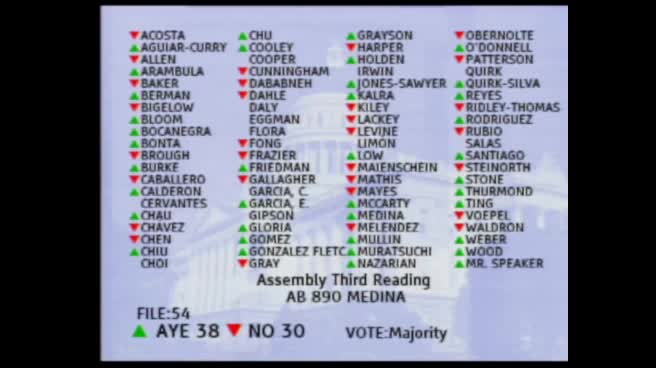 1MIN
Assembly Floor
 1H
Assembly Standing Committee on Appropriations
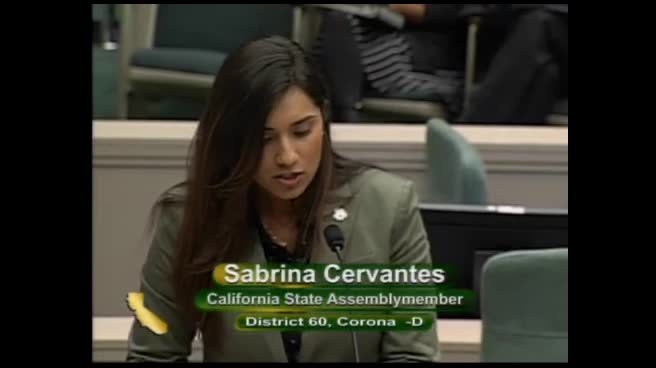 7MIN
Assembly Standing Committee on Transportation
Bill Author

Bill Co-Author(s):