AB 616: Pupil instruction: California State Summer School for Mathematics and Science: funding: tuition.
- Session Year: 2017-2018
- House: Assembly
- Latest Version Date: 2017-10-14
Existing law establishes the California State Summer School for Mathematics and Science to provide academic development to enable pupils with demonstrated academic excellence in mathematics and science to receive intensive educational enrichment in these subjects and an opportunity for pupils who wish to study mathematics or science or to pursue careers that require a high degree of skills in and knowledge of mathematics and science. Existing law requests the Regents of the University of California to operate the summer school.
Existing law, until January 1, 2018, requests the regents to set a tuition fee for the summer school within a range that corresponds to actual program costs, up to but not exceeding $2,810 per session in the year 2012 and to increase this fee by an amount of up to 5% each year thereafter. Existing law, after January 1, 2018, requests the regents to set a tuition fee within a range that corresponds to actual program costs, up to but not exceeding $1,000 per session in the year 2000, and to increase this fee by an amount of up to 5% each year thereafter.
This bill would no longer request the regents after January 1, 2018, to set a tuition fee within a range that corresponds to actual program costs, up to but not exceeding $1,000 per session in the year 2000, and to increase this fee by an amount of up to 5% each year thereafter. The bill would extend the current tuition fee provisions to January 1, 2023.
Existing law establishes the California State Summer School for Mathematics and Science to provide academic development to enable pupils with demonstrated academic excellence in mathematics and science to receive intensive educational enrichment in these subjects and an opportunity for pupils who wish to study mathematics or science or to pursue careers that require a high degree of skills in and knowledge of mathematics and science. Existing law requests the Regents of the University of California to operate the summer school.
Existing law, until January 1, 2018, requests the regents to set a tuition fee for the summer school within a range that corresponds to actual program costs, up to but not exceeding $2,810 per session in the year 2012 and to increase this fee by an amount of up to 5% each year thereafter. Existing law, after January 1, 2018, requests the regents to set a tuition fee within a range that corresponds to actual program costs, up to but not exceeding $1,000 per session in the year 2000 and to increase this fee by an amount of up to 5% each year thereafter.
This bill would no longer request the regents after January 1, 2018, to set a tuition fee within a range that corresponds to actual program costs, up to but not exceeding $1,000 per session in the year 2000 and to increase this fee by an amount of up to 5% each year thereafter. The bill would extend the current tuition fee provisions to January 1, 2023.
(a)It is the intent of the Legislature that at least 50 percent, but not more than 75 percent, of the actual costs of the California State Summer School for Mathematics and Science for each fiscal year would be financed by state funds beginning in the 19992000 fiscal year. The balance of the operating costs would be financed with fees and private support.
(b)Except as provided in subdivision (c), the Regents of the University of California are requested to set a tuition fee within a range that corresponds to actual program costs, up to but not exceeding two thousand eight hundred ten dollars ($2,810) per session in the year 2012, and may increase this fee by an amount up to 5 percent each year thereafter. It is the intent of the Legislature that the University of California award full or partial scholarships on the basis of need and that pupils who are unable to pay all or part of the fee may petition the University of California for a fee reduction or waiver to ensure that a qualified applicant is not denied admission solely because of his or her inability to pay part or all of the fee. Any public announcement regarding the summer school program should include notification that need-based scholarships are available and information regarding the procedure for applying for a scholarship award.
(c)For pupils who are not California residents, it is the intent of the Legislature that the Regents of the University of California set a tuition fee that is not less than the total actual costs to the summer school of services per pupil.
(d)The foundation authorized to be established pursuant to subdivision (d) of Section 8664 may raise funds from the private sector that may be used by the summer school for general program operating costs, scholarships, program augmentation, public relations, recruitment activity, or special projects. Private support may include, but not necessarily be limited to, direct grants to the summer school from private corporations or foundations, individual contributions, in-kind contributions, or fundraising benefits conducted by any entity.
(e)This section shall remain in effect only until January 1, 2023, and as of that date is repealed, unless a later enacted statute, that is enacted before January 1, 2023, deletes or extends that date.
SEC. 2.Section 8669 of the Education Code, as added by Section 3 of Chapter 422 of the Statutes of 2012, is repealed.(a)It is the intent of the Legislature that at least 50 percent, but not more than 75 percent, of the actual costs of the California State Summer School for Mathematics and Science for each fiscal year would be financed by state funds beginning in the 19992000 fiscal year. The balance of the operating costs would be financed with fees and private support.
(b)Except as provided in subdivision (c), the Regents of the University of California are requested to set a tuition fee within a range that corresponds to actual program costs, up to but not exceeding two thousand eight hundred ten dollars ($2,810) per session in the year 2012, and may increase this fee by an amount up to 5 percent each year thereafter. It is the intent of the Legislature that the University of California award full or partial scholarships on the basis of need and that pupils who are unable to pay all or part of the fee may petition the University of California for a fee reduction or waiver to ensure that a qualified applicant is not denied admission solely because of his or her inability to pay part or all of the fee. Any public announcement regarding the summer school program should include notification that need-based scholarships are available and information regarding the procedure for applying for a scholarship award.
(c)For pupils who are not California residents, it is the intent of the Legislature that the Regents of the University of California set a tuition fee that is not less than the total actual costs to the summer school of services per pupil.
(d)The foundation authorized to be established pursuant to subdivision (d) of Section 8664 may raise funds from the private sector that may be used by the summer school for general program operating costs, scholarships, program augmentation, public relations, recruitment activity, or special projects. Private support may include, but not necessarily be limited to, direct grants to the summer school from private corporations or foundations, individual contributions, in-kind contributions, or fundraising benefits conducted by any entity.
(e)This section shall remain in effect only until January 1, 2018, 2023, and as of that date is repealed, unless a later enacted statute, that is enacted before January 1, 2018, 2023, deletes or extends that date.
SEC. 2.Section 8669 of the Education Code, as added by Section 3 of Chapter 422 of the Statutes of 2012, is repealed.8669.(a)It is the intent of the Legislature that at least 50 percent, but not more than 75 percent, of the actual costs of the California State Summer School for Mathematics and Science for each fiscal year would be financed by state funds beginning in the 19992000 fiscal year. The balance of the operating costs would be financed with fees and private support.(b)Except as provided in subdivision (c), the Regents of the University of California are requested to set a tuition fee within a range that corresponds to actual program costs, up to but not exceeding one thousand dollars ($1,000) per session in the year 2000, and may increase this fee by an amount up to 5 percent each year thereafter. It is the intent of the Legislature that the University of California award full or partial scholarships on the basis of need and that pupils who are unable to pay all or part of the fee may petition the University of California for a fee reduction or waiver to ensure that a qualified applicant is not denied admission solely because of his or her inability to pay part or all of the fee. Any public announcement regarding the summer school program should include notification that need-based scholarships are available and information regarding the procedure for applying for a scholarship award.(c)For pupils who are not California residents, it is the intent of the Legislature that the Regents of the University of California set a tuition fee that is not less than the total actual costs to the summer school of services per pupil.(d)The foundation authorized to be established pursuant to subdivision (d) of Section 8664 may raise funds from the private sector that may be used by the summer school for general program operating costs, scholarships, program augmentation, public relations, recruitment activity, or special projects. Private support may include, but not necessarily be limited to, direct grants to the summer school from private corporations or foundations, individual contributions, in-kind contributions, or fundraising benefits conducted by any entity.(e)This section shall become operative on January 1, 2018.|
Date
|
Status
|
|---|---|
| Oct 14, 2017 | Chaptered by Secretary of State - Chapter 781, Statutes of 2017. |
| Oct 14, 2017 | Approved by the Governor. |
| Sep 20, 2017 | Enrolled and presented to the Governor at 4:30 p.m. |
| Sep 11, 2017 | In Assembly. Ordered to Engrossing and Enrolling. |
| Sep 11, 2017 | Read third time. Passed. Ordered to the Assembly. |
| Sep 5, 2017 | Read second time. Ordered to third reading. |
| Sep 1, 2017 | From committee: Do pass. (Ayes 7. Noes 0.) (September 1). |
| Jun 26, 2017 | In committee: Referred to suspense file. |
| Jun 7, 2017 | From committee: Do pass and re-refer to Com. on APPR. with recommendation: To Consent Calendar. (Ayes 7. Noes 0.) (June 7). Re-referred to Com. on APPR. |
| May 18, 2017 | Referred to Com. on ED. |
| May 4, 2017 | In Senate. Read first time. To Com. on RLS. for assignment. |
| May 4, 2017 | Read third time. Passed. Ordered to the Senate. (Ayes 76. Noes 0. Page 1390.) |
| Apr 27, 2017 | Read second time. Ordered to Consent Calendar. |
| Apr 26, 2017 | From committee: Do pass. To Consent Calendar. (Ayes 16. Noes 0.) (April 26). |
| Apr 6, 2017 | From committee: Do pass and re-refer to Com. on APPR. with recommendation: To Consent Calendar. (Ayes 7. Noes 0.) (April 5). Re-referred to Com. on APPR. |
| Feb 27, 2017 | Referred to Com. on ED. |
| Feb 15, 2017 | From printer. May be heard in committee March 17. |
| Feb 14, 2017 | Read first time. To print. |
|
Date
|
Description
|
Location
|
Votes
|
|
|---|---|---|---|---|
| Sep 11, 2017 | Assembly 3rd Reading AB616 Aguiar-Curry et al. By Atkins | Senate Floor |
Passed |
|
| Sep 1, 2017 | Do pass | Senate Standing Committee on Appropriations |
Passed |
|
| Jun 26, 2017 | Placed on suspense file | Senate Standing Committee on Appropriations |
Passed |
|
| Jun 7, 2017 | Do pass, but first be re-referred to the Committee on [Appropriations] with the recommendation: To Consent Calendar | Senate Standing Committee on Education |
Passed |
|
| May 4, 2017 | AB 616 AGUIAR-CURRY Consent Calendar Second Day Regular Session | Assembly Floor |
Passed |
|
| Apr 26, 2017 | Do pass. To Consent Calendar. | Assembly Standing Committee on Appropriations |
Passed |
|
| Apr 5, 2017 | Do pass and be re-referred to the Committee on [Appropriations] with recommendation: To Consent Calendar | Assembly Standing Committee on Education |
Passed |
This list shows positions taken on this bill by organizations on the date displayed, which is linked to the original source.
Positions by individuals are not included.
|
Organization
|
Position
|
Date
|
|---|---|---|
| California School Boards Association | ** Support | Sep 4, 2017 |
| University of California | ** Support | Sep 4, 2017 |
Office of Senate Floor Analyses (916) 651-1520 Fax: (916) 327-4478 | AB |
THIRD READING
Bill No: AB 616
:
SENATE EDUCATION COMMITTEE: 7-0, 6/7/17
AYES: Allen, Wilk, Galgiani, Leyva, Mendoza, Pan, Vidak
SENATE APPROPRIATIONS COMMITTEE: 7-0, 9/1/17
AYES: Lara, Bates, Beall, Bradford, Hill, Nielsen, Wiener
ASSEMBLY FLOOR: 76-0, 5/4/17 (Consent) - See last page for vote
SOURCE: University of California
DIGEST:
This bill extends by five years existing law related to tuition and financial aid for the California State Summer School for Mathematics and Science (COSMOS), operated by the University of California (UC), from January 1, 2018, to January 1, 2023.
Existing law:
- Establishes the COSMOS, operated by the UC, to provide intensive educational enrichment for pupils who have demonstrated academic excellence in mathematics and science.
- Specifies that pupils who have demonstrated academic excellence in mathematics and science and who meet one of the following criteria shall be eligible for admission:
- The pupil has graduated or will graduate, from grade 8 at the end of the school year immediately preceding the summer school session for which he or she is applying.
- The pupil is currently enrolled in any of grades 9 to 12, inclusive.
- The pupil graduated from high school during the school year immediately preceding the summer school session for which he or she is applying.
- Provides for the following, until January 1, 2018, related to the program’s tuition and financial aid:
- Expresses the intent of the Legislature that at least 50 percent, but not more than 75 percent, of the actual costs of COSMOS for each fiscal year, be financed by state funds beginning in 1999–2000, with the balance of the operating costs financed with fees and private support.
- Requests the Regents of the UC to set a tuition fee within a range that corresponds to actual program costs, up to $2,810 per session beginning in 2012 and increased by up to five percent each year thereafter.
- Expresses the intent of the Legislature that the UC award full or partial scholarships on the basis of need and that pupils who are unable to pay all or part of the fee may petition the UC for a fee reduction or waiver to ensure that a qualified applicant is not denied admission solely because of his or her inability to pay part or all of the fee.
- Specifies that any public announcement regarding the summer school program should include notification that need-based scholarships are available and information regarding the procedure for applying for a scholarship award.
- States that, for pupils who are not California residents, it is the intent of the Legislature that the Regents of the UC set a tuition fee that is not less than the total actual costs to the summer school of services per pupil.
- Authorizes funds raised from the private sector to be used by the summer school for general program operating costs, scholarships, program augmentation, public relations, recruitment activity, or special projects.
This bill extends from January 1, 2018, to January 1, 2023, existing law related to tuition and financial aid for COSMOS.
Comments
- Need for the bill. Existing law establishes the current tuition and annual rate of increase for COSMOS with a sunset on January 1, 2018. The purpose of this bill is to extend the sunset date to January 1, 2023. Without the authority to increase tuition and fees, UC would likely decrease the number of participants every year.
- Program mission and goals. The mission of COSMOS is to provide outstanding high school students in the science, technology, engineering, and mathematics (STEM) disciplines with opportunities to delve deeply into their subjects and to prepare for careers in the STEM fields. In 2002, UC convened an expert advisory board to design the COSMOS program. The board set out the following goals for the COSMOS program:
- To engage talented students in high-level teaching and learning.
- To establish a community of scholars that fosters analytical thinking and experimentation.
- To connect students to institutions of higher learning and research facilities.
- To develop models for excellence in science and mathematics education.
- To ensure that the COSMOS student body reflects California’s geographic, economic, and cultural diversity.
In the course of a four-week summer session, COSMOS courses address advanced topics in the STEM fields that go beyond the typical high school curriculum. The courses typically consist of two science and/or mathematics courses, and a science communication course. The courses vary by campus—offered at UC Davis, UC Irvine, UC San Diego, and UC Santa Cruz—and may cover astronomy, aerospace and mechanical engineering, biomedical sciences, computer science, ecology, marine science, robotics, game theory, and more. Each campus can accommodate about 150 pupils for each summer session and admission is competitive, with about 40 percent of the school’s applicants being admitted.
- Program costs for students and the state. The average cost per pupil for COSMOS is about $6,500, which includes instruction and room and board. In 2015, the maximum tuition amount charged to students was $3,250. Full and partial financial assistance is available to families earning up to $85,000 annually. For example, a family of four with an annual income of $40,000 could qualify for a full scholarship, while a family of four with an annual income of $80,000 could qualify for a 25 percent scholarship.
The program has received about $1.6 million in state funds annually since its inception, and another $200,000 in private donations.
- The effectiveness of the program. Existing law requires the UC to report to the Legislature and the Governor on the effectiveness of COSMOS in increasing the quality and supply of science and mathematics students and teachers. According to the UC’s April 2016 evaluation, upon completion of high school, a vast majority (more than 85 percent) of COSMOS alumni enroll in post-secondary education. About 54 percent attend a UC campus and more than 22 percent enroll at a private or out-of-state university. During the past decade, nearly 200 COSMOS alumni have enrolled in an Ivy League university.
The April 2016 evaluation also includes the following COSMOS data:
- From 2011 through 2015, 3,482 students participated in the program. Over time, enrollment has risen steadily, from 680 participants in 2011 to 733 in 2015, an increase of 8 percent.
- The demand for admission to the program has been strong since its inception. Specifically, of the 3,924 completed applications for 2015, 1,534 (39 percent) were accepted, and 86 (2 percent) were wait-listed.
- UC has been able to track 2,669 of 3,139 (85 percent) participants from 2006 to 2010 as having enrolled at a college or university within one year of completing high school. Similarly, even though not all participants from 2011 to 2015 have yet completed high school, 2,304 of 3,481 (66 percent) have enrolled in a college or university. This means that at least three out of four (4,973 or more of 6,620) participants from the past decade have already enrolled in a college or university.
- Of the 4,973 alumni enrolled at colleges and universities, 4,088 (82 percent) were at four-year institutions, with 2,709 (54 percent) at UC campuses, 1,082 (22 percent) at private or out-of-state universities, and 297 (6 percent) at California State University campuses. Another 878 (18 percent) enrolled at California Community Colleges (two-year programs), and the remaining 7 (0.1 percent) enrolled at private or out-of-state two-year institutions.
- After UC, the top ten four-year universities at which program alumni most often enrolled are California Polytechnic State University, Stanford University, Massachusetts Institute of Technology, University of Southern California, Brown University, Cornell University, Harvard University, San Diego State University, California Institute of Technology, and Princeton University.
FISCAL EFFECT: Appropriation: Fiscal Com.: Local:
According to the Senate Appropriations Committee, cost pressure of approximately $1.6 million in annual General Fund due to the bill’s sunset extension. UC’s proposed budget for the 2017-18 fiscal year already includes that amount for the program. The bill’s authorization for a five percent tuition increase will enable UC to use participant fees to either cover or offset the remaining balance of actual program costs. Absent this authority, UC would likely decrease the number of participants.
University of California (source)
California School Boards Association
OPPOSITION: (Verified 8/31/17)
None received
ASSEMBLY FLOOR: 76-0, 5/4/17
AYES: Acosta, Aguiar-Curry, Arambula, Baker, Berman, Bloom, Bocanegra, Bonta, Brough, Burke, Caballero, Calderon, Cervantes, Chau, Chávez, Chen, Chiu, Choi, Chu, Cooley, Cooper, Cunningham, Dababneh, Dahle, Daly, Eggman, Flora, Fong, Frazier, Friedman, Gallagher, Eduardo Garcia, Gipson, Gloria, Gomez, Gonzalez Fletcher, Gray, Grayson, Harper, Holden, Irwin, Jones-Sawyer, Kalra, Kiley, Lackey, Levine, Limón, Low, Maienschein, Mathis, Mayes, McCarty, Medina, Melendez, Mullin, Muratsuchi, Nazarian, Obernolte, O'Donnell, Quirk, Quirk-Silva, Reyes, Ridley-Thomas, Rodriguez, Rubio, Salas, Santiago, Steinorth, Mark Stone, Thurmond, Ting, Voepel, Waldron, Weber, Wood, Rendon
NO VOTE RECORDED: Travis Allen, Bigelow, Cristina Garcia, Patterson
9/4/17 12:19:16
**** END ****
SENATE COMMITTEE ON APPROPRIATIONS
Senator Ricardo Lara, Chair
2017 - 2018 Regular Session
AB 616 (Aguiar-Curry) - Pupil instruction: California State Summer School for Mathematics and Science: funding: tuition
Version: February 14, 2017 | Policy Vote: ED. 7 - 0 |
Urgency: No | Mandate: No |
Hearing Date: June 26, 2017 | Consultant: Lenin Del Castillo |
This bill meets the criteria for referral to the Suspense File.
Bill Summary:
This bill extends by five years existing law related to tuition and financial aid for the California State Summer School for Mathematics and Science (COSMOS), operated by the University of California (UC), from January 1, 2018, to January 1, 2023.
Fiscal Impact:
Cost pressure of approximately $1.6 million in annual General Fund due to the bill’s sunset extension. UC’s proposed budget for the 2017-18 fiscal year already includes that amount for the program. The bill’s authorization for a 5 percent tuition increase will enable UC to use participant fees to either cover or offset the remaining balance of actual program costs. Absent this authority, UC would likely decrease the number of participants.
Background:
Existing law establishes the COSMOS, operated by the UC, to provide intensive educational enrichment for pupils who have demonstrated academic excellence in mathematics and science. It specifies that pupils who meet one of the following criteria shall be eligible for admission: the pupil has graduated or will graduate, from grade 8 at the end of the school year immediately preceding the summer school session for which he or she is applying; the pupil is currently enrolled in any of grades 9 to 12, inclusive; or the pupil graduated from high school during the school year immediately preceding the summer school session for which he or she is applying.
Until January 1, 2018, existing law related to the program’s tuition and financial aid expresses the intent of the Legislature that at least 50 percent, but not more than 75 percent, of the actual costs of COSMOS for each fiscal year, be financed by state funds beginning in 1999–2000, with the balance of the operating costs financed with fees and private support. It also requests the Regents of the UC to set a tuition fee within a range that corresponds to actual program costs, up to $2,810 per session beginning in 2012 and increased by up to five percent each year thereafter. Further, existing law expresses the intent of the Legislature that the UC award full or partial scholarships on the basis of need and that pupils who are unable to pay all or part of the fee may petition the UC for a fee reduction or waiver to ensure that a qualified applicant is not denied admission solely because of his or her inability to pay part or all of the fee. It also specifies that any public announcement regarding the summer school program should include notification that need-based scholarships are available and information regarding the procedure for applying for a scholarship award. Existing law states that, for pupils who are not California residents, it is the intent of the Legislature that the Regents of the UC set a tuition fee that is not less than the total actual costs to the summer school of services per pupil. It also authorizes funds raised from the private sector to be used by the summer school for general program operating costs, scholarships, program augmentation, public relations, recruitment activity, or special projects.
Proposed Law:
This bill extends from January 1, 2018, to January 1, 2023, existing law related to tuition and financial aid for the COSMOS program.
Related Legislation:
Chapter 422, Statutes of 2012 (AB 1663, Dickinson) continued the request for UC to set a tuition fee for the COSMOS program that corresponds to actual program costs and also established a January 1, 2018 sunset date.
Staff Comments:
Each summer, the COSMOS program offers a hands-on, lab intensive educational experience to over 700 high school students. The program has received about $1.6 million in state funds annually since its inception in 1999, and another $200,000 in private donations. The average cost per pupil for COSMOS is about $6,500, which includes instruction and room and board. In 2015, the maximum tuition amount charged to students was $3,250. Full and partial financial assistance is available to families earning up to $85,000 annually.
-- END --
SENATE COMMITTEE ON EDUCATION
Senator Benjamin Allen, Chair
2017 - 2018 Regular
Bill No: AB 616 Hearing Date: June 7, 2017
Author: | |||
Version: | February 14, 2017 | ||
Urgency: | No | Fiscal: | Yes |
Consultant: | Ian Johnson | ||
Subject: Pupil instruction: California State Summer School for Mathematics and Science: funding: tuition
SUMMARY
This bill extends by five years existing law related to tuition and financial aid for the California State Summer School for Mathematics and Science (COSMOS), operated by the University of California (UC), from January 1, 2018, to January 1, 2023.
BACKGROUND
Existing law:
- Establishes the COSMOS, operated by the UC, to provide intensive educational enrichment for pupils who have demonstrated academic excellence in mathematics and science.
- Specifies that pupils who have demonstrated academic excellence in mathematics and science and who meet one of the following criteria shall be eligible for admission:
- The pupil has graduated or will graduate, from grade 8 at the end of the school year immediately preceding the summer school session for which he or she is applying.
- The pupil is currently enrolled in any of grades 9 to 12, inclusive.
- The pupil graduated from high school during the school year immediately preceding the summer school session for which he or she is applying.
Until January 1, 2018, existing law related to the program’s tuition and financial aid:
- Expresses the intent of the Legislature that at least 50 percent, but not more than 75 percent, of the actual costs of COSMOS for each fiscal year, be financed by state funds beginning in 1999–2000, with the balance of the operating costs financed with fees and private support.
- Requests the Regents of the UC to set a tuition fee within a range that corresponds to actual program costs, up to $2,810 per session beginning in 2012 and increased by up to five percent each year thereafter.
- Expresses the intent of the Legislature that the University of California (UC) award full or partial scholarships on the basis of need and that pupils who are unable to pay all or part of the fee may petition the UC for a fee reduction or waiver to ensure that a qualified applicant is not denied admission solely because of his or her inability to pay part or all of the fee.
- Specifies that any public announcement regarding the summer school program should include notification that need-based scholarships are available and information regarding the procedure for applying for a scholarship award.
- States that, for pupils who are not California residents, it is the intent of the Legislature that the Regents of the UC set a tuition fee that is not less than the total actual costs to the summer school of services per pupil.
- Authorizes funds raised from the private sector to be used by the summer school for general program operating costs, scholarships, program augmentation, public relations, recruitment activity, or special projects.
ANALYSIS
This bill extends from January 1, 2018, to January 1, 2023, existing law related to tuition and financial aid for the California State Summer School for Mathematics and Science (COSMOS).
STAFF COMMENTS
- Need for the bill. Existing law establishes the current tuition and annual rate of increase for COSMOS with a sunset on January 1, 2018. The purpose of this bill is to extend the sunset date to January 1, 2023. Without the authority to increase tuition and fees, UC would likely decrease the number of participants every year.
- Program mission and goals. The mission of COSMOS is to provide outstanding high school students in the science, technology, engineering, and mathematics (STEM) disciplines with opportunities to delve deeply into their subjects and to prepare for careers in the STEM fields. In 2002, UC convened an expert advisory board to design the COSMOS program. The board set out the following goals for the COSMOS program:
- To engage talented students in high-level teaching and learning.
- To establish a community of scholars that fosters analytical thinking and experimentation.
- To connect students to institutions of higher learning and research facilities.
- To develop models for excellence in science and mathematics education.
- To ensure that the California State Summer School for Mathematics and Science (COSMOS) student body reflects California’s geographic, economic, and cultural diversity.
In the course of a four-week summer session, COSMOS courses address advanced topics in the science, technology, engineering, and mathematics (STEM) fields that go beyond the typical high school curriculum. The courses typically consist of two science and/or mathematics courses, and a science communication course. The courses vary by campus—offered at University of California (UC) Davis, UC Irvine, UC San Diego, and UC Santa Cruz—and may cover astronomy, aerospace and mechanical engineering, biomedical sciences, computer science, ecology, marine science, robotics, game theory, and more. Each campus can accommodate about 150 pupils for each summer session and admission is competitive, with about 40 percent of the school’s applicants being admitted.
- Program costs for students and the state. The average cost per pupil for COSMOS is about $6,500, which includes instruction and room and board. In 2015, the maximum tuition amount charged to students was $3,250. Full and partial financial assistance is available to families earning up to $85,000 annually. For example, a family of four with an annual income of $40,000 could qualify for a full scholarship, while a family of four with an annual income of $80,000 could qualify for a 25 percent scholarship.
The program has received about $1.6 million in state funds annually since its inception, and another $200,000 in private donations.
- The effectiveness of the program. Existing law requires the UC to report to the Legislature and the Governor on the effectiveness of COSMOS in increasing the quality and supply of science and mathematics students and teachers. According to the UC’s April 2016 evaluation, upon completion of high school, a vast majority (more than 85 percent) of COSMOS alumni enroll in post-secondary education. About 54 percent attend a UC campus and more than 22 percent enroll at a private or out-of-state university. During the past decade, nearly 200 COSMOS alumni have enrolled in an Ivy League university.
The April 2016 evaluation also includes the following COSMOS data:
- From 2011 through 2015, 3,482 students participated in the program. Over time, enrollment has risen steadily, from 680 participants in 2011 to 733 in 2015, an increase of 8 percent.
- The demand for admission to the program has been strong since its inception. Specifically, of the 3,924 completed applications for 2015, 1,534 (39 percent) were accepted, and 86 (2 percent) were wait-listed.
- UC has been able to track 2,669 of 3,139 (85 percent) participants from 2006 to 2010 as having enrolled at a college or university within one year of completing high school. Similarly, even though not all participants from 2011 to 2015 have yet completed high school, 2,304 of 3,481 (66 percent) have enrolled in a college or university. This means that at least three out of four (4,973 or more of 6,620) participants from the past decade have already enrolled in a college or university.
- Of the 4,973 alumni enrolled at colleges and universities, 4,088 (82 percent) were at four-year institutions, with 2,709 (54 percent) at University of California (UC) campuses, 1,082 (22 percent) at private or out-of-state universities, and 297 (6 percent) at California State University campuses. Another 878 (18 percent) enrolled at California Community Colleges (two-year programs), and the remaining 7 (0.1 percent) enrolled at private or out-of-state two-year institutions.
- After UC, the top ten four-year universities at which program alumni most often enrolled are California Polytechnic State University, Stanford University, Massachusetts Institute of Technology, University of Southern California, Brown University, Cornell University, Harvard University, San Diego State University, California Institute of Technology, and Princeton University.
SUPPORT
California School Boards Association
University of California (Sponsor)
OPPOSITION
None received
-- END --
Date of Hearing: April 26, 2017
ASSEMBLY COMMITTEE ON APPROPRIATIONS
Lorena Gonzalez Fletcher, Chair
ABPCA Bill Id:AB 616
Author:(Aguiar-Curry) – As Introduced Ver:February 14, 2017
Policy Committee: | Education | Vote: | 7 - 0 |
|
| ||
|
|
Urgency: No State Mandated Local Program: No Reimbursable: No
SUMMARY:
This bill extends from January 1, 2018, to January 1, 2023, provisions of existing law related to tuition and financial aid increases for the California State Summer School for Mathematics and Science (COSMOS) program offered at the four University of California (UC) campuses.
FISCAL EFFECT:
Minor, if any, cost associated with this bill. The Governor’s 2017-18 proposed budget already funds COSMOS at $1.6 million. By extending the 5% increase on tuition, the state is authorizing COSMOS to use participant fee for the remaining balance of their actual cost. COSMOS has been funded at $1.6 million since 1999. Renewing the sunset on tuition increases allows COSMOS to pay for in-state residents and scholarships for housing and meals.
COMMENTS:
- Purpose. Existing law establishes the current tuition and annual rate of increase for COSMOS with a sunset on January 1, 2018. The purpose of this bill is to extend the sunset date to January 1, 2023. Without the authority to increase tuition and fees, UC will have to decrease the number of participants every year.
- Background. Existing law establishes COSMOS to provide intensive educational enrichment for pupils who have demonstrated academic excellence in mathematics and science. COSMOS is an intensive four-week summer residential program for pupils with a demonstrated aptitude for academic and professional careers in the science, technology, engineering, and mathematics (STEM) fields. Pupils completing grades 8-12 have the opportunity to work with faculty, researchers, and scientists while exploring advanced STEM topics beyond those usually offered in California high schools. The program is offered at four UC campuses: UC Davis, UC Irvine, UC San Diego, and UC Santa Cruz. Each campus can accommodate approximately 150 pupils for each summer session, and admission is competitive. In 2015, 39% of the 3,924 applicants were accepted. According to UC: “Since the inaugural program in 2000, COSMOS has provided over 9,800 students with a rigorous STEM summer learning experience. In the past decade, three out of four COSMOS participants have enrolled in college or university. Over half have enrolled at a UC campus.”
Existing law also expresses the intent of the Legislature that at least 50 percent, but not more than 75 percent, of the actual costs of COSMOS for each fiscal year is to be financed by state funds. The balances of the operating costs are to be financed with fees from participants who can afford to pay and from private support. The Regents of the University of California (UC) are authorized to set a tuition fees up to but not exceeding $2,810 per session in the year 2012, and increase this fee by up to 5 percent each year thereafter until 2018.
Analysis Prepared by: Daisy Gonzales / APPR. / (916) 319-2081
Date of Hearing: April 5, 2017
ASSEMBLY COMMITTEE ON EDUCATION
Patrick O'Donnell, Chair
ABPCA Bill Id:AB 616 (
Author:Aguiar-Curry) – As Introduced Ver:February 14, 2017
SUBJECT: Pupil instruction: California State Summer School for Mathematics and Science: funding: tuition
SUMMARY: Extends from January 1, 2018 to January 1, 2023 provisions of existing law related to tuition and financial aid for the California State Summer School for Mathematics and Science.
EXISTING LAW:
- Establishes the California State Summer School for Mathematics and Science (also known as COSMOS) to provide intensive educational enrichment for pupils who have demonstrated academic excellence in mathematics and science.
- Specifies that pupils who have demonstrated academic excellence in mathematics and science and who meet one of the following criteria shall be eligible for admission:
- The pupil has graduated, or will graduate, from the 8th grade at the end of the school year immediately preceding the summer school session for which he or she is applying;
- The pupil is currently enrolled in any of grades 9 to 12, inclusive; or
- The pupil graduated from high school during the school year immediately preceding the summer school session for which he or she is applying.
- Expresses the intent of the Legislature that at least 50 percent, but not more than 75 percent, of the actual costs of the California State Summer School for Mathematics and Science for each fiscal year be financed by state funds beginning in the 1999–2000 fiscal year, with the balance of the operating costs financed with fees and private support.
- Requests the Regents of the University of California (UC) to set a tuition fee within a range that corresponds to actual program costs, up to but not exceeding $2,810 per session in the year 2012, and increase this fee by up to 5 percent each year thereafter.
- Expresses the intent of the Legislature that the UC award full or partial scholarships on the basis of need and that pupils who are unable to pay all or part of the fee may petition the University of California for a fee reduction or waiver to ensure that a qualified applicant is not denied admission solely because of his or her inability to pay part or all of the fee.
- Specifies that any public announcement regarding the summer school program should include notification that need-based scholarships are available and information regarding the procedure for applying for a scholarship award.
- States that, for pupils who are not California residents, it is the intent of the Legislature that the Regents of the UC set a tuition fee that is not less than the total actual costs to the summer school of services per pupil.
- Authorizes funds raised from the private sector to be used by the summer school for general program operating costs, scholarships, program augmentation, public relations, recruitment activity, or special projects.
- Sunsets these provisions on January 1, 2018.
FISCAL EFFECT: Unknown
COMMENTS:
Background. The California State Summer School for Mathematics and Science, also known as, COSMOS, is an intensive four-week summer residential program for pupils with a demonstrated aptitude for academic and professional careers in the science, technology, engineering, and mathematics (STEM) fields. Pupils completing grades 8-12 have the opportunity to work with faculty, researchers, and scientists while exploring advanced STEM topics beyond those usually offered in California high schools.
The program is offered at four UC campuses: UC Davis, UC Irvine, UC San Diego, and UC Santa Cruz. Each campus can accommodate about 150 pupils for each summer session, and admission is competitive. In 2015 39% of the 3,924 applicants were accepted. For the years 2011 to 2015, inclusive, 49.3% of the participants were male and 50.7% were female. For the same time period, the participation rate by ethnicity was 50.6% Asian, 21.5% White, 16.8% Latino, 2.0% Black, 0.8% Native American, 5.0% Other, and 3.9% Decline to State/Unknown.
COSMOS costs and funding. The average cost per pupil for COSMOS is $6,500, which includes instruction and room and board. In 2015, the maximum tuition was $3,250, which is equal to the maximum amount of $2,810 that was allowed in 2012, as increased by 5% in each subsequent year (the maximum increase allowed by law). The program received $1.643 in state funds in 2015 and another $195,000 in private donations.
Full and partial financial assistance is available to families making up to $85,000. For example, a family of four with a yearly income of $43,000 could have qualified for a full scholarship, while a family of four with a yearly income of $80,000 could have qualified for a 25% scholarship ($813).
Reason for the bill. Existing law, which establishes the current tuition and annual rate of increase, sunsets on January 1, 2018. The purpose of this bill is to extend the sunset date to January 1, 2023.
REGISTERED SUPPORT / OPPOSITION:
Support
University of California
Opposition
None received
Analysis Prepared by: Rick Pratt / ED. / (916) 319-2087
Discussed in Hearing
View Older Hearings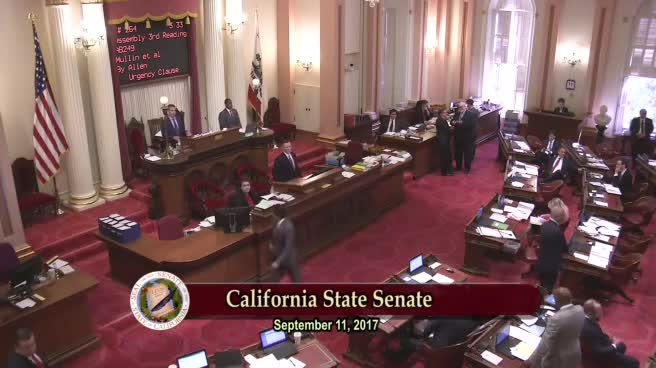

Bill Author

Bill Co-Author(s):
