AB 626: California Retail Food Code: microenterprise home kitchen operations.
- Session Year: 2017-2018
- House: Assembly
- Latest Version Date: 2018-09-18
Existing law, the California Retail Food Code, establishes uniform health and sanitation standards for retail food facilities for regulation by the State Department of Public Health, and requires local enforcement agencies to enforce these provisions. Existing law defines food facility as an operation that stores, prepares, packages, serves, vends, or otherwise provides food for human consumption at the retail level, as specified. Existing law exempts, among others, a private home, including a registered or permitted cottage food operation, from the definition of food facility. A violation of the California Retail Food Code is generally a misdemeanor.
This bill would, among other things, include a microenterprise home kitchen operation within the definition of a food facility, and would define a microenterprise home kitchen operation to mean a food facility that is operated by a resident in a private home where food is stored, handled, and prepared for, and may be served to, consumers, and that meets specified requirements, including, among others, that the operation has no more than one full-time equivalent food employee and has no more than $50,000 in verifiable gross annual sales. The bill would specify that the governing body of a city or county, or city and county, shall have full discretion to authorize, by ordinance or resolution, the permitting of microenterprise home kitchen operations in accordance with the provisions of this bill, except as provided. The bill would require a microenterprise home kitchen operation to be considered a restricted food service facility for purposes of certain provisions of the code, except as otherwise provided, and would exempt a microenterprise home kitchen operation from various provisions applicable to food facilities, including, among others, provisions relating to handwashing, sinks, ventilation, and animals. The bill would require the applicant for a permit to operate a microenterprise home kitchen operation to submit to the local enforcement agency written standard operating procedures that include specified information, including all food types or products that will be handled and the days and times that the home kitchen will potentially be utilized as a microenterprise home kitchen operation.
The bill would require an Internet food service intermediary, as defined, that lists or promotes a microenterprise home kitchen operation on its Internet Web site or mobile application to, among other things, be registered with the department, to clearly and conspicuously post on its Internet Web site or mobile application the requirements for the permitting of a microenterprise home kitchen operation, as specified, prior to the publication of the microenterprise home kitchen operations offer of food for sale, and to submit the name and permit number of a microenterprise home kitchen operation to the local enforcement agency if it receives, through its Internet Web site or mobile application, 3 or more unrelated individual food safety or hygiene complaints in a calendar year from consumers who have made a purchase through its Internet Web site or mobile application. The bill would also make related findings and declarations.
By expanding the scope of a crime, this bill would impose a state-mandated local program.
This bill would incorporate additional changes to Section 113789 of the Health and Safety Code proposed by AB 2178 and AB 2524 to be operative only if this bill and AB 2178, this bill and AB 2524, or all 3 bills are enacted and this bill is enacted last.
The California Constitution requires the state to reimburse local agencies and school districts for certain costs mandated by the state. Statutory provisions establish procedures for making that reimbursement.
This bill would provide that no reimbursement is required by this act for a specified reason.
Existing law, the California Retail Food Code, establishes uniform health and sanitation standards for retail food facilities for regulation by the State Department of Public Health, and requires local enforcement agencies to enforce these provisions. Existing law defines food facility as an operation that stores, prepares, packages, serves, vends, or otherwise provides food for human consumption at the retail level, as specified. Existing law exempts, among others, a private home, including a registered or permitted cottage food operation, from the definition of food facility. A violation of the California Retail Food Code is generally a misdemeanor.
This bill would, among other things, include a microenterprise home kitchen operation within the definition of a food facility, and would define a microenterprise home kitchen operation to mean a food facility that is operated by a resident in a private home where food is stored, handled, and prepared for, and may be served to, consumers, and that meets specified requirements, including, among others, that the operation has no more than one full-time equivalent food employee and has no more than $50,000 in verifiable gross annual sales. The bill would specify that the governing body of a city or county, or city and county, shall have full discretion to authorize, by ordinance or resolution, the permitting of microenterprise home kitchen operations in accordance with the provisions of this bill, except as provided. The bill would require a microenterprise home kitchen operation to be considered a restricted food service facility for purposes of certain provisions of the code, except as otherwise provided, and would exempt a microenterprise home kitchen operation from various provisions applicable to food facilities, including, among others, provisions relating to handwashing, sinks, ventilation, and animals. The bill would require the applicant for a permit to operate a microenterprise home kitchen operation to submit to the local enforcement agency written standard operating procedures that include specified information, including all food types or products that will be handled and the days and times that the home kitchen will potentially be utilized as a microenterprise home kitchen operation.
The bill would require an Internet food service intermediary, as defined, that lists or promotes a microenterprise home kitchen operation on its Internet Web site or mobile application to, among other things, be registered with the department, to clearly and conspicuously post on its Internet Web site or mobile application the requirements for the permitting of a microenterprise home kitchen operation, as specified, prior to the publication of the microenterprise home kitchen operations offer of food for sale, and to submit the name and permit number of a microenterprise home kitchen operation to the local enforcement agency if it receives, through its Internet Web site or mobile application, 3 or more unrelated individual food safety or hygiene complaints in a calendar year from consumers who have made a purchase through its Internet Web site or mobile application. The bill would also make related findings and declarations.
By expanding the scope of a crime, this bill would impose a state-mandated local program.
The California Constitution requires the state to reimburse local agencies and school districts for certain costs mandated by the state. Statutory provisions establish procedures for making that reimbursement.
This bill would provide that no reimbursement is required by this act for a specified reason.
Existing law, the California Retail Food Code, establishes uniform health and sanitation standards for retail food facilities for regulation by the State Department of Public Health, and requires local enforcement agencies to enforce these provisions. Existing law defines food facility as an operation that stores, prepares, packages, serves, vends, or otherwise provides food for human consumption at the retail level, as specified. Existing law exempts, among others, a private home, including a registered or permitted cottage food operation, from the definition of food facility. A violation of the California Retail Food Code is generally a misdemeanor.
This bill would, among other things, include a microenterprise home kitchen operation within the definition of a food facility, and would define a microenterprise home kitchen operation to mean a food facility that is operated by a resident in a private home where food is stored, handled, and prepared for, and may be served to, consumers, and that meets specified requirements, including, among others, that the operation has no more than one full-time equivalent food employee and has no more than $50,000 in verifiable gross annual sales. The bill would specify that the governing body of a city or county, or city and county, shall have full discretion to authorize, by ordinance or resolution, the permitting of microenterprise home kitchen operations in accordance with the provisions of this bill, except as provided. The bill would require a microenterprise home kitchen operation to be considered a restricted food service facility for purposes of certain provisions of the code, except as otherwise provided, and would exempt a microenterprise home kitchen operation from various provisions applicable to food facilities, including, among others, provisions relating to handwashing, sinks, ventilation, and animals. The bill would require the applicant for a permit to operate a microenterprise home kitchen operation to submit to the local enforcement agency written standard operating procedures that include specified information, including all food types or products that will be handled and the days and times that the home kitchen will potentially be utilized as a microenterprise home kitchen operation.
The bill would require an Internet food service intermediary, as defined, that lists or promotes a microenterprise home kitchen operation on its Internet Web site or mobile application to, among other things, be registered with the department, to post on its Internet Web site or mobile application the requirements for the permitting of a microenterprise home kitchen operation, as specified, prior to the publication of the microenterprise home kitchen operations offer of food for sale, and to submit the name and permit number of a microenterprise home kitchen operation to the local enforcement agency if it receives receives, through its Internet Web site or mobile application, 3 or more unrelated individual food safety or hygiene complaints in a calendar year from consumers that who have made a purchase through its Internet Web site or mobile application. The bill would also make related findings and declarations.
By expanding the scope of a crime, this bill would impose a state-mandated local program.
The California Constitution requires the state to reimburse local agencies and school districts for certain costs mandated by the state. Statutory provisions establish procedures for making that reimbursement.
This bill would provide that no reimbursement is required by this act for a specified reason.
Existing law, the California Retail Food Code, establishes uniform health and sanitation standards for retail food facilities for regulation by the State Department of Public Health, and requires local enforcement agencies to enforce these provisions. Existing law defines food facility as an operation that stores, prepares, packages, serves, vends, or otherwise provides food for human consumption at the retail level, as specified. Existing law exempts, among others, a private home, including a registered or permitted cottage food operation, from the definition of food facility. A violation of the California Retail Food Code is generally a misdemeanor.
This bill would, among other things, include a microenterprise home kitchen operation within the definition of a food facility, and would define a microenterprise home kitchen operation to mean a food facility that is operated by a resident in a private home where food is stored, handled, and prepared for, and may be served to, consumers, and that meets specified requirements, including, among others, that the operation has no more than one full-time equivalent food employee and has no more than $50,000 in verifiable gross annual sales. The bill would specify that the governing body of a city or county, or city and county, shall have full discretion to authorize, by ordinance or resolution, the permitting of microenterprise home kitchen operations in accordance with the provisions of this bill, except as provided. The bill would require a microenterprise home kitchen operation to be considered a restricted food service facility for purposes of certain provisions of the code, except as otherwise provided, and would exempt a microenterprise home kitchen operation from various provisions applicable to food facilities, including, among others, provisions relating to handwashing, sinks, ventilation, and animals. The bill would require the applicant for a permit to operate a microenterprise home kitchen operation to submit to the local enforcement agency written standard operating procedures that include specified information, including all food types or products that will be handled and the days and times that the home kitchen will potentially be utilized as a microenterprise home kitchen operation.
The bill would require an Internet food service intermediary, as defined, that lists or promotes a microenterprise home kitchen operation on its Internet Web site or mobile application to, among other things, be registered with the department, to post on its Internet Web site or mobile application the requirements for the permitting of a microenterprise home kitchen operation, as specified, prior to the publication of the microenterprise home kitchen operations offer of food for sale, and to annually track the number of consumers who have purchased food, and the number of transactions that have been made, through its Internet Web site or mobile application. submit the name and permit number of a microenterprise home kitchen operation to the local enforcement agency if it receives 3 or more unrelated individual food safety or hygiene complaints in a calendar year from consumers that have made a purchase through its Internet Web site or mobile application. The bill would also make related findings and declarations.
By expanding the scope of a crime, this bill would impose a state-mandated local program.
The California Constitution requires the state to reimburse local agencies and school districts for certain costs mandated by the state. Statutory provisions establish procedures for making that reimbursement.
This bill would provide that no reimbursement is required by this act for a specified reason.
Existing law, the California Retail Food Code, establishes uniform health and sanitation standards for retail food facilities for regulation by the State Department of Public Health, and requires local enforcement agencies to enforce these provisions. Existing law defines food facility as an operation that stores, prepares, packages, serves, vends, or otherwise provides food for human consumption at the retail level, as specified. Existing law exempts, among others, a private home, including a registered or permitted cottage food operation, from the definition of food facility. A violation of the California Retail Food Code is generally a misdemeanor.
This bill would, among other things, include a microenterprise home kitchen operation within the definition of a food facility, and would define a microenterprise home kitchen operation to mean a food facility that is operated by a resident in a private home where food is stored, handled, and prepared for a consumer for, and may be served to, consumers, and that meets specified requirements, including, among others, that the operation has no more than one full-time equivalent food employee and has no more than $50,000 in verifiable gross annual sales. The bill would specify that the governing body of a city or county, or city and county, shall have full discretion to authorize, by ordinance or resolution, the permitting of microenterprise home kitchen operations in accordance with the provisions of this bill. bill, except as provided. The bill would require a microenterprise home kitchen operation to be considered a restricted food service facility for purposes of certain provisions of the code, except as otherwise provided. provided, and would exempt a microenterprise home kitchen operation from various provisions applicable to food facilities, including, among others, provisions relating to handwashing, sinks, ventilation, and animals. The bill would require the applicant for a permit to operate a microenterprise home kitchen operation to submit to the local enforcement agency written standard operating procedures that include specified information, including all food types or products that will be handled and the days and times that the home kitchen will potentially be utilized as a microenterprise home kitchen operation.
The bill would require an Internet food service intermediary, as defined, that lists or promotes a microenterprise home kitchen operation on its Internet Web site or mobile application to to, among other things, be registered with the department and to inform the department, to post on its Internet Web site or mobile application the requirements for the permitting of a microenterprise home kitchen operation of all requirements specified in these provisions operation, as specified, prior to the publication of the microenterprise home kitchen operations offer of food for sale. The bill would prohibit an Internet food service intermediary from being held liable for any personal injury resulting from the consumption of food from a microenterprise home kitchen operation, or from the failure of a microenterprise home kitchen operation to comply with federal, state, or local laws, among other things. sale, and to annually track the number of consumers who have purchased food, and the number of transactions that have been made, through its Internet Web site or mobile application. The bill would also make conforming changes and related findings and declarations.
By expanding the scope of a crime, this bill would impose a state-mandated local program.
The California Constitution requires the state to reimburse local agencies and school districts for certain costs mandated by the state. Statutory provisions establish procedures for making that reimbursement.
This bill would provide that no reimbursement is required by this act for a specified reason.
Existing law, the California Retail Food Code, establishes uniform health and sanitation standards for retail food facilities for regulation by the State Department of Public Health, and requires local health enforcement agencies to enforce these provisions. Existing law defines food facility as an operation that stores, prepares, packages, serves, vends, or otherwise provides food for human consumption at the retail level, as specified. Existing law exempts, among others, a private home, including a registered or permitted cottage food operation, from the definition of food facility. A violation of any provision of the California Retail Food Code or regulation adopted pursuant to it is generally a misdemeanor.
This bill would, among other things, include a microenterprise home kitchen operation within the definition of a food facility, and would define a microenterprise home kitchen operation to mean a food facility that is operated by a resident of in a private home where food is prepared for a consumer and that meets specified requirements, including, among others, that the operation has no more than one full-time equivalent food employee and has no more than $50,000 in verifiable gross annual sales. The bill would specify that a city or county, or city and county, shall have full discretion to authorize, by ordinance or resolution, the permitting of microenterprise home kitchen operations in accordance with the provisions of this bill. The bill would require a microenterprise home kitchen operation to be considered a restricted food service facility for purposes of certain provisions of the code, except as otherwise provided. The bill would require the applicant for a permit to operate a microenterprise home kitchen operation to submit to the local enforcement agency written standard operating procedures that include specified information, including all food products that will be handled and the days and time times that the home kitchen will be utilized as a microenterprise home kitchen operation.
The bill would require a 3rd-party intermediary an Internet food service intermediary, as defined, that lists or promotes a microenterprise home kitchen operation on its Internet Web site or mobile application, among other things, application to be registered with the department and specified local enforcement agencies and to only list and promote microenterprise home kitchen operations with permits in good standing. to inform the microenterprise home kitchen operation of all requirements specified in these provisions prior to the publication of the microenterprise home kitchen operations offer of food for sale. The bill would make a permitted microenterprise home kitchen operation and any affiliated 3rd-party intermediary strictly liable prohibit an Internet food service intermediary from being held liable for any personal injury resulting from the ordering or consuming consumption of food from a microenterprise home kitchen operation. operation, or from the failure of a microenterprise home kitchen operation to comply with federal, state, or local laws, among other things. The bill would also make conforming changes and related findings and declarations.
By creating a new crime, the expanding the scope of a crime, this bill would impose a state-mandated local program.
The California Constitution requires the state to reimburse local agencies and school districts for certain costs mandated by the state. Statutory provisions establish procedures for making that reimbursement.
This bill would provide that no reimbursement is required by this act for a specified reason.
Existing law, the California Retail Food Code, establishes uniform health and sanitation standards for retail food facilities for regulation by the State Department of Public Health, and requires local health agencies to enforce these provisions. Existing law defines food facility as an operation that stores, prepares, packages, serves, vends, or otherwise provides food for human consumption at the retail level, as specified. Existing law exempts, among others, a private home, including a registered or permitted cottage food operation, from the definition of food facility. A violation of any provision of the California Retail Food Code or regulation adopted pursuant to it is generally a misdemeanor.
This bill would repeal the exemption of a private home from the definition of a food facility. This bill would, among other things, include a microenterprise home kitchen operation within the definition of a food facility, and would define a microenterprise home kitchen operation to mean a food facility that is operated by a resident of a private home where food is prepared for a consumer and that meets specified requirements, including, among others, that the operation has no more than one full-time equivalent food employee and has no more than $50,000 in verifiable gross annual sales. The bill would specify that a city or county, or city and county, shall have full discretion to authorize, by ordinance or resolution, the permitting of microenterprise home kitchen operations in accordance with the provisions of this bill. The bill would require a microenterprise home kitchen operation to be considered a restricted food service facility for purposes of certain provisions of the code, except as otherwise provided. The bill would require the applicant for a permit to operate a microenterprise home kitchen operation to submit to the enforcement agency written standard operating procedures that include specified information, including all food products that will be handled and the days and time that the home kitchen will be utilized as a microenterprise home kitchen operation. The
The bill would require a 3rd-party intermediary that lists or promotes a microenterprise home kitchen operation on its Internet Web site or mobile application, among other things, to be registered with the department and specified local enforcement agencies and to only list and promote microenterprise home kitchen operations with permits in good standing. The bill would make a permitted microenterprise home kitchen operation and any affiliated 3rd-party intermediary strictly liable for any personal injury resulting from the ordering or consuming of food from a microenterprise home kitchen operation. The bill would also make conforming changes and related findings and declarations.
By imposing duties on local officials and creating a new crime, the bill would impose a state-mandated local program.
The California Constitution requires the state to reimburse local agencies and school districts for certain costs mandated by the state. Statutory provisions establish procedures for making that reimbursement.This bill would provide that with regard to certain mandates no reimbursement is required by this act for a specified reason.With regard to any other mandates, this bill would provide that, if the Commission on State Mandates determines that the bill contains costs so mandated by the state, reimbursement for those costs shall be made pursuant to the statutory provisions noted above.The California Constitution requires the state to reimburse local agencies and school districts for certain costs mandated by the state. Statutory provisions establish procedures for making that reimbursement.
This bill would provide that no reimbursement is required by this act for a specified reason.
Existing law, the California Retail Food Code, establishes uniform health and sanitation standards for retail food facilities for regulation by the State Department of Public Health. Health, and requires local health agencies to enforce these provisions. Existing law defines food facility as an operation that stores, prepares, packages, serves, vends, or otherwise provides food for human consumption at the retail level, as specified. Existing law exempts, among others, a private home, including a registered or permitted cottage food operation, from the definition of food facility. A violation of any provision of the California Retail Food Code or regulation adopted pursuant to it is generally a misdemeanor.
This bill would make legislative findings and declarations relating to restrictions associated with retail food facilities and cottage food operations and difficulties for home cooks to independently benefit from their labor, skills, and limited resources. The bill would exempt a homemade food operation from the definition of food facility. The bill would define homemade food operation as an enterprise in a private home for the use of a home kitchen for small-scale, direct food sales by a home cook to consumers, with appropriate flexibility in determining the food types to be sold. The bill would require the department to regulate homemade food operations in a manner that ensures appropriate and sufficient health and sanitation standards. By creating a new crime, this bill would impose a state-mandated local program.The California Constitution requires the state to reimburse local agencies and school districts for certain costs mandated by the state. Statutory provisions establish procedures for making that reimbursement.This bill would provide that no reimbursement is required by this act for a specified reason.This bill would repeal the exemption of a private home from the definition of a food facility. This bill would, among other things, include a microenterprise home kitchen operation within the definition of a food facility, and would define a microenterprise home kitchen operation to mean a food facility that is operated by a resident of a private home where food is prepared for a consumer and that meets specified requirements, including, among others, that the operation has no more than one full-time equivalent food employee and has no more than $50,000 in verifiable gross annual sales. The bill would require a microenterprise home kitchen operation to be considered a restricted food service facility for purposes of certain provisions of the code, except as otherwise provided. The bill would require the applicant for a permit to operate a microenterprise home kitchen operation to submit to the enforcement agency written standard operating procedures that include specified information, including all food products that will be handled and the days and time that the home kitchen will be utilized as a microenterprise home kitchen operation. The bill would also make conforming changes and related findings and declarations.
By imposing duties on local officials and creating a new crime, the bill would impose a state-mandated local program.
The California Constitution requires the state to reimburse local agencies and school districts for certain costs mandated by the state. Statutory provisions establish procedures for making that reimbursement.
This bill would provide that with regard to certain mandates no reimbursement is required by this act for a specified reason.
With regard to any other mandates, this bill would provide that, if the Commission on State Mandates determines that the bill contains costs so mandated by the state, reimbursement for those costs shall be made pursuant to the statutory provisions noted above.
Existing law, the California Retail Food Code, establishes uniform health and sanitation standards for retail food facilities by the State Department of Public Health. Existing law defines food facility as an operation that stores, prepares, packages, serves, vends, or otherwise provides food for human consumption at the retail level, as specified. Existing law exempts, among others, a private home, including a registered or permitted cottage food operation, from the definition of food facility. A violation of any provision of the California Retail Food Code or regulation adopted pursuant to it is generally a misdemeanor.
This bill would make legislative findings and declarations relating to restrictions associated with retail food facilities and cottage food operations and difficulties for home cooks to independently benefit from their labor, skills, and limited resources. The bill would state the intent of the Legislature to enact legislation that defines, authorizes, and regulates a homemade food operation, as specified, and that includes it in the exemption for private homes under the California Retail Food Code. exempt a homemade food operation from the definition of food facility. The bill would define homemade food operation as an enterprise in a private home for the use of a home kitchen for small-scale, direct food sales by a home cook to consumers, with appropriate flexibility in determining the food types to be sold. The bill would require the department to regulate homemade food operations in a manner that ensures appropriate and sufficient health and sanitation standards. By creating a new crime, this bill would impose a state-mandated local program.
The California Constitution requires the state to reimburse local agencies and school districts for certain costs mandated by the state. Statutory provisions establish procedures for making that reimbursement.
This bill would provide that no reimbursement is required by this act for a specified reason.
Existing law, the California Retail Food Code, establishes uniform health and sanitation standards for retail food facilities by the State Department of Public Health. Existing law defines food facility as an operation that stores, prepares, packages, serves, vends, or otherwise provides food for human consumption at the retail level, as specified. Existing law exempts, among others, a private home, including a registered or permitted cottage food operation, from the definition of food facility.
This bill would make legislative findings and declarations relating to restrictions associated with retail food facilities and cottage food operations and difficulties for home cooks to independently benefit from their labor, skills, and limited resources. The bill would state the intent of the Legislature to enact legislation that defines, authorizes, and regulates a homemade food operation, as specified, and that includes it in the exemption for private homes under the California Retail Food Code.
(a)The Legislature finds and declares all of the following:
(1)California is the largest agricultural producer and exporter in the United States.
(2)California is home to the farm-to-table movement, which embraces the idea that restaurants and other food sellers should prioritize locally and sustainably produced foods.
(3)Many cities have embraced the idea of locally grown, produced, and prepared foods. Sacramento, for example, proclaimed itself the farm-to-fork capital of America.
(4)Accordingly, Californians have shown a preference for supporting local agriculture and local business and for finding sustainable solutions to food insecurity.
(5)The retail and commercial food market is an integral part of Californias economy.
(6)Small-scale, home-cooking operations can create significant economic opportunities for Californians that need them most often women, immigrants, and people of color.
(7)Under existing law, individuals can sell food through retail food facilities or cottage food operations, the latter of which being limited to a restricted list that primarily consists of nonperishable food items that can be prepared in the home. Both of these options make it difficult for the vast majority of home cooks to independently benefit from their labor, skills, and limited resources.
(8)Because the bar for entry to restaurant ownership is high, and the cost of renting a retail kitchen is so great, an informal economy of locally produced and prepared hot foods exists in the form of meal preparation services, food carts, and communally shared meals.
(9)However, due to a lack of appropriate regulations, many experienced cooks in California are unable to legally participate in the locally prepared food economy and to earn an income legally therein.
(10)As a result, and because they feel they have no other option, thousands of private chefs, home caterers, and many other food microentrepreneurs cook out of private homes or unlicensed food facilities, with little access to education for best practices or safety guidelines.
(11)Many of these cooks are unable to enter the traditional food economy based on disability, family responsibilities, or lack of opportunity.
(12)Under existing law, preparing and selling food from a home kitchen normally can be treated as a criminal act and may be punishable as a misdemeanor.
(13)Providing guidelines, training, and safety resources to home cooks would also increase public health safeguards in existing informal food economies.
(14)The exchange of home-cooked food can also improve access to healthy foods for communities, particularly in food deserts with severely limited options.
(15)The California Retail Food Code establishes health and sanitation standards for retail food facilities. That law exempts private homes from the definition of a food facility and includes cottage food operations in that exemption.
(16)Therefore, the Legislature should create a framework that authorizes the safe preparation and sale of meals prepared in home kitchens, providing adequate regulations and requirements for food handling and safety.
(b)It is the intent of the Legislature that this act authorize the use of home kitchens for small-scale, direct food sales by home cooks to consumers, providing appropriate flexibility in food types and appropriate health and sanitation standards.
SEC. 2.Section 110460 of the Health and Safety Code is amended to read:110460.No person shall engage in the manufacture, packing, or holding of any processed food in this state unless the person has a valid registration from the department, except those engaged exclusively in the storing, handling, or processing of dried beans. The registration shall be valid for one calendar year from the date of issue, unless it is revoked. The registration shall not be transferable. This section shall not apply to a cottage food operation that is registered or has a permit pursuant to Section 114365 or a microenterprise home kitchen, as defined in Section 113825.
SEC. 3.Section 111955 of the Health and Safety Code is amended to read:111955.Food processing establishment, as used in this chapter, shall mean any room, building, or place or portion thereof, maintained, used, or operated for the purpose of commercially storing, packaging, making, cooking, mixing, processing, bottling, canning, packing, slaughtering, or otherwise preparing or handling food except restaurants. Food processing establishment shall not include a cottage food operation that is registered or has a permit pursuant to Section 114365 or a microenterprise home kitchen, as defined in Section 113825.
SEC. 4.Section 113789 of the Health and Safety Code is amended to read:113789.(a)Food facility means an operation that stores, prepares, packages, serves, vends, or otherwise provides food for human consumption at the retail level, including, but not limited to, the following:
(1)An operation where food is consumed on or off the premises, regardless of whether there is a charge for the food.
(2)A place used in conjunction with the operations described in this subdivision, including, but not limited to, storage facilities for food-related utensils, equipment, and materials.
(b)Food facility includes permanent and nonpermanent food facilities, including, but not limited to, the following:
(1)Public and private school cafeterias.
(2)Restricted food service facilities.
(3)Licensed health care facilities, except as provided in paragraph (12) of subdivision (c).
(4)Commissaries.
(5)Mobile food facilities.
(6)Mobile support units.
(7)Temporary food facilities.
(8)Vending machines.
(9)Certified farmers markets, for purposes of permitting and enforcement pursuant to Section 114370.
(10)Farm stands, for purposes of permitting and enforcement pursuant to Section 114375.
(11)Fishermens markets.
(12)Microenterprise home kitchen operations.
(c)Food facility does not include any of the following:
(1)A cooperative arrangement wherein no permanent facilities are used for storing or handling food.
(2)A private home when used for private, noncommercial purposes or when used as a cottage food operation that is registered or has a permit pursuant to Section 114365.
(3)A church, private club, or other nonprofit association that gives or sells food to its members and guests, and not to the general public, at an event that occurs not more than three days in any 90-day period.
(4)A for-profit entity that gives or sells food at an event that occurs not more than three days in a 90-day period for the benefit of a nonprofit association, if the for-profit entity receives no monetary benefit, other than that resulting from recognition from participating in an event.
(5)Premises set aside for wine tasting, as that term is used in Section 23356.1 of the Business and Professions Code, or premises set aside by a beer manufacturer, as defined in Section 25000.2 of the Business and Professions Code, and in the regulations adopted pursuant to those sections, that comply with Section 118375, regardless of whether there is a charge for the wine or beer tasting, if no other beverage, except for bottles of wine or beer and prepackaged nonpotentially hazardous beverages, is offered for sale or for onsite consumption and no food, except for crackers, pretzels, or prepackaged food that is not potentially hazardous food is offered for sale or for onsite consumption.
(6)An outlet or location, including, but not limited to, premises, operated by a producer, selling or offering for sale only whole produce grown by the producer or shell eggs, or both, provided the sales are conducted at an outlet or location controlled by the producer.
(7)A commercial food processing establishment, as defined in Section 111955.
(8)A child day care facility, as defined in Section 1596.750.
(9)A community care facility, as defined in Section 1502.
(10)A residential care facility for the elderly, as defined in Section 1569.2.
(11)A residential care facility for the chronically ill, which has the same meaning as a residential care facility, as defined in Section 1568.01.
(12)(A)An intermediate care facility for the developmentally disabled, as defined in subdivisions (e), (h), and (m) of Section 1250, with a capacity of six beds or fewer.
(B)A facility described in subparagraph (A) shall report any foodborne illness or outbreak to the local health department and to the State Department of Public Health within 24 hours of the illness or outbreak.
(13)A community food producer, as defined in Section 113752.
SEC. 4.1.Section 113789 of the Health and Safety Code is amended to read:113789.(a)Food facility means an operation that stores, prepares, packages, serves, vends, or otherwise provides food for human consumption at the retail level, including, but not limited to, the following:
(1)An operation where food is consumed on or off the premises, regardless of whether there is a charge for the food.
(2)A place used in conjunction with the operations described in this subdivision, including, but not limited to, storage facilities for food-related utensils, equipment, and materials.
(b)Food facility includes permanent and nonpermanent food facilities, including, but not limited to, the following:
(1)Public and private school cafeterias.
(2)Restricted food service facilities.
(3) Licensed health care facilities, except as provided in paragraph (12) of subdivision (c).
(4)Commissaries.
(5)Mobile food facilities.
(6)Mobile support units.
(7)Temporary food facilities.
(8)Vending machines.
(9)Certified farmers markets, for purposes of permitting and enforcement pursuant to Section 114370.
(10)Farm stands, for purposes of permitting and enforcement pursuant to Section 114375.
(11)Fishermens markets.
(12)Microenterprise home kitchen operations.
(c)Food facility does not include any of the following:
(1)A cooperative arrangement wherein no permanent facilities are used for storing or handling food.
(2)A private home when used for private, noncommercial purposes or when used as a cottage food operation that is registered or has a permit pursuant to Section 114365.
(3)A church, private club, or other nonprofit association that gives or sells food to its members and guests, and not to the general public, at an event that occurs not more than three days in any 90-day period.
(4)A for-profit entity that gives or sells food at an event that occurs not more than three days in a 90-day period for the benefit of a nonprofit association, if the for-profit entity receives no monetary benefit, other than that resulting from recognition from participating in an event.
(5)Premises set aside for wine tasting, as that term is used in Section 23356.1 of the Business and Professions Code, or premises set aside by a beer manufacturer, as defined in Section 25000.2 of the Business and Professions Code, and in the regulations adopted pursuant to those sections, that comply with Section 118375, regardless of whether there is a charge for the wine or beer tasting, if no other beverage, except for bottles of wine or beer and prepackaged nonpotentially hazardous beverages, is offered for sale or for onsite consumption and no food, except for crackers, pretzels, or prepackaged food that is not potentially hazardous food is offered for sale or for onsite consumption.
(6)An outlet or location, including, but not limited to, premises, operated by a producer, selling or offering for sale only whole produce grown by the producer or shell eggs, or both, provided the sales are conducted at an outlet or location controlled by the producer.
(7)A commercial food processing establishment, as defined in Section 111955.
(8)A child day care facility, as defined in Section 1596.750.
(9)A community care facility, as defined in Section 1502.
(10)A residential care facility for the elderly, as defined in Section 1569.2.
(11)A residential care facility for the chronically ill, which has the same meaning as a residential care facility, as defined in Section 1568.01.
(12)(A)An intermediate care facility for the developmentally disabled, as defined in subdivisions (e), (h), and (m) of Section 1250, with a capacity of six beds or fewer.
(B)A facility described in subparagraph (A) shall report any foodborne illness or outbreak to the local health department and to the State Department of Public Health within 24 hours of the illness or outbreak.
(13)A community food producer, as defined in Section 113752.
(14)A limited service charitable feeding operation, as defined in Section 113819.
SEC. 4.2.Section 113789 of the Health and Safety Code is amended to read:113789.(a)Food facility means an operation that stores, prepares, packages, serves, vends, or otherwise provides food for human consumption at the retail level, including, but not limited to, the following:
(1)An operation where food is consumed on or off the premises, regardless of whether there is a charge for the food.
(2)A place used in conjunction with the operations described in this subdivision, including, but not limited to, storage facilities for food-related utensils, equipment, and materials.
(b)Food facility includes permanent and nonpermanent food facilities, including, but not limited to, the following:
(1)Public and private school cafeterias.
(2)Restricted food service facilities.
(3) Licensed health care facilities, except as provided in paragraph (12) of subdivision (c).
(4)Commissaries.
(5)Mobile food facilities.
(6)Mobile support units.
(7)Temporary food facilities.
(8)Vending machines.
(9)Certified farmers markets, for purposes of permitting and enforcement pursuant to Section 114370.
(10)Farm stands, for purposes of permitting and enforcement pursuant to Section 114375.
(11)Fishermens markets.
(12)Microenterprise home kitchen operations.
(13)Catering operation.
(14)Host facility.
(c)Food facility does not include any of the following:
(1)A cooperative arrangement wherein no permanent facilities are used for storing or handling food.
(2)A private home when used for private, noncommercial purposes or when used as a cottage food operation that is registered or has a permit pursuant to Section 114365.
(3)A church, private club, or other nonprofit association that gives or sells food to its members and guests, and not to the general public, at an event that occurs not more than three days in any 90-day period.
(4)A for-profit entity that gives or sells food at an event that occurs not more than three days in a 90-day period for the benefit of a nonprofit association, if the for-profit entity receives no monetary benefit, other than that resulting from recognition from participating in an event.
(5)Premises set aside for wine tasting, as that term is used in Section 23356.1 of the Business and Professions Code, or premises set aside by a beer manufacturer, as defined in Section 25000.2 of the Business and Professions Code, and in the regulations adopted pursuant to those sections, that comply with Section 118375, regardless of whether there is a charge for the wine or beer tasting, if no other beverage, except for bottles of wine or beer and prepackaged nonpotentially hazardous beverages, is offered for sale or for onsite consumption and no food, except for crackers, pretzels, or prepackaged food that is not potentially hazardous food is offered for sale or for onsite consumption.
(6)An outlet or location, including, but not limited to, premises, operated by a producer, selling or offering for sale only whole produce grown by the producer or shell eggs, or both, provided the sales are conducted at an outlet or location controlled by the producer.
(7)A commercial food processing establishment, as defined in Section 111955.
(8)A child day care facility, as defined in Section 1596.750.
(9)A community care facility, as defined in Section 1502.
(10)A residential care facility for the elderly, as defined in Section 1569.2.
(11)A residential care facility for the chronically ill, which has the same meaning as a residential care facility, as defined in Section 1568.01.
(12)(A)An intermediate care facility for the developmentally disabled, as defined in subdivisions (e), (h), and (m) of Section 1250, with a capacity of six beds or fewer.
(B)A facility described in subparagraph (A) shall report any foodborne illness or outbreak to the local health department and to the State Department of Public Health within 24 hours of the illness or outbreak.
(13)A community food producer, as defined in Section 113752.
SEC. 4.3.Section 113789 of the Health and Safety Code is amended to read:113789.(a)Food facility means an operation that stores, prepares, packages, serves, vends, or otherwise provides food for human consumption at the retail level, including, but not limited to, the following:
(1)An operation where food is consumed on or off the premises, regardless of whether there is a charge for the food.
(2)A place used in conjunction with the operations described in this subdivision, including, but not limited to, storage facilities for food-related utensils, equipment, and materials.
(b)Food facility includes permanent and nonpermanent food facilities, including, but not limited to, the following:
(1)Public and private school cafeterias.
(2)Restricted food service facilities.
(3) Licensed health care facilities, except as provided in paragraph (12) of subdivision (c).
(4)Commissaries.
(5)Mobile food facilities.
(6)Mobile support units.
(7)Temporary food facilities.
(8)Vending machines.
(9)Certified farmers markets, for purposes of permitting and enforcement pursuant to Section 114370.
(10)Farm stands, for purposes of permitting and enforcement pursuant to Section 114375.
(11)Fishermens markets.
(12)Microenterprise home kitchen operations.
(13)Catering operation.
(14)Host facility.
(c)Food facility does not include any of the following:
(1)A cooperative arrangement wherein no permanent facilities are used for storing or handling food.
(2)A private home when used for private, noncommercial purposes or when used as a cottage food operation that is registered or has a permit pursuant to Section 114365.
(3)A church, private club, or other nonprofit association that gives or sells food to its members and guests, and not to the general public, at an event that occurs not more than three days in any 90-day period.
(4)A for-profit entity that gives or sells food at an event that occurs not more than three days in a 90-day period for the benefit of a nonprofit association, if the for-profit entity receives no monetary benefit, other than that resulting from recognition from participating in an event.
(5)Premises set aside for wine tasting, as that term is used in Section 23356.1 of the Business and Professions Code, or premises set aside by a beer manufacturer, as defined in Section 25000.2 of the Business and Professions Code, and in the regulations adopted pursuant to those sections, that comply with Section 118375, regardless of whether there is a charge for the wine or beer tasting, if no other beverage, except for bottles of wine or beer and prepackaged nonpotentially hazardous beverages, is offered for sale or for onsite consumption and no food, except for crackers, pretzels, or prepackaged food that is not potentially hazardous food is offered for sale or for onsite consumption.
(6)An outlet or location, including, but not limited to, premises, operated by a producer, selling or offering for sale only whole produce grown by the producer or shell eggs, or both, provided the sales are conducted at an outlet or location controlled by the producer.
(7)A commercial food processing establishment, as defined in Section 111955.
(8)A child day care facility, as defined in Section 1596.750.
(9)A community care facility, as defined in Section 1502.
(10)A residential care facility for the elderly, as defined in Section 1569.2.
(11)A residential care facility for the chronically ill, which has the same meaning as a residential care facility, as defined in Section 1568.01.
(12)(A)An intermediate care facility for the developmentally disabled, as defined in subdivisions (e), (h), and (m) of Section 1250, with a capacity of six beds or fewer.
(B)A facility described in subparagraph (A) shall report any foodborne illness or outbreak to the local health department and to the State Department of Public Health within 24 hours of the illness or outbreak.
(13)A community food producer, as defined in Section 113752.
(14)A limited service charitable feeding operation, as defined in Section 113819.
SEC. 5.Section 113825 is added to the Health and Safety Code, to read:113825.(a)Microenterprise home kitchen operation means a food facility that is operated by a resident in a private home where food is stored, handled, and prepared for, and may be served to, consumers, and that meets all of the following requirements:
(1)The operation has no more than one full-time equivalent food employee, not including a family member or household member.
(2)Food is prepared, cooked, and served on the same day.
(3)Food is consumed onsite at the microenterprise home kitchen operation or offsite if the food is picked up by the consumer or delivered within a safe time period based on holding equipment capacity.
(4)Food preparation does not involve processes that require a HACCP plan, as specified in Section 114419, or the production, service, or sale of raw milk or raw milk products, as defined in Section 11380 of Title 17 of the California Code of Regulations.
(5)The service and sale of raw oysters is prohibited.
(6)Food preparation is limited to no more than 30 individual meals per day, or the approximate equivalent of meal components when sold separately, and no more than 60 individual meals, or the approximate equivalent of meal components when sold separately, per week. The local enforcement agency may decrease the limit of the number of individual meals prepared based on food preparation capacity of the operation, but shall not, in any case, increase the limit of the number of individual meals prepared.
(7)The operation has no more than fifty thousand dollars ($50,000) in verifiable gross annual sales, as adjusted annually for inflation based on the California Consumer Price Index.
(8)The operation only sells food directly to consumers and not to any wholesaler or retailer. For purposes of this paragraph, the sale of food prepared in a microenterprise home kitchen operation through the Internet Web site or mobile application of an Internet food service intermediary, as defined in Section 114367.6, is a direct sale to consumers. An operation that sells food through the Internet Web site or mobile application of an Internet food service intermediary shall consent to the disclosures specified in paragraphs (6) and (7) of subdivision (a) of Section 114367.6.
(b)Microenterprise home kitchen operation does not include either of the following:
(1)A catering operation.
(2)A cottage food operation, as defined in Section 113758.
(c)For purposes of this section, resident of a private home means an individual who resides in the private home when not elsewhere for labor or other special or temporary purpose.
SEC. 6.Chapter 11.6 (commencing with Section 114367) is added to Part 7 of Division 104 of the Health and Safety Code, to read:11.6.Microenterprise Home Kitchen Operation114367.(a)Except as provided in subdivision (b), the governing body of a city or county, or city and county, shall have full discretion to authorize, by ordinance or resolution, the permitting of microenterprise home kitchen operations in accordance with this chapter.
(b)A permit issued by a county that has authorized the permitting of microenterprise home kitchen operations in accordance with this chapter shall be valid in any city within the county regardless of whether the city has separately enacted an ordinance or resolution to authorize or prohibit the permitting of microenterprise home kitchen operations within that city.
114367.1.(a)A microenterprise home kitchen operation, as defined in Section 113825, shall be considered a restricted food service facility for purposes of, and subject to all applicable requirements of, Chapter 1 (commencing with Section 113700) to Chapter 9 (commencing with Section 114265), inclusive, Chapter 12.6 (commencing with Section 114377), and Chapter 13 (commencing with Section 114380), except as otherwise provided in this chapter.
(b)A microenterprise home kitchen operation shall be exempt from all of the following provisions:
(1)Handwashing facilities requirements, as required in Section 113953, provided that a handwashing sink is supplied with warm water and located in the toilet room and supplied, as specified in Section 113953.2.
(2)Any provision in this part relating to sinks, warewashing machines, and manual or machine sanitation, including but not limited to, Sections 114099, 114099.2, 114099.4, 114099.6, 114099.7, 114101.1, 114101.2, 114103, 114107, 114123, 114125, 114163, and 114279, provided that the sink in a microenterprise home kitchen operation has hot and cold water and is fully operable.
(3)Prohibition on the presence of persons unnecessary to the food facility operation in the food preparation, food storage, or warewashing areas, as specified in Section 113945.1.
(4)No smoking sign posting requirements, as specified in Section 113978.
(5)Limitations on employee consumption of food, drink, or tobacco outside of designated areas, as specified in Sections 113977 and 114256.
(6)Limitations on consumer access to the food facility through food preparation areas, as specified in Section 113984.1.
(7)Display guard, cover, and container requirements, as specified in Section 114060, provided that any food on display that is not protected from the direct line of a consumers mouth by an effective means is not served or sold to any subsequent consumer.
(8)Limitations on outdoor display and sale of foods, as specified in Section 114069.
(9)Requirements to provide clean drinking cups and tableware for second portions and beverage refills, as specified in Section 114075.
(10)Requirements pertaining to the characteristics and certification of utensils and equipment, as specified in Sections 114130, 114130.1, and 114139, provided that utensils and equipment are designed to retain their characteristic qualities under normal use conditions.
(11)Requirements pertaining to the characteristics, construction, and multiuse of food-contact and nonfood-contact surfaces, as specified in Sections 114130.1, 114130.3, and 114130.4, provided that food contact surfaces are smooth, easily cleanable, and in good repair.
(12)Requirements pertaining to the characteristics, construction, and disassembly of clean in place (CIP) equipment, as specified in Section 114130.5.
(13)Limitations on the use of wood as a food contact surface and in connection with other equipment, as specified in Section 114132.
(14)Any provision in this part relating to ventilation, including, but not limited to, Article 2 (commencing with Section 114149) of Chapter 6, provided that gases, odors, steam, heat, grease, vapors, and smoke are able to escape from the kitchen.
(15)Requirements that cold or hot holding equipment used for potentially hazardous food be equipped with integral or permanently affixed temperature measuring device or product mimicking sensors, as specified in subdivision (c) of Section 114157.
(16)Requirements pertaining to the installation of fixed, floor-mounted, and table-mounted equipment, as specified in Section 114169.
(17)Dedicated laundry facility requirements, as specified in Section 114185.5, provided that linens used in connection with the microenterprise home kitchen operation shall be laundered separately from the household and other laundry.
(18)Requirements pertaining to water, plumbing, drainage, and waste, as specified in Sections 114193, 114193.1, and 114245.7.
(19)Any requirement that a microenterprise home kitchen operation have more than one toilet facility or that access to the toilet facility not require passage through the food preparation, food storage, or utensil washing areas, including, but not limited to, the requirements specified in Sections 114250 and 114276.
(20)Light intensity, light source, and lightbulb requirements, as specified in Sections 114252 and 114252.1, provided that food preparation areas are well lighted by natural or artificial light whenever food is being prepared.
(21)Requirements to provide and use lockers, storage facilities, and designated dressing areas, and that food facility premises be free of litter and items that are unnecessary to the operation, as specified in Sections 114256.1 and 114257.1, provided that personal effects and clothing not ordinarily found in a home kitchen are placed or stored away from food preparation areas and dressing takes place outside of the kitchen.
(22)Limitations on the presence and handling of animals, such as domestic, service, or patrol animals, as specified in Sections 114259.4 and 114259.5, provided that all animals, other than service animals, are kept outside of the kitchen and dining areas during food service and preparation.
(23)Requirements pertaining to floor, wall, and ceiling surfaces, as specified in Sections 114268, 114269, and 114271, provided that the floor, wall, and ceiling surfaces of the kitchen, storage, and toilet areas are smooth, of durable construction, and easily cleanable with no limitations on the use of wood, tile, and other nonfiber floor surfaces ordinarily used in residential settings.
(24)Any local evaluation or grading system for food facilities, as authorized by Section 113709.
(25)All prohibitions and limitations on the use of a kitchen in a private home as a food facility, including, but not limited to, prohibitions and limitations specified in Section 114285, provided that food is not prepared in designated sleeping quarters. Open kitchens adjacent to living and sleeping areas, kitchens in efficiency, studio, and loft-style residences, and kitchens without doors at all points of ingress and egress may be used in microenterprise home kitchen operations.
(26)Planning and permitting provisions of Sections 114380, 114381, and 114381.2.
(c)A microenterprise home kitchen operation may operate an open-air barbecue or outdoor wood-burning oven, pursuant to the requirements of Section 114143.
(d)The operator of a microenterprise home kitchen operation shall successfully pass an approved and accredited food safety certification examination, as specified in Section 113947.1.
(e)Any individual, other than the operator, who is involved in the preparation, storage, or service of food in a microenterprise home kitchen operation shall be subject to the food handler card requirements specified in Section 113948.
114367.2.(a)A microenterprise home kitchen operation shall not be open for business unless it has obtained a permit issued from the local enforcement agency.
(b)The department shall post on its Internet Web site the requirements for the permitting of a microenterprise home kitchen operation, pursuant to this chapter and any ordinance, resolution, or rules adopted by any city or county, or city and county, that has authorized the permitting of microenterprise home kitchen operations, which shall be written at a high school level.
(c)The applicant shall submit to the local enforcement agency written standard operating procedures that include all of the following information:
(1)All food types or products that will be handled.
(2)The proposed procedures and methods of food preparation and handling.
(3)Procedures, methods, and schedules for cleaning utensils, equipment, and for the disposal of refuse.
(4)How food will be maintained at the required holding temperatures, as specified in Section 113996, pending pickup by consumer or during delivery.
(5)Days and times that the home kitchen will potentially be utilized as a microenterprise home kitchen operation.
(d)(1)The local enforcement agency shall issue a permit after an initial inspection has determined that the proposed microenterprise home kitchen operation and its method of operation comply with the requirements of this chapter.
(2)A local enforcement agency shall not require a microenterprise home kitchen operation to comply with food safety requirements that are different from, or in addition to, the requirements of this chapter.
(e)For purposes of permitting, the permitted area includes the home kitchen, onsite consumer eating area, food storage, utensils and equipment, toilet room, janitorial or cleaning facilities, and refuse storage area. Food operations shall not be conducted outside of the permitted areas.
(f)A local enforcement agency may require a microenterprise home kitchen operation to renew its permit annually.
(g)A permit, once issued, is nontransferable. A permit shall be valid only for the person and location specified by that permit, and, unless suspended or revoked for cause, for the time period indicated.
(h)The permit, or an accurate copy thereof, shall be retained by the operator onsite and displayed at all times the microenterprise home kitchen operation is in operation.
(i)A local enforcement agency may collect a fee for the issuance of a permit pursuant to this chapter in an amount that does not exceed the reasonable administrative costs by the local enforcement agency in issuing the permit.
(j)Notwithstanding any other law, if there are multiple local agencies involved in the issuance of any type of permit, license, or other authorization to a microenterprise home kitchen operation, the governing body of the city or county, or city and county, shall designate one lead local agency that shall be vested with the sole authority to accept all applications for, to collect all fees for, and to issue, any permit, license, or other authorization required for a microenterprise home kitchen operation to operate in the city or county, or city and county. A local agency other than the lead local agency shall not accept any applications for, collect any fees for, nor issue, any permits for the same purpose.
114367.3.(a)Notwithstanding any other law, after the initial inspection for purposes of determining compliance with this chapter, a microenterprise home kitchen operation shall not be subject to routine inspections, except that a representative of a local enforcement agency may access, for inspection purposes, the permitted area of a microenterprise home kitchen operation after the occurrence of either of the following:
(1)The representative has provided the microenterprise home kitchen operation with reasonable advance notice.
(2)The representative has a valid reason, such as a consumer complaint, to suspect that adulterated or otherwise unsafe food has been produced or served by the microenterprise home kitchen operation, or that the microenterprise home kitchen operation has otherwise been in violation of this part.
(b)Notwithstanding any other law, a microenterprise home kitchen operation shall not be subject to more than one inspection each year by the local enforcement agency, except in cases in which the local enforcement agency has valid reason, such as a consumer complaint, to suspect that adulterated or otherwise unsafe food has been produced or served by the microenterprise home kitchen operation, or that the microenterprise home kitchen operation has otherwise been in violation of this part.
(c)The local enforcement agency shall document the reason for the inspection, keep that documentation on file with the microenterprise home kitchen operations permit, and provide the reason in writing to the operator of the microenterprise home kitchen operation.
(d)Access provided under this section is limited to the permitted area of the microenterprise home kitchen operation, during the posted operating hours of the microenterprise home kitchen operation, and solely for the purpose of enforcing or administering this part.
(e)A local enforcement agency may seek recovery from a microenterprise home kitchen operation of an amount that does not exceed the local enforcement agencys reasonable costs of inspecting the microenterprise home kitchen operation for compliance with this part if the microenterprise home kitchen operation is found to be in violation of this part.
114367.4.(a)(1)A city, county, or city and county shall not prohibit the operation of, require a permit to operate, require a rezone of the property for, or levy any fees on, or impose any other restriction on, a microenterprise home kitchen operation in any residential dwelling for zoning purposes. A microenterprise home kitchen operation shall be a permitted use of residential property in any residential dwelling for zoning purposes if the microenterprise home kitchen operation complies with both of the following criteria:
(A)Abstain from posting signage or other outdoor displays advertising the microenterprise home kitchen operation.
(B)Be in compliance with applicable local noise ordinances.
(2)This subdivision does not supersede or otherwise limit the investigative and enforcement authority of the city, county, or city and county with respect to violations of its nuisance ordinances.
(b)The use of a residence for the purposes of a microenterprise home kitchen operation shall not constitute a change of occupancy for purposes of the State Housing Law (Part 1.5 (commencing with Section 17910) of Division 13 of the Health and Safety Code), or for purposes of local building and fire codes.
(c)A microenterprise home kitchen operation shall be considered a residence for the purposes of the State Uniform Building Standards Code and local building and fire codes.
114367.5.(a)A person delivering food on behalf of a microenterprise home kitchen operation with a permit issued pursuant to Section 114367.2 shall be an employee of the operation or a family member or household member of the permitholder, and, if the person drives a motor vehicle in the delivery of the food, the person shall have a valid drivers license.
(b)The microenterprise home kitchen operation shall keep on file a copy of the valid drivers license of a person delivering food on behalf of the operation.
114367.6.(a)An Internet food service intermediary that lists or promotes a microenterprise home kitchen operation on its Internet Web site or mobile application shall meet all of the following requirements:
(1)Be registered with the department.
(2)Prior to the listing or publication of a microenterprise home kitchen operations offer of food for sale, clearly and conspicuously post on its Internet Web site or mobile application the requirements for the permitting of a microenterprise home kitchen specified in this chapter, which shall be written at the high school level and be provided by the department.
(3)Clearly and conspicuously post on its Internet Web site or mobile application the fees associated with using its platform in a manner that allows both the consumer and the microenterprise home kitchen operation to see and understand the amount being charged for the services provided by the Internet food service intermediary. The Internet food service intermediary shall notify microenterprise home kitchen operations of any changes to these fees exceeding a 2-percent increase in writing and no later than one month before the changes take effect.
(4)Clearly and conspicuously post on its Internet Web site or mobile application whether or not it has liability insurance that would cover any incidence arising from the sale or consumption of food listed or promoted on its Internet Web site or mobile application.
(5)Provide a dedicated field on its platform for a microenterprise home kitchen operation to post the permit number, and shall provide notice to the microenterprise home kitchen operation of the requirement that the permit number be updated annually.
(6)Clearly and conspicuously post on its Internet Web site or mobile application how a consumer can contact the Internet food service intermediary through its Internet Web site or mobile application if the consumer has a food safety or hygiene complaint and a link to the departments Internet Web site that contains information for how to file a complaint with the local enforcement agency.
(7)Submit the name and permit number of a microenterprise home kitchen operation to the local enforcement agency if it receives, through its Internet Web site or mobile application, three or more unrelated individual food safety or hygiene complaints in a calendar year from consumers that have made a purchase through its Internet Web site or mobile application. The Internet food service intermediary shall submit this information to the local enforcement agency within two weeks of the third complaint received.
(8)If it is notified by the local enforcement agency of significant food safety related complaints from a verified consumer that has made a purchase through its Internet Web site or mobile application, submit to the local enforcement agency the name and permit number of microenterprise home kitchen operation where the food was purchased, and a list of consumers who purchased food on the same day from that microenterprise home kitchen operation through its Internet Web site or mobile application.
(9)Prior to the listing or publication of a microenterprise home kitchen operations offer of food for sale, obtain consent from the microenterprise home kitchen operation to make the disclosures to government entities required pursuant to this section.
(b)For purposes of this chapter, an Internet food service intermediary means an entity that provides a platform on its Internet Web site or mobile application through which a microenterprise home kitchen operation may choose to offer food for sale and from which the Internet food service intermediary derives revenues, including, but not limited to, revenues from advertising and fees for services offered to a microenterprise home kitchen operation. Services offered by an Internet food service intermediary to a microenterprise home kitchen operation may include, but are not limited to, allowing a microenterprise home kitchen operation to advertise its food for sale and providing a means for potential consumers to arrange payment for the food, whether the consumer pays directly to the microenterprise home kitchen operation or to the Internet food service intermediary. Merely publishing an advertisement for the microenterprise home kitchen operation or food cooked therein does not make the publisher an Internet food service intermediary.
SEC. 7.Section 114390 of the Health and Safety Code is amended to read:114390.(a)Enforcement officers shall enforce this part and all regulations adopted pursuant to this part.
(b)(1)For purposes of enforcement, any authorized enforcement officer may, during the facilitys hours of operation and other reasonable times, enter, inspect, issue citations to, and secure any sample, photographs, or other evidence from a food facility, cottage food operation, or any facility suspected of being a food facility or cottage food operation, or a vehicle transporting food to or from a retail food facility, when the vehicle is stationary at an agricultural inspection station, a border crossing, or at any food facility under the jurisdiction of the enforcement agency, or upon the request of an incident commander.
(2)If a food facility is operating under an HACCP plan, the enforcement officer may, for the purpose of determining compliance with the plan, secure as evidence any documents, or copies of documents, relating to the facilitys adherence to the HACCP plan. Inspection may, for the purpose of determining compliance with this part, include any record, file, paper, process, HACCP plan, invoice, or receipt bearing on whether food, equipment, or utensils are in violation of this part.
(3)The enforcement officer may, for the purpose of determining compliance with the gross annual sales requirements for operating a microenterprise home kitchen operation or a cottage food operation, require those operations to provide copies of documents related to determining gross annual sales.
(c)Notwithstanding subdivision (a), an employee may refuse entry to an enforcement officer who is unable to present official identification showing the enforcement officers picture and enforcement agency name. In the absence of the identification card, a business card showing the enforcement agencys name plus a picture identification card such as a drivers license shall meet this requirement.
(d)It is a violation of this part for any person to refuse to permit entry or inspection, the taking of samples or other evidence, access to copy any record as authorized by this part, to conceal any samples or evidence, withhold evidence concerning them, or interfere with the performance of the duties of an enforcement officer, including making verbal or physical threats or sexual or discriminatory harassment.
(e)A written report of the inspection shall be made, and a copy shall be supplied or mailed to the owner, manager, or operator of the food facility.
SEC. 8.(a)Section 4.1 of this bill incorporates amendments to Section 113789 of the Health and Safety Code proposed by both this bill and Assembly Bill 2178. That section of this bill shall only become operative if (1) both bills are enacted and become effective on or before January 1, 2019, (2) each bill amends Section 113789 of the Health and Safety Code, (3) Assembly Bill 2524 is not enacted or as enacted does not amend that section, and (4) this bill is enacted after Assembly Bill 2178, in which case Sections 4, 4.2, and 4.3 of this bill shall not become operative.
(b)Section 4.2 of this bill incorporates amendments to Section 113789 of the Health and Safety Code proposed by both this bill and Assembly Bill 2524. That section of this bill shall only become operative if (1) both bills are enacted and become effective on or before January 1, 2019, (2) each bill amends Section 113789 of the Health and Safety Code, (3) Assembly Bill 2178 is not enacted or as enacted does not amend that section, and (4) this bill is enacted after Assembly Bill 2524, in which case Sections 4, 4.1, and 4.3 of this bill shall not become operative.
(c)Section 4.3 of this bill incorporates amendments to Section 113789 of the Health and Safety Code proposed by this bill, Assembly Bill 2178, and Assembly Bill 2524. That section of this bill shall only become operative if (1) all three bills are enacted and become effective on or before January 1, 2019, (2) all three bills amend Section 113789 of the Health and Safety Code, and (3) this bill is enacted after Assembly Bill 2178 and Assembly Bill 2524, in which case Sections 4, 4.1, and 4.2 of this bill shall not become operative.
SEC. 9.No reimbursement is required by this act pursuant to Section 6 of Article XIIIB of the California Constitution because the only costs that may be incurred by a local agency or school district will be incurred because this act creates a new crime or infraction, eliminates a crime or infraction, or changes the penalty for a crime or infraction, within the meaning of Section 17556 of the Government Code, or changes the definition of a crime within the meaning of Section 6 of Article XIIIB of the California Constitution.
(a)The Legislature finds and declares all of the following:
(1)California is the largest agricultural producer and exporter in the United States.
(2)California is home to the farm-to-table movement, which embraces the idea that restaurants and other food sellers should prioritize locally and sustainably produced foods.
(3)Many cities have embraced the idea of locally grown, produced, and prepared foods. Sacramento, for example, proclaimed itself the farm-to-fork capital of America.
(4)Accordingly, Californians have shown a preference for supporting local agriculture and local business and for finding sustainable solutions to food insecurity.
(5)The retail and commercial food market is an integral part of Californias economy.
(6)Small-scale, home-cooking operations can create significant economic opportunities for Californians that need them most often women, immigrants, and people of color.
(7)Under existing law, individuals can sell food through retail food facilities or cottage food operations, the latter of which being limited to a restricted list that primarily consists of nonperishable food items that can be prepared in the home. Both of these options make it difficult for the vast majority of home cooks to independently benefit from their labor, skills, and limited resources.
(8)Because the bar for entry to restaurant ownership is high, and the cost of renting a retail kitchen is so great, an informal economy of locally produced and prepared hot foods exists in the form of meal preparation services, food carts, and communally shared meals.
(9)However, due to a lack of appropriate regulations, many experienced cooks in California are unable to legally participate in the locally prepared food economy and to earn an income legally therein.
(10)As a result, and because they feel they have no other option, thousands of private chefs, home caterers, and many other food microentrepreneurs cook out of private homes or unlicensed food facilities, with little access to education for best practices or safety guidelines.
(11)Many of these cooks are unable to enter the traditional food economy based on disability, family responsibilities, or lack of opportunity.
(12)Under existing law, preparing and selling food from a home kitchen normally can be treated as a criminal act and may be punishable as a misdemeanor.
(13)Providing guidelines, training, and safety resources to home cooks would also increase public health safeguards in existing informal food economies.
(14)The exchange of home-cooked food can also improve access to healthy foods for communities, particularly in food deserts with severely limited options.
(15)The California Retail Food Code establishes health and sanitation standards for retail food facilities. That law exempts private homes from the definition of a food facility and includes cottage food operations in that exemption.
(16)Therefore, the Legislature should create a framework that authorizes the safe preparation and sale of meals prepared in home kitchens, providing adequate regulations and requirements for food handling and safety.
(b)It is the intent of the Legislature that this act authorize the use of home kitchens for small-scale, direct food sales by home cooks to consumers, providing appropriate flexibility in food types and appropriate health and sanitation standards.
SEC. 2.Section 110460 of the Health and Safety Code is amended to read:110460.No person shall engage in the manufacture, packing, or holding of any processed food in this state unless the person has a valid registration from the department, except those engaged exclusively in the storing, handling, or processing of dried beans. The registration shall be valid for one calendar year from the date of issue, unless it is revoked. The registration shall not be transferable. This section shall not apply to a cottage food operation that is registered or has a permit pursuant to Section 114365 or a microenterprise home kitchen, as defined in Section 113825.
SEC. 3.Section 111955 of the Health and Safety Code is amended to read:111955.Food processing establishment, as used in this chapter, shall mean any room, building, or place or portion thereof, maintained, used, or operated for the purpose of commercially storing, packaging, making, cooking, mixing, processing, bottling, canning, packing, slaughtering, or otherwise preparing or handling food except restaurants. Food processing establishment shall not include a cottage food operation that is registered or has a permit pursuant to Section 114365 or a microenterprise home kitchen, as defined in Section 113825.
SEC. 4.Section 113789 of the Health and Safety Code is amended to read:113789.(a)Food facility means an operation that stores, prepares, packages, serves, vends, or otherwise provides food for human consumption at the retail level, including, but not limited to, the following:
(1)An operation where food is consumed on or off the premises, regardless of whether there is a charge for the food.
(2)A place used in conjunction with the operations described in this subdivision, including, but not limited to, storage facilities for food-related utensils, equipment, and materials.
(b)Food facility includes permanent and nonpermanent food facilities, including, but not limited to, the following:
(1)Public and private school cafeterias.
(2)Restricted food service facilities.
(3)Licensed health care facilities, except as provided in paragraph (12) of subdivision (c).
(4)Commissaries.
(5)Mobile food facilities.
(6)Mobile support units.
(7)Temporary food facilities.
(8)Vending machines.
(9)Certified farmers markets, for purposes of permitting and enforcement pursuant to Section 114370.
(10)Farm stands, for purposes of permitting and enforcement pursuant to Section 114375.
(11)Fishermens markets.
(12)Microenterprise home kitchen operations.
(c)Food facility does not include any of the following:
(1)A cooperative arrangement wherein no permanent facilities are used for storing or handling food.
(2)A private home when used for private, noncommercial purposes or when used as a cottage food operation that is registered or has a permit pursuant to Section 114365.
(3)A church, private club, or other nonprofit association that gives or sells food to its members and guests, and not to the general public, at an event that occurs not more than three days in any 90-day period.
(4)A for-profit entity that gives or sells food at an event that occurs not more than three days in a 90-day period for the benefit of a nonprofit association, if the for-profit entity receives no monetary benefit, other than that resulting from recognition from participating in an event.
(5)Premises set aside for wine tasting, as that term is used in Section 23356.1 of the Business and Professions Code, or premises set aside by a beer manufacturer, as defined in Section 25000.2 of the Business and Professions Code, and in the regulations adopted pursuant to those sections, that comply with Section 118375, regardless of whether there is a charge for the wine or beer tasting, if no other beverage, except for bottles of wine or beer and prepackaged nonpotentially hazardous beverages, is offered for sale or for onsite consumption and no food, except for crackers, pretzels, or prepackaged food that is not potentially hazardous food is offered for sale or for onsite consumption.
(6)An outlet or location, including, but not limited to, premises, operated by a producer, selling or offering for sale only whole produce grown by the producer or shell eggs, or both, provided the sales are conducted at an outlet or location controlled by the producer.
(7)A commercial food processing establishment, as defined in Section 111955.
(8)A child day care facility, as defined in Section 1596.750.
(9)A community care facility, as defined in Section 1502.
(10)A residential care facility for the elderly, as defined in Section 1569.2.
(11)A residential care facility for the chronically ill, which has the same meaning as a residential care facility, as defined in Section 1568.01.
(12)(A)An intermediate care facility for the developmentally disabled, as defined in subdivisions (e), (h), and (m) of Section 1250, with a capacity of six beds or fewer.
(B)A facility described in subparagraph (A) shall report any foodborne illness or outbreak to the local health department and to the State Department of Public Health within 24 hours of the illness or outbreak.
(13)A community food producer, as defined in Section 113752.
SEC. 4.1.Section 113789 of the Health and Safety Code is amended to read:113789.(a)Food facility means an operation that stores, prepares, packages, serves, vends, or otherwise provides food for human consumption at the retail level, including, but not limited to, the following:
(1)An operation where food is consumed on or off the premises, regardless of whether there is a charge for the food.
(2)A place used in conjunction with the operations described in this subdivision, including, but not limited to, storage facilities for food-related utensils, equipment, and materials.
(b)Food facility includes permanent and nonpermanent food facilities, including, but not limited to, the following:
(1)Public and private school cafeterias.
(2)Restricted food service facilities.
(3) Licensed health care facilities, except as provided in paragraph (12) of subdivision (c).
(4)Commissaries.
(5)Mobile food facilities.
(6)Mobile support units.
(7)Temporary food facilities.
(8)Vending machines.
(9)Certified farmers markets, for purposes of permitting and enforcement pursuant to Section 114370.
(10)Farm stands, for purposes of permitting and enforcement pursuant to Section 114375.
(11)Fishermens markets.
(12)Microenterprise home kitchen operations.
(c)Food facility does not include any of the following:
(1)A cooperative arrangement wherein no permanent facilities are used for storing or handling food.
(2)A private home, including home when used for private, noncommercial purposes or when used as a cottage food operation that is registered or has a permit pursuant to Section 114365.
(3)A church, private club, or other nonprofit association that gives or sells food to its members and guests, and not to the general public, at an event that occurs not more than three days in any 90-day period.
(4)A for-profit entity that gives or sells food at an event that occurs not more than three days in a 90-day period for the benefit of a nonprofit association, if the for-profit entity receives no monetary benefit, other than that resulting from recognition from participating in an event.
(5)Premises set aside for wine tasting, as that term is used in Section 23356.1 of the Business and Professions Code, or premises set aside by a beer manufacturer, as defined in Section 25000.2 of the Business and Professions Code, and in the regulations adopted pursuant to those sections, that comply with Section 118375, regardless of whether there is a charge for the wine or beer tasting, if no other beverage, except for bottles of wine or beer and prepackaged nonpotentially hazardous beverages, is offered for sale or for onsite consumption and no food, except for crackers, pretzels, or prepackaged food that is not potentially hazardous food is offered for sale or for onsite consumption.
(6)An outlet or location, including, but not limited to, premises, operated by a producer, selling or offering for sale only whole produce grown by the producer or shell eggs, or both, provided the sales are conducted at an outlet or location controlled by the producer.
(7)A commercial food processing establishment, as defined in Section 111955.
(8)A child day care facility, as defined in Section 1596.750.
(9)A community care facility, as defined in Section 1502.
(10)A residential care facility for the elderly, as defined in Section 1569.2.
(11)A residential care facility for the chronically ill, which has the same meaning as a residential care facility, as defined in Section 1568.01.
(12)(A)An intermediate care facility for the developmentally disabled, as defined in subdivisions (e), (h), and (m) of Section 1250, with a capacity of six beds or fewer.
(B)A facility described in subparagraph (A) shall report any foodborne illness or outbreak to the local health department and to the State Department of Public Health within 24 hours of the illness or outbreak.
(13)A community food producer, as defined in Section 113752.
(14)A limited service charitable feeding operation, as defined in Section 113819.
SEC. 4.2.Section 113789 of the Health and Safety Code is amended to read:113789.(a)Food facility means an operation that stores, prepares, packages, serves, vends, or otherwise provides food for human consumption at the retail level, including, but not limited to, the following:
(1)An operation where food is consumed on or off the premises, regardless of whether there is a charge for the food.
(2)A place used in conjunction with the operations described in this subdivision, including, but not limited to, storage facilities for food-related utensils, equipment, and materials.
(b)Food facility includes permanent and nonpermanent food facilities, including, but not limited to, the following:
(1)Public and private school cafeterias.
(2)Restricted food service facilities.
(3) Licensed health care facilities, except as provided in paragraph (12) of subdivision (c).
(4)Commissaries.
(5)Mobile food facilities.
(6)Mobile support units.
(7)Temporary food facilities.
(8)Vending machines.
(9)Certified farmers markets, for purposes of permitting and enforcement pursuant to Section 114370.
(10)Farm stands, for purposes of permitting and enforcement pursuant to Section 114375.
(11)Fishermens markets.
(12)Microenterprise home kitchen operations.
(13)Catering operation.
(14)Host facility.
(c)Food facility does not include any of the following:
(1)A cooperative arrangement wherein no permanent facilities are used for storing or handling food.
(2)A private home, including home when used for private, noncommercial purposes or when used as a cottage food operation that is registered or has a permit pursuant to Section 114365.
(3)A church, private club, or other nonprofit association that gives or sells food to its members and guests, and not to the general public, at an event that occurs not more than three days in any 90-day period.
(4)A for-profit entity that gives or sells food at an event that occurs not more than three days in a 90-day period for the benefit of a nonprofit association, if the for-profit entity receives no monetary benefit, other than that resulting from recognition from participating in an event.
(5)Premises set aside for wine tasting, as that term is used in Section 23356.1 of the Business and Professions Code, or premises set aside by a beer manufacturer, as defined in Section 25000.2 of the Business and Professions Code, and in the regulations adopted pursuant to those sections, that comply with Section 118375, regardless of whether there is a charge for the wine or beer tasting, if no other beverage, except for bottles of wine or beer and prepackaged nonpotentially hazardous beverages, is offered for sale or for onsite consumption and no food, except for crackers, pretzels, or prepackaged food that is not potentially hazardous food is offered for sale or for onsite consumption.
(6)An outlet or location, including, but not limited to, premises, operated by a producer, selling or offering for sale only whole produce grown by the producer or shell eggs, or both, provided the sales are conducted at an outlet or location controlled by the producer.
(7)A commercial food processing establishment, as defined in Section 111955.
(8)A child day care facility, as defined in Section 1596.750.
(9)A community care facility, as defined in Section 1502.
(10)A residential care facility for the elderly, as defined in Section 1569.2.
(11)A residential care facility for the chronically ill, which has the same meaning as a residential care facility, as defined in Section 1568.01.
(12)(A)An intermediate care facility for the developmentally disabled, as defined in subdivisions (e), (h), and (m) of Section 1250, with a capacity of six beds or fewer.
(B)A facility described in subparagraph (A) shall report any foodborne illness or outbreak to the local health department and to the State Department of Public Health within 24 hours of the illness or outbreak.
(13)A community food producer, as defined in Section 113752.
SEC. 4.3.Section 113789 of the Health and Safety Code is amended to read:113789.(a)Food facility means an operation that stores, prepares, packages, serves, vends, or otherwise provides food for human consumption at the retail level, including, but not limited to, the following:
(1)An operation where food is consumed on or off the premises, regardless of whether there is a charge for the food.
(2)A place used in conjunction with the operations described in this subdivision, including, but not limited to, storage facilities for food-related utensils, equipment, and materials.
(b)Food facility includes permanent and nonpermanent food facilities, including, but not limited to, the following:
(1)Public and private school cafeterias.
(2)Restricted food service facilities.
(3) Licensed health care facilities, except as provided in paragraph (12) of subdivision (c).
(4)Commissaries.
(5)Mobile food facilities.
(6)Mobile support units.
(7)Temporary food facilities.
(8)Vending machines.
(9)Certified farmers markets, for purposes of permitting and enforcement pursuant to Section 114370.
(10)Farm stands, for purposes of permitting and enforcement pursuant to Section 114375.
(11)Fishermens markets.
(12)Microenterprise home kitchen operations.
(13)Catering operation.
(14)Host facility.
(c)Food facility does not include any of the following:
(1)A cooperative arrangement wherein no permanent facilities are used for storing or handling food.
(2)A private home, including home when used for private, noncommercial purposes or when used as a cottage food operation that is registered or has a permit pursuant to Section 114365.
(3)A church, private club, or other nonprofit association that gives or sells food to its members and guests, and not to the general public, at an event that occurs not more than three days in any 90-day period.
(4)A for-profit entity that gives or sells food at an event that occurs not more than three days in a 90-day period for the benefit of a nonprofit association, if the for-profit entity receives no monetary benefit, other than that resulting from recognition from participating in an event.
(5)Premises set aside for wine tasting, as that term is used in Section 23356.1 of the Business and Professions Code, or premises set aside by a beer manufacturer, as defined in Section 25000.2 of the Business and Professions Code, and in the regulations adopted pursuant to those sections, that comply with Section 118375, regardless of whether there is a charge for the wine or beer tasting, if no other beverage, except for bottles of wine or beer and prepackaged nonpotentially hazardous beverages, is offered for sale or for onsite consumption and no food, except for crackers, pretzels, or prepackaged food that is not potentially hazardous food is offered for sale or for onsite consumption.
(6)An outlet or location, including, but not limited to, premises, operated by a producer, selling or offering for sale only whole produce grown by the producer or shell eggs, or both, provided the sales are conducted at an outlet or location controlled by the producer.
(7)A commercial food processing establishment, as defined in Section 111955.
(8)A child day care facility, as defined in Section 1596.750.
(9)A community care facility, as defined in Section 1502.
(10)A residential care facility for the elderly, as defined in Section 1569.2.
(11)A residential care facility for the chronically ill, which has the same meaning as a residential care facility, as defined in Section 1568.01.
(12)(A)An intermediate care facility for the developmentally disabled, as defined in subdivisions (e), (h), and (m) of Section 1250, with a capacity of six beds or fewer.
(B)A facility described in subparagraph (A) shall report any foodborne illness or outbreak to the local health department and to the State Department of Public Health within 24 hours of the illness or outbreak.
(13)A community food producer, as defined in Section 113752.
(14)A limited service charitable feeding operation, as defined in Section 113819.
SEC. 5.Section 113825 is added to the Health and Safety Code, to read:113825.(a)Microenterprise home kitchen operation means a food facility that is operated by a resident in a private home where food is stored, handled, and prepared for, and may be served to, consumers, and that meets all of the following requirements:
(1)The operation has no more than one full-time equivalent food employee, not including a family member or household member.
(2)Food is prepared, cooked, and served on the same day.
(3)Food is consumed onsite at the microenterprise home kitchen operation or offsite if the food is picked up by the consumer or delivered within a safe time period based on holding equipment capacity.
(4)Food preparation does not involve processes that require a HACCP plan, as specified in Section 114419, or the production, service, or sale of raw milk or raw milk products, as defined in Section 11380 of Title 17 of the California Code of Regulations.
(5)The service and sale of raw oysters is prohibited.
(6)Food preparation is limited to no more than 30 individual meals per day, or the approximate equivalent of meal components when sold separately, and no more than 60 individual meals, or the approximate equivalent of meal components when sold separately, per week. The local enforcement agency may decrease the limit of the number of individual meals prepared based on food preparation capacity of the operation, but shall not, in any case, increase the limit of the number of individual meals prepared.
(7)The operation has no more than fifty thousand dollars ($50,000) in verifiable gross annual sales, as adjusted annually for inflation based on the California Consumer Price Index.
(8)The operation only sells food directly to consumers and not to any wholesaler or retailer. For purposes of this paragraph, the sale of food prepared in a microenterprise home kitchen operation through the Internet Web site or mobile application of an Internet food service intermediary, as defined in Section 114367.6, is a direct sale to consumers. An operation that sells food through the Internet Web site or mobile application of an Internet food service intermediary shall consent to the disclosures specified in paragraphs (6) and (7) of subdivision (a) of Section 114367.6.
(b)Microenterprise home kitchen operation does not include either of the following:
(1)A catering operation.
(2)A cottage food operation, as defined in Section 113758.
(c)For purposes of this section, resident of a private home means an individual who resides in the private home when not elsewhere for labor or other special or temporary purpose.
SEC. 6.Chapter 11.6 (commencing with Section 114367) is added to Part 7 of Division 104 of the Health and Safety Code, to read:11.6.Microenterprise Home Kitchen Operation114367.(a)Except as provided in subdivision (b), the governing body of a city or county, or city and county, shall have full discretion to authorize, by ordinance or resolution, the permitting of microenterprise home kitchen operations in accordance with this chapter.
(b)A permit issued by a county that has authorized the permitting of microenterprise home kitchen operations in accordance with this chapter shall be valid in any city within the county regardless of whether the city has separately enacted an ordinance or resolution to authorize or prohibit the permitting of microenterprise home kitchen operations within that city.
114367.1.(a)A microenterprise home kitchen operation, as defined in Section 113825, shall be considered a restricted food service facility for purposes of, and subject to all applicable requirements of, Chapter 1 (commencing with Section 113700) to Chapter 9 (commencing with Section 114265), inclusive, Chapter 12.6 (commencing with Section 114377), and Chapter 13 (commencing with Section 114380), except as otherwise provided in this chapter.
(b)A microenterprise home kitchen operation shall be exempt from all of the following provisions:
(1)Handwashing facilities requirements, as required in Section 113953, provided that a handwashing sink is supplied with warm water and located in the toilet room and supplied, as specified in Section 113953.2.
(2)Any provision in this part relating to sinks, warewashing machines, and manual or machine sanitation, including but not limited to, Sections 114099, 114099.2, 114099.4, 114099.6, 114099.7, 114101.1, 114101.2, 114103, 114107, 114123, 114125, 114163, and 114279, provided that the sink in a microenterprise home kitchen operation has hot and cold water and is fully operable.
(3)Prohibition on the presence of persons unnecessary to the food facility operation in the food preparation, food storage, or warewashing areas, as specified in Section 113945.1.
(4)No smoking sign posting requirements, as specified in Section 113978.
(5)Limitations on employee consumption of food, drink, or tobacco outside of designated areas, as specified in Sections 113977 and 114256.
(6)Limitations on consumer access to the food facility through food preparation areas, as specified in Section 113984.1.
(7)Display guard, cover, and container requirements, as specified in Section 114060, provided that any food on display that is not protected from the direct line of a consumers mouth by an effective means is not served or sold to any subsequent consumer.
(8)Limitations on outdoor display and sale of foods, as specified in Section 114069.
(9)Requirements to provide clean drinking cups and tableware for second portions and beverage refills, as specified in Section 114075.
(10)Requirements pertaining to the characteristics and certification of utensils and equipment, as specified in Sections 114130, 114130.1, and 114139, provided that utensils and equipment are designed to retain their characteristic qualities under normal use conditions.
(11)Requirements pertaining to the characteristics, construction, and multiuse of food-contact and nonfood-contact surfaces, as specified in Sections 114130.1, 114130.3, and 114130.4, provided that food contact surfaces are smooth, easily cleanable, and in good repair.
(12)Requirements pertaining to the characteristics, construction, and disassembly of clean in place (CIP) equipment, as specified in Section 114130.5.
(13)Limitations on the use of wood as a food contact surface and in connection with other equipment, as specified in Section 114132.
(14)Any provision in this part relating to ventilation, including, but not limited to, Article 2 (commencing with Section 114149) of Chapter 6, provided that gases, odors, steam, heat, grease, vapors, and smoke are able to escape from the kitchen.
(15)Requirements that cold or hot holding equipment used for potentially hazardous food be equipped with integral or permanently affixed temperature measuring device or product mimicking sensors, as specified in subdivision (c) of Section 114157.
(16)Requirements pertaining to the installation of fixed, floor-mounted, and table-mounted equipment, as specified in Section 114169.
(17)Dedicated laundry facility requirements, as specified in Section 114185.5, provided that linens used in connection with the microenterprise home kitchen operation shall be laundered separately from the household and other laundry.
(18)Requirements pertaining to water, plumbing, drainage, and waste, as specified in Sections 114193, 114193.1, and 114245.7.
(19)Any requirement that a microenterprise home kitchen operation have more than one toilet facility or that access to the toilet facility not require passage through the food preparation, food storage, or utensil washing areas, including, but not limited to, the requirements specified in Sections 114250 and 114276.
(20)Light intensity, light source, and lightbulb requirements, as specified in Sections 114252 and 114252.1, provided that food preparation areas are well lighted by natural or artificial light whenever food is being prepared.
(21)Requirements to provide and use lockers, storage facilities, and designated dressing areas, and that food facility premises be free of litter and items that are unnecessary to the operation, as specified in Sections 114256.1 and 114257.1, provided that personal effects and clothing not ordinarily found in a home kitchen are placed or stored away from food preparation areas and dressing takes place outside of the kitchen.
(22)Limitations on the presence and handling of animals, such as domestic, service, or patrol animals, as specified in Sections 114259.4 and 114259.5, provided that all animals, other than service animals, are kept outside of the kitchen and dining areas during food service and preparation.
(23)Requirements pertaining to floor, wall, and ceiling surfaces, as specified in Sections 114268, 114269, and 114271, provided that the floor, wall, and ceiling surfaces of the kitchen, storage, and toilet areas are smooth, of durable construction, and easily cleanable with no limitations on the use of wood, tile, and other nonfiber floor surfaces ordinarily used in residential settings.
(24)Any local evaluation or grading system for food facilities, as authorized by Section 113709.
(25)All prohibitions and limitations on the use of a kitchen in a private home as a food facility, including, but not limited to, prohibitions and limitations specified in Section 114285, provided that food is not prepared in designated sleeping quarters. Open kitchens adjacent to living and sleeping areas, kitchens in efficiency, studio, and loft-style residences, and kitchens without doors at all points of ingress and egress may be used in microenterprise home kitchen operations.
(26)Planning and permitting provisions of Sections 114380, 114381, and 114381.2.
(c)A microenterprise home kitchen operation may operate an open-air barbecue or outdoor wood-burning oven, pursuant to the requirements of Section 114143.
(d)The operator of a microenterprise home kitchen operation shall successfully pass an approved and accredited food safety certification examination, as specified in Section 113947.1.
(e)Any individual, other than the operator, who is involved in the preparation, storage, or service of food in a microenterprise home kitchen operation shall be subject to the food handler card requirements specified in Section 113948.
114367.2.(a)A microenterprise home kitchen operation shall not be open for business unless it has obtained a permit issued from the local enforcement agency.
(b)The department shall post on its Internet Web site the requirements for the permitting of a microenterprise home kitchen operation, pursuant to this chapter and any ordinance, resolution, or rules adopted by any city or county, or city and county, that has authorized the permitting of microenterprise home kitchen operations, which shall be written at a high school level.
(c)The applicant shall submit to the local enforcement agency written standard operating procedures that include all of the following information:
(1)All food types or products that will be handled.
(2)The proposed procedures and methods of food preparation and handling.
(3)Procedures, methods, and schedules for cleaning utensils, equipment, and for the disposal of refuse.
(4)How food will be maintained at the required holding temperatures, as specified in Section 113996, pending pickup by consumer or during delivery.
(5)Days and times that the home kitchen will potentially be utilized as a microenterprise home kitchen operation.
(d)(1)The local enforcement agency shall issue a permit after an initial inspection has determined that the proposed microenterprise home kitchen operation and its method of operation comply with the requirements of this chapter.
(2)A local enforcement agency shall not require a microenterprise home kitchen operation to comply with food safety requirements that are different from, or in addition to, the requirements of this chapter.
(e)For purposes of permitting, the permitted area includes the home kitchen, onsite consumer eating area, food storage, utensils and equipment, toilet room, janitorial or cleaning facilities, and refuse storage area. Food operations shall not be conducted outside of the permitted areas.
(f)A local enforcement agency may require a microenterprise home kitchen operation to renew its permit annually.
(g)A permit, once issued, is nontransferable. A permit shall be valid only for the person and location specified by that permit, and, unless suspended or revoked for cause, for the time period indicated.
(h)The permit, or an accurate copy thereof, shall be retained by the operator onsite and displayed at all times the microenterprise home kitchen operation is in operation.
(i)A local enforcement agency may collect a fee for the issuance of a permit pursuant to this chapter in an amount that does not exceed the reasonable administrative costs by the local enforcement agency in issuing the permit.
(j)Notwithstanding any other law, if there are multiple local agencies involved in the issuance of any type of permit, license, or other authorization to a microenterprise home kitchen operation, the governing body of the city or county, or city and county, shall designate one lead local agency that shall be vested with the sole authority to accept all applications for, to collect all fees for, and to issue, any permit, license, or other authorization required for a microenterprise home kitchen operation to operate in the city or county, or city and county. A local agency other than the lead local agency shall not accept any applications for, collect any fees for, nor issue, any permits for the same purpose.
114367.3.(a)Notwithstanding any other law, after the initial inspection for purposes of determining compliance with this chapter, a microenterprise home kitchen operation shall not be subject to routine inspections, except that a representative of a local enforcement agency may access, for inspection purposes, the permitted area of a microenterprise home kitchen operation after the occurrence of either of the following:
(1)The representative has provided the microenterprise home kitchen operation with reasonable advance notice.
(2)The representative has a valid reason, such as a consumer complaint, to suspect that adulterated or otherwise unsafe food has been produced or served by the microenterprise home kitchen operation, or that the microenterprise home kitchen operation has otherwise been in violation of this part.
(b)Notwithstanding any other law, a microenterprise home kitchen operation shall not be subject to more than one inspection each year by the local enforcement agency, except in cases in which the local enforcement agency has valid reason, such as a consumer complaint, to suspect that adulterated or otherwise unsafe food has been produced or served by the microenterprise home kitchen operation, or that the microenterprise home kitchen operation has otherwise been in violation of this part.
(c)The local enforcement agency shall document the reason for the inspection, keep that documentation on file with the microenterprise home kitchen operations permit, and provide the reason in writing to the operator of the microenterprise home kitchen operation.
(d)Access provided under this section is limited to the permitted area of the microenterprise home kitchen operation, during the posted operating hours of the microenterprise home kitchen operation, and solely for the purpose of enforcing or administering this part.
(e)A local enforcement agency may seek recovery from a microenterprise home kitchen operation of an amount that does not exceed the local enforcement agencys reasonable costs of inspecting the microenterprise home kitchen operation for compliance with this part if the microenterprise home kitchen operation is found to be in violation of this part.
114367.4.(a)(1)A city, county, or city and county shall not prohibit the operation of, require a permit to operate, require a rezone of the property for, or levy any fees on, or impose any other restriction on, a microenterprise home kitchen operation in any residential dwelling for zoning purposes. A microenterprise home kitchen operation shall be a permitted use of residential property in any residential dwelling for zoning purposes if the microenterprise home kitchen operation complies with both of the following criteria:
(A)Abstain from posting signage or other outdoor displays advertising the microenterprise home kitchen operation.
(B)Be in compliance with applicable local noise ordinances.
(2)This subdivision does not supersede or otherwise limit the investigative and enforcement authority of the city, county, or city and county with respect to violations of its nuisance ordinances.
(b)The use of a residence for the purposes of a microenterprise home kitchen operation shall not constitute a change of occupancy for purposes of the State Housing Law (Part 1.5 (commencing with Section 17910) of Division 13 of the Health and Safety Code), or for purposes of local building and fire codes.
(c)A microenterprise home kitchen operation shall be considered a residence for the purposes of the State Uniform Building Standards Code and local building and fire codes.
114367.5.(a)A person delivering food on behalf of a microenterprise home kitchen operation with a permit issued pursuant to Section 114367.2 shall be an employee of the operation or a family member or household member of the permitholder, and, if the person drives a motor vehicle in the delivery of the food, the person shall have a valid drivers license.
(b)The microenterprise home kitchen operation shall keep on file a copy of the valid drivers license of a person delivering food on behalf of the operation.
114367.6.(a)An Internet food service intermediary that lists or promotes a microenterprise home kitchen operation on its Internet Web site or mobile application shall meet all of the following requirements:
(1)Be registered with the department.
(2)Prior to the listing or publication of a microenterprise home kitchen operations offer of food for sale, clearly and conspicuously post on its Internet Web site or mobile application the requirements for the permitting of a microenterprise home kitchen specified in this chapter, which shall be written at the high school level and be provided by the department.
(3)Clearly and conspicuously post on its Internet Web site or mobile application the fees associated with using its platform in a manner that allows both the consumer and the microenterprise home kitchen operation to see and understand the amount being charged for the services provided by the Internet food service intermediary. The Internet food service intermediary shall notify consumers and microenterprise home kitchen operations of any changes to these fees exceeding a 2-percent increase in writing and no later than one month before the changes take effect.
(4)Clearly and conspicuously post on its Internet Web site or mobile application whether or not it has liability insurance that would cover any incidence arising from the sale or consumption of food listed or promoted on its Internet Web site or mobile application.
(5)Provide a dedicated field on its platform for a microenterprise home kitchen operation to post the permit number, and shall provide notice to the microenterprise home kitchen operation of the requirement that the permit number be updated annually.
(6)Clearly and conspicuously post on its Internet Web site or mobile application how a consumer can contact the Internet food service intermediary through its Internet Web site or mobile application if the consumer has a food safety or hygiene complaint and a link to the departments Internet Web site that contains information for how to file a complaint with the local enforcement agency.
(7)Submit the name and permit number of a microenterprise home kitchen operation to the local enforcement agency if it receives, through its Internet Web site or mobile application, three or more unrelated individual food safety or hygiene complaints in a calendar year from consumers that have made a purchase through its Internet Web site or mobile application. The Internet food service intermediary shall submit this information to the local enforcement agency within two weeks of the third complaint received.
(8)If it is notified by the local enforcement agency of significant food safety related complaints from a verified consumer that has made a purchase through its Internet Web site or mobile application, submit to the local enforcement agency the name and permit number of microenterprise home kitchen operation where the food was purchased, and a list of consumers who purchased food on the same day from that microenterprise home kitchen operation through its Internet Web site or mobile application.
(9)Prior to the listing or publication of a microenterprise home kitchen operations offer of food for sale, obtain consent from the microenterprise home kitchen operation to make the disclosures to government entities required pursuant to this section.
(b)For purposes of this chapter, an Internet food service intermediary means an entity that provides a platform on its Internet Web site or mobile application through which a microenterprise home kitchen operation may choose to offer food for sale and from which the Internet food service intermediary derives revenues, including, but not limited to, revenues from advertising and fees for services offered to a microenterprise home kitchen operation. Services offered by an Internet food service intermediary to a microenterprise home kitchen operation may include, but are not limited to, allowing a microenterprise home kitchen operation to advertise its food for sale and providing a means for potential consumers to arrange payment for the food, whether the consumer pays directly to the microenterprise home kitchen operation or to the Internet food service intermediary. Merely publishing an advertisement for the microenterprise home kitchen operation or food cooked therein does not make the publisher an Internet food service intermediary.
SEC. 7.Section 114390 of the Health and Safety Code is amended to read:114390.(a)Enforcement officers shall enforce this part and all regulations adopted pursuant to this part.
(b)(1)For purposes of enforcement, any authorized enforcement officer may, during the facilitys hours of operation and other reasonable times, enter, inspect, issue citations to, and secure any sample, photographs, or other evidence from a food facility, cottage food operation, or any facility suspected of being a food facility or cottage food operation, or a vehicle transporting food to or from a retail food facility, when the vehicle is stationary at an agricultural inspection station, a border crossing, or at any food facility under the jurisdiction of the enforcement agency, or upon the request of an incident commander.
(2)If a food facility is operating under an HACCP plan, the enforcement officer may, for the purpose of determining compliance with the plan, secure as evidence any documents, or copies of documents, relating to the facilitys adherence to the HACCP plan. Inspection may, for the purpose of determining compliance with this part, include any record, file, paper, process, HACCP plan, invoice, or receipt bearing on whether food, equipment, or utensils are in violation of this part.
(3)The enforcement officer may, for the purpose of determining compliance with the gross annual sales requirements for operating a microenterprise home kitchen operation or a cottage food operation, require those operations to provide copies of documents related to determining gross annual sales.
(c)Notwithstanding subdivision (a), an employee may refuse entry to an enforcement officer who is unable to present official identification showing the enforcement officers picture and enforcement agency name. In the absence of the identification card, a business card showing the enforcement agencys name plus a picture identification card such as a drivers license shall meet this requirement.
(d)It is a violation of this part for any person to refuse to permit entry or inspection, the taking of samples or other evidence, access to copy any record as authorized by this part, to conceal any samples or evidence, withhold evidence concerning them, or interfere with the performance of the duties of an enforcement officer, including making verbal or physical threats or sexual or discriminatory harassment.
(e)A written report of the inspection shall be made, and a copy shall be supplied or mailed to the owner, manager, or operator of the food facility.
SEC. 8.(a)Section 4.1 of this bill incorporates amendments to Section 113789 of the Health and Safety Code proposed by both this bill and Assembly Bill 2178. That section of this bill shall only become operative if (1) both bills are enacted and become effective on or before January 1, 2019, (2) each bill amends Section 113789 of the Health and Safety Code, (3) Assembly Bill 2524 is not enacted or as enacted does not amend that section, and (4) this bill is enacted after Assembly Bill 2178, in which case Sections 4, 4.2, and 4.3 of this bill shall not become operative.
(b)Section 4.2 of this bill incorporates amendments to Section 113789 of the Health and Safety Code proposed by both this bill and Assembly Bill 2524. That section of this bill shall only become operative if (1) both bills are enacted and become effective on or before January 1, 2019, (2) each bill amends Section 113789 of the Health and Safety Code, (3) Assembly Bill 2178 is not enacted or as enacted does not amend that section, and (4) this bill is enacted after Assembly Bill 2524, in which case Sections 4, 4.1, and 4.3 of this bill shall not become operative.
(c)Section 4.3 of this bill incorporates amendments to Section 113789 of the Health and Safety Code proposed by this bill, Assembly Bill 2178, and Assembly Bill 2524. That section of this bill shall only become operative if (1) all three bills are enacted and become effective on or before January 1, 2019, (2) all three bills amend Section 113789 of the Health and Safety Code, and (3) this bill is enacted after Assembly Bill 2178 and Assembly Bill 2524, in which case Sections 4, 4.1, and 4.2 of this bill shall not become operative.
SEC. 8.SEC. 9.No reimbursement is required by this act pursuant to Section 6 of Article XIIIB of the California Constitution because the only costs that may be incurred by a local agency or school district will be incurred because this act creates a new crime or infraction, eliminates a crime or infraction, or changes the penalty for a crime or infraction, within the meaning of Section 17556 of the Government Code, or changes the definition of a crime within the meaning of Section 6 of Article XIIIB of the California Constitution.
(a)The Legislature finds and declares all of the following:
(1)California is the largest agricultural producer and exporter in the United States.
(2)California is home to the farm-to-table movement, which embraces the idea that restaurants and other food sellers should prioritize locally and sustainably produced foods.
(3)Many cities have embraced the idea of locally grown, produced, and prepared foods. Sacramento, for example, proclaimed itself the farm-to-fork capital of America.
(4)Accordingly, Californians have shown a preference for supporting local agriculture and local business and for finding sustainable solutions to food insecurity.
(5)The retail and commercial food market is an integral part of Californias economy.
(6)Small-scale, home-cooking operations can create significant economic opportunities for Californians that need them most often women, immigrants, and people of color.
(7)Under existing law, individuals can sell food through retail food facilities or cottage food operations, the latter of which being limited to a restricted list that primarily consists of nonperishable food items that can be prepared in the home. Both of these options make it difficult for the vast majority of home cooks to independently benefit from their labor, skills, and limited resources.
(8)Because the bar for entry to restaurant ownership is high, and the cost of renting a retail kitchen is so great, an informal economy of locally produced and prepared hot foods exists in the form of meal preparation services, food carts, and communally shared meals.
(9)However, due to a lack of appropriate regulations, many experienced cooks in California are unable to legally participate in the locally prepared food economy and to earn an income legally therein.
(10)As a result, and because they feel they have no other option, thousands of private chefs, home caterers, and many other food microentrepreneurs cook out of private homes or unlicensed food facilities, with little access to education for best practices or safety guidelines.
(11)Many of these cooks are unable to enter the traditional food economy based on disability, family responsibilities, or lack of opportunity.
(12)Under existing law, preparing and selling food from a home kitchen normally can be treated as a criminal act and may be punishable as a misdemeanor.
(13)Providing guidelines, training, and safety resources to home cooks would also increase public health safeguards in existing informal food economies.
(14)The exchange of home-cooked food can also improve access to healthy foods for communities, particularly in food deserts with severely limited options.
(15)The California Retail Food Code establishes health and sanitation standards for retail food facilities. That law exempts private homes from the definition of a food facility and includes cottage food operations in that exemption.
(16)Therefore, the Legislature should create a framework that authorizes the safe preparation and sale of meals prepared in home kitchens, providing adequate regulations and requirements for food handling and safety.
(b)It is the intent of the Legislature that this act authorize the use of home kitchens for small-scale, direct food sales by home cooks to consumers, providing appropriate flexibility in food types and appropriate health and sanitation standards.
SEC. 2.Section 110460 of the Health and Safety Code is amended to read:110460.No person shall engage in the manufacture, packing, or holding of any processed food in this state unless the person has a valid registration from the department, except those engaged exclusively in the storing, handling, or processing of dried beans. The registration shall be valid for one calendar year from the date of issue, unless it is revoked. The registration shall not be transferable. This section shall not apply to a cottage food operation that is registered or has a permit pursuant to Section 114365 or a microenterprise home kitchen, as defined in Section 113825.
SEC. 3.Section 111955 of the Health and Safety Code is amended to read:111955.Food processing establishment, as used in this chapter, shall mean any room, building, or place or portion thereof, maintained, used, or operated for the purpose of commercially storing, packaging, making, cooking, mixing, processing, bottling, canning, packing, slaughtering, or otherwise preparing or handling food except restaurants. Food processing establishment shall not include a cottage food operation that is registered or has a permit pursuant to Section 114365 or a microenterprise home kitchen, as defined in Section 113825.
SEC. 4.Section 113789 of the Health and Safety Code is amended to read:113789.(a)Food facility means an operation that stores, prepares, packages, serves, vends, or otherwise provides food for human consumption at the retail level, including, but not limited to, the following:
(1)An operation where food is consumed on or off the premises, regardless of whether there is a charge for the food.
(2)A place used in conjunction with the operations described in this subdivision, including, but not limited to, storage facilities for food-related utensils, equipment, and materials.
(b)Food facility includes permanent and nonpermanent food facilities, including, but not limited to, the following:
(1)Public and private school cafeterias.
(2)Restricted food service facilities.
(3)Licensed health care facilities, except as provided in paragraph (12) of subdivision (c).
(4)Commissaries.
(5)Mobile food facilities.
(6)Mobile support units.
(7)Temporary food facilities.
(8)Vending machines.
(9)Certified farmers markets, for purposes of permitting and enforcement pursuant to Section 114370.
(10)Farm stands, for purposes of permitting and enforcement pursuant to Section 114375.
(11)Fishermens markets.
(12)Microenterprise home kitchen operations.
(c)Food facility does not include any of the following:
(1)A cooperative arrangement wherein no permanent facilities are used for storing or handling food.
(2)A private home when used for private, noncommercial purposes or when used as a cottage food operation that is registered or has a permit pursuant to Section 114365.
(3)A church, private club, or other nonprofit association that gives or sells food to its members and guests, and not to the general public, at an event that occurs not more than three days in any 90-day period.
(4)A for-profit entity that gives or sells food at an event that occurs not more than three days in a 90-day period for the benefit of a nonprofit association, if the for-profit entity receives no monetary benefit, other than that resulting from recognition from participating in an event.
(5)Premises set aside for wine tasting, as that term is used in Section 23356.1 of the Business and Professions Code, or premises set aside by a beer manufacturer, as defined in Section 25000.2 of the Business and Professions Code, and in the regulations adopted pursuant to those sections, that comply with Section 118375, regardless of whether there is a charge for the wine or beer tasting, if no other beverage, except for bottles of wine or beer and prepackaged nonpotentially hazardous beverages, is offered for sale or for onsite consumption and no food, except for crackers, pretzels, or prepackaged food that is not potentially hazardous food is offered for sale or for onsite consumption.
(6)An outlet or location, including, but not limited to, premises, operated by a producer, selling or offering for sale only whole produce grown by the producer or shell eggs, or both, provided the sales are conducted at an outlet or location controlled by the producer.
(7)A commercial food processing establishment, as defined in Section 111955.
(8)A child day care facility, as defined in Section 1596.750.
(9)A community care facility, as defined in Section 1502.
(10)A residential care facility for the elderly, as defined in Section 1569.2.
(11)A residential care facility for the chronically ill, which has the same meaning as a residential care facility, as defined in Section 1568.01.
(12)(A)An intermediate care facility for the developmentally disabled, as defined in subdivisions (e), (h), and (m) of Section 1250, with a capacity of six beds or fewer.
(B)A facility described in subparagraph (A) shall report any foodborne illness or outbreak to the local health department and to the State Department of Public Health within 24 hours of the illness or outbreak.
(13)A community food producer, as defined in Section 113752.
SEC. 5.Section 113825 is added to the Health and Safety Code, to read:113825.(a)Microenterprise home kitchen operation means a food facility that is operated by a resident in a private home where food is stored, handled, and prepared for, and may be served to, consumers, and that meets all of the following requirements:
(1)The operation has no more than one full-time equivalent food employee, not including a family member or household member.
(2)Food is prepared, cooked, and served within 24 hours. on the same day.
(3)Food is consumed onsite at the microenterprise home kitchen operation or offsite if the food is picked up by the consumer or delivered within a safe time period based on holding equipment capacity.
(4)Food preparation does not involve processes that require a HACCP plan, as specified in Section 114419, or the production, service, or sale of raw milk or raw milk products, as defined in Section 11380 of Title 17 of the California Code of Regulations.
(5)The service and sale of raw oysters is prohibited.
(6)Food preparation is limited to no more than 30 individual meals per day, or the approximate equivalent of meal components when sold separately, and no more than 60 individual meals, or the approximate equivalent of meal components when sold separately, per week. The local enforcement agency may decrease the limit of the number of individual meals prepared based on food preparation capacity of the operation, but shall not, in any case, increase the limit of the number of individual meals prepared.
(7)The operation has no more than fifty thousand dollars ($50,000) in verifiable gross annual sales, as adjusted annually for inflation based on the California Consumer Price Index.
(8)The operation only sells food directly to consumers and not to any wholesaler or retailer. For purposes of this paragraph, the sale of food prepared in a microenterprise home kitchen operation through the Internet Web site or mobile application of an Internet food service intermediary, as defined in Section 114367.6, is a direct sale to consumers. An operation that sells food through the Internet Web site or mobile application of an Internet food service intermediary shall consent to the disclosures specified in paragraphs (6) and (7) of subdivision (a) of Section 114367.6.
(b)Microenterprise home kitchen operation does not include either of the following:
(1)A catering operation.
(2)A cottage food operation, as defined in Section 113758.
(c)For purposes of this section, resident of a private home means an individual who resides in the private home when not elsewhere for labor or other special or temporary purpose.
SEC. 6.Chapter 11.6 (commencing with Section 114367) is added to Part 7 of Division 104 of the Health and Safety Code, to read:11.6.Microenterprise Home Kitchen Operation114367.(a)Except as provided in subdivision (b), the governing body of a city or county, or city and county, shall have full discretion to authorize, by ordinance or resolution, the permitting of microenterprise home kitchen operations in accordance with this chapter.
(b)A permit issued by a county that has authorized the permitting of microenterprise home kitchen operations in accordance with this chapter shall be valid in any city within the county regardless of whether the city has separately enacted an ordinance or resolution to authorize or prohibit the permitting of microenterprise home kitchen operations within that city.
114367.1.(a)A microenterprise home kitchen operation, as defined in Section 113825, shall be considered a restricted food service facility for purposes of, and subject to all applicable requirements of, Chapter 1 (commencing with Section 113700) to Chapter 9 (commencing with Section 114265), inclusive, Chapter 12.6 (commencing with Section 114377), and Chapter 13 (commencing with Section 114380), except as otherwise provided in this chapter.
(b)A microenterprise home kitchen operation shall be exempt from all of the following provisions:
(1)Handwashing facilities requirements, as required in Section 113953, provided that a handwashing sink is supplied with warm water and located in the toilet room and supplied, as specified in Section 113953.2.
(2)Any provision in this part relating to sinks, warewashing machines, and manual or machine sanitation, including but not limited to, Sections 114099, 114099.2, 114099.4, 114099.6, 114099.7, 114101.1, 114101.2, 114103, 114107, 114123, 114125, 114163, and 114279, provided that the sink in a microenterprise home kitchen operation has hot and cold water and is fully operable.
(3)Prohibition on the presence of persons unnecessary to the food facility operation in the food preparation, food storage, or warewashing areas, as specified in Section 113945.1.
(4)No smoking sign posting requirements, as specified in Section 113978.
(5)Limitations on employee consumption of food, drink, or tobacco outside of designated areas, as specified in Sections 113977 and 114256.
(6)Limitations on consumer access to the food facility through food preparation areas, as specified in Section 113984.1.
(7)Display guard, cover, and container requirements, as specified in Section 114060, provided that any food on display that is not protected from the direct line of a consumers mouth by an effective means is not served or sold to any subsequent consumer.
(8)Limitations on outdoor display and sale of foods, as specified in Section 114069.
(9)Requirements to provide clean drinking cups and tableware for second portions and beverage refills, as specified in Section 114075.
(10)Requirements pertaining to the characteristics and certification of utensils and equipment, as specified in Sections 114130, 114130.1, and 114139, provided that utensils and equipment are designed to retain their characteristic qualities under normal use conditions.
(11)Requirements pertaining to the characteristics, construction, and multiuse of food-contact and nonfood-contact surfaces, as specified in Sections 114130.1, 114130.3, and 114130.4, provided that food contact surfaces are smooth, easily cleanable, and in good repair.
(12)Requirements pertaining to the characteristics, construction, and disassembly of clean in place (CIP) equipment, as specified in Section 114130.5.
(13)Limitations on the use of wood as a food contact surface and in connection with other equipment, as specified in Section 114132.
(14)Any provision in this part relating to ventilation, including, but not limited to, Article 2 (commencing with Section 114149) of Chapter 6, provided that gases, odors, steam, heat, grease, vapors, and smoke are able to escape from the kitchen.
(15)Requirements that cold or hot holding equipment used for potentially hazardous food be equipped with integral or permanently affixed temperature measuring device or product mimicking sensors, as specified in subdivision (c) of Section 114157.
(16)Requirements pertaining to the installation of fixed, floor-mounted, and table-mounted equipment, as specified in Section 114169.
(17)Dedicated laundry facility requirements, as specified in Section 114185.5, provided that linens used in connection with the microenterprise home kitchen operation shall be laundered separately from the household and other laundry.
(18)Requirements pertaining to water, plumbing, drainage, and waste, as specified in Sections 114193, 114193.1, and 114245.7.
(19)Any requirement that a microenterprise home kitchen operation have more than one toilet facility or that access to the toilet facility not require passage through the food preparation, food storage, or utensil washing areas, including, but not limited to, the requirements specified in Sections 114250 and 114276.
(20)Light intensity, light source, and lightbulb requirements, as specified in Sections 114252 and 114252.1, provided that food preparation areas are well lighted by natural or artificial light whenever food is being prepared.
(21)Requirements to provide and use lockers, storage facilities, and designated dressing areas, and that food facility premises be free of litter and items that are unnecessary to the operation, as specified in Sections 114256.1 and 114257.1, provided that personal effects and clothing not ordinarily found in a home kitchen are placed or stored away from food preparation areas and dressing takes place outside of the kitchen.
(22)Limitations on the presence and handling of animals, such as domestic, service, or patrol animals, as specified in Sections 114259.4 and 114259.5, provided that all animals, other than service animals, are kept outside of the kitchen and dining areas during food service and preparation.
(23)Requirements pertaining to floor, wall, and ceiling surfaces, as specified in Sections 114268, 114269, and 114271, provided that the floor, wall, and ceiling surfaces of the kitchen, storage, and toilet areas are smooth, of durable construction, and easily cleanable with no limitations on the use of wood, tile, and other nonfiber floor surfaces ordinarily used in residential settings.
(24)Any local evaluation or grading system for food facilities, as authorized by Section 113709.
(25)All prohibitions and limitations on the use of a kitchen in a private home as a food facility, including, but not limited to, prohibitions and limitations specified in Section 114285, provided that food is not prepared in designated sleeping quarters. Open kitchens adjacent to living and sleeping areas, kitchens in efficiency, studio, and loft-style residences, and kitchens without doors at all points of ingress and egress may be used in microenterprise home kitchen operations.
(26)Planning and permitting provisions of Sections 114380, 114381, and 114381.2.
(c)A microenterprise home kitchen operation may operate an open-air barbecue or outdoor wood-burning oven, pursuant to the requirements of Section 114143.
(d)The operator of a microenterprise home kitchen operation shall successfully pass an approved and accredited food safety certification examination, as specified in Section 113947.1.
(e)Any individual, other than the operator, who is involved in the preparation, storage, or service of food in a microenterprise home kitchen operation shall be subject to the food handler card requirements specified in Section 113948.
114367.2.(a)A microenterprise home kitchen operation shall not be open for business unless it has obtained a permit issued from the local enforcement agency.
(b)The department shall post on its Internet Web site the requirements for the permitting of a microenterprise home kitchen operation, pursuant to this chapter and any ordinance, resolution, or rules adopted by any city or county, or city and county, that has authorized the permitting of microenterprise home kitchen operations, which shall be written at a high school level.
(c)The applicant shall submit to the local enforcement agency written standard operating procedures that include all of the following information:
(1)All food types or products that will be handled.
(2)The proposed procedures and methods of food preparation and handling.
(3)Procedures, methods, and schedules for cleaning utensils, equipment, and for the disposal of refuse.
(4)How food will be maintained at the required holding temperatures, as specified in Section 113996, pending pickup by consumer or during delivery.
(5)Days and times that the home kitchen will potentially be utilized as a microenterprise home kitchen operation.
(d)(1)The local enforcement agency shall issue a permit after an initial inspection has determined that the proposed microenterprise home kitchen operation and its method of operation comply with the requirements of this chapter.
(2)A local enforcement agency shall not require a microenterprise home kitchen operation to comply with food safety requirements that are different from, or in addition to, the requirements of this chapter.
(e)For purposes of permitting, the permitted area includes the home kitchen, onsite consumer eating area, food storage, utensils and equipment, toilet room, janitorial or cleaning facilities, and refuse storage area. Food operations shall not be conducted outside of the permitted areas.
(f)A local enforcement agency may require a microenterprise home kitchen operation to renew its permit annually.
(g)A permit, once issued, is nontransferable. A permit shall be valid only for the person and location specified by that permit, and, unless suspended or revoked for cause, for the time period indicated.
(h)The permit, or an accurate copy thereof, shall be retained by the operator onsite and displayed at all times the microenterprise home kitchen operation is in operation.
(i)A local enforcement agency may collect a fee for the issuance of a permit pursuant to this chapter in an amount that does not exceed the reasonable administrative costs by the local enforcement agency in issuing the permit.
(j)Notwithstanding any other law, if there are multiple local agencies involved in the issuance of any type of permit, license, or other authorization to a microenterprise home kitchen operation, the governing body of the city or county, or city and county, shall designate one lead local agency that shall be vested with the sole authority to accept all applications for, to collect all fees for, and to issue, any permit, license, or other authorization required for a microenterprise home kitchen operation to operate in the city or county, or city and county. A local agency other than the lead local agency shall not accept any applications for, collect any fees for, nor issue, any permits for the same purpose.
114367.3.(a)Notwithstanding any other law, after the initial inspection for purposes of determining compliance with this chapter, a microenterprise home kitchen operation shall not be subject to routine inspections, except that a representative of a local enforcement agency may access, for inspection purposes, the permitted area of a microenterprise home kitchen operation after the occurrence of either of the following:
(1)The representative has provided the microenterprise home kitchen operation with reasonable advance notice.
(2)The representative has a valid reason reason, such as a consumer complaint, to suspect that adulterated or otherwise unsafe food has been produced or served by the microenterprise home kitchen operation, or that the microenterprise home kitchen operation has otherwise been in violation of this part.
(b)Notwithstanding any other law, a microenterprise home kitchen operation shall not be subject to more than one inspection each year by the local enforcement agency, except in cases in which the local enforcement agency has valid reason reason, such as a consumer complaint, to suspect that adulterated or otherwise unsafe food has been produced or served by the microenterprise home kitchen operation, or that the microenterprise home kitchen operation has otherwise been in violation of this part.
(c)The local enforcement agency shall document the reason for the inspection, keep that documentation on file with the microenterprise home kitchen operations permit, and provide the reason in writing to the operator of the microenterprise home kitchen operation.
(c)(d)Access provided under this section is limited to the permitted area of the microenterprise home kitchen operation, during the posted operating hours of the microenterprise home kitchen operation, and solely for the purpose of enforcing or administering this part.
(d)(e)A local enforcement agency may seek recovery from a microenterprise home kitchen operation of an amount that does not exceed the local enforcement agencys reasonable costs of inspecting the microenterprise home kitchen operation for compliance with this part if the microenterprise home kitchen operation is found to be in violation of this part.
114367.4.(a)(1)A city, county, or city and county shall not prohibit the operation of, require a permit to operate, require a rezone of the property for, or levy any fees on, or impose any other restriction on, a microenterprise home kitchen operation in any residential dwelling for zoning purposes. A microenterprise home kitchen operation shall be a permitted use of residential property in any residential dwelling for zoning purposes if the microenterprise home kitchen operation complies with both of the following criteria:
(A)Abstain from posting signage or other outdoor displays advertising the microenterprise home kitchen operation.
(B)Be in compliance with applicable local noise ordinances.
(2)This subdivision does not supersede or otherwise limit the investigative and enforcement authority of the city, county, or city and county with respect to violations of its nuisance ordinances.
(b)The use of a residence for the purposes of a microenterprise home kitchen operation shall not constitute a change of occupancy for purposes of the State Housing Law (Part 1.5 (commencing with Section 17910) of Division 13 of the Health and Safety Code), or for purposes of local building and fire codes.
(c)A microenterprise home kitchen operation shall be considered a residence for the purposes of the State Uniform Building Standards Code and local building and fire codes.
114367.5.(a)A person delivering food on behalf of a microenterprise home kitchen operation with a permit issued pursuant to Section 114367.2 shall be an employee of the operation or a family member or household member of the permitholder, and, if the person drives a motor vehicle in the delivery of the food, the person shall have a valid drivers license.
(b)The microenterprise home kitchen operation shall keep on file a copy of the valid drivers license of a person delivering food on behalf of the operation.
114367.6.(a)An Internet food service intermediary that lists or promotes a microenterprise home kitchen operation on its Internet Web site or mobile application shall meet all of the following requirements:
(1)Be registered with the department.
(2)Prior to the listing or publication of a microenterprise home kitchen operations offer of food for sale, clearly and conspicuously post on its Internet Web site or mobile application the requirements for the permitting of a microenterprise home kitchen specified in this chapter, which shall be written at the high school level and be provided by the department.
(3)Clearly and conspicuously post on its Internet Web site or mobile application the fees associated with using its platform in a manner that allows both the consumer and the microenterprise home kitchen operation to see and understand the amount being charged for the services provided by the Internet food service intermediary. The Internet food service intermediary shall notify consumers and microenterprise home kitchen operations of any changes to these fees exceeding a 2-percent increase in writing and no later than one month before the changes take effect.
(4)Clearly and conspicuously post on its Internet Web site or mobile application whether or not it has liability insurance that would cover any incidence arising from the sale or consumption of food listed or promoted on its Internet Web site or mobile application.
(5)Provide a dedicated field on its platform for a microenterprise home kitchen operation to post the permit number, and shall provide notice to the microenterprise home kitchen operation of the requirement that the permit number be updated annually.
(6)Clearly and conspicuously post on its Internet Web site or mobile application how a consumer can contact the Internet food service intermediary through its Internet Web site or mobile application if the consumer has a food safety or hygiene complaint and a link to the departments Internet Web site that contains information for how to file a complaint with the local enforcement agency.
(7)Submit the name and permit number of a microenterprise home kitchen operation to the local enforcement agency if it receives, through its Internet Web site or mobile application, three or more unrelated individual food safety or hygiene complaints in a calendar year from consumers that have made a purchase through its Internet Web site or mobile application. The Internet food service intermediary shall submit this information to the local enforcement agency within two weeks of the third complaint received.
(8)If it is notified by the local enforcement agency of significant food safety related complaints from a verified consumer that has made a purchase through its Internet Web site or mobile application, submit to the local enforcement agency the name and permit number of microenterprise home kitchen operation where the food was purchased, and a list of consumers who purchased food on the same day from that microenterprise home kitchen operation through its Internet Web site or mobile application.
(9)Prior to the listing or publication of a microenterprise home kitchen operations offer of food for sale, obtain consent from the microenterprise home kitchen operation to make the disclosures to government entities required pursuant to this section.
(b)For purposes of this chapter, an Internet food service intermediary means an entity that provides a platform on its Internet Web site or mobile application through which a microenterprise home kitchen operation may choose to offer food for sale and from which the Internet food service intermediary derives revenues, including, but not limited to, revenues from advertising and fees for services offered to a microenterprise home kitchen operation. Services offered by an Internet food service intermediary to a microenterprise home kitchen operation may include, but are not limited to, allowing a microenterprise home kitchen operation to advertise its food for sale and providing a means for potential consumers to arrange payment for the food, whether the consumer pays directly to the microenterprise home kitchen operation or to the Internet food service intermediary. Merely publishing an advertisement for the microenterprise home kitchen operation or food cooked therein does not make the publisher an Internet food service intermediary.
SEC. 7.Section 114390 of the Health and Safety Code is amended to read:114390.(a)Enforcement officers shall enforce this part and all regulations adopted pursuant to this part.
(b)(1)For purposes of enforcement, any authorized enforcement officer may, during the facilitys hours of operation and other reasonable times, enter, inspect, issue citations to, and secure any sample, photographs, or other evidence from a food facility, cottage food operation, or any facility suspected of being a food facility or cottage food operation, or a vehicle transporting food to or from a retail food facility, when the vehicle is stationary at an agricultural inspection station, a border crossing, or at any food facility under the jurisdiction of the enforcement agency, or upon the request of an incident commander.
(2)If a food facility is operating under an HACCP plan, the enforcement officer may, for the purpose of determining compliance with the plan, secure as evidence any documents, or copies of documents, relating to the facilitys adherence to the HACCP plan. Inspection may, for the purpose of determining compliance with this part, include any record, file, paper, process, HACCP plan, invoice, or receipt bearing on whether food, equipment, or utensils are in violation of this part.
(3)The enforcement officer may, for the purpose of determining compliance with the gross annual sales requirements for operating a microenterprise home kitchen operation or a cottage food operation, require those operations to provide copies of documents related to determining gross annual sales.
(c)Notwithstanding subdivision (a), an employee may refuse entry to an enforcement officer who is unable to present official identification showing the enforcement officers picture and enforcement agency name. In the absence of the identification card, a business card showing the enforcement agencys name plus a picture identification card such as a drivers license shall meet this requirement.
(d)It is a violation of this part for any person to refuse to permit entry or inspection, the taking of samples or other evidence, access to copy any record as authorized by this part, to conceal any samples or evidence, withhold evidence concerning them, or interfere with the performance of the duties of an enforcement officer, including making verbal or physical threats or sexual or discriminatory harassment.
(e)A written report of the inspection shall be made, and a copy shall be supplied or mailed to the owner, manager, or operator of the food facility.
SEC. 8.No reimbursement is required by this act pursuant to Section 6 of Article XIIIB of the California Constitution because the only costs that may be incurred by a local agency or school district will be incurred because this act creates a new crime or infraction, eliminates a crime or infraction, or changes the penalty for a crime or infraction, within the meaning of Section 17556 of the Government Code, or changes the definition of a crime within the meaning of Section 6 of Article XIIIB of the California Constitution.
(a)The Legislature finds and declares all of the following:
(1)California is the largest agricultural producer and exporter in the United States.
(2)California is home to the farm-to-table movement, which embraces the idea that restaurants and other food sellers should prioritize locally and sustainably produced foods.
(3)Many cities have embraced the idea of locally grown, produced, and prepared foods. Sacramento, for example, proclaimed itself the farm-to-fork capital of America.
(4)Accordingly, Californians have shown a preference for supporting local agriculture and local business and for finding sustainable solutions to food insecurity.
(5)The retail and commercial food market is an integral part of Californias economy.
(6)Small-scale, home-cooking operations can create significant economic opportunities for Californians that need them most often women, immigrants, and people of color.
(7)Under existing law, individuals can sell food through retail food facilities or cottage food operations, the latter of which being limited to a restricted list that primarily consists of nonperishable food items that can be prepared in the home. Both of these options make it difficult for the vast majority of home cooks to independently benefit from their labor, skills, and limited resources.
(8)Because the bar for entry to restaurant ownership is high, and the cost of renting a retail kitchen is so great, an informal economy of locally produced and prepared hot foods exists in the form of meal preparation services, food carts, and communally shared meals.
(9)However, due to a lack of appropriate regulations, many experienced cooks in California are unable to legally participate in the locally prepared food economy and to earn an income legally therein.
(10)As a result, and because they feel they have no other option, thousands of private chefs, home caterers, and many other food microentrepreneurs cook out of private homes or unlicensed food facilities, with little access to education for best practices or safety guidelines.
(11)Many of these cooks are unable to enter the traditional food economy based on disability, family responsibilities, or lack of opportunity.
(12)Under existing law, preparing and selling food from a home kitchen normally can be treated as a criminal act and may be punishable as a misdemeanor.
(13)Providing guidelines, training, and safety resources to home cooks would also increase public health safeguards in existing informal food economies.
(14)The exchange of home-cooked food can also improve access to healthy foods for communities, particularly in food deserts with severely limited options.
(15)The California Retail Food Code establishes health and sanitation standards for retail food facilities. That law exempts private homes from the definition of a food facility and includes cottage food operations in that exemption.
(16)Therefore, the Legislature should create a framework that authorizes the safe preparation and sale of meals prepared in home kitchens, providing adequate regulations and requirements for food handling and safety.
(b)It is the intent of the Legislature that this act authorize the use of home kitchens for small-scale, direct food sales by home cooks to consumers, providing appropriate flexibility in food types and appropriate health and sanitation standards.
SEC. 2.Section 110460 of the Health and Safety Code is amended to read:110460.No person shall engage in the manufacture, packing, or holding of any processed food in this state unless the person has a valid registration from the department, except those engaged exclusively in the storing, handling, or processing of dried beans. The registration shall be valid for one calendar year from the date of issue, unless it is revoked. The registration shall not be transferable. This section shall not apply to a cottage food operation that is registered or has a permit pursuant to Section 114365 or a microenterprise home kitchen, as defined in Section 113825.
SEC. 3.Section 111955 of the Health and Safety Code is amended to read:111955.Food processing establishment, as used in this chapter, shall mean any room, building, or place or portion thereof, maintained, used, or operated for the purpose of commercially storing, packaging, making, cooking, mixing, processing, bottling, canning, packing, slaughtering, or otherwise preparing or handling food except restaurants. Food processing establishment shall not include a cottage food operation that is registered or has a permit pursuant to Section 114365 or a microenterprise home kitchen, as defined in Section 113825.
SEC. 4.Section 113789 of the Health and Safety Code is amended to read:113789.(a)Food facility means an operation that stores, prepares, packages, serves, vends, or otherwise provides food for human consumption at the retail level, including, but not limited to, the following:
(1)An operation where food is consumed on or off the premises, regardless of whether there is a charge for the food.
(2)A place used in conjunction with the operations described in this subdivision, including, but not limited to, storage facilities for food-related utensils, equipment, and materials.
(b)Food facility includes permanent and nonpermanent food facilities, including, but not limited to, the following:
(1)Public and private school cafeterias.
(2)Restricted food service facilities.
(3)Licensed health care facilities, except as provided in paragraph (12) of subdivision (c).
(4)Commissaries.
(5)Mobile food facilities.
(6)Mobile support units.
(7)Temporary food facilities.
(8)Vending machines.
(9)Certified farmers markets, for purposes of permitting and enforcement pursuant to Section 114370.
(10)Farm stands, for purposes of permitting and enforcement pursuant to Section 114375.
(11)Fishermens markets.
(12)Microenterprise home kitchen operations.
(c)Food facility does not include any of the following:
(1)A cooperative arrangement wherein no permanent facilities are used for storing or handling food.
(2)A private home when used for private, noncommercial purposes or when used as a cottage food operation that is registered or has a permit pursuant to Section 114365.
(3)A church, private club, or other nonprofit association that gives or sells food to its members and guests, and not to the general public, at an event that occurs not more than three days in any 90-day period.
(4)A for-profit entity that gives or sells food at an event that occurs not more than three days in a 90-day period for the benefit of a nonprofit association, if the for-profit entity receives no monetary benefit, other than that resulting from recognition from participating in an event.
(5)Premises set aside for wine tasting, as that term is used in Section 23356.1 of the Business and Professions Code, or premises set aside by a beer manufacturer, as defined in Section 25000.2 of the Business and Professions Code, and in the regulations adopted pursuant to those sections, that comply with Section 118375, regardless of whether there is a charge for the wine or beer tasting, if no other beverage, except for bottles of wine or beer and prepackaged nonpotentially hazardous beverages, is offered for sale or for onsite consumption and no food, except for crackers, pretzels, or prepackaged food that is not potentially hazardous food is offered for sale or for onsite consumption.
(6)An outlet or location, including, but not limited to, premises, operated by a producer, selling or offering for sale only whole produce grown by the producer or shell eggs, or both, provided the sales are conducted at an outlet or location controlled by the producer.
(7)A commercial food processing establishment, as defined in Section 111955.
(8)A child day care facility, as defined in Section 1596.750.
(9)A community care facility, as defined in Section 1502.
(10)A residential care facility for the elderly, as defined in Section 1569.2.
(11)A residential care facility for the chronically ill, which has the same meaning as a residential care facility, as defined in Section 1568.01.
(12)(A)An intermediate care facility for the developmentally disabled, as defined in subdivisions (e), (h), and (m) of Section 1250, with a capacity of six beds or fewer.
(B)A facility described in subparagraph (A) shall report any foodborne illness or outbreak to the local health department and to the State Department of Public Health within 24 hours of the illness or outbreak.
(13)A community food producer, as defined in Section 113752.
SEC. 5.Section 113825 is added to the Health and Safety Code, to read:113825.(a)Microenterprise home kitchen operation means a food facility that is operated by a resident in a private home where food is stored, handled, and prepared for, and may be served to, consumers, and that meets all of the following requirements:
(1)The operation has no more than one full-time equivalent food employee, not including a family member or household member.
(2)Food is prepared, cooked, and served within 24 hours.
(3)Food is consumed onsite at the microenterprise home kitchen operation or offsite if the food is picked up by the consumer or delivered within a safe time period based on holding equipment capacity.
(4)Food preparation does not involve processes that require a HACCP plan, as specified in Section 114419, or the production, service, or sale of raw milk or raw milk products, as defined in Section 11380 of Title 17 of the California Code of Regulations.
(5)The service and sale of raw oysters is prohibited.
(6)Food preparation is limited to no more than 30 individual meals per day, or the approximate equivalent of meal components when sold separately, and no more than 60 individual meals, or the approximate equivalent of meal components when sold separately, per week. The local enforcement agency may decrease the limit of the number of individual meals prepared based on food preparation capacity of the operation, but shall not, in any case, increase the limit of the number of individual meals prepared.
(7)The operation has no more than fifty thousand dollars ($50,000) in verifiable gross annual sales, as adjusted annually for inflation based on the California Consumer Price Index.
(8)The operation only sells food directly to consumers and not to any wholesaler or retailer. For purposes of this paragraph, the sale of food prepared in a microenterprise home kitchen operation through the Internet Web site or mobile application of an Internet food service intermediary, as defined in Section 114367.6, is a direct sale to consumers. An operation that sells food through the Internet Web site or mobile application of an Internet food service intermediary shall consent to the disclosures specified in paragraphs (6) and (7) of subdivision (a) of Section 114367.6.
(b)Microenterprise home kitchen operation does not include either of the following:
(1)A catering operation.
(2)A cottage food operation, as defined in Section 113758.
(c)For purposes of this section, resident of a private home means an individual who resides in the private home when not elsewhere for labor or other special or temporary purpose.
SEC. 6.Chapter 11.6 (commencing with Section 114367) is added to Part 7 of Division 104 of the Health and Safety Code, to read:11.6.Microenterprise Home Kitchen Operation114367.(a)Except as provided in subdivision (b), the governing body of a city or county, or city and county, shall have full discretion to authorize, by ordinance or resolution, the permitting of microenterprise home kitchen operations in accordance with this chapter.
(b)A permit issued by a county that has authorized the permitting of microenterprise home kitchen operations in accordance with this chapter shall be valid in any city within the county regardless of whether the city has separately enacted an ordinance or resolution to authorize or prohibit the permitting of microenterprise home kitchen operations within that city.
114367.1.(a)A microenterprise home kitchen operation, as defined in Section 113825, shall be considered a restricted food service facility for purposes of, and subject to all applicable requirements of, Chapter 1 (commencing with Section 113700) to Chapter 9 (commencing with Section 114265), inclusive, Chapter 12.6 (commencing with Section 114377), and Chapter 13 (commencing with Section 114380), except as otherwise provided in this chapter.
(b)A microenterprise home kitchen operation shall be exempt from all of the following provisions:
(1)Handwashing facilities requirements, as required in Section 113953, provided that a handwashing sink is supplied with warm water and located in the toilet room and supplied, as specified in Section 113953.2.
(2)Any provision in this part relating to sinks, warewashing machines, and manual or machine sanitation, including but not limited to, Sections 114099, 114099.2, 114099.4, 114099.6, 114099.7, 114101.1, 114101.2, 114103, 114107, 114123, 114125, 114163, and 114279, provided that the sink in a microenterprise home kitchen operation has hot and cold water and is fully operable.
(3)Prohibition on the presence of persons unnecessary to the food facility operation in the food preparation, food storage, or warewashing areas, as specified in Section 113945.1.
(4)No smoking sign posting requirements, as specified in Section 113978.
(5)Limitations on employee consumption of food, drink, or tobacco outside of designated areas, as specified in Sections 113977 and 114256.
(6)Limitations on consumer access to the food facility through food preparation areas, as specified in Section 113984.1.
(7)Display guard, cover, and container requirements, as specified in Section 114060, provided that any food on display that is not protected from the direct line of a consumers mouth by an effective means is not served or sold to any subsequent consumer.
(8)Limitations on outdoor display and sale of foods, as specified in Section 114069.
(9)Requirements to provide clean drinking cups and tableware for second portions and beverage refills, as specified in Section 114075.
(10)Requirements pertaining to the characteristics and certification of utensils and equipment, as specified in Sections 114130, 114130.1, and 114139, provided that utensils and equipment are designed to retain their characteristic qualities under normal use conditions.
(11)Requirements pertaining to the characteristics, construction, and multiuse of food-contact and nonfood-contact surfaces, as specified in Sections 114130.1, 114130.3, and 114130.4, provided that food contact surfaces are smooth, easily cleanable, and in good repair.
(12)Requirements pertaining to the characteristics, construction, and disassembly of clean in place (CIP) equipment, as specified in Section 114130.5.
(13)Limitations on the use of wood as a food contact surface and in connection with other equipment, as specified in Section 114132.
(14)Any provision in this part relating to ventilation, including, but not limited to, Article 2 (commencing with Section 114149) of Chapter 6, provided that gases, odors, steam, heat, grease, vapors, and smoke are able to escape from the kitchen.
(15)Requirements that cold or hot holding equipment used for potentially hazardous food be equipped with integral or permanently affixed temperature measuring device or product mimicking sensors, as specified in subdivision (c) of Section 114157.
(16)Requirements pertaining to the installation of fixed, floor-mounted, and table-mounted equipment, as specified in Section 114169.
(17)Dedicated laundry facility requirements, as specified in Section 114185.5, provided that linens used in connection with the microenterprise home kitchen operation shall be laundered separately from the household and other laundry.
(18)Requirements pertaining to water, plumbing, drainage, and waste, as specified in Sections 114193, 114193.1, and 114245.7.
(19)Any requirement that a microenterprise home kitchen operation have more than one toilet facility or that access to the toilet facility not require passage through the food preparation, food storage, or utensil washing areas, including, but not limited to, the requirements specified in Sections 114250 and 114276.
(20)Light intensity, light source, and lightbulb requirements, as specified in Sections 114252 and 114252.1, provided that food preparation areas are well lighted by natural or artificial light whenever food is being prepared.
(21)Requirements to provide and use lockers, storage facilities, and designated dressing areas, and that food facility premises be free of litter and items that are unnecessary to the operation, as specified in Sections 114256.1 and 114257.1, provided that personal effects and clothing not ordinarily found in a home kitchen are placed or stored away from food preparation areas and dressing takes place outside of the kitchen.
(22)Limitations on the presence and handling of animals, such as domestic, service, or patrol animals, as specified in Sections 114259.4 and 114259.5, provided that all animals, other than service animals, are kept outside of the kitchen and dining areas during food service and preparation.
(23)Requirements pertaining to floor, wall, and ceiling surfaces, as specified in Sections 114268, 114269, and 114271, provided that the floor, wall, and ceiling surfaces of the kitchen, storage, and toilet areas are smooth, of durable construction, and easily cleanable with no limitations on the use of wood, tile, and other nonfiber floor surfaces ordinarily used in residential settings.
(24)Any local evaluation or grading system for food facilities, as authorized by Section 113709.
(25)All prohibitions and limitations on the use of a kitchen in a private home as a food facility, including, but not limited to, prohibitions and limitations specified in Section 114285, provided that food is not prepared in designated sleeping quarters. Open kitchens adjacent to living and sleeping areas, kitchens in efficiency, studio, and loft-style residences, and kitchens without doors at all points of ingress and egress may be used in microenterprise home kitchen operations.
(26)Planning and permitting provisions of Sections 114380, 114381, and 114381.2.
(c)A microenterprise home kitchen operation may operate an open-air barbecue or outdoor wood-burning oven, pursuant to the requirements of Section 114143.
(d)The operator of a microenterprise home kitchen operation shall successfully pass an approved and accredited food safety certification examination, as specified in Section 113947.1.
(e)Any individual, other than the operator, who is involved in the preparation, storage, or service of food in a microenterprise home kitchen operation shall be subject to the food handler card requirements specified in Section 113948.
114367.2.(a)A microenterprise home kitchen operation shall not be open for business unless it has obtained a permit issued from the local enforcement agency.
(b)The department shall post on its Internet Web site the requirements for the permitting of a microenterprise home kitchen operation, pursuant to this chapter and any ordinance, resolution, or rules adopted by any city or county, or city and county, that has authorized the permitting of microenterprise home kitchen operations, which shall be written at a high school level.
(c)The applicant shall submit to the local enforcement agency written standard operating procedures that include all of the following information:
(1)All food types or products that will be handled.
(2)The proposed procedures and methods of food preparation and handling.
(3)Procedures, methods, and schedules for cleaning utensils, equipment, and for the disposal of refuse.
(4)How food will be maintained at the required holding temperatures, as specified in Section 113996, pending pickup by consumer or during delivery.
(5)Days and times that the home kitchen will potentially be utilized as a microenterprise home kitchen operation.
(d)(1)The local enforcement agency shall issue a permit after an initial inspection has determined that the proposed microenterprise home kitchen operation and its method of operation comply with the requirements of this chapter.
(2)A local enforcement agency shall not require a microenterprise home kitchen operation to comply with food safety requirements that are different from, or in addition to, the requirements of this chapter.
(e)For purposes of permitting, the permitted area includes the home kitchen, onsite consumer eating area, food storage, utensils and equipment, toilet room, janitorial or cleaning facilities, and refuse storage area. Food operations shall not be conducted outside of the permitted areas.
(f)A local enforcement agency may require a microenterprise home kitchen operation to renew its permit annually.
(g)A permit, once issued, is nontransferable. A permit shall be valid only for the person and location specified by that permit, and, unless suspended or revoked for cause, for the time period indicated.
(h)The permit, or an accurate copy thereof, shall be retained by the operator onsite and displayed at all times the microenterprise home kitchen operation is in operation.
(i)A local enforcement agency may collect a fee for the issuance of a permit pursuant to this chapter in an amount that does not exceed the reasonable administrative costs by the local enforcement agency in issuing the permit.
(j)Notwithstanding any other law, if there are multiple local agencies involved in the issuance of any type of permit, license, or other authorization to a microenterprise home kitchen operation, the governing body of the city or county, or city and county, shall designate one lead local agency that shall be vested with the sole authority to accept all applications for, to collect all fees for, and to issue, any permit, license, or other authorization required for a microenterprise home kitchen operation to operate in the city or county, or city and county. A local agency other than the lead local agency shall not accept any applications for, collect any fees for, nor issue, any permits for the same purpose.
114367.3.(a)Notwithstanding any other law, after the initial inspection for purposes of determining compliance with this chapter, a microenterprise home kitchen operation shall not be subject to routine inspections, except that a representative of a local enforcement agency may access, for inspection purposes, the permitted area of a microenterprise home kitchen operation after the occurrence of either of the following:
(1)The representative has provided the microenterprise home kitchen operation with reasonable advance notice.
(2)The representative has, on the basis of a consumer complaint, has a valid reason to suspect that adulterated or otherwise unsafe food has been produced or served by the microenterprise home kitchen operation, or that the microenterprise home kitchen operation has otherwise been in violation of this part.
(b)Notwithstanding any other law, a microenterprise home kitchen operation shall not be subject to more than one inspection each year by the local enforcement agency, except in cases in which the local enforcement agency has, on the basis of a consumer complaint, has valid reason to suspect that adulterated or otherwise unsafe food has been produced or served by the microenterprise home kitchen operation, or that the microenterprise home kitchen operation has otherwise been in violation of this part.
(c)Access provided under this section is limited to the permitted area of the microenterprise home kitchen operation, during the posted operating hours of the microenterprise home kitchen operation, and solely for the purpose of enforcing or administering this part.
(d)A local enforcement agency may seek recovery from a microenterprise home kitchen operation of an amount that does not exceed the local enforcement agencys reasonable costs of inspecting the microenterprise home kitchen operation for compliance with this part, if the inspection was performed in response to a consumer complaint and part if the microenterprise home kitchen operation is found to be in violation of this part.
114367.4.(a)(1)A city, county, or city and county shall not prohibit the operation of, require a permit to operate, require a rezone of the property for, or levy any fees on, or impose any other restriction on, a microenterprise home kitchen operation in any residential dwelling for zoning purposes. A microenterprise home kitchen operation shall be a permitted use of residential property in any residential dwelling for zoning purposes if the microenterprise home kitchen operation complies with both of the following criteria:
(A)Abstain from posting signage or other outdoor displays advertising the microenterprise home kitchen operation.
(B)Be in compliance with applicable local noise ordinances.
(2)This subdivision does not supersede or otherwise limit the investigative and enforcement authority of the city, county, or city and county with respect to violations of its nuisance ordinances.
(b)The use of a residence for the purposes of a microenterprise home kitchen operation shall not constitute a change of occupancy for purposes of the State Housing Law (Part 1.5 (commencing with Section 17910) of Division 13 of the Health and Safety Code), or for purposes of local building and fire codes.
(c)A microenterprise home kitchen operation shall be considered a residence for the purposes of the State Uniform Building Standards Code and local building and fire codes.
114367.5.(a)A person delivering food on behalf of a microenterprise home kitchen operation with a permit issued pursuant to Section 114367.2 shall be an employee of the operation or a family member or household member of the permitholder, and, if the person drives a motor vehicle in the delivery of the food, the person shall have a valid drivers license.
(b)The microenterprise home kitchen operation shall keep on file a copy of the valid drivers license of a person delivering food on behalf of the operation.
114367.6.(a)An Internet food service intermediary that lists or promotes a microenterprise home kitchen operation on its Internet Web site or mobile application shall meet all of the following requirements:
(1)Be registered with the department.
(2)Prior to the listing or publication of a microenterprise home kitchen operations offer of food for sale, clearly and conspicuously post on its Internet Web site or mobile application the requirements for the permitting of a microenterprise home kitchen specified in this chapter, which shall be written at the high school level and be provided by the department.
(3)Clearly and conspicuously post on its Internet Web site or mobile application the fees associated with using its platform in a manner that allows both the consumer and the microenterprise home kitchen operation to see and understand the amount being charged for the services provided by the Internet food service intermediary. The Internet food service intermediary shall notify consumers and microenterprise home kitchen operations of any changes to these fees exceeding a 2 percent 2-percent increase in writing and no later than one month before the changes take effect.
(4)Clearly and conspicuously post on its Internet Web site or mobile application whether or not it has liability insurance that would cover any incidence arising from the sale or consumption of food listed or promoted on its Internet Web site or mobile application.
(4)(5)Provide a dedicated field on its platform for a microenterprise home kitchen operation to post the permit number, and shall provide notice to the microenterprise home kitchen operation of the requirement that the permit number be updated annually.
(5)(6)Clearly and conspicuously post on its Internet Web site or mobile application how a consumer can contact the Internet food service intermediary through its Internet Web site or mobile application if the consumer has a food safety or hygiene complaint and a link to the departments Internet Web site that contains information for how to file a complaint with the local enforcement agency.
(6)(7)Submit the name and permit number of a microenterprise home kitchen operation to the local enforcement agency if it receives, through its Internet Web site or mobile application, three or more unrelated individual food safety or hygiene complaints in a calendar year from consumers that have made a purchase through its Internet Web site or mobile application. The Internet food service intermediary shall submit this information to the local enforcement agency within two weeks of the third complaint received.
(7)(8)If it is notified by the local enforcement agency of significant food safety related complaints from a verified consumer that has made a purchase through its Internet Web site or mobile application, submit to the local enforcement agency the name and permit number of microenterprise home kitchen operation where the food was purchased, and a list of consumers who purchased food on the same day from that microenterprise home kitchen operation through its Internet Web site or mobile application.
(8)(9)Prior to the listing or publication of a microenterprise home kitchen operations offer of food for sale, obtain consent from the microenterprise home kitchen operation to make the disclosures to government entities required pursuant to this section.
(b)For purposes of this chapter, an Internet food service intermediary means an entity that provides a platform on its Internet Web site or mobile application through which a microenterprise home kitchen operation may choose to offer food for sale and from which the Internet food service intermediary derives revenues, including, but not limited to, revenues from advertising and fees for services offered to a microenterprise home kitchen operation. Services offered by an Internet food service intermediary to a microenterprise home kitchen operation may include, but are not limited to, allowing a microenterprise home kitchen operation to advertise its food for sale and providing a means for potential consumers to arrange payment for the food, whether the consumer pays directly to the microenterprise home kitchen operation or to the Internet food service intermediary. Merely publishing an advertisement for the microenterprise home kitchen operation or food cooked therein does not make the publisher an Internet food service intermediary.
SEC. 7.Section 114390 of the Health and Safety Code is amended to read:114390.(a)Enforcement officers shall enforce this part and all regulations adopted pursuant to this part.
(b)(1)For purposes of enforcement, any authorized enforcement officer may, during the facilitys hours of operation and other reasonable times, enter, inspect, issue citations to, and secure any sample, photographs, or other evidence from a food facility, cottage food operation, or any facility suspected of being a food facility or cottage food operation, or a vehicle transporting food to or from a retail food facility, when the vehicle is stationary at an agricultural inspection station, a border crossing, or at any food facility under the jurisdiction of the enforcement agency, or upon the request of an incident commander.
(2)If a food facility is operating under an HACCP plan, the enforcement officer may, for the purpose of determining compliance with the plan, secure as evidence any documents, or copies of documents, relating to the facilitys adherence to the HACCP plan. Inspection may, for the purpose of determining compliance with this part, include any record, file, paper, process, HACCP plan, invoice, or receipt bearing on whether food, equipment, or utensils are in violation of this part.
(3)The enforcement officer may, for the purpose of determining compliance with the gross annual sales requirements for operating a microenterprise home kitchen operation or a cottage food operation, require those operations to provide copies of documents related to determining gross annual sales.
(c)Notwithstanding subdivision (a), an employee may refuse entry to an enforcement officer who is unable to present official identification showing the enforcement officers picture and enforcement agency name. In the absence of the identification card, a business card showing the enforcement agencys name plus a picture identification card such as a drivers license shall meet this requirement.
(d)It is a violation of this part for any person to refuse to permit entry or inspection, the taking of samples or other evidence, access to copy any record as authorized by this part, to conceal any samples or evidence, withhold evidence concerning them, or interfere with the performance of the duties of an enforcement officer, including making verbal or physical threats or sexual or discriminatory harassment.
(e)A written report of the inspection shall be made, and a copy shall be supplied or mailed to the owner, manager, or operator of the food facility.
SEC. 8.No reimbursement is required by this act pursuant to Section 6 of Article XIIIB of the California Constitution because the only costs that may be incurred by a local agency or school district will be incurred because this act creates a new crime or infraction, eliminates a crime or infraction, or changes the penalty for a crime or infraction, within the meaning of Section 17556 of the Government Code, or changes the definition of a crime within the meaning of Section 6 of Article XIIIB of the California Constitution.
(a)The Legislature finds and declares all of the following:
(1)California is the largest agricultural producer and exporter in the United States.
(2)California is home to the farm-to-table movement, which embraces the idea that restaurants and other food sellers should prioritize locally and sustainably produced foods.
(3)Many cities have embraced the idea of locally grown, produced, and prepared foods. Sacramento, for example, proclaimed itself the farm-to-fork capital of America.
(4)Accordingly, Californians have shown a preference for supporting local agriculture and local business and for finding sustainable solutions to food insecurity.
(5)The retail and commercial food market is an integral part of Californias economy.
(6)Small-scale, home-cooking operations can create significant economic opportunities for Californians that need them most often women, immigrants, and people of color.
(7)Under existing law, individuals can sell food through retail food facilities or cottage food operations, the latter of which being limited to a restricted list that primarily consists of nonperishable food items that can be prepared in the home. Both of these options make it difficult for the vast majority of home cooks to independently benefit from their labor, skills, and limited resources.
(8)Because the bar for entry to restaurant ownership is high, and the cost of renting a retail kitchen is so great, an informal economy of locally produced and prepared hot foods exists in the form of meal preparation services, food carts, and communally shared meals.
(9)However, due to a lack of appropriate regulations, many experienced cooks in California are unable to legally participate in the locally prepared food economy and to earn an income legally therein.
(10)As a result, and because they feel they have no other option, thousands of private chefs, home caterers, and many other food microentrepreneurs cook out of private homes or unlicensed food facilities, with little access to education for best practices or safety guidelines.
(11)Many of these cooks are unable to enter the traditional food economy based on disability, family responsibilities, or lack of opportunity.
(12)Under existing law, preparing and selling food from a home kitchen normally can be treated as a criminal act and may be punishable as a misdemeanor.
(13)Providing guidelines, training, and safety resources to home cooks would also increase public health safeguards in existing informal food economies.
(14)The exchange of home-cooked food can also improve access to healthy foods for communities, particularly in food deserts with severely limited options.
(15)The California Retail Food Code establishes health and sanitation standards for retail food facilities. That law exempts private homes from the definition of a food facility and includes cottage food operations in that exemption.
(16)Therefore, the Legislature should create a framework that authorizes the safe preparation and sale of meals prepared in home kitchens, providing adequate regulations and requirements for food handling and safety.
(b)It is the intent of the Legislature that this act authorize the use of home kitchens for small-scale, direct food sales by home cooks to consumers, providing appropriate flexibility in food types and appropriate health and sanitation standards.
SEC. 2.Section 32513 of the Food and Agricultural Code is amended to read:32513.Milk products plant means any place in which a person engages in the business of handling, receiving, manufacturing, freezing, processing, or packaging milk, or any product of milk or engages in the business of manufacturing, freezing, or processing imitation ice cream or imitation ice milk. Milk products plant does not include either of the following:(a)A properly licensed retail food facility that does either of the following:(1)Packages dairy products in the presence of the consumer.(2)Cuts, wraps, and packages cheese, excluding cottage cheese, that is purchased from a licensed manufacturer of milk products, labels the products pursuant to all applicable state and federal laws, and sells the product only to consumers on the premises of the retail food facility.(b)A microenterprise home kitchen, as defined in Section 113825 of the Health and Safety Code.SEC. 3.Section 35017 of the Food and Agricultural Code is amended to read:35017.This article does not apply to any of the following:(a)A private home that is manufacturing for its own use.(b)A retailer that is dealing in finished products that are received from a distributor or producer in final form.(c)A producer that is selling milk and cream exclusively at wholesale for manufacturing, freezing, or processing milk and milk products.(d)A producer whose business consists exclusively of producing and distributing raw market milk produced by such producer.(e)A microenterprise home kitchen, as defined in Section 113825 of the Health and Safety Code.SEC. 4.SEC. 2.Section 110460 of the Health and Safety Code is amended to read:110460.No person shall engage in the manufacture, packing, or holding of any processed food in this state unless the person has a valid registration from the department, except those engaged exclusively in the storing, handling, or processing of dried beans. The registration shall be valid for one calendar year from the date of issue, unless it is revoked. The registration shall not be transferable. This section shall not apply to a cottage food operation that is registered or has a permit pursuant to Section 114365 or a microenterprise home kitchen, as defined in Section 113825.
SEC. 5.SEC. 3.Section 111955 of the Health and Safety Code is amended to read:111955.Food processing establishment, as used in this chapter, shall mean any room, building, or place or portion thereof, maintained, used, or operated for the purpose of commercially storing, packaging, making, cooking, mixing, processing, bottling, canning, packing, slaughtering, or otherwise preparing or handling food except restaurants. Food processing establishment shall not include a cottage food operation that is registered or has a permit pursuant to Section 114365 or a microenterprise home kitchen, as defined in Section 113825.
SEC. 6.SEC. 4.Section 113789 of the Health and Safety Code is amended to read:113789.(a)Food facility means an operation that stores, prepares, packages, serves, vends, or otherwise provides food for human consumption at the retail level, including, but not limited to, the following:
(1)An operation where food is consumed on or off the premises, regardless of whether there is a charge for the food.
(2)A place used in conjunction with the operations described in this subdivision, including, but not limited to, storage facilities for food-related utensils, equipment, and materials.
(b)Food facility includes permanent and nonpermanent food facilities, including, but not limited to, the following:
(1)Public and private school cafeterias.
(2)Restricted food service facilities.
(3)Licensed health care facilities, except as provided in paragraph (12) of subdivision (c).
(4)Commissaries.
(5)Mobile food facilities.
(6)Mobile support units.
(7)Temporary food facilities.
(8)Vending machines.
(9)Certified farmers markets, for purposes of permitting and enforcement pursuant to Section 114370.
(10)Farm stands, for purposes of permitting and enforcement pursuant to Section 114375.
(11)Fishermens markets.
(12)Microenterprise home kitchen operations.
(c)Food facility does not include any of the following:
(1)A cooperative arrangement wherein no permanent facilities are used for storing or handling food.
(2)A private home when used for private, noncommercial purposes or when used as a cottage food operation that is registered or has a permit pursuant to Section 114365.
(3)A church, private club, or other nonprofit association that gives or sells food to its members and guests, and not to the general public, at an event that occurs not more than three days in any 90-day period.
(4)A for-profit entity that gives or sells food at an event that occurs not more than three days in a 90-day period for the benefit of a nonprofit association, if the for-profit entity receives no monetary benefit, other than that resulting from recognition from participating in an event.
(5)Premises set aside for wine tasting, as that term is used in Section 23356.1 of the Business and Professions Code, or premises set aside by a beer manufacturer, as defined in Section 25000.2 of the Business and Professions Code, and in the regulations adopted pursuant to those sections, that comply with Section 118375, regardless of whether there is a charge for the wine or beer tasting, if no other beverage, except for bottles of wine or beer and prepackaged nonpotentially hazardous beverages, is offered for sale or for onsite consumption and no food, except for crackers, pretzels, or prepackaged food that is not potentially hazardous food is offered for sale or for onsite consumption.
(6)An outlet or location, including, but not limited to, premises, operated by a producer, selling or offering for sale only whole produce grown by the producer or shell eggs, or both, provided the sales are conducted at an outlet or location controlled by the producer.
(7)A commercial food processing establishment, as defined in Section 111955.
(8)A child day care facility, as defined in Section 1596.750.
(9)A community care facility, as defined in Section 1502.
(10)A residential care facility for the elderly, as defined in Section 1569.2.
(11)A residential care facility for the chronically ill, which has the same meaning as a residential care facility, as defined in Section 1568.01.
(12)(A)An intermediate care facility for the developmentally disabled, as defined in subdivisions (e), (h), and (m) of Section 1250, with a capacity of six beds or fewer.
(B)A facility described in subparagraph (A) shall report any foodborne illness or outbreak to the local health department and to the State Department of Public Health within 24 hours of the illness or outbreak.
(13)A community food producer, as defined in Section 113752.
SEC. 7.SEC. 5.Section 113825 is added to the Health and Safety Code, to read:113825.(a)Microenterprise home kitchen operation means a food facility that is operated by a resident in a private home where food is stored, handled, and prepared for, and may be served to, consumers, and that meets all of the following requirements:
(1)The operation has no more than one full-time equivalent food employee, not including a family member or household member.
(2)Food is prepared, cooked, and served on the same day. within 24 hours.
(3)Food is consumed onsite at the microenterprise home kitchen operation or offsite if the food is picked up by the consumer or delivered within a safe time period based on holding equipment capacity.
(4)Food preparation does not involve processes that require a HACCP plan, as specified in Section 114419, or the production, service, or sale of raw milk or raw milk products, as defined in Section 11380 of Title 17 of the California Code of Regulations.
(5)The service and sale of raw oysters is prohibited.
(6)Food preparation is limited to no more than 30 individual meals per day, or the approximate equivalent of meal components when sold separately, and no more than 60 individual meals, or the approximate equivalent of meal components when sold separately, per week. The local enforcement agency may decrease the limit of the number of individual meals prepared based on food preparation capacity of the operation, but shall not, in any case, increase the limit of the number of individual meals prepared.
(7)The operation has no more than fifty thousand dollars ($50,000) in verifiable gross annual sales, as adjusted annually for inflation. inflation based on the California Consumer Price Index.
(8)The operation only sells food directly to consumers and not to any wholesaler or retailer. For purposes of this paragraph, the sale of food prepared in a microenterprise home kitchen operation through the Internet Web site or mobile application of an Internet food service intermediary, as defined in Section 114367.6, is a direct sale to consumers. An operation that sells food through the Internet Web site or mobile application of an Internet food service intermediary shall consent to the disclosures specified in paragraphs (5) and (6) and (7) of subdivision (a) of Section 114367.6.
(b)Microenterprise home kitchen operation does not include either of the following:
(1)A catering operation.
(2)A cottage food operation, as defined in Section 113758.
(c)For purposes of this section, resident of a private home means an individual who resides in the private home when not elsewhere for labor or other special or temporary purpose.
SEC. 8.SEC. 6.Chapter 11.6 (commencing with Section 114367) is added to Part 7 of Division 104 of the Health and Safety Code, to read:11.6.Microenterprise Home Kitchen Operation114367.(a)Except as provided in subdivision (b), the governing body of a city or county, or city and county, shall have full discretion to authorize, by ordinance or resolution, the permitting of microenterprise home kitchen operations in accordance with this chapter.
(b)A permit issued by a county that has authorized the permitting of microenterprise home kitchen operations in accordance with this chapter shall be valid in any city within the county regardless of whether the city has separately enacted an ordinance or resolution to authorize or prohibit the permitting of microenterprise home kitchen operations within that city.
114367.1.(a)A microenterprise home kitchen operation, as defined in Section 113825, shall be considered a restricted food service facility for purposes of, and subject to all applicable requirements of, Chapter 1 (commencing with Section 113700) to Chapter 9 (commencing with Section 114265), inclusive, Chapter 12.6 (commencing with Section 114377), and Chapter 13 (commencing with Section 114380), except as otherwise provided in this chapter.
(b)A microenterprise home kitchen operation shall be exempt from all of the following provisions:
(1)Handwashing facilities requirements, as required in Section 113953, provided that a handwashing sink is supplied with warm water and located in the toilet room and supplied, as specified in Section 113953.2.
(2)Any provision in this part relating to sinks, warewashing machines, and manual or machine sanitation, including but not limited to, Sections 114099, 114099.2, 114099.4, 114099.6, 114099.7, 114101.1, 114101.2, 114103, 114107, 114123, 114125, 114163, and 114279, provided that the sink in a microenterprise home kitchen operation has hot and cold water and is fully operable.
(3)Prohibition on the presence of persons unnecessary to the food facility operation in the food preparation, food storage, or warewashing areas, as specified in Section 113945.1.
(4)No smoking sign posting requirements, as specified in Section 113978.
(5)Limitations on employee consumption of food, drink, or tobacco outside of designated areas, as specified in Sections 113977 and 114256.
(6)Limitations on consumer access to the food facility through food preparation areas, as specified in Section 113984.1.
(7)Display guard, cover, and container requirements, as specified in Section 114060, provided that any food on display that is not protected from the direct line of a consumers mouth by an effective means is not served or sold to any subsequent consumer.
(8)Limitations on outdoor display and sale of foods, as specified in Section 114069.
(9)Requirements to provide clean drinking cups and tableware for second portions and beverage refills, as specified in Section 114075.
(10)Requirements pertaining to the characteristics and certification of utensils and equipment, as specified in Sections 114130, 114130.1, and 114139, provided that utensils and equipment are designed to retain their characteristic qualities under normal use conditions.
(11)Requirements pertaining to the characteristics, construction, and multiuse of food-contact and nonfood-contact surfaces, as specified in Sections 114130.1, 114130.3, and 114130.4, provided that food contact surfaces are smooth, easily cleanable, and in good repair.
(12)Requirements pertaining to the characteristics, construction, and disassembly of clean in place (CIP) equipment, as specified in Section 114130.5.
(13)Limitations on the use of wood as a food contact surface and in connection with other equipment, as specified in Section 114132.
(14)Any provision in this part relating to ventilation, including, but not limited to, Article 2 (commencing with Section 114149) of Chapter 6, provided that gases, odors, steam, heat, grease, vapors, and smoke are able to escape from the kitchen.
(15)Requirements that cold or hot holding equipment used for potentially hazardous food be equipped with integral or permanently affixed temperature measuring device or product mimicking sensors, as specified in subdivision (c) of Section 114157.
(16)Requirements pertaining to the installation of fixed, floor-mounted, and table-mounted equipment, as specified in Section 114169.
(17)Dedicated laundry facility requirements, as specified in Section 114185.5, provided that linens used in connection with the microenterprise home kitchen operation shall be laundered separately from the household and other laundry.
(18)Requirements pertaining to water, plumbing, drainage, and waste, as specified in Sections 114193, 114193.1, and 114245.7.
(19)Any requirement that a microenterprise home kitchen operation have more than one toilet facility or that access to the toilet facility not require passage through the food preparation, food storage, or utensil washing areas, including, but not limited to, the requirements specified in Sections 114250 and 114276.
(20)Light intensity, light source, and lightbulb requirements, as specified in Sections 114252 and 114252.1, provided that food preparation areas are well lighted by natural or artificial light whenever food is being prepared.
(21)Requirements to provide and use lockers, storage facilities, and designated dressing areas, and that food facility premises be free of litter and items that are unnecessary to the operation, as specified in Sections 114256.1 and 114257.1, provided that personal effects and clothing not ordinarily found in a home kitchen are placed or stored away from food preparation areas and dressing takes place outside of the kitchen.
(22)Limitations on the presence and handling of animals, such as domestic, service, or patrol animals, as specified in Sections 114259.4 and 114259.5, provided that all animals, other than service animals, are kept outside of the kitchen and dining areas during food service and preparation.
(23)Requirements pertaining to floor, wall, and ceiling surfaces, as specified in Sections 114268, 114269, and 114271, provided that the floor, wall, and ceiling surfaces of the kitchen, storage, and toilet areas are smooth, of durable construction, and easily cleanable with no limitations on the use of wood, tile, and other nonfiber floor surfaces ordinarily used in residential settings.
(24)Any local evaluation or grading system for food facilities, as authorized by Section 113709.
(25)All prohibitions and limitations on the use of a kitchen in a private home as a food facility, including, but not limited to, prohibitions and limitations specified in Section 114285, provided that food is not prepared in designated sleeping quarters. Open kitchens adjacent to living and sleeping areas, kitchens in efficiency, studio, and loft-style residences, and kitchens without doors at all points of ingress and egress may be used in microenterprise home kitchen operations.
(26)Planning and permitting provisions of Sections 114380, 114381, and 114381.2.
(c)A microenterprise home kitchen operation may operate an open-air barbecue or outdoor wood-burning oven, pursuant to the requirements of Section 114143.
(d)The operator of a microenterprise home kitchen operation shall successfully pass an approved and accredited food safety certification examination, as specified in Section 113947.1.
(e)Any individual, other than the operator, who is involved in the preparation, storage, or service of food in a microenterprise home kitchen operation shall be subject to the food handler card requirements specified in Section 113948.
114367.2.(a)A microenterprise home kitchen operation shall not be open for business unless it has obtained a permit issued from the local enforcement agency.
(b)The department shall post on its Internet Web site the requirements for the permitting of a microenterprise home kitchen operation, pursuant to this chapter and any ordinance, resolution, or rules adopted by any city or county, or city and county, that has authorized the permitting of microenterprise home kitchen operations, which shall be written at a high school level.
(c)The applicant shall submit to the local enforcement agency written standard operating procedures that include all of the following information:
(1)All food types or products that will be handled.
(2)The proposed procedures and methods of food preparation and handling.
(3)Procedures, methods, and schedules for cleaning utensils, equipment, and for the disposal of refuse.
(4)How food will be maintained at the required holding temperatures, as specified in Section 113996, pending pickup by consumer or during delivery.
(5)Days and times that the home kitchen will potentially be utilized as a microenterprise home kitchen operation.
(d)(1)The local enforcement agency shall issue a permit after an initial inspection has determined that the proposed microenterprise home kitchen operation and its method of operation comply with the requirements of this chapter.
(2)A local enforcement agency shall not require a microenterprise home kitchen operation to comply with food safety requirements that are different from, or in addition to, the requirements of this chapter.
(e)For purposes of permitting, the permitted area includes the home kitchen, onsite consumer eating area, food storage, utensils and equipment, toilet room, janitorial or cleaning facilities, and refuse storage area. Food operations shall not be conducted outside of the permitted areas.
(f)A local enforcement agency may require a microenterprise home kitchen operation to renew its permit annually.
(g)A permit, once issued, is nontransferable. A permit shall be valid only for the person and location specified by that permit, and, unless suspended or revoked for cause, for the time period indicated.
(h)The permit, or an accurate copy thereof, shall be retained by the operator onsite and displayed at all times the microenterprise home kitchen operation is in operation.
(i)A local enforcement agency may collect a fee for the issuance of a permit pursuant to this chapter in an amount that does not exceed the reasonable administrative costs by the local enforcement agency in issuing the permit.
(j)Notwithstanding any other law, if there are multiple local agencies involved in the issuance of any type of permit, license, or other authorization to a microenterprise home kitchen operation, the governing body of the city or county, or city and county, shall designate one lead local agency that shall be vested with the sole authority to accept all applications for, to collect all fees for, and to issue, any permit, license, or other authorization required for a microenterprise home kitchen operation to operate in the city or county, or city and county. A local agency other than the lead local agency shall not accept any applications for, collect any fees for, nor issue, any permits for the same purpose.
114367.3.(a)Notwithstanding any other law, after the initial inspection for purposes of determining compliance with this chapter, a microenterprise home kitchen operation shall not be subject to routine inspections, except that a representative of a local enforcement agency may access, for inspection purposes, the permitted area of a microenterprise home kitchen operation after the occurrence of either of the following:
(1)The representative has provided the microenterprise home kitchen operation with reasonable advance notice.
(2)The representative has, on the basis of a consumer complaint, a valid reason to suspect that adulterated or otherwise unsafe food has been produced or served by the microenterprise home kitchen operation, or that the microenterprise home kitchen operation has otherwise been in violation of this part.
(b)Notwithstanding any other law, a microenterprise home kitchen operation shall not be subject to more than one inspection each year by the local enforcement agency, except in cases in which the local enforcement agency has, on the basis of a consumer complaint, valid reason to suspect that adulterated or otherwise unsafe food has been produced or served by the microenterprise home kitchen operation, or that the microenterprise home kitchen operation has otherwise been in violation of this part.
(c)Access provided under this section is limited to the permitted area of the microenterprise home kitchen operation, during the posted operating hours of the microenterprise home kitchen operation, and solely for the purpose of enforcing or administering this part.
(d)A local enforcement agency may seek recovery from a microenterprise home kitchen operation of an amount that does not exceed the local enforcement agencys reasonable costs of inspecting the microenterprise home kitchen operation for compliance with this part, if the inspection was performed in response to a consumer complaint and if the microenterprise home kitchen operation is found to be in violation of this part.
114367.4.(a)(1)A city, county, or city and county shall not prohibit the operation of, require a permit to operate, require a rezone of the property for, or levy any fees on, or impose any other restriction on, a microenterprise home kitchen operation in any residential dwelling for zoning purposes. A microenterprise home kitchen operation shall be a permitted use of residential property in any residential dwelling for zoning purposes if the microenterprise home kitchen operation complies with both of the following criteria:
(A)Abstain from posting signage or other outdoor displays advertising the microenterprise home kitchen operation.
(B)Be in compliance with applicable local noise ordinances.
(2)This subdivision does not supersede or otherwise limit the investigative and enforcement authority of the city, county, or city and county with respect to violations of its nuisance ordinances.
(b)The use of a residence for the purposes of a microenterprise home kitchen operation shall not constitute a change of occupancy for purposes of the State Housing Law (Part 1.5 (commencing with Section 17910) of Division 13 of the Health and Safety Code), or for purposes of local building and fire codes.
(c)A microenterprise home kitchen operation shall be considered a residence for the purposes of the State Uniform Building Standards Code and local building and fire codes.
114367.5.(a)A person delivering food on behalf of a microenterprise home kitchen operation with a permit issued pursuant to Section 114367.2 shall be an employee of the operation or a family member or household member of the permitholder, and, if the person drives a motor vehicle in the delivery of the food, the person shall have a valid drivers license.
(b)The microenterprise home kitchen operation shall keep on file a copy of the valid drivers license of a person delivering food on behalf of the operation.
114367.6.(a)An Internet food service intermediary that lists or promotes a microenterprise home kitchen operation on its Internet Web site or mobile application shall meet all of the following requirements:
(1)Be registered with the department.
(2)Prior to the listing or publication of a microenterprise home kitchen operations offer of food for sale, clearly and conspicuously post on its Internet Web site or mobile application the requirements for the permitting of a microenterprise home kitchen specified in this chapter, which shall be written at the high school level and be provided by the department.
(3)Post Clearly and conspicuously post on its Internet Web site or mobile application the fees associated with using its platform in a manner that allows both the consumer and the microenterprise home kitchen operation to see and understand the amount being charged for the services provided by the Internet food service intermediary. The Internet food service intermediary shall notify consumers and microenterprise home kitchen operations of any permanent changes to these fees exceeding a 2 percent increase in writing and no later than one month before the changes take effect.
(4)Provide a dedicated field on its platform for a microenterprise home kitchen operation to post the permit number, and shall provide notice to the microenterprise home kitchen operation of the requirement that the permit number be updated annually.
(5)Post Clearly and conspicuously post on its Internet Web site or mobile application how a consumer can contact the Internet food service intermediary through its Internet Web site or mobile application if the consumer has a food safety or hygiene complaint and a link to the departments Internet Web site that contains information for how to file a complaint with the local enforcement agency.
(6)Submit the name and permit number of a microenterprise home kitchen operation to the local enforcement agency if it receives, through its Internet Web site or mobile application, three or more unrelated individual food safety or hygiene complaints in a calendar year from consumers that have made a purchase through its Internet Web site or mobile application. The Internet food service intermediary shall submit this information to the local enforcement agency within two weeks of the third complaint received.
(7)If it is notified by the local enforcement agency of significant food safety related complaints from a verified consumer that has made a purchase through its Internet Web site or mobile application, submit to the local enforcement agency the name and permit number of microenterprise home kitchen operation where the food was purchased, and a list of consumers who purchased food on the same day from that microenterprise home kitchen operation through its Internet Web site or mobile application.
(8)Prior to the listing or publication of a microenterprise home kitchen operations offer of food for sale, obtain consent from the microenterprise home kitchen operation to make the disclosures to government entities required pursuant to this section.
(b)For purposes of this chapter, an Internet food service intermediary means an entity that provides a platform on its Internet Web site or mobile application through which a microenterprise home kitchen operation may choose to offer food for sale and from which the Internet food service intermediary derives revenues, including, but not limited to, revenues from advertising and fees for services offered to a microenterprise home kitchen operation. Services offered by an Internet food service intermediary to a microenterprise home kitchen operation may include, but are not limited to, allowing a microenterprise home kitchen operation to advertise its food for sale and providing a means for potential consumers to arrange payment for the food, whether the consumer pays directly to the microenterprise home kitchen operation or to the Internet food service intermediary. Merely publishing an advertisement for the microenterprise home kitchen operation or food cooked therein does not make the publisher an Internet food service intermediary.
SEC. 9.SEC. 7.Section 114390 of the Health and Safety Code is amended to read:114390.(a)Enforcement officers shall enforce this part and all regulations adopted pursuant to this part.
(b)(1)For purposes of enforcement, any authorized enforcement officer may, during the facilitys hours of operation and other reasonable times, enter, inspect, issue citations to, and secure any sample, photographs, or other evidence from a food facility, cottage food operation, or any facility suspected of being a food facility or cottage food operation, or a vehicle transporting food to or from a retail food facility, when the vehicle is stationary at an agricultural inspection station, a border crossing, or at any food facility under the jurisdiction of the enforcement agency, or upon the request of an incident commander.
(2)If a food facility is operating under an HACCP plan, the enforcement officer may, for the purpose of determining compliance with the plan, secure as evidence any documents, or copies of documents, relating to the facilitys adherence to the HACCP plan. Inspection may, for the purpose of determining compliance with this part, include any record, file, paper, process, HACCP plan, invoice, or receipt bearing on whether food, equipment, or utensils are in violation of this part.
(3)The enforcement officer may, for the purpose of determining compliance with the gross annual sales requirements for operating a microenterprise home kitchen operation or a cottage food operation, require those operations to provide copies of documents related to determining gross annual sales.
(c)Notwithstanding subdivision (a), an employee may refuse entry to an enforcement officer who is unable to present official identification showing the enforcement officers picture and enforcement agency name. In the absence of the identification card, a business card showing the enforcement agencys name plus a picture identification card such as a drivers license shall meet this requirement.
(d)It is a violation of this part for any person to refuse to permit entry or inspection, the taking of samples or other evidence, access to copy any record as authorized by this part, to conceal any samples or evidence, withhold evidence concerning them, or interfere with the performance of the duties of an enforcement officer, including making verbal or physical threats or sexual or discriminatory harassment.
(e)A written report of the inspection shall be made, and a copy shall be supplied or mailed to the owner, manager, or operator of the food facility.
SEC. 10.SEC. 8.No reimbursement is required by this act pursuant to Section 6 of Article XIIIB of the California Constitution because the only costs that may be incurred by a local agency or school district will be incurred because this act creates a new crime or infraction, eliminates a crime or infraction, or changes the penalty for a crime or infraction, within the meaning of Section 17556 of the Government Code, or changes the definition of a crime within the meaning of Section 6 of Article XIIIB of the California Constitution.
(a)The Legislature finds and declares all of the following:
(1)California is the largest agricultural producer and exporter in the United States.
(2)California is home to the farm-to-table movement, which embraces the idea that restaurants and other food sellers should prioritize locally and sustainably produced foods.
(3)Many cities have embraced the idea of locally grown, produced, and prepared foods. Sacramento, for example, proclaimed itself the farm-to-fork capital of America.
(4)Accordingly, Californians have shown a preference for supporting local agriculture and local business and for finding sustainable solutions to food insecurity.
(5)The retail and commercial food market is an integral part of Californias economy.
(6)Small-scale, home-cooking operations can create significant economic opportunities for Californians that need them most often women, immigrants, and people of color.
(7)Under existing law, individuals can sell food through retail food facilities or cottage food operations, the latter of which being limited to a restricted list that primarily consists of nonperishable food items that can be prepared in the home. Both of these options make it difficult for the vast majority of home cooks to independently benefit from their labor, skills, and limited resources.
(8)Because the bar for entry to restaurant ownership is high, and the cost of renting a retail kitchen is so great, an informal economy of locally produced and prepared hot foods exists in the form of meal preparation services, food carts, and communally shared meals.
(9)However, due to a lack of appropriate regulations, many experienced cooks in California are unable to legally participate in the locally prepared food economy and to earn an income legally therein.
(10)As a result, and because they feel they have no other option, thousands of private chefs, home caterers, and many other food microentrepreneurs cook out of private homes or unlicensed food facilities, with little access to education for best practices or safety guidelines.
(11)Many of these cooks are unable to enter the traditional food economy based on disability, family responsibilities, or lack of opportunity.
(12)Under existing law, preparing and selling food from a home kitchen normally can be treated as a criminal act and may be punishable as a misdemeanor.
(13)Providing guidelines, training, and safety resources to home cooks would also increase public health safeguards in existing informal food economies.
(14)The exchange of home-cooked food can also improve access to healthy foods for communities, particularly in food deserts with severely limited options.
(15)The California Retail Food Code establishes health and sanitation standards for retail food facilities. That law exempts private homes from the definition of a food facility and includes cottage food operations in that exemption.
(16)Therefore, the Legislature should create a framework that authorizes the safe preparation and sale of meals prepared in home kitchens, providing adequate regulations and requirements for food handling and safety.
(b)It is the intent of the Legislature that this act authorize the use of home kitchens for small-scale, direct food sales by home cooks to consumers, providing appropriate flexibility in food types and appropriate health and sanitation standards.
SEC. 2.Section 32513 of the Food and Agricultural Code is amended to read:32513.Milk products plant means any place in which a person engages in the business of handling, receiving, manufacturing, freezing, processing, or packaging milk, or any product of milk or engages in the business of manufacturing, freezing, or processing imitation ice cream or imitation ice milk. Milk products plant does not include either of the following:
(a)A properly licensed retail food facility that does either of the following:
(1)Packages dairy products in the presence of the consumer.
(2)Cuts, wraps, and packages cheese, excluding cottage cheese, that is purchased from a licensed manufacturer of milk products, labels the products pursuant to all applicable state and federal laws, and sells the product only to consumers on the premises of the retail food facility.
(b)A microenterprise home kitchen, as defined in Section 113825 of the Health and Safety Code.
SEC. 3.Section 35017 of the Food and Agricultural Code is amended to read:35017.This article does not apply to any of the following:
(a)A private home that is manufacturing for its own use.
(b)A retailer that is dealing in finished products that are received from a distributor or producer in final form.
(c)A producer that is selling milk and cream exclusively at wholesale for manufacturing, freezing, or processing milk and milk products.
(d)A producer whose business consists exclusively of producing and distributing raw market milk produced by such producer.
(e)A microenterprise home kitchen, as defined in Section 113825 of the Health and Safety Code.
SEC. 4.Section 110460 of the Health and Safety Code is amended to read:110460.No person shall engage in the manufacture, packing, or holding of any processed food in this state unless the person has a valid registration from the department, except those engaged exclusively in the storing, handling, or processing of dried beans. The registration shall be valid for one calendar year from the date of issue, unless it is revoked. The registration shall not be transferable. This section shall not apply to a cottage food operation that is registered or has a permit pursuant to Section 114365 or a microenterprise home kitchen, as defined in Section 113825.
SEC. 5.Section 111955 of the Health and Safety Code is amended to read:111955.Food processing establishment, as used in this chapter, shall mean any room, building, or place or portion thereof, maintained, used, or operated for the purpose of commercially storing, packaging, making, cooking, mixing, processing, bottling, canning, packing, slaughtering, or otherwise preparing or handling food except restaurants. Food processing establishment shall not include a cottage food operation that is registered or has a permit pursuant to Section 114365 or a microenterprise home kitchen, as defined in Section 113825.
SEC. 6.Section 113789 of the Health and Safety Code is amended to read:113789.(a)Food facility means an operation that stores, prepares, packages, serves, vends, or otherwise provides food for human consumption at the retail level, including, but not limited to, the following:
(1)An operation where food is consumed on or off the premises, regardless of whether there is a charge for the food.
(2)A place used in conjunction with the operations described in this subdivision, including, but not limited to, storage facilities for food-related utensils, equipment, and materials.
(b)Food facility includes permanent and nonpermanent food facilities, including, but not limited to, the following:
(1)Public and private school cafeterias.
(2)Restricted food service facilities.
(3)Licensed health care facilities, except as provided in paragraph (12) of subdivision (c).
(4)Commissaries.
(5)Mobile food facilities.
(6)Mobile support units.
(7)Temporary food facilities.
(8)Vending machines.
(9)Certified farmers markets, for purposes of permitting and enforcement pursuant to Section 114370.
(10)Farm stands, for purposes of permitting and enforcement pursuant to Section 114375.
(11)Fishermens markets.
(12)Microenterprise home kitchen operations.
(c)Food facility does not include any of the following:
(1)A cooperative arrangement wherein no permanent facilities are used for storing or handling food.
(2)A private home, which includes home when used for private, noncommercial purposes or when used as a cottage food operation that is registered or has a permit pursuant to Section 114365, but does not include a microenterprise home kitchen operation that has a permit issued pursuant to Section 114367.2. 114365.
(3)A church, private club, or other nonprofit association that gives or sells food to its members and guests, and not to the general public, at an event that occurs not more than three days in any 90-day period.
(4)A for-profit entity that gives or sells food at an event that occurs not more than three days in a 90-day period for the benefit of a nonprofit association, if the for-profit entity receives no monetary benefit, other than that resulting from recognition from participating in an event.
(5)Premises set aside for wine tasting, as that term is used in Section 23356.1 of the Business and Professions Code, or premises set aside by a beer manufacturer, as defined in Section 25000.2 of the Business and Professions Code, and in the regulations adopted pursuant to those sections, that comply with Section 118375, regardless of whether there is a charge for the wine or beer tasting, if no other beverage, except for bottles of wine or beer and prepackaged nonpotentially hazardous beverages, is offered for sale or for onsite consumption and no food, except for crackers, pretzels, or prepackaged food that is not potentially hazardous food is offered for sale or for onsite consumption.
(6)An outlet or location, including, but not limited to, premises, operated by a producer, selling or offering for sale only whole produce grown by the producer or shell eggs, or both, provided the sales are conducted at an outlet or location controlled by the producer.
(7)A commercial food processing establishment, as defined in Section 111955.
(8)A child day care facility, as defined in Section 1596.750.
(9)A community care facility, as defined in Section 1502.
(10)A residential care facility for the elderly, as defined in Section 1569.2.
(11)A residential care facility for the chronically ill, which has the same meaning as a residential care facility, as defined in Section 1568.01.
(12)(A)An intermediate care facility for the developmentally disabled, as defined in subdivisions (e), (h), and (m) of Section 1250, with a capacity of six beds or fewer.
(B)A facility described in subparagraph (A) shall report any foodborne illness or outbreak to the local health department and to the State Department of Public Health within 24 hours of the illness or outbreak.
(13)A community food producer, as defined in Section 113752.
SEC. 7.Section 113825 is added to the Health and Safety Code, to read:113825.(a)Microenterprise home kitchen operation means a food facility that is operated by a resident in a private home where food is stored, handled, and prepared for, and may be served to, consumers, and that meets all of the following requirements:
(1)The operation has no more than one full-time equivalent food employee, not including a family member or household member.
(2)Food is prepared, cooked, and served on the same day.
(3)Food is consumed onsite at the microenterprise home kitchen operation or offsite if the food is picked up by the consumer or delivered within a safe time period based on holding equipment capacity.
(4)Food preparation does not involve processes that require a HACCP plan, as specified in Section 114419, or the production, service, or sale of raw milk or raw milk products, as defined in Section 11380 of Title 17 of the California Code of Regulations.
(5)The service and sale of raw oysters is prohibited.
(6)Food preparation is limited to no more than 30 individual meals per day, or the approximate equivalent of meal components, components when sold separately, and no more than 60 individual meals, or the approximate equivalent of meal components, components when sold separately, per week. The local enforcement agency may decrease the limit of the number of individual meals prepared based on food preparation capacity of the operation, but shall not, in any case, increase the limit of the number of individual meals prepared.
(7)The operation has no more than fifty thousand dollars ($50,000) in verifiable gross annual sales, as adjusted annually for inflation.
(8)The operation only sells food directly to consumers and not to any wholesaler or retailer. For purposes of this paragraph, the sale of food prepared in a microenterprise home kitchen operation through the Internet Web site or mobile application of an Internet food service intermediary, as defined in Section 114367.6, is a direct sale to consumers. An operation that sells food through the Internet Web site or mobile application of an Internet food service intermediary shall consent to the disclosures specified in paragraphs (5) and (6) of subdivision (a) of Section 114367.6.
(b)Microenterprise home kitchen operation does not include either of the following:
(1)A catering operation.
(2)A cottage food operation, as defined in Section 113758.
(c)For purposes of this section, resident of a private home means an individual who resides in the private home when not elsewhere for labor or other special or temporary purpose.
SEC. 8.Chapter 11.6 (commencing with Section 114367) is added to Part 7 of Division 104 of the Health and Safety Code, to read:11.6.Microenterprise Home Kitchen Operation114367.(a)Except as provided in subdivision (b), the governing body of a city or county, or city and county, shall have full discretion to authorize, by ordinance or resolution, the permitting of microenterprise home kitchen operations in accordance with this chapter.
(b)A permit issued by a county that has authorized the permitting of microenterprise home kitchen operations in accordance with this chapter shall be valid in any city within the county regardless of whether the city has separately enacted an ordinance or resolution to authorize or prohibit the permitting of microenterprise home kitchen operations within that city.
114367.1.(a)A microenterprise home kitchen operation, as defined in Section 113825, shall be considered a restricted food service facility for purposes of, and subject to all applicable requirements of, Chapter 1 (commencing with Section 113700) to Chapter 9 (commencing with Section 114265), inclusive, Chapter 12.6 (commencing with Section 114377), and Chapter 13 (commencing with Section 114380), except as otherwise provided in this chapter.
(b)A microenterprise home kitchen operation shall be exempt from all of the following provisions:
(1)Handwashing facilities requirements, as required in Section 113953, provided that a handwashing sink is supplied with warm water and located in the toilet room and supplied, as specified in Section 113953.2.
(2)Any provision in this part relating to sinks, warewashing machines, and manual or machine sanitation, including but not limited to, Sections 114099, 114099.2, 114099.4, 114099.6, 114099.7, 114101.1, 114101.2, 114103, 114107, 114123, 114125, 114163, and 114279, provided that the sink in a microenterprise home kitchen operation has hot and cold water and is fully operable.
(3)Prohibition on the presence of persons unnecessary to the food facility operation in the food preparation, food storage, or warewashing areas, as specified in Section 113945.1.
(4)No smoking sign posting requirements, as specified in Section 113978.
(5)Limitations on employee consumption of food, drink, or tobacco outside of designated areas, as specified in Sections 113977 and 114256.
(6)Limitations on consumer access to the food facility through food preparation areas, as specified in Section 113984.1.
(7)Display guard, cover, and container requirements, as specified in Section 114060, provided that any food on display that is not protected from the direct line of a consumers mouth by an effective means is not served or sold to any subsequent consumer.
(8)Limitations on outdoor display and sale of foods, as specified in Section 114069.
(9)Requirements to provide clean drinking cups and tableware for second portions and beverage refills, as specified in Section 114075.
(10)Requirements pertaining to the characteristics and certification of utensils and equipment, as specified in Sections 114130, 114130.1, and 114139, provided that utensils and equipment are designed to retain their characteristic qualities under normal use conditions.
(11)Requirements pertaining to the characteristics, construction, and multiuse of food-contact and nonfood-contact surfaces, as specified in Sections 114130.1, 114130.3, and 114130.4, provided that food contact surfaces are smooth, easily cleanable, and in good repair.
(12)Requirements pertaining to the characteristics, construction, and disassembly of clean in place (CIP) equipment, as specified in Section 114130.5.
(13)Limitations on the use of wood as a food contact surface and in connection with other equipment, as specified in Section 114132.
(14)Any provision in this part relating to ventilation, including, but not limited to, Article 2 (commencing with Section 114149) of Chapter 6, provided that gases, odors, steam, heat, grease, vapors, and smoke are able to escape from the kitchen.
(15)Requirements that cold or hot holding equipment used for potentially hazardous food be equipped with integral or permanently affixed temperature measuring device or product mimicking sensors, as specified in subdivision (c) of Section 114157.
(16)Requirements pertaining to the installation of fixed, floor-mounted, and table-mounted equipment, as specified in Section 114169.
(17)Dedicated laundry facility requirements, as specified in Section 114185.5, provided that linens used in connection with the microenterprise home kitchen operation shall be laundered separately from the household and other laundry.
(18)Requirements pertaining to water, plumbing, drainage, and waste, as specified in Sections 114193, 114193.1, and 114245.7.
(19)Any requirement that a microenterprise home kitchen operation have more than one toilet facility or that access to the toilet facility not require passage through the food preparation, food storage, or utensil washing areas, including, but not limited to, the requirements specified in Sections 114250 and 114276.
(20)Light intensity, light source, and lightbulb requirements, as specified in Sections 114252 and 114252.1, provided that food preparation areas are well lighted by natural or artificial light whenever food is being prepared.
(21)Requirements to provide and use lockers, storage facilities, and designated dressing areas, and that food facility premises be free of litter and items that are unnecessary to the operation, as specified in Sections 114256.1 and 114257.1, provided that personal effects and clothing not ordinarily found in a home kitchen are placed or stored away from food preparation areas and dressing takes place outside of the kitchen.
(22)Limitations on the presence and handling of animals, such as domestic, service, or patrol animals, as specified in Sections 114259.4 and 114259.5, provided that all animals, other than service animals, are kept outside of the kitchen and dining areas during food service and preparation.
(23)Requirements pertaining to floor, wall, and ceiling surfaces, as specified in Sections 114268, 114269, and 114271, provided that the floor, wall, and ceiling surfaces of the kitchen, storage, and toilet areas are smooth, of durable construction, and easily cleanable with no limitations on the use of wood, tile, and other nonfiber floor surfaces ordinarily used in residential settings.
(24)Any local evaluation or grading system for food facilities, as authorized by Section 113709.
(25)All prohibitions and limitations on the use of a kitchen in a private home as a food facility, including, but not limited to, prohibitions and limitations specified in Section 114285, provided that food is not prepared in designated sleeping quarters. Open kitchens adjacent to living and sleeping areas, kitchens in efficiency, studio, and loft-style residences, and kitchens without doors at all points of ingress and egress may be used in microenterprise home kitchen operations.
(26)Planning and permitting provisions of Sections 114380, 114381, and 114381.2.
(c)A microenterprise home kitchen operation may operate an open-air barbecue or outdoor wood-burning oven, pursuant to the requirements of Section 114143.
(d)The operator of a microenterprise home kitchen operation shall successfully pass an approved and accredited food safety certification examination, as specified in Section 113947.1.
(e)Any individual, other than the operator, who is involved in the preparation, storage, or service of food in a microenterprise home kitchen operation shall be subject to the food handler card requirements specified in Section 113948.
114367.2.(a)A microenterprise home kitchen operation shall not be open for business unless it has obtained a permit issued from the local enforcement agency.
(b)The department shall post on its Internet Web site the requirements for the permitting of a microenterprise home kitchen operation, pursuant to this chapter and any ordinance, resolution, or rules adopted by any city or county, or city and county, that has authorized the permitting of microenterprise home kitchen operations, which shall be written at a high school level.
(c)The applicant shall submit to the local enforcement agency written standard operating procedures that include all of the following information:
(1)All food types or products that will be handled.
(2)The proposed procedures and methods of food preparation and handling.
(3)Procedures, methods, and schedules for cleaning utensils, equipment, and for the disposal of refuse.
(4)How food will be maintained at the required holding temperatures, as specified in Section 113996, pending pickup by consumer or during delivery.
(5)Days and times that the home kitchen will potentially be utilized as a microenterprise home kitchen operation.
(d)(1)The local enforcement agency shall issue a permit after an initial inspection has determined that the proposed microenterprise home kitchen operation and its method of operation comply with the requirements of this chapter.
(2)A local enforcement agency shall not require a microenterprise home kitchen operation to comply with food safety requirements that are different from, or in addition to, the requirements of this chapter.
(e)For purposes of permitting, the permitted area includes the home kitchen, onsite consumer eating area, food storage, utensils and equipment, toilet room, janitorial or cleaning facilities, and refuse storage area. Food operations shall not be conducted outside of the permitted areas.
(f)A local enforcement agency may require a microenterprise home kitchen operation to renew its permit annually.
(g)A permit, once issued, is nontransferable. A permit shall be valid only for the person and location specified by that permit, and, unless suspended or revoked for cause, for the time period indicated.
(h)The permit, or an accurate copy thereof, shall be retained by the operator onsite and displayed at all times the microenterprise home kitchen operation is in operation.
(i)A local enforcement agency may collect a fee for the issuance of a permit pursuant to this chapter in an amount that does not exceed the reasonable administrative costs by the local enforcement agency in issuing the permit.
(j)Notwithstanding any other law, if there are multiple local agencies involved in the issuance of any type of permit, license, or other authorization to a microenterprise home kitchen operation, the governing body of the city or county, or city and county, shall designate one lead local agency that shall be vested with the sole authority to accept all applications for, to collect all fees for, and to issue, any permit, license, or other authorization required for a microenterprise home kitchen operation to operate in the city or county, or city and county. A local agency other than the lead local agency shall not accept any applications for, collect any fees for, nor issue, any permits for the same purpose.
114367.3.(a)Notwithstanding any other law, after the initial inspection for purposes of determining compliance with this chapter, a microenterprise home kitchen operation shall not be subject to routine inspections, except that a representative of a local enforcement agency may access, for inspection purposes, the permitted area of a microenterprise home kitchen operation after the occurrence of either of the following:
(1)The representative has provided the microenterprise home kitchen operation with reasonable advance notice.
(2)The representative has, on the basis of a consumer complaint, a valid reason to suspect that adulterated or otherwise unsafe food has been produced or served by the microenterprise home kitchen operation, or that the microenterprise home kitchen operation has otherwise been in violation of this part.
(b)Notwithstanding any other law, a microenterprise home kitchen operation shall not be subject to more than one inspection each year by the local enforcement agency, except in cases in which the local enforcement agency has, on the basis of a consumer complaint, valid reason to suspect that adulterated or otherwise unsafe food has been produced or served by the microenterprise home kitchen operation, or that the microenterprise home kitchen operation has otherwise been in violation of this part.
(c)Access provided under this section is limited to the permitted area of the microenterprise home kitchen operation, during the posted operating hours of the microenterprise home kitchen operation, and solely for the purpose of enforcing or administering this part.
(d)A local enforcement agency may seek recovery from a microenterprise home kitchen operation of an amount that does not exceed the local enforcement agencys reasonable costs of inspecting the microenterprise home kitchen operation for compliance with this part, if the inspection was performed in response to a consumer complaint and if the microenterprise home kitchen operation is found to be in violation of this part.
114367.4.(a)(1)A city, county, or city and county shall not prohibit the operation of, require a permit to operate, require a rezone of the property for, or levy any fees on, or impose any other restriction on, a microenterprise home kitchen operation in any residential dwelling for zoning purposes. A microenterprise home kitchen operation shall be a permitted use of residential property in any residential dwelling for zoning purposes if the microenterprise home kitchen operation complies with both of the following criteria:
(A)Abstain from posting signage or other outdoor displays advertising the microenterprise home kitchen operation.
(B)Be in compliance with applicable local noise ordinances.
(2)This subdivision does not supersede or otherwise limit the investigative and enforcement authority of the city, county, or city and county with respect to violations of its nuisance ordinances.
(b)The use of a residence for the purposes of a microenterprise home kitchen operation shall not constitute a change of occupancy for purposes of the State Housing Law (Part 1.5 (commencing with Section 17910) of Division 13 of the Health and Safety Code), or for purposes of local building and fire codes.
(c)A microenterprise home kitchen operation shall be considered a residence for the purposes of the State Uniform Building Standards Code and local building and fire codes.
114367.5.(a)A person delivering food on behalf of a microenterprise home kitchen operation with a permit issued pursuant to Section 114367.2 shall be an employee of the operation or a family member or household member of the permitholder, and, if the person drives a motor vehicle in the delivery of the food, the person shall have a valid drivers license.
(b)The microenterprise home kitchen operation shall keep on file a copy of the valid drivers license of a person delivering food on behalf of the operation.
114367.6.(a)An Internet food service intermediary that lists or promotes a microenterprise home kitchen operation on its Internet Web site or mobile application shall meet all of the following requirements:
(1)Be registered with the department.
(2)Prior to the listing or publication of a microenterprise home kitchen operations offer of food for sale, post on its Internet Web site or mobile application the requirements for the permitting of a microenterprise home kitchen specified in this chapter, which shall be written at the high school level and be provided by the department.
(3)Post on its Internet Web site or mobile application the fees associated with using its platform in a manner that allows both the consumer and the microenterprise home kitchen operation to see and understand the amount being charged for the services provided by the Internet food service intermediary. The Internet food service intermediary shall notify consumers and microenterprise home kitchen operations of any permanent changes to these fees exceeding a 2 percent increase in writing and no later than one month before the changes take effect.
(4)Provide a dedicated field on its platform for a microenterprise home kitchen operation to post the permit number, and shall provide notice to the microenterprise home kitchen operation of the requirement that the permit number be updated annually.
(5)Post on its Internet Web site or mobile application how a consumer can contact the Internet food service intermediary if the consumer has a food safety or hygiene complaint and a link to the departments Internet Web site that contains information for how to file a complaint with the local enforcement agency.
(5)(6)Submit the name and permit number of a microenterprise home kitchen operation to the local enforcement agency if it receives receives, through its Internet Web site or mobile application, three or more unrelated individual food safety or hygiene complaints in a calendar year from consumers that have made a purchase through its Internet Web site or mobile application. The Internet food service intermediary shall submit this information to the local enforcement agency within two weeks of the third complaint received.
(6)(7)If it is notified by the local enforcement agency of significant food safety related complaints from a verified consumer that has made a purchase through its Internet Web site or mobile application, submit to the local enforcement agency the name and permit number of microenterprise home kitchen operation where the food was purchased, and a list of consumers who purchased food on the same day from that microenterprise home kitchen operation. operation through its Internet Web site or mobile application.
(7)(8)Prior to the listing or publication of a microenterprise home kitchen operations offer of food for sale, obtain consent from the microenterprise home kitchen operation to make the disclosures to government entities required pursuant to this section.
(b)For purposes of this chapter, an Internet food service intermediary means an entity that provides a platform on its Internet Web site or mobile application through which a microenterprise home kitchen operation may choose to offer food for sale and from which the Internet food service intermediary derives revenues, including, but not limited to, revenues from advertising and fees for services offered to a microenterprise home kitchen operation. Services offered by an Internet food service intermediary to a microenterprise home kitchen operation may include, but are not limited to, allowing a microenterprise home kitchen operation to advertise its food for sale and providing a means for potential consumers to arrange payment for the food, whether the consumer pays directly to the microenterprise home kitchen operation or to the Internet food service intermediary. Merely publishing an advertisement for the microenterprise home kitchen operation or food cooked therein does not make the publisher an Internet food service intermediary.
SEC. 9.Section 114390 of the Health and Safety Code is amended to read:114390.(a)Enforcement officers shall enforce this part and all regulations adopted pursuant to this part.
(b)(1)For purposes of enforcement, any authorized enforcement officer may, during the facilitys hours of operation and other reasonable times, enter, inspect, issue citations to, and secure any sample, photographs, or other evidence from a food facility, cottage food operation, or any facility suspected of being a food facility or cottage food operation, or a vehicle transporting food to or from a retail food facility, when the vehicle is stationary at an agricultural inspection station, a border crossing, or at any food facility under the jurisdiction of the enforcement agency, or upon the request of an incident commander.
(2)If a food facility is operating under an HACCP plan, the enforcement officer may, for the purpose of determining compliance with the plan, secure as evidence any documents, or copies of documents, relating to the facilitys adherence to the HACCP plan. Inspection may, for the purpose of determining compliance with this part, include any record, file, paper, process, HACCP plan, invoice, or receipt bearing on whether food, equipment, or utensils are in violation of this part.
(3)The enforcement officer may, for the purpose of determining compliance with the gross annual sales requirements for operating a microenterprise home kitchen operation or a cottage food operation, require those operations to provide copies of documents related to determining gross annual sales.
(c)Notwithstanding subdivision (a), an employee may refuse entry to an enforcement officer who is unable to present official identification showing the enforcement officers picture and enforcement agency name. In the absence of the identification card, a business card showing the enforcement agencys name plus a picture identification card such as a drivers license shall meet this requirement.
(d)It is a violation of this part for any person to refuse to permit entry or inspection, the taking of samples or other evidence, access to copy any record as authorized by this part, to conceal any samples or evidence, withhold evidence concerning them, or interfere with the performance of the duties of an enforcement officer, including making verbal or physical threats or sexual or discriminatory harassment.
(e)A written report of the inspection shall be made, and a copy shall be supplied or mailed to the owner, manager, or operator of the food facility.
SEC. 10.No reimbursement is required by this act pursuant to Section 6 of Article XIIIB of the California Constitution because the only costs that may be incurred by a local agency or school district will be incurred because this act creates a new crime or infraction, eliminates a crime or infraction, or changes the penalty for a crime or infraction, within the meaning of Section 17556 of the Government Code, or changes the definition of a crime within the meaning of Section 6 of Article XIIIB of the California Constitution.
(a)The Legislature finds and declares all of the following:
(1)California is the largest agricultural producer and exporter in the United States.
(2)California is home to the farm-to-table movement, which embraces the idea that restaurants and other food sellers should prioritize locally and sustainably produced foods.
(3)Many cities have embraced the idea of locally grown, produced, and prepared foods. Sacramento, for example, proclaimed itself the farm-to-fork capital of America.
(4)Accordingly, Californians have shown a preference for supporting local agriculture and local business and for finding sustainable solutions to food insecurity.
(5)The retail and commercial food market is an integral part of Californias economy.
(6)Small-scale, home-cooking operations can create significant economic opportunities for Californians that need them most often women, immigrants, and people of color.
(7)Under existing law, individuals can sell food through retail food facilities or cottage food operations, the latter of which being limited to a restricted list that primarily consists of nonperishable food items that can be prepared in the home. Both of these options make it difficult for the vast majority of home cooks to independently benefit from their labor, skills, and limited resources.
(8)Because the bar for entry to restaurant ownership is high, and the cost of renting a retail kitchen is so great, an informal economy of locally produced and prepared hot foods exists in the form of meal preparation services, food carts, and communally shared meals.
(9)However, due to a lack of appropriate regulations, many experienced cooks in California are unable to legally participate in the locally prepared food economy and to earn an income legally therein.
(10)As a result, and because they feel they have no other option, thousands of private chefs, home caterers, and many other food microentrepreneurs cook out of private homes or unlicensed food facilities, with little access to education for best practices or safety guidelines.
(11)Many of these cooks are unable to enter the traditional food economy based on disability, family responsibilities, or lack of opportunity.
(12)Under existing law, preparing and selling food from a home kitchen normally can be treated as a criminal act and may be punishable as a misdemeanor.
(13)Providing guidelines, training, and safety resources to home cooks would also increase public health safeguards in existing informal food economies.
(14)The exchange of home-cooked food can also improve access to healthy foods for communities, particularly in food deserts with severely limited options.
(15)The California Retail Food Code establishes health and sanitation standards for retail food facilities. That law exempts private homes from the definition of a food facility and includes cottage food operations in that exemption.
(16)Therefore, the Legislature should create a framework that authorizes the safe preparation and sale of meals prepared in home kitchens, providing adequate regulations and requirements for food handling and safety.
(b)It is the intent of the Legislature that this act authorize the use of home kitchens for small-scale, direct food sales by home cooks to consumers, providing appropriate flexibility in food types and appropriate health and sanitation standards.
SEC. 2.Section 32513 of the Food and Agricultural Code is amended to read:32513.Milk products plant means any place in which a person engages in the business of handling, receiving, manufacturing, freezing, processing, or packaging milk, or any product of milk or engages in the business of manufacturing, freezing, or processing imitation ice cream or imitation ice milk. Milk products plant does not include either of the following:
(a)A properly licensed retail food facility that does either of the following:
(1)Packages dairy products in the presence of the consumer.
(2)Cuts, wraps, and packages cheese, excluding cottage cheese, that is purchased from a licensed manufacturer of milk products, labels the products pursuant to all applicable state and federal laws, and sells the product only to consumers on the premises of the retail food facility.
(b)A microenterprise home kitchen, as defined in Section 113825 of the Health and Safety Code.
SEC. 3.Section 35017 of the Food and Agricultural Code is amended to read:35017.This article does not apply to any of the following:
(a)A private home that is manufacturing for its own use.
(b)A retailer that is dealing in finished products that are received from a distributor or producer in final form.
(c)A producer that is selling milk and cream exclusively at wholesale for manufacturing, freezing, or processing milk and milk products.
(d)A producer whose business consists exclusively of producing and distributing raw market milk produced by such producer.
(e)A microenterprise home kitchen, as defined in Section 113825 of the Health and Safety Code.
SEC. 4.Section 110460 of the Health and Safety Code is amended to read:110460.No person shall engage in the manufacture, packing, or holding of any processed food in this state unless the person has a valid registration from the department, except those engaged exclusively in the storing, handling, or processing of dried beans. The registration shall be valid for one calendar year from the date of issue, unless it is revoked. The registration shall not be transferable. This section shall not apply to a cottage food operation that is registered or has a permit pursuant to Section 114365 or a microenterprise home kitchen, as defined in Section 113825.
SEC. 5.Section 111955 of the Health and Safety Code is amended to read:111955.Food processing establishment, as used in this chapter, shall mean any room, building, or place or portion thereof, maintained, used, or operated for the purpose of commercially storing, packaging, making, cooking, mixing, processing, bottling, canning, packing, slaughtering, or otherwise preparing or handling food except restaurants. Food processing establishment shall not include a cottage food operation that is registered or has a permit pursuant to Section 114365 or a microenterprise home kitchen, as defined in Section 113825.
SEC. 6.Section 113789 of the Health and Safety Code is amended to read:113789.(a)Food facility means an operation that stores, prepares, packages, serves, vends, or otherwise provides food for human consumption at the retail level, including, but not limited to, the following:
(1)An operation where food is consumed on or off the premises, regardless of whether there is a charge for the food.
(2)A place used in conjunction with the operations described in this subdivision, including, but not limited to, storage facilities for food-related utensils, equipment, and materials.
(b)Food facility includes permanent and nonpermanent food facilities, including, but not limited to, the following:
(1)Public and private school cafeterias.
(2)Restricted food service facilities.
(3)Licensed health care facilities, except as provided in paragraph (12) of subdivision (c).
(4)Commissaries.
(5)Mobile food facilities.
(6)Mobile support units.
(7)Temporary food facilities.
(8)Vending machines.
(9)Certified farmers markets, for purposes of permitting and enforcement pursuant to Section 114370.
(10)Farm stands, for purposes of permitting and enforcement pursuant to Section 114375.
(11)Fishermens markets.
(12)Microenterprise home kitchen operations.
(c)Food facility does not include any of the following:
(1)A cooperative arrangement wherein no permanent facilities are used for storing or handling food.
(2)A private home, which includes a cottage food operation that is registered or has a permit pursuant to Section 114365, but does not include a microenterprise home kitchen operation that has a permit issued pursuant to Section 114367.2.
(3)A church, private club, or other nonprofit association that gives or sells food to its members and guests, and not to the general public, at an event that occurs not more than three days in any 90-day period.
(4)A for-profit entity that gives or sells food at an event that occurs not more than three days in a 90-day period for the benefit of a nonprofit association, if the for-profit entity receives no monetary benefit, other than that resulting from recognition from participating in an event.
(5)Premises set aside for wine tasting, as that term is used in Section 23356.1 of the Business and Professions Code, or premises set aside by a beer manufacturer, as defined in Section 25000.2 of the Business and Professions Code, and in the regulations adopted pursuant to those sections, that comply with Section 118375, regardless of whether there is a charge for the wine or beer tasting, if no other beverage, except for bottles of wine or beer and prepackaged nonpotentially hazardous beverages, is offered for sale or for onsite consumption and no food, except for crackers, pretzels, or prepackaged food that is not potentially hazardous food is offered for sale or for onsite consumption.
(6)An outlet or location, including, but not limited to, premises, operated by a producer, selling or offering for sale only whole produce grown by the producer or shell eggs, or both, provided the sales are conducted at an outlet or location controlled by the producer.
(7)A commercial food processing establishment, as defined in Section 111955.
(8)A child day care facility, as defined in Section 1596.750.
(9)A community care facility, as defined in Section 1502.
(10)A residential care facility for the elderly, as defined in Section 1569.2.
(11)A residential care facility for the chronically ill, which has the same meaning as a residential care facility, as defined in Section 1568.01.
(12)(A)An intermediate care facility for the developmentally disabled, as defined in subdivisions (e), (h), and (m) of Section 1250, with a capacity of six beds or fewer.
(B)A facility described in subparagraph (A) shall report any foodborne illness or outbreak to the local health department and to the State Department of Public Health within 24 hours of the illness or outbreak.
(13)A community food producer, as defined in Section 113752.
SEC. 7.Section 113825 is added to the Health and Safety Code, to read:113825.(a)Microenterprise home kitchen operation means a food facility that is operated by a resident in a private home where food is stored, handled, and prepared for, and may be served to, consumers, and that meets all of the following requirements:
(1)The operation has no more than one full-time equivalent food employee, not including a family member or household member.
(2)Food is prepared, cooked, and served on the same day.
(3)Food is consumed onsite at the microenterprise home kitchen operation or offsite if the food is picked up by the consumer or delivered within a safe time period based on holding equipment capacity.
(4)Food preparation does not involve processes that require a HACCP plan, as specified in Section 114419, or the production, service, or sale of raw milk or raw milk products, as defined in Section 11380 of Title 17 of the California Code of Regulations.
(5)The service and sale of raw oysters is prohibited.
(6)Food preparation is limited to no more than 30 individual meals per day, or the equivalent of meal components, and no more than 60 individual meals, or the equivalent of meal components, per week. The local enforcement agency may decrease the limit of the number of individual meals prepared based on food preparation capacity of the operation, but shall not, in any case, increase the limit of the number of individual meals prepared.
(7)The operation has no more than fifty thousand dollars ($50,000) in verifiable gross annual sales, as adjusted annually for inflation.
(8)The operation only sells food directly to consumers and not to any wholesaler or retailer. For purposes of this paragraph, the sale of food prepared in a microenterprise home kitchen operation through the Internet Web site or mobile application of an Internet food service intermediary, as defined in Section 114367.6, is a direct sale to consumers. An operation that sells food through the Internet Web site or mobile application of an Internet food service intermediary shall consent to the disclosures specified in paragraphs (5) and (6) of subdivision (a) Section 114367.6.
(b)Microenterprise home kitchen operation does not include either of the following:
(1)A catering operation.
(2)A cottage food operation, as defined in Section 113758.
(c)For purposes of this section, resident of a private home means an individual who resides in the private home when not elsewhere for labor or other special or temporary purpose.
SEC. 8.Chapter 11.6 (commencing with Section 114367) is added to Part 7 of Division 104 of the Health and Safety Code, to read:11.6.Microenterprise Home Kitchen Operation114367.(a)Except as provided in subdivision (b), the governing body of a city or county, or city and county, shall have full discretion to authorize, by ordinance or resolution, the permitting of microenterprise home kitchen operations in accordance with this chapter.
(b)A permit issued by a county that has authorized the permitting of microenterprise home kitchen operations in accordance with this chapter shall be valid in any city within the county regardless of whether the city has separately enacted an ordinance or resolution to authorize or prohibit the permitting of microenterprise home kitchen operations within that city.
114367.1.(a)A microenterprise home kitchen operation, as defined in Section 113825, shall be considered a restricted food service facility for purposes of, and subject to all applicable requirements of, Chapter 1 (commencing with Section 113700) to Chapter 9 (commencing with Section 114265), inclusive, Chapter 12.6 (commencing with Section 114377), and Chapter 13 (commencing with Section 114380), except as otherwise provided in this chapter.
(b)A microenterprise home kitchen operation shall be exempt from all of the following provisions:
(1)Handwashing facilities requirements, as required in Section 113953, provided that a handwashing sink is supplied with warm water and located in the toilet room and supplied, as specified in Section 113953.2.
(2)Any provision in this part relating to sinks, warewashing machines, and manual or machine sanitation, including but not limited to, Sections 114099, 114099.2, 114099.4, 114099.6, 114099.7, 114101.1, 114101.2, 114103, 114107, 114123, 114125, 114163, and 114279, provided that the sink in a microenterprise home kitchen operation has hot and cold water and is fully operable.
(3)Prohibition on the presence of persons unnecessary to the food facility operation in the food preparation, food storage, or warewashing areas, as specified in Section 113945.1.
(4)No smoking sign posting requirements, as specified in Section 113978.
(5)Limitations on employee consumption of food, drink, or tobacco outside of designated areas, as specified in Sections 113977 and 114256.
(6)Limitations on consumer access to the food facility through food preparation areas, as specified in Section 113984.1.
(7)Display guard, cover, and container requirements, as specified in Section 114060, provided that any food on display that is not protected from the direct line of a consumers mouth by an effective means is not served or sold to any subsequent consumer.
(8)Limitations on outdoor display and sale of foods, as specified in Section 114069.
(9)Requirements to provide clean drinking cups and tableware for second portions and beverage refills, as specified in Section 114075.
(10)Requirements pertaining to the characteristics and certification of utensils and equipment, as specified in Sections 114130, 114130.1, and 114139, provided that utensils and equipment are designed to retain their characteristic qualities under normal use conditions.
(11)Requirements pertaining to the characteristics, construction, and multiuse of food-contact and nonfood-contact surfaces, as specified in Sections 114130.1, 114130.3, and 114130.4, provided that food contact surfaces are smooth, easily cleanable, and in good repair.
(12)Requirements pertaining to the characteristics, construction, and disassembly of clean in place (CIP) equipment, as specified in Section 114130.5.
(13)Limitations on the use of wood as a food contact surface and in connection with other equipment, as specified in Section 114132.
(14)Any provision in this part relating to ventilation, including, but not limited to, Article 2 (commencing with Section 114149) of Chapter 6, provided that gases, odors, steam, heat, grease, vapors, and smoke are able to escape from the kitchen.
(15)Requirements that cold or hot holding equipment used for potentially hazardous food be equipped with integral or permanently affixed temperature measuring device or product mimicking sensors, as specified in subdivision (c) of Section 114157.
(16)Requirements pertaining to the installation of fixed, floor-mounted, and table-mounted equipment, as specified in Section 114169.
(17)Dedicated laundry facility requirements, as specified in Section 114185.5, provided that linens used in connection with the microenterprise home kitchen operation shall be laundered separately from the household and other laundry.
(18)Requirements pertaining to water, plumbing, drainage, and waste, as specified in Sections 114193, 114193.1, and 114245.7.
(19)Any requirement that a microenterprise home kitchen operation have more than one toilet facility or that access to the toilet facility not require passage through the food preparation, food storage, or utensil washing areas, including, but not limited to, the requirements specified in Sections 114250 and 114276.
(20)Light intensity, light source, and lightbulb requirements, as specified in Sections 114252 and 114252.1, provided that food preparation areas are well lighted by natural or artificial light whenever food is being prepared.
(21)Requirements to provide and use lockers, storage facilities, and designated dressing areas, and that food facility premises be free of litter and items that are unnecessary to the operation, as specified in Sections 114256.1 and 114257.1, provided that personal effects and clothing not ordinarily found in a home kitchen are placed or stored away from food preparation areas and dressing takes place outside of the kitchen.
(22)Limitations on the presence and handling of animals, such as domestic, service, or patrol animals, as specified in Sections 114259.4 and 114259.5, provided that all animals, other than service animals, are kept outside of the kitchen and dining areas during food service and preparation.
(23)Requirements pertaining to floor, wall, and ceiling surfaces, as specified in Sections 114268, 114269, and 114271, provided that the floor, wall, and ceiling surfaces of the kitchen, storage, and toilet areas are smooth, of durable construction, and easily cleanable with no limitations on the use of wood, tile, and other nonfiber floor surfaces ordinarily used in residential settings.
(24)Any local evaluation or grading system for food facilities, as authorized by Section 113709.
(25)All prohibitions and limitations on the use of a kitchen in a private home as a food facility, including, but not limited to, prohibitions and limitations specified in Section 114285, provided that food is not prepared in designated sleeping quarters. Open kitchens adjacent to living and sleeping areas, kitchens in efficiency, studio, and loft-style residences, and kitchens without doors at all points of ingress and egress may be used in microenterprise home kitchen operations.
(26)Planning and permitting provisions of Sections 114380, 114381, and 114381.2.
(c)A microenterprise home kitchen operation may operate an open-air barbecue or outdoor wood-burning oven, pursuant to the requirements of Section 114143.
(d)The operator of a microenterprise home kitchen operation shall successfully pass an approved and accredited food safety certification examination, as specified in Section 113947.1.
(e)Any individual, other than the operator, who is involved in the preparation, storage, or service of food in a microenterprise home kitchen operation shall be subject to the food handler card requirements specified in Section 113948.
114367.2.(a)A microenterprise home kitchen operation shall not be open for business unless it has obtained a permit issued from the local enforcement agency.
(b)The department shall post on its Internet Web site the requirements for the permitting of a microenterprise home kitchen operation, pursuant to this chapter and any ordinance, resolution, or rules adopted by any city or county, or city and county, that has authorized the permitting of microenterprise home kitchen operations, which shall be written at a high school level.
(c)The applicant shall submit to the local enforcement agency written standard operating procedures that include all of the following information:
(1)All food types or products that will be handled.
(2)The proposed procedures and methods of food preparation and handling.
(3)Procedures, methods, and schedules for cleaning utensils, equipment, and for the disposal of refuse.
(4)How food will be maintained at the required holding temperatures, as specified in Section 113996, pending pickup by consumer or during delivery.
(5)Days and times that the home kitchen will potentially be utilized as a microenterprise home kitchen operation.
(d)(1)The local enforcement agency shall issue a permit after an initial inspection has determined that the proposed microenterprise home kitchen operation and its method of operation comply with the requirements of this chapter.
(2)A local enforcement agency shall not require a microenterprise home kitchen operation to comply with food safety requirements that are different from, or in addition to, the requirements of this chapter.
(e)For purposes of permitting, the permitted area includes the home kitchen, onsite consumer eating area, food storage, utensils and equipment, toilet room, janitorial or cleaning facilities, and refuse storage area. Food operations shall not be conducted outside of the permitted areas.
(f)A local enforcement agency may require a microenterprise home kitchen operation to renew its permit annually.
(g)A permit, once issued, is nontransferable. A permit shall be valid only for the person and location specified by that permit, and, unless suspended or revoked for cause, for the time period indicated.
(h)The permit, or an accurate copy thereof, shall be retained by the operator onsite and displayed at all times the microenterprise home kitchen operation is in operation.
(i)A local enforcement agency may collect a fee for the issuance of a permit pursuant to this chapter in an amount that does not exceed the reasonable administrative costs by the local enforcement agency in issuing the permit.
(j)Notwithstanding any other law, if there are multiple local agencies involved in the issuance of any type of permit, license, or other authorization to a microenterprise home kitchen operation, the governing body of the city or county, or city and county county, shall designate one lead local agency that shall be vested with the sole authority to accept all applications for, to collect all fees for, and to issue, any permit, license, or other authorization required for a microenterprise home kitchen operation to operate in the city or county, or city and county. A local agency other than the lead local agency shall not accept any applications for, collect any fees for, nor issue, any permits for the same purpose.
114367.3.(a)Notwithstanding any other law, after the initial inspection for purposes of determining compliance with this chapter, a microenterprise home kitchen operation shall not be subject to routine inspections, except that a representative of a local enforcement agency may access, for inspection purposes, the permitted area of a microenterprise home kitchen operation after the occurrence of either of the following:
(1)The representative has provided the microenterprise home kitchen operation with reasonable advance notice.
(2)The representative has, on the basis of a consumer complaint, a valid reason to suspect that adulterated or otherwise unsafe food has been produced or served by the microenterprise home kitchen operation, or that the microenterprise home kitchen operation has otherwise been in violation of this part.
(b)Notwithstanding any other law, a microenterprise home kitchen operation shall not be subject to more than one inspection each year by the local enforcement agency, except in cases in which the local enforcement agency has, on the basis of a consumer complaint, valid reason to suspect that adulterated or otherwise unsafe food has been produced or served by the microenterprise home kitchen operation, or that the microenterprise home kitchen operation has otherwise been in violation of this part.
(c)Access provided under this section is limited to the permitted area of the microenterprise home kitchen operation, during the posted operating hours of the microenterprise home kitchen operation, and solely for the purpose of enforcing or administering this part.
(d)A local enforcement agency may seek recovery from a microenterprise home kitchen operation of an amount that does not exceed the local enforcement agencys reasonable costs of inspecting the microenterprise home kitchen operation for compliance with this part, if the microenterprise home kitchen operation is found to be in violation of this part.
114367.4.(a)(1)A city, county, or city and county shall not prohibit the operation of, require a permit to operate, require a rezone of the property for, or levy any fees on, or impose any other restriction on, a microenterprise home kitchen operation in any residential dwelling for zoning purposes. A microenterprise home kitchen operation shall be a permitted use of residential property in any residential dwelling for zoning purposes if the microenterprise home kitchen operation complies with both of the following criteria:
(A)Abstain from posting signage or other outdoor displays advertising the microenterprise home kitchen operation.
(B)Be in compliance with applicable local noise ordinances.
(2)This subdivision does not supersede or otherwise limit the investigative and enforcement authority of the city, county, or city and county with respect to violations of its nuisance ordinances.
(b)The use of a residence for the purposes of a microenterprise home kitchen operation shall not constitute a change of occupancy for purposes of the State Housing Law (Part 1.5 (commencing with Section 17910) of Division 13 of the Health and Safety Code), or for purposes of local building and fire codes.
(c)A microenterprise home kitchen operation shall be considered a residence for the purposes of the State Uniform Building Standards Code and local building and fire codes.
114367.5.(a)A person delivering food on behalf of a microenterprise home kitchen operation with a permit issued pursuant to Section 114367.2 shall be an employee of the operation or a family member or household member of the permitholder, and, if the person drives a motor vehicle in the delivery of the food, the person shall have a valid drivers license.
(b)The microenterprise home kitchen operation shall keep on file a copy of the valid drivers license of a person delivering food on behalf of the operation.
114367.6.(a)An Internet food service intermediary that lists or promotes a microenterprise home kitchen operation on its Internet Web site or mobile application shall meet all of the following requirements:
(1)Be registered with the department.
(2)Prior to the listing or publication of a microenterprise home kitchen operations offer of food for sale, post on its Internet Web site or mobile application the requirements for the permitting of a microenterprise home kitchen specified in this chapter, which shall be written at the high school level and be provided by the department.
(3)Post on its Internet Web site or mobile application the fees associated with using its platform in a manner that allows both the consumer and the microenterprise home kitchen operation to see and understand the amount being charged for the services provided by the Internet food service intermediary. The Internet food service intermediary shall notify consumers and microenterprise home kitchen operations of any permanent changes to these fees exceeding a two percent increase in writing and no later than one month before the changes take effect.
(4)Provide a dedicated field on its platform for a microenterprise home kitchen operation to post the permit number, and shall provide notice to the microenterprise home kitchen operation of the requirement that the permit number be updated annually.
(5)Submit the name and permit number of a microenterprise home kitchen operation to the local enforcement agency if it receives three or more unrelated individual food safety or hygiene complaints in a calendar year from consumers that have made a purchase through its Internet Web site or mobile application. The Internet food service intermediary shall submit this information to the local enforcement agency within two weeks of the third complaint received.
(6)If it is notified by the local enforcement agency of significant food safety related complaints from a verified consumer that has made a purchase through its Internet Web site or mobile application, submit to the local enforcement agency the name and permit number of microenterprise home kitchen operation where the food was purchased, and a list of consumers who purchased food on the same day from that microenterprise home kitchen operation.
(7)Annually track the number of consumers who have purchased food through, and the number of transactions that have been made through, its Internet Web site or mobile application and the number of illnesses reported to be from a microenterprise home kitchen operation that is listed or promoted on its Internet Web site or mobile application. This information shall be made available to any government entity upon request. (8)(7)Prior to the listing or publication of a microenterprise home kitchen operations offer of food for sale, obtain consent from the microenterprise home kitchen operation to make the disclosures to government entities required pursuant to this section.
(b)For purposes of this chapter, an Internet food service intermediary means an entity that provides a platform on its Internet Web site or mobile application through which a microenterprise home kitchen operation may choose to offer food for sale and from which the Internet food service intermediary derives revenues, including, but not limited to, revenues from advertising and fees for services offered to a microenterprise home kitchen operation. Services offered by an Internet food service intermediary to a microenterprise home kitchen operation may include, but are not limited to, allowing a microenterprise home kitchen operation to advertise its food for sale and providing a means for potential consumers to arrange payment for the food, whether the consumer pays directly to the microenterprise home kitchen operation or to the Internet food service intermediary. Merely publishing an advertisement for the microenterprise home kitchen operation or food cooked therein does not make the publisher an Internet food service intermediary.
SEC. 9.Section 114390 of the Health and Safety Code is amended to read:114390.(a)Enforcement officers shall enforce this part and all regulations adopted pursuant to this part.
(b)(1)For purposes of enforcement, any authorized enforcement officer may, during the facilitys hours of operation and other reasonable times, enter, inspect, issue citations to, and secure any sample, photographs, or other evidence from a food facility, cottage food operation, or any facility suspected of being a food facility or cottage food operation, or a vehicle transporting food to or from a retail food facility, when the vehicle is stationary at an agricultural inspection station, a border crossing, or at any food facility under the jurisdiction of the enforcement agency, or upon the request of an incident commander.
(2)If a food facility is operating under an HACCP plan, the enforcement officer may, for the purpose of determining compliance with the plan, secure as evidence any documents, or copies of documents, relating to the facilitys adherence to the HACCP plan. Inspection may, for the purpose of determining compliance with this part, include any record, file, paper, process, HACCP plan, invoice, or receipt bearing on whether food, equipment, or utensils are in violation of this part.
(3)The enforcement officer may, for the purpose of determining compliance with the gross annual sales requirements for operating a microenterprise home kitchen operation or a cottage food operation, require those operations to provide copies of documents related to determining gross annual sales.
(c)Notwithstanding subdivision (a), an employee may refuse entry to an enforcement officer who is unable to present official identification showing the enforcement officers picture and enforcement agency name. In the absence of the identification card, a business card showing the enforcement agencys name plus a picture identification card such as a drivers license shall meet this requirement.
(d)It is a violation of this part for any person to refuse to permit entry or inspection, the taking of samples or other evidence, access to copy any record as authorized by this part, to conceal any samples or evidence, withhold evidence concerning them, or interfere with the performance of the duties of an enforcement officer, including making verbal or physical threats or sexual or discriminatory harassment.
(e)A written report of the inspection shall be made, and a copy shall be supplied or mailed to the owner, manager, or operator of the food facility.
SEC. 10.No reimbursement is required by this act pursuant to Section 6 of Article XIIIB of the California Constitution because the only costs that may be incurred by a local agency or school district will be incurred because this act creates a new crime or infraction, eliminates a crime or infraction, or changes the penalty for a crime or infraction, within the meaning of Section 17556 of the Government Code, or changes the definition of a crime within the meaning of Section 6 of Article XIIIB of the California Constitution.
(a)The Legislature finds and declares all of the following:
(1)California is the largest agricultural producer and exporter in the United States.
(2)California is home to the farm-to-table movement, which embraces the idea that restaurants and other food sellers should prioritize locally and sustainably produced foods.
(3)Many cities have embraced the idea of locally grown, produced, and prepared foods. Sacramento, for example, proclaimed itself the farm-to-fork capital of America.
(4)Accordingly, Californians have shown a preference for supporting local agriculture and local business and for finding sustainable solutions to food insecurity.
(5)The retail and commercial food market is an integral part of Californias economy.
(6)Small-scale, home-cooking operations can create significant economic opportunities for Californians that need them most often women, immigrants, and people of color.
(7)Under existing law, individuals can sell food through retail food facilities or cottage food operations, the latter of which being limited to a restricted list that primarily consists of nonperishable food items that can be prepared in the home. Both of these options make it difficult for the vast majority of home cooks to independently benefit from their labor, skills, and limited resources.
(8)Because the bar for entry to restaurant ownership is high, and the cost of renting a retail kitchen is so great, an informal economy of locally produced and prepared hot foods exists in the form of meal preparation services, food carts, and communally shared meals.
(9)However, due to a lack of appropriate regulations, many experienced cooks in California are unable to legally participate in the locally prepared food economy and to earn an income legally therein.
(10)As a result, and because they feel they have no other option, thousands of private chefs, home caterers, and many other food microentrepreneurs cook out of private homes or unlicensed food facilities, with little access to education for best practices or safety guidelines.
(11)Many of these cooks are unable to enter the traditional food economy based on disability, family responsibilities, or lack of opportunity.
(12)Under existing law, preparing and selling food from a home kitchen normally can be treated as a criminal act and may be punishable as a misdemeanor.
(13)Therefore, the Legislature should create a framework that authorizes the safe preparation and sale of meals prepared in home kitchens, providing adequate regulations and requirements for food handling and safety.(14)(13)Providing guidelines, training, and safety resources to home cooks would also increase public health safeguards in existing informal food economies.
(15)(14)The exchange of home-cooked food can also improve access to healthy foods for communities, particularly in food deserts with severely limited options.
(16)(15)The California Retail Food Code establishes health and sanitation standards for retail food facilities. That law exempts private homes from the definition of a food facility and includes cottage food operations in that exemption.
(16)Therefore, the Legislature should create a framework that authorizes the safe preparation and sale of meals prepared in home kitchens, providing adequate regulations and requirements for food handling and safety.
(b)It is the intent of the Legislature that this act authorize the use of home kitchens for small-scale, direct food sales by home cooks to consumers, providing appropriate flexibility in food types and appropriate health and sanitation standards.
SEC. 2.Section 32513 of the Food and Agricultural Code is amended to read:32513.Milk products plant means any place in which a person engages in the business of handling, receiving, manufacturing, freezing, processing, or packaging milk, or any product of milk or engages in the business of manufacturing, freezing, or processing imitation ice cream or imitation ice milk. Milk products plant does not include a either of the following:
(a)A properly licensed retail food facility that does either of the following:
(a)(1)Packages dairy products in the presence of the consumer.
(b)(2)Cuts, wraps, and packages cheese, excluding cottage cheese, that is purchased from a licensed manufacturer of milk products, labels the products pursuant to all applicable state and federal laws, and sells the product only to consumers on the premises of the retail food facility.
(b)A microenterprise home kitchen, as defined in Section 113825 of the Health and Safety Code.
SEC. 3.Section 35017 of the Food and Agricultural Code is amended to read:35017.This article does not apply to any of the following:
(a)Any A private home that is manufacturing for its own use.
(b)Any A retailer that is dealing in finished products which that are received from a distributor or producer in final form.
(c)Any A producer that is selling milk and cream exclusively at wholesale for manufacturing, freezing, or processing milk and milk products.
(d)Any A producer whose business consists exclusively of producing and distributing raw market milk produced by such producer.
(e)A microenterprise home kitchen, as defined in Section 113825 of the Health and Safety Code.
SEC. 4.Section 110460 of the Health and Safety Code is amended to read:110460.No person shall engage in the manufacture, packing, or holding of any processed food in this state unless the person has a valid registration from the department, except those engaged exclusively in the storing, handling, or processing of dried beans. The registration shall be valid for one calendar year from the date of issue, unless it is revoked. The registration shall not be transferable. This section shall not apply to a cottage food operation that is registered or has a permit pursuant to Section 114365. 114365 or a microenterprise home kitchen, as defined in Section 113825.
SEC. 5.Section 111955 of the Health and Safety Code is amended to read:111955.Food processing establishment, as used in this chapter, shall mean any room, building, or place or portion thereof, maintained, used, or operated for the purpose of commercially storing, packaging, making, cooking, mixing, processing, bottling, canning, packing, slaughtering, or otherwise preparing or handling food except restaurants. Food processing establishment shall not include a cottage food operation that is registered or has a permit pursuant to Section 114365. 114365 or a microenterprise home kitchen, as defined in Section 113825.
SEC. 2.SEC. 6.Section 113789 of the Health and Safety Code is amended to read:113789.(a)Food facility means an operation that stores, prepares, packages, serves, vends, or otherwise provides food for human consumption at the retail level, including, but not limited to, the following:
(1)An operation where food is consumed on or off the premises, regardless of whether there is a charge for the food.
(2)A place used in conjunction with the operations described in this subdivision, including, but not limited to, storage facilities for food-related utensils, equipment, and materials.
(b)Food facility includes permanent and nonpermanent food facilities, including, but not limited to, the following:
(1)Public and private school cafeterias.
(2)Restricted food service facilities.
(3)Licensed health care facilities, except as provided in paragraph (12) of subdivision (c).
(4)Commissaries.
(5)Mobile food facilities.
(6)Mobile support units.
(7)Temporary food facilities.
(8)Vending machines.
(9)Certified farmers markets, for purposes of permitting and enforcement pursuant to Section 114370.
(10)Farm stands, for purposes of permitting and enforcement pursuant to Section 114375.
(11)Fishermens markets.
(12)Microenterprise home kitchen operations.
(c)Food facility does not include any of the following:
(1)A cooperative arrangement wherein no permanent facilities are used for storing or handling food.
(2)A private home, which includes a cottage food operation that is registered or has a permit pursuant to Section 114365, but does not include a microenterprise home kitchen operation that has a permit issued pursuant to Section 114367.2.
(3)A church, private club, or other nonprofit association that gives or sells food to its members and guests, and not to the general public, at an event that occurs not more than three days in any 90-day period.
(4)A for-profit entity that gives or sells food at an event that occurs not more than three days in a 90-day period for the benefit of a nonprofit association, if the for-profit entity receives no monetary benefit, other than that resulting from recognition from participating in an event.
(5)Premises set aside for wine tasting, as that term is used in Section 23356.1 of the Business and Professions Code, or premises set aside by a beer manufacturer, as defined in Section 25000.2 of the Business and Professions Code, and in the regulations adopted pursuant to those sections, that comply with Section 118375, regardless of whether there is a charge for the wine or beer tasting, if no other beverage, except for bottles of wine or beer and prepackaged nonpotentially hazardous beverages, is offered for sale or for onsite consumption and no food, except for crackers, pretzels, or prepackaged food that is not potentially hazardous food is offered for sale or for onsite consumption.
(6)An outlet or location, including, but not limited to, premises, operated by a producer, selling or offering for sale only whole produce grown by the producer or shell eggs, or both, provided the sales are conducted at an outlet or location controlled by the producer.
(7)A commercial food processing establishment, as defined in Section 111955.
(8)A child day care facility, as defined in Section 1596.750.
(9)A community care facility, as defined in Section 1502.
(10)A residential care facility for the elderly, as defined in Section 1569.2.
(11)A residential care facility for the chronically ill, which has the same meaning as a residential care facility, as defined in Section 1568.01.
(12)(A)An intermediate care facility for the developmentally disabled, as defined in subdivisions (e), (h), and (m) of Section 1250, with a capacity of six beds or fewer.
(B)A facility described in subparagraph (A) shall report any foodborne illness or outbreak to the local health department and to the State Department of Public Health within 24 hours of the illness or outbreak.
(13)A community food producer, as defined in Section 113752.
SEC. 3.SEC. 7.Section 113825 is added to the Health and Safety Code, to read:113825.(a)Microenterprise home kitchen operation means a food facility that is operated by a resident in a private home where food is stored, handled, and prepared for a consumer for, and may be served to, consumers, and that meets all of the following requirements:
(1)The operation has no more than one full-time equivalent food employee, not including a family member or household member.
(2)Food is prepared, cooked, and served on the same day, day.
(3)Food is consumed onsite at the microenterprise home kitchen operation or offsite if the food is picked up by the customer, consumer or delivered within a safe time period based on holding equipment capacity.
(3)(4)Food preparation does not involve processes that require a HACCP plan, as specified in Section 114419, or the production, service, or sale of raw milk or raw milk products, as defined in Section 11380 of Title 17 of the California Code of Regulations.
(4)(5)The service and sale of raw oysters is prohibited.
(5)(6)Food preparation is limited to no more than 30 individual meals per day, or the equivalent of meal components, and no more than 60 individual meals meals, or the equivalent of meal components, per week. The local enforcement agency may decrease the limit of the number of individual meals prepared based on food preparation capacity of the operation, but shall not, in any case, increase the limit of the number of individual meals prepared.
(6)(7)The operation has no more than fifty thousand dollars ($50,000) in verifiable gross annual sales. sales, as adjusted annually for inflation.
(8)The operation only sells food directly to consumers and not to any wholesaler or retailer. For purposes of this paragraph, the sale of food prepared in a microenterprise home kitchen operation through the Internet Web site or mobile application of an Internet food service intermediary, as defined in Section 114367.6, is a direct sale to consumers. An operation that sells food through the Internet Web site or mobile application of an Internet food service intermediary shall consent to the disclosures specified in paragraphs (5) and (6) of subdivision (a) Section 114367.6.
(b)Microenterprise home kitchen operation does not include any either of the following:
(1)A catering operation.
(2)A cottage food operation, as defined in Section 113758.
(3)An indirect sale. For purposes of this paragraph, the sale of food prepared in a microenterprise home kitchen operation on the Internet Web site or mobile application of an Internet food service intermediary, as defined in Section 114367.5, shall not constitute indirect sales.(c)For purposes of this section, resident of a private home means an individual who resides in the private home when not elsewhere for labor or other special or temporary purpose.
SEC. 4.Section 114101 of the Health and Safety Code is amended to read:114101.(a)Mechanical machine warewashing shall be accomplished by using an approved machine installed and operated in accordance with the manufacturers specifications.(b)Soiled items to be cleaned in a warewashing machine shall be loaded in racks, trays, or baskets or onto conveyors in a position that exposes the items to the unobstructed spray during all cycles and allows the items to drain.(c)The velocity, quantity, and distribution of the washwater, type, and concentration of detergent used therein, and the time the utensils are exposed to the water shall be sufficient to clean the utensils.(d)Restricted food service facilities need not comply with Section 114130 if the domestic or commercial dishwasher utilized for warewashing is used in accordance with the manufacturers specifications and achieves a utensil surface temperature of at least 160F.SEC. 5.Section 114285 of the Health and Safety Code is amended to read:114285.(a)Except as specified in subdivision (b), a private home, a room used as living or sleeping quarters, or an area directly opening into a room used as living or sleeping quarters shall not be used for conducting food facility operations.(b)(1)Nonperishable, prepackaged food may be given away, sold, or handled from a private home. No food that has exceeded the labeled shelf life date recommended by the manufacturer shall be deemed to be nonperishable food.(2)For purposes of this subdivision, nonperishable food means a food that is not a potentially hazardous food, and that does not show signs of spoiling, becoming rancid, or developing objectionable odors during storage at ambient temperatures.(c)Restricted food service facilities and microenterprise home kitchen operations are exempt from subdivision (a) provided that no sleeping accommodations shall be allowed in any area where food is prepared or stored.SEC. 6.SEC. 8.Chapter 11.6 (commencing with Section 114367) is added to Part 7 of Division 104 of the Health and Safety Code, to read:11.6.Microenterprise Home Kitchen Operation114367.A (a)Except as provided in subdivision (b), the governing body of a city or county, or city and county, shall have full discretion to authorize, by ordinance or resolution, the permitting of microenterprise home kitchen operations in accordance with this chapter.
(b)A permit issued by a county that has authorized the permitting of microenterprise home kitchen operations in accordance with this chapter shall be valid in any city within the county regardless of whether the city has separately enacted an ordinance or resolution to authorize or prohibit the permitting of microenterprise home kitchen operations within that city.
114367.1.(a)A microenterprise home kitchen operation, as defined in Section 113825, shall be considered a restricted food service facility for purposes of, and subject to all applicable requirements of, Chapter 1 (commencing with Section 113700) to Chapter 9 (commencing with Section 114265), inclusive, Chapter 12.6 (commencing with Section 114377), and Chapter 13 (commencing with Section 114380), except as otherwise provided in this chapter.
(b)A microenterprise home kitchen operation shall be exempt from all of the following provisions:
(1)Handwashing sign posting requirements, as specified in Section 113953.5. (2)(1)Handwashing facilities requirements, as required in Section 113953, provided that a handwashing sink is supplied with warm water and located in the toilet room and supplied, as specified in Section 113953.2.
(3)Installing a three-compartment sink, as required in Section 114099, provided that a two-compartment sink is available and used, as specified in Section 114099.3.(4)Installing a food preparation sink, as required in Section 114163, provided that produce is washed, as specified in Section 113992.(2)Any provision in this part relating to sinks, warewashing machines, and manual or machine sanitation, including but not limited to, Sections 114099, 114099.2, 114099.4, 114099.6, 114099.7, 114101.1, 114101.2, 114103, 114107, 114123, 114125, 114163, and 114279, provided that the sink in a microenterprise home kitchen operation has hot and cold water and is fully operable.
(3)Prohibition on the presence of persons unnecessary to the food facility operation in the food preparation, food storage, or warewashing areas, as specified in Section 113945.1.
(4)No smoking sign posting requirements, as specified in Section 113978.
(5)Limitations on employee consumption of food, drink, or tobacco outside of designated areas, as specified in Sections 113977 and 114256.
(6)Limitations on consumer access to the food facility through food preparation areas, as specified in Section 113984.1.
(7)Display guard, cover, and container requirements, as specified in Section 114060, provided that any food on display that is not protected from the direct line of a consumers mouth by an effective means is not served or sold to any subsequent consumer.
(8)Limitations on outdoor display and sale of foods, as specified in Section 114069.
(9)Requirements to provide clean drinking cups and tableware for second portions and beverage refills, as specified in 114075.
(10)Requirements pertaining to the characteristics and certification of utensils and equipment, as specified in Sections 114130, 114130.1, and 114139, provided that utensils and equipment are designed to retain their characteristic qualities under normal use conditions.
(11)Requirements pertaining to the characteristics, construction, and multiuse of food-contact and nonfood-contact surfaces, as specified in Sections 114130.1, 114130.3, and 114130.4, provided that food contact surfaces are smooth, easily cleanable, and in good repair.
(12)Requirements pertaining to the characteristics, construction, and disassembly of clean in place (CIP) equipment, as specified in Section 114130.5.
(13)Limitations on the use of wood as a food contact surface and in connection with other equipment, as specified in Section 114132.
(14)Any provision in this part relating to ventilation, including, but not limited to, Article 2 (commencing with Section 114149) of Chapter 6, provided that gases, odors, steam, heat, grease, vapors, and smoke are able to escape from the kitchen.
(15)Requirements that cold or hot holding equipment used for potentially hazardous food be equipped with integral or permanently affixed temperature measuring device or product mimicking sensors, as specified in subdivision (c) of Section 114157.
(16)Requirements pertaining to the installation of fixed, floor-mounted, and table-mounted equipment, as specified in Section 114169.
(17)Dedicated laundry facility requirements, as specified in Section 114185.5, provided that linens used in connection with the microenterprise home kitchen operation shall be laundered separately from the household and other laundry.
(18)Requirements pertaining to water, plumbing, drainage, and waste, as specified in Sections 114193, 114193.1, and 114245.7.
(19)Any requirement that a microenterprise home kitchen operation have more than one toilet facility or that access to the toilet facility not require passage through the food preparation, food storage, or utensil washing areas, including, but not limited to, the requirements specified in Sections 114250 and 114276.
(20)Light intensity, light source, and lightbulb requirements, as specified in Sections 114252 and 114252.1, provided that food preparation areas are well lighted by natural or artificial light whenever food is being prepared.
(21)Requirements to provide and use lockers, storage facilities, and designated dressing areas, and that food facility premises be free of litter and items that are unnecessary to the operation, as specified in Sections 114256.1 and 114257.1, provided that personal effects and clothing not ordinarily found in a home kitchen are placed or stored away from food preparation areas and dressing takes place outside of the kitchen.
(22)Limitations on the presence and handling of animals, such as domestic, service, or patrol animals, as specified in Sections 114259.4 and 114259.5, provided that all animals, other than service animals, are kept outside of the kitchen and dining areas during food service and preparation.
(23)Requirements pertaining to floor, wall, and ceiling surfaces, as specified in Sections 114268, 114269, and 114271, provided that the floor, wall, and ceiling surfaces of the kitchen, storage, and toilet areas are smooth, of durable construction, and easily cleanable with no limitations on the use of wood, tile, and other nonfiber floor surfaces ordinarily used in residential settings.
(24)Any local evaluation or grading system for food facilities, as authorized by Section 113709.
(25)All prohibitions and limitations on the use of a kitchen in a private home as a food facility, including, but not limited to, prohibitions and limitations specified in Section 114285, provided that food is not prepared in designated sleeping quarters. Open kitchens adjacent to living and sleeping areas, kitchens in efficiency, studio, and loft-style residences, and kitchens without doors at all points of ingress and egress may be used in microenterprise home kitchen operations.
(26)Planning and permitting provisions of Sections 114380, 114381, and 114381.2.
(c)A microenterprise home kitchen operation may operate an open-air barbecue or outdoor wood-burning oven, pursuant to the requirements of Section 114143.
(d)The operator of a microenterprise home kitchen operation shall successfully pass an approved and accredited food safety certification examination, as specified in Section 113947.1.
(c)(e)Any individual individual, other than the operator, who is involved in the preparation, storage, or service of food in a microenterprise home kitchen operation shall be subject to the food handler card requirements specified in Section 113948.
114367.2.(a)A microenterprise home kitchen operation in a city or county, or city and county, that has authorized the permitting of such an operation shall not be open for business unless it is operating under has obtained a permit issued from the local enforcement agency in a manner approved by the local enforcement agency.
(b)The department shall post on its Internet Web site the requirements for the permitting of a microenterprise home kitchen operation, pursuant to this chapter and any ordinance, resolution, or rules adopted by any city or county, or city and county, that has authorized the permitting of microenterprise home kitchen operations, which shall be written at a high school level.
(b)(c)The applicant shall submit to the local enforcement agency written standard operating procedures that include all of the following information:
(1)All food types or products that will be handled.
(2)The proposed procedures and methods of food preparation and handling.
(3)Procedures, methods, and schedules for cleaning utensils, equipment, and for the disposal of refuse.
(4)How food will be maintained at the required holding temperatures, as specified in Section 113996, pending pickup by consumer or during delivery.
(5)Days and times that the home kitchen will potentially be utilized as a microenterprise home kitchen operation.
(d)(1)The local enforcement agency shall issue a permit after an initial inspection has determined that the proposed microenterprise home kitchen operation and its method of operation comply with the requirements of this chapter.
(2)A local enforcement agency shall not require a microenterprise home kitchen operation to comply with food safety requirements that are different from, or in addition to, the requirements of this chapter.
(c)(1)(e)For purposes of permitting, the permitted area includes the home kitchen, onsite customer consumer eating area, food storage, utensils and equipment, toilet room, janitorial or cleaning facilities, and refuse storage area. Food operations shall not be conducted outside of the permitted areas.
(2)For purposes of determining compliance with this part, a representative of a local enforcement agency, for inspection purposes, may access the permitted area of a private home where a food operation is being conducted. Access is limited to the permitted areas and solely for the purpose of enforcing or administering this part.(d)A local enforcement agency in a city or county, or city and county, that has authorized the permitting of microenterprise home kitchen operations may issue a permit pursuant to this section after it has determined all of the following:(1)After an initial inspection, the proposed microenterprise home kitchen operation and its method of operation conform to this part.(2)All local building, business, land use, zoning, and fire safety requirements are fully satisfied.(f)A local enforcement agency may require a microenterprise home kitchen operation to renew its permit annually.
(g)A permit, once issued, is nontransferable. A permit shall be valid only for the person and location specified by that permit, and, unless suspended or revoked for cause, for the time period indicated.
(h)The permit, or an accurate copy thereof, shall be retained by the operator onsite and displayed at all times the microenterprise home kitchen operation is in operation.
(i)A local enforcement agency may collect a fee for the issuance of a permit pursuant to this chapter in an amount that does not exceed the reasonable administrative costs by the local enforcement agency in issuing the permit.
(j)Notwithstanding any other law, if there are multiple local agencies involved in the issuance of any type of permit, license, or other authorization to a microenterprise home kitchen operation, the governing body of the city or county, or city and county shall designate one lead local agency that shall be vested with the sole authority to accept all applications for, to collect all fees for, and to issue, any permit, license, or other authorization required for a microenterprise home kitchen operation to operate in the city or county, or city and county. A local agency other than the lead local agency shall not accept any applications for, collect any fees for, nor issue, any permits for the same purpose.
114367.3.(a)Notwithstanding any other law, after the initial inspection for purposes of determining compliance with this chapter, a microenterprise home kitchen operation shall not be subject to routine inspections, except that a representative of a local enforcement agency may access, for inspection purposes, the permitted area of a microenterprise home kitchen operation after the occurrence of either of the following:
(1)The representative has provided the microenterprise home kitchen operation with reasonable advance notice.
(2)The representative has, on the basis of a consumer complaint, a valid reason to suspect that adulterated or otherwise unsafe food has been produced or served by the microenterprise home kitchen operation, or that the microenterprise home kitchen operation has otherwise been in violation of this part.
(b)Notwithstanding any other law, a microenterprise home kitchen operation shall not be subject to more than one inspection each year by the local enforcement agency, except in cases in which the local enforcement agency has, on the basis of a consumer complaint, valid reason to suspect that adulterated or otherwise unsafe food has been produced or served by the microenterprise home kitchen operation, or that the microenterprise home kitchen operation has otherwise been in violation this part.
(c)Access provided under this section is limited to the permitted area of the microenterprise home kitchen operation, during the posted operating hours of the microenterprise home kitchen operation, and solely for the purpose of enforcing or administering this part.
(d)A local enforcement agency may seek recovery from a microenterprise home kitchen operation of an amount that does not exceed the local enforcement agencys reasonable costs of inspecting the microenterprise home kitchen operation for compliance with this part, if the microenterprise home kitchen operation is found to be in violation of this part.
114367.4.(a)(1)A city, county, or city and county shall not prohibit the operation of, require a permit to operate, require a rezone of the property for, or levy any fees on, or impose any other restriction on, a microenterprise home kitchen operation in any residential dwelling for zoning purposes. A microenterprise home kitchen operation shall be a permitted use of residential property in any residential dwelling for zoning purposes if the microenterprise home kitchen operation complies with both of the following criteria:
(A)Abstain from posting signage or other outdoor displays advertising the microenterprise home kitchen operation.
(B)Be in compliance with applicable local noise ordinances.
(2)This subdivision does not supersede or otherwise limit the investigative and enforcement authority of the city, county, or city and county with respect to violations of its nuisance ordinances.
(b)The use of a residence for the purposes of a microenterprise home kitchen operation shall not constitute a change of occupancy for purposes of the State Housing Law (Part 1.5 (commencing with Section 17910) of Division 13 of the Health and Safety Code), or for purposes of local building and fire codes.
(c)A microenterprise home kitchen operation shall be considered a residence for the purposes of the State Uniform Building Standards Code and local building and fire codes.
114367.3.114367.5.(a)A person delivering food on behalf of a microenterprise home kitchen operation with a permit issued pursuant to Section 114367.2 shall be an employee of the operation or a family member or household member of the permitholder, and and, if the person drives a motor vehicle in the delivery of the food, the person shall have a valid drivers license.
(b)The microenterprise home kitchen operation shall keep on file a copy of the valid drivers license of a person delivering food on behalf of the operation.
114367.4.A local enforcement agency in a city or county, or city and county, that has authorized the permitting of microenterprise home kitchen operations may seek recovery of a fee from a microenterprise home kitchen operation of an amount that does not exceed the local enforcement agencys reasonable costs of inspection and enforcement of this part.114367.5.An Internet food service intermediary means an entity that provides a platform on its Internet Web site or mobile application through which a microenterprise home kitchen operation may offer food for sale and from which the Internet food service intermediary derives revenues, including, but not limited to, revenues from advertising and fees for services offered to a microenterprise home kitchen operation. Services offered by an internet food service intermediary to a microenterprise home kitchen operation may include, but are not limited to, allowing a microenterprise home kitchen operation to advertise its food for sale and providing a means for potential consumers to arrange payment for the food, whether the consumer pays directly to the microenterprise home kitchen operation or to the Internet food service intermediary. Merely publishing an advertisement for the microenterprise home kitchen operation or food cooked therein does not make the publisher an Internet food service intermediary.114367.6.(a)An Internet food service intermediary that lists or promotes a microenterprise home kitchen operation on its Internet Web site or mobile application shall meet all of the following requirements:
(1)Be registered with the department.
(2)Inform the microenterprise home kitchen operation of all requirements specified in this chapter prior to the publication of the microenterprise home kitchen operations offer of food for sale.(3)Be required to submit the name and permit number of a microenterprise home kitchen operation to the local enforcement agency if it receives food safety-related complaints from the local enforcement agency or a consumer that has made a purchase through its Internet Web site or mobile application.(b)An Internet food service intermediary shall not be held liable for any of the following:(1)Any personal injury resulting from the consumption of food from a microenterprise home kitchen operation, or from the failure of a microenterprise home kitchen operation to comply with federal, state, or local laws.(2)For a microenterprise home kitchen operations violation of federal, state, or local laws, except to the extent that the Internet food service intermediary knowingly and actively participated in the violation.(3)Any nuisance caused by a microenterprise home kitchen operation.(2)Prior to the listing or publication of a microenterprise home kitchen operations offer of food for sale, post on its Internet Web site or mobile application the requirements for the permitting of a microenterprise home kitchen specified in this chapter, which shall be written at the high school level and be provided by the department.
(3)Post on its Internet Web site or mobile application the fees associated with using its platform in a manner that allows both the consumer and the microenterprise home kitchen operation to see and understand the amount being charged for the services provided by the Internet food service intermediary. The Internet food service intermediary shall notify consumers and microenterprise home kitchen operations of any permanent changes to these fees exceeding a two percent increase in writing and no later than one month before the changes take effect.
(4)Provide a dedicated field on its platform for a microenterprise home kitchen operation to post the permit number, and shall provide notice to the microenterprise home kitchen operation of the requirement that the permit number be updated annually.
(5)Submit the name and permit number of a microenterprise home kitchen operation to the local enforcement agency if it receives three or more unrelated individual food safety or hygiene complaints in a calendar year from consumers that have made a purchase through its Internet Web site or mobile application. The Internet food service intermediary shall submit this information to the local enforcement agency within two weeks of the third complaint received.
(6)If it is notified by the local enforcement agency of significant food safety related complaints from a verified consumer that has made a purchase through its Internet Web site or mobile application, submit to the local enforcement agency the name and permit number of microenterprise home kitchen operation where the food was purchased, and a list of consumers who purchased food on the same day from that microenterprise home kitchen operation.
(7)Annually track the number of consumers who have purchased food through, and the number of transactions that have been made through, its Internet Web site or mobile application and the number of illnesses reported to be from a microenterprise home kitchen operation that is listed or promoted on its Internet Web site or mobile application. This information shall be made available to any government entity upon request.
(8)Prior to the listing or publication of a microenterprise home kitchen operations offer of food for sale, obtain consent from the microenterprise home kitchen operation to make the disclosures to government entities required pursuant to this section.
(b)For purposes of this chapter, an Internet food service intermediary means an entity that provides a platform on its Internet Web site or mobile application through which a microenterprise home kitchen operation may choose to offer food for sale and from which the Internet food service intermediary derives revenues, including, but not limited to, revenues from advertising and fees for services offered to a microenterprise home kitchen operation. Services offered by an Internet food service intermediary to a microenterprise home kitchen operation may include, but are not limited to, allowing a microenterprise home kitchen operation to advertise its food for sale and providing a means for potential consumers to arrange payment for the food, whether the consumer pays directly to the microenterprise home kitchen operation or to the Internet food service intermediary. Merely publishing an advertisement for the microenterprise home kitchen operation or food cooked therein does not make the publisher an Internet food service intermediary.
SEC. 7.SEC. 9.Section 114390 of the Health and Safety Code is amended to read:114390.(a)Enforcement officers shall enforce this part and all regulations adopted pursuant to this part.
(b)(1)For purposes of enforcement, any authorized enforcement officer may, during the facilitys hours of operation and other reasonable times, enter, inspect, issue citations to, and secure any sample, photographs, or other evidence from a food facility, cottage food operation, or any facility suspected of being a food facility or cottage food operation, or a vehicle transporting food to or from a retail food facility, when the vehicle is stationary at an agricultural inspection station, a border crossing, or at any food facility under the jurisdiction of the enforcement agency, or upon the request of an incident commander.
(2)If a food facility is operating under an HACCP plan, the enforcement officer may, for the purpose of determining compliance with the plan, secure as evidence any documents, or copies of documents, relating to the facilitys adherence to the HACCP plan. Inspection may, for the purpose of determining compliance with this part, include any record, file, paper, process, HACCP plan, invoice, or receipt bearing on whether food, equipment, or utensils are in violation of this part.
(3)The enforcement officer may, for the purpose of determining compliance with the gross annual sales requirements for operating a microenterprise home kitchen operation or a cottage food operation, require those operations to provide copies of documents related to determining gross annual sales.
(c)Notwithstanding subdivision (a), an employee may refuse entry to an enforcement officer who is unable to present official identification showing the enforcement officers picture and enforcement agency name. In the absence of the identification card, a business card showing the enforcement agencys name plus a picture identification card such as a drivers license shall meet this requirement.
(d)It is a violation of this part for any person to refuse to permit entry or inspection, the taking of samples or other evidence, access to copy any record as authorized by this part, to conceal any samples or evidence, withhold evidence concerning them, or interfere with the performance of the duties of an enforcement officer, including making verbal or physical threats or sexual or discriminatory harassment.
(e)A written report of the inspection shall be made, and a copy shall be supplied or mailed to the owner, manager, or operator of the food facility.
SEC. 8.SEC. 10.No reimbursement is required by this act pursuant to Section 6 of Article XIIIB of the California Constitution because the only costs that may be incurred by a local agency or school district will be incurred because this act creates a new crime or infraction, eliminates a crime or infraction, or changes the penalty for a crime or infraction, within the meaning of Section 17556 of the Government Code, or changes the definition of a crime within the meaning of Section 6 of Article XIIIB of the California Constitution.
(a)The Legislature finds and declares all of the following:
(1)California is the largest agricultural producer and exporter in the United States.
(2)California is home to the farm-to-table movement, which embraces the idea that restaurants and other food sellers should prioritize locally and sustainably produced foods.
(3)Many cities have embraced the idea of locally grown, produced, and prepared foods. Sacramento, for example, proclaimed itself the farm-to-fork capital of America.
(4)Accordingly, Californians have shown a preference for supporting local agriculture and local business and for finding sustainable solutions to food insecurity.
(5)The retail and commercial food market is an integral part of Californias economy.
(6)Small-scale, home-cooking operations can create significant economic opportunities for Californians that need them most often women, immigrants, and people of color.
(7)Under existing law, individuals can sell food through retail food facilities or cottage food operations, the latter of which being limited to a restricted list that primarily consists of nonperishable food items that can be prepared in the home. Both of these options make it difficult for the vast majority of home cooks to independently benefit from their labor, skills, and limited resources.
(8)Because the bar for entry to restaurant ownership is high, and the cost of renting a retail kitchen is so great, an informal economy of locally produced and prepared hot foods exists in the form of meal preparation services, food carts, and communally shared meals.
(9)However, due to a lack of appropriate regulations, many experienced cooks in California are unable to legally participate in the locally prepared food economy and to earn an income legally therein.
(10)As a result, and because they feel they have no other option, thousands of private chefs, home caterers, and many other food microentrepreneurs cook out of private homes or unlicensed food facilities, with little access to education for best practices or safety guidelines.
(11)Many of these cooks are unable to enter the traditional food economy based on disability, family responsibilities, or lack of opportunity.
(12)Under existing law, preparing and selling food from a home kitchen normally can be treated as a criminal act and may be punishable as a misdemeanor.
(13)Therefore, the Legislature should create a framework that authorizes the safe preparation and sale of meals prepared in home kitchens, providing adequate regulations and requirements for food handling and safety.
(14)Providing guidelines, training, and safety resources to home cooks would also increase public health safeguards in existing informal food economies.
(15)The exchange of home-cooked food can also improve access to healthy foods for communities, particularly in food deserts with severely limited options.
(16)The California Retail Food Code establishes health and sanitation standards for retail food facilities. That law exempts private homes from the definition of a food facility and includes cottage food operations in that exemption.
(b)It is the intent of the Legislature that this act authorize the use of home kitchens for small-scale, direct food sales by home cooks to consumers, providing appropriate flexibility in food types and appropriate health and sanitation standards.
SEC. 2.Section 113789 of the Health and Safety Code is amended to read:113789.(a)Food facility means an operation that stores, prepares, packages, serves, vends, or otherwise provides food for human consumption at the retail level, including, but not limited to, the following:
(1)An operation where food is consumed on or off the premises, regardless of whether there is a charge for the food.
(2)A place used in conjunction with the operations described in this subdivision, including, but not limited to, storage facilities for food-related utensils, equipment, and materials.
(b)Food facility includes permanent and nonpermanent food facilities, including, but not limited to, the following:
(1)Public and private school cafeterias.
(2)Restricted food service facilities.
(3)Licensed health care facilities, except as provided in paragraph (12) of subdivision (c).
(4)Commissaries.
(5)Mobile food facilities.
(6)Mobile support units.
(7)Temporary food facilities.
(8)Vending machines.
(9)Certified farmers markets, for purposes of permitting and enforcement pursuant to Section 114370.
(10)Farm stands, for purposes of permitting and enforcement pursuant to Section 114375.
(11)Fishermens markets.
(12)Microenterprise home kitchen operations.
(c)Food facility does not include any of the following:
(1)A cooperative arrangement wherein no permanent facilities are used for storing or handling food.
(2)A private home, which includes a cottage food operation that is registered or has a permit pursuant to Section 114365, but does not include a microenterprise home kitchen operation that has a permit issued pursuant to Section 114367.2.
(3)A church, private club, or other nonprofit association that gives or sells food to its members and guests, and not to the general public, at an event that occurs not more than three days in any 90-day period.
(4)A for-profit entity that gives or sells food at an event that occurs not more than three days in a 90-day period for the benefit of a nonprofit association, if the for-profit entity receives no monetary benefit, other than that resulting from recognition from participating in an event.
(5)Premises set aside for wine tasting, as that term is used in Section 23356.1 of the Business and Professions Code, or premises set aside by a beer manufacturer, as defined in Section 25000.2 of the Business and Professions Code, and in the regulations adopted pursuant to those sections, that comply with Section 118375, regardless of whether there is a charge for the wine or beer tasting, if no other beverage, except for bottles of wine or beer and prepackaged nonpotentially hazardous beverages, is offered for sale or for onsite consumption and no food, except for crackers, pretzels, or prepackaged food that is not potentially hazardous food is offered for sale or for onsite consumption.
(6)An outlet or location, including, but not limited to, premises, operated by a producer, selling or offering for sale only whole produce grown by the producer or shell eggs, or both, provided the sales are conducted at an outlet or location controlled by the producer.
(7)A commercial food processing establishment, as defined in Section 111955.
(8)A child day care facility, as defined in Section 1596.750.
(9)A community care facility, as defined in Section 1502.
(10)A residential care facility for the elderly, as defined in Section 1569.2.
(11)A residential care facility for the chronically ill, which has the same meaning as a residential care facility, as defined in Section 1568.01.
(12)(A)An intermediate care facility for the developmentally disabled, as defined in subdivisions (e), (h), and (m) of Section 1250, with a capacity of six beds or fewer.
(B)A facility described in subparagraph (A) shall report any foodborne illness or outbreak to the local health department and to the State Department of Public Health within 24 hours of the illness or outbreak.
(13)A community food producer, as defined in Section 113752.
SEC. 3.Section 113825 is added to the Health and Safety Code, to read:113825.(a)Microenterprise home kitchen operation means a food facility that is operated by a resident in a private home where food is prepared for a consumer and meets all of the following requirements:
(1)The operation has no more than one full-time equivalent food employee, not including a family member or household member.
(2)Food is prepared, cooked, and served on the same day, picked up by the customer, or delivered within a safe time period based on holding equipment capacity.
(3)Food preparation does not involve processes that require a HACCP plan, as specified in Section 114419, or the production, service, or sale of raw milk or raw milk products, as defined in Section 11380 of Title 17 of the California Code of Regulations.
(4)The service and sale of raw oysters is prohibited.
(5)Food preparation is limited to no more than 30 individual meals per day, and no more than 60 individual meals per week. The local enforcement agency may decrease the limit of the number of individual meals prepared based on food preparation capacity of the operation, but shall not, in any case, increase the limit of the number of individual meals prepared.
(6)The operation has no more than fifty thousand dollars ($50,000) in verifiable gross annual sales.
(b)Microenterprise home kitchen operation does not include any of the following:
(1)A catering operation.
(2)A cottage food operation, as defined in Section 113758.
(3)An indirect sale. For purposes of this paragraph, the sale of food prepared in a microenterprise home kitchen operation on the Internet Web site or mobile application of an Internet food service intermediary, as defined in Section 114367.5, shall not constitute indirect sales.
SEC. 4.Section 114101 of the Health and Safety Code is amended to read:114101.(a)Mechanical machine warewashing shall be accomplished by using an approved machine installed and operated in accordance with the manufacturers specifications.
(b)Soiled items to be cleaned in a warewashing machine shall be loaded in racks, trays, or baskets or onto conveyors in a position that exposes the items to the unobstructed spray during all cycles and allows the items to drain.
(c)The velocity, quantity, and distribution of the washwater, type, and concentration of detergent used therein, and the time the utensils are exposed to the water shall be sufficient to clean the utensils.
(d)Restricted food service facilities need not comply with Section 114130 if the domestic or commercial dishwasher utilized for warewashing is used in accordance with the manufacturers specifications and achieves a utensil surface temperature of at least 160F.
SEC. 5.Section 114285 of the Health and Safety Code is amended to read:114285.(a)Except as specified in subdivision (b), a private home, a room used as living or sleeping quarters, or an area directly opening into a room used as living or sleeping quarters shall not be used for conducting food facility operations.
(b)(1)Nonperishable, prepackaged food may be given away, sold, or handled from a private home. No food that has exceeded the labeled shelf life date recommended by the manufacturer shall be deemed to be nonperishable food.
(2)For purposes of this subdivision, nonperishable food means a food that is not a potentially hazardous food, and that does not show signs of spoiling, becoming rancid, or developing objectionable odors during storage at ambient temperatures.
(c)Restricted food service facilities and microenterprise home kitchen operations are exempt from subdivision (a) provided that no sleeping accommodations shall be allowed in any area where food is prepared or stored.
SEC. 6.Chapter 11.6 (commencing with Section 114367) is added to Part 7 of Division 104 of the Health and Safety Code, to read:11.6.Microenterprise Home Kitchen Operation114367.A city or county, or city and county, shall have full discretion to authorize, by ordinance or resolution, the permitting of microenterprise home kitchen operations in accordance with this chapter.
114367.1.(a)A microenterprise home kitchen operation, as defined in Section 113825, shall be considered a restricted food service facility for purposes of, and subject to all applicable requirements of, Chapter 1 (commencing with Section 113700) to Chapter 9 (commencing with Section 114265), inclusive, Chapter 12.6 (commencing with Section 114377), and Chapter 13 (commencing with Section 114380), except as otherwise provided in this chapter.
(b)A microenterprise home kitchen operation shall be exempt from all of the following provisions:
(1)Handwashing sign posting requirements, as specified in Section 113953.5.
(2)Handwashing facilities requirements, as required in Section 113953, provided that a handwashing sink is supplied with warm water and located in the toilet room and supplied, as specified in Section 113953.2.
(3)Installing a three-compartment sink, as required in Section 114099, provided that a two-compartment sink is available and used, as specified in Section 114099.3.
(4)Installing a food preparation sink, as required in Section 114163, provided that produce is washed, as specified in Section 113992.
(c)Any individual who is involved in the preparation, storage, or service of food in a microenterprise home kitchen operation shall be subject to the food handler card requirements specified in Section 113948.
114367.2.(a)A microenterprise home kitchen operation in a city or county, or city and county, that has authorized the permitting of such an operation shall not be open for business unless it is operating under a permit issued from the local enforcement agency in a manner approved by the local enforcement agency.
(b)The applicant shall submit to the local enforcement agency written standard operating procedures that include all of the following information:
(1)All food products that will be handled.
(2)The proposed procedures and methods of food preparation and handling.
(3)Procedures, methods, and schedules for cleaning utensils, equipment, and for the disposal of refuse.
(4)How food will be maintained at the required holding temperatures, as specified in Section 113996, pending pickup by consumer or during delivery.
(5)Days and times that the home kitchen will be utilized as a microenterprise home kitchen operation.
(c)(1)For purposes of permitting, the permitted area includes the home kitchen, onsite customer eating area, food storage, utensils and equipment, toilet room, janitorial or cleaning facilities, and refuse storage area. Food operations shall not be conducted outside of the permitted areas.
(2)For purposes of determining compliance with this part, a representative of a local enforcement agency, for inspection purposes, may access the permitted area of a private home where a food operation is being conducted. Access is limited to the permitted areas and solely for the purpose of enforcing or administering this part.
(d)A local enforcement agency in a city or county, or city and county, that has authorized the permitting of microenterprise home kitchen operations may issue a permit pursuant to this section after it has determined all of the following:
(1)After an initial inspection, the proposed microenterprise home kitchen operation and its method of operation conform to this part.
(2)All local building, business, land use, zoning, and fire safety requirements are fully satisfied.
114367.3.(a)A person delivering food on behalf of a microenterprise home kitchen operation with a permit issued pursuant to Section 114367.2 shall be an employee of the operation or a family member or household member of the permitholder, and shall have a valid drivers license.
(b)The microenterprise home kitchen operation shall keep on file a copy of the valid drivers license of a person delivering food on behalf of the operation.
114367.4.A local enforcement agency in a city or county, or city and county, that has authorized the permitting of microenterprise home kitchen operations may seek recovery of a fee from a microenterprise home kitchen operation of an amount that does not exceed the local enforcement agencys reasonable costs of inspection and enforcement of this part.
114367.5.(a)A third-party intermediary that lists or promotes a microenterprise home kitchen operation on its Internet Web site or mobile application shall meet all of the following requirements:(1)Be registered with the department and any local enforcement agency that has jurisdiction over a microenterprise home kitchen operation that is listed or promoted on the third-party intermediarys Internet Web site or mobile application.(2)Make available to the consumer a photo of the delivery person when there is a delivery of food from the microenterprise home kitchen operation to the consumer.(3)Only list and promote microenterprise home kitchen operations with permits that are issued pursuant to Section 114367.2 and are in good standing. A microenterprise home kitchen operation shall notify each affiliated third-party intermediary if its permit has been suspended or revoked.(4)Cooperate with local enforcement officials with the investigation of consumer complaints, foodborne illness outbreaks, and food recalls.(b)A third-party intermediary registered pursuant to subdivision (a) shall not do either of the following:(1)Require an affiliated microenterprise home kitchen operation to be open certain days of the week or a certain number of hours each day.(2)Require an affiliated microenterprise home kitchen operation to prepare certain food items or meals.114367.6.A microenterprise home kitchen operation that has a permit pursuant to Section 114367.2 and any affiliated third-party intermediary shall be strictly liable for any personal injury resulting from the ordering or consuming of food from a microenterprise home kitchen operation.114367.5.An Internet food service intermediary means an entity that provides a platform on its Internet Web site or mobile application through which a microenterprise home kitchen operation may offer food for sale and from which the Internet food service intermediary derives revenues, including, but not limited to, revenues from advertising and fees for services offered to a microenterprise home kitchen operation. Services offered by an internet food service intermediary to a microenterprise home kitchen operation may include, but are not limited to, allowing a microenterprise home kitchen operation to advertise its food for sale and providing a means for potential consumers to arrange payment for the food, whether the consumer pays directly to the microenterprise home kitchen operation or to the Internet food service intermediary. Merely publishing an advertisement for the microenterprise home kitchen operation or food cooked therein does not make the publisher an Internet food service intermediary.
114367.6.(a)An Internet food service intermediary that lists or promotes a microenterprise home kitchen operation on its Internet Web site or mobile application shall meet all of the following requirements:
(1)Be registered with the department.
(2)Inform the microenterprise home kitchen operation of all requirements specified in this chapter prior to the publication of the microenterprise home kitchen operations offer of food for sale.
(3)Be required to submit the name and permit number of a microenterprise home kitchen operation to the local enforcement agency if it receives food safety-related complaints from the local enforcement agency or a consumer that has made a purchase through its Internet Web site or mobile application.
(b)An Internet food service intermediary shall not be held liable for any of the following:
(1)Any personal injury resulting from the consumption of food from a microenterprise home kitchen operation, or from the failure of a microenterprise home kitchen operation to comply with federal, state, or local laws.
(2)For a microenterprise home kitchen operations violation of federal, state, or local laws, except to the extent that the Internet food service intermediary knowingly and actively participated in the violation.
(3)Any nuisance caused by a microenterprise home kitchen operation.
SEC. 7.Section 114390 of the Health and Safety Code is amended to read:114390.(a)Enforcement officers shall enforce this part and all regulations adopted pursuant to this part.
(b)(1)For purposes of enforcement, any authorized enforcement officer may, during the facilitys hours of operation and other reasonable times, enter, inspect, issue citations to, and secure any sample, photographs, or other evidence from a food facility, cottage food operation, or any facility suspected of being a food facility or cottage food operation, or a vehicle transporting food to or from a retail food facility, when the vehicle is stationary at an agricultural inspection station, a border crossing, or at any food facility under the jurisdiction of the enforcement agency, or upon the request of an incident commander.
(2)If a food facility is operating under an HACCP plan, the enforcement officer may, for the purpose of determining compliance with the plan, secure as evidence any documents, or copies of documents, relating to the facilitys adherence to the HACCP plan. Inspection may, for the purpose of determining compliance with this part, include any record, file, paper, process, HACCP plan, invoice, or receipt bearing on whether food, equipment, or utensils are in violation of this part.
(3)The enforcement officer may, for the purpose of determining compliance with the gross annual sales requirements for operating a microenterprise home kitchen operation or a cottage food operation, require those operations to provide copies of documents related to determining gross annual sales.
(c)Notwithstanding subdivision (a), an employee may refuse entry to an enforcement officer who is unable to present official identification showing the enforcement officers picture and enforcement agency name. In the absence of the identification card, a business card showing the enforcement agencys name plus a picture identification card such as a drivers license shall meet this requirement.
(d)It is a violation of this part for any person to refuse to permit entry or inspection, the taking of samples or other evidence, access to copy any record as authorized by this part, to conceal any samples or evidence, withhold evidence concerning them, or interfere with the performance of the duties of an enforcement officer, including making verbal or physical threats or sexual or discriminatory harassment.
(e)A written report of the inspection shall be made, and a copy shall be supplied or mailed to the owner, manager, or operator of the food facility.
SEC. 8.No reimbursement is required by this act pursuant to Section 6 of Article XIIIB of the California Constitution because the only costs that may be incurred by a local agency or school district will be incurred because this act creates a new crime or infraction, eliminates a crime or infraction, or changes the penalty for a crime or infraction, within the meaning of Section 17556 of the Government Code, or changes the definition of a crime within the meaning of Section 6 of Article XIIIB of the California Constitution.
(a)The Legislature finds and declares all of the following:
(1)California is the largest agricultural producer and exporter in the United States.
(2)California is home to the farm-to-table movement, which embraces the idea that restaurants and other food sellers should prioritize locally and sustainably produced foods.
(3)Many cities have embraced the idea of locally grown, produced, and prepared foods. Sacramento, for example, proclaimed itself the farm-to-fork capital of America.
(4)Accordingly, Californians have shown a preference for supporting local agriculture and local business and for finding sustainable solutions to food insecurity.
(5)The retail and commercial food market is an integral part of Californias economy.
(6)Small-scale, home-cooking operations can create significant economic opportunities for Californians that need them most often women, immigrants, and people of color.
(7)Under existing law, individuals can sell food through retail food facilities or cottage food operations, the latter of which being limited to a restricted list that primarily consists of nonperishable food items that can be prepared in the home. Both of these options make it difficult for the vast majority of home cooks to independently benefit from their labor, skills, and limited resources.
(8)Because the bar for entry to restaurant ownership is high, and the cost of renting a retail kitchen is so great, an informal economy of locally produced and prepared hot foods exists in the form of meal preparation services, food carts, and communally shared meals.
(9)However, due to a lack of appropriate regulations, many experienced cooks in California are unable to legally participate in the locally prepared food economy and to earn an income legally therein.
(10)As a result, and because they feel they have no other option, thousands of private chefs, home caterers, and many other food microentrepreneurs cook out of private homes or unlicensed food facilities, with little access to education for best practices or safety guidelines.
(11)Many of these cooks are unable to enter the traditional food economy based on disability, family responsibilities, or lack of opportunity.
(12)Under existing law, preparing and selling food from a home kitchen normally can be treated as a criminal act and may be punishable as a misdemeanor.
(13)Therefore, the Legislature should create a framework that authorizes the safe preparation and sale of meals prepared in home kitchens, providing adequate regulations and requirements for food handling and safety.
(14)Providing guidelines, training, and safety resources to home cooks would also increase public health safeguards in existing informal food economies.
(15)The exchange of home-cooked food can also improve access to healthy foods for communities, particularly in food deserts with severely limited options.
(16)The California Retail Food Code establishes health and sanitation standards for retail food facilities. That law exempts private homes from the definition of a food facility and includes cottage food operations in that exemption.
(b)It is the intent of the Legislature that this act authorize the use of home kitchens for small-scale, direct food sales by home cooks to consumers, providing appropriate flexibility in food types and appropriate health and sanitation standards.
SEC. 2.Section 113789 of the Health and Safety Code is amended to read:113789.(a)Food facility means an operation that stores, prepares, packages, serves, vends, or otherwise provides food for human consumption at the retail level, including, but not limited to, the following:
(1)An operation where food is consumed on or off the premises, regardless of whether there is a charge for the food.
(2)A place used in conjunction with the operations described in this subdivision, including, but not limited to, storage facilities for food-related utensils, equipment, and materials.
(b)Food facility includes permanent and nonpermanent food facilities, including, but not limited to, the following:
(1)Public and private school cafeterias.
(2)Restricted food service facilities.
(3)Licensed health care facilities, except as provided in paragraph (12) of subdivision (c).
(4)Commissaries.
(5)Mobile food facilities.
(6)Mobile support units.
(7)Temporary food facilities.
(8)Vending machines.
(9)Certified farmers markets, for purposes of permitting and enforcement pursuant to Section 114370.
(10)Farm stands, for purposes of permitting and enforcement pursuant to Section 114375.
(11)Fishermens markets.
(12)Microenterprise home kitchen operations.
(c)Food facility does not include any of the following:
(1)A cooperative arrangement wherein no permanent facilities are used for storing or handling food.
(2)A private home, which includes a cottage food operation that is registered or has a permit pursuant to Section 114365. 114365, but does not include a microenterprise home kitchen operation that has a permit issued pursuant to Section 114367.2.
(3)A church, private club, or other nonprofit association that gives or sells food to its members and guests, and not to the general public, at an event that occurs not more than three days in any 90-day period.
(4)A for-profit entity that gives or sells food at an event that occurs not more than three days in a 90-day period for the benefit of a nonprofit association, if the for-profit entity receives no monetary benefit, other than that resulting from recognition from participating in an event.
(5)Premises set aside for wine tasting, as that term is used in Section 23356.1 of the Business and Professions Code, or premises set aside by a beer manufacturer, as defined in Section 25000.2 of the Business and Professions Code, and in the regulations adopted pursuant to those sections, that comply with Section 118375, regardless of whether there is a charge for the wine or beer tasting, if no other beverage, except for bottles of wine or beer and prepackaged nonpotentially hazardous beverages, is offered for sale or for onsite consumption and no food, except for crackers, pretzels, or prepackaged food that is not potentially hazardous food is offered for sale or for onsite consumption.
(6)An outlet or location, including, but not limited to, premises, operated by a producer, selling or offering for sale only whole produce grown by the producer or shell eggs, or both, provided the sales are conducted at an outlet or location controlled by the producer.
(7)A commercial food processing establishment, as defined in Section 111955.
(8)A child day care facility, as defined in Section 1596.750.
(9)A community care facility, as defined in Section 1502.
(10)A residential care facility for the elderly, as defined in Section 1569.2.
(11)A residential care facility for the chronically ill, which has the same meaning as a residential care facility, as defined in Section 1568.01.
(12)(A)An intermediate care facility for the developmentally disabled, as defined in subdivisions (e), (h), and (m) of Section 1250, with a capacity of six beds or fewer.
(B)A facility described in subparagraph (A) shall report any foodborne illness or outbreak to the local health department and to the State Department of Public Health within 24 hours of the illness or outbreak.
(13)A community food producer, as defined in Section 113752.
SEC. 3.Section 113825 is added to the Health and Safety Code, to read:113825.(a)Microenterprise home kitchen operation means a food facility that is operated by a resident in a private home where food is prepared for a consumer and meets all of the following requirements:
(1)The operation has no more than one full-time equivalent food employee, not including a family member or household member.
(2)Food is prepared, cooked, and served on the same day, picked up by the customer, or delivered within a safe time period based on holding equipment capacity.
(3)Food preparation does not involve processes that require a HACCP plan, as specified in Section 114419, or the production, service, or sale of raw milk or raw milk products, as defined in Section 11380 of Title 17 of the California Code of Regulation. Regulations.
(4)The service and sale of raw oysters is prohibited.
(5)Food preparation is limited to no more than 30 individual meals per day, and no more than 60 individual meals per week, unless otherwise approved by the week. The local enforcement agency may decrease the limit of the number of individual meals prepared based on food preparation capacity of the operation. operation, but shall not, in any case, increase the limit of the number of individual meals prepared.
(6)The operation has no more than fifty thousand dollars ($50,000) in verifiable gross annual sales.
(b)Microenterprise home kitchen operation does not include any of the following:
(1)A catering operation.
(2)A cottage food operation, as defined in Section 113758.
(3)An indirect sale.
SEC. 4.Section 114101 of the Health and Safety Code is amended to read:114101.(a)Mechanical machine warewashing shall be accomplished by using an approved machine installed and operated in accordance with the manufacturers specifications.
(b)Soiled items to be cleaned in a warewashing machine shall be loaded in racks, trays, or baskets or onto conveyors in a position that exposes the items to the unobstructed spray during all cycles and allows the items to drain.
(c)The velocity, quantity, and distribution of the washwater, type, and concentration of detergent used therein, and the time the utensils are exposed to the water shall be sufficient to clean the utensils.
(d)Restricted food service facilities need not comply with Section 114130 if the domestic or commercial dishwasher utilized for warewashing is used in accordance with the manufacturers specifications and achieves a utensil surface temperature of at least 160F.
SEC. 5.Section 114130 of the Health and Safety Code is amended to read:114130.(a)Equipment and utensils shall be designed and constructed to be durable and to retain their characteristic qualities under normal use conditions.(b)Except as specified in subdivision (c), all new and replacement food-related and utensil-related equipment shall be certified or classified for sanitation by an American National Standards Institute (ANSI) accredited certification program. In the absence of an applicable ANSI certified sanitation standard, food-related and utensil-related equipment shall be evaluated for approval by the enforcement agency.(c)Restricted food service facilities need not comply with subdivision (b), depending on the extent of the food service activities, and if the enforcement officer determines that the equipment meets the characteristics of subdivision (a).(d)All new and replacement electrical appliances shall meet applicable Underwriters Laboratories standards for electrical equipment as determined by an ANSI accredited certification program.(e)Notwithstanding subdivision (c), equipment for holding cold and hot food in a restricted food service facility shall be sufficient in number and capacity to ensure proper food temperature control.SEC. 6.SEC. 5.Section 114285 of the Health and Safety Code is amended to read:114285.(a)Except as specified in subdivision (b), a private home, a room used as living or sleeping quarters, or an area directly opening into a room used as living or sleeping quarters shall not be used for conducting food facility operations.
(b)(1)Nonperishable, prepackaged food may be given away, sold, or handled from a private home. No food that has exceeded the labeled shelf life date recommended by the manufacturer shall be deemed to be nonperishable food.
(2)For purposes of this subdivision, nonperishable food means a food that is not a potentially hazardous food, and that does not show signs of spoiling, becoming rancid, or developing objectionable odors during storage at ambient temperatures.
(c)Restricted food service facilities and microenterprise home kitchen operations are exempt from subdivision (a) provided that no sleeping accommodations shall be allowed in any area where food is prepared or stored.
SEC. 7.SEC. 6.Chapter 11.6 (commencing with Section 114367) is added to Part 7 of Division 104 of the Health and Safety Code, to read:11.6.Microenterprise Home Kitchen Enterprise Operation114367.A city or county, or city and county, shall have full discretion to authorize, by ordinance or resolution, the permitting of microenterprise home kitchen operations in accordance with this chapter.
114367.114367.1.(a)A microenterprise home kitchen operation, as defined in Section 113825, shall be considered a restricted food service facility for purposes of, and subject to all applicable requirements of, Chapter 1 (commencing with Section 113700) to Chapter 8 9 (commencing with Section 114250), 114265), inclusive, Chapter 12.6 (commencing with Section 114377), and Chapter 13 (commencing with Section 114380), except as otherwise provided in this chapter.
(b)A microenterprise home kitchen operation shall be exempt from all of the following provisions:
(1)Handwashing sign posting requirements, as specified in Section 113953.5.
(2)Handwashing facilities requirements, as required in Section 113953, provided that a handwashing sink is supplied with warm water and located in the toilet room and supplied, as specified in Section 113953.2.
(3)Installing a three-compartment sink, as required in Section 114099, provided that a two-compartment sink is available and used, as specified in Section 114099.3.
(4)Installing a food preparation sink, as required in Section 114163, provided that produce is washed, as specified in Section 113992.
(c)Any individual who is involved in the preparation, storage, or service of food in a microenterprise home kitchen operation shall be subject to the food handler card requirements specified in Section 113948.
114367.5.114367.2.(a)A microenterprise home kitchen operation in a city or county, or city and county, that has authorized the permitting of such an operation shall not be open for business unless it is operating under a permit issued from the local enforcement agency in a manner approved by the local enforcement agency.
(b)The applicant shall submit to the local enforcement agency written standard operating procedures that include all of the following information:
(1)All food products that will be handled.
(2)The proposed procedures and methods of food preparation and handling.
(3)Procedures, methods, and schedules for cleaning utensils, equipment, and for the disposal of refuse.
(4)How food will be maintained at the required holding temperatures temperatures, as specified in Section 113996, pending pickup by consumer or during delivery.
(5)Days and times that the home kitchen will be utilized as a microenterprise home kitchen operation.
(c)(1)For purposes of permitting, the permitted area includes the home kitchen, onsite customer eating area, food storage, utensils and equipment, toilet room, janitorial or cleaning facilities, and refuse storage area. Food operations shall not be conducted outside of the permitted areas.
(d)(1)(2)For purposes of determining compliance with this chapter, part, a representative of a local enforcement agency, for inspection purposes, may access the permitted area of a private home where a food operation is being conducted. Access is limited to the permitted areas and solely for the purpose of enforcing or administering this part.
(2)A representative of a local enforcement agency may inspect a microenterprise home kitchen operation on the basis of a consumer complaint, reason to suspect that adulterated or otherwise unsafe food has been produced by the operation, or that the operation has violated this part.(d)A local enforcement agency in a city or county, or city and county, that has authorized the permitting of microenterprise home kitchen operations may issue a permit pursuant to this section after it has determined all of the following:
(1)After an initial inspection, the proposed microenterprise home kitchen operation and its method of operation conform to this part.
(2)All local building, business, land use, zoning, and fire safety requirements are fully satisfied.
114367.3.(a)A person delivering food on behalf of a microenterprise home kitchen operation with a permit issued pursuant to Section 114367.2 shall be an employee of the operation or a family member or household member of the permitholder, and shall have a valid drivers license.
(b)The microenterprise home kitchen operation shall keep on file a copy of the valid drivers license of a person delivering food on behalf of the operation.
114367.4.A local enforcement agency in a city or county, or city and county, that has authorized the permitting of microenterprise home kitchen operations may seek recovery of a fee from a microenterprise home kitchen operation of an amount that does not exceed the local enforcement agencys reasonable costs of inspection and enforcement of this part.
114367.5.(a)A third-party intermediary that lists or promotes a microenterprise home kitchen operation on its Internet Web site or mobile application shall meet all of the following requirements:
(1)Be registered with the department and any local enforcement agency that has jurisdiction over a microenterprise home kitchen operation that is listed or promoted on the third-party intermediarys Internet Web site or mobile application.
(2)Make available to the consumer a photo of the delivery person when there is a delivery of food from the microenterprise home kitchen operation to the consumer.
(3)Only list and promote microenterprise home kitchen operations with permits that are issued pursuant to Section 114367.2 and are in good standing. A microenterprise home kitchen operation shall notify each affiliated third-party intermediary if its permit has been suspended or revoked.
(4)Cooperate with local enforcement officials with the investigation of consumer complaints, foodborne illness outbreaks, and food recalls.
(b)A third-party intermediary registered pursuant to subdivision (a) shall not do either of the following:
(1)Require an affiliated microenterprise home kitchen operation to be open certain days of the week or a certain number of hours each day.
(2)Require an affiliated microenterprise home kitchen operation to prepare certain food items or meals.
114367.6.A microenterprise home kitchen operation that has a permit pursuant to Section 114367.2 and any affiliated third-party intermediary shall be strictly liable for any personal injury resulting from the ordering or consuming of food from a microenterprise home kitchen operation.
SEC. 8.SEC. 7.Section 114390 of the Health and Safety Code is amended to read:114390.(a)Enforcement officers shall enforce this part and all regulations adopted pursuant to this part.
(b)(1)For purposes of enforcement, any authorized enforcement officer may, during the facilitys hours of operation and other reasonable times, enter, inspect, issue citations to, and secure any sample, photographs, or other evidence from a food facility, cottage food operation, or any facility suspected of being a food facility or cottage food operation, or a vehicle transporting food to or from a retail food facility, when the vehicle is stationary at an agricultural inspection station, a border crossing, or at any food facility under the jurisdiction of the enforcement agency, or upon the request of an incident commander.
(2)If a food facility is operating under an HACCP plan, the enforcement officer may, for the purpose of determining compliance with the plan, secure as evidence any documents, or copies of documents, relating to the facilitys adherence to the HACCP plan. Inspection may, for the purpose of determining compliance with this part, include any record, file, paper, process, HACCP plan, invoice, or receipt bearing on whether food, equipment, or utensils are in violation of this part.
(3)The enforcement officer may, for the purpose of determining compliance with the gross annual sales requirements for operating a microenterprise home kitchen operation or a cottage food operation, require those operations to provide copies of documents related to determining gross annual sales.
(c)Notwithstanding subdivision (a), an employee may refuse entry to an enforcement officer who is unable to present official identification showing the enforcement officers picture and enforcement agency name. In the absence of the identification card, a business card showing the enforcement agencys name plus a picture identification card such as a drivers license shall meet this requirement.
(d)It is a violation of this part for any person to refuse to permit entry or inspection, the taking of samples or other evidence, access to copy any record as authorized by this part, to conceal any samples or evidence, withhold evidence concerning them, or interfere with the performance of the duties of an enforcement officer, including making verbal or physical threats or sexual or discriminatory harassment.
(e)A written report of the inspection shall be made, and a copy shall be supplied or mailed to the owner, manager, or operator of the food facility.
SEC. 9.No reimbursement is required by this act pursuant to Section 6 of Article XIIIB of the California Constitution for certain costs that may be incurred by a local agency or school district because, in that regard, this act creates a new crime or infraction, eliminates a crime or infraction, or changes the penalty for a crime or infraction, within the meaning of Section 17556 of the Government Code, or changes the definition of a crime within the meaning of Section 6 of Article XIIIB of the California Constitution.However, if the Commission on State Mandates determines that this act contains other costs mandated by the state, reimbursement to local agencies and school districts for those costs shall be made pursuant to Part 7 (commencing with Section 17500) of Division 4 of Title 2 of the Government Code.SEC. 8.No reimbursement is required by this act pursuant to Section 6 of Article XIIIB of the California Constitution because the only costs that may be incurred by a local agency or school district will be incurred because this act creates a new crime or infraction, eliminates a crime or infraction, or changes the penalty for a crime or infraction, within the meaning of Section 17556 of the Government Code, or changes the definition of a crime within the meaning of Section 6 of Article XIIIB of the California Constitution.
(a)The Legislature finds and declares all of the following:
(1)California is the largest agricultural producer and exporter in the United States.
(2)California is home to the farm-to-table movement, which embraces the idea that restaurants and other food sellers should prioritize locally and sustainably produced foods.
(3)Many cities have embraced the idea of locally grown, produced, and prepared foods. Sacramento, for example, proclaimed itself the farm-to-fork capital of America.
(4)Accordingly, Californians have shown a preference for supporting local agriculture and local business and for finding sustainable solutions to food insecurity.
(5)The retail and commercial food market is an integral part of Californias economy.
(6)Small-scale, home-cooking operations can create significant economic opportunities for Californians that need them most often women, immigrants, and people of color.
(7)Under existing law, individuals can sell food through retail food facilities or cottage food operations, the latter of which being limited to a restricted list that primarily consists of nonperishable food items that can be prepared in the home. Both of these options make it difficult for the vast majority of home cooks to independently benefit from their labor, skills, and limited resources.
(8)Because the bar for entry to restaurant ownership is high, and the cost of renting a retail kitchen is so great, an informal economy of locally produced and prepared hot foods exists in the form of meal preparation services, food carts, and communally shared meals.
(9)However, due to a lack of appropriate regulations, many experienced cooks in California are unable to legally participate in the locally prepared food economy and to earn an income legally therein.
(10)As a result, and because they feel they have no other option, thousands of private chefs, home caterers, and many other food microentrepreneurs cook out of private homes or unlicensed food facilities, with little access to education for best practices or safety guidelines.
(11)Many of these cooks are unable to enter the traditional food economy based on disability, family responsibilities, or lack of opportunity.
(12)Under existing law, preparing and selling food from a home kitchen normally can be treated as a criminal act and may be punishable as a misdemeanor.
(13)Therefore, the Legislature should create a framework that authorizes the safe preparation and sale of meals prepared in home kitchens, providing adequate regulations and requirements for food handling and safety.
(14)Providing guidelines, training, and safety resources to home cooks would also increase public health safeguards in existing informal food economies.
(15)The exchange of home-cooked food can also improve access to healthy foods for communities, particularly in food deserts with severely limited options.
(16)The California Retail Food Code establishes health and sanitation standards for retail food facilities. That law exempts private homes from the definition of a food facility and includes cottage food operations in that exemption.
(b)It is the intent of the Legislature that this act authorize the use of home kitchens for small-scale, direct food sales by home cooks to consumers, providing appropriate flexibility in food types and appropriate health and sanitation standards.
SEC. 2.Section 113789 of the Health and Safety Code is amended to read:113789.(a)Food facility means an operation that stores, prepares, packages, serves, vends, or otherwise provides food for human consumption at the retail level, including, but not limited to, the following:
(1)An operation where food is consumed on or off the premises, regardless of whether there is a charge for the food.
(2)A place used in conjunction with the operations described in this subdivision, including, but not limited to, storage facilities for food-related utensils, equipment, and materials.
(b)Food facility includes permanent and nonpermanent food facilities, including, but not limited to, the following:
(1)Public and private school cafeterias.
(2)Restricted food service facilities.
(3)Licensed health care facilities, except as provided in paragraph (12) of subdivision (c).
(4)Commissaries.
(5)Mobile food facilities.
(6)Mobile support units.
(7)Temporary food facilities.
(8)Vending machines.
(9)Certified farmers markets, for purposes of permitting and enforcement pursuant to Section 114370.
(10)Farm stands, for purposes of permitting and enforcement pursuant to Section 114375.
(11)Fishermens markets.
(12)Microenterprise home kitchen operations.
(c)Food facility does not include any of the following:
(1)A cooperative arrangement wherein no permanent facilities are used for storing or handling food.
(2)A private home, which includes, but is not limited to, either of the following: (A)(2)A cottage food operation that is registered or has a permit pursuant to Section 114365.
(B)A homemade food operation, as defined in Section 113806.5.(3)A church, private club, or other nonprofit association that gives or sells food to its members and guests, and not to the general public, at an event that occurs not more than three days in any 90-day period.
(4)A for-profit entity that gives or sells food at an event that occurs not more than three days in a 90-day period for the benefit of a nonprofit association, if the for-profit entity receives no monetary benefit, other than that resulting from recognition from participating in an event.
(5)Premises set aside for wine tasting, as that term is used in Section 23356.1 of the Business and Professions Code, or premises set aside by a beer manufacturer, as defined in Section 25000.2 of the Business and Professions Code, and in the regulations adopted pursuant to those sections, that comply with Section 118375, regardless of whether there is a charge for the wine or beer tasting, if no other beverage, except for bottles of wine or beer and prepackaged nonpotentially hazardous beverages, is offered for sale or for onsite consumption and no food, except for crackers, pretzels, or prepackaged food that is not potentially hazardous food is offered for sale or for onsite consumption.
(6)An outlet or location, including, but not limited to, premises, operated by a producer, selling or offering for sale only whole produce grown by the producer or shell eggs, or both, provided the sales are conducted at an outlet or location controlled by the producer.
(7)A commercial food processing establishment, as defined in Section 111955.
(8)A child day care facility, as defined in Section 1596.750.
(9)A community care facility, as defined in Section 1502.
(10)A residential care facility for the elderly, as defined in Section 1569.2.
(11)A residential care facility for the chronically ill, which has the same meaning as a residential care facility, as defined in Section 1568.01.
(12)(A)An intermediate care facility for the developmentally disabled, as defined in subdivisions (e), (h), and (m) of Section 1250, with a capacity of six beds or fewer.
(B)A facility described in subparagraph (A) shall report any foodborne illness or outbreak to the local health department and to the State Department of Public Health within 24 hours of the illness or outbreak.
(13)A community food producer, as defined in Section 113752.
SEC. 3.Section 113806.5 is added to the Health and Safety Code, to read:113806.5.(a)Homemade food operation means an enterprise in a private home for the use of a home kitchen for small-scale, direct food sales by a home cook to consumers, with appropriate flexibility in determining the food types to be sold, and regulated pursuant to Chapter 11.6 (commencing with Section 114367).(b)For purposes of this section, private home means a dwelling, including an apartment or other leased space, where individuals reside.SEC. 3.Section 113825 is added to the Health and Safety Code, to read:113825.(a)Microenterprise home kitchen operation means a food facility that is operated by a resident in a private home where food is prepared for a consumer and meets all of the following requirements:
(1)The operation has no more than one full-time equivalent food employee, not including a family member or household member.
(2)Food is prepared, cooked, and served on the same day, picked up by the customer, or delivered within a safe time period based on holding equipment capacity.
(3)Food preparation does not involve processes that require a HACCP plan, as specified in Section 114419, or the production, service, or sale of raw milk or raw milk products, as defined in Section 11380 of Title 17 of the California Code of Regulation.
(4)The service and sale of raw oysters is prohibited.
(5)Food preparation is limited to no more than 30 individual meals per day, and no more than 60 individual meals per week, unless otherwise approved by the local enforcement agency based on food preparation capacity of the operation.
(6)The operation has no more than fifty thousand dollars ($50,000) in verifiable gross annual sales.
(b)Microenterprise home kitchen operation does not include any of the following:
(1)A catering operation.
(2)A cottage food operation, as defined in Section 113758.
(3)An indirect sale.
SEC. 4.Section 114101 of the Health and Safety Code is amended to read:114101.(a)Mechanical machine warewashing shall be accomplished by using an approved machine installed and operated in accordance with the manufacturers specifications.
(b)Soiled items to be cleaned in a warewashing machine shall be loaded in racks, trays, or baskets or onto conveyors in a position that exposes the items to the unobstructed spray during all cycles and allows the items to drain.
(c)The velocity, quantity, and distribution of the washwater, type, and concentration of detergent used therein, and the time the utensils are exposed to the water shall be sufficient to clean the utensils.
(d)Restricted food service facilities need not comply with Section 114130 if the domestic or commercial dishwasher utilized for warewashing is capable of providing heat to the surface of the utensils of a used in accordance with the manufacturers specifications and achieves a utensil surface temperature of at least 160F.
SEC. 5.Section 114130 of the Health and Safety Code is amended to read:114130.(a)Equipment and utensils shall be designed and constructed to be durable and to retain their characteristic qualities under normal use conditions.
(b)Except as specified in subdivision (c), all new and replacement food-related and utensil-related equipment shall be certified or classified for sanitation by an American National Standards Institute (ANSI) accredited certification program. In the absence of an applicable ANSI certified sanitation standard, food-related and utensil-related equipment shall be evaluated for approval by the enforcement agency.
(c)Restricted food service facilities need not comply with subdivision (b), depending on the extent of the food service activities, and if the enforcement officer determines that the equipment meets the characteristics of subdivision (a).
(d)All new and replacement electrical appliances shall meet applicable Underwriters Laboratories standards for electrical equipment as determined by an ANSI accredited certification program.
(e)Notwithstanding subdivision (c), equipment for holding cold and hot food in a restricted food service facility shall be sufficient in number and capacity to ensure proper food temperature control.
SEC. 6.Section 114285 of the Health and Safety Code is amended to read:114285.(a)Except as specified in subdivision (b), a private home, a room used as living or sleeping quarters, or an area directly opening into a room used as living or sleeping quarters shall not be used for conducting food facility operations.
(b)(1)Nonperishable, prepackaged food may be given away, sold, or handled from a private home. No food that has exceeded the labeled shelf life date recommended by the manufacturer shall be deemed to be nonperishable food.
(2)For purposes of this subdivision, nonperishable food means a food that is not a potentially hazardous food, and that does not show signs of spoiling, becoming rancid, or developing objectionable odors during storage at ambient temperatures.
(c)Restricted food service facilities and microenterprise home kitchen operations are exempt from subdivision (a) provided that no sleeping accommodations shall be allowed in any area where food is prepared or stored.
SEC. 4.SEC. 7.Chapter 11.6 (commencing with Section 114367) is added to Part 7 of Division 104 of the Health and Safety Code, to read:11.6.Homemade Food Operations Microenterprise Home Kitchen Enterprise114367.The department shall regulate homemade food operations, as defined in Section 113806.5, in a manner that ensures appropriate and sufficient health and sanitation standards.114367.(a)A microenterprise home kitchen operation, as defined in Section 113825, shall be considered a restricted food service facility for purposes of, and subject to all applicable requirements of, Chapter 1 (commencing with Section 113700) to Chapter 8 (commencing with Section 114250), inclusive, Chapter 12.6 (commencing with Section 114377), and Chapter 13 (commencing with Section 114380), except as otherwise provided in this chapter.
(b)A microenterprise home kitchen operation shall be exempt from all of the following provisions:
(1)Handwashing sign posting requirements, as specified in Section 113953.5.
(2)Handwashing facilities requirements, as required in Section 113953, provided that a handwashing sink is supplied with warm water and located in the toilet room and supplied, as specified in Section 113953.2.
(3)Installing a three-compartment sink, as required in Section 114099, provided that a two-compartment sink is available and used, as specified in Section 114099.3.
(4)Installing a food preparation sink, as required in Section 114163, provided that produce is washed, as specified in Section 113992.
(c)Any individual who is involved in the preparation, storage, or service of food in a microenterprise home kitchen operation shall be subject to the food handler card requirements specified in Section 113948.
114367.5.(a)A microenterprise home kitchen operation shall not be open for business unless it is operating under a permit issued from the local enforcement agency in a manner approved by the local enforcement agency.
(b)The applicant shall submit to the local enforcement agency written standard operating procedures that include all of the following information:
(1)All food products that will be handled.
(2)The proposed procedures and methods of food preparation and handling.
(3)Procedures, methods, and schedules for cleaning utensils, equipment, and for the disposal of refuse.
(4)How food will be maintained at the required holding temperatures as specified in Section 113996, pending pickup by consumer or during delivery.
(5)Days and times that the home kitchen will be utilized as a microenterprise home kitchen operation.
(c)For purposes of permitting, the permitted area includes the home kitchen, onsite customer eating area, food storage, utensils and equipment, toilet room, janitorial or cleaning facilities, and refuse storage area. Food operations shall not be conducted outside of the permitted areas.
(d)(1)For purposes of determining compliance with this chapter, a representative of a local enforcement agency, for inspection purposes, may access the permitted area of a private home where a food operation is being conducted. Access is limited to the permitted areas and solely for the purpose of enforcing or administering this part.
(2)A representative of a local enforcement agency may inspect a microenterprise home kitchen operation on the basis of a consumer complaint, reason to suspect that adulterated or otherwise unsafe food has been produced by the operation, or that the operation has violated this part.
SEC. 5.No reimbursement is required by this act pursuant to Section 6 of Article XIIIB of the California Constitution because the only costs that may be incurred by a local agency or school district will be incurred because this act creates a new crime or infraction, eliminates a crime or infraction, or changes the penalty for a crime or infraction, within the meaning of Section 17556 of the Government Code, or changes the definition of a crime within the meaning of Section 6 of Article XIIIB of the California Constitution.SEC. 8.Section 114390 of the Health and Safety Code is amended to read:114390.(a)Enforcement officers shall enforce this part and all regulations adopted pursuant to this part.
(b)(1)For purposes of enforcement, any authorized enforcement officer may, during the facilitys hours of operation and other reasonable times, enter, inspect, issue citations to, and secure any sample, photographs, or other evidence from a food facility, cottage food operation, or any facility suspected of being a food facility or cottage food operation, or a vehicle transporting food to or from a retail food facility, when the vehicle is stationary at an agricultural inspection station, a border crossing, or at any food facility under the jurisdiction of the enforcement agency, or upon the request of an incident commander.
(2)If a food facility is operating under an HACCP plan, the enforcement officer may, for the purpose of determining compliance with the plan, secure as evidence any documents, or copies of documents, relating to the facilitys adherence to the HACCP plan. Inspection may, for the purpose of determining compliance with this part, include any record, file, paper, process, HACCP plan, invoice, or receipt bearing on whether food, equipment, or utensils are in violation of this part.
(3)The enforcement officer may, for the purpose of determining compliance with the gross annual sales requirements for operating a microenterprise home kitchen operation or a cottage food operation, require those operations to provide copies of documents related to determining gross annual sales.
(c)Notwithstanding subdivision (a), an employee may refuse entry to an enforcement officer who is unable to present official identification showing the enforcement officers picture and enforcement agency name. In the absence of the identification card, a business card showing the enforcement agencys name plus a picture identification card such as a drivers license shall meet this requirement.
(d)It is a violation of this part for any person to refuse to permit entry or inspection, the taking of samples or other evidence, access to copy any record as authorized by this part, to conceal any samples or evidence, withhold evidence concerning them, or interfere with the performance of the duties of an enforcement officer, including making verbal or physical threats or sexual or discriminatory harassment.
(e)A written report of the inspection shall be made made, and a copy shall be supplied or mailed to the owner, manager, or operator of the food facility.
SEC. 9.No reimbursement is required by this act pursuant to Section 6 of Article XIIIB of the California Constitution for certain costs that may be incurred by a local agency or school district because, in that regard, this act creates a new crime or infraction, eliminates a crime or infraction, or changes the penalty for a crime or infraction, within the meaning of Section 17556 of the Government Code, or changes the definition of a crime within the meaning of Section 6 of Article XIIIB of the California Constitution.
However, if the Commission on State Mandates determines that this act contains other costs mandated by the state, reimbursement to local agencies and school districts for those costs shall be made pursuant to Part 7 (commencing with Section 17500) of Division 4 of Title 2 of the Government Code.
(a)The Legislature finds and declares all of the following:
(1)California is the largest agricultural producer and exporter in the United States.
(2)California is home to the farm-to-table movement, which embraces the idea that restaurants and other food sellers should prioritize locally and sustainably produced foods.
(3)Many cities have embraced the idea of locally grown, produced, and prepared foods. Sacramento, for example, proclaimed itself the farm-to-fork capital of America.
(4)Accordingly, Californians have shown a preference for supporting local agriculture and local business and for finding sustainable solutions to food insecurity.
(5)The retail and commercial food market is an integral part of Californias economy.
(6)Small-scale, home-cooking operations can create significant economic opportunities for Californians that need them most often women, immigrants, and people of color.
(7)Under existing law, individuals can sell food through retail food facilities or cottage food operations, the latter of which being limited to a restricted list that primarily consists of nonperishable food items that can be prepared in the home. Both of these options make it difficult for the vast majority of home cooks to independently benefit from their labor, skills, and limited resources.
(8)Because the bar for entry to restaurant ownership is high, and the cost of renting a retail kitchen is so great, an informal economy of locally produced and prepared hot foods exists in the form of meal preparation services, food carts, and communally shared meals.
(9)However, due to a lack of appropriate regulations, many experienced cooks in California are unable to legally participate in the locally prepared food economy and to earn an income legally therein.
(10)As a result, and because they feel they have no other option, thousands of private chefs, home caterers, and many other food microentrepreneurs cook out of private homes or unlicensed food facilities, with little access to education for best practices or safety guidelines.
(11)Many of these cooks are unable to enter the traditional food economy based on disability, family responsibilities, or lack of opportunity.
(12)Under existing law, preparing and selling food from a home kitchen normally can be treated as a criminal act and may be punishable as a misdemeanor.
(13)Therefore, the Legislature should create a framework that authorizes the safe preparation and sale of meals prepared in home kitchens, providing adequate regulations and requirements for food handling and safety.
(14)Providing guidelines, training, and safety resources to home cooks would also increase public health safeguards in existing informal food economies.
(15)The exchange of home-cooked food can also improve access to healthy foods for communities, particularly in food deserts with severely limited options.
(16)The California Retail Food Code establishes health and sanitation standards for retail food facilities. That law exempts private homes from the definition of a food facility and includes cottage food operations in that exemption.
(b)It is the intent of the Legislature to enact legislation that defines, authorizes, and regulates a homemade food operation and that includes it in the exemption for private homes under the California Retail Food Code. It is the intent of the Legislature that the future legislation this act authorize the use of home kitchens for small-scale, direct food sales by home cooks to consumers, through homemade food operations, providing appropriate flexibility in food types and appropriate health and sanitation standards.
SEC. 2.Section 113789 of the Health and Safety Code is amended to read:113789.(a)Food facility means an operation that stores, prepares, packages, serves, vends, or otherwise provides food for human consumption at the retail level, including, but not limited to, the following:
(1)An operation where food is consumed on or off the premises, regardless of whether there is a charge for the food.
(2)A place used in conjunction with the operations described in this subdivision, including, but not limited to, storage facilities for food-related utensils, equipment, and materials.
(b)Food facility includes permanent and nonpermanent food facilities, including, but not limited to, the following:
(1)Public and private school cafeterias.
(2)Restricted food service facilities.
(3) Licensed health care facilities, except as provided in paragraph (12) of subdivision (c).
(4)Commissaries.
(5)Mobile food facilities.
(6)Mobile support units.
(7)Temporary food facilities.
(8)Vending machines.
(9)Certified farmers markets, for purposes of permitting and enforcement pursuant to Section 114370.
(10)Farm stands, for purposes of permitting and enforcement pursuant to Section 114375.
(11)Fishermens markets.
(c)Food facility does not include any of the following:
(1)A cooperative arrangement wherein no permanent facilities are used for storing or handling food.
(2)A private home, including a which includes, but is not limited to, either of the following:
(A)A cottage food operation that is registered or has a permit pursuant to Section 114365.
(B)A homemade food operation, as defined in Section 113806.5.
(3)A church, private club, or other nonprofit association that gives or sells food to its members and guests, and not to the general public, at an event that occurs not more than three days in any 90-day period.
(4)A for-profit entity that gives or sells food at an event that occurs not more than three days in a 90-day period for the benefit of a nonprofit association, if the for-profit entity receives no monetary benefit, other than that resulting from recognition from participating in an event.
(5)Premises set aside for wine tasting, as that term is used in Section 23356.1 of the Business and Professions Code, or premises set aside by a beer manufacturer, as defined in Section 25000.2 of the Business and Professions Code, and in the regulations adopted pursuant to those sections, that comply with Section 118375, regardless of whether there is a charge for the wine or beer tasting, if no other beverage, except for bottles of wine or beer and prepackaged nonpotentially hazardous beverages, is offered for sale or for onsite consumption and no food, except for crackers, pretzels, or prepackaged food that is not potentially hazardous food is offered for sale or for onsite consumption.
(6)An outlet or location, including, but not limited to, premises, operated by a producer, selling or offering for sale only whole produce grown by the producer or shell eggs, or both, provided the sales are conducted at an outlet or location controlled by the producer.
(7)A commercial food processing establishment, as defined in Section 111955.
(8)A child day care facility, as defined in Section 1596.750.
(9)A community care facility, as defined in Section 1502.
(10)A residential care facility for the elderly, as defined in Section 1569.2.
(11)A residential care facility for the chronically ill, which has the same meaning as a residential care facility, as defined in Section 1568.01.
(12)(A)An intermediate care facility for the developmentally disabled, as defined in subdivisions (e), (h), and (m) of Section 1250, with a capacity of six beds or fewer.
(B)A facility described in subparagraph (A) shall report any foodborne illness or outbreak to the local health department and to the State Department of Public Health within 24 hours of the illness or outbreak.
(13)A community food producer, as defined in Section 113752.
SEC. 3.Section 113806.5 is added to the Health and Safety Code, to read:113806.5.(a)Homemade food operation means an enterprise in a private home for the use of a home kitchen for small-scale, direct food sales by a home cook to consumers, with appropriate flexibility in determining the food types to be sold, and regulated pursuant to Chapter 11.6 (commencing with Section 114367).
(b)For purposes of this section, private home means a dwelling, including an apartment or other leased space, where individuals reside.
SEC. 4.Chapter 11.6 (commencing with Section 114367) is added to Part 7 of Division 104 of the Health and Safety Code, to read:11.6.Homemade Food Operations114367.The department shall regulate homemade food operations, as defined in Section 113806.5, in a manner that ensures appropriate and sufficient health and sanitation standards.
SEC. 5.No reimbursement is required by this act pursuant to Section 6 of Article XIIIB of the California Constitution because the only costs that may be incurred by a local agency or school district will be incurred because this act creates a new crime or infraction, eliminates a crime or infraction, or changes the penalty for a crime or infraction, within the meaning of Section 17556 of the Government Code, or changes the definition of a crime within the meaning of Section 6 of Article XIIIB of the California Constitution.
(a)The Legislature finds and declares all of the following:
(1)California is the largest agricultural producer and exporter in the United States.
(2)California is home to the farm-to-table movement, which embraces the idea that restaurants and other food sellers should prioritize locally and sustainably produced foods.
(3)Many cities have embraced the idea of locally grown, produced, and prepared foods. Sacramento, for example, proclaimed itself the farm-to-fork capital of America.
(4)Accordingly, Californians have shown a preference for supporting local agriculture and local business and for finding sustainable solutions to food insecurity.
(5)The retail and commercial food market is an integral part of Californias economy.
(6)Small-scale, home-cooking operations can create significant economic opportunities for Californians that need them most often women, immigrants, and people of color.
(7)Under existing law, individuals can sell food through retail food facilities or cottage food operations, the latter of which being limited to a restricted list that primarily consists of nonperishable food items that can be prepared in the home. Both of these options make it difficult for the vast majority of home cooks to independently benefit from their labor, skills, and limited resources.
(8)Because the bar for entry to restaurant ownership is high, and the cost of renting a retail kitchen is so great, an informal economy of locally produced and prepared hot foods exists in the form of meal preparation services, food carts, and communally shared meals.
(9)However, due to a lack of appropriate regulations, many experienced cooks in California are unable to legally participate in the locally prepared food economy and to earn an income legally therein.
(10)As a result, and because they feel they have no other option, thousands of private chefs, home caterers, and many other food microentrepreneurs cook out of private homes or unlicensed food facilities, with little access to education for best practices or safety guidelines.
(11)Many of these cooks are unable to enter the traditional food economy based on disability, family responsibilities, or lack of opportunity.
(12)Under existing law, preparing and selling food from a home kitchen normally can be treated as a criminal act and may be punishable as a misdemeanor.
(13)Therefore, the Legislature should create a framework that authorizes the safe preparation and sale of meals prepared in home kitchens, providing adequate regulations and requirements for food handling and safety.
(14)Providing guidelines, training, and safety resources to home cooks would also increase public health safeguards in existing informal food economies.
(15)The exchange of home-cooked food can also improve access to healthy foods for communities, particularly in food deserts with severely limited options.
(16)The California Retail Food Code establishes health and sanitation standards for retail food facilities. That law exempts private homes from the definition of a food facility and includes cottage food operations in that exemption.
(b)It is the intent of the Legislature to enact legislation that defines, authorizes, and regulates a homemade food operation and that includes it in the exemption for private homes under the California Retail Food Code. It is the intent of the Legislature that the future legislation authorize the use of home kitchens for small-scale, direct food sales by home cooks to consumers, through homemade food operations, providing appropriate flexibility in food types and appropriate health and sanitation standards.
|
Date
|
Status
|
|---|---|
| Sep 18, 2018 | Chaptered by Secretary of State - Chapter 470, Statutes of 2018. |
| Sep 18, 2018 | Approved by the Governor. |
| Sep 6, 2018 | Enrolled and presented to the Governor at 3 p.m. |
| Aug 29, 2018 | Assembly Rule 77 suspended. |
| Aug 28, 2018 | In Assembly. Concurrence in Senate amendments pending. May be considered on or after August 30 pursuant to Assembly Rule 77. |
| Aug 28, 2018 | Read third time. Passed. Ordered to the Assembly. |
| Aug 27, 2018 | Read second time. Ordered to third reading. |
| Aug 24, 2018 | Read third time and amended. Ordered to second reading. |
| Aug 22, 2018 | Read second time. Ordered to third reading. |
| Aug 21, 2018 | Read third time and amended. Ordered to second reading. |
| Aug 17, 2018 | From committee: Do pass. (Ayes 6. Noes 0.) (August 16). |
| Aug 13, 2018 | In committee: Referred to APPR. suspense file. |
| Aug 6, 2018 | In committee: Hearing postponed by committee. |
| Aug 6, 2018 | From committee chair, with author's amendments: Amend, and re-refer to committee. Read second time, amended, and re-referred to Com. on APPR. |
| Jun 25, 2018 | Withdrawn from committee. |
| Jun 21, 2018 | From committee chair, with author's amendments: Amend, and re-refer to committee. Read second time, amended, and re-referred to Com. on JUD. |
| Jun 21, 2018 | From committee: Do pass and re-refer to Com. on JUD. (Ayes 7. Noes 0.) (June 20). Re-referred to Com. on JUD. |
| Jun 13, 2018 | From committee chair, with author's amendments: Amend, and re-refer to committee. Read second time, amended, and re-referred to Com. on HEALTH. |
| Jun 11, 2018 | In committee: Hearing postponed by committee. |
| May 9, 2018 | From committee chair, with author's amendments: Amend, and re-refer to committee. Read second time, amended, and re-referred to Com. on HEALTH. |
| Apr 2, 2018 | From committee chair, with author's amendments: Amend, and re-refer to committee. Read second time, amended, and re-referred to Com. on HEALTH. |
| Mar 15, 2018 | Referred to Coms. on HEALTH and JUD. |
| Jan 29, 2018 | In Senate. Read first time. To Com. on RLS. for assignment. |
| Jan 29, 2018 | Read third time. Passed. Ordered to the Senate. |
| Jan 23, 2018 | Read second time. Ordered to third reading. |
| Jan 22, 2018 | Read second time and amended. Ordered returned to second reading. |
| Jan 18, 2018 | From committee: Amend, and do pass as amended. (Ayes 16. Noes 0.) (January 18). |
| May 26, 2017 | In committee: Hearing postponed by committee. |
| May 24, 2017 | In committee: Set, first hearing. Referred to APPR. suspense file. |
| May 3, 2017 | Re-referred to Com. on APPR. |
| May 2, 2017 | Read second time and amended. |
| May 1, 2017 | From committee: Amend, and do pass as amended and re-refer to Com. on APPR. (Ayes 12. Noes 0.) (April 25). |
| Apr 18, 2017 | In committee: Set, first hearing. Hearing canceled at the request of author. |
| Apr 17, 2017 | Re-referred to Com. on HEALTH. |
| Apr 6, 2017 | From committee chair, with author's amendments: Amend, and re-refer to Com. on HEALTH. Read second time and amended. |
| Mar 27, 2017 | Re-referred to Com. on HEALTH. |
| Mar 23, 2017 | From committee chair, with author's amendments: Amend, and re-refer to Com. on HEALTH. Read second time and amended. |
| Mar 23, 2017 | Referred to Com. on HEALTH. |
| Feb 15, 2017 | From printer. May be heard in committee March 17. |
| Feb 14, 2017 | Read first time. To print. |
|
Date
|
Description
|
Location
|
Votes
|
|
|---|---|---|---|---|
| Aug 29, 2018 | AB 626 GARCIA, E. Concurrence in Senate Amendments | Assembly Floor |
Passed |
|
| Aug 28, 2018 | Assembly 3rd Reading AB626 Eduardo Garcia et al. By Lara | Senate Floor |
Passed |
|
| Aug 16, 2018 | Do pass | Senate Standing Committee on Appropriations |
Passed |
|
| Aug 13, 2018 | Placed on suspense file | Senate Standing Committee on Appropriations |
Passed |
|
| Jun 20, 2018 | Do pass, but first be re-referred to the Committee on [Judiciary] | Senate Standing Committee on Health |
Passed |
|
| Jan 29, 2018 | AB 626 GARCIA, E. Assembly Third Reading | Assembly Floor |
Passed |
|
| Jan 18, 2018 | Do pass as amended. | Assembly Standing Committee on Appropriations |
Passed |
|
| Apr 25, 2017 | Do pass as amended and be re-referred to the Committee on [Appropriations] | Assembly Standing Committee on Health |
Passed |
This list shows positions taken on this bill by organizations on the date displayed, which is linked to the original source.
Positions by individuals are not included.
|
Organization
|
Position
|
Date
|
|---|---|---|
| Airbnb | ** Support | Aug 27, 2018 |
| Alameda County Board of Supervisors | ** Against | Aug 27, 2018 |
| All My Friends Daycare | ** Support | Aug 27, 2018 |
| Assembly Floor: 66-1, 1 | ** Against | Aug 27, 2018 |
| Azul Msi | ** Support | Aug 27, 2018 |
| Border Grill | ** Support | Apr 21, 2017 |
| Border Grill Restaurants & Catering | ** Support | Aug 27, 2018 |
| C.O.O.K. Alliance | ** Support | Aug 27, 2018 |
| Calexico Neighborhood House | ** Support | Aug 27, 2018 |
| California Academy of Preventive Medicine | ** Against | Aug 27, 2018 |
| california alliance of farmers' markets | ** Against | Aug 27, 2018 |
| California Asian Pacific Chamber Of Commerce | ** Support | Aug 27, 2018 |
| California Association For Microenterprise Opportunity | ** Support | Aug 27, 2018 |
| California Association of Environmental Health Administrators | ** Against | Aug 27, 2018 |
| California Capital Financial Development Corporation | ** Support | Aug 27, 2018 |
| California Environmental Health Association | ** Against | Aug 27, 2018 |
| California Hispanic Chamber Of Commerce | ** Support | Aug 27, 2018 |
| California State Association Of Counties | ** Against | Aug 27, 2018 |
| Cerplus | ** Support | Aug 27, 2018 |
| Chef Pires Pies | ** Support | Aug 27, 2018 |
| Chela Empanadas | ** Support | Aug 27, 2018 |
| Circle Of Bees Inc | ** Support | Aug 27, 2018 |
| City and County of San Francisco | ** Support | Aug 27, 2018 |
| City of Berkeley | ** Against | Aug 27, 2018 |
| City Of Coachella | ** Support | Aug 27, 2018 |
| Coachella Valley Economic Partnership | ** Support | Aug 27, 2018 |
| Coachella Valley Women'S Business Center | ** Support | Aug 27, 2018 |
| Coalition for Humane Immigrant Rights | ** Support | Aug 27, 2018 |
| Coke Farm | ** Support | Aug 27, 2018 |
| Community Food and Justice Coalition | ** Support | Aug 27, 2018 |
| Contra Costa County | ** Against | Aug 27, 2018 |
| Core Foods | ** Support | Aug 27, 2018 |
| Councilmember Glenn Miller, City Of Indio | ** Support | Aug 27, 2018 |
| Councilmember Paula Devine, City Of Glendale | ** Support | Aug 27, 2018 |
| County Health Executives Association Of California | ** Against | Aug 27, 2018 |
| Crowdfund Better | ** Support | Aug 27, 2018 |
| Cup & Saucer Princess Parties | ** Support | Aug 27, 2018 |
| Danielle Dailey | ** Support | Aug 27, 2018 |
| Eating Saigon! | ** Support | Aug 27, 2018 |
| Farm Lot 59 | ** Support | Aug 27, 2018 |
| Farming Hope | ** Support | Aug 27, 2018 |
| Flavors of Oakland | ** Support | Aug 27, 2018 |
| food law and policy clinic, harvard law school | ** Support | Aug 27, 2018 |
| Food Shift | ** Support | Aug 27, 2018 |
| Foodnome | ** Support | Aug 27, 2018 |
| Forage Kitchen | ** Support | Aug 27, 2018 |
| Free Spirit Farm | ** Support | Aug 27, 2018 |
| Freefrom | ** Support | Aug 27, 2018 |
| Generative Somatics | ** Support | Aug 27, 2018 |
| Get In Motion Entrepreneurs | ** Support | Aug 27, 2018 |
| Giving Garden | ** Support | Aug 27, 2018 |
| Gobee Group | ** Support | Aug 27, 2018 |
| Gold Finch Edible Designs | ** Support | Aug 27, 2018 |
| Growing Leaders | ** Support | Aug 27, 2018 |
| Health Officers Association Of California | ** Against | Aug 27, 2018 |
| Heavy Fork Farm | ** Support | Aug 27, 2018 |
| Indie Food Hub | ** Support | Aug 27, 2018 |
| Indio City Councilmember Glenn Miller | ** Support | Aug 18, 2018 |
| Itson Inc | ** Support | Aug 27, 2018 |
| Jefferson Economic Development Institute | ** Support | Aug 27, 2018 |
| Josephine | * Support | Apr 25, 2017 |
| La Cocina | ** Support | Aug 27, 2018 |
| Letmecall | ** Support | Aug 27, 2018 |
| Maize | ** Support | Aug 27, 2018 |
| Mayor Zareh Sinanyan, City Of Glendale | ** Support | Aug 27, 2018 |
| Meat, Cheese, Wine, Beer | ** Support | Aug 27, 2018 |
| My Petite Box Today | ** Support | Aug 27, 2018 |
| Nathan Dalton Salsa | ** Support | Aug 27, 2018 |
| National City Chamber of Commerce | ** Support | Aug 27, 2018 |
| Newhall Investments | ** Support | Aug 27, 2018 |
| Noes: Irwin | ** Against | Aug 27, 2018 |
| Oakland Chamber of Commerce | ** Support | Aug 27, 2018 |
| Obsidian Farm | ** Support | Aug 27, 2018 |
| Opening Doors | ** Support | Aug 27, 2018 |
| Own Our Food Coalition | ** Against | Aug 27, 2018 |
| people's community market | ** Support | Aug 27, 2018 |
| Pit Stop Barbeque | ** Support | Aug 27, 2018 |
| Placer County Board of Supervisors | ** Against | Aug 27, 2018 |
| Powersource Cafe | ** Support | Aug 27, 2018 |
| Ramsey Catering | ** Support | Aug 27, 2018 |
| Refugee Revive | ** Support | Aug 27, 2018 |
| Riverside County Economic Development Agency | ** Support | Aug 27, 2018 |
| Riverside County Workforce Development Board | ** Support | Aug 27, 2018 |
| Riverside Food Systems Alliance | ** Support | Aug 27, 2018 |
| Roots of Change | ** Support | Aug 27, 2018 |
| Rural County Representatives of California | ** Against | Aug 27, 2018 |
| San Bernardino County | ** Against | Aug 27, 2018 |
| San Mateo County Board of Supervisors | ** Against | Aug 27, 2018 |
| Santa Clara County Board of Supervisors | ** Against | Aug 27, 2018 |
| Senator Jeff Stone, District 28 | ** Support | Jun 18, 2018 |
| Several individuals | ** Support | Apr 21, 2017 |
| Share Kitchen | ** Support | Aug 27, 2018 |
| Slow Food California | ** Support | Aug 27, 2018 |
| Small Business Majority | * Support | Apr 25, 2017 |
| Solano County | ** Against | Aug 27, 2018 |
| Sustainable Economies Law Center | ** Against | Aug 27, 2018 |
| TARO | ** Support | Aug 27, 2018 |
| Tech Equity Collaborative | ** Support | Aug 27, 2018 |
| The Big Girls Food Blog | ** Support | Aug 27, 2018 |
| The Dojo Cafe | ** Support | Aug 27, 2018 |
| The International Rescue Committee In San Diego | ** Support | Aug 27, 2018 |
| The Story Of Ramen | ** Support | Aug 27, 2018 |
| The Town Kitchen | ** Support | Apr 21, 2017 |
| The University Neighborhood Association | ** Support | Aug 27, 2018 |
| Town Kitchen | ** Support | Aug 27, 2018 |
| Traveling Spoon | ** Support | Aug 27, 2018 |
| Uc Davis Student Housing And Dining | ** Support | Aug 27, 2018 |
| Urban Counties of California | ** Against | Aug 27, 2018 |
| V'S Sweet Treats | ** Support | Aug 27, 2018 |
| Veritable Good Consulting | ** Support | Aug 27, 2018 |
| Vla Management | ** Support | Aug 27, 2018 |
| Women's Foundation of California | ** Support | Aug 27, 2018 |
CONCURRENCE IN SENATE AMENDMENTS
CSA1 Bill Id:AB 626
Author:(Eduardo Garcia and Arambula)
As Amended Ver:August 24, 2018
Majority vote
ASSEMBLY: | 66-1 | (January 29, 2018) | SENATE: | 36-0 | (August 28, 2018) |
Original Committee Reference: HEALTH
SUMMARY: Establishes "microenterprise home kitchens (MHKs)" as a new category of retail food facility, that cities or counties would have discretion to authorize and permit, to be operated by a resident in a private home, subject to specified requirements. Subjects MHKs to the requirements of a restricted food service facility, with numerous exemptions from these requirements primarily to accommodate the differences between a home kitchen and a commercial kitchen. Limits MHKs to selling food directly to consumers, but specifies that the sale of food through an Internet food service intermediary is considered a direct sale to consumers, and establishes requirements on these intermediaries. Specifically, this bill:
- Defines microenterprise MHK as a food facility that is operated by a resident in a private home where food is prepared for a consumer and meets all of the following requirements:
- The operation has no more than one full-time equivalent food employee, not including a family member or household member;
- Food is prepared, cooked, and served on the same day, picked up by the customer, or delivered within a safe time period based on holding equipment capacity;
- Food preparation does not involve processes that require a Hazard Analysis Critical Control Point plan, or the production, service, or sale of raw milk or raw milk products, as specified;
- There is no service and sale of raw oysters;
- Food preparation is limited to no more than 30 individual meals per day, and no more than 60 individual meals per week, unless otherwise approved by the local enforcement agency (LEA) based on food preparation capacity of the operation; and,
- The operation has no more than $50,000 in verifiable gross annual sales.
- States that MHK does not include any of the following:
- A catering operation;
- A cottage food operation, as specified; and,
- An indirect sale.
- Specifies that the sale of food prepared in a MHK on the Internet Website or mobile application of an Internet food service intermediary, as defined, does not constitute indirect sales.
- Requires that equipment for holding cold and hot food in a restricted food service facility be sufficient in number and capacity to ensure proper food temperature control.
- Grants to MHKs the same exemption enjoyed by restricted food service facilities that would otherwise prohibit a kitchen from directly opening into a room used as living or sleeping quarters. Prohibits any sleeping accommodations from being allowed in any area where food is prepared or stored.
- Provides that a MHK be considered a restricted food service facility for purposes of, and subject to all applicable requirements of specified provisions of the California Retail Food Code (CRFC).
- Exempts a MHK from all of the following:
- Handwashing sign posting requirements;
- Handwashing facilities requirements, as specified, provided that a handwashing sink is supplied with warm water and located in the toilet room and supplied with hand cleanser and either a heated-air hand drying device or sanitary single use towels are available;
- Installing a three-compartment sink provided that a two-compartment sink is available and used, as specified; and,
- Installing a food preparation sink provided that produce is washed, as specified.
- Requires any individual who is involved in the preparation, storage, or service of food in a MHK to obtain a food handler card.
- Prohibits a MHK from being open for business unless it is operating under a permit issued from the LEA in a manner approved by the LEA.
- Requires the applicant to submit to the LEA written standard operating procedures that include all of the following information:
- All food products that will be handled;
- The proposed procedures and methods of food preparation and handling;
- Procedures, methods, and schedules for cleaning utensils, equipment, and for the disposal of refuse;
- How food will be maintained at the required holding temperatures pending pickup by consumer or during delivery; and,
- Days and times that the home kitchen will be utilized as a microenterprise home kitchen operation.
- For purposes of permitting, the permitted area includes the home kitchen, onsite customer eating area, food storage, utensils and equipment, toilet room, janitorial or cleaning facilities, and refuse storage area. Prohibits food operations from being conducted outside of the permitted areas.
- For purposes of determining compliance with the provisions of this bill, a representative of a LEA, for inspection purposes, may access the permitted area of a private home where a food operation is being conducted. Limits access to the permitted areas and solely for the purpose of enforcing or administering this part.
- Permits a representative of a LEA to inspect a MHK on the basis of a consumer complaint, reason to suspect that adulterated or otherwise unsafe food has been produced by the operation, or that the operation has violated this part.
- Permits the enforcement officer, for the purpose of determining compliance with the gross annual sales requirements for operating a MHK or a cottage food operation, to require those operations to provide copies of documents related to determining gross annual sales.
- Authorizes a LEA that has authorized MHKs to seek recovery of a fee from a MHK that does not exceed the LEA's reasonable costs.
- Defines an Internet food service intermediary (IFSI) as an entity that provides a platform on its Internet Website or mobile application through which a MHK may offer food for sale and from which the IFSI derives revenues, including, but not limited, revenues from advertising and fees for services offered to a MHK. Allows services to include, but are not limited to, allowing a MHK to advertise its food, and providing a means for consumers to arrange payment.
- Specifies that merely publishing an advertisement for the MHK does not make the publisher an IFSI.
- Requires an IFSI to meet specified requirements, including the following:
- Be registered with the Department of Public Health (DPH);
- Inform the MHK of all requirements of this bill prior to the publication of the microenterprise home kitchen operation offer of food for sale; and,
- To submit the name and permit number of a MHK to the LEA if it receives food safety-related complaints from the LEA or a consumer that has made a purchase through its Internet Web site or mobile application.
- Specifies that an IFSI is not liable for any of the following:
- Any personal injury resulting from the consumption of food from a MHK, or from the failure of a MHK to comply with federal, state, or local laws;
- For a MHKs violation of federal, state, or local laws, except to the extent that the IFSI knowingly and actively participated in the violation; or,
- Any nuisance caused by a MHK.
- Requires a LEA to document the reason for the inspection, keep that documentation on file with the MHK operation's permit, and provide the reason in writing to the operator of the MHK operation.
The Senate amendments revise the definition of food facility; delete unnecessary references to exceptions to food facility requirements; require a MHK to post on its Internet Website or mobile application whether or not it has liability insurance that would cover any incidence arising from the sale or consumption of food listed or promoted on its Internet Website or mobile application; require a LEA to document the reason for the inspection, keep that documentation on file with the MHK operation's permit, and provide the reason in writing to the operator of the MHK operation; and, add language to avoid chaptering out this bill, AB 2178 (Limon) and AB 2524 (Wood).
FISCAL EFFECT: According to the Senate Appropriations Committee, DPH estimates costs of $286,000 in fiscal year 2018-19 and $232,000, ongoing (Food Safety Fund). Specifically:
- Costs of $236,000 for 2.0, limited-term associate governmental program analysts for three years to promulgate regulations; receive and review registration applications for accuracy and completeness and provide assistance to applicants; monitor for corrective action; enter application information into the license database; generate new and renewal registration certificates; send out renewal, late, and invalidation notices; respond to general inquiries; and coordinate with local jurisdictions.
- One-time $50,000 to cover costs associated with modifications to the existing license database, so the database can accommodate the new registration data.
COMMENTS: According to the author, many of their constituents have expressed their concerns and frustrations trying to work in compliance with the existing, overly complicated cottage food laws. The author states that this measure aims to knock down barriers and expand opportunities for marginalized populations who often lack access to the professional food world. The author believes that with this bill, California will take a substantial step towards building a more inclusive food system. The aim of this bill is to support healthy, self-reliant communities, and economically empower talented home cooks with a pathway to attain income self-sufficiency and achieve their American dream of success.
Retail food sales in California, in both restaurants and grocery stores, are governed by CRCF. According to the California Retail Food Safety Coalition, a broad-based coalition of federal, state, and local regulators and the retail food industry, the CRFC is modeled after the federal Model Food Code, developed by the federal Food and Drug Administration and updated every two years to reflect the latest scientific and evidence-based practices. Local Environmental Health Directors have primacy in the enforcement of the CRFC and focus their food facility inspections on minimizing food-borne illness risk factors and maximizing public health interventions. CRFC inspection fees range from $150-$750 per inspection, depending on the size of the facility.
- California's Cottage Food Law. In 2012, California enacted the California Homemade Food Act, also commonly known as the cottage food law. Thousands of small food businesses were formed under the law during its first year of implementation. However, the Homemade Food Act only allows certain non-potentially hazardous foods such as breads, pies, fruit jams, and numerous dried foods to be made in a home kitchen and offered for sale. Selling hot meals, green salads, frozen foods, and many other foods prepared in a home kitchen are not allowed under the law. These foods must be made in an inspected commercial kitchen. The CRFC does not allow a home kitchen to be used as a commercial kitchen except under the parameters of the Homemade Food Act and very narrow occasional exceptions for bake sales organized by charitable organizations. Many consumers and food producers alike would prefer for the law to allow sales of homemade foods that are currently not allowed under the Homemade Food Act.
- Foodborne Illnesses. According to estimates from the federal Centers for Disease Control and Prevention (CDC), one in six, or 48 million Americans will contract a foodborne illness this year. Most healthy individuals will experience mild to moderate symptoms like diarrhea or vomiting depending on the specific organism. However, individuals with weakened immune systems, the very young, and the elderly are most susceptible to severe illnesses like blood infections, paralysis, and organ failure. CDC estimates that nationally, nearly 128,000 people will be hospitalized and 3,000 people will die as a result of a foodborne illness infection. There are 31 primary foodborne pathogens known to cause illness in humans.
Supporters argue that this bill will enable home cooks, who are mostly women, immigrants, and people of color, to use their skills to generate income. Without the fear of fines, thousands of existing home cooks will be able to openly access business education and training on safe food handling practices. Small-scale microenterprises are an important tool for those who may want to grow their business and who would not otherwise have access to sufficient capital to enter the commercial food industry. Finally, supporters say this bill will protect consumers by ensuring public officials have access to the kitchens where the food is prepared and protecting their rights to use existing public health reporting mechanisms if concerns arise.
The California State Association of Counties, Urban Counties of California, Rural County Representatives of California, County Health Executives Association of California, and Health Officers Association of California (HOAC) all oppose this bill because of concerns about the preparation of potentially hazardous foods in home kitchens. Cooking, cooling, and reheating foods, as well as ensuring appropriate hot and cold temperature controls, is challenging in a commercial kitchen even with staff training and appropriate equipment and facilities. This danger increases exponentially in a home kitchen. Opponents state that when food is purchased by the public, they expect it has been prepared within a legal framework to prevent pathogens. Opponents argue that this bill broadens the existing cottage food law in a way that would put the public at risk. Furthermore, the operation of these enterprises in residential neighborhoods raises a host of other issues relating to trash, parking, noise, wastewater, septic sizing, water sources, fire hazards, and Americans with Disabilities Act accessibility, making enforcement and oversight difficult for a number of local governmental entities. HOAC also argues that local inspectors do not have the same expertise when examining home kitchen equipment, and that home kitchens may be used or visited by pets, young children, guests and others without food handling training, all of which increases the risk of foodborne infections.
The Oakland Food Policy Council and the City of Berkeley are opposed to this bill unless it is amended to ensure community ownership of any web platforms acting as intermediaries in the sale of homemade foods, noting that tech start-ups are already operating web platforms to facilitate sales of hot meals made in home kitchens, despite the lack of legal clearance. Both organizations urge the Legislature to ensure that control and profits in this industry remain in the hands of cooks, eaters, and communities – not absentee shareholders and tech company executives.
Analysis Prepared by: Lara Flynn / HEALTH / (916) 319-2097 FN: 0005108
Office of Senate Floor Analyses (916) 651-1520 Fax: (916) 327-4478 | AB |
THIRD READING
Bill No: AB 626
:
SENATE HEALTH COMMITTEE: 7-0, 6/20/18
AYES: Nguyen, Beall, Hernandez, Leyva, Mitchell, Monning, Roth
NO VOTE RECORDED: Pan, Nielsen
SENATE APPROPRIATIONS COMMITTEE: 6-0, 8/16/18
AYES: Portantino, Bates, Beall, Bradford, Hill, Wiener
NO VOTE RECORDED: Nielsen
ASSEMBLY FLOOR: 66-1, 1/29/18 - See last page for vote
SUBJECT: California Retail Food Code: microenterprise home kitchen operations
DIGEST:
This bill establishes “microenterprise home kitchens (MHKs)” as a new category of retail food facility, that cities or counties would have discretion to authorize and permit, to be operated by a resident in a private home, subject to specified requirements; and limits MHKs to selling food directly to consumers, but specifies that the sale of food through an Internet food service intermediary is considered a direct sale to consumers, and establishes requirements on these intermediaries.
Senate Floor Amendments of 8/24/18 delete the requirement that internet food service intermediaries notify consumers of any changes to fees exceeding a 2% increase, so that the bill only requires this notification to MHKs. Additionally, these amendments incorporate chaptering out amendments.
Senate Floor Amendments of 8/21/18 add a requirement that local enforcement agencies document the reason for inspections.
ANALYSIS:
Existing law:
- Establishes the California Retail Food Code (CalCode) to provide for the regulation of retail food facilities. Health and sanitation standards are established at the state level through the CalCode, while enforcement is charged to local agencies, carried out by the 58 county environmental health departments, and four city environmental health departments (Berkeley, Long Beach, Pasadena, and Vernon). [HSC §113700, et seq.]
- Defines a “food facility” as an operation that stores, prepares, packages, serves, vends, or otherwise provides food for human consumption at the retail level. Excludes various entities from the definition of a “food facility,” including a cottage food operation, and a church, private club, or other nonprofit association that gives or sells food to its members and guests, and not to the general public, at an event that occurs no more than three days in any 90 day period. [HSC §113789]
- Defines a “potentially hazardous food,” in part, as a food that requires time or temperature control to limit pathogenic micro-organism growth or toxin formation. Requires potentially hazardous food to be maintained at or above 135 degrees Fahrenheit, or at or below 41 degrees Fahrenheit. [HSC §113781]
- Defines a “cottage food operation” as an enterprise that prepares or packages nonpotentially hazardous foods, and that has no more than $50,000 in gross annual sales, and includes both “Class A” cottage food operations, which is restricted to direct sales of food products, and “Class B” cottage food operations, which may engage in both direct sales and indirect sales through third-party retail food facilities. [HSC §113758]
This bill:
- Defines “MHK” as a food facility that is operated by a resident in a private home where food is stored, handled, and prepared for, and may be served to, consumers, and that meets all of the following requirements:
- Prohibits the MHK from having more than one full-time equivalent food employee, not including a family member or household member;
- Requires food to be prepared, cooked, and served on the same day;
- Requires food to be consumed onsite at the MHK or offsite if the food is picked up by the consumer or delivered within a safe time period based on holding equipment capacity;
- Prohibits the food preparation from involving processes that require an HACCP plan, as specified, or the production, service, or sale of raw milk or raw milk products, as defined, or the sale of raw oysters;
- Limits food preparation to no more than 30 individual meals per day, or the approximate equivalent of meal components sold separately, and no more than 60 individual meals per week. Permits the local enforcement agency to decrease, but not increase, this limit based on capacity;
- Limits the MHK to no more than $50,000 in gross annual sales, as adjusted annually for inflation; and,
- Limits the MHK to selling food directly to consumers and not to any wholesaler or retailer. However, specifies that the sale of food through a Web site or mobile application of an Internet food service intermediary, as defined in this bill, is a direct sale to consumers, and requires an MHK that sells food through an Internet food service intermediary to consent to the requirement that the intermediary submit complaint information to the local enforcement agency, and provide the local enforcement agency with a list of their customers who might be affected by a food safety issue.
- Provides the governing body of a city or county with full discretion to authorize, by ordinance or resolution, the permitting of MHKs in accordance with this bill. However, requires a permit issued by a county that has authorized the permitting of MHK operations to be valid in any city within the county regardless of whether the city has separately enacted an ordinance or resolution to authorize or prohibit the permitting of MHKs within that city. Prohibits an MHK from being open for business unless it has obtained a permit issued from the local enforcement agency.
- Exempts an MHK from a number of requirements of a food facility, including the following:
- Any provision relating to sinks, warewashing machines, and manual or machine sanitation, as long as the sink in an MHK has hot and cold water and is fully operable;
- Limitations on consumer access to the food facility through food preparation areas;
- Requirements pertaining to the characteristics, construction, and multiuse of food-contact and nonfood-contact surfaces, as long as food contact surfaces are smooth, easily cleanable, and in good repair;
- Requirements pertaining to the characteristics, construction, and disassembly of clean-in-place equipment;
- Limitations on the use of wood as a food contact surface and in connection with other equipment;
- Requirements relating to ventilation, as long as gases, odors, heat, grease, vapors, and smoke can escape from the kitchen, and specified requirements pertaining to water, plumbing, drainage, and waste;
- Any requirement that an MHK have more than one toilet facility or that access to the toilet facility not require passage through the food preparation, food storage, or utensil washing areas;
- Limitations on the presence and handling of animals, such as domestic, service, or patrol animals, as long as all animals, other than service animals, are kept outside of the kitchen and dining areas during food service and preparation;
- Requirements pertaining to floor, wall, and ceiling surfaces, as long as the floor, wall, and ceiling surfaces of the kitchen, storage, and toilet areas are smooth, of durable construction, and easily cleanable with no limitations on the use of wood, tile, and other nonfiber floor surfaces ordinarily used in residential settings;
- Any local evaluation or grading system for food facilities, as authorized by specified provisions of law;
- All prohibitions and limitations on the use of a kitchen in a private home as a food facility, as long as food is not prepared in designated sleeping quarters. Permits open kitchens adjacent to living and sleeping areas, kitchens in efficiency, studio, and loft-style residences, and kitchens without doors at all points of ingress and egress to be used in MHK operations; and,
- Planning and permitting provisions of specified provisions of law.
- Requires the operator of an MHK to successfully pass an approved and accredited food safety certification examination, as specified.
- Requires any individual, other than the operator, who is involved in the preparation, storage, or service of food in an MHK to be subject to the food handler card requirements of existing law, as specified.
- Requires the Department of Public Health (DPH) to post on its Web site the requirements for the permitting of an MHK under this bill, and any ordinance, resolution, or rules adopted by any city or county that has authorized the permitting of MHK operations.
- Requires an applicant to submit to the local enforcement agency written standard operating procedures that include specified information, including the food types or products that will be handled and the days and times that the home kitchen will potentially be utilized as an MHK.
- Requires the local enforcement agency to issue a permit after an initial inspection has determined that the proposed MHK and its method of operation comply with the requirements of this bill. Prohibits a local enforcement agency from requiring an MHK to comply with food safety requirements that are different from, or in addition to, the requirements of this bill.
- Specifies that for purposes of permitting an MHK, the permitted area includes the home kitchen, onsite consumer eating area, food storage, utensils and equipment, toilet room, janitorial or cleaning facilities, and refuse storage area. Prohibits food operations from being conducted outside of the permitted areas.
- Permits a local enforcement agency to require an MHK to renew its permit annually. Specifies that a permit is nontransferable, and is valid only for the person and location specified by that permit for the time period indicated.
- Requires the permit, or an accurate copy, to be retained by the operator onsite and displayed at all times the MHK is in operation.
- Permits a local enforcement agency to collect a fee for the issuance of a permit under this bill in an amount that does not exceed the reasonable administrative costs by the local enforcement agency in issuing the permit.
- Requires the governing body of the city or county, if there are multiple local agencies involved in the issuance of any type of permit or license to an MHK, to designate one lead local agency to be vested with the sole authority to accept all applications for, to collect all fees for, and to issue, any permit or license for the MHK to operate in the city or county. Prohibits a local agency other than the lead local agency from accepting any applications for, collecting any fees for, or issuing, any permits for the same purpose.
- Prohibits an MHK, after the initial inspection, from being subject to routine inspections, except that a local enforcement agency representative may inspect the permitted area of an MHK after providing reasonable advance notice, or when the local enforcement agency has a valid reason to suspect that unsafe food has been produced or served by the MHK, or that the MHK has otherwise been in violation of this bill. Prohibits an MHK from being subject to more than one inspection each year by the local enforcement agency, except on the basis of a valid reason to suspect unsafe food has been produced by the MHK. Requires local enforcement agencies to maintain documentation of the reason for inspections.
- Limits access, for purposes of inspection from the local enforcement agency, to the permitted area of the MHK, during the posted operating hours of the MHK, and solely for the purpose of enforcing or administering this bill.
- Permits a local enforcement agency to seek recovery from an MHK that is found to be in violation of this bill of an amount that does not exceed the local enforcement agency’s reasonable costs of inspecting the MHK for compliance.
- Prohibits a city or county from imposing restrictions on MHKs for zoning purposes. Requires an MHK to be a permitted use of a residential property in any residential dwelling for zoning purposes as long as the MHK abstains from posting signage or other outdoor advertising displays, and is in compliance with applicable local noise ordinances. Specifies that these provisions do not supersede or otherwise limit the investigative and enforcement authority of the city or county with respect to violations of its nuisance ordinances.
- Prohibits the use of a residence for the purposes of an MHK from constituting a change of occupancy for purposes of the State Housing Law, as specified, or for purposes of local building and fire codes. Requires an MHK for be considered a residence for purposes of the State Uniform Building Standards Code and local building and fire codes.
- Requires a person delivering food on behalf of a permitted MHK to be an employee of the operation or a family member or household member of the permitholder, and, if the person drives a motor vehicle, to have a valid driver’s license, a copy of which the MHK is required to keep on file.
- Defines an “Internet food service intermediary” intermediary, for purposes of this bill, as an entity that provides a platform on its Web site or mobile application through which an MHK may choose to offer food for sale and from which the intermediary derives revenues, including, but not limited to, revenues from advertising and fees for services offered to an MHK. Permits services offered by an intermediary to an MHK to include, but is not limited to, allowing an MHK to advertise its food for sale and providing a means for potential customers to arrange payment for the food, whether the consumer pays directly to the MHK or to the intermediary. Specifies that publishing an advertisement for the MHK does not make the publisher an intermediary.
- Requires an intermediary that lists or promotes an MHK on its Web site or mobile application to be registered with DPH and meet specified requirements, including the following:
- Post on its Web site or mobile application the fees associated with using its platform in a manner that allows both the consumer and the MHK to see and understand the amount being charged for the services provided by the intermediary. Requires the intermediary to notify consumers and MHKs of any fee change exceeding a 2% increase;
- Post on its Web site or mobile application whether or not it has liability insurance that would cover any incidence arising from the sale or consumption of food listed on its Web site;
- Post on its Web site or mobile application how a consumer can contact the intermediary if the consumer has a food safety or hygiene complaint, and a link to DPH’s web site that contains information for how to file a complaint with the local enforcement agency;
- Submit the name and permit number of an MHK to the local enforcement agency if it receives three or more unrelated individual food safety or hygiene complaints in a calendar year from consumers that have made a purchase through its Web site or mobile application. Require the intermediary to submit this information to the local enforcement agency within two weeks of the third complaint received;
- If the intermediary is notified by the local enforcement agency of significant food safety related complaints from a verified consumer that has made a purchase through its Web site or mobile application, to submit to the local enforcement agency the name and permit number of the MHK where the food was purchased, and a list of consumers who purchased food on the same day from that MHK; and,
- Prior to the listing or publication of an MHK’s offer of food for sale, obtain consent from the MHK operation to make the required disclosures to the local enforcement agency regarding food safety complaints and a list of customers that might be affected.
Comments
Author’s statement. According to the author, current options for selling food are severely prohibitive, and make it difficult for many cooks to independently benefit from their labor and skills. As a result, thousands of potential small business entrepreneurs miss out on a critical income opportunity, or choose to operate illegally without the benefit of safety guidelines or other resources. The goal of this bill is to promote economic development, particularly in our most vulnerable communities where the sale of homemade food is already incredibly popular. Counties that adopt this bill will create a permit process that will require inspections, safe food handling training, and other safety and public health precautions. Further, this bill limits the scale of sales to ensure it is a stepping stone toward – and not a replacement of – the use of commercial kitchen spaces when appropriate and available to cooks. This bill is a long overdue adjustment to the code that has the potential to have a big impact on the economic conditions of the very communities who need it the most.
FISCAL EFFECT: Appropriation: Fiscal Com.: Local:
According to the Senate Appropriations Committee, DPH estimates costs of $286,000 in fiscal year 2018-19 and $232,000, ongoing (Food Safety Fund). Specifically:
- $236,000 for 2.0, limited-term associate governmental program analysts for three years to promulgate regulations; receive and review registration applications for accuracy and completeness and provide assistance to applicants; monitor for corrective action; enter application information into the license database; generate new and renewal registration certificates; send out renewal, late, and invalidation notices; respond to general inquiries; and coordinate with local jurisdictions.
- One-time $50,000 to cover costs associated with modifications to the existing license database, so the database can accommodate the new registration data.
SUPPORT: (Verified 8/24/18)
C.O.O.K. Alliance (source)
Airbnb
All My Friends Daycare
Azul MSI
Border Grill Restaurants & Catering
Calexico Neighborhood House
California Asian Pacific Chamber of Commerce
California Association for Microenterprise Opportunity
California Capital Financial Development Corporation
California Hispanic Chamber of Commerce
Cerplus
Chef Pires Pies
Chela Empanadas
Circle of Bees Inc
City and County of San Francisco
City of Coachella
Coachella Valley Economic Partnership
Coachella Valley Women’s Business Center
Coalition for Humane Immigrant Rights
Coke Farm
Community Food and Justice Coalition
Community Food Council for Del Norte and Adjacent Tribal Lands
CORE Foods
Councilmember Glenn Miller, City of Indio
Councilmember Paula Devine, City of Glendale
Crowdfund Better
Cup & Saucer Princess Parties
Danielle Dailey
Eating Saigon!
Farm Lot 59
Farming Hope
Flavors of Oakland
Food Law and Policy Clinic, Harvard Law School
Food Shift
Foodnome
Forage Kitchen
Free Spirit Farm
FreeFrom
Generative Somatics
Get in Motion Entrepreneurs
Giving Garden
Gobee Group
Gold Finch Edible Designs
Growing Leaders
Heavy Fork Farm
Indie Food Hub
ITSON INC
Jefferson Economic Development Institute
La Cocina
LetMeCall
Maize
Mayor Zareh Sinanyan, City of Glendale
Meat, Cheese, Wine, Beer
My Petite Box Today
Nathan Dalton Salsa
National City Chamber of Commerce
Newhall Investments
Oakland Chamber of Commerce
Obsidian Farm
Opening Doors
People’s Community Market
Pit Stop Barbeque
PowerSource Café
Ramsey Catering
Refugee Revive
Riverside County Economic Development Agency
Riverside County Workforce Development Board
Riverside Food Systems Alliance
Roots of Change
Share Kitchen
Slow Food California
TARO
Tech Equity Collaborative
The Big Girls Food Blog
The Dojo Café
The International Rescue Committee in San Diego
The Story of Ramen
The University Neighborhood Association
Town Kitchen
Traveling Spoon
UC Davis Student Housing and Dining
Veritable Good Consulting
VLA Management
V's Sweet Treats
Women's Foundation of California
OPPOSITION: (Verified 8/24/18)
Alameda County Board of Supervisors
California Academy of Preventive Medicine
California Alliance of Farmers’ Markets
California Association of Environmental Health Administrators
California Environmental Health Association
California State Association of Counties
City of Berkeley
Contra Costa County
County Health Executives Association of California
Health Officers Association of California
Own Our Food Coalition
Placer County Board of Supervisors
Rural County Representatives of California
San Bernardino County
San Mateo County Board of Supervisors
Santa Clara County Board of Supervisors
Solano County
Sustainable Economies Law Center
Urban Counties of California
ARGUMENTS IN SUPPORT: This bill is sponsored by the C.O.O.K. Alliance, which states this bill will enable home cooks – mostly women, immigrants, and people of color – to use their skills to generate income. Without fear of fines, thousands of existing home cooks will be able to openly access business education and training on safe food handling practices. Small-scale microenterprises are an important tool for those who may want to grow their business that would not otherwise have access to sufficient capital to enter the commercial food industry. There are many organizations in support, including farmers, community organizations, and various small businesses. Supporters argue that local food can create more equitable communities, but starting a food business requires a significant investment, and this bill will provide more opportunity to access the market. Supporters state that this bill improves public health safeguards around the existing informal food sales economy, and ensures public officials have access to the kitchens where food is prepared and protecting the ability to use existing public health reporting mechanisms if concerns arise.
ARGUMENTS IN OPPOSITION: The California State Association of Counties, Urban Counties of California, Rural County Representatives of California, County Health Executives Association of California, and the Health Officers Association of California, jointly write in opposition to this bill. These opponents state that they have tremendous concerns about the preparation of potentially hazardous foods in home kitchens, which are not built to the same code as commercial kitchens and cannot be inspected as thoroughly. These opponents state that meals sold out of home kitchens have an increased risk of causing outbreaks of foodborne illness, which can often result in missed work, extensive treatment hospitalization, and even death. Further, these opponents argue this bill poses significant costs to both the state and local governments by threatening to exponentially increase costs associated with foodborne illness outbreak response, investigation, and laboratory resources. The California Academy of Preventive Medicine (CAPM) opposes this bill, stating that California already allows the sale of safer products prepared in home kitchens, but this bill expands the sale of home-cooked food to more hazardous items, increasing risks to the public. According to CAPM, home-cooked food already accounts for 12% of food poisoning outbreaks, 17% of persons affected, and 45% of deaths, and this could be expected to increase.
Oppose unless amended. The Sustainable Economies Law Center (SELC) writes that while they support the concept of further legalizing sales of homemade food in California, they are concerned about the “uberization” of food which could lead to the exploitation of cooks by third party tech platforms. SELC states they are concerned about the “uberization” of food because they have seen serious safety risks and labor justice issues emerge from other web apps facilitating “gig economy” transactions. SELC advocates for a regulatory scheme for homemade food modeled on laws regulating farmers’ markets. SELC points out that California only permits a certified farmers’ market to be operated by a government agency, a nonprofit, or farmers themselves. SELC states that these rules were designed to protect the integrity of the farmers’ markets and to prevent middlemen from profiting at the expense of farmers. SELC suggests that this bill restricts third-party web platforms to those operated by nonprofit corporations, worker or consumer cooperatives, or government agencies. Own Our Food Coalition, the California Alliance of Farmers’ Markets, and the City of Berkeley are also opposed unless amended, and make similar arguments to SELC.
ASSEMBLY FLOOR: 66-1, 1/29/18
AYES: Acosta, Aguiar-Curry, Arambula, Baker, Berman, Bloom, Brough, Burke, Caballero, Calderon, Carrillo, Cervantes, Chau, Chávez, Chen, Chiu, Choi, Cooley, Cooper, Cunningham, Dahle, Daly, Eggman, Flora, Fong, Frazier, Friedman, Gallagher, Cristina Garcia, Eduardo Garcia, Gipson, Gonzalez Fletcher, Grayson, Harper, Holden, Jones-Sawyer, Kiley, Lackey, Levine, Limón, Low, Maienschein, Mathis, Mayes, McCarty, Medina, Melendez, Muratsuchi, Nazarian, Obernolte, O'Donnell, Patterson, Quirk-Silva, Reyes, Rodriguez, Rubio, Salas, Santiago, Steinorth, Mark Stone, Thurmond, Ting, Voepel, Waldron, Weber, Rendon
NOES: Irwin
NO VOTE RECORDED: Travis Allen, Bigelow, Bonta, Chu, Gloria, Gray, Kalra, Mullin, Quirk, Wood
8/27/18 11:39:16
Office of Senate Floor Analyses (916) 651-1520 Fax: (916) 327-4478 | AB |
THIRD READING
Bill No: AB 626
:
SENATE HEALTH COMMITTEE: 7-0, 6/20/18
AYES: Nguyen, Beall, Hernandez, Leyva, Mitchell, Monning, Roth
NO VOTE RECORDED: Pan, Nielsen
SENATE APPROPRIATIONS COMMITTEE: 6-0, 8/16/18
AYES: Portantino, Bates, Beall, Bradford, Hill, Wiener
NO VOTE RECORDED: Nielsen
ASSEMBLY FLOOR: 66-1, 1/29/18 - See last page for vote
SUBJECT: California Retail Food Code: microenterprise home kitchen operations
DIGEST:
This bill establishes “microenterprise home kitchens (MHKs)” as a new category of retail food facility, that cities or counties would have discretion to authorize and permit, to be operated by a resident in a private home, subject to specified requirements; and limits MHKs to selling food directly to consumers, but specifies that the sale of food through an Internet food service intermediary is considered a direct sale to consumers, and establishes requirements on these intermediaries.
Senate Floor Amendments of 8/21/18 add a requirement that local enforcement agencies document the reason for inspections.
ANALYSIS:
Existing law:
- Establishes the California Retail Food Code (CalCode) to provide for the regulation of retail food facilities. Health and sanitation standards are established at the state level through the CalCode, while enforcement is charged to local agencies, carried out by the 58 county environmental health departments, and four city environmental health departments (Berkeley, Long Beach, Pasadena, and Vernon). [HSC §113700, et seq.]
- Defines a “food facility” as an operation that stores, prepares, packages, serves, vends, or otherwise provides food for human consumption at the retail level. Excludes various entities from the definition of a “food facility,” including a cottage food operation, and a church, private club, or other nonprofit association that gives or sells food to its members and guests, and not to the general public, at an event that occurs no more than three days in any 90 day period. [HSC §113789]
- Defines a “potentially hazardous food,” in part, as a food that requires time or temperature control to limit pathogenic micro-organism growth or toxin formation. Requires potentially hazardous food to be maintained at or above 135 degrees Fahrenheit, or at or below 41 degrees Fahrenheit. [HSC §113781]
- Defines a “cottage food operation” as an enterprise that prepares or packages nonpotentially hazardous foods, and that has no more than $50,000 in gross annual sales, and includes both “Class A” cottage food operations, which is restricted to direct sales of food products, and “Class B” cottage food operations, which may engage in both direct sales and indirect sales through third-party retail food facilities. [HSC §113758]
This bill:
- Defines “MHK” as a food facility that is operated by a resident in a private home where food is stored, handled, and prepared for, and may be served to, consumers, and that meets all of the following requirements:
- Prohibits the MHK from having more than one full-time equivalent food employee, not including a family member or household member;
- Requires food to be prepared, cooked, and served on the same day;
- Requires food to be consumed onsite at the MHK or offsite if the food is picked up by the consumer or delivered within a safe time period based on holding equipment capacity;
- Prohibits the food preparation from involving processes that require an HACCP plan, as specified, or the production, service, or sale of raw milk or raw milk products, as defined, or the sale of raw oysters;
- Limits food preparation to no more than 30 individual meals per day, or the approximate equivalent of meal components sold separately, and no more than 60 individual meals per week. Permits the local enforcement agency to decrease, but not increase, this limit based on capacity;
- Limits the MHK to no more than $50,000 in gross annual sales, as adjusted annually for inflation; and,
- Limits the MHK to selling food directly to consumers and not to any wholesaler or retailer. However, specifies that the sale of food through a Web site or mobile application of an Internet food service intermediary, as defined in this bill, is a direct sale to consumers, and requires an MHK that sells food through an Internet food service intermediary to consent to the requirement that the intermediary submit complaint information to the local enforcement agency, and provide the local enforcement agency with a list of their customers who might be affected by a food safety issue.
- Provides the governing body of a city or county with full discretion to authorize, by ordinance or resolution, the permitting of MHKs in accordance with this bill. However, requires a permit issued by a county that has authorized the permitting of MHK operations to be valid in any city within the county regardless of whether the city has separately enacted an ordinance or resolution to authorize or prohibit the permitting of MHKs within that city. Prohibits an MHK from being open for business unless it has obtained a permit issued from the local enforcement agency.
- Exempts an MHK from a number of requirements of a food facility, including the following:
- Any provision relating to sinks, warewashing machines, and manual or machine sanitation, as long as the sink in an MHK has hot and cold water and is fully operable;
- Limitations on consumer access to the food facility through food preparation areas;
- Requirements pertaining to the characteristics, construction, and multiuse of food-contact and nonfood-contact surfaces, as long as food contact surfaces are smooth, easily cleanable, and in good repair;
- Requirements pertaining to the characteristics, construction, and disassembly of clean-in-place equipment;
- Limitations on the use of wood as a food contact surface and in connection with other equipment;
- Requirements relating to ventilation, as long as gases, odors, heat, grease, vapors, and smoke can escape from the kitchen, and specified requirements pertaining to water, plumbing, drainage, and waste;
- Any requirement that an MHK have more than one toilet facility or that access to the toilet facility not require passage through the food preparation, food storage, or utensil washing areas;
- Limitations on the presence and handling of animals, such as domestic, service, or patrol animals, as long as all animals, other than service animals, are kept outside of the kitchen and dining areas during food service and preparation;
- Requirements pertaining to floor, wall, and ceiling surfaces, as long as the floor, wall, and ceiling surfaces of the kitchen, storage, and toilet areas are smooth, of durable construction, and easily cleanable with no limitations on the use of wood, tile, and other nonfiber floor surfaces ordinarily used in residential settings;
- Any local evaluation or grading system for food facilities, as authorized by specified provisions of law;
- All prohibitions and limitations on the use of a kitchen in a private home as a food facility, as long as food is not prepared in designated sleeping quarters. Permits open kitchens adjacent to living and sleeping areas, kitchens in efficiency, studio, and loft-style residences, and kitchens without doors at all points of ingress and egress to be used in MHK operations; and,
- Planning and permitting provisions of specified provisions of law.
- Requires the operator of an MHK to successfully pass an approved and accredited food safety certification examination, as specified.
- Requires any individual, other than the operator, who is involved in the preparation, storage, or service of food in an MHK to be subject to the food handler card requirements of existing law, as specified.
- Requires the Department of Public Health (DPH) to post on its Web site the requirements for the permitting of an MHK under this bill, and any ordinance, resolution, or rules adopted by any city or county that has authorized the permitting of MHK operations.
- Requires an applicant to submit to the local enforcement agency written standard operating procedures that include specified information, including the food types or products that will be handled and the days and times that the home kitchen will potentially be utilized as an MHK.
- Requires the local enforcement agency to issue a permit after an initial inspection has determined that the proposed MHK and its method of operation comply with the requirements of this bill. Prohibits a local enforcement agency from requiring an MHK to comply with food safety requirements that are different from, or in addition to, the requirements of this bill.
- Specifies that for purposes of permitting an MHK, the permitted area includes the home kitchen, onsite consumer eating area, food storage, utensils and equipment, toilet room, janitorial or cleaning facilities, and refuse storage area. Prohibits food operations from being conducted outside of the permitted areas.
- Permits a local enforcement agency to require an MHK to renew its permit annually. Specifies that a permit is nontransferable, and is valid only for the person and location specified by that permit for the time period indicated.
- Requires the permit, or an accurate copy, to be retained by the operator onsite and displayed at all times the MHK is in operation.
- Permits a local enforcement agency to collect a fee for the issuance of a permit under this bill in an amount that does not exceed the reasonable administrative costs by the local enforcement agency in issuing the permit.
- Requires the governing body of the city or county, if there are multiple local agencies involved in the issuance of any type of permit or license to an MHK, to designate one lead local agency to be vested with the sole authority to accept all applications for, to collect all fees for, and to issue, any permit or license for the MHK to operate in the city or county. Prohibits a local agency other than the lead local agency from accepting any applications for, collecting any fees for, or issuing, any permits for the same purpose.
- Prohibits an MHK, after the initial inspection, from being subject to routine inspections, except that a local enforcement agency representative may inspect the permitted area of an MHK after providing reasonable advance notice, or when the local enforcement agency has a valid reason to suspect that unsafe food has been produced or served by the MHK, or that the MHK has otherwise been in violation of this bill. Prohibits an MHK from being subject to more than one inspection each year by the local enforcement agency, except on the basis of a valid reason to suspect unsafe food has been produced by the MHK. Requires local enforcement agencies to maintain documentation of the reason for inspections.
- Limits access, for purposes of inspection from the local enforcement agency, to the permitted area of the MHK, during the posted operating hours of the MHK, and solely for the purpose of enforcing or administering this bill.
- Permits a local enforcement agency to seek recovery from an MHK that is found to be in violation of this bill of an amount that does not exceed the local enforcement agency’s reasonable costs of inspecting the MHK for compliance.
- Prohibits a city or county from imposing restrictions on MHKs for zoning purposes. Requires an MHK to be a permitted use of a residential property in any residential dwelling for zoning purposes as long as the MHK abstains from posting signage or other outdoor advertising displays, and is in compliance with applicable local noise ordinances. Specifies that these provisions do not supersede or otherwise limit the investigative and enforcement authority of the city or county with respect to violations of its nuisance ordinances.
- Prohibits the use of a residence for the purposes of an MHK from constituting a change of occupancy for purposes of the State Housing Law, as specified, or for purposes of local building and fire codes. Requires an MHK for be considered a residence for purposes of the State Uniform Building Standards Code and local building and fire codes.
- Requires a person delivering food on behalf of a permitted MHK to be an employee of the operation or a family member or household member of the permitholder, and, if the person drives a motor vehicle, to have a valid driver’s license, a copy of which the MHK is required to keep on file.
- Defines an “Internet food service intermediary” intermediary, for purposes of this bill, as an entity that provides a platform on its Web site or mobile application through which an MHK may choose to offer food for sale and from which the intermediary derives revenues, including, but not limited to, revenues from advertising and fees for services offered to an MHK. Permits services offered by an intermediary to an MHK to include, but is not limited to, allowing an MHK to advertise its food for sale and providing a means for potential customers to arrange payment for the food, whether the consumer pays directly to the MHK or to the intermediary. Specifies that publishing an advertisement for the MHK does not make the publisher an intermediary.
- Requires an intermediary that lists or promotes an MHK on its Web site or mobile application to be registered with DPH and meet specified requirements, including the following:
- Post on its Web site or mobile application the fees associated with using its platform in a manner that allows both the consumer and the MHK to see and understand the amount being charged for the services provided by the intermediary. Requires the intermediary to notify consumers and MHKs of any fee change exceeding a 2% increase;
- Post on its Web site or mobile application whether or not it has liability insurance that would cover any incidence arising from the sale or consumption of food listed on its Web site;
- Post on its Web site or mobile application how a consumer can contact the intermediary if the consumer has a food safety or hygiene complaint, and a link to DPH’s web site that contains information for how to file a complaint with the local enforcement agency;
- Submit the name and permit number of an MHK to the local enforcement agency if it receives three or more unrelated individual food safety or hygiene complaints in a calendar year from consumers that have made a purchase through its Web site or mobile application. Require the intermediary to submit this information to the local enforcement agency within two weeks of the third complaint received;
- If the intermediary is notified by the local enforcement agency of significant food safety related complaints from a verified consumer that has made a purchase through its Web site or mobile application, to submit to the local enforcement agency the name and permit number of the MHK where the food was purchased, and a list of consumers who purchased food on the same day from that MHK; and,
- Prior to the listing or publication of an MHK’s offer of food for sale, obtain consent from the MHK operation to make the required disclosures to the local enforcement agency regarding food safety complaints and a list of customers that might be affected.
Comments
Author’s statement. According to the author, current options for selling food are severely prohibitive, and make it difficult for many cooks to independently benefit from their labor and skills. As a result, thousands of potential small business entrepreneurs miss out on a critical income opportunity, or choose to operate illegally without the benefit of safety guidelines or other resources. The goal of this bill is to promote economic development, particularly in our most vulnerable communities where the sale of homemade food is already incredibly popular. Counties that adopt this bill will create a permit process that will require inspections, safe food handling training, and other safety and public health precautions. Further, this bill limits the scale of sales to ensure it is a stepping stone toward – and not a replacement of – the use of commercial kitchen spaces when appropriate and available to cooks. This bill is a long overdue adjustment to the code that has the potential to have a big impact on the economic conditions of the very communities who need it the most.
FISCAL EFFECT: Appropriation: Fiscal Com.: Local:
According to the Senate Appropriations Committee, DPH estimates costs of $286,000 in fiscal year 2018-19 and $232,000, ongoing (Food Safety Fund). Specifically:
- $236,000 for 2.0, limited-term associate governmental program analysts for three years to promulgate regulations; receive and review registration applications for accuracy and completeness and provide assistance to applicants; monitor for corrective action; enter application information into the license database; generate new and renewal registration certificates; send out renewal, late, and invalidation notices; respond to general inquiries; and coordinate with local jurisdictions.
- One-time $50,000 to cover costs associated with modifications to the existing license database, so the database can accommodate the new registration data.
SUPPORT: (Verified 8/22/18)
C.O.O.K. Alliance (source)
Airbnb
All My Friends Daycare
Azul MSI
Border Grill Restaurants & Catering
Calexico Neighborhood House
California Asian Pacific Chamber of Commerce
California Association for Microenterprise Opportunity
California Capital Financial Development Corporation
California Hispanic Chamber of Commerce
Cerplus
Chef Pires Pies
Chela Empanadas
Circle of Bees Inc
City and County of San Francisco
City of Coachella
Coachella Valley Economic Partnership
Coachella Valley Women’s Business Center
Coalition for Humane Immigrant Rights
Coke Farm
Community Food and Justice Coalition
Community Food Council for Del Norte and Adjacent Tribal Lands
CORE Foods
Councilmember Glenn Miller, City of Indio
Councilmember Paula Devine, City of Glendale
Crowdfund Better
Cup & Saucer Princess Parties
Danielle Dailey
Eating Saigon!
Farm Lot 59
Farming Hope
Flavors of Oakland
Food Law and Policy Clinic, Harvard Law School
Food Shift
Foodnome
Forage Kitchen
Free Spirit Farm
FreeFrom
Generative Somatics
Get in Motion Entrepreneurs
Giving Garden
Gobee Group
Gold Finch Edible Designs
Growing Leaders
Heavy Fork Farm
Indie Food Hub
ITSON INC
Jefferson Economic Development Institute
La Cocina
LetMeCall
Maize
Mayor Zareh Sinanyan, City of Glendale
Meat, Cheese, Wine, Beer
My Petite Box Today
Nathan Dalton Salsa
National City Chamber of Commerce
Newhall Investments
Oakland Chamber of Commerce
Obsidian Farm
Opening Doors
People’s Community Market
Pit Stop Barbeque
PowerSource Café
Ramsey Catering
Refugee Revive
Riverside County Economic Development Agency
Riverside County Workforce Development Board
Riverside Food Systems Alliance
Roots of Change
Share Kitchen
Slow Food California
TARO
Tech Equity Collaborative
The Big Girls Food Blog
The Dojo Café
The International Rescue Committee in San Diego
The Story of Ramen
The University Neighborhood Association
Town Kitchen
Traveling Spoon
UC Davis Student Housing and Dining
Veritable Good Consulting
VLA Management
V's Sweet Treats
Women's Foundation of California
OPPOSITION: (Verified 8/22/18)
Alameda County Board of Supervisors
California Academy of Preventive Medicine
California Alliance of Farmers’ Markets
California Association of Environmental Health Administrators
California Environmental Health Association
California State Association of Counties
City of Berkeley
Contra Costa County
County Health Executives Association of California
Health Officers Association of California
Own Our Food Coalition
Placer County Board of Supervisors
Rural County Representatives of California
San Bernardino County
San Mateo County Board of Supervisors
Santa Clara County Board of Supervisors
Solano County
Sustainable Economies Law Center
Urban Counties of California
ARGUMENTS IN SUPPORT: This bill is sponsored by the C.O.O.K. Alliance, which states this bill will enable home cooks – mostly women, immigrants, and people of color – to use their skills to generate income. Without fear of fines, thousands of existing home cooks will be able to openly access business education and training on safe food handling practices. Small-scale microenterprises are an important tool for those who may want to grow their business that would not otherwise have access to sufficient capital to enter the commercial food industry. There are many organizations in support, including farmers, community organizations, and various small businesses. Supporters argue that local food can create more equitable communities, but starting a food business requires a significant investment, and this bill will provide more opportunity to access the market. Supporters state that this bill improves public health safeguards around the existing informal food sales economy, and ensures public officials have access to the kitchens where food is prepared and protecting the ability to use existing public health reporting mechanisms if concerns arise.
ARGUMENTS IN OPPOSITION: The California State Association of Counties, Urban Counties of California, Rural County Representatives of California, County Health Executives Association of California, and the Health Officers Association of California, jointly write in opposition to this bill. These opponents state that they have tremendous concerns about the preparation of potentially hazardous foods in home kitchens, which are not built to the same code as commercial kitchens and cannot be inspected as thoroughly. These opponents state that meals sold out of home kitchens have an increased risk of causing outbreaks of foodborne illness, which can often result in missed work, extensive treatment hospitalization, and even death. Further, these opponents argue this bill poses significant costs to both the state and local governments by threatening to exponentially increase costs associated with foodborne illness outbreak response, investigation, and laboratory resources. The California Academy of Preventive Medicine (CAPM) opposes this bill, stating that California already allows the sale of safer products prepared in home kitchens, but this bill expands the sale of home-cooked food to more hazardous items, increasing risks to the public. According to CAPM, home-cooked food already accounts for 12% of food poisoning outbreaks, 17% of persons affected, and 45% of deaths, and this could be expected to increase.
Oppose unless amended. The Sustainable Economies Law Center (SELC) writes that while they support the concept of further legalizing sales of homemade food in California, they are concerned about the “uberization” of food which could lead to the exploitation of cooks by third party tech platforms. SELC states they are concerned about the “uberization” of food because they have seen serious safety risks and labor justice issues emerge from other web apps facilitating “gig economy” transactions. SELC advocates for a regulatory scheme for homemade food modeled on laws regulating farmers’ markets. SELC points out that California only permits a certified farmers’ market to be operated by a government agency, a nonprofit, or farmers themselves. SELC states that these rules were designed to protect the integrity of the farmers’ markets and to prevent middlemen from profiting at the expense of farmers. SELC suggests that this bill restricts third-party web platforms to those operated by nonprofit corporations, worker or consumer cooperatives, or government agencies. Own Our Food Coalition, the California Alliance of Farmers’ Markets, and the City of Berkeley are also opposed unless amended, and make similar arguments to SELC.
ASSEMBLY FLOOR: 66-1, 1/29/18
AYES: Acosta, Aguiar-Curry, Arambula, Baker, Berman, Bloom, Brough, Burke, Caballero, Calderon, Carrillo, Cervantes, Chau, Chávez, Chen, Chiu, Choi, Cooley, Cooper, Cunningham, Dahle, Daly, Eggman, Flora, Fong, Frazier, Friedman, Gallagher, Cristina Garcia, Eduardo Garcia, Gipson, Gonzalez Fletcher, Grayson, Harper, Holden, Jones-Sawyer, Kiley, Lackey, Levine, Limón, Low, Maienschein, Mathis, Mayes, McCarty, Medina, Melendez, Muratsuchi, Nazarian, Obernolte, O'Donnell, Patterson, Quirk-Silva, Reyes, Rodriguez, Rubio, Salas, Santiago, Steinorth, Mark Stone, Thurmond, Ting, Voepel, Waldron, Weber, Rendon
NOES: Irwin
NO VOTE RECORDED: Travis Allen, Bigelow, Bonta, Chu, Gloria, Gray, Kalra, Mullin, Quirk, Wood
8/22/18 14:31:35
Office of Senate Floor Analyses (916) 651-1520 Fax: (916) 327-4478 | AB |
THIRD READING
Bill No: AB 626
:
SENATE HEALTH COMMITTEE: 7-0, 6/20/18
AYES: Nguyen, Beall, Hernandez, Leyva, Mitchell, Monning, Roth
NO VOTE RECORDED: Pan, Nielsen
SENATE APPROPRIATIONS COMMITTEE: 6-0, 8/16/18
AYES: Portantino, Bates, Beall, Bradford, Hill, Wiener
NO VOTE RECORDED: Nielsen
ASSEMBLY FLOOR: 66-1, 1/29/18 - See last page for vote
DIGEST:
This bill establishes “microenterprise home kitchens (MHKs)” as a new category of retail food facility, that cities or counties would have discretion to authorize and permit, to be operated by a resident in a private home, subject to specified requirements; and limits MHKs to selling food directly to consumers, but specifies that the sale of food through an Internet food service intermediary is considered a direct sale to consumers, and establishes requirements on these intermediaries.
ANALYSIS:
Existing law:
- Establishes the California Retail Food Code (CalCode) to provide for the regulation of retail food facilities. Health and sanitation standards are established at the state level through the CalCode, while enforcement is charged to local agencies, carried out by the 58 county environmental health departments, and four city environmental health departments (Berkeley, Long Beach, Pasadena, and Vernon). [HSC §113700, et seq.]
- Defines a “food facility” as an operation that stores, prepares, packages, serves, vends, or otherwise provides food for human consumption at the retail level. Excludes various entities from the definition of a “food facility,” including a cottage food operation, and a church, private club, or other nonprofit association that gives or sells food to its members and guests, and not to the general public, at an event that occurs no more than three days in any 90 day period. [HSC §113789]
- Defines a “potentially hazardous food,” in part, as a food that requires time or temperature control to limit pathogenic micro-organism growth or toxin formation. Requires potentially hazardous food to be maintained at or above 135 degrees Fahrenheit, or at or below 41 degrees Fahrenheit. [HSC §113781]
- Defines a “cottage food operation” as an enterprise that prepares or packages nonpotentially hazardous foods, and that has no more than $50,000 in gross annual sales, and includes both “Class A” cottage food operations, which is restricted to direct sales of food products, and “Class B” cottage food operations, which may engage in both direct sales and indirect sales through third-party retail food facilities. [HSC §113758]
This bill:
- Defines “MHK” as a food facility that is operated by a resident in a private home where food is stored, handled, and prepared for, and may be served to, consumers, and that meets all of the following requirements:
- Prohibits the MHK from having more than one full-time equivalent food employee, not including a family member or household member;
- Requires food to be prepared, cooked, and served within 24 hours;
- Requires food to be consumed onsite at the MHK or offsite if the food is picked up by the consumer or delivered within a safe time period based on holding equipment capacity;
- Prohibits the food preparation from involving processes that require an HACCP plan, as specified, or the production, service, or sale of raw milk or raw milk products, as defined;
- Prohibits the sale of raw oysters;
- Limits food preparation to no more than 30 individual meals per day, or the approximate equivalent of meal components when sold separately, and no more than 60 individual meals, or the equivalent of meal components, per week. Permits the local enforcement agency to decrease this limit based on food preparation capacity of the operation, but prohibits the limit from being increased.
- Limits the MHK to no more than $50,000 in gross annual sales, as adjusted annually for inflation; and,
- Limits the MHK to selling food directly to consumers and not to any wholesaler or retailer. However, specifies that the sale of food through a Web site or mobile application of an Internet food service intermediary, as defined in this bill, is a direct sale to consumers, and requires an MHK that sells food through an Internet food service intermediary to consent to the requirement that the intermediary submit complaint information to the local enforcement agency, and provide the local enforcement agency with a list of their customers who might be affected by a food safety issue.
- Provides the governing body of a city or county with full discretion to authorize, by ordinance or resolution, the permitting of MHKs in accordance with this bill. However, requires a permit issued by a county that has authorized the permitting of MHK operations to be valid in any city within the county regardless of whether the city has separately enacted an ordinance or resolution to authorize or prohibit the permitting of MHKs within that city. Prohibits an MHK from being open for business unless it has obtained a permit issued from the local enforcement agency.
- Exempts an MHK from a number of requirements of a food facility, including the following:
- Any provision relating to sinks, warewashing machines, and manual or machine sanitation, as long as the sink in an MHK has hot and cold water and is fully operable;
- Limitations on consumer access to the food facility through food preparation areas;
- Requirements pertaining to the characteristics, construction, and multiuse of food-contact and nonfood-contact surfaces, as long as food contact surfaces are smooth, easily cleanable, and in good repair;
- Requirements pertaining to the characteristics, construction, and disassembly of clean-in-place equipment;
- Limitations on the use of wood as a food contact surface and in connection with other equipment;
- Requirements relating to ventilation, as long as gases, odors, heat, grease, vapors, and smoke can escape from the kitchen, and specified requirements pertaining to water, plumbing, drainage, and waste;
- Any requirement that an MHK have more than one toilet facility or that access to the toilet facility not require passage through the food preparation, food storage, or utensil washing areas;
- Limitations on the presence and handling of animals, such as domestic, service, or patrol animals, as long as all animals, other than service animals, are kept outside of the kitchen and dining areas during food service and preparation.
- Requirements pertaining to floor, wall, and ceiling surfaces, as long as the floor, wall, and ceiling surfaces of the kitchen, storage, and toilet areas are smooth, of durable construction, and easily cleanable with no limitations on the use of wood, tile, and other nonfiber floor surfaces ordinarily used in residential settings;
- Any local evaluation or grading system for food facilities, as authorized by specified provisions of law;
- All prohibitions and limitations on the use of a kitchen in a private home as a food facility, as long as food is not prepared in designated sleeping quarters. Permits open kitchens adjacent to living and sleeping areas, kitchens in efficiency, studio, and loft-style residences, and kitchens without doors at all points of ingress and egress to be used in MHK operations; and,
- Planning and permitting provisions of specified provisions of law.
- Requires the operator of an MHK to successfully pass an approved and accredited food safety certification examination, as specified.
- Requires any individual, other than the operator, who is involved in the preparation, storage, or service of food in an MHK to be subject to the food handler card requirements of existing law, as specified.
- Requires the Department of Public Health (DPH) to post on its Web site the requirements for the permitting of an MHK under this bill, and any ordinance, resolution, or rules adopted by any city or county that has authorized the permitting of MHK operations.
- Requires an applicant to submit to the local enforcement agency written standard operating procedures that include specified information, including the food types or products that will be handled and the days and times that the home kitchen will potentially be utilized as an MHK.
- Requires the local enforcement agency to issue a permit after an initial inspection has determined that the proposed MHK and its method of operation comply with the requirements of this bill. Prohibits a local enforcement agency from requiring an MHK to comply with food safety requirements that are different from, or in addition to, the requirements of this bill.
- Specifies that for purposes of permitting an MHK, the permitted area includes the home kitchen, onsite consumer eating area, food storage, utensils and equipment, toilet room, janitorial or cleaning facilities, and refuse storage area. Prohibits food operations from being conducted outside of the permitted areas.
- Permits a local enforcement agency to require an MHK to renew its permit annually. Specifies that a permit is nontransferable, and is valid only for the person and location specified by that permit for the time period indicated.
- Requires the permit, or an accurate copy, to be retained by the operator onsite and displayed at all times the MHK is in operation.
- Permits a local enforcement agency to collect a fee for the issuance of a permit under this bill in an amount that does not exceed the reasonable administrative costs by the local enforcement agency in issuing the permit.
- Requires the governing body of the city or county, if there are multiple local agencies involved in the issuance of any type of permit or license to an MHK, to designate one lead local agency to be vested with the sole authority to accept all applications for, to collect all fees for, and to issue, any permit or license for the MHK to operate in the city or county. Prohibits a local agency other than the lead local agency from accepting any applications for, collecting any fees for, or issuing, any permits for the same purpose.
- Prohibits an MHK, after the initial inspection, from being subject to routine inspections, except that a local enforcement agency representative may inspect the permitted area of an MHK after providing reasonable advance notice, or when the local enforcement agency has a valid reason to suspect that unsafe food has been produced or served by the MHK, or that the MHK has otherwise been in violation of this bill. Prohibits an MHK from being subject to more than one inspection each year by the local enforcement agency, except on the basis of a valid reason to suspect unsafe food has been produced by the MHK.
- Limits access, for purposes of inspection from the local enforcement agency, to the permitted area of the MHK, during the posted operating hours of the MHK, and solely for the purpose of enforcing or administering this bill.
- Permits a local enforcement agency to seek recovery from an MHK that is found to be in violation of this bill of an amount that does not exceed the local enforcement agency’s reasonable costs of inspecting the MHK for compliance.
- Prohibits a city or county from imposing restrictions on MHKs for zoning purposes. Requires an MHK to be a permitted use of a residential property in any residential dwelling for zoning purposes as long as the MHK abstains from posting signage or other outdoor advertising displays, and is in compliance with applicable local noise ordinances. Specifies that these provisions do not supersede or otherwise limit the investigative and enforcement authority of the city or county with respect to violations of its nuisance ordinances.
- Prohibits the use of a residence for the purposes of an MHK from constituting a change of occupancy for purposes of the State Housing Law, as specified, or for purposes of local building and fire codes. Requires an MHK for be considered a residence for purposes of the State Uniform Building Standards Code and local building and fire codes.
- Requires a person delivering food on behalf of a permitted MHK to be an employee of the operation or a family member or household member of the permitholder, and, if the person drives a motor vehicle, to have a valid driver’s license, a copy of which the MHK is required to keep on file.
- Defines an “Internet food service intermediary” intermediary, for purposes of this bill, as an entity that provides a platform on its Web site or mobile application through which an MHK may choose to offer food for sale and from which the intermediary derives revenues, including, but not limited to, revenues from advertising and fees for services offered to an MHK. Permits services offered by an intermediary to an MHK to include, but is not limited to, allowing an MHK to advertise its food for sale and providing a means for potential customers to arrange payment for the food, whether the consumer pays directly to the MHK or to the intermediary. Specifies that merely publishing an advertisement for the MHK does not make the publisher an intermediary.
- Requires an intermediary that lists or promotes an MHK on its Web site or mobile application to be registered with DPH and meet specified requirements, including the following:
- Post on its Web site or mobile application the fees associated with using its platform in a manner that allows both the consumer and the MHK to see and understand the amount being charged for the services provided by the intermediary. Requires the intermediary to notify consumers and MHKs of any fee change exceeding a 2% increase;
- Post on its Web site or mobile application whether or not it has liability insurance that would cover any incidence arising from the sale or consumption of food listed on its Web site;
- Post on its Web site or mobile application how a consumer can contact the intermediary if the consumer has a food safety or hygiene complaint, and a link to DPH’s web site that contains information for how to file a complaint with the local enforcement agency;
- Submit the name and permit number of an MHK to the local enforcement agency if it receives three or more unrelated individual food safety or hygiene complaints in a calendar year from consumers that have made a purchase through its Web site or mobile application. Requires the intermediary to submit this information to the local enforcement agency within two weeks of the third complaint received;
- If the intermediary is notified by the local enforcement agency of significant food safety related complaints from a verified consumer that has made a purchase through its Web site or mobile application, to submit to the local enforcement agency the name and permit number of the MHK where the food was purchased, and a list of consumers who purchased food on the same day from that MHK; and,
- Prior to the listing or publication of an MHK’s offer of food for sale, obtain consent from the MHK operation to make the required disclosures to the local enforcement agency regarding food safety complaints and a list of customers that might be affected.
Comments
Author’s statement. According to the author, current options for selling food are severely prohibitive, and make it difficult for many cooks to independently benefit from their labor and skills. As a result, thousands of potential small business entrepreneurs miss out on a critical income opportunity, or choose to operate illegally without the benefit of safety guidelines or other resources. The goal of this bill is to promote economic development, particularly in our most vulnerable communities where the sale of homemade food is already incredibly popular. Counties that adopt this bill will create a permit process that will require inspections, safe food handling training, and other safety and public health precautions. Further, the bill limits the scale of sales to ensure it is a stepping stone toward – and not a replacement of – the use of commercial kitchen spaces when appropriate and available to cooks. This bill is a long overdue adjustment to our code that has the potential to have a big impact on the economic conditions of the very communities who need it the most.
FISCAL EFFECT: Appropriation: Fiscal Com.: Local:
According to the Senate Appropriations Committee:
DPH estimates costs of $286,000 in fiscal year 2018-19 and $232,000, ongoing (Food Safety Fund). Specifically:
- $236,000 for 2.0, limited-term associate governmental program analysts for three years to promulgate regulations; receive and review registration applications for accuracy and completeness and provide assistance to applicants; monitor for corrective action; enter application information into the license database; generate new and renewal registration certificates; send out renewal, late, and invalidation notices; respond to general inquiries; and coordinate with local jurisdictions.
- One-time $50,000 to cover costs associated with modifications to the existing license database, so the database can accommodate the new registration data.
SUPPORT: (Verified 8/15/18)
C.O.O.K. Alliance (source)
Airbnb
All My Friends Daycare
Border Grill Restaurants & Catering
Calexico Neighborhood House
California Asian Pacific Chamber of Commerce
California Association for Microenterprise Opportunity
California Capital Financial Development Corporation
California Hispanic Chamber of Commerce
Cerplus
Chef Pires Pies
Circle of Bees Inc
City and County of San Francisco
City of Coachella
Coachella Valley Economic Partnership
Coachella Valley Women’s Business Center
Coalition for Humane Immigrant Rights
Coke Farm
Community Food and Justice Coalition
Community Food Council for Del Norte and Adjacent Tribal Lands
CORE Foods
Councilmember Paula Devine, City of Glendale
Danielle Dailey
Eating Saigon!
Farm Lot 59
Farming Hope
Flavors of Oakland
Food Law and Policy Clinic, Harvard Law School
Food Shift
Foodnome
Forage Kitchen
Free Spirit Farm
FreeFrom
Generative Somatics
Get in Motion Entrepreneurs
Giving Garden
Gobee Group
Gold Finch Edible Designs
Growing Leaders
Heavy Fork Farm
Indie Food Hub
Indio City Councilmember Glenn Miller
ITSON INC
Jefferson Economic Development Institute
La Cocina
LetMeCall
Maize
Mayor Zareh Sinanyan, City of Glendale
My Petite Box Today
Nathan Dalton Salsa
National City Chamber of Commerce
Newhall Investments
Oakland Chamber of Commerce
Obsidian Farm
Opening Doors
People’s Community Market
Pit Stop Barbeque
PowerSource Café
Ramsey Catering
Riverside County Economic Development Agency
Riverside County Workforce Development Board
Riverside Food Systems Alliance
Roots of Change
Share Kitchen
Slow Food California
TARO
Tech Equity Collaborative
The Big Girls Food Blog
The Dojo Café
The International Rescue Committee in San Diego
The Story of Ramen
Town Kitchen
Traveling Spoon
UC Davis Student Housing and Dining
VLA Management
V's Sweet Treats
Women's Foundation of California
OPPOSITION: (Verified 8/15/18)
Alameda County Board of Supervisors
California Academy of Preventive Medicine
California Alliance of Farmers’ Markets
California Association of Environmental Health Administrators
California Environmental Health Association
California State Association of Counties
City of Berkeley
Contra Costa County
County Health Executives Association of California
Health Officers Association of California
Own Our Food Coalition
Placer County Board of Supervisors
Rural County Representatives of California
San Bernardino County
San Mateo County Board of Supervisors
Santa Clara County Board of Supervisors
Solano County
Sustainable Economies Law Center
Urban Counties of California
ARGUMENTS IN SUPPORT: This bill is sponsored by the C.O.O.K. Alliance, which states this bill will enable home cooks – mostly women, immigrants, and people of color – to use their skills to generate income. Without fear of fines, thousands of existing home cooks will be able to openly access business education and training on safe food handling practices. Small-scale microenterprises are an important tool for those who may want to grow their business that would not otherwise have access to sufficient capital to enter the commercial food industry. There are many organizations in support, including farmers, community organizations, and various small businesses. Supporters argue that local food can create more equitable communities, but starting a food business requires a significant investment, and this bill will provide more opportunity to access the market. Supporters state that this bill improves public health safeguards around the existing informal food sales economy, and ensures public officials have access to the kitchens where food is prepared and protecting the ability to use existing public health reporting mechanisms if concerns arise.
ARGUMENTS IN OPPOSITION: The California State Association of Counties, Urban Counties of California, Rural County Representatives of California, County Health Executives Association of California, and the Health Officers Association of California, jointly write in opposition to the bill. These opponents state that they have tremendous concerns about the preparation of potentially hazardous foods in home kitchens, which are not built to the same code as commercial kitchens and cannot be inspected as thoroughly. These opponents state that meals sold out of home kitchens have an increased risk of causing outbreaks of foodborne illness, which can often result in missed work, extensive treatment hospitalization, and even death. Further, these opponents argue this bill poses significant costs to both the state and local governments by threatening to exponentially increase costs associated with foodborne illness outbreak response, investigation, and laboratory resources. The California Academy of Preventive Medicine (CAPM) opposes this bill, stating that California already allows the sale of safer products prepared in home kitchens, but this bill would expand the sale of home-cooked food to more hazardous items, increasing risks to the public. According to CAP, home-cooked food already accounts for 12% of food poisoning outbreaks, 17% of persons affected, and 45% of deaths, and this could be expected to increase.
Oppose unless amended. The Sustainable Economies Law Center (SELC) writes that while they support the concept of further legalizing sales of homemade food in California, they are concerned about the “uberization” of food which could lead to the exploitation of cooks by third party tech platforms. SELC states they are concerned about the “uberization” of food because they have seen serious safety risks and labor justice issues emerge from other web apps facilitating “gig economy” transactions. SELC advocates for a regulatory scheme for homemade food modeled on laws regulating farmers’ markets. SELC points out that California only permits a certified farmers’ market to be operated by a government agency, a nonprofit, or farmers themselves. SELC states that these rules were designed to protect the integrity of the farmers’ markets and to prevent middlemen from profiting at the expense of farmers. SELC suggests that this bill restrict third-party web platforms to those operated by nonprofit corporations, worker or consumer cooperatives, or government agencies. Own Our Food Coalition, the California Alliance of Farmers’ Markets, and the City of Berkeley are also opposed unless amended, and make similar arguments to SELC.
ASSEMBLY FLOOR: 66-1, 1/29/18
AYES: Acosta, Aguiar-Curry, Arambula, Baker, Berman, Bloom, Brough, Burke, Caballero, Calderon, Carrillo, Cervantes, Chau, Chávez, Chen, Chiu, Choi, Cooley, Cooper, Cunningham, Dahle, Daly, Eggman, Flora, Fong, Frazier, Friedman, Gallagher, Cristina Garcia, Eduardo Garcia, Gipson, Gonzalez Fletcher, Grayson, Harper, Holden, Jones-Sawyer, Kiley, Lackey, Levine, Limón, Low, Maienschein, Mathis, Mayes, McCarty, Medina, Melendez, Muratsuchi, Nazarian, Obernolte, O'Donnell, Patterson, Quirk-Silva, Reyes, Rodriguez, Rubio, Salas, Santiago, Steinorth, Mark Stone, Thurmond, Ting, Voepel, Waldron, Weber, Rendon
NOES: Irwin
NO VOTE RECORDED: Travis Allen, Bigelow, Bonta, Chu, Gloria, Gray, Kalra, Mullin, Quirk, Wood
8/18/18 14:10:15
SENATE COMMITTEE ON APPROPRIATIONS
Senator Anthony Portantino, Chair
2017 - 2018 Regular Session
AB 626 (Eduardo Garcia) - California Retail Food Code: microenterprise home kitchen operations
Version: August 6, 2018 | Policy Vote: HEALTH 7 - 0 |
Urgency: No | Mandate: Yes |
Hearing Date: August 13, 2018 | Consultant: Samantha Lui |
This bill meets the criteria for referral to the Suspense File.
Bill Summary:
Establishes “microenterprise home kitchens (MHKs)” as a new category of retail food facility, that cities or counties would have discretion to authorize and permit, to be operated by a resident in a private home, subject to specified requirements. Subjects MHKs to the requirements of a restricted food service facility, with specified exemptions to accommodate the differences between a home kitchen and a commercial kitchen. Limits MHKs to selling food directly to consumers, but specifies the sale of food through an Internet food service intermediary is considered a direct sale to consumers, and establishes requirements on these intermediaries.
Fiscal Impact:
The Department of Public Health estimates costs of $286,000 in fiscal year 2018-19 and $232,000, ongoing (Food Safety Fund). Specifically:
- $236,000 for 2.0, limited-term associate governmental program analysts for three years to promulgate regulations; receive and review registration applications for accuracy and completeness and provide assistance to applicants; monitor for corrective action; enter application information into the license database; generate new and renewal registration certificates; send out renewal, late, and invalidation notices; respond to general inquiries; and coordinate with local jurisdictions.
- One-time $50,000 to cover costs associated with modifications to the existing license database, so the database can accommodate the new registration data.
Background:
- The California Retail Food Code (CalCode) regulates retail food facilities. Health and sanitation standards are established at the state level, while enforcement is charged to local agencies, carried out by the 58 county environmental health departments, and four city environmental health departments (Berkeley, Long Beach, Pasadena, and Vernon).
AB 1616 (Gatto, Chapter 415, Statutes of 2012) enacted the regulatory structure for cottage food operations, which permits the preparation of food in home kitchens for sale at the retail level, up to $50,000 in gross annual sales. Cottage food is limited to non-potentially hazardous foods, which are those that do not require refrigeration or to be kept hot in order to prevent the growth of micro-organisms or toxins (e.g., baked goods (without custard or meat fillings), candy, dried fruit, dried pasta, dried baking mixes, fruit pies, granola, herb blends, and jams or jellies). Cottage food operations are exempted from the definition of a food facility, and are permitted separately, but they are subject to certain specified provisions of the CalCode, such as handwashing requirements and the use of gloves, among other requirements.
Under existing law, a local enforcement officer is permitted to enter, inspect, and issue citations to a food facility at any time during normal business hours or at other reasonable times, without limitation. If a food service intermediary receives three consumer complaints in a calendar year related to food safety or hygiene complaints, the intermediary is required to submit this information to the local enforcement agency, which would constitute a complaint warranting an inspection by the local enforcement agency.
Proposed Law:
The bill includes the following provisions, among others:
- Defines “microenterprise home kitchen (MHK)” as a food facility that is operated by a resident in a private home where food is stored, handled, and prepared for, and may be served to, consumers, and that meets all specified requirements. Exempts a catering operation, a cottage food operation, as defined, from the definition of MHK.
- Exempts a MHK from specified restricted food service facility requirements, such as handwashing facility requirements, provisions relating to sinks, the no smoking sign posting, requirements related to the characteristics of nonfood-contact services, requirements related to ventilation, and limitations on employee consumption of food, drink, or tobacco outside designated areas, limitations on the presence and handling of animals outside of the kitchen and dining areas during food service.
- Requires an operator of a MHK to pass an approved and accredited food safety and certification examination.
- Requires an internet food service intermediary that lists or promotes a MHK on its application to meet specified requirements, including posting on its internet website or mobile application whether or not it has liability insurance that would cover any incidence arising from the sale or consumption of food listed or promoted on its website or mobile application.
- Requires the local enforcement agency to issue a permit after an initial inspection has determined that the proposed MHK and its method of operation comply with the requirements of this bill. Prohibits a local enforcement agency from requiring an MHK to comply with food safety requirements that are different from, or in addition to, the requirements of this bill.
- Specifies that for purposes of permitting an MHK, the permitted area includes the home kitchen, onsite consumer eating area, food storage, utensils and equipment, toilet room, janitorial or cleaning facilities, and refuse storage area. Prohibits food operations from being conducted outside of the permitted areas.
- Permits a local enforcement agency to require an MHK to renew its permit annually. Specifies that a permit is nontransferable, and is valid only for the person and location specified by that permit for the time period indicated.
- Requires the permit, or an accurate copy, to be retained by the operator onsite and displayed at all times the MHK is in operation.
- Authorizes a local enforcement agency to collect a fee for the issuance of a permit in an amount that does not exceed the reasonable administrative costs by the local enforcement agency in issuing the permit.
- Requires the governing body of the city or county, if there are multiple local agencies involved in the issuance of any type of permit or license to an MHK, to designate one lead local agency to be vested with the sole authority to accept all applications for, to collect all fees for, and to issue, any permit or license for the MHK to operate in the city or county. Prohibits a local agency other than the lead local agency from accepting any applications for, collecting any fees for, or issuing, any permits for the same purpose.
- Prohibits an MHK, after the initial inspection, from being subject to routine inspections, except that a local enforcement agency representative may inspect the permitted area of an MHK after providing reasonable advance notice, or when the local enforcement agency, on the basis of a consumer complaint, has a valid reason to suspect that unsafe food has been produced or served by the MHK, or that the MHK has otherwise been in violation of this bill. Prohibits an MHK from being subject to more than one inspection each year by the local enforcement agency, except on the basis of a consumer complaint.
- Provides no reimbursement is required because the bill creates a new crime.
Related Legislation:
- AB 2524 (Wood) enacts a regulatory structure, within the provisions of law governing retail food facilities, for a catering operation, as well as for a host facility that supports a catering operation. Defines a catering operation as a food service conducted by a permanent food facility at a location other than its permitted location as part of a contracted offsite food service event, or when operating in conjunction with a host facility with direct food sales. Defines a host facility as a facility located in a brewery, winery, or commercial office building that is approved by the local enforcement agency to support a catering operation. The bill is pending consideration in the Senate Appropriations Committee.
- AB 2178 (Limón) Expands the definition of a food facility to include a limited service charitable feeding operation whose purpose is to feed food-insecure individuals and requires limited service charitable feeding operations to register with the local enforcement agency. The bill is pending consideration in the Senate Appropriations Committee.
-- END --
SENATE COMMITTEE ON HEALTH
Senator Dr. Richard Pan, Chair
BILL NO: AB 626
AUTHOR: | Eduardo Garcia | ||
VERSION: | June 13, 2018 | ||
HEARING DATE: | June 20, 2018 | ||
CONSULTANT: | Vincent D. Marchand | ||
SUBJECT: California Retail Food Code: microenterprise home kitchen operations
SUMMARY:
Establishes “microenterprise home kitchens (MHKs)” as a new category of retail food facility, that cities or counties would have discretion to authorize and permit, to be operated by a resident in a private home, subject to specified requirements. Subjects MHKs to the requirements of a restricted food service facility, with numerous exemptions from these requirements primarily to accommodate the differences between a home kitchen and a commercial kitchen. Limits MHKs to selling food directly to consumers, but specifies that the sale of food through an Internet food service intermediary is considered a direct sale to consumers, and establishes requirements on these intermediaries.
Existing law:
- Establishes the California Retail Food Code (CalCode) to provide for the regulation of retail food facilities. Health and sanitation standards are established at the state level through the CalCode, while enforcement is charged to local agencies, carried out by the 58 county environmental health departments, and four city environmental health departments (Berkeley, Long Beach, Pasadena, and Vernon). [HSC §113700, et seq.]
- Defines a “food facility” as an operation that stores, prepares, packages, serves, vends, or otherwise provides food for human consumption at the retail level. Excludes various entities from the definition of a “food facility,” including a cottage food operation, and a church, private club, or other nonprofit association that gives or sells food to its members and guests, and not to the general public, at an event that occurs no more than three days in any 90 day period. [HSC §113789]
- Defines a “restricted food service facility” as either a food facility of 20 guestrooms or less that provides overnight occupancy accommodations, and that serves breakfast only to its registered guests; or, an agricultural homestay facility that provides overnight accommodations of no more than 15 guests. Restricted food service facilities are exempt from some of the requirements of permanent food facilities, such as the prohibition on rooms used as living or sleeping quarters directly opening into a room used for conducting food operations, and specified janitorial requirements. [HSC §113893, §114279]
- Defines a “potentially hazardous food,” in part, as a food that requires time or temperature control to limit pathogenic micro-organism growth or toxin formation. Requires potentially hazardous food to be maintained at or above 135 degrees Fahrenheit, or at or below 41 degrees Fahrenheit. [HSC §113781]
- Defines a “cottage food operation” as an enterprise that prepares or packages nonpotentially hazardous foods, and that has no more than $50,000 in gross annual sales, and includes both “Class A” cottage food operations, which is restricted to direct sales of food products, and “Class B” cottage food operations, which may engage in both direct sales and indirect sales through third-party retail food facilities. [HSC §113758]
- Defines a Hazard Analysis Critical Control Point (HACCP) plan as a document that delineates the formal procedures for maintaining control of potentially hazardous food at the critical control points of food preparation or processing. [HSC §113801]
- Requires food facilities that prepare non-prepackaged potentially hazardous food to have an owner or employee who has successfully passed an approved and accredited food safety certification examination, as specified. [HSC §113947.1]
- Requires the food safety certification examination to include specified elements of knowledge, including knowledge on foodborne illness, the relationship between hygiene and food safety, methods of preventing food contamination, and procedures for cleaning and sanitizing equipment, among other specified elements. [HSC §113947.1]
This bill:
- Defines “MHK” as a food facility that is operated by a resident in a private home where food is stored, handled, and prepared for, and may be served to, consumers, and that meets all of the following requirements:
- Prohibits the MHK from having more than one full-time equivalent food employee, not including a family member or household member;
- Requires food to be prepared, cooked, and served on the same day;
- Requires food to be consumed onsite at the MHK or offsite if the food is picked up by the consumer or delivered within a safe time period based on holding equipment capacity;
- Prohibits the food preparation from involving processes that require an HACCP plan, as specified, or the production, service, or sale of raw milk or raw milk products, as defined;
- Prohibits the sale of raw oysters;
- Limits food preparation to no more than 30 individual meals per day, or the approximate equivalent of meal components when sold separately, and no more than 60 individual meals, or the equivalent of meal components, per week. Permits the local enforcement agency to decrease this limit based on food preparation capacity of the operation, but prohibits the limit from being increased.
- Limits the MHK to no more than $50,000 in gross annual sales, as adjusted annually for inflation; and,
- Limits the MHK to selling food directly to consumers and not to any wholesaler or retailer. However, specifies that the sale of food through a Web site or mobile application of an Internet food service intermediary, as defined in this bill, is a direct sale to consumers, and requires an MHK that sells food through an Internet food service intermediary to consent to the requirement that the intermediary submit complaint information to the local enforcement agency, and provide the local enforcement agency with a list of their customers who might be affected by a food safety issue.
- Exempts a catering operation, and a cottage food operation, as defined, from the definition of an MHK.
- Provides the governing body of a city or county with full discretion to authorize, by ordinance or resolution, the permitting of MHKs in accordance with this bill. However, requires a permit issued by a county that has authorized the permitting of MHK operations to be valid in any city within the county regardless of whether the city has separately enacted an ordinance or resolution to authorize or prohibit the permitting of MHKs within that city. Prohibits an MHK from being open for business unless it has obtained a permit issued from the local enforcement agency.
- Requires an MHK to be considered a restricted food service facility and subject to all applicable requirements of specified provisions of law relating to restricted food service facilities, except as otherwise specified in this bill.
- Exempts an MHK from all of the following requirements of a restricted food service facility:
- Handwashing facility requirements, as specified, as long as a handwashing sink is supplied with warm water and located in the toilet room and supplied as specified;
- Any provision relating to sinks, warewashing machines, and manual or machine sanitation, as long as the sink in an MHK has hot and cold water and is fully operable;
- The prohibition on the presence of persons unnecessary to the food facility operation in the food preparation, food storage, or warewashing areas;
- The no smoking sign posting requirements;
- Limitations on employee consumption of food, drink, or tobacco outside of designated areas;
- Limitations on consumer access to the food facility through food preparation areas;
- Display guard, cover, and container requirements, as specified, as long as any food on display that is not protected from the direct line of a consumer’s mouth by an effective means is not served or sold to any subsequent consumer;
- Limitations on outdoor display and sale of foods;
- Requirements to provide clean drinking cups and tableware for second portions and beverage refills;
- Requirements pertaining to the characteristics and certification of utensils and equipment, as long as utensils and equipment are designed to retain their characteristic qualities under normal use conditions;
- Requirements pertaining to the characteristics, construction, and multiuse of food-contact and nonfood-contact surfaces, as long as food contact surfaces are smooth, easily cleanable, and in good repair;
- Requirements pertaining to the characteristics, construction, and disassembly of clean-in-place equipment;
- Limitations on the use of wood as a food contact surface and in connection with other equipment;
- Any requirement relating to ventilation, as long as gases, odors, steam, heat, grease, vapors, and smoke are able to escape from the kitchen;
- Requirements that cold or hot holding equipment used for potentially hazardous food be equipped with integral or permanently affixed temperature measuring devices or product mimicking sensors;
- Requirements pertaining to the installation of fixed, floor-mounted, and table-mounted equipment;
- Dedicated laundry facility requirements, as specified, as long as linens used in connection with the MHK are laundered separately from the household and other laundry;
- Requirements pertaining to water, plumbing, drainage, and waste, as specified;
- Any requirement that an MHK have more than one toilet facility or that access to the toilet facility not require passage through the food preparation, food storage, or utensil washing areas;
- Light intensity, light source, and lightbulb requirements, as long as food preparation areas are well lighted by natural or artificial light whenever food is being prepared;
- Requirements to provide and use lockers, storage facilities, and designated dressing areas, and that food facility premises be free of litter and items that are unnecessary to the operation, as long as personal effects and clothing not ordinarily found in a home kitchen are placed or stored away from food preparation areas and dressing takes place outside of the kitchen;
- Limitations on the presence and handling of animals, such as domestic, service, or patrol animals, as long as all animals, other than service animals, are kept outside of the kitchen and dining areas during food service and preparation.
- Requirements pertaining to floor, wall, and ceiling surfaces, as long as the floor, wall, and ceiling surfaces of the kitchen, storage, and toilet areas are smooth, of durable construction, and easily cleanable with no limitations on the use of wood, tile, and other nonfiber floor surfaces ordinarily used in residential settings;
- Any local evaluation or grading system for food facilities, as authorized by specified provisions of law;
- All prohibitions and limitations on the use of a kitchen in a private home as a food facility, as long as food is not prepared in designated sleeping quarters. Permits open kitchens adjacent to living and sleeping areas, kitchens in efficiency, studio, and loft-style residences, and kitchens without doors at all points of ingress and egress to be used in MHK operations; and,
- Planning and permitting provisions of specified provisions of law.
- Permits an MHK to operate an open-air barbecue or outdoor wood-burning oven, pursuant to specified requirements in existing law.
- Requires the operator of an MHK to successfully pass an approved and accredited food safety certification examination, as specified.
- Requires any individual, other than the operator, who is involved in the preparation, storage, or service of food in an MHK to be subject to the food handler card requirements of existing law, as specified.
- Requires the Department of Public Health (DPH) to post on its Web site the requirements for the permitting of an MHK under this bill, and any ordinance, resolution, or rules adopted by any city or county that has authorized the permitting of MHK operations, which are required to be written at a high school level.
- Requires an applicant to submit to the local enforcement agency written standard operating procedures that include all of the following information:
- All food types or products that will be handled;
- The proposed procedures and methods of food preparation and handling;
- Procedures, methods, and schedules for cleaning utensils, equipment, and for the disposal of refuse;
- How food will be maintained at the required holding temperatures, as specified in existing law, pending pickup by the consumer or during delivery; and,
- Days and times that the home kitchen will potentially be utilized as an MHK.
- Requires the local enforcement agency to issue a permit after an initial inspection has determined that the proposed MHK and its method of operation comply with the requirements of this bill. Prohibits a local enforcement agency from requiring an MHK to comply with food safety requirements that are different from, or in addition to, the requirements of this bill.
- Specifies that for purposes of permitting an MHK, the permitted area includes the home kitchen, onsite consumer eating area, food storage, utensils and equipment, toilet room, janitorial or cleaning facilities, and refuse storage area. Prohibits food operations from being conducted outside of the permitted areas.
- Permits a local enforcement agency to require an MHK to renew its permit annually. Specifies that a permit is nontransferable, and is valid only for the person and location specified by that permit for the time period indicated.
- Requires the permit, or an accurate copy, to be retained by the operator onsite and displayed at all times the MHK is in operation.
- Permits a local enforcement agency to collect a fee for the issuance of a permit under this bill in an amount that does not exceed the reasonable administrative costs by the local enforcement agency in issuing the permit.
- Requires the governing body of the city or county, if there are multiple local agencies involved in the issuance of any type of permit or license to an MHK, to designate one lead local agency to be vested with the sole authority to accept all applications for, to collect all fees for, and to issue, any permit or license for the MHK to operate in the city or county. Prohibits a local agency other than the lead local agency from accepting any applications for, collecting any fees for, or issuing, any permits for the same purpose.
- Prohibits an MHK, after the initial inspection, from being subject to routine inspections, except that a local enforcement agency representative may inspect the permitted area of an MHK after providing reasonable advance notice, or when the local enforcement agency, on the basis of a consumer complaint, has a valid reason to suspect that unsafe food has been produced or served by the MHK, or that the MHK has otherwise been in violation of this bill. Prohibits an MHK from being subject to more than one inspection each year by the local enforcement agency, except on the basis of a consumer complaint.
- Limits access, for purposes of inspection from the local enforcement agency, to the permitted area of the MHK, during the posted operating hours of the MHK, and solely for the purpose of enforcing or administering this bill.
- Permits a local enforcement agency to seek recovery from an MHK that is found to be in violation of this bill of an amount that does not exceed the local enforcement agency’s reasonable costs of inspecting the MHK for compliance, if the inspection was performed in response to a consumer complaint.
- Prohibits a city or county from imposing restrictions on MHKs for zoning purposes. Requires an MHK to be a permitted use of a residential property in any residential dwelling for zoning purposes as long as the MHK abstains from posting signage or other outdoor advertising displays, and is in compliance with applicable local noise ordinances. Specifies that these provisions do not supersede or otherwise limit the investigative and enforcement authority of the city or county with respect to violations of its nuisance ordinances.
- Prohibits the use of a residence for the purposes of an MHK from constituting a change of occupancy for purposes of the State Housing Law, as specified, or for purposes of local building and fire codes. Requires an MHK for be considered a residence for purposes of the State Uniform Building Standards Code and local building and fire codes.
- Requires a person delivering food on behalf of a permitted MHK to be an employee of the operation or a family member or household member of the permitholder, and, if the person drives a motor vehicle, to have a valid driver’s license, a copy of which the MHK is required to keep on file.
- Defines an “Internet food service intermediary” intermediary, for purposes of this bill, as an entity that provides a platform on its Web site or mobile application through which an MHK may choose to offer food for sale and from which the intermediary derives revenues, including, but not limited to, revenues from advertising and fees for services offered to an MHK. Permits services offered by an intermediary to an MHK to include, but is not limited to, allowing an MHK to advertise its food for sale and providing a means for potential customers to arrange payment for the food, whether the consumer pays directly to the MHK or to the intermediary. Specifies that merely publishing an advertisement for the MHK does not make the publisher an intermediary.
- Requires an intermediary that lists or promotes an MHK on its Web site or mobile application to meet all of the following requirements:
- Be registered with DPH;
- Prior to the listing or publication of an MHK’s offer of food for sale, post on its Internet Web site or mobile application the requirements for the permitting of an MHK, which is required to be written at the high school level and be provided by DPH;
- Post on its Web site or mobile application the fees associated with using its platform in a manner that allows both the consumer and the MHK to see and understand the amount being charged for the services provided by the intermediary. Requires the intermediary to notify consumers and MHKs of any permanent changes to these fees exceeding a 2% increase in writing and no later than one month before the changes take effect;
- Provide a dedicated field on its platform for an MHK to post the permit number, and to provide notice to the MHK of the requirement that the permit number be updated annually;
- Post on its Webs site or mobile application how a consumer can contact the intermediary if the consumer has a food safety or hygiene complaint, and a link to DPH’s web site that contains information for how to file a complaint with the local enforcement agency;
- Submit the name and permit number of an MHK to the local enforcement agency if it receives three or more unrelated individual food safety or hygiene complaints in a calendar year from consumers that have made a purchase through its Web site or mobile application. Requires the intermediary to submit this information to the local enforcement agency within two weeks of the third complaint received;
- If the intermediary is notified by the local enforcement agency of significant food safety related complaints from a verified consumer that has made a purchase through its Web site or mobile application, to submit to the local enforcement agency the name and permit number of the MHK where the food was purchased, and a list of consumers who purchased food on the same day from that MHK; and,
- Prior to the listing or publication of an MHK’s offer of food for sale, obtain consent from the MHK operation to make the required disclosures to the local enforcement agency regarding food safety complaints and a list of customers that might be affected by a food safety issue.
- Excludes MHKs from being regulated as a “milk products plant,” or from being required to register as a food processor,
- Makes various legislative findings and declarations, including that because the bar for entry to restaurant ownership is high, and the cost of renting a retail kitchen is so great, an informal economy of locally produced and prepared hot foods exists in the form of meal preparation services, food carts, and communally shared meal, but due to a local of appropriate regulations, many experienced cooks in California are unable to legally participate in the locally prepared food economy and to earn an income. Declares that the Legislature should create a framework that authorizes the safe preparation and sale of meals prepared in home kitchens, providing adequate regulations and requirements for food handling and safety.
FISCAL EFFECT:
According to the Assembly Committee on Appropriations:
- Information technology costs to CDPH of $50,000 (GF).
- $120,000 per year for the first three years in regulatory staff costs (GF).
- Ongoing staff costs of $120,000 per year for management of registrations, monitoring, and enforcement (GF).
PRIOR VOTES:
Assembly Floor: | 66 - 1 |
Assembly Appropriations Committee: | 16 - 0 |
Assembly Health Committee: | 12 - 0 |
COMMENTS:
- Author’s statement. According to the author, current options for selling food are severely prohibitive, and make it difficult for many cooks to independently benefit from their labor and skills. As a result, thousands of potential small business entrepreneurs miss out on a critical income opportunity, or choose to operate illegally without the benefit of safety guidelines or other resources. The goal of this bill is to promote economic development, particularly in our most vulnerable communities where the sale of homemade food is already incredibly popular. Counties that adopt this bill will create a permit process that will require inspections, safe food handling training, and other safety and public health precautions. Further, the bill limits the scale of sales to ensure it is a stepping stone toward – and not a replacement of – the use of commercial kitchen spaces when appropriate and available to cooks. This bill is a long overdue adjustment to our code that has the potential to have a big impact on the economic conditions of the very communities who need it the most.
- Cottage food operations. AB 1616 (Gatto, Chapter 415, Statutes of 2012) enacted the regulatory structure for cottage food operations. This law, for the first time, permitted the preparation of food in home kitchens for sale at the retail level, up to $50,000 in gross annual sales. However, cottage food is limited to non-potentially hazardous foods: foods that by definition do not require refrigeration or to be kept hot in order to prevent the growth of micro-organisms or toxins. These foods include items such as baked goods (without custard or meat fillings), candy, dried fruit, dried pasta, dried baking mixes, fruit pies, granola, herb blends, and jams or jellies, among others. The law set up two categories of cottage food operations: Class A operations, which are limited to direct sales to consumers, and Class B operations, which are also permitted to sell through third-party retailers such as restaurants or coffee shops. Class A operations are not subject to initial inspection, and can only be inspected following a consumer complaint about unsafe food. Class B operations are subject to an initial inspection, and thereafter no more than one inspection per year. Cottage food operations are exempted from the definition of a food facility, and are permitted separately, but they are subject to certain specified provisions of the CalCode, such as handwashing requirements and the use of gloves, among other requirements.
- Foodborne illnesses. According to the Centers for Disease Control and Prevention (CDC), it is estimated that each year, 48 million people (one in six) get sick from a foodborne illness each year, 128,000 are hospitalized, and 3,000 die. Although anyone can get a foodborne illness, some people are more likely to develop one, including pregnant women, young children, older adults, and people with weakened immune systems. The top five germs that cause illnesses from food eaten in the United States are norovirus, Salmonella, Clostridium perfringens, Campylobacter, and Staphylococcus aureus. Other germs that don’t cause as many illnesses, but when they do are more likely to lead to hospitalization, include Escherichia coli (e. coli), Clostridium botulinum (botulism), Listeria, and Vibrio. Some foods are contaminated before they reach a kitchen, and others are contaminated by food handlers. According to the CDC, sick food handlers specifically caused 53% of the foodborne norovirus outbreaks by contaminating food, and possibly contributed to another 29% of the outbreaks. Among the outbreaks that involved a single contaminated food, over half are produce such as leafy vegetables or fruits, which are commonly eaten raw, and are most often contaminated during preparation or service by a sick food handler.
- Exemptions for MHKs in this bill are designed to accommodate a typical home kitchen. Unlike cottage food operations, which are carved out of the definition of food facilities and permitted separately but are required to adhere to various specified provisions of the CalCode, this bill proposes to permit MHKs as a type of food facility and subject to the CalCode with a long list of exemptions. For the most part, these exemptions reflect the nature of home kitchens versus commercial operations. As an example, the CalCode requires sinks with three compartments and two integrated drainboards to wash cookware, as well as handwashing sinks that are separate from the food preparation area. MHKs would be exempt from these requirements as long as they had a sink with hot and cold water, as these specialized types of sinks would be unlikely to be part of a home kitchen. Similarly, there are exemptions related to the characteristics of utensils and equipment and food contact surfaces, exemptions related to water, plumbing and drainage requirements, and exemptions related to floor, wall, and ceiling surfaces, among other things. In addition to equipment related exemptions, there are exemptions related to the kitchen being part of a home used for other purposes, such as: exempting MHKs from the prohibition on the presence of persons in the food preparation area who are unnecessary to the food facility operation; exempting MHKs from the limitations on employee consumption of food, drink, or tobacco outside of designated areas; and, exempting MHKs from limitations on the presence and handling of animals, as long as all animals other than service animals are kept out of the kitchen and dining areas during food service and preparation.
- Inspection limitations. Under existing law, a local enforcement officer is permitted to enter, inspect, and issue citations to a food facility at any time during normal business hours or at other reasonable times, without limitation. For MHKs, following the initial inspection prior to issuing a permit, this bill would prohibit routine inspections. While a local enforcement officer would still be permitted to inspect on the basis of a consumer complaint to the enforcement agency, without a complaint a local enforcement officer could only inspect the MHK after providing reasonable advance notice, and then no more than once per year. If a food service intermediary receives three consumer complaints in a calendar year related to food safety or hygiene complaints, the intermediary is required to submit this information to the local enforcement agency, which would constitute a complaint warranting an inspection by the local enforcement agency.
- Double referral. This bill has been double-referred. Should it pass out of this Committee, it will be referred to the Senate Judiciary Committee.
- Related legislation. AB 2524 (Wood) enacts a regulatory structure, within the provisions of law governing retail food facilities, for a catering operation, as well as for a host facility that supports a catering operation. Defines a catering operation as a food service conducted by a permanent food facility at a location other than its permitted location as part of a contracted offsite food service event, or when operating in conjunction with a host facility with direct food sales. Defines a host facility as a facility located in a brewery, winery, or commercial office building that is approved by the local enforcement agency to support a catering operation. AB 2178 is set for hearing on June 20, 2018 in this Committee.
AB 2178 (Limón) Expands the definition of a food facility to include a limited service charitable feeding operation whose purpose is to feed food-insecure individuals and requires limited service charitable feeding operations to register with the local enforcement agency. AB 2178 is set for hearing on June 27, 2018 in this Committee. - Prior legislation. AB 1616 (Gatto of 2012) enacted the California Homemade Food Act, also known as the cottage food bill, which provided a regulatory structure to allow the production and sale of nonpotentially hazardous food in a home kitchen.
SB 144 (Runner, Chapter 23, Statutes of 2006) established the CalCode in order to create uniformity between California's retail food safety laws and those of other states, as well as to enhance food safety laws based on the best available science.
- Support. This bill is sponsored by the C.O.O.K. Alliance, which states this bill will enable home cooks – mostly women, immigrants, and people of color – to use their skills to generate income. Without fear of fines, thousands of existing home cooks will be able to openly access business education and training on safe food handling practices. Small-scale microenterprises are an important tool for those who may want to grow their business that would not otherwise have access to sufficient capital to enter the commercial food industry.
There are many organizations in support, including farmers, community organizations, and various small businesses. Supporters argue that local food can create more equitable communities, but starting a food business requires a significant investment, and this bill will provide more opportunity to access the market. Supporters argue that food cooked on a small scale tastes better, is healthier, and gives opportunity to those selling it. Supporters state that this bill improves public health safeguards around the existing informal food sales economy, and ensures public officials have access to the kitchens where food is prepared and protecting the ability to use existing public health reporting mechanisms if concerns arise. Numerous small business and micro-lending organizations such as California Capital Financial development Corporation, the International Rescue Committee in San Diego, and Opening Doors support this bill, stating that it aligns with the goal of supporting small business owners and would-be entrepreneurs. - Oppose unless amended. The Sustainable Economies Law Center (SELC) writes that while they support the concept of further legalizing sales of homemade food in California, they are concerned about the “uberization” of food which could lead to the exploitation of cooks by third party tech platforms. SELC states that they supported passage of AB 1616 to enact the cottage food law, and thousands of small food businesses were formed under the law during just its first year of implementation. SELC is aware of the shortcomings of the cottage food law and would like to see efforts to safely allow sales of more perishable homemade foods. However, SELC states that recently, numerous technology start-ups have developed web-based platforms that advertise and process payments for home cooked meals. SELC states they are concerned about the “uberization” of food because they have seen serious safety risks and labor justice issues emerge from other web apps facilitating “gig economy” transactions. SELC advocates for a regulatory scheme for homemade food modeled on laws regulating farmers’ markets. SELC points out that California only permits a certified farmers’ market to be operated by a government agency, a nonprofit, or farmers themselves. SELC states that these rules were designed to protect the integrity of the farmers’ markets and to prevent middlemen from profiting at the expense of farmers. SELC suggests that this bill restrict third-party web platforms to those operated by nonprofit corporations, worker or consumer cooperatives, or government agencies. SELC argues that without this structure, the dominant model of tech companies is to grow rapidly to control the lion’s share of their market, which keeps competition at bay and provides lucrative return to shareholders. SELC quotes a New York Times Magazine article stating that among the many problems created by these technology platforms “is their tendency to metastasize from transaction enablers to, with sufficient success, participation gatekeepers.” Own Our Food Coalition, the California Alliance of Farmers’ Markets, and the City of Berkeley are also opposed unless amended, and make similar arguments to SELC.
- Opposition. The California State Association of Counties, Urban Counties of California, Rural County Representatives of California, County Health Executives Association of California, and the Health Officers Association of California, jointly write in opposition to the bill. These opponents state that they have tremendous concerns about the preparation of potentially hazardous foods in home kitchens, which are not built to the same code as commercial kitchens and cannot be inspected as thoroughly. These opponents state that meals sold out of home kitchens have an increased risk of causing outbreaks of foodborne illness, which can often result in missed work, extensive treatment hospitalization, and even death. Further, these opponents argue this bill poses significant costs to both the state and local governments by threatening to exponentially increase costs associated with foodborne illness outbreak response, investigation, and laboratory resources.
The California Academy of Preventive Medicine (CAPM) opposes this bill, stating that California already allows the sale of safer products prepared in home kitchens, but this bill would expand the sale of home-cooked food to more hazardous items, increasing risks to the public. According to CAP, home-cooked food already accounts for 12% of food poisoning outbreaks, 17% of persons affected, and 45% of deaths, and this could be expected to increase. CAPM states that unlike commercial restaurants, which are open all day for unannounced inspections, MHKs would require advance appointments and would not be unannounced, so they could not be regulated as carefully. CAPM also points out that children, pets, and persons in unsanitary conditions are generally excluded from restaurant and commercial food production kitchens, but cannot be from home kitchens, increasing inherent risks of contamination.
A number of individual counties oppose this bill. San Mateo County states in opposition that there is an assumption from the public that local environmental health departments can adequately protect public health by ensuring MHKs are following all public health standards, but that the most important tools to ensuring compliance with safe food preparation cannot be practically employed in private homes where people and pets reside. Solano County states that last year, their county responded to 78 complaints from foodborne illnesses, and that one outbreak, caused by a caterer operating an illegal home kitchen, resulted in 11 people becoming ill, two hospitalized, and one death. San Bernardino County states that over the past two years, more than 700 foodborne illness complaints were received, and that this bill could lead to an upsurge of complaints, hospitalizations, and deaths. Counties also argue that the operation of these enterprises in residential neighborhoods raise a number of other issues relating to parking, noise, wastewater, and fire hazards, making enforcement and oversight difficult for local governmental entities.
- Drafting comments.
- Inflation adjuster. On Page 9, lines 1-3, this bill permits the $50,000 limit on gross annual sales of an MHK to be adjusted annually for inflation, but does not specify what index should be used for this adjustment, such as the Consumer Price Index.
- Unnecessary to exempt MHKs from “milk products plant” and “food processor.” Sections 2, 3, 4, and 5 of this bill amend provisions of law that ensure MHKs do not get inadvertently regulated as different types of food processors. In the case of cottage food operators, an exemption from food processors was necessary because cottage food operators are technically exempt from the definition of a food facility. However, because MHKs are a new category of food facility, they will already be exempted in the same manner as every other food facility, so these exemptions are unnecessary.
- Technical drafting error. On page 9, line 12, the cross reference needs to be updated to paragraphs (6) and (7) to reflect recent amendments.
SUPPORT AND OPPOSITION:
Support: C.O.O.K. Alliance (sponsor)
Airbnb
All My Friends Daycare
Border Grill Restaurants & Catering
Calexico Neighborhood House
California Capital Financial Development Corporation
California Hispanic Chamber of Commerce
Cerplus
Chef Pires Pies
Circle of Bees Inc
City of Coachella
Indio City Councilmember Glenn Miller
Coachella Valley Economic Partnership
Coachella Valley Women’s Business Center
Coke Farm
Community Food and Justice Coalition
Community Food Council for Del Norte and Adjacent Tribal Lands
CORE Foods
Danielle Dailey
Eating Saigon!
Farming Hope
Flavors of Oakland
Food Law and Policy Clinic, Harvard Law School
Food Shift
Foodnome
Forage Kitchen
Free Spirit Farm
FreeFrom
Generative Somatics
Get in Motion Entrepreneurs
Giving Garden
Gobee Group
Gold Finch Edible Designs
Growing Leaders
Heavy Fork Farm
Indie Food Hub
ITSON INC
Jefferson Economic Development Institute
La Cocina
LetMeCall
Maize
My Petite Box Today
Nathan Dalton Salsa
National City Chamber of Commerce
Newhall Investments
Oakland Chamber of Commerce
Obsidian Farm
Opening Doors
People’s Community Market
Pit Stop Barbeque
Ramsey Catering
Riverside County Economic Development Agency
Riverside Food Systems Alliance
Roots of Change
Senator Jeff Stone, District 28
Share Kitchen
Slow Food California
TARO
Tech Equity Collaborative
The Big Girls Food Blog
The Dojo Café
The International Rescue Committee in San Diego
The Story of Ramen
Town Kitchen
Traveling Spoon
VLA Management
V's Sweet Treats
Women's Foundation of California
Oppose: Alameda County Board of Supervisors
California Academy of Preventive Medicine
California Alliance of Farmers’ Markets
California Association of Environmental Health Administrators
California Environmental Health Association
California State Association of Counties
City of Berkeley
Contra Costa County
County Health Executives Association of California
Health Officers Association of California
Own Our Food Coalition
Placer County Board of Supervisors
Rural County Representatives of California
San Bernardino County
San Mateo County Board of Supervisors
Santa Clara County Board of Supervisors
Solano County
Sustainable Economies Law Center
Urban Counties of California
-- END --
ASSEMBLY THIRD READING
ATR Bill Id:
Author:(Eduardo Garcia and Arambula)
As Amended Ver:January 22, 2018
Majority vote
Committee | Votes | Ayes | Noes |
Health | 12-0 | Maienschein, Burke, Gallagher, Limón, McCarty, Nazarian, Patterson, Ridley-Thomas, Rodriguez, Santiago, Chiu, Waldron | |
Appropriations | 16-0 | Gonzalez Fletcher, Bigelow, Bloom, Bonta, Calderon, Carrillo, Chau, Eggman, Fong, Friedman, Gallagher, Eduardo Garcia, Jones-Sawyer, Obernolte, Quirk, Reyes |
|
SUMMARY: Authorizes a city or county, or city and county to permit, by ordinance or resolution, the operation of microenterprise home kitchens, through which home cooks would be allowed to sell a limited number of meals. Specifically, this bill:
- Defines microenterprise home kitchen operation (MEHKO) as a food facility that is operated by a resident in a private home where food is prepared for a consumer and meets all of the following requirements:
- The operation has no more than one full-time equivalent food employee, not including a family member or household member;
- Food is prepared, cooked, and served on the same day, picked up by the customer, or delivered within a safe time period based on holding equipment capacity;
- Food preparation does not involve processes that require a Hazard Analysis Critical Control Point plan, or the production, service, or sale of raw milk or raw milk products, as specified;
- There is no service and sale of raw oysters;
- Food preparation is limited to no more than 30 individual meals per day, and no more than 60 individual meals per week, unless otherwise approved by the local enforcement agency (LEA) based on food preparation capacity of the operation; and,
- The operation has no more than $50,000 in verifiable gross annual sales.
- States that MEHKO does not include any of the following:
- A catering operation;
- A cottage food operation, as specified; and,
- An indirect sale.
- Specifies that the sale of food prepared in a MEHKO on the Internet Web site or mobile application of an Internet food service intermediary, as defined, does not constitute indirect sales.
- Requires that equipment for holding cold and hot food in a restricted food service facility be sufficient in number and capacity to ensure proper food temperature control.
- Grants to MEHKOs the same exemption enjoyed by restricted food service facilities that would otherwise prohibit a kitchen from directly opening into a room used as living or sleeping quarters. Prohibits any sleeping accommodations from being allowed in any area where food is prepared or stored.
- Provides that a MEHKO be considered a restricted food service facility for purposes of, and subject to all applicable requirements of specified provisions of the California Retail Food Code (CRFC).
- Exempts a MEHKO from all of the following:
- Handwashing sign posting requirements;
- Handwashing facilities requirements, as specified, provided that a handwashing sink is supplied with warm water and located in the toilet room and supplied with hand cleanser and either a heated-air hand drying device or sanitary single use towels are available;
- Installing a three-compartment sink provided that a two-compartment sink is available and used, as specified; and,
- Installing a food preparation sink provided that produce is washed, as specified.
- Requires any individual who is involved in the preparation, storage, or service of food in a MEHKO to obtain a food handler card.
- Prohibits a MEHKO from being open for business unless it is operating under a permit issued from the LEA in a manner approved by the LEA.
- Requires the applicant to submit to the LEA written standard operating procedures that include all of the following information:
- All food products that will be handled;
- The proposed procedures and methods of food preparation and handling;
- Procedures, methods, and schedules for cleaning utensils, equipment, and for the disposal of refuse;
- How food will be maintained at the required holding temperatures pending pickup by consumer or during delivery; and,
- Days and times that the home kitchen will be utilized as a microenterprise home kitchen operation.
- For purposes of permitting, the permitted area includes the home kitchen, onsite customer eating area, food storage, utensils and equipment, toilet room, janitorial or cleaning facilities, and refuse storage area. Prohibits food operations from being conducted outside of the permitted areas.
- For purposes of determining compliance with the provisions of this bill, a representative of a LEA, for inspection purposes, may access the permitted area of a private home where a food operation is being conducted. Limits access to the permitted areas and solely for the purpose of enforcing or administering this part.
- Permits a representative of a LEA to inspect a MEHKO on the basis of a consumer complaint, reason to suspect that adulterated or otherwise unsafe food has been produced by the operation, or that the operation has violated this part.
- Permits the enforcement officer, for the purpose of determining compliance with the gross annual sales requirements for operating a MEHKO or a cottage food operation, to require those operations to provide copies of documents related to determining gross annual sales.
- Authorizes a LEA that has authorized MEHKOs to seek recovery of a fee from a MEHKO that does not exceed the LEA's reasonable costs.
- Defines an Internet food service intermediary (IFSI) as an entity that provides a platform on its Internet Web site or mobile application through which a MEHKO may offer food for sale and from which the IFSI derives revenues, including, but not limited, revenues from advertising and fees for services offered to a MEHKO. Allows services to include, but are not limited to, allowing a MEHKO to advertise its food, and providing a means for consumers to arrange payment.
- Specifies that merely publishing an advertisement for the MEHKO does not make the publisher an IFSI.
- Requires an IFSI to meet all of the following requirements:
- Be registered with the Department of Public Health (DPH);
- Inform the MEHKO of all requirement of this bill prior to the publication of the MEHKOs offer of food for sale; and,
- To submit the name and permit number of a MEHKO to the LEA if it receives food safety-related complaints from the LEA or a consumer that has made a purchase through its Internet Web site or mobile application.
- Specifies that an IFSI is not liable for any of the following:
- Any personal injury resulting from the consumption of food from a MEHKO, or from the failure of a MEHKO to comply with federal, state, or local laws;
- For a MEHKOs violation of federal, state, or local laws, except to the extent that the IFSI knowingly and actively participated in the violation; or,
- Any nuisance caused by a MEHKO.
EXISTING LAW: Establishes the CRFC under DPH. Includes uniform health and sanitation standards for retail food facilities, and requires local health agencies to enforce these provisions.
FISCAL EFFECT: According to the Assembly Appropriations Committee:
- Information technology costs to DPH of $50,000 (General Fund (GF)).
- $120,000 per year for the first three years in regulatory staff costs (GF).
- Ongoing staff costs of $120,000 per year for management of registrations, monitoring, and enforcement (GF).
COMMENTS: According to the author, many of his constituents have expressed their concerns and frustrations trying to work in compliance with the existing, overly complicated cottage food laws. The author states that this measure aims to knock down barriers and expand opportunities for marginalized populations who often lack access to the professional food world. The author believes that with this bill, California will take a substantial step towards building a more inclusive food system. The aim of this bill is to support healthy, self-reliant communities, and economically empower talented home cooks with a pathway to attain income self-sufficiency and achieve their American dream of success.
Retail food sales in California, in both restaurants and grocery stores, are governed by CRCF. According to the California Retail Food Safety Coalition, a broad-based coalition of federal, state, and local regulators and the retail food industry, the CRFC is modeled after the federal Model Food Code, developed by the federal Food and Drug Administration and updated every two years to reflect the latest scientific and evidence-based practices. Local Environmental Health Directors have primacy in the enforcement of the CRFC and focus their food facility inspections on minimizing food-borne illness risk factors and maximizing public health interventions. CRFC inspection fees range from $150-$750 per inspection, depending on the size of the facility.
- California’s Cottage Food Law. In 2012, California enacted the California Homemade Food Act, also commonly known as the cottage food law. Thousands of small food businesses were formed under the law during its first year of implementation. However, the Homemade Food Act only allows certain non-potentially hazardous foods such as breads, pies, fruit jams, and numerous dried foods to be made in a home kitchen and offered for sale. Selling hot meals, green salads, frozen foods, and many other foods prepared in a home kitchen are not allowed under the law. These foods must be made in an inspected commercial kitchen. The CRFC does not allow a home kitchen to be used as a commercial kitchen except under the parameters of the Homemade Food Act and very narrow occasional exceptions for bake sales organized by charitable organizations. Many consumers and food producers alike would prefer for the law to allow sales of homemade foods that are currently not allowed under the Homemade Food Act.
- Foodborne Illnesses. According to estimates from the federal Centers for Disease Control and Prevention (CDC), one in six, or 48 million Americans will contract a foodborne illness this year. Most healthy individuals will experience mild to moderate symptoms like diarrhea or vomiting depending on the specific organism. However, individuals with weakened immune systems, the very young, and the elderly are most susceptible to severe illnesses like blood infections, paralysis, and organ failure. CDC estimates that nationally, nearly 128,000 people will be hospitalized and 3,000 people will die as a result of a foodborne illness infection. There are 31 primary foodborne pathogens known to cause illness in humans.
Supporters argue that this bill will enable home cooks, who are mostly women, immigrants, and people of color, to use their skills to generate income. Without the fear of fines, thousands of existing home cooks will be able to openly access business education and training on safe food handling practices. Small-scale microenterprises are an important tool for those who may want to grow their business and who would not otherwise have access to sufficient capital to enter the commercial food industry. Finally, supporters say this bill will protect consumers by ensuring public officials have access to the kitchens where the food is prepared and protecting their rights to use existing public health reporting mechanisms if concerns arise.
The California State Association of Counties, Urban Counties of California, Rural County Representatives of California, County Health Executives Association of California, and Health Officers Association of California (HOAC) all oppose this bill because of concerns about the preparation of potentially hazardous foods in home kitchens. Cooking, cooling, and reheating foods, as well as ensuring appropriate hot and cold temperature controls, is challenging in a commercial kitchen even with staff training and appropriate equipment and facilities. This danger increases exponentially in a home kitchen. Opponents state that when food is purchased by the public, they expect it has been prepared within a legal framework to prevent pathogens. Opponents argue that this bill broadens the existing cottage food law in a way that would put the public at risk. Furthermore, the operation of these enterprises in residential neighborhoods raises a host of other issues relating to trash, parking, noise, wastewater, septic sizing, water sources, fire hazards, and Americans with Disabilities Act accessibility, making enforcement and oversight difficult for a number of local governmental entities. HOAC also argues that local inspectors do not have the same expertise when examining home kitchen equipment, and that home kitchens may be used or visited by pets, young children, guests and others without food handling training, all of which increases the risk of foodborne infections.
The Oakland Food Policy Council and the City of Berkeley are opposed to this bill unless it is amended to ensure community ownership of any web platforms acting as intermediaries in the sale of homemade foods, noting that tech start-ups are already operating web platforms to facilitate sales of hot meals made in home kitchens, despite the lack of legal clearance. Both organizations urge the Legislature to ensure that control and profits in this industry remain in the hands of cooks, eaters, and communities – not absentee shareholders and tech company executives.
Analysis Prepared by: Lara Flynn / HEALTH / (916) 319-2097 FN: 0002546
Date of Hearing: May 24, 2017
ASSEMBLY COMMITTEE ON APPROPRIATIONS
Lorena Gonzalez Fletcher, Chair
ABPCA Bill Id:AB 626
Author:(Eduardo Garcia) – As Amended Ver:May 2, 2017
Policy Committee: | Health | Vote: | 12 - 0 |
Urgency: No State Mandated Local Program: Yes Reimbursable: No
SUMMARY:
This bill allows local jurisdictions to authorize, by ordinance or resolution, the operation of microenterprise home kitchens, through which home cooks would be allowed to sell a limited number of meals. Specifically, this bill:
- Limits food preparation to no more than 30 individual meals per day, and no more than 60 individual meals per week, and limits the operation to no more than $50,000 in verifiable gross annual sales.
- Specifies sanitary procedures, including a requirement that operators possess a food handler card and submit procedures and methods of food preparation and handling, as well as cleaning procedures.
- Allows a representative of a local enforcement agency, for inspection purposes, to access the permitted area of a private home where a food operation is being conducted.
- Allows local enforcement entities to seek recovery of a fee from a microenterprise home kitchen operation, in an amount that does not exceed the local agency’s reasonable costs of inspection and enforcement.
- Establishes requirements for a third-party intermediary that lists or promotes a microenterprise home kitchen operation on its web site or mobile application, including registration with the California Department of Public Health (CDPH).
- Provides that a permitted microenterprise home kitchen operation and any affiliated third-party intermediary shall be strictly liable for any personal injury resulting from the ordering or consuming of food from a microenterprise home kitchen operation.
- Contains numerous other, related provisions.
FISCAL EFFECT:
- Information technology costs to CDPH of $50,000 (GF).
- $120,000 per year for the first three years in regulatory staff costs (GF).
- Ongoing staff costs of $120,000 per year for management of registrations, monitoring, and enforcement (GF).
COMMENTS:
- Purpose. According to the author, many constituents have expressed concerns about complying with the existing cottage food laws, which they find overly complicated. The author states this measure aims to knock down barriers and expand opportunities for marginalized populations who often lack access to the professional food world. The author believes that with this bill, California will take a substantial step towards building a more inclusive food system. The intent is to support healthy, self-reliant communities, and economically empower home cooks with a pathway to attain income self-sufficiency.
- Retail Food Laws. Retail food sales in California, in both restaurants and grocery stores, are governed by California Retail Food Code (CRFC). The CRFC generally comports with the federal Model Food Code developed by the federal Food and Drug Administration, which is updated every two years to reflect the latest scientific and evidence-based practices. Local environmental health directors have primacy in the enforcement of the CRFC, and focus their food facility inspections on minimizing food-borne illness risk factors and maximizing public health interventions. CRFC inspection fees range from $150-$750 per inspection, depending on the size of the facility.
- California’s Cottage Food Law. In 2012, California enacted the California Homemade Food Act, commonly known as the cottage food law. Thousands of small food businesses were formed under the law during its first year of implementation. However, the law only allows certain nonpotentially hazardous foods such as breads, pies, fruit jams, and numerous dried foods to be made in a home kitchen and offered for sale. Selling hot meals, green salads, frozen foods, and many other foods prepared in a home kitchen are not allowed under the law. These foods must be made in an inspected commercial kitchen.
- Support. Supporters of this bill, including some local community-based local food policy advocacy organizations, argue that this bill will enable home cooks, who are mostly women, immigrants, and people of color, to use their skills to generate income. Without the fear of fines, thousands of existing home cooks will be able to openly access business education and training on safe food handling practices.
- Opposition. The California State Association of Counties (CSAC), Urban Counties of California, Rural County Representatives of California, County Health Executives Association of California, and Health Officers Association of California (HOAC) strenuously oppose this bill, expressing alarm at the prospect of preparation and sale of potentially hazardous foods in home kitchens. They note cooking, cooling, and reheating foods, as well as ensuring appropriate hot and cold temperature controls, is challenging in a commercial kitchen even with staff training and appropriate equipment and facilities—and that this danger increases exponentially in a home kitchen. They essentially argue that the challenge in ensuring adequate enforcement of food safety standards in a home kitchen is so great and so costly as to be impossible.
- Concerns. Numerous local community-based local food policy advocacy organizations write to request this bill be amended to ensure community ownership of any web platform, in order to prevent the "Uber-ization" of local, home-cooked food. They advocate that control and profits from any development in the homemade food industry remain in the hands of cooks, eaters, and local communities, not tech executives and absentee shareholders. They argue public policy should prioritize community-driven economic development, and that the certified farmers' markets model is the right one for home-cooked food, not third-party web platforms.
- Prior Legislation.
AB 2593 (Brown) of 2016, was similar to this bill, was referred to the Assembly Health Committee but was not heard at the request of the author.
AB 1616 (Gatto), Chapter 415, Statutes of 2012, enacted the California Homemade Food Act.
Analysis Prepared by: Lisa Murawski / APPR. / (916) 319-2081
Date of Hearing: April 25, 2017
ASSEMBLY COMMITTEE ON HEALTH
Jim Wood, Chair
ABPCA Bill Id:AB 626
Author:Eduardo Garcia – As Amended Ver:April 6, 2017
SUBJECT: California Retail Food Code: microenterprise home kitchen operations.
SUMMARY: Permits microenterprise home kitchen operations to sell home cooked food to the public under specified situations. Specifically, this bill:
- Defines microenterprise home kitchen operation (MEHKO) to mean a food facility that is operated by a resident in a private home where food is prepared for a consumer and meets all of the following requirements:
- The operation has no more than one full-time equivalent food employee, not including a family member or household member;
- Food is prepared, cooked, and served on the same day, picked up by the customer, or delivered within a safe time period based on holding equipment capacity;
- Food preparation does not involve processes that require a Hazard Analysis Critical Control Point (HACCP) plan, or the production, service, or sale of raw milk or raw milk products, as specified;
- There is no service and sale of raw oysters;
- Food preparation is limited to no more than 30 individual meals per day, and no more than 60 individual meals per week, unless otherwise approved by the local enforcement agency based on food preparation capacity of the operation; and,
- The operation has no more than $50,000 in verifiable gross annual sales.
- States that MEHKO does not include any of the following:
- A catering operation;
- A cottage food operation, as specified; and,
- An indirect sale.
- Requires that equipment for holding cold and hot food in a restricted food service facility be sufficient in number and capacity to ensure proper food temperature control.
- Grants to MEHKOs the same exemption enjoyed by restricted food service facilities that would otherwise prohibit a kitchen from directly opening into a room used as living or sleeping quarters. Prohibits any sleeping accommodations from being allowed in any area where food is prepared or stored.
- Provides that a MEHKO be considered a restricted food service facility for purposes of, and subject to all applicable requirements of specified provisions of the California Retail Food Code (CRFC).
- Exempts a MEHKO from all of the following:
- Handwashing sign posting requirements;
- Handwashing facilities requirements, as specified, provided that a handwashing sink is supplied with warm water and located in the toilet room and supplied with hand cleanser and either a heated-air hand drying device or sanitary single use towels are available;
- Installing a three-compartment sink provided that a two-compartment sink is available and used, as specified; and,
- Installing a food preparation sink provided that produce is washed, as specified.
- Requires any individual who is involved in the preparation, storage, or service of food in a MEHKO to obtain a food handler card.
- Prohibits a MEHKO from being open for business unless it is operating under a permit issued from the local enforcement agency in a manner approved by the local enforcement agency.
- Requires the applicant to submit to the local enforcement agency written standard operating procedures that include all of the following information:
- All food products that will be handled;
- The proposed procedures and methods of food preparation and handling;
- Procedures, methods, and schedules for cleaning utensils, equipment, and for the disposal of refuse;
- How food will be maintained at the required holding temperatures pending pickup by consumer or during delivery; and,
- Days and times that the home kitchen will be utilized as a microenterprise home kitchen operation.
- For purposes of permitting, the permitted area includes the home kitchen, onsite customer eating area, food storage, utensils and equipment, toilet room, janitorial or cleaning facilities, and refuse storage area. Food operations shall not be conducted outside of the permitted areas.
- For purposes of determining compliance with the provisions of this bill, a representative of a local enforcement agency, for inspection purposes, may access the permitted area of a private home where a food operation is being conducted. Limits access to the permitted areas and solely for the purpose of enforcing or administering this part.
- Permits a representative of a local enforcement agency to inspect a MEHKO on the basis of a consumer complaint, reason to suspect that adulterated or otherwise unsafe food has been produced by the operation, or that the operation has violated this part.
- Permits the enforcement officer, for the purpose of determining compliance with the gross annual sales requirements for operating a MEHKO or a cottage food operation, require those operations to provide copies of documents related to determining gross annual sales.
EXISTING LAW:
- Establishes the California Retail Food Code (CRFC), under the Department of Public Health. Includes uniform health and sanitation standards for retail food facilities, and requires local health agencies to enforce these provisions.
- Defines “food facility” as an operation that stores, prepares, packages, serves, vends, or otherwise provides food for human consumption at the retail level, as specified. Exempts, among others, a private home, including a registered or permitted cottage food operation, from the definition of food facility.
- Defines “restricted food service facility” to mean either of the following:
- A food facility of 20 guestrooms or less that provides overnight transient occupancy accommodations, that serves food only to its registered guests, that serves only a breakfast or similar early morning meal and no other meals except light food or snacks presented to the guest for self-service, and that includes the price of food in the price of the overnight transient occupancy accommodation; or,
- An agricultural homestay facility, as specified.
- Establishes the California Homemade Food Act to regulate the production and sale of certain non-potentially hazardous foods prepared in a home kitchen.
- Provides that a violation of any provision of the CRFC or regulation adopted pursuant to it is generally a misdemeanor.
FISCAL EFFECT: This bill has not yet been analyzed by a fiscal committee.
COMMENTS:
- PURPOSE OF THIS BILL. According to the author, many of his constituents have expressed their concerns and frustrations trying to work in compliance with the existing, overly complicated cottage food laws. The author states that this measure aims to knock down barriers and expand opportunities for marginalized populations who often lack access to the professional food world. The author believes that with this bill, California will take a substantial step towards building a more inclusive food system. The aim of this bill is to support healthy, self-reliant communities, and economically empower talented home cooks with a pathway to attain income self-sufficiency and achieve their American dream of success.
- BACKGROUND. Retail food sales in California, in both restaurants and grocery stores, are governed by CRCF. According to the California Retail Food Safety Coalition (CRFSC), a broad-based coalition of federal, state, and local regulators and the retail food industry, the CRFC is modeled after the federal Model Food Code, developed by the federal Food and Drug Administration and updated every two years to reflect the latest scientific and evidence-based practices. Local Environmental Health Directors have primacy in the enforcement of the CRFC and focus their food facility inspections on minimizing food-borne illness risk factors and maximizing public health interventions. CRFC inspection fees range from $150-$750 per inspection, depending on the size of the facility.
- California’s Cottage Food Law. In 2012, California enacted the California Homemade Food Act, also commonly known as the cottage food law. Thousands of small food businesses were formed under the law during its first year of implementation. However, the Homemade Food Act only allows certain nonpotentially hazardous foods such as breads, pies, fruit jams, and numerous dried foods to be made in a home kitchen and offered for sale. Selling hot meals, green salads, frozen foods, and many other foods prepared in a home kitchen are not allowed under the law. These foods must be made in an inspected commercial kitchen. The CRFC does not allow a home kitchen to be used as a commercial kitchen except under the parameters of the Homemade Food Act and very narrow occasional exceptions for bake sales organized by charitable organizations. Many consumers and food producers alike would prefer for the law to allow sales of homemade foods that are currently not allowed under the Homemade Food Act.
- Foodborne Illnesses. According to estimates from the federal Centers for Disease Control and Prevention (CDC), one in six, or 48 million Americans will contract a foodborne illness this year. Most healthy individuals will experience mild to moderate symptoms like diarrhea or vomiting depending on the specific organism. However, individuals with weakened immune systems, the very young, and the elderly are most susceptible to severe illnesses like blood infections, paralysis, and organ failure. CDC estimates that nationally, nearly 128,000 people will be hospitalized and 3,000 people will die as a result of a foodborne illness infection. There are 31 primary foodborne pathogens known to cause illness in humans.
- SUPPORT. Supporters argue that this bill will enable home cooks, who are mostly women, immigrants, and people of color, to use their skills to generate income. Without the fear of fines, thousands of existing home cooks will be able to openly access business education and training on safe food handling practices. Small-scale microenterprises are an important tool for those who may want to grow their business and who would not otherwise have access to sufficient capital to enter the commercial food industry. Finally, supporters say this bill will protect consumers by ensuring public officials have access to the kitchens where the food is prepared and protecting their rights to use existing public health reporting mechanisms if concerns arise.
- SUPPORT IF AMENDED. The American Planning Association, California Chapter requests an amendment so that any change in a MEHKO that increases the scale or modifies the conditions of operation requires the approval of the local enforcement agency.
- OPPOSITION. The California State Association of Counties (CSAC), Urban Counties of California, Rural County Representatives of California, County Health Executives Association of California, and Health Officers Association of California (HOAC) all oppose this bill because of tremendous concerns about the preparation of potentially hazardous foods in home kitchens. Cooking, cooling, and reheating foods, as well as ensuring appropriate hot and cold temperature controls, is challenging in a commercial kitchen even with staff training and appropriate equipment and facilities. This danger increases exponentially in a home kitchen. Opponents state that when food is purchased by the public, they expect it has been prepared within a legal framework to prevent pathogens. Opponents argue that this bill broadens the existing cottage food law in a way that would put the public at risk. Furthermore, the operation of these enterprises in residential neighborhoods raises a host of other issues relating to trash, parking, noise, wastewater, septic sizing, water sources, fire hazards, and Americans with Disabilities Act accessibility, making enforcement and oversight difficult for a number of local governmental entities. HOAC also argues that local inspectors do not have the same expertise when examining home kitchen equipment, and that home kitchens may be used or visited by pets, young children, guests and others without food handling training, all of which increases the risk of foodborne infections.
- OPPOSE UNLESS AMENDED.
- The California Association of Environmental Health Administrators (CAEHA) and the California Conference of Directors of Environmental Health (CCDEH) oppose this bill unless it is amended to address significant public health and safety concerns. CAEHA reports that while many representatives of CCDEH are very skeptical that food prepared in and sold from a residential property can be done so safely and with little or no disruption to the neighborhood, CCDEH as a body has committed to work with the sponsors and author to explore whether a pathway can be found to allow some limited food preparation and sales form private homes. To this end, CCDEH and CAEHA have taken a position of oppose unless several key issues are fully addressed. CAEHA states that it recognizes that there may be some economic and societal benefits to allowing restricted food preparation and sales from private homes, but is also acutely aware of the real and potentially serious risks associated with these enterprises, including: inadequate structural and equipment capacity to allow safe processing of potentially hazardous foods that require temperature control and protection against cross contamination; lack of adequate food safety training of amateur chefs and cooks; difficulty of regulatory oversight of operations based in private homes; and potential adverse neighborhood impact. Additional issues which CCDEH notes in a position statement on home kitchen operations include: assurance of strict liability for all engaged parties; including third-party intermediaries; ability to inspect; ability to recover costs; and, no formal opposition from HOAC, CSAC, and CRFSC.
- The Sustainable Economies Law Center (SELC), although it supports the concept of further legalizing homemade food, opposes this bill unless it is amended to prevent exploitation of cooks by third party tech platforms. SELC proposes that the state regulate third-party web platforms in the homemade food economy as an additional critical level of consumer protection and to promote economic justice. SELC would restrict the ownership and governance of the web platforms and any other third party intermediaries to corporate structures that are owned and controlled by a group of stakeholders other than shareholders. Specifically, SELC argues that web platforms should be organized as one of the following: worker cooperative, consumer cooperative, nonprofit mutual benefit corporation, nonprofit public benefit corporation, or a government agency. The Ecology Center, the Oakland Food Policy Council, Sierra Harvest, Cooperation Richmond, the Berkeley Student Food Coop and many individuals have also written requesting amendments to this bill so that it ensures community ownership of web platforms that act as intermediaries in the sale of homemade food.
- The California Association of Environmental Health Administrators (CAEHA) and the California Conference of Directors of Environmental Health (CCDEH) oppose this bill unless it is amended to address significant public health and safety concerns. CAEHA reports that while many representatives of CCDEH are very skeptical that food prepared in and sold from a residential property can be done so safely and with little or no disruption to the neighborhood, CCDEH as a body has committed to work with the sponsors and author to explore whether a pathway can be found to allow some limited food preparation and sales form private homes. To this end, CCDEH and CAEHA have taken a position of oppose unless several key issues are fully addressed. CAEHA states that it recognizes that there may be some economic and societal benefits to allowing restricted food preparation and sales from private homes, but is also acutely aware of the real and potentially serious risks associated with these enterprises, including: inadequate structural and equipment capacity to allow safe processing of potentially hazardous foods that require temperature control and protection against cross contamination; lack of adequate food safety training of amateur chefs and cooks; difficulty of regulatory oversight of operations based in private homes; and potential adverse neighborhood impact. Additional issues which CCDEH notes in a position statement on home kitchen operations include: assurance of strict liability for all engaged parties; including third-party intermediaries; ability to inspect; ability to recover costs; and, no formal opposition from HOAC, CSAC, and CRFSC.
- PREVIOUS LEGISLATION.
- AB 2593 (Brown) of 2016, was similar to this bill, was referred to the Assembly Health Committee but was not heard at the request of the author.
- AB 1616 (Gatto), Chapter 415, Statutes of 2012, enacted the California Homemade Food Act.
- COMMENTS. The author has agreed to take all amendments that are included in CCDEH’s position statement, as follows:
- Local governing bodies retain full discretion to allow or not allow such home kitchen operations;
- All local business license, land use, fire safety and zoning requirements are fully satisfied;
- A maximum number of meals to be prepared based on food preparation capacity (refrigeration storage, food storage, food preparation areas) that is prepared and provided for same day consumption and limited to direct sales only;
- A maximum revenue income limit established at a level to ensure that such food operations are intended to serve as incubators or income augmentation and NOT to guarantee a living wage income that may result in the circumvention of the current and necessary commercial retail food safety requirements;
- Basic regulatory requirements that address food safety practices, procedures, and equipment commensurate with the proposed menu;
- Inclusion of additional food safety requirements, including but not limited to permitting and inspections, plan check approval, and food handler training;
- Consider the role of third party intermediaries (i.e. website platforms) to include permitting and data sharing to assist with the investigations of consumer complaints, foodborne illness outbreaks and recalls;
- Assurance of strict liability for all engaged parties, including third-party intermediaries;
- Ability to inspect, investigate, and take enforcement when necessary to assure compliance with requirements;
- Ability to recover costs for the inspection and enforcement of home kitchen operations; and
- No formal opposition from HOAC, CSAC, and CRFSC.
- ADDITIONAL AMENDMENTS. The author proposes the following additional amendments:
- Require anyone doing delivery to have California ID on file with permit holder;
- Third party platforms must have a photo of delivery person if applicable;
- Delivery restricted to family members or employees;
- Third party platforms cannot require cooks to work certain days of the week or a certain number of hours;
- Third party platforms cannot require cooks to prepare certain meals or items; and,
- Third Party Platforms must cooperate with enforcement officials, including sharing information about cooks on their platform and removing cooks from a platform who have violated provisions of the Act.
REGISTERED SUPPORT / OPPOSITION:
Support
Border Grill
Cerplus
Community Food and Justice Coalition
Core Foods
Flavors of Oakland
Food Shift
Forage Kitchen
Gobee Group
Growing Leaders
LaCocina
Maize
Obsidian Farm
People’s Community Market
Pit Stop Barbeque
The Town Kitchen
Several Individuals
Opposition
California State Association of Counties
County Health Executives Association of California
Health Officers Association of California
Rural County Representatives of California
Urban Counties of California
Analysis Prepared by: John Gilman / HEALTH / (916) 319-2097
Discussed in Hearing
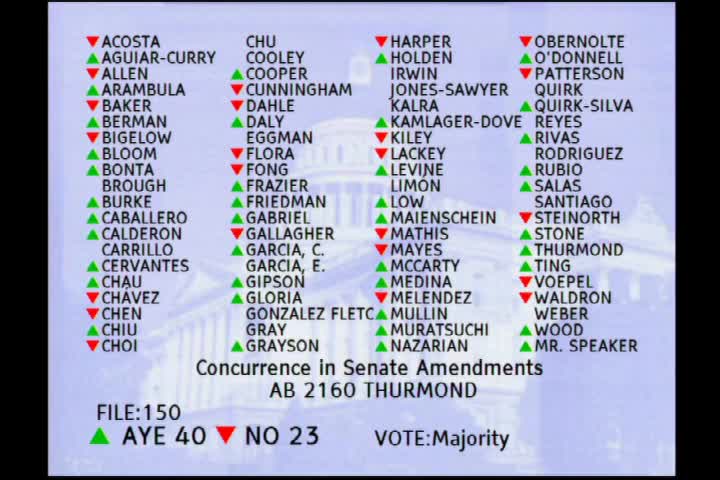 1MIN
Assembly Floor
 2MIN
Senate Floor
 1H
Senate Standing Committee on Appropriations
 7MIN
Assembly Floor
 21MIN
Assembly Standing Committee on Appropriations
 1H
Assembly Standing Committee on Appropriations
 42MIN



