AB 661: Magnesia Spring Ecological Reserve: Mirage Trail.
- Session Year: 2017-2018
- House: Assembly
- Latest Version Date: 2017-09-27
Existing law requires, until January 1, 2018, that the Mirage Trail within the Magnesia Spring Ecological Reserve be open 9 months of the year during the months of May to January, inclusive, and closed for 3 months during the months of February to April, inclusive, to recreational hiking if the Fish and Game Commission determines that specified conditions relating to providing funding and ensuring the proper use and monitoring of the reserve are met.
This bill would require the commission, beginning January 1, 2020, and by January 1 every 2 years thereafter, at a public hearing, to assess compliance with the requirements of those provisions and post its findings and any recommendations on its Internet Web site. The bill would also extend the repeal date of those provisions to January 1, 2028.
Existing law requires, until January 1, 2018, that the Mirage Trail within the Magnesia Spring Ecological Reserve be open 9 months of the year during the months of May to January, inclusive, and closed for 3 months during the months of February to April, inclusive, to recreational hiking if the Fish and Game Commission determines that specified conditions relating to providing funding and ensuring the proper use and monitoring of the reserve are met.
This bill would delete the January 1, 2018, termination date of that provision.
The Mirage Trail within the Magnesia Spring Ecological Reserve shall be open nine months of the year during the months of May to January, inclusive, and closed for three months during the months of February to April, inclusive, to recreational hiking if the commission determines that all of the following conditions are met:
(a)Local public agencies or other nonstate entities will assume complete financial responsibility for the following as determined to be necessary by the commission:
(1)Fencing to dissuade hikers from traversing beyond the trail and into sensitive Peninsular bighorn sheep habitat.
(2)Signage and educational materials to educate hikers about Peninsular bighorn sheep.
(b)A single entity has been designated to fulfill the financial arrangements and other terms and conditions determined by the commission to be necessary pursuant to subdivision (a).
(c)The entity designated pursuant to subdivision (b) has committed to expend at least one hundred thousand dollars ($100,000) by January 1, 2018, to monitor the Peninsular bighorn sheep, consistent with the Coachella Valley Multiple Species Habitat Conservation Plan.
(d)The commission shall, beginning January 1, 2020, and by January 1 every two years thereafter, at a public hearing, assess compliance with the requirements of this section and post its findings and any recommendations on its Internet Web site.
(e)This section shall remain in effect only until January 1, 2028, and as of that date is repealed, unless a later enacted statute that is enacted before January 1, 2028, deletes or extends that date.
(a)The Mirage Trail within the Magnesia Spring Ecological Reserve shall be open nine months of the year during the months of May to January, inclusive, and closed for three months during the months of February to April, inclusive, to recreational hiking if the commission determines that all of the following conditions are met:
(1)(a)Local public agencies or other nonstate entities will assume complete financial responsibility for the following as determined to be necessary by the commission:
(A)(1)Fencing to dissuade hikers from traversing beyond the trail and into sensitive Peninsular bighorn sheep habitat.
(B)(2)Signage and educational materials to educate hikers about Peninsular bighorn sheep.
(2)(b)A single entity has been designated to fulfill the financial arrangements and other terms and conditions determined by the commission to be necessary pursuant to paragraph (1). subdivision (a).
(3)(c)The entity designated pursuant to paragraph (2) subdivision (b) has committed to expend at least one hundred thousand dollars ($100,000) by January 1, 2018, to monitor the Peninsular bighorn sheep, consistent with the Coachella Valley Multiple Species Habitat Conservation Plan.
(b)This section shall remain in effect only until January 1, 2018, and as of that date is repealed, unless a later enacted statute, that is enacted before January 1, 2018, deletes or extends that date.|
Date
|
Status
|
|---|---|
| Sep 27, 2017 | Chaptered by Secretary of State - Chapter 315, Statutes of 2017. |
| Sep 27, 2017 | Approved by the Governor. |
| Sep 19, 2017 | Enrolled and presented to the Governor at 3 p.m. |
| Sep 11, 2017 | Senate amendments concurred in. To Engrossing and Enrolling. |
| Sep 6, 2017 | In Assembly. Concurrence in Senate amendments pending. May be considered on or after September 8 pursuant to Assembly Rule 77. |
| Sep 6, 2017 | Read third time. Passed. Ordered to the Assembly. |
| Sep 5, 2017 | Read second time. Ordered to third reading. |
| Sep 1, 2017 | From committee: Do pass. (Ayes 7. Noes 0.) (September 1). |
| Aug 21, 2017 | In committee: Referred to APPR. suspense file. |
| Jul 17, 2017 | In committee: Hearing postponed by committee. |
| Jul 3, 2017 | Read second time and amended. Re-referred to Com. on APPR. |
| Jun 29, 2017 | From committee: Amend, and do pass as amended and re-refer to Com. on APPR. with recommendation: To Consent Calendar. (Ayes 8. Noes 0.) (June 27). |
| Jun 8, 2017 | In committee: Set, first hearing. Hearing canceled at the request of author. |
| May 10, 2017 | Referred to Com. on N.R. & W. |
| Apr 20, 2017 | In Senate. Read first time. To Com. on RLS. for assignment. |
| Apr 20, 2017 | Read third time. Passed. Ordered to the Senate. (Ayes 74. Noes 0. Page 1144.) |
| Apr 6, 2017 | Read second time. Ordered to Consent Calendar. |
| Apr 5, 2017 | From committee: Do pass. To Consent Calendar. (Ayes 17. Noes 0.) (April 5). |
| Mar 21, 2017 | From committee: Do pass and re-refer to Com. on APPR. (Ayes 14. Noes 0.) (March 21). Re-referred to Com. on APPR. |
| Mar 2, 2017 | Referred to Com. on W.,P., & W. |
| Feb 15, 2017 | From printer. May be heard in committee March 17. |
| Feb 14, 2017 | Read first time. To print. |
|
Date
|
Description
|
Location
|
Votes
|
|
|---|---|---|---|---|
| Sep 11, 2017 | AB 661 MAYES Concurrence in Senate Amendments | Assembly Floor |
Passed |
|
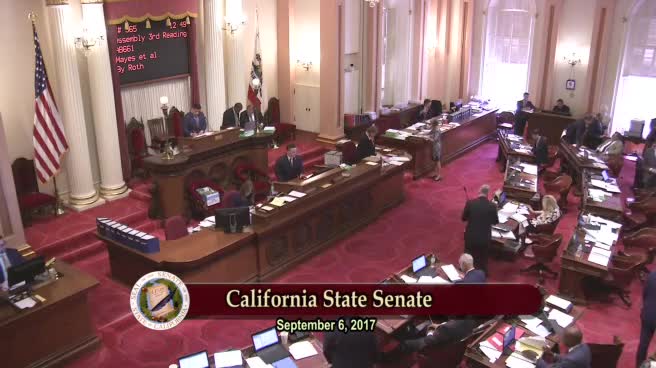
| Sep 6, 2017 | Assembly 3rd Reading AB661 Mayes et al. By Roth | Senate Floor |
Passed |
|
| Sep 1, 2017 | Do pass | Senate Standing Committee on Appropriations |
Passed |
|
| Aug 21, 2017 | Placed on suspense file | Senate Standing Committee on Appropriations |
Passed |
|
| Jun 27, 2017 | Do pass as amended, but first amend, and re-refer to the Committee on [Appropriations] with the recommendation: To Consent Calendar | Senate Standing Committee on Natural Resources and Water |
Passed |
|
| Apr 20, 2017 | Favorable With Committee Substitute (Rules & Policy Committee) | Assembly Floor |
Passed |
|
| Apr 5, 2017 | Do pass. To Consent Calendar. | Assembly Standing Committee on Appropriations |
Passed |
|
| Mar 21, 2017 | Do pass and be re-referred to the Committee on [Appropriations] | Assembly Standing Committee on Water, Parks, and Wildlife |
Passed |
This list shows positions taken on this bill by organizations on the date displayed, which is linked to the original source.
Positions by individuals are not included.
|
Organization
|
Position
|
Date
|
|---|---|---|
| Coachella Valley Association of Governments | * Support | Mar 21, 2017 |
| Coachella Valley Conservation Commission | ** Support | Sep 3, 2017 |
CONCURRENCE IN SENATE AMENDMENTS
CSA1 Bill Id:AB 661
Author:(Mayes and Eduardo Garcia)
As Amended Ver:July 3, 2017
Majority vote
ASSEMBLY: | 74-0 | (April 20, 2017) | SENATE: | 40-0 | (September 6, 2017) |
Original Committee Reference: W., P., & W.
SUMMARY: This bill extends the existing opening and closure dates for the Mirage Trail within the Magnesia Spring Ecological Reserve until January 1, 2028. This bill also requires the Fish and Game Commission (FGC) to assess compliance with the bill's requirements.
The Senate amendments provide oversight by:
- Requiring the FGC, beginning January 1, 2020, and by January 1 every two years thereafter, at a public hearing, to assess compliance with the requirements of the bill.
- Repealing this section on January 1, 2028, unless a later enacted statute that is enacted before January 1, 2028, deletes or extends that date.
EXISTING LAW:
- Provides, pursuant to the federal and state Endangered Species Acts (ESA), species with endangered or threatened designations receive certain protections and government agencies, such as the California Department of Fish and Wildlife (DFW) are required to take actions that reduce further declines in and promotes recovery of these species. The Peninsular bighorn sheep (Ovis Canadensis nelsoni) has been listed as endangered under the federal Endangered Species Act since 1998, and under the California Endangered Species Act as a threatened species since 2000.
- Establishes (Fish and Game Code Section1580) ecological reserves to provide protection for rare, threatened, or endangered native plants, wildlife, as well as specialized terrestrial or aquatic habitat types, and requires that public entry and use is compatible with the primary purpose of the reserve. Further, pursuant to Fish and Game Code Section 1580, the DFW, with approval of the FGC, is authorized to acquire and subsequently manage ecological reserves to protect threatened or endangered species.
FISCAL EFFECT: Unknown, but according to the Assembly Appropriations Committee, no additional state costs for the enforcement of the law. Unknown costs for recent amendments related to public meetings at the FGC.
COMMENTS: The Magnesia Spring Ecological Reserve (Reserve), located on the desert slope of the Santa Rosa Mountains above the communities of Rancho Mirage and Palm Desert, was established for the purpose of protecting the Peninsular bighorn sheep, a threatened and endangered species. The state acquired the Reserve in 1975 as part of a larger reserve of critical habitat for bighorn sheep.
The Reserve is under three different management plans, all of which have the purpose of managing the Reserve to protect bighorn sheep and biological diversity. The last half a mile of the Mirage Trail encroaches on an important lambing area within the Reserve, important habitat for the survival of lambs during the first few months after birth.
Existing law requires the Mirage Trail be open nine months of the year if local public agencies or other entities will assume complete financial responsibility for: 1) fencing to dissuade hikers from leaving the trail; and 2) signage and education materials to educate hikers about bighorn sheep. The law also requires a single entity to be designated to fulfill the financial arrangements and other terms and conditions determined to be necessary by the Fish and Game Commission. These provisions are repealed on January 1, 2018.
Analysis Prepared by: Catherine Freeman / W., P., & W. / (916) 319-2096 FN: 0001783
Office of Senate Floor Analyses (916) 651-1520 Fax: (916) 327-4478 | AB |
THIRD READING
Bill No: AB 661
:
SENATE NATURAL RES. & WATER COMMITTEE: 8-0, 6/27/17
AYES: Hertzberg, Stone, Allen, Atkins, Hueso, Jackson, Stern, Vidak
NO VOTE RECORDED: Monning
SENATE APPROPRIATIONS COMMITTEE: 7-0, 9/1/17
AYES: Lara, Bates, Beall, Bradford, Hill, Nielsen, Wiener
ASSEMBLY FLOOR: 74-0, 4/20/17 (Consent) - See last page for vote
DIGEST:
This bill extends the existing opening and closure dates for the Mirage Trail within the Magnesia Spring Ecological Reserve until January 1, 2028. This bill also requires the Fish and Game Commission (Commission) assess compliance with the bill’s requirements.
Existing law:
- Provides, pursuant to the federal and state Endangered Species Acts (ESA), species with endangered or threatened designations receive certain protections and government agencies, such as the California Department of Fish and Wildlife (Department) are required to take actions that reduce further declines in and promotes recovery of these species. The Peninsular bighorn sheep (Ovis Canadensis nelsoni) has been listed as endangered under the federal Endangered Species Act since 1998, and under the California Endangered Species Act as a threatened species since 2000.
- Establishes (Fish and Game Code §1580) ecological reserves to provide protection for rare, threatened, or endangered native plants, wildlife, as well as specialized terrestrial or aquatic habitat types, and requires that public entry and use is compatible with the primary purpose of the reserve. Further, pursuant to Fish and Game Code §1580, the Department, with approval of the Commission, is authorized to acquire and subsequently manage ecological reserves to protect threatened or endangered species.
This bill:
- Extends the existing opening and closure dates for the Mirage Trail within the Magnesia Spring Ecological Reserve near Palm Desert to January 1, 2028.
- Requires the Commission, beginning January 1, 2020, and by January 1 every two years thereafter, at a public hearing, to assess compliance with the requirements of the bill.
- Requires the Commission to post its findings and any recommendations on its Internet Web site.
Background
- Who manages the reserves? The Commission is authorized to establish and regulate ecological reserves, which includes allowance of public entry and use of the reserve that is compatible with the primary purpose. The Department is authorized to manage ecological reserves, which includes the authorization to designate areas within ecological reserves for trails and to provide added protection for species as necessary.
- Magnesia Spring ecological reserve was designated as an ecological reserve with the primary purpose of protecting threatened or endangered species, including Peninsular bighorn sheep. The reserve is located in the Northern Santa Rosa Mountains of the Coachella Valley, near the cities of Rancho Mirage and Palm Desert. The reserve was established in 1975 by the Commission to provide a large area of critical habitat for the endangered Peninsular bighorn sheep. Further, the reserve currently falls within the purview of three different management plans:
- A 1976 Department wildlife management plan.
- A 1980 Department and Bureau of Land Management plan known as the Santa Rosa Mountains Wildlife Habitat Management Plan (Santa Rosa Mountains plan).
- The Coachella Valley Multiple Species Habitat Conservation Plan, which includes the reserve and land throughout the Coachella Valley.
- The terminus of the Mirage trail was identified as part of US Fish and Wildlife Peninsular Bighorn sheep recovery plan. The recovery plan defines lambing season (January 1 – June 30) and lambing. According to the Department, in 2005, the last half mile of the Mirage Trail was identified as off limits to people in order to mitigate the impacts of nearly two miles of new trails, which were developed at that time, on Department lands, to allow people to access portions of the reserve that have been determined to be less impactful of bighorn sheep. Stakeholders agreed to the closure.
- Local controversy ensued after the top portion of the Mirage Trail was closed to protect Peninsular big horn sheep. This issue was addressed by the negotiated legislation in AB 1097 (Nestande, Chapter 594, Statutes of 2013). Pursuant to Fish and Game Code § 1587, instituted by AB 1097, the Mirage Trail within the Magnesia Spring ecological reserve was required to be open nine months of the year during the months of May to January, inclusive, and closed for three months during the months of February to April, inclusive, to recreational hiking if the Commission determined that all of the following conditions were met:
- Local public agencies or other nonstate entities assume complete financial responsibility for the following as determined to be necessary by the commission:
- Fencing to dissuade hikers from traversing beyond the trail and into sensitive Peninsular bighorn sheep habitat.
- Signage and educational materials to educate hikers about Peninsular bighorn sheep.
- A single entity has been designated to fulfill the financial arrangements and other terms and conditions determined by the Commission to be necessary pursuant to number (1).
- The entity designated pursuant to number (2) has committed to expend at least one hundred thousand dollars ($100,000) by January 1, 2018, to monitor the Peninsular bighorn sheep, consistent with the Coachella Valley Multiple Species Habitat Conservation Plan.
- This section shall remain in effect only until January 1, 2018, and as of that date is repealed, unless a later enacted statute, that is enacted before January 1, 2018, deletes or extends that date.
- Local public agencies or other nonstate entities assume complete financial responsibility for the following as determined to be necessary by the commission:
Comments
- Ongoing research is not yet complete. The 9 month open, 3 month closed, compromise included funding for bighorn sheep research to inform adaptive management of this trail. Specifically, the 2018 sunset in existing law was part of a negotiated compromise in the previous legislation, and was intended to provide time for biological research to be conducted on the use of the areas around the trail by Peninsular bighorn sheep, especially use related to successful lambing. That research is not yet complete. In particular, the use of tracking collars on adult female sheep is critical for estimates of adult female abundance. At this point, only 2 bighorn sheep have been collared with GPS-logging collars in this area, which is far lower than what would be needed to determine whether trail usage by hikers in this case would likely have negative impacts on the recovering sheep. Moreover, 40% of the bighorn sheep research funding set up in the 2013 legislation will be used this year. In accordance with section 1587 of the Fish & Game Code, the Coachella Valley Conservation Commission spent $60,000 last year and will spend $40,000 in 2017 to monitor bighorn sheep movement consistent with the Coachella Valley Habitat Conservation Plan.
- Lambing success is a high priority for bighorn sheep recovery in this region. The Peninsular bighorn sheep are endangered, in large part because of the low success rates of lambs reaching adulthood. Between the years 2005-2010, the survival rate of lambs in the northern Santa Rosa Mountains ranged between 3% - 20%, which is below the 25% survival rate what would be expected for a healthy population. In 2005, the low survival rate was linked to a viral outbreak, but the cause for low survival rates in other years is unknown.
- This is a very popular hiking trail. Estimates indicate that up to 200-300 people use the Mirage trail for recreation and exercise each day.
- Vandalization of signage and lack of compliance of hikers with the trail closure during certain months may continue to be a problem. A single strand post and cable fence was installed at the terminus of the upper Bump and Grind Trail in December 2014. A sign indicating the 3-month closure of the Upper Mirage Trail was installed January 30, 2017 at the start of the closure (Feb 1 to April 30). Recent vandalization of closure signs at the gate occurred in March 2017. Vandalization of fencing and gates on this trail has been recurring for many years. In 2008, the Department began installing chain link gates at the point where the trail was not open. These were torn out and destroyed. Subsequently, signs with the regulations have also been destroyed. In 2011, the Department installed a sturdy gate that could not be easily destroyed, and that gate remains intact at this time.
- Hiker education and outreach efforts have been ongoing since 2014:
- Ecological Reserve signs were posted in English and Spanish on the fence in May 2015 along with CDFW No Trespass Signs that were posted a significant distance beyond the fence to dissuade hikers from continuing off trail in sensitive habitat.
- An educational sign about bighorn sheep was installed at the base of the trail, at the gate, and in other locations in December 2015. The educational signs are equipped with a QR code which allows trail users to link to the www.cvmshcp.org Web site, where digital bighorn information is available.
- In addition to signage, educational information about bighorn sheep is also distributed through the Trails Management Subcommittee of the Coachella Valley Conservation Commission, including to trail user groups and state/federal wildlife agencies. For example, the Desert Trails Hiking Club has distributed hiking etiquette materials, which includes bighorn sheep etiquette.
- Has the Commission taken action on the Mirage trail? Yes, the closures, among other information, from section 1587 have been added to Title 14 §630.
- Of the overlapping management plans that involve the Peninsular bighorn sheep, the Coachella Valley Multiple Species Habitat Conservation Plan is the most recently finalized, having been established in 2008. This plan includes nearly all of the sloped terrain in the Santa Rosa and San Jacinto Mountains, including the Magnesia Ecological Reserve, and Peninsular bighorn sheep are one of four mammal species covered by the plan.
FISCAL EFFECT: Appropriation: Fiscal Com.: Local:
According to the Senate Appropriations Committee this bill will have unknown, potentially significant, cost for the Department (Fish and Game Preservation Fund) to maintain enforcement, hiker education, and restoration of vandalized property.
Coachella Valley Conservation Commission
None received
ARGUMENTS IN SUPPORT: The authors argue that “this bill is needed to ensure that the Mirage Trail is open to hikers for the 9 months [out of the year] but also ensure that the area located on the top of the trial is protected due to the possibility of the Peninsular bighorn sheep lambing near or around that location.”
ASSEMBLY FLOOR: 74-0, 4/20/17
AYES: Acosta, Aguiar-Curry, Travis Allen, Arambula, Baker, Berman, Bigelow, Bloom, Bocanegra, Bonta, Burke, Caballero, Calderon, Cervantes, Chau, Chávez, Chen, Chiu, Chu, Cooley, Cooper, Cunningham, Dababneh, Dahle, Daly, Eggman, Flora, Fong, Frazier, Friedman, Cristina Garcia, Eduardo Garcia, Gipson, Gloria, Gomez, Gonzalez Fletcher, Gray, Grayson, Harper, Holden, Irwin, Jones-Sawyer, Kalra, Kiley, Lackey, Levine, Limón, Low, Maienschein, Mayes, McCarty, Medina, Melendez, Mullin, Muratsuchi, Nazarian, Obernolte, O'Donnell, Quirk, Quirk-Silva, Reyes, Rodriguez, Rubio, Salas, Santiago, Steinorth, Mark Stone, Thurmond, Ting, Voepel, Waldron, Weber, Wood, Rendon
NO VOTE RECORDED: Brough, Choi, Gallagher, Mathis, Patterson, Ridley-Thomas
9/3/17 18:06:39
**** END ****
SENATE COMMITTEE ON APPROPRIATIONS
Senator Ricardo Lara, Chair
2017 - 2018 Regular Session
AB 661 (Mayes) - Magnesia Spring Ecological Reserve: Mirage Trail
Version: July 3, 2017 | Policy Vote: N.R. & W. 8 - 0 |
Urgency: No | Mandate: No |
Hearing Date: July 17, 2017 | Consultant: Narisha Bonakdar |
This bill meets the criteria for referral to the Suspense File.
Bill Summary:
AB 661 extends the existing opening and closure dates for the Mirage Trail within the Magnesia Spring Ecological Reserve near Palm Desert until January 1, 2028. The bill also requires the Fish and Game Commission (commission), beginning January 1, 2020, to biennially assess compliance with the bill’s requirements.
Fiscal Impact:
Unknown, potentially significant, cost for the Department of Fish and Wildlife (Fish and Game Preservation Fund) to maintain enforcement, hiker education, and restoration of vandalized property.
Background:
The Magnesia Spring Ecological Reserve (Reserve), located on the desert slop of the Santa Rosa Mountains above the communities of Rancho Mirage and Palm Desert, was established for the purpose of protecting the Peninsular bighorn sheep, a threatened and endangered species. The state acquired the Reserve in 1975 as part of a larger reserve of critical habitat for bighorn sheep.
The Reserve is under three different management plans, all of which have the purpose of managing the Reserve to protect bighorn sheep and biological diversity.
The last half a mile of the Mirage Trail encroaches on an important lambing area within the Reserve, important habitat for the survival of lambs during the first few months after birth.
Existing law requires the Mirage Trail be open nine months of the year if local public agencies or other entities will assume complete financial responsibility for: 1) fencing to dissuade hikers from leaving the trail; and 2) signage and education materials to educate hikers about bighorn sheep. The law also requires a single entity to be designated to fulfill the financial arrangements and other terms and conditions determined to be necessary by the Fish and Game Commission. These provisions are repealed on January 1, 2018. This bill deletes that sunset date.
Proposed Law:
This bill
- Extends the existing opening and closure dates for the Mirage Trail within the Magnesia Spring Ecological Reserve near Palm Desert to January 1, 2028.
- Requires the commission, beginning January 1, 2020, and by January 1 every two years thereafter, at a public hearing, to assess compliance with the requirements of the bill.
- Requires the commission to post its findings and any recommendations on its Internet Web site.
Related Legislation: AB 880 (Nestande, c. 527, Stats. 2012) – this bill required the Mirage Trail within the Magnesia Spring Ecological Reserve to be open nine months of the year to recreational hiking , if the Fish and Game Commission determines that certain conditions relating to Peninsular bighorn sheep are met. This bill required Fish and Game Commission to determine seasonal openings and closures of the trail that will not conflict with the use of the area by Peninsular bighorn sheep.
AB 1097 (Nestande, c. 594, Stats. 2013) – this bill established that the Mirage Trail in the Magnesia Ecological reserve would be open during the nine months of May to January and closed the three months from February through April, as long as certain conditions were met, including that at least $100,000 must be devoted to monitoring bighorn sheep consistent with the Coachella Valley Multiple Species Conservation Plan.
Staff Comments:
Ongoing research is not yet complete. The 9 month open, 3 month closed, compromise included funding for bighorn sheep research to inform adaptive management of this trail. Specifically, the 2018 sunset in existing law was part of a negotiated compromise in the previous legislation, and was intended to provide time for biological research to be conducted on the use of the areas around the trail by Peninsular bighorn sheep, especially use related to successful lambing. That research is not yet complete. In particular, the use of tracking collars on adult female sheep is critical for estimates of adult female abundance. At this point, only 2 bighorn sheep have been collared with GPS-logging collars in this area, which is far lower than what would be needed to determine whether trail usage by hikers in this case would likely have negative impacts on the recovering sheep.
Vandalization of signage and lack of compliance of hikers with the trail closure during certain months may continue to be a problem. A single strand post and cable fence was installed at the terminus of the upper Bump and Grind Trail in December 2014. A sign indicating the 3-month closure of the Upper Mirage Trail was installed January 30, 2017 at the start of the closure (Feb 1 to April 30). Recent vandalization of closure signs at the gate occurred in March 2017. Vandalization of fencing and gates on this trail has been recurring for many years. In 2008, the Department began installing chain link gates at the point where the trail was not open. These were torn out and destroyed. Subsequently, signs with the regulations have also been destroyed. In 2011, the Department installed a sturdy gate that could not be easily destroyed, and that gate remains intact at this time.
Hiker education and outreach efforts have been ongoing since 2014:
- Ecological Reserve signs were posted in English and Spanish on the fence in May 2015 along with CDFW regulatory signs (CDFW No Trespass. Sign) that were posted a significant distance beyond the fence to dissuade hikers from continuing off trail in sensitive habitat.
- An educational sign about bighorn sheep was installed at the base of the trail, at the gate, and in other locations in December 2015. The educational signs are equipped with a QR code which allows trail users to link to the www.cvmshcp.org website, where digital bighorn information is available.
- In addition to signage, educational information about bighorn sheep is also distributed through the Trails Management Subcommittee of the Coachella Valley Conservation Commission, including to trail user groups and state/federal wildlife agencies. For example, the Desert Trails Hiking Club has distributed hiking etiquette materials, which includes bighorn sheep etiquette.
-- END --
SENATE COMMITTEE ON NATURAL RESOURCES AND WATER
Senator Robert Hertzberg, Chair
2017 - 2018 Regular
Bill No: AB Hearing Date: June 27, 2017
Author: | Mayes | ||
Version: | February 14, 2017 | ||
Urgency: | No | Fiscal: | Yes |
Consultant: | Mike Peterson | ||
Subject: Magnesia Spring Ecological Reserve: Mirage Trail
BACKGROUND AND EXISTING LAW
- The Peninsular bighorn sheep (Ovis Canadensis nelsoni) has been listed as endangered under the federal Endangered Species Act since 1998, and under the California Endangered Species Act as a threatened species since 2000. Pursuant to these federal and state laws, species with endangered or threatened designations receive certain protections and government agencies, such as the California Department of Fish and Wildlife (the Department) are required to take actions that reduce further declines in and promotes recovery of these species.
- Ecological reserves are one mechanism for the protection of threatened or endangered species. Existing law (Fish and Game Code §1580) establishes ecological reserves to provide protection for rare, threatened, or endangered native plants, wildlife, as well as specialized terrestrial or aquatic habitat types, and requires that public entry and use is compatible with the primary purpose of the reserve.
- Pursuant to Fish and Game Code §1580, the Department, with approval of the Fish and Game Commission, is authorized to acquire and subsequently manage ecological reserves to protect threatened or endangered species.
- Who manages the reserves? The Fish and Game Commission is authorized to establish and regulate ecological reserves, which includes allowance of public entry and use of the reserve that is compatible with the primary purpose. The Department is authorized to manage ecological reserves, which includes the authorization to designate areas within ecological reserves for trails and to provide added protection for species as necessary.
- Magnesia Spring ecological reserve was designated as an ecological reserve with the primary purpose of protecting threatened or endangered species, including Peninsular bighorn sheep. The reserve is located in the Northern Santa Rosa Mountains of the Coachella Valley, near the cities of Rancho Mirage and Palm Desert. The reserve was established in 1975 by the Fish and Game Commission to provide a large area of critical habitat for the endangered Peninsular bighorn sheep. The reserve is defined in title 14 section 630 of the California Code of Regulations. Further, the reserve currently falls within the purview of three different management plans:
1) A 1976 Department wildlife management plan.
2) A 1980 Department and Bureau of Land Management plan known as the Santa Rosa Mountains Wildlife Habitat Management Plan (Santa Rosa Mountains plan).
3) The Coachella Valley Multiple Species Habitat Conservation Plan, which includes the reserve and land throughout the Coachella Valley.
- The terminus of the Mirage trail was identified as part of US Fish and Wildlife Peninsular Bighorn sheep recovery plan. The recovery plan defines lambing season as January 1 – June 30 and lambing area. According to the Department, in 2005, the last half mile of the Mirage Trail was identified as off limits to people in order to mitigate the impacts of nearly two miles of new trails developed at that time, on Department lands, to allow people to access portions of the reserve that have been determined to be less impactful of bighorn sheep. Stakeholders agreed to the closure.
- Local controversy ensued after the top portion of the Mirage Trail was closed to protect Peninsular big horn sheep. This reached the Legislature and was resolved via a negotiated solution with AB 1097 (Nestande, c. 594, Stats. 2013). Pursuant to Fish and Game Code § 1587, instituted by AB 1097, the Mirage Trail within the Magnesia Spring ecological reserve was required to be open nine months of the year during the months of May to January, inclusive, and closed for three months during the months of February to April, inclusive, to recreational hiking if the Fish and Game Commission determined that all of the following conditions were met:
1) Local public agencies or other nonstate entities assume complete financial responsibility for the following as determined to be necessary by the commission:
A) Fencing to dissuade hikers from traversing beyond the trail and into sensitive Peninsular bighorn sheep habitat.
B) Signage and educational materials to educate hikers about Peninsular bighorn sheep.
2) A single entity has been designated to fulfill the financial arrangements and other terms and conditions determined by the Fish and Game Commission to be necessary pursuant to number (1).
3) The entity designated pursuant to number (2) has committed to expend at least one hundred thousand dollars ($100,000) by January 1, 2018, to monitor the Peninsular bighorn sheep, consistent with the Coachella Valley Multiple Species Habitat Conservation Plan.
4) This section shall remain in effect only until January 1, 2018, and as of that date is repealed, unless a later enacted statute, that is enacted before January 1, 2018, deletes or extends that date.
PROPOSED LAW
This bill would delete the January 1, 2018 termination date of that provision, which would allow the Mirage Trail on the Magnesia Spring ecological reserve to continue to be open for use May – January, and closed February – April.
ARGUMENTS IN SUPPORT
The authors argue that “this bill is needed to ensure that the Mirage Trail is open to hikers for the 9 months [out of the year] but also ensure that the area located on the top of the trial is protected due to the possibility of the Peninsular bighorn sheep lambing near or around that location.”
ARGUMENTS IN OPPOSITION
None received
COMMENTS
- Ongoing research is not yet complete. The 9 month open, 3 month closed, compromise included funding for bighorn sheep research to inform adaptive management of this trail. Specifically, the 2018 sunset in existing law was part of a negotiated compromise in the previous legislation, and was intended to provide time for biological research to be conducted on the use of the areas around the trail by Peninsular bighorn sheep, especially use related to successful lambing. That research is not yet complete. In particular, the use of tracking collars on adult female sheep is critical for estimates of adult female abundance. At this point, only 2 bighorn sheep have been collared with GPS-logging collars in this area, which is far lower than what would be needed to determine whether trail usage by hikers in this case would likely have negative impacts on the recovering sheep. Moreover, 40% of the bighorn sheep research funding set up in the 2013 legislation will be used this year. In accordance with section 1587 of the Fish & Game Code, the Coachella Valley Conservation Commission spent $60,000 last year and will spend $40,000 in 2017 to monitor bighorn sheep movement consistent with the Coachella Valley Habitat Conservation Plan. As this is incomplete the Committee may wish to extend the sunset for another 10 years rather than remove the sunset [Amendment 1], and establish reporting requirements for the Fish and Game Commission [Amendment 2].
- Lambing success is a high priority for bighorn sheep recovery in this region. The Peninsular bighorn sheep are endangered, in large part because of the low success rates of lambs reaching adulthood. Between the years 2005-2010, the survival rate of lambs in the northern Santa Rosa Mountains ranged between 3% - 20%, which is below the 25% survival rate what would be expected for a healthy population. In 2005, the low survival rate was linked to a viral outbreak, but the cause for low survival rates in other years is unknown.
- This is a very popular hiking trail. Estimates indicate that up to 200-300 people use the Mirage trail for recreation and exercise each day.
- Vandalization of signage and lack of compliance of hikers with the trail closure during certain months may continue to be a problem. A single strand post and cable fence was installed at the terminus of the upper Bump and Grind Trail in December 2014. A sign indicating the 3-month closure of the Upper Mirage Trail was installed January 30, 2017 at the start of the closure (Feb 1 to April 30). Recent vandalization of closure signs at the gate occurred in March 2017. Vandalization of fencing and gates on this trail has been recurring for many years. In 2008, the Department began installing chain link gates at the point where the trail was not open. These were torn out and destroyed. Subsequently, signs with the regulations have also been destroyed. In 2011, the Department installed a sturdy gate that could not be easily destroyed, and that gate remains intact at this time.
- Hiker education and outreach efforts have been ongoing since 2014:
- Ecological Reserve signs were posted in English and Spanish on the fence in May 2015 along with CDFW regulatory signs (CDFW No Trespass. Sign) that were posted a significant distance beyond the fence to dissuade hikers from continuing off trail in sensitive habitat.
- An educational sign about bighorn sheep was installed at the base of the trail, at the gate, and in other locations in December 2015. The educational signs are equipped with a QR code which allows trail users to link to the www.cvmshcp.org website, where digital bighorn information is available.
- In addition to signage, educational information about bighorn sheep is also distributed through the Trails Management Subcommittee of the Coachella Valley Conservation Commission, including to trail user groups and state/federal wildlife agencies. For example, the Desert Trails Hiking Club has distributed hiking etiquette materials, which includes bighorn sheep etiquette.
- Has the Fish and Game Commission taken action on the Mirage trail? Yes, the closures, among other information, from section 1587 have been added to Title 14 §630.
- Of the overlapping management plans that involve the Peninsular bighorn sheep, the Coachella Valley Multiple Species Habitat Conservation Plan is the most recently finalized, having been established in 2008. This plan includes nearly all of the sloped terrain in the Santa Rosa and San Jacinto Mountains, including the Magnesia Ecological Reserve, and Peninsular bighorn sheep are one of four mammal species covered by the plan.
Recent/Previous Legislation
AB 880 (Nestande, c. 527, Stats. 2012) – this bill required the Mirage Trail within the Magnesia Spring Ecological Reserve to be open nine months of the year to recreational hiking , if the Fish and Game Commission determines that certain conditions relating to Peninsular bighorn sheep are met. This bill required Fish and Game Commission to determine seasonal openings and closures of the trail that will not conflict with the use of the area by Peninsular bighorn sheep.
AB 1097 (Nestande, c. 594, Stats. 2013) – this bill established that the Mirage Trail in the Magnesia Ecological reserve would be open during the nine months of May to January and closed the three months from February through April, as long as certain conditions were met, including that at least $100,000 must be devoted to monitoring bighorn sheep consistent with the Coachella Valley Multiple Species Conservation Plan.
SUGGESTED AMENDMENTS
AMENDMENT 1
Page 2, line 25. Add: This section shall remain in effect only until January 1, 2028, and as of that date is repealed, unless a later enacted statute, that is enacted before January 1, 2028 deletes or extends that date.
AMENDMENT 2
Page 2, line 24 add: The commission, starting on January 1, 2020 and every two years thereafter, shall, at a regular public hearing, assess compliance with this section and post its findings and recommendations on its web site.
SUPPORT
Coachella Valley Conservation Commission
OPPOSITION
None Received
-- END --
Date of Hearing: April 5, 2017
ASSEMBLY COMMITTEE ON APPROPRIATIONS
Lorena Gonzalez Fletcher, Chair
ABPCA Bill Id:AB 661
Author:(Mayes) – As Introduced Ver:February 14, 2017
Policy Committee: | Water, Parks and Wildlife | Vote: | 14-0 |
|
| ||
|
|
Urgency: No State Mandated Local Program: No Reimbursable: No
SUMMARY:
This bill extends the existing opening and closure dates for the Mirage Trail within the Magnesia Spring Ecological Reserve near Palm Desert.
Specifically, this bill deletes the January 1, 2018, termination date of a provision that allows the Mirage Trail to be open to the public for recreational hiking during the months of May through January and closed for three months during the months of February through April.
FISCAL EFFECT:
No additional state costs.
COMMENTS:
Background and Purpose. The Magnesia Spring Ecological Reserve (Reserve), located on the desert slop of the Santa Rosa Mountains above the communities of Rancho Mirage and Palm Desert, was established for the purpose of protecting the Peninsular bighorn sheep, a threatened and endangered species. The state acquired the Reserve in 1975 as part of a larger reserve of critical habitat for bighorn sheep.
The Reserve is under three different management plans, all of which have the purpose of managing the Reserve to protect bighorn sheep and biological diversity.
The last half a mile of the Mirage Trail encroaches on an important lambing area within the Reserve, important habitat for the survival of lambs during the first few months after birth.
Existing law requires the Mirage Trail be open nine months of the year if local public agencies or other entities will assume complete financial responsibility for: 1) fencing to dissuade hikers from leaving the trail; and 2) signage and education materials to educate hikers about bighorn sheep. The law also requires a single entity to be designated to fulfill the financial arrangements and other terms and conditions determined to be necessary by the Fish and Game Commission. These provisions are repealed on January 1, 2018. This bill deletes that sunset date.
Analysis Prepared by: Jennifer Galehouse / APPR. / (916) 319-2081
Date of Hearing: March 21, 2017
ASSEMBLY COMMITTEE ON WATER, PARKS, AND WILDLIFE
Eduardo Garcia, Chair
ABPCA Bill Id:AB 661 (
Author:Mayes) – As Introduced Ver:February 14, 2017
SUBJECT: Magnesia Spring Ecological Reserve: Mirage Trail
SUMMARY: Extends the existing opening and closure dates for the Mirage Trail near Palm Desert.
Specifically, this bill: Deletes a January 1, 2018, termination date, of a provision that allows the Mirage Trail, within the Magnesia Spring Ecological Reserve, to be open to the public during the months of May to January, inclusive, and closed for three months during the months of February to April, inclusive, for recreational hiking.
EXISTING LAW:
1) Provides for listing of threatened and endangered species under federal and state law, and prohibits the take of any species so listed, and requires the Department of Fish and Wildlife (DFW) and other state agencies to take steps to conserve species listed as threatened or endangered. The Peninsular bighorn sheep has been listed as endangered under the federal Endangered Species Act since 1998, and under the California Endangered Species Act as a threatened species since 2000.
2) Authorizes the DFW, with approval of the Fish and Game Commission (FGC), to acquire, maintain and manage lands for ecological reserves to protect threatened or endangered species. Makes it unlawful for any person to enter upon any ecological reserve except in accordance with the FGC regulations. Authorizes the DFW to designate areas within ecological reserves for trails, and to provide for added protection for species as necessary, and allows only such public use and entry as are compatible with the primary purpose of the reserve and subject to FGC regulations.
3) Designates the Magnesia Spring Ecological Reserve as an ecological reserve established for the primary purpose of protecting threatened or endangered species, including Peninsular bighorn sheep. Prohibits any person from entering the Magnesia Spring Ecological Reserve from January 1 to September 30, with exceptions for the Mirage Trail and other designated trails as permitted by the DFW.
4) Requires that the Mirage Trail within the Magnesia Spring Ecological Reserve be kept open nine months of the year to recreational hiking, if the FGC determine the following:
a) Local public agencies or other entities will assume complete financial responsibility for fencing to dissuade hikers from traversing beyond the trail and into sensitive Peninsular bighorn sheep habitat, and for signage and educational materials to educate hikers about Peninsular bighorn sheep;
b) A single entity has been designated to fulfill the financial arrangements and other terms and conditions determined necessary by the FGC.
5) Authorizes the FGC to determine seasonal openings and closures of the trail that will not conflict with use of the area by Peninsular bighorn sheep, consistent with above provisions.
6) Provides a January 1, 2018, termination date and repeal for the above provisions, unless a later statute extends or deletes this provision.
FISCAL EFFECT: Unknown.
COMMENTS: The Mirage Trail is a popular hiking trail located partially within the Magnesia Spring Ecological Reserve (Reserve), which was established for the purpose of protecting Peninsular bighorn sheep, a threatened and endangered species. The trail was previously closed by the DFW in order to protect sensitive bighorn sheep lambing grounds within the Magnesia Spring Ecological Reserve. Legislation enacted in 2012 required the trail to be kept open for nine months out of the year if the FGC made certain findings regarding the commitment of a local entity to cover the costs of fencing, signage and education of the public, and required the FGC to determine the precise times and seasons of the year the trail would be open or closed that would not conflict with the use of the area by the bighorn sheep.
This bill, and previous legislation, responds to local opposition to the closure of a portion of the Mirage Trail, located within the Magnesia Spring Ecological Reserve. The popular trail has been used by local residents for many years. Portions of the trail were closed by DFW to protect sensitive bighorn sheep habitat. The Reserve was acquired by the state in 1975 with environmental license plate funds as part of a larger reserve of critical habitat for bighorn sheep. The portion of the Reserve where the trail segment in question is located was purchased in 1986. The Reserve remains essential habitat under the Recovery Plan for Bighorn Sheep in the Peninsular Range. The Reserve is located on the desert slope of the Santa Rosa Mountains above the communities of Rancho Mirage and Palm Desert. The primary purpose of the Reserve is to rehabilitate and maintain habitat for bighorn sheep around Magnesia Spring. Under the Wildlife Management Plan for the Reserve, bighorn sheep are to receive priority over other conflicting uses. The Santa Rosa Mountains Wildlife Habitat Management Plan, a joint DFW and Bureau of Land Management plan that includes the Reserve, also indicates that to maintain viable habitat for the bighorn sheep, public use must be tailored to ensure minimal impacts.
The terminus of the Mirage Trail encroaches on an important lambing area within the Reserve. Lambing areas are habitat essential for ewes and their lambs to survive during the first few months of birth. Insufficient lamb recruitment rate has been identified as one of the key reasons for endangerment of the sheep, and lambing success is known to be impacted by human disturbance. The upper portion of the trail was first closed by the DFW due to concerns about impacts on the sheep several years ago, but the gates and signs erected by the DFW were destroyed by vandalism. A sturdier gate was erected by CalFire crews in June 2011. The DFW also installed security cameras and increased warden patrols of the area at that time, but the security cameras were stolen. Before the new gate was established, an estimated 100-200 people per day walked to the terminus of the Mirage Trail despite the closure of the Reserve from January to June.
In 2011, a status review update on the Peninsular bighorn sheep was completed by the United States Fish and Wildlife Service. The review concluded that the species continues to be endangered throughout its range and no change in endangered status was recommended. The review noted that while the number of sheep has increased, the number of ewes remains below the value recommended for down listing under the recovery plan, and slow population growth remains a significant concern for recovery. The status review also noted the primary threats identified when the species was listed all continue to impact the species, including human disturbance and insufficient lamb recruitment. The report notes that negative effects from trails and recreational uses continues to increase, but that management actions are attempting to control threats through various means such as closing trails seasonally.
AB 1097 (Nestande), Chapter 594, Statutes of 2013, required that the trail be kept open for the months of May through January, inclusive, for hiking, and closed from February to April, rather than leaving that decision to the FGC. Supporters argue that continuing the existing opening dates of the trail benefits hikers, while allowing the use of bighorn sheep during lambing season.
REGISTERED SUPPORT / OPPOSITION:
Support
Coachella Valley Conservation Commission
Opposition
None received.
Analysis Prepared by: Catherine Freeman / W., P., & W. /
Discussed in Hearing
 2MIN
Assembly Floor
 2MIN
Senate Floor
 1H
Senate Standing Committee on Appropriations
 5MIN
Assembly Standing Committee on Water, Parks, and Wildlife


Bill Co-Author(s):