AB 681: Teacher credentialing: teacher preparation outside of the United States: temporary certificates.
- Session Year: 2017-2018
- House: Assembly
- Latest Version Date: 2017-09-01
(1)Existing law requires the Commission on Teacher Credentialing to, among other duties, establish standards for the issuance and renewal of credentials, certificates, and permits. Existing law requires the commission to issue a 5-year preliminary multiple subject teaching credential, a 5-year preliminary single subject teaching credential, or a 5-year preliminary education specialist credential to a teacher prepared in a country other than the United States who meets specified requirements.
Existing law provides that coursework, programs, or degrees completed at an institution of higher education outside of the United States are acceptable toward certification when the commission or an evaluating agency approved by the commission has determined that the institutions coursework, programs, or degrees are equivalent to those offered by a regionally accredited institution in the United States.
This bill would authorize the commission to determine that the national standards for coursework, programs, or degrees in a country other than the United States are equivalent to those offered by a regionally accredited institution in the United States. The bill would provide that, if the commission determines that the other countrys national standards are equivalent, an individual who holds or is eligible for a credential in that country is presumed to have satisfied specified requirements for obtaining a credential.
The bill would authorize the commission to enter into an agreement with an evaluating agency as necessary to make a determination regarding another countrys national standards. The bill would also require the commission to adopt regulations necessary to implement these provisions. The bill would require the commission to annually report to the Legislature specified information relating to these provisions.
The bill would require a school district, county office of education, and charter school to annually report to the State Department of Education the number of visa applications for certain nonimmigrant aliens the school district, county office of education, or charter school applies for on behalf of potential employees, and the number of those visa applications that are granted. The bill would require the department to annually report that information to the Legislature.
(2)Existing law authorizes a county board of education or city and county board of education to issue temporary certificates to certified employees whose credentials are being processed by the Commission on Teacher Credentialing. Under existing law, a county board of education or city and county board of education, before issuing a temporary certificate, or a school district, before issuing a temporary certificate of clearance, is required to obtain a certificate of clearance from the commission.
This bill instead would require a county board of education or city and county board of education, before issuing a temporary certificate, or a school district, before issuing a temporary certificate of clearance, to obtain proof that the applicant has obtained a credential, certificate, or permit authorizing the performance of services in the public schools from the commission.
(3)Existing law authorizes certain school districts, at their discretion, to provide for the registration of a valid certification or other document authorizing the holder to serve in a position requiring certification qualifications as an employee of the school district. Existing law prohibits a school district from exercising that authority until the school district has obtained a certificate of clearance from the Commission on Teacher Credentialing.
This bill instead would require a school district, before providing for the registration of a valid certification or other document authorizing the holder to serve in a position requiring certification qualifications as an employee of the school district, to obtain proof that the holder has obtained a credential, certificate, or permit authorizing the performance of services in the public schools from the commission.
(4)Existing law authorizes a county board of education or city and county board of education to issue temporary certificates to certified employees of nonpublic, nonsectarian schools, including individuals certified in another state, whose credentials are being processed by the Commission on Teacher Credentialing. Existing law requires a county board of education or city and county board of education, before issuing a temporary certificate, to obtain a certificate of clearance from the commission.
This bill instead would require a county board of education or city and county board of education, before issuing a temporary certificate, to obtain proof that the applicant has obtained a credential, certificate, or permit authorizing the performance of services in the public schools from the commission.
(1)Existing law requires the Commission on Teacher Credentialing to, among other duties, establish standards for the issuance and renewal of credentials, certificates, and permits. Existing law requires the commission to issue a 5-year preliminary multiple subject teaching credential, a 5-year preliminary single subject teaching credential, or a 5-year preliminary education specialist credential to a teacher prepared in a country other than the United States who meets specified requirements.
Existing law provides that coursework, programs, or degrees completed at an institution of higher education outside of the United States are acceptable toward certification when the commission or an evaluating agency approved by the commission has determined that the institutions coursework, programs, or degrees are equivalent to those offered by a regionally accredited institution in the United States.
This bill would authorize the commission to determine that the national standards for coursework, programs, or degrees in a country other than the United States are equivalent to those offered by a regionally accredited institution in the United States. The bill would provide that, if the commission determines that the other countrys national standards are equivalent, an individual who holds or is eligible for a credential in that country is presumed to have satisfied specified requirements for obtaining a credential.
The bill would authorize the commission to enter into an agreement with an evaluating agency as necessary to make a determination regarding another countrys national standards. The bill would also require the commission to adopt regulations necessary to implement these provisions. The bill would require the commission to annually report to the Legislature specified information relating to these provisions.
The bill would require a school district, county office of education, and charter school to annually report to the State Department of Education the number of visa applications for certain nonimmigrant aliens the school district, county office of education, or charter school applies for on behalf of potential employees, and the number of those visa applications that are granted. The bill would require the department to annually report that information to the Legislature.
(1)(2)Existing law authorizes a county board of education or city and county board of education to issue temporary certificates to certified employees whose credentials are being processed by the Commission on Teacher Credentialing. Under existing law, a county board of education or city and county board of education, before issuing a temporary certificate, or a school district, before issuing a temporary certificate of clearance, is required to obtain a certificate of clearance from the commission.
This bill instead would require a county board of education or city and county board of education, before issuing a temporary certificate, or a school district, before issuing a temporary certificate of clearance, to obtain proof that the applicant has obtained a credential, certificate, or permit authorizing the performance of services in the public schools from the commission.
(2)(3)Existing law authorizes certain school districts, at their discretion, to provide for the registration of a valid certification or other document authorizing the holder to serve in a position requiring certification qualifications as an employee of the school district. Existing law prohibits a school district from exercising that authority until the school district has obtained a certificate of clearance from the Commission on Teacher Credentialing.
This bill instead would require a school district, before providing for the registration of a valid certification or other document authorizing the holder to serve in a position requiring certification qualifications as an employee of the school district, to obtain proof that the holder has obtained a credential, certificate, or permit authorizing the performance of services in the public schools from the commission.
(3)(4)Existing law authorizes a county board of education or city and county board of education to issue temporary certificates to certified employees of nonpublic, nonsectarian schools, including individuals certified in another state, whose credentials are being processed by the Commission on Teacher Credentialing. Existing law requires a county board of education or city and county board of education, before issuing a temporary certificate, to obtain a certificate of clearance from the commission.
This bill instead would require a county board of education or city and county board of education, before issuing a temporary certificate, to obtain proof that the applicant has obtained a credential, certificate, or permit authorizing the performance of services in the public schools from the commission.
(1)Existing law authorizes a county board of education or city and county board of education to issue temporary certificates to certified employees whose credentials are being processed by the Commission on Teacher Credentialing. Under existing law, a county board of education or city and county board of education, before issuing a temporary certificate, or a school district, before issuing a temporary certificate of clearance, is required to obtain a certificate of clearance from the commission.
This bill instead would require a county board of education or city and county board of education, before issuing a temporary certificate, or a school district, before issuing a temporary certificate of clearance, to obtain proof that the applicant has obtained a credential, certificate, or permit authorizing the performance of services in the public schools from the commission.
(2)Existing law authorizes certain school districts, at their discretion, to provide for the registration of a valid certification or other document authorizing the holder to serve in a position requiring certification qualifications as an employee of the school district. Existing law prohibits a school district from exercising that authority until the school district has obtained a certificate of clearance from the Commission on Teacher Credentialing.
This bill instead would require a school district, before providing for the registration of a valid certification or other document authorizing the holder to serve in a position requiring certification qualifications as an employee of the school district, to obtain proof that the holder has obtained a credential, certificate, or permit authorizing the performance of services in the public schools from the commission.
(3)Existing law authorizes a county board of education or city and county board of education to issue temporary certificates to certified employees of nonpublic, nonsectarian schools, including individuals certified in another state, whose credentials are being processed by the Commission on Teacher Credentialing. Existing law requires a county board of education or city and county board of education, before issuing a temporary certificate, to obtain a certificate of clearance from the commission.
This bill instead would require a county board of education or city and county board of education, before issuing a temporary certificate, to obtain proof that the applicant has obtained a credential, certificate, or permit authorizing the performance of services in the public schools from the commission.
Existing law requires the Commission on Teacher Credentialing to, among other duties, establish standards for the issuance and renewal of credentials, certificates, and permits. Existing law requires the commission to issue a 5-year preliminary multiple subject teaching credential, a 5-year preliminary single subject teaching credential, or a 5-year preliminary education specialist credential to a teacher prepared in a country other than the United States who meets specified requirements. Existing law provides that coursework, programs, or degrees completed at an institution of higher education outside of the United States are acceptable toward certification when the commission or an evaluating agency approved by the commission has determined that the institutions coursework, programs, or degrees are equivalent to those offered by a regionally accredited institution in the United States.This bill would authorize the commission to determine that the national standards for coursework, programs, or degrees in a country other than the United States are equivalent to those offered by a regionally accredited institution in the United States. The bill would provide that, if the commission determines that the other countrys national standards are equivalent, an individual who holds or is eligible for a credential in that country is presumed to have satisfied specified requirements for obtaining a credential.The bill would authorize the commission to enter into an agreement with an evaluating agency as necessary to make a determination regarding another countrys national standards. The bill would also require the commission to adopt regulations necessary to implement these provisions. The bill would require the commission to annually report to the Legislature specified information relating to these provisions.The bill would require a school district, county office of education, and charter school to annually report to the State Department of Education the number of visa applications for certain nonimmigrant aliens the school district, county office of education, or charter school applies for on behalf of potential employees, and the number of those visa applications that are granted. The bill would require the department to annually report that information to the Legislature.Existing law requires the Commission on Teacher Credentialing to, among other duties, establish standards for the issuance and renewal of credentials, certificates, and permits. Existing law requires the commission to issue a 5-year preliminary multiple subject teaching credential, a 5-year preliminary single subject teaching credential, or a 5-year preliminary education specialist credential to a teacher prepared in a country other than the United States who meets specified requirements.
Existing law provides that coursework, programs, or degrees completed at an institution of higher education outside of the United States are acceptable toward certification when the commission or an evaluating agency approved by the commission has determined that the institutions coursework, programs, or degrees are equivalent to those offered by a regionally accredited institution in the United States.
This bill would authorize the commission to determine that the national standards for coursework, programs, or degrees in a country other than the United States are equivalent to those offered by a regionally accredited institution in the United States. The bill would provide that, if the commission determines that the other countrys national standards are equivalent, an individual who holds or is eligible for a credential in that country is presumed to have satisfied specified requirements for obtaining a credential.
The bill would authorize the commission to enter into an agreement with an evaluating agency as necessary to make a determination regarding another countrys national standards. The bill would also require the commission to adopt regulations necessary to implement these provisions. The bill would require the commission to annually report to the Legislature specified information relating to these provisions.
The bill would require a school district, county office of education, and charter school to annually report to the State Department of Education the number of visa applications for certain nonimmigrant aliens the school district, county office of education, or charter school applies for on behalf of potential employees, and the number of those visa applications that are granted. The bill would require the department to annually report that information to the Legislature.
Existing law requires the Commission on Teacher Credentialing to, among other duties, establish standards for the issuance and renewal of credentials, certificates, and permits. Existing law requires the commission to issue a 5-year preliminary multiple subject teaching credential, a 5-year preliminary single subject teaching credential, or a 5-year preliminary education specialist credential to a teacher prepared in a country other than the United States who meets specified requirements.
Existing law provides that coursework, programs, or degrees completed at an institution of higher education outside of the United States are acceptable toward certification when the commission or an evaluating agency approved by the commission has determined that the institutions coursework, programs, or degrees are equivalent to those offered by a regionally accredited institution in the United States.
This bill would authorize the commission to determine that the national standards for coursework, programs, or degrees in a country other than the United States are equivalent to those offered by a regionally accredited institution in the United States. The bill would provide that, if the commission determines that the other countrys national standards are equivalent, an individual who holds or is eligible for a credential in that country is presumed to have satisfied specified requirements for obtaining a credential.
The bill would authorize the commission to enter into an agreement with an evaluating agency as necessary to make a determination regarding another countrys national standards. The bill would also require the commission to adopt regulations necessary to implement these provisions.
(a)In addition to the authority granted to the commission under Section 44275.4, the commission may determine that the national standards for coursework, programs, or degrees in a country other than the United States are equivalent to those offered by a regionally accredited institution in the United States. If the commission determines that the other countrys national standards are equivalent, an individual who holds or is eligible for a credential in that country is presumed to have satisfied the requirements of paragraph (1) of subdivision (b) of Section 44275.4.
(b)The commission may enter into an agreement with an evaluating agency as necessary to make a determination regarding another countrys national standards.
(c)The commission shall adopt regulations necessary to implement this section, including regulations that do both of the following:
(1)Establish uniform standards for making a determination regarding another countrys national standards.
(2)Prescribe the procedure by which a determination regarding another countrys national standards shall occur.
(d)(1)The commission shall annually report to the Legislature the list of countries that qualify under this section, the number of credential applications from foreign countries that are approved, and the country of origin of those credential applications.
(2)A report to be submitted pursuant to paragraph (1) shall be submitted in compliance with Section 9795 of the Government Code.
SEC. 2.Section 44275.6 is added to the Education Code, to read:44275.6.(a)A school district, county office of education, and charter school shall annually report to the department, in a manner prescribed by the department, the number of visa applications for nonimmigrant aliens described in Section 1101(a)(15)(H)(i)(b) of Title 8 of the United States Code that the school district, county office of education, or charter school applies for on behalf of potential employees, and the number of those visa applications that are granted.
(b)(1)The department shall annually report the information provided pursuant to subdivision (a) to the Legislature.
(2)A report to be submitted pursuant to paragraph (1) shall be submitted in compliance with Section 9795 of the Government Code.
SEC. 3.Section 44332.5 of the Education Code is amended to read:44332.5.(a)(1)A school district that may issue warrants pursuant to Section 42647 may, at its discretion, provide for the registration of a valid certification or other document authorizing the holder to serve in a position requiring certification qualifications as an employee of the school district.
(2)A school district shall not provide for the registration of a valid certification or other document authorizing the holder to serve in a position requiring certification qualifications as an employee of the school district until the school district has obtained proof that the holder has obtained a credential, certificate, or permit authorizing the performance of services in the public schools from the commission.
(b)During any period when summary criminal history information is not available from the Federal Bureau of Investigation, an applicant for an initial credential, certificate, or permit shall not be employed in a position requiring certification qualifications until he or she has met the minimum requirements for a temporary certificate of clearance. A temporary certificate of clearance or a credential, certificate, or permit authorizing service in the public schools shall be issued when the applicant has:
(1)Made full disclosure of all facts necessary to establish his or her true identity.
(2)(A)Made a statement under penalty of perjury that he or she has not been convicted of a crime that would constitute grounds for the denial of the credential, permit, or certificate applied for.
(B)An applicant shall not be required to disclose, and the Committee of Credentials shall not inquire into or consider, any acts or omissions not related to the applicants fitness to teach or to perform other duties for which he or she is certificated, or that is related to his or her competence to perform the duties authorized by his or her credential.
(3)Paid to the commission the amount of twelve dollars ($12) or the fees or costs that have been or will be assessed by the Federal Bureau of Investigation for the issuance of its summary criminal history of the applicant when this information is once again made available to the commission. The fees authorized by this paragraph shall be applicable to all credentials, permits, and certificates that were applied for or issued after October 1, 1981.
(c)Upon receipt of a statement from the Federal Bureau of Investigation that it has no summary criminal history information on the applicant, or upon receipt of the summary criminal history information and clearance by the Committee of Credentials, a temporary certificate of clearance shall be converted to a regular certificate of clearance.
SEC. 4.Section 44332.6 of the Education Code is amended to read:44332.6.(a)(1)Before issuing a temporary certificate pursuant to Section 44332, a county board of education or city and county board of education shall obtain proof that the applicant has obtained a credential, certificate, or permit authorizing the performance of services in the public schools from the commission and shall not issue a temporary certificate if the applicant has been convicted of a violent or serious felony.
(2)Before issuing a temporary certificate of clearance pursuant to Section 44332.5, a school district shall obtain proof that the applicant has obtained a credential, certificate, or permit authorizing the performance of services in the public schools from the commission and shall not issue a temporary certificate of clearance if the applicant has been convicted of a violent or serious felony.
(b)This section applies to any violent or serious offense that, if committed in this state, would have been punishable as a violent or serious felony.
(c)For purposes of this section, a violent felony is any felony listed in subdivision (c) of Section 667.5 of the Penal Code and a serious felony is any felony listed in subdivision (c) of Section 1192.7 of the Penal Code.
(d)Notwithstanding subdivision (a), a person shall not be denied a temporary certificate or a temporary certificate of clearance solely on the basis that he or she has been convicted of a violent or serious felony if the person has obtained a certificate of rehabilitation and pardon pursuant to Chapter 3.5 (commencing with Section 4852.01) of Title 6 of Part 3 of the Penal Code.
(e)Notwithstanding subdivision (a), a person shall not be denied a temporary certificate or a temporary certificate of clearance solely on the basis that the person has been convicted of a serious felony that is not also a violent felony, if that person can prove to the sentencing court of the offense in question, by clear and convincing evidence, that he or she has been rehabilitated for the purposes of school employment for at least one year. If the offense in question occurred outside this state, then the person may seek a finding of rehabilitation from the court in the school district in which he or she is a resident.
(f)(1)Notwithstanding paragraph (1) of subdivision (a), a county board of education or city and county board of education may issue a temporary certificate to an employee currently and continuously employed by a school district within the county who is serving under a valid credential and has applied for a renewal of that credential or for an additional credential without obtaining a certificate of clearance from the commission for that employee.
(2)Notwithstanding paragraph (2) of subdivision (a), a county board of education or city and county board of education may issue a temporary certificate of clearance to an employee currently and continuously employed by a school district within the county who is serving under a valid credential and has applied for a renewal of that credential or for an additional credential without obtaining a certificate of clearance from the commission for that employee.
SEC. 5.Section 44406 of the Education Code is amended to read:44406.(a)Before issuing a temporary certificate pursuant to Section 44405, a county board of education or city and county board of education shall obtain proof that the applicant has obtained a credential, certificate, or permit authorizing the performance of services in the public schools from the commission.
(b)The conditions under which a temporary certificate issued pursuant to Section 44405 may or shall be revoked, issued, or denied, as applicable, shall be the same for nonpublic, nonsectarian schools as for schools operated by local educational agencies, as provided in Article 8 (commencing with Section 44330).
(a)In addition to the authority granted to the commission under Section 44275.4, the commission may determine that the national standards for coursework, programs, or degrees in a country other than the United States are equivalent to those offered by a regionally accredited institution in the United States. If the commission determines that the other countrys national standards are equivalent, an individual who holds or is eligible for a credential in that country is presumed to have satisfied the requirements of paragraph (1) of subdivision (b) of Section 44275.4.
(b)The commission may enter into an agreement with an evaluating agency as necessary to make a determination regarding another countrys national standards.
(c)The commission shall adopt regulations necessary to implement this section, including regulations that do both of the following:
(1)Establish uniform standards for making a determination regarding another countrys national standards.
(2)Prescribe the procedure by which a determination regarding another countrys national standards shall occur.
(d)(1)The commission shall annually report to the Legislature the list of countries that qualify under this section, the number of credential applications from foreign countries that are approved, and the country of origin of those credential applications.
(2)A report to be submitted pursuant to paragraph (1) shall be submitted in compliance with Section 9795 of the Government Code.
SEC. 2.Section 44275.6 is added to the Education Code, to read:44275.6.(a)A school district, county office of education, and charter school shall annually report to the department, in a manner prescribed by the department, the number of visa applications for nonimmigrant aliens described in Section 1101(a)(15)(H)(i)(b) of Title 8 of the United States Code that the school district, county office of education, or charter school applies for on behalf of potential employees, and the number of those visa applications that are granted.
(b)(1)The department shall annually report the information provided pursuant to subdivision (a) to the Legislature.
(2)A report to be submitted pursuant to paragraph (1) shall be submitted in compliance with Section 9795 of the Government Code.
SECTION 1.SEC. 3.Section 44332.5 of the Education Code is amended to read:44332.5.(a)(1)A school district that may issue warrants pursuant to Section 42647 may, at its discretion, provide for the registration of a valid certification or other document authorizing the holder to serve in a position requiring certification qualifications as an employee of the school district.
(2)A school district shall not provide for the registration of a valid certification or other document authorizing the holder to serve in a position requiring certification qualifications as an employee of the school district until the school district has obtained proof that the holder has obtained a credential, certificate, or permit authorizing the performance of services in the public schools from the commission.
(b)During any period when summary criminal history information is not available from the Federal Bureau of Investigation, an applicant for an initial credential, certificate, or permit shall not be employed in a position requiring certification qualifications until he or she has met the minimum requirements for a temporary certificate of clearance. A temporary certificate of clearance or a credential, certificate, or permit authorizing service in the public schools shall be issued when the applicant has:
(1)Made full disclosure of all facts necessary to establish his or her true identity.
(2)(A)Made a statement under penalty of perjury that he or she has not been convicted of a crime that would constitute grounds for the denial of the credential, permit, or certificate applied for.
(B)An applicant shall not be required to disclose, and the Committee of Credentials shall not inquire into or consider, any acts or omissions not related to the applicants fitness to teach or to perform other duties for which he or she is certificated, or that is related to his or her competence to perform the duties authorized by his or her credential.
(3)Paid to the commission the amount of twelve dollars ($12) or the fees or costs that have been or will be assessed by the Federal Bureau of Investigation for the issuance of its summary criminal history of the applicant when this information is once again made available to the commission. The fees authorized by this paragraph shall be applicable to all credentials, permits, and certificates that were applied for or issued after October 1, 1981.
(c)Upon receipt of a statement from the Federal Bureau of Investigation that it has no summary criminal history information on the applicant, or upon receipt of the summary criminal history information and clearance by the Committee of Credentials, a temporary certificate of clearance shall be converted to a regular certificate of clearance.
SEC. 2.SEC. 4.Section 44332.6 of the Education Code is amended to read:44332.6.(a)(1)Before issuing a temporary certificate pursuant to Section 44332, a county board of education or city and county board of education shall obtain proof that the applicant has obtained a credential, certificate, or permit authorizing the performance of services in the public schools from the commission and shall not issue a temporary certificate if the applicant has been convicted of a violent or serious felony.
(2)Before issuing a temporary certificate of clearance pursuant to Section 44332.5, a school district shall obtain proof that the applicant has obtained a credential, certificate, or permit authorizing the performance of services in the public schools from the commission and shall not issue a temporary certificate of clearance if the applicant has been convicted of a violent or serious felony.
(b)This section applies to any violent or serious offense that, if committed in this state, would have been punishable as a violent or serious felony.
(c)For purposes of this section, a violent felony is any felony listed in subdivision (c) of Section 667.5 of the Penal Code and a serious felony is any felony listed in subdivision (c) of Section 1192.7 of the Penal Code.
(d)Notwithstanding subdivision (a), a person shall not be denied a temporary certificate or a temporary certificate of clearance solely on the basis that he or she has been convicted of a violent or serious felony if the person has obtained a certificate of rehabilitation and pardon pursuant to Chapter 3.5 (commencing with Section 4852.01) of Title 6 of Part 3 of the Penal Code.
(e)Notwithstanding subdivision (a), a person shall not be denied a temporary certificate or a temporary certificate of clearance solely on the basis that the person has been convicted of a serious felony that is not also a violent felony, if that person can prove to the sentencing court of the offense in question, by clear and convincing evidence, that he or she has been rehabilitated for the purposes of school employment for at least one year. If the offense in question occurred outside this state, then the person may seek a finding of rehabilitation from the court in the school district in which he or she is a resident.
(f)(1)Notwithstanding paragraph (1) of subdivision (a), a county board of education or city and county board of education may issue a temporary certificate to an employee currently and continuously employed by a school district within the county who is serving under a valid credential and has applied for a renewal of that credential or for an additional credential without obtaining a certificate of clearance from the commission for that employee.
(2)Notwithstanding paragraph (2) of subdivision (a), a county board of education or city and county board of education may issue a temporary certificate of clearance to an employee currently and continuously employed by a school district within the county who is serving under a valid credential and has applied for a renewal of that credential or for an additional credential without obtaining a certificate of clearance from the commission for that employee.
SEC. 3.SEC. 5.Section 44406 of the Education Code is amended to read:44406.(a)Before issuing a temporary certificate pursuant to Section 44405, a county board of education or city and county board of education shall obtain proof that the applicant has obtained a credential, certificate, or permit authorizing the performance of services in the public schools from the commission.
(b)The conditions under which a temporary certificate issued pursuant to Section 44405 may or shall be revoked, issued, or denied, as applicable, shall be the same for nonpublic, nonsectarian schools as for schools operated by local educational agencies, as provided in Article 8 (commencing with Section 44330).
(a)(1)A school district that may issue warrants pursuant to Section 42647 may, at its discretion, provide for the registration of a valid certification or other document authorizing the holder to serve in a position requiring certification qualifications as an employee of the school district.
(2)A school district shall not provide for the registration of a valid certification or other document authorizing the holder to serve in a position requiring certification qualifications as an employee of the school district until the school district has obtained a certificate of clearance proof that the holder has obtained a credential, certificate, or permit authorizing the performance of services in the public schools from the commission.
(b)During any period when summary criminal history information is not available from the Federal Bureau of Investigation, an applicant for an initial credential, certificate, or permit shall not be employed in a position requiring certification qualifications until he or she has met the minimum requirements for a temporary certificate of clearance. A temporary certificate of clearance or a credential, certificate, or permit authorizing service in the public schools shall be issued when the applicant has:
(1)Made full disclosure of all facts necessary to establish his or her true identity.
(2)(A)Made a statement under penalty of perjury that he or she has not been convicted of a crime which that would constitute grounds for the denial of the credential, permit, or certificate applied for.
An(B)An applicant shall not be required to disclose, and the Committee of Credentials shall not inquire into or consider, any acts or omissions not related to the applicants fitness to teach or to perform other duties for which he or she is certificated, or that is related to his or her competence to perform the duties authorized by his or her credential.
(3)Paid to the commission the amount of twelve dollars ($12) or the fees or costs which that have been or will be assessed by the Federal Bureau of Investigation for the issuance of its summary criminal history of the applicant when this information is once again made available to the commission. The fees authorized by this paragraph shall be applicable to all credentials, permits, and certificates which that were applied for or issued after October 1, 1981.
(c)Upon receipt of a statement from the Federal Bureau of Investigation that it has no summary criminal history information on the applicant, or upon receipt of the summary criminal history information and clearance by the Committee of Credentials, a temporary certificate of clearance shall be converted to a regular certificate of clearance.
SEC. 2.Section 44332.6 of the Education Code is amended to read:44332.6.(a)(1)Before issuing a temporary certificate pursuant to Section 44332, a county board of education or city and county board of education shall obtain a certificate of clearance proof that the applicant has obtained a credential, certificate, or permit authorizing the performance of services in the public schools from the commission and shall not issue a temporary certificate if the applicant has been convicted of a violent or serious felony.
(2)Before issuing a temporary certificate of clearance pursuant to Section 44332.5, a school district shall obtain a certificate of clearance proof that the applicant has obtained a credential, certificate, or permit authorizing the performance of services in the public schools from the commission and shall not issue a temporary certificate of clearance if the applicant has been convicted of a violent or serious felony.
(b)This section applies to any violent or serious offense which, that, if committed in this state state, would have been punishable as a violent or serious felony.
(c)For purposes of this section, a violent felony is any felony listed in subdivision (c) of Section 667.5 of the Penal Code and a serious felony is any felony listed in subdivision (c) of Section 1192.7 of the Penal Code.
(d)Notwithstanding subdivision (a), a person shall not be denied a temporary certificate or a temporary certificate of clearance solely on the basis that he or she has been convicted of a violent or serious felony if the person has obtained a certificate of rehabilitation and pardon pursuant to Chapter 3.5 (commencing with Section 4852.01) of Title 6 of Part 3 of the Penal Code.
(e)Notwithstanding subdivision (a), a person shall not be denied a temporary certificate or a temporary certificate of clearance solely on the basis that the person has been convicted of a serious felony that is not also a violent felony, if that person can prove to the sentencing court of the offense in question, by clear and convincing evidence, that he or she has been rehabilitated for the purposes of school employment for at least one year. If the offense in question occurred outside this state, then the person may seek a finding of rehabilitation from the court in the school district in which he or she is a resident.
(f)(1)Notwithstanding paragraph (1) of subdivision (a), a county board of education or city and county board of education may issue a temporary certificate to an employee currently and continuously employed by a school district within the county who is serving under a valid credential and has applied for a renewal of that credential or for an additional credential without obtaining a certificate of clearance from the commission for that employee.
(2)Notwithstanding paragraph (2) of subdivision (a), a county board of education or city and county board of education may issue a temporary certificate of clearance to an employee currently and continuously employed by a school district within the county who is serving under a valid credential and has applied for a renewal of that credential or for an additional credential without obtaining a certificate of clearance from the commission for that employee.
SEC. 3.Section 44406 of the Education Code is amended to read:44406.(a)Before issuing a temporary certificate pursuant to Section 44405, a county board of education or city and county board of education shall obtain a certificate of clearance proof that the applicant has obtained a credential, certificate, or permit authorizing the performance of services in the public schools from the commission.
(b)The conditions under which a temporary certificate issued pursuant to Section 44405 may or shall be revoked, issued, or denied, as applicable, shall be the same for nonpublic, nonsectarian schools as for schools operated by local educational agencies, as provided in Article 8 (commencing with Section 44330).
SECTION 1.Section 44275.5 is added to the Education Code, to read:44275.5.(a)In addition to the authority granted to the commission under Section 44275.4, the commission may determine that the national standards for coursework, programs, or degrees in a country other than the United States are equivalent to those offered by a regionally accredited institution in the United States. If the commission determines that the other countrys national standards are equivalent, an individual who holds or is eligible for a credential in that country is presumed to have satisfied the requirements of paragraph (1) of subdivision (b) of Section 44275.4.(b)The commission may enter into an agreement with an evaluating agency as necessary to make a determination regarding another countrys national standards.(c)The commission shall adopt regulations necessary to implement this section, including regulations that do both of the following:(1)Establish uniform standards for making a determination regarding another countrys national standards.(2)Prescribe the procedure by which a determination regarding another countrys national standards shall occur.(d)(1)The commission shall annually report to the Legislature the list of countries that qualify under this section, the number of credential applications from foreign countries that are approved, and the country of origin of those credential applications.(2)A report to be submitted pursuant to paragraph (1) shall be submitted in compliance with Section 9795 of the Government Code.SEC. 2.Section 44275.6 is added to the Education Code, to read:44275.6.(a)A school district, county office of education, and charter school shall annually report to the department, in a manner prescribed by the department, the number of visa applications for nonimmigrant aliens described in Section 1101(a)(15)(H)(i)(b) of Title 8 of the United States Code the school district, county office of education, or charter school applies for on behalf of potential employees, and the number of those visa applications that are granted.(b)(1)The department shall annually report the information provided pursuant to subdivision (a) to the Legislature.(2)A report to be submitted pursuant to paragraph (1) shall be submitted in compliance with Section 9795 of the Government Code.(a)In addition to the authority granted to the commission under Section 44275.4, the commission may determine that the national standards for coursework, programs, or degrees in a country other than the United States are equivalent to those offered by a regionally accredited institution in the United States. If the commission determines that the other countrys national standards are equivalent, an individual who holds or is eligible for a credential in that country is presumed to have satisfied the requirements of paragraph (1) of subdivision (b) of Section 44275.4.
(b)The commission may enter into an agreement with an evaluating agency as necessary to make a determination regarding another countrys national standards.
(c)The commission shall adopt regulations necessary to implement this section, including regulations that do both of the following:
(1)Establish uniform standards for making a determination regarding another countrys national standards.
(2)Prescribe the procedure by which a determination regarding another countrys national standards shall occur.
(d)(1)The commission shall annually report to the Legislature the list of countries that qualify under this section, the number of credential applications from foreign countries that are approved, and the country of origin of those credential applications.
(2)A report to be submitted pursuant to paragraph (1) shall be submitted in compliance with Section 9795 of the Government Code.
SEC. 2.Section 44275.6 is added to the Education Code, to read:44275.6.(a)A school district, county office of education, and charter school shall annually report to the department, in a manner prescribed by the department, the number of visa applications for nonimmigrant aliens described in Section 1101(a)(15)(H)(i)(b) of Title 8 of the United States Code the school district, county office of education, or charter school applies for on behalf of potential employees, and the number of those visa applications that are granted.
(b)(1)The department shall annually report the information provided pursuant to subdivision (a) to the Legislature.
(2)A report to be submitted pursuant to paragraph (1) shall be submitted in compliance with Section 9795 of the Government Code.
(a)In addition to the authority granted to the commission under Section 44275.4, the commission may determine that the national standards for coursework, programs, or degrees in a country other than the United States are equivalent to those offered by a regionally accredited institution in the United States. If the commission determines that the other countrys national standards are equivalent, an individual who holds or is eligible for a credential in that country is presumed to have satisfied the requirements of paragraph (1) of subdivision (b) of Section 44275.4.
(b)The commission may enter into an agreement with an evaluating agency as necessary to make a determination regarding another countrys national standards.
(c)The commission shall adopt regulations necessary to implement this section, including regulations that do both of the following:
(1)Establish uniform standards for making a determination regarding another countrys national standards.
(2)Prescribe the procedure by which a determination regarding another countrys national standards shall occur.
|
Date
|
Status
|
|---|---|
| Sep 1, 2017 | Chaptered by Secretary of State - Chapter 199, Statutes of 2017. |
| Sep 1, 2017 | Approved by the Governor. |
| Aug 25, 2017 | Enrolled and presented to the Governor at 3 p.m. |
| Aug 21, 2017 | Senate amendments concurred in. To Engrossing and Enrolling. |
| Jul 13, 2017 | In Assembly. Concurrence in Senate amendments pending. May be considered on or after July 15 pursuant to Assembly Rule 77. |
| Jul 13, 2017 | Read third time. Passed. Ordered to the Assembly. (Ayes 39. Noes 0. Page 2023.). |
| Jul 11, 2017 | Read second time. Ordered to Consent Calendar. |
| Jul 10, 2017 | From committee: Be placed on second reading file pursuant to Senate Rule 28.8 and ordered to consent calendar. |
| Jun 21, 2017 | From committee: Do pass and re-refer to Com. on APPR. with recommendation: To Consent Calendar. (Ayes 6. Noes 0.) (June 21). Re-referred to Com. on APPR. |
| Jun 12, 2017 | From committee chair, with author's amendments: Amend, and re-refer to committee. Read second time, amended, and re-referred to Com. on ED. |
| Jun 8, 2017 | In committee: Hearing postponed by committee. |
| Jun 6, 2017 | From committee chair, with author's amendments: Amend, and re-refer to committee. Read second time, amended, and re-referred to Com. on ED. |
| May 30, 2017 | In committee: Hearing postponed by committee. |
| May 18, 2017 | Referred to Com. on ED. |
| May 4, 2017 | In Senate. Read first time. To Com. on RLS. for assignment. |
| May 4, 2017 | Read third time. Passed. Ordered to the Senate. (Ayes 76. Noes 0. Page 1391.) |
| Apr 27, 2017 | Read second time. Ordered to Consent Calendar. |
| Apr 26, 2017 | From committee: Do pass. To Consent Calendar. (Ayes 16. Noes 0.) (April 26). |
| Apr 3, 2017 | Re-referred to Com. on APPR. |
| Mar 30, 2017 | Read second time and amended. |
| Mar 29, 2017 | From committee: Amend, and do pass as amended and re-refer to Com. on APPR. with recommendation: To Consent Calendar. (Ayes 7. Noes 0.) (March 22). |
| Mar 2, 2017 | Referred to Com. on ED. |
| Feb 16, 2017 | From printer. May be heard in committee March 18. |
| Feb 15, 2017 | Read first time. To print. |
|
Date
|
Description
|
Location
|
Votes
|
|
|---|---|---|---|---|
| Aug 21, 2017 | AB 681 CHAU Concurrence in Senate Amendments | Assembly Floor |
Passed |
|
| Jul 13, 2017 | Consent Calendar 2nd AB681 | Senate Floor |
Passed |
|
| Jun 21, 2017 | Do pass, but first be re-referred to the Committee on [Appropriations] with the recommendation: To Consent Calendar | Senate Standing Committee on Education |
Passed |
|
| May 4, 2017 | AB 681 CHAU Consent Calendar Second Day Regular Session | Assembly Floor |
Passed |
|
| Apr 26, 2017 | Do pass. To Consent Calendar. | Assembly Standing Committee on Appropriations |
Passed |
|
| Mar 22, 2017 | Do pass as amended, and be re-referred to the Committee on [Appropriations] with recommendation: To Consent Calendar | Assembly Standing Committee on Education |
Passed |
This list shows positions taken on this bill by organizations on the date displayed, which is linked to the original source.
Positions by individuals are not included.
|
Organization
|
Position
|
Date
|
|---|---|---|
| Association Of California School Administrators | ** Support | Jul 12, 2017 |
| California Catholic Conference | ** Support | Jul 12, 2017 |
| California State PTA | ** Support | Jul 12, 2017 |
| Commission on Teacher Credentialing | ** Support | Jul 12, 2017 |
| Edvoice | ** Support | Jul 12, 2017 |
| Public Advocates, Inc. | ** Support | Jul 12, 2017 |
CONCURRENCE IN SENATE AMENDMENTS
CSA1 Bill Id:AB 681
Author:(Chau)
As Amended Ver:June 12, 2017
Majority vote
ASSEMBLY: | 76-0 | (May 4, 2017) | SENATE: | 39-0 | (July 13, 2017) |
Original Committee Reference: ED.
SUMMARY: Authorizes the Commission on Teacher Credentialing (CTC) to determine whether the national teacher credential standards in foreign countries is equivalent to California teacher credentialing standards, in order to expedite the processing time for teacher credential applications from foreign countries; and, specifies that school districts and county offices of education shall not issue a temporary certificate authorizing classroom service until proof that the individual has obtained a credential, certificate or permit authorizing the performance of services in the public schools from the CTC.
The Senate amendments:
- Prohibit a school district from providing for the registration of a valid certification or other document authorizing the holder to serve in a position requiring certification qualifications as an employee of the school district until the school district has obtained proof that the holder has obtained a credential, certificate, or permit authorizing the performance of services in the public schools from the commission on teacher credentialing (CTC).
- Specify, before issuing a temporary certificate, a county board of education or city and county board of education, or a school district shall obtain proof that the applicant has obtained a credential, certificate, or permit authorizing the performance of services in the public schools from the CTC and shall not issue a temporary certificate if the applicant has been convicted of a violent or serious felony.
EXISTING LAW:
- Authorizes individuals who have completed a teacher preparation program outside of the United States to apply to the CTC for a credential; requires the CTC or an evaluating agency approved by the CTC to determine that the institution's coursework, programs, or degrees are equivalent to those offered by a regionally accredited institution in the United States; and, expresses Legislative intent that if an individual is deemed to have equivalent coursework and meets specified requirements, that individual shall be granted a five year preliminary teaching credential.
- Prohibits a school district from providing for the registration of a valid certification or other document authorizing the holder to serve in a position requiring certification qualifications as an employee of the school district until the school district has obtained a certificate of clearance from the commission.
- Specifies, before issuing a temporary certificate, a county board of education or city and county board of education, or school district shall obtain a certificate of clearance from the commission.
FISCAL EFFECT: According to the Senate Appropriations Committee, this bill has negligible state costs and was referred to the Senate Floor under Senate Rule 28.8.
COMMENTS: This bill allows the CTC to determine whether a country has academic and credentialing standards equivalent to those of regionally accredited institutions in the United States, and allows applicants from those countries to forego a foreign transcript evaluation by the CTC or an approved evaluator. Additionally, this bill specifies that a school district or county office of education cannot issue a temporary permit authorizing classroom service without the credentialed employee first having obtained a credential, certificate or permit authorizing the performance of services in the public schools from the CTC.
Foreign Transcript Evaluations: According to the CTC, "Foreign transcript evaluations require an additional investment of time and expense on the part of a teacher who wants to come to the United States and teach in a California school. Moreover, it increases their uncertainty as to whether or not coming to California is a viable option. These factors may combine to create an unnecessary disincentive to recruiting qualified out-of-country educators to serve in California public schools. Many foreign countries have standards equal to or greater than the US: Singapore, Canada, South Korea, and Finland, for example, are all known to be producers of high quality teachers. If the CTC were authorized to examine national academic and credentialing standards and judge them to be equivalent to those of California, it would eliminate the additional time, uncertainty, and expense for teachers coming from these countries, while still allowing the CTC to examine teachers from non-approved countries on an individual basis."
Unintended consequence related to certificates of clearance: In addition to addressing foreign transcript evaluations by the Commission on Teacher Credentialing (CTC), this bill also fixes an unintended consequence of AB 1918 (O'Donnell) Chapter 127, Statutes of 2016. AB 1918 requires county boards of education, before issuing a temporary certificate authorizing classroom service, to obtain a certificate of clearance. According to the CTC, in many cases, teachers in need of a temporary certificate already hold a credential or other certification that required them to go through the exact same background clearance process as the certificate of clearance. This most often occurs when a credentialed teacher is adding new authorized subject areas to their credential. As the new authorization is being processed, counties have historically issued temporary certificates so that teachers can begin working in their new subject area immediately. However, since these teachers have not technically been issued a certificate of clearance as required by AB 1918, they no longer meet the requirements for issuance of a county certificate, despite having been cleared by the CTC. This bill replaces the term "certificate of clearance" with "a credential, certificate, or permit authorizing the performance of services in the public schools" to address this issue.
Analysis Prepared by: Chelsea Kelley / ED. / (916) 319-2087 FN: 0001174
Office of Senate Floor Analyses (916) 651-1520 Fax: (916) 327-4478 | AB |
CONSENT
Bill No: AB 681
:
SENATE EDUCATION COMMITTEE: 6-0, 6/21/17
AYES: Allen, Galgiani, Leyva, Mendoza, Pan, Vidak
NO VOTE RECORDED: Wilk
SENATE APPROPRIATIONS COMMITTEE: Senate Rule 28.8
ASSEMBLY FLOOR: 76-0, 5/4/17 (Consent) - See last page for vote
SOURCE: Commission on Teacher Credentialing
DIGEST:
This bill authorizes the Commission on Teacher Credentialing (CTC) to determine whether the national teaching credential standards of countries other than the United States are equivalent to California’s standards to expedite the processing time for the CTC’s review of teaching credential applications from individuals outside of the United States. Further, this bill clarifies that proof of a credential, certificate, or permit authorizing service in a classroom issued by the CTC meets the requirement for authorizing salary payments to school employees whose credential or permit applications are pending at the CTC.
Existing law:
- Authorizes individuals who have completed a teacher preparation program outside of the United States to apply to the CTC for a credential.
- Requires the CTC or an evaluating agency approved by the CTC to determine that the institution’s coursework, programs, or degrees are equivalent to those offered by a regionally accredited institution in the United States.
- Allows county offices of education to issue temporary certificates for out-of-state credential holders whose credential applications are being processed by the CTC.
- Provides that a school district shall not provide for the registration of a valid certification or other document authorizing the holder to serve in a position requiring certification qualifications as an employee of the school district until the school district has obtained a certificate of clearance from the CTC.
- Authorizes county offices of education to issue temporary certificates for certified employees of nonpublic schools whose credential applications are being processed by the CTC, under the same conditions as those issued for employees of school districts, as specified. Requires that, prior to issuing a temporary certificate, county offices of education obtain a certificate of clearance for the individual from the CTC.
This bill:
- Authorizes the CTC to determine that the national standards for coursework, programs, or degrees in a country other than the United States are equivalent to those offered by a regionally accredited institution in the United States; and, specifies if the CTC determines that the other country’s national standards are equivalent, an individual who holds or is eligible for a credential in that country is presumed to have satisfied the California teaching credential requirements.
- Authorizes the CTC to enter into an agreement with an evaluating agency as necessary to make a determination regarding another country’s national standards.
- Requires the CTC to adopt regulations, including regulations that do both of the following:
- Establish uniform standards for making a determination regarding another country’s national standards.
- Prescribe the procedure by which a determination regarding another country’s national standards shall occur.
- Specifies that proof that the holder has obtained a credential, certificate, or permit authorizing the performance of services in a classroom issued by the CTC meets the requirement for authorizing salary payments to school employees whose credential or permit applications are pending at the CTC.
Comments
- Need for the bill. According to the author, current law allows individuals who have completed a teacher preparation program outside of the United States to apply to the CTC for a credential on the basis of that preparation. In order to do so, the CTC or an evaluating agency approved by the CTC must determine that the institution’s coursework, programs, or degrees are equivalent to those offered by a regionally accredited institution in the United States. The CTC currently has the authority to evaluate foreign transcripts and determine equivalence for credentialing purposes. However, the CTC or an approved evaluator does not have the authority to determine that a country has academic and credentialing standards equivalent to those of regionally accredited institutions in the United States; thus, allowing applicants from such a country to forego an individual foreign transcript evaluation by the CTC.
- Many foreign countries have high teacher standards. According to the CTC, "Foreign transcript evaluations require an additional investment of time and expense on the part of a teacher who wants to come to the United States and teach in a California school. Moreover, it increases their uncertainty as to whether or not coming to California is a viable option. These factors may combine to create an unnecessary disincentive to recruiting qualified out-of-country educators to serve in California public schools. Many foreign countries have standards equal to or greater than the US: Singapore, Canada, South Korea, and Finland, for example, are all known to be producers of high quality teachers. If the CTC were authorized to examine national academic and credentialing standards and judge them to be equivalent to those of California, it would eliminate the additional time, uncertainty, and expense for teachers coming from these countries, while still allowing the CTC to examine teachers from non-approved countries on an individual basis."
- Learning Policy Institute (LPI) report. The LPI’s 2016 report, “Addressing California’s Emerging Teacher Shortage: An Analysis of Sources and Solutions” included the following summary: “After many years of teacher layoffs in California, school districts around the state are hiring again. With the influx of new K-12 funding, districts are looking to lower student-teacher ratios and reinstate classes and programs that were reduced or eliminated during the Great Recession. However, mounting evidence indicates that teacher supply has not kept pace with the increased demand.” The report included the following findings:
- Enrollment in educator preparation programs has dropped by more than 70 percent over the last decade.
- In 2014-15, provisional and short-term permits nearly tripled from the number issued two years earlier, growing from about 850 to more than 2,400.
- The number of teachers hired on substandard permits and credentials nearly doubled in the last two years, to more than 7,700 comprising a third of all the new credentials issued in 2014-15.
- Estimated teacher hires for the 2015-16 school year increased by 25 percent from the previous year while enrollment in the University of California and the California State University teacher education programs increased by only about 3.8 percent.
The Learning Policy Institute (LPI) report offered several policy recommendations for consideration, including the creation of more innovative pipelines into teaching.
- Legislative Analyst Office (LAO) assessment. As part of the Proposition 98 Education Analysis for the 2016-17 Governor’s Budget released in February 2016, the LAO included a section on teacher workforce trends in which it examined evidence for teacher shortages in specific areas, identified and assessed past policy responses to these shortages, and raised issues for the Legislature to consider going forward in terms of new policy responses. In the report, the LAO indicated that the statewide teacher market will help alleviate existing shortages over time and that the shortages may decrease without direct state action. However, the LAO noted there are perennial staffing difficulties in specific areas, such as special education, math, and science, for which they encouraged the Legislature to address with narrowly tailored policies rather than with broad statewide policies.
- Unintended consequence related to certificates of clearance. In addition to addressing foreign transcript evaluations by the CTC, this bill also fixes an unintended consequence of AB 1918 (O’Donnell, Chapter 127, Statutes of 2016).
AB 1918 requires county boards of education, before issuing a temporary certificate authorizing classroom service, to obtain a certificate of clearance. According to the CTC, in many cases, teachers in need of a temporary certificate already hold a credential or other certification that required them to go through the exact same background clearance process as the certificate of clearance. This most often occurs when a credentialed teacher is adding new authorized subject areas to their credential. As the new authorization is being processed, counties have historically issued temporary certificates so that teachers can begin working in their new subject area immediately. However, since these teachers have not technically been issued a certificate of clearance as required by AB 1918, they no longer meet the requirements for issuance of a county certificate, despite having been cleared by the CTC.
This bill replaces the term “certificate of clearance” with “a credential, certificate, or permit authorizing the performance of services in the public schools” to address this issue.
FISCAL EFFECT: Appropriation: Fiscal Com.: Local:
Commission on Teacher Credentialing (source)
Association of California School Administrators
California Catholic Conference
California State PTA
EdVoice
Public Advocates, Inc.
OPPOSITION: (Verified 7/11/17)
None received
ASSEMBLY FLOOR: 76-0, 5/4/17
AYES: Acosta, Aguiar-Curry, Arambula, Baker, Berman, Bloom, Bocanegra, Bonta, Brough, Burke, Caballero, Calderon, Cervantes, Chau, Chávez, Chen, Chiu, Choi, Chu, Cooley, Cooper, Cunningham, Dababneh, Dahle, Daly, Eggman, Flora, Fong, Frazier, Friedman, Gallagher, Eduardo Garcia, Gipson, Gloria, Gomez, Gonzalez Fletcher, Gray, Grayson, Harper, Holden, Irwin, Jones-Sawyer, Kalra, Kiley, Lackey, Levine, Limón, Low, Maienschein, Mathis, Mayes, McCarty, Medina, Melendez, Mullin, Muratsuchi, Nazarian, Obernolte, O'Donnell, Quirk, Quirk-Silva, Reyes, Ridley-Thomas, Rodriguez, Rubio, Salas, Santiago, Steinorth, Mark Stone, Thurmond, Ting, Voepel, Waldron, Weber, Wood, Rendon
NO VOTE RECORDED: Travis Allen, Bigelow, Cristina Garcia, Patterson
7/12/17 11:26:09
**** END ****
SENATE COMMITTEE ON EDUCATION
Senator Benjamin Allen, Chair
2017 - 2018 Regular
Bill No: Hearing Date: June 21, 2017
Author: | |||
Version: |
| ||
Urgency: | Fiscal: | ||
Consultant: | |||
Subject:
SUMMARY
This bill authorizes the Commission on Teacher Credentialing (CTC) to determine whether the national teaching credential standards of countries other than the United States are equivalent to California’s standards to expedite the processing time for the CTC’s review of teaching credential applications from individuals outside of the United States. Further, this bill clarifies that proof of a credential, certificate, or permit authorizing service in a classroom issued by the CTC meets the requirement for authorizing salary payments to school employees whose credential or permit applications are pending at the CTC.
BACKGROUND
Existing law:
- Authorizes individuals who have completed a teacher preparation program outside of the United States to apply to the CTC for a credential.
- Requires the CTC or an evaluating agency approved by the CTC to determine that the institution’s coursework, programs, or degrees are equivalent to those offered by a regionally accredited institution in the United States.
- Allows county offices of education to issue temporary certificates for out-of-state credential holders whose credential applications are being processed by the CTC.
- Provides that a school district shall not provide for the registration of a valid certification or other document authorizing the holder to serve in a position requiring certification qualifications as an employee of the school district until the school district has obtained a certificate of clearance from the CTC.
- Authorizes county offices of education to issue temporary certificates for certified employees of nonpublic schools whose credential applications are being processed by the CTC, under the same conditions as those issued for employees of school districts, as specified. Requires that, prior to issuing a temporary certificate, county offices of education obtain a certificate of clearance for the individual from the CTC.
ANALYSIS
This bill:
- Authorizes the Commission on Teacher Credentialing (CTC) to determine that the national standards for coursework, programs, or degrees in a country other than the United States are equivalent to those offered by a regionally accredited institution in the United States; and, specifies if the CTC determines that the other country’s national standards are equivalent, an individual who holds or is eligible for a credential in that country is presumed to have satisfied the California teaching credential requirements.
- Authorizes the CTC to enter into an agreement with an evaluating agency as necessary to make a determination regarding another country’s national standards.
- Requires the CTC to adopt regulations, including regulations that do both of the following:
- Establish uniform standards for making a determination regarding another country’s national standards.
- Prescribe the procedure by which a determination regarding another country’s national standards shall occur.
- Specifies that proof that the holder has obtained a credential, certificate, or permit authorizing the performance of services in a classroom issued by the CTC meets the requirement for authorizing salary payments to school employees whose credential or permit applications are pending at the CTC.
STAFF COMMENTS
- Need for the bill. According to the author, current law allows individuals who have completed a teacher preparation program outside of the United States to apply to the CTC for a credential on the basis of that preparation. In order to do so, the CTC or an evaluating agency approved by the CTC must determine that the institution’s coursework, programs, or degrees are equivalent to those offered by a regionally accredited institution in the United States. The CTC currently has the authority to evaluate foreign transcripts and determine equivalence for credentialing purposes. However, the CTC or an approved evaluator does not have the authority to determine that a country has academic and credentialing standards equivalent to those of regionally accredited institutions in the United States; thus, allowing applicants from such a country to forego an individual foreign transcript evaluation by the CTC.
- Many foreign countries have high teacher standards. According to the CTC, "Foreign transcript evaluations require an additional investment of time and expense on the part of a teacher who wants to come to the United States and teach in a California school. Moreover, it increases their uncertainty as to whether or not coming to California is a viable option. These factors may combine to create an unnecessary disincentive to recruiting qualified out-of-country educators to serve in California public schools. Many foreign countries have standards equal to or greater than the US: Singapore, Canada, South Korea, and Finland, for example, are all known to be producers of high quality teachers. If the Commission on Teacher Credentialing (CTC) were authorized to examine national academic and credentialing standards and judge them to be equivalent to those of California, it would eliminate the additional time, uncertainty, and expense for teachers coming from these countries, while still allowing the CTC to examine teachers from non-approved countries on an individual basis."
- Learning Policy Institute (LPI) report. The LPI’s 2016 report, “Addressing California’s Emerging Teacher Shortage: An Analysis of Sources and Solutions” included the following summary: “After many years of teacher layoffs in California, school districts around the state are hiring again. With the influx of new K-12 funding, districts are looking to lower student-teacher ratios and reinstate classes and programs that were reduced or eliminated during the Great Recession. However, mounting evidence indicates that teacher supply has not kept pace with the increased demand.” The report included the following findings:
Enrollment in educator preparation programs has dropped by more than 70 percent over the last decade.
In 2014-15, provisional and short-term permits nearly tripled from the number issued two years earlier, growing from about 850 to more than 2,400.
The number of teachers hired on substandard permits and credentials nearly doubled in the last two years, to more than 7,700 comprising a third of all the new credentials issued in 2014-15.
Estimated teacher hires for the 2015-16 school year increased by 25 percent from the previous year while enrollment in the University of California and the California State University teacher education programs increased by only about 3.8 percent.
The Learning Policy Institute (LPI) report offered several policy recommendations for consideration, including the creation of more innovative pipelines into teaching.
- Legislative Analyst Office (LAO) assessment. As part of the Proposition 98 Education Analysis for the 2016-17 Governor’s Budget released in February 2016, the LAO included a section on teacher workforce trends in which it examined evidence for teacher shortages in specific areas, identified and assessed past policy responses to these shortages, and raised issues for the Legislature to consider going forward in terms of new policy responses. In the report, the LAO indicated that the statewide teacher market will help alleviate existing shortages over time and that the shortages may decrease without direct state action. However, the LAO noted there are perennial staffing difficulties in specific areas, such as special education, math, and science, for which they encouraged the Legislature to address with narrowly tailored policies rather than with broad statewide policies.
- Unintended consequence related to certificates of clearance. In addition to addressing foreign transcript evaluations by the Commission on Teacher Credentialing (CTC), this bill also fixes an unintended consequence of AB 1918 (Chapter 127, Statutes of 2016).
AB 1918 requires county boards of education, before issuing a temporary certificate authorizing classroom service, to obtain a certificate of clearance. According to the CTC, in many cases, teachers in need of a temporary certificate already hold a credential or other certification that required them to go through the exact same background clearance process as the certificate of clearance. This most often occurs when a credentialed teacher is adding new authorized subject areas to their credential. As the new authorization is being processed, counties have historically issued temporary certificates so that teachers can begin working in their new subject area immediately. However, since these teachers have not technically been issued a certificate of clearance as required by AB 1918, they no longer meet the requirements for issuance of a county certificate, despite having been cleared by the CTC.
This bill replaces the term “certificate of clearance” with “a credential, certificate, or permit authorizing the performance of services in the public schools” to address this issue.
SUPPORT
Association of California School Administrators
California Catholic Conference
California State PTA
Commission on Teacher Credentialing (Sponsor)
EdVoice
Public Advocates, Inc.
OPPOSITION
None received
-- END --
Date of Hearing: April 26, 2017
ASSEMBLY COMMITTEE ON APPROPRIATIONS
Lorena Gonzalez Fletcher, Chair
ABPCA Bill Id:AB 681
Author:(Chau) – As Amended Ver:March 30, 2017
Policy Committee: | Education | Vote: | 7 - 0 |
|
| ||
|
|
Urgency: No State Mandated Local Program: No Reimbursable: No
SUMMARY:
This bill authorizes the Commission on Teacher Credentialing (CTC) to determine whether the national teacher credential standards in foreign countries are equivalent to California teacher credentialing standards, in order to expedite the processing time for teacher credential applications from foreign countries. Specifically, this bill:
- Authorizes the CTC to adopt uniform standards and procedures to determine whether other country’s national standards are equivalent, and authorizes the CTC to enter into an agreement with an evaluating agency as necessary to make a determination regarding another country’s national standards.
- Requires the CTC to report annually to the Legislature the list of countries that qualify and the number of credential applications approved by country of origin.
- Requires a school district, county office of education and charter school to annually report to the California Department of Education (CDE), the number of visa applications submitted on behalf of potential nonimmigrant employees, and the number of visa applications that are granted; and requires CDE to annually report this information to the Legislature.
FISCAL EFFECT:
- Initial cost of $38,000 Prop 98/GF to CDE to collect data, analyze and write the report. On-going cost of $24,000 Prop 98/GF for continuous data collection and staff time for the annual report to the Legislature. CDE confirms they can collect this information from school districts, county offices of education and charter schools through the California Basic Educational Data System, otherwise known as CBEDS.
- Minor and absorbable costs to the CTC to establish regulations, uniform standards, and report to the legislature. CTC confirms that they will use existing commission staff and meetings to solicit public comment.
COMMENTS
- Purpose. According to the author, current law allows individuals who have completed a credential for a teacher preparation program outside of the United States to apply for a credential on the basis of that preparation. In order to do so, the CTC, or an evaluating agency approved by the CTC, must determine that the institution’s coursework, programs, or degrees are equivalent to those offered by a regionally accredited institution in the United States. The CTC currently has the authority to evaluate foreign transcripts and determine equivalence for credentialing purposes. However, the CTC or an approved evaluator does not have the authority to determine that a country has academic and credentialing standards equivalent to those of regionally accredited institutions in the United States. Allowing the CTC to determine whether a country has academic and credentialing standards equivalent to accredited institutions in the United States, allows applicants from those countries to forego a foreign transcript evaluation by the CTC or an approved evaluator.
- Background. Existing law authorizes individuals who have completed a teacher preparation program outside of the United States to apply to the CTC for a credential and requires the CTC, or an evaluating agency approved by the CTC, to determine that the institution’s coursework, programs, or degrees are equivalent to those offered by a regionally accredited institution in the United States. If an individual is deemed to have equivalent coursework and meets specified requirements, that individual can be granted a five year preliminary teaching credential by the CTC.
Analysis Prepared by: Daisy Gonzales / APPR. / (916) 319-2081
Date of Hearing: March 22, 2017
ASSEMBLY COMMITTEE ON EDUCATION
Patrick O'Donnell, Chair
ABPCA Bill Id:AB 681 (
Author:Chau) – As Introduced Ver:February 15, 2017
SUBJECT: Teacher credentialing: teacher preparation outside of the United States
SUMMARY: Authorizes the Commission on Teacher Credentialing (CTC) to determine whether the national teacher credential standards in foreign countries is equivalent to California teacher credentialing standards, in order to expedite the processing time for teacher credential applications from foreign countries. Specifically, this bill:
- Authorizes the CTC to determine that the national standards for coursework, programs, or degrees in a country other than the United States are equivalent to those offered by a regionally accredited institution in the United States; and, specifies if the CTC determines that the other country’s national standards are equivalent, an individual who holds or is eligible for a credential in that country is presumed to have satisfied the California teaching credential requirements.
- Authorizes the CTC to enter into an agreement with an evaluating agency as necessary to make a determination regarding another country’s national standards.
- Requires the CTC to adopt regulations, including regulations that do both of the following:
- Establish uniform standards for making a determination regarding another country’s national standards.
- Prescribe the procedure by which a determination regarding another country’s national standards shall occur.
EXISTING LAW authorizes individuals who have completed a teacher preparation program outside of the United States to apply to the CTC for a credential; requires the CTC or an evaluating agency approved by the CTC to determine that the institution’s coursework, programs, or degrees are equivalent to those offered by a regionally accredited institution in the United States; and, expresses Legislative intent that if an individual is deemed to have equivalent coursework and meets specified requirements, that individual shall be granted a five year preliminary teaching credential. (Education Code Section 44275.4)
FISCAL EFFECT: Unknown
COMMENTS: This bill allows the CTC to determine whether a country has academic and credentialing standards equivalent to those of regionally accredited institutions in the United States, and allows applicants from those countries to forego a foreign transcript evaluation by the CTC or an approved evaluator.
According to the CTC, "Foreign transcript evaluations require an additional investment of time and expense on the part of a teacher who wants to come to the United States and teach in a California school. Moreover, it increases their uncertainty as to whether or not coming to California is a viable option. These factors may combine to create an unnecessary disincentive to recruiting qualified out-of-country educators to serve in California public schools. Many foreign countries have standards equal to or greater than the US: Singapore, Canada, South Korea, and Finland, for example, are all known to be producers of high quality teachers. If the CTC were authorized to examine national academic and credentialing standards and judge them to be equivalent to those of California, it would eliminate the additional time, uncertainty, and expense for teachers coming from these countries, while still allowing the CTC to examine teachers from non-approved countries on an individual basis."
According to the author, current law allows individuals who have completed a teacher preparation program outside of the United States to apply to the CTC for a credential on the basis of that preparation. In order to do so, the CTC or an evaluating agency approved by the CTC must determine that the institution’s coursework, programs, or degrees are equivalent to those offered by a regionally accredited institution in the United States. The CTC currently has the authority to evaluate foreign transcripts and determine equivalence for credentialing purposes. However, the CTC or an approved evaluator does not have the authority to determine that a country has academic and credentialing standards equivalent to those of regionally accredited institutions in the United States; thus, allowing applicants from such a country to forego an individual foreign transcript evaluation by the CTC.
Teacher Shortage. School districts across the State of California are experiencing a serious shortage of qualified teachers. According to the Learning Policy Institute, increased demand for K–12 teachers in California comes at a time when the supply of new teachers is at a 12-year low. Enrollment in educator preparation programs has dropped by more than 70% over the last decade, and has fallen below the number of estimated hires by school districts around the state. It is estimated teacher hires for the 2015-16 school year increased by 25 percent from the previous year, while credentials issued to fully prepare new teachers increased by less than 1 percent from the previous year, and enrollment in teacher education programs increased by only about 2 percent. In light of the current teacher shortage, recruiting teachers from other countries could be a viable option for districts and this bill could make that process more streamlined.
Additional Considerations. While the CTC's goal is clear to make the process slightly easier to hire qualified teachers from foreign countries with high standards such as Canada and Finland, the committee should note that some California schools have recruited large numbers of foreign teachers with some controversy. According to an October 12, 2016 Los Angeles Times article, Magnolia Public Charter Schools "applied to bring in 138 teachers from abroad, almost all from Turkey, and 97 eventually worked for Magnolia. Thirty-seven still do. As required by law, Magnolia covered the visa-related costs, which it estimated at about $3,000 per employee and chose to pay for the visas of spouses and children. L.A. Unified estimated the total cost of that effort at about $929,000, according to Magnolia Chief Executive Caprice Young, the former L.A. school board president who took over Magnolia in 2015. Young said she ended the practice, though she has brought in a Chinese citizen to teach Chinese."
Committee Amendments: The committee should consider the following amendments:
- Require the CTC to include in their annual report to the Legislature the number of foreign credentials approved and the country of origin.
- Require school districts, county offices of education and charter schools to report to the California Department of Education the number of H1B visas they apply for and are granted on behalf of employees.
REGISTERED SUPPORT / OPPOSITION:
Support
California Catholic Conference, Inc.
EdVoice
Public Advocates, Inc.
Opposition
None on file
Analysis Prepared by: Chelsea Kelley / ED. / (916) 319-2087
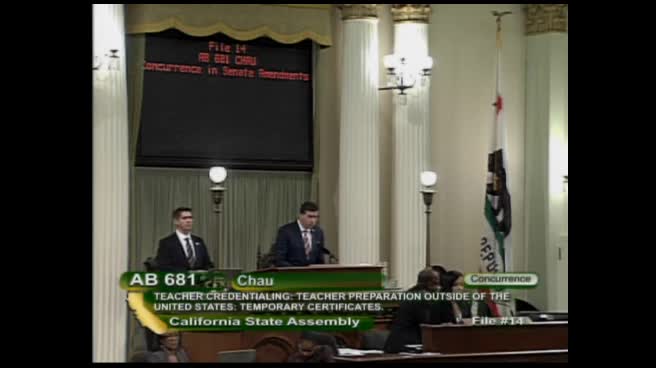
Bill Author

Bill Co-Author(s):