AB 700: Outdoor advertising displays: arenas.
- Session Year: 2017-2018
- House: Assembly
- Latest Version Date: 2018-09-11
The Outdoor Advertising Act provides for the regulation by the Department of Transportation of advertising displays, as defined, within view of public highways. The act exempts from certain of its provisions specified advertising displays located on the premises of an arena or that have been authorized, as of January 1, 2019, by, or in accordance with, a local ordinance as part of a specific plan or sign district adopted in connection with the approval of the arena and that are subject to specified conditions.
This bill would extend the date of this authorization to January 1, 2021.
Existing law provides for the licensure of adult alcoholism or drug abuse recovery or treatment facilities by the State Department of Health Care Services. Existing law provides the department the sole authority to determine the qualifications of personnel working within alcoholism or drug abuse recovery and treatment programs. Existing law requires an individual providing counseling services working within a program to be registered with, or certified by, a certifying organization approved by the department to register and certify counselors.This bill would establish a career ladder for substance use disorder counseling, as defined, to be maintained and updated by the State Department of Health Care Services. The bill would establish classifications for substance use disorder (SUD) counselor certification or registration, as specified, to be implemented by the certifying organizations, as defined. The bill would require any person who engages in the practice of SUD counseling to be certified by, or registered with, a certifying organization, unless specifically exempted. The bill would establish additional standards for registrants and interns, as defined, and impose additional requirements on SUD counselors. The bill would provide authority to the department to discipline a certificate holder or registrant as specified. The bill would authorize the department to implement these provisions by regulation. The bill would make conforming changes to related provisions.Existing law provides for the licensure of adult alcoholism or drug abuse recovery or treatment facilities by the State Department of Health Care Services. Existing law provides the department the sole authority to determine the qualifications of personnel working within alcoholism or drug abuse recovery and treatment programs, as specified. programs. Existing law requires an individual providing counseling services working within a program to be registered with, or certified by, a certifying organization approved by the department to register and certify counselors.
This bill would establish a career ladder for substance use disorder counseling, as defined, to be maintained and updated by the State Department of Health Care Services. The bill would establish classifications for substance use disorder (SUD) counselor certification or registration, as specified, to be implemented by the certifying organizations, as defined. The bill would require any person who engages in the practice of SUD counseling to be certified by, or registered with, a certifying organization, as specified, or to be licensed as a psychologist or clinical social worker, among others. unless specifically exempted. The bill would establish additional standards for registrants and interns, as specified, defined, and impose additional requirements on SUD counselors, as specified. counselors. The bill would provide authority to the department to discipline a certificate holder or registrant under specified circumstances, as specified. The bill would authorize the department to implement these provisions by regulation. The bill would make conforming changes to related provisions.
Existing law provides for the licensure of adult alcoholism or drug abuse recovery or treatment facilities by the State Department of Health Care Services. Existing law provides the department the sole authority to determine the qualifications of personnel working within alcoholism or drug abuse recovery and treatment programs, as specified. Existing law requires an individual providing counseling services working within a program to be registered with, or certified by, a certifying organization approved by the department to register and certify counselors.
This bill would establish a career ladder for substance use disorder counseling, as defined, to be maintained and updated by the State Department of Health Care Services. The bill would establish classifications for substance use disorder (SUD) counselor certification or registration, as specified, to be implemented by the certifying organizations, as defined. The bill would require any person who engages in the practice of SUD counseling to be certified by, or registered with, a certifying organization, as specified. specified, or to be licensed as a psychologist or clinical social worker, among others. The bill would establish additional standards for registrants and interns, as specified, and impose additional requirements on SUD counselors, as specified. The bill would provide authority to the department to discipline a certificate holder or registrant under specified circumstances, as specified. The bill would authorize the department to implement these provisions by regulation. The bill would make conforming changes to related provisions.
Existing law provides for the licensure of adult alcoholism or drug abuse recovery or treatment facilities by the State Department of Health Care Services. Existing law provides the department the sole authority to determine the qualifications of personnel working within alcoholism or drug abuse recovery and treatment programs, as specified. Existing law requires an individual providing counseling services working within a program to be registered with, or certified by, a certifying organization approved by the department to register and certify counselors.
This bill would establish a career ladder and a recommended scope of practice for substance use disorder counseling, as defined, to be created and maintained and updated by the State Department of Health Care Services. The bill would establish classifications for substance use disorder (SUD) counselor certification or registration, as specified, to be implemented by the certifying organizations, as defined. The bill would require any person who engages in the practice of SUD counseling to be certified by, or registered with, a certifying organization, as specified. The bill would establish additional standards for registrants and interns, as specified, and impose additional requirements on SUD counselors, as specified. The bill would provide authority to the department to discipline a certificate holder or registrant under specified circumstances, as specified. The bill would authorize the department to implement these provisions by regulation. The bill would make conforming changes to related provisions.
Existing law provides for the licensure of adult alcoholism or drug abuse recovery or treatment facilities by the State Department of Health Care Services. Existing law provides the department the sole authority to determine the qualifications of personnel working within alcoholism or drug abuse recovery and treatment programs, as specified. Existing law requires an individual providing counseling services working within a program to be registered with with, or certified by by, a certifying organization approved by the department to register and certify counselors.
This bill would establish a scope of practice and career ladder and a recommended scope of practice for substance use disorder counseling, as defined, to be created and maintained by the State Department of Health Care Services. The bill would establish classifications for substance use disorder (SUD) counselor certification or registration, as specified, to be implemented by the certifying organizations, as defined. The bill would require any person who engages in the practice of SUD counseling to be certified by, or registered with, a certifying organization, as specified. The bill would establish additional standards for registrants and interns, as specified, and impose additional requirements on SUD counselors, as specified. The bill would provide authority to the department to discipline a certificate holder or registrant under specified circumstances, as specified. The bill would also require the department to establish a registry of SUD counselors for purposes of employment searches, as specified. The bill would authorize the department to implement these provisions by regulation. The bill would make conforming changes to related provisions.
Existing law provides for the licensure of adult alcoholism or drug abuse recovery or treatment facilities by the State Department of Health Care Services. Existing law provides the department the sole authority to determine the qualifications of personnel working within alcoholism or drug abuse recovery and treatment programs, as specified. Existing law requires an individual providing counseling services working within a program to be registered with or certified by a certifying organization approved by the department to register and certify counselors.
This bill would establish a scope of practice and career ladder for substance use disorder counseling, as defined, to be maintained by the State Department of Health Care Services. The bill would establish classifications for substance use disorder (SUD) counselor certification, as specified, to be implemented by the certifying organizations, as defined. The bill would require any person who engages in the practice of SUD counseling to be certified by a certifying organization, as specified. The bill would provide authority to the department to discipline a certificate holder under specified circumstances, as specified. The bill would also require the department to establish a registry of SUD counselors for purposes of employment searches, as specified. The bill would authorize the department to implement these provisions by regulation. The bill would make conforming changes to related provisions.
(a)With the exception of Article 4 (commencing with Section 5300) and Sections 5400 to 5404, inclusive, this chapter does not apply to any advertising display used exclusively for any of the following purposes:
(1)To advertise the sale, lease, or exchange of real property upon which the advertising display is placed.
(2)To advertise directions to, and the sale, lease, or exchange of, real property for which the advertising display is placed; provided, that the exemption of this paragraph does not apply to advertising displays visible from a highway and subject to the Highway Beautification Act of 1965 (23 U.S.C. Sec. 131).
(3)To designate the name of the owner or occupant of the premises or to identify the premises.
(4)To advertise the business conducted, services rendered, or goods produced or sold upon the property on which the advertising display is placed if the display is on the same side of the highway and within 1,000 feet of the point on the property or within 1,000 feet of the entrance to the site at which the business is conducted, services are rendered, or goods are produced or sold.
(b)With the exception of Article 4 (commencing with Section 5300) and Sections 5400 to 5404, inclusive, this chapter does not apply to any advertising display used exclusively either to advertise products, goods, or services sold by persons on the premises of an arena on a regular basis, or to advertise any products, goods, or services marketed or promoted on the premises of an arena pursuant to a sponsorship marketing plan, if all of the following conditions are met:
(1)The arena is capable of providing a venue for professional sports on a permanent basis.
(2)The arena has a capacity of 15,000 or more seats.
(3)The advertising display is either of the following:
(A)Located on the premises of the arena.
(B)Has been authorized as of January 1, 2021, by, or in accordance with, a local ordinance, including, but not limited to, a specific plan or sign district adopted in connection with the approval of the arena by the city, county, or city and county, bears the name or logo of the arena, and is visible when approaching offramps from the interstate, primary, or state highways used to access the premises of the arena. No arena shall be permitted more than two advertising displays allowed under this subparagraph.
(c)(1)Any advertising display erected pursuant to subdivision (b) and located on the premises of the arena shall be lawful only if authorized by, or in accordance with, an ordinance, including, but not limited to, a specific plan or sign district, adopted by the city, county, or city and county, that regulates advertising displays on the premises of the arena by identifying the specific displays or establishing regulations that include, at a minimum, all of the following:
(A)Number of signs and total signage area allowed.
(B)Maximum individual signage area.
(C)Minimum sign separation.
(D)Illumination restrictions and regulations, including signage refresh rate, scrolling, and brightness.
(E)Illuminated sign hours of operation.
(2)Authorization of advertising displays under subdivision (b) is subject to the owner of the advertising display submitting to the department a copy of the ordinance adopted by the city, county, or city and county in which the arena is located authorizing the advertising display and, for signs located on the premises of the arena, identification of the provisions of the ordinance required under paragraph (1). The department shall certify that the proposed ordinance meets the minimum requirements contained in paragraph (1).
(3)An advertising display authorized pursuant to subdivision (b) shall not advertise products, goods, or services related to tobacco, firearms, or sexually explicit material.
(4)This chapter does not limit a local government from adopting ordinances prohibiting or further restricting the size, number, or type of advertising displays permitted by this section.
(d)As used in this section, the premises of an arena means either of the following:
(1)A venue for indoor or outdoor sports, concerts, or other events.
(2)Any development project or district encompassing the venue, adjacent to it, or separated from it only by public or private rights-of-way, the boundaries of which have been set by the city, county, or city and county in which the arena is located. The development project or district must be contiguous and may not extend more than 1,000 feet beyond the arena structure or any structure physically connected to the arena structure.
(e)As used in this section, sponsorship marketing plan means an agreement between the property owner, facility owner, facility operator, or occupant of the premises of an arena and a sponsor pursuant to which the sponsor is allowed to include its logo, slogan, or advertising on advertising displays and that meets both of the following conditions:
(1)The sponsorship marketing plan is for a period of not less than one year.
(2)The sponsorship marketing plan grants the sponsor the opportunity to display its logo, slogan, or advertising in the interior of structures on the premises of an arena, or conduct promotions, public relations, or marketing activities on the premises of an arena.
(f)Authorization of an advertising display under subdivision (b) that is a message center display is subject to the owner of the display complying with one of the following conditions:
(1)Making a message center display within the premises of the arena available on a space-available basis for use by the department or the Department of the California Highway Patrol for public service messages, including Emergency Alert System (Amber Alert) messages disseminated pursuant to Section 8594 of the Government Code, and messages containing, among other things, reports of commute times, drunk driving awareness messages, reports of accidents of a serious nature, and emergency disaster communications.
(2)Making a message center display not subject to this section that is under the control of the owner of the advertising display available on a space-available basis for public service messages in a location acceptable to the department and the Department of the California Highway Patrol.
(3)Providing funding to the department for the installation of a message center display to accommodate those public service messages, which may include funding as part of mitigation in connection with the approval of the arena by the city, county, or city and county.
(g)If an advertising display authorized under subdivision (b) is subject to a notice from the United States Department of Transportation, the Federal Highway Administration, or any other applicable federal agency to the state that the operation of that display will result in the reduction of federal aid highway funds provided in Section 131 of Title 23 of the United States Code, authorization of the display under subdivision (b) shall cease and the display owner shall remove all advertising copy from the display within 60 days after the state notifies the display owner of the receipt of the federal notice. Failure to remove the advertising copy pursuant to this subdivision shall result in a civil fine, imposed by the California Department of Transportation, of ten thousand dollars ($10,000) per day until the advertising copy is removed. The department shall not assume any liability in connection with cessation of operation or removal of an advertising display or advertising copy pursuant to this subdivision.
(h)The city, county, or city and county adopting the ordinance authorizing the displays erected pursuant to this section shall have primary responsibility for ensuring that the displays remain in conformance with all provisions of the ordinance and of this section. If the city, county, or city and county fails to ensure that the displays remain in conformance with all provisions of the ordinance and of this section after 30 days of receipt of a written notice from the department, the city, county, or city and county shall hold the department harmless and indemnify the department for all costs incurred by the department to ensure compliance with the ordinance and this section or to defend actions challenging the adoption of the ordinance allowing the displays.
(i)An advertising display lawfully erected on or before December 31, 2013, in conformity with subdivision (e) of this section as it read on that date, shall remain authorized, subject to the terms of that subdivision.
(a)With the exception of Article 4 (commencing with Section 5300) and Sections 5400 to 5404, inclusive, this chapter does not apply to any advertising display used exclusively for any of the following purposes:
(1)To advertise the sale, lease, or exchange of real property upon which the advertising display is placed.
(2)To advertise directions to, and the sale, lease, or exchange of, real property for which the advertising display is placed; provided, that the exemption of this paragraph does not apply to advertising displays visible from a highway and subject to the Highway Beautification Act of 1965 (23 U.S.C. Sec. 131).
(3)To designate the name of the owner or occupant of the premises or to identify the premises.
(4)To advertise the business conducted, services rendered, or goods produced or sold upon the property on which the advertising display is placed if the display is on the same side of the highway and within 1,000 feet of the point on the property or within 1,000 feet of the entrance to the site at which the business is conducted, services are rendered, or goods are produced or sold.
(b)With the exception of Article 4 (commencing with Section 5300) and Sections 5400 to 5404, inclusive, this chapter does not apply to any advertising display used exclusively either to advertise products, goods, or services sold by persons on the premises of an arena on a regular basis, or to advertise any products, goods, or services marketed or promoted on the premises of an arena pursuant to a sponsorship marketing plan, if all of the following conditions are met:
(1)The arena is capable of providing a venue for professional sports on a permanent basis.
(2)The arena has a capacity of 15,000 or more seats.
(3)The advertising display is either of the following:
(A)Located on the premises of the arena.
(B)Has been authorized as of January 1, 2019, 2021, by, or in accordance with, a local ordinance, including, but not limited to, a specific plan or sign district adopted in connection with the approval of the arena by the city, county, or city and county, bears the name or logo of the arena, and is visible when approaching offramps from the interstate, primary, or state highways used to access the premises of the arena. No arena shall be permitted more than two advertising displays allowed under this subparagraph.
(c)(1)Any advertising display erected pursuant to subdivision (b) and located on the premises of the arena shall be lawful only if authorized by, or in accordance with, an ordinance, including, but not limited to, a specific plan or sign district, adopted by the city, county, or city and county, that regulates advertising displays on the premises of the arena by identifying the specific displays or establishing regulations that include, at a minimum, all of the following:
(A)Number of signs and total signage area allowed.
(B)Maximum individual signage area.
(C)Minimum sign separation.
(D)Illumination restrictions and regulations, including signage refresh rate, scrolling, and brightness.
(E)Illuminated sign hours of operation.
(2)Authorization of advertising displays under subdivision (b) is subject to the owner of the advertising display submitting to the department a copy of the ordinance adopted by the city, county, or city and county in which the arena is located authorizing the advertising display and, for signs located on the premises of the arena, identification of the provisions of the ordinance required under paragraph (1). The department shall certify that the proposed ordinance meets the minimum requirements contained in paragraph (1).
(3)An advertising display authorized pursuant to subdivision (b) shall not advertise products, goods, or services related to tobacco, firearms, or sexually explicit material.
(4)This chapter does not limit a local government from adopting ordinances prohibiting or further restricting the size, number, or type of advertising displays permitted by this section.
(d)As used in this section, the premises of an arena means either of the following:
(1)A venue for indoor or outdoor sports, concerts, or other events.
(2)Any development project or district encompassing the venue, adjacent to it, or separated from it only by public or private rights-of-way, the boundaries of which have been set by the city, county, or city and county in which the arena is located. The development project or district must be contiguous and may not extend more than 1,000 feet beyond the arena structure or any structure physically connected to the arena structure.
(e)As used in this section, sponsorship marketing plan means an agreement between the property owner, facility owner, facility operator, or occupant of the premises of an arena and a sponsor pursuant to which the sponsor is allowed to include its logo, slogan, or advertising on advertising displays and that meets both of the following conditions:
(1)The sponsorship marketing plan is for a period of not less than one year.
(2)The sponsorship marketing plan grants the sponsor the opportunity to display its logo, slogan, or advertising in the interior of structures on the premises of an arena, or conduct promotions, public relations, or marketing activities on the premises of an arena.
(f)Authorization of an advertising display under subdivision (b) that is a message center display is subject to the owner of the display complying with one of the following conditions:
(1)Making a message center display within the premises of the arena available on a space-available basis for use by the department or the Department of the California Highway Patrol for public service messages, including Emergency Alert System (Amber Alert) messages disseminated pursuant to Section 8594 of the Government Code, and messages containing, among other things, reports of commute times, drunk driving awareness messages, reports of accidents of a serious nature, and emergency disaster communications.
(2)Making a message center display not subject to this section that is under the control of the owner of the advertising display available on a space-available basis for public service messages in a location acceptable to the department and the Department of the California Highway Patrol.
(3)Providing funding to the department for the installation of a message center display to accommodate those public service messages, which may include funding as part of mitigation in connection with the approval of the arena by the city, county, or city and county.
(g)If an advertising display authorized under subdivision (b) is subject to a notice from the United States Department of Transportation, the Federal Highway Administration, or any other applicable federal agency to the state that the operation of that display will result in the reduction of federal aid highway funds provided in Section 131 of Title 23 of the United States Code, authorization of the display under subdivision (b) shall cease and the display owner shall remove all advertising copy from the display within 60 days after the state notifies the display owner of the receipt of the federal notice. Failure to remove the advertising copy pursuant to this subdivision shall result in a civil fine, imposed by the California Department of Transportation, of ten thousand dollars ($10,000) per day until the advertising copy is removed. The department shall not assume any liability in connection with cessation of operation or removal of an advertising display or advertising copy pursuant to this subdivision.
(h)The city, county, or city and county adopting the ordinance authorizing the displays erected pursuant to this section shall have primary responsibility for ensuring that the displays remain in conformance with all provisions of the ordinance and of this section. If the city, county, or city and county fails to ensure that the displays remain in conformance with all provisions of the ordinance and of this section after 30 days of receipt of a written notice from the department, the city, county, or city and county shall hold the department harmless and indemnify the department for all costs incurred by the department to ensure compliance with the ordinance and this section or to defend actions challenging the adoption of the ordinance allowing the displays.
(i)An advertising display lawfully erected on or before December 31, 2013, in conformity with subdivision (e) of this section as it read on that date, shall remain authorized, subject to the terms of that subdivision.
All matter omitted in this version of the bill appears in the bill as amended in the Assembly, May 30, 2017. (JR11)(a)The Legislature finds and declares all of the following:
(1)Substance use disorders are a complex problem with biological, behavioral, and social dimensions. There are an estimated 3.5 million persons with diagnosable substance use disorders receiving treatment in more than 2,500 private or public alcohol and drug treatment programs throughout California.
(2)Substance use disorder (SUD) counselors serve a vulnerable population in California. In addition to professional counseling, treatment often includes medically assisted treatment and treatment for cooccurring disorders.
(3)In California, there are no uniform standards for counselor certification.
(4)The State Department of Health Care Services oversees certified SUD counselors and registrants indirectly through certain state-approved, private certifying organizations. However, each certifying organization currently has its own levels of education and experience required for certification or registration.
(5)A standardized career ladder would correct this problem by providing employers with what they need to hire SUD counselors or registrants with appropriate levels of education and experience.
(6)To address the changes in business practices and workforce standards required by substance use parity, and in order to integrate these services into the mainstream health care delivery system, the Substance Abuse and Mental Health Services Administration (SAMHSA) of the federal Department of Health and Human Services released a report in September 2011 titled Scopes of Practice and Career Ladder for Substance Use Disorder Counseling. The SAMHSA report identifies a model career ladder for SUD counseling. Each category includes specific minimums for addiction studies education, supervised clinical experience, and the passing of an examination.
(b)Therefore, in enacting this act, it is the intent of the Legislature to do all of the following:
(1)Bring the states SUD counselor certification and registration requirements up to national standards, as updated to meet our states workforce needs.
(2)Protect Californians, consumers of addiction services, and families from complex, inconsistent SUD counselor certification and registration standards.
(3)Provide a single, consistent, standardized system of certification and registration that recognizes levels of higher education.
(4)Introduce a tiered system that protects the existing workforce, recognizes multiple levels of SUD counselor education and experience, experience and provides a career ladder and supervision appropriate for each level. ladder. The tiered system protects the existing workforce by transitioning all registrants and certified counselors into the appropriate tier upon renewal of their previous registration or certification, and by exempting from the career tiers certain professionals licensed under Division 2 (commencing with Section 500) of the Business and Professions Code and persons working towards licensure under those provisions. The tiered system will not negatively impact the ability of registrants and counselors to perform their current duties.
SEC. 2.Section 11833 of the Health and Safety Code is amended to read:11833.(a)The department shall have the sole authority in state government to determine the qualifications, including the appropriate skills, education, training, and experience of registered and certified personnel working within alcoholism or drug abuse recovery and treatment programs licensed, certified, or funded under this part, consistent with Chapter 7.7 (commencing with Section 11834.75).
(b)(1)Except for licensed professionals, as defined by the department, the department shall require that an individual providing counseling services working within a program described in subdivision (a) be registered with or certified by a certifying organization approved by the department to register and certify counselors, consistent with Chapter 7.7 (commencing with Section 11834.75).
(2)The department shall not approve a certifying organization that does not, prior to registering or certifying an individual, contact other department-approved certifying organizations to determine whether the individual has ever had his or her registration or certification revoked.
(c)If a counselors registration or certification has been previously revoked, the certifying organization shall deny the request for registration and shall send the counselor a written notice of denial. The notice shall specify the counselors right to appeal the denial in accordance with applicable statutes and regulations. regulations and the right to register and seek new certification if the previous revocation is reversed by the department.
(d)The department shall have the authority to conduct periodic reviews of certifying organizations to determine compliance with all applicable laws and regulations, including subdivision (c), and to take actions for noncompliance, including revocation of the departments approval.
(e)The department may charge the certifying organization a fee to cover the reasonable costs of the department to regulate the certifying organizations according to this section.
(e)(f)(1)Notwithstanding Chapter 3.5 (commencing with Section 11340) of Part 1 of Division 3 of Title 2 of the Government Code, the department, without taking any further regulatory action, shall implement, interpret, or make specific this section by means of all-county letters, plan letters, plan or provider bulletins, or similar instructions until the time that regulations are adopted.
(2)The department shall adopt regulations by December 31, 2017, in accordance with the requirements of Chapter 3.5 (commencing with Section 11340) of Part 1 of Division 3 of Title 2 of the Government Code.
SEC. 3.Section 11834.27 of the Health and Safety Code is amended to read:11834.27.(a) The department shall have the sole authority in state government to establish the appropriate minimum qualifications of the licensee or designated administrator, and the staff of a provider of any of the services specified in subdivision (a) of Section 11834.26. These qualifications may include, but not be limited to, education, skills, life experience, and training.(b) This section does not apply to credentialing or licensing of individuals or to certification qualifications established pursuant to Chapter 7 (commencing with Section 11830) or Chapter 7.7 (commencing with Section 11834.75).SEC. 4.SEC. 3.Chapter 7.7 (commencing with Section 11834.75) is added to Part 2 of Division 10.5 of the Health and Safety Code, to read:7.7.Career Ladder for Substance Use Disorder Counseling: Registration and Certification11834.75.For purposes of this chapter:
(a)BPPE means the Bureau for Private Postsecondary Education.
(b)Certified addiction counselor intern or intern means an uncertified person who has fulfilled the testing and education requirements in Section 11834.76 to become certified, who is seeking to meet the supervised experience requirements of this chapter, and is registered with an approved certifying organization for this purpose.
(c)Certifying organization means an organization approved to register or certify individuals as SUD counselors in accordance with Section 11833.
(d)Clinical supervision means the ongoing process performed by a supervisor or monitoring the performance of one or more supervisees to ensure high-quality service delivery across domains of addiction counselor development, professional and ethical standards, program development, quality assurance, performance evaluation, and administration.
(e)Clock hour means 50 continuous minutes of instruction. Fifteen clock hours are equal to one semester unit of college credit or one and one-half quarter units of college credit.
(f)Department means the State Department of Health Care Services.
(g)NCCA/ICE means the National Commission for Certifying Agencies of the Institute for Credentialing Excellence.
(h)Practicum means a school or college course that is designed to give students supervised practical experience in previously studied theories of addiction treatment.
(i)Programmatic accrediting organization means an accreditation entity that is recognized by the Council for Higher Education Accreditation (CHEA) or the State of California. Recognition by CHEA affirms that the standards and processes of the accrediting organization are consistent with the academic quality, improvement, and accountability expectations that CHEA has established, including the eligibility standard that the majority of institutions or programs each accredits are degree-granting.
(j)Regional accrediting organization means an accreditation entity for higher education accreditation as recognized by the United States Department of Education and the Council for Higher Education Accreditation, including, but not limited to: Middle States Association of Colleges and Schools (Middle States Commission on Higher Education), New England Association of Schools and Colleges (Commission on Institutions of Higher Education and the Commission on Technical and Career Institutions), North Central Association of Colleges and Schools (Higher Learning Commission), Northwest Commission on Colleges and Universities, Southern Association of Colleges and Schools (Southern Association of Colleges and Schools Commission on Colleges), and Western Association of Schools and Colleges (Accrediting Commission for Community and Junior Colleges and Accrediting Commission for Senior Colleges and Universities).
(k)Registrant means an individual who has registered with one of the approved certifying organizations for purposes of providing substance use disorder counseling, and who is seeking to become certified as a SUD counselor.
(l)Substance use disorder counseling or SUD means and includes any or all of the following:
(1)Evaluating a persons alcohol or other drug treatment or recovery needs, including screening prior to admission, intake, and assessment of need for services.
(2)Developing and updating a treatment or recovery plan.
(3)Implementing a treatment or recovery plan.
(4)Continuing assessment or treatment planning.
(5)Conducting individual counseling sessions, group counseling sessions, face-to-face interviews, or counseling for families, couples, and other individuals.
(6)Documenting counseling activities, assessments, treatment and recovery planning, clinical reports related to treatment provided, progress notes, discharge summaries, and all other client-related data.
(m)Substance use disorder counselor or SUD counselor means a person who is certified as an alcohol or other drug counselor by an approved certifying organization and who provides services or treatment at an adult alcoholism or drug abuse recovery or treatment facility.
(n)TAP 21 means the nationally accepted, evidence-based standard for addiction studies education curriculum and means the educational foundation for California SUD counselor certification, pursuant to Chapter 8 (commencing with Section 13000) of Division 4 of Title 9 of the California Code of Regulations.
11834.76.Prior to certification as a SUD counselor, a certifying organization shall require each registrant to comply with the following:
(a)Complete a minimum of 315 documented hours of formal classroom SUD education, which shall include at least the following subjects:
(1)The curriculum contained in TAP 21 related to clinical evaluation, treatment planning, referrals, service coordination, counseling, client, family, and community education, case management, and professional and ethical responsibilities.
(2)Provision of services to special populations, such as aging individuals, individuals with cooccurring disorders, such as alcoholism and mental illness, individuals with post-traumatic stress disorder (PTSD), individuals with disabilities, diverse populations, individuals with cultural differences, or individuals on probation or parole.
(3)Ethics.
(4)Communicable diseases, including tuberculosis, HIV, and hepatitis C.
(5)Prevention of sexual harassment.
(b)Complete a minimum of 250 documented hours of supervised SUD field work based on specified curriculum and supervised onsite by a SUD counselor. As used in this subdivision, supervised means that the individual supervising the training shall do both of the following:
(1)Be physically present and available onsite or at an immediately adjacent site, but not necessarily in the same room at all times.
(2)Document in the registrants record that the registrant has completed the supervised training required by this subdivision.
(c)Complete an additional 2,080 or more documented hours (dependent on level of certification) of paid or unpaid supervised work experience or internship providing counseling services in a SUD program prior to, after, or at the same time as completion of the education required in subdivision (a) and the supervised SUD training required in subdivision (b).
(d)Obtain a score of at least 70 percent on a written or oral examination approved by the certifying organization.
(e)Sign a statement documenting whether his or her prior certification as a SUD counselor has ever been revoked.
(f)Sign an agreement to abide by the certifying organizations code of conduct.
11834.765.Registration shall be renewed annually until certification is complete. A registrant has five years from the date of registration with a certifying organization to become certified.
11834.766.In addition to any other requirement imposed by any other regulation or this chapter, a certified addiction counselor intern may conduct substance use disorder counseling under this chapter, and meet his or her documented hour requirements under Section 11834.76, if subject to clinical supervision.
11834.767.A SUD counselor shall additionally comply with the following requirements:
(a)Biennially complete a minimum of 40 hours of continuing education in addiction-specific topics, of which nine hours shall include addiction-specific laws and ethics.
(b)Receive a passing score on an NCCA/ICE-approved or nationally recognized addiction counseling examination as approved by the department.
(c)(1)Possess an earned degree in addiction counseling, psychology, social work, counseling, marriage and family therapy, counseling psychology, clinical psychology, human services, anthropology, biology, physiology, education, management, business administration, counseling, nursing, medicine, pharmacology, public health, sociology, criminal justice, kinesiology, jurisprudence, or other clinically focused major or an equivalent degree recognized by the certifying organization.(A)Paragraph (1) includes all degrees that lead to clinical licenses.(B)Innovative, cross-disciplinary fields, such as social ecology, may be accepted under paragraph (1) after examination of course content.(2)The degree described under paragraph (1) shall be from(c)For classifications CAC 2 to CAC 5, inclusive, receive the required degree specified in Section 11834.77, from an institution of higher learning accredited by a regional accrediting organization, a programmatic accrediting organization, or a BPPE-approved degree-granting institution that had a BPPE-approved addiction studies degree-granting program in place as of January 1, 2015.
(d)(1)Complete TAP 21 education, as follows:
(A)Complete 315 clock hours (or 21 semester units) of addiction-specific education based on the TAP 21.
(B)Complete a supervised practicum of no less than 250 hours performed in an addiction treatment setting. The practical experience shall include the TAP 21 practice dimensions demonstrating the application of knowledge and skills in a practice setting essential to professional addiction counseling.
(C)Complete a supervised internship performed in an addiction treatment setting. The practical experience shall include the TAP 21 practice dimensions demonstrating the application of knowledge and skills in a practice setting essential to professional addiction counseling.
(2)For subparagraphs (B) and (C) of paragraph (1), the applicant shall provide proof of completion to the certifying organization, including a summary of hours completed with an original signed letter from the clinical supervisor.
11834.77.(a)There is hereby further established a career ladder for substance use disorder counseling, as set forth in this section. The career ladder shall be maintained and updated by the department, as necessary, in conformance with the requirements set forth in this section.
(b)The following classifications shall be established for SUD counselor certification in this state:
(1)Certified Addiction Counselor 5 (CAC 5).
(2)Certified Addiction Counselor 4 (CAC 4).
(3)Certified Addiction Counselor 3 (CAC 3).
(4)Certified Addiction Counselor 2 (CAC 2).
(5)Certified Addiction Counselor 1 (CAC 1).
(6)Certified Addiction Counselor (CAC).
(7)Certified Addiction Counselor Registrant (CAC Registrant).
(c)(1)The CAC 5 shall meet all of the following requirements:
(A)Have a doctorate degree in addiction studies or related discipline or have a medical degree.
(B)Meet the minimum education requirements for the CAC.
(C)Have 3,000 hours of postdoctoral or equivalent supervised work experience.
(2)The CAC 5 may engage in private practice if he or she also holds a license under Division 2 (commencing with Section 500) of the Business and Professions Code.
(d)(1)The CAC 4 shall meet all of the following requirements:
(A)Have a masters degree in addiction studies or related discipline.
(B)Meet the minimum education requirements for the CAC.
(C)Have 3,000 hours of post-masters supervised work experience.
(2)The CAC 4 may engage in private practice if he or she also holds a license under Division 2 (commencing with Section 500) of the Business and Professions Code.
(e)(1)The CAC 3 shall meet all of the following requirements:
(A)Have a bachelors degree in addiction studies or a related degree.
(B)Meet the minimum education requirements for the CAC.
(C)Have 2,080 hours of supervised work experience.
(2)The CAC 3 may not engage in private practice.
(f)(1)The CAC 2 shall meet all of the following requirements:
(A)Have an associates degree in addiction studies or related discipline.
(B)Meet the minimum education requirements for the CAC.
(C)Have 2,080 hours of supervised work experience.
(2)The CAC 2 may not engage in private practice.
(g)(1)The CAC 1 shall meet all of the following requirements:
(A)Have a high school degree or GED.
(B)Have a 39-unit community college certificate in addiction studies from a chancellor-approved program in a regionally accredited college, which includes the minimum education requirements for a CAC.
(C)Have 2,080 hours of supervised work experience.
(2)The CAC 1 may not engage in private practice.
(h)(1)The CAC shall meet both all of the following requirements:
(A)Have a high school degree or GED.
(B)Have 315 clock hours (21 units) of addiction studies education.
(C)Have 6,000 hours of supervised work experience.
(2)The CAC may not engage in private practice.
(i)(1)The CAC Registrants shall meet both of the following requirements:
(A)Be registered with a certifying organization.
(B)Be enrolled in a school or completing supervised experience hours as an intern.
(2)A CAC Registrant may conduct supervised substance use disorder counseling as a CAC pursuant to this chapter, and meet his or her clock hour and supervised work experience requirements for a CAC, as specified under subdivision (h), if subject to clinical supervision.
11834.78.(a)Any (1)Except as provided in paragraph (2), any person who engages in the practice of substance use disorder counseling shall be certified by, or registered with, a certifying organization pursuant to the categories established pursuant to Section 11834.77, including registrants and interns, or shall be licensed registrants.
(2)The following persons are be exempt from the requirements specified in paragraph (1):
(A)A person licensed under Division 2 (commencing with Section 500) of the Business and Professions Code as a psychologist, clinical social worker, professional clinical counselor, or marriage or and family therapist.
(B)A person who is gaining supervised experience toward licensure as a psychologist, clinical social worker, professional clinical counselor, or marriage and family therapist pursuant to Division 2 (commencing with Section 500) of the Business and Professions Code.
(b)Each certifying organization shall establish an application process to implement the requirements established under this chapter. Each certifying organization may establish a reasonable application fee for certification or registration at an amount that is sufficient to cover, but shall not exceed, the reasonable costs of implementing this chapter.
(c)(1)This section shall apply to individuals who first apply for certification or registration on and after January 1, 2018. 2019.
(2)This section shall only apply to a person who is currently certified by, or registered with, a certifying organization as of January 1, 2018, 2019, at the time of renewal of his or her certification or registration. At that time, the certifying organization shall determine which category of substance use disorder counseling the person is qualified to practice pursuant to Section 11834.77.
11834.79.The department has the authority to discipline a person who is certified or registered under this chapter consistent with the requirements and procedures set forth in Sections 13060 to 13070, inclusive, of Title 9 of the California Code of Regulations.
11834.795.(a)The department may adopt regulations to implement this chapter.
(b)When developing regulations, the department shall consider the TAP 21 standards for substance abuse counselors described in subdivision (n) of Section 11834.75.
(a)The Legislature finds and declares all of the following:
(1)Substance use disorders are a complex problem with biological, behavioral, and social dimensions. There are an estimated 3.5 million persons with diagnosable substance use disorders receiving treatment in more than 2,500 private or public alcohol and drug treatment programs throughout California.
(2)Substance use disorder (SUD) counselors serve a vulnerable population in California. In addition to professional counseling, treatment often includes medically assisted treatment and treatment for cooccurring disorders.
(3)In California, there are no uniform standards for counselor certification.
(4)The State Department of Health Care Services oversees certified SUD counselors and registrants indirectly through certain certifying organizations. However, each certifying organization currently has its own levels of education and experience required for certification or registration.
(5)A standardized career ladder would correct this problem by providing employers with what they need to hire SUD counselors or registrants with appropriate levels of education and experience.
(6)To address the changes in business practices and workforce standards required by substance use parity, and in order to integrate these services into the mainstream health care delivery system, the Substance Abuse and Mental Health Services Administration (SAMHSA) of the federal Department of Health and Human Services released a report in September 2011 titled Scopes of Practice and Career Ladder for Substance Use Disorder Counseling. The SAMHSA report identifies a model career ladder for SUD counseling. Each category includes specific minimums for addiction studies education, supervised clinical experience, and the passing of an examination.
(b)Therefore, in enacting this act, it is the intent of the Legislature to do all of the following:
(1)Bring the states SUD counselor certification and registration requirements up to national standards, as updated to meet our states workforce needs.
(2)Protect Californians, consumers of addiction services, and families from complex, inconsistent SUD counselor certification and registration standards.
(3)Provide a single, consistent, standardized system of certification and registration that recognizes levels of higher education.
(4)Introduce a tiered system that protects the existing workforce, recognizes multiple levels of SUD counselor education and experience, and provides a career ladder and supervision appropriate for each level.
SEC. 2.Section 11833 of the Health and Safety Code is amended to read:11833.(a)The department shall have the sole authority in state government to determine the qualifications, including the appropriate skills, education, training, and experience of personnel working within alcoholism or drug abuse recovery and treatment programs licensed, certified, or funded under this part, consistent with Chapter 7.7 (commencing with Section 11834.75).
(b)(1)Except for licensed professionals, as defined by the department, the department shall require that an individual providing counseling services working within a program described in subdivision (a) be registered with or certified by a certifying organization approved by the department to register and certify counselors, consistent with Chapter 7.7 (commencing with Section 11834.75).
(2)The department shall not approve a certifying organization that does not, prior to registering or certifying an individual, contact other department-approved certifying organizations to determine whether the individual has ever had his or her registration or certification revoked.
(c)If a counselors registration or certification has been previously revoked, the certifying organization shall deny the request for registration and shall send the counselor a written notice of denial. The notice shall specify the counselors right to appeal the denial in accordance with applicable statutes and regulations.
(d)The department shall have the authority to conduct periodic reviews of certifying organizations to determine compliance with all applicable laws and regulations, including subdivision (c), and to take actions for noncompliance, including revocation of the departments approval.
(e)(1)Notwithstanding Chapter 3.5 (commencing with Section 11340) of Part 1 of Division 3 of Title 2 of the Government Code, the department, without taking any further regulatory action, shall implement, interpret, or make specific this section by means of all-county letters, plan letters, plan or provider bulletins, or similar instructions until the time that regulations are adopted.
(2)The department shall adopt regulations by December 31, 2017, in accordance with the requirements of Chapter 3.5 (commencing with Section 11340) of Part 1 of Division 3 of Title 2 of the Government Code.
SEC. 3.Section 11834.27 of the Health and Safety Code is amended to read:11834.27.(a) The department shall have the sole authority in state government to establish the appropriate minimum qualifications of the licensee or designated administrator, and the staff of a provider of any of the services specified in subdivision (a) of Section 11834.26. These qualifications may include, but not be limited to, education, skills, life experience, and training.
(b) This section does not apply to credentialing or licensing of individuals or to certification qualifications established pursuant to Chapter 7 (commencing with Section 11830) or Chapter 7.7 (commencing with Section 11834.75).
SEC. 4.Chapter 7.7 (commencing with Section 11834.75) is added to Part 2 of Division 10.5 of the Health and Safety Code, to read:7.7.Career Ladder for Substance Use Disorder Counseling: Registration and Certification11834.75.For purposes of this chapter:
(a)BPPE means the Bureau for Private Postsecondary Education.
(b)Certified addiction counselor intern or intern means an uncertified person who has fulfilled the testing and education requirements in Section 11834.76 to become certified, who is seeking to meet the supervised experience requirements of this chapter, and is registered with an approved certifying organization for this purpose.
(c)Certifying organization means an organization approved to register or certify individuals as SUD counselors in accordance with Section 11833.
(d)Clinical supervision means the ongoing process performed by a supervisor or monitoring the performance of one or more supervisees to ensure high-quality service delivery across domains of addiction counselor development, professional and ethical standards, program development, quality assurance, performance evaluation, and administration.
(e)Clock hour means 50 continuous minutes of instruction. Fifteen clock hours are equal to one semester unit of college credit or one and one-half quarter units of college credit.
(f)Department means the State Department of Health Care Services.
(g)NCCA/ICE means the National Commission for Certifying Agencies of the Institute for Credentialing Excellence.
(h)Practicum means a school or college course that is designed to give students supervised practical experience in previously studied theories of addiction treatment.
(i)Programmatic accrediting organization means an accreditation entity that is recognized by the Council for Higher Education Accreditation (CHEA) or the State of California. Recognition by CHEA affirms that the standards and processes of the accrediting organization are consistent with the academic quality, improvement, and accountability expectations that CHEA has established, including the eligibility standard that the majority of institutions or programs each accredits are degree-granting.
(j)Regional accrediting organization means an accreditation entity for higher education accreditation as recognized by the United States Department of Education and the Council for Higher Education Accreditation, including, but not limited to: Middle States Association of Colleges and Schools (Middle States Commission on Higher Education), New England Association of Schools and Colleges (Commission on Institutions of Higher Education and the Commission on Technical and Career Institutions), North Central Association of Colleges and Schools (Higher Learning Commission), Northwest Commission on Colleges and Universities, Southern Association of Colleges and Schools (Southern Association of Colleges and Schools Commission on Colleges), and Western Association of Schools and Colleges (Accrediting Commission for Community and Junior Colleges and Accrediting Commission for Senior Colleges and Universities).
(k)Registrant means an individual who has registered with one of the approved certifying organizations for purposes of providing substance use disorder counseling, and who is seeking to become certified as a SUD counselor.
(l)Substance use disorder counseling or SUD means and includes any or all of the following:
(1)Evaluating a persons alcohol or other drug treatment or recovery needs, including screening prior to admission, intake, and assessment of need for services.
(2)Developing and updating a treatment or recovery plan.
(3)Implementing a treatment or recovery plan.
(4)Continuing assessment or treatment planning.
(5)Conducting individual counseling sessions, group counseling sessions, face-to-face interviews, or counseling for families, couples, and other individuals.
(6)Documenting counseling activities, assessments, treatment and recovery planning, clinical reports related to treatment provided, progress notes, discharge summaries, and all other client-related data.
(m)Substance use disorder counselor or SUD counselor means a person who is certified as an alcohol or other drug counselor by an approved certifying organization and who provides services or treatment at an adult alcoholism or drug abuse recovery or treatment facility.
(n)TAP 21 means the nationally accepted, evidence-based standard for addiction studies education curriculum and means the educational foundation for California SUD counselor certification, pursuant to Chapter 8 (commencing with Section 13000) of Division 4 of Title 9 of the California Code of Regulations.
11834.76.Prior to certification as a SUD counselor, a certifying organization shall require each registrant to comply with the following:
(a)Complete a minimum of 315 documented hours of formal classroom SUD education, which shall include at least the following subjects:
(1)The curriculum contained in TAP 21 related to clinical evaluation, treatment planning, referrals, service coordination, counseling, client, family, and community education, case management, and professional and ethical responsibilities.
(2)Provision of services to special populations, such as aging individuals, individuals with cooccurring disorders, such as alcoholism and mental illness, individuals with post-traumatic stress disorder (PTSD), individuals with disabilities, diverse populations, individuals with cultural differences, or individuals on probation or parole.
(3)Ethics.
(4)Communicable diseases, including tuberculosis, HIV disease, HIV, and hepatitis C.
(5)Prevention of sexual harassment.
(b)Complete a minimum of 250 documented hours of supervised SUD field work based on specified curriculum and supervised onsite by a SUD counselor. As used in this subdivision, supervised means that the individual supervising the training shall do both of the following:
(1)Be physically present and available onsite or at an immediately adjacent site, but not necessarily in the same room at all times.
(2)Document in the registrants record that the registrant has completed the supervised training required by this subdivision.
(c)Complete an additional 2,080 or more documented hours (dependent on level of certification) of paid or unpaid supervised work experience or internship providing counseling services in a SUD program prior to, after, or at the same time as completion of the education required in subdivision (a) and the supervised SUD training required in subdivision (b).
(d)Obtain a score of at least 70 percent on a written or oral examination approved by the certifying organization.
(e)Sign a statement documenting whether his or her prior certification as a SUD counselor has ever been revoked.
(f)Sign an agreement to abide by the certifying organizations code of conduct.
11834.765.Registration shall be renewed annually until certification is complete. A registrant has five years from the date of registration with a certifying organization to become certified.
11834.766.In addition to any other requirement imposed by any other regulation or this chapter, a certified addiction counselor intern may conduct substance use disorder counseling under this chapter, and meet his or her documented hour requirements under Section 11834.76, if subject to clinical supervision.
11834.767.A SUD counselor shall additionally comply with the following requirements:
(a)Biennially complete a minimum of 40 hours of continuing education in addiction-specific topics, of which nine hours shall include addiction-specific laws and ethics.
(b)Receive a passing score on an NCCA/ICE-approved or nationally recognized addiction counseling examination as approved by the department.
(c)(1)Possess an earned degree in addiction counseling, psychology, social work, counseling, marriage and family therapy, counseling psychology, clinical psychology, human services, anthropology, biology, physiology, education, management, business administration, counseling, nursing, medicine, pharmacology, public health, sociology, criminal justice, kinesiology, jurisprudence, or other clinically focused major or an equivalent degree recognized by the certifying organization.
(A)Paragraph (1) includes all degrees that lead to clinical licenses.
(B)Innovative, cross-disciplinary fields, such as social ecology, may be accepted under paragraph (1) after examination of course content.
(2)The degree described under paragraph (1) shall be from an institution of higher learning accredited by a regional accrediting organization, a programmatic accrediting organization, or a BPPE-approved degree-granting institution that had a BPPE-approved addiction studies degree-granting program in place as of January 1, 2015.
(d)(1)Complete TAP 21 education, as follows:
(A)Complete 315 clock hours (or 21 semester units) of addiction-specific education based on the TAP 21.
(B)Complete a supervised practicum of no less than 250 hours performed in an addiction treatment setting. The practical experience shall include the TAP 21 practice dimensions demonstrating the application of knowledge and skills in a practice setting essential to professional addiction counseling.
(C)Complete a supervised internship performed in an addiction treatment setting. The practical experience shall include the TAP 21 practice dimensions demonstrating the application of knowledge and skills in a practice setting essential to professional addiction counseling.
(2)For subparagraphs (B) and (C) of paragraph (1), the applicant shall provide proof of completion to the certifying organization, including a summary of hours completed with an original signed letter from the clinical supervisor.
11834.77.(a)There is hereby further established a career ladder for substance use disorder counseling, as set forth in this section. The career ladder shall be maintained and updated by the department, as necessary, in conformance with the requirements set forth in this section.
(b)The following classifications shall be established for SUD counselor certification in this state:
(1)Certified Addiction Counselor 5 (CAC 5).
(2)Certified Addiction Counselor 4 (CAC 4).
(3)Certified Addiction Counselor 3 (CAC 3).
(4)Certified Addiction Counselor 2 (CAC 2).
(5)Certified Addiction Counselor 1 (CAC 1).
(6)Certified Addiction Counselor (CAC).
(c)(1)The CAC 5 shall meet all of the following requirements:
(A)Have a doctorate degree in addiction studies or related discipline or have a medical degree.
(B)Meet the minimum education requirements for the CAC.
(C)Have 3,000 hours of postdoctoral or equivalent supervised work experience.
(2)The CAC 5 may engage in private practice if he or she also holds a license under Division 2 (commencing with Section 500) of the Business and Professions Code.
(d)(1)The CAC 4 shall meet all of the following requirements:
(A)Have a masters degree in addiction studies or related discipline.
(B)Meet the minimum education requirements for the CAC.
(C)Have 3,000 hours of post-masters supervised work experience.
(2)The CAC 4 may engage in private practice if he or she also holds a license under Division 2 (commencing with Section 500) of the Business and Professions Code.
(e)(1)The CAC 3 shall meet all of the following requirements:
(A)Have a bachelors degree in addiction studies or a related degree.
(B)Meet the minimum education requirements for the CAC.
(C)Have 2,080 hours of supervised work experience.
(2)The CAC 3 may not engage in private practice.
(f)(1)The CAC 2 shall meet all of the following requirements:
(A)Have an associates degree in addiction studies or related discipline.
(B)Meet the minimum education requirements for the CAC.
(C)Have 2,080 hours of supervised work experience.
(2)The CAC 2 may not engage in private practice.
(g)(1)The CAC 1 shall meet all of the following requirements:
(A)Have a high school degree or GED.
(B)Have a 39-unit community college certificate in addiction studies from a chancellor-approved program in a regionally accredited college, which includes the minimum education requirements for a CAC.
(C)Have 2,080 hours of supervised work experience.
(2)The CAC 1 may not engage in private practice.
(h)(1)The CAC shall meet both of the following requirements:
(A)Have a high school degree or GED.
(B)Have 315 clock hours (21 units) of addiction studies education.
(C)Have 6,000 hours of supervised work experience.
(2)The CAC may not engage in private practice.
11834.78.(a)Any person who engages in the practice of substance use disorder counseling shall be certified by, or registered with, a certifying organization pursuant to the categories established pursuant to Section 11834.77, including registrants and interns. interns, or shall be licensed under Division 2 (commencing with Section 500) of the Business and Professions Code as a psychologist, clinical social worker, professional clinical counselor, or marriage or family therapist.
(b)Each certifying organization shall establish an application process to implement the requirements established under this chapter. Each certifying organization may establish a reasonable application fee for certification or registration at an amount that is sufficient to cover, but shall not exceed, the reasonable costs of implementing this chapter.
(c)(1)This section shall apply to individuals who first apply for certification or registration on and after January 1, 2018.
(2)This section shall only apply to a person who is currently certified by, or registered with, a certifying organization as of January 1, 2018, at the time of renewal of his or her certification or registration. At that time, the certifying organization shall determine which category of substance use disorder counseling the person is qualified to practice pursuant to Section 11834.77.
11834.79.The department has the authority to discipline a person who is certified or registered under this chapter consistent with the requirements and procedures set forth in Sections 13060 to 13070, inclusive, of Title 9 of the California Code of Regulations.
11834.795.(a)The department may adopt regulations to implement this chapter.
(b)When developing regulations, the department shall consider the TAP 21 standards for substance abuse counselors described in subdivision (n) of Section 11834.75.
(a)The Legislature finds and declares all of the following:
(1)Substance use disorders are a complex problem with biological, behavioral, and social dimensions. There are an estimated 3.5 million persons with diagnosable substance use disorders receiving treatment in more than 2,500 private or public alcohol and drug treatment programs throughout California.
(2)Substance use disorder (SUD) counselors serve a vulnerable population in California. In addition to professional counseling, treatment often includes medically assisted treatment and treatment for cooccurring disorders.
(3)In California, there are no uniform standards for counselor certification.
(4)The State Department of Health Care Services oversees certified SUD counselors and registrants indirectly through certain certifying organizations. However, each certifying organization currently has its own levels of education and experience required for certification or registration.
(5)A standardized career ladder would correct this problem by providing employers with what they need to hire SUD counselors or registrants with appropriate levels of education and experience.
(6)To address the changes in business practices and workforce standards required by substance use parity, and in order to integrate these services into the mainstream health care delivery system, the Substance Abuse and Mental Health Services Administration (SAMHSA) of the federal Department of Health and Human Services released a report in September 2011 titled Scopes of Practice and Career Ladder for Substance Use Disorder Counseling. The SAMHSA report identifies a model career ladder for SUD counseling. Each category includes specific minimums for addiction studies education, supervised clinical experience, and the passing of an examination.
(b)Therefore, in enacting this act, it is the intent of the Legislature to do all of the following:
(1)Bring the states SUD counselor certification and registration requirements up to national standards, as updated to meet our states workforce needs.
(2)Protect Californians, consumers of addiction services, and families from complex, inconsistent SUD counselor certification and registration standards.
(3)Provide a single, consistent, standardized system of certification and registration that recognizes levels of higher education.
(4)Introduce a tiered system that protects the existing workforce, recognizes multiple levels of SUD counselor education and experience, and provides recommended scopes of practice a career ladder and supervision appropriate for each level.
SEC. 2.Section 11833 of the Health and Safety Code is amended to read:11833.(a)The department shall have the sole authority in state government to determine the qualifications, including the appropriate skills, education, training, and experience of personnel working within alcoholism or drug abuse recovery and treatment programs licensed, certified, or funded under this part, consistent with Chapter 7.7 (commencing with Section 11834.75).
(b)(1)Except for licensed professionals, as defined by the department, the department shall require that an individual providing counseling services working within a program described in subdivision (a) be registered with or certified by a certifying organization approved by the department to register and certify counselors, consistent with Chapter 7.7 (commencing with Section 11834.75).
(2)The department shall not approve a certifying organization that does not, prior to registering or certifying an individual, contact other department-approved certifying organizations to determine whether the individual has ever had his or her registration or certification revoked.
(c)If a counselors registration or certification has been previously revoked, the certifying organization shall deny the request for registration and shall send the counselor a written notice of denial. The notice shall specify the counselors right to appeal the denial in accordance with applicable statutes and regulations.
(d)The department shall have the authority to conduct periodic reviews of certifying organizations to determine compliance with all applicable laws and regulations, including subdivision (c), and to take actions for noncompliance, including revocation of the departments approval.
(e)(1)Notwithstanding Chapter 3.5 (commencing with Section 11340) of Part 1 of Division 3 of Title 2 of the Government Code, the department, without taking any further regulatory action, shall implement, interpret, or make specific this section by means of all-county letters, plan letters, plan or provider bulletins, or similar instructions until the time that regulations are adopted.
(2)The department shall adopt regulations by December 31, 2017, in accordance with the requirements of Chapter 3.5 (commencing with Section 11340) of Part 1 of Division 3 of Title 2 of the Government Code.
SEC. 3.Section 11834.27 of the Health and Safety Code is amended to read:11834.27.(a) The department shall have the sole authority in state government to establish the appropriate minimum qualifications of the licensee or designated administrator, and the staff of a provider of any of the services specified in subdivision (a) of Section 11834.26. These qualifications may include, but not be limited to, education, skills, life experience, and training.
(b) This section does not apply to credentialing or licensing of individuals or to certification qualifications established pursuant to Chapter 7 (commencing with Section 11830) or Chapter 7.7 (commencing with Section 11834.75).
SEC. 4.Chapter 7.7 (commencing with Section 11834.75) is added to Part 2 of Division 10.5 of the Health and Safety Code, to read:7.7.Scopes of Practice and Career Ladder for Substance Use Disorder Counseling: Registration and Certification11834.75.For purposes of this chapter:
(a)BPPE means the Bureau for Private Postsecondary Education.
(b)Certified addiction counselor intern or intern means an uncertified person who has fulfilled the testing and education requirements in Section 11834.76 to become certified, who is seeking to meet the supervised experience requirements of this chapter, and is registered with an approved certifying organization for this purpose.
(c)Certifying organization means an organization approved to register or certify individuals as SUD counselors, as listed in Section 13035 of Title 9 of the California Code of Regulations. counselors in accordance with Section 11833.
(d)Clinical supervision means the ongoing process performed by a supervisor or monitoring the performance of one or more supervisees to ensure high-quality service delivery across domains of addiction counselor development, professional and ethical standards, program development, quality assurance, performance evaluation, and administration.
(e)Clock hour means 50 continuous minutes of instruction. Fifteen clock hours are equal to one semester unit of college credit or one and one-half quarter units of college credit.
(f)Department means the State Department of Health Care Services.
(g)NCCA/ICE means the National Commission for Certifying Agencies of the Institute for Credentialing Excellence.
(h)Practicum means a school or college course that is designed to give students supervised practical experience in previously studied theories of addiction treatment.
(i)Programmatic accrediting organization means an accreditation entity that is recognized by the Council for Higher Education Accreditation (CHEA) or the State of California, including, but not limited to, the California Association for Alcohol/Drug Education. California. Recognition by CHEA affirms that the standards and processes of the accrediting organization are consistent with the academic quality, improvement improvement, and accountability expectations that CHEA has established, including the eligibility standard that the majority of institutions or programs each accredits are degree-granting.
(j)Regional accrediting organization means an accreditation entity for higher education accreditation as recognized by the United States Department of Education and the Council for Higher Education Accreditation, including, but not limited to: Middle States Association of Colleges and Schools (Middle States Commission on Higher Education), New England Association of Schools and Colleges (Commission on Institutions of Higher Education and the Commission on Technical and Career Institutions), North Central Association of Colleges and Schools (Higher Learning Commission), Northwest Commission on Colleges and Universities, Southern Association of Colleges and Schools (Southern Association of Colleges and Schools Commission on Colleges), and Western Association of Schools and Colleges (Accrediting Commission for Community and Junior Colleges and Accrediting Commission for Senior Colleges and Universities).
(k)Registrant means an individual who has registered with one of the approved certifying organizations for purposes of providing substance use disorder counseling, and who is seeking to become certified as a SUD counselor.
(l)Substance use disorder counseling or SUD means and includes any or all of the following:
(1)Evaluating a persons alcohol or other drug treatment or recovery needs, including screening prior to admission, intake, and assessment of need for services.
(2)Developing and updating a treatment or recovery plan.
(3)Implementing a treatment or recovery plan.
(4)Continuing assessment or treatment planning.
(5)Conducting individual counseling sessions, group counseling sessions, face-to-face interviews, or counseling for families, couples, and other individuals.
(6)Documenting counseling activities, assessments, treatment and recovery planning, clinical reports related to treatment provided, progress notes, discharge summaries, and all other client-related data.
(m)Substance use disorder counselor or SUD counselor means a person who is certified as an alcohol or other drug counselor by an approved certifying organization and who provides services or treatment at an adult alcoholism or drug abuse recovery or treatment facility.
(n)TAP 21 means the Addiction Counseling Competencies: The Knowledge, Skills, and Attitudes of Professional Practice, Technical Assistance Publication Series 21 (TAP 21), published by the Substance Abuse and Mental Health Services Administration, United States Department of Health and Human Services, reprinted 2002. TAP 21 means the nationally accepted, evidence-based standard for addiction studies education curriculum and means the educational foundation for California SUD counselor certification, pursuant to Chapter 8 (commencing with Section 13000) of Division 4 of Title 9 of the California Code of Regulations.
11834.76.Prior to certification as a SUD counselor, a certifying organization shall require each registrant to comply with the following:
(a)Complete a minimum of 315 documented hours of formal classroom SUD education, which shall include at least the following subjects:
(1)The curriculum contained in TAP 21. 21 related to clinical evaluation, treatment planning, referrals, service coordination, counseling, client, family, and community education, case management, and professional and ethical responsibilities.
(2)Provision of services to special populations, such as aging individuals, individuals with cooccurring disorders, such as alcoholism and mental illness, individuals with post-traumatic stress disorder (PTSD), individuals with disabilities, diverse populations, individuals with cultural differences, or individuals on probation or parole.
(3)Ethics.
(4)Communicable diseases, including tuberculosis, HIV disease, and hepatitis C.
(5)Prevention of sexual harassment.
(b)Complete a minimum of 250 documented hours of supervised SUD training based on the curriculum contained in TAP 21 field work based on specified curriculum and supervised on-site onsite by a SUD counselor. As used in this subdivision, supervised means that the individual supervising the training shall do both of the following:
(1)Be physically present and available on site onsite or at an immediately adjacent site, but not necessarily in the same room at all times.
(2)Document in the registrants record that the registrant has completed the supervised training required by this subdivision.
(c)Complete an additional 2,080 or more documented hours (dependent on level of certification) of paid or unpaid supervised work experience or internship providing counseling services in a SUD program prior to, after, or at the same time as completion of the education required in subdivision (a) and the supervised SUD training required in subdivision (b).
(d)Obtain a score of at least 70 percent on a written or oral examination approved by the certifying organization.
(e)Sign a statement documenting whether his or her prior certification as a SUD counselor has ever been revoked.
(f)Sign an agreement to abide by the certifying organizations code of conduct.
11834.765.Registration shall be renewed annually until certification is complete. A registrant has five years from the date of registration with a certifying organization to become certified.
11834.766.In addition to any other requirement imposed by any other regulation or this chapter, a certified addiction counselor intern may conduct substance use disorder counseling under this chapter, and meet his or her documented hour requirements under Section 11834.76, if subject to clinical supervision.
11834.767.A SUD counselor shall additionally comply with the following requirements:
(a)Biennially complete a minimum of 40 hours of continuing education in addiction specific addiction-specific topics, of which nine hours shall include addiction specific addiction-specific laws and ethics.
(b)Receive a passing score on a an NCCA/ICE-approved or nationally recognized addiction counseling examination as approved by the department.
(c)(1)Possess an earned degree in addiction counseling, psychology, social work, counseling, marriage and family therapy, counseling psychology, clinical psychology, human services, anthropology, biology, physiology, education, management, business administration, counseling, nursing, medicine, pharmacology, public health, sociology, criminal justice, kinesiology, jurisprudence, or other clinically focused major or an equivalent degree recognized by the certifying organization.
(A)Paragraph (1) includes all degrees that lead to clinical licenses.
(B)Innovative, cross-disciplinary fields, such as social ecology, may be accepted under paragraph (1) after examination of course content.
(2)The degree described under paragraph (1) shall be from an institution of higher learning accredited by a regional accrediting organization, a programmatic accrediting organization, or a BPPE-approved degree-granting institution that had a BPPE-approved addiction studies degree-granting program in place as of January 1, 2015.
(d)(1)Complete TAP 21 education, as follows:
(A)Complete 315 clock hours (or 21 semester units) of addiction specific addiction-specific education based on the TAP 21.
(B)Complete a supervised practicum of no less than 250 hours performed in an addiction treatment setting. The practical experience shall include the TAP 21 practice dimensions demonstrating the application of knowledge and skills in a practice setting essential to professional addiction counseling.
(C)Complete a supervised internship performed in an addiction treatment setting. The practical experience shall include the TAP 21 practice dimensions demonstrating the application of knowledge and skills in a practice setting essential to professional addiction counseling.
(2)For subparagraphs (B) and (C) of paragraph (1), the applicant shall provide proof of completion to the certifying organization, including a summary of hours completed with an original signed letter from the clinical supervisor.
11834.77.(a)There is hereby further established a career ladder and a recommended scope of practice for substance use disorder counseling, as set forth in this section. The career ladder shall be created, maintained, maintained and updated by the department, as necessary, in conformance with the requirements set forth in this section.
(b)The following classifications shall be established for SUD counselor certification in this state:
(1)Certified Addiction Counselor 5 (CAC 5).
(2)Certified Addiction Counselor 4 (CAC 4).
(3)Certified Addiction Counselor 3 (CAC 3).
(4)Certified Addiction Counselor 2 (CAC 2).
(5)Certified Addiction Counselor 1 (CAC 1).
(6)Certified Addiction Counselor (CAC).
(c)(1)The CAC 5 shall meet all of the following requirements:
(A)Have a doctorate degree in addiction studies or related discipline or have a medical degree.
(B)Meet the minimum education requirements for the CAC.
(C)Have 3,000 hours of post-doctoral postdoctoral or equivalent supervised work experience.
(2)The scope of practice of a CAC 5 may include any or all of the following:(A)Clinical evaluation, treatment planning, referrals, education, documentation, service coordination and case management, counseling, psychoeducation, and services for cooccurring mental health disorders.(B)Individual or group counseling.(3)(2)The CAC 5 may engage in private practice if he or she also holds a license under Division 2 (commencing with Section 500) of the Business and Professions Code.
(d)(1)The CAC 4 shall meet all of the following requirements:
(A)Have a masters degree in addiction studies or related discipline.
(B)Meet the minimum education requirements for the CAC.
(C)Have 3,000 hours of post-masters supervised work experience.
(2)The scope of practice of a CAC 4 may include any or all of the following:(A)Clinical evaluation, treatment planning, referrals, education, documentation, service coordination and case management, counseling, psychoeducation, and services for cooccurring mental health disorders.(B)Individual or group counseling.(3)(2)The CAC 4 may engage in private practice if he or she also holds a license under Division 2 (commencing with Section 500) of the Business and Professions Code.
(e)(1)The CAC 3 shall meet all of the following requirements:
(A)Have a bachelors degree in addiction studies or a related degree.
(B)Meet the minimum education requirements for the CAC.
(C)Have 2,080 hours of supervised work experience.
(2)The scope of practice of a CAC 3 may include any or all of the following:(A)Screenings, brief interventions, referrals, treatment planning, education, documentation, service coordination, case management, and psychoeducation.(B)Individual or group addiction counseling.(3)(2)The CAC 3 may not engage in private practice.
(f)(1)The CAC 2 shall meet all of the following requirements:
(A)Have an associates degree in addiction studies or related discipline.
(B)Meet the minimum education requirements for the CAC.
(C)Have 2,080 hours of supervised work experience.
(2)The scope of practice of a CAC 2 may include any or all of the following:(A)Screenings, brief interventions, referrals, treatment plan monitoring, education, service coordination, case management, and psychoeducation.(B)Individual or group addiction counseling. (3)(2)The CAC 2 may not engage in private practice.
(g)(1)The CAC 1 shall meet all of the following requirements:
(A)Have a high school degree or GED.
(B)Have a 39-unit community college certificate in addiction studies from a chancellor approved chancellor-approved program in a regionally accredited college, which includes the minimum education requirements for a CAC.
(C)Have 2,080 hours of supervised work experience.
(2)The scope of practice of a CAC 1 may include screening, pyschoeducation, participation in treatment planning and documentation, and case management.(3)(2)The CAC 1 may not engage in private practice.
(h)(1)The CAC shall meet both of the following requirements:
(A)Have a high school degree or GED.
(B)Have 315 clock hours (21 units) of addiction studies education.
(C)Have 6,000 hours of supervised work experience.
(2)The scope of practice of a CAC may include screening, pyschoeducation, participation in treatment planning and documentation, and case management.(3)(2)The CAC may not engage in private practice.
11834.78.(a)Any person who engages in the practice of substance use disorder counseling shall be certified by, or registered with, a certifying organization pursuant to the categories established pursuant to Section 11834.77, including registrants and interns.
(b)Each certifying organization shall establish an application process to implement the requirements established under this chapter. Each certifying organization may establish a reasonable application fee for certification or registration at an amount that is sufficient to cover, but shall not exceed, the reasonable costs of implementing this chapter.
(c)(1)This section shall apply to individuals who first apply for certification or registration on and after January 1, 2018.
(2)This section shall only apply to a person who is currently certified by, or registered with, a certifying organization as of January 1, 2018, at the time of renewal of his or her certification or registration. At that time, the certifying organization shall determine which category of substance use disorder counseling the person is qualified to practice pursuant to Section 11834.77.
11834.79.The department has the authority to discipline a person who is certified or registered under this chapter consistent with the requirements and procedures set forth in Sections 13060 to 13070, inclusive, of Title 9 of the California Code of Regulations.
11834.795.(a)The department may adopt regulations to implement this chapter.
(b)When developing regulations, the department shall consider the TAP 21 standards for substance abuse counselors described in subdivision (n) of Section 11834.75.
(a)The Legislature finds and declares all of the following:
(1)Substance use disorders are a complex problem with biological, behavioral, and social dimensions. There are an estimated 3.5 million persons with diagnosable substance use disorders receiving treatment in more than 2,500 private or public alcohol and drug treatment programs throughout California.
(2)Substance use disorder (SUD) counselors serve a vulnerable population in California. In addition to professional counseling, treatment often includes medically assisted treatment and treatment for cooccurring disorders.
(3)In California, there are no uniform standards for counselor certification, nor is there a central registry to verify the certification status of SUD counselors. certification.
(4)The State Department of Health Care Services oversees certified SUD counselors and registrants indirectly through certain certifying organizations. However, each certifying organization currently has its own levels of education and experience required for certification. certification or registration.
(5)A standardized career ladder would correct this problem by providing employers with what they need to hire SUD counselors or registrants with appropriate levels of education and experience.
(6)To address the changes in business practices and workforce standards required by substance use parity, and in order to integrate these services into the mainstream health care delivery system, the Substance Abuse and Mental Health Services Administration (SAMHSA) of the federal Department of Health and Human Services released a report in September 2011 titled Scopes of Practice and Career Ladder for Substance Use Disorder Counseling. The SAMHSA report identifies a model career ladder for SUD counseling. Each category includes specific minimums for addiction studies education, supervised clinical experience, and the passing of an examination.
(b)Therefore, in enacting this act, it is the intent of the Legislature to do all of the following:
(1)Bring the states SUD counselor certification and registration requirements up to national standards, as updated to meet our states workforce needs.
(2)Protect Californians, consumers of addiction services, and families from complex, inconsistent SUD counselor certification and registration standards.
(3)Create a user-friendly single registry of SUD counselors that verifies certification status.(4)(3)Provide a single, consistent, standardized system of certification and registration that recognizes levels of higher education.
(5)(4)Introduce a tiered system that protects the existing workforce, recognizes multiple levels of SUD counselor education and experience, and provides recommended scopes of practice and supervision appropriate for each level.
SEC. 2.Section 11833 of the Health and Safety Code is amended to read:11833.(a)The department shall have the sole authority in state government to determine the qualifications, including the appropriate skills, education, training, and experience of personnel working within alcoholism or drug abuse recovery and treatment programs licensed, certified, or funded under this part, consistent with Chapter 7.7 (commencing with Section 11834.75).
(b)(1)Except for licensed professionals, as defined by the department, the department shall require that an individual providing counseling services working within a program described in subdivision (a) be registered with or certified by a certifying organization approved by the department to register and certify counselors, consistent with Chapter 7.7 (commencing with Section 11834.75).
(2)The department shall not approve a certifying organization that does not, prior to registering or certifying an individual, contact other department-approved certifying organizations to determine whether the individual has ever had his or her registration or certification revoked.
(c)If a counselors registration or certification has been previously revoked, the certifying organization shall deny the request for registration and shall send the counselor a written notice of denial. The notice shall specify the counselors right to appeal the denial in accordance with applicable statutes and regulations.
(d)The department shall have the authority to conduct periodic reviews of certifying organizations to determine compliance with all applicable laws and regulations, including subdivision (c), and to take actions for noncompliance, including revocation of the departments approval.
(e)(1)Notwithstanding Chapter 3.5 (commencing with Section 11340) of Part 1 of Division 3 of Title 2 of the Government Code, the department, without taking any further regulatory action, shall implement, interpret, or make specific this section by means of all-county letters, plan letters, plan or provider bulletins, or similar instructions until the time that regulations are adopted.
(2)The department shall adopt regulations by December 31, 2017, in accordance with the requirements of Chapter 3.5 (commencing with Section 11340) of Part 1 of Division 3 of Title 2 of the Government Code.
SEC. 3.Section 11834.27 of the Health and Safety Code is amended to read:11834.27.(a) The department shall have the sole authority in state government to establish the appropriate minimum qualifications of the licensee or designated administrator, and the staff of a provider of any of the services specified in subdivision (a) of Section 11834.26. These qualifications may include, but not be limited to, education, skills, life experience, and training.
(b) This section does not apply to credentialing or licensing of individuals or to certification qualifications established pursuant to Chapter 7 (commencing with Section 11830) or Chapter 7.7 (commencing with Section 11834.75).
SEC. 4.Chapter 7.7 (commencing with Section 11834.75) is added to Part 2 of Division 10.5 of the Health and Safety Code, to read:7.7.Scopes of Practice and Career Ladder for Substance Use Disorder Counseling Counseling: Registration and Certification11834.75.For purposes of this chapter:
(a)BPPE means the Bureau for Private Postsecondary Education.
(b)Certified addiction counselor intern or intern means an uncertified person who has fulfilled the testing and education requirements in Section 11834.76 to become certified, who is seeking to meet the supervised experience requirements of this chapter, and is registered with an approved certifying organization for this purpose.
(a)(c)Certifying organization means an organization approved to register or certify individuals as SUD counselors, as listed in Section 13035 of Title 9 of the California Code of Regulations.
(d)Clinical supervision means the ongoing process performed by a supervisor or monitoring the performance of one or more supervisees to ensure high-quality service delivery across domains of addiction counselor development, professional and ethical standards, program development, quality assurance, performance evaluation, and administration.
(e)Clock hour means 50 continuous minutes of instruction. Fifteen clock hours are equal to one semester unit of college credit or one and one-half quarter units of college credit.
(b)(f)Department means the State Department of Health Care Services.
(g)NCCA/ICE means the National Commission for Certifying Agencies of the Institute for Credentialing Excellence.
(h)Practicum means a school or college course that is designed to give students supervised practical experience in previously studied theories of addiction treatment.
(i)Programmatic accrediting organization means an accreditation entity that is recognized by the Council for Higher Education Accreditation (CHEA) or the State of California, including, but not limited to, the California Association for Alcohol/Drug Education. Recognition by CHEA affirms that the standards and processes of the accrediting organization are consistent with the academic quality, improvement and accountability expectations that CHEA has established, including the eligibility standard that the majority of institutions or programs each accredits are degree-granting.
(j)Regional accrediting organization means an accreditation entity for higher education accreditation as recognized by the United States Department of Education and the Council for Higher Education Accreditation, including, but not limited to: Middle States Association of Colleges and Schools (Middle States Commission on Higher Education), New England Association of Schools and Colleges (Commission on Institutions of Higher Education and the Commission on Technical and Career Institutions), North Central Association of Colleges and Schools (Higher Learning Commission), Northwest Commission on Colleges and Universities, Southern Association of Colleges and Schools (Southern Association of Colleges and Schools Commission on Colleges), and Western Association of Schools and Colleges (Accrediting Commission for Community and Junior Colleges and Accrediting Commission for Senior Colleges and Universities).
(k)Registrant means an individual who has registered with one of the approved certifying organizations for purposes of providing substance use disorder counseling, and who is seeking to become certified as a SUD counselor.
(c)(l)Substance use disorder counseling or SUD means and includes any or all of the following:
(1)Evaluating a persons alcohol or other drug treatment or recovery needs, including screening prior to admission, intake, and assessment of need for services.
(2)Developing and updating a treatment or recovery plan.
(3)Implementing a treatment or recovery plan.
(4)Continuing assessment or treatment planning.
(5)Conducting individual counseling sessions, group counseling sessions, face-to-face interviews, or counseling for families, couples, and other individuals.
(6)Documenting counseling activities, assessments, treatment and recovery planning, clinical reports related to treatment provided, progress notes, discharge summaries, and all other client-related data.
(d)(m)Substance use disorder counselor or SUD counselor means a person who is registered or certified as an alcohol or other drug counselor by an approved certifying organization and who provides services or treatment at an adult alcoholism or drug abuse recovery or treatment facility.
(n)TAP 21 means the Addiction Counseling Competencies: The Knowledge, Skills, and Attitudes of Professional Practice, Technical Assistance Publication Series 21 (TAP 21), published by the Substance Abuse and Mental Health Services Administration, United States Department of Health and Human Services, reprinted 2002. TAP 21 means the nationally accepted, evidence-based standard for addiction studies education curriculum and means the educational foundation for California SUD counselor certification, pursuant to Chapter 8 (commencing with Section 13000) of Division 4 of Title 9 of the California Code of Regulations.
11834.76.Prior to certification as a SUD counselor, a certifying organization shall require each registrant to comply with the following:
(a)Complete a minimum of 315 documented hours of formal classroom SUD education, which shall include at least the following subjects:
(1)The curriculum contained in TAP 21.
(2)Provision of services to special populations, such as aging individuals, individuals with cooccurring disorders, such as alcoholism and mental illness, individuals with post-traumatic stress disorder (PTSD), individuals with disabilities, diverse populations, individuals with cultural differences, or individuals on probation or parole.
(3)Ethics.
(4)Communicable diseases, including tuberculosis, HIV disease, and hepatitis C.
(5)Prevention of sexual harassment.
(b)Complete a minimum of 250 documented hours of supervised SUD training based on the curriculum contained in TAP 21 and supervised on-site by a SUD counselor. As used in this subdivision, supervised means that the individual supervising the training shall do both of the following:
(1)Be physically present and available on site or at an immediately adjacent site, but not necessarily in the same room at all times.
(2)Document in the registrants record that the registrant has completed the supervised training required by this subdivision.
(c)Complete an additional 2,080 or more documented hours (dependent on level of certification) of paid or unpaid supervised work experience or internship providing counseling services in a SUD program prior to, after, or at the same time as completion of the education required in subdivision (a) and the supervised SUD training required in subdivision (b).
(d)Obtain a score of at least 70 percent on a written or oral examination approved by the certifying organization.
(e)Sign a statement documenting whether his or her prior certification as a SUD counselor has ever been revoked.
(f)Sign an agreement to abide by the certifying organizations code of conduct.
11834.765.Registration shall be renewed annually until certification is complete. A registrant has five years from the date of registration with a certifying organization to become certified.
11834.766.In addition to any other requirement imposed by any other regulation or this chapter, a certified addiction counselor intern may conduct substance use disorder counseling under this chapter, and meet his or her documented hour requirements under Section 11834.76, if subject to clinical supervision.
11834.767.A SUD counselor shall additionally comply with the following requirements:
(a)Biennially complete a minimum of 40 hours of continuing education in addiction specific topics, of which nine hours shall include addiction specific laws and ethics.
(b)Receive a passing score on a NCCA/ICE-approved or nationally recognized addiction counseling examination as approved by the department.
(c)(1)Possess an earned degree in addiction counseling, psychology, social work, counseling, marriage and family therapy, counseling psychology, clinical psychology, human services, anthropology, biology, physiology, education, management, business administration, counseling, nursing, medicine, pharmacology, public health, sociology, criminal justice, kinesiology, jurisprudence, or other clinically focused major or an equivalent degree recognized by the certifying organization.
(A)Paragraph (1) includes all degrees that lead to clinical licenses.
(B)Innovative, cross-disciplinary fields, such as social ecology, may be accepted under paragraph (1) after examination of course content.
(2)The degree described under paragraph (1) shall be from an institution of higher learning accredited by a regional accrediting organization, a programmatic accrediting organization, or a BPPE-approved degree-granting institution that had a BPPE-approved addiction studies degree-granting program in place as of January 1, 2015.
(d)(1)Complete TAP 21 education, as follows:
(A)Complete 315 clock hours (or 21 semester units) of addiction specific education based on the TAP 21.
(B)Complete a supervised practicum of no less than 250 hours performed in an addiction treatment setting. The practical experience shall include the TAP 21 practice dimensions demonstrating the application of knowledge and skills in a practice setting essential to professional addiction counseling.
(C)Complete a supervised internship performed in an addiction treatment setting. The practical experience shall include the TAP 21 practice dimensions demonstrating the application of knowledge and skills in a practice setting essential to professional addiction counseling.
(2)For subparagraphs (B) and (C) of paragraph (1), the applicant shall provide proof of completion to the certifying organization, including a summary of hours completed with an original signed letter from the clinical supervisor.
11834.76.11834.77.(a)There is hereby further established a scope of practice and career ladder and a recommended scope of practice for substance use disorder counseling, as set forth in this section. The career ladder shall be created, maintained, and updated by the department, as necessary, in conformance with the requirements set forth in this section.
(b)The following classifications shall be established for SUD counselor certification in this state:
(1)Certified Addiction Counselor 5 (CAC 5).
(2)Certified Addiction Counselor 4 (CAC 4).
(3)Certified Addiction Counselor 3 (CAC 3).
(4)Certified Addiction Counselor 2 (CAC 2).
(5)Certified Addiction Counselor 1 (CAC 1).
(6)Certified Addiction Counselor (CAC).
(c)(1)The CAC 5 shall meet all of the following requirements:
(A)Have a doctorate degree in addiction studies or related discipline or have a medical degree.
(B)Meet the minimum education requirements for the CAC 1. CAC.
(C)Have 3,000 hours of post-masters post-doctoral or equivalent supervised work experience.
(2)The scope of practice of a CAC 5 may include any or all of the following:
(A)Clinical evaluation, treatment planning, referrals, education, documentation, service coordination and case management, counseling, psychoeducation, and services for cooccurring mental health disorders.
(B)Individual or group counseling.
(3)The CAC 5 may engage in private practice if he or she also holds a license under Division 2 (commencing with Section 500) of the Business and Professions Code.
(d)(1)The CAC 4 shall meet all of the following requirements:
(A)Have a masters degree in addiction studies or related discipline.
(B)Meet the minimum education requirements for the CAC 1. CAC.
(C)Have 3,000 hours of post-masters supervised work experience.
(2)The scope of practice of a CAC 4 may include any or all of the following:
(A)Clinical evaluation, treatment planning, referrals, education, documentation, service coordination and case management, counseling, psychoeducation, and services for cooccurring mental health disorders.
(B)Individual or group counseling.
(3)The CAC 4 may engage in private practice if he or she also holds a license under Division 2 (commencing with Section 500) of the Business and Professions Code.
(e)(1)The CAC 3 shall meet all of the following requirements:
(A)Have a bachelors degree in SUD counseling addiction studies or a related degree.
(B)Meet the minimum education requirements for the CAC 1. CAC.
(C)Have 2,080 hours of supervised work experience.
(2)The scope of practice of a CAC 2 3 may include any or all of the following:
(A)Screenings, brief interventions, referrals, treatment planning, education, documentation, service coordination, case management, and psychoeducation.
(B)Individual or group addiction counseling.
(3)The CAC 3 may not engage in private practice.
(f)(1)The CAC 2 shall meet all of the following requirements:
(A)Have an associates degree in addiction studies or related discipline.
(B)Meet the minimum education requirements for the CAC 1. CAC.
(C)Have 2,080 hours of supervised work experience.
(2)The scope of practice of a CAC 3 2 may include any or all of the following:
(A)Screenings, brief interventions, referrals, treatment plan monitoring, education, service coordination, case management, and psychoeducation.
(B)Individual or group addiction counseling.
(3)The CAC 2 may not engage in private practice.
(g)(1)The CAC 1 shall meet all of the following requirements:
(A)Have a high school degree or GED.
(B)Have a 39-unit community college certificate in addiction studies from a chancellor approved program in a regionally accredited college or university, college, which includes the minimum education requirements for a CAC.
(C)Have 2,080 hours of supervised work experience.
(2)The scope of practice of a CAC 1 may include screening, pyschoeducation, participation in treatment planning and documentation, and case management.
(3)The CAC 1 may not engage in private practice.
(h)(1)The CAC shall meet both of the following requirements:
(A)Have a high school degree or GED or 315 hours (21 units) of addiction studies education. GED.
(B)Have 6,000 hours of supervised work experience.(B)Have 315 clock hours (21 units) of addiction studies education.
(C)Have 6,000 hours of supervised work experience.
(2)The scope of practice of a CAC may include screening, pyschoeducation, participation in treatment planning and documentation, and case management.
(3)The CAC may not engage in private practice.
11834.77.11834.78.(a)Any person who engages in the practice of substance use disorder counseling shall be certified by by, or registered with, a certifying organization pursuant to the categories established pursuant to Section 11834.76. 11834.77, including registrants and interns.
(b)Each certifying organization shall establish an application process to implement the certification requirements established under this chapter. Each certifying organization may establish a reasonable application fee for certification or registration at an amount that is sufficient to cover, but shall not exceed, the reasonable costs of implementing this chapter.
(c)(1)This section shall apply to individuals who first apply for certification or registration on and after January 1, 2018.
(2)This section shall only apply to a person who is currently registered or certified by certified by, or registered with, a certifying organization as of January 1, 2018, at the time of renewal of his or her registration or certification. certification or registration. At that time, the certifying organization shall determine which category of substance use disorder counseling the person is qualified to practice pursuant to Section 11834.76. 11834.77.
11834.78.(a)The department shall also establish a centralized registry for access by potential employers or employers for purposes of determining whether an applicant for employment or employee has the proper certification, experience, background, or education for the employment in which he or she is applying or is employed.(b)Consistent with Section 13075 of Title 9 of the California Code of Regulations, each certifying organization shall provide the department with the information required under subdivision (a) for purposes of implementation of the registry.11834.79.The department has the authority to discipline a person who is certified or registered under this chapter consistent with the requirements and procedures set forth in Sections 13060 to 13070, inclusive, of Title 9 of the California Code of Regulations.
11834.795.The department may adopt regulations to implement this chapter.
(a)The Legislature finds and declares all of the following:
(1)Substance use disorders are a complex problem with biological, behavioral, and social dimensions. There are an estimated 3.5 million persons with diagnosable substance use disorders receiving treatment in more than 2,500 private or public alcohol and drug treatment programs throughout California.
(2)Substance use disorder (SUD) counselors serve a vulnerable population in California. In addition to professional counseling, treatment often includes medically assisted treatment and treatment for cooccurring disorders.
(3)In California, there are no uniform standards for counselor certification, nor is there a central registry to verify the certification status of SUD counselors.
(4)The State Department of Health Care Services oversees certified SUD counselors indirectly through certain certifying organizations. However, each certifying organization currently has its own levels of education and experience required for certification.
(5)A standardized career ladder would correct this problem by providing employers with what they need to hire SUD counselors with appropriate levels of education and experience.
(6)To address the changes in business practices and workforce standards required by substance use parity, and in order to integrate these services into the mainstream health care delivery system, the Substance Abuse and Mental Health Services Administration (SAMHSA) of the federal Department of Health and Human Services released a report in September 2011 titled Scopes of Practice and Career Ladder for Substance Use Disorder Counseling. The SAMHSA report identifies a model career ladder for SUD counseling. Each category includes specific minimums for addiction studies education, supervised clinical experience, and the passing of an examination.
(b)Therefore, in enacting this act, it is the intent of the Legislature to do all of the following:
(1)Bring the states SUD counselor certification requirements up to national standards, as updated to meet our states workforce needs.
(2)Protect Californians, consumers of addiction services, and families from complex, inconsistent SUD counselor certification standards.
(3)Create a user-friendly single registry of SUD counselors that verifies certification status.
(4)Provide a single, consistent, standardized system of certification that recognizes levels of higher education.
(5)Introduce a tiered system that protects the workforce, recognizes multiple levels of SUD counselor education and experience, and provides recommended scopes of practice and supervision appropriate for each level.
SEC. 2.Section 11833 of the Health and Safety Code is amended to read:11833.(a)The department shall have the sole authority in state government to determine the qualifications, including the appropriate skills, education, training, and experience of personnel working within alcoholism or drug abuse recovery and treatment programs licensed, certified, or funded under this part. part, consistent with Chapter 7.7 (commencing with Section 11834.75).
(b)(1)Except for licensed professionals, as defined by the department, the department shall require that an individual providing counseling services working within a program described in subdivision (a) be registered with or certified by a certifying organization approved by the department to register and certify counselors. counselors, consistent with Chapter 7.7 (commencing with Section 11834.75).
(2)The department shall not approve a certifying organization that does not, prior to registering or certifying an individual, contact other department-approved certifying organizations to determine whether the individual has ever had his or her registration or certification revoked.
(c)If a counselors registration or certification has been previously revoked, the certifying organization shall deny the request for registration and shall send the counselor a written notice of denial. The notice shall specify the counselors right to appeal the denial in accordance with applicable statutes and regulations.
(d)The department shall have the authority to conduct periodic reviews of certifying organizations to determine compliance with all applicable laws and regulations, including subdivision (c), and to take actions for noncompliance, including revocation of the departments approval.
(e)(1)Notwithstanding Chapter 3.5 (commencing with Section 11340) of Part 1 of Division 3 of Title 2 of the Government Code, the department, without taking any further regulatory action, shall implement, interpret, or make specific this section by means of all-county letters, plan letters, plan or provider bulletins, or similar instructions until the time that regulations are adopted.
(2)The department shall adopt regulations by December 31, 2017, in accordance with the requirements of Chapter 3.5 (commencing with Section 11340) of Part 1 of Division 3 of Title 2 of the Government Code.
SEC. 3.Section 11834.27 of the Health and Safety Code is amended to read:11834.27.(a) The department shall have the sole authority in state government to establish the appropriate minimum qualifications of the licensee or designated administrator, and the staff of a provider of any of the services specified in subdivision (a) of Section 11834.26. These qualifications may include, but not be limited to, education, skills, life experience, and training.
(b) Nothing in this This section shall be construed to does not apply to credentialing or licensing of individuals or to certification qualifications established pursuant to Chapter 7 (commencing with Section 11833). 11830) or Chapter 7.7 (commencing with Section 11834.75).
SEC. 4.Chapter 7.7 (commencing with Section 11834.75) is added to Part 2 of Division 10.5 of the Health and Safety Code, to read:7.7.Scopes of Practice and Career Ladder for Substance Use Disorder Counseling11834.75.For purposes of this chapter:
(a)Certifying organization means an organization approved to register or certify individuals as SUD counselors, as listed in Section 13035 of Title 9 of the California Code of Regulations.
(b)Department means the State Department of Health Care Services.
(c)Substance use disorder counseling means and includes any or all of the following:
(1)Evaluating a persons alcohol or other drug treatment or recovery needs, including screening prior to admission, intake, and assessment of need for services.
(2)Developing and updating a treatment or recovery plan.
(3)Implementing a treatment or recovery plan.
(4)Continuing assessment or treatment planning.
(5)Conducting individual counseling sessions, group counseling sessions, face-to-face interviews, or counseling for families, couples, and other individuals.
(6)Documenting counseling activities, assessments, treatment and recovery planning, clinical reports related to treatment provided, progress notes, discharge summaries, and all other client-related data.
(d)Substance use disorder counselor or SUD counselor means a person who is registered or certified as an alcohol or other drug counselor by an approved certifying organization and who provides services or treatment at an adult alcoholism or drug abuse recovery or treatment facility.
11834.76.(a)There is hereby established a scope of practice and career ladder for substance use disorder counseling, as set forth in this section. The career ladder shall be created, maintained, and updated by the department, as necessary, in conformance with the requirements set forth in this section.
(b)The following classifications shall be established for SUD counselor certification in this state:
(1)Certified Addiction Counselor 5 (CAC 5).
(2)Certified Addiction Counselor 4 (CAC 4).
(3)Certified Addiction Counselor 3 (CAC 3).
(4)Certified Addiction Counselor 2 (CAC 2).
(5)Certified Addiction Counselor 1 (CAC 1).
(6)Certified Addiction Counselor (CAC).
(c)(1)The CAC 5 shall meet all of the following requirements:
(A)Have a doctorate degree in addiction studies or related discipline or have a medical degree.
(B)Meet the minimum education requirements for the CAC 1.
(C)Have 3,000 hours of post-masters supervised work experience.
(2)The scope of practice of a CAC 5 may include any or all of the following:
(A)Clinical evaluation, treatment planning, referrals, education, documentation, service coordination and case management, counseling, psychoeducation, and services for cooccurring mental health disorders.
(B)Individual or group counseling.
(3)The CAC 5 may engage in private practice if he or she also holds a license under Division 2 (commencing with Section 500) of the Business and Professions Code.
(d)(1)The CAC 4 shall meet all of the following requirements:
(A)Have a masters degree in addiction studies or related discipline.
(B)Meet the minimum education requirements for the CAC 1.
(C)Have 3,000 hours of post-masters supervised work experience.
(2)The scope of practice of a CAC 4 may include any or all of the following:
(A)Clinical evaluation, treatment planning, referrals, education, documentation, service coordination and case management, counseling, psychoeducation, and services for cooccurring mental health disorders.
(B)Individual or group counseling.
(3)The CAC 4 may engage in private practice if he or she also holds a license under Division 2 (commencing with Section 500) of the Business and Professions Code.
(e)(1)The CAC 3 shall meet all of the following requirements:
(A)Have a bachelors degree in SUD counseling or a related degree.
(B)Meet the minimum education requirements for the CAC 1.
(C)Have 2,080 hours of supervised work experience.
(2)The scope of practice of a CAC 2 may include any or all of the following:
(A)Screenings, brief interventions, referrals, treatment planning, education, documentation, service coordination, case management, and psychoeducation.
(B)Individual or group counseling.
(3)The CAC 3 may not engage in private practice.
(f)(1)The CAC 2 shall meet all of the following requirements:
(A)Have an associates degree in addiction studies or related discipline.
(B)Meet the minimum education requirements for the CAC 1.
(C)Have 2,080 hours of supervised work experience.
(2)The scope of practice of a CAC 3 may include any or all of the following:
(A)Screenings, brief interventions, referrals, treatment plan monitoring, education, service coordination, case management, and psychoeducation.
(B)Individual or group counseling.
(3)The CAC 2 may not engage in private practice.
(g)(1)The CAC 1 shall meet all of the following requirements:
(A)Have a high school degree or GED.
(B)Have a 39-unit community college certificate in addiction studies from a chancellor approved program in a regionally accredited college or university, which includes the minimum education requirements for a CAC.
(C)Have 2,080 hours of supervised work experience.
(2)The scope of practice of a CAC 1 may include screening, pyschoeducation, participation in treatment planning and documentation, and case management.
(3)The CAC 1 may not engage in private practice.
(h)(1)The CAC shall meet both of the following requirements:
(A)Have a high school degree or GED or 315 hours (21 units) of addiction studies education.
(B)Have 6,000 hours of supervised work experience.
(2)The scope of practice of a CAC may include screening, pyschoeducation, participation in treatment planning and documentation, and case management.
(3)The CAC may not engage in private practice.
11834.77.(a)Any person who engages in the practice of substance use disorder counseling shall be certified by a certifying organization pursuant to the categories established pursuant to Section 11834.76.
(b)Each certifying organization shall establish an application process to implement the certification requirements established under this chapter. Each certifying organization may establish a reasonable application fee for certification at an amount that is sufficient to cover, but shall not exceed, the reasonable costs of implementing this chapter.
(c)(1)This section shall apply to individuals who first apply for certification on and after January 1, 2018.
(2)This section shall only apply to a person who is currently registered or certified by a certifying organization as of January 1, 2018, at the time of renewal of his or her registration or certification. At that time, the certifying organization shall determine which category of substance use disorder counseling the person is qualified to practice pursuant to Section 11834.76.
11834.78.(a)The department shall also establish a centralized registry for access by potential employers or employers for purposes of determining whether an applicant for employment or employee has the proper certification, experience, background, or education for the employment in which he or she is applying or is employed.
(b)Consistent with Section 13075 of Title 9 of the California Code of Regulations, each certifying organization shall provide the department with the information required under subdivision (a) for purposes of implementation of the registry.
11834.79.The department has the authority to discipline a person who is certified under this chapter consistent with the requirements and procedures set forth in Sections 13060 to 13070, inclusive, of Title 9 of the California Code of Regulations.
11834.795.The department may adopt regulations to implement this chapter.
|
Date
|
Status
|
|---|---|
| Sep 11, 2018 | Chaptered by Secretary of State - Chapter 337, Statutes of 2018. |
| Sep 11, 2018 | Approved by the Governor. |
| Sep 6, 2018 | Enrolled and presented to the Governor at 3 p.m. |
| Aug 29, 2018 | Senate amendments concurred in. To Engrossing and Enrolling. |
| Aug 28, 2018 | From committee: That the Senate amendments be concurred in. (Ayes 17. Noes 0.) (August 28). |
| Aug 23, 2018 | Re-referred to Com. on G.O. pursuant to Assembly Rule 77.2. |
| Aug 20, 2018 | In Assembly. Concurrence in Senate amendments pending. May be considered on or after August 22 pursuant to Assembly Rule 77. |
| Aug 20, 2018 | Read third time. Passed. Ordered to the Assembly. |
| Aug 7, 2018 | Read second time. Ordered to third reading. |
| Aug 6, 2018 | From committee: Be ordered to second reading pursuant to Senate Rule 28.8. |
| Jun 27, 2018 | From committee: Do pass and re-refer to Com. on APPR. (Ayes 12. Noes 0.) (June 26). Re-referred to Com. on APPR. |
| Jun 13, 2018 | Re-referred to Com. on T. & H. |
| Jun 6, 2018 | Withdrawn from committee. |
| Jun 4, 2018 | From committee chair, with author's amendments: Amend, and re-refer to committee. Read second time, amended, and re-referred to Com. on HEALTH. |
| Jul 3, 2017 | In committee: Set, first hearing. Hearing canceled at the request of author. |
| Jun 14, 2017 | Referred to Com. on HEALTH. |
| Jun 1, 2017 | In Senate. Read first time. To Com. on RLS. for assignment. |
| May 31, 2017 | Read third time. Passed. Ordered to the Senate. (Ayes 70. Noes 4. Page 1961.) |
| May 30, 2017 | Read second time and amended. Ordered returned to second reading. |
| May 26, 2017 | From committee: Amend, and do pass as amended. (Ayes 12. Noes 0.) (May 26). |
| May 10, 2017 | In committee: Set, first hearing. Referred to APPR. suspense file. |
| Apr 27, 2017 | Re-referred to Com. on APPR. |
| Apr 26, 2017 | From committee chair, with author's amendments: Amend, and re-refer to Com. on APPR. Read second time and amended. |
| Apr 17, 2017 | Re-referred to Com. on APPR. |
| Apr 6, 2017 | Read second time and amended. |
| Apr 5, 2017 | From committee: Amend, and do pass as amended and re-refer to Com. on APPR. (Ayes 14. Noes 1.) (April 4). |
| Mar 21, 2017 | Re-referred to Com. on HEALTH. |
| Mar 20, 2017 | From committee chair, with author's amendments: Amend, and re-refer to Com. on HEALTH. Read second time and amended. |
| Mar 2, 2017 | Referred to Com. on HEALTH. |
| Feb 16, 2017 | From printer. May be heard in committee March 18. |
| Feb 15, 2017 | Read first time. To print. |
|
Date
|
Description
|
Location
|
Votes
|
|
|---|---|---|---|---|
| Aug 29, 2018 | AB 700 JONES-SAWYER Concurrence in Senate Amendments | Assembly Floor |
Passed |
|
| Aug 28, 2018 | With recommendation: That Senate amendments be concurred in. | Assembly Standing Committee on Governmental Organization |
Passed |
|
| Aug 20, 2018 | Assembly 3rd Reading AB700 Jones-Sawyer By Mitchell | Senate Floor |
Passed |
|
| Jun 26, 2018 | Do pass, but first be re-referred to the Committee on [Appropriations] | Senate Standing Committee on Transportation and Housing |
Passed |
|
| May 31, 2017 | AB 700 JONES-SAWYER Assembly Third Reading | Assembly Floor |
Passed |
|
| May 26, 2017 | Do pass as amended. | Assembly Standing Committee on Appropriations |
Passed |
|
| Apr 4, 2017 | Do pass as amended and be re-referred to the Committee on [Appropriations] | Assembly Standing Committee on Health |
Passed |
This list shows positions taken on this bill by organizations on the date displayed, which is linked to the original source.
Positions by individuals are not included.
|
Organization
|
Position
|
Date
|
|---|---|---|
| Alcohol Justice | ** Support | Mar 31, 2017 |
| Breining Institute | ** Support | Mar 31, 2017 |
| California Association for Alcohol and Drug Educators | * Support | Apr 4, 2017 |
| California Association of Alcohol and Drug Educators | * Support | Apr 4, 2017 |
| California Association Of Alcohol And Drug Program Executives, Inc. | * Neutral | Apr 4, 2017 |
| LA Football Club | * Support | Aug 28, 2018 |
| Los Angeles Centers for Alcohol and Drug Abuse | ** Support | Mar 31, 2017 |
| Los Angeles City Councilmember Curren Price, Jr. | ** Support | Aug 7, 2018 |
| Los Angeles Football Club | ** Support | Aug 7, 2018 |
| San Jose Arena Management | ** Support | Jun 25, 2018 |
| Several individuals | ** Support | Mar 31, 2017 |
CONCURRENCE IN SENATE AMENDMENTS
CSA2 Bill Id:AB 700
Author:(Jones-Sawyer)
As Amended Ver:June 4, 2018
Majority vote
ASSEMBLY: | 70-4 | (May 31, 2017) | SENATE: | 36-0 | (August 20, 2018) |
(vote not relevant)
COMMITTEE VOTE: | 17-0 | (August 28, 2018) | RECOMMENDATION: | concur |
(HEALTH)
Original Committee Reference: Health
SUMMARY: Exempts, for an additional two years, sports arenas meeting specified criteria from most provisions of the Outdoor Advertising Act (OAA).
The Senate amendments delete the Assembly version of this bill, and instead extend until January 1, 2021 the current January 1, 2019 deadline for a sports arena advertising display to be authorized by local ordinance in order to qualify for an OAA exemption.
EXISTING LAW:
- Creates, under the OAA, a regulatory scheme administered by the Department of Transportation (Caltrans) to govern installation and operation of outdoor advertising displays (i.e., billboards) that are visible from state highways. The OAA and related regulations determine the size, illumination, orientation, and location of advertising displays adjacent to and within specified distances of interstate or primary highways, and, with some exceptions, specifically prohibit any advertising display from being placed or maintained on property adjacent to a section of landscaped highway.
- Exempts from the OAA "on-premise" advertising displays, which include those advertising the sale of the property upon which they are placed or that advertise the business conducted, services rendered, or goods produced or sold on the property. Local governments regulate on-premise displays, except for certain safety requirements.
- Exempts from the OAA any advertising display used exclusively either to advertise products, goods, or services sold by persons on the premises of an arena on a regular basis, or to advertise any products, goods, or services marketed or promoted on the premises of an arena pursuant to a sponsorship marketing plan.
- Conditions the exemption described in #3 above upon the arena being capable of providing a venue for professional sports on a permanent basis; the arena having a capacity of 15,000 or more seats; and the advertising display being either of the following:
- Located on the premises of the arena.
- Having been authorized as of January 1, 2019 by, or in accordance with, a local ordinance, including, but not limited to, a specific plan or sign district adopted in connection with the approval of the arena by the city, county, or city and county, bears the name or logo of the arena, and is visible when approaching off-ramps from the interstate, primary, or state highways used to access the premises of the arena. No arena may have more than two advertising displays permitted under this provision.
FISCAL EFFECT: According to the Senate Appropriations Committee, pursuant to Senate Rule 28.8, negligible state costs.
COMMENTS:
Purpose of the bill: "AB 700 is a district bill, allowing the Los Angeles Football Club more time to set up advertising around the stadium as permitted by law." The Author also points out that the Los Angeles Football Club (LAFC) hosted their first game only this past April and will not have had ample time to complete the local permitting process before the upcoming 2019 deadline.
Background:
Outdoor Advertising Act: The state OAA regulates the placement of advertising displays (billboards) and signs along interstate or primary highways, landscaped freeways and similar specified highways. The OAA, along with related federal provisions, is intended, among other things, to promote highway beautification and provide a consistent framework for the regulation of advertising displays along freeways and highways. The OAA sets standards for the advertising structures, including their size, identification and location, and requires compliance with permit application procedures and conditions administered by Caltrans.
In order for an outdoor advertising display application to be considered for a permit adjacent to an Interstate or primary highway the following criterion laid out by the OAA and/or regulations adopted by Caltrans must be met:
Display Location:
- Must be outside the right of way of any highway.
- Must be outside of any stream, or drainage channel.
- There must be an existing business activity within 1000 feet of proposed display location on either side of the highway.
- Must have current property owner consent, in writing, to place the display at desired location.
- Location of property where display is to be placed must be zoned industrial or commercial.
- Must have written permission (building permit) from the local government having jurisdiction where the display is to be located.
- Location may not be adjacent to a landscaped freeway.
- Location may not be adjacent to a scenic highway.
- If adjacent to a bonus segment of an Interstate freeway, copy, size, and spacing is more restrictive.
Actual Display:
- Must be 500 feet from any other permitted display on same side of any highway that is a freeway.
- Must be 300 feet from any other permitted display on same side of any primary highway that is not a freeway in an unincorporated area.
- Must be 100 feet from any other permitted display on same side of any primary highway that is not a freeway and is within the limits of an incorporated city.
- Must be 500 feet from an interchange; intersection at grade or safety roadside rest if the highway is a freeway and the location is outside the limits of an incorporated city and outside the limits of an urban area.
- An electronic changeable message center display must meet the above spacing requirements and be 1000 feet from another electronic message center display.
- Maximum height for the advertising display area is, 25 feet in height and 60 feet in length, not to exceed an overall maximum of 1200 square feet.
Federal Highway Beautification Act of 1965: The Highway Beautification Act of 1965 (HBA) was created to protect the public investment, promote the safety and recreational value of public travel, and to preserve the natural beauty of highways in the nation.
The HBA specifies that states have the responsibility to enforce provisions regarding the placement and maintenance of outdoor advertising signs, displays and devices along the Interstate and National Highway System. In 1968 Caltrans entered into a contractual agreement with the Federal Highway Administration (FHA) to implement and enforce the federal OAC program. Many of the OAA provisions are similar to those contained in federal law, originally established in 1965 through the HBA.
The penalty for failure to enforce federal law is severe: 10% of federal highway funds with the potential to apply the penalty retroactively. Presently, California receives $3.5 billion from the federal government, and stands to lose up to $350 million. SB 744 does contain a provision attempting to mitigate the risk of losing federal funds by stipulating the signs may only display commercial advertisement copy as long as they do not result in the reduction of federal aid highway funds.
Need for Arena Exemptions: Major sports venues are often funded primarily with public funds, but as the public becomes more reluctant to apply tax dollars to such projects, private investors are increasing their share of arena development and construction costs. (In the instance of the LAFC, their stadium is in fact completely privately funded.) To address this shift, arena promoters have looked for other means by which to finance these costly projects. Proponents determined that advertising revenue, particularly generated alongside busy interstates in front of massive sports complexes, was a reasonable and potentially lucrative alternative to public financing. In some ways, policymakers have traded direct public funding for the indirect public cost of allowing these signs to exist, including all the potential downsides such as increased driver distraction and blight.
Genesis of Current Law: Prior to the enactment of SB 31 (Padilla) in 2013, the then-current "arena exemption" contained some ambiguities which, left unaddressed appeared headed to litigation. For example, the prior statute allowed arena displays to advertise products, goods, or services sold on the premises of an arena. It was argued that this could include any products or services that are described in a sponsorship marketing plan agreed to on the arena premises. But Caltrans interpreted the statute as only allowing the advertisement of products or services actually sold on the premises, such as those products sold at refreshment bars within the arena. SB 31 was intended to clarify the statute and avoid costly legal costs for the state because, if the intent of the exemption was to help arena developers fund arena construction, then the OAA should make available to these developers the most effective tools possible.
SB 31 stipulated that for arenas to take advantage of this exemption, they had to receive local authorization by January 1, 2019. LAFC is in the process of applying for local billboard permits for the Banc of America Stadium but will not complete the permitting process in time to meet the current statutory deadline. This bill will give LAFC and the local government more time to complete the permitting process.
Banc of California Stadium: Banc of California Stadium is a soccer-specific 22,000 seat stadium in the Exposition Park neighborhood of Los Angeles, California. It is the home of Major League Soccer's LAFC. Completed in 2018, it was the first open-air stadium built in the City of Los Angeles since 1962. Constructed on the site of the former Los Angeles Memorial Sports Arena, it is located next to the Los Angeles Memorial Coliseum and just south of the main campus of the University of Southern California. LAFC subleases the site from the University which has a master lease with the LA Memorial Coliseum Commission for operating and managing the Coliseum and stadium properties. The LAFC was established in 2016 and broke ground for a stadium later that year. The stadium opened on April 18, 2018.
As Passed by the Assembly, this bill established classifications for substance use disorder (SUD) counselor certification, registrants, and interns, as specified, using federal Substance Abuse and Mental Health Services Administration (SAMHSA) recommendations, to be implemented by the certifying organizations and requires any person who engages in the practice of SUD counseling to be certified by, or registered with, a certifying organization, as specified.
Prior/Related Legislation: SB 31 (Padilla), Chapter 542, Statutes of 2013. Established the current authorization that allows arenas to display advertising for products, goods, or services sold on premises as well as part of a sponsorship marketing plan if the arena is on public land and has a capacity of 15,000 or more seats. SB 31 also established the 2019 deadline for these arenas to qualify for the OAA exemption by obtaining local authorization.
AB 2339 (Solorio) Chapter 439, Statutes of 2008. Exempted from the OAA displays advertising any products, goods, or services sold by persons on the premise of a publicly-owned sports arena located on public land if the arena had a capacity of 5,000 seats and had an advertising display in existence before January 1, 2009.
AB 1373 (Santiago) Chapter 853, Statutes of 2016. Exempted an area of downtown Los Angeles that contains the Convention Center and Staples Center, and an area north of that location, from the Outdoor Advertising Act OAA.
SB 405 (Mendoza) of 2017-2018 Legislative Session. Would have exempted from the OAA advertising displays located in specific geographic areas in the City of Artesia. (Held in Assembly G.O. Committee)
SB 744 (Hueso) of 2017-2018 Legislative Session. Would have created an exemption from the OAA for several existing billboards in the County of Imperial provided the advertising displays are approved by either Caltrans or the FHA. (Held in Assembly G.O. Committee)
SB 459 (Portantino) of 2017-2018 Legislative Session. Would have created an exemption from the OAA for two existing billboards in the City of Upland provided the advertising displays are approved by either Caltrans or the Federal Highways Administration. (Gut and Amended in Senate)
Analysis Prepared by: Kenton Stanhope / G.O. / (916) 319-2531 FN: 0004995
CONCURRENCE IN SENATE AMENDMENTS
CSA1 Bill Id:AB 700
Author:(Jones-Sawyer)
As Amended Ver:June 4, 2018
Majority vote
ASSEMBLY: |
| (vote not relevant) | SENATE: | 36-0 | (August 20, 2018) |
Original Committee Reference: Health
SUMMARY: Exempts, for an additional two years, sports arenas meeting specified criteria from most provisions of the Outdoor Advertising Act (OAA).
The Senate amendments delete the Assembly version of this bill, and instead extend until January 1, 2021 the current January 1, 2019 deadline for a sports arena advertising display to be authorized by local ordinance in order to qualify for an OAA exemption.
EXISTING LAW:
- Creates, under the OAA, a regulatory scheme administered by the Department of Transportation (Caltrans) to govern installation and operation of outdoor advertising displays (i.e., billboards) that are visible from state highways. The OAA and related regulations determine the size, illumination, orientation, and location of advertising displays adjacent to and within specified distances of interstate or primary highways, and, with some exceptions, specifically prohibit any advertising display from being placed or maintained on property adjacent to a section of landscaped highway.
- Exempts from the OAA "on-premise" advertising displays, which include those advertising the sale of the property upon which they are placed or that advertise the business conducted, services rendered, or goods produced or sold on the property. Local governments regulate on-premise displays, except for certain safety requirements.
- Exempts from the OAA any advertising display used exclusively either to advertise products, goods, or services sold by persons on the premises of an arena on a regular basis, or to advertise any products, goods, or services marketed or promoted on the premises of an arena pursuant to a sponsorship marketing plan.
- Conditions the exemption described in 3), above, upon the arena being capable of providing a venue for professional sports on a permanent basis; the arena having a capacity of 15,000 or more seats; and the advertising display being either of the following:
- Located on the premises of the arena.
- Having been authorized as of January 1, 2019, by, or in accordance with, a local ordinance, including, but not limited to, a specific plan or sign district adopted in connection with the approval of the arena by the city, county, or city and county, bears the name or logo of the arena, and is visible when approaching off-ramps from the interstate, primary, or state highways used to access the premises of the arena. No arena may have more than two advertising displays permitted under this provision.
FISCAL EFFECT: According to the Senate Appropriations Committee, pursuant to Senate Rule 28.8, negligible state costs.
COMMENTS:
Purpose of the bill: "AB 700 is a district bill, allowing the Los Angeles Football Club more time to set up advertising around the stadium as permitted by law." The Author also points out that the Los Angeles Football Club (LAFC) hosted their first game only this past April and will not have had ample time to complete the local permitting process before the upcoming 2019 deadline.
Background:
Outdoor Advertising Act: The state OAA regulates the placement of advertising displays (billboards) and signs along interstate or primary highways, landscaped freeways and similar specified highways. The OAA, along with related federal provisions, is intended, among other things, to promote highway beautification and provide a consistent framework for the regulation of advertising displays along freeways and highways. The OAA sets standards for the advertising structures, including their size, identification and location, and requires compliance with permit application procedures and conditions administered by Caltrans.
In order for an outdoor advertising display application to be considered for a permit adjacent to an Interstate or primary highway the following criterion laid out by the OAA and/or regulations adopted by Caltrans must be met:
- Display Location:
- Must be outside the right of way of any highway.
- Must be outside of any stream, or drainage channel.
- There must be an existing business activity within 1000 feet of proposed display location on either side of the highway.
- Must have current property owner consent, in writing, to place the display at desired location.
- Location of property where display is to be placed must be zoned industrial or commercial.
- Must have written permission (building permit) from the local government having jurisdiction where the display is to be located.
- Location may not be adjacent to a landscaped freeway.
- Location may not be adjacent to a scenic highway.
- If adjacent to a bonus segment of an Interstate freeway, copy, size, and spacing is more restrictive.
- Actual Display:
- Must be 500 feet from any other permitted display on same side of any highway that is a freeway.
- Must be 300 feet from any other permitted display on same side of any primary highway that is not a freeway in an unincorporated area.
- Must be 100 feet from any other permitted display on same side of any primary highway that is not a freeway and is within the limits of an incorporated city.
- Must be 500 feet from an interchange; intersection at grade or safety roadside rest if the highway is a freeway and the location is outside the limits of an incorporated city and outside the limits of an urban area.
- An electronic changeable message center display must meet the above spacing requirements and be 1000 feet from another electronic message center display.
- Maximum height for the advertising display area is, 25 feet in height and 60 feet in length, not to exceed an overall maximum of 1200 square feet.
Federal Highway Beautification Act of 1965: The Highway Beautification Act of 1965 (HBA) was created to protect the public investment, promote the safety and recreational value of public travel, and to preserve the natural beauty of highways in the nation.
The HBA specifies that states have the responsibility to enforce provisions regarding the placement and maintenance of outdoor advertising signs, displays and devices along the Interstate and National Highway System. In 1968 Caltrans entered into a contractual agreement with the Federal Highway Administration (FHA) to implement and enforce the federal OAC program. Many of the OAA provisions are similar to those contained in federal law, originally established in 1965 through the HBA.
The penalty for failure to enforce federal law is severe: 10% of federal highway funds with the potential to apply the penalty retroactively. Presently, California receives $3.5 billion from the federal government, and stands to lose up to $350 million. SB 744 (Hueso) of 2017 does contain a provision attempting to mitigate the risk of losing federal funds by stipulating the signs may only display commercial advertisement copy as long as they do not result in the reduction of federal aid highway funds.
Need for Arena Exemptions: Major sports venues are often funded primarily with public funds, but as the public becomes more reluctant to apply tax dollars to such projects, private investors are increasing their share of arena development and construction costs. (In the instance of the LAFC, their stadium is in fact completely privately funded.) To address this shift, arena promoters have looked for other means by which to finance these costly projects. Proponents determined that advertising revenue, particularly generated alongside busy interstates in front of massive sports complexes, was a reasonable and potentially lucrative alternative to public financing. In some ways, policymakers have traded direct public funding for the indirect public cost of allowing these signs to exist, including all the potential downsides such as increased driver distraction and blight.
Genesis of Current Law: Prior to the enactment of SB 31 (Padilla) Chapter 542, Statutes of 2013, the then-current "arena exemption" contained some ambiguities which, left unaddressed appeared headed to litigation. For example, the prior statute allowed arena displays to advertise products, goods, or services sold on the premises of an arena. It was argued that this could include any products or services that are described in a sponsorship marketing plan agreed to on the arena premises. But Caltrans interpreted the statute as only allowing the advertisement of products or services actually sold on the premises, such as those products sold at refreshment bars within the arena. SB 31 was intended to clarify the statute and avoid costly legal costs for the state because, if the intent of the exemption was to help arena developers fund arena construction, then the OAA should make available to these developers the most effective tools possible.
SB 31 stipulated that for arenas to take advantage of this exemption, they had to receive local authorization by January 1, 2019. LAFC is in the process of applying for local billboard permits for the Banc of America Stadium but will not complete the permitting process in time to meet the current statutory deadline. This bill will give LAFC and the local government more time to complete the permitting process.
Banc of California Stadium: Banc of California Stadium is a soccer-specific 22,000 seat stadium in the Exposition Park neighborhood of Los Angeles, California. It is the home of Major League Soccer's LAFC. Completed in 2018, it was the first open-air stadium built in the City of Los Angeles since 1962. Constructed on the site of the former Los Angeles Memorial Sports Arena, it is located next to the Los Angeles Memorial Coliseum and just south of the main campus of the University of Southern California. LAFC subleases the site from the University which has a master lease with the LA Memorial Coliseum Commission for operating and managing the Coliseum and stadium properties. The LAFC was established in 2016 and broke ground for a stadium later that year. The stadium opened on April 18, 2018.
As Passed by the Assembly, this bill established classifications for substance use disorder (SUD) counselor certification, registrants, and interns, as specified, using federal Substance Abuse and Mental Health Services Administration (SAMHSA) recommendations, to be implemented by the certifying organizations and requires any person who engages in the practice of SUD counseling to be certified by, or registered with, a certifying organization, as specified.
Prior/Related Legislation: SB 31 (Padilla), Chapter 542, Statutes of 2013. Established the current authorization that allows arenas to display advertising for products, goods, or services sold on premises as well as part of a sponsorship marketing plan if the arena is on public land and has a capacity of 15,000 or more seats. SB 31 also established the 2019 deadline for these arenas to qualify for the OAA exemption by obtaining local authorization.
AB 2339 (Solorio), Chapter 439, Statutes of 2008. Exempted from the OAA displays advertising any products, goods, or services sold by persons on the premise of a publicly-owned sports arena located on public land if the arena had a capacity of 5,000 seats and had an advertising display in existence before January 1, 2009.
AB 1373 (Santiago), Chapter 853, Statutes of 2016. Exempted an area of downtown Los Angeles that contains the Convention Center and Staples Center, and an area north of that location, from the Outdoor Advertising Act OAA.
SB 405 (Mendoza) of 2017. Would have exempted from the OAA advertising displays located in specific geographic areas in the City of Artesia. (Held in Assembly G.O. Committee)
SB 744 (Hueso) of 2017. Would have created an exemption from the OAA for several existing billboards in the County of Imperial provided the advertising displays are approved by either Caltrans or the FHA. (Held in Assembly G.O. Committee)
SB 459 (Portantino) of 2017-2018 Legislative Session. Would have created an exemption from the OAA for two existing billboards in the City of Upland provided the advertising displays are approved by either Caltrans or the Federal Highways Administration. (Substantially amended in the Senate)
Analysis Prepared by: Kenton Stanhope / G.O. / (916) 319-2531 FN: 0004454
Office of Senate Floor Analyses (916) 651-1520 Fax: (916) 327-4478 | AB 700 |
THIRD READING
Bill No: AB 700
Amended: 6/4/18 in Senate
SENATE TRANS. & HOUSING COMMITTEE: 12-0, 6/26/18
AYES: Beall, Cannella, Allen, Dodd, Gaines, Galgiani, McGuire, Morrell, Roth, Skinner, Vidak, Wiener
NO VOTE RECORDED: Wieckowski
SENATE APPROPRIATIONS COMMITTEE: Senate Rule 28.8
ASSEMBLY FLOOR: 70-4, 5/31/17 - See last page for vote
SUBJECT: Outdoor advertising displays: arenas
DIGEST:
This bill exempts, for an additional two years, sports arenas meeting specified criteria from most provisions of the Outdoor Advertising Act (OAA).
Existing law:
- Creates, under the OAA, a regulatory scheme administered by the Department of Transportation (Caltrans) to govern installation and operation of outdoor advertising displays (i.e., billboards) that are visible from state highways. The OAA and related regulations determine the size, illumination, orientation, and location of advertising displays adjacent to and within specified distances of interstate or primary highways, and, with some exceptions, specifically prohibit any advertising display from being placed or maintained on property adjacent to a section of landscaped highway.
- Exempts from the OAA any advertising display used exclusively either to advertise products, goods, or services sold by persons on the premises of an arena on a regular basis, or to advertise any products, goods, or services marketed or promoted on the premises of an arena pursuant to a sponsorship marketing plan.
- Conditions the exemption described in 2) above upon the arena being capable of providing a venue for professional sports on a permanent basis; the arena having a capacity of 15,000 or more seats; and the advertising display being either of the following:
- Located on the premises of the arena.
- Having been authorized as of January 1, 2019 by, or in accordance with, a local ordinance, including, but not limited to, a specific plan or sign district adopted in connection with the approval of the arena by the city, county, or city and county, bears the name or logo of the arena, and is visible when approaching off-ramps from the interstate, primary, or state highways used to access the premises of the arena. No arena may have more than two advertising displays permitted under this provision.
This bill extends until January 1, 2021, the current January 1, 2019 deadline, for a sports arena advertising display to be authorized by local ordinance in order to qualify for an OAA exemption.
Comments
- Author’s statement. “AB 700 is a district bill, allowing the Los Angeles Football Club more time to set up advertising around the stadium as permitted by law.” He points out that the Los Angeles Football Club (LAFC) hosted their first game only this past April and will not have had ample time to complete the local permitting process before the upcoming 2019 deadline.
- Why are arenas exempted from the OAA? Major sports venues are often funded primarily with public funds, but as the public becomes more reluctant to apply tax dollars to such projects, private investors are increasing their share of arena development and construction costs. (In the instance of the LAFC, their stadium is in fact completely privately funded.) To address this shift, arena promoters have looked for other means by which to finance these costly projects. Proponents determined that advertising revenue, particularly generated alongside busy interstates in front of massive sports complexes, was a reasonable and potentially lucrative alternative to public financing. In some ways, policymakers have traded direct public funding for the indirect public cost of allowing these signs to exist, including all the potential downsides such as increased driver distraction and blight.
- Genesis of current arena law. Prior to the enactment of SB 31 (Padilla, Chapter 542) in 2013, the then-current “arena exemption” contained some ambiguities which, left unaddressed, appeared headed to litigation. For example, the prior statute allowed arena displays to advertise products, goods, or services sold on the premises of an arena. It was argued that this could include any products or services that are described in a sponsorship marketing plan agreed to on the arena premises. But Caltrans interpreted the statute as only allowing the advertisement of products or services actually sold on the premises, such as those products sold at refreshment bars within the arena. SB 31 was intended to clarify the statute and avoid costly legal costs for the state because, if the intent of the exemption was to help arena developers fund arena construction, then the OAA should make available to these developers the most effective tools possible.
- Banc of California Stadium. Banc of California Stadium is a soccer-specific 22,000 seat stadium in the Exposition Park neighborhood of Los Angeles, California. It is the home of Major League Soccer's LAFC. Completed in 2018, it was the first open-air stadium built in the City of Los Angeles since 1962. Constructed on the site of the former Los Angeles Memorial Sports Arena, it is located next to the Los Angeles Memorial Coliseum and just south of the main campus of the University of Southern California. LAFC subleases the site from the University which has a master lease with the LA Memorial Coliseum Commission for operating and managing the Coliseum and stadium properties. The LAFC was established in 2016 and broke ground for a stadium later that year. The stadium opened on April 18, 2018.
- What is the need for this bill? SB 31 stipulated that for arenas to take advantage of this exemption, they had to receive local authorization by January 1, 2019. LAFC is in the process of applying for local billboard permits for the Banc of America Stadium but will not complete the permitting process in time to meet the current statutory deadline.
FISCAL EFFECT: Appropriation: No Fiscal Com.: Yes Local: No
Los Angeles City Councilmember Curren Price, Jr.
Los Angeles Football Club
ASSEMBLY FLOOR: 70-4, 5/31/17
AYES: Acosta, Aguiar-Curry, Arambula, Baker, Berman, Bloom, Bocanegra, Bonta, Brough, Burke, Caballero, Calderon, Cervantes, Chau, Chávez, Chiu, Chu, Cooley, Cooper, Cunningham, Dababneh, Daly, Flora, Fong, Frazier, Friedman, Gallagher, Cristina Garcia, Eduardo Garcia, Gipson, Gloria, Gomez, Gonzalez Fletcher, Gray, Grayson, Holden, Irwin, Jones-Sawyer, Kalra, Kiley, Lackey, Levine, Limón, Low, Maienschein, Mathis, Mayes, McCarty, Medina, Mullin, Muratsuchi, Nazarian, O'Donnell, Quirk, Quirk-Silva, Reyes, Ridley-Thomas, Rodriguez, Rubio, Salas, Santiago, Steinorth, Mark Stone, Thurmond, Ting, Voepel, Waldron, Weber, Wood, Rendon
NOES: Travis Allen, Dahle, Harper, Obernolte
NO VOTE RECORDED: Bigelow, Chen, Choi, Eggman, Melendez, Patterson
Prepared by: Randy Chinn / T. & H. / (916) 651-4121
8/7/18 17:11:38
**** END ****
SENATE COMMITTEE ON TRANSPORTATION AND HOUSING
Senator Jim Beall, Chair
2017 - 2018 Regular
Bill No: Hearing Date: 6/26/2018
Author: | Jones-Sawyer | ||
Version: | 6/4/2018 | ||
Urgency: | No | Fiscal: | Yes |
Consultant: | Howard Posner | ||
SUBJECT:
DIGEST: This bill exempts, for an additional two years, sports arenas meeting specified criteria from most provisions of the Outdoor Advertising Act (OAA).
ANALYSIS:
Existing law:
- Creates, under the OAA, a regulatory scheme administered by the Department of Transportation (Caltrans) to govern installation and operation of outdoor advertising displays (i.e., billboards) that are visible from state highways. The OAA and related regulations determine the size, illumination, orientation, and location of advertising displays adjacent to and within specified distances of interstate or primary highways, and, with some exceptions, specifically prohibit any advertising display from being placed or maintained on property adjacent to a section of landscaped highway.
- Exempts from the OAA “on-premise” advertising displays, which include those advertising the sale of the property upon which they are placed or that advertise the business conducted, services rendered, or goods produced or sold on the property. Local governments regulate on-premise displays, except for certain safety requirements.
- Exempts from the OAA any advertising display used exclusively either to advertise products, goods, or services sold by persons on the premises of an arena on a regular basis, or to advertise any products, goods, or services marketed or promoted on the premises of an arena pursuant to a sponsorship marketing plan.
- Conditions the exemption described in #3 above upon the arena being capable of providing a venue for professional sports on a permanent basis; the arena having a capacity of 15,000 or more seats; and the advertising display being either of the following:
- Located on the premises of the arena.
- Having been authorized as of January 1, 2019 by, or in accordance with, a local ordinance, including, but not limited to, a specific plan or sign district adopted in connection with the approval of the arena by the city, county, or city and county, bears the name or logo of the arena, and is visible when approaching off-ramps from the interstate, primary, or state highways used to access the premises of the arena. No arena may have more than two advertising displays permitted under this provision.
This bill extends until January 1, 2021 the current January 1, 2019 deadline for a sports arena advertising display to be authorized by local ordinance in order to qualify for an OAA exemption.
COMMENTS
- Author’s statement. “AB 700 is a district bill, allowing the Los Angeles Football Club more time to set up advertising around the stadium as permitted by law.” He points out that the Los Angeles Football Club (LAFC) hosted their first game only this past April and will not have had ample time to complete the local permitting process before the upcoming 2019 deadline.
- Why are arenas exempted from the OAA? Major sports venues are often funded primarily with public funds, but as the public becomes more reluctant to apply tax dollars to such projects, private investors are increasing their share of arena development and construction costs. (In the instance of the LAFC, their stadium is in fact completely privately funded.) To address this shift, arena promoters have looked for other means by which to finance these costly projects. Proponents determined that advertising revenue, particularly generated alongside busy interstates in front of massive sports complexes, was a reasonable and potentially lucrative alternative to public financing. In some ways, policymakers have traded direct public funding for the indirect public cost of allowing these signs to exist, including all the potential downsides such as increased driver distraction and blight.
- Genesis of current arena law. Prior to the enactment of SB 31 (Padilla) in 2013, the then-current “arena exemption” contained some ambiguities which, left unaddressed, appeared headed to litigation. For example, the prior statute allowed arena displays to advertise products, goods, or services sold on the premises of an arena. It was argued that this could include any products or services that are described in a sponsorship marketing plan agreed to on the arena premises. But Caltrans interpreted the statute as only allowing the advertisement of products or services actually sold on the premises, such as those products sold at refreshment bars within the arena. SB 31 was intended to clarify the statute and avoid costly legal costs for the state because, if the intent of the exemption was to help arena developers fund arena construction, then the OAA should make available to these developers the most effective tools possible.
- Banc of California Stadium. Banc of California Stadium is a soccer-specific 22,000 seat stadium in the Exposition Park neighborhood of Los Angeles, California. It is the home of Major League Soccer's LAFC. Completed in 2018, it was the first open-air stadium built in the City of Los Angeles since 1962. Constructed on the site of the former Los Angeles Memorial Sports Arena, it is located next to the Los Angeles Memorial Coliseum and just south of the main campus of the University of Southern California. LAFC subleases the site from the University which has a master lease with the LA Memorial Coliseum Commission for operating and managing the Coliseum and stadium properties. The LAFC was established in 2016 and broke ground for a stadium later that year. The stadium opened on April 18, 2018.
- What is the need for this bill? SB31 stipulated that for arenas to take advantage of this exemption, they had to receive local authorization by January 1, 2019. LAFC is in the process of applying for local billboard permits for the Banc of America Stadium but will not complete the permitting process in time to meet the current statutory deadline.
- Committee policy. Over the years, legislators have introduced numerous bills to exempt stretches of road from the OAA’s prohibition against having an advertising display along a landscaped freeway. Several years ago, the committee determined that continued approval of exemptions for nonconforming and prohibited advertising displays threatened to undermine and render meaningless the provisions and intent of the OAA. Therefore, in order to defend the integrity of the OAA, the committee maintains a policy that prohibits hearing any measure exempting specific advertising displays from the OAA, but includes the possibility of hearing bills reflecting legislative changes to statewide policy. This is one such bill.
Related Legislation:
SB 31 (Padilla, Chapter 542, Statutes of 2103) — established the current authorization that allows arenas to display advertising for products, goods, or services sold on premises as well as part of a sponsorship marketing plan if the arena is on public land and has a capacity of 15,000 or more seats. SB 31 also established the 2019 deadline for these arenas to qualify for the OAA exemption by obtaining local authorization.
AB 2339 (Solorio, Chapter 439, Statutes of 2008) — exempted from the OAA displays advertising any products, goods, or services sold by persons on the premise of a publicly-owned sports arena located on public land if the arena had a capacity of 5,000 seats and had an advertising display in existence before January 1, 2009.
AB 1373 (Santiago, Chapter 853, Statutes of 2016) — exempted an area of downtown Los Angeles that contains the Convention Center and Staples Center, and an area north of that location, from the Outdoor Advertising Act OAA.
SB 405 (Mendoza, 2017) —exempts from the OAA advertising displays located in specific geographic areas in the City of Artesia. SB 405 is currently in the Assembly Government Organization Committee.
SB 744 (Hueso, 2017) — creates an exemption from the OAA for several existing billboards in the County of Imperial provided the advertising displays are approved by either Caltrans or the FHA. SB 744 is currently in the Assembly Government Organization Committee.
SB 459 (Portantino, 2017) — would have created an exemption from the OAA for two existing billboards in the City of Upland provided the advertising displays are approved by either Caltrans or the Federal Highways Administration. SB 459 was held in this committee and later gutted and amended out of the committee's jurisdiction.
FISCAL EFFECT: Appropriation: No Fiscal Com.: Yes Local: No
POSITIONS: (Communicated to the committee before noon on Wednesday,
June 20, 2018.)
SUPPORT:
Los Angeles Football Club
San Jose Arena Management (SJAM)
OPPOSITION:
None received.
-- END --
SENATE COMMITTEE ON TRANSPORTATION AND HOUSING
Senator Jim Beall, Chair
2017 - 2018 Regular
Bill No: AB 700 Hearing Date: 6/26/2018
Author: | Jones-Sawyer | ||
Version: | 6/4/2018 | ||
Urgency: | No | Fiscal: | Yes |
Consultant: | Howard Posner | ||
SUBJECT: Outdoor advertising displays: arenas
DIGEST: This bill exempts, for an additional two years, sports arenas meeting specified criteria from most provisions of the Outdoor Advertising Act (OAA).
ANALYSIS:
Existing law:
- Creates, under the OAA, a regulatory scheme administered by the Department of Transportation (Caltrans) to govern installation and operation of outdoor advertising displays (i.e., billboards) that are visible from state highways. The OAA and related regulations determine the size, illumination, orientation, and location of advertising displays adjacent to and within specified distances of interstate or primary highways, and, with some exceptions, specifically prohibit any advertising display from being placed or maintained on property adjacent to a section of landscaped highway.
- Exempts from the OAA “on-premise” advertising displays, which include those advertising the sale of the property upon which they are placed or that advertise the business conducted, services rendered, or goods produced or sold on the property. Local governments regulate on-premise displays, except for certain safety requirements.
- Exempts from the OAA any advertising display used exclusively either to advertise products, goods, or services sold by persons on the premises of an arena on a regular basis, or to advertise any products, goods, or services marketed or promoted on the premises of an arena pursuant to a sponsorship marketing plan.
- Conditions the exemption described in #3 above upon the arena being capable of providing a venue for professional sports on a permanent basis; the arena having a capacity of 15,000 or more seats; and the advertising display being either of the following:
- Located on the premises of the arena.
- Having been authorized as of January 1, 2019 by, or in accordance with, a local ordinance, including, but not limited to, a specific plan or sign district adopted in connection with the approval of the arena by the city, county, or city and county, bears the name or logo of the arena, and is visible when approaching off-ramps from the interstate, primary, or state highways used to access the premises of the arena. No arena may have more than two advertising displays permitted under this provision.
This bill extends until January 1, 2021 the current January 1, 2019 deadline for a sports arena advertising display to be authorized by local ordinance in order to qualify for an OAA exemption.
COMMENTS
- Author’s statement. “AB 700 is a district bill, allowing the Los Angeles Football Club more time to set up advertising around the stadium as permitted by law.” He points out that the Los Angeles Football Club (LAFC) hosted their first game only this past April and will not have had ample time to complete the local permitting process before the upcoming 2019 deadline.
- Why are arenas exempted from the OAA? Major sports venues are often funded primarily with public funds, but as the public becomes more reluctant to apply tax dollars to such projects, private investors are increasing their share of arena development and construction costs. (In the instance of the LAFC, their stadium is in fact completely privately funded.) To address this shift, arena promoters have looked for other means by which to finance these costly projects. Proponents determined that advertising revenue, particularly generated alongside busy interstates in front of massive sports complexes, was a reasonable and potentially lucrative alternative to public financing. In some ways, policymakers have traded direct public funding for the indirect public cost of allowing these signs to exist, including all the potential downsides such as increased driver distraction and blight.
- Genesis of current arena law. Prior to the enactment of SB 31 (Padilla) in 2013, the then-current “arena exemption” contained some ambiguities which, left unaddressed, appeared headed to litigation. For example, the prior statute allowed arena displays to advertise products, goods, or services sold on the premises of an arena. It was argued that this could include any products or services that are described in a sponsorship marketing plan agreed to on the arena premises. But Caltrans interpreted the statute as only allowing the advertisement of products or services actually sold on the premises, such as those products sold at refreshment bars within the arena. SB 31 was intended to clarify the statute and avoid costly legal costs for the state because, if the intent of the exemption was to help arena developers fund arena construction, then the OAA should make available to these developers the most effective tools possible.
- Banc of California Stadium. Banc of California Stadium is a soccer-specific 22,000 seat stadium in the Exposition Park neighborhood of Los Angeles, California. It is the home of Major League Soccer's LAFC. Completed in 2018, it was the first open-air stadium built in the City of Los Angeles since 1962. Constructed on the site of the former Los Angeles Memorial Sports Arena, it is located next to the Los Angeles Memorial Coliseum and just south of the main campus of the University of Southern California. LAFC subleases the site from the University which has a master lease with the LA Memorial Coliseum Commission for operating and managing the Coliseum and stadium properties. The LAFC was established in 2016 and broke ground for a stadium later that year. The stadium opened on April 18, 2018.
- What is the need for this bill? SB31 stipulated that for arenas to take advantage of this exemption, they had to receive local authorization by January 1, 2019. LAFC is in the process of applying for local billboard permits for the Banc of America Stadium but will not complete the permitting process in time to meet the current statutory deadline.
- Committee policy. Over the years, legislators have introduced numerous bills to exempt stretches of road from the OAA’s prohibition against having an advertising display along a landscaped freeway. Several years ago, the committee determined that continued approval of exemptions for nonconforming and prohibited advertising displays threatened to undermine and render meaningless the provisions and intent of the OAA. Therefore, in order to defend the integrity of the OAA, the committee maintains a policy that prohibits hearing any measure exempting specific advertising displays from the OAA, but includes the possibility of hearing bills reflecting legislative changes to statewide policy. This is one such bill.
Related Legislation:
SB 31 (Padilla, Chapter 542, Statutes of 2103) — established the current authorization that allows arenas to display advertising for products, goods, or services sold on premises as well as part of a sponsorship marketing plan if the arena is on public land and has a capacity of 15,000 or more seats. SB 31 also established the 2019 deadline for these arenas to qualify for the OAA exemption by obtaining local authorization.
AB 2339 (Solorio, Chapter 439, Statutes of 2008) — exempted from the OAA displays advertising any products, goods, or services sold by persons on the premise of a publicly-owned sports arena located on public land if the arena had a capacity of 5,000 seats and had an advertising display in existence before January 1, 2009.
AB 1373 (Santiago, Chapter 853, Statutes of 2016) — exempted an area of downtown Los Angeles that contains the Convention Center and Staples Center, and an area north of that location, from the Outdoor Advertising Act OAA.
SB 405 (Mendoza, 2017) —exempts from the OAA advertising displays located in specific geographic areas in the City of Artesia. SB 405 is currently in the Assembly Government Organization Committee.
SB 744 (Hueso, 2017) — creates an exemption from the OAA for several existing billboards in the County of Imperial provided the advertising displays are approved by either Caltrans or the FHA. SB 744 is currently in the Assembly Government Organization Committee.
SB 459 (Portantino, 2017) — would have created an exemption from the OAA for two existing billboards in the City of Upland provided the advertising displays are approved by either Caltrans or the Federal Highways Administration. SB 459 was held in this committee and later gutted and amended out of the committee's jurisdiction.
FISCAL EFFECT: Appropriation: Fiscal Com.: Local:
POSITIONS: (Communicated to the committee before noon on Wednesday,
June 20, 2018.)
SUPPORT:
Los Angeles Football Club
OPPOSITION:
None received.
-- END --
ASSEMBLY THIRD READING
ATR Bill Id:
Author:(Jones-Sawyer)
As Amended Ver:May 30, 2017
Majority vote
Committee | Votes | Ayes | Noes |
Health | 14-1 | Wood, Maienschein, Bonta, Burke, Gallagher, Limón, McCarty, Nazarian, Quirk-Silva, Ridley-Thomas, Rodriguez, Santiago, Thurmond, Waldron | Patterson |
Appropriations | 12-0 | Gonzalez Fletcher, Bloom, Bocanegra, Bonta, Calderon, McCarty, Quirk, Friedman, Eduardo Garcia, Gray, Muratsuchi, Reyes |
|
SUMMARY: Establishes classifications for substance use disorder (SUD) counselor certification, registrants, and interns, as specified, using federal Substance Abuse and Mental Health Services Administration (SAMHSA) recommendations, to be implemented by the certifying organizations and requires any person who engages in the practice of SUD counseling to be certified by, or registered with, a certifying organization, as specified. Specifically, this bill:
- Requires the Department of Health Care Services (DHCS) to require an individual providing counseling services to be registered with or certified by a certifying organization approved by DHCS, consistent with the career ladder established by 5) below.
- Requires a certifying organization, prior to certifying a SUD counselor, to require each registrant to fulfill certain requirements, as specified.
- Permits DHCS to charge certifying organizations a fee to cover the reasonable costs of regulation of the certifying organizations.
- Requires registrations to be renewed annually until certification is complete and allows a registrant five years from the date of registration with a certifying organization to become certified.
- Permits a certified addiction counselor intern to conduct substance use disorder counseling and meet his or her documented hour requirements if subject to clinical supervision.
- Establishes a career ladder and a recommended scope of practice for SUD counseling to be created, maintained, and updated by DHCS, using the following classifications:
- Certified Addiction Counselor 5 (CAC 5) who must meet the following requirements:
- Have a doctorate degree in addiction studies or related discipline or have a medical degree;
- Meet the minimum education requirements for the CAC; and,
- Complete 3,000 hours of post-doctoral or equivalent supervised work experience.
- CAC 4 who must meet the following requirements:
- Have a master's degree in addiction studies or related discipline;
- Meet the minimum education requirements for the CAC; and,
- Complete 3,000 hours of post-master's supervised work experience.
- CAC 3 who must meet the following requirements:
- Have a bachelor's degree in addiction studies or a related degree;
- Meet the minimum education requirements for the CAC; and,
- Complete 2,080 hours of supervised work experience.
- CAC 2 who must meet the following requirements:
- Have an associate's degree in addiction studies or related discipline;
- Meet the minimum education requirements for the CAC; and,
- Complete 2,080 hours of supervised work experience.
- CAC 1 who must meet the following requirements:
- Have a high school degree or general education degree (GED);
- Have a 39-unit community college certificate in addiction studies from a chancellor approved program in a regionally accredited college, which includes the minimum education requirements for a CAC; and,
- Complete 2,080 hours of supervised work experience.
- CAC who must meet the following requirements:
- Have a high school degree or GED;
- Complete 315 clock hours (21 units) of addiction studies education; and,
- Complete 6,000 hours of supervised work experience.
- CAC Registrant who must meet the following requirements:
- Be registered with a certifying organization; and
- Be enrolled in a school or completing supervised experience hours as an intern;
- Certified Addiction Counselor 5 (CAC 5) who must meet the following requirements:
- Specifies the scope of practice of CACs to include:
- For CAC 5 and 4 - clinical evaluation, treatment planning, referrals, education, documentation, service coordination, case management, counseling, psychoeducation, services for co-occurring mental health disorders, and individual or group counseling. Permits a CAC 5 and CAC 4 to engage in private practice if he or she also holds the appropriate license, as specified;
- For CAC 3 and 2 - screenings, brief interventions, referrals, treatment planning, education, documentation, service coordination, case management, psychoeducation and individual or group addiction counseling.
- For CAC 1 and CACs - screenings, pyschoeducation, participation in treatment planning, documentation, and case management.
- For CAC Registrants – conduct supervised SUD counseling to meet his or her clock hour and supervised work experience requirements.
- Authorizes DHCS to discipline a CAC.
- Requires any person who engages in the practice of SUD counseling to be certified by, or registered with, a certifying organization pursuant to the categories established by the career ladder.
- Requires each certifying organization to establish an application process for interns, registrants, and CACs. Permits each certifying organization to establish a reasonable application fee for certification or registration at an amount that is sufficient to cover, but does not exceed, the reasonable costs of implementation.
- Exempts licensed psychologists, clinical social workers, professional clinical counselors, and marriage and family therapists from SUD certification requirements.
- Grandfathers and exempts SUD counselors practicing prior to January 1, 2019, from the requirements of this bill.
EXISTING LAW:
- Establishes the Medi-Cal program, administered by DHCS, under which qualified low-income individuals receive health care services, including substance abuse services under the Drug Medi-Cal program.
- Establishes the Board of Behavioral Sciences, under the Department of Consumer Affairs, to license and regulate Licensed Clinical Social Workers, Licensed Marriage and Family Therapists, Licensed Educational Psychologists, Licensed Professional Clinical Counselors, Associate Clinical Social Workers, Marriage and Family Therapist Interns, and Professional Clinical Counselor Interns.
- Requires DHCS to require an individual providing counseling services be registered with or certified by a certifying organization approved by DHCS to register and certify counselors.
- Prohibits DHCS from approving a certifying organization that does not, prior to registering or certifying an individual, contact other DHCS-approved certifying organizations to determine whether the individual has ever had his or her registration or certification revoked.
- Requires, if a counselor's registration or certification has been previously revoked, the certifying organization to deny the request for registration and to send the counselor a written notice of denial.
- Authorizes DHCS to conduct periodic reviews of certifying organizations to determine compliance with all applicable laws and regulations, and to take actions for noncompliance, including revocation of DHCS's approval.
FISCAL EFFECT: According to the Assembly Appropriations Committee, DHCS administrative costs of $1.9 million in 2018-19 and $1.8 million ongoing annually thereafter (funded through fees authorized pursuant to this bill).
COMMENTS: According to the author, under current state law, DHCS oversees certified SUD counselors, which occurs indirectly via oversight of three certifying organizations. Each of these organizations has its own levels of education and experience required for certification. The problem is that there are no state uniform standards for counselor certification. A standardized career ladder would address this issue by providing employers with the guidelines to hire counselors with appropriate levels of education, certification, and experience. This bill would provide a single, consistent, and standardized system of certification that recognizes levels of counselor education and experience, and suggests recommended scopes of practice and supervision appropriate for each practitioner level. Such uniformity would not only protect the public from the confusing, inconsistent career ladders and non-governmental licensees that are currently offered by the DHCS-approved counselor certifying organizations, but would also ensure that California meets the evidence-based national standards for SUD counselor certification.
Currently DHCS authorizes three different certifying organizations to certify counselors. Each
- Current Certifying Organizations. DHCS recognizes the following NCCA accredited organizations to register and certify alcohol and other drug counselors in California:
- Addiction Counselor Certification Board of California
Affiliated with CAADE
- Addiction Counselor Certification Board of California
Accredited Program: Certified Addiction Treatment Counselor (expires 9/30/17)
CAADE's current tiered certification system is modeled after the SAMHSA career ladder established by this bill. Application requirements to begin the process of becoming a certified counselor include: proof of at least 2,240 hours of supervised clinical/field experience hours, three letters of character reference from three different individuals, and a certification fee of $331.
- California Association of DUI Treatment Programs (CADTP)
Accredited Program: Certified Alcohol & Other Drug Counselor (expires 8/31/18)
CADTP's initial application requirements to begin the SUD counselor certification process include: a declaration of what the registrant has been doing to achieve certification along with proof from a school and/or employer, three hours of ethics training, three hours of confidentiality training, a nine hour online orientation course and a registration fee of $75. Applicants have five years to complete at least 315 hours of formal, in-classroom education, at an accredited college or post-secondary school in alcohol and/or other drug education.
- California Consortium of Addiction Programs and Professionals (CCAPP) (expires 4/30/17)
CCAPP has an established career ladder that includes the following categories: registered alcohol drug technician (RADT), certified alcohol drug counselors I and II, licensed advanced alcohol drug counselor, licensed advanced alcohol drug counselor supervisor, and a variety of specialty credentials. The initial requirements for the lowest tier, the RADT include the completion of an orientation course consisting of ethics, professional boundaries and confidentiality and a fee of $40.
- SAMHSA. In 2011, in response to the Patient Protection and Affordable Care Act as well as the Mental Health Parity and Addiction Equity Act expanding access and coverage for SUD treatment, SAMHSA convened key stakeholders in March 2010 to develop model career ladder for SUD treatment workers. These stakeholders included representatives from higher education, the National Association of State Alcohol/Drug Abuse Directors (NASA/DAD), the State Association of Addiction Services (SAAS), the International Certification and Reciprocity Consortium (IC&RC), the National Association of Addiction Professionals, and the Addiction Technology Transfer Center (ATTC) network. The recommendations were published in a document titled, "Scopes of Practice & Career Ladder for Substance Use Disorder Counseling", which provides a framework and a guide for states to develop their own SUD Scopes of Practice and Career Ladders to meet the needs of their specific jurisdiction. This bill directly adopts the SAMHSA recommended career ladder.
CAADE, sponsor of this bill, states that this bill will bring California's addiction counselor certification standards up to national standards by recognizing multiple levels of experience and education and also motivate addiction counselors to seek higher degrees, preparing them to treat the complex and life threatening disease of addiction. It recognizes California's Chancellor approved, community college Alcohol and Drug Studies certificate programs, which are unique in the nation. These certificates provide future counselors with the opportunity to obtain affordable and accessible education and to apply their coursework to Associate of Arts and Associate of Science degrees which qualify for transfer to Cal-State University and other baccalaureate programs. CAADE states that people seeking SUD counseling deserve treatment which is evidence-based and offered by professionals with the knowledge and competence to deliver professional and appropriate treatment. This bill supports the current workforce while incentivizing higher education by acknowledging counselors who hold higher degrees.
The California Consortium of Addiction Programs and Professionals, a large certifying entity approved by the state to certify SUD counselors, opposes this bill, pointing out it results in a significant state fiscal impact, and that the new requirements and unrealistic implementation timeline will cripple the majority of treatment programs.
Analysis Prepared by: Paula Villescaz / HEALTH / (916) 319-2097 FN: 0000679
Date of Hearing: May 10, 2017
ASSEMBLY COMMITTEE ON APPROPRIATIONS
Lorena Gonzalez Fletcher, Chair
ABPCA Bill Id:AB 700
Author:(Jones-Sawyer) – As Amended Ver:April 26, 2017
Policy Committee: | Health | Vote: | 14 - 1 |
|
|
Urgency: No State Mandated Local Program: No Reimbursable: No
SUMMARY:
This bill overhauls state standards for substance use disorder (SUD) counselors certified by certifying organizations approved by the Department of Health Care Services (DHCS), including standards for education, addiction-specific coursework, and supervised experience. Notably, it applies to anyone performing SUD counseling, not just in programs approved by DHCS.
It also requires DHCS to maintain and update a "career ladder" for SUD counselors, or a classification scheme whereby a range of experience and education types are recognized, including higher degrees, based on national standards.
FISCAL EFFECT:
- DHCS administrative costs of $1.9 million in 2018-19 and $1.8 million ongoing annually thereafter (GF). Though the bill allows the certifying entities to charge a fee to counselors for certification, the bill does not include a fee charged to the certifying organizations for the purpose of supporting DHCS administrative workload.
- Given the abrupt implementation timeline of January 1, 2018, this bill could create additional cost pressure on DHCS in terms of massive confusion as to the implementation of the new certification requirements. In addition, this bill requires SUD counselors to have specified degrees, which will dramatically shrink the available workforce, many of whom have experience in the field but lack a degree. Raising the minimum educational standard could also result in cost pressure to Medi-Cal and other private payers to pay higher rates for SUD counseling services.
COMMENTS:
- Purpose. This bill intends to standardize professional certification standards for SUD counselors. It is sponsored by the California Association of Alcohol and Drug Educators, an entity that is approved by DHCS as a SUD counselor certifying organization.
- Background. Substance use counselors advise people who suffer from alcoholism and drug addiction, providing treatment and support to help the client recover from addiction or modify problem behaviors. According to the U.S. Department of Labor, educational requirements for substance use counselors range from a high school diploma to a master’s degree, depending on the setting, type of work, state regulations, and level of responsibility.
- Current Requirements. In California, there is no license, nor is there a central registry for substance use counselors. Only counselors who work in facilities that receive payment through Medi-Cal are required to be certified or registered through one of six state-approved certifying agencies. The Department of Health Care Services (DHCS), which administers the Medi-Cal program, oversees certified counselors indirectly via oversight of the certifying organizations. This mechanism has been criticized in recent years for being ineffective and providing insufficient consumer protection. For example, a 2013 report by the California Senate Office of Oversight and Outcomes noted the state makes no attempt to review counselors’ criminal backgrounds, as well as the existence of loopholes allowing individuals to be employed in facilities as registered counselors even if their certification had been revoked by a different certifying agency. California's certifying agencies require varying amounts of education and experience.
With respect to those working in private practice, there is no distinct state licensure type for substance abuse counselors, but other licensed masters-level behavioral health professionals, such as licensed professional clinical counselors, can provide such services within their scope of practice. Mental health professionals are regulated by the Board of Behavioral Sciences within DCA, and psychologists are regulated by the Board of Psychology.
- Substance Use Treatment Services. Substance use is a complex problem with physical, behavioral, and social dimensions. The wide range of treatment modalities for substance use, and the peculiar evolution of the definition of substance use and its treatment, pose challenges for the design of an optimal workforce training and regulatory system.
In addition to professional counseling and medication, treatment often includes peer recovery support, including 12-step programs, supportive housing, and similar treatment modalities and support services. These services are often delivered by individuals who are not licensed health care professionals.
- National Guidelines. Federal law was changed in 2008 to require health plans and insurers to provide mental health and substance use treatment at parity with medical benefits. This has created greater demand for substance use and other types of counseling. To address the changes in business practices and workforce standards required by substance use parity, and in order to integrate these services into the mainstream health delivery system, the Substance Abuse and Mental Health Services Administration (SAMHSA) of the U.S. Department of Health and Human Services released a report in September 2011 titled "Scopes of Practice & Career Ladder for Substance Use Disorder Counseling" based on an discussions of an expert panel. The SAMHSA report identifies a five-step model career ladder for SUD counseling. This bill adopts a six-tier certification structure that aligns quite closely, though not exactly, with the SAMHSA model career ladder. It should be noted the bill adopts the spirit of the SAMHSA recommendations, as it recognizes a range of experience and education. However, a different provision of this bill also requires all SUD counselors to have earned a degree in addiction counseling, a major new requirement that is not contemplated in current certification standards and appears inconsistent with the SAMHSA career ladder as well as the section of this bill reference prior that includes the career ladder. The degree requirement is also inconsistent with the section of this bill referenced prior, which specifies the career ladder.
- Prior Legislation. Numerous prior bills address this issue; all failed passage.
- SB 570 (DeSaulnier), of the 2013-14 Legislative Session, established licensure for SUD counselors in private practice. SB 570 was held on this committee's Suspense.
- AB 2007 (Williams), of the 2011-12 Legislative Session, established a licensing and certification system for Advanced Alcohol and Drug Counselors to be administered by the Department of Public Health. This bill was held in the Assembly Health Committee.
- SB 1203 (DeSaulnier), of 2009-10 Legislative Session, instituted a licensing and certification structure for SUD counselors by the Department of Drug and Alcohol Programs (DADP, now DHCS). SB 1203 was held in the Assembly Rules Committee.
- SB 707 (DeSaulnier), of 2009-10 Legislative Session, which was substantially similar to SB 1203 of 2010, was held on this committee's Suspense.
- Opposition. The California Consortium of Addiction Programs and Professionals (CCAPP), another large certifying entity approved by the state to certify SUD counselors, opposes this bill, pointing out it results in a significant state fiscal impact, and that the new requirements and unrealistic implementation timeline will cripple the majority of treatment programs.
- Staff Comments. The author may wish to consider the following:
- This bill applies to individuals who first apply for certification on or after January 1, 2018, which does not allow enough time for development of regulations and implementation of the new standards. A phase-in for compliance should be considered, as well as time for regulations to be adopted.
- This program is supported by the GF, unlike most licensure and certification programs. The author should consider establishing a fee to support DHCS workload.
- A conforming amendment to the definition of "SUD counselor" appears necessary to ensure separately licensed behavioral health personnel, such as social workers, do not need certification pursuant to this bill.
- The unintended consequences and costs related to the provision that requires all SUD counselors to have a specified degree could be significant, as it represents a dramatic change from current practice that will reverberate through the SUD treatment industry. In addition, it does not conform to the career ladder established in the bill, as the requirement for a degree would exclude two or three of the six levels of certified counselor. The author may wish to address this discrepancy.
Analysis Prepared by: Lisa Murawski / APPR. / (916) 319-2081
Date of Hearing: April 4, 2017
ASSEMBLY COMMITTEE ON HEALTH
Jim Wood, Chair
ABPCA Bill Id:AB 700
Author:(Jones-Sawyer) – As Amended Ver:March 20, 2017
SUBJECT: Public health: alcoholism or drug abuse recovery: substance use disorder counseling.
SUMMARY: Establishes classifications for substance use disorder (SUD) counselor certification, registrants, and interns, as specified, using federal Substance Abuse and Mental Health Services Administration (SAMHSA) recommendations, to be implemented by the certifying organizations and requires any person who engages in the practice of SUD counseling to be certified by, or registered with, a certifying organization. Gives the Department of Health Care Services (DHCS) authority to discipline a certificate holder or registrant. Specifically, this bill:
- Requires DHCS to require an individual providing counseling services to be registered with or certified by a certifying organization approved by DHCS, consistent with the career ladder established by 15) below.
- Requires a certifying organization, prior to certifying a SUD counselor, to require each registrant to do the following:
- Complete a minimum of 315 documented hours of formal classroom SUD education, including at least all of the following subjects:
- The curriculum contained in the nationally accepted, evidence-based standard for addiction studies education curriculum outlined in the federal Technical Assistance Publication 21 (TAP 21) published by SAMHSA;
- Provision of services to special populations, such as aging individuals, individuals with co-occurring disorders, such as alcoholism and mental illness, individuals with post-traumatic stress disorder, individuals with disabilities, diverse populations, individuals with cultural differences, or individuals on probation or parole;
- Ethics;
- Communicable diseases, including tuberculosis, Human Immunodeficiency Virus (HIV) disease, and hepatitis C; and,
- Prevention of sexual harassment.
- Complete a minimum of 250 documented hours of supervised SUD training based on the curriculum contained in TAP 21 and supervised on-site by a SUD counselor. Requires the individual supervising the training to be physically present and available on site and document that the registrant has completed the supervised training required by this subdivision;
- Complete an additional 2,080 or more hours, dependent on level of certification, of paid or unpaid supervised work experience or internship providing counseling services in a SUD program prior to, after, or at the same time as completion of specified educational and supervision training requirements;
- Obtain a score of at least 70% on a written or oral examination approved by the certifying organization;
- Sign a statement documenting whether his or her prior certification as a SUD counselor has ever been revoked; and,
- Sign an agreement to abide by the certifying organization’s code of conduct.
- Complete a minimum of 315 documented hours of formal classroom SUD education, including at least all of the following subjects:
- Requires registration to be renewed annually until certification is complete and allows a registrant five years from the date of registration with a certifying organization to become certified.
- Permits a certified addiction counselor intern to conduct substance use disorder counseling and meet his or her documented hour requirements if subject to clinical supervision.
- Requires a SUD counselor to additionally comply with the following requirements:
- Biennially complete a minimum of 40 hours of continuing education in addiction specific topics, of which nine hours must be addiction specific laws and ethics;
- Receive a passing score on a National Commission for Certifying Agencies (NCCA) Institute for Credentialing Experience approved or nationally recognized addiction counseling examination as approved by DHCS;
- Possess an earned degree in addiction counseling, psychology, social work, counseling, marriage and family therapy, counseling psychology, clinical psychology, human services, anthropology, biology, physiology, education, management, business administration, counseling, nursing, medicine, pharmacology, public health, sociology, criminal justice, kinesiology, jurisprudence, or other clinically focused major, including all degrees that lead to clinical licenses or an equivalent degree as recognized by a certifying organization;
- Complete 315 clock hours (or 21 semester units) of addiction specific education; and,
- Complete a supervised practicum of no less than 250 hours performed in an addiction treatment setting, as specified, and complete a supervised internship performed in an addiction treatment setting, as specified. Requires the applicant to provide proof of completion of supervision and internship requirements to the certifying organization, including a summary of hours completed with an original signed letter from the clinical supervisor.
- Establishes a career ladder and a recommended scope of practice for SUD counseling to be created, maintained, and updated by DHCS, using the following classifications:
- Certified Addiction Counselor 5 (CAC 5) who must meet the following requirements:
- Have a doctorate degree in addiction studies or related discipline or have a medical degree;
- Meet the minimum education requirements for the CAC; and,
- Complete 3,000 hours of post-doctoral or equivalent supervised work experience.
- CAC 4 who must meet the following requirements:
- Have a master’s degree in addiction studies or related discipline;
- Meet the minimum education requirements for the CAC; and,
- Complete 3,000 hours of post-master’s supervised work experience.
- CAC 3 who must meet the following requirements:
- Have a bachelor’s degree in addiction studies or a related degree;
- Meet the minimum education requirements for the CAC; and,
- Complete 2,080 hours of supervised work experience.
- CAC 2 who must meet the following requirements:
- Have an associate’s degree in addiction studies or related discipline;
- Meet the minimum education requirements for the CAC; and,
- Complete 2,080 hours of supervised work experience.
- CAC 1 who must meet the following requirements:
- Have a high school degree or general education degree (GED);
- Have a 39-unit community college certificate in addiction studies from a chancellor approved program in a regionally accredited college, which includes the minimum education requirements for a CAC; and,
- Complete 2,080 hours of supervised work experience.
- CAC who must meet the following requirements:
- Have a high school degree or GED;
- Complete 315 clock hours (21 units) of addiction studies education; and,
- Complete 6,000 hours of supervised work experience.
- Certified Addiction Counselor 5 (CAC 5) who must meet the following requirements:
- Specifies the scope of practice of CACs to include:
- For CAC 5 and 4 - clinical evaluation, treatment planning, referrals, education, documentation, service coordination, case management, counseling, psychoeducation, services for co-occurring mental health disorders, and individual or group counseling. Permits a CAC 5 and CAC 4 to engage in private practice if he or she also holds the appropriate license, as specified;
- For CAC 3 and 2 - screenings, brief interventions, referrals, treatment planning, education, documentation, service coordination, case management, psychoeducation and individual or group addiction counseling.
- For CAC 1 and CACs - screenings, pyschoeducation, participation in treatment planning, documentation, and case management.
- Authorizes DHCS to discipline a CAC.
- Requires any person who engages in the practice of SUD counseling to be certified by, or registered with, a certifying organization pursuant to the categories established by the career ladder.
- Requires each certifying organization to establish an application process for interns, registrants, and CACs. Permits each certifying organization to establish a reasonable application fee for certification or registration at an amount that is sufficient to cover, but does not exceed, the reasonable costs of implementation.
- Grandfathers and exempts SUD counselors practicing prior to January 1, 2018, from the requirements of this bill.
- Establishes definitions as follows:
- A certified addiction counselor intern (intern) as an uncertified person who has fulfilled the testing to become certified, but has yet to fulfill supervised experience requirements, and is registered with an approved certifying organization;
- A certifying organization as an organization approved by DHCS to register or certify individuals as SUD counselors;
- A registrant as an individual who has registered with one of the approved certifying organizations for purposes of providing substance use disorder counseling, and who is seeking to become certified as a SUD counselor;
- SUD counseling as any or all of the following:
- Evaluating a person’s alcohol or other drug treatment or recovery needs, including screening prior to admission, intake, and assessment of need for services;
- Developing and updating a treatment or recovery plan;
- Implementing a treatment or recovery plan;
- Continuing assessment or treatment planning;
- Conducting individual counseling sessions, group counseling sessions, face-to-face interviews, or counseling for families, couples, and other individuals; and,
- Documenting counseling activities, assessments, treatment and recovery planning, clinical reports related to treatment provided, progress notes, discharge summaries, and all other client-related data.
- Clinical supervision as the ongoing process performed by a supervisor or monitoring the performance of one or more supervisees to ensure high-quality service delivery across domains of addiction counselor development, professional and ethical standards, program development, quality assurance, performance evaluation, and administration;
- A clock hour as 50 continuous minutes of instruction. Fifteen clock hours are equal to one semester unit of college credit or one and one-half quarter units of college credit;
- A programmatic accrediting organizations as an accreditation entity that is recognized by the Council for Higher Education Accreditation (CHEA) or the State of California, including, but not limited to, the California Association for Alcohol/Drug Education (CAADE);
- A regional accrediting organization as an accreditation entity for higher education accreditation as recognized by the Department of Education and the CHEA, as specified; and,
- "TAP 21” as the nationally accepted, evidence-based standard for addiction studies education curriculum and means the educational foundation for California SUD counselor certification.
EXISTING LAW:
- Establishes the Medi-Cal program, administered by DHCS, under which qualified low-income individuals receive health care services, including substance abuse services under the Drug Medi-Cal (DMC) program.
- Establishes the Board of Behavioral Sciences (BBS), under the Department of Consumer Affairs (DCA), to license and regulate Licensed Clinical Social Workers, Licensed Marriage and Family Therapists, Licensed Educational Psychologists, Licensed Professional Clinical Counselors, Associate Clinical Social Workers, Marriage and Family Therapist Interns, and Professional Clinical Counselor Interns.
- Allows DHCS to enter into contracts with counties for the provision of DMC services. If a county declines to contract with DHCS, existing law requires DHCS to contract for services in the county to ensure beneficiary access.
- Gives DHSC the sole authority to determine the qualifications, including the appropriate skills, education, training, and experience of personnel working within alcoholism or drug abuse recovery and treatment programs licensed, certified, or funded by DHCS.
- Requires DHCS to require an individual providing counseling services be registered with or certified by a certifying organization approved by DHCS to register and certify counselors.
- Prohibits DHCS from approving a certifying organization that does not, prior to registering or certifying an individual, contact other DHCS-approved certifying organizations to determine whether the individual has ever had his or her registration or certification revoked.
- Requires, if a counselor’s registration or certification has been previously revoked, the certifying organization to deny the request for registration and to send the counselor a written notice of denial.
- Authorizes DHCS to conduct periodic reviews of certifying organizations to determine compliance with all applicable laws and regulations, and to take actions for noncompliance, including revocation of DHCS's approval.
- Defines SUD counselor as a person who is certified as an alcohol or other drug counselor by an approved certifying organization and who provides services or treatment at an adult alcoholism or drug abuse recovery or treatment facility.
FISCAL EFFECT: This bill has not yet been analyzed by a fiscal committee.
COMMENTS:
- PURPOSE OF THIS BILL. According to the author, under current state law, DHCS oversees certified SUD counselors, which occurs indirectly via oversight of three certifying organizations. Each of these organizations has its own levels of education and experience required for certification. The problem is that there are no state uniform standards for counselor certification. A standardized career ladder would address this issue by providing employers with the guidelines to hire counselors with appropriate levels of education, certification, and experience. This bill would provide a single, consistent, and standardized system of certification that recognizes levels of counselor education and experience, and suggests recommended scopes of practice and supervision appropriate for each practitioner level. Such uniformity would not only protect the public from the confusing, inconsistent career ladders and non-governmental licensees that are currently offered by the DHCS-approved counselor certifying organizations, but would also ensure that California meets the evidence-based national standards for SUD counselor certification.
- BACKGROUND. Alcohol and drug dependency is a treatable condition, but no one treatment modality is successful with all persons who exhibit chemical dependency problems. Due to the fact that individual problems, needs, and resources vary greatly, a variety of treatment strategies must be available. Treatments for chemical dependency vary because there are multiple perspectives about the condition.
California has about 36,000 registered or certified counselors working in 2,534 private and publicly funded drug and alcohol programs, ranging from residential rehabs to driving under the influence and outpatient programs. Demand for their services have grown as people newly insured under the federal Patient Protection and Affordable Care Act seek help for substance dependence.
Currently DHCS authorizes three different certifying organizations to certify counselors. Each program develops its own classroom curriculum, training, supervisor, and work experience requirements. Background checks are not performed and there is no central repository of counselor information, including disciplinary action taken to suspend or revoke certification for misconduct. DHCS can direct a certifying organization to take action against a counselor for misconduct, but there is nothing to prevent a counselor who has had certification suspended or revoked from obtaining certification from another organization. This bill creates a tiered system for counselor certification with specific education, supervision, training, and experience criteria for each tier. This bill also permits DHCS to impose sanctions for counselor misconduct.- Current Certifying Organizations. DHCS recognizes the following NCCA accredited organizations to register and certify alcohol and other drug counselors in California:
- Addiction Counselor Certification Board of California
Affiliated with CAADE
Accredited Program: Certified Addiction Treatment Counselor (expires 9/30/17)
- Addiction Counselor Certification Board of California
- Current Certifying Organizations. DHCS recognizes the following NCCA accredited organizations to register and certify alcohol and other drug counselors in California:
CAADE's current tiered certification system is modeled after the SAMHSA career ladder established by this bill. Application requirements to begin the process of becoming a certified counselor include: proof of at least 2,240 hours of supervised clinical/field experience hours, three letters of character reference from three different individuals, and a certification fee of $331.
- California Association of DUI Treatment Programs (CADTP)
Accredited Program: Certified Alcohol & Other Drug Counselor (expires 8/31/18)
- California Association of DUI Treatment Programs (CADTP)
CADTP's initial application requirements to begin the SUD counselor certification process include: a declaration of what the registrant has been doing to achieve certification along with proof from a school and/or employer, three hours of ethics training, three hours of confidentiality training, a nine hour online orientation course and a registration fee of $75. Applicants have five years to complete at least 315 hours of formal, in-classroom education, at an accredited college or post-secondary school in alcohol and/or other drug education.
- California Consortium of Addiction Programs and Professionals (CCAPP) (expires 4/30/17)
CCAPP has an established career ladder that includes the following categories: registered alcohol drug technician (RADT), certified alcohol drug counselors I and II, licensed advanced alcohol drug counselor, licensed advanced alcohol drug counselor supervisor, and a variety of specialty credentials. The initial requirements for the lowest tier, the RADT include the completion of an orientation course consisting of ethics, professional boundaries and confidentiality and a fee of $40.
- SAMHSA. In 2011, in response to the Patient Protection and Affordable Care Act as well as the Mental Health Parity and Addiction Equity Act expanding access and coverage for SUD treatment, SAMHSA convened key stakeholders in March 2010 to develop model career ladder for SUD treatment workers. These stakeholders included representatives from higher education, the National Association of State Alcohol/Drug Abuse Directors (NASA/DAD), the State Association of Addiction Services (SAAS), the International Certification and Reciprocity Consortium (IC&RC), the National Association of Addiction Professionals, and the Addiction Technology Transfer Center (ATTC) network. The recommendations were published in a document titled, "Scopes of Practice & Career Ladder for Substance Use Disorder Counseling", which provides a framework and a guide for states to develop their own SUD Scopes of Practice and Career Ladders to meet the needs of their specific jurisdiction. This bill directly adopts the SAMHSA recommended career ladder.
- Senate Report. A 2013 report by the California Senate Office of Oversight and Outcomes (CSOOO) extensively examined the current process to become an SUD counselor, and noted some of the systemic flaws. California is one of only two states among the nation’s 15 largest that makes no attempt to review counselors’ criminal backgrounds. Even within California, SUD counselors are the only health-related profession not required to undergo these checks. Among those who submit to screening are acupuncturists, dental hygienists, optometrists, and veterinarians.
The ability to easily evade regulators represents a gaping loophole in California’s system. While the state’s seven certifying organizations are required to check with their counterparts to see if a counselor has ever been revoked, the regulation states that this must be done only upon certification. Counselors can work for five years before they must become certified.
In 2004, Governor Gray Davis directed the former California Department of Alcohol and Drug Programs (DADP) to come up with regulations for certifying counselors. As the regulations were being considered, treatment programs and organizations that certify counselors warned against strict standards that would prevent too many people from becoming counselors, a problem they said had been encountered by other states that set the bar too high. The regulations went into effect on April 1, 2005.
The CSOOO cross-checked lists of counselor names against individuals who have been excluded from receiving Medicare and Medi-Cal payments because of misconduct including fraud or other criminal activity. CSOOO found several counselors who were able to keep working despite having their registrations or certifications revoked; they simply signed up with a different certifying organization. The organizations are supposed to check with their counterparts to make sure that an applicant has not been ordered revoked by DHCS. However, the regulation states that the check must be done only when the organization certifies counselors, not when they register, providing for a regulatory loophole. Regulations allow counselors to work for five years without being certified, meaning that a revoked counselor could go that long without being detected. After five years, that same counselor might be able to register with another of the certifying organizations and keep working. A current regulation requires the seven certifying organizations to check with one another to see if applicants’ registrations or certifications were ever revoked – but only when they seek certification, not when they register.
DADP regulations approved in 2005 imposed the five-year limit. Individuals can work as counselors with no education or training by registering with one of the certifying organizations. However, the state wanted to assure that inexperienced counselors were working towards the standards required for certification. Five years was seen as a reasonable interval for registrants to meet the requirements. Counselors who failed to achieve certification within five years would be revoked, unless the certifying organization granted a two-year hardship extension. The regulation also required that 30% of a program’s counseling staff be certified. - CSOOO Recommendations. The CSOOO Report concluded with recommendations to improve California’s system for credentialing counselors. Some of those recommendations are as follows:
- Because many shortcomings of the current system stem from the complications of seven private organizations sharing oversight with the State, the Legislature should once again consider putting the state firmly in charge of licensing and/or certifying counselors. This change could be phased in over several years to allow certifying organizations to shift to an emphasis on education and training;
- Alternatively, the state agency that oversees counselors should promulgate a regulation authorizing and requiring certifying organizations to perform criminal background checks. In this case, the state could still establish guidelines for assessing criminal histories, and could set up an advisory panel of experts from within the treatment industry to evaluate and make recommendations on individual cases;
- If the state does not take over counselor credentialing, it should develop a regulation specifying the methods certifying organizations should use to cross-check applicants. The regulation should require certifying organizations to share identifiers other than names, such as driver’s license numbers, dates of birth, or Social Security numbers. The regulation should clarify that certifying organizations are required to check with each other to see if a registrant has already reached the five-year limit for working without certification with another organization;
- The state department that oversees counselors should clarify through regulation its authority to sanction certifying organizations for failing to adequately vet those they register and certify; and,
- The Senate may want to consider legislation to extend the jurisdiction of the department that oversees counselors to those who are not working in programs licensed or certified by the department.
- Because many shortcomings of the current system stem from the complications of seven private organizations sharing oversight with the State, the Legislature should once again consider putting the state firmly in charge of licensing and/or certifying counselors. This change could be phased in over several years to allow certifying organizations to shift to an emphasis on education and training;
- Current Regulations. California Code of Regulations, Title 9, Division 4, Chapter 8, governs the current certification of SUD counselors. They delegate the certification of counselors to 10 private organizations, which must be accredited by a national organization. (The number of certifying organizations has since decreased to three.)
Regulations require all counselors either to register with or become certified by one of the organizations. Those who register must get certified within five years. They set minimum standards for certification, including a score of at least 70% on a test, work experience, and formal classroom education on drug and alcohol counseling. One provision requires that five years after the regulations went into effect – 2010 – treatment programs would have to assure that 30% of their treatment staffs were certified.
The regulations include a code of conduct that makes DHCS responsible for investigating complaints against counselors. Within 90 days of receiving a complaint, DHCS is required to send a written order to a counselor’s certifying organization specifying what corrective action, if any, must be taken. Before certifying a counselor, the private organizations are required to check with their counterparts to determine if a counselor’s certification has ever been revoked.
- SUPPORT. CAADE, sponsor of this bill, states that this bill will bring California’s addiction counselor certification standards up to national standards by recognizing multiple levels of experience and education and also motivate addiction counselors to seek higher degrees, preparing them to treat the complex and life threatening disease of addiction. It recognizes California’s Chancellor approved, community college Alcohol and Drug Studies certificate programs, which are unique in the nation. These certificates provide future counselors with the opportunity to obtain affordable and accessible education and to apply their coursework to AA/AS degrees which qualify for transfer to Cal-State University and other baccalaureate programs. CAADE states that people seeking SUD counseling deserve treatment which is evidence-based and offered by professionals with the knowledge and competence to deliver professional and appropriate treatment. This bill supports the current workforce while incentivizing higher education by acknowledging counselors who hold higher degrees.
The Breining Institute states in support of this bill that the first SUD counselor certification regulations in California, enacted in 2005, were recognized as a "good start" for the profession, and this bill provides a much needed upgrade to the qualifications, based upon nationally-recognized standards, which should be required before an individual is allowed to provide SUD counseling services to a very vulnerable population.
- RELATED LEGISLATION.
- AB 572 (Quirk-Silva) establishes, until January 1, 2021, a pilot program in Orange County to locate an investigator within the county to investigate complaints against licensed adult alcoholism or drug abuse recovery or treatment facilities within the county. AB 572 bill is pending in the Assembly Health Committee.
- AB 285 (Melendez) establishes a voluntary certification process for drug and alcohol free residences and defines "drug and alcohol free residence." AB 285 is pending in the Assembly Appropriations Committee.
- PREVIOUS LEGISLATION.
- SB 570 (DeSaulnier) of 2014 would have established a licensing and certification system for alcohol and drug abuse counselors to be administered by DHCS. This bill was held in the Senate Appropriations Committee.
- AB 2007 (Williams) of 2012 would have established a licensing and certification system for SUD counselors to be administered by the Department of Public Health. AB 2007 was held in Assembly Health Committee
- SB 1203 (DeSaulnier) of 2010 would have instituted a licensing and certification structure for alcohol and other drug counselors by DADP. SB 1203 was held in the Assembly Rules Committee.
- SB 707 (DeSaulnier) of 2009, which was substantially similar to SB 1203, died on the Assembly Appropriations Committee Suspense File.
- AB 239 (DeSaulnier) of 2008 would have established two categories of licensed alcoholism and drug abuse counselors for persons licensed to practice alcoholism and drug abuse counseling under clinical supervision, and persons licensed to conduct an independent practice of alcoholism and drug abuse counseling, and to provide supervision to other counselors, both to be overseen by the DCA BBS. AB 239 was vetoed by Governor Arnold Schwarzenegger who stated, in his veto message, that he was directing DADP to work to craft a uniform standard for all alcohol and drug counselors whether in private practice or in facilities.
- POLICY COMMENT. As drafted, after January 1, 2018, any licensed psychologist, social worker, clinical counselor, or marriage and family therapist would additionally be required to be certified to provide SUD counseling services. Currently, specified professionals currently providing counseling to individuals with SUD are licensed by BSS and must fulfill robust academic and clinical requirements. For those professional licenses, this bill may establish duplicative licensing requirements.
- SUGGESTED AMENDMENTS. This bill adopts federally recommended standards for SUD counselor certification. In addition to standardizing education and training requirements for different classifications, as currently drafted it discusses a recommended "scope of practice." This is language adopted from federal recommendations, but it is not the intent to change the scope of any current counselor practitioners. The Committee may wish to remove references to any sort of scope of practice.
REGISTERED SUPPORT / OPPOSITION:
Support
California Association of Alcohol and Drug Educators (sponsor)
Alcohol Justice
Breining Institute
Los Angeles Centers for Alcohol and Drug Abuse
Several Individuals
Opposition
None on file.
Analysis Prepared by: Paula Villescaz / HEALTH / (916) 319-2097
Discussed in Hearing
 1MIN
Assembly Floor
 1MIN
Assembly Standing Committee on Governmental Organization
 3MIN
Senate Floor
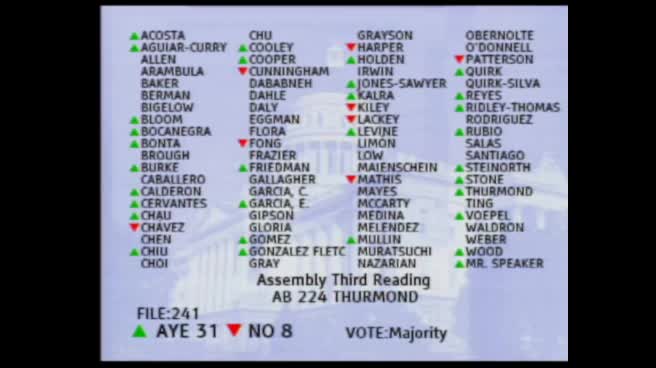 1MIN
Assembly Floor
 1H
Assembly Standing Committee on Appropriations
 9MIN
Assembly Standing Committee on Health
Bill Author

Bill Co-Author(s):