AB 748: Peace officers: video and audio recordings: disclosure.
- Session Year: 2017-2018
- House: Assembly
- Latest Version Date: 2018-09-30
Existing law, the California Public Records Act, requires that public records, as defined, be available to the public for inspection and made promptly available to any person. Existing law makes records of investigations conducted by any state or local police agency exempt from these requirements. Existing law requires specified information regarding the investigation of crimes to be disclosed to the public unless disclosure would endanger the safety of a person involved in an investigation or would endanger the successful completion of the investigation.
This bill would, notwithstanding the above provisions, commencing July 1, 2019, allow a video or audio recording that relates to a critical incident, as defined, to be withheld for 45 calendar days if disclosure would substantially interfere with an active investigation, subject to extensions, as specified. The bill would allow the recording to be withheld if the public interest in withholding video or audio recording clearly outweighs the public interest in disclosure because the release of the recording would, based on the facts and circumstances depicted in the recording, violate the reasonable expectation of privacy of a subject depicted in the recording, in which case the bill would allow the recording to be redacted to protect that interest. If the agency demonstrates that the reasonable expectation of privacy of a subject depicted in the recording cannot adequately be protected through redaction, the bill would require that the recording be promptly disclosed to a subject of the recording, his or her parent, guardian, or representative, as applicable, or his or her heir, beneficiary, immediate family member, or authorized legal representative, if deceased.
By requiring local agencies to make these recordings available, the bill would impose a state-mandated local program.
The California Constitution requires the state to reimburse local agencies and school districts for certain costs mandated by the state. Statutory provisions establish procedures for making that reimbursement.
This bill would provide that no reimbursement is required by this act for a specified reason.
Existing law, the California Public Records Act, requires that public records, as defined, be available to the public for inspection and made promptly available to any person. Existing law makes records of investigations conducted by any state or local police agency exempt from these requirements. Existing law requires specified information regarding the investigation of crimes to be disclosed to the public unless disclosure would endanger the safety of a person involved in an investigation or would endanger the successful completion of the investigation.
This bill would, notwithstanding the above provisions, commencing July 1, 2019, allow a video or audio recording that relates to a critical incident, as defined, to be withheld for 45 calendar days if disclosure would substantially interfere with an active investigation, subject to extensions, as specified. The bill would allow the recording to be withheld if the public interest in withholding video or audio recording clearly outweighs the public interest in disclosure because the release of the recording would, based on the facts and circumstances depicted in the recording, violate the reasonable expectation of privacy of a subject depicted in the recording, in which case the bill would allow the recording to be redacted to protect that interest. If the agency demonstrates that the reasonable expectation of privacy of a subject depicted in the recording cannot adequately be protected through redaction, the bill would require that the recording be promptly disclosed to a subject of the recording, his or her parent, guardian, or representative, as applicable, or his or her estate, heir, beneficiary, immediate family member, or authorized legal representative, if deceased.
By requiring local agencies to make these recordings available, the bill would impose a state-mandated local program.
The California Constitution requires the state to reimburse local agencies and school districts for certain costs mandated by the state. Statutory provisions establish procedures for making that reimbursement.
This bill would provide that no reimbursement is required by this act for a specified reason.
Existing law, the California Public Records Act, requires that public records, as defined, be available to the public for inspection and made promptly available to any person. Existing law makes records of investigations conducted by any state or local police agency exempt from these requirements. Existing law requires specified information regarding the investigation of crimes to be disclosed to the public unless disclosure would endanger the safety of a person involved in an investigation or would endanger the successful completion of the investigation.
This bill would, notwithstanding the above provisions, allow a video or audio recording that relates to a critical incident, defined as an incident involving a peace officers use of force, or involving a violation of law or agency policy by a peace officer, as defined, to be withheld for 45 calendar days if disclosure would substantially interfere with an active investigation, subject to extensions, as specified. The bill would allow the recording to be withheld if the public interest in withholding video or audio recording clearly outweighs the public interest in disclosure because the release of the recording would, based on the facts and circumstances depicted in the recording, violate the reasonable expectation of privacy of a subject depicted in the recording, in which case the bill would allow the recording to be redacted to protect that interest. If the agency demonstrates that the reasonable expectation of privacy of a subject depicted in the recording cannot adequately be protected through redaction, the bill would require that the recording be promptly disclosed to a subject in the recording or his or her immediate family, of the recording, his or her parent, guardian, or representative, as applicable, or his or her estate, if deceased.
By requiring local agencies to make these recordings available, the bill would impose a state-mandated local program.
The California Constitution requires the state to reimburse local agencies and school districts for certain costs mandated by the state. Statutory provisions establish procedures for making that reimbursement.
This bill would provide that no reimbursement is required by this act for a specified reason.
Existing law, the California Public Records Act, requires that public records, as defined, be available to the public for inspection and made promptly available to any person. Existing law makes records of investigations conducted by any state or local police agency exempt from these requirements. Existing law requires specified information regarding the investigation of crimes to be disclosed to the public unless disclosure would endanger the safety of a person involved in an investigation or would endanger the successful completion of the investigation.
This bill would, notwithstanding the above provisions, allow a video or audio recording that relates to a critical incident, defined as an incident involving a peace officers use of force, or involving a violation of law or agency policy by a peace officer, to be withheld for 45 calendar days if disclosure would substantially interfere with an active investigation, subject to extensions, as specified. The bill would allow the recording to be withheld if the public interest in withholding video or audio recording clearly outweighs the public interest in disclosure because the release of the recording would, based on the facts and circumstances depicted in the recording, violate the reasonable expectation of privacy of a subject depicted in the recording, in which case the bill would allow the recording to be redacted to protect that interest. If the agency demonstrates that the reasonable expectation of privacy of a subject depicted in the recording cannot adequately be protected through redaction, the bill would require that the recording be promptly disclosed to a subject in the recording or his or her immediate family, if deceased.
By requiring local agencies to make these recordings available, the bill would impose a state-mandated local program.
The California Constitution requires the state to reimburse local agencies and school districts for certain costs mandated by the state. Statutory provisions establish procedures for making that reimbursement.
This bill would provide that no reimbursement is required by this act for a specified reason.
Existing law, the California Public Records Act, requires that public records, as defined, be available to the public for inspection and made promptly available to any person. Existing law makes records of investigations conducted by any state or local police agency exempt from these requirements. Existing law requires specified information regarding the investigation of crimes to be disclosed to the public unless disclosure would endanger the safety of a person involved in an investigation or would endanger the successful completion of the investigation.
This bill would, notwithstanding the above provisions, allow a video or audio recording that relates to a matter of public concern because it depicts critical incident, defined as an incident involving a peace officers use of force, or is reasonably believed to involve involving a violation of law or agency policy by a peace officer, to be withheld for a maximum of 120 45 calendar days if disclosure would substantially impede interfere with an active investigation. investigation, subject to extensions, as specified. The bill would allow the recording to be withheld if the public interest in withholding video or audio recording clearly outweighs the public interest in disclosure because the release of the recording would, based on the facts and circumstances depicted in the recording, violate the reasonable expectation of privacy of a subject depicted in the recording, in which case the bill would allow the recording to be redacted to protect that interest. If the agency demonstrates that the reasonable expectation of privacy of a subject depicted in the recording cannot adequately be protected through redaction, the bill would require that the recording be promptly disclosed to a subject in the recording or his or her immediate family, if deceased.
By requiring local agencies to make these recordings available, the bill would impose a state-mandated local program.
Existing law requires law enforcement agencies, departments, or entities to consider specified best practices regarding the downloading and storage of body-worn camera data when establishing policies and procedures for the implementation and operation of a body-worn camera system, as specified.This bill would prohibit an agency from disclosing any audio or video recording made pursuant to these provisions available to a 3rd-party contractor, except for the purpose of data storage. The bill would prohibit the sale of a recording for any purpose and would prohibit the use of any biometric scanning program or application in regard to a recording, unless exigent circumstances necessitate the use of biometric scanning.The California Constitution requires the state to reimburse local agencies and school districts for certain costs mandated by the state. Statutory provisions establish procedures for making that reimbursement.
This bill would provide that no reimbursement is required by this act for a specified reason.
Existing law, the California Public Records Act, requires that public records, as defined, be available to the public for inspection and made promptly available to any person. Existing law makes records of investigations conducted by any state or local police agency exempt from these requirements. Existing law requires specified information regarding the investigation of crimes to be disclosed to the public unless disclosure would endanger the safety of a person involved in an investigation or would endanger the successful completion of the investigation.
This bill would, notwithstanding the above provisions, allow a video or audio recording that relates to a matter of public concern because it depicts an incident involving a peace officers use of force, or is reasonably believed to involve a violation of law or public policy, agency policy by a peace officer, to be withheld for a maximum of 90 120 calendar days if disclosure would substantially impede an active investigation. The bill would allow the recording to be withheld if the public interest in withholding video or audio recording clearly outweighs the public interest in disclosure because the release of the recording would, based on the facts and circumstances depicted in the recording, violate the reasonable expectation of privacy of a subject depicted in the recording, in which case the bill would allow the recording to be redacted to protect that interest. If the agency demonstrates that the reasonable expectation of privacy of a subject depicted in the recording cannot adequately be protected through redaction, the bill would require that the recording be promptly disclosed to a subject in the recording or his or her immediate family, if deceased.
Existing law requires law enforcement agencies, departments, or entities to consider specified best practices regarding the downloading and storage of body-worn camera data when establishing policies and procedures for the implementation and operation of a body-worn camera system, as specified.
This bill would prohibit an agency from disclosing any audio or video recording made pursuant to these provisions available to a 3rd-party contractor, except for the purpose of data storage. The bill would prohibit the sale of a recording for any purpose and would prohibit the use of any biometric scanning program or application in regard to a recording. recording, unless exigent circumstances necessitate the use of biometric scanning.
Existing law, the California Public Records Act, requires that public records, as defined, be available to the public for inspection and made promptly available to any person. Existing law makes records of investigations conducted by any state or local police agency exempt from these requirements. Existing law requires specified information regarding the investigation of crimes to be disclosed to the public unless disclosure would endanger the safety of a person involved in an investigation or would endanger the successful completion of the investigation.
This bill would, notwithstanding the above provisions, allow a video or audio recording that relates to a matter of public concern because it depicts an incident involving a peace officers use of force, or is reasonably believed to involve a violation of law or public policy, to be withheld for a maximum of 90 calendar days if disclosure would substantially impede an active investigation. The bill would allow the recording to be withheld if the public interest in withholding video or audio recording clearly outweighs the public interest in disclosure because the release of the recording would, based on the facts and circumstances depicted in the recording, violate the reasonable expectation of privacy of a subject depicted in the recording, in which case the bill would allow the recording to be redacted to protect that interest. If the agency demonstrates that the reasonable expectation of privacy of a subject depicted in the recording cannot adequately be protected through redaction, the bill would require that the recording be promptly disclosed to a subject in the recording or his or her immediate family, if deceased.
Existing law requires law enforcement agencies, departments, or entities to consider specified best practices regarding the downloading and storage of body-worn camera data when establishing policies and procedures for the implementation and operation of a body-worn camera system, as specified.
This bill would prohibit an agency from disclosing any audio or video recording made pursuant to these provisions available to a 3rd-party contractor, except for the purpose of data storage. The bill would prohibit the sale of a recording for any purpose and would prohibit the use of any biometric scanning program or application in regard to a recording.
Existing law requires law enforcement agencies to consider specified best practices when establishing policies and procedures for downloading and storing data from body-worn cameras, including, among other things, prohibiting the unauthorized use, duplication, or distribution of the data, and establishing storage periods for evidentiary and nonevidentiary data, as defined.This bill would require each department or agency that employs peace officers and that elects to require those peace officers to wear body-worn cameras to develop a policy setting forth the procedures for, and limitations on, public access to recordings taken by body-worn cameras, as specified. The bill would require the department or agency to conspicuously post the policy on its Internet Web site.Existing law requires law enforcement agencies to consider specified best practices when establishing policies and procedures for downloading and storing data from body-worn cameras, including, among other things, prohibiting the unauthorized use, duplication, or distribution of the data, and establishing storage periods for evidentiary and nonevidentiary data, as defined.
This bill would require each department or agency that employs peace officers and that elects to require those peace officers to wear body-worn cameras to develop a policy setting forth the procedures for, and limitations on, public access to recordings taken by body-worn cameras, as specified. The bill would require the department or agency to conspicuously post the policy on its Internet Web site.
Except as provided in Sections 6254.7 and 6254.13, this chapter does not require the disclosure of any of the following records:
(a)Preliminary drafts, notes, or interagency or intra-agency memoranda that are not retained by the public agency in the ordinary course of business, if the public interest in withholding those records clearly outweighs the public interest in disclosure.
(b)Records pertaining to pending litigation to which the public agency is a party, or to claims made pursuant to Division 3.6 (commencing with Section 810), until the pending litigation or claim has been finally adjudicated or otherwise settled.
(c)Personnel, medical, or similar files, the disclosure of which would constitute an unwarranted invasion of personal privacy.
(d)Records contained in or related to any of the following:
(1)Applications filed with any state agency responsible for the regulation or supervision of the issuance of securities or of financial institutions, including, but not limited to, banks, savings and loan associations, industrial loan companies, credit unions, and insurance companies.
(2)Examination, operating, or condition reports prepared by, on behalf of, or for the use of, any state agency referred to in paragraph (1).
(3)Preliminary drafts, notes, or interagency or intra-agency communications prepared by, on behalf of, or for the use of, any state agency referred to in paragraph (1).
(4)Information received in confidence by any state agency referred to in paragraph (1).
(e)Geological and geophysical data, plant production data, and similar information relating to utility systems development, or market or crop reports, that are obtained in confidence from any person.
(f)Records of complaints to, or investigations conducted by, or records of intelligence information or security procedures of, the office of the Attorney General and the Department of Justice, the Office of Emergency Services and any state or local police agency, or any investigatory or security files compiled by any other state or local police agency, or any investigatory or security files compiled by any other state or local agency for correctional, law enforcement, or licensing purposes. However, state and local law enforcement agencies shall disclose the names and addresses of persons involved in, or witnesses other than confidential informants to, the incident, the description of any property involved, the date, time, and location of the incident, all diagrams, statements of the parties involved in the incident, the statements of all witnesses, other than confidential informants, to the victims of an incident, or an authorized representative thereof, an insurance carrier against which a claim has been or might be made, and any person suffering bodily injury or property damage or loss, as the result of the incident caused by arson, burglary, fire, explosion, larceny, robbery, carjacking, vandalism, vehicle theft, or a crime as defined by subdivision (b) of Section 13951, unless the disclosure would endanger the safety of a witness or other person involved in the investigation, or unless disclosure would endanger the successful completion of the investigation or a related investigation. However, this subdivision does not require the disclosure of that portion of those investigative files that reflects the analysis or conclusions of the investigating officer.
Customer lists provided to a state or local police agency by an alarm or security company at the request of the agency shall be construed to be records subject to this subdivision.
Notwithstanding any other provision of this subdivision, state and local law enforcement agencies shall make public the following information, except to the extent that disclosure of a particular item of information would endanger the safety of a person involved in an investigation or would endanger the successful completion of the investigation or a related investigation:
(1)The full name and occupation of every individual arrested by the agency, the individuals physical description including date of birth, color of eyes and hair, sex, height and weight, the time and date of arrest, the time and date of booking, the location of the arrest, the factual circumstances surrounding the arrest, the amount of bail set, the time and manner of release or the location where the individual is currently being held, and all charges the individual is being held upon, including any outstanding warrants from other jurisdictions and parole or probation holds.
(2)(A)Subject to the restrictions imposed by Section 841.5 of the Penal Code, the time, substance, and location of all complaints or requests for assistance received by the agency and the time and nature of the response thereto, including, to the extent the information regarding crimes alleged or committed or any other incident investigated is recorded, the time, date, and location of occurrence, the time and date of the report, the name and age of the victim, the factual circumstances surrounding the crime or incident, and a general description of any injuries, property, or weapons involved. The name of a victim of any crime defined by Section 220, 261, 261.5, 262, 264, 264.1, 265, 266, 266a, 266b, 266c, 266e, 266f, 266j, 267, 269, 273a, 273d, 273.5, 285, 286, 288, 288a, 288.2, 288.3, 288.4, 288.5, 288.7, 289, 422.6, 422.7, 422.75, 646.9, or 647.6 of the Penal Code may be withheld at the victims request, or at the request of the victims parent or guardian if the victim is a minor. When a person is the victim of more than one crime, information disclosing that the person is a victim of a crime defined in any of the sections of the Penal Code set forth in this subdivision may be deleted at the request of the victim, or the victims parent or guardian if the victim is a minor, in making the report of the crime, or of any crime or incident accompanying the crime, available to the public in compliance with the requirements of this paragraph.
(B)Subject to the restrictions imposed by Section 841.5 of the Penal Code, the names and images of a victim of human trafficking, as defined in Section 236.1 of the Penal Code, and of that victims immediate family, other than a family member who is charged with a criminal offense arising from the same incident, may be withheld at the victims request until the investigation or any subsequent prosecution is complete. For purposes of this subdivision, immediate family shall have the same meaning as that provided in paragraph (3) of subdivision (b) of Section 422.4 of the Penal Code.
(3)Subject to the restrictions of Section 841.5 of the Penal Code and this subdivision, the current address of every individual arrested by the agency and the current address of the victim of a crime, if the requester declares under penalty of perjury that the request is made for a scholarly, journalistic, political, or governmental purpose, or that the request is made for investigation purposes by a licensed private investigator as described in Chapter 11.3 (commencing with Section 7512) of Division 3 of the Business and Professions Code. However, the address of the victim of any crime defined by Section 220, 236.1, 261, 261.5, 262, 264, 264.1, 265, 266, 266a, 266b, 266c, 266e, 266f, 266j, 267, 269, 273a, 273d, 273.5, 285, 286, 288, 288a, 288.2, 288.3, 288.4, 288.5, 288.7, 289, 422.6, 422.7, 422.75, 646.9, or 647.6 of the Penal Code shall remain confidential. Address information obtained pursuant to this paragraph shall not be used directly or indirectly, or furnished to another, to sell a product or service to any individual or group of individuals, and the requester shall execute a declaration to that effect under penalty of perjury. This paragraph shall not be construed to prohibit or limit a scholarly, journalistic, political, or government use of address information obtained pursuant to this paragraph.
(4)Notwithstanding any other provision of this subdivision, commencing July 1, 2019, a video or audio recording that relates to a critical incident, as defined in subparagraph (C), may be withheld only as follows:
(A)(i)During an active criminal or administrative investigation, disclosure of a recording related to a critical incident may be delayed for no longer than 45 calendar days after the date the agency knew or reasonably should have known about the incident, if, based on the facts and circumstances depicted in the recording, disclosure would substantially interfere with the investigation, such as by endangering the safety of a witness or a confidential source. If an agency delays disclosure pursuant to this paragraph, the agency shall provide in writing to the requester the specific basis for the agencys determination that disclosure would substantially interfere with the investigation and the estimated date for disclosure.
(ii)After 45 days from the date the agency knew or reasonably should have known about the incident, and up to one year from that date, the agency may continue to delay disclosure of a recording if the agency demonstrates that disclosure would substantially interfere with the investigation. After one year from the date the agency knew or reasonably should have known about the incident, the agency may continue to delay disclosure of a recording only if the agency demonstrates by clear and convincing evidence that disclosure would substantially interfere with the investigation. If an agency delays disclosure pursuant to this clause, the agency shall promptly provide in writing to the requester the specific basis for the agencys determination that the interest in preventing interference with an active investigation outweighs the public interest in disclosure and provide the estimated date for the disclosure. The agency shall reassess withholding and notify the requester every 30 days. A recording withheld by the agency shall be disclosed promptly when the specific basis for withholding is resolved.
(B)(i)If the agency demonstrates, on the facts of the particular case, that the public interest in withholding a video or audio recording clearly outweighs the public interest in disclosure because the release of the recording would, based on the facts and circumstances depicted in the recording, violate the reasonable expectation of privacy of a subject depicted in the recording, the agency shall provide in writing to the requester the specific basis for the expectation of privacy and the public interest served by withholding the recording and may use redaction technology, including blurring or distorting images or audio, to obscure those specific portions of the recording that protect that interest. However, the redaction shall not interfere with the viewers ability to fully, completely, and accurately comprehend the events captured in the recording and the recording shall not otherwise be edited or altered.
(ii)Except as provided in clause (iii), if the agency demonstrates that the reasonable expectation of privacy of a subject depicted in the recording cannot adequately be protected through redaction as described in clause (i) and that interest outweighs the public interest in disclosure, the agency may withhold the recording from the public, except that the recording, either redacted as provided in clause (i) or unredacted, shall be disclosed promptly, upon request, to any of the following:
(I)The subject of the recording whose privacy is to be protected, or his or her authorized representative.
(II)If the subject is a minor, the parent or legal guardian of the subject whose privacy is to be protected.
(III)If the subject whose privacy is to be protected is deceased, an heir, beneficiary, designated immediate family member, or authorized legal representative of the deceased subject whose privacy is to be protected.
(iii)If disclosure pursuant to clause (ii) would substantially interfere with an active criminal or administrative investigation, the agency shall provide in writing to the requester the specific basis for the agencys determination that disclosure would substantially interfere with the investigation, and provide the video or audio recording. Thereafter, the recording may be withheld by the agency for 45 calendar days, subject to extensions as set forth in clause (ii) of subparagraph (A).
(C)For purposes of this paragraph, a video or audio recording relates to a critical incident if it depicts any of the following incidents:
(i)An incident involving the discharge of a firearm at a person by a peace officer or custodial officer.
(ii)An incident in which the use of force by a peace officer or custodial officer against a person resulted in death or in great bodily injury.
(D)An agency may provide greater public access to video or audio recordings than the minimum standards set forth in this paragraph.
(E)This paragraph does not alter, limit, or negate any other rights, remedies, or obligations with respect to public records regarding an incident other than a critical incident as described in subparagraph (C).
(F)For purposes of this paragraph, a peace officer does not include any peace officer employed by the Department of Corrections and Rehabilitation.
(g)Test questions, scoring keys, and other examination data used to administer a licensing examination, examination for employment, or academic examination, except as provided for in Chapter 3 (commencing with Section 99150) of Part 65 of Division 14 of Title 3 of the Education Code.
(h)The contents of real estate appraisals or engineering or feasibility estimates and evaluations made for or by the state or local agency relative to the acquisition of property, or to prospective public supply and construction contracts, until all of the property has been acquired or all of the contract agreement obtained. However, the law of eminent domain shall not be affected by this provision.
(i)Information required from any taxpayer in connection with the collection of local taxes that is received in confidence and the disclosure of the information to other persons would result in unfair competitive disadvantage to the person supplying the information.
(j)Library circulation records kept for the purpose of identifying the borrower of items available in libraries, and library and museum materials made or acquired and presented solely for reference or exhibition purposes. The exemption in this subdivision shall not apply to records of fines imposed on the borrowers.
(k)Records, the disclosure of which is exempted or prohibited pursuant to federal or state law, including, but not limited to, provisions of the Evidence Code relating to privilege.
(l)Correspondence of and to the Governor or employees of the Governors office or in the custody of or maintained by the Governors Legal Affairs Secretary. However, public records shall not be transferred to the custody of the Governors Legal Affairs Secretary to evade the disclosure provisions of this chapter.
(m)In the custody of or maintained by the Legislative Counsel, except those records in the public database maintained by the Legislative Counsel that are described in Section 10248.
(n)Statements of personal worth or personal financial data required by a licensing agency and filed by an applicant with the licensing agency to establish his or her personal qualification for the license, certificate, or permit applied for.
(o)Financial data contained in applications for financing under Division 27 (commencing with Section 44500) of the Health and Safety Code, if an authorized officer of the California Pollution Control Financing Authority determines that disclosure of the financial data would be competitively injurious to the applicant and the data is required in order to obtain guarantees from the United States Small Business Administration. The California Pollution Control Financing Authority shall adopt rules for review of individual requests for confidentiality under this section and for making available to the public those portions of an application that are subject to disclosure under this chapter.
(p)(1) Records of state agencies related to activities governed by Chapter 10.3 (commencing with Section 3512), Chapter 10.5 (commencing with Section 3525), and Chapter 12 (commencing with Section 3560) of Division 4, that reveal a state agencys deliberative processes, impressions, evaluations, opinions, recommendations, meeting minutes, research, work products, theories, or strategy, or that provide instruction, advice, or training to employees who do not have full collective bargaining and representation rights under these chapters. This paragraph shall not be construed to limit the disclosure duties of a state agency with respect to any other records relating to the activities governed by the employee relations acts referred to in this paragraph.
(2)Records of local agencies related to activities governed by Chapter 10 (commencing with Section 3500) of Division 4, that reveal a local agencys deliberative processes, impressions, evaluations, opinions, recommendations, meeting minutes, research, work products, theories, or strategy, or that provide instruction, advice, or training to employees who do not have full collective bargaining and representation rights under that chapter. This paragraph shall not be construed to limit the disclosure duties of a local agency with respect to any other records relating to the activities governed by the employee relations act referred to in this paragraph.
(q)(1)Records of state agencies related to activities governed by Article 2.6 (commencing with Section 14081), Article 2.8 (commencing with Section 14087.5), and Article 2.91 (commencing with Section 14089) of Chapter 7 of Part 3 of Division 9 of the Welfare and Institutions Code, that reveal the special negotiators deliberative processes, discussions, communications, or any other portion of the negotiations with providers of health care services, impressions, opinions, recommendations, meeting minutes, research, work product, theories, or strategy, or that provide instruction, advice, or training to employees.
(2)Except for the portion of a contract containing the rates of payment, contracts for inpatient services entered into pursuant to these articles, on or after April 1, 1984, shall be open to inspection one year after they are fully executed. If a contract for inpatient services that is entered into prior to April 1, 1984, is amended on or after April 1, 1984, the amendment, except for any portion containing the rates of payment, shall be open to inspection one year after it is fully executed. If the California Medical Assistance Commission enters into contracts with health care providers for other than inpatient hospital services, those contracts shall be open to inspection one year after they are fully executed.
(3)Three years after a contract or amendment is open to inspection under this subdivision, the portion of the contract or amendment containing the rates of payment shall be open to inspection.
(4)Notwithstanding any other law, the entire contract or amendment shall be open to inspection by the Joint Legislative Audit Committee and the Legislative Analysts Office. The committee and that office shall maintain the confidentiality of the contracts and amendments until the time a contract or amendment is fully open to inspection by the public.
(r)Records of Native American graves, cemeteries, and sacred places and records of Native American places, features, and objects described in Sections 5097.9 and 5097.993 of the Public Resources Code maintained by, or in the possession of, the Native American Heritage Commission, another state agency, or a local agency.
(s)A final accreditation report of the Joint Commission on Accreditation of Hospitals that has been transmitted to the State Department of Health Care Services pursuant to subdivision (b) of Section 1282 of the Health and Safety Code.
(t)Records of a local hospital district, formed pursuant to Division 23 (commencing with Section 32000) of the Health and Safety Code, or the records of a municipal hospital, formed pursuant to Article 7 (commencing with Section 37600) or Article 8 (commencing with Section 37650) of Chapter 5 of Part 2 of Division 3 of Title 4 of this code, that relate to any contract with an insurer or nonprofit hospital service plan for inpatient or outpatient services for alternative rates pursuant to Section 10133 of the Insurance Code. However, the record shall be open to inspection within one year after the contract is fully executed.
(u)(1)Information contained in applications for licenses to carry firearms issued pursuant to Section 26150, 26155, 26170, or 26215 of the Penal Code by the sheriff of a county or the chief or other head of a municipal police department that indicates when or where the applicant is vulnerable to attack or that concerns the applicants medical or psychological history or that of members of his or her family.
(2)The home address and telephone number of prosecutors, public defenders, peace officers, judges, court commissioners, and magistrates that are set forth in applications for licenses to carry firearms issued pursuant to Section 26150, 26155, 26170, or 26215 of the Penal Code by the sheriff of a county or the chief or other head of a municipal police department.
(3)The home address and telephone number of prosecutors, public defenders, peace officers, judges, court commissioners, and magistrates that are set forth in licenses to carry firearms issued pursuant to Section 26150, 26155, 26170, or 26215 of the Penal Code by the sheriff of a county or the chief or other head of a municipal police department.
(v)(1)Records of the Managed Risk Medical Insurance Board and the State Department of Health Care Services related to activities governed by former Part 6.3 (commencing with Section 12695), former Part 6.5 (commencing with Section 12700), Part 6.6 (commencing with Section 12739.5), or Part 6.7 (commencing with Section 12739.70) of Division 2 of the Insurance Code, or Chapter 2 (commencing with Section 15810) or Chapter 4 (commencing with Section 15870) of Part 3.3 of Division 9 of the Welfare and Institutions Code, and that reveal any of the following:
(A)The deliberative processes, discussions, communications, or any other portion of the negotiations with entities contracting or seeking to contract with the board or the department, entities with which the board or the department is considering a contract, or entities with which the board or department is considering or enters into any other arrangement under which the board or the department provides, receives, or arranges services or reimbursement.
(B)The impressions, opinions, recommendations, meeting minutes, research, work product, theories, or strategy of the board or its staff or the department or its staff, or records that provide instructions, advice, or training to their employees.
(2)(A)Except for the portion of a contract that contains the rates of payment, contracts entered into pursuant to former Part 6.3 (commencing with Section 12695), former Part 6.5 (commencing with Section 12700), Part 6.6 (commencing with Section 12739.5), or Part 6.7 (commencing with Section 12739.70) of Division 2 of the Insurance Code, or Chapter 2 (commencing with Section 15810) or Chapter 4 (commencing with Section 15870) of Part 3.3 of Division 9 of the Welfare and Institutions Code, on or after July 1, 1991, shall be open to inspection one year after their effective dates.
(B)If a contract that is entered into prior to July 1, 1991, is amended on or after July 1, 1991, the amendment, except for any portion containing the rates of payment, shall be open to inspection one year after the effective date of the amendment.
(3)Three years after a contract or amendment is open to inspection pursuant to this subdivision, the portion of the contract or amendment containing the rates of payment shall be open to inspection.
(4)Notwithstanding any other law, the entire contract or amendments to a contract shall be open to inspection by the Joint Legislative Audit Committee. The committee shall maintain the confidentiality of the contracts and amendments thereto, until the contracts or amendments to the contracts are open to inspection pursuant to paragraph (3).
(w)(1)Records of the Managed Risk Medical Insurance Board related to activities governed by Chapter 8 (commencing with Section 10700) of Part 2 of Division 2 of the Insurance Code, and that reveal the deliberative processes, discussions, communications, or any other portion of the negotiations with health plans, or the impressions, opinions, recommendations, meeting minutes, research, work product, theories, or strategy of the board or its staff, or records that provide instructions, advice, or training to employees.
(2)Except for the portion of a contract that contains the rates of payment, contracts for health coverage entered into pursuant to Chapter 8 (commencing with Section 10700) of Part 2 of Division 2 of the Insurance Code, on or after January 1, 1993, shall be open to inspection one year after they have been fully executed.
(3)Notwithstanding any other law, the entire contract or amendments to a contract shall be open to inspection by the Joint Legislative Audit Committee. The committee shall maintain the confidentiality of the contracts and amendments thereto, until the contracts or amendments to the contracts are open to inspection pursuant to paragraph (2).
(x)Financial data contained in applications for registration, or registration renewal, as a service contractor filed with the Director of Consumer Affairs pursuant to Chapter 20 (commencing with Section 9800) of Division 3 of the Business and Professions Code, for the purpose of establishing the service contractors net worth, or financial data regarding the funded accounts held in escrow for service contracts held in force in this state by a service contractor.
(y)(1)Records of the Managed Risk Medical Insurance Board and the State Department of Health Care Services related to activities governed by Part 6.2 (commencing with Section 12693) or former Part 6.4 (commencing with Section 12699.50) of Division 2 of the Insurance Code or Sections 14005.26 and 14005.27 of, or Chapter 3 (commencing with Section 15850) of Part 3.3 of Division 9 of, the Welfare and Institutions Code, if the records reveal any of the following:
(A)The deliberative processes, discussions, communications, or any other portion of the negotiations with entities contracting or seeking to contract with the board or the department, entities with which the board or department is considering a contract, or entities with which the board or department is considering or enters into any other arrangement under which the board or department provides, receives, or arranges services or reimbursement.
(B)The impressions, opinions, recommendations, meeting minutes, research, work product, theories, or strategy of the board or its staff, or the department or its staff, or records that provide instructions, advice, or training to employees.
(2)(A)Except for the portion of a contract that contains the rates of payment, contracts entered into pursuant to Part 6.2 (commencing with Section 12693) or former Part 6.4 (commencing with Section 12699.50) of Division 2 of the Insurance Code, on or after January 1, 1998, or Sections 14005.26 and 14005.27 of, or Chapter 3 (commencing with Section 15850) of Part 3.3 of Division 9 of, the Welfare and Institutions Code shall be open to inspection one year after their effective dates.
(B)If a contract entered into pursuant to Part 6.2 (commencing with Section 12693) or former Part 6.4 (commencing with Section 12699.50) of Division 2 of the Insurance Code or Sections 14005.26 and 14005.27 of, or Chapter 3 (commencing with Section 15850) of Part 3.3 of Division 9 of, the Welfare and Institutions Code, is amended, the amendment shall be open to inspection one year after the effective date of the amendment.
(3)Three years after a contract or amendment is open to inspection pursuant to this subdivision, the portion of the contract or amendment containing the rates of payment shall be open to inspection.
(4)Notwithstanding any other law, the entire contract or amendments to a contract shall be open to inspection by the Joint Legislative Audit Committee. The committee shall maintain the confidentiality of the contracts and amendments thereto until the contract or amendments to a contract are open to inspection pursuant to paragraph (2) or (3).
(5)The exemption from disclosure provided pursuant to this subdivision for the contracts, deliberative processes, discussions, communications, negotiations, impressions, opinions, recommendations, meeting minutes, research, work product, theories, or strategy of the board or its staff, or the department or its staff, shall also apply to the contracts, deliberative processes, discussions, communications, negotiations, impressions, opinions, recommendations, meeting minutes, research, work product, theories, or strategy of applicants pursuant to Part 6.4 (commencing with Section 12699.50) of Division 2 of the Insurance Code or Chapter 3 (commencing with Section 15850) of Part 3.3 of Division 9 of the Welfare and Institutions Code.
(z)Records obtained pursuant to paragraph (2) of subdivision (f) of Section 2891.1 of the Public Utilities Code.
(aa)A document prepared by or for a state or local agency that assesses its vulnerability to terrorist attack or other criminal acts intended to disrupt the public agencys operations and that is for distribution or consideration in a closed session.
(ab)Critical infrastructure information, as defined in Section 131(3) of Title 6 of the United States Code, that is voluntarily submitted to the Office of Emergency Services for use by that office, including the identity of the person who or entity that voluntarily submitted the information. As used in this subdivision, voluntarily submitted means submitted in the absence of the office exercising any legal authority to compel access to or submission of critical infrastructure information. This subdivision shall not affect the status of information in the possession of any other state or local governmental agency.
(ac)All information provided to the Secretary of State by a person for the purpose of registration in the Advance Health Care Directive Registry, except that those records shall be released at the request of a health care provider, a public guardian, or the registrants legal representative.
(ad)The following records of the State Compensation Insurance Fund:
(1)Records related to claims pursuant to Chapter 1 (commencing with Section 3200) of Division 4 of the Labor Code, to the extent that confidential medical information or other individually identifiable information would be disclosed.
(2)Records related to the discussions, communications, or any other portion of the negotiations with entities contracting or seeking to contract with the fund, and any related deliberations.
(3)Records related to the impressions, opinions, recommendations, meeting minutes of meetings or sessions that are lawfully closed to the public, research, work product, theories, or strategy of the fund or its staff, on the development of rates, contracting strategy, underwriting, or competitive strategy pursuant to the powers granted to the fund in Chapter 4 (commencing with Section 11770) of Part 3 of Division 2 of the Insurance Code.
(4)Records obtained to provide workers compensation insurance under Chapter 4 (commencing with Section 11770) of Part 3 of Division 2 of the Insurance Code, including, but not limited to, any medical claims information, policyholder information provided that nothing in this paragraph shall be interpreted to prevent an insurance agent or broker from obtaining proprietary information or other information authorized by law to be obtained by the agent or broker, and information on rates, pricing, and claims handling received from brokers.
(5)(A)Records that are trade secrets pursuant to Section 6276.44, or Article 11 (commencing with Section 1060) of Chapter 4 of Division 8 of the Evidence Code, including, without limitation, instructions, advice, or training provided by the State Compensation Insurance Fund to its board members, officers, and employees regarding the funds special investigation unit, internal audit unit, and informational security, marketing, rating, pricing, underwriting, claims handling, audits, and collections.
(B)Notwithstanding subparagraph (A), the portions of records containing trade secrets shall be available for review by the Joint Legislative Audit Committee, California State Auditors Office, Division of Workers Compensation, and the Department of Insurance to ensure compliance with applicable law.
(6)(A)Internal audits containing proprietary information and the following records that are related to an internal audit:
(i)Personal papers and correspondence of any person providing assistance to the fund when that person has requested in writing that his or her papers and correspondence be kept private and confidential. Those papers and correspondence shall become public records if the written request is withdrawn, or upon order of the fund.
(ii)Papers, correspondence, memoranda, or any substantive information pertaining to any audit not completed or an internal audit that contains proprietary information.
(B)Notwithstanding subparagraph (A), the portions of records containing proprietary information, or any information specified in subparagraph (A) shall be available for review by the Joint Legislative Audit Committee, California State Auditors Office, Division of Workers Compensation, and the Department of Insurance to ensure compliance with applicable law.
(7)(A)Except as provided in subparagraph (C), contracts entered into pursuant to Chapter 4 (commencing with Section 11770) of Part 3 of Division 2 of the Insurance Code shall be open to inspection one year after the contract has been fully executed.
(B)If a contract entered into pursuant to Chapter 4 (commencing with Section 11770) of Part 3 of Division 2 of the Insurance Code is amended, the amendment shall be open to inspection one year after the amendment has been fully executed.
(C)Three years after a contract or amendment is open to inspection pursuant to this subdivision, the portion of the contract or amendment containing the rates of payment shall be open to inspection.
(D)Notwithstanding any other law, the entire contract or amendments to a contract shall be open to inspection by the Joint Legislative Audit Committee. The committee shall maintain the confidentiality of the contracts and amendments thereto until the contract or amendments to a contract are open to inspection pursuant to this paragraph.
(E)This paragraph is not intended to apply to documents related to contracts with public entities that are not otherwise expressly confidential as to that public entity.
(F)For purposes of this paragraph, fully executed means the point in time when all of the necessary parties to the contract have signed the contract.
This section does not prevent any agency from opening its records concerning the administration of the agency to public inspection, unless disclosure is otherwise prohibited by law.
This section does not prevent any health facility from disclosing to a certified bargaining agent relevant financing information pursuant to Section 8 of the National Labor Relations Act (29 U.S.C. Sec. 158).
SEC. 2.No reimbursement is required by this act pursuant to Section 6 of Article XIII B of the California Constitution because the only costs that may be incurred by a local agency or school district under this act would result from a legislative mandate that is within the scope of paragraph (7) of subdivision (b) of Section 3 of Article I of the California Constitution.
Except as provided in Sections 6254.7 and 6254.13, this chapter does not require the disclosure of any of the following records:
(a)Preliminary drafts, notes, or interagency or intra-agency memoranda that are not retained by the public agency in the ordinary course of business, if the public interest in withholding those records clearly outweighs the public interest in disclosure.
(b)Records pertaining to pending litigation to which the public agency is a party, or to claims made pursuant to Division 3.6 (commencing with Section 810), until the pending litigation or claim has been finally adjudicated or otherwise settled.
(c)Personnel, medical, or similar files, the disclosure of which would constitute an unwarranted invasion of personal privacy.
(d)Records contained in or related to any of the following:
(1)Applications filed with any state agency responsible for the regulation or supervision of the issuance of securities or of financial institutions, including, but not limited to, banks, savings and loan associations, industrial loan companies, credit unions, and insurance companies.
(2)Examination, operating, or condition reports prepared by, on behalf of, or for the use of, any state agency referred to in paragraph (1).
(3)Preliminary drafts, notes, or interagency or intra-agency communications prepared by, on behalf of, or for the use of, any state agency referred to in paragraph (1).
(4)Information received in confidence by any state agency referred to in paragraph (1).
(e)Geological and geophysical data, plant production data, and similar information relating to utility systems development, or market or crop reports, that are obtained in confidence from any person.
(f)Records of complaints to, or investigations conducted by, or records of intelligence information or security procedures of, the office of the Attorney General and the Department of Justice, the Office of Emergency Services and any state or local police agency, or any investigatory or security files compiled by any other state or local police agency, or any investigatory or security files compiled by any other state or local agency for correctional, law enforcement, or licensing purposes. However, state and local law enforcement agencies shall disclose the names and addresses of persons involved in, or witnesses other than confidential informants to, the incident, the description of any property involved, the date, time, and location of the incident, all diagrams, statements of the parties involved in the incident, the statements of all witnesses, other than confidential informants, to the victims of an incident, or an authorized representative thereof, an insurance carrier against which a claim has been or might be made, and any person suffering bodily injury or property damage or loss, as the result of the incident caused by arson, burglary, fire, explosion, larceny, robbery, carjacking, vandalism, vehicle theft, or a crime as defined by subdivision (b) of Section 13951, unless the disclosure would endanger the safety of a witness or other person involved in the investigation, or unless disclosure would endanger the successful completion of the investigation or a related investigation. However, this subdivision does not require the disclosure of that portion of those investigative files that reflects the analysis or conclusions of the investigating officer.
Customer lists provided to a state or local police agency by an alarm or security company at the request of the agency shall be construed to be records subject to this subdivision.
Notwithstanding any other provision of this subdivision, state and local law enforcement agencies shall make public the following information, except to the extent that disclosure of a particular item of information would endanger the safety of a person involved in an investigation or would endanger the successful completion of the investigation or a related investigation:
(1)The full name and occupation of every individual arrested by the agency, the individuals physical description including date of birth, color of eyes and hair, sex, height and weight, the time and date of arrest, the time and date of booking, the location of the arrest, the factual circumstances surrounding the arrest, the amount of bail set, the time and manner of release or the location where the individual is currently being held, and all charges the individual is being held upon, including any outstanding warrants from other jurisdictions and parole or probation holds.
(2)(A)Subject to the restrictions imposed by Section 841.5 of the Penal Code, the time, substance, and location of all complaints or requests for assistance received by the agency and the time and nature of the response thereto, including, to the extent the information regarding crimes alleged or committed or any other incident investigated is recorded, the time, date, and location of occurrence, the time and date of the report, the name and age of the victim, the factual circumstances surrounding the crime or incident, and a general description of any injuries, property, or weapons involved. The name of a victim of any crime defined by Section 220, 261, 261.5, 262, 264, 264.1, 265, 266, 266a, 266b, 266c, 266e, 266f, 266j, 267, 269, 273a, 273d, 273.5, 285, 286, 288, 288a, 288.2, 288.3, 288.4, 288.5, 288.7, 289, 422.6, 422.7, 422.75, 646.9, or 647.6 of the Penal Code may be withheld at the victims request, or at the request of the victims parent or guardian if the victim is a minor. When a person is the victim of more than one crime, information disclosing that the person is a victim of a crime defined in any of the sections of the Penal Code set forth in this subdivision may be deleted at the request of the victim, or the victims parent or guardian if the victim is a minor, in making the report of the crime, or of any crime or incident accompanying the crime, available to the public in compliance with the requirements of this paragraph.
(B)Subject to the restrictions imposed by Section 841.5 of the Penal Code, the names and images of a victim of human trafficking, as defined in Section 236.1 of the Penal Code, and of that victims immediate family, other than a family member who is charged with a criminal offense arising from the same incident, may be withheld at the victims request until the investigation or any subsequent prosecution is complete. For purposes of this subdivision, immediate family shall have the same meaning as that provided in paragraph (3) of subdivision (b) of Section 422.4 of the Penal Code.
(3)Subject to the restrictions of Section 841.5 of the Penal Code and this subdivision, the current address of every individual arrested by the agency and the current address of the victim of a crime, if the requester declares under penalty of perjury that the request is made for a scholarly, journalistic, political, or governmental purpose, or that the request is made for investigation purposes by a licensed private investigator as described in Chapter 11.3 (commencing with Section 7512) of Division 3 of the Business and Professions Code. However, the address of the victim of any crime defined by Section 220, 236.1, 261, 261.5, 262, 264, 264.1, 265, 266, 266a, 266b, 266c, 266e, 266f, 266j, 267, 269, 273a, 273d, 273.5, 285, 286, 288, 288a, 288.2, 288.3, 288.4, 288.5, 288.7, 289, 422.6, 422.7, 422.75, 646.9, or 647.6 of the Penal Code shall remain confidential. Address information obtained pursuant to this paragraph shall not be used directly or indirectly, or furnished to another, to sell a product or service to any individual or group of individuals, and the requester shall execute a declaration to that effect under penalty of perjury. This paragraph shall not be construed to prohibit or limit a scholarly, journalistic, political, or government use of address information obtained pursuant to this paragraph.
(4)Notwithstanding any other provision of this subdivision, commencing July 1, 2019, a video or audio recording that relates to a critical incident, as defined in subparagraph (C), may be withheld only as follows:
(A)(i)During an active criminal or administrative investigation, disclosure of a recording related to a critical incident may be delayed for no longer than 45 calendar days after the date the agency knew or reasonably should have known about the incident, if, based on the facts and circumstances depicted in the recording, disclosure would substantially interfere with the investigation, such as by endangering the safety of a witness or a confidential source. If an agency delays disclosure pursuant to this paragraph, the agency shall provide in writing to the requester the specific basis for the agencys determination that disclosure would substantially interfere with the investigation and the estimated date for disclosure.
(ii)After 45 days from the date the agency knew or reasonably should have known about the incident, and up to one year from that date, the agency may continue to delay disclosure of a recording if the agency demonstrates that disclosure would substantially interfere with the investigation. After one year from the date the agency knew or reasonably should have known about the incident, the agency may continue to delay disclosure of a recording only if the agency demonstrates by clear and convincing evidence that disclosure would substantially interfere with the investigation. If an agency delays disclosure pursuant to this clause, the agency shall promptly provide in writing to the requester the specific basis for the agencys determination that the interest in preventing interference with an active investigation outweighs the public interest in disclosure and provide the estimated date for the disclosure. The agency shall reassess withholding and notify the requester every 30 days. A recording withheld by the agency shall be disclosed promptly when the specific basis for withholding is resolved.
(B)(i)If the agency demonstrates, on the facts of the particular case, that the public interest in withholding a video or audio recording clearly outweighs the public interest in disclosure because the release of the recording would, based on the facts and circumstances depicted in the recording, violate the reasonable expectation of privacy of a subject depicted in the recording, the agency shall provide in writing to the requester the specific basis for the expectation of privacy and the public interest served by withholding the recording and may use redaction technology, including blurring or distorting images or audio, to obscure those specific portions of the recording that protect that interest. However, the redaction shall not interfere with the viewers ability to fully, completely, and accurately comprehend the events captured in the recording and the recording shall not otherwise be edited or altered.
(ii)Except as provided in clause (iii), if the agency demonstrates that the reasonable expectation of privacy of a subject depicted in the recording cannot adequately be protected through redaction as described in clause (i) and that interest outweighs the public interest in disclosure, the agency may withhold the recording from the public, except that the recording, either redacted as provided in clause (i) or unredacted, shall be disclosed promptly, upon request, to any of the following:
(I)The subject of the recording whose privacy is to be protected, or his or her authorized representative.
(II)If the subject is a minor, the parent or legal guardian of the subject whose privacy is to be protected.
(III)If the subject whose privacy is to be protected is deceased, the executor, administrator, or guardian of the persons estate. an heir, beneficiary, designated immediate family member, or authorized legal representative of the deceased subject whose privacy is to be protected.
(iii)If disclosure pursuant to clause (ii) would substantially interfere with an active criminal or administrative investigation, the agency shall provide in writing to the requester the specific basis for the agencys determination that disclosure would substantially interfere with the investigation, and provide the video or audio recording. Thereafter, the recording may be withheld by the agency for 45 calendar days, subject to extensions as set forth in clause (ii) of subparagraph (A).
(C)For purposes of this paragraph, a video or audio recording relates to a critical incident if it depicts any of the following incidents:
(i)An incident involving the discharge of a firearm at a person by a peace officer or custodial officer.
(ii)An incident involving a strike with an impact weapon or projectile to the head or neck of a person by a peace officer or custodial officer.(iii)An incident in which the use of force by a peace officer or custodial officer against a person resulted in death, or in serious bodily injury, which means a serious impairment of physical condition, including, but not limited to, any of the following: loss of consciousness, concussion, bone fracture, protracted loss or impairment of function of any bodily member or organ, a wound requiring extensive suturing, and serious disfigurement.(iv)The death of an arrestee or detainee in custodial care of the agency.(ii)An incident in which the use of force by a peace officer or custodial officer against a person resulted in death or in great bodily injury.
(D)An agency may provide greater public access to video or audio recordings than the minimum standards set forth in this paragraph.
(E)This paragraph does not alter, limit, or negate any other rights, remedies, or obligations with respect to public records regarding an incident other than a critical incident as described in subparagraph (C).
(F)For purposes of this paragraph, a peace officer does not include any peace officer employed by the Department of Corrections and Rehabilitation.
(g)Test questions, scoring keys, and other examination data used to administer a licensing examination, examination for employment, or academic examination, except as provided for in Chapter 3 (commencing with Section 99150) of Part 65 of Division 14 of Title 3 of the Education Code.
(h)The contents of real estate appraisals or engineering or feasibility estimates and evaluations made for or by the state or local agency relative to the acquisition of property, or to prospective public supply and construction contracts, until all of the property has been acquired or all of the contract agreement obtained. However, the law of eminent domain shall not be affected by this provision.
(i)Information required from any taxpayer in connection with the collection of local taxes that is received in confidence and the disclosure of the information to other persons would result in unfair competitive disadvantage to the person supplying the information.
(j)Library circulation records kept for the purpose of identifying the borrower of items available in libraries, and library and museum materials made or acquired and presented solely for reference or exhibition purposes. The exemption in this subdivision shall not apply to records of fines imposed on the borrowers.
(k)Records, the disclosure of which is exempted or prohibited pursuant to federal or state law, including, but not limited to, provisions of the Evidence Code relating to privilege.
(l)Correspondence of and to the Governor or employees of the Governors office or in the custody of or maintained by the Governors Legal Affairs Secretary. However, public records shall not be transferred to the custody of the Governors Legal Affairs Secretary to evade the disclosure provisions of this chapter.
(m)In the custody of or maintained by the Legislative Counsel, except those records in the public database maintained by the Legislative Counsel that are described in Section 10248.
(n)Statements of personal worth or personal financial data required by a licensing agency and filed by an applicant with the licensing agency to establish his or her personal qualification for the license, certificate, or permit applied for.
(o)Financial data contained in applications for financing under Division 27 (commencing with Section 44500) of the Health and Safety Code, if an authorized officer of the California Pollution Control Financing Authority determines that disclosure of the financial data would be competitively injurious to the applicant and the data is required in order to obtain guarantees from the United States Small Business Administration. The California Pollution Control Financing Authority shall adopt rules for review of individual requests for confidentiality under this section and for making available to the public those portions of an application that are subject to disclosure under this chapter.
(p)(1) Records of state agencies related to activities governed by Chapter 10.3 (commencing with Section 3512), Chapter 10.5 (commencing with Section 3525), and Chapter 12 (commencing with Section 3560) of Division 4, that reveal a state agencys deliberative processes, impressions, evaluations, opinions, recommendations, meeting minutes, research, work products, theories, or strategy, or that provide instruction, advice, or training to employees who do not have full collective bargaining and representation rights under these chapters. This paragraph shall not be construed to limit the disclosure duties of a state agency with respect to any other records relating to the activities governed by the employee relations acts referred to in this paragraph.
(2)Records of local agencies related to activities governed by Chapter 10 (commencing with Section 3500) of Division 4, that reveal a local agencys deliberative processes, impressions, evaluations, opinions, recommendations, meeting minutes, research, work products, theories, or strategy, or that provide instruction, advice, or training to employees who do not have full collective bargaining and representation rights under that chapter. This paragraph shall not be construed to limit the disclosure duties of a local agency with respect to any other records relating to the activities governed by the employee relations act referred to in this paragraph.
(q)(1)Records of state agencies related to activities governed by Article 2.6 (commencing with Section 14081), Article 2.8 (commencing with Section 14087.5), and Article 2.91 (commencing with Section 14089) of Chapter 7 of Part 3 of Division 9 of the Welfare and Institutions Code, that reveal the special negotiators deliberative processes, discussions, communications, or any other portion of the negotiations with providers of health care services, impressions, opinions, recommendations, meeting minutes, research, work product, theories, or strategy, or that provide instruction, advice, or training to employees.
(2)Except for the portion of a contract containing the rates of payment, contracts for inpatient services entered into pursuant to these articles, on or after April 1, 1984, shall be open to inspection one year after they are fully executed. If a contract for inpatient services that is entered into prior to April 1, 1984, is amended on or after April 1, 1984, the amendment, except for any portion containing the rates of payment, shall be open to inspection one year after it is fully executed. If the California Medical Assistance Commission enters into contracts with health care providers for other than inpatient hospital services, those contracts shall be open to inspection one year after they are fully executed.
(3)Three years after a contract or amendment is open to inspection under this subdivision, the portion of the contract or amendment containing the rates of payment shall be open to inspection.
(4)Notwithstanding any other law, the entire contract or amendment shall be open to inspection by the Joint Legislative Audit Committee and the Legislative Analysts Office. The committee and that office shall maintain the confidentiality of the contracts and amendments until the time a contract or amendment is fully open to inspection by the public.
(r)Records of Native American graves, cemeteries, and sacred places and records of Native American places, features, and objects described in Sections 5097.9 and 5097.993 of the Public Resources Code maintained by, or in the possession of, the Native American Heritage Commission, another state agency, or a local agency.
(s)A final accreditation report of the Joint Commission on Accreditation of Hospitals that has been transmitted to the State Department of Health Care Services pursuant to subdivision (b) of Section 1282 of the Health and Safety Code.
(t)Records of a local hospital district, formed pursuant to Division 23 (commencing with Section 32000) of the Health and Safety Code, or the records of a municipal hospital, formed pursuant to Article 7 (commencing with Section 37600) or Article 8 (commencing with Section 37650) of Chapter 5 of Part 2 of Division 3 of Title 4 of this code, that relate to any contract with an insurer or nonprofit hospital service plan for inpatient or outpatient services for alternative rates pursuant to Section 10133 of the Insurance Code. However, the record shall be open to inspection within one year after the contract is fully executed.
(u)(1)Information contained in applications for licenses to carry firearms issued pursuant to Section 26150, 26155, 26170, or 26215 of the Penal Code by the sheriff of a county or the chief or other head of a municipal police department that indicates when or where the applicant is vulnerable to attack or that concerns the applicants medical or psychological history or that of members of his or her family.
(2)The home address and telephone number of prosecutors, public defenders, peace officers, judges, court commissioners, and magistrates that are set forth in applications for licenses to carry firearms issued pursuant to Section 26150, 26155, 26170, or 26215 of the Penal Code by the sheriff of a county or the chief or other head of a municipal police department.
(3)The home address and telephone number of prosecutors, public defenders, peace officers, judges, court commissioners, and magistrates that are set forth in licenses to carry firearms issued pursuant to Section 26150, 26155, 26170, or 26215 of the Penal Code by the sheriff of a county or the chief or other head of a municipal police department.
(v)(1)Records of the Managed Risk Medical Insurance Board and the State Department of Health Care Services related to activities governed by former Part 6.3 (commencing with Section 12695), former Part 6.5 (commencing with Section 12700), Part 6.6 (commencing with Section 12739.5), or Part 6.7 (commencing with Section 12739.70) of Division 2 of the Insurance Code, or Chapter 2 (commencing with Section 15810) or Chapter 4 (commencing with Section 15870) of Part 3.3 of Division 9 of the Welfare and Institutions Code, and that reveal any of the following:
(A)The deliberative processes, discussions, communications, or any other portion of the negotiations with entities contracting or seeking to contract with the board or the department, entities with which the board or the department is considering a contract, or entities with which the board or department is considering or enters into any other arrangement under which the board or the department provides, receives, or arranges services or reimbursement.
(B)The impressions, opinions, recommendations, meeting minutes, research, work product, theories, or strategy of the board or its staff or the department or its staff, or records that provide instructions, advice, or training to their employees.
(2)(A)Except for the portion of a contract that contains the rates of payment, contracts entered into pursuant to former Part 6.3 (commencing with Section 12695), former Part 6.5 (commencing with Section 12700), Part 6.6 (commencing with Section 12739.5), or Part 6.7 (commencing with Section 12739.70) of Division 2 of the Insurance Code, or Chapter 2 (commencing with Section 15810) or Chapter 4 (commencing with Section 15870) of Part 3.3 of Division 9 of the Welfare and Institutions Code, on or after July 1, 1991, shall be open to inspection one year after their effective dates.
(B)If a contract that is entered into prior to July 1, 1991, is amended on or after July 1, 1991, the amendment, except for any portion containing the rates of payment, shall be open to inspection one year after the effective date of the amendment.
(3)Three years after a contract or amendment is open to inspection pursuant to this subdivision, the portion of the contract or amendment containing the rates of payment shall be open to inspection.
(4)Notwithstanding any other law, the entire contract or amendments to a contract shall be open to inspection by the Joint Legislative Audit Committee. The committee shall maintain the confidentiality of the contracts and amendments thereto, until the contracts or amendments to the contracts are open to inspection pursuant to paragraph (3).
(w)(1)Records of the Managed Risk Medical Insurance Board related to activities governed by Chapter 8 (commencing with Section 10700) of Part 2 of Division 2 of the Insurance Code, and that reveal the deliberative processes, discussions, communications, or any other portion of the negotiations with health plans, or the impressions, opinions, recommendations, meeting minutes, research, work product, theories, or strategy of the board or its staff, or records that provide instructions, advice, or training to employees.
(2)Except for the portion of a contract that contains the rates of payment, contracts for health coverage entered into pursuant to Chapter 8 (commencing with Section 10700) of Part 2 of Division 2 of the Insurance Code, on or after January 1, 1993, shall be open to inspection one year after they have been fully executed.
(3)Notwithstanding any other law, the entire contract or amendments to a contract shall be open to inspection by the Joint Legislative Audit Committee. The committee shall maintain the confidentiality of the contracts and amendments thereto, until the contracts or amendments to the contracts are open to inspection pursuant to paragraph (2).
(x)Financial data contained in applications for registration, or registration renewal, as a service contractor filed with the Director of Consumer Affairs pursuant to Chapter 20 (commencing with Section 9800) of Division 3 of the Business and Professions Code, for the purpose of establishing the service contractors net worth, or financial data regarding the funded accounts held in escrow for service contracts held in force in this state by a service contractor.
(y)(1)Records of the Managed Risk Medical Insurance Board and the State Department of Health Care Services related to activities governed by Part 6.2 (commencing with Section 12693) or former Part 6.4 (commencing with Section 12699.50) of Division 2 of the Insurance Code or Sections 14005.26 and 14005.27 of, or Chapter 3 (commencing with Section 15850) of Part 3.3 of Division 9 of, the Welfare and Institutions Code, if the records reveal any of the following:
(A)The deliberative processes, discussions, communications, or any other portion of the negotiations with entities contracting or seeking to contract with the board or the department, entities with which the board or department is considering a contract, or entities with which the board or department is considering or enters into any other arrangement under which the board or department provides, receives, or arranges services or reimbursement.
(B)The impressions, opinions, recommendations, meeting minutes, research, work product, theories, or strategy of the board or its staff, or the department or its staff, or records that provide instructions, advice, or training to employees.
(2)(A)Except for the portion of a contract that contains the rates of payment, contracts entered into pursuant to Part 6.2 (commencing with Section 12693) or former Part 6.4 (commencing with Section 12699.50) of Division 2 of the Insurance Code, on or after January 1, 1998, or Sections 14005.26 and 14005.27 of, or Chapter 3 (commencing with Section 15850) of Part 3.3 of Division 9 of, the Welfare and Institutions Code shall be open to inspection one year after their effective dates.
(B)If a contract entered into pursuant to Part 6.2 (commencing with Section 12693) or former Part 6.4 (commencing with Section 12699.50) of Division 2 of the Insurance Code or Sections 14005.26 and 14005.27 of, or Chapter 3 (commencing with Section 15850) of Part 3.3 of Division 9 of, the Welfare and Institutions Code, is amended, the amendment shall be open to inspection one year after the effective date of the amendment.
(3)Three years after a contract or amendment is open to inspection pursuant to this subdivision, the portion of the contract or amendment containing the rates of payment shall be open to inspection.
(4)Notwithstanding any other law, the entire contract or amendments to a contract shall be open to inspection by the Joint Legislative Audit Committee. The committee shall maintain the confidentiality of the contracts and amendments thereto until the contract or amendments to a contract are open to inspection pursuant to paragraph (2) or (3).
(5)The exemption from disclosure provided pursuant to this subdivision for the contracts, deliberative processes, discussions, communications, negotiations, impressions, opinions, recommendations, meeting minutes, research, work product, theories, or strategy of the board or its staff, or the department or its staff, shall also apply to the contracts, deliberative processes, discussions, communications, negotiations, impressions, opinions, recommendations, meeting minutes, research, work product, theories, or strategy of applicants pursuant to Part 6.4 (commencing with Section 12699.50) of Division 2 of the Insurance Code or Chapter 3 (commencing with Section 15850) of Part 3.3 of Division 9 of the Welfare and Institutions Code.
(z)Records obtained pursuant to paragraph (2) of subdivision (f) of Section 2891.1 of the Public Utilities Code.
(aa)A document prepared by or for a state or local agency that assesses its vulnerability to terrorist attack or other criminal acts intended to disrupt the public agencys operations and that is for distribution or consideration in a closed session.
(ab)Critical infrastructure information, as defined in Section 131(3) of Title 6 of the United States Code, that is voluntarily submitted to the Office of Emergency Services for use by that office, including the identity of the person who or entity that voluntarily submitted the information. As used in this subdivision, voluntarily submitted means submitted in the absence of the office exercising any legal authority to compel access to or submission of critical infrastructure information. This subdivision shall not affect the status of information in the possession of any other state or local governmental agency.
(ac)All information provided to the Secretary of State by a person for the purpose of registration in the Advance Health Care Directive Registry, except that those records shall be released at the request of a health care provider, a public guardian, or the registrants legal representative.
(ad)The following records of the State Compensation Insurance Fund:
(1)Records related to claims pursuant to Chapter 1 (commencing with Section 3200) of Division 4 of the Labor Code, to the extent that confidential medical information or other individually identifiable information would be disclosed.
(2)Records related to the discussions, communications, or any other portion of the negotiations with entities contracting or seeking to contract with the fund, and any related deliberations.
(3)Records related to the impressions, opinions, recommendations, meeting minutes of meetings or sessions that are lawfully closed to the public, research, work product, theories, or strategy of the fund or its staff, on the development of rates, contracting strategy, underwriting, or competitive strategy pursuant to the powers granted to the fund in Chapter 4 (commencing with Section 11770) of Part 3 of Division 2 of the Insurance Code.
(4)Records obtained to provide workers compensation insurance under Chapter 4 (commencing with Section 11770) of Part 3 of Division 2 of the Insurance Code, including, but not limited to, any medical claims information, policyholder information provided that nothing in this paragraph shall be interpreted to prevent an insurance agent or broker from obtaining proprietary information or other information authorized by law to be obtained by the agent or broker, and information on rates, pricing, and claims handling received from brokers.
(5)(A)Records that are trade secrets pursuant to Section 6276.44, or Article 11 (commencing with Section 1060) of Chapter 4 of Division 8 of the Evidence Code, including, without limitation, instructions, advice, or training provided by the State Compensation Insurance Fund to its board members, officers, and employees regarding the funds special investigation unit, internal audit unit, and informational security, marketing, rating, pricing, underwriting, claims handling, audits, and collections.
(B)Notwithstanding subparagraph (A), the portions of records containing trade secrets shall be available for review by the Joint Legislative Audit Committee, California State Auditors Office, Division of Workers Compensation, and the Department of Insurance to ensure compliance with applicable law.
(6)(A)Internal audits containing proprietary information and the following records that are related to an internal audit:
(i)Personal papers and correspondence of any person providing assistance to the fund when that person has requested in writing that his or her papers and correspondence be kept private and confidential. Those papers and correspondence shall become public records if the written request is withdrawn, or upon order of the fund.
(ii)Papers, correspondence, memoranda, or any substantive information pertaining to any audit not completed or an internal audit that contains proprietary information.
(B)Notwithstanding subparagraph (A), the portions of records containing proprietary information, or any information specified in subparagraph (A) shall be available for review by the Joint Legislative Audit Committee, California State Auditors Office, Division of Workers Compensation, and the Department of Insurance to ensure compliance with applicable law.
(7)(A)Except as provided in subparagraph (C), contracts entered into pursuant to Chapter 4 (commencing with Section 11770) of Part 3 of Division 2 of the Insurance Code shall be open to inspection one year after the contract has been fully executed.
(B)If a contract entered into pursuant to Chapter 4 (commencing with Section 11770) of Part 3 of Division 2 of the Insurance Code is amended, the amendment shall be open to inspection one year after the amendment has been fully executed.
(C)Three years after a contract or amendment is open to inspection pursuant to this subdivision, the portion of the contract or amendment containing the rates of payment shall be open to inspection.
(D)Notwithstanding any other law, the entire contract or amendments to a contract shall be open to inspection by the Joint Legislative Audit Committee. The committee shall maintain the confidentiality of the contracts and amendments thereto until the contract or amendments to a contract are open to inspection pursuant to this paragraph.
(E)This paragraph is not intended to apply to documents related to contracts with public entities that are not otherwise expressly confidential as to that public entity.
(F)For purposes of this paragraph, fully executed means the point in time when all of the necessary parties to the contract have signed the contract.
This section does not prevent any agency from opening its records concerning the administration of the agency to public inspection, unless disclosure is otherwise prohibited by law.
This section does not prevent any health facility from disclosing to a certified bargaining agent relevant financing information pursuant to Section 8 of the National Labor Relations Act (29 U.S.C. Sec. 158).
SEC. 2.No reimbursement is required by this act pursuant to Section 6 of Article XIII B of the California Constitution because the only costs that may be incurred by a local agency or school district under this act would result from a legislative mandate that is within the scope of paragraph (7) of subdivision (b) of Section 3 of Article I of the California Constitution.
Except as provided in Sections 6254.7 and 6254.13, this chapter does not require the disclosure of any of the following records:
(a)Preliminary drafts, notes, or interagency or intra-agency memoranda that are not retained by the public agency in the ordinary course of business, if the public interest in withholding those records clearly outweighs the public interest in disclosure.
(b)Records pertaining to pending litigation to which the public agency is a party, or to claims made pursuant to Division 3.6 (commencing with Section 810), until the pending litigation or claim has been finally adjudicated or otherwise settled.
(c)Personnel, medical, or similar files, the disclosure of which would constitute an unwarranted invasion of personal privacy.
(d)Records contained in or related to any of the following:
(1)Applications filed with any state agency responsible for the regulation or supervision of the issuance of securities or of financial institutions, including, but not limited to, banks, savings and loan associations, industrial loan companies, credit unions, and insurance companies.
(2)Examination, operating, or condition reports prepared by, on behalf of, or for the use of, any state agency referred to in paragraph (1).
(3)Preliminary drafts, notes, or interagency or intra-agency communications prepared by, on behalf of, or for the use of, any state agency referred to in paragraph (1).
(4)Information received in confidence by any state agency referred to in paragraph (1).
(e)Geological and geophysical data, plant production data, and similar information relating to utility systems development, or market or crop reports, that are obtained in confidence from any person.
(f)Records of complaints to, or investigations conducted by, or records of intelligence information or security procedures of, the office of the Attorney General and the Department of Justice, the Office of Emergency Services and any state or local police agency, or any investigatory or security files compiled by any other state or local police agency, or any investigatory or security files compiled by any other state or local agency for correctional, law enforcement, or licensing purposes. However, state and local law enforcement agencies shall disclose the names and addresses of persons involved in, or witnesses other than confidential informants to, the incident, the description of any property involved, the date, time, and location of the incident, all diagrams, statements of the parties involved in the incident, the statements of all witnesses, other than confidential informants, to the victims of an incident, or an authorized representative thereof, an insurance carrier against which a claim has been or might be made, and any person suffering bodily injury or property damage or loss, as the result of the incident caused by arson, burglary, fire, explosion, larceny, robbery, carjacking, vandalism, vehicle theft, or a crime as defined by subdivision (b) of Section 13951, unless the disclosure would endanger the safety of a witness or other person involved in the investigation, or unless disclosure would endanger the successful completion of the investigation or a related investigation. However, this subdivision does not require the disclosure of that portion of those investigative files that reflects the analysis or conclusions of the investigating officer.
Customer lists provided to a state or local police agency by an alarm or security company at the request of the agency shall be construed to be records subject to this subdivision.
Notwithstanding any other provision of this subdivision, state and local law enforcement agencies shall make public the following information, except to the extent that disclosure of a particular item of information would endanger the safety of a person involved in an investigation or would endanger the successful completion of the investigation or a related investigation:
(1)The full name and occupation of every individual arrested by the agency, the individuals physical description including date of birth, color of eyes and hair, sex, height and weight, the time and date of arrest, the time and date of booking, the location of the arrest, the factual circumstances surrounding the arrest, the amount of bail set, the time and manner of release or the location where the individual is currently being held, and all charges the individual is being held upon, including any outstanding warrants from other jurisdictions and parole or probation holds.
(2)(A)Subject to the restrictions imposed by Section 841.5 of the Penal Code, the time, substance, and location of all complaints or requests for assistance received by the agency and the time and nature of the response thereto, including, to the extent the information regarding crimes alleged or committed or any other incident investigated is recorded, the time, date, and location of occurrence, the time and date of the report, the name and age of the victim, the factual circumstances surrounding the crime or incident, and a general description of any injuries, property, or weapons involved. The name of a victim of any crime defined by Section 220, 261, 261.5, 262, 264, 264.1, 265, 266, 266a, 266b, 266c, 266e, 266f, 266j, 267, 269, 273a, 273d, 273.5, 285, 286, 288, 288a, 288.2, 288.3, 288.4, 288.5, 288.7, 289, 422.6, 422.7, 422.75, 646.9, or 647.6 of the Penal Code may be withheld at the victims request, or at the request of the victims parent or guardian if the victim is a minor. When a person is the victim of more than one crime, information disclosing that the person is a victim of a crime defined in any of the sections of the Penal Code set forth in this subdivision may be deleted at the request of the victim, or the victims parent or guardian if the victim is a minor, in making the report of the crime, or of any crime or incident accompanying the crime, available to the public in compliance with the requirements of this paragraph.
(B)Subject to the restrictions imposed by Section 841.5 of the Penal Code, the names and images of a victim of human trafficking, as defined in Section 236.1 of the Penal Code, and of that victims immediate family, other than a family member who is charged with a criminal offense arising from the same incident, may be withheld at the victims request until the investigation or any subsequent prosecution is complete. For purposes of this subdivision, immediate family shall have the same meaning as that provided in paragraph (3) of subdivision (b) of Section 422.4 of the Penal Code.
(3)Subject to the restrictions of Section 841.5 of the Penal Code and this subdivision, the current address of every individual arrested by the agency and the current address of the victim of a crime, if the requester declares under penalty of perjury that the request is made for a scholarly, journalistic, political, or governmental purpose, or that the request is made for investigation purposes by a licensed private investigator as described in Chapter 11.3 (commencing with Section 7512) of Division 3 of the Business and Professions Code. However, the address of the victim of any crime defined by Section 220, 236.1, 261, 261.5, 262, 264, 264.1, 265, 266, 266a, 266b, 266c, 266e, 266f, 266j, 267, 269, 273a, 273d, 273.5, 285, 286, 288, 288a, 288.2, 288.3, 288.4, 288.5, 288.7, 289, 422.6, 422.7, 422.75, 646.9, or 647.6 of the Penal Code shall remain confidential. Address information obtained pursuant to this paragraph shall not be used directly or indirectly, or furnished to another, to sell a product or service to any individual or group of individuals, and the requester shall execute a declaration to that effect under penalty of perjury. This paragraph shall not be construed to prohibit or limit a scholarly, journalistic, political, or government use of address information obtained pursuant to this paragraph.
(4)Notwithstanding any other provision of this subdivision, a video or audio recording that relates to a critical incident, as defined in subparagraph (C), may be withheld only as follows:
(A)(i)During an active criminal or administrative investigation, disclosure of a recording related to a critical incident may be delayed for no longer than 45 calendar days from the date of the incident, after the date the agency knew or reasonably should have known about the incident, if, based on the facts and circumstances depicted in the recording, disclosure would substantially interfere with the investigation, such as by endangering the safety of a witness or a confidential source. If an agency delays disclosure pursuant to this paragraph, the agency shall provide in writing to the requester the specific basis for the agencys determination that disclosure would substantially interfere with the investigation and the estimated date for disclosure.
(ii)After 45 days from the date the incident, the agency may continue to delay disclosure of a recording if the agency demonstrates by clear and convincing evidence that the interest in preventing interference with an active investigation outweighs the public interest in disclosure. that disclosure would substantially interfere with the investigation. If an agency delays disclosure pursuant to this clause, the agency shall promptly provide in writing to the requester the specific basis for the agencys determination that the interest in preventing interference with an active investigation outweighs the public interest in disclosure and provide the estimated date for the disclosure. The agency shall reassess withholding and notify the requester every 15 30 days. A recording withheld by the agency shall be disclosed promptly when the specific basis for withholding is resolved.
(B)(i)If the agency demonstrates, on the facts of the particular case, that the public interest in withholding a video or audio recording clearly outweighs the public interest in disclosure because the release of the recording would, based on the facts and circumstances depicted in the recording, violate the reasonable expectation of privacy of a subject depicted in the recording, the agency shall provide in writing to the requester the specific basis for the expectation of privacy and the public interest served by withholding the recording and may use redaction technology, including blurring or distorting images or audio, to obscure those specific portions of the recording that protect that interest. However, the redaction shall not interfere with the viewers ability to fully, completely, and accurately comprehend the events captured in the recording and the recording shall not otherwise be edited or altered.
(ii)Except as provided in clause (iii), if the agency demonstrates that the reasonable expectation of privacy of a subject depicted in the recording cannot adequately be protected through redaction as described in clause (i) and that interest outweighs the public interest in disclosure, the agency may withhold the recording from the public, except that the recording, either redacted as provided in clause (i) or unredacted, shall be disclosed promptly, upon request, to any of the following:
(I)The subject of the recording whose privacy is to be protected, or his or her authorized representative.
(II)If the subject is a minor, the parent or legal guardian of the subject whose privacy is to be protected.
(III)If the subject whose privacy is to be protected is deceased, a member of his or her immediate family, as defined in paragraph (3) of subdivision (b) of Section 422.4 of the Penal Code. the executor, administrator, or guardian of the persons estate.
(iii)If disclosure pursuant to clause (ii) would substantially interfere with an active criminal or administrative investigation, the agency shall provide in writing to the requester the specific basis for the agencys determination that disclosure would substantially interfere with the investigation, and provide the video or audio recording. Thereafter, the recording may be withheld by the agency for 45 calendar days, subject to extensions as set forth in clause (ii) of subparagraph (A).
(C)For purposes of this paragraph, a video or audio recording relates to a critical incident if it depicts an incident involving a peace officers use of force, a violation of law by a peace officer, or a violation of agency policy by a peace officer. As used in this subparagraph, use of force means a peace officers application of force that is likely to or does cause death or serious bodily injury, and includes, without limitation, the discharge of a firearm or a strike to a persons head with an impact weapon. any of the following incidents:
(i)An incident involving the discharge of a firearm at a person by a peace officer or custodial officer.
(ii)An incident involving a strike with an impact weapon or projectile to the head or neck of a person by a peace officer or custodial officer.
(iii)An incident in which the use of force by a peace officer or custodial officer against a person resulted in death, or in serious bodily injury, which means a serious impairment of physical condition, including, but not limited to, any of the following: loss of consciousness, concussion, bone fracture, protracted loss or impairment of function of any bodily member or organ, a wound requiring extensive suturing, and serious disfigurement.
(iv)The death of an arrestee or detainee in custodial care of the agency.
(D)An agency may provide greater public access to video or audio recordings than the minimum standards set forth in this paragraph.
(E)This paragraph does not alter, limit, or negate any other rights, remedies, or obligations with respect to public records regarding an incident other than a critical incident as described in subparagraph (C).
(F)For purposes of this paragraph, a peace officer does not include any peace officer employed by the Department of Corrections and Rehabilitation.
(g)Test questions, scoring keys, and other examination data used to administer a licensing examination, examination for employment, or academic examination, except as provided for in Chapter 3 (commencing with Section 99150) of Part 65 of Division 14 of Title 3 of the Education Code.
(h)The contents of real estate appraisals or engineering or feasibility estimates and evaluations made for or by the state or local agency relative to the acquisition of property, or to prospective public supply and construction contracts, until all of the property has been acquired or all of the contract agreement obtained. However, the law of eminent domain shall not be affected by this provision.
(i)Information required from any taxpayer in connection with the collection of local taxes that is received in confidence and the disclosure of the information to other persons would result in unfair competitive disadvantage to the person supplying the information.
(j)Library circulation records kept for the purpose of identifying the borrower of items available in libraries, and library and museum materials made or acquired and presented solely for reference or exhibition purposes. The exemption in this subdivision shall not apply to records of fines imposed on the borrowers.
(k)Records, the disclosure of which is exempted or prohibited pursuant to federal or state law, including, but not limited to, provisions of the Evidence Code relating to privilege.
(l)Correspondence of and to the Governor or employees of the Governors office or in the custody of or maintained by the Governors Legal Affairs Secretary. However, public records shall not be transferred to the custody of the Governors Legal Affairs Secretary to evade the disclosure provisions of this chapter.
(m)In the custody of or maintained by the Legislative Counsel, except those records in the public database maintained by the Legislative Counsel that are described in Section 10248.
(n)Statements of personal worth or personal financial data required by a licensing agency and filed by an applicant with the licensing agency to establish his or her personal qualification for the license, certificate, or permit applied for.
(o)Financial data contained in applications for financing under Division 27 (commencing with Section 44500) of the Health and Safety Code, if an authorized officer of the California Pollution Control Financing Authority determines that disclosure of the financial data would be competitively injurious to the applicant and the data is required in order to obtain guarantees from the United States Small Business Administration. The California Pollution Control Financing Authority shall adopt rules for review of individual requests for confidentiality under this section and for making available to the public those portions of an application that are subject to disclosure under this chapter.
(p)(1) Records of state agencies related to activities governed by Chapter 10.3 (commencing with Section 3512), Chapter 10.5 (commencing with Section 3525), and Chapter 12 (commencing with Section 3560) of Division 4, that reveal a state agencys deliberative processes, impressions, evaluations, opinions, recommendations, meeting minutes, research, work products, theories, or strategy, or that provide instruction, advice, or training to employees who do not have full collective bargaining and representation rights under these chapters. This paragraph shall not be construed to limit the disclosure duties of a state agency with respect to any other records relating to the activities governed by the employee relations acts referred to in this paragraph.
(2)Records of local agencies related to activities governed by Chapter 10 (commencing with Section 3500) of Division 4, that reveal a local agencys deliberative processes, impressions, evaluations, opinions, recommendations, meeting minutes, research, work products, theories, or strategy, or that provide instruction, advice, or training to employees who do not have full collective bargaining and representation rights under that chapter. This paragraph shall not be construed to limit the disclosure duties of a local agency with respect to any other records relating to the activities governed by the employee relations act referred to in this paragraph.
(q)(1)Records of state agencies related to activities governed by Article 2.6 (commencing with Section 14081), Article 2.8 (commencing with Section 14087.5), and Article 2.91 (commencing with Section 14089) of Chapter 7 of Part 3 of Division 9 of the Welfare and Institutions Code, that reveal the special negotiators deliberative processes, discussions, communications, or any other portion of the negotiations with providers of health care services, impressions, opinions, recommendations, meeting minutes, research, work product, theories, or strategy, or that provide instruction, advice, or training to employees.
(2)Except for the portion of a contract containing the rates of payment, contracts for inpatient services entered into pursuant to these articles, on or after April 1, 1984, shall be open to inspection one year after they are fully executed. If a contract for inpatient services that is entered into prior to April 1, 1984, is amended on or after April 1, 1984, the amendment, except for any portion containing the rates of payment, shall be open to inspection one year after it is fully executed. If the California Medical Assistance Commission enters into contracts with health care providers for other than inpatient hospital services, those contracts shall be open to inspection one year after they are fully executed.
(3)Three years after a contract or amendment is open to inspection under this subdivision, the portion of the contract or amendment containing the rates of payment shall be open to inspection.
(4)Notwithstanding any other law, the entire contract or amendment shall be open to inspection by the Joint Legislative Audit Committee and the Legislative Analysts Office. The committee and that office shall maintain the confidentiality of the contracts and amendments until the time a contract or amendment is fully open to inspection by the public.
(r)Records of Native American graves, cemeteries, and sacred places and records of Native American places, features, and objects described in Sections 5097.9 and 5097.993 of the Public Resources Code maintained by, or in the possession of, the Native American Heritage Commission, another state agency, or a local agency.
(s)A final accreditation report of the Joint Commission on Accreditation of Hospitals that has been transmitted to the State Department of Health Care Services pursuant to subdivision (b) of Section 1282 of the Health and Safety Code.
(t)Records of a local hospital district, formed pursuant to Division 23 (commencing with Section 32000) of the Health and Safety Code, or the records of a municipal hospital, formed pursuant to Article 7 (commencing with Section 37600) or Article 8 (commencing with Section 37650) of Chapter 5 of Part 2 of Division 3 of Title 4 of this code, that relate to any contract with an insurer or nonprofit hospital service plan for inpatient or outpatient services for alternative rates pursuant to Section 10133 of the Insurance Code. However, the record shall be open to inspection within one year after the contract is fully executed.
(u)(1)Information contained in applications for licenses to carry firearms issued pursuant to Section 26150, 26155, 26170, or 26215 of the Penal Code by the sheriff of a county or the chief or other head of a municipal police department that indicates when or where the applicant is vulnerable to attack or that concerns the applicants medical or psychological history or that of members of his or her family.
(2)The home address and telephone number of prosecutors, public defenders, peace officers, judges, court commissioners, and magistrates that are set forth in applications for licenses to carry firearms issued pursuant to Section 26150, 26155, 26170, or 26215 of the Penal Code by the sheriff of a county or the chief or other head of a municipal police department.
(3)The home address and telephone number of prosecutors, public defenders, peace officers, judges, court commissioners, and magistrates that are set forth in licenses to carry firearms issued pursuant to Section 26150, 26155, 26170, or 26215 of the Penal Code by the sheriff of a county or the chief or other head of a municipal police department.
(v)(1)Records of the Managed Risk Medical Insurance Board and the State Department of Health Care Services related to activities governed by former Part 6.3 (commencing with Section 12695), former Part 6.5 (commencing with Section 12700), Part 6.6 (commencing with Section 12739.5), or Part 6.7 (commencing with Section 12739.70) of Division 2 of the Insurance Code, or Chapter 2 (commencing with Section 15810) or Chapter 4 (commencing with Section 15870) of Part 3.3 of Division 9 of the Welfare and Institutions Code, and that reveal any of the following:
(A)The deliberative processes, discussions, communications, or any other portion of the negotiations with entities contracting or seeking to contract with the board or the department, entities with which the board or the department is considering a contract, or entities with which the board or department is considering or enters into any other arrangement under which the board or the department provides, receives, or arranges services or reimbursement.
(B)The impressions, opinions, recommendations, meeting minutes, research, work product, theories, or strategy of the board or its staff or the department or its staff, or records that provide instructions, advice, or training to their employees.
(2)(A)Except for the portion of a contract that contains the rates of payment, contracts entered into pursuant to former Part 6.3 (commencing with Section 12695), former Part 6.5 (commencing with Section 12700), Part 6.6 (commencing with Section 12739.5), or Part 6.7 (commencing with Section 12739.70) of Division 2 of the Insurance Code, or Chapter 2 (commencing with Section 15810) or Chapter 4 (commencing with Section 15870) of Part 3.3 of Division 9 of the Welfare and Institutions Code, on or after July 1, 1991, shall be open to inspection one year after their effective dates.
(B)If a contract that is entered into prior to July 1, 1991, is amended on or after July 1, 1991, the amendment, except for any portion containing the rates of payment, shall be open to inspection one year after the effective date of the amendment.
(3)Three years after a contract or amendment is open to inspection pursuant to this subdivision, the portion of the contract or amendment containing the rates of payment shall be open to inspection.
(4)Notwithstanding any other law, the entire contract or amendments to a contract shall be open to inspection by the Joint Legislative Audit Committee. The committee shall maintain the confidentiality of the contracts and amendments thereto, until the contracts or amendments to the contracts are open to inspection pursuant to paragraph (3).
(w)(1)Records of the Managed Risk Medical Insurance Board related to activities governed by Chapter 8 (commencing with Section 10700) of Part 2 of Division 2 of the Insurance Code, and that reveal the deliberative processes, discussions, communications, or any other portion of the negotiations with health plans, or the impressions, opinions, recommendations, meeting minutes, research, work product, theories, or strategy of the board or its staff, or records that provide instructions, advice, or training to employees.
(2)Except for the portion of a contract that contains the rates of payment, contracts for health coverage entered into pursuant to Chapter 8 (commencing with Section 10700) of Part 2 of Division 2 of the Insurance Code, on or after January 1, 1993, shall be open to inspection one year after they have been fully executed.
(3)Notwithstanding any other law, the entire contract or amendments to a contract shall be open to inspection by the Joint Legislative Audit Committee. The committee shall maintain the confidentiality of the contracts and amendments thereto, until the contracts or amendments to the contracts are open to inspection pursuant to paragraph (2).
(x)Financial data contained in applications for registration, or registration renewal, as a service contractor filed with the Director of Consumer Affairs pursuant to Chapter 20 (commencing with Section 9800) of Division 3 of the Business and Professions Code, for the purpose of establishing the service contractors net worth, or financial data regarding the funded accounts held in escrow for service contracts held in force in this state by a service contractor.
(y)(1)Records of the Managed Risk Medical Insurance Board and the State Department of Health Care Services related to activities governed by Part 6.2 (commencing with Section 12693) or former Part 6.4 (commencing with Section 12699.50) of Division 2 of the Insurance Code or Sections 14005.26 and 14005.27 of, or Chapter 3 (commencing with Section 15850) of Part 3.3 of Division 9 of, the Welfare and Institutions Code, if the records reveal any of the following:
(A)The deliberative processes, discussions, communications, or any other portion of the negotiations with entities contracting or seeking to contract with the board or the department, entities with which the board or department is considering a contract, or entities with which the board or department is considering or enters into any other arrangement under which the board or department provides, receives, or arranges services or reimbursement.
(B)The impressions, opinions, recommendations, meeting minutes, research, work product, theories, or strategy of the board or its staff, or the department or its staff, or records that provide instructions, advice, or training to employees.
(2)(A)Except for the portion of a contract that contains the rates of payment, contracts entered into pursuant to Part 6.2 (commencing with Section 12693) or former Part 6.4 (commencing with Section 12699.50) of Division 2 of the Insurance Code, on or after January 1, 1998, or Sections 14005.26 and 14005.27 of, or Chapter 3 (commencing with Section 15850) of Part 3.3 of Division 9 of, the Welfare and Institutions Code shall be open to inspection one year after their effective dates.
(B)If a contract entered into pursuant to Part 6.2 (commencing with Section 12693) or former Part 6.4 (commencing with Section 12699.50) of Division 2 of the Insurance Code or Sections 14005.26 and 14005.27 of, or Chapter 3 (commencing with Section 15850) of Part 3.3 of Division 9 of, the Welfare and Institutions Code, is amended, the amendment shall be open to inspection one year after the effective date of the amendment.
(3)Three years after a contract or amendment is open to inspection pursuant to this subdivision, the portion of the contract or amendment containing the rates of payment shall be open to inspection.
(4)Notwithstanding any other law, the entire contract or amendments to a contract shall be open to inspection by the Joint Legislative Audit Committee. The committee shall maintain the confidentiality of the contracts and amendments thereto until the contract or amendments to a contract are open to inspection pursuant to paragraph (2) or (3).
(5)The exemption from disclosure provided pursuant to this subdivision for the contracts, deliberative processes, discussions, communications, negotiations, impressions, opinions, recommendations, meeting minutes, research, work product, theories, or strategy of the board or its staff, or the department or its staff, shall also apply to the contracts, deliberative processes, discussions, communications, negotiations, impressions, opinions, recommendations, meeting minutes, research, work product, theories, or strategy of applicants pursuant to Part 6.4 (commencing with Section 12699.50) of Division 2 of the Insurance Code or Chapter 3 (commencing with Section 15850) of Part 3.3 of Division 9 of the Welfare and Institutions Code.
(z)Records obtained pursuant to paragraph (2) of subdivision (f) of Section 2891.1 of the Public Utilities Code.
(aa)A document prepared by or for a state or local agency that assesses its vulnerability to terrorist attack or other criminal acts intended to disrupt the public agencys operations and that is for distribution or consideration in a closed session.
(ab)Critical infrastructure information, as defined in Section 131(3) of Title 6 of the United States Code, that is voluntarily submitted to the Office of Emergency Services for use by that office, including the identity of the person who or entity that voluntarily submitted the information. As used in this subdivision, voluntarily submitted means submitted in the absence of the office exercising any legal authority to compel access to or submission of critical infrastructure information. This subdivision shall not affect the status of information in the possession of any other state or local governmental agency.
(ac)All information provided to the Secretary of State by a person for the purpose of registration in the Advance Health Care Directive Registry, except that those records shall be released at the request of a health care provider, a public guardian, or the registrants legal representative.
(ad)The following records of the State Compensation Insurance Fund:
(1)Records related to claims pursuant to Chapter 1 (commencing with Section 3200) of Division 4 of the Labor Code, to the extent that confidential medical information or other individually identifiable information would be disclosed.
(2)Records related to the discussions, communications, or any other portion of the negotiations with entities contracting or seeking to contract with the fund, and any related deliberations.
(3)Records related to the impressions, opinions, recommendations, meeting minutes of meetings or sessions that are lawfully closed to the public, research, work product, theories, or strategy of the fund or its staff, on the development of rates, contracting strategy, underwriting, or competitive strategy pursuant to the powers granted to the fund in Chapter 4 (commencing with Section 11770) of Part 3 of Division 2 of the Insurance Code.
(4)Records obtained to provide workers compensation insurance under Chapter 4 (commencing with Section 11770) of Part 3 of Division 2 of the Insurance Code, including, but not limited to, any medical claims information, policyholder information provided that nothing in this paragraph shall be interpreted to prevent an insurance agent or broker from obtaining proprietary information or other information authorized by law to be obtained by the agent or broker, and information on rates, pricing, and claims handling received from brokers.
(5)(A)Records that are trade secrets pursuant to Section 6276.44, or Article 11 (commencing with Section 1060) of Chapter 4 of Division 8 of the Evidence Code, including, without limitation, instructions, advice, or training provided by the State Compensation Insurance Fund to its board members, officers, and employees regarding the funds special investigation unit, internal audit unit, and informational security, marketing, rating, pricing, underwriting, claims handling, audits, and collections.
(B)Notwithstanding subparagraph (A), the portions of records containing trade secrets shall be available for review by the Joint Legislative Audit Committee, California State Auditors Office, Division of Workers Compensation, and the Department of Insurance to ensure compliance with applicable law.
(6)(A)Internal audits containing proprietary information and the following records that are related to an internal audit:
(i)Personal papers and correspondence of any person providing assistance to the fund when that person has requested in writing that his or her papers and correspondence be kept private and confidential. Those papers and correspondence shall become public records if the written request is withdrawn, or upon order of the fund.
(ii)Papers, correspondence, memoranda, or any substantive information pertaining to any audit not completed or an internal audit that contains proprietary information.
(B)Notwithstanding subparagraph (A), the portions of records containing proprietary information, or any information specified in subparagraph (A) shall be available for review by the Joint Legislative Audit Committee, California State Auditors Office, Division of Workers Compensation, and the Department of Insurance to ensure compliance with applicable law.
(7)(A)Except as provided in subparagraph (C), contracts entered into pursuant to Chapter 4 (commencing with Section 11770) of Part 3 of Division 2 of the Insurance Code shall be open to inspection one year after the contract has been fully executed.
(B)If a contract entered into pursuant to Chapter 4 (commencing with Section 11770) of Part 3 of Division 2 of the Insurance Code is amended, the amendment shall be open to inspection one year after the amendment has been fully executed.
(C)Three years after a contract or amendment is open to inspection pursuant to this subdivision, the portion of the contract or amendment containing the rates of payment shall be open to inspection.
(D)Notwithstanding any other law, the entire contract or amendments to a contract shall be open to inspection by the Joint Legislative Audit Committee. The committee shall maintain the confidentiality of the contracts and amendments thereto until the contract or amendments to a contract are open to inspection pursuant to this paragraph.
(E)This paragraph is not intended to apply to documents related to contracts with public entities that are not otherwise expressly confidential as to that public entity.
(F)For purposes of this paragraph, fully executed means the point in time when all of the necessary parties to the contract have signed the contract.
This section does not prevent any agency from opening its records concerning the administration of the agency to public inspection, unless disclosure is otherwise prohibited by law.
This section does not prevent any health facility from disclosing to a certified bargaining agent relevant financing information pursuant to Section 8 of the National Labor Relations Act (29 U.S.C. Sec. 158).
SEC. 2.No reimbursement is required by this act pursuant to Section 6 of Article XIII B of the California Constitution because the only costs that may be incurred by a local agency or school district under this act would result from a legislative mandate that is within the scope of paragraph (7) of subdivision (b) of Section 3 of Article I of the California Constitution.
Except as provided in Sections 6254.7 and 6254.13, this chapter does not require the disclosure of any of the following records:
(a)Preliminary drafts, notes, or interagency or intra-agency memoranda that are not retained by the public agency in the ordinary course of business, if the public interest in withholding those records clearly outweighs the public interest in disclosure.
(b)Records pertaining to pending litigation to which the public agency is a party, or to claims made pursuant to Division 3.6 (commencing with Section 810), until the pending litigation or claim has been finally adjudicated or otherwise settled.
(c)Personnel, medical, or similar files, the disclosure of which would constitute an unwarranted invasion of personal privacy.
(d)Records contained in or related to any of the following:
(1)Applications filed with any state agency responsible for the regulation or supervision of the issuance of securities or of financial institutions, including, but not limited to, banks, savings and loan associations, industrial loan companies, credit unions, and insurance companies.
(2)Examination, operating, or condition reports prepared by, on behalf of, or for the use of, any state agency referred to in paragraph (1).
(3)Preliminary drafts, notes, or interagency or intra-agency communications prepared by, on behalf of, or for the use of, any state agency referred to in paragraph (1).
(4)Information received in confidence by any state agency referred to in paragraph (1).
(e)Geological and geophysical data, plant production data, and similar information relating to utility systems development, or market or crop reports, that are obtained in confidence from any person.
(f)Records of complaints to, or investigations conducted by, or records of intelligence information or security procedures of, the office of the Attorney General and the Department of Justice, the Office of Emergency Services and any state or local police agency, or any investigatory or security files compiled by any other state or local police agency, or any investigatory or security files compiled by any other state or local agency for correctional, law enforcement, or licensing purposes. However, state and local law enforcement agencies shall disclose the names and addresses of persons involved in, or witnesses other than confidential informants to, the incident, the description of any property involved, the date, time, and location of the incident, all diagrams, statements of the parties involved in the incident, the statements of all witnesses, other than confidential informants, to the victims of an incident, or an authorized representative thereof, an insurance carrier against which a claim has been or might be made, and any person suffering bodily injury or property damage or loss, as the result of the incident caused by arson, burglary, fire, explosion, larceny, robbery, carjacking, vandalism, vehicle theft, or a crime as defined by subdivision (b) of Section 13951, unless the disclosure would endanger the safety of a witness or other person involved in the investigation, or unless disclosure would endanger the successful completion of the investigation or a related investigation. However, this subdivision does not require the disclosure of that portion of those investigative files that reflects the analysis or conclusions of the investigating officer.
Customer lists provided to a state or local police agency by an alarm or security company at the request of the agency shall be construed to be records subject to this subdivision.
Notwithstanding any other provision of this subdivision, state and local law enforcement agencies shall make public the following information, except to the extent that disclosure of a particular item of information would endanger the safety of a person involved in an investigation or would endanger the successful completion of the investigation or a related investigation:
(1)The full name and occupation of every individual arrested by the agency, the individuals physical description including date of birth, color of eyes and hair, sex, height and weight, the time and date of arrest, the time and date of booking, the location of the arrest, the factual circumstances surrounding the arrest, the amount of bail set, the time and manner of release or the location where the individual is currently being held, and all charges the individual is being held upon, including any outstanding warrants from other jurisdictions and parole or probation holds.
(2)(A)Subject to the restrictions imposed by Section 841.5 of the Penal Code, the time, substance, and location of all complaints or requests for assistance received by the agency and the time and nature of the response thereto, including, to the extent the information regarding crimes alleged or committed or any other incident investigated is recorded, the time, date, and location of occurrence, the time and date of the report, the name and age of the victim, the factual circumstances surrounding the crime or incident, and a general description of any injuries, property, or weapons involved. The name of a victim of any crime defined by Section 220, 261, 261.5, 262, 264, 264.1, 265, 266, 266a, 266b, 266c, 266e, 266f, 266j, 267, 269, 273a, 273d, 273.5, 285, 286, 288, 288a, 288.2, 288.3, 288.4, 288.5, 288.7, 289, 422.6, 422.7, 422.75, 646.9, or 647.6 of the Penal Code may be withheld at the victims request, or at the request of the victims parent or guardian if the victim is a minor. When a person is the victim of more than one crime, information disclosing that the person is a victim of a crime defined in any of the sections of the Penal Code set forth in this subdivision may be deleted at the request of the victim, or the victims parent or guardian if the victim is a minor, in making the report of the crime, or of any crime or incident accompanying the crime, available to the public in compliance with the requirements of this paragraph.
(B)Subject to the restrictions imposed by Section 841.5 of the Penal Code, the names and images of a victim of human trafficking, as defined in Section 236.1 of the Penal Code, and of that victims immediate family, other than a family member who is charged with a criminal offense arising from the same incident, may be withheld at the victims request until the investigation or any subsequent prosecution is complete. For purposes of this subdivision, immediate family shall have the same meaning as that provided in paragraph (3) of subdivision (b) of Section 422.4 of the Penal Code.
(3)Subject to the restrictions of Section 841.5 of the Penal Code and this subdivision, the current address of every individual arrested by the agency and the current address of the victim of a crime, if the requester declares under penalty of perjury that the request is made for a scholarly, journalistic, political, or governmental purpose, or that the request is made for investigation purposes by a licensed private investigator as described in Chapter 11.3 (commencing with Section 7512) of Division 3 of the Business and Professions Code. However, the address of the victim of any crime defined by Section 220, 236.1, 261, 261.5, 262, 264, 264.1, 265, 266, 266a, 266b, 266c, 266e, 266f, 266j, 267, 269, 273a, 273d, 273.5, 285, 286, 288, 288a, 288.2, 288.3, 288.4, 288.5, 288.7, 289, 422.6, 422.7, 422.75, 646.9, or 647.6 of the Penal Code shall remain confidential. Address information obtained pursuant to this paragraph shall not be used directly or indirectly, or furnished to another, to sell a product or service to any individual or group of individuals, and the requester shall execute a declaration to that effect under penalty of perjury. This paragraph shall not be construed to prohibit or limit a scholarly, journalistic, political, or government use of address information obtained pursuant to this paragraph.
(4)Notwithstanding any other provision of this subdivision, a video or audio recording that relates to a critical incident, as defined in subparagraph (C), may be withheld only as follows:
(A)(i)During an active criminal or administrative investigation, disclosure of a recording related to a critical incident may be delayed for no longer than 45 calendar days from the date of the incident, if, based on the facts and circumstances depicted in the recording, disclosure would substantially interfere with the investigation, such as by endangering the safety of a witness or a confidential source. If an agency delays disclosure pursuant to this paragraph, the agency shall provide in writing to the requester the specific basis for the agencys determination that disclosure would substantially interfere with the investigation and the estimated date for disclosure.
(ii)After 45 days from the date the incident, the agency may continue to delay disclosure of a recording if the agency demonstrates by clear and convincing evidence that the interest in preventing interference with an active investigation outweighs the public interest in disclosure. If an agency delays disclosure pursuant to this clause, the agency shall promptly provide in writing to the requester the specific basis for the agencys determination that the interest in preventing interference with an active investigation outweighs the public interest in disclosure and provide the estimated date for the disclosure. The agency shall reassess withholding and notify the requester every 15 days. A recording withheld by the agency shall be disclosed promptly when the specific basis for withholding is resolved.
(B)(i)If the agency demonstrates, on the facts of the particular case, that the public interest in withholding a video or audio recording clearly outweighs the public interest in disclosure because the release of the recording would, based on the facts and circumstances depicted in the recording, violate the reasonable expectation of privacy of a subject depicted in the recording, the agency shall provide in writing to the requester the specific basis for the expectation of privacy and the public interest served by withholding the recording and may use redaction technology, including blurring or distorting images or audio, to obscure those specific portions of the recording that protect that interest. However, the redaction shall not interfere with the viewers ability to fully, completely, and accurately comprehend the events captured in the recording and the recording shall not otherwise be edited or altered.
(ii)Except as provided in clause (iii), if the agency demonstrates that the reasonable expectation of privacy of a subject depicted in the recording cannot adequately be protected through redaction as described in clause (i) and that interest outweighs the public interest in disclosure, the agency may withhold the recording from the public, except that the recording, either redacted as provided in clause (i) or unredacted, shall be disclosed promptly, upon request, to any of the following:
(I)The subject of the recording whose privacy is to be protected, or his or her authorized representative.
(II)If the subject is a minor, the parent or legal guardian of the subject whose privacy is to be protected.
(III)If the subject whose privacy is to be protected is deceased, a member of his or her immediate family, as defined in paragraph (3) of subdivision (b) of Section 422.4 of the Penal Code.
(iii)If disclosure pursuant to clause (ii) would substantially interfere with an active criminal or administrative investigation, the agency shall provide in writing to the requester the specific basis for the agencys determination that disclosure would substantially interfere with the investigation, and provide the video or audio recording. Thereafter, the recording may be withheld by the agency for 45 calendar days, subject to extensions as set forth in clause (ii) of subparagraph (A).
(C)For purposes of this paragraph, a video or audio recording relates to a critical incident if it depicts an incident involving a peace officers use of force or force, a violation of law or by a peace officer, or a violation of agency policy by a peace officer. As used in this subparagraph, use of force means a peace officers application of force that is likely to or does cause death or serious bodily injury, and includes, without limitation, the discharge of a firearm or a strike to a persons head with an impact weapon.
(D)An agency may provide greater public access to video or audio recordings than the minimum standards set forth in this paragraph.
(E)This paragraph does not alter, limit, or negate any other rights, remedies, or obligations with respect to public records regarding an incident other than a critical incident as described in subparagraph (C).
(g)Test questions, scoring keys, and other examination data used to administer a licensing examination, examination for employment, or academic examination, except as provided for in Chapter 3 (commencing with Section 99150) of Part 65 of Division 14 of Title 3 of the Education Code.
(h)The contents of real estate appraisals or engineering or feasibility estimates and evaluations made for or by the state or local agency relative to the acquisition of property, or to prospective public supply and construction contracts, until all of the property has been acquired or all of the contract agreement obtained. However, the law of eminent domain shall not be affected by this provision.
(i)Information required from any taxpayer in connection with the collection of local taxes that is received in confidence and the disclosure of the information to other persons would result in unfair competitive disadvantage to the person supplying the information.
(j)Library circulation records kept for the purpose of identifying the borrower of items available in libraries, and library and museum materials made or acquired and presented solely for reference or exhibition purposes. The exemption in this subdivision shall not apply to records of fines imposed on the borrowers.
(k)Records, the disclosure of which is exempted or prohibited pursuant to federal or state law, including, but not limited to, provisions of the Evidence Code relating to privilege.
(l)Correspondence of and to the Governor or employees of the Governors office or in the custody of or maintained by the Governors Legal Affairs Secretary. However, public records shall not be transferred to the custody of the Governors Legal Affairs Secretary to evade the disclosure provisions of this chapter.
(m)In the custody of or maintained by the Legislative Counsel, except those records in the public database maintained by the Legislative Counsel that are described in Section 10248.
(n)Statements of personal worth or personal financial data required by a licensing agency and filed by an applicant with the licensing agency to establish his or her personal qualification for the license, certificate, or permit applied for.
(o)Financial data contained in applications for financing under Division 27 (commencing with Section 44500) of the Health and Safety Code, if an authorized officer of the California Pollution Control Financing Authority determines that disclosure of the financial data would be competitively injurious to the applicant and the data is required in order to obtain guarantees from the United States Small Business Administration. The California Pollution Control Financing Authority shall adopt rules for review of individual requests for confidentiality under this section and for making available to the public those portions of an application that are subject to disclosure under this chapter.
(p)(1) Records of state agencies related to activities governed by Chapter 10.3 (commencing with Section 3512), Chapter 10.5 (commencing with Section 3525), and Chapter 12 (commencing with Section 3560) of Division 4, that reveal a state agencys deliberative processes, impressions, evaluations, opinions, recommendations, meeting minutes, research, work products, theories, or strategy, or that provide instruction, advice, or training to employees who do not have full collective bargaining and representation rights under these chapters. This paragraph shall not be construed to limit the disclosure duties of a state agency with respect to any other records relating to the activities governed by the employee relations acts referred to in this paragraph.
(2)Records of local agencies related to activities governed by Chapter 10 (commencing with Section 3500) of Division 4, that reveal a local agencys deliberative processes, impressions, evaluations, opinions, recommendations, meeting minutes, research, work products, theories, or strategy, or that provide instruction, advice, or training to employees who do not have full collective bargaining and representation rights under that chapter. This paragraph shall not be construed to limit the disclosure duties of a local agency with respect to any other records relating to the activities governed by the employee relations act referred to in this paragraph.
(q)(1)Records of state agencies related to activities governed by Article 2.6 (commencing with Section 14081), Article 2.8 (commencing with Section 14087.5), and Article 2.91 (commencing with Section 14089) of Chapter 7 of Part 3 of Division 9 of the Welfare and Institutions Code, that reveal the special negotiators deliberative processes, discussions, communications, or any other portion of the negotiations with providers of health care services, impressions, opinions, recommendations, meeting minutes, research, work product, theories, or strategy, or that provide instruction, advice, or training to employees.
(2)Except for the portion of a contract containing the rates of payment, contracts for inpatient services entered into pursuant to these articles, on or after April 1, 1984, shall be open to inspection one year after they are fully executed. If a contract for inpatient services that is entered into prior to April 1, 1984, is amended on or after April 1, 1984, the amendment, except for any portion containing the rates of payment, shall be open to inspection one year after it is fully executed. If the California Medical Assistance Commission enters into contracts with health care providers for other than inpatient hospital services, those contracts shall be open to inspection one year after they are fully executed.
(3)Three years after a contract or amendment is open to inspection under this subdivision, the portion of the contract or amendment containing the rates of payment shall be open to inspection.
(4)Notwithstanding any other law, the entire contract or amendment shall be open to inspection by the Joint Legislative Audit Committee and the Legislative Analysts Office. The committee and that office shall maintain the confidentiality of the contracts and amendments until the time a contract or amendment is fully open to inspection by the public.
(r)Records of Native American graves, cemeteries, and sacred places and records of Native American places, features, and objects described in Sections 5097.9 and 5097.993 of the Public Resources Code maintained by, or in the possession of, the Native American Heritage Commission, another state agency, or a local agency.
(s)A final accreditation report of the Joint Commission on Accreditation of Hospitals that has been transmitted to the State Department of Health Care Services pursuant to subdivision (b) of Section 1282 of the Health and Safety Code.
(t)Records of a local hospital district, formed pursuant to Division 23 (commencing with Section 32000) of the Health and Safety Code, or the records of a municipal hospital, formed pursuant to Article 7 (commencing with Section 37600) or Article 8 (commencing with Section 37650) of Chapter 5 of Part 2 of Division 3 of Title 4 of this code, that relate to any contract with an insurer or nonprofit hospital service plan for inpatient or outpatient services for alternative rates pursuant to Section 10133 of the Insurance Code. However, the record shall be open to inspection within one year after the contract is fully executed.
(u)(1)Information contained in applications for licenses to carry firearms issued pursuant to Section 26150, 26155, 26170, or 26215 of the Penal Code by the sheriff of a county or the chief or other head of a municipal police department that indicates when or where the applicant is vulnerable to attack or that concerns the applicants medical or psychological history or that of members of his or her family.
(2)The home address and telephone number of prosecutors, public defenders, peace officers, judges, court commissioners, and magistrates that are set forth in applications for licenses to carry firearms issued pursuant to Section 26150, 26155, 26170, or 26215 of the Penal Code by the sheriff of a county or the chief or other head of a municipal police department.
(3)The home address and telephone number of prosecutors, public defenders, peace officers, judges, court commissioners, and magistrates that are set forth in licenses to carry firearms issued pursuant to Section 26150, 26155, 26170, or 26215 of the Penal Code by the sheriff of a county or the chief or other head of a municipal police department.
(v)(1)Records of the Managed Risk Medical Insurance Board and the State Department of Health Care Services related to activities governed by former Part 6.3 (commencing with Section 12695), former Part 6.5 (commencing with Section 12700), Part 6.6 (commencing with Section 12739.5), or Part 6.7 (commencing with Section 12739.70) of Division 2 of the Insurance Code, or Chapter 2 (commencing with Section 15810) or Chapter 4 (commencing with Section 15870) of Part 3.3 of Division 9 of the Welfare and Institutions Code, and that reveal any of the following:
(A)The deliberative processes, discussions, communications, or any other portion of the negotiations with entities contracting or seeking to contract with the board or the department, entities with which the board or the department is considering a contract, or entities with which the board or department is considering or enters into any other arrangement under which the board or the department provides, receives, or arranges services or reimbursement.
(B)The impressions, opinions, recommendations, meeting minutes, research, work product, theories, or strategy of the board or its staff or the department or its staff, or records that provide instructions, advice, or training to their employees.
(2)(A)Except for the portion of a contract that contains the rates of payment, contracts entered into pursuant to former Part 6.3 (commencing with Section 12695), former Part 6.5 (commencing with Section 12700), Part 6.6 (commencing with Section 12739.5), or Part 6.7 (commencing with Section 12739.70) of Division 2 of the Insurance Code, or Chapter 2 (commencing with Section 15810) or Chapter 4 (commencing with Section 15870) of Part 3.3 of Division 9 of the Welfare and Institutions Code, on or after July 1, 1991, shall be open to inspection one year after their effective dates.
(B)If a contract that is entered into prior to July 1, 1991, is amended on or after July 1, 1991, the amendment, except for any portion containing the rates of payment, shall be open to inspection one year after the effective date of the amendment.
(3)Three years after a contract or amendment is open to inspection pursuant to this subdivision, the portion of the contract or amendment containing the rates of payment shall be open to inspection.
(4)Notwithstanding any other law, the entire contract or amendments to a contract shall be open to inspection by the Joint Legislative Audit Committee. The committee shall maintain the confidentiality of the contracts and amendments thereto, until the contracts or amendments to the contracts are open to inspection pursuant to paragraph (3).
(w)(1)Records of the Managed Risk Medical Insurance Board related to activities governed by Chapter 8 (commencing with Section 10700) of Part 2 of Division 2 of the Insurance Code, and that reveal the deliberative processes, discussions, communications, or any other portion of the negotiations with health plans, or the impressions, opinions, recommendations, meeting minutes, research, work product, theories, or strategy of the board or its staff, or records that provide instructions, advice, or training to employees.
(2)Except for the portion of a contract that contains the rates of payment, contracts for health coverage entered into pursuant to Chapter 8 (commencing with Section 10700) of Part 2 of Division 2 of the Insurance Code, on or after January 1, 1993, shall be open to inspection one year after they have been fully executed.
(3)Notwithstanding any other law, the entire contract or amendments to a contract shall be open to inspection by the Joint Legislative Audit Committee. The committee shall maintain the confidentiality of the contracts and amendments thereto, until the contracts or amendments to the contracts are open to inspection pursuant to paragraph (2).
(x)Financial data contained in applications for registration, or registration renewal, as a service contractor filed with the Director of Consumer Affairs pursuant to Chapter 20 (commencing with Section 9800) of Division 3 of the Business and Professions Code, for the purpose of establishing the service contractors net worth, or financial data regarding the funded accounts held in escrow for service contracts held in force in this state by a service contractor.
(y)(1)Records of the Managed Risk Medical Insurance Board and the State Department of Health Care Services related to activities governed by Part 6.2 (commencing with Section 12693) or former Part 6.4 (commencing with Section 12699.50) of Division 2 of the Insurance Code or Sections 14005.26 and 14005.27 of, or Chapter 3 (commencing with Section 15850) of Part 3.3 of Division 9 of, the Welfare and Institutions Code, if the records reveal any of the following:
(A)The deliberative processes, discussions, communications, or any other portion of the negotiations with entities contracting or seeking to contract with the board or the department, entities with which the board or department is considering a contract, or entities with which the board or department is considering or enters into any other arrangement under which the board or department provides, receives, or arranges services or reimbursement.
(B)The impressions, opinions, recommendations, meeting minutes, research, work product, theories, or strategy of the board or its staff, or the department or its staff, or records that provide instructions, advice, or training to employees.
(2)(A)Except for the portion of a contract that contains the rates of payment, contracts entered into pursuant to Part 6.2 (commencing with Section 12693) or former Part 6.4 (commencing with Section 12699.50) of Division 2 of the Insurance Code, on or after January 1, 1998, or Sections 14005.26 and 14005.27 of, or Chapter 3 (commencing with Section 15850) of Part 3.3 of Division 9 of, the Welfare and Institutions Code shall be open to inspection one year after their effective dates.
(B)If a contract entered into pursuant to Part 6.2 (commencing with Section 12693) or former Part 6.4 (commencing with Section 12699.50) of Division 2 of the Insurance Code or Sections 14005.26 and 14005.27 of, or Chapter 3 (commencing with Section 15850) of Part 3.3 of Division 9 of, the Welfare and Institutions Code, is amended, the amendment shall be open to inspection one year after the effective date of the amendment.
(3)Three years after a contract or amendment is open to inspection pursuant to this subdivision, the portion of the contract or amendment containing the rates of payment shall be open to inspection.
(4)Notwithstanding any other law, the entire contract or amendments to a contract shall be open to inspection by the Joint Legislative Audit Committee. The committee shall maintain the confidentiality of the contracts and amendments thereto until the contract or amendments to a contract are open to inspection pursuant to paragraph (2) or (3).
(5)The exemption from disclosure provided pursuant to this subdivision for the contracts, deliberative processes, discussions, communications, negotiations, impressions, opinions, recommendations, meeting minutes, research, work product, theories, or strategy of the board or its staff, or the department or its staff, shall also apply to the contracts, deliberative processes, discussions, communications, negotiations, impressions, opinions, recommendations, meeting minutes, research, work product, theories, or strategy of applicants pursuant to Part 6.4 (commencing with Section 12699.50) of Division 2 of the Insurance Code or Chapter 3 (commencing with Section 15850) of Part 3.3 of Division 9 of the Welfare and Institutions Code.
(z)Records obtained pursuant to paragraph (2) of subdivision (f) of Section 2891.1 of the Public Utilities Code.
(aa)A document prepared by or for a state or local agency that assesses its vulnerability to terrorist attack or other criminal acts intended to disrupt the public agencys operations and that is for distribution or consideration in a closed session.
(ab)Critical infrastructure information, as defined in Section 131(3) of Title 6 of the United States Code, that is voluntarily submitted to the Office of Emergency Services for use by that office, including the identity of the person who or entity that voluntarily submitted the information. As used in this subdivision, voluntarily submitted means submitted in the absence of the office exercising any legal authority to compel access to or submission of critical infrastructure information. This subdivision shall not affect the status of information in the possession of any other state or local governmental agency.
(ac)All information provided to the Secretary of State by a person for the purpose of registration in the Advance Health Care Directive Registry, except that those records shall be released at the request of a health care provider, a public guardian, or the registrants legal representative.
(ad)The following records of the State Compensation Insurance Fund:
(1)Records related to claims pursuant to Chapter 1 (commencing with Section 3200) of Division 4 of the Labor Code, to the extent that confidential medical information or other individually identifiable information would be disclosed.
(2)Records related to the discussions, communications, or any other portion of the negotiations with entities contracting or seeking to contract with the fund, and any related deliberations.
(3)Records related to the impressions, opinions, recommendations, meeting minutes of meetings or sessions that are lawfully closed to the public, research, work product, theories, or strategy of the fund or its staff, on the development of rates, contracting strategy, underwriting, or competitive strategy pursuant to the powers granted to the fund in Chapter 4 (commencing with Section 11770) of Part 3 of Division 2 of the Insurance Code.
(4)Records obtained to provide workers compensation insurance under Chapter 4 (commencing with Section 11770) of Part 3 of Division 2 of the Insurance Code, including, but not limited to, any medical claims information, policyholder information provided that nothing in this paragraph shall be interpreted to prevent an insurance agent or broker from obtaining proprietary information or other information authorized by law to be obtained by the agent or broker, and information on rates, pricing, and claims handling received from brokers.
(5)(A)Records that are trade secrets pursuant to Section 6276.44, or Article 11 (commencing with Section 1060) of Chapter 4 of Division 8 of the Evidence Code, including including, without limitation, instructions, advice, or training provided by the State Compensation Insurance Fund to its board members, officers, and employees regarding the funds special investigation unit, internal audit unit, and informational security, marketing, rating, pricing, underwriting, claims handling, audits, and collections.
(B)Notwithstanding subparagraph (A), the portions of records containing trade secrets shall be available for review by the Joint Legislative Audit Committee, California State Auditors Office, Division of Workers Compensation, and the Department of Insurance to ensure compliance with applicable law.
(6)(A)Internal audits containing proprietary information and the following records that are related to an internal audit:
(i)Personal papers and correspondence of any person providing assistance to the fund when that person has requested in writing that his or her papers and correspondence be kept private and confidential. Those papers and correspondence shall become public records if the written request is withdrawn, or upon order of the fund.
(ii)Papers, correspondence, memoranda, or any substantive information pertaining to any audit not completed or an internal audit that contains proprietary information.
(B)Notwithstanding subparagraph (A), the portions of records containing proprietary information, or any information specified in subparagraph (A) shall be available for review by the Joint Legislative Audit Committee, California State Auditors Office, Division of Workers Compensation, and the Department of Insurance to ensure compliance with applicable law.
(7)(A)Except as provided in subparagraph (C), contracts entered into pursuant to Chapter 4 (commencing with Section 11770) of Part 3 of Division 2 of the Insurance Code shall be open to inspection one year after the contract has been fully executed.
(B)If a contract entered into pursuant to Chapter 4 (commencing with Section 11770) of Part 3 of Division 2 of the Insurance Code is amended, the amendment shall be open to inspection one year after the amendment has been fully executed.
(C)Three years after a contract or amendment is open to inspection pursuant to this subdivision, the portion of the contract or amendment containing the rates of payment shall be open to inspection.
(D)Notwithstanding any other law, the entire contract or amendments to a contract shall be open to inspection by the Joint Legislative Audit Committee. The committee shall maintain the confidentiality of the contracts and amendments thereto until the contract or amendments to a contract are open to inspection pursuant to this paragraph.
(E)This paragraph is not intended to apply to documents related to contracts with public entities that are not otherwise expressly confidential as to that public entity.
(F)For purposes of this paragraph, fully executed means the point in time when all of the necessary parties to the contract have signed the contract.
This section does not prevent any agency from opening its records concerning the administration of the agency to public inspection, unless disclosure is otherwise prohibited by law.
This section does not prevent any health facility from disclosing to a certified bargaining agent relevant financing information pursuant to Section 8 of the National Labor Relations Act (29 U.S.C. Sec. 158).
SEC. 2.No reimbursement is required by this act pursuant to Section 6 of Article XIII B of the California Constitution because the only costs that may be incurred by a local agency or school district under this act would result from a legislative mandate that is within the scope of paragraph (7) of subdivision (b) of Section 3 of Article I of the California Constitution.
Except as provided in Sections 6254.7 and 6254.13, this chapter does not require the disclosure of any of the following records:
(a)Preliminary drafts, notes, or interagency or intra-agency memoranda that are not retained by the public agency in the ordinary course of business, if the public interest in withholding those records clearly outweighs the public interest in disclosure.
(b)Records pertaining to pending litigation to which the public agency is a party, or to claims made pursuant to Division 3.6 (commencing with Section 810), until the pending litigation or claim has been finally adjudicated or otherwise settled.
(c)Personnel, medical, or similar files, the disclosure of which would constitute an unwarranted invasion of personal privacy.
(d)Records contained in or related to any of the following:
(1)Applications filed with any state agency responsible for the regulation or supervision of the issuance of securities or of financial institutions, including, but not limited to, banks, savings and loan associations, industrial loan companies, credit unions, and insurance companies.
(2)Examination, operating, or condition reports prepared by, on behalf of, or for the use of, any state agency referred to in paragraph (1).
(3)Preliminary drafts, notes, or interagency or intra-agency communications prepared by, on behalf of, or for the use of, any state agency referred to in paragraph (1).
(4)Information received in confidence by any state agency referred to in paragraph (1).
(e)Geological and geophysical data, plant production data, and similar information relating to utility systems development, or market or crop reports, that are obtained in confidence from any person.
(f)Records of complaints to, or investigations conducted by, or records of intelligence information or security procedures of, the office of the Attorney General and the Department of Justice, the Office of Emergency Services and any state or local police agency, or any investigatory or security files compiled by any other state or local police agency, or any investigatory or security files compiled by any other state or local agency for correctional, law enforcement, or licensing purposes. However, state and local law enforcement agencies shall disclose the names and addresses of persons involved in, or witnesses other than confidential informants to, the incident, the description of any property involved, the date, time, and location of the incident, all diagrams, statements of the parties involved in the incident, the statements of all witnesses, other than confidential informants, to the victims of an incident, or an authorized representative thereof, an insurance carrier against which a claim has been or might be made, and any person suffering bodily injury or property damage or loss, as the result of the incident caused by arson, burglary, fire, explosion, larceny, robbery, carjacking, vandalism, vehicle theft, or a crime as defined by subdivision (b) of Section 13951, unless the disclosure would endanger the safety of a witness or other person involved in the investigation, or unless disclosure would endanger the successful completion of the investigation or a related investigation. However, this subdivision does not require the disclosure of that portion of those investigative files that reflects the analysis or conclusions of the investigating officer.
Customer lists provided to a state or local police agency by an alarm or security company at the request of the agency shall be construed to be records subject to this subdivision.
Notwithstanding any other provision of this subdivision, state and local law enforcement agencies shall make public the following information, except to the extent that disclosure of a particular item of information would endanger the safety of a person involved in an investigation or would endanger the successful completion of the investigation or a related investigation:
(1)The full name and occupation of every individual arrested by the agency, the individuals physical description including date of birth, color of eyes and hair, sex, height and weight, the time and date of arrest, the time and date of booking, the location of the arrest, the factual circumstances surrounding the arrest, the amount of bail set, the time and manner of release or the location where the individual is currently being held, and all charges the individual is being held upon, including any outstanding warrants from other jurisdictions and parole or probation holds.
(2)(A)Subject to the restrictions imposed by Section 841.5 of the Penal Code, the time, substance, and location of all complaints or requests for assistance received by the agency and the time and nature of the response thereto, including, to the extent the information regarding crimes alleged or committed or any other incident investigated is recorded, the time, date, and location of occurrence, the time and date of the report, the name and age of the victim, the factual circumstances surrounding the crime or incident, and a general description of any injuries, property, or weapons involved. The name of a victim of any crime defined by Section 220, 261, 261.5, 262, 264, 264.1, 265, 266, 266a, 266b, 266c, 266e, 266f, 266j, 267, 269, 273a, 273d, 273.5, 285, 286, 288, 288a, 288.2, 288.3, 288.4, 288.5, 288.7, 289, 422.6, 422.7, 422.75, 646.9, or 647.6 of the Penal Code may be withheld at the victims request, or at the request of the victims parent or guardian if the victim is a minor. When a person is the victim of more than one crime, information disclosing that the person is a victim of a crime defined in any of the sections of the Penal Code set forth in this subdivision may be deleted at the request of the victim, or the victims parent or guardian if the victim is a minor, in making the report of the crime, or of any crime or incident accompanying the crime, available to the public in compliance with the requirements of this paragraph.
(B)Subject to the restrictions imposed by Section 841.5 of the Penal Code, the names and images of a victim of human trafficking, as defined in Section 236.1 of the Penal Code, and of that victims immediate family, other than a family member who is charged with a criminal offense arising from the same incident, may be withheld at the victims request until the investigation or any subsequent prosecution is complete. For purposes of this subdivision, immediate family shall have the same meaning as that provided in paragraph (3) of subdivision (b) of Section 422.4 of the Penal Code.
(3)Subject to the restrictions of Section 841.5 of the Penal Code and this subdivision, the current address of every individual arrested by the agency and the current address of the victim of a crime, if the requester declares under penalty of perjury that the request is made for a scholarly, journalistic, political, or governmental purpose, or that the request is made for investigation purposes by a licensed private investigator as described in Chapter 11.3 (commencing with Section 7512) of Division 3 of the Business and Professions Code. However, the address of the victim of any crime defined by Section 220, 236.1, 261, 261.5, 262, 264, 264.1, 265, 266, 266a, 266b, 266c, 266e, 266f, 266j, 267, 269, 273a, 273d, 273.5, 285, 286, 288, 288a, 288.2, 288.3, 288.4, 288.5, 288.7, 289, 422.6, 422.7, 422.75, 646.9, or 647.6 of the Penal Code shall remain confidential. Address information obtained pursuant to this paragraph shall not be used directly or indirectly, or furnished to another, to sell a product or service to any individual or group of individuals, and the requester shall execute a declaration to that effect under penalty of perjury. This paragraph shall not be construed to prohibit or limit a scholarly, journalistic, political, or government use of address information obtained pursuant to this paragraph.
(4)Notwithstanding any other provision of this subdivision, a video or audio recording that relates to a critical incident, as defined in subparagraph (C), may be withheld only as follows:
(A)(i)During an active criminal or administrative investigation, disclosure of a recording related to a critical incident may be delayed for no longer than 45 calendar days from the date of the incident, if, based on the facts and circumstances depicted in the recording, disclosure would substantially interfere with the investigation, such as by endangering the safety of a witness or a confidential source. If an agency delays disclosure pursuant to this paragraph, the agency shall provide in writing to the requester the specific basis for the agencys determination that disclosure would substantially interfere with the investigation and the estimated date for disclosure.
(ii)After 45 days from the date the incident, the agency may continue to delay disclosure of a recording if the agency demonstrates by clear and convincing evidence that the interest in preventing interference with an active investigation outweighs the public interest in disclosure. If an agency delays disclosure pursuant to this clause, the agency shall promptly provide in writing to the requester the specific basis for the agencys determination that the interest in preventing interference with an active investigation outweighs the public interest in disclosure and provide the estimated date for the disclosure. The agency shall reassess withholding and notify the requester every 15 days. A recording withheld by the agency shall be disclosed promptly when the specific basis for withholding is resolved.
(B)(i)If the agency demonstrates, on the facts of the particular case, that the public interest in withholding a video or audio recording clearly outweighs the public interest in disclosure because the release of the recording would, based on the facts and circumstances depicted in the recording, violate the reasonable expectation of privacy of a subject depicted in the recording, the agency shall provide in writing to the requester the specific basis for the expectation of privacy and the public interest served by withholding the recording and may use redaction technology, including blurring or distorting images or audio, to obscure those specific portions of the recording that protect that interest. However, the redaction shall not interfere with the viewers ability to fully, completely, and accurately comprehend the events captured in the recording and the recording shall not otherwise be edited or altered.
(ii)Except as provided in clause (iii), if the agency demonstrates that the reasonable expectation of privacy of a subject depicted in the recording cannot adequately be protected through redaction as described in clause (i) and that interest outweighs the public interest in disclosure, the agency may withhold the recording from the public, except that the recording, either redacted as provided in clause (i) or unredacted, shall be disclosed promptly, upon request, to any of the following:
(I)The subject of the recording whose privacy is to be protected, or his or her authorized representative.
(II)If the subject is a minor, the parent or legal guardian of the subject whose privacy is to be protected.
(III)If the subject whose privacy is to be protected is deceased, a member of his or her immediate family, as defined in paragraph (3) of subdivision (b) of Section 422.4 of the Penal Code.
(iii)If disclosure pursuant to clause (ii) would substantially interfere with an active criminal or administrative investigation, the agency shall provide in writing to the requester the specific basis for the agencys determination that disclosure would substantially interfere with the investigation, and provide the video or audio recording. Thereafter, the recording may be withheld by the agency for 45 calendar days, subject to extensions as set forth in clause (ii) of subparagraph (A).
(C)For purposes of this paragraph, a video or audio recording relates to a critical incident if it depicts an incident involving a peace officers use of force or a violation of law or agency policy by a peace officer. As used in this subparagraph, use of force means a peace officers application of force that is likely to or does cause death or serious bodily injury, and includes, without limitation, the discharge of a firearm or a strike to a persons head with an impact weapon.
(D)An agency may provide greater public access to video or audio recordings than the minimum standards set forth in this paragraph.
(E)This paragraph does not alter, limit, or negate any other rights, remedies, or obligations with respect to public records regarding an incident other than a critical incident as described in subparagraph (C).
(g)Test questions, scoring keys, and other examination data used to administer a licensing examination, examination for employment, or academic examination, except as provided for in Chapter 3 (commencing with Section 99150) of Part 65 of Division 14 of Title 3 of the Education Code.
(h)The contents of real estate appraisals or engineering or feasibility estimates and evaluations made for or by the state or local agency relative to the acquisition of property, or to prospective public supply and construction contracts, until all of the property has been acquired or all of the contract agreement obtained. However, the law of eminent domain shall not be affected by this provision.
(i)Information required from any taxpayer in connection with the collection of local taxes that is received in confidence and the disclosure of the information to other persons would result in unfair competitive disadvantage to the person supplying the information.
(j)Library circulation records kept for the purpose of identifying the borrower of items available in libraries, and library and museum materials made or acquired and presented solely for reference or exhibition purposes. The exemption in this subdivision shall not apply to records of fines imposed on the borrowers.
(k)Records, the disclosure of which is exempted or prohibited pursuant to federal or state law, including, but not limited to, provisions of the Evidence Code relating to privilege.
(l)Correspondence of and to the Governor or employees of the Governors office or in the custody of or maintained by the Governors Legal Affairs Secretary. However, public records shall not be transferred to the custody of the Governors Legal Affairs Secretary to evade the disclosure provisions of this chapter.
(m)In the custody of or maintained by the Legislative Counsel, except those records in the public database maintained by the Legislative Counsel that are described in Section 10248.
(n)Statements of personal worth or personal financial data required by a licensing agency and filed by an applicant with the licensing agency to establish his or her personal qualification for the license, certificate, or permit applied for.
(o)Financial data contained in applications for financing under Division 27 (commencing with Section 44500) of the Health and Safety Code, if an authorized officer of the California Pollution Control Financing Authority determines that disclosure of the financial data would be competitively injurious to the applicant and the data is required in order to obtain guarantees from the United States Small Business Administration. The California Pollution Control Financing Authority shall adopt rules for review of individual requests for confidentiality under this section and for making available to the public those portions of an application that are subject to disclosure under this chapter.
(p)(1) Records of state agencies related to activities governed by Chapter 10.3 (commencing with Section 3512), Chapter 10.5 (commencing with Section 3525), and Chapter 12 (commencing with Section 3560) of Division 4, that reveal a state agencys deliberative processes, impressions, evaluations, opinions, recommendations, meeting minutes, research, work products, theories, or strategy, or that provide instruction, advice, or training to employees who do not have full collective bargaining and representation rights under these chapters. This paragraph shall not be construed to limit the disclosure duties of a state agency with respect to any other records relating to the activities governed by the employee relations acts referred to in this paragraph.
(2)Records of local agencies related to activities governed by Chapter 10 (commencing with Section 3500) of Division 4, that reveal a local agencys deliberative processes, impressions, evaluations, opinions, recommendations, meeting minutes, research, work products, theories, or strategy, or that provide instruction, advice, or training to employees who do not have full collective bargaining and representation rights under that chapter. This paragraph shall not be construed to limit the disclosure duties of a local agency with respect to any other records relating to the activities governed by the employee relations act referred to in this paragraph.
(q)(1)Records of state agencies related to activities governed by Article 2.6 (commencing with Section 14081), Article 2.8 (commencing with Section 14087.5), and Article 2.91 (commencing with Section 14089) of Chapter 7 of Part 3 of Division 9 of the Welfare and Institutions Code, that reveal the special negotiators deliberative processes, discussions, communications, or any other portion of the negotiations with providers of health care services, impressions, opinions, recommendations, meeting minutes, research, work product, theories, or strategy, or that provide instruction, advice, or training to employees.
(2)Except for the portion of a contract containing the rates of payment, contracts for inpatient services entered into pursuant to these articles, on or after April 1, 1984, shall be open to inspection one year after they are fully executed. If a contract for inpatient services that is entered into prior to April 1, 1984, is amended on or after April 1, 1984, the amendment, except for any portion containing the rates of payment, shall be open to inspection one year after it is fully executed. If the California Medical Assistance Commission enters into contracts with health care providers for other than inpatient hospital services, those contracts shall be open to inspection one year after they are fully executed.
(3)Three years after a contract or amendment is open to inspection under this subdivision, the portion of the contract or amendment containing the rates of payment shall be open to inspection.
(4)Notwithstanding any other law, the entire contract or amendment shall be open to inspection by the Joint Legislative Audit Committee and the Legislative Analysts Office. The committee and that office shall maintain the confidentiality of the contracts and amendments until the time a contract or amendment is fully open to inspection by the public.
(r)Records of Native American graves, cemeteries, and sacred places and records of Native American places, features, and objects described in Sections 5097.9 and 5097.993 of the Public Resources Code maintained by, or in the possession of, the Native American Heritage Commission, another state agency, or a local agency.
(s)A final accreditation report of the Joint Commission on Accreditation of Hospitals that has been transmitted to the State Department of Health Care Services pursuant to subdivision (b) of Section 1282 of the Health and Safety Code.
(t)Records of a local hospital district, formed pursuant to Division 23 (commencing with Section 32000) of the Health and Safety Code, or the records of a municipal hospital, formed pursuant to Article 7 (commencing with Section 37600) or Article 8 (commencing with Section 37650) of Chapter 5 of Part 2 of Division 3 of Title 4 of this code, that relate to any contract with an insurer or nonprofit hospital service plan for inpatient or outpatient services for alternative rates pursuant to Section 10133 of the Insurance Code. However, the record shall be open to inspection within one year after the contract is fully executed.
(u)(1)Information contained in applications for licenses to carry firearms issued pursuant to Section 26150, 26155, 26170, or 26215 of the Penal Code by the sheriff of a county or the chief or other head of a municipal police department that indicates when or where the applicant is vulnerable to attack or that concerns the applicants medical or psychological history or that of members of his or her family.
(2)The home address and telephone number of prosecutors, public defenders, peace officers, judges, court commissioners, and magistrates that are set forth in applications for licenses to carry firearms issued pursuant to Section 26150, 26155, 26170, or 26215 of the Penal Code by the sheriff of a county or the chief or other head of a municipal police department.
(3)The home address and telephone number of prosecutors, public defenders, peace officers, judges, court commissioners, and magistrates that are set forth in licenses to carry firearms issued pursuant to Section 26150, 26155, 26170, or 26215 of the Penal Code by the sheriff of a county or the chief or other head of a municipal police department.
(v)(1)Records of the Managed Risk Medical Insurance Board and the State Department of Health Care Services related to activities governed by former Part 6.3 (commencing with Section 12695), former Part 6.5 (commencing with Section 12700), Part 6.6 (commencing with Section 12739.5), or Part 6.7 (commencing with Section 12739.70) of Division 2 of the Insurance Code, or Chapter 2 (commencing with Section 15810) or Chapter 4 (commencing with Section 15870) of Part 3.3 of Division 9 of the Welfare and Institutions Code, and that reveal any of the following:
(A)The deliberative processes, discussions, communications, or any other portion of the negotiations with entities contracting or seeking to contract with the board or the department, entities with which the board or the department is considering a contract, or entities with which the board or department is considering or enters into any other arrangement under which the board or the department provides, receives, or arranges services or reimbursement.
(B)The impressions, opinions, recommendations, meeting minutes, research, work product, theories, or strategy of the board or its staff or the department or its staff, or records that provide instructions, advice, or training to their employees.
(2)(A)Except for the portion of a contract that contains the rates of payment, contracts entered into pursuant to former Part 6.3 (commencing with Section 12695), former Part 6.5 (commencing with Section 12700), Part 6.6 (commencing with Section 12739.5), or Part 6.7 (commencing with Section 12739.70) of Division 2 of the Insurance Code, or Chapter 2 (commencing with Section 15810) or Chapter 4 (commencing with Section 15870) of Part 3.3 of Division 9 of the Welfare and Institutions Code, on or after July 1, 1991, shall be open to inspection one year after their effective dates.
(B)If a contract that is entered into prior to July 1, 1991, is amended on or after July 1, 1991, the amendment, except for any portion containing the rates of payment, shall be open to inspection one year after the effective date of the amendment.
(3)Three years after a contract or amendment is open to inspection pursuant to this subdivision, the portion of the contract or amendment containing the rates of payment shall be open to inspection.
(4)Notwithstanding any other law, the entire contract or amendments to a contract shall be open to inspection by the Joint Legislative Audit Committee. The committee shall maintain the confidentiality of the contracts and amendments thereto, until the contracts or amendments to the contracts are open to inspection pursuant to paragraph (3).
(w)(1)Records of the Managed Risk Medical Insurance Board related to activities governed by Chapter 8 (commencing with Section 10700) of Part 2 of Division 2 of the Insurance Code, and that reveal the deliberative processes, discussions, communications, or any other portion of the negotiations with health plans, or the impressions, opinions, recommendations, meeting minutes, research, work product, theories, or strategy of the board or its staff, or records that provide instructions, advice, or training to employees.
(2)Except for the portion of a contract that contains the rates of payment, contracts for health coverage entered into pursuant to Chapter 8 (commencing with Section 10700) of Part 2 of Division 2 of the Insurance Code, on or after January 1, 1993, shall be open to inspection one year after they have been fully executed.
(3)Notwithstanding any other law, the entire contract or amendments to a contract shall be open to inspection by the Joint Legislative Audit Committee. The committee shall maintain the confidentiality of the contracts and amendments thereto, until the contracts or amendments to the contracts are open to inspection pursuant to paragraph (2).
(x)Financial data contained in applications for registration, or registration renewal, as a service contractor filed with the Director of Consumer Affairs pursuant to Chapter 20 (commencing with Section 9800) of Division 3 of the Business and Professions Code, for the purpose of establishing the service contractors net worth, or financial data regarding the funded accounts held in escrow for service contracts held in force in this state by a service contractor.
(y)(1)Records of the Managed Risk Medical Insurance Board and the State Department of Health Care Services related to activities governed by Part 6.2 (commencing with Section 12693) or former Part 6.4 (commencing with Section 12699.50) of Division 2 of the Insurance Code or Sections 14005.26 and 14005.27 of, or Chapter 3 (commencing with Section 15850) of Part 3.3 of Division 9 of, the Welfare and Institutions Code, if the records reveal any of the following:
(A)The deliberative processes, discussions, communications, or any other portion of the negotiations with entities contracting or seeking to contract with the board or the department, entities with which the board or department is considering a contract, or entities with which the board or department is considering or enters into any other arrangement under which the board or department provides, receives, or arranges services or reimbursement.
(B)The impressions, opinions, recommendations, meeting minutes, research, work product, theories, or strategy of the board or its staff, or the department or its staff, or records that provide instructions, advice, or training to employees.
(2)(A)Except for the portion of a contract that contains the rates of payment, contracts entered into pursuant to Part 6.2 (commencing with Section 12693) or former Part 6.4 (commencing with Section 12699.50) of Division 2 of the Insurance Code, on or after January 1, 1998, or Sections 14005.26 and 14005.27 of, or Chapter 3 (commencing with Section 15850) of Part 3.3 of Division 9 of, the Welfare and Institutions Code shall be open to inspection one year after their effective dates.
(B)If a contract entered into pursuant to Part 6.2 (commencing with Section 12693) or former Part 6.4 (commencing with Section 12699.50) of Division 2 of the Insurance Code or Sections 14005.26 and 14005.27 of, or Chapter 3 (commencing with Section 15850) of Part 3.3 of Division 9 of, the Welfare and Institutions Code, is amended, the amendment shall be open to inspection one year after the effective date of the amendment.
(3)Three years after a contract or amendment is open to inspection pursuant to this subdivision, the portion of the contract or amendment containing the rates of payment shall be open to inspection.
(4)Notwithstanding any other law, the entire contract or amendments to a contract shall be open to inspection by the Joint Legislative Audit Committee. The committee shall maintain the confidentiality of the contracts and amendments thereto until the contract or amendments to a contract are open to inspection pursuant to paragraph (2) or (3).
(5)The exemption from disclosure provided pursuant to this subdivision for the contracts, deliberative processes, discussions, communications, negotiations, impressions, opinions, recommendations, meeting minutes, research, work product, theories, or strategy of the board or its staff, or the department or its staff, shall also apply to the contracts, deliberative processes, discussions, communications, negotiations, impressions, opinions, recommendations, meeting minutes, research, work product, theories, or strategy of applicants pursuant to Part 6.4 (commencing with Section 12699.50) of Division 2 of the Insurance Code or Chapter 3 (commencing with Section 15850) of Part 3.3 of Division 9 of the Welfare and Institutions Code.
(z)Records obtained pursuant to paragraph (2) of subdivision (f) of Section 2891.1 of the Public Utilities Code.
(aa)A document prepared by or for a state or local agency that assesses its vulnerability to terrorist attack or other criminal acts intended to disrupt the public agencys operations and that is for distribution or consideration in a closed session.
(ab)Critical infrastructure information, as defined in Section 131(3) of Title 6 of the United States Code, that is voluntarily submitted to the Office of Emergency Services for use by that office, including the identity of the person who or entity that voluntarily submitted the information. As used in this subdivision, voluntarily submitted means submitted in the absence of the office exercising any legal authority to compel access to or submission of critical infrastructure information. This subdivision shall not affect the status of information in the possession of any other state or local governmental agency.
(ac)All information provided to the Secretary of State by a person for the purpose of registration in the Advance Health Care Directive Registry, except that those records shall be released at the request of a health care provider, a public guardian, or the registrants legal representative.
(ad)The following records of the State Compensation Insurance Fund:
(1)Records related to claims pursuant to Chapter 1 (commencing with Section 3200) of Division 4 of the Labor Code, to the extent that confidential medical information or other individually identifiable information would be disclosed.
(2)Records related to the discussions, communications, or any other portion of the negotiations with entities contracting or seeking to contract with the fund, and any related deliberations.
(3)Records related to the impressions, opinions, recommendations, meeting minutes of meetings or sessions that are lawfully closed to the public, research, work product, theories, or strategy of the fund or its staff, on the development of rates, contracting strategy, underwriting, or competitive strategy pursuant to the powers granted to the fund in Chapter 4 (commencing with Section 11770) of Part 3 of Division 2 of the Insurance Code.
(4)Records obtained to provide workers compensation insurance under Chapter 4 (commencing with Section 11770) of Part 3 of Division 2 of the Insurance Code, including, but not limited to, any medical claims information, policyholder information provided that nothing in this paragraph shall be interpreted to prevent an insurance agent or broker from obtaining proprietary information or other information authorized by law to be obtained by the agent or broker, and information on rates, pricing, and claims handling received from brokers.
(5)(A)Records that are trade secrets pursuant to Section 6276.44, or Article 11 (commencing with Section 1060) of Chapter 4 of Division 8 of the Evidence Code, including without limitation, instructions, advice, or training provided by the State Compensation Insurance Fund to its board members, officers, and employees regarding the funds special investigation unit, internal audit unit, and informational security, marketing, rating, pricing, underwriting, claims handling, audits, and collections.
(B)Notwithstanding subparagraph (A), the portions of records containing trade secrets shall be available for review by the Joint Legislative Audit Committee, California State Auditors Office, Division of Workers Compensation, and the Department of Insurance to ensure compliance with applicable law.
(6)(A)Internal audits containing proprietary information and the following records that are related to an internal audit:
(i)Personal papers and correspondence of any person providing assistance to the fund when that person has requested in writing that his or her papers and correspondence be kept private and confidential. Those papers and correspondence shall become public records if the written request is withdrawn, or upon order of the fund.
(ii)Papers, correspondence, memoranda, or any substantive information pertaining to any audit not completed or an internal audit that contains proprietary information.
(B)Notwithstanding subparagraph (A), the portions of records containing proprietary information, or any information specified in subparagraph (A) shall be available for review by the Joint Legislative Audit Committee, California State Auditors Office, Division of Workers Compensation, and the Department of Insurance to ensure compliance with applicable law.
(7)(A)Except as provided in subparagraph (C), contracts entered into pursuant to Chapter 4 (commencing with Section 11770) of Part 3 of Division 2 of the Insurance Code shall be open to inspection one year after the contract has been fully executed.
(B)If a contract entered into pursuant to Chapter 4 (commencing with Section 11770) of Part 3 of Division 2 of the Insurance Code is amended, the amendment shall be open to inspection one year after the amendment has been fully executed.
(C)Three years after a contract or amendment is open to inspection pursuant to this subdivision, the portion of the contract or amendment containing the rates of payment shall be open to inspection.
(D)Notwithstanding any other law, the entire contract or amendments to a contract shall be open to inspection by the Joint Legislative Audit Committee. The committee shall maintain the confidentiality of the contracts and amendments thereto until the contract or amendments to a contract are open to inspection pursuant to this paragraph.
(E)This paragraph is not intended to apply to documents related to contracts with public entities that are not otherwise expressly confidential as to that public entity.
(F)For purposes of this paragraph, fully executed means the point in time when all of the necessary parties to the contract have signed the contract.
This section does not prevent any agency from opening its records concerning the administration of the agency to public inspection, unless disclosure is otherwise prohibited by law.
This section does not prevent any health facility from disclosing to a certified bargaining agent relevant financing information pursuant to Section 8 of the National Labor Relations Act (29 U.S.C. Sec. 158).
SEC. 2.No reimbursement is required by this act pursuant to Section 6 of Article XIII B of the California Constitution because the only costs that may be incurred by a local agency or school district under this act would result from a legislative mandate that is within the scope of paragraph (7) of subdivision (b) of Section 3 of Article I of the California Constitution.
All matter omitted in this version of the bill appears in the bill as amended in the Senate, July 19, 2017. (JR11)Except as provided in Sections 6254.7 and 6254.13, this chapter does not require the disclosure of any of the following records:
(a)Preliminary drafts, notes, or interagency or intra-agency memoranda that are not retained by the public agency in the ordinary course of business, if the public interest in withholding those records clearly outweighs the public interest in disclosure.
(b)Records pertaining to pending litigation to which the public agency is a party, or to claims made pursuant to Division 3.6 (commencing with Section 810), until the pending litigation or claim has been finally adjudicated or otherwise settled.
(c)Personnel, medical, or similar files, the disclosure of which would constitute an unwarranted invasion of personal privacy.
(d)Records contained in or related to any of the following:
(1)Applications filed with any state agency responsible for the regulation or supervision of the issuance of securities or of financial institutions, including, but not limited to, banks, savings and loan associations, industrial loan companies, credit unions, and insurance companies.
(2)Examination, operating, or condition reports prepared by, on behalf of, or for the use of, any state agency referred to in paragraph (1).
(3)Preliminary drafts, notes, or interagency or intra-agency communications prepared by, on behalf of, or for the use of, any state agency referred to in paragraph (1).
(4)Information received in confidence by any state agency referred to in paragraph (1).
(e)Geological and geophysical data, plant production data, and similar information relating to utility systems development, or market or crop reports, that are obtained in confidence from any person.
(f)Records of complaints to, or investigations conducted by, or records of intelligence information or security procedures of, the office of the Attorney General and the Department of Justice, the Office of Emergency Services and any state or local police agency, or any investigatory or security files compiled by any other state or local police agency, or any investigatory or security files compiled by any other state or local agency for correctional, law enforcement, or licensing purposes. However, state and local law enforcement agencies shall disclose the names and addresses of persons involved in, or witnesses other than confidential informants to, the incident, the description of any property involved, the date, time, and location of the incident, all diagrams, statements of the parties involved in the incident, the statements of all witnesses, other than confidential informants, to the victims of an incident, or an authorized representative thereof, an insurance carrier against which a claim has been or might be made, and any person suffering bodily injury or property damage or loss, as the result of the incident caused by arson, burglary, fire, explosion, larceny, robbery, carjacking, vandalism, vehicle theft, or a crime as defined by subdivision (b) of Section 13951, unless the disclosure would endanger the safety of a witness or other person involved in the investigation, or unless disclosure would endanger the successful completion of the investigation or a related investigation. However, this subdivision does not require the disclosure of that portion of those investigative files that reflects the analysis or conclusions of the investigating officer.
Customer lists provided to a state or local police agency by an alarm or security company at the request of the agency shall be construed to be records subject to this subdivision.
Notwithstanding any other provision of this subdivision, state and local law enforcement agencies shall make public the following information, except to the extent that disclosure of a particular item of information would endanger the safety of a person involved in an investigation or would endanger the successful completion of the investigation or a related investigation:
(1)The full name and occupation of every individual arrested by the agency, the individuals physical description including date of birth, color of eyes and hair, sex, height and weight, the time and date of arrest, the time and date of booking, the location of the arrest, the factual circumstances surrounding the arrest, the amount of bail set, the time and manner of release or the location where the individual is currently being held, and all charges the individual is being held upon, including any outstanding warrants from other jurisdictions and parole or probation holds.
(2)(A)Subject to the restrictions imposed by Section 841.5 of the Penal Code, the time, substance, and location of all complaints or requests for assistance received by the agency and the time and nature of the response thereto, including, to the extent the information regarding crimes alleged or committed or any other incident investigated is recorded, the time, date, and location of occurrence, the time and date of the report, the name and age of the victim, the factual circumstances surrounding the crime or incident, and a general description of any injuries, property, or weapons involved. The name of a victim of any crime defined by Section 220, 261, 261.5, 262, 264, 264.1, 265, 266, 266a, 266b, 266c, 266e, 266f, 266j, 267, 269, 273a, 273d, 273.5, 285, 286, 288, 288a, 288.2, 288.3, 288.4, 288.5, 288.7, 289, 422.6, 422.7, 422.75, 646.9, or 647.6 of the Penal Code may be withheld at the victims request, or at the request of the victims parent or guardian if the victim is a minor. When a person is the victim of more than one crime, information disclosing that the person is a victim of a crime defined in any of the sections of the Penal Code set forth in this subdivision may be deleted at the request of the victim, or the victims parent or guardian if the victim is a minor, in making the report of the crime, or of any crime or incident accompanying the crime, available to the public in compliance with the requirements of this paragraph.
(B)Subject to the restrictions imposed by Section 841.5 of the Penal Code, the names and images of a victim of human trafficking, as defined in Section 236.1 of the Penal Code, and of that victims immediate family, other than a family member who is charged with a criminal offense arising from the same incident, may be withheld at the victims request until the investigation or any subsequent prosecution is complete. For purposes of this subdivision, immediate family shall have the same meaning as that provided in paragraph (3) of subdivision (b) of Section 422.4 of the Penal Code.
(3)Subject to the restrictions of Section 841.5 of the Penal Code and this subdivision, the current address of every individual arrested by the agency and the current address of the victim of a crime, if the requester declares under penalty of perjury that the request is made for a scholarly, journalistic, political, or governmental purpose, or that the request is made for investigation purposes by a licensed private investigator as described in Chapter 11.3 (commencing with Section 7512) of Division 3 of the Business and Professions Code. However, the address of the victim of any crime defined by Section 220, 236.1, 261, 261.5, 262, 264, 264.1, 265, 266, 266a, 266b, 266c, 266e, 266f, 266j, 267, 269, 273a, 273d, 273.5, 285, 286, 288, 288a, 288.2, 288.3, 288.4, 288.5, 288.7, 289, 422.6, 422.7, 422.75, 646.9, or 647.6 of the Penal Code shall remain confidential. Address information obtained pursuant to this paragraph shall not be used directly or indirectly, or furnished to another, to sell a product or service to any individual or group of individuals, and the requester shall execute a declaration to that effect under penalty of perjury. This paragraph shall not be construed to prohibit or limit a scholarly, journalistic, political, or government use of address information obtained pursuant to this paragraph.
(4)Notwithstanding any other provision of this subdivision, a video or audio recording that relates to a matter of public concern, as defined in subparagraph (C), may be withheld only as follows:
(A)If the disclosure would endanger the successful completion of an investigation or related investigation, the agency shall articulate a factual basis as to why disclosure would substantially impede an active investigation, and the video or audio recording may be withheld by the agency for a maximum of 90 120 calendar days.
(B)(i)If the agency demonstrates, on the facts of the particular case, that the public interest in withholding a video or audio recording clearly outweighs the public interest in disclosure because the release of the recording would, based on the facts and circumstances depicted in the recording, violate the reasonable expectation of privacy of a subject depicted in the recording, the agency shall articulate that interest and may use redaction technology to obscure those specific portions of the recording that protect that interest. However, the redaction shall not interfere with the viewers ability to fully, completely, and accurately comprehend the events captured in the recording and the recording shall not otherwise be edited or altered.
(ii)If the agency demonstrates that the reasonable expectation of privacy of a subject depicted in the recording cannot adequately be protected through redaction as described in clause (i) and that interest outweighs the public interest in disclosure, the agency may withhold the recording from the public, except that the recording, either redacted as provided in clause (i) or unredacted, shall be disclosed promptly, upon request, to any of the following, unless disclosure would endanger the successful completion of an investigation or related investigation, in which case the agency shall articulate a factual basis as to why disclosure would substantially impede an active investigation, and the video or audio recording may be withheld by the agency for a maximum of 90 120 calendar days:
(I)To the subject of the recording or his or her authorized representative.
(II)To the parent or legal guardian of the subject if the subject is a minor.
(III)To a member of the subjects immediate family, as defined in paragraph (3) of subdivision (b) of Section 422.4 of the Penal Code, if the subject is deceased.
(C)For purposes of this section, paragraph, a video or audio recording relates to a matter of public concern if it depicts an incident involving a peace officers use of force, or is reasonably believed to involve a violation of law or public policy. agency policy by a peace officer.
(D)An agency may provide greater public access to video or audio recordings than the minimum standards set forth in this section. paragraph.
(E)This section paragraph shall be construed independently of any other exemption in this chapter.
(g)Test questions, scoring keys, and other examination data used to administer a licensing examination, examination for employment, or academic examination, except as provided for in Chapter 3 (commencing with Section 99150) of Part 65 of Division 14 of Title 3 of the Education Code.
(h)The contents of real estate appraisals or engineering or feasibility estimates and evaluations made for or by the state or local agency relative to the acquisition of property, or to prospective public supply and construction contracts, until all of the property has been acquired or all of the contract agreement obtained. However, the law of eminent domain shall not be affected by this provision.
(i)Information required from any taxpayer in connection with the collection of local taxes that is received in confidence and the disclosure of the information to other persons would result in unfair competitive disadvantage to the person supplying the information.
(j)Library circulation records kept for the purpose of identifying the borrower of items available in libraries, and library and museum materials made or acquired and presented solely for reference or exhibition purposes. The exemption in this subdivision shall not apply to records of fines imposed on the borrowers.
(k)Records, the disclosure of which is exempted or prohibited pursuant to federal or state law, including, but not limited to, provisions of the Evidence Code relating to privilege.
(l)Correspondence of and to the Governor or employees of the Governors office or in the custody of or maintained by the Governors Legal Affairs Secretary. However, public records shall not be transferred to the custody of the Governors Legal Affairs Secretary to evade the disclosure provisions of this chapter.
(m)In the custody of or maintained by the Legislative Counsel, except those records in the public database maintained by the Legislative Counsel that are described in Section 10248.
(n)Statements of personal worth or personal financial data required by a licensing agency and filed by an applicant with the licensing agency to establish his or her personal qualification for the license, certificate, or permit applied for.
(o)Financial data contained in applications for financing under Division 27 (commencing with Section 44500) of the Health and Safety Code, if an authorized officer of the California Pollution Control Financing Authority determines that disclosure of the financial data would be competitively injurious to the applicant and the data is required in order to obtain guarantees from the United States Small Business Administration. The California Pollution Control Financing Authority shall adopt rules for review of individual requests for confidentiality under this section and for making available to the public those portions of an application that are subject to disclosure under this chapter.
(p)Records of state agencies related to activities governed by Chapter 10.3 (commencing with Section 3512), Chapter 10.5 (commencing with Section 3525), and Chapter 12 (commencing with Section 3560) of Division 4, that reveal a state agencys deliberative processes, impressions, evaluations, opinions, recommendations, meeting minutes, research, work products, theories, or strategy, or that provide instruction, advice, or training to employees who do not have full collective bargaining and representation rights under these chapters. This subdivision shall not be construed to limit the disclosure duties of a state agency with respect to any other records relating to the activities governed by the employee relations acts referred to in this subdivision.
(q)(1)Records of state agencies related to activities governed by Article 2.6 (commencing with Section 14081), Article 2.8 (commencing with Section 14087.5), and Article 2.91 (commencing with Section 14089) of Chapter 7 of Part 3 of Division 9 of the Welfare and Institutions Code, that reveal the special negotiators deliberative processes, discussions, communications, or any other portion of the negotiations with providers of health care services, impressions, opinions, recommendations, meeting minutes, research, work product, theories, or strategy, or that provide instruction, advice, or training to employees.
(2)Except for the portion of a contract containing the rates of payment, contracts for inpatient services entered into pursuant to these articles, on or after April 1, 1984, shall be open to inspection one year after they are fully executed. If a contract for inpatient services that is entered into prior to April 1, 1984, is amended on or after April 1, 1984, the amendment, except for any portion containing the rates of payment, shall be open to inspection one year after it is fully executed. If the California Medical Assistance Commission enters into contracts with health care providers for other than inpatient hospital services, those contracts shall be open to inspection one year after they are fully executed.
(3)Three years after a contract or amendment is open to inspection under this subdivision, the portion of the contract or amendment containing the rates of payment shall be open to inspection.
(4)Notwithstanding any other law, the entire contract or amendment shall be open to inspection by the Joint Legislative Audit Committee and the Legislative Analysts Office. The committee and that office shall maintain the confidentiality of the contracts and amendments until the time a contract or amendment is fully open to inspection by the public.
(r)Records of Native American graves, cemeteries, and sacred places and records of Native American places, features, and objects described in Sections 5097.9 and 5097.993 of the Public Resources Code maintained by, or in the possession of, the Native American Heritage Commission, another state agency, or a local agency.
(s)A final accreditation report of the Joint Commission on Accreditation of Hospitals that has been transmitted to the State Department of Health Care Services pursuant to subdivision (b) of Section 1282 of the Health and Safety Code.
(t)Records of a local hospital district, formed pursuant to Division 23 (commencing with Section 32000) of the Health and Safety Code, or the records of a municipal hospital, formed pursuant to Article 7 (commencing with Section 37600) or Article 8 (commencing with Section 37650) of Chapter 5 of Part 2 of Division 3 of Title 4 of this code, that relate to any contract with an insurer or nonprofit hospital service plan for inpatient or outpatient services for alternative rates pursuant to Section 10133 of the Insurance Code. However, the record shall be open to inspection within one year after the contract is fully executed.
(u)(1)Information contained in applications for licenses to carry firearms issued pursuant to Section 26150, 26155, 26170, or 26215 of the Penal Code by the sheriff of a county or the chief or other head of a municipal police department that indicates when or where the applicant is vulnerable to attack or that concerns the applicants medical or psychological history or that of members of his or her family.
(2)The home address and telephone number of prosecutors, public defenders, peace officers, judges, court commissioners, and magistrates that are set forth in applications for licenses to carry firearms issued pursuant to Section 26150, 26155, 26170, or 26215 of the Penal Code by the sheriff of a county or the chief or other head of a municipal police department.
(3)The home address and telephone number of prosecutors, public defenders, peace officers, judges, court commissioners, and magistrates that are set forth in licenses to carry firearms issued pursuant to Section 26150, 26155, 26170, or 26215 of the Penal Code by the sheriff of a county or the chief or other head of a municipal police department.
(v)(1)Records of the Managed Risk Medical Insurance Board and the State Department of Health Care Services related to activities governed by former Part 6.3 (commencing with Section 12695), former Part 6.5 (commencing with Section 12700), Part 6.6 (commencing with Section 12739.5), or Part 6.7 (commencing with Section 12739.70) of Division 2 of the Insurance Code, or Chapter 2 (commencing with Section 15810) or Chapter 4 (commencing with Section 15870) of Part 3.3 of Division 9 of the Welfare and Institutions Code, and that reveal any of the following:
(A)The deliberative processes, discussions, communications, or any other portion of the negotiations with entities contracting or seeking to contract with the board or the department, entities with which the board or the department is considering a contract, or entities with which the board or department is considering or enters into any other arrangement under which the board or the department provides, receives, or arranges services or reimbursement.
(B)The impressions, opinions, recommendations, meeting minutes, research, work product, theories, or strategy of the board or its staff or the department or its staff, or records that provide instructions, advice, or training to their employees.
(2)(A)Except for the portion of a contract that contains the rates of payment, contracts entered into pursuant to former Part 6.3 (commencing with Section 12695), former Part 6.5 (commencing with Section 12700), Part 6.6 (commencing with Section 12739.5), or Part 6.7 (commencing with Section 12739.70) of Division 2 of the Insurance Code, or Chapter 2 (commencing with Section 15810) or Chapter 4 (commencing with Section 15870) of Part 3.3 of Division 9 of the Welfare and Institutions Code, on or after July 1, 1991, shall be open to inspection one year after their effective dates.
(B)If a contract that is entered into prior to July 1, 1991, is amended on or after July 1, 1991, the amendment, except for any portion containing the rates of payment, shall be open to inspection one year after the effective date of the amendment.
(3)Three years after a contract or amendment is open to inspection pursuant to this subdivision, the portion of the contract or amendment containing the rates of payment shall be open to inspection.
(4)Notwithstanding any other law, the entire contract or amendments to a contract shall be open to inspection by the Joint Legislative Audit Committee. The committee shall maintain the confidentiality of the contracts and amendments thereto, until the contracts or amendments to the contracts are open to inspection pursuant to paragraph (3).
(w)(1)Records of the Managed Risk Medical Insurance Board related to activities governed by Chapter 8 (commencing with Section 10700) of Part 2 of Division 2 of the Insurance Code, and that reveal the deliberative processes, discussions, communications, or any other portion of the negotiations with health plans, or the impressions, opinions, recommendations, meeting minutes, research, work product, theories, or strategy of the board or its staff, or records that provide instructions, advice, or training to employees.
(2)Except for the portion of a contract that contains the rates of payment, contracts for health coverage entered into pursuant to Chapter 8 (commencing with Section 10700) of Part 2 of Division 2 of the Insurance Code, on or after January 1, 1993, shall be open to inspection one year after they have been fully executed.
(3)Notwithstanding any other law, the entire contract or amendments to a contract shall be open to inspection by the Joint Legislative Audit Committee. The committee shall maintain the confidentiality of the contracts and amendments thereto, until the contracts or amendments to the contracts are open to inspection pursuant to paragraph (2).
(x)Financial data contained in applications for registration, or registration renewal, as a service contractor filed with the Director of Consumer Affairs pursuant to Chapter 20 (commencing with Section 9800) of Division 3 of the Business and Professions Code, for the purpose of establishing the service contractors net worth, or financial data regarding the funded accounts held in escrow for service contracts held in force in this state by a service contractor.
(y)(1)Records of the Managed Risk Medical Insurance Board and the State Department of Health Care Services related to activities governed by Part 6.2 (commencing with Section 12693) or former Part 6.4 (commencing with Section 12699.50) of Division 2 of the Insurance Code or Sections 14005.26 and 14005.27 of, or Chapter 3 (commencing with Section 15850) of Part 3.3 of Division 9 of, the Welfare and Institutions Code, if the records reveal any of the following:
(A)The deliberative processes, discussions, communications, or any other portion of the negotiations with entities contracting or seeking to contract with the board or the department, entities with which the board or department is considering a contract, or entities with which the board or department is considering or enters into any other arrangement under which the board or department provides, receives, or arranges services or reimbursement.
(B)The impressions, opinions, recommendations, meeting minutes, research, work product, theories, or strategy of the board or its staff, or the department or its staff, or records that provide instructions, advice, or training to employees.
(2)(A)Except for the portion of a contract that contains the rates of payment, contracts entered into pursuant to Part 6.2 (commencing with Section 12693) or former Part 6.4 (commencing with Section 12699.50) of Division 2 of the Insurance Code, on or after January 1, 1998, or Sections 14005.26 and 14005.27 of, or Chapter 3 (commencing with Section 15850) of Part 3.3 of Division 9 of, the Welfare and Institutions Code shall be open to inspection one year after their effective dates.
(B)If a contract entered into pursuant to Part 6.2 (commencing with Section 12693) or former Part 6.4 (commencing with Section 12699.50) of Division 2 of the Insurance Code or Sections 14005.26 and 14005.27 of, or Chapter 3 (commencing with Section 15850) of Part 3.3 of Division 9 of, the Welfare and Institutions Code, is amended, the amendment shall be open to inspection one year after the effective date of the amendment.
(3)Three years after a contract or amendment is open to inspection pursuant to this subdivision, the portion of the contract or amendment containing the rates of payment shall be open to inspection.
(4)Notwithstanding any other law, the entire contract or amendments to a contract shall be open to inspection by the Joint Legislative Audit Committee. The committee shall maintain the confidentiality of the contracts and amendments thereto until the contract or amendments to a contract are open to inspection pursuant to paragraph (2) or (3).
(5)The exemption from disclosure provided pursuant to this subdivision for the contracts, deliberative processes, discussions, communications, negotiations, impressions, opinions, recommendations, meeting minutes, research, work product, theories, or strategy of the board or its staff, or the department or its staff, shall also apply to the contracts, deliberative processes, discussions, communications, negotiations, impressions, opinions, recommendations, meeting minutes, research, work product, theories, or strategy of applicants pursuant to former Part 6.4 (commencing with Section 12699.50) of Division 2 of the Insurance Code or Chapter 3 (commencing with Section 15850) of Part 3.3 of Division 9 of the Welfare and Institutions Code.
(z)Records obtained pursuant to paragraph (2) of subdivision (f) of Section 2891.1 of the Public Utilities Code.
(aa)A document prepared by or for a state or local agency that assesses its vulnerability to terrorist attack or other criminal acts intended to disrupt the public agencys operations and that is for distribution or consideration in a closed session.
(ab)Critical infrastructure information, as defined in Section 131(3) of Title 6 of the United States Code, that is voluntarily submitted to the Office of Emergency Services for use by that office, including the identity of the person who or entity that voluntarily submitted the information. As used in this subdivision, voluntarily submitted means submitted in the absence of the office exercising any legal authority to compel access to or submission of critical infrastructure information. This subdivision shall not affect the status of information in the possession of any other state or local governmental agency.
(ac)All information provided to the Secretary of State by a person for the purpose of registration in the Advance Health Care Directive Registry, except that those records shall be released at the request of a health care provider, a public guardian, or the registrants legal representative.
(ad)The following records of the State Compensation Insurance Fund:
(1)Records related to claims pursuant to Chapter 1 (commencing with Section 3200) of Division 4 of the Labor Code, to the extent that confidential medical information or other individually identifiable information would be disclosed.
(2)Records related to the discussions, communications, or any other portion of the negotiations with entities contracting or seeking to contract with the fund, and any related deliberations.
(3)Records related to the impressions, opinions, recommendations, meeting minutes of meetings or sessions that are lawfully closed to the public, research, work product, theories, or strategy of the fund or its staff, on the development of rates, contracting strategy, underwriting, or competitive strategy pursuant to the powers granted to the fund in Chapter 4 (commencing with Section 11770) of Part 3 of Division 2 of the Insurance Code.
(4)Records obtained to provide workers compensation insurance under Chapter 4 (commencing with Section 11770) of Part 3 of Division 2 of the Insurance Code, including, but not limited to, any medical claims information, policyholder information provided that nothing in this paragraph shall be interpreted to prevent an insurance agent or broker from obtaining proprietary information or other information authorized by law to be obtained by the agent or broker, and information on rates, pricing, and claims handling received from brokers.
(5)(A)Records that are trade secrets pursuant to Section 6276.44, or Article 11 (commencing with Section 1060) of Chapter 4 of Division 8 of the Evidence Code, including without limitation, instructions, advice, or training provided by the State Compensation Insurance Fund to its board members, officers, and employees regarding the funds special investigation unit, internal audit unit, and informational security, marketing, rating, pricing, underwriting, claims handling, audits, and collections.
(B)Notwithstanding subparagraph (A), the portions of records containing trade secrets shall be available for review by the Joint Legislative Audit Committee, California State Auditors Office, Division of Workers Compensation, and the Department of Insurance to ensure compliance with applicable law.
(6)(A)Internal audits containing proprietary information and the following records that are related to an internal audit:
(i)Personal papers and correspondence of any person providing assistance to the fund when that person has requested in writing that his or her papers and correspondence be kept private and confidential. Those papers and correspondence shall become public records if the written request is withdrawn, or upon order of the fund.
(ii)Papers, correspondence, memoranda, or any substantive information pertaining to any audit not completed or an internal audit that contains proprietary information.
(B)Notwithstanding subparagraph (A), the portions of records containing proprietary information, or any information specified in subparagraph (A) shall be available for review by the Joint Legislative Audit Committee, California State Auditors Office, Division of Workers Compensation, and the Department of Insurance to ensure compliance with applicable law.
(7)(A)Except as provided in subparagraph (C), contracts entered into pursuant to Chapter 4 (commencing with Section 11770) of Part 3 of Division 2 of the Insurance Code shall be open to inspection one year after the contract has been fully executed.
(B)If a contract entered into pursuant to Chapter 4 (commencing with Section 11770) of Part 3 of Division 2 of the Insurance Code is amended, the amendment shall be open to inspection one year after the amendment has been fully executed.
(C)Three years after a contract or amendment is open to inspection pursuant to this subdivision, the portion of the contract or amendment containing the rates of payment shall be open to inspection.
(D)Notwithstanding any other law, the entire contract or amendments to a contract shall be open to inspection by the Joint Legislative Audit Committee. The committee shall maintain the confidentiality of the contracts and amendments thereto until the contract or amendments to a contract are open to inspection pursuant to this paragraph.
(E)This paragraph is not intended to apply to documents related to contracts with public entities that are not otherwise expressly confidential as to that public entity.
(F)For purposes of this paragraph, fully executed means the point in time when all of the necessary parties to the contract have signed the contract.
This section does not prevent any agency from opening its records concerning the administration of the agency to public inspection, unless disclosure is otherwise prohibited by law.
This section does not prevent any health facility from disclosing to a certified bargaining agent relevant financing information pursuant to Section 8 of the National Labor Relations Act (29 U.S.C. Sec. 158).
SEC. 2.Section 832.18 of the Penal Code is amended to read:832.18.(a)It is the intent of the Legislature to establish policies and procedures to address issues related to the downloading and storage data recorded by a body-worn camera worn by a peace officer. These policies and procedures shall be based on best practices.
(b)When establishing policies and procedures for the implementation and operation of a body-worn camera system, law enforcement agencies, departments, or entities shall consider the following best practices regarding the downloading and storage of body-worn camera data:
(1)Designate the person responsible for downloading the recorded data from the body-worn camera. If the storage system does not have automatic downloading capability, the officers supervisor should take immediate physical custody of the camera and should be responsible for downloading the data in the case of an incident involving the use of force by an officer, an officer-involved shooting, or other serious incident.
(2)Establish when data should be downloaded to ensure the data is entered into the system in a timely manner, the cameras are properly maintained and ready for the next use, and for purposes of tagging and categorizing the data.
(3)Establish specific measures to prevent data tampering, deleting, and copying, including prohibiting the unauthorized use, duplication, or distribution of body-worn camera data.
(4)Categorize and tag body-worn camera video at the time the data is downloaded and classified according to the type of event or incident captured in the data.
(5)Specifically state the length of time that recorded data is to be stored.
(A)Unless subparagraph (B) or (C) applies, nonevidentiary data including video and audio recorded by a body-worn camera should be retained for a minimum of 60 days, after which it may be erased, destroyed, or recycled. An agency may keep data for more than 60 days to have it available in case of a civilian complaint and to preserve transparency.
(B) Evidentiary data including video and audio recorded by a body-worn camera under this section should be retained for a minimum of two years under any of the following circumstances:
(i)The recording is of an incident involving the use of force by a peace officer or an officer-involved shooting.
(ii)The recording is of an incident that leads to the detention or arrest of an individual.
(iii)The recording is relevant to a formal or informal complaint against a law enforcement officer or a law enforcement agency.
(C)If evidence that may be relevant to a criminal prosecution is obtained from a recording made by a body-worn camera under this section, the law enforcement agency should retain the recording for any time in addition to that specified in paragraphs (A) and (B), and in the same manner as is required by law for other evidence that may be relevant to a criminal prosecution.
(D)In determining a retention schedule, the agency should work with its legal counsel to determine a retention schedule to ensure that storage policies and practices are in compliance with all relevant laws and adequately preserve evidentiary chains of custody.
(E)Records or logs of access and deletion of data from body-worn cameras should be retained permanently.
(6)State where the body-worn camera data will be stored, including, for example, an in-house server which is managed internally, or an online cloud database which is managed by a third-party vendor.
(7)If using a third-party vendor to manage the data storage system, the following factors should be considered to protect the security and integrity of the data:
(A)Using an experienced and reputable third-party vendor.
(B)Entering into contracts that govern the vendor relationship and protect the agencys data.
(C)Using a system that has a built-in audit trail to prevent data tampering and unauthorized access.
(D)Using a system that has a reliable method for automatically backing up data for storage.
(E)Consulting with internal legal counsel to ensure the method of data storage meets legal requirements for chain-of-custody concerns.
(F)Using a system that includes technical assistance capabilities.
(8)Require that all recorded data from body-worn cameras are property of their respective law enforcement agency and shall not be accessed or released for any unauthorized purpose, explicitly prohibit agency personnel from accessing recorded data for personal use and from uploading recorded data onto public and social media Internet Web sites, and include sanctions for violations of this prohibition.
(c)(1)For purposes of this section, evidentiary data refers to data of an incident or encounter that could prove useful for investigative purposes, including, but not limited to, a crime, an arrest or citation, a search, a use of force incident, or a confrontational encounter with a member of the public. The retention period for evidentiary data are subject to state evidentiary laws.
(2)For purposes of this section, nonevidentiary data refers to data that does not necessarily have value to aid in an investigation or prosecution, such as data of an incident or encounter that does not lead to an arrest or citation, or data of general activities the officer might perform while on duty.
(d)(1)An agency shall not share, disclose, or otherwise make accessible to a third-party contractor any audio or video recording made pursuant to this section, except for the purpose of the contractor performing data storage services for the agency.
(2)A third-party contractor shall provide only data storage services for recordings, and shall not otherwise access, use, analyze, modify, or disclose recordings.
(3)Agencies that use third-party data storage vendors shall retain exclusive ownership and control of all recordings.
(4)An agency shall not sell a recording for any purpose.
(5)An agency shall not process a recording using any biometric scanning program or application, including, but not limited to, facial recognition software. software, unless exigent circumstances necessitate the use of biometric scanning.
(e)Nothing in this section shall be interpreted to limit the publics right to access recorded data under the California Public Records Act (Chapter 3.5 (commencing with Section 6250) of Division 7 of Title 1 of the Government Code).
Except as provided in Sections 6254.7 and 6254.13, this chapter does not require the disclosure of any of the following records:
(a)Preliminary drafts, notes, or interagency or intra-agency memoranda that are not retained by the public agency in the ordinary course of business, if the public interest in withholding those records clearly outweighs the public interest in disclosure.
(b)Records pertaining to pending litigation to which the public agency is a party, or to claims made pursuant to Division 3.6 (commencing with Section 810), until the pending litigation or claim has been finally adjudicated or otherwise settled.
(c)Personnel, medical, or similar files, the disclosure of which would constitute an unwarranted invasion of personal privacy.
(d)Records contained in or related to any of the following:
(1)Applications filed with any state agency responsible for the regulation or supervision of the issuance of securities or of financial institutions, including, but not limited to, banks, savings and loan associations, industrial loan companies, credit unions, and insurance companies.
(2)Examination, operating, or condition reports prepared by, on behalf of, or for the use of, any state agency referred to in paragraph (1).
(3)Preliminary drafts, notes, or interagency or intra-agency communications prepared by, on behalf of, or for the use of, any state agency referred to in paragraph (1).
(4)Information received in confidence by any state agency referred to in paragraph (1).
(e)Geological and geophysical data, plant production data, and similar information relating to utility systems development, or market or crop reports, that are obtained in confidence from any person.
(f)Records of complaints to, or investigations conducted by, or records of intelligence information or security procedures of, the office of the Attorney General and the Department of Justice, the Office of Emergency Services and any state or local police agency, or any investigatory or security files compiled by any other state or local police agency, or any investigatory or security files compiled by any other state or local agency for correctional, law enforcement, or licensing purposes. However, state and local law enforcement agencies shall disclose the names and addresses of persons involved in, or witnesses other than confidential informants to, the incident, the description of any property involved, the date, time, and location of the incident, all diagrams, statements of the parties involved in the incident, the statements of all witnesses, other than confidential informants, to the victims of an incident, or an authorized representative thereof, an insurance carrier against which a claim has been or might be made, and any person suffering bodily injury or property damage or loss, as the result of the incident caused by arson, burglary, fire, explosion, larceny, robbery, carjacking, vandalism, vehicle theft, or a crime as defined by subdivision (b) of Section 13951, unless the disclosure would endanger the safety of a witness or other person involved in the investigation, or unless disclosure would endanger the successful completion of the investigation or a related investigation. However, this subdivision does not require the disclosure of that portion of those investigative files that reflects the analysis or conclusions of the investigating officer.
Customer lists provided to a state or local police agency by an alarm or security company at the request of the agency shall be construed to be records subject to this subdivision.
Notwithstanding any other provision of this subdivision, state and local law enforcement agencies shall make public the following information, except to the extent that disclosure of a particular item of information would endanger the safety of a person involved in an investigation or would endanger the successful completion of the investigation or a related investigation:
(1)The full name and occupation of every individual arrested by the agency, the individuals physical description including date of birth, color of eyes and hair, sex, height and weight, the time and date of arrest, the time and date of booking, the location of the arrest, the factual circumstances surrounding the arrest, the amount of bail set, the time and manner of release or the location where the individual is currently being held, and all charges the individual is being held upon, including any outstanding warrants from other jurisdictions and parole or probation holds.
(2)(A)Subject to the restrictions imposed by Section 841.5 of the Penal Code, the time, substance, and location of all complaints or requests for assistance received by the agency and the time and nature of the response thereto, including, to the extent the information regarding crimes alleged or committed or any other incident investigated is recorded, the time, date, and location of occurrence, the time and date of the report, the name and age of the victim, the factual circumstances surrounding the crime or incident, and a general description of any injuries, property, or weapons involved. The name of a victim of any crime defined by Section 220, 261, 261.5, 262, 264, 264.1, 265, 266, 266a, 266b, 266c, 266e, 266f, 266j, 267, 269, 273a, 273d, 273.5, 285, 286, 288, 288a, 288.2, 288.3, 288.4, 288.5, 288.7, 289, 422.6, 422.7, 422.75, 646.9, or 647.6 of the Penal Code may be withheld at the victims request, or at the request of the victims parent or guardian if the victim is a minor. When a person is the victim of more than one crime, information disclosing that the person is a victim of a crime defined in any of the sections of the Penal Code set forth in this subdivision may be deleted at the request of the victim, or the victims parent or guardian if the victim is a minor, in making the report of the crime, or of any crime or incident accompanying the crime, available to the public in compliance with the requirements of this paragraph.
(B)Subject to the restrictions imposed by Section 841.5 of the Penal Code, the names and images of a victim of human trafficking, as defined in Section 236.1 of the Penal Code, and of that victims immediate family, other than a family member who is charged with a criminal offense arising from the same incident, may be withheld at the victims request until the investigation or any subsequent prosecution is complete. For purposes of this subdivision, immediate family shall have the same meaning as that provided in paragraph (3) of subdivision (b) of Section 422.4 of the Penal Code.
(3)Subject to the restrictions of Section 841.5 of the Penal Code and this subdivision, the current address of every individual arrested by the agency and the current address of the victim of a crime, if the requester declares under penalty of perjury that the request is made for a scholarly, journalistic, political, or governmental purpose, or that the request is made for investigation purposes by a licensed private investigator as described in Chapter 11.3 (commencing with Section 7512) of Division 3 of the Business and Professions Code. However, the address of the victim of any crime defined by Section 220, 236.1, 261, 261.5, 262, 264, 264.1, 265, 266, 266a, 266b, 266c, 266e, 266f, 266j, 267, 269, 273a, 273d, 273.5, 285, 286, 288, 288a, 288.2, 288.3, 288.4, 288.5, 288.7, 289, 422.6, 422.7, 422.75, 646.9, or 647.6 of the Penal Code shall remain confidential. Address information obtained pursuant to this paragraph shall not be used directly or indirectly, or furnished to another, to sell a product or service to any individual or group of individuals, and the requester shall execute a declaration to that effect under penalty of perjury. This paragraph shall not be construed to prohibit or limit a scholarly, journalistic, political, or government use of address information obtained pursuant to this paragraph.
(4)Notwithstanding any other provision of this subdivision, a video or audio recording that relates to a matter of public concern, as defined in subparagraph (C), may be withheld only as follows:
(A)If the disclosure would endanger the successful completion of an investigation or related investigation, the agency shall articulate a factual basis as to why disclosure would substantially impede an active investigation, and the video or audio recording may be withheld by the agency for a maximum of 90 calendar days.
(B)(i)If the agency demonstrates, on the facts of the particular case, that the public interest in withholding video or audio recording clearly outweighs the public interest in disclosure because the release of the recording would, based on the facts and circumstances depicted in the recording, violate the reasonable expectation of privacy of a subject depicted in the recording, the agency shall articulate that interest and may use redaction technology to obscure those specific portions of the recording that protect that interest. However, the redaction shall not interfere with the viewers ability to fully, completely, and accurately comprehend the events captured in the recording and the recording shall not otherwise be edited or altered.
(ii)If the agency demonstrates that the reasonable expectation of privacy of a subject depicted in the recording cannot adequately be protected through redaction as described in clause (i) and that interest outweighs the public interest in disclosure, the agency may withhold the recording from the public, except that the recording, either redacted as provided in clause (i) or unredacted, shall be disclosed promptly, upon request, to any of the following, unless disclosure would endanger the successful completion of an investigation or related investigation, in which case the agency shall articulate a factual basis as to why disclosure would substantially impede an active investigation, and the video or audio recording may be withheld by the agency for a maximum of 90 calendar days:
(I)To the subject of the recording or his or her authorized representative.
(II)To the parent or legal guardian of the subject if the subject is a minor.
(III)To a member of the subjects immediate family, as defined in paragraph (3) of subdivision (b) of Section 422.4 of the Penal Code, if the subject is deceased.
(C)For purposes of this section, a video or audio recording relates to a matter of public concern if it depicts an incident involving a peace officers use of force, or is reasonably believed to involve a violation of law or public policy.
(D)An agency may provide greater public access to video or audio recordings than the minimum standards set forth in this section.
(E)This section shall be construed independently of any other exemption in this chapter.
(g)Test questions, scoring keys, and other examination data used to administer a licensing examination, examination for employment, or academic examination, except as provided for in Chapter 3 (commencing with Section 99150) of Part 65 of Division 14 of Title 3 of the Education Code.
(h)The contents of real estate appraisals or engineering or feasibility estimates and evaluations made for or by the state or local agency relative to the acquisition of property, or to prospective public supply and construction contracts, until all of the property has been acquired or all of the contract agreement obtained. However, the law of eminent domain shall not be affected by this provision.
(i)Information required from any taxpayer in connection with the collection of local taxes that is received in confidence and the disclosure of the information to other persons would result in unfair competitive disadvantage to the person supplying the information.
(j)Library circulation records kept for the purpose of identifying the borrower of items available in libraries, and library and museum materials made or acquired and presented solely for reference or exhibition purposes. The exemption in this subdivision shall not apply to records of fines imposed on the borrowers.
(k)Records, the disclosure of which is exempted or prohibited pursuant to federal or state law, including, but not limited to, provisions of the Evidence Code relating to privilege.
(l)Correspondence of and to the Governor or employees of the Governors office or in the custody of or maintained by the Governors Legal Affairs Secretary. However, public records shall not be transferred to the custody of the Governors Legal Affairs Secretary to evade the disclosure provisions of this chapter.
(m)In the custody of or maintained by the Legislative Counsel, except those records in the public database maintained by the Legislative Counsel that are described in Section 10248.
(n)Statements of personal worth or personal financial data required by a licensing agency and filed by an applicant with the licensing agency to establish his or her personal qualification for the license, certificate, or permit applied for.
(o)Financial data contained in applications for financing under Division 27 (commencing with Section 44500) of the Health and Safety Code, if an authorized officer of the California Pollution Control Financing Authority determines that disclosure of the financial data would be competitively injurious to the applicant and the data is required in order to obtain guarantees from the United States Small Business Administration. The California Pollution Control Financing Authority shall adopt rules for review of individual requests for confidentiality under this section and for making available to the public those portions of an application that are subject to disclosure under this chapter.
(p)Records of state agencies related to activities governed by Chapter 10.3 (commencing with Section 3512), Chapter 10.5 (commencing with Section 3525), and Chapter 12 (commencing with Section 3560) of Division 4, that reveal a state agencys deliberative processes, impressions, evaluations, opinions, recommendations, meeting minutes, research, work products, theories, or strategy, or that provide instruction, advice, or training to employees who do not have full collective bargaining and representation rights under these chapters. This subdivision shall not be construed to limit the disclosure duties of a state agency with respect to any other records relating to the activities governed by the employee relations acts referred to in this subdivision.
(q)(1)Records of state agencies related to activities governed by Article 2.6 (commencing with Section 14081), Article 2.8 (commencing with Section 14087.5), and Article 2.91 (commencing with Section 14089) of Chapter 7 of Part 3 of Division 9 of the Welfare and Institutions Code, that reveal the special negotiators deliberative processes, discussions, communications, or any other portion of the negotiations with providers of health care services, impressions, opinions, recommendations, meeting minutes, research, work product, theories, or strategy, or that provide instruction, advice, or training to employees.
(2)Except for the portion of a contract containing the rates of payment, contracts for inpatient services entered into pursuant to these articles, on or after April 1, 1984, shall be open to inspection one year after they are fully executed. If a contract for inpatient services that is entered into prior to April 1, 1984, is amended on or after April 1, 1984, the amendment, except for any portion containing the rates of payment, shall be open to inspection one year after it is fully executed. If the California Medical Assistance Commission enters into contracts with health care providers for other than inpatient hospital services, those contracts shall be open to inspection one year after they are fully executed.
(3)Three years after a contract or amendment is open to inspection under this subdivision, the portion of the contract or amendment containing the rates of payment shall be open to inspection.
(4)Notwithstanding any other law, the entire contract or amendment shall be open to inspection by the Joint Legislative Audit Committee and the Legislative Analysts Office. The committee and that office shall maintain the confidentiality of the contracts and amendments until the time a contract or amendment is fully open to inspection by the public.
(r)Records of Native American graves, cemeteries, and sacred places and records of Native American places, features, and objects described in Sections 5097.9 and 5097.993 of the Public Resources Code maintained by, or in the possession of, the Native American Heritage Commission, another state agency, or a local agency.
(s)A final accreditation report of the Joint Commission on Accreditation of Hospitals that has been transmitted to the State Department of Health Care Services pursuant to subdivision (b) of Section 1282 of the Health and Safety Code.
(t)Records of a local hospital district, formed pursuant to Division 23 (commencing with Section 32000) of the Health and Safety Code, or the records of a municipal hospital, formed pursuant to Article 7 (commencing with Section 37600) or Article 8 (commencing with Section 37650) of Chapter 5 of Part 2 of Division 3 of Title 4 of this code, that relate to any contract with an insurer or nonprofit hospital service plan for inpatient or outpatient services for alternative rates pursuant to Section 10133 of the Insurance Code. However, the record shall be open to inspection within one year after the contract is fully executed.
(u)(1)Information contained in applications for licenses to carry firearms issued pursuant to Section 26150, 26155, 26170, or 26215 of the Penal Code by the sheriff of a county or the chief or other head of a municipal police department that indicates when or where the applicant is vulnerable to attack or that concerns the applicants medical or psychological history or that of members of his or her family.
(2)The home address and telephone number of prosecutors, public defenders, peace officers, judges, court commissioners, and magistrates that are set forth in applications for licenses to carry firearms issued pursuant to Section 26150, 26155, 26170, or 26215 of the Penal Code by the sheriff of a county or the chief or other head of a municipal police department.
(3)The home address and telephone number of prosecutors, public defenders, peace officers, judges, court commissioners, and magistrates that are set forth in licenses to carry firearms issued pursuant to Section 26150, 26155, 26170, or 26215 of the Penal Code by the sheriff of a county or the chief or other head of a municipal police department.
(v)(1)Records of the Managed Risk Medical Insurance Board and the State Department of Health Care Services related to activities governed by Part 6.3 (commencing with Section 12695), Part 6.5 (commencing with Section 12700), Part 6.6 (commencing with Section 12739.5), or Part 6.7 (commencing with Section 12739.70) of Division 2 of the Insurance Code, or Chapter 2 (commencing with Section 15810) or Chapter 4 (commencing with Section 15870) of Part 3.3 of Division 9 of the Welfare and Institutions Code, and that reveal any of the following:
(A)The deliberative processes, discussions, communications, or any other portion of the negotiations with entities contracting or seeking to contract with the board or the department, entities with which the board or the department is considering a contract, or entities with which the board or department is considering or enters into any other arrangement under which the board or the department provides, receives, or arranges services or reimbursement.
(B)The impressions, opinions, recommendations, meeting minutes, research, work product, theories, or strategy of the board or its staff or the department or its staff, or records that provide instructions, advice, or training to their employees.
(2)(A)Except for the portion of a contract that contains the rates of payment, contracts entered into pursuant to Part 6.3 (commencing with Section 12695), Part 6.5 (commencing with Section 12700), Part 6.6 (commencing with Section 12739.5), or Part 6.7 (commencing with Section 12739.70) of Division 2 of the Insurance Code, or Chapter 2 (commencing with Section 15810) or Chapter 4 (commencing with Section 15870) of Part 3.3 of Division 9 of the Welfare and Institutions Code, on or after July 1, 1991, shall be open to inspection one year after their effective dates.
(B)If a contract that is entered into prior to July 1, 1991, is amended on or after July 1, 1991, the amendment, except for any portion containing the rates of payment, shall be open to inspection one year after the effective date of the amendment.
(3)Three years after a contract or amendment is open to inspection pursuant to this subdivision, the portion of the contract or amendment containing the rates of payment shall be open to inspection.
(4)Notwithstanding any other law, the entire contract or amendments to a contract shall be open to inspection by the Joint Legislative Audit Committee. The committee shall maintain the confidentiality of the contracts and amendments thereto, until the contracts or amendments to the contracts are open to inspection pursuant to paragraph (3).
(w)(1)Records of the Managed Risk Medical Insurance Board related to activities governed by Chapter 8 (commencing with Section 10700) of Part 2 of Division 2 of the Insurance Code, and that reveal the deliberative processes, discussions, communications, or any other portion of the negotiations with health plans, or the impressions, opinions, recommendations, meeting minutes, research, work product, theories, or strategy of the board or its staff, or records that provide instructions, advice, or training to employees.
(2)Except for the portion of a contract that contains the rates of payment, contracts for health coverage entered into pursuant to Chapter 8 (commencing with Section 10700) of Part 2 of Division 2 of the Insurance Code, on or after January 1, 1993, shall be open to inspection one year after they have been fully executed.
(3)Notwithstanding any other law, the entire contract or amendments to a contract shall be open to inspection by the Joint Legislative Audit Committee. The committee shall maintain the confidentiality of the contracts and amendments thereto, until the contracts or amendments to the contracts are open to inspection pursuant to paragraph (2).
(x)Financial data contained in applications for registration, or registration renewal, as a service contractor filed with the Director of Consumer Affairs pursuant to Chapter 20 (commencing with Section 9800) of Division 3 of the Business and Professions Code, for the purpose of establishing the service contractors net worth, or financial data regarding the funded accounts held in escrow for service contracts held in force in this state by a service contractor.
(y)(1)Records of the Managed Risk Medical Insurance Board and the State Department of Health Care Services related to activities governed by Part 6.2 (commencing with Section 12693) or Part 6.4 (commencing with Section 12699.50) of Division 2 of the Insurance Code or Sections 14005.26 and 14005.27 of, or Chapter 3 (commencing with Section 15850) of Part 3.3 of Division 9 of, the Welfare and Institutions Code, if the records reveal any of the following:
(A)The deliberative processes, discussions, communications, or any other portion of the negotiations with entities contracting or seeking to contract with the board or the department, entities with which the board or department is considering a contract, or entities with which the board or department is considering or enters into any other arrangement under which the board or department provides, receives, or arranges services or reimbursement.
(B)The impressions, opinions, recommendations, meeting minutes, research, work product, theories, or strategy of the board or its staff, or the department or its staff, or records that provide instructions, advice, or training to employees.
(2)(A)Except for the portion of a contract that contains the rates of payment, contracts entered into pursuant to Part 6.2 (commencing with Section 12693) or Part 6.4 (commencing with Section 12699.50) of Division 2 of the Insurance Code, on or after January 1, 1998, or Sections 14005.26 and 14005.27 of, or Chapter 3 (commencing with Section 15850) of Part 3.3 of Division 9 of, the Welfare and Institutions Code shall be open to inspection one year after their effective dates.
(B)If a contract entered into pursuant to Part 6.2 (commencing with Section 12693) or Part 6.4 (commencing with Section 12699.50) of Division 2 of the Insurance Code or Sections 14005.26 and 14005.27 of, or Chapter 3 (commencing with Section 15850) of Part 3.3 of Division 9 of, the Welfare and Institutions Code, is amended, the amendment shall be open to inspection one year after the effective date of the amendment.
(3)Three years after a contract or amendment is open to inspection pursuant to this subdivision, the portion of the contract or amendment containing the rates of payment shall be open to inspection.
(4)Notwithstanding any other law, the entire contract or amendments to a contract shall be open to inspection by the Joint Legislative Audit Committee. The committee shall maintain the confidentiality of the contracts and amendments thereto until the contract or amendments to a contract are open to inspection pursuant to paragraph (2) or (3).
(5)The exemption from disclosure provided pursuant to this subdivision for the contracts, deliberative processes, discussions, communications, negotiations, impressions, opinions, recommendations, meeting minutes, research, work product, theories, or strategy of the board or its staff, or the department or its staff, shall also apply to the contracts, deliberative processes, discussions, communications, negotiations, impressions, opinions, recommendations, meeting minutes, research, work product, theories, or strategy of applicants pursuant to Part 6.4 (commencing with Section 12699.50) of Division 2 of the Insurance Code or Chapter 3 (commencing with Section 15850) of Part 3.3 of Division 9 of the Welfare and Institutions Code.
(z)Records obtained pursuant to paragraph (2) of subdivision (f) of Section 2891.1 of the Public Utilities Code.
(aa)A document prepared by or for a state or local agency that assesses its vulnerability to terrorist attack or other criminal acts intended to disrupt the public agencys operations and that is for distribution or consideration in a closed session.
(ab)Critical infrastructure information, as defined in Section 131(3) of Title 6 of the United States Code, that is voluntarily submitted to the Office of Emergency Services for use by that office, including the identity of the person who or entity that voluntarily submitted the information. As used in this subdivision, voluntarily submitted means submitted in the absence of the office exercising any legal authority to compel access to or submission of critical infrastructure information. This subdivision shall not affect the status of information in the possession of any other state or local governmental agency.
(ac)All information provided to the Secretary of State by a person for the purpose of registration in the Advance Health Care Directive Registry, except that those records shall be released at the request of a health care provider, a public guardian, or the registrants legal representative.
(ad)The following records of the State Compensation Insurance Fund:
(1)Records related to claims pursuant to Chapter 1 (commencing with Section 3200) of Division 4 of the Labor Code, to the extent that confidential medical information or other individually identifiable information would be disclosed.
(2)Records related to the discussions, communications, or any other portion of the negotiations with entities contracting or seeking to contract with the fund, and any related deliberations.
(3)Records related to the impressions, opinions, recommendations, meeting minutes of meetings or sessions that are lawfully closed to the public, research, work product, theories, or strategy of the fund or its staff, on the development of rates, contracting strategy, underwriting, or competitive strategy pursuant to the powers granted to the fund in Chapter 4 (commencing with Section 11770) of Part 3 of Division 2 of the Insurance Code.
(4)Records obtained to provide workers compensation insurance under Chapter 4 (commencing with Section 11770) of Part 3 of Division 2 of the Insurance Code, including, but not limited to, any medical claims information, policyholder information provided that nothing in this paragraph shall be interpreted to prevent an insurance agent or broker from obtaining proprietary information or other information authorized by law to be obtained by the agent or broker, and information on rates, pricing, and claims handling received from brokers.
(5)(A)Records that are trade secrets pursuant to Section 6276.44, or Article 11 (commencing with Section 1060) of Chapter 4 of Division 8 of the Evidence Code, including without limitation, instructions, advice, or training provided by the State Compensation Insurance Fund to its board members, officers, and employees regarding the funds special investigation unit, internal audit unit, and informational security, marketing, rating, pricing, underwriting, claims handling, audits, and collections.
(B)Notwithstanding subparagraph (A), the portions of records containing trade secrets shall be available for review by the Joint Legislative Audit Committee, California State Auditors Office, Division of Workers Compensation, and the Department of Insurance to ensure compliance with applicable law.
(6)(A)Internal audits containing proprietary information and the following records that are related to an internal audit:
(i)Personal papers and correspondence of any person providing assistance to the fund when that person has requested in writing that his or her papers and correspondence be kept private and confidential. Those papers and correspondence shall become public records if the written request is withdrawn, or upon order of the fund.
(ii)Papers, correspondence, memoranda, or any substantive information pertaining to any audit not completed or an internal audit that contains proprietary information.
(B)Notwithstanding subparagraph (A), the portions of records containing proprietary information, or any information specified in subparagraph (A) shall be available for review by the Joint Legislative Audit Committee, California State Auditors Office, Division of Workers Compensation, and the Department of Insurance to ensure compliance with applicable law.
(7)(A)Except as provided in subparagraph (C), contracts entered into pursuant to Chapter 4 (commencing with Section 11770) of Part 3 of Division 2 of the Insurance Code shall be open to inspection one year after the contract has been fully executed.
(B)If a contract entered into pursuant to Chapter 4 (commencing with Section 11770) of Part 3 of Division 2 of the Insurance Code is amended, the amendment shall be open to inspection one year after the amendment has been fully executed.
(C)Three years after a contract or amendment is open to inspection pursuant to this subdivision, the portion of the contract or amendment containing the rates of payment shall be open to inspection.
(D)Notwithstanding any other law, the entire contract or amendments to a contract shall be open to inspection by the Joint Legislative Audit Committee. The committee shall maintain the confidentiality of the contracts and amendments thereto until the contract or amendments to a contract are open to inspection pursuant to this paragraph.
(E)This paragraph is not intended to apply to documents related to contracts with public entities that are not otherwise expressly confidential as to that public entity.
(F)For purposes of this paragraph, fully executed means the point in time when all of the necessary parties to the contract have signed the contract.
This section does not prevent any agency from opening its records concerning the administration of the agency to public inspection, unless disclosure is otherwise prohibited by law.
This section does not prevent any health facility from disclosing to a certified bargaining agent relevant financing information pursuant to Section 8 of the National Labor Relations Act (29 U.S.C. Sec. 158).
SEC. 2.Section 832.18 of the Penal Code is amended to read:832.18.(a)It is the intent of the Legislature to establish policies and procedures to address issues related to the downloading and storage data recorded by a body-worn camera worn by a peace officer. These policies and procedures shall be based on best practices.
(b)When establishing policies and procedures for the implementation and operation of a body-worn camera system, law enforcement agencies, departments, or entities shall consider the following best practices regarding the downloading and storage of body-worn camera data:
(1)Designate the person responsible for downloading the recorded data from the body-worn camera. If the storage system does not have automatic downloading capability, the officers supervisor should take immediate physical custody of the camera and should be responsible for downloading the data in the case of an incident involving the use of force by an officer, an officer-involved shooting, or other serious incident.
(2)Establish when data should be downloaded to ensure the data is entered into the system in a timely manner, the cameras are properly maintained and ready for the next use, and for purposes of tagging and categorizing the data.
(3)Establish specific measures to prevent data tampering, deleting, and copying, including prohibiting the unauthorized use, duplication, or distribution of body-worn camera data.
(4)Categorize and tag body-worn camera video at the time the data is downloaded and classified according to the type of event or incident captured in the data.
(5)Specifically state the length of time that recorded data is to be stored.
(A)Unless subparagraph (B) or (C) applies, nonevidentiary data including video and audio recorded by a body-worn camera should be retained for a minimum of 60 days, after which it may be erased, destroyed, or recycled. An agency may keep data for more than 60 days to have it available in case of a civilian complaint and to preserve transparency.
(B) Evidentiary data including video and audio recorded by a body-worn camera under this section should be retained for a minimum of two years under any of the following circumstances:
(i)The recording is of an incident involving the use of force by a peace officer or an officer-involved shooting.
(ii)The recording is of an incident that leads to the detention or arrest of an individual.
(iii)The recording is relevant to a formal or informal complaint against a law enforcement officer or a law enforcement agency.
(C)If evidence that may be relevant to a criminal prosecution is obtained from a recording made by a body-worn camera under this section, the law enforcement agency should retain the recording for any time in addition to that specified in paragraphs (A) and (B), and in the same manner as is required by law for other evidence that may be relevant to a criminal prosecution.
(D)In determining a retention schedule, the agency should work with its legal counsel to determine a retention schedule to ensure that storage policies and practices are in compliance with all relevant laws and adequately preserve evidentiary chains of custody.
(E)Records or logs of access and deletion of data from body-worn cameras should be retained permanently.
(6)State where the body-worn camera data will be stored, including, for example, an in-house server which is managed internally, or an online cloud database which is managed by a third-party vendor.
(7)If using a third-party vendor to manage the data storage system, the following factors should be considered to protect the security and integrity of the data:
(A)Using an experienced and reputable third-party vendor.
(B)Entering into contracts that govern the vendor relationship and protect the agencys data.
(C)Using a system that has a built-in audit trail to prevent data tampering and unauthorized access.
(D)Using a system that has a reliable method for automatically backing up data for storage.
(E)Consulting with internal legal counsel to ensure the method of data storage meets legal requirements for chain-of-custody concerns.
(F)Using a system that includes technical assistance capabilities.
(8)Require that all recorded data from body-worn cameras are property of their respective law enforcement agency and shall not be accessed or released for any unauthorized purpose, explicitly prohibit agency personnel from accessing recorded data for personal use and from uploading recorded data onto public and social media Internet Web sites, and include sanctions for violations of this prohibition.
(c)(1)For purposes of this section, evidentiary data refers to data of an incident or encounter that could prove useful for investigative purposes, including, but not limited to, a crime, an arrest or citation, a search, a use of force incident, or a confrontational encounter with a member of the public. The retention period for evidentiary data are subject to state evidentiary laws.
(2)For purposes of this section, nonevidentiary data refers to data that does not necessarily have value to aid in an investigation or prosecution, such as data of an incident or encounter that does not lead to an arrest or citation, or data of general activities the officer might perform while on duty.
(d)(1)An agency shall not share, disclose, or otherwise make accessible to a third-party contractor any audio or video recording made pursuant to this section, except for the purpose of the contractor performing data storage services for the agency.
(2)A third-party contractor shall provide only data storage services for recordings, and shall not otherwise access, use, analyze, modify, or disclose recordings.
(3)Agencies that use third-party data storage vendors shall retain exclusive ownership and control of all recordings.
(4)An agency shall not sell a recording for any purpose.
(5)An agency shall not process a recording using any biometric scanning program or application, including, but not limited to, facial recognition software.
(d)(e)Nothing in this section shall be interpreted to limit the publics right to access recorded data under the California Public Records Act (Chapter 3.5 (commencing with Section 6250) of Division 7 of Title 1 of the Government Code).
SECTION 1.Section 830.105 is added to the Penal Code, immediately following Section 830.10, to read:830.105.No later than July 1, 2018, each department or agency that employs peace officers and that elects to require those peace officers to wear body-worn cameras shall develop a policy setting forth the procedures for, and limitations on, public access to recordings taken by body-worn cameras. The policy shall allow public access to the fullest extent required by the California Public Records Act (Chapter 3.5 (commencing with Section 6250) of Division 7 of Title 1 of the Government Code). The department or agency shall conspicuously post the policy on its Internet Web site.No later than July 1, 2018, each department or agency that employs peace officers and that elects to require those peace officers to wear body-worn cameras shall develop a policy setting forth the procedures for, and limitations on, public access to recordings taken by body-worn cameras. The policy shall allow public access to the fullest extent required by the California Public Records Act (Chapter 3.5 (commencing with Section 6250) of Division 7 of Title 1 of the Government Code). The department or agency shall conspicuously post the policy on its Internet Web site.
|
Date
|
Status
|
|---|---|
| Sep 30, 2018 | Chaptered by Secretary of State - Chapter 960, Statutes of 2018. |
| Sep 30, 2018 | Approved by the Governor. |
| Sep 7, 2018 | Enrolled and presented to the Governor at 2:30 p.m. |
| Aug 31, 2018 | Senate amendments concurred in. To Engrossing and Enrolling. |
| Aug 30, 2018 | Action rescinded whereby the bill was re-referred to Com. on P. & C.P. pursuant to Assembly Rule 77.2. |
| Aug 29, 2018 | Re-referred to Com. on P. & C.P. pursuant to Assembly Rule 77.2. |
| Aug 28, 2018 | In Assembly. Concurrence in Senate amendments pending. May be considered on or after August 30 pursuant to Assembly Rule 77. |
| Aug 28, 2018 | Read third time. Passed. Ordered to the Assembly. |
| Aug 24, 2018 | Read second time. Ordered to third reading. |
| Aug 23, 2018 | Read third time and amended. Ordered to second reading. |
| Aug 20, 2018 | Read second time. Ordered to third reading. |
| Aug 17, 2018 | From committee: Amend, and do pass as amended. (Ayes 5. Noes 2.) (August 16). |
| Aug 6, 2018 | In committee: Referred to APPR. suspense file. |
| Jul 3, 2018 | Read second time and amended. Re-referred to Com. on APPR. |
| Jul 2, 2018 | From committee: Amend, and do pass as amended and re-refer to Com. on APPR. (Ayes 6. Noes 1.) (June 26). |
| Jun 14, 2018 | From committee chair, with author's amendments: Amend, and re-refer to committee. Read second time, amended, and re-referred to Com. on JUD. |
| May 17, 2018 | In committee: Set, first hearing. Hearing canceled at the request of author. |
| Aug 23, 2017 | Re-referred to Com. on JUD. |
| Jul 19, 2017 | Read second time and amended. Re-referred to Com. on RLS. |
| Jul 18, 2017 | From committee: Amend, and do pass as amended and re-refer to Com. on RLS. (Ayes 5. Noes 2.) (July 11). |
| Jul 5, 2017 | From committee chair, with author's amendments: Amend, and re-refer to committee. Read second time, amended, and re-referred to Com. on PUB. S. |
| May 24, 2017 | Referred to Com. on PUB. S. |
| May 11, 2017 | In Senate. Read first time. To Com. on RLS. for assignment. |
| May 11, 2017 | Read third time. Passed. Ordered to the Senate. (Ayes 77. Noes 0. Page 1488.) |
| May 4, 2017 | Read second time. Ordered to Consent Calendar. |
| May 3, 2017 | From committee: Do pass. To Consent Calendar. (Ayes 16. Noes 0.) (May 3). |
| Apr 18, 2017 | From committee: Do pass and re-refer to Com. on APPR. with recommendation: To Consent Calendar. (Ayes 11. Noes 0.) (April 18). Re-referred to Com. on APPR. |
| Apr 4, 2017 | From committee: Do pass and re-refer to Com. on JUD. with recommendation: To Consent Calendar. (Ayes 7. Noes 0.) (April 4). Re-referred to Com. on JUD. |
| Mar 28, 2017 | In committee: Set, second hearing. Hearing canceled at the request of author. |
| Mar 21, 2017 | In committee: Set, first hearing. Hearing canceled at the request of author. |
| Mar 2, 2017 | Referred to Coms. on PUB. S. and JUD. |
| Feb 16, 2017 | From printer. May be heard in committee March 18. |
| Feb 15, 2017 | Read first time. To print. |
|
Date
|
Description
|
Location
|
Votes
|
|
|---|---|---|---|---|
| Aug 31, 2018 | AB 748 TING Concurrence in Senate Amendments | Assembly Floor |
Passed |
|
| Aug 31, 2018 | With recommendation: That Senate amendments be concurred in. | Assembly Standing Committee on Public Safety |
Passed |
|
| Aug 28, 2018 | Assembly 3rd Reading AB748 Ting et al. By Mitchell | Senate Floor |
Passed |
|
| Aug 16, 2018 | Do pass as amended | Senate Standing Committee on Appropriations |
Passed |
|
| Aug 6, 2018 | Placed on suspense file | Senate Standing Committee on Appropriations |
Passed |
|
| Jun 26, 2018 | Do pass as amended, but first amend, and re-refer to the Committee on [Appropriations] | Senate Standing Committee on Judiciary |
Passed |
|
| Jul 11, 2017 | Do pass as amended, but first amend, and re-refer to the Committee on [Rules] | Senate Standing Committee on Public Safety |
Passed |
|
| May 11, 2017 | AB 748 TING Consent Calendar Second Day Regular Session | Assembly Floor |
Passed |
|
| May 3, 2017 | Do pass. To Consent Calendar. | Assembly Standing Committee on Appropriations |
Passed |
|
| Apr 18, 2017 | Do pass and be re-referred to the Committee on [Appropriations] with recommendation: To Consent Calendar | Assembly Standing Committee on Judiciary |
Passed |
|
| Apr 4, 2017 | Do pass and be re-referred to the Committee on [Judiciary] with recommendation: To Consent Calendar | Assembly Standing Committee on Public Safety |
Passed |
This list shows positions taken on this bill by organizations on the date displayed, which is linked to the original source.
Positions by individuals are not included.
|
Organization
|
Position
|
Date
|
|---|---|---|
| Aaron Read & Associates | * Against | Jul 11, 2017 |
| American Civil Liberties Union of California | ** Support | Aug 29, 2018 |
| Assembly Floor Vote: 77 - 0 | ** Against | Jul 10, 2017 |
| Assembly Floor: 77-0, 5 | ** Against | Aug 24, 2018 |
| Assembly Floor: 77-0, 5 | ** Against | Aug 24, 2018 |
| Association For Los Angeles Deputy Sheriffs | ** Against | Aug 29, 2018 |
| Association of Deputy District Attorneys | ** Against | Aug 29, 2018 |
| California Association Of Code Enforcement Officers | ** Against | Aug 29, 2018 |
| California Association Of Highway Patrolmen | ** Against | Aug 29, 2018 |
| California Attorneys For Criminal Justice | ** Support | Aug 29, 2018 |
| California Broadcasters Association | ** Support | Aug 29, 2018 |
| California Civil Liberties Advocacy | ** Support | Aug 29, 2018 |
| California College And University Police Chiefs Association | ** Against | Aug 29, 2018 |
| California Correctional Supervisors Organization | ** Against | Aug 29, 2018 |
| California District Attorneys Association | ** Against | Aug 29, 2018 |
| California Narcotic Officers Association | ** Against | Aug 29, 2018 |
| California News Publishers Association | * Support | Aug 31, 2018 |
| california peace officers' association | ** Against | Aug 29, 2018 |
| California Public Defenders Association | ** Support | Aug 29, 2018 |
| California State Association Of Counties | ** Against | Aug 29, 2018 |
| California State Sheriffs' Association | * Against | Aug 31, 2018 |
| Climate Action Campaign | ** Support | Aug 29, 2018 |
| First Amendment Coalition | ** Support | Aug 29, 2018 |
| Jeff Adachi, San Francisco Public Defender | * Support | Jul 11, 2017 |
| Law Enforcement Coalition | * Against | Jul 11, 2017 |
| Law Offices of John Lovell | * Against | Jul 11, 2017 |
| League Of California Cities | ** Against | Aug 29, 2018 |
| Los Angeles District Attorney's Office | ** Against | Aug 29, 2018 |
| Los Angeles Police Protective League | ** Against | Aug 29, 2018 |
| Los Angeles Professional Peace Officers Association | ** Against | Aug 29, 2018 |
| Mcelfresh Law, Inc. | ** Support | Aug 29, 2018 |
| Motion Picture Association Of America, Inc. | ** Support | Aug 29, 2018 |
| No Vote Recorded: Dahle, O'Donnell, Patterson | ** Against | Aug 24, 2018 |
| No Vote Recorded: Dahle, O'Donnell, Patterson | ** Against | Aug 24, 2018 |
| Oakland Privacy | ** Support | Aug 29, 2018 |
| Peace Officers Research Association Of California | ** Against | Aug 29, 2018 |
| PURPOSE | ** Against | Jul 10, 2017 |
| San Diego LGBT Community Center | ** Support | Aug 29, 2018 |
| San Francisco | * Support | Jul 11, 2017 |
| San Francisco No Injunctions Coalition | ** Support | Aug 29, 2018 |
| Think Dignity | ** Support | Aug 29, 2018 |
CONCURRENCE IN SENATE AMENDMENTS
CSA2 Bill Id:AB 748
Author:(Ting)
As Amended Ver:August 23, 2018
Majority vote
ASSEMBLY: | 77-0 | (May 11, 2017) | SENATE: | 24-13 | (August 28, 2018) |
COMMITTEE VOTE: | 5-2 | (August 31, 2018) | RECOMMENDATION: | concur |
(Pub. S.)
Original Committee Reference: PUB. S.
SUMMARY: Establishes a standard for the release of body-worn camera footage by balancing privacy interests with the public's interest in the footage.
The Senate amendments:
- Provides that, commencing July 1, 2019, an audio or video recording that relates to a critical incident, as defined, may only be withheld as follows:
- During an active criminal or administrative investigation, disclosure of a recording related to a critical incident may be delayed for no longer than 45 calendar days after the date the agency knew or should have known about the incident, if, based on the facts and circumstances depicted in the recording, disclosure would substantially interfere with the investigation, such as by endangering the safety of a witness or a confidential source. If an agency delays disclosure pursuant to this paragraph, the agency shall provide in writing to the requester the specific basis for the agency's determination that disclosure would substantially interfere with the investigation and the estimated date for disclosure;
- After 45 days from the date the agency knew or should have known about the incident, and up to one year from that date the agency may continue to delay disclosure of a recording if the agency demonstrates that disclosure would substantially interfere with the investigation. After one year from the date the agency knew or reasonably should have known about the incident, the agency may continue to delay the disclosure of a recording only if the agency demonstrates by clear and convincing evidence that disclosure would substantially interfere with the investigation. If an agency delays disclosure pursuant to this clause, the agency shall promptly provide in writing to the requester the specific basis for the agency's determination that the interest in preventing interference with an active investigation outweighs the public interest in disclosure and provide the estimated date for the disclosure. The agency shall reassess withholding and notify the requester every 30 days. A recording withheld by the agency shall be disclosed promptly when the specific basis for withholding is resolved;
- If the agency demonstrates, on the facts of the particular case, that the public interest in withholding a video or audio recording clearly outweighs the public interest in disclosure because the release of the recording would, based on the facts and circumstances depicted in the recording, violate the reasonable expectation of privacy of a subject depicted in the recording, the agency shall provide in writing to the requester the specific basis for the expectation of privacy and the public interest served by withholding the recording and may use redaction technology, including blurring or distorting images or audio, to obscure those specific portions of the recording that protect that interest. However, the redaction shall not interfere with the viewer's ability to fully, completely, and accurately comprehend the events captured in the recording and the recording shall not otherwise be edited or altered;
- If the agency demonstrates that the reasonable expectation of privacy of a subject depicted in the recording cannot adequately be protected through redaction and that person's interest outweighs the public interest in disclosure, the agency may withhold the recording from the public, except that the recording, either redacted or un-redacted, shall be disclosed promptly, upon request, to any of the following:
- To the subject of the recording or his or her authorized representative;
- To the parent or legal guardian of the subject, if the subject is a minor; and,
- To an heir, beneficiary, designated immediate family member, or authorized legal representative of the subject, if subject is deceased.
- Provides that if disclosure, as specified, would substantially interfere with an active criminal or administrative investigation, the agency shall provide in writing to the requester the specific basis for the agency's determination that disclosure would substantially interfere with the investigation, and provide the video or audio recording. Thereafter, the recording may be held for 45 days, subject to extensions, as specified.
- States that an audio or video recording relates to a critical incident if it depicts any of the following incidents:
- An incident involving the discharge of a firearm at a person by a peace officer or a custodial officer; and,
- An incident in which the use of force by a peace officer or custodial officer against a person that resulted in death or great bodily injury.
- Provides that an agency may provide greater public access to audio or video recordings than the established minimum standards.
- States that the above standards do not alter, limit, or negate any other rights, remedies, or obligations with respect to public records regarding an incident other than a critical incident, as specified.
- Provides that a peace officer does not include any peace officer employed by the California Department of Corrections and Rehabilitation
EXISTING LAW:
- Specifies that no public safety officer shall be required as a condition of employment by his or her employing public safety department or other public agency to consent to the use of his or her photograph or identity as a public safety officer on the Internet for any purpose if that officer reasonably believes that the disclosure may result in a threat, harassment, intimidation, or harm to that officer or his or her family.
- States that based upon his or her reasonable belief that the disclosure of his or her photograph or identity as a public safety officer on the Internet may result in a threat, harassment, intimidation, or harm, the officer may notify the department or other public agency to cease and desist from that disclosure.
- States that after the notification to cease and desist, the officer, a district attorney, or a United States Attorney may seek an injunction prohibiting any official or unofficial use by the department or other public agency on the Internet of his or her photograph or identity as a public safety officer.
- Provides that the court may impose a civil penalty in an amount not to exceed $500 per day commencing two working days after the date of receipt of the notification to cease and desist.
- Establishes the CPRA and provides that the Legislature, mindful of the right of individuals to privacy, finds and declares that access to information concerning the conduct of the people's business is a fundamental and necessary right of every person in this state.
- Defines "public records" as "any writing containing information relating to the conduct of the public's business prepared, owned, used, or retained by any state or local agency regardless of physical form or characteristics." "Writing" means "any handwriting, typewriting, printing, photostating, photographing, photocopying, transmitting by electronic mail or facsimile, and every other means of recording upon any tangible thing any form of communication or representation, including letters, words, pictures, sounds, or symbols, or combinations thereof, and any record thereby created, regardless of the manner in which the record has been stored."
- Makes public records open to inspection at all times during the office hours of the state or local agency. Every person has a right to inspect any public record, except as hereafter provided. Any reasonably segregable portion of a record shall be available for inspection by any person requesting the record after deletion of the portions that are exempted by law.
- Provides that, except with respect to public records exempt from disclosure by express provisions of law, each state or local agency, upon a request for a copy of records that reasonably describes an identifiable record or records, shall make the records promptly available to any person upon payment of fees covering direct costs of duplication, or a statutory fee if applicable. Upon request, an exact copy shall be provided unless impracticable to do so.
- Requires the public agency, when a member of the public requests to inspect a public record or obtain a copy of a public record, in order to assist the member of the public make a focused and effective request that reasonably describes an identifiable record or records, to do all of the following, to the extent reasonable under the circumstances:
- Assist the member of the public to identify records and information that are responsive to the request or to the purpose of the request, if stated;
- Describe the information technology and physical location in which the records exist; and,
- Provide suggestions for overcoming any practical basis for denying access to the records or information sought.
- States that the above provision does not apply when the public agency determines that the request should be denied and bases that determination solely on an exemption listed in section 6254, as specified.
- States that, except as in other sections of the CPRA, this chapter does not require the disclosure of specified records, which includes among other things: records of complaints to, or investigations conducted by specified agencies, including any state or local police agency, or any investigatory or security files compiled by any other state or local police agency, or any investigatory or security files compiled by any other state or local agency for correctional, law enforcement, or licensing purposes.
- Provides, notwithstanding any other law, state and local law enforcement agencies shall make public the following information, except to the extent that disclosure of a particular item of information would endanger the safety of a person involved in an investigation or would endanger the successful completion of the investigation or a related investigation:
- The full name and booking information of all persons arrested;
- Calls for service logs and crime reports, subject to protections for protecting the confidentiality of victims; and,
- The addresses of individuals arrested by the agency and victims of a crime, where the requester declares under penalty of perjury that the request is made for a scholarly, journalistic, political, or governmental purpose, or that the request is made for investigation purposes by a licensed private investigator.
- Requires the agency to justify withholding any record by demonstrating that the record in question is exempt under express provisions of this chapter or that on the facts of the particular case the public interest served by not disclosing the record clearly outweighs the public interest served by disclosure of the record.
- Authorizes any person to institute proceedings for injunctive or declarative relief or writ of mandate in any court of competent jurisdiction to enforce his or her right to inspect or to receive a copy of any public record or class of public records under this chapter.
AS PASSED BY THE ASSEMBLY, this bill:
- Provided that no later than July 1, 2018, each department or agency that employs peace officers and that elects to require those peace officers to wear body cameras shall develop a policy setting forth the procedures for, and limitations on, public access to recordings taken by body-worn cameras.
- Required the body-worn camera policy to allow public access to the fullest extent required by the California Public Records Act (CPRA).
- Provided that the department or agencies that elect to require officers to wear body-worn cameras shall conspicuously post the policy on its Internet Website.
FISCAL EFFECT: According to the Senate Appropriations Committee:
- Ongoing costs of approximately $520,000 annually to the California Highway Patrol for 2.0 new sergeant positions within the department's Office of Internal Affairs to review, redact where appropriate, and determine if video and audio recordings of critical incidents that are requested can be disclosed to the public. (Special fund*)
- Ongoing costs of approximately $412,000 annually to the Department of Justice for 2.0 new Audio Visual Specialists and 1.0 new Associate Governmental Program Analyst within the department's Division of Law Enforcement to review, redact where appropriate, and determine if video and audio recordings of critical incidents that are requested can be disclosed to the public. (General Fund)
- Unknown, potentially-major non-reimbursable costs in the aggregate to local law enforcement agencies to review video and audio recordings, redact when appropriate and possible, and release pursuant to record requests. (Local funds)
*Motor Vehicle Account, State Transportation Fund
COMMENTS: According to the author, "Transparency between law enforcement and the communities they protect is critical to establishing and maintaining good relationships. For those law enforcement agencies that have chosen to deploy body cameras on their officers, this bill simply requires these agencies to adopt and post a policy on how the public may seek access to the body camera recordings. Too often, confusion about public access to these recordings exacerbates sensitive or controversial situations."
Analysis Prepared by: Gregory Pagan / PUB. S. / (916) 319-3744 FN: 0005209
Date of Hearing: August 31, 2018
ASSEMBLY COMMITTEE ON PRIVACY AND CONSUMER PROTECTION
Ed Chau, Chair
ABPCA Bill Id:AB 748 (
Author:Ting) – As Amended Ver:August 23, 2018
PURSUANT TO RULE 77.2
SUBJECT: Peace officers: video and audio recordings: disclosure
SUMMARY: This bill, commencing July 1, 2019, would authorize a law enforcement agency to withhold an audio or video recording that relates to a critical incident, as defined, for a specified period of time if disclosure would substantially interfere with an active investigation, as specified. Specifically, this bill would:
- Provide that a video or audio recording that relates to a critical incident may be withheld only as follows:
- During an active criminal or administrative investigation, disclosure of a recording related to a critical incident may be delayed for no longer than 45 calendar days after the date the agency knew or reasonably should have known about the incident, if disclosure would substantially interfere with the investigation, as specified. Would require the agency to provide in writing the specific basis for the agency’s determination that disclosure would substantially interfere with the investigation and the estimated date for disclosure.
- After 45 days from the date the agency knew or reasonably should have known about the incident, and up to one year from that date, the agency may continue to delay disclosure of a recording if the agency demonstrates that disclosure would substantially interfere with the investigation. After one year from the date the agency knew or reasonably should have known about the incident, the agency may continue to delay disclosure of a recording only if the agency demonstrates by clear and convincing evidence that disclosure would substantially interfere with the investigation, and the agency would be required to promptly provide in writing the specific basis for the agency’s determination, as specified. The agency would be required to reassess withholding and notify the requester every 30 days.
- Provide that if the agency demonstrates, on the facts of the particular case, that the public interest in withholding a video or audio recording clearly outweighs the public interest in disclosure because the release of the recording would violate the reasonable expectation of privacy of a subject in the recording, as specified, the agency must provide in writing to the requester the specific basis for the expectation of privacy and the public interest served by withholding the recording. Would authorize the agency to use redaction technology to obscure specific portions of the recording to protect that privacy interest, so long as the redaction does not interfere with the viewer’s ability to fully, completely, and accurately comprehend the events captured in the recording.
- Provide that if the agency demonstrates that a subject’s reasonable expectation of privacy in the recording cannot adequately be protected through redaction, and that the subject’s privacy interest outweighs the public interest in disclosure, the agency may withhold the recording from the public, except that the recording, either unredacted or redacted, as specified above, shall be disclosed promptly, upon request, to the subject of the recording whose privacy is to be protected, or his or her authorized representative, parent (in the case of a minor), or an heir, beneficiary, designated immediate family member, or authorized legal representative of the deceased subject whose privacy is to be protected.
- Provide that if disclosure pursuant to the paragraph above would substantially interfere with an active criminal or administrative investigation, the agency must provide in writing to the requester the specific basis for the agency’s determination that disclosure would substantially interfere with the investigation, and provide the video or audio recording. Thereafter, the recording may be withheld by the agency for 45 calendar days, subject to extensions detailed above.
- Authorize an agency to provide greater public access to video or audio recordings than the minimum standards set forth above.
- Provide that the above provisions do not alter, limit, or negate any other rights, remedies, or obligations with respect to public records regarding an incident other than a critical incident.
- Exempt any peace officer employed by the Department of Corrections and Rehabilitation from the provisions above.
- Define a “critical incident” to mean an incident involving the discharge of a firearm at a person by a peace officer or custodial officer, in which the use of force by a peace officer or custodial officer against a person resulted in death or in great bodily injury.
EXISTING LAW:
- Provides that all people are by nature free and independent and have inalienable rights. Among these are enjoying and defending life and liberty, acquiring, possessing, and protecting property, and pursuing and obtaining safety, happiness, and privacy. Provides that the right to privacy was specifically designed to “prevent government ... from collecting and stockpiling unnecessary information about us and misusing information gathered for one purpose in order to serve another purpose.” (Cal. Const., art. I., Sec. 1; White v. Davis (1975) 13 Cal.3d 757, 774.)
- Declares, under the California Constitution, the people’s right to transparency in government. Specifically, the people have the right of access to information concerning the conduct of the people’s business, and therefore, the meetings of public bodies and the writings of public officials and agencies shall be open to public scrutiny. (Cal. Const., art. I, Sec. 3.)
- Governs the disclosure of information collected and maintained by public agencies under the California Public Records Act (CPRA). (Gov. Code Sec. 6250 et seq.) Generally, all public records are accessible to the public upon request, unless the record requested is exempt from public disclosure. (Gov. Code Sec. 6254.) There are 30 general categories of documents or information that are exempt from disclosure, essentially due to the character of the information, and unless it is shown that the public’s interest in disclosure outweighs the public’s interest in non-disclosure of the information, the exempt information may be withheld by the public agency with custody of the information. (Gov. Code Sec. 6254 et seq.)
- Provides that if a state or local agency discloses a public record that is otherwise exempt under the CPRA, to a member of the public, the disclosure constitutes a waiver of otherwise applicable exemptions, as specified. (Gov. Code Sec. 6254.5.)
- Provides that public records are open to inspection at all times during the office hours of the state or local agency and every person has a right to inspect any public record, except as specified. Any reasonably segregable portion of a record shall be available for inspection by any person requesting the record after deletion of the portions that are exempted by law. (Gov. Code Sec. 6253(a).)
- Authorizes any person to institute proceedings for injunctive or declarative relief or writ of mandate in any court of competent jurisdiction to enforce his or her right to inspect or to receive a copy of any public record or class of public records, and authorizes an award of court costs and reasonable attorney fees to the plaintiff should the plaintiff prevail in litigation, and those costs and fees are required to be paid by the public agency, as specified. (Gov. Code Secs. 6258, 6259(d).) The test for determining whether a record may be withheld from public access is whether the public’s interest in disclosure is outweighed by the public’s interest in withholding disclosure of the record. (Gov. Code Sec. 6255.)
FISCAL EFFECT: According to the Senate Appropriations Committee:
- Ongoing costs of approximately $520,000 annually to the California Highway Patrol for 2.0 new sergeant positions within the department’s Office of Internal Affairs to review, redact where appropriate, and determine if video and audio recordings of critical incidents that are requested can be disclosed to the public. (Special fund*)
- Ongoing costs of approximately $412,000 annually to the Department of Justice for 2.0 new Audio Visual Specialists and 1.0 new Associate Governmental Program Analyst within the department’s Division of Law Enforcement to review, redact where appropriate, and determine if video and audio recordings of critical incidents that are requested can be disclosed to the public. (General Fund)
- Unknown, potentially-major non-reimbursable costs in the aggregate to local law enforcement agencies to review video and audio recordings, redact when appropriate and possible, and release pursuant to record requests. (Local funds)
*Motor Vehicle Account, State Transportation Fund
COMMENTS:
- Purpose of the bill: this bill seeks to create a standard for the release of body-worn camera footage captured by law enforcement agencies by balancing privacy interests with the public’s interest in the footage. This bill is co-sponsored by the American Civil Liberties Union of California (ACLU) and the California News Publishers Association (CNPA).
- Author’s statement: According to the author, “Transparency between law enforcement and the communities they protect is critical to establishing and maintaining good relationships. Current law does not require law enforcement agencies to maintain a policy on how it does or does not release recordings made by body cameras. As a result, the public may not know how or if such recordings may be requested, which adds confusion and controversy to already sensitive situations, like the days following an incident of violence involving law enforcement. AB 748 seeks to remedy this issue by setting a floor for law enforcement agencies to comply with so that both the public and the agencies have transparency on when the recordings should be released.”
- The California Public Records Act and police-worn body cameras: The CPRA governs the disclosure of information collected and maintained by public agencies. Generally, all public records are accessible to the public upon request, unless the record requested is exempt from disclosure. (Gov. Code Sec. 6254 et seq.) There are 30 general categories of documents or information that are exempt from disclosure, essentially due to the character of the information, and unless it is shown that the public’s interest in disclosure outweighs the public’s interest in non-disclosure of the information, the exempt information may be withheld by the public agency with custody of the information.
Under the CPRA, audio and video recordings constitute “writings” that re generally subject to public disclosure, unless otherwise exempted. (See Gov. Code Secs. 6252(e) and 6252(g).) Over the last several years, such recordings and public access to such recordings have become particularly controversial in light of various critical incidents involving law enforcement and the public they serve. On August 9, 2014, Michael Brown was shot by Officer Darren Wilson in Ferguson, Missouri during the course of an arrest for an alleged robbery. While Wilson was not indicted for his actions, the incident demonstrated the tremendous difficulties in determining crucial facts related to use of force by police against members of the public. In the wake of Ferguson and other incidents involving allegations of police misconduct, communities across the country are outfitting police forces with body cameras. In fact, the use of body cameras has emerged as a rare point of agreement between reform advocates and law enforcement officials. At the same time, body cameras also pose a substantial threat to privacy. With an activated camera constantly documenting everything a police officer sees and does, sensitive content, such as the interior of private residences, interviews with victims, and discussions with confidential informants, may be recorded and potentially preserved for public inspection.
Recognizing the need to both increase police accountability and protect privacy rights, the Legislature has considered a number of bills in the past few years seeking to strike an appropriate balance between what footage should be available for public review versus the footage that should be kept confidential. Specifically, AB 66 (Weber, 2015) would have required law enforcement agencies to comply with set guidelines, including a mandate that policies be posted conspicuously on the agency’s website, and a prohibition on the copying of camera files for personal use. That bill failed passage in the Assembly Committee on Appropriations. That same year, AB 1246 (Quirk, 2015), aimed to prohibit the disclosure of a body-worn camera footage, except to the person whose image is recorded by the camera. That bill failed passage in the Assembly Committee on Public Safety. SB 175 (Huff and Gaines, 2015) would have required each police department using body-worn cameras to adopt a policy relating to the use of those cameras. It also would have required that the policies were developed in accordance with specified acts governing employee organizations, with designated representatives of nonsupervisory officers. That bill failed on the Assembly Floor.
More recently, in 2016, AB 1940 (Cooper, 2016) again attempted to require police departments that use body-worn cameras to adopt a policy pertaining to the use of the cameras. Among its objectives was to require law enforcement agencies to have a policy to prohibit a peace officer from making a video or audio recording in a health facility or medical office when a patient may be in the view of the body-worn camera, or when a health care practitioner is providing care to an individual. However, that would have authorized officers to view body camera footage prior to the drafting of police reports. AB 1940 failed passage in the Senate Public Safety Committee. AB 2533 (Santiago, 2016) would have required that a police officer be provided notice before the release of any audio or video of the officer recorded by the officer. That bill also failed passage in the Senate Public Safety Committee. Finally, AB 2611 (Low, 2016) sought to amend the CPRA to prohibit disclosure of any audio or video recording depicting the death of a peace officer unless authorized by the officer’s immediate family. That bill failed in the Assembly Judiciary Committee.
Taking a seemingly different approach than the previous attempts to regulate disclosure of police footage under the CPRA, this bill seeks to balance the privacy interests of individuals captured on police body camera footage against the interest of the public in having access to those recordings. In support, the co-sponsor ACLU writes, “AB 748 recognizes that despite the important goal of transparency, police cameras also have the potential to intrude on personal privacy. The bill appropriately balances these interests by authorizing law enforcement agencies to redact a recording to protect an individual’s reasonable expectation of privacy, as well as to entirely withhold all public release of the recording if redaction is not adequate to protect personal privacy.”
- Law enforcement uses an investigatory exemption to the CPRA: The CPRA provides that public records are open to inspection at all times during the office hours of a state or local agency, and that every person has a right to inspect any public record, unless otherwise exempted from disclosure. Existing law further provides that in the event that a record contains non-disclosable information, “any reasonably segregable portion of the record shall be available” to the requestor. (Gov. Code Sec. 6253.)
Notably, records of complaints and investigations conducted by the police, or any investigatory or security files compiled by the police are exempted from disclosure under the CPRA. (Gov. Code Sec. 6254(f).) With regard to records that are not covered by a specific exemption, police agencies still may withhold any record if “on the facts of the particular case the public interest served by not disclosing the record clearly outweighs the public interest served by the disclosure of the record.” (Gov. Code Sec. 6255.) While public records laws may have been passed to promote good governance and public accountability, the CPRA does not “allow limitations on access to a public record based upon the purpose for which the record is being requested, if the record is otherwise subject to disclosure.” (Gov. Code Sec. 6257.5.) Thus, public records may be used for any purpose, including for commercial purposes, and custodians of public records are advised to not inquire into the motives behind the request.
This bill would amend the investigatory exemption to provide specific guidelines to govern the disclosure and withholding of certain video and audio recordings held by law enforcement.
- Balancing competing constitutional rights: On a daily basis, police interact with individuals whose identities are sensitive, such as confidential informants and witnesses, and with people at very low or vulnerable points in their lives, including individuals being arrested and victims giving emotional or graphic statements. Public disclosure of many of these interactions could violate a person’s privacy without serving any legitimate public interest. If constantly recording law enforcement’s interactions, body camera footage may also compromise the privacy of the officers wearing a camera. Thus, depending on the circumstances, police camera footage may be intrusive for both police officers and members of the public. However, such devices have been shown to improve evidence gathering and increase police legitimacy. Ultimately, the goal of equipping police officers with body cameras is to provide a record of police conduct, which should improve public trust in law enforcement. That being said, failing to protect the privacy of individuals may have the unintended consequence of chilling the public’s willingness to engage with police investigations, and thus limit the agency’s ability to adequately serve the community. It may also cause undue harm to victims and their survivors, civilians and law enforcement alike.
Privacy is a fundamental right enshrined our state’s constitution, which provides that “all people are by nature free and independent and have inalienable rights. Among these are enjoying and defending life and liberty, acquiring, possessing, and protecting property, and pursuing and obtaining safety, happiness, and privacy.” (Cal. Const., art. I., Sec. 1.) It should be noted that, as a general matter, rights do not exist in a vacuum, and in addition to privacy, the California constitution equally protects “the right of access to information concerning the conduct of the people’s business, and therefore, the meetings of public bodies and the writings of public officials and agencies shall be open to public scrutiny.” (Cal. Const, art. I, Sec. 3.) Here, these two fundamental rights overlap, and thus each must be balanced against the other so that each may be given effect.
To that end, the author has included a number of provisions in this bill to reasonably protect individuals’ privacy while simultaneously giving the public reasonable access to police body camera footage. Specifically, this bill would allow a video or audio recording that relates to a critical incident to be withheld for 45 days if disclosure would substantially interfere with an active investigation, subject to certain extensions. The bill would also allow a recording depicting a critical incident to be withheld if the public interest in withholding video or audio recording clearly outweighs the public interest in disclosure because the release of the recording would violate the reasonable expectation of privacy of a subject in the recording. In the event that a subject’s privacy would be violated by release of the video, the bill would require redaction of the subject, if possible, prior to releasing the footage. If redaction would not protect the subject of the video, this bill would allow the agency to withhold the video from the public, but would require that the footage be given to the subject, upon request.
The CPNA, co- sponsor, writes in support:
AB 748 would create a statewide, minimum standard to require disclosure of important footage captured and gathered by police. Requiring actual records be disclosed under AB 748 provides the public the official government record of the “facts and circumstances” of an incident—something a summary does not do and which is all that state law requires be disclosed under the investigatory record exemption in Gov. Code 6254(f).
The public’s interest in public access to information about law enforcement activity is “particularly great” when an officer fires a gun, or uses force that results in serious bodily injury or death. Regular disclosure of this footage reassures the public that law enforcement is not suppressing facts to support its version of events in critical incidents.
AB 748 would establish a minimum, enforceable, statewide standard that affords the public access to audio and video footage of critical incidents. This follows a trend among local police agencies that have established their own policies for disclosure. […] AB 748 also adds to the privacy protections related to the disclosure of body camera footage as established in AB 459 (Chau), which was signed into law last year.
Law enforcement, generally, opposes this bill arguing that the process provided by the bill is too strict and does not take into account the needs of law enforcement agencies. Specifically, the California Police Chiefs Association writes in opposition that the “requirements set forth in this measure fail to adequately protect ongoing investigations or active prosecutions and place incredible burdens on individual departments through an unfunded statewide-mandate.” The League of California Cities and California State Association of Counties similarly argue in opposition that “the disclosure process outlined by this measure irrationally removes local authority over the determination to release footage to the public. Specifically, this bill suffers from the same timeframe deficiencies of past legislative efforts. While there may be a legitimate public interest in disclosure of the audio and video recordings covered by this bill, there is an equal, if not more compelling, public interest in the successful completion of impartial investigations and the pursuit of justice.”
That being said, the current version of the bill appears to reasonably protect the investigatory exemption that law enforcement currently utilizes by giving police the ability to withhold footage of critical incidents for up to 45 days if the agency determines that disclosure would substantially interfere with an active investigation. Moreover, this 45-day period under the bill can be extended. It would not be until after one year of withholding footage, that an agency would be required to show by clear and convincing evidence that disclosure would substantially interfere with an active investigation. At that point the agency would arguably be able to withhold the footage indefinitely. Furthermore, as a matter of public policy, it may prove beneficial to provide a degree of consistency and uniformity across the state in how such recordings are to be disclosed or withheld under the CPRA.
To these points, Alliance San Diego writes in support:
AB 748 recognizes that despite the important goal of transparency, police cameras also have the potential to intrude on personal privacy. [This] bill balances these interests by authorizing law enforcement agencies to redact a recording to protect an individual’s reasonable expectation of privacy, as well as to entirely withhold all public release of the recording if redaction is not adequate to protect personal privacy, while still allowing release to the victims or their families.
Public disclosure of government records is a core tenet of democracy; without it, the public cannot exercise oversight and control of public officials, particularly in situations where government actors have been entrusted with the enormous power wielded by police officers. AB 748 strikes the right balance between policy accountability, the investigatory needs of police agencies, and individual privacy rights. Moreover, it ensures that law enforcement recordings are treated uniformly under a single statewide standard, consistent with the purpose of the CPRA.
- Recent amendments narrow the bill to address oppositions’ concerns: In seeking to address a number of concerns raised by the opposition, the author has agreed to a variety of amendments. Specifically, law enforcement raised concerns that the timelines provided under the bill were too strict or overly burdensome. In response, the author extended the requirement to update the requestor on the status of their request from 15 days to 30 days, and delayed the implementation of the bill by six months, so that its provisions would become effective on July 1, 2019.
Notably, the author also limited this bill to “critical incidents,” defined as an incident involving the discharge of a firearm at a person by a peace officer or custodial officer, or an incident in which the use of force by a peace officer or custodial officer against a person resulted in death or in great bodily injury. The author also exempted the Department of Corrections and Rehabilitation from the bill, and applied the “clear and convincing” standard required to continue withholding footage to recordings that had not been disclosed after a year, instead of 45 days.
Despite these improvements, staff notes that the current version of the bill contains a drafting error in proposed Section 6254(f)(4)(B)(iii) which could serve to undermine the intent of the bill, and would likely be disfavored by law enforcement and privacy advocates alike. In relevant part the bill provides, “(iii) If disclosure pursuant to clause (ii) would substantially interfere with an active criminal or administrative investigation, the agency shall provide in writing to the requester the specific basis for the agency’s determination that disclosure would substantially interfere with the investigation, and provide the video or audio recording. Thereafter, the recording may be withheld by the agency for 45 calendar days, subject to extensions as set forth in clause (ii) of subparagraph (A).” (Emphasis added.)
This error, which is the result of language added to the bill with the July 14, 2018 amendments, would result in a recording being provided to a requestor despite potentially violating the privacy of a subject in the recording and interfering with an active criminal or administrative investigation. However, because the bill’s implementation would be delayed by six months, if approved, there is arguably time for the author to bring an urgency measure next year to address this error prior to the effective date of this bill. On the other hand, should that error not be fixed or if such future legislation fails to garner the requisite two-thirds vote, the consequences would be significant for both law enforcement and individuals alike.
- Prior legislation: AB 459 (Chau, Ch. 291, Stats. 2017) provides that public agencies are not required to disclose video or audio created during the commission or investigation of the crimes of rape, incest, sexual assault, domestic violence, or child abuse that depicts the face, intimate body part, or voice of a victim of the incident depicted in the recording, as specified.
AB 2611(Low, 2016) see Comment 3.
AB 2533 (Santiago, 2016) see Comment 3.
AB 1957 (Quirk, 2016) see Comment 3.
AB 1940 (Cooper, 2016) see Comment 3.
AB 66 (Weber, 2015) see Comment 3.
REGISTERED SUPPORT / OPPOSITION:
Support
American Civil Liberties Union of California (co-sponsor)
California News Publishers Association (co-sponsor)
California Attorneys for Criminal Justice
California Broadcasters Association
California Civil Liberties Advocacy
California Public Defenders Association
Climate Action Campaign
First Amendment Coalition
McElfresh Law, Inc.
Motion Picture Association of America, Inc.
Oakland Privacy
San Diego LGBT Community Center
San Francisco No Injunctions Coalition
Think Dignity
Opposition
Association for Los Angeles Deputy Sheriffs
Association of Deputy District Attorneys
California Association of Code Enforcement Officers
California Association of Highway Patrolmen
California College and University Police Chiefs Association
California Correctional Supervisors Organization
California District Attorneys Association
California Narcotic Officers Association
California Peace Officers’ Association
California State Association of Counties
California State Sheriffs’ Association
League of California Cities
Los Angeles County Probation Officers Union AFSCME Local 685
Los Angeles District Attorney’s Office
Los Angeles Police Protective League
Los Angeles Professional Peace Officers Association
Peace Officers Research Association of California
Analysis Prepared by: Nichole Rapier / P. & C.P. / (916) 319-2200
CONCURRENCE IN SENATE AMENDMENTS
CSA1 Bill Id:AB 748
Author:(Ting)
As Amended Ver:August 23, 2018
Majority vote
ASSEMBLY: | 77-0 | (May 11, 2017) | SENATE: | 24-13 | (August 28, 2018) |
Original Committee Reference: PUB. S.
SUMMARY: Establishes a standard for the release of body-worn camera footage by balancing privacy interests with the public's interest in the footage.
The Senate amendments:
- Provides that, commencing July 1, 2019, an audio or video recording that relates to a critical incident, as defined, may only be withheld as follows:
- During an active criminal or administrative investigation, disclosure of a recording related to a critical incident may be delayed for no longer than 45 calendar days after the date the agency knew or should have known about the incident, if, based on the facts and circumstances depicted in the recording, disclosure would substantially interfere with the investigation, such as by endangering the safety of a witness or a confidential source. If an agency delays disclosure pursuant to this paragraph, the agency shall provide in writing to the requester the specific basis for the agency's determination that disclosure would substantially interfere with the investigation and the estimated date for disclosure;
- After 45 days from the date the agency knew or should have known about the incident, and up to one year from that date the agency may continue to delay disclosure of a recording if the agency demonstrates that disclosure would substantially interfere with the investigation. After one year from the date the agency knew or reasonably should have known about the incident, the agency may continue to delay the disclosure of a recording only if the agency demonstrates by clear and convincing evidence that disclosure would substantially interfere with the investigation. If an agency delays disclosure pursuant to this clause, the agency shall promptly provide in writing to the requester the specific basis for the agency's determination that the interest in preventing interference with an active investigation outweighs the public interest in disclosure and provide the estimated date for the disclosure. The agency shall reassess withholding and notify the requester every 15 days. A recording withheld by the agency shall be disclosed promptly when the specific basis for withholding is resolved;
- If the agency demonstrates, on the facts of the particular case, that the public interest in withholding a video or audio recording clearly outweighs the public interest in disclosure because the release of the recording would, based on the facts and circumstances depicted in the recording, violate the reasonable expectation of privacy of a subject depicted in the recording, the agency shall provide in writing to the requester the specific basis for the expectation of privacy and the public interest served by withholding the recording and may use redaction technology, including blurring or distorting images or audio, to obscure those specific portions of the recording that protect that interest. However, the redaction shall not interfere with the viewer's ability to fully, completely, and accurately comprehend the events captured in the recording and the recording shall not otherwise be edited or altered;
- If the agency demonstrates that the reasonable expectation of privacy of a subject depicted in the recording cannot adequately be protected through redaction and that person's interest outweighs the public interest in disclosure, the agency may withhold the recording from the public, except that the recording, either redacted or un-redacted, shall be disclosed promptly, upon request, to any of the following:
- To the subject of the recording or his or her authorized representative;
- To the parent or legal guardian of the subject, if the subject is a minor; and,
- To an heir, beneficiary, designated immediate family member, or authorized legal representative of the subject, if subject the is deceased.
- Provides that if disclosure, as specified, would substantially interfere with an active criminal or administrative investigation, the agency shall provide in writing to the requester the specific basis for the agency's determination that disclosure would substantially interfere with the investigation, and provide the video or audio recording. Thereafter, the recording may be held for 45 days, subject to extensions, as specified.
- States that an audio or video recording relates to a critical incident if it depicts any of the following incidents:
- An incident involving the discharge of a firearm at a person by a peace officer or a custodial officer; and,
- An incident in which the use of force by a peace officer or custodial officer against a person that resulted in death or great bodily injury.
- Provides that an agency may provide greater public access to audio or video recordings than the established minimum standards.
- States that the above standards do not alter, limit, or negate any other rights, remedies, or obligations with respect to public records regarding an incident other than a critical incident, as specified.
- Provides that a peace officer does not include any peace officer employed by the California Department of Corrections and Rehabilitation
EXISTING LAW:
- Specifies that no public safety officer shall be required as a condition of employment by his or her employing public safety department or other public agency to consent to the use of his or her photograph or identity as a public safety officer on the Internet for any purpose if that officer reasonably believes that the disclosure may result in a threat, harassment, intimidation, or harm to that officer or his or her family.
- States that based upon his or her reasonable belief that the disclosure of his or her photograph or identity as a public safety officer on the Internet may result in a threat, harassment, intimidation, or harm, the officer may notify the department or other public agency to cease and desist from that disclosure.
- States that after the notification to cease and desist, the officer, a district attorney, or a United States Attorney may seek an injunction prohibiting any official or unofficial use by the department or other public agency on the Internet of his or her photograph or identity as a public safety officer.
- Provides that the court may impose a civil penalty in an amount not to exceed five hundred dollars ($500) per day commencing two working days after the date of receipt of the notification to cease and desist.
- Establishes the California Public Records Act (CPRA) and provides that the Legislature, mindful of the right of individuals to privacy, finds and declares that access to information concerning the conduct of the people's business is a fundamental and necessary right of every person in this state.
- Defines "public records" as "any writing containing information relating to the conduct of the public's business prepared, owned, used, or retained by any state or local agency regardless of physical form or characteristics." "Writing" means "any handwriting, typewriting, printing, photostating, photographing, photocopying, transmitting by electronic mail or facsimile, and every other means of recording upon any tangible thing any form of communication or representation, including letters, words, pictures, sounds, or symbols, or combinations thereof, and any record thereby created, regardless of the manner in which the record has been stored."
- Makes public records open to inspection at all times during the office hours of the state or local agency. Every person has a right to inspect any public record, except as hereafter provided. Any reasonably segregable portion of a record shall be available for inspection by any person requesting the record after deletion of the portions that are exempted by law.
- Provides that, except with respect to public records exempt from disclosure by express provisions of law, each state or local agency, upon a request for a copy of records that reasonably describes an identifiable record or records, shall make the records promptly available to any person upon payment of fees covering direct costs of duplication, or a statutory fee if applicable. Upon request, an exact copy shall be provided unless impracticable to do so.
- Requires the public agency, when a member of the public requests to inspect a public record or obtain a copy of a public record, in order to assist the member of the public make a focused and effective request that reasonably describes an identifiable record or records, to do all of the following, to the extent reasonable under the circumstances:
- Assist the member of the public to identify records and information that are responsive to the request or to the purpose of the request, if stated;
- Describe the information technology and physical location in which the records exist; and,
- Provide suggestions for overcoming any practical basis for denying access to the records or information sought.
- States that the above provision does not apply when the public agency determines that the request should be denied and bases that determination solely on an exemption listed in section 6254, as specified.
- States that, except as in other sections of the CPRA, this chapter does not require the disclosure of specified records, which includes among other things: records of complaints to, or investigations conducted by specified agencies, including any state or local police agency, or any investigatory or security files compiled by any other state or local police agency, or any investigatory or security files compiled by any other state or local agency for correctional, law enforcement, or licensing purposes.
- Provides, notwithstanding any other law, state and local law enforcement agencies shall make public the following information, except to the extent that disclosure of a particular item of information would endanger the safety of a person involved in an investigation or would endanger the successful completion of the investigation or a related investigation:
- The full name and booking information of all persons arrested;
- Calls for service logs and crime reports, subject to protections for protecting the confidentiality of victims; and,
- The addresses of individuals arrested by the agency and victims of a crime, where the requester declares under penalty of perjury that the request is made for a scholarly, journalistic, political, or governmental purpose, or that the request is made for investigation purposes by a licensed private investigator.
- Requires the agency to justify withholding any record by demonstrating that the record in question is exempt under express provisions of this chapter or that on the facts of the particular case the public interest served by not disclosing the record clearly outweighs the public interest served by disclosure of the record.
- Authorizes any person to institute proceedings for injunctive or declarative relief or writ of mandate in any court of competent jurisdiction to enforce his or her right to inspect or to receive a copy of any public record or class of public records under this chapter.
AS PASSED BY THE ASSEMBLY, this bill:
- Provided that no later than July 1, 2018, each department or agency that employs peace officers and that elects to require those peace officers to wear body cameras shall develop a policy setting forth the procedures for, and limitations on, public access to recordings taken by body-worn cameras.
- Required the body-worn camera policy to allow public access to the fullest extent required by the CPRA.
Provided that the department or agencies that elect to require officers to wear body-worn cameras shall conspicuously post the policy on its Internet Website.
FISCAL EFFECT: According to the Senate Appropriations Committee:
- Ongoing costs of approximately $520,000 annually to the California Highway Patrol for 2.0 new sergeant positions within the department's Office of Internal Affairs to review, redact where appropriate, and determine if video and audio recordings of critical incidents that are requested can be disclosed to the public. (Special fund*)
- Ongoing costs of approximately $412,000 annually to the Department of Justice for 2.0 new Audio Visual Specialists and 1.0 new Associate Governmental Program Analyst within the department's Division of Law Enforcement to review, redact where appropriate, and determine if video and audio recordings of critical incidents that are requested can be disclosed to the public. (General Fund)
- Unknown, potentially-major non-reimbursable costs in the aggregate to local law enforcement agencies to review video and audio recordings, redact when appropriate and possible, and release pursuant to record requests. (Local funds)
*Motor Vehicle Account, State Transportation Fund
COMMENTS: According to the author, "Transparency between law enforcement and the communities they protect is critical to establishing and maintaining good relationships. For those law enforcement agencies that have chosen to deploy body cameras on their officers, this bill simply requires these agencies to adopt and post a policy on how the public may seek access to the body camera recordings. Too often, confusion about public access to these recordings exacerbates sensitive or controversial situations."
Analysis Prepared by: Gregory Pagan / PUB. S. / (916) 319-3744 FN: 0005117
Office of Senate Floor Analyses (916) 651-1520 Fax: (916) 327-4478 | AB |
THIRD READING
Bill No: AB 748
Amended: 8/23/18 in Senate
SENATE PUBLIC SAFETY COMMITTEE: 5-2, 7/11/17
AYES: Skinner, Bradford, Jackson, Mitchell, Wiener
NOES: Anderson, Stone
SENATE JUDICIARY COMMITTEE: 6-1, 6/26/18
AYES: Jackson, Moorlach, Hertzberg, Monning, Stern, Wieckowski
NOES: Anderson
SENATE APPROPRIATIONS COMMITTEE: 5-2, 8/16/18
AYES: Portantino, Beall, Bradford, Hill, Wiener
NOES: Bates, Nielsen
ASSEMBLY FLOOR: 77-0, 5/11/17 (Consent) - See last page for vote
DIGEST:
This bill allows for the public disclosure of a video or audio recording depicting a “critical incident,” which will be defined as involving a peace officer’s use of force, violation of law, or violation of agency policy, except as specified.
Senate Floor Amendments of 8/23/18 do the following: 1) delay implementation until July 1, 2019; 2) change the level of force that triggers disclosure from serious bodily injury to great bodily injury; 3) specify that the standard to withhold release of records shall be clear and convincing evidence after one year; and 4) remove baton strikes to the head or neck as a category of force requiring release.
Existing law:
- Declares, under the California Constitution, the people’s right to transparency in government. (“The people have the right of access to information concerning the conduct of the people’s business, and therefore, the meetings of public bodies and the writings of public officials and agencies shall be open to public scrutiny....”) (Cal. Const., art. I, Sec. 3.)
- Provides individuals an express right to privacy specifically designed to “prevent government ... from collecting and stockpiling unnecessary information about us and misusing information gathered for one purpose in order to serve another purpose.” (Cal. Const., art. I., Sec. 1; White v. Davis (1975) 13 Cal.3d 757, 774.)
- Governs the disclosure of information collected and maintained by public agencies. (Gov. Code Sec. 6250 et seq.) Generally, all public records are accessible to the public upon request, unless the record requested is exempt from public disclosure. (Gov. Code Sec. 6254.) There are 30 general categories of documents or information that are exempt from disclosure, essentially due to the character of the information, and unless it is shown that the public’s interest in disclosure outweighs the public’s interest in non-disclosure of the information, the exempt information may be withheld by the public agency with custody of the information. (Gov. Code Sec. 6254 et seq.)
- Provides that if a state or local agency discloses a public record, that is otherwise exempt, to a member of the public, the disclosure constitutes a waiver of the exemptions as specified. (Gov. Code Sec. 6254.5.)
- Provides that public records are open to inspection at all times during the office hours of the state or local agency and every person has a right to inspect any public record, except as specified. Any reasonably segregable portion of a record shall be available for inspection by any person requesting the record after deletion of the portions that are exempted by law. (Gov. Code Sec. 6253(a).)
- Provides that any person may institute proceedings for injunctive or declarative relief or writ of mandate in any court of competent jurisdiction to enforce his or her right to inspect or to receive a copy of any public record or class of public records, and authorizes an award of court costs and reasonable attorney fees to the plaintiff should the plaintiff prevail in litigation, and those costs and fees are required to be paid by the public agency, as specified. (Gov. Code Secs. 6258, 6259(d).) The test for determining whether a record may be withheld from public access is whether the public’s interest in disclosure is outweighed by the public’s interest in withholding disclosure of the record. (Gov. Code Sec. 6255.)
- Requires, under the California Constitution, that a statute that limits the right of access to information concerning the conduct of the people’s business be adopted with findings demonstrating the interest protected by the limitation and the need for protecting that interest. (Cal. Const., art. 1, Sec. 3(b)(2).)
This bill:
- Provides that notwithstanding any other provision of the subdivision (dealing with public safety records), a video or audio recording that relates to a critical incident, as defined may be withheld as provided.
- Provides that a video or audio recording relates to a “critical incident” if it depicts an incident involving a peace officer’s use of force or a violation of law or agency policy by a peace officer.
- Provides that “use of force” means a peace officer’s application of force that is likely to or does cause death or serious bodily injury, and includes, without limitation, the discharge of a firearm or a strike to a person’s head with an impact weapon.
- Provides that a video or audio recording that relates to a critical incident may be withheld only as follows:
- During an active criminal or administrative investigation, disclosure of a recording related to a critical incident may be delayed for no longer than 45 calendar days from when the agency knows or reasonably should know about the incident, if, based on the facts and circumstances depicted in the recording, disclosure would substantially interfere with the investigation, such as by endangering the safety of a witness or a confidential source. If an agency delays disclosure pursuant to the above paragraph, the agency shall provide in writing to the requester the specific basis for the agency’s determination that disclosure would substantially interfere with the investigation and the estimated date for disclosure.
- After 45 days from when the agency knows or reasonably should know about the incident, the agency may continue to delay disclosure of a recording if the agency demonstrates that disclosure would substantially interfere with the investigation. If an agency delays disclosure pursuant to this clause, the agency shall promptly provide in writing to the requester the specific basis for the agency’s determination that the interest in preventing interference with an active investigation outweighs the public interest in disclosure and provide the estimated date for the disclosure. The agency shall reassess withholding and notify the requester every 30 days. A recording withheld by the agency shall be disclosed promptly when the specific basis for withholding is resolved.
- Provides that if the agency demonstrates, on the facts of the particular case, that the public interest in withholding a video or audio recording clearly outweighs the public interest in disclosure because the release of the recording would, based on the facts and circumstances depicted in the recording, violate the reasonable expectation of privacy of a subject depicted in the recording, the agency shall provide in writing to the requester the specific basis for the expectation of privacy and the public interest served by withholding the recording and may use redaction technology, including blurring or distorting images or audio, to obscure those specific portions of the recording that protect that interest. However, the redaction shall not interfere with the viewer’s ability to fully, completely, and accurately comprehend the events captured in the recording and the recording shall not otherwise be edited or altered.
- Specifies that except as provided in the subsequent paragraph regarding an active investigation, if the agency demonstrates that the reasonable expectation of privacy of a subject depicted in the recording cannot adequately be protected through redaction as described above and that interest outweighs the public interest in disclosure, the agency may withhold the recording from the public, except that the recording, either redacted or unredacted, shall be disclosed promptly, upon request, to any of the following:
- The subject of the recording whose privacy is to be protected, or his or her authorized representative;
- If the subject is a minor, the parent or legal guardian of the subject whose privacy is to be protected; or
- If the subject whose privacy is to be protected is deceased, an executor, administrator, or guardian of the deceased.
- Provides that disclosure pursuant to the above paragraph would substantially interfere with an active criminal or administrative investigation, the agency shall provide in writing to the requester the specific basis for the agency’s determination that disclosure would substantially interfere with the investigation, and provide the video or audio recording. Thereafter, the recording may be withheld by the agency for 45 calendar days, subject to the 15 day extensions detailed above.
- Provides that an agency may provide greater public access to video or audio recordings than the minimum standards set forth above.
- Provides that the above provisions do not alter, limit, or negate any other rights, remedies, or obligations with respect to public records regarding an incident other than a “critical incident.”
Background
The Public Records Act (CPRA) generally governs requests for the release of information in the hands of public agencies. It is designed to give the public access to information in possession of public agencies: "public records are open to inspection at all times during the office hours of the…agency and every person has a right to inspect any public record, except as . . . provided, [and to receive] an exact copy” of an identifiable record unless impracticable. (Gov. Code, § 6253.) There are a number of exceptions to disclosure, but to ensure maximum access, they are read narrowly. The agency always bears the burden of justifying nondisclosure, and "any reasonably segregable portion . . . shall be available for inspection…after deletion of the portions which are exempt." (Id.)
Legislation enacting CPRA was signed in 1968. The fundamental precept of the CPRA is that governmental records shall be disclosed to the public, upon request, unless there is a specific reason not to do so. Most of the reasons for withholding disclosure of a record are set forth in specific exemptions contained in the CPRA. However, some confidentiality provisions are incorporated by reference to other laws. Also, the CPRA provides for a general balancing test by which an agency may withhold records from disclosure, if it can establish that the public interest in nondisclosure clearly outweighs the public interest in disclosure. There are two recurring interests that justify most of the exemptions from disclosure. First, several CPRA exemptions are based on a recognition of the individual’s right to privacy (e.g., privacy in certain personnel, medical or similar records). Second, a number of disclosure exemptions are based on the government’s need to perform its assigned functions in a reasonably efficient manner (e.g., maintaining confidentiality of investigative records, official information, records related to pending litigation, and preliminary notes or memoranda). If a record contains exempt information, the agency generally must segregate or redact the exempt information and disclose the remainder of the record. If an agency improperly withholds records, a member of the public may enforce, in court, his or her right to inspect or copy the records and receive payment for court costs and attorney’s fees.
In response to a request for records, an agency has 10 days to decide if copies of the records will be provided. In "unusual" cases (request is "voluminous," seeks records held off-site, OR requires consultation with other agencies), the agency may, upon written notice to the requesters, give itself an additional 14 days to respond. These time periods may not be used solely to delay access to the records.
Law Enforcement investigative records are currently exempt under the CPRA. Records of complaints, preliminary inquiries to determine if a crime has been committed, and full-scale investigations, as well as closure memoranda are investigative records. In addition, records that are not inherently investigatory may be covered by the exemption where they pertain to an enforcement proceeding that has become concrete and definite. Investigative and security records created for law enforcement, correctional or licensing purposes also are covered by the exemption from disclosure. The exemption is permanent and does not terminate once the investigation has been completed. Even though investigative records themselves may be withheld, CPRA mandates that law enforcement agencies disclose specified information about investigative activities. However, the agency’s duty to disclose such information only applies if the request is made contemporaneously with the creation of the record in which the requested information is contained.
CPRA requires that basic information must be disclosed by law enforcement agencies in connection with calls for assistance or arrests, unless to do so would endanger the safety of an individual or interfere with an investigation. With respect to public disclosures concerning calls for assistance and the identification of arrestees, the law restricts disclosure of address information to specified persons. However, CPRA expressly permits agencies to withhold the analysis and conclusions of investigative personnel. Thus, specified facts may be disclosable pursuant to the statutory directive, but the analysis and recommendations of investigative personnel concerning such facts are exempt.
Law enforcement agencies across California have elected to use body-worn cameras to record their daily interactions with the public. Since the rise to prominence of this practice, there have been various attempts at passing legislation to codify the process for accessing the footage recorded by the cameras. Presently, there is no uniform set of procedures that police departments must follow in deciding whether to release footage. However, recordings are often withheld from the public on the grounds that they are “investigative records” and therefore exempt from mandatory disclosure pursuant to the CPRA. (Section 6254 (f).)
The CPRA requires disclosure of public records upon a reasonably focused and specific request, except with respect to public records exempt from disclosure by express provisions of law. (Section 6253 (b).) When a record is not specifically exempt from disclosure, the CPRA provides a balancing test to be used when determining whether records should be released. (Section 6254.16 (f).) If the public interest in nondisclosure clearly outweighs the public interest in disclosure, the records will not be released. (American Civil Liberties Union of Northern Cal. v. Superior Court (2011) 202 Cal.App.4th 55, 62.) Currently, law enforcement investigative records are exempt from mandated disclosure under the CPRA. (Section 6254 (f).) This includes records of complaints, preliminary inquiries to determine if a crime has been committed, and full-scale investigations, as well as closure memoranda. (Section 6254.)
In 2015, AB 66 (Weber) sought to tackle the issue of access to body-camera recordings by requiring that law enforcement agencies comply with set guidelines, including a mandate that policies be posted conspicuously on the agency’s Web site, and a prohibition on the copying of camera files for personal use. The bill also provided a list of suggested guidelines that law enforcement agencies must consider in adopting their own policies. That bill failed passage in the Assembly Committee on Appropriations. Another bill from 2015, AB 1246 (Quirk), aimed to prohibit the disclosure of a recording made by a body-worn camera, except to the person whose image is recorded by the camera. That bill failed passage in the Assembly Committee on Public Safety. SB 175 (Huff and Gaines), also from 2015, sought to require each police department using body-worn cameras to adopt a policy relating to the use of those cameras. It also required that the policies were developed in accordance with specified acts governing employee organizations, with designated representatives of nonsupervisory officers. That bill failed on the Assembly Floor.
In 2016, AB 1940 (Cooper) again attempted to require police departments which use body-worn cameras to adopt a policy pertaining to the use of the cameras. Among its objectives was to require law enforcement agencies to have a policy to prohibit a peace officer from making a video or audio recording in a health facility or medical office when a patient may be in the view of the body-worn camera, or when a health care practitioner is providing care to an individual. However, that bill required that officers be permitted to view body camera footage prior to the drafting of police reports. That bill, like its predecessors, did not become law. It failed passage in this committee. AB 2533 (Santiago) sought to require that a police officer be provided with a minimum of three business days’ notice before a public safety department or other public agency releases, on the Internet, any audio or video of the officer recorded by the officer. The bill also failed in the Senate Public Safety Committee. Finally, AB 2611 (Low, 2016) sought to amend the CPRA to prohibit disclosure of any audio or video recording depicting the death of a peace officer unless authorized by the officer’s immediate family. That bill failed in the Assembly Judiciary Committee, given that it prohibited disclosure of the recordings, unlike the bill’s original form in which it passed the Committee, which would have exempted such recordings from mandatory disclosure, but still allowed an agency to disclose them when the public interest in withholding the recordings did not clearly outweigh the public interest in disclosing them.
FISCAL EFFECT: Appropriation: Fiscal Com.: Local:
According to the Senate Appropriations Committee:
- Ongoing costs of approximately $520,000 annually to the California Highway Patrol for 2.0 new sergeant positions within the department’s Office of Internal Affairs to review, redact where appropriate, and determine if video and audio recordings of critical incidents that are requested can be disclosed to the public. (Special fund*)
- Ongoing costs of approximately $412,000 annually to the Department of Justice for 2.0 new Audio Visual Specialists and 1.0 new Associate Governmental Program Analyst within the department’s Division of Law Enforcement to review, redact where appropriate, and determine if video and audio recordings of critical incidents that are requested can be disclosed to the public. (General Fund)
- Unknown, potentially-major non-reimbursable costs in the aggregate to local law enforcement agencies to review video and audio recordings, redact when appropriate and possible, and release pursuant to record requests. (Local funds)
*Motor Vehicle Account, State Transportation Fund
American Civil Liberties Union
California Attorneys for Criminal Justice
California Broadcasters Association
California Civil Liberties Advocacy
California Newspaper Publishers Association
California Public Defenders Association
OPPOSITION: (Verified 8/23/18)
Association for Los Angeles Deputy Sheriffs
Association of Deputy District Attorneys
California Association of Code Enforcement Officers
California Association of Highway Patrolmen
California College and University Police Chiefs Association
California Correctional Supervisors Organization
California District Attorneys Association
California Narcotic Officers Association
California Peace Officers’ Association
California State Association of Counties
California State Sheriffs’ Association
League of California Cities
Los Angeles County Probation Officers Union AFSCME Local 685
Los Angeles District Attorney’s Office
Los Angeles Police Protective League
Los Angeles Professional Peace Officers Association
Peace Officers Research Association of California
ASSEMBLY FLOOR: 77-0, 5/11/17
AYES: Acosta, Aguiar-Curry, Travis Allen, Arambula, Baker, Berman, Bigelow, Bloom, Bocanegra, Bonta, Brough, Burke, Caballero, Calderon, Cervantes, Chau, Chávez, Chen, Chiu, Choi, Chu, Cooley, Cooper, Cunningham, Dababneh, Daly, Eggman, Flora, Fong, Frazier, Friedman, Gallagher, Cristina Garcia, Eduardo Garcia, Gipson, Gloria, Gomez, Gonzalez Fletcher, Gray, Grayson, Harper, Holden, Irwin, Jones-Sawyer, Kalra, Kiley, Lackey, Levine, Limón, Low, Maienschein, Mathis, Mayes, McCarty, Medina, Melendez, Mullin, Muratsuchi, Nazarian, Obernolte, Quirk, Quirk-Silva, Reyes, Ridley-Thomas, Rodriguez, Rubio, Salas, Santiago, Steinorth, Mark Stone, Thurmond, Ting, Voepel, Waldron, Weber, Wood, Rendon
NO VOTE RECORDED: Dahle, O'Donnell, Patterson
8/24/18 14:45:14
**** END ****
Office of Senate Floor Analyses (916) 651-1520 Fax: (916) 327-4478 | AB |
THIRD READING
Bill No: AB 748
Amended: 8/17/18 in Senate
SENATE PUBLIC SAFETY COMMITTEE: 5-2, 7/11/17
AYES: Skinner, Bradford, Jackson, Mitchell, Wiener
NOES: Anderson, Stone
SENATE JUDICIARY COMMITTEE: 6-1, 6/26/18
AYES: Jackson, Moorlach, Hertzberg, Monning, Stern, Wieckowski
NOES: Anderson
SENATE APPROPRIATIONS COMMITTEE: 5-2, 8/16/18
AYES: Portantino, Beall, Bradford, Hill, Wiener
NOES: Bates, Nielsen
ASSEMBLY FLOOR: 77-0, 5/11/17 (Consent) - See last page for vote
DIGEST:
This bill allows for the public disclosure of a video or audio recording depicting a “critical incident,” which will be defined as involving a peace officer’s use of force, violation of law, or violation of agency policy, except as specified.
Existing law:
- Declares, under the California Constitution, the people’s right to transparency in government. (“The people have the right of access to information concerning the conduct of the people’s business, and therefore, the meetings of public bodies and the writings of public officials and agencies shall be open to public scrutiny....”) (Cal. Const., art. I, Sec. 3.)
- Provides individuals an express right to privacy specifically designed to “prevent government ... from collecting and stockpiling unnecessary information about us and misusing information gathered for one purpose in order to serve another purpose.” (Cal. Const., art. I., Sec. 1; White v. Davis (1975) 13 Cal.3d 757, 774.)
- Governs the disclosure of information collected and maintained by public agencies. (Gov. Code Sec. 6250 et seq.) Generally, all public records are accessible to the public upon request, unless the record requested is exempt from public disclosure. (Gov. Code Sec. 6254.) There are 30 general categories of documents or information that are exempt from disclosure, essentially due to the character of the information, and unless it is shown that the public’s interest in disclosure outweighs the public’s interest in non-disclosure of the information, the exempt information may be withheld by the public agency with custody of the information. (Gov. Code Sec. 6254 et seq.)
- Provides that if a state or local agency discloses a public record, that is otherwise exempt, to a member of the public, the disclosure constitutes a waiver of the exemptions as specified. (Gov. Code Sec. 6254.5.)
- Provides that public records are open to inspection at all times during the office hours of the state or local agency and every person has a right to inspect any public record, except as specified. Any reasonably segregable portion of a record shall be available for inspection by any person requesting the record after deletion of the portions that are exempted by law. (Gov. Code Sec. 6253(a).)
- Provides that any person may institute proceedings for injunctive or declarative relief or writ of mandate in any court of competent jurisdiction to enforce his or her right to inspect or to receive a copy of any public record or class of public records, and authorizes an award of court costs and reasonable attorney fees to the plaintiff should the plaintiff prevail in litigation, and those costs and fees are required to be paid by the public agency, as specified. (Gov. Code Secs. 6258, 6259(d).) The test for determining whether a record may be withheld from public access is whether the public’s interest in disclosure is outweighed by the public’s interest in withholding disclosure of the record. (Gov. Code Sec. 6255.)
- Requires, under the California Constitution, that a statute that limits the right of access to information concerning the conduct of the people’s business be adopted with findings demonstrating the interest protected by the limitation and the need for protecting that interest. (Cal. Const., art. 1, Sec. 3(b)(2).)
This bill:
- Provides that notwithstanding any other provision of the subdivision (dealing with public safety records), a video or audio recording that relates to a critical incident, as defined may be withheld as provided.
- Provides that a video or audio recording relates to a “critical incident” if it depicts an incident involving a peace officer’s use of force or a violation of law or agency policy by a peace officer.
- Provides that “use of force” means a peace officer’s application of force that is likely to or does cause death or serious bodily injury, and includes, without limitation, the discharge of a firearm or a strike to a person’s head with an impact weapon.
- Provides that a video or audio recording that relates to a critical incident may be withheld only as follows:
- During an active criminal or administrative investigation, disclosure of a recording related to a critical incident may be delayed for no longer than 45 calendar days from when the agency knows or reasonably should know about the incident, if, based on the facts and circumstances depicted in the recording, disclosure would substantially interfere with the investigation, such as by endangering the safety of a witness or a confidential source. If an agency delays disclosure pursuant to the above paragraph, the agency shall provide in writing to the requester the specific basis for the agency’s determination that disclosure would substantially interfere with the investigation and the estimated date for disclosure.
- After 45 days from when the agency knows or reasonably should know about the incident, the agency may continue to delay disclosure of a recording if the agency demonstrates that disclosure would substantially interfere with the investigation. If an agency delays disclosure pursuant to this clause, the agency shall promptly provide in writing to the requester the specific basis for the agency’s determination that the interest in preventing interference with an active investigation outweighs the public interest in disclosure and provide the estimated date for the disclosure. The agency shall reassess withholding and notify the requester every 30 days. A recording withheld by the agency shall be disclosed promptly when the specific basis for withholding is resolved.
- During an active criminal or administrative investigation, disclosure of a recording related to a critical incident may be delayed for no longer than 45 calendar days from when the agency knows or reasonably should know about the incident, if, based on the facts and circumstances depicted in the recording, disclosure would substantially interfere with the investigation, such as by endangering the safety of a witness or a confidential source. If an agency delays disclosure pursuant to the above paragraph, the agency shall provide in writing to the requester the specific basis for the agency’s determination that disclosure would substantially interfere with the investigation and the estimated date for disclosure.
- Provides that if the agency demonstrates, on the facts of the particular case, that the public interest in withholding a video or audio recording clearly outweighs the public interest in disclosure because the release of the recording would, based on the facts and circumstances depicted in the recording, violate the reasonable expectation of privacy of a subject depicted in the recording, the agency shall provide in writing to the redecquester the specific basis for the expectation of privacy and the public interest served by withholding the recording and may use redaction technology, including blurring or distorting images or audio, to obscure those specific portions of the recording that protect that interest. However, the redaction shall not interfere with the viewer’s ability to fully, completely, and accurately comprehend the events captured in the recording and the recording shall not otherwise be edited or altered.
- Specifies that except as provided in the subsequent paragraph regarding an active investigation, if the agency demonstrates that the reasonable expectation of privacy of a subject depicted in the recording cannot adequately be protected through redaction as described above and that interest outweighs the public interest in disclosure, the agency may withhold the recording from the public, except that the recording, either redacted or unredacted, shall be disclosed promptly, upon request, to any of the following:
- The subject of the recording whose privacy is to be protected, or his or her authorized representative;
- If the subject is a minor, the parent or legal guardian of the subject whose privacy is to be protected; or
- If the subject whose privacy is to be protected is deceased, an executor, administrator, or guardian of the deceased.
- The subject of the recording whose privacy is to be protected, or his or her authorized representative;
- Provides that disclosure pursuant to the above paragraph would substantially interfere with an active criminal or administrative investigation, the agency shall provide in writing to the requester the specific basis for the agency’s determination that disclosure would substantially interfere with the investigation, and provide the video or audio recording. Thereafter, the recording may be withheld by the agency for 45 calendar days, subject to the 15 day extensions detailed above.
- Provides that an agency may provide greater public access to video or audio recordings than the minimum standards set forth above.
- Provides that the above provisions do not alter, limit, or negate any other rights, remedies, or obligations with respect to public records regarding an incident other than a “critical incident.”
Background
The Public Records Act (CPRA) generally governs requests for the release of information in the hands of public agencies. It is designed to give the public access to information in possession of public agencies: "public records are open to inspection at all times during the office hours of the…agency and every person has a right to inspect any public record, except as . . . provided, [and to receive] an exact copy” of an identifiable record unless impracticable. (Gov. Code, § 6253.) There are a number of exceptions to disclosure, but to ensure maximum access, they are read narrowly. The agency always bears the burden of justifying nondisclosure, and "any reasonably segregable portion . . . shall be available for inspection…after deletion of the portions which are exempt." (Id.)
Legislation enacting CPRA was signed in 1968. The fundamental precept of the CPRA is that governmental records shall be disclosed to the public, upon request, unless there is a specific reason not to do so. Most of the reasons for withholding disclosure of a record are set forth in specific exemptions contained in the CPRA. However, some confidentiality provisions are incorporated by reference to other laws. Also, the CPRA provides for a general balancing test by which an agency may withhold records from disclosure, if it can establish that the public interest in nondisclosure clearly outweighs the public interest in disclosure. There are two recurring interests that justify most of the exemptions from disclosure. First, several CPRA exemptions are based on a recognition of the individual’s right to privacy (e.g., privacy in certain personnel, medical or similar records). Second, a number of disclosure exemptions are based on the government’s need to perform its assigned functions in a reasonably efficient manner (e.g., maintaining confidentiality of investigative records, official information, records related to pending litigation, and preliminary notes or memoranda). If a record contains exempt information, the agency generally must segregate or redact the exempt information and disclose the remainder of the record. If an agency improperly withholds records, a member of the public may enforce, in court, his or her right to inspect or copy the records and receive payment for court costs and attorney’s fees.
In response to a request for records, an agency has 10 days to decide if copies of the records will be provided. In "unusual" cases (request is "voluminous," seeks records held off-site, OR requires consultation with other agencies), the agency may, upon written notice to the requesters, give itself an additional 14 days to respond. These time periods may not be used solely to delay access to the records.
Law Enforcement investigative records are currently exempt under the CPRA. Records of complaints, preliminary inquiries to determine if a crime has been committed, and full-scale investigations, as well as closure memoranda are investigative records. In addition, records that are not inherently investigatory may be covered by the exemption where they pertain to an enforcement proceeding that has become concrete and definite. Investigative and security records created for law enforcement, correctional or licensing purposes also are covered by the exemption from disclosure. The exemption is permanent and does not terminate once the investigation has been completed. Even though investigative records themselves may be withheld, CPRA mandates that law enforcement agencies disclose specified information about investigative activities. However, the agency’s duty to disclose such information only applies if the request is made contemporaneously with the creation of the record in which the requested information is contained.
CPRA requires that basic information must be disclosed by law enforcement agencies in connection with calls for assistance or arrests, unless to do so would endanger the safety of an individual or interfere with an investigation. With respect to public disclosures concerning calls for assistance and the identification of arrestees, the law restricts disclosure of address information to specified persons. However, CPRA expressly permits agencies to withhold the analysis and conclusions of investigative personnel. Thus, specified facts may be disclosable pursuant to the statutory directive, but the analysis and recommendations of investigative personnel concerning such facts are exempt.
Law enforcement agencies across California have elected to use body-worn cameras to record their daily interactions with the public. Since the rise to prominence of this practice, there have been various attempts at passing legislation to codify the process for accessing the footage recorded by the cameras. Presently, there is no uniform set of procedures that police departments must follow in deciding whether to release footage. However, recordings are often withheld from the public on the grounds that they are “investigative records” and therefore exempt from mandatory disclosure pursuant to the CPRA. (Section 6254 (f).)
The CPRA requires disclosure of public records upon a reasonably focused and specific request, except with respect to public records exempt from disclosure by express provisions of law. (Section 6253 (b).) When a record is not specifically exempt from disclosure, the CPRA provides a balancing test to be used when determining whether records should be released. (Section 6254.16 (f).) If the public interest in nondisclosure clearly outweighs the public interest in disclosure, the records will not be released. (American Civil Liberties Union of Northern Cal. v. Superior Court (2011) 202 Cal.App.4th 55, 62.) Currently, law enforcement investigative records are exempt from mandated disclosure under the CPRA. (Section 6254 (f).) This includes records of complaints, preliminary inquiries to determine if a crime has been committed, and full-scale investigations, as well as closure memoranda. (Section 6254.)
In 2015, AB 66 (Weber) sought to tackle the issue of access to body-camera recordings by requiring that law enforcement agencies comply with set guidelines, including a mandate that policies be posted conspicuously on the agency’s Web site, and a prohibition on the copying of camera files for personal use. The bill also provided a list of suggested guidelines that law enforcement agencies must consider in adopting their own policies. That bill failed passage in the Assembly Committee on Appropriations. Another bill from 2015, AB 1246 (Quirk), aimed to prohibit the disclosure of a recording made by a body-worn camera, except to the person whose image is recorded by the camera. That bill failed passage in the Assembly Committee on Public Safety. SB 175 (Huff and Gaines), also from 2015, sought to require each police department using body-worn cameras to adopt a policy relating to the use of those cameras. It also required that the policies were developed in accordance with specified acts governing employee organizations, with designated representatives of nonsupervisory officers. That bill failed on the Assembly Floor.
In 2016, AB 1940 (Cooper) again attempted to require police departments which use body-worn cameras to adopt a policy pertaining to the use of the cameras. Among its objectives was to require law enforcement agencies to have a policy to prohibit a peace officer from making a video or audio recording in a health facility or medical office when a patient may be in the view of the body-worn camera, or when a health care practitioner is providing care to an individual. However, that bill required that officers be permitted to view body camera footage prior to the drafting of police reports. That bill, like its predecessors, did not become law. It failed passage in this committee. AB 2533 (Santiago) sought to require that a police officer be provided with a minimum of three business days’ notice before a public safety department or other public agency releases, on the Internet, any audio or video of the officer recorded by the officer. The bill also failed in the Senate Public Safety Committee. Finally, AB 2611 (Low, 2016) sought to amend the CPRA to prohibit disclosure of any audio or video recording depicting the death of a peace officer unless authorized by the officer’s immediate family. That bill failed in the Assembly Judiciary Committee, given that it prohibited disclosure of the recordings, unlike the bill’s original form in which it passed the Committee, which would have exempted such recordings from mandatory disclosure, but still allowed an agency to disclose them when the public interest in withholding the recordings did not clearly outweigh the public interest in disclosing them.
FISCAL EFFECT: Appropriation: Fiscal Com.: Local:
According to the Senate Appropriations Committee:
- Ongoing costs of approximately $520,000 annually to the California Highway Patrol for 2.0 new sergeant positions within the department’s Office of Internal Affairs to review, redact where appropriate, and determine if video and audio recordings of critical incidents that are requested can be disclosed to the public. (Special fund*)
- Ongoing costs of approximately $412,000 annually to the Department of Justice for 2.0 new Audio Visual Specialists and 1.0 new Associate Governmental Program Analyst within the department’s Division of Law Enforcement to review, redact where appropriate, and determine if video and audio recordings of critical incidents that are requested can be disclosed to the public. (General Fund)
- Unknown, potentially-major non-reimbursable costs in the aggregate to local law enforcement agencies to review video and audio recordings, redact when appropriate and possible, and release pursuant to record requests. (Local funds)
*Motor Vehicle Account, State Transportation Fund
American Civil Liberties Union
California Attorneys for Criminal Justice
California Broadcasters Association
California Civil Liberties Advocacy
California Newspaper Publishers Association
California Public Defenders Association
OPPOSITION: (Verified 8/16/18)
Association for Los Angeles Deputy Sheriffs
Association of Deputy District Attorneys
California Association of Code Enforcement Officers
California Association of Highway Patrolmen
California College and University Police Chiefs Association
California Correctional Supervisors Organization
California District Attorneys Association
California Narcotic Officers Association
California Peace Officers’ Association
California State Association of Counties
California State Sheriffs’ Association
League of California Cities
Los Angeles County Probation Officers Union AFSCME Local 685
Los Angeles District Attorney’s Office
Los Angeles Police Protective League
Los Angeles Professional Peace Officers Association
Peace Officers Research Association of California
ASSEMBLY FLOOR: 77-0, 5/11/17
AYES: Acosta, Aguiar-Curry, Travis Allen, Arambula, Baker, Berman, Bigelow, Bloom, Bocanegra, Bonta, Brough, Burke, Caballero, Calderon, Cervantes, Chau, Chávez, Chen, Chiu, Choi, Chu, Cooley, Cooper, Cunningham, Dababneh, Daly, Eggman, Flora, Fong, Frazier, Friedman, Gallagher, Cristina Garcia, Eduardo Garcia, Gipson, Gloria, Gomez, Gonzalez Fletcher, Gray, Grayson, Harper, Holden, Irwin, Jones-Sawyer, Kalra, Kiley, Lackey, Levine, Limón, Low, Maienschein, Mathis, Mayes, McCarty, Medina, Melendez, Mullin, Muratsuchi, Nazarian, Obernolte, Quirk, Quirk-Silva, Reyes, Ridley-Thomas, Rodriguez, Rubio, Salas, Santiago, Steinorth, Mark Stone, Thurmond, Ting, Voepel, Waldron, Weber, Wood, Rendon
NO VOTE RECORDED: Dahle, O'Donnell, Patterson
8/20/18 10:40:14
**** END ****
SENATE COMMITTEE ON APPROPRIATIONS
Senator Anthony Portantino, Chair
2017 - 2018 Regular Session
AB 748 (Ting) - Peace officers: video and audio recordings: disclosure
Version: July 3, 2018 | Policy Vote: PUB. S. 5 - 2, JUD. 6 - 1 |
Urgency: No | Mandate: Yes |
Hearing Date: August 16, 2018 | Consultant: Shaun Naidu |
Bill Summary:
AB 748 would allow for the public disclosure of a video or audio recording depicting a “critical incident,” which would be defined as involving a peace officer’s use of force, violation of law, or violation of agency policy, except as specified.
*********** ANALYSIS ADDENDUM – SUSPENSE FILE ***********
The following information is revised to reflect amendments
adopted by the committee on August 16, 2018
Fiscal Impact:
- Ongoing costs of approximately $520,000 annually to the California Highway Patrol for 2.0 new sergeant positions within the department’s Office of Internal Affairs to review, redact where appropriate, and determine if video and audio recordings of critical incidents that are requested can be disclosed to the public. (Special fund*)
- Ongoing costs of approximately $412,000 annually to the Department of Justice for 2.0 new Audio Visual Specialists and 1.0 new Associate Governmental Program Analyst within the department’s Division of Law Enforcement to review, redact where appropriate, and determine if video and audio recordings of critical incidents that are requested can be disclosed to the public. (General Fund)
- Unknown, potentially-major non-reimbursable costs in the aggregate to local law enforcement agencies to review video and audio recordings, redact when appropriate and possible, and release pursuant to record requests. (Local funds)
*Motor Vehicle Account, State Transportation Fund
Author Amendments:
Specify to whom law enforcement must promptly disclose the recording; lower the standard by which law enforcement may delay disclosure; increase the reassessment period from fifteen to thirty days; exempt peace officers employed by the Department of Corrections and Rehabilitation; and revise what incidents constitute a "critical incident."
-- END --
SENATE COMMITTEE ON APPROPRIATIONS
Senator Anthony Portantino, Chair
2017 - 2018 Regular Session
AB 748 (Ting) - Peace officers: video and audio recordings: disclosure
Version: July 3, 2018 | Policy Vote: PUB. S. 5 - 2, JUD. 6 - 1 |
Urgency: No | Mandate: Yes |
Hearing Date: August 6, 2018 | Consultant: Shaun Naidu |
This bill meets the criteria for referral to the Suspense File.
Bill Summary:
AB 748 would allow for the public disclosure of a video or audio recording depicting a “critical incident,” which would be defined as involving a peace officer’s use of force, violation of law, or violation of agency policy, except as specified.
Fiscal Impact:
- Ongoing costs of approximately $520,000 annually to the California Highway Patrol for 2.0 new sergeant positions within the department’s Office of Internal Affairs to review, redact where appropriate, and determine if video and audio recordings of critical incidents that are requested can be disclosed to the public. (Special fund*)
- Ongoing costs of approximately $412,000 annually to the Department of Justice for 2.0 new Audio Visual Specialists and 1.0 new Associate Governmental Program Analyst within the department’s Division of Law Enforcement to review, redact where appropriate, and determine if video and audio recordings of critical incidents that are requested can be disclosed to the public. (General Fund)
- Unknown, potentially-major non-reimbursable costs in the aggregate to local law enforcement agencies to review video and audio recordings, redact when appropriate and possible, and release pursuant to record requests. (Local funds)
*Motor Vehicle Account, State Transportation Fund
Background:
The California Public Records Act (PRA) requires state and local public entities, with specified exceptions, to make records available for inspection by the public. Specifically, the PRA requires each public agency, upon a request for a copy of records and within ten days from receipt of the request, to determine if the request, in whole or in part, seeks copies of disclosable public records in the possession of the agency and requires the agency to promptly notify the person making the request of the determination and the reasons therefor. Among the listed exceptions to the disclosure requirement is the ability of a law enforcement agency to deny a record request of an investigation if disclosure would endanger the safety of a person involved in the investigation or would endanger the successful completion of the investigation.
The act provides that when it appears to a superior court that certain public records are being withheld improperly from a member of the public, the court must order the officer or person charged with withholding the records to disclose the public record or show cause why he or she should not do so. Additionally, the court is required to award court costs and reasonable attorney fees to the plaintiff if the plaintiff prevails in litigation filed pursuant to the PRA and requires the court to award court costs and reasonable attorney fees to the public agency if the court finds that the plaintiff’s case is clearly frivolous.
In 2014, the voters passed Proposition 42, which required local governments to comply with laws providing for public access to local government body meetings and records of government officials. Moreover, it eliminated reimbursement by the state for local compliance costs. While the passage of the proposition led to a cost savings of tens of millions of dollars annually in avoided reimbursements by the state, those costs now are borne entirely by the local governments.
Proposed Law:
This bill would:
- Allow a video or audio recording that relates to a critical incident to be withheld for forty-five calendar days if disclosure would substantially interfere with an active criminal or administrative investigation, subject to extensions, as specified.
- Define “critical incident” as an incident involving:
- Use of force by a peace officer;
- A violation of law by a peace officer; or
- A violation of agency policy by a peace officer.
- Allow a video or audio recording to be withheld if the public interest in the recording clearly outweighs the public interest in disclosure because the release of the recording would, based on the facts and circumstances depicted in the recording, violate the reasonable expectation of privacy of a subject depicted in the recording.
- Allow the use of redaction technology on a recording, the disclosure of which would violate the reasonable expectation of a person’s privacy, to protect that interest.
- Require that the recording be promptly disclosed to a subject in the recording or his or her immediate family, if deceased, or parent or legal guardian, if a minor, if the agency demonstrates that the reasonable expectation of privacy of a subject depicted in the recording cannot adequately be protected through the use of redaction technology.
Prior Legislation:
SB 1421 (Skinner, 2018) would subject specified peace and correctional officer personnel records to public disclosure. SB 1421 is pending in the Assembly Committee on Appropriations.
AB 459 (Chau, Ch. 291, Stats. 2017) provided that public agencies are not required to disclose a video or audio recording created during the commission or investigation of the crimes of rape, incest, sexual assault, domestic violence, or child abuse that depicts the face, intimate body part, or voice of a victim of the incident depicted in the recording.
AB 2533 (Santiago, 2016) would have required a public safety officer to be provided a minimum of three business days’ notice before a public safety department or other public agency releases on the Internet any audio or video of the officer recorded by the officer. AB 2353 failed passage in the Senate Committee on Public Safety.
AB 1957 (Quirk, 2016) would have required a state or local law enforcement agency to make available, upon request, footage from a law enforcement body-worn camera sixty days after the commencement of an investigation into misconduct that uses or involves that footage. AB 1957 failed passage on the Assembly floor.
AB 1940 (Cooper, 2016) would have exempted body-worn camera recordings that depict the use of force resulting in serious injury or death from public disclosure pursuant to the PRA unless a judicial determination is made, after the adjudication of any civil or criminal proceeding related to the use of force incident, that the interest in public disclosure outweighs the need to protect the individual right to privacy. AB 1940 failed passage in the Senate Committee on Public Safety.
AB 66 (Weber, 2015) would have established statewide policies and guidelines for law enforcement agencies that require its officers to wear body-worn cameras. AB 66 was never heard in the Assembly Committee on Appropriations.
-- END --
Senator Hannah-Beth Jackson, Chair
2017-2018 Regular Session
Bill No: AB 748 (Author:Ting)
Version: June 14, 2018
Hearing Date: June 26, 2018
Fiscal: Yes
Urgency: No
Consultant: MEC
SUBJECT
Peace officers: video and audio recordings: disclosure
DESCRIPTION
This bill would expand the public’s access to video and audio recordings where those records relate to a “critical incident,” as specified. This bill would define a video or audio recording as relating to a “critical incident” if it depicts an incident involving a peace officer’s use of force or a violation of law or agency policy by a peace officer. This bill would define “use of force” as a peace officer’s application of force that is likely to or does cause death or serious bodily injury, and includes, without limitation, the discharge of a firearm or a strike to a person’s head with an impact weapon. This bill would allow for the temporary denial of the release of recordings, as specified. The bill contains provisions to protect the privacy of people depicted in recordings.
BACKGROUND
The California Constitution provides that the “people have the right of access to information concerning the conduct of the people’s business, and therefore…the writings of public officials and agencies shall be open to public scrutiny...” (Cal. Const., art. I, Sec. 3.) The California Public Records Act (CPRA), enacted in 1968, requires public disclosure of public agency documents. The CPRA gives every person the right to inspect and obtain copies of all state and local government documents not exempt from disclosure. (Gov. Code Sec. 6253.) Generally, all public records are accessible to the public upon request, unless the record requested is exempt from public disclosure. (Gov. Code Sec. 6254.) There are 30 general categories of documents or information that are exempt from disclosure, essentially due to the character of the information. However, a public agency can justify withholding any record by demonstrating that on the facts of the particular case the public interest served by not disclosing the record clearly outweighs the public interest served by disclosure of the record. (Gov. Code Sec. 6255(a).)
The CPRA requires each public agency, upon a request for a copy of records and within 10 days from receipt of the request, to determine whether the request, in whole or in part, seeks copies of disclosable public records in the possession of the agency and requires the agency to promptly notify the person making the request of the determination and the reasons therefor. The CPRA provides that when it appears to a superior court that certain public records are being improperly withheld from a member of the public, the CPRA requires the court to order the officer or person charged with withholding the records to disclose the public record or show cause why he or she should not do so. The CPRA requires the court to award court costs and reasonable attorney fees to the plaintiff if the plaintiff prevails in litigation filed pursuant to these provisions, and requires the court to award court costs and reasonable attorney fees to the public agency if the court finds that the plaintiff’s case is clearly frivolous.
Law enforcement records are subject to disclosure under the CPRA. However, there are limitations in statute to the disclosure of law enforcement records. Specifically, a law enforcement entity is entitled to deny disclosure to the public of records of investigations if disclosure would endanger the safety of a person involved in an investigation or would endanger the successful completion of the investigation. Proponents of this bill argue that there should be more liberal release of recordings that depict incidents involving a peace officer’s use of force or a peace officer’s violation of law or a peace officer’s violation of agency policies.
Video recordings, whether those from police dash cameras, police body cameras, or cell phones, are increasingly capturing footage of law enforcement interactions with people. In the wake of deaths of black and brown men from guns used by law enforcement, there has been increased pressure on law enforcement to video record what goes on in the field. Various law enforcement entities throughout the state have body cameras on their officers and/or dash cameras on their cars. Presently there is no uniformity regarding whether, when, and how to release recordings. Recordings are often withheld from the public through a justification that they qualify for the investigation exemption to mandatory disclosure under the CPRA. There are some who argue for complete sunshine of police recordings, regardless of who is on the recording. There are others who highlight the importance of protecting the privacy of those in recordings. This bill seeks to strike a balance between the competing interests of privacy, public safety, and the people’s right to know what is happening in their government.
This bill passed the Senate Committee on Public Safety on July 11, 2017 with a vote of 5 to 2 vote.
CHANGES TO EXISTING LAW
Existing law, the California Constitution, declares the people’s right to transparency in government. (“The people have the right of access to information concerning the conduct of the people’s business, and therefore, the meetings of public bodies and the writings of public officials and agencies shall be open to public scrutiny....”) (Cal. Const., art. I, Sec. 3.)
Existing law, the California Public Records Act (CPRA), governs the disclosure of information collected and maintained by public agencies. (Gov. Code Sec. 6250 et seq.) Generally, all public records are accessible to the public upon request, unless the record requested is exempt from public disclosure. (Gov. Code Sec. 6254.) There are 30 general categories of documents or information that are exempt from disclosure, essentially due to the character of the information.
Existing law, for purposes of the CPRA, defines: “public agency” as any state or local agency; “state agency” to include every state office, officer, department, division, bureau, board, and commission or other state body or agency, except for the Legislature and the Judiciary; and “person” to include any natural person, corporation, partnership, limited liability company, firm, or, association. (Gov. Code Sec. 6252(c),(d)&(f).)
Existing law provides that except with respect to public records exempt from disclosure by express provisions of law, each state or local agency, upon a request for a copy of records that reasonably describes an identifiable record or records, is required to make the records promptly available to any person upon payment of fees covering direct costs of duplication, or a statutory fee if applicable. (Gov. Code Sec. 6253(b).)
Existing law requires each agency, upon a request for a copy of records and within 10 days from receipt of the request, to determine whether the request, in whole or in part, seeks copies of disclosable public records in the possession of the agency and requires the agency to promptly notify the person making the request of the determination and the reasons therefor. (Gov. Code Sec. 6253(c).)
Existing law provides that in unusual circumstances, as defined, the 10-day time limit may be extended by written notice from the head of the agency or his or her designee to the person making the request, setting forth the reasons for the extension and the date on which a determination is expected to be dispatched. No notice shall specify a date that would result in an extension of more than 14 days. When the agency dispatches the determination, and if the agency determines that the request seeks disclosable public records, the agency shall state the estimated date and time when the records will be made available. (Gov. Code Sec. 6253(c).)
Existing law prohibits construing the CPRA to permit an agency to delay or obstruct the inspection or copying of public records. (Gov. Code Sec. 6253(d).)
Existing law provides that the agency shall justify withholding any record by demonstrating that the record in question is exempt under express provisions of the CPRA, or that on the facts of the particular case the public interest served by not disclosing the record clearly outweighs the public interest served by disclosure of the record. (Gov. Code Sec. 6255(a).)
Existing law provides that any reasonably segregable portion of a record shall be available for inspection by any person requesting the record after deletion of the portions that are exempted by law. (Gov. Code Sec. 6253(a).)
Existing law provides that a response to a written request for inspection or copies of public records that includes a determination that the request is denied, in whole or in part, shall be in writing. (Gov. Code Sec. 6255(b).)
Existing law provides that any person may institute proceedings for injunctive or declarative relief or writ of mandate in any court of competent jurisdiction to enforce his or her right to inspect or to receive a copy of any public record or class of public records under the CPRA. The times for responsive pleadings and for hearings in these proceedings shall be set by the judge of the court with the object of securing a decision as to these matters at the earliest possible time. (Gov. Code Sec. 6258.)
Existing law provides that whenever it is made to appear by verified petition to the superior court of the county where the records or some part thereof are situated that certain public records are being improperly withheld from a member of the public, the court shall order the officer or person charged with withholding the records to disclose the public record or show cause why he or she should not do so. The court shall decide the case after examining the record in camera, if permitted by subdivision (b) of Section 915 of the Evidence Code, papers filed by the parties, and any oral argument and additional evidence as the court may allow. (Gov. Code Sec. 6259(a).)
Existing law provides that if the court finds that the public official’s decision to refuse disclosure is not justified under Section 6254 or 6255, he or she shall order the public official to make the record public. If the judge determines that the public official was justified in refusing to make the record public, he or she shall return the item to the public official without disclosing its content with an order supporting the decision refusing disclosure. (Gov. Code Sec. 6259(b).)
Existing law provides that the court shall award court costs and reasonable attorney fees to the plaintiff should the plaintiff prevail in litigation filed pursuant to this section. The costs and fees shall be paid by the public agency of which the public official is a member or employee and shall not become a personal liability of the public official. If the court finds that the plaintiff’s case is clearly frivolous, it shall award court costs and reasonable attorney fees to the public agency. (Gov. Code Sec. 6259(d).)
Existing law requires specified information regarding the investigation of crimes to be disclosed to the public unless disclosure would endanger the safety of a person involved in an investigation or would endanger the successful completion of the investigation, as specified. (Gov. Code Sec. 6254(f).)
This bill would provide that notwithstanding any other provision of the subdivision (dealing with public safety records), a video or audio recording that relates to a critical incident, as defined may be withheld as provided.
This bill would provide that a video or audio recording relates to a “critical incident” if it depicts an incident involving a peace officer’s use of force or a violation of law or agency policy by a peace officer.
This bill would provide that “use of force” means a peace officer’s application of force that is likely to or does cause death or serious bodily injury, and includes, without limitation, the discharge of a firearm or a strike to a person’s head with an impact weapon.
This bill would provide that a video or audio recording that relates to a critical incident may be withheld only as follows:
- During an active criminal or administrative investigation, disclosure of a recording related to a critical incident may be delayed for no longer than 45 calendar days from the date of the incident, if, based on the facts and circumstances depicted in the recording, disclosure would substantially interfere with the investigation, such as by endangering the safety of a witness or a confidential source. If an agency delays disclosure pursuant to the above paragraph, the agency shall provide in writing to the requester the specific basis for the agency’s determination that disclosure would substantially interfere with the investigation and the estimated date for disclosure.
- After 45 days from the date of the incident, the agency may continue to delay disclosure of a recording if the agency demonstrates by clear and convincing evidence that the interest in preventing interference with an active investigation outweighs the public interest in disclosure. If an agency delays disclosure pursuant to this clause, the agency shall promptly provide in writing to the requester the specific basis for the agency’s determination that the interest in preventing interference with an active investigation outweighs the public interest in disclosure and provide the estimated date for the disclosure. The agency shall reassess withholding and notify the requester every 15 days. A recording withheld by the agency shall be disclosed promptly when the specific basis for withholding is resolved.
This bill would provide that if the agency demonstrates, on the facts of the particular case, that the public interest in withholding a video or audio recording clearly outweighs the public interest in disclosure because the release of the recording would, based on the facts and circumstances depicted in the recording, violate the reasonable expectation of privacy of a subject depicted in the recording, the agency shall provide in writing to the requester the specific basis for the expectation of privacy and the public interest served by withholding the recording and may use redaction technology, including blurring or distorting images or audio, to obscure those specific portions of the recording that protect that interest. However, the redaction shall not interfere with the viewer’s ability to fully, completely, and accurately comprehend the events captured in the recording and the recording shall not otherwise be edited or altered.
This bill would specify that except as provided in the subsequent paragraph regarding an active investigation, if the agency demonstrates that the reasonable expectation of privacy of a subject depicted in the recording cannot adequately be protected through redaction as described above and that interest outweighs the public interest in disclosure, the agency may withhold the recording from the public, except that the recording, either redacted or unredacted, shall be disclosed promptly, upon request, to any of the following:
- the subject of the recording whose privacy is to be protected, or his or her authorized representative;
- if the subject is a minor, the parent or legal guardian of the subject whose privacy is to be protected; or
- if the subject whose privacy is to be protected is deceased, a member of his or her immediate family, as defined in paragraph (3) of subdivision (b) of Section 422.4 of the Penal Code.
This bill would provide that disclosure pursuant to the above paragraph would substantially interfere with an active criminal or administrative investigation, the agency shall provide in writing to the requester the specific basis for the agency’s determination that disclosure would substantially interfere with the investigation, and provide the video or audio recording. Thereafter, the recording may be withheld by the agency for 45 calendar days, subject to the 15 day extensions detailed above.
This bill would provide that an agency may provide greater public access to video or audio recordings than the minimum standards set forth above.
This bill would provide that the above provisions do not alter, limit, or negate any other rights, remedies, or obligations with respect to public records regarding an incident other than a “critical incident.”
COMMENT
1. Stated need for the bill
According to the author:
Transparency between law enforcement and the communities they protect is critical to establishing and maintaining good relationships. Current law does not require law enforcement agencies to maintain a policy on how it does or does not release recordings made by body cameras. As a result, the public may not know how or if such recordings may be requested, which adds confusion and controversy to already sensitive situations, like the days following an incident of violence involving law enforcement. AB 748 seeks to remedy this issue by setting a floor for law enforcement agencies to comply with so that both the public and the agencies have transparency on when the recordings should be released.
According to the California News Publishers Association, sponsors of the bill:
The public’s interest in public access to information about law enforcement activity is “particularly great” when there is a violation of law or agency policy, and when an officer uses force that may lead to serious bodily injury or death. [citation omitted]
Video footage which depicts an officer’s serious use of force, or a violation of law or policy, often provides the best evidence of the “facts and circumstances” of an incident of high public concern between a member of the public and a police officer. [citation omitted] Regular disclosure of this footage reassures the public that law enforcement is not suppressing facts to support its version of events in critical incidents.
AB 748 would establish a minimum, enforceable, statewide standard that affords the public access to audio and video footage of critical incidents. This follows a trend among local police agencies that have established their own policies for disclosure. The bill is modeled in part on the policy recently implemented by the Los Angeles Police Department, which established a rule to generally require disclosure of records of a critical incident within 45 days.
Like the LAPD policy, AB 748 gives agencies the flexibility to withhold records of critical incidents for longer than 45 days if necessary to protect the due process interests of an individual or an active investigation. AB 748 also adds to the privacy protections related to the disclosure of body camera footage as established in AB 459 (Chau), which was signed into law last year.
AB 748 is a balanced approach that takes into account the various interests in nondisclosure while ultimately mandating the release of body camera footage and other similar files when there is a paramount interest in public disclosure.
2. Efforts to pass legislation regarding disclosure of police video recordings
In an effort to build trust between law enforcement and the communities they serve, many communities and departments have employed officer-worn body cameras so that the public may have a realistic account of police work. Yet, despite this climate, under the CPRA the police maintain largely unfettered discretion to withhold records that are relevant to the public interest. Most recordings will arguably fall under the investigatory exemption, and records that do not fall within an exemption can be withheld under a “catchall” provision which requires only a balancing test (see Comment 3 below).
In 2015, AB 66 (Weber) sought to tackle the issue of access to body-camera recordings by requiring that law enforcement agencies comply with set guidelines, including a mandate that policies be posted conspicuously on the agency’s website, and a prohibition on the copying of camera files for personal use. The bill also provided a list of suggested guidelines that law enforcement agencies must consider in adopting their own policies. That bill failed passage in the Assembly Committee on Appropriations. Another bill from 2015, AB 1246 (Quirk), aimed to prohibit the disclosure of a recording made by a body-worn camera, except to the person whose image is recorded by the camera. That bill failed passage in the Assembly Committee on Public Safety. SB 175 (Huff and Gaines, 2015), sought to require each police department using body-worn cameras to adopt a policy relating to the use of those cameras. It also required that the policies were developed in accordance with specified acts governing employee organizations, with designated representatives of nonsupervisory officers. That bill failed on the Assembly Floor.
In 2016, AB 1940 (Cooper) again attempted to require police departments which use body-worn cameras to adopt a policy pertaining to the use of the cameras. Among its objectives was to require law enforcement agencies to have a policy to prohibit a peace officer from making a video or audio recording in a health facility or medical office when a patient may be in the view of the body-worn camera, or when a health care practitioner is providing care to an individual. However, that bill required that officers be permitted to view body camera footage prior to the drafting of police reports. That bill, like its predecessors, did not become law. It failed passage in the Senate Committee on Public Safety. AB 2533 (Santiago, 2016) would have provided that a public safety officer shall be entitled to a minimum of three business days’ notice before a public safety department or other public agency releases on the Internet any audio or video of the officer recorded by the officer. The bill failed passage in the Senate Committee on Public Safety. Finally, AB 2611 (Low, 2016) sought to amend the CPRA to prohibit disclosure of any audio or video recording depicting the death of a peace officer unless authorized by the officer’s immediate family. That bill failed in the Assembly Judiciary Committee.
AB 748 is the latest legislative attempt to strike the right balance between protecting the integrity of investigations and ensuring transparency of video and audio recordings that relate to a “critical incident,” defined as depicting an incident involving a peace officer’s use of force or a violation of law or agency policy by a peace officer. This bill would define “use of force” as a peace officer’s application of force that is likely to or does cause death or serious bodily injury, and includes, without limitation, the discharge of a firearm or a strike to a person’s head with an impact weapon. This bill contains provisions to protect the privacy of those depicted in the recordings and that allow for the protection of the recordings during investigations, as specified.
These provisions could benefit from technical amendments to ensure that the provisions are not misinterpreted.
Amendment 1
On page 7, line 37, after: force
Insert: ,
Amendment 2
On page 7, line 37, after: law
Insert: by a peace officer
Amendment 3
On page 7, line 37, before: agency policy
Insert: a violation of
3. Bill affects records that fall under the investigatory exemption
The California Public Records Act (CPRA) provides that public records are open to inspection at all times during the office hours of a state or local agency, and that every person has a right to inspect any public record, unless otherwise exempted from disclosure. Existing law further provides, that in the event that a record contains non-disclosable information, “any reasonably segregable portion of the record shall be available” to the requestor. (Gov. Code Sec. 6253.)
Notably, records of complaints and investigations conducted by the police, or any investigatory or security files compiled by the police are exempted from disclosure under the CPRA. (Gov. Code Sec. 6254(f).) With regard to records that are not covered by an exemption, police agencies may withhold any record if “on the facts of the particular case the public interest served by not disclosing the record clearly outweighs the public interest served by the disclosure of the record.” (Gov. Code Sec. 6255.) Furthermore, while public records laws may have been passed to promote good governance and public accountability, the CPRA does not “allow limitations on access to a public record based upon the purpose for which the record is being requested, if the record is otherwise subject to disclosure.” (Gov. Code Sec. 6257.5.) Thus, public records may be used for any purpose, including for commercial purposes, and custodians of public records are advised to not inquire into the motives behind the request.
This bill would require the disclosure of certain audio or visual records that a law enforcement agency would otherwise be able to withhold under the investigatory exemption. However, the expansion of records that would now be available is a very small universe. The expansion only applies to video or audio recordings that relate to an incident involving a peace officer’s use of force or a violation of law or agency policy by a peace officer. A law enforcement agency could withhold a recording for a period of 45 days from the incident, and subsequent 15 day periods of time, under specified circumstances. To ensure that there is a legitimate justification for the withholding, the law enforcement entity would have to provide the reasons for the withholding in writing to the requester.
In opposition, the California Police Chiefs Association writes:
Under AB 748, law enforcement agencies would have only 45 days to withhold investigative footage from the time a critical incident takes place, which is broadly defined by the measure as ANY violation of law or internal department policy, use of force LIKELY to cause death or serious bodily injury or discharge of a firearm or strike to person’s head with an impact weapon. Under this definition, minor policy violations and minor use of force incidents would result in the same disclosure requirements as a deadly office-involved shooting – clearly those are vastly different scenarios that do not necessarily merit the same level of public scrutiny.
After 45 days, this measure would require the agency to request a 15-day extension upon proof, by clear and convincing evidence (which is our highest civil standard), that disclosure would interfere with an active investigation. The agency must then reassess withholding the investigative footage every 15 days AND provide notifications to each requester.
The California State Sheriffs’ Association, in opposition, writes:
Local agencies should maintain the authority to determine when and how such recordings should be released including whether they will be released at all. Even if an investigation is ongoing, the language specifies that a recording may be withheld, but only for 45 days unless the agency notifies the requester of the recording every 15 days after the first 45 days as to the reason for non-disclosure. Ultimately, however, AB 748 provides that the recording must be disclosed thereby mandating the public release of information that could be crucial evidence in a pending criminal case.
4. Offers privacy protections for those depicted in the recordings
On a daily basis, police interact with individuals whose identities are sensitive, such as confidential informants and witnesses, and with people at very low or vulnerable points in their lives, including individuals being arrested and victims giving emotional or graphic statements. Public disclosure of many of these interactions could violate a person’s privacy without serving any legitimate public interest. If constantly recording, body camera footage may also compromise the privacy of the officers wearing a camera.
Thus, depending on the circumstances, police camera footage may be intrusive for both police officers and members of the public. However, such devices have been shown to reduce violence, improve evidence gathering, and increase police legitimacy. The use of cameras ensures that both the police and the public they interact with are “on their best behavior.” Ultimately, the goal of equipping police officers with body cameras is to provide a record of police conduct, which should improve public trust in the police. That being said, failing to protect the privacy of individuals may have the unintended consequence of chilling the public’s willingness to engage with the police investigations, and thus limit the agency’s ability to adequately serve the community.
Existing law, recognizing the need for a balance between transparency and privacy, requires that even when a record contains information or material that is non-disclosable, “any reasonably segregable portion of a record shall be made available.” Similarly, this bill would provide that if the agency demonstrates, on the facts of the particular case, that the public interest in withholding a video or audio recording clearly outweighs the public interest in disclosure because the release of the recording would, based on the facts and circumstances depicted in the recording, violate the reasonable expectation of privacy of a subject depicted in the recording, the agency shall provide in writing to the requester the specific basis for the expectation of privacy and the public interest served by withholding the recording and may use redaction technology, including blurring or distorting images or audio, to obscure those specific portions of the recording that protect that interest. However, the redaction shall not interfere with the viewer’s ability to fully, completely, and accurately comprehend the events captured in the recording and the recording shall not otherwise be edited or altered. The bill would also specify that, except in the context of active investigations, if the agency demonstrates that the reasonable expectation of privacy of a subject depicted in the recording cannot adequately be protected through redaction and that interest outweighs the public interest in disclosure, the agency may withhold the recording from the public, except that the recording, either redacted or unredacted, shall be disclosed promptly, upon request, to any of the following:
- the subject of the recording whose privacy is to be protected, or his or her authorized representative;
- if the subject is a minor, the parent or legal guardian of the subject whose privacy is to be protected; or
- if the subject whose privacy is to be protected is deceased, a member of his or her immediate family, as defined in paragraph (3) of subdivision (b) of Section 422.4 of the Penal Code.
This provision ensures that the agency does not invoke a requester’s own reasonable expectation of privacy in order to deny that person a recording of the critical incident.
This bill is intended to prevent law enforcement from delaying the release of video and audio of law enforcement use of force, law enforcement breaking the law and law enforcement violating agency policy. Simply put, the goal of this bill is to prevent law enforcement from hiding behind the investigation exception and privacy exception in order to justify not releasing video and audio recordings.
The provisions of this bill arguably strike the right balance between withholding recordings to protect the integrity of investigations, shining light on police misconduct, and protecting the privacy of those who are depicted in recordings.
Support: American Civil Liberties Union; California Attorneys for Criminal Justice; California Broadcasters Association; California Civil Liberties Advocacy; California Newspaper Publishers Association; California Public Defenders Association; Motion Picture Association of America, Inc.; Oakland Privacy;
Opposition: Association of Orange County Deputy Sheriffs; California Association of Highway Patrolmen; California District Attorneys Association; California Law Enforcement Association of Records Supervisors; California Police Chiefs Association; California Police Protective League; California State Association of Counties; California State Sheriffs’ Association; City of Palmdale; Fraternal Order of Police; League of California Cities; Long Beach Police Officers Association; Peace Officers Research Association of California; Police Officers Research; Riverside Sheriffs’ Association; Sacramento County Deputy Sheriffs; San Joaquin County Hispanic Chamber of Commerce
HISTORY
Source: American Civil Liberties Union of California; California News Publishers Association
Related Pending Legislation: SB 1421 (Skinner, 2018)
Prior Legislation:
AB 459 (Chau, Ch. 291, Stats. 2017) provides that public agencies are not required to disclose video or audio created during the commission or investigation of the crimes of rape, incest, sexual assault, domestic violence, or child abuse that depicts the face, intimate body part, or voice of a victim of the incident depicted in the recording. This bill requires the agency to justify withholding such a video or audio recording by demonstrating that the public interest served by not disclosing the recording clearly outweighs the public interest served by disclosure of the recording. This bill provides factors for the agency to consider in making such a determination. This bill requires public agencies to permit a victim of a crime depicted in such videos to inspect the recording and obtain a copy.
AB 2533 (Santiago, 2016), See Comment 2.
AB 1957 (Quirk,2016), See Comment 2.
AB 1940 (Cooper, 2016), 2016, See Comment 2.
SB 175 (Huff, Gaines, 2015) See Comment 2.
AB 66 (Weber), 2015, See Comment 2.
Prior Vote:
Senate Public Safety Committee (Ayes 5, Noes 2)
Assembly Floor (Ayes 77, Noes 0)
Assembly Appropriations Committee (Ayes 16, Noes 0)
Assembly Judiciary Committee (Ayes 11, Noes 0)
Assembly Public Safety Committee (Ayes 7, Noes 0)
**************
SENATE COMMITTEE ON PUBLIC SAFETY
Senator Nancy Skinner, Chair
2017 - 2018 Regular
Bill No: AB 748 Hearing Date: July 11, 2017
Author: | Ting | ||
Version: | July 5, 2017 | ||
Urgency: | No | Fiscal: | Yes |
Consultant: | GC | ||
Subject: Peace Officers: Body-Worn Cameras
HISTORY
Source: California Newspaper Publishers Association
Prior Legislation: AB 2533 (Santiago), 2016, failed passage in this committee
AB 1957 (Quirk) 2016, failed passage on the Assembly Floor
AB 1940 (Cooper), 2016, failed passage in this committee
AB 66 (Weber), 2015, failed passage in Assembly Appropriations
Support: American Civil Liberties Union; California Attorneys for Criminal Justice; California Civil Liberties Advocacy; California Public Defenders Association
Opposition: Association for Los Angeles Deputy Sheriffs; Association of Deputy District Attorneys; California Association of Code Enforcement Officers; California Association of Highway Patrolmen; California College and University Police Chiefs Association; California Correctional Supervisors Organization; California Narcotic Officers Association; California State Sheriffs’ Association; Los Angeles County Probation Officers Union AFSCME Local 685; Los Angeles District Attorney’s Office; Los Angeles Professional Peace Officers Association; Los Angeles Police Protective League; Peace officers Research Association of California
Assembly Floor Vote: 77 - 0
PURPOSE
The purpose of this bill is to establish a standard for the release of body-worn camera footage captured by law enforcement agencies by balancing privacy interests and the public’s interest in the footage.
Existing law, under the California Constitution, declares the people’s right to transparency in government. (“The people have the right of access to information concerning the conduct of the people’s business, and therefore, the meetings of public bodies and the writings of public officials and agencies shall be open to public scrutiny....”) (Cal. Const., art. I, Sec. 3.)
Existing law provides individuals an express right to privacy specifically designed to “prevent government ... from collecting and stockpiling unnecessary information about us and misusing information gathered for one purpose in order to serve another purpose.” (Cal. Const., art. I., Sec. 1; White v. Davis (1975) 13 Cal.3d 757, 774.)
Existing law, under the California Public Records Act (CPRA), governs the disclosure of information collected and maintained by public agencies. (Gov. Code Sec. 6250 et seq.) Generally, all public records are accessible to the public upon request, unless the record requested is exempt from public disclosure. (Gov. Code Sec. 6254.) There are 30 general categories of documents or information that are exempt from disclosure, essentially due to the character of the information, and unless it is shown that the public’s interest in disclosure outweighs the public’s interest in non-disclosure of the information, the exempt information may be withheld by the public agency with custody of the information. (Gov. Code Sec. 6254 et seq.)
Existing law provides that if a state or local agency discloses a public record, that is otherwise exempt, to a member of the public, the disclosure constitutes a waiver of the exemptions as specified. (Gov. Code Sec. 6254.5.)
Existing law provides that public records are open to inspection at all times during the office hours of the state or local agency and every person has a right to inspect any public record, except as specified. Any reasonably segregable portion of a record shall be available for inspection by any person requesting the record after deletion of the portions that are exempted by law. (Gov. Code Sec. 6253(a).)
Existing law provides that any person may institute proceedings for injunctive or declarative relief or writ of mandate in any court of competent jurisdiction to enforce his or her right to inspect or to receive a copy of any public record or class of public records, and authorizes an award of court costs and reasonable attorney fees to the plaintiff should the plaintiff prevail in litigation, and those costs and fees are required to be paid by the public agency, as specified. (Gov. Code Secs. 6258, 6259(d).) The test for determining whether a record may be withheld from public access is whether the public’s interest in disclosure is outweighed by the public’s interest in withholding disclosure of the record. (Gov. Code Sec. 6255.)
Existing law, under the California Constitution, requires that a statute that limits the right of access to information concerning the conduct of the people’s business be adopted with findings demonstrating the interest protected by the limitation and the need for protecting that interest. (Cal. Const., art. 1, Sec. 3(b)(2).)
This bill specifies that a video or audio recording that relates to a matter of public concern may be withheld if the agency demonstrates that, on the facts of a particular case, the public interest in nondisclosure clearly outweighs the public interest in disclosure.
This bill specifies a balancing test for measuring the public interests in disclosure of a video or audio recording by considering the following:
- The constitutional right of the people to access information concerning the conduct of law enforcement officers and agencies.
- Whether a subject shown in the recording has a reasonable expectation of privacy, based on the facts and circumstances depicted in the recording.
This bill states that if the agency determines that release of the recording would violate the reasonable expectation of privacy of the subject shown in the recording, the agency shall articulate that interest, and may use redaction technology to obscure those portions of the recording that protect that interest, provided the redaction does not interfere with the viewer’s ability to comprehend the events captured on the video footage.
This bill specifies that unless the agency demonstrates the public interest in nondisclosure clearly outweighs the public interest in disclosure, a video or audio recording shall be released if it relates to a matter of public concern.
This bill defines “public concern” for the purpose of this section as an incident involving a law enforcement officer’s use of force, or an incident which the applicant for release of the video or audio reasonably believes involves a violation of law or public policy.
This bill requires that an agency shall release any video or audio recording promptly unless there is an articulable factual basis why disclosure would substantially impede an active investigation. Further specifies that an agency may not withhold recordings under this section for a period of time exceeding 90 days.
This bill provides, that upon request, a recording shall be disclosed to any subject of the recording, or specified relatives.
This bill specifies that any agency may provide greater public access to a video or audio recording than the minimum standards set forth in this bill.
This bill provides for specified limitations on third-party access to the audio and video recordings. These limitations include:
- Prohibits disclosure to a third-party contractor except for the purpose of the contractor performing data storage for the agency.
- Specifies that a third-party contractor shall only store data, and shall not otherwise access, use, analyze, modify, or disclose recordings.
- Requires that third-party contractors retain exclusive ownership and control of all recordings.
- Prohibits an agency from selling a recording for any purpose.
- Specifies that an agency shall not process a recording using any biometric scanning program or application, including, but not limited to, facial recognition software.
COMMENTS
1. Need for This Bill
According to the author:
Current law does not require law enforcement agencies to have a policy on how it does or does not release recordings made by body cameras. As a result, the public may not know how or if such recordings may be requested, which adds confusion and controversy to already sensitive situations, like the days following an incident of violence involving law enforcement.
2. California Public Records Act (CPRA)
The Public Records Act generally governs requests for the release of information in the hands of public agencies. It is designed to give the public access to information in possession of public agencies: "public records are open to inspection at all times during the office hours of the…agency and every person has a right to inspect any public record, except as . . . provided, [and to receive] an exact copy” of an identifiable record unless impracticable. (Gov. Code, § 6253.) There are a number of exceptions to disclosure, but to ensure maximum access, they are read narrowly. The agency always bears the burden of justifying nondisclosure, and "any reasonably segregable portion . . . shall be available for inspection…after deletion of the portions which are exempt." (Id.)
Legislation enacting CPRA was signed in 1968. The fundamental precept of the CPRA is that governmental records shall be disclosed to the public, upon request, unless there is a specific reason not to do so. Most of the reasons for withholding disclosure of a record are set forth in specific exemptions contained in the CPRA. However, some confidentiality provisions are incorporated by reference to other laws. Also, the CPRA provides for a general balancing test by which an agency may withhold records from disclosure, if it can establish that the public interest in nondisclosure clearly outweighs the public interest in disclosure. There are two recurring interests that justify most of the exemptions from disclosure. First, several CPRA exemptions are based on a recognition of the individual’s right to privacy (e.g., privacy in certain personnel, medical or similar records). Second, a number of disclosure exemptions are based on the government’s need to perform its assigned functions in a reasonably efficient manner (e.g., maintaining confidentiality of investigative records, official information, records related to pending litigation, and preliminary notes or memoranda). If a record contains exempt information, the agency generally must segregate or redact the exempt information and disclose the remainder of the record. If an agency improperly withholds records, a member of the public may enforce, in court, his or her right to inspect or copy the records and receive payment for court costs and attorney’s fees. (http://ag.ca.gov/publications/summary_public_records_act.pdf)
In response to a request for records, an agency has 10 days to decide if copies of the records will be provided. In "unusual" cases (request is "voluminous," seeks records held off-site, OR requires consultation with other agencies), the agency may, upon written notice to the requesters, give itself an additional 14 days to respond. These time periods may not be used solely to delay access to the records.
3. Exemptions to CPRA for Law Enforcement Investigative Records
Law Enforcement investigative records are currently exempt under the CPRA. Records of complaints, preliminary inquiries to determine if a crime has been committed, and full-scale investigations, as well as closure memoranda are investigative records. In addition, records that are not inherently investigatory may be covered by the exemption where they pertain to an enforcement proceeding that has become concrete and definite. Investigative and security records created for law enforcement, correctional or licensing purposes also are covered by the exemption from disclosure. The exemption is permanent and does not terminate once the investigation has been completed. Even though investigative records themselves may be withheld, CPRA mandates that law enforcement agencies disclose specified information about investigative activities. However, the agency’s duty to disclose such information only applies if the request is made contemporaneously with the creation of the record in which the requested information is contained.
CPRA requires that basic information must be disclosed by law enforcement agencies in connection with calls for assistance or arrests, unless to do so would endanger the safety of an individual or interfere with an investigation. With respect to public disclosures concerning calls for assistance and the identification of arrestees, the law restricts disclosure of address information to specified persons. However, CPRA expressly permits agencies to withhold the analysis and conclusions of investigative personnel. Thus, specified facts may be disclosable pursuant to the statutory directive, but the analysis and recommendations of investigative personnel concerning such facts are exempt.
4. Recent Body Worn-Camera Legislative Efforts in California
Law enforcement agencies across California have elected to use body-worn cameras to record their daily interactions with the public. Since the rise to prominence of this practice, there have been various attempts at passing legislation to codify the process for accessing the footage recorded by the cameras. Presently, there is no uniform set of procedures that police departments must follow in deciding whether to release footage. However, recordings are often withheld from the public on the grounds that they are “investigative records” and therefore exempt from mandatory disclosure pursuant to the CPRA. (Section 6254 (f).)
The CPRA requires disclosure of public records upon a reasonably focused and specific request, except with respect to public records exempt from disclosure by express provisions of law. (Section 6253 (b).) When a record is not specifically exempt from disclosure, the CPRA provides a balancing test to be used when determining whether records should be released. (Section 6254.16 (f).) If the public interest in nondisclosure clearly outweighs the public interest in disclosure, the records will not be released. (American Civil Liberties Union of Northern Cal. v. Superior Court (2011) 202 Cal.App.4th 55, 62.) Currently, law enforcement investigative records are exempt from mandated disclosure under the CPRA. (Section 6254 (f).) This includes records of complaints, preliminary inquiries to determine if a crime has been committed, and full-scale investigations, as well as closure memoranda. (Section 6254.)
In 2015, AB 66 (Weber) sought to tackle the issue of access to body-camera recordings by requiring that law enforcement agencies comply with set guidelines, including a mandate that policies be posted conspicuously on the agency’s website, and a prohibition on the copying of camera files for personal use. The bill also provided a list of suggested guidelines that law enforcement agencies must consider in adopting their own policies. That bill failed passage in the Assembly Committee on Appropriations. Another bill from 2015, AB 1246 (Quirk), aimed to prohibit the disclosure of a recording made by a body-worn camera, except to the person whose image is recorded by the camera. That bill failed passage in the Assembly Committee on Public Safety. SB 175 (Huff and Gaines), also from 2015, sought to require each police department using body-worn cameras to adopt a policy relating to the use of those cameras. It also required that the policies were developed in accordance with specified acts governing employee organizations, with designated representatives of nonsupervisory officers. That bill failed on the Assembly Floor.
In 2016, AB 1940 (Cooper) again attempted to require police departments which use body-worn cameras to adopt a policy pertaining to the use of the cameras. Among its objectives was to require law enforcement agencies to have a policy to prohibit a peace officer from making a video or audio recording in a health facility or medical office when a patient may be in the view of the body-worn camera, or when a health care practitioner is providing care to an individual. However, that bill required that officers be permitted to view body camera footage prior to the drafting of police reports. That bill, like its predecessors, did not become law. It failed passage in this committee. AB 2533 (Santiago) sought to require that a police officer be provided with a minimum of three business days’ notice before a public safety department or other public agency releases, on the Internet, any audio or video of the officer recorded by the officer. This bill also failed in this committee. Finally, AB 2611 (Low, 2016) sought to amend the CPRA to prohibit disclosure of any audio or video recording depicting the death of a peace officer unless authorized by the officer’s immediate family. That bill failed in the Assembly Judiciary Committee, given that it prohibited disclosure of the recordings, unlike the bill’s original form in which it passed the Committee, which would have exempted such recordings from mandatory disclosure, but still allowed an agency to disclose them when the public interest in withholding the recordings did not clearly outweigh the public interest in disclosing them.
5. California Public Records Act and Specified Recordings
The California Public Records Act (CPRA) provides that public records are open to inspection at all times during the office hours of a state or local agency, and that every person has a right to inspect any public record, unless otherwise exempted from disclosure. Existing law further provides that in the event that a record contains non-disclosable information, “any reasonably segregable portion of the record shall be available” to the requestor. (Gov. Code Sec. 6253.)
Relevant here, records of complaints and investigations conducted by various police agencies, or any investigatory or security files compiled by those agencies are exempted from disclosure under the CPRA. (Gov. Code Sec. 6254(f).) However, state and local law enforcement agencies are required to disclose certain information, such as the names of persons involved in, or witnesses to, the incident, certain details of the incident, and statements related to the incident. But even that information can be withheld if the disclosure would endanger the safety of a witness or other person involved in the investigation, or disclosure would endanger the successful completion of the investigation or a related investigation.
With regard to records that are not covered by an exemption, agencies may withhold any record if “on the facts of the particular case the public interest served by not disclosing the record clearly outweighs the public interest served by the disclosure of the record.” (Gov. Code Sec. 6255.)
This bill would add two specific factors that must be considered by an agency when balancing the competing public interests:
- The constitutional right of the people to access information concerning the conduct of law enforcement officers and agencies.
- Whether a subject shown in the recording has a reasonable expectation of privacy, based on the facts and circumstances depicted in the recording.
Additionally, this bill provides that if the agency determines that release of the recording would violate the reasonable expectation of privacy of the subject shown in the recording, the agency shall articulate that interest, and may use redaction technology to obscure those portions of the recording that protect that interest, provided the redaction does not interfere with the viewer’s ability to comprehend the events captured on the video footage. The recording shall not otherwise be edited or altered.” This provision of the bill would provide additional guidance to agencies when determining whether to disclose such recordings.
Presumably, if the agency decided to redact or distort a recording, as suggested by one of these listed considerations, the agency would still need to justify such redaction or distortion through one of the two circumstances provided in this bill.
6. Exemption for Ongoing Investigations – 90 Days Limitation
The bill calls for the release of footage upon the balance of public interests, “unless disclosure would endanger the successful completion of an investigation…and the video or audio recording may be withheld by the agency for a maximum of 90-calendar days.” Depending upon the nature of an investigation, a 90-day limitation may not give a law enforcement agency sufficient time to complete their investigation. Disclosing video of an active investigation to the public could damage efforts to accurately and effectively investigate an event. Witnesses may have their independent recollection of an event clouded by camera footage. A strict 90-day window may limit effective law enforcement investigations that may take longer to conduct than the time allotted.
7. Related Legislation, Consistent with AB 459 (Chau)
The provisions of this bill are substantially similar to the safeguards included in AB 459 (Chau) which is also being heard by the committee today. AB 459 (Chau) This bill would add another category of records exempt from disclosure requirements. AB 459 would provide that video or audio recordings that are created during the commission or investigation of the crimes of rape, incest, sexual assault, domestic violence, or child abuse are not required to be disclosed if they depict the face, intimate body part, or voice of a victim of the incident depicted in the recording.
However, the exemption in AB 459 would only apply where the agency can justify withholding the video or audio recording “by demonstrating, pursuant to Section 6255 [of the Government Code], that on the facts of the particular case, the public interest served by not disclosing the recording clearly outweighs the public interest served by disclosure of the recording.” Section 6255 of the Government Code already allows an agency to withhold any record by “demonstrating . . . that on the facts of the particular case the public interest served by not disclosing the record clearly outweighs the public interest served by disclosure of the record.” Therefore, this provision would not create any new basis to withhold the recordings specified.
However, AB 459 would add two specific factors that must be considered by an agency when balancing the competing public interests: “(1) The constitutional right to privacy of the person or persons depicted in the recording”; and, “(2) Whether the potential harm to the victim caused by disclosing the recording may be mitigated by redacting the recording to obscure images showing intimate body parts and personally identifying characteristics of the victim or by distorting portions of the recording containing the victim’s voice, provided that the redaction does not prevent a viewer from being able to fully and accurately perceive the events captured on the recording. The recording shall not otherwise be edited or altered.” This provision of AB 459 would provide additional guidance to agencies when determining whether to disclose such recordings.
Presumably, if the agency decided to redact or distort a recording, as suggested by one of these listed considerations, the agency would still need to justify such redaction or distortion through one of the two circumstances provided in this bill.
8. Argument in Support
According to the California News Publishers Association:
AB 748 updates the California Public Records Act (CPRA) in an era where body cameras, smartphones, and other recording devices capture footage of law enforcement activities that finds its way into the public sphere. In recent years, this footage has often driven public debate on important public policy issues related to law enforcement activity.
Current law, specifically Government Code 6254(f), has been misused by local agencies to deny the public access to video footage labeled “investigatory.” This interpretation of the law has empowered agencies that utilize body cameras, including the Los Angeles Police Department, to declare a policy of blanket secrecy and refuse to release any footage the cameras capture.
However, even the LAPD has recognized that the release of video footage can be valuable to public discourse.
In October 2016, LAPD Police Chief Charlie Beck deviated from the absolute secrecy policy, ordering the release of security camera video of the fatal officer-involved shooting of Carnell Snell Jr. The Los Angeles Times reported that Beck said he “acted out of concern for public safety as well as to correct claims by some who knew Snell who said that the teen didn’t have a gun.” See Kate Mather, “Protests continue after LAPD releases video showing moments before fatal police shooting,” Los Angeles Times (Oct. 4, 2016), available at http://www.latimes.com/local/lanow/la-me-shooting-video-20161004-snap-story.html.
The value of body camera and other video footage in illuminating the facts about incidents of high public concern, like a deadly use of force by police, is undeniable. But current law, which gives police the unfettered discretion to determine what footage to release, lets law enforcement pick and choose which cases deserve transparency—and which cases don’t.
The investigatory record exemption, which was not drafted with body cameras in mind, only requires that information contained in investigatory records shall be disclosed. It does not require disclosure of the actual record, only the release of summary information.
Summaries invite sanitization and bias. This completely undercuts the stated purpose of using body cameras—transparency. This also defeats the promise of accountability.
AB 748 would limit an agency’s discretion to withhold footage under Section 6254(f) when a member of the public seeks a recording related to an incident that is a matter of public concern, including incidents where there is a use of force by police.
Making available body camera and other similar files promotes transparency by giving the public a dispassionate view of events that relate to a matter of public concern. It also ensures that the official government record of an incident of public concern is available to the public. This helps ground the news media’s reporting in fact, and promotes a greater public understanding of what happened. This is particularly true when bystander footage is also available or posted online.
Policy debate in California has long been driven by incidents captured on camera. For example, video of the Rodney King beating ultimately lead to restrictions on LAPD officers’ use of aluminum batons.
Preventing the public from ever being able to review video footage captured by law enforcement deprives community members, local leaders, legislators, taxpayers, and journalists of the information and facts the footage contains, and ultimately, the reform the footage contents may demand.
Despite CNPA’s belief that body camera footage should be presumptively disclosable, AB 748 also recognizes that the very real public interest in disclosure may be outweighed by an individual’s privacy interests, or other important considerations. The measure specifies that if the agency conducts a balancing test and determines that the footage should be withheld, there is a basis for nondisclosure.
AB 748 also specifically recognizes that the agency may assert an investigatory interest in delaying disclosure of the record by including this provision: “An agency shall release any video or audio recording promptly unless there is an articulable factual basis why disclosure would substantially impede an active investigation.”
Moreover, the CPRA is structured to ensure that all other exemptions in the Act are applicable to any footage sought by a requester. A couple of examples include the personal privacy and medical information exemption in Government Code 6254(c), as well as Government Code 6254(k), which incorporates other confidentiality provisions in law. These provisions of law provide separate bases for nondisclosure. Additionally, other duties imposed by the CPRA, including the duty to redact information exempt from disclosure, would apply.
AB 748 is a balanced approach that takes into account the various interests in nondisclosure in ultimately mandating the release of body camera footage and other similar files when there is a paramount interest in public disclosure.
9. Arguments in Opposition
According to the Association for Los Angeles Deputy Sheriffs:
Although the proposed amendments were not shared with any of our organizations, and they are not even in print as this letter is being composed, we did received them from a party not connected with your office. We would note parenthetically that these are major changes to the content of AB 748 and we don’t understand why they weren’t openly shared and discussed with relevant stakeholders in a timeframe greater than during a July 4th week that is a scant eight days prior to the bill’s scheduled policy committee hearing.
The impact of this bill is to effectively reclassify investigatory materials as being under the rubric of the Public Records Act. Although the proposed language purports to say that an agency may withhold investigatory video or audio recordings, the bar for such action is set unreasonably high. Under the proposed amendments a simple allegation from the requester of the video and/or audio would meet the so-called “public concern” threshold which would place the investigatory materials on a glide path to public release.
The proposed language to be added to AB 748 is contrary to settled case law which holds that investigatory materials are squarely under the aegis of the California Public Records Act exemption for law enforcement records of investigation. The impact of this bill is to degrade that long settled exemption by effectively stripping footage of its investigatory nature.
According to the California State Sheriffs’ Association:
We understand that the pending amendments, the new version of the bill would create a presumption that audio or video recordings of incidents involving a law enforcement officer’s use of force or alleged law or policy violation by an officer shall be released unless the agency affirmatively demonstrates that the public interest in nondisclosure clearly outweighs the public interest in disclosure.
Local agencies should maintain the authority to determine when and how such recordings should be released including whether they will be released at all. Even if an investigation is ongoing, the language specifies that a recording may not be withheld for more than 90-days. This inelastic time frame will mandate the public release of information that could be crucial evidence in a pending criminal case or could be information that, if released, would violate the sanctity of an ongoing employee discipline action.
AB 748 also precludes a recording from being used with any biometric scanning program including facial recognition software. Proponents have offered no worthy justification for arresting the use of a powerful tool in such an arbitrary fashion.
-- END –
Date of Hearing: May 3, 2017
ASSEMBLY COMMITTEE ON APPROPRIATIONS
Lorena Gonzalez Fletcher, Chair
ABPCA Bill Id:AB 748
Author:(Ting) – As Introduced Ver:February 15, 2017
Policy Committee: | Public Safety | Vote: | 7 - 0 |
Judiciary | 11 - 0 | ||
|
|
Urgency: No State Mandated Local Program: No Reimbursable: No
SUMMARY:
This bill requires those departments or agencies employing peace officers that have elected to require use of body-worn cameras to devise, by July 1, 2018, a policy delineating the procedures for, and limitations on, public access to recordings taken by the body-worn cameras, and the policy must be posted on the agency’s Internet Website. The policy must allow public access as required by the California Public Records Act (CPRA).
FISCAL EFFECT:
- No additional costs to the California Highway Patrol.
- No reimbursable state-mandated costs. This bill only applies to those local agencies that elect to use body-worn cameras.
COMMENTS:
- Background. Current law requires, when establishing policies and procedures for the implementation and operation of a body-worn camera system, law enforcement agencies, departments, or entities to consider the best practices as specified regarding the downloading and storage of body-worn camera data, including designating the person responsible for downloading the recorded data from the body-worn camera and specifically stating the length of time that recorded data is to be stored. Current law, the CPRA, provides that the Legislature, mindful of the right of individuals to privacy, finds and declares that access to information concerning the conduct of the people’s business is a fundamental and necessary right of every person in this state, and what information may be disclosed to the public by a state or law enforcement agency.
In the last several years, many law enforcement agencies across California have equipped officers with body-worn cameras as a means for increasing transparency in officer-civilian interactions. In that time, local police departments have adopted varying policies and procedures concerning the use of such cameras and release of recordings, as no state-wide law regarding use has been adopted, and recordings are often withheld from the public on the grounds that they are “investigative records” and therefore exempt from mandatory disclosure pursuant to the CPRA.
- Purpose. The author states that AB 748 simply requires agencies that have to chosen to deploy body-cameras, to adopt and post a policy on how the public may seek access to the footing. The author believes transparency between law enforcement agencies and the communities they protect is critical for good relationships.
- Prior Legislation. AB 2533 (Santiago), of the 2015-2016 Legislative Session, would have required a public safety officer to be provided a minimum of three business days’ notice before a public safety department or other public agency releases on the Internet any audio or video of the officer recorded by the officer. AB 2353 failed passage in the Senate Public Safety Committee.
AB 1957 (Quirk), of the 2015-2016 Legislative Session, would have required a state or local law enforcement agency to make available, upon request, footage from a law enforcement body-worn camera 60 days after the commencement of an investigation into misconduct that uses or involves that footage. AB 1957 failed passage on the Assembly Floor.
AB 1940 (Cooper), of the 2015-2016 Legislative Session, would have exempted body-worn camera recordings that depict the use of force resulting in serious injury or death from public disclosure pursuant to the act unless a judicial determination is made, after the adjudication of any civil or criminal proceeding related to the use of force incident, that the interest in public disclosure outweighs the need to protect the individual right to privacy. AB 1940 failed passage in the Senate Public Safety Committee
AB 66 (Weber), of the 2015-2016 Legislative Session, would have established statewide policies and guidelines for law enforcement agencies that require its officers to wear body-worn cameras. AB 66 was not taken up by the author in this Committee.
Analysis Prepared by: Pedro Reyes / APPR. / (916) 319-2081
Date of Hearing: April 18, 2017
ASSEMBLY COMMITTEE ON JUDICIARY
Mark Stone, Chair
ABPCA Bill Id:AB 748
Author:(Ting) – As Introduced Ver:February 15, 2017
PROPOSED CONSENT
SUBJECT: Peace officers: body-worn cameras
KEY ISSUE: IN ORDER TO INCREASE TRANSPARENCY IN THE PUBLIC’S INTERACTIONS WITH LAW ENFORCEMENT, should police departments electing to use body-worn cameras be required to have a policy, allowing public access to the fullest extent of the law, regarding public access to recordings taken by the cameras?
SYNOPSIS
Recent years have seen mounting civil unrest over police brutality and use of fatal force against members of the public during traffic stops and other routine interactions between law enforcement and the public. In an effort to make daily police interactions more transparent and thus increase trust in the law enforcement system among members of the public, various law enforcement agencies across California have elected to require their officers to use body-worn cameras that record their interactions with the public. Still, these agencies often do not have policies concerning procedures for public access to the recordings taken by the cameras. As a result, there is often confusion among members of the public who seek to access the recordings about what information they are entitled to access and how to request and obtain recordings.
A number of recent legislative efforts to adopt statewide policies regarding the use of body cameras and release of recordings by such cameras have failed to become law. Unlike those prior efforts, this bill, supported by criminal justice organizations, does not seek to impose specific policies for the use of body-worn cameras on law enforcement agencies and only requires those law enforcement agencies which elect to use body-worn cameras to adopt policies for the use of the cameras and for the release of their recordings to the public. Specifically, this author-sponsored bill would require law enforcement agencies that elect to use body-worn cameras to do all of the following: (1) adopt a policy regarding public access to the recordings, (2) allow public access to recordings to the fullest extent required by the California Public Records Act, and (3) post the policy conspicuously on their Internet Websites. While still giving deference to local law enforcement agencies, this bill would clear up the uncertainties surrounding access to recordings by allowing the public to be aware of procedures for obtaining them. The author states that transparency between law enforcement and the communities they protect is critical, and that “too often, confusion about public access to these recordings exacerbates sensitive or controversial situations.” There is no reported opposition to the bill.
SUMMARY: Requires those departments or agencies employing peace officers, which have elected to require use of body-worn cameras, to devise a policy delineating the procedures for, and limitations on, public access to recordings taken by the body-worn cameras. Specifically, this bill:
- Provides that those agencies employing officers who use body-worn cameras develop a policy regarding public access to recordings by no later than July 1, 2018.
- Requires the policy to allow public access to the fullest extent required by the California Public Records Act (CPRA).
- Requires the department or agency to post the policy conspicuously on its Internet Website.
EXISTING LAW:
- Requires, when establishing policies and procedures for the implementation and operation of a body-worn camera system, law enforcement agencies, departments, or entities to consider the best practices as specified regarding the downloading and storage of body-worn camera data, including designating the person responsible for downloading the recorded data from the body-worn camera and specifically stating the length of time that recorded data is to be stored. (Pen. Code Section 832.18.)
- Establishes the CPRA and provides that the Legislature, mindful of the right of individuals to privacy, finds and declares that access to information concerning the conduct of the people’s business is a fundamental and necessary right of every person in this state. (Gov. Code Section 6250 et seq. All further statutory references are to this code section, unless otherwise indicated.)
- Defines “public records” as “any writing containing information relating to the conduct of the public's business prepared, owned, used, or retained by any state or local agency regardless of physical form or characteristics.” “Writing” means “any handwriting, typewriting, printing, photostating, photographing, photocopying, transmitting by electronic mail or facsimile, and every other means of recording upon any tangible thing any form of communication or representation, including letters, words, pictures, sounds, or symbols, or combinations thereof, and any record thereby created, regardless of the manner in which the record has been stored.” (Section 6252.)
- Provides that, except with respect to public records exempt from disclosure by express provisions of law, each state or local agency, upon a request for a copy of records that reasonably describes an identifiable record or records, shall make the records promptly available to any person upon payment of fees covering direct costs of duplication, or a statutory fee if applicable. Upon request, an exact copy shall be provided unless impracticable to do so. (Section 6253 (b).)
- States that, except as in other sections of the CPRA, this chapter does not require the disclosure of specified records, which includes among other things: records of complaints to, or investigations conducted by specified agencies, including any state or local police agency, or any investigatory or security files compiled by any other state or local agency for correctional, law enforcement, or licensing purposes. (Section 6254.)
- Provides, notwithstanding any other law, state and local law enforcement agencies shall make public the following information, except to the extent that disclosure of a particular item of information would endanger the safety of a person involved in an investigation or would endanger the successful completion of the investigation or a related investigation:
- The full name and booking information of all persons arrested;
- Calls for service logs and crime reports, subject to protections for protecting the confidentiality of victims; and,
- The addresses of individuals arrested by the agency and victims of a crime, where the requester declares under penalty of perjury that the request is made for a scholarly, journalistic, political, or governmental purpose, or that the request is made for investigation purposes by a licensed private investigator. (Section 6254 (f).)
- Requires the agency to justify withholding any record by demonstrating that the record in question is exempt under express provisions of this chapter or that on the facts of the particular case the public interest served by not disclosing the record clearly outweighs the public interest served by disclosure of the record. (Section 6255.)
FISCAL EFFECT: As currently in print this bill is keyed fiscal.
COMMENTS: In the last several years, many law enforcement agencies across California have equipped officers with body-worn cameras as a means for increasing transparency in officer-civilian interactions. In that time, local police departments have adopted varying policies and procedures concerning the use of such cameras and release of recordings, as no state-wide law regarding use has been adopted, and recordings are often withheld from the public on the grounds that they are “investigative records” and therefore exempt from mandatory disclosure pursuant to the California Public Records Act (CPRA). (Section 6254 (f).)
Recent attempts at passing legislation pertaining to the use of body-worn cameras have been ill-fated. In 2015, AB 66 (Weber) sought to tackle the issue by requiring that law enforcement agencies comply with set guidelines, including mandating that policies be posted conspicuously on the agency’s website, and forbidding the copying of camera files for personal use. The bill also provided a list of suggested guidelines that law enforcement agencies must consider in adopting their own policies. That bill died in the Assembly Committee on Appropriations. Another bill from 2015, AB 1246 (Quirk), aimed to prohibit the disclosure of a recording made by a body-worn camera, except to the person whose image is recorded by the camera. That bill died in the Assembly Committee on Public Safety. SB 175 (Huff and Gaines), also from 2015, sought to require each police department using body-worn cameras to adopt a policy relating to the use of those cameras. The policies would need to be developed in accordance with specified acts governing employee organizations, with designated representatives of nonsupervisory officers. That bill died in the Assembly on the inactive file.
In 2016, AB 1940 (Cooper) again intended to require police departments using body-worn cameras to adopt a policy pertaining to the use of the cameras. Among its objectives was to require law enforcement agencies to have a policy to prohibit a peace officer from making a video or audio recording in a health facility or medical office when a patient may be in the view of the body-worn camera, or when a health care practitioner is providing care to an individual. This bill, like its predecessors, did not become law. It died in the Senate Committee on Public Safety. Finally, AB 2533 (Santiago) sought to require that a police officer be provided with a minimum of three business days’ notice before a public safety department or other public agency releases, on the Internet, any audio or video of the officer recorded by the officer. This bill also died in the Senate Committee on Public Safety.
Unlike most prior legislative efforts in this area of the law, this bill does not seek to impose specific policies for the use of body-worn cameras on law enforcement agencies and only requires those law enforcement agencies which choose to use body-worn cameras to create policies outlining the procedures for public access to the recordings taken by the cameras, to the fullest extent required by the CPRA. The CPRA requires disclosure of public records upon request, unless there is a specific reason not to do so. That act provides a balancing test to be used when determining whether records should be released. If the public interest in nondisclosure clearly outweighs the public interest in disclosure, the records will not be released. Currently, law enforcement investigative records are exempt from mandated disclosure under the CPRA. This includes records of complaints, preliminary inquiries to determine if a crime has been committed, and full-scale investigations, as well as closure memoranda.
The bill would also require police departments to display the policy conspicuously on their website. The author states in support of the bill: “Transparency between law enforcement and the communities they protect is critical to establishing and maintaining good relationships. For those law enforcement agencies that have chosen to deploy body cameras on their officers, this bill simply requires these agencies to adopt and post a policy on how the public may seek access to the body camera recordings. Too often, confusion about public access to these recordings exacerbates sensitive or controversial situations.”
The author cites, in support of his position that law enforcement policies for the use of body cameras are critically important, a Time Magazine report detailing the various concerns that law enforcement agencies have with releasing footage from body-worn cameras. The concerns of law enforcement enumerated in the article include a fear that released footage will affect future trials of officers involved, thus compromising their right to a fair trial, as well as a potential for tainting a jury pool. (Sanburn, Why Police Departments Don't Always Release Body Cam Footage, Time Magazine (Aug. 17, 2016).) Still another component is the bystanders’ right to privacy. However, those advocating for greater transparency in law enforcement point to recent police shootings in Milwaukee and Chicago, where repeated requests for recordings were denied, in essence prohibiting a thorough understanding of what transpired to cause officers to use deadly force. (Ibid.) A coherent policy detailing the procedures for public access to body-worn camera recordings would help balance the many competing interests involved. (Ibid.) The bill, which leaves discretion to law enforcement agencies by allowing them to choose their own procedures, is a crucial step in the direction toward creating policies for public access to body-worn camera footage and will help ensure that the public is aware of law enforcement policies for use of body cameras and policies for access to footage from those cameras. The bill’s requirement that policies must provide public access to the fullest extent required by the CPRA will help ensure that the public has access to recordings whenever allowed by law.
ARGUMENTS IN SUPPORT: The California Newspaper Publishers Association writes in support of the bill: “Law enforcement agencies are increasingly outfitting officers with body cameras with the stated purpose of utilizing these cameras to increase accountability and transparency. AB 748 would require any agency that purchases body cameras to develop and make public policies related to the public’s ability to access captured footage. Requiring a law enforcement agency to post its body camera access policies would give the public more information regarding when or why footage is disclosed or withheld.”
The California Attorneys for Criminal Justice supports this bill because “[i]n recent years, there have been highly-publicized incidents of police brutality and the rise of community member’s deaths in officer-involved altercations. Yet public outcry to urge law enforcement officials for more access, accountability, and transparency has yet to produce comprehensive legislation. AB 748 would make an initial significant change to help ensure more access to these records by the public and hopefully create more police accountability and transparent when body cameras are used for both the public’s and law enforcement’s safety.”
REGISTERED SUPPORT / OPPOSITION:
Support
California Attorneys for Criminal Justice
California Newspaper Publishers Association
California Public Defenders Association
Opposition
None on file
Analysis Prepared by: Lusine Chinkezian, Alison Merrilees / JUD. / (916) 319-2334
Date of Hearing:
Chief Counsel: Gregory Pagan
ASSEMBLY COMMITTEE ON PUBLIC SAFETY
Reginald Byron Jones-Sawyer, Sr., Chair
ABPCA Bill Id:AB 748
Author:(Ting) – As Introduced Ver:February 15, 2017
SUMMARY:
Requires each department or agency that employs peace officers and elects to deploy body-worn cameras to develop a policy and make the policy publicly accessible, as specified. Specifically, this bill:
- Provides that no later than July 1, 2018, each department or agency that employs peace officers and that elects to require those peace officers to wear body cameras shall develop a policy setting forth the procedures for, and limitations on, public access to recordings taken by body-worn cameras.
- Requires the body-worn camera policy to allow public access to the fullest extent required by the California Public Records Act (CPRA).
- Provides that the department or agencies that elect to require officers to wear body-worn cameras shall conspicuously post the policy on its Internet Website.
EXISTING LAW:
- Specifies that no public safety officer shall be required as a condition of employment by his or her employing public safety department or other public agency to consent to the use of his or her photograph or identity as a public safety officer on the Internet for any purpose if that officer reasonably believes that the disclosure may result in a threat, harassment, intimidation, or harm to that officer or his or her family. (Gov. Code, § 3307.5, subd. (a).)
- States that based upon his or her reasonable belief that the disclosure of his or her photograph or identity as a public safety officer on the Internet may result in a threat, harassment, intimidation, or harm, the officer may notify the department or other public agency to cease and desist from that disclosure. (Gov. Code, § 3307.5, subd. (b).)
- States that after the notification to cease and desist, the officer, a district attorney, or a United States Attorney may seek an injunction prohibiting any official or unofficial use by the department or other public agency on the Internet of his or her photograph or identity as a public safety officer. (Gov. Code, § 3307.5, subd. (b).)
- Provides that the court may impose a civil penalty in an amount not to exceed five hundred dollars ($500) per day commencing two working days after the date of receipt of the notification to cease and desist. (Gov. Code, § 3307.5, subd. (b).)
- Establishes the CPRA and provides that the Legislature, mindful of the right of individuals to privacy, finds and declares that access to information concerning the conduct of the people’s business is a fundamental and necessary right of every person in this state. (Gov. Code, § 6250 et seq.)
- Defines "public records" as "any writing containing information relating to the conduct of the public's business prepared, owned, used, or retained by any state or local agency regardless of physical form or characteristics." "Writing" means "any handwriting, typewriting, printing, photostating, photographing, photocopying, transmitting by electronic mail or facsimile, and every other means of recording upon any tangible thing any form of communication or representation, including letters, words, pictures, sounds, or symbols, or combinations thereof, and any record thereby created, regardless of the manner in which the record has been stored." (Gov. Code, § 6252.)
- Makes public records open to inspection at all times during the office hours of the state or local agency. Every person has a right to inspect any public record, except as hereafter provided. Any reasonably segregable portion of a record shall be available for inspection by any person requesting the record after deletion of the portions that are exempted by law. (Gov. Code, § 6253, subd. (a).)
- Provides that, except with respect to public records exempt from disclosure by express provisions of law, each state or local agency, upon a request for a copy of records that reasonably describes an identifiable record or records, shall make the records promptly available to any person upon payment of fees covering direct costs of duplication, or a statutory fee if applicable. Upon request, an exact copy shall be provided unless impracticable to do so. (Gov. Code, § 6253, subd. (b).)
- Requires the public agency, when a member of the public requests to inspect a public record or obtain a copy of a public record, in order to assist the member of the public make a focused and effective request that reasonably describes an identifiable record or records, to do all of the following, to the extent reasonable under the circumstances:
- Assist the member of the public to identify records and information that are responsive to the request or to the purpose of the request, if stated;
- Describe the information technology and physical location in which the records exist; and,
- Provide suggestions for overcoming any practical basis for denying access to the records or information sought. (Gov. Code, § 6253.1, subd. (a).)
- Assist the member of the public to identify records and information that are responsive to the request or to the purpose of the request, if stated;
- States that the above provision does not apply when the public agency determines that the request should be denied and bases that determination solely on an exemption listed in section 6254, as specified. (Gov. Code, § 6253.1, subd. (d).)
- States that, except as in other sections of the CPRA, this chapter does not require the disclosure of specified records, which includes among other things: records of complaints to, or investigations conducted by specified agencies, including any state or local police agency, or any investigatory or security files compiled by any other state or local police agency, or any investigatory or security files compiled by any other state or local agency for correctional, law enforcement, or licensing purposes. (Gov. Code, § 6254.)
- Provides, notwithstanding any other law, state and local law enforcement agencies shall make public the following information, except to the extent that disclosure of a particular item of information would endanger the safety of a person involved in an investigation or would endanger the successful completion of the investigation or a related investigation:
- The full name and booking information of all persons arrested;
- Calls for service logs and crime reports, subject to protections for protecting the confidentiality of victims; and,
- The addresses of individuals arrested by the agency and victims of a crime, where the requester declares under penalty of perjury that the request is made for a scholarly, journalistic, political, or governmental purpose, or that the request is made for investigation purposes by a licensed private investigator. (Gov. Code, § 6254, subd. (f).)
- The full name and booking information of all persons arrested;
- Requires the agency to justify withholding any record by demonstrating that the record in question is exempt under express provisions of this chapter or that on the facts of the particular case the public interest served by not disclosing the record clearly outweighs the public interest served by disclosure of the record. (Gov. Code, § 6255.)
- Authorizes any person to institute proceedings for injunctive or declarative relief or writ of mandate in any court of competent jurisdiction to enforce his or her right to inspect or to receive a copy of any public record or class of public records under this chapter. (Gov. Code, § 6258.)
FISCAL EFFECT:
Unknown
COMMENTS:
- Author's Statement: According to the author, "Transparency between law enforcement and the communities they protect is critical to establishing and maintaining good relationships. For those law enforcement agencies that have chosen to deploy body cameras on their officers, this bill simply requires these agencies to adopt and post a policy on how the public may seek access to the body camera recordings. Too often, confusion about public access to these recordings exacerbates sensitive or controversial situations."
- Background: A recent report released by U.S. Department of Justice's Office of Community Oriented Policing Services and the Police Executive Research Forum studied the use of body-worn cameras by police agencies. This research included a survey of 250 police agencies, interviews with more than 40 police executives, a review of 20 existing body-camera policies, and a national conference at which more than 200 police chiefs, sheriffs, federal justice representatives, and other experts shared their knowledge of and experiences with body-worn cameras. The report shows that body-worn cameras can help agencies demonstrate transparency and address the community's questions about controversial events. Among other reported benefits are that the presence of a body-worn camera have helped strengthen officer professionalism and helped to de-escalate contentious situations, and when questions do arise following an event or encounter, police having a video record helps lead to a quicker resolution. (Miller and Toliver, Implementing a Body-Worn Camera Program: Recommendations and Lessons Learned, Police Executive Research Forum (Nov. 2014).)
The report recommends that each agency develop its own comprehensive written policy to govern body-worn camera usage, that includes the following:- Basic camera usage, including who will be assigned to wear the cameras and where on the body the cameras are authorized to be placed;
- The designated staff member(s) responsible for ensuring cameras are charged and in proper working order, for reporting and documenting problems with cameras, and for reissuing working cameras to avert malfunction claims if critical footage is not captured;
- Recording protocols, including when to activate the camera, when to turn it off, and the types of circumstances in which recording is required, allowed, or prohibited;
- The process for downloading recorded data from the camera, including who is responsible for downloading, when data must be downloaded, where data will be stored, and how to safeguard against data tampering or deletion;
- The method for documenting chain of custody;
- The length of time recorded data will be retained by the agency in various circumstances;
- The process and policies for accessing and reviewing recorded data, including the persons authorized to access data and the circumstances in which recorded data can be reviewed;
- Policies for releasing recorded data to the public, including protocols regarding redactions and responding to public disclosure requests; and,
- Policies requiring that any contracts with a third-party vendor for cloud storage explicitly state that the videos are owned by the police agency and that its use and access are governed by agency policy.
(Id. at pp. 37-38.)
- Basic camera usage, including who will be assigned to wear the cameras and where on the body the cameras are authorized to be placed;
This bill implements the recommendation that law enforcement agencies that use body-worn cameras to have a policy as to the procedures for, and limitations on, public access to recordings taken by body-worn cameras, provided that those procedures and limitations are in accordance with state law that governs public access to records.
- Prior Legislation:
- AB 2533 (Santiago), of the 2015-2016 Legislative Session, required a public safety officer to be provided a minimum of three business days’ notice before a public safety department or other public agency releases on the Internet any audio or video of the officer recorded by the officer. AB 2353 failed passage in the Senate Public Safety Committee.
- AB 1957 (Quirk), of the 2015-2016 Legislative Session, would have required a state or local law enforcement agency to make available, upon request, footage from a law enforcement body-worn camera 60 days after the commencement of an investigation into misconduct that uses or involves that footage. AB 1957 failed passage on the Assembly Floor.
- AB 1940 (Cooper), of the 2015-2016 Legislative Session, would exempt body-worn camera recordings that depict the use of force resulting in serious injury or death from public disclosure pursuant to the act unless a judicial determination is made, after the adjudication of any civil or criminal proceeding related to the use of force incident, that the interest in public disclosure outweighs the need to protect the individual right to privacy. AB 1940 failed passage in the Senate Public Safety Committee
- AB 66 (Weber), of the 2015-2016 Legislative Session, established statewide policies and guidelines for law enforcement agencies that require its officers to wear body-worn cameras. AB 66 was not taken up in the Assembly Appropriations Committee.
REGISTERED SUPPORT / OPPOSITION:
Support
California Newspaper Publishers Association
California Attorneys for Criminal Justice
California Public Defenders Association
Opposition
None
Analysis Prepared by:
Gregory Pagan / PUB. S. /
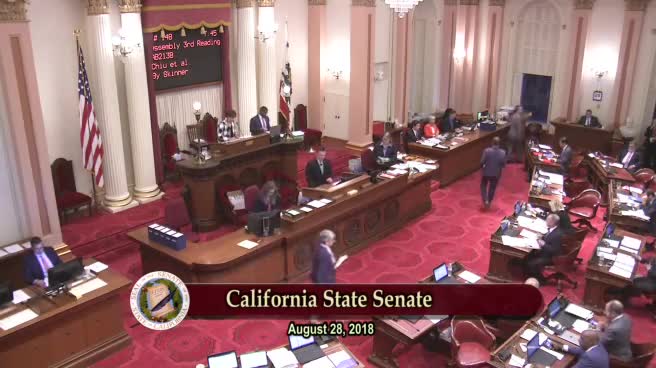

Bill Author


