AB 814: Consumer protection: enforcement powers: investigatory subpoena.
- Session Year: 2017-2018
- House: Assembly
- Latest Version Date: 2017-03-23
The Unfair Competition Law (UCL) establishes a statutory cause of action for unfair competition, including any unlawful, unfair, or fraudulent business act or practice and unfair, deceptive, untrue, or misleading advertising. Under this law, actions for relief are required to be prosecuted exclusively by the Attorney General, a district attorney, a county counsel authorized by agreement with the district attorney in actions involving violation of a county ordinance, a city attorney of a city having a population in excess of 750,000, or a city attorney in a city and county, or, with the consent of the district attorney, by a city prosecutor in a city having a full-time city prosecutor in the name of the people of the State of California, as specified, or by a person who has suffered injury in fact and has lost money or property as a result of the unfair competition.
Existing law authorizes a district attorney, upon reasonable belief there has been a violation of the UCL or various other laws related to unfair business practices, to exercise all the powers granted to the Attorney General as a head of department to investigate the potential violation, including the authority to issue subpoenas.
This bill would specify that this investigatory power granted to the Attorney General as a head of a department applies to a city attorney of a city having a population in excess of 750,000 or to a city attorney in the of a city and county when those city attorneys reasonably believe that there may have been a violation of the UCL.
The Unfair Competition (UCL) establishes a statutory cause of action for unfair competition, including any unlawful, unfair, or fraudulent business act or practice and unfair, deceptive, untrue, or misleading advertising. Under this law, actions for relief are required to be prosecuted exclusively by the Attorney General, a district attorney, a county counsel authorized by agreement with the district attorney in actions involving violation of a county ordinance, a city attorney of a city having a population in excess of 750,000, a city attorney in a city and county, or, with the consent of the district attorney, by a city prosecutor in a city having a full-time city prosecutor in the name of the people of the State of California, as specified, or by a person who has suffered injury in fact and has lost money or property as a result of the unfair competition.
Existing law authorizes a district attorney, upon reasonable belief there has been a violation of the UCL or various other laws related to unfair business practices, to exercise all the powers granted to the Attorney General as a head of department to investigate the potential violation, including the authority to issue subpoenas.
This bill would specify that this investigatory power granted to the Attorney General as a head of a department applies to a city attorney of a city having a population in excess of 750,000 or to a city attorney in the city and county when those city attorneys reasonably believe that there may have been a violation of the UCL.
Existing law grants to district attorneys all the powers granted to the California Attorney General, as specified, for the purpose of enforcing laws relating to restraint of trade and unfair competition. Under this law, a district attorney may conduct investigations and issue subpoenas to witnesses in order to gather information in connection with the investigation of possible violations of the law. This law provides that a district attorney is subject to the California Right to Financial Privacy Act (RFPA), which generally establishes a confidential relationship between financial institutions and their customers and limits state and local agencies from obtaining the financial records of customers unless requests for those records are described with particularity and adhere to certain requirements.This bill would extend the power to enforce laws related to unfair competition to city attorneys of cities with a population exceeding 750,000, and would make those city attorneys subject to provisions of the RFPA.Existing law grants to district attorneys all the powers granted to the California Attorney General, as specified, for the purpose of enforcing laws relating to restraint of trade and unfair competition. Under this law, a district attorney may conduct investigations and issue subpoenas to witnesses in order to gather information in connection with the investigation of possible violations of the law. This law provides that a district attorney is subject to the California Right to Financial Privacy Act (RFPA), which generally establishes a confidential relationship between financial institutions and their customers and limits state and local agencies from obtaining the financial records of customers unless requests for those records are described with particularity and adhere to certain requirements.
This bill would extend the power to enforce laws related to unfair competition to city attorneys of cities with a population exceeding 750,000, and would make those city attorneys subject to provisions of the RFPA.
(a)All those powers granted to the Attorney General as a head of a department under Article 2 (commencing with Section 11180) of Chapter 2 of Part 1 of Division 3 of Title 2 of the Government Code shall be granted to the district attorney of any county when that district attorney reasonably believes that there may have been a violation of Article 2 (commencing with Section 16720) or Article 3 (commencing with Section 16750) of this chapter, or a violation of Chapter 4 (commencing with Section 17000) of this part, or a violation of Chapter 5 (commencing with Section 17200) of this part, and shall be subject to the provisions of Chapter 20 (commencing with Section 7460) of Division 7 of Title 1 of the Government Code.
(b)All those powers granted to the Attorney General as head of a department under Article 2 (commencing with Section 11180) of Chapter 2 of Part 1 of Division 3 of Title 2 of the Government Code shall be granted to the city attorney of any city having a population in excess of 750,000 or to a city attorney in of a city and county when the city attorney reasonably believes that there may have been a violation of Chapter 5 (commencing with Section 17200) of this part, and shall be subject to the provisions of Chapter 20 (commencing with Section 7460) of Division 7 of Title 1 of the Government Code.
(c)Any investigations investigation pursuant to these powers shall be conducted in accordance with the procedures set forth in Article 2 (commencing with Section 11180) of Chapter 2 of Part 1 of Division 3 of Title 2 of the Government Code, including all applicable principles relating to immunity from self-incrimination. However, Section 16758 shall not be construed as providing automatic immunity with respect to the subject of a subpoena issued in connection with that investigation. Court orders sought pursuant to this section shall be sought in the superior court of the county in which the district attorney or city attorney seeking the order holds office.
(a)All those powers granted to the Attorney General as a head of a department under Article 2 (commencing with Section 11180) of Chapter 2 of Part 1 of Division 3 of Title 2 of the Government Code shall be granted to the district attorney of any county when that district attorney reasonably believes that there may have been a violation of Article 2 (commencing with Section 16720) or Article 3 (commencing with Section 16750) of this chapter, or a violation of Chapter 4 (commencing with Section 17000) of this part, or a violation of Chapter 5 (commencing with Section 17200) of this part, and shall be subject to the provisions of Chapter 20 (commencing with Section 7460) of Division 7 of Title 1 of the Government Code.
(b)All those powers granted to the Attorney General as head of a department under Article 2 (commencing with Section 11180) of Chapter 2 of Part 1 of Division 3 of Title 2 of the Government Code shall be granted to the city attorney of any city having a population in excess of 750,000 or to a city attorney in a city and county when that the city attorney reasonably believes that there may have been a violation of Chapter 5 (commencing with Section 17200) of this part, and shall be subject to the provisions of Chapter 20 (commencing with Section 7460) of Division 7 of Title 1 of the Government Code.
(c)Any investigations pursuant to these powers shall be conducted in accordance with the procedures set forth in Article 2 (commencing with Section 11180) of Chapter 2 of Part 1 of Division 3 of Title 2 of the Government Code, including all applicable principles relating to immunity from self-incrimination applicable thereto. However, nothing in self-incrimination. However, Section 16758 shall not be construed as providing automatic immunity with respect to the subject of a subpoena issued in connection with that investigation. Court orders sought pursuant to this section shall be sought in the superior court of the county where in which the district attorney seeking the order holds office.
(a)All those powers granted to the Attorney General as a head of a department under Article 2 (commencing with Section 11180) of Chapter 2 of Part 1 of Division 3 of Title 2 of the Government Code shall be granted to the district attorney of any county when that district attorney reasonably believes that there may have been a violation of Article 2 (commencing with Section 16720) or Article 3 (commencing with Section 16750) of this chapter, or a violation of Chapter 4 (commencing with Section 17000) of this part, or a violation of Chapter 5 (commencing with Section 17200) of this part, and shall be subject to the provisions of Chapter 20 (commencing with Section 7460) of Division 7 of Title 1 of the Government Code. Any
(b)All those powers granted to the Attorney General as head of a department under Article 2 (commencing with Section 11180) of Chapter 2 of Part 1 of Division 3 of Title 2 of the Government Code shall be granted to the city attorney of any city having a population in excess of 750,000 when that city attorney reasonably believes that there may have been a violation of Chapter 5 (commencing with Section 17200) of this part, and shall be subject to the provisions of Chapter 20 (commencing with Section 7460) of Division 7 of Title 1 of the Government Code.
(c)Any investigations pursuant to these powers shall be conducted in accordance with the procedures set forth in Article 2 (commencing with Section 11180) of Chapter 2 of Part 1 of Division 3 of Title 2 of the Government Code, including all principles relating to immunity from self-incrimination applicable thereto. However, nothing in Section 16758 shall be construed as providing automatic immunity with respect to the subject of a subpoena issued in connection with that investigation. Court orders sought pursuant to this section shall be sought in the superior court of the county where the district attorney seeking the order holds office.
|
Date
|
Status
|
|---|---|
| Sep 16, 2017 | Ordered to inactive file at the request of Senator McGuire. |
| Sep 15, 2017 | Read second time. Ordered to third reading. |
| Sep 14, 2017 | From inactive file. |
| Sep 13, 2017 | Ordered to inactive file at the request of Senator Jackson. |
| Sep 6, 2017 | Read third time. Refused passage. |
| Sep 5, 2017 | Read second time. Ordered to third reading. |
| Sep 1, 2017 | From committee: Do pass. (Ayes 5. Noes 2.) (September 1). |
| Jun 26, 2017 | In committee: Referred to suspense file. |
| Jun 13, 2017 | From committee: Do pass and re-refer to Com. on APPR. (Ayes 5. Noes 2.) (June 13). Re-referred to Com. on APPR. |
| May 10, 2017 | Referred to Coms. on JUD. and APPR. |
| Apr 3, 2017 | In Senate. Read first time. To Com. on RLS. for assignment. |
| Apr 3, 2017 | Read third time. Passed. Ordered to the Senate. (Ayes 43. Noes 28. Page 873.) |
| Mar 27, 2017 | Read second time. Ordered to third reading. |
| Mar 23, 2017 | Read second time and amended. Ordered returned to second reading. |
| Mar 22, 2017 | From committee: Amend, and do pass as amended. (Ayes 8. Noes 2.) (March 21). |
| Mar 16, 2017 | Re-referred to Com. on JUD. |
| Mar 15, 2017 | From committee chair, with author's amendments: Amend, and re-refer to Com. on JUD. Read second time and amended. |
| Mar 2, 2017 | Referred to Com. on JUD. |
| Feb 16, 2017 | From printer. May be heard in committee March 18. |
| Feb 15, 2017 | Read first time. To print. |
|
Date
|
Description
|
Location
|
Votes
|
|
|---|---|---|---|---|
| Sep 6, 2017 | Assembly 3rd Reading AB814 Bloom et al. By Jackson Reconsider | Senate Floor |
Passed |
|
| Sep 6, 2017 | Assembly 3rd Reading AB814 Bloom et al. By Jackson | Senate Floor |
Passed |
|
| Sep 1, 2017 | Do pass | Senate Standing Committee on Appropriations |
Passed |
|
| Jun 26, 2017 | Placed on suspense file | Senate Standing Committee on Appropriations |
Passed |
|
| Jun 13, 2017 | Do pass, but first be re-referred to the Committee on [Appropriations] | Senate Standing Committee on Judiciary |
Passed |
|
| Apr 3, 2017 | AB 814 BLOOM Assembly Third Reading | Assembly Floor |
Passed |
|
| Mar 21, 2017 | Do pass as amended. | Assembly Standing Committee on Judiciary |
Passed |
This list shows positions taken on this bill by organizations on the date displayed, which is linked to the original source.
Positions by individuals are not included.
|
Organization
|
Position
|
Date
|
|---|---|---|
| American Insurance Association | ** Against | Sep 6, 2017 |
| Association Of California Insurance Companies | ** Against | Sep 6, 2017 |
| Bet Tzedek Legal Services | ** Support | Sep 6, 2017 |
| California Apartment Association | ** Against | Sep 6, 2017 |
| California Association Of Health Plans | ** Against | Sep 6, 2017 |
| California Bankers Association | ** Against | Sep 6, 2017 |
| California Broadcasters Association | ** Against | Sep 6, 2017 |
| California Building Industry Association | ** Against | Sep 6, 2017 |
| California Cable & Telecommunication Association | ** Against | Sep 6, 2017 |
| California Chamber Of Commerce | ** Against | Sep 6, 2017 |
| California Citizens Against Lawsuit Abuse | ** Against | Sep 6, 2017 |
| California Community Banking Network | ** Against | Sep 6, 2017 |
| California Credit Union League | ** Against | Sep 6, 2017 |
| California District Attorneys Association | ** Support | Sep 6, 2017 |
| California Fair Services Authority | ** Against | Sep 6, 2017 |
| California Justice Association of California | ** Against | Mar 23, 2017 |
| California Manufacturers & Technology Association | ** Against | Sep 6, 2017 |
| California Mortgage Bankers Association | ** Against | Sep 6, 2017 |
| California Retailers Association | ** Against | Sep 6, 2017 |
| Citizens Against Lawsuit Abuse | ** Against | Mar 23, 2017 |
| City and County of San Fransisco | * Support | Jun 13, 2017 |
| City Of Los Angeles | ** Support | Sep 6, 2017 |
| Civil Justice Association Of California | ** Against | Sep 6, 2017 |
| Communication Workers of America, District 9 | ** Support | Sep 6, 2017 |
| Construction Employers' Association | ** Against | Sep 6, 2017 |
| Consumer Attorneys Of California | ** Support | Sep 6, 2017 |
| Consumer Federation Of California | ** Support | Sep 6, 2017 |
| Consumers For Auto Reliability And Safety | ** Support | Sep 6, 2017 |
| Los Angeles City Attorney | * Support | Jun 13, 2017 |
| Los Angeles City Attorney Mike Feuer | ** Support | Sep 6, 2017 |
| National Federation Of Independent Business | ** Against | Sep 6, 2017 |
| Personal Insurance Federation Of California | ** Against | Sep 6, 2017 |
| Property Casualty Insurers Association of America | ** Against | Sep 6, 2017 |
| San Diego City Attorney Mara W. Elliott | ** Support | Sep 6, 2017 |
| San Diego City Attorney, Mara Elliott | ** Support | Mar 23, 2017 |
| San Francisco City Attorney Dennis J. Herrera | ** Support | Sep 6, 2017 |
| San Francisco City Attorney, Dennis Herrera | ** Support | Mar 23, 2017 |
| San Francisco Mayor, Edwin Lee | ** Support | Sep 6, 2017 |
| San Jose City Attorney Richard Doyle | ** Support | Sep 6, 2017 |
| San Jose City Council | ** Support | Sep 6, 2017 |
| SEIU California | ** Support | Sep 6, 2017 |
| Technet | ** Against | Sep 6, 2017 |
| Western State Petroleum Association | ** Against | Sep 6, 2017 |
Office of Senate Floor Analyses (916) 651-1520 Fax: (916) 327-4478 | AB |
THIRD READING
Bill No: AB 814
:
SENATE JUDICIARY COMMITTEE: 5-2, 6/13/17
AYES: Jackson, Hertzberg, Monning, Stern, Wieckowski
NOES: Moorlach, Anderson
SENATE APPROPRIATIONS COMMITTEE: 5-2, 9/1/17
AYES: Lara, Beall, Bradford, Hill, Wiener
NOES: Bates, Nielsen
SENATE FLOOR: 18-18, 9/6/17 (FAIL)
AYES: Allen, Atkins, Beall, Bradford, De León, Dodd, Hernandez, Hertzberg, Jackson, Lara, Leyva, McGuire, Mitchell, Monning, Skinner, Stern, Wieckowski, Wiener
NOES: Anderson, Bates, Berryhill, Cannella, Fuller, Gaines, Galgiani, Hill, Mendoza, Moorlach, Morrell, Newman, Nguyen, Nielsen, Portantino, Stone, Vidak, Wilk
NO VOTE RECORDED: Glazer, Hueso, Pan, Roth
ASSEMBLY FLOOR: 43-28, 4/3/17 - See last page for vote
SOURCE: Los Angeles City Attorney Mike Feuer
DIGEST:
This bill grants certain city attorneys the power to conduct investigations, including the ability to issue pre-litigation subpoenas, when they reasonably believe there has been a violation of California’s Unfair Competition Law, Business and Professions Code Section 17200 et seq.
Existing law:
- Permits the head of each department to make investigations and prosecute actions concerning:
- All matters relating to the business activities and subjects under the jurisdiction of the department;
- Violations of any law or rule or order of the department; and
- Such other matters as may be provided by law. (Gov. Code Sec. 11180.)
- Authorizes the heads of each department to do the following acts in connection with any authorized investigation or action:
- Issue subpoenas for the attendance of witnesses and the production of papers, books, accounts, documents, any writing as defined by Section 250 of the Evidence Code, tangible things, and testimony pertinent or material to any inquiry, investigation, hearing, proceeding, or action conducted in any part of the state;
- Inspect and copy books, records, and other items described above;
- Hear complaints;
- Administer oaths;
- Certify to all official acts;
- Promulgate interrogatories pertinent or material to any inquiry, investigation, hearing, proceeding, or action;
- Divulge information or evidence related to the investigation of unlawful activity discovered to the Attorney General or to any prosecuting attorney of this state, any other state, or the United States, who has a responsibility for investigating the unlawful activity investigated or discovered, or to any governmental agency responsible for enforcing laws related to the unlawful activity investigated or discovered, if the Attorney General, prosecuting attorney, or agency to which the information or evidence is divulged agrees to maintain the confidentiality of the information received to the extent required by this article; and
- Present information or evidence obtained or developed from the investigation of unlawful activity to a court or at an administrative hearing in connection with any action or proceeding. (Gov. Code Sec. 11181.)
- Grants all those powers granted to the Attorney General as head of a department pursuant to Government Code Section 11180 et seq. to the district attorney of any county when the district attorney reasonably believes that there may have been a violation of (a) California’s Unfair Competition Law (“UCL”), Business and Professions Code Section 17200 et seq.; (b) Business and Professions Code Section 16720 et seq.; (c) Business and Professions Code Section 16750 et seq.; or (d) Business and Professions Code Section 17000 et seq. These powers are subject to the provisions of the California Right to Financial Privacy Act, Government Code Section 7460 et seq., and must be conducted in accordance with the procedures set forth in Government Code Section 11180 et seq., including all applicable principles relating to immunity from self-incrimination. (Bus. & Prof. Code Sec. 16759.)
- Defines “unfair competition” to mean and include any unlawful, unfair or fraudulent business act or practice and unfair, deceptive, untrue, or misleading advertising and any act prohibited by Chapter 1 (commencing with Section 17500) of Part 3 of Division 7 of the Business and Professions Code. (Bus. & Prof. Code Sec. 17200.)
- Provides that any person who engages, has engaged, or proposes to engage in unfair competition may be enjoined in any court of competent jurisdiction. The court may make such orders or judgments, including the appointment of a receiver, as may be necessary to prevent the use or employment by any person of any practice which constitutes unfair competition or as may be necessary to restore to any person in interest any money or property, real or personal, which may have been acquired by means of such unfair competition. Any person may pursue representative claims or relief on behalf of others only if the claimant meets the standing requirements of Business and Professions Code Section 17204 and complies with Section 382 of the Code of Civil Procedure, but these limitations do not apply to claims brought under this chapter by the Attorney General, or any district attorney, county counsel, city attorney, or city prosecutor in this state. (Bus. & Prof. Code Sec. 17203.)
- Requires actions for relief pursuant to the UCL be prosecuted exclusively in a court of competent jurisdiction and only by the following:
- The Attorney General;
- A district attorney;
- A county counsel authorized by agreement with the district attorney in actions involving violation of a county ordinance;
- A city attorney of a city having a population in excess of 750,000;
- A city attorney in a city and county;
- A city prosecutor in a city having a full-time city prosecutor in the name of the people of the State of California upon their own complaint or upon the complaint of a board, officer, person, corporation, or association with the consent of the district attorney; or
- A person who has suffered injury in fact and has lost money or property as a result of the unfair competition. (Bus. & Prof. Code Sec. 17204.)
This bill:
- Grants all those powers granted to the Attorney General as head of a department pursuant to Government Code Section 11180 et seq. to the city attorney of any city having a population in excess of 750,000, or to a city attorney of a city and county when the city attorney reasonably believes that there may have been a violation of the UCL. This bill subjects the use of such powers to the provisions of the California Right to Financial Privacy Act, Government Code Section 7460 et seq.
- Requires any investigation carried out pursuant to the powers this bill creates to be conducted in accordance with the procedures set forth in Government Code Section 11180 et seq., including all applicable principles relating to immunity from self-incrimination. This bill provides that Business and Professions Code Section 16758 shall not be construed as providing automatic immunity with respect to the subject of a subpoena issued in connection with that investigation. This bill requires all court orders sought pursuant to this bill’s new provisions to be sought in the superior court of the county in which the city attorney seeking the order holds office.
Background
Among the agencies authorized to bring actions pursuant to UCL, Business and Professions Code Section 17200 et seq., are the city attorneys of San Francisco, San Jose, San Diego, and Los Angeles.
The Government Code authorizes the Attorney General, and all other heads of state departments, to investigate and prosecute actions concerning certain matters, and empowers them with certain investigatory tools, including pre-litigation subpoena power. Although the four city attorneys discussed above can bring UCL actions, they are not currently afforded the same tools as the Attorney General, and other department heads, in investigating possible unfair competition cases.
District attorneys are authorized to bring UCL actions and are statutorily vested with the same investigation powers as the Attorney General, as a head of a department, with respect to suspected violations of certain civil laws, including the UCL, by Section 16759 of the Business and Professions Code. These powers allow district attorneys to more efficiently investigate and prosecute UCL actions.
This bill amends Section 16759 to extend these same investigatory powers to city attorneys of cities with populations over 750,000 and city attorneys of a city and county when they reasonably believe that a violation of the UCL has occurred.
Comments
The author writes:
Granting pre-litigation subpoena power to city attorneys from cities with a population in excess of 750,000 would allow city attorneys to play a stronger role in protecting California consumers. Recent issues with Wells Fargo exemplify how subpoena power would increase consumer protection and streamline city attorney investigations. Granting subpoena power would also allow city attorneys to investigate allegations of wrongdoing when access to public sources of information is scarce.
A limited extension of powers to specified city attorneys
Current law authorizes the heads of each state department to make investigations and prosecute actions concerning matters relating to the business activities and subjects under their jurisdiction; violations of any law or rule or order of the department; and such other matters as may be provided by law. In order to effectuate these investigations and actions, the law provides the heads of these departments certain powers. Among the powers is the ability to promulgate interrogatories; the ability to issue subpoenas for the attendance of witnesses and the production of certain documents, testimony, or other materials; and the ability to inspect and copy those same documents and materials.
In order to facilitate their investigation of certain misconduct, including violations of the UCL, district attorneys are granted the investigative powers discussed above by Section 16759 of the Business and Professions Code. Their use of these powers is still subject to certain safeguards. In particular, district attorneys’ investigations under this section must abide by the procedures laid out in the Government Code and are subject to the California Right to Financial Privacy Act.
This bill extends these same powers to the city attorneys of certain cities, currently limited to the city attorneys of San Jose, Los Angeles, San Francisco, and San Diego. Although the opposition argues that this power is unlimited and ripe for abuse, these powers are limited in scope. First, they are subject to the same parameters currently applied to district attorneys’ use of these investigatory powers in Section 16759. In addition, a city attorney will only be granted these expanded investigatory powers when the city attorney “reasonably believes that there may have been a violation of [the UCL].” This bill does not extend the right to bring actions pursuant to the UCL to any additional agencies or extend the powers to investigations of violations of any other laws.
Fortifies the ability of city attorneys to protect consumers and businesses
The purpose of the UCL is to combat and prevent the use or employment by any person of any practice which constitutes unfair competition. The law provides for civil penalties and whatever other relief is necessary to effectuate its purpose. In addition, the UCL currently grants certain government entities the ability to prosecute such actions. This bill seeks a modest extension of current law to grant the city attorneys of the state’s largest cities to have the same investigative powers in connection with UCL actions that the Attorney General and all district attorneys already have.
Affording city attorneys these additional powers enables them to more robustly address unfair competition in their communities. For instance, the ability to issue pre-litigation subpoenas allows city attorneys to quickly act upon a reasonable suspicion of wrongdoing by seeking more information in a timely and targeted manner rather than forcing a city attorney into a more time-consuming and costly lawsuit. City attorneys will be better equipped to protect consumers from unfair practices and to protect businesses that follow the rules from the businesses that seek to reap the advantages that come with unlawful and unfair business practices.
The author and sponsor of the bill, the Los Angeles City Attorney, provide an example that illustrates what would be the more salient benefits of this extension of investigatory powers. In its recent and infamous scheme, Wells Fargo systematically stole customers’ identities to create new and unauthorized accounts for customers in order to meet certain internal goals and to charge these customers fees. In response to early reports of this scheme, the Office of the City Attorney of Los Angeles began to investigate Wells Fargo and its business practices in Los Angeles. However, the Los Angeles City Attorney’s Office contends that the investigation was thwarted by their inability to quickly obtain records, allowing the misconduct to continue longer than it otherwise should have. It argues that had it had the ability to issue pre-litigation subpoenas, the office could have rooted out the problem and stopped the scheme much sooner.
FISCAL EFFECT: Appropriation: Fiscal Com.: Local:
According to the Senate Appropriations Committee, unknown, potentially significant cost pressures (General Fund*) to the court to adjudicate UCL violation cases brought against defendants that otherwise would not have been filed absent the information discovered through the expansion of investigatory powers to city attorneys.
*Trial Court Trust Fund
Los Angeles City Attorney Mike Feuer (source)
Bet Tzedek Legal Services
California District Attorneys Association
City of Los Angeles
Communication Workers of America, District 9
Consumer Attorneys of California
Consumer Federation of California
Consumers for Auto Reliability and Safety
San Diego City Attorney Mara W. Elliott
San Francisco City Attorney Dennis J. Herrera
San Francisco Mayor, Edwin Lee
San Jose City Attorney Richard Doyle
San Jose City Council
SEIU California
American Insurance Association
Association of California Insurance Companies
California Apartment Association
California Association of Health Plans
California Bankers Association
California Broadcasters Association
California Building Industry Association
California Cable & Telecommunication Association
California Chamber of Commerce
California Citizens Against Lawsuit Abuse
California Community Banking Network
California Credit Union League
California Fair Services Authority
California Manufacturers & Technology Association
California Mortgage Bankers Association
California Retailers Association
Civil Justice Association of California
Construction Employers’ Association
National Federation of Independent Business
Personal Insurance Federation of California
Property Casualty Insurers Association of America
TechNet
Western State Petroleum Association
ARGUMENTS IN SUPPORT: The four city attorneys who would be granted these additional powers write in support that granting their offices “access to key information pre-lawsuit increases the likelihood that a matter would be resolved without court intervention, freeing up judicial resources to resolve other important matters.” They contend that their offices “have the will, skills[,] and ability to champion consumer protection at the local level.”
ARGUMENTS IN OPPOSITION: A coalition led by the Civil Justice Association of California argues that this bill would “expand meritless civil liability” for businesses. It argues that these powers were intended and should remain solely with the state’s law enforcement officers.
ASSEMBLY FLOOR: 43-28, 4/3/17
AYES: Aguiar-Curry, Berman, Bloom, Bocanegra, Bonta, Burke, Caballero, Calderon, Chau, Chiu, Chu, Cooley, Dababneh, Eggman, Friedman, Cristina Garcia, Eduardo Garcia, Gipson, Gloria, Gomez, Gonzalez Fletcher, Holden, Irwin, Jones-Sawyer, Kalra, Levine, Limón, Low, McCarty, Muratsuchi, Nazarian, O'Donnell, Quirk, Quirk-Silva, Reyes, Ridley-Thomas, Santiago, Mark Stone, Thurmond, Ting, Weber, Wood, Rendon
NOES: Acosta, Travis Allen, Arambula, Baker, Bigelow, Brough, Chávez, Chen, Choi, Cunningham, Dahle, Flora, Fong, Gallagher, Gray, Harper, Kiley, Lackey, Maienschein, Mathis, Mayes, Melendez, Obernolte, Patterson, Salas, Steinorth, Voepel, Waldron
NO VOTE RECORDED: Cervantes, Cooper, Daly, Frazier, Grayson, Medina, Mullin, Rodriguez, Rubio
9/6/17 16:17:33
**** END ****
Office of Senate Floor Analyses (916) 651-1520 Fax: (916) 327-4478 | AB |
THIRD READING
Bill No: AB 814
:
SENATE JUDICIARY COMMITTEE: 5-2, 6/13/17
AYES: Jackson, Hertzberg, Monning, Stern, Wieckowski
NOES: Moorlach, Anderson
SENATE APPROPRIATIONS COMMITTEE: 5-2, 9/1/17
AYES: Lara, Beall, Bradford, Hill, Wiener
NOES: Bates, Nielsen
ASSEMBLY FLOOR: 43-28, 4/3/17 - See last page for vote
SOURCE: Los Angeles City Attorney Mike Feuer
DIGEST:
This bill grants certain city attorneys the power to conduct investigations, including the ability to issue pre-litigation subpoenas, when they reasonably believe there has been a violation of California’s Unfair Competition Law, Business and Professions Code Section 17200 et seq.
Existing law:
- Permits the head of each department to make investigations and prosecute actions concerning:
- All matters relating to the business activities and subjects under the jurisdiction of the department;
- Violations of any law or rule or order of the department; and
- Such other matters as may be provided by law. (Gov. Code Sec. 11180.)
- Authorizes the heads of each department to do the following acts in connection with any authorized investigation or action:
- Issue subpoenas for the attendance of witnesses and the production of papers, books, accounts, documents, any writing as defined by Section 250 of the Evidence Code, tangible things, and testimony pertinent or material to any inquiry, investigation, hearing, proceeding, or action conducted in any part of the state;
- Inspect and copy books, records, and other items described above;
- Hear complaints;
- Administer oaths;
- Certify to all official acts;
- Promulgate interrogatories pertinent or material to any inquiry, investigation, hearing, proceeding, or action;
- Divulge information or evidence related to the investigation of unlawful activity discovered to the Attorney General or to any prosecuting attorney of this state, any other state, or the United States, who has a responsibility for investigating the unlawful activity investigated or discovered, or to any governmental agency responsible for enforcing laws related to the unlawful activity investigated or discovered, if the Attorney General, prosecuting attorney, or agency to which the information or evidence is divulged agrees to maintain the confidentiality of the information received to the extent required by this article; and
- Present information or evidence obtained or developed from the investigation of unlawful activity to a court or at an administrative hearing in connection with any action or proceeding. (Gov. Code Sec. 11181.)
- Grants all those powers granted to the Attorney General as head of a department pursuant to Government Code Section 11180 et seq. to the district attorney of any county when the district attorney reasonably believes that there may have been a violation of (a) California’s Unfair Competition Law (“UCL”), Business and Professions Code Section 17200 et seq.; (b) Business and Professions Code Section 16720 et seq.; (c) Business and Professions Code Section 16750 et seq.; or (d) Business and Professions Code Section 17000 et seq. These powers are subject to the provisions of the California Right to Financial Privacy Act, Government Code Section 7460 et seq., and must be conducted in accordance with the procedures set forth in Government Code Section 11180 et seq., including all applicable principles relating to immunity from self-incrimination. (Bus. & Prof. Code Sec. 16759.)
- Defines “unfair competition” to mean and include any unlawful, unfair or fraudulent business act or practice and unfair, deceptive, untrue, or misleading advertising and any act prohibited by Chapter 1 (commencing with Section 17500) of Part 3 of Division 7 of the Business and Professions Code. (Bus. & Prof. Code Sec. 17200.)
- Provides that any person who engages, has engaged, or proposes to engage in unfair competition may be enjoined in any court of competent jurisdiction. The court may make such orders or judgments, including the appointment of a receiver, as may be necessary to prevent the use or employment by any person of any practice which constitutes unfair competition or as may be necessary to restore to any person in interest any money or property, real or personal, which may have been acquired by means of such unfair competition. Any person may pursue representative claims or relief on behalf of others only if the claimant meets the standing requirements of Business and Professions Code Section 17204 and complies with Section 382 of the Code of Civil Procedure, but these limitations do not apply to claims brought under this chapter by the Attorney General, or any district attorney, county counsel, city attorney, or city prosecutor in this state. (Bus. & Prof. Code Sec. 17203.)
- Requires actions for relief pursuant to the UCL be prosecuted exclusively in a court of competent jurisdiction and only by the following:
- The Attorney General;
- A district attorney;
- A county counsel authorized by agreement with the district attorney in actions involving violation of a county ordinance;
- A city attorney of a city having a population in excess of 750,000;
- A city attorney in a city and county;
- A city prosecutor in a city having a full-time city prosecutor in the name of the people of the State of California upon their own complaint or upon the complaint of a board, officer, person, corporation, or association with the consent of the district attorney; or
- A person who has suffered injury in fact and has lost money or property as a result of the unfair competition. (Bus. & Prof. Code Sec. 17204.)
This bill:
- Grants all those powers granted to the Attorney General as head of a department pursuant to Government Code Section 11180 et seq. to the city attorney of any city having a population in excess of 750,000, or to a city attorney of a city and county when the city attorney reasonably believes that there may have been a violation of the UCL. This bill subjects the use of such powers to the provisions of the California Right to Financial Privacy Act, Government Code Section 7460 et seq.
- Requires any investigation carried out pursuant to the powers this bill creates to be conducted in accordance with the procedures set forth in Government Code Section 11180 et seq., including all applicable principles relating to immunity from self-incrimination. This bill provides that Business and Professions Code Section 16758 shall not be construed as providing automatic immunity with respect to the subject of a subpoena issued in connection with that investigation. This bill requires all court orders sought pursuant to this bill’s new provisions to be sought in the superior court of the county in which the city attorney seeking the order holds office.
Background
Among the agencies authorized to bring actions pursuant to UCL, Business and Professions Code Section 17200 et seq., are the city attorneys of San Francisco, San Jose, San Diego, and Los Angeles.
The Government Code authorizes the Attorney General, and all other heads of state departments, to investigate and prosecute actions concerning certain matters, and empowers them with certain investigatory tools, including pre-litigation subpoena power. Although the four city attorneys discussed above can bring UCL actions, they are not currently afforded the same tools as the Attorney General, and other department heads, in investigating possible unfair competition cases.
District attorneys are authorized to bring UCL actions and are statutorily vested with the same investigation powers as the Attorney General, as a head of a department, with respect to suspected violations of certain civil laws, including the UCL, by Section 16759 of the Business and Professions Code. These powers allow district attorneys to more efficiently investigate and prosecute UCL actions.
This bill amends Section 16759 to extend these same investigatory powers to city attorneys of cities with populations over 750,000 and city attorneys of a city and county when they reasonably believe that a violation of the UCL has occurred.
Comments
The author writes:
Granting pre-litigation subpoena power to city attorneys from cities with a population in excess of 750,000 would allow city attorneys to play a stronger role in protecting California consumers. Recent issues with Wells Fargo exemplify how subpoena power would increase consumer protection and streamline city attorney investigations. Granting subpoena power would also allow city attorneys to investigate allegations of wrongdoing when access to public sources of information is scarce.
A limited extension of powers to specified city attorneys
Current law authorizes the heads of each state department to make investigations and prosecute actions concerning matters relating to the business activities and subjects under their jurisdiction; violations of any law or rule or order of the department; and such other matters as may be provided by law. In order to effectuate these investigations and actions, the law provides the heads of these departments certain powers. Among the powers is the ability to promulgate interrogatories; the ability to issue subpoenas for the attendance of witnesses and the production of certain documents, testimony, or other materials; and the ability to inspect and copy those same documents and materials.
In order to facilitate their investigation of certain misconduct, including violations of the UCL, district attorneys are granted the investigative powers discussed above by Section 16759 of the Business and Professions Code. Their use of these powers is still subject to certain safeguards. In particular, district attorneys’ investigations under this section must abide by the procedures laid out in the Government Code and are subject to the California Right to Financial Privacy Act.
This bill extends these same powers to the city attorneys of certain cities, currently limited to the city attorneys of San Jose, Los Angeles, San Francisco, and San Diego. Although the opposition argues that this power is unlimited and ripe for abuse, these powers are limited in scope. First, they are subject to the same parameters currently applied to district attorneys’ use of these investigatory powers in Section 16759. In addition, a city attorney will only be granted these expanded investigatory powers when the city attorney “reasonably believes that there may have been a violation of [the UCL].” This bill does not extend the right to bring actions pursuant to the UCL to any additional agencies or extend the powers to investigations of violations of any other laws.
Fortifies the ability of city attorneys to protect consumers and businesses
The purpose of the UCL is to combat and prevent the use or employment by any person of any practice which constitutes unfair competition. The law provides for civil penalties and whatever other relief is necessary to effectuate its purpose. In addition, the UCL currently grants certain government entities the ability to prosecute such actions. This bill seeks a modest extension of current law to grant the city attorneys of the state’s largest cities to have the same investigative powers in connection with UCL actions that the Attorney General and all district attorneys already have.
Affording city attorneys these additional powers enables them to more robustly address unfair competition in their communities. For instance, the ability to issue pre-litigation subpoenas allows city attorneys to quickly act upon a reasonable suspicion of wrongdoing by seeking more information in a timely and targeted manner rather than forcing a city attorney into a more time-consuming and costly lawsuit. City attorneys will be better equipped to protect consumers from unfair practices and to protect businesses that follow the rules from the businesses that seek to reap the advantages that come with unlawful and unfair business practices.
The author and sponsor of the bill, the Los Angeles City Attorney, provide an example that illustrates what would be the more salient benefits of this extension of investigatory powers. In its recent and infamous scheme, Wells Fargo systematically stole customers’ identities to create new and unauthorized accounts for customers in order to meet certain internal goals and to charge these customers fees. In response to early reports of this scheme, the Office of the City Attorney of Los Angeles began to investigate Wells Fargo and its business practices in Los Angeles. However, the Los Angeles City Attorney’s Office contends that the investigation was thwarted by their inability to quickly obtain records, allowing the misconduct to continue longer than it otherwise should have. It argues that had it had the ability to issue pre-litigation subpoenas, the office could have rooted out the problem and stopped the scheme much sooner.
FISCAL EFFECT: Appropriation: Fiscal Com.: Local:
According to the Senate Appropriations Committee, unknown, potentially significant cost pressures (General Fund*) to the court to adjudicate UCL violation cases brought against defendants that otherwise would not have been filed absent the information discovered through the expansion of investigatory powers to city attorneys.
*Trial Court Trust Fund
Los Angeles City Attorney Mike Feuer (source)
Bet Tzedek Legal Services
California District Attorneys Association
City of Los Angeles
Communication Workers of America, District 9
Consumer Attorneys of California
Consumer Federation of California
Consumers for Auto Reliability and Safety
San Diego City Attorney Mara W. Elliott
San Francisco City Attorney Dennis J. Herrera
San Francisco Mayor, Edwin Lee
San Jose City Attorney Richard Doyle
San Jose City Council
SEIU California
American Insurance Association
Association of California Insurance Companies
California Apartment Association
California Association of Health Plans
California Bankers Association
California Broadcasters Association
California Building Industry Association
California Cable & Telecommunication Association
California Chamber of Commerce
California Citizens Against Lawsuit Abuse
California Community Banking Network
California Credit Union League
California Fair Services Authority
California Manufacturers & Technology Association
California Mortgage Bankers Association
California Retailers Association
Civil Justice Association of California
Construction Employers’ Association
National Federation of Independent Business
Personal Insurance Federation of California
Property Casualty Insurers Association of America
TechNet
Western State Petroleum Association
ARGUMENTS IN SUPPORT: The four city attorneys who would be granted these additional powers write in support that granting their offices “access to key information pre-lawsuit increases the likelihood that a matter would be resolved without court intervention, freeing up judicial resources to resolve other important matters.” They contend that their offices “have the will, skills[,] and ability to champion consumer protection at the local level.”
ARGUMENTS IN OPPOSITION: A coalition led by the Civil Justice Association of California argues that this bill would “expand meritless civil liability” for businesses. It argues that these powers were intended and should remain solely with the state’s law enforcement officers.
ASSEMBLY FLOOR: 43-28, 4/3/17
AYES: Aguiar-Curry, Berman, Bloom, Bocanegra, Bonta, Burke, Caballero, Calderon, Chau, Chiu, Chu, Cooley, Dababneh, Eggman, Friedman, Cristina Garcia, Eduardo Garcia, Gipson, Gloria, Gomez, Gonzalez Fletcher, Holden, Irwin, Jones-Sawyer, Kalra, Levine, Limón, Low, McCarty, Muratsuchi, Nazarian, O'Donnell, Quirk, Quirk-Silva, Reyes, Ridley-Thomas, Santiago, Mark Stone, Thurmond, Ting, Weber, Wood, Rendon
NOES: Acosta, Travis Allen, Arambula, Baker, Bigelow, Brough, Chávez, Chen, Choi, Cunningham, Dahle, Flora, Fong, Gallagher, Gray, Harper, Kiley, Lackey, Maienschein, Mathis, Mayes, Melendez, Obernolte, Patterson, Salas, Steinorth, Voepel, Waldron
NO VOTE RECORDED: Cervantes, Cooper, Daly, Frazier, Grayson, Medina, Mullin, Rodriguez, Rubio
9/4/17 12:53:27
**** END ****
SENATE COMMITTEE ON
Senator Ricardo Lara, Chair
2017 - 2018 Regular Session
AB 814 (Bloom) - Consumer protection: enforcement powers: investigatory subpoena
Version: | Policy Vote: |
Urgency: | Mandate: |
Hearing Date: | Consultant: |
This bill meets the criteria for referral to the Suspense File.
Bill Summary:
AB 814 would grant investigatory powers related to possible Unfair Competition Law violations available to the Attorney General to specified city attorneys.
Fiscal Impact:
Unknown, potentially significant cost pressures (General Fund*) to the court to adjudicate Unfair Competition Law violation cases brought against defendants that otherwise would not have been filed absent the information discovered through the expansion of investigatory powers to city attorneys.
*Trial Court Trust Fund
Background:
The Unfair Competition Law (UCL) establishes a statutory cause of action for unfair competition, including any unlawful, unfair, or fraudulent business act or practice and unfair, deceptive, untrue, or misleading advertising. Under this law, actions for relief are required to be prosecuted exclusively by the Attorney General, a district attorney, a county counsel authorized by agreement with the district attorney in actions involving violation of a county ordinance, a city attorney of a city with a population of over 750,000 residents, or a city attorney of a city and county. Additionally, with the consent of the district attorney, a UCL action may be brought by a city prosecutor in a city having a full-time city prosecutor in the name of the people of the State of California, as specified. A person who has suffered injury in fact and has lost money or property as a result of the unfair competition may file a UCL lawsuit as well. The suing party may seek to recover civil penalties or injunctive relief.
As a practical matter, the city attorneys of Los Angeles, San Diego, San Jose and San Francisco meet the statutory criteria to file a UCL action. City attorneys, however, do not possess the pre-litigation powers to investigate possible UCL violations.
Proposed Law:
This bill would grant investigatory powers related to potential UCL violations available to the Attorney General to city attorneys of cities with populations over 750,000 and city attorneys of a city and county when they reasonably believe that a UCL violation has occurred. These investigatory powers include the follow:
- Issue subpoenas for the attendance of witnesses and the production of papers, books, accounts, documents, any writing, as defined, tangible things, and testimony pertinent or material to any inquiry, investigation, hearing, proceeding, or action conducted in any part of the state;
- Inspect and copy books, records, and other items described above;
- Hear complaints;
- Administer oaths;
- Certify to all official acts;
- Promulgate interrogatories pertinent or material to any inquiry, investigation, hearing, proceeding, or action;
- Divulge information or evidence related to the investigation of unlawful activity discovered to the Attorney General or to any prosecuting attorney of this state, any other state, or the United States, who has a responsibility for investigating the unlawful activity investigated or discovered, or to any governmental agency responsible for enforcing laws related to the unlawful activity investigated or discovered, if the Attorney General, prosecuting attorney, or agency to which the information or evidence is divulged agrees to maintain the confidentiality of the information received to the extent required by law; and
- Present information or evidence obtained or developed from the investigation of unlawful activity to a court or at an administrative hearing in connection with any action or proceeding.
Staff Comments:
Granting city attorneys pre-litigation powers to investigate possible UCL violations likely would lead to the exercise of these powers and the uncovering of new UCL violations. This could result in the filing of more UCL actions in court and new litigation that would not have happened but for the discovery of the violations through the pre-litigation investigatory powers. It costs about $7,010 to operate a courtroom for one day. So if the expansion of pre-litigation subpoena and other powers to city attorneys led to more than seven new cases, or one complex case that took longer than seven days (e.g., a class action lawsuit against a well-resourced defendant), that otherwise would not have been brought because the violations were undiscovered, the cost pressures of this bill to the court would surpass the Suspense File threshold. The fiscal impact of this bill, however, cannot be known with certainty, as the actual impact will be dependent on numerous factors, including, but not limited to, the frequency with which city attorneys exercise the investigatory powers, the complexity of alleged violations, if parties settle matters prior to litigation, and the factors unique to each case.
-- END --
Senator Hannah-Beth Jackson, Chair
2017-2018 Regular Session
Bill No: AB 814 (Author:Bloom)
Version: March 23, 2017
Hearing Date: June 13, 2017
Fiscal: No
Urgency: No
Consultant: CK
SUBJECT
Consumer protection: enforcement powers: investigatory subpoena
DESCRIPTION
This bill would grant certain city attorneys the power to conduct investigations, including the ability to issue pre-litigation subpoenas, when they reasonably believe there has been a violation of California’s Unfair Competition Law, Business and Professions Code Section 17200 et seq.
BACKGROUND
Unfair business practices encompass fraud, misrepresentation, and oppressive or unconscionable acts or practices by businesses, often against consumers. In California, affected individuals and specified governmental agencies are authorized to bring civil actions for unfair competition and to recover civil penalties or injunctive relief pursuant to the Unfair Competition Law (UCL), Business and Professions Code Section 17200 et seq.
Among the agencies authorized to bring such actions are city attorneys of cities with populations in excess of 750,000 and city attorneys of a city and county. Currently, the City and County of San Francisco is the only consolidated city-county in California, a status it has held since 1856. Thus, in practice, San Francisco is the only public entity that is affected by the statutory provisions granting authority to a city attorney of a city and county to bring unfair competition actions. Currently, the only other city attorneys granted authority to bring actions under the UCL based on population are those in San Jose, San Diego, and Los Angeles.
The Government Code authorizes the Attorney General, and all other heads of state departments, to investigate and prosecute actions concerning certain matters, and empowers them with certain investigatory tools, including pre-litigation subpoena power. Although the four city attorneys discussed above can bring UCL actions, they are not currently afforded the same tools as the Attorney General, and other department heads, in investigating possible unfair competition cases.
Current law also authorizes district attorneys to bring UCL actions. However, they are statutorily vested with the same investigation powers as the Attorney General, as a head of a department, with respect to suspected violations of certain civil laws, including the UCL, by Section 16759 of the Business and Professions Code. These powers allow district attorneys to more efficiently investigate and prosecute UCL actions.
This bill would amend Section 16759 to extend these same investigatory powers to city attorneys of cities with populations over 750,000 and city attorneys of a city and county when they reasonably believe that a violation of the UCL has occurred.
CHANGES TO EXISTING LAW
Existing law permits the head of each department to make investigations and prosecute actions concerning:
- all matters relating to the business activities and subjects under the jurisdiction of the department;
- violations of any law or rule or order of the department; and
- such other matters as may be provided by law. (Gov. Code Sec. 11180.)
Existing law authorizes the heads of each department to do the following acts in connection with any authorized investigation or action:
- issue subpoenas for the attendance of witnesses and the production of papers, books, accounts, documents, any writing as defined by Section 250 of the Evidence Code, tangible things, and testimony pertinent or material to any inquiry, investigation, hearing, proceeding, or action conducted in any part of the state;
- inspect and copy books, records, and other items described above;
- hear complaints;
- administer oaths;
- certify to all official acts;
- promulgate interrogatories pertinent or material to any inquiry, investigation, hearing, proceeding, or action;
- divulge information or evidence related to the investigation of unlawful activity discovered to the Attorney General or to any prosecuting attorney of this state, any other state, or the United States, who has a responsibility for investigating the unlawful activity investigated or discovered, or to any governmental agency responsible for enforcing laws related to the unlawful activity investigated or discovered, if the Attorney General, prosecuting attorney, or agency to which the information or evidence is divulged agrees to maintain the confidentiality of the information received to the extent required by this article; and
- present information or evidence obtained or developed from the investigation of unlawful activity to a court or at an administrative hearing in connection with any action or proceeding. (Gov. Code Sec. 11181.)
Existing law grants all those powers granted to the Attorney General as head of a department pursuant to Government Code Section 11180 et seq. to the district attorney of any county when the district attorney reasonably believes that there may have been a violation of (1) California’s Unfair Competition Law (“UCL”), Business and Professions Code Section 17200 et seq.; (2) Business and Professions Code Section 16720 et seq.; (3) Business and Professions Code Section 16750 et seq.; or (4) Business and Professions Code Section 17000 et seq. These powers are subject to the provisions of the California Right to Financial Privacy Act, Government Code Section 7460 et seq., and must be conducted in accordance with the procedures set forth in Government Code Section 11180 et seq., including all applicable principles relating to immunity from self-incrimination. (Bus. & Prof. Code Sec. 16759.)
Existing law defines “unfair competition” to mean and include any unlawful, unfair or fraudulent business act or practice and unfair, deceptive, untrue, or misleading advertising and any act prohibited by Chapter 1 (commencing with Section 17500) of Part 3 of Division 7 of the Business and Professions Code. (Bus. & Prof. Code Sec. 17200.)
Existing law provides that any person who engages, has engaged, or proposes to engage in unfair competition may be enjoined in any court of competent jurisdiction. The court may make such orders or judgments, including the appointment of a receiver, as may be necessary to prevent the use or employment by any person of any practice which constitutes unfair competition or as may be necessary to restore to any person in interest any money or property, real or personal, which may have been acquired by means of such unfair competition. Any person may pursue representative claims or relief on behalf of others only if the claimant meets the standing requirements of Business and Professions Code Section 17204 and complies with Section 382 of the Code of Civil Procedure, but these limitations do not apply to claims brought under this chapter by the Attorney General, or any district attorney, county counsel, city attorney, or city prosecutor in this state. (Bus. & Prof. Code Sec. 17203.)
Existing law requires actions for relief pursuant to the UCL be prosecuted exclusively in a court of competent jurisdiction and only by the following:
- the Attorney General;
- a district attorney;
- a county counsel authorized by agreement with the district attorney in actions involving violation of a county ordinance;
- a city attorney of a city having a population in excess of 750,000;
- a city attorney in a city and county;
- a city prosecutor in a city having a full-time city prosecutor in the name of the people of the State of California upon their own complaint or upon the complaint of a board, officer, person, corporation, or association with the consent of the district attorney; or
- a person who has suffered injury in fact and has lost money or property as a result of the unfair competition. (Bus. & Prof. Code Sec. 17204.)
This bill would grant all those powers granted to the Attorney General as head of a department pursuant to Government Code Section 11180 et seq. to the city attorney of any city having a population in excess of 750,000, or to a city attorney of a city and county when the city attorney reasonably believes that there may have been a violation of the UCL. This bill would subject the use of such powers to the provisions of the California Right to Financial Privacy Act, Government Code Section 7460 et seq.
This bill would require any investigation carried out pursuant to the powers this bill creates to be conducted in accordance with the procedures set forth in Government Code Section 11180 et seq., including all applicable principles relating to immunity from self-incrimination. This bill would provide that Business and Professions Code Section 16758 shall not be construed as providing automatic immunity with respect to the subject of a subpoena issued in connection with that investigation. This bill would require all court orders sought pursuant to this bill’s new provisions to be sought in the superior court of the county in which the city attorney seeking the order holds office.
COMMENT
1. Stated need for the bill
According to the author:
Granting pre-litigation subpoena power to city attorneys from cities with a population in excess of 750,000 would allow city attorneys to play a stronger role in protecting California consumers. Recent issues with Wells Fargo exemplify how subpoena power would increase consumer protection and streamline city attorney investigations. Granting subpoena power would also allow city attorneys to investigate allegations of wrongdoing when access to public sources of information is scarce.
The four city attorneys who would be granted these additional powers write in support that granting their offices “access to key information pre-lawsuit increases the likelihood that a matter would be resolved without court intervention, freeing up judicial resources to resolve other important matters.” They contend that their offices “have the will, skills[,] and ability to champion consumer protection at the local level.”
2. A limited extension of powers to specified city attorneys
Current law authorizes the heads of each state department to make investigations and prosecute actions concerning matters relating to the business activities and subjects under their jurisdiction; violations of any law or rule or order of the department; and such other matters as may be provided by law. In order to effectuate these investigations and actions, the law provides the heads of these departments certain powers. Among the powers is the ability to promulgate interrogatories; the ability to issue subpoenas for the attendance of witnesses and the production of certain documents, testimony, or other materials; and the ability to inspect and copy those same documents and materials.
In order to facilitate their investigation of certain misconduct, including violations of the UCL, district attorneys are granted the investigative powers discussed above by Section 16759 of the Business and Professions Code. Their use of these powers is still subject to certain safeguards. In particular, district attorneys’ investigations under this section must abide by the procedures laid out in the Government Code and are subject to the California Right to Financial Privacy Act.
This bill would extend these same powers to the city attorneys of certain cities, currently limited to the city attorneys of San Jose, Los Angeles, San Francisco, and San Diego. Although some in opposition to this bill argue that this power is unlimited and ripe for abuse, these powers would be limited in scope. First, they will be subject to the same parameters currently applied to district attorneys’ use of these investigatory powers in Section 16759. In addition, a city attorney will only be granted these expanded investigatory powers when the city attorney “reasonably believes that there may have been a violation of [the UCL].” This bill would not extend the right to bring actions pursuant to the UCL to any additional agencies or extend the powers to investigations of violations of any other laws.
3. Fortifies the ability of city attorneys to protect consumers and businesses
The purpose of the UCL is to combat and prevent the use or employment by any person of any practice which constitutes unfair competition. The law provides for civil penalties and whatever other relief is necessary to effectuate its purpose. In addition, the UCL currently grants certain government entities the ability to prosecute such actions. This bill seeks a modest extension of current law to grant the city attorneys of the state’s largest cities to have the same investigative powers in connection with UCL actions that the Attorney General and all district attorneys already have.
Affording city attorneys these additional powers will enable them to more robustly address unfair competition in their communities. For instance, the ability to issue pre-litigation subpoenas allows city attorneys to quickly act upon a reasonable suspicion of wrongdoing by seeking more information in a timely and targeted manner rather than forcing a city attorney into a more time-consuming and costly lawsuit. With these efficient and versatile new tools, city attorneys will be better equipped to protect consumers from unfair practices and to protect businesses who follow the rules from the businesses that seek to reap the advantages that come with unlawful and unfair business practices.
The author and sponsor of the bill, the Los Angeles City Attorney, provide an example that illustrates what would be the more salient benefits of this extension of investigatory powers. In its recent and infamous scheme, Wells Fargo systematically stole customers identities to create new and unauthorized accounts for customers in order to meet certain internal goals and to charge these customers fees. In response to early reports of this scheme, the Office of the City Attorney of Los Angeles began to investigate Wells Fargo and its business practices in Los Angeles. However, the Los Angeles City Attorney’s Office contends that the investigation was thwarted by their inability to quickly obtain records, allowing the misconduct to continue longer than it otherwise should have. It argues that had it had the ability to issue pre-litigation subpoenas, the office could have rooted out the problem and stopped the scheme much sooner.
The four city attorneys who would be granted these investigatory powers write in support of the bill, explaining the benefits of one particular tool:
Pre-litigation subpoena power is a powerful tool to uncover wrongdoing. Without pre-litigation subpoena power, law enforcement agencies are forced to rely exclusively on public records or percipient witnesses to investigate wrongdoing. Yet there is not always a paper trail of wrongdoing in the public record, or an identifiable group of witnesses to help guide an investigation of unlawful, unfair, or fraudulent business practices. Granting pre-litigation subpoena power to the city attorneys of the four largest cities in California would greatly facilitate thorough pre-litigation investigations and allow cities to make more informed litigation choices.
4. Opposition
A number of groups have written in opposition to this bill, including the California Chamber of Commerce and a coalition of business groups led by the Civil Justice Association of California (CJAC).
One argument put forward is that this bill will expand the prevalence of “fishing expeditions,” the trend of governmental “shakedowns,” and the use of nefarious “contingency-fee attorneys.” However, no examples have been presented of any of the four offices who would be granted these investigatory powers engaging in ethically suspect practices. The opposition argues that these powers are nearly unlimited and businesses would be forced to comply no matter how broad or irrelevant the requests. However, any subpoenas issued by a city attorney pursuant to this bill would be subject to the same rules already applied to pre-litigation subpoenas, and any business would have the right to refuse compliance. The issuing city attorney would have to turn to the courts to compel compliance with any subpoena, placing the matter before an impartial court to analyze the subpoena’s merits. (See Gov. Code Sec. 11180 et seq.)
Another argument put forward in opposition by CJAC is that these powers were intended and should remain solely with the state’s law enforcement officers. They argue that the city attorneys are not held to the same “ethical obligations toward justice” and therefore should be kept from having these powers. However, this overlooks the broad duties and responsibilities carried out by these city attorneys, most of who conduct complex civil litigation and prosecute criminal offenses.
CJAC’s coalition has also argued that this bill would “expand meritless civil liability” for businesses. However, this bill would not create any new bases for civil liability, and would still require these city attorneys to prove their cases to a court before establishing civil liability. The ability to investigate unfair practices will arguably support businesses that operate within the law by deterring and punishing those businesses that do not.
The California Chamber of Commerce argues that city attorneys should not be given these investigatory powers because they can already seek discovery through Section 2035.010 of the Code of Civil Procedure. That statute is specifically designed to perpetuate evidence, not investigate violations of the law.
The California Constitution provides cities and counties the ability to adopt charters and the powers such charters include:
It shall be competent in any city charter to provide that the city governed thereunder may make and enforce all ordinances and regulations in respect to municipal affairs, subject only to restrictions and limitations provided in their several charters and in respect to other matters they shall be subject to general laws. City charters adopted pursuant to this Constitution shall supersede any existing charter, and with respect to municipal affairs shall supersede all laws inconsistent therewith.
(Cal. Const., art. XI, Sec. 5.)
CJAC’s coalition contends this bill runs afoul of the California Constitution by improperly interfering with charter cities’ authority over their municipal affairs. They argue:
AB 814 seeks to add the power of pre-litigation administrative subpoena authority to those powers granted to the city attorneys of four charter cities; the duties and powers of an individual city attorney are clearly a municipal affair for charter cities and local governments already retain the authority to amend their city charters and thus grant the power of pre-litigation subpoena power to their city attorney.
In response, relying on Domar Electric, Inc. v. City of Los Angeles (1994) 9 Cal. 4th 161, 170-171, the Los Angeles City Attorney’s Office contends that this argument fails because a city’s charter is a document of limitation, not a grant of authority. It argues that where a city charter does not prohibit the power authorized by state statute, such statute is not preempted. The sponsor also points out that it is through state statute that these city attorneys are granted the power to prosecute Section 17200 claims in the first place. Therefore, a statute that simply provides a tool to carry out such actions goes no further.
The opposition argues the city attorneys should simply seek discovery through their respective city councils. However, these city councils only have the power to issue subpoenas in actions or proceedings pending before them. Therefore, encouraging city attorneys to wield this power outside of its intended jurisdiction is arguably improper. Two of the relevant city councils are in support of giving this power to their respective city attorneys.
The opposition also argues that city attorneys should simply coordinate efforts with district attorneys and rely on the district attorneys’ powers rather than investigating on their own. This fails to address the advantages of having additional entities using their own resources to uncover and prevent unfair competition practices rather than taxing district attorneys’ offices. In addition, the California District Attorneys Association has written in support of this bill and its extension of these investigatory powers to city attorneys.
Support: Bet Tzedek Legal Services; California District Attorneys Association; City and County of San Francisco; City of Los Angeles; Communication Workers of America, District 9; Consumer Attorneys of California; Consumer Federation of California; Consumers for Auto Reliability and Safety; San Diego City Attorney Mara W. Elliott; San Francisco City Attorney Dennis J. Herrera; San Jose City Attorney Richard Doyle; San Jose City Council; SEIU California
Opposition: American Insurance Association; Association of California Insurance Companies; California Apartment Association; California Association of Health Plans; California Bankers Association; California Broadcasters Association; California Building Industry Association; California Cable & Telecommunication Association; California Chamber of Commerce; California Citizens Against Lawsuit Abuse; California Community Banking Network; California Credit Union League; California Fair Services Authority; California Justice Association of California; California Manufacturers & Technology Association; California Mortgage Bankers Association; California Retailers Association; Construction Employers’ Association; Nation Federation of Independent Business; Personal Insurance Federation of California; Property Casualty Insurers Association of America; TechNet; Western State Petroleum Association;
HISTORY
Source: Los Angeles City Attorney Mike Feuer
Related Pending Legislation: None Known
Prior Legislation: None Known
Prior Vote:
Assembly Floor (Ayes 43, Noes 28)
Assembly Judiciary Committee (Ayes 8, Noes 2)
**************
ASSEMBLY THIRD READING
ATR Bill Id:AB 814
Author:(Bloom)
As Amended Ver:
Majority vote
Committee | Votes | Ayes | Noes |
Judiciary | 8-2 | Mark Stone, Chau, Chiu, Cristina Garcia, Holden, Kalra, Reyes, Ting | Cunningham, Kiley |
SUMMARY: Extends the powers granted to the Attorney General to make investigations, including to issue pre-litigation subpoenas, in order to prosecute actions to enforce laws related to prohibited restraints on competition and unfair trade practices, to city attorneys of cities with a population exceeding 750,000 and a city attorney of a city and county. Specifically, this bill:
- Grants all of the powers that are granted to the Attorney General as the head of a state department to make investigations and prosecute actions regarding unfair competition laws (commencing with Section 17200 of the Business & Professions (B&P) Code) to the city attorney of any city having a population in excess of 750,000 and the city attorney of any city and county when that city attorney reasonably believes that there may have been a violation of such laws.
- Makes such a city attorney subject to the provisions of the "California Right to Financial Privacy Act" set forth in the Government Code.
EXISTING LAW:
- Allows the Attorney General, as the head of each state department, to make investigations and prosecute actions concerning:
- All matters relating to the business activities and subjects under the jurisdiction of the department;
- Violations of any law or rule or order of the department;
- Such other matters as may be provided by law. (Government Code Section 11180.)
- Authorizes civil actions for injunctive relief for violations of unfair competition laws to be prosecuted in the name of the people of the State of California upon their own complaint exclusively in a court of competent jurisdiction by any of the following:
- The Attorney General;
- A district attorney;
- A county counsel authorized by agreement with the district attorney in actions involving violation of a county ordinance;
- A city attorney of a city having a population in excess of 750,000;
- A city attorney in a city and county;
- A city attorney who has the consent of the district attorney; or
- A city prosecutor in a city having a full-time city prosecutor. (B&P Code Section 17204.)
- Pursuant to the "California Right to Financial Privacy Act," generally prohibits any officer, employee, or agent of a state or local agency or department, in connection with a civil or criminal investigation of a customer of a financial institution, to request or receive copies of, or the information contained in, the financial records of any customer of the financial institution, unless the financial records are described with particularity and are consistent with the scope and requirements of the investigation giving rise to such request and one of the following requirements are satisfied:
- The customer has authorized disclosure to such officer, employee or agent of such state or local agency or department thereof;
- The financial records are disclosed in response to an administrative subpoena or summons;
- The financial records are disclosed in response to a search warrant;
- The financial records are disclosed in response to a judicial subpoena or subpoena duces tecum. (Government Code 7460.)
FISCAL EFFECT: None
COMMENTS: This bill seeks to give the city attorneys of the four largest cities in California—who already have the power to file unfair competition cases—the investigative tools they need, specifically the ability to issue pre-litigation subpoenas for records, rather than being hampered by restrictions on using those tools.
According to the sponsor and supporters, the Wells Fargo case illustrates the need for the bill. In December of 2013, an article in the Los Angeles Times first reported that Wells Fargo Bank was pressuring employees to open additional accounts that their customers may not have needed or wanted. (http://www.latimes.com/business/la-fi-wells-fargo-sale-pressure-20131222-story.html) After seeing the Los Angeles Times article, the Los Angeles City Attorney's Office immediately began investigating Wells Fargo and its business practices. According to that office, which also happens to be the sponsor of this bill, the investigation was thwarted by the office's lack of authority to issue pre-litigation subpoena power to obtain records. As a result, the Los Angeles City Attorney's Office was forced to use more time-consuming and less reliable methods of investigation. Ultimately, the lack of pre-litigation subpoena power allowed the unlawful and fraudulent activity to continue to the detriment of countless consumers because it took almost three years for the Wells Fargo scandal, as the world now knows it, to come to the attention of the public at large.
It seems reasonable to conclude, at least in this case, that if the Los Angeles City Attorney's Office had pre-litigation subpoena power, the matter would have come to public attention (and the fraud would have stopped) much sooner. According to the sponsor:
It took several deputy city attorneys 16 months to gather sufficient evidence to file suit. During that time, the deputy city attorneys interviewed many former Wells Fargo employees identified in newspaper articles and found through referrals, and poured through voluminous public records, such as court records concerning wrongful termination lawsuits employees brought against Wells Fargo. If the Los Angeles City Attorney had pre-litigation subpoena power, his office could have streamlined the investigative process by obtaining information directly from Wells Fargo. This would have allowed his office to protect consumers by stopping Wells Fargo's harmful conduct earlier.
The power to issue prelitigation subpoenas is subject to judicial review in order to protect businesses and individuals from any government overreach. If a business declines to respond to a subpoena, the investigating agency issuing the subpoena must petition the superior court for an order compelling the business to produce documents required by the subpoena. (Government Code Section 11187.)
The city attorneys of the four largest cities in California oversee large law offices, and handle complex civil and white-collar investigations, making them equally qualified to handle the responsibility of pre-litigation subpoena power. There is no dispute that the Los Angeles City Attorney's Office was responsible for bringing the Wells Fargo case, mentioned above, to public attention. As a result, the case made national news, led to investigations by the Securities and Exchange Commission (SEC), FBI, Consumer Financial Protection Bureau (CFPB), and both houses of Congress; the resignation of the CEO; and a loss of $1 billion in stock value and became a financially damaging scandal for Wells Fargo.
Administrative subpoena power is ubiquitous across this State's civil government. Each state department in California has the power to subpoena records as part of investigations of matters relating to the business activities and subjects under the jurisdiction of the department or any violations of any law, rule, or order of the department, whether such violation is civil or criminal. (Government Code Sections 11180, 11181.) Moreover, across California, city councils have the power to issue subpoenas requiring the attendance of witnesses or production of books or other records for evidence or testimony in "any action or proceeding" pending before them. (Government Code Section 37104.) The common theme among the entities that have this power is that they also have the corresponding power to regulate, discipline, or conduct adjudicatory hearings (as the city attorneys of California's four largest cities also have).
City attorneys are subject to heightened ethical obligations when they bring Section 17200 actions. As the California Supreme Court has recognized, even in civil actions, prosecutors are ethically bound "to seek justice and to develop a full and fair record," and are prohibited from using their "position or the economic power of the government to harass parties or to bring about unjust settlements or results." (Los Angeles v. Decker (1977) 18 Cal. 3d 860, 871.) Under established rules of ethics, city attorneys in civil cases "are pledged to the accomplishment of one objective only, that of impartial justice." (Id.; See also County of Santa Clara v. Superior Court (2010) 50 Cal. 4th 35, 57.)
Analysis Prepared by: Alison Merrilees / JUD. / (916) 319-2334 FN: 0000052
Date of Hearing: March 21, 2017
ASSEMBLY COMMITTEE ON JUDICIARY
Mark Stone, Chair
ABPCA Bill Id:AB 814 (
Author:Bloom) – As Amended Ver:March 15, 2017
As Proposed to be Amended
SUBJECT: CONSUMER PROTECTION: ENFORCEMENT POWERS
KEY ISSUE: SHOULD THE POWER TO MAKE INVESTIGATIONS, INCLUDING THE ABILITY TO ISSUE PRE-LITIGATION SUBPOENAS TO GATHER INFORMATION ABOUT CERTAIN CIVIL OFFENSES, WHICH IS CURRENTLY RESERVED FOR THE ATTORNEY GENERAL AND THE DISTRICT ATTORNEYS OF THE STATE, BE EXTENDED TO CITY ATTORNEYS OF THE FOUR LARGEST CITIES IN CALIFORNIA, GIVEN THAT THOSE SAME CITY ATTORNEYS ALREADY HAVE THE ABILITY TO PROSECUTE THOSE CIVIL MATTERS?
SYNOPSIS
Existing law allows the city attorneys of the four largest cities in California—Los Angeles, San Diego, San Jose, and San Francisco—like the Attorney General (AG) and district attorneys to bring civil actions for prohibited restraints on competition and unfair trade practices. While current law allows both the AG and the district attorneys to make investigations, including the power to issue pre-litigation subpoenas, it does not grant the same power to any city attorneys. This bill would simply give the city attorneys of the four largest cities in California the same power to make investigations, including the power to issue pre-litigation subpoenas, in actions to enforce laws related to prohibited restraints on competition and unfair trade practices, that the AG and district attorneys now have. According to the sponsor and supporters, the Wells Fargo case illustrates the need for the bill. In December of 2013, an article in the Los Angeles Times first reported that Wells Fargo Bank was pressuring employees to open additional accounts that their customers may not have needed or wanted. After seeing the article, the Los Angeles City Attorney’s Office immediately began investigating Wells Fargo and its business practices. According to that office, which also happens to be the sponsor of this bill, the investigation was thwarted by the office’s lack of authority to issue pre-litigation subpoena power to obtain records. As a result, the office was forced to use more time-consuming and less reliable methods of investigation. Ultimately, the lack of pre-litigation subpoena power allowed the unlawful and fraudulent activity to continue to the detriment of countless consumers because it took almost three years for the Wells Fargo scandal, as the world now knows it, to come to the attention of the public at large.
A large number of business groups oppose the bill, arguing the following: 1) the power to issue pre-litigation subpoenas could be abused and the impact could be unnecessarily burdensome on businesses and dangerous to consumer privacy; 2) the Attorney General and county district attorneys already have pre-litigation subpoena power which is appropriate, given their prosecutorial roles, and which adequately protects the public from corporate wrongdoing; 3) a city attorney should be focusing on city business, instead of prosecuting unfair competition cases; and 4) city attorneys may not be ethical enough to have pre-litigation subpoena authority, which could lead to “unjustified lawsuits.” All of these arguments can be refuted because there is no qualitative difference between the power, resources, and ethical obligations of these public attorneys. Given that the city attorneys of the four cities (and one county) affected by this bill already have the power to prosecute unfair competition cases and also—given their size, resources, and history of pursuing unfair competition cases on behalf of consumers—it makes sense for their offices to have the investigative tools they need to file charges, rather than being hampered by restrictions on using those tools.
SUMMARY: Extends the powers granted to the Attorney General to make investigations, including to issue pre-litigation subpoenas, in order to prosecute actions to enforce laws related to prohibited restraints on competition and unfair trade practices, to city attorneys of cities with a population exceeding 750,000 and a city attorney of a city and county. Specifically, this bill:
- Grants all of the powers that are granted to the Attorney General as the head of a state department to make investigations and prosecute actions regarding unfair competition laws (commencing with Section 17200 of the Business & Professions (B&P) Code) to the city attorney of any city having a population in excess of 750,000 and the city attorney of any city and county when that city attorney reasonably believes that there may have been a violation of such laws.
- Makes such a city attorney subject to the provisions of the “California Right to Financial Privacy Act” set forth in the Government Code.
EXISTING LAW:
- Allows the Attorney General, as the head of each state department, to make investigations and prosecute actions concerning:
- All matters relating to the business activities and subjects under the jurisdiction of the department;
- Violations of any law or rule or order of the department;
- Such other matters as may be provided by law. (Gov. Code Section 11180.)
- Specifies that all of the powers granted to the Attorney General as a head of a department described in 1), above, shall be granted to the district attorney of any county when that district attorney reasonably believes that there may have been a prohibited restraint on competition (B&P Code Section 16720 et seq.) or an unfair trade practice (B&P Code Section 17000 et seq.) and that investigations shall be subject to the provisions of the “California Right to Financial Privacy Act” set forth in the Government Code. (B&P Code Section 16759.)
- Defines “unfair competition” to mean and include any unlawful, unfair or fraudulent business act or practice and unfair, deceptive, untrue or misleading advertising and any act of false advertising specifically prohibited by Section 17500 et seq. of the B&P Code. (B&P Code Section 17200.)
- Authorizes civil actions for injunctive relief for violations of unfair competition laws to be prosecuted in the name of the people of the State of California upon their own complaint exclusively in a court of competent jurisdiction by any of the following:
- The Attorney General;
- A district attorney;
- A county counsel authorized by agreement with the district attorney in actions involving violation of a county ordinance;
- A city attorney of a city having a population in excess of 750,000;
- A city attorney in a city and county;
- A city attorney who has the consent of the district attorney; or
- A city prosecutor in a city having a full-time city prosecutor. (B&P Code Section 17204.)
- Pursuant to the “California Right to Financial Privacy Act,” generally prohibits any officer, employee, or agent of a state or local agency or department, in connection with a civil or criminal investigation of a customer of a financial institution, to request or receive copies of, or the information contained in, the financial records of any customer of the financial institution, unless the financial records are described with particularity and are consistent with the scope and requirements of the investigation giving rise to such request and one of the following requirements are satisfied:
- The customer has authorized disclosure to such officer, employee or agent of such state or local agency or department thereof;
- The financial records are disclosed in response to an administrative subpoena or summons;
- The financial records are disclosed in response to a search warrant;
- The financial records are disclosed in response to a judicial subpoena or subpoena duces tecum. (Gov. Code 7460.)
FISCAL EFFECT: As currently in print this bill is keyed non-fiscal.
COMMENTS: California’s earliest unfair competition law, Civil Code Section 3369, was enacted in 1872. It “addressed only the availability of civil remedies for business violations in cases of penalty, forfeiture, and criminal violation.” (California Antitrust & Unfair Competition Law (3rd Ed.), Volume 2: Unfair Competition (State Bar of California, 2003 Daniel Mogin & Danielle S. Fitzpatrick, eds.) at p. 4.) A 1933 amendment expanded the law to prohibit “any person [from] performing an act of unfair competition,” but did not extend its protections to consumers. In 1935, consumers, not just business competitors, were given the opportunity to sue under the UCL. (California Antitrust & Unfair Competition Law, supra, at p. 5.) In 1935, the California Supreme Court, interpreted the statute to provide such protection, saying “the rules of unfair competition” would protect the public from “fraud and deceit” (American Philatelic Soc. v. Claibourne (1935) 3 Cal. 2d. 689, 698.) In 1977, the legislature moved the Unfair Competition Law to its current location in Section 17200 of the B&P Code. In 1991, the Legislature expanded the authority to prosecute such cases to city attorneys in cities having a population in excess of 750,000 and the city attorney of a city and county. (See B&P Code Section 17204.) In 2004, California voters enacted Proposition 64, which limited standing to individuals who suffered financial/property loss because of an unfair business practice. (B&P Code Section 17203.)
According to the sponsor and supporters, the Wells Fargo case illustrates the need for the bill. In December of 2013, an article in the Los Angeles Times first reported that Wells Fargo Bank was pressuring employees to open additional accounts that their customers may not have needed or wanted. (http://www.latimes.com/business/la-fi-wells-fargo-sale-pressure-20131222-story.html) After seeing the Los Angeles Times article, the Los Angeles City Attorney’s Office immediately began investigating Wells Fargo and its business practices. According to that office, which also happens to be the sponsor of this bill, the investigation was thwarted by the office’s lack of authority to issue pre-litigation subpoena power to obtain records. As a result, the Los Angeles City Attorney’s Office was forced to use more time-consuming and less reliable methods of investigation. Ultimately, the lack of pre-litigation subpoena power allowed the unlawful and fraudulent activity to continue to the detriment of countless consumers because it took almost three years for the Wells Fargo scandal, as the world now knows it, to come to the attention of the public at large.
On September 8, 2016, as a result of the sponsor’s investigation, which brought the issue to its attention, the Consumer Financial Protection Bureau imposed $185 million in fines—including a $100 million penalty, the largest ever levied by the agency—on Wells Fargo for creating fake accounts and secretly issuing credit cards without customers’ consent. (http://www.cjr.org/q_and_a/wells_fargo_la_times_accounts.php)
Because of this unnecessary delay between the time when the sponsor opened its investigation and the time Wells Fargo admitted wrongdoing, countless customers and investors were harmed (not to mention employees of Wells Fargo, who were routinely fired for refusing to comply with the high-pressure illegal and unethical sales tactics). Furthermore, Wells Fargo delayed notifying the public and investors about the investigation for more than six months, despite securities regulations that companies must disclose “material” information – matters that a “reasonable” investor would deem important in deciding whether to buy a stock. (http://www.charlotteobserver.com/news/business/banking/bank-watch-blog/article125973184.html#storylink=cpy))
It seems reasonable to conclude, at least in this case, that if the Los Angeles City Attorney’s Office had pre-litigation subpoena power, the matter would have come to public attention (and the fraud would have stopped) much sooner. According to the sponsor:
It took several deputy city attorneys 16 months to gather sufficient evidence to file suit. During that time, the deputy city attorneys interviewed many former Wells Fargo employees identified in newspaper articles and found through referrals, and poured through voluminous public records, such as court records concerning wrongful termination lawsuits employees brought against Wells Fargo.
If the Los Angeles City Attorney had pre-litigation subpoena power, his office could have streamlined the investigative process by obtaining information directly from Wells Fargo. This would have allowed his office to protect consumers by stopping Wells Fargo’s harmful conduct earlier.
Pre-litigation subpoena power is also important because there will not always be a paper trail of wrongful termination lawsuits, or an identifiable group of witnesses to help guide an investigation of unlawful, unfair, or fraudulent business practices.
Given that the city attorneys of the four cities (and one county) affected by this bill already have the power to prosecute unfair competition cases and also—given their size, resources, and history of pursuing unfair competition cases on behalf of consumers—it makes sense for their offices to have the investigative tools they need to file charges, rather than being hampered by restrictions on using those tools.
ARGUMENTS BY OPPOSITION AND RESPONSES TO THOSE ARGUMENTS. A coalition of business groups writes in opposition to this bill, raising a number of issues. Their arguments can basically be summed up as follows:
- The power to issue pre-litigation subpoenas could be abused and the impact could be unnecessarily burdensome on businesses and dangerous to consumer privacy.
The business coalition alleges that the power to issue prelitigation subpoenas “can almost be unlimited in scope, as there is no charge on which it’s based (a charge would narrow the focus to an actual claim of wrongdoing).” They argue that city attorneys of the four largest cities should not be entrusted with subpoena power because a subpoena “is a court-ordered command which invokes a penalty on a person or entity served for failure to comply,” and “subpoena power is subject to abuse.” Responding to such subpoenas, furthermore, is extremely burdensome:
Businesses are required to respond to the subpoena, pay lawyers to handle the response, and manage public relations issues that arise as a result of the investigation. Further, pre-litigation subpoena power may result in substantial amounts of confidential customer information being released to governmental entities that do not have a demonstrated track record with cyber security or the resources to provide sufficient safeguards for this kind of information. This poses a privacy concern for the public.
This argument does not take into account that the issuance of pre-litigation subpoenas is subject to judicial review in order to protect businesses and individuals from any government overreach. If a business declines to respond to a subpoena, the investigating agency issuing the subpoena must petition the superior court for an order compelling the business to produce documents required by the subpoena. (Gov. Code Section 11187.) The superior court will then hold a hearing at which the business will be given the opportunity to explain the reasons for its refusal to produce the requested documents, evaluate the business’s arguments, and assess “whether the subpoena conforms to legal and constitutional standards.” (Fielder v. Berkeley Properties Co. (1972) 23 Cal. App. 3d 30, 39.) A court “cannot compel the production of evidence in disregard of the privilege against self-incrimination or the constitutional provisions prohibiting unreasonable searches and seizures.” (Brovelli v. Superior Court of Los Angeles County (1961) 56 Cal. 2d 524, 529.) Regarding privacy, any investigative records in a prosecutor’s files, at least during the pendency of the investigation and possibly much longer, are exempt from public disclosure pursuant to the California Public Records Act. (Gov. Code Section 6254 (f).)
- The Attorney General and county district attorneys already have pre-litigation subpoena power which is appropriate, given their prosecutorial roles, and which adequately protects the public from corporate wrongdoing.
According to the business coalition, “The Attorney General serves as the chief law enforcement officer in the State, and district attorneys provide that role for their respective counties,” which gives them unique powers and resources that city attorneys do not have:
A district attorney’s most essential duty is investigating and prosecuting criminal offenses on behalf of the people. The Attorney General and district attorneys already have pre-litigation subpoena power, because they are full time prosecutors. Lawmakers have determined that great authority is warranted for prosecutors, whose role is to protect the public and to do justice. Additionally, prosecutors often have investigators and fact finders (police officers and/or investigative staff), who can help them find evidence of wrongdoing before they must resort to the extreme response of a subpoena.
This statement oversimplifies the role of the Attorney General and county district attorneys and incorrectly differentiates the AG’s and D.A.s’ duties from those of city attorneys. Although the AG is, indeed, “the chief law enforcement officer of the state” (See Cal. Const., Art. V, sec. 13), the AG is also responsible for ensuring that all laws (including criminal and civil) “of the State are uniformly and adequately enforced.” (Ibid.) The AG’s responsibilities, according to the office website, “include . . . preserving California's spectacular natural resources, enforcing civil rights laws, and helping victims of identity theft, mortgage-related fraud, illegal business practices, and other consumer crime,” none of which are generally handled as criminal matters. (https://oag.ca.gov/services-info) Likewise, offices of district attorneys and city attorneys routinely investigate and prosecute civil matters.
The California Justice Association of California’s argument that the Legislature has always intended subpoena power “to remain solely with California's chief law enforcement officers” also ignores the ubiquity of administrative subpoena power across this State’s civil government. Each state department in California has the power to subpoena records as part of investigations of matters relating to the business activities and subjects under the jurisdiction of the department or any violations of any law, rule, or order of the department, whether such violation is civil or criminal. (Gov. Code Sections 11180, 11181.) Moreover, across California, city councils have the power to issue subpoenas requiring the attendance of witnesses or production of books or other records for evidence or testimony in “any action or proceeding” pending before them. (Gov. Code Section 37104.) The common theme among the entities that have this power is that they also have the corresponding power to regulate, discipline, or conduct adjudicatory hearings (as the city attorneys of California’s four largest cities also have).
- A city attorney should be focusing on city business, instead of prosecuting unfair competition cases.
The business coalition writes that, unlike the AG and district attorneys, “city attorneys have a much broader role than do their prosecutorial brethren.”
City attorneys advise their cities on legal matters regarding city business, disciplining city employees, drafting ordinances and resolutions and staffing public meetings [Citation omitted]. They settle lawsuits against the city and may negotiate contracts with businesses who provide services to the city. The powers afforded to district attorneys under the Government Code are fully intended to remain with California’s chief law enforcement officers. This power should not to be extended to attorneys who do not harbor the sole duty of investigating and prosecuting crime.
As mentioned above, the AG and district attorneys do not have “the sole duty of investigating and prosecuting crime.” All of these public attorneys—the AG, district attorneys, and city attorneys alike—have an extremely broad subject matter jurisdiction that encompasses criminal and civil matters. The business coalition may not like the fact that the city attorneys of these large cities are active in their pursuit of corporate wrongdoing, but the fact is that they are. There is no dispute that the Los Angeles City Attorney’s Office was responsible for bringing the Wells Fargo case, mentioned above, to public attention. As a result, the case made national news, led to investigations by the SEC, FBI, CFPB, and both houses of Congress; the resignation of the CEO; and a loss of $1 billion in stock value and became a financially damaging scandal for Wells Fargo. City Attorney Mike Feuer is also suing Southern California Gas to remedy the largest methane gas leak in the history of Los Angeles, and oversees a branch of criminal prosecutors that is larger than all but a handful of the state’s county district attorney offices. The other three city attorneys also oversee large law offices, and handle complex civil and white-collar investigations, making them equally qualified to handle the responsibility of pre-litigation subpoena power.
- City attorneys may not be ethical enough to have pre-litigation subpoena authority, which could lead to “unjustified lawsuits.”
Subpoena power in the Section 17200 context, according to the business coalition, should be restricted to the Attorney General and county District Attorneys because only those offices are governed by the “higher ethical obligations toward justice” articulated in Rule 3.8 of the American Bar Association’s Model Rules of Professional Conduct. According to the business coalition:
Some local prosecutors have used their prosecutorial discretion to sue businesses to extract large settlements, and utilizing contingency-fee attorneys that aren’t tasked with the same neutrality and public-interest motives as their public counterparts. Expanding prefiling subpoena power to city attorneys will give this immense authority to those who may not have the ethical responsibility to wield it judiciously.
In fact, Rule 3.8 applies to prosecutors (including city attorneys) in criminal cases, but does not apply to any prosecutors (including the AG and district attorneys) in civil cases, such as B&P Code Section 17200 cases. However, city attorneys are subject to heightened ethical obligations when they bring Section 17200 actions. As the California Supreme Court has recognized, even in civil actions, prosecutors are ethically bound “to seek justice and to develop a full and fair record,” and are prohibited from using their “position or the economic power of the government to harass parties or to bring about unjust settlements or results.” (Los Angeles v. Decker (1977) 18 Cal. 3d 860, 871.) Under established rules of ethics, city attorneys in civil cases “are pledged to the accomplishment of one objective only, that of impartial justice.” (Id.; See also County of Santa Clara v. Superior Court (2010) 50 Cal. 4th 35, 57.)
Minor technical amendments.
- On Page 3, at line 7, strike the second “in” and insert: “of”
- On Page 3, at line 23, after “attorney: insert: “or city attorney”
REGISTERED SUPPORT / OPPOSITION:
Support
Los Angeles City Attorney, Mike Feuer (sponsor)
Bet Tzedek Legal Services
California District Attorneys Association
Communication Workers of America
Consumer Attorneys of California
Consumers for Auto Reliability and Safety
San Francisco City Attorney, Dennis Herrera
San Diego City Attorney, Mara Elliott
San Jose City Attorney, Richard Doyle
Opposition
California Justice Association of California
American Insurance Association
Property Casualty Insurers, Associations of America
Association of California Insurance Companies
California Mortgage Bankers Association
California Apartment Association
Personal Insurance Federation of California
California Manufacturers & Technology Association
California Bankers Association
California Retailers Association
Nation Federation of Independent Business
Citizens Against Lawsuit Abuse
California Credit Union League
TechNet
Analysis Prepared by: Alison Merrilees / JUD. / (916) 319-2334
Discussed in Hearing
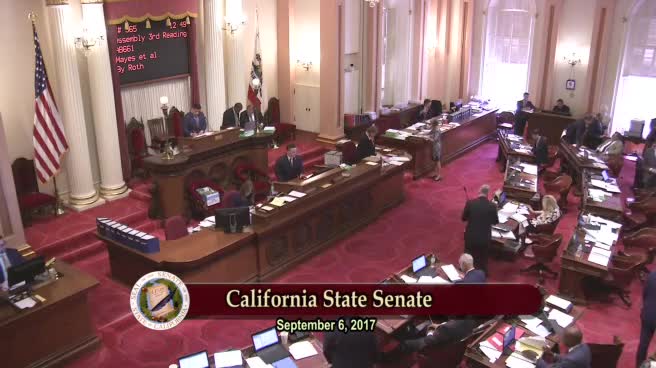 10MIN
Senate Floor
 1H
Senate Standing Committee on Appropriations
 14MIN
Senate Standing Committee on Appropriations
 41MIN
Senate Standing Committee on Judiciary
 7MIN
Assembly Floor
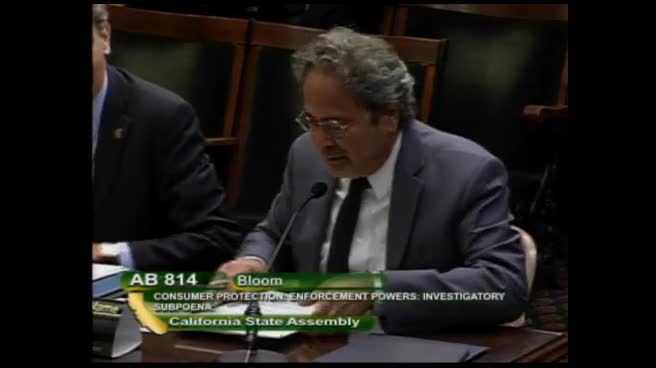 34MIN
Assembly Standing Committee on Judiciary
Bill Author

Bill Co-Author(s):
