AB 818: CalWORKs: welfare to work.
- Session Year: 2017-2018
- House: Assembly
- Latest Version Date: 2017-07-31
Existing law establishes the California Work Opportunity and Responsibility to Kids (CalWORKs) program, under which each county provides cash assistance and other benefits to qualified low-income families using federal, state, and county funds. Existing law establishes a 48-month lifetime limit of CalWORKs benefits for eligible adults, as specified. Existing law requires a recipient of CalWORKs to participate in certain welfare-to-work activities as a condition of eligibility for 24 cumulative months, as specified, and then to meet other federal requirements afterwards, as specified. Existing law authorizes each county to provide an extension of the 24 months for recipients who are unlikely to meet the federal requirements, and authorizes a recipient to request the extension and present evidence to the county that he or she meets a specified circumstance, including that the recipient has achieved satisfactory progress in an educational or treatment program that has a known graduation, transfer, or completion date that would meaningfully increase the likelihood of his or her employment.
This bill would provide that for purposes of the educational or treatment program circumstance, a high school education or its equivalent is presumed to meaningfully increase the likelihood of the recipients employment. The bill would additionally include as a circumstance to be presented as evidence in requesting an extension, that the recipient obtained his or her high school diploma or its equivalent while participating in specified welfare-to-work activities during the 24 months, and an additional period of time to complete an educational program or other specified activity in which he or she is currently participating would meaningfully increase the likelihood of his or her employment.
(a)A recipient subject to the 24-month time limitation described in Section 11322.85 may request an extension in accordance with Section 11322.86 and may present evidence to the county that he or she meets any of the following circumstances:
(1)The recipient is likely to obtain employment within six months.
(2)The recipient has encountered unique labor market barriers temporarily preventing employment, and therefore needs additional time to obtain employment.
(3)The recipient has achieved satisfactory progress in an educational or treatment program, including adult basic education, vocational education, or a self-initiated program that has a known graduation, transfer, or completion date that would meaningfully increase the likelihood of his or her employment. For purposes of this paragraph, a high school education or its equivalent is presumed to meaningfully increase the likelihood of employment.
(4)The recipient needs an additional period of time to complete a welfare-to-work activity specified in his or her welfare-to-work case plan due to a diagnosed learning or other disability, so as to meaningfully increase the likelihood of his or her employment.
(5)The recipient has submitted an application to receive SSI disability benefits, and a hearing date has been established.
(6)The recipient obtained his or her high school diploma or its equivalent while participating in activities described in paragraph (1) of subdivision (a) of Section 11322.85, and an additional period of time to complete an educational program or other activity described in paragraph (1) of subdivision (a) of Section 11322.85 in which he or she is currently participating would meaningfully increase the likelihood of his or her employment.
(7)Other circumstances as determined by the department.
(b)(1)Except for an extension requested in accordance with paragraph (5) of subdivision (a), and subject to the limitation described in paragraph (2) of subdivision (a) of Section 11322.86, a county shall grant an extension to a recipient who presents evidence in accordance with subdivision (a) unless the county determines that the evidence presented does not support the existence of the circumstances described in subdivision (a).
(2)An extension requested in accordance with paragraph (5) of subdivision (a) shall be granted if evidence that a hearing date has been established is provided to the county.
(3)At any hearing disputing a countys denial of an extension in accordance with paragraph (1), the county shall have the burden of proof to establish that an extension was not justified unless the county demonstrates that the denial was due to the unavailability of an extension in accordance with the 20-percent limitation described in paragraph (2) of subdivision (a) of Section 11322.86.
(c)If, as a result of information already available to a county, including the recipients welfare-to-work plan and verifications of participation, the county identifies that a recipient meets a circumstance described in subdivision (a), and subject to the limitation described in paragraph (2) of subdivision (a) of Section 11322.86, a county may grant an extension of the 24-month time limitation described in paragraph (1) of subdivision (a) of Section 11322.85 to the recipient.
(d)An extension granted in accordance with subdivision (b) or (c) shall be granted for an initial period of up to six months and shall be reevaluated by the county at least every six months.
(a)A recipient subject to the 24-month time limitation described in Section 11322.85 may request an extension in accordance with Section 11322.86 and may present evidence to the county that he or she meets any of the following circumstances:
(1)The recipient is likely to obtain employment within six months.
(2)The recipient has encountered unique labor market barriers temporarily preventing employment, and therefore needs additional time to obtain employment.
(3)The recipient has achieved satisfactory progress in an educational or treatment program, including adult basic education, vocational education, or a self-initiated program that has a known graduation, transfer, or completion date that would meaningfully increase the likelihood of his or her employment. For purposes of this paragraph, a high school education or its equivalent is presumed to meaningfully increase the likelihood of employment.
(4)The recipient needs an additional period of time to complete a welfare-to-work activity specified in his or her welfare-to-work case plan due to a diagnosed learning or other disability, so as to meaningfully increase the likelihood of his or her employment.
(5)The recipient has submitted an application to receive SSI disability benefits, and a hearing date has been established.
(6)The recipient obtained his or her high school diploma or its equivalent while participating in activities described in paragraph (1) of subdivision (a) of Section 11322.85, and an additional period of time to complete an educational program or other activity described in paragraph (1) of subdivision (a) of Section 11322.85 in which he or she is currently participating would meaningfully increase the likelihood of his or her employment.
(6)(7)Other circumstances as determined by the department.
(b)(1)Except for an extension requested in accordance with paragraph (5) of subdivision (a), and subject to the limitation described in paragraph (2) of subdivision (a) of Section 11322.86, a county shall grant an extension to a recipient who presents evidence in accordance with subdivision (a) unless the county determines that the evidence presented does not support the existence of the circumstances described in subdivision (a).
(2)An extension requested in accordance with paragraph (5) of subdivision (a) shall be granted if evidence that a hearing date has been established is provided to the county.
(3)At any hearing disputing a countys denial of an extension in accordance with paragraph (1), the county shall have the burden of proof to establish that an extension was not justified unless the county demonstrates that the denial was due to the unavailability of an extension in accordance with the 20-percent limitation described in paragraph (2) of subdivision (a) of Section 11322.86.
(c)If, as a result of information already available to a county, including the recipients welfare-to-work plan and verifications of participation, the county identifies that a recipient meets a circumstance described in subdivision (a), and subject to the limitation described in paragraph (2) of subdivision (a) of Section 11322.86, a county may grant an extension of the 24-month time limitation described in paragraph (1) of subdivision (a) of Section 11322.85 to the recipient.
(d)An extension granted in accordance with subdivision (b) or (c) shall be granted for an initial period of up to six months and shall be reevaluated by the county at least every six months.
(e)This section shall become operative on January 1, 2013.|
Date
|
Status
|
|---|---|
| Jul 31, 2017 | Chaptered by Secretary of State - Chapter 141, Statutes of 2017. |
| Jul 31, 2017 | Approved by the Governor. |
| Jul 21, 2017 | Enrolled and presented to the Governor at 4 p.m. |
| Jul 17, 2017 | In Assembly. Ordered to Engrossing and Enrolling. |
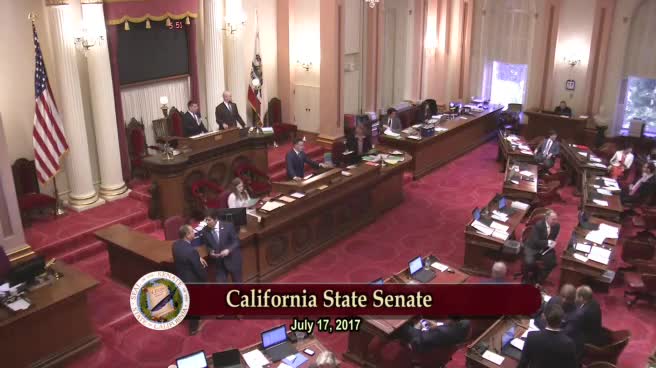
| Jul 17, 2017 | Read third time. Passed. Ordered to the Assembly. |
| Jun 27, 2017 | Read second time. Ordered to third reading. |
| Jun 26, 2017 | From committee: Be ordered to second reading pursuant to Senate Rule 28.8. |
| Jun 14, 2017 | From committee: Do pass and re-refer to Com. on APPR. (Ayes 4. Noes 0.) (June 13). Re-referred to Com. on APPR. |
| May 10, 2017 | Referred to Com. on HUMAN S. |
| Apr 20, 2017 | In Senate. Read first time. To Com. on RLS. for assignment. |
| Apr 20, 2017 | Read third time. Passed. Ordered to the Senate. (Ayes 74. Noes 0. Page 1144.) |
| Apr 6, 2017 | Read second time. Ordered to Consent Calendar. |
| Apr 5, 2017 | From committee: Do pass. To Consent Calendar. (Ayes 17. Noes 0.) (April 5). |
| Mar 22, 2017 | From committee: Do pass and re-refer to Com. on APPR. with recommendation: To Consent Calendar. (Ayes 7. Noes 0.) (March 21). Re-referred to Com. on APPR. |
| Mar 2, 2017 | Referred to Com. on HUM. S. |
| Feb 16, 2017 | From printer. May be heard in committee March 18. |
| Feb 15, 2017 | Read first time. To print. |
|
Date
|
Description
|
Location
|
Votes
|
|
|---|---|---|---|---|
| Jul 17, 2017 | Conference Report | Senate Floor |
Passed |
|
| Jun 13, 2017 | Do pass, but first be re-referred to the Committee on [Appropriations] | Senate Standing Committee on Human Services |
Passed |
|
| Apr 20, 2017 | Favorable With Amendment(s) (Government Accountability Committee) | Assembly Floor |
Passed |
|
| Apr 5, 2017 | Do pass. To Consent Calendar. | Assembly Standing Committee on Appropriations |
Passed |
|
| Mar 21, 2017 | Do pass and be re-referred to the Committee on [Appropriations] with recommendation: To Consent Calendar | Assembly Standing Committee on Human Services |
Passed |
This list shows positions taken on this bill by organizations on the date displayed, which is linked to the original source.
Positions by individuals are not included.
|
Organization
|
Position
|
Date
|
|---|---|---|
| California Alternative Payment Program Association | ** Support | Mar 18, 2017 |
| California Catholic Conference | ** Support | Jun 28, 2017 |
| contra cost board of supervisors | ** Support | Jun 28, 2017 |
| County Welfare Directors Association of California | ** Support | Jun 28, 2017 |
| National Association of Social Workers | ** Support | Jun 28, 2017 |
| Santa Clara County Board of Supervisors | ** Support | Mar 18, 2017 |
| the city and county of san francisco | ** Support | Jun 28, 2017 |
| the santa clara county board of supervisors | ** Support | Jun 28, 2017 |
| the service employees international union | ** Support | Jun 28, 2017 |
| western center on law and poverty | ** Support | Jun 28, 2017 |
Office of Senate Floor Analyses (916) 651-1520 Fax: (916) 327-4478 | AB |
THIRD READING
Bill No: AB 818
:
SENATE HUMAN SERVICES COMMITTEE: 4-0, 6/13/17
AYES: Wiener, Glazer, Newman, Nguyen
NO VOTE RECORDED: Berryhill
SENATE APPROPRIATIONS COMMITTEE: Senate Rule 28.8
ASSEMBLY FLOOR: 74-0, 4/20/17 (Consent) - See last page for vote
SOURCE: California Welfare Directors Association of California
DIGEST:
This bill permits a California Work Opportunity and Responsibility to Kids (CalWORKs) recipient to request an extension to the 24-month welfare-to-work time clock in order to obtain a high school education or its equivalent, or to participate in education or activities subsequent to the acquisition of a high school diploma or its equivalent.
Existing law:
- Establishes the federal Temporary Assistance for Needy Families (TANF) program, which permits states to implement the program under a state plan. (42 USC 601 et seq.)
- Establishes in state law the California Work Opportunity and Responsibility to Kids (CalWORKs) program to provide cash assistance and other social services for low-income families through the federal TANF program. Under CalWORKs, each county provides assistance through a combination of state, county and federal TANF funds. (WIC 10530, 11200)
- Establishes income, asset and real property limits to determine eligibility for CalWORKs program participants, including net income below the Maximum Aid Payment (MAP), based on family size and county of residence. (WIC 11150 et seq., 11450 et seq.)
- Establishes a 48-month lifetime limit on CalWORKs benefits for eligible adults, including a “24-month time clock” (24 cumulative, but not necessarily consecutive, months) during which a recipient has a broader range of permissible activities in which he or she can participate, and after which, a recipient must meet the more stringent federal work requirements in order to retain eligibility. (WIC 11454, 11322.85)
- Requires, generally, CalWORKs recipients to participate in welfare-to-work activities as a condition of eligibility for aid. (WIC 11320 et seq.)
- Mandates the sequence of employment-related activities a CalWORKs participant must engage in subsequent to the receipt of aid, unless otherwise exempted under Section 11320.3. (WIC 11320.1)
- Establishes qualifying welfare-to-work activities to include employment, on-the-job training, community service, adult basic education, and other specified activities, and requires a specified number of weekly hours of welfare-to-work participation to remain eligible for aid. (WIC 11322.6) (WIC 11322.8)
- Permits counties to grant an extension to the welfare-to-work 24-month time clock, as specified, for recipients who are unlikely to meet the more stringent federal requirements upon expiration of the 24-month time clock, and limits the number of extensions granted to no more than 20 percent of assistance units in the county in which all adult members have been provided CalWORKs aid for at least 24 months but not more than 48 months, as specified. (WIC 11322.86)
- Authorizes CalWORKs recipients to request an extension to the 24-month time clock for specified reasons, including, among other things: likelihood of obtaining employment within six months, encountering unique labor market barriers, and achieving satisfactory progress in an educational or treatment program that has a known graduation, transfer, or completion date and that would meaningfully increase the likelihood of his or her employment, as specified. (WIC 11322.87 (a))
- Requires, when a recipient presents evidence that the county determines supports the existence of a qualified circumstance for extension of the 24-month time clock, and subject to the 20 percent limitation pursuant to WIC 11322.86, the county to grant an extension to that recipient for an initial period of up to six months and to be reevaluated by the county at least every six months, as specified. (WIC 11322.87 (b) and (d))
- Authorizes a county, as a result of information already available to it, and subject to the 20 percent limitation, to grant an extension to the 24-month time clock, as specified, for an initial period of up to six months and to be reevaluated by the county at least every six months. (WIC 11322.87)
This bill:
- Clarifies that, for purposes of a CalWORKs recipient seeking an extension to the 24-month time clock on the basis of achieving satisfactory progress in an educational or treatment program that would meaningfully increase the likelihood of his or her employment, as specified, a high school education or its equivalent is presumed to meaningfully increase the likelihood of employment.
- Authorizes a CalWORKs recipient who has obtained his or her high school diploma or its equivalent while participating in welfare-to-work activities under the 24-month clock to request an extension to that clock if he or she could meaningfully increase the likelihood of his or her employment by being granted additional time for the completion of a subsequent educational program or other permitted activity, as specified.
- Makes technical amendments.
Background
According to the author, the 24-month time restriction for CalWORKs recipients “makes it particularly difficult for participants working towards a high school diploma or its equivalent because their 24-month clock ‘ticks’ while they pursue their education.” This ticking of the clock results in shortened timeframe to participate in career technical education or in other educational or training activities once participants earn a diploma.
Per the author, “The ultimate goal of the CalWORKs program is to provide support to recipients who need assistance making the transition to work and this bill makes sure high school equivalency is obtained without the 24-month time limit being reached first. This effectively ensures that (recipients) have enough time to get the education and training needed before entering the workforce full time, increasing their odds of avoiding chronic unemployment and other obstacles in the way of self-sufficiency.”
CalWORKs. One of California’s essential anti-poverty strategies is the CalWORKs program, which provides cash assistance to approximately 500,000 families – including more than 1 million children. The CalWORKs program provides monthly income assistance and employment-related services aimed at moving children out of poverty and helping families meet basic needs. The CalWORKs program is funded with a mix of federal TANF money, state, and county funds.
In order to be eligible for CalWORKs, families must meet income and asset tests. A family of three would qualify if their monthly income is no more than $1,282. According to the CalWORKs Annual Summary dated January 2017, the average CalWORKs grant in Fiscal Year 2016-17 was $514 per month. At this rate, a family of three receives $17.13 per day. This grant amount puts the annual household income at $6,168 per year. Federal Poverty Guidelines show that 100 percent of poverty for a family of three is more than three times that – at $20,160 per year. Adult benefits in the CalWORKs program are contingent upon participation in welfare-to-work activities.
Welfare-to-Work Requirements. State law provides for a cumulative 48-month lifetime limit on cash aid for adults. During those 48 months, adults may receive a total of 24 months of Welfare-to-Work (WTW) services and activities. WTW activities include subsidized and unsubsidized employment, community service, adult basic education, community college, job skills, training, mental health counseling, substance abuse treatment and other activities necessary to assist recipients in obtaining employment.
Unless they are exempt, an adult in a one parent assistance unit is required to participate in WTW activities for an average of 30 hours per week during the month or an average of 20 hours per week for a parent with a child under age six. In a two-parent assistance unit, one or both adults must participate in WTW activities for a combined average of 35 hours per week.
If a CalWORKs recipient who is not exempt from participation does not meet the WTW requirements, the recipient may be sanctioned, and that recipient’s portion of the family’s grant may be subtracted from the amount provided to the family. However, the 24-month clock may be stopped for a number of reasons, including participation in job search or the development of a new welfare-to-work plan. Counties have the authority to grant extensions to the 24-month time clock to up to 20 percent of their caseload of adult CalWORKs recipients who have been participating for between 24 and 48 months.
According to the California Department of Social Services’ (CDSS) Annual Summary of the CalWORKs program, “Current data indicates that the vast majority of CalWORKs recipients subject to the welfare-to-work 24-month time clock have months remaining on their clocks. However, it appears that the number of CalWORKs recipients who will have months tick and/or exhaust their welfare-to-work 24-month time clock will increase in the next 12 months.” CDSS predicts that, on average, 430 cases will be removed from aid each month in FY 2016-17 and 740 will be removed from aid each month in FY 2017-18. If these numbers prove to be true, more than 14,000 adults will have their CalWORKs aid terminated over the two fiscal years.
Education, employment, and earnings. Graduation from high school is strongly correlated with a higher likelihood of employment and greater earning potential. High school dropouts are far more likely to experience reduced job opportunities, unemployment, incarceration, or require government assistance as compared to high school graduates.
According to a report issued by US Department of Labor’s Bureau of Labor Statistics, in 2014, 18.3 percent of the working poor had not obtained a high school diploma and 8.3 percent of the working poor had obtained a high school diploma, but no college education.
Additionally, a 2007 study by Northwestern University shows that male dropouts were 6.3 times more likely to be incarcerated than high school graduates and 63 times more likely to be incarcerated than college graduates.
Education and the CalWORKs population. The Public Policy Institute of California estimates that between 49 and 59 percent of the CalWORKs adult population has not completed high school. The CalWORKs Annual Summary reports that in Federal Fiscal Year 2015, 58.7 percent of CalWORKs heads-of-household that participated in welfare-to-work had completed high school or the equivalent.
A recent study of WTW participants in San Bernardino showed that less than half (46 percent) of WTW participants who obtained either a high school diploma or high school equivalency were able to do so in fewer than six months; 19 percent took six to 12 months, 15 percent took 12 percent to 23 months and 19 percent took more than 24 months.
Related/Prior Legislation
AB 227 (Mayes, 2017) creates the California Work Opportunity and Responsibility to Kids (CalWORKs) Educational Opportunity and Attainment Program to offer education grants and stipends to eligible CalWORKs participants who complete certain educational programs. This is a two-year bill.
AB 1604 (Nazarian, 2017) permits a California Work Opportunity and Responsibility to Kids (CalWORKs) recipient to participate in a high school equivalency program prior to participation in other specified CalWORKs activities. It is awaiting hearing in Senate Appropriations Committee.
AB 1994 (Lopez, 2016) would have created the CalED program to provide a one-time $500 supplement to eligible CalWORKs participants upon successful completion of a high school equivalency examination. It was held in Assembly Appropriations Committee.
AB 2448 (Burke, 2016) would have changed CalWORKs requirements regarding permissible welfare-to-work activities to facilitate a recipient’s completion of a high school equivalency program. It was vetoed by the Governor.
SB 1041 (Senate Committee on Budget and Fiscal Review, Chapter 47, Statutes of 2012) adopted a number of changes to the CalWORKs program, including the establishment of the 24-month time clock.
FISCAL EFFECT: Appropriation: Fiscal Com.: Local:
County Welfare Directors Association of California (source)
California Catholic Conference
City and County of San Francisco Human Services Agency
Contra Cost Board of Supervisors
National Association of Social Workers
The City and County of San Francisco
The Santa Clara County Board of Supervisors
The Service Employees International Union
Western Center on Law and Poverty
OPPOSITION: (Verified 6/28/17)
None received
ARGUMENTS IN SUPPORT: According to the sponsor, the California Welfare Directors Association of California, “A high school diploma is a fundamental necessity if we are to help CalWORKs parents get on the track to self-sufficiency. Ensuring that the parents who achieve high school equivalencies are not penalized by doing so, and are able to receive welfare-to-work services while they complete a subsequent activity, is also crucial. Without statutory support for education, county efforts – and the state and federal dollars spent to support those efforts – will far be less effective, and more children will remain in poverty.”
ASSEMBLY FLOOR: 74-0, 4/20/17
AYES: Acosta, Aguiar-Curry, Travis Allen, Arambula, Baker, Berman, Bigelow, Bloom, Bocanegra, Bonta, Burke, Caballero, Calderon, Cervantes, Chau, Chávez, Chen, Chiu, Chu, Cooley, Cooper, Cunningham, Dababneh, Dahle, Daly, Eggman, Flora, Fong, Frazier, Friedman, Cristina Garcia, Eduardo Garcia, Gipson, Gloria, Gomez, Gonzalez Fletcher, Gray, Grayson, Harper, Holden, Irwin, Jones-Sawyer, Kalra, Kiley, Lackey, Levine, Limón, Low, Maienschein, Mayes, McCarty, Medina, Melendez, Mullin, Muratsuchi, Nazarian, Obernolte, O'Donnell, Quirk, Quirk-Silva, Reyes, Rodriguez, Rubio, Salas, Santiago, Steinorth, Mark Stone, Thurmond, Ting, Voepel, Waldron, Weber, Wood, Rendon
NO VOTE RECORDED: Brough, Choi, Gallagher, Mathis, Patterson, Ridley-Thomas
6/28/17 14:38:59
**** END ****
SENATE COMMITTEE ON HUMAN SERVICES
Senator Wiener, Chair
2017 - 2018 Regular
Bill No: AB 818
Author: | Burke | ||
Version: | February 15, 2017 | Hearing Date: | June 13, 2017 |
Urgency: | No | Fiscal: | Yes |
Consultant: | Taryn Smith | ||
Subject: CalWORKs: welfare to work
SUMMARY
This bill permits a California Work Opportunity and Responsibility to Kids (CalWORKs) recipient to request an extension to the 24-month welfare-to-work time clock in order to obtain a high school education or its equivalent, or to participate in education or activities subsequent to the acquisition of a high school diploma or its equivalent.
ABSTRACT
Existing law:
- Establishes the federal Temporary Assistance for Needy Families (TANF) program, which permits states to implement the program under a state plan. (42 USC 601 et seq.)
- Establishes in state law the California Work Opportunity and Responsibility to Kids (CalWORKs) program to provide cash assistance and other social services for low-income families through the federal TANF program. Under CalWORKs, each county provides assistance through a combination of state, county and federal TANF funds. (WIC 10530, 11200)
- Establishes income, asset and real property limits to determine eligibility for CalWORKs program participants, including net income below the Maximum Aid Payment (MAP), based on family size and county of residence which is around 40 percent of the Federal Poverty Level. (WIC 11150 et seq., 11450 et seq.)
- Establishes a 48-month lifetime limit on CalWORKs benefits for eligible adults, including a “24-month time clock” (24 cumulative, but not necessarily consecutive, months) during which a recipient has a broader range of permissible activities in which he or she can participate, and after which, a recipient must meet the more stringent federal work requirements in order to retain eligibility. (WIC 11454, 11322.85)
- Generally requires a recipient of CalWORKs benefits to participate in welfare-to-work activities as a condition of eligibility for aid. (WIC 11320 et seq.)
- Mandates the sequence of employment-related activities a CalWORKs participant must engage in subsequent to the receipt of aid, unless otherwise exempted under Section 11320.3. (WIC 11320.1)
- Establishes qualifying welfare-to-work activities to include employment, on-the-job training, community service, adult basic education, and other specified activities, and requires a specified number of weekly hours of welfare-to-work participation to remain eligible for aid. (WIC 11322.6) (WIC 11322.8)
- Permits counties to grant an extension to the welfare-to-work 24-month time clock, as specified, for recipients who are unlikely to meet the more stringent federal requirements upon expiration of the 24-month time clock, and limits the number of extensions granted to no more than 20 percent of assistance units in the county in which all adult members have been provided CalWORKs aid for at least 24 months but not more than 48 months, as specified. (WIC 11322.86)
- Authorizes CalWORKs recipients to request an extension to the 24-month time clock for specified reasons, including, among other things: likelihood of obtaining employment within six months, encountering unique labor market barriers, and achieving satisfactory progress in an educational or treatment program that has a known graduation, transfer, or completion date and that would meaningfully increase the likelihood of his or her employment, as specified. (WIC 11322.87 (a))
- Requires, when a recipient presents evidence that the county determines supports the existence of a qualified circumstance for extension of the 24-month time clock, and subject to the 20 percent limitation pursuant to WIC 11322.86, the county to grant an extension to that recipient for an initial period of up to six months and to be reevaluated by the county at least every six months, as specified. (WIC 11322.87 (b) and (d))
- Authorizes a county, as a result of information already available to it, and subject to the 20 percent limitation, to grant an extension to the 24-month time clock, as specified, for an initial period of up to six months and to be reevaluated by the county at least every six months. (WIC 11322.87 (c) and (d))
This bill:
- Clarifies that, for purposes of a CalWORKs recipient seeking an extension to the 24-month time clock on the basis of achieving satisfactory progress in an educational or treatment program that would meaningfully increase the likelihood of his or her employment, as specified, a high school education or its equivalent is presumed to meaningfully increase the likelihood of employment.
- Authorizes a CalWORKs recipient who has obtained his or her high school diploma or its equivalent while participating in welfare-to-work activities under the 24-month clock to request an extension to that clock if he or she could meaningfully increase the likelihood of his or her employment by being granted additional time for the completion of a subsequent educational program or other permitted activity, as specified.
- Makes technical amendments.
FISCAL IMPACT
According to an analysis prepared by the Assembly Appropriations Committee, this bill would likely have the following fiscal impact:
- CDSS anticipates the number recipients who otherwise would have been dropped from aid, but would continue to receive aid under this bill, will be minimal.
- One-time minor and absorbable administrative costs to CDSS.
BACKGROUND AND DISCUSSION
Purpose of the bill:
According to the author, the 24-month time restriction for CalWORKs recipients “makes it particularly difficult for participants working towards a high school diploma or its equivalent because their 24-month clock ‘ticks’ while they pursue their education.” This ticking of the clock results in shortened timeframe to participate in career technical education or in other educational or training activities once participants earn a diploma.
Per the author, “The ultimate goal of the CalWORKs program is to provide support to recipients who need assistance making the transition to work and this bill makes sure high school equivalency is obtained without the 240-month time limit being reached first. This effectively ensures that (recipients) have enough time to get the education and training needed before entering the workforce full time, increasing their odds of avoiding chronic unemployment and other obstacles in the way of self-sufficiency.”
Poverty
The United States Census Bureau reports that, in 2015, the national poverty rate for children under age 18 was 19.7 percent. Poverty rates for people aged 18 to 64 was at 12.4 percent and for people aged 65 and older was at 8.8 percent.
According to the PPIC, 15.3% of Californians lacked enough resources—about $24,000 per year for a family of four—to meet basic needs in 2015. However, this rate does not account for California’s housing costs or other critical family expenses and resources. The California Poverty Measure (CPM) accounts for the cost of living and a range of family needs and resources, including social safety net benefits. According to the CPM, 20.6 percent of Californians lacked enough resources—about $30,000 per year for a family of four—to meet basic needs in 2014. At 23 percent, the poverty was highest among children.
CalWORKs
One of California’s essential anti-poverty strategies is the CalWORKs program, which provides cash assistance to approximately 500,000 families – including more than 1 million children. The CalWORKs program provides monthly income assistance and employment-related services aimed at moving children out of poverty and helping families meet basic needs. The CalWORKs program is funded with a mix of federal TANF money, state, and county funds. CDSS is the designated state agency responsible for program supervision at the state level. The counties are responsible for administering the caseloads at the local level.
In order to be eligible for CalWORKs, families must meet income and asset tests. A family of three would qualify if their monthly income is no more than $1,282. In addition, children must be deprived of parental support and care due to the incapacity, death or absence of a parent or unemployment of the principal wage-earner. Persons fleeing to avoid prosecution, custody or confinement after conviction of a felony are not eligible for CalWORKs.
According to the CalWORKs Annual Summary dated January 2017, the average CalWORKs grant in Fiscal Year 2016-17 was $514 per month. At this rate, a family of three receives $17.13 per day. This equates to $5.71 per family member, per day to meet basic needs, including rent, clothing, utility bills, food, and anything else a family needs to ensure children can be cared for at home and safely remain with their families. This grant amount puts the annual household income at $6,168 per year. Federal Poverty Guidelines show that 100 percent of poverty for a family of three is more than three times that – at $20,160 per year. Adult benefits in the CalWORKs program are contingent upon participation in welfare-to-work activities.
Welfare-to-Work Requirements
State law provides for a cumulative 48-month lifetime limit on cash aid for adults. During those 48 months, adults may receive a total of 24 months of Welfare-to-Work (WTW) services and activities. WTW activities include subsidized and unsubsidized employment, community service, adult basic education, community college, job skills, training, mental health counseling, substance abuse treatment and other activities necessary to assist recipients in obtaining employment.
Unless they are exempt, an adult in a one parent assistance unit is required to participate in WTW activities for an average of 30 hours per week during the month or an average of 20 hours per week for a parent with a child under age six. In a two-parent assistance unit, one or both adults must participate in WTW activities for a combined average of 35 hours per week.
Once the 24 months of WTW activities have been exhausted, adults must meet the stricter federal work participation requirements (20, 30, or 35 hours weekly, depending on family composition) unless they are exempt or receive an extension. If a CalWORKs recipient who is not exempt from participation does not meet the WTW requirements, the recipient may be sanctioned, and that recipient’s portion of the family’s grant may be subtracted from the amount provided to the family.
However, the 24-month clock may be stopped for a number of reasons, including participation in job search or the development of a new welfare-to-work plan. Counties have the authority to grant extensions to the 24-month time clock to up to 20 percent of their caseload of adult CalWORKs recipients who have been participating for between 24 and 48 months.
According to CDSS’ Annual Summary of the CalWORKs program, “Current data indicates that the vast majority of CalWORKs recipients subject to the welfare-to-work 24-month time clock have months remaining on their clocks. However, it appears that the number of CalWORKs recipients who will have months tick and/or exhaust their welfare-to-work 24-month time clock will increase in the next 12 months.” CDSS estimates that, on average, 1,460 cases per month will reach the end of their 24-month time clock in Fiscal Year 2016-17 and 4,120 cases per month will time out in fiscal year 2017-18.
CDSS further estimates that, “Of the cases that utilize their entire welfare-to-work 24-month time clock, 20 percent will receive an extension and 36 percent will begin meeting work requirements. The remaining 44 percent will enter the noncompliance process and have an adult(s) removed from aid.” CDSS predicts that, on average, 430 cases will be removed from aid each month in FY 2016-17 and 740 will be removed from aid each month in FY 2017-18. If these numbers prove to be true, more than 14,000 adults will have their CalWORKs aid terminated over the two fiscal years.
Education, employment, and earnings
Graduation from high school is strongly correlated with a higher likelihood of employment and greater earning potential. High school dropouts are far more likely to experience reduced job opportunities, unemployment, incarceration, or require government assistance as compared to high school graduates.
According to a report issued by US Department of Labor’s Bureau of Labor Statistics, in 2014, 18.3 percent of the working poor had not obtained a high school diploma and 8.3 percent of the working poor had obtained a high school diploma, but no college education.[1]
Also according to the Bureau of Labor Statistics, full-time workers age 25 and older without a high school diploma had median weekly earnings of $494 in the first quarter of 2016. That compares with a median of $679 for high school graduates who never attended college and $782 for workers with some college or an associate degree.[2] The national unemployment rate in January 2017 was 4.8 percent. For people with less than a high school diploma, the unemployment rate was 7.7 percent and for high school graduate with no college it was 5.3 percent. [3]
Additionally, a 2007 study by Northwestern University shows that male dropouts were 6.3 times more likely to be incarcerated than high school graduates and 63 times more likely to be incarcerated than college graduates.
Education and the CalWORKs population
The Public Policy Institute of California estimates that between 49 and 59 percent of the CalWORKs adult population has not completed high school. The CalWORKs Annual Summary reports that in Federal Fiscal Year 2015, 58.7 percent of CalWORKs heads-of-household that participated in welfare-to-work had completed high school or the equivalent. The percentage of high school graduates among CalWORKs heads-of-household in cases that are sanctioned is 40.7 percent and for exempt cases it is 51.6 percent. The same annual report shows that 3,587 associate’s degrees were earned by CalWORKs recipients in 2014-15 and 3,905 were earned in 2015-16.
A recent study of WTW participants in San Bernardino showed that less than half (46 percent) of WTW participants who obtained either a high school diploma or high school equivalency were able to do so in fewer than six months; 19 percent took six to 12 months, 15 percent took 12 percent to 23 months and 19 percent took more than 24 months.
Related legislation:
AB 227 (Mayes, 2017) creates the California Work Opportunity and Responsibility to Kids (CalWORKs) Educational Opportunity and Attainment Program to offer education grants and stipends to eligible CalWORKs participants who complete certain educational programs. It is pending committee assignment in Senate Rules Committee.
AB 273 (Aguiar-Curry, 2017) clarifies that engagement in English as a second language and high school or high school equivalency educational programs meets criteria for establishing eligibility for subsidized child care programs. It is pending assignment in Senate Rules Committee.
AB 1607 (Nazarian, 2017) permits a California Work Opportunity and Responsibility to Kids (CalWORKs) recipient to participate in a high school equivalency program prior to participation in other specified CalWORKs activities. It is scheduled to be heard in Senate Human Services committee On June 13, 2017.
AB 1994 (Lopez, 2016) would have created the CalED program to provide a one-time $500 supplement to eligible CalWORKs participants upon successful completion of a high school equivalency examination. It was held in Assembly Appropriations Committee.
AB 2058 (Mayes, 2016) would have created the CalWORKs Educational Opportunity and Attainment Program to offer education grants to eligible CalWORKs participants who complete certain educational programs. It was held in Assembly Appropriations Committee.
AB 2448 (Burke, 2016) would have changed CalWORKs requirements regarding permissible welfare-to-work activities to facilitate a recipient’s completion of a high school equivalency program. It was vetoed by the Governor.
SB 1041 (Senate Committee on Budget and Fiscal Review, Chapter 47, Statutes of 2012) adopted a number of changes to the CalWORKs program, including the establishment of the 24-month time clock.
COMMENTS
Data consistently shows that obtaining a high school diploma, or equivalent, will improve a person’s employment opportunities and income capacity. Recent data shows that it takes the majority of WTW participants well over six months complete a high school diploma or equivalency program while the 24-month clock is ticking. This means time spent on obtaining high school education while in the WTW program is cutting into the time that could be spent obtaining job training or other job readiness services that are available via WTW.
This bill is a follow up to AB 2448 (Burke, 2016), which proposed to suspend the CalWORKs 24-month time clock for up to 12 months for CalWORKs recipients actively seeking their high school diplomas or equivalent. The Governor vetoed AB 2448. In his veto message, the Governor indicated that existing flexibility in the CalWORKs program “allows counties to extend the 24-month clock on a case-by-case basis for recipients making progress toward their high school diploma.”
Current law allows individual CalWORKs recipients to request an extension to the 24-month clock if they meet certain specified criteria, including, but not limited to:
- The recipient is likely to obtain employment within six months
- The recipient encountered unique labor market barriers temporarily preventing employment, as specified
- The recipient has achieved satisfactory progress in an education or treatment program, as specified, that would meaningfully increase the likelihood of employment
- The recipient has submitted an application to receive SSI disability benefits, and a hearing date has been established
This bill clarifies that a high school education or its equivalent is presumed to meaningfully increase the likelihood of employment. Unlike AB 2448, this bill uses the existing program structure, and adds to the list of circumstances in which WTW participants may request an extension of the 24-month clock. Under AB 818, WTW participants who have obtained their high school diploma or equivalent while participating in WTW may request an extension to the 24-month clock in order to continue participation in an educational program or other activity provided for in the WTW plan that would meaningfully increase the likelihood of employment.
PRIOR VOTES
Assembly Floor: | 74 - 0 |
Assembly Appropriations Committee: | 17 - 0 |
Assembly Human Services Committee: | 7 - 0 |
POSITIONS
Support:
County Welfare Directors Association of California (sponsor)
California Catholic Conference
City and County of San Francisco Human Services Agency
Contra Cost Board of Supervisors
National Association of Social Workers
The City and County of San Francisco
The Santa Clara County Board of Supervisors
Western Center on Law and Poverty
Oppose:
None received.
-- END –
http://www.bls.gov/opub/reports/working-poor/2014/home.htm ↑
https://www.bls.gov/opub/ted/2016/weekly-earnings-by-educational-attainment-in-first-quarter-2016.htm ↑
https://www.bls.gov/opub/ted/2017/unemployment-rate-2-point-5-percent-for-college-grads-7-point-7-percent-for-high-school-dropouts-january-2017.htm ↑
Date of Hearing: April 5, 2017
ASSEMBLY COMMITTEE ON APPROPRIATIONS
Lorena Gonzalez Fletcher, Chair
ABPCA Bill Id:AB 818
Author:(Burke) – As Introduced Ver:February 15, 2017
Policy Committee: | Human Services | Vote: | 7 - 0 |
|
|
Urgency: No State Mandated Local Program: No Reimbursable: No
SUMMARY: This bill permits a California Work Opportunity and Responsibility to Kids (CalWORKs) recipient to request an extension to the 24-month welfare-to-work time clock in order to obtain a high school education or its equivalent, or to participate in education or activities subsequent to the acquisition of a high school diploma or its equivalent. Specifically, this bill:
- Clarifies that a high school education or its equivalent is presumed to meaningfully increase the likelihood of employment for purposes of a CalWORKs recipient seeking an extension to the 24-month time clock.
- Authorizes a CalWORKs recipient who has obtained his or her high school diploma or its equivalent while participating in welfare-to-work activities under the 24-month clock to request an extension to that clock if he or she could meaningfully increase the likelihood of his or her employment by being granted additional time for the completion of a subsequent educational program or other permitted activity, as specified.
FISCAL EFFECT:
- Counties have existing authority to grant extensions to the 24-month clock. The Department of Social Services (DSS) anticipates the number recipients who otherwise would have been dropped from aid, but would continue to receive aid under this bill, will be minimal.
- One-time minor and absorbable administrative costs to the DSS.
COMMENTS:
- Purpose. According to the author, “The ultimate goal of the CalWORKs program is to provide support to recipients who need assistance making the transition to work and this bill makes sure high school equivalency is obtained without the 24 month time limit being reached first. This effectively ensures they have enough time to get the education and training needed before entering the workforce full time, increasing their odds of avoiding chronic unemployment and other obstacles in the way of self-sufficiency.”
- Background. The CalWORKs program provides monthly income assistance and employment-related services for qualified families. The 2016-17 average monthly cash grant is $533.67, and the maximum monthly grant amount for a family of three (one parent and two children) is $714. According to DSS, approximately 490,000 families rely on CalWORKs, including nearly one million children.
Adult recipients are expected to participate in welfare-to-work activities during the up to 48 months for which they may receive assistance. Participation requirements can include a broad range of activities for 24 of those 48 months, such as employment, training, education, and mental health, domestic violence, and substance abuse services. After this 24-month time clock “runs out,” recipients must meet the less-flexible federal TANF requirements in order to remain eligible for aid.
The 24-month clock can be temporarily stopped for several reasons, including the establishment of good cause for not participating, or due to participation in certain activities such as job search or the development of a new welfare-to-work plan. Additionally, counties have the authority to grant extensions to the 24-month time clock to up to 20% of their caseload of adult CalWORKs recipients who have been participating for between 24 and 48 months.
DSS estimates that, in fiscal year 2016-17, an average of 1,460 cases per month will reach the end of their 24-month time clock. For fiscal year 2017-18, DSS puts this estimate at an average of 4,120 cases per month, less than one percent of the average monthly caseload. Of the cases that utilize their entire 24-month time clock, DSS estimates that 20% will receive an extension and 36% will begin meeting work requirements. The remainder will enter the noncompliance process and a small portion of those will be removed from aid.
Anecdotal data suggest that for welfare-to-work participants who obtained either a high school diploma or its equivalent, under 50% were able to do so in less than six months, and the majority of the remaining recipients needed longer than 12 months.
- Related Legislation.
- AB 273 (Aguiar-Curry, awaiting hearing in this Committee, clarifies that engagement in English as a second language and high school or high school equivalency educational programs meets criteria for establishing eligibility for subsidized child care programs.
- AB 227 (Mayes) creates the CalWORKs Educational Opportunity and Attainment Program to offer education grants to eligible CalWORKs participants who complete certain educational programs. It is substantially similar to AB 2058 (Mayes), 2016, and is pending in the Assembly Human Services Committee.
- Prior Legislation.
- AB 2448 (Burke), of the 2015-16 Legislative Session, was a broader version of this bill and would have changed CalWORKs requirements regarding permissible welfare-to-work activities to facilitate a recipient’s completion of a high school equivalency program. It was vetoed by the Governor.
- AB 2058 (Mayes), of the 2015-16 Legislative Session, would have created the CalWORKs Educational Opportunity and Attainment Program to offer education grants to eligible CalWORKs participants who complete certain educational programs. It held on this Committee’s Suspense File.
- 1994 (Lopez), of the 2015-16 Legislative Session, would have created the CalED program to provide a one-time $500 supplement to eligible CalWORKs participants upon successful completion of a high school equivalency examination. It was held on this Committee’s Suspense File.
- SB 1041 (Senate Committee on Budget and Fiscal Review), Chapter 47, Statutes of 2012, adopted a number of changes to the CalWORKs program, including the establishment of the 24-month time clock.
Analysis Prepared by: Jennifer Swenson / APPR. / (916) 319-2081
Date of Hearing: March 21, 2017
ASSEMBLY COMMITTEE ON HUMAN SERVICES
Blanca Rubio, Chair
ABPCA Bill Id:AB 818 (
Author:Burke) – As Introduced Ver:February 15, 2017
SUBJECT: CalWORKs: welfare to work
SUMMARY: Permits a California Work Opportunity and Responsibility to Kids (CalWORKs) recipient to request an extension to the 24-month welfare-to-work time clock in order to obtain a high school education or its equivalent or to participate in education or activities subsequent to the acquisition of a high school diploma or its equivalent.
Specifically, this bill:
- Clarifies that, for purposes of a CalWORKs recipient seeking an extension to the 24-month time clock on the basis of achieving satisfactory progress in an educational or treatment program that would meaningfully increase the likelihood of his or her employment, as specified, a high school education or its equivalent is presumed to meaningfully increase the likelihood of employment.
- Authorizes a CalWORKs recipient who has obtained his or her high school diploma or its equivalent while participating in welfare-to-work activities under the 24-month clock to request an extension to that clock if he or she could meaningfully increase the likelihood of his or her employment by being granted additional time for the completion of a subsequent educational program or other permitted activity, as specified.
- Makes technical amendments.
EXISTING LAW:
- Establishes under federal law the Temporary Assistance for Needy Families (TANF) program to provide aid and welfare-to-work services to eligible families and, in California, provides that TANF funds for welfare-to-work services are administered through the CalWORKs program. (42 U.S.C. 601 et seq., WIC 11200 et seq.)
- Establishes income, asset, and real property limits used to determine eligibility for the CalWORKs program, including net income below the Maximum Aid Payment (MAP), based on family size and county of residence, which is around 40% of the Federal Poverty Level. (WIC 11150 to 11160, 11450 et seq.)
- Requires all individuals 16 years of age or older, unless they are otherwise exempt, to participate in welfare-to-work activities as a condition of eligibility for CalWORKs. (WIC 11320.3, 11322.6)
- Establishes the number of weekly hours of welfare-to-work participation necessary to remain eligible for aid. (WIC 11322.8)
- Establishes a 48-month lifetime limit on CalWORKs benefits for eligible adults, including a “24-month time clock” (24 cumulative, but not necessarily consecutive, months) during which a recipient has a broader range of permissible activities in which he or she can participate, and after which, a recipient must meet the more stringent federal work requirements in order to retain eligibility. (WIC 11454, 11322.85)
- Permits counties to grant an extension to the welfare-to-work 24-month time clock for recipients who are unlikely to meet the more stringent federal requirements upon expiration of the 24-month time clock, and limits the number of extensions granted to no more than 20% of assistance units in the county in which all adult members have been provided CalWORKs aid for at least 24 months but not more than 48 months, as specified. (WIC 11322.86)
- Authorizes CalWORKs recipients to request an extension to the 24-month time clock for specified reasons, including, among other things: likelihood of obtaining employment within six months, encountering unique labor market barriers, and achieving satisfactory progress in an educational or treatment program that has a known graduation, transfer, or completion date and that would meaningfully increase the likelihood of his or her employment, as specified. (WIC 11322.87 (a))
- Requires, when a recipient presents evidence that the county determines supports the existence of a qualified circumstance for extension of the 24-month time clock, and subject to the 20% limitation pursuant to WIC 11322.86, the county to grant an extension to that recipient for an initial period of up to six months and to be reevaluated by the county at least every six months, as specified. (WIC 11322.87 (b) and (d))
- Authorizes a county to, as a result of information already available to it, and subject to the 20% limitation pursuant to WIC 11322.86, grant an extension to the 24-month time clock, as specified, for an initial period of up to six months and to be reevaluated by the county at least every six months. (WIC 11322.87 (c) and (d))
FISCAL EFFECT: Unknown.
COMMENTS:
CalWORKs: The CalWORKs program provides monthly income assistance and employment-related services aimed at moving children out of poverty and helping families meet basic needs. Federal funding for CalWORKs comes from the TANF block grant. The average 2016-17 monthly CalWORKs cash grant is $533.67 per household, and the maximum monthly grant amount for a family of three, if the family has no other income and lives in a high-cost county, is currently $714, yielding an amount of $8,568 per year. The current federal poverty threshold for a family of three is $20,420 per year. According to recent data from the Department of Social Services (DSS), over 508,000 families rely on CalWORKs, including close to one million children.
CalWORKs time limits: Passage of the Personal Responsibility and Work Opportunity Reconciliation Act of 1996 (PRWORA) marked the end of the previous Aid to Families with Dependent Children (AFDC) program and the beginning of the block-granted TANF program, under which CalWORKs was established in California state law. Among the numerous programmatic changes included within the TANF program was a requirement that eligible parents work or participate in work training or other activities that lead to employment. The TANF program provides a great deal of flexibility in how states implement their respective programs, including the ability for states to establish more truncated time limits than the 60-month lifetime limit on aid for adult recipients authorized within it. As of 2011, California has limited aid to adult CalWORKs recipients to a lifetime limit of 48 months.
Welfare-to-Work requirements and the 24-month time clock: Welfare-to-work activities within the CalWORKs program include public or private sector subsidized or unsubsidized employment; on-the-job training; community service; secondary school, adult basic education and vocational education and training when the education is needed for the recipient to become employed; specific mental health, substance abuse, or domestic violence services if they are necessary to obtain or retain employment; and a number of other activities necessary to assist a recipient in obtaining unsubsidized employment.
Unless they are exempt, single parent adults with a child under the age of 6 must participate for 20 hours per week in welfare-to-work activities, single parent adults with no children under 6 years old must participate for at least 30 hours per week in welfare-to-work activities, and the minimum participation requirement for two-parent families is 35 hours per week.
SB 1041 (Senate Committee on Budget and Fiscal Review), Chapter 47, Statutes of 2012, adopted a number of changes to the CalWORKs program, including the establishment of the 24-month time clock. While most adult recipients are expected to participate in welfare-to-work activities during the up to 48 months for which they may receive assistance, those participation requirements can include a broad range of activities for 24 of those 48 months, such as employment, training, education, and mental health, domestic violence, and substance abuse services. After this 24-month time clock “runs out,” recipients must meet the less-flexible federal TANF requirements in order to remain eligible for aid. Failure to meet the welfare-to-work requirements per either set of permissible activities can result in a recipient being sanctioned for noncompliance, and that recipient’s portion of the family’s grant subtracted from the amount provided to the family to meet basic needs.
The 24-month clock does not have to “tick” off consecutively; that is, a recipient may have the clock “stopped” for a number of reasons, including the establishment of good cause for not participating or due to participation in certain activities such as job search or the development of a new welfare-to-work plan. Additionally, counties have the authority to grant extensions to the 24-month time clock to up to 20% of their caseload of adult CalWORKs recipients who have been participating for between 24 and 48 months.
According to DSS, “Current data indicates that the vast majority of CalWORKs recipients subject to the welfare-to-work 24-month time clock have months remaining on their clocks. However, it appears that the number of CalWORKs recipients who will have months tick and/or exhaust their welfare-to-work 24-month time clock will increase in the next 12 months.” DSS estimates that, in fiscal year 2016-17, an average of 1,460 cases per month will reach the end of their 24-month time clock. In fiscal year 2017-18, DSS places this estimate at an average of 4,120 cases per month. DSS further estimates that, “Of the cases that utilize their entire welfare-to-work 24-month time clock, 20% will receive an extension and 36% will begin meeting work requirements. The remaining 44% will enter the noncompliance process and have an adult(s) removed from aid. It is anticipated that 430 average monthly cases will be removed from aid in FY 2016-17 and 740 will be removed from aid in FY 2017-18.”
Education, employment, and earnings: Data for 2015 from the U.S. Bureau of Labor Statistics regarding adults ages 25 and over with full-time jobs indicate that those without a high school diploma or equivalent saw median weekly earnings of $493, compared to their counterparts with a high school diploma whose median weekly earnings were $678. Among the same population, the unemployment rate for those without a high school diploma was 8.0%, compared to 5.4% for those with a high school diploma. The same dataset indicates that acquisition of an associate’s degree further improves outcomes: median weekly earnings were $798 and the unemployment rate was 2.8%. For those with a bachelor’s degree, median weekly earnings were $1,137, and the unemployment rate was 2.4%.
High school education for the CalWORKs population: According to DSS, in Federal Fiscal Year 2015, 58.7% of heads-of-household in CalWORKs assistance units participating in welfare-to-work had completed high school or the equivalent. DSS reports that 3,587 associate’s degrees were earned by CalWORKs recipients in 2014-15 and 3,905 were earned in 2015-16 (note that one individual may have received more than one degree in a given year).
Need for this bill: The County Welfare Directors Association of California (CWDA), sponsor of this bill, examined data from San Bernardino County and found that, for welfare-to-work participants who obtained either a high school diploma or its equivalent, under 50% were able to do so in less than six months, and the majority of the remaining recipients needed longer than 12 months. CWDA notes that these findings are consistent with research in other states and comments that, “The current structure of the 24 month time clock may not present a barrier for those who are able to obtain their GED [certificate of general educational development] in less than six months. But as the data show, less than half of those who achieve a GED while in Welfare to Work are able to do it in that short time frame. For the other half of clients, taking an average of 6 to 12 to 18 months away from their time clocks before they are even able to move into post-secondary or vocational education programs simply does not leave sufficient time to achieve those additional degrees or certificates, even if everything else in their lives goes exactly right, which we know from experience with families in poverty rarely occurs.”
According to the author, “The ultimate goal of the CalWORKs program is to provide support to recipients who need assistance making the transition to work and this bill makes sure high school equivalency is obtained without the 24 month time limit being reached first. This effectively ensures they have enough time to get the education and training needed before entering the workforce full time, increasing their odds of avoiding chronic unemployment and other obstacles in the way of self-sufficiency.”
PRIOR AND RELATED LEGISLATION:
AB 227 (Mayes), 2017, is substantially similar to AB 2058 (Mayes), 2016. It is awaiting hearing in the Assembly Human Services Committee.
AB 273 (Aguiar-Curry), 2017, clarifies that engagement in English as a second language and high school or high school equivalency educational programs meets criteria for establishing eligibility for subsidized child care programs. It is awaiting hearing in the Assembly Appropriations Committee.
AB 1994 (Lopez), 2016, would have created the CalED program to provide a one-time $500 supplement to eligible CalWORKs participants upon successful completion of a high school equivalency examination. It died in the Assembly Appropriations Committee.
AB 2058 (Mayes), 2016, would have created the CalWORKs Educational Opportunity and Attainment Program to offer education grants to eligible CalWORKs participants who complete certain educational programs. It died in the Assembly Appropriations Committee.
AB 2448 (Burke), 2016, would have changed CalWORKs requirements regarding permissible welfare-to-work activities to facilitate a recipient’s completion of a high school equivalency program. It was vetoed by the Governor.
SB 1041 (Senate Committee on Budget and Fiscal Review), Chapter 47, Statutes of 2012, adopted a number of changes to the CalWORKs program, including the establishment of the 24-month time clock.
SB 72 (Senate Budget and Fiscal Review Committee), Chapter 8, Statutes of 2011, among other things, reduced the amount of time parents or caregiver relatives could receive CalWORKs aid from 60 to 48 months.
REGISTERED SUPPORT / OPPOSITION:
Support
County Welfare Directors Association of CA (CWDA) (Sponsor)
California Alternative Payment Program Association (CAPPA)
Santa Clara County Board of Supervisors
Opposition
None on file.
Analysis Prepared by: Daphne Hunt / HUM. S. / (916) 319-2089
Bill Author

Bill Co-Author(s):