AB 865: Military personnel: veterans: resentencing: mitigating circumstances.
- Session Year: 2017-2018
- House: Assembly
- Latest Version Date: 2018-09-19
Under existing law, most felonies are punishable by a triad of terms of incarceration in the state prison, comprised of low, middle, and upper lengths of terms. Until January 1, 2022, the choice of the appropriate term that is to best serve the interests of justice rests within the sound discretion of the court.
Existing law, effective January 1, 2015, requires the court, if it concludes that a defendant convicted of a felony offense is, or was, a member of the United States military who may be suffering from sexual trauma, traumatic brain injury, post-traumatic stress disorder, substance abuse, or mental health problems as a result of his or her military service, to consider that circumstance as a factor in mitigation when imposing a term pursuant to the sentencing provisions above. Under existing law, this consideration does not preclude the court from considering similar trauma, injury, substance abuse, or mental health due to other causes, as evidence or factors in mitigation.
This bill would authorize any person who was sentenced for a felony conviction prior to January 1, 2015, and who is, or was, a member of the United States military and who may be suffering from any of the above-described conditions as a result of his or her military service to petition for a recall of sentence under specified conditions. The bill would require the court, upon receiving a petition, to determine, at a public hearing held after not less than 15 days notice to the prosecution, the defense, and any victim of the offense, as specified, whether the person satisfies the specified criteria and, if so, would authorize the court, in its discretion, to resentence the person following a resentencing hearing.
This bill would prohibit resentencing under these provisions from resulting in the imposition of a term longer than the original sentence. The bill would also require a person who is resentenced pursuant to these provisions to be given credit for time served.
Under existing law, most felonies are punishable by a triad of terms of incarceration in the state prison, comprised of low, middle, and upper lengths of terms. Until January 1, 2022, the choice of the appropriate term that is to best serve the interests of justice rests within the sound discretion of the court.
Existing law, effective January 1, 2015, requires the court, if it concludes that a defendant convicted of a felony offense is, or was, a member of the United States military who may be suffering from sexual trauma, traumatic brain injury, post-traumatic stress disorder, substance abuse, or mental health problems as a result of his or her military service, to consider that circumstance as a factor in mitigation when imposing a term pursuant to the sentencing provisions above. Under existing law, this consideration does not preclude the court from considering similar trauma, injury, substance abuse, or mental health due to other causes, as evidence or factors in mitigation.
This bill would authorize any person who was sentenced for a felony conviction prior to January 1, 2016, 2015, and who is, or was, a member of the United States military and who may be suffering from any of the above-described conditions as a result of his or her military service to petition for a recall of sentence under specified conditions. The bill would require the court, upon receiving a petition, to determine, at a public hearing held after not less than 15 days notice to the prosecution, the defense, and any victim of the offense, as specified, whether the person satisfies the specified criteria and, if so, would authorize the court, in its discretion, to resentence the person following a resentencing hearing.
This bill would prohibit resentencing under these provisions from resulting in the imposition of a term longer than the original sentence. The bill would also require a person who is resentenced pursuant to these provisions to be given credit for time served.
Under existing law, most felonies are punishable by a triad of terms of incarceration in the state prison, comprised of low, middle, and upper lengths of terms. Until January 1, 2022, the choice of the appropriate term that is to best serve the interests of justice rests within the sound discretion of the court.
Existing law, effective January 1, 2015, requires the court, if it concludes that a defendant convicted of a felony offense is, or was, a member of the United States military who may be suffering from sexual trauma, traumatic brain injury, post-traumatic stress disorder, substance abuse, or mental health problems as a result of his or her military service, to consider that circumstance as a factor in mitigation when imposing a term pursuant to the sentencing provisions above. Under existing law, this consideration does not preclude the court from considering similar trauma, injury, substance abuse, or mental health due to other causes, as evidence or factors in mitigation.
This bill would authorize any person who was sentenced for a felony conviction prior to January 1, 2016, and who is, or was, a member of the United States military and who may be suffering from any of the above-described conditions as a result of his or her military service to petition for a recall of sentence under specified conditions. The bill would require the court, upon receiving a petition, to determine, at a public hearing held after not less than 15 days notice to the prosecution, the defense, and any victim of the offense, as specified, whether the person satisfies the specified criteria and, if so, would authorize the court, in its discretion, to resentence the person following a resentencing hearing.
This bill would prohibit resentencing under these provisions from resulting in the imposition of a term longer than the original sentence. The bill would also require a person who is resentenced pursuant to these provisions to be given credit for time served.
The Horse Racing Law establishes the California Horse Racing Board and requires the board, among other things, to maintain a general office for the transaction of its business in Sacramento and to maintain a public record of every vote at the boards general office.This bill would require the board to post the record of its vote on its Internet Web site.The Horse Racing Law establishes the California Horse Racing Board and requires the board, among other things, to maintain a general office for the transaction of its business in Sacramento and to maintain a public record of every vote at the boards general office.
This bill would require the board to post the record of its vote on its Internet Web site.
(a)If the court concludes that a defendant convicted of a felony offense is, or was, a member of the United States military who may be suffering from sexual trauma, traumatic brain injury, post-traumatic stress disorder, substance abuse, or mental health problems as a result of his or her military service, the court shall consider the circumstance as a factor in mitigation when imposing a term under subdivision (b) of Section 1170. This consideration does not preclude the court from considering similar trauma, injury, substance abuse, or mental health problems due to other causes, as evidence or factors in mitigation.
(b)(1)A person currently serving a sentence for a felony conviction, whether by trial or plea, who is, or was, a member of the United States military and who may be suffering from sexual trauma, traumatic brain injury, post-traumatic stress disorder, substance abuse, or mental health problems as a result of his or her military service may petition for a recall of sentence, before the trial court that entered the judgment of conviction in his or her case, to request resentencing pursuant to subdivision (a) if the person meets both of the following conditions:
(A)The circumstance of suffering from sexual trauma, traumatic brain injury, post-traumatic stress disorder, substance abuse, or mental health problems as a result of the persons military service was not considered as a factor in mitigation at the time of sentencing.
(B)The person was sentenced prior to January 1, 2015. This subdivision shall apply retroactively, whether or not the case was final as of January 1, 2015.
(2)If the court that originally sentenced the person is not available, the presiding judge shall designate another judge to rule on the petition.
(3)Upon receiving a petition under this subdivision, the court shall determine, at a public hearing held after not less than 15 days notice to the prosecution, the defense, and any victim of the offense, whether the person satisfies the criteria in this subdivision. At that hearing, the prosecution shall have an opportunity to be heard on the petitioners eligibility and suitability for resentencing. If the person satisfies the criteria, the court may, in its discretion, resentence the person following a resentencing hearing.
(4)A person who is resentenced pursuant to this subdivision shall be given credit for time served.
(5)Under no circumstances may resentencing under this subdivision result in the imposition of a term longer than the original sentence.
(6)This subdivision does not alter or diminish any rights conferred under Section 28 of Article I of the California Constitution (Marsys Law).
(7)This subdivision does not diminish or abrogate any rights or remedies otherwise available to the person.
(8)This subdivision does not diminish or abrogate the finality of judgments in any case not falling within the purview of this subdivision.
(9)This subdivision does not impose an obligation on the Department of Corrections and Rehabilitation to provide medical or mental health assessments in order to identify potential service-related injuries.
(a)If the court concludes that a defendant convicted of a felony offense is, or was, a member of the United States military who may be suffering from sexual trauma, traumatic brain injury, post-traumatic stress disorder, substance abuse, or mental health problems as a result of his or her military service, the court shall consider the circumstance as a factor in mitigation when imposing a term under subdivision (b) of Section 1170. This consideration does not preclude the court from considering similar trauma, injury, substance abuse, or mental health problems due to other causes, as evidence or factors in mitigation.
(b)(1) A person currently serving a sentence for a felony conviction, whether by trial or plea, who is, or was, a member of the United States military and who may be suffering from sexual trauma, traumatic brain injury, post-traumatic stress disorder, substance abuse, or mental health problems as a result of his or her military service may petition for a recall of sentence, before the trial court that entered the judgment of conviction in his or her case, to request resentencing pursuant to subdivision (a) if the person meets both of the following conditions:
(A)The circumstance of suffering from sexual trauma, traumatic brain injury, post-traumatic stress disorder, substance abuse, or mental health problems as a result of the persons military service was not considered as a factor in mitigation at the time of sentencing.
(B)The person was sentenced prior to January 1, 2016. 2015. This subdivision shall apply retroactively, whether or not the case was final as of January 1, 2016. 2015.
(2)If the court that originally sentenced the person is not available, the presiding judge shall designate another judge to rule on the petition.
(3)Upon receiving a petition under this subdivision, the court shall determine, at a public hearing held after not less than 15 days notice to the prosecution, the defense, and any victim of the offense, whether the person satisfies the criteria in this subdivision. At that hearing, the prosecution shall have an opportunity to be heard on the petitioners eligibility and suitability for resentencing. If the person satisfies the criteria, the court may, in its discretion, resentence the person following a resentencing hearing.
(4)A person who is resentenced pursuant to this subdivision shall be given credit for time served.
(5)Under no circumstances may resentencing under this subdivision result in the imposition of a term longer than the original sentence.
(6)This subdivision does not alter or diminish any rights conferred under Section 28 of Article I of the California Constitution (Marsys Law).
(7)This subdivision does not diminish or abrogate any rights or remedies otherwise available to the person.
(8)This subdivision does not diminish or abrogate the finality of judgments in any case not falling within the purview of this subdivision.
(a)If the court concludes that a defendant convicted of a felony offense is, or was, a member of the United States military who may be suffering from sexual trauma, traumatic brain injury, post-traumatic stress disorder, substance abuse, or mental health problems as a result of his or her military service, the court shall consider the circumstance as a factor in mitigation when imposing a term under subdivision (b) of Section 1170. This consideration does not preclude the court from considering similar trauma, injury, substance abuse, or mental health problems due to other causes, as evidence or factors in mitigation.
(b)(1) A person currently serving a sentence for a felony conviction, whether by trial or plea, who is, or was, a member of the United States military and who may be suffering from sexual trauma, traumatic brain injury, post-traumatic stress disorder, substance abuse, or mental health problems as a result of his or her military service may petition for a recall of sentence, before the trial court that entered the judgment of conviction in his or her case, to request resentencing pursuant to subdivision (a) if the person meets both of the following conditions:
(A)The circumstance of suffering from sexual trauma, traumatic brain injury, post-traumatic stress disorder, substance abuse, or mental health problems as a result of the persons military service was not considered as a factor in mitigation at the time of sentencing.
(B)The person was sentenced prior to January 1, 2016. This subdivision shall apply retroactively, whether or not the case was final as of January 1, 2016.
(2)If the court that originally sentenced the person is not available, the presiding judge shall designate another judge to rule on the petition.
(3)Upon receiving a petition under this subdivision, the court shall determine, at a public hearing held after not less than 15 days notice to the prosecution, the defense, and any victim of the offense, whether the person satisfies the criteria in this subdivision. At that hearing, the prosecution shall have an opportunity to be heard on the petitioners eligibility and suitability for resentencing. If the person satisfies the criteria, the court may, in its discretion, resentence the person following a resentencing hearing.
(4)A person who is resentenced pursuant to this subdivision shall be given credit for time served.
(5)Under no circumstances may resentencing under this subdivision result in the imposition of a term longer than the original sentence.
(6)This subdivision does not alter or diminish any rights conferred under Section 28 of Article I of the California Constitution (Marsys Law).
(7)This subdivision does not diminish or abrogate any rights or remedies otherwise available to the person.
(8)This subdivision does not diminish or abrogate the finality of judgments in any case not falling within the purview of this subdivision.
SECTION 1.Section 19431 of the Business and Professions Code is amended to read:19431.(a)The board shall establish and maintain a general office for the transaction of its business in Sacramento. The board may establish any branch office for the transaction of its business at a place to be determined by it, and may hold meetings at any other place within the state when the interests of the public may be better served.(b)A public record of every vote shall be maintained at the boards general office and posted on the boards Internet Web site.(c)At least four members of the board shall concur in the taking of any official action or in the exercise of any of the boards duties, powers, or functions.(a)The board shall establish and maintain a general office for the transaction of its business in Sacramento. The board may establish any branch office for the transaction of its business at a place to be determined by it, and may hold meetings at any other place within the state when the interests of the public may be better served.
A(b)A public record of every vote shall be maintained at the boards general office. office and posted on the boards Internet Web site.
At(c)At least four members of the board shall concur in the taking of any official action or in the exercise of any of the boards duties, powers, or functions.
|
Date
|
Status
|
|---|---|
| Sep 19, 2018 | Chaptered by Secretary of State - Chapter 523, Statutes of 2018. |
| Sep 19, 2018 | Approved by the Governor. |
| Sep 4, 2018 | Enrolled and presented to the Governor at 3 p.m. |
| Aug 27, 2018 | Senate amendments concurred in. To Engrossing and Enrolling. |
| Aug 22, 2018 | In Assembly. Concurrence in Senate amendments pending. May be considered on or after August 24 pursuant to Assembly Rule 77. |
| Aug 21, 2018 | Read third time. Passed. Ordered to the Assembly. |
| Aug 20, 2018 | Read second time. Ordered to third reading. |
| Aug 17, 2018 | From committee: Amend, and do pass as amended. (Ayes 6. Noes 1.) (August 16). |
| Aug 6, 2018 | In committee: Referred to APPR. suspense file. |
| Jun 26, 2018 | From committee: Do pass and re-refer to Com. on APPR. (Ayes 6. Noes 0.) (June 26). Re-referred to Com. on APPR. |
| Jun 6, 2018 | In committee: Hearing postponed by committee. |
| May 15, 2018 | From committee: Do pass and re-refer to Com. on V.A. with recommendation: To Consent Calendar. (Ayes 7. Noes 0.) (May 15). Re-referred to Com. on V.A. |
| Apr 30, 2018 | From committee chair, with author's amendments: Amend, and re-refer to committee. Read second time, amended, and re-referred to Com. on PUB. S. |
| Apr 19, 2018 | Referred to Coms. on PUB. S. and V.A. |
| Jan 29, 2018 | In Senate. Read first time. To Com. on RLS. for assignment. |
| Jan 29, 2018 | Read third time. Passed. Ordered to the Senate. |
| Jan 29, 2018 | Read third time. Passed. Ordered to the Senate. (Ayes 76. Noes 0. Page 3856.) |
| Jan 22, 2018 | Read second time. Ordered to third reading. |
| Jan 18, 2018 | In committee: Set, first hearing. Referred to APPR. suspense file. |
| Jan 12, 2018 | From committee: Do pass and re-refer to Com. on APPR. (Ayes 7. Noes 0.) (January 12). Re-referred to Com. on APPR. |
| Jan 12, 2018 | Joint Rule 62(a), file notice suspended. |
| Jan 8, 2018 | From committee: Be re-referred to Com. on PUB. S. Re-referred. (Ayes 9. Noes 0.) (January 8). Re-referred to Com. on PUB. S. |
| Jan 3, 2018 | From committee chair, with author's amendments: Amend, and re-refer to Com. on G.O. Read second time and amended. |
| Mar 2, 2017 | Referred to Com. on G.O. |
| Feb 17, 2017 | From printer. May be heard in committee March 19. |
| Feb 16, 2017 | Read first time. To print. |
|
Date
|
Description
|
Location
|
Votes
|
|
|---|---|---|---|---|
| Aug 27, 2018 | AB 865 LEVINE Concurrence in Senate Amendments | Assembly Floor |
Passed |
|
| Aug 21, 2018 | Assembly 3rd Reading AB865 Levine By Roth | Senate Floor |
Passed |
|
| Aug 16, 2018 | Do pass as amended | Senate Standing Committee on Appropriations |
Passed |
|
| Aug 6, 2018 | Placed on suspense file | Senate Standing Committee on Appropriations |
Passed |
|
| Jun 26, 2018 | Do pass, but first be re-referred to the Committee on [Appropriations] | Senate Standing Committee on Veterans Affairs |
Passed |
|
| May 15, 2018 | Do pass, but first be re-referred to the Committee on [Veterans Affairs] with the recommendation: To Consent Calendar | Senate Standing Committee on Public Safety |
Passed |
|
| Jan 29, 2018 | AB 865 LEVINE Assembly Third Reading | Assembly Floor |
Passed |
|
| Jan 18, 2018 | Do pass. | Assembly Standing Committee on Appropriations |
Passed |
|
| Jan 12, 2018 | Do pass and be re-referred to the Committee on [Appropriations] | Assembly Standing Committee on Public Safety |
Passed |
|
| Jan 8, 2018 | Be re-referred to the Committee on [Public Safety] | Assembly Standing Committee on Rules |
Passed |
This list shows positions taken on this bill by organizations on the date displayed, which is linked to the original source.
Positions by individuals are not included.
|
Organization
|
Position
|
Date
|
|---|---|---|
| American Civil Liberties Union of California | ** Support | Aug 19, 2018 |
| American G.I. Forum of California | ** Support | Aug 19, 2018 |
| American Legion - Department of California | ** Support | Aug 19, 2018 |
| AMVETS - Department of California | ** Support | Aug 19, 2018 |
| California Association Of County Veterans Service Officers | ** Support | Aug 19, 2018 |
| California Public Defenders Association | ** Support | Aug 19, 2018 |
| California State Commanders Veterans Council | ** Support | Aug 19, 2018 |
| California Veteran Legal Task Force | ** Support | Aug 19, 2018 |
| County Behavioral Health Directors Association | ** Support | Aug 19, 2018 |
| Judicial Council of California | ** Support | Aug 19, 2018 |
| Vietnam Veterans of America - California Council | ** Support | Aug 19, 2018 |
CONCURRENCE IN SENATE AMENDMENTS
CSA1 Bill Id:AB 865
Author:(Levine)
As Amended Ver:August 17, 2018
Majority vote
ASSEMBLY: | 76-0 | (January 29, 2018) | SENATE: | 38-0 | (August 21, 2018) |
Original Committee Reference: PUB. S.
SUMMARY: Authorizes the court, under specified conditions, to resentence any person who was sentenced for a felony conviction prior to January 1, 2015, and who is, or was, a member of the United States military and who may be suffering from specified mental health problems as a result of his or her military service.
The Senate Amendments:
- Change the date to allow resentencing for specified individuals that were sentenced to felony convictions prior to January 1, 2015, instead of January 1, 2016.
- Specify that provisions of this bill do not impose an obligation on the Department of Corrections and Rehabilitation (CDCR) to provide medical or mental health assessments in order to identify potential service-related injuries.
EXISTING LAW:
- Provides that, under the determinate sentencing law, when a judgment of imprisonment is to be imposed and the statute specifies three possible terms, the choice of the appropriate term rests within the sound discretion of the court.
- Provides that, in exercising discretion to select one of the three authorized prison terms as specified, "the sentencing judge may consider circumstances in aggravation or mitigation, and any other factor reasonably related to the sentencing decision. The relevant circumstances may be obtained from the case record, the probation officer's report, other reports and statements properly received, statements in aggravation or mitigation, and any evidence introduced at the sentencing hearing."
- Enumerates circumstances in aggravation, relating both to the crime and to the defendant, as specified.
- Enumerates circumstances in mitigation, relating both to the crime and to the defendant, as specified.
- Provides that if the court concludes that a defendant convicted of a felony offense, is, or was, a member of the military who may be suffering from sexual trauma, traumatic brain injury, post-traumatic stress disorder (PTSD), substance abuse, or psychological problems as a result of that service, the court must consider the circumstance as a factor in mitigation when imposing one of three possible terms under section 1170(b), of the determinate sentencing law. This does not preclude the court from considering similar trauma, injury, substance abuse, or psychological problems due to other cases in mitigation.
- Allows the court, within 120 days of the sentence, on its own motion, or at any time upon the recommendation of the secretary or the Board of Parole Hearings in the case of state prison inmates, or the county correctional administrator in the case of county jail inmates, to recall the sentence previously ordered and resentence the defendant in the same manner as if he or she had not previously been sentenced, provided the new sentence, if any, is no greater than the initial sentence.
AS PASSED BY THE ASSEMBLY, this bill:
- Provided that a person currently serving a sentence for a felony conviction, whether by trial or plea, who is, or was, a member of the United States military and who may be suffering from sexual trauma, traumatic brain injury, PTSD, substance abuse, or mental health problems as a result of his or her military service may petition for a recall of sentence before the trial court that entered the judgment of conviction in his or her case, to request resentencing, as specified, under the following conditions:
- The circumstance of suffering from sexual trauma, traumatic brain injury, PTSD, substance abuse, or mental health problems as a result of the person's military service was not considered as a factor in mitigation at the time of sentencing; and
- The person was sentenced prior to January 1, 2016. This subdivision shall apply retroactively, whether or not the case was final as of January 1, 2016.
- Specified that the petitioner may request resentencing in which the trial court, in exercising its discretion to select one of the three possible prison terms as specified, must consider the circumstance of suffering from sexual trauma, traumatic brain injury, PTSD, substance abuse, or mental health problems as a result of the person's military service as a factor in mitigation. This consideration does not preclude the court from considering similar trauma, injury, substance abuse, or mental health problems due to other causes, as evidence or factors in mitigation.
- Provided that upon receiving a petition, the court must determine if the person satisfies the criteria in this provision. If the person satisfies the criteria, the court may, in its discretion, resentence the person following a resentencing hearing.
- Provided that if the judge who originally sentenced the person is not available, the presiding judge must designate another judge to rule on the petition.
- Stated that a resentencing hearing ordered under this subdivision constitutes a "post-conviction release proceeding" under Marsy's Law.
- Required that a person who is resentenced be given credit for time served.
- Prohibited the imposition of a longer term than the original sentence under any circumstance.
- Stated that this provision does not diminish or abrogate any rights or remedies otherwise available to the person.
- Stated that this provision does not diminish or abrogate the finality of judgments in any case not falling within the purview of this provision.
FISCAL EFFECT: According to the Senate Appropriations Committee:
- Unknown, potentially-major workload cost pressure in the millions of dollars to the courts to process and adjudicate resentencing petitions. Actual costs would be dependent on the number of individuals who would file a petition for resentencing pursuant to this bill. While the superior courts are not funded on a workload basis, an increase in workload could result in delayed court services and would put pressure on the General Fund to fund additional staff and resources. For example, the 2018 Budget Act appropriated $64 million from the General Fund to backfill continued reduction in fine and penalty revenue for trial court operations. (General Fund*)
- Unknown, potentially-major workload costs, ranging from the hundreds of thousands of dollars to the millions of dollars to the Department of Corrections and Rehabilitation (CDCR) to supervise and transport inmates from state facilities to the appropriate courthouses for the petition and resentencing hearings. Actual costs would be dependent on the number of individuals whom the department is required to transport and how many inmates the department could transport and supervise per excursion. (General Fund)
- Unknown potential savings in state incarceration costs for individuals whom the court resentenced to a lower term of imprisonment and are released from state facilities. These savings would be offset, in part, to the extent that these individuals are placed on parole (as opposed to post-release community supervision). The proposed 2018-19 per capita cost to house a person in a state prison is $80,729 annually, with an annual marginal rate per inmate of between $10,000 and $12,000. The average contract-prison rate cost per inmate is over $30,000 annually. Actual savings is dependent on the number of inmates who are resentenced and to what new term of incarceration the inmates were resentenced. (General Fund)
*Trial Court Trust Fund
COMMENTS: According to the author, "Existing law provides if the court concludes that a defendant convicted of a felony offense is, or was, a member of the United States military who may be suffering from sexual trauma, traumatic brain injury, post-traumatic stress disorder (PTSD), substance abuse, or mental health problems as a result of his or her military service, the court shall consider the circumstance as a factor in mitigation when imposing a term under subdivision (b) of Section 1170. This consideration does not preclude the court from considering similar trauma, injury, substance abuse, or mental health problems due to other causes, as evidence or factors in mitigation." Unfortunately, this provision does not apply to veterans convicted prior to January 1, 2015. "The Institute of Medicine (IOM) estimates that of the 2.6 million United States service members who served in Iraq or Afghanistan since 2001, 13% to 20% will have PTSD, that is a figure of approximately 338, 000 veterans on the low end. "In an analysis of that national population of incarcerated veterans, veterans of the most recent conflicts: Operation Enduring Freedom (OEF), Operation Iraqi Freedom (OIF) and Operation New Dawn (OND), are three times more likely than other incarcerated veterans to have combat-related PTSD.
"PTSD and Incarceration:
"The IOM reports that, 'criminal justice involvement is one of the most significant problems for Iraq and Afghanistan War Veterans.' Further, there are numerous studies that note the link between PTSD and TBI and increased rates of incarceration. An article published in the Journal of Consulting and Clinical Psychology, examined a national survey of 1,388 Iraq and Afghanistan veterans and reached the following conclusions: 'The data indicates that the subset of veterans with PTSD with high irritability may be at increased risk of criminal arrest after they return home from deployment, which is consistent with the general strain theory of criminal behavior…Clinicians should be aware that veterans with PTSD who report very frequent symptoms of anger and irritability may be at increased risk of engaging in criminal behavior.' "The number of veterans incarcerated in state and federal prisons and local jail in 2011-2012 was 181,500. About half of veterans in prison (48%) and jail (55%) had been told by a mental health professional they had a mental disorder. "While AB 2098 mostly affects veterans from Operation Iraqi Freedom and Operation New Dawn, veterans from prior wars are mostly left out. It is estimated that 41% of veterans in prison in 2011-2012 were Vietnam Veterans. "Expanding Penal Code section 1170.91 to be retroactive will ensure there is equal treatment of all veterans, not just those convicted after January 1, 2015."
Please see the policy committee analysis for a full discussion of this bill.
Analysis Prepared by: David Billingsley / PUB. S. / (916) 319-3744 FN: 0004490
Office of Senate Floor Analyses (916) 651-1520 Fax: (916) 327-4478 | AB |
THIRD READING
Bill No: AB 865
Amended: 8/17/18 in Senate
SENATE PUBLIC SAFETY COMMITTEE: 7-0, 5/15/18
AYES: Skinner, Anderson, Bradford, Jackson, Mitchell, Stone, Wiener
SENATE VETERANS AFFAIRS COMMITTEE: 6-0, 6/26/18
AYES: Roth, Nielsen, Dodd, Hueso, Nguyen, Wilk
SENATE APPROPRIATIONS COMMITTEE: 6-1, 8/16/18
AYES: Portantino, Bates, Beall, Bradford, Hill, Wiener
NOES: Nielsen
ASSEMBLY FLOOR: 76-0, 1/29/18 - See last page for vote
SOURCE: California Veteran Legal Task Force
DIGEST:
This bill allows a person who was sentenced on a felony conviction prior to January 1, 2015, and who is, or was, a member of the United States military and who may be suffering from specified mental health problems as a result of his or her military service, to petition for a recall and resentencing.
Existing law:
- Provides that, under the determinate sentencing law, when a judgment of imprisonment is to be imposed and the statute specifies three possible terms, the choice of the appropriate term rests within the sound discretion of the court. (Pen. Code, § 1170, subd. (b)
- Provides that, in exercising discretion to select one of the three authorized prison terms as specified, “the sentencing judge may consider circumstances in aggravation or mitigation, and any other factor reasonably related to the sentencing decision. The relevant circumstances may be obtained from the case record, the probation officer’s report, other reports and statements properly received, statements in aggravation or mitigation, and any evidence introduced at the sentencing hearing.” (Cal. Rules of Court, Rule 4.420(b).
- Enumerates circumstances in aggravation, relating both to the crime and to the defendant, as specified. (Cal. Rules of Court, Rule 4.421.)
- Enumerates circumstances in mitigation, relating both to the crime and to the defendant, as specified. (Cal. Rules of Court, Rule 4.423.)
- Allows the court, within 120 days of the sentence, on its own motion, or at any time upon the recommendation of the secretary or the Board of Parole Hearings in the case of state prison inmates, or the county correctional administrator in the case of county jail inmates, to recall the sentence previously ordered and resentence the defendant in the same manner as if he or she had not previously been sentenced, provided the new sentence, if any, is no greater than the initial sentence. (Pen. Code, § 1170, subd. (d)(1).
- Provides that, starting January 1, 2015, if the court concludes that a defendant convicted of a felony offense, is, or was, a member of the military who may be suffering from sexual trauma, traumatic brain injury, post-traumatic stress disorder (PTSD), substance abuse, or psychological problems as a result of that service, the court must consider the circumstance as a factor in mitigation when imposing one of three possible terms under section 1170, subdivision (b), of the determinate sentencing law. This does not preclude the court from considering similar trauma, injury, substance abuse, or psychological problems due to other cases in mitigation. (Pen. Code, § 1170.91.)
This bill:
- States that a person who is currently serving a sentence for a felony conviction, whether by trial or plea, who is, or was, a member of the United States military and who may be suffering from sexual trauma, traumatic brain injury, post-traumatic stress disorder, substance abuse, or mental health problems as a result of his or her military service may petition for a recall of sentence, before the trial court that entered the judgment of conviction in his or her case, to request resentencing if the following condition are met:
- The circumstance of suffering from sexual trauma, traumatic brain injury, post-traumatic stress disorder, substance abuse, or mental health problems as a result of the person’s military service was not considered as a factor in mitigation at the time of sentencing; and,
- The person was sentenced prior to January 1, 2015. This subdivision shall apply retroactively, whether or not the case was final as of January 1, 2015.
- Provides that if the court that originally sentenced the person is not available, the presiding judge shall designate another judge to rule on the petition.
- Requires, upon receiving a petition under the provisions of this bill, the court to determine, at a public hearing held after not less than 15 days’ notice to the prosecution, the defense, and any victim of the offense, whether the person satisfies the criteria required by this bill.
- Provides that at the hearing, the prosecution shall have an opportunity to be heard on the petitioner’s eligibility and suitability for resentencing.
- States that if the petitioner satisfies the criteria, the court may, in its discretion, resentence the person following a resentencing hearing.
- Specifies that a person who is resentenced under the provisions of this bill shall be given credit for time served.
- Prohibits resentencing of a petitioner that results in the imposition of a term longer than the original sentence.
- Clarifies that its provisions do not alter or diminish any rights conferred under Section 28 of Article I of the California Constitution (Marsy’s Law) or diminish or abrogate the finality of judgments in any case not falling within its purview.
- Clarifies that its provisions do not diminish or abrogate any rights or remedies otherwise available to the person.
- Provides that it does not impose an obligation on the Department of Corrections and Rehabilitation to provide medical or mental health assessments in order to identify potential service-related injuries.
Background
Most felonies are punished under the Determinate Sentencing Law (DSL). (Pen. Code, § 1170.) The DSL covers felonies for which three specified terms are provided in statute; crimes declared to be felonies but for which there is no specified term; and crimes simply made punishable by imprisonment in the state prison or in the county jail pursuant to realignment. The latter two categories are punishable by 16 months (low term), 2 years (middle term), or 3 years (upper term). (Pen. Code, § 18.)
Under the DSL, where three terms are specified, the court is free to choose any of the three terms, using valid discretion. The judge must still state reasons for the term selected. (Pen. Code, § 1170, subd. (b); see also Cal. Rules of Court, rules 4.406(b)(4) , 4.420(e).) “[T]he sentencing judge may consider circumstances in aggravation or mitigation, and any other factor reasonably related to the sentencing decision. The relevant circumstances may be obtained from the case record, the probation officer’s report, other reports and statements properly received, statements in aggravation or mitigation, and any evidence introduced at the sentencing hearing.” (Cal. Rules of Court, rule 4.420(b), see also Pen. Code, § 1170, subd. (b).) The Rules of Court provides lists of both aggravating factors and mitigating factors. In each category there are factors relating to the crime and factors relating to the defendant. (See Cal. Rules of Court, rule 4.421 and rule 4.423.)
SB 2098 (Levine, Chapter 163, Statutes of 2014), which became effective January 1, 2015, required the court to consider a defendant’s status as a veteran, or current member of the military, who is suffering from sexual trauma, traumatic brain injury, PTSD, substance abuse, or other mental health problems as result of his or her military service as a factor in mitigation when choosing one of three authorized terms of imprisonment. (Pen. Code, § 1170.91.)
This bill allows a person who was sentenced for a felony conviction prior to January 1, 2015, the effective date of SB 2098, and who is, or was, a member of the military and who may be suffering from any of these conditions as a result of his or her military service to petition for a recall of his or her sentence and be resentenced in accordance with the provisions of Penal Code section 1170.91. The petitioner would be allowed to request a resentencing hearing in which the court considers his or her mental health issues stemming from military service in imposing one of the three terms of imprisonment. The court may, in its discretion, resentence the defendant.
Currently, under Penal Code section 1170, subdivision (d), a trial court may recall a defendant’s sentence and “impose any otherwise permissible new sentence, which may include consideration of facts that arose after [the defendant] was committed to serve the original sentence.” (Dix v. Superior Court (1991) 53 Cal.3d 442, 465.) The new sentence cannot be greater than the original sentence. (Pen. Code, § 1170, subd. (d)(1).) The court’s recall of a sentence for resentencing on the recommendation of the county correctional administrator, the Secretary of the CDCR, or the Board of Parole Hearings, or the county correctional administrator may occur at any time. However, a trial court’s recall for resentencing on its own motion must occur within 120 days after the commitment date. (Pen. Code, § 1170, subd. (d)(1).)
This bill expands the scope of the trial court’s power to recall and resentence in a limited manner. Specifically, a defendant with mental health issues stemming from military service may petition the court, as specified, and the court has discretion to resentence the defendant. This bill limits resentencing to circumstances in which the person’s mental health problems as a result of military service were not considered as a factor in mitigation at the time of the original sentencing. Because the court is authorized to consider any evidence in mitigation or aggravation at sentencing, the defendant’s mental health could have been presented and considered at the defendant’s original sentencing, though the court was not expressly required to consider it prior to January 1, 2015. This limitation is intended to prohibit rehearing the issue if it had already been presented and considered at sentencing.
FISCAL EFFECT: Appropriation: Fiscal Com.: Local:
According to the Senate Appropriations Committee:
- Unknown, potentially-major workload cost pressure in the millions of dollars to the courts to process and adjudicate resentencing petitions. Actual costs would be dependent on the number of individuals who would file a petition for resentencing pursuant to this bill. While the superior courts are not funded on a workload basis, an increase in workload could result in delayed court services and would put pressure on the General Fund to fund additional staff and resources. For example, the 2018 Budget Act appropriated $64 million from the General Fund to backfill continued reduction in fine and penalty revenue for trial court operations. (General Fund*)
- Unknown, potentially-major workload costs, ranging from the hundreds of thousands of dollars to the millions of dollars to the Department of Corrections and Rehabilitation (CDCR) to supervise and transport inmates from state facilities to the appropriate courthouses for the petition and resentencing hearings. Actual costs would be dependent on the number of individuals whom the department is required to transport and how many inmates the department could transport and supervise per excursion. (General Fund)
- Unknown potential savings in state incarceration costs for individuals whom the court resentenced to a lower term of imprisonment and are released from state facilities. These savings would be offset, in part, to the extent that these individuals are placed on parole (as opposed to post-release community supervision). The proposed 2018-19 per capita cost to house a person in a state prison is $80,729 annually, with an annual marginal rate per inmate of between $10,000 and $12,000. The average contract-prison rate cost per inmate is over $30,000 annually. Actual savings is dependent on the number of inmates who are resentenced and to what new term of incarceration the inmates were resentenced. (General Fund)
*Trial Court Trust Fund
California Veteran Legal Task Force (source)
American Civil Liberties Union of California
American G.I. Forum of California
American Legion – Department of California
AMVETS – Department of California
California Association of County Veterans Service Officers
California Public Defenders Association
California State Commanders Veterans Council
County Behavioral Health Directors Association
Judicial Council of California
Military Officers Association of California – California Council of Chapters
Vietnam Veterans of America – California Council
OPPOSITION: (Verified 8/16/18)
None received
ASSEMBLY FLOOR: 76-0, 1/29/18
AYES: Acosta, Aguiar-Curry, Arambula, Baker, Berman, Bigelow, Bloom, Bonta, Brough, Burke, Caballero, Calderon, Carrillo, Cervantes, Chau, Chávez, Chen, Chiu, Choi, Chu, Cooley, Cooper, Cunningham, Dahle, Daly, Eggman, Flora, Fong, Frazier, Friedman, Gallagher, Cristina Garcia, Eduardo Garcia, Gipson, Gloria, Gonzalez Fletcher, Gray, Grayson, Harper, Holden, Irwin, Jones-Sawyer, Kalra, Kiley, Lackey, Levine, Limón, Low, Maienschein, Mathis, Mayes, McCarty, Medina, Melendez, Mullin, Muratsuchi, Nazarian, Obernolte, O'Donnell, Patterson, Quirk, Quirk-Silva, Reyes, Rodriguez, Rubio, Salas, Santiago, Steinorth, Mark Stone, Thurmond, Ting, Voepel, Waldron, Weber, Wood, Rendon
NO VOTE RECORDED: Travis Allen
8/19/18 13:47:17
**** END ****
SENATE COMMITTEE ON APPROPRIATIONS
Senator Anthony Portantino, Chair
2017 - 2018 Regular Session
AB 865 (Levine) - Military personnel: veterans: resentencing: mitigating circumstances
Version: April 30, 2018 | Policy Vote: PUB. S. 7 - 0, V.A. 6 - 0 |
Urgency: No | Mandate: No |
Hearing Date: August 16, 2018 | Consultant: Shaun Naidu |
Bill Summary:
AB 865 would allow a veteran or member of the military who is serving a sentence currently to petition for resentencing if the person can show that he or she suffered from one of a list of specified conditions as the result of the military service.
*********** ANALYSIS ADDENDUM – SUSPENSE FILE ***********
The following information is revised to reflect amendments
adopted by the committee on August 16, 2018
Fiscal Impact:
- Unknown, potentially-major workload cost pressure in the millions of dollars to the courts to process and adjudicate resentencing petitions. Actual costs would be dependent on the number of individuals who would file a petition for resentencing pursuant to this bill. While the superior courts are not funded on a workload basis, an increase in workload could result in delayed court services and would put pressure on the General Fund to fund additional staff and resources. For example, the 2018 Budget Act appropriated $64 million from the General Fund to backfill continued reduction in fine and penalty revenue for trial court operations. (General Fund*)
- Unknown, potentially-major workload costs, ranging from the hundreds of thousands of dollars to the millions of dollars to the Department of Corrections and Rehabilitation (CDCR) to supervise and transport inmates from state facilities to the appropriate courthouses for the petition and resentencing hearings. Actual costs would be dependent on the number of individuals whom the department is required to transport and how many inmates the department could transport and supervise per excursion. (General Fund)
- Unknown potential savings in state incarceration costs for individuals whom the court resentenced to a lower term of imprisonment and are released from state facilities. These savings would be offset, in part, to the extent that these individuals are placed on parole (as opposed to post-release community supervision). The proposed 2018-19 per capita cost to house a person in a state prison is $80,729 annually, with an annual marginal rate per inmate of between $10,000 and $12,000. The average contract-prison rate cost per inmate is over $30,000 annually. Actual savings is dependent on the number of inmates who are resentenced and to what new term of incarceration the inmates were resentenced. (General Fund)
*Trial Court Trust Fund
Author Amendments:
Specify that the bill does not impose an obligation on CDCR to provide medical or mental health assessments.
-- END --
SENATE COMMITTEE ON APPROPRIATIONS
Senator Anthony Portantino, Chair
2017 - 2018 Regular Session
AB 865 (Levine) - Military personnel: veterans: resentencing: mitigating circumstances
Version: April 30, 2018 | Policy Vote: PUB. S. 7 - 0, V.A. 6 - 0 |
Urgency: No | Mandate: No |
Hearing Date: August 6, 2018 | Consultant: Shaun Naidu |
This bill meets the criteria for referral to the Suspense File.
Bill Summary:
AB 865 would allow a veteran or member of the military who is serving a sentence currently to petition for resentencing if the person can show that he or she suffered from one of a list of specified conditions as the result of the military service.
Fiscal Impact:
- Unknown, potentially-major workload cost pressure in the millions of dollars to the courts to process and adjudicate resentencing petitions. Actual costs would be dependent on the number of individuals who would file a petition for resentencing pursuant to this bill. While the superior courts are not funded on a workload basis, an increase in workload could result in delayed court services and would put pressure on the General Fund to fund additional staff and resources. For example, the 2018 Budget Act appropriated $64 million from the General Fund to backfill continued reduction in fine and penalty revenue for trial court operations. (General Fund*)
- Unknown, potentially-major workload costs, ranging from the hundreds of thousands of dollars to the millions of dollars to the Department of Corrections and Rehabilitation (CDCR) to supervise and transport inmates from state facilities to the appropriate courthouses for the petition and resentencing hearings. Actual costs would be dependent on the number of individuals whom the department is required to transport and how many inmates the department could transport and supervise per excursion. (General Fund)
- Unknown potential savings in state incarceration costs for individuals whom the court resentenced to a lower term of imprisonment and are released from state facilities. These savings would be offset, in part, to the extent that these individuals are placed on parole (as opposed to post-release community supervision). The proposed 2018-19 per capita cost to house a person in a state prison is $80,729 annually, with an annual marginal rate per inmate of between $10,000 and $12,000. The average contract-prison rate cost per inmate is over $30,000 annually. Actual savings is dependent on the number of inmates who are resentenced and to what new term of incarceration the inmates were resentenced. (General Fund)
*Trial Court Trust Fund
Background:
In California, most felonies are punishable by a triad of terms of incarceration, comprised of low, middle, and upper lengths of terms. The court, in its sound discretion, imposes the appropriate term that best serves the interests of justice. In exercising this discretion, the sentencing judge may consider circumstances in aggravation or mitigation and any other factor reasonably related to the sentencing decision. The judge is allowed to get information about these relevant circumstances from the case record, the probation officer’s report, other reports and statements properly received by the court, statements in aggravation or mitigation, and any evidence introduced at the sentencing hearing.
Effective January 1, 2015, if the court concludes that a defendant convicted of a felony offense is, or was, a member of the U.S. military who may be suffering from sexual trauma, traumatic brain injury, post-traumatic stress disorder (PTSD), substance abuse, or mental health problems as a result of his or her military service, it is required to consider that circumstance as a factor in mitigation when imposing a term pursuant to a sentencing triad. This consideration does not prevent the court from considering similar trauma, injury, substance abuse, or mental health due to other causes, as evidence or factors in mitigation.
Proposed Law:
This bill would allow any person who was sentenced for a felony conviction before January 1, 2015 and who is, or was, a member of the U.S. military and who may be suffering from sexual trauma, traumatic brain injury, PSTD, substance abuse, or mental health problems as a result of his or her military service to petition for a recall of sentence under specified conditions. Additionally, this bill would:
- Require the court, upon receiving a petition, to determine, at a public hearing held after not less than fifteen-days’ notice to the prosecution, the defense, and any victim of the offense, as specified, whether the person satisfies the specified criteria.
- Allow the court, in its discretion, to resentence the person following a resentencing hearing if the court found that the person satisfied the required criteria.
- Prohibit resentencing under these provisions from resulting in the imposition of a term longer than the original sentence.
- Require a person who is resentenced pursuant to these provisions to be given credit for time served.
Related Legislation:
AB 665 (Levine, 2017) was identical to this bill and was held on the Suspense File of this Committee.
AB 2098 (Levine, Ch. 163, Stats. 2014) required the court to consider a defendant’s status as a veteran suffering from PTSD or specified another trauma or condition when making sentencing determinations.
Staff Comments:
As of early 2017, there were approximately 4,715 inmate-veterans incarcerated in state prison who have admission dates prior to January 1, 2015. While it is unknown how many of these individuals would petition for resentencing, there is a possibility that all of them could, even if the court ultimately finds that some do not satisfy all of the required criteria for resentencing. If all of these inmates petitioned for resentencing, and assuming that it takes the court one hour to process and decide each petition, which is a conservative assumption, court workload costs related to this bill would exceed $4 million. The American Psychological Association reports that about 20 percent of veterans who served in Iraq and Afghanistan suffer from PTSD, and over 7 percent of all veterans meet the criteria for a substance abuse disorder. Applying the combined 27 percent for just two of the conditions (i.e., not including those who suffer from sexual trauma or traumatic brain injury) that could lead to a hearing, at the low end, this bill could result in new court costs of over $1 million. This bill does not specify by when a person must file the petition. Consequently, most could be filed in one calendar year, or the petitions could be filed over the course of multiple years.
AB 865 would produce additional costs to CDCR to transport inmate-veterans to and from court hearings. There are many factors that affect the costs of out-of-institution transportation, including each inmate’s escape risk and in-custody behavior, the distance from an inmate’s housing facility to the courthouse, and the pace at which a court moves through its docket. Presuming that two correctional officers with regular hourly wages would transport one inmate with a total travel and court time of four hours, which is a conservative assumption, this bill would cost the department almost $300 per hearing. If the court and travel time were extended, department costs would rise commensurately. If the department were able to transport multiple inmates to a courthouse at one time, the per-inmate costs would be lowered in turn.
Staff notes that this bill does not require the military service-related trauma to be a contributing factor of the offense. Consequently, if an inmate-veteran suffered from one of the specified condition as a result of his or her military service, but that condition played no role in the commission of the offense, the court still would be required to consider the condition as a mitigating factor of the crime. This could result in a greater number of inmate-veterans petitioning the court for resentencing.
-- END --
SENATE COMMITTEE ON VETERANS AFFAIRS
Senator Richard Roth, Chair
2017 - 2018 Regular
Bill No: AB 865 Hearing Date: 6/26/18
Author: | |||
Version: | 4/30/18 Amended | ||
Urgency: | No | Fiscal: | Yes |
Consultant: | Wade Teasdale | ||
Subject: Military personnel: veterans: resentencing: mitigating circumstances
DESCRIPTION
Summary:
This bill allows a person – who was sentenced on a felony conviction prior to January 1, 2015; and who is or was a member of the United States military; and who may be suffering from specified mental health problems as a result of his or her military service – to petition for a recall of sentence and request resentencing. Furthermore, the bill authorizes the court, under specified conditions, to resentence that person.
Existing law:
- Provides that most felonies are punishable by a three-tiered sentencing framework for incarceration in state prison. The framework is based upon low, middle, and upper lengths of terms. Until January 1, 2022, the choice of the appropriate term that is to best serve the interests of justice rests within the discretion of the court.
- Effective January 1, 2015, requires the court – if the court concludes that a defendant convicted of a felony offense is or was a member of the United States military, who may be suffering from sexual trauma, traumatic brain injury, post-traumatic stress disorder (PTSD), substance abuse, or mental health problems as a result of his or her military service – to consider that circumstance as a mitigating factor when imposing a term pursuant to the sentencing framework’s provisions.
- Provides that this consideration does not preclude the court from considering similar trauma, injury, substance abuse, or mental health resulting from other causes, as evidence or factors in mitigation.
* A more thorough review of existing law is contained in the Background section.
This bill:
- Provides that a person – who is currently serving a sentence for a felony conviction, whether by trial or plea; and who is or was a member of the United States military; and who may be suffering from sexual trauma, traumatic brain injury, PTSD, substance abuse, or mental health problems as a result of his or her military service – may petition for a recall of sentence, before the trial court that entered the judgment of conviction in his or her case, to request resentencing if the following conditions are met:
- The circumstance of suffering from sexual trauma, traumatic brain injury, PTSD, substance abuse, or mental health problems, as a result of the person’s military service, was not considered as a factor in mitigation at the time of sentencing; and,
- The person was sentenced prior to January 1, 2015. This subdivision shall apply retroactively, whether or not the case was final as of January 1, 2015.
- Provides that if the court that originally sentenced the person is not available, the presiding judge shall designate another judge to rule on the petition.
- Requires the court, upon receiving a petition under the provisions of this bill, to determine, at a public hearing held after not less than 15 days’ notice to the prosecution, the defense, and any victim of the offense, whether the person satisfies the criteria required by this bill.
- Provides that at the hearing, the prosecution shall have an opportunity to be heard on the petitioner’s eligibility and suitability for resentencing.
- Provides that if the petitioner satisfies the criteria, the court may, in its discretion, resentence the person following a resentencing hearing.
- Specifies that a person who is resentenced under the provisions of this bill shall be given credit for time served.
- Prohibits resentencing of a petitioner that results in the imposition of a term longer than the original sentence.
- Clarifies that its provisions do not alter or diminish any rights conferred under Section 28 of Article I of the California Constitution (Marsy’s Law)
- Clarifies that its provisions do not diminish or abrogate the finality of judgments in any case not falling within its purview, or any rights or remedies otherwise available to the person.
BACKGROUND
Veterans and the Criminal Justice System
A joint study by the University of California-San Francisco and the San Francisco Veterans Affairs Medical Center found that approximately one-third of the 238,000 veterans returning from Iraq and Afghanistan in the study population received one or more mental health or psychosocial diagnoses. The diagnoses include PTSD, depression, anxiety, adjustment disorder, alcohol use disorder, and substance use disorder. (The Journal of Traumatic Stress, Vol. 23, No. 1, February 2010.)
In recent years, programs have been developed to keep veterans (especially combat veterans), who have mental health problems, from being put into jail or prison. The programs aim to assist veterans, who become involved in the justice system, in receiving treatment for their mental health problems. This includes younger veterans returning from Afghanistan and Iraq as well as older demographic veteran cohorts.
For example, veteran treatment courts (VTC) are adult collaborative courts modeled after drug courts and mental health courts. Typically, only veterans charged with non-violent crimes and who are in need of mental health or substance abuse treatment may go to a VTC. These special nonadversarial courts allow veterans to remain in the community, receive services needed to heal and redirect themselves, and be diverted away from life paths that might lead to commission of other crimes, including felonies. Successful completion of a VTC process can lead to rights restored and records expunged.
In 2014 the Legislature enacted AB 2098 (Levine), which addresses the sentencing of veterans convicted of serious crimes. That law requires the court to consider a defendant’s status as a veteran suffering from PTSD or other forms of trauma when making specified sentencing determinations. Relevant existing law:
- Provides that, under the determinate sentencing law, when a judgment of imprisonment is to be imposed and the statute specifies three possible terms, the choice of the appropriate term rests within the sound discretion of the court.
- Provides that, in exercising discretion to select one of the authorized prison terms, “the sentencing judge may consider circumstances in aggravation or mitigation, and any other factor reasonably related to the sentencing decision. The relevant circumstances may be obtained from the case record, the probation officer’s report, other reports and statements properly received, statements in aggravation or mitigation, and any evidence introduced at the sentencing hearing.”
- Enumerates circumstances, respectively, in aggravation and in mitigation, relating both to the crime and to the defendant, as specified.
- Allows the court, within 120 days of the sentence, on its own motion, or at any time upon the recommendation of the secretary or the Board of Parole Hearings in the case of state prison inmates, or the county correctional administrator in the case of county jail inmates, to recall the sentence previously ordered and resentence the defendant in the same manner as if he or she had not previously been sentenced, provided the new sentence, if any, is no greater than the initial sentence.
- Provides that, starting January 1, 2015, if the court concludes that a defendant convicted of a felony offense is or was a member of the military who may be suffering from sexual trauma, traumatic brain injury, PTSD, substance abuse, or psychological problems as a result of that service, the court must consider the circumstance as a factor in mitigation when imposing one of three possible terms under the determinate sentencing law. This does not preclude the court from considering similar trauma, injury, substance abuse, or psychological problems due to other cases in mitigation.
COMMENT
- Committee Analytical Comment: This bill is substantially similar to AB 665 (Levine), of the 2017-2018 Legislative Session.
- Author’s Statement:
“Existing law provides if the court concludes that a defendant convicted of a felony offense is, or was, a member of the United States military who may be suffering from sexual trauma, traumatic brain injury, PTSD, substance abuse, or mental health problems as a result of his or her military service, the court shall consider the circumstance as a factor in mitigation when imposing a term under subdivision (b) of Section 1170. This consideration does not preclude the court from considering similar trauma, injury, substance abuse, or mental health problems due to other causes, as evidence or factors in mitigation.
“Unfortunately, this provision does not apply to veterans convicted prior to January 1, 2015.
“The Institute of Medicine (IOM) estimates that of the 2.6 million U.S. service members who served in Iraq or Afghanistan since 2001, 13% to 20% will have PTSD, that is a figure of approximately 338, 000 veterans on the low end.
“In an analysis of that national population of incarcerated veterans, veterans of the most recent conflicts: Operation Enduring Freedom (OEF), Operation Iraqi Freedom (OIF) and Operation New Dawn (OND), are three times more likely than other incarcerated veterans to have combat-related PTSD.
“PTSD and Incarceration:
“The IOM reports that, ‘criminal justice involvement is one of the most significant problems for Iraq and Afghanistan War Veterans.’ Further, there are numerous studies that note the link between PTSD and TBI and increased rates of incarceration. An article published in the Journal of Consulting and Clinical Psychology, examined a national survey of 1,388 Iraq and Afghanistan veterans and reached the following conclusions: ‘The data indicates that the subset of veterans with PTSD with high irritability may be at increased risk of criminal arrest after they return home from deployment, which is consistent with the general strain theory of criminal behavior…Clinicians should be aware that veterans with PTSD who report very frequent symptoms of anger and irritability may be at increased risk of engaging in criminal behavior.’
“The number of veterans incarcerated in state and federal prisons and local jails in 2011-2012 was 181,500. About half of veterans in prison (48%) and jail (55%) had been told by a mental health professional they had a mental disorder.
“While AB 2098 mostly affects veterans from Operation Iraqi Freedom and Operation New Dawn, veterans from prior wars are mostly left out. It is estimated that 41% of veterans in prison in 2011-2012 were Vietnam Veterans.
“Expanding Penal Code section 1170.91 to be retroactive will ensure there is equal treatment of all veterans, not just those convicted after January 1, 2015.”
Prior/Related Legislation:
AB 665 (Levine, held, Senate Appropriations) would allow a person, who was sentenced for a felony conviction prior to January 1, 2015, and who is or was a member of the United States military, and who may be suffering from specified mental health problems as a result of the person’s military service, to petition for a recall of sentence.
AB 2098 (Levine, Chapter 163, Statutes of 2014) requires the court to consider a defendant’s status as a veteran suffering from PTSD or other forms of trauma when making specified sentencing determinations.
AB 2357 (Skinner, Chapter 184, Statutes of 2014) requires the Department of Corrections and Rehabilitation to include data regarding an inmate's service in the United States military in its mandatory assessment of all inmates.
SB 769 (Block, Chapter 46, Statutes of 2013) clarifies that dismissal of a case under provisions for veteran defendants who had military-service-related mental health issues does not restore a defendant's right to possess a firearm, and does not prevent conviction for being a felon or drug addict in possession of a firearm.
AB 2371 (Butler, Chapter 403, Statutes of 2012) provides restorative relief to veteran defendants who acquire a criminal record due to a service-related mental disorder.
POSITIONS
Sponsor: Author.
Support:
American Civil Liberties Union (ACLU)
American G.I. Forum of California
American Legion – Department of California
AMVETS – Department of California
California Association of County Veterans Service Officers (CACVSO)
California Public Defenders Association
California State Commanders Veterans Council
County Behavioral Health Directors Association
Judicial Council of California
Military Officers Association of America, California Council of Chapters (MOAA)
Vietnam Veterans of America – California State Council
Oppose: None received
-- END --
SENATE COMMITTEE ON PUBLIC SAFETY
Senator Nancy Skinner, Chair
2017 - 2018 Regular
Bill No: AB 865 Hearing Date: May 15, 2018
Author: | Levine | ||
Version: | April 30, 2018 | ||
Urgency: | No | Fiscal: | Yes |
Consultant: | SC | ||
Subject: Military Personnel: Veterans: Resentencing: Mitigating Circumstances
HISTORY
Source: California Veteran Legal Task Force
Prior Legislation: AB 665 (Levine), 2017, held in Sen. Appropriations
SB 1227 (Hancock), Ch. 658, Stats. 2014
AB 2098 (Levine), Ch. 163, Stats. 2014
SB 769 (Block), Ch. 46, Stats. 2013
AB 2371 (Butler), Ch. 403, Stats. 2012
AB 674 (Salas), Ch. 347, Stats. 2010
AB 2586 (Parra), Ch. 788, Stats. 2006
Support: American Civil Liberties Union of California; American G.I. Forum of California; American Legion – Department of California; AMVETS – Department of California; California Association of County Veterans Service Officers; California Public Defenders Association; California State Commanders Veterans Council; County Behavioral Health Directors Association; Judicial Council of California; Military Officers Association of California – California Council of Chapters; Vietnam Veterans of America – California Council
Opposition: None known
Assembly Floor Vote: 76 - 0
PURPOSE
The purpose of this bill is to allow a person who was sentenced on a felony conviction prior to January 1, 2015, and who is, or was, a member of the United States military and who may be suffering from specified mental health problems as a result of his or her military service, to petition for a recall and resentencing.
Existing law provides that, under the determinate sentencing law, when a judgment of imprisonment is to be imposed and the statute specifies three possible terms, the choice of the appropriate term rests within the sound discretion of the court. (Pen. Code, § 1170, subd. (b).)
Existing law provides that, in exercising discretion to select one of the three authorized prison terms as specified, “the sentencing judge may consider circumstances in aggravation or mitigation, and any other factor reasonably related to the sentencing decision. The relevant circumstances may be obtained from the case record, the probation officer’s report, other reports and statements properly received, statements in aggravation or mitigation, and any evidence introduced at the sentencing hearing.” (Cal. Rules of Court, Rule 4.420(b).)
Existing law enumerates circumstances in aggravation, relating both to the crime and to the defendant, as specified. (Cal. Rules of Court, Rule 4.421.)
Existing law enumerates circumstances in mitigation, relating both to the crime and to the defendant, as specified. (Cal. Rules of Court, Rule 4.423.)
Existing law allows the court, within 120 days of the sentence, on its own motion, or at any time upon the recommendation of the secretary or the Board of Parole Hearings in the case of state prison inmates, or the county correctional administrator in the case of county jail inmates, to recall the sentence previously ordered and resentence the defendant in the same manner as if he or she had not previously been sentenced, provided the new sentence, if any, is no greater than the initial sentence. (Pen. Code, § 1170, subd. (d)(1).)
Existing law provides that, starting January 1, 2015, if the court concludes that a defendant convicted of a felony offense, is, or was, a member of the military who may be suffering from sexual trauma, traumatic brain injury, post-traumatic stress disorder (PTSD), substance abuse, or psychological problems as a result of that service, the court must consider the circumstance as a factor in mitigation when imposing one of three possible terms under section 1170, subdivision (b), of the determinate sentencing law. This does not preclude the court from considering similar trauma, injury, substance abuse, or psychological problems due to other cases in mitigation. (Pen. Code, § 1170.91.)
This bill states that a person who is currently serving a sentence for a felony conviction, whether by trial or plea, who is, or was, a member of the United States military and who may be suffering from sexual trauma, traumatic brain injury, post-traumatic stress disorder, substance abuse, or mental health problems as a result of his or her military service may petition for a recall of sentence, before the trial court that entered the judgment of conviction in his or her case, to request resentencing if the following condition are met:
- The circumstance of suffering from sexual trauma, traumatic brain injury, post-traumatic stress disorder, substance abuse, or mental health problems as a result of the person’s military service was not considered as a factor in mitigation at the time of sentencing; and,
- The person was sentenced prior to January 1, 2015. This subdivision shall apply retroactively, whether or not the case was final as of January 1, 2015.
This bill provides that if the court that originally sentenced the person is not available, the presiding judge shall designate another judge to rule on the petition.
This bill requires, upon receiving a petition under the provisions of this bill, the court to determine, at a public hearing held after not less than 15 days’ notice to the prosecution, the defense, and any victim of the offense, whether the person satisfies the criteria required by this bill.
This bill provides that at the hearing, the prosecution shall have an opportunity to be heard on the petitioner’s eligibility and suitability for resentencing.
This bill states that if the petitioner satisfies the criteria, the court may, in its discretion, resentence the person following a resentencing hearing.
This bill specifies that a person who is resentenced under the provisions of this bill shall be given credit for time served.
This bill prohibits resentencing of a petitioner that results in the imposition of a term longer than the original sentence.
This bill clarifies that its provisions do not alter or diminish any rights conferred under Section 28 of Article I of the California Constitution (Marsy’s Law) or diminish or abrogate the finality of judgments in any case not falling within its purview.
This bill clarifies that its provisions do not diminish or abrogate any rights or remedies otherwise available to the person.
COMMENTS
- Need for This Bill
According to the author of this bill:
Existing law provides if the court concludes that a defendant convicted of a felony offense is, or was, a member of the United States military who may be suffering from sexual trauma, traumatic brain injury, post-traumatic stress disorder (PTSD), substance abuse, or mental health problems as a result of his or her military service, the court shall consider the circumstance as a factor in mitigation when imposing a term under subdivision (b) of Section 1170. This consideration does not preclude the court from considering similar trauma, injury, substance abuse, or mental health problems due to other causes, as evidence or factors in mitigation. (Fn. omitted.)
Unfortunately, this provision does not apply to veterans convicted prior to January 1, 2015.
The Institute of Medicine (IOM) estimates that of the 2.6 million U.S. service members who served in Iraq or Afghanistan since 2001, 13% to 20% will have PTSD, that is a figure of approximately 338,000 veterans on the low end. (Fn. omitted.)
In an analysis of that national population of incarcerated veterans, veterans of the most recent conflicts: Operation Enduring Freedom (OEF), Operation Iraqi Freedom (OIF) and Operation New Dawn (OND), are three times more likely than other incarcerated veterans to have combat-related PTSD. (Fn. omitted.)
. . . .
While AB 2098 mostly affects veterans from Operation Iraqi Freedom and Operation New Dawn, veterans from prior wars are mostly left out. It is estimated that 41% of veterans in prison in 2011-2012 were Vietnam Veterans. (Fn. omitted.)
Expanding Penal Code section 1170.91 to be retroactive will ensure there is equal treatment of all veterans, not just those convicted after January 1, 2015.
2. UCSF and San Francisco V.A. Medical Center Study on Veterans and PTSD
The Journal of Traumatic Stress, Vol. 23, No. 1, February 2010, discussed a study conducted by the University of California-San Francisco and the San Francisco Veterans Affairs Medical Center. The study found that approximately one-third of the 238,000 veterans returning from Iraq and Afghanistan in the study population received one or more mental health or psychosocial diagnoses. The diagnoses include PTSD, depression, anxiety, adjustment disorder, alcohol use disorder, and substance use disorder. (http://www.healthemotions.org/downloads/marmar4.pdf)
3. Determinate Sentencing Law and Resentencing Provisions
Most felonies are punished under the Determinate Sentencing Law (DSL). (Pen. Code, § 1170.) The DSL covers felonies for which three specified terms are provided in statute; crimes declared to be felonies but for which there is no specified term; and crimes simply made punishable by imprisonment in the state prison or in the county jail pursuant to realignment. The latter two categories are punishable by 16 months (low term), 2 years (middle term), or 3 years (upper term). (Pen. Code, § 18.)
Under the DSL, where three terms are specified, the court is free to choose any of the three terms, using valid discretion. The judge must still state reasons for the term selected. (Pen. Code, § 1170, subd. (b); see also Cal. Rules of Court, rules 4.406(b)(4) , 4.420(e).) “[T]he sentencing judge may consider circumstances in aggravation or mitigation, and any other factor reasonably related to the sentencing decision. The relevant circumstances may be obtained from the case record, the probation officer’s report, other reports and statements properly received, statements in aggravation or mitigation, and any evidence introduced at the sentencing hearing.” (Cal. Rules of Court, rule 4.420(b), see also Pen. Code, § 1170, subd. (b).) The Rules of Court provides lists of both aggravating factors and mitigating factors. In each category there are factors relating to the crime and factors relating to the defendant. (See Cal. Rules of Court, rule 4.421 and rule 4.423.)
SB 2098 (Levine), Chapter 163, Statutes of 2014, which became effective January 1, 2015, requires the court to consider a defendant’s status as a veteran, or current member of the military, who is suffering from sexual trauma, traumatic brain injury, PTSD, substance abuse, or other mental health problems as result of his or her military service as a factor in mitigation when choosing one of three authorized terms of imprisonment. (Pen. Code, § 1170.91.)
This bill would allow a person who was sentenced for a felony conviction prior to January 1, 2015, the effective date of SB 2098, and who is, or was, a member of the military and who may be suffering from any of these conditions as a result of his or her military service to petition for a recall of his or her sentence and be resentenced in accordance with the provisions of Penal Code section 1170.91. The petitioner would be allowed to request a resentencing hearing in which the court considers his or her mental health issues stemming from military service in imposing one of the three terms of imprisonment. The court may, in its discretion, resentence the defendant.
Currently, under Penal Code section 1170, subdivision (d), a trial court may recall a defendant’s sentence and “impose any otherwise permissible new sentence, which may include consideration of facts that arose after [the defendant] was committed to serve the original sentence.” (Dix v. Superior Court (1991) 53 Cal.3d 442, 465.) The new sentence cannot be greater than the original sentence. (Pen. Code, § 1170, subd. (d)(1).) The court’s recall of a sentence for resentencing on the recommendation of the county correctional administrator, the Secretary of the CDCR, or the Board of Parole Hearings, or the county correctional administrator may occur at any time. However, a trial court’s recall for resentencing on its own motion must occur within 120 days after the commitment date. (Pen. Code, § 1170, subd. (d)(1).)
This bill expands the scope of the trial court’s power to recall and resentence in a limited manner. Specifically, a defendant with mental health issues stemming from military service may petition the court, as specified, and the court has discretion to resentence the defendant. This bill limits resentencing to circumstances in which the person’s mental health problems as a result of military service were not considered as a factor in mitigation at the time of the original sentencing. Because the court is authorized to consider any evidence in mitigation or aggravation at sentencing, the defendant’s mental health could have been presented and considered at the defendant’s original sentencing, though the court was not expressly required to consider it prior to January 1, 2015. This limitation is intended to prohibit rehearing the issue if it had already been presented and considered at sentencing.
-- END –
ASSEMBLY THIRD READING
ATR Bill Id:AB 865
Author:()
As Ver:January 3, 2018
Committee | Votes | Ayes | Noes |
Public Safety | 7-0 | Jones-Sawyer, Lackey, Carrillo, Gonzalez Fletcher, Kiley, Quirk, Santiago | |
Appropriations | 17-0 | Gonzalez Fletcher, Bigelow, Bloom, Bonta, Brough, Calderon, Carrillo, Chau, Eggman, Fong, Friedman, Gallagher, Eduardo Garcia, Jones-Sawyer, Obernolte, Quirk, Reyes |
SUMMARY: Authorizes the court, under specified conditions, to resentence any person who was sentenced for a felony conviction prior to January 1, 2016, and who is, or was, a member of the United States military and who may be suffering from specified mental health problems as a result of his or her military service. Specifically, this bill:
- Provides that a person currently serving a sentence for a felony conviction, whether by trial or plea, who is, or was, a member of the United States military and who may be suffering from sexual trauma, traumatic brain injury, post-traumatic stress disorder (PTSD), substance abuse, or mental health problems as a result of his or her military service may petition for a recall of sentence before the trial court that entered the judgment of conviction in his or her case, to request resentencing, as specified, under the following conditions:
- The circumstance of suffering from sexual trauma, traumatic brain injury, PTSD, substance abuse, or mental health problems as a result of the person's military service was not considered as a factor in mitigation at the time of sentencing; and
- The person was sentenced prior to January 1, 2016. This subdivision shall apply retroactively, whether or not the case was final as of January 1, 2016.
- Specifies that the petitioner may request resentencing in which the trial court, in exercising its discretion to select one of the three possible prison terms as specified, must consider the circumstance of suffering from sexual trauma, traumatic brain injury, PTSD, substance abuse, or mental health problems as a result of the person's military service as a factor in mitigation. This consideration does not preclude the court from considering similar trauma, injury, substance abuse, or mental health problems due to other causes, as evidence or factors in mitigation.
- Provides that upon receiving a petition, the court must determine if the person satisfies the criteria in this provision. If the person satisfies the criteria, the court may, in its discretion, resentence the person following a resentencing hearing.
- Provides that if the judge who originally sentenced the person is not available, the presiding judge must designate another judge to rule on the petition.
- States that a resentencing hearing ordered under this subdivision constitutes a "post-conviction release proceeding" under Marsy's Law.[1]
- Requires that a person who is resentenced be given credit for time served.
- Prohibits the imposition of a longer term than the original sentence under any circumstance.
- States that this provision does not diminish or abrogate any rights or remedies otherwise available to the person.
- State that this provision does not diminish or abrogate the finality of judgments in any case not falling within the purview of this provision.
EXISTING LAW:
- Provides that, under the determinate sentencing law, when a judgment of imprisonment is to be imposed and the statute specifies three possible terms, the choice of the appropriate term rests within the sound discretion of the court.
- Provides that, in exercising discretion to select one of the three authorized prison terms as specified, "the sentencing judge may consider circumstances in aggravation or mitigation, and any other factor reasonably related to the sentencing decision. The relevant circumstances may be obtained from the case record, the probation officer's report, other reports and statements properly received, statements in aggravation or mitigation, and any evidence introduced at the sentencing hearing."
- Enumerates circumstances in aggravation, relating both to the crime and to the defendant, as specified.
- Enumerates circumstances in mitigation, relating both to the crime and to the defendant, as specified.
- Provides that if the court concludes that a defendant convicted of a felony offense, is, or was, a member of the military who may be suffering from sexual trauma, traumatic brain injury, PTSD, substance abuse, or psychological problems as a result of that service, the court must consider the circumstance as a factor in mitigation when imposing one of three possible terms under section 1170, subdivision (b), of the determinate sentencing law. This does not preclude the court from considering similar trauma, injury, substance abuse, or psychological problems due to other cases in mitigation.
- Allows the court, within 120 days of the sentence, on its own motion, or at any time upon the recommendation of the secretary or the Board of Parole Hearings in the case of state prison inmates, or the county correctional administrator in the case of county jail inmates, to recall the sentence previously ordered and resentence the defendant in the same manner as if he or she had not previously been sentenced, provided the new sentence, if any, is no greater than the initial sentence.
FISCAL EFFECT: According to the Assembly Appropriations Committee:
- General Fund (GF) costs to California Department of Corrections and Rehabilitation (CDCR) of more than $1,000,000 to perform mental health evaluations of 4,715 inmates that might qualify for resentencing, fund various information technology and administrative costs, and to transport inmates to resentencing hearings. These costs would be partially, or potentially fully, offset by GF savings to CDCR by reducing the sentences of certain felons currently in state prison. The net fiscal effect to CDCR is unknown.
- Minor and absorbable costs to the courts for the resentencing hearings. Costs are minor because the courts indicate this bill would only impact a small number of cases.
COMMENTS: According to the author, "Existing law provides if the court concludes that a defendant convicted of a felony offense is, or was, a member of the United States military who may be suffering from sexual trauma, traumatic brain injury, post-traumatic stress disorder (PTSD), substance abuse, or mental health problems as a result of his or her military service, the court shall consider the circumstance as a factor in mitigation when imposing a term under subdivision (b) of Section 1170. This consideration does not preclude the court from considering similar trauma, injury, substance abuse, or mental health problems due to other causes, as evidence or factors in mitigation." Unfortunately, this provision does not apply to veterans convicted prior to January 1, 2015. "The Institute of Medicine (IOM) estimates that of the 2.6 million United States service members who served in Iraq or Afghanistan since 2001, 13% to 20% will have PTSD, that is a figure of approximately 338, 000 veterans on the low end. "In an analysis of that national population of incarcerated veterans, veterans of the most recent conflicts: Operation Enduring Freedom (OEF), Operation Iraqi Freedom (OIF) and Operation New Dawn (OND), are three times more likely than other incarcerated veterans to have combat-related PTSD.
"PTSD and Incarceration:
"The IOM reports that, 'criminal justice involvement is one of the most significant problems for Iraq and Afghanistan War Veterans.' Further, there are numerous studies that note the link between PTSD and TBI and increased rates of incarceration. An article published in the Journal of Consulting and Clinical Psychology, examined a national survey of 1,388 Iraq and Afghanistan veterans and reached the following conclusions: 'The data indicates that the subset of veterans with PTSD with high irritability may be at increased risk of criminal arrest after they return home from deployment, which is consistent with the general strain theory of criminal behavior…Clinicians should be aware that veterans with PTSD who report very frequent symptoms of anger and irritability may be at increased risk of engaging in criminal behavior.' "The number of veterans incarcerated in state and federal prisons and local jail in 2011-2012 was 181,500. About half of veterans in prison (48%) and jail (55%) had been told by a mental health professional they had a mental disorder. "While AB 2098 mostly affects veterans from Operation Iraqi Freedom and Operation New Dawn, veterans from prior wars are mostly left out. It is estimated that 41% of veterans in prison in 2011-2012 were Vietnam Veterans. "Expanding Penal Code section 1170.91 to be retroactive will ensure there is equal treatment of all veterans, not just those convicted after January 1, 2015."
Analysis Prepared by: FN: 0002534
This provision of Marcy's Law specifies the victim's right "[t]o reasonable notice of all public proceedings, including delinquency proceedings, upon request, at which the defendant and the prosecutor are entitled to be present and of all parole or other post-conviction release proceedings, and to be present at all such proceedings." (California Constitution Article I, Section 28(b)(7).) ↑
Date of Hearing: January 12, 2018
Counsel: David Billingsley
ASSEMBLY COMMITTEE ON PUBLIC SAFETY
Reginald Byron Jones-Sawyer, Sr., Chair
ABPCA Bill Id:AB 865
Author:(Levine) – As Amended Ver:January 3, 2018
SUMMARY:
- Authorizes the court, under specified conditions, to resentence any person who was sentenced for a felony conviction prior to January 1, 2016, and who is, or was, a member of the United States military and who may be suffering from specified mental health problems as a result of his or her military service. Specifically, this bill:
- Provides that a person currently serving a sentence for a felony conviction, whether by trial or plea, who is, or was, a member of the United States military and who may be suffering from sexual trauma, traumatic brain injury, post-traumatic stress disorder (PTSD), substance abuse, or mental health problems as a result of his or her military service may petition for a recall of sentence before the trial court that entered the judgment of conviction in his or her case, to request resentencing, as specified, under the following conditions:
- The circumstance of suffering from sexual trauma, traumatic brain injury, PTSD, substance abuse, or mental health problems as a result of the person’s military service was not considered as a factor in mitigation at the time of sentencing; and
- The person was sentenced prior to January 1, 2016. This subdivision shall apply retroactively, whether or not the case was final as of January 1, 2016.
- The circumstance of suffering from sexual trauma, traumatic brain injury, PTSD, substance abuse, or mental health problems as a result of the person’s military service was not considered as a factor in mitigation at the time of sentencing; and
- Specifies that the petitioner may request resentencing in which the trial court, in exercising its discretion to select one of the three possible prison terms as specified, must consider the circumstance of suffering from sexual trauma, traumatic brain injury, PTSD, substance abuse, or mental health problems as a result of the person’s military service as a factor in mitigation. This consideration does not preclude the court from considering similar trauma, injury, substance abuse, or mental health problems due to other causes, as evidence or factors in mitigation.
- Provides that upon receiving a petition, the court must determine if the person satisfies the criteria in this provision. If the person satisfies the criteria, the court may, in its discretion, resentence the person following a resentencing hearing.
- Provides that if the judge who originally sentenced the person is not available, the presiding judge must designate another judge to rule on the petition.
- States that a resentencing hearing ordered under this subdivision constitutes a “post-conviction release proceeding” under Marsy’s Law.[1]
- Requires that a person who is resentenced be given credit for time served.
- Prohibits the imposition of a longer term than the original sentence under any circumstance.
- States that this provision does not diminish or abrogate any rights or remedies otherwise available to the person.
- State that this provision does not diminish or abrogate the finality of judgments in any case not falling within the purview of this provision.
EXISTING LAW:
-
- Provides that, under the determinate sentencing law, when a judgment of imprisonment is to be imposed and the statute specifies three possible terms, the choice of the appropriate term rests within the sound discretion of the court. (Pen. Code, § 1170, subd. (b).)
- Provides that, in exercising discretion to select one of the three authorized prison terms as specified, “the sentencing judge may consider circumstances in aggravation or mitigation, and any other factor reasonably related to the sentencing decision. The relevant circumstances may be obtained from the case record, the probation officer’s report, other reports and statements properly received, statements in aggravation or mitigation, and any evidence introduced at the sentencing hearing.” (Cal. Rules of Court, Rule 4.420(b).)
- Enumerates circumstances in aggravation, relating both to the crime and to the defendant, as specified. (Cal. Rules of Court, Rule 4.421.)
- Enumerates circumstances in mitigation, relating both to the crime and to the defendant, as specified. (Cal. Rules of Court, Rule 4.423.)
- Provides that if the court concludes that a defendant convicted of a felony offense, is, or was, a member of the military who may be suffering from sexual trauma, traumatic brain injury, PTSD, substance abuse, or psychological problems as a result of that service, the court must consider the circumstance as a factor in mitigation when imposing one of three possible terms under section 1170, subdivision (b), of the determinate sentencing law. This does not preclude the court from considering similar trauma, injury, substance abuse, or psychological problems due to other cases in mitigation. (Pen. Code, § 1170.91.)
- Allows the court, within 120 days of the sentence, on its own motion, or at any time upon the recommendation of the secretary or the Board of Parole Hearings in the case of state prison inmates, or the county correctional administrator in the case of county jail inmates, to recall the sentence previously ordered and resentence the defendant in the same manner as if he or she had not previously been sentenced, provided the new sentence, if any, is no greater than the initial sentence. (Pen. Code, § 1170, subd. (d)(1).)
FISCAL EFFECT:
Unknown
COMMENTS:
- Author’s Statement: According to the author, “Existing law provides if the court concludes that a defendant convicted of a felony offense is, or was, a member of the United States military who may be suffering from sexual trauma, traumatic brain injury, post-traumatic stress disorder (PTSD), substance abuse, or mental health problems as a result of his or her military service, the court shall consider the circumstance as a factor in mitigation when imposing a term under subdivision (b) of Section 1170. This consideration does not preclude the court from considering similar trauma, injury, substance abuse, or mental health problems due to other causes, as evidence or factors in mitigation.
“Unfortunately, this provision does not apply to veterans convicted prior to January 1, 2015.
“The Institute of Medicine (IOM) estimates that of the 2.6 million U.S. service members who served in Iraq or Afghanistan since 2001, 13% to 20% will have PTSD, that is a figure of approximately 338, 000 veterans on the low end.
“In an analysis of that national population of incarcerated veterans, veterans of the most recent conflicts: Operation Enduring Freedom (OEF), Operation Iraqi Freedom (OIF) and Operation New Dawn (OND), are three times more likely than other incarcerated veterans to have combat-related PTSD.
“PTSD and Incarceration:
“The IOM reports that, ‘criminal justice involvement is one of the most significant problems for Iraq and Afghanistan War Veterans.’ Further, there are numerous studies that note the link between PTSD and TBI and increased rates of incarceration. An article published in the Journal of Consulting and Clinical Psychology, examined a national survey of 1,388 Iraq and Afghanistan veterans and reached the following conclusions: ‘The data indicates that the subset of veterans with PTSD with high irritability may be at increased risk of criminal arrest after they return home from deployment, which is consistent with the general strain theory of criminal behavior…Clinicians should be aware that veterans with PTSD who report very frequent symptoms of anger and irritability may be at increased risk of engaging in criminal behavior.’
“The number of veterans incarcerated in state and federal prisons and local jail in 2011-2012 was 181,500. About half of veterans in prison (48%) and jail (55%) had been told by a mental health professional they had a mental disorder.
“While AB 2098 mostly affects veterans from Operation Iraqi Freedom and Operation New Dawn, veterans from prior wars are mostly left out. It is estimated that 41% of veterans in prison in 2011-2012 were Vietnam Veterans.
“Expanding Penal Code section 1170.91 to be retroactive will ensure there is equal treatment of all veterans, not just those convicted after January 1, 2015.” - UCSF and San Francisco VA Medical Center Study on Veterans and PTSD: The Journal of Traumatic Stress, Vol. 23, No. 1, February 2010, discussed a study conducted by the University of California-San Francisco and the San Francisco Veterans Affairs Medical Center. The study found that approximately one-third of the 238,000 veterans returning from Iraq and Afghanistan in the study population received one or more mental health or psychosocial diagnoses. The diagnoses include PTSD, depression, anxiety, adjustment disorder, alcohol use disorder, and substance use disorder. (http://www.healthemotions.org/downloads/marmar4.pdf)
- Incarcerated Veterans in California: The number of veterans incarcerated in state and federal prisons and local jail in 2011-2012 was 181,500. (Bronson, Carson & Noonan, Veterans in Prison and Jail, 2011-12 (Dec. 2015) U.S. Dep’t of Justice, Bureau of Justice Statistics, p. 1.) “About half of all veterans in prison (48%) and jail (55%) had been told by a mental health professional they had a mental disorder.” (Ibid.) “Incarcerated defendants who saw combat (60% in prison and 67% in jail) were more likely than noncombat veterans (44% in prison and 49% in jail) to have been told they have a mental disorder.” (Ibid.)
Data on the number of incarcerated veterans in California has historically been difficult to obtain. One of the reasons was because this information was self-reported. However, the California Department of Corrections and Rehabilitation (CDCR) has previously informed this Committee that as of February 2014, CDCR was able to verify prior military service via a data exchange with the U.S. Department of Veterans Affairs (USDVA). As of February 2014, there were 4,521 currently-incarcerated inmates at CDCR verified by the USDVA as having prior military service.
At this time, an updated USDVA-verified number is not available from CDCR. However, CDCR informed this Committee that as of March 15, 2017, there were 6,880 currently-incarcerated inmates at CDCR who either self-identified or were USVDA-verified as having prior military service.
The Website of the California Veterans Legal Task Force provides some information about veteran defendants in San Diego County: “San Diego County is home to the largest concentration of military activity in the world, with 134,000 active duty military personnel, 229,000 veteran residents and the largest discharged Operation Iraqi Freedom and Operation Enduring Freedom (Afghanistan) veteran population in the nation. About 38,000 veterans in the county have recent combat service, the highest concentration of any county in the U.S. and almost double the number residing in Los Angeles. Of that number, VA Research indicates that approximately 11,550 will suffer a diagnosable mental condition related to their service. Studies from the Bureau of Justice Administration can be used to predict that almost 5,800 of them will be incarcerated for criminal activity, 1,900 for felony crimes.”
(<http://www.cvltf.org>.)
- Determinate Sentencing: Most felonies are punished under the Determinate Sentencing Law (DSL). (Pen. Code, § 1170.) The DSL covers felonies for which three specified terms are provided in statute; crimes declared to be felonies but for which there is no specified term; and crimes simply made punishable by imprisonment in the state prison or in the county jail pursuant to realignment. The latter two categories are punishable by 16 months (low term), 2 years (middle term), or 3 years (upper term). (Pen. Code, § 18.)
Under the DSL, where three terms are specified, the court is free to choose any of the three terms, using valid discretion. The judge must still state reasons for the term selected. (Pen. Code, § 1170, subd. (b); see also Cal. Rules of Court, rules 4.406(b)(4) , 4.420(e).) “[T]he sentencing judge may consider circumstances in aggravation or mitigation, and any other factor reasonably related to the sentencing decision. The relevant circumstances may be obtained from the case record, the probation officer’s report, other reports and statements properly received, statements in aggravation or mitigation, and any evidence introduced at the sentencing hearing.” (Cal. Rules of Court, rule 4.420(b), see also Pen. Code, § 1170, subd. (b).) The Rules of Court list both aggravating factors and mitigating factors. In each category there are factors relating to the crime and factors relating to the defendant. (See Cal. Rules of Court, rule 4.421 and rule 4.423.)
AB 2098 (Levine) – Chapter 163, Statutes of 2014, which became effective January 1, 2015, requires the court to consider a defendant’s status as a veteran, or current member of the military, who is suffering from sexual trauma, traumatic brain injury, PTSD, substance abuse, or other mental health problems as result of his or her military service as a factor in mitigation when choosing one of three authorized terms of imprisonment. (Pen. Code, § 1170.91.)
This bill would allow any person who was sentenced for a felony conviction prior to January 1, 2016, and who is, or was, a member of the military and who may be suffering from any of these conditions as a result of his or her military service to petition for a recall of his or her sentence and be resentenced in accordance with the provisions of Penal Code section 1170.91 – i.e., to request a resentencing hearing in which the court considers his or her mental health problems stemming from military service in imposing a term of imprisonment. The court may, in its discretion, grant a resentencing hearing.
This bill is substantially similar to AB 665 (Levine), of the 2017-2018 Legislative Session, but applies to sentences prior to January 1, 2016 instead of sentences prior to January 1, 2015. AB 665 was held in the Senate Appropriations Committee. It is not clear why this bill changed the date to apply to sentences before January 1, 2016. The stated purpose of this bill is to apply the provisions of AB 2098 retroactively. The effective date of AB 2098 was January 1, 2015. That date is more consistent with the stated intent of this bill.
Currently, under Penal Code section 1170, subdivision (d), a trial court may recall a defendant’s sentence and “impose any otherwise permissible new sentence, which may include consideration of facts that arose after [the defendant] was committed to serve the original sentence.” (Dix v. Superior Court (1991) 53 Cal.3d 442, 465.) The new sentence cannot be greater than the original sentence. (Pen. Code, § 1170, subd. (d)(1).) The court’s recall of a sentence for resentencing on the recommendation of the county correctional administrator, the Secretary of the CDCR, or the Board of Parole Hearings, or the county correctional administrator may occur at any time. However, a trial court’s recall for resentencing on its own motion must occur within 120 days after the commitment date. (Pen. Code, § 1170, subd. (d)(1).) This bill expands the scope of the trial court’s power to recall and resentence in a limited manner. That is, when a defendant with mental health problems stemming from service, petitions the court, as specified.
The resentencing proposed by this bill is somewhat analogous to the retroactive resentencing mechanism implemented under Proposition 47, which made “certain drug- and theft-related offenses misdemeanors, unless the offenses were committed by certain ineligible defendants. These offenses had previously been designated as either felonies or wobblers (crimes that can be punished as either felonies or misdemeanors).” (People v. Rivera (2015) 233 Cal.App.4th 1085, 1091.) “Proposition 47 also created a new resentencing provision: section 1170.18. Under section 1170.18, a person ‘currently serving’ a felony sentence for an offense that is now a misdemeanor under Proposition 47, may petition for a recall of that sentence and request resentencing in accordance with the statutes that were added or amended by Proposition 47.” (Id. at p. 1092.) Proposition 36, the Three Strikes Reform Act of 2012, which changed who is eligible for a Three Strikes life sentence, created a similar recall and resentencing procedure for eligible defendants. (See Pen. Code, § 1170.126, subd. (b).)
On a practical note, unlike Propositions 47 and 36, resentencing where a defendant could not have obtained relief prior to the act, here the mitigating mental health evidence could have been presented and considered at the defendant’s original sentencing though the court was not expressly required to consider it. This bill addresses this issue, in part, by limiting resentencing to circumstances in which the person’s mental health problems as a result of military service were not considered as a factor in mitigation at the time of the original sentencing.
Argument in Support: According to the American Civil Liberties Union California, “In 2014, the Governor signed your (Assemblymember Levine), which allowed judges to consider service-related mental illness for veterans as a mitigating factor for sentencing, effective January 1, 2015. AB 865 will make that law retroactive and ensure that all veterans who are suffering from sexual trauma, traumatic brain injury, PTSD, substance abuse, or other mental health problems as result of military service are treated equally.
“The numbers of veterans seeking VA mental healthcare for PTSD has grown dramatically over the past ten years, including a significant number of newly diagnosed Vietnam veterans. The Rand Corporation found that 18.5 percent of returning Afghanistan and Iraq veterans met the criteria for either PTSD or depression, and about 20 percent of Afghanistan and Iraq veterans report experiencing probable TBI (Traumatic Brain Injury). This bill will give veterans who presently suffer from inappropriate or disproportionate punishments the opportunity to petition for statutory mitigation that was denied to them prior to January 1, 2015.”
- Related Legislation: AB 665 (Levine), was substantially similar to this bill but applied to sentences prior to January 1, 2015 instead of sentences prior to January 1, 2016. AB 665 was held in the Senate Appropriations Committee.
- Prior Legislation:
- SB 1084 (Hancock), Chapter 867, Statutes of 2016, extended to January 1, 2022, the authority of the court to, in its sound discretion, impose the appropriate term that best serves the interests of justice. The bill would, on and after January 1, 2022, require the court to impose the middle term, unless there are circumstances in aggravation or mitigation of the crime.
- AB 2098 (Levine), Chapter 163, Statutes of 2014, requires the court to consider a defendant’s status as a veteran suffering from post-traumatic stress disorder (PTSD) or other forms of trauma when making specified sentencing determinations.
- SB 1227 (Hancock), Chapter 658, Statutes of 2014, authorizes pretrial diversion for members of the military for specified offenses.
- SB 769 (Block), Chapter 46, Statutes of 2013, clarifies that dismissal of a case under provisions for veteran defendants who had military-service-related mental health issues does not restore a defendant's right to possess a firearm, and does not prevent conviction for being a felon or drug addict in possession of a firearm.
- AB 2371 (Butler), Chapter 403, Statutes of 2012, provides restorative relief to a veteran defendant who acquires a criminal record due to a mental disorder stemming from military service.
- AB 593 (Ma) Chapter 803, Statutes of 2012, provides that a writ of habeas corpus based on intimate partner battering may be prosecuted if competent and substantial expert testimony relating to intimate partner battering and its effects was not introduced at trial, thereby affecting the outcome of the case.
- AB 674 (Salas), Chapter 347, Statutes of 2010, allows a court to order a defendant who suffers from sexual trauma, traumatic brain injury, PTSD, substance abuse, or mental health problems as a result of military service into a treatment program or veteran's court for a period not to exceed that which the defendant would have served in state prison or jail.
- AB 2586 (Parra), Chapter 788, Statutes of 2006, allows the court to consider a treatment program, in lieu of incarceration, as a condition of probation in cases involving military veterans who suffer from PTSD, substance abuse, or psychological problems stemming from their military service.
- SB 799 (Karnette), Chapter 858, Statutes of 2001, allows a writ of habeas corpus to be prosecuted on the grounds that evidence relating to battered woman syndrome was not introduced at the trial, thereby affecting the outcome of the case.
REGISTERED SUPPORT / OPPOSITION:
Support
American Civil Liberties Union California
American G.I. Forum of California
California Association of County Veterans Service Officers
California Public Defenders Association
California State Commanders Veterans Council
Military Officers Association of America, California Council of Chapters
Vietnam Veterans of America-California State Council
Opposition
None
Analysis Prepared by:
Elizabeth Potter / PUB. S. / (916) 319-3744
This provision of Marcy’s Law specifies the victim’s right “[t]o reasonable notice of all public proceedings, including delinquency proceedings, upon request, at which the defendant and the prosecutor are entitled to be present and of all parole or other post-conviction release proceedings, and to be present at all such proceedings.” (Cal. Const., art. I, § 28, subd. (b)(7).) ↑
Discussed in Hearing
 56SEC
Assembly Floor
 2MIN
Senate Floor
 1H
Senate Standing Committee on Appropriations
 1MIN
Assembly Floor
 21MIN
Assembly Standing Committee on Appropriations
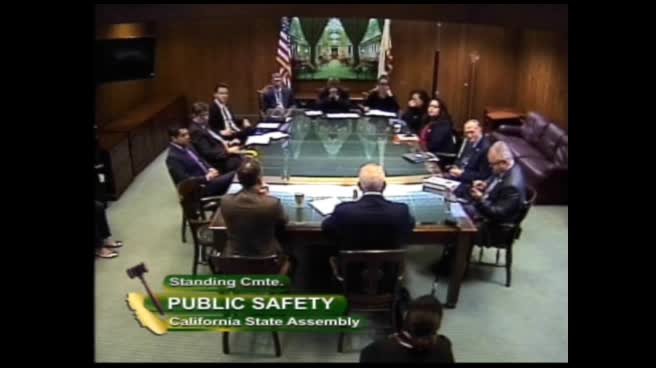 4MIN
Assembly Standing Committee on Public Safety
Bill Author

Bill Co-Author(s):