ACA 5: Motor vehicle fees and taxes: restriction on expenditures: appropriations limit.
- Session Year: 2017-2018
- House: Assembly
- Latest Version Date: 2017-04-17
(1)Article XIX of the California Constitution restricts the expenditure of revenues from taxes imposed by the state on fuels used in motor vehicles upon public streets and highways to street and highway and certain mass transit purposes, and restricts the expenditure of revenues from fees and taxes imposed by the state upon vehicles or their use or operation to state administration and enforcement of laws regulating the use, operation, or registration of vehicles used upon the public streets and highways, as well as to street and highway and certain mass transit purposes. These restrictions do not apply to revenues from taxes or fees imposed under the Sales and Use Tax Law or the Vehicle License Fee Law.
This measure would add Article XIXD to the California Constitution to require revenues derived from vehicle fees imposed under a specified chapter of the Vehicle License Fee Law to be used solely for transportation purposes, as defined. The measure would prohibit these revenues from being used for the payment of principal and interest on state transportation general obligation bonds that were authorized by the voters on or before November 8, 2016. The measure would prohibit the revenues from being used for the payment of principal and interest on state transportation general obligation bonds issued after that date unless the bond act submitted to the voters expressly authorizes that use. The measure would also prohibit the Legislature from borrowing these revenues, except as specified, or using them for purposes other than transportation purposes.
(2)Article XIIIB of the California Constitution prohibits the total annual appropriations subject to limitation of the state and each local government from exceeding the appropriations limit of the entity of the government for the prior year, as adjusted.
This measure would exclude appropriations of certain revenues associated with the Road Repair and Accountability Act of 2017 from the appropriations subject to constitutional limitation.
(3)Article XIXA of the California Constitution requires the deposit of a specified portion of the sales and use tax on diesel fuel in the Public Transportation Account in the State Transportation Fund, and restricts the expenditure of those revenues to certain transportation planning and mass transportation purposes. Article XIXA prohibits the Legislature from borrowing these revenues and from using these revenues other than as specifically permitted by Article XIXA.
This measure would restrict additional portions of the sales and use tax on diesel fuel to expenditure on certain transportation planning and mass transportation purposes and require those revenues to be deposited in the Public Transportation Account. The measure would prohibit the Legislature from temporarily or permanently diverting or appropriating these additional revenues for other than certain transportation planning and mass transportation purposes, or from borrowing, except as specified, these additional revenues.
(1)Article XIX of the California Constitution restricts the expenditure of revenues from taxes imposed by the state on fuels used in motor vehicles upon public streets and highways to street and highway and certain mass transit purposes, and restricts the expenditure of revenues from fees and taxes imposed by the state upon vehicles or their use or operation to state administration and enforcement of laws regulating the use, operation, or registration of vehicles used upon the public streets and highways, as well as to street and highway and certain mass transit purposes. These restrictions do not apply to revenues from taxes or fees imposed under the Sales and Use Tax Law or the Vehicle License Fee Law.
This measure would add Article XIXD to the California Constitution to require revenues derived from vehicle fees imposed under a specified chapter of the Vehicle License Fee Law to be used solely for transportation purposes, as defined. The measure would prohibit these revenues from being used for the payment of principal and interest on state transportation general obligation bonds that were authorized by the voters on or before November 8, 2016. The measure would prohibit the revenues from being used for the payment of principal and interest on state transportation general obligation bonds issued after that date unless the bond act submitted to the voters expressly authorizes that use. The measure would also prohibit the Legislature from borrowing these revenues, except as specified, or using them for purposes other than transportation purposes.
(2)Article XIIIB of the California Constitution prohibits the total annual appropriations subject to limitation of the state and each local government from exceeding the appropriations limit of the entity of the government for the prior year, as adjusted.
This measure would exclude appropriations of certain revenues associated with the Road Repair and Accountability Act of 2017 from the appropriations subject to constitutional limitation.
(3)Article XIXA of the California Constitution requires the deposit of a specified portion of the sales and use tax on diesel fuel in the Public Transportation Account in the State Transportation Fund, and restricts the expenditure of those revenues to certain transportation planning and mass transportation purposes. Article XIXA prohibits the Legislature from borrowing these revenues and from using these revenues other than as specifically permitted by Article XIXA.
This measure would restrict additional portions of the sales and use tax on diesel fuel to expenditure on certain transportation planning and mass transportation purposes and require those revenues to be deposited in the Public Transportation Account. The measure would prohibit the Legislature from temporarily or permanently diverting or appropriating these additional revenues for other than certain transportation planning and mass transportation purposes, or from borrowing, except as specified, these additional revenues.
(1)Article XIX of the California Constitution restricts the expenditure of revenues from taxes imposed by the state on fuels used in motor vehicles upon public streets and highways to street and highway and certain mass transit purposes, and restricts the expenditure of revenues from fees and taxes imposed by the state upon vehicles or their use or operation to state administration and enforcement of laws regulating the use, operation, or registration of vehicles used upon the public streets and highways, as well as to street and highway and certain mass transit purposes. These restrictions do not apply to revenues from taxes or fees imposed under the Sales and Use Tax Law or the Vehicle License Fee Law.
This measure would add Article XIXD to the California Constitution to require revenues derived from vehicle fees imposed under a specified chapter of the Vehicle License Fee Law to be used solely for transportation purposes. The measure would prohibit these revenues from being used for the payment of principal and interest on state transportation general obligation bonds that were authorized by the voters on or before November 8, 2016. The measure would prohibit the revenues from being used for the payment of principal and interest on state transportation general obligation bonds issued after that date unless the bond act submitted to the voters expressly authorizes that use. The measure would also prohibit the Legislature from borrowing these revenues, except as specified, or using them for purposes other than transportation purposes, as defined.
(2)Article XIIIB of the California Constitution prohibits the total annual appropriations subject to limitation of the state and each local government from exceeding the appropriations limit of the entity of the government for the prior year, as adjusted.
This measure would exclude appropriations of certain revenues associated with the Road Repair and Accountability Act of 2017 from the appropriations subject to constitutional limitation.
(3)Article XIXA of the California Constitution requires the deposit of a specified portion of the sales and use tax on diesel fuel in the Public Transportation Account in the State Transportation Fund, and restricts the expenditure of those revenues to certain transportation and mass transportation purposes. Article XIXA prohibits the Legislature from borrowing these revenues and from using these revenues other than as specifically permitted by Article XIXA.
This measure would restrict additional portions of the sales and use tax on diesel fuel to expenditure on certain transportation planning or mass transportation purposes and require those revenues to be deposited in the Public Transportation Account. The measure would prohibit the Legislature from temporarily or permanently diverting or appropriating these additional revenues for other than certain transportation planning or mass transportation purposes, or from borrowing, except as specified, these additional revenues.
The California Constitution generally limits ad valorem taxes on real property to 1% of the full cash value of that property. For purposes of this limitation, full cash value is defined as the assessors valuation of real property as shown on the 197576 tax bill under full cash value or, thereafter, the appraised value of that real property when purchased, newly constructed, or a change in ownership has occurred. The California Constitution authorizes the Legislature to provide that persons over 55 years of age and persons who are severely disabled may transfer the base year value, as defined, of real property that is eligible for a homeowners property tax exemption to a replacement dwelling, if certain conditions are met.This measure would additionally authorize the Legislature to provide for a similar transfer of base year value of real property to a replacement dwelling for persons who have a severely disabled child.The California Constitution generally limits ad valorem taxes on real property to 1% of the full cash value of that property. For purposes of this limitation, full cash value is defined as the assessors valuation of real property as shown on the 197576 tax bill under full cash value or, thereafter, the appraised value of that real property when purchased, newly constructed, or a change in ownership has occurred. The California Constitution authorizes the Legislature to provide that persons over 55 years of age and persons who are severely disabled may transfer the base year value, as defined, of real property that is eligible for a homeowners property tax exemption to a replacement dwelling, if certain conditions are met.
This measure would additionally authorize the Legislature to provide for a similar transfer of base year value of real property to a replacement dwelling for persons who have a severely disabled child.
WHEREAS, Transportation revenues raised by the Road Repair and Accountability Act of 2017 should be constitutionally protected for transportation purpose; and
WHEREAS, By so doing, Californians are assured revenues raised by that act are spent to repair streets and bridges, address years of deferred maintenance on highways and local roads, improve mobility and public transit, and invest in needed transportation infrastructure to benefit all Californians; now, therefore, be it
Resolved by the Assembly, the Senate concurring, That the Legislature of the State of California at its 201718 commencing on the fifth day of December 2016, two-thirds of the membership of each house concurring, hereby proposes to the people of the State of California, that the Constitution of the State be amended as follows:
Appropriations subject to limitation of each entity of government shall not include appropriations of revenues from the Road Maintenance and Rehabilitation Account created by the Road Repair and Accountability Act of 2017, or any other revenues deposited into any other funds pursuant to the act. No adjustment in the appropriations limit of any entity of government shall be required pursuant to Section 3 as a result of revenues being deposited in or appropriated from the Road Maintenance and Rehabilitation Account created by the Road Repair and Accountability Act of 2017 or any other account pursuant to the act.
(a)The Legislature shall not borrow revenues from the Public Transportation Account, or any successor account, and shall not use these revenues for purposes, or in ways, other than those specifically permitted by this article.
(b)The Public Transportation Account in the State Transportation Fund, or any successor account, is a trust fund. The Legislature may not change the status of the Public Transportation Account as a trust fund. Funds in the Public Transportation Account may not be loaned or otherwise transferred to the General Fund or any other fund or account in the State Treasury.
(c)All revenues specified in paragraphs (1) through (3), inclusive, of subdivision (a) of Section 7102 of the Revenue and Taxation Code, as that section read on June 1, 2001, shall be deposited no less than quarterly into the Public Transportation Account (Section 99310 of the Public Utilities Code), or its successor. The Legislature may not take any action which temporarily or permanently diverts or appropriates these revenues for purposes other than those described in subdivision (d), or delays, defers, suspends, or otherwise interrupts the quarterly deposit of these funds into the Public Transportation Account.
(d)Funds in the Public Transportation Account may only be used for transportation planning and mass transportation purposes. The revenues described in subdivision (c) are hereby continuously appropriated to the Controller without regard to fiscal years for allocation as follows:
(1)Fifty percent pursuant to subdivisions (a) through (f), inclusive, of Section 99315 of the Public Utilities Code, as that section read on July 30, 2009.
(2)Twenty-five percent pursuant to subdivision (b) of Section 99312 of the Public Utilities Code, as that section read on July 30, 2009.
(3)Twenty-five percent pursuant to subdivision (c) of Section 99312 of the Public Utilities Code, as that section read on July 30, 2009.
(e)For purposes of paragraph (1) of subdivision (d), transportation planning means only the purposes described in subdivisions (c) through (f), inclusive, of Section 99315 of the Public Utilities Code, as that section read on July 30, 2009.
(f)For purposes of this article, mass transportation, public transit, and mass transit have the same meaning as public transportation. Public transportation means:
(1)(A)Surface transportation service provided to the general public, complementary paratransit service provided to persons with disabilities as required by 42 U.S.C. 12143, or similar transportation provided to people with disabilities or the elderly; (B) operated by bus, rail, ferry, or other conveyance on a fixed route, demand response, or otherwise regularly available basis; (C) generally for which a fare is charged; and (D) provided by any transit district, included transit district, municipal operator, included municipal operator, eligible municipal operator, or transit development board, as those terms were defined in Article 1 of Chapter 4 of Part 11 of Division 10 of the Public Utilities Code on January 1, 2009, a joint powers authority formed to provide mass transportation services, an agency described in subdivision (f) of Section 15975 of the Government Code, as that section read on January 1, 2009, any recipient of funds under Sections 99260, 99260.7, 99275, or subdivision (c) of Section 99400 of the Public Utilities Code, as those sections read on January 1, 2009, or a consolidated agency as defined in Section 132353.1 of the Public Utilities Code, as that section read on January 1, 2009.
(2)Surface transportation service provided by the Department of Transportation pursuant to subdivision (a) of Section 99315 of the Public Utilities Code, as that section read on July 30, 2009.
(3)Public transit capital improvement projects, including those identified in subdivision (b) of Section 99315 of the Public Utilities Code, as that section read on July 30, 2009.
(g)All revenues specified in Sections 6051.8 and 6201.8 of the Revenue and Taxation Code, as those sections read on January 1, 2018, shall be deposited no less than quarterly into the Public Transportation Account, or its successor. Except as provided in Sections 16310 and 16381 of the Government Code, as those sections read on January 1, 2018, the Legislature may not take any action that temporarily or permanently diverts or appropriates these revenues for purposes other than those described in subdivision (d), or delays, defers, suspends, or otherwise interrupts the quarterly deposit of these revenues into the Public Transportation Account.
(a)Notwithstanding Section 8 of Article XIX, revenues derived from vehicle fees imposed under the Vehicle License Fee Law pursuant to Chapter 6 (commencing with Section 11050) of Part 5 of Division 2 of the Revenue and Taxation Code, or its successor, over and above the costs of collection and any refunds authorized by law, shall be used solely for transportation purposes, as defined by Section 11050 of the Revenue and Taxation Code, as that section read upon enactment of the Road Repair and Accountability Act of 2017.
(b)The revenues described in subdivision (a) shall not be used for the payment of principal and interest on state transportation general obligation bonds that were authorized by the voters on or before November 8, 2016, nor shall those revenues be used for payment of principal and interest on state transportation general obligation bond acts approved by the voters after that date, unless the bond act expressly authorizes that use.
(c)Except as provided in Sections 16310 and 16381 of the Government Code, as those sections read on January 1, 2018, the Legislature shall not borrow the revenues described in subdivision (a), and shall not use these revenues for purposes, or in ways, other than as authorized in subdivisions (a) or (b).
WHEREAS, Transportation revenues raised by the Road Repair and Accountability Act of 2017 should be constitutionally protected for transportation purpose; and
WHEREAS, By so doing, Californians are assured revenues raised by that act are spent to repair streets and bridges, address years of deferred maintenance on highways and local roads, improve mobility and public transit, and invest in needed transportation infrastructure to benefit all Californians; now, therefore, be it
Resolved by the Assembly, the Senate concurring, That the Legislature of the State of California at its 201718 commencing on the fifth day of December 2016, two-thirds of the membership of each house concurring, hereby proposes to the people of the State of California, that the Constitution of the State be amended as follows:
Appropriations subject to limitation of each entity of government shall not include appropriations of revenues from the Road Maintenance and Rehabilitation Account created by the Road Repair and Accountability Act of 2017, or any other revenues deposited into any other funds pursuant to the act. No adjustment in the appropriations limit of any entity of government shall be required pursuant to Section 3 as a result of revenues being deposited in or appropriated from the Road Maintenance and Rehabilitation Account created by the Road Repair and Accountability Act of 2017 or any other account pursuant to the act.
(a)The Legislature shall not borrow revenues from the Public Transportation Account, or any successor account, and shall not use these revenues for purposes, or in ways, other than those specifically permitted by this article.
(b)The Public Transportation Account in the State Transportation Fund, or any successor account, is a trust fund. The Legislature may not change the status of the Public Transportation Account as a trust fund. Funds in the Public Transportation Account may not be loaned or otherwise transferred to the General Fund or any other fund or account in the State Treasury.
(c)All revenues specified in paragraphs (1) through (3), inclusive, of subdivision (a) of Section 7102 of the Revenue and Taxation Code, as that section read on June 1, 2001, shall be deposited no less than quarterly into the Public Transportation Account (Section 99310 of the Public Utilities Code), or its successor. The Legislature may not take any action which temporarily or permanently diverts or appropriates these revenues for purposes other than those described in subdivision (d), or delays, defers, suspends, or otherwise interrupts the quarterly deposit of these funds into the Public Transportation Account.
(d)Funds in the Public Transportation Account may only be used for transportation planning and mass transportation purposes. The revenues described in subdivision (c) are hereby continuously appropriated to the Controller without regard to fiscal years for allocation as follows:
(1)Fifty percent pursuant to subdivisions (a) through (f), inclusive, of Section 99315 of the Public Utilities Code, as that section read on July 30, 2009.
(2)Twenty-five percent pursuant to subdivision (b) of Section 99312 of the Public Utilities Code, as that section read on July 30, 2009.
(3)Twenty-five percent pursuant to subdivision (c) of Section 99312 of the Public Utilities Code, as that section read on July 30, 2009.
(e)For purposes of paragraph (1) of subdivision (d), transportation planning means only the purposes described in subdivisions (c) through (f), inclusive, of Section 99315 of the Public Utilities Code, as that section read on July 30, 2009.
(f)For purposes of this article, mass transportation, public transit, and mass transit have the same meaning as public transportation. Public transportation means:
(1)(A)Surface transportation service provided to the general public, complementary paratransit service provided to persons with disabilities as required by 42 U.S.C. 12143, or similar transportation provided to people with disabilities or the elderly; (B) operated by bus, rail, ferry, or other conveyance on a fixed route, demand response, or otherwise regularly available basis; (C) generally for which a fare is charged; and (D) provided by any transit district, included transit district, municipal operator, included municipal operator, eligible municipal operator, or transit development board, as those terms were defined in Article 1 of Chapter 4 of Part 11 of Division 10 of the Public Utilities Code on January 1, 2009, a joint powers authority formed to provide mass transportation services, an agency described in subdivision (f) of Section 15975 of the Government Code, as that section read on January 1, 2009, any recipient of funds under Sections 99260, 99260.7, 99275, or subdivision (c) of Section 99400 of the Public Utilities Code, as those sections read on January 1, 2009, or a consolidated agency as defined in Section 132353.1 of the Public Utilities Code, as that section read on January 1, 2009.
(2)Surface transportation service provided by the Department of Transportation pursuant to subdivision (a) of Section 99315 of the Public Utilities Code, as that section read on July 30, 2009.
(3)Public transit capital improvement projects, including those identified in subdivision (b) of Section 99315 of the Public Utilities Code, as that section read on July 30, 2009.
(g)All revenues specified in Sections 6051.8 and 6201.8 of the Revenue and Taxation Code, as those sections read on January 1, 2018, shall be deposited no less than quarterly into the Public Transportation Account, or its successor. Except as provided in Sections 16310 and 16381 of the Government Code, as those sections read on January 1, 2018, the Legislature may not take any action that temporarily or permanently diverts or appropriates these revenues for purposes other than those described in subdivision (d), or delays, defers, suspends, or otherwise interrupts the quarterly deposit of these revenues into the Public Transportation Account.
(a)Notwithstanding Section 8 of Article XIX, revenues derived from vehicle fees imposed under the Vehicle License Fee Law pursuant to Chapter 6 (commencing with Section 11050) of Part 5 of Division 2 of the Revenue and Taxation Code, or its successor, over and above the costs of collection and any refunds authorized by law, shall be used solely for transportation purposes, as defined by Section 11050 of the Revenue and Taxation Code, as that section read upon enactment of the Road Repair and Accountability Act of 2017.
(b)The revenues described in subdivision (a) shall not be used for the payment of principal and interest on state transportation general obligation bonds that were authorized by the voters on or before November 8, 2016, nor shall those revenues be used for payment of principal and interest on state transportation general obligation bond acts approved by the voters after that date, unless the bond act expressly authorizes that use.
(c)Except as provided in Sections 16310 and 16381 of the Government Code, as those sections read on January 1, 2018, the Legislature shall not borrow the revenues described in subdivision (a), and shall not use these revenues for purposes, or in ways, other than as authorized in subdivisions (a) or (b).
WHEREAS, Transportation revenues raised by the Road Repair and Accountability Act of 2017 should be constitutionally protected for transportation purpose; and
WHEREAS, By so doing, Californians are assured revenues raised by that act are spent to repair streets and bridges, address years of deferred maintenance on highways and local roads, improve mobility and public transit, and invest in needed transportation infrastructure to benefit all Californians; now, therefore, be it
Resolved by the Assembly, the Senate concurring, That the Legislature of the State of California at its 201718 commencing on the fifth day of December 2016, two-thirds of the membership of each house concurring, hereby proposes to the people of the State of California, that the Constitution of the State be amended as follows:
Appropriations subject to limitation of each entity of government shall not include appropriations of revenues from the Road Maintenance and Rehabilitation Account created by the Road Repair and Accountability Act of 2017, or any other revenues deposited into any other funds pursuant to the act. No adjustment in the appropriations limit of any entity of government shall be required pursuant to Section 3 as a result of revenues being deposited in or appropriated from the Road Maintenance and Rehabilitation Account created by the Road Repair and Accountability Act of 2017 or any other account pursuant to the act.
(a)The Legislature shall not borrow revenues from the Public Transportation Account, or any successor account, and shall not use these revenues for purposes, or in ways, other than those specifically permitted by this article.
(b)The Public Transportation Account in the State Transportation Fund, or any successor account, is a trust fund. The Legislature may not change the status of the Public Transportation Account as a trust fund. Funds in the Public Transportation Account may not be loaned or otherwise transferred to the General Fund or any other fund or account in the State Treasury.
(c)All revenues specified in paragraphs (1) through (3), inclusive, of subdivision (a) of Section 7102 of the Revenue and Taxation Code, as that section read on June 1, 2001, shall be deposited no less than quarterly into the Public Transportation Account (Section 99310 of the Public Utilities Code), or its successor. The Legislature may not take any action which temporarily or permanently diverts or appropriates these revenues for purposes other than those described in subdivision (d), or delays, defers, suspends, or otherwise interrupts the quarterly deposit of these funds into the Public Transportation Account.
(d)Funds in the Public Transportation Account may only be used for transportation planning and mass transportation purposes. The revenues described in subdivision (c) are hereby continuously appropriated to the Controller without regard to fiscal years for allocation as follows:
(1)Fifty percent pursuant to subdivisions (a) through (f), inclusive, of Section 99315 of the Public Utilities Code, as that section read on July 30, 2009.
(2)Twenty-five percent pursuant to subdivision (b) of Section 99312 of the Public Utilities Code, as that section read on July 30, 2009.
(3)Twenty-five percent pursuant to subdivision (c) of Section 99312 of the Public Utilities Code, as that section read on July 30, 2009.
(e)For purposes of paragraph (1) of subdivision (d), transportation planning means only the purposes described in subdivisions (c) through (f), inclusive, of Section 99315 of the Public Utilities Code, as that section read on July 30, 2009.
(f)For purposes of this article, mass transportation, public transit, and mass transit have the same meaning as public transportation. Public transportation means:
(1)(A)Surface transportation service provided to the general public, complementary paratransit service provided to persons with disabilities as required by 42 U.S.C. 12143, or similar transportation provided to people with disabilities or the elderly; (B) operated by bus, rail, ferry, or other conveyance on a fixed route, demand response, or otherwise regularly available basis; (C) generally for which a fare is charged; and (D) provided by any transit district, included transit district, municipal operator, included municipal operator, eligible municipal operator, or transit development board, as those terms were defined in Article 1 of Chapter 4 of Part 11 of Division 10 of the Public Utilities Code on January 1, 2009, a joint powers authority formed to provide mass transportation services, an agency described in subdivision (f) of Section 15975 of the Government Code, as that section read on January 1, 2009, any recipient of funds under Sections 99260, 99260.7, 99275, or subdivision (c) of Section 99400 of the Public Utilities Code, as those sections read on January 1, 2009, or a consolidated agency as defined in Section 132353.1 of the Public Utilities Code, as that section read on January 1, 2009.
(2)Surface transportation service provided by the Department of Transportation pursuant to subdivision (a) of Section 99315 of the Public Utilities Code, as that section read on July 30, 2009.
(3)Public transit capital improvement projects, including those identified in subdivision (b) of Section 99315 of the Public Utilities Code, as that section read on July 30, 2009.
(g)All revenues specified in Sections 6051.8 and 6201.8 of the Revenue and Taxation Code, as those sections read on January 1, 2018, shall be deposited no less than quarterly into the Public Transportation Account, or its successor. Except as provided in Sections 16310 and 16381 of the Government Code, as those sections read on January 1, 2018, the Legislature may not take any action that temporarily or permanently diverts or appropriates these revenues for purposes other than those described in subdivision (d), or delays, defers, suspends, or otherwise interrupts the quarterly deposit of these revenues into the Public Transportation Account.
(a)Notwithstanding Section 8 of Article XIX, revenues derived from vehicle fees imposed under the Vehicle License Fee Law pursuant to Chapter 6 (commencing with Section 11050) of Part 5 of Division 2 of the Revenue and Taxation Code, or its successor, over and above the costs of collection and any refunds authorized by law, shall be used solely for transportation purposes, as defined by Section 11050 of the Revenue and Taxation Code, as that section read upon enactment of the Road Repair and Accountability Act of 2017.
(b)The revenues described in subdivision (a) shall not be used for the payment of principal and interest on state transportation general obligation bonds that were authorized by the voters on or before November 8, 2016, nor shall those revenues be used for payment of principal and interest on state transportation general obligation bond acts approved by the voters after that date, unless the bond act expressly authorizes that use.
(c)Except as provided in Sections 16310 and 16381 of the Government Code, as those sections read on January 1, 2018, the Legislature shall not borrow the revenues described in subdivision (a), and shall not use these revenues for purposes, or in ways, other than as authorized in subdivisions (a) or (b).
(a)(1)The full cash value means the county assessors valuation of real property as shown on the 197576 tax bill under full cash value or, thereafter, the appraised value of real property when purchased, newly constructed, or a change in ownership has occurred after the 1975 assessment. All real property not already assessed up to the 197576 full cash value may be reassessed to reflect that valuation. For purposes of this section, newly constructed does not include real property that is reconstructed after a disaster, as declared by the Governor, where the fair market value of the real property, as reconstructed, is comparable to its fair market value prior to the disaster. For purposes of this section, the term newly constructed does not include that portion of an existing structure that consists of the construction or reconstruction of seismic retrofitting components, as defined by the Legislature.(2)However, the Legislature may provide that, under appropriate circumstances and pursuant to definitions and procedures established by the Legislature, any person over the age of 55 years who resides in property that is eligible for the homeowners exemption under subdivision (k) of Section 3 of Article XIII and any implementing legislation may transfer the base year value of the property entitled to exemption, with the adjustments authorized by subdivision (b), to any replacement dwelling of equal or lesser value located within the same county and purchased or newly constructed by that person as his or her principal residence within two years of the sale of the original property. For purposes of this section, any person over the age of 55 years includes a married couple one member of which is over the age of 55 years. For purposes of this section, replacement dwelling means a building, structure, or other shelter constituting a place of abode, whether real property or personal property, and any land on which it may be situated. For purposes of this section, a two-dwelling unit shall be considered as two separate single-family dwellings. This paragraph shall apply to any replacement dwelling that was purchased or newly constructed on or after November 5, 1986.(3)In addition, the Legislature may authorize each county board of supervisors, after consultation with the local affected agencies within the countys boundaries, to adopt an ordinance making the provisions of this subdivision relating to transfer of base year value also applicable to situations in which the replacement dwellings are located in that county and the original properties are located in another county within this State. For purposes of this paragraph, local affected agency means any city, special district, school district, or community college district that receives an annual property tax revenue allocation. This paragraph applies to any replacement dwelling that was purchased or newly constructed on or after the date the county adopted the provisions of this subdivision relating to transfer of base year value, but does not apply to any replacement dwelling that was purchased or newly constructed before November 9, 1988.(4)The Legislature may extend the provisions of this subdivision relating to the transfer of base year values from original properties to replacement dwellings of homeowners over the age of 55 years to either or both of the following:(A)Severely disabled homeowners, but only with respect to those replacement dwellings purchased or newly constructed on or after June 6, 1990.(B)Homeowners with a severely disabled child, but only with respect to those replacement dwellings purchased or newly constructed on or after the effective date of this subparagraph.(b)The full cash value base may reflect from year to year the inflationary rate not to exceed 2 percent for any given year or reduction as shown in the consumer price index or comparable data for the area under taxing jurisdiction, or may be reduced to reflect substantial damage, destruction, or other factors causing a decline in value.(c)For purposes of subdivision (a), the Legislature may provide that the term newly constructed does not include any of the following:(1)The construction or addition of any active solar energy system.(2)The construction or installation of any fire sprinkler system, other fire extinguishing system, fire detection system, or fire-related egress improvement, as defined by the Legislature, that is constructed or installed after the effective date of this paragraph.(3)The construction, installation, or modification on or after the effective date of this paragraph of any portion or structural component of a single- or multiple-family dwelling that is eligible for the homeowners exemption if the construction, installation, or modification is for the purpose of making the dwelling more accessible to a severely disabled person.(4)The construction, installation, removal, or modification on or after the effective date of this paragraph of any portion or structural component of an existing building or structure if the construction, installation, removal, or modification is for the purpose of making the building more accessible to, or more usable by, a disabled person.(d)For purposes of this section, the term change in ownership does not include the acquisition of real property as a replacement for comparable property if the person acquiring the real property has been displaced from the property replaced by eminent domain proceedings, by acquisition by a public entity, or governmental action that has resulted in a judgment of inverse condemnation. The real property acquired shall be deemed comparable to the property replaced if it is similar in size, utility, and function, or if it conforms to state regulations defined by the Legislature governing the relocation of persons displaced by governmental actions. This subdivision applies to any property acquired after March 1, 1975, but affects only those assessments of that property that occur after the provisions of this subdivision take effect.(e)(1)Notwithstanding any other provision of this section, the Legislature shall provide that the base year value of property that is substantially damaged or destroyed by a disaster, as declared by the Governor, may be transferred to comparable property within the same county that is acquired or newly constructed as a replacement for the substantially damaged or destroyed property.(2)Except as provided in paragraph (3), this subdivision applies to any comparable replacement property acquired or newly constructed on or after July 1, 1985, and to the determination of base year values for the 198586 fiscal year and fiscal years thereafter.(3)In addition to the transfer of base year value of property within the same county that is permitted by paragraph (1), the Legislature may authorize each county board of supervisors to adopt, after consultation with affected local agencies within the county, an ordinance allowing the transfer of the base year value of property that is located within another county in the State and is substantially damaged or destroyed by a disaster, as declared by the Governor, to comparable replacement property of equal or lesser value that is located within the adopting county and is acquired or newly constructed within three years of the substantial damage or destruction of the original property as a replacement for that property. The scope and amount of the benefit provided to a property owner by the transfer of base year value of property pursuant to this paragraph shall not exceed the scope and amount of the benefit provided to a property owner by the transfer of base year value of property pursuant to subdivision (a). For purposes of this paragraph, affected local agency means any city, special district, school district, or community college district that receives an annual allocation of ad valorem property tax revenues. This paragraph applies to any comparable replacement property that is acquired or newly constructed as a replacement for property substantially damaged or destroyed by a disaster, as declared by the Governor, occurring on or after October 20, 1991, and to the determination of base year values for the 199192 fiscal year and fiscal years thereafter.(f)For the purposes of subdivision (e):(1)Property is substantially damaged or destroyed if it sustains physical damage amounting to more than 50 percent of its value immediately before the disaster. Damage includes a diminution in the value of property as a result of restricted access caused by the disaster.(2)Replacement property is comparable to the property substantially damaged or destroyed if it is similar in size, utility, and function to the property that it replaces, and if the fair market value of the acquired property is comparable to the fair market value of the replaced property prior to the disaster.(g)For purposes of subdivision (a), the terms purchased and change in ownership do not include the purchase or transfer of real property between spouses since March 1, 1975, including, but not limited to, all of the following:(1)Transfers to a trustee for the beneficial use of a spouse, or the surviving spouse of a deceased transferor, or by a trustee of such a trust to the spouse of the trustor.(2)Transfers to a spouse that take effect upon the death of a spouse.(3)Transfers to a spouse or former spouse in connection with a property settlement agreement or decree of dissolution of a marriage or legal separation.(4)The creation, transfer, or termination, solely between spouses, of any coowners interest.(5)The distribution of a legal entitys property to a spouse or former spouse in exchange for the interest of the spouse in the legal entity in connection with a property settlement agreement or a decree of dissolution of a marriage or legal separation.(h)(1)For purposes of subdivision (a), the terms purchased and change in ownership do not include the purchase or transfer of the principal residence of the transferor in the case of a purchase or transfer between parents and their children, as defined by the Legislature, and the purchase or transfer of the first one million dollars ($1,000,000) of the full cash value of all other real property between parents and their children, as defined by the Legislature. This subdivision applies to both voluntary transfers and transfers resulting from a court order or judicial decree.(2)(A)Subject to subparagraph (B), commencing with purchases or transfers that occur on or after the date upon which the measure adding this paragraph becomes effective, the exclusion established by paragraph (1) also applies to a purchase or transfer of real property between grandparents and their grandchild or grandchildren, as defined by the Legislature, that otherwise qualifies under paragraph (1), if all of the parents of that grandchild or those grandchildren, who qualify as the children of the grandparents, are deceased as of the date of the purchase or transfer.(B)A purchase or transfer of a principal residence shall not be excluded pursuant to subparagraph (A) if the transferee grandchild or grandchildren also received a principal residence, or interest therein, through another purchase or transfer that was excludable pursuant to paragraph (1). The full cash value of any real property, other than a principal residence, that was transferred to the grandchild or grandchildren pursuant to a purchase or transfer that was excludable pursuant to paragraph (1), and the full cash value of a principal residence that fails to qualify for exclusion as a result of the preceding sentence, shall be included in applying, for purposes of subparagraph (A), the one-million-dollar ($1,000,000) full cash value limit specified in paragraph (1).(i)(1)Notwithstanding any other provision of this section, the Legislature shall provide with respect to a qualified contaminated property, as defined in paragraph (2), that either, but not both, of the following apply:(A)(i)Subject to the limitation of clause (ii), the base year value of the qualified contaminated property, as adjusted as authorized by subdivision (b), may be transferred to a replacement property that is acquired or newly constructed as a replacement for the qualified contaminated property, if the replacement real property has a fair market value that is equal to or less than the fair market value of the qualified contaminated property if that property were not contaminated and, except as otherwise provided by this clause, is located within the same county. The base year value of the qualified contaminated property may be transferred to a replacement real property located within another county if the board of supervisors of that other county has, after consultation with the affected local agencies within that county, adopted a resolution authorizing an intercounty transfer of base year value as so described.(ii)This subparagraph applies only to replacement property that is acquired or newly constructed within five years after ownership in the qualified contaminated property is sold or otherwise transferred.(B)In the case in which the remediation of the environmental problems on the qualified contaminated property requires the destruction of, or results in substantial damage to, a structure located on that property, the term new construction does not include the repair of a substantially damaged structure, or the construction of a structure replacing a destroyed structure on the qualified contaminated property, performed after the remediation of the environmental problems on that property, provided that the repaired or replacement structure is similar in size, utility, and function to the original structure.(2)For purposes of this subdivision, qualified contaminated property means residential or nonresidential real property that is all of the following:(A)In the case of residential real property, rendered uninhabitable, and in the case of nonresidential real property, rendered unusable, as the result of either environmental problems, in the nature of and including, but not limited to, the presence of toxic or hazardous materials, or the remediation of those environmental problems, except where the existence of the environmental problems was known to the owner, or to a related individual or entity as described in paragraph (3), at the time the real property was acquired or constructed. For purposes of this subparagraph, residential real property is uninhabitable if that property, as a result of health hazards caused by or associated with the environmental problems, is unfit for human habitation, and nonresidential real property is unusable if that property, as a result of health hazards caused by or associated with the environmental problems, is unhealthy and unsuitable for occupancy.(B)Located on a site that has been designated as a toxic or environmental hazard or as an environmental cleanup site by an agency of the State of California or the federal government.(C)Real property that contains a structure or structures thereon prior to the completion of environmental cleanup activities, and that structure or structures are substantially damaged or destroyed as a result of those environmental cleanup activities.(D)Stipulated by the lead governmental agency, with respect to the environmental problems or environmental cleanup of the real property, not to have been rendered uninhabitable or unusable, as applicable, as described in subparagraph (A), by any act or omission in which an owner of that real property participated or acquiesced.(3)It shall be rebuttably presumed that an owner of the real property participated or acquiesced in any act or omission that rendered the real property uninhabitable or unusable, as applicable, if that owner is related to any individual or entity that committed that act or omission in any of the following ways:(A)Is a spouse, parent, child, grandparent, grandchild, or sibling of that individual.(B)Is a corporate parent, subsidiary, or affiliate of that entity.(C)Is an owner of, or has control of, that entity.(D)Is owned or controlled by that entity.If this presumption is not overcome, the owner shall not receive the relief provided for in subparagraph (A) or (B) of paragraph (1). The presumption may be overcome by presentation of satisfactory evidence to the assessor, who shall not be bound by the findings of the lead governmental agency in determining whether the presumption has been overcome.(4)This subdivision applies only to replacement property that is acquired or constructed on or after January 1, 1995, and to property repairs performed on or after that date.(j)Unless specifically provided otherwise, amendments to this section adopted prior to November 1, 1988, are effective for changes in ownership that occur, and new construction that is completed, after the effective date of the amendment. Unless specifically provided otherwise, amendments to this section adopted after November 1, 1988, are effective for changes in ownership that occur, and new construction that is completed, on or after the effective date of the amendment.Resolved by the Assembly, the Senate concurring, That the Legislature of the State of California at its 201718 commencing on the fifth day of December 2016, two-thirds of the membership of each house concurring, hereby proposes to the people of the State of California, that the Constitution of the State be amended as follows:
(a)(1)The full cash value means the county assessors valuation of real property as shown on the 197576 tax bill under full cash value or, thereafter, the appraised value of real property when purchased, newly constructed, or a change in ownership has occurred after the 1975 assessment. All real property not already assessed up to the 197576 full cash value may be reassessed to reflect that valuation. For purposes of this section, newly constructed does not include real property that is reconstructed after a disaster, as declared by the Governor, where the fair market value of the real property, as reconstructed, is comparable to its fair market value prior to the disaster. For purposes of this section, the term newly constructed does not include that portion of an existing structure that consists of the construction or reconstruction of seismic retrofitting components, as defined by the Legislature.
However,(2)However, the Legislature may provide that, under appropriate circumstances and pursuant to definitions and procedures established by the Legislature, any person over the age of 55 years who resides in property that is eligible for the homeowners exemption under subdivision (k) of Section 3 of Article XIII and any implementing legislation may transfer the base year value of the property entitled to exemption, with the adjustments authorized by subdivision (b), to any replacement dwelling of equal or lesser value located within the same county and purchased or newly constructed by that person as his or her principal residence within two years of the sale of the original property. For purposes of this section, any person over the age of 55 years includes a married couple one member of which is over the age of 55 years. For purposes of this section, replacement dwelling means a building, structure, or other shelter constituting a place of abode, whether real property or personal property, and any land on which it may be situated. For purposes of this section, a two-dwelling unit shall be considered as two separate single-family dwellings. This paragraph shall apply to any replacement dwelling that was purchased or newly constructed on or after November 5, 1986.
In(3)In addition, the Legislature may authorize each county board of supervisors, after consultation with the local affected agencies within the countys boundaries, to adopt an ordinance making the provisions of this subdivision relating to transfer of base year value also applicable to situations in which the replacement dwellings are located in that county and the original properties are located in another county within this State. For purposes of this paragraph, local affected agency means any city, special district, school district, or community college district that receives an annual property tax revenue allocation. This paragraph applies to any replacement dwelling that was purchased or newly constructed on or after the date the county adopted the provisions of this subdivision relating to transfer of base year value, but does not apply to any replacement dwelling that was purchased or newly constructed before November 9, 1988.
The(4)The Legislature may extend the provisions of this subdivision relating to the transfer of base year values from original properties to replacement dwellings of homeowners over the age of 55 years to severely either or both of the following:
(A)Severely disabled homeowners, but only with respect to those replacement dwellings purchased or newly constructed on or after the effective date of this paragraph. June 6, 1990.
(B)Homeowners with a severely disabled child, but only with respect to those replacement dwellings purchased or newly constructed on or after the effective date of this subparagraph.
(b)The full cash value base may reflect from year to year the inflationary rate not to exceed 2 percent for any given year or reduction as shown in the consumer price index or comparable data for the area under taxing jurisdiction, or may be reduced to reflect substantial damage, destruction, or other factors causing a decline in value.
(c)For purposes of subdivision (a), the Legislature may provide that the term newly constructed does not include any of the following:
(1)The construction or addition of any active solar energy system.
(2)The construction or installation of any fire sprinkler system, other fire extinguishing system, fire detection system, or fire-related egress improvement, as defined by the Legislature, that is constructed or installed after the effective date of this paragraph.
(3)The construction, installation, or modification on or after the effective date of this paragraph of any portion or structural component of a single- or multiple-family dwelling that is eligible for the homeowners exemption if the construction, installation, or modification is for the purpose of making the dwelling more accessible to a severely disabled person.
(4)The construction, installation, removal, or modification on or after the effective date of this paragraph of any portion or structural component of an existing building or structure if the construction, installation, removal, or modification is for the purpose of making the building more accessible to, or more usable by, a disabled person.
(d)For purposes of this section, the term change in ownership does not include the acquisition of real property as a replacement for comparable property if the person acquiring the real property has been displaced from the property replaced by eminent domain proceedings, by acquisition by a public entity, or governmental action that has resulted in a judgment of inverse condemnation. The real property acquired shall be deemed comparable to the property replaced if it is similar in size, utility, and function, or if it conforms to state regulations defined by the Legislature governing the relocation of persons displaced by governmental actions. This subdivision applies to any property acquired after March 1, 1975, but affects only those assessments of that property that occur after the provisions of this subdivision take effect.
(e)(1)Notwithstanding any other provision of this section, the Legislature shall provide that the base year value of property that is substantially damaged or destroyed by a disaster, as declared by the Governor, may be transferred to comparable property within the same county that is acquired or newly constructed as a replacement for the substantially damaged or destroyed property.
(2)Except as provided in paragraph (3), this subdivision applies to any comparable replacement property acquired or newly constructed on or after July 1, 1985, and to the determination of base year values for the 198586 fiscal year and fiscal years thereafter.
(3)In addition to the transfer of base year value of property within the same county that is permitted by paragraph (1), the Legislature may authorize each county board of supervisors to adopt, after consultation with affected local agencies within the county, an ordinance allowing the transfer of the base year value of property that is located within another county in the State and is substantially damaged or destroyed by a disaster, as declared by the Governor, to comparable replacement property of equal or lesser value that is located within the adopting county and is acquired or newly constructed within three years of the substantial damage or destruction of the original property as a replacement for that property. The scope and amount of the benefit provided to a property owner by the transfer of base year value of property pursuant to this paragraph shall not exceed the scope and amount of the benefit provided to a property owner by the transfer of base year value of property pursuant to subdivision (a). For purposes of this paragraph, affected local agency means any city, special district, school district, or community college district that receives an annual allocation of ad valorem property tax revenues. This paragraph applies to any comparable replacement property that is acquired or newly constructed as a replacement for property substantially damaged or destroyed by a disaster, as declared by the Governor, occurring on or after October 20, 1991, and to the determination of base year values for the 199192 fiscal year and fiscal years thereafter.
(f)For the purposes of subdivision (e):
(1)Property is substantially damaged or destroyed if it sustains physical damage amounting to more than 50 percent of its value immediately before the disaster. Damage includes a diminution in the value of property as a result of restricted access caused by the disaster.
(2)Replacement property is comparable to the property substantially damaged or destroyed if it is similar in size, utility, and function to the property that it replaces, and if the fair market value of the acquired property is comparable to the fair market value of the replaced property prior to the disaster.
(g)For purposes of subdivision (a), the terms purchased and change in ownership do not include the purchase or transfer of real property between spouses since March 1, 1975, including, but not limited to, all of the following:
(1)Transfers to a trustee for the beneficial use of a spouse, or the surviving spouse of a deceased transferor, or by a trustee of such a trust to the spouse of the trustor.
(2)Transfers to a spouse that take effect upon the death of a spouse.
(3)Transfers to a spouse or former spouse in connection with a property settlement agreement or decree of dissolution of a marriage or legal separation.
(4)The creation, transfer, or termination, solely between spouses, of any coowners interest.
(5)The distribution of a legal entitys property to a spouse or former spouse in exchange for the interest of the spouse in the legal entity in connection with a property settlement agreement or a decree of dissolution of a marriage or legal separation.
(h)(1)For purposes of subdivision (a), the terms purchased and change in ownership do not include the purchase or transfer of the principal residence of the transferor in the case of a purchase or transfer between parents and their children, as defined by the Legislature, and the purchase or transfer of the first one million dollars ($1,000,000) of the full cash value of all other real property between parents and their children, as defined by the Legislature. This subdivision applies to both voluntary transfers and transfers resulting from a court order or judicial decree.
(2)(A)Subject to subparagraph (B), commencing with purchases or transfers that occur on or after the date upon which the measure adding this paragraph becomes effective, the exclusion established by paragraph (1) also applies to a purchase or transfer of real property between grandparents and their grandchild or grandchildren, as defined by the Legislature, that otherwise qualifies under paragraph (1), if all of the parents of that grandchild or those grandchildren, who qualify as the children of the grandparents, are deceased as of the date of the purchase or transfer.
(B)A purchase or transfer of a principal residence shall not be excluded pursuant to subparagraph (A) if the transferee grandchild or grandchildren also received a principal residence, or interest therein, through another purchase or transfer that was excludable pursuant to paragraph (1). The full cash value of any real property, other than a principal residence, that was transferred to the grandchild or grandchildren pursuant to a purchase or transfer that was excludable pursuant to paragraph (1), and the full cash value of a principal residence that fails to qualify for exclusion as a result of the preceding sentence, shall be included in applying, for purposes of subparagraph (A), the one-million-dollar ($1,000,000) full cash value limit specified in paragraph (1).
(i)(1)Notwithstanding any other provision of this section, the Legislature shall provide with respect to a qualified contaminated property, as defined in paragraph (2), that either, but not both, of the following apply:
(A)(i)Subject to the limitation of clause (ii), the base year value of the qualified contaminated property, as adjusted as authorized by subdivision (b), may be transferred to a replacement property that is acquired or newly constructed as a replacement for the qualified contaminated property, if the replacement real property has a fair market value that is equal to or less than the fair market value of the qualified contaminated property if that property were not contaminated and, except as otherwise provided by this clause, is located within the same county. The base year value of the qualified contaminated property may be transferred to a replacement real property located within another county if the board of supervisors of that other county has, after consultation with the affected local agencies within that county, adopted a resolution authorizing an intercounty transfer of base year value as so described.
(ii)This subparagraph applies only to replacement property that is acquired or newly constructed within five years after ownership in the qualified contaminated property is sold or otherwise transferred.
(B)In the case in which the remediation of the environmental problems on the qualified contaminated property requires the destruction of, or results in substantial damage to, a structure located on that property, the term new construction does not include the repair of a substantially damaged structure, or the construction of a structure replacing a destroyed structure on the qualified contaminated property, performed after the remediation of the environmental problems on that property, provided that the repaired or replacement structure is similar in size, utility, and function to the original structure.
(2)For purposes of this subdivision, qualified contaminated property means residential or nonresidential real property that is all of the following:
(A)In the case of residential real property, rendered uninhabitable, and in the case of nonresidential real property, rendered unusable, as the result of either environmental problems, in the nature of and including, but not limited to, the presence of toxic or hazardous materials, or the remediation of those environmental problems, except where the existence of the environmental problems was known to the owner, or to a related individual or entity as described in paragraph (3), at the time the real property was acquired or constructed. For purposes of this subparagraph, residential real property is uninhabitable if that property, as a result of health hazards caused by or associated with the environmental problems, is unfit for human habitation, and nonresidential real property is unusable if that property, as a result of health hazards caused by or associated with the environmental problems, is unhealthy and unsuitable for occupancy.
(B)Located on a site that has been designated as a toxic or environmental hazard or as an environmental cleanup site by an agency of the State of California or the federal government.
(C)Real property that contains a structure or structures thereon prior to the completion of environmental cleanup activities, and that structure or structures are substantially damaged or destroyed as a result of those environmental cleanup activities.
(D)Stipulated by the lead governmental agency, with respect to the environmental problems or environmental cleanup of the real property, not to have been rendered uninhabitable or unusable, as applicable, as described in subparagraph (A), by any act or omission in which an owner of that real property participated or acquiesced.
(3)It shall be rebuttably presumed that an owner of the real property participated or acquiesced in any act or omission that rendered the real property uninhabitable or unusable, as applicable, if that owner is related to any individual or entity that committed that act or omission in any of the following ways:
(A)Is a spouse, parent, child, grandparent, grandchild, or sibling of that individual.
(B)Is a corporate parent, subsidiary, or affiliate of that entity.
(C)Is an owner of, or has control of, that entity.
(D)Is owned or controlled by that entity.
If this presumption is not overcome, the owner shall not receive the relief provided for in subparagraph (A) or (B) of paragraph (1). The presumption may be overcome by presentation of satisfactory evidence to the assessor, who shall not be bound by the findings of the lead governmental agency in determining whether the presumption has been overcome.
(4)This subdivision applies only to replacement property that is acquired or constructed on or after January 1, 1995, and to property repairs performed on or after that date.
(j)Unless specifically provided otherwise, amendments to this section adopted prior to November 1, 1988, are effective for changes in ownership that occur, and new construction that is completed, after the effective date of the amendment. Unless specifically provided otherwise, amendments to this section adopted after November 1, 1988, are effective for changes in ownership that occur, and new construction that is completed, on or after the effective date of the amendment.
|
Date
|
Status
|
|---|---|
| Apr 17, 2017 | Chaptered by Secretary of State - Res. Chapter 30, Statutes of 2017. |
| Apr 17, 2017 | Enrolled and filed with the Secretary of State at 1 p.m. |
| Apr 6, 2017 | In Assembly. Ordered to Engrossing and Enrolling. |
| Apr 6, 2017 | In Senate. |
| Apr 6, 2017 | Assembly Rule 96 suspended. |
| Apr 5, 2017 | Coauthors revised. |
| Apr 4, 2017 | From committee chair, with author's amendments: Amend, and re-refer to Com. on RLS. Read second time and amended. |
| Apr 3, 2017 | Referred to Com. on RLS. |
| Feb 19, 2017 | From printer. May be heard in committee March 21. |
| Feb 17, 2017 | Read first time. To print. |
|
Date
|
Description
|
Location
|
Votes
|
|
|---|---|---|---|---|
| Apr 6, 2017 | Assembly 3rd Reading (Supplemental File 1) ACA5 Frazier et al. By Newman | Senate Floor |
Passed |
|
| Apr 6, 2017 | ACA 5 FRAZIER Assembly Third Reading | Assembly Floor |
Passed |
|
| Apr 6, 2017 | ACA 5 FRAZIER Assembly Third Reading Amend By HARPER Set #1 Motion to Lay on the Table By CALDERON | Assembly Floor |
Passed |
This list shows positions taken on this bill by organizations on the date displayed, which is linked to the original source.
Positions by individuals are not included.
(Without Reference to File)
ASSEMBLY THIRD READING
ATR Bill Id:ACA 5
Author:(Frazier and Newman)
As Amended Ver:April 4, 2017
2/3 vote
SUMMARY: If approved by the voters, would amend the California Constitution to do the following:
- Exempt appropriations of revenues generated as part of the proposed Road Repair and Accountability Act of 2017 (Act) (SB 1 (Beall) of the current legislative session) from counting towards the state appropriation limit (Gann Limit).
- Require diesel fuel sales tax revenues to be deposited into the Public Transportation Account (PTA) and prohibit the Legislature from diverting or appropriating those funds for purposes other than transportation planning and mass transportation.
- Require revenues derived from a proposed Transportation Improvement Fee to be used solely for transportation purposes, prohibit those revenues from being used to pay for previously authorized transportation bond debt service, and prohibit the Legislature from borrowing or using those revenues for unauthorized purposes.
EXISTING LAW:
- California Constitution Articles XIX, XIX A, and XIX B, specify the following:
- Fuel excise tax revenues (from vehicles used on public streets and highways) and vehicle registration fee revenues are solely dedicated to specified transportation purposes.
- Fuel excise tax revenues may be used for payment of bonds to fund voter approved fixed-guideway mass transit projects, and a majority of voters in an election throughout a county or counties may approved the use of these revenues for fixed-guideway mass transit.
- The Legislature is prohibited from borrowing revenues from the Highway Users Tax Account (HUTA), or using those revenues for unauthorized purposes.
- The Legislature may use up to 25% of the state's share of fuel excise tax revenues for payment of state-issued, voter-approved bonds for transportation purposes issued after November 2010. A city or county may also use up to 25% of its share of revenues for those purposes.
- Restrictions on fuel excise tax and vehicle registration fee revenues do not apply to revenues derived from sales taxes or vehicle license fees.
- The PTA is a trust fund and revenues in the fund may only be used for specified transportation planning and mass transportation purposes. The Legislature is prohibited from borrowing revenues from the PTA, loaning or transferring them to the General Fund, or using the revenues for any purposes not specifically authorized.
- Motor vehicle fuel sales tax revenues must be deposited into the Transportation Investment Fund (TIF), a trust fund, and used solely for specified transportation purposes (40% for local streets and roads, 40% for the state highway system, and 20% for transit). The Legislature is prohibited from borrowing revenues from the TIF or using the revenues for any purpose not specifically authorized.
- California Constitution Article XIII B, imposes an appropriation limit on the state and most local governments that limits the amount of spending to a base level, adjusted annually for inflation and population growth. State appropriations from the proceeds of taxes must be made within the state appropriation limit (SAL), otherwise known as the Gann limit. If state appropriations subject to those restrictions exceed the SAL, any revenue in excess of the SAL over two consecutive years must be appropriated for purposes exempt from the SAL (such as debt service), or used for a combination of Proposition 98 education spending and taxpayer rebates.
FISCAL IMPACT: According to the Senate Appropriations Committee:
- One-time General Fund costs in the range of $414,000 to $552,000 to the Secretary of State (SOS), likely in 2017-18, for printing and mailing costs to place the measure on the ballot in a statewide election. Actual costs may be higher or lower, depending on the length of required elements and the overall size of the ballot.
- New constitutional protections that ensure diesel fuel sales tax revenues are deposited into the PTA and not subject to diversion or appropriation for purposes other than transportation planning and mass transportation would apply to approximately $500 million in annual revenues.
- New constitutional protections that require revenues from the proposed Transportation Improvement Fee be used solely for specified transportation purposes, and not for existing bond debt service, would apply to an estimated $1.5 billion to $1.6 billion in new annual revenues, if SB 1 is enacted.
- Exempts appropriations of approximately $2 billion in new annual revenues generated by SB 1 from counting towards the Gann Limit. Absent this provision, state spending could be constrained in future years, to the extent appropriations of SB 1 revenues result in state appropriations exceeding the Gann Limit for two consecutive years in the future.
COMMENTS: This constitutional amendment, if approved by the voters, would amend the California Constitution in the following ways:
- Add Section 15 to Article XIII B to exempt appropriations of revenues generated from the Road Maintenance and Rehabilitation Account created by SB 1, or any other revenues deposited into funds pursuant to that measure, from counting towards the state appropriation limit.
- Amend Article XIX A Section I to require revenues derived from the sales tax on diesel fuels to be deposited into the PTA, and prohibit the Legislature from temporarily or permanently diverting or appropriating those revenues for purposes other than transportation planning and mass transportation.
- Add Article XIX D to require that revenues derived from SB 1's proposed Transportation Improvement Fee on vehicles, except for specified administrative expenditures to collect the revenues, be used solely for transportation purposes. These revenues shall not be used for debt service on state transportation general obligation bonds authorized prior to November 8, 2016, and may only be used for future bond debt service to the extent that purpose is explicitly authorized in future bond acts. The Legislature would be prohibited from borrowing those revenues or using them for unauthorized purposes, as specified.
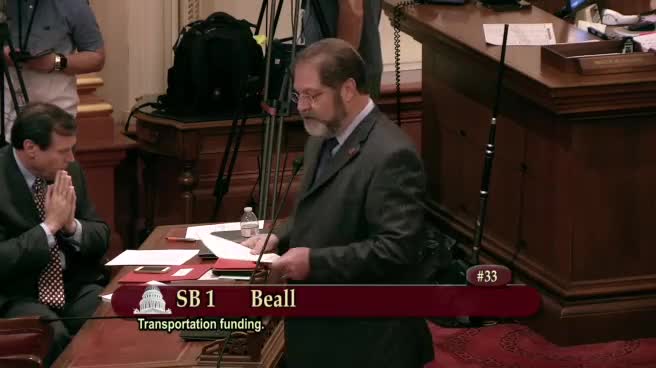
This constitutional amendment is a companion measure to SB 1 (Beall) that would enact the Road Repair and Accountability Act of 2017. This constitutional amendment would constitutionally protect funds raised by the Act so that the money can only be used for transportation purposes. This constitutional amendment specifically identifies the two funding sources in SB 1 that are not already protected by the Constitution: revenue derived from diesel sales tax and the proposed Transportation Improvement Fee.
This constitutional amendment also clarifies that the SAL does not include appropriations of revenue generated as a result of the transportation funding proposal in SB 1 (approximately $2 billion), which is generally the case with infrastructure expenditures.
Analysis Prepared by: Janet Dawson / TRANS. / (916) 319-2093 FN: 0000098
Office of Senate Floor Analyses (916) 651-1520 Fax: (916) 327-4478 | ACA |
THIRD READING
Bill No: ACA 5
:
ASSEMBLY FLOOR: Not available
DIGEST: This constitutional amendment proposes to amend the California Constitution to prohibit the Legislature from borrowing revenues from fees and taxes imposed on vehicles or their use or operation, and from using those revenues other than as specifically permitted in the Constitution.
Existing law, pursuant to the California Constitution:
- Restricts the use of fuel excise tax revenues (from vehicles used on public streets and highways) and vehicle registration fee revenues to transportation purposes.
- Restricts the Legislature from borrowing revenues from the Highway Users Tax Account.
- Restricts fuel excise tax revenues to development and construction of roads and highways, unless a majority of voters in an election throughout a county or counties approves the use of the revenues for fixed-guideway mass transit.
- Allows the Legislature to pledge fuel excise tax revenues for payment of bonds to fund voter-approved fixed-guideway mass transit projects.
- Allows the Legislature to use up to 25% of the state’s share of fuel excise tax revenues for payment of state-issued, voter-approved bonds for transportation purposes issued after November 2010.
- Allows a city or county to use up to 25% of its share of fuel excise tax revenues for payment of locally issued, voter-approved bonds for transportation purposes.
- Specifies that the restrictions on fuel excise tax and vehicle registration fee revenues do not apply to revenues derived from sales taxes or vehicle license fees.
- Establishes the Public Transportation Account (PTA) as a trust fund and provides that revenues in the fund may only be used for specified transportation planning and mass transportation purposes. Further specifies that the Legislature is prohibited from borrowing revenues from the PTA, loaning or transferring them to the General Fund, or using the revenues for any purposes not specifically authorized.
- Imposes an appropriation limit on the state and most local governments which limits the amount of spending to a base level, adjusted annually for inflation and population growth. State appropriations from the proceeds of taxes must be made within the state appropriation limit (SAL) or Gann limit. If state appropriations subject to those restrictions exceed the SAL, any revenue in excess of the SAL over two consecutive years must be appropriated for purposes exempt from the SAL (such as debt service), or used for a combination of Proposition 98 education spending and taxpayer rebates.
This constitutional amendment:
- Requires diesel fuel sales tax revenues to be deposited into the PTA and prohibits the Legislature from diverting or appropriating those funds for purposes other than transportation planning and mass transportation.
- Requires revenues derived from a proposed Transportation Improvement Fee to be used solely for transportation purposes, prohibits those revenues from being used to pay for previously authorized transportation bond debt service, and prohibits the Legislature from borrowing or using those revenues for unauthorized purposes.
- Exempts appropriations of revenues generated as part of the proposed Road Repair and Accountability Act of 2017 (SB 1, Beall) from counting towards the state appropriation limit (Gann Limit).
- Requires the provisions specified in this measure are subject to voter approval in the 2018.
Comments
- Purpose. According to the authors, “ACA 5 will ensure that future revenues passed by the Legislature to pay for road and highway maintenance will be spent exclusively on vitally needed repairs and not on other legislative priorities.
“According to the American Society of Civil Engineers, 68% of California’s roads are considered to be in ‘poor’ or ‘mediocre’ condition. Not only does poor road quality affect individual users, it also impacts the efficient movement of goods throughout the state, which directly impacts job growth and the competitiveness of California’s ports and goods movement industries. With freight movement predicted to increase significantly, Californians will see increased deterioration of their roads due to the heavier vehicle use. Because preventative maintenance costs 10 to 12 times less than pavement and road rehabilitation, California is at an opportune moment to make needed repairs and avoid facing even higher maintenance costs down the road.
“In order to fund needed repairs to the states roads and highways, the Legislature is considering a number of options that would provide increased funding for transportation projects but provide no oversight or protection on how funds would be spent. Without the protections in SCA 2, revenues that are raised to pay for the repair and maintenance of the state’s roads and highways could be used for non-transportation related purposes. Not only would this fail to fix our roads and highways, it would also defy the intent of the Legislature and violate the public trust of our constituents.”
- Current restrictions. Most transportation revenues, including gasoline and diesel excise taxes and vehicle registration fees, are constitutionally protected from being borrowed or used for purposes other than transportation. This protection does not apply to vehicle license fees and fuel excise taxes for usage outside of public roads. Additionally, since 2011, weight fees have been used to pay down transportation-related general obligation bonds.
- The need for new funding. The deterioration of California’s state and local streets and roads has been widely documented. For example, at the January 2017 California Transportation Commission (CTC) hearing, a local streets and roads needs assessment presented to the CTC found that the statewide average pavement condition index, which rates the condition of the surface of a road network, to be 65. This score indicates that statewide, roads on average are in “fair/at risk” condition and are becoming worn down to the point where rehabilitation, rather than routine maintenance, may be needed to prevent rapid deterioration. The needs assessment further found that in order to maintain local roads at their existing condition would require an additional $3.5 billion annually. Overall, according to the “Fix Our Roads” Coalition, total deferred maintenance shortfalls total approximately $78 billion, while the shortfall is estimated at $59 billion for the deferred maintenance backlog at the state level.
- A response to the need. Introduced in the current legislative session, SB 1 (Beall) serves the consensus transportation funding package between the Senate, Assembly, and Governor. Serving as the legislative vehicle, SB 1 proposes to increase a number of transportation-related taxes and fees to raise roughly $5.2 billion in new transportation revenues annually and makes annual inflation adjustments. SB 1 proposes the funding to be used towards deferred maintenance on the state highways and local streets and roads, improve the state’s trade corridors, and transit. SB 1 further contains a number of additional transportation-related reforms including creating a Transportation Inspector General subject to Senate confirmation within the newly created Caltrans Office of Audits and Investigations, granting CTC additional oversight over the SHOPP projects, including staffing support, and developing an Advance Mitigation Program. ACA 5 serves as the companion measure to provide constitutional protections for the revenues generated under SB 1.
Related/Prior Legislation
ACA 5 is an identical measure to SCA 2 (Newman, 2017) which was heard in the Transportation and Housing Committee, the Elections and Constitutional Amendments Committee, and the Appropriations Committee of the Senate. SCA 2 is currently on the Senate Floor awaiting a final Senate vote; however as part of the consensus transportation funding package, ACA 5 will serve as the companion measure to SB 1.
FISCAL EFFECT: Appropriation: Fiscal Com.: Local:
According to the Senate Appropriations Committee analysis of SCA 2:
- One-time General Fund costs in the range of $414,000 to $552,000 to the Secretary of State, likely in 2017-18, for printing and mailing costs to place the measure on the ballot in a statewide election. Actual costs may be higher or lower, depending on the length of required elements and the overall size of the ballot.
- New constitutional protections that ensure diesel fuel sales tax revenues are deposited into the PTA and not subject to diversion or appropriation for purposes other than transportation planning and mass transportation would apply to approximately $500 million in annual revenues.
- New constitutional protections that require revenues from the proposed Transportation Improvement Fee be used solely for specified transportation purposes, and not for existing bond debt service, would apply to an estimated $1.5 billion to $1.6 billion in new annual revenues, if SB 1 is enacted.
- Exempts appropriations of approximately $2 billion in new annual revenues generated by SB 1 from counting towards the Gann Limit. Absent this provision, state spending could be constrained in future years, to the extent appropriations of SB 1 revenues result in state appropriations exceeding the Gann Limit for two consecutive years in the future.
None received
None received
4/6/17 18:16:49