ACR 21: Public postsecondary education: free speech policy.
- Session Year: 2017-2018
- House: Assembly
- Latest Version Date: 2017-07-17
This measure would urge all private and public universities in California, to the extent that they have not adopted free speech statements consistent with the principles articulated by the Chancellor of the University of California at Irvine, and the Free Expression Statement formally adopted by the University of Chicago, to consider such statements as a model for developing and adopting free speech statements.
This measure would urge all private and public universities in California, to the extent that they have not adopted free speech statements consistent with the principles articulated by the Chancellor of the University of California at Irvine, and the Free Expression Statement formally adopted by the University of Chicago, to consider such statements as a model for developing and adopting free speech statements.
This measure would urge all California State University and University of California schools to adopt as a policy the University of Chicago statement on free speech. private and public universities in California, to the extent that they have not adopted free speech statements consistent with the principles articulated by the Chancellor of the University of California at Irvine, and the Free Expression Statement formally adopted by the University of Chicago, to consider such statements as a model for developing and adopting free speech statements.
This measure would urge all California State University and University of California schools to adopt as a policy the University of Chicago statement on free speech.
WHEREAS, The First Amendment to the United States Constitution states that Congress shall make no law respecting an establishment of religion, or prohibiting the free exercise thereof; or abridging the freedom of speech, or of the press; or the right of the people peaceably to assemble, and to petition the Government for a redress of grievances.; and
WHEREAS, The First Amendment prohibits, with narrowly defined exceptions, governmental entities such as state universities from restricting free speech; and
WHEREAS, In 2016, University of California President Janet Napolitano wrote that the sanctity of free speech in our country is hardly guaranteed at least not on our college campuses, where freedom of expression and the free flow of ideas should incubate discovery and learning and warned about how far we have moved from freedom of speech on campuses to freedom from speech; and
WHEREAS, Furthermore, President Napolitano urged that the way to deal with extreme, unfounded speech is not with less speech it is with more speech, informed by facts and persuasive argument. Educating students from an informed more speech approach as opposed to silencing an objectionable speaker should be one of academias key roles; and
WHEREAS, In a 2016 speech at Howard University, former President Barack Obama stated, Theres been a trend around the country of trying to get colleges to disinvite speakers with a different point of view, or disrupt a politicians rally. Dont do that no matter how ridiculous or offensive you might find the things that come out of their mouths...There will be times when you shouldnt compromise your core values, your integrity, and you will have the responsibility to speak up in the face of injustice. But listen. Engage. If the other side has a point, learn from them. If theyre wrong, rebut them. Teach them. Beat them on the battlefield of ideas; and
WHEREAS, On September 23, 2016, the Chancellor of the University of California at Irvine issued the following statement on Rights of Free Speech and Academic Freedom:
Freedom of speech is a bedrock value of our constitutional system and is at the core of this universitys mission. Courts have recognized that First Amendment principles acquire a special significance in the university setting, where the free and unfettered interplay of competing views is essential to the institutions educational mission. The University of California is also committed to upholding and preserving academic freedom, which for the faculty encompasses freedom of inquiry and research, freedom of teaching, and freedom of expression and publication.
Free speech requires us to accept that we will be exposed to viewpoints, arguments or forms of expression that make us uncomfortable or even offend us. It is in precisely these circumstances that free speech often serves its most vital purpose, especially in an educational context. Throughout history, speech that challenges conventional wisdom has been a driving force for progress. Speech that makes us uneasy may compel us to reconsider our own strongly held views in fact, a willingness to reconsider strongly held views is one of the reasons why people pursue higher education. Hearing offensive viewpoints provides opportunities for those sentiments to be exposed, engaged and rebutted.
Universities exist to provide the conditions for hard thought and difficult debate so that individuals can develop the capacity for independent judgment. This cannot happen if universities attempt to shield people from ideas and opinions they might find unwelcome, or if members of the university community try to silence or interfere with speakers with whom they disagree. As U.S. Supreme Court Justice Louis Brandeis advised in his famous Whitney v. California opinion in 1927, If there be time to expose through discussion the falsehood and fallacies, to avert the evil by the processes of education, the remedy to be applied is more speech, not enforced silence.
Of course, freedom of speech is not and cannot be absolute. While there is no hate speech exception to First Amendment protections, threats, harassment, fighting words, incitement and defamatory speech are not protected. Freedom of speech does not mean a right to say anything at any place and any time. There can and must be restrictions on the time, place and manner of speech, but the campus is committed to ensuring the availability of places for speeches and protests. And so we will safeguard freedom of speech. But in addition, I hope we will keep in mind the need to nurture other norms and practices in order for us to perform the distinctive mission of the university.
It is of value to society if there is a place where people decide that they will work together to create a scholarly community dedicated to rigorous inquiry, evidence-based reasoning, logical argumentation, experimentation, and a willingness to reassess ones perspective in light of new evidence and arguments.
These beliefs and practices these scholarly norms are inextricably linked to related values, including a genuine desire to engage competing perspectives and learn from those who have had different experiences or who hold different viewpoints. It is because of these values that we attempt to resolve (or at least better understand) disagreements through reasoned and sustained conversation, debate and the acquisition of new knowledge. They also prompt us to speak out in support of each other when members of our community are subject to hateful, discriminatory or inflammatory personal attacks.
If our commitment to freedom and democracy leads us to defend the rights of free speech, our commitment to scholarly inquiry and education leads us to promote norms and practices that enable us to learn from each other in an atmosphere of positive engagement and mutual respect; and
WHEREAS, The Committee on Freedom of Expression at the University of Chicago, a private university, was appointed in July 2014 by President Robert J. Zimmer and Provost Eric D. Isaacs in light of recent events nationwide that have tested institutional commitments to free and open discourse. The Committees charge was to draft a statement articulating the Universitys overarching commitment to free, robust, and uninhibited debate and deliberation among all members of the Universitys community; and
WHEREAS, At least 16 universities across the country have adopted a version of the University of Chicago statement on free speech, which reads as follows:
Because the institution is committed to free and open inquiry in all matters, it guarantees all members of the institutions community the broadest possible latitude to speak, write, listen, challenge, and learn. Except insofar as limitations on that freedom are necessary to the functioning of the institution, the institution fully respects and supports the freedom of all members of the institution community to discuss any problem that presents itself.
Of course, the ideas of different members of the institutions community will often and quite naturally conflict. But it is not the proper role of the institution to attempt to shield individuals from ideas and opinions they find unwelcome, disagreeable, or even deeply offensive. Although the institution greatly values civility, and although all members of the institutions community share in the responsibility for maintaining a climate of mutual respect, concerns about civility and mutual respect can never be used as a justification for closing off discussion of ideas, however offensive or disagreeable those ideas may be to some members of our community.
The freedom to debate and discuss the merits of competing ideas does not, of course, mean that individuals may say whatever they wish, wherever they wish. The institution may restrict expression that violates the law, that falsely defames a specific individual, that constitutes a genuine threat or harassment, that unjustifiably invades substantial privacy or confidentiality interests, or that is otherwise directly incompatible with the functioning of the institution. In addition, the institution may reasonably regulate the time, place, and manner of expression to ensure that it does not disrupt the ordinary activities of the institution. But these are narrow exceptions to the general principle of freedom of expression, and it is vitally important that these exceptions never be used in a manner that is inconsistent with the institutions commitment to a completely free and open discussion of ideas.
In a word, the institutions fundamental commitment is to the principle that debate or deliberation may not be suppressed because the ideas put forth are thought by some or even by most members of the institution community to be offensive, unwise, immoral, or wrong-headed. It is for the individual members of the institutions community, not for the institution as an institution, to make those judgments for themselves, and to act on those judgments not by seeking to suppress speech, but by openly and vigorously contesting the ideas that they oppose. Indeed, fostering the ability of members of the institutions community to engage in such debate and deliberation in an effective and responsible manner is an essential part of the institutions educational mission.
As a corollary to the institutions commitment to protect and promote free expression, members of the institutions community must also act in conformity with the principle of free expression. Although members of the institutions community are free to criticize and contest the views expressed on campus, and to criticize and contest speakers who are invited to express their views on campus, they may not obstruct or otherwise interfere with the freedom of others to express views they reject or even loathe. To this end, the institution has a solemn responsibility not only to promote a lively and fearless freedom of debate and deliberation, but also to protect that freedom when others attempt to restrict it; and
WHEREAS, Several campuses of the California State University and the University of California have already adopted free speech statements consistent with the principles articulated by the Chancellor of the University of California, Irvine, and the statement formally adopted by University of Chicago; now, therefore, be it
Resolved by the Assembly of the State of California, the Senate thereof concurring, That the Legislature urges all private and public universities in California, to the extent that they have not adopted free speech statements consistent with the principles articulated by the Chancellor of the University of California, Irvine, and the Free Expression Statement formally adopted by the University of Chicago, to consider such statements as a model for developing and adopting free speech statements; and be it further
Resolved, That the Chief Clerk of the Assembly transmit copies of this resolution to the author for appropriate distribution.
WHEREAS, The First Amendment to the United States Constitution states that Congress shall make no law respecting an establishment of religion, or prohibiting the free exercise thereof; or abridging the freedom of speech, or of the press; or the right of the people peaceably to assemble, and to petition the Government for a redress of grievances.; and
WHEREAS, The First Amendment prohibits, with narrowly defined exceptions, governmental entities such as state universities from restricting free speech; and
WHEREAS, Free speech is being threatened at public universities across the country, including at recent events in California at the University of California, Berkeley and the University of California, Davis; andWHEREAS, In 2016, University of California President Janet Napolitano wrote that the sanctity of free speech in our country is hardly guaranteed at least not on our college campuses, where freedom of expression and the free flow of ideas should incubate discovery and learning and warned about how far we have moved from freedom of speech on campuses to freedom from speech; and
WHEREAS, Furthermore, President Napolitano urged that the way to deal with extreme, unfounded speech is not with less speech it is with more speech, informed by facts and persuasive argument. Educating students from an informed more speech approach as opposed to silencing an objectionable speaker should be one of academias key roles; and
WHEREAS, In a 2016 speech at Howard University, former President Barack Obama stated, Theres been a trend around the country of trying to get colleges to disinvite speakers with a different point of view, or disrupt a politicians rally. Dont do that no matter how ridiculous or offensive you might find the things that come out of their mouths...There will be times when you shouldnt compromise your core values, your integrity, and you will have the responsibility to speak up in the face of injustice. But listen. Engage. If the other side has a point, learn from them. If theyre wrong, rebut them. Teach them. Beat them on the battlefield of ideas; and
WHEREAS, In a recent study, the Foundation for Individual Rights in Education (FIRE) conducted a survey of 449 colleges in the United States and found that 33.9% of public universities maintain severely restrictive speech codes that clearly and substantially prohibit constitutionally protected speech; and WHEREAS, The FIRE report identified 9 public universities in California as having at least one policy both clearly and substantially restricting freedom of speech and 23 public universities in California as having policies that could be interpreted to suppress protected speech; andWHEREAS, On September 23, 2016, the Chancellor of the University of California at Irvine issued the following statement on Rights of Free Speech and Academic Freedom:
Freedom of speech is a bedrock value of our constitutional system and is at the core of this universitys mission. Courts have recognized that First Amendment principles acquire a special significance in the university setting, where the free and unfettered interplay of competing views is essential to the institutions educational mission. The University of California is also committed to upholding and preserving academic freedom, which for the faculty encompasses freedom of inquiry and research, freedom of teaching, and freedom of expression and publication.
Free speech requires us to accept that we will be exposed to viewpoints, arguments or forms of expression that make us uncomfortable or even offend us. It is in precisely these circumstances that free speech often serves its most vital purpose, especially in an educational context. Throughout history, speech that challenges conventional wisdom has been a driving force for progress. Speech that makes us uneasy may compel us to reconsider our own strongly held views in fact, a willingness to reconsider strongly held views is one of the reasons why people pursue higher education. Hearing offensive viewpoints provides opportunities for those sentiments to be exposed, engaged and rebutted.
Universities exist to provide the conditions for hard thought and difficult debate so that individuals can develop the capacity for independent judgment. This cannot happen if universities attempt to shield people from ideas and opinions they might find unwelcome, or if members of the university community try to silence or interfere with speakers with whom they disagree. As U.S. Supreme Court Justice Louis Brandeis advised in his famous Whitney v. California opinion in 1927, If there be time to expose through discussion the falsehood and fallacies, to avert the evil by the processes of education, the remedy to be applied is more speech, not enforced silence.
Of course, freedom of speech is not and cannot be absolute. While there is no hate speech exception to First Amendment protections, threats, harassment, fighting words, incitement and defamatory speech are not protected. Freedom of speech does not mean a right to say anything at any place and any time. There can and must be restrictions on the time, place and manner of speech, but the campus is committed to ensuring the availability of places for speeches and protests. And so we will safeguard freedom of speech. But in addition, I hope we will keep in mind the need to nurture other norms and practices in order for us to perform the distinctive mission of the university.
It is of value to society if there is a place where people decide that they will work together to create a scholarly community dedicated to rigorous inquiry, evidence-based reasoning, logical argumentation, experimentation, and a willingness to reassess ones perspective in light of new evidence and arguments.
These beliefs and practices these scholarly norms are inextricably linked to related values, including a genuine desire to engage competing perspectives and learn from those who have had different experiences or who hold different viewpoints. It is because of these values that we attempt to resolve (or at least better understand) disagreements through reasoned and sustained conversation, debate and the acquisition of new knowledge. They also prompt us to speak out in support of each other when members of our community are subject to hateful, discriminatory or inflammatory personal attacks.
If our commitment to freedom and democracy leads us to defend the rights of free speech, our commitment to scholarly inquiry and education leads us to promote norms and practices that enable us to learn from each other in an atmosphere of positive engagement and mutual respect; and
WHEREAS, The Committee on Freedom of Expression at the University of Chicago Chicago, a private university, was appointed in July 2014 by President Robert J. Zimmer and Provost Eric D. Isaacs in light of recent events nationwide that have tested institutional commitments to free and open discourse. The Committees charge was to draft a statement articulating the Universitys overarching commitment to free, robust, and uninhibited debate and deliberation among all members of the Universitys community; and
WHEREAS, At least 16 universities across the country have adopted a version of the University of Chicago statement on free speech; and speech, which reads as follows:
WHEREAS, The following is a model, based on the University of Chicago statement, for public universities in California to adopt:Because the institution is committed to free and open inquiry in all matters, it guarantees all members of the institutions community the broadest possible latitude to speak, write, listen, challenge, and learn. Except insofar as limitations on that freedom are necessary to the functioning of the institution, the institution fully respects and supports the freedom of all members of the institution community to discuss any problem that presents itself.
Of course, the ideas of different members of the institutions community will often and quite naturally conflict. But it is not the proper role of the institution to attempt to shield individuals from ideas and opinions they find unwelcome, disagreeable, or even deeply offensive. Although the institution greatly values civility, and although all members of the institutions community share in the responsibility for maintaining a climate of mutual respect, concerns about civility and mutual respect can never be used as a justification for closing off discussion of ideas, however offensive or disagreeable those ideas may be to some members of our community.
The freedom to debate and discuss the merits of competing ideas does not, of course, mean that individuals may say whatever they wish, wherever they wish. The institution may restrict expression that violates the law, that falsely defames a specific individual, that constitutes a genuine threat or harassment, that unjustifiably invades substantial privacy or confidentiality interests, or that is otherwise directly incompatible with the functioning of the institution. In addition, the institution may reasonably regulate the time, place, and manner of expression to ensure that it does not disrupt the ordinary activities of the institution. But these are narrow exceptions to the general principle of freedom of expression, and it is vitally important that these exceptions never be used in a manner that is inconsistent with the institutions commitment to a completely free and open discussion of ideas.
In a word, the institutions fundamental commitment is to the principle that debate or deliberation may not be suppressed because the ideas put forth are thought by some or even by most members of the institution community to be offensive, unwise, immoral, or wrong-headed. It is for the individual members of the institutions community, not for the institution as an institution, to make those judgments for themselves, and to act on those judgments not by seeking to suppress speech, but by openly and vigorously contesting the ideas that they oppose. Indeed, fostering the ability of members of the institutions community to engage in such debate and deliberation in an effective and responsible manner is an essential part of the institutions educational mission.
As a corollary to the institutions commitment to protect and promote free expression, members of the institutions community must also act in conformity with the principle of free expression. Although members of the institutions community are free to criticize and contest the views expressed on campus, and to criticize and contest speakers who are invited to express their views on campus, they may not obstruct or otherwise interfere with the freedom of others to express views they reject or even loathe. To this end, the institution has a solemn responsibility not only to promote a lively and fearless freedom of debate and deliberation, but also to protect that freedom when others attempt to restrict it; now, therefore, be it it; and
WHEREAS, Several campuses of the California State University and the University of California have already adopted free speech statements consistent with the principles articulated by the Chancellor of the University of California, Irvine, and the statement formally adopted by University of Chicago; now, therefore, be it
Resolved by the Assembly of the State of California, the Senate thereof concurring, That the Legislature urges all California State University and University of California schools to adopt as a policy the University of Chicago statement on free speech; private and public universities in California, to the extent that they have not adopted free speech statements consistent with the principles articulated by the Chancellor of the University of California, Irvine, and the Free Expression Statement formally adopted by the University of Chicago, to consider such statements as a model for developing and adopting free speech statements; and be it further
Resolved, That the Chief Clerk of the Assembly transmit copies of this resolution to the author for appropriate distribution.
WHEREAS, The First Amendment to the United States Constitution states that Congress shall make no law respecting an establishment of religion, or prohibiting the free exercise thereof; or abridging the freedom of speech, or of the press; or the right of the people peaceably to assemble, and to petition the Government for a redress of grievances.; and
WHEREAS, The First Amendment prohibits, with narrowly defined exceptions, governmental entities such as state universities from restricting free speech; and
WHEREAS, Free speech is being threatened at public universities across the country, including at recent events in California at the University of California, Berkeley and the University of California, Davis; and
WHEREAS, In 2016, University of California President Janet Napolitano wrote that the sanctity of free speech in our country is hardly guaranteed at least not on our college campuses, where freedom of expression and the free flow of ideas should incubate discovery and learning and warned about how far we have moved from freedom of speech on campuses to freedom from speech; and
WHEREAS, Furthermore, President Napolitano urged that the way to deal with extreme, unfounded speech is not with less speech it is with more speech, informed by facts and persuasive argument. Educating students from an informed more speech approach as opposed to silencing an objectionable speaker should be one of academias key roles; and
WHEREAS, In a 2016 speech at Howard University, former President Barack Obama stated, Theres been a trend around the country of trying to get colleges to disinvite speakers with a different point of view, or disrupt a politicians rally. Dont do that no matter how ridiculous or offensive you might find the things that come out of their mouths...There will be times when you shouldnt compromise your core values, your integrity, and you will have the responsibility to speak up in the face of injustice. But listen. Engage. If the other side has a point, learn from them. If theyre wrong, rebut them. Teach them. Beat them on the battlefield of ideas; and
WHEREAS, In a recent study, the Foundation for Individual Rights in Education (FIRE) conducted a survey of 449 colleges in the United States and found that 33.9% of public universities maintain severely restrictive speech codes that clearly and substantially prohibit constitutionally protected speech; and
WHEREAS, The FIRE report identified 9 public universities in California as having at least one policy both clearly and substantially restricting freedom of speech and 23 public universities in California as having policies that could be interpreted to suppress protected speech; and
WHEREAS, The Committee on Freedom of Expression at the University of Chicago was appointed in July 2014 by President Robert J. Zimmer and Provost Eric D. Isaacs in light of recent events nationwide that have tested institutional commitments to free and open discourse. The Committees charge was to draft a statement articulating the Universitys overarching commitment to free, robust, and uninhibited debate and deliberation among all members of the Universitys community; and
WHEREAS, At least 16 universities across the country have adopted a version of the University of Chicago statement on free speech; and
WHEREAS, The following is a model, based on the University of Chicago statement, for public universities in California to adopt:
Because the institution is committed to free and open inquiry in all matters, it guarantees all members of the institutions community the broadest possible latitude to speak, write, listen, challenge, and learn. Except insofar as limitations on that freedom are necessary to the functioning of the institution, the institution fully respects and supports the freedom of all members of the institution community to discuss any problem that presents itself.
Of course, the ideas of different members of the institutions community will often and quite naturally conflict. But it is not the proper role of the institution to attempt to shield individuals from ideas and opinions they find unwelcome, disagreeable, or even deeply offensive. Although the institution greatly values civility, and although all members of the institutions community share in the responsibility for maintaining a climate of mutual respect, concerns about civility and mutual respect can never be used as a justification for closing off discussion of ideas, however offensive or disagreeable those ideas may be to some members of our community.
The freedom to debate and discuss the merits of competing ideas does not, of course, mean that individuals may say whatever they wish, wherever they wish. The institution may restrict expression that violates the law, that falsely defames a specific individual, that constitutes a genuine threat or harassment, that unjustifiably invades substantial privacy or confidentiality interests, or that is otherwise directly incompatible with the functioning of the institution. In addition, the institution may reasonably regulate the time, place, and manner of expression to ensure that it does not disrupt the ordinary activities of the institution. But these are narrow exceptions to the general principle of freedom of expression, and it is vitally important that these exceptions never be used in a manner that is inconsistent with the institutions commitment to a completely free and open discussion of ideas.
In a word, the institutions fundamental commitment is to the principle that debate or deliberation may not be suppressed because the ideas put forth are thought by some or even by most members of the institution community to be offensive, unwise, immoral, or wrong-headed. It is for the individual members of the institutions community, not for the institution as an institution, to make those judgments for themselves, and to act on those judgments not by seeking to suppress speech, but by openly and vigorously contesting the ideas that they oppose. Indeed, fostering the ability of members of the institutions community to engage in such debate and deliberation in an effective and responsible manner is an essential part of the institutions educational mission.
As a corollary to the institutions commitment to protect and promote free expression, members of the institutions community must also act in conformity with the principle of free expression. Although members of the institutions community are free to criticize and contest the views expressed on campus, and to criticize and contest speakers who are invited to express their views on campus, they may not obstruct or otherwise interfere with the freedom of others to express views they reject or even loathe. To this end, the institution has a solemn responsibility not only to promote a lively and fearless freedom of debate and deliberation, but also to protect that freedom when others attempt to restrict it; now, therefore, be it
Resolved by the Assembly of the State of California, the Senate thereof concurring, That the Legislature urges all California State University and University of California schools to adopt as a policy the University of Chicago statement on free speech; and be it further
Resolved, that the Chief Clerk of the Assembly transmit copies of this resolution to the author for appropriate distribution.
|
Date
|
Status
|
|---|---|
| Jul 17, 2017 | Chaptered by Secretary of State - Res. Chapter 103, Statutes of 2017. |
| Jul 17, 2017 | Enrolled and filed with the Secretary of State at 4 p.m. |
| Jul 13, 2017 | In Assembly. Ordered to Engrossing and Enrolling. |
| Jul 13, 2017 | Adopted and to Assembly. (Ayes 39. Noes 0. Page 2025.) |
| Jul 11, 2017 | Read second time. Ordered to Consent Calendar. |
| Jul 10, 2017 | From committee: Be placed on second reading file pursuant to Senate Rule 28.8 and ordered to consent calendar. |
| Jun 21, 2017 | From committee: Be adopted, and re-refer to Com. on APPR. with recommendation: To Consent Calendar. (Ayes 7. Noes 0.) (June 20). Re-referred to Com. on APPR. |
| Jun 7, 2017 | From committee: Be adopted, and re-refer to Com. on JUD. with recommendation: To Consent Calendar. (Ayes 7. Noes 0.) (June 7). Re-referred to Com. on JUD. |
| May 10, 2017 | Re-referred to Coms. on ED. and JUD. |
| Apr 24, 2017 | In Senate. To Com. on RLS. |
| Apr 20, 2017 | Adopted and to Senate. (Ayes 76. Noes 0. Page 1139.) |
| Apr 17, 2017 | From Consent Calendar by request of Assembly Member Kiley. To Third Reading. |
| Apr 5, 2017 | From committee: Be adopted. To Consent Calendar. (Ayes 17. Noes 0.) (April 5). |
| Mar 20, 2017 | Re-referred to Com. on APPR. |
| Mar 16, 2017 | Amended. |
| Mar 15, 2017 | From committee: Amend, and be adopted as amended, and re-refer to Com. on APPR. with recommendation: To Consent Calendar. (Ayes 11. Noes 0.) (March 14). |
| Mar 2, 2017 | Coauthors revised. |
| Feb 21, 2017 | Referred to Com. on JUD. |
| Feb 9, 2017 | From printer. |
| Feb 8, 2017 | Introduced. To print. |
|
Date
|
Description
|
Location
|
Votes
|
|
|---|---|---|---|---|
| Jul 13, 2017 | Consent Calendar 2nd ACR21 | Senate Floor |
Passed |
|
| Jun 20, 2017 | Be adopted, but first be re-referred to the Committee on [Appropriations] with recommendation: To Consent Calendar | Senate Standing Committee on Judiciary |
Passed |
|
| Jun 7, 2017 | Be adopted, but first be re-referred to the Committee on [Judiciary] with recommendation: To Consent Calendar | Senate Standing Committee on Education |
Passed |
|
| Apr 20, 2017 | Favorable With Committee Substitute (Insurance & Banking Subcommittee) | Assembly Floor |
Passed |
|
| Apr 5, 2017 | Be adopted. To Consent Calendar. | Assembly Standing Committee on Appropriations |
Passed |
|
| Mar 14, 2017 | Amend, and be adopted as amended and re-refer to the Committee on [Appropriations] with the recommendation: To Consent Calendar | Assembly Standing Committee on Judiciary |
Passed |
This list shows positions taken on this bill by organizations on the date displayed, which is linked to the original source.
Positions by individuals are not included.
Office of Senate Floor Analyses (916) 651-1520 Fax: (916) 327-4478 | ACR |
CONSENT
Bill No: ACR 21
:
SENATE EDUCATION COMMITTEE: 7-0, 6/7/17
AYES: Allen, Wilk, Galgiani, Leyva, Mendoza, Pan, Vidak
SENATE JUDICIARY COMMITTEE: 7-0, 6/20/17
AYES: Jackson, Moorlach, Anderson, Hertzberg, Monning, Stern, Wieckowski
SENATE APPROPRIATIONS COMMITTEE: Senate Rule 28.8
ASSEMBLY FLOOR: 76-0, 4/20/17 - See last page for vote
DIGEST:
This resolution urges all private and public universities in California to consider free speech statements that are consistent with specified principles to be a model for developing and adopting free speech statements.
ANALYSIS: Existing federal law prohibits Congress from making any law respecting an establishment of religion, or prohibiting the free exercise thereof; or abridging the freedom of speech, or of the press; or the right of the people peaceably to assemble, and to petition the government for a redress of grievances. (First Amendment to the United States Constitution)
Existing state law:
- Provides that every person may freely speak, write and publish his or her sentiments on all subjects, being responsible for the abuse of this right. Existing law prohibits a law from restraining or abridging liberty of speech or press. (California Constitution, Article I, Section 2)
- Prohibits the Regents of the University of California (UC), the Trustees of the California State University (CSU), the governing board of a community college district, and an administrator of any campus of those institutions, from making or enforcing a rule subjecting a student to disciplinary sanction solely on the basis of conduct that is speech or other communication that, when engaged in outside a campus of those institutions, is protected from governmental restriction. (Education Code § 66301)
- Provides that 1) and 2), above, do not prohibit an institution from adopting rules and regulations that are designed to prevent hate violence from being directed at students in a manner that denies them their full participation in the educational process, if the rules and regulations conform to standards established by the First Amendment to the United States Constitution and Section 2 of Article I of the California Constitution for citizens generally. (EC § 66301 and § 94367)
- Requires the governing board of a community college district to adopt rules and regulations relating to the exercise of free expression by students upon the premises of each community college maintained by the district, which shall include reasonable provisions for the time, place, and manner of conducting such activities. Existing law provides that such rules and regulations shall not prohibit the right of students to exercise free expression, except that expression which is obscene, libelous or slanderous according to current legal standards, or which so incites students as to create a clear and present danger of the commission of unlawful acts on community college premises, or the violation of lawful community college regulations, or the substantial disruption of the orderly operation of the community college, shall be prohibited. (EC § 76120)
- Authorizes a student to commence a civil action to obtain appropriate injunctive and declaratory relief as determined by the court. Upon a motion, a court may award attorney’s fees to a prevailing plaintiff in a civil action pursuant to this section. (EC § 66301 and § 94367)
This resolution:
- Finds and declares that whereas:
- The First Amendment to the United States Constitution prohibits governmental entities such as state universities from restricting free speech.
- UC President Napolitano has commented about the sanctity of free speech on college campuses and warned about moving from freedom of speech to freedom from speech.
- Former President Obama spoke about a trend of trying to get colleges to disinvite speakers with a different point of view, or disrupt a politician’s rally.
- The Chancellor of the UC at Irvine issued a statement on “Rights of Free Speech and Academic Freedom” relative to freedom of speech being a bedrock value of our constitutional system and at the core of the university’s mission, and the existence of universities to provide the conditions for hard thought and difficult debate.
- The Committee on Freedom of Expression at the University of Chicago drafted a statement articulating the University’s overarching commitment to free, robust, and uninhibited debate and deliberation among all members of the University’s community.
- At least 16 universities across the country have adopted a version of the University of Chicago statement on free speech.
- Several campuses of the CSU and the UC have already adopted free speech statements consistent with the principles articulated by the Chancellor of UC, Irvine, and the statement adopted by the University of Chicago.
- Resolves that the Legislature urges all private and public universities in California, to the extent that they have not adopted free speech statements consistent with the principles articulated by the Chancellor of the UC, Irvine, and the Free Expression Statement adopted by the University of Chicago, to consider such statements as a model for developing and adopting free speech statements.
Comments
Free speech and codes of conduct. Freedom of speech on public postsecondary educational institutions is allowed within the confines of codes of conduct and time, place and manner restrictions. Institutions cannot discipline a student for engaging in a free speech activity, but can discipline a student if the free speech activity crosses into unlawful behavior, or otherwise violates the institution’s time, place and manner restrictions.
Postsecondary educational institutions maintain time, place, and manner restrictions to ensure safety, security, and order. As an example, CSU, Sacramento’s policy states:
“A. Overview: All activities set forth in this policy are subject to these general time, place, and manner restrictions in addition to any other time, place, and manner restrictions specified below.
B. TIME: At all times, except for non-University affiliated organizations and individuals, who are limited to normal operating hours.
C. PLACE: Freedom of expression activities may take place anywhere on campus with the following exceptions: inside parking lots and structures, inside University buildings, and near any location in which instructional, educational, and/or official business activities are being conducted (generally within 20 feet). Popular locations for freedom of expression activities are the Library Quad, Main Quad, and South Green.
D. MANNER:
- Freedom of expression, which includes marches and/or moving protests, must be conducted in a manner that (1) shall not interfere with or obstruct the free flow of pedestrian or vehicular traffic; (2) shall not interfere with or disrupt the conduct of University business; (3) shall be carried out without creating excessive noise by use of a device; (4) shall not unreasonably interfere with classes in session or other scheduled academic, educational, co-curricular, and/or cultural/arts programs; (5) shall not promote an unlawful end, such as promoting actual violence or bodily or property harms, terrorist threats, defamation, obscenity, and false advertising; and (6) shall not violate any federal, state, or local safety code, such as regulations set by the State Fire Marshal, or University policy.
- For any public meeting, demonstration, rally, etc., held on University grounds, advance reservations are advised to avoid conflict with previously reserved activities. Use of space shall not conflict with prior reservation of that space for another use. (Casual or unscheduled users will not be allowed to interfere with scheduled, organized, or traditional use). Use of any campus buildings for this purpose requires advance reservations and is restricted to non-profit organizations or student organizations, and faculty-, staff- or administration-sponsored events. To maintain access and safety, the use of ramps, entrances, breezeways, hallways, and other pedestrian pathways is not authorized for such purposes.
- The scheduling process will ensure order and adequate preparation for the event and a suitable space for the intended use and expected attendance. Policies and procedures for reserving campus facilities are available in the Student Organizations & Leadership office and the Office of Space Management. Requests for student organization-sponsored events shall be directed to the Student Organizations & Leadership office. Requests for faculty-, staff- and administration-sponsored, and community events shall be directed to the Office of Space Management or the office that oversees reservations for that particular venue (e.g., requests for University Union space must be made through the University Union Events Services Office). Please consult the University’s Office of Space Management’s website for information relating to the appropriate office to contact to make reservations for a particular location on the University’s campus.” [http://www.csus.edu/umanual/student/stu-0125.htm]
FISCAL EFFECT: Appropriation: No Fiscal Com.: Yes Local: No
None received
OPPOSITION: (Verified 7/11/17)
ASSEMBLY FLOOR: 76-0, 4/20/17
AYES: Acosta, Aguiar-Curry, Travis Allen, Arambula, Baker, Berman, Bigelow, Bloom, Bocanegra, Bonta, Burke, Caballero, Calderon, Cervantes, Chau, Chávez, Chen, Chiu, Choi, Chu, Cooper, Cunningham, Dababneh, Dahle, Daly, Eggman, Flora, Fong, Frazier, Friedman, Gallagher, Cristina Garcia, Eduardo Garcia, Gipson, Gloria, Gomez, Gonzalez Fletcher, Gray, Grayson, Harper, Holden, Irwin, Jones-Sawyer, Kalra, Kiley, Lackey, Levine, Limón, Low, Maienschein, Mayes, McCarty, Medina, Melendez, Mullin, Muratsuchi, Nazarian, Obernolte, O'Donnell, Patterson, Quirk, Quirk-Silva, Reyes, Rodriguez, Rubio, Salas, Santiago, Steinorth, Mark Stone, Thurmond, Ting, Voepel, Waldron, Weber, Wood, Rendon
NO VOTE RECORDED: Brough, Cooley, Mathis, Ridley-Thomas
7/12/17 9:03:06
**** END ****
Senator Hannah-Beth Jackson, Chair
2017-2018 Regular Session
Bill No: ACR 21 (Author:Kiley)
Version: March 16, 2017
Hearing Date: June 20, 2017
Fiscal: Yes
Urgency: No
Consultant: TSG
SUBJECT
Public postsecondary education: free speech policy
DESCRIPTION
This concurrent resolution would encourage all private and public universities in California to adopt free speech statements similar to those issued by the University of Chicago and the University of California at Irvine, both of which urge university communities to embrace a robust exchange of ideas, even when such ideas may be abhorrent or deeply discomforting to many listeners.
BACKGROUND
In recent years, a number of prominent speakers have been prevented from speaking on college campuses throughout the U.S. In some instances, student or community groups disrupted the speaker to the point that the speaker was effectively drowned out, or was forced to give up trying to communicate with the audience. In other cases, threats of violence or actual violence related to the speaker’s presence led the university or student group hosting the speaker to cancel the talk altogether. (See Comment 2 for specific examples of the problem.)
As a result of these incidents, a number of universities have felt compelled to issue statements affirming and clarifying their commitments to principles of free speech on campus. Of these, statements put out by University of California, Irvine Chancellor Howard Gillman and by the University of Chicago are especially compelling for their full-throated assertion of the philosophy, consistent with U.S. constitutional law, that the appropriate response to speech that is upsetting is to counter with more speech.
This resolution would urge private and public universities and colleges in California to consider adopting free speech statements similar to those put forth by U.C. Irvine and the University of Chicago.
This resolution passed out of the Senate Committee on Education by a 7-0 vote.
CHANGES TO EXISTING LAW
Existing law provides that “Congress shall make no law… abridging the freedom of speech...” (U.S. Const., Amend. 1.)
Existing law applies the First Amendment to the states through operation of the Fourteenth Amendment. (Gitlow v. New York (1925) 268 U.S. 652; NAACP v. Alabama (1925) 357 U.S. 449.)
Existing law establishes that the First Amendment applies in full force on public college and university campuses. (Healy v. James (1972) 408 U.S. 169, 180.)
Existing law provides that every person may freely speak, write and publish his or her sentiments on all subjects, being responsible for the abuse of this right. (Cal. Const., art. I, Sec. 2)
Existing law holds, as a general matter, that the liberty of speech clause in the California Constitution is more protective of speech than its federal counterpart, including by recognizing a right to free speech in private spaces held open to the public. (Pruneyard Shopping Center v. Robins (1980) 447 U.S. 74.)
Existing law prohibits the Regents of the University of California, the Trustees of the California State University, the governing board of a community college district, or an administrator of any campus of those institutions, from making or enforcing a rule disciplining a student solely on the basis of conduct that is speech or other communication that, when engaged in outside a campus, is protected from governmental restriction by the First Amendment or the liberty of speech clause of the California Constitution. (Ed. Code Sec. 66301(a).)
Existing law provides that nothing in the provision immediately above is intended to prohibit an institution from adopting rules and regulations that are designed to prevent hate violence, as defined, from being directed at students in a manner that denies them their full participation in the educational process, so long as the rules and regulations conform to standards established by the First Amendment or the liberty speech clause of the California Constitution. (Ed. Code Sec. 66301(e).)
Existing law provides that no private postsecondary educational institution, with the exception of religiously controlled institutions, shall make or enforce a rule disciplining a student solely on the basis of conduct that is speech or other communication that, when engaged in outside the campus, is protected from governmental restriction by the First Amendment or the liberty of speech clause of the California Constitution. Specifies that this provision does not prohibit an institution from adopting rules and regulations that are designed to prevent hate violence, as defined, from being directed at students in a manner that denies them their full participation in the educational process, so long as the rules and regulations conform to the First Amendment and the liberty of speech clause of the California Constitution. (Ed. Code Sec. 94367.)
This resolution would find and declare that:
- the First Amendment prohibits, with narrowly defined exemptions, government entities such as state universities from restricting free speech;
- University of California President, Janet Napolitano and former President Barak Obama have stressed the importance of free expression on college campuses and while at the same time noting incidents where such expression has been limited;
- the Chancellor of the University of California at Irvine recently issued a statement on the “Rights of Free Speech and Academic Freedom,” noting, among other things, that Freedom of Speech is the bedrock value of our constitutional system and the core of the university; that free speech requires us to accept that we will be exposed to viewpoints, arguments or forms of expression that make us uncomfortable or even offend us; and that while our commitment to freedom and democracy leads us to defend the rights of free speech, our commitment to scholarly inquiry and education leads us to promote norms and practices that enable us to learn from each other in an atmosphere of positive engagement and mutual respect;
- the University of Chicago adopted a statement on free speech that has been adopted by 16 other universities, and whereas that statement proclaims a commitment to free and open inquiry in all matters, and guarantees all members of the university community the broadest possible latitude to speak, write, listen, challenge, and learn, even where speech may express ideas and opinions that other members of the community find unwelcome, disagreeable, or even deeply offensive; and
- several campuses of the California State University and the University of California have already adopted free speech policies consistent with the principles articulated by Chancellor of the University of California at Irvine and the statement formally adopted by University of Chicago.
This resolution would resolve that the Legislature urge all private and public universities in California, to the extent that they do not already have free speech statements consistent with the principles articulated by the Chancellor of the University of California at Irvine, or the Free Speech Statement formally adopted by the University of Chicago, to consider such statements as a model for developing similar free speech statements.
COMMENT
1. Stated need for the bill
According to the author:
Freedom of speech is at the foundation of our democracy, and universities should be lively environments where First Amendment freedoms flourish. Berkeley was the birthplace of the free speech movement in the 1960s, whose principles are now enshrined in the University of Chicago Statement on Free Expression. California can renew its commitment to those principles, and once again become a leader in the cause of campus free speech with the passage of ACR 21.
2. Examples of the problem this resolution is meant to address
Here is a summary of a few of the most prominent recent events involving the stifling of free expression on university campuses in California:
- On February 1, 2017, Breitbart News editor Milo Yiannopoulos was scheduled to speak at UC Berkeley. He had been invited there to do so by the Berkeley College Republicans. A crowd of roughly 1,500 protestors turned up before the talk and proceeded to express their disagreement with the speaker loudly but peacefully. However, at some point, a subgroup of about 150 individuals dressed in all black and wearing masks became violent. The subgroup attacked other people and smashed property, causing the University to cancel the speech about two hours before it was scheduled to begin. Approximately six people were injured and about $100,000 in property was damaged.[1] Later, in late April 2017, UC Berkeley postponed a scheduled speech by conservative icon Ann Coulter, citing safety concerns. Although the University offered Coulter an alternative time and space to speak, she ultimately declined and the speech never took place.[2]
- On April 5, 2017, Heather MacDonald, a Manhattan Institute Scholar and author of the book “The War on Cops,” gave a talk at UCLA on the theme of “Blue Lives Matter.” Protestors frequently disrupted the talk with shouting, but MacDonald was able to finish the talk, including a question and answer session. The next day, MacDonald was scheduled to speak to a live audience at Claremont-McKenna College. Protestors there prevented the public from entering the hall and campus administrators hastily arranged for MacDonald to speak by live stream without an audience in front of her. Even still, the presence of disruptive protesters around the building led campus security to urge MacDonald to wrap up after just 30 minutes. They then gave her a police escort out of the building.[3]
- On April 5, 2017, the Mayor of Jerusalum, Nir Barkat, cancelled a speech scheduled for San Francisco State University, citing the fact that the event was not widely publicized and limited to a ticketed audience. “By failing to provide the necessary public forum and properly publicize my lecture, the University has contributed to the continuing marginalization and demonization of the Jewish state,” Barkat said. One year earlier, Barkat had attempted to speak at SFSU, but his talk was interrupted by demonstrators who effectively drowned him out.[4]
3. The problem of the “heckler’s veto”
In most instances of speaker disruptions, including the event cancellations at the University of California, campus free speech policies did not cause the cancellation. Rather, in each instance, either the student group hosting the speaker, or the university itself, cancelled the events because of security concerns. In each case, other students or members of the community threatened or engaged in violence to such a degree that the hosts decided it would be unsafe to proceed with the talk as planned.
These incidents represent classic examples of what is known as the “heckler’s veto.” The term refers to situations in which it is not the government that inhibits speech, but the response of the listener. When the audience, or disruptive individuals within it, succeed in intimidating the speaker into silence or drown out the speaker’s ability to communicate, they have achieved what the government constitutionally cannot: shutting down free speech.
First Amendment case law, though not crystal clear in this area, generally holds that the mere possibility that speech is offensive or could theoretically incite a violent response is not sufficient justification to restrain it. (See, e.g., Nat’l Socialist Party of Am. v. Vill. of Skokie, 432 U.S. 43, 43–44 (1977) (recognizing First Amendment rights of Neo Nazis seeking to march with swastikas and to distribute racist and anti-Semitic propaganda in a predominantly Jewish community); Brandenburg v. Ohio, 395 U.S. 444, 447 (1969) (recognizing the First Amendment rights of Ku Klux Klan members to advocate for white supremacy-based political reform achieved through violent means); Texas v. Johnson, 491 U.S. 397, 405–06 (1989) (recognizing flag burning as a form of political expression protected by the First Amendment); Snyder v. Phelps, 562 U.S. 443, 454–56 (2011) (recognizing a religious sect’s right to picket military funerals).
At the same time, when a university confronts a genuine risk of violence, however, it has a responsibility to maintain the safety of speakers, audience members, and the wider public. Even the most famous judicial invocation of the doctrine that the cure for offensive speech is more speech recognized this challenge:
If there be time to expose through discussion the falsehoods and fallacies, to avert the evil by the processes of education, the remedy to be applied, is more speech, not enforced silence. Only an emergency can justify repression. Such must be the rule if authority is to be reconciled with freedom. Such, in my opinion, is the command of the Constitution. It is therefore always open to Americans to challenge a law abridging free speech and assembly by showing that there was no emergency justifying it. (Whitney v. People of the State of California (1927) 274 U.S. 357, 377 (J. Brandeis, concurring)(emphasis added.)
What the incidents at the University of California demonstrate more than anything, are the genuine challenges – both legal and practical – that a university confronts when its welcomes all viewpoints but elements within the student body or in the campus community are determined to create an emergency; determined, in other words, to exercise the heckler’s veto.
Of course, the problem would not exist if people refrained from trying to exercise the heckler’s veto in the first place. While this bill is directed at California colleges and universities themselves, therefore, this bill is perhaps better viewed as an exhortation to campus community members and members of the public not to interfere with campus free speech by attempting to exert the heckler’s veto.
4. Other approaches to limitations on freedom of expression in democracies
The free speech principles that this resolution calls upon California colleges and universities to adopt are in keeping with what has been the prevailing U.S. viewpoint with regard to hate speech; namely, that the antidote to hate speech is more speech.
As a matter of broader perspective on the issue, however, it is worth noting that other democracies have taken a different approach to the issue of hate speech. In particular, several European countries criminalize certain types of racist speech, believing, based on their experience with fascism in Germany in the 1930s and 1940s, that “more speech” has not always proven sufficient to prevent hate speech from leading to actual violence.[5]
Support: None known
Opposition: None known
HISTORY
Source: Author
Related Pending Legislation:
SB 472 (Nielsen, 2017) would declare that the outdoor areas of the Universities of California, the California State Universities, and California Community Colleges are traditional public forums for the purposes of First Amendment law. In those outdoor areas, California’s public postsecondary institutions would only be able to make and enforce reasonable restrictions related to the time, place, and manner of speech, and any such restriction would have to be narrowly tailored to serve a significant institutional interest. In addition, such restrictions would have to be content neutral and viewpoint neutral. Finally, any restrictions on campus speech would have to allow for ample alternative means of expression and for the ability of campus community members to spontaneously and contemporaneously distribute literature and assemble. SB 472 is currently on hold in the Senate Appropriations Committee.
ACA 14 (Melendez, 2017) would place on the ballot the “Campus Free Speech Act,” a proposition to amend the California Constitution enshrining therein many of the same free speech principles set forth in the University of Chicago free speech statement and requiring that California’s public universities adopt student conduct codes consistent with those terms. ACA 14 is pending referral in the Assembly.
Prior Legislation:
ACR 76 (Lowenthal, 2013) would have recognized the importance of the right of freedom of speech, would have condemned biased, hurtful, and dangerous speech intended to stoke fear and intimidation in its listeners, and would have encouraged public postsecondary educational institutions to ensure that they provide a safe, encouraging environment for exercising the right of freedom of speech. ACR 76 never came up for vote on the Assembly Floor.
SB 1412 (Morrow, 2006) would have called upon the University of California, California State University, and California Community Colleges to develop a student bill of rights, including provisions regarding free speech on campus. SB 1412 died in the Senate Education Committee.
SB 5 (Morrow, 2005) was similar to SB 1412. SB 5 failed passage in the Senate Education Committee.
SB 1335 (Morrow, 2004) was nearly identical to SB 5. SB 1335 failed passage in the Senate Education Committee.
Prior Vote:
Senate Education Committee (Ayes 7, Noes 0)
Assembly Floor (Ayes 76, Noes 0)
Assembly Appropriations Committee (Ayes 17, Noes 0)
Assembly Judiciary Committee (Ayes 11, Noes 0)
**************
Park and Lah, Berkeley Protests of Yiannopoulos Caused $100,000 in Damage (Feb. 2, 2017) CNN <http://www.cnn.com/2017/02/01/us/milo-yiannopoulos-berkeley/index.html> (as of June 10, 2017). ↑
McLaughlin, Ann Coulter Controversy Tests Berkeley's Free Speech Credentials (Apr. 27, 2017) CNN <http://www.cnn.com/2017/04/27/us/berkeley-ann-coulter-free-speech/index.html> (as of June 10, 2017). ↑
Kabbany, Angry Mob Shuts Down Blue Lives Matter Speech at Claremont McKenna College (Apr. 7, 2017) The College Fix <https://www.thecollegefix.com/post/32050/> (as of June 10, 2017). ↑
Barba, Jerusalem Mayor Cancels Visit to SFSU, Accuses College of Suppressing Jewish Voice (Apr. 5, 2017) San Francisco Examiner <http://www.sfexaminer.com/jerusalem-mayor-cancels-visit-sfsu-planning-concerns/> (as of June 10, 2017). ↑
See, e.g., Bearak, ‘Prosecuted for What Millions Think:’ Netherlands Hate Speech Trial Restarts for Geert Wilders (Oct. 14, 2016) The Washington Post <https://www.washingtonpost.com/news/
worldviews/wp/2016/10/14/prosecuted-for-what-millions-think-geert-wilderss-hate-speech-trial-gets-green-light/?utm_term=.67fa9c5e4fc9> (as of June 8, 2017). ↑
SENATE COMMITTEE ON EDUCATION
Senator Benjamin Allen, Chair
2017 - 2018 Regular
Bill No: ACR 21 Hearing Date: June 7, 2017
Author: | |||
Version: | March 16, 2017 | ||
Urgency: |
| Fiscal: | Yes |
Consultant: | Lynn Lorber | ||
Subject: Public postsecondary education: free speech policy
NOTE: This bill has been referred to the Committees on Education and Judiciary. A "do pass" motion should include referral to the Committee on Judiciary.
SUMMARY
This resolution urges all private and public universities in California to consider free speech statements that are consistent with specified principles to be a model for developing and adopting free speech statements.
BACKGROUND
Existing federal law prohibits Congress from making any law respecting an establishment of religion, or prohibiting the free exercise thereof; or abridging the freedom of speech, or of the press; or the right of the people peaceably to assemble, and to petition the government for a redress of grievances. (First Amendment to the United States Constitution)
Existing state law:
- Provides that every person may freely speak, write and publish his or her sentiments on all subjects, being responsible for the abuse of this right. Existing law prohibits a law from restraining or abridging liberty of speech or press. (California Constitution, Article I, Section 2)
- Prohibits the Regents of the University of California, the Trustees of the California State University, the governing board of a community college district, and an administrator of any campus of those institutions, from making or enforcing a rule subjecting a student to disciplinary sanction solely on the basis of conduct that is speech or other communication that, when engaged in outside a campus of those institutions, is protected from governmental restriction. (Education Code § 66301)
- Provides that #1 and 2 do not prohibit an institution from adopting rules and regulations that are designed to prevent hate violence from being directed at students in a manner that denies them their full participation in the educational process, if the rules and regulations conform to standards established by the First Amendment to the United States Constitution and Section 2 of Article I of the California Constitution for citizens generally. (EC § 66301 and § 94367)
- Requires the governing board of a community college district to adopt rules and regulations relating to the exercise of free expression by students upon the premises of each community college maintained by the district, which shall include reasonable provisions for the time, place, and manner of conducting such activities. Existing law provides that such rules and regulations shall not prohibit the right of students to exercise free expression, except that expression which is obscene, libelous or slanderous according to current legal standards, or which so incites students as to create a clear and present danger of the commission of unlawful acts on community college premises, or the violation of lawful community college regulations, or the substantial disruption of the orderly operation of the community college, shall be prohibited. (EC § 76120)
- Authorizes a student to commence a civil action to obtain appropriate injunctive and declaratory relief as determined by the court. Upon a motion, a court may award attorney’s fees to a prevailing plaintiff in a civil action pursuant to this section. (EC § 66301 and § 94367)
ANALYSIS
This resolution urges all private and public universities in California to consider free speech statements that are consistent with specified principles to be a model for developing and adopting free speech statements. Specifically, this resolution:
- Finds and declares that whereas:
- The First Amendment to the United States Constitution prohibits governmental entities such as state universities from restricting free speech.
- University of California (UC) President Napolitano has commented about the sanctity of free speech on college campuses and warned about moving from freedom of speech to freedom from speech.
- Former President Obama spoke about a trend of trying to get colleges to disinvite speakers with a different point of view, or disrupt a politician’s rally.
- The Chancellor of the UC at Irvine issued a statement on “Rights of Free Speech and Academic Freedom” relative to freedom of speech being a bedrock value of our constitutional system and at the core of the university’s mission, and the existence of universities to provide the conditions for hard thought and difficult debate.
- The Committee on Freedom of Expression at the University of Chicago drafted a statement articulating the University’s overarching commitment to free, robust, and uninhibited debate and deliberation among all members of the University’s community.
- At least 16 universities across the country have adopted a version of the University of Chicago statement on free speech.
- Several campuses of the California State University (CSU) and the University of California have already adopted free speech statements consistent with the principles articulated by the Chancellor of the University of California (UC), Irvine, and the statement adopted by the University of Chicago.
- The First Amendment to the United States Constitution prohibits governmental entities such as state universities from restricting free speech.
- Resolves that the Legislature urges all private and public universities in California, to the extent that they have not adopted free speech statements consistent with the principles articulated by the Chancellor of the UC, Irvine, and the Free Expression Statement adopted by the University of Chicago, to consider such statements as a model for developing and adopting free speech statements.
STAFF COMMENTS
- Need for the resolution. According to the author, “A number of events throughout the country have raised questions about the state of free speech on America’s college campuses. In a 2016 editorial in the Boston Globe, UC President Napolitano wrote that ‘the sanctity of free speech in our country is hardly guaranteed – at least not on our college campuses, where freedom of expression and the free flow of ideas should incubate discovery and learning’ and warned about ‘how far we have moved from freedom of speech on campuses to freedom from speech.’ In a 2016 speech at Howard University, President Obama raised concerns about the state of free speech on college campuses. On September 23, 2016, the Chancellor of UCI Howard Gillman encouraged the student body to respect free speech asserting, ‘Universities exist to provide the conditions for hard thought and difficult debate so that individuals can develop the capacity for independent judgment. This cannot happen if universities attempt to shield people from ideas and opinions they might find unwelcome, or if members of the university community try to silence or interfere with speakers with whom they disagree.’”
- Free speech and codes of conduct. Freedom of speech on public postsecondary educational institutions is allowed within the confines of codes of conduct and time, place and manner restrictions. Institutions cannot discipline a student for engaging in a free speech activity, but can discipline a student if the free speech activity crosses into unlawful behavior, or otherwise violates the institution’s time, place and manner restrictions.
Postsecondary educational institutions maintain time, place, and manner restrictions to ensure safety, security, and order. As an example, CSU, Sacramento’s policy states:
“A. Overview: All activities set forth in this policy are subject to these general time, place, and manner restrictions in addition to any other time, place, and manner restrictions specified below.
B. TIME: At all times, except for non-University affiliated organizations and individuals, who are limited to normal operating hours.
C. PLACE: Freedom of expression activities may take place anywhere on campus with the following exceptions: inside parking lots and structures, inside University buildings, and near any location in which instructional, educational, and/or official business activities are being conducted (generally within 20 feet). Popular locations for freedom of expression activities are the Library Quad, Main Quad, and South Green.
D. MANNER:
- Freedom of expression, which includes marches and/or moving protests, must be conducted in a manner that (1) shall not interfere with or obstruct the free flow of pedestrian or vehicular traffic; (2) shall not interfere with or disrupt the conduct of University business; (3) shall be carried out without creating excessive noise by use of a device; (4) shall not unreasonably interfere with classes in session or other scheduled academic, educational, co-curricular, and/or cultural/arts programs; (5) shall not promote an unlawful end, such as promoting actual violence or bodily or property harms, terrorist threats, defamation, obscenity, and false advertising; and (6) shall not violate any federal, state, or local safety code, such as regulations set by the State Fire Marshal, or University policy.
- For any public meeting, demonstration, rally, etc., held on University grounds, advance reservations are advised to avoid conflict with previously reserved activities. Use of space shall not conflict with prior reservation of that space for another use. (Casual or unscheduled users will not be allowed to interfere with scheduled, organized, or traditional use). Use of any campus buildings for this purpose requires advance reservations and is restricted to non-profit organizations or student organizations, and faculty-, staff- or administration-sponsored events. To maintain access and safety, the use of ramps, entrances, breezeways, hallways, and other pedestrian pathways is not authorized for such purposes.
- The scheduling process will ensure order and adequate preparation for the event and a suitable space for the intended use and expected attendance. Policies and procedures for reserving campus facilities are available in the Student Organizations & Leadership office and the Office of Space Management. Requests for student organization-sponsored events shall be directed to the Student Organizations & Leadership office. Requests for faculty-, staff- and administration-sponsored, and community events shall be directed to the Office of Space Management or the office that oversees reservations for that particular venue (e.g., requests for University Union space must be made through the University Union Events Services Office). Please consult the University’s Office of Space Management’s website for information relating to the appropriate office to contact to make reservations for a particular location on the University’s campus.” http://www.csus.edu/umanual/student/stu-0125.htm
- Fiscal impact. Legislative Counsel has flagged this resolution as being fiscal. According to the Assembly Appropriations Committee, this resolution would have a negligible fiscal impact.
- Related legislation. SB 472 (Nielsen) requires a person who wishes to engage in expressive activity on the campus of a public postsecondary institution to be permitted to do so freely, as long as that person’s conduct is not unlawful and does not materially and substantially disrupt the functioning of the institution. SB 472 was held in the Senate Appropriations Committee.
SUPPORT
None received
OPPOSITION
None received
-- END --
ASSEMBLY THIRD READING
ATR Bill Id:ACR 21
Author:(Kiley and Quirk)
As Amended Ver:March 16, 2017
Majority vote
Committee | Votes | Ayes | Noes |
Judiciary | 11-0 | Mark Stone, Cunningham, Chau, Chiu, Cristina Garcia, Holden, Kalra, Kiley, Maienschein, Reyes, Ting |
SUMMARY: Calls upon the Legislature to urge public and private colleges and universities in California to develop free speech statements, as specified. Specifically, this measure:
- Finds and Declares that Whereas:
- The First Amendment prohibits, with narrowly defined exemptions, government entities such as state universities from restricting free speech;
- University of California President, Janet Napolitano and former President Barak Obama have stressed the importance of free expression on college campuses and while at the same time noting incidents where such expression has been limited;
- The Chancellor of the University of California at Irvine recently issued a statement on the "Rights of Free Speech and Academic Freedom," noting, among other things, that Freedom of Speech is the bedrock value of our constitutional system and the core of the university; that free speech requires us to accept that we will be exposed to viewpoints, arguments or forms of expression that make us uncomfortable or even offend us; and that while our commitment to freedom and democracy leads us to defend the rights of free speech, our commitment to scholarly inquiry and education leads us to promote norms and practices that enable us to learn from each other in an atmosphere of positive engagement and mutual respect;
- The University of Chicago adopted a statement on free speech that has been adopted by 16 other universities, and whereas that statement proclaims a commitment to free and open inquiry in all matters, and guarantees all members of the university community the broadest possible latitude to speak, write, listen, challenge, and learn, even where speech may express ideas and opinions that other members of the community find unwelcome, disagreeable, or even deeply offensive;
- Several campuses of the California State University and the University of California have already adopted free speech policies consistent with the principles articulated by Chancellor of the University of California at Irvine and the statement formally adopted by University of Chicago.
- Resolves that the Legislature urge all private and public universities in California, to the extent that they do not already have free speech statements consistent with the principles articulated by the Chancellor of the University of California at Irvine, or the Free Speech Statement formally adopted by the University of Chicago, to consider such statements as a model for developing similar free speech statements.
EXISTING LAW:
- Prohibits a government entity from making any law or enforcing any policy abridging freedom of speech. (United States (U.S.) Constitution, Amendment I, as applied to the states by Amendment XIV.)
- Provides that every person may freely speak, write, and publish his or her sentiments on all subjects, being responsible for the abuse of those rights. A law may not restrain or abridge liberty of speech or press. (California Constitution, Article I, Section 2(a).)
- Holds, as a general matter, that the liberty of speech clause in the California Constitution is more protective of speech than its federal counterpart, including by recognizing a right to free speech in private spaces held open to the public. (Pruneyard Shopping Center v. Robins (1980) 447 U.S. 74.)
- Prohibits the Regents of the University of California, the Trustees of the California State University, the governing board of a community college district, or an administrator of any campus of those institutions, from making or enforcing a rule disciplining a student solely on the basis of conduct that is speech or other communication that, when engaged in outside a campus, is protected from governmental restriction by the First Amendment or the liberty of speech clause of the California Constitution. (Education Code Section 66301 (a).)
- Provides that nothing in the provision immediately above is intended to prohibit an institution from adopting rules and regulations that are designed to prevent hate violence, as defined, from being directed at students in a manner that denies them their full participation in the educational process, so long as the rules and regulations conform to standards established by the First Amendment or the liberty speech clause of the California Constitution. (Education Code Section 66301 (e).)
- Provides that no private postsecondary educational institution, with the exception of religiously controlled institutions, shall make or enforce a rule disciplining a student solely on the basis of conduct that is speech or other communication that, when engaged in outside the campus, is protected from governmental restriction by the First Amendment or the liberty of speech clause of the California Constitution. Specifies that this provision does not prohibit an institution from adopting rules and regulations that are designed to prevent hate violence, as defined, from being directed at students in a manner that denies them their full participation in the educational process, so long as the rules and regulations conform to the First Amendment and the liberty of speech clause of the California Constitution. (California Education Code Section 94367.)
FISCAL EFFECT: According to the Assembly Appropriations Committee, negligible fiscal impact.
COMMENTS: This resolution calls upon the California legislature to urge public and private colleges in the state to demonstrate their commitment to freedom of expression by adopting free speech statements that are consistent with principles set forth in the University of Chicago's formally adopted Statement on Free Expression, or with a statement issued by the Chancellor of the University of California at Irvine. Both of these statements – the former a formally adopted policy, the latter a statement of principles issued to the campus community – similarly express the view that universities must be places of free, robust, and uninhibited expression, even when that expression strikes some as highly offensive or inappropriate. Both statements reflect a long line of U.S. Supreme Court cases holding that the First Amendment is most vital when it protects speech that is radically outside the mainstream, discomfiting, or even offensive – because that is precisely the kind of speech that the majority seeks to repress. People rarely object, after all, to pleasantries. According to most reports, about sixteen colleges have adopted some version of the University of Chicago statement and an undetermined number of others are considering doing so. The Chicago statement, and the movement to secure its broader adoption, reflects an ongoing debate about how best to preserve the university's critical mission as a free and open arena of competing ideas, while at the same time preserving the value of robust but civil discourse. This resolution, the author hopes, will encourage colleges and universities in California to consider the principles articulated by the University of California, Irvine, Chancellor, and in the formal statement adopted by the University of Chicago, as they strive to be "lively environments where First Amendment freedoms flourish."
Analysis Prepared by: Thomas Clark / JUD. / (916) 319-2334 FN: 0000137
Date of Hearing: April 5, 2017
ASSEMBLY COMMITTEE ON APPROPRIATIONS
Lorena Gonzalez Fletcher, Chair
ABPCA Bill Id:ACR 21
Author:(Kiley) – As Amended Ver:March 16, 2017
Policy Committee: | Judiciary | Vote: | 11 - 0 |
|
|
Urgency: State Mandated Local Program: No Reimbursable: No
SUMMARY:
This resolution calls upon the Legislature to urge public and private colleges and universities in California to develop free speech statements, as specified. Specifically, this resolution:
Resolves that the Legislature urge all private and public universities in California, to the extent that they do not already have free speech statements consistent with the principles articulated by the Chancellor of the University of California at Irvine, or the Free Speech Statement formally adopted by the University of Chicago, to consider such statements as a model for developing similar free speech statements.
FISCAL EFFECT:
Negligible fiscal impact.
COMMENTS:
Purpose. According to the author, in 2014 the University of Chicago appointed a Committee on Free Expression in response to episodes on college campuses that tested institutional commitments to free and open discourse. The Committee on Free Expression was asked to draft a statement articulating the University’s overarching commitment to free, robust, and uninhibited debate and deliberation among all members of the University’s community. The author notes that at least sixteen universities across the country have adopted a version of the University of Chicago Statement of Free Expression. The author states, “California can renew its commitment to those principles, and once again become a leader in the cause of campus freedom.”
Analysis Prepared by: Jessica Peters / APPR. / (916) 319-2081
Date of Hearing:
ASSEMBLY COMMITTEE ON
, Chair
ABPCA Bill Id:
Author:( and Quirk) – As Ver:
PROPOSED CONSENT (As Proposed to be Amended)
SUBJECT:
KEY ISSUE: should public and private colleges in californIa be encouraged to develop free speech statements that express a commitment to protecting freedom of expression and fostering the free flow of ideas on college campuses?
SYNOPSIS
This resolution calls upon the California legislature to urge public and private colleges in the state to demonstrate their commitment to freedom of expression by adopting free speech statements that are consistent with principles set forth in the University of Chicago's formally adopted Statement on Free Expression, or with a statement issued by the Chancellor of the University of California at Irvine. Both of these statements – the former a formally adopted policy, the latter a statement of principles issued to the campus community – similarly express the view that universities must be places of free, robust, and uninhibited expression, even when that expression strikes some as highly offensive or inappropriate. Both statements reflect a long line of U.S. Supreme Court cases holding that the First Amendment is most vital when it protects speech that is radically outside the mainstream, discomfiting, or even offensive – because that is precisely the kind of speech that the majority seeks to repress. People rarely object, after all, to pleasantries. According to most reports, about sixteen colleges have adopted some version of the University of Chicago statement and an undetermined number of others are considering doing so. The Chicago statement, and the movement to secure its broader adoption, reflects an ongoing debate about how best to preserve the university's critical mission as a free and open arena of competing ideas, while at the same time preserving the value of robust but civil discourse. This resolution, the author hopes, will encourage colleges and universities in California to consider the principles articulated by the University of California, Irvine, Chancellor, and in the formal statement adopted by the University of Chicago, as they strive to be "lively environments where First Amendment freedoms flourish."
SUMMARY: Calls upon the Legislature to urge public and private colleges and universities in California to develop free speech statements, as specified. Specifically, this measure:
- Finds and Declares that Whereas:
- The First Amendment prohibits, with narrowly defined exemptions, government entities such as state universities from restricting free speech;
- University of California President, Janet Napolitano and former President Barak Obama have stressed the importance of free expression on college campuses and while at the same time noting incidents where such expression has been limited;
- The Chancellor of the University of California at Irvine recently issued a statement on the "Rights of Free Speech and Academic Freedom," noting, among other things, that Freedom of Speech is the bedrock value of our constitutional system and the core of the university; that free speech requires us to accept that we will be exposed to viewpoints, arguments or forms of expression that make us uncomfortable or even offend us; and that while our commitment to freedom and democracy leads us to defend the rights of free speech, our commitment to scholarly inquiry and education leads us to promote norms and practices that enable us to learn from each other in an atmosphere of positive engagement and mutual respect;
- The University of Chicago adopted a statement on free speech that has been adopted by 16 other universities, and whereas that statement proclaims a commitment to free and open inquiry in all matters, and guarantees all members of the university community the broadest possible latitude to speak, write, listen, challenge, and learn, even where speech may express ideas and opinions that other members of the community find unwelcome, disagreeable, or even deeply offensive;
- Several campuses of the California State University and the University of California have already adopted free speech policies consistent with the principles articulated by Chancellor of the University of California at Irvine and the statement formally adopted by University of Chicago.
- Resolves that the Legislature urge all private and public universities in California, to the extent that they do not already have free speech statements consistent with the principles articulated by the Chancellor of the University of California at Irvine, or the Free Speech Statement formally adopted by the University of Chicago, to consider such statements as a model for developing similar free speech statements.
EXISTING LAW:
- Prohibits a government entity from making any law or enforcing any policy abridging freedom of speech. (U.S. Constitution, Amendment I, as applied to the states by Amendment XIV.)
- Provides that every person may freely speak, write, and publish his or her sentiments on all subjects, being responsible for the abuse of those rights. A law may not restrain or abridge liberty of speech or press. (California Constitution, Article I, Section 2(a).)
- Holds, as a general matter, that the liberty of speech clause in the California Constitution is more protective of speech than its federal counterpart, including by recognizing a right to free speech in private spaces held open to the public. (Pruneyard Shopping Center v. Robins (1980) 447 U.S. 74.)
- Prohibits the Regents of the University of California, the Trustees of the California State University, the governing board of a community college district, or an administrator of any campus of those institutions, from making or enforcing a rule disciplining a student solely on the basis of conduct that is speech or other communication that, when engaged in outside a campus, is protected from governmental restriction by the First Amendment or the liberty of speech clause of the California Constitution. (Education Code Section 66301 (a).)
- Provides that nothing in the provision immediately above is intended to prohibit an institution from adopting rules and regulations that are designed to prevent hate violence, as defined, from being directed at students in a manner that denies them their full participation in the educational process, so long as the rules and regulations conform to standards established by the First Amendment or the liberty speech clause of the California Constitution. (Education Code Section 66301 (e).)
- Provides that no private postsecondary educational institution, with the exception of religiously controlled institutions, shall make or enforce a rule disciplining a student solely on the basis of conduct that is speech or other communication that, when engaged in outside the campus, is protected from governmental restriction by the First Amendment or the liberty of speech clause of the California Constitution. Specifies that this provision does not prohibit an institution from adopting rules and regulations that are designed to prevent hate violence, as defined, from being directed at students in a manner that denies them their full participation in the educational process, so long as the rules and regulations conform to the First Amendment and the liberty of speech clause of the California Constitution. (California Education Code Section 94367.)
FISCAL EFFECT: As currently in print this measure is keyed fiscal.
COMMENTS: This resolution reflects a concern raised by people of diverse political views that some colleges and universities in the United States have too often reacted to politically unpopular or offensive speech by attempting to squelch it, whether by disinviting speakers in response to student or faculty protest, or by enforcing student codes of conduct that, as applied, infringe upon constitutionally protected speech. As is often noted, the First Amendment necessarily protects speech that many or even most people find inappropriate or offensive. Inoffensive speech generally needs no protection for the simple reason that no one objects to it. As Supreme Court Justices Oliver Wendell Holmes, Jr., Louis Brandeis, William Brennan, among others, have argued: the best response to offensive or wrong-headed speech is more speech, because truth often derives from the exchange of competing ideas, and in the marketplace of ideas, truth will eventually prevail over falsehood. (See e.g. Whitney v. California, (1927) 274 U.S. 357.) Former President Barak Obama captured both the concern about recent trends on college campuses and the enduring wisdom of Holmes, Brandeis and Brennan in a speech delivered at Howard University in 2016:
There’s been a trend around the country of trying to get colleges to disinvite speakers with a different point of view, or disrupt a politician’s rally. Don’t do that – no matter how ridiculous or offensive you might find the things that come out of their mouths…There will be times when you shouldn’t compromise your core values, your integrity, and you will have the responsibility to speak up in the face of injustice. But listen. Engage. If the other side has a point, learn from them. If they’re wrong, rebut them. Teach them. Beat them on the battlefield of ideas.
Existing Law and the Limits of Student Codes of Conduct: Many if not most college and university codes of conduct recognize and reflect the tension between maintaining the university as a bastion of free expression, on the one hand, while at the same time insisting that expression not rise to such a level of intimidation nor harassment that it interferes with the educational function of the university, or limits the free expression of others. In addition to individual campus policies, the California Education Code also recognizes this tension. For example, existing law prohibits UC, CSU, the community college system, or any official on any of their campuses, from disciplining a student for speech or conduct that would be constitutionally protected if that speech or conduct had occurred outside of the campus. Nonetheless, the same statute also permits those institutions to adopt rules to prevent "hate violence" that is directed at students in such a manner that it denies them their full participation in the educational process, with the caveat that any such rules must conform to the First Amendment and the liberty of speech clause in the California Constitution. (Education Code Section 66301.) Another section of the Education Code applies these same rules to private colleges, with appropriate exceptions for private religious colleges. (Education Code Section 94367.)
Free Speech Statements vs. Student Codes of Conduct: It should be noted that adopting a free speech "statement" that sets forth an aspirational commitment to free speech is not the same thing as developing a student "code of conduct" that respects those aspirations. Like any other institution, a university has the right to impose certain norms and expectations relating to the conduct and decorum of those who seek to join its ranks. For an example, an employer, whether public or private, may impose a dress code or require employees to treat each other collegially and with respect. One cannot, for example, berate or verbally abuse a fellow employee and claim to have exercised freedom of speech. Similarly, colleges and universities can demand that students abide by reasonable codes of conduct and decorum when interacting with faculty or fellow students. Yet, at the same time, administrators cannot enforce such rules if they violate constitutionally "protected" speech. In practice, the line between a reasonable and constitutional code of conduct, on the one hand, and an unconstitutional infringement upon free expression, on the other, may be difficult to draw in practice. No matter how glowing the values set forth in an officially adopted "Statement on Free Speech," the test will be whether the code of conduct, as applied, is consistent with those values.
For example, the U.C. Berkeley statement on free speech is an admirably terse statement that nothing in the code of conduct will be applied in a manner that infringes upon constitutionally protected speech. The statements of the University of Chicago and U.C. Irvine Chancellor are much longer than the Berkeley statement, but they end up saying the same thing. It does not appear, however, that differences between free speech "statements" are necessarily reflected in different student codes of conduct. For example, while the University of Chicago and U.C. Berkeley free speech statements differ, the critical parts of their codes of conduct – that is, those dealing with speech that may rise to the level of conduct – are remarkably similar. For example, both codes of conduct prohibit "harassment" and define "harassment" to include verbal conduct that is so intimidating, hostile, or offensive that it interferes with educational participation or creates a hostile educational environment. The University of Chicago code of conduct defines “harassment” to include “verbal conduct . . . that is based on a protected class and that is so severe and pervasive that it has the purpose and effect of unreasonably interfering with a person’s work performance or educational program participation, or that creates an intimidating, hostile, or offensive work or educational environment.” U.C. Berkeley’s parallel code of conduct prohibits “Sexual, racial, and other forms of harassment,” with “harassment” defined as “conduct that is so severe and/or pervasive, and objectively offensive, and that [it]substantially impairs a person’s access to University programs and activities . . . “ In short, the University of Chicago may have a more robust "statement" than U.C. Berkeley, but the code of conduct of both schools limit verbal conduct when it rises to the level of harassment, in substantially the same language.
Proposed Author Amendments: As originally introduced this bill held out only the University of Chicago statement as a model for CSU and UC campuses to adopt. The introduced version of the resolution also included references to incidents at the University of California, Davis, and the University of California, Berkeley, where a scheduled speech by a provocative conservative public figure was cancelled. However, these incidents had nothing to do with free speech or student conduct policies at either of those campuses. In the case of U.C. Davis, the university did not cancel the speech; rather, the speech was cancelled by the student group that sponsored the event when other students protesting the speaker's presence blocked entry into the building in which he was supposed to speak. In the case of U.C. Berkeley, the university initially refused to cancel the speech notwithstanding requests by students and faculty to do so. The speech was only cancelled after protests against the speaker turned violent. The speech was cancelled for public safety concerns unrelated to any speech or conduct policy. To be sure, both of these incidents may raise troubling questions about intolerance of opposing views, but the cancellations had nothing to do with the policies of either campus. Therefore, the author will delete the references to these incidents. Recognizing that many colleges in California have adopted statements and policies fully consistent with the University of Chicago statement, the author will also amend the resolution to reflect this fact and to add references to a statement of the Chancellor of the University of California, Irvine.
Finally, the author will amend the resolution to cover all public and private colleges in California, not just the UC and CSU campuses. While the First Amendment only applies to government entities, the inclusion of private colleges is appropriate for two reasons. First, the resolution is aspirational, and both public and private colleges have a common mission to foster the free play of ideas. Second, unlike the First Amendment, the liberty of speech clause of the California Constitution has been interpreted to apply to private spaces that are open to the public. (Pruneyard Shopping Center v. Robins (1980) 447 U.S. 74.) The broader reach of the California Constitution is also reflected in California Education Code Section 94367 which, as noted above, applies similar restrictions and exceptions to public and private colleges.
ARGUMENTS IN SUPPORT: According to the author, in 2014 the University of Chicago appointed a "Committee on Free Expression" in response to episodes on college campuses nationwide that, in the words of the President and Provost of the University of Chicago, "tested institutional commitments to free and open discourse." The Committee was asked to draft a statement articulating the University's "overarching commitment to free, robust, and uninhibited debate and deliberation among all members of the University's community." The author notes that at least sixteen universities across the country have adopted a version of the University of Chicago statement, and the author would like California colleges to join this movement and do the same.
"Freedom of speech," the author writes, "is at the foundation of our democracy, and universities should be lively environments where First Amendment freedoms flourish. Berkeley was the birthplace of the free speech movement in the 1960s, whose principles are now enshrined in the University of Chicago Statement on Free Expression. California can renew its commitment to those principles, and once again become a leader in the cause of campus freedom."
REGISTERED SUPPORT / OPPOSITION:
Support
None on file
Opposition
None on file
Analysis Prepared by:
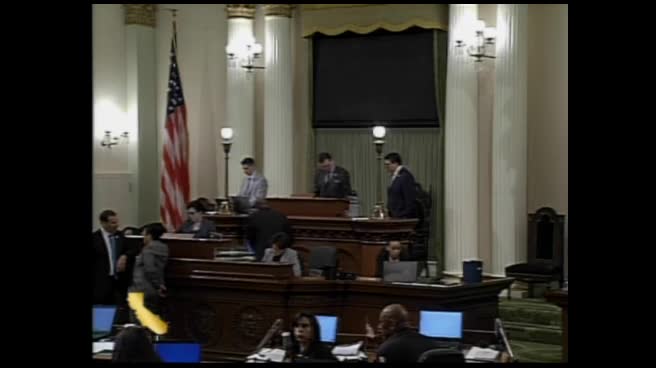


Bill Co-Author(s):