AJR 14: 135th anniversary of the Chinese Exclusion Act.
- Session Year: 2017-2018
- House: Assembly
- Latest Version Date: 2017-08-24
This measure would mark May 6, 2017, as the 135th anniversary of the enactment of the Chinese Exclusion Act in order to recognize the harm caused by racially discriminatory immigration measures, and to honor the contributions of all immigrants and refugees who have enriched our communities. The measure would also declare the opposition of the Legislature to recent executive orders signed by President Trump relating to immigration, call upon the President to revoke those orders, condemn the expansion of deportations being undertaken under the current presidential administration, and reaffirm that the state is open and welcoming to immigrants and refugees who are integral to life in our state.
This measure would mark May 6, 2017, as the 135th anniversary of the enactment of the Chinese Exclusion Act in order to recognize the harm caused by racially discriminatory immigration measures, and to honor the contributions of all immigrants and refugees who have enriched our communities. The measure would also declare the opposition of the Legislature to recent executive orders signed by President Trump relating to immigration, call upon the President to revoke those orders, condemn the expansion of deportations being undertaken under the current presidential administration, and reaffirm that the state is open and welcoming to immigrants and refugees who are integral to life in our state.
This measure would mark May 6, 2017, as the 135th anniversary of the enactment of the Chinese Exclusion Act in order to recognize the harm caused by racially discriminatory immigration measures, and to honor the contributions of all immigrants and refugees who have enriched our communities. The measure would also declare the opposition of the Legislature to recent executive orders signed by President Trump relating to immigration, call upon the President to revoke those orders, condemn the expansion of deportations planned being undertaken under the current presidential administration, and reaffirm that the state is open and welcoming to immigrants and refugees who are integral to life in our state.
This measure would mark May 6, 2017, as the 135th anniversary of the enactment of the Chinese Exclusion Act in order to recognize the harm caused by racially discriminatory immigration measures, and to honor the contributions of all immigrants and refugees who have enriched our communities. The measure would also declare the opposition of the Legislature to recent executive orders signed by President Trump relating to immigration, call upon the President to rescind revoke those orders, condemn the expansion of deportations planned under the current presidential administration, and reaffirm that the Legislature state is open and welcoming to immigrants and refugees who are integral to life in our state.
This measure would mark May 6, 2017, as the 135th anniversary of the enactment of the Chinese Exclusion Act in order to recognize the harm caused by racially discriminatory immigration measures, and to honor the contributions of all immigrants and refugees who have enriched our communities. The measure would also declare the opposition of the Legislature to recent executive orders signed by President Trump relating to immigration, call upon the President to rescind those orders, condemn the expansion of deportations planned under the current administration, and reaffirm that the Legislature is open and welcoming to immigrants and refugees who are integral to life in our state.
WHEREAS, On May 6, 1882, President Chester A. Arthur signed the Chinese Exclusion Act, which was the nations first law to prohibit immigration solely on the basis of ethnicity; and
WHEREAS, The Chinese Exclusion Act, which was renewed in 1892, amended in 1902, and made permanent in 1904, prevented Chinese laborers from entering the United States, and denied Chinese a pathway to citizenship for more than 60 years; and
WHEREAS, Subsequent legislation, such as the 1892 Geary Act that required all Chinese to register for and carry on their persons Certificates of Residence or risk imprisonment and deportation, set a precedent for the Muslim registry being promoted by President Trump today; and
WHEREAS, The Chinese Exclusion Act was based on racial hostility against Chinese, who were characterized as unassimilable, vile heathens and were blamed for lowering wages, taking away jobs, draining the economy, and endangering the American way of life; and
WHEREAS, There is a direct link between the racial animus and religious intolerance exemplified by the Chinese Exclusion Act and President Trumps executive orders, which attempt to ban the issuance of travel visas for citizens of certain majority-Muslim nations based on unestablished security risks and the implication that all Muslims are terrorists; and
WHEREAS, President Trumps Executive Order 13780, titled Protecting the Nation from Foreign Terrorist Entry into the United States and issued March 6, 2017, seeks to suspend the entry of all refugees under the United States Refugee Assistance Program for 120 days, and seeks to limit the total number of refugees accepted to just 50,000 half the number of refugees previously accepted under the Obama administration; and
WHEREAS, President Trumps Executive Order 13768, titled Enhancing Public Safety in the Interior of the United States and issued January 25, 2017, seeks to direct the Department of Homeland Security to hire 10,000 additional immigration enforcement officers, empower states and local law enforcement to perform functions of immigration officers, and to greatly expand the categories of people classified as priorities for removal, including those who are convicted of only minor crimes or who are simply charged with, but not convicted, of a crime; and
WHEREAS, President Trumps Executive Order 13767, titled Border Security and Immigration Enforcement Improvements and issued January 25, 2017, calls for the construction of a wall along the southern border with Mexico estimated to cost $20 billion, the construction and operation of new immigration detention facilities near the border, and the hiring of 5,000 additional Border Patrol agents; and
WHEREAS, With the unanimous passage of Senate Resolution 201 by the United States Senate in 2011, and the unanimous passage of House Resolution 683 by the United States House of Representatives in 2012, both houses of Congress have condemned the Chinese Exclusion Act and affirmed Congress commitment to preserve the civil rights and constitutional protections for all people; now, therefore, be it
Resolved by the Assembly and the Senate of the State of California, jointly, That the Members join Asian and Pacific Islander communities throughout the state in marking May 6, 2017, as the 135th anniversary of the Chinese Exclusion Act in recognition of the harm caused by racially discriminatory immigration measures and to honor the contributions of all immigrants and refugees who have enriched our communities; and be it further
Resolved,That the Legislature condemns the expansion of deportations being undertaken by the current presidential administration as well as its actions to exclude immigrants based on national origin and religion, which threaten to repeat the terrible injustices perpetrated by the Chinese Exclusion Act 135 years ago; and be it further
Resolved, That the Legislature declares its opposition to Executive Orders 13767, 13768, and 13780, and calls upon the President to revoke these executive orders; and be it further
Resolved, That the Legislature reaffirms that the State of California is open and welcoming to immigrants and refugees who are integral to the life of our state; and be it further
Resolved, That the Chief Clerk of the Assembly transmit copies of this resolution to the authors for appropriate distribution.
WHEREAS, On May 6, 1882, President Chester A. Arthur signed the Chinese Exclusion Act, which was the nations first law to prohibit immigration solely on the basis of ethnicity; and
WHEREAS, The Chinese Exclusion Act, which was renewed in 1892, amended in 1902, and made permanent in 1904, prevented Chinese laborers from entering the United States, and denied Chinese a pathway to citizenship for more than 60 years; and
WHEREAS, Subsequent legislation, such as the 1892 Geary Act that required all Chinese to register for and carry on their persons Certificates of Residence or risk imprisonment and deportation, set a precedent for the Muslim registry being promoted by President Trump today; and
WHEREAS, The Chinese Exclusion Act was based on racial hostility against Chinese, who were characterized as unassimilable, vile heathens and were blamed for lowering wages, taking away jobs, draining the economy, and endangering the American way of life; and
WHEREAS, There is a direct link between the racial animus and religious intolerance exemplified by the Chinese Exclusion Act and President Trumps executive orders, which attempt to ban the issuance of travel visas for citizens of certain majority-Muslim nations based on unestablished security risks and the implication that all Muslims are terrorists; and
WHEREAS, President Trumps Executive Order 13780, titled Protecting the Nation from Foreign Terrorist Entry into the United States and issued March 6, 2017, seeks to suspend the entry of all refugees under the United States Refugee Assistance Program for 120 days, and seeks to limit the total number of refugees accepted to just 50,000 half the number of refugees previously accepted under the Obama administration; and
WHEREAS, President Trumps Executive Order 13768, titled Enhancing Public Safety in the Interior of the United States and issued January 25, 2017, seeks to direct the Department of Homeland Security to hire 10,000 additional immigration enforcement officers, empower states and local law enforcement to perform functions of immigration officers, and to greatly expand the categories of people classified as priorities for removal, including those who are convicted of only minor crimes or who are simply charged with, but not convicted, of a crime; and
WHEREAS, President Trumps Executive Order 13767, titled Border Security and Immigration Enforcement Improvements and issued January 25, 2017, calls for the construction of a wall along the southern border with Mexico estimated to cost $20 billion, the construction and operation of new immigration detention facilities near the border, and the hiring of 5,000 additional Border Patrol agents; and
WHEREAS, With the unanimous passage of Senate Resolution 201 by the United States Senate in 2011, and the unanimous passage of House Resolution 683 by the United States House of Representatives in 2012, both houses of Congress have condemned the Chinese Exclusion Act and affirmed Congress commitment to preserve the civil rights and constitutional protections for all people; now, therefore, be it
Resolved by the Assembly and the Senate of the State of California, jointly, That the Members join Asian and Pacific Islander communities throughout the state in marking May 6, 2017, as the 135th anniversary of the Chinese Exclusion Act in recognition of the harm caused by racially discriminatory immigration measures and to honor the contributions of all immigrants and refugees who have enriched our communities; and be it further
Resolved,That the Legislature condemns the expansion of deportations planned being undertaken by the current presidential administration as well as its actions to exclude immigrants based on national origin and religion, which threaten to repeat the terrible injustices perpetrated by the Chinese Exclusion Act 135 years ago; and be it further
Resolved, That the Legislature declares its opposition to Executive Orders 13767, 13768, and 13780, and calls upon the President to revoke these executive orders; and be it further
Resolved, That the Legislature reaffirms that the State of California is open and welcoming to immigrants and refugees who are integral to the life of our state; and be it further
Resolved, That the Chief Clerk of the Assembly transmit copies of this resolution to the authors for appropriate distribution.
WHEREAS, On May 6, 1882, President Chester A. Arthur signed the Chinese Exclusion Act, which was the nations first law to prohibit immigration solely on the basis of ethnicity; and
WHEREAS, The Chinese Exclusion Act, which was renewed in 1892, amended in 1902, and made permanent in 1904, prevented Chinese laborers from entering the United States, and denied Chinese a pathway to citizenship for more than 60 years; and
WHEREAS, Subsequent legislation, such as the 1892 Geary Act that required all Chinese to register for and carry on their persons Certificates of Residence or risk imprisonment and deportation, set a precedent for the Muslim registry being promoted by President Trump today; and
WHEREAS, The Chinese Exclusion Act was based on racial hostility against Chinese, who were characterized as unassimilable, vile heathens and were blamed for lowering wages, taking away jobs, draining the economy, and endangering the American way of life; and
WHEREAS, There is a direct link between the racial animus and religious intolerance exemplified by the Chinese Exclusion Act and President Trumps executive orders, which attempt to ban the issuance of travel visas for citizens of certain majority-Muslim nations based on unestablished security risks and the implication that all Muslims are terrorists; and
WHEREAS, President Trumps executive order Executive Order 13780, titled Protecting the Nation from Foreign Terrorist Entry into the United States dated January 27, 2017, and again in an executive order dated and issued March 6, 2017, suspended refugee resettlement seeks to suspend the entry of all refugees under the United States Refugee Assistance Program for 120 days, and cut in half the seeks to limit the total number of refugees the U.S. had accepted previously in the Obama administration to 50,000 refugees; and to just 50,000 half the number of refugees previously accepted under the Obama administration; and
WHEREAS, President Trumps executive order for expedited removals gives immigration officials broad powers to arrest and deport anyone suspected of being in the United States without authorization, just as marshals were allowed to sweep through Chinese communities in the aftermath of the Chinese Exclusion Act to raid homes and businesses in search of undocumented immigrants; and Executive Order 13768, titled Enhancing Public Safety in the Interior of the United States and issued January 25, 2017, seeks to direct the Department of Homeland Security to hire 10,000 additional immigration enforcement officers, empower states and local law enforcement to perform functions of immigration officers, and to greatly expand the categories of people classified as priorities for removal, including those who are convicted of only minor crimes or who are simply charged with, but not convicted, of a crime; and
WHEREAS, President Trumps executive order Executive Order 13767, titled Border Security and Immigration Enforcement Improvements dated and issued January 25, 2017, on border enforcement called calls for the construction of a new border wall, which has been estimated to cost $20 billion, and the hiring of additional Border Patrol and Immigration and Customs Enforcement agents to deport undocumented immigrants whom he called bad hombres and rapists, thereby criminalizing immigrant communities at large; and wall along the southern border with Mexico estimated to cost $20 billion, the construction and operation of new immigration detention facilities near the border, and the hiring of 5,000 additional Border Patrol agents; and
WHEREAS, With the unanimous passage of Senate Resolution 201 by the United States Senate in 2011, and the unanimous passage of House Resolution 683 by the United States House of Representatives in 2012, both houses of Congress have condemned the Chinese Exclusion Act and affirmed Congress commitment to preserve the civil rights and constitutional protections for all people; now, therefore therefore, be it
Resolved by the Assembly and the Senate of the State of California, jointly, That the Members join Asian and Pacific Islander communities throughout the state in marking May 6, 2017, as the 135th anniversary of the Chinese Exclusion Act in recognition of the harm caused by racially discriminatory immigration measures and to honor the contributions of all immigrants and refugees who have enriched our communities; and be it further
Resolved, That the Legislature declares its opposition to the executive orders signed by the President on border enforcement policies and the Muslim travel ban, and calls upon the President to rescind these executive orders; and be it furtherResolved,That the Legislature condemns the expansion of deportations planned by the current presidential administration as well as its executive order banning immigration actions to exclude immigrants based on national origin and religion; religion, which threaten to repeat the terrible injustices perpetrated by the Chinese Exclusion Act 135 years ago; and be it further
Resolved, That the Legislature declares its opposition to Executive Orders 13767, 13768, and 13780, and calls upon the President to revoke these executive orders; and be it further
Resolved, That the Legislature reaffirms it that the State of California is open and welcoming to immigrants and refugees who are integral to the life of our state; and be it further
Resolved,That the Chief Clerk of the Assembly transmit copies of this resolution to the authors for appropriate distribution.
WHEREAS, On May 6, 1882, President Chester A. Arthur signed the Chinese Exclusion Act, which was the nations first law to prohibit immigration solely on the basis of ethnicity; and
WHEREAS, The Chinese Exclusion Act, which was renewed in 1892, amended in 1902, and made permanent in 1904, prevented Chinese laborers from entering the United States, and denied Chinese a pathway to citizenship for more than 60 years; and
WHEREAS, Subsequent legislation, such as the 1892 Geary Act that required all Chinese to register for and carry on their persons Certificates of Residence or risk imprisonment and deportation, set a precedent for the Muslim registry being promoted by President Trump today; and
WHEREAS, The Chinese Exclusion Act was based on racial hostility against Chinese, who were characterized as unassimilable, vile heathens and were blamed for lowering wages, taking away jobs, draining the economy, and endangering the American way of life; and
WHEREAS, There is a direct link between the racial animus and religious intolerance exemplified by the Chinese Exclusion Act and President Trumps executive orders, which attempt to ban the issuance of travel visas for citizens of certain majority-Muslim nations based on unestablished security risks and the implication that all Muslims are terrorists; and
WHEREAS, President Trumps executive order titled Protecting the Nation from Foreign Terrorist Entry into the United States dated January 27, 2017, and again in an executive order dated March 6, 2017, suspended refugee resettlement for 120 days, and cut in half the number of refugees the U.S. had accepted previously in the Obama administration to 50,000 refugees; and
WHEREAS, President Trumps executive order for expedited removals gives immigration officials broad powers to arrest and deport anyone suspected of being in the United States without authorization, just as marshals were allowed to sweep through Chinese communities in the aftermath of the Chinese Exclusion Act to raid homes and businesses in search of undocumented immigrants; and
WHEREAS, President Trumps executive order titled Border Security and Immigration Enforcement Improvements dated January 25, 2017, on border enforcement called for the construction of a new border wall, which has been estimated to cost $20 billion, and the hiring of additional Border Patrol and Immigration and Customs Enforcement agents to deport undocumented immigrants whom he called bad hombres and rapists, thereby criminalizing immigrant communities at large; and
WHEREAS, With the unanimous passage of Senate Resolution 201 by the United States Senate in 2011, and the unanimous passage of House Resolution 683 by the United States House of Representatives in 2012, both houses of Congress have condemned the Chinese Exclusion Act and affirmed Congress commitment to preserve the civil rights and constitutional protections for all people; now, therefore be it
Resolved by the Assembly and the Senate of the State of California, jointly, That the Members join Asian and Pacific Islander communities throughout the state in marking May 6, 2017, as the 135th anniversary of the Chinese Exclusion Act in recognition of the harm caused by racially discriminatory immigration measures and to honor the contributions of all immigrants and refugees who have enriched our communities; and be it further
Resolved, That the Legislature declares its opposition to the executive orders signed by the President on border enforcement policies and the Muslim travel ban, and calls upon the President to rescind these executive orders; and be it further
Resolved, That the Legislature condemns the expansion of deportations planned by the current administration as well as its executive order banning immigration based on national origin and religion; and be it further
Resolved, That the Legislature reaffirms it is open and welcoming to immigrants and refugees who are integral to the life of our state; and be it further
Resolved, That the Chief Clerk of the Assembly transmit copies of this resolution to the authors for appropriate distribution.
|
Date
|
Status
|
|---|---|
| Aug 24, 2017 | Chaptered by Secretary of State - Res. Chapter 120, Statutes of 2017. |
| Aug 24, 2017 | Enrolled and filed with the Secretary of State at 3 p.m. |
| Aug 21, 2017 | Senate amendments concurred in. To Engrossing and Enrolling. |
| Jul 17, 2017 | In Assembly. Concurrence in Senate amendments pending. |
| Jul 17, 2017 | Adopted and to Assembly. |
| Jun 21, 2017 | From committee: Be adopted. Ordered to Third Reading. (Ayes 5. Noes 1.) (June 20). |
| Jun 7, 2017 | From committee chair, with author's amendments: Amend, and re-refer to committee. Amended and re-referred to Com. on JUD. |
| Jun 1, 2017 | Re-referred to Com. on JUD. |
| May 23, 2017 | In Senate. To Com. on RLS. |
| May 22, 2017 | Coauthors revised. |
| May 17, 2017 | Amended. Ordered to third reading. |
| May 16, 2017 | From committee: Amend, and be adopted as amended. (Ayes 7. Noes 0.) (May 16). |
| May 4, 2017 | Referred to Com. on JUD. |
| May 2, 2017 | From printer. |
| May 1, 2017 | Introduced. To print. |
|
Date
|
Description
|
Location
|
Votes
|
|
|---|---|---|---|---|
| Aug 21, 2017 | AJR 14 TING Concurrence in Senate Amendments | Assembly Floor |
Passed |
|
| Jul 17, 2017 | Passage | Senate Floor |
Passed |
|
| Jun 20, 2017 | Be adopted. Ordered to third reading | Senate Standing Committee on Judiciary |
Passed |
|
| May 22, 2017 | AJR 14 TING Assembly Third Reading | Assembly Floor |
Passed |
|
| May 16, 2017 | Be adopted as amended. | Assembly Standing Committee on Judiciary |
Passed |
This list shows positions taken on this bill by organizations on the date displayed, which is linked to the original source.
Positions by individuals are not included.
|
Organization
|
Position
|
Date
|
|---|---|---|
| Asian Americans Advancing Justice | * Support | May 16, 2017 |
| California Historical Society | ** Support | Jun 21, 2017 |
| California Immigrant Policy Center | ** Support | Jun 21, 2017 |
| Chinese for Affirmative Action | ** Support | Jun 21, 2017 |
| CHIRLA-Coalition for Humane Immigrant Rights | * Support | May 16, 2017 |
| council on american-islamic relations - california chapter | ** Support | Jun 21, 2017 |
| OCA Sacramento | ** Support | May 12, 2017 |
| oca sacramento, asian pacific american advocates | ** Support | Jun 21, 2017 |
CONCURRENCE IN SENATE AMENDMENTS
CSA1 Bill Id:AJR 14
Author:(Ting and Chiu)
As Amended Ver:June 7, 2017
Majority vote
ASSEMBLY: | 59-0 | (May 22, 2017) | SENATE: | 30-10 | (July 17, 2017) |
Original Committee Reference: JUD.
SUMMARY: Observes the 135th anniversary of the Chinese Exclusion Act, and declares the Legislature's opposition to recent executive orders on immigration enforcement. Specifically, this measure:
- Finds that on May 6, 1882, President Chester A. Arthur signed the Chinese Exclusion Act, the nation's first law to prohibit immigration solely on the basis of ethnicity, and that the Act was renewed and later made permanent in 1904, preventing Chinese laborers from entering the United States, and denying Chinese a pathway to citizenship for more than 60 years.
- Finds that subsequent legislation, such as the 1892 Geary Act that required all Chinese to register for and carry on their persons Certificates of Residence or risk imprisonment and deportation, set a precedent for the Muslim registry being promoted by President Trump today.
- Finds that the Chinese Exclusion Act was based on racial hostility against Chinese, who were characterized as "unassimilable, vile heathens" and were blamed for lowering wages, taking away jobs, draining the economy, and endangering the American way of life.
- Declares there is a direct link between the racial animus and religious intolerance exemplified by the Chinese Exclusion Act and President Trump's executive orders, which attempt to ban the issuance of travel visas for citizens of certain majority-Muslim nations based on unestablished security risks and the implication that all Muslims are terrorists.
- Finds that Executive Order 13780, titled "Protecting the Nation from Foreign Terrorist Entry into the United States" and issued March 6, 2017, seeks to suspend the entry of all refugees under the United States (U.S.) Refugee Assistance Program for 120 days, and seeks to limit the number of total refugees accepted to just 50,000 – half the number of refugees previously accepted under the Obama administration.
- Finds that Executive Order 13768, titled "Enhancing Public Safety in the Interior of the United States" and issued January 25, 2017, seeks to direct the Department of Homeland Security to hire 10,000 additional immigration enforcement officers, empower state and local law enforcement to perform functions of immigration officers, and to greatly expand the categories of people classified as priorities for removal, including those convicted of only minor crimes or simply charged but not convicted of a crime.
- Finds that Executive Order 13767, titled "Border Security and Immigration Enforcement Improvements" and issued on January 25, 2017, calls for the construction of a wall along the southern border with Mexico estimated to cost $20 billion, the construction and operation of new immigration detention facilities near the border, and the hiring of 5,000 additional Border Patrol agents.
- Declares that with the unanimous passage of Senate Resolution 201 by the United States Senate in 2011, and the unanimous passage of House Resolution 683 by the United States House of Representatives in 2012, both houses of Congress have condemned the Chinese Exclusion Act and affirmed Congress' commitment to preserve the civil rights and constitutional protections for all people.
- Calls upon all Members of the Legislature to join Asian and Pacific Islander communities throughout the state in marking May 6, 2017, as the 135th anniversary of the Chinese Exclusion Act, in recognition of the harm caused by racially discriminatory immigration measures and to honor the contributions of all immigrants and refugees who have enriched our communities.
- Declares that the Legislature condemns the expansion of deportations being undertaken by the current presidential administration, as well as its actions to exclude immigrants based on national origin and religion, which both threaten to repeat the terrible injustices perpetrated by the Chinese Exclusion Act of 1882.
- Declares the Legislature's opposition to Executive Orders 13767, 13768, and 13780, and calls upon the President to revoke these executive orders.
- Reaffirms that the State of California is open and welcoming to immigrants and refugees who are integral to the life of our state.
The Senate amendments add a number of Assembly co-authors and make one technical change.
FISCAL EFFECT: None
COMMENTS: This resolution observes the 135th anniversary of the Chinese Exclusion Act of 1882 on May 6, 2017, notes the parallels between the Act and recent actions taken by the current presidential administration to exclude immigrants based on national origin, and declares the Legislature's opposition to three controversial executive orders on immigration enforcement issued by the president earlier this year.
Chinese Exclusion Act of 1882. In 1882, Congress passed the Chinese Exclusion Act, the first U.S. law to restrict immigration and naturalization for a specific ethnic group. The Act outlawed all Chinese immigration to the United States and denied citizenship to those Chinese who were already settled in the country. By outlawing all new immigration, the Act effectively prevented thousands of Chinese men already living in the U.S. from reuniting with their wives and children who were left behind in China when they came to this country in order to work.
According to historian Andrew Gyory, the Chinese Exclusion Act "reversed not only American policy, but also American tradition, changing forever the nation's image of itself as a beacon of hope, a refuge for the poor and the oppressed the world over." In his view, the Chinese Exclusion Act not only "legitimize[d] racism as national policy" but set a precedent for broader exclusion laws and "fostered an atmosphere of hostility towards foreigners that would endure for generations." (Andrew Gyory, Closing the Gate: Race Politics and the Chinese Exclusion Act. Chapel Hill: University of North Carolina Press, 1998)
The ban on Chinese immigration was extended indefinitely in 1902, and was not repealed until Congress passed the Magnuson Act on December 17, 1943. Although the Act made Chinese Americans eligible for naturalization, Congress initially limited the number of Chinese immigrants allowed into the country to only 105 immigrants per year. (Asian Law Journal, December 2000.) According to one scholar of the Chinese Exclusion Act, the Act marked the beginning of an era where, for political reasons, U.S. immigration policy became more exclusionary in nature. Quoting from a recent article by writer Kat Chow:
"The Chinese exclusion law was the very first time in American history that immigrants were barred because of their race and class. In 1882, when Congress passed the law, there were 39,600 men and women from China who arrived in the U.S. Just three years later, there were only 22, according to early records that Lee came across in her research. (Kat Chow, "As Chinese Exclusion Act Turns 135, Experts Point To Parallels Today." Accessed at: http://www.npr.org/sections/ codeswitch/2017/05/05/527091890/the-135-year-bridge-between-the-chinese-exclusion-act-and-a-proposed-travel-ban)
Background on recent Executive Orders on immigration enforcement. On January 25, 2017, Executive Order (EO)13767, titled "Border Security and Immigration Enforcement Improvements," which is perhaps best known for proclaiming U.S. policy to secure the southern border of the United States through the immediate construction of a physical wall on the southern border and directing the Secretary of the Department of Homeland Security (DHS) to "immediately" take steps to plan, design, and construct a physical wall, as well as to construct and operate detention facilities to detain aliens at or near the border with Mexico, was issued. Among other things, EO 13767 also directs the Secretary to: 1) allocate asylum officers and judges to detention facilities in order to conduct authorized removal proceedings; 2) ensure detention of aliens apprehended for violations of immigration law pending outcome of removal proceedings; and 3) hire 5,000 additional border patrol agents.
On the same date, January 25, 2017, Executive Order 13768, titled "Enhancing Public Safety in the Interior of the United States," was issued, which, among other things, directs the Secretary of Homeland Security to: 1) hire 10,000 additional immigration officers and to empower state and local law enforcement to perform functions of immigration officers; and 2) prioritize certain persons for removal, especially any person charged with or convicted of a criminal offense, any person who has committed acts that constitute a criminal offense, or any person who has "abused" a public benefit program. EO 13768 also seeks to designate as a "sanctuary jurisdiction" any jurisdiction that refuses to exchange information, as required by 8 U.S. Code Section 1373, and would make such jurisdictions ineligible for federal grants, except as deemed necessary for law enforcement purposes.
Finally, on January 27, 2017, Executive Order 13769, titled "Protecting the Nation from Foreign Terrorist Entry into the United States," but more commonly known as the purported "Muslim travel ban" was issued. On February 9, 2017, the United States Court of Appeals for the Ninth Circuit denied the government's emergency motion for a stay of the lower court's temporary injunction against EO 13769, effectively affirming the injunction against the travel ban. Rather than appeal the decision of the Ninth Circuit to the U.S. Supreme Court, the administration instead revoked EO 13769 and issued a revised version of the order, Executive Order 13780, on March 6, 2017. EO 13780 seeks, among other things, to suspend entry into the U.S. of nationals of Iran, Libya, Somalia, Sudan, Syria, and Yemen (Iraq is excluded) for 90 days, subject to exceptions for: 1) a person holding a valid visa or other document that permits travel in the U.S.; 2) a legal permanent resident (i.e. "Green Card" holder); 3) a foreign national granted asylum or a refugee already admitted into the U.S.; or 4) a person inside the U.S. at the time of this order. EO 13780 also seeks to suspend the entry of all refugees under the U.S. Refugee Assistance Program for 120 days, and seeks to limit the total number of refugees accepted into the U.S. to just 50,000 – half the number of refugees previously accepted under the Obama administration.
This measure draws parallels between the Chinese Exclusion Act of 1882 and the recent Executive Orders that appear to single out certain groups for discrimination and exclusion. According to the author, the occasion of the 135th Anniversary of the Chinese Exclusion Act gives us pause to look back at history and understand the danger of pursuing immigration policies that are based on discrimination against and exclusion of certain groups of immigrants based on their national origin, religion, or other protected factors. The author states:
The Chinese Exclusion Act was a painful part of Chinese American history in this country that we cannot forget. The harsh reality of today is that we have a presidential administration that does not understand our nation's history, and pursues senseless executive orders that discriminate against an individual based upon their national origin or religious beliefs. This resolution marks the 135th anniversary of the signing of the Chinese Exclusion Act but also serves to declare California's opposition to these orders, and push every person to stay awake and act when injustices of the past are recycled by this administration.
Accordingly, this measure observes the 135th anniversary of the Chinese Exclusion Act "in recognition of the harm caused by racially discriminatory immigration measures" and states that "there is a direct link between the racial animus and religious intolerance exemplified by the Chinese Exclusion Act and President Trump's executive orders." The measure "condemns the expansion of deportations being undertaken by the current presidential administration as well as its actions to exclude immigrants based on national origin and religion, which threaten to repeat the terrible injustices perpetrated by the Chinese Exclusion Act 135 years ago" and calls upon the President to revoke Executive Orders 13767, 13768, and 13780.
Analysis Prepared by: Anthony Lew / JUD. / (916) 319-2334 FN: 0001028
Office of Senate Floor Analyses (916) 651-1520 Fax: (916) 327-4478 | AJR 14 |
THIRD READING
Bill No: AJR 14
Author: Ting (D) and Chiu (D), et al.
Amended: 6/7/17 in Senate
SENATE JUDICIARY COMMITTEE: 5-1, 6/20/17
AYES: Jackson, Hertzberg, Monning, Stern, Wieckowski
NOES: Anderson
NO VOTE RECORDED: Moorlach
ASSEMBLY FLOOR: 59-0, 5/22/17 - See last page for vote
SUBJECT: 135th anniversary of the Chinese Exclusion Act
SOURCE: Chinese for Affirmative Action
DIGEST:
This resolution marks the 135th anniversary of the signing of the Chinese Exclusion Act, describes the racial hostility that gave rise to it, draws parallels to the immigration policies of the present federal administration, and calls upon that administration to revoke the three key Executive Orders (EOs) which implement that policy, parts of which are currently blocked by federal court orders.
Existing law:
- Provides that all people are by nature free and independent and have inalienable rights, including enjoying and defending life and liberty, acquiring, possessing, and protecting property, and pursuing and obtaining safety, happiness, and privacy. (Cal. Const., art. 1, Sec. 1.)
- Provides, pursuant to the Unruh Civil Rights Act, that all persons within the jurisdiction of this state are free and equal, and specifically prohibits discrimination based on sex, race, color, religion, ancestry, national origin, disability, medical condition, marital status, or sexual orientation with respect to accommodations, advantages, facilities, privileges, or services in all business establishments of every kind. (Civil Code Section 51.)
- Provides, pursuant to the federal Immigration and Nationality Act, that no person shall receive any preference or priority or be discriminated against in the issuance of an immigrant visa because of the person’s race, sex, nationality, place of birth, or place of residence, except as specifically provided. (8 U.S.C. Sec. 1152(a).)
This resolution:
- Finds and declares that:
- On May 6, 1882, President Chester A. Arthur signed the Chinese Exclusion Act, the nation’s first law to prohibit immigration solely on the basis of ethnicity, and that the Act was renewed and later made permanent in 1904, preventing Chinese laborers from entering the United States, and denying people of Chinese descent a pathway to citizenship for more than 60 years;
- Subsequent legislation, such as the 1892 Geary Act that required all people of Chinese descent to register for and carry on their persons Certificates of Residence or risk imprisonment and deportation, set a precedent for the Muslim registry being promoted by President Trump today;
- The Chinese Exclusion Act was based on racial hostility against people of Chinese descent, who were characterized as “unassimilable, vile heathens” and were blamed for lowering wages, taking away jobs, draining the economy, and endangering the American way of life;
- There is a direct link between the racial animus and religious intolerance exemplified by the Chinese Exclusion Act and President Trump’s EOs, which attempt to ban the issuance of travel visas for citizens of certain majority-Muslim nations based on unestablished security risks and the implication that all Muslims are terrorists;
- EO 13780, titled “Protecting the Nation from Foreign Terrorist Entry into the United States” and issued March 6, 2017, seeks to suspend the entry of all refugees under the U.S. Refugee Assistance Program for 120 days, and seeks to limit the number of total refugees accepted to just 50,000—half the number of refugees previously accepted under the Obama administration;
- EO 13768, titled “Enhancing Public Safety in the Interior of the United States” and issued January 25, 2017, seeks to direct the Department of Homeland Security (DHS) to hire 10,000 additional immigration enforcement officers, empower state and local law enforcement to perform functions of immigration officers, and to greatly expand the categories of people classified as priorities for removal, including those convicted of only minor crimes or simply charged but not convicted of a crime;
- EO 13767, titled “Border Security and Immigration Enforcement Improvements” and issued on January 25, 2017, calls for the construction of a wall along the southern border with Mexico estimated to cost $20 billion, the construction and operation of new immigration detention facilities near the border, and the hiring of 5,000 additional Border Patrol agents; and
- With the unanimous passage of Senate Resolution 201 by the United States Senate in 2011, and the unanimous passage of House Resolution 683 by the United States House of Representatives in 2012, both houses of Congress have condemned the Chinese Exclusion Act and affirmed Congress’ commitment to preserve the civil rights and constitutional protections for all people.
- Resolves, on behalf of the California Senate and Assembly jointly, that:
- The Members of the Legislature join Asian and Pacific Islander communities throughout the state in marking May 6, 2017, as the 135th anniversary of the Chinese Exclusion Act, in recognition of the harm caused by racially discriminatory immigration measures and to honor the contributions of all immigrants and refugees who have enriched our communities;
- The Legislature condemns the expansion of deportations being undertaken by the current presidential administration, as well as its actions to exclude immigrants based on national origin and religion, which both threaten to repeat the terrible injustices perpetrated by the Chinese Exclusion Act of 1882;
- The Legislature declares its opposition to EOs 13767, 13768, and 13780, and calls upon the President to revoke them;
- The Legislature reaffirms that the State of California is open and welcoming to immigrants and refugees who are integral to the life of our state; and
- The Chief Clerk of the Assembly shall transmit copies of this resolution to the authors for appropriate distribution.
Background
In the spring of 1882, the U.S. Congress passed the Chinese Exclusion Act and, on May 6, 1882, then U.S. President Chester Arthur signed it, thus enacting the first U.S. law to restrict immigration and naturalization for a specific ethnic group. The Chinese Exclusion Act banned all Chinese immigration into the U.S. and denied citizenship to those Chinese who were already here. With that:
the United States stopped being a nation of immigrants that welcomed foreigners without restrictions, borders or gates. Instead, it became a ... gatekeeping nation. In the process, the very definition of what it meant to be an ‘American’ became even more exclusionary.” (Erika Lee, At America’s Gates: Chinese Immigration During The Exclusion Era, 1882-1943, University of North Carolina Press, pp. 6-7).
Contemporaneous statements about the Chinese Exclusion Act make plain the racial hostility behind its enactment. Supporters of the Act asserted that Chinese nationals were “unassimable aliens,” “unwelcome invasions,” “undesirable,” “diseased,” and “illegal,” among other slander. (Id. p. 22.)
One hundred and thirty-five years later, racial and religious hostility – albeit directed at different targets – is once again driving the nation’s immigration policy and rhetoric.
This resolution both commemorates the 135th anniversary of the Chinese Exclusion Act and uses its history as a cautionary tale about the present. Specifically, this resolution draws a parallel between the racial animus that motivated the Chinese Exclusion Act and the anti-Muslim prejudice that appears to be fueling the current federal government approach to foreign visitors, treatment of refugees, and immigration generally. With these parallels in mind, this resolution urges President Trump to revoke these policies and reaffirms California’s commitment to serve as a place of welcome and refuge to immigrants.
Current status of the EOs addressed in this resolution
This bill calls upon President Trump to revoke three EOs relating to immigration policy. Several elements of these EOs have already been challenged successfully in court on constitutional grounds. As a result, the federal courts have instructed the government not to enforce those parts of the orders. In one instance, President Trump issued a revised order, only to have it blocked by the courts as well. President Trump has ordered the U.S. Department of Justice to appeal one of those rulings, regarding a ban on travel from a series of predominately Muslim countries, to the U.S. Supreme Court, which is now determining whether or not to take up the case.
More specifically, the content and status of each order can be summarized as follows:
- EO 13767, “Border Security and Immigration Enforcement Improvements.” Issued by President Trump on January 25, 2017, this order made it U.S. policy to construct a physical wall along the southern border. It directed the Secretary of DHS to take steps “immediately” to plan, design, and construct the wall, as well as to construct and operate detention facilities to detain aliens at or near the border with Mexico. Among other things, EO 13767 also directs the Secretary to: (1) allocate asylum officers and judges to detention facilities in order to conduct authorized removal proceedings; (2) ensure detention of aliens apprehended for violations of immigration law pending outcome of removal proceedings; and (3) hire 5,000 additional border patrol agents.
- EO 13768, “Enhancing Public Safety in the Interior of the United States.” Issued by President Trump on January 25, 2017, this order directs the Secretary of DHS to: (1) hire 10,000 additional immigration officers and to empower state and local law enforcement to perform functions of immigration officers; and (2) prioritize certain persons for removal, especially any person charged with or convicted of a criminal offense, any person who has committed acts that constitute a criminal offense, or any person who has “abused” a public benefit program. EO 13768 also seeks to designate as a “sanctuary” any jurisdiction that refuses to exchange information, as required by 8 U.S.C. Sec. 1373, and would make such jurisdictions ineligible for federal grants, except as deemed necessary for law enforcement purposes. The County of Santa Clara and the City of San Francisco together challenged this EO’s provisions regarding sanctuary cities in court. On April 25, 2017, a federal judge ruled that the sanctuary city related provisions were likely unconstitutional and blocked the federal government from enforcing this aspect of the order pending a final determination. (Cnty. of Santa Clara v. Trump (N.D. Cal. Apr. 25, 2017) 2017 U.S. Dist. LEXIS 62871.)
- EO 13769, “Protecting the Nation from Foreign Terrorist Entry into the United States.” Issued by President Trump on January 27, 2017, this is the order frequently referred to as the “Muslim travel ban.” Among other things, EO 13769 suspended all travel to the U.S. from nationals of Iraq, Iran, Libya, Somalia, Sudan, Syria, and Yemen. In the following days, hundreds of travelers from those countries were detained at U.S. airports upon arrival and protests erupted. Multiple U.S. District Courts ruled the travel ban unconstitutional and enjoined the government from enforcing it. (Washington v. Trump, (W.D. Wash. Feb. 3, 2017) 2017 U.S. Dist. LEXIS 16012; State v. Trump (D. Haw. Feb. 9, 2017) 2017 U.S. Dist. LEXIS 19248; Aziz v. Trump (E.D. Va. Feb. 13, 2017) 2017 U.S. Dist. LEXIS 20889.) On February 9, 2017, the United States Court of Appeals for the Ninth Circuit denied the government’s emergency motion for a stay of the lower court’s temporary injunction against EO 13769, effectively affirming the injunction against the travel ban. (Washington v. Trump (9th Cir. Wash. Feb. 9, 2017) 847 F.3d 1151.) Rather than appeal the Ninth Circuit decision to the U.S. Supreme Court, the administration instead revoked EO 13769 and issued a revised version of the order, EO 13780, on March 6, 2017. Among other things, EO 13780 announced that the U.S. government would suspend entry into the U.S. of nationals of Iran, Libya, Somalia, Sudan, Syria, and Yemen (Iraq was excluded) for 90 days beginning May 16, 2017, subject to exceptions for (1) a person holding a valid visa or other document that permits travel in the U.S.; (2) a legal permanent resident (i.e. “Green Card” holder); (3) a foreign national granted asylum or a refugee already admitted into the U.S.; or (4) a person inside the U.S. at the time of this order. EO 13780 also ordered suspension of the entry of all refugees under the U.S. Refugee Assistance Program for 120 days, and seeks to limit the total number of refugees accepted into the U.S. to just 50,000—half the number of refugees previously accepted under the Obama administration. Just hours before this revised EO was scheduled to go into effect, however, a U.S. District Court in Hawaii enjoined it as well. (Hawai’i v. Trump (D. Haw. Mar. 15, 2017) 2017 U.S. Dist. LEXIS 36935.) A federal district court in Maryland soon followed. (Int’l Refugee Assistance Project v. Trump (D. Md. Mar. 15, 2017) 2017 U.S. Dist. LEXIS 37645). The Fourth Circuit Court of Appeal subsequently affirmed the Maryland injunction. (Int’l Refugee Assistance Project v. Trump (4th Cir. Md. May 25, 2017) 2017 U.S. App. LEXIS 9109.) President Trump instructed the U.S. Justice Department to appeal the Fourth Circuit decision to the U.S. Supreme Court. The parties had until June 12, 2017 to brief the U.S. Supreme Court on whether or not it should take up the matter. (Trump v. Int’l Refugee Assistance Project (U.S. June 2, 2017) 2017 U.S. LEXIS 3552.) Meanwhile, on June 13, 2017, a three judge panel of the Ninth Circuit unanimously affirmed the Hawaii District Court ruling, though it scaled back the scope of the District Court’s injunction to allow the federal government to study implementation methods while actual implementation is on hold. (Hawai’i v. Trump (9th Cir. June 12, 2017, No. 17-15589, available at -- http://cdn.ca9.uscourts.gov/datastore/uploads/general/cases_of_interest/17-15589%20per%20curiam%20opinion.pdf -- [as of June 14, 2017].)
Widespread remorse for the Chinese Exclusion Act
The Chinese Exclusion Act endured in various forms until 1943. Even then, however, national origin and race-based quotas remained part of U.S. immigration law until 1965.
In the time since, there has been widespread condemnation of the Chinese Exclusion Act. On the state level, four prior resolutions have made it crystal clear that California regrets and repudiates the Chinese Exclusion Act. These resolutions acknowledge the state’s role in creating the conditions that led to enactment of the Act and formally apologize to the Chinese community for that role. The resolutions also celebrate the repeal of the Act and affirm California’s commitment to embracing immigrants of all races, religions, and nationalities.
At the federal level, Congress has passed three resolutions, House Resolution 683 — 112th Congress (2011-2012), Senate Resolution 201 — 112th Congress (2011-2012), and House Resolution 282 — 112th Congress (2011-2012), all expressing regret over the Chinese Exclusion Act.
NOTE: See the Senate Judiciary Committee analysis for details on these resolutions.
FISCAL EFFECT: Appropriation: No Fiscal Com.: No Local: No
Chinese for Affirmative Action (source)
California Historical Society
California Immigrant Policy Center
Council on American-Islamic Relations – California Chapter
OCA Sacramento, Asian Pacific American Advocates
OPPOSITION: (Verified 6/20/17)
None received
ARGUMENTS IN SUPPORT: According to the author:
The Chinese Exclusion Act was a painful part of Chinese American history in this country that we cannot forget. The harsh reality of today is that we have a presidential administration that does not understand our nation’s history, and pursues senseless executive orders that discriminate against an individual based upon their immigration status or religious beliefs. This resolution marks the 135th anniversary of the signing of the Chinese Exclusion Act but also serves to declare California’s opposition to these orders, and push every person to stay awake and act when injustices of the past are recycled by this administration.
In support, the California Historical Society writes:
Although the Chinese Exclusion was repealed in 1943, its enactment opened an appalling chapter in our nation’s history and continues to serve as an explicit reminder of the painful and very tangible impacts of discrimination directed against an individual by virtue of her or his ethnicity, race, or religious beliefs. Tragically, the current federal administration is repeating the mistakes of the Chinese Exclusion Act.
ASSEMBLY FLOOR: 59-0, 5/22/17
AYES: Aguiar-Curry, Arambula, Baker, Berman, Bloom, Bocanegra, Burke, Caballero, Calderon, Cervantes, Chau, Chávez, Chiu, Chu, Cooley, Cooper, Dababneh, Dahle, Daly, Eggman, Frazier, Friedman, Cristina Garcia, Eduardo Garcia, Gipson, Gloria, Gomez, Gonzalez Fletcher, Gray, Grayson, Holden, Irwin, Jones-Sawyer, Kalra, Lackey, Levine, Limón, Low, Mayes, McCarty, Medina, Mullin, Muratsuchi, O'Donnell, Quirk, Quirk-Silva, Reyes, Ridley-Thomas, Rodriguez, Rubio, Salas, Santiago, Steinorth, Mark Stone, Thurmond, Ting, Weber, Wood, Rendon
NO VOTE RECORDED: Acosta, Travis Allen, Bigelow, Bonta, Brough, Chen, Choi, Cunningham, Flora, Fong, Gallagher, Harper, Kiley, Maienschein, Mathis, Melendez, Nazarian, Obernolte, Patterson, Voepel, Waldron
Prepared by: Timothy Griffiths / JUD. / (916) 651-4113
6/21/17 13:38:26
**** END ****
Senator Hannah-Beth Jackson, Chair
2017-2018 Regular Session
Bill No: AJR 14 (Author:Ting)
Version: June 7, 2017
Hearing Date: June 20, 2017
Fiscal: No
Urgency:
Consultant: TSG
SUBJECT
135th anniversary of the Chinese Exclusion Act
DESCRIPTION
This resolution marks the 135th anniversary of the signing of the Chinese Exclusion Act, describes the racial hostility that gave rise to it, draws parallels to the immigration policies of the present federal administration, and calls upon that administration to revoke the three key Executive Orders which implement that policy, parts of which are currently blocked by federal court orders.
BACKGROUND
In the spring of 1882, the U.S. Congress passed the Chinese Exclusion Act and, on May 6, 1882, then U.S. President Chester Arthur signed it, thus enacting the first U.S. law to restrict immigration and naturalization for a specific ethnic group. The Chinese Exclusion Act banned all Chinese immigration into the U.S. and denied citizenship to those Chinese who were already here. With that:
the United States stopped being a nation of immigrants that welcomed foreigners without restrictions, borders or gates. Instead, it became a ... gatekeeping nation. In the process, the very definition of what it meant to be an ‘American’ became even more exclusionary.” (Erika Lee, At America’s Gates: Chinese Immigration During The Exclusion Era, 1882-1943, University of North Carolina Press, pp. 6-7).
Contemporaneous statements about the Chinese Exclusion Act make plain the racial hostility behind its enactment. Supporters of the Act asserted that Chinese nationals were “unassimable aliens,” “unwelcome invasions,” “undesirable,” “diseased,” and “illegal,” among other slander. (Id. p. 22.)
One hundred and thirty-five years later, racial and religious hostility – albeit directed at different targets – is once again driving the nation’s immigration policy and rhetoric.
This resolution both commemorates the 135th anniversary of the Chinese Exclusion Act and would use its history as a cautionary tale about the present. Specifically, this resolution draws a parallel between the racial animus that motivated the Chinese Exclusion Act and the anti-Muslim prejudice that appears to be fueling the current federal government approach to foreign visitors, treatment of refugees, and immigration generally. With these parallels in mind, this resolution urges President Trump to revoke these policies and reaffirms California’s commitment to serve as a place of welcome and refuge to immigrants.
CHANGES TO EXISTING LAW
Existing law provides that all people are by nature free and independent and have inalienable rights, including enjoying and defending life and liberty, acquiring, possessing, and protecting property, and pursuing and obtaining safety, happiness, and privacy. (Cal. Const., art. 1, Sec. 1.)
Existing law, pursuant to the Unruh Civil Rights Act, provides that all persons within the jurisdiction of this state are free and equal, and specifically prohibits discrimination based on sex, race, color, religion, ancestry, national origin, disability, medical condition, marital status, or sexual orientation with respect to accommodations, advantages, facilities, privileges, or services in all business establishments of every kind. (Civil Code Section 51.)
Existing law, pursuant to the federal Immigration and Nationality Act, provides that no person shall receive any preference or priority or be discriminated against in the issuance of an immigrant visa because of the person’s race, sex, nationality, place of birth, or place of residence, except as specifically provided. (8 U.S.C. Sec. 1152(a).)
This resolution would find and declare that:
- on May 6, 1882, President Chester A. Arthur signed the Chinese Exclusion Act, the nation’s first law to prohibit immigration solely on the basis of ethnicity, and that the Act was renewed and later made permanent in 1904, preventing Chinese laborers from entering the United States, and denying people of Chinese descent a pathway to citizenship for more than 60 years;
- subsequent legislation, such as the 1892 Geary Act that required all people of Chinese descent to register for and carry on their persons Certificates of Residence or risk imprisonment and deportation, set a precedent for the Muslim registry being promoted by President Trump today;
- the Chinese Exclusion Act was based on racial hostility against people of Chinese descent, who were characterized as “unassimilable, vile heathens” and were blamed for lowering wages, taking away jobs, draining the economy, and endangering the American way of life;
- there is a direct link between the racial animus and religious intolerance exemplified by the Chinese Exclusion Act and President Trump’s executive orders, which attempt to ban the issuance of travel visas for citizens of certain majority-Muslim nations based on unestablished security risks and the implication that all Muslims are terrorists;
- Executive Order 13780, titled “Protecting the Nation from Foreign Terrorist Entry into the United States” and issued March 6, 2017, seeks to suspend the entry of all refugees under the U.S. Refugee Assistance Program for 120 days, and seeks to limit the number of total refugees accepted to just 50,000—half the number of refugees previously accepted under the Obama administration;
- Executive Order 13768, titled “Enhancing Public Safety in the Interior of the United States” and issued January 25, 2017, seeks to direct the Department of Homeland Security to hire 10,000 additional immigration enforcement officers, empower state and local law enforcement to perform functions of immigration officers, and to greatly expand the categories of people classified as priorities for removal, including those convicted of only minor crimes or simply charged but not convicted of a crime;
- Executive Order 13767, titled “Border Security and Immigration Enforcement Improvements” and issued on January 25, 2017, calls for the construction of a wall along the southern border with Mexico estimated to cost $20 billion, the construction and operation of new immigration detention facilities near the border, and the hiring of 5,000 additional Border Patrol agents; and
- with the unanimous passage of Senate Resolution 201 by the United States Senate in 2011, and the unanimous passage of House Resolution 683 by the United States House of Representatives in 2012, both houses of Congress have condemned the Chinese Exclusion Act and affirmed Congress’ commitment to preserve the civil rights and constitutional protections for all people.
This resolution would, on behalf of the California Senate and Assembly jointly, resolve that:
- the Members of the Legislature join Asian and Pacific Islander communities throughout the state in marking May 6, 2017, as the 135th anniversary of the Chinese Exclusion Act, in recognition of the harm caused by racially discriminatory immigration measures and to honor the contributions of all immigrants and refugees who have enriched our communities;
- the Legislature condemns the expansion of deportations being undertaken by the current presidential administration, as well as its actions to exclude immigrants based on national origin and religion, which both threaten to repeat the terrible injustices perpetrated by the Chinese Exclusion Act of 1882;
- the Legislature declares its opposition to Executive Orders 13767, 13768, and 13780, and calls upon the President to revoke them;
- the Legislature reaffirms that the State of California is open and welcoming to immigrants and refugees who are integral to the life of our state; and
- the Chief Clerk of the Assembly shall transmit copies of this resolution to the authors for appropriate distribution.
COMMENT
1. Stated need for the bill
According to the author:
The Chinese Exclusion Act was a painful part of Chinese American history in this country that we cannot forget. The harsh reality of today is that we have a presidential administration that does not understand our nation’s history, and pursues senseless executive orders that discriminate against an individual based upon their immigration status or religious beliefs. This resolution marks the 135th anniversary of the signing of the Chinese Exclusion Act but also serves to declare California’s opposition to these orders, and push every person to stay awake and act when injustices of the past are recycled by this administration.
In support, the California Historical Society writes:
Although the Chinese Exclusion was repealed in 1943, its enactment opened an appalling chapter in our nation’s history and continues to serve as an explicit reminder of the painful and very tangible impacts of discrimination directed against an individual by virtue of her or his ethnicity, race, or religious beliefs. Tragically, the current federal administration is repeating the mistakes of the Chinese Exclusion Act.
2. Current status of the Executive Orders addressed in this resolution
This bill calls upon President Trump to revoke three Executive Orders relating to immigration policy. Several elements of these Executive Orders have already been challenged successfully in court on constitutional grounds. As a result, the federal courts have instructed the government not to enforce those parts of the orders. In one instance, President Trump issued a revised order, only to have it blocked by the courts as well. President Trump has ordered the U.S. Department of Justice to appeal one of those rulings, regarding a ban on travel from a series of predominately Muslim countries, to the U.S. Supreme Court, which is now determining whether or not to take up the case.
More specifically, the content and status of each order can be summarized as follows:
- Executive Order (EO)13767, “Border Security and Immigration Enforcement Improvements.” Issued by President Trump on January 25, 2017, this order made it U.S. policy to construct a physical wall along the southern border. It directed the Secretary of the Department of Homeland Security (DHS) to take steps “immediately” to plan, design, and construct the wall, as well as to construct and operate detention facilities to detain aliens at or near the border with Mexico. Among other things, EO 13767 also directs the Secretary to: (1) allocate asylum officers and judges to detention facilities in order to conduct authorized removal proceedings; (2) ensure detention of aliens apprehended for violations of immigration law pending outcome of removal proceedings; and (3) hire 5,000 additional border patrol agents.
- Executive Order 13768, “Enhancing Public Safety in the Interior of the United States.” Issued by President Trump on January 25, 2017, this order directs the Secretary of Homeland Security to: (1) hire 10,000 additional immigration officers and to empower state and local law enforcement to perform functions of immigration officers; and (2) prioritize certain persons for removal, especially any person charged with or convicted of a criminal offense, any person who has committed acts that constitute a criminal offense, or any person who has “abused” a public benefit program. EO 13768 also seeks to designate as a “sanctuary” any jurisdiction that refuses to exchange information, as required by 8 U.S.C. Sec. 1373, and would make such jurisdictions ineligible for federal grants, except as deemed necessary for law enforcement purposes. The County of Santa Clara and the City of San Francisco together challenged this Executive Order’s provisions regarding sanctuary cities in court. On April 25, 2017, a federal judge ruled that the sanctuary city related provisions were likely unconstitutional and blocked the federal government from enforcing this aspect of the order pending a final determination. (Cnty. of Santa Clara v. Trump (N.D. Cal. Apr. 25, 2017) 2017 U.S. Dist. LEXIS 62871.)
- Executive Order 13769, “Protecting the Nation from Foreign Terrorist Entry into the United States.” Issued by President Trump on January 27, 2017, this is the order frequently referred to as the “Muslim travel ban.” Among other things, EO 13769 suspended all travel to the U.S. from nationals of Iraq, Iran, Libya, Somalia, Sudan, Syria, and Yemen. In the following days, hundreds of travelers from those countries were detained at U.S. airports upon arrival and protests erupted. Multiple U.S. District Courts ruled the travel ban unconstitutional and enjoined the government from enforcing it. (Washington v. Trump, (W.D. Wash. Feb. 3, 2017) 2017 U.S. Dist. LEXIS 16012; State v. Trump (D. Haw. Feb. 9, 2017) 2017 U.S. Dist. LEXIS 19248; Aziz v. Trump (E.D. Va. Feb. 13, 2017) 2017 U.S. Dist. LEXIS 20889.) On February 9, 2017, the United States Court of Appeals for the Ninth Circuit denied the government’s emergency motion for a stay of the lower court’s temporary injunction against EO 13769, effectively affirming the injunction against the travel ban. (Washington v. Trump (9th Cir. Wash. Feb. 9, 2017) 847 F.3d 1151.) Rather than appeal the Ninth Circuit decision to the U.S. Supreme Court, the administration instead revoked EO 13769 and issued a revised version of the order, Executive Order 13780, on March 6, 2017. Among other things, EO 13780 announced that the U.S. government would suspend entry into the U.S. of nationals of Iran, Libya, Somalia, Sudan, Syria, and Yemen (Iraq was excluded) for 90 days beginning May 16, 2017, subject to exceptions for (1) a person holding a valid visa or other document that permits travel in the U.S.; (2) a legal permanent resident (i.e. “Green Card” holder); (3) a foreign national granted asylum or a refugee already admitted into the U.S.; or (4) a person inside the U.S. at the time of this order. EO 13780 also ordered suspension of the entry of all refugees under the U.S. Refugee Assistance Program for 120 days, and seeks to limit the total number of refugees accepted into the U.S. to just 50,000—half the number of refugees previously accepted under the Obama administration. Just hours before this revised executive order was scheduled to go into effect, however, a U.S. District Court in Hawaii enjoined it as well. (Hawai’i v. Trump (D. Haw. Mar. 15, 2017) 2017 U.S. Dist. LEXIS 36935.) A federal district court in Maryland soon followed. (Int’l Refugee Assistance Project v. Trump (D. Md. Mar. 15, 2017) 2017 U.S. Dist. LEXIS 37645). The Fourth Circuit Court of Appeal subsequently affirmed the Maryland injunction. (Int’l Refugee Assistance Project v. Trump (4th Cir. Md. May 25, 2017) 2017 U.S. App. LEXIS 9109.) President Trump instructed the U.S. Justice Department to appeal the Fourth Circuit decision to the U.S. Supreme Court. The parties had until June 12, 2017 to brief the U.S. Supreme Court on whether or not it should take up the matter. (Trump v. Int’l Refugee Assistance Project (U.S. June 2, 2017) 2017 U.S. LEXIS 3552.) Meanwhile, on June 13, 2017, a three judge panel of the Ninth Circuit unanimously affirmed the Hawaii District Court ruling, though it scaled back the scope of the District Court’s injunction to allow the federal government to study implementation methods while actual implementation is on hold. (Hawai’i v. Trump (9th Cir. June 12, 2017, No. 17-15589, available at <http://cdn.ca9.uscourts.gov/datastore/uploads/general/cases_of_interest/17-15589%20per%20curiam%20opinion.pdf> [as of June 14, 2017].)
3. Widespread remorse for the Chinese Exclusion Act
The Chinese Exclusion Act endured in various forms until 1943. Even then, however, national origin and race-based quotas remained part of U.S. immigration law until 1965.
In the time since, there has been widespread condemnation of the Chinese Exclusion Act. On the state level, four prior resolutions have made it crystal clear that California regrets and repudiates the Chinese Exclusion Act. These resolutions acknowledge the state’s role in creating the conditions that led to enactment of the Act and formally apologize to the Chinese community for that role. The resolutions also celebrate the repeal of the Act and affirm California’s commitment to embracing immigrants of all races, religions, and nationalities. (See Prior Related Legislation, below, for details on these resolutions.)
At the federal level, Congress has passed three resolutions, House Resolution 683 — 112th Congress (2011-2012), Senate Resolution 201 — 112th Congress (2011-2012), and House Resolution 282 — 112th Congress (2011-2012), all expressing regret over the Chinese Exclusion Act.
4. Amendment
Since the bill has come over from the Assembly, the author has amended it once to reflect that the federal government’s expansion of deportations under President Trump is no longer merely “planned,” but is now very much underway.
Support: California Historical Society; California Immigrant Policy Center; Chinese for Affirmative Action; Council on American-Islamic Relations – California Chapter; OCA Sacramento, Asian Pacific American Advocates
Opposition: None known
HISTORY
Source: Chinese for Affirmative Action
Related Pending Legislation:
SCR 49 (Pan, 2017) would designate December 17th as an annual “Day of Inclusion,” to mark the anniversary of the repeal of the Chinese Exclusion Act. SCR 49 is currently on the Senate inactive file.
Prior Legislation:
SCR 94 (Pan, Resolution Chapter 77, Statutes of 2016) found and declared that the repeal of the Chinese Exclusion Act on December 17, 1943, marks the date on which the United States expressed a commitment to break down cultural barriers and further racial, religious, and cultural tolerance, and acknowledged December 17 each year as an annual “Day of Inclusion” in recognition of the contributions of all immigrants to California and the United States.
ACR 125 (Chau, Resolution Chapter 62, Statutes of 2016) declared May 2016 as Asian Pacific Islander American Heritage Month and made a series of findings recognizing the contributions of Asian Pacific Islanders to California, in spite of hardships such as the Chinese Exclusion Act.
AB 2864 (Chau, Chapter 648, Statutes of 2016) encouraged teachers to discuss the Chinese Exclusion Act and the Chinese American contribution to the transcontinental railroad in California classroom instruction.
SJR 23 (Huff and De León, Resolution Chapter 134, Statutes of 2014) requested that Congress formally apologize to Chinese Americans for the enactment of the Chinese Exclusion Act of 1882 and other similar discriminatory federal laws of that era.
SCR 122 (De León, Resolution Chapter 132, Statutes of 2014) acknowledged California’s wrongdoings against the Chinese community their role in the promotion of the Chinese Exclusion Act, and made a formal apology to the Chinese community.
ACR 42 (Fong and De León, Resolution Chapter 79, Statutes of 2009) expressed the Legislature’s regret for enactment of past discriminatory laws and constitutional provisions which resulted in the persecution of Chinese living in California, and affirmed its commitment to preserving the rights of all people and celebrated the contributions that all immigrants have made to California and the nation.
Prior Vote:
Assembly Floor (Ayes 59, Noes 0)
Assembly Judiciary Committee (Ayes 7, Noes 0)
**************
ASSEMBLY THIRD READING
ATR Bill Id:AJR 14
Author:(Ting and Chiu)
As Amended Ver:May 17, 2017
Majority vote
Committee | Votes | Ayes | Noes |
Judiciary | 7-0 | Mark Stone, Chiu, Cristina Garcia, Jones-Sawyer, Kalra, Reyes, Ting |
|
SUMMARY: Observes the 135th anniversary of the Chinese Exclusion Act, and declares the Legislature's opposition to recent executive orders on immigration enforcement. Specifically, this measure:
- Finds that on May 6, 1882, President Chester A. Arthur signed the Chinese Exclusion Act, the nation's first law to prohibit immigration solely on the basis of ethnicity, and that the Act was renewed and later made permanent in 1904, preventing Chinese laborers from entering the United States, and denying Chinese a pathway to citizenship for more than 60 years.
- Finds that subsequent legislation, such as the 1892 Geary Act that required all Chinese to register for and carry on their persons Certificates of Residence or risk imprisonment and deportation, set a precedent for the Muslim registry being promoted by President Trump today.
- Finds that the Chinese Exclusion Act was based on racial hostility against Chinese, who were characterized as "unassimilable, vile heathens" and were blamed for lowering wages, taking away jobs, draining the economy, and endangering the American way of life.
- Declares there is a direct link between the racial animus and religious intolerance exemplified by the Chinese Exclusion Act and President Trump's executive orders, which attempt to ban the issuance of travel visas for citizens of certain majority-Muslim nations based on unestablished security risks and the implication that all Muslims are terrorists.
- Finds that Executive Order 13780, titled "Protecting the Nation from Foreign Terrorist Entry into the United States" and issued March 6, 2017, seeks to suspend the entry of all refugees under the United States (U.S.) Refugee Assistance Program for 120 days, and seeks to limit the number of total refugees accepted to just 50,000 – half the number of refugees previously accepted under the Obama administration.
- Finds that Executive Order 13768, titled "Enhancing Public Safety in the Interior of the United States" and issued January 25, 2017, seeks to direct the Department of Homeland Security to hire 10,000 additional immigration enforcement officers, empower state and local law enforcement to perform functions of immigration officers, and to greatly expand the categories of people classified as priorities for removal, including those convicted of only minor crimes or simply charged but not convicted of a crime.
- Finds that Executive Order 13767, titled "Border Security and Immigration Enforcement Improvements" and issued on January 25, 2017, calls for the construction of a wall along the southern border with Mexico estimated to cost $20 billion, the construction and operation of new immigration detention facilities near the border, and the hiring of 5,000 additional Border Patrol agents.
- Declares that with the unanimous passage of Senate Resolution 201 by the United States Senate in 2011, and the unanimous passage of House Resolution 683 by the United States House of Representatives in 2012, both houses of Congress have condemned the Chinese Exclusion Act and affirmed Congress' commitment to preserve the civil rights and constitutional protections for all people.
- Calls upon all Members of the Legislature to join Asian and Pacific Islander communities throughout the state in marking May 6, 2017, as the 135th anniversary of the Chinese Exclusion Act, in recognition of the harm caused by racially discriminatory immigration measures and to honor the contributions of all immigrants and refugees who have enriched our communities.
- Declares that the Legislature condemns the expansion of deportations planned by the current presidential administration, as well as its actions to exclude immigrants based on national origin and religion, which both threaten to repeat the terrible injustices perpetrated by the Chinese Exclusion Act of 1882.
- Declares the Legislature's opposition to Executive Orders 13767, 13768, and 13780, and calls upon the President to revoke these executive orders.
- Reaffirms that the State of California is open and welcoming to immigrants and refugees who are integral to the life of our state.
FISCAL EFFECT: None
COMMENTS: This resolution observes the 135th anniversary of the Chinese Exclusion Act of 1882 on May 6, 2017, notes the parallels between the Act and recent actions taken by the current presidential administration to exclude immigrants based on national origin, and declares the Legislature's opposition to three controversial executive orders on immigration enforcement issued by the president earlier this year.
Chinese Exclusion Act of 1882. In 1882, Congress passed the Chinese Exclusion Act, the first U.S. law to restrict immigration and naturalization for a specific ethnic group. The Act outlawed all Chinese immigration to the United States and denied citizenship to those Chinese who were already settled in the country. By outlawing all new immigration, the Act effectively prevented thousands of Chinese men already living in the U.S. from reuniting with their wives and children who were left behind in China when they came to this country in order to work.
According to historian Andrew Gyory, the Chinese Exclusion Act "reversed not only American policy, but also American tradition, changing forever the nation's image of itself as a beacon of hope, a refuge for the poor and the oppressed the world over." In his view, the Chinese Exclusion Act not only "legitimize[d] racism as national policy" but set a precedent for broader exclusion laws and "fostered an atmosphere of hostility towards foreigners that would endure for generations." (Andrew Gyory, Closing the Gate: Race Politics and the Chinese Exclusion Act. Chapel Hill: University of North Carolina Press, 1998)
The ban on Chinese immigration was extended indefinitely in 1902, and was not repealed until Congress passed the Magnuson Act on December 17, 1943. Although the Act made Chinese Americans eligible for naturalization, Congress initially limited the number of Chinese immigrants allowed into the country to only 105 immigrants per year. (Asian Law Journal, December 2000)
According to one scholar of the Chinese Exclusion Act, the Act marked the beginning of an era where, for political reasons, U.S. immigration policy became more exclusionary in nature. Quoting from a recent article by writer Kat Chow:
"Beginning in 1882, the United States stopped being a nation of immigrants that welcomed foreigners without restrictions, borders or gates. Instead, it became a ... gatekeeping nation," Erika Lee, a professor at the University of Minnesota, wrote in her book At America's Gates: Chinese Immigration During The Exclusion Era, 1882-1943. "In the process, the very definition of what it meant to be an 'American' became even more exclusionary." (Erika Lee, At America's Gates: Chinese Immigration During The Exclusion Era, 1882-1943. Chapel Hill: University of North Carolina Press, 2003)
The Chinese exclusion law was the very first time in American history that immigrants were barred because of their race and class. In 1882, when Congress passed the law, there were 39,600 men and women from China who arrived in the U.S. Just three years later, there were only 22, according to early records that Lee came across in her research. (Kat Chow, "As Chinese Exclusion Act Turns 135, Experts Point To Parallels Today." Accessed at: http://www.npr.org/sections/ codeswitch/2017/05/05/527091890/the-135-year-bridge-between-the-chinese-exclusion-act-and-a-proposed-travel-ban)
Background on recent Executive Orders on immigration enforcement. On January 25, 2017, Executive Order (EO)13767, titled "Border Security and Immigration Enforcement Improvements," which is perhaps best known for proclaiming U.S. policy to secure the southern border of the United States through the immediate construction of a physical wall on the southern border and directing the Secretary of the Department of Homeland Security (DHS) to "immediately" take steps to plan, design, and construct a physical wall, as well as to construct and operate detention facilities to detain aliens at or near the border with Mexico, was issued. Among other things, EO 13767 also directs the Secretary to: 1) allocate asylum officers and judges to detention facilities in order to conduct authorized removal proceedings; 2) ensure detention of aliens apprehended for violations of immigration law pending outcome of removal proceedings; and 3) hire 5,000 additional border patrol agents.
On the same date, January 25, 2017, Executive Order 13768, titled "Enhancing Public Safety in the Interior of the United States," was issued, which, among other things, directs the Secretary of Homeland Security to: 1) hire 10,000 additional immigration officers and to empower state and local law enforcement to perform functions of immigration officers; and 2) prioritize certain persons for removal, especially any person charged with or convicted of a criminal offense, any person who has committed acts that constitute a criminal offense, or any person who has "abused" a public benefit program. EO 13768 also seeks to designate as a "sanctuary jurisdiction" any jurisdiction that refuses to exchange information, as required by 8 U.S.Code Section 1373, and would make such jurisdictions ineligible for federal grants, except as deemed necessary for law enforcement purposes.
Finally, on January 27, 2017, Executive Order 13769, titled "Protecting the Nation from Foreign Terrorist Entry into the United States," but more commonly known as the purported "Muslim travel ban" was issued. On February 9, 2017, the United States Court of Appeals for the Ninth Circuit denied the government's emergency motion for a stay of the lower court's temporary injunction against EO 13769, effectively affirming the injunction against the travel ban. Rather than appeal the decision of the Ninth Circuit to the U.S. Supreme Court, the administration instead revoked EO 13769 and issued a revised version of the order, Executive Order 13780, on March 6, 2017. EO 13780 seeks, among other things, to suspend entry into the U.S. of nationals of Iran, Libya, Somalia, Sudan, Syria, and Yemen (Iraq is excluded) for 90 days, subject to exceptions for: 1) a person holding a valid visa or other document that permits travel in the U.S.; 2) a legal permanent resident (i.e. "Green Card" holder); 3) a foreign national granted asylum or a refugee already admitted into the U.S.; or 4) a person inside the U.S. at the time of this order. EO 13780 also seeks to suspend the entry of all refugees under the U.S. Refugee Assistance Program for 120 days, and seeks to limit the total number of refugees accepted into the U.S. to just 50,000 – half the number of refugees previously accepted under the Obama administration.
This measure draws parallels between the Chinese Exclusion Act of 1882 and the recent Executive Orders that appear to single out certain groups for discrimination and exclusion. According to the author, the occasion of the 135th Anniversary of the Chinese Exclusion Act gives us pause to look back at history and understand the danger of pursuing immigration policies that are based on discrimination against and exclusion of certain groups of immigrants based on their national origin, religion, or other protected factors. The author states:
The Chinese Exclusion Act was a painful part of Chinese American history in this country that we cannot forget. The harsh reality of today is that we have a presidential administration that does not understand our nation's history, and pursues senseless executive orders that discriminate against an individual based upon their national origin or religious beliefs. This resolution marks the 135th anniversary of the signing of the Chinese Exclusion Act but also serves to declare California's opposition to these orders, and push every person to stay awake and act when injustices of the past are recycled by this administration.
Accordingly, this measure observes the 135th anniversary of the Chinese Exclusion Act "in recognition of the harm caused by racially discriminatory immigration measures" and states that "there is a direct link between the racial animus and religious intolerance exemplified by the Chinese Exclusion Act and President Trump's executive orders." The measure "condemns the expansion of deportations planned by the current presidential administration as well as its actions to exclude immigrants based on national origin and religion, which threaten to repeat the terrible injustices perpetrated by the Chinese Exclusion Act 135 years ago" and calls upon the President to revoke Executive Orders 13767, 13768, and 13780.
Analysis Prepared by: Anthony Lew / JUD. / (916) 319-2334 FN: 0000433
Date of Hearing: May 16, 2017
ASSEMBLY COMMITTEE ON JUDICIARY
Mark Stone, Chair
ABPCA Bill Id:AJR 14
Author:(Ting and Chiu) – As Introduced Ver:May 1, 2017
As Proposed to be Amended
SUBJECT: 135TH ANNIVERSARY OF THE CHINESE EXCLUSION ACT
KEY ISSUE: on the 135th anniversary of the chinese exclusion act of 1882—the first u.s. law to ban immigrants based on their race and national origin--should the legislature declare its opposition to recent executive orders on immigration by president trump and urge him to revoke those orders?
SYNOPSIS
The Chinese Exclusion Act of 1882 was the first federal law ever passed which excluded a group of immigrants solely based on their race or nationality, and set an unfortunate precedent for racist foreign and national policies that led to broader exclusion laws and fostered an environment of racism in this country. In addition to banning all Chinese immigration to the United States, the Chinese Exclusion Act also denied citizenship to those Chinese who were already in the country. Originally set to expire in 1892, the Act was extended by Congress for another ten years (in the form of the Geary Act) and then made permanent in 1902. It remained in effect until it was finally repealed in 1943.
According to the author, the occasion of the 135th Anniversary of the Chinese Exclusion Act on May 6, 2017 gives us pause to look back at history and understand the danger of pursuing immigration policies that seek to exclude certain groups of immigrants based on their national origin, religion, or other protected factors. Proponents of the measure, including immigrant advocates and civil rights groups, contend there are a number of parallels between the Act and three Executive Orders on immigration enforcement issued by the current presidential administration earlier this year. (These Executive Orders seek, among other things, to prohibit the entry of persons from predominantly Muslim countries into the U.S.; limit the number of refugees who may be accepted into the country and suspend entry of all refugees for 120 days; construct a border wall between Mexico and the U.S.; and hire thousands of new immigration enforcement and border patrol agents.) In particular, proponents caution that any proposed immigration policy to exclude immigrants based on national origin or religion threatens to repeat the past mistakes of the Chinese Exclusion Act. Accordingly, in addition to observing the 135th anniversary of the Act, this measure also declares the Legislature's opposition to three controversial executive orders on immigration enforcement issued earlier this year, as specified. There is no known opposition to this resolution.
SUMMARY: Observes the 135th anniversary of the Chinese Exclusion Act, and declares the Legislature's opposition to recent executive orders on immigration enforcement. Specifically, this measure:
- Finds that on May 6, 1882, President Chester A. Arthur signed the Chinese Exclusion Act, the nation’s first law to prohibit immigration solely on the basis of ethnicity, and that the Act was renewed and later made permanent in 1904, preventing Chinese laborers from entering the United States, and denying Chinese a pathway to citizenship for more than 60 years.
- Finds that subsequent legislation, such as the 1892 Geary Act that required all Chinese to register for and carry on their persons Certificates of Residence or risk imprisonment and deportation, set a precedent for the Muslim registry being promoted by President Trump today.
- Finds that the Chinese Exclusion Act was based on racial hostility against Chinese, who were characterized as “unassimilable, vile heathens” and were blamed for lowering wages, taking away jobs, draining the economy, and endangering the American way of life.
- Declares there is a direct link between the racial animus and religious intolerance exemplified by the Chinese Exclusion Act and President Trump’s executive orders, which attempt to ban the issuance of travel visas for citizens of certain majority-Muslim nations based on unestablished security risks and the implication that all Muslims are terrorists.
- Finds that Executive Order 13780, titled “Protecting the Nation from Foreign Terrorist Entry into the United States” and issued March 6, 2017, seeks to suspend the entry of all refugees under the U.S. Refugee Assistance Program for 120 days, and seeks to limit the number of total refugees accepted to just 50,000—half the number of refugees previously accepted under the Obama administration.
- Finds that Executive Order 13768, titled “Enhancing Public Safety in the Interior of the United States” and issued January 25, 2017, seeks to direct the Department of Homeland Security to hire 10,000 additional immigration enforcement officers, empower state and local law enforcement to perform functions of immigration officers, and to greatly expand the categories of people classified as priorities for removal, including those convicted of only minor crimes or simply charged but not convicted of a crime.
- Finds that Executive Order 13767, titled “Border Security and Immigration Enforcement Improvements” and issued on January 25, 2017, calls for the construction of a wall along the southern border with Mexico estimated to cost $20 billion, the construction and operation of new immigration detention facilities near the border, and the hiring of 5,000 additional Border Patrol agents.
- Declares that with the unanimous passage of Senate Resolution 201 by the United States Senate in 2011, and the unanimous passage of House Resolution 683 by the United States House of Representatives in 2012, both houses of Congress have condemned the Chinese Exclusion Act and affirmed Congress’ commitment to preserve the civil rights and constitutional protections for all people.
- Calls upon all Members of the Legislature to join Asian and Pacific Islander communities throughout the state in marking May 6, 2017, as the 135th anniversary of the Chinese Exclusion Act, in recognition of the harm caused by racially discriminatory immigration measures and to honor the contributions of all immigrants and refugees who have enriched our communities.
- Declares that the Legislature condemns the expansion of deportations planned by the current presidential administration, as well as its actions to exclude immigrants based on national origin and religion, which both threaten to repeat the terrible injustices perpetrated by the Chinese Exclusion Act of 1882.
- Declares the Legislature's opposition to Executive Orders 13767, 13768, and 13780, and calls upon the President to revoke these executive orders.
- Reaffirms that the State of California is open and welcoming to immigrants and refugees who are integral to the life of our state.
EXISTING LAW:
- Provides that all people are by nature free and independent and have inalienable rights, including enjoying and defending life and liberty, acquiring, possessing, and protecting property, and pursuing and obtaining safety, happiness, and privacy. (Section 1 of Article 1 of the California Constitution.)
- Pursuant to the Unruh Civil Rights Act, provides that all persons within the jurisdiction of this state are free and equal, and specifically prohibits discrimination based on sex, race, color, religion, ancestry, national origin, disability, medical condition, marital status, or sexual orientation with respect to accommodations, advantages, facilities, privileges, or services in all business establishments of every kind. (Civil Code Section 51.)
- Pursuant to the federal Immigration and Nationality Act, provides that no person shall receive any preference or priority or be discriminated against in the issuance of an immigrant visa because of the person's race, sex, nationality, place of birth, or place of residence, except as specifically provided [citations omitted]. (8 U.S.C. § 1152(a).)
FISCAL EFFECT: As currently in print this measure is keyed non-fiscal.
COMMENTS: This resolution observes the 135th anniversary of the Chinese Exclusion Act of 1882 on May 6, 2017, notes the parallels between the Act and recent actions taken by the current presidential administration to exclude immigrants based on national origin, and declares the Legislature's opposition to three controversial executive orders on immigration enforcement issued by the president earlier this year.
Chinese Exclusion Act of 1882. In 1882, Congress passed the Chinese Exclusion Act, the first U.S. law to restrict immigration and naturalization for a specific ethnic group. The Act outlawed all Chinese immigration to the United States and denied citizenship to those Chinese who were already settled in the country. By outlawing all new immigration, the Act effectively prevented thousands of Chinese men already living in the U.S. from reuniting with their wives and children who were left behind in China when they came to this country in order to work.
According to historian Andrew Gyory, the Chinese Exclusion Act "reversed not only American policy, but also American tradition, changing forever the nation’s image of itself as a beacon of hope, a refuge for the poor and the oppressed the world over." In his view, the Chinese Exclusion Act not only "legitimize[d] racism as national policy" but set a precedent for broader exclusion laws and "fostered an atmosphere of hostility towards foreigners that would endure for generations." (Andrew Gyory, Closing the Gate: Race Politics and the Chinese Exclusion Act. Chapel Hill: University of North Carolina Press, 1998.)
The ban on Chinese immigration was extended indefinitely in 1902, and was not repealed until Congress passed the Magnuson Act on December 17, 1943. Although the Act made Chinese Americans eligible for naturalization, Congress initially limited the number of Chinese immigrants allowed into the country to only 105 immigrants per year. (Asian Law Journal, December 2000.)
According to one scholar of the Chinese Exclusion Act, the Act marked the beginning of an era where, for political reasons, U.S. immigration policy became more exclusionary in nature. Quoting from a recent article by writer Kat Chow:
Beginning in 1882, the United States stopped being a nation of immigrants that welcomed foreigners without restrictions, borders or gates. Instead, it became a ... gatekeeping nation," Erika Lee, a professor at the University of Minnesota, wrote in her book At America's Gates: Chinese Immigration During The Exclusion Era, 1882-1943. "In the process, the very definition of what it meant to be an 'American' became even more exclusionary." (Erika Lee, At America's Gates: Chinese Immigration During The Exclusion Era, 1882-1943. Chapel Hill: University of North Carolina Press, 2003.)
The Chinese exclusion law was the very first time in American history that immigrants were barred because of their race and class. In 1882, when Congress passed the law, there were 39,600 men and women from China who arrived in the U.S. Just three years later, there were only 22, according to early records that Lee came across in her research.
The 1876 presidential race between Rutherford Hayes and Samuel Tilden was a major turning point in the country's stance on immigration. Leading up to the election, the race was so close and electoral votes were so coveted, it brought California's ongoing fight to push out Chinese immigrants to the national stage, Lee said. Many Californians worried that Chinese laborers would take their jobs, and that they were sexually lecherous threats to society. (Kat Chow, "As Chinese Exclusion Act Turns 135, Experts Point To Parallels Today." Accessed at: http://www.npr.org/sections/codeswitch /2017/05/05/527091890/the-135-year-bridge-between-the-chinese-exclusion-act-and-a-proposed-travel-ban.)
California's unfortunate role in promoting the Chinese Exclusion Act, and its subsequent apology for that role in 2014. In 2014, the Legislature passed SCR 122 (De Leon), Res. Ch.132, Stats. 2014, which acknowledged that California’s stance against the Chinese community in the late 1800's influenced the promotion and passage of the federal Chinese Exclusion Act. SCR 122 finds and declares that California lobbied Congress for years to strictly prohibit immigration from China, and in 1882, was successful in convincing Congress to enact the Chinese Exclusion Act, which set the precedent for future racist foreign and national policies that led to broader exclusion laws and fostered an environment of racism that quickly led to the Jim Crow laws of the 1880s.
It should also be noted that in 1879, three years before Congress passed the federal Chinese Exclusion Act, California amended its state constitution to allow discrimination against Chinese persons. That year, California adopted Article XIX, titled "Legislature to Protect State From Certain Aliens” which reads in part:
The Legislature shall prescribe all necessary regulations for the protection of the
State . . . from the burdens and evils arising from the presence of aliens, who are, or may become vagrants, paupers, mendicants, criminals, or invalids afflicted with contagious or infectious diseases, and from aliens otherwise dangerous or detrimental to the well-being or peace of the State, and to impose conditions upon which such persons may reside in the State, and to provide the means and mode of their removal from the State.
Article XIX targeted Chinese immigrants and had the effect of denying Chinese the right to own and acquire property, the right to own a firearm, the right to be employed by a corporation, and the right of employment in public work. Article XIX also declared that "foreigners unable to become citizens" (meaning Chinese, who Congress specifically denied citizenship with passage of the Chinese Exclusion Act of 1882) were "dangerous or detrimental to the well-being of the State." Article XIX remained in effect for 73 years until it was finally repealed in 1952.
SCR 122 (De Leon) provided the California Legislature's formal apology to the Chinese-American community for its role in the enactment of the Chinese Exclusion Laws and state constitutional provisions that legitimized discrimination against Chinese persons.
Background on recent Executive Orders on immigration enforcement. On January 25, 2017, Executive Order (EO)13767, titled “Border Security and Immigration Enforcement Improvements," which is perhaps best known for proclaiming U.S. policy to secure the southern border of the United States through the immediate construction of a physical wall on the southern border and directing the Secretary of the Department of Homeland Security (DHS) to "immediately" take steps to plan, design, and construct a physical wall, as well as to construct and operate detention facilities to detain aliens at or near the border with Mexico, was issued. Among other things, EO 13767 also directs the Secretary to: (1) allocate asylum officers and judges to detention facilities in order to conduct authorized removal proceedings; (2) ensure detention of aliens apprehended for violations of immigration law pending outcome of removal proceedings; and (3) hire 5,000 additional border patrol agents.
On the same date, January 25, 2017, Executive Order 13768, titled “Enhancing Public Safety in the Interior of the United States,” was issued, which, among other things, directs the Secretary of Homeland Security to: (1) hire 10,000 additional immigration officers and to empower state and local law enforcement to perform functions of immigration officers; and (2) prioritize certain persons for removal, especially any person charged with or convicted of a criminal offense, any person who has committed acts that constitute a criminal offense, or any person who has "abused" a public benefit program. EO 13768 also seeks to designate as a "sanctuary jurisdiction" any jurisdiction that refuses to exchange information, as required by 8 U.S.C. § 1373, and would make such jurisdictions ineligible for federal grants, except as deemed necessary for law enforcement purposes.
Finally, on January 27, 2017, Executive Order 13769, titled "Protecting the Nation from Foreign Terrorist Entry into the United States," but more commonly known as the purported "Muslim travel ban" was issued. On February 9, 2017, the United States Court of Appeals for the Ninth Circuit denied the government's emergency motion for a stay of the lower court's temporary injunction against EO 13769, effectively affirming the injunction against the travel ban. Rather than appeal the decision of the Ninth Circuit to the U.S. Supreme Court, the administration instead revoked EO 13769 and issued a revised version of the order, Executive Order 13780, on March 6, 2017. EO 13780 seeks, among other things, to suspend entry into the U.S. of nationals of Iran, Libya, Somalia, Sudan, Syria, and Yemen (Iraq is excluded) for 90 days, subject to exceptions for (1) a person holding a valid visa or other document that permits travel in the U.S.; (2) a legal permanent resident (i.e. "Green Card" holder); (3) a foreign national granted asylum or a refugee already admitted into the U.S.; or (4) a person inside the U.S. at the time of this order. EO 13780 also seeks to suspend the entry of all refugees under the U.S. Refugee Assistance Program for 120 days, and seeks to limit the total number of refugees accepted into the U.S. to just 50,000—half the number of refugees previously accepted under the Obama administration.
Proposed author's amendments to the measure clarify specific details about the three Executive Orders, described above, that were issued earlier this year. In addition, the proposed amendments make technical and conforming changes to provisions declaring the Legislature's opposition to these Executive Orders and urging their revocation.
This measure draws parallels between the Chinese Exclusion Act of 1882 and the recent Executive Orders that appear to single out certain groups for discrimination and exclusion. According to the author, the occasion of the 135th Anniversary of the Chinese Exclusion Act gives us pause to look back at history and understand the danger of pursuing immigration policies that are based on discrimination against and exclusion of certain groups of immigrants based on their national origin, religion, or other protected factors. The author states:
The Chinese Exclusion Act was a painful part of Chinese American history in this country that we cannot forget. The harsh reality of today is that we have a presidential administration that does not understand our nation’s history, and pursues senseless executive orders that discriminate against an individual based upon their national origin or religious beliefs. This resolution marks the 135th anniversary of the signing of the Chinese Exclusion Act but also serves to declare California’s opposition to these orders, and push every person to stay awake and act when injustices of the past are recycled by this administration.
There are a number of parallels between the Act and the executive actions on immigration enforcement issued earlier this year. Professor Erika Lee, according to Kat Chow in her article, above, points out the similarities:
Lee said that anti-immigrant measures in the 1880s — and today — were driven by both working-class people and elites, as well as those who had a "vested economic interest in border walls and detention centers." The Chinese Exclusion Act set the groundwork for immigrant detention centers and the country's first large-scale deportation of a single immigrant group. Specifically, the exclusion era brought an expansion of the federal government in terms of hiring more immigrant inspectors, whose responsibilities included working as interpreters and at the detention facilities.
As for today's parallel? Lee points to companies that are vying to build a U.S.-Mexico border wall, and the question of whether there will be more privately-owned immigrant detention centers under President Trump. Lee says that today's equivalent is the proposed so-called "Muslim ban," because it singles out specific groups of people for discrimination." The fact that we don't explicitly name Muslims [in the executive order] is more of a reflection of how our racial sensibilities have changed over the past 135 years, in terms of being more polite in our racism." (Chow, supra.)
This resolution is supported by immigrant advocates and civil rights groups, who also draw a connection between the ideology behind the Chinese Exclusion Act and the recent executive orders. For example, the California Immigrant Policy Center writes:
While the Chinese Exclusion Act was repealed in 1943, this stain on our nation’s history serves as a painful reminder about the very real harmful effects of discrimination against an individual’s ethnicity, race, or religious beliefs. Unfortunately, the current federal administration under President Trump is repeating the same mistakes from the past.
The president has signed three executive orders that again put America on the wrong side of history. These executive orders are deeply alarming to communities of color across the country, as they suspend Muslim entry based on the implication that all Muslims are terrorists, and give broad powers to Immigrations and Customs Enforcement, advocating for workplace raids, immediate deportations, and sweeps of homes of undocumented individuals.
There is a direct link between the racial and religious animosity driving these executive orders and the Chinese Exclusion Act. AJR 14 calls on the President to do the right thing and repeal his executive orders, and return America to a country that celebrates diversity and welcomes immigrants and refugees who are integral to California, and the United States.
Accordingly, this measure observes the 135th anniversary of the Chinese Exclusion Act "in recognition of the harm caused by racially discriminatory immigration measures" and states that "there is a direct link between the racial animus and religious intolerance exemplified by the Chinese Exclusion Act and President Trump’s executive orders." As proposed to be amended, the measure "condemns the expansion of deportations planned by the current presidential administration as well as its actions to exclude immigrants based on national origin and religion, which threaten to repeat the terrible injustices perpetrated by the Chinese Exclusion Act 135 years ago" and calls upon the President to revoke Executive Orders 13767, 13768, and 13780.
Previous related legislation. In addition to SCR 122 (De Leon) of 2104, the Legislature also passed SJR 23 (Huff and De Leon), Res. Ch. 134, Stats. 2014, which requested Congress to formally apologize to Chinese Americans for the enactment of the Chinese Exclusion Act of 1882 and other similar discriminatory federal laws of that period.
ACR 42 (Fong and De Leon), Res. Ch. 79, Statutes of 2009, expressed the Legislature’s regret for enactment of past discriminatory laws and constitutional provisions which resulted in the persecution of Chinese living in California, and affirmed its commitment to preserving the rights of all people and celebrated the contributions that all immigrants have made to California and the nation.
SCR 94 (Pan), Res. Ch. 77, Stats. 2016, finds that the repeal of the Chinese Exclusion Act on December 17, 1943, marks the date on which the United States expressed a commitment to break down cultural barriers and further racial, religious, and cultural tolerance, and acknowledges December 17 each year as an annual “Day of Inclusion” in recognition of the contributions of all immigrants to California and the United States.
REGISTERED SUPPORT / OPPOSITION:
Support
California Historical Society
California Immigrant Policy Center
Chinese for Affirmative Action
Council on American-Islamic Relations, California
OCA Sacramento
Opposition
None on file
Analysis Prepared by: Anthony Lew / JUD. / (916) 319-2334
Discussed in Hearing
 3MIN
Assembly Floor
 3MIN
Senate Floor
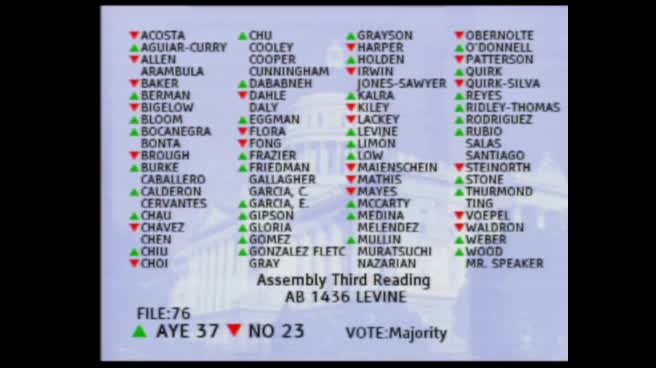 5MIN
Assembly Floor
 13MIN
Assembly Standing Committee on Judiciary


Bill Co-Author(s):