AJR 25: Mexican braceros: settlement.
- Session Year: 2017-2018
- House: Assembly
- Latest Version Date: 2017-09-25
This measure would urge the United States government to urge the Mexican government and the Ministers, the Second Chamber of the Supreme Court in Mexico, whose President is Javier Laynez Potisek, to make a final determination to pay the braceros pursuant to the decision of February 29, 2016, and would urge the United States government to urge the Mexican government to accept a variety of documents to prove that a bracero or his or her heir or beneficiary has a valid claim.
This measure would urge the United States government to urge the Mexican government and the Ministers, the Second Chamber of the Supreme Court in Mexico, whose President is Javier Laynez Potisek, to make a final determination to pay the braceros pursuant to the decision of February 29, 2016, and would urge the United States government to urge the Mexican government to accept a variety of documents to prove that a bracero or his or her heir or beneficiary has a valid claim.
This measure would urge the United States government to urge the Mexican government and the Ministers, the Second Chamber of the Supreme Court in Mexico, whose President is Javier Laynez Potisek, to make a final determination to pay the braceros pursuant to the decision of February 29, 2016, and would urge the United States government to urge the Mexican government to accept a variety of documents to prove that a bracero or his or her heir or beneficiary has a valid claim.
This measure would urge the United States government to urge the Mexican government and the Ministers, the Second Chamber of the Supreme Court in Mexico, whose President is Javier Laynez Potisek, to make a final determination to pay the braceros pursuant to the decision of February 29, 2016, and would urge the United States government to urge the Mexican government to accept a variety of documents to prove that a bracero or his or her heir or beneficiary has a valid claim.
WHEREAS, The Bracero program was a labor importation program initiated by the United States government in 1942 to alleviate the countrys labor shortage during World War II. Over the programs 22-year life, more than 4.5 million Mexican nationals, known as braceros, were legally contracted to work in the United States; and
WHEREAS, Between 1942 and 1946, 10 percent of the braceros wages were deducted from each paycheck and set aside for a savings fund, to be paid to the braceros upon their return to Mexico and to ensure that the braceros would return to their country. Yet, even upon returning most braceros never received the savings that were automatically deducted from their paychecks; and
WHEREAS, For years the braceros have petitioned the Mexican government and, more recently, the Mexican bank, Banrural, to acknowledge the existence of these funds. Farmworker activists estimate the total sum owed to the braceros to be between $150 million and $3 billion, including interest; and
WHEREAS, In 2003, six braceros filed a class action federal lawsuit, on behalf of themselves and other braceros, against the Mexican government. Those six braceros and the Mexican government have now entered into a proposed settlement, which may entitle the braceros to a one-time award of 38,000 pesos each from the Mexican government; and
WHEREAS, The Mexican government has stated that the settlement only applied to braceros who worked from 1942 to 1946, which it said was the period when 10 percent of the braceros wages were deducted. Many braceros claimed the deduction continued after 1946, and many braceros were unable to prove that they were employed during and after 1946. Requirements imposed on the braceros by the Mexican government were very stringent and difficult for braceros to fulfill, including a requirement to provide only original documents or certified (apostilled) copies; and
WHEREAS, The State of California has a unique social and moral responsibility in this matter because many of the braceros worked and resided in California and because many elderly braceros and their heirs or beneficiaries are now residents of this state; and
WHEREAS, After 18 years of organized struggle, on February 29, 2016, 5,400 braceros won a lawsuit against the Mexican government regarding the payment of their saving fund. The Mexican government has not responded to this historical debt. The United States government, as well, has not responded to this abandonment of its former workers; now, therefore, be it
Resolved by the Assembly and the Senate of the State of California, jointly, That the Legislature of the State of California urges the United States government to urge the Mexican government and the Ministers, the Second Chamber of the Supreme Court in Mexico, whose President is Javier Laynez Potisek, to make a final determination to pay the braceros pursuant to the decision of February 29, 2016; and be it further
Resolved, That the Legislature urges the United States government to urge the Mexican government to accept a variety of documents, including, but not limited to, affidavits or copies of original documents, to prove that a bracero or his or her heir or beneficiary has a valid claim; and be it further
Resolved, That the Chief Clerk of the Assembly transmit copies of this resolution to the President and Vice President of the United States, to the Speaker of the House of Representatives, to the Majority Leader of the Senate, to each Senator and Representative from California in the Congress of the United States, to Ambassador of Mexico to the United States Geronimo Gutierrez, and to the Consul General of Mexico in the following cities: Calexico, Fresno, Los Angeles, Sacramento, San Bernardino, San Diego, San Francisco, San Jose, and Santa Ana.
WHEREAS, The Bracero program was a labor importation program initiated by the United States government in 1942 to alleviate the countrys labor shortage during World War II. Over the programs 22-year life, more than 4.5 million Mexican nationals, known as braceros, were legally contracted to work in the United States; and
WHEREAS, Between 1942 and 1946, 10 percent of the braceros wages were deducted from each paycheck and set aside for a savings fund, to be paid to the braceros upon their return to Mexico and to ensure that the braceros would return to their country. Yet, even upon returning most braceros never received the savings that were automatically deducted from their paychecks; and
WHEREAS, For years the braceros have petitioned the Mexican government and, more recently, the Mexican bank, Banrural, to acknowledge the existence of these funds. Farmworker activists estimate the total sum owed to the braceros to be between $150 million and $3 billion, including interest; and
WHEREAS, In 2003, six braceros filed a class action federal lawsuit, on behalf of themselves and other braceros, against the Mexican government. Those six braceros and the Mexican government have now entered into a proposed settlement, which may entitle the braceros to a one-time award of 38,000 pesos each from the Mexican government; and
WHEREAS, The Mexican government has stated that the settlement only applied to braceros who worked from 1942 to 1946, which it said was the period when 10 percent of the braceros wages were deducted. Many braceros claimed the deduction continued after 1946, and many braceros were unable to prove that they were employed during and after 1946. Requirements imposed on the braceros by the Mexican government were very stringent and difficult for braceros to fulfill, including a requirement to provide only original documents or certified (apostilled) copies; and
WHEREAS, The State of California has a unique social and moral responsibility in this matter because many of the braceros worked and resided in California and because many elderly braceros and their heirs or beneficiaries are now residents of this state; and
WHEREAS, After 18 years of organized struggle, on February 29, 2016, 5,400 braceros won a lawsuit against the Mexican government regarding the payment of their saving fund. The Mexican government has not responded to this historical debt. The United States government, as well, has not responded to this abandonment of its former workers; now, therefore, be it
Resolved by the Assembly and the Senate of the State of California, jointly, That the Legislature of the State of California urges the United States government to urge the Mexican government and the Ministers, the Second Chamber of the Supreme Court in Mexico, whose President is Javier Laynez Potisek, to make a final determination to pay the braceros pursuant to the decision of February 29, 2016; and be it further
Resolved, That the Legislature urges the United States government to urge the Mexican government to accept a variety of documents, including, but not limited to, affidavits or copies of original documents, to prove that a bracero or his or her heir or beneficiary has a valid claim; and be it further
Resolved, That the Chief Clerk of the Assembly transmit copies of this resolution to the President and Vice President of the United States Geronimo Gutierrez, States, to the Speaker of the House of Representatives, to the Majority Leader of the Senate, to each Senator and Representative from California in the Congress of the United States, to Ambassador, Ambassador of Mexico to the United States Geronimo Gutierrez, and to the Consul General of Mexico in the following cities: Calexico, Fresno, Los Angeles, Sacramento, San Bernardino, San Diego, San Francisco, San Jose, and Santa Ana.
WHEREAS, The Bracero program was a labor importation program initiated by the United States government in 1942 to alleviate the countrys labor shortage during World War II. Over the programs 22-year life, more than 4.5 million Mexican nationals, known as braceros, were legally contracted to work in the United States; and
WHEREAS, Between 1942 and 1946, 10 percent of the braceros wages were deducted from each paycheck and set aside for a savings fund, to be paid to the braceros upon their return to Mexico and to ensure that the braceros would return to their country. Yet, even upon returning most braceros never received the savings that were automatically deducted from their paychecks; and
WHEREAS, For years the braceros have petitioned the Mexican government and, more recently, the Mexican bank, Banrural, to acknowledge the existence of these funds. Farmworker activists estimate the total sum owed to the braceros to be between $150 million and $3 billion, including interest; and
WHEREAS, In 2003, six braceros filed a class action federal lawsuit, on behalf of themselves and other braceros, against the Mexican government. Those six braceros and the Mexican government have now entered into a proposed settlement, which may entitle the braceros to a one-time award of 38,000 pesos each from the Mexican government; and
WHEREAS, The Mexican government has stated that the settlement only applied to braceros who worked from 1942 to 1946, which it said was the period when 10 percent of the braceros wages were deducted. Many braceros claimed the deduction continued after 1946, and many braceros were unable to prove that they were employed during and after 1946. Requirements imposed on the braceros by the Mexican government were very stringent and difficult for braceros to fulfill, including a requirement to provide only original documents or certified (apostilled) copies; and
WHEREAS, The State of California has a unique social and moral responsibility in this matter because many of the braceros worked and resided in California and because many elderly braceros and their heirs or beneficiaries are now residents of this state; and
WHEREAS, After 18 years of organized struggle, on February 29, 2016, 5,400 braceros won a lawsuit against the Mexican government regarding the payment of their saving fund. The Mexican government has not responded to this historical debt. The United States government, as well, has not responded to this abandonment of its former workers; now, therefore, be it
Resolved by the Assembly and the Senate of the State of California, jointly,That the Legislature of the State of California urges the United States government to urge the Mexican government and the Ministers, the Second Chamber of the Supreme Court in Mexico, whose President is Javier Laynez Potisek, to make a final determination to pay the braceros pursuant to the decision of February 29, 2016; and be it further
Resolved, That the Legislature urges the United States government to urge the Mexican government to accept a variety of documents, including, but not limited to, affidavits or copies of original documents, to prove that a bracero or his or her heir or beneficiary has a valid claim; and be it further
Resolved, That the Chief Clerk of the Assembly transmit copies of this resolution to the President and Vice President of the United States Geronimo Gutierrez, to the Speaker of the House of Representatives, to the Majority Leader of the Senate, to each Senator and Representative from California in the Congress of the United States, to Ambassador, of Mexico to the United States Geronimo Gutierrez, and to the Consul General of Mexico in the following cities: Calexico, Fresno, Los Angeles, Sacramento, San Bernardino, San Diego, San Francisco, San Jose, and Santa Ana.
|
Date
|
Status
|
|---|---|
| Sep 25, 2017 | Chaptered by Secretary of State - Res. Chapter 211, Statutes of 2017. |
| Sep 25, 2017 | Enrolled and filed with the Secretary of State at 3 p.m. |
| Sep 15, 2017 | In Assembly. Ordered to Engrossing and Enrolling. |
| Sep 14, 2017 | Adopted and to Assembly. |
| Sep 12, 2017 | From committee: Ordered to third reading. |
| Sep 11, 2017 | In Senate. To Com. on RLS. |
| Sep 11, 2017 | Adopted and to Senate. |
| Sep 8, 2017 | Amended. Ordered to third reading. |
| Sep 5, 2017 | Assembly Rule 96 suspended. |
| Sep 1, 2017 | Referred to Com. on L. & E. |
| Aug 31, 2017 | From printer. |
| Aug 30, 2017 | Introduced. To print. |
|
Date
|
Description
|
Location
|
Votes
|
|
|---|---|---|---|---|
| Sep 14, 2017 | Assembly 3rd Reading AJR25 Reyes et al. By Hueso | Senate Floor |
Passed |
|
| Sep 11, 2017 | AJR 25 REYES Assembly Third Reading | Assembly Floor |
Passed |
This list shows positions taken on this bill by organizations on the date displayed, which is linked to the original source.
Positions by individuals are not included.
Office of Senate Floor Analyses (916) 651-1520 Fax: (916) 327-4478 | AJR 25 |
THIRD READING
Bill No: AJR 25
Amended: 9/8/17 in Assembly
ASSEMBLY FLOOR: 72-0, 9/11/17 - See last page for vote
SUBJECT: Mexican braceros: settlement
DIGEST:
This resolution urges the United States government to urge the Mexican government and the Ministers, the Second Chamber of the Supreme Court in Mexico, whose President is Javier Laynez Potisek, to make a final determination to pay the braceros pursuant to the decision of February 29, 2016, and urges the United States government to urge the Mexican government to accept a variety of documents to prove that a bracero or his or her heir or beneficiary has a valid claim.
ANALYSIS: This resolution makes the following legislative findings:
- The “Bracero” program was a labor importation program initiated by the United States government in 1942 to alleviate the country’s labor shortage during World War II. Over the program’s 22-year life, more than 4.5 million Mexican nationals, known as braceros, were legally contracted to work in the United States.
- Between 1942 and 1946, 10 percent of the braceros’ wages were deducted from each paycheck and set aside for a “savings fund,” to be paid to the braceros upon their return to Mexico and to ensure that the braceros would return to their country. Yet, even upon returning most braceros never received the savings that were automatically deducted from their paychecks.
- For years the braceros have petitioned the Mexican government and, more recently, the Mexican bank, Banrural, to acknowledge the existence of these funds. Farmworker activists estimate the total sum owed to the braceros to be between $150 million and $3 billion, including interest.
- In 2003, six braceros filed a class action federal lawsuit, on behalf of themselves and other braceros, against the Mexican government. Those six braceros and the Mexican government have now entered into a proposed settlement, which may entitle the braceros to a one-time award of 38,000 pesos each from the Mexican government.
- After 18 years of organized struggle, on February 29, 2016, 5,400 braceros won a lawsuit against the Mexican government regarding the payment of their “saving fund.” The Mexican government has not responded to this historical debt. The United States government, as well, has not responded to this abandonment of its former workers.
This resolution:
- Urges the United States government to urge the Mexican government and the Ministers, the Second Chamber of the Supreme Court in Mexico, whose President is Javier Laynez Potisek, to make a final determination to pay the braceros pursuant to the decision of February 29, 2016.
- Urges the United States government to urge the Mexican government to accept a variety of documents, including, but not limited to, affidavits or copies of original documents, to prove that a bracero or his or her heir or beneficiary has a valid claim.
FISCAL EFFECT: Appropriation: No Fiscal Com.: No Local: No
None received
OPPOSITION: (Verified 9/12/17)
None received
ASSEMBLY FLOOR: 72-0, 9/11/17
AYES: Acosta, Aguiar-Curry, Travis Allen, Arambula, Baker, Berman, Bigelow, Bloom, Bocanegra, Bonta, Brough, Burke, Caballero, Calderon, Cervantes, Chau, Chávez, Chen, Chiu, Chu, Cooley, Cooper, Cunningham, Dababneh, Dahle, Daly, Eggman, Flora, Frazier, Friedman, Gallagher, Cristina Garcia, Eduardo Garcia, Gipson, Gonzalez Fletcher, Gray, Grayson, Holden, Irwin, Jones-Sawyer, Kalra, Lackey, Levine, Limón, Low, Maienschein, Mathis, Mayes, McCarty, Medina, Mullin, Muratsuchi, Nazarian, Obernolte, O'Donnell, Patterson, Quirk, Quirk-Silva, Reyes, Rodriguez, Rubio, Salas, Santiago, Steinorth, Mark Stone, Thurmond, Ting, Voepel, Waldron, Weber, Wood, Rendon
NO VOTE RECORDED: Choi, Fong, Gloria, Harper, Kiley, Melendez, Ridley-Thomas
Prepared by: Karen Chow / SFA / (916) 651-1520
9/12/17 21:21:31
**** END ****
ASSEMBLY THIRD READING
ATR Bill Id:AJR 25
Author:(Reyes)
As Amended Ver:September 8, 2017
Majority vote
SUMMARY: Urges the United States government to urge the Mexican government and the Ministers, the Second Chamber of the Supreme Court in Mexico, whose President is Javier Laynez Potisek, to make a final determination to pay the braceros pursuant to the decision of February 29, 2016, and urges the United States government to urge the Mexican government to accept a variety of documents to prove that a bracero or his or her heir or beneficiary has a valid claim. Specifically, this resolution makes the following legislative findings and declarations:
- The "Bracero" program was a labor importation program initiated by the United States government in 1942 to alleviate the country's labor shortage during World War II. Over the program's 22-year life, more than 4.5 million Mexican nationals, known as braceros, were legally contracted to work in the United States.
- Between 1942 and 1946, 10% of the braceros' wages were deducted from each paycheck and set aside for a "savings fund," to be paid to the braceros upon their return to Mexico and to ensure that the braceros would return to their country. Yet, even upon returning most braceros never received the savings that were automatically deducted from their paychecks.
- For years the braceros have petitioned the Mexican government and, more recently, the Mexican bank, Banrural, to acknowledge the existence of these funds. Farmworker activists estimate the total sum owed to the braceros to be between $150 million and $3 billion, including interest.
- In 2003, six braceros filed a class action federal lawsuit, on behalf of themselves and other braceros, against the Mexican government. Those six braceros and the Mexican government have now entered into a proposed settlement, which may entitle the braceros to a one-time award of 38,000 pesos each from the Mexican government.
- The Mexican government has stated that the settlement only applied to braceros who worked from 1942 to 1946, which it said was the period when ten percent of the braceros' wages were deducted. Many braceros claimed the deduction continued after 1946, and many braceros were unable to prove that they were employed during and after 1946. Requirements imposed on the braceros by the Mexican government were very stringent and difficult for braceros to fulfill, including a requirement to provide only original documents or certified (apostilled) copies.
- The State of California has a unique social and moral responsibility in this matter because many of the braceros worked and resided in California and because many elderly braceros and their heirs or beneficiaries are now residents of this state.
- After 18 years of organized struggle, on February 29, 2016, 5,400 braceros won a lawsuit against the Mexican government regarding the payment of their "saving fund." The Mexican government has not responded to this historical debt. The United States government, as well, has not responded to this abandonment of its former workers.
FISCAL EFFECT: None
COMMENTS: According to the author's office, in 1942 the United States signed the Bracero Treaty which reopened the floodgates for legal immigration of Mexican laborers. Between the period of 1942 and 1964, millions of Mexicans were imported into the United States as braceros under the Bracero Treaty (Treaty) to work temporarily on contract to United States growers and ranchers.
Under the Treaty, 10% of the bracero's wages were deducted from each paycheck and set aside for a savings fund, allegedly to be reimbursed to them upon return to Mexico. Most braceros never received the savings upon return that were automatically deducted from their paychecks. For years the braceros petitioned the Mexican government and more recently the Mexican bank, Banrural, to acknowledge the existence of these funds. Farm-workers activists estimate the sum to be between $150 million and $3 billion, including interest.
In 2003 some braceros filed a class action federal lawsuit on behalf of themselves and other braceros against the Mexican government. Those braceros and the Mexican government have now entered into a propose settlement, which may entitle the braceros to a one-time award of 38,000 pesos or $3500 United States currency from the Mexican government if they filed by the required January 2009 deadlines. Now the deadlines have expired and many ex-braceros or their relatives were not aware of this and some still struggle trying to find 40-year old original documents required proving they are entitled to the award.
Analysis Prepared by: Lorie Alvarez / L. & E. / (916) 319-2091 FN: 0002180
ASSEMBLY THIRD READING
ATR Bill Id:AJR 25
Author:(Reyes)
As Introduced Ver:August 30, 2017
Majority vote
SUMMARY: Urges the United States government to urge the Mexican government and the Ministers, the Second Chamber of the Supreme Court in Mexico, whose President is Javier Laynez Potisek, to make a final determination to pay the braceros pursuant to the decision of February 29, 2016, and urges the United States government to urge the Mexican government to accept a variety of documents to prove that a bracero or his or her heir or beneficiary has a valid claim. Specifically, this resolution makes the following legislative findings and declarations:
- The "Bracero" program was a labor importation program initiated by the United States government in 1942 to alleviate the country's labor shortage during World War II. Over the program's 22-year life, more than 4.5 million Mexican nationals, known as braceros, were legally contracted to work in the United States.
- Between 1942 and 1946, 10% of the braceros' wages were deducted from each paycheck and set aside for a "savings fund," to be paid to the braceros upon their return to Mexico and to ensure that the braceros would return to their country. Yet, even upon returning most braceros never received the savings that were automatically deducted from their paychecks.
- For years the braceros have petitioned the Mexican government and, more recently, the Mexican bank, Banrural, to acknowledge the existence of these funds. Farmworker activists estimate the total sum owed to the braceros to be between $150 million and $3 billion, including interest.
- In 2003, six braceros filed a class action federal lawsuit, on behalf of themselves and other braceros, against the Mexican government. Those six braceros and the Mexican government have now entered into a proposed settlement, which may entitle the braceros to a one-time award of 38,000 pesos each from the Mexican government.
- The Mexican government has stated that the settlement only applied to braceros who worked from 1942 to 1946, which it said was the period when ten percent of the braceros' wages were deducted. Many braceros claimed the deduction continued after 1946, and many braceros were unable to prove that they were employed during and after 1946. Requirements imposed on the braceros by the Mexican government were very stringent and difficult for braceros to fulfill, including a requirement to provide only original documents or certified (apostilled) copies.
- The State of California has a unique social and moral responsibility in this matter because many of the braceros worked and resided in California and because many elderly braceros and their heirs or beneficiaries are now residents of this state.
- After 18 years of organized struggle, on February 29, 2016, 5,400 braceros won a lawsuit against the Mexican government regarding the payment of their "saving fund." The Mexican government has not responded to this historical debt. The United States government, as well, has not responded to this abandonment of its former workers.
FISCAL EFFECT: None
COMMENTS: According to the author's office, in 1942 the United States (U.S.) signed the Bracero Treaty which reopened the floodgates for legal immigration of Mexican laborers. Between the period of 1942 and 1964, millions of Mexicans were imported into the U.S. as braceros under the Bracero Treaty (Treaty) to work temporarily on contract to U.S. growers and ranchers.
Under the Treaty, ten percent of the bracero's wages were deducted from each paycheck and set aside for a savings fund, allegedly to be reimbursed to them upon return to Mexico. Most braceros never received the savings upon return that were automatically deducted from their paychecks. For years the braceros petitioned the Mexican government and more recently the Mexican bank, Banrural, to acknowledge the existence of these funds. Farm-workers activists estimate the sum to be between $150 million and $3 billion, including interest.
In 2003 some braceros filed a class action federal lawsuit on behalf of themselves and other braceros against the Mexican government. Those braceros and the Mexican government have now entered into a propose settlement, which may entitle the braceros to a one-time award of 38,000 pesos or $3500 U.S. currency from the Mexican government if they filed by the required January 2009 deadlines. Now the deadlines have expired and many ex-braceros or their relatives were not aware of this and some still struggle trying to find 40-year old original documents required proving they are entitled to the award.
Analysis Prepared by: Lorie Alvarez / L. & E. / (916) 319-2091 FN: 0001779
Discussed in Hearing
View Older Hearings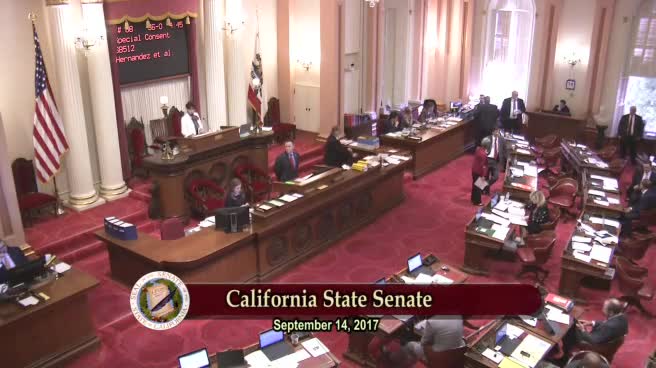
Bill Author

Bill Co-Author(s):
