AJR 34: Agricultural workers: labor shortages.
- Session Year: 2017-2018
- House: Assembly
- Latest Version Date: 2018-08-28
This measure would urge the Congress of the United States to acknowledge the problem of a labor shortage in the agricultural industry in California and to work together with California to solve the issue.
This measure would urge the Congress of the United States to acknowledge the problem of a labor shortage in the agricultural industry in California and to work together with California to solve the issue.
This measure would urge the President and the Congress of the United States to acknowledge the problem of a labor shortage in the agricultural industry in California and to work together with California to solve the issue.
This measure would urge the President and the Congress of the United States to acknowledge the problem of a labor shortage in the agricultural industry in California and to work together with California to solve the issue.
WHEREAS, With a population of 39 million people, California represents one-eighth of the population of the United States and one-seventh of the nations gross domestic product; and
WHEREAS, In 2016, the Bureau of Economic Analysis placed California as the sixth largest economy in the world, rivaling the United Kingdom as number five, with the states economic output for 2015 estimated at $2.46 trillion; and
WHEREAS, The $2.46 trillion number puts Californias output above that of France, which generated an estimated $2.422 trillion. Only the United States as a whole, China, Japan, Germany, and the United Kingdom have a higher gross domestic product than California; and
WHEREAS, On a global scale, Californias economy ranks between fifth and ninth in the world, ahead of such countries as Canada, Mexico, Germany, and Spain. According to a study by University of California, Davis, every dollar of value addedlabor and property income and indirect business taxesin farming and agricultural related industries generates an additional $1.27 in the state economy. For every 100 jobs in agriculture, there are 94 additional jobs created throughout the state; and
WHEREAS, Fourteen percent of the United States economy is generated and originates in California, while the Golden State also accounts for 15 percent of the nations total agricultural exports and has been named the nations top agricultural producing state for the last five decades; and
WHEREAS, California agriculture produces 12.5 percent of the total agricultural production for all 50 states, which was $19 billion greater than the second largest state, Iowa, and more than twice the amount of the state with the third largest production, Texas; and
WHEREAS, Californias agricultural industry contributed $47.1 billion to the states economy in 2015, and $100 billion when the economic impact in shipping and warehousing sectors are included; and
WHEREAS, More than 77,000 farms and ranches in California produce more than 400 animal and plant commodities annually, significantly more than any other state in the nation, with the top 10 commodities being milk and cream, grapes, cattle and calves, lettuce, strawberries, pistachios, tomatoes, walnuts, and broilers; and
WHEREAS, In the past decade farming costs have increased an estimated 88 percent, due in part to new and expanding state and federal laws and regulations. Meanwhile, food produced by foreign nations is being imported at an accelerated pace, and at far lower costs. In todays global market, California farmers cannot simply pass on their costs to consumers. The high costs of doing business in the state has resulted in consolidation of land and a reduction in total farmed acreage, which is detrimental to the states economy; and
WHEREAS, California agricultural provides two-thirds of the nations nuts and fruits and over a third of its vegetables. In 2016, California recorded 2.18 million tons of oranges, an increase of 12 percent from 2015, and 2.05 billion pounds of almonds, an increase of 8 percent from 2015; and
WHEREAS, In 2016, the agricultural industry in California employed an annual average of 421,100 people, with the agricultural value chain accounting for more than three million jobs in California; and
WHEREAS, California is in the top 10 of the worlds most productive agricultural producing countries, ahead of Canada, Mexico, Germany, and Spain; and
WHEREAS, The top 10 international destinations for California agricultural exports are the European Union, Canada, China and Hong Kong, Japan, Mexico, Korea, India, the United Arab Emirates, Turkey, and Vietnam. This reflects the range of the worldwide importance of California agriculture; and
WHEREAS, In 2015, University of California, Davis academics estimated that the lack of water availability had caused California agriculture to experience approximately $1.84 billion in economic losses and 10,000 seasonal jobs, even though the agriculture sector added jobs in 2015; and
WHEREAS, Due to water shortages and drought conditions, California farmers have had to demonstrate resiliency by moving crops within the state where water is more accessible and have depended on groundwater supplies; and
WHEREAS, In 2015, 77,500 farms operated in California on approximately 25.5 million acres; and
WHEREAS, Nearly 27 percent of California farms generated commodity sales of over $100,000, which was 20 percent greater than the national average; and
WHEREAS, The top agriculture producing counties in California are Tulare ($6.9 billion), Kern ($6.8 billion), Fresno ($6.6 billion), Monterey ($4.8 billion), Stanislaus ($3.8 billion), San Joaquin ($2.7 billion), Ventura ($2.1 billion), Kings ($2.0 billion), and Madera ($2.0 billion); and
WHEREAS, California has some of the most productive farm land in the world and has historically led the nation in crop receipts. In 2015, United States crop receipts were $379.1 billion, with California accounting for $47 billion of that total; and
WHEREAS, In 2014, the total number of farmworkers employed in agriculture in California was 839,300; and
WHEREAS, The production of many fruits and vegetables is relatively labor intensive, with labor costs representing 20 to 40 percent of production costs; and
WHEREAS, Most California farmworkers were born in Mexico and 60 percent of crop workers employed on the states farms are undocumented; and
WHEREAS, Several factors, including a tightening of border controls, has slowed arrivals of new farmworkers, resulting in labor shortages and higher production costs for farmers; and
WHEREAS, The number of farmworkers employed on California farms is of great interest because fears of farm labor shortages could reduce the production of labor-intensive crops and reduce the overall production of Californias crop receipts; and
WHEREAS, California agriculture has also been hit hard by the labor shortage. California farmers have also had to address the reality that the workers born in the United States will not comprise the workforce that the agricultural industry requires for the present and future. California farmers are working to retain their current workforce, allow the use of mechanical aids to increase productivity, substitute machines for workers where possible, and supplement current workers with H-2A workers. Many in agriculture recognize that this path is precarious and carries high risks and costs; and
WHEREAS, California agriculture is indispensable to Californias economy and to the states and nations food security. It is a vital supplier of food to many parts of the world and fills many voids for the worlds populations. The challenges of having sufficient water supplies and a competent and sufficient labor force require immediate attention. State and federal legislators must work with all elements in the agriculture industry in California to find sound policy solutions; now, therefore, be it
Resolved by the Assembly and the Senate of the State of California, jointly, That the Legislature urges the Congress of the United States to acknowledge that the problem of labor shortages in the California agricultural industry is a structural economic problem and that after many years of recruiting and increasing wages American-born workers have not demonstrated the desire to fill the growing void and are not a viable replacement for the current workforce that includes unauthorized workers who have worked in agriculture over the last 40 years; and be it further
Resolved, That states should have the role of declaring a labor shortage crisis, have processes in place to address the shortage, and request assistance from the federal government to bring about corrective and responsive action and policies. This follows the example of how states declare disaster areas which trigger emergency federal relief assistance; and be it further
Resolved, That these labor shortages in Californias agricultural industry pose a danger to the security of the nations food supply; and be it further
Resolved, That the Legislature urges the Congress of the United States to work together with California to solve this issue before it becomes a crisis; and be it further
Resolved, That the Chief Clerk of the Assembly transmit copies of this resolution to the President and Vice President of the United States, to the Speaker of the House of Representatives, and to each Senator and Representative from California in the Congress of the United States.
WHEREAS, With a population of 39 million people, California represents one-eighth of the population of the United States and one-seventh of the nations gross domestic product; and
WHEREAS, In 2016, the Bureau of Economic Analysis placed California as the sixth largest economy in the world, rivaling the United Kingdom as number five, with the states economic output for 2015 estimated at $2.46 trillion; and
WHEREAS, The $2.46 trillion number puts Californias output above that of France, which generated an estimated $2.422 trillion. Only the United States as a whole, China, Japan, Germany, and the United Kingdom have a higher gross domestic product than California; and
WHEREAS, On a global scale, Californias economy ranks between fifth and ninth in the world, ahead of such countries as Canada, Mexico, Germany, and Spain. According to a study by University of California, Davis, every dollar of value addedlabor and property income and indirect business taxesin farming and agricultural related industries generates an additional $1.27 in the state economy. For every 100 jobs in agriculture, there are 94 additional jobs created throughout the state; and
WHEREAS, Fourteen percent of the United States economy is generated and originates in California, while the Golden State also accounts for 15 percent of the nations total agricultural exports and has been named the nations top agricultural producing state for the last five decades; and
WHEREAS, California agriculture produces 12.5 percent of the total agricultural production for all 50 states, which was $19 billion greater than the second largest state, Iowa, and more than twice the amount of the state with the third largest production, Texas; and
WHEREAS, Californias agricultural industry contributed $47.1 billion to the states economy in 2015, and $100 billion when the economic impact in shipping and warehousing sectors are included; and
WHEREAS, More than 77,000 farms and ranches in California produce more than 400 animal and plant commodities annually, significantly more than any other state in the nation, with the top 10 commodities being milk and cream, grapes, cattle and calves, lettuce, strawberries, pistachios, tomatoes, walnuts, and broilers; and
WHEREAS, In the past decade farming costs have increased an estimated 88 percent, due in part to new and expanding state and federal laws and regulations. Meanwhile, food produced by foreign nations is being imported at an accelerated pace, and at far lower costs. In todays global market, California farmers cannot simply pass on their costs to consumers. The high costs of doing business in the state has resulted in consolidation of land and a reduction in total farmed acreage, which is detrimental to the states economy; and
WHEREAS, California agricultural provides two-thirds of the nations nuts and fruits and over a third of its vegetables. In 2016, California recorded 2.18 million tons of oranges, an increase of 12 percent from 2015, and 2.05 billion pounds of almonds, an increase of 8 percent from 2015; and
WHEREAS, In 2016, the agricultural industry in California employed an annual average of 421,100 people, with the agricultural value chain accounting for more than three million jobs in California; and
WHEREAS, California is in the top 10 of the worlds most productive agricultural producing countries, ahead of Canada, Mexico, Germany, and Spain; and
WHEREAS, The top 10 international destinations for California agricultural exports are the European Union, Canada, China and Hong Kong, Japan, Mexico, Korea, India, the United Arab Emirates, Turkey, and Vietnam. This reflects the range of the worldwide importance of California agriculture; and
WHEREAS, In 2015, University of California, Davis academics estimated that the lack of water availability had caused California agriculture to experience approximately $1.84 billion in economic losses and 10,000 seasonal jobs, even though the agriculture sector added jobs in 2015; and
WHEREAS, Due to water shortages and drought conditions, California farmers have had to demonstrate resiliency by moving crops within the state where water is more accessible and have depended on groundwater supplies; and
WHEREAS, In 2015, 77,500 farms operated in California on approximately 25.5 million acres; and
WHEREAS, Nearly 27 percent of California farms generated commodity sales of over $100,000, which was 20 percent greater than the national average; and
WHEREAS, The top agriculture producing counties in California are Tulare ($6.9 billion), Kern ($6.8 billion), Fresno ($6.6 billion), Monterey ($4.8 billion), Stanislaus ($3.8 billion), San Joaquin ($2.7 billion), Ventura ($2.1 billion), Kings ($2.0 billion), and Madera ($2.0 billion); and
WHEREAS, California has some of the most productive farm land in the world and has historically led the nation in crop receipts. In 2015, United States crop receipts were $379.1 billion, with California accounting for $47 billion of that total; and
WHEREAS, In 2014, the total number of farmworkers employed in agriculture in California was 839,300; and
WHEREAS, The production of many fruits and vegetables is relatively labor intensive, with labor costs representing 20 to 40 percent of production costs; and
WHEREAS, Most California farmworkers were born in Mexico and 60 percent of crop workers employed on the states farms are undocumented; and
WHEREAS, Several factors, including a tightening of border controls, has slowed arrivals of new farmworkers, resulting in labor shortages and higher production costs for farmers; and
WHEREAS, The number of farmworkers employed on California farms is of great interest because fears of farm labor shortages could reduce the production of labor-intensive crops and reduce the overall production of Californias crop receipts; and
WHEREAS, California agriculture has also been hit hard by the labor shortage. California farmers have also had to address the reality that the workers born in the United States will not comprise the workforce that the agricultural industry requires for the present and future. California farmers are working to retain their current workforce, allow the use of mechanical aids to increase productivity, substitute machines for workers where possible, and supplement current workers with H-2A workers. Many in agriculture recognize that this path is precarious and carries high risks and costs; and
WHEREAS, California agriculture is indispensable to Californias economy and to the states and nations food security. It is a vital supplier of food to many parts of the world and fills many voids for the worlds populations. The challenges of having sufficient water supplies and a competent and sufficient labor force require immediate attention. State and federal legislators must work with all elements in the agriculture industry in California to find sound policy solutions; now, therefore, be it
Resolved by the Assembly and the Senate of the State of California, jointly, That the Legislature urges the President and the Congress of the United States to acknowledge that the problem of labor shortages in the California agricultural industry is a structural economic problem and that after many years of recruiting and increasing wages American-born workers have not demonstrated the desire to fill the growing void and are not a viable replacement for the current workforce that includes unauthorized workers who have worked in agriculture over the last 40 years; and be it further
Resolved, That states should have the role of declaring a labor shortage crisis, have processes in place to address the shortage, and request assistance from the federal government to bring about corrective and responsive action and policies. This follows the example of how states declare disaster areas which trigger emergency federal relief assistance; and be it further
Resolved, That these labor shortages in Californias agricultural industry pose a danger to the security of the nations food supply; and be it further
Resolved, That the Legislature urges the President and the Congress of the United States to work together with California to solve this issue before it becomes a crisis; and be it further
Resolved, That the Chief Clerk of the Assembly transmit copies of this resolution to the President and Vice President of the United States, to the Speaker of the House of Representatives, and to each Senator and Representative from California in the Congress of the United States.
|
Date
|
Status
|
|---|---|
| Aug 28, 2018 | Chaptered by Secretary of State - Res. Chapter 172, Statutes of 2018. |
| Aug 28, 2018 | Enrolled and filed with the Secretary of State at 2 p.m. |
| Aug 23, 2018 | In Assembly. Ordered to Engrossing and Enrolling. |
| Aug 8, 2018 | From committee: Be adopted. Ordered to Third Reading. (Ayes 3. Noes 0.) (August 8). |
| Jul 3, 2018 | Re-referred to Com. on L. & I.R. |
| Jun 26, 2018 | In Senate. To Com. on RLS. |
| Jun 25, 2018 | Coauthors revised. |
| Jun 21, 2018 | From committee: Be adopted. Ordered to Third Reading. (Ayes 4. Noes 0.) (June 20). |
| Apr 26, 2018 | In committee: Hearing cancelled at the request of author. |
| Apr 25, 2018 | Re-referred to Com. on L. & E. |
| Apr 24, 2018 | From committee chair, with author's amendments: Amend, and re-refer to Com. on L. & E. Amended. |
| Apr 23, 2018 | In committee: Hearing postponed by committee. |
| Apr 10, 2018 | In committee: Hearing postponed by committee. |
| Mar 15, 2018 | Referred to Com. on L. & E. |
| Mar 2, 2018 | From printer. |
| Mar 1, 2018 | Introduced. To print. |
|
Date
|
Description
|
Location
|
Votes
|
|
|---|---|---|---|---|
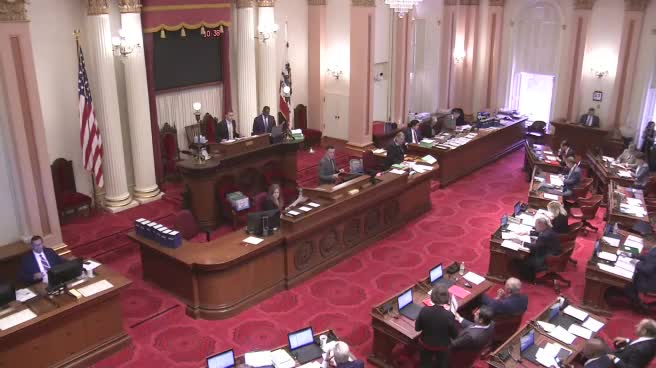
| Aug 23, 2018 | Assembly 3rd Reading AJR34 Eduardo Garcia et al. By Cannella | Senate Floor |
Passed |
|
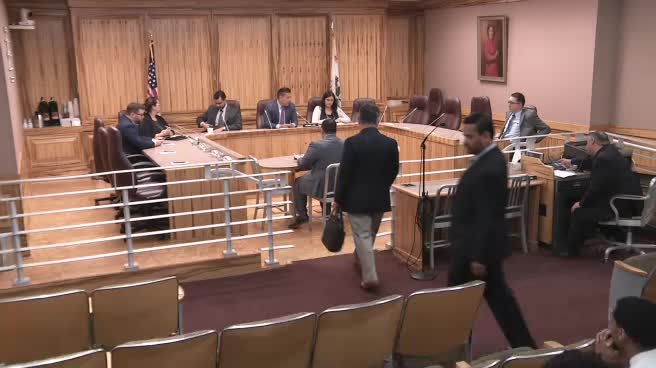
| Aug 8, 2018 | Be adopted. Ordered to third reading | Senate Standing Committee on Labor and Industrial Relations |
Passed |
|
| Jun 25, 2018 | AJR 34 GARCIA, E. Assembly Third Reading | Assembly Floor |
Passed |
|
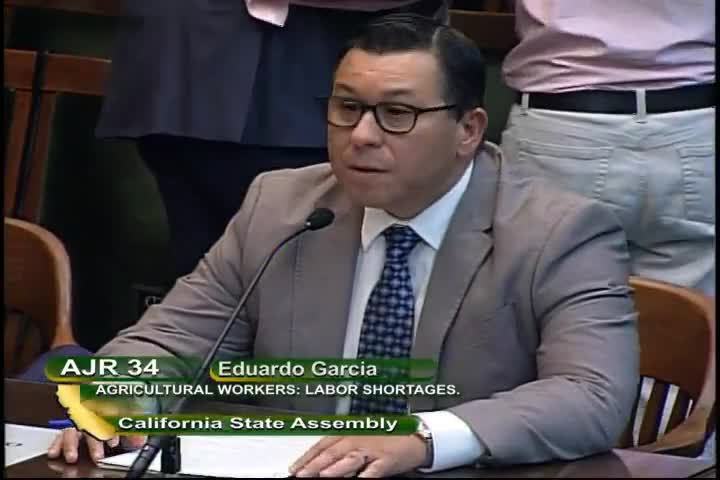
| Jun 20, 2018 | Be adopted. To third reading. | Assembly Standing Committee on Labor and Employment |
Passed |
This list shows positions taken on this bill by organizations on the date displayed, which is linked to the original source.
Positions by individuals are not included.
|
Organization
|
Position
|
Date
|
|---|---|---|
| Clinicas Valles Salinas | * Support | Jun 20, 2018 |
Office of Senate Floor Analyses (916) 651-1520 Fax: (916) 327-4478 | AJR |
THIRD READING
Bill No: AJR 34
:
SENATE LABOR & IND. REL. COMMITTEE: 3-0, 8/8/18
AYES: Lara, Jackson, Mitchell
NO VOTE RECORDED: Stone, Wieckowski
ASSEMBLY FLOOR: 60-0, 6/25/18 - See last page for vote
DIGEST:
This resolution calls on Congress to acknowledge the existence of and assist in finding a solution to the labor shortage in California’s agricultural sector.
Existing law:
- Makes it illegal for a person or other entity to “knowingly” hire, recruit, or refer for employment an unauthorized individual or any individual without complying with specified employment verification procedures.
- Requires employers to verify that every new hire is either a U.S. citizen or authorized to work in the United States by completing form I-9, Employment Eligibility Verification, upon hire and submitting necessary documentation for verification. Additionally, the E-Verify Program (of the U.S. Department of Homeland Security) is an internet-based system operated by the United States Citizenship and Immigration Services in partnership with the Social Security Administration which enables participating employers to, on a voluntary basis, verify that the employees they hire are authorized to work in the United States.
- Requires that all protections, rights, and remedies available under state law, except any reinstatement remedy prohibited by federal law, are available to all individuals regardless of immigration status who have applied for employment, or who are or have been employed in the state. (Labor Code §1019 and §1171.5; Civic Code §3339; Health and Safety Code §24000; Government Code §7285)
- Establishes that federal law preempts state law with regards to regulating immigration.
This resolution:
- Urges the Congress of the United States to acknowledge the problem of labor shortages in California’s agricultural industry.
- Finds and declares that after many years of recruiting and increasing wages American-born workers have not demonstrated the desire to fill labor vacancies and are not a viable replacement for the current workforce that includes unauthorized workers.
- Calls for states to have a role in declaring a labor shortage crisis and for the federal government to establish processes to address the shortage.
- Requests assistance from the federal government to bring about corrective and responsive action and policies.
Comments
Need for this resolution? The agriculture industry in California employs more than 829,300 farmworkers, according to a 2016 University of California, Davis study with the California Employment Development Department. The California Department of Food and Agriculture estimates California's agricultural output includes more than 400 commodities, including over one-third of the country’s vegetables and two-thirds of the country’s fruits and nuts. According to the National Agricultural Survey, over 60% of workers employed in this sector are unauthorized and various sources estimate that the number of undocumented workers may exceed 75%. If those unauthorized workers were to be deported it could result in a nation-wide food shortage and jeopardize California’s long-term economic health. Especially given the decrease of immigration, both legal and illegal, from Mexico and other South American countries in recent years, the problem of farm labor shortages will only worsen as time goes on. Employers in the agriculture sector are increasingly put in a position where, despite offering wages above minimum wage, American-born workers are uninterested in filling vacancies. The reasons for this are varied and often hotly debated, but the fact remains that by current estimates less than 40% of the agriculture sector workers are American-born and, in reality, the number could be much lower than this. The renewed focus by the Trump Administration on immigration will almost certainly result in a reduction in the amount of laborers that California has routinely relied on to provide the rest of the United States and the world with a wide variety of fruits, vegetables and other agricultural products. While this resolution will not by itself change any laws, calling attention to the problem could potentially be the first step in mustering the resources for a true legislative solution at the state or federal level.
Related/Prior Legislation
AB 20 (Alejo, 2015), held in the Assembly Appropriations Committee, would have required the Labor and Workforce Development Agency and the Department of Food and Agriculture to convene a working group to consult with the United States Department of Homeland Security and the United States Department of Justice with the goal of implementing a program to provide undocumented persons who are agricultural employees with a permit to work and live in California.
FISCAL EFFECT: Appropriation: No Fiscal Com.: Local: No
None received
None received
ARGUMENTS IN SUPPORT: According to the author, “With regards to immigration, the indecisiveness of the Federal Government has lasted for decades and California needs to stand up for our unauthorized workers in the agriculture industry. Unauthorized workers make up 60% to 75% of the agriculture labor force. If those unauthorized workers were to be deported it could result in a nation-wide food shortage.”
ASSEMBLY FLOOR: 60-0, 6/25/18
AYES: Acosta, Aguiar-Curry, Arambula, Baker, Berman, Bloom, Bonta, Burke, Caballero, Calderon, Carrillo, Chau, Chávez, Chiu, Chu, Cooley, Cooper, Cunningham, Daly, Eggman, Frazier, Friedman, Gabriel, Gallagher, Cristina Garcia, Eduardo Garcia, Gipson, Gloria, Gray, Grayson, Holden, Irwin, Jones-Sawyer, Kalra, Lackey, Levine, Limón, Low, Maienschein, Mathis, McCarty, Mullin, Muratsuchi, Nazarian, O'Donnell, Quirk, Quirk-Silva, Reyes, Rivas, Rodriguez, Rubio, Salas, Santiago, Mark Stone, Thurmond, Ting, Waldron, Weber, Wood, Rendon
NO VOTE RECORDED: Travis Allen, Bigelow, Brough, Cervantes, Chen, Choi, Dahle, Flora, Fong, Gonzalez Fletcher, Harper, Kamlager-Dove, Kiley, Mayes, Medina, Melendez, Obernolte, Patterson, Steinorth, Voepel
8/8/18 16:29:47
**** END ****
SENATE COMMITTEE ON LABOR AND INDUSTRIAL RELATIONS
Senator Ricardo Lara, Chair
2017 - 2018 Regular
Bill No: AJR 34 Hearing Date: August 8, 2018
Author: | Eduardo Garcia | ||
Version: | April 24, 2018 | ||
Urgency: |
| Fiscal: | No |
Consultant: | Jake Ferrera | ||
Subject: Agricultural workers: labor shortages
KEY ISSUE
Should the Legislature call on Congress to acknowledge the existence of and assist in finding a solution to the labor shortage in California’s agricultural sector?
ANALYSIS
Existing law
- Makes it illegal for a person or other entity to “knowingly” hire, recruit, or refer for employment an unauthorized individual or any individual without complying with specified employment verification procedures.
- Requires employers to verify that every new hire is either a U.S. citizen or authorized to work in the United States by completing form I-9, Employment Eligibility Verification, upon hire and submitting necessary documentation for verification. Additionally, the E-Verify Program (of the U.S. Department of Homeland Security) is an internet-based system operated by the USCIS in partnership with the SSA which enables participating employers to, on a voluntary basis, verify that the employees they hire are authorized to work in the United States.
- Requires that all protections, rights, and remedies available under state law, except any reinstatement remedy prohibited by federal law, are available to all individuals regardless of immigration status who have applied for employment, or who are or have been employed in the state. (Labor Code §1019 and §1171.5; Civic Code §3339; Health and Safety Code §24000; Government Code §7285)
- Establishes that federal law preempts state law with regards to regulating immigration.
This Bill
- Urges the Congress of the United States to acknowledge the problem of labor shortages in California’s agricultural industry.
- Finds and declares that after many years of recruiting and increasing wages American-born workers have not demonstrated the desire to fill labor vacancies and are not a viable replacement for the current workforce that includes unauthorized workers.
- Calls for states to have a role in declaring a labor shortage crisis and for the federal government to establish processes to address the shortage.
- Requests assistance from the federal government to bring about corrective and responsive action and policies.
COMMENTS
1. Need for this bill?
The Agriculture industry in California employs more than 829,300 farmworkers, according to a 2016 UC Davis study with the California Employment Development Department. The California Department of Food and Agriculture estimates California's agricultural output includes more than 400 commodities, including over one-third of the country’s vegetables and two-thirds of the country’s fruits and nuts. According to the National Agricultural Survey, over 60% of workers employed in this sector are unauthorized and various sources estimate that the number of undocumented workers may exceed 75%. If those unauthorized workers were to be deported it could result in a nation-wide food shortage and jeopardize California’s long-term economic health.
Especially given the decrease of immigration, both legal and illegal, from Mexico and other South American countries in recent years, the problem of farm labor shortages will only worsen as time goes on. Employers in the agriculture sector are increasingly put in a position where, despite offering wages above minimum wage, American-born workers are uninterested in filling vacancies. The reasons for this are varied and often hotly debated, but the fact remains that by current estimates less than 40% of the agriculture sector workers are American-born and, in reality, the number could be much lower than this. The renewed focus by the Trump Administration on immigration will almost certainly result in a reduction in the amount of laborers that California has routinely relied on to provide the rest of the United States and the world with a wide variety of fruits, vegetables and other agricultural products. While this resolution will not by itself change any laws, calling attention to the problem could potentially be the first step in mustering the resources for a true legislative solution at the state or federal level.
2. Proponent Arguments:
According to the Author:
“With regards to immigration, the indecisiveness of the Federal Government has lasted for decades and California needs to stand up for our unauthorized workers in the agriculture industry. Unauthorized workers make up 60% to 75% of the agriculture labor force. If those unauthorized workers were to be deported it could result in a nation-wide food shortage.”
3. Opponent Arguments:
None on file.
4. Prior Legislation:
AB 20 (Alejo) Held in Assembly Appropriations would have required the Labor and Workforce Development Agency and the Department of Food and Agriculture to convene a working group to consult with the United States Department of Homeland Security and the United States Department of Justice with the goal of implementing a program to provide undocumented persons who are agricultural employees with a permit to work and live in California.
SUPPORT
None on file.
OPPOSITION
None on file.
-- END --
ASSEMBLY THIRD READING
ATR Bill Id:AJR 34
Author:(Eduardo Garcia and Caballero)
As Amended Ver:April 24, 2018
Majority
Committee | Votes | Ayes | Noes |
Labor | 4-0 | Thurmond, Jones-Sawyer, Kalra, Rivas |
SUMMARY: Urges Congress to acknowledge the problem of a labor shortage in the agricultural industry in California and to work together with California to solve the issue. Specifically, this resolution makes the following legislative findings and declarations:
- Fourteen percent of the United States' economy is generated and originates in California, while the Golden State also accounts for 15% of the nation's total agricultural exports and has been named the nation's top agricultural producing state for the last five decades.
- California agriculture produces 12.5% of the total agricultural production for all 50 states, which was $19 billion greater than the second largest state, Iowa, and more than twice the amount of the state with the third largest production, Texas.
- California's agricultural industry contributed $47.1 billion to the state's economy in 2015, and $100 billion when the economic impact in shipping and warehousing sectors are included.
- More than 77,000 farms and ranches in California produce more than 400 animal and plant commodities annually, significantly more than any other state in the nation, with the top 10 commodities being milk and cream, grapes, cattle and calves, lettuce, strawberries, pistachios, tomatoes, walnuts, and broilers.
- In the past decade farming costs have increased an estimated 88%, due in part to new and expanding state and federal laws and regulations. Meanwhile, food produced by foreign nations is being imported at an accelerated pace, and at far lower costs. In today's global market, California farmers cannot simply pass on their costs to consumers. The high costs of doing business in the state has resulted in consolidation of land and a reduction in total farmed acreage, which is detrimental to the state's economy.
- California agricultural [sic] provides two-thirds of the nation's nuts and fruits and over a third of its vegetables. In 2016, California recorded 2.18 million tons of oranges, an increase of 12% from 2015, and 2.05 billion pounds of almonds, an increase of 8% from 2015.
- In 2016, the agricultural industry in California employed an annual average of 421,100 people, with the agricultural value chain accounting for more than three million jobs in California.
- In 2015, University of California, Davis academics estimated that the lack of water availability had caused California agriculture to experience approximately $1.84 billion in economic losses and 10,000 seasonal jobs, even though the agriculture sector added jobs in 2015.
- California has some of the most productive farm land in the world and has historically led the nation in crop receipts. In 2015, United States crop receipts were $379.1 billion, with California accounting for $47 billion of that total.
- The production of many fruits and vegetables is relatively labor intensive, with labor costs representing 20 to 40% of production costs.
- Most California farmworkers were born in Mexico and 60% of crop workers employed on the state's farms are undocumented.
- Several factors, including a tightening of border controls has slowed arrivals of new farmworkers, resulting in labor shortages and higher production costs for farmers.
- The number of farmworkers employed on California farms is of great interest because fears of farm labor shortages could reduce the production of labor-intensive crops and reduce the overall production of California's crop receipts.
- California agriculture has also been hit hard by the labor shortage. California farmers have also had to address the reality that the workers born in the United States will not comprise the workforce that the agricultural industry requires for the present and future. California farmers are working to retain their current workforce, allow the use of mechanical aids to increase productivity, substitute machines for workers where possible, and supplement current workers with H-2A workers. Many in agriculture recognize that this path is precarious and carries high risks and costs.
- California agriculture is indispensable to California's economy and to the state's and nation's food security. It is a vital supplier of food to many parts of the world and fills many voids for the world's populations. The challenges of having sufficient water supplies and a competent and sufficient labor force require immediate attention. State and federal legislators must work with all elements in the agriculture industry in California to find sound policy solutions.
In addition, this resolution makes the following resolutions:
- The Assembly and the Senate of the State of California, jointly, that the Legislature urges the Congress of the United States to acknowledge that the problem of labor shortages in the California agricultural industry is a structural economic problem and that after many years of recruiting and increasing wages American-born workers have not demonstrated the desire to fill the growing void and are not a viable replacement for the current workforce that includes unauthorized workers who have worked in agriculture over the last 40 years.
- That states should have the role of declaring a labor shortage crisis, have processes in place to address the shortage, and request assistance from the federal government to bring about corrective and responsive action and policies. This follows the example of how states declare disaster areas which trigger emergency federal relief assistance.
- That these labor shortages in California's agricultural industry pose a danger to the security of the nation's food supply.
- That the Legislature urges the Congress of the United States to work together with California to solve this issue before it becomes a crisis.
COMMENTS: According to the author, California's economic well-being is closely tied to the health of its agricultural industry. The author states, "Agriculture is a key California industry that employs more than 839,300 farmworkers according to a 2016 UC [University of California] Davis study with the California Employment Development Department. The California Department of Food and Agriculture estimates California's agricultural output includes more than 400 commodities; including over one-third of the country's vegetables and two-thirds of the country's fruits and nuts." In addition, the author cites the National Agricultural Workers Survey, which found that in 2015-16 approximately 56% of California's farmworkers were unauthorized. The author concludes that "If those unauthorized workers were to be deported it could result in a nation-wide food shortage."
Analysis Prepared by: Megan Lane / L. & E. / (916) 319-2091 FN: 0003565
Date of Hearing: June 20, 2018
ASSEMBLY COMMITTEE ON LABOR AND EMPLOYMENT
Tony Thurmond, Chair
ABPCA Bill Id:AJR 34 (
Author:Eduardo Garcia) – As Amended Ver:April 24, 2018
SUBJECT: Agricultural workers: labor shortages
SUMMARY: Urges Congress to acknowledge the problem of a labor shortage in the agricultural industry in California and to work together with California to solve the issue. Specifically, this resolution makes the following legislative findings and declarations:
- Fourteen percent of the United States’ economy is generated and originates in California, while the Golden State also accounts for 15 percent of the nation’s total agricultural exports and has been named the nation’s top agricultural producing state for the last five decades.
- California agriculture produces 12.5 percent of the total agricultural production for all 50 states, which was $19 billion greater than the second largest state, Iowa, and more than twice the amount of the state with the third largest production, Texas.
- California’s agricultural industry contributed $47.1 billion to the state’s economy in 2015, and $100 billion when the economic impact in shipping and warehousing sectors are included.
- More than 77,000 farms and ranches in California produce more than 400 animal and plant commodities annually, significantly more than any other state in the nation, with the top 10 commodities being milk and cream, grapes, cattle and calves, lettuce, strawberries, pistachios, tomatoes, walnuts, and broilers.
- In the past decade farming costs have increased an estimated 88 percent, due in part to new and expanding state and federal laws and regulations. Meanwhile, food produced by foreign nations is being imported at an accelerated pace, and at far lower costs. In today’s global market, California farmers cannot simply pass on their costs to consumers. The high costs of doing business in the state has resulted in consolidation of land and a reduction in total farmed acreage, which is detrimental to the state’s economy.
- California agricultural [sic] provides two-thirds of the nation’s nuts and fruits and over a third of its vegetables. In 2016, California recorded 2.18 million tons of oranges, an increase of 12 percent from 2015, and 2.05 billion pounds of almonds, an increase of 8 percent from 2015.
- In 2016, the agricultural industry in California employed an annual average of 421,100 people, with the agricultural value chain accounting for more than three million jobs in California.
- In 2015, University of California, Davis academics estimated that the lack of water availability had caused California agriculture to experience approximately $1.84 billion in economic losses and 10,000 seasonal jobs, even though the agriculture sector added jobs in 2015.
- California has some of the most productive farm land in the world and has historically led the nation in crop receipts. In 2015, United States crop receipts were $379.1 billion, with California accounting for $47 billion of that total.
- The production of many fruits and vegetables is relatively labor intensive, with labor costs representing 20 to 40 percent of production costs.
- Most California farmworkers were born in Mexico and 60 percent of crop workers employed on the state’s farms are undocumented.
- Several factors, including a tightening of border controls has slowed arrivals of new farmworkers, resulting in labor shortages and higher production costs for farmers.
- The number of farmworkers employed on California farms is of great interest because fears of farm labor shortages could reduce the production of labor-intensive crops and reduce the overall production of California’s crop receipts.
- California agriculture has also been hit hard by the labor shortage. California farmers have also had to address the reality that the workers born in the United States will not comprise the workforce that the agricultural industry requires for the present and future. California farmers are working to retain their current workforce, allow the use of mechanical aids to increase productivity, substitute machines for workers where possible, and supplement current workers with H-2A workers. Many in agriculture recognize that this path is precarious and carries high risks and costs.
- California agriculture is indispensable to California’s economy and to the state’s and nation’s food security. It is a vital supplier of food to many parts of the world and fills many voids for the world’s populations. The challenges of having sufficient water supplies and a competent and sufficient labor force require immediate attention. State and federal legislators must work with all elements in the agriculture industry in California to find sound policy solutions.
In addition, this resolution makes the following resolutions:
- The Assembly and the Senate of the State of California, jointly, that the Legislature urges the Congress of the United States to acknowledge that the problem of labor shortages in the California agricultural industry is a structural economic problem and that after many years of recruiting and increasing wages American-born workers have not demonstrated the desire to fill the growing void and are not a viable replacement for the current workforce that includes unauthorized workers who have worked in agriculture over the last 40 years.
- That states should have the role of declaring a labor shortage crisis, have processes in place to address the shortage, and request assistance from the federal government to bring about corrective and responsive action and policies. This follows the example of how states declare disaster areas which trigger emergency federal relief assistance.
- That these labor shortages in California’s agricultural industry pose a danger to the security of the nation’s food supply.
- That the Legislature urges the Congress of the United States to work together with California to solve this issue before it becomes a crisis.
FISCAL EFFECT: None
COMMENTS: According to the author, California’s economic well-being is closely tied to the health of its agricultural industry. The author states, “Agriculture is a key California industry that employs more than 839,300 farmworkers according to a 2016 UC Davis study with the California Employment Development Department. The California Department of Food and Agriculture estimates California’s agricultural output includes more than 400 commodities; including over one-third of the country’s vegetables and two-thirds of the country’s fruits and nuts.” In addition, the author cites the National Agricultural Workers Survey, which found that in 2015-2016 approximately 56 percent of California’s farmworkers were unauthorized. The author concludes that “If those unauthorized workers were to be deported it could result in a nation-wide food shortage.”
Related Legislation
AB 1885 (Garcia) of 2018 was companion legislation and would have created a working group to issue a report with recommendations regarding a work permit program for undocumented persons in the agricultural and service industries to submit to the Governor and Legislature and obligated the Governor to make a formal request to the federal government to implement the program. The bill was heard for testimony only in this Committee.
REGISTERED SUPPORT / OPPOSITION:
Support
None on file.
Opposition
None on file.
Analysis Prepared by: Megan Lane / L. & E. /
Date of Hearing: April 11, 2018
ASSEMBLY COMMITTEE ON LABOR AND EMPLOYMENT
Tony Thurmond, Chair
ABPCA Bill Id:AJR 34 (
Author:Eduardo Garcia) – As Introduced Ver:March 1, 2018
SUBJECT: Agricultural workers: labor shortages
SUMMARY: Urges the President and the Congress to acknowledge the problem of a labor shortage in the agricultural industry in California and to work together with California to solve the issue. Specifically, this resolution makes the following legislative findings and declarations:
- Fourteen percent of the United States’ economy is generated and originates in California, while the Golden State also accounts for 15 percent of the nation’s total agricultural exports and has been named the nation’s top agricultural producing state for the last five decades.
- California agriculture produces 12.5 percent of the total agricultural production for all 50 states, which was $19 billion greater than the second largest state, Iowa, and more than twice the amount of the state with the third largest production, Texas.
- California’s agricultural industry contributed $47.1 billion to the state’s economy in 2015, and $100 billion when the economic impact in shipping and warehousing sectors are included.
- More than 77,000 farms and ranches in California produce more than 400 animal and plant commodities annually, significantly more than any other state in the nation, with the top 10 commodities being milk and cream, grapes, cattle and calves, lettuce, strawberries, pistachios, tomatoes, walnuts, and broilers.
- In the past decade farming costs have increased an estimated 88 percent, due in part to new and expanding state and federal laws and regulations. Meanwhile, food produced by foreign nations is being imported at an accelerated pace, and at far lower costs. In today’s global market, California farmers cannot simply pass on their costs to consumers. The high costs of doing business in the state has resulted in consolidation of land and a reduction in total farmed acreage, which is detrimental to the state’s economy.
- California agricultural [sic] provides two-thirds of the nation’s nuts and fruits and over a third of its vegetables. In 2016, California recorded 2.18 million tons of oranges, an increase of 12 percent from 2015, and 2.05 billion pounds of almonds, an increase of 8 percent from 2015.
- In 2016, the agricultural industry in California employed an annual average of 421,100 people, with the agricultural value chain accounting for more than three million jobs in California.
- In 2015, University of California, Davis academics estimated that the lack of water availability had caused California agriculture to experience approximately $1.84 billion in economic losses and 10,000 seasonal jobs, even though the agriculture sector added jobs in 2015.
- California has some of the most productive farm land in the world and has historically led the nation in crop receipts. In 2015, United States crop receipts were $379.1 billion, with California accounting for $47 billion of that total.
- The production of many fruits and vegetables is relatively labor intensive, with labor costs representing 20 to 40 percent of production costs.
- Most California farmworkers were born in Mexico and 60 percent of crop workers employed on the state’s farms are undocumented.
- Several factors, including a tightening of border controls, has slowed arrivals of new farmworkers, resulting in labor shortages and higher production costs for farmers.
- The number of farmworkers employed on California farms is of great interest because fears of farm labor shortages could reduce the production of labor-intensive crops and reduce the overall production of California’s crop receipts.
- California agriculture has also been hit hard by the labor shortage. California farmers have also had to address the reality that the workers born in the United States will not comprise the workforce that the agricultural industry requires for the present and future. California farmers are working to retain their current workforce, allow the use of mechanical aids to increase productivity, substitute machines for workers where possible, and supplement current workers with H-2A workers. Many in agriculture recognize that this path is precarious and carries high risks and costs.
- California agriculture is indispensable to California’s economy and to the state’s and nation’s food security. It is a vital supplier of food to many parts of the world and fills many voids for the world’s populations. The challenges of having sufficient water supplies and a competent and sufficient labor force require immediate attention. State and federal legislators must work with all elements in the agriculture industry in California to find sound policy solutions.
In addition, this resolution makes the following resolutions:
- The Assembly and the Senate of the State of California, jointly, that the Legislature urges the President and the Congress of the United States to acknowledge that the problem of labor shortages in the California agricultural industry is a structural economic problem and that after many years of recruiting and increasing wages American-born workers have not demonstrated the desire to fill the growing void and are not a viable replacement for the current workforce that includes unauthorized workers who have worked in agriculture over the last 40 years.
- That states should have the role of declaring a labor shortage crisis, have processes in place to address the shortage, and request assistance from the federal government to bring about corrective and responsive action and policies. This follows the example of how states declare disaster areas which trigger emergency federal relief assistance.
- That these labor shortages in California’s agricultural industry pose a danger to the security of the nation’s food supply.
- That the Legislature urges the President and the Congress of the United States to work together with California to solve this issue before it becomes a crisis.
FISCAL EFFECT: None
COMMENTS: According to the author, California’s economic well-being is closely tied to the health of its agricultural industry. The author states, “Agriculture is a key California industry that employs more than 839,300 farmworkers according to a 2016 UC Davis study with the California Employment Development Department. The California Department of Food and Agriculture estimates California’s agricultural output includes more than 400 commodities; including over one-third of the country’s vegetables and two-thirds of the country’s fruits and nuts.” In addition, the author cites the National Agricultural Workers Survey, which found that in 2015-2016, approximately 56 percent of California’s farmworkers were unauthorized. The author concludes that “If those unauthorized workers were to be deported it could result in a nation-wide food shortage.”
REGISTERED SUPPORT / OPPOSITION:
Support
None on file.
Opposition
None on file.
Analysis Prepared by: Megan Lane / L. & E. /
Discussed in Hearing
 10MIN
Senate Floor
 15MIN
Senate Standing Committee on Labor and Industrial Relations
 5MIN
Assembly Standing Committee on Labor and Employment


Bill Co-Author(s):