SB 1035: General plans.
- Session Year: 2017-2018
- House: Senate
- Latest Version Date: 2018-09-23
The Planning and Zoning Law requires the legislative body of a city or county to adopt a comprehensive, long-term general plan that includes various elements, including, among others, a housing element and a safety element for the protection of the community from unreasonable risks associated with the effects of various geologic and seismic hazards, flooding, and wildland and urban fires. Existing law requires the housing element to be revised according to a specific schedule. Existing law requires, after the initial revision of the safety element to identify flood hazards and address the risk of fire in certain lands upon each revision of the housing element, the planning agency to review and, if necessary, revise the safety element to identify new information relating to flood and fire hazards that was not previously available during the previous revision of the safety element. Existing law also requires the safety element to be reviewed and updated as necessary to address climate adaptation and resiliency strategies applicable to the city or county.
This bill would instead require the safety element to be reviewed and revised as necessary to address climate adaption and resiliency strategies and would require, after these revisions, the planning agency to review and, if necessary, revise the safety element upon each revision of the housing element or local hazard mitigation plan, but not less than once every 8 years, to identify new information relating to flood and fire hazards and climate adaptation and resiliency strategies applicable to the city or county that was not available during the previous revision of the safety element. By increasing the duties of local officials, this bill would create a state-mandated local program.
This bill would incorporate additional changes to Section 65302 of the Government Code proposed by AB 3160 to be operative only if this bill and AB 3160 are enacted and this bill is enacted last.
The California Constitution requires the state to reimburse local agencies and school districts for certain costs mandated by the state. Statutory provisions establish procedures for making that reimbursement.
This bill would provide that no reimbursement is required by this act for a specified reason.
The Planning and Zoning Law requires the legislative body of a city or county to adopt a comprehensive, long-term general plan that includes various elements, including, among others, a housing element and a safety element for the protection of the community from unreasonable risks associated with the effects of various geologic and seismic hazards, flooding, and wildland and urban fires. Existing law requires the housing element to be revised according to a specific schedule. Existing law requires, after the initial revision of the safety element to identify flood hazards and address the risk of fire in certain lands upon each revision of the housing element, the planning agency to review and, if necessary, revise the safety element to identify new information relating to flood and fire hazards that was not previously available during the previous revision of the safety element. Existing law also requires the safety element to be reviewed and updated as necessary to address climate adaptation and resiliency strategies applicable to the city or county.
This bill would require, after the review and update instead require the safety element to be reviewed and revised as necessary to address climate adaption and resiliency strategies, strategies and would require, after these revisions, the planning agency to review and, if necessary, revise the safety element upon each revision of the housing element or local hazard mitigation plan, but not less than once every 8 years, to identify new information relating to flood and fire hazards and climate adaptation and resiliency strategies applicable to the city or county that was not available during the previous revision of the safety element. By increasing the duties of local officials, this bill would create a state-mandated local program.
The California Constitution requires the state to reimburse local agencies and school districts for certain costs mandated by the state. Statutory provisions establish procedures for making that reimbursement.
This bill would provide that no reimbursement is required by this act for a specified reason.
The Planning and Zoning Law requires the legislative body of a city or county to adopt a comprehensive, long-term general plan that includes various elements, including, among others, a housing element and a safety element for the protection of the community from unreasonable risks associated with the effects of various geologic and seismic hazards, flooding, and wildland and urban fires. Existing law requires the housing element to be revised according to a specific schedule. Existing law requires, after the initial revision of the safety element to identify flood hazards and address the risk of fire in certain lands upon each revision of the housing element, the planning agency to review and, if necessary, revise the safety element to identify new information relating to flood and fire hazards that was not previously available during the previous revision of the safety element. Existing law also requires the safety element to be reviewed and updated as necessary to address climate adaptation and resiliency strategies applicable to the city or county.
This bill would require, after the review and update to address climate adaption and resiliency strategies, the planning agency to review and, if necessary, revise the safety element upon each revision of the housing element to identify new information relating to flood and fire hazards and climate adaptation and resiliency strategies applicable to the city or county that was not available during the previous revision of the safety element. By increasing the duties of local officials, this bill would create a state-mandated local program.
The California Constitution requires the state to reimburse local agencies and school districts for certain costs mandated by the state. Statutory provisions establish procedures for making that reimbursement.
This bill would provide that no reimbursement is required by this act for a specified reason.
The general plan shall consist of a statement of development policies and shall include a diagram or diagrams and text setting forth objectives, principles, standards, and plan proposals. The plan shall include the following elements:
(a)A land use element that designates the proposed general distribution and general location and extent of the uses of the land for housing, business, industry, open space, including agriculture, natural resources, recreation, and enjoyment of scenic beauty, education, public buildings and grounds, solid and liquid waste disposal facilities, greenways, as defined in Section 816.52 of the Civil Code, and other categories of public and private uses of land. The location and designation of the extent of the uses of the land for public and private uses shall consider the identification of land and natural resources pursuant to paragraph (3) of subdivision (d). The land use element shall include a statement of the standards of population density and building intensity recommended for the various districts and other territory covered by the plan. The land use element shall identify and annually review those areas covered by the plan that are subject to flooding identified by flood plain mapping prepared by the Federal Emergency Management Agency (FEMA) or the Department of Water Resources. The land use element shall also do both of the following:
(1)Designate in a land use category that provides for timber production those parcels of real property zoned for timberland production pursuant to the California Timberland Productivity Act of 1982 (Chapter 6.7 (commencing with Section 51100) of Part 1 of Division 1 of Title 5).
(2)Consider the impact of new growth on military readiness activities carried out on military bases, installations, and operating and training areas, when proposing zoning ordinances or designating land uses covered by the general plan for land, or other territory adjacent to military facilities, or underlying designated military aviation routes and airspace.
(A)In determining the impact of new growth on military readiness activities, information provided by military facilities shall be considered. Cities and counties shall address military impacts based on information from the military and other sources.
(B)The following definitions govern this paragraph:
(i)Military readiness activities mean all of the following:
(I)Training, support, and operations that prepare the men and women of the military for combat.
(II)Operation, maintenance, and security of any military installation.
(III)Testing of military equipment, vehicles, weapons, and sensors for proper operation or suitability for combat use.
(ii)Military installation means a base, camp, post, station, yard, center, homeport facility for any ship, or other activity under the jurisdiction of the United States Department of Defense as defined in paragraph (1) of subsection (g) of Section 2687 of Title 10 of the United States Code.
(b)(1)A circulation element consisting of the general location and extent of existing and proposed major thoroughfares, transportation routes, terminals, any military airports and ports, and other local public utilities and facilities, all correlated with the land use element of the plan.
(2)(A)Commencing January 1, 2011, upon any substantive revision of the circulation element, the legislative body shall modify the circulation element to plan for a balanced, multimodal transportation network that meets the needs of all users of streets, roads, and highways for safe and convenient travel in a manner that is suitable to the rural, suburban, or urban context of the general plan.
(B)For purposes of this paragraph, users of streets, roads, and highways mean bicyclists, children, persons with disabilities, motorists, movers of commercial goods, pedestrians, users of public transportation, and seniors.
(c)A housing element as provided in Article 10.6 (commencing with Section 65580).
(d)(1)A conservation element for the conservation, development, and utilization of natural resources including water and its hydraulic force, forests, soils, rivers and other waters, harbors, fisheries, wildlife, minerals, and other natural resources. The conservation element shall consider the effect of development within the jurisdiction, as described in the land use element, on natural resources located on public lands, including military installations. That portion of the conservation element including waters shall be developed in coordination with any countywide water agency and with all district and city agencies, including flood management, water conservation, or groundwater agencies that have developed, served, controlled, managed, or conserved water of any type for any purpose in the county or city for which the plan is prepared. Coordination shall include the discussion and evaluation of any water supply and demand information described in Section 65352.5, if that information has been submitted by the water agency to the city or county.
(2)The conservation element may also cover all of the following:
(A)The reclamation of land and waters.
(B)Prevention and control of the pollution of streams and other waters.
(C)Regulation of the use of land in stream channels and other areas required for the accomplishment of the conservation plan.
(D)Prevention, control, and correction of the erosion of soils, beaches, and shores.
(E)Protection of watersheds.
(F)The location, quantity, and quality of the rock, sand, and gravel resources.
(3)Upon the next revision of the housing element on or after January 1, 2009, the conservation element shall identify rivers, creeks, streams, flood corridors, riparian habitats, and land that may accommodate floodwater for purposes of groundwater recharge and stormwater management.
(e)An open-space element as provided in Article 10.5 (commencing with Section 65560).
(f)(1)A noise element that shall identify and appraise noise problems in the community. The noise element shall analyze and quantify, to the extent practicable, as determined by the legislative body, current and projected noise levels for all of the following sources:
(A)Highways and freeways.
(B)Primary arterials and major local streets.
(C)Passenger and freight online railroad operations and ground rapid transit systems.
(D)Commercial, general aviation, heliport, helistop, and military airport operations, aircraft overflights, jet engine test stands, and all other ground facilities and maintenance functions related to airport operation.
(E)Local industrial plants, including, but not limited to, railroad classification yards.
(F)Other ground stationary noise sources, including, but not limited to, military installations, identified by local agencies as contributing to the community noise environment.
(2)Noise contours shall be shown for all of these sources and stated in terms of community noise equivalent level (CNEL) or day-night average sound level (Ldn). The noise contours shall be prepared on the basis of noise monitoring or following generally accepted noise modeling techniques for the various sources identified in paragraphs (1) to (6), inclusive.
(3)The noise contours shall be used as a guide for establishing a pattern of land uses in the land use element that minimizes the exposure of community residents to excessive noise.
(4)The noise element shall include implementation measures and possible solutions that address existing and foreseeable noise problems, if any. The adopted noise element shall serve as a guideline for compliance with the states noise insulation standards.
(g)(1)A safety element for the protection of the community from any unreasonable risks associated with the effects of seismically induced surface rupture, ground shaking, ground failure, tsunami, seiche, and dam failure; slope instability leading to mudslides and landslides; subsidence; liquefaction; and other seismic hazards identified pursuant to Chapter 7.8 (commencing with Section 2690) of Division 2 of the Public Resources Code, and other geologic hazards known to the legislative body; flooding; and wildland and urban fires. The safety element shall include mapping of known seismic and other geologic hazards. It shall also address evacuation routes, military installations, peakload water supply requirements, and minimum road widths and clearances around structures, as those items relate to identified fire and geologic hazards.
(2)The safety element, upon the next revision of the housing element on or after January 1, 2009, shall also do the following:
(A)Identify information regarding flood hazards, including, but not limited to, the following:
(i)Flood hazard zones. As used in this subdivision, flood hazard zone means an area subject to flooding that is delineated as either a special hazard area or an area of moderate or minimal hazard on an official flood insurance rate map issued by the Federal Emergency Management Agency (FEMA). The identification of a flood hazard zone does not imply that areas outside the flood hazard zones or uses permitted within flood hazard zones will be free from flooding or flood damage.
(ii)National Flood Insurance Program maps published by FEMA.
(iii)Information about flood hazards that is available from the United States Army Corps of Engineers.
(iv)Designated floodway maps that are available from the Central Valley Flood Protection Board.
(v)Dam failure inundation maps prepared pursuant to Section 6161 of the Water Code that are available from the Department of Water Resources.
(vi)Awareness Floodplain Mapping Program maps and 200-year flood plain maps that are or may be available from, or accepted by, the Department of Water Resources.
(vii)Maps of levee protection zones.
(viii)Areas subject to inundation in the event of the failure of project or nonproject levees or floodwalls.
(ix)Historical data on flooding, including locally prepared maps of areas that are subject to flooding, areas that are vulnerable to flooding after wildfires, and sites that have been repeatedly damaged by flooding.
(x)Existing and planned development in flood hazard zones, including structures, roads, utilities, and essential public facilities.
(xi)Local, state, and federal agencies with responsibility for flood protection, including special districts and local offices of emergency services.
(B)Establish a set of comprehensive goals, policies, and objectives based on the information identified pursuant to subparagraph (A), for the protection of the community from the unreasonable risks of flooding, including, but not limited to:
(i)Avoiding or minimizing the risks of flooding to new development.
(ii)Evaluating whether new development should be located in flood hazard zones, and identifying construction methods or other methods to minimize damage if new development is located in flood hazard zones.
(iii)Maintaining the structural and operational integrity of essential public facilities during flooding.
(iv)Locating, when feasible, new essential public facilities outside of flood hazard zones, including hospitals and health care facilities, emergency shelters, fire stations, emergency command centers, and emergency communications facilities or identifying construction methods or other methods to minimize damage if these facilities are located in flood hazard zones.
(v)Establishing cooperative working relationships among public agencies with responsibility for flood protection.
(C)Establish a set of feasible implementation measures designed to carry out the goals, policies, and objectives established pursuant to subparagraph (B).
(3)Upon the next revision of the housing element on or after January 1, 2014, the safety element shall be reviewed and updated as necessary to address the risk of fire for land classified as state responsibility areas, as defined in Section 4102 of the Public Resources Code, and land classified as very high fire hazard severity zones, as defined in Section 51177. This review shall consider the advice included in the Office of Planning and Researchs most recent publication of Fire Hazard Planning, General Plan Technical Advice Series and shall also include all of the following:
(A)Information regarding fire hazards, including, but not limited to, all of the following:
(i)Fire hazard severity zone maps available from the Department of Forestry and Fire Protection.
(ii)Any historical data on wildfires available from local agencies or a reference to where the data can be found.
(iii)Information about wildfire hazard areas that may be available from the United States Geological Survey.
(iv)General location and distribution of existing and planned uses of land in very high fire hazard severity zones and in state responsibility areas, including structures, roads, utilities, and essential public facilities. The location and distribution of planned uses of land shall not require defensible space compliance measures required by state law or local ordinance to occur on publicly owned lands or open space designations of homeowner associations.
(v)Local, state, and federal agencies with responsibility for fire protection, including special districts and local offices of emergency services.
(B)A set of goals, policies, and objectives based on the information identified pursuant to subparagraph (A) for the protection of the community from the unreasonable risk of wildfire.
(C)A set of feasible implementation measures designed to carry out the goals, policies, and objectives based on the information identified pursuant to subparagraph (B) including, but not limited to, all of the following:
(i)Avoiding or minimizing the wildfire hazards associated with new uses of land.
(ii)Locating, when feasible, new essential public facilities outside of high fire risk areas, including, but not limited to, hospitals and health care facilities, emergency shelters, emergency command centers, and emergency communications facilities, or identifying construction methods or other methods to minimize damage if these facilities are located in a state responsibility area or very high fire hazard severity zone.
(iii)Designing adequate infrastructure if a new development is located in a state responsibility area or in a very high fire hazard severity zone, including safe access for emergency response vehicles, visible street signs, and water supplies for structural fire suppression.
(iv)Working cooperatively with public agencies with responsibility for fire protection.
(D)If a city or county has adopted a fire safety plan or document separate from the general plan, an attachment of, or reference to, a city or countys adopted fire safety plan or document that fulfills commensurate goals and objectives and contains information required pursuant to this paragraph.
(4)Upon the next revision of a local hazard mitigation plan, adopted in accordance with the federal Disaster Mitigation Act of 2000 (Public Law 106-390), on or after January 1, 2017, or, if a local jurisdiction has not adopted a local hazard mitigation plan, beginning on or before January 1, 2022, the safety element shall be reviewed and updated as necessary to address climate adaptation and resiliency strategies applicable to the city or county. This review shall consider advice provided in the Office of Planning and Researchs General Plan Guidelines and shall include all of the following:
(A)(i)A vulnerability assessment that identifies the risks that climate change poses to the local jurisdiction and the geographic areas at risk from climate change impacts, including, but not limited to, an assessment of how climate change may affect the risks addressed pursuant to paragraphs (2) and (3).
(ii)Information that may be available from federal, state, regional, and local agencies that will assist in developing the vulnerability assessment and the adaptation policies and strategies required pursuant to subparagraph (B), including, but not limited to, all of the following:
(I)Information from the Internet-based Cal-Adapt tool.
(II)Information from the most recent version of the California Adaptation Planning Guide.
(III)Information from local agencies on the types of assets, resources, and populations that will be sensitive to various climate change exposures.
(IV)Information from local agencies on their current ability to deal with the impacts of climate change.
(V)Historical data on natural events and hazards, including locally prepared maps of areas subject to previous risk, areas that are vulnerable, and sites that have been repeatedly damaged.
(VI)Existing and planned development in identified at-risk areas, including structures, roads, utilities, and essential public facilities.
(VII)Federal, state, regional, and local agencies with responsibility for the protection of public health and safety and the environment, including special districts and local offices of emergency services.
(B)A set of adaptation and resilience goals, policies, and objectives based on the information specified in subparagraph (A) for the protection of the community.
(C)A set of feasible implementation measures designed to carry out the goals, policies, and objectives identified pursuant to subparagraph (B) including, but not limited to, all of the following:
(i)Feasible methods to avoid or minimize climate change impacts associated with new uses of land.
(ii)The location, when feasible, of new essential public facilities outside of at-risk areas, including, but not limited to, hospitals and health care facilities, emergency shelters, emergency command centers, and emergency communications facilities, or identifying construction methods or other methods to minimize damage if these facilities are located in at-risk areas.
(iii)The designation of adequate and feasible infrastructure located in an at-risk area.
(iv)Guidelines for working cooperatively with relevant local, regional, state, and federal agencies.
(v)The identification of natural infrastructure that may be used in adaptation projects, where feasible. Where feasible, the plan shall use existing natural features and ecosystem processes, or the restoration of natural features and ecosystem processes, when developing alternatives for consideration. For the purposes of this clause, natural infrastructure means the preservation or restoration of ecological systems, or utilization of engineered systems that use ecological processes, to increase resiliency to climate change, manage other environmental hazards, or both. This may include, but is not limited to, flood plain and wetlands restoration or preservation, combining levees with restored natural systems to reduce flood risk, and urban tree planting to mitigate high heat days.
(D)(i)If a city or county has adopted the local hazard mitigation plan, or other climate adaptation plan or document that fulfills commensurate goals and objectives and contains the information required pursuant to this paragraph, separate from the general plan, an attachment of, or reference to, the local hazard mitigation plan or other climate adaptation plan or document.
(ii)Cities or counties that have an adopted hazard mitigation plan, or other climate adaptation plan or document that substantially complies with this section, or have substantially equivalent provisions to this subdivision in their general plans, may use that information in the safety element to comply with this subdivision, and shall summarize and incorporate by reference into the safety element the other general plan provisions, climate adaptation plan or document, specifically showing how each requirement of this subdivision has been met.
(5)After the initial revision of the safety element pursuant to paragraphs (2), (3), and (4), the planning agency shall review and, if necessary, revise the safety element upon each revision of the housing element or local hazard mitigation plan, but not less than once every eight years, to identify new information relating to flood and fire hazards and climate adaptation and resiliency strategies applicable to the city or county that was not available during the previous revision of the safety element.
(6)Cities and counties that have flood plain management ordinances that have been approved by FEMA that substantially comply with this section, or have substantially equivalent provisions to this subdivision in their general plans, may use that information in the safety element to comply with this subdivision, and shall summarize and incorporate by reference into the safety element the other general plan provisions or the flood plain ordinance, specifically showing how each requirement of this subdivision has been met.
(7)Prior to the periodic review of its general plan and prior to preparing or revising its safety element, each city and county shall consult the California Geological Survey of the Department of Conservation, the Central Valley Flood Protection Board, if the city or county is located within the boundaries of the Sacramento and San Joaquin Drainage District, as set forth in Section 8501 of the Water Code, and the Office of Emergency Services for the purpose of including information known by and available to the department, the agency, and the board required by this subdivision.
(8)To the extent that a countys safety element is sufficiently detailed and contains appropriate policies and programs for adoption by a city, a city may adopt that portion of the countys safety element that pertains to the citys planning area in satisfaction of the requirement imposed by this subdivision.
(h)(1)An environmental justice element, or related goals, policies, and objectives integrated in other elements, that identifies disadvantaged communities within the area covered by the general plan of the city, county, or city and county, if the city, county, or city and county has a disadvantaged community. The environmental justice element, or related environmental justice goals, policies, and objectives integrated in other elements, shall do all of the following:
(A)Identify objectives and policies to reduce the unique or compounded health risks in disadvantaged communities by means that include, but are not limited to, the reduction of pollution exposure, including the improvement of air quality, and the promotion of public facilities, food access, safe and sanitary homes, and physical activity.
(B)Identify objectives and policies to promote civil engagement in the public decisionmaking process.
(C)Identify objectives and policies that prioritize improvements and programs that address the needs of disadvantaged communities.
(2)A city, county, or city and county subject to this subdivision shall adopt or review the environmental justice element, or the environmental justice goals, policies, and objectives in other elements, upon the adoption or next revision of two or more elements concurrently on or after January 1, 2018.
(3)By adding this subdivision, the Legislature does not intend to require a city, county, or city and county to take any action prohibited by the United States Constitution or the California Constitution.
(4)For purposes of this subdivision, the following terms shall apply:
(A)Disadvantaged communities means an area identified by the California Environmental Protection Agency pursuant to Section 39711 of the Health and Safety Code or an area that is a low-income area that is disproportionately affected by environmental pollution and other hazards that can lead to negative health effects, exposure, or environmental degradation.
(B)Public facilities includes public improvements, public services, and community amenities, as defined in subdivision (d) of Section 66000.
(C)Low-income area means an area with household incomes at or below 80 percent of the statewide median income or with household incomes at or below the threshold designated as low income by the Department of Housing and Community Developments list of state income limits adopted pursuant to Section 50093 of the Health and Safety Code.
SEC. 1.5.Section 65302 of the Government Code is amended to read:65302.The general plan shall consist of a statement of development policies and shall include a diagram or diagrams and text setting forth objectives, principles, standards, and plan proposals. The plan shall include the following elements:
(a)A land use element that designates the proposed general distribution and general location and extent of the uses of the land for housing, business, industry, open space, including agriculture, natural resources, recreation, and enjoyment of scenic beauty, education, public buildings and grounds, solid and liquid waste disposal facilities, greenways, as defined in Section 816.52 of the Civil Code, and other categories of public and private uses of land. The location and designation of the extent of the uses of the land for public and private uses shall consider the identification of land and natural resources pursuant to paragraph (3) of subdivision (d). The land use element shall include a statement of the standards of population density and building intensity recommended for the various districts and other territory covered by the plan. The land use element shall identify and annually review those areas covered by the plan that are subject to flooding identified by flood plain mapping prepared by the Federal Emergency Management Agency (FEMA) or the Department of Water Resources. The land use element shall also do both of the following:
(1)Designate in a land use category that provides for timber production those parcels of real property zoned for timberland production pursuant to the California Timberland Productivity Act of 1982 (Chapter 6.7 (commencing with Section 51100) of Part 1 of Division 1 of Title 5).
(2)Consider the impact of new growth on military readiness activities carried out on military bases, installations, and operating and training areas, when proposing zoning ordinances or designating land uses covered by the general plan for land, or other territory adjacent to military facilities, or underlying designated military aviation routes and airspace.
(A)In determining the impact of new growth on military readiness activities, information provided by military facilities shall be considered. Cities and counties shall address military impacts based on information from the military and other sources.
(B)The following definitions govern this paragraph:
(i)Military readiness activities mean all of the following:
(I)Training, support, and operations that prepare the men and women of the military for combat.
(II)Operation, maintenance, and security of any military installation.
(III)Testing of military equipment, vehicles, weapons, and sensors for proper operation or suitability for combat use.
(ii)Military installation means a base, camp, post, station, yard, center, homeport facility for any ship, or other activity under the jurisdiction of the United States Department of Defense as defined in paragraph (1) of subsection (g) of Section 2687 of Title 10 of the United States Code.
(b)(1)A circulation element consisting of the general location and extent of existing and proposed major thoroughfares, transportation routes, terminals, any military airports and ports, and other local public utilities and facilities, all correlated with the land use element of the plan.
(2)(A)Commencing January 1, 2011, upon any substantive revision of the circulation element, the legislative body shall modify the circulation element to plan for a balanced, multimodal transportation network that meets the needs of all users of streets, roads, and highways for safe and convenient travel in a manner that is suitable to the rural, suburban, or urban context of the general plan.
(B)For purposes of this paragraph, users of streets, roads, and highways mean bicyclists, children, persons with disabilities, motorists, movers of commercial goods, pedestrians, users of public transportation, and seniors.
(c)A housing element as provided in Article 10.6 (commencing with Section 65580).
(d)(1)A conservation element for the conservation, development, and utilization of natural resources including water and its hydraulic force, forests, soils, rivers and other waters, harbors, fisheries, wildlife, minerals, and other natural resources. The conservation element shall consider the effect of development within the jurisdiction, as described in the land use element, on natural resources located on public lands, including military installations. That portion of the conservation element including waters shall be developed in coordination with any countywide water agency and with all district and city agencies, including flood management, water conservation, or groundwater agencies that have developed, served, controlled, managed, or conserved water of any type for any purpose in the county or city for which the plan is prepared. Coordination shall include the discussion and evaluation of any water supply and demand information described in Section 65352.5, if that information has been submitted by the water agency to the city or county.
(2)The conservation element may also cover all of the following:
(A)The reclamation of land and waters.
(B)Prevention and control of the pollution of streams and other waters.
(C)Regulation of the use of land in stream channels and other areas required for the accomplishment of the conservation plan.
(D)Prevention, control, and correction of the erosion of soils, beaches, and shores.
(E)Protection of watersheds.
(F)The location, quantity, and quality of the rock, sand, and gravel resources.
(3)Upon the next revision of the housing element on or after January 1, 2009, the conservation element shall identify rivers, creeks, streams, flood corridors, riparian habitats, and land that may accommodate floodwater for purposes of groundwater recharge and stormwater management.
(e)An open-space element as provided in Article 10.5 (commencing with Section 65560).
(f)(1)A noise element that shall identify and appraise noise problems in the community. The noise element shall analyze and quantify, to the extent practicable, as determined by the legislative body, current and projected noise levels for all of the following sources:
(A)Highways and freeways.
(B)Primary arterials and major local streets.
(C)Passenger and freight online railroad operations and ground rapid transit systems.
(D)Commercial, general aviation, heliport, helistop, and military airport operations, aircraft overflights, jet engine test stands, and all other ground facilities and maintenance functions related to airport operation.
(E)Local industrial plants, including, but not limited to, railroad classification yards.
(F)Other ground stationary noise sources, including, but not limited to, military installations, identified by local agencies as contributing to the community noise environment.
(2)Noise contours shall be shown for all of these sources and stated in terms of community noise equivalent level (CNEL) or day-night average sound level (Ldn). The noise contours shall be prepared on the basis of noise monitoring or following generally accepted noise modeling techniques for the various sources identified in paragraphs (1) to (6), inclusive.
(3)The noise contours shall be used as a guide for establishing a pattern of land uses in the land use element that minimizes the exposure of community residents to excessive noise.
(4)The noise element shall include implementation measures and possible solutions that address existing and foreseeable noise problems, if any. The adopted noise element shall serve as a guideline for compliance with the states noise insulation standards.
(g)(1)A safety element for the protection of the community from any unreasonable risks associated with the effects of seismically induced surface rupture, ground shaking, ground failure, tsunami, seiche, and dam failure; slope instability leading to mudslides and landslides; subsidence; liquefaction; and other seismic hazards identified pursuant to Chapter 7.8 (commencing with Section 2690) of Division 2 of the Public Resources Code, and other geologic hazards known to the legislative body; flooding; and wildland and urban fires. The safety element shall include mapping of known seismic and other geologic hazards. It shall also address evacuation routes, military installations, peakload water supply requirements, and minimum road widths and clearances around structures, as those items relate to identified fire and geologic hazards.
(2)The safety element, upon the next revision of the housing element on or after January 1, 2009, shall also do the following:
(A)Identify information regarding flood hazards, including, but not limited to, the following:
(i)Flood hazard zones. As used in this subdivision, flood hazard zone means an area subject to flooding that is delineated as either a special hazard area or an area of moderate or minimal hazard on an official flood insurance rate map issued by the Federal Emergency Management Agency (FEMA). The identification of a flood hazard zone does not imply that areas outside the flood hazard zones or uses permitted within flood hazard zones will be free from flooding or flood damage.
(ii)National Flood Insurance Program maps published by FEMA.
(iii)Information about flood hazards that is available from the United States Army Corps of Engineers.
(iv)Designated floodway maps that are available from the Central Valley Flood Protection Board.
(v)Dam failure inundation maps prepared pursuant to Section 6161 of the Water Code that are available from the Department of Water Resources.
(vi)Awareness Floodplain Mapping Program maps and 200-year flood plain maps that are or may be available from, or accepted by, the Department of Water Resources.
(vii)Maps of levee protection zones.
(viii)Areas subject to inundation in the event of the failure of project or nonproject levees or floodwalls.
(ix)Historical data on flooding, including locally prepared maps of areas that are subject to flooding, areas that are vulnerable to flooding after wildfires, and sites that have been repeatedly damaged by flooding.
(x)Existing and planned development in flood hazard zones, including structures, roads, utilities, and essential public facilities.
(xi)Local, state, and federal agencies with responsibility for flood protection, including special districts and local offices of emergency services.
(B)Establish a set of comprehensive goals, policies, and objectives based on the information identified pursuant to subparagraph (A), for the protection of the community from the unreasonable risks of flooding, including, but not limited to:
(i)Avoiding or minimizing the risks of flooding to new development.
(ii)Evaluating whether new development should be located in flood hazard zones, and identifying construction methods or other methods to minimize damage if new development is located in flood hazard zones.
(iii)Maintaining the structural and operational integrity of essential public facilities during flooding.
(iv)Locating, when feasible, new essential public facilities outside of flood hazard zones, including hospitals and health care facilities, emergency shelters, fire stations, emergency command centers, and emergency communications facilities or identifying construction methods or other methods to minimize damage if these facilities are located in flood hazard zones.
(v)Establishing cooperative working relationships among public agencies with responsibility for flood protection.
(C)Establish a set of feasible implementation measures designed to carry out the goals, policies, and objectives established pursuant to subparagraph (B).
(3)Concurrent with each revision of the housing element on or after January 1, 2019, the safety element shall be reviewed and updated as necessary to address the risk of fire for land classified as state responsibility areas, as defined in Section 4102 of the Public Resources Code, and land classified as very high fire hazard severity zones, as defined in subdivision (i) of Section 51177. The local jurisdiction may review the safety element upon being classified as a very high fire hazard severity zone without revision of the housing element. This review shall consider the advice included in the Office of Planning and Researchs most recent guidance document entitled Fire Hazard Planning, General Plan Technical Advice Series and shall also include all of the following:
(A)Information regarding fire hazards, including, but not limited to, all of the following:
(i)Fire hazard severity zone maps available from the Department of Forestry and Fire Protection.
(ii)Any historical data on wildfires available from local agencies or a reference to where the data can be found.
(iii)Information about wildfire hazard areas that may be available from the United States Geological Survey.
(iv)General location and distribution of existing and planned uses of land in very high fire hazard severity zones and in state responsibility areas, including structures, roads, utilities, and essential public facilities. The location and distribution of planned uses of land shall not require defensible space compliance measures required by state law or local ordinance to occur on publicly owned lands or open space designations of homeowner associations.
(v)Local, state, and federal agencies with responsibility for fire protection, including special districts and local offices of emergency services.
(B)A set of goals, policies, and objectives based on the information identified pursuant to subparagraph (A) for the protection of the community from the unreasonable risk of wildfire.
(C)A set of feasible implementation measures designed to carry out the goals, policies, and objectives based on the information identified pursuant to subparagraph (B) including, but not limited to, all of the following:
(i)Avoiding or minimizing the wildfire hazards associated with new uses of land.
(ii)Locating, when feasible, new essential public facilities outside of high fire risk areas, including, but not limited to, hospitals and health care facilities, emergency shelters, emergency command centers, and emergency communications facilities, or identifying construction methods or other methods to minimize damage if these facilities are located in a state responsibility area or very high fire hazard severity zone.
(iii)Designing adequate infrastructure if a new development is located in a state responsibility area or in a very high fire hazard severity zone, including safe access for emergency response vehicles, visible street signs, and water supplies for structural fire suppression.
(iv)Working cooperatively with public agencies with responsibility for fire protection.
(D)If a city or county has adopted a fire safety plan or document separate from the general plan, an attachment of, or reference to, a city or countys adopted fire safety plan or document that fulfills commensurate goals and objectives and contains information required pursuant to this paragraph.
(4)Upon the next revision of a local hazard mitigation plan, adopted in accordance with the federal Disaster Mitigation Act of 2000 (Public Law 106-390), on or after January 1, 2017, or, if a local jurisdiction has not adopted a local hazard mitigation plan, beginning on or before January 1, 2022, the safety element shall be reviewed and updated as necessary to address climate adaptation and resiliency strategies applicable to the city or county. This review shall consider advice provided in the Office of Planning and Researchs General Plan Guidelines and shall include all of the following:
(A)(i)A vulnerability assessment that identifies the risks that climate change poses to the local jurisdiction and the geographic areas at risk from climate change impacts, including, but not limited to, an assessment of how climate change may affect the risks addressed pursuant to paragraphs (2) and (3).
(ii)Information that may be available from federal, state, regional, and local agencies that will assist in developing the vulnerability assessment and the adaptation policies and strategies required pursuant to subparagraph (B), including, but not limited to, all of the following:
(I)Information from the Internet-based Cal-Adapt tool.
(II)Information from the most recent version of the California Adaptation Planning Guide.
(III)Information from local agencies on the types of assets, resources, and populations that will be sensitive to various climate change exposures.
(IV)Information from local agencies on their current ability to deal with the impacts of climate change.
(V)Historical data on natural events and hazards, including locally prepared maps of areas subject to previous risk, areas that are vulnerable, and sites that have been repeatedly damaged.
(VI)Existing and planned development in identified at-risk areas, including structures, roads, utilities, and essential public facilities.
(VII)Federal, state, regional, and local agencies with responsibility for the protection of public health and safety and the environment, including special districts and local offices of emergency services.
(B)A set of adaptation and resilience goals, policies, and objectives based on the information specified in subparagraph (A) for the protection of the community.
(C)A set of feasible implementation measures designed to carry out the goals, policies, and objectives identified pursuant to subparagraph (B) including, but not limited to, all of the following:
(i)Feasible methods to avoid or minimize climate change impacts associated with new uses of land.
(ii)The location, when feasible, of new essential public facilities outside of at-risk areas, including, but not limited to, hospitals and health care facilities, emergency shelters, emergency command centers, and emergency communications facilities, or identifying construction methods or other methods to minimize damage if these facilities are located in at-risk areas.
(iii)The designation of adequate and feasible infrastructure located in an at-risk area.
(iv)Guidelines for working cooperatively with relevant local, regional, state, and federal agencies.
(v)The identification of natural infrastructure that may be used in adaptation projects, where feasible. Where feasible, the plan shall use existing natural features and ecosystem processes, or the restoration of natural features and ecosystem processes, when developing alternatives for consideration. For the purposes of this clause, natural infrastructure means the preservation or restoration of ecological systems, or utilization of engineered systems that use ecological processes, to increase resiliency to climate change, manage other environmental hazards, or both. This may include, but is not limited to, flood plain and wetlands restoration or preservation, combining levees with restored natural systems to reduce flood risk, and urban tree planting to mitigate high heat days.
(D)(i)If a city or county has adopted the local hazard mitigation plan, or other climate adaptation plan or document that fulfills commensurate goals and objectives and contains the information required pursuant to this paragraph, separate from the general plan, an attachment of, or reference to, the local hazard mitigation plan or other climate adaptation plan or document.
(ii)Cities or counties that have an adopted hazard mitigation plan, or other climate adaptation plan or document that substantially complies with this section, or have substantially equivalent provisions to this subdivision in their general plans, may use that information in the safety element to comply with this subdivision, and shall summarize and incorporate by reference into the safety element the other general plan provisions, climate adaptation plan or document, specifically showing how each requirement of this subdivision has been met.
(5)After the initial revision of the safety element pursuant to paragraphs (2), (3), and (4), the planning agency shall review and, if necessary, revise the safety element upon each revision of the housing element or local hazard mitigation plan, but not less than once every eight years, to identify new information relating to flood and fire hazards and climate adaptation and resiliency strategies applicable to the city or county that was not available during the previous revision of the safety element.
(6)Cities and counties that have flood plain management ordinances that have been approved by FEMA that substantially comply with this section, or have substantially equivalent provisions to this subdivision in their general plans, may use that information in the safety element to comply with this subdivision, and shall summarize and incorporate by reference into the safety element the other general plan provisions or the flood plain ordinance, specifically showing how each requirement of this subdivision has been met.
(7)Prior to the periodic review of its general plan and prior to preparing or revising its safety element, each city and county shall consult the California Geological Survey of the Department of Conservation, the Central Valley Flood Protection Board, if the city or county is located within the boundaries of the Sacramento and San Joaquin Drainage District, as set forth in Section 8501 of the Water Code, and the Office of Emergency Services for the purpose of including information known by and available to the department, the agency, and the board required by this subdivision.
(8)To the extent that a countys safety element is sufficiently detailed and contains appropriate policies and programs for adoption by a city, a city may adopt that portion of the countys safety element that pertains to the citys planning area in satisfaction of the requirement imposed by this subdivision.
(h)(1)An environmental justice element, or related goals, policies, and objectives integrated in other elements, that identifies disadvantaged communities within the area covered by the general plan of the city, county, or city and county, if the city, county, or city and county has a disadvantaged community. The environmental justice element, or related environmental justice goals, policies, and objectives integrated in other elements, shall do all of the following:
(A)Identify objectives and policies to reduce the unique or compounded health risks in disadvantaged communities by means that include, but are not limited to, the reduction of pollution exposure, including the improvement of air quality, and the promotion of public facilities, food access, safe and sanitary homes, and physical activity.
(B)Identify objectives and policies to promote civil engagement in the public decisionmaking process.
(C)Identify objectives and policies that prioritize improvements and programs that address the needs of disadvantaged communities.
(2)A city, county, or city and county subject to this subdivision shall adopt or review the environmental justice element, or the environmental justice goals, policies, and objectives in other elements, upon the adoption or next revision of two or more elements concurrently on or after January 1, 2018.
(3)By adding this subdivision, the Legislature does not intend to require a city, county, or city and county to take any action prohibited by the United States Constitution or the California Constitution.
(4)For purposes of this subdivision, the following terms shall apply:
(A)Disadvantaged communities means an area identified by the California Environmental Protection Agency pursuant to Section 39711 of the Health and Safety Code or an area that is a low-income area that is disproportionately affected by environmental pollution and other hazards that can lead to negative health effects, exposure, or environmental degradation.
(B)Public facilities includes public improvements, public services, and community amenities, as defined in subdivision (d) of Section 66000.
(C)Low-income area means an area with household incomes at or below 80 percent of the statewide median income or with household incomes at or below the threshold designated as low income by the Department of Housing and Community Developments list of state income limits adopted pursuant to Section 50093 of the Health and Safety Code.
SEC. 2.Section 1.5 of this bill incorporates amendments to Section 65302 of the Government Code proposed by both this bill and AB 3160. That section of this bill shall only become operative if (1) both bills are enacted and become effective on or before January 1, 2019, (2) each bill amends Section 65302 of the Government Code, and (3) this bill is enacted after AB 3160, in which case Section 1 of this bill shall not become operative.
SEC. 3.No reimbursement is required by this act pursuant to Section 6 of Article XIIIB of the California Constitution because a local agency or school district has the authority to levy service charges, fees, or assessments sufficient to pay for the program or level of service mandated by this act, within the meaning of Section 17556 of the Government Code.
The general plan shall consist of a statement of development policies and shall include a diagram or diagrams and text setting forth objectives, principles, standards, and plan proposals. The plan shall include the following elements:
(a)A land use element that designates the proposed general distribution and general location and extent of the uses of the land for housing, business, industry, open space, including agriculture, natural resources, recreation, and enjoyment of scenic beauty, education, public buildings and grounds, solid and liquid waste disposal facilities, greenways, as defined in Section 816.52 of the Civil Code, and other categories of public and private uses of land. The location and designation of the extent of the uses of the land for public and private uses shall consider the identification of land and natural resources pursuant to paragraph (3) of subdivision (d). The land use element shall include a statement of the standards of population density and building intensity recommended for the various districts and other territory covered by the plan. The land use element shall identify and annually review those areas covered by the plan that are subject to flooding identified by flood plain mapping prepared by the Federal Emergency Management Agency (FEMA) or the Department of Water Resources. The land use element shall also do both of the following:
(1)Designate in a land use category that provides for timber production those parcels of real property zoned for timberland production pursuant to the California Timberland Productivity Act of 1982 (Chapter 6.7 (commencing with Section 51100) of Part 1 of Division 1 of Title 5).
(2)Consider the impact of new growth on military readiness activities carried out on military bases, installations, and operating and training areas, when proposing zoning ordinances or designating land uses covered by the general plan for land, or other territory adjacent to military facilities, or underlying designated military aviation routes and airspace.
(A)In determining the impact of new growth on military readiness activities, information provided by military facilities shall be considered. Cities and counties shall address military impacts based on information from the military and other sources.
(B)The following definitions govern this paragraph:
(i)Military readiness activities mean all of the following:
(I)Training, support, and operations that prepare the men and women of the military for combat.
(II)Operation, maintenance, and security of any military installation.
(III)Testing of military equipment, vehicles, weapons, and sensors for proper operation or suitability for combat use.
(ii)Military installation means a base, camp, post, station, yard, center, homeport facility for any ship, or other activity under the jurisdiction of the United States Department of Defense as defined in paragraph (1) of subsection (g) of Section 2687 of Title 10 of the United States Code.
(b)(1)A circulation element consisting of the general location and extent of existing and proposed major thoroughfares, transportation routes, terminals, any military airports and ports, and other local public utilities and facilities, all correlated with the land use element of the plan.
(2)(A)Commencing January 1, 2011, upon any substantive revision of the circulation element, the legislative body shall modify the circulation element to plan for a balanced, multimodal transportation network that meets the needs of all users of streets, roads, and highways for safe and convenient travel in a manner that is suitable to the rural, suburban, or urban context of the general plan.
(B)For purposes of this paragraph, users of streets, roads, and highways mean bicyclists, children, persons with disabilities, motorists, movers of commercial goods, pedestrians, users of public transportation, and seniors.
(c)A housing element as provided in Article 10.6 (commencing with Section 65580).
(d)(1)A conservation element for the conservation, development, and utilization of natural resources including water and its hydraulic force, forests, soils, rivers and other waters, harbors, fisheries, wildlife, minerals, and other natural resources. The conservation element shall consider the effect of development within the jurisdiction, as described in the land use element, on natural resources located on public lands, including military installations. That portion of the conservation element including waters shall be developed in coordination with any countywide water agency and with all district and city agencies, including flood management, water conservation, or groundwater agencies that have developed, served, controlled, managed, or conserved water of any type for any purpose in the county or city for which the plan is prepared. Coordination shall include the discussion and evaluation of any water supply and demand information described in Section 65352.5, if that information has been submitted by the water agency to the city or county.
(2)The conservation element may also cover all of the following:
(A)The reclamation of land and waters.
(B)Prevention and control of the pollution of streams and other waters.
(C)Regulation of the use of land in stream channels and other areas required for the accomplishment of the conservation plan.
(D)Prevention, control, and correction of the erosion of soils, beaches, and shores.
(E)Protection of watersheds.
(F)The location, quantity, and quality of the rock, sand, and gravel resources.
(3)Upon the next revision of the housing element on or after January 1, 2009, the conservation element shall identify rivers, creeks, streams, flood corridors, riparian habitats, and land that may accommodate floodwater for purposes of groundwater recharge and stormwater management.
(e)An open-space element as provided in Article 10.5 (commencing with Section 65560).
(f)(1)A noise element that shall identify and appraise noise problems in the community. The noise element shall analyze and quantify, to the extent practicable, as determined by the legislative body, current and projected noise levels for all of the following sources:
(A)Highways and freeways.
(B)Primary arterials and major local streets.
(C)Passenger and freight online railroad operations and ground rapid transit systems.
(D)Commercial, general aviation, heliport, helistop, and military airport operations, aircraft overflights, jet engine test stands, and all other ground facilities and maintenance functions related to airport operation.
(E)Local industrial plants, including, but not limited to, railroad classification yards.
(F)Other ground stationary noise sources, including, but not limited to, military installations, identified by local agencies as contributing to the community noise environment.
(2)Noise contours shall be shown for all of these sources and stated in terms of community noise equivalent level (CNEL) or day-night average sound level (Ldn). The noise contours shall be prepared on the basis of noise monitoring or following generally accepted noise modeling techniques for the various sources identified in paragraphs (1) to (6), inclusive.
(3)The noise contours shall be used as a guide for establishing a pattern of land uses in the land use element that minimizes the exposure of community residents to excessive noise.
(4)The noise element shall include implementation measures and possible solutions that address existing and foreseeable noise problems, if any. The adopted noise element shall serve as a guideline for compliance with the states noise insulation standards.
(g)(1)A safety element for the protection of the community from any unreasonable risks associated with the effects of seismically induced surface rupture, ground shaking, ground failure, tsunami, seiche, and dam failure; slope instability leading to mudslides and landslides; subsidence; liquefaction; and other seismic hazards identified pursuant to Chapter 7.8 (commencing with Section 2690) of Division 2 of the Public Resources Code, and other geologic hazards known to the legislative body; flooding; and wildland and urban fires. The safety element shall include mapping of known seismic and other geologic hazards. It shall also address evacuation routes, military installations, peakload water supply requirements, and minimum road widths and clearances around structures, as those items relate to identified fire and geologic hazards.
(2)The safety element, upon the next revision of the housing element on or after January 1, 2009, shall also do the following:
(A)Identify information regarding flood hazards, including, but not limited to, the following:
(i)Flood hazard zones. As used in this subdivision, flood hazard zone means an area subject to flooding that is delineated as either a special hazard area or an area of moderate or minimal hazard on an official flood insurance rate map issued by the Federal Emergency Management Agency (FEMA). The identification of a flood hazard zone does not imply that areas outside the flood hazard zones or uses permitted within flood hazard zones will be free from flooding or flood damage.
(ii)National Flood Insurance Program maps published by FEMA.
(iii)Information about flood hazards that is available from the United States Army Corps of Engineers.
(iv)Designated floodway maps that are available from the Central Valley Flood Protection Board.
(v)Dam failure inundation maps prepared pursuant to Section 6161 of the Water Code that are available from the Department of Water Resources.
(vi)Awareness Floodplain Mapping Program maps and 200-year flood plain maps that are or may be available from, or accepted by, the Department of Water Resources.
(vii)Maps of levee protection zones.
(viii)Areas subject to inundation in the event of the failure of project or nonproject levees or floodwalls.
(ix)Historical data on flooding, including locally prepared maps of areas that are subject to flooding, areas that are vulnerable to flooding after wildfires, and sites that have been repeatedly damaged by flooding.
(x)Existing and planned development in flood hazard zones, including structures, roads, utilities, and essential public facilities.
(xi)Local, state, and federal agencies with responsibility for flood protection, including special districts and local offices of emergency services.
(B)Establish a set of comprehensive goals, policies, and objectives based on the information identified pursuant to subparagraph (A), for the protection of the community from the unreasonable risks of flooding, including, but not limited to:
(i)Avoiding or minimizing the risks of flooding to new development.
(ii)Evaluating whether new development should be located in flood hazard zones, and identifying construction methods or other methods to minimize damage if new development is located in flood hazard zones.
(iii)Maintaining the structural and operational integrity of essential public facilities during flooding.
(iv)Locating, when feasible, new essential public facilities outside of flood hazard zones, including hospitals and health care facilities, emergency shelters, fire stations, emergency command centers, and emergency communications facilities or identifying construction methods or other methods to minimize damage if these facilities are located in flood hazard zones.
(v)Establishing cooperative working relationships among public agencies with responsibility for flood protection.
(C)Establish a set of feasible implementation measures designed to carry out the goals, policies, and objectives established pursuant to subparagraph (B).
(3)Upon the next revision of the housing element on or after January 1, 2014, the safety element shall be reviewed and updated as necessary to address the risk of fire for land classified as state responsibility areas, as defined in Section 4102 of the Public Resources Code, and land classified as very high fire hazard severity zones, as defined in Section 51177. This review shall consider the advice included in the Office of Planning and Researchs most recent publication of Fire Hazard Planning, General Plan Technical Advice Series and shall also include all of the following:
(A)Information regarding fire hazards, including, but not limited to, all of the following:
(i)Fire hazard severity zone maps available from the Department of Forestry and Fire Protection.
(ii)Any historical data on wildfires available from local agencies or a reference to where the data can be found.
(iii)Information about wildfire hazard areas that may be available from the United States Geological Survey.
(iv)General location and distribution of existing and planned uses of land in very high fire hazard severity zones and in state responsibility areas, including structures, roads, utilities, and essential public facilities. The location and distribution of planned uses of land shall not require defensible space compliance measures required by state law or local ordinance to occur on publicly owned lands or open space designations of homeowner associations.
(v)Local, state, and federal agencies with responsibility for fire protection, including special districts and local offices of emergency services.
(B)A set of goals, policies, and objectives based on the information identified pursuant to subparagraph (A) for the protection of the community from the unreasonable risk of wildfire.
(C)A set of feasible implementation measures designed to carry out the goals, policies, and objectives based on the information identified pursuant to subparagraph (B) including, but not limited to, all of the following:
(i)Avoiding or minimizing the wildfire hazards associated with new uses of land.
(ii)Locating, when feasible, new essential public facilities outside of high fire risk areas, including, but not limited to, hospitals and health care facilities, emergency shelters, emergency command centers, and emergency communications facilities, or identifying construction methods or other methods to minimize damage if these facilities are located in a state responsibility area or very high fire hazard severity zone.
(iii)Designing adequate infrastructure if a new development is located in a state responsibility area or in a very high fire hazard severity zone, including safe access for emergency response vehicles, visible street signs, and water supplies for structural fire suppression.
(iv)Working cooperatively with public agencies with responsibility for fire protection.
(D)If a city or county has adopted a fire safety plan or document separate from the general plan, an attachment of, or reference to, a city or countys adopted fire safety plan or document that fulfills commensurate goals and objectives and contains information required pursuant to this paragraph.
(4)Upon the next revision of a local hazard mitigation plan, adopted in accordance with the federal Disaster Mitigation Act of 2000 (Public Law 106-390), on or after January 1, 2017, or, if a local jurisdiction has not adopted a local hazard mitigation plan, beginning on or before January 1, 2022, the safety element shall be reviewed and updated as necessary to address climate adaptation and resiliency strategies applicable to the city or county. This review shall consider advice provided in the Office of Planning and Researchs General Plan Guidelines and shall include all of the following:
(A)(i)A vulnerability assessment that identifies the risks that climate change poses to the local jurisdiction and the geographic areas at risk from climate change impacts, including, but not limited to, an assessment of how climate change may affect the risks addressed pursuant to paragraphs (2) and (3).
(ii)Information that may be available from federal, state, regional, and local agencies that will assist in developing the vulnerability assessment and the adaptation policies and strategies required pursuant to subparagraph (B), including, but not limited to, all of the following:
(I)Information from the Internet-based Cal-Adapt tool.
(II)Information from the most recent version of the California Adaptation Planning Guide.
(III)Information from local agencies on the types of assets, resources, and populations that will be sensitive to various climate change exposures.
(IV)Information from local agencies on their current ability to deal with the impacts of climate change.
(V)Historical data on natural events and hazards, including locally prepared maps of areas subject to previous risk, areas that are vulnerable, and sites that have been repeatedly damaged.
(VI)Existing and planned development in identified at-risk areas, including structures, roads, utilities, and essential public facilities.
(VII)Federal, state, regional, and local agencies with responsibility for the protection of public health and safety and the environment, including special districts and local offices of emergency services.
(B)A set of adaptation and resilience goals, policies, and objectives based on the information specified in subparagraph (A) for the protection of the community.
(C)A set of feasible implementation measures designed to carry out the goals, policies, and objectives identified pursuant to subparagraph (B) including, but not limited to, all of the following:
(i)Feasible methods to avoid or minimize climate change impacts associated with new uses of land.
(ii)The location, when feasible, of new essential public facilities outside of at-risk areas, including, but not limited to, hospitals and health care facilities, emergency shelters, emergency command centers, and emergency communications facilities, or identifying construction methods or other methods to minimize damage if these facilities are located in at-risk areas.
(iii)The designation of adequate and feasible infrastructure located in an at-risk area.
(iv)Guidelines for working cooperatively with relevant local, regional, state, and federal agencies.
(v)The identification of natural infrastructure that may be used in adaptation projects, where feasible. Where feasible, the plan shall use existing natural features and ecosystem processes, or the restoration of natural features and ecosystem processes, when developing alternatives for consideration. For the purposes of this clause, natural infrastructure means the preservation or restoration of ecological systems, or utilization of engineered systems that use ecological processes, to increase resiliency to climate change, manage other environmental hazards, or both. This may include, but is not limited to, floodplain and wetlands restoration or preservation, combining levees with restored natural systems to reduce flood risk, and urban tree planting to mitigate high heat days.
(D)(i)If a city or county has adopted the local hazard mitigation plan, or other climate adaptation plan or document that fulfills commensurate goals and objectives and contains the information required pursuant to this paragraph, separate from the general plan, an attachment of, or reference to, the local hazard mitigation plan or other climate adaptation plan or document.
(ii)Cities or counties that have an adopted hazard mitigation plan, or other climate adaptation plan or document that substantially complies with this section, or have substantially equivalent provisions to this subdivision in their general plans, may use that information in the safety element to comply with this subdivision, and shall summarize and incorporate by reference into the safety element the other general plan provisions, climate adaptation plan or document, specifically showing how each requirement of this subdivision has been met.
(5)After the initial revision of the safety element pursuant to paragraphs (2), (3), and (4), the planning agency shall review and, if necessary, revise the safety element upon each revision of the housing element or local hazard mitigation plan, but not less than once every eight years, to identify new information relating to flood and fire hazards and climate adaptation and resiliency strategies applicable to the city or county that was not available during the previous revision of the safety element.
(6)Cities and counties that have flood plain management ordinances that have been approved by FEMA that substantially comply with this section, or have substantially equivalent provisions to this subdivision in their general plans, may use that information in the safety element to comply with this subdivision, and shall summarize and incorporate by reference into the safety element the other general plan provisions or the flood plain ordinance, specifically showing how each requirement of this subdivision has been met.
(7)Prior to the periodic review of its general plan and prior to preparing or revising its safety element, each city and county shall consult the California Geological Survey of the Department of Conservation, the Central Valley Flood Protection Board, if the city or county is located within the boundaries of the Sacramento and San Joaquin Drainage District, as set forth in Section 8501 of the Water Code, and the Office of Emergency Services for the purpose of including information known by and available to the department, the agency, and the board required by this subdivision.
(8)To the extent that a countys safety element is sufficiently detailed and contains appropriate policies and programs for adoption by a city, a city may adopt that portion of the countys safety element that pertains to the citys planning area in satisfaction of the requirement imposed by this subdivision.
(h)(1)An environmental justice element, or related goals, policies, and objectives integrated in other elements, that identifies disadvantaged communities within the area covered by the general plan of the city, county, or city and county, if the city, county, or city and county has a disadvantaged community. The environmental justice element, or related environmental justice goals, policies, and objectives integrated in other elements, shall do all of the following:
(A)Identify objectives and policies to reduce the unique or compounded health risks in disadvantaged communities by means that include, but are not limited to, the reduction of pollution exposure, including the improvement of air quality, and the promotion of public facilities, food access, safe and sanitary homes, and physical activity.
(B)Identify objectives and policies to promote civil engagement in the public decisionmaking process.
(C)Identify objectives and policies that prioritize improvements and programs that address the needs of disadvantaged communities.
(2)A city, county, or city and county subject to this subdivision shall adopt or review the environmental justice element, or the environmental justice goals, policies, and objectives in other elements, upon the adoption or next revision of two or more elements concurrently on or after January 1, 2018.
(3)By adding this subdivision, the Legislature does not intend to require a city, county, or city and county to take any action prohibited by the United States Constitution or the California Constitution.
(4)For purposes of this subdivision, the following terms shall apply:
(A)Disadvantaged communities means an area identified by the California Environmental Protection Agency pursuant to Section 39711 of the Health and Safety Code or an area that is a low-income area that is disproportionately affected by environmental pollution and other hazards that can lead to negative health effects, exposure, or environmental degradation.
(B)Public facilities includes public improvements, public services, and community amenities, as defined in subdivision (d) of Section 66000.
(C)Low-income area means an area with household incomes at or below 80 percent of the statewide median income or with household incomes at or below the threshold designated as low income by the Department of Housing and Community Developments list of state income limits adopted pursuant to Section 50093 of the Health and Safety Code.
SEC. 1.5.Section 65302 of the Government Code is amended to read:65302.The general plan shall consist of a statement of development policies and shall include a diagram or diagrams and text setting forth objectives, principles, standards, and plan proposals. The plan shall include the following elements:
(a)A land use element that designates the proposed general distribution and general location and extent of the uses of the land for housing, business, industry, open space, including agriculture, natural resources, recreation, and enjoyment of scenic beauty, education, public buildings and grounds, solid and liquid waste disposal facilities, greenways, as defined in Section 816.52 of the Civil Code, and other categories of public and private uses of land. The location and designation of the extent of the uses of the land for public and private uses shall consider the identification of land and natural resources pursuant to paragraph (3) of subdivision (d). The land use element shall include a statement of the standards of population density and building intensity recommended for the various districts and other territory covered by the plan. The land use element shall identify and annually review those areas covered by the plan that are subject to flooding identified by flood plain mapping prepared by the Federal Emergency Management Agency (FEMA) or the Department of Water Resources. The land use element shall also do both of the following:
(1)Designate in a land use category that provides for timber production those parcels of real property zoned for timberland production pursuant to the California Timberland Productivity Act of 1982 (Chapter 6.7 (commencing with Section 51100) of Part 1 of Division 1 of Title 5).
(2)Consider the impact of new growth on military readiness activities carried out on military bases, installations, and operating and training areas, when proposing zoning ordinances or designating land uses covered by the general plan for land, or other territory adjacent to military facilities, or underlying designated military aviation routes and airspace.
(A)In determining the impact of new growth on military readiness activities, information provided by military facilities shall be considered. Cities and counties shall address military impacts based on information from the military and other sources.
(B)The following definitions govern this paragraph:
(i)Military readiness activities mean all of the following:
(I)Training, support, and operations that prepare the men and women of the military for combat.
(II)Operation, maintenance, and security of any military installation.
(III)Testing of military equipment, vehicles, weapons, and sensors for proper operation or suitability for combat use.
(ii)Military installation means a base, camp, post, station, yard, center, homeport facility for any ship, or other activity under the jurisdiction of the United States Department of Defense as defined in paragraph (1) of subsection (g) of Section 2687 of Title 10 of the United States Code.
(b)(1)A circulation element consisting of the general location and extent of existing and proposed major thoroughfares, transportation routes, terminals, any military airports and ports, and other local public utilities and facilities, all correlated with the land use element of the plan.
(2)(A)Commencing January 1, 2011, upon any substantive revision of the circulation element, the legislative body shall modify the circulation element to plan for a balanced, multimodal transportation network that meets the needs of all users of streets, roads, and highways for safe and convenient travel in a manner that is suitable to the rural, suburban, or urban context of the general plan.
(B)For purposes of this paragraph, users of streets, roads, and highways mean bicyclists, children, persons with disabilities, motorists, movers of commercial goods, pedestrians, users of public transportation, and seniors.
(c)A housing element as provided in Article 10.6 (commencing with Section 65580).
(d)(1)A conservation element for the conservation, development, and utilization of natural resources including water and its hydraulic force, forests, soils, rivers and other waters, harbors, fisheries, wildlife, minerals, and other natural resources. The conservation element shall consider the effect of development within the jurisdiction, as described in the land use element, on natural resources located on public lands, including military installations. That portion of the conservation element including waters shall be developed in coordination with any countywide water agency and with all district and city agencies, including flood management, water conservation, or groundwater agencies that have developed, served, controlled, managed, or conserved water of any type for any purpose in the county or city for which the plan is prepared. Coordination shall include the discussion and evaluation of any water supply and demand information described in Section 65352.5, if that information has been submitted by the water agency to the city or county.
(2)The conservation element may also cover all of the following:
(A)The reclamation of land and waters.
(B)Prevention and control of the pollution of streams and other waters.
(C)Regulation of the use of land in stream channels and other areas required for the accomplishment of the conservation plan.
(D)Prevention, control, and correction of the erosion of soils, beaches, and shores.
(E)Protection of watersheds.
(F)The location, quantity, and quality of the rock, sand, and gravel resources.
(3)Upon the next revision of the housing element on or after January 1, 2009, the conservation element shall identify rivers, creeks, streams, flood corridors, riparian habitats, and land that may accommodate floodwater for purposes of groundwater recharge and stormwater management.
(e)An open-space element as provided in Article 10.5 (commencing with Section 65560).
(f)(1)A noise element that shall identify and appraise noise problems in the community. The noise element shall analyze and quantify, to the extent practicable, as determined by the legislative body, current and projected noise levels for all of the following sources:
(A)Highways and freeways.
(B)Primary arterials and major local streets.
(C)Passenger and freight online railroad operations and ground rapid transit systems.
(D)Commercial, general aviation, heliport, helistop, and military airport operations, aircraft overflights, jet engine test stands, and all other ground facilities and maintenance functions related to airport operation.
(E)Local industrial plants, including, but not limited to, railroad classification yards.
(F)Other ground stationary noise sources, including, but not limited to, military installations, identified by local agencies as contributing to the community noise environment.
(2)Noise contours shall be shown for all of these sources and stated in terms of community noise equivalent level (CNEL) or day-night average sound level (Ldn). The noise contours shall be prepared on the basis of noise monitoring or following generally accepted noise modeling techniques for the various sources identified in paragraphs (1) to (6), inclusive.
(3)The noise contours shall be used as a guide for establishing a pattern of land uses in the land use element that minimizes the exposure of community residents to excessive noise.
(4)The noise element shall include implementation measures and possible solutions that address existing and foreseeable noise problems, if any. The adopted noise element shall serve as a guideline for compliance with the states noise insulation standards.
(g)(1)A safety element for the protection of the community from any unreasonable risks associated with the effects of seismically induced surface rupture, ground shaking, ground failure, tsunami, seiche, and dam failure; slope instability leading to mudslides and landslides; subsidence; liquefaction; and other seismic hazards identified pursuant to Chapter 7.8 (commencing with Section 2690) of Division 2 of the Public Resources Code, and other geologic hazards known to the legislative body; flooding; and wildland and urban fires. The safety element shall include mapping of known seismic and other geologic hazards. It shall also address evacuation routes, military installations, peakload water supply requirements, and minimum road widths and clearances around structures, as those items relate to identified fire and geologic hazards.
(2)The safety element, upon the next revision of the housing element on or after January 1, 2009, shall also do the following:
(A)Identify information regarding flood hazards, including, but not limited to, the following:
(i)Flood hazard zones. As used in this subdivision, flood hazard zone means an area subject to flooding that is delineated as either a special hazard area or an area of moderate or minimal hazard on an official flood insurance rate map issued by the Federal Emergency Management Agency (FEMA). The identification of a flood hazard zone does not imply that areas outside the flood hazard zones or uses permitted within flood hazard zones will be free from flooding or flood damage.
(ii)National Flood Insurance Program maps published by FEMA.
(iii)Information about flood hazards that is available from the United States Army Corps of Engineers.
(iv)Designated floodway maps that are available from the Central Valley Flood Protection Board.
(v)Dam failure inundation maps prepared pursuant to Section 6161 of the Water Code that are available from the Department of Water Resources.
(vi)Awareness Floodplain Mapping Program maps and 200-year flood plain maps that are or may be available from, or accepted by, the Department of Water Resources.
(vii)Maps of levee protection zones.
(viii)Areas subject to inundation in the event of the failure of project or nonproject levees or floodwalls.
(ix)Historical data on flooding, including locally prepared maps of areas that are subject to flooding, areas that are vulnerable to flooding after wildfires, and sites that have been repeatedly damaged by flooding.
(x)Existing and planned development in flood hazard zones, including structures, roads, utilities, and essential public facilities.
(xi)Local, state, and federal agencies with responsibility for flood protection, including special districts and local offices of emergency services.
(B)Establish a set of comprehensive goals, policies, and objectives based on the information identified pursuant to subparagraph (A), for the protection of the community from the unreasonable risks of flooding, including, but not limited to:
(i)Avoiding or minimizing the risks of flooding to new development.
(ii)Evaluating whether new development should be located in flood hazard zones, and identifying construction methods or other methods to minimize damage if new development is located in flood hazard zones.
(iii)Maintaining the structural and operational integrity of essential public facilities during flooding.
(iv)Locating, when feasible, new essential public facilities outside of flood hazard zones, including hospitals and health care facilities, emergency shelters, fire stations, emergency command centers, and emergency communications facilities or identifying construction methods or other methods to minimize damage if these facilities are located in flood hazard zones.
(v)Establishing cooperative working relationships among public agencies with responsibility for flood protection.
(C)Establish a set of feasible implementation measures designed to carry out the goals, policies, and objectives established pursuant to subparagraph (B).
(3)Upon the next Concurrent with each revision of the housing element on or after January 1, 2014, 2019, the safety element shall be reviewed and updated as necessary to address the risk of fire for land classified as state responsibility areas, as defined in Section 4102 of the Public Resources Code, and land classified as very high fire hazard severity zones, as defined in Section 51177. subdivision (i) of Section 51177. The local jurisdiction may review the safety element upon being classified as a very high fire hazard severity zone without revision of the housing element. This review shall consider the advice included in the Office of Planning and Researchs most recent publication of guidance document entitled Fire Hazard Planning, General Plan Technical Advice Series and shall also include all of the following:
(A)Information regarding fire hazards, including, but not limited to, all of the following:
(i)Fire hazard severity zone maps available from the Department of Forestry and Fire Protection.
(ii)Any historical data on wildfires available from local agencies or a reference to where the data can be found.
(iii)Information about wildfire hazard areas that may be available from the United States Geological Survey.
(iv)General location and distribution of existing and planned uses of land in very high fire hazard severity zones and in state responsibility areas, including structures, roads, utilities, and essential public facilities. The location and distribution of planned uses of land shall not require defensible space compliance measures required by state law or local ordinance to occur on publicly owned lands or open space designations of homeowner associations.
(v)Local, state, and federal agencies with responsibility for fire protection, including special districts and local offices of emergency services.
(B)A set of goals, policies, and objectives based on the information identified pursuant to subparagraph (A) for the protection of the community from the unreasonable risk of wildfire.
(C)A set of feasible implementation measures designed to carry out the goals, policies, and objectives based on the information identified pursuant to subparagraph (B) including, but not limited to, all of the following:
(i)Avoiding or minimizing the wildfire hazards associated with new uses of land.
(ii)Locating, when feasible, new essential public facilities outside of high fire risk areas, including, but not limited to, hospitals and health care facilities, emergency shelters, emergency command centers, and emergency communications facilities, or identifying construction methods or other methods to minimize damage if these facilities are located in a state responsibility area or very high fire hazard severity zone.
(iii)Designing adequate infrastructure if a new development is located in a state responsibility area or in a very high fire hazard severity zone, including safe access for emergency response vehicles, visible street signs, and water supplies for structural fire suppression.
(iv)Working cooperatively with public agencies with responsibility for fire protection.
(D)If a city or county has adopted a fire safety plan or document separate from the general plan, an attachment of, or reference to, a city or countys adopted fire safety plan or document that fulfills commensurate goals and objectives and contains information required pursuant to this paragraph.
(4)Upon the next revision of a local hazard mitigation plan, adopted in accordance with the federal Disaster Mitigation Act of 2000 (Public Law 106-390), on or after January 1, 2017, or, if a local jurisdiction has not adopted a local hazard mitigation plan, beginning on or before January 1, 2022, the safety element shall be reviewed and updated as necessary to address climate adaptation and resiliency strategies applicable to the city or county. This review shall consider advice provided in the Office of Planning and Researchs General Plan Guidelines and shall include all of the following:
(A)(i)A vulnerability assessment that identifies the risks that climate change poses to the local jurisdiction and the geographic areas at risk from climate change impacts, including, but not limited to, an assessment of how climate change may affect the risks addressed pursuant to paragraphs (2) and (3).
(ii)Information that may be available from federal, state, regional, and local agencies that will assist in developing the vulnerability assessment and the adaptation policies and strategies required pursuant to subparagraph (B), including, but not limited to, all of the following:
(I)Information from the Internet-based Cal-Adapt tool.
(II)Information from the most recent version of the California Adaptation Planning Guide.
(III)Information from local agencies on the types of assets, resources, and populations that will be sensitive to various climate change exposures.
(IV)Information from local agencies on their current ability to deal with the impacts of climate change.
(V)Historical data on natural events and hazards, including locally prepared maps of areas subject to previous risk, areas that are vulnerable, and sites that have been repeatedly damaged.
(VI)Existing and planned development in identified at-risk areas, including structures, roads, utilities, and essential public facilities.
(VII)Federal, state, regional, and local agencies with responsibility for the protection of public health and safety and the environment, including special districts and local offices of emergency services.
(B)A set of adaptation and resilience goals, policies, and objectives based on the information specified in subparagraph (A) for the protection of the community.
(C)A set of feasible implementation measures designed to carry out the goals, policies, and objectives identified pursuant to subparagraph (B) including, but not limited to, all of the following:
(i)Feasible methods to avoid or minimize climate change impacts associated with new uses of land.
(ii)The location, when feasible, of new essential public facilities outside of at-risk areas, including, but not limited to, hospitals and health care facilities, emergency shelters, emergency command centers, and emergency communications facilities, or identifying construction methods or other methods to minimize damage if these facilities are located in at-risk areas.
(iii)The designation of adequate and feasible infrastructure located in an at-risk area.
(iv)Guidelines for working cooperatively with relevant local, regional, state, and federal agencies.
(v)The identification of natural infrastructure that may be used in adaptation projects, where feasible. Where feasible, the plan shall use existing natural features and ecosystem processes, or the restoration of natural features and ecosystem processes, when developing alternatives for consideration. For the purposes of this clause, natural infrastructure means the preservation or restoration of ecological systems, or utilization of engineered systems that use ecological processes, to increase resiliency to climate change, manage other environmental hazards, or both. This may include, but is not limited to, floodplain and wetlands restoration or preservation, combining levees with restored natural systems to reduce flood risk, and urban tree planting to mitigate high heat days.
(D)(i)If a city or county has adopted the local hazard mitigation plan, or other climate adaptation plan or document that fulfills commensurate goals and objectives and contains the information required pursuant to this paragraph, separate from the general plan, an attachment of, or reference to, the local hazard mitigation plan or other climate adaptation plan or document.
(ii)Cities or counties that have an adopted hazard mitigation plan, or other climate adaptation plan or document that substantially complies with this section, or have substantially equivalent provisions to this subdivision in their general plans, may use that information in the safety element to comply with this subdivision, and shall summarize and incorporate by reference into the safety element the other general plan provisions, climate adaptation plan or document, specifically showing how each requirement of this subdivision has been met.
(5)After the initial revision of the safety element pursuant to paragraphs (2) and (3) upon each revision of the housing element, (2), (3), and (4), the planning agency shall review and, if necessary, revise the safety element upon each revision of the housing element or local hazard mitigation plan, but not less than once every eight years, to identify new information relating to flood and fire hazards and climate adaptation and resiliency strategies applicable to the city or county that was not available during the previous revision of the safety element.
(6)Cities and counties that have flood plain management ordinances that have been approved by FEMA that substantially comply with this section, or have substantially equivalent provisions to this subdivision in their general plans, may use that information in the safety element to comply with this subdivision, and shall summarize and incorporate by reference into the safety element the other general plan provisions or the flood plain ordinance, specifically showing how each requirement of this subdivision has been met.
(7)Prior to the periodic review of its general plan and prior to preparing or revising its safety element, each city and county shall consult the California Geological Survey of the Department of Conservation, the Central Valley Flood Protection Board, if the city or county is located within the boundaries of the Sacramento and San Joaquin Drainage District, as set forth in Section 8501 of the Water Code, and the Office of Emergency Services for the purpose of including information known by and available to the department, the agency, and the board required by this subdivision.
(8)To the extent that a countys safety element is sufficiently detailed and contains appropriate policies and programs for adoption by a city, a city may adopt that portion of the countys safety element that pertains to the citys planning area in satisfaction of the requirement imposed by this subdivision.
(h)(1)An environmental justice element, or related goals, policies, and objectives integrated in other elements, that identifies disadvantaged communities within the area covered by the general plan of the city, county, or city and county, if the city, county, or city and county has a disadvantaged community. The environmental justice element, or related environmental justice goals, policies, and objectives integrated in other elements, shall do all of the following:
(A)Identify objectives and policies to reduce the unique or compounded health risks in disadvantaged communities by means that include, but are not limited to, the reduction of pollution exposure, including the improvement of air quality, and the promotion of public facilities, food access, safe and sanitary homes, and physical activity.
(B)Identify objectives and policies to promote civil engagement in the public decisionmaking process.
(C)Identify objectives and policies that prioritize improvements and programs that address the needs of disadvantaged communities.
(2)A city, county, or city and county subject to this subdivision shall adopt or review the environmental justice element, or the environmental justice goals, policies, and objectives in other elements, upon the adoption or next revision of two or more elements concurrently on or after January 1, 2018.
(3)By adding this subdivision, the Legislature does not intend to require a city, county, or city and county to take any action prohibited by the United States Constitution or the California Constitution.
(4)For purposes of this subdivision, the following terms shall apply:
(A)Disadvantaged communities means an area identified by the California Environmental Protection Agency pursuant to Section 39711 of the Health and Safety Code or an area that is a low-income area that is disproportionately affected by environmental pollution and other hazards that can lead to negative health effects, exposure, or environmental degradation.
(B)Public facilities includes public improvements, public services, and community amenities, as defined in subdivision (d) of Section 66000.
(C)Low-income area means an area with household incomes at or below 80 percent of the statewide median income or with household incomes at or below the threshold designated as low income by the Department of Housing and Community Developments list of state income limits adopted pursuant to Section 50093 of the Health and Safety Code.
SEC. 2.Section 1.5 of this bill incorporates amendments to Section 65302 of the Government Code proposed by both this bill and AB 3160. That section of this bill shall only become operative if (1) both bills are enacted and become effective on or before January 1, 2019, (2) each bill amends Section 65302 of the Government Code, and (3) this bill is enacted after AB 3160, in which case Section 1 of this bill shall not become operative.
SEC. 2.SEC. 3.No reimbursement is required by this act pursuant to Section 6 of Article XIIIB of the California Constitution because a local agency or school district has the authority to levy service charges, fees, or assessments sufficient to pay for the program or level of service mandated by this act, within the meaning of Section 17556 of the Government Code.
The general plan shall consist of a statement of development policies and shall include a diagram or diagrams and text setting forth objectives, principles, standards, and plan proposals. The plan shall include the following elements:
(a)A land use element that designates the proposed general distribution and general location and extent of the uses of the land for housing, business, industry, open space, including agriculture, natural resources, recreation, and enjoyment of scenic beauty, education, public buildings and grounds, solid and liquid waste disposal facilities, greenways, as defined in Section 816.52 of the Civil Code, and other categories of public and private uses of land. The location and designation of the extent of the uses of the land for public and private uses shall consider the identification of land and natural resources pursuant to paragraph (3) of subdivision (d). The land use element shall include a statement of the standards of population density and building intensity recommended for the various districts and other territory covered by the plan. The land use element shall identify and annually review those areas covered by the plan that are subject to flooding identified by flood plain mapping prepared by the Federal Emergency Management Agency (FEMA) or the Department of Water Resources. The land use element shall also do both of the following:
(1)Designate in a land use category that provides for timber production those parcels of real property zoned for timberland production pursuant to the California Timberland Productivity Act of 1982 (Chapter 6.7 (commencing with Section 51100) of Part 1 of Division 1 of Title 5).
(2)Consider the impact of new growth on military readiness activities carried out on military bases, installations, and operating and training areas, when proposing zoning ordinances or designating land uses covered by the general plan for land, or other territory adjacent to military facilities, or underlying designated military aviation routes and airspace.
(A)In determining the impact of new growth on military readiness activities, information provided by military facilities shall be considered. Cities and counties shall address military impacts based on information from the military and other sources.
(B)The following definitions govern this paragraph:
(i)Military readiness activities mean all of the following:
(I)Training, support, and operations that prepare the men and women of the military for combat.
(II)Operation, maintenance, and security of any military installation.
(III)Testing of military equipment, vehicles, weapons, and sensors for proper operation or suitability for combat use.
(ii)Military installation means a base, camp, post, station, yard, center, homeport facility for any ship, or other activity under the jurisdiction of the United States Department of Defense as defined in paragraph (1) of subsection (g) of Section 2687 of Title 10 of the United States Code.
(b)(1)A circulation element consisting of the general location and extent of existing and proposed major thoroughfares, transportation routes, terminals, any military airports and ports, and other local public utilities and facilities, all correlated with the land use element of the plan.
(2)(A)Commencing January 1, 2011, upon any substantive revision of the circulation element, the legislative body shall modify the circulation element to plan for a balanced, multimodal transportation network that meets the needs of all users of streets, roads, and highways for safe and convenient travel in a manner that is suitable to the rural, suburban, or urban context of the general plan.
(B)For purposes of this paragraph, users of streets, roads, and highways mean bicyclists, children, persons with disabilities, motorists, movers of commercial goods, pedestrians, users of public transportation, and seniors.
(c)A housing element as provided in Article 10.6 (commencing with Section 65580).
(d)(1)A conservation element for the conservation, development, and utilization of natural resources including water and its hydraulic force, forests, soils, rivers and other waters, harbors, fisheries, wildlife, minerals, and other natural resources. The conservation element shall consider the effect of development within the jurisdiction, as described in the land use element, on natural resources located on public lands, including military installations. That portion of the conservation element including waters shall be developed in coordination with any countywide water agency and with all district and city agencies, including flood management, water conservation, or groundwater agencies that have developed, served, controlled, managed, or conserved water of any type for any purpose in the county or city for which the plan is prepared. Coordination shall include the discussion and evaluation of any water supply and demand information described in Section 65352.5, if that information has been submitted by the water agency to the city or county.
(2)The conservation element may also cover all of the following:
(A)The reclamation of land and waters.
(B)Prevention and control of the pollution of streams and other waters.
(C)Regulation of the use of land in stream channels and other areas required for the accomplishment of the conservation plan.
(D)Prevention, control, and correction of the erosion of soils, beaches, and shores.
(E)Protection of watersheds.
(F)The location, quantity, and quality of the rock, sand, and gravel resources.
(3)Upon the next revision of the housing element on or after January 1, 2009, the conservation element shall identify rivers, creeks, streams, flood corridors, riparian habitats, and land that may accommodate floodwater for purposes of groundwater recharge and stormwater management.
(e)An open-space element as provided in Article 10.5 (commencing with Section 65560).
(f)(1)A noise element that shall identify and appraise noise problems in the community. The noise element shall analyze and quantify, to the extent practicable, as determined by the legislative body, current and projected noise levels for all of the following sources:
(A)Highways and freeways.
(B)Primary arterials and major local streets.
(C)Passenger and freight online railroad operations and ground rapid transit systems.
(D)Commercial, general aviation, heliport, helistop, and military airport operations, aircraft overflights, jet engine test stands, and all other ground facilities and maintenance functions related to airport operation.
(E)Local industrial plants, including, but not limited to, railroad classification yards.
(F)Other ground stationary noise sources, including, but not limited to, military installations, identified by local agencies as contributing to the community noise environment.
(2)Noise contours shall be shown for all of these sources and stated in terms of community noise equivalent level (CNEL) or day-night average sound level (Ldn). The noise contours shall be prepared on the basis of noise monitoring or following generally accepted noise modeling techniques for the various sources identified in paragraphs (1) to (6), inclusive.
(3)The noise contours shall be used as a guide for establishing a pattern of land uses in the land use element that minimizes the exposure of community residents to excessive noise.
(4)The noise element shall include implementation measures and possible solutions that address existing and foreseeable noise problems, if any. The adopted noise element shall serve as a guideline for compliance with the states noise insulation standards.
(g)(1)A safety element for the protection of the community from any unreasonable risks associated with the effects of seismically induced surface rupture, ground shaking, ground failure, tsunami, seiche, and dam failure; slope instability leading to mudslides and landslides; subsidence; liquefaction; and other seismic hazards identified pursuant to Chapter 7.8 (commencing with Section 2690) of Division 2 of the Public Resources Code, and other geologic hazards known to the legislative body; flooding; and wildland and urban fires. The safety element shall include mapping of known seismic and other geologic hazards. It shall also address evacuation routes, military installations, peakload water supply requirements, and minimum road widths and clearances around structures, as those items relate to identified fire and geologic hazards.
(2)The safety element, upon the next revision of the housing element on or after January 1, 2009, shall also do the following:
(A)Identify information regarding flood hazards, including, but not limited to, the following:
(i)Flood hazard zones. As used in this subdivision, flood hazard zone means an area subject to flooding that is delineated as either a special hazard area or an area of moderate or minimal hazard on an official flood insurance rate map issued by the Federal Emergency Management Agency (FEMA). The identification of a flood hazard zone does not imply that areas outside the flood hazard zones or uses permitted within flood hazard zones will be free from flooding or flood damage.
(ii)National Flood Insurance Program maps published by FEMA.
(iii)Information about flood hazards that is available from the United States Army Corps of Engineers.
(iv)Designated floodway maps that are available from the Central Valley Flood Protection Board.
(v)Dam failure inundation maps prepared pursuant to Section 6161 of the Water Code that are available from the Department of Water Resources.
(vi)Awareness Floodplain Mapping Program maps and 200-year flood plain maps that are or may be available from, or accepted by, the Department of Water Resources.
(vii)Maps of levee protection zones.
(viii)Areas subject to inundation in the event of the failure of project or nonproject levees or floodwalls.
(ix)Historical data on flooding, including locally prepared maps of areas that are subject to flooding, areas that are vulnerable to flooding after wildfires, and sites that have been repeatedly damaged by flooding.
(x)Existing and planned development in flood hazard zones, including structures, roads, utilities, and essential public facilities.
(xi)Local, state, and federal agencies with responsibility for flood protection, including special districts and local offices of emergency services.
(B)Establish a set of comprehensive goals, policies, and objectives based on the information identified pursuant to subparagraph (A), for the protection of the community from the unreasonable risks of flooding, including, but not limited to:
(i)Avoiding or minimizing the risks of flooding to new development.
(ii)Evaluating whether new development should be located in flood hazard zones, and identifying construction methods or other methods to minimize damage if new development is located in flood hazard zones.
(iii)Maintaining the structural and operational integrity of essential public facilities during flooding.
(iv)Locating, when feasible, new essential public facilities outside of flood hazard zones, including hospitals and health care facilities, emergency shelters, fire stations, emergency command centers, and emergency communications facilities or identifying construction methods or other methods to minimize damage if these facilities are located in flood hazard zones.
(v)Establishing cooperative working relationships among public agencies with responsibility for flood protection.
(C)Establish a set of feasible implementation measures designed to carry out the goals, policies, and objectives established pursuant to subparagraph (B).
(3)Upon the next revision of the housing element on or after January 1, 2014, the safety element shall be reviewed and updated as necessary to address the risk of fire for land classified as state responsibility areas, as defined in Section 4102 of the Public Resources Code, and land classified as very high fire hazard severity zones, as defined in Section 51177. This review shall consider the advice included in the Office of Planning and Researchs most recent publication of Fire Hazard Planning, General Plan Technical Advice Series and shall also include all of the following:
(A)Information regarding fire hazards, including, but not limited to, all of the following:
(i)Fire hazard severity zone maps available from the Department of Forestry and Fire Protection.
(ii)Any historical data on wildfires available from local agencies or a reference to where the data can be found.
(iii)Information about wildfire hazard areas that may be available from the United States Geological Survey.
(iv)General location and distribution of existing and planned uses of land in very high fire hazard severity zones and in state responsibility areas, including structures, roads, utilities, and essential public facilities. The location and distribution of planned uses of land shall not require defensible space compliance measures required by state law or local ordinance to occur on publicly owned lands or open space designations of homeowner associations.
(v)Local, state, and federal agencies with responsibility for fire protection, including special districts and local offices of emergency services.
(B)A set of goals, policies, and objectives based on the information identified pursuant to subparagraph (A) for the protection of the community from the unreasonable risk of wildfire.
(C)A set of feasible implementation measures designed to carry out the goals, policies, and objectives based on the information identified pursuant to subparagraph (B) including, but not limited to, all of the following:
(i)Avoiding or minimizing the wildfire hazards associated with new uses of land.
(ii)Locating, when feasible, new essential public facilities outside of high fire risk areas, including, but not limited to, hospitals and health care facilities, emergency shelters, emergency command centers, and emergency communications facilities, or identifying construction methods or other methods to minimize damage if these facilities are located in a state responsibility area or very high fire hazard severity zone.
(iii)Designing adequate infrastructure if a new development is located in a state responsibility area or in a very high fire hazard severity zone, including safe access for emergency response vehicles, visible street signs, and water supplies for structural fire suppression.
(iv)Working cooperatively with public agencies with responsibility for fire protection.
(D)If a city or county has adopted a fire safety plan or document separate from the general plan, an attachment of, or reference to, a city or countys adopted fire safety plan or document that fulfills commensurate goals and objectives and contains information required pursuant to this paragraph.
(4)Upon the next revision of a local hazard mitigation plan, adopted in accordance with the federal Disaster Mitigation Act of 2000 (Public Law 106-390), on or after January 1, 2017, or, if a local jurisdiction has not adopted a local hazard mitigation plan, beginning on or before January 1, 2022, the safety element shall be reviewed and updated as necessary to address climate adaptation and resiliency strategies applicable to the city or county. This review shall consider advice provided in the Office of Planning and Researchs General Plan Guidelines and shall include all of the following:
(A)(i)A vulnerability assessment that identifies the risks that climate change poses to the local jurisdiction and the geographic areas at risk from climate change impacts, including, but not limited to, an assessment of how climate change may affect the risks addressed pursuant to paragraphs (2) and (3).
(ii)Information that may be available from federal, state, regional, and local agencies that will assist in developing the vulnerability assessment and the adaptation policies and strategies required pursuant to subparagraph (B), including, but not limited to, all of the following:
(I)Information from the Internet-based Cal-Adapt tool.
(II)Information from the most recent version of the California Adaptation Planning Guide.
(III)Information from local agencies on the types of assets, resources, and populations that will be sensitive to various climate change exposures.
(IV)Information from local agencies on their current ability to deal with the impacts of climate change.
(V)Historical data on natural events and hazards, including locally prepared maps of areas subject to previous risk, areas that are vulnerable, and sites that have been repeatedly damaged.
(VI)Existing and planned development in identified at-risk areas, including structures, roads, utilities, and essential public facilities.
(VII)Federal, state, regional, and local agencies with responsibility for the protection of public health and safety and the environment, including special districts and local offices of emergency services.
(B)A set of adaptation and resilience goals, policies, and objectives based on the information specified in subparagraph (A) for the protection of the community.
(C)A set of feasible implementation measures designed to carry out the goals, policies, and objectives identified pursuant to subparagraph (B) including, but not limited to, all of the following:
(i)Feasible methods to avoid or minimize climate change impacts associated with new uses of land.
(ii)The location, when feasible, of new essential public facilities outside of at-risk areas, including, but not limited to, hospitals and health care facilities, emergency shelters, emergency command centers, and emergency communications facilities, or identifying construction methods or other methods to minimize damage if these facilities are located in at-risk areas.
(iii)The designation of adequate and feasible infrastructure located in an at-risk area.
(iv)Guidelines for working cooperatively with relevant local, regional, state, and federal agencies.
(v)The identification of natural infrastructure that may be used in adaptation projects, where feasible. Where feasible, the plan shall use existing natural features and ecosystem processes, or the restoration of natural features and ecosystem processes, when developing alternatives for consideration. For the purposes of this clause, natural infrastructure means the preservation or restoration of ecological systems, or utilization of engineered systems that use ecological processes, to increase resiliency to climate change, manage other environmental hazards, or both. This may include, but is not limited to, floodplain and wetlands restoration or preservation, combining levees with restored natural systems to reduce flood risk, and urban tree planting to mitigate high heat days.
(D)(i)If a city or county has adopted the local hazard mitigation plan, or other climate adaptation plan or document that fulfills commensurate goals and objectives and contains the information required pursuant to this paragraph, separate from the general plan, an attachment of, or reference to, the local hazard mitigation plan or other climate adaptation plan or document.
(ii)Cities or counties that have an adopted hazard mitigation plan, or other climate adaptation plan or document that substantially complies with this section, or have substantially equivalent provisions to this subdivision in their general plans, may use that information in the safety element to comply with this subdivision, and shall summarize and incorporate by reference into the safety element the other general plan provisions, climate adaptation plan or document, specifically showing how each requirement of this subdivision has been met.
(5)After the initial revision of the safety element pursuant to paragraphs (2) and (3) and again after the review and update required pursuant to paragraph (2), (3), and (4), the planning agency shall review and, if necessary, revise the safety element upon each revision of the housing element or local hazard mitigation plan, but not less than once every eight years, to identify new information relating to flood and fire hazards and climate adaptation and resiliency strategies applicable to the city or county that was not available during the previous revision of the safety element.
(6)Cities and counties that have flood plain management ordinances that have been approved by FEMA that substantially comply with this section, or have substantially equivalent provisions to this subdivision in their general plans, may use that information in the safety element to comply with this subdivision, and shall summarize and incorporate by reference into the safety element the other general plan provisions or the flood plain ordinance, specifically showing how each requirement of this subdivision has been met.
(7)Prior to the periodic review of its general plan and prior to preparing or revising its safety element, each city and county shall consult the California Geological Survey of the Department of Conservation, the Central Valley Flood Protection Board, if the city or county is located within the boundaries of the Sacramento and San Joaquin Drainage District, as set forth in Section 8501 of the Water Code, and the Office of Emergency Services for the purpose of including information known by and available to the department, the agency, and the board required by this subdivision.
(8)To the extent that a countys safety element is sufficiently detailed and contains appropriate policies and programs for adoption by a city, a city may adopt that portion of the countys safety element that pertains to the citys planning area in satisfaction of the requirement imposed by this subdivision.
(h)(1)An environmental justice element, or related goals, policies, and objectives integrated in other elements, that identifies disadvantaged communities within the area covered by the general plan of the city, county, or city and county, if the city, county, or city and county has a disadvantaged community. The environmental justice element, or related environmental justice goals, policies, and objectives integrated in other elements, shall do all of the following:
(A)Identify objectives and policies to reduce the unique or compounded health risks in disadvantaged communities by means that include, but are not limited to, the reduction of pollution exposure, including the improvement of air quality, and the promotion of public facilities, food access, safe and sanitary homes, and physical activity.
(B)Identify objectives and policies to promote civil engagement in the public decisionmaking process.
(C)Identify objectives and policies that prioritize improvements and programs that address the needs of disadvantaged communities.
(2)A city, county, or city and county subject to this subdivision shall adopt or review the environmental justice element, or the environmental justice goals, policies, and objectives in other elements, upon the adoption or next revision of two or more elements concurrently on or after January 1, 2018.
(3)By adding this subdivision, the Legislature does not intend to require a city, county, or city and county to take any action prohibited by the United States Constitution or the California Constitution.
(4)For purposes of this subdivision, the following terms shall apply:
(A)Disadvantaged communities means an area identified by the California Environmental Protection Agency pursuant to Section 39711 of the Health and Safety Code or an area that is a low-income area that is disproportionately affected by environmental pollution and other hazards that can lead to negative health effects, exposure, or environmental degradation.
(B)Public facilities includes public improvements, public services, and community amenities, as defined in subdivision (d) of Section 66000.
(C)Low-income area means an area with household incomes at or below 80 percent of the statewide median income or with household incomes at or below the threshold designated as low income by the Department of Housing and Community Developments list of state income limits adopted pursuant to Section 50093 of the Health and Safety Code.
SEC. 2.No reimbursement is required by this act pursuant to Section 6 of Article XIIIB of the California Constitution because a local agency or school district has the authority to levy service charges, fees, or assessments sufficient to pay for the program or level of service mandated by this act, within the meaning of Section 17556 of the Government Code.
The general plan shall consist of a statement of development policies and shall include a diagram or diagrams and text setting forth objectives, principles, standards, and plan proposals. The plan shall include the following elements:
(a)A land use element that designates the proposed general distribution and general location and extent of the uses of the land for housing, business, industry, open space, including agriculture, natural resources, recreation, and enjoyment of scenic beauty, education, public buildings and grounds, solid and liquid waste disposal facilities, greenways, as defined in Section 816.52 of the Civil Code, and other categories of public and private uses of land. The location and designation of the extent of the uses of the land for public and private uses shall consider the identification of land and natural resources pursuant to paragraph (3) of subdivision (d). The land use element shall include a statement of the standards of population density and building intensity recommended for the various districts and other territory covered by the plan. The land use element shall identify and annually review those areas covered by the plan that are subject to flooding identified by flood plain mapping prepared by the Federal Emergency Management Agency (FEMA) or the Department of Water Resources. The land use element shall also do both of the following:
(1)Designate in a land use category that provides for timber production those parcels of real property zoned for timberland production pursuant to the California Timberland Productivity Act of 1982 (Chapter 6.7 (commencing with Section 51100) of Part 1 of Division 1 of Title 5).
(2)Consider the impact of new growth on military readiness activities carried out on military bases, installations, and operating and training areas, when proposing zoning ordinances or designating land uses covered by the general plan for land, or other territory adjacent to military facilities, or underlying designated military aviation routes and airspace.
(A)In determining the impact of new growth on military readiness activities, information provided by military facilities shall be considered. Cities and counties shall address military impacts based on information from the military and other sources.
(B)The following definitions govern this paragraph:
(i)Military readiness activities mean all of the following:
(I)Training, support, and operations that prepare the men and women of the military for combat.
(II)Operation, maintenance, and security of any military installation.
(III)Testing of military equipment, vehicles, weapons, and sensors for proper operation or suitability for combat use.
(ii)Military installation means a base, camp, post, station, yard, center, homeport facility for any ship, or other activity under the jurisdiction of the United States Department of Defense as defined in paragraph (1) of subsection (g) of Section 2687 of Title 10 of the United States Code.
(b)(1)A circulation element consisting of the general location and extent of existing and proposed major thoroughfares, transportation routes, terminals, any military airports and ports, and other local public utilities and facilities, all correlated with the land use element of the plan.
(2)(A)Commencing January 1, 2011, upon any substantive revision of the circulation element, the legislative body shall modify the circulation element to plan for a balanced, multimodal transportation network that meets the needs of all users of streets, roads, and highways for safe and convenient travel in a manner that is suitable to the rural, suburban, or urban context of the general plan.
(B)For purposes of this paragraph, users of streets, roads, and highways mean bicyclists, children, persons with disabilities, motorists, movers of commercial goods, pedestrians, users of public transportation, and seniors.
(c)A housing element as provided in Article 10.6 (commencing with Section 65580).
(d)(1)A conservation element for the conservation, development, and utilization of natural resources including water and its hydraulic force, forests, soils, rivers and other waters, harbors, fisheries, wildlife, minerals, and other natural resources. The conservation element shall consider the effect of development within the jurisdiction, as described in the land use element, on natural resources located on public lands, including military installations. That portion of the conservation element including waters shall be developed in coordination with any countywide water agency and with all district and city agencies, including flood management, water conservation, or groundwater agencies that have developed, served, controlled, managed, or conserved water of any type for any purpose in the county or city for which the plan is prepared. Coordination shall include the discussion and evaluation of any water supply and demand information described in Section 65352.5, if that information has been submitted by the water agency to the city or county.
(2)The conservation element may also cover all of the following:
(A)The reclamation of land and waters.
(B)Prevention and control of the pollution of streams and other waters.
(C)Regulation of the use of land in stream channels and other areas required for the accomplishment of the conservation plan.
(D)Prevention, control, and correction of the erosion of soils, beaches, and shores.
(E)Protection of watersheds.
(F)The location, quantity, and quality of the rock, sand, and gravel resources.
(3)Upon the next revision of the housing element on or after January 1, 2009, the conservation element shall identify rivers, creeks, streams, flood corridors, riparian habitats, and land that may accommodate floodwater for purposes of groundwater recharge and stormwater management.
(e)An open-space element as provided in Article 10.5 (commencing with Section 65560).
(f)(1)A noise element that shall identify and appraise noise problems in the community. The noise element shall analyze and quantify, to the extent practicable, as determined by the legislative body, current and projected noise levels for all of the following sources:
(A)Highways and freeways.
(B)Primary arterials and major local streets.
(C)Passenger and freight online railroad operations and ground rapid transit systems.
(D)Commercial, general aviation, heliport, helistop, and military airport operations, aircraft overflights, jet engine test stands, and all other ground facilities and maintenance functions related to airport operation.
(E)Local industrial plants, including, but not limited to, railroad classification yards.
(F)Other ground stationary noise sources, including, but not limited to, military installations, identified by local agencies as contributing to the community noise environment.
(2)Noise contours shall be shown for all of these sources and stated in terms of community noise equivalent level (CNEL) or day-night average sound level (Ldn). The noise contours shall be prepared on the basis of noise monitoring or following generally accepted noise modeling techniques for the various sources identified in paragraphs (1) to (6), inclusive.
(3)The noise contours shall be used as a guide for establishing a pattern of land uses in the land use element that minimizes the exposure of community residents to excessive noise.
(4)The noise element shall include implementation measures and possible solutions that address existing and foreseeable noise problems, if any. The adopted noise element shall serve as a guideline for compliance with the states noise insulation standards.
(g)(1)A safety element for the protection of the community from any unreasonable risks associated with the effects of seismically induced surface rupture, ground shaking, ground failure, tsunami, seiche, and dam failure; slope instability leading to mudslides and landslides; subsidence; liquefaction; and other seismic hazards identified pursuant to Chapter 7.8 (commencing with Section 2690) of Division 2 of the Public Resources Code, and other geologic hazards known to the legislative body; flooding; and wildland and urban fires. The safety element shall include mapping of known seismic and other geologic hazards. It shall also address evacuation routes, military installations, peakload water supply requirements, and minimum road widths and clearances around structures, as those items relate to identified fire and geologic hazards.
(2)The safety element, upon the next revision of the housing element on or after January 1, 2009, shall also do the following:
(A)Identify information regarding flood hazards, including, but not limited to, the following:
(i)Flood hazard zones. As used in this subdivision, flood hazard zone means an area subject to flooding that is delineated as either a special hazard area or an area of moderate or minimal hazard on an official flood insurance rate map issued by the Federal Emergency Management Agency (FEMA). The identification of a flood hazard zone does not imply that areas outside the flood hazard zones or uses permitted within flood hazard zones will be free from flooding or flood damage.
(ii)National Flood Insurance Program maps published by FEMA.
(iii)Information about flood hazards that is available from the United States Army Corps of Engineers.
(iv)Designated floodway maps that are available from the Central Valley Flood Protection Board.
(v)Dam failure inundation maps prepared pursuant to Section 6161 of the Water Code that are available from the Department of Water Resources.
(vi)Awareness Floodplain Mapping Program maps and 200-year flood plain maps that are or may be available from, or accepted by, the Department of Water Resources.
(vii)Maps of levee protection zones.
(viii)Areas subject to inundation in the event of the failure of project or nonproject levees or floodwalls.
(ix)Historical data on flooding, including locally prepared maps of areas that are subject to flooding, areas that are vulnerable to flooding after wildfires, and sites that have been repeatedly damaged by flooding.
(x)Existing and planned development in flood hazard zones, including structures, roads, utilities, and essential public facilities.
(xi)Local, state, and federal agencies with responsibility for flood protection, including special districts and local offices of emergency services.
(B)Establish a set of comprehensive goals, policies, and objectives based on the information identified pursuant to subparagraph (A), for the protection of the community from the unreasonable risks of flooding, including, but not limited to:
(i)Avoiding or minimizing the risks of flooding to new development.
(ii)Evaluating whether new development should be located in flood hazard zones, and identifying construction methods or other methods to minimize damage if new development is located in flood hazard zones.
(iii)Maintaining the structural and operational integrity of essential public facilities during flooding.
(iv)Locating, when feasible, new essential public facilities outside of flood hazard zones, including hospitals and health care facilities, emergency shelters, fire stations, emergency command centers, and emergency communications facilities or identifying construction methods or other methods to minimize damage if these facilities are located in flood hazard zones.
(v)Establishing cooperative working relationships among public agencies with responsibility for flood protection.
(C)Establish a set of feasible implementation measures designed to carry out the goals, policies, and objectives established pursuant to subparagraph (B).
(3)Upon the next revision of the housing element on or after January 1, 2014, the safety element shall be reviewed and updated as necessary to address the risk of fire for land classified as state responsibility areas, as defined in Section 4102 of the Public Resources Code, and land classified as very high fire hazard severity zones, as defined in Section 51177. This review shall consider the advice included in the Office of Planning and Researchs most recent publication of Fire Hazard Planning, General Plan Technical Advice Series and shall also include all of the following:
(A)Information regarding fire hazards, including, but not limited to, all of the following:
(i)Fire hazard severity zone maps available from the Department of Forestry and Fire Protection.
(ii)Any historical data on wildfires available from local agencies or a reference to where the data can be found.
(iii)Information about wildfire hazard areas that may be available from the United States Geological Survey.
(iv)General location and distribution of existing and planned uses of land in very high fire hazard severity zones and in state responsibility areas, including structures, roads, utilities, and essential public facilities. The location and distribution of planned uses of land shall not require defensible space compliance measures required by state law or local ordinance to occur on publicly owned lands or open space designations of homeowner associations.
(v)Local, state, and federal agencies with responsibility for fire protection, including special districts and local offices of emergency services.
(B)A set of goals, policies, and objectives based on the information identified pursuant to subparagraph (A) for the protection of the community from the unreasonable risk of wildfire.
(C)A set of feasible implementation measures designed to carry out the goals, policies, and objectives based on the information identified pursuant to subparagraph (B) including, but not limited to, all of the following:
(i)Avoiding or minimizing the wildfire hazards associated with new uses of land.
(ii)Locating, when feasible, new essential public facilities outside of high fire risk areas, including, but not limited to, hospitals and health care facilities, emergency shelters, emergency command centers, and emergency communications facilities, or identifying construction methods or other methods to minimize damage if these facilities are located in a state responsibility area or very high fire hazard severity zone.
(iii)Designing adequate infrastructure if a new development is located in a state responsibility area or in a very high fire hazard severity zone, including safe access for emergency response vehicles, visible street signs, and water supplies for structural fire suppression.
(iv)Working cooperatively with public agencies with responsibility for fire protection.
(D)If a city or county has adopted a fire safety plan or document separate from the general plan, an attachment of, or reference to, a city or countys adopted fire safety plan or document that fulfills commensurate goals and objectives and contains information required pursuant to this paragraph.
(4)Upon the next revision of a local hazard mitigation plan, adopted in accordance with the federal Disaster Mitigation Act of 2000 (Public Law 106-390), on or after January 1, 2017, or, if a local jurisdiction has not adopted a local hazard mitigation plan, beginning on or before January 1, 2022, the safety element shall be reviewed and updated as necessary to address climate adaptation and resiliency strategies applicable to the city or county. This review shall consider advice provided in the Office of Planning and Researchs General Plan Guidelines and shall include all of the following:
(A)(i)A vulnerability assessment that identifies the risks that climate change poses to the local jurisdiction and the geographic areas at risk from climate change impacts, including, but not limited to, an assessment of how climate change may affect the risks addressed pursuant to paragraphs (2) and (3).
(ii)Information that may be available from federal, state, regional, and local agencies that will assist in developing the vulnerability assessment and the adaptation policies and strategies required pursuant to subparagraph (B), including, but not limited to, all of the following:
(I)Information from the Internet-based Cal-Adapt tool.
(II)Information from the most recent version of the California Adaptation Planning Guide.
(III)Information from local agencies on the types of assets, resources, and populations that will be sensitive to various climate change exposures.
(IV)Information from local agencies on their current ability to deal with the impacts of climate change.
(V)Historical data on natural events and hazards, including locally prepared maps of areas subject to previous risk, areas that are vulnerable, and sites that have been repeatedly damaged.
(VI)Existing and planned development in identified at-risk areas, including structures, roads, utilities, and essential public facilities.
(VII)Federal, state, regional, and local agencies with responsibility for the protection of public health and safety and the environment, including special districts and local offices of emergency services.
(B)A set of adaptation and resilience goals, policies, and objectives based on the information specified in subparagraph (A) for the protection of the community.
(C)A set of feasible implementation measures designed to carry out the goals, policies, and objectives identified pursuant to subparagraph (B) including, but not limited to, all of the following:
(i)Feasible methods to avoid or minimize climate change impacts associated with new uses of land.
(ii)The location, when feasible, of new essential public facilities outside of at-risk areas, including, but not limited to, hospitals and health care facilities, emergency shelters, emergency command centers, and emergency communications facilities, or identifying construction methods or other methods to minimize damage if these facilities are located in at-risk areas.
(iii)The designation of adequate and feasible infrastructure located in an at-risk area.
(iv)Guidelines for working cooperatively with relevant local, regional, state, and federal agencies.
(v)The identification of natural infrastructure that may be used in adaptation projects, where feasible. Where feasible, the plan shall use existing natural features and ecosystem processes, or the restoration of natural features and ecosystem processes, when developing alternatives for consideration. For the purposes of this clause, natural infrastructure means the preservation or restoration of ecological systems, or utilization of engineered systems that use ecological processes, to increase resiliency to climate change, manage other environmental hazards, or both. This may include, but is not limited to, floodplain and wetlands restoration or preservation, combining levees with restored natural systems to reduce flood risk, and urban tree planting to mitigate high heat days.
(D)(i)If a city or county has adopted the local hazard mitigation plan, or other climate adaptation plan or document that fulfills commensurate goals and objectives and contains the information required pursuant to this paragraph, separate from the general plan, an attachment of, or reference to, the local hazard mitigation plan or other climate adaptation plan or document.
(ii)Cities or counties that have an adopted hazard mitigation plan, or other climate adaptation plan or document that substantially complies with this section, or have substantially equivalent provisions to this subdivision in their general plans, may use that information in the safety element to comply with this subdivision, and shall summarize and incorporate by reference into the safety element the other general plan provisions, climate adaptation plan or document, specifically showing how each requirement of this subdivision has been met.
(5)After the initial revision of the safety element pursuant to paragraphs (2) and (3) upon each revision of the housing element, and again after the review and update required pursuant to paragraph (4), the planning agency shall review and, if necessary, revise the safety element upon each revision of the housing element to identify new information relating to flood and fire hazards and climate adaptation and resiliency strategies applicable to the city or county that was not available during the previous revision of the safety element.
(6)Cities and counties that have flood plain management ordinances that have been approved by FEMA that substantially comply with this section, or have substantially equivalent provisions to this subdivision in their general plans, may use that information in the safety element to comply with this subdivision, and shall summarize and incorporate by reference into the safety element the other general plan provisions or the flood plain ordinance, specifically showing how each requirement of this subdivision has been met.
(7)Prior to the periodic review of its general plan and prior to preparing or revising its safety element, each city and county shall consult the California Geological Survey of the Department of Conservation, the Central Valley Flood Protection Board, if the city or county is located within the boundaries of the Sacramento and San Joaquin Drainage District, as set forth in Section 8501 of the Water Code, and the Office of Emergency Services for the purpose of including information known by and available to the department, the agency, and the board required by this subdivision.
(8)To the extent that a countys safety element is sufficiently detailed and contains appropriate policies and programs for adoption by a city, a city may adopt that portion of the countys safety element that pertains to the citys planning area in satisfaction of the requirement imposed by this subdivision.
(h)(1)An environmental justice element, or related goals, policies, and objectives integrated in other elements, that identifies disadvantaged communities within the area covered by the general plan of the city, county, or city and county, if the city, county, or city and county has a disadvantaged community. The environmental justice element, or related environmental justice goals, policies, and objectives integrated in other elements, shall do all of the following:
(A)Identify objectives and policies to reduce the unique or compounded health risks in disadvantaged communities by means that include, but are not limited to, the reduction of pollution exposure, including the improvement of air quality, and the promotion of public facilities, food access, safe and sanitary homes, and physical activity.
(B)Identify objectives and policies to promote civil engagement in the public decisionmaking process.
(C)Identify objectives and policies that prioritize improvements and programs that address the needs of disadvantaged communities.
(2)A city, county, or city and county subject to this subdivision shall adopt or review the environmental justice element, or the environmental justice goals, policies, and objectives in other elements, upon the adoption or next revision of two or more elements concurrently on or after January 1, 2018.
(3)By adding this subdivision, the Legislature does not intend to require a city, county, or city and county to take any action prohibited by the United States Constitution or the California Constitution.
(4)For purposes of this subdivision, the following terms shall apply:
(A)Disadvantaged communities means an area identified by the California Environmental Protection Agency pursuant to Section 39711 of the Health and Safety Code or an area that is a low-income area that is disproportionately affected by environmental pollution and other hazards that can lead to negative health effects, exposure, or environmental degradation.
(B)Public facilities includes public improvements, public services, and community amenities, as defined in subdivision (d) of Section 66000.
(C)Low-income area means an area with household incomes at or below 80 percent of the statewide median income or with household incomes at or below the threshold designated as low income by the Department of Housing and Community Developments list of state income limits adopted pursuant to Section 50093 of the Health and Safety Code.
SEC. 2.No reimbursement is required by this act pursuant to Section 6 of Article XIIIB of the California Constitution because a local agency or school district has the authority to levy service charges, fees, or assessments sufficient to pay for the program or level of service mandated by this act, within the meaning of Section 17556 of the Government Code.
|
Date
|
Status
|
|---|---|
| Sep 23, 2018 | Chaptered by Secretary of State. Chapter 733, Statutes of 2018. |
| Sep 23, 2018 | Approved by the Governor. |
| Sep 5, 2018 | Enrolled and presented to the Governor at 3:30 p.m. |
| Aug 28, 2018 | Assembly amendments concurred in. (Ayes 31. Noes 7.) Ordered to engrossing and enrolling. |
| Aug 28, 2018 | In Senate. Concurrence in Assembly amendments pending. |
| Aug 27, 2018 | Read third time. Passed. Ordered to the Senate. |
| Aug 23, 2018 | Read third time and amended. |
| Jun 28, 2018 | Read second time. Ordered to third reading. |
| Jun 27, 2018 | From committee: Do pass. (Ayes 12. Noes 4.) (June 27). |
| Jun 13, 2018 | From committee: Do pass and re-refer to Com. on APPR. (Ayes 6. Noes 2.) (June 13). Re-referred to Com. on APPR. |
| May 10, 2018 | Referred to Com. on L. GOV. |
| May 3, 2018 | In Assembly. Read first time. Held at Desk. |
| May 3, 2018 | Read third time. Passed. (Ayes 30. Noes 6.) Ordered to the Assembly. |
| May 1, 2018 | Read second time. Ordered to third reading. |
| Apr 30, 2018 | From committee: Be ordered to second reading pursuant to Senate Rule 28.8. |
| Apr 20, 2018 | Set for hearing April 30. |
| Apr 18, 2018 | From committee: Do pass and re-refer to Com. on APPR. (Ayes 6. Noes 1.) (April 18). Re-referred to Com. on APPR. |
| Apr 12, 2018 | Read second time and amended. Re-referred to Com. on EQ. |
| Apr 11, 2018 | From committee: Do pass as amended and re-refer to Com. on EQ. (Ayes 5. Noes 0.) (April 11). |
| Apr 6, 2018 | Set for hearing April 18 in EQ. pending receipt. |
| Apr 3, 2018 | Set for hearing April 11. |
| Apr 2, 2018 | April 4 set for first hearing canceled at the request of author. |
| Mar 21, 2018 | Set for hearing April 4. |
| Feb 22, 2018 | Referred to Coms. on GOV. & F. and EQ. |
| Feb 9, 2018 | From printer. May be acted upon on or after March 11. |
| Feb 8, 2018 | Introduced. Read first time. To Com. on RLS. for assignment. To print. |
|
Date
|
Description
|
Location
|
Votes
|
|
|---|---|---|---|---|
| Aug 28, 2018 | Unfinished Business SB1035 Jackson Concurrence | Senate Floor |
Passed |
|
| Aug 27, 2018 | SB 1035 Jackson Senate Third Reading By AGUIAR-CURRY | Assembly Floor |
Passed |
|
| Jun 27, 2018 | Do pass. | Assembly Standing Committee on Appropriations |
Passed |
|
| Jun 13, 2018 | Do pass and be re-referred to the Committee on [Appropriations] | Assembly Standing Committee on Local Government |
Passed |
|
| May 3, 2018 | Senate 3rd Reading SB1035 Jackson | Senate Floor |
Passed |
|
| Apr 18, 2018 | Do pass, but first be re-referred to the Committee on [Appropriations] | Senate Standing Committee on Environmental Quality |
Passed |
|
| Apr 11, 2018 | Do pass as amended, but first amend, and re-refer to the Committee on [Environmental Quality] | Senate Standing Committee on Governance and Finance |
Passed |
This list shows positions taken on this bill by organizations on the date displayed, which is linked to the original source.
Positions by individuals are not included.
|
Organization
|
Position
|
Date
|
|---|---|---|
| American Planning Association, California Chapter | ** Support | Aug 28, 2018 |
| California League Of Conservation Voters | * Support | Apr 11, 2018 |
| California State Association Of Counties | ** Support | Aug 28, 2018 |
| Local Government Commission | ** Support | Aug 28, 2018 |
| Pacific Forest Trust | * Support | Apr 18, 2018 |
| Sierra Club California | * Support | Jun 13, 2018 |
| Unknown. | ** Against | Apr 6, 2018 |
| Unknown. | ** Support | Apr 6, 2018 |
Office of Senate Floor Analyses (916) 651-1520 Fax: (916) 327-4478 | SB |
UNFINISHED BUSINESS
Bill No: SB 1035
:
SENATE GOVERNANCE & FIN. COMMITTEE: 5-0, 4/11/18
AYES: McGuire, Nguyen, Beall, Hernandez, Hertzberg
NO VOTE RECORDED: Lara, Moorlach
SENATE ENVIRONMENTAL QUALITY COMMITTEE: 6-1, 4/18/18
AYES: Wieckowski, Gaines, Hill, Lara, Skinner, Stern
NOES: Stone
SENATE APPROPRIATIONS COMMITTEE: Senate Rule 28.8
SENATE FLOOR: 30-6, 5/3/18
AYES: Allen, Atkins, Bates, Beall, Berryhill, Bradford, Dodd, Gaines, Galgiani, Glazer, Hernandez, Hertzberg, Hill, Hueso, Jackson, Lara, Leyva, McGuire, Mitchell, Monning, Newman, Nguyen, Pan, Portantino, Roth, Skinner, Stern, Wieckowski, Wiener, Wilk
NOES: Anderson, Fuller, Morrell, Nielsen, Stone, Vidak
NO VOTE RECORDED: Cannella, De León, Moorlach
ASSEMBLY FLOOR: 56-23, 8/27/18 - See last page for vote
DIGEST:
This bill requires climate adaptation and resiliency information contained in a general plan to be regularly updated.
Assembly Amendments
add language to avoid chaptering out issues with AB 3160 (Grayson).
Existing law:
- Requires every county and city to adopt a general plan with seven mandatory elements, including the safety element.
- Provides that the safety element’s purpose is to protect the community from unreasonable risks from geologic hazards, flooding, and wildland and urban fires.
- Requires most cities’ and counties’ major land use decisions—subdivisions, zoning, public works projects, use permits—to be consistent with their general plans.
- Requires the safety element to contain specified information on climate adaptation and resiliency strategies applicable to that city or county, including:
- A vulnerability assessment that identifies the risks that climate change poses to the local jurisdiction and the geographic areas at- risk from climate change impacts, including existing and planned development in identified at-risk areas.
- A set of adaptation and resilience goals, policies, and objectives for the protection of the community based on the identified climate risks.
- A set of feasible implementation measures designed to carry out those goals, policies, and objectives.
- Requires cities and counties to revise their safety elements to include this information upon the next update of a city or county’s local hazard mitigation plan (LHMP) after January 1, 2017 or by January 1, 2022 if the city or county has not adopted a LHMP.
- Allows a city or county that has adopted a LHMP or other planning document that meets the above requirements to incorporate the LHMP or other plan by reference in the general plan instead of revising the safety element.
This bill:
- Requires the safety element to be revised to identify new information on fire hazards, flood hazards, and climate adaptation and resiliency strategies applicable to the city or county that was not available during the previous revision of the safety element.
- Requires this revision to occur upon each revision of the housing element or LHMP, but not less than every eight years.
Comments
Purpose of the bill. State law says that locals must periodically update their safety elements to incorporate new information on flood and fire risks, but a similar requirement for climate adaptation and resiliency strategies was accidentally eliminated in 2016. SB 1035 requires climate adaptation and resiliency strategies in local general plans to be regularly revised, carrying out the Legislature’s intent when it initially directed local governments to consider these risks. SB 1035 ensures that city councils and county boards of supervisors are armed with the latest information regarding climate risk and the latest thinking on how to mitigate those risks as they consider where to locate new development and public works, with the effect of improving decisions, protecting lives and property, and saving public dollars. At the same time, SB 1035 provides local agencies the flexibility they need to update their safety elements on a schedule that works for them.
FISCAL EFFECT: Appropriation: Fiscal Com.: Local:
American Planning Association, California Chapter
California State Association of Counties
Local Government Commission
OPPOSITION: (Verified 8/27/18)
None received
ASSEMBLY FLOOR: 56-23, 8/27/18
AYES: Aguiar-Curry, Arambula, Baker, Berman, Bloom, Bonta, Burke, Caballero, Calderon, Carrillo, Cervantes, Chau, Chiu, Chu, Cooley, Cooper, Daly, Eggman, Frazier, Friedman, Gabriel, Cristina Garcia, Eduardo Garcia, Gipson, Gloria, Gonzalez Fletcher, Grayson, Holden, Irwin, Jones-Sawyer, Kalra, Kamlager-Dove, Levine, Limón, Low, Maienschein, McCarty, Medina, Mullin, Muratsuchi, Nazarian, O'Donnell, Quirk, Quirk-Silva, Reyes, Rivas, Rodriguez, Rubio, Salas, Santiago, Mark Stone, Thurmond, Ting, Weber, Wood, Rendon
NOES: Acosta, Travis Allen, Bigelow, Brough, Chávez, Chen, Choi, Cunningham, Dahle, Fong, Gallagher, Gray, Harper, Kiley, Lackey, Mathis, Mayes, Melendez, Obernolte, Patterson, Steinorth, Voepel, Waldron
NO VOTE RECORDED: Flora
8/28/18 9:36:24
**** END ****
SENATE THIRD READING
STR Bill Id:SB 1035
Author:(Jackson)
As Amended Ver:August 23, 2018
Majority vote
SENATE VOTE: 30-6
Committee | Votes | Ayes | Noes |
Local Government | 6-2 | Aguiar-Curry, Bloom, Caballero, Gabriel, Grayson, Rivas | Lackey, Voepel |
Appropriations | 12-4 | Gonzalez Fletcher, Bloom, Bonta, Calderon, Carrillo, Chau, Eggman, Friedman, Eduardo Garcia, Nazarian, Quirk, Reyes | Bigelow, Fong, Gallagher, Obernolte |
SUMMARY: Requires climate adaptation and resiliency information contained in a general plan to be regularly updated. Specifically, this bill:
- Requires the safety element to be revised to identify new information on fire hazards, flood hazards, and climate adaptation and resiliency strategies applicable to the city or county that was not available during the previous revision of the safety element.
- Requires this revision to occur upon each revision of the housing element or local hazard mitigation plan (LHMP), but not less than once every eight years.
EXISTING LAW:
- Requires every county and city to adopt a general plan with seven mandatory elements, including the safety element.
- Provides that the safety element's purpose is to protect the community from unreasonable risks from geologic hazards, flooding, and wildland and urban fires.
- Requires most cities' and counties' major land use decisions, including subdivisions, zoning, public works projects, and use permits, to be consistent with their general plans.
- Requires the safety element to contain specified information on climate adaptation and resiliency strategies applicable to that city or county, including:
- A vulnerability assessment that identifies the risks that climate change poses to the local jurisdiction and the geographic areas at- risk from climate change impacts, including existing and planned development in identified at-risk areas;
- A set of adaptation and resilience goals, policies, and objectives for the protection of the community based on the identified climate risks; and,
- A set of feasible implementation measures designed to carry out those goals, policies, and objectives.
- Requires cities and counties to revise their safety elements to include this information upon the next update of a city or county's LHMP after January 1, 2017 or by January 1, 2022,
if the city or county has not adopted an LHMP. - Allows a city or county that has adopted an LHMP or other planning document that meets the above requirements to incorporate the LHMP or other plan by reference in the general plan instead of revising the safety element.
FISCAL EFFECT: According to the Assembly Appropriations Committee, there is negligible state cost. Any local costs to update general plan safety elements can be recovered through local fees and, therefore, are not reimbursable by the state.
COMMENTS:
- Bill Summary. SB 379 (Jackson), Chapter 608, Statutes of 2015, established a requirement in general plan law that a city or county must address climate adaptation and resiliency strategies upon the next revision of their safety element, and then continue to update the safety element, as needed, for adaptation and resiliency concerns, upon subsequent revisions of the safety element, to occur concurrently with subsequent revisions of the housing element.
In 2016, SB 974 (Committee on Governance and Finance), Chapter 366, Statutes of 2016, deleted the requirement that the safety element be regularly updated as specified in SB 397, upon revisions of the housing element.
This bill reestablishes that update requirement and also requires the safety element to be revised to identify new information on fire hazards, flood hazards, and climate adaptation and resiliency strategies applicable to the city or county that was not available during the previous revision of the safety element. This revision must occur upon each revision of the housing element or LHMP, but not less than once every eight years. This bill is an author-sponsored measure.
- Author's Statement. According to the author, "Local governments are at the forefront of confronting climate change. It is through long-range planning where local governments can most appropriately implement the adaptation and resiliency strategies that will protect their communities from suffering the worst impacts of a changing climate. This planning is essential and therefore must be done regularly in order to keep ahead of the dynamic nature of a changing climate."
- Arguments in Support. The California State Association of Counties writes that local governments must continue to learn from and plan for potential environmental impacts to ensure the safety of residents, and for that reason, is supportive of this bill.
- Arguments in Opposition. None on file.
Analysis Prepared by: Debbie Michel / L. GOV. / (916) 319-3958 FN: 0004382
SENATE THIRD READING
STR Bill Id:SB 1035
Author:(Jackson)
As Amended Ver:April 12, 2018
Majority vote
SENATE VOTE: 30-6
Committee | Votes | Ayes | Noes |
Local Government | 6-2 | Aguiar-Curry, Bloom, Caballero, Gabriel, Grayson, Rivas | Lackey, Voepel |
Appropriations | 12-4 | Gonzalez Fletcher, Bloom, Bonta, Calderon, Carrillo, Chau, Eggman, Friedman, Eduardo Garcia, Nazarian, Quirk, Reyes | Bigelow, Fong, Gallagher, Obernolte |
SUMMARY: Requires climate adaptation and resiliency information contained in a general plan to be regularly updated. Specifically, this bill:
- Requires the safety element to be revised to identify new information on fire hazards, flood hazards, and climate adaptation and resiliency strategies applicable to the city or county that was not available during the previous revision of the safety element.
- Requires this revision to occur upon each revision of the housing element or local hazard mitigation plan (LHMP), but not less than once every eight years.
EXISTING LAW:
- Requires every county and city to adopt a general plan with seven mandatory elements, including the safety element.
- Provides that the safety element's purpose is to protect the community from unreasonable risks from geologic hazards, flooding, and wildland and urban fires.
- Requires most cities' and counties' major land use decisions, including subdivisions, zoning, public works projects, and use permits, to be consistent with their general plans.
- Requires the safety element to contain specified information on climate adaptation and resiliency strategies applicable to that city or county, including:
- A vulnerability assessment that identifies the risks that climate change poses to the local jurisdiction and the geographic areas at- risk from climate change impacts, including existing and planned development in identified at-risk areas;
- A set of adaptation and resilience goals, policies, and objectives for the protection of the community based on the identified climate risks; and,
- A set of feasible implementation measures designed to carry out those goals, policies, and objectives.
- Requires cities and counties to revise their safety elements to include this information upon the next update of a city or county's LHMP after January 1, 2017 or by January 1, 2022,
if the city or county has not adopted an LHMP. - Allows a city or county that has adopted an LHMP or other planning document that meets the above requirements to incorporate the LHMP or other plan by reference in the general plan instead of revising the safety element.
FISCAL EFFECT: According to the Assembly Appropriations Committee, there is negligible state cost. Any local costs to update general plan safety elements can be recovered through local fees and, therefore, are not reimbursable by the state.
COMMENTS:
- Bill Summary. SB 379 (Jackson), Chapter 608, Statutes of 2015, established a requirement in general plan law that a city or county must address climate adaptation and resiliency strategies upon the next revision of their safety element, and then continue to update the safety element, as needed, for adaptation and resiliency concerns, upon subsequent revisions of the safety element, to occur concurrently with subsequent revisions of the housing element.
In 2016, SB 974 (Committee on Governance and Finance), Chapter 366, Statutes of 2016, deleted the requirement that the safety element be regularly updated as specified in SB 397, upon revisions of the housing element.
This bill reestablishes that update requirement and also requires the safety element to be revised to identify new information on fire hazards, flood hazards, and climate adaptation and resiliency strategies applicable to the city or county that was not available during the previous revision of the safety element. This revision must occur upon each revision of the housing element or LHMP, but not less than once every eight years. This bill is an author-sponsored measure.
- Author's Statement. According to the author, "Local governments are at the forefront of confronting climate change. It is through long-range planning where local governments can most appropriately implement the adaptation and resiliency strategies that will protect their communities from suffering the worst impacts of a changing climate. This planning is essential and therefore must be done regularly in order to keep ahead of the dynamic nature of a changing climate."
- Arguments in Support. The California State Association of Counties writes that local governments must continue to learn from and plan for potential environmental impacts to ensure the safety of residents, and for that reason, is supportive of this bill.
- Arguments in Opposition. None on file.
Analysis Prepared by: Debbie Michel / L. GOV. / (916) 319-3958 FN: 0003618
Date of Hearing: June 27, 2018
ASSEMBLY COMMITTEE ON APPROPRIATIONS
Lorena Gonzalez Fletcher, Chair
SBPCA Bill Id:SB 1035
Author:(Jackson) – As Amended Ver:April 12, 2018
Policy Committee: | Local Government | Vote: | 6 - 2 |
|
| ||
|
|
Urgency: No State Mandated Local Program: Yes Reimbursable: No
SUMMARY:
This bill requires climate adaptation and resiliency information contained in a city or county general plan to be regularly updated. Specifically, this bill:
- Requires the safety element to be revised to identify new information on fire hazards, flood hazards, and climate adaptation and resiliency strategies applicable to the city or county that was not available during the previous revision of the safety element.
- Requires this revision to occur upon each revision of the housing element or local hazard mitigation plan (LHMP), but not less than once every eight years.
FISCAL EFFECT:
Negligible state cost. Any local costs to update general plan safety elements can be recovered through local fees and, therefore, are not reimbursable by the state.
COMMENTS:
Purpose and Background. Seeking to ensure that cities and counties consider risks associated with climate change, the Legislature passed SB 379 (Jackson), Chapter 608, Statutes of 2015, requiring cities and counties to review and update their general plans’ safety elements to address climate adaptation and resiliency.
SB 379 requires a city or county to review and revise the information in the safety element along with each update of the housing element—generally every eight years. Seeking to clarify the specific information that must be updated on this schedule, the Senate Governance and Finance Committee’s annual local government omnibus act amended this requirement to specify that only fire and flood risk information must be updated with the housing element (SB 974, Committee on Governance and Finance, Chapter 366, Statutes of 2016). The author notes this clarification was erroneous and that the intent was to require flood, fire, and climate risks and resiliency strategies to be updated regularly.
This bill reestablishes that update requirement and also requires the safety element to be revised to identify new information on fire hazards, flood hazards, and climate adaptation and resiliency strategies that was not available during the previous revision of the safety element.
Analysis Prepared by: Jennifer Swenson / APPR. / (916) 319-2081
Date of Hearing: June 13, 2018
ASSEMBLY COMMITTEE ON LOCAL GOVERNMENT
Cecilia Aguiar-Curry, Chair
SBPCA Bill Id:SB 1035
Author:(Jackson) – As Amended Ver:April 12, 2018
SENATE VOTE: 30-6
SUBJECT: General plans.
SUMMARY: Requires climate adaptation and resiliency information contained in a general plan to be regularly updated. Specifically, this bill:
- Requires the safety element to be revised to identify new information on fire hazards, flood hazards, and climate adaptation and resiliency strategies applicable to the city or county that was not available during the previous revision of the safety element.
- Requires this revision to occur upon each revision of the housing element or local hazard mitigation plan (LHMP), but not less than once every eight years.
EXISTING LAW:
- Requires every county and city to adopt a general plan with seven mandatory elements, including the safety element.
- Provides that the safety element’s purpose is to protect the community from unreasonable risks from geologic hazards, flooding, and wildland and urban fires.
- Requires most cities’ and counties’ major land use decisions, including subdivisions, zoning, public works projects, and use permits, to be consistent with their general plans.
- Requires the safety element to contain specified information on climate adaptation and resiliency strategies applicable to that city or county, including:
- A vulnerability assessment that identifies the risks that climate change poses to the local jurisdiction and the geographic areas at- risk from climate change impacts, including existing and planned development in identified at-risk areas;
- A set of adaptation and resilience goals, policies, and objectives for the protection of the community based on the identified climate risks; and,
- A set of feasible implementation measures designed to carry out those goals, policies, and objectives.
- Requires cities and counties to revise their safety elements to include this information upon the next update of a city or county’s LHMP after January 1, 2017 or by January 1, 2022,
if the city or county has not adopted an LHMP. - Allows a city or county that has adopted an LHMP or other planning document that meets the above requirements to incorporate the LHMP or other plan by reference in the general plan instead of revising the safety element.
FISCAL EFFECT: According to the Senate Appropriations Committee, negligible fiscal costs, pursuant to Rule 28.8.
COMMENTS:
- Bill Summary. SB 379 (Jackson), Chapter 608, Statutes of 2015, established a requirement in general plan law that a city or county must address climate adaptation and resiliency strategies upon the next revision of their safety element, and then continue to update the safety element, as needed, for adaptation and resiliency concerns, upon subsequent revisions of the safety element, to occur concurrently with subsequent revisions of the housing element.
In 2016, SB 974 (Committee on Governance and Finance), Chapter 366, Statutes of 2016, deleted the requirement that the safety element be regularly updated as specified in SB 397, upon revisions of the housing element.
This bill reestablishes that update requirement and also requires the safety element to be revised to identify new information on fire hazards, flood hazards, and climate adaptation and resiliency strategies applicable to the city or county that was not available during the previous revision of the safety element. This revision must occur upon each revision of the housing element or LHMP, but not less than once every eight years. This bill is an author-sponsored measure.
- Author’s Statement. According to the author, “Local governments are at the forefront of confronting climate change. It is through long-range planning where local governments can most appropriately implement the adaptation and resiliency strategies that will protect their communities from suffering the worst impacts of a changing climate. This planning is essential and therefore must be done regularly in order to keep ahead of the dynamic nature of a changing climate.”
- Arguments in Support. The California State Association of Counties writes that local governments must continue to learn from and plan for potential environmental impacts
to ensure the safety of residents, and for that reason, is supportive of this bill. - Arguments in Opposition. None on file.
REGISTERED SUPPORT / OPPOSITION:
Support
American Planning Association, California Chapter
California State Association of Counties
Local Government Commission
Opposition
None on file
Analysis Prepared by: Debbie Michel / L. GOV. / (916) 319-3958
Office of Senate Floor Analyses (916) 651-1520 Fax: (916) 327-4478 | SB |
THIRD READING
Bill No: SB 1035
:
SENATE GOVERNANCE & FIN. COMMITTEE: 5-0, 4/11/18
AYES: McGuire, Nguyen, Beall, Hernandez, Hertzberg
NO VOTE RECORDED: Lara, Moorlach
SENATE ENVIRONMENTAL QUALITY COMMITTEE: 6-1, 4/18/18
AYES: Wieckowski, Gaines, Hill, Lara, Skinner, Stern
NOES: Stone
SENATE APPROPRIATIONS COMMITTEE: Senate Rule 28.8
DIGEST:
This bill requires climate adaptation and resiliency information contained in a general plan to be regularly updated.
Existing law:
- Requires every county and city to adopt a general plan with seven mandatory elements, including the safety element.
- Provides that the safety element’s purpose is to protect the community from unreasonable risks from geologic hazards, flooding, and wildland and urban fires.
- Requires most cities’ and counties’ major land use decisions—subdivisions, zoning, public works projects, use permits—to be consistent with their general plans.
- Requires the safety element to contain specified information on climate adaptation and resiliency strategies applicable to that city or county, including:
- A vulnerability assessment that identifies the risks that climate change poses to the local jurisdiction and the geographic areas at- risk from climate change impacts, including existing and planned development in identified at-risk areas.
- A set of adaptation and resilience goals, policies, and objectives for the protection of the community based on the identified climate risks.
- A set of feasible implementation measures designed to carry out those goals, policies, and objectives.
- Requires cities and counties to revise their safety elements to include this information upon the next update of a city or county’s local hazard mitigation plan (LHMP) after January 1, 2017 or by January 1, 2022 if the city or county has not adopted a LHMP.
- Allows a city or county that has adopted a LHMP or other planning document that meets the above requirements to incorporate the LHMP or other plan by reference in the general plan instead of revising the safety element.
This bill:
- Requires the safety element to be revised to identify new information on fire hazards, flood hazards, and climate adaptation and resiliency strategies applicable to the city or county that was not available during the previous revision of the safety element.
- Requires this revision to occur upon each revision of the housing element or LHMP, but not less than every eight years.
Comments
Purpose of the bill. State law says that locals must periodically update their safety elements to incorporate new information on flood and fire risks, but a similar requirement for climate adaptation and resiliency strategies was accidentally eliminated in 2016. SB 1035 requires climate adaptation and resiliency strategies in local general plans to be regularly revised, carrying out the Legislature’s intent when it initially directed local governments to consider these risks. SB 1035 ensures that city councils and county boards of supervisors are armed with the latest information regarding climate risk and the latest thinking on how to mitigate those risks as they consider where to locate new development and public works, with the effect of improving decisions, protecting lives and property, and saving public dollars. At the same time, SB 1035 provides local agencies the flexibility they need to update their safety elements on a schedule that works for them.
FISCAL EFFECT: Appropriation: Fiscal Com.: Local:
American Planning Association, California Chapter
California State Association of Counties
Local Government Commission
None received
5/2/18 15:04:54
**** END ****
SENATE COMMITTEE ON ENVIRONMENTAL QUALITY
Senator Wieckowski, Chair
2017 - 2018 Regular
Bill No: SB 1035
Author: | Jackson | ||
Version: | 4/11/2018 | Hearing Date: | 4/18/2018 |
Urgency: | No | Fiscal: | Yes |
Consultant: | Magdalena Gutowska | ||
SUBJECT: General Plans
ANALYSIS:
Existing law:
- Requires local planning agencies to prepare a comprehensive, long-term general plan for the physical development of counties and cities that includes elements for land use, circulation, housing, conservation, open space, noise, and safety, that must be revised every five years or as specified. (Government Code §65300 et seq.)
- Requires that the safety element protects communities from risks associated with earthquakes, flooding, and fires, and directs climate adaptation and resiliency strategies.
- Specifies that a vulnerability assessment identifies the risks that climate change poses, and informs adaptation goals, policies and objectives that are included in the safety element.
- Requires that new information related to flood and fire hazards and climate adaptation and resiliency strategies is included in the safety element upon each revision of the housing element. (GOV §65302)
- Specifies that a vulnerability assessment identifies the risks that climate change poses, and informs adaptation goals, policies and objectives that are included in the safety element.
- Requires the Office of Emergency Services, and other relevant agencies, to revise the Adaptation Planning Guide following an update of the Safeguarding California Plan every three years. (Public Resources Code §71356)
- Requires that the Governor’s Office of Planning and Research (OPR) adopt and periodically revise guidelines for the preparation and content of city and county general plans. (GOV §65040.2)
This bill:
- Reestablishes and clarifies the update requirement for flood, fire and climate adaptation assessments in the safety element of general plans.
Background
- Adaptation and Planning Guidance Documents. The state has prepared a number of comprehensive reports on climate change and adaptation in California that span the topics of targets and plans, quantification of inventories and trends, and finally, summaries of planned and ongoing adaptation actions.
The 2018 Safeguarding California Plan is a catalogue of ongoing actions and recommendations that protect infrastructure, communities, services and the natural environment from climate change. The Safeguarding Plan provides policy guidance for state government, makes efforts transparent to the public, and holds agencies accountable for progress. Notably, the 2018 Safeguarding Plan coded its recommendations proving the first formal system for reporting on progress. Another significant advance in the evolution of the Safeguarding California documents was the identification of ten cross-sector principles in the Implementation Action Plans released in 2016. The structure of cross-sector principles acknowledges that climate impacts span jurisdictional boundaries and require coordination between state agencies across political boundaries (state, regional, local).
One of the initial recommendations in the 2009 Safeguarding strategy document was that communities should amend their general plans to assess climate change impacts, identify vulnerable areas, and develop reasonable risk reduction strategies as soon as possible, given that climate change will affect nearly every aspect of the general plan and long-term developments. The strategy further notes that communities will need to implement adaptation measures because many plans can only be implemented at the local level.
The 2012 California Climate Adaptation Planning Guide, prepared and promoted by the Natural Resources Agency, the Office of Emergency Services, and the Office of Planning and Research, provides guidance and support to regional and local bodies in developing vulnerability assessments and adaptation strategies. The guide consists of an overview document and three companion documents for use as needed in defining local and regional impacts, understanding regional characteristics, and identifying adaptation strategies. The guide is meant to allow for flexibility across communities in terms of the time, money, and effort available for adaptation. The Office of Emergency Services, together with other departments, is currently working on an update to the Adaptation Planning Guide following the 2018 Safeguarding California Plan Update pursuant to SB 246 (Wieckowski, Chapter 606, Statutes of 2015).
The Office of Planning and Research’s (OPR) General Plan Guidelines provide advisory guidelines for cities and counties preparing local general plans and encourages “collaborative and comprehensive land use planning at the local, regional, and statewide levels to achieve sustainable development goals of protecting the environment, maintaining a healthy economy, and ensuring equitable treatment of all people.” OPR released a 2017 update that includes advice on how general plans can incorporate climate adaptation, this is in addition to the guidelines webpage offering many tools and bakcground information about the elements that are required in general plans.
- Independent Report Recommendation. The Little Hoover Commission, an independent state oversight agency with bipartisan membership, released a 2014 report titled “Governing California Through Climate Change.” This study reviewed the state’s preparedness for the impacts of climate change, often referred to as “slow-moving emergency,” through conducting multiple hearings, meetings, and interviews with experts and stakeholders. One of their five main recommendations included: “Governments at all levels should build climate risk assessment and adaptation into general plans, hazard mitigation plans and all local planning processes.” This bill addresses that recommendation.
- Establishment of the Adaptation Clearinghouse as a resource for regional and local planners. The Integrated Climate Adaptation and Resiliency Program at the Governor’s Office of Planning and Research (OPR) was created by SB 246 (Wieckowski, Chapter 606, Statutes of 2015) and helps to organize a cohesive and coordinated response to the impacts of climate change across California. This program is developing holistic strategies to coordinate climate activities at the state, regional and local levels while advancing social equity. One of the ways it pursues this mission is by the creation and maintenance of the State Adaptation Clearinghouse.
The clearinghouse serves as a centralized source of information and resources to assist state, regional, and local decision-makers with planning adaptation projects. It aims to be a user-friendly database that is searchable using keywords and tags, as well as a map interface and topic pages to access information by area of interest. The types of resources in the clearinghouse include, but are not limited to: assessments, plans and strategies, communication or educational materials, planning and/or policy guidance, data, tools, and case studies. Importantly, the clearinghouse highlights connections to existing state tools and resources, such as: the Hazard Mitigation Plan, Climate Change and Health Vulnerability Assessments, Sea Level Rise Guidance and Database, General Plan Guidelines and Cal-Adapt.
- Recent State and Federal Laws Regarding Local Planning. AB 162 (Wolk Chapter 369, Statutes of 2007), and SB 1241 (Kehoe, Chapter 311, Statutes of 2012), updated local plan guideline requirements regarding flood and fire hazards. Together, they required the safety element to have information, goals, policies, objectives, and feasible implementation measures related to identifying and protecting against unreasonable flood and fire risks. The flood and fire requirements were also tied to a revision of the housing element. Aside from the housing element, other elements of local general plans are not required to be regularly revised in state law.
SB 379 (Jackson, Chapter 608 , Statutes of 2016) built on the requirements of AB 162 (Wolk Chapter 369, Statutes of 2007), and SB 1241 (Kehoe, Chapter 311, Statutes of 2012) by helping to ensure that cities and counties are including climate adaptation and resiliency strategies as part of the safety elements of their general plans. The revision cycle was also intended to be coupled with housing element revisions made on or after January 1, 2017.
The Federal Emergency Management Agency (FEMA) requires that local jurisdictions prepare a Hazard Mitigation Plan in order to receive certain types of non-emergency disaster assistance, including funding for mitigation projects. The Robert T. Stafford Disaster Relief and Emergency Assistance Act (Public Law 93-288) provides for state, local, and tribal governments to undertake a risk-based approach to reducing risks from natural hazards through mitigation planning.
- Committee on Governance and Finance Omnibus Bill 2016. The requirement that directed local governments to update, as necessary, their safety elements for climate adaptation and resiliency strategies upon subsequent revisions of their housing elements was inadvertently made less clear in law the following year (2016) in a Senate Governance and Finance committee omnibus bill. Changes to the update requirement in statute effectively left local governments to interpret changes to revision of their safety element for climate adaptation concerns, but without a clear requirement to update at any future point, despite the continuing, accelerating, and evolving impacts of climate change.
Comments
- Purpose of Bill. According to the author, “Local governments are at the forefront of confronting climate change. And it is in their long-range planning where local governments can most appropriately implement the adaptation and resiliency strategies that will protect their communities from suffering the worst impacts of a changing climate. This planning is essential and therefore must be done regularly in order to keep ahead of the dynamic nature of the problem.”
- Importance of the requirement for safety element updates. Local governments are at the forefront of confronting climate change. Long range planning is where local governments can most appropriately implement the adaptation and resiliency strategies that will protect their communities from suffering the worst impacts of a changing climate. This planning is essential and therefore must be done regularly in order to keep ahead of the dynamic nature of the problem.
As climate change accelerates and impacts worsen, regional/local governments will need to incorporate the latest climate science, in order to effectively plan for anticipated climate impacts. Without a regular update requirement, it will be at the discretion of the local government as to whether it considers climate adaptation and resiliency in long-term housing, transportation, public health, and other subject matter during post-2022 updates of their general plans.
Related/Prior Legislation
SB 974 (Committee on Governance and Finance, Chapter 366, Statutes of 2016), removed the requirement that directed local governments to update, as necessary, their safety elements for climate adaptation and resiliency strategies upon subsequent revisions of their housing elements.
SB 379 (Jackson, Chapter 608 , Statutes of 2016), expanded the safety element’s requirements to include climate adaptation and resiliency strategies.
AB 162 (Wolk, Chapter 369, Statutes of 2007), expanded the safety element’s requirements for flood management by requiring cities and counties to add more information and policies relating to flood hazards.
SB 1241 (Kehoe, Chapter 311, Statutes of 2012), further expanded the safety element to include information on fire hazards on land classified as state responsibility areas and very high fire hazard severity zones.
DOUBLE REFERRAL:
This measure was heard in the Governance and Finance Committee on April 11, 2018, and passed out of committee with a vote of 5-0.
SOURCE:
Author
SUPPORT:
American Planning Association, California chapter – SUPPORT IF AMENDED
OPPOSITION:
None received
SENATE COMMITTEE ON GOVERNANCE AND FINANCE
Senator Mike McGuire, Chair
2017 - 2018 Regular
Bill No: | SB 1035 | Hearing Date: | 4/11/18 |
Author: | Jackson | Tax Levy: | No |
Version: | 2/8/18 | Fiscal: | Yes |
Consultant: | Favorini-Csorba | ||
General plans
Requires climate adaptation and resiliency information contained in a general plan to be regularly updated.
Background
Every county and city must adopt a general plan with seven mandatory elements: land use, circulation, housing, conservation, open space, noise, and safety. Except for the housing elements, state law does not require counties and cities to regularly revise their general plans. Most cities’ and counties’ major land use decisions—subdivisions, zoning, public works projects, use permits—must be consistent with their general plans. Development decisions must carry out and not obstruct a general plan’s policies.
The Planning and Zoning Law says that the safety element’s purpose is to protect the community from unreasonable risks from geologic hazards, flooding, and wildland and urban fires. In 2007, the Legislature expanded the safety elements’ contents for flood hazards (AB 162, Wolk, 2007). Similarly, in 2012, the Legislature expanded the safety elements’ contents for fire risks on land classified as state responsibility areas and very high fire hazard severity zones (SB 1241, Kehoe, 2012). These bills require safety elements to contain:
- Specified information about flood hazards and fire hazards.
- Based on that information, a set of comprehensive goals, policies, and objectives to protect against unreasonable flood risks and fire risks.
- To carry out those goals, a set of feasible implementation measures.
In recent years, local officials have started to focus more attention on the risks posed to communities throughout California by the potential effects of global climate change, including increased temperatures, sea level rise, a reduced winter snowpack, altered precipitation patterns, and more frequent storm events. Many local governments have adopted a local hazard mitigation plan (LHMP) to identify all of the natural hazards that threaten a community and strategies to mitigate those hazards. The Federal Emergency Management Agency (FEMA) reviews and approves every LHMP, and the LHMP expires five years after it’s approved, unless amended and recertified.
Seeking to ensure that cities and counties consider risks associated with climate change, the Legislature passed SB 379 (Jackson, 2015) which requires cities and counties to review and update their general plans’ safety elements to address climate adaptation and resiliency. SB 379 requires the safety element to contain specified information on climate adaptation and resiliency strategies applicable to that city or county, including:
- A vulnerability assessment that identifies the risks that climate change poses to the local jurisdiction and the geographic areas at-risk from climate change impacts, including existing and planned development in identified at-risk areas.
- A set of adaptation and resilience goals, policies, and objectives for the protection of the community based on the identified climate risks.
- A set of feasible implementation measures designed to carry out those goals, policies, and objectives.
Cities and counties must revise their safety elements to include this information upon the next update of a city or county’s LHMP after January 1, 2017 or by January 1, 2022 if the city or county has not adopted a LHMP. If the city or county has adopted a LHMP or other planning document that meets those requirements, a city or county can incorporate the LHMP or other plan by reference in the general plan instead of revising the safety element.
SB 379 originally required a city or county to review and revise the information in the safety element along with each update of the housing element—generally every eight years. Seeking to clarify which specific information must be updated on this schedule, the Senate Governance and Finance Committee’s annual local government omnibus act amended this requirement to specify that only fire and flood risk information had to be updated along with the housing element (SB 974, 2016). The author notes that this clarification was erroneous and that the intent was to require flood, fire, and climate risks and resiliency strategies to be updated regularly. The author wants to amend state law to align with this intent.
Proposed Law
Senate Bill 1035 requires the safety element to be revised to identify new information on climate adaptation and resiliency strategies applicable to the city or county that was not available during the previous revision of the safety element. SB 1035 requires this revision to occur upon each revision of the housing element after the safety element is first revised to include this information under current law.
State Revenue Impact
No estimate.
Comments
1. Purpose of the bill. Comprehensive land use planning serves two purposes. First, it helps public officials avoid problems when they make decisions about the future. Second, it helps public officials solve past problems. To make sure that city and county officials incorporate the relevant information on flood, fire, and climate risks into their land use decision-making, legislators required local general plans’ safety elements to present information, set goals and policies based on that information, and come up with feasible measures to carry out those goals and policies. But risks change over time: new development springs up in already risk-prone areas, and changing climate conditions mean that new areas can become subject to new risks. State law says that locals must periodically update their safety elements to incorporate new information on flood and fire risks, but a similar requirement for climate adaptation and resiliency strategies was accidentally eliminated in 2016. SB 1035 requires climate adaptation and resiliency strategies in local general plans to be regularly revised, carrying out the Legislature’s intent when it initially directed local governments to consider these risks. SB 1035 ensures that city councils and county boards of supervisors are armed with the latest information regarding climate risk and the latest thinking on how to mitigate those risks as they consider where to locate new development and public works, with the effect of improving decisions, protecting lives and property, and saving public dollars.
2. Timing is everything. LHMPs must be updated every five years to remain certified as current by the Federal Emergency Management Authority. This occurs on a rolling basis—there are no set schedules in law. By contrast, state law specifies certain dates upon which a city or county’s housing element must be revised: on an eight-year cycle in most cases. A local government may find it advantageous to revise its LHMP and safety element at the same time because the LHMP and safety element often include similar or identical information. SB 1035 requires a revision of the safety element upon each update of the housing element, but depending on when a city or county first adopts an LHMP, these cycles could be far apart. To grant local agencies greater flexibility while maintaining the same frequency of updates, the Committee may wish to consider amending SB 1035 to require the safety element revision to occur upon each update of either the housing element or LHMP, but not less than every eight years.
3. Double-referred. The Senate Rules Committee referred SB 1035 to both the Committees on Governance and Finance, which considers bills affecting the land use planning, and Environmental Quality.
4. Mandate. The California Constitution generally requires the state to reimburse local agencies for their costs when the state imposes new programs or additional duties on them. According to the Legislative Counsel’s Office, SB 1035 creates a new state-mandated local program because it increases the duties of local officials. SB 1035 disclaims this mandate by saying that no reimbursement is required by this act because local agencies can levy fees to pay for the program.
Support and Opposition
(4/4/18)
Support: Unknown.
Opposition: Unknown.
-- END --
Discussed in Hearing
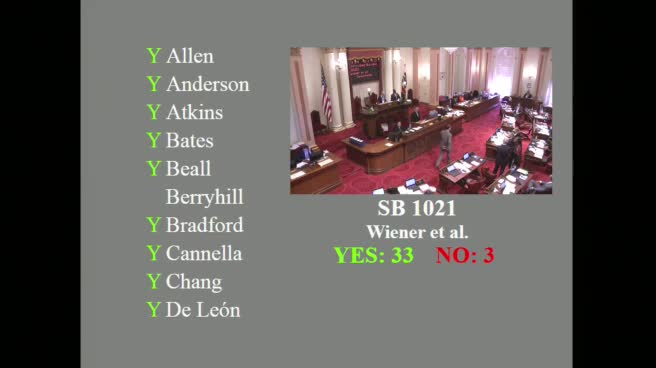 1MIN
Senate Floor
 1MIN
Assembly Floor
 1MIN
Assembly Standing Committee on Appropriations
 5MIN
Assembly Standing Committee on Local Government
 2MIN
Senate Floor
 17MIN
Senate Standing Committee on Environmental Quality
 8MIN
Senate Standing Committee on Governance and Finance
Bill Author

Bill Co-Author(s):