SB 1041: Childhood lead poisoning prevention.
- Session Year: 2017-2018
- House: Senate
- Latest Version Date: 2018-09-22
Existing law, the Childhood Lead Poisoning Prevention Act of 1991, establishes the Childhood Lead Poisoning Prevention Program (Program), which is administered by the State Department of Public Health. Existing law requires the department to adopt regulations establishing a standard of care at least as stringent as the most recent United States Centers for Disease Control and Prevention screening guidelines. Existing law provides that the standard of care shall require a child who is determined to be at risk for lead poisoning to be screened. Existing regulations require every health care provider who performs a periodic health assessment of a child to order a child who receives services from a publicly funded program for low-income children to be screened for lead poisoning. Existing law requires the department to collect and analyze all information necessary to effectively monitor appropriate case management efforts, prepare a biennial report on this material, and disseminate the report to local health departments and the general public.
This bill would make it a goal of the state that all children at risk of lead exposure receive blood lead screening tests, and would require the department to take action, and to require local agencies to take action, necessary to ensure these goals are met. By requiring local agencies to take action to meet these goals, this bill would impose a state-mandated local program.
The bill would require the department to notify health care providers who perform periodic health assessments for children about, and would require those health care providers to inform parents and guardians about, the childhood lead exposure and blood lead screening tests, as specified.
The bill would require the department to report on additional content, including the total number of children enrolled in Medi-Cal and who have secured blood lead screening tests. The bill would specify that any material in the report comply with state and federal privacy laws. The bill would require the department to prominently post the biennial report on the Internet Web site. The bill would require the department to collaborate with the State Department of Health Care Services to collect and analyze information related to children enrolled in Medi-Cal.
Existing law requires the department to, by March 1, 2019, and by March 1 of each year thereafter, prepare and prominently post on its Internet Web site information that evaluates the departments progress in meeting the program goals.
This bill would require the information to include the biennial report.
This bill would incorporate additional changes to Section 105295 of the Health and Safety Code proposed by SB 1097 to be operative only if this bill and SB 1097 are enacted and this bill is enacted last.
The California Constitution requires the state to reimburse local agencies and school districts for certain costs mandated by the state. Statutory provisions establish procedures for making that reimbursement.
This bill would provide that, if the Commission on State Mandates determines that the bill contains costs mandated by the state, reimbursement for those costs shall be made pursuant to the statutory provisions noted above.
Existing law, the Childhood Lead Poisoning Prevention Act of 1991, establishes the Childhood Lead Poisoning Prevention Program (Program), which is administered by the State Department of Public Health. Existing law requires the department to adopt regulations establishing a standard of care at least as stringent as the most recent United States Centers for Disease Control and Prevention screening guidelines. Existing law provides that the standard of care shall require a child who is determined to be at risk for lead poisoning to be screened. Existing regulations require every health care provider who performs a periodic health assessment of a child to order a child who receives services from a publicly funded program for low-income children to be screened for lead poisoning. Existing law requires the department to collect and analyze all information necessary to effectively monitor appropriate case management efforts, prepare a biennial report on this material, and disseminate the report to local health departments and the general public.
This bill would make it a goal of the state that all children at risk of lead exposure receive blood lead screening tests, and would require the department to take action, and to require local agencies to take action, necessary to ensure these goals are met. By requiring local agencies to take action to meet these goals, this bill would impose a state-mandated local program.
The bill would require the department to annually notify health care providers who perform periodic health assessments for children about, and would require those health care providers to annually inform parents and guardians about, the tests. childhood lead exposure and blood lead screening tests, as specified.
The bill would require the department to report on additional content, including the total number of children enrolled in Medi-Cal and who have secured blood lead screening tests. The bill would specify that any material in the report comply with state and federal privacy laws. The bill would require the department to prominently post the biennial report on the Internet Web site. The bill would require the department to collaborate with the State Department of Health Care Services to collect and analyze information related to children enrolled in Medi-Cal.
Existing law requires the department to, by March 1, 2019, and by March 1 of each year thereafter, prepare and prominently post on its Internet Web site information that evaluates the departments progress in meeting the program goals.
This bill would require the information to include the biennial report.
The California Constitution requires the state to reimburse local agencies and school districts for certain costs mandated by the state. Statutory provisions establish procedures for making that reimbursement.
This bill would provide that, if the Commission on State Mandates determines that the bill contains costs mandated by the state, reimbursement for those costs shall be made pursuant to the statutory provisions noted above.
Existing law, the Childhood Lead Poisoning Prevention Act of 1991, establishes the Childhood Lead Poisoning Prevention Program (Program), which is administered by the State Department of Public Health. Existing law requires the State Department of Public Health department to adopt regulations establishing a standard of care at least as stringent as the most recent United States Centers for Disease Control and Prevention screening guidelines. Existing law provides that the standard of care shall require a child who is determined to be at risk for lead poisoning to be screened. Existing regulations require every health care provider who performs a periodic health assessment of a child to order a child who receives services from a publicly funded program for low-income children to be screened for lead poisoning. Existing law requires the department to collect and analyze all information necessary to effectively monitor appropriate case management efforts, prepare a biennial report on this material, and disseminate the report to local health departments and the general public.
This bill would make it a goal of the state that all children at risk of lead exposure receive blood lead screening tests, and would require the department to take action, and to require local agencies to take action, necessary to ensure these goals are met. By requiring local agencies to take action to meet these goals, this bill would impose a state-mandated local program.
The bill would require the department to annually notify health care providers who perform periodic health assessments for children about, and would require those health care providers to annually inform parents and guardians about, the tests.
The bill would require the department to report on additional content, including the total number of children enrolled in Medi-Cal and who have secured blood lead screening tests. The bill would specify that any material in the report comply with state and federal privacy laws. The bill would require the department to prominently post the biennial report on the Internet Web site.
Existing law requires the department to, by March 1, 2019, and by March 1 of each year thereafter, prepare and prominently post on its Internet Web site information that evaluates the departments progress in meeting the program goals.
This bill would require the information to include a lead screening report aggregated to show the total number of children enrolled in Medi-Cal, and not enrolled in Medi-Cal, broken down by county and by year of age, who have received and who have not received blood lead screening tests. the biennial report.
The California Constitution requires the state to reimburse local agencies and school districts for certain costs mandated by the state. Statutory provisions establish procedures for making that reimbursement.
This bill would provide that, if the Commission on State Mandates determines that the bill contains costs mandated by the state, reimbursement for those costs shall be made pursuant to the statutory provisions noted above.
Existing law, the Childhood Lead Poisoning Prevention Act of 1991, requires the State Department of Public Health to adopt regulations establishing a standard of care at least as stringent as the most recent United States Centers for Disease Control and Prevention screening guidelines. Existing law provides that the standard of care shall require a child who is determined to be at risk for lead poisoning to be screened. Existing regulations require every health care provider who performs a periodic health assessment of a child to order a child who receives services from a publicly funded program for low-income children to be screened for lead poisoning.
This bill would make it a goal of the state that all children at risk of lead exposure receive blood lead screening tests, and would require the department to take action, and to require local agencies to take action, necessary to ensure these goals are met. By requiring local agencies to take action to meet these goals, this bill would impose a state-mandated local program.
The bill would require the department to annually notify health care providers who perform periodic health assessments for children about, and would require those health care providers to annually inform parents and guardians about, the tests.
Existing law requires the department to, by March 1, 2019, and by March 1 of each year thereafter, prepare and prominently post on its Internet Web site information that evaluates the departments progress in meeting the program goals.
This bill would require the information to include a lead screening report aggregated to show the total number of children enrolled in Medi-Cal, and not enrolled in Medi-Cal, broken down by county and by year of age, who have received and who have not received blood lead screening tests.
The California Constitution requires the state to reimburse local agencies and school districts for certain costs mandated by the state. Statutory provisions establish procedures for making that reimbursement.
This bill would provide that, if the Commission on State Mandates determines that the bill contains costs mandated by the state, reimbursement for those costs shall be made pursuant to the statutory provisions noted above.
(a)It is the goal of the state that all children at risk of lead exposure receive blood lead screening tests.
(b)The department shall adopt regulations establishing a standard of care, at least as stringent as the most recent federal Centers for Disease Control and Prevention screening guidelines, whereby all children are evaluated for risk of lead poisoning by health care providers during each childs periodic health assessment. The regulations shall meet the goals of subdivision (a) and shall include the determination of risk factors for whether a child is at risk. When determining the risk factors, the department shall consider the most significant environmental risk factors, including, but not limited to, a childs time spent in a home, school, or building built before 1978, a childs proximity to a former lead or steel smelter or an industrial facility that historically emitted or currently emits lead, a childs proximity to a freeway or heavily traveled roadway, other potential risk factors for lead exposure, and known sources of lead contamination. By July 1, 2019, the regulations shall be developed in consultation with medical experts, environmental experts, appropriate professional organizations, the public, and others as determined by the department.
(c)The standard of care shall require a child who is determined to be at risk for lead poisoning, according to the regulations adopted pursuant to subdivision (b), to be screened.
(d)The standard of care shall provide that a child shall not be screened pursuant to this chapter if the parent or guardian of the child refuses to consent to the screening.
(e)The standard of care shall provide that health care providers are responsible only for evaluation of all children, for screening of children determined to be at risk, and for medically necessary followup services.
(f)The fee imposed by Section 105310 shall not be used to fund blood lead screening under this section.
SEC. 2.Section 105286 is added to the Health and Safety Code, to read:105286.(a)The department shall notify health care providers who perform periodic health assessments for children about, and those health care providers shall inform parents and guardians about, all of the following:
(1)The risks and effects of childhood lead exposure.
(2)The requirement that children enrolled in Medi-Cal receive blood lead screening tests as set forth in the departments standard of care policies, promulgated regulations, and published guidelines, in accordance with Section 105285.
(3)The requirement that children not enrolled in Medi-Cal who are at high risk of lead exposure receive blood lead screening tests as set forth in the departments standard of care policies, promulgated regulations, and published guidelines, in accordance with Section 105285.
(b)To implement the requirements of subdivision (a), the department may use channels of communication, including, but not limited to, publications that serve the health care provider community, such as newsletters developed by either the Medical Board of California, other licensing organizations or associations, or local organizations and jurisdictions.
SEC. 3.Section 105295 of the Health and Safety Code is amended to read:105295.(a)The department shall collect and analyze information necessary to effectively monitor appropriate case management efforts. The department shall prepare a biennial report describing the effectiveness of appropriate case management efforts. The report shall include, but not be limited to, all of the following:
(1)The number of enrolled children in Medi-Cal, identified by county and year of age, who received blood lead screening tests and who have not received these tests.
(2)The number of children not enrolled in Medi-Cal, identified by county and year of age, who have received blood lead screening tests.
(3)Publicly releasable data and information that the department compiles, identifies, and analyzes in accordance with subdivision (b) of Section 124125.
(b)This report shall be made available to local health departments and the general public. The department shall prominently post the report on the Internet Web site consistent with the requirements of subdivision (c) of Section 124125.
(c)The department shall collaborate with the State Department of Health Care Services to collect and analyze information identified under subdivision (a) that pertains to children enrolled in Medi-Cal.
SEC. 3.5.Section 105295 of the Health and Safety Code is amended to read:105295.(a)(1)The department shall collect and analyze all information necessary to effectively monitor appropriate case management efforts. The department shall prepare a biennial report describing the effectiveness of appropriate case management efforts. This report shall be made available to local health departments and the general public.
(2)The department shall prominently post the report prepared pursuant to this subdivision on the departments Internet Web site consistent with the requirements of subdivision (c) of Section 124125.
(b)The report prepared pursuant to subdivision (a) shall include all of the following information listed for each county:
(1)The total number of children tested for lead poisoning.
(2)The results of blood lead testing by ranges of lead levels.
(3)The number of children, by blood lead level range, who were referred for case management and environmental services and who received the following services:
(A)Home visit.
(B)Environmental investigation.
(C)Family education and provision of educational materials, nutrition assessment, and nutrition education.
(4)(A) The identified sources of lead exposure for those children having lead poisoning.
(B)The report shall indicate whether the sources of lead exposure identified in, on, or around a residence or location associated with a child with lead poisoning have been removed, remediated, or abated.
(c)The report shall also include, but not be limited to, all of the following:
(1)The number of enrolled children in Medi-Cal, identified by county and year of age, who received blood lead screening tests and who have not received these tests.
(2)The number of children not enrolled in Medi-Cal, identified by county, and year of age, who have received blood lead screening tests.
(3)Publicly releasable data and information that the department compiles, identifies, and analyzes in accordance with subdivision (b) of Section 124125.
(d)The department shall collaborate with the State Department of Health Care Services to collect and analyze information identified under subdivision (c) that pertains to children enrolled in Medi-Cal.
(e)When preparing the report required by subdivision (b), the department may use the information that the department receives through its existing case management efforts, including, but not limited to, the data in biennial reports provided to the department from local health departments.
(f)The department shall provide the data collected and the report prepared pursuant to this section to the Healthy Communities Data and Indicators Project (HCI) standardized set of statistical measures for use in any tools developed by HCI that are used for planning healthy communities and evaluating the impact of plans, projects, policies, and environmental changes on community health.
(g)All uses and disclosure of data made pursuant to this section shall comply with all applicable state and federal laws for the protection of the privacy and security of data, including, but not limited to, subdivision (g) of Section 124130 and the Information Practices Act of 1977 (Chapter 1 (commencing with Section 1798) of Title 1.8 of Part 4 of Division 3 of the Civil Code).
SEC. 4.Section 105300 of the Health and Safety Code is amended to read:105300.Notwithstanding Section 124130, the department shall have broad regulatory authority to fully implement and effectuate the purposes of this chapter. The authority shall include, but is not limited to, the following:
(a)The development of protocols to be utilized in screening and the procedures for changing those protocols when more accurate or efficient technologies become available.
(b)The designation of laboratories which are qualified to analyze whole blood specimens for concentrations of lead and the monitoring of those laboratories for accuracy.
(c)The development of reporting procedures by laboratories.
(d)The reimbursement for state-sponsored services related to screening and appropriate case management.
(e)The establishment of lower concentrations of lead in whole blood than those specified by the United States Centers for Disease Control for the purpose of determining the existence of lead poisoning.
(f)The establishment of lower acceptable levels of the concentration of lead in whole blood than those specified by the United States Centers for Disease Control for the purpose of determining the need to provide appropriate case management for lead poisoning.
(g)The development of appropriate case management protocols.
(h)The notification to the childs parent or guardian of the results of blood lead testing and environmental assessment.
(i)The establishment of a periodicity schedule for evaluation for childhood lead poisoning.
SEC. 5.Section 124125 of the Health and Safety Code is amended to read:124125.(a)The Legislature hereby finds and declares that childhood lead exposure represents the most significant childhood environmental health problem in the state today; that too little is known about the prevalence, long-term health care costs, severity, and location of these problems in California; that it is well known that the environment is widely contaminated with lead; that excessive lead exposure causes acute and chronic damage to a childs renal system, red blood cells, and developing brain and nervous system; that at least one in every 25 children in the nation has an elevated blood lead level; and that the cost to society of neglecting this problem may be enormous.
(b)The Legislature further finds and declares that knowledge about where and to what extent harmful childhood lead exposures are occurring in the state could lead to the prevention of these exposures, and to the betterment of the health of Californias future citizens. Therefore, the enactment of this article establishes a state Childhood Lead Poisoning Prevention Program. The department shall accomplish all of the following:
(1)Compile information concerning the prevalence, causes, and geographic occurrence of high childhood blood lead levels.
(2)Identify and target areas of the state where childhood lead exposures are especially significant.
(3)Analyze information collected pursuant to this article and, where indicated, design and implement a program of medical followup and environmental abatement and followup that will reduce the incidence of excessive childhood lead exposures in California.
(4)Work, as necessary, with the State Department of Health Care Services to advance lead testing of children enrolled in Medi-Cal.
(c)(1)By March 1, 2019, and by March 1 of each year thereafter, the department shall prepare and prominently post on its Internet Web site information that evaluates the departments progress in meeting the goals of this section. The information shall also include all of the following:
(A)An annually updated analysis of the data and information identified and compiled relative to paragraphs (1) and (2) of subdivision (b).
(B)To the greatest extent possible, a list of the census tracts in which children test positive at a rate higher than the national average for blood lead in exceedance of the federal Centers for Disease Control and Preventions reference level for elevated blood lead based on the data and information received during the previous calendar year.
(C)The report developed pursuant to Section 105295.
(2)All uses and disclosures of data made pursuant to this section shall comply with all applicable state and federal laws for the protection of the privacy and security of data, including, but not limited to, the Confidentiality of Medical Information Act (Part 2.6 (commencing with Section 56) of Division 1 of the Civil Code), the Information Practices Act of 1977 (Chapter 1 (commencing with Section 1798) of Title 1.8 of Part 4 of Division 3 of the Civil Code), Title 1.81 (commencing with Section 1798.80) of Part 4 of Division 3 of the Civil Code, the federal Health Insurance Portability and Accountability Act of 1996 (Public Law 104-191), and the federal Health Information Technology for Economic and Clinical Health Act, Title XIII of the federal American Recovery and Reinvestment Act of 2009 (Public Law 111-5), and implementing regulations.
SEC. 6.Section 3.5 of this bill incorporates amendments to Section 105295 of the Health and Safety Code proposed by both this bill and Senate Bill 1097. That section of this bill shall only become operative if (1) both bills are enacted and become effective on or before January 1, 2019, (2) each bill amends Section 105295 of the Health and Safety Code, and (3) this bill is enacted after Senate Bill 1097, in which case Section 3 of this bill shall not become operative.
SEC. 7.If the Commission on State Mandates determines that this act contains costs mandated by the state, reimbursement to local agencies and school districts for those costs shall be made pursuant to Part 7 (commencing with Section 17500) of Division 4 of Title 2 of the Government Code.
(a)It is the goal of the state that all children at risk of lead exposure receive blood lead screening tests.
(b)The department shall adopt regulations establishing a standard of care, at least as stringent as the most recent federal Centers for Disease Control and Prevention screening guidelines, whereby all children are evaluated for risk of lead poisoning by health care providers during each childs periodic health assessment. The regulations shall meet the goals of subdivision (a) and shall include the determination of risk factors for whether a child is at risk. When determining the risk factors, the department shall consider the most significant environmental risk factors, including, but not limited to, a childs time spent in a home, school, or building built before 1978, a childs proximity to a former lead or steel smelter or an industrial facility that historically emitted or currently emits lead, a childs proximity to a freeway or heavily traveled roadway, other potential risk factors for lead exposure, and known sources of lead contamination. By July 1, 2019, the regulations shall be developed in consultation with medical experts, environmental experts, appropriate professional organizations, the public, and others as determined by the department.
(c)The standard of care shall require a child who is determined to be at risk for lead poisoning, according to the regulations adopted pursuant to subdivision (b), to be screened.
(d)The standard of care shall provide that a child shall not be screened pursuant to this chapter if the parent or guardian of the child refuses to consent to the screening.
(e)The standard of care shall provide that health care providers are responsible only for evaluation of all children, for screening of children determined to be at risk, and for medically necessary followup services.
(f)The fee imposed by Section 105310 shall not be used to fund blood lead screening under this section.
SEC. 2.Section 105286 is added to the Health and Safety Code, to read:105286.(a)The department shall notify health care providers who perform periodic health assessments for children about, and those health care providers shall inform parents and guardians about, all of the following:
(1)The risks and effects of childhood lead exposure.
(2)The requirement that children enrolled in Medi-Cal receive blood lead screening tests as set forth in the departments standard of care policies, promulgated regulations, and published guidelines, in accordance with Section 105285.
(3)The requirement that children not enrolled in Medi-Cal who are at high risk of lead exposure receive blood lead screening tests as set forth in the departments standard of care policies, promulgated regulations, and published guidelines, in accordance with Section 105285.
(b)To implement the requirements of subdivision (a), the department may use channels of communication, including, but not limited to, publications that serve the health care provider community, such as newsletters developed by either the Medical Board of California, other licensing organizations or associations, or local organizations and jurisdictions.
SEC. 3.Section 105295 of the Health and Safety Code is amended to read:105295.(a)The department shall collect and analyze information necessary to effectively monitor appropriate case management efforts. The department shall prepare a biennial report describing the effectiveness of appropriate case management efforts. The report shall include, but not be limited to, all of the following:
(1)The number of enrolled children in Medi-Cal, identified by county and year of age, who received blood lead screening tests and who have not received these tests.
(2)The number of children not enrolled in Medi-Cal, identified by county, county and year of age, who have recieved received blood lead screening tests.
(3)Publicly releasable data and information that the department compiles, identifies, and analyzes in accordance with subdivision (b) of Section 124125.
(b)This report shall be made available to local health departments and the general public. The department shall prominently post the report on the Internet Web site consistent with the requirements of subdivision (c) of Section 124125.
(c)The department shall collaborate with the State Department of Health Care Services to collect and analyze information identified under subdivision (a) that pertains to children enrolled in Medi-Cal.
SEC. 3.5.Section 105295 of the Health and Safety Code is amended to read:105295.(a)(1)The department shall collect and analyze all information necessary to effectively monitor appropriate case management efforts. The department shall prepare a biennial report describing the effectiveness of appropriate case management efforts. This report shall be made available to local health departments and the general public.
(2)The department shall prominently post the report prepared pursuant to this subdivision on the departments Internet Web site consistent with the requirements of subdivision (c) of Section 124125.
(b)The report prepared pursuant to subdivision (a) shall include all of the following information listed for each county:
(1)The total number of children tested for lead poisoning.
(2)The results of blood lead testing by ranges of lead levels.
(3)The number of children, by blood lead level range, who were referred for case management and environmental services and who received the following services:
(A)Home visit.
(B)Environmental investigation.
(C)Family education and provision of educational materials, nutrition assessment, and nutrition education.
(4)(A) The identified sources of lead exposure for those children having lead poisoning.
(B)The report shall indicate whether the sources of lead exposure identified in, on, or around a residence or location associated with a child with lead poisoning have been removed, remediated, or abated.
(c)The report shall also include, but not be limited to, all of the following:
(1)The number of enrolled children in Medi-Cal, identified by county and year of age, who received blood lead screening tests and who have not received these tests.
(2)The number of children not enrolled in Medi-Cal, identified by county, and year of age, who have received blood lead screening tests.
(3)Publicly releasable data and information that the department compiles, identifies, and analyzes in accordance with subdivision (b) of Section 124125.
(d)The department shall collaborate with the State Department of Health Care Services to collect and analyze information identified under subdivision (c) that pertains to children enrolled in Medi-Cal.
(e)When preparing the report required by subdivision (b), the department may use the information that the department receives through its existing case management efforts, including, but not limited to, the data in biennial reports provided to the department from local health departments.
(f)The department shall provide the data collected and the report prepared pursuant to this section to the Healthy Communities Data and Indicators Project (HCI) standardized set of statistical measures for use in any tools developed by HCI that are used for planning healthy communities and evaluating the impact of plans, projects, policies, and environmental changes on community health.
(g)All uses and disclosure of data made pursuant to this section shall comply with all applicable state and federal laws for the protection of the privacy and security of data, including, but not limited to, subdivision (g) of Section 124130 and the Information Practices Act of 1977 (Chapter 1 (commencing with Section 1798) of Title 1.8 of Part 4 of Division 3 of the Civil Code).
SEC. 4.Section 105300 of the Health and Safety Code is amended to read:105300.Notwithstanding Section 124130, the department shall have broad regulatory authority to fully implement and effectuate the purposes of this chapter. The authority shall include, but is not limited to, the following:
(a)The development of protocols to be utilized in screening and the procedures for changing those protocols when more accurate or efficient technologies become available.
(b)The designation of laboratories which are qualified to analyze whole blood specimens for concentrations of lead and the monitoring of those laboratories for accuracy.
(c)The development of reporting procedures by laboratories.
(d)The reimbursement for state-sponsored services related to screening and appropriate case management.
(e)The establishment of lower concentrations of lead in whole blood than those specified by the United States Centers for Disease Control for the purpose of determining the existence of lead poisoning.
(f)The establishment of lower acceptable levels of the concentration of lead in whole blood than those specified by the United States Centers for Disease Control for the purpose of determining the need to provide appropriate case management for lead poisoning.
(g)The development of appropriate case management protocols.
(h)The notification to the childs parent or guardian of the results of blood lead testing and environmental assessment.
(i)The establishment of a periodicity schedule for evaluation for childhood lead poisoning.
SEC. 5.Section 124125 of the Health and Safety Code is amended to read:124125.(a)The Legislature hereby finds and declares that childhood lead exposure represents the most significant childhood environmental health problem in the state today; that too little is known about the prevalence, long-term health care costs, severity, and location of these problems in California; that it is well known that the environment is widely contaminated with lead; that excessive lead exposure causes acute and chronic damage to a childs renal system, red blood cells, and developing brain and nervous system; that at least one in every 25 children in the nation has an elevated blood lead level; and that the cost to society of neglecting this problem may be enormous.
(b)The Legislature further finds and declares that knowledge about where and to what extent harmful childhood lead exposures are occurring in the state could lead to the prevention of these exposures, and to the betterment of the health of Californias future citizens. Therefore, the enactment of this article establishes a state Childhood Lead Poisoning Prevention Program. The department shall accomplish all of the following:
(1)Compile information concerning the prevalence, causes, and geographic occurrence of high childhood blood lead levels.
(2)Identify and target areas of the state where childhood lead exposures are especially significant.
(3)Analyze information collected pursuant to this article and, where indicated, design and implement a program of medical followup and environmental abatement and followup that will reduce the incidence of excessive childhood lead exposures in California.
(4)Work, as necessary, with the State Department of Health Care Services to advance lead testing of children enrolled in Medi-Cal.
(c)(1)By March 1, 2019, and by March 1 of each year thereafter, the department shall prepare and prominently post on its Internet Web site information that evaluates the departments progress in meeting the goals of this section. The information shall also include all of the following:
(A)An annually updated analysis of the data and information identified and compiled relative to paragraphs (1) and (2) of subdivision (b).
(B)To the greatest extent possible, a list of the census tracts in which children test positive at a rate higher than the national average for blood lead in exceedance of the federal Centers for Disease Control and Preventions reference level for elevated blood lead based on the data and information received during the previous calendar year.
(C)The report developed pursuant to Section 105295.
(2)All uses and disclosures of data made pursuant to this section shall comply with all applicable state and federal laws for the protection of the privacy and security of data, including, but not limited to, the Confidentiality of Medical Information Act (Part 2.6 (commencing with Section 56) of Division 1 of the Civil Code), the Information Practices Act of 1977 (Chapter 1 (commencing with Section 1798) of Title 1.8 of Part 4 of Division 3 of the Civil Code), Title 1.81 (commencing with Section 1798.80) of Part 4 of Division 3 of the Civil Code, the federal Health Insurance Portability and Accountability Act of 1996 (Public Law 104-191), and the federal Health Information Technology for Economic and Clinical Health Act, Title XIII of the federal American Recovery and Reinvestment Act of 2009 (Public Law 111-5), and implementing regulations.
SEC. 6.Section 3.5 of this bill incorporates amendments to Section 105295 of the Health and Safety Code proposed by both this bill and Senate Bill 1097. That section of this bill shall only become operative if (1) both bills are enacted and become effective on or before January 1, 2019, (2) each bill amends Section 105295 of the Health and Safety Code, and (3) this bill is enacted after Senate Bill 1097, in which case Section 3 of this bill shall not become operative.
SEC. 6. SEC. 7.If the Commission on State Mandates determines that this act contains costs mandated by the state, reimbursement to local agencies and school districts for those costs shall be made pursuant to Part 7 (commencing with Section 17500) of Division 4 of Title 2 of the Government Code.
(a)It is the goal of the state that all children at risk of lead exposure receive blood lead screening tests. It is also the goal of the state that all children enrolled in Medi-Cal receive blood lead screening tests at 12 months and 24 months of age, and that any enrolled child between 24 months and 72 months of age with no record of a previous blood lead screening test receive at least one test.
(b)The department shall adopt regulations establishing a standard of care, at least as stringent as the most recent federal Centers for Disease Control and Prevention screening guidelines, whereby all children are evaluated for risk of lead poisoning by health care providers during each childs periodic health assessment. The regulations shall meet the goals of subdivision (a) and shall include the determination of risk factors for whether a child is at risk. When determining the risk factors, the department shall consider the most significant environmental risk factors, including, but not limited to, a childs time spent in a home, school, or building built before 1978, a childs proximity to a former lead or steel smelter or an industrial facility that historically emitted or currently emits lead, a childs proximity to a freeway or heavily traveled roadway, other potential risk factors for lead exposure, and known sources of lead contamination. By July 1, 2019, the regulations shall be developed in consultation with medical experts, environmental experts, appropriate professional organizations, the public, and others as determined by the department.
(c)The standard of care shall require a child who is determined to be at risk for lead poisoning, according to the regulations adopted pursuant to subdivision (b), to be screened.
(d)The standard of care shall provide that a child shall not be screened pursuant to this chapter if the parent or guardian of the child refuses to consent to the screening.
(e)The standard of care shall provide that health care providers are responsible only for evaluation of all children, for screening of children determined to be at risk, and for medically necessary followup services.
(f)The fee imposed by Section 105310 shall not be used to fund blood lead screening under this section.
SEC. 2.Section 105286 is added to the Health and Safety Code, to read:105286.(a)The department shall annually notify health care providers who perform periodic health assessments for children about, and those health care providers shall annually inform parents and guardians about, all of the following:
(a)(1)The risks and effects of childhood lead exposure.
(b)(2)The requirement that children enrolled in Medi-Cal receive blood lead screening tests. tests as set forth in the departments standard of care policies, promulgated regulations, and published guidelines, in accordance with Section 105285.
(3)The requirement that children not enrolled in Medi-Cal who are at high risk of lead exposure receive blood lead screening tests as set forth in the departments standard of care policies, promulgated regulations, and published guidelines, in accordance with Section 105285.
(b)To implement the requirements of subdivision (a), the department may use channels of communication, including, but not limited to, publications that serve the health care provider community, such as newsletters developed by either the Medical Board of California, other licensing organizations or associations, or local organizations and jurisdictions.
SEC. 3.Section 105295 of the Health and Safety Code is amended to read:105295.(a)The department shall collect and analyze information necessary to effectively monitor appropriate case management efforts. The department shall prepare a biennial report describing the effectiveness of appropriate case management efforts. The report shall include, but not be limited to, the all of the following:
(1)The number of enrolled children in Medi-Cal and the number of nonenrolled children in Medi-Cal, identified by county and year of age, who received blood lead screening tests and who have not received these tests, and all tests.
(2)The number of children not enrolled in Medi-Cal, identified by county, and year of age, who have recieved blood lead screening tests.
(3)Publicly releasable data and information that the department compiles, identifies, and analyzes in accordance with subdivision (b) of Section 124125. This
(b)This report shall be made available to local health departments and the general public. The department shall prominently post the report on the Internet Web site consistent with the requirements of subdivision (c) of Section 124125.
(c)The department shall collaborate with the State Department of Health Care Services to collect and analyze information identified under subdivision (a) that pertains to children enrolled in Medi-Cal.
SEC. 4.Section 105300 of the Health and Safety Code is amended to read:105300.Notwithstanding Section 124130, the department shall have broad regulatory authority to fully implement and effectuate the purposes of this chapter. The authority shall include, but is not limited to, the following:
(a)The development of protocols to be utilized in screening and the procedures for changing those protocols when more accurate or efficient technologies become available.
(b)The designation of laboratories which are qualified to analyze whole blood specimens for concentrations of lead and the monitoring of those laboratories for accuracy.
(c)The development of reporting procedures by laboratories.
(d)Reimbursement The reimbursement for state-sponsored services related to screening and appropriate case management.
(e)Establishment The establishment of lower concentrations of lead in whole blood than those specified by the United States Centers for Disease Control for the purpose of determining the existence of lead poisoning.
(f)Establishment The establishment of lower acceptable levels of the concentration of lead in whole blood than those specified by the United States Centers for Disease Control for the purpose of determining the need to provide appropriate case management for lead poisoning.
(g)Development The development of appropriate case management protocols.
(h)Notification The notification to the childs parent or guardian of the results of blood lead testing and environmental assessment.
(i)The establishment of a periodicity schedule for evaluation for childhood lead poisoning.
(j)Undertaking actions and requiring local agencies to undertake actions necessary to ensure the goals set forth in subdivision (a) of Section 105285 are met.SEC. 5.Section 124125 of the Health and Safety Code is amended to read:124125.(a)The Legislature hereby finds and declares that childhood lead exposure represents the most significant childhood environmental health problem in the state today; that too little is known about the prevalence, long-term health care costs, severity, and location of these problems in California; that it is well known that the environment is widely contaminated with lead; that excessive lead exposure causes acute and chronic damage to a childs renal system, red blood cells, and developing brain and nervous system; that at least one in every 25 children in the nation has an elevated blood lead level; and that the cost to society of neglecting this problem may be enormous.
(b)The Legislature further finds and declares that knowledge about where and to what extent harmful childhood lead exposures are occurring in the state could lead to the prevention of these exposures, and to the betterment of the health of Californias future citizens. Therefore, the enactment of this article establishes a state Childhood Lead Poisoning Prevention Program. The department shall accomplish all of the following:
(1)Compile information concerning the prevalence, causes, and geographic occurrence of high childhood blood lead levels.
(2)Identify and target areas of the state where childhood lead exposures are especially significant.
(3)Analyze information collected pursuant to this article and, where indicated, design and implement a program of medical followup and environmental abatement and followup that will reduce the incidence of excessive childhood lead exposures in California.
(4)Achieve the goals set forth in subdivision (a) of Section 105285. Work, as necessary, with the State Department of Health Care Services to advance lead testing of children enrolled in Medi-Cal.
(c)(1)By March 1, 2019, and by March 1 of each year thereafter, the department shall prepare and prominently post on its Internet Web site information that evaluates the departments progress in meeting the goals of this section. The information shall also include all of the following:
(A)An annually updated analysis of the data and information identified and compiled relative to paragraphs (1) and (2) of subdivision (b).
(B)To the greatest extent possible, a list of the census tracts in which children test positive at a rate higher than the national average for blood lead in exceedance of the federal Centers for Disease Control and Preventions reference level for elevated blood lead based on the data and information received during the previous calendar year.
(C)The report developed pursuant to Section 105295.
(2)All uses and disclosures of data made pursuant to this section shall comply with all applicable state and federal laws for the protection of the privacy and security of data, including, but not limited to, the Confidentiality of Medical Information Act (Part 2.6 (commencing with Section 56) of Division 1 of the Civil Code), the Information Practices Act of 1977 (Chapter 1 (commencing with Section 1798) of Title 1.8 of Part 4 of Division 3 of the Civil Code), Title 1.81 (commencing with Section 1798.80) of Part 4 of Division 3 of the Civil Code, the federal Health Insurance Portability and Accountability Act of 1996 (Public Law 104-191), and the federal Health Information Technology for Economic and Clinical Health Act, Title XIII of the federal American Recovery and Reinvestment Act of 2009 (Public Law 111-5), and implementing regulations.
SEC. 6.If the Commission on State Mandates determines that this act contains costs mandated by the state, reimbursement to local agencies and school districts for those costs shall be made pursuant to Part 7 (commencing with Section 17500) of Division 4 of Title 2 of the Government Code.
(a)It is the goal of the state that all children at risk of lead exposure receive blood lead screening tests. It is also the goal of the state that all children enrolled in Medi-Cal receive blood lead screening tests at 12 months and 24 months of age, and that any enrolled child between 24 months and 72 months of age with no record of a previous blood lead screening test receive at least one test.
(b)The department shall adopt regulations establishing a standard of care, at least as stringent as the most recent federal Centers for Disease Control and Prevention screening guidelines, whereby all children are evaluated for risk of lead poisoning by health care providers during each childs periodic health assessment. The regulations shall meet the goals of subdivision (a) and shall include the determination of risk factors for whether a child is at risk. When determining the risk factors, the department shall consider the most significant environmental risk factors, including, but not limited to, a childs time spent in a home, school, or building built before 1978, a childs proximity to a former lead or steel smelter or an industrial facility that historically emitted or currently emits lead, a childs proximity to a freeway or heavily traveled roadway, other potential risk factors for lead exposure, and known sources of lead contamination. By July 1, 2019, the regulations shall be developed in consultation with medical experts, environmental experts, appropriate professional organizations, the public, and others as determined by the department.
(c)The standard of care shall require a child who is determined to be at risk for lead poisoning, according to the regulations adopted pursuant to subdivision (b), to be screened.
(d)The standard of care shall provide that a child shall not be screened pursuant to this chapter if the parent or guardian of the child refuses to consent to the screening.
(e)The standard of care shall provide that health care providers are responsible only for evaluation of all children, for screening of children determined to be at risk, and for medically necessary followup services.
(f)The fee imposed by Section 105310 shall not be used to fund blood lead screening under this section.
SEC. 2.Section 105286 is added to the Health and Safety Code, to read:105286.The department shall annually notify health care providers who perform periodic health assessments for children about, and those health care providers shall annually inform parents and guardians about, all of the following:
(a)The risks and effects of childhood lead exposure.
(b)The requirement that children enrolled in Medi-Cal receive blood lead screening tests.
SEC. 3.Section 105295 of the Health and Safety Code is amended to read:105295.The department shall collect and analyze all information necessary to effectively monitor appropriate case management efforts. The department shall prepare a biennial report describing the effectiveness of appropriate case management efforts. The report shall include, but not be limited to, the number of enrolled children in Medi-Cal and the number of nonenrolled children in Medi-Cal, identified by county and year of age, who received blood lead screening tests and who have not received these tests, and all data and information that the department compiles, identifies, and analyzes in accordance with subdivision (b) of Section 124125. This report shall be made available to local health departments and the general public. The department shall prominently post the report on the Internet Web site consistent with the requirements of subdivision (c) of Section 124125.
SEC. 3.SEC. 4.Section 105300 of the Health and Safety Code is amended to read:105300.Notwithstanding Section 124130, the department shall have broad regulatory authority to fully implement and effectuate the purposes of this chapter. The authority shall include, but is not limited to, the following:
(a) The development of protocols to be utilized in screening and the procedures for changing those protocols when more accurate or efficient technologies become available.
(b) The designation of laboratories which are qualified to analyze whole blood specimens for concentrations of lead and the monitoring of those laboratories for accuracy.
(c) The development of reporting procedures by laboratories.
(d) Reimbursement for state-sponsored services related to screening and appropriate case management.
(e) Establishment of lower concentrations of lead in whole blood than those specified by the United States Centers for Disease Control for the purpose of determining the existence of lead poisoning.
(f) Establishment of lower acceptable levels of the concentration of lead in whole blood than those specified by the United States Centers for Disease Control for the purpose of determining the need to provide appropriate case management for lead poisoning.
(g) Development of appropriate case management protocols.
(h) Notification to the childs parent or guardian of the results of blood lead testing and environmental assessment.
(i) The establishment of a periodicity schedule for evaluation for childhood lead poisoning.
(j)Undertaking actions and requiring local agencies to undertake actions necessary to ensure the goals set forth in subdivision (a) of Section 105285 are met.
SEC. 4.SEC. 5.Section 124125 of the Health and Safety Code is amended to read:124125.(a)The Legislature hereby finds and declares that childhood lead exposure represents the most significant childhood environmental health problem in the state today; that too little is known about the prevalence, long-term health care costs, severity, and location of these problems in California; that it is well known that the environment is widely contaminated with lead; that excessive lead exposure causes acute and chronic damage to a childs renal system, red blood cells, and developing brain and nervous system; that at least one in every 25 children in the nation has an elevated blood lead level; and that the cost to society of neglecting this problem may be enormous.
(b)The Legislature further finds and declares that knowledge about where and to what extent harmful childhood lead exposures are occurring in the state could lead to the prevention of these exposures, and to the betterment of the health of Californias future citizens. Therefore, the enactment of this article establishes a state Childhood Lead Poisoning Prevention Program. The department shall accomplish all of the following:
(1)Compile information concerning the prevalence, causes, and geographic occurrence of high childhood blood lead levels.
(2)Identify and target areas of the state where childhood lead exposures are especially significant.
(3)Analyze information collected pursuant to this article and, where indicated, design and implement a program of medical followup and environmental abatement and followup that will reduce the incidence of excessive childhood lead exposures in California.
(4)Achieve the goals set forth in subdivision (a) of Section 105285.
(c)(1)By March 1, 2019, and by March 1 of each year thereafter, the department shall prepare and prominently post on its Internet Web site information that evaluates the departments progress in meeting the goals of this section. The information shall also include all of the following:
(A)An annually updated analysis of the data and information identified and compiled relative to paragraphs (1) and (2) of subdivision (b).
(B)To the greatest extent possible, a list of the census tracts in which children test positive at a rate higher than the national average for blood lead in exceedance of the federal Centers for Disease Control and Preventions reference level for elevated blood lead based on the data and information received during the previous calendar year.
(C)A The report detailing the departments progress in meeting the goals set forth in subdivision (a) of Section 105285. The report shall include the total number of Medi-Cal enrolled children, and the total number of children not enrolled in Medi-Cal, broken down by county and by year of age, who have received and who have not received blood lead screening tests. developed pursuant to Section 105295.
(2)All uses and disclosures of data made pursuant to this section shall comply with all applicable state and federal laws for the protection of the privacy and security of data, including, but not limited to, the Confidentiality of Medical Information Act (Part 2.6 (commencing with Section 56) of Division 1 of the Civil Code), the Information Practices Act of 1977 (Chapter 1 (commencing with Section 1798) of Title 1.8 of Part 4 of Division 3 of the Civil Code), Title 1.81 (commencing with Section 1798.80) of Part 4 of Division 3 of the Civil Code, the federal Health Insurance Portability and Accountability Act of 1996 (Public Law 104-191), and the federal Health Information Technology for Economic and Clinical Health Act, Title XIII of the federal American Recovery and Reinvestment Act of 2009 (Public Law 111-5), and implementing regulations.
SEC. 5.SEC. 6.If the Commission on State Mandates determines that this act contains costs mandated by the state, reimbursement to local agencies and school districts for those costs shall be made pursuant to Part 7 (commencing with Section 17500) of Division 4 of Title 2 of the Government Code.
(a)The It is the goal of the state that all children at risk of lead exposure receive blood lead screening tests. It is also the goal of the state that all children enrolled in Medi-Cal receive blood lead screening tests at 12 months and 24 months of age, and that any enrolled child between 24 months and 72 months of age with no record of a previous blood lead screening test receive at least one test.
(b)The department shall adopt regulations establishing a standard of care, at least as stringent as the most recent federal Centers for Disease Control and Prevention screening guidelines, whereby all children are evaluated for risk of lead poisoning by health care providers during each childs periodic health assessment. The regulations shall meet the goals of subdivision (a) and shall include the determination of risk factors for whether a child is at risk. When determining the risk factors, the department shall consider the most significant environmental risk factors, including, but not limited to, a childs time spent in a home, school, or building built before 1978, a childs proximity to a former lead or steel smelter or an industrial facility that historically emitted or currently emits lead, a childs proximity to a freeway or heavily traveled roadway, other potential risk factors for lead exposure, and known sources of lead contamination. By July 1, 2019, the regulations shall be developed in consultation with medical experts, environmental experts, appropriate professional organizations, the public, and others as determined by the department.
(b)(c)The standard of care shall require a child who is determined to be at risk for lead poisoning, according to the regulations adopted pursuant to subdivision (a) (b), to be screened.
(c)(d)The standard of care shall provide that a child shall not be screened pursuant to this chapter if the parent or guardian of the child refuses to consent to the screening.
(d)(e)The standard of care shall provide that health care providers are responsible only for evaluation of all children, for screening of children determined to be at risk, and for medically necessary followup services.
(e)(f)The fee imposed by Section 105310 shall not be used to fund blood lead screening under this section.
SEC. 2.Section 105286 is added to the Health and Safety Code, to read:105286.The department shall annually notify health care providers who perform periodic health assessments for children about, and those health care providers shall annually inform parents and guardians about, all of the following:
(a)The risks and effects of childhood lead exposure.
(b)The requirement that children enrolled in Medi-Cal receive blood lead screening tests.
SEC. 3.Section 105300 of the Health and Safety Code is amended to read:105300.Notwithstanding Section 124130, the department shall have broad regulatory authority to fully implement and effectuate the purposes of this chapter. The authority shall include, but is not limited to, the following:
(a) The development of protocols to be utilized in screening and the procedures for changing those protocols when more accurate or efficient technologies become available.
(b) The designation of laboratories which are qualified to analyze whole blood specimens for concentrations of lead and the monitoring of those laboratories for accuracy.
(c) The development of reporting procedures by laboratories.
(d) Reimbursement for state-sponsored services related to screening and appropriate case management.
(e) Establishment of lower concentrations of lead in whole blood than those specified by the United States Centers for Disease Control for the purpose of determining the existence of lead poisoning.
(f) Establishment of lower acceptable levels of the concentration of lead in whole blood than those specified by the United States Centers for Disease Control for the purpose of determining the need to provide appropriate case management for lead poisoning.
(g) Development of appropriate case management protocols.
(h) Notification to the childs parent or guardian of the results of blood lead testing and environmental assessment.
(i) The establishment of a periodicity schedule for evaluation for childhood lead poisoning.
(j)Undertaking actions and requiring local agencies to undertake actions necessary to ensure the goals set forth in subdivision (a) of Section 105285 are met.
SEC. 4.Section 124125 of the Health and Safety Code is amended to read:124125.(a)The Legislature hereby finds and declares that childhood lead exposure represents the most significant childhood environmental health problem in the state today; that too little is known about the prevalence, long-term health care costs, severity, and location of these problems in California; that it is well known that the environment is widely contaminated with lead; that excessive lead exposure causes acute and chronic damage to a childs renal system, red blood cells, and developing brain and nervous system; that at least one in every 25 children in the nation has an elevated blood lead level; and that the cost to society of neglecting this problem may be enormous.
(b)The Legislature further finds and declares that knowledge about where and to what extent harmful childhood lead exposures are occurring in the state could lead to the prevention of these exposures, and to the betterment of the health of Californias future citizens. Therefore, the enactment of this article establishes a state Childhood Lead Poisoning Prevention Program. The department shall accomplish all of the following:
(1)To compile Compile information concerning the prevalence, causes, and geographic occurrence of high childhood blood lead levels.
(2)To identify Identify and target areas of the state where childhood lead exposures are especially significant.
(3)To analyze Analyze information collected pursuant to this article and, where indicated, design and implement a program of medical followup and environmental abatement and followup that will reduce the incidence of excessive childhood lead exposures in California.
(4)Achieve the goals set forth in subdivision (a) of Section 105285.
(c)(1)By March 1, 2019, and by March 1 of each year thereafter, the department shall prepare and prominently post on its Internet Web site information that evaluates the departments progress in meeting the goals of this section. The information shall also include all of the following:
(A)An annually updated analysis of the data and information identified and compiled relative to paragraphs (1) and (2) of subdivision (b).
(B)To the greatest extent possible, a list of the census tracts in which children test positive at a rate higher than the national average for blood lead in exceedance of the federal Centers for Disease Control and Preventions reference level for elevated blood lead based on the data and information received during the previous calendar year.
(C)A report detailing the departments progress in meeting the goals set forth in subdivision (a) of Section 105285. The report shall include the total number of Medi-Cal enrolled children, and the total number of children not enrolled in Medi-Cal, broken down by county and by year of age, who have received and who have not received blood lead screening tests.
(2)All uses and disclosures of data made pursuant to this section shall comply with all applicable state and federal laws for the protection of the privacy and security of data, including, but not limited to, the Confidentiality of Medical Information Act (Part 2.6 (commencing with Section 56) of Division 1 of the Civil Code), the Information Practices Act of 1977 (Chapter 1 (commencing with Section 1798) of Title 1.8 of Part 4 of Division 3 of the Civil Code), Title 1.81 (commencing with Section 1798.80) of Part 4 of Division 3 of the Civil Code, the federal Health Insurance Portability and Accountability Act of 1996 (Public Law 104-191), and the federal Health Information Technology for Economic and Clinical Health Act, Title XIII of the federal American Recovery and Reinvestment Act of 2009 (Public Law 111-5), and implementing regulations.
SEC. 5.If the Commission on State Mandates determines that this act contains costs mandated by the state, reimbursement to local agencies and school districts for those costs shall be made pursuant to Part 7 (commencing with Section 17500) of Division 4 of Title 2 of the Government Code.
|
Date
|
Status
|
|---|---|
| Sep 22, 2018 | Chaptered by Secretary of State. Chapter 690, Statutes of 2018. |
| Sep 22, 2018 | Approved by the Governor. |
| Sep 10, 2018 | Enrolled and presented to the Governor at 4 p.m. |
| Aug 30, 2018 | Assembly amendments concurred in. (Ayes 39. Noes 0.) Ordered to engrossing and enrolling. |
| Aug 30, 2018 | Ordered to special consent calendar. |
| Aug 29, 2018 | In Senate. Concurrence in Assembly amendments pending. |
| Aug 29, 2018 | Read third time. Passed. Ordered to the Senate. |
| Aug 23, 2018 | Read third time and amended. |
| Aug 21, 2018 | Read second time. Ordered to third reading. |
| Aug 20, 2018 | Read second time and amended. Ordered to second reading. |
| Aug 16, 2018 | From committee: Do pass as amended. (Ayes 12. Noes 0.) (August 16). |
| Aug 8, 2018 | August 8 set for first hearing. Placed on suspense file. |
| Jun 27, 2018 | From committee: Do pass and re-refer to Com. on APPR. with recommendation: To consent calendar. (Ayes 15. Noes 0.) (June 26). Re-referred to Com. on APPR. |
| Jun 7, 2018 | Referred to Com. on HEALTH. |
| May 31, 2018 | In Assembly. Read first time. Held at Desk. |
| May 31, 2018 | Read third time. Passed. (Ayes 39. Noes 0.) Ordered to the Assembly. |
| May 29, 2018 | Ordered to special consent calendar. |
| May 25, 2018 | From committee: Do pass. (Ayes 7. Noes 0.) (May 25). |
| May 18, 2018 | Set for hearing May 25. |
| Apr 23, 2018 | April 23 hearing: Placed on APPR. suspense file. |
| Apr 17, 2018 | Set for hearing April 23. |
| Apr 9, 2018 | Read second time and amended. Re-referred to Com. on APPR. |
| Apr 5, 2018 | From committee: Do pass as amended and re-refer to Com. on APPR. (Ayes 9. Noes 0.) (April 4). |
| Mar 20, 2018 | Set for hearing April 4. |
| Feb 22, 2018 | Referred to Com. on HEALTH. |
| Feb 9, 2018 | From printer. May be acted upon on or after March 11. |
| Feb 8, 2018 | Introduced. Read first time. To Com. on RLS. for assignment. To print. |
|
Date
|
Description
|
Location
|
Votes
|
|
|---|---|---|---|---|
| Aug 30, 2018 | Unfinished Business SB1041 Leyva et al. Concurrence | Senate Floor |
Passed |
|
| Aug 29, 2018 | SB 1041 Leyva Senate Third Reading By REYES | Assembly Floor |
Passed |
|
| Aug 16, 2018 | Do pass as amended. | Assembly Standing Committee on Appropriations |
Passed |
|
| Jun 26, 2018 | Do pass and be re-referred to the Committee on [Appropriations] with recommendation: To Consent Calendar | Assembly Standing Committee on Health |
Passed |
|
| May 31, 2018 | Special Consent SB1041 | Senate Floor |
Passed |
|
| May 25, 2018 | Do pass | Senate Standing Committee on Appropriations |
Passed |
|
| Apr 23, 2018 | Placed on suspense file | Senate Standing Committee on Appropriations |
Passed |
|
| Apr 4, 2018 | Do pass as amended, but first amend, and re-refer to the Committee on [Appropriations] | Senate Standing Committee on Health |
Passed |
This list shows positions taken on this bill by organizations on the date displayed, which is linked to the original source.
Positions by individuals are not included.
|
Organization
|
Position
|
Date
|
|---|---|---|
| American Academy Of Pediatrics, California | ** Support | Aug 30, 2018 |
| Association of California Healthcare Districts | ** Support | Aug 30, 2018 |
| Association Of Regional Center Agencies | ** Support | Aug 30, 2018 |
| California Climate and Agriculture Network | * Support | Apr 4, 2018 |
| California League Of Conservation Voters | ** Support | Aug 30, 2018 |
| California Public Interest Research Group | ** Support | Aug 30, 2018 |
| California State PTA | ** Support | Aug 30, 2018 |
| California Teachers Association | ** Support | Aug 30, 2018 |
| Children Now | ** Support | Aug 30, 2018 |
| Children's Advocacy Institute | ** Support | Aug 30, 2018 |
| Children'S Defense Fund | ** Support | Aug 30, 2018 |
| City of Berkeley | ** Support | Aug 30, 2018 |
| Clean Water Action | ** Support | Aug 30, 2018 |
| Coalition of California Welfare Rights Organizations | ** Support | Aug 30, 2018 |
| Department Of Finance | ** Against | Aug 30, 2018 |
| Environmental Justice Coalition for Water | ** Support | Aug 30, 2018 |
| Environmental Working Group | ** Support | Aug 30, 2018 |
| Friends Committee On Legislation Of California | ** Support | Aug 30, 2018 |
| Healthy Black Families Inc | ** Support | Aug 30, 2018 |
| Healthy Black Families, Inc. | ** Support | Jun 22, 2018 |
| Natural Resources Defense Council | ** Support | Aug 30, 2018 |
| Physicians for Social Responsibility-San Francisco Bay Area Chapter | ** Support | Jun 22, 2018 |
| Seventh Generation Advisors | ** Support | Aug 30, 2018 |
| Sierra Club California | ** Support | Aug 30, 2018 |
| Smart Oakland | ** Support | Aug 30, 2018 |
| Smartoakland.Org | ** Support | Jun 22, 2018 |
| western center on law and poverty | ** Support | Aug 30, 2018 |
Office of Senate Floor Analyses (916) 651-1520 Fax: (916) 327-4478 | SB |
UNFINISHED BUSINESS
Bill No: SB 1041
:
SENATE HEALTH COMMITTEE: 9-0, 4/4/18
AYES: Hernandez, Nguyen, Leyva, Mitchell, Monning, Newman, Nielsen, Pan, Roth
SENATE APPROPRIATIONS COMMITTEE: 7-0, 5/25/18
AYES: Lara, Bates, Beall, Bradford, Hill, Nielsen, Wiener
SENATE FLOOR: 39-0, 5/31/18
AYES: Allen, Anderson, Atkins, Bates, Beall, Berryhill, Bradford, Cannella, De León, Dodd, Fuller, Gaines, Galgiani, Glazer, Hernandez, Hertzberg, Hill, Hueso, Jackson, Lara, Leyva, McGuire, Mitchell, Monning, Moorlach, Morrell, Newman, Nguyen, Nielsen, Pan, Portantino, Roth, Skinner, Stern, Stone, Vidak, Wieckowski, Wiener, Wilk
ASSEMBLY FLOOR: 80-0, 8/29/18 - See last page for vote
SOURCE: Coalition of California Welfare Rights Organizations
Environmental Working Group
DIGEST: This bill requires the California Department of Public Health (DPH) to annually notify health care providers who perform periodic health assessments for children about, and requires those health care providers to inform parents and guardians about, the risks and effect of childhood lead exposure, and the requirement that children enrolled in Medi-Cal receive blood screening tests. This bill requires DPH to include additional publicly releasable information about the number of children enrolled in Medi-Cal who have and have not received blood lead screening tests.
Assembly Amendments (1) delete the codification of a goal that all children enrolled in Medi-Cal receive screening tests at 12 months and 24 months of age, and that any enrolled child between 24 months and 72 months of age with no record of a previous blood lead screening test receive at least one test; (2) delete the requirement that DPH and providers do an annual notification about health risk assessments and lead, and add in the DPH notification requirements that children on Medi-Cal and children at high risk obtain blood lead screening test consistent with the Medi-Cal standard of care, as specified; and (3) incorporate additional changes proposed by SB 1097 to be operative only if this bill and SB 1097 are enacted and this bill is enacted last.
Existing law:
- Establishes the Childhood Lead Poisoning Prevention Act (CLPPA) of 1991, which requires DPH to adopt regulations that establish a standard of care at least as stringent as the most recent United States Centers for Disease Control and Prevention (CDC) screening guidelines, whereby all children are evaluated for risk of lead poisoning by health care providers during each child’s periodic health assessment. [HSC §105275, et seq.]
- Requires the CLPPA regulations to include a risk assessment for determining whether a child is “at risk.” [HSC §105285]
- Requires DPH to collect and analyze all information necessary to effectively monitor appropriate case management efforts and prepare a biennial report to local health officers and the public describing the effectiveness of these efforts. [HSC §105295]
- Provides DPH with broad authority to fully implement and effectuate the CLPPA, including but not limited to, developing screening protocols; designating laboratories qualified to analyze whole blood specimens for lead concentration; establishing lower lead concentrations in whole blood than that of the CDC; establishing lower acceptable levels of lead concentration in whole blood than that of the CDC; and notifying a child’s parent or guardian of the results of blood lead testing and environmental assessment. [HSC §105300]
- Requires, pursuant to the CLPPA, DPH to establish a Childhood Lead Prevention Program (CLPP) that accomplishes goals related to the compilation of information concerning prevalence, causes, and geographic occurrence of high childhood blood lead levels (BLLs); identification and target areas where childhood lead exposure is significant; and the analysis of information collected, and the design and implementation of a program, as specified, that will reduce the incidence of excessive childhood lead exposes in the state. [HSC §124125]
- Requires, by March 1, 2019, and by March 1 annually thereafter, DPH to prepare and post on its Internet Web site, information that includes to the greatest extent possible a list of census tracts in which children test positive at a higher rate than the national average for blood lead in excess of the CDC’s reference level for elevated blood lead, as specified. [HSC §124125]
This bill:
- Makes it the goal of the state that all children at risk of lead exposure receive blood lead screening tests.
- Requires the CLPPA regulations and CLPP to meet the goals of 1) above.
- Adds to DPH’s authority to implement CLPPA, the undertaking of actions and requiring local agencies to undertake actions, necessary to ensure the goals of 1) above are met. Requires DPH to work, as necessary, with the Department of Health Care Services (DHCS) to advance lead testing of children enrolled in Medi-Cal.
- Requires DPH to notify health care providers who perform periodic health assessments for children about, and requires those health care providers to inform parents and guardians about, the risks and effect of childhood lead exposure, and the requirement that children enrolled in Medi-Cal receive blood screening tests, as set forth in the DPH standard of care policies, promulgated regulations, and published guidelines, as specified and the same for children not enrolled in Medi-Cal who are at high risk of lead exposure.
- Permits DPH to use channels of communication, including, but not limited to, publications that serve the health care provider community, such as newsletters developed by either the Medical Board of California, other licensing organizations or associations, or local organizations and jurisdictions.
- Requires DPH to include in its biennial report on case management efforts, the number of enrolled children in Medi-Cal identified by county and year of age, and the number of enrolled children not on Medi-Cal identified by county and year of age, who have received and who have not received blood lead screening tests, and all data and information that DPH compiles, identifies, and analyzes in accordance with existing reporting requirements. Requires DPH to prominently post the report on its Internet Web site consistent with the requirement of existing law, as specified. Clarifies that the data must be publicly releasable.
- Requires DPH to collaborate with DHCS to collect and analyze identified information that pertains to children enrolled in Medi-Cal.
Comments
- Author’s statement. According to the author, it is unacceptable that nearly three-fourths of children on Medi-Cal are not being tested for lead poisoning. Children, the most vulnerable population of our state, deserve important care and health services to grow up strong and healthy. SB 1041 would help ensure the testing of small children, as mandated by existing law, by requiring DPH and health care providers to inform parents of the dangers of high lead levels and the requirement that children on Medi-Cal must be tested. In addition, SB 1041 would require DPH to compile the number of children on Medi-Cal who have and have not been tested so that we can ensure greater transparency and information on the state’s effort to test our children.
- Lead poisoning. According to DPH, lead is a naturally occurring metal that has been used in many products and is harmful to the human body. There is no known safe level of lead. Small amounts of lead can build up in the body and cause lifelong learning and behavior problems. Lead Poisoning is the most common environmental illness in California children and it is preventable. The United States has taken many steps to remove sources of lead, but it is still around. Children under six years old and fetuses are at greatest risk of harmful health effects from lead poisoning as their brains and nervous systems are still forming.
- CLPP. In California, the CLPP, within DPH, provides services to the community for the purpose of increasing awareness regarding the hazards of lead exposure, reducing lead exposure, and increasing the number of children assessed and appropriately blood tested for lead poisoning. The CLPP program offers home visitation, environmental home inspections, and nutritional assessments to families of children found to be severely lead poisoned. The CLPP provides telephone contacts and educational materials to families of lead-poisoned and lead-exposed children. The CLPP provides information and education to the general public, medical providers, and community-based organizations.
- Standard of care. Under CLPPA regulations, every provider who performs a periodic health assessment of a child must provide oral or written anticipatory guidance to a parent or guardian of a child (six months to 72 months of age), including, at a minimum, the information that children can be harmed by exposure to lead, especially deteriorating or disturbed lead-based paint and the dust from it, and are particularly at risk of lead poisoning from the time the child begins to crawl until 72 months of age. If the child receives services from a publicly funded program for low-income children, the provider must order the child screened for lead poisoning as the child is presumed to be at risk of lead poisoning. A child in a publicly funded program shall be screened at 12 and 24 months of age, or if the screening has not occurred at those ages up to age 72 months, and if there is a change in circumstance that has put the child at risk. If the child does not receive services from a publicly funded program for low-income children, the provider must evaluate the child’s risk of lead poisoning by asking a parent or guardian of the child certain questions and ordering a screening based on the answer. A health care provider does not have to order a child screened for lead poisoning if a parent or guardian withholds or refuses to consent or if the risk of screening is a greater risk to the child’s health.
- Medicaid. According to information found on Medicaid.gov, while substantial environmental improvements have been made to reduce exposure to lead, there are still over four million children estimated to reside in housing where they are exposed to lead. The CDC projects that there are about half a million children between the ages of one and five years in the United States who possess BLLs greater than five micrograms per deciliter, which is the threshold level at which CDC recommends public health actions are taken. All children enrolled in Medicaid, regardless of whether coverage is funded through title XIX or XXI, are required to receive blood lead screening tests at ages 12 months and 24 months. In addition, any child between 24 and 72 months with no record of a previous blood lead screening test must receive one. Completion of a risk assessment questionnaire does not meet the Medicaid requirement. The Medicaid requirement is met only when the two blood lead screening tests identified above (or a catch-up blood lead screening test) are conducted. In November 2016, the Centers for Medicare & Medicaid Services (CMS) issued an Informational Bulletin that reviewed the lead screening policy for Medicaid and the Children’s Health Insurance Program, and outlined the actions states can take to increase blood lead screening rates.
According to the November 2016 bulletin, under the EPSDT benefit, Medicaid provides comprehensive coverage for any service described in section 1905(a) of the Social Security Act needed that is medically necessary to correct or ameliorate defects in physical and mental illnesses or conditions identified by the screening services, whether or not such service is otherwise covered under the state plan. The bulletin also indicates that Medicaid agencies are required to submit data on the number of blood lead screening tests for children enrolled in Medicaid from birth to age six and tests reported for 2015 indicate that only about 38% of children ages 12 to 24 months are reported to have been screened. CMS believes this underrepresents the actual number of children who received blood lead screening tests.
- Assembly oversight hearing. On February 13, 2018 the Assembly Committee on Environmental Safety and Toxic Materials held an oversight hearing on the status of testing low-income children for lead exposure. The committee reported data that suggest about 28% of children on Medi-Cal were tested for the past five years. At the hearing, representatives from DPH indicated that they believe 72% of children ages 12 to 24 months with household income at or below 250% of the federal poverty level are tested at least once. DPH representatives also indicted that 85% of children receiving case management for elevated BLL are on Medi-Cal. The data in the table below was provided by DHCS, and indicates Medi-Cal lead testing rates in the range of 26.4% to 42.7%, depending upon age and whether the child is enrolled in managed care or fee-for-service delivery systems. DHCS representatives indicated at the hearing that the data may underrepresent actual screenings to the extent providers may not have reported screenings. DHCS committed to reviewing and revising policies and procedures to ensure Medi-Cal plans and providers are aware of state requirements for universal screening, and to see if Medi-Cal and DPH data could be used to identify more accurate blood lead screening rates. As follow-up to the hearing, DHCS has reported that there are some inherent complexities in the DHCS and DPH data and data sharing authorized under existing law that have taken time to navigate. Following the data linkage, DHCS and DPH will be able to work together to compare methods and compile the count of children in Medi-Cal receiving blood lead screening. The updated results are expected to be provided to the Assembly Committee on Environmental Safety and Toxic Materials during the week of April 16, 2018.
FISCAL EFFECT: Appropriation: Fiscal Com.: Local:
According to the Assembly Committee on Appropriations:
- Ongoing research staff costs of approximately $160,000 annually for DPH to analyze and monitor compliance of the blood lead screening requirement for Medi-Cal providers (Childhood Lead Poisoning Prevention Fund).
- Ongoing research staff costs of approximately $150,000 annually for DHCS to assist in analysis of Medi-Cal data (GF/federal).
- Unknown potential cost pressure to CDPH and reimburse counties for undertaking any actions prescribed by the state pursuant to this bill to ensure screening goals are met.
Coalition of California Welfare Rights Organizations (co-source)
Environmental Working Group (co-source)
American Academy of Pediatrics, California
Association of California Healthcare Districts
Association of Regional Center Agencies
California League of Conservation Voters
California Public Interest Research Group
California State PTA
California Teachers Association
Children Now
Children’s Advocacy Institute
Children’s Defense Fund
City of Berkeley
Clean Water Action
Environmental Justice Coalition for Water
Friends Committee on Legislation of California
Healthy Black Families Inc
Natural Resources Defense Council
Physicians for Social Responsibility San Francisco Bay Area Chapter
Sierra Club California
Seventh Generation Advisors
Smart Oakland
Western Center on Law and Poverty
OPPOSITION: (Verified 8/29/18)
Department of Finance
ARGUMENTS IN SUPPORT: The Coalition of California Welfare Rights Organizations and the Environmental Working Group write that legacy lead – lead remaining in paint, plumbing, contaminated soil, and pipes – continues to endanger children who encounter this known neurotoxin in their homes and other environments, such as day care facilities, and new sources of lead have been identified. Recent analysis of state data found that three-quarters of children who are most at risk did not receive blood lead screenings in accordance with state and federal regulations. California must and should identify as many children as the law requires, per testing protocols for toxic lead exposures. At a minimum, DPH and its CLPP should be required to ensure that the established lead-testing goal for Medi-Cal recipient children is met, that all other lead-exposed children are tested, and that providers and parents are informed of child blood lead testing requirements. The American Academy of Pediatrics, California writes, if not caught early, treated, and further exposure addressed, lead poisoning will lead to permanent and lifelong disabilities. African-American and children in poverty continue to have higher incidence of blood lead concentrations. Lead intoxication has been shown to decrease IQ and cause behavior difficulties (e.g., inattentive, hyperactive, disorganized). Follow-up studies of children with high blood lead levels show higher rates of failure to graduate from high school, reading disabilities, and greater absenteeism in the final year of high school. This bill would improve health outcomes and accountability and ensure that children enrolled in Medi-Cal are being tested.
ARGUMENTS IN OPPOSITION: The Department of Finance believes this bill will exacerbate a current structural imbalance in CLPP and DPH would need to significantly increase CLPP fees to support additional expenditures. DOF also believes this bill is premature. DHCS is currently evaluating how to improve blood lead screening rates, including the review of how Medi-Cal managed care plans can improve the tracking and reporting of blood lead screening rates.
ASSEMBLY FLOOR: 80-0, 8/29/18
AYES: Acosta, Aguiar-Curry, Travis Allen, Arambula, Baker, Berman, Bigelow, Bloom, Bonta, Brough, Burke, Caballero, Calderon, Carrillo, Cervantes, Chau, Chávez, Chen, Chiu, Choi, Chu, Cooley, Cooper, Cunningham, Dahle, Daly, Eggman, Flora, Fong, Frazier, Friedman, Gabriel, Gallagher, Cristina Garcia, Eduardo Garcia, Gipson, Gloria, Gonzalez Fletcher, Gray, Grayson, Harper, Holden, Irwin, Jones-Sawyer, Kalra, Kamlager-Dove, Kiley, Lackey, Levine, Limón, Low, Maienschein, Mathis, Mayes, McCarty, Medina, Melendez, Mullin, Muratsuchi, Nazarian, Obernolte, O'Donnell, Patterson, Quirk, Quirk-Silva, Reyes, Rivas, Rodriguez, Rubio, Salas, Santiago, Steinorth, Mark Stone, Thurmond, Ting, Voepel, Waldron, Weber, Wood, Rendon
8/30/18 10:27:46
**** END ****
SENATE THIRD READING
STR Bill Id:SB 1041
Author:(Leyva)
As Amended Ver:August 23, 2018
Majority vote
SENATE VOTE: 39-0
Committee | Votes | Ayes | Noes |
Health | 15-0 | Wood, Mayes, Aguiar-Curry, Bigelow, Bonta, Burke, Carrillo, Flora, Limón, McCarty, Nazarian, Rodriguez, Santiago, Thurmond, Waldron |
|
Appropriations | 12-0 | Gonzalez Fletcher, Bloom, Bonta, Calderon, Carrillo, Chau, Eggman, Friedman, Eduardo Garcia, Nazarian, Quirk, Reyes |
|
SUMMARY: Requires the Department of Public Health (DPH) to notify health care providers who perform periodic health assessments for children about, and requires those health care providers to inform parents and guardians about the risks and effects of childhood lead exposure, the requirement that children enrolled and not enrolled in Medi-Cal receive blood lead screening tests, as specified. Revises biennial report to require DPH to collaborate with the Department of Health Care Services (DHCS) to collect and analyze information regarding the effectiveness of appropriate case management for lead poisoning. Specifically, this bill:
- Makes it the goal of the state that all children at risk of lead exposure receive blood lead screening tests.
- Permits DPH to use channels of communications to notify health care providers, including, not limited to, publications that serve the health care providers community, such as newsletters developed by either the Medical Board of California, other licensing organizations or associations, or local organizations and jurisdictions.
- Requires the biennial report to include, but not be limited to all of the following:
- Number of enrolled children in Medi-Cal, identified by county and year of age, who received blood lead screening tests and who have not received these tests;
- Number of children not enrolled in Medi-Cal, identified by county and year of age, who received blood lead screening tests; and,
- Publicly releasable data and information that DPH compiles, identifies, and analyzes.
- Requires DPH to prominently post the biennial report as specified in 3), above, on their Internet Website.
- Requires DPH to work, as necessary, with DHCS to advance lead testing of children enrolled in Medi-Cal.
EXISTING LAW:
- Requires DPH to collect and analyze all information necessary to effectively monitor appropriate case management efforts and requires DPH to prepare a biennial report describing the effectiveness of appropriate case management efforts that must be made available to local health departments and the general public.
- Requires DPH to revise its regulations for Childhood Lead Poisoning Prevention Program (CLPPP) to redefine the assessment of risks for the purposes of evaluating a child's risk for lead exposure.
- Requires DPH, pursuant to CLPPP, to accomplish the following:
- Compile information concerning the prevalence, causes, and geographic occurrence of high childhood blood lead levels;
- Identify and target area of the state where childhood lead exposures are especially significant; and,
- Analyze information collected, as specified, and where indicated, design and implement a program of medical follow up and environmental abatement and follow up that will reduce the incidence of excessive childhood lead exposures in California.
- Requires DPH, by March 1, 2019, and by March 1 of year thereafter, to prepare and prominently post on its Internet Website information that evaluates DPH's progress in meeting the goals of CLPPP, as specified.
FISCAL EFFECT: According to the Assembly Appropriations Committee:
- Ongoing research staff costs of approximately $160,000 annually for DPH to analyze and monitor compliance of the blood lead screening requirement for Medi-Cal providers (Childhood Lead Poisoning Prevention Fund).
- Ongoing research staff costs of approximately $150,000 annually for DHCS to assist in analysis of Medi-Cal data (General Fund/federal funds).
COMMENTS: According to the author, it is unacceptable that nearly three-fourths of children on Medi-Cal are not being tested for lead poisoning. The author states that children, a vulnerable population in our state, deserve proper care and health services to grow up strong and healthy. The author notes that this bill would help ensure the testing of small children, as mandated by existing law, by requiring DPH and health care providers to inform parents of the dangers of high lead levels and the requirement that children on Medi-Cal must be tested. The author concludes that this bill would also require DPH to compile a report on the number of children on Medi-Cal who have and have not been tested, ensuring greater transparency and information on California's effort to test children for lead poisoning.
Lead is a naturally occurring metal that has been used in many products and is harmful to the human body. There is no known safe level of lead. Children under six years old and fetuses are at greatest risk of harmful health effects from lead poisoning as their brains and nervous systems are still forming. According to the Centers for Disease Control and Prevention (CDC), exposure to lead can slow development and growth causing learning and behavior problems along with hearing and speech issues that may last a lifetime. Lead can be found in a variety of environments that put children at risk. Many toys imported into the United States (U.S.) have been found to contain lead. Additionally, lead from gasoline used for many years has settled into soil and is difficult to remove. This soil could be tracked into a home through shoes or clothing. Homes built before 1978 are at high-risk for containing lead-based paint and this causes a direct danger to children. When lead-based paint peels or cracks this causes a lead dust in which children can easily breathe in. Children may also eat paint chips or chew on the surfaces of cribs, highchairs, windows, woodwork, doors, or railings that contain lead. According to the CDC, it is estimated that there are 24 million homes in the U.S. with lead-based paint and approximately 4 million of those household have young children.
According to DPH, lead poisoning is preventable. There are approximately half a million U.S. children ages one to five with blood lead levels above 5 micrograms per deciliter, the reference level at which CDC recommends public health actions be initiated. No safe blood lead level in children has been identified. Because lead exposure often occurs with no obvious symptoms, it frequently goes unrecognized. Symptoms, if present, may be confused with common childhood complaints, such as stomachache, crankiness, headaches, or loss of appetite. The only way to know if a child has lead poisoning is for the child to get a blood test for lead. According to DPH, the best approach to treat lead poisoning is to stop a child from coming into contact with the lead source. In California there are local county lead programs that have environmental investigators who will test homes and any type of childcare facility.
The cosponsors of this bill, Coalition of California Welfare Rights Organization (CCWRO) and the Environmental Working Group (EWG), state this bill enacts a child blood testing goal and directs DPH to achieve the goal. The cosponsors state that new sources of lead have been identified and local officials report that children are frequently exposed to potentially dangerous levels of lead by consuming certain imported spices, playing with imported toys, or using foreign manufactured cosmetics or ritual items. The cosponsors argue that while many of California's youngest children are still exposed to lead, many who are at the highest risks of lead poisoning are not tested for lead exposure as required by law. CCWRO and EWG conclude, at the minimum DPH and the CLPPP should be required to ensure that the established lead-testing goal for Medi-Cal recipient children is met, that all other lead-exposed children are tested, and that providers and parents are informed of child blood lead testing requirements.
Analysis Prepared by: Monica Montano / HEALTH / (916) 319-2097 FN: 0004608
SENATE THIRD READING
STR Bill Id:SB 1041
Author:(Leyva)
As Amended Ver:August 20, 2018
Majority vote
SENATE VOTE: 39-0
Committee | Votes | Ayes | Noes |
Health | 15-0 | Wood, Mayes, Aguiar-Curry, Bigelow, Bonta, Burke, Carrillo, Flora, Limón, McCarty, Nazarian, Rodriguez, Santiago, Thurmond, Waldron | |
Appropriations | 12-0 | Gonzalez Fletcher, Bloom, Bonta, Calderon, Carrillo, Chau, Eggman, Friedman, Eduardo Garcia, Nazarian, Quirk, Reyes |
|
SUMMARY: Requires the Department of Public Health (DPH) to notify health care providers who perform periodic health assessments for children about, and requires those health care providers to inform parents and guardians about the risks and effects of childhood lead exposure, the requirement that children enrolled and not enrolled in Medi-Cal receive blood lead screening tests, as specified. Revises biennial report to require DPH to collaborate with the Department of Health Care Services (DHCS) to collect and analyze information regarding the effectiveness of appropriate case management for lead poisoning. Specifically, this bill:
- Makes it the goal of the state that all children at risk of lead exposure receive blood lead screening tests.
- Permits DPH to use channels of communications to notify health care providers, including, not limited to, publications that serve the health care providers community, such as newsletters developed by either the Medical Board of California, other licensing organizations or associations, or local organizations and jurisdictions.
- Requires the biennial report to include, but not be limited to all of the following:
- Number of enrolled children in Medi-Cal, identified by county and year of age, who received blood lead screening tests and who have not received these tests;
- Number of children not enrolled in Medi-Cal, identified by county and year of age, who received blood lead screening tests; and,
- Publicly releasable data and information that DPH compiles, identifies, and analyzes.
- Requires DPH to prominently post the biennial report as specified in 3), above, on their Internet Website.
- Requires DPH to work, as necessary, with DHCS to advance lead testing of children enrolled in Medi-Cal.
EXISTING LAW:
- Requires DPH to collect and analyze all information necessary to effectively monitor appropriate case management efforts and requires DPH to prepare a biennial report describing the effectiveness of appropriate case management efforts that must be made available to local health departments and the general public.
- Requires DPH to revise its regulations for Childhood Lead Poisoning Prevention Program (CLPPP) to redefine the assessment of risks for the purposes of evaluating a child's risk for lead exposure.
- Requires DPH, pursuant to CLPPP, to accomplish the following:
- Compile information concerning the prevalence, causes, and geographic occurrence of high childhood blood lead levels;
- Identify and target area of the state where childhood lead exposures are especially significant; and,
- Analyze information collected, as specified, and where indicated, design and implement a program of medical follow up and environmental abatement and follow up that will reduce the incidence of excessive childhood lead exposures in California.
- Requires DPH, by March 1, 2019, and by March 1 of year thereafter, to prepare and prominently post on its Internet Website information that evaluates DPH's progress in meeting the goals of CLPPP, as specified.
FISCAL EFFECT: According to the Assembly Appropriations Committee:
- Ongoing research staff costs of approximately $160,000 annually for DPH to analyze and monitor compliance of the blood lead screening requirement for Medi-Cal providers (Childhood Lead Poisoning Prevention Fund).
- Ongoing research staff costs of approximately $150,000 annually for DHCS to assist in analysis of Medi-Cal data (General Fund/federal funds).
COMMENTS: According to the author, it is unacceptable that nearly three-fourths of children on Medi-Cal are not being tested for lead poisoning. The author states that children, a vulnerable population in our state, deserve proper care and health services to grow up strong and healthy. The author notes that this bill would help ensure the testing of small children, as mandated by existing law, by requiring DPH and health care providers to inform parents of the dangers of high lead levels and the requirement that children on Medi-Cal must be tested. The author concludes that this bill would also require DPH to compile a report on the number of children on Medi-Cal who have and have not been tested, ensuring greater transparency and information on California's effort to test children for lead poisoning.
Lead is a naturally occurring metal that has been used in many products and is harmful to the human body. There is no known safe level of lead. Children under six years old and fetuses are at greatest risk of harmful health effects from lead poisoning as their brains and nervous systems are still forming. According to the Centers for Disease Control and Prevention (CDC), exposure to lead can slow development and growth causing learning and behavior problems along with hearing and speech issues that may last a lifetime. Lead can be found in a variety of environments that put children at risk. Many toys imported into the United States (U.S.) have been found to contain lead. Additionally, lead from gasoline used for many years has settled into soil and is difficult to remove. This soil could be tracked into a home through shoes or clothing. Homes built before 1978 are at high-risk for containing lead-based paint and this causes a direct danger to children. When lead-based paint peels or cracks this causes a lead dust in which children can easily breathe in. Children may also eat paint chips or chew on the surfaces of cribs, highchairs, windows, woodwork, doors, or railings that contain lead. According to the CDC, it is estimated that there are 24 million homes in the U.S. with lead-based paint and approximately 4 million of those household have young children.
According to DPH, lead poisoning is preventable. There are approximately half a million U.S. children ages one to five with blood lead levels above 5 micrograms per deciliter, the reference level at which CDC recommends public health actions be initiated. No safe blood lead level in children has been identified. Because lead exposure often occurs with no obvious symptoms, it frequently goes unrecognized. Symptoms, if present, may be confused with common childhood complaints, such as stomachache, crankiness, headaches, or loss of appetite. The only way to know if a child has lead poisoning is for the child to get a blood test for lead. According to DPH, the best approach to treat lead poisoning is to stop a child from coming into contact with the lead source. In California there are local county lead programs that have environmental investigators who will test homes and any type of childcare facility.
The cosponsors of this bill, Coalition of California Welfare Rights Organization (CCWRO) and the Environmental Working Group (EWG), state this bill enacts a child blood testing goal and directs DPH to achieve the goal. The cosponsors state that new sources of lead have been identified and local officials report that children are frequently exposed to potentially dangerous levels of lead by consuming certain imported spices, playing with imported toys, or using foreign manufactured cosmetics or ritual items. The cosponsors argue that while many of California's youngest children are still exposed to lead, many who are at the highest risks of lead poisoning are not tested for lead exposure as required by law. CCWRO and EWG conclude, at the minimum DPH and the CLPPP should be required to ensure that the established lead-testing goal for Medi-Cal recipient children is met, that all other lead-exposed children are tested, and that providers and parents are informed of child blood lead testing requirements.
Analysis Prepared by: Monica Montano / HEALTH / (916) 319-2097 FN: 0004193
Date of Hearing: August 8, 2018
ASSEMBLY COMMITTEE ON APPROPRIATIONS
Lorena Gonzalez Fletcher, Chair
SBPCA Bill Id:SB 1041
Author:(Leyva) – As Amended Ver:April 9, 2018
Policy Committee: | Health | Vote: | 15 - 0 |
Urgency: No State Mandated Local Program: Yes Reimbursable: No
SUMMARY:
This bill requires state departments to undertake a number of activities to ensure children receive blood lead tests. Specifically, this bill:
- Establishes state goals that all children at risk of lead exposure receive blood lead screening tests, as specified, consistent with current requirements. Requires CDPH to achieve the goals.
- Requires the California Department of Public Health (CDPH) to annually notify health care providers who perform periodic health assessments for children about, and requires those health care providers to annually inform parents and guardians about, the risks and effects of childhood lead exposure and the requirement that children enrolled in Medi-Cal receive blood lead screening tests.
- Revises the requirements of the biennial report required to be published by CDPH regarding the effectiveness of appropriate case management for lead poisoning.
- Expands the authority of CDPH to include undertaking actions and requiring local agencies to undertake actions necessary to ensure the goals described in provision 3) above are met.
FISCAL EFFECT:
- Ongoing research staff costs of approximately $160,000 annually for CDPH to analyze and monitor compliance of the blood lead screening requirement for Medi-Cal providers (Childhood Lead Poisoning Prevention Fund).
- Ongoing research staff costs of approximately $150,000 annually for DHCS to assist in analysis of Medi-Cal data (GF/federal).
- Unknown potential cost pressure to CDPH and reimburse counties for undertaking any actions prescribed by the state pursuant to this bill to ensure screening goals are met.
COMMENTS:
- Purpose. This bill is intended to ensure vulnerable children on Medi-Cal receive blood lead tests by creating the necessary mechanisms to ensure compliance with and proper implementation of existing blood lead screening mandates.
- Background. Lead is harmful to neural development of children and no level of lead in the blood is safe. Because there is no safe level of lead, two main public health strategies are employed: educating parents and caregivers about identifying and keeping children safe from lead hazards, and preventing lead poisoning through environmental remediation. Blood lead tests are also recommended for children who are at-risk and at certain ages, and current law and regulation requires providers to administer such tests. If a blood test shows a high blood lead level, a child is contacted by a state-contracted, locally administered case management program that includes public health nursing and environmental follow-up to detect and eliminate lead exposure pathways.
DHCS does not make compliance with blood lead screening tests a performance metric applicable to managed care health plans it contracts with. However, contracts do require the plans make reasonable attempts to ensure the blood lead screening test is provided and requires providers to document attempts to provided tests. Law and regulation require health care providers to provide screening tests to a targeted population at appropriate intervals. All children enrolled in publicly funded health care programs (e.g., Medi-Cal) are considered part of the target population for screening, which also includes children living in older homes.
There appears to be confusion over the current level of provider compliance with blood lead screening mandate and whether children are getting the tests that are recommended or required. The Environmental Safety and Toxic Materials (ESTM) committee held a hearing examining the issue earlier this year. At this hearing, DHCS indicated data showed only 37% of enrolled one- and two-year-old children received tests. At the same time, laboratory data from CDPH appear to indicate a higher level of screening of low-income children.
CDPH maintains a web-based system whereby blood lead test results are reported electronically to the department. The lead test results are aggregated so that repeat blood lead tests for the same individual can be identified and are stored together. This system has been mostly used to identify cases of high blood levels for individual case management, but CDPH and DHCS have recently begun collaborating, pursuant to a request from the ESTM committee, to match Medi-Cal data with data in CDPH's system.
- Related Legislation. AB 2122 (Reyes), pending in the Senate Appropriations Committee, establishes goals related to lead screening and requires DHCS to undertake a number of activities to ensure children receive blood lead tests, many of which are similar to this bill.
AB 2976 (Quirk), pending in the Senate Appropriations Committee, requires the California Department of Public Health (CDPH) to coordinate with the Department of Health Care Services (DHCS) to gather data to determine whether low-income children are being screened for lead poisoning pursuant to current regulations.
SB 1097 (Hueso), pending on the this committee's Suspense File, modifies and expands the topics of an existing periodic report prepared by the California Department of Public Health (CDPH) on childhood lead poisoning case management efforts.
Analysis Prepared by: Lisa Murawski / APPR. / (916) 319-2081
Date of Hearing: June 26, 2018
ASSEMBLY COMMITTEE ON HEALTH
Jim Wood, Chair
SBPCA Bill Id:SB 1041
Author:(Leyva) – As Amended Ver:April 9, 2018
SENATE VOTE: 39-0
SUBJECT: Childhood lead poisoning prevention.
SUMMARY: Requires the Department of Public Health (DPH) to annually notify health care providers who perform periodic health assessments for children about, and requires those health care providers to annually inform parents and guardians about, the risks and effects of childhood lead exposure and the requirement that children enrolled in Medi-Cal receive blood lead screening tests. Revises the requirements of the biennial report required to be published by DPH regarding the effectiveness of appropriate case management for lead poisoning. Specifically, this bill:
- Makes it the goal of the state that all children at risk of lead exposure receive blood lead screening tests, and that all children enrolled in Medi-Cal receive screening tests at 12 months and 24 months of age, and that any enrolled child between 24 months and 72 months of age with no record of a previous blood lead screening test receive at least one test, consistent with current lead testing requirements of children.
- Requires DPH and the Childhood Lead Poisoning Prevention Program (CLPPP) to complete the goals described in provision 1) above.
- Expands the authority of DPH to include undertaking actions and requiring local agencies to undertake actions necessary to ensure the goals described in provision 1) above are met.
- Requires the biennial report to include, but not be limited to the following: number of enrolled children in Medi-Cal; number of nonenrolled children in Medi-Cal, identified by county and year of age, who received blood lead screening tests and who have not received these tests; and, all data and information that DPH compiles, identifies, and analyzes.
- Requires DPH to prominently post the report as specified in 4) above, on their Internet Website.
EXISTING LAW:
- Requires DPH to collect and analyze all information necessary to effectively monitor appropriate case management efforts and requires DPH to prepare a biennial report describing the effectiveness of appropriate case management efforts that must be made available to local health departments and the general public.
- Defines case management efforts as health care referrals, environmental assessments, and educational activities, performed by the appropriate person, professional, or entity, necessary to reduce a child’s exposure to lead and the consequences of the exposure, as determined by the United States Centers for Disease Control and Prevention (CDC).
- Requires DPH, under the Childhood Lead Poisoning Prevention Act of 1991 (CLPPA), to establish a childhood lead poisoning prevention program to increase awareness regarding the hazards of lead exposure, reduce lead exposure, increase the number of children assessed and their blood tested for lead poisoning, and identify and conduct medical follow-up of high-risk children.
- Establishes the Childhood Lead Poisoning Prevention Fund (CLPPF) to support lead poisoning prevention programs for children.
- Requires DPH to revise its regulations for CLPPP to redefine the assessment of risks for the purposes of evaluating a child's risk for lead exposure.
- Requires DPH to consider the most significant risk factors for childhood lead exposure, including, but not limited to, a child's time spent in a home, school, or building built before 1978, a child's proximity to a former lead or steel smelter or an industrial facility that historically emitted or currently emits lead, a child's proximity to a freeway or heavily travelled roadway, potential risk factors for lead exposure, and known sources of lead contamination.
- Requires DPH, pursuant to CLPPP, to accomplish the following:
- Compile information concerning the prevalence, causes, and geographic occurrence of high childhood blood lead levels;
- Identify and target area of the state where childhood lead exposures are especially significant; and,
- Analyze information collected, as specified, and where indicated, design and implement a program of medical follow up and environmental abatement and follow up that will reduce the incidence of excessive childhood lead exposures in California.
- Requires DPH, by March 1, 2019 and by March 1 of year thereafter, to prepare and prominently post on its Internet Website information that evaluates DPH’s progress in meeting the goals specified in 7) above and to annually update analysis of the data and information identified and compiled relative to 7) a) and 7) b) above.
FISCAL EFFECT: According to the Senate Appropriations Committee:
- Ongoing costs of approximately $164,000 and one new position (Research Scientist III) for DPH to comply with the bill’s requirements (CLPPF). The position’s duties would include analyzing and monitoring compliance of the blood screening requirement for Medi-Cal providers.
- While the CLPPP within DPH already provides outreach to increase awareness regarding the hazards of lead exposure and also increase the number of children being blood tested for lead poisoning, there could be additional ongoing costs for DPH to notify health care providers and complete the bill’s reporting and posting requirements (CLPPF). Health providers may also incur increased costs to conduct similar outreach to parents each year. The extent of these costs is unknown.
- No additional costs to the Medi-Cal program are anticipated. Current law already requires blood testing for lead poisoning for children enrolled in Medi-Cal, regardless of their risk factors.
COMMENTS:
- PURPOSE OF THIS BILL. According to the author, it is unacceptable that nearly three-fourths of children on Medi-Cal are not being tested for lead poisoning. The author states that children, a vulnerable population in our state, deserve proper care and health services to grow up strong and healthy. The author notes that this bill would help ensure the testing of small children, as mandated by existing law, by requiring DPH and health care providers to inform parents of the dangers of high lead levels and the requirement that children on Medi-Cal must be tested. The author concludes that this bill would also require DPH to compile a report on the number of children on Medi-Cal who have and have not been tested, ensuring greater transparency and information on California’s effort to test children for lead poisoning.
- BACKGROUND. Lead is a naturally occurring metal that has been used in many products and is harmful to the human body. There is no known safe level of lead. Children under six years old and fetuses are at greatest risk of harmful health effects from lead poisoning as their brains and nervous systems are still forming. According to the CDC, exposure to lead can slow development and growth causing learning and behavior problems along with hearing and speech issues that may last a lifetime. Lead can be found in a variety of environments that put children at risk. Many toys imported into the U.S. have been found to contain lead. Additionally, lead from gasoline used for many years has settled into soil and is difficult to remove. This soil could be tracked into a home through shoes or clothing. CDC also points out that refugees and other children who have lived or spent time in another county may also be at increased risk. Homes built before 1978 are at high-risk for containing lead-based paint and this causes a direct danger to children. When lead-based paint peels or cracks this causes a lead dust in which children can easily breathe in. Children may also eat paint chips or chew on the surfaces of cribs, highchairs, windows, woodwork, doors, or railings that contain lead. According to the CDC, it is estimated that there are 24 million homes in the U.S. with lead-based paint and approximately 4 million of those household have young children.
- Lead Poisoning. According to DPH, lead poisoning is preventable. There are approximately half a million U.S. children ages one to five with blood lead levels (BLL) above 5 micrograms per deciliter (µg/dL), the reference level at which CDC recommends public health actions be initiated. No safe blood lead level in children has been identified. Because lead exposure often occurs with no obvious symptoms, it frequently goes unrecognized. Symptoms, if present, may be confused with common childhood complaints, such as stomachache, crankiness, headaches, or loss of appetite. The only way to know if a child has lead poisoning is for the child to get a blood test for lead. According to DPH, the best approach to treat lead poisoning is to stop a child from coming into contact with the lead source. In California there are local county lead programs that have environmental investigators who will test homes and any type of childcare facility.
- Informational Hearing. On February 13, 2018, the Assembly Committee on Environmental Safety and Toxic Materials (ESTM) held an informational hearing entitled: Status of Lead Testing Low-Income Children for Lead Exposure. According to the Committee’s background paper, there is data to suggest that poor and minority children are disproportionately affected because calcium and iron prevent lead uptake in the body and poor nutrition can lead to higher risk of lead absorption. Therefore children on state nutrition assistance programs are considered higher risk for lead exposure. Additionally, low-income children tend to live in older and less maintained housing, where lead exposure from paint is a higher risk. The ESTM Committee had data to suggest that only 28% of children on Medi-Cal have been tested annually for the past five years for lead exposure.
- Reporting. Results of all blood lead tests are sent to DPH by the analyzing laboratory. These test results are shared immediately, over the Web, with local health jurisdictions. The local jurisdictions also receive immediate alerts about very high BLLs, reports every two weeks on children with increased BLLs, and data disks with all blood lead information for their jurisdictions, which are issued quarterly and annually. DPH receives about 700,000 blood lead tests a year. The information that accompanies the test results (such as address or ZIP code) may be incomplete or wrong. Sometimes the test result is sent twice. As its first priority, DPH spends considerable time finding the correct information for children with increased BLLs, matching the information if the child has been tested before, and providing this to the local jurisdictions. This is crucial to assure that additional lead exposure is prevented in these children and public health services are given. Blood lead test results also are sent by laboratories directly to the health care provider of the child. DPH then manually cleans the hundreds of thousands of test results and assign them to the child’s location. These are not automated functions.
- CLPPA. The CLPPA requires DPH to adopt regulations establishing a standard of care, at least as stringent as the most recent CDC screening guidelines, whereby all children are evaluated for risk of lead poisoning by health care providers during each child’s periodic health assessment. The CLPPP provides services to the community for the purpose of increasing awareness regarding the hazards of lead exposure, reducing lead exposure, and increasing the number of children assessed and appropriately blood tested for lead poisoning. The CLPPP offers home visitation, environmental home inspections, and nutritional assessments to families of children found to be severely lead poisoned. The CLPPA provides telephone contacts and educational materials to families of lead-poisoned and lead-exposed children. The CLPPP provides information and education to the general public, medical providers, and community-based organizations.
- Lead Lawsuit and Pending Initiative. In 2017, the California Court of Appeals
held that three defendant companies (Sherwin-Williams Company, NL Industries, and ConAgra Grocery Products), created a public nuisance in 10 plaintiff jurisdictions by promoting the use of lead-based paint in the interior of residences built before 1951 even though they had actual knowledge of the harm the paint would pose to children. The California Supreme Court refused to hear the case on appeal. The Court of Appeals’ decision requires remediation of the lead-based paint, but not its complete removal, in the 10 California jurisdictions of the plaintiffs in the case. The jurisdictions include: seven counties: Santa Clara; Alameda; Los Angeles; Monterey; San Mateo; Solano; and, Ventura; two cities, Oakland and San Diego; and, the city and county of San Francisco. Under this ruling, funding from paint manufacturers for local lead abatement programs likely will total several hundred million dollars.
Currently, there is an initiative pending that would authorize the state to sell $2 billion in general obligation bonds to fund the remediation of environmental and structural hazards (such as mold, asbestos, radon, water, pests, ventilation and lead hazards in homes, schools and senior facilities). Of this total, $1.5 billion would be given as grants to owners of housing, with $1.2 billion set aside for single family and small multifamily homes. In addition, $400 million would be given to schools and $100 million to senior housing and assisted living facilities.
- SUPPORT. The cosponsors of this bill, Coalition of California Welfare Rights Organization (CCWRO) and the Environmental Working Group (EWG), state this bill enacts a child blood testing goal and directs DPH to achieve the goal. The cosponsors state that new sources of lead have been identified and local officials report that children are frequently exposed to potentially dangerous levels of lead by consuming certain imported spices, playing with imported toys, or using foreign manufactured cosmetics or ritual items. The cosponsors argue that while many of California’s youngest children are still exposed to lead, many who are at the highest risks of lead poisoning are not tested for lead exposure as required by law. CCWRO and EWG conclude, at the minimum DPH and the CLPPP should be required to ensure that the established lead-testing goal for Medi-Cal recipient children is met, that all other lead-exposed children are tested, and that providers and parents are informed of child blood lead testing requirements.
- RELATED LEGISLATION.
- AB 2122 (Reyes) would require a contract between the Department of Health Care Services (DHCS) and a Medi-Cal managed care (MCMC) plan to ensure that a MCMC plan meets the standard of care for lead testing. Requires DHCS to ensure that children in specified age groups receive blood lead screening tests. AB 2122 is pending in the Senate Health Committee.
- SB 1097 (Hueso) would revise the requirements of the biennial report required to be published by DPH regarding the effectiveness of appropriate case management efforts for lead poisoning management. SB 1097 is currently pending in the Assembly Appropriations Committee.
- AB 2976 (Quirk) would require DPH to coordinate with state entities, including DHCS, that are responsible for administering publicly funded programs for low-income children to gather data to determine whether children are being screened for lead poisoning. AB 2976 is pending in the Senate Health Committee.
- PREVIOUS LEGISLATION.
- AB 247 (Garcia) of 2017 would have required the Office of Environmental Health Hazard Assessment to convene a Lead Advisory Taskforce to review and advise on policies and procedures to reduce childhood lead poisoning in the state. AB 247 was vetoed by the Governor who stated: “This bill creates a twenty-one member Lead Advisory Task Force to review and advise on state policies and procedures to reduce childhood lead poisoning and to suggest a regulatory agenda that would identify sources of lead and ensure standards are protective of public health.
The responsibilities of this task force would be duplicative of ongoing work by the Office of Environmental Health Hazard Assessment, DPH, the State Water Resources Control Board, and the Department of Toxic Substances Control. Coordination and evaluation of procedures to reduce childhood lead poisoning is being accomplished administratively amongst these agencies so there is no reason to divert resources to a task force.”
- AB 1316 (Quirk), Chapter 507, Statutes of 2017, requires DPH to revise its regulations for the CLPPP to redefine the assessment of risks for the purposes of evaluating a child's risk for lead exposure.
- SB 775 (Ridley-Thomas) of 2007 would have, among other provisions, required DPH to make available on its Internet Website the most current information on lead, as specified, and would have required providers primarily responsible for providing prenatal care to explain to pregnant women that lead poisoning prevention information is available on the Internet Website or provide other information about lead poisoning prevention. SB 775 was vetoed by the Governor who indicated: “While I support programs to reduce lead exposure for children, this bill is duplicative of existing state requirements and may jeopardize overall funding for lead poisoning prevention. Many of the bill's provisions are unnecessary and are already being accomplished administratively.”
REGISTERED SUPPORT / OPPOSITION:
Support
Coalition of California Welfare Rights Organization (cosponsor)
Environmental Working Group (cosponsor)
American Academy of Pediatrics-California
Association of California Healthcare Districts
Association of Regional Center Agencies
California League of Conservation Voters
California State PTA
California Teachers Association
Children’s Advocacy Institute
Children’s Defense Fund
Children Now
City of Berkeley
Clean Water Action
Environmental Justice Coalition for Water
Friends Committee on Legislation of California
Healthy Black Families, Inc.
Natural Resources Defense Council
Physicians for Social Responsibility-San Francisco Bay Area Chapter
Seventh Generation Advisors
SmartOakland.org
Western Center on Law and Poverty
Opposition
None on file.
Analysis Prepared by: Monica Montano / HEALTH / (916) 319-2097
Office of Senate Floor Analyses (916) 651-1520 Fax: (916) 327-4478 | SB 1041 |
THIRD READING
Bill No: SB 1041
Amended: 4/9/18
SENATE HEALTH COMMITTEE: 9-0, 4/4/18
AYES: Hernandez, Nguyen, Leyva, Mitchell, Monning, Newman, Nielsen, Pan, Roth
SENATE APPROPRIATIONS COMMITTEE: 7-0, 5/25/18
AYES: Lara, Bates, Beall, Bradford, Hill, Nielsen, Wiener
SUBJECT: Childhood lead poisoning prevention
SOURCE: Coalition of California Welfare Rights Organizations
Environmental Working Group
DIGEST:
- This bill requires the California Department of Public Health (DPH) to annually notify health care providers who perform periodic health assessments for children about, and requires those health care providers to annually inform parents and guardians about, the risks and effect of childhood lead exposure, and the requirement that children enrolled in Medi-Cal receive blood screening tests. This bill requires DPH to include additional information about the number of children enrolled in Medi-Cal who have and have not received blood lead screening tests.
Existing law:
- Establishes the Childhood Lead Poisoning Prevention Act (CLPPA) of 1991, which requires DPH to adopt regulations that establish a standard of care at least as stringent as the most recent United States Centers for Disease Control and Prevention (CDC) screening guidelines, whereby all children are evaluated for risk of lead poisoning by health care providers during each child’s periodic health assessment. [HSC §105275, et seq.]
- Requires the CLPPA regulations to include a risk assessment for determining whether a child is “at risk.” [HSC §105285]
- Requires DPH to collect and analyze all information necessary to effectively monitor appropriate case management efforts and prepare a biennial report to local health officers and the public describing the effectiveness of these efforts. [HSC §105295]
- Provides DPH with broad authority to fully implement and effectuate the CLPPA, including but not limited to, developing screening protocols; designating laboratories qualified to analyze whole blood specimens for lead concentration; establishing lower lead concentrations in whole blood than that of the CDC; establishing lower acceptable levels of lead concentration in whole blood than that of the CDC; and notifying a child’s parent or guardian of the results of blood lead testing and environmental assessment. [HSC §105300]
- Requires, pursuant to the CLPPA, DPH to establish a Childhood Lead Prevention Program (CLPP) that accomplishes goals related to the compilation of information concerning prevalence, causes, and geographic occurrence of high childhood blood lead levels (BLLs); identification and target areas where childhood lead exposure is significant; and the analysis of information collected, and the design and implementation of a program, as specified, that will reduce the incidence of excessive childhood lead exposes in the state. [HSC §124125]
- Requires, by March 1, 2019, and by March 1 annually thereafter, DPH to prepare and post on its Internet Web site, information that includes to the greatest extent possible a list of census tracts in which children test positive at a higher rate than the national average for blood lead in excess of the CDC’s reference level for elevated blood lead, as specified. [HSC §124125]
- Establishes the Medi-Cal program, administered by the Department of Health Care Services (DHCS), under which qualified low-income individuals receive health care services. [WIC § 14000, et seq]
- Establishes a schedule of benefits under the Medi-Cal program, which includes Early and Periodic Diagnosis, Screening and Treatment (EPDST) for any individual less than 21 years of age, consistent with federal Medicaid requirements. [§1905(r) of the federal Social Security Act]
This bill:
- Makes it the goal of the state that all children at risk of lead exposure receive blood lead screening tests, and that all children enrolled in Medi-Cal receive screening tests at 12 months and 24 months of age, and that any enrolled child between 24 months and 72 months of age with no record of a previous blood lead screening test receive at least one test.
- Requires the CLPPA regulations and CLPP to meet the goals of 1) above.
- Adds to DPH’s authority to implement CLPPA, the undertaking of actions and requiring local agencies to undertake actions, necessary to ensure the goals of 1) above are met.
- Requires DPH to annually notify health care providers who perform periodic health assessments for children about, and requires those health care providers to annually inform parents and guardians about, the risks and effect of childhood lead exposure, and the requirement that children enrolled in Medi-Cal receive blood screening tests.
- Requires DPH to include in its biennial report on case management efforts, the number of enrolled children in Medi-Cal and the number of nonenrolled children in Medi-Cal, identified by county and year of age, who have received and who have not received blood lead screening tests, and all data and information that DPH compiles, identifies, and analyzes in accordance with existing reporting requirements. Requires DPH to prominently post the report on its Internet Web site consistent with the requirement of existing law, as specified.
Comments
- Author’s statement. According to the author, it is unacceptable that nearly three-fourths of children on Medi-Cal are not being tested for lead poisoning. Children, the most vulnerable population of our state, deserve important care and health services to grow up strong and healthy. SB 1041 would help ensure the testing of small children, as mandated by existing law, by requiring DPH and health care providers to inform parents of the dangers of high lead levels and the requirement that children on Medi-Cal must be tested. In addition, SB 1041 would require DPH to compile the number of children on Medi-Cal who have and have not been tested so that we can ensure greater transparency and information on the state’s effort to test our children.
- Lead poisoning. According to DPH, lead is a naturally occurring metal that has been used in many products and is harmful to the human body. There is no known safe level of lead. Small amounts of lead can build up in the body and cause lifelong learning and behavior problems. Lead Poisoning is the most common environmental illness in California children and it is preventable. The United States has taken many steps to remove sources of lead, but it is still around. Children under six years old and fetuses are at greatest risk of harmful health effects from lead poisoning as their brains and nervous systems are still forming.
- CLPP. In California, the CLPP, within DPH, provides services to the community for the purpose of increasing awareness regarding the hazards of lead exposure, reducing lead exposure, and increasing the number of children assessed and appropriately blood tested for lead poisoning. The CLPP program offers home visitation, environmental home inspections, and nutritional assessments to families of children found to be severely lead poisoned. The CLPP provides telephone contacts and educational materials to families of lead-poisoned and lead-exposed children. The CLPP provides information and education to the general public, medical providers, and community-based organizations.
- Standard of care. Under CLPPA regulations, every provider who performs a periodic health assessment of a child must provide oral or written anticipatory guidance to a parent or guardian of a child (six months to 72 months of age), including, at a minimum, the information that children can be harmed by exposure to lead, especially deteriorating or disturbed lead-based paint and the dust from it, and are particularly at risk of lead poisoning from the time the child begins to crawl until 72 months of age. If the child receives services from a publicly funded program for low-income children, the provider must order the child screened for lead poisoning as the child is presumed to be at risk of lead poisoning. A child in a publicly funded program shall be screened at 12 and 24 months of age, or if the screening has not occurred at those ages up to age 72 months, and if there is a change in circumstance that has put the child at risk. If the child does not receive services from a publicly funded program for low-income children, the provider must evaluate the child’s risk of lead poisoning by asking a parent or guardian of the child certain questions and ordering a screening based on the answer. A health care provider does not have to order a child screened for lead poisoning if a parent or guardian withholds or refuses to consent or if the risk of screening is a greater risk to the child’s health.
- Reporting. Results of all blood lead tests are sent to DPH by the analyzing laboratory. These test results are shared immediately, over the web, with local health jurisdictions. The local jurisdictions also receive immediate alerts about very high BLLs, reports every two weeks on children with increased BLLs, and data disks with all blood lead information for their jurisdictions, which are issued quarterly and annually. DPH receives about 700,000 blood lead tests a year. The information that accompanies the test results (such as address or ZIP code) may be incomplete or wrong. Sometimes the test result is sent twice. As its first priority, DPH spends considerable time finding the correct information for children with increased BLLs, matching the information if the child has been tested before, and providing this to the local jurisdictions. This is crucial to assure that additional lead exposure is prevented in these children and public health services are given. Blood lead test results also are sent by laboratories directly to the health care provider of the child. DPH then manually cleans the hundreds of thousands of test results and assign them to the child’s location. These are not automated functions.
- Medicaid. According to information found on Medicaid.gov, while substantial environmental improvements have been made to reduce exposure to lead, there are still over four million children estimated to reside in housing where they are exposed to lead. The CDC projects that there are about half a million children between the ages of one and five years in the United States who possess BLLs greater than five micrograms per deciliter, which is the threshold level at which CDC recommends public health actions are taken. All children enrolled in Medicaid, regardless of whether coverage is funded through title XIX or XXI, are required to receive blood lead screening tests at ages 12 months and 24 months. In addition, any child between 24 and 72 months with no record of a previous blood lead screening test must receive one. Completion of a risk assessment questionnaire does not meet the Medicaid requirement. The Medicaid requirement is met only when the two blood lead screening tests identified above (or a catch-up blood lead screening test) are conducted. In November 2016, the Centers for Medicare & Medicaid Services (CMS) issued an Informational Bulletin that reviewed the lead screening policy for Medicaid and the Children’s Health Insurance Program, and outlined the actions states can take to increase blood lead screening rates.
According to the November 2016 bulletin, under the EPSDT benefit, Medicaid provides comprehensive coverage for any service described in section 1905(a) of the Social Security Act needed that is medically necessary to correct or ameliorate defects in physical and mental illnesses or conditions identified by the screening services, whether or not such service is otherwise covered under the state plan. Medicaid also provides reimbursement for lead investigations in the home or primary residence of a child with an elevated BLL. States have an affirmative obligation to ensure that Medicaid-eligible children and their families are aware of the services that are a part of the EPSDT benefit and have access to required screenings and necessary treatment services. There is concern that not all blood lead screening tests conducted in provider’s offices are coded in a way to be included in Medicaid screening data. States should provide clear guidance to providers on these data and reporting requirements to ensure that results are coded correctly and reported to state health departments for inclusion in state lead screening surveillance data.
The bulletin also indicates that Medicaid agencies are required to submit data on the number of blood lead screening tests for children enrolled in Medicaid from birth to age six and tests reported for 2015 indicate that only about 38% of children ages 12 to 24 months are reported to have been screened. CMS believes this underrepresents the actual number of children who received blood lead screening tests.
- Assembly oversight hearing. On February 13, 2018 the Assembly Committee on Environmental Safety and Toxic Materials held an oversight hearing on the status of testing low-income children for lead exposure. The committee reported data that suggest about 28% of children on Medi-Cal were tested for the past five years. At the hearing, representatives from DPH indicated that they believe 72% of children ages 12 to 24 months with household income at or below 250% of the federal poverty level are tested at least once. DPH representatives also indicted that 85% of children receiving case management for elevated BLL are on Medi-Cal. The data in the table below was provided by DHCS, and indicates Medi-Cal lead testing rates in the range of 26.4% to 42.7%, depending upon age and whether the child is enrolled in managed care or fee-for-service delivery systems. DHCS representatives indicated at the hearing that the data may underrepresent actual screenings to the extent providers may not have reported screenings. DHCS committed to reviewing and revising policies and procedures to ensure Medi-Cal plans and providers are aware of state requirements for universal screening, and to see if Medi-Cal and DPH data could be used to identify more accurate blood lead screening rates. As follow-up to the hearing, DHCS has reported that there are some inherent complexities in the DHCS and DPH data and data sharing authorized under existing law that have taken time to navigate. Following the data linkage, DHCS and DPH will be able to work together to compare methods and compile the count of children in Medi-Cal receiving blood lead screening. The updated results are expected to be provided to the Assembly Committee on Environmental Safety and Toxic Materials during the week of April 16, 2018.
FISCAL EFFECT: Appropriation: Fiscal Com.: Local:
According to the Senate Committee on Appropriations:
- Ongoing costs of approximately $164,000 and one new position (Research Scientist III) for DPH to comply with the bill’s requirements (Childhood Lead Poisoning Prevention Fund). The position’s duties would include analyzing and monitoring compliance of the blood screening requirement for Medi-Cal providers.
- While the Childhood Lead Prevention Program within the DPH already provides outreach to increase awareness regarding the hazards of lead exposure and also increase the number of children being blood tested for lead poisoning, there could be additional ongoing costs for DPH to notify health care providers and complete the bill’s reporting and posting requirements (Childhood Lead Poisoning Prevention Fund). Health providers may also incur increased costs to conduct similar outreach to parents each year. The extent of these costs is unknown.
- No additional costs to the Medi-Cal program are anticipated. Current law already requires blood testing for lead poisoning for children enrolled in Medi-Cal, regardless of their risk factors.
Coalition of California Welfare Rights Organizations (co-source)
Environmental Working Group (co-source)
American Academy of Pediatrics, California
Association of California Healthcare Districts
Association of Regional Center Agencies
California League of Conservation Voters
California State PTA
California Teachers Association
Children Now
Children’s Advocacy Institute
Children’s Defense Fund
City of Berkeley
Clean Water Action
Environmental Justice Coalition for Water
Friends Committee on Legislation of California
Natural Resources Defense Council
Physicians for Social Responsibility San Francisco Bay Area Chapter
Seventh Generation Advisors
Smart Oakland
Western Center on Law and Poverty
OPPOSITION: (Verified 5/22/18)
None received
ARGUMENTS IN SUPPORT: The Coalition of California Welfare Rights Organizations and the Environmental Working Group write that legacy lead – lead remaining in paint, plumbing, contaminated soil, and pipes – continues to endanger children who encounter this known neurotoxin in their homes and other environments, such as day care facilities, and new sources of lead have been identified. Recent analysis of state data found that three-quarters of children who are most at risk did not receive blood lead screenings in accordance with state and federal regulations. California must and should identify as many children as the law requires, per testing protocols for toxic lead exposures. At a minimum, DPH and its CLPP should be required to ensure that the established lead-testing goal for Medi-Cal recipient children is met, that all other lead-exposed children are tested, and that providers and parents are informed of child blood lead testing requirements. The American Academy of Pediatrics, California writes, if not caught early, treated, and further exposure addressed, lead poisoning will lead to permanent and lifelong disabilities. African-American and children in poverty continue to have higher incidence of blood lead concentrations. Lead intoxication has been shown to decrease IQ and cause behavior difficulties (e.g., inattentive, hyperactive, disorganized). Follow-up studies of children with high blood lead levels show higher rates of failure to graduate from high school, reading
disabilities, and greater absenteeism in the final year of high school. This bill would improve health outcomes and accountability and ensure that children enrolled in Medi-Cal are being tested.
5/26/18 14:31:07
SENATE COMMITTEE ON
Senator Ricardo Lara, Chair
2017 - 2018 Regular Session
SB 1041 (Leyva) - Childhood lead poisoning prevention
Version: | Policy Vote: |
Urgency: | Mandate: |
Hearing Date: | Consultant: |
This bill meets the criteria for referral to the Suspense File.
Bill Summary:
- This bill requires the California Department of Public Health (DPH) to annually notify health care providers who perform periodic health assessments for children about the risks and effects of childhood lead exposure and the requirement that children enrolled in Medi-Cal receive blood screening tests. This bill also requires health care providers to inform parents and guardians of this information.
Fiscal Impact:
- Ongoing costs of approximately $164,000 and one new position (Research Scientist III) for DPH to comply with the bill’s requirements (Childhood Lead Poisoning Prevention Fund). The position’s duties would include analyzing and monitoring compliance of the blood screening requirement for Medi-Cal providers.
- While the Childhood Lead Prevention Program within the DPH already provides outreach to increase awareness regarding the hazards of lead exposure and also increase the number of children being blood tested for lead poisoning, there could be additional ongoing costs for DPH to notify health care providers and complete the bill’s reporting and posting requirements (Childhood Lead Poisoning Prevention Fund). Health providers may also incur increased costs to conduct similar outreach to parents each year. The extent of these costs is unknown.
- No additional costs to the Medi-Cal program are anticipated. Current law already requires blood testing for lead poisoning for children enrolled in Medi-Cal, regardless of their risk factors.
Background:
Under current law, health plans and health insurers are required to provide coverage for screening for blood lead levels for children who are at risk of lead poisoning, as determined by a physician. DPH is required to adopt regulations establishing the standard of care for evaluating children at risk of lead poisoning. The current regulations require health care providers to only assess whether the child lives in or spends time in a place built before 1978 that has peeling or chipped paint or that has recently been renovated. If the answer to that question is yes or the parent or guardian does not know, the physician is required to order a blood test. In addition, under current law, all children enrolled in Medi-Cal are required to have their blood tested for lead at 12 and 24 months.
DPH currently oversees the Childhood Lead Poisoning Prevention Program. Under the Program, the DPH receives the results of all blood tests for lead poisoning from the testing laboratory. For results that indicate lead poisoning (currently defined as a blood lead level over 4.5 micrograms of lead per deciliter of blood), DPH works with local health officials to provide services such as home visitations to assess environmental risk, assistance connecting with health care services, and ongoing monitoring. According to the department, much of the analysis of the data provided by laboratories must be done manually to ensure positive results are identified and that the positive results are correctly connected with the child’s correct home address and other contact information, so that local health officials can connect with the child’s family. DPH also provides funding to local health departments to support their activities. The Program is supported by a fee assessed on businesses whose products currently contain lead or formerly contained lead (such as paint manufacturers).
Existing law requires, by March 1, 2019, and by March 1 annually thereafter, DPH to prepare and post on its Internet Web site, information that includes to the greatest extent possible a list of census tracts in which children test positive at a higher rate than the national average for blood lead in excess of the CDC’s reference level for elevated blood lead, as specified.
Proposed Law:
This bill provides that it is the goal of the state that all children at risk of lead exposure receive blood lead screening tests, and that all children enrolled in Medi-Cal receive screening tests at 12 months and 24 months of age, and that any enrolled child between 24 months and 72 months of age with no record of a previous blood lead screening test receive at least one test. Further, this bill provides that the CLPPA regulations and CLPP shall meet these goals.
This bill adds to DPH’s authority to implement CLPPA, the undertaking of actions and requiring local agencies to undertake actions, necessary to ensure the goals above are met.
This bill requires DPH to annually notify health care providers who perform periodic health assessments for children about, and requires those health care providers to annually inform parents and guardians about, the risks and effects of childhood lead exposure, and the requirement that children enrolled in Medi-Cal receive blood screening tests.
This bill requires DPH to include on its existing biennial report, the number of Medi-Cal enrolled children and the number of children not enrolled in Medi-Cal, broken down by county and by year of age, who have received and who have not received blood lead screening tests, and all data and information that DPH compiles , identifies, and analyzes, as specified. This bill also requires DPH to prominently post this information on its Internet Web site.
Related Legislation:
AB 1316 (Quirk, Chapter 507, Statutes of 2017) requires DPH to revise its regulations for the CLPP to redefine the assessment of risks for the purposes of evaluating a child's risk for lead exposure. Requires DPH to consider the most significant risk factors for childhood lead exposure, including, but not limited to, a child's time spent in a home, school, or building built before 1978, a child's proximity to a former lead or steel smelter or an industrial facility that historically emitted or currently emits lead, a child's proximity to a freeway or heavily travelled roadway, potential risk factors for lead exposure, and known sources of lead contamination.
-- END --
SENATE COMMITTEE ON HEALTH
Senator Ed Hernandez, O.D., Chair
BILL NO: SB 1041
AUTHOR: | Leyva | ||
VERSION: | February 8, 2018 | ||
HEARING DATE: | April 4, 2018 | ||
CONSULTANT: | Teri Boughton | ||
SUBJECT: Childhood lead poisoning prevention
SUMMARY:
- Requires the California Department of Public Health (DPH) to annually notify health care providers who perform periodic health assessments for children about, and requires those health care providers to annually inform parents and guardians about, the risks and effect of childhood lead exposure, and the requirement that children enrolled in Medi-Cal receive blood screening tests. Requires DPH to include on its Internet Web site the total number of Medi-Cal enrolled children, and the total number of children not enrolled in Medi-Cal, broken down by county and by year of age, who have received and who have not received blood lead screening tests.
Existing law:
1) Establishes the Childhood Lead Poisoning Prevention Act (CLPPA) of 1991, which requires DPH to adopt regulations that establish a standard of care at least as stringent as the most recent United States Centers for Disease Control and Prevention (CDC) screening guidelines, whereby all children are evaluated for risk of lead poisoning by health care providers during each child’s periodic health assessment. [HSC §105275 et seq]
2) Requires the CLPPA regulations to include a risk assessment for determining whether a child is “at risk.” [HSC §105285]
3) Requires DPH to collect and analyze all information necessary to effectively monitor appropriate case management efforts and prepare a biennial report to local health officers and the public describing the effectiveness of these efforts. [HSC §105295]
- Provides DPH with broad authority to fully implement and effectuate the CLPPA, including but not limited to, developing screening protocols; designating laboratories qualified to analyze whole blood specimens for lead concentration; establishing lower lead concentrations in whole blood than that of the CDC; establishing lower acceptable levels of lead concentration in whole blood than that of the CDC; and notifying a child’s parent or guardian of the results of blood lead testing and environmental assessment. [HSC §105300]
- Requires, pursuant to the CLPPA, DPH to establish a Childhood Lead Prevention Program (CLPP) that accomplishes goals related to the compilation of information concerning prevalence, causes, and geographic occurrence of high childhood blood lead levels (BLLs); identification and target areas where childhood lead exposure is significant; and the analysis of information collected, and the design and implementation of a program, as specified, that will reduce the incidence of excessive childhood lead exposes in the state. [HSC §124125]
- Requires, by March 1, 2019, and by March 1 annually thereafter, DPH to prepare and post on its Internet Web site, information that includes to the greatest extent possible a list of census tracts in which children test positive at a higher rate than the national average for blood lead in excess of the CDC’s reference level for elevated blood lead, as specified. [HSC §124125]
- Establishes the Medi-Cal program, administered by the Department of Health Care Services (DHCS), under which qualified low-income individuals receive health care services. [WIC
§ 14000 et seq]
- Establishes a schedule of benefits under the Medi-Cal program, which includes Early and Periodic Diagnosis, Screening and Treatment (EPDST) for any individual less than 21 years of age, consistent with federal Medicaid requirements. [§1905(r) of the federal Social Security Act]
This bill:
- Makes it the goal of the state that all children at risk of lead exposure receive blood lead screening tests, and that all children enrolled in Medi-Cal receive screening tests at 12 months and 24 months of age, and that any enrolled child between 24 months and 72 months of age with no record of a previous blood lead screening test receive at least one test.
- Requires the CLPPA regulations and CLPP to meet the goals of 1) above.
- Adds to DPH’s authority to implement CLPPA, the undertaking of actions and requiring local agencies to undertake actions, necessary to ensure the goals of 1) above are met.
- Requires DPH to annually notify health care providers who perform periodic health assessments for children about, and requires those health care providers to annually inform parents and guardians about, the risks and effect of childhood lead exposure, and the requirement that children enrolled in Medi-Cal receive blood screening tests.
- Requires DPH to include on its Internet Web site a report detailing DPH’s progress in meeting the goals in 1) above, the total number of Medi-Cal enrolled children, and the total number of children not enrolled in Medi-Cal, broken down by county and by year of age, who have received and who have not received blood lead screening tests.
FISCAL EFFECT:
This bill has not been analyzed by a fiscal committee.
COMMENTS:
- Author’s statement. According to the author, it is unacceptable that nearly three-fourths of children on Medi-Cal are not being tested for lead poisoning. Children, the most vulnerable population of our state, deserve important care and health services to grow up strong and healthy. SB 1041 would help ensure the testing of small children, as mandated by existing law, by requiring DPH and health care providers to inform parents of the dangers of high lead levels and the requirement that children on Medi-Cal must be tested. In addition, SB 1041 would require DPH to compile the number of children on Medi-Cal who have and have not been tested so that we can ensure greater transparency and information on the state’s effort to test our children.
- Lead poisoning. According to DPH, lead is a naturally occurring metal that has been used in many products and is harmful to the human body. There is no known safe level of lead. Small amounts of lead can build up in the body and cause lifelong learning and behavior problems. Lead Poisoning is the most common environmental illness in California children and it is preventable. The United States has taken many steps to remove sources of lead, but it is still around. Children under six years old and fetuses are at greatest risk of harmful health effects from lead poisoning as their brains and nervous systems are still forming.
- Centers for Disease Control and Prevention (CDC). The CDC compiles state surveillance data for children under 72 months who were tested for lead at least once since January 1, 1997. A blood lead test is the best way to measure lead exposure. Children are given a blood test to determine the level of lead in their blood. The amount of lead in blood is referred to as BLL. BLLs are measured in micrograms of lead per deciliter of blood. CDC funded health departments are required to provide data to CDC; other health departments are not.
- CLPP. In California, the CLPP, within DPH, provides services to the community for the purpose of increasing awareness regarding the hazards of lead exposure, reducing lead exposure, and increasing the number of children assessed and appropriately blood tested for lead poisoning. The CLPP program offers home visitation, environmental home inspections, and nutritional assessments to families of children found to be severely lead poisoned. The CLPP provides telephone contacts and educational materials to families of lead-poisoned and lead-exposed children. The CLPP provides information and education to the general public, medical providers, and community-based organizations.
- Standard of care. Under CLPPA regulations, every provider who performs a periodic health assessment of a child must provide oral or written anticipatory guidance to a parent or guardian of a child (six months to 72 months of age), including, at a minimum, the information that children can be harmed by exposure to lead, especially deteriorating or disturbed lead-based paint and the dust from it, and are particularly at risk of lead poisoning from the time the child begins to crawl until 72 months of age. If the child receives services from a publicly funded program for low-income children, the provider must order the child screened for lead poisoning as the child is presumed to be at risk of lead poisoning. A child in a publicly funded program shall be screened at 12 and 24 months of age, or if the screening has not occurred at those ages up to age 72 months, and if there is a change in circumstance that has put the child at risk. If the child does not receive services from a publicly funded program for low-income children, the provider must evaluate the child’s risk of lead poisoning by asking a parent or guardian of the child certain questions and ordering a screening based on the answer. A health care provider does not have to order a child screened for lead poisoning if a parent or guardian withholds or refuses to consent or if the risk of screening is a greater risk to the child’s health.
- DPH data. According to DPH, 2014 is the most recent year for which blood lead testing results have been fully analyzed statewide. Information from this analysis, and those done for testing results from 2007 through 2014, are posted on the DPH website with the information broken out by county, child age, and blood lead level. The statewide information for 2015 will be available soon. The California totals for 2014 are as follows:
Age Group | BLL < 4.5 | % | BLL ≥ 4.5 to <9.5 | % | BLL ≥ 9.5 | % | Totals |
<6 | 543,980 | 98.32% | 8,048 | 1.45% | 1,252 | .23% | 553,280 |
6 to 21 | 43,055 | 97.66% | 906 | 2.06% | 125 | .28% | 44,086 |
Total | 587,035 | 98.27% | 8,954 | 1.50% | 1,377 | .23% | 597,366 |
- Reporting. Results of all blood lead tests are sent to DPH by the analyzing laboratory. These test results are shared immediately, over the web, with local health jurisdictions. The local jurisdictions also receive immediate alerts about very high BLLs, reports every two weeks on children with increased BLLs, and data disks with all blood lead information for their jurisdictions, which are issued quarterly and annually. DPH receives about 700,000 blood lead tests a year. The information that accompanies the test results (such as address or ZIP code) may be incomplete or wrong. Sometimes the test result is sent twice. As its first priority, DPH spends considerable time finding the correct information for children with increased BLLs, matching the information if the child has been tested before, and providing this to the local jurisdictions. This is crucial to assure that additional lead exposure is prevented in these children and public health services are given. Blood lead test results also are sent by laboratories directly to the health care provider of the child. DPH then manually cleans the hundreds of thousands of test results and assign them to the child’s location. These are not automated functions.
- Reuters Study. A March 22, 2017 article published by Reuters titled “Lead Poisoning Afflicts Neighborhoods Across California,” indicates that dozens of California communities have experienced recent rates of childhood lead poisoning that surpass those of Flint Michigan, with one Fresno location showing rates nearly three times higher. Reuters found at least 29 California neighborhoods where children had elevated lead tests as high as in Flint. Other zip codes with rates equal to or greater than Flint were found in the counties of Alameda (Oakland), Los Angeles, Monterey, and Humboldt. The data for the study was released by DPH in response to a records request by Reuters and a limited set of numbers previously disclosed by the state. The data is based on tests conducted during 2012.
- Public Health Institute Study. An April 2017 study by the Public Health Institute (PHI) published in Pediatrics indicates that lead reporting may be capturing just two out of every three children poisoned by lead. The study, which assessed child lead poisoning in the US from 1999 to 2010, found states where more than 80% of lead-poisoned children remain unidentified. Researchers expect that testing rates have only declined in the subsequent years. For each state, researchers estimated the prevalence of children aged 12 months to five years with elevated BLLs, defined as ten micrograms per deciliter and higher from 1999 to 2010, the years in which the most accurate data for estimating prevalence were available. These prevalence estimates were compared to the numbers of elevated BLL cases reported to the CDC during this time period. In California, only 37% of children with elevated BLL were identified.
- Medicaid. According to information found on Medicaid.gov, while substantial environmental improvements have been made to reduce exposure to lead, there are still over four million children estimated to reside in housing where they are exposed to lead. The CDC projects that there are about half a million children between the ages of one and five years in the United States who possess BLLs greater than five micrograms per deciliter, which is the threshold level at which CDC recommends public health actions are taken. It is essential that children enrolled in Medicaid receive appropriate blood lead screening tests. All children enrolled in Medicaid, regardless of whether coverage is funded through title XIX or XXI, are required to receive blood lead screening tests at ages 12 months and 24 months. In addition, any child between 24 and 72 months with no record of a previous blood lead screening test must receive one. Completion of a risk assessment questionnaire does not meet the Medicaid requirement. The Medicaid requirement is met only when the two blood lead screening tests identified above (or a catch-up blood lead screening test) are conducted. In November 2016, the Centers for Medicare & Medicaid Services (CMS) issued an Informational Bulletin that reviewed the lead screening policy for Medicaid and the Children’s Health Insurance Program, and outlined the actions states can take to increase blood lead screening rates. The bulletin also indicates that in 2012, CMS authorized states to request approval to implement a targeted lead screening program.
According to the November 2016 bulletin, under the EPSDT benefit, Medicaid provides comprehensive coverage for any service described in section 1905(a) of the Social Security Act needed that is medically necessary to correct or ameliorate defects in physical and mental illnesses or conditions identified by the screening services, whether or not such service is otherwise covered under the state plan. Medicaid also provides reimbursement for lead investigations in the home or primary residence of a child with an elevated BLL. States have an affirmative obligation to ensure that Medicaid-eligible children and their families are aware of the services that are a part of the EPSDT benefit and have access to required screenings and necessary treatment services. There is concern that not all blood lead screening tests conducted in provider’s offices are coded in a way to be included in Medicaid screening data. States should provide clear guidance to providers on these data and reporting requirements to ensure that results are coded correctly and reported to state health departments for inclusion in state lead screening surveillance data.
The bulletin also indicates that Medicaid agencies are required to submit data on the number of blood lead screening tests for children enrolled in Medicaid from birth to age six and tests reported for 2015 indicate that only about 38% of children ages 12 to 24 months are reported to have been screened. CMS believes this underrepresents the actual number of children who received blood lead screening tests. The bulletin also indicates that the National Committee for Quality Assurance has a blood lead screening measure as part of the Healthcare Effectiveness Data and Information Set (HEDIS) that some states have elected to use as a performance measure. The quality measure is for blood lead testing of two year old children continuously enrolled in Medicaid for 11 months. Approximately 30 states report this measure with on average, a blood lead screening rate of 66% for Medicaid managed care plans that reported over the last two years.
- Assembly oversight hearing. On February 13, 2018 the Assembly Committee on Environmental Safety and Toxic Materials held an oversight hearing on the status of testing low-income children for lead exposure. The committee reported data that suggest about 28% of children on Medi-Cal were tested for the past five years. At the hearing, representatives from DPH indicated that they believe 72% of children ages 12 to 24 months with household income at or below 250% of the federal poverty level are tested at least once. DPH representatives also indicted that 85% of children receiving case management for elevated BLL are on Medi-Cal. The data in the table below was provided by DHCS, and indicates Medi-Cal lead testing rates in the range of 26.4% to 42.7%, depending upon age and whether the child is enrolled in managed care or fee-for-service delivery systems.
Federal Fiscal Year Managed Care | Total # of Children Age 12-23 months old Enrolled in Medi-Cal with Blood Lead Tests/Total # Enrolled in Medi-Cal | Rate | Total # of Children Age 24-35 months old Enrolled in Medi-Cal with Blood Lead Tests/Total # Enrolled in Medi-Cal | Rate |
2012 | 98,294/235,947 | 41.7% | 74,511/214,802 | 34.7% |
2013 | 99,252/241,681 | 41.1% | 78,627/236,013 | 33.3% |
2014 | 105,378/257,209 | 41% | 81,760/243,405 | 33.6% |
2015 | 98,951/251,833 | 39.3% | 81,423/258,329 | 31.5% |
2016 | 105,230/246,589 | 42.7% | 87,307/262,659 | 33.2% |
Fee-for-Service | ||||
2012 | 22,278/58,105 | 38.3% | 13,285/47,673 | 27.9% |
2013 | 24,063/62,043 | 38.8% | 14,192/51,075 | 27.8% |
2014 | 20,427/55,246 | 37% | 10,909/42,807 | 25.5% |
2015 | 27,109/70,882 | 38.2% | 12,033/47,242 | 25.5% |
2016 | 28,658/76,217 | 37.6% | 14,499/54,919 | 26.4% |
DHCS representatives indicated at the hearing that the data may underrepresent actual screenings to the extent providers may not have reported screenings. DHCS committed to reviewing and revising policies and procedures to ensure Medi-Cal plans and providers are aware of state requirements for universal screening, and to see if Medi-Cal and DPH data could be used to identify more accurate blood lead screening rates. As follow-up to the hearing, DHCS has reported that there are some inherent complexities in the DHCS and DPH data and data sharing authorized under existing law that have taken time to navigate. Following the data linkage, DHCS and DPH will be able to work together to compare methods and compile the count of children in Medi-Cal receiving blood lead screening. The updated results are expected to be provided to the Assembly Committee on Environmental Safety and Toxic Materials during the week of April 16, 2018.
- Related legislation. AB 11 (McCarty) requires that screening services available under the EPSDT Program specifically include screening services for individuals zero to three years of age, inclusive, in compliance with the periodicity schedule and the standardized and validated screening tool that are established by the Bright Futures/American Academy of Pediatrics Recommendations for Preventive Pediatric Health Care and by any future updates to those recommendations. AB 11 is pending in the Senate Health Committee.
AB 2122 (Reyes) requires DHCS to ensure that a child enrolled in Medi-Cal receives blood lead screening tests at 12 and 24 months of age, and that a child two to six years of age, receives a blood lead screening test if there is no record of a previous test for that child. Requires DHCS to report its progress toward blood lead screening tests for all enrolled children, as specified, annually on its Internet Web site, establish a case management monitoring system, and require health care providers to test enrolled children, as specified, and to notify a child’s parent, parents, guardian, or other person charged with his or her support and maintenance, and the child’s health care provider, with specified information, including when a child has missed a required blood lead screening test, as specified. AB 2122 is pending in the Assembly Health Committee.
AB 2275 (Arambula) requires DHCS to establish a quality assessment and performance improvement program for all Medi-Cal managed care plans, through which the plans would be required to meet annual improvements in quality measures and reduction of health disparities, as specified. Requires DHCS to require the plans to track and trend quality measures by specified demographic categories, and establish quality improvement performance targets, commencing July 1, 2019, and to develop a financial incentive program to reward high-performing plans and progress towards meeting annual targets, as specified. AB 2275 is pending in the Assembly Health Committee.
AB 2976 (Quirk) requires DPH to coordinate with state agencies, including DHCS, that are responsible for administering publicly funded programs for low-income children to gather data to determine whether children are being screened for lead poisoning as required by regulations. AB 2976 is pending in the Assembly Committee on Health.
- Prior legislation. AB 1316 (Quirk, Chapter 507, Statutes of 2017) requires DPH to revise its regulations for the CLPP to redefine the assessment of risks for the purposes of evaluating a child's risk for lead exposure. Requires DPH to consider the most significant risk factors for childhood lead exposure, including, but not limited to, a child's time spent in a home, school, or building built before 1978, a child's proximity to a former lead or steel smelter or an industrial facility that historically emitted or currently emits lead, a child's proximity to a freeway or heavily travelled roadway, potential risk factors for lead exposure, and known sources of lead contamination. Makes several technical and clarifying changes to the CLPP statute and the mandate on health care service plans that offer preventive services for children.
AB 247 (Garcia of 2017) would have established a Statewide Lead Advisory Taskforce to review and provide recommendations regarding policies and procedures to reduce lead poisoning in the state. AB 247 was vetoed by the Governor who indicated: “The responsibilities of this task force would be duplicative of ongoing work by the Office of Environmental Health Hazard Assessment, the Department of Public Health, the State Water Resources Control Board, and the Department of Toxic Substances Control. Coordination and evaluation of procedures to reduce childhood lead poisoning is being accomplished administratively amongst these agencies so there is no reason to divert resources to a task force.”
SB 775 (Ridley-Thomas of 2007) would have, among other provisions, required DPH to make available on its Web site the most current information on lead, as specified, and would have required providers primarily responsible for providing prenatal care to explain to pregnant women that lead poisoning prevention information is available on the Website or provide other information about lead poisoning prevention. SB 775 was vetoed by the Governor who indicated: “While I support programs to reduce lead exposure for children, this bill is duplicative of existing state requirements and may jeopardize overall funding for lead poisoning prevention. Many of the bill's provisions are unnecessary and are already being accomplished administratively.”
- Support. The Coalition of California Welfare Rights Organizations and the Environmental Working Group write that legacy lead – lead remaining in paint, plumbing, contaminated soil, and pipes – continues to endanger children who encounter this known neurotoxin in their homes and other environments, such as day care facilities, and new sources of lead have been identified. Recent analysis of state data found that three-quarters of children who are most at risk did not receive blood lead screenings in accordance with state and federal regulations. California must and should identify as many children as the law requires, per testing protocols for toxic lead exposures. At a minimum, DPH and its CLPP should be required to ensure that the established lead-testing goal for Medi-Cal recipient children is met, that all other lead-exposed children are tested, and that providers and parents are informed of child blood lead testing requirements. The American Academy of Pediatrics, California writes, if not caught early, treated, and further exposure addressed, lead poisoning will lead to permanent and lifelong disabilities. African-American and children in poverty continue to have higher incidence of blood lead concentrations. Lead intoxication has been shown to decrease IQ and cause behavior difficulties (e.g., inattentive, hyperactive, disorganized). Follow-up studies of children with high blood lead levels show higher rates of failure to graduate from high school, reading disabilities, and greater absenteeism in the final year of high school. This bill would improve health outcomes and accountability and ensure that children enrolled in Medi-Cal are being tested.
- Amendments. The author requests the committee adopt an amendment that would incorporate the reporting requirements of this bill into an existing report, as follows:
Section 124125 of the Health and Safety Code is amended to read:
(c) (1) (C) The report required in section 105295 shall detail the department’s progress in meeting the goals set forth in subdivision (a) of Section 105285. The report shall include the total number of Medi-Cal enrolled children, and the total number of children not enrolled in Medi-Cal, broken down by county and by year of age, who have received and who have not received blood lead screening tests.
SUPPORT AND OPPOSITION:
Support: Coalition of California Welfare Rights Organizations (cosponsor)
Environmental Working Group (cosponsor)
American Academy of Pediatrics, California
Association of Regional Center Agencies
California League of Conservation Voters
Children Now
Children’s Advocacy Institute
Children’s Defense Fund
Clean Water Action
Environmental Justice Coalition for Water
Friends Committee on Legislation of California
Natural Resources Defense Council
Seventh Generation Advisors
Smart Oakland
Western Center on Law and Poverty
Oppose: None received
-- END --
Discussed in Hearing
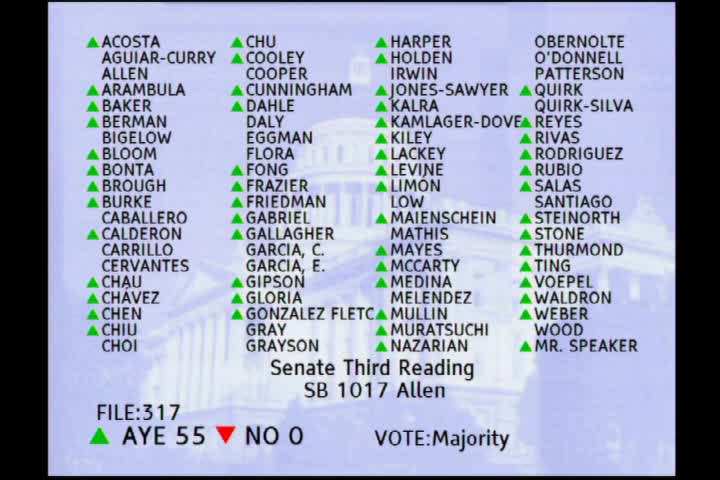 2MIN
Assembly Floor
 1H
Assembly Standing Committee on Appropriations
 22MIN
Senate Standing Committee on Health
Bill Author

Bill Co-Author(s):




