SB 1054: Pretrial release and detention: pretrial services.
- Session Year: 2017-2018
- House: Senate
- Latest Version Date: 2018-09-30
(1)Existing law, as proposed by SB 10 of the 201718 Regular Session, commencing October 1, 2019, requires persons arrested and detained to be subject to a pretrial risk assessment conducted by Pretrial Assessment Services, defined as an entity, division, or program that is assigned the responsibility to assess the risk level of persons charged with the commission of a crime, report the results of the risk determination to the court, and make recommendations for conditions of release of individuals pending adjudication of their criminal case. SB 10 requires the courts to establish pretrial assessment services and authorizes those services to be performed by court employees or through a contract with a local public agency, as specified. SB 10 provides that if no local agency will agree to perform the pretrial assessments, and if the court elects not to perform the assessments, the court may contract with a new local pretrial assessment services agency established specifically to perform the role. SB 10 requires pretrial assessment services to be performed by public employees.
This bill, notwithstanding the requirement that pretrial assessment services be performed by public employees, would authorize, until January 1, 2023, a qualified local public agency in the City and County of San Francisco to contract with the existing not-for-profit entity that is performing pretrial services in the city and county to provide continuity and sufficient time to transition the entitys employees into public employment.
(2)SB 10 authorizes Pretrial Assessment Services to release a person assessed as being a low risk, as defined, on his or her own recognizance, and additionally requires superior courts to adopt rules authorizing Pretrial Assessment Services to release persons assessed as being a medium risk, as defined, on his or her own recognizance. However, SB 10 prohibits Pretrial Assessment Services from releasing persons who meet specified conditions, including, among others, tier 2 sex offenders subject to registration for a minimum of 20 years and tier 3 sex offenders subject to lifetime registration.
This bill would provide that if SB 10 of the 201718 Regular Session becomes operative, the release prohibitions described above would be expanded to additionally include persons convicted of sex crimes and certain other offenses subject to the Sex Offender Registration Act, as specified. By increasing the length of time certain persons remain in county jails, this bill would impose a state-mandated local program.
(3)The California Constitution requires the state to reimburse local agencies and school districts for certain costs mandated by the state. Statutory provisions establish procedures for making that reimbursement.
This bill would provide that, if the Commission on State Mandates determines that the bill contains costs mandated by the state, reimbursement for those costs shall be made pursuant to the statutory provisions noted above.
(1)Existing law, as proposed by SB 10 of the 201718 Regular Session, commencing October 1, 2019, requires persons arrested and detained to be subject to a pretrial risk assessment conducted by Pretrial Assessment Services, defined as an entity, division, or program that is assigned the responsibility to assess the risk level of persons charged with the commission of a crime, report the results of the risk determination to the court, and make recommendations for conditions of release of individuals pending adjudication of their criminal case. SB 10 requires the courts to establish pretrial assessment services, and authorizes the services to be performed by court employees or through a contract with a local public agency, as specified. SB 10 provides that if no local agency will agree to perform the pretrial assessments, and if the court elects not to perform the assessments, that the court may contract with a new local pretrial assessment services agency established specifically to perform the role. SB 10 requires pretrial assessment services to be performed by public employees.
This bill, notwithstanding the requirement that pretrial assessment services be performed by public employees, would authorize, until January 1, 2023, a qualified local public agency in the City and County of San Francisco to contract with the existing not-for-profit entity that is performing pretrial services in the city and county to provide continuity and sufficient time to transition the entitys employees into public employment.
(2)SB 10 authorizes Pretrial Assessment Services to release a person assessed as being a low risk, as defined, on his or her own recognizance, and additionally requires superior courts to adopt rules authorizing Pretrial Assessment Services to release persons assessed as being a medium risk, as defined, on his or her own recognizance. However, SB 10 prohibits Pretrial Assessment Services from releasing persons who meet specified conditions, including, among others, tier 2 sex offenders subject to registration for a minimum of 20 years and tier 3 sex offenders subject to lifetime registration.
This bill would provide that if SB 10 of the 201718 Regular Session becomes operative, the release prohibitions described above would be expanded to additionally include persons convicted of sex crimes and certain other offenses subject to the Sex Offender Registration Act, as specified. By increasing the length of time certain persons remain in county jails, this bill would impose a state-mandated local program.
(3)The California Constitution requires the state to reimburse local agencies and school districts for certain costs mandated by the state. Statutory provisions establish procedures for making that reimbursement.
This bill would provide that, if the Commission on State Mandates determines that the bill contains costs mandated by the state, reimbursement for those costs shall be made pursuant to the statutory provisions noted above.
Existing law authorizes the Department of Toxic Substances Control to compel a responsible party to take or pay for appropriate removal or remediation action necessary to protect the public health and safety and the environment at the Santa Susana Field Laboratory site in Ventura County. Existing law prohibits the sale, lease, sublease, or transfer of land presently or formerly occupied by the Santa Susana Field Laboratory unless the Director of Toxic Substances Control or his or her designee certifies that the land has undergone complete remediation pursuant to specified protective standards. This bill would require the department to provide the public with a monthly status report on the projected completion dates of all environmental review documents and all approved soil or groundwater cleanup plans related to the Santa Susana Field Laboratory cleanup effort.This bill would make legislative findings and declarations as to the necessity of a special statute for the Santa Susana Field Laboratory cleanup.Existing law authorizes the Department of Toxic Substances Control to compel a responsible party to take or pay for appropriate removal or remediation action necessary to protect the public health and safety and the environment at the Santa Susana Field Laboratory site in Ventura County. Existing law prohibits the sale, lease, sublease, or transfer of land presently or formerly occupied by the Santa Susana Field Laboratory unless the Director of Toxic Substances Control or his or her designee certifies that the land has undergone complete remediation pursuant to specified protective standards.
This bill would require the department to provide the public with a monthly status report on the projected completion dates of all environmental review documents and all approved soil or groundwater cleanup plans related to the Santa Susana Field Laboratory cleanup effort.
This bill would make legislative findings and declarations as to the necessity of a special statute for the Santa Susana Field Laboratory cleanup.
(a)Pretrial Assessment Services shall conduct a prearraignment review of the facts and circumstances relevant to the arrested persons custody status, and shall consider any relevant and available information provided by law enforcement, the arrested person, any victim, and the prosecution or defense.
(b)Pretrial Assessment Services, using the information obtained pursuant to this section and Section 1320.9, and having assessed a person as having a low risk to public safety and low risk of failure to appear in court, shall release a low risk person on his or her own recognizance, prior to arraignment, without review by the court, and with the least restrictive nonmonetary condition or combination of conditions that will reasonably assure public safety and the persons return to court. This subdivision does not apply to a person booked and released under Section 1320.8 or a person who is ineligible for consideration for release prior to arraignment as set forth in subdivision (e).
(c)Pretrial Assessment Services shall order the release or detention of medium risk persons in accordance with the review and release standards set forth in the local rule of court authorized under Section 1320.11. A person released pursuant to the local rule of court shall be released on his or her own recognizance or on supervised own recognizance release, prior to arraignment, without review by the court, and with the least restrictive nonmonetary condition or combination of conditions that will reasonably assure public safety and the persons return to court. This subdivision shall not apply to a person booked and released under Section 1320.8 or a person ineligible for consideration prior to arraignment pursuant to subdivision (e) of this section. Pursuant to Section 1320.13, courts may conduct prearraignment reviews and make release decisions and may authorize subordinate judicial officers to conduct prearraignment reviews and make release decisions authorized by this chapter.
(d)A person shall not be required to pay for any nonmonetary condition or combination of conditions imposed pursuant to this section.
(e)Notwithstanding subdivisions (a) and (b), Pretrial Assessment Services shall not release:
(1)A person who has been assessed in the current case by Pretrial Assessment Services using a validated risk assessment tool pursuant to Section 1320.9 and is assessed as high risk.
(2)A person arrested for an offense listed in Section 290.
(3)A person arrested for any of the following misdemeanor offenses:
(A)A violation of Section 273.5.
(B)A violation of paragraph (1) of subdivision (e) of Section 243.
(C)A violation of Section 273.6 if the detained person is alleged to have made threats to kill or harm, engaged in violence against, or gone to the residence or the workplace of, the protected party.
(D)A violation of Section 646.9.
(4)A person arrested for a felony offense that includes, as an element of the crime for which the person was arrested, physical violence to another person, the threat of such violence, or the likelihood of great bodily injury, or a felony offense in which the person is alleged to have been personally armed with or personally used a deadly weapon or firearm in the commission of the crime, or alleged to have personally inflicted great bodily injury in the commission of the crime.
(5)A person arrested for a third offense within the past 10 years of driving under the influence of alcohol or drugs or any combination thereof, or for an offense of driving under the influence of alcohol or drugs with injury to another, or for an offense of driving with a blood alcohol level of .20 or above.
(6)A person arrested for a violation of any type of restraining order within the past five years.
(7)A person who has three or more prior warrants for failure to appear within the previous 12 months.
(8)A person who, at the time of arrest, was pending trial or pending sentencing for a misdemeanor or a felony.
(9)A person who, at the time of arrest, was on any form of postconviction supervision other than informal probation or court supervision.
(10)A person who has intimidated, dissuaded, or threatened retaliation against a witness or victim of the current crime.
(11)A person who has violated a condition of pretrial release within the past five years.
(12)A person who has been convicted of a serious felony, as defined in subdivision (c) of Section 1192.7, or a violent felony, as defined in subdivision (c) of Section 667.5, within the past five years.
(13)A person arrested with or without a warrant for a serious felony, as defined in subdivision (c) of Section 1192.7, or a violent felony, as defined in subdivision (c) of Section 667.5.
(f)Review of the persons custody status and release pursuant to subdivision (b) or (c) shall occur without unnecessary delay, and no later than 24 hours of the persons booking. The 24-hour period may be extended for good cause, but shall not exceed an additional 12 hours.
(g)A person shall not be released on his or her own recognizance in accordance with subdivision (b) or (c) until the person signs a release agreement that includes, at a minimum, all of the following from the person:
(1)A promise to appear at all times and places, as ordered by the court.
(2)A promise not to depart this state without the permission of the court.
(3)Agreement to waive extradition if the person fails to appear as required and is apprehended outside of the State of California.
(4)Acknowledgment that he or she has been informed of the consequences and penalties applicable to violation of these conditions of release.
(5)Agreement to obey all laws and orders of the court.
(h)Persons not released pursuant to this section shall be detained until arraignment unless the court provides prearraignment review pursuant to Section 1320.13.
SEC. 2.Section 1320.26 of the Penal Code, as proposed to be added by Senate Bill 10 of the 201718 Regular Session, is amended to read:1320.26.(a)The courts shall establish pretrial assessment services. The services may be performed by court employees or the court may contract for those services with a qualified local public agency with relevant experience.
(b)Before the court decides to not enter into a contract with a qualified local public agency, the court shall find that agency will not agree to perform this function with the resources available or does not have the capacity to perform the function.
(c)If no qualified local agency will agree to perform this pretrial assessment function for a superior court, and the court elects not to perform this function, the court may contract with a new local pretrial assessment services agency established to specifically perform this role.
(d)For the purpose of the provision of pretrial assessment services, the court may not contract with a qualified local public agency that has primary responsibility for making arrests and detentions within the jurisdiction.
(e)Pretrial assessment services shall be performed by public employees.
(f)Notwithstanding subdivision (i), the Superior Court of the County of Santa Clara may contract with the Office of Pretrial Services of the County of Santa Clara to provide pretrial assessment services within the County of Santa Clara and that office shall be eligible for funding allocations pursuant to subdivision (c) of Section 1320.27 and Section 1320.28.
(g)Notwithstanding subdivision (e), until January 1, 2023, a qualified local public agency in the City and County of San Francisco may contract with the existing not-for-profit entity that is performing pretrial services in the city and county for pretrial assessment services to provide continuity and sufficient time to transition the entitys employees into public employment.
(h)On or before February 1, 2019, the presiding judge of the superior court and the chief probation officer of each county, or the director of the County of Santa Claras Office of Pretrial Services for that county, shall submit to the Judicial Council a letter confirming their intent to contract for pretrial assessment services pursuant to this section.
(i)For the purposes of this section:
(1)Pretrial Assessment Services does not include supervision of persons released under this chapter.
(2)A qualified local public agency is one with experience in all of the following:
(A)Relevant expertise in making risk-based determinations.
(B)Making recommendations to the courts pursuant to Section 1203.
(C)Supervising offenders in the community.
(D)Employing peace officers.
SEC. 3.This act shall become operative on October 1, 2019, and contingent upon Senate Bill 10 of the 201718 Regular Session becoming operative.
SEC. 4.If the Commission on State Mandates determines that this act contains costs mandated by the state, reimbursement to local agencies and school districts for those costs shall be made pursuant to Part 7 (commencing with Section 17500) of Division 4 of Title 2 of the Government Code.
(a)Pretrial Assessment Services shall conduct a prearraignment review of the facts and circumstances relevant to the arrested persons custody status, and shall consider any relevant and available information provided by law enforcement, the arrested person, any victim, and the prosecution or defense.
(b)Pretrial Assessment Services, using the information obtained pursuant to this section and Section 1320.9, and having assessed a person as having a low risk to public safety and low risk of failure to appear in court, shall release a low risk person on his or her own recognizance, prior to arraignment, without review by the court, and with the least restrictive nonmonetary condition or combination of conditions that will reasonably assure public safety and the persons return to court. This subdivision does not apply to a person booked and released under Section 1320.8 or a person who is ineligible for consideration for release prior to arraignment as set forth in subdivision (e).
(c)Pretrial Assessment Services shall order the release or detention of medium risk persons in accordance with the review and release standards set forth in the local rule of court authorized under Section 1320.11. A person released pursuant to the local rule of court shall be released on his or her own recognizance or on supervised own recognizance release, prior to arraignment, without review by the court, and with the least restrictive nonmonetary condition or combination of conditions that will reasonably assure public safety and the persons return to court. This subdivision shall not apply to a person booked and released under Section 1320.8 or a person ineligible for consideration prior to arraignment pursuant to subdivision (e) of this section. Pursuant to Section 1320.13, courts may conduct prearraignment reviews and make release decisions and may authorize subordinate judicial officers to conduct prearraignment reviews and make release decisions authorized by this chapter.
(d)A person shall not be required to pay for any nonmonetary condition or combination of conditions imposed pursuant to this section.
(e)Notwithstanding subdivisions (a) and (b), Pretrial Assessment Services shall not release:
(1)A person who has been assessed in the current case by Pretrial Assessment Services using a validated risk assessment tool pursuant to Section 1320.9 and is assessed as high risk.
(2)A person arrested for an offense listed in paragraph (2) or (3) of subdivision (d) of Section 290.
(3)A person arrested for any of the following misdemeanor offenses:
(A)A violation of Section 273.5.
(B)A violation of paragraph (1) of subdivision (e) of Section 243.
(C)A violation of Section 273.6 if the detained person is alleged to have made threats to kill or harm, engaged in violence against, or gone to the residence or the workplace of, the protected party.
(D)A violation of Section 646.9.
(4)A person arrested for a felony offense that includes, as an element of the crime for which the person was arrested, physical violence to another person, the threat of such violence, or the likelihood of great bodily injury, or a felony offense in which the person is alleged to have been personally armed with or personally used a deadly weapon or firearm in the commission of the crime, or alleged to have personally inflicted great bodily injury in the commission of the crime.
(5)A person arrested for a third offense within the past 10 years of driving under the influence of alcohol or drugs or any combination thereof, or for an offense of driving under the influence of alcohol or drugs with injury to another, or for an offense of driving with a blood alcohol level of .20 or above.
(6)A person arrested for a violation of any type of restraining order within the past five years.
(7)A person who has three or more prior warrants for failure to appear within the previous 12 months.
(8)A person who, at the time of arrest, was pending trial or pending sentencing for a misdemeanor or a felony.
(9)A person who, at the time of arrest, was on any form of postconviction supervision other than informal probation or court supervision.
(10)A person who has intimidated, dissuaded, or threatened retaliation against a witness or victim of the current crime.
(11)A person who has violated a condition of pretrial release within the past five years.
(12)A person who has been convicted of a serious felony, as defined in subdivision (c) of Section 1192.7, or a violent felony, as defined in subdivision (c) of Section 667.5, within the past five years.
(13)A person arrested with or without a warrant for a serious felony, as defined in subdivision (c) of Section 1192.7, or a violent felony, as defined in subdivision (c) of Section 667.5.
(f)Review of the persons custody status and release pursuant to subdivision (b) or (c) shall occur without unnecessary delay, and no later than 24 hours of the persons booking. The 24-hour period may be extended for good cause, but shall not exceed an additional 12 hours.
(g)A person shall not be released on his or her own recognizance in accordance with subdivision (b) or (c) until the person signs a release agreement that includes, at a minimum, all of the following from the person:
(1)A promise to appear at all times and places, as ordered by the court.
(2)A promise not to depart this state without the permission of the court.
(3)Agreement to waive extradition if the person fails to appear as required and is apprehended outside of the State of California.
(4)Acknowledgment that he or she has been informed of the consequences and penalties applicable to violation of these conditions of release.
(5)Agreement to obey all laws and orders of the court.
(h)Persons not released pursuant to this section shall be detained until arraignment unless the court provides prearraignment review pursuant to Section 1320.13.
SEC. 2.Section 1320.26 of the Penal Code, as proposed to be added by Senate Bill 10 of the 201718 Regular Session, is amended to read:1320.26.(a)The courts shall establish pretrial assessment services. The services may be performed by court employees or the court may contract for those services with a qualified local public agency with relevant experience.
(b)Before the court decides to not enter into a contract with a qualified local public agency, the court shall find that agency will not agree to perform this function with the resources available or does not have the capacity to perform the function.
(c)If no qualified local agency will agree to perform this pretrial assessment function for a superior court, and the court elects not to perform this function, the court may contract with a new local pretrial assessment services agency established to specifically perform this role.
(d)For the purpose of the provision of pretrial assessment services, the court may not contract with a qualified local public agency that has primary responsibility for making arrests and detentions within the jurisdiction.
(e)Pretrial assessment services shall be performed by public employees.
(f)Notwithstanding subdivision (h), (i), the Superior Court of the County of Santa Clara may contract with the Office of Pretrial Services of the County of Santa Clara to provide pretrial assessment services within the County of Santa Clara and that office shall be eligible for funding allocations pursuant to subdivision (c) of Section 1320.27 and Section 1320.28.
(g)Notwithstanding subdivision (e), until January 1, 2023, a qualified local public agency in the City and County of San Francisco may contract with the existing not-for-profit entity that is performing pretrial services in the city and county for pretrial assessment services to provide continuity and sufficient time to transition the entitys employees into public employment.
(g)(h)On or before February 1, 2019, the presiding judge of the superior court and the chief probation officer of each county, or the director of the County of Santa Claras Office of Pretrial Services for that county, shall submit to the Judicial Council a letter confirming their intent to contract for pretrial assessment services pursuant to this section.
(h)(i)For the purposes of this section:
(1)Pretrial Assessment Services does not include supervision of persons released under this chapter.
(2)A qualified local public agency is one with experience in all of the following:
(A)Relevant expertise in making risk-based determinations.
(B)Making recommendations to the courts pursuant to Section 1203.
(C)Supervising offenders in the community.
(D)Employing peace officers.
SEC. 3.This act shall become operative on October 1, 2019, and contingent upon Senate Bill 10 of the 201718 Regular Session becoming operative.
SEC. 4.If the Commission on State Mandates determines that this act contains costs mandated by the state, reimbursement to local agencies and school districts for those costs shall be made pursuant to Part 7 (commencing with Section 17500) of Division 4 of Title 2 of the Government Code.
SECTION 1.The Legislature finds and declares all of the following:(a)In 2007, the United States Department of Energy (DOE), the National Aeronautics and Space Administration (NASA), and the Boeing Company voluntarily entered into a consent order for corrective action (Consent Order) with the Department of Toxic Substances Control (DTSC) for the cleanup of chemical contamination at the Santa Susana Field Laboratory (SSFL) in the County of Ventura.(b)Pursuant to the 2007 Consent Order, the cleanup of chemically contaminated soil and the construction of groundwater cleanup remedies were to be completed by June 30, 2017.(c)In 2010, the DOE and NASA voluntarily entered into Administrative Orders on Consent for Remedial Action (AOCs) with DTSC for the cleanup of radioactive and chemical contamination at the SSFL.(d)Pursuant to the 2010 AOCs, the deadline for cleanup of soil and construction of groundwater cleanup remedies remained June 30, 2017.(e)As of 2018, aside from a few interim measures, the cleanup has not yet begun.(f)In September of 2017, DTSC issued a draft program environmental impact report (draft PEIR) for SSFL for public comment, which was issued years late and after the deadlines set forth in the 2007 Consent Order and the 2010 AOCs.(g)To make matters worse, the draft PEIR postpones until later stages the identification of the specific cleanup actions to be considered and the review of those actions.(h)The Legislature and many in the community near the SSFL are concerned about the long delays.SEC. 2.Section 25359.21 is added to the Health and Safety Code, to read:25359.21.The department shall provide the public with a monthly status report on both of the following:(a)The projected completion dates for all environmental documents prepared pursuant to the California Environmental Quality Act (Division 13 (commencing with Section 21000) of the Public Resources Code) for the Santa Susana Field laboratory cleanup.(b)All approved soil or groundwater cleanup plans regarding the Santa Susana Field Laboratory cleanup.SEC. 3.The Legislature finds and declares that a special statute is necessary and that a general statute cannot be made applicable within the meaning of Section 16 of Article IV of the California Constitution because of the unique circumstances regarding the Santa Susana Field Laboratory cleanup.The Legislature finds and declares all of the following:
(a)In 2007, the United States Department of Energy (DOE), the National Aeronautics and Space Administration (NASA), and the Boeing Company voluntarily entered into a consent order for corrective action (Consent Order) with the Department of Toxic Substances Control (DTSC) for the cleanup of chemical contamination at the Santa Susana Field Laboratory (SSFL) in the County of Ventura.
(b)Pursuant to the 2007 Consent Order, the cleanup of chemically contaminated soil and the construction of groundwater cleanup remedies were to be completed by June 30, 2017.
(c)In 2010, the DOE and NASA voluntarily entered into Administrative Orders on Consent for Remedial Action (AOCs) with DTSC for the cleanup of radioactive and chemical contamination at the SSFL.
(d)Pursuant to the 2010 AOCs, the deadline for cleanup of soil and construction of groundwater cleanup remedies remained June 30, 2017.
(e)As of 2018, aside from a few interim measures, the cleanup has not yet begun.
(f)In September of 2017, DTSC issued a draft program environmental impact report (draft PEIR) for SSFL for public comment, which was issued years late and after the deadlines set forth in the 2007 Consent Order and the 2010 AOCs.
(g)To make matters worse, the draft PEIR postpones until later stages the identification of the specific cleanup actions to be considered and the review of those actions.
(h)The Legislature and many in the community near the SSFL are concerned about the long delays.
SEC. 2.Section 25359.21 is added to the Health and Safety Code, to read:25359.21.The department shall provide the public with a monthly status report on both of the following:
(a)The projected completion dates for all environmental documents prepared pursuant to the California Environmental Quality Act (Division 13 (commencing with Section 21000) of the Public Resources Code) for the Santa Susana Field laboratory cleanup.
(b)All approved soil or groundwater cleanup plans regarding the Santa Susana Field Laboratory cleanup.
SEC. 3.The Legislature finds and declares that a special statute is necessary and that a general statute cannot be made applicable within the meaning of Section 16 of Article IV of the California Constitution because of the unique circumstances regarding the Santa Susana Field Laboratory cleanup.
|
Date
|
Status
|
|---|---|
| Sep 30, 2018 | Chaptered by Secretary of State. Chapter 980, Statutes of 2018. |
| Sep 30, 2018 | Approved by the Governor. |
| Sep 6, 2018 | Enrolled and presented to the Governor at 4 p.m. |
| Aug 29, 2018 | Assembly amendments concurred in. (Ayes 38. Noes 1.) Ordered to engrossing and enrolling. |
| Aug 28, 2018 | In Senate. Concurrence in Assembly amendments pending. |
| Aug 28, 2018 | Read third time. Passed. Ordered to the Senate. |
| Aug 27, 2018 | Ordered to third reading. |
| Aug 24, 2018 | Re-referred to Com. on PUB. S. pursuant to Assembly Rule 77.2. |
| Aug 23, 2018 | Read third time and amended. |
| Aug 21, 2018 | From inactive file. |
| Aug 20, 2018 | Notice of intention to remove from inactive file given by Assembly Member Calderon. |
| Aug 13, 2018 | From consent calendar on motion of Assembly Member Calderon. |
| Aug 9, 2018 | Read second time. Ordered to consent calendar. |
| Aug 8, 2018 | From committee: Do pass. Ordered to consent calendar. (Ayes 17. Noes 0.) (August 8). |
| Jun 27, 2018 | From committee: Do pass and re-refer to Com. on APPR. with recommendation: To consent calendar. (Ayes 6. Noes 0.) (June 26). Re-referred to Com. on APPR. |
| Jun 7, 2018 | June 12 hearing postponed by committee. |
| May 10, 2018 | Referred to Com. on E.S. & T.M. |
| May 3, 2018 | In Assembly. Read first time. Held at Desk. |
| May 3, 2018 | Read third time. Passed. (Ayes 38. Noes 0.) Ordered to the Assembly. |
| May 1, 2018 | Read second time. Ordered to consent calendar. |
| Apr 30, 2018 | From committee: Be ordered to second reading pursuant to Senate Rule 28.8 and ordered to consent calendar. |
| Apr 20, 2018 | Set for hearing April 30. |
| Apr 18, 2018 | From committee: Do pass and re-refer to Com. on APPR. with recommendation: To consent calendar. (Ayes 7. Noes 0.) (April 18). Re-referred to Com. on APPR. |
| Mar 29, 2018 | Set for hearing April 18. |
| Mar 20, 2018 | April 4 set for first hearing canceled at the request of author. |
| Mar 20, 2018 | Set for hearing April 4. |
| Feb 22, 2018 | Referred to Com. on EQ. |
| Feb 13, 2018 | From printer. May be acted upon on or after March 15. |
| Feb 12, 2018 | Introduced. Read first time. To Com. on RLS. for assignment. To print. |
|
Date
|
Description
|
Location
|
Votes
|
|
|---|---|---|---|---|
| Aug 29, 2018 | Unfinished Business SB1054 Hertzberg et al. Concurrence | Senate Floor |
Passed |
|
| Aug 29, 2018 | Unfinished Business SB1054 Hertzberg et al. Concurrence Reconsider | Senate Floor |
Passed |
|
| Aug 29, 2018 | Unfinished Business SB1054 Hertzberg et al. Concurrence | Senate Floor |
Passed |
|
| Aug 28, 2018 | SB 1054 Hertzberg Senate Third Reading By BONTA | Assembly Floor |
Passed |
|
| Aug 8, 2018 | Do pass. To Consent Calendar. | Assembly Standing Committee on Appropriations |
Passed |
|
| Jun 26, 2018 | Do pass and be re-referred to the Committee on [Appropriations] with recommendation: To Consent Calendar | Assembly Standing Committee on Environmental Safety and Toxic Materials |
Passed |
|
| May 3, 2018 | Consent Calendar SB1054 | Senate Floor |
Passed |
|
| Apr 18, 2018 | Do pass, but first be re-referred to the Committee on [Appropriations] with the recommendation: To Consent Calendar | Senate Standing Committee on Environmental Quality |
Passed |
This list shows positions taken on this bill by organizations on the date displayed, which is linked to the original source.
Positions by individuals are not included.
|
Organization
|
Position
|
Date
|
|---|---|---|
| Committee to Bridge the Gap | ** Support | Jun 23, 2018 |
| Physicians for Social Responsibility - Los Angeles | ** Support | Jun 23, 2018 |
| Rocketdyne Cleanup Coalition | ** Support | Jun 23, 2018 |
| Southern California Federation of Scientists | ** Support | Jun 23, 2018 |
Office of Senate Floor Analyses (916) 651-1520 Fax: (916) 327-4478 | SB |
UNFINISHED BUSINESS
Bill No: SB 1054
:
PRIOR SENATE VOTES NOT RELEVANT
ASSEMBLY FLOOR: 75-1, 8/28/18 - See last page for vote
DIGEST:
This bill is a follow up to SB 10 (Hertzberg, 2018) which created a risk-based non-monetary prearraignment and pretrial release system for people arrested for criminal offenses, it provides that no person arrested for a sex offense could be released pre-arraignment and that in the City and County of San Francisco the existing non-profit entity performing pretrial services may provide the pretrial assessment services required in SB 10.
Assembly Amendments
delete the contents of the bill and replace it with the content of SB 10 (Hertzberg).
Existing law:
- Declares that a person shall be released on bail by sufficient sureties, except for:
- Capital crimes when the facts are evident or the presumption great;
- Felony offenses involving acts of violence on another person, or felony sexual assault offenses on another person, when the facts are evident or the presumption great and the court finds based upon clear and convincing evidence that there is a substantial likelihood the person's release would result in great bodily harm to others; or
- Felony offenses when the facts are evident or the presumption great and the court finds based on clear and convincing evidence that the person has threatened another with great bodily harm and that there is a substantial likelihood that the person would carry out the threat if released. (Cal. Const., art. I, section 12.)
- Prohibits excessive bail. (Id.)
- Sets forth a system of when a person shall be released on bail or on his or her own recognizance. (see Penal Code §§ 815a, 1269b, 1270, 1270.1, 1270.2, 1275, 1318.1(a).).)
This bill:
- Provides that San Francisco can use their existing not-for-profit entity for the pretrial assessments that are required by SB 10.
- Expands the offenses that SB 10 makes ineligible for pre-arraignment release to include all sex offenses for which a person must register.
Related/Prior Legislation
SB 10 (Hertzberg) which passed out of the Senate on concurrence on 8/2/18 proposes to change the existing bail system into a risk-based non-monetary prearraignment and pretrial release system.
FISCAL EFFECT: Appropriation: Fiscal Com.: Local:
Unknown with latest amendments.
None received
OPPOSITION: (Verified 8/28/18)
None received
ASSEMBLY FLOOR: 75-1, 8/28/18
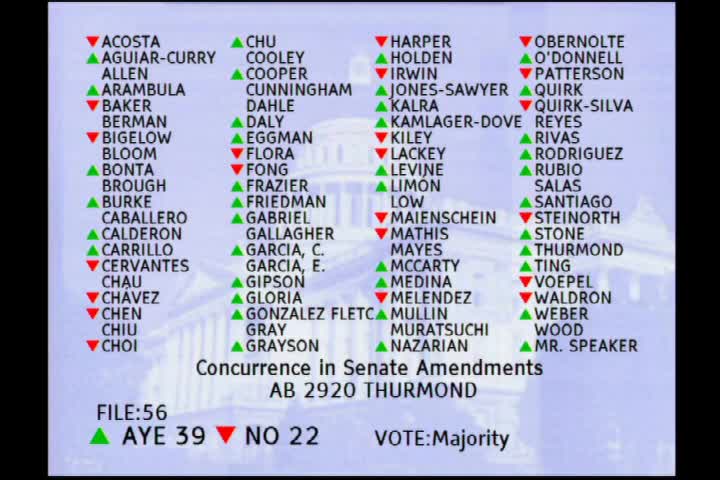
AYES: Acosta, Aguiar-Curry, Travis Allen, Arambula, Baker, Berman, Bigelow, Bloom, Bonta, Brough, Burke, Caballero, Calderon, Carrillo, Cervantes, Chau, Chávez, Chen, Chiu, Choi, Chu, Cooley, Cunningham, Dahle, Daly, Eggman, Flora, Frazier, Friedman, Gabriel, Gallagher, Cristina Garcia, Eduardo Garcia, Gipson, Gloria, Gonzalez Fletcher, Gray, Grayson, Holden, Irwin, Jones-Sawyer, Kalra, Kamlager-Dove, Lackey, Levine, Limón, Low, Maienschein, Mathis, Mayes, McCarty, Medina, Melendez, Mullin, Muratsuchi, Nazarian, Obernolte, O'Donnell, Quirk, Quirk-Silva, Reyes, Rivas, Rodriguez, Rubio, Salas, Santiago, Steinorth, Mark Stone, Thurmond, Ting, Voepel, Waldron, Weber, Wood, Rendon
NOES: Cooper
NO VOTE RECORDED: Fong, Harper, Kiley, Patterson
8/28/18 21:36:00
**** END ****
SENATE THIRD READING
STR Bill Id:SB 1054
Author:(Hertzberg)
As Amended Ver:August 23, 2018
Majority vote
SENATE VOTE: 38-0
Committee | Votes | Ayes | Noes |
Environmental Safety | 6-0 | Quirk, Arambula, Lackey, Holden, Mathis, Muratsuchi |
|
Appropriations | 17-0 | Gonzalez Fletcher, Bigelow, Bloom, Bonta, Brough, Calderon, Carrillo, Chau, Eggman, Fong, Friedman, Gallagher, Eduardo Garcia, Nazarian, Obernolte, Quirk, Reyes |
|
SUMMARY: Makes technical changes to SB 10 (Hertzberg), of the current legislative session, which repeals the current commercial bail system and enacts a risk-based preventative detention system. Specifically, this bill:
- Exempts, until January 1, 2023, the San Francisco Pretrial Diversion Project from the requirement that pretrial assessment services be performed by public employees.
- Fixes an incorrect cross reference which references the version of the sex offender registration statute not yet in effect.
- Makes these provisions contingent upon the enactment of SB 10 (Hertzberg) of the current legislative session.
EXISTING LAW:
- Authorizes a court, with the concurrence of the board of supervisors, to employ an investigative staff for the purpose of recommending whether a defendant should be released on his or her own recognizance (OR). (Penal Code, Section 1318.1, subd. (a).)
- States that whenever a court has employed investigative staff for the purpose of recommending whether a defendant should be released on OR, an investigative report shall be prepared in all cases involved in a violent felony listed in subdivision (c) of Penal Code Section 667.5, or a felony violation of driving under the influence and causing bodily injury to another person, recommending whether the defendant should be released on OR. The report shall include all of the following
- Written verification of any outstanding warrants against the defendant;
- Written verification of any prior incidents where the defendant has failed to make a court appearance;
- Written verification of the criminal record of the defendant; and,
- Written verification of the residence of the defendant during the past year. (Penal Code, Section 1318.1(b).)
- Prohibits OR release of a defendant for any violent felony until a hearing is held in open court and the prosecuting attorney is given notice and an opportunity to be heard on the matter. (Penal Code, Section 1319.)
- Requires persons convicted of specified sex offenses to register for life. (Penal Code, Section 290, operative until Jan. 1, 2021.)
- Establishes a tiered registry for sex offenses so that people will be required to register for 10 years, 20 years, or lifetime depending on the conviction offense, but delays implementation until January 1, 2021. (Penal Code, Section 290, operative on Jan. 1, 2021.)
Analysis Prepared by: Sandy Uribe / PUB. S. / (916) 319-3744 FN: 0004695
SENATE THIRD READING
STR Bill Id:SB 1054
Author:(Hertzberg)
As Introduced Ver:February 12, 2018
Majority vote
SENATE VOTE: 38-0
Committee | Votes | Ayes | Noes |
Environmental Safety | 6-0 | Quirk, Arambula, Lackey, Holden, Mathis, Muratsuchi | |
Appropriations | 17-0 | Gonzalez Fletcher, Bigelow, Bloom, Bonta, Brough, Calderon, Carrillo, Chau, Eggman, Fong, Friedman, Gallagher, Eduardo Garcia, Nazarian, Obernolte, Quirk, Reyes |
|
SUMMARY: Requires the Department of Toxic Substances Control (DTSC) to provide the public with a monthly status report on the cleanup of the Santa Susana Field Laboratory (SSFL), including projected completion dates for all environmental documents prepared under the California Environmental Quality Act (CEQA) and all approved soil or groundwater cleanup plans.
FISCAL EFFECT: According to the Assembly Appropriations Committee, the costs to DTSC are absorbable within existing resources for enactment of this bill.
COMMENTS:
Santa Susana Field Laboratory (SSFL): The SSFL is located 30 miles northwest of downtown Los Angeles in southeastern Ventura County. A former rocket engine test and nuclear research facility, the 2,849-acre field laboratory is currently the focus of a comprehensive environmental investigation and cleanup program conducted by the responsible parties, Boeing, the United States Department of Energy (DOE), and the National Aeronautics and Space Administration (NASA), and overseen by DTSC.
SSFL site operations and history: Operational activities at SSFL began in 1948 and primarily included research, development, and testing of liquid-propellant rocket engines, water jet pumps, lasers, liquid-metal heat exchanger components, nuclear energy, and related technologies. The principal activity was large rocket engine testing by Boeing (and its predecessors North American Aviation and Rockwell International), the United States Air Force (USAF), and NASA. Past operational activities at SSFL resulted in the release of chemicals of concern to both soil and groundwater. The nuclear research also resulted in the accidental release of radioactive elements to the environment.
Cleanup of SSFL: Cleanup of soil, groundwater, and related media at SSFL will be conducted under the Corrective Action Program of the federal Resource Conservation and Recovery Act (RCRA), with DTSC as the lead agency. In addition, the cleanup of soil by DOE and NASA, is being conducted under state law, the Hazardous Substances Account Act. Because of their role in causing the contamination at the project site, NASA, DOE, and Boeing are referred to as "Responsible Parties" (RPs), which means they are responsible for conducting required investigations and clean up of contaminants released from past activities at the project site. The RPs are required to prepare draft project-specific cleanup documents for each area requiring cleanup. The public will have an opportunity to review and comment on these draft documents. Thereafter, DTSC will issue final cleanup decision documents that describe each RP’s project specific cleanup requirements.
Draft Environmental Impact Report (EIR) for SSFL: In September 2017, DTSC released the draft EIR for the cleanup of SSFL for 90 day public comment. The Draft EIR explains the environmental impacts that could result from SSFL cleanup activities, and identifies alternatives to avoid or reduce those impacts.
SSFL Draft Program Management Plan (PMP): The Draft PMP, prepared by DTSC, establishes the framework for investigation and cleanup decisions at SSFL. The Draft PMP describes how the cleanup will be undertaken in accordance with all applicable laws. The PMP will serve as a roadmap for how DTSC and the three RPs (Boeing, NASA, and DOE) will complete the SSFL cleanup. Additionally, the PMP will assist in managing the complex nature of cleanup projects, the responsible parties’ schedules, and multiple regulatory agencies’ involvement at the site. The PMP will be updated annually to incorporate new information, especially as it relates to schedule and the roles of supporting agencies.
SSFL project schedule: The current schedule goal is for DTSC to finalize the EIR in 2018 and for all three RPs to have draft cleanup decision documents to DTSC in late 2018 to early 2019. Cleanup activities are currently anticipated to begin in 2019. Project cleanup schedules will be further defined in the remediation planning documents and associated designs; however, if soil cleanup begins in early 2019, remediation of all chemically and radiologically impacted soils is anticipated to be completed by the end 2034.
The investigation and planning for the cleanup of SSFL has been going on for over a decade and is almost two years past a 2017 goal for completing the cleanup. The investigation and cleanup of SSFL has been complex and involved multiple stakeholders. Once DTSC releases the final EIR, and if it is not litigated, the cleanup of SSFL could begin in 2019. Given how imminent cleanup activities are to commencing and how critical the remaining environmental documents and data are, this bill cements in statute the requirement that DTSC provide the public with environmental documents prepared under CEQA and all approved soil or groundwater cleanup plans.
Analysis Prepared by: Josh Tooker / E.S. & T.M. / (916) 319-3965 FN: 0004406
Date of Hearing: August 8, 2018
ASSEMBLY COMMITTEE ON APPROPRIATIONS
Lorena Gonzalez Fletcher, Chair
SBPCA Bill Id:SB 1054
Author:(Hertzberg) – As Introduced Ver:February 12, 2018
Policy Committee: | Environmental Safety and Toxic Materials | Vote: | 6 - 0 |
|
| ||
|
|
Urgency: No State Mandated Local Program: No Reimbursable: No
SUMMARY:
This bill requires the Department of Toxic Substances Control (DTSC) to provide the public with a monthly status report on the cleanup for the Santa Susana Field Laboratory, including projected completion dates for all environmental documents prepared under the California Environmental Quality Act (CEQA) and all approved soil or groundwater cleanup plans.
FISCAL EFFECT:
DTSC costs are absorbable within existing resources.
COMMENTS:
Background and Purpose. For decades, Santa Susana was the home base for experimentation with nuclear reactors, rocket engines, and liquid metals. The significant contamination left behind due to multiple accidents involving nuclear reactors is well-documented. Since the laboratory’s closure in 2006, thousands of acres affected by radioactive and chemical contamination have remained unaddressed, sitting just 30 miles northwest of downtown Los Angeles.
In 2007, The United States Department of Energy, the National Aeronautics and Space Administration, and the Boeing Company entered into a voluntary agreement with DTSC to clean up the chemical contamination at the Santa Susana Field Laboratory. The agreement originally targeted June 30, 2017, for completion, but due to long delays, there has been no action.
This bill requires DTSC to provide monthly reports on all approved soil and groundwater cleanup plans and all environmental documents prepared under the California Environmental Quality Act (CEQA). The bill is intended to help the public understand and oversee the progress on the Santa Susana Field Laboratory.
Analysis Prepared by: Jennifer Galehouse / APPR. / (916) 319-2081
Date of Hearing: June 26, 2018
ASSEMBLY COMMITTEE ON ENVIRONMENTAL SAFETY AND TOXIC MATERIALS
Bill Quirk, Chair
SBPCA Bill Id:SB 1054
Author:(Hertzberg) – As Introduced Ver:February 12, 2018
SENATE VOTE: 38-0
SUBJECT: Santa Susana Field Laboratory cleanup
SUMMARY: Requires the Department of Toxic Substances Control (DTSC) to provide the public with a monthly status report on the cleanup for the Santa Susana Field Laboratory, including projected completion dates for all environmental documents prepared under the California Environmental Quality Act (CEQA) and all approved soil or groundwater cleanup plans.
EXISTING LAW:
1) Establishes a program to provide for response authority for releases of hazardous substances, including spills and hazardous waste disposal sites that pose a threat to the public health or the environment. Provides that this is known as the Carpenter-Presley-Tanner Hazardous Substance Account Act (HSAA). (Health and Safety Code (HSC) § 25300 et seq.)
2) Authorizes DTSC to regulate hazardous waste management pursuant to the Hazardous Waste Control Law (HWCL). (HSC § 25200 (a))
3) Creates a Federal "Superfund" to clean up uncontrolled or abandoned hazardous waste sites, as well as accidents, spills, and other emergency releases of pollutants and contaminants into the environment, under the Comprehensive Environmental Response, Compensation, and Liability Act (CERCLA). Provides the United States Environmental Protection Agency (US EPA) with the authority to seek out those parties responsible for any release and assure their cooperation in the cleanup. (42 United States Code (U.S.C.) § 9601 et seq.)
4) Establishes the national hazardous waste management program under Subtitle C of the Resources Conservation and Recovery Act (RCRA). (42 U.S.C. § 6901 et seq.)
FISCAL EFFECT: Unknown.
COMMENTS:
Need for the bill: According to the author, "The cleanup of the Santa Susana Field Laboratory, which was supposed to be finished in 2017, has not even started and DTSC has announced that it won’t be completed until 2034. A recent draft programmatic EIR (when finalized) will result in many subsequent project level environmental analyses. This bill is focused on those future documents and directs that they be posted on the department’s website. It is important to make it as easy as possible for the public to stay informed, therefore SB 1034 requires DTSC to provide the public with the status of all approved soil and groundwater cleanup plans and all environmental documents under CEQA."
The Comprehensive Environmental Response, Compensation, and Liability Act (CERCLA): CERCLA, or Superfund, provides a Federal "Superfund" to clean up uncontrolled or abandoned hazardous-waste sites as well as accidents, spills, and other emergency releases of pollutants and contaminants into the environment. Through CERCLA, US EPA was given authority to seek out those parties responsible for any release and assure their cooperation in the cleanup.
US EPA cleans up orphan sites when potentially responsible parties cannot be identified or located, or when they fail to act. Through various enforcement tools, US EPA obtains private party cleanup through orders, consent decrees, and other small party settlements. US EPA also recovers costs from financially viable individuals and companies once a response action has been completed. Superfund site identification, monitoring, and response activities in states are coordinated through the states’ environmental protection or waste management agencies.
CERCLA defines liable parties as current owners and operators of a facility, former owners and operators of a facility at the time of disposal, persons who arranged for treatment or disposal of hazardous substances, and transporters of hazardous substances who selected the disposal site. A person who falls within the definition of one of these classes may be held liable under CERCLA.
Federal hazardous waste regulation: The federal RCRA established three programs: hazardous waste management (RCRA Subtitle C), solid waste management (RCRA Subtitle D), and the underground storage tank program (RCRA Subtitle I). RCRA provides "cradle-to-grave" control of solid and hazardous waste by establishing management requirements for generators and transporters of hazardous waste treatment, storage, and disposal facilities. Most states have been authorized to implement some or all of the RCRA subtitle C program. State RCRA programs must be at least as stringent as the federal program; however, states can adopt more stringent requirements.
Carpenter-Presley-Tanner Hazardous Substances Account Act (HSAA): State law provides DTSC with general administrative responsibility for overseeing the state’s responses to spills or releases of hazardous substances, and for hazardous waste disposal sites that pose a threat to public health or the environment. DTSC uses the HSAA for cleanup of contaminated sites and the HWCL for the regulation of hazardous waste sites. The HSAA provides DTSC with the authority, procedures, and standards to investigate, remove, and remediate contamination at sites; to issue and enforce a removal or remedial action order to any responsible party; and, to impose administrative or civil penalties for noncompliance with an order. Federal and state law also authorize DTSC to recover costs and expenses it incurs in carrying out these activities.
California Hazardous Waste Control Law (HWCL): The HWCL is the state's program that implements and enforces federal hazardous waste law in California and directs DTSC to oversee and implement the state's HWCL. Any person who stores, treats, or disposes of hazardous waste must obtain a permit from DTSC. The HWCL covers the entire management of hazardous waste, from the point the hazardous waste is generated, to management, transportation, and ultimately disposal into a state or federal authorized facility.
Santa Susana Field Laboratory (SSFL): The SSFL is located 30 miles northwest of downtown Los Angeles in southeastern Ventura County, near the crest of the Simi Hills at the western border of the San Fernando Valley. A former rocket engine test and nuclear research facility, the 2,849-acre field laboratory is currently the focus of a comprehensive environmental investigation and cleanup program conducted by the responsible parties, Boeing, the United States Department of Energy (DOE), and the National Aeronautics and Space Administration (NASA), and overseen by DTSC.
SSFL Site Operations and History: Operational activities at SSFL began in 1948 and primarily included research, development, and testing of liquid-propellant rocket engines, water jet pumps, lasers, liquid-metal heat exchanger components, nuclear energy, and related technologies. The principal activity was large rocket engine testing by Boeing (and its predecessors North American Aviation and Rockwell International), the U.S. Air Force (USAF), and NASA. The majority of the project site was acquired in 1954 and 1958, and development of the western portion of the site began soon after.
From 1954 to 2001, DOE and its predecessor agency, the Atomic Energy Commission, sponsored nuclear and non-nuclear energy research and development projects at the site. The research and energy development activities included nuclear energy operations (development, fabrication, disassembly, and examination of 10 nuclear research reactors, reactor fuel, and other radioactive materials) and large-scale liquid sodium metal experiments for testing liquid-metal fast-breeder reactor components. The last of the nuclear reactors was shut down by 1974 and the remaining nuclear energy research and handling of nuclear materials ended by 1988.
The past operational activities at SSFL resulted in the release of chemicals of concern to both soil and groundwater. Engine testing in the six rocket engine test areas primarily used petroleum based compounds as fuel and liquid oxygen as the oxidizer. Solvents, primarily trichloroethene (TCE), were used to clean engine components as well as for other equipment degreasing operations at SSFL. Petroleum fuel hydrocarbons and chlorinated solvents were used at SSFL in the largest volumes. Another solvent, used in lesser quantities, 1,1,1-trichloroethane (TCA), contained 1,4-dioxane as a stabilizer to increase the longevity and usefulness of the solvent. Solid propellants, including perchlorate compounds, were used at SSFL for research and testing operations. Polychlorinated biphenyls (PCBs) were present in some waste oils as well as oils within pre-1980 electrical transformers at various sites within SSFL.
The nuclear research conducted in Area IV also resulted in the accidental release of radioactive elements to the environment. Radionuclides that have been detected at more than one sample location include cesium-137, strontium-90, plutonium-239/240, cobalt-60, europium-152, plutonium-238, americium-241, and curium-243/244.
Three landfills were used at SSFL primarily for disposal of non-hazardous, inert construction debris (concrete, asphalt, rock, soil, etc.). Liquid wastes from engine testing were managed until the 1980s in a series of both flow-through and retention ponds. Ten of these ponds (impoundments) have undergone closure: one was clean-closed and nine were closed as RCRA regulated units. Radioactive and mixed wastes were managed for offsite disposal at the onsite Radioactive Materials Handling Facility; non-radioactive, alkaline, and liquid-metal wastes were managed and treated at the onsite Hazardous Waste Management Facility. The onsite Thermal Treatment Facility was used for open burn/open detonation of hypergolic, reactive, and explosive wastes. Operational programs are no longer active since all research and development ceased as of 2006.
Cleanup of SSFL: Cleanup of soil, groundwater, and related media at SSFL will be conducted under the Corrective Action Program of RCRA. In addition, the cleanup of soil by the federal agencies, DOE and NASA, is being conducted under the HSAA. Because of their role in causing the contamination at the project site, NASA, DOE, and Boeing are referred to as "Responsible Parties" (RPs), which means they are responsible for conducting required investigations and cleanups of contaminants released from past activities at the project site.
Investigation and cleanup requirements at the project site are further defined in the 2007 Consent Order for Corrective Action (2007 Consent Order) and the 2010 Administrative Orders on Consent (AOCs) for Remedial Action. The 2007 Consent Order and the 2010 AOCs establish the requirements for the investigation and cleanup of soil and groundwater at the project site. The RPs are required to prepare draft project-specific cleanup documents for each area requiring cleanup. The public will have an opportunity to review and comment on these draft documents. Thereafter, DTSC will issue final cleanup decision documents that describe each RP’s project specific cleanup requirements for each area requiring a cleanup.
The 2007 Consent Order is the initial agreement that DTSC and the three RPs entered into to define the requirements for investigating contaminated soil and groundwater, and to implement the cleanup at SSFL. However, in 2010, NASA and DOE entered into subsequent, separate AOCs with DTSC. The 2010 AOCs establish the process to investigate and cleanup soil within NASA’s and DOE’s administrative areas. The 2007 Consent Order continues to define the groundwater investigation and cleanup requirements for all of SSFL, and soil investigation and cleanup requirements within Boeing’s administrative areas. As a result of these separate orders, the soil cleanup requirements for Boeing areas are less stringent than the soil cleanup requirements for DOE and NASA areas.
Draft Environmental Impact Report (EIR) for SSFL: In September 2017, DTSC released the draft EIR for the cleanup of SSFL for 90 day public comment. The Draft EIR explains the environmental impacts that could result from SSFL cleanup activities, and identifies alternatives to avoid or reduce those impacts.
The Draft EIR evaluates potential impacts of the SSFL cleanup project described in two types of administrative cleanup documents: A 2007 Consent Order for Corrective Action, which applies to the cleanup of groundwater and contaminated soil in Boeing's area; and 2010 AOCs that apply to the cleanup of contaminated soil in areas controlled by DOE and NASA. As required by CEQA, the Draft EIR also evaluates several alternatives to the proposed project.
SSFL Draft Program Management Plan (PMP): The Draft PMP, prepared by DTSC, establishes the framework for investigation and cleanup decisions at SSFL. The Draft PMP describes how the cleanup will be undertaken in accordance with all applicable laws, including California state law, 2007 Consent Order for Corrective Action, and 2010 AOCs.
The PMP will serve as a roadmap for how DTSC and the three RP's (Boeing, NASA, and DOE) will complete the SSFL cleanup. Additionally, the PMP will assist in managing the complex nature of cleanup projects, the responsible parties’ schedules, and multiple regulatory agencies’ involvement at the site. The PMP will be updated annually to incorporate new information, especially as it relates to schedule and the roles of supporting agencies.
DTSC will determine the final framework for the PMP after reviewing and considering all public comments submitted during the public comment period. Subsequent decision documents, which will include individual public comment periods, will be prepared consistent with the framework for each discrete cleanup project at SSFL.
SSFL project schedule: The current schedule goal is for DTSC to finalize the EIR in 2018 and for all three RPs to have draft cleanup decision documents to DTSC in late 2018 to early 2019. Cleanup activities are currently anticipated to begin in 2019. Project cleanup schedules will be further defined in the remediation planning documents and associated designs; however, if soil cleanup begins in early 2019, remediation of all chemically and radiologically impacted soils is anticipated to be completed by the end 2034.
The investigation and planning for the cleanup of SSFL has been going on for over a decade and is almost two years past a 2017 goal for completing the cleanup. The investigation and cleanup of SSFL has been complex and involved multiple stakeholders. Once DTSC releases the final EIR, and if it is not litigated, the cleanup of SSFL could begin in 2019. Given how imminent cleanup activities are to commencing and how critical the remaining environmental documents and data are, SB 1054 cements in statute the requirement that DTSC provide the public environmental documents prepared under CEQA and all approved soil or groundwater cleanup plans. Given the volume and complexity of the documents, it is likely that DTSC will comply with this bill by posting the required information on its website and by notifying interested parties via an e-mail list.
REGISTERED SUPPORT / OPPOSITION:
Support
Committee to Bridge the Gap
Physicians for Social Responsibility – Los Angeles
Rocketdyne Cleanup Coalition
Southern California Federation of Scientists
Opposition
None on file.
Analysis Prepared by: Josh Tooker / E.S. & T.M. /
Office of Senate Floor Analyses (916) 651-1520 Fax: (916) 327-4478 | SB 1054 |
CONSENT
Bill No: SB 1054
Introduced: 2/12/18
SENATE ENVIRONMENTAL QUALITY COMMITTEE: 7-0, 4/18/18
AYES: Wieckowski, Stone, Gaines, Hill, Lara, Skinner, Stern
SENATE APPROPRIATIONS COMMITTEE: Senate Rule 28.8
SUBJECT: Santa Susana Field Laboratory cleanup
DIGEST:
This bill requires the Department of Toxic Substance Control (DTSC) provide the public with a monthly status report on the projected completion dates of all environmental review documents and all approved soil or groundwater cleanup plans related to the Santa Susana Field Laboratory (SSFL) cleanup effort.
Existing law:
- Provides, under the Comprehensive Environmental Response Compensation and Liability Act (CERCLA), commonly known as the federal Superfund law, the United States Environmental Protection Agency (USEPA) with authority over the remediation of uncontrolled or abandoned hazardous-waste sites as well as accidents, spills, and other emergency releases of pollutants and contaminants into the environment.
- Requires, under Chapter 6.5 of the Health and Safety Code (commencing with Section 25100), DTSC to establish standards and regulations for the management of hazardous wastes to protect against the hazards to public health, domestic livestock, wildlife and the environment.
- Authorizes, under Chapter 6.8 of the Health and Safety Code (commencing with Section 25300), the Carpenter-Presley-Tanner Hazardous Substance Account Act (commonly referred to as the State Superfund program), DTSC the authority to require, oversee and recover costs for the remediation of sites where contamination of soil and water presents a hazard to human health or the environment.
- Provides that a responsible party is responsible for and must pay for appropriate removal or remediation action necessary to protect the public health and safety and the environment at the SSFL site in Ventura County as compelled by DTSC.
- Prohibits the sale, lease, sublease, or transfer of land presently or formerly occupied by the SSFL unless the Director of DTSC or his or her designee certifies that the land has undergone complete remediation pursuant to specified protective standards.
This bill requires DTSC provide the public with a monthly status report on the projected completion dates of all environmental review documents and all approved soil or groundwater cleanup plans related to the SSFL cleanup effort.
Background
- SSFL history. SSFL consists of 2850 acres of land in eastern Ventura County, bordering Los Angeles County, about 30 miles northwest of downtown Los Angeles between Simi and San Fernando Valleys.
SSFL was slated as a United States government facility dedicated to the development and testing of nuclear reactors, powerful rockets such as the Delta II, and the systems that powered the Apollo missions.
SSFL was established after World War II by the United States government to develop and test nuclear reactors and engines for missiles, spacecraft and rockets. The first commercial nuclear-power producing reactor inside the United States was built at SSFL. The reactor powered over 1,100 homes in the Moorpark area of California for a short period of time. SSFL, however, also became home to the first meltdown of a power-producing reactor in the United States on July 26, 1959. Today, all nuclear research and most rocket testing has stopped. The site is now owned by The Boeing Company and is used as a research facility.
The location of SSFL was chosen in 1947 for its remoteness in order to conduct work that was considered too dangerous and too noisy to be performed in more densely populated areas.
The site is divided into four production and two buffer areas, (Area I, II, III, and IV, and the northern and southern buffer zones). Areas I through III were used for rocket testing, missile testing, and munitions development. Area IV was used primarily for nuclear reactor experimentation and development. Laser research for the Strategic Defense Initiative (popularly known as "Star Wars"), also was conducted in Area IV.
Since its inception SSFL has been used by a number of companies and agencies of the federal government.
The first was Rocketdyne, originally a division of North American Aviation (NAA), which began its development of liquid propellant rocket engines after the end of World War II and then continued under its own name in the mid-1950s.
The Atomics International division of NAA used a separate and dedicated portion of the SSFL to build and operate the first commercial nuclear power plant in the United States, as well as for the testing and development of compact nuclear reactors, including the first and only known nuclear reactor launched into Low Earth Orbit by the United States, the SNAP-10A.
Atomics International also operated the Energy Technology Engineering Center (ETEC) at the site for the U.S. government. As overall interest in nuclear power declined, Atomics International made a transition to non-nuclear energy-related projects, such as coal gasification, and gradually, ceased designing and testing nuclear reactors. Atomics International eventually was merged with the Rocketdyne division in 1978.
The Sodium Reactor Experiment (SRE) was an experimental nuclear reactor that operated at the site from 1957 to 1964 and was the first commercial power plant in the world to experience a core meltdown. There was a decades-long cover-up of the incident by the U.S. Department of Energy (DOE). The operation predated environmental regulation, so early disposal techniques are not recorded in detail. Thousands of pounds of sodium coolant from the time of the meltdown are not yet accounted for.
The reactor and support systems were removed in 1981 and the building torn down in 1999.
ETEC was a government-owned, contractor-operated complex of industrial facilities located within Area IV of SSFL. The ETEC specialized in non-nuclear testing of components which were designed to transfer heat from a nuclear reactor using liquid metals instead of water or gas. The center operated from 1966 to 1998. The ETEC site has been closed and is now undergoing building removal and environmental remediation by DOE.
In 1996, Boeing became the primary owner and operator of the SSFL and later closed the site.
- SSFL to Superfund site. Over the decades of operation SSFL experienced numerous accidents, spills and releases that have resulted in widespread radioactive and chemical contamination of the groundwater, surface water and soil on the site and the surrounding area.
In 1959, the coolant in the SRE became blocked, causing the fuel to overheat. When it was shut down, a third of the fuel had experienced melting. The reactor had no containment structure (the thick concrete domes required of modern reactors to keep radioactivity from escaping) and, therefore, radioactivity was released directly into the environment. Nuclear scientists have estimated that the amount of radioactivity emitted from that accident alone could have been as much as 240 times that released from the Three Mile Island accident.
In 1964, a second reactor broke down, and, as a result, 80% of the fuel was damaged.
In 1969, a third reactor suffered a similar accident, damaging a third of its fuel.
In addition, for several decades, reactor components were burned in open-air pits. Even though no radioactive or chemical wastes were ever allowed to be burned, the prohibition was repeatedly violated and the burn pit became significantly contaminated.
On the rocket testing side of the property, approximately 30,000 rocket tests were conducted. Many of these activities resulted in the release of extremely toxic materials. Trichloroethylene (TCE), for instance, a very toxic solvent, was used in massive quantities to wash off the rocket test stands, with the runoff percolating into the soil and groundwater. Half a million gallons of TCE are now in the soil and groundwater.
In 1989, a DOE study found widespread radioactive and chemical contamination throughout the site.
In 1994 two workers at SSFL were killed in an explosion. Subsequent investigation by federal authorities determined that the explosion was caused by the burning of hazardous materials as a routine practice of illegal disposal of such materials. Rocketdyne, the site operator, pled guilty to three felony counts of illegal disposal of hazardous materials and paid a $6.5 million fine.
In 1990, California Department of Health Services conducted a study of the incidence of cancer in the Los Angeles County census tracts nearest to the site. The study found a higher than normal rate of urinary bladder cancers in census tracts closest to SSFL.
In 1997, University of California, Los Angeles (UCLA) released a study on the effects of radiation exposures on the workers at SSFL. The study found that the workers exposure to external penetrating radiation was associated with elevated cancers of the blood, the lymph system, and the lungs. Cancer death rates for all cancers and for “radiosensitive” solid cancers were found to increase as radiation doses increased. In 1999, the UCLA team issued the second part of its study on effects of exposures to chemicals from the rocket test stands. UCLA found elevated rates of death from cancers of the lung, blood, and lymph system, as well as bladder and kidney associated with exposures to chemicals at the rocket test stands, presumably hydrazine, a rocket test fuel component.
In 2005, the U.S. Agency for Toxic Substance Disease Registry released two multi-year studies on the potential health impacts on residents living near SSFL. The first found that very high levels of toxic chemicals were released into the areas surrounding SSFL, at concentrations far in excess of USEPA acceptable levels, with the highest risk being within two miles of the site. The second study found cancer rates in the surrounding community increased the closer one got to SSFL, again with the highest risk being within two miles of the site and found significant increases in those cancers presumed to be radiosensitive and those associated with chemical exposures.
Throughout the years, about ten low-power nuclear reactors operated at SSFL, in addition to several "critical facilities" that helped develop nuclear science and applications. At least four of the ten nuclear reactors had accidents during their operation. The reactors located on the grounds of SSFL were considered experimental, and therefore, had no containment structures.
The site ceased research and development operations in 2006. The years of rocket testing, nuclear reactor testing, and liquid metal research have left the site "significantly contaminated".
- SSFL radiation remediation. In 1995, the USEPA and DOE announced a Joint Policy Agreement under which all DOE sites, including SSFL, were to be cleaned up to meet the USEPA’s CERCLA standards.
However, in 2003, DOE issued an Environmental Assessment indicating that it intended to release SSFL for residential use without meeting the CERCLA standards for remediation of the site.
In December, 2003, USEPA issued a letter saying that the DOE cleanup was not adequately protective of public health; the site had not been adequately characterized; and that the only safe public use for the site, given the DOE standards, would be limited day hikes with restrictions on picnicking.
In 2007, DOE agreed to use the USEPA CERCLA standard for their remediation of the last two buildings. However, DOE stated that it was not going to revisit the rest of the site to ensure the entire site cleanup meets the CERCLA standards.
- DTSC and SSFL cleanup. In 2007, Boeing signed an agreement with DTSC to clean up the portion of SSFL for which the company is responsible.
In 2008, SB 990 (Kuehl, Chapter 729, Statutes of 2007) was enacted by the Legislature requiring: (1) SSFL be remediated under the lead agency authority of DTSC, (2) that calculating the risk from radiological and chemical contaminants at the site shall be summed and the land use assumption shall be either suburban residential or rural residential and (3) the Director of DTSC to certify that the land has undergone complete remediation pursuant to this bill.
In 2009, Boeing sued in federal court successfully overturning SB 990, asserting that it imposed “uniquely onerous cleanup rules that apply nowhere else in California.”
In 2010, capping months of negotiations, DTSC, DOE and National Aeronautics and Space Administration (NASA) formed binding agreements, Administrative Orders on Consent (AOCs) regarding the cleanup of DOE’s 290-acre and NASA’s 451-acre portions of the facility to meet the strict environmental standards set by SB 990 and remediate to background levels for both low-level radiation and toxic chemical contamination, completing the remediation by the end of 2017. Negotiations with Boeing however remained on-going as to the cleanup standard that is to be imposed on its portion of the cleanup.
DTSC stated in the absence of the SB 990 requirements or an AOC with Boeing that its normal procedures, pursuant to Health and Safety Code Chapter 6.8 dictates a remediation to potential land uses as specified in local government land use plans and zoning decisions which for SSFL is agricultural or rural residentially zoned.
Boeing and the other responsible parties, with oversight by regional and state environmental regulatory agencies, have continuously conducted site investigations in preparation for a comprehensive cleanup of the Santa Susana site. Over the years, numerous interim cleanup activities have begun to address contamination in soil, groundwater and stormwater, furthering the progress toward the remediation of the site.
In April 2017, Boeing announced it had agreed to a conservation easement held by North American Land Trust permanently preserving as open space habitat the nearly 2,400 acres Boeing SSFL site.
The conservation easement is a legally enforceable document that, among other restrictions, forever prohibits residential or agricultural development on-site. It permanently binds the property, regardless of who owns the land.
In the final quarter of 2017 DTSC released a draft Environmental Impact Report (EIR) for the remediation of SSFL.
Parties to the SSFL cleanup, from both the communities as well as the responsible parties, have argued DTSC’s process in developing the EIR was not adequately transparent and, is based on faulty scientific assumptions, does not comply with the California Environmental Quality Act as it lacks the required assessments of alternatives and violates the AOCs with NASA and DOE by allowing substantial contamination to remain.
The site has already missed the 2017 deadline for completed remediation. DTSC now projects a cleanup completion date of 2034.
Comments
Purpose of the bill. According to the author, “The SSFL remediation has languished for decades under poor oversight by DTSC. The release of the EIR in 2017 was expected to provide the clear path forward and plan for cleanup that complied with the agreements made by all parties. Not only does the EIR not meet the tenants of the agreements and commitments made by DTSC and the responsible parties, it creates further delay in reaching a clear path forward to full remediation, thereby continuing the ongoing risks to both human health and the environment around the site. SB 1054 creates some level of accountability on the part of the department by requiring monthly, public status reports on the projected completion dates of all environmental review documents and cleanup plans related to SSFL.”
FISCAL EFFECT: Appropriation: No Fiscal Com.: Yes Local: No
Committee to Bridge the Gap
Physicians for Social Responsibility, Los Angeles
Rocketdyne Cleanup Coalition
Southern California Federation of Scientists
OPPOSITION: (Verified 4/30/18)
None received
Prepared by: Rachel Machi Wagoner / E.Q. / (916) 651-4108
5/2/18 15:22:22
**** END ****
SENATE COMMITTEE ON ENVIRONMENTAL QUALITY
Senator Wieckowski, Chair
2017 - 2018 Regular
Bill No: SB 1054
Author: | Hertzberg | ||
Version: | 2/12/2018 | Hearing Date: | 4/18/2018 |
Urgency: | No | Fiscal: | Yes |
Consultant: | Rachel Machi Wagoner | ||
SUBJECT: Santa Susana Field Laboratory cleanup
ANALYSIS:
Existing law:
- Under the Comprehensive Environmental Response Compensation and Liability Act (CERCLA), commonly known as the federal Superfund law, provides the United States Environmental Protection Agency (USEPA) with authority over the remediation of uncontrolled or abandoned hazardous-waste sites as well as accidents, spills, and other emergency releases of pollutants and contaminants into the environment.
- Under Chapter 6.5 of the Health and Safety Code (commencing with Section 25100), requires the Department of Toxic Substance Control (DTSC) to establish standards and regulations for the management of hazardous wastes to protect against the hazards to public health, domestic livestock, wildlife and the environment.
- Under Chapter 6.8 of the Health and Safety Code (commencing with Section 25300), the Carpenter-Presley-Tanner Hazardous Substance Account Act (commonly referred to as the State Superfund program) authorizes DTSC the authority to require, oversee and recover costs for the remediation of sites where contamination of soil and water presents a hazard to human health or the environment.
- Provides that a responsible party is responsible for and must pay for appropriate removal or remediation action necessary to protect the public health and safety and the environment at the Santa Susana Field Laboratory site in Ventura County as compelled by the Department of Toxic Substances Control (DTSC).
- Prohibits the sale, lease, sublease, or transfer of land presently or formerly occupied by the Santa Susana Field Laboratory unless the Director of Toxic Substances Control or his or her designee certifies that the land has undergone complete remediation pursuant to specified protective standards.
This bill: Requires DTSC provide the public with a monthly status report on the projected completion dates of all environmental review documents and all approved soil or groundwater cleanup plans related to the Santa Susana Field Laboratory cleanup effort.
Background
- Santa Susana Field Laboratory (SSFL) History. SSFL consists of 2850 acres of land in eastern Ventura County, bordering Los Angeles County, about 30 miles northwest of downtown Los Angeles between Simi and San Fernando Valleys.
SSFL was slated as a United States government facility dedicated to the development and testing of nuclear reactors, powerful rockets such as the Delta II, and the systems that powered the Apollo missions.
SSFL was established after World War II by the United States government to develop and test nuclear reactors and engines for missiles, spacecraft and rockets. The first commercial nuclear-power producing reactor inside the United States was built at SSFL. The reactor powered over 1,100 homes in the Moorpark area of California for a short period of time. SSFL, however, also became home to the first meltdown of a power-producing reactor in the United States on July 26, 1959. Today, all nuclear research and most rocket testing has stopped. The site is now owned by The Boeing Company and is used as a research facility.
The location of SSFL was chosen in 1947 for its remoteness in order to conduct work that was considered too dangerous and too noisy to be performed in more densely populated areas.
The site is divided into four production and two buffer areas, (Area I, II, III, and IV, and the northern and southern buffer zones). Areas I through III were used for rocket testing, missile testing, and munitions development. Area IV was used primarily for nuclear reactor experimentation and development. Laser research for the Strategic Defense Initiative (popularly known as "Star Wars"), also was conducted in Area IV.
Since its inception SSFL has been used by a number of companies and agencies of the federal government.
The first was Rocketdyne, originally a division of North American Aviation (NAA), which began its development of liquid propellant rocket engines after the end of World War II and then continued under its own name in the mid-1950s.
The Atomics International division of NAA used a separate and dedicated portion of the Santa Susana Field Laboratory to build and operate the first commercial nuclear power plant in the United States, as well as for the testing and development of compact nuclear reactors, including the first and only known nuclear reactor launched into Low Earth Orbit by the United States, the SNAP-10A.
Atomics International also operated the Energy Technology Engineering Center at the site for the U.S. government. As overall interest in nuclear power declined, Atomics International made a transition to non-nuclear energy-related projects, such as coal gasification, and gradually, ceased designing and testing nuclear reactors. Atomics International eventually was merged with the Rocketdyne division in 1978.
The Sodium Reactor Experiment-SRE was an experimental nuclear reactor that operated at the site from 1957 to 1964 and was the first commercial power plant in the world to experience a core meltdown. There was a decades-long cover-up of the incident by the U.S. Department of Energy. The operation predated environmental regulation, so early disposal techniques are not recorded in detail. Thousands of pounds of sodium coolant from the time of the meltdown are not yet accounted for.
The reactor and support systems were removed in 1981 and the building torn down in 1999.
The Energy Technology Engineering Center-ETEC, was a government-owned, contractor-operated complex of industrial facilities located within Area IV of the Santa Susana Field Laboratory. The ETEC specialized in non-nuclear testing of components which were designed to transfer heat from a nuclear reactor using liquid metals instead of water or gas. The center operated from 1966 to 1998. The ETEC site has been closed and is now undergoing building removal and environmental remediation by the U.S. Department of Energy.
In 1996, The Boeing Company became the primary owner and operator of the Santa Susana Field Laboratory and later closed the site.
- SSFL to Superfund Site. Over the decades of operation SSFL experienced numerous accidents, spills and releases that have resulted in widespread radioactive and chemical contamination of the groundwater, surface water and soil on the site and the surrounding area.
In 1959, the coolant in the Sodium Reactor Experiment became blocked, causing the fuel to overheat. When it was shut down, a third of the fuel had experienced melting. The reactor had no containment structure (the thick concrete domes required of modern reactors to keep radioactivity from escaping) and, therefore, radioactivity was released directly into the environment. Nuclear scientists have estimated that the amount of radioactivity emitted from that accident alone could have been as much as 240 times that released from the Three Mile Island accident.
In 1964, a second reactor broke down, and, as a result, 80% of the fuel was damaged.
In 1969, a third reactor suffered a similar accident, damaging a third of its fuel.
In addition, for several decades, reactor components were burned in open-air pits. Even though no radioactive or chemical wastes were ever allowed to be burned, the prohibition was repeatedly violated and the burn pit became significantly contaminated.
On the rocket testing side of the property, approximately 30,000 rocket tests were conducted. Many of these activities resulted in the release of extremely toxic materials. Trichloroethylene (TCE), for instance, a very toxic solvent, was used in massive quantities to wash off the rocket test stands, with the runoff percolating into the soil and groundwater. Half a million gallons of TCE are now in the soil and groundwater.
In 1989, a DOE study found widespread radioactive and chemical contamination throughout the site.
In 1994 two workers at SSFL were killed in an explosion. Subsequent investigation by federal authorities determined that the explosion was caused by the burning of hazardous materials as a routine practice of illegal disposal of such materials. Rocketdyne, the site operator, pled guilty to three felony counts of illegal disposal of hazardous materials and paid a $6.5 million fine.
In 1990, DHS conducted a study of the incidence of cancer in the Los Angeles County census tracts nearest to the site. The study found a higher than normal rate of urinary bladder cancers in census tracts closest to SSFL.
In 1997, University of California, Los Angeles (UCLA) released a study on the effects of radiation exposures on the workers at SSFL. The study found that the workers exposure to external penetrating radiation was associated with elevated cancers of the blood, the lymph system, and the lungs. Cancer death rates for all cancers and for “radiosensitive” solid cancers were found to increase as radiation doses increased. In 1999, the UCLA team issued the second part of its study on effects of exposures to chemicals from the rocket test stands. UCLA found elevated rates of death from cancers of the lung, blood, and lymph system, as well as bladder and kidney associated with exposures to chemicals at the rocket test stands, presumably hydrazine, a rocket test fuel component.
In 2005, the U.S. Agency for Toxic Substance Disease Registry released two multi-year studies on the potential health impacts on residents living near SSFL. The first found that very high levels of toxic chemicals were released into the areas surrounding SSFL, at concentrations far in excess of USEPA acceptable levels, with the highest risk being within two miles of the site. The second study found cancer rates in the surrounding community increased the closer one got to SSFL, again with the highest risk being within two miles of the site and found significant increases in those cancers presumed to be radiosensitive and those associated with chemical exposures.
Throughout the years, about ten low-power nuclear reactors operated at SSFL, in addition to several "critical facilities" that helped develop nuclear science and applications. At least four of the ten nuclear reactors had accidents during their operation. The reactors located on the grounds of SSFL were considered experimental, and therefore, had no containment structures.
The site ceased research and development operations in 2006. The years of rocket testing, nuclear reactor testing, and liquid metal research have left the site "significantly contaminated".
- Santa Susana Field Laboratory radiation remediation. In 1995, the USEPA and DOE announced a Joint Policy Agreement under which all DOE sites, including SSFL, were to be cleaned up to meet the USEPA’s CERCLA standards.
However, in 2003, DOE issued an Environmental Assessment indicating that it intended to release SSFL for residential use without meeting the CERCLA standards for remediation of the site.
In December, 2003, USEPA issued a letter saying that the DOE cleanup was not adequately protective of public health; the site had not been adequately characterized; and that the only safe public use for the site, given the DOE standards, would be limited day hikes with restrictions on picnicking.
In 2007, DOE agreed to use the USEPA CERCLA standard for their remediation of the last two buildings. However, DOE stated that it was not going to revisit the rest of the site to ensure the entire site cleanup meets the CERCLA standards.
- DTSC and SSFL Cleanup. In 2007, Boeing signed an agreement with DTSC to clean up the portion of SSFL for which the company is responsible.
In 2008, SB 990 (Kuehl, Chapter 729, Statutes of 2007) was enacted by the legislature requiring: 1) SSFL be remediated under the lead agency authority of DTSC, 2) that calculating the risk from radiological and chemical contaminants at the site shall be summed and the land use assumption shall be either suburban residential or rural residential and 3) the Director of DTSC to certify that the land has undergone complete remediation pursuant to this bill.
According to the author, various piecemeal cleanups around the SSFL site were undertaken with varying degrees of protective quality but the site was not fully evaluated and “characterized” as to its degree of contamination. According to the author’s office, USEPA had criticized this piecemeal approach and the inadequate characterization and cleanup, declaring that the site is not safe for unrestricted residential use and, (e.g. might be able to be used for day-hikes with stringent limits on picnicking.) Despite these concerns, the federal Department of Energy (DOE) continued to move forward with plans to release the site for unrestricted residential use. If this had been allowed, homes would have been built on soil contaminated with strontium-90, cesium-137 and other radionuclides from the past meltdown and other past accidents.
In 2009, Boeing sued in federal court successfully overturning SB 990, asserting that it imposed “uniquely onerous cleanup rules that apply nowhere else in California.
In 2010, capping months of negotiations, DTSC, DOE and NASA formed binding agreements, Administrative Orders on Consent (AOCs) regarding the cleanup of DOE’s 290-acre and NASA’s 451-acre portions of the facility to meet the strict environmental standards set by SB 990 and remediate to background levels for both low-level radiation and toxic chemical contamination, completing the remediation by the end of 2017. Negotiations with Boeing however remained on-going as to the cleanup standard that is to be imposed on its portion of the cleanup.
DTSC stated in the absence of the SB 990 requirements or an AOC with Boeing that its normal procedures, pursuant to Health and Safety Code Chapter 6.8 dictates a remediation to potential land uses as specified in local government land use plans and zoning decisions which for SSFL is agricultural or rural residentially zoned.
Boeing and the other responsible parties, with oversight by regional and state environmental regulatory agencies, have continuously conducted site investigations in preparation for a comprehensive cleanup of the Santa Susana site. Over the years, numerous interim cleanup activities have begun to address contamination in soil, groundwater and stormwater, furthering the progress toward the remediation of the site.
In April, 2017 Boeing announced it had agreed to a conservation easement held by North American Land Trust permanently preserving as open space habitat the nearly 2,400 acres Boeing SSFL site.
The conservation easement is a legally enforceable document that, among other restrictions, forever prohibits residential or agricultural development on-site. It permanently binds the property, regardless of who owns the land.
In the final quarter of 2017 DTSC released a draft Environmental Impact Report (EIR) for the remediation of SSFL.
Parties to the SSFL cleanup, from both the communities as well as the responsible parties, have argued DTSC’s process in developing the EIR was not adequately transparent and, is based on faulty scientific assumptions, does not comply with the California Environmental Quality Act as it lacks the required assessments of alternatives and violates the AOCs with NASA and DOE by allowing substantial contamination to remain.
The site has already missed the 2017 deadline for completed remediation. DTSC now projects a cleanup completion date of 2034.
Comments
Purpose of Bill. According to the author, “The SSFL remediation has languished for decades under poor oversight by DTSC. The release of the EIR in 2017 was expected to provide the clear path forward and plan for cleanup that complied with the agreements made by all parties. Not only does the EIR not meet the tenants of the agreements and commitments made by DTSC and the responsible parties, it creates further delay in reaching a clear path forward to full remediation, thereby continuing the ongoing risks to both human health and the environment around the site. SB 1054 creates some level of accountability on the part of the department by requiring monthly, public status reports on the projected completion dates of all environmental review documents and cleanup plans related to SSFL.”
SOURCE:
author
SUPPORT:
Committee to Bridge the Gap
Physicians for Social Responsibility, Los Angeles
Rocketdyne Cleanup Coalition
Southern California Federation of Scientists
OPPOSITION:
None received
-- END --
Discussed in Hearing
View Older Hearings