SB 1071: Public postsecondary education: Chancellor of the California Community Colleges: policy to award course credit for prior military education, training, and service.
- Session Year: 2017-2018
- House: Senate
- Latest Version Date: 2018-09-19
(1)Existing law establishes the California Community Colleges, under the administration of the Board of Governors of the California Community Colleges, as one of the segments of public postsecondary education in this state. Under existing law, the board of governors appoints the Chancellor of the California Community Colleges to serve as the chief executive officer of the segment. Existing law requires the chancellor to determine by July 1, 2015, for which courses credit should be awarded for prior military experience.
This bill would require, by September 1, 2019, the office of the chancellor, in collaboration with the Academic Senate for the California Community Colleges, to develop a consistent policy to award military personnel and veterans who have an official Joint Services Transcript course credit for California Intersegmental General Education Transfer Curriculum, California State University General Education Breadth, or local community college general education requirements, as specified. The bill would also require the office of the chancellor and the academic senate to review and adjust this uniform policy to align it with policies of other public postsecondary educational institutions.
The bill would require, by December 31, 2020, each community college district to have a policy consistent with the policy developed by the chancellor. The bill would require each community college campus to post on its Internet Web site the most recent policy adopted pursuant to this bill.
Because this bill would impose new duties on community college districts, it would constitute a state-mandated local program.
(2)The California Constitution requires the state to reimburse local agencies and school districts for certain costs mandated by the state. Statutory provisions establish procedures for making that reimbursement.
This bill would provide that, if the Commission on State Mandates determines that the bill contains costs mandated by the state, reimbursement for those costs shall be made pursuant to the statutory provisions noted above, except that specified funding provided for community college districts shall be used to directly offset any mandated costs.
(1)Existing law establishes the California Community Colleges, under the administration of the Board of Governors of the California Community Colleges, as one of the segments of public postsecondary education in this state. Under existing law, the board of governors appoints the Chancellor of the California Community Colleges to serve as the chief executive officer of the segment. Existing law requires the chancellor to determine by July 1, 2015, for which courses credit should be awarded for prior military experience.
This bill would instead require, commencing January by September 1, 2019, the office of the chancellor, in collaboration with the Academic Senate for the California Community Colleges, to begin development of, and for each community college district to subsequently begin adoption and implementation of, a uniform develop a consistent policy to award military personnel and veterans who have an official Joint Services Transcript, Transcript course credit for California Intersegmental General Education Transfer Curriculum, California State University General Education Breadth, or local community college general education requirements, as specified. The bill would also require the office of the chancellor and the academic senate to review and adjust this uniform policy to align it with policies of other public postsecondary educational institutions.
The bill would require that, if the policy required to be adopted under the bill is not implemented for the entering class in the fall 2019 academic term, the Chancellor of the California Community Colleges would be required to report, in writing, to the appropriate legislative policy committees the reasons for not implementing the uniform policy and the plan for implementing the policy for the entering class in the fall 2020 academic term.The bill would require, by December 31, 2020, each community college district to have a policy consistent with the policy developed by the chancellor. The bill would require each community college campus to post on its Internet Web site the most recent policy adopted pursuant to this bill.
Because this bill would impose new duties on community college districts, it would constitute a state-mandated local program.
(2)The California Constitution requires the state to reimburse local agencies and school districts for certain costs mandated by the state. Statutory provisions establish procedures for making that reimbursement.
This bill would provide that, if the Commission on State Mandates determines that the bill contains costs mandated by the state, reimbursement for those costs shall be made pursuant to the statutory provisions noted above. above, except that specified funding provided for community college districts shall be used to directly offset any mandated costs.
(1)Existing law establishes the California Community Colleges, under the administration of the Board of Governors of the California Community Colleges, as one of the segments of public postsecondary education in this state. Under existing law, the board of governors appoints the Chancellor of the California Community Colleges to serve as the chief executive officer of the segment. Existing law requires the chancellor to determine by July 1, 2015, for which courses credit should be awarded for prior military experience.
This bill would instead require, commencing January 1, 2019, the office of the chancellor, in collaboration with the Academic Senate for the California Community Colleges, to begin development of, and for each community college district to subsequently begin adoption and implementation of, a uniform policy to award military personnel and veterans who have an official Joint Services Transcript, as specified. The bill would also require the office of the chancellor and the academic senate to review and adjust this uniform policy to align it with policies of other public postsecondary educational institutions.
The bill would require that, if the policy required to be adopted under the bill is not implemented for the entering class in the fall 2019 academic term, the Chancellor of the California Community Colleges would be required to report, in writing, to the appropriate legislative policy committees the reasons for not implementing the uniform policy and the plan for implementing the policy for the entering class in the fall 2020 academic term.
The bill would require each community college campus to post on its Internet Web site the most recent policy adopted pursuant to this bill.
Because this bill would impose new duties on community college districts, it would constitute a state-mandated local program.
(2)The California Constitution requires the state to reimburse local agencies and school districts for certain costs mandated by the state. Statutory provisions establish procedures for making that reimbursement.
This bill would provide that, if the Commission on State Mandates determines that the bill contains costs mandated by the state, reimbursement for those costs shall be made pursuant to the statutory provisions noted above.
(1)Existing law establishes the California Community Colleges, under the administration of the Board of Governors of the California Community Colleges, as one of the segments of public postsecondary education in this state. Under existing law, the board of governors appoints the Chancellor of the California Community Colleges to serve as the chief executive officer of the segment. Existing law requires the chancellor to determine by July 1, 2015, for which courses credit should be awarded for prior military experience.
This bill would instead require, commencing January 1, 2019, the office of the chancellor, in collaboration with the Academic Senate for the California Community Colleges, to begin development of, and for each community college district to subsequently begin adoption and implementation of, a uniform policy to award military personnel and veterans with who have an official Joint Services Transcript, as specified. The bill would also require the office of the chancellor and the academic senate to review and adjust this uniform policy to align it with policies of other public postsecondary educational institutions.
The bill would require that, if the policy required to be adopted under the bill is not implemented for the entering class in the fall 2019 academic term, the Chancellor of the California Community Colleges would be required to report, in writing, to the appropriate legislative policy committees the reasons for not implementing the uniform policy and the plan for implementing the policy for the entering class in the fall 2020 academic term.
The bill would require each community college campus to post on its Internet Web site the most recent policy adopted pursuant to this bill.
Because this bill would impose new duties on community college districts, it would constitute a state-mandated local program.
(2)The California Constitution requires the state to reimburse local agencies and school districts for certain costs mandated by the state. Statutory provisions establish procedures for making that reimbursement.
This bill would provide that, if the Commission on State Mandates determines that the bill contains costs mandated by the state, reimbursement for those costs shall be made pursuant to the statutory provisions noted above.
(1)Existing law establishes the California Community Colleges, under the administration of the Board of Governors of the California Community Colleges, as one of the segments of public postsecondary education in this state. Under existing law, the board of governors appoints the Chancellor of the California Community Colleges to serve as the chief executive officer of the segment. Existing law requires the chancellor to determine by July 1, 2015, for which courses credit should be awarded for prior military experience.
This bill would delete the provision that requires the chancellor to make this determination.This bill would instead require, commencing January 1, 2019, the office of the chancellor, in collaboration with the Academic Senate for the California Community Colleges, to begin development of, and for each community college district to subsequently begin adoption and implementation of, a uniform policy to award military personnel and veterans with an official Joint Services Transcript, as specified. The bill would also require the office of the chancellor and the academic senate to review and adjust this uniform policy to align it with policies of other public postsecondary educational institutions.
The bill would require that, if the policy required to be adopted under the bill is not implemented for the entering class in the fall 2019 academic term, the Chancellor of the California Community Colleges would be required to report, in writing, to the appropriate legislative policy committees the reasons for not implementing the uniform policy and the plan for implementing the policy for the entering class in the fall 2020 academic term.
The bill would require each community college campus to post on its Internet Web site the most recent policy adopted pursuant to this bill.
Because this bill would impose new duties on community college districts, it would constitute a state-mandated local program.
(2)The California Constitution requires the state to reimburse local agencies and school districts for certain costs mandated by the state. Statutory provisions establish procedures for making that reimbursement.
This bill would provide that, if the Commission on State Mandates determines that the bill contains costs mandated by the state, reimbursement for those costs shall be made pursuant to the statutory provisions noted above.
Existing law establishes the California Community Colleges, under the administration of the Board of Governors of the California Community Colleges, as one of the segments of public postsecondary education in this state. Under existing law, the board of governors appoints the Chancellor of the California Community Colleges to serve as the chief executive officer of the segment. Existing law requires the chancellor to determine by July 1, 2015, for which courses credit should be awarded for prior military experience.
This bill would delete the provision that requires the chancellor to make this determination.
(a)It is the intent of the Legislature to establish a consistent policy for awarding course credit for prior military education, training, and service for general education within the California Community Colleges. It is the intent of the Legislature that the Chancellor of the California Community Colleges, in collaboration with the Academic Senate for the California Community Colleges, consider, when adopting the consistent policy, granting credit to a student who has an official Joint Services Transcript containing courses that have been evaluated by the American Council on Education with full descriptions and credit recommendations.
(b)The Legislature finds and declares all of the following:
(1)California is home to the nations largest veteran population, which totals over 1,800,000, with that number continuing to grow by approximately 25,000 annually.
(2)More than 90 percent of Californias veterans who pursue a postservice educational path will attend one of Californias 114 community colleges, with 50 percent of those veteran students applying earned educational benefits toward their college educations.
(3)Approximately 70,000 veterans and active duty service members are currently enrolled at campuses of the California Community Colleges.
(4)The lack of a consistent policy for awarding course credit for prior military education, training, and service often requires military personnel and veterans to repeat or retake courses they have already taken while in the military, ultimately serving as an academic and financial barrier for students enrolling in California Community Colleges and wasting the valuable GI Bill benefits that our veterans receive.
SEC. 2.Section 66025.71 is added to the Education Code, immediately following Section 66025.7, to read:66025.71.(a)The Office of the Chancellor of the California Community Colleges, in collaboration with the Academic Senate for the California Community Colleges, shall do both of the following:
(1)By September 1, 2019, develop a consistent policy to award military personnel and veterans who have an official Joint Services Transcript containing courses that have been evaluated by the American Council on Education with full descriptions and credit recommendations, course credit for California Intersegmental General Education Transfer Curriculum, California State University General Education Breadth, or local community college general education requirements, as appropriate for the students needs, in a course with subject matter similar to that of his or her military education, training, and service.
(2)Periodically review and adjust the policy developed pursuant to this subdivision to align it with policies of other public postsecondary educational institutions.
(b)By December 31, 2020, each community college district shall have a policy consistent with the policy developed by the chancellor pursuant to subdivision (a) to assess Joint Services Transcripts for the awarding of course credit.
(c)Each community college campus shall post on its Internet Web site the most recent policy adopted pursuant to this section.
SEC. 3.If the Commission on State Mandates determines that this act contains costs mandated by the state, reimbursement to local agencies and school districts for those costs shall be made pursuant to Part 7 (commencing with Section 17500) of Division 4 of Title 2 of the Government Code, except that funding provided for community college districts pursuant to Section 84750.4 shall be used to directly offset any mandated costs.
(a)It is the intent of the Legislature to establish a uniform consistent policy for awarding course credit for prior military education, training, and service for general education within the California Community Colleges. It is the intent of the Legislature that the Chancellor of the California Community Colleges, in collaboration with the Academic Senate for the California Community Colleges, consider, when adopting the uniform consistent policy, granting credit to a student who has an official Joint Services Transcript containing courses that have been evaluated by the American Council on Education with full descriptions and credit recommendations.
(b)The Legislature finds and declares all of the following:
(1)California is home to the nations largest veteran population, which totals over 1,800,000, with that number continuing to grow by approximately 25,000 annually.
(2)More than 90 percent of Californias veterans who pursue a postservice educational path will attend one of Californias 114 community colleges, with 50 percent of those veteran students applying earned educational benefits toward their college educations.
(3)Approximately 70,000 veterans and active duty service members are currently enrolled at campuses of the California Community Colleges.
(4)The lack of a uniform consistent policy for awarding course credit for prior military education, training, and service often requires military personnel and veterans to repeat or retake courses they have already taken while in the military, ultimately serving as an academic and financial barrier for students enrolling in California Community Colleges and wasting the valuable GI Bill benefits that our veterans receive.
SEC. 2.Section 66025.71 is added to the Education Code, immediately following Section 66025.7, to read:66025.71.(a)The Office of the Chancellor of the California Community Colleges, in collaboration with the Academic Senate for the California Community Colleges, shall do both of the following:
(1)Commencing January 1, 2019, begin development of, and each community college district subsequently shall begin adoption and implementation of, a uniform By September 1, 2019, develop a consistent policy to award military personnel and veterans who have an official Joint Services Transcript containing courses that have been evaluated by the American Council on Education with full descriptions and credit recommendations, course credit for California Intersegmental General Education Transfer Curriculum, California State University General Education Breadth, or local community college general education requirements, as appropriate for the students needs, in a course with subject matter similar to that of his or her military education, training, and service.
(2)Periodically review and adjust the policy developed pursuant to this subdivision to align it with policies of other public postsecondary educational institutions.
(b)If the policy to be adopted pursuant to subdivision (a) is not implemented for the entering class in the fall 2019 academic term, the Chancellor of the California Community Colleges shall report to the appropriate legislative committees the reasons for not implementing the uniform policy and the plan for implementing the policy for the entering class in the fall 2020 academic term.(b)By December 31, 2020, each community college district shall have a policy consistent with the policy developed by the chancellor pursuant to subdivision (a) to assess Joint Services Transcripts for the awarding of course credit.
(c)Each community college campus shall post on its Internet Web site the most recent policy adopted pursuant to this section.
SEC. 3.If the Commission on State Mandates determines that this act contains costs mandated by the state, reimbursement to local agencies and school districts for those costs shall be made pursuant to Part 7 (commencing with Section 17500) of Division 4 of Title 2 of the Government Code. Code, except that funding provided for community college districts pursuant to Section 84750.4 shall be used to directly offset any mandated costs.
(a)It is the intent of the Legislature to establish a uniform policy for awarding course credit for prior military education, training, and service for general education within the California Community Colleges. It is the intent of the Legislature that the Chancellor of the California Community Colleges, in collaboration with the Academic Senate for the California Community Colleges, consider, when adopting the uniform policy, granting credit to a student who has an official Joint Services Transcript containing courses that have been evaluated by the American Council on Education with full descriptions and credit recommendations.
(b)The Legislature finds and declares all of the following:
(b)(1)California is home to the nations largest veteran population, which totals over 1,800,000, with that number continuing to grow by approximately 25,000 annually.
(c)(2)More than 90 percent of Californias veterans who pursue a postservice educational path will attend one of Californias 114 community colleges, with 50 percent of those veteran students applying earned educational benefits toward their college educations.
(d)(3)Approximately 70,000 veterans and active duty service members are currently enrolled at campuses of the California Community Colleges.
(e)(4)The lack of a uniform policy for awarding course credit for prior military education, training, and service often requires military personnel and veterans to repeat or retake courses they have already taken while in the military, ultimately serving as an academic and financial barrier for students enrolling in California Community Colleges and wasting the valuable GI Bill benefits that our veterans receive.
SEC. 2.Section 66025.71 is added to the Education Code, immediately following Section 66025.7, to read:66025.71.(a)The Office of the Chancellor of the California Community Colleges, in collaboration with the Academic Senate for the California Community Colleges, shall do both of the following:
(1)Commencing January 1, 2019, begin development of, and each community college district subsequently shall begin adoption and implementation of, a uniform policy to award military personnel and veterans who have an official Joint Services Transcript containing courses that have been evaluated by the American Council on Education with full descriptions and credit recommendations, course credit for California Intersegmental General Education Transfer Curriculum, California State University General Education Breadth, or local community college general education requirements, as appropriate for the students needs, in a course with subject matter similar to that of his or her military education, training, and service.
(2)Periodically review and adjust the policy developed pursuant to this subdivision to align it with policies of other public postsecondary educational institutions.
(b)If the policy to be adopted pursuant to subdivision (a) is not implemented for the entering class in the fall 2019 academic term, the Chancellor of the California Community Colleges shall report to the appropriate legislative committees the reasons for not implementing the uniform policy and the plan for implementing the policy for the entering class in the fall 2020 academic term.
(c)Each community college campus shall post on its Internet Web site the most recent policy adopted pursuant to this section.
SEC. 3.If the Commission on State Mandates determines that this act contains costs mandated by the state, reimbursement to local agencies and school districts for those costs shall be made pursuant to Part 7 (commencing with Section 17500) of Division 4 of Title 2 of the Government Code.
(a)It is the intent of the Legislature to establish a uniform policy for awarding course credit for prior military education, training, and service for general education within the California Community Colleges. It is the intent of the Legislature that the Chancellor of the California Community Colleges, in collaboration with the Academic Senate for the California Community Colleges, consider, when adopting the uniform policy, granting credit to a pupil student who has an official Joint Services Transcript containing courses that have been evaluated by the American Council on Education with full descriptions and credit recommendations.
(b)California is home to the nations largest veteran population, which totals over 1,800,000, with that number continuing to grow by approximately 25,000 annually.
(c)More than 90 percent of Californias veterans who pursue a postservice educational path will attend one of Californias 114 community colleges, with 50 percent of those veteran students applying earned educational benefits toward their college educations.
(d)Approximately 70,000 veterans and active duty service members are currently enrolled at campuses of the California Community Colleges.
(e)The lack of a uniform policy for awarding course credit for prior military education, training, and service often requires military personnel and veterans to repeat or retake courses they have already taken while in the military, ultimately serving as an academic and financial barrier for students enrolling in California Community Colleges and wasting the valuable GI Bill benefits that our veterans receive.
SEC. 2.Section 66025.71 is added to the Education Code, immediately following Section 66025.7, to read:66025.71.(a)The Office of the Chancellor of the California Community Colleges, in collaboration with the Academic Senate for the California Community Colleges, shall do both of the following:
(1)Commencing January 1, 2019, begin development of, and each community college district subsequently shall begin adoption and implementation of, a uniform policy to award military personnel and veterans with who have an official Joint Services Transcript containing courses that have been evaluated by the American Council on Education with full descriptions and credit recommendations, course credit for California Intersegmental General Education Transfer Curriculum, California State University General Education Breadth, or local community college general education requirements, as appropriate for the students needs, in a course with subject matter similar to that of his or her military education, training, and service.
(2)Periodically review and adjust the policy developed pursuant to this subdivision to align it with policies of other public postsecondary educational institutions.
(b)If the policy to be adopted pursuant to subdivision (a) is not implemented for the entering class in the fall 2019 academic term, the Chancellor of the California Community Colleges shall report to the appropriate legislative committees the reasons for not implementing the uniform policy and the plan for implementing the policy for the entering class in the fall 2020 academic term.
(c)Each community college campus shall post on its Internet Web site the most recent policy adopted pursuant to this section.
SEC. 3.If the Commission on State Mandates determines that this act contains costs mandated by the state, reimbursement to local agencies and school districts for those costs shall be made pursuant to Part 7 (commencing with Section 17500) of Division 4 of Title 2 of the Government Code.
(a)It is the intent of the Legislature to establish a uniform policy for awarding course credit for prior military education, training, and service for general education within the California Community Colleges. It is the intent of the Legislature that the Chancellor of the California Community Colleges, in collaboration with the Academic Senate for the California Community Colleges, consider, when adopting the uniform policy, granting credit to a pupil who has an official Joint Services Transcript containing courses that have been evaluated by the American Council on Education with full descriptions and credit recommendations.
(b)California is home to the nations largest veteran population, which totals over 1,800,000, with that number continuing to grow by approximately 25,000 annually.
(c)More than 90 percent of Californias veterans who pursue a postservice educational path will attend one of Californias 114 community colleges, with 50 percent of those veteran students applying earned educational benefits toward their college educations.
(d)Approximately 70,000 veterans and active duty service members are currently enrolled at campuses of the California Community Colleges.
(e)The lack of a uniform policy for awarding course credit for prior military education, training, and service often requires military personnel and veterans to repeat or retake courses they have already taken while in the military, ultimately serving as an academic and financial barrier for students enrolling in California Community Colleges and wasting the valuable GI Bill benefits that our veterans receive.
SEC. 2.Section 66025.71 is added to the Education Code, immediately following Section 66025.7, to read:66025.71.(a)The office of the Chancellor of the California Community Colleges, in collaboration with the Academic Senate for the California Community Colleges, shall do both of the following:
(1)Commencing January 1, 2019, begin development of, and each community college district subsequently shall begin adoption and implementation of, a uniform policy to award military personnel and veterans with an official Joint Services Transcript containing courses that have been evaluated by the American Council on Education with full descriptions and credit recommendations, course credit for California Intersegmental General Education Transfer Curriculum, California State University General Education Breadth, or local community college general education requirements, as appropriate for the students needs, in a course with subject matter similar to that of his or her military education, training, and service.
(2)Periodically review and adjust the policy developed pursuant to this subdivision to align it with policies of other public postsecondary educational institutions.
(b)If the policy to be adopted pursuant to subdivision (a) is not implemented for the entering class in the fall 2019 academic term, the Chancellor of the California Community Colleges shall report to the appropriate legislative committees the reasons for not implementing the uniform policy and the plan for implementing the policy for the entering class in the fall 2020 academic term.
(c)Each community college campus shall post on its Internet Web site the most recent policy adopted pursuant to this section.
SEC. 3.If the Commission on State Mandates determines that this act contains costs mandated by the state, reimbursement to local agencies and school districts for those costs shall be made pursuant to Part 7 (commencing with Section 17500) of Division 4 of Title 2 of the Government Code.
SECTION 1.Section 66025.7 of the Education Code is repealed.|
Date
|
Status
|
|---|---|
| Sep 19, 2018 | Chaptered by Secretary of State. Chapter 560, Statutes of 2018. |
| Sep 19, 2018 | Approved by the Governor. |
| Sep 10, 2018 | Enrolled and presented to the Governor at 4 p.m. |
| Aug 30, 2018 | Assembly amendments concurred in. (Ayes 39. Noes 0.) Ordered to engrossing and enrolling. |
| Aug 30, 2018 | Ordered to special consent calendar. |
| Aug 29, 2018 | In Senate. Concurrence in Assembly amendments pending. |
| Aug 29, 2018 | Read third time. Passed. Ordered to the Senate. |
| Aug 21, 2018 | Read second time. Ordered to third reading. |
| Aug 20, 2018 | Read second time and amended. Ordered to second reading. |
| Aug 16, 2018 | From committee: Do pass as amended. (Ayes 12. Noes 0.) (August 16). |
| Aug 8, 2018 | August 8 set for first hearing. Placed on suspense file. |
| Jun 27, 2018 | From committee: Do pass and re-refer to Com. on APPR. (Ayes 12. Noes 0.) (June 26). Re-referred to Com. on APPR. |
| Jun 18, 2018 | From committee with author's amendments. Read second time and amended. Re-referred to Com. on HIGHER ED. |
| Jun 7, 2018 | Referred to Com. on HIGHER ED. |
| May 31, 2018 | In Assembly. Read first time. Held at Desk. |
| May 31, 2018 | Read third time. Passed. (Ayes 39. Noes 0.) Ordered to the Assembly. |
| May 29, 2018 | Ordered to special consent calendar. |
| May 25, 2018 | From committee: Do pass. (Ayes 7. Noes 0.) (May 25). |
| May 18, 2018 | Set for hearing May 25. |
| Apr 30, 2018 | April 30 hearing: Placed on APPR. suspense file. |
| Apr 20, 2018 | Set for hearing April 30. |
| Apr 18, 2018 | Read second time and amended. Re-referred to Com. on APPR. |
| Apr 17, 2018 | From committee: Do pass as amended and re-refer to Com. on APPR. with recommendation: To consent calendar. (Ayes 6. Noes 0.) (April 11). |
| Apr 6, 2018 | Set for hearing April 11. |
| Apr 4, 2018 | Re-referred to Com. on ED. |
| Mar 22, 2018 | From committee with author's amendments. Read second time and amended. Re-referred to Com. on RLS. |
| Feb 22, 2018 | Referred to Com. on RLS. |
| Feb 13, 2018 | From printer. May be acted upon on or after March 15. |
| Feb 12, 2018 | Introduced. Read first time. To Com. on RLS. for assignment. To print. |
|
Date
|
Description
|
Location
|
Votes
|
|
|---|---|---|---|---|
| Aug 30, 2018 | Unfinished Business SB1071 Roth et al. Concurrence | Senate Floor |
Passed |
|
| Aug 29, 2018 | SB 1071 Roth Senate Third Reading By IRWIN | Assembly Floor |
Passed |
|
| Aug 16, 2018 | Do pass as amended. | Assembly Standing Committee on Appropriations |
Passed |
|
| Jun 26, 2018 | Do pass and be re-referred to the Committee on [Appropriations] | Assembly Standing Committee on Higher Education |
Passed |
|
| May 31, 2018 | Special Consent SB1071 | Senate Floor |
Passed |
|
| May 25, 2018 | Do pass | Senate Standing Committee on Appropriations |
Passed |
|
| Apr 30, 2018 | Placed on suspense file | Senate Standing Committee on Appropriations |
Passed |
|
| Apr 11, 2018 | Do pass as amended, but first amend, and re-refer to the Committee on [Appropriations] with the recommendation: To Consent Calendar | Senate Standing Committee on Education |
Passed |
This list shows positions taken on this bill by organizations on the date displayed, which is linked to the original source.
Positions by individuals are not included.
Office of Senate Floor Analyses (916) 651-1520 Fax: (916) 327-4478 | SB |
UNFINISHED BUSINESS
Bill No: SB 1071
:
SENATE EDUCATION COMMITTEE: 6-0, 4/11/18
AYES: Allen, Wilk, Galgiani, Leyva, Pan, Vidak
SENATE APPROPRIATIONS COMMITTEE: 7-0, 5/25/18
AYES: Lara, Bates, Beall, Bradford, Hill, Nielsen, Wiener
SENATE FLOOR: 39-0, 5/31/18
AYES: Allen, Anderson, Atkins, Bates, Beall, Berryhill, Bradford, Cannella, De León, Dodd, Fuller, Gaines, Galgiani, Glazer, Hernandez, Hertzberg, Hill, Hueso, Jackson, Lara, Leyva, McGuire, Mitchell, Monning, Moorlach, Morrell, Newman, Nguyen, Nielsen, Pan, Portantino, Roth, Skinner, Stern, Stone, Vidak, Wieckowski, Wiener, Wilk
ASSEMBLY FLOOR: Not available
SUBJECT: Public postsecondary education: Chancellor of the California Community Colleges: policy to award course credit for prior military education, training, and service
DIGEST: This bill requires, by September 1, 2019, the Office of the Chancellor of the California Community Colleges (CCC), in collaboration with the Academic Senate to develop a consistent policy for awarding course credit for prior military education, training and service. This bill also requires each community college district to have a policy consistent with the policy developed by the Chancellor’s Office.
Assembly Amendments
(1) provide an additional nine months for the CCC Chancellor’s Office to develop a consistent policy for the awarding of course credit for prior military experience and an additional 15 months for districts to implement those policies; and (2) specify that colleges are to use existing resources to offset costs.
ANALYSIS:
Existing law:
- Establishes a matriculation process at CCCs with the purpose of realizing a student's educational objectives. Matriculation services to be made available by the colleges include, but are not limited to, (a) processing of admission applications, (b) orientation and pre-orientation services concerning academic expectations and financial assistance, and (c) assessment and counseling upon enrollment, as specified. (Education Code § 78212)
- Requires, by July 1, 2015, the Chancellor of the CCC, using common course descriptors and pertinent standards of the American Council on Education (ACE), to determine for which courses credit should be awarded for prior military experience. (EC § 66025.7)
- Requires the California State University (CSU) and CCC to grant priority registration for enrollment to former members of the Armed Forces of the United States within two years of leaving active military duty. (EC § 66025.8)
- Requires the Board of Registered Nursing to adopt regulations by January 1, 2017, requiring schools to have a process to evaluate and grant credit for military education and experience. (Business and Professions Code § 2786.1)
This bill:
- Requires the Office of the Chancellor of the CCC, in collaboration with the Academic Senate to do both of the following:
- By September 1, 2019, develop a consistent policy to award military personnel and veterans who have an official Joint Services Transcript containing courses evaluated by the ACE, course credit to fulfil general education requirements, as appropriate for the student’s needs, in a course with subject matter similar to that of his or her for military education, training and service.
- Periodically review and adjust the policy specified in a) above to align it with policies of other public postsecondary educational institutions.
- Requires each community college district to do the following:
- By December 31, 2020, have a policy consistent with the policy developed by the Chancellor’s Office to assess Joint Services Transcripts for the awarding of course credit.
- Post on its Internet Web site the most recent policy adopted.
- States legislative findings and declarations relative to the thousands of veterans serviced by the CCC, the lack of a consistent policy for awarding course credit for prior military experience, and how the absence of a consistent policy creates academic and financial barriers for military veterans.
- Establishes that if the Commission on State Mandates determines that this act contains costs mandated by the state, the state shall reimburse the applicable entities except that funding for community college districts pursuant to Section 84750.4 shall be used to directly offset any mandated costs.
Comments
- Need for the bill. AB 2462 (Block, Chapter 404, Statutes of 2012) required the CCC Chancellor’s Office to determine for which course credit should be awarded for prior military experience by July 1, 2015. However, citing shared governance regulations related to academic senates in the CCC having primary responsibility for academic matters including assessment for prior learning and lack of authority for awarding credit, the CCC Chancellor’s Office in its capacity only provided guidance to colleges and recommended best practices for granting credit.
According to the author, AB 2462 has not been properly implemented, “At present, almost six years after the chaptering of AB 2462, and nearly three years after the law’s prescribed implementation date, California’s community colleges still lack a uniform policy for the awarding of course credit for military education, training, and experience. As a consequence, veterans and California-based active duty military personnel who enroll in community colleges are often force to retake courses they have already successfully completed while in the military. This ultimately creates academic and financial barriers for their enrollment and successful completion of a college while also wasting the valuable GI bill benefits that our veterans have justly earned through their admirable service.”
This bill aims to ensure implementation of a consistent policy that supports granting course credits for prior military experience.
- Veterans in CCC. California has an estimated 1.8 million veterans residing in the state. According to the CCC, the number of veterans utilizing veteran education benefits at CCC grew from 44,000 in 2010-11 to approximately 70,000 in 2014-2015 and will continue to increase dramatically. In addition, there are an estimated 8,000 to 10,000 active duty personnel enrolled annually at community colleges across the state, not including dependents.
- ACE. The military issues academic transcripts for active-duty service members and veterans. The transcripts issued by the various service branches are endorsed and periodically evaluated by ACE and bear its seal. ACE also publishes the Guide to the Evaluation of Educational Experiences in the Armed Services, which provides recommendations to colleges for evaluating these transcripts. The Guide’s credit transfer recommendations are based on reviews of military coursework by a panel of university faculty members convened by ACE. These faculty members review military coursework and occupational training descriptions pertaining to their own academic disciplines, evaluating them according to disciplinary standards and expectations. Both the University of California and the California State University have adopted ACE standards for evaluating the academic credit or prior service of veterans, and in 2011 the CCC Academic Senate passed a resolution urging local academic senates to award credit in accordance with ACE standards.
- CCC recognition of prior learning. The determination for awarding credit for prior learning including for military experience is the purview of the college’s faculty. As such, credit for prior learning policies and practices vary widely across CCC. The one exception relates to policies established under SB 466 (Hill, Chapter 489, Statutes of 2015) governing nursing programs. SB 466 mandates that nursing programs in California offer students credit for prior military experience or risk negative action by the Board of Registered Nursing.
- Focus on general education. This bill requires that the policy developed by the Chancellor’s office be for fulfilling general education requirements at a community college. A report by the Chancellor’s Office related to AB 2462 (Block, Chapter 404, Statutes of 2012), recommends that credit for prior learning should apply toward a student’s major or general education program rather than as an elective, as these types of credits “will generally be of limited value for a CTE certificate or a transfer degree.” Additionally, there is general concern of the over awarding of elective credits for prior military experience that could have unintended consequences. To this end the report notes that providing additional unnecessary elective credit can push veterans over the cap on the number of units earned, that among other things, could jeopardized financial aid eligibility without getting them closer to their academic goals.
FISCAL EFFECT: Appropriation: Fiscal Com.: Local:
According to the Assembly Appropriations Committee:
- Unknown one-time Proposition 98 General Fund costs for community college districts to adopt and implement a uniform policy for awarding course credit for prior military experience, depending on the policy the chancellor’s office develops. (There are 72 community college districts and 114 community colleges within those districts.) The state would need to reimburse these costs to community colleges, if the Commission on State Mandates determines the bill’s requirements to be a reimbursable state mandate.
- Ongoing Proposition 98 General Fund cost of $112,000 annually for the CCC Chancellor’s Office to review courses, coordinate with each community college district’s curriculum committee, coordinate transfer credits with the CSU and University of California’s requirements, and periodically review and adjust the policy.
SUPPORT: (Verified 8/22/18)
None received
OPPOSITION: (Verified 8/22/18)
None received
8/30/18 0:06:00
**** END ****
SENATE THIRD READING
STR Bill Id:
Author:(Roth)
As Amended Ver:
Majority vote
SENATE VOTE: 39-0
Committee | Votes | Ayes | Noes |
Higher Education | 12-0 | Medina, Baker, Arambula, Bloom, Chávez, Irwin, Kiley, Levine, Low, Patterson, Quirk-Silva, Weber | |
Appropriations | 12-0 | Gonzalez Fletcher, Bloom, Bonta, Calderon, Carrillo, Chau, Eggman, Friedman, Eduardo Garcia, Nazarian, Quirk, Reyes |
|
SUMMARY: Requires, by September 1, 2019, the Office of the Chancellor of the California Community Colleges (CCC), in collaboration with the Academic Senate to develop a consistent for awarding course credit for prior military education, training and service. This bill also requires each community college district to have a policy consistent with the policy developed by the Chancellor of the CCC, as specified. Specifically, this bill:
- Requires the Office of the Chancellor of the CCC, in collaboration with the Academic Senate to do both of the following:
- By September 1, 2019, develop a consistent to award military personnel and veterans who have an official Joint Services Transcript containing courses evaluated by the American Council on Education (ACE), course credit to fulfil general education requirements, course credit for California Intersegmental General Education Transfer Curriculum, California State University General Education Breadth, or local community college general education requirements, as appropriate for the student's needs, in a course with subject matter similar to that of his or her military education, training, and service.; and,
- Periodically review and adjust the policy developed in a) above to align it with policies of other public postsecondary educational institutions.
- Requires, each community college district to:
- By December 31, 2020, have a policy consistent with the policy developed by the Chancellor of the CCC pursuant to the provisions detailed above in a) to assess Joint Services Transcripts for the awarding of course credit; and,
- Post on its Internet Website the most recent uniform policy adopted.
- States legislative findings and declarations relative to the thousands of veterans serviced by the CCC, the lack of a uniform policy for awarding course credit for prior military experience, and how the absence of a uniform policy creates academic and financial barriers for military veterans.
- Establishes that if the Commission on State Mandates determines that this act contains costs mandated by the state, reimbursement to local agencies and school districts for those costs shall be made pursuant to Government Code Title 2 Division 4 Part 7 (commencing with Section 17500), except that funding provided for community college districts pursuant to Section 84750.4 shall be used to directly offset any mandated costs.
EXISTING LAW:
- Establishes a matriculation process at CCCs with the purpose of realizing a student's educational objectives. Matriculation services to be made available by the colleges include, but are not limited to: processing of admission applications, orientation and pre-orientation services concerning academic expectations and financial assistance, and assessment and counseling upon enrollment, as specified. (Education Code (EDC) Section 78212)
- Requires, by July 1, 2015, the Chancellor of the CCC, using common course descriptors and pertinent standards of the ACE, to determine for which courses credit should be awarded for prior military experience. (EDC Section 66025.7)
- Requires the California State University (CSU) and CCC to grant priority registration for enrollment to former members of the Armed Forces of the United States within two years of leaving active military duty. (EDC Section 66025.8)
- Requires the Board of Registered Nursing to adopt regulations by January 1, 2017, requiring schools to have a process to evaluate and grant credit for military education and experience. (Business and Professions Code Section 2786.1)
FISCAL EFFECT: According to the Assembly Committee on Appropriations:
- There are unknown one-time Proposition 98 General Fund costs for community college districts to adopt and implement a uniform policy for awarding course credit for prior military experience, depending on the policy the chancellor's office develops. The state would potentially need to reimburse these costs to community colleges, if the Commission on State Mandates determines the bill's requirements to be a reimbursable state mandate. However, the bill specifies colleges are to use existing resources to offset mandate costs.
- Ongoing Proposition 98 General Fund cost of $112,000 annually for the CCC chancellor's office to review courses, coordinate with each community college district's curriculum committee, coordinate transfer credits with the California State University and University of California's requirements, and periodically review and adjust the policy.
COMMENTS: Purpose. AB 2462 (Block, Chapter 404, Statutes of 2012) required the California Community College Chancellor's Office (CCCCO) to determine how much course credit should be awarded for prior military experience by July 1, 2015. However, citing shared governance regulations related to academic senates in the CCC having primary responsibility for academic matters including assessment for prior learning and lack of authority for awarding credit, the CCCCO in its capacity only provided guidance to colleges and recommended best practices for granting credit.
According to the author, AB 2462 has not been properly implemented, "At present, almost six years after the chaptering of AB 2462, and nearly three years after the law's prescribed implementation date, California's community colleges still lack a uniform policy for the awarding of course credit for military education, training, and experience. As a consequence, veterans and California-based active duty military personnel who enroll in community colleges are often force to retake courses they have already successfully completed while in the military. This ultimately creates academic and financial barriers for their enrollment and successful completion of a college while also wasting the valuable GI bill benefits that our veterans have justly earned through their admirable service."
This bill aims to ensure implementation of a uniform policy that supports granting course credits for prior military experience.
Veterans in CCC. California has an estimated 1.8 million veterans residing in the state. According to the CCC, the number of veterans utilizing veteran education benefits at CCC grew from 44,000 in 2010-11 to approximately 70,000 in 2014-2015 and will continue to increase dramatically. In addition, there are an estimated 8,000 to 10,000 active duty personnel enrolled annually at community colleges across the state, not including dependents.
ACE. The military issues academic transcripts for active-duty service members and veterans. The transcripts issued by the various service branches are endorsed and periodically evaluated by ACE and bear its seal. ACE also publishes the Guide to the Evaluation of Educational Experiences in the Armed Services, which provides recommendations to colleges for evaluating these transcripts. The Guide's credit transfer recommendations are based on reviews of military coursework by a panel of university faculty members convened by ACE. These faculty members review military coursework and occupational training descriptions pertaining to their own academic disciplines, evaluating them according to disciplinary standards and expectations. Both the University of California and the California State University have adopted ACE standards for evaluating the academic credit or prior service of veterans, and in 2011 the CCC Academic Senate passed a resolution urging local academic senates to award credit in accordance with ACE standards.
Community College of the Air Force. The U.S. Air Force is the sole branch of the armed forces that has fully integrated their military occupational specialty job training with an accredited, degree-granting institution. The Community College of the Air Force (CCAF) is a federally-chartered degree-granting institution that serves the United States Air Force's enlisted force. CCAF partners with over 108 affiliated Air Force schools, 82 Education Service Offices located worldwide, and more than 1,500 civilian academic institutions to serve approximately 300,000 active, guard, and reserve enlisted personnel. The college annually awards over 22,000 associate in applied science degrees from 68 degree programs.
CCAF gained regional accreditation through the Southern Association of Colleges and Schools Commission on Colleges, has awarded more than 490,000 associate in applied science degree since issuing its first degree in 1977.
While Air Force Servicemembers have access to CCAF transcripts, members of the Army, Navy, Marine Corps, and Coast Guard rely on the Joint Service Transcript when having their prior military learning assessed.
CCC recognition of prior learning. The determination for awarding credit for prior learning including for military experience is the purview of the college's faculty. As such, credit for prior learning policies and practices vary widely across CCC. The one exception relates to policies established under SB 466 (Hill, Chapter 489, Statutes of 2015) governing nursing programs. SB 466 mandates that nursing programs in California offer students credit for prior military experience or risk negative action by the Board of Registered Nursing.
Focus on general education. This bill requires adoption and implementation of a uniform policy for purposes of fulfilling general education requirements at a community college. A report by the Chancellor's Office related to AB 2462, recommends that credit for prior learning should apply toward a student's major or general education program rather than as an elective, as elective credits "will generally be of limited value for a CTE certificate or a transfer degree." There is a general concern of over awarding elective credits for prior military experience that could have unintended consequences. The report notes that there are caps on the number of units veterans can earn and still receive financial aid, and providing them with additional unnecessary, elective credit can push them over those caps without getting them closer to their academic goals.
Prior legislation. AB 1786 (Cervantes) of 2018, require the CCC chancellor to establish, by March 31, 2019, an initiative to expand the use of course credit at the CCC for students with prior learning. The bill would require the chancellor to submit, by January 1, 2020, a report on the initiative to the Legislature. AB 1786 is pending presentation on the Senate Floor.
SB 466 (Hill) Chapter 489, Statutes of 2015, is described in the "CCC recognition of prior learning" section of this analysis.
SB 2462 (Block) Chapter 404, Statutes of 2012, is described in the "Purpose" section of this bill.
Analysis Prepared by: Kevin Powers / HIGHER ED. / (916) 319-3960 FN: 0004413
Date of Hearing: August 8, 2018
ASSEMBLY COMMITTEE ON APPROPRIATIONS
Lorena Gonzalez Fletcher, Chair
SBPCA Bill Id:SB 1071
Author:(Roth) – As Amended Ver:June 18, 2018
Policy Committee: | Higher Education | Vote: | 12 - 0 |
|
|
Urgency: No State Mandated Local Program: Yes Reimbursable: Yes
SUMMARY:
This bill requires, beginning January 1, 2019, the California Community College (CCC) chancellor’s office, in collaboration with the Academic Senate for the CCC, to develop a uniform policy for awarding course credit for prior military experience. It also requires each community college district to adopt and implement the policy. If the policy is not implemented for the entering class of the 2019-20 academic term, the chancellor’s office is required to submit a report to the Legislature documenting reasons for not implementing the uniform policy and a plan for implementing the policy for the entering class of the 2020-21 academic term.
FISCAL EFFECT:
- Unknown one-time Proposition 98 General Fund costs for community college districts to adopt and implement a uniform policy for awarding course credit for prior military experience, depending on the policy the chancellor’s office develops. (There are 72 community college districts and 114 community colleges within those districts.) The state would need to reimburse these costs to community colleges, if the Commission on State Mandates determines the bill’s requirements to be a reimbursable state mandate.
- Ongoing Proposition 98 General Fund cost of $112,000 annually for the CCC chancellor’s office to review courses, coordinate with each community college district’s curriculum committee, coordinate transfer credits with the California State University and University of California’s requirements, and periodically review and adjust the policy.
COMMENTS:
- Purpose. According to the author:
At present, almost six years after the chaptering of AB 2462, and nearly three years after the law’s prescribed implementation date, California’s community colleges still lack a uniform policy for the awarding of course credit for military education, training, and experience. As a consequence, veterans and California-based active duty military personnel who enroll in community colleges are often force to retake courses they have already successfully completed while in the military.
Proponents also indicate veterans too often use their GI bill benefits to take courses they already completed in the military.
- Background. Credit for prior learning allows students to demonstrate college-level knowledge and competencies to earn credit toward a college degree. Some common examples of prior learning for which colleges may grant credit are military and workforce training.
Most community college districts in California grant credit for prior learning for students who can demonstrate college-level knowledge. However, credit for prior learning policies typically vary widely across the state because each community college’s faculty determines its college’s policies.
Existing law mandates nursing programs in California offer students credit for prior military experience. Existing law also required the CCC chancellor’s office to determine which course credits at community colleges should be awarded for prior military experience by July 1, 2015. The chancellor’s office ultimately provided guidance to colleges and recommended best practices for granting credit.
This bill aims to ensure implementation of a uniform policy that supports granting course credits for prior military experience across all disciplines.
- Related Legislation. AB 1786 (Cervantes) requires the CCC chancellor’s office to establish, by March 31, 2019, an initiative to expand the use of course credit at the CCC for students with prior learning. The bill would require the chancellor to submit, by January 1, 2020, a report on the initiative to the Legislature. The bill is currently on the senate appropriations committee suspense file.
SB 466 (Hill) Chapter 489, Statutes of 2015, requires nursing programs in California to offer credit for prior military experience.
AB 2462 (Block) Chapter 404, Statutes of 2012, requires the CCC chancellor’s office to determine how much course credit should be awarded for prior military experience by July 1, 2015.
Analysis Prepared by: Natasha Collins / APPR. / (916) 319-2081
Date of Hearing: June 26, 2018
ASSEMBLY COMMITTEE ON HIGHER EDUCATION
Jose Medina, Chair
SBPCA Bill Id:SB 1071
Author:(Roth) – As Amended Ver:June 18, 2018
SENATE VOTE: 39-0
SUBJECT: Public postsecondary education: Chancellor of the California Community Colleges: uniform policy to award course credit for prior military education, training, and service
SUMMARY: Requires, commencing January 1, 2019, the Office of the Chancellor of the California Community Colleges (CCC), in collaboration with the Academic Senate to develop a uniform policy for awarding course credit for prior military education, training and service. This bill also requires each community college district to adopt and implement that policy, as specified. Specifically, this bill:
- Requires the Office of the Chancellor of the CCC, in collaboration with the Academic Senate to do both of the following:
- Commencing January 1, 2019, begin development of uniform policy to award military personnel and veterans who have an official Joint Services Transcript containing courses evaluated by the American Council on Education (ACE), course credit to fulfil general education requirements, as appropriate for the student’s needs, in a course with subject matter similar to that of his or her military education, training and service; and,
- Periodically review and adjust the policy developed in a) above to align it with policies of other public postsecondary educational institutions.
- Requires, each community college district to:
- Commencing January 1, 2019, begin adoption and implementation of the uniform policy described in (1) (a) above, as specified; and,
- Post on its Internet Website the most recent uniform policy adopted.
- Requires, if the policy required to be adopted in (1) (a) above is not implemented for the entering class in the fall 2019 academic term, the Chancellor of the CCC to report to the appropriate legislative committees the reasons for not implementing the uniform policy and the plan for implementing the policy for the entering class in the fall 2020 academic term.
- States legislative findings and declarations relative to the thousands of veterans serviced by the CCC, the lack of a uniform policy for awarding course credit for prior military experience, and how the absence of a uniform policy creates academic and financial barriers for military veterans.
- Establishes that if the Commission on State Mandates determines that this act contains costs mandated by the state, the state shall reimburse the applicable entities.
EXISTING LAW:
- Establishes a matriculation process at CCCs with the purpose of realizing a student's educational objectives. Matriculation services to be made available by the colleges include, but are not limited to: processing of admission applications, orientation and pre-orientation services concerning academic expectations and financial assistance, and assessment and counseling upon enrollment, as specified. (Education Code (EDC) Section 78212)
- Requires, by July 1, 2015, the Chancellor of the CCC, using common course descriptors and pertinent standards of the ACE, to determine for which courses credit should be awarded for prior military experience. (EDC Section 66025.7)
- Requires the California State University (CSU) and CCC to grant priority registration for enrollment to former members of the Armed Forces of the United States within two years of leaving active military duty. (EDC Section 66025.8)
- Requires the Board of Registered Nursing to adopt regulations by January 1, 2017, requiring schools to have a process to evaluate and grant credit for military education and experience. (Business and Professions Code Section 2786.1)
FISCAL EFFECT: According to the Senate Appropriations Committee:
- This bill could create a reimbursable state mandate by requiring community college districts to adopt and implement a uniform policy for awarding course credit for military experience. A precise estimate of the mandate would vary depending on the policy to be developed by the Chancellor’s Office, but the one-time Proposition 98 General Fund costs could be in the tens of millions of dollars.
- The Chancellor’s Office estimates annual General Fund costs of approximately $112,000 and one position to review all community college courses and determine which should be eligible for prior military education, training service credit. The Academic Senate may incur similar General Fund costs as well.
COMMENTS: Purpose. AB 2462 (Block, Chapter 404, Statutes of 2012) required the California Community College Chancellor’s Office (CCCCO) to determine how much course credit should be awarded for prior military experience by July 1, 2015. However, citing shared governance regulations related to academic senates in the CCC having primary responsibility for academic matters including assessment for prior learning and lack of authority for awarding credit, the CCCCO in its capacity only provided guidance to colleges and recommended best practices for granting credit.
According to the author, AB 2462 has not been properly implemented, “At present, almost six years after the chaptering of AB 2462, and nearly three years after the law’s prescribed implementation date, California’s community colleges still lack a uniform policy for the awarding of course credit for military education, training, and experience. As a consequence, veterans and California-based active duty military personnel who enroll in community colleges are often force to retake courses they have already successfully completed while in the military. This ultimately creates academic and financial barriers for their enrollment and successful completion of a college while also wasting the valuable GI bill benefits that our veterans have justly earned through their admirable service.”
This bill aims to ensure implementation of a uniform policy that supports granting course credits for prior military experience.
Veterans in CCC. California has an estimated 1.8 million veterans residing in the state. According to the CCC, the number of veterans utilizing veteran education benefits at CCC grew from 44,000 in 2010-11 to approximately 70,000 in 2014-2015 and will continue to increase dramatically. In addition, there are an estimated 8,000 to 10,000 active duty personnel enrolled annually at community colleges across the state, not including dependents.
ACE. The military issues academic transcripts for active-duty service members and veterans. The transcripts issued by the various service branches are endorsed and periodically evaluated by ACE and bear its seal. ACE also publishes the Guide to the Evaluation of Educational Experiences in the Armed Services, which provides recommendations to colleges for evaluating these transcripts. The Guide’s credit transfer recommendations are based on reviews of military coursework by a panel of university faculty members convened by ACE. These faculty members review military coursework and occupational training descriptions pertaining to their own academic disciplines, evaluating them according to disciplinary standards and expectations. Both the University of California and the California State University have adopted ACE standards for evaluating the academic credit or prior service of veterans, and in 2011 the CCC Academic Senate passed a resolution urging local academic senates to award credit in accordance with ACE standards.
Community College of the Air Force. The U.S. Air Force is the sole branch of the armed forces that has fully integrated their military occupational specialty job training with an accredited, degree-granting institution. The Community College of the Air Force (CCAF) is a federally-chartered degree-granting institution that serves the United States Air Force's enlisted force. CCAF partners with over 108 affiliated Air Force schools, 82 Education Service Offices located worldwide, and more than 1,500 civilian academic institutions to serve approximately 300,000 active, guard, and reserve enlisted personnel. The college annually awards over 22,000 associate in applied science degrees from 68 degree programs.
CCAF gained regional accreditation through the Southern Association of Colleges and Schools Commission on Colleges, has awarded more than 490,000 associate in applied science degree since issuing its first degree in 1977.
While Air Force Servicemembers have access to CCAF transcripts, members of the Army, Navy, Marine Corps, and Coast Guard rely on the Joint Service Transcript when having their prior military learning assessed.
CCC recognition of prior learning. The determination for awarding credit for prior learning including for military experience is the purview of the college’s faculty. As such, credit for prior learning policies and practices vary widely across CCC. The one exception relates to policies established under SB 466 (Hill, Chapter 489, Statutes of 2015) governing nursing programs. SB 466 mandates that nursing programs in California offer students credit for prior military experience or risk negative action by the Board of Registered Nursing.
Focus on general education. This bill requires adoption and implementation of a uniform policy for purposes of fulfilling general education requirements at a community college. A report by the Chancellor’s Office related to AB 2462, recommends that credit for prior learning should apply toward a student’s major or general education program rather than as an elective, as elective credits “will generally be of limited value for a CTE certificate or a transfer degree.” There is a general concern of over awarding elective credits for prior military experience that could have unintended consequences. The report notes that there are caps on the number of units veterans can earn and still receive financial aid, and providing them with additional unnecessary, elective credit can push them over those caps without getting them closer to their academic goals.
Prior legislation. AB 1786 (Cervantes) of 2018, require the CCC chancellor to establish, by March 31, 2019, an initiative to expand the use of course credit at the CCC for students with prior learning. The bill would require the chancellor to submit, by January 1, 2020, a report on the initiative to the Legislature. AB 1786 is pending hearing in the Senate Committee on Appropriations.
SB 466 (Hill) Chapter 489, Statutes of 2015, is described in the “CCC recognition of prior learning” section of this analysis.
SB 2462 (Block) Chapter 404, Statutes of 2012, is described in the “Purpose” section of this bill.
REGISTERED SUPPORT / OPPOSITION:
Support
None on file.
Opposition
None on file.
Analysis Prepared by: Kevin Powers / HIGHER ED. / (916) 319-3960
Office of Senate Floor Analyses (916) 651-1520 Fax: (916) 327-4478 | SB |
THIRD READING
Bill No: SB 1071
:
SENATE EDUCATION COMMITTEE: 6-0, 4/11/18
AYES: Allen, Wilk, Galgiani, Leyva, Pan, Vidak
SENATE APPROPRIATIONS COMMITTEE: 7-0, 5/25/18
AYES: Lara, Bates, Beall, Bradford, Hill, Nielsen, Wiener
DIGEST:
This bill requires, commencing January 1, 2019, the Office of the Chancellor of the California Community Colleges (CCC), in collaboration with the Academic Senate to develop a uniform policy for awarding course credit for prior military education, training and service. This bill also requires each community college district to adopt and implement that policy, as specified.
Existing law:
- Establishes a matriculation process at CCCs with the purpose of realizing a student's educational objectives. Matriculation services to be made available by the colleges include, but are not limited to, (a) processing of admission applications, (b) orientation and pre-orientation services concerning academic expectations and financial assistance, and (c) assessment and counseling upon enrollment, as specified. (Education Code § 78212)
- Requires, by July 1, 2015, the Chancellor of the CCC, using common course descriptors and pertinent standards of the American Council on Education (ACE), to determine for which courses credit should be awarded for prior military experience. (EC § 66025.7)
- Requires the California State University (CSU) and CCC to grant priority registration for enrollment to former members of the Armed Forces of the United States within two years of leaving active military duty. (EC § 66025.8)
- Requires the Board of Registered Nursing to adopt regulations by January 1, 2017, requiring schools to have a process to evaluate and grant credit for military education and experience. (Business and Professions Code § 2786.1)
This bill:
- Requires the Office of the Chancellor of the CCC, in collaboration with the Academic Senate to do both of the following:
- Commencing January 1, 2019, begin development of uniform policy to award military personnel and veterans who have an official Joint Services Transcript containing courses evaluated by the ACE, course credit to fulfil general education requirements, as appropriate for the student’s needs, in a course with subject matter similar to that of his or her for military education, training and service.
- Periodically review and adjust the policy developed in a) above to align it with policies of other public postsecondary educational institutions.
- Requires, each community college district to:
- Commencing January 1, 2019, begin adoption and implementation of the uniform policy described in 1) a) above, as specified.
- Post on its Internet Web site the most recent uniform policy adopted.
- Requires, if the policy required to be adopted in 1) a) above is not implemented for the entering class in the fall 2019 academic term, the Chancellor of the CCC to report to the appropriate legislative committees the reasons for not implementing the uniform policy and the plan for implementing the policy for the entering class in the fall 2020 academic term.
- States legislative findings and declarations relative to the thousands of veterans serviced by the CCC, the lack of a uniform policy for awarding course credit for prior military experience, and how the absence of a uniform policy creates academic and financial barriers for military veterans.
- Establishes that if the Commission on State Mandates determines that this act contains costs mandated by the state, the state shall reimburse the applicable entities.
Comments
- Need for the bill. AB 2462 (Block, Chapter 404, Statutes of 2012) required the California Community College Chancellor’s Office (CCCCO) to determine for which course credit should be awarded for prior military experience by July 1, 2015. However, citing shared governance regulations related to academic senates in the CCC having primary responsibility for academic matters including assessment for prior learning and lack of authority for awarding credit, the CCCCO in its capacity only provided guidance to colleges and recommended best practices for granting credit.
According to the author, AB 2462 has not been properly implemented, “At present, almost six years after the chaptering of AB 2462, and nearly three years after the law’s prescribed implementation date, California’s community colleges still lack a uniform policy for the awarding of course credit for military education, training, and experience. As a consequence, veterans and California-based active duty military personnel who enroll in community colleges are often force to retake courses they have already successfully completed while in the military. This ultimately creates academic and financial barriers for their enrollment and successful completion of a college while also wasting the valuable GI bill benefits that our veterans have justly earned through their admirable service.”
This bill aims to ensure implementation of a uniform policy that supports granting course credits for prior military experience.
- Veterans in CCC. California has an estimated 1.8 million veterans residing in the state. According to the CCC, the number of veterans utilizing veteran education benefits at CCC grew from 44,000 in 2010-11 to approximately 70,000 in 2014-2015 and will continue to increase dramatically. In addition, there are an estimated 8,000 to 10,000 active duty personnel enrolled annually at community colleges across the state, not including dependents.
- ACE. The military issues academic transcripts for active-duty service members and veterans. The transcripts issued by the various service branches are endorsed and periodically evaluated by ACE and bear its seal. ACE also publishes the Guide to the Evaluation of Educational Experiences in the Armed Services, which provides recommendations to colleges for evaluating these transcripts. The Guide’s credit transfer recommendations are based on reviews of military coursework by a panel of university faculty members convened by ACE. These faculty members review military coursework and occupational training descriptions pertaining to their own academic disciplines, evaluating them according to disciplinary standards and expectations. Both the University of California and the California State University have adopted ACE standards for evaluating the academic credit or prior service of veterans, and in 2011 the CCC Academic Senate passed a resolution urging local academic senates to award credit in accordance with ACE standards.
- CCC recognition of prior learning. The determination for awarding credit for prior learning including for military experience is the purview of the college’s faculty. As such, credit for prior learning policies and practices vary widely across CCC. The one exception relates to policies established under SB 466 (Hill, Chapter 489, Statutes of 2015) governing nursing programs. SB 466 mandates that nursing programs in California offer students credit for prior military experience or risk negative action by the Board of Registered Nursing.
- Focus on general education. This bill requires adoption and implementation of a uniform policy for purposes of fulfilling general education requirements at a community college. A report by the Chancellor’s Office related to AB 2462, recommends that credit for prior learning should apply toward a student’s major or general education program rather than as an elective, as elective credits “will generally be of limited value for a CTE certificate or a transfer degree.” There is a general concern of over awarding elective credits for prior military experience that could have unintended consequences. The report notes that there are caps on the number of units veterans can earn and still receive financial aid, and providing them with additional unnecessary, elective credit can push them over those caps without getting them closer to their academic goals.
FISCAL EFFECT: Appropriation: Fiscal Com.: Local:
According to the Senate Appropriations Committee:
- This bill could create a reimbursable state mandate by requiring community college districts to adopt and implement a uniform policy for awarding course credit for military experience. A precise estimate of the mandate would vary depending on the policy to be developed by the Chancellor’s Office, but the one-time Proposition 98 General Fund costs could be in the tens of millions of dollars.
- The Chancellor’s Office estimates annual General Fund costs of approximately $112,000 and one position to review all community college courses and determine which should be eligible for prior military education, training service credit. The Academic Senate may incur similar General Fund costs as well.
None received
OPPOSITION: (Verified 5/25/18)
None received
5/26/18 15:20:30
**** END ****
SENATE COMMITTEE ON APPROPRIATIONS
Senator Ricardo Lara, Chair
2017 - 2018 Regular Session
SB 1071 (Newman) - Public postsecondary education: Chancellor of the California Community Colleges: uniform policy to award course credit for prior military education, training, and service
Version: April 18, 2018 | Policy Vote: ED. 6 - 0 |
Urgency: No | Mandate: Yes |
Hearing Date: April 30, 2018 | Consultant: Lenin Del Castillo |
This bill meets the criteria for referral to the Suspense File.
Bill Summary:
This bill, commencing January 1, 2019, requires the Office of the Chancellor’s Office of the California Community Colleges, in collaboration with the Academic Senate, to develop a uniform policy for awarding course credit for prior military education, training and service. This bill also requires each community college district to adopt and implement that policy.
Fiscal Impact:
- This bill could create a reimbursable state mandate by requiring community college districts to adopt and implement a uniform policy for awarding course credit for military experience. A precise estimate of the mandate would vary depending on the policy to be developed by the Chancellor’s Office, but the one-time Proposition 98 General Fund costs could be in the tens of millions of dollars.
- The Chancellor’s Office estimates annual General Fund costs of approximately $112,000 and one position to review all community college courses and determine which should be eligible for prior military education, training service credit. The Academic Senate may incur similar General Fund costs as well.
Background:
Existing law establishes a matriculation process at the community colleges with the purpose of realizing a student's educational objectives. Matriculation services to be made available by the colleges include, but are not limited to (a) processing of admission applications, (b) orientation and pre-orientation services concerning academic expectations and financial assistance, and (c) assessment and counseling upon enrollment, as specified. (Education Code § 78212)
Existing law also requires the California State University (CSU) and CCC to grant priority registration for enrollment to former members of the Armed Forces of the United States within two years of leaving active military duty. (EC § 66025.8)
Existing law requires, by July 1, 2015 the Chancellor’s Office, using common course descriptors and pertinent standards of the American Council on Education (ACE), to determine for which courses credit should be awarded for prior military experience. (EC § 66025.7)
The American Council on Education (ACE) is an organization that has, since 1945, provided a collaborative link between the U. S. Department of Defense and higher education through the review of military training and experiences for the award of equivalent college credits for members of the Armed Forces. The military issues academic transcripts for active-duty service members and veterans. The transcripts issued by the various service branches are endorsed and periodically evaluated by ACE and bear its seal. ACE also publishes the Guide to the Evaluation of Educational Experiences in the Armed Services, which provides recommendations to colleges for evaluating these transcripts. Both the University of California (UC) and the CSU have adopted the ACE standards for evaluating the academic credit or prior service of veterans, and in 2011 the California Community College Academic Senate passed a resolution urging local academic senates to award credit in accordance with ACE standards.
Proposed Law:
This bill requires the Chancellor’s Office, in collaboration with the Academic Senate to do both of the following:
- Commencing January 1, 2019, begin development of uniform policy to award military personnel and veterans who have an official Joint Services Transcript containing courses evaluated by the American Council on Education, course credit to fulfil general education requirements, as appropriate for the student’s needs, in a course with subject matter similar to that of his or her for military education, training and service.
- Periodically review and adjust the policy developed above in a) to align it with policies of other public postsecondary educational institutions.
This bill requires each community college district, commencing January 1, 2019, to begin adoption and implementation of the uniform policy described above, as specified, and post on its Internet Web site the most recent uniform policy adopted.
This bill requires, if the policy is not implemented for the entering class in the fall 2019 academic term, the Chancellor to report to the appropriate legislative committees the reasons for not implementing the uniform policy and the plan for implementing the policy for the entering class in the fall 2020 academic term.
This bill states legislative findings and declarations relative to the thousands of veterans serviced by the CCC, the lack of a uniform policy for awarding course credit for prior military experience, and how the absence of a uniform policy creates academic and financial barriers for military veterans.
Related Legislation:
AB 1786 (Cervantes, 2018) requires a statewide articulation officer of the Chancellor’s Office to, using common course descriptors and pertinent recommendations of the ACE, determine by July 1, 2019 which courses credit should be awarded for prior military experience. This bill is pending in the Assembly Appropriations Committee.
AB 2462 (Block, Chapter 404, Statutes of 2012) requires the Chancellor of the California Community Colleges to determine for which courses credit should be awarded for prior military experience, by July 1, 2013.
Staff Comments:
According to the Chancellor’s Office, most community college districts have a policy in place to accept credits using the ACE guidelines. Generally, the districts will grant at least elective units towards the 60 units required for an associate degree. In addition, many districts will clear some general education requirements using military credit (and some clear major requirements for specific majors), either through an evaluation of military credit based on ACE guidelines or via student petition. The determination for awarding credit for prior learning including for military experience is under the purview of the college’s faculty. As such, credit for prior learning policies and practices vary widely across the state. The one exception relates to policies established under SB 466 (Hill, Chapter 489, Statutes of 2015) governing nursing programs. SB 466 mandates that nursing programs in California offer students credit for prior military experience or risk negative action by the Board of Registered Nursing.
California has an estimated 1.8 million veterans residing in the state. According to the Chancellor’s Office, the number of veterans utilizing veteran education benefits at community colleges grew from 44,000 in 2010-11 to approximately 70,000 in 2014-2015 and will continue to increase dramatically. In addition, there are an estimated 8,000 to 10,000 active duty personnel enrolled annually at community colleges across the state, not including dependents.
This bill requires the Chancellor’s Office to develop a uniform policy for awarding course credit for prior military education, training and service, and for local districts to adopt and implement that policy. The Chancellor’s office has opined that it would need an additional position to complete the necessary work, at an estimated annual General Fund cost of $112,000. The Chancellor’s office may need to review courses and coordinate with each district’s curriculum committee to create common course descriptors, and also coordinate with the CSU and UC if the courses in question count toward transfer requirements.
By requiring each community college district to adopt and implement the policy, the bill could result in a reimbursable state mandate. A precise estimate of the mandate is unknown and would depend on the policy that is developed by the Chancellor’s Office, but the one-time Proposition 98 General Fund costs could be in the tens of millions of dollars. As an example, the Saddleback Community College earned an Innovation award grant of $2 million to develop an online credit translator to help military veterans identify and determine which credits they may qualify for at the college. The primary goal of the project is to increase the number of prior learning credits awarded to veteran students through existing articulation methods and by establishing systems, policies and processes to recognize the types of military occupations, experiences, skills, education and training, prior certifications, and examinations that may count toward college credit. The grantee partnered with local CSU campuses to establish a pathway from military service to community college to ultimately a four-year-degree.
-- END --
SENATE COMMITTEE ON EDUCATION
Senator Benjamin Allen, Chair
2017 - 2018 Regular
Bill No: SB 1071 Hearing Date: April 11, 2018
Author: | |||
Version: | March 22, 2018 | ||
Urgency: | No | Fiscal: | Yes |
Consultant: | Olgalilia Ramirez | ||
Subject: Public postsecondary education: Chancellor of the California Community Colleges: uniform policy to award course credit for prior military education, training, and service.
SUMMARY
This bill, commencing January 1, 2019, requires the Office of the Chancellor of the California Community Colleges (CCC), in collaboration with the Academic Senate to develop a uniform policy for awarding course credit for prior military education, training and service. This bill also requires each community college district to adopt and implement that policy, as specified.
BACKGROUND
Existing law:
- Establishes a matriculation process at CCCs with the purpose of realizing a student's educational objectives. Matriculation services to be made available by the colleges include, but are not limited to (a) processing of admission applications, (b) orientation and pre-orientation services concerning academic expectations and financial assistance, and (c) assessment and counseling upon enrollment, as specified. (Education Code § 78212)
- Requires, by July 1, 2015 the Chancellor of the California Community Colleges (CCC), using common course descriptors and pertinent standards of the American Council on Education (ACE), to determine for which courses credit should be awarded for prior military experience. (EC § 66025.7)
- Requires the California State University (CSU) and CCC to grant priority registration for enrollment to former members of the Armed Forces of the United States within two years of leaving active military duty. (EC § 66025.8)
- Requires the Board of Registered Nursing to adopt regulations by January 1, 2017, requiring schools to have a process to evaluate and grant credit for military education and experience. (Business and Professions Code § 2786.1)
ANALYSIS
This bill:
- Requires the Office of the Chancellor of the California Community Colleges (CCC), in collaboration with the Academic Senate to do both of the following:
- Commencing January 1, 2019, begin development of uniform policy to
award military personnel and veterans who have an official Joint Services Transcript containing courses evaluated by the American Council on Education, course credit to fulfil general education requirements, as appropriate for the student’s needs, in a course with subject matter similar to that of his or her for military education, training and service.
- Periodically review and adjust the policy developed above in a) to align it
with policies of other public postsecondary educational institutions.
- Requires, each community college district to:
- Commencing January 1, 2019, begin adoption and implementation of the
uniform policy described above in (1) (a), as specified.
- Post on its Internet Web site the most recent uniform policy adopted.
- Requires, if the policy required to be adopted above in (1)(a) is not implemented for the entering class in the fall 2019 academic term, the Chancellor of the CCC to report to the appropriate legislative committees the reasons for not implementing the uniform policy and the plan for implementing the policy for the entering class in the fall 2020 academic term.
- States legislative findings and declarations relative to the thousands of veterans serviced by the CCC, the lack of a uniform policy for awarding course credit for prior military experience, and how the absence of a uniform policy creates academic and financial barriers for military veterans.
- Establishes if the Commission on State Mandates determines that this act contains costs mandated by the state, the state shall reimburse the applicable entities.
STAFF COMMENTS
- Need for the bill. AB 2462 (Block, Chapter 404, Statutes of 2012) required the California Community College Chancellor’s Office (CCCCO) to determine for which course credit should be awarded for prior military experience by July 1, 2015. However, citing shared governance regulations related to academic senates in the CCC having primary responsibility for academic matters including assessment for prior learning and lack of authority for awarding credit, the CCCCO in its capacity only provided guidance to colleges and recommended best practices for granting credit.
According to the author, AB 2462 has not been properly implemented, “At present, almost six years after the chaptering of AB 2462, and nearly three years after the law’s prescribed implementation date, California’s community colleges still lack a uniform policy for the awarding of course credit for military education, training, and experience. As a consequence, veterans and California-based active duty military personnel who enroll in community colleges are often force to retake courses they have already successfully completed while in the military. This ultimately creates academic and financial barriers for their enrollment and successful completion of a college while also wasting the valuable GI bill benefits that our veterans have justly earned through their admirable service.”
This bill aims to ensure implementation of a uniform policy that supports granting course credits for prior military experience.
- Veterans in California Community Colleges (CCC). California has an estimated 1.8 million veterans residing in the state. According to the CCC, the number of veterans utilizing veteran education benefits at CCC grew from 44,000 in 2010-11 to approximately 70,000 in 2014-2015 and will continue to increase dramatically. In addition, there are an estimated 8,000 to 10,000 active duty personnel enrolled annually at community colleges across the state, not including dependents.
- American Council on Education Guide (ACE). The military issues academic transcripts for active-duty service members and veterans. The transcripts issued by the various service branches are endorsed and periodically evaluated by ACE and bear its seal. ACE also publishes the Guide to the Evaluation of Educational Experiences in the Armed Services, which provides recommendations to colleges for evaluating these transcripts. The Guide’s credit transfer recommendations are based on reviews of military coursework by a panel of university faculty members convened by ACE. These faculty members review military coursework and occupational training descriptions pertaining to their own academic disciplines, evaluating them according to disciplinary standards and expectations. Both the University of California (UC) and the California State University (CSU) have adopted the American Council and Education standards for evaluating the academic credit or prior service of veterans, and in 2011 the CCC Academic Senate passed a resolution urging local academic senates to award credit in accordance with ACE standards.
- CCC recognition of prior learning. The determination for awarding credit for prior learning including for military experience is the purview of the college’s faculty. As such, credit for prior learning policies and practices vary widely across CCC. The one exception relates to policies established under SB 466 (Hill, Chapter 489, Statutes of 2015) governing nursing programs. SB 466 mandates that nursing programs in California offer students credit for prior military experience or risk negative action by the Board of Registered Nursing.
- Focus on general education. A report by the Chancellor’s Office related to AB 2462, recommends that credit for prior learning should apply toward a student’s major or general education program rather than as an elective, as elective credits “will generally be of limited value for a CTE certificate or a transfer degree.” There is a general concern of over awarding elective credits for prior military experience that could have unintended consequences. The report notes that there are caps on the number of units veterans can earn and still receive financial aid, and providing them with additional unnecessary, elective credit can push them over those caps without getting them closer to their academic goals. This bill specifically requires the development of a uniform policy for awarding course credit to fulfill general education requirements for prior military experience.
- Renewed effort and funding. Saddleback Community College earned an Innovation award grant to develop an online credit translator that will help military veterans identify and determine which credits they may qualify for at the college. The primary goal of the project is to increase the number of prior learning credits awarded to veteran students through existing articulation methods and by establishing systems, policies and process to recognize the types of military occupations, experiences, skills, education and training, prior certifications, and examinations that may count toward college credit. The grantee partnered with local California State University (CSU) campuses to establish a pathway from military service to community college to ultimately a four-year-degree. It appears that the plan is to bring this project to scale and replicate the model systemwide. Its staff understanding the author’s office is working with the Chancellor’s office to ensure that the goal of this bill and grant objectives are aligned.
- Technical amendment.
66025.71. (a) The office of the Chancellor of the California Community Colleges (CCC), in collaboration with the Academic Senate for the CCC, shall do both of the following:
(1) Commencing January 1, 2019, begin development of, and each community college district subsequently shall begin adoption and implementation of, a uniform policy to award military personnel and veterans with who have an official Joint Services Transcript containing courses that have been evaluated by the American Council on Education with full descriptions and credit recommendations, course credit for California Intersegmental General Education Transfer Curriculum, CSU General Education Breadth, or local community college general education requirements, as appropriate for the student’s needs, in a course with subject matter similar to that of his or her military education, training, and service.
- Related legislation. AB 1786 (Cervantes, 2018) This bill would require a statewide articulation officer at the Office of the Chancellor of the California Community Colleges to, using common course descriptors and pertinent recommendations of the American Council on Education, determine, by July 1, 2019, for which courses credit should be awarded for prior military experience. AB 1786 is pending hearing in the Assembly Higher Education Committee.
SUPPORT
None received
OPPOSITION
None received
-- END --
Discussed in Hearing
View Older Hearings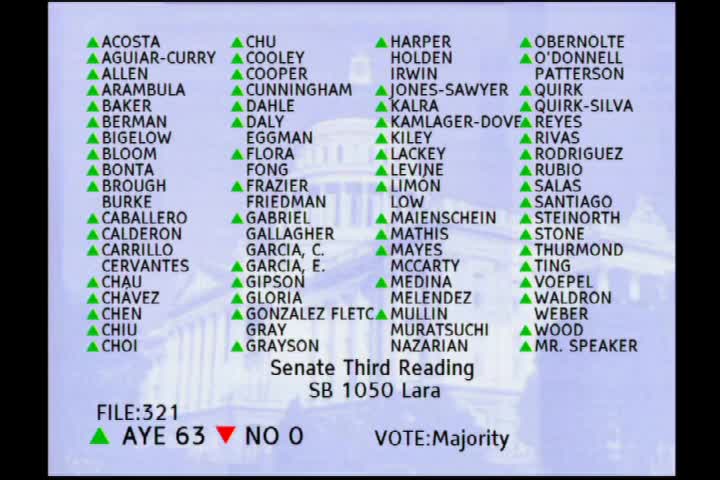



Bill Co-Author(s):
