SB 1123: Disability compensation: paid family leave.
- Session Year: 2017-2018
- House: Senate
- Latest Version Date: 2018-09-27
Existing law establishes, within the state disability insurance program, a family temporary disability insurance program, also known as the paid family leave program, for the provision of wage replacement benefits to workers who take time off work to care for a seriously ill family member or to bond with a minor child within one year of birth or placement, as specified. Under existing law, an individual who is entitled to leave under FMLA and CFRA is required to take Family Temporary Disability Insurance leave concurrent with leave taken under FMLA and CFRA.
This bill would, on and after January 1, 2021, expand the scope of the family temporary disability insurance program to include time off to participate in a qualifying exigency related to the covered active duty, as defined, or call to covered active duty of the individuals spouse, domestic partner, child, or parent in the armed forces of the United States, as specified. The bill would, when an employee for the first time requests leave because of a qualifying exigency arising out of the covered active duty or call to covered active duty, or notification of an impending call or order to covered active duty, of the employees spouse, domestic partner, child, or parent in the armed forces of the United States, authorize the Employment Development Department to require the employee to provide a copy of the covered active duty orders or other documentation issued by the military that indicates that the employees spouse, domestic partner, child, or parent is in the armed forces of the United States, is on covered active duty or call to covered active duty, and the dates of the covered active duty service.
Under existing law, workers are required to pay contributions to the Unemployment Compensation Disability Fund, a special fund in the State Treasury, and those funds are continuously appropriated for the purpose of providing disability benefits and making payment of administrative expenses.
By authorizing expenditure of these funds for a new purpose, this bill would make an appropriation.
Existing law establishes, within the state disability insurance program, a family temporary disability insurance program, also known as the paid family leave program, for the provision of wage replacement benefits to workers who take time off work to care for a seriously ill family member or to bond with a minor child within one year of birth or placement, as specified. Under existing law, an individual who is entitled to leave under FMLA and CFRA is required to take Family Temporary Disability Insurance leave concurrent with leave taken under FMLA and CFRA.
This bill would would, on and after January 1, 2021, expand the scope of the family temporary disability insurance program to include time off to participate in a qualifying exigency related to the covered active duty, as defined, or call to covered active duty of the individuals spouse, domestic partner, child, or parent in the armed forces of the United States, as specified. The bill would, when an employee for the first time requests leave because of a qualifying exigency arising out of the covered active duty or call to covered active duty, or notification of an impending call or order to covered active duty, of the employees spouse, domestic partner, child, or parent in the armed forces of the United States, authorize the Employment Development Department to require the employee to provide a copy of the covered active duty orders or other documentation issued by the military that indicates that the employees spouse, domestic partner, child, or parent is in the armed forces of the United States, is on covered active duty or call to covered active duty, and the dates of the covered active duty service.
Under existing law, workers are required to pay contributions to the Unemployment Compensation Disability Fund, a special fund in the State Treasury, and those funds are continuously appropriated for the purpose of providing disability benefits and making payment of administrative expenses.
By authorizing expenditure of these funds for a new purpose, this bill would make an appropriation.
Existing law establishes, within the state disability insurance program, a family temporary disability insurance program, also known as the paid family leave program, for the provision of wage replacement benefits to workers who take time off work to care for a seriously ill family member or to bond with a minor child within one year of birth or placement, as specified. Under existing law, an individual who is entitled to leave under FMLA and CFRA is required to take Family Temporary Disability Insurance leave concurrent with leave taken under FMLA and CFRA.
This bill would expand the scope of the family temporary disability insurance program to include time off to participate in a qualifying exigency related to the covered active duty status duty, as defined, or call to covered active duty of the individuals spouse, domestic partner, child, or parent in the armed forces of the United States, as specified. The bill would, when an employee for the first time requests leave because of a qualifying exigency arising out of the covered active duty or call to covered active duty status, duty, or notification of an impending call or order to covered active duty, of the employees spouse, domestic partner, child, or parent in the armed forces of the United States, authorize the Employment Development Department to require the employee to provide a copy of the covered active duty orders or other documentation issued by the military that indicates that the employees spouse, domestic partner, child, or parent is in the armed forces of the United States, is on covered active duty or call to covered active duty status, duty, and the dates of the covered active duty service.
Under existing law, workers are required to pay contributions to the Unemployment Compensation Disability Fund, a special fund in the State Treasury, and those funds are continuously appropriated for the purpose of providing disability benefits and making payment of administrative expenses.
By authorizing expenditure of these funds for a new purpose, this bill would make an appropriation.
Existing law establishes, within the state disability insurance program, a family temporary disability insurance program, also known as the paid family leave program, for the provision of wage replacement benefits to workers who take time off work to care for a seriously ill family member or to bond with a minor child within one year of birth or placement, as specified. Under existing law, an individual who is entitled to leave under FMLA and CFRA is required to take Family Temporary Disability Insurance leave concurrent with leave taken under FMLA and CFRA.
This bill would make a nonsubstantive change to these provisions. expand the scope of the family temporary disability insurance program to include time off to participate in a qualifying exigency related to the active duty status of the individuals spouse, domestic partner, child, or parent in the armed forces of the United States, as specified. The bill would, when an employee for the first time requests leave because of a qualifying exigency arising out of the active duty or call to active duty status, or notification of an impending call or order to active duty, of the employees spouse, domestic partner, child, or parent in the armed forces of the United States, authorize the Employment Development Department to require the employee to provide a copy of the active duty orders or other documentation issued by the military that indicates that the employees spouse, domestic partner, child, or parent is in the armed forces of the United States, is on active duty or call to active duty status, and the dates of the active duty service.
Under existing law, workers are required to pay contributions to the Unemployment Compensation Disability Fund, a special fund in the State Treasury, and those funds are continuously appropriated for the purpose of providing disability benefits and making payment of administrative expenses.
By authorizing expenditure of these funds for a new purpose, this bill would make an appropriation.
Existing law establishes, within the state disability insurance program, a family temporary disability insurance program, also known as the paid family leave program, for the provision of wage replacement benefits to workers who take time off work to care for a seriously ill family member or to bond with a minor child within one year of birth or placement, as specified. Under existing law, an individual who is entitled to leave under FMLA and CFRA is required to take Family Temporary Disability Insurance leave concurrent with leave taken under FMLA and CFRA.
This bill would make a nonsubstantive change to these provisions.
(a)(1)The purpose of this chapter is to establish, within the state disability insurance program, a family temporary disability insurance program. Family temporary disability insurance shall provide up to six weeks of wage replacement benefits to workers who take time off work to care for a seriously ill child, spouse, parent, grandparent, grandchild, sibling, or domestic partner, or to bond with a minor child within one year of the birth or placement of the child in connection with foster care or adoption.
(2)Nothing in this chapter shall be construed to abridge the rights and responsibilities conveyed under the CFRA or pregnancy disability leave.
(b)An individuals weekly benefit amount shall be the amount provided in Section 2655. An individual is eligible to receive family temporary disability insurance benefits equal to one-seventh of his or her weekly benefit amount for each full day during which he or she is unable to work due to caring for a seriously ill or injured family member or bonding with a minor child within one year of the birth or placement of the child in connection with foster care or adoption.
(c)The maximum amount payable to an individual during any disability benefit period for family temporary disability insurance shall be six times his or her weekly benefit amount, but in no case shall the total amount of benefits payable be more than the total wages paid to the individual during his or her disability base period. If the benefit is not a multiple of one dollar ($1), it shall be computed to the next higher multiple of one dollar ($1).
(d)No more than six weeks of family temporary disability insurance benefits shall be paid within any 12-month period.
(e)An individual shall file a claim for family temporary disability insurance benefits not later than the 41st consecutive day following the first compensable day with respect to which the claim is made for benefits, which time shall be extended by the department upon a showing of good cause. If a first claim is not complete, the claim form shall be returned to the claimant for completion and it shall be completed and returned not later than the 10th consecutive day after the date it was mailed by the department to the claimant, except that such time shall be extended by the department upon a showing of good cause.
(f)This section shall remain in effect only until January 1, 2021, and as of that date is repealed.
SEC. 2.Section 3301 is added to the Unemployment Insurance Code, to read:3301.(a)(1)The purpose of this chapter is to establish, within the state disability insurance program, a family temporary disability insurance program. Family temporary disability insurance shall provide up to six weeks of wage replacement benefits to workers who take time off work to care for a seriously ill child, spouse, parent, grandparent, grandchild, sibling, or domestic partner, to bond with a minor child within one year of the birth or placement of the child in connection with foster care or adoption, or to participate in a qualifying exigency related to the covered active duty or call to covered active duty of the individuals spouse, domestic partner, child, or parent in the Armed Forces of the United States.
(2)Nothing in this chapter shall be construed to abridge the rights and responsibilities conveyed under the CFRA or pregnancy disability leave.
(b)An individuals weekly benefit amount shall be the amount provided in Section 2655. An individual is eligible to receive family temporary disability insurance benefits equal to one-seventh of his or her weekly benefit amount for each full day during which he or she is unable to work due to caring for a seriously ill or injured family member, bonding with a minor child within one year of the birth or placement of the child in connection with foster care or adoption, or participating in a qualifying exigency related to the covered active duty or call to covered active duty of the individuals spouse, domestic partner, child, or parent in the Armed Forces of the United States.
(c)The maximum amount payable to an individual during any disability benefit period for family temporary disability insurance shall be six times his or her weekly benefit amount, but in no case shall the total amount of benefits payable be more than the total wages paid to the individual during his or her disability base period. If the benefit is not a multiple of one dollar ($1), it shall be computed to the next higher multiple of one dollar ($1).
(d)No more than six weeks of family temporary disability insurance benefits shall be paid within any 12-month period.
(e)An individual shall file a claim for family temporary disability insurance benefits not later than the 41st consecutive day following the first compensable day with respect to which the claim is made for benefits, which time shall be extended by the department upon a showing of good cause. If a first claim is not complete, the claim form shall be returned to the claimant for completion and it shall be completed and returned not later than the 10th consecutive day after the date it was mailed by the department to the claimant, except that such time shall be extended by the department upon a showing of good cause.
(f)This section shall become operative on January 1, 2021.
SEC. 3.Section 3302.1 of the Unemployment Insurance Code is amended to read:3302.1.For purposes of this chapter:
(a)Disability benefit period with respect to any individual, means the period of unemployment beginning with the first day an individual establishes a valid claim for family temporary disability insurance benefits to care for a seriously ill family member, or to bond with a minor child during the first year after the birth or placement of the child in connection with foster care or adoption.
(b)Periods of family care leave for the same care recipient within a 12-month period shall be considered one disability benefit period.
(c)Periods of disability for pregnancy, as defined in Section 2608, and periods of family care leave for bonding associated with the birth of that child shall be considered one disability benefit period.
(d)This section shall remain in effect only until January 1, 2021, and as of that date is repealed.
SEC. 4.Section 3302.1 is added to the Unemployment Insurance Code, to read:3302.1.For purposes of this chapter:
(a)Covered active duty means, with respect to a member of the regular Armed Forces of the United States, duty during the deployment of the member with the regular armed forces to a foreign country and, with respect to a member of the reserve components of the Armed Forces of the United States, duty during the deployment of the member of those reserve components to a foreign country under a federal call or order to active duty.
(b)Disability benefit period with respect to any individual, means the period of unemployment beginning with the first day an individual establishes a valid claim for family temporary disability insurance benefits to care for a seriously ill family member, to bond with a minor child during the first year after the birth or placement of the child in connection with foster care or adoption, or to participate in a qualifying exigency related to the covered active duty or call to covered active duty of the individuals spouse, domestic partner, child, or parent in the Armed Forces of the United States.
(1)Periods of family care leave for the same care recipient within a 12-month period shall be considered one disability benefit period.
(2)Periods of disability for pregnancy, as defined in Section 2608, and periods of family care leave for bonding associated with the birth of that child shall be considered one disability benefit period.
(3)This section shall become operative on January 1, 2021.
SEC. 5.Section 3302.2 is added to the Unemployment Insurance Code, to read:3302.2.For purposes of this chapter, a qualifying exigency related to the covered active duty or call to covered active duty of the individuals spouse, domestic partner, child, or parent in the Armed Forces of the United States means any of the following:
(a)Activities undertaken within seven calendar days from the date that a spouse, domestic partner, child, or parent has been notified of an impending call or order to covered active duty in the Armed Forces of the United States to address any issue that arises from the call or order.
(b)Attendance in either or both of the following:
(1)An official ceremony, program, or event sponsored by the military that is related to the covered active duty or call to covered active duty of the spouse, domestic partner, child, or parent.
(2)A family support or assistance program and informational briefing sponsored or promoted by the military, military service organizations, or the American Red Cross that is related to the covered active duty or call to covered active duty of the spouse, domestic partner, child, or parent.
(c)Any of the following activities related to the biological, adopted, or foster child, stepchild, legal ward, or child for whom the spouse, domestic partner, child, or parent in the Armed Forces of the United States stands in loco parentis, who is either not more than 18 years of age or, if equal to or more than 18 years of age, is incapable of self-care because of a disability at the time that the paid leave is to commence:
(1)Arranging for alternative childcare for the child when the covered active duty or call to covered active duty of the spouse, domestic partner, child, or parent in the Armed Forces of the United States necessitates a change in the existing childcare arrangement.
(2)Providing childcare for the child on an urgent, immediate need basis when the need to provide this care arises from the covered active duty or call to covered active duty of the spouse, domestic partner, child, or parent in the Armed Forces of the United States.
(3)Enrolling or transferring the child to a new school or day care facility when enrollment or transfer is necessitated by the covered active duty or call to covered active duty of the spouse, domestic partner, child, or parent in the Armed Forces of the United States.
(4)Attending meetings with staff at the childs school or day care facility, including, but not limited to, meetings with school officials regarding disciplinary measures, parent-teacher conferences, or meetings with school counselors, when these meetings are necessary due to circumstances arising from the covered active duty or call to covered active duty of the spouse, domestic partner, child, or parent in the Armed Forces of the United States.
(d)To make financial and legal arrangements for either or both of the following purposes:
(1)Making or updating financial or legal arrangements to address the absence of the spouse, domestic partner, child, or parent in the Armed Forces of the United States while on covered active duty or call to covered active duty, including, but not limited to, preparing and executing financial and healthcare powers of attorney, transferring bank account signature authority, enrolling in the Defense Enrollment Eligibility Reporting System (DEERS), obtaining military identification cards, or preparing or updating a will or living trust.
(2)Acting as the representative of the spouse, domestic partner, child, or parent in the Armed Forces of the United States before a federal, state, or local agency for purposes of obtaining, arranging, or appealing military service benefits while the spouse, domestic partner, child, or parent in the Armed Forces of the United States is on covered active duty or call to covered active duty, and for a period of ninety days following the termination of the covered active duty.
(e)Attending counseling provided by someone other than a health care provider, for oneself, for the spouse, domestic partner, child, or parent in the Armed Forces of the United States, or for the biological, adopted, or foster child, a stepchild, or a legal ward of the spouse, domestic partner, child, or parent in the Armed Forces of the United States, or a child for whom this person stands in loco parentis, who is either not more than 18 years of age, or equal to or more than 18 years of age and incapable of self-care because of a disability at the time that paid family leave is to commence, provided that the need for counseling arises from the covered active duty or call to covered active duty of the spouse, domestic partner, child, or parent in the Armed Forces of the United States.
(f)Accompanying a spouse, domestic partner, child, or parent in the Armed Forces of the United States while that individual is on short-term, temporary, rest and recuperation leave during the period of deployment in a foreign country, provided that any leave taken for this purpose is for not more than 15 calendar days beginning on the date of commencement for the rest and recuperation leave.
(g)Attending arrival ceremonies, reintegration briefings and events, and any other official ceremony or program sponsored by the military for a period of 90 days following the termination of the covered active duty of the spouse, domestic partner, child, or parent in the Armed Forces of the United States.
(h)Addressing issues that arise from the death of the spouse, domestic partner, child, or parent in the Armed Forces of the United States while on covered active duty status, including meeting and recovering the body of the spouse, domestic partner, child, or parent in the Armed Forces of the United States, making funeral arrangements, and attending funeral services.
(i)(1)Any of the following activities related to the parent of the spouse, domestic partner, child, or parent in the Armed Forces of the United States while the parent of the spouse, domestic partner, child, or parent in the armed forces during covered active duty is incapable of self-care by requiring active assistance or supervision over daily self-care in three or more of the activities of daily living or instrument activities of daily living:
(A)Arranging for alternative care for the parent of the spouse, domestic partner, child, or parent in the Armed Forces of the United States when the covered active duty or call to covered active duty of the spouse, domestic partner, child, or parent in the Armed Forces of the United States necessitates a change in the existing care arrangement for the parent.
(B)Providing care for the parent who is incapable of self-care on an urgent, immediate need basis when the need to provide this care arises from the covered active duty or call to covered active duty of the spouse, domestic partner, child, or parent in the Armed Forces of the United States.
(C)Admitting or transferring the parent to a care facility when admission or transfer is necessitated by the covered active duty or call to covered active duty of the spouse, domestic partner, child, or parent in the Armed Forces of the United States.
(D)Attending meetings with staff at the parents care facility, including, but not limited to, meetings with hospice or social service providers of the parent of the spouse, domestic partner, child, or parent in the Armed Forces of the United States when these meetings are necessary due to circumstances arising from the covered active duty or call to covered active duty of the spouse, domestic partner, child, or parent in the Armed Forces of the United States.
(2)For purposes of this subdivision, activities of daily living include adaptive activities, such as caring appropriately for ones grooming and hygiene, bathing, dressing, and eating. Instrumental activities of daily living include, but are not limited to, cooking, cleaning, shopping, taking public transportation, paying bills, maintaining a residence, using telephones and directories, and using a post office.
(j)Any other activities to address other events that arise out of the covered active duty or call to covered active duty of the spouse, domestic partner, child, or parent in the Armed Forces of the United States, provided that the employer and employee agree that this leave shall qualify as an exigency, and agree to both the timing and duration of this leave.
(k)This section shall become operative on January 1, 2021.
SEC. 6.Section 3303 of the Unemployment Insurance Code is amended to read:3303.(a)On and after July 1, 2014, an individual shall be deemed eligible for family temporary disability insurance benefits equal to one-seventh of his or her weekly benefit amount on any day in which he or she is unable to perform his or her regular or customary work because he or she is bonding with a minor child during the first year after the birth or placement of the child in connection with foster care or adoption, or caring for a seriously ill child, parent, grandparent, grandchild, sibling, spouse, or domestic partner, only if the director finds both of the following:
(1)The individual has made a claim for temporary disability benefits as required by authorized regulations.
(2)The individual has filed a certificate, as required by Sections 2708 and 2709.
(b)This section shall remain in effect only until January 1, 2021, and as of that date is repealed.
SEC. 7.Section 3303 is added to the Unemployment Insurance Code, to read:3303.(a)On and after July 1, 2014, only if the director makes both of the findings described in subdivision (b), an individual shall be deemed eligible for family temporary disability insurance benefits equal to one-seventh of his or her weekly benefit amount on any day in which he or she is unable to perform his or her regular or customary work because of any of the following:
(1)The individual is bonding with a minor child during the first year after the birth or placement of the child in connection with foster care or adoption.
(2)The individual is caring for a seriously ill child, parent, grandparent, grandchild, sibling, spouse, or domestic partner.
(3)The individual is participating in a qualifying exigency related to the covered active duty or call to covered active duty of the individuals spouse, domestic partner, child, or parent in the Armed Forces of the United States.
(b)An individual shall be deemed eligible for family temporary disability insurance benefits described in subdivision (a) only if the directors finds both of the following:
(1)The individual has made a claim for temporary disability benefits as required by authorized regulations.
(2)The individual has filed a certificate, as required by Sections 2708 and 2709, or for purposes of participating in a qualifying exigency related to the covered active duty or call to covered active duty of the individuals spouse, domestic partner, child, or parent in the Armed Forces of the United States, has provided the information requested pursuant to Section 3307.
(c)This section shall become operative on January 1, 2021.
SEC. 8.Section 3303.1 of the Unemployment Insurance Code is amended to read:3303.1.(a)An individual is not eligible for family temporary disability insurance benefits with respect to any day that any of the following apply:
(1)The individual has received, or is entitled to receive, unemployment compensation benefits under Part 1 (commencing with Section 100) or under an unemployment compensation act of any other state or of the federal government.
(2)The individual has received, or is entitled to receive, other benefits in the form of cash benefits as defined in Section 2629.
(3)The individual has received, or is entitled to receive, state disability insurance benefits under Part 2 (commencing with Section 2601) or under a disability insurance act of any other state.
(4)Another family member, as defined in Section 3302, is ready, willing, and able and available for the same period of time in a day that the individual is providing the required care.
(b)An individual who is entitled to leave under the FMLA and the CFRA must take Family Temporary Disability Insurance (FTDI) leave concurrent with leave taken under the FMLA and the CFRA.
(c)As a condition of an employees initial receipt of family temporary disability insurance benefits during any 12-month period in which an employee is eligible for these benefits, an employer may require an employee to take up to two weeks of earned but unused vacation leave prior to the employees initial receipt of these benefits. This subdivision may not be construed in a manner that relieves an employer of any duty of collective bargaining the employer may have with respect to the subject matter of this subdivision.
(d)This section shall remain in effect only until January 1, 2021, and as of that date is repealed.
SEC. 9.Section 3303.1 is added to the Unemployment Insurance Code, to read:3303.1.(a)An individual is not eligible for family temporary disability insurance benefits with respect to any day that any of the following apply:
(1)The individual has received, or is entitled to receive, unemployment compensation benefits under Part 1 (commencing with Section 100) or under an unemployment compensation act of any other state or of the federal government.
(2)The individual has received, or is entitled to receive, other benefits in the form of cash benefits as defined in Section 2629.
(3)The individual has received, or is entitled to receive, state disability insurance benefits under Part 2 (commencing with Section 2601) or under a disability insurance act of any other state.
(4)Another family member, as defined in Section 3302, is ready, willing, and able and available for the same period of time in a day that the individual is providing the required care or participating in a qualifying exigency related to the covered active duty or call to covered active duty of the individuals spouse, domestic partner, child, or parent in the Armed Forces of the United States.
(b)An individual who is entitled to leave under the FMLA and the CFRA shall take Family Temporary Disability Insurance (FTDI) leave concurrent with leave taken under the FMLA and the CFRA.
(c)As a condition of an employees initial receipt of family temporary disability insurance benefits during any 12-month period in which an employee is eligible for these benefits, an employer may require an employee to take up to two weeks of earned but unused vacation leave prior to the employees initial receipt of these benefits. This subdivision may not be construed in a manner that relieves an employer of any duty of collective bargaining the employer may have with respect to the subject matter of this subdivision.
(d)This section shall become operative on January 1, 2021.
SEC. 10.Section 3307 is added to the Unemployment Insurance Code, to read:3307.(a)When an employee requests for the first time leave because of a qualifying exigency arising out of the covered active duty or call to covered active duty or notification of an impending call or order to covered active duty of the employees spouse, domestic partner, child, or parent in the Armed Forces of the United States, the department may require the employee to provide a copy of the covered active duty orders or other documentation issued by the military that indicates that the employees spouse, domestic partner, child, or parent is in the Armed Forces of the United States, is on covered active duty or call to covered active duty status, and the dates of the covered active duty service. This information need only be provided to the department. A copy of new active duty orders or other documentation issued by the military may be required by the department if the need for leave because of a qualifying exigency arises out of a different covered active duty or call to covered active duty or notification of an impending call or order to covered active duty of the same or a different family member.
(b)The department may require that a request for paid family leave for any qualifying exigency specified in Section 3302.2 be supported by sufficient information from the employee that sets forth the following:
(1)A statement or description, signed by the employee, of appropriate facts regarding the qualifying exigency for which paid family leave is requested. The facts shall be sufficient to support the need for leave and may include information on the type of qualifying exigency for which leave is requested and any available written documentation that supports the request for leave. For example, this information may include a copy of a meeting announcement for informational briefings sponsored by the military, a document confirming an appointment with a counselor or school official, or a copy of a bill for services for the handling of legal or financial affairs.
(2)The approximate date of the commencement or pending commencement of the qualifying exigency.
(3)If an employee requests leave because of a qualifying exigency for a single, continuous period of time, the beginning and end dates for that leave.
(4)If an employee requests leave because of a qualifying exigency on an intermittent basis, an estimate of the frequency and duration of the qualifying exigency.
(5)If the qualifying exigency involves meeting with a third party, appropriate contact information for the individual or entity with whom the employee is meeting, including, but not limited to, the name, title, organization, address, telephone number, fax number, and email address, if available, and a brief description of the purpose of the meeting.
(6)If the qualifying exigency involves rest and recuperation leave, a copy of the rest and recuperation orders for the employees spouse, domestic partner, child, or parent in the Armed Forces of the United States, or other documentation issued by the military that indicates that this person has been granted rest and recuperation leave, and the dates of that rest and recuperation leave.
(c)If an employee submits complete and sufficient information to support his or her request for leave because of a qualifying exigency, the department may not request additional information from the employee. However, if the qualifying exigency involves meeting with a third party, the department may contact the individual or entity with whom the employee is meeting for purposes of verifying a meeting or appointment schedule and the nature of the meeting between the employee and the specified individual or entity. The employees permission is not required in order to verify meetings or appointments with third parties, but no additional information may be requested by the department. The department also may contact an appropriate unit of the Department of Defense to request verification that an individual is on covered active duty or call to covered active duty or has been notified of an impending call or order to covered active duty. No additional information may be requested, and the employees permission is not required.
(d)This section shall become operative on January 1, 2021.
(a)(1)The purpose of this chapter is to establish, within the state disability insurance program, a family temporary disability insurance program. Family temporary disability insurance shall provide up to six weeks of wage replacement benefits to workers who take time off work to care for a seriously ill child, spouse, parent, grandparent, grandchild, sibling, or domestic partner, or to bond with a minor child within one year of the birth or placement of the child in connection with foster care or adoption.
(2)Nothing in this chapter shall be construed to abridge the rights and responsibilities conveyed under the CFRA or pregnancy disability leave.
(b)An individuals weekly benefit amount shall be the amount provided in Section 2655. An individual is eligible to receive family temporary disability insurance benefits equal to one-seventh of his or her weekly benefit amount for each full day during which he or she is unable to work due to caring for a seriously ill or injured family member or bonding with a minor child within one year of the birth or placement of the child in connection with foster care or adoption.
(c)The maximum amount payable to an individual during any disability benefit period for family temporary disability insurance shall be six times his or her weekly benefit amount, but in no case shall the total amount of benefits payable be more than the total wages paid to the individual during his or her disability base period. If the benefit is not a multiple of one dollar ($1), it shall be computed to the next higher multiple of one dollar ($1).
(d)No more than six weeks of family temporary disability insurance benefits shall be paid within any 12-month period.
(e)An individual shall file a claim for family temporary disability insurance benefits not later than the 41st consecutive day following the first compensable day with respect to which the claim is made for benefits, which time shall be extended by the department upon a showing of good cause. If a first claim is not complete, the claim form shall be returned to the claimant for completion and it shall be completed and returned not later than the 10th consecutive day after the date it was mailed by the department to the claimant, except that such time shall be extended by the department upon a showing of good cause.
(f)This section shall become operative on July 1, 2014.(f)This section shall remain in effect only until January 1, 2021, and as of that date is repealed.
SEC. 2.Section 3301 is added to the Unemployment Insurance Code, to read:3301.(a)(1)The purpose of this chapter is to establish, within the state disability insurance program, a family temporary disability insurance program. Family temporary disability insurance shall provide up to six weeks of wage replacement benefits to workers who take time off work to care for a seriously ill child, spouse, parent, grandparent, grandchild, sibling, or domestic partner, to bond with a minor child within one year of the birth or placement of the child in connection with foster care or adoption, or to participate in a qualifying exigency related to the covered active duty or call to covered active duty of the individuals spouse, domestic partner, child, or parent in the Armed Forces of the United States.
(2)Nothing in this chapter shall be construed to abridge the rights and responsibilities conveyed under the CFRA or pregnancy disability leave.
(b)An individuals weekly benefit amount shall be the amount provided in Section 2655. An individual is eligible to receive family temporary disability insurance benefits equal to one-seventh of his or her weekly benefit amount for each full day during which he or she is unable to work due to caring for a seriously ill or injured family member, bonding with a minor child within one year of the birth or placement of the child in connection with foster care or adoption, or participating in a qualifying exigency related to the covered active duty or call to covered active duty of the individuals spouse, domestic partner, child, or parent in the Armed Forces of the United States.
(c)The maximum amount payable to an individual during any disability benefit period for family temporary disability insurance shall be six times his or her weekly benefit amount, but in no case shall the total amount of benefits payable be more than the total wages paid to the individual during his or her disability base period. If the benefit is not a multiple of one dollar ($1), it shall be computed to the next higher multiple of one dollar ($1).
(d)No more than six weeks of family temporary disability insurance benefits shall be paid within any 12-month period.
(e)An individual shall file a claim for family temporary disability insurance benefits not later than the 41st consecutive day following the first compensable day with respect to which the claim is made for benefits, which time shall be extended by the department upon a showing of good cause. If a first claim is not complete, the claim form shall be returned to the claimant for completion and it shall be completed and returned not later than the 10th consecutive day after the date it was mailed by the department to the claimant, except that such time shall be extended by the department upon a showing of good cause.
(f)This section shall become operative on January 1, 2021.
SEC. 3.Section 3302.1 of the Unemployment Insurance Code is amended to read:3302.1.For purposes of this chapter:
(a)Disability benefit period with respect to any individual, means the period of unemployment beginning with the first day an individual establishes a valid claim for family temporary disability insurance benefits to care for a seriously ill family member, or to bond with a minor child during the first year after the birth or placement of the child in connection with foster care or adoption.
(b)Periods of family care leave for the same care recipient within a 12-month period shall be considered one disability benefit period.
(c)Periods of disability for pregnancy, as defined in Section 2608, and periods of family care leave for bonding associated with the birth of that child shall be considered one disability benefit period.
(d)This section shall remain in effect only until January 1, 2021, and as of that date is repealed.
SEC. 4.Section 3302.1 is added to the Unemployment Insurance Code, to read:3302.1.For purposes of this chapter:
(a)Covered active duty means, with respect to a member of the regular Armed Forces of the United States, duty during the deployment of the member with the regular armed forces to a foreign country and, with respect to a member of the reserve components of the Armed Forces of the United States, duty during the deployment of the member of those reserve components to a foreign country under a federal call or order to active duty.
(b)Disability benefit period with respect to any individual, means the period of unemployment beginning with the first day an individual establishes a valid claim for family temporary disability insurance benefits to care for a seriously ill family member, to bond with a minor child during the first year after the birth or placement of the child in connection with foster care or adoption, or to participate in a qualifying exigency related to the covered active duty or call to covered active duty of the individuals spouse, domestic partner, child, or parent in the Armed Forces of the United States.
(1)Periods of family care leave for the same care recipient within a 12-month period shall be considered one disability benefit period.
(2)Periods of disability for pregnancy, as defined in Section 2608, and periods of family care leave for bonding associated with the birth of that child shall be considered one disability benefit period.
(3)This section shall become operative on January 1, 2021.
SEC. 3.SEC. 5.Section 3302.2 is added to the Unemployment Insurance Code, to read:3302.2.For purposes of this chapter, a qualifying exigency related to the covered active duty or call to covered active duty of the individuals spouse, domestic partner, child, or parent in the armed forces Armed Forces of the United States means any of the following:
(a)Activities undertaken within seven calendar days from the date that a spouse, domestic partner, child, or parent has been notified of an impending call or order to covered active duty in the armed forces Armed Forces of the United States to address any issue that arises from the call or order.
(b)Attendance in either or both of the following:
(1)An official ceremony, program, or event sponsored by the military that is related to the covered active duty or call to covered active duty of the spouse, domestic partner, child, or parent.
(2)A family support or assistance program and informational briefing sponsored or promoted by the military, military service organizations, or the American Red Cross that is related to the covered active duty or call to covered active duty of the spouse, domestic partner, child, or parent.
(c)Any of the following activities related to the biological, adopted, or foster child, stepchild, legal ward, or child for whom the spouse, domestic partner, child, or parent in the armed forces Armed Forces of the United States stands in loco parentis, who is either not more than 18 years of age or, if equal to or more than 18 years of age, is incapable of self-care because of a disability at the time that the paid leave is to commence:
(1)Arranging for alternative childcare for the child when the covered active duty or call to covered active duty of the spouse, domestic partner, child, or parent in the armed forces Armed Forces of the United States necessitates a change in the existing childcare arrangement.
(2)Providing childcare for the child on an urgent, immediate need basis when the need to provide this care arises from the covered active duty or call to covered active duty of the spouse, domestic partner, child, or parent in the armed forces Armed Forces of the United States.
(3)Enrolling or transferring the child to a new school or day care facility when enrollment or transfer is necessitated by the covered active duty or call to covered active duty of the spouse, domestic partner, child, or parent in the armed forces Armed Forces of the United States.
(4)Attending meetings with staff at the childs school or day care facility, including, but not limited to, meetings with school officials regarding disciplinary measures, parent-teacher conferences, or meetings with school counselors, when these meetings are necessary due to circumstances arising from the covered active duty or call to covered active duty of the spouse, domestic partner, child, or parent in the armed forces Armed Forces of the United States.
(d)To make financial and legal arrangements for either or both of the following purposes:
(1)Making or updating financial or legal arrangements to address the absence of the spouse, domestic partner, child, or parent in the armed forces Armed Forces of the United States while on covered active duty or call to covered active duty, including, but not limited to, preparing and executing financial and healthcare powers of attorney, transferring bank account signature authority, enrolling in the Defense Enrollment Eligibility Reporting System (DEERS), obtaining military identification cards, or preparing or updating a will or living trust.
(2)Acting as the representative of the spouse, domestic partner, child, or parent in the armed forces Armed Forces of the United States before a federal, state, or local agency for purposes of obtaining, arranging, or appealing military service benefits while the spouse, domestic partner, child, or parent in the armed forces Armed Forces of the United States is on covered active duty or call to covered active duty, and for a period of ninety days following the termination of the covered active duty.
(e)Attending counseling provided by someone other than a health care provider, for oneself, for the spouse, domestic partner, child, or parent in the armed forces Armed Forces of the United States, or for the biological, adopted, or foster child, a stepchild, or a legal ward of the spouse, domestic partner, child, or parent in the armed forces Armed Forces of the United States, or a child for whom this person stands in loco parentis, who is either not more than 18 years of age, or equal to or more than 18 years of age and incapable of self-care because of a disability at the time that paid family leave is to commence, provided that the need for counseling arises from the covered active duty or call to covered active duty of the spouse, domestic partner, child, or parent in the armed forces Armed Forces of the United States.
(f)Accompanying a spouse, domestic partner, child, or parent in the armed forces Armed Forces of the United States while that individual is on short-term, temporary, rest and recuperation leave during the period of deployment in a foreign country, provided that any leave taken for this purpose is for not more than 15 calendar days beginning on the date of commencement for the rest and recuperation leave.
(g)Attending arrival ceremonies, reintegration briefings and events, and any other official ceremony or program sponsored by the military for a period of 90 days following the termination of the covered active duty of the spouse, domestic partner, child, or parent in the armed forces Armed Forces of the United States.
(h)Addressing issues that arise from the death of the spouse, domestic partner, child, or parent in the armed forces Armed Forces of the United States while on covered active duty status, including meeting and recovering the body of the spouse, domestic partner, child, or parent in the armed forces Armed Forces of the United States, making funeral arrangements, and attending funeral services.
(i)(1)Any of the following activities related to the parent of the spouse, domestic partner, child, or parent in the armed forces Armed Forces of the United States while the parent of the spouse, domestic partner, child, or parent in the armed forces during covered active duty is incapable of self-care by requiring active assistance or supervision over daily self-care in three or more of the activities of daily living or instrument activities of daily living:
(A)Arranging for alternative care for the parent of the spouse, domestic partner, child, or parent in the armed forces Armed Forces of the United States when the covered active duty or call to covered active duty of the spouse, domestic partner, child, or parent in the armed forces Armed Forces of the United States necessitates a change in the existing care arrangement for the parent.
(B)Providing care for the parent who is incapable of self-care on an urgent, immediate need basis when the need to provide this care arises from the covered active duty or call to covered active duty of the spouse, domestic partner, child, or parent in the armed forces Armed Forces of the United States.
(C)Admitting or transferring the parent to a care facility when admission or transfer is necessitated by the covered active duty or call to covered active duty of the spouse, domestic partner, child, or parent in the armed forces Armed Forces of the United States.
(D)Attending meetings with staff at the parents care facility, including, but not limited to, meetings with hospice or social service providers of the parent of the spouse, domestic partner, child, or parent in the armed forces Armed Forces of the United States when these meetings are necessary due to circumstances arising from the covered active duty or call to covered active duty of the spouse, domestic partner, child, or parent in the armed forces Armed Forces of the United States.
(2)For purposes of this subdivision, activities of daily living include adaptive activities, such as caring appropriately for ones grooming and hygiene, bathing, dressing, and eating. Instrumental activities of daily living include, but are not limited to, cooking, cleaning, shopping, taking public transportation, paying bills, maintaining a residence, using telephones and directories, and using a post office.
(j)Any other activities to address other events that arise out of the covered active duty or call to covered active duty of the spouse, domestic partner, child, or parent in the armed forces Armed Forces of the United States, provided that the employer and employee agree that this leave shall qualify as an exigency, and agree to both the timing and duration of this leave.
(k)This section shall become operative on January 1, 2021.
SEC. 4.Section 3303 of the Unemployment Insurance Code is amended to read:3303.(a)On and after July 1, 2014, only if the director makes both of the findings described in subdivision (b), an individual shall be deemed eligible for family temporary disability insurance benefits equal to one-seventh of his or her weekly benefit amount on any day in which he or she is unable to perform his or her regular or customary work because of any of the following:(1)The individual is bonding with a minor child during the first year after the birth or placement of the child in connection with foster care or adoption.(2)The individual is caring for a seriously ill child, parent, grandparent, grandchild, sibling, spouse, or domestic partner.(3)The individual is participating in a qualifying exigency related to the covered active duty or call to covered active duty of the individuals spouse, domestic partner, child, or parent in the armed forces of the United States.(b)An individual shall be deemed eligible for family temporary disability insurance benefits described in subdivision (a) only if the directors finds both of the following:(1)The individual has made a claim for temporary disability benefits as required by authorized regulations.(2)The individual has filed a certificate, as required by Sections 2708 and 2709, or for purposes of participating in a qualifying exigency related to the covered active duty or call to covered active duty of the individuals spouse, domestic partner, child, or parent in the armed forces of the United States, has provided the information requested pursuant to Section 3307.SEC. 5.Section 3303.1 of the Unemployment Insurance Code is amended to read:3303.1.(a)An individual is not eligible for family temporary disability insurance benefits with respect to any day that any of the following apply:(1)The individual has received, or is entitled to receive, unemployment compensation benefits under Part 1 (commencing with Section 100) or under an unemployment compensation act of any other state or of the federal government.(2)The individual has received, or is entitled to receive, other benefits in the form of cash benefits as defined in Section 2629.(3)The individual has received, or is entitled to receive, state disability insurance benefits under Part 2 (commencing with Section 2601) or under a disability insurance act of any other state.(4)Another family member, as defined in Section 3302, is ready, willing, and able and available for the same period of time in a day that the individual is providing the required care or participating in a qualifying exigency related to the covered active duty or call to covered active duty of the individuals spouse, domestic partner, child, or parent in the armed forces of the United States.(b)An individual who is entitled to leave under the FMLA and the CFRA shall take Family Temporary Disability Insurance (FTDI) leave concurrent with leave taken under the FMLA and the CFRA.(c)As a condition of an employees initial receipt of family temporary disability insurance benefits during any 12-month period in which an employee is eligible for these benefits, an employer may require an employee to take up to two weeks of earned but unused vacation leave prior to the employees initial receipt of these benefits. If an employer so requires an employee to take vacation leave, that portion of the vacation leave that does not exceed one week shall be applied to the waiting period required under subdivision (b) of Section 3303. This subdivision may not be construed in a manner that relieves an employer of any duty of collective bargaining the employer may have with respect to the subject matter of this subdivision.SEC. 6.Section 3303 of the Unemployment Insurance Code is amended to read:3303.(a)On and after July 1, 2014, an individual shall be deemed eligible for family temporary disability insurance benefits equal to one-seventh of his or her weekly benefit amount on any day in which he or she is unable to perform his or her regular or customary work because he or she is bonding with a minor child during the first year after the birth or placement of the child in connection with foster care or adoption, or caring for a seriously ill child, parent, grandparent, grandchild, sibling, spouse, or domestic partner, only if the director finds both of the following:
(1)The individual has made a claim for temporary disability benefits as required by authorized regulations.
(2)The individual has filed a certificate, as required by Sections 2708 and 2709.
(b)This section shall become operative on January 1, 2018.(b)This section shall remain in effect only until January 1, 2021, and as of that date is repealed.
SEC. 7.Section 3303 is added to the Unemployment Insurance Code, to read:3303.(a)On and after July 1, 2014, only if the director makes both of the findings described in subdivision (b), an individual shall be deemed eligible for family temporary disability insurance benefits equal to one-seventh of his or her weekly benefit amount on any day in which he or she is unable to perform his or her regular or customary work because of any of the following:
(1)The individual is bonding with a minor child during the first year after the birth or placement of the child in connection with foster care or adoption.
(2)The individual is caring for a seriously ill child, parent, grandparent, grandchild, sibling, spouse, or domestic partner.
(3)The individual is participating in a qualifying exigency related to the covered active duty or call to covered active duty of the individuals spouse, domestic partner, child, or parent in the Armed Forces of the United States.
(b)An individual shall be deemed eligible for family temporary disability insurance benefits described in subdivision (a) only if the directors finds both of the following:
(1)The individual has made a claim for temporary disability benefits as required by authorized regulations.
(2)The individual has filed a certificate, as required by Sections 2708 and 2709, or for purposes of participating in a qualifying exigency related to the covered active duty or call to covered active duty of the individuals spouse, domestic partner, child, or parent in the Armed Forces of the United States, has provided the information requested pursuant to Section 3307.
(c)This section shall become operative on January 1, 2021.
SEC. 8.Section 3303.1 of the Unemployment Insurance Code is amended to read:3303.1.(a)An individual is not eligible for family temporary disability insurance benefits with respect to any day that any of the following apply:
(1)The individual has received, or is entitled to receive, unemployment compensation benefits under Part 1 (commencing with Section 100) or under an unemployment compensation act of any other state or of the federal government.
(2)The individual has received, or is entitled to receive, other benefits in the form of cash benefits as defined in Section 2629.
(3)The individual has received, or is entitled to receive, state disability insurance benefits under Part 2 (commencing with Section 2601) or under a disability insurance act of any other state.
(4)Another family member, as defined in Section 3302, is ready, willing, and able and available for the same period of time in a day that the individual is providing the required care.
(b)An individual who is entitled to leave under the FMLA and the CFRA must take Family Temporary Disability Insurance (FTDI) leave concurrent with leave taken under the FMLA and the CFRA.
(c)As a condition of an employees initial receipt of family temporary disability insurance benefits during any 12-month period in which an employee is eligible for these benefits, an employer may require an employee to take up to two weeks of earned but unused vacation leave prior to the employees initial receipt of these benefits. If an employer so requires an employee to take vacation leave, that portion of the vacation leave that does not exceed one week shall be applied to the waiting period required under subdivision (b) of Section 3303. This subdivision may not be construed in a manner that relieves an employer of any duty of collective bargaining the employer may have with respect to the subject matter of this subdivision.
(d)This section shall remain in effect only until January 1, 2021, and as of that date is repealed.
SEC. 9.Section 3303.1 is added to the Unemployment Insurance Code, to read:3303.1.(a)An individual is not eligible for family temporary disability insurance benefits with respect to any day that any of the following apply:
(1)The individual has received, or is entitled to receive, unemployment compensation benefits under Part 1 (commencing with Section 100) or under an unemployment compensation act of any other state or of the federal government.
(2)The individual has received, or is entitled to receive, other benefits in the form of cash benefits as defined in Section 2629.
(3)The individual has received, or is entitled to receive, state disability insurance benefits under Part 2 (commencing with Section 2601) or under a disability insurance act of any other state.
(4)Another family member, as defined in Section 3302, is ready, willing, and able and available for the same period of time in a day that the individual is providing the required care or participating in a qualifying exigency related to the covered active duty or call to covered active duty of the individuals spouse, domestic partner, child, or parent in the Armed Forces of the United States.
(b)An individual who is entitled to leave under the FMLA and the CFRA shall take Family Temporary Disability Insurance (FTDI) leave concurrent with leave taken under the FMLA and the CFRA.
(c)As a condition of an employees initial receipt of family temporary disability insurance benefits during any 12-month period in which an employee is eligible for these benefits, an employer may require an employee to take up to two weeks of earned but unused vacation leave prior to the employees initial receipt of these benefits. This subdivision may not be construed in a manner that relieves an employer of any duty of collective bargaining the employer may have with respect to the subject matter of this subdivision.
(d)This section shall become operative on January 1, 2021.
SEC. 6.SEC. 10.Section 3307 is added to the Unemployment Insurance Code, to read:3307.(a)When an employee requests for the first time leave because of a qualifying exigency arising out of the covered active duty or call to covered active duty or notification of an impending call or order to covered active duty of the employees spouse, domestic partner, child, or parent in the armed forces Armed Forces of the United States, the department may require the employee to provide a copy of the covered active duty orders or other documentation issued by the military that indicates that the employees spouse, domestic partner, child, or parent is in the armed forces Armed Forces of the United States, is on covered active duty or call to covered active duty status, and the dates of the covered active duty service. This information need only be provided to the department. A copy of new active duty orders or other documentation issued by the military may be required by the department if the need for leave because of a qualifying exigency arises out of a different covered active duty or call to covered active duty or notification of an impending call or order to covered active duty of the same or a different family member.
(b)The department may require that a request for paid family leave for any qualifying exigency specified in Section 3302.2 be supported by sufficient information from the employee that sets forth the following:
(1)A statement or description, signed by the employee, of appropriate facts regarding the qualifying exigency for which paid family leave is requested. The facts shall be sufficient to support the need for leave and may include information on the type of qualifying exigency for which leave is requested and any available written documentation that supports the request for leave. For example, this information may include a copy of a meeting announcement for informational briefings sponsored by the military, a document confirming an appointment with a counselor or school official, or a copy of a bill for services for the handling of legal or financial affairs.
(2)The approximate date of the commencement or pending commencement of the qualifying exigency.
(3)If an employee requests leave because of a qualifying exigency for a single, continuous period of time, the beginning and end dates for that leave.
(4)If an employee requests leave because of a qualifying exigency on an intermittent basis, an estimate of the frequency and duration of the qualifying exigency.
(5)If the qualifying exigency involves meeting with a third party, appropriate contact information for the individual or entity with whom the employee is meeting, including, but not limited to, the name, title, organization, address, telephone number, fax number, and email address, if available, and a brief description of the purpose of the meeting.
(6)If the qualifying exigency involves rest and recuperation leave, a copy of the rest and recuperation orders for the employees spouse, domestic partner, child, or parent in the armed forces Armed Forces of the United States, or other documentation issued by the military that indicates that this person has been granted rest and recuperation leave, and the dates of that rest and recuperation leave.
(c)If an employee submits complete and sufficient information to support his or her request for leave because of a qualifying exigency, the department may not request additional information from the employee. However, if the qualifying exigency involves meeting with a third party, the department may contact the individual or entity with whom the employee is meeting for purposes of verifying a meeting or appointment schedule and the nature of the meeting between the employee and the specified individual or entity. The employee's employees permission is not required in order to verify meetings or appointments with third parties, but no additional information may be requested by the department. The department also may contact an appropriate unit of the Department of Defense to request verification that an individual is on covered active duty or call to covered active duty or has been notified of an impending call or order to covered active duty. No additional information may be requested, and the employee's employees permission is not required.
(d)This section shall become operative on January 1, 2021.
(a)(1)The purpose of this chapter is to establish, within the state disability insurance program, a family temporary disability insurance program. Family temporary disability insurance shall provide up to six weeks of wage replacement benefits to workers who take time off work to care for a seriously ill child, spouse, parent, grandparent, grandchild, sibling, or domestic partner, or to bond with a minor child within one year of the birth or placement of the child in connection with foster care or adoption.
(2)Nothing in this chapter shall be construed to abridge the rights and responsibilities conveyed under the CFRA or pregnancy disability leave.
(b)An individuals weekly benefit amount shall be the amount provided in Section 2655. An individual is eligible to receive family temporary disability insurance benefits equal to one-seventh of his or her weekly benefit amount for each full day during which he or she is unable to work due to caring for a seriously ill or injured family member, bonding with a minor child within one year of the birth or placement of the child in connection with foster care or adoption, or participating in a qualifying exigency related to the covered active duty status or call to covered active duty of the individuals spouse, domestic partner, child, or parent in the armed forces of the United States.
(c)The maximum amount payable to an individual during any disability benefit period for family temporary disability insurance shall be six times his or her weekly benefit amount, but in no case shall the total amount of benefits payable be more than the total wages paid to the individual during his or her disability base period. If the benefit is not a multiple of one dollar ($1), it shall be computed to the next higher multiple of one dollar ($1).
(d)No more than six weeks of family temporary disability insurance benefits shall be paid within any 12-month period.
(e)An individual shall file a claim for family temporary disability insurance benefits not later than the 41st consecutive day following the first compensable day with respect to which the claim is made for benefits, which time shall be extended by the department upon a showing of good cause. If a first claim is not complete, the claim form shall be returned to the claimant for completion and it shall be completed and returned not later than the 10th consecutive day after the date it was mailed by the department to the claimant, except that such time shall be extended by the department upon a showing of good cause.
SEC. 2.Section 3302.1 of the Unemployment Insurance Code is amended to read:3302.1.For purposes of this chapter:
(a)Covered active duty means, with respect to a member of the regular armed forces of the United States, duty during the deployment of the member with the regular armed forces to a foreign country and, with respect to a member of the reserve components of the armed forces of the United States, duty during the deployment of the member of those reserve components to a foreign country under a federal call or order to active duty.
(a)(b)Disability benefit period with respect to any individual, means the period of unemployment beginning with the first day an individual establishes a valid claim for family temporary disability insurance benefits to care for a seriously ill family member, to bond with a minor child during the first year after the birth or placement of the child in connection with foster care or adoption, or to participate in a qualifying exigency related to the covered active duty status or call to covered active duty of the individuals spouse, domestic partner, child, or parent in the armed forces of the United States.
(b)(1)Periods of family care leave for the same care recipient within a 12-month period shall be considered one disability benefit period.
(c)(2)Periods of disability for pregnancy, as defined in Section 2608, and periods of family care leave for bonding associated with the birth of that child shall be considered one disability benefit period.
SEC. 3.Section 3302.2 is added to the Unemployment Insurance Code, to read:3302.2.For purposes of this chapter, a qualifying exigency related to the covered active duty status or call to covered active duty of the individuals spouse, domestic partner, child, or parent in the armed forces of the United States means any of the following:
(a)Activities undertaken within seven calendar days from the date that a spouse, domestic partner, child, or parent has been notified of an impending call or order to covered active duty in the armed forces of the United States to address any issue that arises from the call or order.
(b)Attendance in either or both of the following:
(1)An official ceremony, program, or event sponsored by the military that is related to the covered active duty or call to covered active duty status of the spouse, domestic partner, child, or parent.
(2)A family support or assistance program and informational briefing sponsored or promoted by the military, military service organizations, or the American Red Cross that is related to the covered active duty or call to covered active duty status of the spouse, domestic partner, child, or parent.
(c)Any of the following activities related to the biological, adopted, or foster child, stepchild, legal ward, or child for whom the spouse, domestic partner, child, or parent in the armed forces of the United States stands in loco parentis, who is either not more than 18 years of age or, if equal to or more than 18 years of age, is incapable of self-care because of a disability at the time that the FMLA paid leave is to commence:
(1)Arranging for alternative childcare for the child when the covered active duty or call to covered active duty of the spouse, domestic partner, child, or parent in the armed forces of the United States necessitates a change in the existing childcare arrangement.
(2)Providing childcare for the child on an urgent, immediate need basis when the need to provide this care arises from the covered active duty or call to covered active duty status of the spouse, domestic partner, child, or parent in the armed forces of the United States.
(3)Enrolling or transferring the child to a new school or day care facility when enrollment or transfer is necessitated by the covered active duty or call to covered active duty status of the spouse, domestic partner, child, or parent in the armed forces of the United States.
(4)Attending meetings with staff at the childs school or day care facility, including, but not limited to, meetings with school officials regarding disciplinary measures, parent-teacher conferences, or meetings with school counselors, when these meetings are necessary due to circumstances arising from the covered active duty or call to covered active duty status of the spouse, domestic partner, child, or parent in the armed forces of the United States.
(d)To make financial and legal arrangements for either or both of the following purposes:
(1)Making or updating financial or legal arrangements to address the absence of the spouse, domestic partner, child, or parent in the armed forces of the United States while on covered active duty or call to covered active duty status, duty, including, but not limited to, preparing and executing financial and healthcare powers of attorney, transferring bank account signature authority, enrolling in the Defense Enrollment Eligibility Reporting System (DEERS), obtaining military identification cards, or preparing or updating a will or living trust.
(2)Acting as the representative of the spouse, domestic partner, child, or parent in the armed forces of the United States before a federal, state, or local agency for purposes of obtaining, arranging, or appealing military service benefits while the spouse, domestic partner, child, or parent in the armed forces of the United States is on covered active duty or call to covered active duty status, duty, and for a period of ninety days following the termination of the covered active duty status. duty.
(e)Attending counseling provided by someone other than a health care provider, for oneself, for the spouse, domestic partner, child, or parent in the armed forces of the United States, or for the biological, adopted, or foster child, a stepchild, or a legal ward of the spouse, domestic partner, child, or parent in the armed forces of the United States, or a child for whom this person stands in loco parentis, who is either not more than 18 years of age, or equal to or more than 18 years of age and incapable of self-care because of a disability at the time that FMLA paid family leave is to commence, provided that the need for counseling arises from the covered active duty or call to covered active duty status of the spouse, domestic partner, child, or parent in the armed forces of the United States.
(f)Accompanying a spouse, domestic partner, child, or parent in the armed forces of the United States while that individual is on short-term, temporary, rest and recuperation leave during the period of deployment, deployment in a foreign country, provided that any leave taken for this purpose is for not more than 15 calendar days beginning on the date of commencement for the rest and recuperation leave.
(g)Attending arrival ceremonies, reintegration briefings and events, and any other official ceremony or program sponsored by the military for a period of 90 days following the termination of the covered active duty status of the spouse, domestic partner, child, or parent in the armed forces of the United States.
(h)Addressing issues that arise from the death of the spouse, domestic partner, child, or parent in the armed forces of the United States while on covered active duty status, including meeting and recovering the body of the spouse, domestic partner, child, or parent in the armed forces of the United States, making funeral arrangements, and attending funeral services.
(i)(1)Any of the following activities related to the parent of the spouse, domestic partner, child, or parent in the armed forces of the United States while the parent of the spouse, domestic partner, child, or parent in the armed forces during covered active duty is incapable of self-care by requiring active assistance or supervision over daily self-care in three or more of the activities of daily living or instrument activities of daily living:
(A)Arranging for alternative care for the parent of the spouse, domestic partner, child, or parent in the armed forces of the United States when the covered active duty or call to covered active duty of the spouse, domestic partner, child, or parent in the armed forces of the United States necessitates a change in the existing care arrangement for the parent.
(B)Providing care for the parent who is incapable of self-care on an urgent, immediate need basis when the need to provide this care arises from the covered active duty or call to covered active duty status of the spouse, domestic partner, child, or parent in the armed forces of the United States.
(C)Admitting or transferring the parent to a care facility when admission or transfer is necessitated by the covered active duty or call to covered active duty status of the spouse, domestic partner, child, or parent in the armed forces of the United States.
(D)Attending meetings with staff at the parents care facility, including, but not limited to, meetings with hospice or social service providers of the parent of the spouse, domestic partner, child, or parent in the armed forces of the United States when these meetings are necessary due to circumstances arising from the covered active duty or call to covered active duty status of the spouse, domestic partner, child, or parent in the armed forces of the United States.
(2)For purposes of this subdivision, activities of daily living include adaptive activities, such as caring appropriately for one's grooming and hygiene, bathing, dressing, and eating. Instrumental activities of daily living include, but are not limited to, cooking, cleaning, shopping, taking public transportation, paying bills, maintaining a residence, using telephones and directories, and using a post office.
(j)Any other activities to address other events that arise out of the covered active duty or call to covered active duty status of the spouse, domestic partner, child, or parent in the armed forces of the United States, provided that the employer and employee agree that this leave shall qualify as an exigency, and agree to both the timing and duration of this leave.
SEC. 4.Section 3303 of the Unemployment Insurance Code is amended to read:3303.(a)On and after July 1, 2014, only if the director makes both of the findings described in subdivision (b), an individual shall be deemed eligible for family temporary disability insurance benefits equal to one-seventh of his or her weekly benefit amount on any day in which he or she is unable to perform his or her regular or customary work because of any of the following:
(1)The individual is bonding with a minor child during the first year after the birth or placement of the child in connection with foster care or adoption.
(2)The individual is caring for a seriously ill child, parent, grandparent, grandchild, sibling, spouse, or domestic partner.
(3)The individual is participating in a qualifying exigency related to the covered active duty status or call to covered active duty of the individuals spouse, domestic partner, child, or parent in the armed forces of the United States.
(b)An individual shall be deemed eligible for family temporary disability insurance benefits described in subdivision (a) only if the directors finds both of the following:
(1)The individual has made a claim for temporary disability benefits as required by authorized regulations.
(2)The individual has filed a certificate, as required by Sections 2708 and 2709, or for purposes of participating in a qualifying exigency related to the covered active duty status or call to covered active duty of the individuals spouse, domestic partner, child, or parent in the armed forces of the United States, has provided the information requested pursuant to Section 3307.
SEC. 5.Section 3303.1 of the Unemployment Insurance Code is amended to read:3303.1.(a)An individual is not eligible for family temporary disability insurance benefits with respect to any day that any of the following apply:
(1)The individual has received, or is entitled to receive, unemployment compensation benefits under Part 1 (commencing with Section 100) or under an unemployment compensation act of any other state or of the federal government.
(2)The individual has received, or is entitled to receive, other benefits in the form of cash benefits as defined in Section 2629.
(3)The individual has received, or is entitled to receive, state disability insurance benefits under Part 2 (commencing with Section 2601) or under a disability insurance act of any other state.
(4)Another family member, as defined in Section 3302, is ready, willing, and able and available for the same period of time in a day that the individual is providing the required care or participating in a qualifying exigency related to the covered active duty status or call to covered active duty of the individuals spouse, domestic partner, child, or parent in the armed forces of the United States.
(b)An individual who is entitled to leave under the FMLA and the CFRA shall take Family Temporary Disability Insurance (FTDI) leave concurrent with leave taken under the FMLA and the CFRA.
(c)As a condition of an employees initial receipt of family temporary disability insurance benefits during any 12-month period in which an employee is eligible for these benefits, an employer may require an employee to take up to two weeks of earned but unused vacation leave prior to the employees initial receipt of these benefits. If an employer so requires an employee to take vacation leave, that portion of the vacation leave that does not exceed one week shall be applied to the waiting period required under subdivision (b) of Section 3303. This subdivision may not be construed in a manner that relieves an employer of any duty of collective bargaining the employer may have with respect to the subject matter of this subdivision.
SEC. 6.Section 3307 is added to the Unemployment Insurance Code, to read:3307.(a)When an employee requests for the first time leave because of a qualifying exigency arising out of the covered active duty or call to covered active duty status or notification of an impending call or order to covered active duty of the employees spouse, domestic partner, child, or parent in the armed forces of the United States, the department may require the employee to provide a copy of the covered active duty orders or other documentation issued by the military that indicates that the employees spouse, domestic partner, child, or parent is in the armed forces of the United States, is on covered active duty or call to covered active duty status, and the dates of the covered active duty service. This information need only be provided to the department. A copy of new active duty orders or other documentation issued by the military may be required by the department if the need for leave because of a qualifying exigency arises out of a different covered active duty or call to covered active duty status or notification of an impending call or order to covered active duty of the same or a different family member.
(b)The department may require that a request for paid family leave for any qualifying exigency specified in Section 3302.2 be supported by sufficient information from the employee that sets forth the following:
(1)A statement or description, signed by the employee, of appropriate facts regarding the qualifying exigency for which paid family leave is requested. The facts shall be sufficient to support the need for leave and may include information on the type of qualifying exigency for which leave is requested and any available written documentation that supports the request for leave. For example, this information may include a copy of a meeting announcement for informational briefings sponsored by the military, a document confirming an appointment with a counselor or school official, or a copy of a bill for services for the handling of legal or financial affairs.
(2)The approximate date of the commencement or pending commencement of the qualifying exigency.
(3)If an employee requests leave because of a qualifying exigency for a single, continuous period of time, the beginning and end dates for that leave.
(4)If an employee requests leave because of a qualifying exigency on an intermittent basis, an estimate of the frequency and duration of the qualifying exigency.
(5)If the qualifying exigency involves meeting with a third party, appropriate contact information for the individual or entity with whom the employee is meeting, including, but not limited to, the name, title, organization, address, telephone number, fax number, and email address, if available, and a brief description of the purpose of the meeting.
(6)If the qualifying exigency involves rest and recuperation leave, a copy of the rest and recuperation orders for the employees spouse, domestic partner, child, or parent in the armed forces of the United States, or other documentation issued by the military that indicates that this person has been granted rest and recuperation leave, and the dates of that rest and recuperation leave.
(c)If an employee submits complete and sufficient information to support his or her request for leave because of a qualifying exigency, the department may not request additional information from the employee. However, if the qualifying exigency involves meeting with a third party, the department may contact the individual or entity with whom the employee is meeting for purposes of verifying a meeting or appointment schedule and the nature of the meeting between the employee and the specified individual or entity. The employee's permission is not required in order to verify meetings or appointments with third parties, but no additional information may be requested by the department. The department also may contact an appropriate unit of the Department of Defense to request verification that an individual is on covered active duty or call to covered active duty status or has been notified of an impending call or order to covered active duty. No additional information may be requested, and the employee's permission is not required.
(a)(1)The purpose of this chapter is to establish, within the state disability insurance program, a family temporary disability insurance program. Family temporary disability insurance shall provide up to six weeks of wage replacement benefits to workers who take time off work to care for a seriously ill child, spouse, parent, grandparent, grandchild, sibling, or domestic partner, or to bond with a minor child within one year of the birth or placement of the child in connection with foster care or adoption.
(2)Nothing in this chapter shall be construed to abridge the rights and responsibilities conveyed under the CFRA or pregnancy disability leave.
(b)An individuals weekly benefit amount shall be the amount provided in Section 2655. An individual is eligible to receive family temporary disability insurance benefits equal to one-seventh of his or her weekly benefit amount for each full day during which he or she is unable to work due to caring for a seriously ill or injured family member or member, bonding with a minor child within one year of the birth or placement of the child in connection with foster care or adoption. adoption, or participating in a qualifying exigency related to the active duty status of the individuals spouse, domestic partner, child, or parent in the armed forces of the United States.
(c)The maximum amount payable to an individual during any disability benefit period for family temporary disability insurance shall be six times his or her weekly benefit amount, but in no case shall the total amount of benefits payable be more than the total wages paid to the individual during his or her disability base period. If the benefit is not a multiple of one dollar ($1), it shall be computed to the next higher multiple of one dollar ($1).
(d)No more than six weeks of family temporary disability insurance benefits shall be paid within any 12-month period.
(e)An individual shall file a claim for family temporary disability insurance benefits not later than the 41st consecutive day following the first compensable day with respect to which the claim is made for benefits, which time shall be extended by the department upon a showing of good cause. If a first claim is not complete, the claim form shall be returned to the claimant for completion and it shall be completed and returned not later than the 10th consecutive day after the date it was mailed by the department to the claimant, except that such time shall be extended by the department upon a showing of good cause.
(f)This section shall become operative on July 1, 2014.SEC. 2.Section 3302.1 of the Unemployment Insurance Code is amended to read:3302.1.For purposes of this chapter:
(a)Disability benefit period with respect to any individual, means the period of unemployment beginning with the first day an individual establishes a valid claim for family temporary disability insurance benefits to care for a seriously ill family member, or to bond with a minor child during the first year after the birth or placement of the child in connection with foster care or adoption. adoption, or to participate in a qualifying exigency related to the active duty status of the individuals spouse, domestic partner, child, or parent in the armed forces of the United States.
(b)Periods of family care leave for the same care recipient within a 12-month period shall be considered one disability benefit period.
(c)Periods of disability for pregnancy, as defined in Section 2608, and periods of family care leave for bonding associated with the birth of that child shall be considered one disability benefit period.
SEC. 3.Section 3302.2 is added to the Unemployment Insurance Code, to read:3302.2.For purposes of this chapter, a qualifying exigency related to the active duty status of the individuals spouse, domestic partner, child, or parent in the armed forces of the United States means any of the following:
(a)Activities undertaken within seven calendar days from the date that a spouse, domestic partner, child, or parent has been notified of an impending call or order to active duty in the armed forces of the United States to address any issue that arises from the call or order.
(b)Attendance in either or both of the following:
(1)An official ceremony, program, or event sponsored by the military that is related to the active duty or call to active duty status of the spouse, domestic partner, child, or parent.
(2)A family support or assistance program and informational briefing sponsored or promoted by the military, military service organizations, or the American Red Cross that is related to the active duty or call to active duty status of the spouse, domestic partner, child, or parent.
(c)Any of the following activities related to the biological, adopted, or foster child, stepchild, legal ward, or child for whom the spouse, domestic partner, child, or parent in the armed forces of the United States stands in loco parentis, who is either not more than 18 years of age or, if equal to or more than 18 years of age, is incapable of self-care because of a disability at the time that the FMLA leave is to commence:
(1)Arranging for alternative childcare for the child when the active duty or call to active duty of the spouse, domestic partner, child, or parent in the armed forces of the United States necessitates a change in the existing childcare arrangement.
(2)Providing childcare for the child on an urgent, immediate need basis when the need to provide this care arises from the active duty or call to active duty status of the spouse, domestic partner, child, or parent in the armed forces of the United States.
(3)Enrolling or transferring the child to a new school or day care facility when enrollment or transfer is necessitated by the active duty or call to active duty status of the spouse, domestic partner, child, or parent in the armed forces of the United States.
(4)Attending meetings with staff at the childs school or day care facility, including, but not limited to, meetings with school officials regarding disciplinary measures, parent-teacher conferences, or meetings with school counselors, when these meetings are necessary due to circumstances arising from the active duty or call to active duty status of the spouse, domestic partner, child, or parent in the armed forces of the United States.
(d)To make financial and legal arrangements for either or both of the following purposes:
(1)Making or updating financial or legal arrangements to address the absence of the spouse, domestic partner, child, or parent in the armed forces of the United States while on active duty or call to active duty status, including, but not limited to, preparing and executing financial and healthcare powers of attorney, transferring bank account signature authority, enrolling in the Defense Enrollment Eligibility Reporting System (DEERS), obtaining military identification cards, or preparing or updating a will or living trust.
(2)Acting as the representative of the spouse, domestic partner, child, or parent in the armed forces of the United States before a federal, state, or local agency for purposes of obtaining, arranging, or appealing military service benefits while the spouse, domestic partner, child, or parent in the armed forces of the United States is on active duty or call to active duty status, and for a period of ninety days following the termination of the active duty status.
(e)Attending counseling provided by someone other than a health care provider, for oneself, for the spouse, domestic partner, child, or parent in the armed forces of the United States, or for the biological, adopted, or foster child, a stepchild, or a legal ward of the spouse, domestic partner, child, or parent in the armed forces of the United States, or a child for whom this person stands in loco parentis, who is either not more than 18 years of age, or equal to or more than 18 years of age and incapable of self-care because of a disability at the time that FMLA leave is to commence, provided that the need for counseling arises from the active duty or call to active duty status of the spouse, domestic partner, child, or parent in the armed forces of the United States.
(f)Accompanying a spouse, domestic partner, child, or parent in the armed forces of the United States while that individual is on short-term, temporary, rest and recuperation leave during the period of deployment, provided that any leave taken for this purpose is for not more than 15 calendar days beginning on the date of commencement for the rest and recuperation leave.
(g)Attending arrival ceremonies, reintegration briefings and events, and any other official ceremony or program sponsored by the military for a period of 90 days following the termination of the active duty status of the spouse, domestic partner, child, or parent in the armed forces of the United States.
(h)Addressing issues that arise from the death of the spouse, domestic partner, child, or parent in the armed forces of the United States while on covered active duty status, including meeting and recovering the body of the spouse, domestic partner, child, or parent in the armed forces of the United States, making funeral arrangements, and attending funeral services.
(i)(1)Any of the following activities related to the parent of the spouse, domestic partner, child, or parent in the armed forces of the United States while the parent of the spouse, domestic partner, child, or parent in the armed forces is incapable of self-care by requiring active assistance or supervision over daily self-care in three or more of the activities of daily living or instrument activities of daily living:
(A)Arranging for alternative care for the parent of the spouse, domestic partner, child, or parent in the armed forces of the United States when the active duty or call to active duty of the spouse, domestic partner, child, or parent in the armed forces of the United States necessitates a change in the existing care arrangement for the parent.
(B)Providing care for the parent who is incapable of self-care on an urgent, immediate need basis when the need to provide this care arises from the active duty or call to active duty status of the spouse, domestic partner, child, or parent in the armed forces of the United States.
(C)Admitting or transferring the parent to a care facility when admission or transfer is necessitated by the active duty or call to active duty status of the spouse, domestic partner, child, or parent in the armed forces of the United States.
(D)Attending meetings with staff at the parents care facility, including, but not limited to, meetings with hospice or social service providers of the parent of the spouse, domestic partner, child, or parent in the armed forces of the United States when these meetings are necessary due to circumstances arising from the active duty or call to active duty status of the spouse, domestic partner, child, or parent in the armed forces of the United States.
(2)For purposes of this subdivision, activities of daily living include adaptive activities, such as caring appropriately for one's grooming and hygiene, bathing, dressing, and eating. Instrumental activities of daily living include, but are not limited to, cooking, cleaning, shopping, taking public transportation, paying bills, maintaining a residence, using telephones and directories, and using a post office.
(j)Any other activities to address other events that arise out of the active duty or call to active duty status spouse, domestic partner, child, or parent in the armed forces of the United States, provided that the employer and employee agree that this leave shall qualify as an exigency, and agree to both the timing and duration of this leave.
SEC. 4.Section 3303 of the Unemployment Insurance Code is amended to read:3303.(a)On and after July 1, 2014, only if the director makes both of the findings described in subdivision (b), an individual shall be deemed eligible for family temporary disability insurance benefits equal to one-seventh of his or her weekly benefit amount on any day in which he or she is unable to perform his or her regular or customary work because he or she is bonding with a minor child during the first year after the birth or placement of the child in connection with foster care or adoption, or caring for a seriously ill child, parent, grandparent, grandchild, sibling, spouse, or domestic partner, only if the director finds both of any of the following:
(1)The individual is bonding with a minor child during the first year after the birth or placement of the child in connection with foster care or adoption.
(2)The individual is caring for a seriously ill child, parent, grandparent, grandchild, sibling, spouse, or domestic partner.
(3)The individual is participating in a qualifying exigency related to the active duty status of the individuals spouse, domestic partner, child, or parent in the armed forces of the United States.
(b)An individual shall be deemed eligible for family temporary disability insurance benefits described in subdivision (a) only if the directors finds both of the following:
(1)The individual has made a claim for temporary disability benefits as required by authorized regulations.
(2)The individual has filed a certificate, as required by Sections 2708 and 2709. 2709, or for purposes of participating in a qualifying exigency related to the active duty status of the individuals spouse, domestic partner, child, or parent in the armed forces of the United States, has provided the information requested pursuant to Section 3307.
(b)This section shall become operative on January 1, 2018.SECTION 1.SEC. 5.Section 3303.1 of the Unemployment Insurance Code is amended to read:3303.1.(a)An individual is not eligible for family temporary disability insurance benefits with respect to any day that any of the following apply:
(1)The individual has received, or is entitled to receive, unemployment compensation benefits under Part 1 (commencing with Section 100) or under an unemployment compensation act of any other state or of the federal government.
(2)The individual has received, or is entitled to receive, other benefits in the form of cash benefits as defined in Section 2629.
(3)The individual has received, or is entitled to receive, state disability insurance benefits under Part 2 (commencing with Section 2601) or under a disability insurance act of any other state.
(4)Another family member, as defined in Section 3302, is ready, willing, and able and available for the same period of time in a day that the individual is providing the required care. care or participating in a qualifying exigency related to the active duty status of the individuals spouse, domestic partner, child, or parent in the armed forces of the United States.
(b)An individual who is entitled to leave under the FMLA and the CFRA shall take Family Temporary Disability Insurance (FTDI) leave concurrent with leave taken under the FMLA and the CFRA.
(c)As a condition of an employees initial receipt of family temporary disability insurance benefits during any 12-month period in which an employee is eligible for these benefits, an employer may require an employee to take up to two weeks of earned but unused vacation leave prior to the employees initial receipt of these benefits. If an employer so requires an employee to take vacation leave, that portion of the vacation leave that does not exceed one week shall be applied to the waiting period required under subdivision (b) of Section 3303. This subdivision may not be construed in a manner that relieves an employer of any duty of collective bargaining the employer may have with respect to the subject matter of this subdivision.
SEC. 6.Section 3307 is added to the Unemployment Insurance Code, to read:3307.(a)When an employee requests for the first time leave because of a qualifying exigency arising out of the active duty or call to active duty status or notification of an impending call or order to active duty of the employees spouse, domestic partner, child, or parent in the armed forces of the United States, the department may require the employee to provide a copy of the active duty orders or other documentation issued by the military that indicates that the employees spouse, domestic partner, child, or parent is in the armed forces of the United States, is on active duty or call to active duty status, and the dates of the active duty service. This information need only be provided to the department. A copy of new active duty orders or other documentation issued by the military may be required by the department if the need for leave because of a qualifying exigency arises out of a different active duty or call to active duty status or notification of an impending call or order to active duty of the same or a different family member.
(b)The department may require that a request for paid family leave for any qualifying exigency specified in Section 3302.2 be supported by sufficient information from the employee that sets forth the following:
(1)A statement or description, signed by the employee, of appropriate facts regarding the qualifying exigency for which paid family leave is requested. The facts shall be sufficient to support the need for leave and may include information on the type of qualifying exigency for which leave is requested and any available written documentation that supports the request for leave. For example, this information may include a copy of a meeting announcement for informational briefings sponsored by the military, a document confirming an appointment with a counselor or school official, or a copy of a bill for services for the handling of legal or financial affairs.
(2)The approximate date of the commencement or pending commencement of the qualifying exigency.
(3)If an employee requests leave because of a qualifying exigency for a single, continuous period of time, the beginning and end dates for that leave.
(4)If an employee requests leave because of a qualifying exigency on an intermittent basis, an estimate of the frequency and duration of the qualifying exigency.
(5)If the qualifying exigency involves meeting with a third party, appropriate contact information for the individual or entity with whom the employee is meeting, including, but not limited to, the name, title, organization, address, telephone number, fax number, and email address, if available, and a brief description of the purpose of the meeting.
(6)If the qualifying exigency involves rest and recuperation leave, a copy of the rest and recuperation orders for the employees spouse, domestic partner, child, or parent in the armed forces of the United States, or other documentation issued by the military that indicates that this person has been granted rest and recuperation leave, and the dates of that rest and recuperation leave.
(c)If an employee submits complete and sufficient information to support his or her request for leave because of a qualifying exigency, the department may not request additional information from the employee. However, if the qualifying exigency involves meeting with a third party, the department may contact the individual or entity with whom the employee is meeting for purposes of verifying a meeting or appointment schedule and the nature of the meeting between the employee and the specified individual or entity. The employee's permission is not required in order to verify meetings or appointments with third parties, but no additional information may be requested by the department. The department also may contact an appropriate unit of the Department of Defense to request verification that an individual is on active duty or call to active duty status or has been notified of an impending call or order to active duty. No additional information may be requested, and the employee's permission is not required.
(a)An individual is not eligible for family temporary disability insurance benefits with respect to any day that any of the following apply:
(1)The individual has received, or is entitled to receive, unemployment compensation benefits under Part 1 (commencing with Section 100) or under an unemployment compensation act of any other state or of the federal government.
(2)The individual has received, or is entitled to receive, other benefits in the form of cash benefits as defined in Section 2629.
(3)The individual has received, or is entitled to receive, state disability insurance benefits under Part 2 (commencing with Section 2601) or under a disability insurance act of any other state.
(4)Another family member, as defined in Section 3302, is ready, willing, and able and available for the same period of time in a day that the individual is providing the required care.
(b)An individual who is entitled to leave under the FMLA and the CFRA must shall take Family Temporary Disability Insurance (FTDI) leave concurrent with leave taken under the FMLA and the CFRA.
(c)As a condition of an employees initial receipt of family temporary disability insurance benefits during any 12-month period in which an employee is eligible for these benefits, an employer may require an employee to take up to two weeks of earned but unused vacation leave prior to the employees initial receipt of these benefits. If an employer so requires an employee to take vacation leave, that portion of the vacation leave that does not exceed one week shall be applied to the waiting period required under subdivision (b) of Section 3303. This subdivision may not be construed in a manner that relieves an employer of any duty of collective bargaining the employer may have with respect to the subject matter of this subdivision.|
Date
|
Status
|
|---|---|
| Sep 27, 2018 | Chaptered by Secretary of State. Chapter 849, Statutes of 2018. |
| Sep 27, 2018 | Approved by the Governor. |
| Sep 10, 2018 | Enrolled and presented to the Governor at 4 p.m. |
| Aug 30, 2018 | Assembly amendments concurred in. (Ayes 39. Noes 0.) Ordered to engrossing and enrolling. |
| Aug 30, 2018 | Ordered to special consent calendar. |
| Aug 29, 2018 | In Senate. Concurrence in Assembly amendments pending. |
| Aug 29, 2018 | Read third time. Passed. Ordered to the Senate. |
| Aug 21, 2018 | Read second time. Ordered to third reading. |
| Aug 20, 2018 | Read second time and amended. Ordered to second reading. |
| Aug 16, 2018 | From committee: Do pass as amended. (Ayes 17. Noes 0.) (August 16). |
| Aug 8, 2018 | August 8 set for first hearing. Placed on suspense file. |
| Jun 20, 2018 | From committee: Do pass and re-refer to Com. on APPR. with recommendation: To consent calendar. (Ayes 12. Noes 0.) (June 20). Re-referred to Com. on APPR. |
| Jun 7, 2018 | Referred to Com. on INS. |
| May 31, 2018 | In Assembly. Read first time. Held at Desk. |
| May 31, 2018 | Read third time. Passed. (Ayes 39. Noes 0.) Ordered to the Assembly. |
| May 29, 2018 | Ordered to special consent calendar. |
| May 25, 2018 | From committee: Do pass. (Ayes 7. Noes 0.) (May 25). |
| May 18, 2018 | Set for hearing May 25. |
| May 14, 2018 | May 14 hearing: Placed on APPR. suspense file. |
| May 4, 2018 | Set for hearing May 14. |
| Apr 26, 2018 | Read second time and amended. Re-referred to Com. on APPR. |
| Apr 25, 2018 | From committee: Do pass as amended and re-refer to Com. on APPR. (Ayes 5. Noes 0.) (April 25). |
| Apr 13, 2018 | Set for hearing April 25. |
| Apr 4, 2018 | Re-referred to Com. on L. & I.R. |
| Mar 22, 2018 | From committee with author's amendments. Read second time and amended. Re-referred to Com. on RLS. |
| Feb 22, 2018 | Referred to Com. on RLS. |
| Feb 14, 2018 | From printer. May be acted upon on or after March 16. |
| Feb 13, 2018 | Introduced. Read first time. To Com. on RLS. for assignment. To print. |
|
Date
|
Description
|
Location
|
Votes
|
|
|---|---|---|---|---|
| Aug 30, 2018 | Unfinished Business SB1123 Jackson et al. Concurrence | Senate Floor |
Passed |
|
| Aug 29, 2018 | SB 1123 Jackson Senate Third Reading By EGGMAN | Assembly Floor |
Passed |
|
| Aug 16, 2018 | Do pass as amended. | Assembly Standing Committee on Appropriations |
Passed |
|
| Jun 20, 2018 | Do pass and be re-referred to the Committee on [Appropriations] with recommendation: To Consent Calendar | Assembly Standing Committee on Insurance |
Passed |
|
| May 31, 2018 | Special Consent SB1123 | Senate Floor |
Passed |
|
| May 25, 2018 | Do pass | Senate Standing Committee on Appropriations |
Passed |
|
| May 14, 2018 | Placed on suspense file | Senate Standing Committee on Appropriations |
Passed |
|
| Apr 25, 2018 | Do pass as amended, but first amend, and re-refer to the Committee on [Appropriations] | Senate Standing Committee on Labor and Industrial Relations |
Passed |
This list shows positions taken on this bill by organizations on the date displayed, which is linked to the original source.
Positions by individuals are not included.
|
Organization
|
Position
|
Date
|
|---|---|---|
| AARP California | ** Support | Aug 30, 2018 |
| American G.I. Forum of California | ** Support | Jun 18, 2018 |
| AMVETS-Department of California | ** Support | Jun 18, 2018 |
| BreastfeedLA | ** Support | Jun 18, 2018 |
| California Association Of County Veterans Service Officers | ** Support | Jun 18, 2018 |
| California Employment Lawyers Association | ** Support | Aug 30, 2018 |
| California Labor Federation | * Indeterminate | Apr 25, 2018 |
| California State Commanders Veterans Council | ** Support | Jun 18, 2018 |
| California Work & Family Coalition | ** Support | May 29, 2018 |
| California Work & Family Colaition | ** Support | Aug 30, 2018 |
| Child Care Law Center | ** Support | Jun 18, 2018 |
| Clinica Monsenor Oscar A. Romero | ** Support | Aug 30, 2018 |
| Legal Aid At Work | ** Support | Aug 30, 2018 |
| maternal mental health now | ** Support | Jun 18, 2018 |
| Military Officers Association Of America-California County Of Chapters | ** Support | Jun 18, 2018 |
| National Military Family Association | ** Support | Aug 30, 2018 |
Office of Senate Floor Analyses (916) 651-1520 Fax: (916) 327-4478 | SB |
UNFINISHED BUSINESS
Bill No: SB 1123
:
SENATE LABOR & IND. REL. COMMITTEE: 5-0, 4/25/18
AYES: Pan, Stone, Jackson, Mitchell, Wieckowski
SENATE APPROPRIATIONS COMMITTEE: 7-0, 5/25/18
AYES: Lara, Bates, Beall, Bradford, Hill, Nielsen, Wiener
SENATE FLOOR: 39-0, 5/31/18
AYES: Allen, Anderson, Atkins, Bates, Beall, Berryhill, Bradford, Cannella, De León, Dodd, Fuller, Gaines, Galgiani, Glazer, Hernandez, Hertzberg, Hill, Hueso, Jackson, Lara, Leyva, McGuire, Mitchell, Monning, Moorlach, Morrell, Newman, Nguyen, Nielsen, Pan, Portantino, Roth, Skinner, Stern, Stone, Vidak, Wieckowski, Wiener, Wilk
ASSEMBLY FLOOR: 80-0, 8/29/18 - See last page for vote
DIGEST:
This bill expands Paid Family Leave to include families who must take time off to attend to situations arising out of a family member or loved one’s status as a covered active duty member of the US Armed Forces.
Assembly Amendments
(1) delay implementation of this bill until January 1, 2021; (2) update the bill to be consistent with the removal of a waiting period for Family Temporary Disability Insurance benefits; and (3) make technical, non-substantive changes to wording and section order and add Assemblywoman Gonzalez Fletcher as a coauthor.
Existing federal law:
- Establishes the Family Medical Leave Act, which allows an eligible employee shall be entitled to a total of 12 workweeks of leave during any 12-month period for any qualifying exigency arising out of the fact that the spouse, or a son, daughter, or parent of the employee is on covered active duty or has been notified of an impending call or order to covered active duty in the Armed Forces. (Title 29, Part 825 of the Federal Code of Regulation, §102 [E])
- Defines “Covered active duty or call to covered active duty status” to mean duty during the deployment of a member with the Armed Forces to a foreign country. (Title 29, part 825 of the Federal Code of Regulation, § 825.126)
Existing state law:
- Establishes the a family temporary disability insurance program, which provides up to six weeks of wage replacement benefits to workers who must take time off work to care for a seriously ill child, spouse, parent, grandparent, grandchild, sibling, or domestic partner, or to bond with a minor child within one year of the birth or placement of the child in connection with foster care or adoption. This wage replacement is available for only 6 weeks out of every 12 month period and is overseen by the state disability insurance program.
(Unemployment Insurance Code §3301)
- Specifies that an individual is not eligible for family temporary disability insurance benefits if the individual has received, or is entitled to receive, unemployment compensation benefits, the individual has received, or is entitled to receive, “other benefits” in the form of cash benefits as defined in Section 2629 of the labor code, the individual has received, or is entitled to receive, state disability insurance benefits or if another family member, is ready, willing, and able and available for the same period of time in a day that the individual is providing the required care. (Unemployment Insurance Code §3303.1)
- Establishes the Unemployment Compensation Disability Fund to finance a disability insurance system designed to compensate for wage losses sustained by individuals unemployed because of sickness or injury.
(Unemployment Insurance Code §3012)
This bill:
- Expands the scope of the family temporary disability insurance program to include time off to attend to a “qualifying exigency” related to the covered active duty status of the individual’s spouse, domestic partner, child, or parent in the armed forces of the United States.
- Requires that on the first time that employee requests leave because of an urgent need, an employee must provide a copy of the active duty orders or other documentation issued by the military that indicates that the employee’s spouse, domestic partner, child, or parent is in the armed forces of the United States, is on covered active duty or call to covered active duty status, and the dates of the covered active duty service
- Defines “qualifying exigency related to the covered active duty status of the individual’s spouse, domestic partner, child, or parent in the armed forces of the United States” to mean any of the following:
- Activities undertaken within seven calendar days from the date that a spouse, domestic partner, child, or parent has been notified of an impending call or order to active duty in the armed forces of the United States to address any issue that arises from the call or order.
- Attendance in either an official ceremony, program, or event sponsored by the military that is related to the covered active duty or call to active duty, or a family support or assistance program and informational briefing sponsored or promoted by the military, military service organizations, or the American Red Cross.
- Arranging for alternative childcare for a child when the active duty or call to active duty necessitates a change in the existing childcare arrangement, including urgent immediate circumstances or a need to transfer or reenroll the child with another childcare provider.
- Attending meetings with staff at the child’s school or day care facility, including, but not limited to, meetings with school officials regarding disciplinary measures, parent-teacher conferences, or meetings with school counselors.
- Making or updating financial or legal arrangements to address the absence of the spouse, domestic partner, child, or parent in the armed forces of the United States while on covered active duty or call to covered active duty status.
- Acting as the representative of the spouse, domestic partner, child, or parent in the armed forces of the United States before a federal, state, or local agency for purposes of obtaining, arranging, or appealing military service benefits while the spouse, domestic partner, child, or parent in the armed forces of the United States is on covered active duty or call to covered active duty status, and for a period of ninety days following the termination of the covered active duty status.
- Attending counseling provided by someone other than a health care provider, for oneself, for the spouse, domestic partner, child, or parent in the armed forces of the United States, or for the biological, adopted, or foster child, a stepchild, or a legal ward of the spouse, domestic partner, child, or parent in the armed forces of the United States.
- Accompanying a spouse, domestic partner, child, or parent in the armed forces of the United States while that individual is on short-term, temporary, rest and recuperation leave during the period of deployment, provided that any leave taken for this purpose is for not more than 15 calendar days.
- Attending arrival ceremonies, reintegration briefings and events, and any other official ceremony or program sponsored by the military for a period of 90 days following the termination of the covered active duty status of the spouse, domestic partner, child, or parent in the armed forces of the United States.
- Addressing issues that arise from the death of the spouse, domestic partner, child, or parent in the armed forces of the United States while on covered active duty status.
- Arranging for alternative care for the parent of the spouse, domestic partner, child, or parent in the armed forces of the United States, including providing urgent immediate care oneself or transferring a parent to a new care facility if needed.
- Attending meetings with staff at the parent’s care facility, including meetings with hospice or social service providers of the parent of the spouse, domestic partner, child, or parent in the armed forces of the United States.
- Any other activities to address other events that arise out of the covered active duty or call to covered active duty status spouse, domestic partner, child, or parent in the armed forces of the United States, provided that the employer and employee agree that this leave shall qualify as an exigency, and agree to both the timing and duration of this leave.
Comments
Need for this bill?
According to the author:
When a member of the military is deployed overseas, life changes quickly, and it frequently sends family members on a scramble to make significant financial, legal, emotional and logistical preparations in advance of their loved one’s departure. Even though no one is ill or injured, family members often need time away from work to handle these issues immediately. This is particularly in the case of short-term notice of deployment, in which the service member is given 7 days or less notice of this significant life change.
FISCAL EFFECT: Appropriation: Fiscal Com.: Local:
According to the Assembly Appropriations Committee:
- Increased expenditures from the Unemployment Compensation Disability Fund (UCDF), the special fund that pays for State Disability Insurance (SDI) and PFL benefits, of uncertain magnitude given utilization and average length of benefit payments are unknown, but potentially in the tens of millions of dollars annually. Accounting for increased expenditures under this bill, the forecasted fund balance at the end of 2022 is a healthy $4.5 billion.
- $2.7 million one-time to EDD for information technology (IT) programming for four different components of its major IT systems. Additionally, the department’s Disability Insurance Branch would have a one-time implementation cost of $110,000 to develop business requirements for the IT programming efforts and make updates to (a) forms and publications, (b) its website, and (c) staff manuals and procedures for staff training (UCDF).
California Employment Lawyers Association
California Work & Family Colaition
Clinica Monseñor Oscar A. Romero
National Military Family Association
Legal Aid at Work
AARP California
OPPOSITION: (Verified 8/29/18)
None received
ARGUMENTS IN SUPPORT: Proponents argue that qualifying exigency leave already exists under federal law and allows qualifying employees to take up to 12 weeks of unpaid, job-protected leave. Proponents also note that 2 other states, New York and Washington, already include this qualifying exigency leave for members of the military in their Paid Family Leave programs and California should enact a similar commitment to military families.
ASSEMBLY FLOOR: 80-0, 8/29/18
AYES: Acosta, Aguiar-Curry, Travis Allen, Arambula, Baker, Berman, Bigelow, Bloom, Bonta, Brough, Burke, Caballero, Calderon, Carrillo, Cervantes, Chau, Chávez, Chen, Chiu, Choi, Chu, Cooley, Cooper, Cunningham, Dahle, Daly, Eggman, Flora, Fong, Frazier, Friedman, Gabriel, Gallagher, Cristina Garcia, Eduardo Garcia, Gipson, Gloria, Gonzalez Fletcher, Gray, Grayson, Harper, Holden, Irwin, Jones-Sawyer, Kalra, Kamlager-Dove, Kiley, Lackey, Levine, Limón, Low, Maienschein, Mathis, Mayes, McCarty, Medina, Melendez, Mullin, Muratsuchi, Nazarian, Obernolte, O'Donnell, Patterson, Quirk, Quirk-Silva, Reyes, Rivas, Rodriguez, Rubio, Salas, Santiago, Steinorth, Mark Stone, Thurmond, Ting, Voepel, Waldron, Weber, Wood, Rendon
8/30/18 10:31:52
**** END ****
SENATE THIRD READING
STR Bill Id:
Author:(Jackson)
As Amended Ver:August 20, 2018
Majority vote
SENATE VOTE: 39-0
Committee | Votes | Ayes | Noes |
Insurance | 12-0 | Daly, Mayes, Bigelow, Calderon, Chen, Chu, Cooley, Cooper, Frazier, Gipson, Grayson, Harper | |
Appropriations | 17-0 | Gonzalez Fletcher, Bigelow, Bloom, Bonta, Brough, Calderon, Carrillo, Chau, Eggman, Fong, Friedman, Gallagher, Eduardo Garcia, Nazarian, Obernolte, Quirk, Reyes |
|
SUMMARY: Allows paid family leave (PFL) claims because a family member is on active duty. Specifically, this bill:
- Permits an individual who misses work due to their spouse, domestic partner, parent or child being on active duty in the armed forces to receive PFL benefits.
- Defines "active duty" to mean deployment to a foreign country.
- Specifies a wide range of activities related to having a member on "active duty" that qualify an individual to receive PFL benefits.
- Prohibits an individual from obtaining PFL benefits when another family member is able to perform the activity related to having a family member on active duty.
- Permits the Employment Development Department (EDD) to require an individual claiming PFL benefits because a family member is on active duty to provide documents and other information to substantiate the claim.
- Delays implementation of the bill until January 1, 2021.
EXISTING LAW:
- Establishes the PFL program which provides up to six weeks of partial wage replacement benefits to workers who must take time off work to care for a seriously ill child, spouse, parent, grandparent, grandchild, sibling, or domestic partner, or to bond with a minor child.
- Specifies that an individual is not eligible for family temporary disability insurance benefits if another family member, is ready, willing, and able and available for the same period of time that the individual is providing the required care.
FISCAL EFFECT: According to the Senate Appropriations Committee this bill:
- Would result in a projected increase in expenditures from the Unemployment Compensation Disability Fund (UCDF), the special fund (whose major fund sources include a tax on workers and earnings from investments) that pays for State Disability Insurance and Paid Family Leave benefits, of $94 million in 2019, $98 million in 2020, and $102 million in 2021. These increases are based on specified Employment Development Department (EDD) assumptions.
- EDD would incur a one-time cost of $2.7 million related to information technology (IT) programming for two of its major IT systems. Additionally, the department's Disability Insurance Branch would have a one-time implementation cost of $112,000 to develop business requirements for the IT programming efforts, and make updates to (1) forms and publications, (2) its Internet site, and (3) staff manuals and procedures for staff training (UCDF).
COMMENTS:
- Purpose. According to the author, SB 1123 expands California's employee funded PFL program to cover the often sudden and pressing needs that arise as the result of having a family member who is in the military deployed overseas. The federal Family and Medical Leave Act (FMLA) allows eligible employees who work for private employers of 50 or more employees to take up to 12 weeks of job-protected leave for the birth or adoption of a child, for personal illness, and for family caregiving responsibilities. About 10 years ago, the FMLA was expanded to include specific kinds of military family leave. One of those leaves is known as "qualifying exigency leave," and allows for job-protected but unpaid time off from work to assist a spouse, parent, son or daughter who has been notified of an impending deployment to a foreign country. Although some states (such as Washington and New York) have expanded their Paid Family Leave programs to allow wage replacement for qualifying exigency leave, California has not. SB 1123 would expand our PFL program to bring it in line with Washington and New York.
- Paid Family Leave Program. PFL was enacted in 2002 to extend disability compensation to individuals who take time off work to care for a seriously ill child, spouse, parent, domestic partner, or to bond with a new minor child. California was the first state in the nation to implement a paid family leave benefit with benefit payments beginning on July 1, 2004. In calendar year 2017, 241,814 PFL claims were paid.
- Funding PFL. PFL is part of the State Disability Insurance program that is paid for by the proceeds of an employee payroll deduction which are deposited in the Disability Insurance (DI) Fund. PFL claims are approximately 13% of total payments from the DI Fund. The SDI contribution is set at 1.0% of the first $114,967 of wages in 2018. Both the rate and the wage ceiling are adjusted every year by EDD according to a statutory formula. At the end of 2017, the DI fund had a reserve of $3.1 billion which is approximately 49% of annual program costs. EDD guidelines suggest that a reserve of 25% is adequate to ensure the ongoing solvency of the DI Fund.
Analysis Prepared by: Paul Riches / INS. / (916) 319-2086 FN: 0004116
Date of Hearing: August 8, 2018
ASSEMBLY COMMITTEE ON APPROPRIATIONS
Lorena Gonzalez Fletcher, Chair
SBPCA Bill Id:SB 1123
Author:(Jackson) – As Amended Ver:April 26, 2018
Policy Committee: | Insurance | Vote: | 12 - 0 |
Urgency: No State Mandated Local Program: No Reimbursable: No
SUMMARY:
This bill expands eligibility for the state Paid Family Leave (PFL) program for those who miss work due to a family member being deployed to active military duty. Specifically, this bill:
- Permits an individual who misses work due to their spouse, domestic partner, parent, or child being on active duty in the armed forces to receive PFL benefits.
- Defines "active duty” to mean deployment to a foreign country.
- Specifies a wide range of activities related to having a member on active duty that qualify an individual to receive PFL benefits.
- Prohibits an individual from obtaining PFL benefits when another family member is able to perform the activity related to having a family member on active duty.
- Permits the Employment Development Department (EDD) to require an individual claiming PFL benefits because a family member is on active duty to provide documents and other information to substantiate the claim.
FISCAL EFFECT:
- Increased expenditures from the Unemployment Compensation Disability Fund (UCDF), the special fund that pays for State Disability Insurance (SDI) and PFL benefits, of uncertain magnitude given utilization and average length of benefit payments are unknown, but potentially in the tens of millions of dollars annually. Accounting for increased expenditures under this bill, the forecasted fund balance at the end of 2022 is a healthy $4.5 billion.
- $2.7 million one-time to EDD for information technology (IT) programming for four different components of its major IT systems. Additionally, the department’s Disability Insurance Branch would have a one-time implementation cost of $110,000 to develop business requirements for the IT programming efforts and make updates to (a) forms and publications, (b) its website, and (c) staff manuals and procedures for staff training (UCDF).
COMMENTS:
- Paid Family Leave Program. PFL was enacted in 2002 to extend disability compensation to individuals who take time off work to care for a seriously ill child, spouse, parent, domestic partner or to bond with a new minor child. California was the first state to implement a paid family leave benefit, which was built on the structure of the State Disability Insurance (SDI) program. The vast majority of claims are bonding claims. Many confuse the PFL program (which provides only wage replacement during leave) with the job protection guarantees in the federal Family & Medical Leave Act (FMLA) and the California Family Rights Act (CFRA); however, the changes to PFL benefits in this bill do not affect these job protection laws. This bill aligns PFL rules with federally mandated job protection guarantees for family issues arising from active-duty deployment to allow affected employees to receive wage replacement benefit while on job-protected leave.
The PFL program provides a cash benefit set at 60%-70% of "base period" wages, dependent on income for up to 6 weeks. The maximum weekly benefit is currently set at $1,216 and is adjusted every year based on the statewide average weekly wage. All private-sector employees, and public-sector employees who have opted in, participate in the program.
- Funding. Benefits for SDI and PFL are paid from revenues in the UCDF, which in turn is funded through worker contributions. EDD, which administers this program, is authorized to increase worker contributions up to a maximum rate of 1.5% of wages to fund SDI/PFL benefits. The fund has been healthy in recent years, with expenditures and revenues aligned as well as adequate reserves.
- Prior Legislation. SB 1661 (Kuehl, Chapter 901, Statutes of 2002) created the PFL program.
SB 770 (Jackson, Chapter 350, Statutes of 2013) expanded the definition of family to include in-laws, siblings, and grandparents.
AB 908 (Gomez), Chapter 5, Statutes of 2016, increased wage replacement levels in the PFL program and removed the seven day waiting period.
- Staff Comments. Given significant systems changes are required, including information technology systems programming and testing, as well as the development of new forms, processes, and protocols, a 2019 implementation date is unrealistic. The author may wish to consider a delayed implementation date to January 1, 2021.
Analysis Prepared by: Lisa Murawski / APPR. / (916) 319-2081
Date of Hearing: June 20, 2018
ASSEMBLY COMMITTEE ON INSURANCE
Tom Daly, Chair
SBPCA Bill Id:SB 1123
Author:(Jackson) – As Amended Ver:April 26, 2018
SENATE VOTE: 39-0
SUBJECT: Disability compensation: paid family leave.
SUMMARY: Allows paid family leave (PFL) claims because a family member is on active duty. Specifically, this bill:
- Permits an individual who misses work due to their spouse, domestic partner, parent or child being on active duty in the armed forces to receive PFL benefits.
- Defines "active duty” to mean deployment to a foreign country.
- Specifies a wide range of activities related to having a member on "active duty" that qualify an individual to receive PFL benefits.
- Prohibits an individual from obtaining PFL benefits when another family member is able to perform the activity related to having a family member on active duty.
- Permits the Employment Development Department (EDD) to require an individual claiming PFL benefits because a family member is on active duty to provide documents and other information to substantiate the claim.
EXISTING LAW:
- Establishes the PFL program which provides up to six weeks of partial wage replacement benefits to workers who must take time off work to care for a seriously ill child, spouse, parent, grandparent, grandchild, sibling, or domestic partner, or to bond with a minor child.
- Specifies that an individual is not eligible for family temporary disability insurance benefits if another family member, is ready, willing, and able and available for the same period of time that the individual is providing the required care.
FISCAL EFFECT: According to the Senate Appropriations Committee this bill:
- Would result in a projected increase in expenditures from the Unemployment Compensation Disability Fund (UCDF), the special fund (whose major fund sources include a tax on workers and earnings from investments) that pays for State Disability Insurance and Paid Family Leave benefits, of $94 million in 2019, $98 million in 2020, and $102 million in 2021. These increases are based on specified Employment Development Department (EDD) assumptions.
- EDD would incur a one-time cost of $2.7 million related to information technology (IT) programming for two of its major IT systems. Additionally, the department’s Disability Insurance Branch would have a one-time implementation cost of $112,000 to develop business requirements for the IT programming efforts, and make updates to (1) forms and publications, (2) its Internet site, and (3) staff manuals and procedures for staff training (UCDF).
COMMENTS:
- Purpose. According to the author, SB 1123 expands California’s employee funded PFL program to cover the often sudden and pressing needs that arise as the result of having a family member who is in the military deployed overseas. The federal Family and Medical Leave Act (FMLA) allows eligible employees who work for private employers of 50 or more employees to take up to 12 weeks of job-protected leave for the birth or adoption of a child, for personal illness, and for family caregiving responsibilities. About 10 years ago, the FMLA was expanded to include specific kinds of military family leave. One of those leaves is known as “qualifying exigency leave,” and allows for job-protected but unpaid time off from work to assist a spouse, parent, son or daughter who has been notified of an impending deployment to a foreign country. Although some states (such as Washington and New York) have expanded their Paid Family Leave programs to allow wage replacement for qualifying exigency leave, California has not. SB 1123 would expand our PFL program to bring it in line with Washington and New York.
- Paid Family Leave Program. PFL was enacted in 2002 to extend disability compensation to individuals who take time off work to care for a seriously ill child, spouse, parent, domestic partner, or to bond with a new minor child. California was the first state in the nation to implement a paid family leave benefit with benefit payments beginning on July 1, 2004. In calendar year 2017, 241,814 PFL claims were paid.
- Funding PFL. PFL is part of the State Disability Insurance program that is paid for by the proceeds of an employee payroll deduction which are deposited in the Disability Insurance (DI) Fund. PFL claims are approximately 13% of total payments from the DI Fund. The SDI contribution is set at 1.0% of the first $114,967 of wages in 2018. Both the rate and the wage ceiling are adjusted every year by EDD according to a statutory formula. At the end of 2017, the DI fund had a reserve of $3.1 billion which is approximately 49% of annual program costs. EDD guidelines suggest that a reserve of 25% is adequate to ensure the ongoing solvency of the DI Fund.
REGISTERED SUPPORT / OPPOSITION:
Support
AARP
American G.I. Forum of California
AMVETS-Department of California
BreastfeedLA
California Association of County Veterans Service Officers
California Employment Lawyers Association (CELA)
California State Commanders Veterans Council
Child Care Law Center
Clinica Monsenor Oscar A. Romero
Legal Aid at Work
Maternal Mental Health NOW
Military Officers Association of America-California County of Chapters
National Military Family Association
Opposition
None received.
Analysis Prepared by: Paul Riches / INS. / (916) 319-2086
Office of Senate Floor Analyses (916) 651-1520 Fax: (916) 327-4478 | SB |
THIRD READING
Bill No: SB 1123
:
SENATE LABOR & IND. REL. COMMITTEE: 5-0, 4/25/18
AYES: Pan, Stone, Jackson, Mitchell, Wieckowski
SENATE APPROPRIATIONS COMMITTEE: 7-0, 5/25/18
AYES: Lara, Bates, Beall, Bradford, Hill, Nielsen, Wiener
DIGEST:
This bill expands Paid Family Leave to include families who must take time off to attend to situations arising out of a family member or loved one’s status as a covered active duty member of the US Armed Forces.
Existing federal law:
- Establishes the Family Medical Leave Act, which allows an eligible employee shall be entitled to a total of 12 workweeks of leave during any 12-month period for any qualifying exigency arising out of the fact that the spouse, or a son, daughter, or parent of the employee is on covered active duty or has been notified of an impending call or order to covered active duty in the Armed Forces. (Title 29, Part 825 of the Federal Code of Regulation, §102 [E])
- Defines “Covered active duty or call to covered active duty status” to mean duty during the deployment of a member with the Armed Forces to a foreign country. (Title 29, part 825 of the Federal Code of Regulation, § 825.126)
Existing state law:
- Establishes the a family temporary disability insurance program, which provides up to six weeks of wage replacement benefits to workers who must take time off work to care for a seriously ill child, spouse, parent, grandparent, grandchild, sibling, or domestic partner, or to bond with a minor child within one year of the birth or placement of the child in connection with foster care or adoption. This wage replacement is available for only 6 weeks out of every 12 month period and is overseen by the state disability insurance program. (Unemployment Insurance Code §3301)
- Specifies that an individual is not eligible for family temporary disability insurance benefits if the individual has received, or is entitled to receive, unemployment compensation benefits, the individual has received, or is entitled to receive, “other benefits” in the form of cash benefits as defined in Section 2629 of the labor code, the individual has received, or is entitled to receive, state disability insurance benefits or if another family member, is ready, willing, and able and available for the same period of time in a day that the individual is providing the required care. (Unemployment Insurance Code §3303.1)
- Establishes the Unemployment Compensation Disability Fund to finance a disability insurance system designed to compensate for wage losses sustained by individuals unemployed because of sickness or injury. (Unemployment Insurance Code §3012)
This bill:
- Expands the scope of the family temporary disability insurance program to include time off to attend to a “qualifying exigency” related to the covered active duty status of the individual’s spouse, domestic partner, child, or parent in the armed forces of the United States.
- Requires that on the first time that employee requests leave because of an urgent need, an employee must provide a copy of the active duty orders or other documentation issued by the military that indicates that the employee’s spouse, domestic partner, child, or parent is in the armed forces of the United States, is on covered active duty or call to covered active duty status, and the dates of the covered active duty service
- Defines “qualifying exigency related to the covered active duty status of the individual’s spouse, domestic partner, child, or parent in the armed forces of the United States” to mean any of the following:
- Activities undertaken within seven calendar days from the date that a spouse, domestic partner, child, or parent has been notified of an impending call or order to active duty in the armed forces of the United States to address any issue that arises from the call or order.
- Attendance in either an official ceremony, program, or event sponsored by the military that is related to the covered active duty or call to active duty, or a family support or assistance program and informational briefing sponsored or promoted by the military, military service organizations, or the American Red Cross.
- Arranging for alternative childcare for a child when the active duty or call to active duty necessitates a change in the existing childcare arrangement, including urgent immediate circumstances or a need to transfer or reenroll the child with another childcare provider.
- Attending meetings with staff at the child’s school or day care facility, including, but not limited to, meetings with school officials regarding disciplinary measures, parent-teacher conferences, or meetings with school counselors.
- Making or updating financial or legal arrangements to address the absence of the spouse, domestic partner, child, or parent in the armed forces of the United States while on covered active duty or call to covered active duty status.
- Acting as the representative of the spouse, domestic partner, child, or parent in the armed forces of the United States before a federal, state, or local agency for purposes of obtaining, arranging, or appealing military service benefits while the spouse, domestic partner, child, or parent in the armed forces of the United States is on covered active duty or call to covered active duty status, and for a period of ninety days following the termination of the covered active duty status.
- Attending counseling provided by someone other than a health care provider, for oneself, for the spouse, domestic partner, child, or parent in the armed forces of the United States, or for the biological, adopted, or foster child, a stepchild, or a legal ward of the spouse, domestic partner, child, or parent in the armed forces of the United States.
- Accompanying a spouse, domestic partner, child, or parent in the armed forces of the United States while that individual is on short-term, temporary, rest and recuperation leave during the period of deployment, provided that any leave taken for this purpose is for not more than 15 calendar days.
- Attending arrival ceremonies, reintegration briefings and events, and any other official ceremony or program sponsored by the military for a period of 90 days following the termination of the covered active duty status of the spouse, domestic partner, child, or parent in the armed forces of the United States.
- Addressing issues that arise from the death of the spouse, domestic partner, child, or parent in the armed forces of the United States while on covered active duty status,
- Arranging for alternative care for the parent of the spouse, domestic partner, child, or parent in the armed forces of the United States, including providing urgent immediate care oneself or transferring a parent to a new care facility if needed.
- Attending meetings with staff at the parent’s care facility, including meetings with hospice or social service providers of the parent of the spouse, domestic partner, child, or parent in the armed forces of the United States.
- Any other activities to address other events that arise out of the covered active duty or call to covered active duty status spouse, domestic partner, child, or parent in the armed forces of the United States, provided that the employer and employee agree that this leave shall qualify as an exigency, and agree to both the timing and duration of this leave.
Comments
- Need for this bill? According to the author:
“When a member of the military is deployed overseas, life changes quickly, and it frequently sends family members on a scramble to make significant financial, legal, emotional and logistical preparations in advance of their loved one’s departure. Even though no one is ill or injured, family members often need time away from work to handle these issues immediately. This is particularly in the case of short-term notice of deployment, in which the service member is given 7 days or less notice of this significant life change.”
FISCAL EFFECT: Appropriation: Fiscal Com.: Local:
According to the Senate Appropriations Committee:
- This bill will result in a projected increase in expenditures from the Unemployment Compensation Disability Fund, the special fund (whose major fund sources include a tax on workers and earnings from investments) that pays for State Disability Insurance and Paid Family Leave benefits, of $94 million in 2019, $98 million in 2020, and $102 million in 2021. These increases are based on specified Employment Development Department (EDD) assumptions.
- EDD would incur a one-time cost of $2.7 million related to information technology (IT) programming for two of its major IT systems. Additionally, the department’s Disability Insurance Branch would have a one-time implementation cost of $112,000 to develop business requirements for the IT programming efforts, and make updates to (1) forms and publications, (2) its Internet site, and (3) staff manuals and procedures for staff training (UCDF).
AARP California
California Employment Lawyers Association
California Work & Family Coalition
Clinica Monseñor Oscar A. Romero
National Military Family Association
Legal Aid at Work
OPPOSITION: (Verified 5/25/18)
None received
ARGUMENTS IN SUPPORT: Proponents argue that qualifying exigency leave already exists under federal law and allows qualifying employees to take up to 12 weeks of unpaid, job-protected leave. Proponents also note that 2 other states, New York and Washington, already include this qualifying exigency leave for members
of the military in their Paid Family Leave programs and California should enact a similar commitment to military families.
5/29/18 14:08:28
**** END ****
SENATE COMMITTEE ON
Senator Ricardo Lara, Chair
2017 - 2018 Regular Session
SB 1123 (Jackson) - Disability compensation: paid family leave
Version: | Policy Vote: |
Urgency: | Mandate: |
Hearing Date: | Consultant: |
This bill meets the criteria for referral to the Suspense File.
Bill Summary:
SB 1123 would expand Paid Family Leave to include families who take time off related to covered active duty in the United State Armed Forces.
Fiscal Impact:
- This bill would result in a projected increase in expenditures from the Unemployment Compensation Disability Fund (UCDF), the special fund (whose major fund sources include a tax on workers and earnings from investments) that pays for State Disability Insurance and Paid Family Leave benefits, of $94 million in 2019, $98 million in 2020, and $102 million in 2021. These increases are based on specified Employment Development Department (EDD) assumptions (See Staff Comments).
- EDD would incur a one-time cost of $2.7 million related to information technology (IT) programming for two of its major IT systems. Additionally, the department’s Disability Insurance Branch would have a one-time implementation cost of $112,000 to develop business requirements for the IT programming efforts, and make updates to (1) forms and publications, (2) its Internet site, and (3) staff manuals and procedures for staff training (UCDF).
Background:
The California State Disability Insurance Program (SDI) was created in 1946 and is administered by EDD. The SDI program covers about 13 million workers. Current law requires coverage for employees working for employers in excess of $100 in a calendar quarter. Exceptions include certain domestic workers and governmental employees. Disability benefits are payable when a covered employee suffers a wage loss and cannot work due to pregnancy or illness/injury not related to their job. Benefits are payable for a maximum for 52 weeks. EDD data indicate that in 2016 there were about 640,000 total claims filed with a total of $5.2 billion in benefits paid. The average benefit amount was $527 with approximately 16.1 average weeks per claim.
Paid Family Leave (PFL) is established within the State Disability Insurance program, and provides benefits to individuals who take time off of work to care for a seriously ill child, spouse, parent, or registered domestic partner, or to bond with a new minor child due to birth, adoption, or foster care placement. California was the first state to implement a PFL benefit, which also covers about 13 million residents in the State. In 2013, PFL was extended to workers who take time off of work to care for a seriously ill parent-in-law, grandparent, grandchild, or sibling. In 2016, about 227,000 PFL claims were filed, 90 percent of which were filed to take time off to bond with a newborn child.
The SDI program is paid for by the proceeds of an employee payroll deduction whose proceeds are deposited into the Disability Insurance (DI) Fund. The DI Fund pays out the DI and PFL benefits. PFL claims are approximately 12 percent of total payments from the DI Fund. The SDI contribution is set at 1.0% of the first $114,967 of wages in 2018. Both the rate and the wage ceiling are adjusted annually by EDD according to a specified formula. At the end of 2018, the DI fund was projected to have reserves of $3.2 billion.
Unlike SDI benefits, income from PFL has been deemed taxable by the Internal Revenue Service. Under PFL, workers can claim a cash benefit set at 60 to 70 percent (depending on income) of "base period" wages for up to 6 weeks. The maximum weekly benefit is currently set at $1,216 and is adjusted every year based on the statewide average weekly wage. The average claim in 2016 paid $585 per week for 5.4 weeks.
Proposed Law:
This bill would expand the scope of the family temporary disability insurance program to include time off to participate in a qualifying exigency related to the covered active duty, as defined, or call to covered active duty of the individual’s spouse, domestic partner, child, or parent in the armed forces of the United States, as specified. Additionally, the bill would, when an employee for the first time requests leave because of a qualifying exigency (as defined) arising out of the covered active duty or call to covered active duty, or notification of an impending call or order to covered active duty, of the employee’s spouse, domestic partner, child, or parent in the armed forces of the United States, authorize EDD to require the employee to provide a copy of the covered active duty orders or other documentation issued by the military that indicates (1) that the employee’s spouse, domestic partner, child, or parent is in the armed forces of the United States, (2) is on covered active duty or call to covered active, duty, and (3) the dates of the covered active duty service.
Related Legislation:
SB 63 (Jackson, Chapter 686, Statutes of 2017) prohibits an employer from refusing to hire, or from discharging, fining, suspending, expelling, or discriminating against, an individual for exercising the right to parental leave.
Staff Comments:
United State Department of Defense data indicate that the State has an active duty force (including reserves) of 185,000. Recent amendments to the bill clarify that it only would affect “covered active duty members of the U.S. Armed Forces”, which is defined to mean active duty members that are deployed in a foreign country.
EDD’s estimate of the bill’s impact on the UCDF by necessity relies on a set of assumptions regarding military deployment and PFL utilization. EDD specifically assumes that (1) 15 percent of the active duty force is deployed outside the United States, and (2) for every deployed service member, one relative would receive PFL benefits at an average duration of 5.4 weeks – the current average duration for the PFL program. Thus, the department concludes that it would receive 27,000 additional claims annually, which at the 5.4 week duration would lead to increased PFL payouts of about $100 million annually.
Under EDD’s assumptions, even with the increased payouts, the UCDF balance in 2021 would be $3.9 billion, and the increase in net-benefits paid under the bill (by itself) would have no effect on worker contributions or the SDI contribution rate.
Staff notes that it is not likely that individuals would use PFL under the provisions of this bill for the same 5.4 average week duration associated with other uses, such as bonding with a newborn infant. To the extent that fewer additional claims were filed under this bill than the 27,000 assumed by EDD, or the average duration were less than 5.4 weeks, the increase in payouts would be lower than that assumed by EDD, and the Fund balance would be higher.
EDD estimates one-time Information Technology costs of $2.7 million, to make modifications to two major IT systems: the PFL system, and the SDI Online system. The SDI Online system allows customers to file SDI claims online. These systems would need (1) to be programmed to capture changes to forms, and other administrative updates, and (2) tested to ensure that the changes work properly with all of the components of the claim filing process. EDD’s administrative costs and its projections related to the UCDF fund balance assume no passage of other related bills.
EDD notes that it anticipates needing to years to make the IT changes needed to implement the bill. Specifically, the department would likely not have the IT changes in place before January 1, 2021.
-- END --
SENATE COMMITTEE ON LABOR AND INDUSTRIAL RELATIONS
Senator Richard Pan, Chair
2017 - 2018 Regular
Bill No: SB 1123 Hearing Date: April 25, 2018
Author: | Jackson | ||
Version: | March 22, 2018 | ||
Urgency: | No | Fiscal: | Yes |
Consultant: | Jake Ferrera | ||
Subject: Disability compensation: paid family leave
KEY ISSUE
Should the Legislature expand Paid Family Leave to include families who must take time off to attend to situations arising out of a family member or loved one’s status as an active duty member of the US Armed Forces?
ANALYSIS
Existing law
- Establishes the a family temporary disability insurance program, which provides up to six weeks of wage replacement benefits to workers who must take time off work to care for a seriously ill child, spouse, parent, grandparent, grandchild, sibling, or domestic partner, or to bond with a minor child within one year of the birth or placement of the child in connection with foster care or adoption. This wage replacement is available for only 6 weeks out of every 12 month period and is overseen by the state disability insurance program.
(Unemployment Insurance Code §3301)
- Specifies that an individual is not eligible for family temporary disability insurance benefits if the individual has received, or is entitled to receive, unemployment compensation benefits, the individual has received, or is entitled to receive, “other benefits” in the form of cash benefits as defined in Section 2629 of the labor code, the individual has received, or is entitled to receive, state disability insurance benefits or if another family member, is ready, willing, and able and available for the same period of time in a day that the individual is providing the required care. (Unemployment Insurance Code §3303.1)
- Establishes the Unemployment Compensation Disability Fund to finance a disability insurance system designed to compensate for wage losses sustained by individuals unemployed because of sickness or injury. (Unemployment Insurance Code §3012)
Existing Federal Law
- Establishes the Family Medical Leave Act, which allows an eligible employee shall be entitled to a total of 12 workweeks of leave during any 12-month period for any qualifying exigency arising out of the fact that the spouse, or a son, daughter, or parent of the employee is on covered active duty or has been notified of an impending call or order to covered active duty in the Armed Forces. (Title 29, Part 825 of the Federal Code of Regulation, §102 [E])
- Defines “Covered active duty or call to covered active duty status” to mean duty during the deployment of a member with the Armed Forces to a foreign country.
(Title 29, part 825 of the Federal Code of Regulation, § 825.126)
This Bill
- Expands the scope of the family temporary disability insurance program to include time off to attend to a “qualifying exigency” related to the covered active duty status of the individual’s spouse, domestic partner, child, or parent in the armed forces of the United States.
- Requires that on the first time that employee requests leave because of an urgent need, an employee must provide a copy of the active duty orders or other documentation issued by the military that indicates that the employee’s spouse, domestic partner, child, or parent is in the armed forces of the United States, is on covered active duty or call to covered active duty status, and the dates of the covered active duty service
- Defines “qualifying exigency related to the covered active duty status of the individual’s spouse, domestic partner, child, or parent in the armed forces of the United States” to mean any of the following:
- Activities undertaken within seven calendar days from the date that a spouse, domestic partner, child, or parent has been notified of an impending call or order to active duty in the armed forces of the United States to address any issue that arises from the call or order.
- Attendance in either an official ceremony, program, or event sponsored by the military that is related to the covered active duty or call to active duty, or a family support or assistance program and informational briefing sponsored or promoted by the military, military service organizations, or the American Red Cross.
- Arranging for alternative childcare for a child when the active duty or call to active duty necessitates a change in the existing childcare arrangement, including urgent immediate circumstances or a need to transfer or reenroll the child with another childcare provider.
- Attending meetings with staff at the child’s school or day care facility, including, but not limited to, meetings with school officials regarding disciplinary measures, parent-teacher conferences, or meetings with school counselors.
- Making or updating financial or legal arrangements to address the absence of the spouse, domestic partner, child, or parent in the armed forces of the United States while on covered active duty or call to covered active duty status.
- Acting as the representative of the spouse, domestic partner, child, or parent in the armed forces of the United States before a federal, state, or local agency for purposes of obtaining, arranging, or appealing military service benefits while the spouse, domestic partner, child, or parent in the armed forces of the United States is on covered active duty or call to covered active duty status, and for a period of ninety days following the termination of the covered active duty status.
- Attending counseling provided by someone other than a health care provider, for oneself, for the spouse, domestic partner, child, or parent in the armed forces of the United States, or for the biological, adopted, or foster child, a stepchild, or a legal ward of the spouse, domestic partner, child, or parent in the armed forces of the United States.
- Accompanying a spouse, domestic partner, child, or parent in the armed forces of the United States while that individual is on short-term, temporary, rest and recuperation leave during the period of deployment, provided that any leave taken for this purpose is for not more than 15 calendar days.
- Attending arrival ceremonies, reintegration briefings and events, and any other official ceremony or program sponsored by the military for a period of 90 days following the termination of the covered active duty status of the spouse, domestic partner, child, or parent in the armed forces of the United States.
- Addressing issues that arise from the death of the spouse, domestic partner, child, or parent in the armed forces of the United States while on covered active duty status,
- Arranging for alternative care for the parent of the spouse, domestic partner, child, or parent in the armed forces of the United States, including providing urgent immediate care oneself or transferring a parent to a new care facility if needed.
- Attending meetings with staff at the parent’s care facility, including meetings with hospice or social service providers of the parent of the spouse, domestic partner, child, or parent in the armed forces of the United States.
- Any other activities to address other events that arise out of the covered active duty or call to covered active duty status spouse, domestic partner, child, or parent in the armed forces of the United States, provided that the employer and employee agree that this leave shall qualify as an exigency, and agree to both the timing and duration of this leave.
COMMENTS
1. Need for this bill?
According to the Author:
“When a member of the military is deployed overseas, life changes quickly, and it frequently sends family members on a scramble to make significant financial, legal, emotional and logistical preparations in advance of their loved one’s departure. Even though no one is ill or injured, family members often need time away from work to handle these issues immediately. This is particularly in the case of short-term notice of deployment, in which the service member is given 7 days or less notice of this significant life change.”
2. Staff Comments
California is currently home to more than 128,000 active duty service members and 56,000 reserve forces, according to the Department of Defense. Data from the Employment Development Department in 2015 found that the labor force of California stood at approximately 24.5 million people, of which a substantial portion fall under the provisions of Paid Family Leave and would be covered by the Unemployment Compensation Disability Fund in the event of an illness in the family or of the individual. Potential budget concerns have been discussed with the author surrounding adding this many new individuals with access to these benefits at the same time.
The author has agreed to amendments proposed for this bill that would move towards alleviating the potential budgetary concerns mentioned above. The amendments clarify that SB 1123 would only affect “covered active duty members of the U.S. Armed Forces”, which is defined to mean active duty members that are deployed in a foreign country. This reduces the number of beneficiaries and the potential cost of this bill.
3. Proponent Arguments:
Proponents argue that qualifying exigency leave already exists under federal law and allows qualifying employees to take up to 12 weeks of unpaid, job-protected leave. Proponents also note that 2 other states, New York and Washington, already include this qualifying exigency leave for members of the military in their Paid Family Leave programs and California should enact a similar commitment to military families.
4. Opponent Arguments:
None on file.
5. Prior Legislation:
SB 63 (Jackson) Chaptered by Secretary of State – Chapter 686, Statutes of 2017 prohibits an employer from refusing to hire, or from discharging, fining, suspending, expelling, or discriminating against, an individual for exercising the right to parental leave.
SUPPORT
California Employment Lawyers Association
California Work & Family Colaition
Clinica Monseñor Oscar A. Romero
National Military Family Association
Legal Aid at Work
OPPOSITION
None on file.
-- END --
Discussed in Hearing
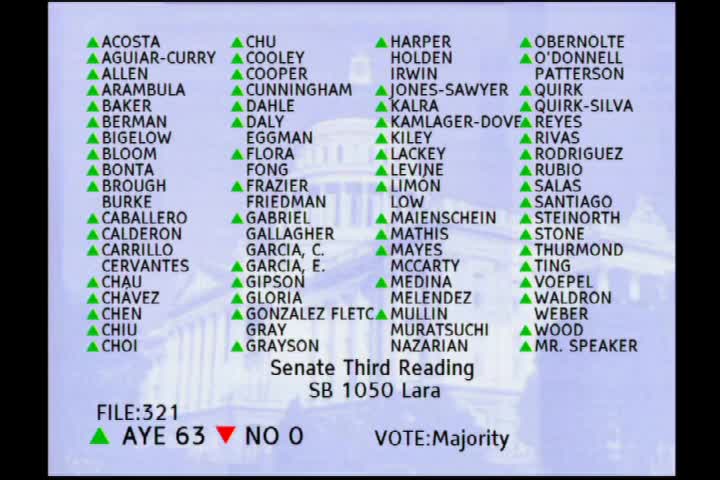 59SEC
Assembly Floor
 1H
Assembly Standing Committee on Appropriations
 8MIN
Senate Standing Committee on Appropriations
 8MIN
Senate Standing Committee on Labor and Industrial Relations
Bill Author

Bill Co-Author(s):
