SB 1138: Food options: plant-based meals.
- Session Year: 2017-2018
- House: Senate
- Latest Version Date: 2018-09-18
(1)Existing law requires a licensed general acute care hospital, acute psychiatric hospital, skilled nursing facility, intermediate care facility, special hospital, and nursing facility to employ a dietitian. Existing law imposes criminal sanctions for a violation of provisions, or willful or repeated violations of rules or regulations adopted pursuant to provisions, relating to these licensed facilities.
This bill would require these licensed facilities to make available wholesome, plant-based meals of such variety as to meet the needs of patients in accordance with their physicians orders. The bill would exclude this requirement from the criminal sanctions.
(2)Existing law requires each prison inmate to be provided with sufficient plain and wholesome food of such variety as may be most conducive to good health.
This bill would require the food provided to those inmates to include the availability of plant-based meals. The bill would require the Department of Corrections and Rehabilitation to develop a plan to make available the plant-based meals on an overall cost-neutral basis.
(3)This bill would make legislative findings and declarations in support of its provisions.
(1)Existing law requires a licensed general acute care hospital, acute psychiatric hospital, skilled nursing facility, intermediate care facility, special hospital, and nursing facility to employ a dietitian. Existing law imposes criminal sanctions for a violation of provisions, or willful or repeated violations of rules or regulations adopted pursuant to provisions, relating to these licensed facilities.
This bill would require these licensed facilities to make available wholesome, plant-based meals of such variety as to meet the needs of patients in accordance with their physicians orders. The bill would exclude this requirement from the criminal sanctions.
(2)Existing law requires each prison inmate to be provided with sufficient plain and wholesome food of such variety as may be most conducive to good health.
This bill would require the food provided to those inmates to include the availability of plant-based meals.
(3)This bill would make legislative findings and declarations in support of its provisions.
(1)Existing law requires a licensed general acute care hospital, acute psychiatric hospital, skilled nursing facility, intermediate care facility, special hospital, and nursing facility to employ a dietitian. Existing law imposes criminal sanctions for a violation of provisions, or willful or repeated violations of rules or regulations adopted pursuant to provisions, relating to these licensed facilities.
This bill would require these licensed facilities to make available wholesome, plant-based meals of such variety as to meet the needs of patients in accordance with their physicians orders. The bill would exclude this requirement from the criminal sanctions.
(2)Existing law requires each inmate to be provided with sufficient plain and wholesome food of such variety as may be most conducive to good health.
This bill would require the food provided to inmates to include the availability of plant-based meals.
(3)This bill would make legislative findings and declarations in support of its provisions.
Existing law establishes, until July 1, 2023, the California Healthy Food Financing Initiative for the purpose of supporting access to healthy food for all Californians. Existing law also establishes, within the State Department of Education, the California Fresh Start Pilot Program to provide fresh fruits and vegetables for public school pupils. Existing law provides for the licensure and regulation of certain hospitals by the State Department of Public Health. Existing law provides for the establishment and administration of state prisons and county jails for the confinement of persons who are convicted of crimes.This bill would state the intent of the Legislature to enact legislation to ensure that pupils in schools, patients in hospitals, and inmates in prisons, that are administered by the state or private entities, are provided with healthy food options, by requiring schools, hospitals, and prisons, that are administered by the state or private entities, to provide plant-based meal options.Existing law establishes, until July 1, 2023, the California Healthy Food Financing Initiative for the purpose of supporting access to healthy food for all Californians. Existing law also establishes, within the State Department of Education, the California Fresh Start Pilot Program to provide fresh fruits and vegetables for public school pupils. Existing law provides for the licensure and regulation of certain hospitals by the State Department of Public Health. Existing law provides for the establishment and administration of state prisons and county jails for the confinement of persons who are convicted of crimes.
This bill would state the intent of the Legislature to enact legislation to ensure that pupils in schools, patients in hospitals, and inmates in prisons, that are administered by the state or private entities, are provided with healthy food options, by requiring schools, hospitals, and prisons, that are administered by the state or private entities, to provide plant-based meal options.
The Legislature finds and declares all of the following:
(a)Public institutions such as licensed health care facilities and state prisons that provide food to captive audiences have a particular responsibility to provide a diversity of healthy meals that are acceptable to most religions, those with ethical dietary beliefs, and those with known food sensitivities.
(b)In 2017, the American Medical Association adopted a policy, entitled Healthy Food Options in Hospitals (H-150.949), that calls on hospitals to improve the health of patients, staff, and visitors by providing a variety of healthful food, including plant-based meals.
(c)Inmates are required to be provided with sufficient plain and wholesome food of such variety as may be most conducive to good health. Plant-based meals are mostly unavailable to inmates. Vegetarian meals are required to be provided upon request of an inmate with any religious, personal, or ethical dietary need, but often times, these meals are not strictly plant based and contain milk or egg products.
SEC. 2.Section 1265.10 is added to the Health and Safety Code, to read:1265.10.(a)A licensed health facility, as defined in subdivision (a), (b), (c), (d), (f), or (k) of Section 1250, shall make available wholesome, plant-based meals of such variety as to meet the needs of patients in accordance with their physicians orders.
(b)Notwithstanding any other law, including, but not limited to, Section 1290, a violation of this section shall not constitute a crime.
(c)For the purposes of this section, plant-based meals shall mean entire meals that contain no animal products or byproducts, including meat, poultry, fish, dairy, or eggs.
SEC. 3.Section 2084 of the Penal Code is amended to read:2084.(a)The department shall provide each prisoner with a bed, sufficient covering of blankets, and with garments of substantial material and of distinctive manufacture, and with sufficient plain and wholesome food of such variety as may be most conducive to good health and that shall include the availability of plant-based meals.
(b)The department shall develop a plan to make available the plant-based meals described in subdivision (a) on an overall cost-neutral basis.
(c)For the purposes of this section, plant-based meals shall mean entire meals that contain no animal products or byproducts, including meat, poultry, fish, dairy, or eggs.
The Legislature finds and declares all of the following:
(a)Public institutions such as licensed health care facilities and state prisons that provide food to captive audiences have a particular responsibility to provide a diversity of healthy meals that are acceptable to most religions, those with ethical dietary beliefs, and those with known food sensitivities.
(b)In 2017, the American Medical Association adopted a policy, entitled Healthy Food Options in Hospitals (H-150.949), that calls on hospitals to improve the health of patients, staff, and visitors by providing a variety of healthful food, including plant-based meals.
(c)Inmates are required to be provided with sufficient plain and wholesome food of such variety as may be most conducive to good health. Plant-based meals are mostly unavailable to inmates. Vegetarian meals are required to be provided upon request of an inmate with any religious, personal, or ethical dietary need, but often times, these meals are not strictly plant based and contain milk or egg products.
SEC. 2.Section 1265.10 is added to the Health and Safety Code, to read:1265.10.(a)A licensed health facility, as defined in subdivision (a), (b), (c), (d), (f), or (k) of Section 1250, shall make available wholesome, plant-based meals of such variety as to meet the needs of patients in accordance with their physicians orders.
(b)Notwithstanding any other law, including, but not limited to, Section 1290, a violation of this section shall not constitute a crime.
(c)For the purposes of this section, plant-based meals shall mean entire meals that contain no animal products or byproducts, including meat, poultry, fish, dairy, or eggs.
SEC. 3.Section 2084 of the Penal Code is amended to read:2084.(a)The department shall provide each prisoner with a bed, sufficient covering of blankets, and with garments of substantial material and of distinctive manufacture, and with sufficient plain and wholesome food of such variety as may be most conducive to good health and that shall include the availability of plant-based meals.
(b)The department shall develop a plan to make available the plant-based meals described in subdivision (a) on an overall cost-neutral basis.
(b)(c)For the purposes of this section, plant-based meals shall mean entire meals that contain no animal products or byproducts, including meat, poultry, fish, dairy, or eggs.
The Legislature finds and declares all of the following:
(a)Public institutions such as licensed health care facilities and state prisons that provide food to captive audiences have a particular responsibility to provide the healthiest possible food options. Plant-based meals have no cholesterol, provide much needed fiber and other nutrients, are acceptable to most religions and ethical dietary beliefs, and pose fewer problems for people with common food sensitivities, including egg and dairy allergies. a diversity of healthy meals that are acceptable to most religions, those with ethical dietary beliefs, and those with known food sensitivities.
(b)In 2017, the American Medical Association adopted a policy, entitled Healthy Food Options in Hospitals (H-150.949), that calls on hospitals to improve the health of patients, staff, and visitors by providing a variety of healthful food, including plant-based meals.
(c)Inmates are required to be provided with sufficient plain and wholesome food of such variety as may be most conducive to good health. Plant-based meals, containing the healthiest possible foods, meals are mostly unavailable to inmates. Vegetarian meals are required to be provided upon request of an inmate with any religious, personal, or ethical dietary need, but often times, these meals are not strictly plant based and contain milk or egg products.
(d)Requiring plant-based meals to be served in licensed California health care facilities and state prisons will help address cancer prevention and provide an example of healthful eating to the general public.SEC. 2.Section 1265.10 is added to the Health and Safety Code, to read:1265.10.(a)A licensed health facility, as defined in subdivision (a), (b), (c), (d), (f), or (k) of Section 1250, shall make available wholesome, plant-based meals of such variety as to meet the needs of patients in accordance with their physicians orders.
(b)Notwithstanding any other law, including, but not limited to, Section 1290, a violation of this section shall not constitute a crime.
(c)For the purposes of this section, plant-based meals shall mean entire meals that contain no animal products or byproducts, including meat, poultry, fish, dairy, or eggs.
SEC. 3.Section 2084 of the Penal Code is amended to read:2084.(a)The department shall provide each prisoner with a bed, sufficient covering of blankets, and with garments of substantial material and of distinctive manufacture, and with sufficient plain and wholesome food of such variety as may be most conducive to good health and that shall include the availability of plant-based meals.
(b)For the purposes of this section, plant-based meals shall mean entire meals that contain no animal products or byproducts, including meat, poultry, fish, dairy, or eggs.
The Legislature finds and declares all of the following:
(a)Public institutions such as licensed health care facilities and state prisons that provide food to captive audiences have a particular responsibility to provide the healthiest possible food options. Plant-based meals have no cholesterol, provide much needed fiber and other nutrients, are acceptable to most religions and ethical dietary beliefs, and pose fewer problems for people with common food sensitivities, including egg and dairy allergies.
(b)In 2017, the American Medical Association adopted a policy, entitled Healthy Food Options in Hospitals (H-150.949), that calls on hospitals to improve the health of patients, staff, and visitors by providing a variety of healthful food, including plant-based meals.
(c)Inmates are required to be provided with sufficient plain and wholesome food of such variety as may be most conducive to good health. Plant-based meals, containing the healthiest possible foods, are mostly unavailable to inmates. Vegetarian meals are required to be provided upon request of an inmate with any religious, personal, or ethical dietary need, but often times, these meals are not strictly plant based and contain milk or egg products.
(d)Requiring plant-based meals to be served in licensed California health care facilities and state prisons will help address cancer prevention and provide an example of healthful eating to the general public.
SEC. 2.Section 1265.10 is added to the Health and Safety Code, to read:1265.10.(a)A licensed health facility, as defined in subdivision (a), (b), (c), (d), (f), or (k) of Section 1250, shall make available wholesome, plant-based meals of such variety as to meet the needs of patients in accordance with their physicians orders.
(b)Notwithstanding any other law, including, but not limited to, Section 1290, a violation of this section shall not constitute a crime.
(c)For the purposes of this section, plant-based meals shall mean entire meals that contain no animal products or byproducts, including meat, poultry, fish, dairy, or eggs.
SEC. 3.Section 2084 of the Penal Code is amended to read:2084.(a)The department shall provide each prisoner with a bed, sufficient covering of blankets, and with garments of substantial material and of distinctive manufacture, and with sufficient plain and wholesome food of such variety as may be most conducive to good health. health and that shall include the availability of plant-based meals.
(b)For the purposes of this section, plant-based meals shall mean entire meals that contain no animal products or byproducts, including meat, poultry, fish, dairy, or eggs.
SECTION 1.It is the intent of the Legislature to enact legislation to ensure that pupils in schools, patients in hospitals, and inmates in prisons, that are administered by the state or private entities, are provided with healthy food options, which are a central aspect of the management of obesity, diabetes, cardiovascular disease, and many other conditions, by requiring schools, hospitals, and prisons, that are administered by the state or private entities, to provide plant-based meal options.It is the intent of the Legislature to enact legislation to ensure that pupils in schools, patients in hospitals, and inmates in prisons, that are administered by the state or private entities, are provided with healthy food options, which are a central aspect of the management of obesity, diabetes, cardiovascular disease, and many other conditions, by requiring schools, hospitals, and prisons, that are administered by the state or private entities, to provide plant-based meal options.
|
Date
|
Status
|
|---|---|
| Sep 18, 2018 | Chaptered by Secretary of State. Chapter 512, Statutes of 2018. |
| Sep 18, 2018 | Approved by the Governor. |
| Sep 10, 2018 | Enrolled and presented to the Governor at 4 p.m. |
| Aug 30, 2018 | Assembly amendments concurred in. (Ayes 39. Noes 0.) Ordered to engrossing and enrolling. |
| Aug 29, 2018 | In Senate. Concurrence in Assembly amendments pending. |
| Aug 29, 2018 | Read third time. Passed. Ordered to the Senate. |
| Aug 21, 2018 | Read second time. Ordered to third reading. |
| Aug 20, 2018 | Read second time and amended. Ordered to second reading. |
| Aug 16, 2018 | From committee: Do pass as amended. (Ayes 15. Noes 1.) (August 16). |
| Aug 8, 2018 | August 8 set for first hearing. Placed on suspense file. |
| Jun 26, 2018 | From committee: Do pass and re-refer to Com. on APPR. with recommendation: To consent calendar. (Ayes 7. Noes 0.) (June 26). Re-referred to Com. on APPR. |
| Jun 20, 2018 | From committee: Do pass and re-refer to Com. on PUB. S. with recommendation: To consent calendar. (Ayes 15. Noes 0.) (June 19). Re-referred to Com. on PUB. S. |
| Jun 7, 2018 | Referred to Coms. on HEALTH and PUB. S. |
| May 31, 2018 | In Assembly. Read first time. Held at Desk. |
| May 31, 2018 | Read third time. Passed. (Ayes 39. Noes 0.) Ordered to the Assembly. |
| May 29, 2018 | Ordered to special consent calendar. |
| May 25, 2018 | From committee: Do pass. (Ayes 7. Noes 0.) (May 25). |
| May 18, 2018 | Set for hearing May 25. |
| May 14, 2018 | May 14 hearing: Placed on APPR. suspense file. |
| May 4, 2018 | Set for hearing May 14. |
| Apr 30, 2018 | Read second time and amended. Re-referred to Com. on APPR. |
| Apr 26, 2018 | From committee: Do pass as amended and re-refer to Com. on APPR. (Ayes 9. Noes 0.) (April 25). |
| Apr 17, 2018 | From committee: Do pass and re-refer to Com. on HEALTH. (Ayes 6. Noes 0.) (April 17). Re-referred to Com. on HEALTH. |
| Apr 6, 2018 | Set for hearing April 25. |
| Apr 5, 2018 | Set for hearing April 17. |
| Apr 4, 2018 | Re-referred to Coms. on PUB. S. and HEALTH. |
| Mar 22, 2018 | From committee with author's amendments. Read second time and amended. Re-referred to Com. on RLS. |
| Feb 22, 2018 | Referred to Com. on RLS. |
| Feb 14, 2018 | From printer. May be acted upon on or after March 16. |
| Feb 13, 2018 | Introduced. Read first time. To Com. on RLS. for assignment. To print. |
|
Date
|
Description
|
Location
|
Votes
|
|
|---|---|---|---|---|
| Aug 30, 2018 | Unfinished Business SB1138 Skinner Concurrence | Senate Floor |
Passed |
|
| Aug 29, 2018 | SB 1138 Skinner Senate Third Reading By KALRA | Assembly Floor |
Passed |
|
| Aug 16, 2018 | Do pass as amended. | Assembly Standing Committee on Appropriations |
Passed |
|
| Jun 26, 2018 | Do pass and be re-referred to the Committee on [Appropriations] with recommendation: To Consent Calendar | Assembly Standing Committee on Public Safety |
Passed |
|
| Jun 19, 2018 | Do pass and be re-referred to the Committee on [Public Safety] with recommendation: To Consent Calendar | Assembly Standing Committee on Health |
Passed |
|
| May 31, 2018 | Special Consent SB1138 | Senate Floor |
Passed |
|
| May 25, 2018 | Do pass | Senate Standing Committee on Appropriations |
Passed |
|
| May 14, 2018 | Placed on suspense file | Senate Standing Committee on Appropriations |
Passed |
|
| Apr 25, 2018 | Do pass as amended, but first amend, and re-refer to the Committee on [Appropriations] | Senate Standing Committee on Health |
Passed |
|
| Apr 17, 2018 | Do pass, but first be re-referred to the Committee on [Health] | Senate Standing Committee on Public Safety |
Passed |
This list shows positions taken on this bill by organizations on the date displayed, which is linked to the original source.
Positions by individuals are not included.
|
Organization
|
Position
|
Date
|
|---|---|---|
| Adventist Health | ** Support | Jun 25, 2018 |
| Adventist Health Clear Lake | ** Support | Apr 23, 2018 |
| Adventist Health Clearlake | ** Support | Aug 30, 2018 |
| Adventist Health, Howard Memorial Hospital | ** Support | Jun 15, 2018 |
| Anti-Recidivism Coalition | ** Support | Jun 25, 2018 |
| Balanced | ** Support | Aug 30, 2018 |
| Brighter Green | ** Support | Aug 30, 2018 |
| California Cattleman's Association | * Neutral | Apr 25, 2018 |
| California Public Defenders Association | ** Support | Aug 30, 2018 |
| Center For Biological Diversity | ** Support | Aug 30, 2018 |
| Center For Food Safety | ** Support | Aug 30, 2018 |
| East Bay Animal Pac | ** Support | Aug 30, 2018 |
| Ecology Center | ** Support | Jun 25, 2018 |
| Ella Baker Center For Human Rights | ** Support | Aug 30, 2018 |
| Environmental Working Group | ** Support | Aug 30, 2018 |
| Friends Of The Earth | ** Support | Aug 30, 2018 |
| Greenpeace | ** Support | Jun 25, 2018 |
| Health Care Without Harm | ** Support | Aug 30, 2018 |
| Herself | * Support | Apr 25, 2018 |
| Herself | * Support | Apr 25, 2018 |
| Herself | * Support | Apr 25, 2018 |
| Herself | * Support | Apr 25, 2018 |
| Herself | * Support | Apr 25, 2018 |
| Herself | * Support | Apr 25, 2018 |
| Humane Society Of The United States | ** Support | Aug 30, 2018 |
| Occidental Arts & Ecology Center | ** Support | Aug 30, 2018 |
| One private individual | ** Support | Jun 25, 2018 |
| Over 100 Individuals | ** Support | Aug 30, 2018 |
| Peace For Animals and World Animal News | * Support | Apr 25, 2018 |
| Physicians Committee For Responsible Medicine | ** Support | Aug 30, 2018 |
| Plant Base Foods Association | ** Support | Jun 15, 2018 |
| Plant Based Foods Association | ** Support | Apr 23, 2018 |
| Plant-Based Foods Association | ** Support | Jun 25, 2018 |
| Social Compassion In Legislation | ** Support | Aug 30, 2018 |
| The Tofurky Company | ** Support | Jun 25, 2018 |
| Tofurkey Company | ** Support | Aug 30, 2018 |
| Tofurky Company | ** Support | Jun 15, 2018 |
| Tsehootsooi Medical Center | ** Support | Jun 15, 2018 |
| Western United Dairymen | * Neutral | Apr 25, 2018 |
Office of Senate Floor Analyses (916) 651-1520 Fax: (916) 327-4478 | SB |
UNFINISHED BUSINESS
Bill No: SB 1138
: in Senate
SENATE PUBLIC SAFETY COMMITTEE: 6-0, 4/17/18
AYES: Skinner, Anderson, Bradford, Mitchell, Stone, Wiener
NO VOTE RECORDED: Jackson
SENATE HEALTH COMMITTEE: 9-0, 4/25/18
AYES: Hernandez, Nguyen, Leyva, Mitchell, Monning, Newman, Nielsen, Pan, Roth
SENATE APPROPRIATIONS COMMITTEE: 7-0, 5/25/18
AYES: Lara, Bates, Beall, Bradford, Hill, Nielsen, Wiener
SENATE FLOOR: 39-0, 5/31/18
AYES: Allen, Anderson, Atkins, Bates, Beall, Berryhill, Bradford, Cannella, De León, Dodd, Fuller, Gaines, Galgiani, Glazer, Hernandez, Hertzberg, Hill, Hueso, Jackson, Lara, Leyva, McGuire, Mitchell, Monning, Moorlach, Morrell, Newman, Nguyen, Nielsen, Pan, Portantino, Roth, Skinner, Stern, Stone, Vidak, Wieckowski, Wiener, Wilk
ASSEMBLY FLOOR: 70-9, 8/29/18 - See last page for vote
SUBJECT: Food options: plant-based meals
Physicians Committee for Responsible Medicine
Social Compassion for Legislation
DIGEST:
This bill requires the California Department of Corrections and Rehabilitation (CDCR) to make plant-based meals available to the inmates under its jurisdiction, and requires specified licensed health care facilities to make plant-based meals available to their patients, as specified.
Assembly Amendments provide that CDCR develop a plan to make available the plant-based meals on an overall cost-neutral basis.
Existing law:
- Defines a “health facility” as a facility, place, or building that is organized, maintained, and operated for the diagnosis, care, prevention, and treatment of human illness, physical or mental, including convalescence and rehabilitation and including care during and after pregnancy, or for any one or more of these purposes, for one or more persons, to which the persons are admitted for a 24-hour stay or longer, which includes an acute care hospital, an acute psychiatric hospital, a skilled nursing facility, an intermediate care facility, a special hospital, and a nursing facility. (Health & Saf. Code, § 1250.)
- Requires a licensed general acute care hospital, acute psychiatric hospital, skilled nursing facility, intermediate care facility, special hospital, and nursing facility to employ a dietitian. (Health & Saf. Code, § 1265.4, subd. (a).)
- Imposes criminal sanctions for a violation of various provisions, or willful or repeated violations of rules or regulations adopted pursuant to those provisions, relating to licensed health facilities. (Health & Saf. Code, § 1290.)
- Requires CDCR to provide each prisoner with a bed, sufficient covering of blankets, and with garments of substantial material and of distinctive manufacture, and with sufficient plain and wholesome food of such variety as may be most conducive to good health. (Pen. Code, § 2084.)
This bill:
- Requires a licensed health facility, as specified, to make available wholesome, plant-based meals of such variety as to meet the needs of patients in accordance with their physicians’ orders.
- Specifies that notwithstanding any other law, a violation of the requirement that specified licensed health facilities make available plant-based meals to patients shall not constitute a crime.
- Defines “plant-based meals” to mean entire meals that contain no animal products or byproducts, including meat, poultry, fish, dairy, or eggs.
- Requires CDCR to make plant-based meals available to inmates.
Background
Regulations on inmate diets
CDCR is currently not required to make plant-based meals available to inmates. Penal Code section 2084 requires CDCR to provide inmates “with sufficient plain and wholesome food of such variety as may be most conducive to good health.” CDCR regulations further specify that each inmate must be provided a “nutritionally balanced diet.” (Cal. Code of Regs., tit. 15, § 3050, subd. (a).) The current Recommended Dietary Allowances (RDA) and Dietary Reference Intakes (RDI) as established by the Food and Nutrition Board of the Institute of Medicine, National Academy of Science are authoritative in setting levels of nutritional need. (Dept. of Operations Manual (DOM) § 54080.1.) The standardized CDCR menu and nutritional analysis must be reviewed by a registered dietician annually to ensure compliance with the RDA and DRI. (DOM § 54080.4.) Generally, inmates must be provided three meals during each 24-hour period, and a minimum of two of those meals must be hot meals. (DOM § 54080.5) Deviations from the two hot meals per day requirement may be allowed to accommodate religious observances and religious diet programs and institution emergencies. (Id.)
The regulations also delineate CDCR’s policies on special inmate diets. Each institution must make reasonable efforts to accommodate those inmates who have been determined to require a religious diet, as specified. (Cal. Code of Regs., tit. 15, § 3054, subd. (a).) Inmates requesting a special diet must be a participant of the Religious Diet Program. There are three religious diet options: vegetarian, kosher, and religious meat alternate. (Cal. Code of Regs., tit. 15, § 3054, subd. (e).)
Vegetarian meals must be available at all institutions upon request for inmates with any religious, personal, or ethical dietary need. Inmates may seek participation in the vegetarian diet program by submitting to any chaplain a Religious Diet Program Request form. (Cal. Code of Regs., tit. 15, § 3054.1.) No more than 30 days may pass between receipt of the request, which results in a determination about the inmate’s eligibility for the program, and the day an accepted inmate begins receiving the religious meals requested. (Cal. Code of Regs., tit. 15, § 3054.1, subd. (a).) Inmates approved for participation in the program must be provided with an approved vegetarian protein alternative. (Cal. Code of Regs., tit. 15, § 3054.1.)
The approval process for participation in the Religious Diet Program requires the chaplain to:
- Interview the inmate requesting the religious diet.
- Determine the inmate’s religious diet eligibility and placement into the appropriate religious diet program.
- When Religious Diet Program eligibility is determined, explain CDCR’s agreement concerning the religious diet program.
- When applicable, have the inmate sign the Religious Diet Program Agreement and the Religious Diet Program Request.
- Distribute the completed Religious Diet Program Request and the Religious Diet Program Agreement, within three working days to the Community Resources Manager.
- Notify the inmate of the decision in writing by providing a copy of their Religious Diet Request.
- Enter pertinent information for each inmate approved to participate in a Religious Diet Program onto a religious diet participant list within 24 hours of approval. Maintain and update the list every 30 days, and provide the correctional food manager with a copy of the list of those inmates who have been determined eligible to receive a religious diet, and which diet they will receive.
- Regularly monitor the religious diet lists with food service staff to ensure that all inmate Religious Diet Program participants are served their religious dietary meals with minimal delay.
- Provide each approved inmate with a Religious Diet Card.
- Meet with inmates, giving them the opportunity to respond to any allegations of Religious Diet Program Agreement compliance violations, prior to making a determination of continuing eligibility. (Cal. Code of Regs., tit. 15, § 3054.4, subd. (b).)
Inmate participants of the Religious Diet Program must show their Religious Diet Card when receiving their approved religious diet and follow the conditions of the signed Religious Diet Program Agreement. (Cal. Code of Regs., tit. 15, § 3054.4, subd. (c).) An inmate who wishes to withdraw from the Religious Diet Program must sign the Religious Diet Program Cancellation Request form and submit the completed it to the institution’s Community Resources Manager. (Cal. Code of Regs., tit. 15, § 3054.4, subd. (d).) Any alleged compliance violation of the Religious Diet Program Agreement must be reported and documented in the inmate’s central file. All reports must be sent to the designated representative of the RRC, who then must consult with the inmate. The RRC makes the final determination of continuing eligibility. A first violation of the Religious Diet Program Agreement results in a warning issued to the inmate, and a second violation within six months of the first violation may subject the inmate to removal from the program. (Cal. Code of Regs., tit. 15, § 3054.5.)
Regulations on patient diets
Existing regulations covering general acute care hospitals, acute psychiatric hospitals, and special hospitals require the dietetic service to provide food of the quality and quantity to meet the patient’s needs in accordance with physician’s orders and, to the extent medically possible, to meet the RDA, as specified. (Cal. Code. of Regs, tit. 22, §70273.) Patients must be served at least three meals daily, and patient food preferences must be respected as much as possible with substitutes to be offered through use of a selective menu or substitutes from appropriate food groups. (Cal. Code. of Regs, tit. 22, §71243.)
Intermediate care and skilled nursing facilities (SNFs) are required to provide written menus for regular and therapeutic diets at least one week in advance. (Cal. Code. of Regs, tit. 22, §72341.) These types of facilities are also required to provide a variety of foods, to be adjusted to include seasonal commodities, and to be planned with consideration for cultural background and food habits of patients. (Cal. Code. of Regs, tit. 22, §73333.)
According to the Senate Health Committee’s analysis, the Department of Public Health’s interpretation of the regulations pertaining to patient food preferences would require a hospital “to provide a requested vegan meal to the extent possible.” With regard to SNFs and intermediate care facilities, the Centers for Medicare and Medicaid Services issued new regulations in 2016 governing long-term care facilities, which included new requirements on nutrition services. As part of the Person Centered Care guidelines, facilities are required, when preparing food and meals, to take into consideration residents’ needs and preferences and the overall cultural and religious make-up of the facility’s population.
FISCAL EFFECT: Appropriation: Fiscal Com.: Local:
According to the Assembly Appropriations Committee:
Costs are uncertain, but for illustrative purposes, if 2% of inmates requested a plant-based diet and provision of such a diet costs an extra $0.50 per day, costs would be around $500,000 GF. Plant-based options also have the potential to be cheaper than alternatives, but it would depend on how the California Department of Corrections and Rehabilitation (CDCR) implemented this new requirement. For instance, costs for purchase, storage, and preparation of a meal of dried lentils and rice may be less than costs for a salad with a variety of fresh produce.
Friends of the Earth (co-source)
Physicians Committee for Responsible Medicine (co-source)
Social Compassion in Legislation (co-source)
Adventist Health Clearlake
Balanced
Brighter Green
California Public Defenders Association
Center for Biological Diversity
Center for Food Safety
East Bay Animal PAC
Ella Baker Center for Human Rights
Environmental Working Group
Health Care Without Harm
Humane Society of the United States
Occidental Arts & Ecology Center
Tofurkey Company
Over 100 individuals
OPPOSITION: (Verified 8/27/18)
None received
ASSEMBLY FLOOR: 70-9, 8/29/18
AYES: Acosta, Aguiar-Curry, Arambula, Baker, Berman, Bigelow, Bloom, Bonta, Burke, Caballero, Calderon, Carrillo, Cervantes, Chau, Chávez, Chen, Chiu, Choi, Chu, Cooley, Cooper, Dahle, Daly, Eggman, Flora, Frazier, Friedman, Gabriel, Gallagher, Cristina Garcia, Eduardo Garcia, Gipson, Gloria, Gonzalez Fletcher, Grayson, Holden, Irwin, Jones-Sawyer, Kalra, Kamlager-Dove, Kiley, Lackey, Levine, Limón, Low, Mathis, Mayes, McCarty, Medina, Mullin, Muratsuchi, Nazarian, O'Donnell, Quirk, Quirk-Silva, Reyes, Rivas, Rodriguez, Rubio, Salas, Santiago, Steinorth, Mark Stone, Thurmond, Ting, Voepel, Waldron, Weber, Wood, Rendon
NOES: Travis Allen, Brough, Cunningham, Fong, Gray, Harper, Maienschein, Melendez, Obernolte
NO VOTE RECORDED: Patterson
8/30/18 10:02:15
**** END ****
SENATE THIRD READING
STR Bill Id:SB 1138
Author:(Skinner)
As Amended Ver:August 20, 2018
Majority vote
SENATE VOTE: 39-0
Committee | Votes | Ayes | Noes |
Health | 15-0 | Wood, Mayes, Aguiar-Curry, Bigelow, Bonta, Burke, Carrillo, Flora, Limón, McCarty, Nazarian, Rodriguez, Santiago, Thurmond, Waldron | |
Public Safety | 7-0 | Jones-Sawyer, Lackey, Carrillo, Kamlager-Dove, Kiley, Quirk, Santiago | |
Appropriations | 15-1 | Gonzalez Fletcher, Bigelow, Bloom, Bonta, Brough, Calderon, Carrillo, Chau, Eggman, Friedman, Gallagher, Eduardo Garcia, Nazarian, Quirk, Reyes | Fong |
SUMMARY: Requires hospitals and long-term care facilities, as defined, and prisons, to make wholesome, plant-based meals available to patients and prisoners. Specifically, this bill:
- Requires general acute care hospitals, acute psychiatric hospitals, skilled nursing facilities (SNFs), intermediate care facilities (ICFs), special hospitals, and nursing facilities to make wholesome, plant-based meals available to patients in accordance with their physicians' orders.
- Requires the Department of Corrections and Rehabilitation (CDCR) to make plant-based meals available to prisoners, and to develop a plan to make the plant-based meals available on an overall cost-neutral basis.
- Defines "plant-based meals" as entire meals that contain no animal products or byproducts, including meat, poultry, fish, dairy, or eggs.
- Finds and declares that public institutions that provide food to "captive audiences" have a responsibility to provide a diversity of healthy meals that are acceptable to most religions, those with ethical dietary beliefs, and those with known food sensitivities.
FISCAL EFFECT: According to the Assembly Appropriations Committee, minor costs to CDCR to prepare a plan to implement the provision of plant-base meals on an overall cost-neutral basis.
COMMENTS: According to the author, most people have the option to prepare food at home or bring a meal to work, school or elsewhere that suits our religious, ethical, and dietary needs. Those in an institutional setting such as a licensed health care facility or a state prison do not have that option. While many public institutions already provide vegetarian or vegan options, it is not yet required at hospitals and prisons. The author states that providing a plant-based meal option not only ensures that religious, ethical, or dietary needs are respected, plant-based meals, if properly selected, can also be healthier. The author points to a two-year pilot program in which, Friends of the Earth (FOE) and Oakland Unified School District (OUSD) were able to show that serving more plant-based meals at OUSD resulted in a 14% reduction in the carbon footprint of the District's food program, 6% reduction in water footprint, and $42,000 in cost-savings. The author notes that support for plant-based meals is growing, and in 2017, the American Medical Association called on hospitals to provide plant-based meal options to align hospital menus with their health care mission. The author concludes that this bill will ensure that hospitals and state prisons provide a plant-based meal option to improve health, respect religious and other preferences as well as extend California's environmental stewardship.
- Existing requirements to accommodate patient preference. Current regulations require hospitals to respect patient food preferences as much as possible and that substitutes be offered through use of a selective menu or substitutes from appropriate food groups. According to the Department of Public Health, if a patient requested a vegan meal, it interprets this regulation as requiring hospitals "to provide a requested vegan meal to the extent possible." With regard to SNFs and ICFs, in 2016 the Centers for Medicare and Medicaid Services issued new regulations governing long-term care facilities, which included new requirements on nutrition services. As part of the Person Centered Care guidelines, facilities are required, when preparing food and meals, to take into consideration residents' needs and preferences and the overall cultural and religious make-up of the facility's population.
- CDCR food service regulations. CDCR regulations require CDCR to make reasonable efforts to accommodate inmates who have been determined to require a religious diet. The religious diet options include: vegetarian, kosher, and religious meat alternate. Vegetarian meals are required to be available at all institutions upon request for inmates with any religious, personal, or ethical dietary need. Inmates are permitted to seek participation in the vegetarian diet program by submitting to any chaplain a Religious Diet Program Request form. Inmates approved for participation in the program are required to be provided with an approved vegetarian protein alternative.
According to CDCR, as of April 2018 there are approximately 2,061 inmate participants receiving a vegetarian diet statewide. There are no vegan diets available for CDCR. CDCR's vegetarian option is a lacto-ovo vegetarian diet which includes eggs, nuts, and dairy products.
According to CDCR, it is difficult to provide a detailed estimate related to providing "plant based meals." With the fluctuating price of fresh produce, seasonal changes which effect pricing, as well as logistics, the ability to serve a continued variety of fresh fruits and vegetables would be extremely costly. For example, if 10,000 inmates (out of a total in custody population of 129,319 inmates as of May 31, 2018) requested a plant-based diet and a plant-based diet cost $0.20 more per day per inmate, the annual increased cost would be $730,000. CDCR notes that this example is for illustrative purposes as it cannot yet determine how much more a plant-based diet would actually cost.
Analysis Prepared by: Lara Flynn / HEALTH / (916) 319-2097 FN: 0004178
Date of Hearing: August 8, 2018
ASSEMBLY COMMITTEE ON APPROPRIATIONS
Lorena Gonzalez Fletcher, Chair
SBPCA Bill Id:SB 1138
Author:(Skinner) – As Amended Ver:April 30, 2018
Policy Committee: | Health | Vote: | 15 - 0 |
Public Safety | 7 - 0 |
Urgency: No State Mandated Local Program: No Reimbursable: No
SUMMARY:
This bill requires hospitals, long-term care (LTC) facilities, and state prisons to make available “plant-based meals,” defined as entire meals that contain no animal products or byproducts, including meat, poultry, fish, dairy, or eggs.
FISCAL EFFECT:
Costs are uncertain, but for illustrative purposes, if 2% of inmates requested a plant-based diet and provision of such a diet costs an extra $0.50 per day, costs would be around $500,000 GF. Plant-based options also have the potential to be cheaper than alternatives, but it would depend on how the California Department of Corrections and Rehabilitation (CDCR) implemented this new requirement. For instance, costs for purchase, storage, and preparation of a meal of dried lentils and rice may be less than costs for a salad with a variety of fresh produce.
COMMENTS:
- Purpose. This bill is co-sponsored by Social Compassion in Legislation, Friends of the Earth, and Physicians Committee for Responsible Medicine to ensure hospitals and state prisons provide a plant-based meal options to improve health, respect religious and other preferences, and extend California’s environmental stewardship. The author and sponsors point to health and environmental benefits of a plant-based diet and a growing awareness and acceptance of such a diet.
- Background. Hospitals and LTC facilities are required to accommodate patient preferences and religious needs, but are not currently required to provide completely vegan (wholly plant-based) meals. CDCR regulations require CDCR to make reasonable efforts to accommodate inmates who have been determined to require a religious diet, and vegetarian meals are required to be available at all institutions upon request for inmates with any religious, personal, or ethical dietary need. However, vegan meals are not provided.
- Staff Comment. In order to reduce potential GF cost pressure, the author may wish to consider requiring CDCR to develop a plan to provide plant-based meals on an overall cost-neutral basis.
Analysis Prepared by: Lisa Murawski / APPR. / (916) 319-2081
Date of Hearing: June 26, 2018
Counsel: Liah Burnley
ASSEMBLY COMMITTEE ON PUBLIC SAFETY
Reginald Byron Jones-Sawyer, Sr., Chair
SBPCA Bill Id:SB 1138
Author:(Skinner) – As Amended Ver:April 30, 2018
SUMMARY: Requires the California Department of Corrections and Rehabilitation (CDCR) and licensed health care facilities to provide plant-based meals. Specifically, this bill:
- Requires licensed health facilities to make available wholesome, plant-based meals of such variety as to meet the needs of patients in accordance with their physicians orders.
- Requires CDCR to provide each prisoner with sufficient plain and wholesome food that includes plant-based meals.
- Defines “plant-based meals” as “entire meals that contain no animal products or byproducts, including meat, poultry, fish, dairy, or eggs.”
- States the following findings and declarations:
- Public institutions such as licensed health care facilities and state prisons have a responsibility to provide healthy meals that are acceptable to most religions, those with ethical dietary beliefs, and those with known food sensitivities;
- In 2017, the American Medical Association adopted a Healthy Food Options in Hospitals policy that calls on hospitals to provide a variety of healthful food, including plant-based meals; and,
- Inmates are required to be provided with sufficient plain and wholesome food of such variety as may be conducive to good health. Plant-based meals are mostly unavailable to inmates. Vegetarian meals are required to be provided upon request of an inmate with religious personal or ethical dietary need, but often times, these meals are not strictly plant based and contain milk or egg products.
- Public institutions such as licensed health care facilities and state prisons have a responsibility to provide healthy meals that are acceptable to most religions, those with ethical dietary beliefs, and those with known food sensitivities;
EXISTING LAW:
- Requires a licensed general acute care hospital, acute psychiatric hospital, skilled nursing facility, intermediate care facility, special hospital, and nursing facility to employ a dietitian. (Health & Saf. Code, § 1265.4, subd. (a).)
- Requires CDCR to provide each prisoner with a bed, sufficient covering of blankets, and with garments of substantial material and of distinctive manufacture, and with sufficient plain and wholesome food of such variety as may be most conducive to good health. (Pen. Code, § 2084.)
- Requires state agencies, including CDCR, to purchase agricultural and industrial products from California Prison Industry Association (CAPIA) and states that products may be purchased from CAPIA by state agencies to be offered for sale to inmates of CDCR and to any other person under the care of the state who resides in state-operated institutional facilities. (Pen. Code, § 2807.)
FISCAL EFFECT: Unknown.
COMMENTS:
- Author’s Statement: According to the author, “Most people have the option to prepare at home or bring a meal to work, school or elsewhere the suits our religious, ethical, and dietary needs. Those in an institutional setting such as a licensed health care facility or a state prison do not have that option. While many public institutions already provide vegetarian or vegan options, it is not yet required at hospitals and prisons.
“Providing a plant-based meal option not only ensures that religious, ethical, or dietary needs are respected, plant-based meals, if properly selected, can also be healthier.
“In a two-year pilot program, Friends of the Earth (FOE) and Oakland Unified School District (OUSD) were able to show that serving more plant-based meals at OUSD resulted in a 14% reduction in the carbon footprint of the District’s food program, 6% reduction in water footprint, and $42,000 in cost-savings.
“The support for plant-based meals is growing. In 2017, the American Medical Association called on hospitals to provide plant-based meal options to align hospital menus with their health care mission.
“SB 1138 will ensure that hospital’s and state prisons provide a plant-based meal option to improve health, respect religious and other preferences as well as extend California’s environmental stewardship.”
- Prison Food: “There are two primary ways in which food is consumed as part of the state food environment: situations where individuals have very little or no choice about what they are served (e.g., prisons) and situations where individuals have choice not only about what food they order, but whether they buy their food from the state at all (e.g., park visitors).” (Public Health Institute, Strategic Growth Council, and the California Health in All Policies Task Force, California State Government Food Procurement Policies and Practices (2016), available at: http://sgc.ca.gov/programs/hiap/docs/20160916-CAStateGovernmentFoodProcurementPoliciesandPractices-2016.pdf.) CDCR is the largest state food purchaser and food service provider, and serves around 130 million meals each year at 35 state prisons. (Id.)
- Standardized Prison Menu: Penal Code section 2084 requires CDCR to provide inmates “with sufficient plain and wholesome food of such variety as may be most conducive to good health.” CDCR also requires that each inmate be provided a “nutritionally balanced diet.” (Cal. Code of Regs., tit. 15, § 3050, subd. (a).) Generally, inmates must be provided three meals during each 24-hour period, and a minimum of two of those meals must be hot meals. (Department Operations Manual “DOM” § 54080.5)
CDCR’s Departmental Food Administrator (DFA) is a registered dietitian who develops a standardized menu to meet adult nutritional requirements. (DOM § 54080.4.) When planning menus, the DFA follows a set of federal and state dietary guidelines including the federal Recommended Dietary Reference Intakes and Recommended Dietary Allowances, CDCR’s Heart Healthy diet, and the American Heart Association’s Healthy Eating plan. (California State Government Food Procurement Policies and Practices (2016); DOM § 54080.1.) The standardized CDCR menu and nutritional analysis must be reviewed by the DFA annually to ensure compliance with the federal dietary recommendations. (DOM § 54080.) All of the facilities serve the same standardized menu and all inmates are served the same menu, with the exception of those who receive Kosher, Halal, vegetarian, or special medical meals (discussed in further detail below).
The following is an example, of CDCR’s standardized menu for one day:
- Breakfast: One-half cup of juice, six ounces of cereal, pancakes, sausage, syrup, a cup of nonfat milk, and a cup of coffee. The vegetarian option would replace the sausage with peanut butter;
- Lunch: A wheat bread sandwich, with two ounces of lunch meat, mustard, a package of shelled sunflower seeds, graham crackers, one item of fresh fruit, and a sugar free beverage. The vegetarian option would include three slices of cheese in lieu of the lunch meat;
- Dinner: Three-fourths cup of salad with dressing, four ounces of breaded fish, cocktail sauce, a baked potato, one-half cup of broccoli, two slices of wheat bread, a piece of iced cake, and a sugar free beverage. The vegetarian option would include one cup of vegetarian beans to replace the breaded fish. (See, http://sgc.ca.gov/programs/hiap/docs/20160916-CAStateGovernmentFoodProcurementPoliciesandPractices-2016.pdf.)
In addition to the three meals per day served by CDCR, inmates can use money in their inmate trust accounts to purchase food items from prison canteens. (Cal. Code of Regs. tit. 15, § 3090; Pen. Code, § 5005.) These items are not subject to any nutritional guidelines, even though the law requires food and beverages offered in vending machines on state property to follow nutritional guidelines. (Pen. Code, § 5005; See also, California State Government Food Procurement Policies and Practices (2016).) Items for sale frequently include candy, ice cream, cookies and pastries, and instant food like Ramen and Spam. (Id.)
- CDCR’s Religious Diet Meals: There are three religious diet options: vegetarian, kosher, and religious meat alternate. (Cal. Code of Regs., tit. 15, § 3054, subd. (e).) According to data from 2016, approximately 9,600 inmates currently receive religious meal designation and approximately 4,500 receive vegetarian meals. CDCR’s regulations include provisions that address special inmate diets. Each institution must make reasonable efforts to accommodate inmates who have been determined to require a religious diet. (Cal. Code of Regs., tit. 15, § 3054, subd. (a).) Inmates requesting a special diet must be a participant of the Religious Diet Program. (Cal. Code of Regs., tit. 15, § 3054.)
Religious Diet Program meals are available at all institutions upon request for inmates with any religious, personal, or ethical dietary need. Inmates may seek participation in the religious diet program by submitting a Religious Diet Program Request form to a CDCR Chaplain. (Cal. Code of Regs., tit. 15, § 3054.1.) Inmates approved for participation in the program must be provided with an approved vegetarian protein alternative. (Cal. Code of Regs., tit. 15, § 3054.1.) The Chaplain and the Religious Review Committee make the final determination of whether an inmate is eligible for a special religious diet. To be eligible, an inmate’s religious belief must be both “sincerely held” and “religious nature,” as determined by the Chaplain. (Shakur v. Schriro, (2008) 9th Cir. 514 F.3d 878, 885; In Re Garcia, (2012) 202 Cal.App.4th 892.)
Typically, religious diet meals are as follows:
- Vegetarian Meals: Vegetarian meals are lacto-ovo vegetarian, meaning they may include dairy products, eggs, and fish. (See Cal. Code Regs., tit 15, § 3054.1; DOM § 54080.14.)
- Halal Meals: Halal meals consist of two vegetarian meals for breakfast and lunch and dinner with halal meat from an animal that was cared for and slaughtered according to Islamic dietary laws. (See Cal. Code Regs., tit 15, §§ 3053, 3054.3; DOM §§ 54080, 54080.14.)
- Kosher Meals: Kosher meals consist of prepackaged frozen meals using kosher-certified food. (See Cal. Code Regs., tit 15, § 3054.2, § 3054.2(e); DOM § 54080.14.)
- Could Providing Inmates Healthier Food Options Increase Prison Security and Public Safety and Reduce Health Care Costs?: Nutrition affects behavior. (National Research Council (1994) Understanding and Preventing Violence.) In a 2002 study of 231 prisoners, violent incidents while in custody were cut by a more than a third among those given mineral and vitamin supplements. Overall, offences recorded by the prison authorities fell by a quarter. (See Gesch, B., (2002) Influence of Supplementary Vitamins, Minerals, and Essential Fatty Acids on the Antisocial Behavior of Young Adult Prisoners.) A Dutch research team repeated the study in 2010, and had the same results. (Zaalberg, A., (2010) Effects of Nutritional Supplementation on Aggression, Rule-Breaking, and Psychopathology among Young Adult Prisoners.) Their research highlighted the fact that behavior issues have been linked to nutritional deficiencies. (Id.)
In 1997, inmates at the now-closed Victor Valley Medium Community Correctional Facility, a privately owned prison under contract with CDCR in Adelanto, California, (https://www.raw-by-nature.com/the-answer-is-veganism/) were given the choice whether they wanted to the standard CDCR standardized food menu, or enroll in the NEWSTART program which included a vegan diet, bible studies, job training and anger management. (Id.) Remarkably, the Victor Valley facility had a recidivism rate of less than two percent. In comparison, the recidivism rate for the state was 95 percent. (Id.) The Victor Valley nutrition services coordinator Julianne Aranda explained that “what we eat not only affects us physically, but it affects our mental attitude, our aggressiveness and our ability to make good decisions.” (Id.) According to prison officials, the typical lines drawn amongst race and gang affiliation were were non-existent on the Victor Valley prison yard. (Id.) Inmates claimed that the food led them to feel better, have greater energy, increased stamina and reduced problems with acne. (https://www.insidershealth.com/vegan-prison-reducing-aggression-fostering-better-inmates/.) Considering the correlation between behavior and nutrition, a closer look at how the state feeds its prison population is warranted.
Along with behavior, a plant-based diet may improve inmate health. In general, inmates have a wide variety of risk factors that have been associated with poor physical health. (Bureau of Justice Statistics (2004) Criminal Offender Statistics.) Additionally, “the increasing rate of incarceration of females and older individuals further taxes the medical resources of jails and prisons, as both populations have a higher likelihood of physical health concerns relative to young male inmates.” (Maruschak L., Bureau of Justice Statistics Special Report. U.S. Department of Justice, (2006) Medical problems of jail inmates.)
The state bears the cost of poor inmate health. “California spends hundreds of millions of dollars directly on food and spends more each year on health care costs of diet-related diseases through employee medical benefits, direct medical services to those housed in state facilities, and through state supported Medi-Cal and Medi-Cade.” (California State Government Food Procurement Policies and Practices (2016).) As the care for the physical health of offenders is becoming increasingly expensive, interventions that can improve inmates’ physical health are desirable. (Id.)
On the other hand, there are some safety and security concerns providing inmates with certain food items. For example, CDCR limits the types of fruit served due to security concerns: “[a]pples are served daily, oranges and other fruits are not served due to concerns that inmates will make “pruno,” a fruit-based fermented alcohol, which is prohibited. In addition, prisons with level 3 and 4 security are not allowed to serve fruit with pits because the pits can be used as weapons.” (California State Government Food Procurement Policies and Practices (2016).) However, with the many varieties of plant-based food farmed in California, CDCR can provide both a safe and secure prison environment and provide nutritious plant-based meals to inmates.
- CDCR Food Procurement: State correctional facilities are required to purchase products through CALPIA if available, and then through DGS contracts for items not offered through CALPIA. (California State Government Food Procurement Policies and Practices (2016).) Of all menu items served at CDCR, about 60 percent are purchased through DGS, 30 percent from CALPIA, and 10 percent come from independent procurement contracts under delegated purchasing authority. (Id.) CDCR purchases approximately $150 million worth of food each year through contracts negotiated by DGS, CALPIA, and directly from distributors. (Id.) Each year, CALPIA produces and sells approximately $65 million worth of agricultural and food products including almonds, bread, juice, peanut butter, jelly, milk, meat, eggs, chicken, coffee, and cookies. (https://catalog.calpia.ca.gov/food/pricing-forms/.) As stated by the California Health in All Policies Task Force, “CALPIA produces and/or processes a range of food items and could expand its reach to include more fresh vegetables and fruit.” (California State Government Food Procurement Policies and Practices (2016).)
The largest purchaser of CALPIA food is CDCR. In 2014, CDCR accounted for nearly 60 percent percent of all sales (including non-food items). (Id.) As such, CALPIA tends to produce items that meet CDCR specifications for CDCR’s standardized food menu. (Id.) Because CDCR is the largest state purchaser and provider of state food, CDCR’s needs often drive how DGS and CALPIA formulate all of their contracts for food products. (Id.) CDCR “follows a set of federal and state dietary guidelines for menu development,” thus, “there are a range of opportunities to improve the entire state food environment based on CDCR’s need.” (Id.) For example, “[b]ecause DGS purchases products in large amounts, it can influence the market to produce healthier products at lower prices by embedding nutritional or other criteria into bid specifications.” (Id.) Optimistically, this bill could have the chance effect of improving the overall state food environment, by providing more options for more nutritious plant-based meals options for other state departments that procure food from CALPIA and DGS, including the California Department of Developmental Services, Department of Parks and Recreation, Department of Veteran Affairs, Department of Education, CalFire, and California Highway Patrol.
- Argument in Support: According to Adventist Health, “When creating more plant-based options for a menu there are several considerations that need to be evaluated. For instance, the raw food cost of the ingredients, any change in labor needed to execute the menu items, food quality, and of course, it must taste good. We have found that the majority of resource changes came down to whether we needed to train staff on new recipes, but often we can just change out old recipes for new without much or any training.
“As we began to develop a more plant-based menu it was easier to offer a variety of options without a lot of additional production time. Since our core menu sides such as rice pilaf or polenta are plant-based, it is easy to build upon buy juts adding a few components to that plate to make it a well-rounded, nutritionally adequate, and tasty meal.” - Prior Legislation:
- SB 441 (Torlakson), Chapter 597, Statutes of 2008, mandated a set of acceptable nutrition guidelines for a portion of the food and beverages offered in vending machines on State property.
- AB 459 (Mitchell), of the 2013-14 Legislative Session, would have required vending machines on state property to meet accepted nutritional guidelines and that any food or beverages sold in state-owned or state-leased buildings meet the standard criteria for food and nutrition guidelines for concessions as determined under the U.S. General Services Administration’s Health and Sustainability Guidelines for Federal Concessions and Vending Operations. AB 459 died in Assembly Appropriations Committee.
- AB 2413 (Pérez), Chapter 583, Statues of 2014, established the Office of Farm to Fork within the California Department of Food and Agriculture, and required the office, to the extent that resources are available, to increase the amount of agricultural products available to underserved communities and schools in the state.
- SB 441 (Torlakson), Chapter 597, Statutes of 2008, mandated a set of acceptable nutrition guidelines for a portion of the food and beverages offered in vending machines on State property.
REGISTERED SUPPORT / OPPOSITION:
Support
Physicians Committee for Responsible Medicine (Co-Sponsor)
Social Compassion in Legislation (Co-Sponsor)
Adventist Health
Anti-Recidivism Coalition
Balanced
California Healthy Food in Health Care program of Health Care without Harm
Center for Biological Diversity
Center for Food Safety
California Public Defenders Association
Brighter Green
East Bay Animal PAC
Ecology Center
Ella Baker Center for Human Rights
Friends of the Earth
Greenpeace
Occidental Arts & Ecology Center
Plant-Based Foods Association
The Tofurky Company
The Human Society of the United States
One Private Individual
Opposition
None
Analysis Prepared by: Liah Burnley / PUB. S. / (916) 319-3744
Date of Hearing: June 19, 2018
ASSEMBLY COMMITTEE ON HEALTH
Jim Wood, Chair
SBPCA Bill Id:SB 1138
Author:(Skinner) – As Amended Ver:April 30, 2018
SENATE VOTE: 39-0
SUBJECT: Food options: plant-based meals.
SUMMARY: Requires hospitals and long-term care facilities, as defined, and prisons, to make wholesome, plant-based meals available to patients and prisoners. Specifically, this bill:
- Requires general acute care hospitals (GACHs), acute psychiatric hospitals (APHs), skilled nursing facilities (SNFs), intermediate care facilities (ICFs), special hospitals, and nursing facilities to make wholesome, plant-based meals available to patients in accordance with their physicians' orders.
- Requires the Department of Corrections and Rehabilitation (CDCR) to make plant-based meals available to prisoners.
- Defines "plant-based meals" as entire meals that contain no animal products or byproducts, including meat, poultry, fish, dairy, or eggs.
- Finds and declares that public institutions that provide food to "captive audiences" have a responsibility to provide a diversity of healthy meals that are acceptable to most religions, those with ethical dietary beliefs, and those with known food sensitivities.
EXISTING LAW:
- Licenses and regulates health facilities, including GACHs, APHs, SNFs, ICFs, special hospitals and nursing facilities by the Department of Public Health (DPH). Defines a “health facility” as a facility, place, or building that is organized, maintained, and operated for the diagnosis, care, prevention, and treatment of human illness, physical or mental, including convalescence and rehabilitation and including care during and after pregnancy, or for any one or more of these purposes, for one or more persons, to which the persons are admitted for a 24-hour stay or longer.
- Requires CDCR to provide each prisoner with a bed, sufficient covering of blankets, and with garments of substantial material and of distinctive manufacture, and with sufficient plain and wholesome food of such variety as may be most conducive to good health.
- Requires, through regulations, GACHs, APHs, and special hospitals dietetic service to provide food of the quality and quantity to meet the patient’s needs in accordance with physician’s orders and, to the extent medically possible, to meet the Recommended Daily Dietary Allowance, as specified. Requires not less than three meals served daily, and that patient food preferences be respected, as much as possible, and substitutes to be offered through the use of a selective menu or substitutes from appropriate food groups.
- Requires, through regulations, ICFs and SNFs to provide written menus for regular and therapeutic diets at least one week in advance, and for the menus to provide a variety of foods, to be adjusted to include seasonal commodities, and to be planned with consideration for cultural background and food habits of patients.
FISCAL EFFECT: According to the Senate Appropriations Committee, unknown, potentially-significant costs in the hundreds of thousands of dollars annually to CDCR to provide a plant-based meal option at all of its institutions (General Fund), and unknown compliance costs to specified health care facilities. It is unclear how many physicians’ orders would include the need for a strictly-vegan diet.
COMMENTS:
- PURPOSE OF THIS BILL. According to the author, most people have the option to prepare food at home or bring a meal to work, school or elsewhere that suits our religious, ethical, and dietary needs. Those in an institutional setting such as a licensed health care facility or a state prison do not have that option. While many public institutions already provide vegetarian or vegan options, it is not yet required at hospitals and prisons. The author states that providing a plant-based meal option not only ensures that religious, ethical, or dietary needs are respected, plant-based meals, if properly selected, can also be healthier. The author points to a two-year pilot program in which, Friends of the Earth (FOE) and Oakland Unified School District (OUSD) were able to show that serving more plant-based meals at OUSD resulted in a 14% reduction in the carbon footprint of the District’s food program, 6% reduction in water footprint, and $42,000 in cost-savings. The author notes that support for plant-based meals is growing, and in 2017, the American Medical Association called on hospitals to provide plant-based meal options to align hospital menus with their health care mission. The author concludes that this bill will ensure that hospitals and state prisons provide a plant-based meal option to improve health, respect religious and other preferences as well as extend California’s environmental stewardship.
- BACKGROUND.
- Existing requirements to accommodate patient preference. As noted in existing law above, regulations require hospitals to respect patient food preferences as much as possible and that substitutes be offered through use of a selective menu or substitutes from appropriate food groups. According to DPH, if a patient requested a vegan meal, it interprets this regulation as requiring hospitals “to provide a requested vegan meal to the extent possible.” With regard to SNFs and intermediate care facilities, in 2016 the Centers for Medicare and Medicaid Services issued new regulations governing long-term care facilities, which included new requirements on nutrition services. As part of the Person Centered Care guidelines, facilities are required, when preparing food and meals, to take into consideration residents’ needs and preferences and the overall cultural and religious make-up of the facility’s population.
- CDCR food service regulations. CDCR regulations require CDCR to make reasonable efforts to accommodate inmates who have been determined to require a religious diet. The religious diet options include: vegetarian, kosher, and religious meat alternate. Vegetarian meals are required to be available at all institutions upon request for inmates with any religious, personal, or ethical dietary need. Inmates are permitted to seek participation in the vegetarian diet program by submitting to any chaplain a Religious Diet Program Request form. Inmates approved for participation in the program are required to be provided with an approved vegetarian protein alternative.
- Existing requirements to accommodate patient preference. As noted in existing law above, regulations require hospitals to respect patient food preferences as much as possible and that substitutes be offered through use of a selective menu or substitutes from appropriate food groups. According to DPH, if a patient requested a vegan meal, it interprets this regulation as requiring hospitals “to provide a requested vegan meal to the extent possible.” With regard to SNFs and intermediate care facilities, in 2016 the Centers for Medicare and Medicaid Services issued new regulations governing long-term care facilities, which included new requirements on nutrition services. As part of the Person Centered Care guidelines, facilities are required, when preparing food and meals, to take into consideration residents’ needs and preferences and the overall cultural and religious make-up of the facility’s population.
According to CDCR, as of April 2018 there are approximately 2,061 inmate participants receiving a vegetarian diet statewide. There are no vegan diets available for CDCR. CDCR’s vegetarian option is a lacto-ovo vegetarian diet which includes eggs, nuts, and dairy products.
According to CDCR, it is difficult to provide a detailed estimate related to providing “plant based meals.” With the fluctuating price of fresh produce, seasonal changes which effect pricing, as well as logistics, the ability to serve a continued variety of fresh fruits and vegetables would be extremely costly. For example, if 10,000 inmates (out of a total in custody population of 129,319 inmates as of May 31, 2018) requested a plant-based diet and a plant-based diet cost $0.20 more per day per inmate, the annual increased cost would be $730,000. CDCR notes that this example is for illustrative purposes as it cannot yet determine how much more a plant-based diet would actually cost.
- SUPPORT. Social Compassion in Legislation, FOE, and Physicians Committee for Responsible Medicine are the sponsors of this bill. The sponsors note that plant-based foods are increasingly in demand for health, environmental, and animal welfare reasons. The sponsors state that research suggests that 36% of U.S. consumers prefer milk and meat alternatives and that between 26 and 41% of Americans have eaten less meat over the past year.
Occidental Arts & Ecology Center (OAEC) states that dietary shifts towards plant base foods are crucial to conserve water resources, which are at risk in a warming world hit by increasingly frequent and catastrophic climate disasters such as prolonged droughts experienced here in California. OAEC notes that about a quarter of California's irrigated water is used to produce meat and dairy products and that plant-base proteins requires less water per unit of protein than animal products. - DOUBLE REFERRAL. This bill is double referred; upon passage in this Committee, it will be referred to the Assembly Committee on Public Safety.
REGISTERED SUPPORT / OPPOSITION:
Support
Social Compassion in Legislation (cosponsor)
Friends of the Earth (cosponsor)
Physicians Committee for Responsible Medicine (cosponsor)
Adventist Health, Howard Memorial Hospital
Anti-Recidivism Coalition
Balanced
Brighter Green
Center for Biological Diversity
Center for Food Safety
East Bay Animal PAC
Ecology Center
Ella Baker Center for Human Rights
Greenpeace
Health Care without Harm
Humane Society of the United States
Occidental Arts & Ecology Center
Plant Base Foods Association
Tofurky Company
Tsehootsooi Medical Center
Opposition
None on file
Analysis Prepared by: Lara Flynn / HEALTH / (916) 319-2097
Office of Senate Floor Analyses (916) 651-1520 Fax: (916) 327-4478 | SB |
THIRD READING
Bill No: SB 1138
:
SENATE PUBLIC SAFETY COMMITTEE: 6-0, 4/17/18
AYES: Skinner, Anderson, Bradford, Mitchell, Stone, Wiener
NO VOTE RECORDED: Jackson
SENATE HEALTH COMMITTEE: 9-0, 4/25/18
AYES: Hernandez, Nguyen, Leyva, Mitchell, Monning, Newman, Nielsen, Pan, Roth
SENATE APPROPRIATIONS COMMITTEE: 7-0, 5/25/18
AYES: Lara, Bates, Beall, Bradford, Hill, Nielsen, Wiener
Physicians Committee for Responsible Medicine
Social Compassion for Legislation
DIGEST:
This bill requires the California Department of Corrections and Rehabilitation (CDCR) to make plant-based meals available to the inmates under its jurisdiction, and requires specified licensed health care facilities to make plant-based meals available to their patients, as specified.
Existing law:
- Defines a “health facility” as a facility, place, or building that is organized, maintained, and operated for the diagnosis, care, prevention, and treatment of human illness, physical or mental, including convalescence and rehabilitation and including care during and after pregnancy, or for any one or more of these purposes, for one or more persons, to which the persons are admitted for a 24-hour stay or longer, which includes an acute care hospital, an acute psychiatric hospital, a skilled nursing facility, an intermediate care facility, a special hospital, and a nursing facility. (Health & Saf. Code, § 1250.)
- Requires a licensed general acute care hospital, acute psychiatric hospital, skilled nursing facility, intermediate care facility, special hospital, and nursing facility to employ a dietitian. (Health & Saf. Code, § 1265.4, subd. (a).)
- Imposes criminal sanctions for a violation of various provisions, or willful or repeated violations of rules or regulations adopted pursuant to those provisions, relating to licensed health facilities. (Health & Saf. Code, § 1290.)
- Requires CDCR to provide each prisoner with a bed, sufficient covering of blankets, and with garments of substantial material and of distinctive manufacture, and with sufficient plain and wholesome food of such variety as may be most conducive to good health. (Pen. Code, § 2084.)
This bill:
- Requires a licensed health facility, as specified, to make available wholesome, plant-based meals of such variety as to meet the needs of patients in accordance with their physicians’ orders.
- Specifies that notwithstanding any other law, a violation of the requirement that specified licensed health facilities make available plant-based meals to patients shall not constitute a crime.
- Defines “plant-based meals” to mean entire meals that contain no animal products or byproducts, including meat, poultry, fish, dairy, or eggs.
- Requires CDCR to make plant-based meals available to inmates.
Background
Regulations on inmate diets
CDCR is currently not required to make plant-based meals available to inmates. Penal Code section 2084 requires CDCR to provide inmates “with sufficient plain and wholesome food of such variety as may be most conducive to good health.” CDCR regulations further specify that each inmate must be provided a “nutritionally balanced diet.” (Cal. Code of Regs., tit. 15, § 3050, subd. (a).) The current Recommended Dietary Allowances (RDA) and Dietary Reference Intakes (RDI) as established by the Food and Nutrition Board of the Institute of Medicine, National Academy of Science are authoritative in setting levels of nutritional need. (Dept. of Operations Manual (DOM) § 54080.1.) The standardized CDCR menu and nutritional analysis must be reviewed by a registered dietician annually to ensure compliance with the RDA and DRI. (DOM § 54080.4.) Generally, inmates must be provided three meals during each 24-hour period, and a minimum of two of those meals must be hot meals. (DOM § 54080.5) Deviations from the two hot meals per day requirement may be allowed to accommodate religious observances and religious diet programs and institution emergencies. (Id.)
The regulations also delineate CDCR’s policies on special inmate diets. Each institution must make reasonable efforts to accommodate those inmates who have been determined to require a religious diet, as specified. (Cal. Code of Regs., tit. 15, § 3054, subd. (a).) Inmates requesting a special diet must be a participant of the Religious Diet Program. There are three religious diet options: vegetarian, kosher, and religious meat alternate. (Cal. Code of Regs., tit. 15, § 3054, subd. (e).)
Vegetarian meals must be available at all institutions upon request for inmates with any religious, personal, or ethical dietary need. Inmates may seek participation in the vegetarian diet program by submitting to any chaplain a Religious Diet Program Request form. (Cal. Code of Regs., tit. 15, § 3054.1.) No more than 30 days may pass between receipt of the request, which results in a determination about the inmate’s eligibility for the program, and the day an accepted inmate begins receiving the religious meals requested. (Cal. Code of Regs., tit. 15, § 3054.1, subd. (a).) Inmates approved for participation in the program must be provided with an approved vegetarian protein alternative. (Cal. Code of Regs., tit. 15, § 3054.1.)
The approval process for participation in the Religious Diet Program requires the chaplain to:
- Interview the inmate requesting the religious diet.
- Determine the inmate’s religious diet eligibility and placement into the appropriate religious diet program.
- When Religious Diet Program eligibility is determined, explain CDCR’s agreement concerning the religious diet program.
- When applicable, have the inmate sign the Religious Diet Program Agreement and the Religious Diet Program Request.
- Distribute the completed Religious Diet Program Request and the Religious Diet Program Agreement, within three working days to the Community Resources Manager.
- Notify the inmate of the decision in writing by providing a copy of their Religious Diet Request.
- Enter pertinent information for each inmate approved to participate in a Religious Diet Program onto a religious diet participant list within 24 hours of approval. Maintain and update the list every 30 days, and provide the correctional food manager with a copy of the list of those inmates who have been determined eligible to receive a religious diet, and which diet they will receive.
- Regularly monitor the religious diet lists with food service staff to ensure that all inmate Religious Diet Program participants are served their religious dietary meals with minimal delay.
- Provide each approved inmate with a Religious Diet Card.
- Meet with inmates, giving them the opportunity to respond to any allegations of Religious Diet Program Agreement compliance violations, prior to making a determination of continuing eligibility. (Cal. Code of Regs., tit. 15, § 3054.4, subd. (b).)
Inmate participants of the Religious Diet Program must show their Religious Diet Card when receiving their approved religious diet and follow the conditions of the signed Religious Diet Program Agreement. (Cal. Code of Regs., tit. 15, § 3054.4, subd. (c).) An inmate who wishes to withdraw from the Religious Diet Program must sign the Religious Diet Program Cancellation Request form and submit the completed it to the institution’s Community Resources Manager. (Cal. Code of Regs., tit. 15, § 3054.4, subd. (d).) Any alleged compliance violation of the Religious Diet Program Agreement must be reported and documented in the inmate’s central file. All reports must be sent to the designated representative of the RRC, who then must consult with the inmate. The RRC makes the final determination of continuing eligibility. A first violation of the Religious Diet Program Agreement results in a warning issued to the inmate, and a second violation within six months of the first violation may subject the inmate to removal from the program. (Cal. Code of Regs., tit. 15, § 3054.5.)
Regulations on patient diets
Existing regulations covering general acute care hospitals, acute psychiatric hospitals, and special hospitals require the dietetic service to provide food of the quality and quantity to meet the patient’s needs in accordance with physician’s orders and, to the extent medically possible, to meet the RDA, as specified. (Cal. Code. of Regs, tit. 22, §70273.) Patients must be served at least three meals daily, and patient food preferences must be respected as much as possible with substitutes to be offered through use of a selective menu or substitutes from appropriate food groups. (Cal. Code. of Regs, tit. 22, §71243.)
Intermediate care and skilled nursing facilities (SNFs) are required to provide written menus for regular and therapeutic diets at least one week in advance. (Cal. Code. of Regs, tit. 22, §72341.) These types of facilities are also required to provide a variety of foods, to be adjusted to include seasonal commodities, and to be planned with consideration for cultural background and food habits of patients. (Cal. Code. of Regs, tit. 22, §73333.)
According to the Senate Health Committee’s analysis, the Department of Public Health’s interpretation of the regulations pertaining to patient food preferences would require a hospital “to provide a requested vegan meal to the extent possible.” With regard to SNFs and intermediate care facilities, the Centers for Medicare and Medicaid Services issued new regulations in 2016 governing long-term care facilities, which included new requirements on nutrition services. As part of the Person Centered Care guidelines, facilities are required, when preparing food and meals, to take into consideration residents’ needs and preferences and the overall cultural and religious make-up of the facility’s population.
FISCAL EFFECT: Appropriation: Fiscal Com.: Local:
According to the Senate Appropriations Committee:
- Unknown, potentially-significant costs in the hundreds of thousands of dollars annually to CDCR to provide a plant-based meal option at all of its institutions. (General Fund)
- Unknown compliance costs to specified public licensed health care facilities. It is unclear how many physicians’ orders would include the need for a strictly-vegan diet.
Friends of the Earth (co-source)
Physicians Committee for Responsible Medicine (co-source)
Social Compassion in Legislation (co-source)
Adventist Health Clearlake
Balanced
Brighter Green
California Public Defenders Association
Center for Biological Diversity
Center for Food Safety
East Bay Animal PAC
Ella Baker Center for Human Rights
Environmental Working Group
Health Care Without Harm
Humane Society of the United States
Occidental Arts & Ecology Center
Tofurkey Company
Over 100 individuals
OPPOSITION: (Verified 5/25/18)
5/26/18 14:35:41
**** END ****
SENATE COMMITTEE ON APPROPRIATIONS
Senator Ricardo Lara, Chair
2017 - 2018 Regular Session
SB 1138 (Skinner) - Food options: plant-based meals
Version: April 30, 2018 | Policy Vote: PUB. S. 6 - 0, HEALTH 9 - 0 |
Urgency: No | Mandate: No |
Hearing Date: May 14, 2018 | Consultant: Shaun Naidu |
This bill meets the criteria for referral to the Suspense File.
Bill Summary:
SB 1138 would require the Department of Corrections and Rehabilitation (CDCR) and specified licensed health care facilities to make plant-based meals available to individuals under their custody or care, as specified.
Fiscal Impact:
- Unknown, potentially-significant costs in the hundreds of thousands of dollars annually to CDCR to provide a plant-based meal option at all of its institutions. (General Fund)
- Unknown compliance costs to specified public licensed health care facilities. It is unclear how many physicians’ orders would include the need for a strictly-vegan diet.
Background:
Hospitals are required to respect patient food preferences as much as possible and offer substitutes through use of a selective menu or substitutes from appropriate food groups. According to the Department of Public Health, if a patient requested a vegan meal, it interprets this regulation as requiring hospitals “to provide a requested vegan meal to the extent possible.” With regard to skilled nursing facilities and intermediate care facilities, the Centers for Medicare and Medicaid Services issued regulations in 2016 governing long-term care facilities, which included new requirements on nutrition services. Facilities are required, when preparing food and meals, to take into consideration residents’ needs and preferences and the overall cultural and religious make-up of the facility’s population.
As stated in the analysis of this bill by the Senate Committee on Public Safety:
Penal Code section 2084 requires CDCR to provide inmates “with sufficient plain and wholesome food of such variety as may be most conducive to good health.” CDCR regulations further specify that each inmate must be provided a “nutritionally balanced diet.” (Cal. Code of Regs., tit. 15, § 3050, subd. (a).) The current Recommended Dietary Allowances (RDA) and Dietary Reference Intakes (RDI) as established by the Food and Nutrition Board of the Institute of Medicine, National Academy of Science are authoritative in setting levels of nutritional need. (Dept. of Operations Manual (DOM) § 54080.1.) The standardized CDCR menu and nutritional analysis must be reviewed by a registered dietician annually to ensure compliance with the RDA and DRI. (DOM § 54080.4.) Generally, inmates must be provided three meals during each 24-hour period, and a minimum of two of those meals must be hot meals. (DOM § 54080.5) Deviations from the two hot meals per day requirement may be allowed to accommodate religious observances and religious diet programs and institution emergencies. (Id.)
The regulations also delineate the department’s policies on special inmate diets. Each institution must make reasonable efforts to accommodate those inmates who have been determined to require a religious diet, as specified. (Cal. Code of Regs., tit. 15, § 3054, subd. (a).) Inmates requesting a special diet must be a participant of the Religious Diet Program. There are three religious diet options: vegetarian, kosher, and religious meat alternate. (Cal. Code of Regs., tit. 15, § 3054, subd. (e).)
Vegetarian meals must be available at all institutions upon request for inmates with any religious, personal, or ethical dietary need. Inmates may seek participation in the vegetarian diet program by submitting to any chaplain a Religious Diet Program Request form. (Cal. Code of Regs., tit. 15, § 3054.1.) No more than 30 days may pass between receipt of the request, which results in a determination about the inmate’s eligibility for the program, and the day an accepted inmate begins receiving the religious meals requested. (Cal. Code of Regs., tit. 15, § 3054.1, subd. (a).) Inmates approved for participation in the program must be provided with an approved vegetarian protein alternative. (Cal. Code of Regs., tit. 15, § 3054.1.)
Proposed Law:
This bill would:
- Require licensed general acute care hospitals, acute psychiatric hospitals, skilled nursing facilities, intermediate care facilities, special hospitals, and nursing facilities to make available wholesome, plant-based meals of such variety as to meet the needs of patients in accordance with their physicians’ orders.
- Exclude the above requirement from criminal sanctions.
- Require CDCR to provide the availability of plant-based meals.
- Define “plant-based meals” to mean entire meals that contain no animal products or byproducts, including meat, poultry, fish, dairy, or eggs.
- Make specified legislative findings and declarations.
Staff Comments:
Given the fluctuating price of fresh produce, logistical considerations, and seasonal changes that affect pricing, it is difficult for CDCR to determine a detailed estimate related to providing a plant-based meal option at its institutions. Currently, the department provides three different types of specialty meals: Kosher meals, RMA (i.e., Muslim diet) meals, and vegetarian meals. Each of these meal options costs more than the traditional (non-restrictive) meal option, with Kosher meals costing substantially more. While meat products tend to be more expensive than certain non-meat items, CDCR does purchase very large quantities in bulk which can lower the department’s purchase price.
For illustrative purposes, if 10,000 inmates out of a total custody population of roughly 129,000 individuals requested a plant-based diet and this option costs $0.20 more per day per inmate, the annual increase in cost would be $730,000. These potential costs would be on top of any additional refrigeration and storage units that would be needed by the institutions to keep the additional plant-based meal ingredients. Alternatively, if the plant-based meals turn out to be less costly than any of the other specialty diets that the department currently provides, and individuals switch from one of those options to a plant-based diet, there would be potential savings on a per inmate basis.
-- END --
SENATE COMMITTEE ON HEALTH
Senator Ed Hernandez, O.D., Chair
BILL NO: SB 1138
AUTHOR: | Skinner | ||
VERSION: | March 22, 2018 | ||
HEARING DATE: | April 25, 2018 | ||
CONSULTANT: | Vincent D. Marchand | ||
SUBJECT: Food options: plant-based meals
SUMMARY:
Requires hospitals, long-term care facilities, and state prisons, to make available to patients and prisoners, plant-based meals without animal products or byproducts.
Existing law:
- Licenses and regulates health facilities, including general acute care hospitals, special hospitals, acute psychiatric hospitals, skilled nursing facilities (SNFs), and intermediate care facilities by the Department of Public Health (DPH). [HSC §1250 et seq.]
- Requires the California Department of Corrections and Rehabilitation (CDCR) to provide each prisoner with a bed, sufficient covering of blankets, and with garments of substantial material and of distinctive manufacture, and with sufficient plain and wholesome food of such variety as may be most conducive to good health. [PC §2084]
Existing Regulations:
- For general acute care hospitals, acute psychiatric hospitals, and special hospitals (hospitals), requires the dietetic service to provide food of the quality and quantity to meet the patient’s needs in accordance with physician’s orders and, to the extent medically possible, to meet the Recommended Daily Dietary Allowance, as specified. Requires not less than three meals served daily, and that patient food preferences to be respected as much as possible and substitutes to be offered through use of a selective menu or substitutes from appropriate food groups. [22 CCR §70273 and §71243]
- For intermediate care and SNFs, requires menus for regular and therapeutic diets to be written at least one week in advance, and requires the menus to provide a variety of foods, to be adjusted to include seasonal commodities, and to be planned with consideration for cultural background and food habits of patients. [22 CCR §72341 and §73333]
This bill:
- Requires a licensed health facility, defined to include all hospitals, SNFs and intermediate care facilities, to make available wholesome, plant-based meals of such variety as to meet the needs of patients in accordance with their physicians’ orders.
- Requires CDCR, as part of the existing requirement to provide each prisoner with sufficient plain and wholesome food of such variety as may be most conducive to good health, to include the availability of plant-based meals.
- Defines “plant-based meals,” for purposes of this bill, as entire meals that contain no animal products or byproducts, including meat, poultry, fish, dairy, or eggs.
- Makes various legislative findings and declarations, including that institutions such as health care facilities and prisons provide food to “captive audiences” and have a particular responsibility to provide the healthiest possible food options, that plant-based meals provide much of the needed fiber and other nutrients and are acceptable to most religious and ethical dietary beliefs, and that requiring plant-based meals will help address cancer prevention and provide an example of healthful eating to the general public.
FISCAL EFFECT:
This bill has not been analyzed by a fiscal committee.
COMMENTS:
- Author’s statement. According to the author, most people have the option to prepare at home or bring a meal to work, school or elsewhere that suits our religious, ethical, and dietary needs. Those in an institutional setting such as a licensed health care facility or a state prison do not have that option. While many public institutions already provide vegetarian or vegan options, it is not yet required at hospitals and prisons. Providing a plant-based meal option not only ensures that religious, ethical, or dietary needs are respected, plant-based meals, if properly selected, can also be healthier. In a two-year pilot program, Friends of the Earth and Oakland Unified School District (OUSD) were able to show that serving more plant-based meals at OUSD resulted in a 14% reduction in the carbon footprint of the District’s food program, six percent reduction in water footprint, and $42,000 in cost-savings. The support for plant-based meals is growing. In 2017, the American Medical Association called on hospitals to provide plant-based meal options to align hospital menus with their health care mission. SB 1138 will ensure that hospitals and state prisons provide a plant-based meal option to improve health, respect religious and other preferences as well as extend California’s environmental stewardship.
- Summary of Public Safety Committee analysis on food service in prisons. This bill was previously heard in the Senate Committee on Public Safety. According to that committee’s analysis of this bill, regulations require that each institution under CDCR make reasonable efforts to accommodate those inmates who have been determined to require a religious diet. The religious diet options include: vegetarian, kosher, and religious meat alternate. Vegetarian meals are required to be available at all institutions upon request for inmates with any religious, personal, or ethical dietary need. Inmates are permitted to seek participation in the vegetarian diet program by submitting to any chaplain a Religious Diet Program Request form. Inmates approved for participation in the program are required to be provided with an approved vegetarian protein alternative. According to the Senate Public Safety Committee analysis, because it is not known how many inmates would opt for plant-based meals if that option were available, or how many of the vegetarian meals that CDCR currently offers are also plant-based meals, the impact of this bill is unknown.
- Existing requirements to accommodate patient preference. As noted in existing regulations above, there are requirements that hospitals respect patient food preferences as much as possible and that substitutes be offered through use of a selective menu or substitutes from appropriate food groups. According to DPH, if a patient requested a vegan meal, it interprets this regulation as requiring hospital “to provide a requested vegan meal to the extent possible.” With regard to SNFs and intermediate care facilities, in 2016 the Centers for Medicare and Medicaid Services issued new regulations governing long-term care facilities, which included new requirements on nutrition services. As part of the Person Centered Care guidelines, facilities are required, when preparing food and meals, to take into consideration residents’ needs and preferences and the overall cultural and religious make-up of the facility’s population.
- Double referral. This bill was heard in the Senate Public Safety Committee on April 17, 2018, and passed with a 6-0 vote.
- Support. This bill is sponsored by Friends of the Earth (FOE) , Social Compassion in Legislation, and Physicians Committee for Responsible Medicine. According to FOE, patients and inmates should have access to healthy foods that meet their religious, ethical, personal, and dietary needs. FOE states that plant-based foods are increasingly in demand for health, environmental, and animal welfare reasons. FOE states that eating more plant-based foods is essential to meeting climate goals, and asserts that the livestock sector accounts for more greenhouse gas emissions that the entire transportation sector. According to FOE, plant-based food conserves water, is better for our health, and can reduce California’s health care costs. Social Compassion in Legislation and the Physicians Committee for Responsible Medicine write in support that the leading causes of death in the United States are heart disease and cancer, and that while plant-based diets are most effective at combating these causes, they are rarely encouraged or promoted. The sponsors argue that various workplace and institutional environments can encourage healthy choices by providing or improving access to wholesome, nutritious options such as plant-based foods.
Numerous groups support this bill. The Humane Society of the United States argues in support that offering plant-based meals and fewer animal-based meals may mean fewer animals factory farmed, where the animals are subject to inhumane conditions. The Center for Biological Diversity states that plant-based foods require less water and land to produce than meat and dairy products, and increasing plant-based meal options can help California conserve its natural resources. Health Care Without Harm states that this bill is aligned with its national campaign goals around reducing the amount of meat that is purchased and served in health care institutions and replacing meat with health, less resource-intensive, plant-based options. The Plant Based Foods Association states that the popularity of plant-based foods is outpacing traditional grocery, with sales of plant-based foods increasing 8.1% last year, compared to a slight decline in sales of all foods sold in the same channels. The Tofurky Company states that research shows that plant-based diets are cost-effective, low-risk interventions that may lower body mass index, blood pressure, and cholesterol levels. - Author amendments to revise findings and declarations. The author intends to offer amendments that revise the legislative findings and declarations to delete language stating that plant-based meals have no cholesterol, that plant-based foods are the healthiest possible foods, and that requiring plant-based meals to be served in health facilities and prisons will help address cancer prevention and provide an example of healthful eating to the general public.
SUPPORT AND OPPOSITION:
Support: Friends of the Earth (co-sponsor)
Social Compassion in Legislation (co-sponsor)
Physicians Committee for Responsible Medicine (co-sponsor)
Adventist Health Clear Lake
Balanced
Brighter Green
Center for Biological Diversity
Center for Food Safety
East Bay Animal PAC
Ella Baker Center for Human Rights
Environmental Working Group
Greenpeace
Health Care Without Harm
Occidental Arts & Ecology Center
Plant Based Foods Association
The Humane Society of the United States
Tofurky Company
Oppose: None received
-- END --
SENATE COMMITTEE ON PUBLIC SAFETY
Senator Nancy Skinner, Chair
2017 - 2018 Regular
Bill No: SB 1138 Hearing Date: April 17, 2018
Author: | Skinner | ||
Version: | March 22, 2018 | ||
Urgency: | No | Fiscal: | Yes |
Consultant: | SJ | ||
Subject: Food Options: Plant-Based Meals
HISTORY
Source: Friends of the Earth
Physicians Committee for Responsible Medicine
Social Compassion in Legislation
Prior Legislation: None
Support: Adventist Health Clearlake; Balanced; Brighter Green; California Public Defenders Association; Center for Biological Diversity; Center for Food Safety; East Bay Animal PAC; Ella Baker Center for Human Rights; Environmental Working Group; Health Care Without Harm; Humane Society of the United States; Occidental Arts & Ecology Center; Tofurkey Company; over 100 individuals
Opposition: None known
PURPOSE
The purpose of this bill is to require the California Department of Corrections and Rehabilitation (CDCR) to make plant-based meals available to the inmates under its jurisdiction, and to require specified licensed health care facilities to make plant-based meals available to their patients, as specified.
Existing law defines a “health facility” as a facility, place, or building that is organized, maintained, and operated for the diagnosis, care, prevention, and treatment of human illness, physical or mental, including convalescence and rehabilitation and including care during and after pregnancy, or for any one or more of these purposes, for one or more persons, to which the persons are admitted for a 24-hour stay or longer, which includes an acute care hospital, an acute psychiatric hospital, a skilled nursing facility, an intermediate care facility, a special hospital, and a nursing facility. (Health & Saf. Code, § 1250.)
Existing law requires a licensed general acute care hospital, acute psychiatric hospital, skilled nursing facility, intermediate care facility, special hospital, and nursing facility to employ a dietitian. (Health & Saf. Code, § 1265.4, subd. (a).)
Existing law imposes criminal sanctions for a violation of various provisions, or willful or repeated violations of rules or regulations adopted pursuant to those provisions, relating to licensed health facilities. (Health & Saf. Code, § 1290.)
Existing law requires CDCR to provide each prisoner with a bed, sufficient covering of blankets, and with garments of substantial material and of distinctive manufacture, and with sufficient plain and wholesome food of such variety as may be most conducive to good health. (Pen. Code, § 2084.)
This bill requires a licensed health facility, as specified, to make available wholesome, plant-based meals of such variety as to meet the needs of patients in accordance with their physicians’ orders.
This bill specifies that notwithstanding any other law, a violation of the requirement that specified licensed health facilities make available plant-based meals to patients shall not constitute a crime.
This bill defines “plant-based meals” to mean entire meals that contain no animal products or byproducts, including meat, poultry, fish, dairy, or eggs.
This bill requires CDCR to make plant-based meals available to inmates.
COMMENTS
- Need for This Bill
According to the author:
Most of us have the option to prepare at home or bring a meal with us to work, school or elsewhere that suits our religious, ethical, and dietary needs. Those in an institutional setting such as a licensed health care facility or a state prison do not have that option. While many public institutions already provide vegetarian or vegan options, it is not yet required at hospitals and prisons.
Providing a plant-based meal option not only ensures that religious, ethical, or dietary needs are respected, plant-based meals, if properly selected, can also be healthier.
Additionally, eating a plant-based diet results in fewer greenhouse gas emissions. In a two-year pilot program, Friends of the Earth (FOE) and Oakland Unified School District (OUSD) were able to show that serving more plant-based meals at OUSD resulted in a 14% reduction in the carbon footprint of the District’s food program, 6% reduction in water footprint, and $42,000 in cost-savings. In addition, a 2014 UCLA report found that increasing the inclusion of plant-based meals could increase the global food supply by 49% without expanding croplands as well as significantly reduce carbon emissions and waste byproducts that end up in our oceans.
The support for plant-based meals is growing. In 2017, the American Medical Association called on hospitals to provide plant-based meal options to align hospital menus with their health care mission. In addition, the California Penal Code already laid the foundation by ensuring that each prisoner must be provided with sufficient vegetarian meals upon request. These meals, however, are not strictly plant-based and often contain milk or eggs.
SB 1138 will ensure that hospitals and state prisons provide a plant-based meal option to improve health, respect religious and other preferences as well as extend California’s environmental stewardship.
2. CDCR Policies on Food Service and Inmate Diets
Penal Code section 2084 requires CDCR to provide inmates “with sufficient plain and wholesome food of such variety as may be most conducive to good health.” CDCR regulations further specify that each inmate must be provided a “nutritionally balanced diet.” (Cal. Code of Regs., tit. 15, § 3050, subd. (a).) The current Recommended Dietary Allowances (RDA) and Dietary Reference Intakes (RDI) as established by the Food and Nutrition Board of the Institute of Medicine, National Academy of Science are authoritative in setting levels of nutritional need. (Dept. of Operations Manual (DOM) § 54080.1.) The standardized CDCR menu and nutritional analysis must be reviewed by a registered dietician annually to ensure compliance with the RDA and DRI. (DOM § 54080.4.) Generally, inmates must be provided three meals during each 24-hour period, and a minimum of two of those meals must be hot meals. (DOM § 54080.5) Deviations from the two hot meals per day requirement may be allowed to accommodate religious observances and religious diet programs and institution emergencies. (Id.)
The regulations also delineate the department’s policies on special inmate diets. Each institution must make reasonable efforts to accommodate those inmates who have been determined to require a religious diet, as specified. (Cal. Code of Regs., tit. 15, § 3054, subd. (a).) Inmates requesting a special diet must be a participant of the Religious Diet Program. There are three religious diet options: vegetarian, kosher, and religious meat alternate. (Cal. Code of Regs., tit. 15, § 3054, subd. (e).)
Vegetarian meals must be available at all institutions upon request for inmates with any religious, personal, or ethical dietary need. Inmates may seek participation in the vegetarian diet program by submitting to any chaplain a Religious Diet Program Request form. (Cal. Code of Regs., tit. 15, § 3054.1.) No more than 30 days may pass between receipt of the request, which results in a determination about the inmate’s eligibility for the program, and the day an accepted inmate begins receiving the religious meals requested. (Cal. Code of Regs., tit. 15, § 3054.1, subd. (a).) Inmates approved for participation in the program must be provided with an approved vegetarian protein alternative. (Cal. Code of Regs., tit. 15, § 3054.1.)
The approval process for participation in the Religious Diet Program requires the chaplain to:
- Interview the inmate requesting the religious diet.
- Determine the inmate’s religious diet eligibility and placement into the appropriate religious diet program.
- When Religious Diet Program eligibility is determined, explain the department’s agreement concerning the religious diet program.
- When applicable, have the inmate sign the Religious Diet Program Agreement and the Religious Diet Program Request.
- Distribute the completed Religious Diet Program Request and the Religious Diet Program Agreement, within three working days to the Community Resources Manager.
- Notify the inmate of the decision in writing by providing a copy of their Religious Diet Request.
- Enter pertinent information for each inmate approved to participate in a Religious Diet Program onto a religious diet participant list within 24 hours of approval. Maintain and update the list every 30 days, and provide the correctional food manager with a copy of the list of those inmates who have been determined eligible to receive a religious diet, and which diet they will receive.
- Regularly monitor the religious diet lists with food service staff to ensure that all inmate Religious Diet Program participants are served their religious dietary meals with minimal delay.
- Provide each approved inmate with a Religious Diet Card.
- Meet with inmates, giving them the opportunity to respond to any allegations of Religious Diet Program Agreement compliance violations, prior to making a determination of continuing eligibility.
(Cal. Code of Regs., tit. 15, § 3054.4, subd. (b).)
Inmate participants of the Religious Diet Program must show their Religious Diet Card when receiving their approved religious diet and follow the conditions of the signed Religious Diet Program Agreement. (Cal. Code of Regs., tit. 15, § 3054.4, subd. (c).) An inmate who wishes to withdraw from the Religious Diet Program must sign the Religious Diet Program Cancellation Request form and submit the completed it to the institution’s Community Resources Manager. (Cal. Code of Regs., tit. 15, § 3054.4, subd. (d).) Any alleged compliance violation of the Religious Diet Program Agreement must be reported and documented in the inmate’s central file. All reports must be sent to the designated representative of the RRC, who then must consult with the inmate. The RRC makes the final determination of continuing eligibility. A first violation of the Religious Diet Program Agreement results in a warning issued to the inmate, and a second violation within six months of the first violation may subject the inmate to removal from the program. (Cal. Code of Regs., tit. 15, § 3054.5.)
CDCR is currently not required to make plant-based food options available to inmates. Because it is not known how many inmates would opt for plant-based meals if that option were available or how many of the vegetarian meals that CDCR currently offers are also plant-based meals, the impact of this bill is unknown. This bill is double referred to the Senate Health Committee. The requirement that specified licensed health facilities make plant-based meals available to patients and the other health-related aspects of the bill will be analyzed in that committee.
-- END --

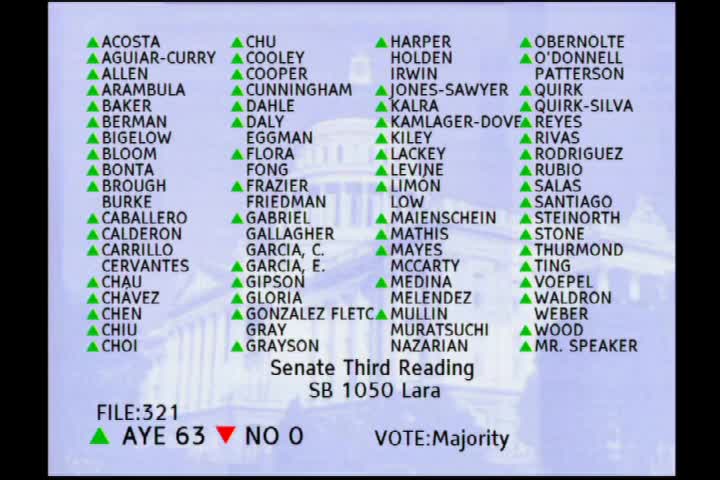


Bill Author

Bill Co-Author(s):