SB 1144: Enhanced industrial disability leave: State Bargaining Unit 8.
- Session Year: 2017-2018
- House: Senate
- Latest Version Date: 2018-09-28
Existing law generally grants to state officers and employees who are members of the Public Employees Retirement System or the State Teachers Retirement System, among others, a right to industrial disability leave, as defined. Existing law also grants an employee who is a member of State Bargaining Unit 8 and is temporarily disabled in the course of state employment for more than 22 days an extended industrial disability leave benefit based on his or her net salary, as defined. Existing law authorizes the employee to receive this benefit for a period not to exceed 52 weeks after the date of injury or until the date the injury is declared permanent, whichever is earlier. Existing law also authorizes an eligible employee whose injuries are burn-related to receive that benefit for up to 156 weeks.
This bill would delete the above requirement that an employee of State Bargaining Unit 8 be temporarily disabled for a period that exceeds 22 consecutive days to be entitled to the enhanced industrial disability leave benefit. The bill would also include within this benefit any salary increases that the employee would have received during his or her leave. The bill would revise the above condition concerning an injury or illness being declared permanent to include that it also be declared stationary.
Existing law generally grants to state officers and employees who are members of the Public Employees Retirement System or the State Teachers Retirement System, among others, a right to industrial disability leave, as defined. Existing law also grants an employee who is a member of State Bargaining Unit 8 and is temporarily disabled in the course of state employment for more than 22 days an extended industrial disability leave benefit based on his or her net salary, as defined. Existing law authorizes the employee to receive this benefit for a period not to exceed 52 weeks after the date of injury or until the date the injury is declared permanent, whichever is earlier. Existing law also authorizes an eligible employee whose injuries are burn-related to receive that benefit for up to 156 weeks.
This bill would delete the above requirement that an employee of State Bargaining Unit 8 be temporarily disabled for a period that exceeds 22 consecutive days to be entitled to the enhanced industrial disability leave benefit. The bill would also include within this benefit any salary increases that the employee would have received during his or her leave. The bill would revise the above condition concerning an injury or illness being declared permanent, to include that it also be declared stationary.
(1)Existing law generally designates air pollution control and air quality management districts with the primary responsibility for the control of air pollution from all sources other than vehicular sources. Existing law establishes maximum criminal and civil penalties for any person, as defined, for violations of air pollution laws from nonvehicular sources. Existing law generally establishes the maximum criminal and civil penalties at $5,000, annually adjusted based on the California Consumer Price Index.This bill would establish additional civil penalties and fines on specified petroleum refineries, petrochemical plants, and fossil-fuel-burning, electricity-generating power plants that emit an air contaminant in violation of specified rules, regulations, emissions limitations, permits, or orders of a district or district hearing board and when the violation presents a serious threat to the health or welfare of the public. The bill also would make various conforming changes. By adding to the duties of air districts, this bill would impose a state-mandated local program.(2)The California Constitution requires the state to reimburse local agencies and school districts for certain costs mandated by the state. Statutory provisions establish procedures for making that reimbursement.This bill would provide that, if the Commission on State Mandates determines that the bill contains costs mandated by the state, reimbursement for those costs shall be made pursuant to the statutory provisions noted above.(1)Existing law generally designates air pollution control and air quality management districts with the primary responsibility for the control of air pollution from all sources other than vehicular sources. Existing law establishes maximum criminal and civil penalties for any person, as defined, for violations of air pollution laws from nonvehicular sources. Existing law generally establishes the maximum criminal and civil penalties at $5,000, annually adjusted based on the California Consumer Price Index.
This bill would establish additional civil penalties and fines on specified petroleum refineries, petrochemical plants, and fossil-fuel-burning, electricity-generating power plants that emit an air contaminant in violation of specified rules, regulations, emissions limitations, permits, or orders of a district or district hearing board and when the violation presents a serious threat to the health or welfare of the public. The bill also would make various conforming changes. By adding to the duties of air districts, this bill would impose a state-mandated local program.
(2)The California Constitution requires the state to reimburse local agencies and school districts for certain costs mandated by the state. Statutory provisions establish procedures for making that reimbursement.
This bill would provide that, if the Commission on State Mandates determines that the bill contains costs mandated by the state, reimbursement for those costs shall be made pursuant to the statutory provisions noted above.
(a)If an employee who is a member of State Bargaining Unit 8 is temporarily disabled by illness or injury arising out of and in the course of state employment, he or she shall receive an enhanced industrial disability leave benefit. The enhanced industrial disability leave benefit shall be equivalent to the injured employees net salary, including any increases the employee would have received during the leave. The benefit may not exceed 52 weeks after the date of the occurrence of the injury or illness or until the date the injury or illness is declared permanent and stationary, whichever is earlier.
(b) Notwithstanding the above 52-week limitation, an employee described in subdivision (a) whose injuries are burn-related may receive the benefit described in subdivision (a) for a period not to exceed 156 weeks after the date of the occurrence of the injury or illness or until the date the injury or illness is declared permanent and stationary, whichever is earlier.
(c)For purposes of this section, net salary means the amount of salary received after federal income tax, state income tax, and the employees retirement contribution has been deducted from the employees gross salary.
(a)If an employee who is a member of State Bargaining Unit 8 is temporarily disabled by illness or injury arising out of and in the course of state employment for a period that exceeds 22 consecutive days, employment, he or she shall be entitled to receive the an enhanced industrial disability leave benefit provided by this section. benefit.
(b)(1)Except as provided in paragraph (2), an employee described by subdivision (a) shall receive an The enhanced industrial disability leave benefit in an amount that is the shall be equivalent of to the injured employees net salary on the date of the occurrence of the injury or illness or the date the injury or illness is declared, whichever is greater. salary, including any increases the employee would have received during the leave. An employee may receive this benefit for a period The benefit may not to exceed 52 weeks after the date of the occurrence of the injury or illness or until the date the injury or illness is declared permanent, permanent and stationary, whichever is earlier. For the purposes of this subdivision, net salary means the amount of salary the employee receives after federal income tax, state income tax, and the employees retirement contribution has been deducted from the employees gross salary.
(2)(b)An employee Notwithstanding the above 52-week limitation, an employee described by in subdivision (a) whose injuries are burn-related may receive the benefit described in paragraph (1) in subdivision (a) for a period not to exceed 156 weeks after the date of the occurrence of the injury or illness or until the date the injury or illness is declared permanent, permanent and stationary, whichever is earlier.
(c)For purposes of this section, net salary means the amount of salary received after federal income tax, state income tax, and the employees retirement contribution has been deducted from the employees gross salary.
SECTION 1.Section 42400.7 of the Health and Safety Code is amended to read:42400.7.(a) The recovery of civil penalties pursuant to Section 39674, 42401, 42402, 42402.1, 42402.2, 42402.3, 42402.4, or 42402.7 precludes prosecution under Section 42400, 42400.1, 42400.2, 42400.3, 42400.3.5, or 42400.4 for the same offense. When a district refers a violation to a prosecuting agency, the filing of a criminal complaint is grounds requiring the dismissal of any civil action brought pursuant to this article for the same offense.(b) If the pending civil action described in subdivision (a) includes a request for injunctive relief, that portion of the civil action shall not be dismissed upon the filing of a criminal complaint for the same offense.SEC. 2.Section 42402 of the Health and Safety Code is amended to read:42402.(a)Except as provided in Sections 42402.1, 42402.2, 42402.3, 42402.4, and 42402.7, any person who violates this part, any order issued pursuant to Section 42316, or any rule, regulation, permit, or order of a district, including a district hearing board, or of the state board issued pursuant to Part 1 (commencing with Section 39000) to Part 4 (commencing with Section 41500), inclusive, is strictly liable for a civil penalty of not more than five thousand dollars ($5,000).(b)(1)Any person who violates any provision of this part, any order issued pursuant to Section 42316, or any rule, regulation, permit or order of a district, including a district hearing board, or of the state board issued pursuant to Part 1 (commencing with Section 39000) to Part 4 (commencing with Section 41500), inclusive, is strictly liable for a civil penalty of not more than ten thousand dollars ($10,000).(2)(A)If a civil penalty in excess of five thousand dollars ($5,000) for each day in which a violation occurs is sought, there is no liability under this subdivision if the person accused of the violation alleges by affirmative defense and establishes that the violation was caused by an act that was not the result of intentional conduct or negligent conduct.(B)Subparagraph (A) shall not apply to a violation of federally enforceable requirements that occur at a Title V source in a district in which a Title V permit program has been fully approved.(C)Subparagraph (A) does not apply to a person who is determined to have violated an annual facility emissions cap established pursuant to a market based incentive program adopted by a district pursuant to subdivision (b) of Section 39616.(c)Any person who owns or operates any source of air contaminants in violation of Section 41700 that causes actual injury, as defined in subdivision (d) of Section 42400, to the health and safety of a considerable number of persons or the public, is liable for a civil penalty of not more than fifteen thousand dollars ($15,000).(d)Each day during any portion of which a violation occurs is a separate offense.SEC. 3.Section 42402.7 is added to the Health and Safety Code, to read:42402.7.(a)For purposes of this section, the following terms have the following meanings:(1)Actual injury means any physical injury that, in the opinion of a physician, requires medical treatment involving more than a physical examination.(2)Corrective action has the same meaning as in Section 42400.2.(3)Person means a Title V source that is a petroleum refinery, petrochemical plant, or fossil-fuel-burning, electricity-generating power plant.(4)Serious threat to the health or welfare of the public means either of the following:(A)A violation involving a release of an air contaminant that causes actual injury to one or more members of public.(B)A violation of Section 41700 that affects 25 or more people on any day.(b)(1)A person shall be strictly liable for a civil penalty of not more than thirty thousand dollars ($30,000) per day if that person emits an air contaminant in violation of this part or any rule, regulation, emissions limitation, permit, or order of a district or district hearing board and the violation presents a serious threat to the health or welfare of the public. If that person has had two or more prior serious violations within the 36 months prior to the date of the violation, the civil penalty shall not be more than one hundred thousand dollars ($100,000) per day.(2)The civil penalty assessed pursuant to this subdivision shall not apply if the violation is caused by unforeseen and unforeseeable criminal acts, acts of war, acts of terrorism, or civil unrest.(c)A person shall be assessed a fine of not more than seventy-five thousand dollars ($75,000) per day if that person negligently emits an air contaminant in violation of this part or any rule, regulation, emissions limitation, permit, or order of a district or district hearing board and the violation presents a serious threat to the health or welfare of the public. If that person has had two or more prior serious violations within the 36 months prior to the date of the violation, the fine shall not be more than two hundred fifty thousand dollars ($250,000) per day.(d)A person shall be liable for a civil penalty of not more than one hundred twenty-five thousand dollars ($125,000) per day if that person knew of the emission of the air contaminant and failed to take corrective action within a reasonable period of time under the circumstances and the violation presents a serious threat to the health or welfare of the public. If that person has had two or more prior serious violations within the 36 months prior to the date of the violation, the civil penalty shall not be more than three hundred seventy-five thousand dollars ($375,000) per day.(e)A person shall be liable for a civil penalty of not more than two hundred fifty thousand dollars ($250,000) per day if that person emits an air contaminant that is willful and intentional and the violation presents a serious threat to the health or welfare of the public. If that person has had two or more prior serious violations within the 36 months prior to the date of the violation, the fine shall not be more than five hundred thousand dollars ($500,000) per day.(f)Each day during any portion of which a violation occurs is a separate offense.(g)If a higher penalty or fine described in this part may be applied to a violation described in this section, that higher penalty or fine shall be used as the maximum.(h)The provisions of Section 42403 shall apply to this section.SEC. 4.Section 42403 of the Health and Safety Code is amended to read:42403.(a) The civil penalties prescribed in Sections 39674, 42402.7, 42401, 42402, 42402.1, 42402.2, and 42402.3 shall be assessed and recovered in a civil action brought in the name of the people of the State of California by the Attorney General, by any district attorney, or by the attorney for any district in which the violation occurs in any court of competent jurisdiction.(b) In determining the amount assessed, the court, or in reaching any settlement, the district, shall take into consideration all relevant circumstances, including, but not limited to, the following:(1) The extent of harm caused by the violation.(2) The nature and persistence of the violation.(3) The length of time over which the violation occurs.(4) The frequency of past violations.(5) The record of maintenance.(6) The unproven or innovative nature of the control equipment.(7) Any action taken by the defendant, including the nature, extent, and time of response of the cleanup and construction undertaken, to mitigate the violation.(8) The financial burden to the defendant.SEC. 5.Section 42405.5 of the Health and Safety Code is amended to read:42405.5.(a) If any state or local government agency provides assistance in the investigation, data collection, or monitoring, preparation, or prosecution of an action to recover civil penalties pursuant to Section 42401, 42402, 42402.1, 42402.2, 42402.7, and that assistance is provided in coordination with the state board or a district prosecuting the action, that agency shall be reimbursed out of the proceeds of the penalty collected for its costs and expenses incurred in providing the assistance.(b) If the penalty collected is insufficient to fully reimburse the state board or district for the costs and expenses incurred in preparing and prosecuting the case and another agency or agencies for the costs and expenses incurred in assisting in the case, the amount collected shall be prorated among the state board or district and the assisting agency or agencies, on the basis of costs and expenses incurred by each.(c) This section does not apply where there is an express agreement between the state board or district and another agency or agencies regarding reimbursement for assistance services and expenses.SEC. 6.If the Commission on State Mandates determines that this act contains costs mandated by the state, reimbursement to local agencies and school districts for those costs shall be made pursuant to Part 7 (commencing with Section 17500) of Division 4 of Title 2 of the Government Code.(a) The recovery of civil penalties pursuant to Section 39674, 42401, 42402, 42402.1, 42402.2, 42402.3, or 42402.4 42402.4, or 42402.7 precludes prosecution under Section 42400, 42400.1, 42400.2, 42400.3, 42400.3.5, or 42400.4 for the same offense. When a district refers a violation to a prosecuting agency, the filing of a criminal complaint is grounds requiring the dismissal of any civil action brought pursuant to this article for the same offense.
(b) If the pending civil action described in subdivision (a) includes a request for injunctive relief, that portion of the civil action shall not be dismissed upon the filing of a criminal complaint for the same offense.
SEC. 2.Section 42402 of the Health and Safety Code is amended to read:42402.(a)Except as provided in Sections 42402.1, 42402.2, 42402.3, and 42402.4, and 42402.7, any person who violates this part, any order issued pursuant to Section 42316, or any rule, regulation, permit, or order of a district, including a district hearing board, or of the state board issued pursuant to Part 1 (commencing with Section 39000) to Part 4 (commencing with Section 41500), inclusive, is strictly liable for a civil penalty of not more than five thousand dollars ($5,000).
(b)(1)Any person who violates any provision of this part, any order issued pursuant to Section 42316, or any rule, regulation, permit or order of a district, including a district hearing board, or of the state board issued pursuant to Part 1 (commencing with Section 39000) to Part 4 (commencing with Section 41500), inclusive, is strictly liable for a civil penalty of not more than ten thousand dollars ($10,000).
(2)(A)If a civil penalty in excess of five thousand dollars ($5,000) for each day in which a violation occurs is sought, there is no liability under this subdivision if the person accused of the violation alleges by affirmative defense and establishes that the violation was caused by an act that was not the result of intentional conduct or negligent conduct.
(B)Subparagraph (A) shall not apply to a violation of federally enforceable requirements that occur at a Title V source in a district in which a Title V permit program has been fully approved.
(C)Subparagraph (A) does not apply to a person who is determined to have violated an annual facility emissions cap established pursuant to a market based incentive program adopted by a district pursuant to subdivision (b) of Section 39616.
(c)Any person who owns or operates any source of air contaminants in violation of Section 41700 that causes actual injury, as defined in subdivision (d) of Section 42400, to the health and safety of a considerable number of persons or the public, is liable for a civil penalty of not more than fifteen thousand dollars ($15,000).
(d)Each day during any portion of which a violation occurs is a separate offense.
SEC. 3.Section 42402.7 is added to the Health and Safety Code, to read:42402.7.(a)For purposes of this section, the following terms have the following meanings:
(1)Actual injury means any physical injury that, in the opinion of a physician, requires medical treatment involving more than a physical examination.
(2)Corrective action has the same meaning as in Section 42400.2.
(3)Person means a Title V source that is a petroleum refinery, petrochemical plant, or fossil-fuel-burning, electricity-generating power plant.
(4)Serious threat to the health or welfare of the public means either of the following:
(A)A violation involving a release of an air contaminant that causes actual injury to one or more members of public.
(B)A violation of Section 41700 that affects 25 or more people on any day.
(b)(1)A person shall be strictly liable for a civil penalty of not more than thirty thousand dollars ($30,000) per day if that person emits an air contaminant in violation of this part or any rule, regulation, emissions limitation, permit, or order of a district or district hearing board and the violation presents a serious threat to the health or welfare of the public. If that person has had two or more prior serious violations within the 36 months prior to the date of the violation, the civil penalty shall not be more than one hundred thousand dollars ($100,000) per day.
(2)The civil penalty assessed pursuant to this subdivision shall not apply if the violation is caused by unforeseen and unforeseeable criminal acts, acts of war, acts of terrorism, or civil unrest.
(c)A person shall be assessed a fine of not more than seventy-five thousand dollars ($75,000) per day if that person negligently emits an air contaminant in violation of this part or any rule, regulation, emissions limitation, permit, or order of a district or district hearing board and the violation presents a serious threat to the health or welfare of the public. If that person has had two or more prior serious violations within the 36 months prior to the date of the violation, the fine shall not be more than two hundred fifty thousand dollars ($250,000) per day.
(d)A person shall be liable for a civil penalty of not more than one hundred twenty-five thousand dollars ($125,000) per day if that person knew of the emission of the air contaminant and failed to take corrective action within a reasonable period of time under the circumstances and the violation presents a serious threat to the health or welfare of the public. If that person has had two or more prior serious violations within the 36 months prior to the date of the violation, the civil penalty shall not be more than three hundred seventy-five thousand dollars ($375,000) per day.
(e)A person shall be liable for a civil penalty of not more than two hundred fifty thousand dollars ($250,000) per day if that person emits an air contaminant that is willful and intentional and the violation presents a serious threat to the health or welfare of the public. If that person has had two or more prior serious violations within the 36 months prior to the date of the violation, the fine shall not be more than five hundred thousand dollars ($500,000) per day.
(f)Each day during any portion of which a violation occurs is a separate offense.
(g)If a higher penalty or fine described in this part may be applied to a violation described in this section, that higher penalty or fine shall be used as the maximum.
(h)The provisions of Section 42403 shall apply to this section.
SEC. 4.Section 42403 of the Health and Safety Code is amended to read:42403.(a) The civil penalties prescribed in Sections 39674, 42402.7, 42401, 42402, 42402.1, 42402.2, and 42402.3 shall be assessed and recovered in a civil action brought in the name of the people of the State of California by the Attorney General, by any district attorney, or by the attorney for any district in which the violation occurs in any court of competent jurisdiction.
(b) In determining the amount assessed, the court, or in reaching any settlement, the district, shall take into consideration all relevant circumstances, including, but not limited to, the following:
(1) The extent of harm caused by the violation.
(2) The nature and persistence of the violation.
(3) The length of time over which the violation occurs.
(4) The frequency of past violations.
(5) The record of maintenance.
(6) The unproven or innovative nature of the control equipment.
(7) Any action taken by the defendant, including the nature, extent, and time of response of the cleanup and construction undertaken, to mitigate the violation.
(8) The financial burden to the defendant.
SEC. 5.Section 42405.5 of the Health and Safety Code is amended to read:42405.5.(a) If any state or local government agency provides assistance in the investigation, data collection, or monitoring, preparation, or prosecution of an action to recover civil penalties pursuant to Section 42401, 42402, 42402.1, or 42402.2, 42402.7, and that assistance is provided in coordination with the state board or a district prosecuting the action, that agency shall be reimbursed out of the proceeds of the penalty collected for its costs and expenses incurred in providing the assistance.
(b) If the penalty collected is insufficient to fully reimburse the state board or district for the costs and expenses incurred in preparing and prosecuting the case and another agency or agencies for the costs and expenses incurred in assisting in the case, the amount collected shall be prorated among the state board or district and the assisting agency or agencies, on the basis of costs and expenses incurred by each.
(c) This section does not apply where there is an express agreement between the state board or district and another agency or agencies regarding reimbursement for assistance services and expenses.
SEC. 6.If the Commission on State Mandates determines that this act contains costs mandated by the state, reimbursement to local agencies and school districts for those costs shall be made pursuant to Part 7 (commencing with Section 17500) of Division 4 of Title 2 of the Government Code.
|
Date
|
Status
|
|---|---|
| Sep 28, 2018 | Chaptered by Secretary of State. Chapter 897, Statutes of 2018. |
| Sep 28, 2018 | Approved by the Governor. |
| Sep 5, 2018 | Enrolled and presented to the Governor at 3:30 p.m. |
| Aug 28, 2018 | In Senate. Ordered to engrossing and enrolling. |
| Aug 27, 2018 | Read third time. Passed. Ordered to the Senate. |
| Aug 20, 2018 | Read second time. Ordered to third reading. |
| Aug 16, 2018 | From committee: Do pass. (Ayes 17. Noes 0.) (August 16). |
| Aug 8, 2018 | August 8 set for first hearing. Placed on suspense file. |
| Jun 20, 2018 | From committee: Do pass and re-refer to Com. on APPR. (Ayes 6. Noes 0.) (June 20). Re-referred to Com. on APPR. |
| Jun 11, 2018 | Referred to Com. on P.E., R., & S.S. |
| May 29, 2018 | In Assembly. Read first time. Held at Desk. |
| May 29, 2018 | Read third time. Passed. (Ayes 38. Noes 0.) Ordered to the Assembly. |
| May 25, 2018 | From committee: Do pass. (Ayes 6. Noes 0.) (May 25). |
| May 18, 2018 | Set for hearing May 25. |
| May 14, 2018 | May 14 hearing: Placed on APPR. suspense file. |
| May 8, 2018 | Set for hearing May 14. |
| May 7, 2018 | May 7 hearing postponed by committee. |
| Apr 27, 2018 | Set for hearing May 7. |
| Apr 24, 2018 | From committee: Do pass and re-refer to Com. on APPR. (Ayes 3. Noes 0. Page 4789.) (April 23). Re-referred to Com. on APPR. |
| Apr 23, 2018 | From committee: Do pass and re-refer to Com. on APPR. (Ayes 3. Noes 0.) (April 23). Re-referred to Com. on APPR. |
| Apr 19, 2018 | Re-referred to Com. on P.E. & R. |
| Apr 17, 2018 | Set for hearing April 23 in P.E. & R. pending receipt. |
| Apr 11, 2018 | Withdrawn from committee. |
| Apr 9, 2018 | From committee with author's amendments. Read second time and amended. Re-referred to Com. on EQ. |
| Mar 22, 2018 | April 4 set for first hearing canceled at the request of author. |
| Mar 20, 2018 | Set for hearing April 4. |
| Feb 22, 2018 | Referred to Coms. on EQ. and JUD. |
| Feb 15, 2018 | From printer. May be acted upon on or after March 17. |
| Feb 14, 2018 | Introduced. Read first time. To Com. on RLS. for assignment. To print. |
|
Date
|
Description
|
Location
|
Votes
|
|
|---|---|---|---|---|
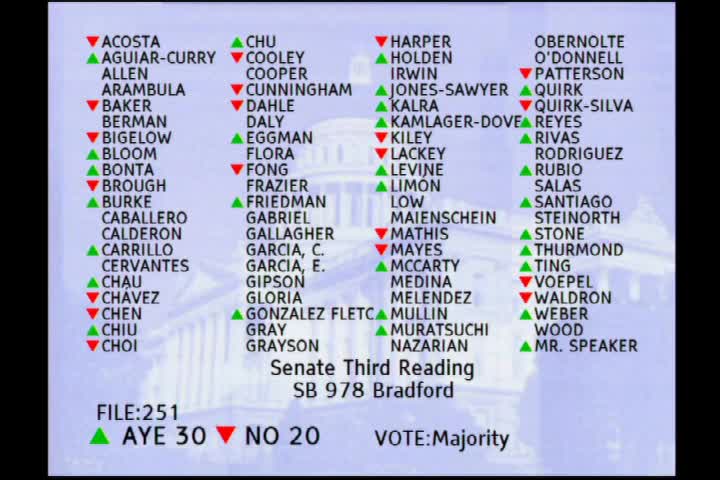
| Aug 27, 2018 | SB 1144 Dodd Senate Third Reading By RODRIGUEZ | Assembly Floor |
Passed |
|
| Aug 16, 2018 | Do pass. | Assembly Standing Committee on Appropriations |
Passed |
|
| Jun 20, 2018 | Do pass and be re-referred to the Committee on [Appropriations] | Assembly Standing Committee on Public Employees, Retirement, and Social Security |
Passed |
|
| May 29, 2018 | Senate 3rd Reading SB1144 Dodd | Senate Floor |
Passed |
|
| May 25, 2018 | Do pass | Senate Standing Committee on Appropriations |
Passed |
|
| May 14, 2018 | Placed on suspense file | Senate Standing Committee on Appropriations |
Passed |
|
| Apr 23, 2018 | Do pass, but first be re-referred to the Committee on [Appropriations] | Senate Standing Committee on Public Employment and Retirement |
Passed |
This list shows positions taken on this bill by organizations on the date displayed, which is linked to the original source.
Positions by individuals are not included.
|
Organization
|
Position
|
Date
|
|---|---|---|
| Cal Fire Local 2881 | ** Support | Jun 19, 2018 |
SENATE THIRD READING
STR Bill Id:SB 1144
Author:(Dodd)
As Amended Ver:April 9, 2018
Majority vote
SENATE VOTE: 38-0
Committee | Votes | Ayes | Noes |
Public Employees | 6-0 | Rodriguez, Brough, Cervantes, Cooley, Cooper, O'Donnell | |
Appropriations | 17-0 | Gonzalez Fletcher, Bigelow, Bloom, Bonta, Brough, Calderon, Carrillo, Chau, Eggman, Fong, Friedman, Gallagher, Eduardo Garcia, Nazarian, Obernolte, Quirk, Reyes |
|
SUMMARY: Provides a Bargaining Unit 8 (BU) state firefighter who is on Enhanced Industrial Disability Leave (EIDL) with any pay raises received by active state firefighters. Specifically, this bill:
- Provides that the EIDL benefit must include any increases to salary for BU 8 employees during EIDL that the employee would have received if the employee was not on leave.
- Eliminates the requirement that an employee be temporarily disabled by certain illness or injury for a period exceeding 22 days before receiving EIDL benefits.
- Provides that the EIDL benefit may not exceed 52 weeks after the date the injury or illness occurred, or until the injury or illness is declared permanent and stationary, whichever is earlier.
- States that notwithstanding the 52-week limitation, an employee whose injuries are burn-related may receive the EIDL benefit for a period not to exceed 156 weeks after the date of the occurrence of the injury or illness, or until the date the injury or illness is declared permanent and stationary, whichever is earlier.
EXISTING LAW:
- Establishes a worker compensation system, "workers' compensation temporary disability," to provide benefits to an employee who suffers from an injury or illness that arises out of and during the course of employment, irrespective of fault.
- Requires all employers to secure payment of benefits by either securing the consent of the Department of Industrial Relations to self-insure or by securing insurance against liability from an insurance company duly authorized by the state.
- Provides for the payment of indemnity benefits if the occupational injury causes temporary or permanent disability which prevents the worker from returning to work. In the case of temporary disability (TD) payments, the benefit is two-thirds of the weekly loss in wages due to disability for up to 104 weeks within five years.
- Grants certain public employees who incur on-the-job injuries or illnesses a disability leave without loss of salary for up to one year in lieu of TD benefits. This leave of absence is set forth in Labor Code Sections 4800 and 4850, and is sometimes referred to as "4850 leave." These employees include: city police officers; city, county, or district firefighters; sheriffs; and, county probation officers, group counselors, or juvenile services officers.
- Provides a replacement benefit program, "industrial disability leave" (IDL) for eligible employees in lieu of TD benefits. A state officer or employee who is a California Public Employees' Retirement System (CalPERS) or the California State Teachers' Retirement System (CalSTRS) and is temporarily disabled in the course of performance of duty is entitled to industrial disability leave for a period not to exceed 52 weeks within two years from the first day of disability. The employee is entitled to net pay for up to 22 days or upon declaration of a permanent disability, whichever is shorter. Thereafter, the employee is entitled to two-thirds of full pay adjusted to offset disability benefits.
- Provides an extension of disability payments at net pay beyond the 22 days provided for under the IDL benefit. Rank and file employees can receive these EIDL payments for one year or longer, depending on the provisions of their respective MOUs. Excluded employees are limited to 52 weeks of EIDL within a two-year period after the date of the qualifying injury.
- Specifies that an employee who is a member of BU 8 and is temporarily disabled by illness or injury arising out of and in the course of state employment for a period that exceeds 22 consecutive days must be entitled to EIDL equivalent to net salary. Provides the EIDL benefit for a period not to exceed 52 weeks after the date the injury or illness occurred or is declared, or until the date the injury or illness is declared permanent.
- States that an employee who sustains burn-related injuries may receive the EIDL for a period not to exceed 156 weeks after the date of the occurrence of the injury or illness or until the date the injury or illness is declared permanent, whichever is earlier.
FISCAL EFFECT: According to the Assembly Appropriations Committee, this bill would have an "[u]nknown impact on future compensation costs. The costs will depend on future pay increases and the number of affected employees on disability leave at the time of those pay increases. There may be other additional costs to the extent that SB 1144 leads to more firefighters receiving disability leave than they otherwise would, but this effect is likely small."
COMMENT: According to the author, "[i]n 2017, I authored SB 334 which was passed unanimously by the Legislature and signed by the Governor. Senate Bill 334 extended an EIDL benefit to a CAL FIRE firefighter injured during training. Unfortunately, the way current law reads, if an increase is received by active firefighters during the time the firefighter is on leave, it is not extended to them. This bill extends any increases to a CAL FIRE firefighter on EIDL, if one is given to active firefighters during the time they're on leave."
Analysis Prepared by: Michael Bolden / P.E.,R., & S.S. / (916) 319-3957 FN: 0004089
Date of Hearing: August 8, 2018
ASSEMBLY COMMITTEE ON APPROPRIATIONS
Lorena Gonzalez Fletcher, Chair
SBPCA Bill Id:SB 1144
Author:(Dodd) – As Amended Ver:April 9, 2018
Policy Committee: | Public Employees, Retirement, and Social Security | Vote: | 6 - 0 |
|
| ||
|
|
Urgency: No State Mandated Local Program: No Reimbursable: No
SUMMARY:
This bill provides a member of State Bargaining Unit 8 (BU 8) who is on enhanced industrial disability leave (EIDL) with any pay raises that firefighter would have received while on leave. This bill also eliminates the requirement that an employee be temporarily disabled by illness or injury, as specified, for a period exceeding 22 consecutive days before receiving EIDL benefits.
FISCAL EFFECT:
Unknown impact on future compensation costs. The costs will depend on future pay increases and the number of affected employees on disability leave at the time of those pay increases. There may be other additional costs to the extent that SB 1144 leads to more firefighters receiving disability leave than they otherwise would, but this effect is likely small. (See Comment #4.)
COMMENTS:
- Background. Industrial Disability Leave (IDL) and EIDL are benefit programs provided to eligible public sector employees. IDL provides full replacement of an eligible employee’s net pay for up to 22 days of leave, after which they receive two-thirds of their net pay. Employees are eligible for IDL benefits if they are eligible for workers’ compensation benefits and are an active member of the California Public Employees’ Retirement System (CalPERS) or the California State Teachers’ Retirement System (CalSTRS).
EIDL provides an extension of disability payments at full net pay beyond the 22 days provided for under the IDL benefit. For members of BU 8, which consists of CAL FIRE firefighters, EIDL is available for those members who are on IDL for 22 consecutive days, and there is additional leave time for those who incur burn-related injuries.
- Recent legislation. SB 334 (Dodd), Chapter 857, Statutes of 2017, extended EID to BU 9 members who are temporarily disabled for a period that exceeds 22 consecutive days and provided additional EIDL leave time to BU 9 members who suffer burn-related injuries.
- Purpose. According to the author, SB 223 is a follow-up to SB 334 to clarify that when active firefighters receive a pay increase, firefighters on leave also receive that pay increase.
- Staff Comments. In addition to ensuring that firefighters on disability leave receive pay increases they would have received if they were active, SB 1144 replaces IDL with EIDL for the first 22 days of disability leave. The costs associated with this change depend on the number of employees who take disability leave and whether the duration and levels of benefits are changed. Because IDL in the first 22 days and EIDL provide firefighters the same compensation (full net pay), generally speaking this change is unlikely to dramatically increase the number of employees on leave or their benefit amounts. Nevertheless, differences in how IDL and EIDL are administered may result in a modest increase in overall participation. Those differences include:
- Three-day wait period. Under IDL, an injured employee must wait three days to go on short-term disability, while there is no such period for EIDL. SB 1144 effectively eliminates the 3-day waiting period, allowing employees to immediately qualify for EIDL. This may result in additional firefighters on disability than there otherwise would be.
- Consecutive days under IDL. Under current law, an employee qualifies for EIDL after 22 consecutive days on IDL. However, not all employees claim IDL for 22 consecutive days (instead, some employees take their leave in increments), which means they receive a reduced benefit on day 23 instead of the full net pay offered by EIDL. SB 1144 provides this same employee full net pay benefit past 22 days by eliminating the requirement that the first 22 days of leave have to be consecutive.
Analysis Prepared by: Luke Reidenbach / APPR. / (916) 319-2081
Date of Hearing: June 20, 2018
ASSEMBLY COMMITTEE ON PUBLIC EMPLOYEES, RETIREMENT, AND SOCIAL SECURITY
Freddie Rodriguez, Chair
SBPCA Bill Id:SB 1144
Author:(Dodd) – As Amended Ver:April 9, 2018
SENATE VOTE: 38-0
SUBJECT: Enhanced industrial disability leave: State Bargaining Unit 8
SUMMARY: Provide a Bargaining Unit 8 (BU) state firefighter who is on enhanced industrial disability leave (EIDL) with any pay raises active state firefighters receive, as specified. Specifically, this bill:
1) Provides that the EIDL benefit shall include any increases to salary for BU 8 employees during the EIDL leave the employee would have received if the employee were not on leave.
2) Eliminates the requirement that an employee be temporarily disabled by illness or injury, as specified, for a period exceeding 22 days before receiving EIDL benefits.
3) Provides that the EIDL benefit may not exceed 52 weeks after the date the injury or illness occurred, or until the injury or illness is declared permanent and stationary, whichever is earlier.
4) States that notwithstanding the 52-week limitation, an employee, as specified, whose injuries are burn-related may receive the EIDL benefit for a period not to exceed 156 weeks after the date of the occurrence of the injury or illness or until the date the injury or illness is declared permanent and stationary, whichever is earlier.
EXISTING LAW:
- Establishes a worker compensation system, “workers’ compensation temporary disability,” to provide benefits to an employee who suffers from an injury or illness that arises out of and during the course of employment, irrespective of fault.
- Requires all employers to secure payment of benefits by either securing the consent of the Department of Industrial Relations to self-insure or by securing insurance against liability from an insurance company duly authorized by the state.
- Provides for the payment of indemnity benefits if the occupational injury causes temporary or permanent disability which prevents the worker from returning to his or her job. In the case of temporary disability (TD) payments, the benefit is two-thirds of the weekly loss in wages due to disability for up to 104 weeks within five years.
- Grants certain public employees who incur on the job injuries or illnesses a disability leave without loss of salary for up to one year in lieu of TD benefits. This leave of absence is set forth in Labor Code Sections 4800 and 4850, and is sometimes referred to as “4850 leave.” These employees include:
- City police officers;
- City, county, or district firefighters;
- Sheriffs;
- County probation officers, group counselors, or juvenile services officers, and
- State firefighters employed by the Department of Justice.
- Provides a replacement benefit program, “industrial disability leave” (IDL) for eligible employees in lieu of TD benefits. A state officer or employee who is a California Public Employees’ Retirement System (CalPERS) or California State Teachers’ Retirement System (CalSTRS) member and is temporarily disabled in the course of his or her duties is entitled to industrial disability leave for a period not to exceed 52 weeks within two years from the first day of disability. The employee is entitled to net pay, as specified, for up to 22 days or upon declaration of a permanent disability, whichever is shorter. Thereafter, the employee is entitled to two-thirds of full pay adjusted to offset disability benefits, as specified.
- Provides an extension of disability payments at net pay, as specified, beyond the 22 days provided for under the IDL benefit. Rank and file employees can receive these “enhanced industrial disability leave” (EIDL) payments for one year or longer, depending on the provisions of their respective MOUs. Excluded employees are limited to 52 weeks of EIDL within a two-year period after the date of the qualifying injury.
- Specifies that an employee who is a member of BU 8 and is temporarily disabled by illness or injury arising out of and in the course of state employment for a period that exceeds 22 consecutive days shall be entitled to EIDL equivalent to net salary, as defined. Provides the EIDL benefit for a period not to exceed 52 weeks after the date the injury or illness occurred or is declared, or until the date the injury or illness is declared permanent, as specified.
- States that an employee who sustains burn-related injuries may receive the EIDL for a period not to exceed 156 weeks after the date of the occurrence of the injury or illness or until the date the injury or illness is declared permanent, whichever is earlier.
FISCAL EFFECT: According to the Senate Appropriations Committee, “[t]he California Department of Forestry and Fire Protection (CAL FIRE) indicates that it would incur increased annual costs of $1.2 million in 2018-19, and $5.3 million ongoing (General Fund) to implement the provisions of the bill related to higher disability payments, overtime, and increased staffing needs.
COMMENTS: According to the author, “[i]n 2017, I authored Senate Bill 334 which was passed unanimously by the Legislature and signed by the Governor. Senate Bill 334 extended an Enhanced Industrial Disability Leave (EIDL) benefit to a CAL FIRE firefighter injured during training. Unfortunately, the way current law reads, if an increase is received by active firefighters during the time the firefighter is on leave, it is not extended to them. This bill extends any increases to a CAL FIRE firefighter on EIDL, if one is given to active firefighters during the time they’re on leave.”
1) Background
The IDL and EIDL are disability benefit programs offered to eligible public sector workers in place of Temporary Disability (TD). The IDL provides an active member of CalPERS or CalSTRS with a full replacement of their net salary during leave, up to 22 days.
BU 8 consists of firefighter employees of CAL FIRE. EIDL is offered only to excluded state employees and to specified members of CAL FIRE who have sustained a temporarily disabling injury or illness out of or in the course of state employment, and provides additional leave time for burn-related injuries.
EIDL does not apply to presumptive, stress-related disabilities, psychiatric disabilities, or any physical disability arising from a psychiatric injury. This bill provides a similar benefit that local firefighters receive under Labor Code 4850 and will ensure that state firefighters on EIDL who later return to service are not penalized for their employment-related injury or illness.
The California Department of Industrial Relations defines “permanent and stationary” as the point in time when an employee has reached maximal medical improvement, meaning that their condition has stabilized and is unlikely to substantially change in the next year, with or without medical treatment. A “permanent disability” is a lasting disability from an industrial injury or illness that affects an employee’s ability to earn a living.
2) Prior/Related Legislation
Chapter 857, Statutes of 2017 (SB 334, Dodd) clarified that enhanced industrial disability leave for CAL FIRE firefighters who lose the ability to work for more than 22 workdays as the result of an injury or illness incurred in the official performance of their duties includes coverage for injuries from on the job training.
Assembly Bill 2493 (Atkins, 2016) would have extended “4850 leave” to rank-and-file and supervisorial CAL FIRE firefighters whose principal duties include active fire suppression or prevention services. The bill was vetoed by the Governor, who raised cost concerns that “this policy results in higher take home pay than pre-injury wages.”
REGISTERED SUPPORT / OPPOSITION:
Support
CAL FIRE Local 2881
Opposition
None on file.
Analysis Prepared by: Michael Bolden / P.E.,R., & S.S. / (916) 319-3957
Office of Senate Floor Analyses (916) 651-1520 Fax: (916) 327-4478 | SB |
THIRD READING
Bill No: SB 1144
: in Senate
SENATE PUBLIC EMP. & RET. COMMITTEE: 3-0, 4/23/18
AYES: Pan, Leyva, Portantino
NO VOTE RECORDED: Morrell, Moorlach
SENATE APPROPRIATIONS COMMITTEE: 6-0, 5/25/18
AYES: Lara, Beall, Bradford, Hill, Nielsen, Wiener
NO VOTE RECORDED: Bates
DIGEST:
This bill provides a state firefighter who is on enhanced industrial disability leave with any pay raises active state firefighters receive, as specified.
ANALYSIS:
Existing law:
- Establishes a worker compensation system, “workers’ compensation temporary disability,” to provide benefits to an employee who suffers from an injury or illness that arises out of and during the course of employment, irrespective of fault.
- Requires all employers to secure payment of benefits by either securing the consent of the Department of Industrial Relations to self-insure or by securing insurance against liability from an insurance company duly authorized by the state.
- Provides for the payment of indemnity benefits if the occupational injury causes temporary or permanent disability which prevents the worker from returning to his or her job. In the case of temporary disability (TD) payments, the benefit is two-thirds of the weekly loss in wages due to disability for up to 104 weeks within five years.
- Grants certain public employees who incur on the job injuries or illnesses a disability leave without loss of salary for up to one year in lieu of TD benefits. This leave of absence is set forth in Labor Code Sections 4800 and 4850, and is sometimes referred to as “4850 leave.” These employees include:
- City police officers,
- City, county, or district firefighters,
- Sheriffs,
- County probation officers, group counselors, or juvenile services officers, and
- State firefighters employed by the Department of Justice.
- Provides a replacement benefit program, “industrial disability leave” (IDL) for eligible employees in lieu of TD benefits. A state officer or employee who is a California Public Employees’ Retirement System (CalPERS) or California State Teachers’ Retirement System (CalSTRS) member and is temporarily disabled in the course of his or her duties is entitled to industrial disability leave for a period not to exceed 52 weeks within two years from the first day of disability. The employee is entitled to net pay, as specified, for up to 22 days or upon declaration of a permanent disability, whichever is shorter. Thereafter, the employee is entitled to two-thirds of full pay adjusted to offset disability benefits, as specified.
- Provides an extension of disability payments at net pay, as specified, beyond the 22 days provided for under the IDL benefit. Rank and file employees can receive these “enhanced industrial disability leave” (EIDL) payments for one year or longer, depending on the provisions of their respective memorandum of understandings. Excluded employees are limited to 52 weeks of EIDL within a two-year period after the date of the qualifying injury.
- Specifies that an employee who is a member of Bargaining Unit (BU) 8 (CAL FIRE) and is temporarily disabled by illness or injury arising out of and in the course of state employment for a period that exceeds 22 consecutive days shall be entitled to EIDL equivalent to net salary, as defined. Provides the EIDL benefit for a period not to exceed 52 weeks after the date the injury or illness occurred or is declared, or until the date the injury or illness is declared permanent, as specified.
- States that an employee who sustains burn-related injuries may receive the EIDL for a period not to exceed 156 weeks after the date of the occurrence of the injury or illness or until the date the injury or illness is declared permanent, whichever is earlier.
This bill:
- Provides that the enhanced industrial disability leave benefit shall include any increases to salary for BU 8 employees during the EIDL leave the employee would have received if the employee were not on leave.
- Eliminates the requirement that an employee be temporarily disabled by illness or injury, as specified, for a period exceeding 22 days before receiving EIDL benefits.
- Stipulates that the EIDL benefit may not exceed 52 weeks after the date the injury or illness occurred, or until the injury or illness is declared permanent and stationary, whichever is earlier.
- States that notwithstanding the 52-week limitation, an employee, as specified, whose injuries are burn-related may receive the EIDL benefit for a period not to exceed 156 weeks after the date of the occurrence of the injury or illness or until the date the injury or illness is declared permanent and stationary, whichever is earlier.
Background
IDL and EIDL are both disability benefit programs offered to eligible public sector workers in place of TD. IDL provides an active member of CalPERS or CalSTRS with a full replacement of their net salary during leave, up to 22 days.
BU 8 consists of firefighter employees of the California Department of Forestry and Fire Protection (CAL FIRE). EIDL is offered only to excluded state employees and to specified members of CAL FIRE who have sustained a temporarily disabling injury or illness out of or in the course of state employment, and provides additional leave time for burn-related injuries.
EIDL does not apply to presumptive, stress-related disabilities, psychiatric disabilities, or any physical disability arising from a psychiatric injury. This bill provides a similar benefit that local firefighters receive under Labor Code Section 4850 and will ensure that state firefighters on EIDL who later return to service are not penalized for their employment-related injury or illness.
The Department of Industrial Relations defines “permanent and stationary” as the point in time when an employee has reached maximal medical improvement, meaning that their condition has stabilized and is unlikely to substantially change in the next year, with or without medical treatment. A “permanent disability” is a lasting disability from an industrial injury or illness that affects an employee’s ability to earn a living.
Related/Prior Legislation
SB 334 (Dodd, Chapter 857, Statutes of 2017) clarified that enhanced industrial disability leave for CAL FIRE firefighters who lose the ability to work for more than 22 workdays as the result of an injury or illness incurred in the official performance of their duties includes coverage for injuries from on the job training.
AB 2493 (Atkins, 2016) would have extended “4850 leave” to rank-and-file and supervisorial CAL FIRE firefighters whose principal duties include active fire suppression or prevention services. The bill was vetoed by the Governor, who raised cost concerns that “this policy results in higher take home pay than pre-injury wages.”
FISCAL EFFECT: Appropriation: Fiscal Com.: Local:
According to the Senate Appropriations Committee, CAL FIRE indicates that it would incur increased annual costs of $1.2 million in 2018-19, and $5.3 million ongoing (General Fund) to implement the provisions of this bill, related to higher disability payments, overtime, and increased staffing needs.
CAL FIRE Local 2881 (source)
OPPOSITION: (Verified 5/25/18)
None received
ARGUMENTS IN SUPPORT: The author’s office states,
Firefighting is a dangerous job that requires skill and constant training…This training is hands-on and can involve actual fires…As a result of this, firefighters are often injured both on the job and during training.
This bill amends current law to allow a CalFIRE firefighter injured on the job, and receiving EIDL, to receive any pay increases active CalFIRE firefighters received during the time they are out.
CAL FIRE Local 2881 writes, “SB 1144 corrects [an] unintended flaw in the system and grants a pay raise to a CAL FIRE firefighter on Enhanced Industrial Disability Leave, if one is given to active firefighters during [the firefighter’s] leave.”
5/26/18 15:11:25
**** END ****
SENATE COMMITTEE ON APPROPRIATIONS
Senator Ricardo Lara, Chair
2017 - 2018 Regular Session
SB 1144 (Dodd) - Enhanced industrial disability leave: State Bargaining Unit 8
Version: April 9, 2018 | Policy Vote: P.E. & R. 3 - 0 |
Urgency: No | Mandate: No |
Hearing Date: May 14, 2018 | Consultant: Robert Ingenito |
This bill meets the criteria for referral to the Suspense File.
Bill Summary:
SB 1144 would provide a state firefighter who is on enhanced industrial disability leave with any pay raises active state firefighters receive, as specified.
Fiscal Impact:
The California Department of Forestry and Fire Protection (CAL FIRE) indicates that it would incur increased annual costs of $1.2 million in 2018-19, and $5.3 million ongoing (General Fund) to implement the provisions of the bill, related to higher disability payments, overtime, and increased staffing needs.
Background:
Current law establishes a workers’ compensation system that provides benefits to an employee who suffers from an injury or illness that arises out of and in the course of employment, irrespective of fault. Generally speaking, under current law, an injured worker who is unable to work is entitled to two years of temporary disability (TD) benefits. These benefits are designed to partially offset the loss of wages for workers unable to work in the aftermath of an injury. The benefit amount is 67 percent of a worker’s average weekly wage during the past 12 months.
Labor Code Section 4850 provides specified categories of peace officers with a higher wage loss benefit. Eligible public safety officers who become disabled while performing their duties are entitled to a one-year leave of absence without loss of salary in lieu of TD payments. These employees include: (1) city police officers, (2) city, county, or district firefighters, (3) sheriffs, (4) inspectors, investigators, detectives, or personnel with comparable titles in any district attorney's office, (5) county probation officers, group counselors, or juvenile services officers, (6) lifeguards employed by a county of the first class or the City of San Diego, (7) airport law enforcement officers, (8) harbor or port police officers, wardens, or special officers of a harbor or port district or city or county harbor department, (9) police officers of the Los Angeles Unified School District, and (10), state firefighters employed by the Department of Justice.
Industrial Disability Leave (IDL) provides a replacement benefit program paid to eligible employees in lieu of TD benefits. State officers or employees who are CalPERS or CalSTRS members, and are temporarily disabled in the course of their duties, are entitled to IDL for a period not to exceed 52 weeks within two years from the first day of disability. The employee is entitled to net pay, as specified, for up to 22 days or upon declaration of a permanent disability, whichever is shorter. Thereafter, the employee is entitled to 67 percent of full pay adjusted to offset disability benefits, as specified.
Enhanced Industrial Disability Leave (EIDL) provides an extension of disability payments at net pay, as specified, beyond the 22 days provided for under the IDL benefit. Rank and file employees can receive EIDL payments for one year or longer, depending on the provisions of their respective MOUs. Excluded employees are limited to 52 weeks of EIDL within a two-year period after the date of the qualifying injury.
Bargaining Unit (BU) 8 consists of CAL FIRE’s firefighter employees. EIDL is offered only to excluded state employees and to specified members of CAL FIRE who have sustained a temporarily disabling injury or illness out of or in the course of state employment, and provides additional leave time for burn-related injuries.
Proposed Law:
This bill would do the following:
- Provide that the EIDL benefit shall include any increases to salary for BU 8 employees during the EIDL leave the employee would have received if the employee were not on leave.
- Eliminate the requirement that an employee be temporarily disabled by illness or injury, as specified, for a period exceeding 22 days before receiving EIDL benefits.
- Stipulates that the EIDL benefit may not exceed 52 weeks after the date the injury or illness occurred, or until the injury or illness is declared permanent and stationary, whichever is earlier.
- States that notwithstanding the 52 week limitation, an employee, as specified, whose injuries are burn-related may receive the EIDL benefit for a period not to exceed 156 weeks after the date of the occurrence of the injury or illness or until the date the injury or illness is declared permanent and stationary, whichever is earlier.
Related Legislation:
- SB 334 (Dodd, Chapter 857, Statutes of 2017), clarified that enhanced industrial disability leave for CAL FIRE firefighters who lose the ability to work for more than 22 work days as the result of an injury or illness incurred in the official performance of their duties includes coverage for injuries from on the job training.
- AB 2493 (Atkins, 2016), would have extended “4850 leave” to rank-and-file and supervisorial CAL FIRE firefighters whose principal duties include active fire suppression or prevention services. The bill was vetoed by the Governor.
Staff Comments:
As noted above, CAL FIRE estimates it would incur ongoing annual expenses of $5.3 million as a result of the bill, related to a combination of higher disability payments ($650,000), overtime ($4.2 million), and increased staffing needs ($432,000). Prior to the passage of SB 334, employees on IDL and EIDL could receive salary adjustments. However, SB 334 did not include this language; consequently, under current law, employees cannot receive pay adjustments while on EIDL. Thus, the fiscal impact of this bill reflects the impact of a 5 percent salary increase scheduled for July, 2018.
In addition, although employees on IDL receive 100 percent of their net salary for the first 22 days, there is a 3-day waiting period before IDL begins. EIDL does not have a waiting period because it was intended to be a benefit picking up where IDL ended. This bill would effectively eliminate the 3-day waiting period by allowing people to immediately qualify for EIDL, which would result in a greater fiscal impact to CAL FIRE’s workers’ compensation budget.
By eliminating the 22 consecutive day requirement, more employees would be eligible for EIDL, thereby increasing costs under the bill. CAL FIRE notes that the proposed 2018-19 state budget contains an augmentation to fund the Department’s increased workers’ compensation costs associated with SB 334. However, CAL FIRE would need an additional $650,000 annually to cover the increased cost of the additional 22 days of EIDL and salary increases. Moreover, the Department anticipates that the increase in claims would require three additional positions and $432,000 to accommodate the higher workload.
In addition, overtime would also be necessary to backfill any fire suppression positions that are on leave. At present, CAL FIRE cannot determine the number employees eligible for EIDL; as an order of magnitude, the overtime cost for backfilling 100 firefighters would cost CAL FIRE $4.2 million. This amount represents the increment between the claims that currently qualify for EIDL and the additional EIDL claims that could be made under this bill.
Finally, if employees remain temporarily disabled at the end of the one year period of the leave of absence, they would be eligible to receive temporary disability payments for an additional year. The increased cost of the benefit itself is further compounded by the cost of overtime to fill behind the injured employee while the employee recovers. The fiscal impact of these costs is unknown.
-- END --
SENATE COMMITTEE ON
PUBLIC EMPLOYMENT AND RETIREMENT
Dr. Richard Pan, Chair
2017 - 2018 Regular
Bill No: SB 1144 Hearing Date: 4/23/18
Author: | Dodd | ||
Version: | 4/9/18 As amended | ||
Urgency: | No | Fiscal: | Yes |
Consultant: | Korinne Sugasawara | ||
Subject: Enhanced industrial disability leave: State Bargaining Unit 8
SOURCE: CAL FIRE Local 2881
DIGEST: This bill provides a state firefighter who is on enhanced industrial disability leave with any pay raises active state firefighters receive, as specified.
ANALYSIS:
Existing law:
- Establishes a worker compensation system, “workers’ compensation temporary disability,” to provide benefits to an employee who suffers from an injury or illness that arises out of and during the course of employment, irrespective of fault.
- Requires all employers to secure payment of benefits by either securing the consent of the Department of Industrial Relations to self-insure or by securing insurance against liability from an insurance company duly authorized by the state.
- Provides for the payment of indemnity benefits if the occupational injury causes temporary or permanent disability which prevents the worker from returning to his or her job. In the case of temporary disability (TD) payments, the benefit is two-thirds of the weekly loss in wages due to disability for up to 104 weeks within five years.
- Grants certain public employees who incur on the job injuries or illnesses a disability leave without loss of salary for up to one year in lieu of TD benefits. This leave of absence is set forth in Labor Code Sections 4800 and 4850, and is sometimes referred to as “4850 leave.” These employees include:
- City police officers,
- City, county, or district firefighters,
- Sheriffs,
- County probation officers, group counselors, or juvenile services officers, and
- State firefighters employed by the Department of Justice.
- Provides a replacement benefit program, “industrial disability leave” (IDL) for eligible employees in lieu of TD benefits. A state officer or employee who is a California Public Employees’ Retirement System (CalPERS) or California State Teachers’ Retirement System (CalSTRS) member and is temporarily disabled in the course of his or her duties is entitled to industrial disability leave for a period not to exceed 52 weeks within two years from the first day of disability. The employee is entitled to net pay, as specified, for up to 22 days or upon declaration of a permanent disability, whichever is shorter. Thereafter, the employee is entitled to two-thirds of full pay adjusted to offset disability benefits, as specified.
- Provides an extension of disability payments at net pay, as specified, beyond the 22 days provided for under the IDL benefit. Rank and file employees can receive these “enhanced industrial disability leave” (EIDL) payments for one year or longer, depending on the provisions of their respective MOUs. Excluded employees are limited to 52 weeks of EIDL within a two-year period after the date of the qualifying injury.
- Specifies that an employee who is a member of Bargaining Unit 8 (CAL FIRE) and is temporarily disabled by illness or injury arising out of and in the course of state employment for a period that exceeds 22 consecutive days shall be entitled to EIDL equivalent to net salary, as defined. Provides the EIDL benefit for a period not to exceed 52 weeks after the date the injury or illness occurred or is declared, or until the date the injury or illness is declared permanent, as specified.
- States that an employee who sustains burn-related injuries may receive the EIDL for a period not to exceed 156 weeks after the date of the occurrence of the injury or illness or until the date the injury or illness is declared permanent, whichever is earlier.
This bill:
- Provides that the enhanced industrial disability leave benefit shall include any increases to salary for Bargaining Unit (BU) 8 employees during the EIDL leave the employee would have received if the employee were not on leave.
- Eliminates the requirement that an employee be temporarily disabled by illness or injury, as specified, for a period exceeding 22 days before receiving EIDL benefits.
- Stipulates that the EIDL benefit may not exceed 52 weeks after the date the injury or illness occurred, or until the injury or illness is declared permanent and stationary, whichever is earlier.
- States that notwithstanding the 52 week limitation, an employee, as specified, whose injuries are burn-related may receive the EIDL benefit for a period not to exceed 156 weeks after the date of the occurrence of the injury or illness or until the date the injury or illness is declared permanent and stationary, whichever is earlier.
Background
Industrial Disability Leave (IDL) and Enhanced Industrial Disability Leave (EIDL) are both disability benefit programs offered to eligible public sector workers in place of Temporary Disability (TD). IDL provides an active member of CalPERS or CalSTRS with a full replacement of their net salary during leave, up to 22 days.
BU 8 consists of firefighter employees of the California Department of Forestry and Fire Protection (CAL FIRE). EIDL is offered only to excluded state employees and to specified members of CAL FIRE who have sustained a temporarily disabling injury or illness out of or in the course of state employment, and provides additional leave time for burn-related injuries.
EIDL does not apply to presumptive, stress-related disabilities, psychiatric disabilities, or any physical disability arising from a psychiatric injury. This bill provides a similar benefit that local firefighters receive under Labor Code 4850 and will ensure that state firefighters on EIDL who later return to service are not penalized for their employment-related injury or illness.
The California Department of Industrial Relations defines “permanent and stationary” as the point in time when an employee has reached maximal medical improvement, meaning that their condition has stabilized and is unlikely to substantially change in the next year, with or without medical treatment. A “permanent disability” is a lasting disability from an industrial injury or illness that affects an employee’s ability to earn a living.
Related/Prior Legislation
SB 334 (Dodd, Chapter 857, Statutes of 2017), clarified that enhanced industrial disability leave for CAL FIRE firefighters who lose the ability to work for more than 22 work days as the result of an injury or illness incurred in the official performance of their duties includes coverage for injuries from on the job training.
AB 2493 (Atkins, 2016), would have extended “4850 leave” to rank-and-file and supervisorial CAL FIRE firefighters whose principal duties include active fire suppression or prevention services. The bill was vetoed by the Governor, who raised cost concerns that “this policy results in higher take home pay than pre-injury wages.”
FISCAL EFFECT: Appropriation: No Fiscal Com.: Yes Local: Yes
SUPPORT:
CAL FIRE Local 2881 (source)
OPPOSITION:
None received.
ARGUMENTS IN SUPPORT:
The author’s office states,
Firefighting is a dangerous job that requires skill and constant training…This training is hands-on and can involve actual fires…As a result of this, firefighters are often injured both on the job and during training.
This bill amends current law to allow a CalFIRE firefighter injured on the job, and receiving EIDL, to receive any pay increases active CalFIRE firefighters received during the time they are out.”
CAL FIRE Local 2881 writes, “SB 1144 corrects [an] unintended flaw in the system and grants a pay raise to a CAL FIRE firefighter on Enhanced Industrial Disability Leave, if one is given to active firefighters during [the firefighter’s] leave.”
Discussed in Hearing
 1MIN
Assembly Floor
 1H
Assembly Standing Committee on Appropriations
 1MIN
Senate Floor
 4MIN
Senate Standing Committee on Public Employment and Retirement
Bill Author

Bill Co-Author(s):