SB 1148: Medi-Cal: restorative dental services.
- Session Year: 2017-2018
- House: Senate
- Latest Version Date: 2018-09-05
Existing law provides for the Medi-Cal program, which is administered by the State Department of Health Care Services, under which qualified low-income individuals receive health care services. The Medi-Cal program is, in part, governed and funded by federal Medicaid program provisions. Existing law includes emergency and essential diagnostic and restorative dental services, and dental prophylaxis cleanings and dental examinations within the scope of benefits that may be provided to eligible recipients under the Medi-Cal program. Existing law authorizes specified Medi-Cal providers to recommend, after consultation with the beneficiary, and to receive reimbursement for, certain dental restorative materials other than the covered benefit of amalgam.
This bill would authorize a provider of services for the treatment of dental caries to provide, and receive reimbursement for, the application of silver diamine fluoride when used as a caries arresting agent, as specified, if the provider first consults with the beneficiary and obtains written informed consent, and if the treatment is included as part of a comprehensive treatment plan, to the extent that federal financial participation is available and any necessary federal approvals have been obtained. The bill would not prohibit a registered dental hygienist in alternative practice who meets the requirements of the bill from providing the services described in the bill. The bill would limit availability of the described services to specified Medi-Cal beneficiary populations. The bill would authorize the department to implement its provisions by means of all-county letters, provider bulletins, or similar instructions, without taking further regulatory action.
Existing law provides for the Medi-Cal program, which is administered by the State Department of Health Care Services, under which qualified low-income individuals receive health care services. The Medi-Cal program is, in part, governed and funded by federal Medicaid program provisions. Existing law includes emergency and essential diagnostic and restorative dental services, and dental prophylaxis cleanings and dental examinations within the scope of benefits that may be provided to eligible recipients under the Medi-Cal program. Existing law authorizes specified Medi-Cal providers to recommend, after consultation with the beneficiary, and to receive reimbursement for, certain dental restorative materials other than the covered benefit of amalgam.
This bill would authorize a provider of services for the treatment of dental caries to provide, and receive reimbursement for, the application of silver diamine fluoride when used as a caries arresting agent, as specified, if the provider first consults with the beneficiary and obtains written informed consent, and if the treatment is included as part of a comprehensive treatment plan, to the extent that federal financial participation is available and any necessary federal approvals have been obtained. The bill would not prohibit a registered dental hygienist in alternative practice who meets the requirements of the bill from providing the services described in the bill. The bill would limit availability of the described services to specified Medi-Cal beneficiary populations until January 1, 2023, and thereafter would be available for any Medi-Cal beneficiary. populations. The bill would authorize the department to implement its provisions by means of all-county letters, provider bulletins, or similar instructions, without taking further regulatory action.
Existing law provides for the Medi-Cal program, which is administered by the State Department of Health Care Services, under which qualified low-income individuals receive health care services. The Medi-Cal program is, in part, governed and funded by federal Medicaid program provisions. Existing law includes emergency and essential diagnostic and restorative dental services, and dental prophylaxis cleanings and dental examinations within the scope of benefits that may be provided to eligible recipients under the Medi-Cal program. Existing law authorizes specified Medi-Cal providers to recommend, after consultation with the beneficiary, and to receive reimbursement for, certain dental restorative materials other than the covered benefit of amalgam.
This bill would, expand the scope of benefits to include would authorize a provider of services for the treatment of dental caries to provide, and receive reimbursement for, the application of silver diamine fluoride when used as a caries arresting agent agent, as specified, if the provider first consults with the beneficiary and obtains written informed consent, and if the treatment is included as part of a comprehensive treatment plan, to the extent that federal financial participation is available and any necessary federal approvals have been obtained. The bill would include not prohibit a registered dental hygienist in alternative practice within the definition of a provider of services for the treatment of dental caries. The bill would authorize the department to establish appropriate utilization controls for patients eligible to receive services under the bill. who meets the requirements of the bill from providing the services described in the bill. The bill would limit availability of the described services to specified Medi-Cal beneficiary populations until January 1, 2023, and thereafter would be available for any Medi-Cal beneficiary. The bill would authorize the department to implement its provisions by means of all-county letters, provider bulletins, or similar instructions, without taking further regulatory action.
Existing law provides for the Medi-Cal program, which is administered by the State Department of Health Care Services, under which qualified low-income individuals receive health care services. The Medi-Cal program is, in part, governed and funded by federal Medicaid program provisions. Existing law includes emergency and essential diagnostic and restorative dental services, and dental prophylaxis cleanings and dental examinations within the scope of benefits that may be provided to eligible recipients under the Medi-Cal program. Existing law authorizes specified Medi-Cal providers to recommend, after consultation with the beneficiary, and to receive reimbursement for, certain dental restorative materials other than the covered benefit of amalgam.
This bill additionally would authorize a provider of services for the treatment of dental caries to provide, and receive reimbursement for, would, expand the scope of benefits to include the application of silver diamine fluoride when used as a caries arresting agent and billed as specified, if the provider first consults with the beneficiary and obtains written informed consent, and if the treatment is included as part of a comprehensive treatment plan. plan, to the extent that federal financial participation is available and any necessary federal approvals have been obtained. The bill would include a registered dental hygienist in alternative practice within the definition of a provider of services for the treatment of dental caries. The bill would authorize the department to establish appropriate utilization controls for patients eligible to receive services under the bill.
Existing law provides for the Medi-Cal program, which is administered by the State Department of Health Care Services, under which qualified low-income individuals receive health care services. The Medi-Cal program is, in part, governed and funded by federal Medicaid program provisions. Existing law includes emergency and essential diagnostic and restorative dental services, and dental prophylaxis cleanings and dental examinations within the scope of benefits that may be provided to eligible recipients under the Medi-Cal program. Existing law authorizes specified Medi-Cal providers to recommend, after consultation with the beneficiary, and to receive reimbursement for, certain dental restorative materials other than the covered benefit of amalgam.
This bill additionally would authorize a provider of services for the treatment of dental caries to provide, and receive reimbursement for, silver diamine fluoride when used as a caries arresting agent and billed as specified, if the provider first consults with the beneficiary and obtains written informed consent, and if the treatment is included as part of a comprehensive treatment plan. The bill would include a registered dental hygienist in alternative practice within the definition of a provider of services for the treatment of dental caries. The bill would authorize the department to establish appropriate utilization controls for patients eligible to receive services under the bill.
Existing law provides for the Medi-Cal program, which is administered by the State Department of Health Care Services, under which qualified low-income individuals receive health care services. The Medi-Cal program is, in part, governed and funded by federal Medicaid program provisions. Existing law includes emergency and essential diagnostic and restorative dental services, and dental prophylaxis cleanings and dental examinations within the scope of benefits that may be provided to eligible recipients under the Medi-Cal program. Existing law authorizes specified Medi-Cal providers to recommend, after consultation with the beneficiary, and to receive reimbursement for, certain dental restorative materials other than the covered benefit of amalgam.
This bill additionally would authorize a provider of services that includes the provision of dental restorative materials to provide for the use of for the treatment of dental caries to provide, and receive reimbursement for, silver diamine fluoride when used as a caries arresting agent after consultation and billed as specified, if the provider first consults with the beneficiary, including beneficiary and obtains written informed consent, and if the treatment is included as part of a comprehensive treatment plan, as specified. plan.
Existing law provides for the Medi-Cal program, which is administered by the State Department of Health Care Services, under which qualified low-income individuals receive health care services. The Medi-Cal program is, in part, governed and funded by federal Medicaid program provisions. Existing law includes emergency and essential diagnostic and restorative dental services, and dental prophylaxis cleanings and dental examinations within the scope of benefits that may be provided to eligible recipients under the Medi-Cal program. Existing law authorizes specified Medi-Cal providers to recommend, after consultation with the beneficiary, and to receive reimbursement for, certain dental restorative materials other than the covered benefit of amalgam.
This bill additionally would authorize a provider of services that includes the provision of dental restorative materials to provide for the use of silver diamine fluoride as a caries arresting agent after consultation with the beneficiary, including informed consent, and as part of a comprehensive treatment plan, as specified.
(a)A provider of services for the treatment of dental caries may provide, and receive reimbursement for, the application of silver diamine fluoride, on a per-tooth basis, when used to arrest an active, nonsymptomatic carious lesion, and without mechanical removal of sound tooth structure, if all of the following conditions are met:
(1)There is a consultation with the beneficiary, or his or her designee.
(2)The beneficiary, or his or her designee, signs a written informed consent form that is approved by the department.
(3)The treatment is part of a comprehensive treatment plan.
(b)This section does not preclude the use of silver diamine fluoride for preventive services, when appropriate.
(c)Nothing shall prohibit a registered dental hygienist in alternative practice from billing for this benefit when all the requirements of paragraphs (1) to (3), inclusive, of subdivision (a) are met.
(d)This benefit shall be limited to the following Medi-Cal populations:
(1)Children six years of age and under.
(2)Persons with disabilities or other underlying conditions such that nonrestorative caries treatment may be optimal.
(3)Adults who live in a licensed skilled nursing facility or licensed intermediate care facility.
(e)This section shall only be implemented to the extent that both of the following occur:
(1)The department obtains any federal approvals necessary to implement this section.
(2)The department obtains federal matching funds to the extent permitted by federal law.
(f)Notwithstanding Chapter 3.5 (commencing with Section 11340) of Part 1 of Division 3 of Title 2 of the Government Code, the department may implement the provisions of this section by means of all-county letters, provider bulletins, or similar instructions, without taking further regulatory action.
(g)This section shall become operative on January 1, 2019.
(a)A provider of services for the treatment of dental caries may provide, and receive reimbursement for, the application of silver diamine fluoride, on a per-tooth basis, when used to arrest an active, nonsymptomatic carious lesion, and without mechanical removal of sound tooth structure, if all of the following conditions are met:
(1)There is a consultation with the beneficiary, or his or her designee.
(2)The beneficiary, or his or her designee, signs a written informed consent form that is approved by the department.
(3)The treatment is part of a comprehensive treatment plan.
(b)This section does not preclude the use of silver diamine fluoride for preventive services, when appropriate.
(c)Nothing shall prohibit a registered dental hygienist in alternative practice from billing for this benefit when all the requirements of paragraphs (1) to (3), inclusive, of subdivision (a) are met.
(d)(1)This benefit shall be limited to the following Medi-Cal populations:
(A)(1)Children six years of age and under.
(B)(2)Persons with disabilities or other underlying conditions such that nonrestorative caries treatment may be optimal.
(C)(3)Adults who live in a licensed skilled nursing facility or licensed intermediate care facility.
(2)The limitation described in this subdivision shall be implemented only until January 1, 2023.(e)This section shall only be implemented to the extent that both of the following occur:
(1)The department obtains any federal approvals necessary to implement this section.
(2)The department obtains federal matching funds to the extent permitted by federal law.
(f)Notwithstanding Chapter 3.5 (commencing with Section 11340) of Part 1 of Division 3 of Title 2 of the Government Code, the department may implement the provisions of this section by means of all-county letters, provider bulletins, or similar instructions, without taking further regulatory action.
(g)This section shall become operative on January 1, 2019.
(a)(1)The application of silver diamine fluoride when used as a caries arresting agent is a covered benefit under this chapter, A provider of services for the treatment of dental caries may provide, and receive reimbursement for, the application of silver diamine fluoride, on a per-tooth basis, when used to arrest an active, nonsymptomatic carious lesion, and without mechanical removal of sound tooth structure, if all of the following conditions are met:
(A)(1)There is a consultation with the beneficiary, or his or her designee.
(B)(2)The beneficiary, or his or her designee, signs a written informed consent form that is approved by the department.
(C)(3)The treatment is part of a comprehensive treatment plan.
(2)For purposes of this subdivision, a provider of services for the treatment of dental caries includes a registered dental hygienist in alternative practice.(b)This section does not preclude the use of silver diamine fluoride for preventive services, when appropriate.
(c)The department may establish appropriate utilization controls as set forth under Section 14133 for patients eligible to receive services under this section.(c)Nothing shall prohibit a registered dental hygienist in alternative practice from billing for this benefit when all the requirements of paragraphs (1) to (3), inclusive, of subdivision (a) are met.
(d)(1)This benefit shall be limited to the following Medi-Cal populations:
(A)Children six years of age and under.
(B)Persons with disabilities or other underlying conditions such that nonrestorative caries treatment may be optimal.
(C)Adults who live in a licensed skilled nursing facility or licensed intermediate care facility.
(2)The limitation described in this subdivision shall be implemented only until January 1, 2023.
(d)(e)This section shall only be implemented to the extent that both of the following occur:
(1)The department obtains any federal approvals necessary to implement this section.
(2)The department obtains federal matching funds to the extent permitted by federal law.
(e)(f)Notwithstanding Chapter 3.5 (commencing with Section 11340) of Part 1 of Division 3 of Title 2 of the Government Code, the department may implement the provisions of this section by means of all-county letters, provider bulletins, or similar instructions, without taking further regulatory action.
(f)(g)This section shall become operative on January 1, 2019.
(a)(1)A provider of services for the treatment of dental caries may provide, and receive reimbursement for, The application of silver diamine fluoride when used as a caries arresting agent and when billed pursuant to Code D1354 of the American Dental Associations Current Dental Terminology, effective January 1, 2018, is a covered benefit under this chapter, if all of the following conditions are met:
(A)There is a consultation with the beneficiary, or his or her designee.
(B)The beneficiary, or his or her designee, signs a written informed consent form that is approved by the department.
(C)The treatment is part of a comprehensive treatment plan.
(2)For purposes of this subdivision, a provider of services for the treatment of dental caries includes a registered dental hygienist in alternative practice.
(b) This section does not preclude the use of silver diamine fluoride for preventive services, when appropriate.
(c)The department may establish appropriate utilization controls as set forth under Section 14133 for patients eligible to receive services under this section.
(d)This section shall only be implemented to the extent that both of the following occur:
(1)The department obtains any federal approvals necessary to implement this section.
(2)The department obtains federal matching funds to the extent permitted by federal law.
(e)Notwithstanding Chapter 3.5 (commencing with Section 11340) of Part 1 of Division 3 of Title 2 of the Government Code, the department may implement the provisions of this section by means of all-county letters, provider bulletins, or similar instructions, without taking further regulatory action.
(f)This section shall become operative on January 1, 2019.
(a)(1)A provider of services for the treatment of dental caries may provide, and receive reimbursement for, silver diamine fluoride when used as a caries arresting agent and when billed pursuant to Code D1354 of the American Dental Associations Current Dental Terminology, effective January 1, 2018, if all of the following conditions are met:
(1)(A)There is a consultation with the beneficiary, or his or her designee.
(2)(B)The beneficiary, or his or her designee, signs a written informed consent form that is approved by the department.
(3)(C)The treatment is part of a comprehensive treatment plan.
(2)For purposes of this subdivision, a provider of services for the treatment of dental caries includes a registered dental hygienist in alternative practice.
(b) This section does not preclude the use of silver diamine fluoride for preventative preventive services, when appropriate.
(c)The department may establish appropriate utilization controls for patients eligible to receive services under this section.
(a)A provider of services for the treatment of dental caries may provide, and receive reimbursement for, silver diamine fluoride when used as a caries arresting agent and when billed pursuant to Code D1354 of the American Dental Associations Current Dental Terminology, effective January 1, 2018, if all of the following conditions are met:
(1)There is a consultation with the beneficiary, or his or her designee.
(2)The beneficiary, or his or her designee, signs a written informed consent form that is approved by the department.
(3)The treatment is part of a comprehensive treatment plan.
(b) This section does not preclude the use of silver diamine fluoride for preventative services, when appropriate.
SECTION 1.Section 14132.22 of the Welfare and Institutions Code is amended to read:14132.22.(a)For purposes of this section, dental restorative materials are limited to composite resin, glass ionomer cement, resin ionomer cement, and amalgam, as described on the Dental Board of Californias dental materials factsheet.(b)A provider of services that includes the provision of dental restorative materials to a beneficiary under this chapter may recommend, after consultation with the beneficiary, a dental restorative material other than the covered benefit of amalgam.(c)A provider may claim and receive the reimbursement rate for an amalgam restoration when using a different dental restorative material.(d)(1)A provider of services that includes the provision of dental restorative materials to a beneficiary under this chapter may provide for the use of silver diamine fluoride as a caries arresting agent, pursuant to paragraph (2), after consultation with the beneficiary that includes appropriate informed consent required by the department, and as part of a comprehensive treatment plan.(2) The authorization provided by paragraph (1) applies to interim caries arresting medicament application, per tooth, for the conservative treatment of an active, nonsymptomatic carious lesion by topical application of a caries arresting or inhibiting medicament without mechanical removal of sound tooth structure, as described in Code D1354 of the American Dental Associations Current Dental Terminology, effective January 1, 2018.(a)For purposes of this section, dental restorative materials are limited to composite resin, glass ionomer cement, resin ionomer cement, and amalgam, as described on the Dental Board of Californias dental materials factsheet.
(b)A provider of services that includes the provision of dental restorative materials to a beneficiary under this chapter may recommend, after consultation with the beneficiary, a dental restorative material other than the covered benefit of amalgam.
(c)A provider may claim and receive the reimbursement rate for an amalgam restoration when using a different dental restorative material.
(d)(1)A provider of services that includes the provision of dental restorative materials to a beneficiary under this chapter may provide for the use of silver diamine fluoride as a caries arresting agent, pursuant to paragraph (2), after consultation with the beneficiary that includes appropriate informed consent required by the department, and as part of a comprehensive treatment plan.
(2) The authorization provided by paragraph (1) applies to interim caries arresting medicament application, per tooth, for the conservative treatment of an active, nonsymptomatic carious lesion by topical application of a caries arresting or inhibiting medicament without mechanical removal of sound tooth structure, as described in Code D1354 of the American Dental Associations Current Dental Terminology, effective January 1, 2018.
|
Date
|
Status
|
|---|---|
| Sep 27, 2018 | In Senate. Consideration of Governor's veto pending. |
| Sep 27, 2018 | Vetoed by the Governor. |
| Sep 10, 2018 | Enrolled and presented to the Governor at 4 p.m. |
| Aug 30, 2018 | Assembly amendments concurred in. (Ayes 39. Noes 0.) Ordered to engrossing and enrolling. |
| Aug 30, 2018 | Ordered to special consent calendar. |
| Aug 29, 2018 | In Senate. Concurrence in Assembly amendments pending. |
| Aug 29, 2018 | Read third time. Passed. Ordered to the Senate. |
| Aug 21, 2018 | Read second time. Ordered to third reading. |
| Aug 20, 2018 | Read second time and amended. Ordered to second reading. |
| Aug 16, 2018 | From committee: Do pass as amended. (Ayes 12. Noes 0.) (August 16). |
| Aug 8, 2018 | August 8 set for first hearing. Placed on suspense file. |
| Jul 3, 2018 | From committee with author's amendments. Read second time and amended. Re-referred to Com. on APPR. |
| Jun 21, 2018 | Read second time and amended. Re-referred to Com. on APPR. |
| Jun 20, 2018 | From committee: Do pass as amended and re-refer to Com. on APPR. (Ayes 15. Noes 0.) (June 19). |
| Jun 13, 2018 | From committee with author's amendments. Read second time and amended. Re-referred to Com. on HEALTH. |
| Jun 7, 2018 | Referred to Com. on HEALTH. |
| May 31, 2018 | In Assembly. Read first time. Held at Desk. |
| May 31, 2018 | Read third time. Passed. (Ayes 39. Noes 0.) Ordered to the Assembly. |
| May 29, 2018 | Ordered to special consent calendar. |
| May 25, 2018 | From committee: Do pass. (Ayes 7. Noes 0.) (May 25). |
| May 18, 2018 | Set for hearing May 25. |
| May 14, 2018 | May 14 hearing: Placed on APPR. suspense file. |
| May 9, 2018 | Set for hearing May 14. |
| Apr 10, 2018 | Read second time and amended. Re-referred to Com. on APPR. |
| Apr 9, 2018 | From committee: Do pass as amended and re-refer to Com. on APPR. (Ayes 9. Noes 0.) (April 4). |
| Mar 20, 2018 | Set for hearing April 4. |
| Feb 22, 2018 | Referred to Com. on HEALTH. |
| Feb 15, 2018 | From printer. May be acted upon on or after March 17. |
| Feb 14, 2018 | Introduced. Read first time. To Com. on RLS. for assignment. To print. |
|
Date
|
Description
|
Location
|
Votes
|
|
|---|---|---|---|---|
| Aug 30, 2018 | Unfinished Business SB1148 Pan Concurrence | Senate Floor |
Passed |
|
| Aug 29, 2018 | SB 1148 Pan Senate Third Reading By MAYES | Assembly Floor |
Passed |
|
| Aug 16, 2018 | Do pass as amended. | Assembly Standing Committee on Appropriations |
Passed |
|
| Jun 19, 2018 | Do pass as amended and be re-referred to the Committee on [Appropriations] | Assembly Standing Committee on Health |
Passed |
|
| May 31, 2018 | Special Consent SB1148 | Senate Floor |
Passed |
|
| May 25, 2018 | Do pass | Senate Standing Committee on Appropriations |
Passed |
|
| May 14, 2018 | Placed on suspense file | Senate Standing Committee on Appropriations |
Passed |
|
| Apr 4, 2018 | Do pass as amended, but first amend, and re-refer to the Committee on [Appropriations] | Senate Standing Committee on Health |
Passed |
This list shows positions taken on this bill by organizations on the date displayed, which is linked to the original source.
Positions by individuals are not included.
|
Organization
|
Position
|
Date
|
|---|---|---|
| Aaron Reed and Associates | * Support | Jun 19, 2018 |
| California Dental Association | ** Support | Oct 11, 2018 |
| california dental hygienists' association | ** Support | Oct 11, 2018 |
| Dental Board of California | ** Support | Oct 11, 2018 |
| Department Of Finance | ** Against | Oct 11, 2018 |
| Department of Health Care Services | ** Against | Oct 11, 2018 |
| Gary And Mary West Senior Dental | ** Support | Oct 11, 2018 |
| Unknown affiliation | * Support | Apr 4, 2018 |
Office of Senate Floor Analyses (916) 651-1520 Fax: (916) 327-4478 | SB |
VETO
Bill No: SB 1148
:
SENATE HEALTH COMMITTEE: 9-0, 4/4/18
AYES: Hernandez, Nguyen, Leyva, Mitchell, Monning, Newman, Nielsen, Pan, Roth
SENATE APPROPRIATIONS COMMITTEE: 7-0, 5/25/18
AYES: Lara, Bates, Beall, Bradford, Hill, Nielsen, Wiener
SENATE FLOOR: 39-0, 5/31/18
AYES: Allen, Anderson, Atkins, Bates, Beall, Berryhill, Bradford, Cannella, De León, Dodd, Fuller, Gaines, Galgiani, Glazer, Hernandez, Hertzberg, Hill, Hueso, Jackson, Lara, Leyva, McGuire, Mitchell, Monning, Moorlach, Morrell, Newman, Nguyen, Nielsen, Pan, Portantino, Roth, Skinner, Stern, Stone, Vidak, Wieckowski, Wiener, Wilk
SENATE FLOOR: 39-0, 8/30/18
AYES: Allen, Anderson, Atkins, Bates, Beall, Bradford, Cannella, Chang, De León, Delgado, Dodd, Fuller, Gaines, Galgiani, Glazer, Hernandez, Hertzberg, Hill, Hueso, Jackson, Lara, Leyva, McGuire, Mitchell, Monning, Moorlach, Morrell, Nguyen, Nielsen, Pan, Portantino, Roth, Skinner, Stern, Stone, Vidak, Wieckowski, Wiener, Wilk
NO VOTE RECORDED: Berryhill
ASSEMBLY FLOOR: 80-0, 8/29/18 - See last page for vote
SOURCE: California Dental Association
DIGEST:
This bill permits a Denti-Cal provider for the treatment of dental caries to provide, and receive Denti-Cal reimbursement for, silver diamine fluoride (SDF) when used as a caries arresting agent for specified populations of Medi-Cal beneficiaries, if specified conditions are met.
ANALYSIS:
Existing law:
- Establishes the Medi-Cal program, which is administered by the Department of Health Care Services (DHCS), under which qualified low-income individuals receive health care services, including certain dental services, as specified. The application of fluoride, or other appropriate fluoride treatment as defined by DHCS, and other prophylaxis treatment for children 17 years of age and under is covered by Denti-Cal. [WIC§ 14000, et seq. 14132, 14131.10]
- Permits a Denti-Cal provider of services that includes the provision of dental restorative materials to a beneficiary to recommend, after consultation with the beneficiary, a dental restorative material other than the covered benefit of amalgam. [WIC §14132.22]
- Limits dental restorative materials to composite resin, glass ionomer cement, resin ionomer cement, and amalgam, as described on a specified Dental Board of California’s dental materials factsheet. [WIC §14132.22]
- Permits a Denti-Cal providers to claim and receive the reimbursement rate for an amalgam restoration when using a different dental restorative material. [WIC §14132.22]
This bill:
- Permits a provider of services for the treatment of dental caries to provide, and receive reimbursement for, the application of SDF, on a per-tooth basis, when used to arrest an active, nonsymptomatic carious lesion, and without mechanical removal of sound tooth structure, if all of the following conditions are met:
- There is a consultation with the beneficiary, or his or her designee;
- The beneficiary, or his or her designee, signs a written informed consent form that is approved by DHCS; and,
- The treatment is part of a comprehensive treatment plan.
- Limits the SDF benefit to the following Medi-Cal populations:
- Children six years of age and under;
- Persons with disabilities or other underlying conditions such that nonrestorative caries treatment may be optimal; and,
- Adults who live in a licensed skilled nursing facility or licensed intermediate care facility.
- Prohibits this bill from precluding the use of SDF for preventive services, when appropriate.
- States that nothing in this bill prohibits a registered dental hygienist in alternative practice from billing Denti-Cal for this benefit when all the requirements of 1), inclusive, are met.
- Implements this bill only to the extent that DHCS obtains any federal approvals necessary and DHCS obtains federal matching funds to the extent permitted by federal law.
- Permits DHCS to implement the provisions of this bill by means of all-county letters, provider bulletins, or similar instructions, without taking further regulatory action.
Comments
- Author’s statement. According to the author, this bill expands the options available for treating dental decay by requiring SDF to be a covered benefit under Denti-Cal. Though tooth decay is preventable, it remains the most common chronic disease of childhood and affects people across their life. SDF holds promise for reducing the burden of this disease, slowing or stopping disease progression with the application of a topical liquid. The simplicity of the application, requiring no anesthesia or drilling, makes it particularly beneficial for young children, frail elders or others who may be unable to receive traditional dental treatment. Denti-Cal covers our most vulnerable populations and SDF needs to be a tool in the toolbox for managing their care.
- Dental Caries Data. Untreated dental caries are a significant pediatric public health problem. Approximately 23% of children aged two to five years had dental caries in primary teeth, and approximately 10% of children aged two to five years had untreated dental caries, according to National Health and Nutrition Examination Survey 2011-12 data. DHCS most recent data for calendar year 2016 shows that children’s Denti-Cal dental utilization for ages 0-20 was 44.5%.
- SDF. SDF is a non-invasive antimicrobial liquid that is applied topically to help stop tooth decay and to treat tooth sensitivity. SDF can be applied every six to 12 months, but may be applied as necessary at a frequency determined by the dental provider. The procedure involves drying the affected area, placing a small amount of SDF on the affected area, allowing SDF to dry for one minute, and rinsing the area with water.
SDF received Food and Drug Administration (FDA) approval in 2014 as a device for treating dental hypersensitivity. SDF has not been approved as a dental caries arrest medicament and is administered in children and adults as an off-label use. SDF has been used internationally for decades to arrest dental caries in primary and permanent teeth. Several reviews published in dental journals have found SDF is effective in arresting caries in primary teeth among children, the treatment is noninvasive and easily operated, and it can be a promising strategy to manage dental caries in young children or those who have special needs.
SDF applied to dental decay or other tissues of the mouth, lips and skin causes significant, irreversible black staining due to formation of silver oxide. Superficial black staining of the skin and oral mucosa tends to resolve within days as epithelial cells slough off. In contrast, unrestored caries lesions treated with SDF remain black permanently.
SDF is not currently a Denti-Cal benefit, except in Domain 2 of the Dental Transformation Initiative funded through the state’s Section 1115 Medicaid waiver. Implemented in January 2017, Domain 2 is a four year caries risk assessment and disease management pilot program in 11 counties limited to children enrolled in Medi-Cal age six and under with the goal of assessing caries risk and managing caries disease using preventive services and non-invasive treatment approaches instead of more invasive and costly restorative procedures. Participating dental providers receive incentive payments for using standardized caries risk assessments (CRA), development of a treatment plan, nutritional counseling, and motivational interviewing. The CRA reimbursement amount for these caries arresting medicament applications is $35 twice yearly.
Since Domain 2 has only been implemented for less than two years, DHCS indicates exact expenditures and long-term impacts of using caries arresting medicament applications as a preventative service is indeterminate. DHCS indicates it will use results from Domain 2 to compare utilization rates for restorative services against preventive services. DHCS indicates it will collect and analyze data to determine if caries arresting medicament applications are effective in reducing the number of restorations being performed.
FISCAL EFFECT: Appropriation: No Fiscal Com.: Yes Local: No
According to the Assembly Appropriations Committee, assuming the eligible population size is approximately 3.2 million people, 1.0% of eligible individuals receive the benefit, and a cost of $96 per service, the costs will be around $3.1 million annually (GF/federal) until January 1, 2023.
California Dental Association (source)
California Dental Hygienists’ Association
Dental Board of California
Gary and Mary West Senior Dental
OPPOSITION: (Verified 10/1/18)
Department of Health Care Services
Department of Finance
ARGUMENTS IN SUPPORT: This bill is sponsored by the California Dental Association (CDA), which argues SDF is being incorporated into many dental practices across the state and is growing in use and popularity among dentists and the public as an alternative to traditional treatment for dental decay. CDA states this treatment should be an available option for dental providers committed to serving the vulnerable Denti-Cal population, and this bill simply provides reimbursement for its use by dentists participating in Denti-Cal. CDA concludes that, while SDF is not a remedy for all dental caries, it is a low-cost, safe, nonsurgical disease management approach that, while it may not fully eliminate the need for additional dental care or treatment, its use can be beneficial in the care of people with disabilities, frail elderly patients, young children and children with special care needs who are not able to receive traditional restorative treatment.
ARGUMENTS IN OPPOSITION: The Department of Finance (DOF) writes in opposition because it expands benefits in the Medi-Cal program and creates significant ongoing General Fund costs, which increases the risk to the state budget in future years when revenues decline. In addition, DOF states the provisions of this bill were considered during the budget process and were ultimately not included in the 2018 Budget Act. Finally, DOF argues SDF was approved by the FDA in August 2014 as a desensitizing agent, but its use is not yet approved for treatment of caries, specifically. Given the lack of comprehensive long-term studies documenting its effectiveness for treating caries, DOF argues it is premature to add it as a covered Medi-Cal benefit.
DHCS writes in opposition that it established a four-year pilot program under Domain 2 of the DTI in January 2017, which currently offers SDF for children ages six and under who are Medi-Cal beneficiaries. DHCS believes the outcome and evaluation of the pilot program should properly determine the effectiveness of SDF, including age-appropriate utilization, in order to better consider its inclusion as a new Medi-Cal benefit.
GOVERNOR'S VETO MESSAGE:
I am returning the following five bills without my signature:
AB 2043
AB 2342
AB 2593
SB 1125
SB 1148
Each of these bills require significant, ongoing general fund commitments. As such, I believe they should be considered as part of the budget process.
ASSEMBLY FLOOR: 80-0, 8/29/18
AYES: Acosta, Aguiar-Curry, Travis Allen, Arambula, Baker, Berman, Bigelow, Bloom, Bonta, Brough, Burke, Caballero, Calderon, Carrillo, Cervantes, Chau, Chávez, Chen, Chiu, Choi, Chu, Cooley, Cooper, Cunningham, Dahle, Daly, Eggman, Flora, Fong, Frazier, Friedman, Gabriel, Gallagher, Cristina Garcia, Eduardo Garcia, Gipson, Gloria, Gonzalez Fletcher, Gray, Grayson, Harper, Holden, Irwin, Jones-Sawyer, Kalra, Kamlager-Dove, Kiley, Lackey, Levine, Limón, Low, Maienschein, Mathis, Mayes, McCarty, Medina, Melendez, Mullin, Muratsuchi, Nazarian, Obernolte, O'Donnell, Patterson, Quirk, Quirk-
Silva, Reyes, Rivas, Rodriguez, Rubio, Salas, Santiago, Steinorth, Mark Stone, Thurmond, Ting, Voepel, Waldron, Weber, Wood, Rendon
10/11/18 15:03:10
**** END ****
Office of Senate Floor Analyses (916) 651-1520 Fax: (916) 327-4478 | SB |
UNFINISHED BUSINESS
Bill No: SB 1148
:
SENATE HEALTH COMMITTEE: 9-0, 4/4/18
AYES: Hernandez, Nguyen, Leyva, Mitchell, Monning, Newman, Nielsen, Pan, Roth
SENATE APPROPRIATIONS COMMITTEE: 7-0, 5/25/18
AYES: Lara, Bates, Beall, Bradford, Hill, Nielsen, Wiener
SENATE FLOOR: 39-0, 5/31/18
AYES: Allen, Anderson, Atkins, Bates, Beall, Berryhill, Bradford, Cannella, De León, Dodd, Fuller, Gaines, Galgiani, Glazer, Hernandez, Hertzberg, Hill, Hueso, Jackson, Lara, Leyva, McGuire, Mitchell, Monning, Moorlach, Morrell, Newman, Nguyen, Nielsen, Pan, Portantino, Roth, Skinner, Stern, Stone, Vidak, Wieckowski, Wiener, Wilk
ASSEMBLY FLOOR: 80-0, 8/29/18 - See last page for vote
SUBJECT: Medi-Cal: restorative dental services
SOURCE: California Dental Association
DIGEST:
This bill permits a Denti-Cal provider for the treatment of dental caries to provide, and receive Denti-Cal reimbursement for, silver diamine fluoride (SDF) when used as a caries arresting agent for specified populations of Medi-Cal beneficiaries, if specified conditions are met.
Assembly Amendments (1) limit the SDF benefit to children six years of age and under, persons with disabilities or other underlying conditions such that nonrestorative caries treatment may be optimal, and adults who live in a licensed skilled nursing facility or licensed intermediate care facility; (2) delete the reference to a particular reimbursement code; (3) implement this bill if federal approval and matching funds are available; and (4) permit DHCS to implement this bill through guidance in lieu of adopting regulations.
Existing law:
- Establishes the Medi-Cal program, which is administered by the Department of Health Care Services (DHCS), under which qualified low-income individuals receive health care services, including certain dental services, as specified. The application of fluoride, or other appropriate fluoride treatment as defined by DHCS, and other prophylaxis treatment for children 17 years of age and under is covered by Denti-Cal. [WIC§ 14000, et seq. 14132, 14131.10]
- Permits a Denti-Cal provider of services that includes the provision of dental restorative materials to a beneficiary to recommend, after consultation with the beneficiary, a dental restorative material other than the covered benefit of amalgam. [WIC §14132.22]
- Limits dental restorative materials to composite resin, glass ionomer cement, resin ionomer cement, and amalgam, as described on a specified Dental Board of California’s dental materials factsheet. [WIC §14132.22]
- Permits a Denti-Cal providers to claim and receive the reimbursement rate for an amalgam restoration when using a different dental restorative material. [WIC §14132.22]
This bill:
- Permits a provider of services for the treatment of dental caries to provide, and receive reimbursement for, the application of SDF, on a per-tooth basis, when used to arrest an active, nonsymptomatic carious lesion, and without mechanical removal of sound tooth structure, if all of the following conditions are met:
- There is a consultation with the beneficiary, or his or her designee;
- The beneficiary, or his or her designee, signs a written informed consent form that is approved by DHCS; and,
- The treatment is part of a comprehensive treatment plan.
- Limits the SDF benefit to the following Medi-Cal populations:
- Children six years of age and under;
- Persons with disabilities or other underlying conditions such that nonrestorative caries treatment may be optimal; and,
- Adults who live in a licensed skilled nursing facility or licensed intermediate care facility.
- Prohibits this bill from precluding the use of SDF for preventive services, when appropriate.
- States that nothing in this bill prohibits a registered dental hygienist in alternative practice from billing Denti-Cal for this benefit when all the requirements of 1), inclusive, are met.
- Implements this bill only to the extent that DHCS obtains any federal approvals necessary and DHCS obtains federal matching funds to the extent permitted by federal law.
- Permits DHCS to implement the provisions of this bill by means of all-county letters, provider bulletins, or similar instructions, without taking further regulatory action.
Comments
- Author’s statement. According to the author, this bill expands the options available for treating dental decay by requiring SDF to be a covered benefit under Denti-Cal. Though tooth decay is preventable, it remains the most common chronic disease of childhood and affects people across their life. SDF holds promise for reducing the burden of this disease, slowing or stopping disease progression with the application of a topical liquid. The simplicity of the application, requiring no anesthesia or drilling, makes it particularly beneficial for young children, frail elders or others who may be unable to receive traditional dental treatment. Denti-Cal covers our most vulnerable populations and SDF needs to be a tool in the toolbox for managing their care.
- Dental Caries Data. Untreated dental caries are a significant pediatric public health problem. Approximately 23% of children aged two to five years had dental caries in primary teeth, and approximately 10% of children aged two to five years had untreated dental caries, according to National Health and Nutrition Examination Survey 2011-12 data. DHCS most recent data for calendar year 2016 shows that children’s Denti-Cal dental utilization for ages 0-20 was 44.5%.
- SDF. SDF is a non-invasive antimicrobial liquid that is applied topically to help stop tooth decay and to treat tooth sensitivity. SDF can be applied every six to 12 months, but may be applied as necessary at a frequency determined by the dental provider. The procedure involves drying the affected area, placing a small amount of SDF on the affected area, allowing SDF to dry for one minute, and rinsing the area with water.
SDF received Food and Drug Administration (FDA) approval in 2014 as a device for treating dental hypersensitivity. SDF has not been approved as a dental caries arrest medicament and is administered in children and adults as an off-label use. SDF has been used internationally for decades to arrest dental caries in primary and permanent teeth. Several reviews published in dental journals have found SDF is effective in arresting caries in primary teeth among children, the treatment is noninvasive and easily operated, and it can be a promising strategy to manage dental caries in young children or those who have special needs.
SDF applied to dental decay or other tissues of the mouth, lips and skin causes significant, irreversible black staining due to formation of silver oxide. Superficial black staining of the skin and oral mucosa tends to resolve within days as epithelial cells slough off. In contrast, unrestored caries lesions treated with SDF remain black permanently.
SDF is not currently a Denti-Cal benefit, except in Domain 2 of the Dental Transformation Initiative funded through the state’s Section 1115 Medicaid waiver. Implemented in January 2017, Domain 2 is a four year caries risk assessment and disease management pilot program in 11 counties limited to children enrolled in Medi-Cal age six and under with the goal of assessing caries risk and managing caries disease using preventive services and non-invasive treatment approaches instead of more invasive and costly restorative procedures. Participating dental providers receive incentive payments for using standardized caries risk assessments (CRA), development of a treatment plan, nutritional counseling, and motivational interviewing. The CRA reimbursement amount for these caries arresting medicament applications is $35 twice yearly.
Since Domain 2 has only been implemented for less than two years, DHCS indicates exact expenditures and long-term impacts of using caries arresting medicament applications as a preventative service is indeterminate. DHCS indicates it will use results from Domain 2 to compare utilization rates for restorative services against preventive services. DHCS indicates it will collect and analyze data to determine if caries arresting medicament applications are effective in reducing the number of restorations being performed.
FISCAL EFFECT: Appropriation: No Fiscal Com.: Yes Local: No
According to the Assembly Appropriations Committee, assuming the eligible population size is approximately 3.2 million people, 1.0% of eligible individuals receive the benefit, and a cost of $96 per service, the costs will be around $3.1 million annually (GF/federal) until January 1, 2023.
California Dental Association (source)
California Dental Hygienists’ Association
Dental Board of California
Gary and Mary West Senior Dental
OPPOSITION: (Verified 8/29/18)
Department of Health Care Services
Department of Finance
ARGUMENTS IN SUPPORT: This bill is sponsored by the California Dental Association (CDA), which argues SDF is being incorporated into many dental practices across the state and is growing in use and popularity among dentists and the public as an alternative to traditional treatment for dental decay. CDA states this treatment should be an available option for dental providers committed to serving the vulnerable Denti-Cal population, and this bill simply provides reimbursement for its use by dentists participating in Denti-Cal. CDA concludes that, while SDF is not a remedy for all dental caries, it is a low-cost, safe, nonsurgical disease management approach that, while it may not fully eliminate the need for additional dental care or treatment, its use can be beneficial in the care of people with disabilities, frail elderly patients, young children and children with special care needs who are not able to receive traditional restorative treatment.
ARGUMENTS IN OPPOSITION: The Department of Finance (DOF) writes in opposition because it expands benefits in the Medi-Cal program and creates significant ongoing General Fund costs, which increases the risk to the state budget in future years when revenues decline. In addition, DOF states the provisions of this bill were considered during the budget process and were ultimately not included in the 2018 Budget Act. Finally, DOF argues SDF was approved by the FDA in August 2014 as a desensitizing agent, but its use is not yet approved for treatment of caries, specifically. Given the lack of comprehensive long-term studies documenting its effectiveness for treating caries, DOF argues it is premature to add it as a covered Medi-Cal benefit.
DHCS writes in opposition that it established a four-year pilot program under Domain 2 of the DTI in January 2017, which currently offers SDF for children ages six and under who are Medi-Cal beneficiaries. DHCS believes the outcome and evaluation of the pilot program should properly determine the effectiveness of SDF, including age-appropriate utilization, in order to better consider its inclusion as a new Medi-Cal benefit.
ASSEMBLY FLOOR: 80-0, 8/29/18
AYES: Acosta, Aguiar-Curry, Travis Allen, Arambula, Baker, Berman, Bigelow, Bloom, Bonta, Brough, Burke, Caballero, Calderon, Carrillo, Cervantes, Chau, Chávez, Chen, Chiu, Choi, Chu, Cooley, Cooper, Cunningham, Dahle, Daly, Eggman, Flora, Fong, Frazier, Friedman, Gabriel, Gallagher, Cristina Garcia, Eduardo Garcia, Gipson, Gloria, Gonzalez Fletcher, Gray, Grayson, Harper, Holden, Irwin, Jones-Sawyer, Kalra, Kamlager-Dove, Kiley, Lackey, Levine, Limón, Low, Maienschein, Mathis, Mayes, McCarty, Medina, Melendez, Mullin, Muratsuchi, Nazarian, Obernolte, O'Donnell, Patterson, Quirk, Quirk-Silva, Reyes, Rivas, Rodriguez, Rubio, Salas, Santiago, Steinorth, Mark Stone, Thurmond, Ting, Voepel, Waldron, Weber, Wood, Rendon
8/30/18 10:37:37
**** END ****
SENATE THIRD READING
STR Bill Id:SB 1148
Author:(Pan)
As Amended Ver:August 20, 2018
Majority vote
SENATE VOTE: 39-0
Committee | Votes | Ayes | Noes |
Health | 15-0 | Wood, Mayes, Aguiar-Curry, Bigelow, Bonta, Burke, Carrillo, Flora, Limón, McCarty, Nazarian, Rodriguez, Santiago, Thurmond, Waldron | |
Appropriations | 12-0 | Gonzalez Fletcher, Bloom, Bonta, Calderon, Carrillo, Chau, Eggman, Friedman, Eduardo Garcia, Nazarian, Quirk, Reyes |
|
SUMMARY: Adds silver diamine fluoride (SDF), when used as a caries arresting agent, as a benefit under the Medi-Cal Dental Program (Denti-Cal), provided specified conditions are met. Specifically, this bill:
- Allows a provider of services for the treatment of dental caries to provide, and receive reimbursement for, the application of SDF on a per-tooth basis when SDF is used to arrest an active, nonsymptomatic carious lesion, and without mechanical removal of sound tooth structure if all of the following conditions are met:
- There is a consultation with the beneficiary, or his or her designee;
- The beneficiary, or his or her designee, signs a written informed consent form that is approved by the Department of Health Care Services (DHCS); and,
- The treatment is part of a comprehensive treatment plan.
- Allows for a Registered Dental Hygienist in Alternative Practice to bill for this benefit when all the requirements of 1) above are met.
- Limits the benefits to Medi-Cal populations to:
- Children six years of age and under;
- Persons with disabilities or other underlying conditions such that nonrestorative caries treatment may be optimal; and,
- Adults who live in a licensed skilled nursing facility or licensed intermediate care facility.
- Limits implementation of this section to the extent that DHCS obtains federal approvals necessary to implement and federal matching funds to the extent permitted by federal law.
FISCAL EFFECT: According to the Assembly Appropriations Committee, assuming the eligible population size is approximately 3.2 million people with 1.0% of eligible individuals receiving the benefit, at a cost of $96 per service, the cost will be a round $3.1 million annually (General Fund/federal funds) until January 1, 2023.
COMMENTS: SDF is a non-invasive antimicrobial liquid that is applied topically to help stop tooth decay and to treat tooth sensitivity. SDF can be applied every six to 12 months, but may be applied as necessary at a frequency determined by the dental provider. The procedure involves drying the affected area, placing a small amount of SDF on the affected area, allowing SDF to dry for one minute, and rinsing the area with water.
SDF received United States Food and Drug Administration (FDA) approval in 2014 as a device for treating dental hypersensitivity. SDF has not been approved as a dental caries arrest medicament and is administered in children and adults as an off-label use. SDF has been used internationally for decades to arrest dental caries in primary and permanent teeth.
According to the author, this bill expands the options available for treating dental decay by requiring SDF to be a covered benefit under Denti-Cal. Though tooth decay is preventable, it remains the most common chronic disease of childhood and affects people across their life. SDF holds promise for reducing the burden of this disease, slowing or stopping disease progression with the application of a topical liquid. The simplicity of the application, requiring no anesthesia or drilling, makes it particularly beneficial for young children, frail elders or others who may be unable to receive traditional dental treatment. The author concludes by stating that Denti-Cal covers our most vulnerable populations and SDF needs to be a tool in the toolbox for managing their care.
The California Dental Association, sponsor of this bill, states that in 2014 the FDA approved SDF, paving the way for widespread use in the United States. SDF is currently being incorporated into many dental practices across the state, is covered by many commercial health plans and is already a covered benefit in several other states, including Oregon. This bill simply provides reimbursement for its use to dentists practicing in Denti-Cal and will ensure that SDF is an available tool as appropriate.
The DHCS opposes this bill stating that in 2017, DHCS established a four-year pilot program under Domain 2 of the Dental Transformation Initiative, which offers SDF for children ages six and under who are Medi-Cal beneficiaries. DHCS believes the outcome and evaluation of the pilot program should properly determine the effectiveness of SDF, including age-appropriate utilization in order to better consider its inclusion as a new Medi-Cal benefit.
Analysis Prepared by: Judith Babcock / HEALTH / (916) 319-2097 FN: 0004181
Date of Hearing: August 8, 2018
ASSEMBLY COMMITTEE ON APPROPRIATIONS
Lorena Gonzalez Fletcher, Chair
SBPCA Bill Id:SB 1148
Author:(Pan) – As Amended Ver:July 3, 2018
Policy Committee: | Health | Vote: | 15 - 0 |
Urgency: No State Mandated Local Program: No Reimbursable: No
SUMMARY:
This bill adds application of silver diamine fluoride (SDF) as a covered dental benefit under the Medi-Cal program for specified populations if specified criteria are met, including federal approval and available of federal matching funds.
Effective January 1, 2023, it applies the coverage of SDF benefits to all populations.
FISCAL EFFECT:
Assuming the eligible population size is approximately 3.2 million people, 1.0% of eligible individuals receive the benefit, and a cost of $96 per service, the costs will be around $3.1 million annually (GF/federal) until January 1, 2023.
Effective January 1, 2023, the cost is estimated to be in the range of $8 million-$13 million, depending on utilization, once the bill applies to all populations (GF/federal).
COMMENTS:
- Purpose. According to the author, this bill expands the options available for treating dental decay by requiring SDF to be a covered benefit under Denti-Cal. Though tooth decay is preventable, it remains the most common chronic disease of childhood and affects people across their life. SDF holds promise for reducing the burden of this disease, slowing or stopping disease progression with the application of a topical liquid. The simplicity of the application, requiring no anesthesia or drilling, makes it particularly beneficial for young children, frail elders, or others who may be unable to receive traditional dental treatment.
- SDF. SDF is a non-invasive antimicrobial liquid that is applied topically to help stop tooth decay and to treat tooth sensitivity. SDF can be applied every six to 12 months, but may be applied as necessary at a frequency determined by the dental provider. The procedure involves drying the affected area, placing a small amount of SDF on the affected area, allowing SDF to dry for one minute, and rinsing the area with water. Although it is not approved by the Federal Drug Administration for use in arresting dental caries, SDF has been used internationally for this purpose for decades. In 2017, the American Academy of Pediatric Dentistry issued an evidence-based guideline that recommends use of 38% SDF to treat active dental caries in primary teeth in pediatric and special-needs patients.This bill limits the eligible population to children six years of age and under, persons with disabilities or other underlying conditions such that nonrestorative caries treatment may be optimal, and adults who live in a licensed skilled nursing facility or licensed intermediate care facility.
- Support. The California Dental Association (CDA) and the California Dental Hygiene Association state this bill provides reimbursement for SDF to dentists practicing in Denti-Cal and will ensure that SDF is an available tool as appropriate. CDA indicates SDF is growing in use and popularity among dentists and the public as an alternative to traditional treatment for dental decay. The California Dental Hygienists Association states that application of SDF to control caries has no negative side effects other than possible staining. No harm comes from placing SDF and it should be a covered benefit.
- Opposition. The Department of Health Care Services (DHCS) opposes this bill, indicating SDF is covered through a department initiative called the Dental Transformation Initiative. DHCS believes it is prudent to wait for the evaluation of pilot programs under this initiative before expanding coverage.
- Staff Comments. Per this bill's sponsor, the California Dental Association, the intent of the bill is to allow the department to limit SDF benefit coverage to specific populations as the department sees fit, and not to expand to all populations in 2023. If this is the intent, amendments are needed to align the bill language with this intent.
Analysis Prepared by: Lisa Murawski / APPR. / (916) 319-2081
Date of Hearing: June 19, 2018
ASSEMBLY COMMITTEE ON HEALTH
Jim Wood, Chair
SBPCA Bill Id:SB 1148
Author:(Pan) – As Amended Ver:June 13, 2018
SENATE VOTE: 39-0
SUBJECT: Medi-Cal: restorative dental services.
SUMMARY: Adds silver diamine fluoride (SDF), when used as a caries arresting agent, as a benefit under the Medi-Cal Dental Program (Denti-Cal), provided specified conditions are met. Specifically, this bill:
- Allows a provider of services for the treatment of dental caries to provide, and receive reimbursement for, SDF when used as a caries arresting agent and when billed in accordance with Code D1354 of the American Dental Association’s Current Dental Terminology (CDT), as effective January 1, 2018, if all of the following conditions are met:
- There is a consultation with the beneficiary, or his or her designee;
- The beneficiary, or his or her designee, signs a written informed consent form that is approved by the Department of Health Care Services (DHCS); and,
- The treatment is part of a comprehensive treatment plan.
- Allows for the “provider of services for the treatment of dental caries” to include a Registered Dental Hygienist in Alternative Practice.
- Prohibits this bill from precluding the use of SDF for preventive services, when appropriate.
- Authorizes DHCS to establish appropriate utilization controls for patients eligible to receive SDF services.
EXISTING LAW:
- Establishes the Medi-Cal program, which is administered by the DHCS, under which qualified low-income individuals receive health care services, including certain dental services.
- Limits dental restorative materials to composite resin, glass ionomer cement, resin ionomer cement, and amalgam.
- Permits a Denti-Cal provider to claim and receive the reimbursement rate for an amalgam restoration when using a different dental restorative material.
FISCAL EFFECT: According to the Senate Committee on Appropriations:
- This bill would have an estimated Medi-Cal local assistance fiscal impact of approximately $12.8 million total funds ($6.4 million (General Fund (GF)) annually.
- The projected costs for this bill are based on Domain 2 (D2) of the Dental Transformation Initiative (DTI) costs for the use of caries arresting medicament applications, which are billed at the current Schedule of Maximum Allowance of $35 twice yearly, as offered in eleven DTI D2 counties for children ages zero through six years that receive a Caries Risk Assessment (CRA) and are classified as high risk, and which are currently billed as a per mouth procedure. However, as proposed in this bill, SDF would become a statewide benefit for all eligible Medi-Cal dental enrollees effective January 1, 2018, and the billing would change to a per tooth procedure with an estimated reimbursement rate of $12 per tooth with a maximum of four teeth receiving the procedure per visit and an allowance of two visits per year.
- Potential savings due to utilization of less restorative services as a result of implementing this policy are possible but are indeterminate at this time due to lack of data available regarding the long-term benefits of this procedure.
- Administrative costs would be minimal but indeterminate. DHCS does not anticipate support costs associated with this policy implementation.
COMMENTS:
- PURPOSE OF THIS BILL. According to the author, this bill expands the options available for treating dental decay by requiring SDF to be a covered benefit under Denti-Cal. Though tooth decay is preventable, it remains the most common chronic disease of childhood and affects people across their life. SDF holds promise for reducing the burden of this disease, slowing or stopping disease progression with the application of a topical liquid. The simplicity of the application, requiring no anesthesia or drilling, makes it particularly beneficial for young children, frail elders or others who may be unable to receive traditional dental treatment. The author concludes by stating that Denti-Cal covers our most vulnerable populations and SDF needs to be a tool in the toolbox for managing their care.
- BACKGROUND. The Medi-Cal Program is administered by DHCS and covers dental services for children and adults. Adult dental coverage was eliminated in 2009 under AB 5 (Committee on Budget), Chapter 20, Statutes of 2009, which also eliminated other optional benefits for adults that had been covered under Medi-Cal. A more limited adult dental benefit was restored in AB 82 (Budget Committee), Chapter 23, Statutes of 2013, the 2013-14 budget health trailer bill. SB 97 (Budget and Fiscal Review Committee), Chapter 52, Statutes of 2017, the 2017-18 health budget trailer bill, fully restored adult Denti-Cal benefits on January 1, 2018.
In addition to the adult dental benefit restoration, the 2018 Budget Act provided funding for supplemental payments for Denti-Cal in both the fee-for-service (FFS) and dental managed care. Providers who are eligible to provide and bill for one of a specified list of codes will receive an associated supplemental payment equal to 40% of the Denti-Cal FFS rate, in addition to whatever other payment they receive from DHCS in FFS or from the dental health plan as a network provider in managed care. DHCS estimates that the supplemental payments made for services in 2017-18 under this proposal will total approximately $350.6 million total funds ($140 million from Proposition 56).- Denti-Cal delivery models. Denti-Cal uses two different models for delivering dental services: FFS and dental managed care. In contrast to Medi-Cal managed care (where nearly 80% of beneficiaries are enrolled in a Medi-Cal managed care plan), Denti-Cal managed care is only mandatorily implemented in two counties and covers less than 7% of total Medi-Cal enrollment despite broad statutory authority enabling DHCS to implement dental managed care. The two Denti-Cal models are as follows:
- FFS. In the FFS dental model, beneficiaries may receive dental services from any provider who accepts Medi-Cal payments and agrees to see them. Dental providers receive a payment for each service provided to the Medi-Cal beneficiary. FFS Denti-Cal expenditures are projected to be $1.2 billion total funds ($357.6 million GF) in 2017-18.
- Denti-Cal managed care. In the dental managed care model, Medi-Cal pays dental plans a set amount per member per month (known as a capitation payment) to provide dental care to beneficiaries enrolled in the plan. Generally, enrollees may only receive services from providers that are within the plan’s provider network.
Only two counties have Denti-Cal managed care. In Sacramento County, almost all children and adults are mandatorily enrolled in a dental plan. If a beneficiary does not choose a dental plan, the beneficiary will be automatically assigned to one. In Los Angeles County, beneficiaries may voluntarily enroll in a dental plan. If a beneficiary in Los Angeles County does not choose to enroll in a dental plan, they are automatically enrolled in FFS. Denti-Cal managed care expenditures are projected to be $133.1 million total funds ($46.9 million GF) in 2017-18. A May 2016 report to the Legislature on Denti-Cal from DHCS indicates approximately 420,000 beneficiaries were enrolled in dental plans in Sacramento County and 512,000 in Los Angeles County.
- FFS. In the FFS dental model, beneficiaries may receive dental services from any provider who accepts Medi-Cal payments and agrees to see them. Dental providers receive a payment for each service provided to the Medi-Cal beneficiary. FFS Denti-Cal expenditures are projected to be $1.2 billion total funds ($357.6 million GF) in 2017-18.
- Untreated Dental Caries. A 2017 California Department of Public Health report entitled, “Status of Oral Health in California: Oral Disease Burden and Prevention 2017” states that tooth decay is the most common chronic condition experienced by children—far more common than asthma or hay fever. In California, 54% of kindergarteners and 70% of third graders have experienced dental caries (tooth decay), and nearly one-third of children have untreated tooth decay (2004 data – most recent available). In California, Latino children and low-income children experience more tooth decay and untreated tooth decay than other children. Approximately 10.4% of parents described the conditions of their children’s teeth as fair or poor. Finally, it is estimated that California children miss 874,000 days of school each year due to dental problems.
- SDF. SDF is a non-invasive antimicrobial liquid that is applied topically to help stop tooth decay and to treat tooth sensitivity. SDF can be applied every six to 12 months, but may be applied as necessary at a frequency determined by the dental provider. The procedure involves drying the affected area, placing a small amount of SDF on the affected area, allowing SDF to dry for one minute, and rinsing the area with water.
SDF received U.S. Food and Drug Administration (FDA) approval in 2014 as a device for treating dental hypersensitivity. SDF has not been approved as a dental caries arrest medicament and is administered in children and adults as an off-label use. SDF has been used internationally for decades to arrest dental caries in primary and permanent teeth.
A review entitled “Clinical Trials of Silver Diamine Fluoride in Arresting Caries among Children: A Systematic Review” to investigate the clinical effectiveness of SDF in arresting dental caries among was published in the Journal of Dental Research Clinical & Translational Research. The review found that 38% SDF (38% is the percentage of fluoride) can effectively arrest caries among children. The overall percentage of active caries that became arrested was 81%. Apart from permanently staining the arrested lesion black, no significant complication of SDF use among children was reported. The review stated SDF is effective in arresting caries in primary teeth among children, the treatment is noninvasive and easily operated, and it can be a promising strategy to manage dental caries in young children or those who have special needs.
A 2017 systematic review published in the Caries Research entitled “Silver Diamine Fluoride Has Efficacy in Controlling Caries Progression in Primary Teeth: A Systematic Review and Meta-Analysis” evaluated the efficacy of SDF in controlling caries progression in children when compared with active treatments or placebos. The authors of the review stated the arrestment of caries at 12 months promoted by SDF was 66% higher than by other active material, and 154% higher than by placebos. The authors stated the evidence was graded as high quality, and that the use of SDF is 89% more effective in controlling/arresting caries than other treatments or placebos.
In 2017, the American Academy of Pediatric Dentistry issued an evidence-based guideline that recommends use of 38% SDF to treat active dental caries in primary teeth in pediatric and special-needs patients. The guideline workgroup panel made a conditional recommendation regarding the use of 38% SDF for the arrest of cavitated caries lesions in primary teeth as part of a comprehensive caries management program. After taking into consideration the low cost of the treatment and the disease burden of caries, panel members were confident that the benefits of SDF application in the target populations outweigh its possible undesirable effects.
SDF applied to dental decay or other tissues of the mouth, lips and skin causes significant, irreversible black staining due to formation of silver oxide. Superficial black staining of the skin and oral mucosa tends to resolve within days as epithelial cells slough off. In contrast, unrestored caries lesions treated with SDF remain black permanently.
SDF is not currently a Denti-Cal benefit, except as part of D2 of the DTI funded through the state’s Section 1115 Medicaid waiver. Implemented in January 2017, D2 is a four year caries risk assessment and disease management pilot program in 11 counties limited to children enrolled in Medi-Cal age six and under with the goal of assessing caries risk and managing caries disease using preventive services and non-invasive treatment approaches instead of more invasive and costly restorative procedures. Participating dental providers receive incentive payments for using standardized CRA, development of a treatment plan, nutritional counseling, and motivational interviewing. D2 includes global CRA procedure codes for reimbursement, including CDT Code D1354. The CRA reimbursement amount for these caries arresting medicament applications is $35 twice yearly.
Since D2 has only been implemented for 15 months, DHCS indicates exact expenditures and long-term impacts of using caries arresting medicament applications as a preventative service is indeterminate. DHCS indicates it will use results from D2 to compare utilization rates for restorative services against preventive services. DHCS indicates it will collect and analyze data to determine if caries arresting medicament applications under CDT Code D1354 are effective in reducing the number of restorations being performed.
- Denti-Cal delivery models. Denti-Cal uses two different models for delivering dental services: FFS and dental managed care. In contrast to Medi-Cal managed care (where nearly 80% of beneficiaries are enrolled in a Medi-Cal managed care plan), Denti-Cal managed care is only mandatorily implemented in two counties and covers less than 7% of total Medi-Cal enrollment despite broad statutory authority enabling DHCS to implement dental managed care. The two Denti-Cal models are as follows:
- SUPPORT. The California Dental Association (CDA), sponsor of this bill, states that in 2014 the FDA approved SDF, paving the way for widespread use in the United States. SDF is currently being incorporated into many dental practices across the state, is covered by many commercial health plans and is already a covered benefit in several other states, including Oregon. This bill simply provides reimbursement for its use to dentists practicing in Denti-Cal and will ensure that SDF is an available tool as appropriate. CDA concludes by saying SDF is growing in use and popularity among dentists and the public as an alternative to traditional treatment for dental decay. The California Dental Hygienists Association states that application of SDF to control caries has no negative side effects other than possible staining. No harm comes from placing SDF. The patients have relief from pain and decay is stopped until further dental treatment can be obtained. California continues to struggle to provide sufficient access to dental health care for up to 50% of the population. The new SDF code will help in that endeavor by providing an additional resource for treatment.
- RELATED LEGISLATION.
- AB 15 (Maienschein) of 2017, requires DHCS, for the 2017-18 fiscal year, to double Denti-Cal provider reimbursement rates for the 15 most common prevention, treatment, and oral evaluation services based on the average rates per service established in the 2015-16 fiscal year. AB 15 was held in the Assembly Appropriations Committee.
- SB 1474 (Weiner) of 2018, requires DHCS to develop a mechanism to identify and designate individuals with chronic medical, physical, mental, behavioral, or developmental conditions or other disabilities that complicate their dental care or require the dental provider to provide additional expertise, actions and resources. Requires DHCS to establish Medi-Cal aid codes that identify individuals meeting these criteria as enrollees with special dental service needs, and would require, for enrollees with special dental service needs, DHCS to include in its Denti-Cal services three additional codes. SB 1464 is pending in the Assembly Health Committee and will be heard on June 26, 2018.
- PREVIOUS LEGISLATION.
- SB 1098 (Canella), Chapter 30, Statutes of 2016, required DHCS, by October 1, 2017, to report to the Legislature on progress towards the goal of raising the Denti-Cal utilization rate among eligible child beneficiaries to 60% or greater and identify a date by which DHCS projects this utilization goal will be met. SB 1098 authorized DHCS to include in the report any recommendations for legislative consideration that would assist DHCS in meeting the goal by the specified date, and, if applicable, required DHCS to engage relevant stakeholders in the development of those recommendations.
- AB 2077 (Wood) Chapter 613, Statutes of 2016, requires DHCS to expedite the Denti-Cal provider enrollment process, including an alternative automatic enrollment process for a provider already commercially enrolled, subject to federal approval. Requires automatic deactivation of a dental provider who has not submitted a claim over a continuous 12-month period, (after appropriate notice to the provider). Requires DHCS to monitor access and utilization of Denti-Cal services to assess opportunities to improve access and utilization. Expands and aligns Denti-Cal FFS and Denti-Cal managed care annual reporting requirements, and requires quarterly data reporting requirements. Codifies the data reporting and evaluation requirements for the Dental Transformation Initiative in the state’s “Medi-Cal 2020” Section 1115 waiver.
- AB 82 (Committee on Budget), Chapter 23, Statutes of 2013, restored partial adult optional dental benefits, including full mouth dentures, effective May 1, 2014.
- SB 75 (Committee on Budget and Fiscal Review), Chapter 18, Statutes of 2015, the health budget trailer bill of 2015, exempted FFS and dental managed care dental services and applicable ancillary services for dates of service on or after July 1, 2015, or the effective date of any necessary federal approvals, whichever is later from the 10% Denti-Cal rate reduction.
- SB 694 (Padilla) of 2011, would have established the Statewide Office of Oral Health (Office) within DPH and authorized the Office to conduct a study to assess the safety, quality, cost-effectiveness, and patient satisfaction of expanded dental procedures performed by specified dental health care providers. SB 694 was held on the Assembly Appropriations Committee suspense file.
- Technical Amendments. In order to clarify the author’s intent related to the implementation date of this bill, a technical amendment is proposed that states it is the intent of the Legislature to make this bill operative on January 1, 2019.
REGISTERED SUPPORT / OPPOSITION:
Support
California Dental Association (sponsor)
California Dental Hygiene Association
Opposition
None on file.
Analysis Prepared by: Judith Babcock / HEALTH / (916) 319-2097
Office of Senate Floor Analyses (916) 651-1520 Fax: (916) 327-4478 | SB 1148 |
THIRD READING
Bill No: SB 1148
Amended: 4/10/18
SENATE HEALTH COMMITTEE: 9-0, 4/4/18
AYES: Hernandez, Nguyen, Leyva, Mitchell, Monning, Newman, Nielsen, Pan, Roth
SENATE APPROPRIATIONS COMMITTEE: 7-0, 5/25/18
AYES: Lara, Bates, Beall, Bradford, Hill, Nielsen, Wiener
SUBJECT: Medi-Cal: restorative dental services
SOURCE: California Dental Association
DIGEST:
This bill permits a Denti-Cal provider for the treatment of dental caries to provide, and receive Denti-Cal reimbursement for, silver diamine fluoride when used as a caries arresting agent, if specified conditions are met.
Existing law:
- Establishes the Medi-Cal program, which is administered by the Department of Health Care Services (DHCS), under which qualified low-income individuals receive health care services, including certain dental services, as specified. The application of fluoride, or other appropriate fluoride treatment as defined by DHCS, and other prophylaxis treatment for children 17 years of age and under is covered by Denti-Cal. [WIC§ 14000, et seq. 14132, 14131.10]
- Permits a Denti-Cal provider of services that includes the provision of dental restorative materials to a beneficiary to recommend, after consultation with the beneficiary, a dental restorative material other than the covered benefit of amalgam. [WIC §14132.22]
- Limits dental restorative materials to composite resin, glass ionomer cement, resin ionomer cement, and amalgam, as described on a specified Dental Board of California’s dental materials factsheet. [WIC §14132.22]
- Permits a Denti-Cal providers to claim and receive the reimbursement rate for an amalgam restoration when using a different dental restorative material. [WIC §14132.22]
This bill:
- Permits a provider of services for the treatment of dental caries to provide, and receive Denti-Cal reimbursement for, silver diamine fluoride (SDF) when used as a caries arresting agent and when billed pursuant to a specific dental code, if all of the following conditions are met:
- There is a consultation with the beneficiary, or his or her designee;
- The beneficiary, or his or her designee, signs a written informed consent form that is approved by DHCS; and,
- The treatment is part of a comprehensive treatment plan.
- Prohibits this bill from precluding the use of SDF for preventative services, when appropriate.
Comments
- Author’s statement. According to the author, this bill expands the options available for treating dental decay by requiring SDF to be a covered benefit under Denti-Cal. Though tooth decay is preventable, it remains the most common chronic disease of childhood and affects people across their life. SDF holds promise for reducing the burden of this disease, slowing or stopping disease progression with the application of a topical liquid. The simplicity of the application, requiring no anesthesia or drilling, makes it particularly beneficial for young children, frail elders or others who may be unable to receive traditional dental treatment. Denti-Cal covers our most vulnerable populations and SDF needs to be a tool in the toolbox for managing their care.
- Dental Caries Data. Untreated dental caries are a significant pediatric public health problem. Approximately 23% of children aged two to five years had dental caries in primary teeth, and approximately 10% of children aged two to five years had untreated dental caries, according to National Health and Nutrition Examination Survey 2011-12 data. DHCS most recent data for calendar year 2016 shows that children’s Denti-Cal dental utilization for ages 0-20 was 44.5%.
- SDF. SDF is a non-invasive antimicrobial liquid that is applied topically to help stop tooth decay and to treat tooth sensitivity. SDF can be applied every six to 12 months, but may be applied as necessary at a frequency determined by the dental provider. The procedure involves drying the affected area, placing a small amount of SDF on the affected area, allowing SDF to dry for one minute, and rinsing the area with water.
SDF received Food and Drug Administration approval in 2014 as a device for treating dental hypersensitivity. SDF has not been approved as a dental caries arrest medicament and is administered in children and adults as an off-label use. SDF has been used internationally for decades to arrest dental caries in primary and permanent teeth. Several reviews published in dental journals have found
SDF is effective in arresting caries in primary teeth among children, the treatment is noninvasive and easily operated, and it can be a promising strategy to manage dental caries in young children or those who have special needs.
SDF applied to dental decay or other tissues of the mouth, lips and skin causes significant, irreversible black staining due to formation of silver oxide. Superficial black staining of the skin and oral mucosa tends to resolve within days as epithelial cells slough off. In contrast, unrestored caries lesions treated with SDF remain black permanently.
SDF is not currently a Denti-Cal benefit, except in Domain 2 of the Dental Transformation Initiative funded through the state’s Section 1115 Medicaid waiver. Implemented in January 2017, Domain 2 is a four year caries risk assessment and disease management pilot program in 11 counties limited to children enrolled in Medi-Cal age six and under with the goal of assessing caries risk and managing caries disease using preventive services and non-invasive treatment approaches instead of more invasive and costly restorative procedures. Participating dental providers receive incentive payments for using standardized caries risk assessments (CRA), development of a treatment plan, nutritional counseling, and motivational interviewing. Domain 2 includes global CRA procedure codes for reimbursement, including CDT Code D1354, which is the code referenced in this bill. The CRA reimbursement amount for these caries arresting medicament applications is $35 twice yearly.
Since Domain 2 has only been implemented for 15 months, DHCS indicates exact expenditures and long-term impacts of using caries arresting medicament applications as a preventative service is indeterminate. DHCS indicates it will use results from Domain 2 to compare utilization rates for restorative services against preventive services. DHCS indicates it will collect and analyze data to determine if caries arresting medicament applications under CDT Code D1354 are effective in reducing the number of restorations being performed.
- Concerns. The Dental Hygiene Committee of California (DHCC) writes expressing concerns with the requirement in this bill for a comprehensive treatment plan in order for a dental provider to bill Denti-Cal for SDF. DHCC states Registered Dental Hygienists (RDH) and Registered Dental Hygienists in Alternative Practice (RDHAP) are not allowed to provide a comprehensive treatment plan within their scope of practice. DHCC requests that this bill be amended to remove the requirement for a comprehensive treatment plan so that RDHs and RHDAPs can provide dental services to a wider range of the population.
FISCAL EFFECT: Appropriation: No Fiscal Com.: Yes Local: No
According to the Senate Committee on Appropriations:
- SB 1148 would have an estimated Medi-Cal local assistance fiscal impact of approximately $12.8 million total funds ($6.4 million General Fund) annually.
- The projected costs for SB 1148 are based on DTI D2 costs for the use of caries arresting medicament applications, which are billed at the current Schedule of Maximum Allowance of $35 twice yearly, as offered in eleven DTI D2 counties for children ages zero through six years that receive a CRA and are classified as high risk, and which are currently billed as a per mouth procedure. However, as proposed in SB 1148, SDF would become a statewide benefit for all eligible Medi-Cal Dental enrollees effective January 1, 2018, and the billing would change to a per tooth procedure with an estimated reimbursement rate of $12 per tooth with a maximum of four teeth receiving the procedure per visit and an allowance of two visits per year.
- Potential savings due to utilization of less restorative services as a result of implementing this policy are possible but are indeterminate at this time due to lack of data available regarding the long term benefits of this procedure.
- Administrative costs would be minimal but indeterminate. The department does not anticipate support costs associated with this policy implementation.
California Dental Association (source)
Gary and Mary West Senior Dental
OPPOSITION: (Verified 5/22/18)
None received
ARGUMENTS IN SUPPORT: This bill is sponsored by the California Dental Association (CDA), which argues SDF is being incorporated into many dental practices across the state and is growing in use and popularity among dentists and the public as an alternative to traditional treatment for dental decay. CDA states this treatment should be an available option for dentists committed to serving the vulnerable Denti-Cal population, and this bill simply provides reimbursement for its use by dentists participating in Denti-Cal. CDA concludes that, while SDF is not a remedy for all dental caries, it is a low-cost, safe, nonsurgical disease management approach that, while it may not fully eliminate the need for additional dental care or treatment, its use can be beneficial in the care of people with disabilities, frail elderly patients, young children and children with special care needs who are not able to receive traditional restorative treatment.
5/26/18 14:39:40
**** END ****
SENATE COMMITTEE ON
Senator Ricardo Lara, Chair
2017 - 2018 Regular Session
SB 1148 (Pan) - Medi-Cal: restorative dental services
Version: | Policy Vote: |
Urgency: | Mandate: |
Hearing Date: | Consultant: |
This bill meets the criteria for referral to the Suspense File.
Bill Summary:
The bill authorizes a provider of services for the treatment of dental carries to provide and receive reimbursement for silver diamine fluoride as a caries arresting agency, if specified conditions are met, including consultation with the beneficiary, a signed informed consent form, and as part of the use for preventative services, when appropriate.
Fiscal Impact:
- SB 1148 would have an estimated Medi-Cal local assistance fiscal impact of approximately $12,815,000 total funds ($6,407,500 General Fund) annually.
- The projected costs for SB 1148 are based on DTI D2 costs for the use of caries arresting medicament applications, which are billed at the current Schedule of Maximum Allowance of $35 twice yearly, as offered in eleven DTI D2 counties for children ages zero through six years that receive a CRA and are classified as high risk, and which are currently billed as a per mouth procedure. However, as proposed in SB 1148, SDF would become a statewide benefit for all eligible Medi-Cal Dental enrollees effective January 1, 2018, and the billing would change to a per tooth procedure with an estimated reimbursement rate of $12 per tooth with a maximum of four teeth receiving the procedure per visit and an allowance of two visits per year.
- Potential savings due to utilization of less restorative services as a result of implementing this policy are possible but are indeterminate at this time due to lack of data available regarding the long term benefits of this procedure.
- Administrative costs would be minimal but indeterminate. The department does not anticipate support costs associated with this policy implementation.
Background:
SDF is a non-invasive antimicrobial liquid that is applied topically to help stop tooth decay and to treat tooth sensitivity. SDF can be applied every six to 12 months, but may be applied as necessary at a frequency determined by the dental provider. The procedure involves drying the affected area, placing a small amount of SDF on the affected area, allowing SDF to dry for one minute, and rinsing the area with water.
SDF is not currently a Denti-Cal benefit, except in Domain 2 of the Dental Transformation Initiative funded through the state’s Section 1115 Medicaid waiver. Implemented in January 2017, Domain 2 is a four year caries risk assessment and disease management pilot program in 11 counties limited to children enrolled in Medi-Cal age six and under with the goal of assessing caries risk and managing caries disease using preventive services and non-invasive treatment approaches instead of more invasive and costly restorative procedures. Participating dental providers receive incentive payments for using standardized caries risk assessments (CRA), development of a treatment plan, nutritional counseling, and motivational interviewing. The CRA reimbursement amount for these caries arresting medicament applications is $35 twice yearly.
Proposed Law:
The bill authorizes a provider of services for the treatment of dental carries to provide and receive reimbursement for silver diamine fluoride as a caries arresting agency, if specified conditions are met, including consultation with the beneficiary, a signed informed consent form, and as part of the use for preventative services, when appropriate.
Staff Comments:
SB 1148 would require DHCS to add silver diamine fluoride (SDF) as a covered benefit for all Medi-Cal beneficiaries as a treatment option for tooth decay. SDF would be reimbursable to enrolled Medi-Cal dental providers as a caries (i.e., cavities) arresting agent, as specified, after consultation with the beneficiary and approved informed consent, as part of a beneficiary’s comprehensive treatment plan.
-- END --
SENATE COMMITTEE ON HEALTH
Senator Ed Hernandez, O.D., Chair
BILL NO: SB 1148
AUTHOR: | Pan | ||
VERSION: | February 14, 2018 | ||
HEARING DATE: | April 4, 2018 | ||
CONSULTANT: | Scott Bain | ||
SUBJECT: Medi-Cal: restorative dental services
SUMMARY:
Permits a Denti-Cal provider who provides dental restorative materials to provide for the use of silver diamine fluoride as a caries arresting agent, after consultation with the beneficiary, appropriate informed consent, and as part of a comprehensive treatment plan.
Existing law:
- Establishes the Medi-Cal program, which is administered by the Department of Health Care Services (DHCS), under which qualified low-income individuals receive health care services, including certain dental services, as specified. The application of fluoride, or other appropriate fluoride treatment as defined by DHCS, and other prophylaxis treatment for children 17 years of age and under is covered by Denti-Cal. [WIC§ 14000 et seq., 14132, 14131.10]
- Permits a Denti-Cal provider of services that includes the provision of dental restorative materials to a beneficiary to recommend, after consultation with the beneficiary, a dental restorative material other than the covered benefit of amalgam. [WIC §14132.22]
- Limits dental restorative materials to composite resin, glass ionomer cement, resin ionomer cement, and amalgam, as described on a specified Dental Board of California’s dental materials factsheet. [WIC §14132.22]
- Permits a Denti-Cal providers to claim and receive the reimbursement rate for an amalgam restoration when using a different dental restorative material. [WIC §14132.22]
This bill:
- Permits a provider of services that includes the provision of dental restorative materials to a Denti-Cal beneficiary to provide for the use of silver diamine fluoride (SDF) as a caries arresting agent, after consultation with the beneficiary that includes appropriate informed consent required by DHCS, and as part of a comprehensive treatment plan.
- Limits the authorization in 2) above to interim caries arresting medicament application, per tooth, for the conservative treatment of an active, nonsymptomatic carious lesion by topical application of a caries arresting or inhibiting medicament without mechanical removal of sound tooth structure, as described in Code D1354 of the American Dental Association’s Current Dental Terminology (CDT), effective January 1, 2018.
FISCAL EFFECT:
This bill has not been analyzed by a fiscal committee.
COMMENTS:
- Author’s statement. According to the author, this bill expands the options available for treating dental decay by requiring SDF to be a covered benefit under Denti-Cal. Though tooth decay is preventable, it remains the most common chronic disease of childhood and affects people across their life. SDF holds promise for reducing the burden of this disease, slowing or stopping disease progression with the application of a topical liquid. The simplicity of the application, requiring no anesthesia or drilling, makes it particularly beneficial for young children, frail elders or others who may be unable to receive traditional dental treatment. Denti-Cal covers our most vulnerable populations and SDF needs to be a tool in the toolbox for managing their care.
- Background. Untreated dental caries are a significant pediatric public health problem. Approximately 23% of children aged two to five years had dental caries in primary teeth, and approximately 10% of children aged two to five years had untreated dental caries, according to National Health and Nutrition Examination Survey 2011-12 data. DHCS most recent data for calendar year 2016 shows that children’s Denti-Cal dental utilization for ages 0-20 was 44.5%.
- SDF. SDF is a non-invasive antimicrobial liquid that is applied topically to help stop tooth decay and to treat tooth sensitivity. SDF can be applied every six to 12 months, but may be applied as necessary at a frequency determined by the dental provider. The procedure involves drying the affected area, placing a small amount of SDF on the affected area, allowing SDF to dry for one minute, and rinsing the area with water.
SDF received Food and Drug Administration approval in 2014 as a device for treating dental hypersensitivity. SDF has not been approved as a dental caries arrest medicament and is administered in children and adults as an off-label use. SDF has been used internationally for decades to arrest dental caries in primary and permanent teeth.
A review entitled “Clinical Trials of Silver Diamine Fluoride in Arresting Caries among Children: A Systematic Review” to investigate the clinical effectiveness of SDF in arresting dental caries among was published in the Journal of Dental Research Clinical & Translational Research. The review found that 38% SDF (38% is the percentage of fluoride) can effectively arrest caries among children. The overall percentage of active caries that became arrested was 81%. Apart from staining the arrested lesion black, no significant complication of SDF use among children was reported. The review stated SDF is effective in arresting caries in primary teeth among children, the treatment is noninvasive and easily operated, and it can be a promising strategy to manage dental caries in young children or those who have special needs.
A 2017 systematic review published in the Caries Research entitled “Silver Diamine Fluoride Has Efficacy in Controlling Caries Progression in Primary Teeth: A Systematic Review and Meta-Analysis” evaluated the efficacy of SDF in controlling caries progression in children when compared with active treatments or placebos. The authors of the review stated the arrestment of caries at 12 months promoted by SDF was 66% higher than by other active material, and 154% higher than by placebos. The authors stated the evidence was graded as high quality, and that the use of SDF is 89% more effective in controlling/arresting caries than other treatments or placebos. Similarly, a 2018 systematic review and meta-analysis published in the Journal of Evidence-Based Dental Practice found the use of SDF was 89% more effective in arresting caries than the other treatments or no treatment in primary teeth after 12 months, based on high quality evidence for primary teeth.
In 2017, the American Academy of Pediatric Dentistry (AAPD) issued an evidence-based guideline that recommends use of 38% SDF to treat active dental caries in primary teeth in pediatric and special-needs patients. The guideline workgroup panel made a conditional recommendation regarding the use of 38% SDF for the arrest of cavitated caries lesions in primary teeth as part of a comprehensive caries management program. After taking into consideration the low cost of the treatment and the disease burden of caries, panel members were confident that the benefits of SDF application in the target populations outweigh its possible undesirable effects. The Grading of Recommendations Assessment, Development, and Evaluation (GRADE) approach was used to assess the quality of the evidence and the evidence-to-decision framework was employed to formulate a recommendation. Per GRADE, this is a conditional recommendation based on low-quality evidence (evidence is graded as high, moderate, low or very low; low means their confidence in the effect estimate is limited: The true effect may be substantially different from the estimate of the effect). A conditional recommendation for patients means the majority of individuals in this situation would want the suggested course of action, but many would not.
SDF applied to dental decay or other tissues of the mouth, lips and skin causes significant, irreversible black staining due to formation of silver oxide. Superficial black staining of the skin and oral mucosa tends to resolve within days as epithelial cells slough off. In contrast, unrestored caries lesions treated with SDF remain black permanently.
The CDT code (D1354) referenced in this bill became effective on January 1, 2016, and has had one revision effective January 1, 2018 (to add “per tooth” to the nomenclature) and is not specific to SDF. The current CDT code, which this bill references, is:
D1354 interim caries arresting medicament application – per tooth
Conservative treatment of an active, non-symptomatic carious lesion by topical application of a caries arresting or inhibiting medicament and without mechanical removal of sound tooth structure.
SDF is not currently a Denti-Cal benefit, except in Domain 2 of the Dental Transformation Initiative funded through the state’s Section 1115 Medicaid waiver. Implemented in January 2017, Domain 2 is a four year caries risk assessment and disease management pilot program in 11 counties limited to children enrolled in Medi-Cal age six and under with the goal of assessing caries risk and managing caries disease using preventive services and non-invasive treatment approaches instead of more invasive and costly restorative procedures. Participating dental providers receive incentive payments for using standardized caries risk assessments (CRA), development of a treatment plan, nutritional counseling, and motivational interviewing. Domain 2 includes global CRA procedure codes for reimbursement, including CDT Code D1354. The CRA reimbursement amount for these caries arresting medicament applications is $35 twice yearly.
Since Domain 2 has only been implemented for 15 months, DHCS indicates exact expenditures and long-term impacts of using caries arresting medicament applications as a preventative service is indeterminate. DHCS indicates it will use results from Domain 2 to compare utilization rates for restorative services against preventive services. DHCS indicates it will collect and analyze data to determine if caries arresting medicament applications under CDT Code D1354 are effective in reducing the number of restorations being performed.
- Denti-Cal delivery models. Denti-Cal uses two different models for delivering dental services: fee for service (FFS) and dental managed care. In contrast to Medi-Cal managed care (where nearly 80% of beneficiaries are enrolled in a Medi-Cal managed care plan), Denti-Cal managed care is only mandatorily implemented in two counties and covers less than seven percent of total Medi-Cal enrollment despite broad statutory authority from 1994 enabling DHCS to implement dental managed care. The two Denti-Cal models are as follows:
- FFS. In the FFS dental model, beneficiaries may receive dental services from any provider who accepts Medi-Cal payments and agrees to see them. Dental providers receive a payment for each service provided to the Medi-Cal beneficiary. FFS Denti-Cal expenditures are projected to be $1.2 billion total funds ($357.6 million general fund [GF]) in 2017-18.
- Denti-Cal managed care. In the dental managed care model, Medi-Cal pays dental plans a set amount per member per month (known as a capitation payment) to provide dental care to beneficiaries enrolled in the plan. Generally, enrollees may only receive services from providers that are within the plan’s provider network.
In Sacramento, almost all children and adults are mandatorily enrolled in a dental plan. If a beneficiary does not choose a dental plan, the beneficiary will be automatically assigned to one. In Los Angeles County, beneficiaries may voluntarily enroll in a dental plan. If a beneficiary in Los Angeles County does not choose to enroll in a dental plan, they are automatically enrolled in FFS. DHCS contracts with three plans in each county: Access Dental Plan, Health Net Dental Plan and LIBERTY Dental Plan. Plans are paid a monthly capitation rate that varies by county, population group and age, with payments ranging from $9.37 to $14.39 per person per month (this includes the amount for the managed care organization tax). Denti-Cal managed care expenditures are projected to be $133.1 million total funds ($46.9 million GF) in 2017-18. A May 2016 report to the Legislature on Denti-Cal from DHCS indicates approximately 420,000 beneficiaries were enrolled in dental plans in Sacramento County and 512,000 in Los Angeles County. - Related legislation. SB 1464 (Wiener) requires DHCS to develop a mechanism to identify and designate individuals with chronic medical, physical, mental, behavioral, or developmental conditions or other disabilities that complicate their dental care or require the dental provider to provide additional expertise, actions, and resources. Requires DHCS to establish Medi-Cal aid codes that identify individuals meeting these criteria as enrollees with special dental service needs, and would require, for enrollees with special dental service needs, DHCS to include in its Denti-Cal services three additional CDT codes. SB 1464 is in the Senate Rules Committee.
- Prior legislation. SB 1098 (Canella, Chapter 30, Statutes of 2016) requires DHCS, by October 1, 2017, to report to the Legislature on progress towards the goal of raising the Denti-Cal utilization rate among eligible child beneficiaries to 60% or greater and identify a date by which DHCS projects this utilization goal will be met. Authorizes DHCS to include in the report any recommendations for legislative consideration that would assist DHCS in meeting the goal by the specified date, and, if applicable, required DHCS to engage relevant stakeholders in the development of those recommendations. DHCS indicates this report is in final review.
AB 2077 (Wood, Chapter 613, Statutes of 2016) requires DHCS to expedite the Denti-Cal provider enrollment process, including an alternative automatic enrollment process for a provider already commercially enrolled, subject to federal approval. Requires automatic deactivation of a dental provider who has not submitted a claim over a continuous 12-month period, after notice to the provider. Requires DHCS to monitor access and utilization of Denti-Cal services to assess opportunities to improve access and utilization. Expands and aligns Denti-Cal fee-for-service and Denti-Cal managed care annual reporting requirements, and requires quarterly data reporting requirements. Codifies the data reporting and evaluation requirements for the Dental Transformation Initiative in the state’s “Medi-Cal 2020” Section 1115 waiver.
SB 694 (Padilla of 2011-12) would have established the Statewide Office of Oral Health (Office) within DPH and authorized the Office to conduct a study to assess the safety, quality, cost-effectiveness, and patient satisfaction of expanded dental procedures performed by specified dental health care providers. SB 694 was held on the Assembly Appropriations Committee suspense file.
AB 82 (Committee on Budget, Chapter 23, Statutes of 2013) restores partial adult optional dental benefits, including full mouth dentures, effective May 1, 2014.
SB 75 (Committee on Budget and Fiscal Review, Chapter 18, Statutes of 2015) the health budget trailer bill of 2015, exempts FFS and dental managed care dental services and applicable ancillary services for dates of service on or after July 1, 2015, or the effective date of any necessary federal approvals, whichever is later from the 10% Denti-Cal rate reduction.
- Support. This bill is sponsored by the California Dental Association (CDA), which argues SDF is being incorporated into many dental practices across the state and is growing in use and popularity among dentists and the public as an alternative to traditional treatment for dental decay. CDA states this treatment should be an available option for dentists committed to serving the vulnerable Denti-Cal population, and this bill simply provides reimbursement for its use by dentists participating in Denti-Cal. CDA concludes that, while SDF is not a remedy for all dental caries, it is a low-cost, safe, nonsurgical disease management approach that, while it may not fully eliminate the need for additional dental care or treatment, its use can be beneficial in the care of people with disabilities, frail elderly patients, young children and children with special care needs who are not able to receive traditional restorative treatment.
SUPPORT AND OPPOSITION:
Support: California Dental Association (sponsor)
Gary and Mary West Senior Dental
Oppose: None received
-- END --
Discussed in Hearing
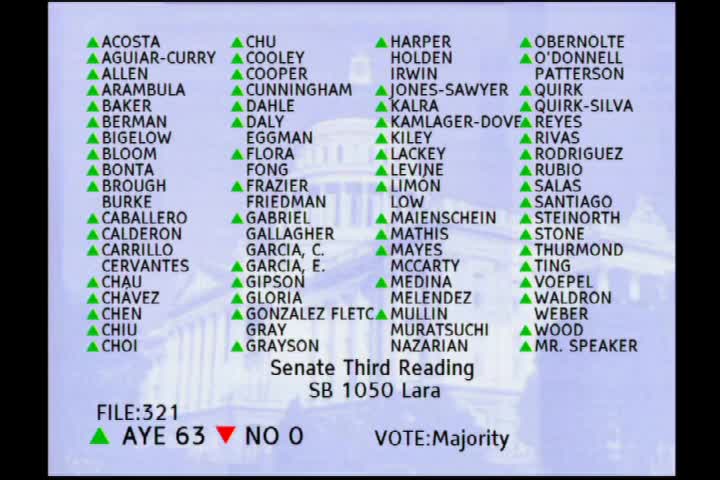 1MIN
Assembly Floor
 1H
Assembly Standing Committee on Appropriations
 5MIN
Assembly Standing Committee on Health
 14MIN
Senate Standing Committee on Health
Bill Author

Bill Co-Author(s):