SB 1181: Emergency services: certified community conservation corps.
- Session Year: 2017-2018
- House: Senate
- Latest Version Date: 2018-09-21
Existing law, the California Emergency Services Act, grants the Governor certain powers to be exercised in accordance with the State Emergency Plan and programs for the mitigation of the effects of an emergency. Existing law creates the Office of Emergency Services within the Governors office and commits to the office the responsibility for the states response services for natural, technological, or manmade disasters and emergencies.
This bill would authorize the Office of Emergency Services to enter into an agreement directly with one or more certified community conservation corps, as defined, to perform emergency or disaster response services as the office deems appropriate.
(a)The office may enter into an agreement directly with one or more certified community conservation corps to perform emergency or disaster response services as the office deems appropriate.
(b)For purposes of this subdivision, certified community conservation corps means a community conservation corps that has been certified as described in Section 14507.5 of the Public Resources Code.
REVISIONS: HeadingLine 2.|
Date
|
Status
|
|---|---|
| Sep 21, 2018 | Chaptered by Secretary of State. Chapter 623, Statutes of 2018. |
| Sep 21, 2018 | Approved by the Governor. |
| Sep 12, 2018 | Enrolled and presented to the Governor at 5 p.m. |
| Aug 30, 2018 | In Senate. Ordered to engrossing and enrolling. |
| Aug 30, 2018 | Read third time. Passed. Ordered to the Senate. |
| Aug 20, 2018 | Read second time. Ordered to third reading. |
| Aug 16, 2018 | From committee: Do pass. (Ayes 17. Noes 0.) (August 16). |
| Aug 8, 2018 | August 8 set for first hearing. Placed on suspense file. |
| Jun 21, 2018 | From committee: Do pass and re-refer to Com. on APPR. with recommendation: To consent calendar. (Ayes 19. Noes 0.) (June 20). Re-referred to Com. on APPR. |
| Jun 7, 2018 | Referred to Com. on G.O. |
| May 31, 2018 | In Assembly. Read first time. Held at Desk. |
| May 31, 2018 | Read third time. Passed. (Ayes 39. Noes 0.) Ordered to the Assembly. |
| May 29, 2018 | Ordered to special consent calendar. |
| May 25, 2018 | From committee: Do pass. (Ayes 7. Noes 0.) (May 25). |
| May 18, 2018 | Set for hearing May 25. |
| Apr 23, 2018 | April 23 hearing: Placed on APPR. suspense file. |
| Apr 13, 2018 | Set for hearing April 23. |
| Apr 10, 2018 | From committee: Do pass and re-refer to Com. on APPR. (Ayes 12. Noes 0.) (April 10). Re-referred to Com. on APPR. |
| Mar 15, 2018 | Set for hearing April 10. |
| Feb 22, 2018 | Referred to Com. on G.O. |
| Feb 15, 2018 | From printer. May be acted upon on or after March 17. |
| Feb 14, 2018 | Introduced. Read first time. To Com. on RLS. for assignment. To print. |
|
Date
|
Description
|
Location
|
Votes
|
|
|---|---|---|---|---|
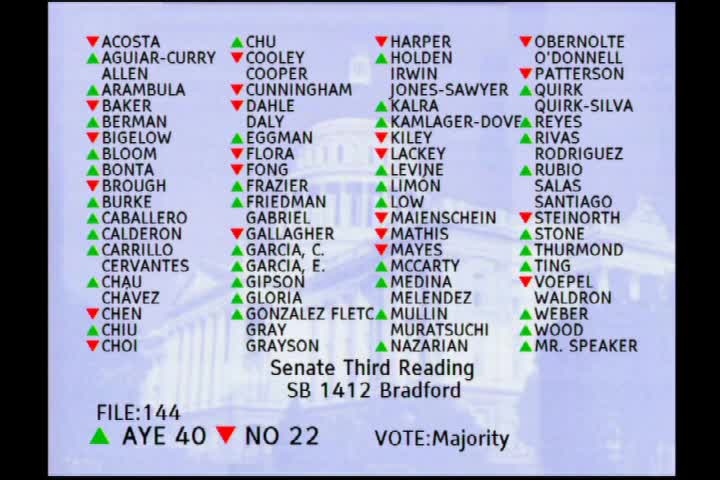
| Aug 30, 2018 | SB 1181 Hueso Senate Third Reading By GONZALEZ FLETCHER | Assembly Floor |
Passed |
|
| Aug 16, 2018 | Do pass. | Assembly Standing Committee on Appropriations |
Passed |
|
| Jun 20, 2018 | Do pass and be re-referred to the Committee on [Appropriations] with recommendation: To Consent Calendar | Assembly Standing Committee on Governmental Organization |
Passed |
|
| May 31, 2018 | Special Consent SB1181 | Senate Floor |
Passed |
|
| May 25, 2018 | Do pass | Senate Standing Committee on Appropriations |
Passed |
|
| Apr 23, 2018 | Placed on suspense file | Senate Standing Committee on Appropriations |
Passed |
|
| Apr 10, 2018 | Do pass, but first be re-referred to the Committee on [Appropriations] | Senate Standing Committee on Governmental Organization |
Passed |
This list shows positions taken on this bill by organizations on the date displayed, which is linked to the original source.
Positions by individuals are not included.
|
Organization
|
Position
|
Date
|
|---|---|---|
| California Association Of Local Conservation Corps | ** Support | Jun 19, 2018 |
| Civicorps | ** Support | Jun 19, 2018 |
| Conservation Corps North Bay | ** Support | Jun 19, 2018 |
| Conservation Corps of Long Beach | ** Support | Jun 19, 2018 |
| Fresno Eoc Local Conservation Corps | ** Support | Jun 19, 2018 |
| Greater Valley Conservation Corps | ** Support | Jun 19, 2018 |
| Los Angeles Conservation Corps | ** Support | Jun 19, 2018 |
| Orange County Conservation Corps | ** Support | Jun 19, 2018 |
| Sacramento Regional Conservation Corps | ** Support | Jun 19, 2018 |
| San Francisco Conservation Corps | ** Support | Jun 19, 2018 |
| San Jose Conservation Corps | ** Support | Jun 19, 2018 |
| Sequoia Community Corps | ** Support | Jun 19, 2018 |
| Urban Conservation Corps Of San Diego | ** Support | Jun 19, 2018 |
| Urban Conservation Corps of the Inland Empire | ** Support | Jun 19, 2018 |
SENATE THIRD READING
STR Bill Id:SB 1181
Author:(Hueso)
As Introduced Ver:February 14, 2018
Majority vote
SENATE VOTE: 39-0
Committee | Votes | Ayes | Noes |
Governmental Organization | 19-0 | Gray, Bigelow, Acosta, Aguiar-Curry, Bonta, Cooley, Cooper, Daly, Gallagher, Eduardo Garcia, Gipson, Gloria, Jones-Sawyer, Kiley, Lackey, Levine, Low, Salas, Waldron | |
Appropriations | 17-0 | Gonzalez Fletcher, Bigelow, Bloom, Bonta, Brough, Calderon, Carrillo, Chau, Eggman, Fong, Friedman, Gallagher, Eduardo Garcia, Nazarian, Obernolte, Quirk, Reyes |
|
SUMMARY: This bill authorizes the Office of Emergency Services (CalOES) to directly enter into an agreement with one or more certified community conservation corps, as defined, to perform emergency or disaster response services.
EXISTING LAW:
- Establishes CalOES in the office of the Governor and provides that CalOES is responsible for the state's emergency and disaster response services for natural, technological, or manmade disasters and emergencies.
- States that CalOES is responsible for activities necessary to prevent, respond to, recover from, and mitigate the effects of emergencies and disasters to people and property.
- Provides that CalOES may, as appropriate, include private businesses and nonprofit organizations within its responsibilities to prepare the state for disasters.
- Provides that CalOES may establish a statewide registry of private businesses and nonprofit organizations that are interested in donating services, goods, labor, equipment, resources, or dispensaries or other facilities to further the preparedness of the state for disasters.
- Defines "Community Conservation Corps" to mean a nonprofit public benefit corporation, or an agency operated by a city, county, or city and county, that is certified by the California Conservation Corps as meeting all of the following criteria:
- The corps is organized into supervised work crews of young men and women on the basis of motivation for hard work, personal development, and public service, without regard to their prior employment or educational background.
- The program is based upon highly disciplined work experience, includes an educational component, and is designed to develop character and civic consciousness.
- Compensation to corpsmembers is no less than the federal minimum wage, and corpsmembers receive assistance in obtaining permanent employment following participation in the program.
- The corps engages in recycling and litter abatement projects as well as projects that accomplish the conservationist and other purposes.
- The corps consists of an average annual enrollment of not less than 50 corpsmembers between 18 and 25 years of age.
- Requires the California Conservation Corps to evaluate a community conservation corps for certification after the corps has completed 12 months of continuous operation, and annually thereafter
FISCAL EFFECT: According to Assembly Appropriations Committee, the fiscal effect is unknown, but likely modest, General Fund costs to contract with Local Conservation Corps (LCCs). Under existing practice, it costs CalOES approximately $2,000 per day to contract with the California Conservation Corps (CCC), the state conservation corps program. It is expected that costs to contract with LCCs would be similar, but additional costs would only materialize if CalOES contracts with LCCs to supplement, rather than replace, other emergency or disaster response services.
COMMENTS:
Purpose of the bill: According to the author, "The California Conservation Corps are mandated by the state to prioritize responding to natural or manmade disasters. In this capacity, they respond to support communities during a State of Emergency. They can help construct fire lines, prepare meals, and assist with floods, fires, earthquakes and more. Although the Local Conservation Corps (LCCs) share similar job training and skills, they are not able to support emergency response efforts in a direct fashion. This is because the LCCs, as local non-profit organizations, have no direct and seamless way to contract with the state. This ability is usually only permitted through a long and roundabout contractual process that is cumbersome for emergency situations."
Background: In 2009, the California Legislature merged the powers, purposes, and responsibilities of the former CalOES with those of the Office of Homeland Security (OHS) into the newly-created California Emergency Management Agency (Cal EMA). On July 1, 2013, Governor Edmund G. Brown Jr.'s Reorganization Plan #2 eliminated Cal EMA and restored it to the Governor's Office, renaming it the California Governor's Office of Emergency Services (CalOES), and merging it with the Office of Public Safety Communications. Today, CalOES is responsible for overseeing and coordinating emergency preparedness, response, recovery and homeland security activities within the state.
Local Conservation Corps: The Community Conservation Corps, also referred to as LCCs, are different from the state-managed California Conservation Corps. They are individual, regional, nonprofit organizations governed by a volunteer Board of Directors. Every LCC is required to be certified by the California Conservation Corps as having met a number of criteria.
The mission of LCCs is to preserve and protect the environment and provide job skills and educational opportunities to young men and women, primarily aged 18-25. Through funding from the Department of Resources Recycling and Recovery, and various city, county, and private organizations, California's 14 LCCs create jobs and educational opportunities for over 2,000 Californian young women and men, and provide a solid foundation for public service through hundreds of community service projects.
State Emergency Plan (SEP): On June 23, 2009, Governor Arnold Schwarzenegger promulgated the 2009 edition of the State of California Emergency Plan. The plan, in accordance with the California Emergency Services Act (CESA) addresses the state's response to extraordinary emergency situations associated with natural disasters or human-caused emergencies. The SEP is a management document intended to be read and understood before an emergency occurs. In accordance with the Act, the plan describes the methods for carrying out emergency operations, the process for rendering mutual aid, the emergency services of governmental agencies, how resources are mobilized, how the public will be informed and the process to ensure continuity of government during an emergency or disaster.
The SEP is designed to outline the activities of all California jurisdictions within a statewide emergency management system and it embraces the capabilities and resources in the broader emergency management community that includes individuals, businesses, non-governmental organizations, tribal governments, other states, federal government and international assistance.
The current SEP contains the duties and resources provided by the California Conservation Corps (CCC), which is legislatively mandated to respond to natural or manmade disasters in California. Since the CCC was established in 1976, more than 11 million hours of emergency work has been delivered by CCC. This bill would allow LCC's to enter into a similar an agreement with CalOES and provide additional resources during an emergency.
Prior/Related Legislation: AB 1928 (McCarty) of the current legislative session. Would authorize the California Conservation Corps to enter into a contract with an individual or collective of certified community conservation corps for a project or program that is in furtherance of specified legislative findings and declarations. (Pending in the Senate Natural Resources and Water Committee)
AB 1956 (Limon) of the current legislative session. Would require the Department of Forestry and Fire Protection to, on or before July 1, 2019, establish a local assistance grant program for fire prevention activities. Groups eligible for grants would include local agencies, resource conservation districts, fire safe councils, the California Conservation Corps, certified local conservation corps, University of California Cooperative Extension, and qualified nonprofit organizations. (Pending in the Senate Natural Resources and Water Committee)
AB 2045 (De La Torre), Chapter 438, Statutes of 2008. Among other things, authorized the Department of Forestry and Fire Protection to utilize the California Conservation Corps or certified Community Conservation Corps in implementing the California Urban Forestry Act of 1978 program.
AB 3038 (Ruskin), Chapter 904, Statutes of 2006. Revised the qualifications and definition of community conservation corps.
Analysis Prepared by: Kenton Stanhope / G.O. / (916) 319-2531 FN: 0004110
Date of Hearing: August 8, 2018
ASSEMBLY COMMITTEE ON APPROPRIATIONS
Lorena Gonzalez Fletcher, Chair
SBPCA Bill Id:SB 1181
Author:(Hueso) – As Introduced Ver:February 14, 2018
Policy Committee: | Governmental Organization | Vote: | 19 - 0 |
|
| ||
|
|
Urgency: No State Mandated Local Program: No Reimbursable: No
SUMMARY:
This bill authorizes the Office of Emergency Services (CalOES) to directly enter into an agreement with one or more local conservation corps (LCCs) to perform emergency or disaster response services.
FISCAL EFFECT:
Unknown, but likely modest, General Fund costs to contract with LCCs. Under existing practice, it costs CalOES approximately $2,000 per day to contract with the California Conservation Corps (CCC), the state conservation corps program. It is expected that costs to contract with LCCs would be similar, but additional costs would only materialize if CalOES contracts with LCCs to supplement, rather than replace, other emergency or disaster response services.
COMMENTS:
- Background. The CCC, established by Governor Brown during his first term in 1976, is the oldest and largest state conservation corps program in the country. It is modeled after the 1930s Civilian Conservation Corps. Although the CCC was originally conceived as a labor source for trail maintenance and restoration, it has since evolved to a workforce development program. LCCs are non-profit organizations that operate at the local level with similar missions to the CCC. California has 14 LCCs throughout the state, and these LCCs are required to obtain certification from the CCC to operate.
- Purpose. According to the author, LCCs , despite similar job training and skills as the CCC, currently lack a direct and seamless way to contract with the state to assist with emergency response. SB 1181 is intended to streamline how LCCs to provide direct assistance during natural and manmade disasters.
- Related legislation. AB 1928 (McCarty), of the 2017-18 Legislative Session, which authorizes CCC to enter into a contract with a LCC for a project or program for specified purposes, is pending in the Senate Appropriations Committee.
Analysis Prepared by: Luke Reidenbach / APPR. / (916) 319-2081
Date of Hearing: June 20, 2018
ASSEMBLY COMMITTEE ON GOVERNMENTAL ORGANIZATION
Adam Gray, Chair
SBPCA Bill Id:SB 1181
Author:(Hueso) – As Introduced Ver:February 14, 2018
SENATE VOTE: 39-0
SUBJECT: Emergency services: certified community conservation corps
SUMMARY: This bill authorizes the Office of Emergency Services (CalOES) to directly enter into an agreement with one or more certified community conservation corps, as defined, to perform emergency or disaster response services.
EXISTING LAW:
- Establishes CalOES in the office of the Governor and provides that CalOES is responsible for the state’s emergency and disaster response services for natural, technological, or manmade disasters and emergencies.
- States that CalOES is responsible for activities necessary to prevent, respond to, recover from, and mitigate the effects of emergencies and disasters to people and property.
- Provides that CalOES may, as appropriate, include private businesses and nonprofit organizations within its responsibilities to prepare the state for disasters.
- Provides that CalOES may establish a statewide registry of private businesses and nonprofit organizations that are interested in donating services, goods, labor, equipment, resources, or dispensaries or other facilities to further the preparedness of the state for disasters.
- Defines “Community Conservation Corps” to mean a nonprofit public benefit corporation, or an agency operated by a city, county, or city and county, that is certified by the California Conservation Corps as meeting all of the following criteria:
- The corps is organized into supervised work crews of young men and women on the basis of motivation for hard work, personal development, and public service, without regard to their prior employment or educational background.
- The program is based upon highly disciplined work experience, includes an educational component, and is designed to develop character and civic consciousness.
- Compensation to corpsmembers is no less than the federal minimum wage, and corpsmembers receive assistance in obtaining permanent employment following participation in the program.
- The corps engages in recycling and litter abatement projects as well as projects that accomplish the conservationist and other purposes.
- The corps consists of an average annual enrollment of not less than 50 corpsmembers between 18 and 25 years of age.
- Requires the California Conservation Corps to evaluate a community conservation corps for certification after the corps has completed 12 months of continuous operation, and annually thereafter
FISCAL EFFECT: Unknown
COMMENTS:
Purpose of the bill: According to the author, “The California Conservation Corps are mandated by the state to prioritize responding to natural or manmade disasters. In this capacity, they respond to support communities during a State of Emergency. They can help construct fire lines, prepare meals, and assist with floods, fires, earthquakes and more. Although the Local Conservation Corps (LCCs) share similar job training and skills, they are not able to support emergency response efforts in a direct fashion. This is because the LCCs, as local non-profit organizations, have no direct and seamless way to contract with the state. This ability is usually only permitted through a long and roundabout contractual process that is cumbersome for emergency situations.”
Background: In 2009, the California Legislature merged the powers, purposes, and responsibilities of the former CalOES with those of the Office of Homeland Security (OHS) into the newly-created California Emergency Management Agency (Cal EMA). On July 1, 2013, Governor Edmund G. Brown Jr.’s Reorganization Plan #2 eliminated Cal EMA and restored it to the Governor’s Office, renaming it the California Governor’s Office of Emergency Services (CalOES), and merging it with the Office of Public Safety Communications. Today, CalOES is responsible for overseeing and coordinating emergency preparedness, response, recovery and homeland security activities within the state.
Local Conservation Corps: The Community Conservation Corps, also referred to as LCCs, are different from the state-managed California Conservation Corps. They are individual, regional, nonprofit organizations governed by a volunteer Board of Directors. Every LCC is required to be certified by the California Conservation Corps as having met a number of criteria.
The mission of LCCs is to preserve and protect the environment and provide job skills and educational opportunities to young men and women, primarily aged 18-25. Through funding from the Department of Resources Recycling and Recovery, and various city, county, and private organizations, California’s 14 LCCs create jobs and educational opportunities for over 2,000 Californian young women and men, and provide a solid foundation for public service through hundreds of community service projects.
State Emergency Plan (SEP): On June 23, 2009, Governor Arnold Schwarzenegger promulgated the 2009 edition of the State of California Emergency Plan. The plan, in accordance with the California Emergency Services Act (CESA) addresses the state's response to extraordinary emergency situations associated with natural disasters or human-caused emergencies. The SEP is a management document intended to be read and understood before an emergency occurs. In accordance with the Act, the plan describes the methods for carrying out emergency operations, the process for rendering mutual aid, the emergency services of governmental agencies, how resources are mobilized, how the public will be informed and the process to ensure continuity of government during an emergency or disaster.
The SEP is designed to outline the activities of all California jurisdictions within a statewide emergency management system and it embraces the capabilities and resources in the broader emergency management community that includes individuals, businesses, non-governmental organizations, tribal governments, other states, federal government and international assistance.
The current SEP contains the duties and resources provided by the California Conservation Corps (CCC), which is legislatively mandated to respond to natural or manmade disasters in California. Since the CCC was established in 1976, more than 11 million hours of emergency work has been delivered by CCC. This bill would allow LCC’s to enter into a similar an agreement with CalOES and provide additional resources during an emergency.
Support: The California Association of Local Conservation Corps (CALCC) writes in support: “In disaster situations, corpsmembers have previously helped the state respond to emergencies by working on the ground on projects including creating fire breaks, clearing trees from vulnerable structures, placing sandbags to prevent flood damage, and installing water tanks to give communities better access to clean drinking water. Often, however, LCCs are prevented from, or significantly delayed in, providing critical disaster support to the state.”
Further, CALCC states that “during the Northern California fires that began in October 2017, contracting issues prevented the Conservation Corps of North Bay (CCNB) from deploying a single corpsmember to support the state. CCNB, located in and serving Sonoma and Napa counties, with their existing fire response experience and dozens of corpsmembers trained and eager to help their neighbors, were effectively blocked from doing so. The high demand for emergency response personnel and rapidity in reaction time is always underscored during an emergency. The nature and size of disasters this past year reinforces the need for maximizing and utilizing all our trained personnel.”
Prior/Related Legislation: AB 1928 (McCarty) of 2017-2018 Legislative Session. Would authorize the California Conservation Corps to enter into a contract with an individual or collective of certified community conservation corps for a project or program that is in furtherance of specified legislative findings and declarations. (Pending in the Senate Natural Resources and Water Committee)
AB 1956 (Limon) of 2017-2018 Legislative Session. Would require the Department of Forestry and Fire Protection to, on or before July 1, 2019, establish a local assistance grant program for fire prevention activities. Groups eligible for grants would include local agencies, resource conservation districts, fire safe councils, the California Conservation Corps, certified local conservation corps, University of California Cooperative Extension, and qualified nonprofit organizations. (Pending in the Senate Natural Resources and Water Committee)
AB 2045 (De La Torre), Chapter 438, Statutes of 2008. Among other things, authorized the Department of Forestry and Fire Protection to utilize the California Conservation Corps or certified Community Conservation Corps in implementing the California Urban Forestry Act of 1978 program.
AB 3038 (Ruskin), Chapter 904, Statutes of 2006. Revised the qualifications and definition of community conservation corps.
REGISTERED SUPPORT / OPPOSITION:
Support
California Association of Local Conservation Corps (Source)
Civicorps
Conservation Corps North Bay
Conservation Corps of Long Beach
Fresno EOC Local Conservation Corps
Greater Valley Conservation Corps
Los Angeles Conservation Corps
Orange County Conservation Corps
Sacramento regional Conservation Corps
San Francisco Conservation Corps
San Jose Conservation Corps
Sequoia Community Corps
Urban Conservation Corps of San Diego
Urban Conservation Corps of the Inland Empire
Opposition
None on file
Analysis Prepared by: Kenton Stanhope / G.O. / (916) 319-2531
Office of Senate Floor Analyses (916) 651-1520 Fax: (916) 327-4478 | SB |
THIRD READING
Bill No: SB 1181
:
SENATE GOVERNMENTAL ORG. COMMITTEE: 12-0, 4/10/18
AYES: Dodd, Wilk, Bradford, Cannella, Gaines, Galgiani, Glazer, Hill, Hueso, Lara, Portantino, Vidak
SENATE APPROPRIATIONS COMMITTEE: 7-0, 5/25/18
AYES: Lara, Bates, Beall, Bradford, Hill, Nielsen, Wiener
SOURCE: California Association of Local Conservation Corps
DIGEST:
This bill authorizes the Office of Emergency Services (OES) to directly enter into an agreement with one or more certified community conservation corps, as defined, to perform emergency or disaster response services.
Existing law:
- Establishes OES in the office of the Governor and provides that OES is responsible for the state’s emergency and disaster response services for natural, technological, or manmade disasters and emergencies.
- States that OES is responsible for activities necessary to prevent, respond to, recover from, and mitigate the effects of emergencies and disasters to people and property.
- Provides that OES may, as appropriate, include private businesses and nonprofit organizations within its responsibilities to prepare the state for disasters.
- Provides that OES may establish a statewide registry of private businesses and nonprofit organizations that are interested in donating services, goods, labor, equipment, resources, or dispensaries or other facilities to further the preparedness of the state for disasters.
- Defines “Community Conservation Corps” to mean a nonprofit public benefit corporation, or an agency operated by a city, county, or city and county, that is certified by the California Conservation Corps as meeting specified criteria.
This bill authorizes OES to enter into an agreement directly with one or more certified community conservation corps, as defined, to perform emergency or disaster response services as OES deems appropriate.
Comments
Purpose of the bill. According to the author, “the California Conservation Corps are mandated by the state to prioritize responding to natural or manmade disasters. In this capacity, they respond to support communities during a State of Emergency. They can help construct fire lines, prepare meals, and assist with floods, fires, earthquakes and more. Although the Local Conservation Corps (LCCs) share similar job training and skills, they are not able to support emergency response efforts in a direct fashion. This is because the LCCs, as local non-profit organizations, have no direct and seamless way to contract with the state. This ability is usually only permitted through a long and roundabout contractual process that is cumbersome for emergency situations.”
Local Conservation Corps. The Community Conservation Corps, also referred to as LCCs, are different from the state-managed California Conservation Corps. They are individual, regional, nonprofit organizations governed by a volunteer Board of Directors. Every LCC is required to be certified by the California Conservation Corps as having met a number of criteria.
The mission of LCCs is to preserve and protect the environment and provide job skills and educational opportunities to young men and women, primarily aged 18-25. Through funding from the Department of Resources Recycling and Recovery, and various city, county, and private organizations, California’s 14 LCCs create jobs and educational opportunities for over 2,000 Californian young women and men, and provide a solid foundation for public service through hundreds of community service projects.
According to the Senate Governmental Organization Committee, currently, OES does not enter into contractual agreements with nonprofit organizations for the delivery of emergency or disaster response services. It is important to note that this bill does not require OES to enter into any such agreement; it simply grants OES the authority to do so. However it is unclear to what extent OES would enter into any agreements for the delivery of emergency or disaster response services with LCCs should that authority exist.
Related/Prior Legislation
AB 1928 (McCarty, 2018) authorizes the California Conservation Corps to enter into a contract with an individual or collective of certified community conservation corps for a project or program that is in furtherance of specified legislative findings and declarations. (Pending in the Assembly Appropriations Committee)
AB 1956 (Limon, 2018) requires the Department of Forestry and Fire Protection, on or before July 1, 2019, to establish a local assistance grant program for fire prevention activities. Groups eligible for grants would include local agencies, resource conservation districts, fire safe councils, the California Conservation Corps, certified local conservation corps, University of California Cooperative Extension, and qualified nonprofit organizations. (Pending in the Assembly Appropriations Committee)
SB 821 (Jackson, 2018) authorizes each county, and city and county, to access the contact information of resident accountholders through the records of a public utility or other agency responsible for property-related services for the sole purpose of enrolling county residents in a county-operated public emergency warning system. (Pending in the Assembly Governmental Organization Committee)
AB 2045 (De La Torre, Chapter 438, Statutes of 2008), among other things, authorized the Department of Forestry and Fire Protection to utilize the California Conservation Corps or certified Community Conservation Corps in implementing the California Urban Forestry Act of 1978 program.
FISCAL EFFECT: Appropriation: Fiscal Com.: Local:
According to the Senate Appropriations Committee, unknown, likely significant cost pressure for contracting with certified community conservation corps and utilizing their services in the event of an emergency. These costs may replace the costs for utilizing the California Conservation Corps or occur in addition to those costs depending on whether the certified community conservation corps are used to replace or to supplement the utilization of the California Conservation Corps.
California Association of Local Conservation Corps (source)
Civicorps
Conservation Corps North Bay
Conservation Corps of Long Beach
Fresno EOC Local Conservation Corps
Greater Valley Conservation Corps
Los Angeles Conservation Corps
Orange County Conservation Corps
Sacramento Regional Conservation Corps
San Francisco Conservation Corps
San Jose Conservation Corps
Sequoia Community Corps
Urban Conservation Corps of San Diego
Urban Conservation Corps of the Inland Empire
OPPOSITION: (Verified 5/25/18)
None received
ARGUMENTS IN SUPPORT: According to the California Association of Local Conservation Corps, “in disaster situations, corpsmembers have previously helped the state respond to emergencies by working on the ground on projects including creating fire breaks, clearing trees from vulnerable structures, placing sandbags to prevent flood damage, and installing water tanks to give communities better access to clean drinking water. Often, however, LCCs are prevented from, or significantly delayed in, providing critical disaster support to the state.”
5/26/18 15:26:22
SENATE COMMITTEE ON
Senator Ricardo Lara, Chair
2017 - 2018 Regular Session
SB 1181 (Hueso) - Emergency services: certified community conservation corps
Version: | Policy Vote: |
Urgency: | Mandate: |
Hearing Date: | Consultant: |
This bill meets the criteria for referral to the Suspense File.
Bill Summary:
SB 1181 would authorize the Office of Emergency Services (CalOES) to directly enter into an agreement with one or more certified community conservation corps, as defined, to perform emergency or disaster response services.
Fiscal Impact:
- Unknown, likely significant cost pressure for contracting with certified community conservation corps and utilizing their services in the event of an emergency. These costs may replace the costs for utilizing the California Conservation Corps or occur in addition to those costs depending on whether the certified community conservation corps are used to replace or to supplement the utilization of the California Conservation Corps.
Background:
The Community Conservation Corps (also Local Conservation Corps (LCC)) are individual, regional, nonprofit organizations governed by a volunteer Board of Directors. The California Conservation Corps is a department within the California Natural Resources Agency that works on environmental projects and responds to natural and man-made disasters. LCCs are required to be evaluated and certified by the California Conservation Corp. According to the author, although LCCs share similar job training and skills with the California Conservation Corps, they are not able to support emergency response efforts in a direct fashion because as local nonprofit organizations, they have no direct and seamless way to contract with the state.
LCCs are funded through the Department of Resources Recycling and Recovery and various city, county, and private organizations. California has 14 LCCs throughout the state.
Proposed Law:
This bill would authorize CalOES to enter into an agreement directly with one or more certified community conservation corps, as defined, to perform emergency or disaster response services as CalOES deems appropriate.
Related Legislation:
AB 1928 (McCarty, 2018) would authorize the California Conservation Corps to enter into a contract with an individual or collective of certified community conservation corps for a project or program that is in furtherance of specified legislative findings and declarations. This bill is pending in the Assembly Appropriations Committee.
AB 2045 (De La Torre, Chapter 438, Statutes of 2008) among other things, authorized the Department of Forestry and Fire Protection to utilize the California Conservation Corps or certified Community Conservation Corps in implementing the California Urban Forestry Act of 1978 program.
AB 3038 (Ruskin, Chapter 904, Statutes of 2006) revised the qualifications and definition of community conservation corps.
Staff Comments:
Staff notes that CalOES does not currently enter into contractual agreements with nonprofit organizations for the delivery of emergency or disaster response services. Currently CalOES utilizes the California Conservation Corps to perform emergency or disaster response services. This bill does not require CalOES to enter into an agreement with LCCs but rather grants the authority to do so. In the event that CalOES enters into an agreement and utilizes the services of LCCs, whether in replacement of or in addition to the services of the California Conservation Corps, the costs for those services would supplant or add to the costs for utilizing the California Conservation Corps, respectively.
According to CalOES, it costs approximately $2000 per day per crew for the California Conservation Corps to respond to an emergency or disaster. The number of crews and length of time needed to respond varies based on the scope of the emergency event.
-- END --
SENATE COMMITTEE ON GOVERNMENTAL ORGANIZATION
Senator Bill Dodd
Chair
2017 - 2018 Regular
Bill No: 1181 Hearing Date: 4/10/2018
Author: | |||
Version: | 2/14/2018 Introduced | ||
Urgency: | No | Fiscal: | Yes |
Consultant: | Brian Duke | ||
SUBJECT: Emergency services: certified community conservation corps
DIGEST: This bill authorizes the Office of Emergency Services (OES) to directly enter into an agreement with one or more certified community conservation corps, as defined, to perform emergency or disaster response services.
ANALYSIS:
Existing law:
- Establishes OES in the office of the Governor and provides that OES is responsible for the state’s emergency and disaster response services for natural, technological, or manmade disasters and emergencies.
- States that OES is responsible for activities necessary to prevent, respond to, recover from, and mitigate the effects of emergencies and disasters to people and property.
- Provides that OES may, as appropriate, include private businesses and nonprofit organizations within its responsibilities to prepare the state for disasters.
- Provides that OES may establish a statewide registry of private businesses and nonprofit organizations that are interested in donating services, goods, labor, equipment, resources, or dispensaries or other facilities to further the preparedness of the state for disasters.
- Defines “Community Conservation Corps” to mean a nonprofit public benefit corporation, or an agency operated by a city, county, or city and county, that is certified by the California Conservation Corps as meeting all of the following criteria:
- The corps is organized into supervised work crews of young men and women on the basis of motivation for hard work, personal development, and public service, without regard to their prior employment or educational background.
- The program is based upon highly disciplined work experience, includes an educational component, and is designed to develop character and civic consciousness.
- Compensation to corpsmembers is no less than the federal minimum wage, and corpsmembers receive assistance in obtaining permanent employment following participation in the program.
- The corps engages in recycling and litter abatement projects as well as projects that accomplish the conservationist and other purposes.
- The corps consists of an average annual enrollment of not less than 50 corpsmembers between 18 and 25 years of age.
- Requires the California Conservation Corps to evaluate a community conservation corps for certification after the corps has completed 12 months of continuous operation, and annually thereafter.
This bill authorizes OES to enter into an agreement directly with one or more certified community conservation corps, as defined, to perform emergency or disaster response services as OES deems appropriate.
Background
Purpose of the bill. According to the author, “the California Conservation Corps are mandated by the state to prioritize responding to natural or manmade disasters. In this capacity, they respond to support communities during a State of Emergency. They can help construct fire lines, prepare meals, and assist with floods, fires, earthquakes and more. Although the Local Conservation Corps (LCCs) share similar job training and skills, they are not able to support emergency response efforts in a direct fashion. This is because the LCCs, as local non-profit organizations, have no direct and seamless way to contract with the state. This ability is usually only permitted through a long and roundabout contractual process that is cumbersome for emergency situations.”
Local Conservation Corps. The Community Conservation Corps, also referred to as LCCs, are different from the state-managed California Conservation Corps. They are individual, regional, nonprofit organizations governed by a volunteer Board of Directors. Every LCC is required to be certified by the California Conservation Corps as having met a number of criteria.
The mission of LCCs is to preserve and protect the environment and provide job skills and educational opportunities to young men and women, primarily aged 18-25. Through funding from the Department of Resources Recycling and Recovery, and various city, county, and private organizations, California’s 14 LCCs create jobs and educational opportunities for over 2,000 Californian young women and men, and provide a solid foundation for public service through hundreds of community service projects.
2017 California Fire Season. California’s 2017 wildfire season was unprecedented, both in terms of scope and destruction. The state faced roughly 9,000 wildfires which burned over one million acres. The fires destroyed nearly 11,000 structures and were responsible for the deaths of at least 46 people. The cleanup and recovery from these devastating fires, and ensuing debris flows, continue to this day.
As climate change continues to plague the state, many scientists predict that the 2017 fire season is not an anomaly, and that similar wildfires are likely to continue into the future. Given the growing need for emergency response services, the author argues that it is important to provide OES with as many tools as possible to respond during times of emergency.
Staff comments. Currently, OES does not enter into contractual agreements with nonprofit organizations for the delivery of emergency or disaster response services. It is important to note that this bill does not require OES to enter into any such agreement; it simply grants OES the authority to do so. However it is unclear to what extent OES would enter into any agreements for the delivery of emergency or disaster response services with LCCs should that authority exist.
Prior/Related Legislation
AB 1928 (McCarty, 2018) authorizes the California Conservation Corps to enter into a contract with an individual or collective of certified community conservation corps for a project or program that is in furtherance of specified legislative findings and declarations. (Pending in the Assembly Natural Resources Committee)
AB 1956 (Limon, 2018) requires the Department of Forestry and Fire Protection to, on or before July 1, 2019, establish a local assistance grant program for fire prevention activities. Groups eligible for grants would include local agencies, resource conservation districts, fire safe councils, the California Conservation Corps, certified local conservation corps, University of California Cooperative Extension, and qualified nonprofit organizations. (Pending in the Assembly Natural Resources Committee)
SB 821 (Jackson, 2018) authorizes each county, and city and county, to access the contact information of resident accountholders through the records of a public utility or other agency responsible for property-related services for the sole purpose of enrolling county residents in a county-operated public emergency warning system. (Pending in the Senate Governmental Organization Committee)
AB 2045 (De La Torre, Chapter 438, Statutes of 2008) among other things, authorized the Department of Forestry and Fire Protection to utilize the California Conservation Corps or certified Community Conservation Corps in implementing the California Urban Forestry Act of 1978 program.
AB 3038 (Ruskin, Chapter 904, Statutes of 2006) revised the qualifications and definition of community conservation corps.
FISCAL EFFECT: Appropriation: Fiscal Com.: Local:
SUPPORT:
California Association of Local Conservation Corps (Source)
Civicorps
Conservation Corps North Bay
Conservation Corps of Long Beach
Fresno EOC Local Conservation Corps
Greater Valley Conservation Corps
Los Angeles Conservation Corps
Orange County Conservation Corps
Sacramento regional Conservation Corps
San Francisco Conservation Corps
San Jose Conservation Corps
Sequoia Community Corps
Urban Conservation Corps of San Diego
Urban Conservation Corps of the Inland Empire
OPPOSITION:
None received
ARGUMENTS IN SUPPORT: According to the California Association of Local Conservation Corps (CALCC), “in disaster situations, corpsmembers have previously helped the state respond to emergencies by working on the ground on projects including creating fire breaks, clearing trees from vulnerable structures, placing sandbags to prevent flood damage, and installing water tanks to give communities better access to clean drinking water. Often, however, LCCs are prevented from, or significantly delayed in, providing critical disaster support to the state.”
Further, CALCC states that “during the Northern California fires that began in October 2017, contracting issues prevented the Conservation Corps of North Bay (CCNB) from deploying a single corpsmember to support the state. CCNB, located in and serving Sonoma and Napa counties, with their existing fire response experience and dozens of corpsmembers trained and eager to help their neighbors, were effectively blocked from doing so. The high demand for emergency response personnel and rapidity in reaction time is always underscored during an emergency. The nature and size of disasters this past year reinforces the need for maximizing and utilizing all our trained personnel.”
Discussed in Hearing
 1MIN
Assembly Floor
 1H
Assembly Standing Committee on Appropriations
 7MIN
Senate Standing Committee on Governmental Organization
Bill Author

Bill Co-Author(s):
