SB 1208: Courts, judicial emergencies.
- Session Year: 2017-2018
- House: Senate
- Latest Version Date: 2018-08-24
Existing law authorizes a presiding judge to request the Chairperson of the Judicial Council to authorize the court to transfer cases to an adjacent county, hold sessions in other parts of the county, extend specified time periods, and declare judicial holidays, among other emergency responses, when war, insurrection, pestilence, or other public calamity, among other things, threatens the orderly operation of a superior court location or locations within a county.
This bill would instead grant the judge that authority if war, an act of terrorism, public unrest or calamity, epidemic, natural disaster, or other substantial risk to the health and welfare of court personnel or the public, or the danger thereof, threatens the orderly operation of a superior court location or locations within a county or renders presence in, or access to, an affected court facility or facilities unsafe. The bill would also extend this authorization when a condition leads to a state of emergency being proclaimed by the President of the United States or by the Governor. The bill would allow for the transfer of cases to be made to a superior court in any county, to a court in an adjacent county, or to a superior court within 100 miles of the border of the county in which the court impacted by the emergency is situated, as specified.
Existing law requires that a civil action be brought to trial within 5 years after the action is commenced against the defendant. Existing law requires that if a new trial is granted, the action be brought to trial within 3 years.
This bill would allow those time periods to be extended for the fewest days necessary under the circumstances of an emergency, as determined by the Chairperson of the Judicial Council.
The bill would specify that the Chairperson of the Judicial Council is not precluded from granting further extensions upon making a renewed determination that circumstances warranting relief continue to exist.
Existing law authorizes a presiding judge to request the Chairperson of the Judicial Council to authorize the court to transfer cases to an adjacent county, hold sessions in other parts of the county, extend specified time periods, and declare judicial holidays, among other emergency responses, when war, insurrection, pestilence, or other public calamity, among other things, threatens the orderly operation of a superior court location or locations within a county.
This bill would instead grant the judge that authority if war, an act of terrorism, public unrest or calamity, epidemic, natural disaster, or other substantial risk to the health and welfare of court personnel or the public, or the danger thereof, threatens the orderly operation of a superior court location or locations within a county or renders presence in, or access to, an affected court facility or facilities unsafe. The bill would also extend this authorization when a condition leads to a state of emergency being proclaimed by the President of the United States or by the Governor. The bill would allow for the transfer of cases to be made to a superior court in any county. county, to a court in an adjacent county, or to a superior court within 100 miles of the border of the county in which the court impacted by the emergency is situated, as specified.
Existing law requires that a civil action be brought to trial within 5 years after the action is commenced against the defendant. Existing law requires that if a new trial is granted, the action be brought to trial within 3 years.
This bill would allow those time periods to be extended for the fewest days necessary under the circumstances of an emergency, as determined by the Chairperson of the Judicial Council.
The bill would specify that the Chairperson of the Judicial Council is not precluded from granting further extensions upon making a renewed determination that circumstances warranting relief continue to exist.
Existing law authorizes a presiding judge to request the Chairperson of the Judicial Council to authorize the court to transfer cases to an adjacent county, hold sessions in other parts of the county, extend specified time periods, and declare judicial holidays, among other emergency responses, when war, insurrection, pestilence, or other public calamity, among other things, threatens the orderly operation of a superior court location or locations within a county.
This bill would instead grant the judge that authority if war, an act of terrorism, public unrest or calamity, epidemic, natural disaster, or other substantial risk to the health and welfare of court personnel or the public, or the danger thereof, threatens the orderly operation of a superior court location or locations within a county or renders presence in, or access to, an affected court facility or facilities unsafe. The bill would also extend this authorization when a condition leads to a state of emergency being proclaimed by the President of the United States or by the Governor. The bill would allow for the transfer of cases to be made to a superior court in any county.
Existing law requires that a civil action be brought to trial within 5 years after the action is commenced against the defendant. Existing law requires that if a new trial is granted, the action be brought to trial within 3 years.
This bill would allow the above those time periods to be extended for the fewest days necessary under the circumstances of an emergency, as determined by the Chairperson of the Judicial Council.
The bill would specify that the Chairperson of the Judicial Council is not precluded from granting further extensions upon making a renewed determination that circumstances warranting relief continue to exist.
Existing law authorizes a presiding judge to request the Chairperson of the Judicial Council to authorize the court to transfer cases to an adjacent county, hold sessions in other parts of the county, extend specified time periods, and declare judicial holidays, among other emergency responses, when war, insurrection, pestilence, or other public calamity, among other things, threatens the orderly operation of a superior court location or locations within a county.
This bill would instead grant the judge that authority if war, an act of terrorism, public unrest or calamity, epidemic, natural disaster, or other substantial risk to the health and welfare of court personnel or the public, or the danger thereof, threatens the orderly operation of a superior court location or locations within a county or renders presence in, or access to, an affected court facility or facilities unsafe. The bill would also extend this authorization when a condition leads to a state of emergency being proclaimed by the President of the United States or by the Governor. The bill would allow for the transfer of cases to be made to a superior court in any county.
Existing law requires that a civil action be brought to trial within 5 years after the action is commenced against the defendant. Existing law requires that if a new trial is granted, the action be brought to trial within 3 years.
This bill would allow the above time periods to be extended for the fewest days necessary under the circumstances of an emergency, as determined by the Chairperson of the Judicial Council.
The bill would specify that the Chairperson of the Judicial Council is not precluded from granting further extensions upon making a renewed determination that circumstances warranting relief continue to exist.
(a)When war, an act of terrorism, public unrest or calamity, epidemic, natural disaster, or other substantial risk to the health and welfare of court personnel or the public, or the danger thereof, the destruction of or danger to the building appointed for holding the court, a large influx of criminal cases resulting from a large number of arrests within a short period of time, or a condition that leads to a state of emergency being proclaimed by the President of the United States or by the Governor pursuant to Section 8625, threatens the orderly operation of a superior court location or locations within a county or renders presence in, or access to, an affected court facility or facilities unsafe, the presiding judge may request and the Chairperson of the Judicial Council may, notwithstanding any other law, by order authorize the court to do one or more of the following:
(1)Hold sessions anywhere within the county.
(2)Transfer civil cases pending trial in the court to a superior court in another county. A transfer shall not be made pursuant to this paragraph except as follows:
(A)With the consent of all parties to the case, a pending civil case may be transferred to a superior court in any county.
(B)Upon a finding by the court that extreme or undue hardship would result unless the case is transferred for trial, a pending civil case may be transferred to any superior court in an adjacent county or to any superior court within 100 miles of the border of the county in which the court impacted by the emergency is situated. In addition to the foregoing, if a court is located within an area identified to be within the boundary of a state of emergency proclaimed by the Governor pursuant to Section 8625, a pending civil case may be transferred to any superior court within 100 miles of the outer boundary of the area proclaimed to be experiencing a state of emergency.
(3)Any civil case so transferred pursuant to paragraph (2) shall be integrated into the existing caseload of the court to which it is transferred pursuant to rules to be provided by the Judicial Council. This section does not affect a courts authority under Section 69740.
(4)Declare that a date or dates on which an emergency condition, as described in this section, substantially interfered with the publics ability to file papers in a court facility or facilities be deemed a holiday for purposes of computing the time for filing papers with the court under Sections 12 and 12a of the Code of Civil Procedure. This paragraph applies to the fewest days necessary under the circumstances of the emergency, as determined by the Chairperson of the Judicial Council.
(5)Declare that a date on which an emergency condition, as described in this section, prevented the court from either (A) conducting proceedings governed by Section 825 of the Penal Code, or Section 315, 334, 631, 632, 637, or 657 of the Welfare and Institutions Code, or (B) accepting the filing of petitions for purposes of Section 313 or 631 of the Welfare and Institutions Code, be deemed a holiday for purposes of computing time under those statutes. This paragraph applies to the fewest days necessary under the circumstances of the emergency, as determined by the Chairperson of the Judicial Council.
(6)Extend the time periods provided in Sections 583.310 and 583.320 of the Code of Civil Procedure to bring an action to trial. The extension shall be for the fewest days necessary under the circumstances of the emergency, as determined by the Chairperson of the Judicial Council.
(7)Extend the duration of any temporary restraining order that would otherwise expire because an emergency condition, as described in this section, prevented the court from conducting proceedings to determine whether a permanent order should be entered. The extension shall be for the fewest days necessary under the circumstances of the emergency, as determined by the Chairperson of the Judicial Council.
(8)Within the affected county during a state of emergency resulting from a natural or human-made disaster proclaimed by the President of the United States or by the Governor pursuant to Section 8625 of the Government Code, extend the time period provided in Section 825 of the Penal Code within which a defendant charged with a felony offense shall be taken before a magistrate from 48 hours to not more than seven days, with the number of days to be designated by the Chairperson of the Judicial Council. This authorization shall be effective for 30 days unless it is extended by a new request and a new order.
(9)Extend the time period provided in Section 859b of the Penal Code for the holding of a preliminary examination from 10 court days to not more than 15 court days.
(10)Extend the time period provided in Section 1382 of the Penal Code within which the trial must be held by not more than 30 days, but the trial of a defendant in custody whose time is so extended shall be given precedence over all other cases.
(11)Within the affected area of a county during a state of emergency resulting from a natural or human-made disaster proclaimed by the President of the United States or by the Governor pursuant to Section 8625 of the Government Code, extend the time periods provided in Sections 313, 315, 632, and 637 of the Welfare and Institutions Code, with the number of days to be designated by the Chairperson of the Judicial Council. The extension of time shall be for the shortest period of time necessary under the circumstances of the emergency, but the time period shall not be extended to more than seven days. This authorization shall be effective for 30 days unless it is extended by a new request and a new order. With regard to the time periods provided in Sections 632 and 637 of the Welfare and Institutions Code, this paragraph applies only if the minor has been charged with a felony.
(12)Within the affected county during a state of emergency resulting from a natural or human-made disaster proclaimed by the President of the United States or by the Governor pursuant to Section 8625 of the Government Code, extend the time period provided in Sections 334 and 657 of the Welfare and Institutions Code within which a hearing on a juvenile court petition shall be held by not more than 15 days, with the number of days to be designated by the Chairperson of the Judicial Council. This authorization shall be effective for 30 days unless it is extended by a new request and a new order. With regard to the time periods provided in Section 657 of the Welfare and Institutions Code, this paragraph applies only if the minor has been charged with a felony.
(b)The limitations on extensions of time provided for in subdivision (a) set forth the maximum respective extensions allowable from the time when the Chairperson of the Judicial Council makes a determination that circumstances warranting relief under this section exist. The limitations on extensions of time do not preclude the Chairperson of the Judicial Council, at the request of a presiding judge, from granting further extensions, up to the maximum permitted under the relevant paragraph, upon making a renewed determination that circumstances warranting relief under this section continue to exist.
(a)When war, an act of terrorism, public unrest or calamity, epidemic, natural disaster, or other substantial risk to the health and welfare of court personnel or the public, or the danger thereof, the destruction of or danger to the building appointed for holding the court, a large influx of criminal cases resulting from a large number of arrests within a short period of time, or a condition that leads to a state of emergency being proclaimed by the President of the United States or by the Governor pursuant to Section 8625, threatens the orderly operation of a superior court location or locations within a county or renders presence in, or access to, an affected court facility or facilities unsafe, the presiding judge may request and the Chairperson of the Judicial Council may, notwithstanding any other provision of law, by order authorize the court to do one or more of the following:
(1)Hold sessions anywhere within the county.
(2)Transfer civil cases pending trial in the court to a superior court in another county. A transfer shall not be made pursuant to this paragraph except with as follows:
(A)With the consent of all parties to the case or upon case, a pending civil case may be transferred to a superior court in any county.
(B)Upon a finding by the court that extreme or undue hardship would result unless the case is transferred for trial. Any trial, a pending civil case may be transferred to any superior court in an adjacent county or to any superior court within 100 miles of the border of the county in which the court impacted by the emergency is situated. In addition to the foregoing, if a court is located within an area identified to be within the boundary of a state of emergency proclaimed by the Governor pursuant to Section 8625, a pending civil case may be transferred to any superior court within 100 miles of the outer boundary of the area proclaimed to be experiencing a state of emergency.
(3)Any civil case so transferred pursuant to paragraph (2) shall be integrated into the existing caseload of the court to which it is transferred pursuant to rules to be provided by the Judicial Council. This section does not affect a courts authority under Section 69740.
(3)(4)Declare that a date or dates on which an emergency condition, as described in this section, substantially interfered with the publics ability to file papers in a court facility or facilities be deemed a holiday for purposes of computing the time for filing papers with the court under Sections 12 and 12a of the Code of Civil Procedure. This paragraph applies to the fewest days necessary under the circumstances of the emergency, as determined by the Chairperson of the Judicial Council.
(4)(5)Declare that a date on which an emergency condition, as described in this section, prevented the court from either (A) conducting proceedings governed by Section 825 of the Penal Code, or Section 315, 334, 631, 632, 637, or 657 of the Welfare and Institutions Code, or (B) accepting the filing of petitions for purposes of Section 313 or 631 of the Welfare and Institutions Code, be deemed a holiday for purposes of computing time under those statutes. This paragraph shall apply applies to the fewest days necessary under the circumstances of the emergency, as determined by the Chairperson of the Judicial Council.
(5)(6)Extend the time periods provided in Sections 583.310 and 583.320 of the Code of Civil Procedure to bring an action to trial. The extension shall be for the fewest days necessary under the circumstances of the emergency, as determined by the Chairperson of the Judicial Council.
(6)(7)Extend the duration of any temporary restraining order that would otherwise expire because an emergency condition, as described in this section, prevented the court from conducting proceedings to determine whether a permanent order should be entered. The extension shall be for the fewest days necessary under the circumstances of the emergency, as determined by the Chairperson of the Judicial Council.
(7)(8)Within the affected county during a state of emergency resulting from a natural or human-made disaster proclaimed by the President of the United States or by the Governor pursuant to Section 8625 of the Government Code, extend the time period provided in Section 825 of the Penal Code within which a defendant charged with a felony offense shall be taken before a magistrate from 48 hours to not more than seven days, with the number of days to be designated by the Chairperson of the Judicial Council. This authorization shall be effective for 30 days unless it is extended by a new request and a new order.
(8)(9)Extend the time period provided in Section 859b of the Penal Code for the holding of a preliminary examination from 10 court days to not more than 15 court days.
(9)(10)Extend the time period provided in Section 1382 of the Penal Code within which the trial must be held by not more than 30 days, but the trial of a defendant in custody whose time is so extended shall be given precedence over all other cases.
(10)(11)Within the affected area of a county during a state of emergency resulting from a natural or human-made disaster proclaimed by the President of the United States or by the Governor pursuant to Section 8625 of the Government Code, extend the time periods provided in Sections 313, 315, 632, and 637 of the Welfare and Institutions Code, with the number of days to be designated by the Chairperson of the Judicial Council. The extension of time shall be for the shortest period of time necessary under the circumstances of the emergency, but in no event shall the time period shall not be extended to more than seven days. This authorization shall be effective for 30 days unless it is extended by a new request and a new order. With regard to the time periods provided in Sections 632 and 637 of the Welfare and Institutions Code, this paragraph shall apply applies only if the minor has been charged with a felony.
(11)(12)Within the affected county during a state of emergency resulting from a natural or human-made disaster proclaimed by the President of the United States or by the Governor pursuant to Section 8625 of the Government Code, extend the time period provided in Sections 334 and 657 of the Welfare and Institutions Code within which a hearing on a juvenile court petition shall be held by not more than 15 days, with the number of days to be designated by the Chairperson of the Judicial Council. This authorization shall be effective for 30 days unless it is extended by a new request and a new order. With regard to the time periods provided in Section 657 of the Welfare and Institutions Code, this paragraph shall apply applies only if the minor has been charged with a felony.
(b)The limitations on extensions of time provided for in subdivision (a) set forth the maximum respective extensions allowable from the time when the Chairperson of the Judicial Council makes a determination that circumstances warranting relief under this section exist. The limitations on extensions of time do not preclude the Chairperson of the Judicial Council, at the request of a presiding judge, from granting further extensions, up to the maximum permitted under the relevant paragraph, upon making a renewed determination that circumstances warranting relief under this section continue to exist.
(a)When war, an act of terrorism, public unrest or calamity, epidemic, natural disaster, or other substantial risk to the health and welfare of court personnel or the public, or the danger thereof, the destruction of or danger to the building appointed for holding the court, a large influx of criminal cases resulting from a large number of arrests within a short period of time, or a condition that leads to a state of emergency being proclaimed by the President of the United States or by the Governor pursuant to Section 8625, threatens the orderly operation of a superior court location or locations within a county or renders presence in, or access to, an affected court facility or facilities unsafe, the presiding judge may request and the Chairperson of the Judicial Council may, notwithstanding any other provision of law, by order authorize the court to do one or more of the following:
(1)Hold sessions anywhere within the county.
(2)Transfer civil cases pending trial in the court to a superior court in another county. A transfer shall not be made pursuant to this paragraph except with the consent of all parties to the case or upon a finding by the court that extreme or undue hardship would result unless the case is transferred for trial. Any civil case so transferred shall be integrated into the existing caseload of the court to which it is transferred pursuant to rules to be provided by the Judicial Council. This section does not affect a courts authority under Section 69740.
(3)Declare that a date or dates on which an emergency condition, as described in this section, substantially interfered with the publics ability to file papers in a court facility or facilities be deemed a holiday for purposes of computing the time for filing papers with the court under Sections 12 and 12a of the Code of Civil Procedure. This paragraph applies to the fewest days necessary under the circumstances of the emergency, as determined by the Chairperson of the Judicial Council.
(4)Declare that a date on which an emergency condition, as described in this section, prevented the court from either (A) conducting proceedings governed by Section 825 of the Penal Code, or Section 313, 315, 334, 631, 632, 637, or 657 of the Welfare and Institutions Code, or (B) accepting the filing of petitions for purposes of Section 313 or 631 of the Welfare and Institutions Code, be deemed a holiday for purposes of computing time under those statutes. This paragraph shall apply to the fewest days necessary under the circumstances of the emergency, as determined by the Chairperson of the Judicial Council.
(5)Extend the time periods provided in Sections 583.310 and 583.320 of the Code of Civil Procedure to bring an action to trial. The extension shall be for the fewest days necessary under the circumstances of the emergency, as determined by the Chairperson of the Judicial Council.
(6)Extend the duration of any temporary restraining order that would otherwise expire because an emergency condition, as described in this section, prevented the court from conducting proceedings to determine whether a permanent order should be entered. The extension shall be for the fewest days necessary under the circumstances of the emergency, as determined by the Chairperson of the Judicial Council.
(7)Within the affected county during a state of emergency resulting from a natural or human-made disaster proclaimed by the President of the United States or by the Governor pursuant to Section 8625 of the Government Code, extend the time period provided in Section 825 of the Penal Code within which a defendant charged with a felony offense shall be taken before a magistrate from 48 hours to not more than seven days, with the number of days to be designated by the Chairperson of the Judicial Council. This authorization shall be effective for 30 days unless it is extended by a new request and a new order.
(8)Extend the time period provided in Section 859b of the Penal Code for the holding of a preliminary examination from 10 court days to not more than 15 court days.
(9)Extend the time period provided in Section 1382 of the Penal Code within which the trial must be held by not more than 30 days, but the trial of a defendant in custody whose time is so extended shall be given precedence over all other cases.
(10)Within the affected area of a county during a state of emergency resulting from a natural or human-made disaster proclaimed by the President of the United States or by the Governor pursuant to Section 8625 of the Government Code, extend the time period periods provided in Sections 313, 315, 632, and 637 of the Welfare and Institutions Code within which a minor shall be given a detention hearing, Code, with the number of days to be designated by the Chairperson of the Judicial Council. The extension of time shall be for the shortest period of time necessary under the circumstances of the emergency, but in no event shall the time period within which a detention hearing must be given be extended to more than seven days. This authorization shall be effective for 30 days unless it is extended by a new request and a new order. With regard to the time periods provided in Sections 632 and 637 of the Welfare and Institutions Code, this paragraph shall apply only if the minor has been charged with a felony.
(11)Within the affected county during a state of emergency resulting from a natural or human-made disaster proclaimed by the President of the United States or by the Governor pursuant to Section 8625 of the Government Code, extend the time period provided in Sections 334 and 657 of the Welfare and Institutions Code within which a hearing on a juvenile court petition shall be held by not more than 15 days, with the number of days to be designated by the Chairperson of the Judicial Council. This authorization shall be effective for 30 days unless it is extended by a new request and a new order. With regard to the time periods provided in Section 657 of the Welfare and Institutions Code, this paragraph shall apply only if the minor has been charged with a felony.
(b)The limitations on extensions of time provided for in subdivision (a) set forth the maximum respective extensions allowable from the time when the Chairperson of the Judicial Council makes a determination that circumstances warranting relief under this section exist. The limitations on extensions of time do not preclude the Chairperson of the Judicial Council, at the request of a presiding judge, from granting further extensions, up to the maximum permitted under the relevant paragraph, upon making a renewed determination that circumstances warranting relief under this section continue to exist.
(a)When war, an act of terrorism, public unrest or calamity, epidemic, natural disaster, or other substantial risk to the health and welfare of court personnel or the public, or the danger thereof, the destruction of or danger to the building appointed for holding the court, a large influx of criminal cases resulting from a large number of arrests within a short period of time, or a condition that leads to a state of emergency being proclaimed by the President of the United States or by the Governor pursuant to Section 8625, threatens the orderly operation of a superior court location or locations within a county or renders presence in, or access to, an affected court facility or facilities unsafe, the presiding judge may request and the Chairperson of the Judicial Council may, notwithstanding any other provision of law, by order authorize the court to do one or more of the following:
(1)Hold sessions anywhere within the county.
(2)Transfer civil cases pending trial in the court to a superior court in another county. A transfer shall not be made pursuant to this paragraph except with the consent of all parties to the case or upon a finding by the court that extreme or undue hardship would result unless the case is transferred for trial. Any civil case so transferred shall be integrated into the existing caseload of the court to which it is transferred pursuant to rules to be provided by the Judicial Council. This section does not affect a courts authority under Section 69740.
(3)Declare that a date or dates on which an emergency condition, as described in this section, substantially interfered with the publics ability to file papers in a court facility or facilities be deemed a holiday for purposes of computing the time for filing papers with the court under Sections 12 and 12a of the Code of Civil Procedure. This paragraph applies to the fewest days necessary under the circumstances of the emergency, as determined by the Chairperson of the Judicial Council.
(4)Declare that a date on which an emergency condition, as described in this section, prevented the court from conducting proceedings governed by Section 825 of the Penal Code, or Section 313, 315, 631, 632, 637, or 657 of the Welfare and Institutions Code, be deemed a holiday for purposes of computing time under those statutes. This subdivision paragraph shall apply to the fewest days necessary under the circumstances of the emergency, as determined by the Chairperson of the Judicial Council.
(5)Extend the time periods provided in Sections 583.310 and 583.320 of the Code of Civil Procedure to bring an action to trial. The extension shall be for the fewest days necessary under the circumstances of the emergency, as determined by the Chairperson of the Judicial Council.
(6)Extend the duration of any temporary restraining order that would otherwise expire because an emergency condition, as described in this section, prevented the court from conducting proceedings to determine whether a permanent order should be entered. The extension shall be for the fewest days necessary under the circumstances of the emergency, as determined by the Chairperson of the Judicial Council.
(7)Within the affected county during a state of emergency resulting from a natural or human-made disaster proclaimed by the President of the United States or by the Governor pursuant to Section 8625 of the Government Code, extend the time period provided in Section 825 of the Penal Code within which a defendant charged with a felony offense shall be taken before a magistrate from 48 hours to not more than seven days, with the number of days to be designated by the Chairperson of the Judicial Council. This authorization shall be effective for 30 days unless it is extended by a new request and a new order.
(8)Extend the time period provided in Section 859b of the Penal Code for the holding of a preliminary examination from 10 court days to not more than 15 court days.
(9)Extend the time period provided in Section 1382 of the Penal Code within which the trial must be held by not more than 30 days, but the trial of a defendant in custody whose time is so extended shall be given precedence over all other cases.
(10)Within the affected area of a county during a state of emergency resulting from a natural or human-made disaster proclaimed by the President of the United States or by the Governor pursuant to Section 8625 of the Government Code, extend the time period provided in Sections 313, 315, 632, and 637 of the Welfare and Institutions Code within which a minor shall be given a detention hearing, with the number of days to be designated by the Chairperson of the Judicial Council. The extension of time shall be for the shortest period of time necessary under the circumstances of the emergency, but in no event shall the time period within which a detention hearing must be given be extended to more than seven days. This authorization shall be effective for 30 days unless it is extended by a new request and a new order. This subdivision shall apply only where With regard to the time periods provided in Sections 632 and 637 of the Welfare and Institutions Code, this paragraph shall apply only if the minor has been charged with a felony.
(11)Within the affected county during a state of emergency resulting from a natural or human-made disaster proclaimed by the President of the United States or by the Governor pursuant to Section 8625 of the Government Code, extend the time period provided in Sections 334 and 657 of the Welfare and Institutions Code within which an adjudication a hearing on a juvenile court petition shall be held by not more than 15 days, with the number of days to be designated by the Chairperson of the Judicial Council. This authorization shall be effective for 30 days unless it is extended by a new request and a new order. This subdivision shall apply only where With regard to the time periods provided in Section 657 of the Welfare and Institutions Code, this paragraph shall apply only if the minor has been charged with a felony.
(b)The limitations on extensions of time provided for in subdivision (a) set forth the maximum respective extensions allowable from the time when the Chairperson of the Judicial Council makes a determination that circumstances warranting relief under this section exist. The limitations on extensions of time do not preclude the Chairperson of the Judicial Council, at the request of a presiding judge, from granting further extensions, up to the maximum permitted under the relevant paragraph, upon making a renewed determination that circumstances warranting relief under this section continue to exist.
(a)When war, insurrection, pestilence, or other public calamity, an act of terrorism, public unrest or calamity, epidemic, natural disaster, or other substantial risk to the health and welfare of court personnel or the public, or the danger thereof, or the destruction of or danger to the building appointed for holding the court, renders it necessary, or when a large influx of criminal cases resulting from a large number of arrests within a short period of time time, or a condition that leads to a state of emergency being proclaimed by the President of the United States or by the Governor pursuant to Section 8625, threatens the orderly operation of a superior court location or locations within a county, county or renders presence in, or access to, an affected court facility or facilities unsafe, the presiding judge may request and the Chairperson of the Judicial Council may, notwithstanding any other provision of law, by order authorize the court to do one or more of the following:
(a)(1)Hold sessions anywhere within the county.
(b)(2)Transfer civil cases pending trial in the court to a superior court in an adjacent another county. No A transfer may shall not be made pursuant to this subdivision paragraph except with the consent of all parties to the case or upon a showing by a party finding by the court that extreme or undue hardship would result unless the case is transferred for trial. Any civil case so transferred shall be integrated into the existing caseload of the court to which it is transferred pursuant to rules to be provided by the Judicial Council. This section does not affect a courts authority under Section 69740.
(c)(3)Declare that a date or dates on which an emergency condition, as described in this section, substantially interfered with the publics ability to file papers in a court facility or facilities be deemed a holiday for purposes of computing the time for filing papers with the court under Sections 12 and 12a of the Code of Civil Procedure. This subdivision shall apply paragraph applies to the fewest days necessary under the circumstances of the emergency, as determined by the Chairperson of the Judicial Council.
(d)(4)Declare that a date on which an emergency condition, as described in this section, prevented the court from conducting proceedings governed by Section 825 of the Penal Code, or Section 313, 315, 631, 632, 637, or 657 of the Welfare and Institutions Code, be deemed a holiday for purposes of computing time under those statutes. This subdivision shall apply to the fewest days necessary under the circumstances of the emergency, as determined by the Chairperson of the Judicial Council.
(5)Extend the time periods provided in Sections 583.310 and 583.320 of the Code of Civil Procedure to bring an action to trial. The extension shall be for the fewest days necessary under the circumstances of the emergency, as determined by the Chairperson of the Judicial Council.
(e)(6)Extend the duration of any temporary restraining order that would otherwise expire because an emergency condition, as described in this section, prevented the court from conducting proceedings to determine whether a permanent order should be entered. The extension shall be for the fewest days necessary under the circumstances of the emergency, as determined by the Chairperson of the Judicial Council.
(f)(7)Within the affected county during a state of emergency resulting from a natural or human-made disaster proclaimed by the President of the United States or by the Governor pursuant to Section 8625 of the Government Code, extend the time period provided in Section 825 of the Penal Code within which a defendant charged with a felony offense shall be taken before a magistrate from 48 hours to not more than seven days, with the number of days to be designated by the Chairperson of the Judicial Council. This authorization shall be effective for 30 days unless it is extended by a new request and a new order.
(g)(8)Extend the time period provided in Section 859b of the Penal Code for the holding of a preliminary examination from 10 court days to not more than 15 days.
(h)(9)Extend the time period provided in Section 1382 of the Penal Code within which the trial must be held by not more than 30 days, but the trial of a defendant in custody whose time is so extended shall be given precedence over all other cases.
(i)(10)Within the affected area of a county during a state of emergency resulting from a natural or human-made disaster proclaimed by the President of the United States or by the Governor pursuant to Section 8625 of the Government Code, extend the time period provided in Sections 313, 315, 632, and 637 of the Welfare and Institutions Code within which a minor shall be given a detention hearing, with the number of days to be designated by the Chairperson of the Judicial Council. The extension of time shall be for the shortest period of time necessary under the circumstances of the emergency, but in no event shall the time period within which a detention hearing must be given be extended to more than seven days. This authorization shall be effective for 30 days unless it is extended by a new request and a new order. This subdivision shall apply only where the minor has been charged with a felony.
(j)(11)Within the affected county during a state of emergency resulting from a natural or human-made disaster proclaimed by the President of the United States or by the Governor pursuant to Section 8625 of the Government Code, extend the time period provided in Sections 334 and 657 of the Welfare and Institutions Code within which an adjudication on a juvenile court petition shall be held by not more than 15 days, with the number of days to be designated by the Chairperson of the Judicial Council. This authorization shall be effective for 30 days unless it is extended by a new request and a new order. This subdivision shall apply only where the minor has been charged with a felony.
(b)The limitations on extensions of time provided for in subdivision (a) set forth the maximum respective extensions allowable from the time when the Chairperson of the Judicial Council makes a determination that circumstances warranting relief under this section exist. The limitations on extensions of time do not preclude the Chairperson of the Judicial Council, at the request of a presiding judge, from granting further extensions, up to the maximum permitted under the relevant paragraph, upon making a renewed determination that circumstances warranting relief under this section continue to exist.
|
Date
|
Status
|
|---|---|
| Aug 24, 2018 | Chaptered by Secretary of State. Chapter 201, Statutes of 2018. |
| Aug 24, 2018 | Approved by the Governor. |
| Aug 15, 2018 | Enrolled and presented to the Governor at 4 p.m. |
| Aug 9, 2018 | Assembly amendments concurred in. (Ayes 37. Noes 0.) Ordered to engrossing and enrolling. |
| Jul 5, 2018 | In Senate. Concurrence in Assembly amendments pending. |
| Jul 5, 2018 | Read third time. Passed. Ordered to the Senate. |
| Jun 28, 2018 | Read second time. Ordered to consent calendar. |
| Jun 27, 2018 | From committee: Do pass. Ordered to consent calendar. (Ayes 16. Noes 0.) (June 27). |
| Jun 14, 2018 | Read second time and amended. Re-referred to Com. on APPR. |
| Jun 13, 2018 | From committee: Do pass as amended and re-refer to Com. on APPR. with recommendation: To consent calendar. (Ayes 9. Noes 0.) (June 12). |
| May 31, 2018 | From committee with author's amendments. Read second time and amended. Re-referred to Com. on JUD. |
| May 7, 2018 | Referred to Com. on JUD. |
| Apr 30, 2018 | In Assembly. Read first time. Held at Desk. |
| Apr 30, 2018 | Read third time. Passed. (Ayes 36. Noes 0.) Ordered to the Assembly. |
| Apr 24, 2018 | Read second time. Ordered to consent calendar. |
| Apr 23, 2018 | From committee: Be ordered to second reading pursuant to Senate Rule 28.8 and ordered to consent calendar. |
| Apr 13, 2018 | Set for hearing April 23. |
| Apr 11, 2018 | Withdrawn from committee. |
| Apr 4, 2018 | Read second time and amended. Re-referred to Com. on PUB. S. |
| Apr 3, 2018 | From committee: Do pass as amended and re-refer to Com. on PUB. S. with recommendation: To consent calendar. (Ayes 6. Noes 0.) (April 3). |
| Mar 21, 2018 | Set for hearing April 3. |
| Mar 1, 2018 | Referred to Coms. on JUD. and PUB. S. |
| Feb 16, 2018 | From printer. May be acted upon on or after March 18. |
| Feb 15, 2018 | Introduced. Read first time. To Com. on RLS. for assignment. To print. |
|
Date
|
Description
|
Location
|
Votes
|
|
|---|---|---|---|---|
| Aug 9, 2018 | Unfinished Business SB1208 JUD. (Jackson) Concurrence | Senate Floor |
Passed |
|
| Jul 5, 2018 | SB 1208 JUD. Consent Calendar Second Day Regular Session | Assembly Floor |
Passed |
|
| Jun 27, 2018 | Do pass. To Consent Calendar. | Assembly Standing Committee on Appropriations |
Passed |
|
| Jun 12, 2018 | Do pass as amended, and be re-referred to the Committee on [Appropriations] with recommendation: To Consent Calendar | Assembly Standing Committee on Judiciary |
Passed |
|
| Apr 30, 2018 | Consent Calendar SB1208 JUD. (Jackson) | Senate Floor |
Passed |
|
| Apr 3, 2018 | Do pass as amended, but first amend, and re-refer to the Committee on [Public Safety] with the recommendation: To Consent Calendar | Senate Standing Committee on Judiciary |
Passed |
This list shows positions taken on this bill by organizations on the date displayed, which is linked to the original source.
Positions by individuals are not included.
|
Organization
|
Position
|
Date
|
|---|---|---|
| California Defense Counsel | ** Support | Aug 1, 2018 |
| Civil Justice Association Of California | ** Support | Aug 1, 2018 |
| Judicial Council of California | ** Support | Aug 1, 2018 |
Office of Senate Floor Analyses (916) 651-1520 Fax: (916) 327-4478 | SB |
UNFINISHED BUSINESS
Bill No: SB 1208
:
SENATE JUDICIARY COMMITTEE: 6-0, 4/3/18
AYES: Jackson, Moorlach, Hertzberg, Monning, Stern, Wieckowski
NO VOTE RECORDED: Anderson
SENATE APPROPRIATIONS COMMITTEE: Senate Rule 28.8
SENATE FLOOR: 36-0, 4/30/18 (Consent)
AYES: Allen, Anderson, Atkins, Bates, Beall, Bradford, Dodd, Fuller, Gaines, Galgiani, Glazer, Hernandez, Hertzberg, Hill, Hueso, Jackson, Lara, Leyva, McGuire, Mitchell, Monning, Moorlach, Morrell, Newman, Nguyen, Nielsen, Pan, Portantino, Roth, Skinner, Stern, Stone, Vidak, Wieckowski, Wiener, Wilk
NO VOTE RECORDED: Berryhill, Cannella, De León
ASSEMBLY FLOOR: 69-0, 7/5/18 (Consent) - See last page for vote
DIGEST:
This bill modernizes the existing statutory authorization for courts to respond to certain emergency conditions. This bill also expands the circumstances under which the authorization would apply and provides additional flexibility to the Chairperson of the Judicial Council.
Assembly Amendments
apply certain limitations to where a civil case may be transferred, add Section 334 of the Welfare and Institutions Code to one provision, and make other technical amendments.
ANALYSIS:
Existing law:
- Permits a presiding judge to request and the Chairperson of the Judicial Council to authorize the following actions when war, insurrection, pestilence, or other public calamity, or the danger thereof, or the destruction of or danger to the building appointed for holding the court, renders such action necessary, or when a large influx of criminal cases resulting from a large number of arrests within a short period of time threatens the orderly operation of a superior court location or locations within a county:
- hold sessions anywhere within the county;
- transfer civil cases pending trial in the court to a superior court in an adjacent county. Such transfers may be made only with the consent of all parties to the case or upon a showing by a party that extreme or undue hardship would result unless the case is transferred for trial. Any civil case so transferred must be integrated into the existing caseload of the court to which it is transferred, as provided;
- declare that a date or dates on which an emergency condition, as specified, substantially interfered with the public’s ability to file papers in a court facility or facilities be deemed a holiday for purposes of computing the time for filing papers with the court under Sections 12 and 12a of the Code of Civil Procedure. This provision applies to the fewest days necessary under the circumstances of the emergency, as determined by the Chairperson of the Judicial Council;
- declare that a date on which an emergency condition, as provided, prevented the court from conducting proceedings governed by Section 825 of the Penal Code, or Section 313, 315, 631, 632, 637, or 657 of the Welfare and Institutions Code, be deemed a holiday for purposes of computing time under those statutes. This provision applies to the fewest days necessary under the circumstances of the emergency, as determined by the Chairperson of the Judicial Council;
- extend the duration of any temporary restraining order that would otherwise expire because an emergency condition, as provided, prevented the court from conducting proceedings to determine whether a permanent order should be entered. The extension shall be for the fewest days necessary under the circumstances of the emergency, as determined by the Chairperson of the Judicial Council;
- extend the time period provided in Section 859b of the Penal Code for the holding of a preliminary examination from 10 court days to not more than 15 days;
- extend the time period provided in Section 1382 of the Penal Code within which the trial must be held by not more than 30 days, but the trial of a defendant in custody whose time is so extended shall be given precedence over all other cases;
- within the affected county during a state of emergency resulting from a natural or human-made disaster proclaimed by the President of the United States or by the Governor pursuant to Section 8625 of the Government Code, extend the time period provided in Section 825 of the Penal Code within which a defendant charged with a felony offense shall be taken before a magistrate from 48 hours to not more than seven days, with the number of days to be designated by the Chairperson of the Judicial Council. This authorization is effective for 30 days unless extended by a new request and a new order;
- within the affected area of a county during a state of emergency resulting from a natural or human-made disaster proclaimed by the President of the United States or by the Governor pursuant to Section 8625 of the Government Code, extend the time period provided in Sections 313, 315, 632, and 637 of the Welfare and Institutions Code within which a minor shall be given a detention hearing, with the number of days to be designated by the Chairperson of the Judicial Council. The extension of time shall be for the shortest period of time necessary under the circumstances of the emergency, but in no event shall the time period within which a detention hearing must be given be extended to more than seven days. This authorization is effective for 30 days unless extended by a new request and a new order. This provision only applies where the minor has been charged with a felony; and,
- within the affected county during a state of emergency resulting from a natural or human-made disaster proclaimed by the President of the United States or by the Governor pursuant to Section 8625 of the Government Code, extend the time period provided in Sections 334 and 657 of the Welfare and Institutions Code within which an adjudication on a juvenile court petition shall be held by not more than 15 days, with the number of days to be designated by the Chairperson of the Judicial Council. This authorization is effective for 30 days unless extended by a new request and a new order. This provision only applies where the minor has been charged with a felony. (Gov. Code Sec. 68115.)
- Authorizes the Governor to proclaim a state of emergency in an area affected or likely to be affected thereby when the Governor finds that circumstances described in subdivision (b) of Section 8558 exist; and either
- the Governor is requested to do so (1) in the case of a city by the mayor or chief executive, (2) in the case of a county by the chairman of the board of supervisors or the county administrative officer; or
- the Governor finds that local authority is inadequate to cope with the emergency. (Gov. Code Sec. 8625.)
- Defines, in Government Code Section 8558, “state of emergency” as the duly proclaimed existence of conditions of disaster or of extreme peril to the safety of persons and property within the state caused by such conditions as air pollution, fire, flood, storm, epidemic, riot, drought, sudden and severe energy shortage, plant or animal infestation or disease, the Governor’s warning of an earthquake or volcanic prediction, or an earthquake, or other conditions, other than conditions resulting from a labor controversy or conditions causing a “state of war emergency,” which, by reason of their magnitude, are or are likely to be beyond the control of the services, personnel, equipment, and facilities of any single county, city and county, or city and require the combined forces of a mutual aid region or regions to combat, or with respect to regulated energy utilities, a sudden and severe energy shortage requires extraordinary measures beyond the authority vested in the California Public Utilities Commission. (Gov. Code Sec. 8558.)
- Requires each trial court to determine the number and location of sessions of the court necessary for the prompt disposition of the business before the court. In making this determination, the court must consider, among other factors, the impact of this provision on court employees, the availability and adequacy of facilities for holding the court session at the specific location, the efficiency and cost of holding the session at the specific location, any applicable security issues, and the convenience to the parties and the public served by the court. The preceding provision makes clear that it does not preclude a session from being held in a building other than a courthouse. (Gov. Code Sec. 69740(a).)
- Provides that, in appropriate circumstances, upon agreement of the presiding judges of the courts, and in the discretion of the court, the location of a session may be outside the county, except that the consent of the parties shall be necessary to the holding of a criminal jury trial outside the county. Parties do not have the right to request the court to exercise its discretion pursuant to this provision. (Gov. Code Sec. 69740(b).)
- Provides that a civil action shall be brought to trial within five years after the action is commenced against the defendant. (Code Civ. Proc. Sec. 583.310.)
- Provides that if a new trial is granted in an action, the action shall again be brought to trial within the following times:
- if a trial is commenced but no judgment is entered because of a mistrial or because a jury is unable to reach a decision, within three years after the order of the court declaring the mistrial or the disagreement of the jury is entered;
- if after judgment a new trial is granted and no appeal is taken, within three years after the order granting the new trial is entered; or,
- if on appeal an order granting a new trial is affirmed or a judgment is reversed and the action remanded for a new trial, within three years after the remittitur is filed by the clerk of the trial court. (Code Civ. Proc. Sec. 583.320.)
This bill:
- Recasts and expands the emergency conditions, which, when such conditions threaten the orderly operation of a superior court location or locations within a county or render presence in, or access to, an affected court facility or facilities unsafe, a presiding judge can request, and the Chairperson of the Judicial Council can authorize, various actions in response thereto to now include war, an act of terrorism, public unrest or calamity, epidemic, natural disaster, or other substantial risk to the health and welfare of court personnel or the public, or the danger thereof, the destruction of or danger to the building appointed for holding the court, a large influx of criminal cases resulting from a large number of arrests within a short period of time, or a condition that leads to a state of emergency being proclaimed by the President of the United States or by the Governor pursuant to Section 8625 of the Government Code.
- Allows a presiding judge to request and the Chairperson of the Judicial Council to authorize a court to do the following in response to specified emergency conditions:
- transfer civil cases pending trial in the court to a superior court in another county with the consent of the parties;\
- upon a finding by the court that extreme or undue hardship would result unless the case is transferred for trial, a pending civil case may be transferred to any superior court in an adjacent county or to any superior court within 100 miles of the border of the county in which the court impacted by the emergency is situated. In addition to the foregoing, if a court is located within an area identified to be within the boundary of a state of emergency proclaimed by the Governor pursuant to Section 8625, a pending civil case may be transferred to any superior court within 100 miles of the outer boundary of the area proclaimed to be experiencing a state of emergency.
- the provision would make clear that it does not affect a court’s authority under Section 69740 of the Government Code; and
- extend the time periods provided in Sections 583.310 and 583.320 of the Code of Civil Procedure to bring an action to trial. The extension would have to be for the fewest days necessary under the circumstances of the emergency, as determined by the Chairperson of the Judicial Council.
- Adds Section 334 of the Welfare and Institutions Code to the provisions governing declarations of court holidays.
- Provides that the limitations on extensions of time provided for in subdivision (a) of Section 68115 of the Government Code set forth the maximum respective extensions allowable from the time when the Chairperson of the Judicial Council makes a determination that circumstances warranting relief exist. This bill provides that the limitations on extensions of time do not preclude the Chairperson of the Judicial Council, at the request of a presiding judge, from granting further extensions, up to the maximum permitted under the relevant paragraph, upon making a renewed determination that circumstances warranting relief under this section continue to exist.
Background
In October 2017, wildfires ravaged Northern California, destroying at least 8,400 homes and buildings. In December 2017, the Thomas fire destroyed vast portions of Ventura and Santa Barbara Counties. Before it was contained, it became the largest wildfire on record in California. These fires took lives, destroyed communities, and disrupted life for millions of Californians. Relevant here, these fires also seriously disrupted the operation of our justice system.
Existing law, Section 68115 of the Government Code, does allow a presiding judge to request, and the Chairperson of the Judicial Council, the Chief Justice of the Supreme Court, to authorize, various actions in response to specified emergency conditions. Such a request was made in Sonoma County, and Chief Justice Tani Cantil-Sakauye declared there was “an immediate threat to the orderly operations” of the Sonoma Superior Court. The Chief Justice issued orders authorizing the court to institute emergency procedures in response to the fires plaguing the county. Pursuant to that authorization, Judge Nadler issued an order that the court closure is to be deemed a holiday for purposes of filing and serving papers, and extending other deadlines otherwise required by law to be followed.
This recent utilization of the powers in Section 68115 has presented an opportunity to reevaluate the statute to ensure that it adequately empowers the Judiciary to respond to emergency conditions to ensure justice is best preserved while still protecting the fundamental right to due process of law. This bill modernizes the statute, taking into consideration the emergencies the courts are likely to face. This bill also provides additional flexibility to the courts to respond to these emergencies and expand the powers in certain limited civil court situations.
Comments
The author states:
Existing law authorizes a presiding judge to request the Chairperson of the Judicial Council to authorize the court to hold sessions in other parts of the county, transfer cases to an adjacent county, extend certain deadlines, and declare judicial holidays, among other emergency responses, when war, insurrection, pestilence, or other public calamity, among other things, threatens the orderly operation of a superior court location or locations within a county.
Recent emergency situations such as the fires in Sonoma County and Southern California and the mudslides in Montecito have drawn attention to the need to modernize the statute and provide courts more flexibility in responding to these and additional emergency situations.
Adapting the law to afford flexibility, ensure fairness, and provide clarity
This bill updates Section 68115 of the Government Code to replace certain enumerated emergency situations such as pestilence and insurrection with acts of terrorism, natural disasters, epidemics, and other substantial risks that threaten the orderly operation of the courts in order to ensure that the judicial system is granted proper flexibility to respond to such incidents. In addition, this bill extends the existing authority to situations where a state of emergency is declared by the President of the United States or the Governor. The revised statute appreciates the modern realities facing the courts and the emergencies that would likely threaten their orderly operation.
This bill also allows the Chairperson of the Judicial Council to authorize extensions of the deadlines for bringing civil cases to trial when these emergency situations occur. This bill allows certain timelines to be extended, when deemed necessary, in response to the enumerated emergencies. In total, these changes ensure that courts have the necessary flexibility and authority to avoid inequitable outcomes resulting from emergency circumstances that they may face.
FISCAL EFFECT: Appropriation: Fiscal Com.: Local:
According to the Assembly Appropriations Committee, this bill has negligible state costs.
SUPPORT: (Verified 7/30/18)
California Defense Counsel
Civil Justice Association of California
Judicial Council of California
OPPOSITION: (Verified 7/30/18)
None received
ASSEMBLY FLOOR: 69-0, 7/5/18
AYES: Acosta, Aguiar-Curry, Travis Allen, Baker, Berman, Bloom, Bonta, Burke, Caballero, Calderon, Carrillo, Cervantes, Chau, Chávez, Chen, Chiu, Choi, Chu, Cooper, Daly, Eggman, Flora, Fong, Frazier, Friedman, Gabriel, Gallagher, Cristina Garcia, Eduardo Garcia, Gipson, Gloria, Gonzalez Fletcher, Gray, Grayson, Harper, Holden, Irwin, Jones-Sawyer, Kalra, Kamlager-Dove, Kiley, Lackey, Levine, Limón, Low, Mathis, Mayes, Medina, Melendez, Muratsuchi, Nazarian, Obernolte, Patterson, Quirk-Silva, Reyes, Rivas, Rodriguez, Rubio, Salas, Santiago, Steinorth, Mark Stone, Thurmond, Ting, Voepel, Waldron, Weber, Wood, Rendon
NO VOTE RECORDED: Arambula, Bigelow, Brough, Cooley, Cunningham, Dahle, Maienschein, McCarty, Mullin, O'Donnell, Quirk
Prepared by: Christian Kurpiewski / JUD. / (916) 651-4113
8/1/18 12:17:33
**** END ****
Date of Hearing: June 27, 2018
ASSEMBLY COMMITTEE ON APPROPRIATIONS
Lorena Gonzalez Fletcher, Chair
SBPCA Bill Id:SB 1208
Author:(Committee on Judiciary) – As Amended Ver:June 14, 2018
Policy Committee: | Judiciary | Vote: | 9 - 0 |
Urgency: No State Mandated Local Program: No Reimbursable: No
SUMMARY:
This bill updates and otherwise modifies statute regarding operation of the judicial branch during emergencies, natural disasters, and other threats to public safety. Specifically, this bill:
- Modifies the definition of emergency conditions under which a presiding judge may request of the chairperson of the Judicial Council of California authorization to hold session at a location other than the court location or locations within the county, so as to delete reference to “insurrection, pestilence, or other public calamity” and to add reference to “an act of terrorism, public unrest or calamity, epidemic, natural disaster, or other substantial risk to the health and welfare of court personnel or the public” and conditions that lead to a state of emergency.
- Broadens the chairperson’s authority to order civil cases to a county other than the affected county.
- Makes technical changes.
FISCAL EFFECT:
Negligible state costs.
COMMENTS:
Purpose. This bill, authored by the Senate Committee on the Judiciary, responds to several shortcomings in the statute governing operation of the judicial branch during emergencies. Several of these shortcomings became apparent during recent disasters, including the overtopping of the Oroville emergency spillway and the subsequent evacuation, as well as the large, regional fires in Northern California and Southern California. This bill attempts to modernize language that defines the conditions that provide judicial council flexibility in conducting court business and to add specificity to that language to increase that flexibility. The bill makes other related changes and technical adjustments to statute.
Analysis Prepared by: Jay Dickenson / APPR. / (916) 319-2081
Date of Hearing: June 12, 2018
ASSEMBLY COMMITTEE ON JUDICIARY
Mark Stone, Chair
SBPCA Bill Id:SB 1208
Author:(Committee on Judiciary) – As Amended Ver:May 31, 2018
PROPOSED CONSENT (As Proposed to be Amended)
SENATE VOTE: 36-0
SUBJECT: Courts and judicial emergencies
KEY ISSUE: SHOULD EXISTING LAW GOVERNING EMERGENCIES AND THE JUDICIAL BRANCH BE REVISED AND RECAST IN ORDER TO PROVIDE THE JUDICIAL BRANCH WITH ADDITIONAL FLEXIBILITY TO HANDLE NATURAL DISASTERS AND OTHER THREATS TO PUBLIC SAFETY?
SYNOPSIS
This non-controversial bill seeks to revise and recast existing law related to the judicial branch’s authority to respond to a natural disaster and other emergency situations that impact court operations. In the wake of floods and fires across California in 2017, it became clear that the existing law governing these judicial branch emergencies was antiquated, unnecessarily vague, and inflexible in the wake of large-scale disasters.
Accordingly, as proposed to be amended, this bill revises the types of events that would permit the Chairperson of the Judicial Council to find that an emergency situation exists at a court by removing antiquated phrasing and using modern terms like terrorism and natural disasters to define an emergency. Additionally, this measure clarifies the process for moving pending litigation to neighboring jurisdictions, away from the risk to public safety. Finally, this measure makes several technical and conforming changes. This non-controversial measure is one of the Senate Judiciary Committee’s annual committee bills and has been crafted with the input of several stakeholders related to the courts. This bill is supported by several legal associations, including the Civil Justice Association of California and the California Defense Counsel as well as the Judicial Council of California who support the flexibility the bill provides to the courts during an emergency. This measure received overwhelming bi-partisan support in the California State Senate and has no known opposition.
SUMMARY: Revises and recasts the provision related to the judicial emergencies which provide the courts the ability to delay or relocate various judicial proceedings. Specifically, this bill:
- Updates, revises and recasts, the circumstances upon which a presiding judge of a court may request the Chairperson of the Judicial Council authorize the court act upon the emergency provisions provided by this bill.
- Provides that the emergency provisions provided by this bill may be ordered if any of the following emergency situations have occurred or are at risk of occurrence:
- War;
- An act of terrorism;
- Public unrest or calamity;
- Epidemic;
- Natural Disaster;
- Other substantial risks to the health and welfare of court personnel or the public;
- Other substantial risk of the destruction of or danger to the building appointed for holding court;
- Any other condition that leads to a state of emergency being proclaimed by the President of the United States or the Governor of the State of California; or
- A large influx of criminal cases resulting from a large number of arrests within a short period of time.
- Provides that upon a finding by the Chairperson of the Judicial Council that a situation described in 2) exists, the Chairperson of the Judicial Council may authorize and order one or more of the following actions:
- A court to hold sessions anywhere in the county;
- A court to transfer civil cases to any county with the consent of the parties;
- A court to transfer civil cases, upon the court’s own finding that the emergency condition described in 2) would result in extreme or undue hardship, to any court in an adjacent county or within 100 miles of the county in which the court is situated, or to any court within 100 miles of the outer boundary of an area proclaimed to be experiencing a state of emergency by the Governor;
- Declare that the date or dates on which an emergency condition described in 2) substantially interfered with the public’s ability to file papers in a court facility to be deemed a holiday for the purpose of filings required by the Code of Civil Procedure;
- Declare that the date or dates on which an emergency condition described in 2) prevented the court from holding specified criminal magistrate proceedings or juvenile detention or dependency hearings to be a court holiday;
- Extend the time period for filing specified civil actions;
- Extend the duration of any temporary restraining order that would otherwise expire because an emergency condition as provided in 2) would prevent proceedings from commencing to determine whether a permanent order should be entered;
- Extend the time period within which a defendant charged with a felony offense shall be taken before a magistrate from 48 hours to not more than seven days, if within a county declared to be experiencing a state of emergency;
- Extend the time period within which a defendant must be given a preliminary hearing from 10 court days to not more than 15 court days;
- Extend the time period within which a criminal trial must be held by 30 days and provide that the trial for defendants in custody must be given precedence over all other cases;
- Extend the time period for holding various criminal magistrate proceedings or child welfare hearings to a period designated by the Chairperson of the Judicial Council not to exceed seven days, if within a county declared to be experiencing a state of emergency; and
- Extend the time period for holding various juvenile detention and dependency hearings to a period designated by the Chairperson of the Judicial Council not to exceed 15 days, if within a county declared to be experiencing a state of emergency;
- Provides that the limitations provided by 3) do not preclude the Chairperson of the Judicial Council from issuing an additional order that the emergency situation necessitating the order still exists and an extension of the time periods provided in 3) is necessary.
EXISTING LAW:
- Provides that when the occurrence or risk of war, insurrection, pestilence, or other public calamity, or the destruction of or danger to the building appointed for holding the court, renders it necessary, or when a large influx of criminal cases resulting from a large number of arrests within a short period of time threatens the orderly operation of a superior court location or locations within a county, the presiding judge may request and the Chairperson of the Judicial Council may authorize the court to do one or more of the following:
- Hold sessions anywhere within the county;
- Transfer civil cases pending trial in the court to a superior court in an adjacent county with the consent of all parties to the case or upon a showing by a party that extreme or undue hardship would result unless the case is transferred for trial;
- Declare that a date or dates on which an emergency condition substantially interfered with the public’s ability to file papers in a court facility or facilities be deemed a holiday for purposes of computing the time for filing papers with the court required by the Code of Civil Procedure;
- Declare that a date or dates on which an emergency condition prevented the court from conducting proceedings regarding a defendant’s appearances before a magistrate after arrest and various juvenile detention hearings, as specified, be deemed a holiday for purposes of computing time under those statutes;
- Extend the duration of any temporary restraining order that would otherwise expire because an emergency condition prevented the court from conducting proceedings to determine whether a permanent order should be entered;
- Within the affected county during a state of emergency resulting from a natural or human-made disaster proclaimed by the President of the United States or by the Governor extend the time period a defendant charged with a felony offense shall be taken before a magistrate from 48 hours to not more than seven days, with the number of days to be designated by the Chairperson of the Judicial Council. Provides that this authorization shall be effective for 30 days unless it is extended by a new request and a new order;
- Extend the time period provided in the Penal Code for the holding of a preliminary examination from 10 court days to not more than 15 days;
- Extend the time period provided in the Penal Code within which the trial must be held by not more than 30 days, but the trial of a defendant in custody whose time is so extended shall be given precedence over all other cases;
- Within the affected area of a county during a state of emergency resulting from a natural or human-made disaster proclaimed by the President of the United States or by the Governor, extend the time period provided in the Welfare and Institutions Code within which a minor charged with a felony shall be given a detention hearing, with the number of days to be designated by the Chairperson of the Judicial Council. The extension of time shall be for the shortest period of time necessary under the circumstances of the emergency, but in no event shall the time period within which a detention hearing must be given be extended to more than seven days. Provides that this authorization shall be effective for 30 days unless it is extended by a new request and a new order; and
- Within the affected county during a state of emergency resulting from a natural or human-made disaster proclaimed by the President of the United States or by the Governor extend the time period provided in the Welfare and Institutions Code within which an adjudication on a juvenile court petition in felony cases shall be held by not more than 15 days, with the number of days to be designated by the Chairperson of the Judicial Council. This authorization shall be effective for 30 days unless it is extended by a new request and a new order. (Government Code Section 68115.)
- Provides that, generally, any extension granted pursuant to 1) shall be for the fewest days necessary under the circumstances of the emergency, as determined by the Chairperson of the Judicial Council. (Government Code Section 68115.)
- Authorizes the Governor to proclaim a state of emergency in an area affected or likely to be affected thereby when the Governor finds that the existence of conditions of a disaster or of extreme peril to the safety of persons and property within the state exist; and either:
- The Governor is requested to do so by the mayor or chief executive of a city, or the chairman of the board of supervisors or the county administrative officer; or
- The Governor finds that local authority is inadequate to cope with the emergency. (Government Code Section 8625.)
- Provides that during a state of war emergency the Governor shall have complete authority over all agencies of the state government and the right to exercise within the area or regions designated all police power vested in the state by the Constitution and laws of the State of California. (Government Code Section 8620.)
- Requires each trial court to determine the number and location of sessions of the court necessary for the prompt disposition of the business before the court and to consider among other factors, the impact on court employees, the availability and adequacy of facilities for holding the court session at the specific location, the efficiency and cost of holding the session at the specific location, any applicable security issues, and the convenience to the parties and the public served by the court. The preceding provision makes clear that it does not preclude a session from being held in a building other than a courthouse. (Government Code Section 69740 (a).)
- Provides that, in appropriate circumstances, upon agreement of the presiding judges of the courts, and in the discretion of the court, the location of a session may be outside the county, except that the consent of the parties shall be necessary to the holding of a criminal jury trial outside the county. Parties do not have the right to request the court to exercise its discretion pursuant to this provision. (Government Code Section 69740 (b).)
- Provides that a civil action shall be brought to trial within five years after the action is commenced against the defendant. (Code of Civil Procedure Section 583.310.)
- Provides that if a new trial is granted in an action, the action shall again be brought to trial within the following times:
- If a trial is commenced but no judgment is entered because of a mistrial or because a jury is unable to reach a decision, within three years after the order of the court declaring the mistrial or the disagreement of the jury is entered;
- If after judgment a new trial is granted and no appeal is taken, within three years after the order granting the new trial is entered; or,
- If on appeal an order granting a new trial is affirmed or a judgment is reversed and the action remanded for a new trial, within three years after the remittitur is filed by the clerk of the trial court. (Code of Civil Procedure Section 583.320.)
- Provides that, generally, a defendant shall be taken before the magistrate without unnecessary delay, and, in any event, within 48 hours after his or her arrest, excluding Sundays and holidays. (Penal Code Section 825.)
- Provides that if the last day for the performance of any act provided or required by law to be performed within a specified period of time is a holiday, then that period is extended to and including the next day that is not a holiday. (Code of Civil Procedure Section 12a.)
- Provides that if a minor has been taken into custody and not released to a parent or guardian, the juvenile court shall hold a “detention hearing” to determine whether the minor shall be further detained as soon as possible, but in any event before the expiration of the next judicial day after a petition to declare the minor a dependent child has been filed. (Welfare and Institutions Code Section 315.)
- Provides that upon the filing of a proceeding to declare a child the dependent of the court the filing of the petition, the clerk of the juvenile court shall set the same for hearing within 30 days, except that in the case of a minor detained in custody at the time of the filing of the petition, the petition must be set for hearing within 15 judicial days from the date of the order of the court directing such detention. (Welfare and Institutions Code Section 334.)
- Provides that whenever a minor is taken into custody by a peace officer or probation officer, except when the minor willfully misrepresents himself or herself as 18 or more years of age, the minor shall be released within 48 hours after having been taken into custody, excluding nonjudicial days, unless within that period of time a petition to declare the minor a ward has been filed or a criminal complaint against the minor has been filed in a court of competent jurisdiction. (Welfare and Institutions Code Section 631.)
- Provides that unless sooner released, as soon as possible after a minor is taken into custody, under but in any event before the expiration of the next judicial day after a petition to declare the minor a ward or dependent child has been filed, the minor shall be brought before a judge or referee of the juvenile court for a hearing to determine whether the minor shall be further detained. (Welfare and Institutions Code Section 632.)
- Requires that if a child welfare hearing is held and no parent or guardian of such minor is present and no parent or guardian has had actual notice of the hearing, a parent or guardian of such minor may file his affidavit setting forth such facts with the clerk of the juvenile court and the clerk shall immediately set the matter for rehearing at a time within 24 hours, excluding Sundays and nonjudicial days from the filing of the affidavit. (Welfare and Institutions Code Section 637.)
- Requires that upon the filing of the petition, the clerk of the juvenile court shall set the same for hearing within 30 days unless:
- If a minor is detained in custody at the time of the filing of the petition, the petition must be set for hearing within 15 judicial days from the date of the order of the court directing such detention.
- In the case of a minor not before the juvenile court at the time of the filing of the petition and for whom a warrant of arrest has been issued the hearing on the petition shall be stayed until the minor is brought before the juvenile court on the warrant of arrest. (Welfare and Institutions Code Section 657 (a).)
FISCAL EFFECT: As currently in print this bill is keyed fiscal.
COMMENTS: California experienced several significant emergencies in 2017. Following the mass evacuation of portions of Butte County, following a potential breach of the Oroville Dam, and widespread wildfires that impacted parts of a half-dozen counties, California courts determined that existing statutes regarding judicial emergencies do not adequately address modern disaster risks. Accordingly, this non-controversial measure was introduced by the Senate Committee on Judiciary to modernize the existing judicial emergency statutes. In support of the measure that Committee notes:
Existing law authorizes a presiding judge to request the Chairperson of the Judicial Council to authorize the court to hold sessions in other parts of the county, transfer cases to an adjacent county, extend certain deadlines, and declare judicial holidays, among other emergency responses, when war, insurrection, pestilence, or other public calamity, among other things, threatens the orderly operation of a superior court location or locations within a county.
Recent emergency situations such as the fires in Sonoma County and Southern California and the mudslides in Montecito have drawn attention to the need to modernize the statute and provide courts more flexibility in responding to these and additional emergency situations.
SB 1208 updates the statute to replace certain enumerated emergency situations such as pestilence and insurrection with acts of terrorism and natural disasters in order to ensure that the judicial system is granted proper flexibility to respond to such incidents. In addition, this bill would extend the existing authority to situations where a state.
Existing procedures for court emergencies. Recognizing that courts are likely to face a variety of logistical challenges from man-made or natural disasters, existing law already provides guidelines to the judicial branch for emergencies impacting the courts. According to the Judicial Council the original statute for court emergencies is decades old and new provisions have been added over the years as new statutes and proceedings were enacted into law. The existing timelines provided in the statute for delaying proceedings related to magistrates, arraignment, juvenile proceedings, and some trials are found in current law. This bill simply makes technical amendments to those proceedings.
As noted above, however, the original statute traces its original to a far simpler time in California when the state had not experienced some types of emergencies that now threaten the state. In the intervening years, Californians have become more aware of the risks posed to the state by natural disasters including earthquakes and large wildfires, as well as man-made calamities such as terrorism. However, the existing law does not refer to any of these issues, instead references, “insurrection, pestilence, or other public calamity.”
When it rains it pours, then burns. The emergencies of 2017 highlighted the need to update the law regarding judicial emergencies. California experienced several large-scale emergencies in 2017. In February, dramatic rainfall in a short time period damaged infrastructure and resulted in water from the Lake Oroville Reservoir overtopping the emergency spillway at the Oroville Dam. When the water began to undermine the Dam’s structural integrity, a mass evacuation of the City of Oroville was ordered, which lasted for several days. The Butte County courthouse located in Oroville was closed as a result of the evacuation.
Similarly, when wildfires broke out across Mendocino, Napa, and Solano counties in October of 2017, and subsequent fires started in Santa Barbara and Ventura, the courts were forced to close. The Judicial Council notes that as a result of the fires, whole regions were without open courts for several days.
These emergencies exposed several flaws in existing law. First, it was unclear how far the existing statute extended. For example, it is unclear if the Oroville Dam evacuation would have constituted a “public calamity” sufficient for the courts to implement emergency protocols. Additionally, as highlighted by the wildfires, a natural disaster may impact numerous counties adjacent to the county where the emergency occurs. The existing law only provides courts with the ability to move cases to a neighboring jurisdiction, providing little relief if that jurisdiction is also facing a pressing emergency.
Although climate change is likely to increase the instance of weather-related natural disasters, this situation is not limited to fires and flood. An examination of the Earthquake Hazard Zone maps developed by the California Geological Survey shows numerous earthquake faults traversing several highly populated counties. Should a large earthquake occur on a major fault system in Southern California or the Bay Area, numerous counties could see their court systems closed for weeks or months at a time, limiting vital court services to wide areas of California that are severely impacted by disasters.
This bill. In addition to enacting several technical changes, this bill seeks to directly address the issues presented by the lack of clarity in defining an emergency, as well as the procedures for moving specified cases to neighboring jurisdictions. This bill removes the outdated references to “pestilence” and “public calamity” and instead utilizes more specific and modern terminology to describe emergencies, including natural disasters and terrorism. These changes should provide guidance to the Chairperson of the Judicial Council when needing to act in an emergency. Furthermore, this bill proposes to modify the adjacent county language found in existing law in order to provide courts with greater flexibility in moving cases in the event of a regional emergency.
As proposed to be amended, this bill balances litigant needs in emergencies. As currently in print, this bill permits the court to relocate a civil case to any county in the state in the event the court finds that extreme or undue hardship exists. Due to California’s size, this provision could result in cases being transferred across the state, resulting in significant travel and related hardship for court personnel, litigants, and witnesses. To balance the need to relocate cases in the event of regional disasters, proposed amendments seek to strike a balance between judicial efficiency in an emergency and the needs of parties to a civil matter. The proposed amendments would permit a case to be moved anywhere in California only if all parties agree to such a move. In the event the court determines the case must be moved, the court can relocate the case to the adjacent county, a venue within 100 miles of the border of the county in which the court sits, or within 100 miles of the outer boundary of an area deemed to be in a state of emergency by the governor. As proposed to be amended, the existing paragraph (2) of subdivision (a) would now read:
(2) Transfer civil cases pending trial in the court to a superior court in another county. A transfer shall not be made pursuant to this paragraph except as follows:
(A) With the consent of all parties to the case, a pending civil case may be transferred to a superior court in any county.
(B) Upon a finding by the court that extreme or undue hardship would result unless the case is transferred for trial, a pending civil case may be transferred to any superior court in an adjacent county or to any superior court within 100 miles of the border of the county in which the court impacted by the emergency is situated. In addition to the foregoing, if a court is located within an area identified to be within the boundary of a state of emergency proclaimed by the Governor pursuant to Section 8625, a pending civil case may be transferred to any superior court within 100 miles of the outer boundary of the area proclaimed to be experiencing a state of emergency.
(3) Any civil case so transferred pursuant to paragraph (2) shall be integrated into the existing caseload of the court to which it is transferred pursuant to rules to be provided by the Judicial Council. This section does not affect a court’s authority under Section 69740.
Additional technical amendments would renumber the remaining paragraphs of the bill to reflect the changes.
ARGUMENTS IN SUPPORT: This bill is supported by the Civil Justice Association of California and the California Defense Counsel noting the bill provides needed clarity and flexibility to the existing law. They jointly note:
SB 1208 is a sensible measure providing the judicial branch with additional flexibility in moving civil cases to different venues in the event of war, terrorism, natural disasters, or other disruptions to the orderly operations of the court. The recent fires illustrate the need for practical solutions to situations where the existing courthouse simply cannot function as the venue for a civil case.
REGISTERED SUPPORT / OPPOSITION:
Support
California Defense Counsel
Civil Justice Association of California
Judicial Council of California
Opposition
None on file
Analysis Prepared by: Nicholas Liedtke / JUD. / (916) 319-2334
Office of Senate Floor Analyses (916) 651-1520 Fax: (916) 327-4478 | SB |
CONSENT
Bill No: SB 1208
:
SENATE JUDICIARY COMMITTEE: 6-0, 4/3/18
AYES: Jackson, Moorlach, Hertzberg, Monning, Stern, Wieckowski
NO VOTE RECORDED: Anderson
SENATE APPROPRIATIONS COMMITTEE: Senate Rule 28.8
DIGEST:
This bill modernizes the existing statutory authorization for courts to respond to certain emergency conditions. This bill also expands the circumstances under which the authorization would apply and provides additional flexibility to the Chairperson of the Judicial Council.
Existing law:
- Permits a presiding judge to request and the Chairperson of the Judicial Council to authorize the following actions when war, insurrection, pestilence, or other public calamity, or the danger thereof, or the destruction of or danger to the building appointed for holding the court, renders such action necessary, or when a large influx of criminal cases resulting from a large number of arrests within a short period of time threatens the orderly operation of a superior court location or locations within a county:
- hold sessions anywhere within the county;
- transfer civil cases pending trial in the court to a superior court in an adjacent county. Such transfers may be made only with the consent of all parties to the case or upon a showing by a party that extreme or undue hardship would result unless the case is transferred for trial. Any civil case so transferred must be integrated into the existing caseload of the court to which it is transferred, as provided;
- declare that a date or dates on which an emergency condition, as specified, substantially interfered with the public’s ability to file papers in a court facility or facilities be deemed a holiday for purposes of computing the time for filing papers with the court under Sections 12 and 12a of the Code of Civil Procedure. This provision applies to the fewest days necessary under the circumstances of the emergency, as determined by the Chairperson of the Judicial Council;
- declare that a date on which an emergency condition, as provided, prevented the court from conducting proceedings governed by Section 825 of the Penal Code, or Section 313, 315, 631, 632, 637, or 657 of the Welfare and Institutions Code, be deemed a holiday for purposes of computing time under those statutes. This provision applies to the fewest days necessary under the circumstances of the emergency, as determined by the Chairperson of the Judicial Council;
- extend the duration of any temporary restraining order that would otherwise expire because an emergency condition, as provided, prevented the court from conducting proceedings to determine whether a permanent order should be entered. The extension shall be for the fewest days necessary under the circumstances of the emergency, as determined by the Chairperson of the Judicial Council;
- extend the time period provided in Section 859b of the Penal Code for the holding of a preliminary examination from 10 court days to not more than 15 days;
- extend the time period provided in Section 1382 of the Penal Code within which the trial must be held by not more than 30 days, but the trial of a defendant in custody whose time is so extended shall be given precedence over all other cases;
- within the affected county during a state of emergency resulting from a natural or human-made disaster proclaimed by the President of the United States or by the Governor pursuant to Section 8625 of the Government Code, extend the time period provided in Section 825 of the Penal Code within which a defendant charged with a felony offense shall be taken before a magistrate from 48 hours to not more than seven days, with the number of days to be designated by the Chairperson of the Judicial Council. This authorization is effective for 30 days unless extended by a new request and a new order;
- within the affected area of a county during a state of emergency resulting from a natural or human-made disaster proclaimed by the President of the United States or by the Governor pursuant to Section 8625 of the Government Code, extend the time period provided in Sections 313, 315, 632, and 637 of the Welfare and Institutions Code within which a minor shall be given a detention hearing, with the number of days to be designated by the Chairperson of the Judicial Council. The extension of time shall be for the shortest period of time necessary under the circumstances of the emergency, but in no event shall the time period within which a detention hearing must be given be extended to more than seven days. This authorization is effective for 30 days unless extended by a new request and a new order. This provision only applies where the minor has been charged with a felony; and,
- within the affected county during a state of emergency resulting from a natural or human-made disaster proclaimed by the President of the United States or by the Governor pursuant to Section 8625 of the Government Code, extend the time period provided in Sections 334 and 657 of the Welfare and Institutions Code within which an adjudication on a juvenile court petition shall be held by not more than 15 days, with the number of days to be designated by the Chairperson of the Judicial Council. This authorization is effective for 30 days unless extended by a new request and a new order. This provision only applies where the minor has been charged with a felony. (Gov. Code Sec. 68115.)
- Authorizes the Governor to proclaim a state of emergency in an area affected or likely to be affected thereby when the Governor finds that circumstances described in subdivision (b) of Section 8558 exist; and either
- the Governor is requested to do so (1) in the case of a city by the mayor or chief executive, (2) in the case of a county by the chairman of the board of supervisors or the county administrative officer; or
- the Governor finds that local authority is inadequate to cope with the emergency. (Gov. Code Sec. 8625.)
- Defines, in Government Code Section 8558, “state of emergency” as the duly proclaimed existence of conditions of disaster or of extreme peril to the safety of persons and property within the state caused by such conditions as air pollution, fire, flood, storm, epidemic, riot, drought, sudden and severe energy shortage, plant or animal infestation or disease, the Governor’s warning of an earthquake or volcanic prediction, or an earthquake, or other conditions, other than conditions resulting from a labor controversy or conditions causing a “state of war emergency,” which, by reason of their magnitude, are or are likely to be beyond the control of the services, personnel, equipment, and facilities of any single county, city and county, or city and require the combined forces of a mutual aid region or regions to combat, or with respect to regulated energy utilities, a sudden and severe energy shortage requires extraordinary measures beyond the authority vested in the California Public Utilities Commission. (Gov. Code Sec. 8558.)
- Requires each trial court to determine the number and location of sessions of the court necessary for the prompt disposition of the business before the court. In making this determination, the court must consider, among other factors, the impact of this provision on court employees, the availability and adequacy of facilities for holding the court session at the specific location, the efficiency and cost of holding the session at the specific location, any applicable security issues, and the convenience to the parties and the public served by the court. The preceding provision makes clear that it does not preclude a session from being held in a building other than a courthouse. (Gov. Code Sec. 69740(a).)
- Provides that, in appropriate circumstances, upon agreement of the presiding judges of the courts, and in the discretion of the court, the location of a session may be outside the county, except that the consent of the parties shall be necessary to the holding of a criminal jury trial outside the county. Parties do not have the right to request the court to exercise its discretion pursuant to this provision. (Gov. Code Sec. 69740(b).)
- Provides that a civil action shall be brought to trial within five years after the action is commenced against the defendant. (Code Civ. Proc. Sec. 583.310.)
- Provides that if a new trial is granted in an action, the action shall again be brought to trial within the following times:
- if a trial is commenced but no judgment is entered because of a mistrial or because a jury is unable to reach a decision, within three years after the order of the court declaring the mistrial or the disagreement of the jury is entered;
- if after judgment a new trial is granted and no appeal is taken, within three years after the order granting the new trial is entered; or,
- if on appeal an order granting a new trial is affirmed or a judgment is reversed and the action remanded for a new trial, within three years after the remittitur is filed by the clerk of the trial court. (Code Civ. Proc. Sec. 583.320.)
This bill:
- Recasts and expands the emergency conditions, which, when such conditions threaten the orderly operation of a superior court location or locations within a county or render presence in, or access to, an affected court facility or facilities unsafe, a presiding judge can request, and the Chairperson of the Judicial Council can authorize, various actions in response thereto to now include war, an act of terrorism, public unrest or calamity, epidemic, natural disaster, or other substantial risk to the health and welfare of court personnel or the public, or the danger thereof, the destruction of or danger to the building appointed for holding the court, a large influx of criminal cases resulting from a large number of arrests within a short period of time, or a condition that leads to a state of emergency being proclaimed by the President of the United States or by the Governor pursuant to Section 8625 of the Government Code.
- Allows a presiding judge to request and the Chairperson of the Judicial Council to authorize a court to do the following in response to specified emergency conditions:
- transfer civil cases pending trial in the court to a superior court in another county with the consent of the parties or upon a finding by the court that extreme or undue hardship would result unless the case is transferred for trial. The provision would make clear that it does not affect a court’s authority under Section 69740 of the Government Code; and
- extend the time periods provided in Sections 583.310 and 583.320 of the Code of Civil Procedure to bring an action to trial. The extension would have to be for the fewest days necessary under the circumstances of the emergency, as determined by the Chairperson of the Judicial Council.
- Provides that the limitations on extensions of time provided for in subdivision (a) of Section 68115 of the Government Code set forth the maximum respective extensions allowable from the time when the Chairperson of the Judicial Council makes a determination that circumstances warranting relief exist. This bill provides that the limitations on extensions of time do not preclude the Chairperson of the Judicial Council, at the request of a presiding judge, from granting further extensions, up to the maximum permitted under the relevant paragraph, upon making a renewed determination that circumstances warranting relief under this section continue to exist.
Background
In October 2017, wildfires ravaged Northern California, destroying at least 8,400 homes and buildings. In December 2017, the Thomas fire destroyed vast portions of Ventura and Santa Barbara Counties. Before it was contained, it became the largest wildfire on record in California. These fires took lives, destroyed communities, and disrupted life for millions of Californians. Relevant here, these fires also seriously disrupted the operation of our justice system.
In Sonoma County, the fires forced the Sonoma County Superior Court to close its doors for several weeks. In a press release announcing the closure, Acting Presiding Judge Gary Nadler stated: “We need to make certain that the health and safety of the public and court staff is protected before allowing court business to continue. We will examine conditions over the next few days and determine when court may resume.” Court employees were told they did not need to come to work. However, certain issues arise when courts are shut down like this; there are numerous laws establishing time lines for various proceedings that do not automatically toll or take into consideration such court closures.
Existing law, Section 68115 of the Government Code, does allow a presiding judge to request, and the Chairperson of the Judicial Council, the Chief Justice of the Supreme Court, to authorize, various actions in response to specified emergency conditions. Such a request was made in Sonoma County, and Chief Justice Tani Cantil-Sakauye declared there was “an immediate threat to the orderly operations” of the Sonoma Superior Court. The Chief Justice issued orders authorizing the court to institute emergency procedures in response to the fires plaguing the county. Pursuant to that authorization, Judge Nadler issued an order that the court closure is to be deemed a holiday for purposes of filing and serving papers, and extending other deadlines otherwise required by law to be followed.
This recent utilization of the powers in Section 68115 has presented an opportunity to reevaluate the statute to ensure that it adequately empowers the Judiciary to respond to emergency conditions to ensure justice is best preserved while still protecting the fundamental right to due process of law. This bill modernizes the statute, taking into consideration the emergencies the courts are likely to face. This bill also provides additional flexibility to the courts to respond to these emergencies and expand the powers in certain limited civil court situations.
Comments
The author states:
Existing law authorizes a presiding judge to request the Chairperson of the Judicial Council to authorize the court to hold sessions in other parts of the county, transfer cases to an adjacent county, extend certain deadlines, and declare judicial holidays, among other emergency responses, when war, insurrection, pestilence, or other public calamity, among other things, threatens the orderly operation of a superior court location or locations within a county.
Recent emergency situations such as the fires in Sonoma County and Southern California and the mudslides in Montecito have drawn attention to the need to modernize the statute and provide courts more flexibility in responding to these and additional emergency situations.
Adapting the law to afford flexibility, ensure fairness, and provide clarity
This bill updates Section 68115 of the Government Code to replace certain enumerated emergency situations such as pestilence and insurrection with acts of terrorism, natural disasters, epidemics, and other substantial risks that threaten the orderly operation of the courts in order to ensure that the judicial system is granted proper flexibility to respond to such incidents. In addition, this bill extends the existing authority to situations where a state of emergency is declared by the President of the United States or Governor. The revised statute appreciates the modern realities facing the courts and the emergencies that would likely threaten their orderly operation.
This bill also allows the Chairperson of the Judicial Council to authorize extensions of the deadlines for bringing civil cases to trial when these emergency situations occur. Existing law provides that a civil action shall be brought to trial within five years after the action is commenced against the defendant. (Code Civ. Proc. Sec. 583.310.) In addition, when a new trial is granted in a civil action, the action is required to be brought to trial within three years. (Code Civ. Proc. Sec. 583.320.) It is arguably a great injustice to allow plaintiffs’ legitimate claims to be barred because of ill-timed natural disasters or acts of terrorism. This bill allows such timelines to be extended, when deemed necessary, in response to the enumerated emergencies.
Under the existing statute, civil cases pending trial can be transferred to an adjacent court during the specified emergency conditions. This bill empowers the Chairperson of the Judicial Council to authorize the transfer of civil cases pending trial to non-adjacent counties if necessary. This extension of the law is especially important in situations where the relevant emergency is widespread and adjacent counties are similarly affected.
This bill also authorizes the Chairperson to grant additional extensions of these time periods, when warranted, within the maximums set by each respective provision. While not increasing the total length that such time periods can be extended, this change allows the Judiciary to reevaluate emergency conditions and extend initial extensions when absolutely necessary.
In total, these changes ensure that courts have the necessary flexibility and authority to avoid inequitable outcomes resulting from emergency circumstances that they may face.
FISCAL EFFECT: Appropriation: Fiscal Com.: Local:
None received
OPPOSITION: (Verified 4/25/18)
None received
4/25/18 14:35:29
**** END ****
Senator Hannah-Beth Jackson, Chair
2017-2018 Regular Session
Bill No: SB 1208 (Author:Committee on Judiciary)
Version: February 15, 2018
Hearing Date: April 3, 2018
Fiscal: Yes
Urgency: No
Consultant: CK
SUBJECT
Courts, judicial emergencies
DESCRIPTION
This bill would modernize the existing statutory authorization for courts to respond to certain emergency conditions. This bill would also expand the circumstances under which the authorization would apply and provide additional flexibility to the Chairperson of the Judicial Council.
BACKGROUND
In October 2017, wildfires ravaged Northern California, destroying at least 8,400 homes and buildings. In December 2017, the Thomas fire destroyed vast portions of Ventura and Santa Barbara Counties. Before it was contained, it became the largest wildfire on record in California. These fires took lives, destroyed communities, and disrupted life for millions of Californians. Relevant here, these fires also seriously disrupted the operation of our justice system.
In Sonoma County, the fires forced the Sonoma County Superior Court to close its doors for several weeks. In a press release announcing the closure, Acting Presiding Judge Gary Nadler stated: “We need to make certain that the health and safety of the public and court staff is protected before allowing court business to continue. We will examine conditions over the next few days and determine when court may resume.” Court employees were told they did not need to come to work. However, certain issues arise when courts are shut down like this; there are numerous laws establishing time lines for various proceedings that do not automatically toll or take into consideration such court closures.
Existing law, Section 68115 of the Government Code, does allow a presiding judge to request, and the Chairperson of the Judicial Council, the Chief Justice of the Supreme Court, to authorize, various actions in response to specified emergency conditions. Such a request was made in Sonoma County, and Chief Justice Tani Cantil-Sakauye declared there was “an immediate threat to the orderly operations” of the Sonoma Superior Court. The Chief Justice issued orders authorizing the court to institute emergency procedures in response to the fires plaguing the county. Pursuant to that authorization, Judge Nadler issued an order that the court closure is to be deemed a holiday for purposes of filing and serving papers, and extending other deadlines otherwise required by law to be followed.
This recent utilization of the powers in Section 68115 has presented an opportunity to reevaluate the statute to ensure that it adequately empowers the Judiciary to respond to emergency conditions to ensure justice is best preserved while still protecting the fundamental right to due process of law. This bill would modernize the statute, taking into consideration the emergencies the courts are likely to face. This bill would also provide additional flexibility to the courts to respond to these emergencies and expand the powers in certain limited civil court situations.
CHANGES TO EXISTING LAW
Existing law permits a presiding judge to request and the Chairperson of the Judicial Council to authorize the following actions when war, insurrection, pestilence, or other public calamity, or the danger thereof, or the destruction of or danger to the building appointed for holding the court, renders such action necessary, or when a large influx of criminal cases resulting from a large number of arrests within a short period of time threatens the orderly operation of a superior court location or locations within a county:
- hold sessions anywhere within the county;
- transfer civil cases pending trial in the court to a superior court in an adjacent county. Such transfers may be made only with the consent of all parties to the case or upon a showing by a party that extreme or undue hardship would result unless the case is transferred for trial. Any civil case so transferred must be integrated into the existing caseload of the court to which it is transferred, as provided;
- declare that a date or dates on which an emergency condition, as specified, substantially interfered with the public’s ability to file papers in a court facility or facilities be deemed a holiday for purposes of computing the time for filing papers with the court under Sections 12 and 12a of the Code of Civil Procedure. This provision applies to the fewest days necessary under the circumstances of the emergency, as determined by the Chairperson of the Judicial Council;
- declare that a date on which an emergency condition, as provided, prevented the court from conducting proceedings governed by Section 825 of the Penal Code, or Section 313, 315, 631, 632, 637, or 657 of the Welfare and Institutions Code, be deemed a holiday for purposes of computing time under those statutes. This provision applies to the fewest days necessary under the circumstances of the emergency, as determined by the Chairperson of the Judicial Council;
- extend the duration of any temporary restraining order that would otherwise expire because an emergency condition, as provided, prevented the court from conducting proceedings to determine whether a permanent order should be entered. The extension shall be for the fewest days necessary under the circumstances of the emergency, as determined by the Chairperson of the Judicial Council;
- extend the time period provided in Section 859b of the Penal Code for the holding of a preliminary examination from 10 court days to not more than 15 days;
- extend the time period provided in Section 1382 of the Penal Code within which the trial must be held by not more than 30 days, but the trial of a defendant in custody whose time is so extended shall be given precedence over all other cases;
- within the affected county during a state of emergency resulting from a natural or human-made disaster proclaimed by the President of the United States or by the Governor pursuant to Section 8625 of the Government Code, extend the time period provided in Section 825 of the Penal Code within which a defendant charged with a felony offense shall be taken before a magistrate from 48 hours to not more than seven days, with the number of days to be designated by the Chairperson of the Judicial Council. This authorization is effective for 30 days unless extended by a new request and a new order;
- within the affected area of a county during a state of emergency resulting from a natural or human-made disaster proclaimed by the President of the United States or by the Governor pursuant to Section 8625 of the Government Code, extend the time period provided in Sections 313, 315, 632, and 637 of the Welfare and Institutions Code within which a minor shall be given a detention hearing, with the number of days to be designated by the Chairperson of the Judicial Council. The extension of time shall be for the shortest period of time necessary under the circumstances of the emergency, but in no event shall the time period within which a detention hearing must be given be extended to more than seven days. This authorization is effective for 30 days unless extended by a new request and a new order. This provision only applies where the minor has been charged with a felony; and,
- within the affected county during a state of emergency resulting from a natural or human-made disaster proclaimed by the President of the United States or by the Governor pursuant to Section 8625 of the Government Code, extend the time period provided in Sections 334 and 657 of the Welfare and Institutions Code within which an adjudication on a juvenile court petition shall be held by not more than 15 days, with the number of days to be designated by the Chairperson of the Judicial Council. This authorization is effective for 30 days unless extended by a new request and a new order. This provision only applies where the minor has been charged with a felony. (Gov. Code Sec. 68115.)
Existing law authorizes the Governor to proclaim a state of emergency in an area affected or likely to be affected thereby when the Governor finds that circumstances described in subdivision (b) of Section 8558 exist; and either
- the Governor is requested to do so (1) in the case of a city by the mayor or chief executive, (2) in the case of a county by the chairman of the board of supervisors or the county administrative officer; or
- the Governor finds that local authority is inadequate to cope with the emergency. (Gov. Code Sec. 8625.)
Existing law, Government Code Section 8558, defines “state of emergency” as the duly proclaimed existence of conditions of disaster or of extreme peril to the safety of persons and property within the state caused by such conditions as air pollution, fire, flood, storm, epidemic, riot, drought, sudden and severe energy shortage, plant or animal infestation or disease, the Governor’s warning of an earthquake or volcanic prediction, or an earthquake, or other conditions, other than conditions resulting from a labor controversy or conditions causing a “state of war emergency,” which, by reason of their magnitude, are or are likely to be beyond the control of the services, personnel, equipment, and facilities of any single county, city and county, or city and require the combined forces of a mutual aid region or regions to combat, or with respect to regulated energy utilities, a sudden and severe energy shortage requires extraordinary measures beyond the authority vested in the California Public Utilities Commission. (Gov. Code Sec. 8558.)
Existing law requires each trial court to determine the number and location of sessions of the court necessary for the prompt disposition of the business before the court. In making this determination, the court must consider, among other factors, the impact of this provision on court employees, the availability and adequacy of facilities for holding the court session at the specific location, the efficiency and cost of holding the session at the specific location, any applicable security issues, and the convenience to the parties and the public served by the court. The preceding provision makes clear that it does not preclude a session from being held in a building other than a courthouse. (Gov. Code Sec. 69740(a).)
Existing law provides that, in appropriate circumstances, upon agreement of the presiding judges of the courts, and in the discretion of the court, the location of a session may be outside the county, except that the consent of the parties shall be necessary to the holding of a criminal jury trial outside the county. Parties do not have the right to request the court to exercise its discretion pursuant to this provision. (Gov. Code Sec. 69740(b).)
Existing law provides that a civil action shall be brought to trial within five years after the action is commenced against the defendant. (Code Civ. Proc. Sec. 583.310.)
Existing law provides that if a new trial is granted in an action, the action shall again be brought to trial within the following times:
- if a trial is commenced but no judgment is entered because of a mistrial or because a jury is unable to reach a decision, within three years after the order of the court declaring the mistrial or the disagreement of the jury is entered;
- if after judgment a new trial is granted and no appeal is taken, within three years after the order granting the new trial is entered; or,
- if on appeal an order granting a new trial is affirmed or a judgment is reversed and the action remanded for a new trial, within three years after the remittitur is filed by the clerk of the trial court. (Code Civ. Proc. Sec. 583.320.)
This bill would recast and expand the emergency conditions, which, when such conditions threaten the orderly operation of a superior court location or locations within a county or render presence in, or access to, an affected court facility or facilities unsafe, a presiding judge can request, and the Chairperson of the Judicial Council can authorize, various actions in response thereto to now include war, an act of terrorism, public unrest or calamity, epidemic, natural disaster, or other substantial risk to the health and welfare of court personnel or the public, or the danger thereof, the destruction of or danger to the building appointed for holding the court, a large influx of criminal cases resulting from a large number of arrests within a short period of time, or a condition that leads to a state of emergency being proclaimed by the President of the United States or by the Governor pursuant to Section 8625 of the Government Code.
This bill would allow a presiding judge to request and the Chairperson of the Judicial Council to authorize a court to do the following in response to specified emergency conditions:
- transfer civil cases pending trial in the court to a superior court in another county with the consent of the parties or upon a finding by the court that extreme or undue hardship would result unless the case is transferred for trial. The provision would make clear that it does not affect a court’s authority under Section 69740 of the Government Code; and
- extend the time periods provided in Sections 583.310 and 583.320 of the Code of Civil Procedure to bring an action to trial. The extension would have to be for the fewest days necessary under the circumstances of the emergency, as determined by the Chairperson of the Judicial Council.
This bill would provide that the limitations on extensions of time provided for in subdivision (a) of Section 68115 of the Government Code set forth the maximum respective extensions allowable from the time when the Chairperson of the Judicial Council makes a determination that circumstances warranting relief exist. This bill would provide that the limitations on extensions of time do not preclude the Chairperson of the Judicial Council, at the request of a presiding judge, from granting further extensions, up to the maximum permitted under the relevant paragraph, upon making a renewed determination that circumstances warranting relief under this section continue to exist.
COMMENT
1. Stated need for the bill
According to the author:
Existing law authorizes a presiding judge to request the Chairperson of the Judicial Council to authorize the court to hold sessions in other parts of the county, transfer cases to an adjacent county, extend certain deadlines, and declare judicial holidays, among other emergency responses, when war, insurrection, pestilence, or other public calamity, among other things, threatens the orderly operation of a superior court location or locations within a county.
Recent emergency situations such as the fires in Sonoma County and Southern California and the mudslides in Montecito have drawn attention to the need to modernize the statute and provide courts more flexibility in responding to these and additional emergency situations.
2. Adapting the law to afford flexibility, ensure fairness, and provide clarity
This bill would update Section 68115 of the Government Code to replace certain enumerated emergency situations such as pestilence and insurrection with acts of terrorism, natural disasters, epidemics, and other substantial risks that threaten the orderly operation of the courts in order to ensure that the judicial system is granted proper flexibility to respond to such incidents. In addition, this bill would extend the existing authority to situations where a state of emergency is declared by the Governor or President of the United States. The revised statute would appreciate the modern realities facing the courts and the emergencies that would likely threaten their orderly operation.
This bill would also allow the Chairperson of the Judicial Council to authorize extensions of the deadlines for bringing civil cases to trial when these emergency situations occur. Existing law provides that a civil action shall be brought to trial within five years after the action is commenced against the defendant. (Code Civ. Proc. Sec. 583.310.) In addition, when a new trial is granted in a civil action, the action is required to be brought to trial within three years. (Code Civ. Proc. Sec. 583.320.) It is arguably a great injustice to allow plaintiffs’ legitimate claims to be barred because of ill-timed natural disasters or acts of terrorism. This bill would allow such timelines to be extended, when deemed necessary, in response to the enumerated emergencies.
Under the existing statute, civil cases pending trial can be transferred to an adjacent court during the specified emergency conditions. This bill would empower the Chairperson of the Judicial Council to authorize the transfer of civil cases pending trial to non-adjacent counties if necessary. This extension of the law is especially important in situations where the relevant emergency is widespread and adjacent counties are similarly affected.
This bill would also authorize the Chairperson to grant additional extensions of these time periods, when warranted, within the maximums set by each respective provision. While not increasing the total length that such time periods can be extended, this change would allow the Judiciary to reevaluate emergency conditions and extend initial extensions when absolutely necessary.
In total, these changes would ensure that courts have the necessary flexibility and authority to avoid inequitable outcomes resulting from emergency circumstances that they may face.
3. Author’s Amendments
The following amendments to the existing statute would clarify certain provisions and correct some improper references and modifiers.
In paragraph (8) of subdivision (a) (existing subdivision (g)), the law allows for an extension from 10 court days to not more than 15 days. Court days are calculated differently than calendar days, with the former not counting weekends and holidays. Days generally are considered calendar days. In fact, 15 calendar days has the potential to be the same span of time as 10 court days. It is unlikely that the original intent of this provision was to allow possibly no extension depending on how holidays fall during an emergency. This amendment would make clear that this provision is intended to allow an extension of no more than 15 court days.
Amendment #1
On page 4, line 12, delete “15 days” and insert “15 court days”
Paragraphs (10) and (11) of subdivision (a) (existing subdivisions (i) and (j)) apply only when a minor has been charged with a felony. However, these provisions govern Sections 313, 315, and 334 of the Welfare and Institutions Code, which are dependency statutes and do not involve crimes. This amendment addresses this discrepancy.
Amendment #2
On page 4, line 32, delete “This subdivision” and insert:
“With regard to the time periods provided in Sections 632 and 637 of the Welfare and Institutions Code, this paragraph”
On page 5, line 4, delete “This subdivision” and insert:
“With regard to the time period provided in Section 657 of the Welfare and Institutions Code, this paragraph”
Paragraph (11) of subdivision (a) (existing subdivision (j)) deals with Sections 334 and 657 of the Welfare and Institutions Code. These statutes govern various hearings on juvenile court petitions. Paragraph (11) makes reference to adjudications. This amendment would address this discrepancy.
Amendment #3
On page 4, line 40, delete “an adjudication” and insert “a hearing”
Support: None Known
Opposition: None Known
HISTORY
Source: Senate Committee on Judiciary
Related Pending Legislation: None Known
Prior Legislation: None Known
**************
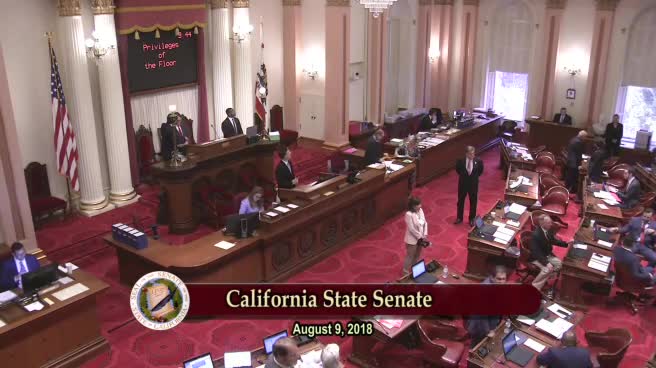
Bill Author
Bill Co-Author(s):