SB 1309: Fishing: Fisheries Omnibus Bill of 2018.
- Session Year: 2017-2018
- House: Senate
- Latest Version Date: 2018-09-30
(1)Existing law prohibits specified persons from taking salmon for commercial purposes unless the person has a commercial fishing salmon stamp affixed to that persons commercial fishing license. Existing law requires the Department of Fish and Wildlife to issue a commercial fishing salmon stamp upon application for the stamp and payment of a base fee of $85. That base fee is required to be adjusted during specified commercial salmon seasons. However, existing law prohibits the total fees, as adjusted, from exceeding $260. Existing law requires the department to deposit revenues from this fee, funds received from other sources, as specified, and other specified revenues in the Commercial Salmon Stamp Dedicated Subaccount in the Fish and Game Preservation Fund, to be available, upon appropriation by the Legislature, for purposes relating to enhancement and restoration of salmon. Existing law also authorizes up to 15% of funds expended from the subaccount for these purposes to be used for administrative costs. Existing law establishes the Commercial Salmon Trollers Advisory Committee, consisting of 6 members selected by the Director of Fish and Wildlife, as provided, to make recommendations on programs and a budget for the subaccount, and on specified revenue-raising measures. Existing law repeals these provisions as of January 1, 2019. A violation of any provision of the Fish and Game Code, or any rule, regulation, or order made or adopted under those provisions, is a misdemeanor, unless otherwise specified.
This bill would extend the operation of these provisions until January 1, 2029. By extending the operation of existing requirements, the violation of which would be a crime, the bill would impose a state-mandated local program.
(2)Existing law prohibits the taking of anchovies for any purpose in Humboldt Bay, except that anchovies may be taken in specified areas of the bay for live bait between May 1 and December 1, and for dead bait between May 1 and August 31, by the operator of a vessel for use in his or her own fishing operation, except for incidental sales to local sport fishermen for bait. Existing law establishes a 15-ton limit on the total number of anchovies that may be taken between May 1 and August 31 of each year and a 15-ton limit between September 1 and December 1 of each year. Existing law requires an observer employed by the Department of Fish and Wildlife to inspect any bait operation and halt that operation if it cannot be conducted without adversely affecting the game species of the bay. Existing law requires the department to receive notification of a bait operation in the bay at least 12 hours before the operation commences. Existing law authorizes the Fish and Game Commission to adopt any other regulation it determines is necessary to protect the Humboldt Bay anchovy resource.
This bill would permit taking of anchovies in Humboldt Bay between May 1 and December 1 without restrictions on area or use. Instead of 2 15-ton limits on the taking of anchovies in 2 separate periods, the bill would authorize not more than 60 tons of anchovies to be taken between May 1 and December 1 of each year. The bill would include, as part of the commissions regulatory authority to protect anchovy in Humboldt Bay, the authority to adopt a regulation that changes this permitted take amount based upon credible science. The bill would delete the above-described provisions regarding inspection and notification of bait operations. By changing the definition of a crime, the bill would impose a state-mandated local program.
(3)Existing law regulates the Dungeness crab fishery and, among other things, permits the Director of Fish and Wildlife to delay the opening of the fishery in specified situations and regulates the taking of Dungeness crab during those delays.
This bill would require the Department of Fish and Wildlife, on or before November 1, 2020, in consultation with the California Dungeness Crab Fishing Gear Working Group and other stakeholders, to adopt regulations establishing criteria and protocols to evaluate and respond to potential risk of marine life entanglement, as prescribed. Upon the effective date of these regulations, the bill would authorize the director to restrict the take of Dungeness crab pursuant to the criteria and protocols. Until those regulations become effective or until November 1, 2020, whichever is sooner, the bill would authorize the director to restrict the take of Dungeness crab in those areas where the Dungeness crab fishery is being conducted in a manner that poses a significant risk of marine life entanglement if the director makes a specified determination, in consultation with the working group, and after the director complies with specified procedures. The bill would require the director to expeditiously lift any restriction in waters if the director determines, in consultation with the working group, that the significant risk has abated in those waters. The bill would repeal these provisions on January 1, 2024. Because a violation of these provisions would be a crime, the bill would impose a state-mandated local program.
(4)Existing law requires any vessel using bottom trawl gear in state-managed halibut fisheries to possess a California halibut bottom trawl vessel permit issued by the Department of Fish and Wildlife that authorizes the use of trawl gear by that vessel for the take of California halibut. Existing law requires a permit to be issued annually, and, since the 200708 season, has required an applicant to have previously held a valid permit. Existing law prohibits the department from issuing a permit unless a vessel has landed a minimum of 200 pounds of California halibut in specified calendar years before 2005, as provided, as documented on fish landing receipts. Existing law only authorizes transfer of a permit to another vessel if the transfer occurs before the implementation of a restricted access program and either the originally permitted vessel was lost, stolen, destroyed, or suffered a major irreparable mechanical breakdown, or the permitholder has died, is permanently disabled, or has retired, and, in the case of death, disability, or retirement, California halibut landings contributed significantly to the record and economic income derived from the vessel, as determined by regulations adopted by the Fish and Game Commission. Under existing law, these provisions will become inoperative upon the adoption by the commission of a halibut fishery management plan, as specified.
This bill would repeal the above-described provisions conditioning issuance of a permit on landings in calendar years before 2005. The bill would repeal both of the above-described limitations on the circumstances under which a transfer may be authorized, and would authorize the department, rather than the commission, before the implementation of a restricted access program, to consider a request to transfer a permit to another vessel owned by the permitholder or to another person, as provided, without regard to either of those limitations. The bill would authorize an applicant who is denied a transfer of a permit to appeal the denial in writing to the commission within 60 days from the date of the departments decision.
(5)Existing law designates a specified area as the California halibut trawl grounds and regulates trawl net fishing within the trawl grounds. Existing law specifies trawl net fishing season in the trawl grounds. Existing law authorizes the Director of Fish and Wildlife to close the trawl grounds, or portions of the trawl grounds, to trawl net fishing or restrict the nets that may be used in the trawl grounds, or portions of the trawl grounds, if the director determines that the California halibut resource, or existing fishing operations, are in danger of irreparable injury, as provided. Existing law closes specified areas in the trawl grounds to trawl gear, and closes other specified areas unless the Fish and Game Commission finds that a bottom trawl fishery for halibut minimizes bycatch, is likely not damaging sea floor habitat, is not adversely affecting ecosystem health, and is not impeding reasonable restoration of kelp, coral, or other biogenic habitats. Existing law requires the commission to close additional areas in the trawl grounds if it makes certain findings pursuant to a mandatory triennial review.
This bill would designate 2 additional areas as California halibut trawl grounds: an area of the ocean waters of Monterey Bay, as described, and an area of ocean waters offshore of Port San Luis, as described. However, under the bill, those additional areas would remain closed to trawling until the commission determines that trawling in those areas is consistent with the above-described provisions. The bill would also provide that trawl fishing gear may only be deployed in those additional areas between sunrise and sunset. By changing the definition of a crime and creating new crimes, the bill would impose a state-mandated local program.
The bill authorize the commission to reduce the length of the open season or hours of operation specified in statute and to modify specified statutory requirements applicable to the use of trawl nets in the California halibut trawl grounds to make those requirements more restrictive.
(6)Existing law authorizes the Department of Fish and Wildlife, in consultation with the Dungeness crab task force, to develop regulations as necessary to provide for the retrieval of lost or abandoned commercial crab traps. Existing law requires the department, as part of those regulations, to establish a retrieval permit program that grants a person who obtains a retrieval permit the authority to retrieve during the closed season of the Dungeness crab commercial fishery lost or abandoned Dungeness crab traps belonging to another person and to receive compensation for that retrieval on a per trap basis. Existing law requires the department to establish a fee to be charged to a Dungeness crab vessel permitholder for each trap belonging to the permitholder that is retrieved through the program. Existing law prohibits the department from renewing a Dungeness crab vessel permit until any fee imposed pursuant to the program has been paid. Existing law provides that these provisions shall become inoperative on April 1, 2019, and, as of January 1, 2020, are repealed.
This bill would revise and recast these provisions. The bill would require the department, in consultation with the Dungeness crab task force, to establish a retrieval program to provide for the retrieval of lost or abandoned commercial Dungeness crab traps by June 30, 2019. The bill would require, as part of the program, the department to establish a retrieval permit similar to the one described above, but would require the payment of a permit fee to obtain a retrieval permit and would provide that any Dungeness crab trap retrieved under the authority of a retrieval permit would become the property of the retrieval permitholder. The bill would require a retrieval permitholder to notify the former trap owner of the retrieval of a Dungeness crab trap and to offer to sell the trap to the former owner for a reasonable recovery fee. The bill would require the department to impose per-trap fees on any former owner who refuses to pay the recovery fee to the retrieval permitholder. The bill would require the department to set the rate of these fees at a level sufficient to recover any costs to the department from handling noncompliance with the gear retrieval program and to reimburse the retrieval permitholder, as provided, and would require the department, upon appropriation by the Legislature, to use the proceeds of these fees for those purposes. The bill would authorize, rather than require, the department to deny an application for renewal or transfer of a Dungeness crab vessel permit until the applicant pays any fees imposed for failure to pay a recovery fee to a retrieval permitholder. The bill would make the revised provisions inoperative on April 1, 2029. By extending the operation of existing requirements, the violation of which would be a crime, the bill would impose a state-mandated local program.
(7)Existing law requires every trap or string of traps in state waters to be marked with a buoy.
This bill would require the Department of Fish and Wildlife, by January 1, 2020, to implement regulations requiring standardized gear marking for those fisheries in which the department determines it is appropriate. The bill would require the department to establish a gear marking fee for each fishery requiring standardized gear marking and to set and adjust each fee in an amount to fully recover, but not exceed, all reasonable administrative and implementation costs of the department relating to the gear marking requirement. Because a violation of these regulations would be a crime, the bill would impose a state-mandated local program.
(8)The California Constitution requires the state to reimburse local agencies and school districts for certain costs mandated by the state. Statutory provisions establish procedures for making that reimbursement.
This bill would provide that no reimbursement is required by this act for a specified reason.
(1)Existing law prohibits specified persons from taking salmon for commercial purposes unless the person has a commercial fishing salmon stamp affixed to that persons commercial fishing license. Existing law requires the Department of Fish and Wildlife to issue a commercial fishing salmon stamp upon application for the stamp and payment of a base fee of $85. That base fee is required to be adjusted during specified commercial salmon seasons. However, existing law prohibits the total fees, as adjusted, from exceeding $260. Existing law requires the department to deposit revenues from this fee, funds received from other sources, as specified, and other specified revenues in the Commercial Salmon Stamp Dedicated Subaccount in the Fish and Game Preservation Fund, to be available, upon appropriation by the Legislature, for purposes relating to enhancement and restoration of salmon. Existing law also authorizes up to 15% of funds expended from the subaccount for these purposes to be used for administrative costs. Existing law establishes the Commercial Salmon Trollers Advisory Committee, consisting of 6 members selected by the Director of Fish and Wildlife, as provided, to make recommendations on programs and a budget for the subaccount, and on specified revenue-raising measures. Existing law repeals these provisions as of January 1, 2019. A violation of any provision of the Fish and Game Code, or any rule, regulation, or order made or adopted under those provisions, is a misdemeanor, unless otherwise specified.
This bill would extend the operation of these provisions until January 1, 2029. By extending the operation of existing requirements, the violation of which would be a crime, the bill would impose a state-mandated local program.
(2)Existing law prohibits the taking of anchovies for any purpose in Humboldt Bay, except that anchovies may be taken in specified areas of the bay for live bait between May 1 and December 1, and for dead bait between May 1 and August 31, by the operator of a vessel for use in his or her own fishing operation, except for incidental sales to local sport fishermen for bait. Existing law establishes a 15-ton limit on the total number of anchovies that may be taken between May 1 and August 31 of each year and a 15-ton limit between September 1 and December 1 of each year. Existing law requires an observer employed by the Department of Fish and Wildlife to inspect any bait operation and halt that operation if it cannot be conducted without adversely affecting the game species of the bay. Existing law requires the department to receive notification of a bait operation in the bay at least 12 hours before the operation commences. Existing law authorizes the Fish and Game Commission to adopt any other regulation it determines is necessary to protect the Humboldt Bay anchovy resource.
This bill would permit taking of anchovies in Humboldt Bay between May 1 and December 1 without restrictions on area or use. Instead of 2 15-ton limits on the taking of anchovies in 2 separate periods, the bill would authorize not more than 60 tons of anchovies to be taken between May 1 and December 1 of each year. The bill would make this 60-ton take authority subject to an initial determination by the commission that the authority is consistent with the commissions forage species policy, as specified. The bill would include, as part of the commissions regulatory authority to protect the Humboldt Bay anchovy resource, anchovy in Humboldt Bay, the authority to adopt a regulation that changes this permitted take amount based upon credible science. The bill would delete the above-described provisions regarding inspection and notification of bait operations. By changing the definition of a crime, the bill would impose a state-mandated local program.
(3)Existing law regulates the Dungeness crab fishery and, among other things, permits the Director of Fish and Wildlife to delay the opening of the fishery in specified situations and regulates the taking of Dungeness crab during those delays.
This bill would require the Department of Fish and Wildlife, on or before November 1, 2020, in consultation with the California Dungeness Crab Fishing Gear Working Group and other stakeholders, to adopt regulations establishing criteria and protocols to evaluate and respond to potential risk of marine life entanglement, as prescribed. Upon the effective date of these regulations, the bill would authorize the director to restrict the take of Dungeness crab pursuant to the criteria and protocols. Until those regulations become effective or until November 1, 2020, whichever is sooner, the bill would authorize the director to restrict the take of Dungeness crab in those areas where the Dungeness crab fishery is being conducted in a manner that poses a significant risk of marine life entanglement if the director makes a specified determination, in consultation with the working group, and after the director complies with specified procedures. The bill would require the director to expeditiously lift any restriction in waters if the director determines, in consultation with the working group, that the significant risk has abated in those waters. The bill would repeal these provisions on January 1, 2024. Because a violation of these provisions would be a crime, the bill would impose a state-mandated local program.
(4)Existing law requires any vessel using bottom trawl gear in state-managed halibut fisheries to possess a California halibut bottom trawl vessel permit issued by the Department of Fish and Wildlife that authorizes the use of trawl gear by that vessel for the take of California halibut. Existing law requires a permit to be issued annually, and, since the 200708 season, has required an applicant to have previously held a valid permit. Existing law prohibits the department from issuing a permit unless a vessel has landed a minimum of 200 pounds of California halibut in specified calendar years before 2005, as provided, as documented on fish landing receipts. Existing law only authorizes transfer of a permit to another vessel if the transfer occurs before the implementation of a restricted access program and either the originally permitted vessel was lost, stolen, destroyed, or suffered a major irreparable mechanical breakdown, or the permitholder has died, is permanently disabled, or has retired, and, in the case of death, disability, or retirement, California halibut landings contributed significantly to the record and economic income derived from the vessel, as determined by regulations adopted by the Fish and Game Commission. Under existing law, these provisions will become inoperative upon the adoption by the commission of a halibut fishery management plan, as specified.
This bill would repeal the above-described provisions conditioning issuance of a permit on landings in calendar years before 2005. The bill would repeal both of the above-described limitations on the circumstances under which a transfer may be authorized, and would authorize the department, rather than the commission, before the implementation of a restricted access program, to consider a request to transfer a permit to another vessel, vessel owned by the permitholder or to another person, as provided, without regard to either of those limitations. The bill would authorize an applicant who is denied a transfer of a permit to appeal the denial in writing to the commission within 60 days from the date of the departments decision.
(5)Existing law designates a specified area as the California halibut trawl grounds and regulates trawl net fishing within the trawl grounds. Existing law specifies trawl net fishing season in the trawl grounds. Existing law authorizes the Director of Fish and Wildlife to close the trawl grounds, or portions of the trawl grounds, to trawl net fishing or restrict the nets that may be used in the trawl grounds, or portions of the trawl grounds, if the director determines that the California halibut resource, or existing fishing operations, are in danger of irreparable injury, as provided. Existing law closes specified areas in the trawl grounds to trawl gear, and closes other specified areas unless the Fish and Game Commission finds that a bottom trawl fishery for halibut minimizes bycatch, is likely not damaging sea floor habitat, is not adversely affecting ecosystem health, and is not impeding reasonable restoration of kelp, coral, or other biogenic habitats. Existing law requires the commission to close additional areas in the trawl grounds if it makes certain findings pursuant to a mandatory triennial review.
This bill would designate 2 additional areas as California halibut trawl grounds: an area of the ocean waters of Monterey Bay, as described, and an area of ocean waters offshore of Port San Luis, as described. However, under the bill, those additional areas would remain closed to trawling until the commission determines that trawling in those areas is consistent with the above-described provisions. The bill would also provide that trawl fishing gear may only be deployed in those additional areas between sunrise and sunset. By changing the definition of a crime and creating new crimes, the bill would impose a state-mandated local program.
The bill authorize the commission to reduce the length of the open season or hours of operation specified in statute and to modify specified statutory requirements applicable to the use of trawl nets in the California halibut trawl grounds to make those requirements more restrictive.
(6)Existing law authorizes the Department of Fish and Wildlife, in consultation with the Dungeness crab task force, to develop regulations as necessary to provide for the retrieval of lost or abandoned commercial crab traps. Existing law requires the department, as part of those regulations, to establish a retrieval permit program that grants a person who obtains a retrieval permit the authority to retrieve during the closed season of the Dungeness crab commercial fishery lost or abandoned Dungeness crab traps belonging to another person and to receive compensation for that retrieval on a per trap basis. Existing law requires the department to establish a fee to be charged to a Dungeness crab vessel permitholder for each trap belonging to the permitholder that is retrieved through the program. Existing law prohibits the department from renewing a Dungeness crab vessel permit until any fee imposed pursuant to the program has been paid. Existing law provides that these provisions shall become inoperative on April 1, 2019, and, as of January 1, 2020, are repealed.
This bill would revise and recast these provisions. The bill would require the department, in consultation with the Dungeness crab task force, to establish a retrieval program to provide for the retrieval of lost or abandoned commercial Dungeness crab traps by June 30, 2019. The bill would require, as part of the program, the department to establish a retrieval permit similar to the one described above, but would require the payment of a permit fee to obtain a retrieval permit and would provide that any Dungeness crab trap retrieved under the authority of a retrieval permit would become the property of the retrieval permitholder. The bill would require a retrieval permitholder to notify the former trap owner of the retrieval of a Dungeness crab trap and to offer to sell the trap to the former owner for a reasonable recovery fee. The bill would require the department to impose a per-trap fee fees on any former owner who refuses to pay the recovery fee to the retrieval permitholder and to use the proceeds of that fee permitholder. The bill would require the department to set the rate of these fees at a level sufficient to recover any costs to the department from handling noncompliance with the gear retrieval program and to reimburse the retrieval permitholder. permitholder, as provided, and would require the department, upon appropriation by the Legislature, to use the proceeds of these fees for those purposes. The bill would authorize, rather than require, the department to deny an application for renewal or transfer of a Dungeness crab vessel permit until the applicant pays any fees imposed for failure to pay a recovery fee to a retrieval permitholder. The bill would make the revised provisions inoperative on April 1, 2029. By extending the operation of existing requirements, the violation of which would be a crime, the bill would impose a state-mandated local program.
(7)Existing law requires every trap or string of traps in state waters to be marked with a buoy.
This bill would require the Department of Fish and Wildlife, by January 1, 2020, to implement regulations requiring all traps and buoys to include standardized gear marking and clear identification of ownership. standardized gear marking for those fisheries in which the department determines it is appropriate. The bill would require the department to establish a gear marking fee for each fishery requiring standardized gear marking and to set and adjust each fee in an amount to fully recover, but not exceed, all reasonable administrative and implementation costs of the department relating to the gear marking requirement. Because a violation of these regulations would be a crime, the bill would impose a state-mandated local program.
(8)The California Constitution requires the state to reimburse local agencies and school districts for certain costs mandated by the state. Statutory provisions establish procedures for making that reimbursement.
This bill would provide that no reimbursement is required by this act for a specified reason.
(1)Existing law prohibits specified persons from taking salmon for commercial purposes unless the person has a commercial fishing salmon stamp affixed to that persons commercial fishing license. Existing law requires the Department of Fish and Wildlife to issue a commercial fishing salmon stamp upon application for the stamp and payment of a base fee of $85. That base fee is required to be adjusted during specified commercial salmon seasons. However, existing law prohibits the total fees, as adjusted, from exceeding $260. Existing law requires the department to deposit revenues from this fee, funds received from other sources, as specified, and other specified revenues in the Commercial Salmon Stamp Dedicated Subaccount in the Fish and Game Preservation Fund, to be available, upon appropriation by the Legislature, for purposes relating to enhancement and restoration of salmon. Existing law also authorizes up to 15% of funds expended from the subaccount for these purposes to be used for administrative costs. Existing law establishes the Commercial Salmon Trollers Advisory Committee, consisting of 6 members selected by the Director of Fish and Wildlife, as provided, to make recommendations on programs and a budget for the subaccount, and on specified revenue-raising measures. Existing law repeals these provisions as of January 1, 2019. A violation of any provision of the Fish and Game Code, or any rule, regulation, or order made or adopted under those provisions, is a misdemeanor, unless otherwise specified.
This bill would extend the operation of these provisions until January 1, 2029. By extending the operation of existing requirements, the violation of which would be a crime, the bill would impose a state-mandated local program.
(2)Existing law prohibits the taking of anchovies for any purpose in Humboldt Bay, except that anchovies may be taken in specified areas of the bay for live bait between May 1 and December 1, and for dead bait between May 1 and August 31, by the operator of a vessel for use in his or her own fishing operation, except for incidental sales to local sport fishermen for bait. Existing law establishes a 15-ton limit on the total number of anchovies that may be taken between May 1 and August 31 of each year and a 15-ton limit between September 1 and December 1 of each year. Existing law requires an observer employed by the Department of Fish and Wildlife to inspect any bait operation and halt that operation if it cannot be conducted without adversely affecting the game species of the bay. Existing law requires the department to receive notification of a bait operation in the bay at least 12 hours before the operation commences. Existing law authorizes the Fish and Game Commission to adopt any other regulation it determines is necessary to protect the Humboldt Bay anchovy resource.
This bill would permit taking of anchovies in Humboldt Bay between May 1 and December 1 without restrictions on area or use. Instead of 2 15-ton limits on the taking of anchovies in 2 separate periods, the bill would authorize not more than 60 tons of anchovies to be taken between May 1 and December 1 of each year. The bill would make this 60-ton take authority subject to an initial determination by the commission that the authority is consistent with the commissions forage species policy, as specified. The bill would include, as part of the commissions regulatory authority to protect the Humboldt Bay anchovy resource, the authority to adopt a regulation that changes this permitted take amount based upon credible science. The bill would delete the above-described provisions regarding inspection and notification of bait operations. By changing the definition of a crime, the bill would impose a state-mandated local program.
(3)Existing law regulates the Dungeness crab fishery and, among other things, permits the Director of Fish and Wildlife to delay the opening of the fishery in specified situations and regulates the taking of Dungeness crab during those delays.
This bill would require the department, Department of Fish and Wildlife, on or before November 1, 2020, in consultation with the California Dungeness Crab Fishing Gear Working Group and other stakeholders, to adopt regulations establishing criteria and protocols to evaluate and respond to potential risk of marine life entanglement, as prescribed. Upon the effective date of these regulations, the bill would authorize the director to restrict the take of Dungeness crab pursuant to the criteria and protocols. Until those regulations become effective or until November 1, 2020, whichever is sooner, the bill would authorize the director to restrict the take of Dungeness crab in those areas where the Dungeness crab fishery is being conducted in a manner that poses a significant risk of marine mammal life entanglement if the director makes a specified determination, in consultation with the working group, and after the director complies with specified procedures. The bill would require the director to expeditiously lift any restriction in waters if the director determines, in consultation with the working group, that the significant risk has abated in those waters. The bill would repeal these provisions on January 1, 2024. Because a violation of these provisions would be a crime, the bill would impose a state-mandated local program.
(4)Existing law requires any vessel using bottom trawl gear in state-managed halibut fisheries to possess a California halibut bottom trawl vessel permit issued by the Department of Fish and Wildlife that authorizes the use of trawl gear by that vessel for the take of California halibut. Existing law requires a permit to be issued annually, and, since the 200708 season, has required an applicant to have previously held a valid permit. Existing law prohibits the department from issuing a permit unless a vessel has landed a minimum of 200 pounds of California halibut in specified calendar years before 2005, as provided, as documented on fish landing receipts. Existing law only authorizes transfer of a permit to another vessel if the transfer occurs before the implementation of a restricted access program and either the originally permitted vessel was lost, stolen, destroyed, or suffered a major irreparable mechanical breakdown, or the permitholder has died, is permanently disabled, or has retired, and, in the case of death, disability, or retirement, California halibut landings contributed significantly to the record and economic income derived from the vessel, as determined by regulations adopted by the Fish and Game Commission. Under existing law, these provisions will become inoperative upon the adoption by the commission of a halibut fishery management plan, as specified.
This bill would repeal the above-described provisions conditioning issuance of a permit on landings in calendar years before 2005. The bill would repeal both of the above-described limitations on the circumstances under which a transfer may be authorized, and would authorize the commission, before the implementation of a restricted access program, to consider a request to transfer a permit to another vessel, as provided, without regard to either of those limitations.
(5)Existing law designates a specified area as the California halibut trawl grounds and regulates trawl net fishing within the trawl grounds. Existing law specifies trawl net fishing season in the trawl grounds. Existing law authorizes the Director of Fish and Wildlife to close the trawl grounds, or portions of the trawl grounds, to trawl net fishing or restrict the nets that may be used in the trawl grounds, or portions of the trawl grounds, if the director determines that the California halibut resource, or existing fishing operations, are in danger of irreparable injury, as provided. Existing law closes specified areas in the trawl grounds to trawl gear, and closes other specified areas unless the Fish and Game Commission finds that a bottom trawl fishery for halibut minimizes bycatch, is likely not damaging sea floor habitat, is not adversely affecting ecosystem health, and is not impeding reasonable restoration of kelp, coral, or other biogenic habitats. Existing law requires the commission to close additional areas in the trawl grounds if it makes certain findings pursuant to a mandatory triennial review.
This bill would designate 2 additional areas as California halibut trawl grounds: an area of the ocean waters of Monterey Bay, as described, and an area of ocean waters offshore of Port San Luis, as described. However, under the bill, those additional areas would remain closed to trawling until the commission determines that trawling in those areas is consistent with the above-described provisions. The bill would also provide that trawl fishing gear may only be deployed in those additional areas between sunrise and sunset. By changing the definition of a crime and creating new crimes, the bill would impose a state-mandated local program.
(6)Existing law authorizes the Department of Fish and Wildlife, in consultation with the Dungeness crab task force, to develop regulations as necessary to provide for the retrieval of lost or abandoned commercial crab traps. Existing law requires the department, as part of those regulations, to establish a retrieval permit program that grants a person who obtains a retrieval permit the authority to retrieve during the closed season of the Dungeness crab commercial fishery lost or abandoned Dungeness crab traps belonging to another person and to receive compensation for that retrieval on a per trap basis. Existing law requires the department to establish a fee to be charged to a Dungeness crab vessel permitholder for each trap belonging to the permitholder that is retrieved through the program. Existing law prohibits the department from renewing a Dungeness crab vessel permit until any fee imposed pursuant to the program has been paid. Existing law provides that these provisions shall become inoperative on April 1, 2019, and, as of January 1, 2020, are repealed.
This bill would revise and recast these provisions. The bill would require the department, in consultation with the Dungeness crab task force, to establish a retrieval program to provide for the retrieval of lost or abandoned commercial Dungeness crab traps by June 30, 2019. The bill would require, as part of the program, the department to establish a retrieval permit similar to the one described above, but would require the payment of a permit fee to obtain a retrieval permit and would provide that any Dungeness crab trap retrieved under the authority of a retrieval permit would become the property of the retrieval permitholder. The bill would require a retrieval permitholder to notify the former trap owner of the retrieval of a Dungeness crab trap and to offer to sell the trap to the former owner for a reasonable recovery fee. The bill would require the department to impose a per-trap fee on any former owner who refuses to pay the recovery fee to the retrieval permitholder and to use the proceeds of that fee to reimburse the retrieval permitholder. The bill would authorize, rather than require, the department to deny an application for renewal or transfer of a Dungeness crab vessel permit until the applicant pays any fees imposed for failure to pay a recovery fee to a retrieval permitholder. The bill would make the revised provisions inoperative on April 1, 2029. By extending the operation of existing requirements, the violation of which would be a crime, the bill would impose a state-mandated local program.
(7)Existing law requires every trap or string of traps in state waters to be marked with a buoy.
This bill would require the Department of Fish and Wildlife, by January 1, 2020, to implement regulations requiring all traps and buoys to include standardized gear marking and clear identification of ownership. Because a violation of these regulations would be a crime, the bill would impose a state-mandated local program.
(8)The California Constitution requires the state to reimburse local agencies and school districts for certain costs mandated by the state. Statutory provisions establish procedures for making that reimbursement.
This bill would provide that no reimbursement is required by this act for a specified reason.
(1)Existing law prohibits specified persons from taking salmon for commercial purposes unless the person has a commercial fishing salmon stamp affixed to that persons commercial fishing license. Existing law requires the Department of Fish and Wildlife to issue a commercial fishing salmon stamp upon application for the stamp and payment of a base fee of $85. That base fee is required to be adjusted during specified commercial salmon seasons. However, existing law prohibits the total fees, as adjusted, from exceeding $260. Existing law requires the department to deposit revenues from this fee, funds received from other sources, as specified, and other specified revenues in the Commercial Salmon Stamp Dedicated Subaccount in the Fish and Game Preservation Fund, to be available, upon appropriation by the Legislature, for purposes relating to enhancement and restoration of salmon. Existing law also authorizes up to 15% of funds expended from the subaccount for these purposes to be used for administrative costs. Existing law establishes the Commercial Salmon Trollers Advisory Committee, consisting of 6 members selected by the Director of Fish and Wildlife, as provided, to make recommendations on programs and a budget for the subaccount, and on specified revenue-raising measures. Existing law repeals these provisions as of January 1, 2019. A violation of any provision of the Fish and Game Code, or any rule, regulation, or order made or adopted under those provisions, is a misdemeanor, unless otherwise specified.
This bill would extend the operation of these provisions until January 1, 2029. By extending the operation of existing requirements, the violation of which would be a crime, the bill would impose a state-mandated local program.
(2)Existing law prohibits the taking of anchovies for any purpose in Humboldt Bay, except that anchovies may be taken in specified areas of the bay for live bait between May 1 and December 1, and for dead bait between May 1 and August 31, by the operator of a vessel for use in his or her own fishing operation, except for incidental sales to local sport fishermen for bait. Existing law establishes a 15-ton limit on the total number of anchovies that may be taken between May 1 and August 31 of each year and a 15-ton limit between September 1 and December 1 of each year. Existing law requires an observer employed by the Department of Fish and Wildlife to inspect any bait operation and halt that operation if it cannot be conducted without adversely affecting the game species of the bay. Existing law requires the department to receive notification of a bait operation in the bay at least 12 hours before the operation commences. Existing law authorizes the Fish and Game Commission to adopt any other regulation it determines is necessary to protect the Humboldt Bay anchovy resource.
This bill would permit taking of anchovies in Humboldt Bay between May 1 and December 1 without restrictions on area or use. Instead of 2 15-ton limits on the taking of anchovies in 2 separate periods, the bill would authorize not more than 60 tons of anchovies to be taken between May 1 and December 1 of each year. The bill would make this 60-ton take authority subject to an initial determination by the commission that the authority is consistent with the commissions forage species policy, as specified. The bill would include, as part of the commissions regulatory authority to protect the Humboldt Bay anchovy resource, the authority to adopt a regulation that changes this permitted take amount based upon credible science. The bill would delete the above-described provisions regarding inspection and notification of bait operations. By changing the definition of a crime, the bill would impose a state-mandated local program.
(3)Existing law regulates the Dungeness crab fishery and, among other things, permits the Director of Fish and Wildlife to delay the opening of the fishery in specified situations and regulates the taking of Dungeness crab during those delays.
This bill would express the intent of the Legislature that the Department of Fish and Wildlife, with the meaningful participation of the California Dungeness Crab Fishing Gear Working Group, as defined, and other stakeholders, develop procedures to limit the risk of entanglement of marine life from Dungeness crab fishing gear during the Dungeness crab fishing season. The bill would require the working group to evaluate the relative risk of whale entanglements, and the department, in consultation with the working group, to develop protocols and criteria including, but not limited to, the Risk Assessment and Mitigation Program developed by the working group, for potential action to mitigate that risk.This bill would require the department, on or before November 1, 2020, in consultation with the California Dungeness Crab Fishing Gear Working Group and other stakeholders, to adopt regulations establishing criteria and protocols to evaluate and respond to potential risk of marine life entanglement, as prescribed. Upon the effective date of these regulations, the bill would authorize the director to restrict the take of Dungeness crab pursuant to the criteria and protocols. Until those regulations become effective or until November 1, 2020, whichever is sooner, the bill would authorize the director to restrict the take of Dungeness crab in those areas where the Dungeness crab fishery is being conducted in a manner that poses a significant risk of marine mammal entanglement if the director makes a specified determination, in consultation with the working group, and after the director complies with specified procedures. The bill would require the director to expeditiously lift any restriction in waters if the director determines, in consultation with the working group, that the significant risk has abated in those waters. Because a violation of these provisions would be a crime, the bill would impose a state-mandated local program.
(4)Existing law requires any vessel using bottom trawl gear in state-managed halibut fisheries to possess a California halibut bottom trawl vessel permit issued by the Department of Fish and Wildlife that authorizes the use of trawl gear by that vessel for the take of California halibut. Existing law requires a permit to be issued annually, and, since the 200708 season, has required an applicant to have previously held a valid permit. Existing law prohibits the department from issuing a permit unless a vessel has landed a minimum of 200 pounds of California halibut in specified calendar years before 2005, as provided, as documented on fish landing receipts. Existing law only authorizes transfer of a permit to another vessel if the transfer occurs before the implementation of a restricted access program and either the originally permitted vessel was lost, stolen, destroyed, or suffered a major irreparable mechanical breakdown, or the permitholder has died, is permanently disabled, or has retired, and, in the case of death, disability, or retirement, California halibut landings contributed significantly to the record and economic income derived from the vessel, as determined by regulations adopted by the Fish and Game Commission. Under existing law, these provisions will become inoperative upon the adoption by the Fish and Game Commission commission of a halibut fishery management plan, as specified.
This bill would delete repeal the above-described provisions conditioning issuance of a permit on landings in calendar years before 2005. The bill would delete repeal both of the above-described limitations on the circumstances under which a transfer may be authorized, and would authorize the commission, before the implementation of a restricted access program, to consider a request to transfer a permit to another vessel, as provided, without regard to either of those limitations.
(5)Existing law designates a specified area as the California halibut trawl grounds and regulates trawl net fishing within the trawl grounds. Existing law specifies trawl net fishing season in the trawl grounds. Existing law authorizes the Director of Fish and Wildlife to close the trawl grounds, or portions of the trawl grounds, to trawl net fishing or restrict the nets that may be used in the trawl grounds, or portions of the trawl grounds, if the director determines that the California halibut resource, or existing fishing operations, are in danger of irreparable injury, as provided. Existing law closes specified areas in the trawl grounds to trawl gear, and closes other specified areas unless the Fish and Game Commission finds that a bottom trawl fishery for halibut minimizes bycatch, is likely not damaging sea floor habitat, is not adversely affecting ecosystem health, and is not impeding reasonable restoration of kelp, coral, or other biogenic habitats. Existing law requires the commission to close additional areas in the trawl grounds if it makes certain findings pursuant to a mandatory triennial review.
This bill would designate two 2 additional areas as California halibut trawl grounds: an area of the ocean waters of Monterey Bay, as described, and an area of ocean waters offshore of Port San Luis, as described. However, under the bill, those additional areas would remain closed to trawling until the commission determines that trawling in those areas is consistent with the above-described provisions. The bill would also provide that trawl fishing gear may only be deployed in those additional areas between sunrise and sunset. By changing the definition of a crime and creating new crimes, the bill would impose a state-mandated local program.
(6)Existing law authorizes the Department of Fish and Wildlife, in consultation with the Dungeness crab task force, to develop regulations as necessary to provide for the retrieval of lost or abandoned commercial crab traps. Existing law requires the department, as part of those regulations, to establish a retrieval permit program that grants a person who obtains a retrieval permit the authority to retrieve during the closed season of the Dungeness crab commercial fishery lost or abandoned Dungeness crab traps belonging to another person and to receive compensation for that retrieval on a per trap basis. Existing law requires the department to establish a fee to be charged to a Dungeness crab vessel permitholder for each trap belonging to the permitholder that is retrieved through the program. Existing law prohibits the department from renewing a Dungeness crab vessel permit until any fee imposed pursuant to the program has been paid. Existing law provides that these provisions shall become inoperative on April 1, 2019, and, as of January 1, 2020, are repealed.
This bill would revise and recast these provisions. The bill would require the department, in consultation with the Dungeness crab task force, to establish a retrieval program to provide for the retrieval of lost or abandoned commercial Dungeness crab traps by June 30. 30, 2019. The bill would require, as part of the program, the department to establish a retrieval permit similar to the one described above, but would require the payment of a permit fee to obtain a retrieval permit and would provide that any Dungeness crab trap retrieved under the authority of a retrieval permit would become the property of the retrieval permitholder. The bill would require a retrieval permitholder to notify the former trap owner of the retrieval of a Dungeness crab trap and to offer to sell the trap to the former owner for a reasonable recovery fee. The bill would require the department to impose a per-trap fee on any former owner who refuses to pay the recovery fee to the retrieval permitholder and to use the proceeds of that fee to reimburse the retrieval permitholder. The bill would authorize, rather than require, the department to deny an application for renewal or transfer of a Dungeness crab vessel permit until the applicant pays any fees imposed for failure to pay a recovery fee to a retrieval permitholder. The bill would extend the inoperative and repeal dates of these provisions until April 1, 2029, and January 1, 2030, respectively. make the revised provisions inoperative on April 1, 2029. By extending the operation of existing requirements, the violation of which would be a crime, the bill would impose a state-mandated local program.
(7)Existing law requires every trap or string of traps in state waters to be marked with a buoy.
This bill would require the Department of Fish and Wildlife, by January 1, 2020, to implement regulations requiring all traps and buoys to include standardized gear marking and clear identification of ownership. Because a violation of these regulations would be a crime, the bill would impose a state-mandated local program.
(8)The(8)The California Constitution requires the state to reimburse local agencies and school districts for certain costs mandated by the state. Statutory provisions establish procedures for making that reimbursement.
This bill would provide that no reimbursement is required by this act for a specified reason.
(1)Existing law prohibits specified persons from taking salmon for commercial purposes unless the person has a commercial fishing salmon stamp affixed to that persons commercial fishing license. Existing law requires the Department of Fish and Wildlife to issue a commercial fishing salmon stamp upon application for the stamp and payment of a base fee of $85. That base fee is required to be adjusted during specified commercial salmon seasons. However, existing law prohibits the total fees, as adjusted, from exceeding $260. Existing law requires the department to deposit revenues from this fee, funds received from other sources, as specified, and other specified revenues in the Commercial Salmon Stamp Dedicated Subaccount in the Fish and Game Preservation Fund, to be available, upon appropriation by the Legislature, for purposes relating to enhancement and restoration of salmon. Existing law also authorizes up to 15% of funds expended from the subaccount for these purposes to be used for administrative costs. Existing law establishes the Commercial Salmon Trollers Advisory Committee, consisting of 6 members selected by the Director of Fish and Wildlife, as provided, to make recommendations on programs and a budget for the subaccount, and on specified revenue-raising measures. Existing law repeals these provisions as of January 1, 2019. A violation of any provision of the Fish and Game Code, or any rule, regulation, or order made or adopted under those provisions, is a misdemeanor, unless otherwise specified.
This bill would extend the operation of these provisions until January 1, 2029. By extending the operation of existing requirements, the violation of which would be a crime, the bill would impose a state-mandated local program.
(2)Existing law prohibits taking of anchovies for any purpose in Humboldt Bay, except that anchovies may be taken in specified areas of the bay for live bait between May 1 and December 1, and for dead bait between May 1 and August 31, by the operator of a vessel for use in his or her own fishing operation, except for incidental sales to local sport fishermen for bait. Existing law establishes a 15-ton limit on the total number of anchovies that may be taken between May 1 and August 31 of each year and a 15-ton limit between September 1 and December 1 of each year. Existing law requires an observer employed by the Department of Fish and Wildlife to inspect any bait operation and halt that operation if it cannot be conducted without adversely affecting the game species of the bay. Existing law requires the department to receive notification of a bait operation in the bay at least 12 hours before the operation commences. Existing law authorizes the Fish and Game Commission to adopt any other regulation it determines is necessary to protect the Humboldt Bay anchovy resource.
This bill would permit taking of anchovies in Humboldt Bay between May 1 and December 1 without restrictions on area or use. Instead of 2 15-ton limits on the taking of anchovies in 2 separate periods, the bill would establish one 60-ton limit on the total number authorize not more than 60 tons of anchovies that may to be taken between May 1 and December 1 of each year. The bill would make this 60-ton take authority subject to an initial determination by the commission that the authority is consistent with the commissions forage species policy, as specified. The bill would include, as part of the commissions regulatory authority to protect the Humboldt Bay anchovy resource, the authority to adopt a regulation that changes this permitted take amount based upon credible science. The bill would delete the above-described provisions regarding inspection and notification of bait operations. By changing the definition of a crime, the bill would impose a state-mandated local program.
(3)Existing law regulates the Dungeness crab fishery and, among other things, permits the Director of Fish and Wildlife to delay the opening of the fishery in specified situations and regulates the taking of Dungeness crab during those delays.
This bill would authorize the director, upon the unanimous recommendation express the intent of the Legislature that the Department of Fish and Wildlife, with the meaningful participation of the California Dungeness Crab Fishing Gear Working Group, as defined, to, on an emergency basis, close Dungeness crab season in any waters due to whale entanglements, or reopen Dungeness crab season in those waters if the risk of whale entanglements has abated. Because a violation of these provisions would be a crime, the bill would impose a state-mandated local program. and other stakeholders, develop procedures to limit the risk of entanglement of marine life from Dungeness crab fishing gear during the Dungeness crab fishing season. The bill would require the working group to evaluate the relative risk of whale entanglements, and the department, in consultation with the working group, to develop protocols and criteria including, but not limited to, the Risk Assessment and Mitigation Program developed by the working group, for potential action to mitigate that risk.
(4)Existing law requires any vessel using bottom trawl gear in state-managed halibut fisheries to possess a California halibut bottom trawl vessel permit issued by the Department of Fish and Wildlife that authorizes the use of trawl gear by that vessel for the take of California halibut. Existing law requires a permit to be issued annually, and, since the 200708 season, has required an applicant to have previously held a valid permit. Existing law prohibits the department from issuing a permit unless a vessel has landed a minimum of 200 pounds of California halibut in specified calendar years before 2005, as provided, as documented on fish landing receipts. Existing law only authorizes transfer of a permit to another vessel if the transfer occurs before the implementation of a restricted access program and either the originally permitted vessel was lost, stolen, destroyed, or suffered a major irreparable mechanical breakdown, or the permitholder has died, is permanently disabled, or has retired, and, in the case of death, disability, or retirement, California halibut landings contributed significantly to the record and economic income derived from the vessel, as determined by regulations adopted by the Fish and Game Commission. Under existing law, these provisions will become inoperative upon the adoption by the Fish and Game Commission of a halibut fishery management plan, as specified.
This bill would delete the above-described provisions conditioning issuance of a permit on landings in calendar years before 2005. The bill would delete both of the above-described limitations on the circumstances under which a transfer may be authorized, and would authorize the commission, before the implementation of a restricted access program, to consider a request to transfer a permit to another vessel, as provided, without regard to either of those limitations.
(5)Existing law designates a specified area as the California halibut trawl grounds and regulates trawl net fishing within the trawl grounds. Existing law specifies trawl net fishing season in the trawl grounds. Existing law authorizes the Director of Fish and Wildlife to close the trawl grounds, or portions of the trawl grounds, to trawl net fishing or restrict the nets that may be used in the trawl grounds, or portions of the trawl grounds, if the director determines that the California halibut resource, or existing fishing operations, are in danger of irreparable injury, as provided. Existing law closes specified areas in the trawl grounds to trawl gear, and closes other specified areas unless the Fish and Game Commission finds that a bottom trawl fishery for halibut minimizes bycatch, is likely not damaging sea floor habitat, is not adversely affecting ecosystem health, and is not impeding reasonable restoration of kelp, coral, or other biogenic habitats. Existing law requires the commission to close additional areas in the trawl grounds if it makes certain findings pursuant to a mandatory triennial review.
This bill would designate two additional areas as California halibut trawl grounds: an area of the ocean waters of Monterey Bay, as described, and an area of ocean waters offshore of Port San Luis, as described. However, under the bill, those additional areas would remain closed to trawling until the commission determines that trawling in those areas is consistent with the above-described provisions. The bill would also provide that trawl fishing gear may only be deployed in those additional areas between sunrise and sunset. By changing the definition of a crime and creating new crimes, the bill would impose a state-mandated local program.
(6)Existing law authorizes the Department of Fish and Wildlife, in consultation with the Dungeness crab task force, to develop regulations as necessary to provide for the retrieval of lost or abandoned commercial crab traps. Existing law requires the department, as part of those regulations, to establish a retrieval permit program that grants a person who obtains a retrieval permit the authority to retrieve during the closed season of the Dungeness crab commercial fishery lost or abandoned Dungeness crab traps belonging to another person and to receive compensation for that retrieval on a per trap basis. Existing law requires the department to establish a fee to be charged to a Dungeness crab vessel permitholder for each trap belonging to the permitholder that is retrieved through the program. Existing law prohibits the department from renewing a Dungeness crab vessel permit until any fee imposed pursuant to the program has been paid. Existing law provides that these provisions shall become inoperative on April 1, 2019, and, as of January 1, 2020, are repealed.
This bill would revise and recast these provisions. The bill would require the department, in consultation with the Dungeness crab task force, to establish a retrieval program to provide for the retrieval of lost or abandoned commercial Dungeness crab traps by June 30. 2019. The bill would require, as part of the program, the department to establish a retrieval permit similar to the one described above, but would require the payment of a permit fee to obtain a retrieval permit and would provide that any Dungeness crab trap retrieved under the authority of a retrieval permit would become the property of the retrieval permitholder. The bill would require a retrieval permitholder to notify the former trap owner of the retrieval of a Dungeness crab trap and to offer to sell the trap to the former owner for a reasonable recovery fee. The bill would require the department to impose a per-trap fee on any former owner who refuses to pay the recovery fee to the retrieval permitholder and to use the proceeds of that fee to reimburse the retrieval permitholder. The bill would authorize, rather than require, the department to deny an application for renewal or transfer of a Dungeness crab vessel permit until the applicant pays any fees imposed for failure to pay a recovery fee to a retrieval permitholder. The bill would extend the inoperative and repeal dates of these provisions until April 1, 2029, and January 1, 2030, respectively. By extending the operation of existing requirements, the violation of which would be a crime, the bill would impose a state-mandated local program.
(7)Existing law requires every trap or string of traps in state waters to be marked with a buoy.
This bill would require the Department of Fish and Wildlife, by January 1, 2020, to implement regulations requiring all traps and buoys to include standardized gear marking and clear identification of ownership. Because a violation of these regulations would be a crime, the bill would impose a state-mandated local program.
(8)The California Constitution requires the state to reimburse local agencies and school districts for certain costs mandated by the state. Statutory provisions establish procedures for making that reimbursement.
This bill would provide that no reimbursement is required by this act for a specified reason.
(1)Existing law prohibits specified persons from taking salmon for commercial purposes unless the person has a commercial fishing salmon stamp affixed to that persons commercial fishing license. Existing law requires the Department of Fish and Wildlife to issue a commercial fishing salmon stamp upon application for the stamp and payment of a base fee of $85. That base fee is required to be adjusted during specified commercial salmon seasons. However, existing law prohibits the total fees, as adjusted, from exceeding $260. Existing law requires the department to deposit revenues from this fee, funds received from other sources, as specified, and other specified revenues in the Commercial Salmon Stamp Dedicated Subaccount in the Fish and Game Preservation Fund, to be available, upon appropriation by the Legislature, for purposes relating to enhancement and restoration of salmon. Existing law also authorizes up to 15% of funds expended from the subaccount for these purposes to be used for administrative costs. Existing law establishes the Commercial Salmon Trollers Advisory Committee, consisting of 6 members selected by the Director of Fish and Wildlife, as provided, to make recommendations on programs and a budget for the subaccount, and on specified revenue-raising measures. Existing law repeals these provisions as of January 1, 2019. A violation of any provision of the Fish and Game Code, or any rule, regulation, or order made or adopted under those provisions, is a misdemeanor, unless otherwise specified.
This bill would extend the operation of these provisions until January 1, 2029. By extending the operation of existing requirements, the violation of which would be a crime, the bill would impose a state-mandated local program.
(2)Existing law prohibits taking of anchovies for any purpose in Humboldt Bay, except that anchovies may be taken in specified areas of the bay for live bait between May 1 and December 1, and for dead bait between May 1 and August 31, by the operator of a vessel for use in his or her own fishing operation, except for incidental sales to local sport fishermen for bait. Existing law establishes a 15-ton limit on the total number of anchovies that may be taken between May 1 and August 31 of each year and a 15-ton limit between September 1 and December 1 of each year. Existing law requires an observer employed by the Department of Fish and Wildlife to inspect any bait operation and halt that operation if it cannot be conducted without adversely affecting the game species of the bay. Existing law requires the department to receive notification of a bait operation in the bay at least 12 hours before the operation commences.
This bill would permit taking of anchovies in Humboldt Bay between May 1 and December 1 without restrictions on area or use. Instead of 2 15-ton limits on the taking of anchovies in 2 separate periods, the bill would establish one 60-ton limit on the total number of anchovies that may be taken between May 1 and December 1 of each year. The bill would delete the above-described provisions regarding inspection and notification of bait operations. By changing the definition of a crime, the bill would impose a state-mandated local program.
(3)Existing law regulates the Dungeness crab fishery and, among other things, permits the Director of Fish and Wildlife to delay the opening of the fishery in specified situations and regulates the taking of Dungeness crab during those delays.
This bill would authorize the director, upon the unanimous recommendation of the California Dungeness Crab Fishing Gear Working Group, as defined, to, on an emergency basis, close Dungeness crab season in any waters due to whale entanglements, or reopen Dungeness crab season in those waters if the risk of whale entanglements has abated. Because a violation of these provisions would be a crime, the bill would impose a state-mandated local program.
(4)Existing law requires any vessel using bottom trawl gear in state-managed halibut fisheries to possess a California halibut bottom trawl vessel permit issued by the Department of Fish and Wildlife that authorizes the use of trawl gear by that vessel for the take of California halibut. Existing law requires a permit to be issued annually, and, since the 200708 season, has required an applicant to have previously held a valid permit. Existing law prohibits the department from issuing a permit unless a vessel has landed a minimum of 200 pounds of California halibut in specified calendar years before 2005, as provided, as documented on fish landing receipts. Existing law only authorizes transfer of a permit to another vessel if the transfer occurs before the implementation of a restricted access program and either the originally permitted vessel was lost, stolen, destroyed, or suffered a major irreparable mechanical breakdown, or the permitholder has died, is permanently disabled, or has retired, and, in the case of death, disability, or retirement, California halibut landings contributed significantly to the record and economic income derived from the vessel, as determined by regulations adopted by the Fish and Game Commission. Under existing law, these provisions will become inoperative upon the adoption by the Fish and Game Commission of a halibut fishery management plan, as specified.
This bill would delete the above-described provisions conditioning issuance of a permit on landings in calendar years before 2005. The bill would delete both of the above-described limitations on the circumstances under which a transfer may be authorized, and would authorize the commission, before the implementation of a restricted access program, to consider a request to transfer a permit to another vessel, as provided, without regard to either of those limitations.
(5)Existing law designates a specified area as the California halibut trawl grounds and regulates trawl net fishing within the trawl grounds. Existing law specifies trawl net fishing season in the trawl grounds. Existing law authorizes the Director of Fish and Wildlife to close the trawl grounds, or portions of the trawl grounds, to trawl net fishing or restrict the nets that may be used in the trawl grounds, or portions of the trawl grounds, if the director determines that the California halibut resource, or existing fishing operations, are in danger of irreparable injury, as provided. Existing law closes specified areas in the trawl grounds to trawl gear, and closes other specified areas unless the Fish and Game Commission finds that a bottom trawl fishery for halibut minimizes bycatch, is likely not damaging sea floor habitat, is not adversely affecting ecosystem health, and is not impeding reasonable restoration of kelp, coral, or other biogenic habitats. Existing law requires the commission to close additional areas in the trawl grounds if it makes certain findings pursuant to a mandatory triennial review.
This bill would designate two additional areas as California halibut trawl grounds: an area of the ocean waters of Monterey Bay, as described, and an area of ocean waters offshore of Port San Luis, as described. The bill would provide that trawl fishing gear may only be deployed in those additional areas between sunrise and sunset. By changing the definition of a crime and creating new crimes, the bill would impose a state-mandated local program.
(6)Existing law authorizes the Department of Fish and Wildlife, in consultation with the Dungeness crab task force, to develop regulations as necessary to provide for the retrieval of lost or abandoned commercial crab traps. Existing law requires the department, as part of those regulations, to establish a retrieval permit program that grants a person who obtains a retrieval permit the authority to retrieve during the closed season of the Dungeness crab commercial fishery lost or abandoned Dungeness crab traps belonging to another person and to receive compensation for that retrieval on a per trap basis. Existing law requires the department to establish a fee to be charged to a Dungeness crab vessel permitholder for each trap belonging to the permitholder that is retrieved through the program. Existing law prohibits the department from renewing a Dungeness crab vessel permit until any fee imposed pursuant to the program has been paid. Existing law provides that these provisions shall become inoperative on April 1, 2019, and, as of January 1, 2020, are repealed.
This bill would require the department to develop those regulations by June 30, 2019. revise and recast these provisions. The bill would require the department, in consultation with the Dungeness crab task force, to establish a retrieval program to provide for the retrieval of lost or abandoned commercial Dungeness crab traps by June 30. 2019. The bill would require, as part of the program, the department to establish a retrieval permit similar to the one described above, but would require the payment of a permit fee to obtain a retrieval permit and would provide that any Dungeness crab trap retrieved under the authority of a retrieval permit would become the property of the retrieval permitholder. The bill would require a retrieval permitholder to notify the former trap owner of the retrieval of a Dungeness crab trap and to offer to sell the trap to the former owner for a reasonable recovery fee. The bill would require the department to impose a per-trap fee on any former owner who refuses to pay the recovery fee to the retrieval permitholder and to use the proceeds of that fee to reimburse the retrieval permitholder. The bill would authorize, rather than require, the department to deny an application for renewal or transfer of a Dungeness crab vessel permit until the applicant pays any fees imposed for failure to pay a recovery fee to a retrieval permitholder. The bill would extend the inoperative and repeal dates of these provisions until April 1, 2029, and January 1, 2030, respectively. By extending the operation of existing requirements, the violation of which would be a crime, the bill would impose a state-mandated local program.
(7)Existing law requires every trap or string of traps in state waters to be marked with a buoy.
This bill would require the Department of Fish and Wildlife, by January 1, 2020, to implement regulations requiring all traps and buoys to include standardized gear marking and clear identification of ownership. Because a violation of these regulations would be a crime, the bill would impose a state-mandated local program.
(8)The California Constitution requires the state to reimburse local agencies and school districts for certain costs mandated by the state. Statutory provisions establish procedures for making that reimbursement.
This bill would provide that no reimbursement is required by this act for a specified reason.
(1)Existing law prohibits specified persons from taking salmon for commercial purposes unless the person has a commercial fishing salmon stamp affixed to that persons commercial fishing license. Existing law requires the Department of Fish and Wildlife to issue a commercial fishing salmon stamp upon application for the stamp and payment of a base fee of $85. That base fee is required to be adjusted during specified commercial salmon seasons. However, existing law prohibits the total fees, as adjusted, from exceeding $260. Existing law requires the department to deposit revenues from this fee, funds received from other sources, as specified, and other specified revenues in the Commercial Salmon Stamp Dedicated Subaccount in the Fish and Game Preservation Fund, to be available, upon appropriation by the Legislature, for purposes relating to enhancement and restoration of salmon. Existing law also authorizes up to 15% of funds expended from the subaccount for these purposes to be used for administrative costs. Existing law establishes the Commercial Salmon Trollers Advisory Committee, consisting of 6 members selected by the Director of Fish and Wildlife, as provided, to make recommendations on programs and a budget for the subaccount, and on specified revenue-raising measures. Existing law repeals these provisions as of January 1, 2019. A violation of any provision of the Fish and Game Code, or any rule, regulation, or order made or adopted under those provisions, is a misdemeanor, unless otherwise specified.
This bill would extend the operation of these provisions until January 1, 2029. By extending the operation of existing requirements, the violation of which would be a crime, the bill would impose a state-mandated local program.
(2)Existing law prohibits taking of anchovies for any purpose in Humboldt Bay, except that anchovies may be taken in specified areas of the bay for live bait between May 1 and December 1, and for dead bait between May 1 and August 31, by the operator of a vessel for use in his or her own fishing operation, except for incidental sales to local sport fishermen for bait. Existing law establishes a 15-ton limit on the total number of anchovies that may be taken between May 1 and August 31 of each year and a 15-ton limit between September 1 and December 1 of each year. Existing law requires an observer employed by the Department of Fish and Wildlife to inspect any bait operation and halt that operation if it cannot be conducted without adversely affecting the game species of the bay. Existing law requires the department to receive notification of a bait operation in the bay at least 12 hours before the operation commences.
This bill would permit taking of anchovies in Humboldt Bay between May 1 and December 1 without restrictions on area or use. Instead of 2 15-ton limits on the taking of anchovies in 2 separate periods, the bill would establish one 60-ton limit on the total number of anchovies that may be taken between May 1 and December 1 of each year. The bill would delete the above-described provisions regarding inspection and notification of bait operations. By changing the definition of a crime, the bill would impose a state-mandated local program.
(3)Existing law regulates the Dungeness crab fishery and, among other things, permits the Director of Fish and Wildlife to delay the opening of the fishery in specified situations and regulates the taking of Dungeness crab during those delays.
This bill would authorize the director, upon the unanimous recommendation of the California Dungeness Crab Fishing Gear Working Group, as defined, to, on an emergency basis, close Dungeness crab season in any waters due to whale entanglements, or reopen Dungeness crab season in those waters if the risk of whale entanglements has abated. Because a violation of these provisions would be a crime, the bill would impose a state-mandated local program.
(4)Existing law requires any vessel using bottom trawl gear in state-managed halibut fisheries to possess a California halibut bottom trawl vessel permit issued by the Department of Fish and Wildlife that authorizes the use of trawl gear by that vessel for the take of California halibut. Existing law requires a permit to be issued annually, and, since the 200708 season, has required an applicant to have previously held a valid permit. Existing law prohibits the department from issuing a permit unless a vessel has landed a minimum of 200 pounds of California halibut in specified calendar years before 2005, as provided, as documented on fish landing receipts. Existing law only authorizes transfer of a permit to another vessel if the transfer occurs before the implementation of a restricted access program and either the originally permitted vessel was lost, stolen, destroyed, or suffered a major irreparable mechanical breakdown, or the permitholder has died, is permanently disabled, or has retired, and, in the case of death, disability, or retirement, California halibut landings contributed significantly to the record and economic income derived from the vessel, as determined by regulations adopted by the Fish and Game Commission. Under existing law, these provisions will become inoperative upon the adoption by the Fish and Game Commission of a halibut fishery management plan, as specified.
This bill would delete the above-described provisions conditioning issuance of a permit on landings in calendar years before 2005. The bill would delete both of the above-described limitations on the circumstances under which a transfer may be authorized, and would authorize the commission, before the implementation of a restricted access program, to consider a request to transfer a permit to another vessel, as provided, without regard to either of those limitations.
(5)Existing law designates a specified area as the California halibut trawl grounds and regulates trawl net fishing within the trawl grounds. Existing law specifies trawl net fishing season in the trawl grounds. Existing law authorizes the Director of Fish and Wildlife to close the trawl grounds, or portions of the trawl grounds, to trawl net fishing or restrict the nets that may be used in the trawl grounds, or portions of the trawl grounds, if the director determines that the California halibut resource, or existing fishing operations, are in danger of irreparable injury, as provided. Existing law closes specified areas in the trawl grounds to trawl gear, and closes other specified areas unless the Fish and Game Commission finds that a bottom trawl fishery for halibut minimizes bycatch, is likely not damaging sea floor habitat, is not adversely affecting ecosystem health, and is not impeding reasonable restoration of kelp, coral, or other biogenic habitats. Existing law requires the commission to close additional areas in the trawl grounds if it makes certain findings pursuant to a mandatory triennial review.
This bill would designate two additional areas as California halibut trawl grounds: an area of the ocean waters of Monterey Bay, as described, and an area of ocean waters offshore of Port San Luis, as described. The bill would provide that trawl fishing gear may only be deployed in those additional areas between sunrise and sunset. By changing the definition of a crime and creating new crimes, the bill would impose a state-mandated local program.
(6)Existing law authorizes the Department of Fish and Wildlife, in consultation with the Dungeness crab task force, to develop regulations as necessary to provide for the retrieval of lost or abandoned commercial crab traps. Existing law requires the department, as part of those regulations, to establish a retrieval permit program that grants a person who obtains a retrieval permit the authority to retrieve during the closed season of the Dungeness crab commercial fishery lost or abandoned Dungeness crab traps belonging to another person and to receive compensation for that retrieval on a per trap basis. Existing law requires the department to establish a fee to be charged to a Dungeness crab vessel permitholder for each trap belonging to the permitholder that is retrieved through the program. Existing law prohibits the department from renewing a Dungeness crab vessel permit until any fee imposed pursuant to the program has been paid. Existing law provides that these provisions shall become inoperative on April 1, 2019, and, as of January 1, 2020, are repealed.
This bill would require the department to develop those regulations by June 30, 2019. The bill would extend the inoperative and repeal dates of these provisions until April 1, 2029, and January 1, 2030, respectively. By extending the operation of existing requirements, the violation of which would be a crime, the bill would impose a state-mandated local program.
(7)Existing law requires every trap or string of traps in state waters to be marked with a buoy.
This bill would require the Department of Fish and Wildlife, by January 1, 2020, to implement regulations requiring all traps and buoys to include standardized gear marking and clear identification of ownership. Because a violation of these regulations would be a crime, the bill would impose a state-mandated local program.
(8)The California Constitution requires the state to reimburse local agencies and school districts for certain costs mandated by the state. Statutory provisions establish procedures for making that reimbursement.
This bill would provide that no reimbursement is required by this act for a specified reason.
This act shall be known, and may be cited, as the Fisheries Omnibus Bill of 2018.
SEC. 2.In regard to Section 6 of this act, the Legislature finds and declares all of the following:
(a)The Dungeness crab fishery is a critical part of the California coastal seafood economy, providing gainful employment for thousands of people and access by consumers to sustainable, nutritious, locally produced seafood.
(b)The disastrous 201516 commercial Dungeness crab fishing season, which resulted in significant financial hardship for fishermen and the seafood industry, as well as an increase in the number of marine mammal entanglements, was driven by extreme and abnormal environmental and biological forces, including warming ocean conditions, shifting distribution patterns of marine life, including whales and their prey, and domoic acid impacts throughout the marine food web.
(c)The entanglement of marine life incident to the Dungeness crab fishery should be minimized to the fullest extent practicable.
(d)Management measures designed to reduce marine life entanglements in the California Dungeness crab fishery must necessarily include thorough consultation with fishery stakeholders and organizations focused on achieving workable solutions for the sustainable coexistence of commercial fisheries and marine life.
(e)In order to effectively manage the risk of entanglement, the Department of Fish and Wildlife needs the ability, in consultation with fishery stakeholders, to address significant risks to marine life through authority given to the Director of Fish and Wildlife until a robust regulatory program has been adopted. It is the intent of the Legislature that the interim authority for the director provided pursuant to subdivision (c) of Section 8276.1 of the Fish and Game Code shall expire on November 1, 2020, or upon the development of regulations which will guide management decisions, whichever occurs sooner. This interim authority and its implementation should protect marine life while minimizing economic impacts to commercial fishing activity.
(f)The Department of Fish and Wildlife and stakeholders are continually increasing their understanding of the causes of marine life entanglements, and management measures designed to address marine life entanglements are anticipated to adapt as new information and technologies become available.
SEC. 3.It is the intent of the Legislature that the regulations required to be implemented by January 1, 2020, pursuant to Section 9005 of the Fish and Game Code, be designed to ensure that the fishery of origin and individual ownership of gear involved in entanglement of marine life and lost gear can be readily identified from a distance.
SEC. 4.Section 7863 of the Fish and Game Code is amended to read:7863.This article shall remain in effect only until January 1, 2029, and as of that date is repealed, unless a later enacted statute that is enacted before January 1, 2029, deletes or extends that date.
SEC. 5.Section 8183 of the Fish and Game Code is amended to read:8183.(a)No anchovies may be taken for any purpose in Humboldt Bay, except under the following conditions:
(1)Anchovies may be taken between May 1 and December 1.
(2)Not more than 60 tons of anchovies may be taken between May 1 and December 1 of each year.
(3)Only bait nets, as defined in Section 8780, shall be used to take anchovy.
(4)Any game fish caught incidentally in bait nets shall be released by use of a hand scoop net or by dipping the cork line.
(b)An accurate record of all fishing operations shall be kept and is subject to inspection by the department.
(c)The commission may adopt regulations it determines are necessary to protect anchovy in Humboldt Bay, including, if applicable and based on credible science, a regulation that changes the permitted take amount established pursuant to paragraph (2) of subdivision (a).
SEC. 6.Section 8276.1 is added to the Fish and Game Code, to read:8276.1.(a)For purposes of this section, the following definitions shall apply:
(1)California Dungeness Crab Fishing Gear Working Group means the California Dungeness Crab Fishing Gear Working Group established by the department, in partnership with the Ocean Protection Council and the National Marine Fisheries Service, on September 21, 2015, and as defined by its most recent charter as it may be amended from time to time.
(2)Risk assessment and mitigation program means the program developed by the California Dungeness Crab Fishing Gear Working Group, as that program may be amended from time to time until the regulations are adopted pursuant to subdivision (b), to identify and assess elevated levels of entanglement risk and determine the need for management options to reduce the risk of entanglement.
(b)On or before November 1, 2020, the department, in consultation with the California Dungeness Crab Fishing Gear Working Group and other stakeholders, shall adopt regulations establishing criteria and protocols to evaluate and respond to the potential risk of marine life entanglement. The regulations shall include, but are not limited to, the risk assessment and mitigation program. Upon the effective date of the regulations, the director may restrict the take of Dungeness crab pursuant to the protocols and criteria.
(c)(1)Until the regulations adopted pursuant to subdivision (b) become effective or until November 1, 2020, whichever is sooner, if the director, in consultation with the California Dungeness Crab Fishing Gear Working Group, determines that the California Dungeness crab fishery is being conducted in a manner that poses a significant risk of marine life entanglement, the director may restrict the take of Dungeness crab in those areas where that risk has been determined to exist, including through time or area closures, or both.
(2)The authority of the director provided pursuant to paragraph (1) shall be temporary and shall expire upon the effective date of the regulations described in subdivision (b) or upon the expiration of that authority pursuant to subdivision (e), whichever is soonest.
(3)The director shall evaluate the following factors to determine if there is a significant risk of marine life entanglement and the appropriate management response:
(A)The conditions inherent to the fishery, such as safety of life at sea, weather, vessel operations, and other related issues.
(B)The duration of any delays in the normal start of the fishery.
(C)Indications of anomalous ocean or forage conditions, or both, in the current season.
(D)The known location of marine life of concern.
(E)The known location and intensity of fishing effort.
(F)The number of confirmed marine life entanglements documented in advance of or during the current fishing season.
(G)The existence and prevalence of factors that may result in significant risk of marine life entanglement.
(H)The likelihood of exceeding the potential biological removal level of a marine life species.
(I)The socioeconomic impacts of any management response to fishery stakeholders.
(4)(A)After making a preliminary determination pursuant to paragraph (1) that a significant risk of entanglement exists, the director shall provide 48 hours notice to the California Dungeness Crab Fishing Gear Working Group and other stakeholders before taking any action to close the fishery or otherwise restrict the take of Dungeness crab.
(B)The notice shall provide the information supporting the directors determination of a significant risk of entanglement as well as the anticipated management response.
(C)The director shall consider any recommendations or new information provided by the California Dungeness Crab Fishing Gear Working Group or any member of the public within the 48-hour notice period in advance of enacting any management measures pursuant to this subdivision.
(5)Any time or area closures, or both, implemented pursuant to this subdivision shall, while providing for adequate reduction of risk to marine life, be minimized in duration and extent.
(6)The director shall expeditiously lift any restriction in waters pursuant to this subdivision if the director determines, in consultation with the California Dungeness Crab Fishing Gear Working Group, that the significant risk of entanglement in those waters has abated.
(7)Chapter 3.5 (commencing with Section 11340) of Part 1 of Division 3 of Title 2 of the Government Code does not apply to actions taken pursuant to this subdivision.
(d)It shall be unlawful to take or possess Dungeness crab from any waters closed, or otherwise violate any restriction on take imposed, pursuant to this section.
(e)If the department has not developed the regulations pursuant to subdivision (b) by November 1, 2020, the power of the director to exercise the authority described in subdivision (c) shall become inoperative on November 1, 2020.
(f)This section shall remain in effect only until January 1, 2024, and as of that date is repealed.
SEC. 7.Section 8494 of the Fish and Game Code is amended to read:8494.(a)Any vessel using bottom trawl gear in state-managed halibut fisheries, as described in subdivision (a) of Section 8841, shall possess a valid California halibut bottom trawl vessel permit that has not been suspended or revoked and that is issued by the department authorizing the use of trawl gear by that vessel for the take of California halibut.
(b)A California halibut bottom trawl vessel permit shall be issued annually, commencing with the 2006 permit year and an applicant shall have been issued a California halibut bottom trawl vessel permit in the immediately preceding permit year.
(c)Permits issued pursuant to this section may be transferred only if at least one of the following occur:
(1)The commission adopts a restricted access program for the fishery that is consistent with the commissions policies regarding restricted access to commercial fisheries.
(2)(A)Prior to the implementation of a halibut trawl restricted access program, the department may consider requests from a vessel permitholder or his or her conservator or estate representative, as applicable, to transfer a vessel permit to a vessel consistent with the requirements of subparagraph (B) or (C). The department may request information that it determines is reasonably necessary from the permitholder or his or her conservator or heirs or estate for the purpose of verifying statements in the request prior to authorizing the transfer of the permit.
(B)The department may approve the transfer of a California halibut bottom trawl vessel permit to a replacement vessel if all of the following requirements are met:
(i)In the form of a notarized application, the permitholder submits to the department a request for the transfer of a California halibut bottom trawl vessel permit to another vessel owned by the permitholder.
(ii)The permitholder provides a current United States Coast Guard certificate of documentation or vessel marine survey to the department for the permitted vessel and replacement vessel.
(iii)Based on the information provided pursuant to clause (ii), the department determines that the replacement vessel is equal to or less than the capacity of the permitted vessel.
(iv)The department determines the California halibut bottom trawl vessel permit for the permitted vessel is valid and has not been suspended or revoked.
(v)If applicable, the department receives written confirmation from the replacement vessels owner or authorized agent, or mortgager, of the vessels participation in the transfer of the California halibut bottom trawl vessel permit.
(vi)The replacement vessel is registered with the department pursuant to Section 7881 at the time the application is submitted pursuant to clause (i).
(C)The department may approve the transfer of a California halibut bottom trawl vessel permit to another person if all of the following requirements are met:
(i)In the form of a notarized application, the permitholder or his or her conservator or estate submits to the department a request to transfer a California halibut bottom trawl vessel permit to another person.
(ii)If the permitholders estate submits a request pursuant to clause (i), the estate submits the notarized application to the department within one year of the death of the permitholder as listed on the death certificate.
(iii)A current United States Coast Guard certificate of documentation or vessel marine survey is provided to the department for the permitted vessel and vessel to be used by the proposed transferee.
(iv)Based on the information provided pursuant to clause (iii), the department determines that the vessel to be used by the proposed transferee is equal to or less than the capacity of the permitted vessel.
(v)The proposed transferee meets both of the following requirements:
(I)The person has a valid commercial fishing license issued pursuant to Section 7852 that has not been suspended or revoked.
(II)The person is the owner of a commercial fishing vessel that is registered with the department pursuant to Section 7881 that registration has not been suspended or revoked.
(vi)The permit for the permitted vessel is current, and the permitholder or his or her conservator or estate submitting the application is responsible for any renewal of the permit that becomes due during the application processing period.
(vii)Under penalty of perjury, the permitholder or his or her conservator or estate signs the application for transfer and certifies that the information included is true to the best of his or her information and belief.
(D)Any applicant who is denied transfer pursuant to this paragraph may appeal the denial in writing describing the basis for the appeal to the commission within 60 days from the date of the departments decision.
(d)The commission shall establish California halibut bottom trawl vessel permit fees based on the recommendations of the department and utilizing the guidelines outlined in subdivision (b) of Section 711 to cover the costs of administering this section. Prior to the adoption of a restricted access program pursuant to subdivision (c), fees may not exceed one thousand dollars ($1,000) per permit.
(e)Individuals holding a federal groundfish trawl permit may retain and land up to 150 pounds of California halibut per trip without a California halibut trawl permit in accordance with federal and state regulations, including, but not limited to, regulations developed under a halibut fishery management plan.
(f)This section shall become inoperative upon the adoption by the commission of a halibut fishery management plan in accordance with the requirements of Part 1.7 (commencing with Section 7050).
(g)The commission may adopt regulations to implement this section.
SEC. 8.Section 8495 of the Fish and Game Code is amended to read:8495.(a)The following areas are designated as the California halibut trawl grounds:
(1)The ocean waters lying between one and three nautical miles from the mainland shore lying south and east of a line running due west (270 true) from Point Arguello and north and west of a line running due south (180 true) from Point Mugu.
(2)The ocean waters of Monterey Bay delineated by straight lines connecting the following points in the following order and excluding federal waters as defined by the order entered by the United States Supreme Court in the case of United States of America v. State of California, 135 S.Ct. 563 (2014):
| Latitude | Longitude |
| 36 54.146 N | 122 4.244 W |
| 36 52.910 N | 122 4.225 W |
| 36 52.024 N | 122 2.117 W |
| 36 51.680 N | 121 59.321 W |
| 36 52.230 N | 121 57.810 W |
| 36 48.974 N | 121 52.474 W |
| 36 49.835 N | 121 51.840 W |
| 36 54.250 N | 121 54.883 W |
| 36 54.287 N | 121 58.062 W |
| 36 53.956 N | 122 2.117 W |
| Longitude | Latitude |
| -121 52.00320096 | 36 49.732266378 |
| -121 52.44333966 | 36 48.980946096 |
| -121 57.77850834 | 36 52.23946824 |
| -121 59.32425072 | 36 51.680657442 |
| -122 2.12078646 | 36 52.009891824 |
| -122 4.18901964 | 36 52.816435086 |
| -122 4.51162806 | 36 53.907575316 |
(3)The ocean waters offshore of Port San Luis lying between one and three nautical miles from the mainland shore, as described by an area circumscribed by a line connecting the following points in clockwise order, with the line connecting the last two points approximately parallel to the lines connecting the preceding points:
| Latitude | Longitude |
| 35 08 N | 120 46 W |
| 35 08 N | 120 40.1 W |
| 35 06.6 N | 120 39.2 W |
| 35 02.2 N | 120 39.3 W |
| 34 57 N | 120 40.7 W |
| 34 57 N | 120 43.5 W |
| 35 06.4 N | 120 46 W |
| Longitude | Latitude |
| -121 52.00320096 | 36 49.732266378 |
| -121 52.44333966 | 36 48.980946096 |
| -121 57.77850834 | 36 52.23946824 |
| -121 59.32425072 | 36 51.680657442 |
| -122 2.12078646 | 36 52.009891824 |
| -122 4.18901964 | 36 52.816435086 |
| -122 4.51162806 | 36 53.907575316 |
(b)Notwithstanding subdivision (a), the use of trawl gear for the take of fish is prohibited in the following areas of the California halibut trawl grounds:
(1)Around Point Arguello. The area from a line extending from Point Arguello true west (270) and out three miles, to a line extending from Rocky Point true south (180) and out three miles.
(2)Around Point Conception. From a point on land approximately one-half mile north of Point Conception at latitude 34 27.5 extending seaward true west (270) from one to three miles, to a point on land approximately one-half mile east of Point Conception at longitude 120 27.5 extending seaward true south (180) from one to three miles.
(3)In the Hueneme Canyon in that portion demarked by the IMO Vessel Traffic safety zone on NOAA/NOS Chart 18725 and from one mile to the three mile limit of state waters.
(4)In Mugu Canyon, from Laguna Point, a line extending true south (180) and out three miles, to Point Mugu, a line extending true south (180) and from one to three miles.
(c)(1)Notwithstanding subdivision (a), commencing April 1, 2008, the following areas in the California halibut trawl grounds shall be closed to trawling, unless the commission finds that a bottom trawl fishery for halibut minimizes bycatch, is likely not damaging sea floor habitat, is not adversely affecting ecosystem health, and is not impeding reasonable restoration of kelp, coral, or other biogenic habitats:
(A)The ocean waters lying between one and three nautical miles from the mainland shore from a point east of a line extending seaward true south (180) from a point on land approximately one-half mile east of Point Conception at longitude 120 27.5 to a line extending due south from Gaviota.
(B)The ocean waters lying between one and two nautical miles from the mainland shore lying east of a line extending due south from Santa Barbara Point (180) and west of a line extending due south from Pitas Point (180).
(C)Except as provided in subdivision (b), the ocean waters lying between one and three nautical miles from the mainland shore lying south and east of a line running due west (270 true) from Point Arguello to a line extending seaward true south (180) from a point on land approximately 1/2 mile east of Point Conception at longitude 120 27.5 , and from the western border of the IMO Vessel Traffic safety zone on NOAA/NOS Chart 18725 in Hueneme Canyon running south and east to a line running due south (180 true) from Point Mugu.
(2)In making the finding described in paragraph (1), the commission shall pay special attention to areas where kelp and other biogenic habitats existed and where restoring those habitats is reasonably feasible, and to hard bottom areas and other substrate that may be particularly sensitive to bottom trawl impacts.
(d)Notwithstanding subdivision (a), the areas of the halibut trawl grounds identified in paragraphs (2) and (3) of subdivision (a) shall remain closed to trawling until the commission determines that trawling in those areas is consistent with the provisions of this section. At the commissions discretion, a determination pursuant to this subdivision may be made through the review required pursuant to subdivision (e).
(e)Commencing January 1, 2008, the commission shall review information every three years from the federal groundfish observer program and other available research and monitoring information it determines relevant, and shall close any areas in the California halibut trawl grounds where it finds that the use of trawl gear does not minimize bycatch, is likely damaging sea floor habitat, is adversely affecting ecosystem health, or impedes reasonable restoration of kelp, coral, or other biogenic habitats. The commission shall pay special attention to areas where kelp and other biogenic habitats existed and where restoring those habitats is reasonably feasible, and to hard bottom areas and other substrate that may be particularly sensitive to bottom trawl impacts in making that finding.
(f)Notwithstanding any other law, the commission shall determine the size, weight, and configuration of all parts of the trawl gear, including, but not limited to, net, mesh, doors, appurtenances, and towing equipment as it determines is necessary to ensure trawl gear is used in a sustainable manner within the California halibut trawl grounds.
SEC. 9.Section 8496 of the Fish and Game Code is amended to read:8496.(a)Unless otherwise specified by the commission pursuant subdivision (b), within the California halibut trawl grounds the following requirements shall apply to the use of trawl nets:
(1)Open season and hours of operation shall be as follows:
(A)Open season shall be June 16 to March 14, inclusive.
(B)In the designated halibut trawl grounds within Monterey Bay and offshore of Port San Luis, trawl fishing gear may only be deployed to capture fish between sunrise and sunset.
(2)California halibut shall only be taken pursuant to Section 8392.
(3)Not more than 500 pounds of fish other than California halibut may be possessed, except that any amount of sea cucumbers may be possessed by a person who holds a valid sea cucumber permit and who meets any conditions adopted by the commission pursuant to Section 8405.3, and any amount of sharks, skates, or rays for which the take or possession of that species is not otherwise prohibited by this code may be taken or possessed.
(4)It is unlawful to operate a trawl net in a way that damages or destroys other types of fishing gear that is buoyed or otherwise visibly marked.
(5)Sections 8833 and 8836 do not apply to trawl nets when used or possessed on California halibut trawl grounds.
(6)Trawl nets described in Section 8843 shall only be used within the halibut trawl grounds.
(7)Single bags and cod-ends or double bags and cod-ends may be used within the halibut trawl grounds and may be possessed while a vessel is in transit directly to the halibut trawl grounds or returning directly to port. Double bags shall be hung and tied to each rib line so that the knots of each layer coincide, knot for knot, for the full length of the double layers. The double mesh section shall not measure over 25 meshes or 12 feet in length, whichever is greater. The individual meshes in the double section shall measure not less than seven and one-half inches in length.
(8)No net, whose cod-end meshes are less than prescribed in this section, may be possessed on any vessel that is operating under the authority of this section.
(b)The commission may reduce the length of the open season or hours of operation, or either of those, specified in paragraph (1) of subdivision (a). The commission may also modify any of the requirements of paragraphs (2) to (8), inclusive, of subdivision (a) to make those requirements more restrictive.
SEC. 10.Section 9002.5 of the Fish and Game Code is amended to read:9002.5.(a)Notwithstanding Section 9002, the department, in consultation with the Dungeness crab task force, shall establish a retrieval program to provide for the retrieval of lost or abandoned commercial Dungeness crab traps by June 30, 2019.
(b)The retrieval program developed pursuant to subdivision (a) shall be consistent with all of the following:
(1)The department shall establish a retrieval permit that grants a person who obtains a retrieval permit the authority to retrieve Dungeness crab traps located in ocean waters belonging to another person without written permission from that person during the closed season of the Dungeness crab commercial fishery, as described in Section 8276. The department may establish any qualifications it deems necessary for a person to obtain a retrieval permit. The department shall require a permit fee in an amount necessary to fully recover, but not exceed, all reasonable administrative and implementation costs to the department of the retrieval program.
(2)Notwithstanding Chapter 4 (commencing with Section 2080) of Title 6 of Part 4 of Division 3 of the Civil Code or any other law, any Dungeness crab trap retrieved under the authority of a retrieval permit shall become the property of the retrieval permitholder.
(3)The department shall require a retrieval permitholder to notify the former trap owner of the retrieval of a Dungeness crab trap and shall offer to sell the trap to the former owner for a reasonable recovery fee, as determined by the retrieval permitholder, based on the cost of trap retrieval and storage of the trap. The department shall impose per-trap fees on any former trap owner who refuses to pay the recovery fee to the retrieval permitholder. The department shall set the rate of these per-trap fees at a level sufficient to recover any costs to the department from handling noncompliance with the gear retrieval program and to reimburse the retrieval permitholder for the reasonable cost of trap retrieval, storage, and disposal of crab traps belonging to a former owner who refuses to pay the recovery fees for those traps and, upon appropriation by the Legislature, shall use the proceeds of the per-trap fees for these purposes. The department shall annually adjust the per-trap fees pursuant to Section 713.
(4)Notwithstanding Section 8022, the department may release contact information to a retrieval permitholder for purposes of the retrieval program under terms and conditions as the department deems necessary to preserve the confidentiality of the information released. Any release of information pursuant to this section shall not constitute a waiver of any applicable exemptions from disclosure under the California Public Records Act (Chapter 3.5 (commencing with Section 6250) of Division 7 of Title 1 of the Government Code).
(5)The department may deny an application for renewal or transfer of a Dungeness crab vessel permit until the applicant pays any fees imposed pursuant to paragraph (3).
(6)The department shall submit the proposed retrieval program developed pursuant to this section to the Dungeness crab task force for review, and shall not implement the retrieval program until the task force has had 60 days or more to review the proposed retrieval program and recommend any proposed changes. The director may implement the retrieval program earlier than 60 days after it is submitted to the Dungeness crab task force for review, if recommended by the task force.
(c)This section shall become inoperative on April 1, 2029, and, as of January 1, 2030, is repealed, unless a later enacted statute, that becomes operative on or before January 1, 2030, deletes or extends the dates on which it becomes inoperative and is repealed.
SEC. 11.Section 9005 of the Fish and Game Code is amended to read:9005.Every trap or string of traps shall be marked with a buoy. The department shall implement regulations by January 1, 2020, requiring standardized gear marking for those fisheries in which the department determines it is appropriate. As part of the regulations, the department shall establish a fee for each fishery requiring standardized gear marking pursuant to this section and shall set and adjust each fee in an amount to fully recover, but not exceed, all reasonable administrative and implementation costs of the department relating to the standardized gear marking requirement.
SEC. 12.No reimbursement is required by this act pursuant to Section 6 of Article XIIIB of the California Constitution because the only costs that may be incurred by a local agency or school district will be incurred because this act creates a new crime or infraction, eliminates a crime or infraction, or changes the penalty for a crime or infraction, within the meaning of Section 17556 of the Government Code, or changes the definition of a crime within the meaning of Section 6 of Article XIIIB of the California Constitution.
This act shall be known, and may be cited, as the Fisheries Omnibus Bill of 2018.
SEC. 2.In regard to Section 6 of this act, the Legislature finds and declares all of the following:
(a)The Dungeness crab fishery is a critical part of the California coastal seafood economy, providing gainful employment for thousands of people and access by consumers to sustainable, nutritious, locally produced seafood.
(b)The disastrous 201516 commercial Dungeness crab fishing season, which resulted in significant financial hardship for fishermen and the seafood industry, as well as an increase in the number of marine mammal entanglements, was driven by extreme and abnormal environmental and biological forces, including warming ocean conditions, shifting distribution patterns of marine life, including whales and their prey, and domoic acid impacts throughout the marine food web.
(c)The entanglement of marine life incident to the Dungeness crab fishery should be minimized to the fullest extent practicable.
(d)Management measures designed to reduce marine life entanglements in the California Dungeness crab fishery must necessarily include thorough consultation with fishery stakeholders and organizations focused on achieving workable solutions for the sustainable coexistence of commercial fisheries and marine life.
(e)In order to effectively manage the risk of entanglement, the Department of Fish and Wildlife needs the ability, in consultation with fishery stakeholders, to address significant risks to marine life through authority given to the Director of Fish and Wildlife until a robust regulatory program has been adopted. It is the intent of the Legislature that the interim authority for the director provided pursuant to subdivision (c) of Section 8276.1 of the Fish and Game Code shall expire on November 1, 2020, or upon the development of regulations which will guide management decisions, whichever occurs sooner. This interim authority and its implementation should protect marine life while minimizing economic impacts to commercial fishing activity.
(f)The Department of Fish and Wildlife and stakeholders are continually increasing their understanding of the causes of marine life entanglements, and management measures designed to address marine life entanglements are anticipated to adapt as new information and technologies become available.
SEC. 3.It is the intent of the Legislature that the regulations required to be implemented by January 1, 2020, pursuant to Section 9005 of the Fish and Game Code, be designed to ensure that the fishery of origin and individual ownership of gear involved in entanglement of marine life and lost gear can be readily identified from a distance.
SEC. 4.Section 7863 of the Fish and Game Code is amended to read:7863.This article shall remain in effect only until January 1, 2029, and as of that date is repealed, unless a later enacted statute that is enacted before January 1, 2029, deletes or extends that date.
SEC. 5.Section 8183 of the Fish and Game Code is amended to read:8183.(a)No anchovies may be taken for any purpose in Humboldt Bay, except under the following conditions:
(1)Anchovies may be taken between May 1 and December 1.
(2)Subject to an initial determination by the commission that the following authority is consistent with the forage species policy adopted by the commission on November 7, 2012, or its successor policy, not Not more than 60 tons of anchovies may be taken between May 1 and December 1 of each year.
(3)Only bait nets, as defined in Section 8780, shall be used to take anchovy.
(4)Any game fish caught incidentally in bait nets shall be released by use of a hand scoop net or by dipping the cork line.
(b)An accurate record of all fishing operations shall be kept and is subject to inspection by the department.
(c)The commission shall may adopt any other regulation regulations it determines is are necessary to protect the Humboldt Bay anchovy resource, including in Humboldt Bay, including, if applicable and based on credible science, a regulation that changes the permitted take amount established pursuant to paragraph (2) of subdivision (a) based upon credible science. (a).
SEC. 6.Section 8276.1 is added to the Fish and Game Code, to read:8276.1.(a)For purposes of this section, the following definitions shall apply:
(1)California Dungeness Crab Fishing Gear Working Group means the California Dungeness Crab Fishing Gear Working Group established by the department, in partnership with the Ocean Protection Council and the National Marine Fisheries Service, on September 21, 2015, and as defined by its most recent charter as it may be amended from time to time.
(2)Risk assessment and mitigation program means the program developed by the California Dungeness Crab Fishing Gear Working Group Group, as that program may be amended from time to time until the regulations are adopted pursuant to subdivision (b), to identify and assess elevated levels of entanglement risk and determine the need for management options to reduce the risk of entanglement.
(b)On or before November 1, 2020, the department, in consultation with the California Dungeness Crab Fishing Gear Working Group and other stakeholders, shall adopt regulations establishing criteria and protocols to evaluate and respond to the potential risk of marine life entanglement. The regulations shall include, but are not limited to, the risk assessment and mitigation program. Upon the effective date of the regulations, the director may restrict the take of Dungeness crab pursuant to the protocols and criteria.
(c)(1)Until the regulations adopted pursuant to subdivision (b) become effective or until November 1, 2020, whichever is sooner, if the director, in consultation with the California Dungeness Crab Fishing Gear Working Group, determines that the California Dungeness crab fishery is being conducted in a manner that poses a significant risk of marine life entanglement, the director may restrict the take of Dungeness crab in those areas where that risk has been determined to exist, including through time or area closures, or both.
(2)The authority of the director provided pursuant to paragraph (1) shall be temporary and shall expire upon the effective date of the regulations described in subdivision (b) or upon the expiration of that authority pursuant to subdivision (e), whichever is soonest.
(3)The director shall evaluate the following factors to determine if there is a significant risk of marine life entanglement and the appropriate management response:
(A)The conditions inherent to the fishery, such as safety of life at sea, weather, vessel operations, and other related issues.
(B)The duration of any delays in the normal start of the fishery.
(C)Indications of anomalous ocean or forage conditions, or both, in the current season.
(D)The known location of marine life of concern.
(E)The known location and intensity of fishing effort.
(F)The number of confirmed marine life entanglements documented in advance of or during the current fishing season.
(G)The existence and prevalence of factors that may result in significant risk of marine life entanglement.
(H)The likelihood of exceeding the potential biological removal level of a marine life species.
(I)The socioeconomic impacts of any management response to fishery stakeholders.
(4)(A)After making a preliminary determination pursuant to paragraph (1) that a significant risk of entanglement exists, the director shall provide 48 hours notice to the California Dungeness Crab Fishing Gear Working Group and other stakeholders before taking any action to close the fishery or otherwise restrict the take of Dungeness crab.
(B)The notice shall provide the information supporting the directors determination of a significant risk of entanglement as well as the anticipated management response.
(C)The director shall consider any recommendations or new information provided by the California Dungeness Crab Fishing Gear Working Group or any member of the public within the 48-hour notice period in advance of enacting any management measures pursuant to this subdivision.
(5)Any time or area closures, or both, implemented pursuant to this subdivision shall, while providing for adequate reduction of risk to marine life, be minimized in duration and extent.
(6)The director shall expeditiously lift any restriction in waters pursuant to this subdivision if the director determines, in consultation with the California Dungeness Crab Fishing Gear Working Group, that the significant risk of entanglement in those waters has abated.
(7)Chapter 3.5 (commencing with Section 11340) of Part 1 of Division 3 of Title 2 of the Government Code does not apply to actions taken pursuant to this subdivision.
(d)It shall be unlawful to take or possess Dungeness crab from any waters closed, or otherwise violate any restriction on take imposed, pursuant to this section.
(e)If the department has not developed the regulations pursuant to subdivision (b) by November 1, 2020, the power of the director to exercise the authority described in subdivision (c) shall become inoperative on November 1, 2020.
(f)This section shall remain in effect only until January 1, 2024, and as of that date is repealed.
SEC. 7.Section 8494 of the Fish and Game Code is amended to read:8494.(a)Commencing April 1, 2006, any Any vessel using bottom trawl gear in state-managed halibut fisheries, as described in subdivision (a) of Section 8841, shall possess a valid California halibut bottom trawl vessel permit that has not been suspended or revoked and that is issued by the department authorizing the use of trawl gear by that vessel for the take of California halibut.
(b)A California halibut bottom trawl vessel permit shall be issued annually, commencing with the 2006 permit year. Commencing with the 200708 season, in order to be eligible for that permit, year and an applicant shall have been issued a California halibut bottom trawl vessel permit in the immediately preceding permit year.
(c)Permits issued pursuant to this section may be transferred only if at least one of the following occur:
(1)The commission adopts a restricted access program for the fishery that is consistent with the commissions policies regarding restricted access to commercial fisheries.
(2)(A)Prior to the implementation of a halibut trawl restricted access program, the commission department may consider requests from a vessel permitholder or his or her conservator or estate representative representative, as applicable, to transfer a vessel permit to a vessel of a capacity equal to or less than the capacity of the vessel to which the permit was first issued at the time the permit was first issued, as determined by the department. consistent with the requirements of subparagraph (B) or (C). The commission department may request information that it determines is reasonably necessary from the permitholder or his or her conservator or heirs or estate for the purpose of verifying statements in the request prior to authorizing the transfer of the permit.
(B)The department may approve the transfer of a California halibut bottom trawl vessel permit to a replacement vessel if all of the following requirements are met:
(i)In the form of a notarized application, the permitholder submits to the department a request for the transfer of a California halibut bottom trawl vessel permit to another vessel owned by the permitholder.
(ii)The permitholder provides a current United States Coast Guard certificate of documentation or vessel marine survey to the department for the permitted vessel and replacement vessel.
(iii)Based on the information provided pursuant to clause (ii), the department determines that the replacement vessel is equal to or less than the capacity of the permitted vessel.
(iv)The department determines the California halibut bottom trawl vessel permit for the permitted vessel is valid and has not been suspended or revoked.
(v)If applicable, the department receives written confirmation from the replacement vessels owner or authorized agent, or mortgager, of the vessels participation in the transfer of the California halibut bottom trawl vessel permit.
(vi)The replacement vessel is registered with the department pursuant to Section 7881 at the time the application is submitted pursuant to clause (i).
(C)The department may approve the transfer of a California halibut bottom trawl vessel permit to another person if all of the following requirements are met:
(i)In the form of a notarized application, the permitholder or his or her conservator or estate submits to the department a request to transfer a California halibut bottom trawl vessel permit to another person.
(ii)If the permitholders estate submits a request pursuant to clause (i), the estate submits the notarized application to the department within one year of the death of the permitholder as listed on the death certificate.
(iii)A current United States Coast Guard certificate of documentation or vessel marine survey is provided to the department for the permitted vessel and vessel to be used by the proposed transferee.
(iv)Based on the information provided pursuant to clause (iii), the department determines that the vessel to be used by the proposed transferee is equal to or less than the capacity of the permitted vessel.
(v)The proposed transferee meets both of the following requirements:
(I)The person has a valid commercial fishing license issued pursuant to Section 7852 that has not been suspended or revoked.
(II)The person is the owner of a commercial fishing vessel that is registered with the department pursuant to Section 7881 that registration has not been suspended or revoked.
(vi)The permit for the permitted vessel is current, and the permitholder or his or her conservator or estate submitting the application is responsible for any renewal of the permit that becomes due during the application processing period.
(vii)Under penalty of perjury, the permitholder or his or her conservator or estate signs the application for transfer and certifies that the information included is true to the best of his or her information and belief.
(D)Any applicant who is denied transfer pursuant to this paragraph may appeal the denial in writing describing the basis for the appeal to the commission within 60 days from the date of the departments decision.
(d)The commission shall establish California halibut bottom trawl vessel permit fees based on the recommendations of the department and utilizing the guidelines outlined in subdivision (b) of Section 711 to cover the costs of administering this section. Prior to the adoption of a restricted access program pursuant to subdivision (c), fees may not exceed one thousand dollars ($1,000) per permit.
(e)Individuals holding a federal groundfish trawl permit may retain and land up to 150 pounds of California halibut per trip without a California halibut trawl permit in accordance with federal and state regulations, including, but not limited to, regulations developed under a halibut fishery management plan.
(f)This section shall become inoperative upon the adoption by the commission of a halibut fishery management plan in accordance with the requirements of Part 1.7 (commencing with Section 7050).
(g)The commission may adopt regulations to implement this section.
SEC. 8.Section 8495 of the Fish and Game Code is amended to read:8495.(a)The following areas are designated as the California halibut trawl grounds:
(1)The ocean waters lying between one and three nautical miles from the mainland shore lying south and east of a line running due west (270 true) from Point Arguello and north and west of a line running due south (180 true) from Point Mugu.
(2)The ocean waters of Monterey Bay delineated by straight lines connecting the following points in the following order and excluding federal waters as defined by the order entered by the United States Supreme Court in the case of United States of America v. State of California, 135 S.Ct. 563 (2014):
| Latitude | Longitude |
| 36 54.475 N36 54.146 N | 122 7.937 W122 4.244 W |
| 36 52.910 N | 122 4.225 W |
| 36 52.024 N | 122 2.117 W |
| 36 51.680 N | 121 59.321 W |
| 36 52.230 N | 121 57.810 W |
| 36 48.974 N | 121 52.474 W |
| 36 49.685 N36 49.835 N | 121 51.960 W121 51.840 W |
| 36 54.250 N | 121 54.883 W |
| 36 54.287 N | 121 58.062 W |
| 36 53.956 N | 122 2.117 W |
| Longitude | Latitude |
| -121 52.00320096 | 36 49.732266378 |
| -121 52.44333966 | 36 48.980946096 |
| -121 57.77850834 | 36 52.23946824 |
| -121 59.32425072 | 36 51.680657442 |
| -122 2.12078646 | 36 52.009891824 |
| -122 4.18901964 | 36 52.816435086 |
| -122 4.51162806 | 36 53.907575316 |
(3)The ocean waters offshore of Port San Luis lying between one and three nautical miles from the mainland shore, as described by an area circumscribed by a line connecting the following points in clockwise order, with the line connecting the last two points approximately parallel to the lines connecting the preceding points:
| Latitude | Longitude |
| 35 08 N | 120 46 W |
| 35 08 N | 120 40.1 W |
| 35 06.6 N | 120 39.2 W |
| 35 02.2 N | 120 39.3 W |
| 34 57 N | 120 40.7 W |
| 34 57 N | 120 43.5 W |
| 35 06.4 N | 120 46 W |
| Longitude | Latitude |
| -121 52.00320096 | 36 49.732266378 |
| -121 52.44333966 | 36 48.980946096 |
| -121 57.77850834 | 36 52.23946824 |
| -121 59.32425072 | 36 51.680657442 |
| -122 2.12078646 | 36 52.009891824 |
| -122 4.18901964 | 36 52.816435086 |
| -122 4.51162806 | 36 53.907575316 |
(b)Notwithstanding subdivision (a), the use of trawl gear for the take of fish is prohibited in the following areas of the California halibut trawl grounds:
(1)Around Point Arguello. The area from a line extending from Point Arguello true west (270) and out three miles, to a line extending from Rocky Point true south (180) and out three miles.
(2)Around Point Conception. From a point on land approximately one-half mile north of Point Conception at latitude 34 27.5 extending seaward true west (270) from one to three miles, to a point on land approximately one-half mile east of Point Conception at longitude 120 27.5 extending seaward true south (180) from one to three miles.
(3)In the Hueneme Canyon in that portion demarked by the IMO Vessel Traffic safety zone on NOAA/NOS Chart 18725 and from one mile to the three mile limit of state waters.
(4)In Mugu Canyon, from Laguna Point, a line extending true south (180) and out three miles, to Point Mugu, a line extending true south (180) and from one to three miles.
(c)(1)Notwithstanding subdivision (a), commencing April 1, 2008, the following areas in the California halibut trawl grounds shall be closed to trawling, unless the commission finds that a bottom trawl fishery for halibut minimizes bycatch, is likely not damaging sea floor habitat, is not adversely affecting ecosystem health, and is not impeding reasonable restoration of kelp, coral, or other biogenic habitats:
(A)The ocean waters lying between one and three nautical miles from the mainland shore from a point east of a line extending seaward true south (180) from a point on land approximately one-half mile east of Point Conception at longitude 120 27.5 to a line extending due south from Gaviota.
(B)The ocean waters lying between one and two nautical miles from the mainland shore lying east of a line extending due south from Santa Barbara Point (180) and west of a line extending due south from Pitas Point (180).
(C)Except as provided in subdivision (b), the ocean waters lying between one and three nautical miles from the mainland shore lying south and east of a line running due west (270 true) from Point Arguello to a line extending seaward true south (180) from a point on land approximately 1/2 mile east of Point Conception at longitude 120 27.5 , and from the western border of the IMO Vessel Traffic safety zone on NOAA/NOS Chart 18725 in Hueneme Canyon running south and east to a line running due south (180 true) from Point Mugu.
(2)In making the finding described in paragraph (1), the commission shall pay special attention to areas where kelp and other biogenic habitats existed and where restoring those habitats is reasonably feasible, and to hard bottom areas and other substrate that may be particularly sensitive to bottom trawl impacts.
(d)Notwithstanding subdivision (a), the areas of the halibut trawl grounds identified in paragraphs (2) and (3) of subdivision (a) shall remain closed to trawling until the commission determines that trawling in those areas is consistent with the provisions of this section. At the commissions discretion, a determination pursuant to this subdivision may be made through the review required pursuant to subdivision (e).
(e)Commencing January 1, 2008, the commission shall review information every three years from the federal groundfish observer program and other available research and monitoring information it determines relevant, and shall close any areas in the California halibut trawl grounds where it finds that the use of trawl gear does not minimize bycatch, is likely damaging sea floor habitat, is adversely affecting ecosystem health, or impedes reasonable restoration of kelp, coral, or other biogenic habitats. The commission shall pay special attention to areas where kelp and other biogenic habitats existed and where restoring those habitats is reasonably feasible, and to hard bottom areas and other substrate that may be particularly sensitive to bottom trawl impacts in making that finding.
(f)Notwithstanding any other law, the commission shall determine the size, weight, and configuration of all parts of the trawl gear, including, but not limited to, net, mesh, doors, appurtenances, and towing equipment as it determines is necessary to ensure trawl gear is used in a sustainable manner within the California halibut trawl grounds.
SEC. 9.Section 8496 of the Fish and Game Code is amended to read:8496.Within (a)Unless otherwise specified by the commission pursuant subdivision (b), within the California halibut trawl grounds the following requirements shall apply to the use of trawl nets:
(a)(1)Open season and hours of operation shall be as follows:
(1)(A)Open season shall be June 16 to March 14, inclusive.
(2)(B)In the designated halibut trawl grounds within Monterey Bay and offshore of Port San Luis, trawl fishing gear may only be deployed to capture fish between sunrise and sunset.
(b)(2)California halibut shall only be taken pursuant to Section 8392.
(c)(3)Not more than 500 pounds of fish other than California halibut may be possessed, except that any amount of sea cucumbers may be possessed by a person who holds a valid sea cucumber permit and who meets any conditions adopted by the commission pursuant to Section 8405.3, and any amount of sharks, skates, or rays for which the take or possession of that species is not otherwise prohibited by this code may be taken or possessed.
(d)(4)It is unlawful to operate a trawl net in a way that damages or destroys other types of fishing gear that is buoyed or otherwise visibly marked.
(e)(5)Sections 8833 and 8836 do not apply to trawl nets when used or possessed on California halibut trawl grounds.
(f)(6)Trawl nets described in Section 8843 shall only be used within the halibut trawl grounds.
(g)(7)Single bags and cod-ends or double bags and cod-ends may be used within the halibut trawl grounds and may be possessed while a vessel is in transit directly to the halibut trawl grounds or returning directly to port. Double bags shall be hung and tied to each rib line so that the knots of each layer coincide, knot for knot, for the full length of the double layers. The double mesh section shall not measure over 25 meshes or 12 feet in length, whichever is greater. The individual meshes in the double section shall measure not less than seven and one-half inches in length.
(h)(8)No net, whose cod-end meshes are less than prescribed in this section, may be possessed on any vessel that is operating under the authority of this section.
(b)The commission may reduce the length of the open season or hours of operation, or either of those, specified in paragraph (1) of subdivision (a). The commission may also modify any of the requirements of paragraphs (2) to (8), inclusive, of subdivision (a) to make those requirements more restrictive.
SEC. 10.Section 9002.5 of the Fish and Game Code is amended to read:9002.5.(a)Notwithstanding Section 9002, the department, in consultation with the Dungeness crab task force, shall establish a retrieval program to provide for the retrieval of lost or abandoned commercial Dungeness crab traps by June 30, 2019.
(b)The retrieval program developed pursuant to subdivision (a) shall be consistent with all of the following:
(1)The department shall establish a retrieval permit that grants a person who obtains a retrieval permit the authority to retrieve Dungeness crab traps located in ocean waters belonging to another person without written permission from that person during the closed season of the Dungeness crab commercial fishery, as described in Section 8276. The department may establish any qualifications it deems necessary for a person to obtain a retrieval permit. The department shall require a permit fee in an amount necessary to fully recover, but not exceed, all reasonable administrative and implementation costs to the department of the retrieval program.
(2)Notwithstanding Chapter 4 (commencing with Section 2080) of Title 6 of Part 4 of Division 3 of the Civil Code or any other law, any Dungeness crab trap retrieved under the authority of a retrieval permit shall become the property of the retrieval permitholder.
(3)The department shall require a retrieval permitholder to notify the former trap owner of the retrieval of a Dungeness crab trap and shall offer to sell the trap to the former owner for a reasonable recovery fee, as determined by the retrieval permitholder, based on the cost of trap retrieval and storage of the trap. The department shall impose a per-trap fee fees on any former trap owner who refuses to pay the recovery fee to the retrieval permitholder and shall use the proceeds from this fee permitholder. The department shall set the rate of these per-trap fees at a level sufficient to recover any costs to the department from handling noncompliance with the gear retrieval program and to reimburse the retrieval permitholder for the reasonable cost of trap retrieval, storage, and disposal. disposal of crab traps belonging to a former owner who refuses to pay the recovery fees for those traps and, upon appropriation by the Legislature, shall use the proceeds of the per-trap fees for these purposes. The department shall annually adjust the per-trap fees pursuant to Section 713.
(4)Notwithstanding Section 8022, the department may release contact information to a retrieval permitholder for purposes of the retrieval program under terms and conditions as the department deems necessary to preserve the confidentiality of the information released. Any release of information pursuant to this section shall not constitute a waiver of any applicable exemptions from disclosure under the California Public Records Act (Chapter 3.5 (commencing with Section 6250) of Division 7 of Title 1 of the Government Code).
(5)The department may deny an application for renewal or transfer of a Dungeness crab vessel permit until the applicant pays any fees imposed pursuant to paragraph (3).
(6)The department shall submit the proposed retrieval program developed pursuant to this section to the Dungeness crab task force for review, and shall not implement the retrieval program until the task force has had 60 days or more to review the proposed retrieval program and recommend any proposed changes. The director may implement the retrieval program earlier than 60 days after it is submitted to the Dungeness crab task force for review, if recommended by the task force.
(c)This section shall become inoperative on April 1, 2029, and, as of January 1, 2030, is repealed, unless a later enacted statute, that becomes operative on or before January 1, 2030, deletes or extends the dates on which it becomes inoperative and is repealed.
SEC. 11.Section 9005 of the Fish and Game Code is amended to read:9005.Every trap or string of traps shall be marked with a buoy. The department shall implement regulations by January 1, 2020, requiring all traps and buoys to include standardized gear marking and clear identification of ownership. standardized gear marking for those fisheries in which the department determines it is appropriate. As part of the regulations, the department shall establish a fee for each fishery requiring standardized gear marking pursuant to this section and shall set and adjust each fee in an amount to fully recover, but not exceed, all reasonable administrative and implementation costs of the department relating to the standardized gear marking requirement.
SEC. 12.No reimbursement is required by this act pursuant to Section 6 of Article XIIIB of the California Constitution because the only costs that may be incurred by a local agency or school district will be incurred because this act creates a new crime or infraction, eliminates a crime or infraction, or changes the penalty for a crime or infraction, within the meaning of Section 17556 of the Government Code, or changes the definition of a crime within the meaning of Section 6 of Article XIIIB of the California Constitution.
This act shall be known, and may be cited, as the Fisheries Omnibus Bill of 2018.
SEC. 2.In regard to Section 6 of this act, the Legislature finds and declares all of the following:
(a)The Dungeness crab fishery is a critical part of the California coastal seafood economy, providing gainful employment for thousands of people and access by consumers to sustainable, nutritious, locally produced seafood.
(b)The disastrous 201516 commercial Dungeness crab fishing season, which resulted in significant financial hardship for fishermen and the seafood industry, as well as an increase in the number of marine mammal entanglements, was driven by extreme and abnormal environmental and biological forces, including warming ocean conditions, shifting distribution patterns of marine life, including whales and their prey, and domoic acid impacts throughout the marine food web.
(c)The entanglement of marine mammals life incident to the Dungeness crab fishery should be minimized to the fullest extent practicable.
(d)Management measures designed to reduce marine life entanglements in the California Dungeness crab fishery must necessarily include thorough consultation with fishery stakeholders and organizations focused on achieving workable solutions for the sustainable coexistence of commercial fisheries and marine life.
(e)In order to effectively manage the risk of entanglement, the department Department of Fish and Wildlife needs the ability, in consultation with fishery stakeholders, to address significant risks to marine life through authority given to the Director of Fish and Wildlife until a robust regulatory program has been adopted. It is the intent of the Legislature that the interim authority for the director provided pursuant to subdivision (c) of Section 8276.1 of the Fish and Game Code shall expire on November 1, 2020, or upon the development of regulations which will guide management decisions, whichever occurs sooner. This interim authority and its implementation should protect large marine mammals life while minimizing economic impacts to commercial fishing activity.
(f)The department Department of Fish and Wildlife and stakeholders are continually increasing their understanding of the causes of marine life entanglements, and management measures designed to address marine life entanglements are anticipated to adapt as new information and technologies become available.
SEC. 3.It is the intent of the Legislature that the regulations required to be implemented by January 1, 2020, pursuant to Section 9005 of the Fish and Game Code, be designed to ensure that the fishery of origin and individual ownership of gear involved in entanglement of marine life and lost gear can be readily identified from a distance.
SEC. 4.Section 7863 of the Fish and Game Code is amended to read:7863.This article shall remain in effect only until January 1, 2029, and as of that date is repealed, unless a later enacted statute that is enacted before January 1, 2029, deletes or extends that date.
SEC. 5.Section 8183 of the Fish and Game Code is amended to read:8183.(a)No anchovies may be taken for any purpose in Humboldt Bay, except under the following conditions:
(1)Anchovies may be taken between May 1 and December 1.
(2)Subject to an initial determination by the commission that the following authority is consistent with the forage species policy adopted by the commission on November 7, 2012, or its successor policy, not more than 60 tons of anchovies may be taken between May 1 and December 1 of each year.
(3)Only bait nets, as defined in Section 8780, shall be used to take anchovy.
(4)Any game fish caught incidentally in bait nets shall be released by use of a hand scoop net or by dipping the cork line.
(b)An accurate record of all fishing operations shall be kept and is subject to inspection by the department.
(c)The commission shall adopt any other regulation it determines is necessary to protect the Humboldt Bay anchovy resource, including a regulation that changes the permitted take amount established pursuant to paragraph (2) of subdivision (a) based upon credible science.
SEC. 6.Section 8276.1 is added to the Fish and Game Code, to read:8276.1.(a)For purposes of this section, the following definitions shall apply:
(1)California Dungeness Crab Fishing Gear Working Group means the California Dungeness Crab Fishing Gear Working Group established by the department, in partnership with the Ocean Protection Council and the National Marine Fisheries Service, on September 21, 2015, and as defined by its most recent charter as it may be amended from time to time.
(2)Risk assessment and mitigation program means the program developed by the California Dungeness Crab Fishing Gear Working Group to identify and assess elevated levels of entanglement risk and determine the need for management options to reduce the risk of entanglement.
(b)On or before November 1, 2020, the department, in consultation with the California Dungeness Crab Fishing Gear Working Group and other stakeholders, shall adopt regulations establishing criteria and protocols to evaluate and respond to the potential risk of marine life entanglement. The regulations shall include, but are not limited to, the risk assessment and mitigation program. Upon the effective date of the regulations, the director may restrict the take of Dungeness crab pursuant to the protocols and criteria.
(c)(1)Until the regulations adopted pursuant to subdivision (b) become effective or until November 1, 2020, whichever is sooner, if the director, in consultation with the California Dungeness Crab Fishing Gear Working Group, determines that the California Dungeness crab fishery is being conducted in a manner that poses a significant risk of marine mammal life entanglement, the director may restrict the take of Dungeness crab in those areas where that risk has been determined to exist, including through time or area closures, or both.
(2)The authority of the director provided pursuant to paragraph (1) shall be temporary and shall expire upon the effective date of the regulations described in subdivision (b) or upon the expiration of that authority pursuant to subdivision (e), whichever is soonest.
(3)The director shall evaluate the following factors to determine if there is a significant risk of marine mammal life entanglement and the appropriate management response:
(A)The conditions inherent to the fishery, such as safety of life at sea, weather, vessel operations, and other related issues.
(B)The duration of any delays in the normal start of the fishery.
(C)Indications of anomalous ocean or forage conditions, or both, in the current season.
(D)The known location of marine mammals. life of concern.
(E)The known location and intensity of fishing effort.
(F)The number of confirmed marine mammal life entanglements documented in advance of or during the current fishing season.
(G)The existence and prevalence of factors that may result in significant risk of marine mammal life entanglement.
(H)The likelihood of exceeding the potential biological removal level of a marine mammal life species.
(I)The socioeconomic impacts of any management response to fishery stakeholders.
(4)(A)After making a preliminary determination pursuant to paragraph (1) that a significant risk of entanglement exists, the director shall provide 48 hours notice to the California Dungeness Crab Fishing Gear Working Group and other stakeholders before taking any action to close the fishery or otherwise restrict the take of Dungeness crab.
(B)The notice shall provide the information supporting the directors determination of a significant risk of entanglement as well as the anticipated management response.
(C)The director shall consider any recommendations or new information provided by the California Dungeness Crab Fishing Gear Working Group or any member of the public within the 48-hour notice period in advance of enacting any management measures pursuant to this subdivision.
(5)Any time or area closures, or both, implemented pursuant to this subdivision shall, while providing for adequate reduction of risk to marine mammals, life, be minimized in duration and extent.
(6)The director shall expeditiously lift any restriction in waters pursuant to this subdivision if the director determines, in consultation with the California Dungeness Crab Fishing Gear Working Group, that the significant risk of entanglement in those waters has abated.
(7)Chapter 3.5 (commencing with Section 11340) of Part 1 of Division 3 of Title 2 of the Government Code does not apply to actions taken pursuant to this subdivision.
(d)It shall be unlawful to take or possess Dungeness crab from any waters closed, or otherwise violate any restriction on take imposed, pursuant to this section.
(e)If the department has not developed the regulations pursuant to subdivision (b) by November 1, 2020, the power of the director to exercise the authority described in subdivision (c) shall become inoperative on November 1, 2020.
(f)This section shall remain in effect only until January 1, 2024, and as of that date is repealed.
SEC. 7.Section 8494 of the Fish and Game Code is amended to read:8494.(a)Commencing April 1, 2006, any vessel using bottom trawl gear in state-managed halibut fisheries, as described in subdivision (a) of Section 8841, shall possess a valid California halibut bottom trawl vessel permit that has not been suspended or revoked and that is issued by the department authorizing the use of trawl gear by that vessel for the take of California halibut.
(b)A California halibut bottom trawl vessel permit shall be issued annually, commencing with the 2006 permit year. Commencing with the 200708 season, in order to be eligible for that permit, an applicant shall have been issued a California halibut bottom trawl vessel permit in the immediately preceding permit year.
(c)Permits issued pursuant to this section may be transferred only if at least one of the following occur:
(1)The commission adopts a restricted access program for the fishery that is consistent with the commissions policies regarding restricted access to commercial fisheries.
(2)Prior to the implementation of a halibut trawl restricted access program, the commission may consider requests from a vessel permitholder or his or her conservator or estate representative to transfer a vessel permit to a vessel of a capacity equal to or less than the capacity of the vessel to which the permit was first issued at the time the permit was first issued, as determined by the department. The commission may request information that it determines is reasonably necessary from the permitholder or his or her heirs or estate for the purpose of verifying statements in the request prior to authorizing the transfer of the permit.
(d)The commission shall establish California halibut bottom trawl vessel permit fees based on the recommendations of the department and utilizing the guidelines outlined in subdivision (b) of Section 711 to cover the costs of administering this section. Prior to the adoption of a restricted access program pursuant to subdivision (c), fees may not exceed one thousand dollars ($1,000) per permit.
(e)Individuals holding a federal groundfish trawl permit may retain and land up to 150 pounds of California halibut per trip without a California halibut trawl permit in accordance with federal and state regulations, including, but not limited to, regulations developed under a halibut fishery management plan.
(f)This section shall become inoperative upon the adoption by the commission of a halibut fishery management plan in accordance with the requirements of Part 1.7 (commencing with Section 7050).
(g)The commission may adopt regulations to implement this section.
SEC. 8.Section 8495 of the Fish and Game Code is amended to read:8495.(a)The following areas are designated as the California halibut trawl grounds:
(1)The ocean waters lying between one and three nautical miles from the mainland shore lying south and east of a line running due west (270 true) from Point Arguello and north and west of a line running due south (180 true) from Point Mugu.
(2)The ocean waters of Monterey Bay delineated by straight lines connecting the following points in the following order and excluding federal waters as defined by the order entered by the United States Supreme Court in the case of United States of America v. State of California, 135 S.Ct. 563 (2014):
| Latitude | Longitude |
| 36 54.475 N | 122 7.937 W |
| 36 52.024 N | 122 2.117 W |
| 36 51.680 N | 121 59.321 W |
| 36 52.230 N | 121 57.810 W |
| 36 48.974 N | 121 52.474 W |
| 36 49.685 N | 121 51.960 W |
| 36 54.250 N | 121 54.883 W |
| 36 54.287 N | 121 58.062 W |
| 36 53.956 N | 122 2.117 W |
| Longitude | Latitude |
| -121 52.00320096 | 36 49.732266378 |
| -121 52.44333966 | 36 48.980946096 |
| -121 57.77850834 | 36 52.23946824 |
| -121 59.32425072 | 36 51.680657442 |
| -122 2.12078646 | 36 52.009891824 |
| -122 4.18901964 | 36 52.816435086 |
| -122 4.51162806 | 36 53.907575316 |
(3)The ocean waters offshore of Port San Luis lying between one and three nautical miles from the mainland shore, as described by an area circumscribed by a line connecting the following points in clockwise order, with the line connecting the last two points approximately parallel to the lines connecting the preceding points:
| Latitude | Longitude |
| 35 08 N | 120 46 W |
| 35 08 N | 120 40.1 W |
| 35 06.6 N | 120 39.2 W |
| 35 02.2 N | 120 39.3 W |
| 34 57 N | 120 40.7 W |
| 34 57 N | 120 43.5 W |
| 35 06.4 N | 120 46 W |
| Longitude | Latitude |
| -121 52.00320096 | 36 49.732266378 |
| -121 52.44333966 | 36 48.980946096 |
| -121 57.77850834 | 36 52.23946824 |
| -121 59.32425072 | 36 51.680657442 |
| -122 2.12078646 | 36 52.009891824 |
| -122 4.18901964 | 36 52.816435086 |
| -122 4.51162806 | 36 53.907575316 |
(b)Notwithstanding subdivision (a), the use of trawl gear for the take of fish is prohibited in the following areas of the California halibut trawl grounds:
(1)Around Point Arguello. The area from a line extending from Point Arguello true west (270) and out three miles, to a line extending from Rocky Point true south (180) and out three miles.
(2)Around Point Conception. From a point on land approximately one-half mile north of Point Conception at latitude 34 27.5 extending seaward true west (270) from one to three miles, to a point on land approximately one-half mile east of Point Conception at longitude 120 27.5 extending seaward true south (180) from one to three miles.
(3)In the Hueneme Canyon in that portion demarked by the IMO Vessel Traffic safety zone on NOAA/NOS Chart 18725 and from one mile to the three mile limit of state waters.
(4)In Mugu Canyon, from Laguna Point, a line extending true south (180) and out three miles, to Point Mugu, a line extending true south (180) and from one to three miles.
(c)(1)Notwithstanding subdivision (a), commencing April 1, 2008, the following areas in the California halibut trawl grounds shall be closed to trawling, unless the commission finds that a bottom trawl fishery for halibut minimizes bycatch, is likely not damaging sea floor habitat, is not adversely affecting ecosystem health, and is not impeding reasonable restoration of kelp, coral, or other biogenic habitats:
(A)The ocean waters lying between one and three nautical miles from the mainland shore from a point east of a line extending seaward true south (180) from a point on land approximately one-half mile east of Point Conception at longitude 120 27.5 to a line extending due south from Gaviota.
(B)The ocean waters lying between one and two nautical miles from the mainland shore lying east of a line extending due south from Santa Barbara Point (180) and west of a line extending due south from Pitas Point (180).
(C)Except as provided in subdivision (b), the ocean waters lying between one and three nautical miles from the mainland shore lying south and east of a line running due west (270 true) from Point Arguello to a line extending seaward true south (180) from a point on land approximately 1/2 mile east of Point Conception at longitude 120 27.5 , and from the western border of the IMO Vessel Traffic safety zone on NOAA/NOS Chart 18725 in Hueneme Canyon running south and east to a line running due south (180 true) from Point Mugu.
(2)In making the finding described in paragraph (1), the commission shall pay special attention to areas where kelp and other biogenic habitats existed and where restoring those habitats is reasonably feasible, and to hard bottom areas and other substrate that may be particularly sensitive to bottom trawl impacts.
(d)Notwithstanding subdivision (a), the areas of the halibut trawl grounds identified in paragraphs (2) and (3) of subdivision (a) shall remain closed to trawling until the commission determines that trawling in those areas is consistent with the provisions of this section. At the commissions discretion, a determination pursuant to this subdivision may be made through the review required pursuant to subdivision (e).
(e)Commencing January 1, 2008, the commission shall review information every three years from the federal groundfish observer program and other available research and monitoring information it determines relevant, and shall close any areas in the California halibut trawl grounds where it finds that the use of trawl gear does not minimize bycatch, is likely damaging sea floor habitat, is adversely affecting ecosystem health, or impedes reasonable restoration of kelp, coral, or other biogenic habitats. The commission shall pay special attention to areas where kelp and other biogenic habitats existed and where restoring those habitats is reasonably feasible, and to hard bottom areas and other substrate that may be particularly sensitive to bottom trawl impacts in making that finding.
(f)Notwithstanding any other law, the commission shall determine the size, weight, and configuration of all parts of the trawl gear, including, but not limited to, net, mesh, doors, appurtenances, and towing equipment as it determines is necessary to ensure trawl gear is used in a sustainable manner within the California halibut trawl grounds.
SEC. 9.Section 8496 of the Fish and Game Code is amended to read:8496.Within the California halibut trawl grounds the following requirements shall apply to the use of trawl nets:
(a)Open season and hours of operation shall be as follows:
(1)Open season shall be June 16 to March 14, inclusive.
(2)In the designated halibut trawl grounds within Monterey Bay and offshore of Port San Luis, trawl fishing gear may only be deployed to capture fish between sunrise and sunset.
(b)California halibut shall only be taken pursuant to Section 8392.
(c)Not more than 500 pounds of fish other than California halibut may be possessed, except that any amount of sea cucumbers may be possessed by a person who holds a valid sea cucumber permit and who meets any conditions adopted by the commission pursuant to Section 8405.3, and any amount of sharks, skates, or rays for which the take or possession of that species is not otherwise prohibited by this code may be taken or possessed.
(d)It is unlawful to operate a trawl net in a way that damages or destroys other types of fishing gear that is buoyed or otherwise visibly marked.
(e)Sections 8833 and 8836 do not apply to trawl nets when used or possessed on California halibut trawl grounds.
(f)Trawl nets described in Section 8843 shall only be used within the halibut trawl grounds.
(g)Single bags and cod-ends or double bags and cod-ends may be used within the halibut trawl grounds and may be possessed while a vessel is in transit directly to the halibut trawl grounds or returning directly to port. Double bags shall be hung and tied to each rib line so that the knots of each layer coincide, knot for knot, for the full length of the double layers. The double mesh section shall not measure over 25 meshes or 12 feet in length, whichever is greater. The individual meshes in the double section shall measure not less than seven and one-half inches in length.
(h)No net, whose cod-end meshes are less than prescribed in this section, may be possessed on any vessel that is operating under the authority of this section.
SEC. 10.Section 9002.5 of the Fish and Game Code is amended to read:9002.5.(a)Notwithstanding Section 9002, the department, in consultation with the Dungeness crab task force, shall establish a retrieval program to provide for the retrieval of lost or abandoned commercial Dungeness crab traps by June 30, 2019.
(b)The retrieval program developed pursuant to subdivision (a) shall be consistent with all of the following:
(1)The department shall establish a retrieval permit that grants a person who obtains a retrieval permit the authority to retrieve Dungeness crab traps located in ocean waters belonging to another person without written permission from that person during the closed season of the Dungeness crab commercial fishery, as described in Section 8276. The department may establish any qualifications it deems necessary for a person to obtain a retrieval permit. The department shall require a permit fee in an amount necessary to fully recover, but not exceed, all reasonable administrative and implementation costs to the department of the retrieval program.
(2)Notwithstanding Chapter 4 (commencing with Section 2080) of Title 6 of Part 4 of Division 3 of the Civil Code or any other law, any Dungeness crab trap retrieved under the authority of a retrieval permit shall become the property of the retrieval permitholder.
(3)The department shall require a retrieval permitholder to notify the former trap owner of the retrieval of a Dungeness crab trap and shall offer to sell the trap to the former owner for a reasonable recovery fee, as determined by the retrieval permitholder, based on the cost of trap retrieval and storage of the trap. The department shall impose a per-trap fee on any former trap owner who refuses to pay the recovery fee to the retrieval permitholder and shall use the proceeds from this fee to reimburse the retrieval permitholder for the reasonable cost of trap retrieval, storage, and disposal.
(4)Notwithstanding Section 8022, the department may release contact information to a retrieval permitholder for purposes of the retrieval program under terms and conditions as the department deems necessary to preserve the confidentiality of the information released. Any release of information pursuant to this section shall not constitute a waiver of any applicable exemptions from disclosure under the California Public Records Act (Chapter 3.5 (commencing with Section 6250) of Division 7 of Title 1 of the Government Code).
(5)The department may deny an application for renewal or transfer of a Dungeness crab vessel permit until the applicant pays any fees imposed pursuant to paragraph (3).
(6)The department shall submit the proposed retrieval program developed pursuant to this section to the Dungeness crab task force for review, and shall not implement the retrieval program until the task force has had 60 days or more to review the proposed retrieval program and recommend any proposed changes. The director may implement the retrieval program earlier than 60 days after it is submitted to the Dungeness crab task force for review, if recommended by the task force.
(c)This section shall become inoperative on April 1, 2029, and, as of January 1, 2030, is repealed, unless a later enacted statute, that becomes operative on or before January 1, 2030, deletes or extends the dates on which it becomes inoperative and is repealed.
SEC. 11.Section 9005 of the Fish and Game Code is amended to read:9005.Every trap or string of traps shall be marked with a buoy. The department shall implement regulations by January 1, 2020, requiring all traps and buoys to include standardized gear marking and clear identification of ownership.
SEC. 12.No reimbursement is required by this act pursuant to Section 6 of Article XIIIB of the California Constitution because the only costs that may be incurred by a local agency or school district will be incurred because this act creates a new crime or infraction, eliminates a crime or infraction, or changes the penalty for a crime or infraction, within the meaning of Section 17556 of the Government Code, or changes the definition of a crime within the meaning of Section 6 of Article XIIIB of the California Constitution.
This act shall be known, and may be cited, as the Fisheries Omnibus Bill of 2018.
SEC. 2.In regard to Section 6 of this act, the Legislature finds and declares all of the following:
(a)The Dungeness crab fishery is a critical part of the California coastal seafood economy, providing gainful employment for thousands of people and access by consumers to sustainable, nutritious, locally produced seafood.
(b)The disastrous 201516 commercial Dungeness crab fishing season, which resulted in significant financial hardship for fishermen and the seafood industry, as well as an increase in the number of marine mammal entanglements, was driven by extreme and abnormal environmental and biological forces, including warming ocean conditions, shifting distribution patterns of marine life, including whales and their prey, and domoic acid impacts throughout the marine food web.
(c)The entanglement of marine mammals incident to the Dungeness crab fishery should be minimized to the fullest extent practicable.
(d)Management measures designed to reduce marine life entanglements in the California Dungeness crab fishery must necessarily include thorough consultation with fishery stakeholders and organizations focused on achieving workable solutions for the sustainable coexistence of commercial fisheries and marine life.
(e)In order to effectively manage the risk of entanglement, the department needs the ability, in consultation with fishery stakeholders, to address significant risks to marine life through authority given to the Director of Fish and Wildlife until a robust regulatory program has been adopted. It is the intent of the Legislature that the interim authority for the director provided pursuant to subdivision (c) of Section 8276.1 of the Fish and Game Code shall expire on November 1, 2020, or upon the development of regulations which will guide management decisions, whichever occurs sooner. This interim authority and its implementation should protect large marine mammals while minimizing economic impacts to commercial fishing activity.
(f)The department and stakeholders are continually increasing their understanding of the causes of marine life entanglements, and management measures designed to address marine life entanglements are anticipated to adapt as new information and technologies become available.
SEC. 2.SEC. 3.It is the intent of the Legislature that the regulations required to be implemented by January 1, 2020, pursuant to Section 9005 of the Fish and Game Code, be designed to ensure that the fishery of origin and individual ownership of gear involved in entanglement of marine life and lost gear can be readily identified from a distance.
SEC. 3.SEC. 4.Section 7863 of the Fish and Game Code is amended to read:7863.This article shall remain in effect only until January 1, 2029, and as of that date is repealed, unless a later enacted statute that is enacted before January 1, 2029, deletes or extends that date.
SEC. 4.SEC. 5.Section 8183 of the Fish and Game Code is amended to read:8183.(a)No anchovies may be taken for any purpose in Humboldt Bay, except under the following conditions:
(1)Anchovies may be taken between May 1 and December 1.
(2)Subject to an initial determination by the commission that the following authority is consistent with the forage species policy adopted by the commission on November 7, 2012, or its successor policy, not more than 60 tons of anchovies may be taken between May 1 and December 1 of each year.
(3)Only bait nets, as defined in Section 8780, shall be used to take anchovy.
(4)Any game fish caught incidentally in bait nets shall be released by use of a hand scoop net or by dipping the cork line.
(b)An accurate record of all fishing operations shall be kept and is subject to inspection by the department.
(c)The commission shall adopt any other regulation it determines is necessary to protect the Humboldt Bay anchovy resource, including a regulation that changes the permitted take amount established pursuant to paragraph (2) of subdivision (a) based upon credible science.
SEC. 5.Section 8276.1 is added to the Fish and Game Code, to read:8276.1.(a)For purposes of this section, the term California Dungeness Crab Fishing Gear Working Group means the California Dungeness Crab Fishing Gear Working Group established by the department, in partnership with the Ocean Protection Council and the National Marine Fisheries Service, on or about August 20, 2015.(b)It is the intent of the Legislature that the department, with meaningful participation of the California Dungeness Crab Fishing Gear Working Group and other stakeholders, develop procedures to limit the risk of entanglement of marine life from Dungeness crab fishing gear during the Dungeness crab fishing season.(c)The California Dungeness Crab Fishing Gear Working Group shall evaluate the relative risk of whale entanglements, and the department, in consultation with the working group, shall develop protocols and criteria including, but not limited to, the Risk Assessment and Mitigation Program developed by the working group, for potential action to mitigate that risk.SEC. 6.Section 8276.1 is added to the Fish and Game Code, to read:8276.1.(a)For purposes of this section, the following definitions shall apply:
(1)California Dungeness Crab Fishing Gear Working Group means the California Dungeness Crab Fishing Gear Working Group established by the department, in partnership with the Ocean Protection Council and the National Marine Fisheries Service, on September 21, 2015, and as defined by its most recent charter as it may be amended from time to time.
(2)Risk assessment and mitigation program means the program developed by the California Dungeness Crab Fishing Gear Working Group to identify and assess elevated levels of entanglement risk and determine the need for management options to reduce the risk of entanglement.
(b)On or before November 1, 2020, the department, in consultation with the California Dungeness Crab Fishing Gear Working Group and other stakeholders, shall adopt regulations establishing criteria and protocols to evaluate and respond to the potential risk of marine life entanglement. The regulations shall include, but are not limited to, the risk assessment and mitigation program. Upon the effective date of the regulations, the director may restrict the take of Dungeness crab pursuant to the protocols and criteria.
(c)(1)Until the regulations adopted pursuant to subdivision (b) become effective or until November 1, 2020, whichever is sooner, if the director, in consultation with the California Dungeness Crab Fishing Gear Working Group, determines that the California Dungeness crab fishery is being conducted in a manner that poses a significant risk of marine mammal entanglement, the director may restrict the take of Dungeness crab in those areas where that risk has been determined to exist, including through time or area closures, or both.
(2)The authority of the director provided pursuant to paragraph (1) shall be temporary and shall expire upon the effective date of the regulations described in subdivision (b) or upon the expiration of that authority pursuant to subdivision (e), whichever is soonest.
(3)The director shall evaluate the following factors to determine if there is a significant risk of marine mammal entanglement and the appropriate management response:
(A)The conditions inherent to the fishery, such as safety of life at sea, weather, vessel operations, and other related issues.
(B)The duration of any delays in the normal start of the fishery.
(C)Indications of anomalous ocean or forage conditions, or both, in the current season.
(D)The known location of marine mammals.
(E)The known location and intensity of fishing effort.
(F)The number of confirmed marine mammal entanglements documented in advance of or during the current fishing season.
(G)The existence and prevalence of factors that may result in significant risk of marine mammal entanglement.
(H)The likelihood of exceeding the potential biological removal level of a marine mammal species.
(I)The socioeconomic impacts of any management response to fishery stakeholders.
(4)(A)After making a preliminary determination pursuant to paragraph (1) that a significant risk of entanglement exists, the director shall provide 48 hours notice to the California Dungeness Crab Fishing Gear Working Group and other stakeholders before taking any action to close the fishery or otherwise restrict the take of Dungeness crab.
(B)The notice shall provide the information supporting the directors determination of a significant risk of entanglement as well as the anticipated management response.
(C)The director shall consider any recommendations or new information provided by the California Dungeness Crab Fishing Gear Working Group or any member of the public within the 48-hour notice period in advance of enacting any management measures pursuant to this subdivision.
(5)Any time or area closures, or both, implemented pursuant to this subdivision shall, while providing for adequate reduction of risk to marine mammals, be minimized in duration and extent.
(6)The director shall expeditiously lift any restriction in waters pursuant to this subdivision if the director determines, in consultation with the California Dungeness Crab Fishing Gear Working Group, that the significant risk of entanglement in those waters has abated.
(7)Chapter 3.5 (commencing with Section 11340) of Part 1 of Division 3 of Title 2 of the Government Code does not apply to actions taken pursuant to this subdivision.
(d)It shall be unlawful to take or possess Dungeness crab from any waters closed, or otherwise violate any restriction on take imposed, pursuant to this section.
(e)If the department has not developed the regulations pursuant to subdivision (b) by November 1, 2020, the power of the director to exercise the authority described in subdivision (c) shall become inoperative on November 1, 2020.
(f)This section shall remain in effect only until January 1, 2024, and as of that date is repealed.
SEC. 6.SEC. 7.Section 8494 of the Fish and Game Code is amended to read:8494.(a)Commencing April 1, 2006, any vessel using bottom trawl gear in state-managed halibut fisheries, as described in subdivision (a) of Section 8841, shall possess a valid California halibut bottom trawl vessel permit that has not been suspended or revoked and that is issued by the department authorizing the use of trawl gear by that vessel for the take of California halibut.
(b)A California halibut bottom trawl vessel permit shall be issued annually, commencing with the 2006 permit year. Commencing with the 200708 season, in order to be eligible for that permit, an applicant shall have been issued a California halibut bottom trawl vessel permit in the immediately preceding permit year.
(c)Permits issued pursuant to this section may be transferred only if at least one of the following occur:
(1)The commission adopts a restricted access program for the fishery that is consistent with the commissions policies regarding restricted access to commercial fisheries.
(2)Prior to the implementation of a halibut trawl restricted access program, the commission may consider requests from a vessel permitholder or his or her conservator or estate representative to transfer a vessel permit to a vessel of a capacity equal to or less capacity, than the capacity of the vessel to which the permit was first issued at the time the permit was first issued, as determined by the department. The commission may request information that it determines is reasonably necessary from the permitholder or his or her heirs or estate for the purpose of verifying statements in the request prior to authorizing the transfer of the permit.
(d)The commission shall establish California halibut bottom trawl vessel permit fees based on the recommendations of the department and utilizing the guidelines outlined in subdivision (b) of Section 711 to cover the costs of administering this section. Prior to the adoption of a restricted access program pursuant to subdivision (c), fees may not exceed one thousand dollars ($1,000) per permit.
(e)Individuals holding a federal groundfish trawl permit may retain and land up to 150 pounds of California halibut per trip without a California halibut trawl permit in accordance with federal and state regulations, including, but not limited to, regulations developed under a halibut fishery management plan.
(f)This section shall become inoperative upon the adoption by the commission of a halibut fishery management plan in accordance with the requirements of Part 1.7 (commencing with Section 7050).
(g)The commission may adopt regulations to implement this section.
SEC. 7.SEC. 8.Section 8495 of the Fish and Game Code is amended to read:8495.(a)The following areas are designated as the California halibut trawl grounds:
(1)The ocean waters lying between one and three nautical miles from the mainland shore lying south and east of a line running due west (270 true) from Point Arguello and north and west of a line running due south (180 true) from Point Mugu.
(2)The ocean waters of Monterey Bay delineated by straight lines connecting the following points in the following order and excluding federal waters as defined by the order entered by the United States Supreme Court in the case of United States of America v. State of California, 135 S.Ct. 563 (2014):
| Latitude | Longitude |
| 36 54.475 N | 122 7.937 W |
| 36 52.024 N | 122 2.117 W |
| 36 51.680 N | 121 59.321 W |
| 36 52.230 N | 121 57.810 W |
| 36 48.974 N | 121 52.474 W |
| 36 49.685 N | 121 51.960 W |
| 36 54.250 N | 121 54.883 W |
| 36 54.287 N | 121 58.062 W |
| 36 53.956 N | 122 2.117 W |
| Longitude | Latitude |
| -121 52.00320096 | 36 49.732266378 |
| -121 52.44333966 | 36 48.980946096 |
| -121 57.77850834 | 36 52.23946824 |
| -121 59.32425072 | 36 51.680657442 |
| -122 2.12078646 | 36 52.009891824 |
| -122 4.18901964 | 36 52.816435086 |
| -122 4.51162806 | 36 53.907575316 |
(3)The ocean waters offshore of Port San Luis lying between one and three nautical miles from the mainland shore, as described by an area circumscribed by a line connecting the following points in clockwise order, with the line connecting the last two points approximately parallel to the lines connecting the preceding points:
| Latitude | Longitude |
| 35 08 N | 120 46 W |
| 35 08 N | 120 40.1 W |
| 35 06.6 N | 120 39.2 W |
| 35 02.2 N | 120 39.3 W |
| 34 57 N | 120 40.7 W |
| 34 57 N | 120 43.5 W |
| 35 06.4 N | 120 46 W |
| Longitude | Latitude |
| -121 52.00320096 | 36 49.732266378 |
| -121 52.44333966 | 36 48.980946096 |
| -121 57.77850834 | 36 52.23946824 |
| -121 59.32425072 | 36 51.680657442 |
| -122 2.12078646 | 36 52.009891824 |
| -122 4.18901964 | 36 52.816435086 |
| -122 4.51162806 | 36 53.907575316 |
(b)Notwithstanding subdivision (a), the use of trawl gear for the take of fish is prohibited in the following areas of the California halibut trawl grounds:
(1)Around Point Arguello. The area from a line extending from Point Arguello true west (270) and out three miles, to a line extending from Rocky Point true south (180) and out three miles.
(2)Around Point Conception. From a point on land approximately one-half mile north of Point Conception at latitude 34 27.5 extending seaward true west (270) from one to three miles, to a point on land approximately 1/2 one-half mile east of Point Conception at longitude 120 27.5 extending seaward true south (180) from one to three miles.
(3)In the Hueneme Canyon in that portion demarked by the IMO Vessel Traffic safety zone on NOAA/NOS Chart 18725 and from one mile to the three mile limit of state waters.
(4)In Mugu Canyon, from Laguna Point, a line extending true south (180) and out three miles, to Point Mugu, a line extending true south (180) and from one to three miles.
(c)(1)Notwithstanding subdivision (a), commencing April 1, 2008, the following areas in the California halibut trawl grounds shall be closed to trawling, unless the commission finds that a bottom trawl fishery for halibut minimizes bycatch, is likely not damaging sea floor habitat, is not adversely affecting ecosystem health, and is not impeding reasonable restoration of kelp, coral, or other biogenic habitats:
(A)The ocean waters lying between one and three nautical miles from the mainland shore from a point east of a line extending seaward true south (180) from a point on land approximately 1/2 one-half mile east of Point Conception at longitude 120 27.5 to a line extending due south from Gaviota.
(B)The ocean waters lying between one and two nautical miles from the mainland shore lying east of a line extending due south from Santa Barbara Point (180) and west of a line extending due south from Pitas Point (180).
(C)Except as provided in subdivision (b), the ocean waters lying between one and three nautical miles from the mainland shore lying south and east of a line running due west (270 true) from Point Arguello to a line extending seaward true south (180) from a point on land approximately 1/2 mile east of Point Conception at longitude 120 27.5 , and from the western border of the IMO Vessel Traffic safety zone on NOAA/NOS Chart 18725 in Hueneme Canyon running south and east to a line running due south (180 true) from Point Mugu.
(2)In making the finding described in paragraph (1), the commission shall pay special attention to areas where kelp and other biogenic habitats existed and where restoring those habitats is reasonably feasible, and to hard bottom areas and other substrate that may be particularly sensitive to bottom trawl impacts.
(d)Notwithstanding subdivision (a), the areas of the halibut trawl grounds identified in paragraphs (2) and (3) of subdivision (a) shall remain closed to trawling until the commission determines that trawling in those areas is consistent with the provisions of this section. At the commissions discretion, a determination pursuant to this subdivision may be made through the review required pursuant to subdivision (e).
(e)Commencing January 1, 2008, the commission shall review information every three years from the federal groundfish observer program and other available research and monitoring information it determines relevant, and shall close any areas in the California halibut trawl grounds where it finds that the use of trawl gear does not minimize bycatch, is likely damaging sea floor habitat, is adversely affecting ecosystem health, or impedes reasonable restoration of kelp, coral, or other biogenic habitats. The commission shall pay special attention to areas where kelp and other biogenic habitats existed and where restoring those habitats is reasonably feasible, and to hard bottom areas and other substrate that may be particularly sensitive to bottom trawl impacts in making that finding.
(f)Notwithstanding any other law, the commission shall determine the size, weight, and configuration of all parts of the trawl gear, including, but not limited to, net, mesh, doors, appurtenances, and towing equipment as it determines is necessary to ensure trawl gear is used in a sustainable manner within the California halibut trawl grounds.
SEC. 8.SEC. 9.Section 8496 of the Fish and Game Code is amended to read:8496.Within the California halibut trawl grounds the following requirements shall apply to the use of trawl nets:
(a)Open season and hours of operation shall be as follows:
(1)Open season shall be June 16 to March 14, inclusive.
(2)In the designated halibut trawl grounds within Monterey Bay and offshore of Port San Luis, trawl fishing gear may only be deployed to capture fish between sunrise and sunset.
(b)California halibut shall only be taken pursuant to Section 8392.
(c)Not more than 500 pounds of fish other than California halibut may be possessed, except that any amount of sea cucumbers may be possessed by a person who holds a valid sea cucumber permit and who meets any conditions adopted by the commission pursuant to Section 8405.3, and any amount of sharks, skates, or rays for which the take or possession of that species is not otherwise prohibited by this code may be taken or possessed.
(d)It is unlawful to operate a trawl net in a way that damages or destroys other types of fishing gear that is buoyed or otherwise visibly marked.
(e)Sections 8833 and 8836 do not apply to trawl nets when used or possessed on California halibut trawl grounds.
(f)Trawl nets described in Section 8843 shall only be used within the halibut trawl grounds.
(g)Single bags and cod-ends or double bags and cod-ends may be used within the halibut trawl grounds and may be possessed while a vessel is in transit directly to the halibut trawl grounds or returning directly to port. Double bags shall be hung and tied to each rib line so that the knots of each layer coincide, knot for knot, for the full length of the double layers. The double mesh section shall not measure over 25 meshes or 12 feet in length, whichever is greater. The individual meshes in the double section shall measure not less than 71/2 seven and one-half inches in length.
(h)No net, whose cod-end meshes are less than prescribed in this section, may be possessed on any vessel that is operating under the authority of this section.
SEC. 9.SEC. 10.Section 9002.5 of the Fish and Game Code is amended to read:9002.5.(a)Notwithstanding Section 9002, the department, in consultation with the Dungeness crab task force, shall establish a retrieval program to provide for the retrieval of lost or abandoned commercial Dungeness crab traps by June 30, 2019.
(b)The retrieval program developed pursuant to subdivision (a) shall be consistent with all of the following:
(1)The department shall establish a retrieval permit that grants a person who obtains a retrieval permit the authority to retrieve Dungeness crab traps located in ocean waters belonging to another person without written permission from that person during the closed season of the Dungeness crab commercial fishery, as described in Section 8276. The department may establish any qualifications it deems necessary for a person to obtain a retrieval permit. The department shall require a permit fee in an amount necessary to fully recover, but not exceed, all reasonable administrative and implementation costs to the department of the retrieval program.
(2)Notwithstanding Chapter 4 (commencing with Section 2080) of Title 6 of Part 4 of Division 3 of the Civil Code or any other law, any Dungeness crab trap retrieved under the authority of a retrieval permit shall become the property of the retrieval permitholder.
(3)The department shall require a retrieval permitholder to notify the former trap owner of the retrieval of a Dungeness crab trap and shall offer to sell the trap to the former owner for a reasonable recovery fee, as determined by the retrieval permitholder, based on the cost of trap retrieval and storage of the trap. The department shall impose a per-trap fee on any former trap owner who refuses to pay the recovery fee to the retrieval permitholder and shall use the proceeds from this fee to reimburse the retrieval permitholder for the reasonable cost of trap retrieval, storage, and disposal.
(4)Notwithstanding Section 8022, the department may release contact information to a retrieval permitholder for purposes of the retrieval program under terms and conditions as the department deems necessary to preserve the confidentiality of the information released. Any release of information pursuant to this section shall not constitute a waiver of any applicable exemptions from disclosure under the California Public Records Act (Chapter 3.5 (commencing with Section 6250) of Division 7 of Title 1 of the Government Code).
(5)The department may deny an application for renewal or transfer of a Dungeness crab vessel permit until the applicant pays any fees imposed pursuant to paragraph (3).
(6)The department shall submit the proposed retrieval program developed pursuant to this section to the Dungeness crab task force for review, and shall not implement the retrieval program until the task force has had 60 days or more to review the proposed retrieval program and recommend any proposed changes. The director may implement the retrieval program earlier than 60 days after it is submitted to the Dungeness crab task force for review, if recommended by the task force.
(c)The department shall establish the retrieval program through an emergency regulation. The adoption of any regulation pursuant to this section shall be deemed to be an emergency and necessary for the immediate preservation of the public peace, health, and safety, and general welfare.(d)(c)This section shall become inoperative on April 1, 2029, and, as of January 1, 2030, is repealed, unless a later enacted statute, that becomes operative on or before January 1, 2030, deletes or extends the dates on which it becomes inoperative and is repealed.
SEC. 10.SEC. 11.Section 9005 of the Fish and Game Code is amended to read:9005.Every trap or string of traps shall be marked with a buoy. The department shall implement regulations by January 1, 2020, requiring all traps and buoys to include standardized gear marking and clear identification of ownership.
SEC. 11.SEC. 12.No reimbursement is required by this act pursuant to Section 6 of Article XIIIB of the California Constitution because the only costs that may be incurred by a local agency or school district will be incurred because this act creates a new crime or infraction, eliminates a crime or infraction, or changes the penalty for a crime or infraction, within the meaning of Section 17556 of the Government Code, or changes the definition of a crime within the meaning of Section 6 of Article XIIIB of the California Constitution.
This act shall be known, and may be cited, as the Fisheries Omnibus Bill of 2018.
SEC. 2.It is the intent of the Legislature that the regulations required to be implemented by January 1, 2020, pursuant to Section 9005 of the Fish and Game Code, be designed to ensure that the fishery of origin and individual ownership of gear involved in entanglements entanglement of marine life and lost gear can be readily identified from a distance.
SEC. 3.Section 7863 of the Fish and Game Code is amended to read:7863.This article shall remain in effect only until January 1, 2029, and as of that date is repealed, unless a later enacted statute that is enacted before January 1, 2029, deletes or extends that date.
SEC. 4.Section 8183 of the Fish and Game Code is amended to read:8183.(a)No anchovies may be taken for any purpose in Humboldt Bay, except under the following conditions:
(1)Anchovies may be taken between May 1 and December 1.
(2)Not Subject to an initial determination by the commission that the following authority is consistent with the forage species policy adopted by the commission on November 7, 2012, or its successor policy, not more than 60 tons of anchovies may be taken between May 1 and December 1 of each year.
(3)Only bait nets, as defined in Section 8780, shall be used to take anchovy.
(4)Any game fish caught incidentally in bait nets shall be released by use of a hand scoop net or by dipping the cork line.
(b)An accurate record of all fishing operations shall be kept and is subject to inspection by the department.
(c)The commission shall adopt any other regulation it determines is necessary to protect the Humboldt Bay anchovy resource. resource, including a regulation that changes the permitted take amount established pursuant to paragraph (2) of subdivision (a) based upon credible science.
SEC. 5.Section 8276.1 is added to the Fish and Game Code, to read:8276.1.(a)For purposes of this section, the term California Dungeness Crab Fishing Gear Working Group means the California Dungeness Crab Fishing Gear Working Group established by the department, in partnership with the Ocean Protection Council and the National Marine Fisheries Service, on or about August 20, 2015.
(b)Upon the unanimous recommendation of the California Dungeness Crab Fishing Gear Working Group, the director may, on an emergency basis, close Dungeness crab season in any waters due to whale entanglements, or reopen Dungeness crab season in those waters if the risk of whale entanglements has abated.(b)It is the intent of the Legislature that the department, with meaningful participation of the California Dungeness Crab Fishing Gear Working Group and other stakeholders, develop procedures to limit the risk of entanglement of marine life from Dungeness crab fishing gear during the Dungeness crab fishing season.
(c)The California Dungeness Crab Fishing Gear Working Group shall evaluate the relative risk of whale entanglements, and the department, in consultation with the working group, shall develop protocols and criteria including, but not limited to, the Risk Assessment and Mitigation Program developed by the working group, for a potential action pursuant to subdivision (b). to mitigate that risk.
SEC. 6.Section 8494 of the Fish and Game Code is amended to read:8494.(a)Commencing April 1, 2006, any vessel using bottom trawl gear in state-managed halibut fisheries, as described in subdivision (a) of Section 8841, shall possess a valid California halibut bottom trawl vessel permit that has not been suspended or revoked and that is issued by the department authorizing the use of trawl gear by that vessel for the take of California halibut.
(b)A California halibut bottom trawl vessel permit shall be issued annually, commencing with the 2006 permit year. Commencing with the 200708 season, in order to be eligible for that permit, an applicant shall have been issued a California halibut bottom trawl vessel permit in the immediately preceding permit year.
(c)Permits issued pursuant to this section may be transferred only if at least one of the following occur:
(1)The commission adopts a restricted access program for the fishery that is consistent with the commissions policies regarding restricted access to commercial fisheries.
(2)Prior to the implementation of a halibut trawl restricted access program, the commission may consider requests from a vessel permitholder or his or her conservator or estate representative to transfer a vessel permit to a vessel of equal or less capacity, as determined by the department. The commission may request information that it determines is reasonably necessary from the permitholder or his or her heirs or estate for the purpose of verifying statements in the request prior to authorizing the transfer of the permit.
(d)The commission shall establish California halibut bottom trawl vessel permit fees based on the recommendations of the department and utilizing the guidelines outlined in subdivision (b) of Section 711 to cover the costs of administering this section. Prior to the adoption of a restricted access program pursuant to subdivision (c), fees may not exceed one thousand dollars ($1,000) per permit.
(e)Individuals holding a federal groundfish trawl permit may retain and land up to 150 pounds of California halibut per trip without a California halibut trawl permit in accordance with federal and state regulations, including, but not limited to, regulations developed under a halibut fishery management plan.
(f)This section shall become inoperative upon the adoption by the commission of a halibut fishery management plan in accordance with the requirements of Part 1.7 (commencing with Section 7050).
(g)The commission may adopt regulations to implement this section.
SEC. 7.Section 8495 of the Fish and Game Code is amended to read:8495.(a)The following area is areas are designated as the California halibut trawl grounds:
(1)The ocean waters lying between one and three nautical miles from the mainland shore lying south and east of a line running due west (270 true) from Point Arguello and north and west of a line running due south (180 true) from Point Mugu.
(2)The ocean waters of Monterey Bay delineated by straight lines connecting the following points in the following order and excluding federal waters as defined by the order entered by the United States Supreme Court in the case of United States of America v. State of California, 135 S.Ct. 563 (2014):
| Latitude | Longitude |
| 36 54.475 N | 122 7.937 W |
| 36 52.024 N | 122 2.117 W |
| 36 51.680 N | 121 59.321 W |
| 36 52.230 N | 121 57.810 W |
| 36 48.974 N | 121 52.474 W |
| 36 49.685 N | 121 51.960 W |
| 36 54.250 N | 121 54.883 W |
| 36 54.287 N | 121 58.062 W |
| 36 53.956 N | 122 2.117 W |
| Longitude | Latitude |
| -121 52.00320096 | 36 49.732266378 |
| -121 52.44333966 | 36 48.980946096 |
| -121 57.77850834 | 36 52.23946824 |
| -121 59.32425072 | 36 51.680657442 |
| -122 2.12078646 | 36 52.009891824 |
| -122 4.18901964 | 36 52.816435086 |
| -122 4.51162806 | 36 53.907575316 |
(3)The ocean waters offshore of Port San Luis lying between one and three nautical miles from the mainland shore, as described by an area circumscribed by a line connecting the following points in clockwise order, with the line connecting the last two points approximately parallel to the lines connecting the preceding points:
| Latitude | Longitude |
| 35 08 N | 120 46 W |
| 35 08 N | 120 40.1 W |
| 35 06.6 N | 120 39.2 W |
| 35 02.2 N | 120 39.3 W |
| 34 57 N | 120 40.7 W |
| 34 57 N | 120 43.5 W |
| 35 06.4 N | 120 46 W |
| Longitude | Latitude |
| -121 52.00320096 | 36 49.732266378 |
| -121 52.44333966 | 36 48.980946096 |
| -121 57.77850834 | 36 52.23946824 |
| -121 59.32425072 | 36 51.680657442 |
| -122 2.12078646 | 36 52.009891824 |
| -122 4.18901964 | 36 52.816435086 |
| -122 4.51162806 | 36 53.907575316 |
(b)Notwithstanding subdivision (a), the use of trawl gear for the take of fish is prohibited in the following areas of the California halibut trawl grounds:
(1)Around Point Arguello. The area from a line extending from Point Arguello true west (270) and out three miles, to a line extending from Rocky Point true south (180) and out three miles.
(2)Around Point Conception. From a point on land approximately one-half mile north of Point Conception at latitude 34 27.5 extending seaward true west (270) from one to three miles, to a point on land approximately 1/2 mile east of Point Conception at longitude 120 27.5 extending seaward true south (180) from one to three miles.
(3)In the Hueneme Canyon in that portion demarked by the IMO Vessel Traffic safety zone on NOAA/NOS Chart 18725 and from one mile to the three mile limit of state waters.
(4)In Mugu Canyon, from Laguna Point, a line extending true south (180) and out three miles, to Point Mugu, a line extending true south (180) and from one to three miles.
(c)(1)Notwithstanding subdivision (a), commencing April 1, 2008, the following areas in the California halibut trawl grounds shall be closed to trawling, unless the commission finds that a bottom trawl fishery for halibut minimizes bycatch, is likely not damaging sea floor habitat, is not adversely affecting ecosystem health, and is not impeding reasonable restoration of kelp, coral, or other biogenic habitats:
(A)The ocean waters lying between one and three nautical miles from the mainland shore from a point east of a line extending seaward true south (180) from a point on land approximately 1/2 mile east of Point Conception at longitude 120 27.5 to a line extending due south from Gaviota.
(B)The ocean waters lying between one and two nautical miles from the mainland shore lying east of a line extending due south from Santa Barbara Point (180) and west of a line extending due south from Pitas Point (180).
(C)Except as provided in subdivision (b), the ocean waters lying between one and three nautical miles from the mainland shore lying south and east of a line running due west (270 true) from Point Arguello to a line extending seaward true south (180) from a point on land approximately 1/2 mile east of Point Conception at longitude 120 27.5 , and from the western border of the IMO Vessel Traffic safety zone on NOAA/NOS Chart 18725 in Hueneme Canyon running south and east to a line running due south (180 true) from Point Mugu.
(2)In making the finding described in paragraph (1), the commission shall pay special attention to areas where kelp and other biogenic habitats existed and where restoring those habitats is reasonably feasible, and to hard bottom areas and other substrate that may be particularly sensitive to bottom trawl impacts.
(d)Notwithstanding subdivision (a), the areas of the halibut trawl grounds identified in paragraphs (2) and (3) of subdivision (a) shall remain closed to trawling until the commission determines that trawling in those areas is consistent with the provisions of this section. At the commissions discretion, a determination pursuant to this subdivision may be made through the review required pursuant to subdivision (e).
(d)(e)Commencing January 1, 2008, the commission shall review information every three years from the federal groundfish observer program and other available research and monitoring information it determines relevant, and shall close any areas in the California halibut trawl grounds where it finds that the use of trawl gear does not minimize bycatch, is likely damaging sea floor habitat, is adversely affecting ecosystem health, or impedes reasonable restoration of kelp, coral, or other biogenic habitats. The commission shall pay special attention to areas where kelp and other biogenic habitats existed and where restoring those habitats is reasonably feasible, and to hard bottom areas and other substrate that may be particularly sensitive to bottom trawl impacts in making that finding.
(e)(f)Notwithstanding any other law, the commission shall determine the size, weight, and configuration of all parts of the trawl gear, including, but not limited to, net, mesh, doors, appurtenances, and towing equipment as it determines is necessary to ensure trawl gear is used in a sustainable manner within the California halibut trawl grounds.
SEC. 8.Section 8496 of the Fish and Game Code is amended to read:8496.Within the California halibut trawl grounds the following requirements shall apply to the use of trawl nets:
(a)Open season and hours of operation shall be as follows:
(1)Open season shall be June 16 to March 14, inclusive.
(2)In the designated halibut trawl grounds within Monterey Bay and offshore of Port San Luis, trawl fishing gear may only be deployed to capture fish between sunrise and sunset.
(b)California halibut shall only be taken pursuant to Section 8392.
(c)Not more than 500 pounds of fish other than California halibut may be possessed, except that any amount of sea cucumbers may be possessed by a person who holds a valid sea cucumber permit and who meets any conditions adopted by the commission pursuant to Section 8405.3, and any amount of sharks, skates, or rays for which the take or possession of that species is not otherwise prohibited by this code may be taken or possessed.
(d)It is unlawful to operate a trawl net in a way that damages or destroys other types of fishing gear that is buoyed or otherwise visibly marked.
(e)Sections 8833 and 8836 do not apply to trawl nets when used or possessed on California halibut trawl grounds.
(f)Trawl nets described in Section 8843 shall only be used within the halibut trawl grounds.
(g)Single bags and cod-ends or double bags and cod-ends may be used within the halibut trawl grounds and may be possessed while a vessel is in transit directly to the halibut trawl grounds or returning directly to port. Double bags shall be hung and tied to each rib line so that the knots of each layer coincide, knot for knot, for the full length of the double layers. The double mesh section shall not measure over 25 meshes or 12 feet in length, whichever is greater. The individual meshes in the double section shall measure not less than 71/2 inches in length.
(h)No net, whose cod-end meshes are less than prescribed in this section, may be possessed on any vessel that is operating under the authority of this section.
SEC. 9.Section 9002.5 of the Fish and Game Code is amended to read:9002.5.(a)Notwithstanding Section 9002, the department, in consultation with the Dungeness crab task force, shall establish a retrieval program to provide for the retrieval of lost or abandoned commercial Dungeness crab traps by June 30, 2019.
(b)The retrieval program developed pursuant to subdivision (a) shall be consistent with all of the following:
(1)The department shall establish a retrieval permit that grants a person who obtains a retrieval permit the authority to retrieve Dungeness crab traps located in ocean waters belonging to another person without written permission from that person during the closed season of the Dungeness crab commercial fishery, as described in Section 8276. The department may establish any qualifications it deems necessary for a person to obtain a retrieval permit. The department shall require a permit fee in an amount necessary to fully recover, but not exceed, all reasonable administrative and implementation costs to the department of the retrieval program.
(2)Notwithstanding Chapter 4 (commencing with Section 2080) of Title 6 of Part 4 of Division 3 of the Civil Code or any other law, any Dungeness crab trap retrieved under the authority of a retrieval permit shall become the property of the retrieval permitholder.
(3)The department shall require a retrieval permitholder to notify the former trap owner of the retrieval of a Dungeness crab trap and shall offer to sell the trap to the former owner for a reasonable recovery fee, as determined by the retrieval permitholder, based on the cost of trap retrieval and storage of the trap. The department shall impose a per-trap fee on any former trap owner who refuses to pay the recovery fee to the retrieval permitholder and shall use the proceeds from this fee to reimburse the retrieval permitholder for the reasonable cost of trap retrieval, storage, and disposal.
(4)Notwithstanding Section 8022, the department may release contact information to a retrieval permitholder for purposes of the retrieval program under terms and conditions as the department deems necessary to preserve the confidentiality of the information released. Any release of information pursuant to this section shall not constitute a waiver of any applicable exemptions from disclosure under the California Public Records Act (Chapter 3.5 (commencing with Section 6250) of Division 7 of Title 1 of the Government Code).
(5)The department may deny an application for renewal or transfer of a Dungeness crab vessel permit until the applicant pays any fees imposed pursuant to paragraph (3).
(6)The department shall submit the proposed retrieval program developed pursuant to this section to the Dungeness crab task force for review, and shall not implement the retrieval program until the task force has had 60 days or more to review the proposed retrieval program and recommend any proposed changes. The director may implement the retrieval program earlier than 60 days after it is submitted to the Dungeness crab task force for review, if recommended by the task force.
(c)The department shall establish the retrieval program through an emergency regulation. The adoption of any regulation pursuant to this section shall be deemed to be an emergency and necessary for the immediate preservation of the public peace, health, and safety, and general welfare.
(d)This section shall become inoperative on April 1, 2029, and, as of January 1, 2030, is repealed, unless a later enacted statute, that becomes operative on or before January 1, 2030, deletes or extends the dates on which it becomes inoperative and is repealed.
SEC. 10.Section 9005 of the Fish and Game Code is amended to read:9005.Every trap or string of traps shall be marked with a buoy. The department shall implement regulations by January 1, 2020, requiring all traps and buoys to include standardized gear marking and clear identification of ownership.
SEC. 11.No reimbursement is required by this act pursuant to Section 6 of Article XIIIB of the California Constitution because the only costs that may be incurred by a local agency or school district will be incurred because this act creates a new crime or infraction, eliminates a crime or infraction, or changes the penalty for a crime or infraction, within the meaning of Section 17556 of the Government Code, or changes the definition of a crime within the meaning of Section 6 of Article XIIIB of the California Constitution.
This act shall be known, and may be cited, as the Fisheries Omnibus Bill of 2018.
SEC. 2.It is the intent of the Legislature that the regulations required to be implemented by January 1, 2020, pursuant to Section 9005 of the Fish and Game Code, be designed to ensure that the fishery of origin and individual ownership of gear involved in entanglements and lost gear can be readily identified from a distance.
SEC. 2.SEC. 3.Section 7863 of the Fish and Game Code is amended to read:7863.This article shall remain in effect only until January 1, 2029, and as of that date is repealed, unless a later enacted statute that is enacted before January 1, 2029, deletes or extends that date.
SEC. 3.SEC. 4.Section 8183 of the Fish and Game Code is amended to read:8183.(a)No anchovies may be taken for any purpose in Humboldt Bay, except under the following conditions:
(1)Anchovies may be taken between May 1 and December 1.
(2)Not more than 60 tons of anchovies may be taken between May 1 and December 1 of each year.
(3)Only bait nets, as defined in Section 8780, shall be used to take anchovy.
(4)Any game fish caught incidentally in bait nets shall be released by use of a hand scoop net or by dipping the cork line.
(b)An accurate record of all fishing operations shall be kept and is subject to inspection by the department.
(c)The commission shall adopt any other regulation it determines is necessary to protect the Humboldt Bay anchovy resource.
SEC. 4.SEC. 5.Section 8276.1 is added to the Fish and Game Code, to read:8276.1.(a)For purposes of this section, the term California Dungeness Crab Fishing Gear Working Group means the California Dungeness Crab Fishing Gear Working Group established by the department, in partnership with the Ocean Protection Council and the National Marine Fisheries Service, on or about August 20, 2015.
(b)Upon the unanimous recommendation of the California Dungeness Crab Fishing Gear Working Group, the director may, on an emergency basis, close Dungeness crab season in any waters due to whale entanglements, or reopen Dungeness crab season in those waters if the risk of whale entanglements has abated.
(c)The California Dungeness Crab Fishing Gear Working Group shall evaluate the relative risk of whale entanglements, and the department, in consultation with the working group, shall develop protocols and criteria including, but not limited to, the Risk Assessment and Mitigation Program developed by the working group, for a potential action pursuant to subdivision (b).
SEC. 5.SEC. 6.Section 8494 of the Fish and Game Code is amended to read:8494.(a)Commencing April 1, 2006, any vessel using bottom trawl gear in state-managed halibut fisheries, as described in subdivision (a) of Section 8841, shall possess a valid California halibut bottom trawl vessel permit that has not been suspended or revoked and that is issued by the department authorizing the use of trawl gear by that vessel for the take of California halibut.
(b)A California halibut bottom trawl vessel permit shall be issued annually, commencing with the 2006 permit year. Commencing with the 200708 season, in order to be eligible for that permit, an applicant shall have been issued a California halibut bottom trawl vessel permit in the immediately preceding permit year.
(c)Permits issued pursuant to this section may be transferred only if at least one of the following occur:
(1)The commission adopts a restricted access program for the fishery that is consistent with the commissions policies regarding restricted access to commercial fisheries.
(2)Prior to the implementation of a halibut trawl restricted access program, the commission may consider requests from a vessel permitholder or his or her conservator or estate representative to transfer a vessel permit to a vessel of equal or less capacity, as determined by the department. The commission may request information that it determines is reasonably necessary from the permitholder or his or her heirs or estate for the purpose of verifying statements in the request prior to authorizing the transfer of the permit.
(d)The commission shall establish California halibut bottom trawl vessel permit fees based on the recommendations of the department and utilizing the guidelines outlined in subdivision (b) of Section 711 to cover the costs of administering this section. Prior to the adoption of a restricted access program pursuant to subdivision (c), fees may not exceed one thousand dollars ($1,000) per permit.
(e)Individuals holding a federal groundfish trawl permit may retain and land up to 150 pounds of California halibut per trip without a California halibut trawl permit in accordance with federal and state regulations, including, but not limited to, regulations developed under a halibut fishery management plan.
(f)This section shall become inoperative upon the adoption by the commission of a halibut fishery management plan in accordance with the requirements of Part 1.7 (commencing with Section 7050).
(g)The commission may adopt regulations to implement this section.
SEC. 6.SEC. 7.Section 8495 of the Fish and Game Code is amended to read:8495.(a)The following area is designated as the California halibut trawl grounds:
(1)The ocean waters lying between one and three nautical miles from the mainland shore lying south and east of a line running due west (270 true) from Point Arguello and north and west of a line running due south (180 true) from Point Mugu.
(2)The ocean waters of Monterey Bay lying between three nautical miles from the mainland shore and the 40-fathom depth contour, delineated by straight lines connecting the following points in the following order: order and excluding federal waters as defined by the order entered by the United States Supreme Court in the case of United States of America v. State of California, 135 S.Ct. 563 (2014):
| Latitude | Longitude |
| 36 54.475 N | 122 7.937 W |
| 36 52.024 N | 122 2.117 W |
| 36 51.680 N | 121 59.321 W |
| 36 52.230 N | 121 57.810 W |
| 36 48.974 N | 121 52.474 W |
| 36 49.685 N | 121 51.960 W |
| 36 54.250 N | 121 54.883 W |
| 36 54.287 N | 121 58.062 W |
| 36 53.956 N | 122 2.117 W |
| Longitude | Latitude |
| -121 52.00320096 | 36 49.732266378 |
| -121 52.44333966 | 36 48.980946096 |
| -121 57.77850834 | 36 52.23946824 |
| -121 59.32425072 | 36 51.680657442 |
| -122 2.12078646 | 36 52.009891824 |
| -122 4.18901964 | 36 52.816435086 |
| -122 4.51162806 | 36 53.907575316 |
(3)The ocean waters offshore of Port San Luis lying between one and three nautical miles from the mainland shore, as described by an area circumscribed by a line connecting the following points in clockwise order, with the line connecting the last two points approximately parallel to the lines connecting the preceding points:
| Latitude | Longitude |
| 35 08 N | 120 46 W |
| 35 08 N | 120 40.1 W |
| 35 06.6 N | 120 39.2 W |
| 35 02.2 N | 120 39.3 W |
| 34 57 N | 120 40.7 W |
| 34 57 N | 120 43.5 W |
| 35 06.4 N | 120 46 W |
| Longitude | Latitude |
| -121 52.00320096 | 36 49.732266378 |
| -121 52.44333966 | 36 48.980946096 |
| -121 57.77850834 | 36 52.23946824 |
| -121 59.32425072 | 36 51.680657442 |
| -122 2.12078646 | 36 52.009891824 |
| -122 4.18901964 | 36 52.816435086 |
| -122 4.51162806 | 36 53.907575316 |
(b)Notwithstanding subdivision (a), the use of trawl gear for the take of fish is prohibited in the following areas of the California halibut trawl grounds:
(1)Around Point Arguello. The area from a line extending from Point Arguello true west (270) and out three miles, to a line extending from Rocky Point true south (180) and out three miles.
(2)Around Point Conception. From a point on land approximately one-half mile north of Point Conception at latitude 34 27.5 extending seaward true west (270) from one to three miles, to a point on land approximately 1/2 mile east of Point Conception at longitude 120 27.5 extending seaward true south (180) from one to three miles.
(3)In the Hueneme Canyon in that portion demarked by the IMO Vessel Traffic safety zone on NOAA/NOS Chart 18725 and from one mile to the three mile limit of state waters.
(4)In Mugu Canyon, from Laguna Point, a line extending true south (180) and out three miles, to Point Mugu, a line extending true south (180) and from one to three miles.
(c)(1)Notwithstanding subdivision (a), commencing April 1, 2008, the following areas in the California halibut trawl grounds shall be closed to trawling, unless the commission finds that a bottom trawl fishery for halibut minimizes bycatch, is likely not damaging sea floor habitat, is not adversely affecting ecosystem health, and is not impeding reasonable restoration of kelp, coral, or other biogenic habitats:
(A)The ocean waters lying between one and three nautical miles from the mainland shore from a point east of a line extending seaward true south (180) from a point on land approximately 1/2 mile east of Point Conception at longitude 120 27.5 to a line extending due south from Gaviota.
(B)The ocean waters lying between one and two nautical miles from the mainland shore lying east of a line extending due south from Santa Barbara Point (180) and west of a line extending due south from Pitas Point (180).
(C)Except as provided in subdivision (b), the ocean waters lying between one and three nautical miles from the mainland shore lying south and east of a line running due west (270 true) from Point Arguello to a line extending seaward true south (180) from a point on land approximately 1/2 mile east of Point Conception at longitude 120 27.5 , and from the western border of the IMO Vessel Traffic safety zone on NOAA/NOS Chart 18725 in Hueneme Canyon running south and east to a line running due south (180 true) from Point Mugu.
(2)In making the finding described in paragraph (1), the commission shall pay special attention to areas where kelp and other biogenic habitats existed and where restoring those habitats is reasonably feasible, and to hard bottom areas and other substrate that may be particularly sensitive to bottom trawl impacts.
(d)Commencing January 1, 2008, the commission shall review information every three years from the federal groundfish observer program and other available research and monitoring information it determines relevant, and shall close any areas in the California halibut trawl grounds where it finds that the use of trawl gear does not minimize bycatch, is likely damaging sea floor habitat, is adversely affecting ecosystem health, or impedes reasonable restoration of kelp, coral, or other biogenic habitats. The commission shall pay special attention to areas where kelp and other biogenic habitats existed and where restoring those habitats is reasonably feasible, and to hard bottom areas and other substrate that may be particularly sensitive to bottom trawl impacts in making that finding.
(e)Notwithstanding any other law, the commission shall determine the size, weight, and configuration of all parts of the trawl gear, including, but not limited to, net, mesh, doors, appurtenances, and towing equipment as it determines is necessary to ensure trawl gear is used in a sustainable manner within the California halibut trawl grounds.
SEC. 7.SEC. 8.Section 8496 of the Fish and Game Code is amended to read:8496.Within the California halibut trawl grounds the following requirements shall apply to the use of trawl nets:
(a)Open season and hours of operation shall be as follows:
(1)Open season shall be June 16 to March 14, inclusive.
(2)In the designated halibut trawl grounds within Monterey Bay and offshore of Port San Luis, trawl fishing gear may only be deployed to capture fish between sunrise and sunset.
(b)California halibut shall only be taken pursuant to Section 8392.
(c)Not more than 500 pounds of fish other than California halibut may be possessed, except that any amount of sea cucumbers may be possessed by a person who holds a valid sea cucumber permit and who meets any conditions adopted by the commission pursuant to Section 8405.3, and any amount of sharks, skates, or rays for which the take or possession of that species is not otherwise prohibited by this code may be taken or possessed.
(d)It is unlawful to operate a trawl net in a way that damages or destroys other types of fishing gear that is buoyed or otherwise visibly marked.
(e)Sections 8833 and 8836 do not apply to trawl nets when used or possessed on California halibut trawl grounds.
(f)Trawl nets described in Section 8843 shall only be used within the halibut trawl grounds.
(g)Single bags and cod-ends or double bags and cod-ends may be used within the halibut trawl grounds and may be possessed while a vessel is in transit directly to the halibut trawl grounds or returning directly to port. Double bags shall be hung and tied to each rib line so that the knots of each layer coincide, knot for knot, for the full length of the double layers. The double mesh section shall not measure over 25 meshes or 12 feet in length, whichever is greater. The individual meshes in the double section shall measure not less than 71/2 inches in length.
(h)No net, whose cod-end meshes are less than prescribed in this section, may be possessed on any vessel that is operating under the authority of this section.
SEC. 8.SEC. 9.Section 9002.5 of the Fish and Game Code is amended to read:9002.5.(a)Notwithstanding Section 9002, the department, in consultation with the Dungeness crab task force, shall develop regulations as necessary establish a retrieval program to provide for the retrieval of lost or abandoned commercial Dungeness crab traps by June 30, 2019.
(b)(1)As part of the regulations adopted pursuant to subdivision (a), the department shall establish a retrieval permit program that facilitates the removal of lost or abandoned crab gear in an efficient and cost-effective manner consistent with all of the following:(A)The department shall establish a retrieval permit that grants a person who obtains a retrieval permit the authority to retrieve during the closed season of the Dungeness crab commercial fishery lost or abandoned Dungeness crab traps belonging to another person and to receive compensation for that retrieval on a per trap basis from the revenue generated by the fee established pursuant to subparagraph (B).(B)The department shall establish a fee to be charged to a Dungeness crab vessel permitholder for each trap belonging to the permitholder that is retrieved through the program. The department shall set the fee at a level sufficient to cover the reasonable regulatory costs associated with the program and to provide reasonable compensation to a retrieval permitholder on a per trap basis. The reasonable regulatory costs associated with the program include, but are not limited to, administrative costs, storage costs, and costs associated with disposing unusable traps or traps whose owner cannot be identified.(C)The department may use entities in addition to the department, including, but not limited to, nongovernmental organizations, to help implement the program.(D)A Dungeness crab trap shall not be returned to the owner of the trap until the owner has paid the fee established pursuant to subparagraph (B).(E)The department shall not renew a Dungeness crab vessel permit until any fee imposed pursuant to subparagraph (B) has been paid.(2)The department may adopt additional requirements necessary to implement the program described in this subdivision.(b)The retrieval program developed pursuant to subdivision (a) shall be consistent with all of the following:
(1)The department shall establish a retrieval permit that grants a person who obtains a retrieval permit the authority to retrieve Dungeness crab traps located in ocean waters belonging to another person without written permission from that person during the closed season of the Dungeness crab commercial fishery, as described in Section 8276. The department may establish any qualifications it deems necessary for a person to obtain a retrieval permit. The department shall require a permit fee in an amount necessary to fully recover, but not exceed, all reasonable administrative and implementation costs to the department of the retrieval program.
(2)Notwithstanding Chapter 4 (commencing with Section 2080) of Title 6 of Part 4 of Division 3 of the Civil Code or any other law, any Dungeness crab trap retrieved under the authority of a retrieval permit shall become the property of the retrieval permitholder.
(3)The department shall require a retrieval permitholder to notify the former trap owner of the retrieval of a Dungeness crab trap and shall offer to sell the trap to the former owner for a reasonable recovery fee, as determined by the retrieval permitholder, based on the cost of trap retrieval and storage of the trap. The department shall impose a per-trap fee on any former trap owner who refuses to pay the recovery fee to the retrieval permitholder and shall use the proceeds from this fee to reimburse the retrieval permitholder for the reasonable cost of trap retrieval, storage, and disposal.
(4)Notwithstanding Section 8022, the department may release contact information to a retrieval permitholder for purposes of the retrieval program under terms and conditions as the department deems necessary to preserve the confidentiality of the information released. Any release of information pursuant to this section shall not constitute a waiver of any applicable exemptions from disclosure under the California Public Records Act (Chapter 3.5 (commencing with Section 6250) of Division 7 of Title 1 of the Government Code).
(5)The department may deny an application for renewal or transfer of a Dungeness crab vessel permit until the applicant pays any fees imposed pursuant to paragraph (3).
(3)(6)The department shall submit the proposed retrieval program developed pursuant to this subdivision section to the Dungeness crab task force for review, and shall not implement the retrieval program until the task force has had 60 days or more to review the proposed retrieval program and recommend any proposed changes. The director may implement the retrieval program earlier than 60 days after it is submitted to the Dungeness crab task force for review, if recommended by the task force.
(c)The department shall establish the retrieval program through an emergency regulation. The adoption of any regulation pursuant to this section shall be deemed to be an emergency and necessary for the immediate preservation of the public peace, health, and safety, and general welfare.
(c)(d)This section shall become inoperative on April 1, 2029, and, as of January 1, 2030, is repealed, unless a later enacted statute, that becomes operative on or before January 1, 2030, deletes or extends the dates on which it becomes inoperative and is repealed.
SEC. 9.SEC. 10.Section 9005 of the Fish and Game Code is amended to read:9005.Every trap or string of traps, traps shall be marked with a buoy. The department shall implement regulations by January 1, 2020, requiring all traps and buoys to include standardized gear marking and clear identification of ownership.
SEC. 10.SEC. 11.No reimbursement is required by this act pursuant to Section 6 of Article XIIIB of the California Constitution because the only costs that may be incurred by a local agency or school district will be incurred because this act creates a new crime or infraction, eliminates a crime or infraction, or changes the penalty for a crime or infraction, within the meaning of Section 17556 of the Government Code, or changes the definition of a crime within the meaning of Section 6 of Article XIIIB of the California Constitution.
This act shall be known, and may be cited, as the Fisheries Omnibus Bill of 2018.
SEC. 2.Section 7863 of the Fish and Game Code is amended to read:7863.This article shall remain in effect only until January 1, 2019, 2029, and as of that date is repealed, unless a later enacted statute that is enacted before January 1, 2019, 2029, deletes or extends that date.
SEC. 3.Section 8183 of the Fish and Game Code is amended to read:8183.(a)No anchovies may be taken for any purpose in Humboldt Bay, except under the following conditions:
(a)(1)Anchovies may be taken for live bait between May 1 and December 1 and may be taken for dead bait between May 1 and August 31. The operator of a vessel may take anchovies only for use in his or her own fishing operation, except that the operator may make incidental sales of anchovies so taken to local sport fishermen for their use as bait. 1.
This subdivision does not prevent the cooperative effort of two or more vessel operators or their crews working together with one net if each operator has complied with the notification requirement in subdivision (b).(b)An observer who is an employee of the department shall inspect any bait operation and may halt that operation if the operation cannot be conducted without adversely affecting the game species of the bay. Notification of all bait operations shall be dispatched so as to be received by the department at least 12 hours prior to the commencement of the operation.(c)Anchovies may be taken in Districts 8 and 9 only north of a line extending through channel markers 8 and 9 in Humboldt Bay.(d)(2)Not more than 15 60 tons of anchovies may be taken between May 1 and August 31 of each year and not more than 15 tons may be taken between September 1 and December 1 of each year.
(e)(3)Only bait nets, as defined in Section 8780, shall be used to take anchovy.
(f)(4)Any game fish caught incidentally in bait nets shall be released by use of a hand scoop net or by dipping the cork line.
An(b)An accurate record of all fishing operations shall be kept and is subject to inspection by the department.
The(c)The commission shall adopt any other regulation it determines is necessary to protect the Humboldt Bay anchovy resource.
SEC. 4.Section 8276.1 is added to the Fish and Game Code, to read:8276.1.(a)For purposes of this section, the term California Dungeness Crab Fishing Gear Working Group means the California Dungeness Crab Fishing Gear Working Group established by the department, in partnership with the Ocean Protection Council and the National Marine Fisheries Service, on or about August 20, 2015.
(b)Upon the unanimous recommendation of the California Dungeness Crab Fishing Gear Working Group, the director may, on an emergency basis, close Dungeness crab season in any waters due to whale entanglements, or reopen Dungeness crab season in those waters if the risk of whale entanglements has abated.
(c)The California Dungeness Crab Fishing Gear Working Group shall evaluate the relative risk of whale entanglements, and the department, in consultation with the working group, shall develop protocols and criteria including, but not limited to, the Risk Assessment and Mitigation Program developed by the working group, for a potential action pursuant to subdivision (b).
SEC. 5.Section 8494 of the Fish and Game Code is amended to read:8494.(a)Commencing April 1, 2006, any vessel using bottom trawl gear in state-managed halibut fisheries, as described in subdivision (a) of Section 8841, shall possess a valid California halibut bottom trawl vessel permit that has not been suspended or revoked and that is issued by the department authorizing the use of trawl gear by that vessel for the take of California halibut.
(b)A California halibut bottom trawl vessel permit shall be issued annually, commencing with the 2006 permit year. Commencing with the 200708 season, in order to be eligible for that permit, an applicant shall have been issued a California halibut bottom trawl vessel permit in the immediately preceding permit year.
(c)The department shall not issue a California halibut bottom trawl vessel permit pursuant to this section for use in the California halibut fishery unless that vessel has landed a minimum of 200 pounds of California halibut and reported that landing on fish landing receipts as being caught with bottom trawl gear in at least one of the following:(1)At least two of the calendar years 1995 to 2003, inclusive.(2)At least one of the calendar years 1995 to 2003, inclusive, and from January 1, 2004, to February 19, 2004, inclusive.(d)(c)Permits issued pursuant to this section may be transferred only if at least one of the following occur:
(1)The commission adopts a restricted access program for the fishery that is consistent with the commissions policies regarding restricted access to commercial fisheries.
(2)Prior to the implementation of a restricted access program, the permit is transferred to another vessel owned by the same permitholder of equal or less capacity, as determined by the department, and if the originally permitted vessel was lost, stolen, destroyed, or suffered a major irreparable mechanical breakdown. The department may not issue a permit for a replacement vessel if the department determines that the originally permitted vessel was fraudulently reported as lost, stolen, destroyed, or damaged. Only the permitholder at the time of the loss, theft, destruction, or irreparable mechanical breakdown of a vessel may apply to transfer the vessel permit. Evidence that a vessel is lost, stolen, or destroyed shall be in the form of a copy of the report filed with the United States Coast Guard, or any other law enforcement agency or fire department that conducted an investigation of the loss.(3)(2)Prior to the implementation of a halibut trawl restricted access program, the commission may consider requests from a vessel permitholder or his or her conservator or estate representative to transfer a permit with the vessel if both of the following conditions are met:
(A)The permitholder has died, is permanently disabled, or the permitholder is at least 65 years of age and has decided to retire from commercial fishing.(B)California halibut landings contributed significantly to the record and economic income derived from the vessel, as determined by regulations adopted by the commission. a vessel permit to a vessel of equal or less capacity, as determined by the department. The commission may request information that it determines is reasonably necessary from the permitholder or his or her heirs or estate for the purpose of verifying statements in the request prior to authorizing the transfer of the permit.(e)(d)The commission shall establish California halibut bottom trawl vessel permit fees based on the recommendations of the department and utilizing the guidelines outlined in subdivision (b) of Section 711 to cover the costs of administering this section. Prior to the adoption of a restricted access program pursuant to subdivision (d), (c), fees may not exceed one thousand dollars ($1,000) per permit.
(f)(e)Individuals holding a federal groundfish trawl permit may retain and land up to 150 pounds of California halibut per trip without a California halibut trawl permit in accordance with federal and state regulations, including, but not limited to, regulations developed under a halibut fishery management plan.
(g)(f)This section shall become inoperative upon the adoption by the commission of a halibut fishery management plan in accordance with the requirements of Part 1.7 (commencing with Section 7050).
(h)(g)The commission may adopt regulations to implement this section.
SEC. 6.Section 8495 of the Fish and Game Code is amended to read:8495.(a)The following area is designated as the California halibut trawl grounds:
The(1)The ocean waters lying between one and three nautical miles from the mainland shore lying south and east of a line running due west (270 true) from Point Arguello and north and west of a line running due south (180 true) from Point Mugu.
(2)The ocean waters of Monterey Bay lying between three nautical miles from the mainland shore and the 40-fathom depth contour, delineated by straight lines connecting the following points in the following order:
| Latitude | Longitude |
| 36 54.475 N | 122 7.937 W |
| 36 52.024 N | 122 2.117 W |
| 36 51.680 N | 121 59.321 W |
| 36 52.230 N | 121 57.810 W |
| 36 48.974 N | 121 52.474 W |
| 36 49.685 N | 121 51.960 W |
| Longitude | Latitude |
| -121 52.00320096 | 36 49.732266378 |
| -121 52.44333966 | 36 48.980946096 |
| -121 57.77850834 | 36 52.23946824 |
| -121 59.32425072 | 36 51.680657442 |
| -122 2.12078646 | 36 52.009891824 |
| -122 4.18901964 | 36 52.816435086 |
| -122 4.51162806 | 36 53.907575316 |
(3)The ocean waters offshore of Port San Luis lying between one and three nautical miles from the mainland shore, as described by an area circumscribed by a line connecting the following points in clockwise order, with the line connecting the last two points approximately parallel to the lines connecting the preceding points:
| Latitude | Longitude |
| 35 08 N | 120 46 W |
| 35 08 N | 120 40.1 W |
| 35 06.6 N | 120 39.2 W |
| 35 02.2 N | 120 39.3 W |
| 34 57 N | 120 40.7 W |
| 34 57 N | 120 43.5 W |
| 35 06.4 N | 120 46 W |
| Longitude | Latitude |
| -121 52.00320096 | 36 49.732266378 |
| -121 52.44333966 | 36 48.980946096 |
| -121 57.77850834 | 36 52.23946824 |
| -121 59.32425072 | 36 51.680657442 |
| -122 2.12078646 | 36 52.009891824 |
| -122 4.18901964 | 36 52.816435086 |
| -122 4.51162806 | 36 53.907575316 |
(b)Notwithstanding subdivision (a), the use of trawl gear for the take of fish is prohibited in the following areas of the California halibut trawl grounds:
(1)Around Point Arguello. The area from a line extending from Point Arguello true west (270) and out three miles, to a line extending from Rocky Point true south (180) and out three miles.
(2)Around Point Conception. From a point on land approximately one-half mile north of Point Conception at latitude 34 27.5 extending seaward true west (270) from one to three miles, to a point on land approximately 1/2 mile east of Point Conception at longitude 120 27.5 extending seaward true south (180) from one to three miles.
(3)In the Hueneme Canyon in that portion demarked by the IMO Vessel Traffic safety zone on NOAA/NOS Chart 18725 and from one mile to the three mile limit of state waters.
(4)In Mugu Canyon, from Laguna Point, a line extending true south (180) and out three miles, to Point Mugu, a line extending true south (180) and from one to three miles.
(c)(1)Notwithstanding subdivision (a), commencing April 1, 2008, the following areas in the California halibut trawl grounds shall be closed to trawling, unless the commission finds that a bottom trawl fishery for halibut minimizes bycatch, is likely not damaging sea floor habitat, is not adversely affecting ecosystem health, and is not impeding reasonable restoration of kelp, coral, or other biogenic habitats:
(A)The ocean waters lying between one and three nautical miles from the mainland shore from a point east of a line extending seaward true south (180) from a point on land approximately 1/2 mile east of Point Conception at longitude 120 27.5 to a line extending due south from Gaviota.
(B)The ocean waters lying between one and two nautical miles from the mainland shore lying east of a line extending due south from Santa Barbara Point (180) and west of a line extending due south from Pitas Point (180).
(C)Except as provided in subdivision (b), the ocean waters lying between one and three nautical miles from the mainland shore lying south and east of a line running due west (270 true) from Point Arguello to a line extending seaward true south (180) from a point on land approximately 1/2 mile east of Point Conception at longitude 120 27.5 , and from the western border of the IMO Vessel Traffic safety zone on NOAA/NOS Chart 18725 in Hueneme Canyon running south and east to a line running due south (180 true) from Point Mugu.
(2)In making the finding described in paragraph (1), the commission shall pay special attention to areas where kelp and other biogenic habitats existed and where restoring those habitats is reasonably feasible, and to hard bottom areas and other substrate that may be particularly sensitive to bottom trawl impacts.
(d)Commencing January 1, 2008, the commission shall review information every three years from the federal groundfish observer program and other available research and monitoring information it determines relevant, and shall close any areas in the California halibut trawl grounds where it finds that the use of trawl gear does not minimize bycatch, is likely damaging sea floor habitat, is adversely affecting ecosystem health, or impedes reasonable restoration of kelp, coral, or other biogenic habitats. The commission shall pay special attention to areas where kelp and other biogenic habitats existed and where restoring those habitats is reasonably feasible, and to hard bottom areas and other substrate that may be particularly sensitive to bottom trawl impacts in making that finding.
(e)Notwithstanding any other provision of law, the commission shall determine the size, weight, and configuration of all parts of the trawl gear, including, but not limited to, net, mesh, doors, appurtenances, and towing equipment as it determines is necessary to ensure trawl gear is used in a sustainable manner within the California halibut trawl grounds.
SEC. 7.Section 8496 of the Fish and Game Code is amended to read:8496.Within the California halibut trawl grounds the following requirements shall apply to the use of trawl nets:
(a)Open season and hours of operation shall be as follows:
(a)(1)Open season shall be June 16 to March 14, inclusive.
(2)In the designated halibut trawl grounds within Monterey Bay and offshore of Port San Luis, trawl fishing gear may only be deployed to capture fish between sunrise and sunset.
(b)California halibut shall only be taken pursuant to Section 8392.
(c)Not more than 500 pounds of fish other than California halibut may be possessed, except that any amount of sea cucumbers may be possessed by a person who holds a valid sea cucumber permit and who meets any conditions adopted by the commission pursuant to Section 8405.3, and any amount of sharks, skates, or rays for which the take or possession of that species is not otherwise prohibited by this code may be taken or possessed.
(d)It is unlawful to operate a trawl net in a way that damages or destroys other types of fishing gear which that is buoyed or otherwise visibly marked.
(e)Sections 8833 and 8836 do not apply to trawl nets when used or possessed on California halibut trawl grounds.
(f)Trawl nets described in Section 8843 shall only be used within the halibut trawl grounds.
(g)Single bags and cod-ends or double bags and cod-ends may be used within the halibut trawl grounds and may be possessed while a vessel is in transit directly to the halibut trawl grounds or returning directly to port. Double bags shall be hung and tied to each rib line so that the knots of each layer coincide, knot for knot, for the full length of the double layers. The double mesh section shall not measure over 25 meshes or 12 feet in length, whichever is greater. The individual meshes in the double section shall measure not less than 71/2 inches in length.
(h)No net, whose cod-end meshes are less than prescribed in this section, may be possessed on any vessel that is operating under the authority of this section.
SEC. 8.Section 9002.5 of the Fish and Game Code is amended to read:9002.5.(a)Notwithstanding Section 9002, the department, in consultation with the Dungeness crab task force, shall develop regulations as necessary to provide for the retrieval of lost or abandoned commercial crab traps. traps by June 30, 2019.
(b)(1)As part of the regulations adopted pursuant to subdivision (a), the department shall establish a retrieval permit program that facilitates the removal of lost or abandoned crab gear in an efficient and cost-effective manner consistent with all of the following:
(A)The department shall establish a retrieval permit that grants a person who obtains a retrieval permit the authority to retrieve during the closed season of the Dungeness crab commercial fishery lost or abandoned Dungeness crab traps belonging to another person and to receive compensation for that retrieval on a per trap basis from the revenue generated by the fee established pursuant to subparagraph (B).
(B)The department shall establish a fee to be charged to a Dungeness crab vessel permitholder for each trap belonging to the permitholder that is retrieved through the program. The department shall set the fee at a level sufficient to cover the reasonable regulatory costs associated with the program and to provide reasonable compensation to a retrieval permitholder on a per trap basis. The reasonable regulatory costs associated with the program include, but are not limited to, administrative costs, storage costs, and costs associated with disposing unusable traps or traps whose owner cannot be identified.
(C)The department may use entities in addition to the department, including, but not limited to, nongovernmental organizations, to help implement the program.
(D)A Dungeness crab trap shall not be returned to the owner of the trap until the owner has paid the fee established pursuant to subparagraph (B).
(E)The department shall not renew a Dungeness crab vessel permit until any fee imposed pursuant to subparagraph (B) has been paid.
(2)The department may adopt additional requirements necessary to implement the program described in this subdivision.
(3)The department shall submit the proposed program developed pursuant to this subdivision to the Dungeness crab task force for review, and shall not implement the program until the task force has had 60 days or more to review the proposed program and recommend any proposed changes. The director may implement the program earlier than 60 days after it is submitted to the Dungeness crab task force for review, if recommended by the task force.
(c)This section shall become inoperative on April 1, 2019, 2029, and, as of January 1, 2020, 2030, is repealed, unless a later enacted statute, that becomes operative on or before January 1, 2020, 2030, deletes or extends the dates on which it becomes inoperative and is repealed.
SEC. 9.Section 9005 of the Fish and Game Code is amended to read:9005.Every trap or string of traps, shall be marked with a buoy. The department shall implement regulations by January 1, 2020, requiring all traps and buoys to include standardized gear marking and clear identification of ownership.
SEC. 10.No reimbursement is required by this act pursuant to Section 6 of Article XIIIB of the California Constitution because the only costs that may be incurred by a local agency or school district will be incurred because this act creates a new crime or infraction, eliminates a crime or infraction, or changes the penalty for a crime or infraction, within the meaning of Section 17556 of the Government Code, or changes the definition of a crime within the meaning of Section 6 of Article XIIIB of the California Constitution.
|
Date
|
Status
|
|---|---|
| Sep 30, 2018 | Chaptered by Secretary of State. Chapter 985, Statutes of 2018. |
| Sep 30, 2018 | Approved by the Governor. |
| Sep 10, 2018 | Enrolled and presented to the Governor at 4 p.m. |
| Aug 29, 2018 | Assembly amendments concurred in. (Ayes 38. Noes 1.) Ordered to engrossing and enrolling. |
| Aug 28, 2018 | In Senate. Concurrence in Assembly amendments pending. |
| Aug 28, 2018 | Read third time. Passed. Ordered to the Senate. |
| Aug 20, 2018 | Read second time. Ordered to third reading. |
| Aug 16, 2018 | From committee: Do pass. (Ayes 16. Noes 0.) (August 16). |
| Aug 16, 2018 | Joint Rule 62(a) suspended. |
| Aug 15, 2018 | August 15 set for first hearing. Placed on suspense file. |
| Aug 6, 2018 | From committee with author's amendments. Read second time and amended. Re-referred to Com. on APPR. |
| Jun 27, 2018 | Read second time and amended. Re-referred to Com. on APPR. |
| Jun 26, 2018 | From committee: Do pass as amended and re-refer to Com. on APPR. (Ayes 15. Noes 0.) (June 26). |
| Jun 19, 2018 | From committee with author's amendments. Read second time and amended. Re-referred to Com. on W.,P., & W. |
| Jun 11, 2018 | Referred to Com. on W.,P., & W. |
| May 31, 2018 | In Assembly. Read first time. Held at Desk. |
| May 30, 2018 | Read third time. Passed. (Ayes 38. Noes 0.) Ordered to the Assembly. |
| May 25, 2018 | From committee: Do pass. (Ayes 7. Noes 0.) (May 25). |
| May 23, 2018 | Set for hearing May 25. |
| May 22, 2018 | May 22 hearing: Placed on APPR. suspense file. |
| May 15, 2018 | Set for hearing May 22. |
| May 14, 2018 | May 14 hearing postponed by committee. |
| May 4, 2018 | Set for hearing May 14. |
| May 3, 2018 | May 7 hearing postponed by committee. |
| Apr 27, 2018 | Set for hearing May 7. |
| Apr 23, 2018 | Read second time and amended. Re-referred to Com. on APPR. |
| Apr 19, 2018 | From committee: Do pass as amended and re-refer to Com. on APPR. (Ayes 9. Noes 0.) (April 16). |
| Apr 9, 2018 | From committee with author's amendments. Read second time and amended. Re-referred to Com. on N.R. & W. |
| Mar 14, 2018 | Set for hearing April 16. |
| Mar 1, 2018 | Referred to Com. on N.R. & W. |
| Feb 20, 2018 | From printer. May be acted upon on or after March 22. |
| Feb 16, 2018 | Introduced. Read first time. To Com. on RLS. for assignment. To print. |
|
Date
|
Description
|
Location
|
Votes
|
|
|---|---|---|---|---|
| Aug 29, 2018 | Unfinished Business SB1309 McGuire et al. Concurrence | Senate Floor |
Passed |
|
| Aug 28, 2018 | SB 1309 McGuire Senate Third Reading By DAHLE | Assembly Floor |
Passed |
|
| Aug 16, 2018 | Do pass. | Assembly Standing Committee on Appropriations |
Passed |
|
| Jun 26, 2018 | Do pass as amended and be re-referred to the Committee on [Appropriations] | Assembly Standing Committee on Water, Parks, and Wildlife |
Passed |
|
| May 30, 2018 | Senate 3rd Reading SB1309 McGuire et al. | Senate Floor |
Passed |
|
| May 25, 2018 | Do pass | Senate Standing Committee on Appropriations |
Passed |
|
| May 22, 2018 | Placed on suspense file | Senate Standing Committee on Appropriations |
Passed |
|
| Apr 16, 2018 | Do pass as amended, but first amend, and re-refer to the Committee on [Appropriations] | Senate Standing Committee on Natural Resources and Water |
Passed |
This list shows positions taken on this bill by organizations on the date displayed, which is linked to the original source.
Positions by individuals are not included.
|
Organization
|
Position
|
Date
|
|---|---|---|
| Alliance of Communities for Sustainable Fisheries | ** Support | Aug 28, 2018 |
| American Albacore Fishing Association | ** Support | Aug 28, 2018 |
| Audobon California | ** Support | Aug 28, 2018 |
| California Dungeness Crab Fishing Gear Working Group | ** Support | Aug 28, 2018 |
| California Dungeness Crab Task Force | ** Support | Aug 28, 2018 |
| California Fisheries & Seafood Institute | ** Support | Aug 28, 2018 |
| Center For Biological Diversity Inc | * Support | Jun 26, 2018 |
| Cloudburst Fishing Company | ** Support | Aug 28, 2018 |
| Cloudburst Fishing Company, Inc. | ** Support | Jun 22, 2018 |
| Half Moon Bay Seafood Marketing Association | ** Support | Aug 28, 2018 |
| Humboldt Fishermen'S Marketing Association, Inc. | ** Support | Aug 28, 2018 |
| Monterey Commercial Fishermen'S Association | ** Support | Aug 28, 2018 |
| Pacific Coast Federation Of Fishermen'S Associations | ** Support | Aug 28, 2018 |
| Social Compassion In Legislation | * Support | Jun 26, 2018 |
| Sportfishing Conservancy | ** Against | Aug 28, 2018 |
| The Nature Conservancy | ** Support | Aug 28, 2018 |
| Western Fishboat Owner'S Association | ** Support | Apr 12, 2018 |
| Western Fishboat Owners Association | ** Support | Jun 22, 2018 |
| Western Fishboat Owners' Association | ** Support | Aug 28, 2018 |
Office of Senate Floor Analyses (916) 651-1520 Fax: (916) 327-4478 | SB |
UNFINISHED BUSINESS
Bill No: SB 1309
:
SENATE NATURAL RES. & WATER COMMITTEE: 9-0, 4/16/18
AYES: Hertzberg, Stone, Allen, Hueso, Jackson, McGuire, Monning, Stern, Vidak
SENATE APPROPRIATIONS COMMITTEE: 7-0, 5/25/18
AYES: Lara, Bates, Beall, Bradford, Hill, Nielsen, Wiener
SENATE FLOOR: 38-0, 5/30/18
AYES: Allen, Anderson, Atkins, Bates, Beall, Berryhill, Bradford, Cannella, Dodd, Fuller, Gaines, Galgiani, Glazer, Hernandez, Hertzberg, Hill, Hueso, Jackson, Lara, Leyva, McGuire, Mitchell, Monning, Moorlach, Morrell, Newman, Nguyen, Nielsen, Pan, Portantino, Roth, Skinner, Stern, Stone, Vidak, Wieckowski, Wiener, Wilk
NO VOTE RECORDED: De León
ASSEMBLY FLOOR: 76-0, 8/28/18 - See last page for vote
DIGEST:
This bill, an omnibus fishing bill, addresses a number of fisheries issues, including extending the sunset on a salmon program, revising the existing Dungeness crab trap retrieval program, requiring the Dungeness Crab Working Group to evaluate risks of marine life entanglements, and reopening certain areas to halibut trawling, among other things.
Assembly Amendments
provide a process to address marine life entanglements by the Dungeness crab fishery, revise fees and other terms of the Dungeness crab trap retrieval program, revise provisions related to the halibut bottom trawl fishery, authorize a fee for fisheries where traps require standardized marking, add legislative findings, and make technical and clarifying changes.
Existing law:
- Establishes the Commercial Salmon Trollers Enhancement and Restoration Program (program).
- The program prohibits specified persons from taking salmon for commercial purposes unless the person has a commercial fishing salmon stamp affixed to that person’s commercial fishing license and requires the Department of Fish and Wildlife (department) to issue a commercial fishing salmon stamp upon application and with a fee, as specified, that cannot exceed $260.
- Under the program, the department is required to deposit fee revenues and other funds, as specified, in the Commercial Salmon Stamp Dedicated Subaccount in the Fish and Game Preservation Fund to be available, upon appropriation by the Legislature, for purposes relating to enhancement and restoration of salmon. No more than 15% of the funds may be used for administrative purposes.
- The program establishes the Commercial Salmon Trollers Advisory Committee with specified composition to make recommendations on programs and budget for the subaccount, among other things.
- The program sunsets on January 1, 2019.
- Prohibits taking of anchovies for any purpose in Humboldt Bay, except that anchovies may be taken in specified areas of the bay for live bait between May 1 and December 1, and for dead bait between May 1 and August 31, by the operator of a vessel for use in his or her own fishing operation with a limited exception allowing incidental sales to local sports fishermen for bait.
- Each year, there is a 15-ton limit on the total number of anchovies that may be taken between May 1 and August 31, and a separate 15-ton limit for anchovies that may be taken between September 1 and December 1 for a total of 30 tons annually.
- A department-employed observer to inspect the bait operation is required, and the observer must stop the bait operation if it cannot be conducted without adversely affecting the bay’s game species. The department must receive notice of a bait operation at least 12 hours in advance.
- The Fish and Game Commission (commission) is authorized to adopt additional regulations it determines are necessary to protect the Humboldt Bay anchovy resource.
- Regulates the Dungeness crab fishery and, among other things, permits the Director of Fish and Wildlife (director) to delay the opening of the fishery in specified situations, and regulates the taking of Dungeness crab during those delays.
- Requires any vessel using bottom trawl gear in state-managed halibut fisheries to possess a California halibut bottom trawl vessel permit (trawl vessel permit) issued by the department that authorizes the use of trawl gear by that vessel for the take of California halibut.
- The trawl vessel permit must be issued annually, and, since the 2007-2008 season, the applicant for a permit must have previously held a valid permit.
- The department shall not issue a trawl vessel permit unless a vessel has landed a minimum of 200 pounds of California halibut in specified calendar years before 2005, as provided, and documented.
- Transfer of the trawl vessel permit is only authorized to another vessel if the transfer occurs before the implementation of a restricted access program, and either the originally permitted vessel was lost, stolen, destroyed, or suffered a major irreparable mechanical breakdown, or the permitholder has died, is permanently disabled, or has retired, and, in the event of death, disability, or retirement, California halibut landings contributed significantly to the record and economic income derived from the vessel, as determined. However, these provisions become inoperative when the Fish and Game Commission (commission) adopts a halibut fishery management plan, as specified.
- Designates specified areas as California halibut trawl grounds, regulates trawl net fishing within the trawl grounds, and specifies trawl net fishing season in the trawl grounds.
- The director is authorized to close the trawl grounds, or portions of the trawl grounds, to trawl net fishing or restrict the nets that may be used in the trawl grounds, or portions of the trawl grounds, if the director determines that the California halibut resources, or existing fishing operations, are in danger of irreparable injury, as provided.
- Specified areas in the trawl grounds are closed to trawl gear and other specified areas are closed unless the commission finds that a bottom trawl fishery for halibut minimizes bycatch, is likely not damaging sea floor habitat, is not adversely affecting ecosystem health, and is not impeding reasonable restoration of kelp, coral, or other biogenic habitats. The commission is required to close additional areas in the trawl grounds if it makes certain findings pursuant to a mandatory triennial review.
- Authorizes the department, in consultation with the Dungeness crab task force (task force), to develop regulations, as necessary, to provide for the retrieval of lost or abandoned commercial crab traps.
- The department, as part of these regulations, is required to establish a retrieval permit program that grants a person who obtains a retrieval permit the authority to retrieve during the closed season of the Dungeness crab commercial fishery lost or abandoned Dungeness crab traps belonging to another person and to receive compensation for that retrieval on a per trap basis.
- The department is required to establish a fee to be charged to a Dungeness crab vessel permitholder for each trap belonging to that permitholder that is retrieved through the retrieval program.
- The department is prohibited from renewing a Dungeness crab vessel permit until any fee imposed pursuant to the retrieval program has been paid.
- These retrieval program provisions sunset on April 1, 2019, and are repealed as of January 1, 2020.
- Requires every trap or string of traps in state waters to be marked with a buoy.
This bill enacts various provisions related to the state’s fisheries. Specifically, this bill:
- Establishes the Fisheries Omnibus Act of 2018.
- Extends the sunset on the Commercial Salmon Trollers Enhancement and Restoration Program for 10 years (until January 1, 2029).
- Permits the taking of anchovies in Humboldt Bay between May 1 and December 1 without restrictions on area or use, replaces the two separate 15-ton limits on take per year with a single 60 ton take limit, removes provisions regarding inspection and notification of bait operations, and authorizes the commission to modify the catch limit and other regulations based upon credible science, as specified.
- Requires the department , in consultation with the California Dungeness Crab Fishing Gear Working Group (working group), as defined, and other stakeholders, to adopt regulations establishing criteria and protocols to evaluate and respond to the potential risk of marine life entanglement in crab gear by November 1, 2020.
- The regulations shall include the working group’s risk assessment and mitigation program. The director is authorized to restrict the take of Dungeness crab pursuant to the protocols and criteria when the regulations are in effect. Prior to that the director may restrict the take of Dungeness crab in those areas where there is a significant risk to marine life entanglement by taking into consideration certain factors and with advance notice to the working group and stakeholders, as specified. The director’s authority to restrict take expires on November 1, 2020 regardless of whether the necessary regulations are in effect.
- These provisions sunset on January 1, 2024.
- Deletes obsolete provisions related to the issue of trawl vessel permits, deletes both of the above-described limitations on the circumstances under which a trawl vessel permit transfer may be authorized, and authorizes the commission, before the implementation of a restricted access program, to consider a request to transfer a permit to another vessel, as provided, without regard to either of those limitations, although the newly permitted vessel would have to be of equal or less capacity, as specified.
- Provisions establishing documentation and other requirements for the transfer of trawl vessel permits are established, as specified.
- Designates two additional areas as California halibut trawl grounds – an area of ocean waters of Monterey Bay, as described, and an area offshore of Port San Luis, as described. The deployment of trawl fishing gear in these two new locations is restricted to between sunrise and sunset, and the additional areas will remain closed to trawling until the commission determines that trawling in those areas is consistent with established provisions governing trawling, as specified.
- The commission is authorized to modify fishery season, open hours and other requirements, as specified.
- Revises and recasts the existing Dungeness crab trap retrieval program provisions.
- The department, in consultation with the task force, is required to establish a retrieval program to provide for the retrieval of lost or abandoned commercial Dungeness crab traps by June 30, 2019, subject to certain criteria, as specified. These include the establishment of a retrieval permit and a retrieval permit fee, authorization to recover crab traps during the closed season that are not the property of the retrieval permit holder (although they become the property of the retrieval permit holder once retrieved), notification to the former crab trap owner and an offer to sell the retrieved trap back to that person, the establishment of a per trap fee by the department for any former trap owner who refused to pay the recovery fee to the retrieval permit holder, reimbursement of expenses to the retrieval permit holder from the collected recovery fee, authorization of the department to deny an application for renewal or transfer of a Dungess crab vessel permit until any fees imposed for failure to pay a recovery fee are addressed, and provide for task force review of the proposed program, among other provisions, as specified.
- The retrieval program’s sunset is extended for 10 years (until April 1, 2029 with a repeal date of January 1, 2030).
- Requires the department, by January 1, 2020, to implement regulations requiring all traps and buoys to include standardized gear marking and clear identification of ownership for every department-determined fishery that is appropriate, including establishment of a fee for each applicable fishery. Legislative intent language notes that the purpose of the standardization is to help identify the fishery and owner of the gear, as specified.
- Makes extensive legislative findings related to the Dungeness crab fishery
- Imposes a state-mandated local program and provide that no reimbursement is required, as specified.
Background
NOTE: For additional information regarding this bill, please see the Senate Natural Resources and Water Committee bill analysis.
FISCAL EFFECT: Appropriation: Fiscal Com.: Local:
According to the Assembly Appropriations Committee:
Ongoing annual DFW costs of approximately $1.1 million to coordinate the working group and administer the new provisions related to gear marking and the new trawl grounds (Fish and Game Preservation Fund).
Alliance of Communities for Sustainable Fisheries
American Albacore Fishing Association
Audobon California
California Dungeness Crab Fishing Gear Working Group
California Dungeness Crab Task Force
California Fisheries & Seafood Institute
Cloudburst Fishing Company
Half Moon Bay Seafood Marketing Association
Humboldt Fishermen’s Marketing Association, Inc.
Monterey Commercial Fishermen’s Association
Pacific Coast Federation of Fishermen’s Associations
The Nature Conservancy
Western Fishboat Owners’ Association
One individual
OPPOSITION: (Verified 8/28/18)
Sportfishing Conservancy
ARGUMENTS IN SUPPORT: Writing in support of the bill, the Pacific Coast Federation of Fishermen’s Associations (PCFFA) states, “[a]s you know, commercial fisheries in California are in dire need of support. With several declared and pending federal fishery failures reverberating through California’s coastal economies, fishermen can ill-afford the status quo. [This] important and timely bill would renew our state’s commitment to continued fisheries sustainability and opportunity in many sectors by providing surgical fixes as well as long-term vision.”
PCFFA continues by noting it applauds the efforts in the bill to ensure that commercial fishermen’s perspectives are part of the state response to challenges in the Dungeness crab fishery, and the importance of a consensus approach to addressing entanglements in fixed gear fisheries.
The California Dungeness Crab Fishing Gear Working Group supports standardized gear marking, and states “[t]his action will help the state and its partners, including the Working Group, to gather important information about the origins of entanglements (e.g. fishery, gear set-up, timing, etc.) and work to reduce entanglement risk.” They also note “support for the premise of granting authority to the director to implement the Risk Assessment and Mitigation Program […]”
Audobon California and several commercial fishing interests support the proposed changes to the Humboldt Bay anchovy fishery.
ARGUMENTS IN OPPOSITION: While the Sportfishing Conservancy supports many of the provisions in the bill, they “strongly oppose the provisions that would open up large areas of our coastal habitat to various forms of halibut trawling because it is by far the most destructive and environmentally hazardous type of commercial fishing.”
They describe the various detrimental impacts associated with bottom trawling, and note “[i]t was because of all these negative impacts that the areas SB 1309 seeks to re-open to trawling were ultimately closed to this type of harmful conduct. We supported that decision, and in our view, there has been no showing that it should be changed.”
ASSEMBLY FLOOR: 76-0, 8/28/18
AYES: Acosta, Aguiar-Curry, Arambula, Baker, Berman, Bigelow, Bloom, Bonta, Brough, Burke, Caballero, Calderon, Carrillo, Cervantes, Chau, Chávez, Chen, Chiu, Chu, Cooley, Cooper, Cunningham, Dahle, Daly, Eggman, Flora, Fong, Frazier, Friedman, Gabriel, Gallagher, Cristina Garcia, Eduardo Garcia, Gipson, Gloria, Gonzalez Fletcher, Gray, Grayson, Harper, Holden, Irwin, Jones-Sawyer, Kalra, Lackey, Levine, Limón, Low, Maienschein, Mathis, Mayes, McCarty, Medina, Melendez, Mullin, Muratsuchi, Nazarian, Obernolte, O'Donnell, Patterson, Quirk, Quirk-Silva, Reyes, Rivas, Rodriguez, Rubio, Salas, Santiago, Steinorth, Mark Stone, Thurmond, Ting, Voepel, Waldron, Weber, Wood, Rendon
NO VOTE RECORDED: Travis Allen, Choi, Kamlager-Dove, Kiley
8/28/18 21:27:56
SENATE THIRD READING
STR Bill Id:SB 1309
Author:(McGuire)
As Amended Ver:August 6, 2018
Majority vote
SENATE VOTE: 38-0
Committee | Votes | Ayes | Noes |
Water | 15-0 | Eduardo Garcia, Gallagher, Bigelow, Carrillo, Choi, Chu, Friedman, Gloria, Harper, Kalra, Levine, Mathis, Rubio, Salas, Wood | |
Appropriations | 16-0 | Gonzalez Fletcher, Bigelow, Bloom, Bonta, Calderon, Carrillo, Chau, Eggman, Fong, Friedman, Gallagher, Eduardo Garcia, Nazarian, Obernolte, Quirk, Reyes |
|
SUBJECT: Fishing: Fisheries Omnibus Bill of 2018
SUMMARY: Enacts various provisions related to the state's fisheries. Specifically, this bill:
- Extends the sunset for existing provisions for the Commercial Salmon Trollers Enhancement and Restoration Program for 10 years until January 1, 2029.
- Permits the taking of not more than 60 tons of anchovies in Humboldt Bay between May 1 and December 1. The Fish and Game Commission (commission) may adopt regulations that change this permitted take amount in Humboldt Bay to protect anchovy based upon credible science.
- Requires the Department of Fish and Wildlife (DFW), in consultation with the California Dungeness Crab Fishing Gear Working Group (working group) and other stakeholders, to adopt regulations by November 1, 2020, that establish criteria and protocols to evaluate and respond to the risk of entanglement of marine life from Dungeness crab fishing gear, as prescribed. The bill would allow the DFW to restrict the take of Dungeness crab pursuant to the criteria and protocols in the regulation, or prior to the establishment of the regulation under interim authority granted by the bill.
- Repeals the provisions for the bottom trawl gear halibut fishery conditioning issuance of a permit on landings in calendar years before 2005. Repeals limitations on the circumstances under which a transfer may be authorized, and authorizes the DFW, following the adoption of a restricted access program by the commission, to consider a request to transfer a permit to another vessel if necessary requirements, as prescribed, are met.
- Designates two additional areas as California halibut trawl grounds: an area of the ocean waters of Monterey Bay, as described, and an area of ocean waters offshore of Port San Luis, as described, with fishing allowed between sunrise and sunset. Those additional areas would remain closed to trawling until the commission determines that trawling in those areas is consistent with existing provisions, as described. Allows the commission to reduce the length of the open season or hours of operation, or modify other requirements, as described, to make those requirements more restrictive.
- Revises and recasts provisions relating to the permit program for the retrieval of lost or abandoned commercial crab traps. Requires the retrieval permit program be established by June 30, 2019, and makes the revised provisions inoperative on April 1, 2029.
- Requires the DFW, by January 1, 2020, to implement regulations requiring standardized gear marking for those fisheries in which the DFW determines it is appropriate.
- Makes findings and declarations with regard to the Dungeness crab fishery in California.
EXISTING LAW:
- Prohibits specified persons from taking salmon for commercial purposes unless the person has a commercial fishing salmon stamp, as prescribed, affixed to that person's commercial fishing license. Requires the DFW to deposit revenues from salmon stamp fees, funds received from other sources, as specified, and other specified revenues in the Commercial Salmon Stamp Dedicated Subaccount in the Fish and Game Preservation Fund, to be available, upon appropriation by the Legislature, for purposes relating to enhancement and restoration of salmon. Establishes the Commercial Salmon Trollers Advisory Committee, consisting of six members selected by the Director of the Department of Fish and Wildlife (director), as provided, to make recommendations on programs and a budget for the subaccount, and on specified revenue-raising measures. Repeals these provisions as of January 1, 2019. [Fish and Game Code (FGC) Section 7860-7863]
- Prohibits the taking of anchovies for any purpose in Humboldt Bay, except that anchovies may be taken in specified areas of the bay for bait by the operator of a vessel for use in his or her own fishing operation, as prescribed. Establishes a 15-ton limit on the total number of anchovies that may be taken between May 1 and August 31 of each year and a 15-ton limit between September 1 and December 1 of each year. Requires an observer employed by the DFW to inspect any bait operation and halt that operation if it cannot be conducted without adversely affecting the game species of the bay. Requires the DFW to receive notification of a bait operation in the bay at least 12 hours before the operation commences. Authorizes the commission to adopt any other regulation it determines is necessary to protect the Humboldt Bay anchovy resource. [FGC Section 8183]
- Regulates the Dungeness crab fishery and, among other things, permits the director to delay the opening of the fishery in specified situations and regulates the taking of Dungeness crab during those delays. [FGC Section 8275-8284]
- Requires any vessel using bottom trawl gear in state-managed halibut fisheries to possess a California halibut bottom trawl vessel permit issued by the DFW. Requires a permit to be issued annually, and, since the 2007–08 season, has required an applicant to have previously held a valid permit. Prohibits the DFW from issuing a permit unless a vessel has landed a minimum of 200 pounds of California halibut in specified calendar years before 2005, as provided. Authorizes the transfer of a permit to another vessel under specified circumstances. Makes these provisions inoperative upon the adoption by the commission of a halibut fishery management plan, as specified. [FGC Section 8494]
- Designates a specified area as the California halibut trawl grounds and regulates trawl net fishing within the trawl grounds. Authorizes the director to close or restrict the trawl grounds, or portions of the trawl grounds, if the director determines that the California halibut resource, or existing fishing operations, are in danger of irreparable injury, as provided. Closes specified areas in the trawl grounds to trawl gear, and closes other specified areas unless the commission finds that a bottom trawl fishery for halibut minimizes bycatch, is likely not damaging sea floor habitat, is not adversely affecting ecosystem health, and is not impeding reasonable restoration of kelp, coral, or other biogenic habitats. Requires the commission to close additional areas in the trawl grounds if it makes certain findings pursuant to a mandatory triennial review. [FGC Section 8495-8497]
- Authorizes the DFW, in consultation with the Dungeness crab task force, to develop regulations as necessary to provide for the retrieval of lost or abandoned commercial crab traps. Requires the DFW to establish a retrieval permit program that grants a person who obtains a retrieval permit the authority to retrieve lost or abandoned Dungeness crab traps belonging to another person during the closed season of the fishery and to receive compensation for that retrieval on a per trap basis. Requires the DFW to establish a fee to be charged to a Dungeness crab vessel permit holder for each trap belonging to the permit holder that is retrieved through the program. Prohibits the DFW from renewing a Dungeness crab vessel permit until any fees imposed pursuant to the program has been paid. These provisions sunset on April 1, 2019, and, as of January 1, 2020, are repealed. [FGC Section 9002.5]
- Requires every trap or string of traps in state waters to be marked with a buoy. [FGC Section 9005]
FISCAL EFFECT: According to the Assembly Appropriations Committee, there are ongoing annual costs to the DFW of approximately $1.1 million (Fish and Game Preservation Fund) to coordinate the working group and administer the new provisions related to gear marking and the new trawl grounds.
COMMENTS: This bill enacts various provisions related to the state's fisheries.
Background: Fisheries Management. In 2012 at the conclusion of a strategic visioning process for the DFW and the commission, two bills instituted a series of statutory reforms for the management of fish and wildlife – SB 1148 (Pavley), Chapter 565, Statutes of 2012 and AB 2402 (Huffman), Chapter 559, Statutes of 2012. These reforms placed an emphasis on the use of science-based decision-making and management for fish and wildlife management in California.
The Joint Committee on Fisheries and Aquaculture advances a bill every few years to remedy issues and challenges in the fishing community. SB 1309 addresses various issues identified by the joint committee, including provisions relating to the salmon stamp program, Dungeness crab gear and marine life entanglements, the Dungeness crab gear retrieval program, bottom trawl halibut fishery permit transfers and the opening of additional trawl grounds, and the marking of fishing gear.
Analysis Prepared by: Keith Cialino / W., P., & W. / (916) 319-2096 FN: 0004126
Date of Hearing: August 15, 2018
ASSEMBLY COMMITTEE ON APPROPRIATIONS
Lorena Gonzalez Fletcher, Chair
SBPCA Bill Id:SB 1309
Author:(McGuire) – As Amended Ver:August 6, 2018
Policy Committee: | Water, Parks and Wildlife | Vote: | 15 - 0 |
|
| ||
|
|
Urgency: No State Mandated Local Program: Yes Reimbursable: No
SUMMARY: This bill enacts various provisions related to the state’s fisheries. Specifically, this bill:
- Authorizes the Fish and Game Commission (FGC) to add two areas to the California halibut trawl grounds with correct coordinates and additional FGC authority.
- Provides the following regarding the prevention of whale entanglement:
- Intent language directing the Department of Fish and Wildlife (DFW), in consultation with the California Dungeness Crab Fishing Gear Working Group, to develop protocols to limit the risk of marine life entanglement in crab fishing gear.
- Emergency authority for the DFW Director to revise operations of the commercial Dungeness crab fishery in response to marine mammal entanglements and provide authority for the department to adopt regulations to manage risk to marine life.
- Requires DFW to develop regulations requiring all commercial trap gear to be marked to identify ownership by January 1, 2020.
- Extends provisions of the commercial salmon program regarding the collection of fees used to support salmon restoration and enhancement programs.
- Increases Humboldt Bay anchovy harvest from 30 tons to 60 tons.
- Allows the transfer of halibut bottom trawl vessel permits.
- Clarifies fee authority for the lost gear retrieval and gear marking programs, and other technical edits to improve the application of the proposed programs.
FISCAL EFFECT:
Ongoing annual DFW costs of approximately $1.1 million to coordinate the working group and administer the new provisions related to gear marking and the new trawl grounds (Fish and Game Preservation Fund).
COMMENTS:
Background and Purpose. Existing law establishes the Commercial Salmon Trollers Enhancement and Restoration Program, which sunsets January 1, 2019. Under this program, DFW raises revenues through fees for commercial salmon fishing permits (the commercial salmon fishing stamp). DFW deposits fee revenues in the Commercial Salmon Stamp Dedicated Subaccount in the Fish and Game Preservation Fund to be available, upon appropriation by the Legislature, for purposes relating to enhancement and restoration of salmon.
Each year, there is a 15-ton limit on the total number of anchovies that may be taken between May 1 and August 31, and a separate 15-ton limit for anchovies that may be taken between September 1 and December 1, for a total of 30 tons annually.
Current law also regulates the Dungeness crab fishery and, among other things, permits the DFW director to delay the opening of the fishery in specified situations, and regulates the taking of Dungeness crab during those delays. In addition, any vessel using bottom trawl gear in state-managed halibut fisheries must possess a trawl vessel permit that authorizes the use of trawl gear by that vessel for the take of California halibut in specified trawl grounds.
State statute authorizes DFW, in consultation with the Dungeness crab task force, to develop regulations, as necessary, to provide for the retrieval of lost or abandoned commercial crab traps; and every trap or string of traps in state waters must be marked with a buoy.
The Joint Committee on Fisheries and Aquaculture advances a bill every few years to remedy issues and challenges in the fishing community. SB 1309 addresses various issues identified by the joint committee.
Analysis Prepared by: Jennifer Galehouse / APPR. / (916) 319-2081
Date of Hearing: June 26, 2018
ASSEMBLY COMMITTEE ON WATER, PARKS, AND WILDLIFE
Eduardo Garcia, Chair
SBPCA Bill Id:SB 1309
Author:(McGuire) – As Amended Ver:June 19, 2018
SENATE VOTE: 38-0
SUBJECT: Fishing: Fisheries Omnibus Bill of 2018
SUMMARY: Enacts various provisions related to the state’s fisheries. Specifically, this bill:
- Extends the sunset for existing provisions for the Commercial Salmon Trollers Enhancement and Restoration Program for 10 years until January 1, 2029.
- Permits the taking of not more than 60 tons of anchovies in Humboldt Bay between May 1 and December 1 without restrictions on area or use, subject to an initial determination by the Fish and Game Commission (commission) and the commission’s authority to adopt a regulation that changes this permitted take amount based upon credible science.
- Requires the Department of Fish and Wildlife (DFW), in consultation with the California Dungeness Crab Fishing Gear Working Group (working group) and other stakeholders, to adopt regulations by November 1, 2020, that establish criteria and protocols to evaluate and respond to the risk of entanglement of marine life from Dungeness crab fishing gear, as prescribed. The bill would allow the DFW to restrict the take of Dungeness crab pursuant to the criteria and protocols in the regulation, or prior to the establishment of the regulation under interim authority granted by the bill.
- Repeals the provisions for the bottom trawl gear halibut fishery conditioning issuance of a permit on landings in calendar years before 2005. Repeals limitations on the circumstances under which a transfer may be authorized, and authorizes the commission, before the implementation of a restricted access program, to consider a request to transfer a permit to another vessel, as provided, without regard to those limitations.
- Designates two additional areas as California halibut trawl grounds: an area of the ocean waters of Monterey Bay, as described, and an area of ocean waters offshore of Port San Luis, as described, with fishing allowed between sunrise and sunset. Those additional areas would remain closed to trawling until the commission determines that trawling in those areas is consistent with existing provisions, as described.
- Revises and recasts provisions relating to the permit program for the retrieval of lost or abandoned commercial crab traps. Requires the retrieval permit program be established by June 30, 2019, and makes the revised provisions inoperative on April 1, 2029.
- Requires the DFW, by January 1, 2020, to implement regulations requiring all traps and buoys to include standardized gear marking and clear identification of ownership.
- Makes findings and declarations with regard to the Dungeness crab fishery in California.
EXISTING LAW:
- Prohibits specified persons from taking salmon for commercial purposes unless the person has a commercial fishing salmon stamp, as prescribed, affixed to that person’s commercial fishing license. Requires the DFW to deposit revenues from salmon stamp fees, funds received from other sources, as specified, and other specified revenues in the Commercial Salmon Stamp Dedicated Subaccount in the Fish and Game Preservation Fund, to be available, upon appropriation by the Legislature, for purposes relating to enhancement and restoration of salmon. Establishes the Commercial Salmon Trollers Advisory Committee, consisting of 6 members selected by the Director of the Department of Fish and Wildlife (director), as provided, to make recommendations on programs and a budget for the subaccount, and on specified revenue-raising measures. Repeals these provisions as of January 1, 2019. [Fish and Game Code (FGC) § 7860-7863]
- Prohibits the taking of anchovies for any purpose in Humboldt Bay, except that anchovies may be taken in specified areas of the bay for bait by the operator of a vessel for use in his or her own fishing operation, as prescribed. Establishes a 15-ton limit on the total number of anchovies that may be taken between May 1 and August 31 of each year and a 15-ton limit between September 1 and December 1 of each year. Requires an observer employed by the DFW to inspect any bait operation and halt that operation if it cannot be conducted without adversely affecting the game species of the bay. Requires the DFW to receive notification of a bait operation in the bay at least 12 hours before the operation commences. Authorizes the commission to adopt any other regulation it determines is necessary to protect the Humboldt Bay anchovy resource. [FGC § 8183]
- Regulates the Dungeness crab fishery and, among other things, permits the director to delay the opening of the fishery in specified situations and regulates the taking of Dungeness crab during those delays. [FGC § 8275-8284]
- Requires any vessel using bottom trawl gear in state-managed halibut fisheries to possess a California halibut bottom trawl vessel permit issued by the DFW. Requires a permit to be issued annually, and, since the 2007–08 season, has required an applicant to have previously held a valid permit. Prohibits the DFW from issuing a permit unless a vessel has landed a minimum of 200 pounds of California halibut in specified calendar years before 2005, as provided. Authorizes the transfer of a permit to another vessel under specified circumstances. Makes these provisions inoperative upon the adoption by the commission of a halibut fishery management plan, as specified. [FGC § 8494]
- Designates a specified area as the California halibut trawl grounds and regulates trawl net fishing within the trawl grounds. Authorizes the director to close or restrict the trawl grounds, or portions of the trawl grounds, if the director determines that the California halibut resource, or existing fishing operations, are in danger of irreparable injury, as provided. Closes specified areas in the trawl grounds to trawl gear, and closes other specified areas unless the commission finds that a bottom trawl fishery for halibut minimizes bycatch, is likely not damaging sea floor habitat, is not adversely affecting ecosystem health, and is not impeding reasonable restoration of kelp, coral, or other biogenic habitats. Requires the commission to close additional areas in the trawl grounds if it makes certain findings pursuant to a mandatory triennial review. [FGC § 8495-8497]
- Authorizes the DFW, in consultation with the Dungeness crab task force, to develop regulations as necessary to provide for the retrieval of lost or abandoned commercial crab traps. Requires the DFW to establish a retrieval permit program that grants a person who obtains a retrieval permit the authority to retrieve lost or abandoned Dungeness crab traps belonging to another person during the closed season of the fishery and to receive compensation for that retrieval on a per trap basis. Requires the DFW to establish a fee to be charged to a Dungeness crab vessel permit holder for each trap belonging to the permit holder that is retrieved through the program. Prohibits the DFW from renewing a Dungeness crab vessel permit until any fees imposed pursuant to the program has been paid. These provisions sunset on April 1, 2019, and, as of January 1, 2020, are repealed. [FGC § 9002.5]
- Requires every trap or string of traps in state waters to be marked with a buoy. [FGC § 9005]
FISCAL EFFECT: Unknown
COMMENTS: This bill enacts various provisions related to the state’s fisheries.
Author’s Statement:
This bill compiles issues that affect fishing and resources protection into a single bill. California’s fishing industry is among the top seafood producing states in the America. The Joint Committees on Fisheries and Aquaculture works with the tens of thousands of hard working men and women of the Golden State’s commercial and recreational fishing industries – worth $9 billion – and advances an omnibus bill every few years to remedy issues and challenges in the community. SB 1309 addresses various issues including requiring DFW to develop regulations for the retrieval of lost or abandoned commercial crab traps and extending the repeal dates of the existing statute, extending the Commercial Salmon Stamp Program, and authorizing the Fish and Game Commission to consider a request to transfer a halibut permit to another vessel of equal or less capacity.
Background: Fisheries Management. In 2012 at the conclusion of a strategic visioning process for the DFW and the commission, two bills instituted a series of statutory reforms for the management of fish and wildlife – SB 1148 (Pavley), Chapter 565, Statutes of 2012 and AB 2402 (Huffman), Chapter 559, Statutes of 2012. These reforms placed an emphasis on the use of science-based decision-making and management for fish and wildlife management in California.
Salmon Restoration and Enhancement Program. The DFW, in partnership with the California Commercial Salmon Trollers Advisory Committee, manages funds collected from commercial salmon license fees to administer Chinook salmon restoration and enhancement programs in the state that will serve to increase ocean salmon landings. Funds generated through the sale of commercial salmon stamps may be granted to projects to restore salmon populations through habitat improvement or salmon hatchery management, and to projects that provide public education on the importance and biology of salmon. This bill extends these provisions for 10 years to January 1, 2029.
Anchovies in Humboldt Bay. Anchovy is a forage fish species and subject to the commission’s existing policy. The commission’s forage species policy states that the commission should “prevent the development of new or expanded forage fisheries until essential fishery information is available and applied to ensure the sustainability of target forage species and protect its benefit as prey.” The policy also recognizes the importance of forage species to the surrounding ecosystem, proposes precautionary goals that utilize the best available science in management decisions, and recognizes recreational and commercial fishing interests.
The doubling of Humboldt Bay anchovy catch limits (from 30 to 60 tons) is to provide the opportunity for the development of a market for local human consumption of anchovies. While the relative amount of the change in catch limit is small in the context of the overall fishery (19,000 and 9,200 tons of anchovies were landed in California in 2015 and 2016, respectively), the increase could cause local depletion of the forage fish with subsequent impacts on the local ecosystem. Anchovy populations are spatially heterogeneous and may be a very important local source of food to the ecosystem. The selection of 60 tons does not appear to have been based on science. Therefore, the bill conditions the increase to 60 tons on the commission making a determination that the increase is consistent with its existing policy for forage fish species. The commission also has the authority to alter the catch limit in the future based upon credible science.
California Dungeness Crab Fishery. The commercial Dungeness crab fishery is one of the last major commercial fisheries in California managed by the Legislature through statute rather than by the commission. The DFW manages the commercial Dungeness crab fishery pursuant to FGC § 8275 et seq. which requires the fishery be managed using a “3-S” (sex, size, and season) management strategy, as specified. The Dungeness crab task force (task force) was established by the Legislature in 2008 to provide recommendations on management of the crab fishery. The task force is composed of representatives of the recreational and commercial crab fisheries, crab processors, commercial passenger fishing vessels, and several nonvoting members from nongovernmental organizations and the DFW. The task force has been supportive of efforts to develop the lost and abandoned crab gear retrieval program, and, in general, is supportive of the California Dungeness Crab Fishing Gear Working Group’s efforts to address whale entanglement.
Dungeness Crab Fishery and Entanglements. Entanglement of marine species in fishing gear can lead to injury, illness, suffocation, starvation, and even death. In recent years, some of the highest totals for whale entanglements in fishing gear off the west coast have been observed since data started being kept in 1982. The increase in whale entanglements reported are likely due to a variety of factors including changes in whale abundance, shifting habitat and distribution patterns, oceanographic changes in the California current and increased public reporting.
Threatened or endangered humpback whales are most commonly entangled, but blue, fin, gray, minke, orca, and sperm whales, as well as other marine mammals and sea turtles, have been entangled. As recently as 2002, fewer than five entanglements were reported per year. There were 61 and 71 reported in 2015 and 2017, respectively. While the source of the gear is unknown in many instances, Dungeness crab gear has been involved in at least some instances. According to the National Oceanic and Atmospheric Administration Fisheries Service (NOAA Fisheries), of the 61 whales entangled in waters off Oregon, Washington and California in 2015, 22 were confirmed to be entanglements in fishing gear, and 12 of those 22 were entanglements with gear from the Dungeness crab fishery. Preliminary reports suggest entanglement numbers are slightly lower in 2018, although not all entanglements are observed.
In 2015, the DFW, in collaboration with NOAA Fisheries and the Pacific Fishery Management Council, convened the working group to help address entanglement. The working group developed voluntary Best Fishing Practices in time for the 2016-2017 season, and has issued several recommendations and continues to work to develop strategies to reduce entanglements. The working group and the task force are separate entities, although two members of the task force also serve on the working group.
Authority to Restrict Take Due to the Risk of Marine Life Entanglement. Under this bill, the DFW is required to adopt regulations establishing criteria and protocols to evaluate and respond to the potential risk of marine life entanglement. Upon the effective date of these regulations, the bill would authorize the director to restrict the take of Dungeness crab pursuant to the criteria and protocols. Until those regulations become effective or until November 1, 2020, whichever is sooner, the bill would authorize the director to restrict the take of Dungeness crab in those areas where the Dungeness crab fishery is being conducted in a manner that poses a significant risk of marine mammal entanglement. The bill would require the director to expeditiously lift any restriction in waters if the director determines, in consultation with the working group, that the significant risk has abated in those waters.
Under the interim authority granted prior to the promulgation of regulations, the director is required to evaluate the following factors to determine if there is a significant risk of marine mammal entanglement and the appropriate management response:
- The conditions inherent to the fishery, such as safety of life at sea, weather, vessel operations, and other related issues.
- The duration of any delays in the normal start of the fishery.
- Indications of anomalous ocean or forage conditions, or both, in the current season.
- The known location of marine mammals.
- The known location and intensity of fishing effort.
- The number of confirmed marine mammal entanglements documented in advance of or during the current fishing season.
- The existence and prevalence of factors that may result in significant risk of marine mammal entanglement.
- The likelihood of exceeding the potential biological removal level of a marine mammal species.
- The socioeconomic impacts of any management response to fishery stakeholders.
Prior to the regulations taking effect, and under the interim authority granted by the bill, the director shall provide 48 hours’ notice to the working group and other stakeholders before taking any action to close the fishery or otherwise restrict the take of Dungeness crab. The notice is required to include the information supporting the director’s determination of a significant risk of entanglement as well as the anticipated management response. The working group or any member of the public may make recommendations or provide new information within the 48-hour notice period, which the director should consider in advance of enacting any management measures.
The regulations are required to include the Risk Assessment and Mitigation Program (RAMP) developed by the working group, as well as additional criteria and protocols. The RAMP was scheduled for pilot testing during the 2017-2018 fishing season. If successful, the RAMP would help guide gear deployment to reduce the risk of whale entanglements. The intent of RAMP is to be data-driven and use adaptive management for refinement as understanding of the risks improves.
Halibut Trawl Fishery Requirements. The halibut fishery is managed through the adoption of regulations by the commission that are implemented and enforced by the DFW. This bill revises the provisions for the bottom trawl gear halibut fishery, which previously conditioned the issuance of a permit on landings in calendar years before 2005. The bill also lessens the restrictions on the transfer of a halibut permit, and authorizes the commission, before the implementation of a restricted access program, to consider a request to transfer a permit to another vessel without regard to those restrictions.
Halibut Fishing Areas. Commercial trawling within state waters is only allowed in the statutorily defined California halibut trawling grounds, and available areas are subject to regular review by the commission. The next review is due in 2020. Prior to opening the two new trawl areas outlined in the bill, the commission would be required to ensure consistency with existing trawling requirements in order to protect potentially sensitive locations, if any, within the new areas.
Lost or Abandoned Crab Trap Retrieval Program. Lost or abandoned crab traps can entangle marine species, as described above. In addition, these traps continue to catch both Dungeness crabs as well as non-target species. The California Derelict Fishing Gear Removal Pilot Project was started in July 2005 by the SeaDoc Society with funding from the California Ocean Protection Council, the National Fish and Wildlife Foundation and the NOAA Marine Debris Program. This program continued as the California Lost Fishing Gear Recovery Project run by the SeaDoc Society, and was added into statute by SB 1287 (McGuire) in 2016.
SB 1287 required the DFW to create a statewide industry-funded crab gear retrieval program to remove lost and abandoned gear from the ocean. As recommended by the task force, only owners of the retrieved traps, identifiable by trap and/or buoy tags, were to be responsible for fees. As an economic incentive for compliance, SB 1287 prohibited renewing a Dungeness crab vessel permit until retrieval fees were paid.
This bill makes significant changes to the requirements of SB 1287, requires the retrieval permit program be established by June 30, 2019, and makes the revised provisions inoperative on April 1, 2029. The DFW would be required to establish a retrieval program similar to the one described above, but would require the payment of a permit fee to obtain a retrieval permit and would provide that any Dungeness crab traps retrieved under the authority of a retrieval permit would become the property of the retrieval permit holder. The bill would require a retrieval permit holder to notify the former trap owner of the retrieval of a Dungeness crab trap and to offer to sell the trap to the former owner for a reasonable recovery fee. The bill would require the DFW to impose a per-trap fee on any former owner who refuses to pay the recovery fee to the retrieval permit holder and to use the proceeds of that fee to reimburse the retrieval permit holder. The bill would authorize, rather than require, the DFW to deny an application for renewal or transfer of a Dungeness crab vessel permit until the applicant pays any fees imposed for failure to pay a recovery fee to a retrieval permit holder.
Gear Markings. Current law requires every trap or string of traps in state waters to be marked with a buoy. This bill would require the DFW to implement regulations by January 1, 2020, requiring all traps and buoys to include standardized gear marking and clear identification of ownership. Legislative intent language included in the bill states that standardizing the markings would make it easier to identify the fishery and owner of gear that entangles marine life or is lost.
Committee Amendments: The committee may wish to consider technical amendments to ensure the interim authority of the Director of the DFW to restrict Dungeness crab take is consistent with the regulations required to be adopted by November 1, 2020. The committee suggests the following changes to Section 6 of the bill:
Amendment 1: Page 9, line 38 – strike “mammal” and insert:
“life”
Amendment 2: Page 10, line 8 – strike “mammal” and insert:
“life”
Amendment 3: Page 10, line 15 – strike “mammal” and insert:
“life of concern”
Amendment 4: Page 10, line 17 – strike “mammal” and insert:
“life”
Amendment 5: Page 10, line 20 – strike “mammal” and insert:
“life”
Amendment 6: Page 10, line 22 – strike “mammal”
Amendment 7: Page 11, line 3 – strike “mammal” and insert:
“life”
Prior and Related Legislation:
SB 1310 (McGuire), 2018, reforms various elements of the Dungeness crab fishery largely in response to task force recommendations. This bill is in the Assembly Committee on Water, Parks and Wildlife.
SB 290 (Jackson), 2017, would have established a grant funding program, as specified, to provide grants to qualified organizations to respond to marine mammal or sea turtle entanglement or stranding emergencies. The bill was vetoed by Governor Brown.
SB 1287 (McGuire), Chapter 542, Statutes of 2016, established the lost crab gear retrieval program in statute and provided a mechanism for rapid closure of a fishery due to public health risks by the Director of Fish and Wildlife, as specified.
SB 1459 (Alpert), Chapter 721, Statutes of 2004, specified the conditions under which bottom trawl fishing for halibut can take place off the coast of California, among other things.
Arguments in Support: Those in support argue that SB 1309 compiles relatively noncontroversial issues that affect fishing and resources protection into a single bill. They are supportive of the extension of the Commercial Salmon Stamp Program and take regulations for Humboldt Bay anchovies consistent with other anchovy fisheries that allow for human consumption, as well as other provisions.
Arguments in Opposition: Those in opposition argue that opening up additional coastal areas to halibut trawling will have negative consequences for marine wildlife and the environment. Trawling results in bycatch, and damages the seabed and stirs up potential toxins in the bottom sediments.
REGISTERED SUPPORT / OPPOSITION:
Support
American Albacore Fishing Association
Audubon California
California Dungeness Crab Task Force
California Fisheries and Seafood Institute
Cloudburst Fishing Company, Inc.
Humboldt Fishermen’s Marketing Association, Inc.
Western Fishboat Owners Association
Opposition
Sportfishing Conservancy, The
Analysis Prepared by: Keith Cialino / W., P., & W. / (916) 319-2096
Office of Senate Floor Analyses (916) 651-1520 Fax: (916) 327-4478 | SB |
THIRD READING
Bill No: SB 1309
:
SENATE NATURAL RES. & WATER COMMITTEE: 9-0, 4/16/18
AYES: Hertzberg, Stone, Allen, Hueso, Jackson, McGuire, Monning, Stern, Vidak
SENATE APPROPRIATIONS COMMITTEE: 7-0, 5/25/18
AYES: Lara, Bates, Beall, Bradford, Hill, Nielsen, Wiener
DIGEST:
This bill, an omnibus fishing bill, addresses a number of fisheries issues, including extending the sunset on a salmon program, revising the existing Dungeness crab trap retrieval program, requiring the Dungeness Crab Working Group to evaluate risks of whale entanglements, and reopening certain areas to halibut trawling, among other things.
Existing law:
- Establishes the Commercial Salmon Trollers Enhancement and Restoration Program (program).
- The program prohibits specified persons from taking salmon for commercial purposes unless the person has a commercial fishing salmon stamp affixed to that person’s commercial fishing license and requires the Department of Fish and Wildlife (department) to issue a commercial fishing salmon stamp upon application and with a fee, as specified, that cannot exceed $260.
- Under the program, the department is required to deposit fee revenues and other funds, as specified, in the Commercial Salmon Stamp Dedicated Subaccount in the Fish and Game Preservation Fund to be available, upon appropriation by the Legislature, for purposes relating to enhancement and restoration of salmon. No more than 15% of the funds may be used for administrative purposes.
- The program establishes the Commercial Salmon Trollers Advisory Committee with specified composition to make recommendations on programs and budget for the subaccount, among other things.
- The program sunsets on January 1, 2019.
- Prohibits taking of anchovies for any purpose in Humboldt Bay, except that anchovies may be taken in specified areas of the bay for live bait between May 1 and December 1, and for dead bait between May 1 and August 31, by the operator of a vessel for use in his or her own fishing operation with a limited exception allowing incidental sales to local sports fishermen for bait.
- Each year, there is a 15-ton limit on the total number of anchovies that may be taken between May 1 and August 31, and a separate 15-ton limit for anchovies that may be taken between September 1 and December 1 for a total of 30 tons annually.
- A department-employed observer to inspect the bait operation is required, and the observer must stop the bait operation if it cannot be conducted without adversely affecting the bay’s game species. The department must receive notice of a bait operation at least 12 hours in advance.
- The Fish and Game Commission (commission) is authorized to adopt additional regulations it determines are necessary to protect the Humboldt Bay anchovy resource.
- Regulates the Dungeness crab fishery and, among other things, permits the Director of Fish and Wildlife (director) to delay the opening of the fishery in specified situations, and regulates the taking of Dungeness crab during those delays.
- Requires any vessel using bottom trawl gear in state-managed halibut fisheries to possess a California halibut bottom trawl vessel permit (trawl vessel permit) issued by the department that authorizes the use of trawl gear by that vessel for the take of California halibut.
- The trawl vessel permit must be issued annually, and, since the 2007-2008 season, the applicant for a permit must have previously held a valid permit.
- The department shall not issue a trawl vessel permit unless a vessel has landed a minimum of 200 pounds of California halibut in specified calendar years before 2005, as provided, and documented.
- Transfer of the trawl vessel permit is only authorized to another vessel if the transfer occurs before the implementation of a restricted access program, and either the originally permitted vessel was lost, stolen, destroyed, or suffered a major irreparable mechanical breakdown, or the permitholder has died, is permanently disabled, or has retired, and, in the event of death, disability, or retirement, California halibut landings contributed significantly to the record and economic income derived from the vessel, as determined. However, these provisions become inoperative when the Fish and Game Commission (commission) adopts a halibut fishery management plan, as specified.
- Designates specified areas as California halibut trawl grounds, regulates trawl net fishing within the trawl grounds, and specifies trawl net fishing season in the trawl grounds.
- The director is authorized to close the trawl grounds, or portions of the trawl grounds, to trawl net fishing or restrict the nets that may be used in the trawl grounds, or portions of the trawl grounds, if the director determines that the California halibut resources, or existing fishing operations, are in danger of irreparable injury, as provided.
- Specified areas in the trawl grounds are closed to trawl gear and other specified areas are closed unless the commission finds that a bottom trawl fishery for halibut minimizes bycatch, is likely not damaging sea floor habitat, is not adversely affecting ecosystem health, and is not impeding reasonable restoration of kelp, coral, or other biogenic habitats. The commission is required to close additional areas in the trawl grounds if it makes certain findings pursuant to a mandatory triennial review.
- Authorizes the department, in consultation with the Dungeness crab task force (task force), to develop regulations, as necessary, to provide for the retrieval of lost or abandoned commercial crab traps.
- The department, as part of these regulations, is required to establish a retrieval permit program that grants a person who obtains a retrieval permit the authority to retrieve during the closed season of the Dungeness crab commercial fishery lost or abandoned Dungeness crab traps belonging to another person and to receive compensation for that retrieval on a per trap basis.
- The department is required to establish a fee to be charged to a Dungeness crab vessel permitholder for each trap belonging to that permitholder that is retrieved through the retrieval program.
- The department is prohibited from renewing a Dungeness crab vessel permit until any fee imposed pursuant to the retrieval program has been paid.
- These retrieval program provisions sunset on April 1, 2019, and are repealed as of January 1, 2020.
- Requires every trap or string of traps in state waters to be marked with a buoy.
This bill enacts various provisions related to the state’s fisheries. Specifically, this bill:
- Establishes the Fisheries Omnibus Act of 2018.
- Extends the sunset on the Commercial Salmon Trollers Enhancement and Restoration Program for 10 years (until January 1, 2029).
- Permits the taking of anchovies in Humboldt Bay between May 1 and December 1 without restrictions on area or use, replaces the two separate 15-ton limits on take per year with a single 60 ton take limit if the commission makes an initial determination that this amount is consistent with its adopted forage fish policy, as specified, removes provisions regarding inspection and notification of bait operations, and authorizes the commission to modify the catch limit based upon credible science.
- Expresses legislative intent that the department, with the meaningful participation of the California Dungeness Crab Fishing Gear Working Group (working group), as defined, to, and other stakeholders, develop procedures to limit the risk of entanglement of marine life from Dungeness crab fishing gear during the Dungeness crab fishing season.
- Requires the working group to evaluate the relative risk of whale entanglements, and requires the department, in consultation with the working group, to develop protocols and criteria, including, but not limited to, the Risk Assessment and Mitigation Program developed by the working group, for potential action related to closing the Dungeness crab season in any waters.
- Deletes obsolete provisions related to the issue of trawl vessel permits, deletes both of the above-described limitations on the circumstances under which a trawl vessel permit transfer may be authorized, and authorizes the commission, before the implementation of a restricted access program, to consider a request to transfer a permit to another vessel, as provided, without regard to either of those limitations, although the newly permitted vessel would have to be of equal or less capacity, as specified.
- Designates two additional areas as California halibut trawl grounds – an area of ocean waters of Monterey Bay, as described, and an area offshore of Port San Luis, as described. The deployment of trawl fishing gear in these two new locations is restricted to between sunrise and sunset, and the additional areas will remain closed to trawling until the commission determines that trawling in those areas is consistent with established provisions governing trawling, as specified.
- Revises and recasts the existing Dungeness crab trap retrieval program provisions.
- The department, in consultation with the task force, is required to establish a retrieval program to provide for the retrieval of lost or abandoned commercial Dungeness crab traps by June 30, 2019.
- The department is required to establish a retrieval permit, and require the payment of a permit fee to obtain a retrieval permit.
- Any Dungeness crab trap retrieved under the authority of a retrieval permit would become the property of the retrieval permitholder.
- The retrieval permitholder is required to notify the former trap owner of the retrieval of a Dungeness crab trap and to offer to sell the trap to the former owner for a reasonable recovery fee.
- The department is required to impose a per-trap fee on any former owner who refused to pay the recovery fee to the retrieval permitholder, and is required to use the proceeds of that fee to reimburse the retrieval permitholder.
- The department is authorized, rather than required, to deny an application for renewal or transfer of a Dungeness crab vessel permit until the applicant pays any fees imposed for failure to pay a recovery fee to a retrieval permit holder.
- The department is directed to issue emergency regulations for the retrieval program and is required the department to provide the proposed program to the task force for review, as specified, pending implementation.
- The retrieval program’s sunset is extended for 10 years (until April 1, 2029 with a repeal date of January 1, 2030).
- Requires the department, by January 1, 2020, to implement regulations requiring all traps and buoys to include standardized gear marking and clear identification of ownership. Legislative intent language notes that the purpose of the standardization is to help identify the fishery and owner of the gear that entangles whales.
- Imposes a state-mandated local program and provide that no reimbursement is required, as specified.
Background
For additional information regarding this bill, please see the Senate Natural Resources and Water Committee bill analysis.
FISCAL EFFECT: Appropriation: Fiscal Com.: Local:
According to the Senate Appropriations Committee:
- While some of the costs remain uncertain at this time, this bill could impose costs on the department of approximately $50,000 to establish a retrieval program for lost or abandoned commercial crab traps. An unknown portion of these costs could be recovered by permit fees.
- This bill would require the department to implement regulations requiring traps and buoys to include standardized gear marking and clear identification of ownership, which could impose additional costs, likely greater than $50,000.
Alliance of Communities for Sustainable Fisheries
American Albacore Fishing Association
Audobon California
California Dungeness Crab Fishing Gear Working Group
California Fisheries & Seafood Institute
Cloudburst Fishing Company
Half Moon Bay Seafood Marketing Association
Humboldt Fishermen’s Marketing Association, Inc.
Monterey Commercial Fishermen’s Association
Pacific Coast Federation of Fishermen’s Associations
The Nature Conservancy
Western Fishboat Owners’ Association
One individual
OPPOSITION: (Verified 5/25/18)
Sportfishing Conservancy
ARGUMENTS IN SUPPORT: Writing in support of the bill, the Pacific Coast Federation of Fishermen’s Associations (PCFFA) states, “[a]s you know, commercial fisheries in California are in dire need of support. With several declared and pending federal fishery failures reverberating through California’s coastal economies, fishermen can ill-afford the status quo. [This] important and timely bill would renew our state’s commitment to continued fisheries sustainability and opportunity in many sectors by providing surgical fixes as well as long-term vision.”
PCFFA continues by noting it applauds the efforts in the bill to ensure that commercial fishermen’s perspectives are part of the state response to challenges in the Dungeness crab fishery, and the importance of a consensus approach to addressing entanglements in fixed gear fisheries.
The California Dungeness Crab Fishing Gear Working Group supports standardized gear marking, and states “[t]his action will help the state and its partners, including the Working Group, to gather important information about the origins of entanglements (e.g. fishery, gear set-up, timing, etc.) and work to reduce entanglement risk.” They also note “support for the premise of granting authority to the director to implement the Risk Assessment and Mitigation Program […]”
Audobon California and several commercial fishing interests support the proposed changes to the Humboldt Bay anchovy fishery.
ARGUMENTS IN OPPOSITION: While the Sportfishing Conservancy supports many of the provisions in the bill, they “strongly oppose the provisions that would open up large areas of our coastal habitat to various forms of halibut trawling because it is by far the most destructive and environmentally hazardous type of commercial fishing.”
They describe the various detrimental impacts associated with bottom trawling, and note “[i]t was because of all these negative impacts that the areas SB 1309 seeks to re-open to trawling were ultimately closed to this type of harmful conduct. We supported that decision, and in our view, there has been no showing that it should be changed.”
5/26/18 16:46:15
**** END ****
SENATE COMMITTEE ON
Senator Ricardo Lara, Chair
2017 - 2018 Regular Session
SB 1309 (McGuire) - Fishing: Fisheries Omnibus Bill of 2018
Version: | Policy Vote: |
Urgency: | Mandate: |
Hearing Date: | Consultant: Mike Peterson |
This bill meets the criteria for referral to the Suspense File.
Bill Summary:
This bill is an omnibus fishing bill that addresses a number of fisheries issues, including extending the sunset on a salmon program, revising the existing Dungeness crab trap retrieval program, and requiring the Dungeness Crab Working Group to evaluate risks of whale entanglements.
Fiscal Impact:
- While some of the costs remain uncertain at this time, this bill could impose costs on the Department of Fish and Wildlife of approximately $50,000 to establish a retrieval program for lost or abandoned commercial crab traps. An unknown portion of these costs could be recovered by permit fees.
- This bill would require the department to implement regulations requiring traps and buoys to include standardized gear marking and clear identification of ownership, which could impose additional costs, likely greater than $50,000.
Background:
Existing law establishes the Commercial Salmon Trollers Enhancement and Restoration Program, which sunsets January 1, 2019. Under this program, the Department of Fish and Wildlife (the Department) raises revenues through fees for commercial salmon fishing permits (the commercial salmon fishing stamp). The Department is required to deposit fee revenues and other funds, as specified, in the Commercial Salmon Stamp Dedicated Subaccount in the Fish and Game Preservation Fund to be available, upon appropriation by the Legislature, for purposes relating to enhancement and restoration of salmon.
Each year, there is a 15-ton limit on the total number of anchovies that may be taken between May 1 and August 31, and a separate 15-ton limit for anchovies that may be taken between September 1 and December 1 for a total of 30 tons annually.
Current law also regulates the Dungeness crab fishery and, among other things, permits the Director of Fish and Wildlife (director) to delay the opening of the fishery in specified situations, and regulates the taking of Dungeness crab during those delays. In addition, any vessel using bottom trawl gear in state-managed halibut fisheries must possess a California halibut bottom trawl vessel permit (trawl vessel permit) issued by the department that authorizes the use of trawl gear by that vessel for the take of California halibut in specified California halibut trawl grounds.
State statute authorizes the department, in consultation with the Dungeness crab task force, to develop regulations, as necessary, to provide for the retrieval of lost or abandoned commercial crab traps; and every trap or string of traps in state waters must be marked with a buoy.
Proposed Law:
Senate Bill 1309 extends the sunset on the Commercial Salmon Trollers Enhancement and Restoration Program
.
The bill permits the taking of anchovies in Humboldt Bay to 60 tons, if the Fish and Game Commission makes a determination that this catch limit is consistent with existing policy for forage fish species. The Fish and Game Commission would be authorized to alter the catch limit in the future based on credible science.
The bill states that the legislature that the Department, with meaningful participation of the California Dungeness Crab Fish Gear Working Group, and other stakeholders develop procedures to limit the risk of entanglement of marine life from Dungeness crab fishing gear during fishing season.
The bill pecifies that, upon the Fish and Game Commission making a determination that trawling in two specific areas (an area in Monterey bay and another offshore of Port San Luis) is consistent with certain existing provisions related to protecting ocean resources, this bill would designate two additional areas as California Halibut trawl grounds.
In addition, the bill requires the Department, by January 1, 2020, to implement regulations requiring all traps and buoys to include standardized gear marking and clear identification of ownership, among other provisions that revise and recast the Dungeness crab trap retrieval program.
Related Legislation:
SB 1310 (McGuire) – SB 1310 would revise numerous provisions related to the management of the Dungeness crab fishery and implement recent task force recommendations, among other things. This bill is currently pending in this Committee.
Staff Comments:
1) The policy committee analysis notes that whale entanglements in fishing gear off the US West Coast are increasing. In recent years, some of the highest totals for whale entanglements in fishing gear off the US West Coast have been observed since data started being kept in 1982. As recently as 2002, fewer than 5 entanglements were reported per year. There were 61 and 71 reported in 2015 and 2017, respectively. Threatened and endangered humpback whales are most commonly entangled, but blue, fin, gray, minke, orca, and sperm whales have also been entangled. While the source of the gear is unknown in many instances, Dungeness crab fishery-related gear has been involved in at least some instances. This is, in part, the motivation underlying lost crab trap gear retrieval programs in the state. Multiple collaborative efforts are underway to further address this issue.
Of particular note by the Senate Natural Resources and Water Committee is that this bill includes the development of a Risk Assessment and Management Program (RAMP), which seeks to develop a science-based “traffic light” system (e.g. green, yellow and red lights) to help guide gear deployment to reduce the risk of whale entanglements. A RAMP pilot was scheduled to be tested during the 2017 – 2018 fishing season to evaluate it – including the implementation of the tools and process for assessing circumstances where entanglement risk is likely to be elevated, and, as appropriate, the identification of possible voluntary management measures for the director’s consideration. The intent of RAMP is to be data-driven and use adaptive management for refinement as understanding of the risks to marine mammals improves. It is important to recognize, however, that RAMP development will be iterative and much is unknown about the factors to include and how to weigh them.
2) Structural Deficit in the Fish and Game Preservation Fund. The fiscal analysis of this bill takes place in the context of long-term budget issues at the Department and a structural deficit in the non-dedicated Fish and game Preservation Fund. This fund is the Department’s primary source of financial support. The Governor’s January proposed 2018-2019 budget attempts to address a roughly $20 million structural deficit from other sources. However, the outcome of that proposal remains unknown.
-- END --
SENATE COMMITTEE ON NATURAL RESOURCES AND WATER
Senator Robert Hertzberg, Chair
2017 - 2018 Regular
Bill No: SB 1309 Hearing Date: April 16, 2018
Author: | |||
Version: | April 9, 2018 Amended | ||
Urgency: | Fiscal: | ||
Consultant: | |||
Subject: Fishing: Fisheries Omnibus Bill of 2018
BACKGROUND AND EXISTING LAW
Existing law:
- Establishes the Commercial Salmon Trollers Enhancement and Restoration Program (program).
- The program prohibits specified persons from taking salmon for commercial purposes unless the person has a commercial fishing salmon stamp affixed to that person’s commercial fishing license and requires the Department of Fish and Wildlife (department) to issue a commercial fishing salmon stamp upon application and with a fee, as specified, that cannot exceed $260.
- Under the program, the department is required to deposit fee revenues and other funds, as specified, in the Commercial Salmon Stamp Dedicated Subaccount in the Fish and Game Preservation Fund to be available, upon appropriation by the Legislature, for purposes relating to enhancement and restoration of salmon. No more than 15% of the funds may be used for administrative purposes.
- The program establishes the Commercial Salmon Trollers Advisory Committee with specified composition to make recommendations on programs and budget for the subaccount, among other things.
- The program sunsets on January 1, 2019.
- Prohibits taking of anchovies for any purpose in Humboldt Bay, except that anchovies may be taken in specified areas of the bay for live bait between May 1 and December 1, and for dead bait between May 1 and August 31, by the operator of a vessel for use in his or her own fishing operation with a limited exception allowing incidental sales to local sports fishermen for bait.
- Each year, there is a 15-ton limit on the total number of anchovies that may be taken between May 1 and August 31, and a separate 15-ton limit for anchovies that may be taken between September 1 and December 1 for a total of 30 tons annually.
- A department-employed observer to inspect the bait operation is required, and the observer must stop the bait operation if it cannot be conducted without adversely affecting the bay’s game species. The department must receive notice of a bait operation at least 12 hours in advance.
- Regulates the Dungeness crab fishery and, among other things, permits the Director of Fish and Wildlife (director) to delay the opening of the fishery in specified situations, and regulates the taking of Dungeness crab during those delays.
- Requires any vessel using bottom trawl gear in state-managed halibut fisheries to possess a California halibut bottom trawl vessel permit (trawl vessel permit) issued by the department that authorizes the use of trawl gear by that vessel for the take of California halibut.
- The trawl vessel permit must be issued annually, and, since the 2007-2008 season, the applicant for a permit must have previously held a valid permit.
- The department shall not issue a trawl vessel permit unless a vessel has landed a minimum of 200 pounds of California halibut in specified calendar years before 2005, as provided, and documented.
- Transfer of the trawl vessel permit is only authorized to another vessel if the transfer occurs before the implementation of a restricted access program, and either the originally permitted vessel was lost, stolen, destroyed, or suffered a major irreparable mechanical breakdown, or the permitholder has died, is permanently disabled, or has retired, and, in the event of death, disability, or retirement, California halibut landings contributed significantly to the record and economic income derived from the vessel, as determined. However, these provisions become inoperative when the Fish and Game Commission (commission) adopts a halibut fishery management plan, as specified.
- Designates specified areas as California halibut trawl grounds, regulates trawl net fishing within the trawl grounds, and specifies trawl net fishing season in the trawl grounds.
- The director is authorized to close the trawl grounds, or portions of the trawl grounds, to trawl net fishing or restrict the nets that may be used in the trawl grounds, or portions of the trawl grounds, if the director determines that the California halibut resources, or existing fishing operations, are in danger of irreparable injury, as provided.
- Specified areas in the trawl grounds are closed to trawl gear and other specified areas are closed unless the commission finds that a bottom trawl fishery for halibut minimizes bycatch, is likely not damaging sea floor habitat, is not adversely affecting ecosystem health, and is not impeding reasonable restoration of kelp, coral, or other biogenic habitats. The commission is required to close additional areas in the trawl grounds if it makes certain findings pursuant to a mandatory triennial review.
- Authorizes the department, in consultation with the Dungeness crab task force (task force), to develop regulations, as necessary, to provide for the retrieval of lost or abandoned commercial crab traps.
- The department, as part of these regulations, is required to establish a retrieval permit program that grants a person who obtains a retrieval permit the authority to retrieve during the closed season of the Dungeness crab commercial fishery lost or abandoned Dungeness crab traps belonging to another person and to receive compensation for that retrieval on a per trap basis.
- The department is required to establish a fee to be charged to a Dungeness crab vessel permitholder for each trap belonging to that permitholder that is retrieved through the retrieval program.
- The department is prohibited from renewing a Dungeness crab vessel permit until any fee imposed pursuant to the retrieval program has been paid.
- These retrieval program provisions sunset on April 1, 2019, and are repealed as of January 1, 2020.
- Requires every trap or string of traps in state waters to be marked with a buoy.
PROPOSED LAW
This bill would enact various provisions related to the state’s fisheries. Specifically, this bill would:
- Establish the Fisheries Omnibus Act of 2018.
- Extend the sunset on the Commercial Salmon Trollers Enhancement and Restoration Program for 10 years (until January 1, 2029).
- Permit the taking of anchovies in Humboldt Bay between May 1 and December 1 without restrictions on area or use, replace the two separate 15-ton limits on take per year with a single 60 ton take limit, and remove provisions regarding inspection and notification of bait operations.
- Authorize the director, upon the unanimous recommendation of the California Dungeness Crab Fishing Gear Working Group (working group), as defined, to, on an emergency basis, close Dungeness crab season in any waters due to whale entanglements, or reopen Dungeness crab season in those waters if the risk of whale entanglements has abated.
- Require the working group to evaluate the relative risk of whale entanglements, and require the department, in consultation with the working group, to develop protocols and criteria, including, but not limited to, the Risk Assessment and Mitigation Program developed by the working group, for potential action related to closing the Dungeness crab season in any waters.
- Delete obsolete provisions related to the issue of trawl vessel permits, delete both of the above-described limitations on the circumstances under which a trawl vessel permit transfer may be authorized, and authorize the commission, before the implementation of a restricted access program, to consider a request to transfer a permit to another vessel, as provided, without regard to either of those limitations, although the newly permitted vessel would have to be of equal or less capacity, as specified.
- Designate two additional areas as California halibut trawl grounds – an area of ocean waters of Monterey Bay, as described, and an area offshore of Port San Luis, as described.
- The deployment of trawl fishing gear in these two new locations is restricted to between sunrise and sunset.
- Revise and recast the existing Dungeness crab trap retrieval program provisions.
- The department, in consultation with the task force, is required to establish a retrieval program to provide for the retrieval of lost or abandoned commercial Dungeness crab traps by June 30, 2019.
- The department is required to establish a retrieval permit, and require the payment of a permit fee to obtain a retrieval permit.
- Any Dungeness crab trap retrieved under the authority of a retrieval permit would become the property of the retrieval permitholder.
- The retrieval permitholder is required to notify the former trap owner of the retrieval of a Dungeness crab trap and to offer to sell the trap to the former owner for a reasonable recovery fee.
- The department is required to impose a per-trap fee on any former owner who refused to pay the recovery fee to the retrieval permitholder, and is required to use the proceeds of that fee to reimburse the retrieval permitholder.
- The department is authorized, rather than required, to deny an application for renewal or transfer of a Dungeness crab vessel permit until the applicant pays any fees imposed for failure to pay a recovery fee to a retrieval permit holder.
- The department is directed to issue emergency regulations for the retrieval program and is required the department to provide the proposed program to the task force for review, as specified, pending implementation.
- The retrieval program’s sunset is extended for 10 years (until April 1, 2029 with a repeal date of January 1, 2030).
- Require the department, by January 1, 2020, to implement regulations requiring all traps and buoys to include standardized gear marking and clear identification of ownership.
- Legislative intent language notes that the purpose of the standardization is to help identify the fishery and owner of the gear that entangles whales.
- Impose a state-mandated local program and provide that no reimbursement is required, as specified.
ARGUMENTS IN SUPPORT
Writing in support of the bill, the Pacific Coast Federation of Fishermen’s Associations states, “[a]s you know, commercial fisheries in California are in dire need of support. With several declared and pending federal fishery failures reverberating through California’s coastal economies, fishermen can ill-afford the status quo. [This] important and timely bill would renew our state’s commitment to continued fisheries sustainability and opportunity in many sectors by providing surgical fixes as well as long-term vision.”
PCFFA continues by noting it applauds the efforts in the bill to ensure that commercial fishermen’s perspectives are part of the state response to challenges in the Dungeness crab fishery, and the importance of a consensus approach to addressing entanglements in fixed gear fisheries.
The California Dungeness Crab Fishing Gear Working Group supports standardized gear marking, and states “[t]his action will help the state and its partners, including the Working Group, to gather important information about the origins of entanglements (e.g. fishery, gear set-up, timing, etc.) and work to reduce entanglement risk.” They also note “support for the premise of granting authority to the director to implement the Risk Assessment and Mitigation Program […]”
Audobon California and several commercial fishing interests support the proposed changes to the Humboldt Bay anchovy fishery.
ARGUMENTS IN OPPOSITION
None received
COMMENTS
Science-based decision-making. In 2012 at the conclusion of a strategic visioning process for the department and the commission, two bills instituted a series of statutory reforms for the management of fish and wildlife (SB 1148 (Pavley, Chapter 565, Statutes of 2012), and AB 2402 (Huffman, Chapter 559, Statutes of 2012)). Of particular note, and relevant to this bill, there was an emphasis on the use of science-based decision-making and management.
Recent rise in whale entanglements in fishing gear off the US West Coast. In recent years, some of the highest totals for whale entanglements in fishing gear off the US West Coast have been observed since data started being kept in 1982. As recently as 2002, fewer than 5 entanglements were reported per year. There were 61 and 71 reported in 2015 and 2017, respectively. Preliminary reports suggest entanglement numbers have dropped off lately, although not all whales that die from entanglements are observed. The increase in whale entanglements reported are likely due to a variety of factors including changes in whale abundance, shifting habitat and distribution patterns, oceanographic changes in the California current and increased public reporting. Threatened and endangered humpback whales are most commonly entangled, but blue, fin, gray, minke, orca, and sperm whales have also been entangled. While the source of the gear is unknown in many instances, Dungeness crab fishery-related gear have been involved in at least some instances. This is, in part, the motivation underlying lost crab trap gear retrieval programs in the state.
Collaborative efforts are underway to further help address whale entanglements. In 2015, the department, in collaboration with the National Marine Fisheries Service and the council, convened the California Dungeness Crab Fishing Gear Working Group (working group) to help address entanglement. The selection of the 20 working group members appears to have been at the discretion of the department’s marine region deputy and is composed of commercial fishermen, environmental organizations, and state and federal agency representatives. It is not clear what criteria were used to select the group beyond an interest or expertise in the fishery, and an ability to volunteer time to the effort. Ten of the now 19 members of the working group are commercial fishermen. The working group developed a Guide for Best Fishing Practices in time for the 2016-2017 season, and has issued several recommendations and continues to work to develop strategies to reduce entanglements. The working group and the task force are separate entities, although two members of the task force also serve on the working group.
Of particular note – and included in this bill – is the development of the Risk Assessment and Management Program (RAMP) which seeks to develop a science-based “traffic light” system (e.g. green, yellow and red lights) to help guide gear deployment to reduce the risk of whale entanglements. A RAMP pilot was scheduled to be tested during the 2017 – 2018 fishing season to evaluate it – including the implementation of the tools and process for assessing circumstances where entanglement risk is likely to be elevated, and, as appropriate, the identification of possible voluntary management measures for the director’s consideration. The intent of RAMP is to be data-driven and use adaptive management for refinement as understanding of the risks improve. It is important to recognize, however, that RAMP development will be iterative and much is unknown about the factors to include and how to weigh them.
Management of the California Dungeness crab fishery. The commercial Dungeness crab fishery is one of the last major commercial fisheries in California managed by the Legislature through statute rather than by the commission. The department manages the commercial Dungeness crab fishery pursuant to Fish and Game Code §§ 8275 et seq. which requires the fishery be managed using a “3-S” management strategy (sex, size, and season), as specified. There is a formal role for the task force in statute to provide recommendations to the Legislature. The director – in at least the event of an oil spill or if public health is at risk – has the authority, as specified, to temporarily close a fishery. Responding to whale entanglements appears to go beyond the director’s explicit authorities, however, taking marine mammals is against the law (Fish and Game Code § 4500) as is the take of endangered species, with limited exception. In 2016 the department asked the crab fishery to pull crab pots out of Monterey Bay to help limit whale entanglements in crab gear, although how much compliance occurred was not monitored.
Camel’s nose under the tent (and then some)? Existing law and regulation establishes the commission, the department and the director with specified duties to protect and conserve the state’s fish and wildlife resources. Members of the commission and the director are nominated, as specified, and subject to vetting and confirmation by the Senate. The commission, department and the director are regulators of hunting, sport fishing, and commercial fishing interests, among other things. Members of the working group do not go through the rigorous public vetting process the director or the members of the commission do. The members of the working group do not have the same statutory obligation to protect and conserve the state’s fish and wildlife resources that the commission, department and the director do. In fact, more than half of the members of the working group, as commercial fishermen, are regulated by the commission, department and director. However, this bill institutes a process where the working group has effective veto authority over the director’s ability to close the Dungeness crab fishery due to whale entanglement risk. Put another way, the regulated community has veto authority over the regulator. To Committee staff knowledge, this is unprecedented in state law. Additionally, the requirement that the working group’s vote – following unknown protocols – be unanimous would set a very high bar to meet. Some of the working group members could potentially have a personal conflict of interest with respect to voting to close a particular location. Further, the original charter of the working group does not foresee formal policy making guidance (May 2017 version) which this bill provides to it. That written, that does not mean that the working group does not have a meaningful and important role to play in addressing whale entanglement and the crab fishery. Therefore, the Committee may wish to remove the language providing veto authority to the working group over the director, and replace it with legislative intent language acknowledging that efforts remain underway among the author and stakeholders to reach consensus. Additionally, the Committee may wish to direct staff to continue working with author’s office and stakeholders as part of this process. [Amendment 1]
Anchovy is a forage fish species and subject to the commission’s existing policy. Anchovies are an important forage species in California waters. Emerging science has indicated that forage species populations naturally can fluctuate over a broad range. The commission’s forage species policy states that the commission should “prevent the development of new or expanded forage fisheries until essential fishery information is available and applied to ensure the sustainability of target forage species and protect its benefit as prey.” The policy also recognizes the importance of forage species to the surrounding ecosystem, proposes precautionary goals that utilize the best available science in management decisions, and recognizes recreational and commercial fishing interests.
One of the interests expressed in doubling the Humboldt Bay catch limits (from 30 to 60 tons) is to provide the opportunity for the development of a market for local human consumption of anchovies. However, while the relative amount of the change in catch limit is small in the context of the overall fishery (some 19,000 tons of anchovies were landed in California in 2015), the potential issue is local depletion of the forage fish with subsequent impacts on the local ecosystem. Anchovy populations are spatially heterogeneous and may be a very important local source of food to the ecosystem. The 60 tons does not appear to have been selected based upon science. It is unclear that rigid catch limits are appropriately set in statute given the time necessary to modify the law. Therefore, the Committee may wish to amend the bill to make the increase to 60 tons dependent upon the commission making a determination that the increase is consistent with its existing policy for forage fish species, and, additionally, allow the commission to alter the catch limit in the future based upon credible science. [Amendment 2]
The California halibut fishery. The halibut fishery is managed through the adoption of regulations by the commission which are implemented and enforced by the department. Commercial trawling within state waters is only allowed in the statutorily-defined California halibut trawling grounds, and available areas are subject to regular review by the commission. The next review is due in 2020. Recent science indicates that some parts of the sea floor are dynamic and the impact of trawling can be minimized. Committee staff understand that the areas proposed to be opened by this bill include these types of areas, and would become subject to the same regular review. Nevertheless, the Committee may wish to ensure that commission review takes place prior to re-opening these new areas to trawling in order to protect potentially sensitive locations, if any, within the new areas. [Amendment 3]
There is an additional minor clarifying amendment to provide context. [Amendment 4]
Appropriate speed to implement changes to the crab trap retrieval program? Both SB 1310 (McGuire) and this bill contain provisions affecting the crab trap retrieval program (in fact, both bills amend Fish and Game Code §9002.5, but in different ways). The author may wish to consider whether it makes sense to consolidate all of the provisions affecting the crab trap retrieval program into one bill to avoid conflicts. Additionally, any provisions that would benefit from implementation prior to the 2018-2019 commercial fishing season may be good candidates for inclusion in SB 1310 (McGuire) due to its urgency provision.
More on entanglements and marine life. The Center for Biological Diversity, in its support with amendments letter, suggests, among other things, that the scope of the entanglement provisions be extended to include sea turtles, many of which are endangered species. Both the department and the National Marine Fisheries Service, through their representatives on the working group, are discussing how, if appropriate, to address leatherback sea turtles in the RAMP framework beyond the potential benefits to reducing the risk of sea turtle entanglements through actions to reduce the risk of whale entanglements.
In addition it is worth noting that ship strikes kill or harm numerous whales (and sea turtles) off the US West Coast. There are voluntary programs instituted to reduce speeds around the Greater Farallones National Marine Sanctuary off the coast of Marin and the Channel Islands National Marine Sanctuary in Santa Barbara. Mandatory actions necessary to help avert ship strikes are generally subject to federal, and in some instances, international, oversight by the National Marine Fisheries Service, the US Coast Guard and the International Maritime Organization. A recent peer-reviewed study of ship strikes off of California found them to be mostly associated with designated shipping lanes leading to and from major ports. The study’s authors suggest that in addition to shipping land modifications and relocations that ship speed reductions may be helpful.
Structural deficit in the Fish and Game Preservation Fund. Although beyond the scope of this Committee’s jurisdiction, it is worth noting that there are long-standing budget issues at the department and a structural deficit in the non-dedicated Fish and Game Preservation Fund – the department’s principal source of support. Commercial fish landing fees were raised in the Fiscal Year (FY) 2017-2018 budget. Based upon available data, however, the approximate doubling of these fees would likely address only a fraction of the deficit, and commercial fishing and related activities overall do not appear to be self-supporting. There is a pending budget change proposal for the FY 2018-2019 budget to increase funding for the department from other sources. The outcome of the current proposal is unclear.
Recent related legislation
SB 1310 (McGuire, 2018) reforms various elements of the Dungeness crab fishery largely in response to task force recommendations. (This bill is pending before the Senate Natural Resources and Water Committee.)
SB 290 (Jackson, 2017) would have established a grant funding program, as specified, to provide grants to qualified organizations to respond to marine mammal or sea turtle entanglement or stranding emergencies. (This bill was vetoed by Governor Brown.)
SB 1287 (McGuire, Chapter 542, Statutes of 2016) established the lost crab gear retrieval program in statute and provided a mechanism for rapid closure of a fishery due to public health risks by the director, as specified.
SB 1459 (Alpert, Chapter 721, Statutes of 2004) specified the conditions under which bottom trawl fishing for halibut can take place off the coast of California, among other things.
SUGGESTED AMENDMENTS
AMENDMENT 1
Page 6, lines 33 – 37 shall be deleted
Also page 7, line 3 shall be modified
(b) Upon the unanimous recommendation of the California Dungeness Crab Fishing Gear Working Group, the director may, on an emergency basis, close Dungeness crab season in any waters due to whale entanglements, or reopen Dungeness crab season in those waters if the risk of whale entanglements has abated.
“group, for a potential action. pursuant to subdivision (b).”
Replace with the following language:
“It is the intent of the legislature that the Department of Fish and Wildlife, with meaningful participation of the California Dungeness Crab Fishing Gear Working Group, and other stakeholders develop procedures to limit the risk of entanglement of marine life from Dungeness crab fishing gear during fishing season.”
AMENDMENT 2
Page 6, lines 13 – 14 be revised to read:
(2) Following a determination by the Fish and Game Commission of consistency with the commission’s established forage species policy, not Not more than 60 tons of anchovies may be taken between May 1 and December 1 of each year.
Page 6, lines 21 – 23 be revised to read:
(c) The commission shall adopt any other regulation it determines is necessary to protect the Humboldt Bay anchovy resource., including changes to the permitted take amount established pursuant to paragraph (2) of subdivision (a) based upon credible science.
AMENDMENT 3
After page 10, line 40 insert the following:
“(f) The areas identified by paragraphs (2) and (3) in subdivision (a) shall not be reopened to trawling until the commission determines that trawling in those areas is consistent with the provisions of this section. At the commission’s discretion, this determination may be made through the review required pursuant to subdivision (d).”
AMENDMENT 4
Page 5, line 7 to be revised to read:
“entanglement of marine life and lost gear can be readily identified from a”
SUPPORT
American Albacore Fishing Association
Audobon California
California Dungeness Crab Fishing Gear Working Group
California Fisheries & Seafood Institute
Cloudburst Fishing Company
Humboldt Fishermen’s Marketing Association, Inc.
The Nature Conservancy
Pacific Coast Federation of Fishermen’s Associations
Western Fishboat Owner’s Association
OPPOSITION
None Received
-- END --
Discussed in Hearing
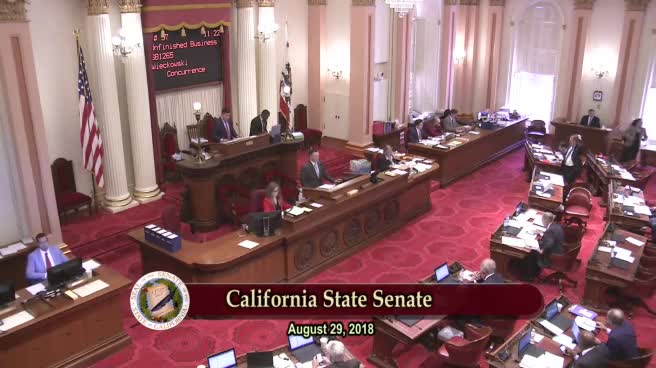 1MIN
Senate Floor
 2MIN
Assembly Floor
 1H
Assembly Standing Committee on Appropriations
 9MIN
Assembly Standing Committee on Water, Parks, and Wildlife
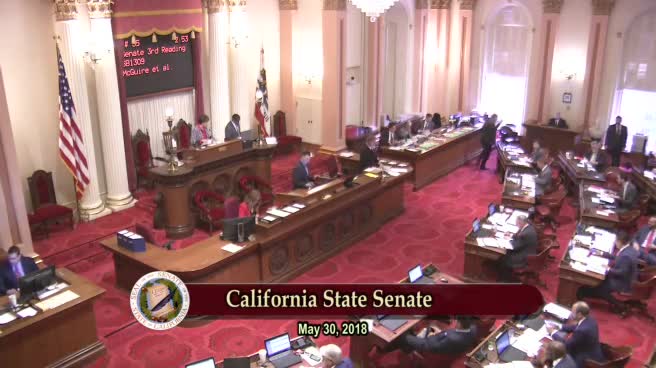 1MIN
Senate Floor
 9MIN
Senate Standing Committee on Natural Resources and Water
Bill Author


