SB 1361: Department of Business Oversight: administration.
- Session Year: 2017-2018
- House: Senate
- Latest Version Date: 2018-09-22
Existing law, the Financial Institutions Law, regulates the activities of various financial entities, including commercial banks, industrial banks, and trust companies. The Financial Institutions Law authorizes the Commissioner of Business Oversight to levy civil penalties against any specified financial institutions licensee, or any subsidiary of a licensee, for violations of law that apply to that particular category of financial institution, as defined. Existing law prohibits the commissioner and his or her designees from disclosing or permitting the disclosure of any record, record of any action, or information contained in a record of any action, taken by the commissioner, except as specified, to persons other than federal or state government employees who are authorized by statute to obtain the records in the performance of their official duties, unless the disclosure is authorized or requested by the affected licensee or the affected subsidiary of the licensee.
This bill would delete that prohibition and would require the commissioner to make all final orders issued pursuant to those provisions public on the departments Internet Web site.
Existing law authorizes the commissioner to adopt and implement a method of accepting electronic filings or applications, reports, or other matters, as specified. Existing law requires this method to include a way of verifying the identity of the person making the filing and provides that this verification satisfies other verifications required by the Financial Institutions Law.
This bill would deem the verification described above to satisfy all other verifications required by the commissioner. The bill would also require a licensee subject to the commissioners jurisdiction to establish and maintain an electronic service address, as specified, for receiving communications and documents from the commissioner, the address to be provided upon licensure. The bill would require a licensee to inform the commissioner of a change in the address prior to the change, would require the licensee to provide the commissioner the new address, and would authorize the commissioner to impose a fine of up to $50 a day, not to exceed $1,000, for a failure to do so. The bill would require the commissioner to provide specified licensees an electronic service address designated for receiving correspondence from them. The bill would provide that communications sent to these electronic service addresses do not satisfy notice requirements, or displace laws or regulations, that require notice to be served in a different manner, if a hearing right attaches to the notice.
Existing law, the Financial Institutions Law, regulates the activities of various financial entities, including commercial banks, industrial banks, and trust companies. The Financial Institutions Law authorizes the Commissioner of Business Oversight to levy civil penalties against any specified financial institutions licensee, or any subsidiary of a licensee, for violations of law that apply to that particular category of financial institution, as defined. Existing law prohibits the commissioner and his or her designees from disclosing or permitting the disclosure of any record, record of any action, or information contained in a record of any action, taken by the commissioner, except as specified, to persons other than federal or state government employees who are authorized by statute to obtain the records in the performance of their official duties, unless the disclosure is authorized or requested by the affected licensee or the affected subsidiary of the licensee.
This bill would delete that prohibition and would require the commissioner to make all final orders issued pursuant to those provisions public on the departments Internet Web site.
Existing law authorizes the commissioner to adopt and implement a method of accepting electronic filings or applications, reports, or other matters, as specified. Existing law requires this method to include a way of verifying the identity of the person making the filing and provides that this verification satisfies other verifications required by the Financial Institutions Law.
This bill would deem the verification described above to satisfy all other verifications required by the commissioner. The bill would also require a licensee subject to the commissioners jurisdiction to establish and maintain an electronic service address, as specified, for receiving communications and documents from the commissioner, the address to be provided upon licensure. The bill would require a licensee to inform the commissioner of a change in the address prior to the change, would require the licensee to provide the commissioner the new address, and would authorize the commissioner to impose a fine of up to $50 a day, not to exceed $1,000, for a failure to do so. The bill would require the commissioner to provide specified licensees an electronic service address designated for receiving correspondence from them. The bill would provide that communications sent to these electronic service addresses do not satisfy notice requirements, or displace laws or regulations, that require notice to be served in a different manner, if a hearing right attaches to the notice.
Existing law, the Financial Institutions Law, regulates the activities of various financial entities, including commercial banks, industrial banks, and trust companies. The Financial Institutions Law authorizes the Commissioner of Business Oversight to levy civil penalties against any specified financial institutions licensee, or any subsidiary of a licensee, for violations of law that apply to that particular category of financial institution, as defined. Existing law prohibits the commissioner and his or her designees from disclosing or permitting the disclosure of any record, record of any action, or information contained in a record of any action, taken by the commissioner, except as specified, to persons other than federal or state government employees who are authorized by statute to obtain the records in the performance of their official duties, unless the disclosure is authorized or requested by the affected licensee or the affected subsidiary of the licensee.
This bill would delete that prohibition and would require the commissioner to make all final orders issued pursuant to those provisions public on the departments Internet Web site.
Existing law authorizes the commissioner to adopt and implement a method of accepting electronic filings or applications, reports, or other matters, as specified. Existing law requires this method to include a way of verifying the identity of the person making the filing and provides that this verification satisfies other verifications required by the Financial Institutions Law.
This bill would deem the verification described above to satisfy all other verifications required by the commissioner. The bill would also require a licensee subject to the commissioners jurisdiction to establish and maintain an electronic service address, as specified, for receiving communications and documents from the commissioner, the address to be provided upon licensure. The bill would require a licensee to inform the commissioner of a change in the address prior to the change, would require the licensee to provide the commissioner the new address, and would authorize the commission commissioner to impose a fine of up to $50 a day, not to exceed $1,000, for a failure to do so. The bill would require the commissioner to provide specified licensees an electronic service address designated for receiving correspondence from them. The bill would provide that communications sent to these electronic service addresses do not satisfy notice requirements, or displace laws or regulations, that require notice to be served in a different manner, if a hearing right attaches to the notice.
Existing law, the Financial Institutions Law, regulates the activities of various financial entities, including commercial banks, industrial banks, and trust companies. The Financial Institutions Law authorizes the Commissioner of Business Oversight to levy civil penalties against any specified financial institutions licensee, or any subsidiary of a licensee, for violations of law that apply to that particular category of financial institution, as defined. Existing law prohibits the commissioner and his or her designees from disclosing or permitting the disclosure of any record, record of any action, or information contained in a record of any action, taken by the commissioner, except as specified, to persons other than federal or state government employees who are authorized by statute to obtain the records in the performance of their official duties, unless the disclosure is authorized or requested by the affected licensee or the affected subsidiary of the licensee.
This bill would delete that prohibition and would require the commissioner to make all final orders issued pursuant to those provisions public on the departments Internet Web site.
Existing law authorizes the commissioner to adopt and implement a method of accepting electronic filings or applications, reports, or other matters, as specified. Existing law requires this method to include a way of verifying the identity of the person making the filing and provides that this verification satisfies other verifications required by the Financial Institutions Law.
This bill would deem the verification described above to satisfy all other verifications required by the commissioner. The bill would also require a licensee subject to the commissioners jurisdiction to establish and maintain an electronic service address, as specified, for receiving communications and documents from the commissioner, the address to be provided upon licensure. The bill would require a licensee to inform the commissioner of a change in the address prior to the change, would require the licensee to provide the commissioner the new address, and would authorize the commission to impose a fine of up to $50 a day, not to exceed $1,000, for a failure to do so. The bill would require the commissioner to provide specified licensees an electronic service address designated for receiving correspondence from them. The bill would provide that communications sent to these electronic service addresses do not satisfy notice requirements, or displace laws or regulations, that require notice to be served in a different manner, if a hearing right attaches to the notice.
Existing law, the Financial Institutions Law, regulates the activities of various financial entities, including commercial banks, industrial banks, and trust companies. The Financial Institutions Law authorizes the Commissioner of Business Oversight to levy civil penalties against any specified financial institutions licensee, or any subsidiary of a licensee, for violations of law that apply to that particular category of financial institution, as defined. Existing law prohibits the commissioner and his or her designees from disclosing or permitting the disclosure of any record, record of any action, or information contained in a record of any action, taken by the commissioner, except as specified, to persons other than federal or state government employees who are authorized by statute to obtain the records in the performance of their official duties, unless the disclosure is authorized or requested by the affected licensee or the affected subsidiary of the licensee.
This bill would delete that prohibition and would require the commissioner to make all final orders issued pursuant to those provisions public on the departments Internet Web site.
Existing law, the Banking Law, defines and regulates specified banks and trust companies and commits the enforcement of these laws with the Commissioner of Business Oversight. The Banking Law prescribes various requirements for bank offices and authorizes a bank to close or discontinue the operation of a branch office only if the bank satisfies certain requirements, including providing the commissioner a notice containing specified information.This bill would require a bank that proposes to close or discontinue a branch office to post prominently, at specified locations at the branch, a notice containing certain information, including the date of closing or discontinuance and the location of the office to which the business of the branch will be transferred.Existing law, the Banking Law, defines and regulates specified banks and trust companies and commits the enforcement of these laws with the Commissioner of Business Oversight. The Banking Law prescribes various requirements for bank offices and authorizes a bank to close or discontinue the operation of a branch office only if the bank satisfies certain requirements, including providing the commissioner a notice containing specified information.
This bill would require a bank that proposes to close or discontinue a branch office to post prominently, at specified locations at the branch, a notice containing certain information, including the date of closing or discontinuance and the location of the office to which the business of the branch will be transferred.
Existing law prescribes standards for buildings under construction or repair and defines a building, for these purposes, as any multifloor building, other than one framed with structural steel, that is more than 2 stories high in the course of construction. Existing law prescribes particular standards for buildings of reinforced concrete construction that have reinforced concrete floors, which address when floors must be filled in, in relation to subsequent work on the floors above.This bill would make nonsubstantive changes to the provisions relating to buildings of reinforced concrete construction with reinforced concrete floors, as described above.Existing law prescribes standards for buildings under construction or repair and defines a building, for these purposes, as any multifloor building, other than one framed with structural steel, that is more than 2 stories high in the course of construction. Existing law prescribes particular standards for buildings of reinforced concrete construction that have reinforced concrete floors, which address when floors must be filled in, in relation to subsequent work on the floors above.
This bill would make nonsubstantive changes to the provisions relating to buildings of reinforced concrete construction with reinforced concrete floors, as described above.
(a)For purposes of this section, the following definitions apply:
(1)Applicable law means:
(A)With respect to any bank, Division 1.6 (commencing with Section 4800), and any of the following provisions:
(i)Article 6 (commencing with Section 405) of Chapter 3.
(ii)Article 3 (commencing with Section 1130) of Chapter 5 of Division 1.1.
(iii)Chapter 6 (commencing with Section 1200) of Division 1.1.
(iv)Chapter 10 (commencing with Section 1320) of Division 1.1.
(v)Chapter 14 (commencing with Section 1460) of Division 1.1.
(vi)Article 1 (commencing with Section 1530) of Chapter 15 of Division 1.1.
(vii)Chapter 16 (commencing with Section 1550) of Division 1.1.
(viii)Chapter 20 (commencing with Section 1750) of Division 1.1.
(ix)Section 456.
(x)Section 457.
(xi)Section 459.
(xii)Section 460.
(xiii)Section 461.
(xiv)Section 1331.
(xv)Chapter 21 (commencing with Section 1850) of Division 1.1.
(xvi)Chapter 18 (commencing with Section 1660) of Division 1.1.
(xvii)Chapter 19 (commencing with Section 1670) of Division 1.1.
(B)With respect to any savings association, any provision of Division 1.6 (commencing with Section 4800) and Division 2 (commencing with Section 5000).
(C)With respect to any insurance premium finance agency, any provision of Division 7 (commencing with Section 18000).
(D)With respect to any business and industrial development corporation, any provision of Division 15 (commencing with Section 31000).
(E)With respect to any credit union, any of the following provisions:
(i)Section 14252.
(ii)Section 14253.
(iii)Section 14255.
(iv)Article 4 (commencing with Section 14350) of Chapter 3 of Division 5.
(v)Section 14401.
(vi)Section 14404.
(vii)Section 14408, only as that section applies to gifts to directors, volunteers, and employees, and the related family or business interests of the directors, volunteers, and employees.
(viii)Section 14409.
(ix)Section 14410.
(x)Article 5 (commencing with Section 14600) of Chapter 4 of Division 5.
(xi)Article 6 (commencing with Section 14650) of Chapter 4 of Division 5, excluding subdivision (a) of Section 14651.
(xii)Section 14803.
(xiii)Section 14851.
(xiv)Section 14858.
(xv)Section 14860.
(xvi)Section 14861.
(xvii)Section 14863.
(F)With respect to any money transmitter, any provision of Division 1.2 (commencing with Section 2000).
(2)Licensee means any bank, savings association, credit union, trust company, money transmitter, insurance premium finance agency, or business and industrial development corporation that is authorized by the commissioner to conduct business in this state.
(b)Notwithstanding any other provision of this code that applies to a licensee or a subsidiary of a licensee, after notice and an opportunity to be heard, the commissioner may, by order that shall include findings of fact which incorporates a determination made in accordance with subdivision (e), levy civil penalties against any licensee or any subsidiary of a licensee who has violated any provision of applicable law, any order issued by the commissioner, any written agreement between the commissioner and the licensee or subsidiary of the licensee, or any condition of any approval issued by the commissioner. The commissioner shall have the sole authority to bring any action with respect to a violation of applicable law subject to a penalty imposed under this section.
Except as provided in paragraphs (1) and (2), any penalty imposed by the commissioner may not exceed one thousand dollars ($1,000) a day, provided that the aggregate penalty of all offenses in any one action against any licensee or subsidiary of a licensee shall not exceed fifty thousand dollars ($50,000).
(1)If the commissioner determines that any licensee or subsidiary of the licensee has recklessly violated any applicable law, any order issued by the commissioner, any provision of any written agreement between the commissioner and the licensee or subsidiary, or any condition of any approval issued by the commissioner, the commissioner may impose a penalty not to exceed five thousand dollars ($5,000) per day, provided that the aggregate penalty of all offenses in an action against any licensee or subsidiary of a licensee shall not exceed seventy-five thousand dollars ($75,000).
(2)If the commissioner determines that any licensee or subsidiary of the licensee has knowingly violated any applicable law, any order issued by the commissioner, any provision of any written agreement between the commissioner and the licensee or subsidiary, or any condition of any approval issued by the commissioner, the commissioner may impose a penalty not to exceed ten thousand dollars ($10,000) per day, provided that the aggregate penalty of all offenses in an action against any licensee or subsidiary of a licensee shall not exceed 1 percent of the total assets of the licensee or subsidiary of a licensee subject to the penalty.
(c)Nothing in this section shall be construed to impair or impede the commissioner from pursuing any other administrative action allowed by law.
(d)Nothing in this section shall be construed to impair or impede the commissioner from bringing an action in court to enforce any law or order he or she has issued, including orders issued under this section. Nothing in this section shall be construed to impair or impede the commissioner from seeking any other damages or injunction allowed by law.
(e)In determining the amount and the appropriateness of initiating a civil money penalty under subdivision (b), the commissioner shall consider all of the following:
(1)Evidence that the violation or practice or breach of duty was intentional or was committed with a disregard of the law or with a disregard of the consequences to the institution.
(2)The duration and frequency of the violations, practices, or breaches of duties.
(3)The continuation of the violations, practices, or breaches of duty after the licensee or subsidiary of the licensee was notified, or, alternatively, its immediate cessation and correction.
(4)The failure to cooperate with the commissioner in effecting early resolution of the problem.
(5)Evidence of concealment of the violation, practice, or breach of duty or, alternatively, voluntary disclosure of the violation, practice, or breach of duty.
(6)Any threat of loss, actual loss, or other harm to the institution, including harm to the public confidence in the institution, and the degree of that harm.
(7)Evidence that a licensee or subsidiary of a licensee received financial gain or other benefit as a result of the violation, practice, or breach of duty.
(8)Evidence of any restitution paid by a licensee or subsidiary of a licensee of losses resulting from the violation, practice, or breach of duty.
(9)History of prior violations, practices, or breaches of duty, particularly where they are similar to the actions under consideration.
(10)Previous criticism of the institution for similar actions.
(11)Presence or absence of a compliance program and its effectiveness.
(12)Tendency to engage in violations of law, unsafe or unsound financial institutions practices, or breaches of duties.
(13)The existence of agreements, commitments, orders, or conditions imposed in writing intended to prevent the violation, practice, or breach of duty.
(14)Whether the violation, practice, or breach of duty causes quantifiable, economic benefit or loss to the licensee or the subsidiary of the licensee. In those cases, removal of the benefit or recompense of the loss usually will be insufficient, by itself, to promote compliance with the applicable law, order, or written agreement. The penalty amount should reflect a remedial purpose and should provide a deterrent to future misconduct.
(15)Other factors as the commissioner may, in his or her opinion, consider relevant to assessing the penalty or establishing the amount of the penalty.
(f)The amounts collected under this section shall be deposited in the appropriate fund of the department. For purposes of this subdivision, the term appropriate fund means the fund to which the annual assessments of fined licensees, or the parent licensee of the fined subsidiary, are credited.
SEC. 2.Section 331 of the Financial Code is amended to read:331.The commissioner may adopt and implement any method of accepting electronic filings of applications, reports, or other matters, which, in the opinion of the commissioner, is secure. Any method of electronic filing chosen by the commissioner shall include a method to verify the identity of the person making the filing. The verification shall be deemed to satisfy all other verifications required by the commissioner, and shall have the same force and effect as the use of manual signatures.
SEC. 3.Section 331.5 is added to the Financial Code, to read:331.5.(a)(1)A licensee subject to the commissioners jurisdiction shall establish and maintain an electronic service address designated for receiving communications and documents that are sent by the commissioner to licensees. This electronic service address shall be provided to the commissioner upon licensure. The electronic service address provided to the commissioner shall not be the electronic service address of any individual employee. A licensee shall have the capacity to receive an attachment that accompanies a message sent to its electronic service address, provided the size of the attachment is reasonable in relation to the technology available at the time the attachment is sent.
(2)Prior to changing the electronic service address most recently provided to the commissioner, the licensee shall notify the commissioner of the change and provide to the commissioner his or her new electronic service address. The commissioner may impose a fine of up to fifty dollars ($50) per day, not to exceed one thousand dollars ($1,000) in the aggregate, on a licensee who fails to notify the commissioner before changing his or her electronic service address or fails to provide the commissioner a new electronic service address.
(3)The commissioner shall provide each licensee that establishes and maintains an electronic service address in accordance with this section with an electronic service address designated for receiving correspondence from licensees subject to the commissioners jurisdiction. This service address shall have the capacity to receive an attachment that accompanies a message sent by the licensee, provided the size of the attachment is reasonable in relation to the technology available at the time the attachment is sent.
(b)A communication sent to an electronic service address established pursuant to this section does not satisfy any notice requirement, or displace any law or regulation, that requires notice to be served in a different manner, if a hearing right attaches to the notice.
SEC. 4.Section 583 of the Financial Code is amended to read:583.(a)The commissioner shall make public on the departments Internet Web site all final orders issued pursuant to Sections 329, 567, 580, 581, 582, 585, 586, 587, 2148, 14303, 14304, 14305, 14307, 14308, 14309, 14310, 16200.5, 16900.5, 18349.5, 18356, 18357, 18358, 18359, 18363, 18367, and 18415.3 all decisions to modify or rescind an order pursuant to Sections 588, 14311, 16205, and 16905, all decisions to revoke or suspend a license pursuant to Sections 590, 591, 2149, 16202, 16203, 16902, 16903, 18349, and 18353, all decisions to revoke or suspend the designation of an agent pursuant to Sections 2150 and 2151, all decisions to approve resumption of business pursuant to Section 14314, and all decisions to take possession of the property and business of a licensee pursuant to Sections 592, 2149, 2150.2, 14313, 14315, 14319, 16206, 16906, 18415, and 18415.4. This public notice shall be in addition to the notice required pursuant to Section 594.
(b)If the commissioner makes a determination in writing that the publication of a final order or decision referenced in subdivision (a) would seriously threaten the safety or soundness of a regulated institution subject to that order or decision, the commissioner may delay publication of the order or decision for a reasonable time.
(c)If the commissioner makes a determination that the publication of a final order or decision referenced in subdivision (a) would reveal information which would identify a customer of the institution subject to the order, the commissioner may redact from the order, prior to publication, any information that, in the determination of the commissioner, would identify any customer of the subject institution.
(a)For purposes of this section, the following definitions apply:
(1)Applicable law means:
(A)With respect to any bank, Division 1.6 (commencing with Section 4800), and any of the following provisions:
(i)Article 6 (commencing with Section 405) of Chapter 3.
(ii)Article 3 (commencing with Section 1130) of Chapter 5 of Division 1.1.
(iii)Chapter 6 (commencing with Section 1200) of Division 1.1.
(iv)Chapter 10 (commencing with Section 1320) of Division 1.1.
(v)Chapter 14 (commencing with Section 1460) of Division 1.1.
(vi)Article 1 (commencing with Section 1530) of Chapter 15 of Division 1.1.
(vii)Chapter 16 (commencing with Section 1550) of Division 1.1.
(viii)Chapter 20 (commencing with Section 1750) of Division 1.1.
(ix)Section 456.
(x)Section 457.
(xi)Section 459.
(xii)Section 460.
(xiii)Section 461.
(xiv)Section 1331.
(xv)Chapter 21 (commencing with Section 1850) of Division 1.1.
(xvi)Chapter 18 (commencing with Section 1660) of Division 1.1.
(xvii)Chapter 19 (commencing with Section 1670) of Division 1.1.
(B)With respect to any savings association, any provision of Division 1.6 (commencing with Section 4800) and Division 2 (commencing with Section 5000).
(C)With respect to any insurance premium finance agency, any provision of Division 7 (commencing with Section 18000).
(D)With respect to any business and industrial development corporation, any provision of Division 15 (commencing with Section 31000).
(E)With respect to any credit union, any of the following provisions:
(i)Section 14252.
(ii)Section 14253.
(iii)Section 14255.
(iv)Article 4 (commencing with Section 14350) of Chapter 3 of Division 5.
(v)Section 14401.
(vi)Section 14404.
(vii)Section 14408, only as that section applies to gifts to directors, volunteers, and employees, and the related family or business interests of the directors, volunteers, and employees.
(viii)Section 14409.
(ix)Section 14410.
(x)Article 5 (commencing with Section 14600) of Chapter 4 of Division 5.
(xi)Article 6 (commencing with Section 14650) of Chapter 4 of Division 5, excluding subdivision (a) of Section 14651.
(xii)Section 14803.
(xiii)Section 14851.
(xiv)Section 14858.
(xv)Section 14860.
(xvi)Section 14861.
(xvii)Section 14863.
(F)With respect to any money transmitter, any provision of Division 1.2 (commencing with Section 2000).
(2)Licensee means any bank, savings association, credit union, trust company, money transmitter, insurance premium finance agency, or business and industrial development corporation that is authorized by the commissioner to conduct business in this state.
(b)Notwithstanding any other provision of this code that applies to a licensee or a subsidiary of a licensee, after notice and an opportunity to be heard, the commissioner may, by order that shall include findings of fact which incorporates a determination made in accordance with subdivision (e), levy civil penalties against any licensee or any subsidiary of a licensee who has violated any provision of applicable law, any order issued by the commissioner, any written agreement between the commissioner and the licensee or subsidiary of the licensee, or any condition of any approval issued by the commissioner. The commissioner shall have the sole authority to bring any action with respect to a violation of applicable law subject to a penalty imposed under this section.
Except as provided in paragraphs (1) and (2), any penalty imposed by the commissioner may not exceed one thousand dollars ($1,000) a day, provided that the aggregate penalty of all offenses in any one action against any licensee or subsidiary of a licensee shall not exceed fifty thousand dollars ($50,000).
(1)If the commissioner determines that any licensee or subsidiary of the licensee has recklessly violated any applicable law, any order issued by the commissioner, any provision of any written agreement between the commissioner and the licensee or subsidiary, or any condition of any approval issued by the commissioner, the commissioner may impose a penalty not to exceed five thousand dollars ($5,000) per day, provided that the aggregate penalty of all offenses in an action against any licensee or subsidiary of a licensee shall not exceed seventy-five thousand dollars ($75,000).
(2)If the commissioner determines that any licensee or subsidiary of the licensee has knowingly violated any applicable law, any order issued by the commissioner, any provision of any written agreement between the commissioner and the licensee or subsidiary, or any condition of any approval issued by the commissioner, the commissioner may impose a penalty not to exceed ten thousand dollars ($10,000) per day, provided that the aggregate penalty of all offenses in an action against any licensee or subsidiary of a licensee shall not exceed 1 percent of the total assets of the licensee or subsidiary of a licensee subject to the penalty.
(c)Nothing in this section shall be construed to impair or impede the commissioner from pursuing any other administrative action allowed by law.
(d)Nothing in this section shall be construed to impair or impede the commissioner from bringing an action in court to enforce any law or order he or she has issued, including orders issued under this section. Nothing in this section shall be construed to impair or impede the commissioner from seeking any other damages or injunction allowed by law.
(e)In determining the amount and the appropriateness of initiating a civil money penalty under subdivision (b), the commissioner shall consider all of the following:
(1)Evidence that the violation or practice or breach of duty was intentional or was committed with a disregard of the law or with a disregard of the consequences to the institution.
(2)The duration and frequency of the violations, practices, or breaches of duties.
(3)The continuation of the violations, practices, or breaches of duty after the licensee or subsidiary of the licensee was notified, or, alternatively, its immediate cessation and correction.
(4)The failure to cooperate with the commissioner in effecting early resolution of the problem.
(5)Evidence of concealment of the violation, practice, or breach of duty or, alternatively, voluntary disclosure of the violation, practice, or breach of duty.
(6)Any threat of loss, actual loss, or other harm to the institution, including harm to the public confidence in the institution, and the degree of that harm.
(7)Evidence that a licensee or subsidiary of a licensee received financial gain or other benefit as a result of the violation, practice, or breach of duty.
(8)Evidence of any restitution paid by a licensee or subsidiary of a licensee of losses resulting from the violation, practice, or breach of duty.
(9)History of prior violations, practices, or breaches of duty, particularly where they are similar to the actions under consideration.
(10)Previous criticism of the institution for similar actions.
(11)Presence or absence of a compliance program and its effectiveness.
(12)Tendency to engage in violations of law, unsafe or unsound financial institutions practices, or breaches of duties.
(13)The existence of agreements, commitments, orders, or conditions imposed in writing intended to prevent the violation, practice, or breach of duty.
(14)Whether the violation, practice, or breach of duty causes quantifiable, economic benefit or loss to the licensee or the subsidiary of the licensee. In those cases, removal of the benefit or recompense of the loss usually will be insufficient, by itself, to promote compliance with the applicable law, order, or written agreement. The penalty amount should reflect a remedial purpose and should provide a deterrent to future misconduct.
(15)Other factors as the commissioner may, in his or her opinion, consider relevant to assessing the penalty or establishing the amount of the penalty.
(f)The amounts collected under this section shall be deposited in the appropriate fund of the department. For purposes of this subdivision, the term appropriate fund means the fund to which the annual assessments of fined licensees, or the parent licensee of the fined subsidiary, are credited.
SEC. 2.Section 331 of the Financial Code is amended to read:331.The commissioner may adopt and implement any method of accepting electronic filings of applications, reports, or other matters, which, in the opinion of the commissioner, is secure. Any method of electronic filing chosen by the commissioner shall include a method to verify the identity of the person making the filing. The verification shall be deemed to satisfy all other verifications required by the commissioner, and shall have the same force and effect as the use of manual signatures.
SEC. 3.Section 331.5 is added to the Financial Code, to read:331.5.(a)(1)A licensee subject to the commissioners jurisdiction shall establish and maintain an electronic service address designated for receiving communications and documents that are sent by the commissioner to licensees. This electronic service address shall be provided to the commissioner upon licensure. The electronic service address provided to the commissioner shall not be the electronic service address of any individual employee. A licensee shall have the capacity to receive an attachment that accompanies a message sent to its electronic service address, provided the size of the attachment is reasonable in relation to the technology available at the time the attachment is sent.
(2)Prior to changing the electronic service address most recently provided to the commissioner, the licensee shall notify the commissioner of the change and provide to the commissioner his or her new electronic service address. The commissioner may impose a fine of up to fifty dollars ($50) per day, not to exceed one thousand dollars ($1,000) in the aggregate, on a licensee who fails to notify the commissioner before changing his or her electronic service address or fails to provide the commissioner a new electronic service address.
(3)The commissioner shall provide each licensee that establishes and maintains an electronic service address in accordance with this section with an electronic service address designated for receiving correspondence from licensees subject to the commissioners jurisdiction. This service address shall have the capacity to receive an attachment that accompanies a message sent by the licensee, provided the size of the attachment is reasonable in relation to the technology available at the time the attachment is sent.
(b)A communication sent to an electronic service address established pursuant to this section does not satisfy any notice requirement, or displace any law or regulation, that requires notice to be served in a different manner, if a hearing right attaches to the notice.
SEC. 4.Section 583 of the Financial Code is amended to read:583.(a)The commissioner shall make public on the departments Internet Web site all final orders issued pursuant to Sections 329, 567, 580, 581, 582, 585, 586, 587, 2148, 14303, 14304, 14305, 14307, 14308, 14309, 14310, 16200.5, 16900.5, 18349.5, 18356, 18357, 18358, 18359, 18363, 18367, and 18415.3 all decisions to modify or rescind an order pursuant to Sections 588, 14311, 16205, and 16905, all decisions to revoke or suspend a license pursuant to Sections 590, 591, 2149, 16202, 16203, 16902, 16903, 18349, and 18353, all decisions to revoke or suspend the designation of an agent pursuant to Sections 2150 and 2151, all decisions to approve resumption of business pursuant to Section 14314, and all decisions to take possession of the property and business of a licensee pursuant to Sections 592, 2149, 2150.2, 14313, 14315, 14319, 16206, 16906, 18415, and 18415.4. This public notice shall be in addition to the notice required pursuant to Section 594.
(b)If the commissioner makes a determination in writing that the publication of a final order or decision referenced in subdivision (a) would seriously threaten the safety or soundness of a regulated institution subject to that order or decision, the commissioner may delay publication of the order or decision for a reasonable time.
(c)If the commissioner makes a determination that the publication of a final order or decision referenced in subdivision (a) would reveal information which would identify a customer of the institution subject to the order, the commissioner may redact from the order, prior to publication, any information that, in the determination of the commissioner, would identify any customer of the subject institution.
(a)For purposes of this section, the following definitions apply:
(1)Applicable law means:
(A)With respect to any bank, Division 1.6 (commencing with Section 4800), and any of the following provisions:
(i)Article 6 (commencing with Section 405) of Chapter 3.
(ii)Article 3 (commencing with Section 1130) of Chapter 5 of Division 1.1.
(iii)Chapter 6 (commencing with Section 1200) of Division 1.1.
(iv)Chapter 10 (commencing with Section 1320) of Division 1.1.
(v)Chapter 14 (commencing with Section 1460) of Division 1.1.
(vi)Article 1 (commencing with Section 1530) of Chapter 15 of Division 1.1.
(vii)Chapter 16 (commencing with Section 1550) of Division 1.1.
(viii)Chapter 20 (commencing with Section 1750) of Division 1.1.
(ix)Section 456.
(x)Section 457.
(xi)Section 459.
(xii)Section 460.
(xiii)Section 461.
(xiv)Section 1331.
(xv)Chapter 21 (commencing with Section 1850) of Division 1.1.
(xvi)Chapter 18 (commencing with Section 1660) of Division 1.1.
(xvii)Chapter 19 (commencing with Section 1670) of Division 1.1.
(B)With respect to any savings association, any provision of Division 1.6 (commencing with Section 4800) and Division 2 (commencing with Section 5000).
(C)With respect to any insurance premium finance agency, any provision of Division 7 (commencing with Section 18000).
(D)With respect to any business and industrial development corporation, any provision of Division 15 (commencing with Section 31000).
(E)With respect to any credit union, any of the following provisions:
(i)Section 14252.
(ii)Section 14253.
(iii)Section 14255.
(iv)Article 4 (commencing with Section 14350) of Chapter 3 of Division 5.
(v)Section 14401.
(vi)Section 14404.
(vii)Section 14408, only as that section applies to gifts to directors, volunteers, and employees, and the related family or business interests of the directors, volunteers, and employees.
(viii)Section 14409.
(ix)Section 14410.
(x)Article 5 (commencing with Section 14600) of Chapter 4 of Division 5.
(xi)Article 6 (commencing with Section 14650) of Chapter 4 of Division 5, excluding subdivision (a) of Section 14651.
(xii)Section 14803.
(xiii)Section 14851.
(xiv)Section 14858.
(xv)Section 14860.
(xvi)Section 14861.
(xvii)Section 14863.
(F)With respect to any money transmitter, any provision of Division 1.2 (commencing with Section 2000).
(2)Licensee means any bank, savings association, credit union, trust company, money transmitter, insurance premium finance agency, or business and industrial development corporation that is authorized by the commissioner to conduct business in this state.
(b)Notwithstanding any other provision of this code that applies to a licensee or a subsidiary of a licensee, after notice and an opportunity to be heard, the commissioner may, by order that shall include findings of fact which incorporates a determination made in accordance with subdivision (e), levy civil penalties against any licensee or any subsidiary of a licensee who has violated any provision of applicable law, any order issued by the commissioner, any written agreement between the commissioner and the licensee or subsidiary of the licensee, or any condition of any approval issued by the commissioner. The commissioner shall have the sole authority to bring any action with respect to a violation of applicable law subject to a penalty imposed under this section.
Except as provided in paragraphs (1) and (2), any penalty imposed by the commissioner may not exceed one thousand dollars ($1,000) a day, provided that the aggregate penalty of all offenses in any one action against any licensee or subsidiary of a licensee shall not exceed fifty thousand dollars ($50,000).
(1)If the commissioner determines that any licensee or subsidiary of the licensee has recklessly violated any applicable law, any order issued by the commissioner, any provision of any written agreement between the commissioner and the licensee or subsidiary, or any condition of any approval issued by the commissioner, the commissioner may impose a penalty not to exceed five thousand dollars ($5,000) per day, provided that the aggregate penalty of all offenses in an action against any licensee or subsidiary of a licensee shall not exceed seventy-five thousand dollars ($75,000).
(2)If the commissioner determines that any licensee or subsidiary of the licensee has knowingly violated any applicable law, any order issued by the commissioner, any provision of any written agreement between the commissioner and the licensee or subsidiary, or any condition of any approval issued by the commissioner, the commissioner may impose a penalty not to exceed ten thousand dollars ($10,000) per day, provided that the aggregate penalty of all offenses in an action against any licensee or subsidiary of a licensee shall not exceed 1 percent of the total assets of the licensee or subsidiary of a licensee subject to the penalty.
(c)Nothing in this section shall be construed to impair or impede the commissioner from pursuing any other administrative action allowed by law.
(d)Nothing in this section shall be construed to impair or impede the commissioner from bringing an action in court to enforce any law or order he or she has issued, including orders issued under this section. Nothing in this section shall be construed to impair or impede the commissioner from seeking any other damages or injunction allowed by law.
(e)In determining the amount and the appropriateness of initiating a civil money penalty under subdivision (b), the commissioner shall consider all of the following:
(1)Evidence that the violation or practice or breach of duty was intentional or was committed with a disregard of the law or with a disregard of the consequences to the institution.
(2)The duration and frequency of the violations, practices, or breaches of duties.
(3)The continuation of the violations, practices, or breaches of duty after the licensee or subsidiary of the licensee was notified, or, alternatively, its immediate cessation and correction.
(4)The failure to cooperate with the commissioner in effecting early resolution of the problem.
(5)Evidence of concealment of the violation, practice, or breach of duty or, alternatively, voluntary disclosure of the violation, practice, or breach of duty.
(6)Any threat of loss, actual loss, or other harm to the institution, including harm to the public confidence in the institution, and the degree of that harm.
(7)Evidence that a licensee or subsidiary of a licensee received financial gain or other benefit as a result of the violation, practice, or breach of duty.
(8)Evidence of any restitution paid by a licensee or subsidiary of a licensee of losses resulting from the violation, practice, or breach of duty.
(9)History of prior violations, practices, or breaches of duty, particularly where they are similar to the actions under consideration.
(10)Previous criticism of the institution for similar actions.
(11)Presence or absence of a compliance program and its effectiveness.
(12)Tendency to engage in violations of law, unsafe or unsound financial institutions practices, or breaches of duties.
(13)The existence of agreements, commitments, orders, or conditions imposed in writing intended to prevent the violation, practice, or breach of duty.
(14)Whether the violation, practice, or breach of duty causes quantifiable, economic benefit or loss to the licensee or the subsidiary of the licensee. In those cases, removal of the benefit or recompense of the loss usually will be insufficient, by itself, to promote compliance with the applicable law, order, or written agreement. The penalty amount should reflect a remedial purpose and should provide a deterrent to future misconduct.
(15)Other factors as the commissioner may, in his or her opinion, consider relevant to assessing the penalty or establishing the amount of the penalty.
(f)The amounts collected under this section shall be deposited in the appropriate fund of the department. For purposes of this subdivision, the term appropriate fund means the fund to which the annual assessments of fined licensees, or the parent licensee of the fined subsidiary, are credited.
SEC. 2.Section 331 of the Financial Code is amended to read:331.The commissioner may adopt and implement any method of accepting electronic filings of applications, reports, or other matters, which, in the opinion of the commissioner, is secure. Any method of electronic filing chosen by the commissioner shall include a method to verify the identity of the person making the filing. The verification shall be deemed to satisfy all other verifications required by the commissioner, and shall have the same force and effect as the use of manual signatures.
SEC. 3.Section 331.5 is added to the Financial Code, to read:331.5.(a)(1)A licensee subject to the commissioners jurisdiction shall establish and maintain an electronic service address designated for receiving communications and documents that are sent by the commissioner to licensees. This electronic service address shall be provided to the commissioner upon licensure. The electronic service address provided to the commissioner shall not be the electronic service address of any individual employee. A licensee shall have the capacity to receive an attachment that accompanies a message sent to its electronic service address, provided the size of the attachment is reasonable in relation to the technology available at the time the attachment is sent.
(2)Prior to changing the electronic service address most recently provided to the commissioner, the licensee shall notify the commission commissioner of the change and provide to the commissioner his or her new electronic service address. The commissioner may impose a fine of up to fifty dollars ($50) per day, not to exceed one thousand dollars ($1,000) in the aggregate, on a licensee who fails to notify the commissioner before changing his or her electronic service address or fails to provide the commission commissioner a new electronic service address.
(3)The commissioner shall provide each licensee that establishes and maintains an electronic service address in accordance with this section with an electronic service address designated for receiving correspondence from licensees subject to the commissioners jurisdiction. This service address shall have the capacity to receive an attachment that accompanies a message sent by the licensee, provided the size of the attachment is reasonable in relation to the technology available at the time the attachment is sent.
(b)A communication sent to an electronic service address established pursuant to this section does not satisfy any notice requirement, or displace any law or regulation, that requires notice to be served in a different manner, if a hearing right attaches to the notice.
SEC. 4.Section 583 of the Financial Code is amended to read:583.(a)The commissioner shall make public on the departments Internet Web site all final orders issued pursuant to Sections 329, 567, 580, 581, 582, 585, 586, 587, 2148, 14303, 14304, 14305, 14307, 14308, 14309, 14310, 16200.5, 16900.5, 18349.5, 18356, 18357, 18358, 18359, 18363, 18367, and 18415.3 all decisions to modify or rescind an order pursuant to Sections 588, 14311, 16205, and 16905, all decisions to revoke or suspend a license pursuant to Sections 590, 591, 2149, 16202, 16203, 16902, 16903, 18349, and 18353, all decisions to revoke or suspend the designation of an agent pursuant to Sections 2150 and 2151, all decisions to approve resumption of business pursuant to Section 14314, and all decisions to take possession of the property and business of a licensee pursuant to Sections 592, 2149, 2150.2, 14313, 14315, 14319, 16206, 16906, 18415, and 18415.4. This public notice shall be in addition to the notice required pursuant to Section 594.
(b)If the commissioner makes a determination in writing that the publication of a final order or decision referenced in subdivision (a) would seriously threaten the safety or soundness of a regulated institution subject to that order or decision, the commissioner may delay publication of the order or decision for a reasonable time.
(c)If the commissioner makes a determination that the publication of a final order or decision referenced in subdivision (a) would reveal information which would identify a customer of the institution subject to the order, the commissioner may redact from the order, prior to publication, any information that, in the determination of the commissioner, would identify any customer of the subject institution.
(a)For purposes of this section, the following definitions apply:
(1)Applicable law means:
(A)With respect to any bank, Division 1.6 (commencing with Section 4800), and any of the following provisions:
(i)Article 6 (commencing with Section 405) of Chapter 3.
(ii)Article 3 (commencing with Section 1130) of Chapter 5 of Division 1.1.
(iii)Chapter 6 (commencing with Section 1200) of Division 1.1.
(iv)Chapter 10 (commencing with Section 1320) of Division 1.1.
(v)Chapter 14 (commencing with Section 1460) of Division 1.1.
(vi)Article 1 (commencing with Section 1530) of Chapter 15 of Division 1.1.
(vii)Chapter 16 (commencing with Section 1550) of Division 1.1.
(viii)Chapter 20 (commencing with Section 1750) of Division 1.1.
(ix)Section 456.
(x)Section 457.
(xi)Section 459.
(xii)Section 460.
(xiii)Section 461.
(xiv)Section 1331.
(xv)Chapter 21 (commencing with Section 1850) of Division 1.1.
(xvi)Chapter 18 (commencing with Section 1660) of Division 1.1.
(xvii)Chapter 19 (commencing with Section 1670) of Division 1.1.
(B)With respect to any savings association, any provision of Division 1.6 (commencing with Section 4800) and Division 2 (commencing with Section 5000).
(C)With respect to any insurance premium finance agency, any provision of Division 7 (commencing with Section 18000).
(D)With respect to any business and industrial development corporation, any provision of Division 15 (commencing with Section 31000).
(E)With respect to any credit union, any of the following provisions:
(i)Section 14252.
(ii)Section 14253.
(iii)Section 14255.
(iv)Article 4 (commencing with Section 14350) of Chapter 3 of Division 5.
(v)Section 14401.
(vi)Section 14404.
(vii)Section 14408, only as that section applies to gifts to directors, volunteers, and employees, and the related family or business interests of the directors, volunteers, and employees.
(viii)Section 14409.
(ix)Section 14410.
(x)Article 5 (commencing with Section 14600) of Chapter 4 of Division 5.
(xi)Article 6 (commencing with Section 14650) of Chapter 4 of Division 5, excluding subdivision (a) of Section 14651.
(xii)Section 14803.
(xiii)Section 14851.
(xiv)Section 14858.
(xv)Section 14860.
(xvi)Section 14861.
(xvii)Section 14863.
(F)With respect to any money transmitter, any provision of Division 1.2 (commencing with Section 2000).
(2)Licensee means any bank, savings association, credit union, trust company, money transmitter, insurance premium finance agency, or business and industrial development corporation that is authorized by the commissioner to conduct business in this state.
(b)Notwithstanding any other provision of this code that applies to a licensee or a subsidiary of a licensee, after notice and an opportunity to be heard, the commissioner may, by order that shall include findings of fact which incorporates a determination made in accordance with subdivision (e), levy civil penalties against any licensee or any subsidiary of a licensee who has violated any provision of applicable law, any order issued by the commissioner, any written agreement between the commissioner and the licensee or subsidiary of the licensee, or any condition of any approval issued by the commissioner. The commissioner shall have the sole authority to bring any action with respect to a violation of applicable law subject to a penalty imposed under this section.
Except as provided in paragraphs (1) and (2), any penalty imposed by the commissioner may not exceed one thousand dollars ($1,000) a day, provided that the aggregate penalty of all offenses in any one action against any licensee or subsidiary of a licensee shall not exceed fifty thousand dollars ($50,000).
(1)If the commissioner determines that any licensee or subsidiary of the licensee has recklessly violated any applicable law, any order issued by the commissioner, any provision of any written agreement between the commissioner and the licensee or subsidiary, or any condition of any approval issued by the commissioner, the commissioner may impose a penalty not to exceed five thousand dollars ($5,000) per day, provided that the aggregate penalty of all offenses in an action against any licensee or subsidiary of a licensee shall not exceed seventy-five thousand dollars ($75,000).
(2)If the commissioner determines that any licensee or subsidiary of the licensee has knowingly violated any applicable law, any order issued by the commissioner, any provision of any written agreement between the commissioner and the licensee or subsidiary, or any condition of any approval issued by the commissioner, the commissioner may impose a penalty not to exceed ten thousand dollars ($10,000) per day, provided that the aggregate penalty of all offenses in an action against any licensee or subsidiary of a licensee shall not exceed 1 percent of the total assets of the licensee or subsidiary of a licensee subject to the penalty.
(c)Nothing in this section shall be construed to impair or impede the commissioner from pursuing any other administrative action allowed by law.
(d)Nothing in this section shall be construed to impair or impede the commissioner from bringing an action in court to enforce any law or order he or she has issued, including orders issued under this section. Nothing in this section shall be construed to impair or impede the commissioner from seeking any other damages or injunction allowed by law.
(e)In determining the amount and the appropriateness of initiating a civil money penalty under subdivision (b), the commissioner shall consider all of the following:
(1)Evidence that the violation or practice or breach of duty was intentional or was committed with a disregard of the law or with a disregard of the consequences to the institution.
(2)The duration and frequency of the violations, practices, or breaches of duties.
(3)The continuation of the violations, practices, or breaches of duty after the licensee or subsidiary of the licensee was notified, or, alternatively, its immediate cessation and correction.
(4)The failure to cooperate with the commissioner in effecting early resolution of the problem.
(5)Evidence of concealment of the violation, practice, or breach of duty or, alternatively, voluntary disclosure of the violation, practice, or breach of duty.
(6)Any threat of loss, actual loss, or other harm to the institution, including harm to the public confidence in the institution, and the degree of that harm.
(7)Evidence that a licensee or subsidiary of a licensee received financial gain or other benefit as a result of the violation, practice, or breach of duty.
(8)Evidence of any restitution paid by a licensee or subsidiary of a licensee of losses resulting from the violation, practice, or breach of duty.
(9)History of prior violations, practices, or breaches of duty, particularly where they are similar to the actions under consideration.
(10)Previous criticism of the institution for similar actions.
(11)Presence or absence of a compliance program and its effectiveness.
(12)Tendency to engage in violations of law, unsafe or unsound financial institutions practices, or breaches of duties.
(13)The existence of agreements, commitments, orders, or conditions imposed in writing intended to prevent the violation, practice, or breach of duty.
(14)Whether the violation, practice, or breach of duty causes quantifiable, economic benefit or loss to the licensee or the subsidiary of the licensee. In those cases, removal of the benefit or recompense of the loss usually will be insufficient, by itself, to promote compliance with the applicable law, order, or written agreement. The penalty amount should reflect a remedial purpose and should provide a deterrent to future misconduct.
(15)Other factors as the commissioner may, in his or her opinion, consider relevant to assessing the penalty or establishing the amount of the penalty.
(f)The amounts collected under this section shall be deposited in the appropriate fund of the department. For purposes of this subdivision, the term appropriate fund means the fund to which the annual assessments of fined licensees, or the parent licensee of the fined subsidiary, are credited.
SEC. 2.Section 331 of the Financial Code is amended to read:331.Notwithstanding any other provision of law, the The commissioner may adopt and implement any method of accepting electronic filings of applications, reports, or other matters, which, in the opinion of the commissioner, is secure. Any method of electronic filing chosen by the commissioner shall include a method to verify the identity of the person making the filing. The verification shall be deemed to satisfy all other verifications required by the Financial Institutions Law, commissioner, and shall have the same force and effect as the use of manual signatures.
SEC. 3.Section 331.5 is added to the Financial Code, to read:331.5.(a)(1)A licensee subject to the commissioners jurisdiction shall establish and maintain an electronic service address designated for receiving communications and documents that are sent by the commissioner to licensees. This electronic service address shall be provided to the commissioner upon licensure. The electronic service address provided to the commissioner shall not be the electronic service address of any individual employee. A licensee shall have the capacity to receive an attachment that accompanies a message sent to its electronic service address, provided the size of the attachment is reasonable in relation to the technology available at the time the attachment is sent.
(2)Prior to changing the electronic service address most recently provided to the commissioner, the licensee shall notify the commission of the change and provide to the commissioner his or her new electronic service address. The commissioner may impose a fine of up to fifty dollars ($50) per day, not to exceed one thousand dollars ($1,000) in the aggregate, on a licensee who fails to notify the commissioner before changing his or her electronic service address or fails to provide the commission a new electronic service address.
(3)The commissioner shall provide each licensee that establishes and maintains an electronic service address in accordance with this section with an electronic service address designated for receiving correspondence from licensees subject to the commissioners jurisdiction. This service address shall have the capacity to receive an attachment that accompanies a message sent by the licensee, provided the size of the attachment is reasonable in relation to the technology available at the time the attachment is sent.
(b)A communication sent to an electronic service address established pursuant to this section does not satisfy any notice requirement, or displace any law or regulation, that requires notice to be served in a different manner, if a hearing right attaches to the notice.
SEC. 2.SEC. 4.Section 583 of the Financial Code is amended to read:583.(a)The commissioner shall make public on the departments Internet Web site all final orders issued pursuant to Sections 329, 567, 580, 581, 582, 585, 586, 587, 2148, 14303, 14304, 14305, 14307, 14308, 14309, 14310, 16200.5, 16900.5, 18349.5, 18356, 18357, 18358, 18359, 18363, 18367, and 18415.3 all decisions to modify or rescind an order pursuant to Sections 588, 14311, 16205, and 16905, all decisions to revoke or suspend a license pursuant to Sections 590, 591, 2149, 16202, 16203, 16902, 16903, 18349, and 18353, all decisions to revoke or suspend the designation of an agent pursuant to Sections 2150 and 2151, all decisions to approve resumption of business pursuant to Section 14314, and all decisions to take possession of the property and business of a licensee pursuant to Sections 592, 2149, 2150.2, 14313, 14315, 14319, 16206, 16906, 18415, and 18415.4. This public notice shall be in addition to the notice required pursuant to Section 594.
(b)If the commissioner makes a determination in writing that the publication of a final order or decision referenced in subdivision (a) would seriously threaten the safety or soundness of a regulated institution subject to that order or decision, the commissioner may delay publication of the order or decision for a reasonable time.
(c)If the commissioner makes a determination that the publication of a final order or decision referenced in subdivision (a) would reveal information which would identify a customer of the institution subject to the order, the commissioner may redact from the order, prior to publication, any information that, in the determination of the commissioner, would identify any customer of the subject institution.
(a)For purposes of this section, the following definitions apply:
(1)Applicable law means:
(A)With respect to any bank, Division 1.6 (commencing with Section 4800), and any of the following provisions:
(i)Article 6 (commencing with Section 405) of Chapter 3.
(ii)Article 3 (commencing with Section 1130) of Chapter 5 of Division 1.1.
(iii)Chapter 6 (commencing with Section 1200) of Division 1.1.
(iv)Chapter 10 (commencing with Section 1320) of Division 1.1.
(v)Chapter 14 (commencing with Section 1460) of Division 1.1.
(vi)Article 1 (commencing with Section 1530) of Chapter 15 of Division 1.1.
(vii)Chapter 16 (commencing with Section 1550) of Division 1.1.
(viii)Chapter 20 (commencing with Section 1750) of Division 1.1.
(ix)Section 456.
(x)Section 457.
(xi)Section 459.
(xii)Section 460.
(xiii)Section 461.
(xiv)Section 1331.
(xv)Chapter 21 (commencing with Section 1850) of Division 1.1.
(xvi)Chapter 18 (commencing with Section 1660) of Division 1.1.
(xvii)Chapter 19 (commencing with Section 1670) of Division 1.1.
(B)With respect to any savings association, any provision of Division 1.6 (commencing with Section 4800) and Division 2 (commencing with Section 5000).
(C)With respect to any insurance premium finance agency, any provision of Division 7 (commencing with Section 18000).
(D)With respect to any business and industrial development corporation, any provision of Division 15 (commencing with Section 31000).
(E)With respect to any credit union, any of the following provisions:
(i)Section 14252.
(ii)Section 14253.
(iii)Section 14255.
(iv)Article 4 (commencing with Section 14350) of Chapter 3 of Division 5.
(v)Section 14401.
(vi)Section 14404.
(vii)Section 14408, only as that section applies to gifts to directors, volunteers, and employees, and the related family or business interests of the directors, volunteers, and employees.
(viii)Section 14409.
(ix)Section 14410.
(x)Article 5 (commencing with Section 14600) of Chapter 4 of Division 5.
(xi)Article 6 (commencing with Section 14650) of Chapter 4 of Division 5, excluding subdivision (a) of Section 14651.
(xii)Section 14803.
(xiii)Section 14851.
(xiv)Section 14858.
(xv)Section 14860.
(xvi)Section 14861.
(xvii)Section 14863.
(F)With respect to any money transmitter, any provision of Division 1.2 (commencing with Section 2000).
(2)Licensee means any bank, savings association, credit union, trust company, money transmitter, insurance premium finance agency, or business and industrial development corporation that is authorized by the commissioner to conduct business in this state.
(b)Notwithstanding any other provision of this code that applies to a licensee or a subsidiary of a licensee, after notice and an opportunity to be heard, the commissioner may, by order that shall include findings of fact which incorporates a determination made in accordance with subdivision (e), levy civil penalties against any licensee or any subsidiary of a licensee who has violated any provision of applicable law, any order issued by the commissioner, any written agreement between the commissioner and the licensee or subsidiary of the licensee, or any condition of any approval issued by the commissioner. Notwithstanding any other provision of law, neither the commissioner nor any employee of the department shall disclose or permit the disclosure of any record, record of any action, or information contained in a record of any action, taken by the commissioner under the provisions of this section, unless the action was taken pursuant to paragraph (2) of subdivision (b), to persons other than federal or state government employees who are authorized by statute to obtain the records in the performance of their official duties, unless the disclosure is authorized or requested by the affected licensee or the affected subsidiary of the licensee. The commissioner shall have the sole authority to bring any action with respect to a violation of applicable law subject to a penalty imposed under this section.
Except as provided in paragraphs (1) and (2), any penalty imposed by the commissioner may not exceed one thousand dollars ($1,000) a day, provided that the aggregate penalty of all offenses in any one action against any licensee or subsidiary of a licensee shall not exceed fifty thousand dollars ($50,000).
(1)If the commissioner determines that any licensee or subsidiary of the licensee has recklessly violated any applicable law, any order issued by the commissioner, any provision of any written agreement between the commissioner and the licensee or subsidiary, or any condition of any approval issued by the commissioner, the commissioner may impose a penalty not to exceed five thousand dollars ($5,000) per day, provided that the aggregate penalty of all offenses in an action against any licensee or subsidiary of a licensee shall not exceed seventy-five thousand dollars ($75,000).
(2)If the commissioner determines that any licensee or subsidiary of the licensee has knowingly violated any applicable law, any order issued by the commissioner, any provision of any written agreement between the commissioner and the licensee or subsidiary, or any condition of any approval issued by the commissioner, the commissioner may impose a penalty not to exceed ten thousand dollars ($10,000) per day, provided that the aggregate penalty of all offenses in an action against any licensee or subsidiary of a licensee shall not exceed 1 percent of the total assets of the licensee or subsidiary of a licensee subject to the penalty.
(c)Nothing in this section shall be construed to impair or impede the commissioner from pursuing any other administrative action allowed by law.
(d)Nothing in this section shall be construed to impair or impede the commissioner from bringing an action in court to enforce any law or order he or she has issued, including orders issued under this section. Nothing in this section shall be construed to impair or impede the commissioner from seeking any other damages or injunction allowed by law.
(e)In determining the amount and the appropriateness of initiating a civil money penalty under subdivision (b), the commissioner shall consider all of the following:
(1)Evidence that the violation or practice or breach of duty was intentional or was committed with a disregard of the law or with a disregard of the consequences to the institution.
(2)The duration and frequency of the violations, practices, or breaches of duties.
(3)The continuation of the violations, practices, or breaches of duty after the licensee or subsidiary of the licensee was notified, or, alternatively, its immediate cessation and correction.
(4)The failure to cooperate with the commissioner in effecting early resolution of the problem.
(5)Evidence of concealment of the violation, practice, or breach of duty or, alternatively, voluntary disclosure of the violation, practice, or breach of duty.
(6)Any threat of loss, actual loss, or other harm to the institution, including harm to the public confidence in the institution, and the degree of that harm.
(7)Evidence that a licensee or subsidiary of a licensee received financial gain or other benefit as a result of the violation, practice, or breach of duty.
(8)Evidence of any restitution paid by a licensee or subsidiary of a licensee of losses resulting from the violation, practice, or breach of duty.
(9)History of prior violations, practices, or breaches of duty, particularly where they are similar to the actions under consideration.
(10)Previous criticism of the institution for similar actions.
(11)Presence or absence of a compliance program and its effectiveness.
(12)Tendency to engage in violations of law, unsafe or unsound financial institutions practices, or breaches of duties.
(13)The existence of agreements, commitments, orders, or conditions imposed in writing intended to prevent the violation, practice, or breach of duty.
(14)Whether the violation, practice, or breach of duty causes quantifiable, economic benefit or loss to the licensee or the subsidiary of the licensee. In those cases, removal of the benefit or recompense of the loss usually will be insufficient, by itself, to promote compliance with the applicable law, order, or written agreement. The penalty amount should reflect a remedial purpose and should provide a deterrent to future misconduct.
(15)Other factors as the commissioner may, in his or her opinion, consider relevant to assessing the penalty or establishing the amount of the penalty.
(f)The amounts collected under this section shall be deposited in the appropriate fund of the department. For purposes of this subdivision, the term appropriate fund means the fund to which the annual assessments of fined licensees, or the parent licensee of the fined subsidiary, are credited.
SEC. 2.Section 583 of the Financial Code is amended to read:583.(a)The commissioner shall make public on the departments Internet Web site all final orders issued pursuant to Sections 329, 567, 580, 581, 582, 585, 586, 587, 2148, 14303, 14304, 14305, 14307, 14308, 14309, 14310, 16200.5, 16900.5, 18349.5, 18356, 18357, 18358, 18359, 18363, 18367, and 18415.3 all decisions to modify or rescind an order pursuant to Sections 588, 14311, 16205, and 16905, all decisions to revoke or suspend a license pursuant to Sections 590, 591, 2149, 16202, 16203, 16902, 16903, 18349, and 18353, all decisions to revoke or suspend the designation of an agent pursuant to Sections 2150 and 2151, all decisions to approve resumption of business pursuant to Section 14314, and all decisions to take possession of the property and business of a licensee pursuant to Sections 592, 2149, 2150.2, 14313, 14315, 14319, 16206, 16906, 18415, and 18415.4. This public notice shall be in addition to the notice required pursuant to Section 594.
(b)If the commissioner makes a determination in writing that the publication of a final order or decision referenced in subdivision (a) would seriously threaten the safety or soundness of a regulated institution subject to that order or decision, the commissioner may delay publication of the order or decision for a reasonable time.
(c)If the commissioner makes a determination that the publication of a final order or decision referenced in subdivision (a) would reveal information which would identify a customer of the institution subject to the order, the commissioner may redact from the order, prior to publication, any information that, in the determination of the commissioner, would identify any customer of the subject institution.
SECTION 1.Section 1078 of the Financial Code is amended to read:1078.(a)A bank may close or discontinue the operation of any branch office if, before the closing or discontinuance, (1) the bank files with the commissioner a notice containing the information in subdivision (b), and (2) the commissioner within 60 days after the filing of the notice or any longer period to which the bank consents, filing of the notice or any longer period to which the bank consents, either (A) issues a written statement not objecting to the notice, or (B) does not issue a written objection to the notice.(b)(1)A notice filed under subdivision (a) shall contain all of the following information:(A)The name of the California state bank.(B)The location of the branch office proposed to be closed or discontinued.(C)The location of the office to which the business of the branch office proposed to be closed or discontinued is proposed to be transferred.(D)The proposed date of closing or discontinuance.(E)A detailed statement of the reasons for the decision to close the branch office.(F)Statistical or other information in support of the reasons consistent with the institutions written policy for branch office closings.(G)Any other information that the commissioner may require.(2)A notice filed under subdivision (a) shall be in the form, shall be signed in the manner, and shall, if the commissioner requires, be verified in the manner that the commissioner may require.(c)For purposes of subdivision (a), a notice is deemed to be filed with the commissioner at the time when all of the following have occurred:(1)The complete notice, including any amendments or supplements, containing all the information required by the commissioner, and otherwise complying with subdivision (b), is received by the commissioner.(2)A summary of the notice, including, at a minimum, the information described in subparagraphs (A) to (D), inclusive, of subdivision (b), has been posted prominently in the following locations:(A)In one location inside the branch that is proposed to be closed or discontinued.(B)In one location near or on the primary entrance to the branch to be closed or discontinued, where the notice may be read from outside the branch. (d)In determining whether or not to object to a notice filed under subdivision (a), except if the commissioner finds that it is necessary in the interests of safety and soundness that the branch office be closed or discontinued, the commissioner shall consider whether the closing or discontinuance of the branch office will have a seriously adverse effect on the public convenience or advantage.(a)A bank may close or discontinue the operation of any branch office if, before the closing or discontinuance, (1) the bank files with the commissioner a notice containing the information in subdivision (b), and (2) the commissioner within 60 days after the filing of the notice or any longer period to which the bank consents, filing of the notice or any longer period to which the bank consents, either (A) issues a written statement not objecting to the notice, or (B) does not issue a written objection to the notice.
(b)(1)A notice filed under subdivision (a) shall contain all of the following information:
(A)The name of the California state bank.
(B)The location of the branch office proposed to be closed or discontinued.
(C)The location of the office to which the business of the branch office proposed to be closed or discontinued is proposed to be transferred.
(D)The proposed date of closing or discontinuance.
(E)A detailed statement of the reasons for the decision to close the branch office.
(F)Statistical or other information in support of the reasons consistent with the institutions written policy for branch office closings.
(G)Any other information that the commissioner may require.
(2)A notice filed under subdivision (a) shall be in the form, shall be signed in the manner, and shall, if the commissioner requires, be verified in the manner that the commissioner may require.
(c)For purposes of subdivision (a), a notice is deemed to be filed with the commissioner at the time when the all of the following have occurred:
(1)The complete notice, including any amendments or supplements, containing all the information required by the commissioner, and otherwise complying with subdivision (b), is received by the commissioner.
(2)A summary of the notice, including, at a minimum, the information described in subparagraphs (A) to (D), inclusive, of subdivision (b), has been posted prominently in the following locations:
(A)In one location inside the branch that is proposed to be closed or discontinued.
(B)In one location near or on the primary entrance to the branch to be closed or discontinued, where the notice may be read from outside the branch.
(d)In determining whether or not to object to a notice filed under subdivision (a), except if the commissioner finds that it is necessary in the interests of safety and soundness that the branch office be closed or discontinued, the commissioner shall consider whether the closing or discontinuance of the branch office will have a seriously adverse effect on the public convenience or advantage.
SECTION 1.Section 7102 of the Labor Code is amended to read:7102.A building that is of reinforced concrete construction, with reinforced concrete floors, shall have the floor filled in, either with forms or concrete, on each floor before the commencement of work upon the walls of the second floor above or the commencement of work upon the floor of the next floor above.Every A building which that is of reinforced concrete construction, with reinforced concrete floors, shall have the floor filled in, either with forms or concrete, on each floor before the commencement of work upon the walls of the second floor above or the commencement of work upon the floor of the next floor above.
|
Date
|
Status
|
|---|---|
| Sep 22, 2018 | Chaptered by Secretary of State. Chapter 699, Statutes of 2018. |
| Sep 22, 2018 | Approved by the Governor. |
| Sep 10, 2018 | Enrolled and presented to the Governor at 4 p.m. |
| Aug 28, 2018 | Assembly amendments concurred in. (Ayes 38. Noes 0.) Ordered to engrossing and enrolling. |
| Aug 21, 2018 | From committee: That the Assembly amendments be concurred in. (Ayes 7. Noes 0.) |
| Aug 21, 2018 | Set for hearing August 21. |
| Aug 20, 2018 | From committee: Be re-referred to Com. on B. & F.I. pursuant to Senate Rule 29.10(d). (Ayes 5. Noes 0.) Re-referred to Com. on B. & F.I. |
| Aug 20, 2018 | Re-referred to Com. on RLS. pursuant to Senate Rule 29.10(d). |
| Aug 16, 2018 | In Senate. Concurrence in Assembly amendments pending. |
| Aug 16, 2018 | Read third time. Passed. Ordered to the Senate. |
| Aug 9, 2018 | Read second time. Ordered to consent calendar. |
| Aug 8, 2018 | From committee: Do pass. Ordered to consent calendar. (Ayes 17. Noes 0.) (August 8). |
| Jul 2, 2018 | From committee with author's amendments. Read second time and amended. Re-referred to Com. on APPR. |
| Jun 19, 2018 | From committee: Do pass and re-refer to Com. on APPR. with recommendation: To consent calendar. (Ayes 11. Noes 0.) (June 18). Re-referred to Com. on APPR. |
| Jun 11, 2018 | From committee with author's amendments. Read second time and amended. Re-referred to Com. on B. & F. |
| Jun 6, 2018 | June 11 hearing postponed by committee. |
| May 10, 2018 | Referred to Com. on B. & F. |
| May 3, 2018 | In Assembly. Read first time. Held at Desk. |
| May 3, 2018 | Read third time. Passed. (Ayes 38. Noes 0.) Ordered to the Assembly. |
| May 1, 2018 | Read second time. Ordered to consent calendar. |
| Apr 30, 2018 | From committee: Be ordered to second reading pursuant to Senate Rule 28.8 and ordered to consent calendar. |
| Apr 20, 2018 | Set for hearing April 30. |
| Apr 19, 2018 | From committee: Do pass and re-refer to Com. on APPR. with recommendation: To consent calendar. (Ayes 7. Noes 0.) (April 18). Re-referred to Com. on APPR. |
| Apr 6, 2018 | Set for hearing April 18. |
| Apr 5, 2018 | From committee with author's amendments. Read second time and amended. Re-referred to Com. on B. & F.I. |
| Apr 4, 2018 | Re-referred to Com. on B. & F.I. |
| Mar 22, 2018 | From committee with author's amendments. Read second time and amended. Re-referred to Com. on RLS. |
| Mar 8, 2018 | Referred to Com. on RLS. |
| Feb 20, 2018 | From printer. May be acted upon on or after March 22. |
| Feb 16, 2018 | Introduced. Read first time. To Com. on RLS. for assignment. To print. |
|
Date
|
Description
|
Location
|
Votes
|
|
|---|---|---|---|---|
| Aug 28, 2018 | Unfinished Business SB1361 Bradford Concurrence | Senate Floor |
Passed |
|
| Aug 21, 2018 | That the Assembly amendments be concurred in | Senate Standing Committee on Banking and Financial Institutions |
Passed |
|
| Aug 16, 2018 | SB 1361 Bradford Consent Calendar Second Day Regular Session | Assembly Floor |
Passed |
|
| Aug 8, 2018 | Do pass. To Consent Calendar. | Assembly Standing Committee on Appropriations |
Passed |
|
| Jun 18, 2018 | Do pass and be re-referred to the Committee on [Appropriations] | Assembly Standing Committee on Banking and Finance |
Passed |
|
| Jun 18, 2018 | Do pass and be re-referred to the Committee on [Appropriations] with recommendation: To Consent Calendar | Assembly Standing Committee on Banking and Finance |
Passed |
|
| May 3, 2018 | Consent Calendar SB1361 | Senate Floor |
Passed |
|
| Apr 18, 2018 | Do pass, but first be re-referred to the Committee on [Appropriations] with the recommendation: To Consent Calendar | Senate Standing Committee on Banking and Financial Institutions |
Passed |
This list shows positions taken on this bill by organizations on the date displayed, which is linked to the original source.
Positions by individuals are not included.
|
Organization
|
Position
|
Date
|
|---|---|---|
| Department Of Business Oversight | ** Support | Aug 24, 2018 |
SENATE COMMITTEE ON
BANKING AND FINANCIAL INSTITUTIONS
Senator Steven Bradford, Chair
2017 - 2018 Regular
Bill No: Hearing Date: August 21, 2018
Author: | |||
Version: | Amended | ||
Urgency: | Fiscal: | ||
Consultant: | |||
Subject:
SENATE RULE 29.10 HEARING: An earlier version of this bill was heard and passed by this Committee in April, 2018. Provisions of this analysis applicable to the amendments added to the bill in the Assembly are shown in italics.
SUMMARY
This bill requires the Department of Business Oversight (DBO) to disclose specified information about the civil penalties it levies against financial institutions; requires every licensee subject to DBO’s jurisdiction to establish and maintain an electronic service address designated for receiving communications and documents from DBO; and authorizes DBO to adopt and implement any method of accepting electronic filings from licensees under its jurisdiction.
EXISTING FEDERAL LAW
- Requires each federal banking agency to publish and make available to the public, on a monthly basis, all of the following ((12 USC Section 1818(u)):
- Any written agreement or other written statement for which a violation may be enforced, unless that banking agency determines that publication would be contrary to the public interest.
- Any final order issued by that banking agency with respect to any administrative enforcement proceeding brought by the agency.
- Any modification to or termination of any order or agreement made public by the banking agency.
- Any written agreement or other written statement for which a violation may be enforced, unless that banking agency determines that publication would be contrary to the public interest.
- Provides that if the appropriate banking agency makes a determination in writing that the publication of a final order would seriously threaten the safety and soundness of an insured depository institution, the agency may delay the publication of the document for a reasonable time ((12 USC Section 1818(u)).
EXISTING STATE LAW
- Defines a licensee, for purposes of the provisions described below, as a bank, savings association, credit union, trust company, money transmitter, insurance premium finance agency, or business or industrial development corporation authorized by the Commissioner of Business Oversight (commissioner) to conduct business in this state.
- Provides that, notwithstanding any other provision of law that applies to a licensee or a subsidiary of a licensee, the commissioner may, by order, levy a civil penalty against any licensee or any subsidiary of any licensee that has violated any provision of applicable law, any order issued by the commissioner, any written agreement between the commissioner and the licensee or subsidiary of the licensee, or any condition of any approval issued by the commissioner.
- Caps allowable civil penalties at $1,000 per day and $50,000 per licensee or subsidiary, except in cases involving reckless violations (capped at $5,000 per day and $75,000 total per licensee or subsidiary) and cases involving knowing violations (capped at $10,000 per day and a total of 1% of a licensee’s or subsidiary’s total assets).
- Prohibits DBO from disclosing or permitting the disclosure of any record, record of any action, or information contained in a record of any action taken by the commissioner under the provisions of the code section authorizing civil penalties, to persons other than federal or state government employees, unless the disclosure is authorized or requested by the affected licensee or subsidiary or is taken in connection with a knowing violation.
- Provides that, notwithstanding any other provision of law that applies to a licensee or a subsidiary of a licensee, the commissioner may, by order, levy a civil penalty against any licensee or any subsidiary of any licensee that has violated any provision of applicable law, any order issued by the commissioner, any written agreement between the commissioner and the licensee or subsidiary of the licensee, or any condition of any approval issued by the commissioner.
- Requires the commissioner to make public, on DBO’s Internet web site, most types of final enforcement actions taken against DBO’s financial services licensees, but provides that, if the commissioner determines that the publication of a final enforcement action would seriously threaten the safety or soundness of a regulated institution subject to that enforcement action, the commissioner may delay publication of the order or decision for a reasonable time.
- Authorizes the commissioner to adopt and implement any method of accepting electronic filings of applications, reports, or other matters which, in the opinion of the commissioner, is secure, requires any method of electronic filing chosen by the commissioner to include a way to verify the identity of the person making the filing, and provides that the verification shall be deemed to satisfy all other verifications required by the Financial Institutions Law, and shall have the same force and effect as a manual signature.
THIS BILL
- Deletes the provision, described in Existing Law Number 1c, above, which prohibits DBO from disclosing or permitting the disclosure of any record, record of any action, or information contained in a record of any action taken by the commissioner under the provisions of the code section authorizing civil penalties, to persons other than federal or state government employees, unless the disclosure is authorized or requested by the affected licensee or subsidiary or is taken in connection with a knowing violation.
- Adds the imposition of civil penalties against financial services licensees to the list of enforcement actions DBO is required to make public on its Internet web site.
- Provides that the verification of the identity of a person making an electronic filing may be used to satisfy all verifications required under all of the laws under the jurisdiction of the commissioner (not just under the Financial Institutions Law).
- Requires every licensee subject to the commissioner’s jurisdiction to establish and maintain an electronic service address designated for receiving communications and documents sent by the commissioner to licensees, notify the commissioner before changing that service address, and ensure that communications sent to that service address may contain attachments, as specified. Provides that a communication sent to an electronic service address by the commissioner does not satisfy any notice requirement or displace any law or regulation that requires notice to be serviced in a different manner, if a hearing right attaches to that notice.
- Requires the commissioner to provide each licensee that establishes and maintains an electronic service address with an electronic service address designated for receiving correspondence from licensees subject to the commissioner’s jurisdiction and requires this service address to be capable of receiving attachments that accompany messages sent by licensees, as specified.
COMMENTS
- Purpose: This bill is sponsored by the author to update provisions of law administered by DBO.
- Background and Discussion: This bill has two separate provisions. The first provision (relating to the publication of civil penalties) was heard and passed by this Committee in April, 2018. The second provision (relating to electronic service addresses) was amended into the bill in the Assembly and is back before this committee for review prior to a concurrence vote.
Disclosure of Civil Penalties. This bill deletes a provision in existing law, which restricts DBO’s ability to disclose or permit the disclosure of civil penalties levied against financial services licensees. The bill also adds the imposition of civil penalties against financial services licensees to the list of enforcement actions DBO is required to make public on its Internet web site. The rationale behind the provision of existing law that this bill would delete is unclear and appears to contravene the public’s right to know about malfeasance by financial institutions. DBO would like the ability to make public the civil penalties it imposes against its financial services licensees, in the same way federal banking agencies are allowed to make their civil penalties public. Granting DBO this authority appears consistent with the provisions of SB 979 (Vargas), Chapter 356, Statutes of 2012. That bill added the code section requiring the then-department of Financial institutions (DFI; predecessor department to DBO) to make public, on its Internet web site, with limited exceptions, final enforcement actions taken against DFI’s financial services licensees.
Designated E-Mail Addresses. This provision, added in the Assembly, makes two, related changes. First, it broadens the provision of existing law that allows the commissioner to adopt and implement any method of accepting electronic filings of applications, reports, or other matters, as specified, to cover all licensees, not just Financial Institutions Law licensees. Second, it requires every licensee subject to the commissioner’s jurisdiction to establish and maintain an electronic service address designated for receiving communications and documents that are sent by the commissioner to licensees and requires the commissioner to reciprocate by providing licensees with an electronic service address designated for receiving communications from licensees.
DBO currently uses e-mail to communicate with many of its licensees pursuant to a Commissioner’s Order issued in 2013 and instructions contained in its May 2018 Bulletin. This bill codifies DBO’s existing procedures for communicating with its licensees via e-mail. The bill also contains safeguards intended to ensure that e-mail cannot be used to satisfy any notice requirement, if a hearing right attaches to that notice. - Support: DBO writes that “the bill would improve government transparency and efficiency, and better inform the public about the DBO’s enforcement actions against financial institutions.”
- Opposition: None received.
- Prior and Related Legislation:
- SB 979 (Vargas), Chapter 356, Statutes of 2012 added the code section requiring DFI to make public, on its Internet web site, final enforcement actions taken against DFI’s financial services licensees, as specified.
LIST OF REGISTERED SUPPORT/OPPOSITION
Support
Department of Business Oversight
Opposition
None received
-- END --
Office of Senate Floor Analyses (916) 651-1520 Fax: (916) 327-4478 | SB |
UNFINISHED BUSINESS
Bill No: SB 1361
:
SENATE BANKING & F.I. COMMITTEE: 7-0, 4/18/18
AYES: Bradford, Vidak, Gaines, Galgiani, Hueso, Lara, Portantino
SENATE APPROPRIATIONS COMMITTEE: Senate Rule 28.8
SENATE BANKING & F.I. COMMITTEE: 7-0, 8/21/18 (Pursuant to Senate Rule 29.10)
AYES: Bradford, Vidak, Gaines, Galgiani, Hueso, Lara, Portantino
SENATE FLOOR: 38-0, 5/3/18 (Consent)
AYES: Allen, Anderson, Atkins, Bates, Beall, Berryhill, Bradford, Cannella, Dodd, Fuller, Gaines, Galgiani, Glazer, Hernandez, Hertzberg, Hill, Hueso, Jackson, Lara, Leyva, McGuire, Mitchell, Monning, Moorlach, Morrell, Newman, Nguyen, Nielsen, Pan, Portantino, Roth, Skinner, Stern, Stone, Vidak, Wieckowski, Wiener, Wilk
NO VOTE RECORDED: De León
ASSEMBLY FLOOR: 76-0, 8/16/18 (Consent) - See last page for vote
SUBJECT: Department of Business Oversight: administration
DIGEST:
This bill requires the Department of Business Oversight (DBO) to disclose specified information about the civil penalties it levies against financial institutions; requires every licensee subject to DBO’s jurisdiction to establish and maintain an electronic service address designated for receiving communications and documents from DBO; and authorizes DBO to adopt and implement any method of accepting electronic filings from licensees under its jurisdiction.
Assembly Amendments
add provisions requiring every licensee subject to DBO’s jurisdiction to establish and maintain an electronic service address designated for receiving communications and documents from DBO and authorizing DBO to adopt and implement any method of accepting electronic filings from licensees under its jurisdiction.
Existing federal law:
- Requires each federal banking agency to publish and make available to the public, on a monthly basis, all of the following ((12 USC Section 1818(u)):
- Any written agreement or other written statement for which a violation may be enforced, unless that banking agency determines that publication would be contrary to the public interest.
- Any final order issued by that banking agency with respect to any administrative enforcement proceeding brought by the agency.
- Any modification to or termination of any order or agreement made public by the banking agency.
- Any written agreement or other written statement for which a violation may be enforced, unless that banking agency determines that publication would be contrary to the public interest.
- Provides that if the appropriate banking agency makes a determination in writing that the publication of a final order would seriously threaten the safety and soundness of an insured depository institution, the agency may delay the publication of the document for a reasonable time ((12 USC Section 1818(u)).
Existing state law:
- Defines a licensee, for purposes of the provisions described below, as a bank, savings association, credit union, trust company, money transmitter, insurance premium finance agency, or business or industrial development corporation authorized by the Commissioner of Business Oversight (commissioner) to conduct business in this state.
- Provides that, notwithstanding any other provision of law that applies to a licensee or a subsidiary of a licensee, the commissioner may, by order, levy a civil penalty against any licensee or any subsidiary of any licensee that has violated any provision of applicable law, any order issued by the commissioner, any written agreement between the commissioner and the licensee or subsidiary of the licensee, or any condition of any approval issued by the commissioner.
- Caps allowable civil penalties at $1,000 per day and $50,000 per licensee or subsidiary, except in cases involving reckless violations (capped at $5,000 per day and $75,000 total per licensee or subsidiary) and cases involving knowing violations (capped at $10,000 per day and a total of 1% of a licensee’s or subsidiary’s total assets).
- Prohibits DBO from disclosing or permitting the disclosure of any record, record of any action, or information contained in a record of any action taken by the commissioner under the provisions of the code section authorizing civil penalties, to persons other than federal or state government employees, unless the disclosure is authorized or requested by the affected licensee or subsidiary or is taken in connection with a knowing violation.
- Provides that, notwithstanding any other provision of law that applies to a licensee or a subsidiary of a licensee, the commissioner may, by order, levy a civil penalty against any licensee or any subsidiary of any licensee that has violated any provision of applicable law, any order issued by the commissioner, any written agreement between the commissioner and the licensee or subsidiary of the licensee, or any condition of any approval issued by the commissioner.
- Requires the commissioner to make public, on DBO’s Internet web site, most types of final enforcement actions taken against DBO’s financial services licensees, but provides that, if the commissioner determines that the publication of a final enforcement action would seriously threaten the safety or soundness of a regulated institution subject to that enforcement action, the commissioner may delay publication of the order or decision for a reasonable time.
- Authorizes the commissioner to adopt and implement any method of accepting electronic filings of applications, reports, or other matters which, in the opinion of the commissioner, is secure, requires any method of electronic filing chosen by the commissioner to include a way to verify the identity of the person making the filing, and provides that the verification shall be deemed to satisfy all other verifications required by the Financial Institutions Law, and shall have the same force and effect as a manual signature.
This bill:
- Deletes the provision, described in existing state law 1c), above, which prohibits DBO from disclosing or permitting the disclosure of any record, record of any action, or information contained in a record of any action taken by the commissioner under the provisions of the code section authorizing civil penalties, to persons other than federal or state government employees, unless the disclosure is authorized or requested by the affected licensee or subsidiary or is taken in connection with a knowing violation.
- Adds the imposition of civil penalties against financial services licensees to the list of enforcement actions DBO is required to make public on its Internet web site.
- Provides that the verification of the identity of a person making an electronic filing may be used to satisfy all verifications required under all of the laws under the jurisdiction of the commissioner (not just under the Financial Institutions Law).
- Requires every licensee subject to the commissioner’s jurisdiction to establish and maintain an electronic service address designated for receiving communications and documents sent by the commissioner to licensees, notify the commissioner before changing that service address, and ensure that communications sent to that service address may contain attachments, as specified. Provides that a communication sent to an electronic service address by the commissioner does not satisfy any notice requirement or displace any law or regulation that requires notice to be serviced in a different manner, if a hearing right attaches to that notice.
- Requires the commissioner to provide each licensee that establishes and maintains an electronic service address with an electronic service address designated for receiving correspondence from licensees subject to the commissioner’s jurisdiction and requires this service address to be capable of receiving attachments that accompany messages sent by licensees, as specified.
Background
This bill has two provisions. The first provision (relating to the publication of civil penalties) was heard and passed by the Senate in May 2018. The second provision (relating to electronic service addresses) was amended into the bill in the Assembly. The second provision was heard by the Senate Banking and Financial Institutions Committee in August 2018 pursuant to Senate Rule 29.10 and returned to the Senate Floor with a recommendation that the Assembly amendments be concurred in.
Disclosure of Civil Penalties. This bill deletes a provision in existing law, which restricts DBO’s ability to disclose or permit the disclosure of civil penalties levied against financial services licensees. This bill also adds the imposition of civil penalties against financial services licensees to the list of enforcement actions DBO is required to make public on its Internet Web site. The rationale behind the provision of existing law that this bill would delete is unclear and appears to contravene the public’s right to know about malfeasance by financial institutions. DBO would like the ability to make public the civil penalties it imposes against its financial services licensees, in the same way federal banking agencies are allowed to make their civil penalties public. Granting DBO this authority appears consistent with the provisions of SB 979 (Vargas, Chapter 356, Statutes of 2012). That bill added the code section requiring the then-Department of Financial Institutions (DFI; predecessor department to DBO) to make public, on its Internet Web site, with limited exceptions, final enforcement actions taken against DFI’s financial services licensees.
Designated E-Mail Addresses. This provision makes two, related changes. First, it broadens the provision of existing law that allows the commissioner to adopt and implement any method of accepting electronic filings of applications, reports, or other matters, as specified, to cover all licensees, not just Financial Institutions Law licensees. Second, it requires every licensee subject to the commissioner’s jurisdiction to establish and maintain an electronic service address designated for receiving communications and documents that are sent by the commissioner to licensees and requires the commissioner to reciprocate by providing licensees with an electronic service address designated for receiving communications from licensees.
DBO currently uses e-mail to communicate with many of its licensees pursuant to a Commissioner’s Order issued in 2013 and instructions contained in its May 2018 Bulletin. This bill codifies DBO’s existing procedures for communicating with its licensees via e-mail. This bill also contains safeguards intended to ensure that e-mail cannot be used to satisfy any notice requirement, if a hearing right attaches to that notice.
Related/Prior Legislation
SB 979 (Vargas, Chapter 356, Statutes of 2012) added the code section requiring DFI to make public, on its Internet Web site, final enforcement actions taken against DFI’s financial services licensees, as specified.
FISCAL EFFECT: Appropriation: Fiscal Com.: Local:
According to the Assembly Appropriations Committee, this bill has minor and absorbable state costs.
Department of Business Oversight
OPPOSITION: (Verified 8/13/18)
None received
ARGUMENTS IN SUPPORT: DBO writes that “the bill would improve government transparency and efficiency, and better inform the public about the DBO’s enforcement actions against financial institutions.”
ASSEMBLY FLOOR: 76-0, 8/16/18
AYES: Acosta, Aguiar-Curry, Travis Allen, Arambula, Baker, Berman, Bigelow, Bonta, Brough, Burke, Caballero, Calderon, Carrillo, Cervantes, Chau, Chávez, Chen, Chiu, Choi, Chu, Cooley, Cooper, Cunningham, Dahle, Daly, Eggman, Flora, Fong, Frazier, Friedman, Gabriel, Gallagher, Eduardo Garcia, Gipson, Gloria, Gonzalez Fletcher, Gray, Grayson, Harper, Holden, Irwin, Jones-Sawyer, Kalra, Kamlager-Dove, Kiley, Lackey, Levine, Limón, Maienschein, Mathis, Mayes, Medina, Melendez, Mullin, Muratsuchi, Nazarian, Obernolte, O'Donnell, Patterson, Quirk, Quirk-Silva, Reyes, Rivas, Rodriguez, Rubio, Salas, Santiago, Steinorth, Mark Stone, Thurmond, Ting, Voepel, Waldron, Weber, Wood, Rendon
NO VOTE RECORDED: Bloom, Cristina Garcia, Low, McCarty
8/21/18 19:09:30
**** END ****
Date of Hearing: August 8, 2018
ASSEMBLY COMMITTEE ON APPROPRIATIONS
Lorena Gonzalez Fletcher, Chair
SBPCA Bill Id:SB 1361
Author:(Bradford) – As Amended Ver:July 2, 2018
Policy Committee: | Banking and Finance | Vote: | 11 - 0 |
|
| ||
|
|
Urgency: No State Mandated Local Program: No Reimbursable: No
SUMMARY:
This bill requires the Department of Business Oversight (DBO) to disclose specified information about civil penalties and requires licensees to provide DBO an electronic service address for receiving communications and documents. Specifically, this bill:
- Removes the prohibition on DBO’s ability to disclose records or information of any action taken by DBO related to civil penalties, except in specified circumstances, and requires DBO to make public online all final orders related to civil penalties levied against a licensees or any subsidiary of a licensee.
- Requires a licensee to establish and maintain an electronic service address for receiving communications and documents that are sent by DBO or the DBO commissioner and requires a licensee to notify the commissioner of any change to the address.
- Authorizes DBO to impose a fine of up to $50 per day, not to exceed $1,000, on a licensee who fails to notify DBO of an electronic service address change or to provide DBO an address.
FISCAL EFFECT:
Minor and absorbable state costs.
COMMENTS:
- Background and purpose. Under current law, DBO may levy a civil penalty against a financial services licensee such as a bank, savings association, credit union, trust company, money transmitter, insurance premium finance agency, or a business or industrial development corporation. These penalties are capped at $1,000 per day and $50,000 per licensee or subsidiary, except in cases involving reckless violations (up to $5,000 per day and $75,000 per licensee) and cases involving knowing violations (up to $10,000 per day and 1% of a licensee’s total assets). Current law also requires DBO to make public online most types of final enforcement actions taken against a licensee, but DBO is currently prohibited from disclosing any record under the provisions of law authorizing civil penalties.
According to the author, SB 1361 is intended to allow DBO to make public the civil penalties it imposes on financial services licensees. As the Senate Committee on Banking and Financial Institutions notes in its analysis, the original rationale for this prohibition is unclear and appears to contravene the public’s right to know about malfeasance by financial institutions.
- Recent amendments. The most recent author amendments to SB 1361 were technical and did not create any new policy or fiscal considerations.
- Prior legislation. SB 979 (Vargas), Chapter 356, Statutes of 2012, added the code section requiring Department of Financial Institutions (the predecessor to DBO) to make public, on its internet web site, final enforcement actions taken against DFI’s financial services licensees, as specified.
Analysis Prepared by: Luke Reidenbach / APPR. / (916) 319-2081
Date of Hearing: June 18, 2018
ASSEMBLY COMMITTEE ON BANKING AND FINANCE
Monique Limón, Chair
SBPCA Bill Id:SB 1361
Author:(Bradford) – As Amended Ver:June 11, 2018
SENATE VOTE: 38-0
SUBJECT: Department of Business Oversight: administration
SUMMARY: Requires the Department of Business Oversight (DBO) to disclose specified information about the civil penalties it levies against banks, savings associations, credit unions, trust companies, money transmitters, insurance premium finance agencies, and business or industrial development corporations. Specifically, this bill:
- Deletes the prohibition which prohibits DBO from disclosing or permitting the disclosure of any record, record of any action, or information contained in a record of any action taken by the commissioner under the provisions of the code section authorizing civil penalties, to persons other than federal or state government employees, unless the disclosure is authorized or requested by the affected licensee or subsidiary or is taken in connection with a knowing violation.
- Adds the imposition of civil penalties against financial services licensees to the list of enforcement actions DBO is required to make public on its Internet Web site.
EXISTING LAW:
Existing state law:
- Defines a licensee as a bank, savings association, credit union, trust company, money transmitter, insurance premium finance agency, or business or industrial development corporation authorized by the Commissioner of Business Oversight (commissioner) to conduct business in this state. These licensees will be referred to as financial services licensees for the remainder of this analysis.
- Provides that, notwithstanding any other provision of law that applies to a licensee or a subsidiary of a licensee, the commissioner may, by order, levy a civil penalty against any licensee or any subsidiary of any licensee that has violated any provision of applicable law, any order issued by the commissioner, any written agreement between the commissioner and the licensee or subsidiary of the licensee, or any condition of any approval issued by the commissioner.
- Caps allowable civil penalties at $1,000 per day and $50,000 per licensee or subsidiary, except in cases involving reckless violations (capped at $5,000 per day and $75,000 total per licensee or subsidiary) and cases involving knowing violations (capped at $10,000 per day and a total of 1% of a licensee’s or subsidiary’s total assets).
- Prohibits DBO from disclosing or permitting the disclosure of any record, record of any action, or information contained in a record of any action taken by the commissioner under the provisions of the code section authorizing civil penalties, to persons other than federal or state government employees, unless the disclosure is authorized or requested by the affected licensee or subsidiary or is taken in connection with a knowing violation.
Requires the commissioner to make public, on DBO’s Internet Web site, most types of final enforcement actions taken against DBO’s financial services licensees, but provides that, if the commissioner determines that the publication of a final enforcement action would seriously threaten the safety or soundness of a regulated institution subject to that enforcement action, the commissioner may delay publication of the order or decision for a reasonable time.
Existing federal law:
- Requires each federal banking agency to publish and make available to the public, on a monthly basis, all of the following ((12 USC Section 1818(u)):
- Any written agreement or other written statement for which a violation may be enforced, unless that banking agency determines that publication would be contrary to the public interest.
- Any final order issued by that banking agency with respect to any administrative enforcement proceeding brought by the agency.
- Any modification to or termination of any order or agreement made public by the banking agency.
- Any written agreement or other written statement for which a violation may be enforced, unless that banking agency determines that publication would be contrary to the public interest.
- Provides that if the appropriate banking agency makes a determination in writing that the publication of a final order would seriously threaten the safety and soundness of an insured depository institution, the agency may delay the publication of the document for a reasonable time ((12 USC Section 1818(u)).
FISCAL EFFECT: According to the Senate Appropriations Committee pursuant to Senate Rule 28.8 costs are minor and absorbable.
COMMENTS: In order to achieve greater transparency in government regulatory actions, DBO will have the ability to make public the civil penalties it imposes against its financial services licensees, in the same way federal banking agencies are allowed to make their civil penalties public. Granting DBO this authority appears consistent with the provisions of SB 979 (Vargas, Chapter 356, Statutes of 2012). That bill added the code section requiring the then-Department of Financial Institutions (DFI; predecessor department to DBO) to make public, on its Internet Web site, with limited exceptions, final enforcement actions taken against DFI’s financial services licensees.
Recent amendments provided by the author were technical and clarifying in nature.
REGISTERED SUPPORT / OPPOSITION:
Support
Department of Business Oversight
Opposition
None on file
Analysis Prepared by: William Herms / B. & F. / (916) 319-3081
Office of Senate Floor Analyses (916) 651-1520 Fax: (916) 327-4478 | SB |
CONSENT
Bill No: SB 1361
:
SENATE BANKING & F.I. COMMITTEE: 7-0, 4/18/18
AYES: Bradford, Vidak, Gaines, Galgiani, Hueso, Lara, Portantino
SENATE APPROPRIATIONS COMMITTEE: Senate Rule 28.8
DIGEST:
This bill requires the Department of Business Oversight (DBO) to disclose specified information about the civil penalties it levies against banks, savings associations, credit unions, trust companies, money transmitters, insurance premium finance agencies, and business or industrial development corporations.
Existing federal law:
- Requires each federal banking agency to publish and make available to the public, on a monthly basis, all of the following ((12 USC Section 1818(u)):
- Any written agreement or other written statement for which a violation may be enforced, unless that banking agency determines that publication would be contrary to the public interest.
- Any final order issued by that banking agency with respect to any administrative enforcement proceeding brought by the agency.
- Any modification to or termination of any order or agreement made public by the banking agency.
- Any written agreement or other written statement for which a violation may be enforced, unless that banking agency determines that publication would be contrary to the public interest.
- Provides that if the appropriate banking agency makes a determination in writing that the publication of a final order would seriously threaten the safety and soundness of an insured depository institution, the agency may delay the publication of the document for a reasonable time ((12 USC Section 1818(u)).
Existing state law:
- Defines a licensee, for purposes of the provisions described below, as a bank, savings association, credit union, trust company, money transmitter, insurance premium finance agency, or business or industrial development corporation authorized by the Commissioner of Business Oversight (commissioner) to conduct business in this state. These licensees will be referred to as financial services licensees for the remainder of this analysis.
- Provides that, notwithstanding any other provision of law that applies to a licensee or a subsidiary of a licensee, the commissioner may, by order, levy a civil penalty against any licensee or any subsidiary of any licensee that has violated any provision of applicable law, any order issued by the commissioner, any written agreement between the commissioner and the licensee or subsidiary of the licensee, or any condition of any approval issued by the commissioner.
- Caps allowable civil penalties at $1,000 per day and $50,000 per licensee or subsidiary, except in cases involving reckless violations (capped at $5,000 per day and $75,000 total per licensee or subsidiary) and cases involving knowing violations (capped at $10,000 per day and a total of 1% of a licensee’s or subsidiary’s total assets).
- Prohibits DBO from disclosing or permitting the disclosure of any record, record of any action, or information contained in a record of any action taken by the commissioner under the provisions of the code section authorizing civil penalties, to persons other than federal or state government employees, unless the disclosure is authorized or requested by the affected licensee or subsidiary or is taken in connection with a knowing violation.
- Requires the commissioner to make public, on DBO’s Internet Web site, most types of final enforcement actions taken against DBO’s financial services licensees, but provides that, if the commissioner determines that the publication of a final enforcement action would seriously threaten the safety or soundness of a regulated institution subject to that enforcement action, the commissioner may delay publication of the order or decision for a reasonable time.
This bill:
- Deletes the prohibition, described in 4), above, which prohibits DBO from disclosing or permitting the disclosure of any record, record of any action, or information contained in a record of any action taken by the commissioner under the provisions of the code section authorizing civil penalties, to persons other than federal or state government employees, unless the disclosure is authorized or requested by the affected licensee or subsidiary or is taken in connection with a knowing violation.
- Adds the imposition of civil penalties against financial services licensees to the list of enforcement actions DBO is required to make public on its Internet Web site.
The rationale behind the provision of existing law that this bill deletes is unclear and appears to contravene the public’s right to know about malfeasance by financial institutions. DBO would like the ability to make public the civil penalties it imposes against its financial services licensees, in the same way federal banking agencies are allowed to make their civil penalties public. Granting DBO this authority appears consistent with the provisions of SB 979 (Vargas, Chapter 356, Statutes of 2012). That bill added the code section requiring the then-Department of Financial Institutions (DFI; predecessor department to DBO) to make public, on its Internet Web site, with limited exceptions, final enforcement actions taken against DFI’s financial services licensees.
FISCAL EFFECT: Appropriation: Fiscal Com.: Local:
Department of Business Oversight
OPPOSITION: (Verified 4/25/18)
None received
5/2/18 14:57:05
**** END ****
SENATE COMMITTEE ON
BANKING AND FINANCIAL INSTITUTIONS
Senator Steven Bradford, Chair
2017 - 2018 Regular
Bill No: SB 1361 Hearing Date: April 18, 2018
Author: | Bradford | ||
Version: | April 5, 2018 Amended | ||
Urgency: | No | Fiscal: | Yes |
Consultant: | Eileen Newhall | ||
Subject: Banking: disclosure: civil penalties.
SUMMARY
This bill deletes the provision of law prohibiting the Department of Business Oversight (DBO) from disclosing specified information about the civil penalties it levies against banks, savings associations, credit unions, trust companies, money transmitters, insurance premium finance agencies, and business or industrial development corporations under certain circumstances.
EXISTING LAW
- Defines a licensee, for purposes of the provisions described below, as a bank, savings association, credit union, trust company, money transmitter, insurance premium finance agency, or business or industrial development corporation authorized by the Commissioner of Business Oversight (commissioner) to conduct business in this state. These licensees will be referred to as financial services licensees for the remainder of this analysis.
- Provides that, notwithstanding any other provision of law that applies to a licensee or a subsidiary of a licensee, the commissioner may, by order, levy a civil penalty against any licensee or any subsidiary of any licensee that has violated any provision of applicable law, any order issued by the commissioner, any written agreement between the commissioner and the licensee or subsidiary of the licensee, or any condition of any approval issued by the commissioner.
- Caps allowable civil penalties at $1,000 per day and $50,000 per licensee or subsidiary, except in cases involving reckless violations (capped at $5,000 per day and $75,000 total per licensee or subsidiary) and cases involving knowing violations (capped at $10,000 per day and a total of 1% of a licensee’s or subsidiary’s total assets).
- Prohibits DBO from disclosing or permitting the disclosure of any record, record of any action, or information contained in a record of any action taken by the commissioner under the provisions of the code section authorizing civil penalties, to persons other than federal or state government employees, unless the disclosure is authorized or requested by the affected licensee or subsidiary or is taken in connection with a knowing violation.
- Requires the commissioner to make public, on DBO’s Internet web site, most types of final enforcement actions taken against DBO’s financial services licensees, but provides that, if the commissioner determines that the publication of a final enforcement action would seriously threaten the safety or soundness of a regulated institution subject to that enforcement action, the commissioner may delay publication of the order or decision for a reasonable time.
EXISTING FEDERAL LAW
- Requires each federal banking agency to publish and make available to the public, on a monthly basis, all of the following ((12 USC Section 1818(u)):
- Any written agreement or other written statement for which a violation may be enforced, unless that banking agency determines that publication would be contrary to the public interest.
- Any final order issued by that banking agency with respect to any administrative enforcement proceeding brought by the agency.
- Any modification to or termination of any order or agreement made public by the banking agency.
- Any written agreement or other written statement for which a violation may be enforced, unless that banking agency determines that publication would be contrary to the public interest.
- Provides that if the appropriate banking agency makes a determination in writing that the publication of a final order would seriously threaten the safety and soundness of an insured depository institution, the agency may delay the publication of the document for a reasonable time ((12 USC Section 1818(u)).
THIS BILL
- Deletes the prohibition, described in Existing Law Number 4, above, which prohibits DBO from disclosing or permitting the disclosure of any record, record of any action, or information contained in a record of any action taken by the commissioner under the provisions of the code section authorizing civil penalties, to persons other than federal or state government employees, unless the disclosure is authorized or requested by the affected licensee or subsidiary or is taken in connection with a knowing violation.
- Adds the imposition of civil penalties against financial services licensees to the list of enforcement actions DBO is required to make public on its Internet web site.
COMMENTS
- Purpose: This bill is sponsored by the author and is intended to allow DBO to make public the civil penalties it imposes on its financial services licensees.
- Background and Discussion: The rationale behind the provision of existing law that this bill would delete is unclear and appears to contravene the public’s right to know about malfeasance by financial institutions. DBO would like the ability to make public the civil penalties it imposes against its financial services licensees, in the same way federal banking agencies are allowed to make their civil penalties public. Granting DBO this authority appears consistent with the provisions of SB 979 (Vargas), Chapter 356, Statutes of 2012. That bill added the code section requiring the then-Department of Financial Institutions (DFI; predecessor department to DBO) to make public, on its Internet web site, with limited exceptions, final enforcement actions taken against DFO’s financial services licensees.
- Support: None received.
- Opposition: None received.
- Prior and Related Legislation:
- SB 979 (Vargas), Chapter 356, Statutes of 2012 added the code section requiring DFI to make public, on its Internet web site, final enforcement actions taken against DFI’s financial services licensees, as specified.
LIST OF REGISTERED SUPPORT/OPPOSITION
Support
None received
Opposition
None received
-- END --
Discussed in Hearing
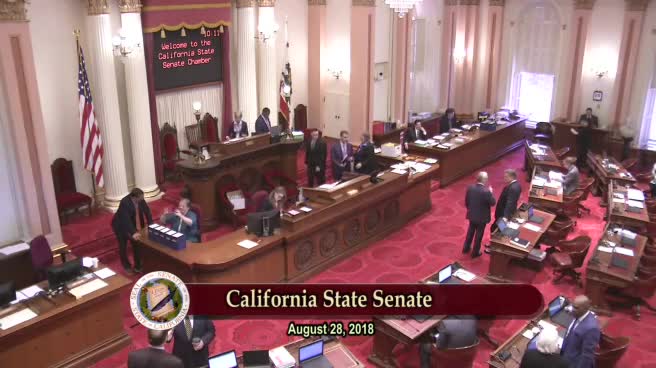 40SEC
Senate Floor
 3MIN
Senate Standing Committee on Banking and Financial Institutions
Bill Author

Bill Co-Author(s):