SB 1387: Vehicles: license plate pilot programs.
- Session Year: 2017-2018
- House: Senate
- Latest Version Date: 2018-09-18
Existing law requires a vehicle to display a license plate issued by the Department of Motor Vehicles on the rear of the vehicle. Existing law requires a vehicle to display tabs upon the license plate indicating the month and year of expiration of the vehicle registration and makes it a crime to display expired tabs. Existing law authorizes the department to conduct a pilot program, to be completed no later than January 1, 2019, to evaluate the use of alternatives to stickers, tabs, license plates, and registration cards, subject to certain requirements, and if the department conducts a pilot program, requires the department to submit a report of the results of the pilot program, as specified, to the Legislature no later than July 1, 2020.
This bill would extend the date for which the authorized pilot program is to be completed by the department to January 1, 2020.
Existing law, operative under certain conditions, redesignates the Peninsula Corridor Study Joint Powers Board as the Peninsula Rail Transit District, comprised of 9 members appointed from various governing bodies situated in the City and County of San Francisco and the Counties of San Mateo and Santa Clara, with specified powers.This bill would repeal the provisions relating to the Peninsula Rail Transit District.Existing law, operative under certain conditions, redesignates the Peninsula Corridor Study Joint Powers Board as the Peninsula Rail Transit District, comprised of 9 members appointed from various governing bodies situated in the City and County of San Francisco and the Counties of San Mateo and Santa Clara, with specified powers.
This bill would repeal the provisions relating to the Peninsula Rail Transit District.
(a)The department may issue one or more stickers, tabs, or other suitable devices in lieu of the license plates provided for under this code. Except when the physical differences between the stickers, tabs, or devices and license plates by their nature render the provisions of this code inapplicable, all provisions of this code relating to license plates may apply to stickers, tabs, or devices.
(b)The department may establish a pilot program to evaluate the use of alternatives to the stickers, tabs, license plates, and registration cards authorized by this code, subject to all of the following requirements:
(1)The alternative products shall be approved by the Department of the California Highway Patrol.
(2)The pilot program shall be limited to no more than 0.5 percent of registered vehicles for the purpose of road testing and evaluation.
(3)The alternative products to be evaluated shall be provided at no cost to the state.
(4)Any pilot program established by the department pursuant to this subdivision shall be completed no later than January 1, 2020.
(5)Any pilot program established by the department pursuant to this subdivision shall be limited to vehicle owners who have voluntarily chosen to participate in the pilot program.
(c)In the conduct of any pilot program pursuant to this section, any data exchanged between the department and any electronic device or the provider of any electronic device shall be limited to those data necessary to display evidence of registration compliance. The department shall not receive or retain any information generated during the pilot program regarding the movement, location, or use of a vehicle participating in the pilot program.
(d)If the department conducts a pilot program authorized in subdivision (b), the department shall, no later than July 1, 2020, submit a report of the results of the pilot program to the Legislature, in compliance with Section 9795 of the Government Code, to include, but not be limited to, all of the following:
(1)An evaluation of the cost-effectiveness of the alternatives used in the pilot program when compared to the departments current use of stickers, tabs, license plates, and registration cards.
(2)A review of all products evaluated in the pilot program and of the features of those products. The report shall note if the devices evaluated in the pilot program are available with the ability to transmit and retain information relating to the movement, location, or use of a vehicle, and if a product contains that feature, the report shall also note if the product includes any security features to protect against unauthorized access to information.
(3)Recommendations for subsequent actions, if any, that should be taken with regard to alternatives evaluated in the pilot program.
(a)The department may issue one or more stickers, tabs, or other suitable devices in lieu of the license plates provided for under this code. Except where when the physical differences between the stickers, tabs, or devices and license plates by their nature render the provisions of this code inapplicable, all provisions of this code relating to license plates may apply to stickers, tabs, or devices.
(b)The department may establish a pilot program to evaluate the use of alternatives to the stickers, tabs, license plates, and registration cards authorized by this code, subject to all of the following requirements:
(1)The alternative products shall be approved by the Department of the California Highway Patrol.
(2)The pilot program shall be limited to no more than 0.5 percent of registered vehicles for the purpose of road testing and evaluation.
(3)The alternative products to be evaluated shall be provided at no cost to the state.
(4)Any pilot program established by the department pursuant to this subdivision shall be completed no later than January 1, 2019. 2020.
(5)Any pilot program established by the department pursuant to this subdivision shall be limited to vehicle owners who have voluntarily chosen to participate in the pilot program.
(c)In the conduct of any pilot program pursuant to this section, any data exchanged between the department and any electronic device or the provider of any electronic device shall be limited to those data necessary to display evidence of registration compliance. The department shall not receive or retain any information generated during the pilot program regarding the movement, location, or use of a vehicle participating in the pilot program.
(d)If the department conducts a pilot program authorized in subdivision (b), the department shall, no later than July 1, 2020, submit a report of the results of the pilot program to the Legislature, in compliance with Section 9795 of the Government Code, to include, but not be limited to, all of the following:
(1)An evaluation of the cost effectiveness cost-effectiveness of the alternatives used in the pilot program when compared to the departments current use of stickers, tabs, license plates, and registration cards.
(2)A review of all products evaluated in the pilot program and of the features of those products. The report shall note if the devices evaluated in the pilot program are available with the ability to transmit and retain information relating to the movement, location, or use of a vehicle, and if a product contains that feature, the report shall also note if the product includes any security features to protect against unauthorized access to information.
(3)Recommendations for subsequent actions, if any, that should be taken with regard to alternatives evaluated in the pilot program.
SECTION 1.Division 16 (commencing with Section 160000) of the Public Utilities Code is repealed.|
Date
|
Status
|
|---|---|
| Sep 18, 2018 | Chaptered by Secretary of State. Chapter 520, Statutes of 2018. |
| Sep 18, 2018 | Approved by the Governor. |
| Sep 10, 2018 | Enrolled and presented to the Governor at 4 p.m. |
| Aug 30, 2018 | Assembly amendments concurred in. (Ayes 39. Noes 0.) Ordered to engrossing and enrolling. |
| Aug 29, 2018 | Ordered to special consent calendar. |
| Aug 28, 2018 | In Senate. Concurrence in Assembly amendments pending. |
| Aug 28, 2018 | Read third time. Passed. Ordered to the Senate. |
| Aug 20, 2018 | Read second time. Ordered to third reading. |
| Aug 16, 2018 | From committee: Do pass. (Ayes 17. Noes 0.) (August 16). |
| Aug 8, 2018 | August 8 set for first hearing. Placed on APPR. suspense file. |
| Aug 8, 2018 | August 8 set for first hearing. Placed on suspense file. |
| Jun 26, 2018 | From committee: Do pass and re-refer to Com. on APPR. (Ayes 13. Noes 0.) (June 25). Re-referred to Com. on APPR. |
| Jun 20, 2018 | From committee with author's amendments. Read second time and amended. Re-referred to Com. on TRANS. |
| Apr 26, 2018 | Referred to Com. on TRANS. |
| Apr 9, 2018 | In Assembly. Read first time. Held at Desk. |
| Apr 9, 2018 | Read third time. Passed. (Ayes 39. Noes 0.) Ordered to the Assembly. |
| Apr 4, 2018 | Read second time. Ordered to consent calendar. |
| Apr 3, 2018 | From committee: Do pass. Ordered to consent calendar. (Ayes 13. Noes 0.) (April 3). |
| Mar 21, 2018 | Set for hearing April 3. |
| Mar 8, 2018 | Referred to Com. on T. & H. |
| Feb 20, 2018 | From printer. May be acted upon on or after March 22. |
| Feb 16, 2018 | Introduced. Read first time. To Com. on RLS. for assignment. To print. |
|
Date
|
Description
|
Location
|
Votes
|
|
|---|---|---|---|---|
| Aug 28, 2018 | SB 1387 Beall Senate Third Reading By AGUIAR-CURRY | Assembly Floor |
Passed |
|
| Aug 16, 2018 | Do pass. | Assembly Standing Committee on Appropriations |
Passed |
|
| Jun 25, 2018 | Do pass and be re-referred to the Committee on [Appropriations] | Assembly Standing Committee on Transportation |
Passed |
|
| Apr 9, 2018 | Consent Calendar SB1387 | Senate Floor |
Passed |
|
| Apr 3, 2018 | Do pass and be ordered to the Consent Calendar | Senate Standing Committee on Transportation and Housing |
Passed |
This list shows positions taken on this bill by organizations on the date displayed, which is linked to the original source.
Positions by individuals are not included.
|
Organization
|
Position
|
Date
|
|---|---|---|
| New Car Dealers Association | ** Support | Aug 28, 2018 |
| Reviver Auto | ** Support | Aug 28, 2018 |
| Reviverauto | ** Support | Jun 22, 2018 |
| Silicon Valley Leadership Group | ** Support | Aug 28, 2018 |
Office of Senate Floor Analyses (916) 651-1520 Fax: (916) 327-4478 | SB |
UNFINISHED BUSINESS
Bill No: SB 1387
:
PRIOR SENATE VOTES NOT RELEVANT
ASSEMBLY FLOOR: 80-0, 8/28/18 - See last page for vote
SUBJECT: Vehicles: license plate pilot programs
DIGEST:
This bill extends the sunset date for the Department of Motor Vehicles (DMV) pilot program relative to studying alternatives to vehicle license plates, registration stickers, and registration cards.
Assembly Amendments
delete provisions passed out of the Senate as they relate to the Peninsula Rail Transit District and incorporate provisions pertaining to the sunset extension of DMV’s license plate pilot program.
Existing law:
- Requires DMV to issue two reflectorized license plates for vehicles and specifies that:
- Each plate must display the word “California,” the vehicle's registration number, and the year for which the vehicle's registration is valid; and,
- For license plates other than motorcycles, the license must be rectangular in shape, 12 inches in length, and six inches in width.
- Prohibits DMV from contracting with any non-governmental entity for purposes of manufacturing license plates.
- Authorizes DMV to issue one or more stickers, tabs, or other suitable devices in lieu of a license plate as specified.
- Authorizes DMV to conduct a pilot program to evaluate alternatives to vehicle license plates, registration stickers, and registration cards until no later than January 1, 2019, and requires DMV to report on the results of the pilot program to the Legislature no later than July 1, 2020.
- Requires the Department of the California Highway Patrol to approve any DMV-selected alternative to license plates or registration stickers and cards.
- Requires a vendor to be responsible for the cost associated with any alternative products used in the pilot program.
- Imposes various fees for the registration of vehicles and the purchase, transfer, and renewal of specialty license plates.
This bill extends existing authority for DMV to conduct a pilot evaluating alternatives to vehicle license plates, registration stickers, and registration cards from January 1, 2019, to January 1, 2020.
Comments
- Purpose. According to the author, “SB 1387 extends existing authority for Department of Motor Vehicles to conduct a pilot evaluating alternatives to vehicle license plates, registration stickers, and registration cards from January 1, 2019 to January 1, 2020. The purpose for extending the sunset date is to ensure the plates have sufficient miles-in-use and the hardware and software function properly, including how the digital plates interact with the cloud. In addition, SB 1387 will serve to align the sunset date of the pilot more closely to the date the DMV is required to submit their final report and recommendations to the Legislature, which is July 1, 2020 in current law.”
- Driver's licenses. DMV has issued license plates and registration stickers since 1959. Currently, in order to register a vehicle, the registered owner must submit proof of insurance, pay registration and other fees, and when required, provide proof that the vehicle passed a smog check inspection. DMV then issues, typically by mail, a vehicle registration card and the appropriate sticker for the vehicle's rear license plate. For annual renewal of a vehicle registration, DMV mails the registered owner a notice and reply envelope approximately 60 days prior to the vehicle's renewal date. The owner can remit fees and required documentation by mail, via DMV's Internet Web site, in person at a DMV field office, DMV self-service terminal, or at the office of one of DMV's private industry partners. DMV registers 35 million vehicles annually, with over 10 million renewals taking place in DMV field offices each year.
- Pilot Program. In 2013, the Legislature passed and Governor Brown signed SB 806 (Hueso, Chapter 569, Statutes of 2013) authorizing DMV to establish a pilot program to evaluate the use of alternatives to license plates, registration stickers, and registration cards. SB 806 required DMV to complete the pilot by January 1, 2017, and report its findings to the Legislature by July 1, 2018. At the time, the author sought to facilitate DMV's ability to explore alternatives to the traditional metal license plate, plastic-coated registration stickers, and paper registration cards in order to improve efficiency and lower the cost of DMV vehicle registration services. In 2016, SB 1399 (Hueso, Chapter 155, Statutes of 2016) extended the pilot program to 2019 and reporting requirements to 2020 respectively to provide DMV and program participants additional time to study and evaluate alternatives.
This bill extends DMV's authority to conduct the pilot program one more year, to January 1, 2020. According to the author, this is necessary to properly conduct and complete the study. This bill does not extend the report deadline of July 1, 2020, which will not delay the submission of the results to the Legislature.
FISCAL EFFECT: Appropriation: Fiscal Com.: Local:
According to the Assembly Appropriations Committee:
- Minor cost to DMV to operate the pilot program for one additional year.
New Car Dealers Association
Reviver Auto
Silicon Valley Leadership Group
OPPOSITION: (Verified 8/28/18)
None received
ASSEMBLY FLOOR: 80-0, 8/28/18
AYES: Acosta, Aguiar-Curry, Travis Allen, Arambula, Baker, Berman, Bigelow, Bloom, Bonta, Brough, Burke, Caballero, Calderon, Carrillo, Cervantes, Chau, Chávez, Chen, Chiu, Choi, Chu, Cooley, Cooper, Cunningham, Dahle, Daly, Eggman, Flora, Fong, Frazier, Friedman, Gabriel, Gallagher, Cristina Garcia, Eduardo Garcia, Gipson, Gloria, Gonzalez Fletcher, Gray, Grayson, Harper, Holden, Irwin, Jones-Sawyer, Kalra, Kamlager-Dove, Kiley, Lackey, Levine, Limón, Low, Maienschein, Mathis, Mayes, McCarty, Medina, Melendez, Mullin, Muratsuchi, Nazarian, Obernolte, O'Donnell, Patterson, Quirk, Quirk-Silva, Reyes, Rivas, Rodriguez, Rubio, Salas, Santiago, Steinorth, Mark Stone, Thurmond, Ting, Voepel, Waldron, Weber, Wood, Rendon
8/28/18 21:27:57
SENATE THIRD READING
STR Bill Id:SB 1387
Author:(Beall)
As Amended Ver:June 20, 2018
Majority vote
SENATE VOTE: 39-0
Committee | Votes | Ayes | Noes |
Transportation | 13-0 | Frazier, Fong, Aguiar-Curry, Baker, Berman, Chu, Daly, Friedman, Gipson, Harper, Mathis, Medina, O'Donnell | |
Appropriations | 17-0 | Gonzalez Fletcher, Bigelow, Bloom, Bonta, Brough, Calderon, Carrillo, Chau, Eggman, Fong, Friedman, Gallagher, Eduardo Garcia, Nazarian, Obernolte, Quirk, Reyes |
|
SUMMARY: Extends existing authority for Department of Motor Vehicles (DMV) to conduct a pilot evaluating alternatives to vehicle license plates, registration stickers, and registration cards from January 1, 2019 to January 1, 2020.
EXISTING LAW:
- Requires DMV to issue two reflectorized license plates for vehicles and specifies that:
- Each plate must display the word "California," the vehicle's registration number, and the year for which the vehicle's registration is valid; and,
- For license plates other than motorcycles, the license must be rectangular in shape, 12 inches in length, and six inches in width.
- Prohibits DMV from contracting with any non-governmental entity for purposes of manufacturing license plates.
- Authorizes DMV to issue one or more stickers, tabs, or other suitable devices in lieu of a license plate as specified.
- Authorizes DMV to conduct a pilot program to evaluate alternatives to vehicle license plates, registration stickers, and registration cards until no later than January 1, 2019, and requires DMV to report on the results of the pilot program to the Legislature no later than July 1, 2020.
- Requires the Department of the California Highway Patrol to approve any DMV-selected alternative to license plates or registration stickers and cards.
- Requires a vendor to be responsible for the cost associated with any alternative products used in the pilot program.
- Imposes various fees for the registration of vehicles and the purchase, transfer, and renewal of specialty license plates.
FISCAL EFFECT: According to Assembly Appropriations Committee, minor cost to DMV to operate the pilot program for one additional year.
COMMENTS: DMV has issued license plates and registration stickers since 1959. Currently, in order to register a vehicle, the registered owner must submit proof of insurance, pay registration and other fees, and when required, provide proof that the vehicle passed a smog check inspection. DMV then issues, typically by mail, a vehicle registration card and the appropriate sticker for the vehicle's rear license plate. For annual renewal of a vehicle registration, DMV mails the registered owner a notice and reply envelope approximately 60 days prior to the vehicle's renewal date. The owner can remit fees and required documentation by mail, via DMV's Internet web site, in person at a DMV field office, DMV self-service terminal, or at the office of one of DMV's private industry partners. DMV registers 35 million vehicles annually, with over 10 million renewals taking place in DMV field offices each year.
In 2013, the Legislature passed and Governor Brown signed SB 806 (Hueso), Chapter 569, Statutes of 2013, authorizing DMV to establish a pilot program to evaluate the use of alternatives to license plates, registration stickers, and registration cards. SB 806 required DMV to complete the pilot by January 1, 2017, and report its findings to the Legislature by July 1, 2018. At the time, the author sought to facilitate DMV's ability to explore alternatives to the traditional metal license plate, plastic-coated registration stickers, and paper registration cards in order to improve efficiency and lower the cost of DMV vehicle registration services.
Since the enactment of SB 806, DMV has developed specifications and completed procurements for each of the three authorized alternatives. The procurement process ran longer than was anticipated when SB 806 was initially considered, and field testing for some of the technologies by the contracted vendors did not begin until as late as November 2015. Due to the abbreviated nature of the testing window and at the behest of the vendors carrying out the pilot, Governor Brown signed SB 1399 (Hueso), Chapter 155, Statutes of 2016, extending the authorization of the pilot until 2019 and the deadline for DMV to report on the pilot until 2020.
This bill extends DMV's authority to conduct the pilot program one more year, to January 1, 2020. According to the author, this is necessary to properly conduct and complete the study. This bill does not extend the report deadline, however, and therefore will not delay the submission of the results to the Legislature.
Analysis Prepared by: Eric Thronson / TRANS. / (916) 319-2093 FN: 0004129
Date of Hearing: August 8, 2018
ASSEMBLY COMMITTEE ON APPROPRIATIONS
Lorena Gonzalez Fletcher, Chair
SBPCA Bill Id:SB 1387
Author:(Beall) – As Amended Ver:June 20, 2018
Policy Committee: | Transportation | Vote: | 13 - 0 |
|
| ||
|
|
Urgency: No State Mandated Local Program: No Reimbursable: No
SUMMARY:
This bill extends existing authority, from January 1, 2019 to January 1, 2020, for Department of Motor Vehicles (DMV) to conduct a pilot evaluating alternatives to vehicle license plates, registration stickers, and registration cards.
FISCAL EFFECT:
Minor cost to DMV to operate the pilot program for one additional year.
COMMENTS:
- Background. In 2013, the Legislature passed and Governor Brown signed SB 806 (Hueso), Chapter 569, Statutes of 2013, authorizing DMV to establish a pilot program to evaluate the use of alternatives to license plates, registration stickers, and registration cards. SB 806 required DMV to complete the pilot by January 1, 2017, and report its findings to the Legislature by July 1, 2018. Since the enactment of SB 806, DMV has developed specifications and completed procurements for each of the three authorized alternatives. The procurement process ran longer than was anticipated when SB 806 was initially considered, and field testing for some of the technologies by the contracted vendors did not begin until as late as November 2015. Due to the shortened testing window and at the request of the vendors carrying out the pilot, Governor Brown signed SB 1399 (Hueso), Chapter 155, Statutes of 2016, extending the authorization of the pilot until 2019 and the deadline for DMV to report on the pilot until 2020. As recently as last year there were only a handful of digital plates being tested as part of the pilot program. Over the last year pilot program participation has increased significantly, which will provide a much larger sample of data for DMV to evaluate.
- Purpose. This bill would extend DMV’s authority to conduct the pilot program one more year, to January 1, 2020. According to the author, this is necessary to properly conduct and complete the study.
Analysis Prepared by: Jessica Peters / APPR. / (916) 319-2081
Date of Hearing: June 25, 2018
ASSEMBLY COMMITTEE ON TRANSPORTATION
Jim Frazier, Chair
SBPCA Bill Id:SB 1387
Author:(Beall) – As Amended Ver:June 20, 2018
SENATE VOTE: vote not relevant
SUBJECT: Vehicles: license plate pilot programs
SUMMARY: Extends existing authority for Department of Motor Vehicles (DMV) to conduct a pilot evaluating alternatives to vehicle license plates, registration stickers, and registration cards from January 1, 2019 to January 1, 2020.
EXISTING LAW:
- Requires DMV to issue two reflectorized license plates for vehicles and specifies that:
- Each plate must display the word “California,” the vehicle's registration number, and the year for which the vehicle's registration is valid; and,
- For license plates other than motorcycles, the license must be rectangular in shape, 12 inches in length, and six inches in width.
- Prohibits DMV from contracting with any non-governmental entity for purposes of manufacturing license plates.
- Authorizes DMV to issue one or more stickers, tabs, or other suitable devices in lieu of a license plate as specified.
- Authorizes DMV to conduct a pilot program to evaluate alternatives to vehicle license plates, registration stickers, and registration cards until no later than January 1, 2019, and requires DMV to report on the results of the pilot program to the Legislature no later than July 1, 2020.
- Requires the Department of the California Highway Patrol to approve any DMV-selected alternative to license plates or registration stickers and cards.
- Requires a vendor to be responsible for the cost associated with any alternative products used in the pilot program.
- Imposes various fees for the registration of vehicles and the purchase, transfer, and renewal of specialty license plates.
FISCAL EFFECT: Unknown
COMMENTS: DMV has issued license plates and registration stickers since 1959. Currently, in order to register a vehicle, the registered owner must submit proof of insurance, pay registration and other fees, and when required, provide proof that the vehicle passed a smog check inspection. DMV then issues, typically by mail, a vehicle registration card and the appropriate sticker for the vehicle’s rear license plate. For annual renewal of a vehicle registration, DMV mails the registered owner a notice and reply envelope approximately 60 days prior to the vehicle’s renewal date. The owner can remit fees and required documentation by mail, via DMV’s Internet web site, in person at a DMV field office, DMV self-service terminal, or at the office of one of DMV’s private industry partners. DMV registers 35 million vehicles annually, with over 10 million renewals taking place in DMV field offices each year.
In 2013, the Legislature passed and Governor Brown signed SB 806 (Hueso), Chapter 569, Statutes of 2013, authorizing DMV to establish a pilot program to evaluate the use of alternatives to license plates, registration stickers, and registration cards. SB 806 required DMV to complete the pilot by January 1, 2017, and report its findings to the Legislature by July 1, 2018. At the time, the author sought to facilitate DMV’s ability to explore alternatives to the traditional metal license plate, plastic-coated registration stickers, and paper registration cards in order to improve efficiency and lower the cost of DMV vehicle registration services.
Since the enactment of SB 806, DMV has developed specifications and completed procurements for each of the three authorized alternatives. The procurement process ran longer than was anticipated when SB 806 was initially considered, and field testing for some of the technologies by the contracted vendors did not begin until as late as November 2015. Due to the abbreviated nature of the testing window and at the behest of the vendors carrying out the pilot, Governor Brown signed SB 1399 (Hueso), Chapter 155, Statutes of 2016, extending the authorization of the pilot until 2019 and the deadline for DMV to report on the pilot until 2020.
This bill would extend DMV’s authority to conduct the pilot program one more year, to January 1, 2020. According to the author, this is necessary to properly conduct and complete the study. This bill does not extend the report deadline, however, and therefore will not delay the submission of the results to the Legislature.
Previous Legislation: SB 1399 (Hueso), Chapter 155, Statutes of 2016, extended the sunset on the DMV pilot program evaluating alternatives to license plates, registration stickers, and registration cards to January 1, 2019, and the deadline for DMV to report on the pilot to July 1, 2020.
SB 806 (Hueso), Chapter 569, Statutes of 2013, authorized DMV to conduct a pilot program to evaluate alternatives to license plates, registration stickers, and registration cards.
REGISTERED SUPPORT / OPPOSITION:
Support
ReviverAuto
Opposition
None on file
Analysis Prepared by: Eric Thronson / TRANS. / (916) 319-2093
Office of Senate Floor Analyses (916) 651-1520 Fax: (916) 327-4478 | SB |
CONSENT
Bill No: SB 1387
:
SENATE TRANS. & HOUSING COMMITTEE: 13-0, 4/3/18
AYES: Beall, Cannella, Allen, Dodd, Gaines, Galgiani, McGuire, Morrell, Roth, Skinner, Vidak, Wieckowski, Wiener
DIGEST:
This bill deletes obsolete provisions of law creating the Peninsula Rail District.
Existing law:
- Re-designates the Peninsula Corridor Study Joint Powers Board as the Peninsula Rail Transit District (District) and specifies the composition of the District’s governing board.
- Vests the District, additionally, with specified powers and duties necessary for the operation of rail passenger and freight services between San Francisco and Alma[1], as well as the authority to provide commuter rail service between San Jose and Gilroy, as specified.
This bill deletes unnecessary provisions of law establishing the District and giving it specified powers.
Background
- A history of Caltrain. Caltrain is a commuter rail line that provides service along the San Francisco Peninsula, through the South Bay to San Jose and Gilroy. The line began in 1980, when Caltrans started providing rail service in the corridor, sharing operating subsidies with San Francisco, San Mateo, and Santa Clara counties. The state assumed sole responsibility for station acquisitions and other capital improvements until the Peninsula Corridor Study Joint Powers Board was formed in 1987 to manage the line. In 1988, the Legislature enacted statutes re-designating the Peninsula Corridor Study Joint Powers Board as the District. However, the District was never formed. Instead, in 1992, the Peninsula Corridor Study Joint Powers Board became the Peninsula Corridor Joint Powers Board and assumed operating responsibilities for Caltrain.
- Technical cleanup. This bill provides technical cleanup to existing state law by removing provisions that are now obsolete.
Comments
- Purpose. The author notes, “SB 1387 repeals obsolete provisions in the Public Utilities Code enabling creation of a Peninsula Rail District to operate commuter rail service on the San Francisco Peninsula. Such a district was never formed. Rather, the Peninsula Corridor Joint Powers Board was formed under the Joint Powers Agency law in the Government Code to manage the commuter rail service now known as Caltrain.”
The author further highlights, "the fact that there is an unused and unnecessary body of law referring to a different agency as operator of rail service on the Peninsula causes confusion to those who administer various grants, provide services to, and oversee the Peninsula Corridor Joint Powers Board."
FISCAL EFFECT: Appropriation: Fiscal Com.: Local:
None received
None received
4/4/18 14:19:29
**** END ****
Alma is currently a drowned, ghost town in Santa Clara County that lies beneath the waters of Lexington Reservoir. It used to be an important rail stop for the logging industry. ↑
SENATE COMMITTEE ON TRANSPORTATION AND HOUSING
Senator Jim Beall, Chair
2017 - 2018 Regular
Bill No: Hearing Date: 4/3/2018
Author: | Beall | ||
Version: | 2/16/2018 | ||
Urgency: | No | Fiscal: | No |
Consultant: | Jeffery Song | ||
SUBJECT:
DIGEST: This bill deletes obsolete provisions of law creating the Peninsula Rail District.
ANALYSIS:
Existing law:
- Re-designates the Peninsula Corridor Study Joint Powers Board as the Peninsula Rail Transit District (District) and specifies the composition of the District’s governing board.
- Additionally vests the District with specified powers and duties necessary for the operation of rail passenger and freight services between San Francisco and Alma[1], as well as the authority to provide commuter rail service between San Jose and Gilroy, as specified.
This bill deletes unnecessary provisions of law establishing the District and giving it specified powers.
COMMENTS
- Purpose. The author notes, “SB 1387 repeals obsolete provisions in the Public Utilities Code enabling creation of a Peninsula Rail District to operate commuter rail service on the San Francisco Peninsula. Such a district was never formed. Rather, the Peninsula Corridor Joint Powers Board was formed under the Joint Powers Agency law in the Government Code to manage the commuter rail service now known as Caltrain.”
The author further highlights, "the fact that there is an unused and unnecessary body of law referring to a different agency as operator of rail service on the Peninsula causes confusion to those who administer various grants, provide services to, and oversee the Peninsula Corridor Joint Powers Board."
- A history of Caltrain. Caltrain is a commuter rail line that provides service along the San Francisco Peninsula, through the South Bay to San Jose and Gilroy. The line began in 1980, when Caltrans started providing rail service in the corridor, sharing operating subsidies with San Francisco, San Mateo, and Santa Clara counties. The state assumed sole responsibility for station acquisitions and other capital improvements until the Peninsula Corridor Study Joint Powers Board was formed in 1987 to manage the line. In 1988, the Legislature enacted statutes re-designating the Peninsula Corridor Study Joint Powers Board as the District. However, the District was never formed. Instead, in 1992, the Peninsula Corridor Study Joint Powers Board became the Peninsula Corridor Joint Powers Board and assumed operating responsibilities for Caltrain.
- Technical cleanup. This bill provides technical cleanup to existing state law by removing provisions that are now obsolete.
FISCAL EFFECT: Appropriation: No Fiscal Com.: No Local: No
POSITIONS: (Communicated to the committee before noon on Wednesday,
March 28, 2018.)
SUPPORT:
None received.
OPPOSITION:
None received.
-- END --
Alma is currently a drowned, ghost town in Santa Clara County that lies beneath the waters of Lexington Reservoir. It used to be an important rail stop for the logging industry. ↑
Discussed in Hearing
View Older Hearings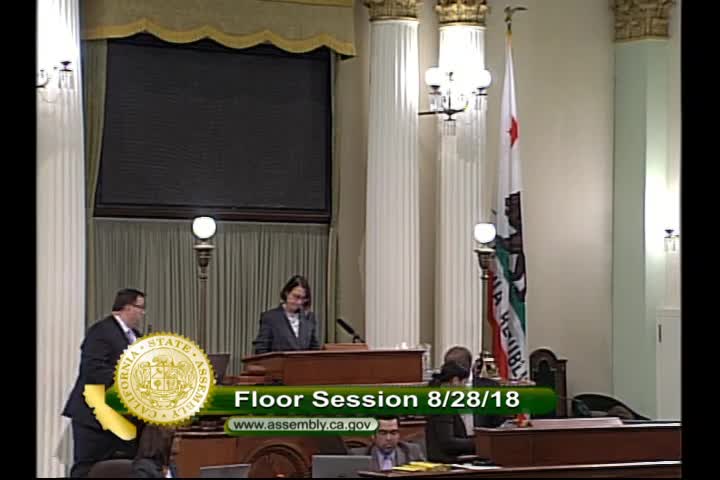

Bill Author

Bill Co-Author(s):