SB 149: Presidential primary elections: ballot access.
- Session Year: 2017-2018
- House: Senate
- Latest Version Date: 2017-09-20
Existing law establishes processes for printing on presidential primary ballots the names of candidates for President of the United States who are considered to be generally recognized candidates or who are selected by a sufficient number of registered voters.
This bill would enact the Presidential Tax Transparency and Accountability Act, which would require a candidate for President, in order to have his or her name placed upon a primary election ballot, to file his or her income tax returns for the 5 most recent taxable years with the Secretary of State, as specified. The act would require the Secretary of State, after adopting regulations, to redact the income tax returns of Presidential candidates as necessary to protect individual privacy, as specified, and subsequently to make the returns available to the public on the Secretary of States Internet Web site.
Existing law establishes processes for printing on presidential primary ballots the names of candidates for President of the United States who are considered to be generally recognized candidates or who are selected by a sufficient number of registered voters. Existing law generally requires a write-in candidate for President in a presidential primary election to file an endorsement of his or her write-in candidacy with the Secretary of State, at least 21 days before the election.
This bill would enact the Presidential Tax Transparency and Accountability Act, which would require a candidate for President, in order to have his or her name placed upon a primary election ballot, to file his or her income tax returns for the 5 most recent taxable years with the Secretary of State, as specified. The act would impose the same requirement on a Presidential write-in candidate, in order for votes for the candidate in a presidential primary election to be counted. The act would require the Secretary of State, after adopting regulations, to redact the income tax returns of Presidential candidates as necessary to protect individual privacy, as specified, and subsequently to make the returns available to the public on the Secretary of States Internet Web site.
Existing law establishes processes for printing on presidential primary ballots the names of candidates for President of the United States who are considered to be generally recognized candidates or who are selected by a sufficient number of registered voters. Existing law generally requires a write-in candidate for President in a presidential primary election to file an endorsement of his or her write-in candidacy with the Secretary of State, at least 21 days before the election.
This bill would enact the Presidential Tax Transparency and Accountability Act, which would require a candidate for President, in order to have his or her name placed upon a primary election ballot, to file his or her income tax returns for the 5 most recent taxable years, if applicable, years with the Secretary of State. State, as specified. The act would also require impose the same requirement on a Presidential write-in candidates income tax returns for the 5 most recent taxable years, if applicable, to be submitted to the Secretary of State, candidate, in order for votes for the candidate to be recognized in a presidential primary election. election to be counted. The act would require the Secretary of State, after adopting regulations, to redact the income tax returns of Presidential candidates as necessary to protect privacy, individual privacy, as specified, and subsequently to make them the returns available to the public on the Secretary of States Internet Web site.
Existing law requires that the names of candidates for President and Vice President of the United States be printed on statewide general election ballots. establishes processes for printing on presidential primary ballots the names of candidates for President of the United States who are considered to be generally recognized candidates or who are selected by a sufficient number of registered voters. Existing law establishes a process for counting votes for generally requires a write-in candidates candidate for President and Vice President for which a declaration in a presidential primary election to file an endorsement of his or her write-in candidacy is timely submitted to with the Secretary of State. State, at least 21 days before the election.
This bill, which bill would be known as enact the Presidential Tax Transparency and Accountability Act, which would require a candidate for President, in order to have his or her name placed upon a general primary election ballot, to file his or her income tax returns returns for the 5 most recent taxable years years, if applicable, with the Secretary of State at least 70 days before that election. State. The bill act would also require a Presidential write-in candidates income tax returns for the 5 most recent taxable years years, if applicable, to be included with his or her declaration of write-in candidacy. submitted to the Secretary of State, in order for the candidate to be recognized in a presidential primary election. The bill act would require the Secretary of State, after adopting regulations, to redact the income tax returns of Presidential candidates as necessary to protect privacy, and subsequently to make them available to the public on the Secretary of States Internet Web site.
Existing law requires that the names of candidates for President and Vice President of the United States be printed on statewide general election ballots. Existing law establishes a process for counting votes for write-in candidates for President and Vice President for which a declaration of write-in candidacy is timely submitted to the Secretary of State.
This bill, which would be known as the Presidential Tax Transparency and Accountability Act, would require a candidate for President, in order to have his or her name placed upon a general election ballot, to file his or her income tax returns for the 5 most recent taxable years with the Secretary of State at least 70 days before that election. The bill would also require a Presidential write-in candidates income tax returns for the 5 most recent taxable years to be included with his or her declaration of write-in candidacy. The bill would require the Secretary of State, after adopting regulations, to redact the income tax returns of Presidential candidates as necessary to protect privacy, and subsequently to make them available to the public on the Secretary of States Internet Web site.
This chapter shall be known and may be cited as the Presidential Tax Transparency and Accountability Act.
6881.The Legislature finds and declares that the State of California has a strong interest in ensuring that its voters make informed, educated choices in the voting booth. To this end, the state has mandated that extensive amounts of information be provided to voters, including county and state voter information guides. The Legislature also finds and declares that a Presidential candidates income tax returns provide voters with essential information regarding the candidates potential conflicts of interest, business dealings, financial status, and charitable donations. The information in tax returns therefore helps voters to make a more informed decision. The Legislature further finds and declares that as one of the largest centers of economic activity in the world, the State of California has a special interest in the President refraining from corrupt or self-enriching behaviors while in office. The people of California can better estimate the risks of any given Presidential candidate engaging in corruption or the appearance of corruption if they have access to candidates tax returns. Finally, the State of California has an interest in ensuring that any violations of the Foreign Emoluments Clause of the United States Constitution or statutory prohibitions on behavior such as insider trading are detected and punished. Mandated disclosure of Presidential candidates tax returns will enable enforcement of the laws against whichever candidate is elected President. The Legislature finds and declares that compliance costs with this requirement will be trivial.
6882.For purposes of this chapter, income tax return means any tax or information return, declaration of estimated tax, or claim for refund required by, or provided for or permitted under, the provisions of the Internal Revenue Code, and that is filed on behalf of, or with respect to any person, and any amendment or supplement thereto, including supporting schedules, attachments, or lists that are supplemental to, or part of, the return so filed.
6883.(a)Notwithstanding any other law, the Secretary of State shall not print the name of a candidate for President of the United States on a primary election ballot, unless the candidate, within a reasonable timeframe established by the Secretary of State, files with the Secretary of State a copy of every income tax return the candidate filed with the Internal Revenue Service in the five most recent taxable years.
(b)If the candidate has not filed his or her income tax return with the Internal Revenue Service for the tax year immediately preceding the primary election, he or she shall submit a copy of the income tax return to the Secretary of State within five days of filing the return with the Internal Revenue Service.
(c)The requirement in subdivision (a) does not apply to any year in which the candidate was not required to file his or her income tax return with the Internal Revenue Service.
6884.(a)The Secretary of State shall redact the social security number, address, or telephone number of any individual in an income tax return submitted pursuant to this chapter, and shall make any other redactions necessary to protect individual privacy.
(b)After redacting an income tax return, the Secretary of State shall make it available to the public on the Secretary of States Internet Web site.
6885.The Secretary of State shall adopt regulations to implement this chapter.
This chapter shall be known and may be cited as the Presidential Tax Transparency and Accountability Act.
6881.The Legislature finds and declares that a presidential candidates income tax returns provide voters with essential information regarding the candidates potential conflicts of interest, business dealings, financial status, and charitable donations. Donald Trumps refusal to release his income tax returns departed from decades of established political tradition, denying voters the opportunity to fully evaluate his fitness for the office of President of the United States.6881.The Legislature finds and declares that the State of California has a strong interest in ensuring that its voters make informed, educated choices in the voting booth. To this end, the state has mandated that extensive amounts of information be provided to voters, including county and state voter information guides. The Legislature also finds and declares that a Presidential candidates income tax returns provide voters with essential information regarding the candidates potential conflicts of interest, business dealings, financial status, and charitable donations. The information in tax returns therefore helps voters to make a more informed decision. The Legislature further finds and declares that as one of the largest centers of economic activity in the world, the State of California has a special interest in the President refraining from corrupt or self-enriching behaviors while in office. The people of California can better estimate the risks of any given Presidential candidate engaging in corruption or the appearance of corruption if they have access to candidates tax returns. Finally, the State of California has an interest in ensuring that any violations of the Foreign Emoluments Clause of the United States Constitution or statutory prohibitions on behavior such as insider trading are detected and punished. Mandated disclosure of Presidential candidates tax returns will enable enforcement of the laws against whichever candidate is elected President. The Legislature finds and declares that compliance costs with this requirement will be trivial.
6882.For purposes of this chapter, income tax return means any tax or information return, declaration of estimated tax, or claim for refund required by, or provided for or permitted under, the provisions of the Internal Revenue Code, and that is filed on behalf of, or with respect to any person, and any amendment or supplement thereto, including supporting schedules, attachments, or lists that are supplemental to, or part of, the return so filed.
6883.(a)Notwithstanding any other law, the Secretary of State shall not print the name of a candidate for President of the United States on a primary election ballot, unless the candidate, within a reasonable timeframe established by the Secretary of State, files with the Secretary of State a copy of every income tax return the candidate filed with the Internal Revenue Service in the five most recent taxable years.
(b)If the candidate has not filed his or her income tax return with the Internal Revenue Service for the tax year immediately preceding the primary election, he or she shall submit a copy of the income tax return to the Secretary of State within five days of filing the return with the Internal Revenue Service.
(c)The requirement in subdivision (a) does not apply to any year in which the candidate was not required to file his or her income tax return with the Internal Revenue Service.
6884.(a)Notwithstanding any other law, votes for a write-in candidate for President of the United States in a presidential primary election shall not be counted, unless the candidate, within a reasonable timeframe established by the Secretary of State, files with the Secretary of State a copy of every income tax return the candidate filed with the Internal Revenue Service in the five most recent taxable years.(b)If the candidate has not filed his or her income tax return with the Internal Revenue Service for the tax year immediately preceding the primary election, he or she shall submit a copy of the income tax return to the Secretary of State within five days of filing the return.6885.6884.(a)The Secretary of State shall redact the social security number, address, or telephone number of any individual in an income tax return submitted pursuant to this chapter, and shall make any other redactions necessary to protect individual privacy.
(b)After redacting an income tax return, the Secretary of State shall make it available to the public on the Secretary of States Internet Web site.
6886.6885.The Secretary of State shall adopt regulations to implement this chapter.
This chapter shall be known and may be cited as the Presidential Tax Transparency and Accountability Act.
6881.The Legislature finds and declares that a presidential candidates income tax returns provide voters with essential information regarding the candidates potential conflicts of interest, business dealings, financial status, and charitable donations. Donald Trumps refusal to release his income tax returns departed from decades of established political tradition, denying voters the opportunity to fully evaluate his fitness for the office of President of the United States.
6882.For purposes of this chapter, income tax return means any tax or information return, declaration of estimated tax, or claim for refund required by, or provided for or permitted under, the provisions of the Internal Revenue Code, and that is filed on behalf of, or with respect to any person, and any amendment or supplement thereto, including supporting schedules, attachments, or lists that are supplemental to, or part of, the return so filed.
6882.6883.(a)Notwithstanding any other law, the Secretary of State shall not print the name of a candidate for President of the United States on a primary election ballot, unless the candidate, within a reasonable timeframe established by the Secretary of State, files with the Secretary of State a copy of his or her every income tax returns for return the candidate filed with the Internal Revenue Service in the five most recent taxable years, if applicable. years.
(b)If the candidate has not filed his or her income tax return with the Internal Revenue Service for the tax year immediately preceding the primary election, he or she shall submit a copy of the income tax return to the Secretary of State within five days of filing the return with the Internal Revenue Service.
6883.6884.(a)Notwithstanding any other law, the Secretary of State shall not recognize votes for a write-in candidate for President of the United States in a presidential primary election, election shall not be counted, unless the candidate, within a reasonable timeframe established by the Secretary of State, files with the Secretary of State a copy of his or her every income tax returns for return the candidate filed with the Internal Revenue Service in the five most recent taxable years, if applicable. years.
(b)If the candidate has not filed his or her income tax return with the Internal Revenue Service for the tax year immediately preceding the primary election, he or she shall submit a copy of the income tax return to the Secretary of State within five days of filing the return.
6884.6885.(a)The Secretary of State shall redact the social security number, address, or telephone number of any individual in an income tax return submitted pursuant to this chapter as chapter, and shall make any other redactions necessary to protect privacy. individual privacy. After
(b)After redacting an income tax return, the Secretary of State shall make it available to the public on the Secretary of States Internet Web site.
6885.6886.The Secretary of State shall adopt regulations to implement this chapter.
REVISIONS: HeadingLine 5.This chapter shall be known and may be cited as the Presidential Tax Transparency and Accountability Act.
6881.The Legislature finds and declares that a presidential candidates income tax returns provide voters with essential information regarding the candidates potential conflicts of interest, business dealings, financial status, and charitable donations. Donald Trumps refusal to release his income tax returns departed from decades of established political tradition, denying voters the opportunity to fully evaluate his fitness for the office of President of the United States.
6882.Notwithstanding any other law, the Secretary of State shall not print the name of a candidate for President of the United States on a primary election ballot, unless the candidate, within a reasonable timeframe established by the Secretary of State, files with the Secretary of State a copy of his or her income tax returns for the five most recent taxable years, if applicable.
6883.Notwithstanding any other law, the Secretary of State shall not recognize a write-in candidate for President of the United States in a presidential primary election, unless the candidate, within a reasonable timeframe established by the Secretary of State, files with the Secretary of State a copy of his or her income tax returns for the five most recent taxable years, if applicable.
6884.The Secretary of State shall redact an income tax return submitted pursuant to this chapter as necessary to protect privacy. After redacting an income tax return, the Secretary of State shall make it available to the public on the Secretary of States Internet web site.
6885.The Secretary of State shall adopt regulations to implement this chapter.
SECTION 1.This act shall be known and may be cited as the Presidential Tax Transparency and Accountability Act.SEC. 2.The Legislature finds and declares that a presidential candidates income tax returns provide voters with essential information regarding the candidates potential conflicts of interest, business dealings, financial status, and charitable donations. Donald Trumps refusal to release his income tax returns departed from decades of established political tradition, denying voters the opportunity to fully evaluate his fitness for the office of President of the United States.SEC. 3.Section 6901 of the Elections Code is amended to read:6901.(a)Whenever a political party, in accordance with Section 6864, 7100, 7300, 7578, or 7843, submits to the Secretary of State its certified list of nominees for electors of President and Vice President of the United States, the Secretary of State shall notify each candidate for elector of his or her nomination by the party.(b)The Secretary of State shall cause the names of the candidates for President and Vice President of the several political parties to be placed upon the ballot for the ensuing general election.(c)Notwithstanding subdivision (b), the Secretary of State shall not cause the name of a political partys candidate for President to be placed upon the ballot for the ensuing general election unless the candidate, no later than 70 days before that general election, files with the Secretary of State a copy of his or her income tax returns for the five most recent taxable years.(d)The Secretary of State shall redact a Presidential candidates tax returns as necessary to protect privacy. After redacting the tax returns, the Secretary of State shall make them available to the public on the Secretary of States Internet Web site.(e)The Secretary of State shall adopt regulations to implement subdivisions (c) and (d).SEC. 4.Section 8304 of the Elections Code is amended to read:8304.(a)When a group of candidates for presidential electors designates the presidential and vice presidential candidates for whom all of the group pledge themselves to vote, the names of the presidential candidate and vice presidential candidate designated by that group shall be printed on the ballot pursuant to Chapter 2 (commencing with Section 13100) of Division 13.(b)(1)Notwithstanding subdivision (a), the name of a candidate for President shall not be printed on a general election ballot as described in subdivision (a) unless the candidate, no later than 70 days before the general election, files with the Secretary of State a copy of his or her income tax returns for the five most recent taxable years.(2)The Secretary of State shall redact the Presidential candidates income tax returns as necessary to protect privacy. After redacting the income tax returns, the Secretary of State shall make them available to the public on the Secretary of States Internet Web site.(c)The Secretary of State shall adopt regulations to implement subdivision (b).SEC. 5.Section 8651 of the Elections Code is amended to read:8651.The declaration of write-in candidacy for presidential elector shall contain the following information:(a)Candidates name.(b)Residence address.(c)A declaration stating that he or she is a write-in candidate for the office of presidential elector.(d)Oath or affirmation as set forth in Section 3 of Article XX of the California Constitution.(e)The date of the general election.(f)The names of the candidates for President and Vice President of the United States for which the group of presidential electors are pledged.(g)(1)A copy of the Presidential candidates income tax returns for the five most recent taxable years.(2)The Secretary of State shall redact the Presidential candidates income tax returns as necessary to protect privacy. After redacting the income tax returns, the Secretary of State shall make them available to the public on the Secretary of States Internet Web site.(h)The Secretary of State shall adopt regulations to implement subdivision (g).This act shall be known and may be cited as the Presidential Tax Transparency and Accountability Act.
SEC. 2.The Legislature finds and declares that a presidential candidates income tax returns provide voters with essential information regarding the candidates potential conflicts of interest, business dealings, financial status, and charitable donations. Donald Trumps refusal to release his income tax returns departed from decades of established political tradition, denying voters the opportunity to fully evaluate his fitness for the office of President of the United States.
SEC. 3.Section 6901 of the Elections Code is amended to read:6901.(a)Whenever a political party, in accordance with Section 6864, 7100, 7300, 7578, or 7843, submits to the Secretary of State its certified list of nominees for electors of President and Vice President of the United States, the Secretary of State shall notify each candidate for elector of his or her nomination by the party. The
(b)The Secretary of State shall cause the names of the candidates for President and Vice President of the several political parties to be placed upon the ballot for the ensuing general election.
(c)Notwithstanding subdivision (b), the Secretary of State shall not cause the name of a political partys candidate for President to be placed upon the ballot for the ensuing general election unless the candidate, no later than 70 days before that general election, files with the Secretary of State a copy of his or her income tax returns for the five most recent taxable years.
(d)The Secretary of State shall redact a Presidential candidates tax returns as necessary to protect privacy. After redacting the tax returns, the Secretary of State shall make them available to the public on the Secretary of States Internet Web site.
(e)The Secretary of State shall adopt regulations to implement subdivisions (c) and (d).
SEC. 4.Section 8304 of the Elections Code is amended to read:8304.(a)When a group of candidates for presidential electors designates the presidential and vice presidential candidates for whom all of the group pledge themselves to vote, the names of the presidential candidate and vice presidential candidate designated by that group shall be printed on the ballot pursuant to Chapter 2 (commencing with Section 13100) of Division 13.
(b)(1)Notwithstanding subdivision (a), the name of a candidate for President shall not be printed on a general election ballot as described in subdivision (a) unless the candidate, no later than 70 days before the general election, files with the Secretary of State a copy of his or her income tax returns for the five most recent taxable years.
(2)The Secretary of State shall redact the Presidential candidates income tax returns as necessary to protect privacy. After redacting the income tax returns, the Secretary of State shall make them available to the public on the Secretary of States Internet Web site.
(c)The Secretary of State shall adopt regulations to implement subdivision (b).
SEC. 5.Section 8651 of the Elections Code is amended to read:8651.The declaration of write-in candidacy for presidential elector shall contain the following information:
(a)Candidates name.
(b)Residence address.
(c)A declaration stating that he or she is a write-in candidate for the office of presidential elector.
(d)Oath or affirmation as set forth in Section 3 of Article XX of the California Constitution.
(e)The date of the general election.
(f)The names of the candidates for President and Vice President of the United States for which the group of presidential electors are pledged.
(g)(1)A copy of the Presidential candidates income tax returns for the five most recent taxable years.
(2)The Secretary of State shall redact the Presidential candidates income tax returns as necessary to protect privacy. After redacting the income tax returns, the Secretary of State shall make them available to the public on the Secretary of States Internet Web site.
(h)The Secretary of State shall adopt regulations to implement subdivision (g).
|
Date
|
Status
|
|---|---|
| Mar 3, 2018 | Last day to consider Governor’s veto pursuant to Joint Rule 58.5. |
| Oct 15, 2017 | In Senate. Consideration of Governor's veto pending. |
| Oct 15, 2017 | Vetoed by the Governor. |
| Sep 22, 2017 | Enrolled and presented to the Governor at 3 p.m. |
| Sep 15, 2017 | Assembly amendments concurred in. (Ayes 27. Noes 11.) Ordered to engrossing and enrolling. |
| Sep 15, 2017 | In Senate. Concurrence in Assembly amendments pending. |
| Sep 14, 2017 | Read third time. Passed. Ordered to the Senate. |
| Sep 7, 2017 | Amendments by Assembly Member Harper tabled on motion by Assembly Member Calderon. |
| Aug 24, 2017 | Read second time. Ordered to third reading. |
| Aug 23, 2017 | From committee: Do pass. (Ayes 10. Noes 5.) (August 23). |
| Aug 21, 2017 | From committee with author's amendments. Read second time and amended. Re-referred to Com. on APPR. |
| Jul 13, 2017 | Coauthors revised. |
| Jun 15, 2017 | Referred to Com. on E. & R. |
| Jun 1, 2017 | In Assembly. Read first time. Held at Desk. |
| May 31, 2017 | Motion by Senator Monning to lay on table amendments by Senator Anderson adopted. (Ayes 27. Noes 13. Page 1348.) |
| May 26, 2017 | Read second time. Ordered to third reading. |
| May 25, 2017 | From committee: Do pass. (Ayes 5. Noes 2. Page 1178.) (May 25). |
| May 19, 2017 | Set for hearing May 25. |
| May 1, 2017 | May 1 hearing: Placed on APPR. suspense file. |
| Apr 21, 2017 | Set for hearing May 1. |
| Apr 19, 2017 | From committee: Do pass and re-refer to Com. on APPR. (Ayes 4. Noes 1. Page 743.) (April 18). Re-referred to Com. on APPR. |
| Apr 5, 2017 | From committee with author's amendments. Read second time and amended. Re-referred to Com. on E. & C.A. |
| Apr 4, 2017 | Set for hearing April 18. |
| Mar 29, 2017 | From committee: Do pass and re-refer to Com. on E. & C.A. (Ayes 5. Noes 2. Page 539.) (March 28). Re-referred to Com. on E. & C.A. |
| Mar 20, 2017 | From committee with author's amendments. Read second time and amended. Re-referred to Com. on JUD. |
| Mar 14, 2017 | Set for hearing March 28. |
| Jan 26, 2017 | Referred to Coms. on JUD. and E. & C.A. |
| Jan 19, 2017 | From printer. May be acted upon on or after February 18. |
| Jan 18, 2017 | Introduced. Read first time. To Com. on RLS. for assignment. To print. |
|
Date
|
Description
|
Location
|
Votes
|
|
|---|---|---|---|---|
| Sep 15, 2017 | Unfinished Business SB149 McGuire et al. Concurrence | Senate Floor |
Passed |
|
| Sep 14, 2017 | SB 149 McGuire Senate Third Reading By SANTIAGO | Assembly Floor |
Passed |
|
| Sep 7, 2017 | SB 149 McGuire Senate Third Reading By SANTIAGO Amend By HARPER Set #1 Motion to Lay on the Table By CALDERON | Assembly Floor |
Passed |
|
| Aug 23, 2017 | Do pass. | Assembly Standing Committee on Appropriations |
Passed |
|
| Jul 12, 2017 | Do pass and be re-referred to the Committee on [Appropriations] | Assembly Standing Committee on Elections and Redistricting |
Passed |
|
| May 31, 2017 | Senate 3rd Reading SB149 McGuire et al. | Senate Floor |
Passed |
|
| May 25, 2017 | Do pass | Senate Standing Committee on Appropriations |
Passed |
|
| May 1, 2017 | Placed on suspense file | Senate Standing Committee on Appropriations |
Passed |
|
| Apr 18, 2017 | Do pass, but first be re-referred to the Committee on [Appropriations] | Senate Standing Committee on Elections and Constitutional Amendments |
Passed |
|
| Mar 28, 2017 | Do pass, but first be re-referred to the Committee on [Elections and Constitutional Amendments] | Senate Standing Committee on Judiciary |
Passed |
This list shows positions taken on this bill by organizations on the date displayed, which is linked to the original source.
Positions by individuals are not included.
|
Organization
|
Position
|
Date
|
|---|---|---|
| 10th ad democrats | ** Support | Jan 2, 2018 |
| AJ CIGAR | * Indeterminate | Mar 28, 2017 |
| americans for tax fairness | ** Support | Jan 2, 2018 |
| California Alliance For Retired Americans | ** Support | Jan 2, 2018 |
| California Common Cause | ** Support | Jul 10, 2017 |
| California Federation Of Teachers | ** Support | Jan 2, 2018 |
| California Labor Federation | ** Support | Jan 2, 2018 |
| California Teachers Association | ** Support | Jan 2, 2018 |
| City of West Hollywood | ** Support | Jan 2, 2018 |
| Courage Campaign | ** Support | Jan 2, 2018 |
| democracy for america - marin | ** Support | Jan 2, 2018 |
| Democracy Winters | * Support | Mar 28, 2017 |
| indivisible | ** Support | Jan 2, 2018 |
| Los Angeles County Democratic Party | ** Support | Jan 2, 2018 |
| mill valley community action network | ** Support | Jan 2, 2018 |
| Roseville Resistance | * Support | Mar 28, 2017 |
| Sacramento | * Support | Mar 28, 2017 |
| Secretary of State Alex Padilla | ** Support | Jan 2, 2018 |
| Service Employees International Union | ** Support | Jan 2, 2018 |
| Tax March Sacramento | * Support | Mar 28, 2017 |
| Two individuals | ** Support | Jan 2, 2018 |
Office of Senate Floor Analyses (916) 651-1520 Fax: (916) 327-4478 | SB |
VETO
Bill No: SB 149
:
SENATE JUDICIARY COMMITTEE: 5-2, 3/28/17
AYES: Jackson, Hertzberg, Monning, Stern, Wieckowski
NOES: Moorlach, Anderson
SENATE ELECTIONS & C.A. COMMITTEE: 4-1, 4/18/17
AYES: Stern, Allen, Hertzberg, Leyva
NOES: Anderson
SENATE APPROPRIATIONS COMMITTEE: 5-2, 5/25/17
AYES: Lara, Beall, Bradford, Hill, Wiener
NOES: Bates, Nielsen
SENATE FLOOR: 27-13, 5/31/17
AYES: Allen, Atkins, Beall, Bradford, De León, Dodd, Galgiani, Glazer, Hernandez, Hertzberg, Hill, Hueso, Jackson, Lara, Leyva, McGuire, Mendoza, Mitchell, Monning, Newman, Pan, Portantino, Roth, Skinner, Stern, Wieckowski, Wiener
NOES: Anderson, Bates, Berryhill, Cannella, Fuller, Gaines, Moorlach, Morrell, Nguyen, Nielsen, Stone, Vidak, Wilk
SENATE FLOOR: 27-11, 9/15/17
AYES: Allen, Atkins, Beall, Bradford, De León, Dodd, Galgiani, Glazer, Hernandez, Hertzberg, Hill, Hueso, Jackson, Lara, Leyva, McGuire, Mendoza, Mitchell, Monning, Newman, Pan, Portantino, Roth, Skinner, Stern, Wieckowski, Wiener
NOES: Anderson, Bates, Cannella, Fuller, Moorlach, Morrell, Nguyen, Nielsen, Stone, Vidak, Wilk
NO VOTE RECORDED: Berryhill, Gaines
ASSEMBLY FLOOR: 54-23, 9/14/17 - See last page for vote
DIGEST: This bill enacts the Presidential Tax Transparency and Accountability Act requiring, as a precondition for appearing on a California primary election ballot, candidates for U.S. President and to file copies of their income tax returns for the five most recent taxable years with the California Secretary of State’s Office (SOS). After redacting the returns for privacy purposes, the SOS would then make the returns available to the public through its Web site.
Existing law:
- Provides that: “[n]o person except a natural born citizen, or a citizen of the United States, at the time of adoption of this Constitution, shall be eligible to the office of President; neither shall any person be eligible to that office who shall not have attained to the age of thirty-five years, and been fourteen years a resident within the United States.” (U.S. Const., art. II, Sec. 1, par. 5.)
- States that: “[t]he executive Power shall be vested in a President of the United States of America. He shall… be elected, as follows… Each State shall appoint, in such Manner as the Legislature thereof may direct, a Number of Electors, equal to the whole Number of Senators and Representatives to which the State may be entitled in the Congress…”(U.S. Const., art. II, Sec. 1, para. 1-2.)
- Establishes that, in California, political parties may certify a list of nominees for presidential elector to the SOS, who shall then place the names of that political party’s candidates for U.S. President and Vice President on the ballot. (Elec. Code Sec. 6901.)
- Provides that, in California, when a group of candidates for presidential electors designates the presidential and vice presidential candidates for whom all of the group pledge themselves to vote, the SOS shall place the names of those presidential and vice presidential candidates on the ballot. (Elec. Code Sec. 8304.)
- Permits, in California, a group of candidates for presidential electors to be certified as write-in candidates, in which case the candidates must declare the names of the presidential and vice presidential candidates they pledge to support. (Elec. Code Sec. 8651.)
- Creates the general rule that federal tax returns are confidential. (26 U.S.C. Sec. 6103.)
- Provides that: “[n]o Title of Nobility shall be granted by the United States: And no Person holding any Office of Profit or Trust under them, shall, without the Consent of the Congress, accept of any present, Emolument, Office, or Title, of any kind whatever, from any King, Prince, or foreign State.” (U.S. Const., art. I, Sec. 9, par. 8.)
This bill:
- Makes findings regarding the importance of the content of a tax return for the informed evaluation of a presidential candidate’s potential conflicts of interest, business dealings, financial status, and charitable donations.
- Prohibits the SOS to place the name of any candidate for U.S. President on the primary ballot unless the candidate files a copy of his or her income tax returns for the past five years, by a reasonable deadline to be established by the SOS. The candidate need not submit a tax return for any year for which the candidate was not required to file taxes.
- Directs the SOS to redact the tax return as necessary to protect privacy and then to make the return available to the public on the SOS Web site.
- Directs the SOS to adopt implementing regulations.
In 1973, the Providence Journal-Bulletin obtained and published data showing that President Richard Nixon had paid an astonishingly low amount in taxes in 1969 given his income for that year. Nixon faced mounting public suspicion and famously responded “I welcome this kind of examination, because people have got to know whether or not their president is a crook. Well, I am not a crook.” After initially resisting calls for him to do so, Nixon eventually released his taxes and underwent an Internal Revenue Service (IRS) audit. It turned out he had improperly claimed an exemption of $500,000 for papers he donated to the National Archives. Nixon wound up paying nearly half of his net worth in back taxes.[1]
Ever since this incident, it has been customary – though never required by law – for U.S. presidential candidates to release their tax returns. Only one candidate, President Gerald Ford in 1976, did not do so. Ford released a summary of his return instead.
Then, during the 2016 campaign for U.S. President, Donald Trump broke with this longstanding tradition and refused to release his tax returns. Prior to declaring his candidacy formally, Trump said he would release his tax returns if he ran for president.[2] In February 2014, he said he would release his tax returns in the next three to four months.[3] Later, he stated that he could not release his tax returns because he was being audited by the IRS.[4] Trump asserted that he would release his returns when the audit was over.[5] After he was inaugurated, Trump’s former campaign manager appeared to state that Trump was not going to release his tax returns at all.[6]
Though prompted by Trump’s break with the customary practice, this bill is not retroactive and applies even-handedly to all future presidential candidates, regardless of party or viewpoint. According to the author, this bill will function to increase transparency, expose potential conflicts of interest, discourage corruption, and provide voters with a more complete basis on which to evaluate those who would seek the nation’s highest office.
Tax returns provide key financial information about the filer. A tax return indicates the filer’s income, what income-generating assets the filer owns, how much the filer is saving, how much the filer has paid in taxes, and what, if any, charitable contributions the filer has made.[7] While some of this information is partially captured in a candidate’s mandatory Federal Elections Commission filing, the information contained in a tax return is broader and more specific.[8] All of this information is relevant to the voters’ determination of who is best fit to lead the country.
This bill enables voters in California to have full access to this information prior to casting their votes.
Comments
U.S. Constitutional Analysis
The U.S. Constitution spells out the qualifications for the office of President. Eligible candidates must be natural born citizens, they must be over 35 years of age, and they have to have resided in the country for at least 14 years. (U.S. Const., Art. II, Sec. 1, para. 5.) In United States Term Limits v. Thornton (1995) 514 U.S. 779 (hereafter “Term Limits”), the U.S. Supreme Court delved exhaustively into the history of the Constitution’s Qualifications Clauses, as the eligibility requirements for federal elective offices are known. Regarding eligibility to serve in Congress, the Court concluded that the constitutional qualifications are fixed, and that states have no authority to alter or add to the terms contained in them. Id at 827.
At the same time, if every interested and eligible candidate for a federal elective office were entitled to appear on the ballot without restriction, the ballot could quickly become so lengthy as to be unwieldy. People might run on a lark or as a joke. Recognizing this, the Court has upheld state laws that impose requirements for appearing on the ballot, even though those requirements are not contained in the relevant constitutional Qualifications Clause:
[a] State has a legitimate interest in regulating the number of candidates on the ballot. In so doing, the State understandably and properly seeks to prevent the clogging of its election machinery, avoid voter confusion, and assure that the winner is the choice of a majority, or at least a strong plurality, of those voting, without the expense and burden of runoff elections… Moreover, a State has an interest, if not a duty, to protect the integrity of its political processes from frivolous or fraudulent candidacies. (Storer v. Brown (1974) 415 U.S. 724, 732-733, hereafter “Storer,” internal citations omitted.)
Thus, Term Limits stands for the proposition that states cannot use ballot access provisions to add or alter the qualifications for federal elective office, while Storer affirms that provisions that merely regulate access to the ballot are constitutionally permissible. But where is the line between the two and on which side does a ballot access requirement to release tax returns fall?
In Schaefer v. Townsend (9th Cir. 2000) 215 F.3d 1031, the Ninth Circuit considered a California statute that required congressional candidates to be residents of the state in order to qualify to get on the ballot. In contrast, the congressional Qualifications Clause merely requires a member of the House of Representatives to inhabit the state “when elected.” (U.S. Const. art. I, Sec. 2, par. 2). Drawing from Term Limits, the Ninth Circuit devised a two-part test for distinguishing between a constitutionally sound ballot access law, and laws that impermissibly interfere with the Qualifications Clause:
First, we must ask whether the… statutes create an absolute bar to candidates who would otherwise qualify under the Qualifications Clause. If they do not, we next ask whether they have the likely effect of handicapping an otherwise qualified class of candidates. (Schaefer, supra, 215 F.3d 1031, 1035.)
Since California is in its jurisdiction, the Ninth Circuit would hear any challenge to SB 149 and Ninth Circuit case law would apply. Presumably, therefore, the Ninth Circuit would examine SB 149 under the two part Schaefer test. A tax return release requirement does not bar otherwise qualified individuals from running. As initially introduced, SB 149 might have kept someone off the ballot who was otherwise eligible to be president, if that person did not have tax returns for each of the past five years for some reason. However, subsequent amendments to this bill make an exception for such instances, so that possibility no longer raises constitutional concern. In short, under existing Ninth Circuit precedent, SB 149 appears to be constitutional.
Nonetheless, if enacted, SB 149 is likely to be challenged in court. There are strong arguments that SB 149 would be found constitutional, most clearly under existing Ninth Circuit precedent, but it is possible that the courts would determine otherwise.
Related/Prior Legislation
SR 23 (Wiener, 2017) urged President Trump to release his tax returns as part of its broader call for an independent investigation into connections between Russia and Trump’s presidential campaign and administration. SR 23 was adopted by the Senate on March 23, 2017.
FISCAL EFFECT: Appropriation: Fiscal Com.: Local:
According to the Assembly Appropriations Committee:
- One-time GF costs of $75,000 to SOS to promulgate regulations.
- Ongoing GF costs to SOS of $55,000 every four years for staff to handle new workload of processing and redacting submitted tax forms and posting them online.
Secretary of State Alex Padilla
10th AD Democrats
Americans for Tax Fairness
California Alliance for Retired Americans
California Federation of Teachers
California Labor Federation
California Teachers Association
City of West Hollywood
Courage Campaign
Democracy for America – Marin
Indivisible
Los Angeles County Democratic Party
Mill Valley Community Action Network
Service Employees International Union
Two individuals
OPPOSITION: (Verified 10/25/17)
None received
ARGUMENTS IN SUPPORT: According to the author:
Releasing tax returns to the public is a long held tradition by all major party Presidential candidates in the modern era. This practice assured the public that all potential Presidential candidates were complying with the emoluments clause.
The American public deserves to know that the individual they are selecting to be president will have their best interest at the heart of every decision, not the best interests of any business venture or investment fund. Transparency is a non-partisan issue.
There are pressing questions for voters to have answered before an election, because unlike members of Congress and federal appointees, presidents are largely exempt from conflict-of-interest laws.
Voters not only deserve full disclosure of their future leader’s tax returns, they should be entitled to them.
GOVERNOR'S VETO MESSAGE:
I am returning Senate Bill 149 without my signature.
This bill requires any candidate for president to disclose five years of his or her income tax returns before their name can be placed on California's primary election ballot.
Although tax returns are by law confidential, many presidential candidates have voluntarily released them. This bill is a response to President Trump's refusal to release his returns during the last election.
While I recognize the political attractiveness-even the merits-of getting
President Trump's tax returns, I worry about the political perils of individual states seeking to regulate presidential elections in this manner. First, it may not be constitutional. Second, it sets a "slippery slope" precedent. Today we require tax returns, but what would be next? Five years of health records? A certified birth certificate? High school report cards? And will these requirements vary depending on which political party is in power?
A qualified candidate's ability to appear on the ballot is fundamental to our democratic system. For that reason, I hesitate to start down a road that well might lead to an ever escalating set of differing state requirements for presidential candidates.
ASSEMBLY FLOOR: 54-23, 9/14/17
AYES: Aguiar-Curry, Arambula, Baker, Berman, Bloom, Bocanegra, Bonta, Burke, Caballero, Calderon, Cervantes, Chau, Chiu, Chu, Cooley, Cooper, Dababneh, Eggman, Friedman, Cristina Garcia, Eduardo Garcia, Gipson, Gloria, Gonzalez Fletcher, Gray, Grayson, Holden, Irwin, Jones-Sawyer, Kalra, Levine, Limón, Low, Maienschein, McCarty, Medina, Mullin, Muratsuchi, Nazarian, O'Donnell, Quirk, Quirk-Silva, Reyes, Ridley-Thomas, Rodriguez, Rubio, Salas, Santiago, Mark Stone, Thurmond, Ting, Weber, Wood, Rendon
NOES: Acosta, Travis Allen, Bigelow, Brough, Chávez, Chen, Choi, Cunningham, Dahle, Flora, Fong, Gallagher, Harper, Kiley, Lackey, Mathis, Mayes, Melendez, Obernolte, Patterson, Steinorth, Voepel, Waldron
NO VOTE RECORDED: Daly, Frazier
Prepared by: Timothy Griffiths / JUD. / (916) 651-4113
1/2/18 9:56:16
**** END ****
Zuckoff, Why We Ask to See Candidates’ Tax Returns (Aug. 5, 2016) The New York Times <https://www.nytimes.com/2016/08/06/opinion/why-we-ask-to-see-candidates-tax-returns.html?_r=0> (as of Mar. 12, 2017). ↑
Hugh Hewitt Show (Feb. 15, 2015) <https://www.youtube.com/watch?v=SIMDkxoS1as> (as of Mar. 13, 2017). ↑
Face the Nation Transcripts (Feb. 14, 2016) <http://www.cbsnews.com/news/face-the-nation-transcripts-february-14-2016-donald-trump-marco-rubio/> (as of Mar. 13, 2017). ↑
The CNN-Telemundo Republican Debate Transcript, Annotated (Feb. 25, 2016) <https://www.washingtonpost.com/news/the-fix/wp/2016/02/25/the-cnntelemundo-republican-debate-transcript-annotated/?utm_term=.558ae4eb9cb9> (as of Mar. 13, 2017). ↑
@realDonaldTrump, In Interview I Told @AP That My Taxes Are Under Routine Audit And I Would Release My Tax Returns When Audit Is Complete, Not After Election! (Mar. 11, 2016) Twitter <https://twitter.com/realdonaldtrump/status/730500562022760448?lang=en> (as of Mar. 17, 2017). ↑
Bradner, Conway: Trump Will Not Release Tax Returns (Jan. 22, 2017) CNN <http://www.cnn.com/2017/01/22/politics/kellyanne-conway-trump-tax-returns/> (as of Mar. 8, 2017). ↑
Maurer, What You Can – And Can’t – Learn From a Tax Return (Jan. 11, 2017) CNBC <http://www.cnbc.com/2016/11/01/what-you-can--and-cant--learn-from-a-tax-return.html> (as of Mar. 14, 2017). ↑
See Comment 6 of this Analysis, below. ↑
Office of Senate Floor Analyses (916) 651-1520 Fax: (916) 327-4478 | SB |
UNFINISHED BUSINESS
Bill No: SB 149
:
SENATE JUDICIARY COMMITTEE: 5-2, 3/28/17
AYES: Jackson, Hertzberg, Monning, Stern, Wieckowski
NOES: Moorlach, Anderson
SENATE ELECTIONS & C.A. COMMITTEE: 4-1, 4/18/17
AYES: Stern, Allen, Hertzberg, Leyva
NOES: Anderson
SENATE APPROPRIATIONS COMMITTEE: 5-2, 5/25/17
AYES: Lara, Beall, Bradford, Hill, Wiener
NOES: Bates, Nielsen
SENATE FLOOR: 27-13, 5/31/17
AYES: Allen, Atkins, Beall, Bradford, De León, Dodd, Galgiani, Glazer, Hernandez, Hertzberg, Hill, Hueso, Jackson, Lara, Leyva, McGuire, Mendoza, Mitchell, Monning, Newman, Pan, Portantino, Roth, Skinner, Stern, Wieckowski, Wiener
NOES: Anderson, Bates, Berryhill, Cannella, Fuller, Gaines, Moorlach, Morrell, Nguyen, Nielsen, Stone, Vidak, Wilk
ASSEMBLY FLOOR: 54-23, 9/14/17 - See last page for vote
DIGEST: This bill enacts the Presidential Tax Transparency and Accountability Act requiring, as a precondition for appearing on a California primary election ballot, candidates for U.S. President and to file copies of their income tax returns for the five most recent taxable years with the California Secretary of State’s Office (SOS). After redacting the returns for privacy purposes, the SOS would then make the returns available to the public through its Web site.
Assembly Amendments expand upon the legislative findings to emphasize the value of the information contained in a tax return to the ability of California voters to evaluate the financial interests of presidential candidates and cast an informed ballot. The amendments also simplify the exception to the requirement to submit a tax return by limiting it to any year for which the candidate was required to file a tax return.
Existing law:
- Provides that: “[n]o person except a natural born citizen, or a citizen of the United States, at the time of adoption of this Constitution, shall be eligible to the office of President; neither shall any person be eligible to that office who shall not have attained to the age of thirty-five years, and been fourteen years a resident within the United States.” (U.S. Const., art. II, Sec. 1, par. 5.)
- States that: “[t]he executive Power shall be vested in a President of the United States of America. He shall… be elected, as follows… Each State shall appoint, in such Manner as the Legislature thereof may direct, a Number of Electors, equal to the whole Number of Senators and Representatives to which the State may be entitled in the Congress…”(U.S. Const., art. II, Sec. 1, para. 1-2.)
- Establishes that, in California, political parties may certify a list of nominees for presidential elector to the SOS, who shall then place the names of that political party’s candidates for U.S. President and Vice President on the ballot. (Elec. Code Sec. 6901.)
- Provides that, in California, when a group of candidates for presidential electors designates the presidential and vice presidential candidates for whom all of the group pledge themselves to vote, the SOS shall place the names of those presidential and vice presidential candidates on the ballot. (Elec. Code Sec. 8304.)
- Permits, in California, a group of candidates for presidential electors to be certified as write-in candidates, in which case the candidates must declare the names of the presidential and vice presidential candidates they pledge to support. (Elec. Code Sec. 8651.)
- Creates the general rule that federal tax returns are confidential. (26 U.S.C. Sec. 6103.)
- Provides that: “[n]o Title of Nobility shall be granted by the United States: And no Person holding any Office of Profit or Trust under them, shall, without the Consent of the Congress, accept of any present, Emolument, Office, or Title, of any kind whatever, from any King, Prince, or foreign State.” (U.S. Const., art. I, Sec. 9, par. 8.)
This bill:
- Makes findings regarding the importance of the content of a tax return for the informed evaluation of a presidential candidate’s potential conflicts of interest, business dealings, financial status, and charitable donations.
- Prohibits the SOS to place the name of any candidate for U.S. President on the primary ballot unless the candidate files a copy of his or her income tax returns for the past five years, by a reasonable deadline to be established by the SOS. The candidate need not submit a tax return for any year for which the candidate was not required to file taxes.
- Directs the SOS to redact the tax return as necessary to protect privacy and then to make the return available to the public on the SOS Web site.
- Directs the SOS to adopt implementing regulations.
In 1973, the Providence Journal-Bulletin obtained and published data showing that President Richard Nixon had paid an astonishingly low amount in taxes in 1969 given his income for that year. Nixon faced mounting public suspicion and famously responded “I welcome this kind of examination, because people have got to know whether or not their president is a crook. Well, I am not a crook.” After initially resisting calls for him to do so, Nixon eventually released his taxes and underwent an Internal Revenue Service (IRS) audit. It turned out he had improperly claimed an exemption of $500,000 for papers he donated to the National Archives. Nixon wound up paying nearly half of his net worth in back taxes.[1]
Ever since this incident, it has been customary – though never required by law – for U.S. presidential candidates to release their tax returns. Only one candidate, President Gerald Ford in 1976, did not do so. Ford released a summary of his return instead.
Then, during the 2016 campaign for U.S. President, Donald Trump broke with this longstanding tradition and refused to release his tax returns. Prior to declaring his candidacy formally, Trump said he would release his tax returns if he ran for president.[2] In February 2014, he said he would release his tax returns in the next three to four months.[3] Later, he stated that he could not release his tax returns because he was being audited by the IRS.[4] Trump asserted that he would release his returns when the audit was over.[5] After he was inaugurated, Trump’s former campaign manager appeared to state that Trump was not going to release his tax returns at all.[6]
Though prompted by Trump’s break with the customary practice, this bill is not retroactive and applies even-handedly to all future presidential candidates, regardless of party or viewpoint. According to the author, this bill will function to increase transparency, expose potential conflicts of interest, discourage corruption, and provide voters with a more complete basis on which to evaluate those who would seek the nation’s highest office.
Tax returns provide key financial information about the filer. A tax return indicates the filer’s income, what income-generating assets the filer owns, how much the filer is saving, how much the filer has paid in taxes, and what, if any, charitable contributions the filer has made.[7] While some of this information is partially captured in a candidate’s mandatory Federal Elections Commission filing, the information contained in a tax return is broader and more specific.[8] All of this information is relevant to the voters’ determination of who is best fit to lead the country.
This bill enables voters in California to have full access to this information prior to casting their votes.
Comments
U.S. Constitutional Analysis
The U.S. Constitution spells out the qualifications for the office of President. Eligible candidates must be natural born citizens, they must be over 35 years of age, and they have to have resided in the country for at least 14 years. (U.S. Const., Art. II, Sec. 1, para. 5.) In United States Term Limits v. Thornton (1995) 514 U.S. 779 (hereafter “Term Limits”), the U.S. Supreme Court delved exhaustively into the history of the Constitution’s Qualifications Clauses, as the eligibility requirements for federal elective offices are known. Regarding eligibility to serve in Congress, the Court concluded that the constitutional qualifications are fixed, and that states have no authority to alter or add to the terms contained in them. Id at 827.
At the same time, if every interested and eligible candidate for a federal elective office were entitled to appear on the ballot without restriction, the ballot could quickly become so lengthy as to be unwieldy. People might run on a lark or as a joke. Recognizing this, the Court has upheld state laws that impose requirements for appearing on the ballot, even though those requirements are not contained in the relevant constitutional Qualifications Clause:
[a] State has a legitimate interest in regulating the number of candidates on the ballot. In so doing, the State understandably and properly seeks to prevent the clogging of its election machinery, avoid voter confusion, and assure that the winner is the choice of a majority, or at least a strong plurality, of those voting, without the expense and burden of runoff elections… Moreover, a State has an interest, if not a duty, to protect the integrity of its political processes from frivolous or fraudulent candidacies. (Storer v. Brown (1974) 415 U.S. 724, 732-733, hereafter “Storer,” internal citations omitted.)
Thus, Term Limits stands for the proposition that states cannot use ballot access provisions to add or alter the qualifications for federal elective office, while Storer affirms that provisions that merely regulate access to the ballot are constitutionally permissible. But where is the line between the two and on which side does a ballot access requirement to release tax returns fall?
In Schaefer v. Townsend (9th Cir. 2000) 215 F.3d 1031, the Ninth Circuit considered a California statute that required congressional candidates to be residents of the state in order to qualify to get on the ballot. In contrast, the congressional Qualifications Clause merely requires a member of the House of Representatives to inhabit the state “when elected.” (U.S. Const. art. I, Sec. 2, par. 2). Drawing from Term Limits, the Ninth Circuit devised a two-part test for distinguishing between a constitutionally sound ballot access law, and laws that impermissibly interfere with the Qualifications Clause:
First, we must ask whether the… statutes create an absolute bar to candidates who would otherwise qualify under the Qualifications Clause. If they do not, we next ask whether they have the likely effect of handicapping an otherwise qualified class of candidates. (Schaefer, supra, 215 F.3d 1031, 1035.)
Since California is in its jurisdiction, the Ninth Circuit would hear any challenge to SB 149 and Ninth Circuit case law would apply. Presumably, therefore, the Ninth Circuit would examine SB 149 under the two part Schaefer test. A tax return release requirement does not bar otherwise qualified individuals from running. As initially introduced, SB 149 might have kept someone off the ballot who was otherwise eligible to be president, if that person did not have tax returns for each of the past five years for some reason. However, subsequent amendments to this bill make an exception for such instances, so that possibility no longer raises constitutional concern. In short, under existing Ninth Circuit precedent, SB 149 appears to be constitutional.
Nonetheless, if enacted, SB 149 is likely to be challenged in court. There are strong arguments that SB 149 would be found constitutional, most clearly under existing Ninth Circuit precedent, but it is possible that the courts would determine otherwise.
Related/Prior Legislation
SR 23 (Wiener, 2017) urges President Trump to release his tax returns as part of its broader call for an independent investigation into connections between Russia and Trump’s presidential campaign and administration. SR 23 was adopted by the Senate on March 23, 2017.
FISCAL EFFECT: Appropriation: Fiscal Com.: Local:
According to the Assembly Appropriations Committee:
- One-time GF costs of $75,000 to SOS to promulgate regulations.
- Ongoing GF costs to SOS of $55,000 every four years for staff to handle new workload of processing and redacting submitted tax forms and posting them online.
Secretary of State Alex Padilla
10th AD Democrats
Americans for Tax Fairness
California Alliance for Retired Americans
California Federation of Teachers
California Labor Federation
California Teachers Association
City of West Hollywood
Courage Campaign
Democracy for America – Marin
Indivisible
Los Angeles County Democratic Party
Mill Valley Community Action Network
Service Employees International Union
Two individuals
OPPOSITION: (Verified 9/11/17)
None received
ARGUMENTS IN SUPPORT: According to the author:
Releasing tax returns to the public is a long held tradition by all major party Presidential candidates in the modern era. This practice assured the public that all potential Presidential candidates were complying with the emoluments clause.
The American public deserves to know that the individual they are selecting to be president will have their best interest at the heart of every decision, not the best interests of any business venture or investment fund. Transparency is a non-partisan issue.
There are pressing questions for voters to have answered before an election, because unlike members of Congress and federal appointees, presidents are largely exempt from conflict-of-interest laws.
Voters not only deserve full disclosure of their future leader’s tax returns, they should be entitled to them.
ASSEMBLY FLOOR: 54-23, 9/14/17
AYES: Aguiar-Curry, Arambula, Baker, Berman, Bloom, Bocanegra, Bonta, Burke, Caballero, Calderon, Cervantes, Chau, Chiu, Chu, Cooley, Cooper, Dababneh, Eggman, Friedman, Cristina Garcia, Eduardo Garcia, Gipson, Gloria, Gonzalez Fletcher, Gray, Grayson, Holden, Irwin, Jones-Sawyer, Kalra, Levine, Limón, Low, Maienschein, McCarty, Medina, Mullin, Muratsuchi, Nazarian, O'Donnell, Quirk, Quirk-Silva, Reyes, Ridley-Thomas, Rodriguez, Rubio, Salas, Santiago, Mark Stone, Thurmond, Ting, Weber, Wood, Rendon
NOES: Acosta, Travis Allen, Bigelow, Brough, Chávez, Chen, Choi, Cunningham, Dahle, Flora, Fong, Gallagher, Harper, Kiley, Lackey, Mathis, Mayes, Melendez, Obernolte, Patterson, Steinorth, Voepel, Waldron
NO VOTE RECORDED: Daly, Frazier
9/15/17 9:24:35
**** END ****
Zuckoff, Why We Ask to See Candidates’ Tax Returns (Aug. 5, 2016) The New York Times <https://www.nytimes.com/2016/08/06/opinion/why-we-ask-to-see-candidates-tax-returns.html?_r=0> (as of Mar. 12, 2017). ↑
Hugh Hewitt Show (Feb. 15, 2015) <https://www.youtube.com/watch?v=SIMDkxoS1as> (as of Mar. 13, 2017). ↑
Face the Nation Transcripts (Feb. 14, 2016) <http://www.cbsnews.com/news/face-the-nation-transcripts-february-14-2016-donald-trump-marco-rubio/> (as of Mar. 13, 2017). ↑
The CNN-Telemundo Republican Debate Transcript, Annotated (Feb. 25, 2016) <https://www.washingtonpost.com/news/the-fix/wp/2016/02/25/the-cnntelemundo-republican-debate-transcript-annotated/?utm_term=.558ae4eb9cb9> (as of Mar. 13, 2017). ↑
@realDonaldTrump, In Interview I Told @AP That My Taxes Are Under Routine Audit And I Would Release My Tax Returns When Audit Is Complete, Not After Election! (Mar. 11, 2016) Twitter <https://twitter.com/realdonaldtrump/status/730500562022760448?lang=en> (as of Mar. 17, 2017). ↑
Bradner, Conway: Trump Will Not Release Tax Returns (Jan. 22, 2017) CNN <http://www.cnn.com/2017/01/22/politics/kellyanne-conway-trump-tax-returns/> (as of Mar. 8, 2017). ↑
Maurer, What You Can – And Can’t – Learn From a Tax Return (Jan. 11, 2017) CNBC <http://www.cnbc.com/2016/11/01/what-you-can--and-cant--learn-from-a-tax-return.html> (as of Mar. 14, 2017). ↑
See Comment 6 of this Analysis, below. ↑
SENATE THIRD READING
STR Bill Id:SB 149
Author:(McGuire and Wiener)
As Amended Ver:August 21, 2017
Majority vote
SENATE VOTE: 27-13
Committee | Votes | Ayes | Noes |
Elections | 4-2 | Berman, Low, Mullin, Weber | Harper, Cunningham |
Appropriations | 10-5 | Gonzalez Fletcher, Bocanegra, Bonta, Calderon, Chau, Eggman, Friedman, Gray, Jones-Sawyer, Reyes | Bigelow, Brough, Fong, Gallagher, Obernolte |
SUMMARY: Requires, as a precondition for appearing on a California primary election ballot, a candidate for United States (U.S.) President to file copies of his or her income tax returns with the California Secretary of State (SOS), as specified. Specifically, this bill:
- Prohibits the SOS, notwithstanding any other law, from printing the name of a candidate for President of the U.S. on a primary election ballot, unless the candidate, within a reasonable timeframe established by the SOS, files with the SOS a copy of every income tax return the candidate filed with the Internal Revenue Service in the five most recent taxable years. Requires a candidate, if he or she has not filed his or her income tax return with the Internal Revenue Service for the tax year immediately preceding the primary election, to submit a copy of the income tax return to the SOS within five days of filing the return with the Internal Revenue Service. Provides that these provisions do not apply to any year in which the candidate was not required to file his or her income tax return with the Internal Revenue Service.
- Requires the SOS to redact the social security number, address, or telephone number of any individual in an income tax return submitted pursuant to the provisions of this bill, and to make any other redactions necessary to protect individual privacy.
- Requires the SOS, after redacting an income tax return, to make it available to the public on the SOS's Internet Web site.
- Requires the SOS to adopt regulations to implement the provisions of this bill.
- Defines "income tax return," for the purposes of this bill, to mean any tax or information return, declaration of estimated tax, or claim for refund required by, or provided for or permitted under, the provisions of the Internal Revenue Code, and that is filed on behalf of, or with respect to any person, and any amendment or supplement thereto, including supporting schedules, attachments, or lists that are supplemental to, or part of, the return so filed.
FISCAL EFFECT: According to the Assembly Appropriations Committee:
- One-time General Fund (GF) costs of $75,000 to SOS to promulgate regulations.
- Ongoing GF costs to SOS of $55,000 every four years for staff to handle new workload of processing and redacting submitted tax forms and posting them online.
COMMENTS: According to the author, "Releasing tax returns to the public is a long held tradition by all major party Presidential candidates in the modern era. This practice assured the public that all potential Presidential candidates were complying with the emoluments clause.
"The American public deserves to know that the individual they are selecting to be president will have their best interest at the heart of every decision, not the best interests of any business venture or investment fund. Transparency is a non-partisan issue. There are pressing questions for voters to have answered before an election, because unlike members of Congress and federal appointees, presidents are largely exempt from conflict-of-interest laws. Voters not only deserve full disclosure of their future leader's tax returns, they should be entitled to them."
Almost half of the states have introduced legislation to require future presidential candidates to disclose income tax returns in order to be placed on the ballot. Consequently, there have been numerous media articles and reports discussing and questioning the constitutionality of these bills and specifically asking whether, under the U.S. Constitution, a state can require candidates for U.S. President to release his or her tax returns publicly as a precondition for appearing on the ballot.
While the courts have not ruled directly on the this question, the U.S. Supreme Court has ruled on ballot access requirements for congressional candidates and has held that states and the federal government cannot add to the qualifications of senator or congressional representatives outlined in the federal Constitution.
The question as to whether states have the legal authority to impose certain requirements on presidential candidates as a condition for the candidate's name to appear on the ballot remains unclear.
On September 7, 2017, after the Assembly Elections & Redistricting Committee's consideration of this bill, the Legislative Counsel Bureau released an opinion which stated that this bill, as amended on August 21, 2017, if enacted, would violate the qualifications clause of the U.S. Constitution.
Please see the policy committee analysis for a full discussion of this bill.
Analysis Prepared by: Nichole Becker / E. & R. / (916) 319-2094 FN: 0002230
Date of Hearing: August 23, 2017
ASSEMBLY COMMITTEE ON APPROPRIATIONS
Lorena Gonzalez Fletcher, Chair
SBPCA Bill Id:SB 149
Author:(McGuire) – As Amended Ver:August 21, 2017
Policy Committee: | Elections and Redistricting | Vote: | 4 - 2 |
|
| ||
|
|
Urgency: No State Mandated Local Program: No Reimbursable: No
SUMMARY:
This bill requires, as a precondition for appearing on a California primary election ballot, a candidate for United States (U.S.) President to file copies of his or her income tax returns with the California Secretary of State (SOS), as specified. Specifically, this bill:
- Prohibits the SOS from printing the name of a candidate for President of the U.S. on a primary election ballot, unless the candidate, within a reasonable timeframe established by the SOS, files with the SOS a copy of every income tax return the candidate filed with the Internal Revenue Service in the five most recent taxable years.
- Requires the SOS to redact the social security number, address, and telephone number of any individual on an income tax return submitted pursuant to the provisions of this bill, and to make any other redactions necessary to protect individual privacy.
- Requires the SOS to make the redacted version of the tax returns available to the public on the SOS's website.
- Requires the SOS to adopt regulations to implement the provisions of this bill.
FISCAL EFFECT:
- One-time GF costs of $75,000 to SOS to promulgate regulations.
- Ongoing GF costs to SOS of $55,000 every four years for staff to handle new workload of processing and redacting submitted tax forms and posting them online.
COMMENTS:
Background and Purpose. It is customary for the Presidential candidates of both major parties to release their recent tax returns. This information provides transparency and helps voters understand the financial interests of the candidates. In the 2016 election, then-candidate Trump broke with this practice and refused to release copies of his tax returns. According to the author, “The American public deserves to know that the individual they are selecting to be President will have their best interest at the heart of every decision, not the best interests of any business venture or investment fund. Transparency is a non-partisan issue.” The author further states, “There are pressing questions for voters to have answered before an election, because unlike members of Congress and federal appointees, presidents are largely exempt from conflict-of-interest laws.”
Analysis Prepared by: Jessica Peters / APPR. / (916) 319-2081
Date of Hearing: July 12, 2017
ASSEMBLY COMMITTEE ON ELECTIONS AND REDISTRICTING
Marc Berman, Chair
SBPCA Bill Id:SB 149
Author:(McGuire) – As Amended Ver:April 5, 2017
SENATE VOTE: 27-13
SUBJECT: Presidential primary elections: ballot access.
SUMMARY: Requires, as a precondition for appearing on a California primary election ballot, a candidate for United States (U.S.) President to file copies of his or her income tax returns with the California Secretary of State (SOS), as specified. Specifically, this bill:
- Creates the Presidential Tax Transparency and Accountability Act and makes findings and declarations that a presidential candidate's income tax returns provide voters with essential information regarding the candidate's potential conflicts of interest, business dealings, financial status, and charitable donations. States that Donald Trump's refusal to release his income tax returns departed from decades of established political tradition, denying voters the opportunity to fully evaluate his fitness for the office of President of the U.S.
- Defines "income tax return," for the purposes of this bill, to mean any tax or information return, declaration of estimated tax, or claim for refund required by, or provided for or permitted under, the provisions of the Internal Revenue Code, and that is filed on behalf of, or with respect to any person, and any amendment or supplement thereto, including supporting schedules, attachments, or lists that are supplemental to, or part of, the return so filed.
- Prohibits the SOS, notwithstanding any other law, from printing the name of a candidate for President of the U.S. on a primary election ballot, unless the candidate, within a reasonable timeframe established by the SOS, files with the SOS a copy of every income tax return the candidate filed with the Internal Revenue Service in the five most recent taxable years. Requires a candidate, if he or she has not filed his or her income tax return with the Internal Revenue Service for the tax year immediately preceding the primary election, to submit a copy of the income tax return to the SOS within five days of filing the return with the Internal Revenue Service.
- Prohibits votes for a write-in candidate for President of the U.S. in a presidential primary election from being counted unless the candidate, within a reasonable timeframe established by the SOS, files with the SOS a copy of every income tax return the candidate filed with the Internal Revenue Service in the five most recent taxable years. Requires a candidate, if he or she has not filed his or her income tax return with the Internal Revenue Service for the tax year immediately preceding the primary election, to submit a copy of the income tax return to the SOS within five days of filing the return.
- Requires the SOS to redact the social security number, address, or telephone number of any individual in an income tax return submitted pursuant to the provisions of this bill, and to make any other redactions necessary to protect individual privacy.
- Requires the SOS, after redacting an income tax return, to make it available to the public on the SOS's Internet Web site.
- Requires the SOS to adopt regulations to implement the provisions of this bill.
EXISTING FEDERAL LAW:
- Provides that "[n]o person except a natural born citizen, or a citizen of the United States, at the time of adoption of this Constitution, shall be eligible to the office of President; neither shall any person be eligible to that office who shall not have attained to the age of thirty-five years, and been fourteen years a resident within the United States."
- Provides "[t]he executive Power shall be vested in a President of the United States of America. He shall… be elected, as follows… Each State shall appoint, in such Manner as the Legislature thereof may direct, a Number of Electors, equal to the whole Number of Senators and Representatives to which the State may be entitled in the Congress…"
- Provides that federal tax returns are confidential.
EXISTING STATE LAW:
- Permits a person to have his or her name placed on the ballot as a presidential candidate in the Presidential Primary Election by either determination of the SOS that a person is a generally-recognized candidate or by circulating nomination papers, as specified.
- Permits an otherwise qualified person to submit a statement of write-in candidacy as a presidential candidate for the Presidential Primary Election, as specified.
FISCAL EFFECT: According to the Senate Appropriations Committee:
- One-time costs of $75,000 (General Fund) to the SOS to adopt regulations to implement the provisions of this bill.
- Intermittent workload costs of $55,000 (General Fund) every four years for SOS to comb through the various tax returns of each presidential candidate to redact certain information; the extent of work is dependent on the number of candidates and the volume of each candidate’s income tax returns for the most recent 5-year period.
- Minor workload costs (General Fund) to SOS to post income tax returns on his website.
COMMENTS:
- Purpose of the Bill: According to the author:
Releasing tax returns to the public is a long held tradition by all major party Presidential candidates in the modern era. This practice assured the public that all potential Presidential candidates were complying with the emoluments clause.
The American public deserves to know that the individual they are selecting to be president will have their best interest at the heart of every decision, not the best interests of any business venture or investment fund. Transparency is a non-partisan issue.
There are pressing questions for voters to have answered before an election, because unlike members of Congress and federal appointees, presidents are largely exempt from conflict-of-interest laws.
Voters not only deserve full disclosure of their future leader’s tax returns, they should be entitled to them.
- Similar Legislation in Other States: According to the National Conference of State Legislators' database, 24 states have introduced bills requiring future presidential candidates to disclose income tax returns in order to be placed on the ballot (Arizona, California, Connecticut, Delaware, Georgia, Hawaii, Illinois, Iowa, Kentucky, Maryland, Michigan, Minnesota, Mississippi, Montana, New Jersey, New Mexico, New York, Ohio, Oregon, Pennsylvania, Rhode Island, Tennessee, Vermont, and Virginia).
- Constitutional? As mentioned above, almost half of the states have introduced legislation to require future presidential candidates to disclose income tax returns in order to be placed on the ballot. Consequently, there have been numerous media articles and reports discussing and questioning the constitutionality of these bills and specifically asking whether, under the U.S. Constitution, a state can require candidates for U.S. President to release his or her tax returns publicly as a precondition for appearing on the ballot.
In one media article, Rick Hasen, a law professor at the University of California, Irvine, states that the Constitution has conflicting provisions and "[the] question is whether a law that would deprive a presidential candidate of ballot access on the basis of a failure to provide tax return would be creating an unconstitutional additional qualification, or whether it would be permissible within the state's power to set the rules for presidential elections." According to Mr. Hasen, no court has ruled on this question.
While the courts have not ruled directly on the this question, the U.S. Supreme Court has ruled on ballot access requirements for congressional candidates and has held that states and the federal government cannot add to the qualifications of senator or congressional representatives outlined in the federal Constitution. In 1995, the U.S. Supreme Court ruling in U.S. Term Limits v. Thornton (1995) 514 U.S. 779, held that Arkansas could not deny ballot access to congressional candidates who served more than three terms or to Senate candidates who served more than two terms, essentially striking down measures the state had enacted to create congressional term limits. Furthermore the court ruled that the U.S. Constitution set the exclusive qualifications running for federal office (including age and citizenship requirements), and that states do not have the authority to alter or add to the terms contained in them.
The courts have also allowed states the authority to set reasonable conditions for candidates for federal elective office in order to ensure serious candidates appear on the ballot. Such conditions include common mechanisms such as a filing fee or securing a sufficient number of voters' signatures on a petition. However, such conditions cannot go further and set substantive conditions for who can run. In Storer v. Brown (1974) 415 U.S. 724, 732-733, the court upheld a California law that prohibited an independent candidate from running if he had registered with a party or voted in the preceding party primary and required candidates to complete a petition with 5% of signatures from the preceding general election, as specified. The court upheld the law as it applied to congressional candidates and affirmed that provisions that merely regulate access to the ballot are constitutionally permissible even though those requirements are not contained in the relevant constitutional Qualifications Clause:
[A] State has a legitimate interest in regulating the number of candidates on the ballot. In so doing, the State understandably and properly seeks to prevent the clogging of its election machinery, avoid voter confusion, and assure that the winner is the choice of a majority, or at least a strong plurality, of those voting, without the expense and burden of runoff elections… Moreover, a State has an interest, if not a duty, to protect the integrity of its political processes from frivolous or fraudulent candidacies.
In sum, Term Limits stands for the proposition that states cannot use ballot access provisions to add or alter the qualifications for federal elective office, while Storer affirms that provisions that merely regulate access to the ballot are constitutionally permissible.
The question as to whether states have the legal authority to impose certain requirements on presidential candidates as a condition for the candidate's name to appear on the ballot remains unclear. Some legal experts contend that the previous court's guidance regarding congressional candidates would likely extend to the office of the President. Other legal experts contend that similar tax disclosure bills are unconstitutional as the U.S. Supreme Court has repeatedly held that states cannot use the ballot as a political weapon.
The Senate Judiciary Committee, which did a thorough analysis of the constitutional questions and issues raised, further examines where the line between Term Limits and Storer lies and on which side a ballot access requirement to release tax returns fall. The Senate Judiciary analysis points out that the lower federal courts have applied the holdings in Term Limits and Storer in at least three different ways. Additionally, the Senate Judiciary Committee analysis further discusses how the previous cases, which examined restrictions on ballot access for congressional elections, might be similar and analogous to the presidential context and for that reason Term Limits and its progeny may guide decisions for any ruling on a challenge to the ballot access restriction proposed by this bill. Alternatively, the Senate Judiciary Committee analysis examines ways in which the courts might distinguish ballot access restrictions in the congressional context from those in the presidential context.
The Senate Judiciary Committee analysis concludes that this bill falls within a muddled and evolving area of constitutional jurisprudence. If enacted, it is likely to be challenged in court.
- Differences Between a Tax Return and Existing Financial Disclosure Requirements: Candidates for U.S. President and Vice President are already required to disclose certain financial information to the Federal Election Commission (FEC) within 30 days of declaring their candidacy. The content of an FEC candidacy filing differs in scope and specificity from that contained in a tax return.
On an FEC filing, candidates report financial information in ranges, rather than in specific amounts. Moreover, certain financial information, such as a candidate’s homes, cars, and federal retirement plan, is exempt from reporting. Thus, long before the controversy over Trump’s tax returns, some journalists and transparency advocates were already criticizing the FEC filings for their limited utility.
A tax return, by contrast, contains specific financial figures. It also provides some information that is not required in the FEC filing. While this information still falls short of providing exhaustive detail about an individual’s finances, it provides far more information than an FEC filing alone. Generally tax returns can provide voters with insight to a candidate's finances (success of business and charitable givings), any conflicts of interest, and honesty (were taxes lowered through legal tax avoidance or illegal tax evasion).
The following are differences between what can be learned about a candidate from a tax return as opposed to an FEC filing:
- How much a candidate paid in taxes. Financial disclosures do not include how much a candidate paid in taxes and, thus, what their effective tax rate was.
- What tax breaks a candidate claimed. Financial disclosures do not list what types of tax deductions a candidate has claimed.
- Whether a candidate has offshore accounts. Financial disclosures ask candidates to list assets but are not required to provide detailed information, so offshore accounts can be easily masked.
- Charitable giving. Financial disclosures do not include information on what, if anything, a candidate has given to charity.
- A more truthful picture. Financial disclosures are reviewed by the FEC for compliance with reporting requirements, but they are not audited for accuracy like tax returns which carry fines and possible jail time for fraud. Because of that, a tax return presents less of an opportunity to inflate claims of wealth.
- Numbers down to the cent. Financial disclosures report assets in broad ranges (e.g. $1,001 - $15,000; over $1,000,000), while tax returns focus on the exact dollar figure of an asset.
- Brennan Center for Justice Paper: In June of this year the Brennan Center for Justice at New York University School of Law, released a paper entitled, "Presidential Transparency: Beyond Tax Returns." The paper delves into the question of what personal tax returns would actually reveal to the public if they were released. According to the report, upon viewing a president's personal tax returns — including the standard form 1040 and accompanying schedules — the public would learn at least two things: how much a president is paying and has paid in federal taxes, and (from Schedule A) how much he or she has claimed in itemized deductions for things like charitable giving. This information can be highly relevant to determining the president’s ethical fitness. Moreover, the report states that other information the public might learn from the president's full tax returns that are not included on any ethics forms, include important details related to potential conflicts of interest, foreign ties or business dealings and interests, information about negative –valued entities which may generate tax-deductible losses, additional information about sole proprietorships and how involved the president remains with the operation of his or her companies while serving as president, information on the personal impact of tax reform, and precise numbers and figures.
The report, however, further observes that a great deal of highly-relevant information about a president's business interests would simply not show up on any tax document. Moreover, personal tax returns are unlikely to shed light on the original source of revenue and debts (who is paying the president and to whom he or she owes money), business partners, or the extent of personal wealth or where assets are located.
The report concludes that a president’s personal tax returns would certainly reveal more than any ethics forms about potential conflicts or other ethical issues and agrees that legislation pending in Congress that requires disclosure of the president's personal tax returns is sound policy. However, the paper also contends that this information would almost certainly not provide a complete picture of the president's finances and that no compilation of returns is likely to reflect all of the president’s original sources of income, major creditors, or key business partners. While the report insists that this information is crucial to determining the extent of conflicts of interest and other ethical violations, it recommends that a better way to secure it would be to amend the Ethics in Government Act to strengthen existing ethics disclosure requirements. - Arguments in Support: California Common Cause, who has a support if amended position, writes:
SB 149 furthers the essential goal of holding power accountable. The President is the highest elected official in the nation and as such, as a candidate, should be held to the highest standards of transparency. Income tax returns can reveal conflicts of interest and give a member of the public important information about a candidate’s financial interests and activities as they consider who should receive their vote.
While presidential candidates are already required to divulge certain financial information to the Federal Elections Commission within 30 days of declaring their candidacy, income tax returns provide a much more detailed and in-depth picture of a candidate’s true financial situation. For example, unlike the required FEC information, income tax returns reveal what a candidate’s effective tax rate is, what tax breaks the candidate has claimed, and whether the candidate has offshore accounts.
However, these arguments are equally persuasive as to the Governor of California, and we see no reason why the bill should not be extended to this office as well. As the highest elected officer of the sixth-largest economy in the world, the Governor of California should be held to a similarly high standard of transparency. While candidates for governor must file a Form 700 Statement of Economic Interest, this information falls well short of what would be contained in a tax return.
For decades, it had been the norm for presidential and gubernatorial candidates to release their returns. However, this past election, then-candidate, now-President Donald Trump bucked this longstanding norm by refusing to release his returns. Similarly, in 2010, then-candidate, now-Governor Jerry Brown became the first governor in a generation to not release his returns.
- Related Legislation: SR 23 (Wiener), urges President Trump to release his tax returns as part of its broader call for an independent investigation into connections between Russia and Trump’s presidential campaign and administration. SR 23 passed the Senate Committee on Judiciary on a 4-1 vote and was adopted on the Senate Floor on a 24-10 vote.
REGISTERED SUPPORT / OPPOSITION:
Support
Americans for Tax Fairness
California Alliance for Retired Americans
California Common Cause (if amended)
California Federation of Teachers, AFT, AFL-CIO
California Labor Federation
California Teachers Association
City of West Hollywood
Courage Campaign
Democracy for America-Marin
Indivisible Sacramento
Los Angeles County Democratic Party
Mill Valley Community Action Network
Secretary of State Alex Padilla
Service Employees International Union California
10th AD Democrats
Two Individuals
Opposition
None on file.
Analysis Prepared by: Nichole Becker / E. & R. / (916) 319-2094
Office of Senate Floor Analyses (916) 651-1520 Fax: (916) 327-4478 | SB |
THIRD READING
Bill No: SB 149
:
SENATE JUDICIARY COMMITTEE: 5-2, 3/28/17
AYES: Jackson, Hertzberg, Monning, Stern, Wieckowski
NOES: Moorlach, Anderson
SENATE ELECTIONS & C.A. COMMITTEE: 4-1, 4/18/17
AYES: Stern, Allen, Hertzberg, Leyva
NOES: Anderson
SENATE APPROPRIATIONS COMMITTEE: 5-2, 5/25/17
AYES: Lara, Beall, Bradford, Hill, Wiener
NOES: Bates, Nielsen
DIGEST: This bill enacts the Presidential Tax Transparency and Accountability Act requiring, as a precondition for appearing on a California primary election ballot, candidates for U.S. President and to file copies of their income tax returns for the five most recent taxable years with the California Secretary of State’s Office (SOS). After redacting the returns for privacy purposes, the SOS would then make the returns available to the public through its Web site.
Existing law:
- Provides that: “[n]o person except a natural born citizen, or a citizen of the United States, at the time of adoption of this Constitution, shall be eligible to the office of President; neither shall any person be eligible to that office who shall not have attained to the age of thirty-five years, and been fourteen years a resident within the United States.” (U.S. Const., art. II, Sec. 1, par. 5.)
- States that: “[t]he executive Power shall be vested in a President of the United States of America. He shall… be elected, as follows… Each State shall appoint, in such Manner as the Legislature thereof may direct, a Number of Electors, equal to the whole Number of Senators and Representatives to which the State may be entitled in the Congress…”(U.S. Const., art. II, Sec. 1, para. 1-2.)
- Establishes that, in California, political parties may certify a list of nominees for presidential elector to the SOS, who shall then place the names of that political party’s candidates for U.S. President and Vice President on the ballot. (Elec. Code Sec. 6901.)
- Provides that, in California, when a group of candidates for presidential electors designates the presidential and vice presidential candidates for whom all of the group pledge themselves to vote, the SOS shall place the names of those presidential and vice presidential candidates on the ballot. (Elec. Code Sec. 8304.)
- Permits, in California, a group of candidates for presidential electors to be certified as write-in candidates, in which case the candidates must declare the names of the presidential and vice presidential candidates they pledge to support. (Elec. Code Sec. 8651.)
- Creates the general rule that federal tax returns are confidential. (26 U.S.C. Sec. 6103.)
- Provides that: “[n]o Title of Nobility shall be granted by the United States: And no Person holding any Office of Profit or Trust under them, shall, without the Consent of the Congress, accept of any present, Emolument, Office, or Title, of any kind whatever, from any King, Prince, or foreign State.” (U.S. Const., art. I, Sec. 9, par. 8.)
This bill:
- Prohibits the SOS to place the name of any candidate for U.S. President on the primary ballot unless the candidate files a copy of his or her income tax returns for the past five years, if applicable, by a reasonable deadline to be established by the SOS.
- Directs the SOS to redact the tax return as necessary to protect privacy and then to make the return available to the public on the SOS Web site.
- Directs the SOS to adopt implementing regulations.
In 1973, the Providence Journal-Bulletin obtained and published data showing that President Richard Nixon had paid an astonishingly low amount in taxes in 1969 given his income for that year. Nixon faced mounting public suspicion and famously responded “I welcome this kind of examination, because people have got to know whether or not their president is a crook. Well, I am not a crook.” After initially resisting calls for him to do so, Nixon eventually released his taxes and underwent an Internal Revenue Service (IRS) audit. It turned out he had improperly claimed an exemption of $500,000 for papers he donated to the National Archives. Nixon wound up paying nearly half of his net worth in back taxes.[1]
Ever since this incident, it has been customary – though never required by law – for U.S. presidential candidates to release their tax returns. Only one candidate, President Gerald Ford in 1976, did not do so. Ford released a summary of his return instead.
Then, during the 2016 campaign for U.S. President, Donald Trump broke with this longstanding tradition and refused to release his tax returns. Prior to declaring his candidacy formally, Trump said he would release his tax returns if he ran for president.[2] In February 2014, he said he would release his tax returns in the next three to four months.[3] Later, he stated that he could not release his tax returns because he was being audited by the IRS.[4] Trump asserted that he would release his returns when the audit was over.[5] After he was inaugurated, Trump’s former campaign manager appeared to state that Trump was not going to release his tax returns at all.[6]
Though prompted by Trump’s break with the customary practice, this bill is not retroactive and applies even-handedly to all future presidential candidates, regardless of party or viewpoint. According to the author, the bill will function to increase transparency, expose potential conflicts of interest, discourage corruption, and provide voters with a more complete basis on which to evaluate those who would seek the nation’s highest office.
Tax returns provide key financial information about the filer. A tax return indicates the filer’s income, what income-generating assets the filer owns, how much the filer is saving, how much the filer has paid in taxes, and what, if any, charitable contributions the filer has made.[7] While some of this information is partially captured in a candidate’s mandatory Federal Elections Commission filing, the information contained in a tax return is broader and more specific.[8] All of this information is relevant to the voters’ determination of who is best fit to lead the country.
This bill enables voters in California to have full access to this information prior to casting their votes.
Comments
U.S. Constitutional Analysis
The U.S. Constitution spells out the qualifications for the office of President. Eligible candidates must be natural born citizens, they must be over 35 years of age, and they have to have resided in the country for at least 14 years. (U.S. Const., Art. II, Sec. 1, para. 5.) In United States Term Limits v. Thornton (1995) 514 U.S. 779 (hereafter “Term Limits”), the U.S. Supreme Court delved exhaustively into the history of the Constitution’s Qualifications Clauses, as the eligibility requirements for federal elective offices are known. Regarding eligibility to serve in Congress, the Court concluded that the constitutional qualifications are fixed, and that states have no authority to alter or add to the terms contained in them. Id at 827.
At the same time, if every interested and eligible candidate for a federal elective office were entitled to appear on the ballot without restriction, the ballot could quickly become so lengthy as to be unwieldy. People might run on a lark or as a joke. Recognizing this, the Court has upheld state laws that impose requirements for appearing on the ballot, even though those requirements are not contained in the relevant constitutional Qualifications Clause:
[a] State has a legitimate interest in regulating the number of candidates on the ballot. In so doing, the State understandably and properly seeks to prevent the clogging of its election machinery, avoid voter confusion, and assure that the winner is the choice of a majority, or at least a strong plurality, of those voting, without the expense and burden of runoff elections… Moreover, a State has an interest, if not a duty, to protect the integrity of its political processes from frivolous or fraudulent candidacies. (Storer v. Brown (1974) 415 U.S. 724, 732-733, hereafter “Storer,” internal citations omitted.)
Thus, Term Limits stands for the proposition that states cannot use ballot access provisions to add or alter the qualifications for federal elective office, while Storer affirms that provisions that merely regulate access to the ballot are constitutionally permissible. But where is the line between the two and on which side does a ballot access requirement to release tax returns fall?
In Schaefer v. Townsend (9th Cir. 2000) 215 F.3d 1031, the Ninth Circuit considered a California statute that required congressional candidates to be residents of the state in order to qualify to get on the ballot. In contrast, the congressional Qualifications Clause merely requires a member of the House of Representatives to inhabit the state “when elected.” (U.S. Const. art. I, Sec. 2, par. 2). Drawing from Term Limits, the Ninth Circuit devised a two-part test for distinguishing between a constitutionally sound ballot access law, and laws that impermissibly interfere with the Qualifications Clause:
First, we must ask whether the… statutes create an absolute bar to candidates who would otherwise qualify under the Qualifications Clause. If they do not, we next ask whether they have the likely effect of handicapping an otherwise qualified class of candidates. (Schaefer, supra, 215 F.3d 1031, 1035.)
Since California is in its jurisdiction, the Ninth Circuit would hear any challenge to SB 149 and Ninth Circuit case law would apply. Presumably, therefore, the Ninth Circuit would examine SB 149 under the two part Schaefer test. A tax return release requirement does not bar otherwise qualified individuals from running. As initially introduced, SB 149 might have kept someone off the ballot who was otherwise eligible to be president, if that person did not have tax returns for each of the past five years for some reason. However, subsequent amendments to the bill make an exception for such instances, so that possibility no longer raises constitutional concern. In short, under existing Ninth Circuit precedent, SB 149 appears to be constitutional.
Nonetheless, if enacted, SB 149 is likely to be challenged in court. There are strong arguments that SB 149 would be found constitutional, most clearly under existing Ninth Circuit precedent, but it is possible that the courts would determine otherwise.
Related/Prior Legislation
SR 23 (Wiener, 2017) urges President Trump to release his tax returns as part of its broader call for an independent investigation into connections between Russia and Trump’s presidential campaign and administration. SR 23 was adopted by the Senate on March 23, 2017.
FISCAL EFFECT: Appropriation: Fiscal Com.: Local:
According to the Senate Appropriations Committee:
- One-time costs of $75,000 (General Fund) to the SOS to adopt regulations to implement the provisions of this bill.
- Intermittent workload costs of $55,000 (General Fund) every four years for SOS to comb through the various tax returns of each presidential candidate to redact certain information; the extent of work is dependent on the number of candidates and the volume of each candidate’s income tax returns for the most recent five-year period.
- Minor workload costs (General Fund) to SOS to post income tax returns on his Web site.
Americans for Tax Fairness
California Alliance for Retired Americans
California Federation of Teachers
California Labor Federation
California Teachers Association
City of West Hollywood (by Resolution #17-4907)
Courage Campaign
Democracy for America – Marin
Indivisible
Laurence H. Tribe, Professor of Constitutional Law, Harvard Law School
Los Angeles County Democratic Party
Mill Valley Community Action Network
Service Employees International Union
10th AD Democrats
Two individuals
OPPOSITION: (Verified 5/25/17)
None received
ARGUMENTS IN SUPPORT: According to the author:
Releasing tax returns to the public is a long held tradition by all major party Presidential candidates in the modern era. This practice assured the public that all potential Presidential candidates were complying with the emoluments clause.
The American public deserves to know that the individual they are selecting to be president will have their best interest at the heart of every decision, not the best interests of any business venture or investment fund. Transparency is a non-partisan issue.
There are pressing questions for voters to have answered before an election, because unlike members of Congress and federal appointees, presidents are largely exempt from conflict-of-interest laws.
Voters not only deserve full disclosure of their future leader’s tax returns, they should be entitled to them.
In support, Laurence H. Tribe, Professor of Constitutional Law at Harvard Law School, writes:
California’s proposed law is part of a larger effort by many states to require presidential candidates to release several years of their tax returns in order to gain access to the ballot… I have studied these state laws carefully and have concluded that they are constitutional. Our federal constitution allows states to create ballot access requirements that ensure the ballots for every office, including the office of presidential elector, are comprehensible and informative. A line must of course be drawn between permissible ballot access laws and impermissible attempts to add qualifications to those specified in the Federal Constitution. But my research and reflection lead me to conclude that tax return disclosure laws such as the law proposed in California resemble ballot access laws in structure, impact, and purpose much more closely than they resemble laws imposing additional qualifications for the presidential office. As a result, I believe these laws comport fully with the U.S. Constitution.
Unlike prohibited qualifications, these laws do not impose substantive requirements on candidates beyond those imposed by the Constitution itself. They do not create an insurmountable barrier in advance to any set of individuals otherwise qualified under Article II of our Constitution. Instead, these laws require federally qualified candidates to comply with a relatively minor process of tax disclosure – something any candidate can readily do – in order to allow voters to make more fully informed judgments about the character and background of competing candidates. The states have legitimate justifications for providing their voters with this important information. The proposed laws mandate transparency rather than interposing obstacles that some would-be candidates cannot surmount. Given this reality, the many states’ efforts, of which California’s proposed law is one, are legitimate and are overwhelmingly likely to be upheld under legal challenge in the courts, whether state or federal.
Prepared by: Timothy Griffiths / JUD. / (916) 651-4113
5/27/17 18:43:49
**** END ****
Zuckoff, Why We Ask to See Candidates’ Tax Returns (Aug. 5, 2016) The New York Times <https://www.nytimes.com/2016/08/06/opinion/why-we-ask-to-see-candidates-tax-returns.html?_r=0> (as of Mar. 12, 2017). ↑
Hugh Hewitt Show (Feb. 15, 2015) <https://www.youtube.com/watch?v=SIMDkxoS1as> (as of Mar. 13, 2017). ↑
Face the Nation Transcripts (Feb. 14, 2016) <http://www.cbsnews.com/news/face-the-nation-transcripts-february-14-2016-donald-trump-marco-rubio/> (as of Mar. 13, 2017). ↑
The CNN-Telemundo Republican Debate Transcript, Annotated (Feb. 25, 2016) <https://www.washingtonpost.com/news/the-fix/wp/2016/02/25/the-cnntelemundo-republican-debate-transcript-annotated/?utm_term=.558ae4eb9cb9> (as of Mar. 13, 2017). ↑
@realDonaldTrump, In Interview I Told @AP That My Taxes Are Under Routine Audit And I Would Release My Tax Returns When Audit Is Complete, Not After Election! (Mar. 11, 2016) Twitter <https://twitter.com/realdonaldtrump/status/730500562022760448?lang=en> (as of Mar. 17, 2017). ↑
Bradner, Conway: Trump Will Not Release Tax Returns (Jan. 22, 2017) CNN <http://www.cnn.com/2017/01/22/politics/kellyanne-conway-trump-tax-returns/> (as of Mar. 8, 2017). ↑
Maurer, What You Can – And Can’t – Learn From a Tax Return (Jan. 11, 2017) CNBC <http://www.cnbc.com/2016/11/01/what-you-can--and-cant--learn-from-a-tax-return.html> (as of Mar. 14, 2017). ↑
See Comment 6 of this Analysis, below. ↑
SENATE COMMITTEE ON APPROPRIATIONS
Senator Ricardo Lara, Chair
2017 - 2018 Regular Session
SB 149 (McGuire) - Presidential primary elections: ballot access
Version: April 5, 2017 | Policy Vote: JUD. 5 - 2, E. & C.A. 4 - 1 |
Urgency: No | Mandate: No |
Hearing Date: May 1, 2017 | Consultant: Shaun Naidu |
This bill meets the criteria for referral to the Suspense File.
Bill Summary:
SB 149 would require a candidate for President to file his or her income tax returns for the 5 most recent taxable years with the Secretary of State in order to have his or her name placed upon a primary election ballot.
Fiscal Impact:
- One-time costs of $75,000 (General Fund) to the Secretary of State (SOS) to adopt regulations to implement the provisions of this bill.
- Intermittent workload costs of $55,000 (General Fund) every four years for SOS to comb through the various tax returns of each presidential candidate to redact certain information; the extent of work is dependent on the number of candidates and the volume of each candidate’s income tax returns for the most recent 5-year period.
- Minor workload costs (General Fund) to SOS to post income tax returns on his website.
Background:
The United States Constitution provides that:
- No person except a natural born citizen, or a citizen of the United States, at the time of adoption of this Constitution, shall be eligible to the office of President; neither shall any person be eligible to that office who shall not have attained to the age of thirty-five years, and been fourteen years a resident within the United States.
- The executive Power shall be vested in a President of the United States of America. He shall… be elected, as follows… Each State shall appoint, in such Manner as the Legislature thereof may direct, a Number of Electors, equal to the whole Number of Senators and Representatives to which the State may be entitled in the Congress…”
Additionally, existing law provides that a person may have his or her name placed on the ballot as a presidential candidate in the Presidential Primary Election by either determination of SOS that a person is a generally-recognized candidate or by circulating nomination papers, as specified. An otherwise qualified person is permitted to submit a statement of write-in candidacy as a presidential candidate for the Presidential Primary Election. Finally, pursuant to federal law, federal income tax returns are confidential.
Proposed Law:
This bill would enact the Presidential Tax Transparency and Accountability Act. Specifically, it would:
- Require a candidate for President to file his or her income tax returns for the 5 most recent taxable years with SOS, as specified.
- Impose the same requirement on a Presidential write-in candidate, in order for votes for the candidate in a presidential primary election to be counted.
- Require SOS, after adopting regulations, to redact the income tax returns of presidential candidates as necessary to protect individual privacy, as specified, and subsequently to make the returns available to the public on SOS’s website.
Related Legislation:
SR 23 (Wiener, 2017) urged President Trump to release his income tax returns as part of its broader call for an independent investigation into connections between Russia and Trump’s presidential campaign and administration. SR 23 was adopted by the Senate.
-- END --
SENATE COMMITTEE ON
ELECTIONS AND CONSTITUTIONAL AMENDMENTS
Senator Henry Stern, Chair
2017 - 2018 Regular
Bill No: SB Hearing Date: 4/18/17
Author: | & Wiener | ||
Version: | 4/5/17 | ||
Urgency: | No | Fiscal: | Yes |
Consultant: | Darren Chesin | ||
Subject: Presidential primary elections: ballot access
DIGEST
This bill would, as a precondition for appearing on a California primary election ballot, require candidates for U.S. President to file copies of their income tax returns for the five most recent taxable years with the California Secretary of State (SOS). After redacting the returns for privacy purposes, the SOS would then make the returns available to the public through its website.
ANALYSIS
Existing law:
- Provides, pursuant to the United States Constitution that:
- No person except a natural born citizen, or a citizen of the United States, at the time of adoption of this Constitution, shall be eligible to the office of President; neither shall any person be eligible to that office who shall not have attained to the age of thirty-five years, and been fourteen years a resident within the United States.
- The executive Power shall be vested in a President of the United States of America. He shall… be elected, as follows… Each State shall appoint, in such Manner as the Legislature thereof may direct, a Number of Electors, equal to the whole Number of Senators and Representatives to which the State may be entitled in the Congress…”
- Provides that a person may have his or her name placed on the ballot as a presidential candidate in the Presidential Primary Election by either determination of the SOS that a person is a generally-recognized candidate or by circulating nomination papers, as specified.
- Permits an otherwise qualified person to submit a statement of write-in candidacy as a presidential candidate for the Presidential Primary Election.
- Provides that, pursuant to federal law, federal tax returns are confidential.
This bill:
- Provides that this bill shall be known and may be cited as the Presidential Tax Transparency and Accountability Act.
- Provides that the SOS shall not print the name of a candidate for President of the United States on a primary election ballot nor count the votes for a write-in candidate for that office, unless the candidate, within a reasonable timeframe established by the SOS, files with the SOS a copy of every income tax return the candidate filed with the Internal Revenue Service (IRS) in the five most recent taxable years.
- Provides that if the candidate has not filed his or her income tax return with the IRS for the tax year immediately preceding the primary election, he or she shall submit a copy of the income tax return to the SOS within five days of filing the return with the IRS.
- Requires the SOS to redact the social security number, address, or telephone number of any individual in an income tax return submitted pursuant to this bill and shall make any other redactions necessary to protect individual privacy.
- Provides, after redacting an income tax return, the SOS shall make it available to the public on the SOS’s Internet Web site.
- Provides, for the purposes of this bill, that “income tax return” means any tax or information return, declaration of estimated tax, or claim for refund required by, or provided for or permitted under, the provisions of the Internal Revenue Code, and that is filed on behalf of, or with respect to any person, and any amendment or supplement thereto, including supporting schedules, attachments, or lists that are supplemental to, or part of, the return so filed.
- Requires the SOS to adopt implementing regulations.
- Makes legislative findings that a presidential candidate’s income tax returns provide voters with essential information regarding the candidate’s potential conflicts of interest, business dealings, financial status, and charitable donations and that Donald Trump’s refusal to release his income tax returns departed from decades of established political tradition, denying voters the opportunity to fully evaluate his fitness for the office of President of the United States.
BACKGROUND
Presidential Candidates’ Tax Returns. In 1973, the Providence Journal-Bulletin obtained and published data showing that President Richard Nixon had paid an astonishingly low amount in taxes in 1969 given his income for that year. After initially resisting calls for him to do so, Nixon eventually released his taxes and underwent an IRS audit. It turned out he had improperly claimed an exemption of $500,000 for papers he donated to the National Archives.
Ever since this incident, it has been customary – though never required by law – for U.S. presidential candidates to release their tax returns. Only one candidate, President Gerald Ford in 1976, did not do so. Ford released a summary of his return instead.
During the 2016 campaign for U.S. President, Donald Trump broke with this longstanding tradition and refused to release his tax returns. Though prompted by Trump’s break with the customary practice, this bill is not retroactive and would only apply to future presidential candidates.
Tax returns provide key financial information about the filer. A tax return indicates the filer’s income, what income-generating assets the filer owns, how much the filer is saving, how much the filer has paid in taxes, and what, if any, charitable contributions the filer has made. While some of this information is partially captured in a candidate’s mandatory Federal Elections Commission (FEC) filing, the information contained in a tax return is broader and more specific.
Constitutional analysis per the Senate Judiciary Committee.
Under the U.S. Constitution, can the State of California require candidates for U.S. President to release their tax returns publicly as a precondition for appearing on the California ballot? According to the legal test that the federal Ninth Circuit Court of Appeals has applied to similar ballot access restrictions in the context of U.S. Congressional elections, the answer is most likely yes, California can. However, since the case law is not crystal clear and no court has ruled directly on this question, it is difficult to be absolutely certain.
The U.S. Constitution spells out the qualifications for the office of President. Eligible candidates must be natural born citizens, they must be over 35 years of age, and they have to have resided in the country for at least fourteen years. In United States Term Limits v. Thornton (1995) 514 U.S. 779 (hereafter “Term Limits”), the U.S. Supreme Court delved exhaustively into the history of the Constitution’s Qualifications Clauses, as the eligibility requirements for federal elective offices are known. Regarding eligibility to serve in Congress, the Court concluded that the constitutional qualifications are fixed, and that states have no authority to alter or add to the terms contained in them.
At the same time, if every interested and eligible candidate for a federal elective office were entitled to appear on the ballot without restriction, the ballot could quickly become so lengthy as to be unwieldy. People might run on a lark or as a joke. Recognizing this, the Court has upheld state laws that impose requirements for appearing on the ballot, even though those requirements are not contained in the relevant constitutional Qualifications Clause:
[a] State has a legitimate interest in regulating the number of candidates on the ballot. In so doing, the State understandably and properly seeks to prevent the clogging of its election machinery, avoid voter confusion, and assure that the winner is the choice of a majority, or at least a strong plurality, of those voting, without the expense and burden of runoff elections… Moreover, a State has an interest, if not a duty, to protect the integrity of its political processes from frivolous or fraudulent candidacies. (Storer v. Brown (1974) 415 U.S. 724, 732-733, hereafter “Storer.”)
Thus, Term Limits stands for the proposition that states cannot use ballot access provisions to add or alter the qualifications for federal elective office, while Storer affirms that provisions that merely regulate access to the ballot are constitutionally permissible. But where is the line between the two and on which side does a ballot access requirement to release tax returns fall? Lower federal courts have applied the holdings in Term Limits and Storer in at least three different ways.
In Schaefer v. Townsend (9th Cir. 2000) 215 F.3d 1031, the Ninth Circuit considered a California statute that required congressional candidates to be residents of the state in order to qualify to get on the ballot. In contrast, the congressional Qualifications Clause merely requires a member of the House of Representatives to inhabit the state “when elected.” Drawing from Term Limits, the Ninth Circuit devised a two part test for distinguishing between a constitutionally sound ballot access law, and laws that impermissibly interfere with the Qualifications Clause:
First, we must ask whether the… statutes create an absolute bar to candidates who would otherwise qualify under the Qualifications Clause. If they do not, we next ask whether they have the likely effect of handicapping an otherwise qualified class of candidates.
The Ninth Circuit concluded that since California’s statute handicapped candidates residing outside of the state from getting on the ballot, it impermissibly hindered otherwise qualified candidates from running.
In Biener v. Calio (2004) 351 F.3d 206, the Third Circuit examined a Delaware law that imposed a $3,000 filing fee on primary election candidates while exempting indigent candidates. In upholding the fee, the Appellate Court focused on the fact that the ballot access restriction in question did not relate to an inherent characteristic of the candidate and therefore did not exclude a class of potential candidates.
Finally, in Cartwright v. Barnes (11th Cir. 2002) 304 F.3d 1138, the Eleventh Circuit passed judgment on a Georgia law requiring that congressional candidates obtain signatures from five percent of registered voters in order to get on the ballot. In upholding the requirement, the Eleventh Circuit declined to adopt the test formulated by the Ninth Circuit, and instead set forth a procedural versus substantive distinction: procedural regulations on eligibility are constitutional; substantive ones are not. In the Eleventh Circuit’s view, Georgia’s five percent requirement was constitutionally sound because it was part of the state’s election procedures and did not make any substantive change to the qualifications for office.
Since California is in its jurisdiction, the Ninth Circuit would hear any challenge to SB 149 and Ninth Circuit case law would apply. Presumably, therefore, the Ninth Circuit would examine SB 149 under the two part Schaefer test. A tax return release requirement does not bar otherwise qualified individuals from running. As initially introduced, SB 149 might have kept someone off the ballot who was otherwise eligible to be president, if that person did not have tax returns for each of the past five years for some reason. However, subsequent amendments to the bill make an exception for such instances, so that possibility no longer raises constitutional concern. In short, under existing Ninth Circuit precedent, SB 149 appears to be constitutional.
SB 149 is likely constitutional under the Third and Eleventh Circuit tests as well. Nothing about releasing tax returns involves an inherent characteristic of a potential candidate, at least not where an exception is made for those who, for whatever reason, do not have a tax return. Similarly, the requirement to release tax returns seems entirely procedural, rather than substantive in nature. If SB 149 authorized the Secretary of State to reject a candidate based on the content of the tax return submitted, such a requirement would surely enter into the realm of a substantive qualification. But merely requiring the submission of a complete tax return does not. Like submitting signatures, a filing fee, fee waiver, or any other ballot access paperwork, submitting a tax return would simply be a bureaucratic step. Thus, under any of the existing constitutional tests for ballot access restrictions, SB 149 would seem to pass muster.
Analysis of SB 149’s constitutionality does not end there, however. As mentioned, all of these cases examined restrictions on ballot access in the context of U.S. congressional elections. SB 149 would place restrictions on ballot access in the U.S. presidential context. Much about the congressional context is similar and analogous to the presidential context and for that reason, Term Limits and its progeny are likely to be the guiding decisions for any ruling on a challenge to the ballot access restriction proposed by this bill. As the one federal court decision to address the matter concluded, the rationale behind Term Limits’ holding about the congressional Qualifications Clause “applies with equal force to the presidential Qualifications Clause…” De la Fuente v. Merrill (M.D. of Alabama, Northern Division 2016) __ F.Supp.3d ___, 2016 WL 5886885.
In spite of the logical similarities, however, there are at least two reasons to think that the courts might distinguish ballot access restrictions in the congressional context from those in the presidential context. The first distinction between the two circumstances is that congressional elections take place on a state-by-state basis, whereas the presidential election takes place on the national scale. Therefore, one state’s congressional ballot access laws control only that state’s congressional election. They do not affect how people in other states vote or who their elected representative will be. In a presidential election, by contrast, the ballot access laws in one state could easily alter the outcome of the election overall, thereby imposing, to some degree, the will of one state on the others.
That difference seemed to be very much on the minds of the U.S. Supreme Court justices when they decided Anderson v. Celebrezze (1983) 460 U.S. 780. In that case, Ohio had enacted ballot access rules requiring independent presidential candidates to file by an early deadline. The Celebrezze majority employed a balancing test between the rights of voters to cast a ballot for the candidate of their choice and the interest of the state in maintaining the integrity of its ballot. Id. at 789. In weighing the state’s interest and ultimately striking down the Ohio statute, the Court wrote:
[i]n the context of a Presidential election, state-imposed restrictions implicate a uniquely important national interest. For the President and the Vice President of the United States are the only elected officials who represent all the voters in the Nation. Moreover, the impact of the votes in each State is affected by the votes cast for the various candidates in other States. Thus, in a Presidential election a State’s enforcement of more stringent ballot access requirements, including filing deadlines, has an impact beyond its own borders. Similarly, the State has a less important interest in regulating Presidential elections than statewide or local elections, because the outcome will largely be determined by voters outside the State’s boundaries. (Celebrezze, supra, 460 U.S. 780, 794-795.)
In Term Limits, the Court held that Celebrezze’s balancing test does not apply if the ballot access regulation in question alters or adds to the Qualifications Clause as opposed to regulating a procedural aspect of an election or requiring a candidate to show a base level of support. (Schaefer, supra, 215 F.3d 1031,1038.) Since, as discussed, the line between these categories is fuzzy, it is not clear whether Term Limits effectively overruled the Celebrezze balancing test or whether the Celebrezze test retains some validity. Regardless, the point here is that the Court has recognized that the national scale of presidential elections differentiates them from congressional contests and, as a result, the Court may be less deferential to state-specific ballot presidential access restrictions such as that proposed by SB 149.
The second distinction between the congressional and presidential contexts is in the Constitution itself. While the presidential and congressional qualifications clauses of the U.S. Constitution are nearly identical in structure, the respective constitutional clauses regarding how the elections are to be conducted are quite different. The congressional clause allows states to set up the “time, place and manner” by which congressional elections are to take place, but it also permits the U.S. Congress to override the states should it wish to.
By contrast, with regard to how presidential electors are to be chosen, the U.S. Constitution simply says each state shall appoint its electors “in such manner as the legislature thereof may direct…” By its plain language, this provision would seem to give states enormous latitude to design the process for choosing electors. The dissent in Celebrezze emphasized this point heavily in arguing that Ohio’s presidential ballot restriction should have been ruled constitutional.
This provision, one of few in the Constitution that grants an express plenary power to the States, conveys the broadest power of determination and it recognizes that in the election of a President the people act through their representatives in the legislature, and leaves it to the legislature exclusively to define the method of effecting the object. (Celebrezze, 460 U.S. 780, 806-807, (Rehnquist, J. dissenting, internal citations omitted.)
In writing about state efforts to impose the release of tax returns as a requirement for appearing on presidential ballots, University of Illinois College of Law Dean Vikram Amar has noted that similar arguments surfaced in the Bush v. Gore decisions:
[s]ome of the justices seemed to indicate that states didn’t even need to hold elections to gather popular input before selecting representatives to the so-called electoral college, and that as long as states were not treating votes from different parts of the state or for different candidates in a disuniform way (and a tax-return-disclosure requirement would apply equally to all candidates and their supporters), states continue to have broad latitude. (Amar, Can and Should States Mandate Tax Return Disclosure as a Condition for Presidential Candidates to Appear on the Ballot? (Dec. 30, 2016) Verdict <https://verdict.justia.com/2016/12/30/can-states-mandate-tax-return-disclosure-condition-presidential-candidates-appear-ballot> (as of Mar. 14, 2017).)
If a court reviewing SB 149 embraced this expansive view of states’ authority to determine how its presidential electors are appointed, then SB 149 would almost certainly be found constitutional.
In sum, SB 149 falls within a muddled and evolving area of constitutional jurisprudence. If enacted, it is likely to be challenged in court. There are strong arguments that SB 149 would be found constitutional, most clearly under existing Ninth Circuit precedent, but it is possible that the courts would determine otherwise.
Differences between a tax return and existing financial disclosure requirements
Candidates for U.S. President and Vice President are already required to disclose certain financial information to the FEC within 30 days of declaring their candidacy. The content of an FEC candidacy filing differs in scope and specificity from that contained in a tax return.
On an FEC filing, candidates report financial information in ranges, rather than in specific amounts. Moreover, certain financial information, such as a candidate’s homes, cars, and federal retirement plan, is exempt from reporting. Thus, long before the controversy over Trump’s tax returns, some journalists and transparency advocates were already criticizing the FEC filings for their limited utility.
A tax return, by contrast, contains specific financial figures. It also provides some information that is not required in the FEC filing. While this information still falls short of providing exhaustive detail about an individual’s finances, it provides far more information than an FEC filing alone.
One observer notes the following 10 differences between what can be learned about a candidate from a tax return as opposed to an FEC filing:
- How much a candidate paid in taxes. Financial disclosures do not include how much a candidate paid in taxes and, thus, what their effective tax rate was.
- What tax breaks a candidate claimed. Financial disclosures do not list what types of tax deductions a candidate has claimed.
- Whether a candidate has offshore accounts. Financial disclosures ask candidates to list assets but are not required to provide detailed information, so offshore accounts can be easily masked.
- Charitable giving. Financial disclosures do not include information on what, if anything, a candidate has given to charity.
- A more truthful picture. Financial disclosures are reviewed by the FEC for compliance with reporting requirements, but they are not audited for accuracy like tax returns which carry fines and possible jail time for fraud. Because of that, a tax return presents less of an opportunity to inflate claims of wealth.
- Numbers down to the cent. Financial disclosures report assets in broad ranges (e.g. $1,001 - $15,000; over $1,000,000), while tax returns focus on the exact dollar figure of an asset.
COMMENTS
- According to the author: Throughout his campaign, President Donald Trump refused to release his tax returns even as his Republican, Democratic and third-party opponents did so.
Releasing tax returns to the public is a long held tradition by all major party Presidential candidates in the modern era. This practice assured the public that all potential Presidential candidates were complying with the emoluments clause.
The American public deserves to know that the individual they are selecting to be president will have their best interest at the heart of every decision, not the best interests of any business venture or investment fund. Transparency is a non-partisan issue.
There are pressing questions for voters to have answered before an election, because unlike members of Congress and federal appointees, presidents are largely exempt from conflict-of-interest laws.
Voters not only deserve full disclosure of their future leader’s tax returns, they should be entitled to them.
RELATED/PRIOR LEGISLATION
SR 23 (Wiener), urges President Trump to release his tax returns as part of its broader call for an independent investigation into connections between Russia and Trump’s presidential campaign and administration. SR 23 was adopted by the Senate
PRIOR ACTION
Senate Judiciary Committee: | 5-2 |
POSITIONS
Sponsor: Authors
Support: Americans for Tax Fairness
California Federation of Teachers
California Labor Federation
California Teachers Association
City of West Hollywood
Courage Campaign
10th AD Democrats
Oppose: None received
-- END --
Senator Hannah-Beth Jackson, Chair
2017-2018 Regular Session
Bill No: SB 149 (Author:McGuire)
Version: March 20, 2017
Hearing Date: March 28, 2017
Fiscal: Yes
Urgency: No
Consultant: TSG
SUBJECT
Presidential primary elections: ballot access
DESCRIPTION
This bill, to be known as the Presidential Tax Transparency and Accountability Act, would, as a precondition for appearing on a California primary election ballot, require candidates for U.S. President and to file copies of their income tax returns for the five most recent taxable years with the California Secretary of State’s Office. After redacting the returns for privacy purposes, the Secretary of State’s office would then make the returns available to the public through its website.
BACKGROUND
In 1973, the Providence Journal-Bulletin obtained and published data showing that President Richard Nixon had paid an astonishingly low amount in taxes in 1969 given his income for that year. Nixon faced mounting public suspicion and famously responded “I welcome this kind of examination, because people have got to know whether or not their president is a crook. Well, I am not a crook.” After initially resisting calls for him to do so, Nixon eventually released his taxes and underwent an Internal Revenue Service (IRS) audit. It turned out he had improperly claimed an exemption of $500,000 for papers he donated to the National Archives. Nixon wound up paying nearly half of his net worth in back taxes.[1]
Ever since this incident, it has been customary – though never required by law – for U.S. presidential candidates to release their tax returns. Only one candidate, President Gerald Ford in 1976, did not do so. Ford released a summary of his return instead.
Then, during the 2016 campaign for U.S. President, Donald Trump broke with this longstanding tradition and refused to release his tax returns. Prior to declaring his candidacy formally, Trump said he would release his tax returns if he ran for president.[2] In February 2014, he said he would release his tax returns in the next three to four months.[3] Later, he stated that he could not release his tax returns because he was being audited by the IRS.[4] Trump asserted that he would release his returns when the audit was over.[5] After he was inaugurated, Trump’s former campaign manager appeared to state that Trump was not going to release his tax returns at all.[6]
Though prompted by Trump’s break with the customary practice, this bill is not retroactive and would apply even-handedly to all future presidential candidates, regardless of party or viewpoint. According to the author, the bill would function to increase transparency, expose potential conflicts of interest, discourage corruption, and provide voters with a more complete basis on which to evaluate those who would seek the nation’s highest office.
Tax returns provide key financial information about the filer. A tax return indicates the filer’s income, what income-generating assets the filer owns, how much the filer is saving, how much the filer has paid in taxes, and what, if any, charitable contributions the filer has made.[7] While some of this information is partially captured in a candidate’s mandatory Federal Elections Commission filing, the information contained in a tax return is broader and more specific.[8] All of this information is relevant to the voters’ determination of who is best fit to lead the country.
This bill would enable voters in California to have full access to this information prior to casting their votes.
CHANGES TO EXISTING LAW
Existing law provides that: “[n]o person except a natural born citizen, or a citizen of the United States, at the time of adoption of this Constitution, shall be eligible to the office of President; neither shall any person be eligible to that office who shall not have attained to the age of thirty-five years, and been fourteen years a resident within the United States.” (U.S. Const., art. II, Sec. 1, par. 5.)
Existing law states that: “[t]he executive Power shall be vested in a President of the United States of America. He shall… be elected, as follows… Each State shall appoint, in such Manner as the Legislature thereof may direct, a Number of Electors, equal to the whole Number of Senators and Representatives to which the State may be entitled in the Congress…”(U.S. Const., art. II, Sec. 1, para. 1-2.)
Existing law establishes that, in California, political parties may certify a list of nominees for presidential elector to the Secretary of State, who shall then place the names of that political party’s candidates for U.S. President and Vice President on the ballot. (Elec. Code Sec. 6901.)
Existing law provides that, in California, when a group of candidates for presidential electors designates the presidential and vice presidential candidates for whom all of the group pledge themselves to vote, the Secretary of State shall place the names of those presidential and vice presidential candidates on the ballot. (Elec. Code Sec. 8304.)
Existing law, in California, permits a group of candidates for presidential electors to be certified as write-in candidates, in which case the candidates must declare the names of the presidential and vice presidential candidates they pledge to support. (Elec. Code Sec. 8651.)
Existing law creates the general rule that federal tax returns are confidential. (26 U.S.C. Sec. 6103.)
Existing law provides that: “[n]o Title of Nobility shall be granted by the United States: And no Person holding any Office of Profit or Trust under them, shall, without the Consent of the Congress, accept of any present, Emolument, Office, or Title, of any kind whatever, from any King, Prince, or foreign State.” (U.S. Const., art. I, Sec. 9, par. 8.)
This bill would prohibit the Secretary of State to place the name of any candidate for U.S. President on the ballot unless the candidate files a copy of his or her income tax returns for the past five years, if applicable, by a reasonable deadline to be established by the Secretary of State.
This bill would direct the Secretary of State to redact the tax return as necessary to protect privacy and then to make the return available to the public on the Secretary of State’s website.
This bill would direct the Secretary of State to adopt implementing regulations.
COMMENT
1. Stated need for the bill
According to the author:
Throughout his campaign, President Donald Trump refused to release his tax returns even as his Republican, Democratic and third-party opponents did so.
Releasing tax returns to the public is a long held tradition by all major party Presidential candidates in the modern era. This practice assured the public that all potential Presidential candidates were complying with the emoluments clause.
The American public deserves to know that the individual they are selecting to be president will have their best interest at the heart of every decision, not the best interests of any business venture or investment fund. Transparency is a non-partisan issue.
There are pressing questions for voters to have answered before an election, because unlike members of Congress and federal appointees, presidents are largely exempt from conflict-of-interest laws.
Voters not only deserve full disclosure of their future leader’s tax returns, they should be entitled to them.
In support, Laurence H. Tribe, Professor of Constitutional Law at Harvard Law School, writes:
California’s proposed law is part of a larger effort by many states to require presidential candidates to release several years of their tax returns in order to gain access to the ballot. As I made clear last week, I have studied these state laws carefully and have concluded that they are constitutional. Our federal constitution allows states to create ballot access requirements that ensure the ballots for every office, including the office of presidential elector, are comprehensible and informative. A line must of course be drawn between permissible ballot access laws and impermissible attempts to add qualifications to those specified in the Federal Constitution. But my research and reflection lead me to conclude that tax return disclosure laws such as the law proposed in California resemble ballot access laws in structure, impact, and purpose much more closely than they resemble laws imposing additional qualifications for the presidential office. As a result, I believe these laws comport fully with the U.S. Constitution.
Unlike prohibited qualifications, these laws do not impose substantive requirements on candidates beyond those imposed by the Constitution itself. They do not create an insurmountable barrier in advance to any set of individuals otherwise qualified under Article II of our Constitution. Instead, these laws require federally qualified candidates to comply with a relatively minor process of tax disclosure – something any candidate can readily do – in order to allow voters to make more fully informed judgments about the character and background of competing candidates. The states have legitimate justifications for providing their voters with this important information. The proposed laws mandate transparency rather than interposing obstacles that some would-be candidates cannot surmount. Given this reality, the many states’ efforts, of which California’s proposed law is one, are legitimate and are overwhelmingly likely to be upheld under legal challenge in the courts, whether state or federal.
In further support, the City of West Hollywood writes:
Full transparency of presidential candidates is critical for voters to make an informed decision about choosing their elected officials. Of utmost importance is public disclosure of candidates’ tax returns. Tax returns are a way for the public to determine if there are areas of conflict of interest, how much the candidates earn, their sources of income, and what charities they support. Tax returns can also corroborate claims candidates make on the campaign trail.
California is the most populous state in the country and has the most electoral votes. Presidential candidates campaigning in California should meet the state’s ethical standard for accountability.
In further support, Americans for Tax Fairness writes:
The need for SB 149 (and similar laws in other states) has arisen because Donald Trump broke with 40 years of precedent by refusing to release his tax returns while running for president. American voters were thus denied answers to some crucial questions: How much, if anything, had he paid in taxes to support the nation he wished to lead? Would any of his businesses or investments conflict with his duties as president, or even endanger national security? Would he personally benefit from his proposed tax-law changes?...
Of course, the problem of undisclosed tax returns might not end with President Trump. By breaking a 40-year tradition, he has invited future presidential candidates to hide their tax returns as well. If they do, voters would be forced to choose their leaders while being entirely in the dark about the important issues of honesty, generosity and potential conflicts of interest that are illuminated by tax-return information.
2. U.S. constitutional analysis
Under the U.S. Constitution, can the State of California require candidates for U.S. President to release their tax returns publicly as a precondition for appearing on the California ballot? According to the legal test that the Ninth Circuit has applied to similar ballot access restrictions in the context of U.S. Congressional elections, the answer is most likely yes, California can. However, since the case law is not crystal clear and no court has ruled directly on this question, it is difficult to be absolutely certain.
The U.S. Constitution spells out the qualifications for the office of President. Eligible candidates must be natural born citizens, they must be over 35 years of age, and they have to have resided in the country for at least fourteen years. (U.S. Const., Art. II, Sec. 1, para. 5.) In United States Term Limits v. Thornton (1995) 514 U.S. 779 (hereafter “Term Limits”), the U.S. Supreme Court delved exhaustively into the history of the Constitution’s Qualifications Clauses, as the eligibility requirements for federal elective offices are known. Regarding eligibility to serve in Congress, the Court concluded that the constitutional qualifications are fixed, and that states have no authority to alter or add to the terms contained in them. Id at 827.
At the same time, if every interested and eligible candidate for a federal elective office were entitled to appear on the ballot without restriction, the ballot could quickly become so lengthy as to be unwieldy. People might run on a lark or as a joke. Recognizing this, the Court has upheld state laws that impose requirements for appearing on the ballot, even though those requirements are not contained in the relevant constitutional Qualifications Clause:
[a] State has a legitimate interest in regulating the number of candidates on the ballot. In so doing, the State understandably and properly seeks to prevent the clogging of its election machinery, avoid voter confusion, and assure that the winner is the choice of a majority, or at least a strong plurality, of those voting, without the expense and burden of runoff elections… Moreover, a State has an interest, if not a duty, to protect the integrity of its political processes from frivolous or fraudulent candidacies. (Storer v. Brown (1974) 415 U.S. 724, 732-733, hereafter “Storer,” internal citations omitted.)
Thus, Term Limits stands for the proposition that states cannot use ballot access provisions to add or alter the qualifications for federal elective office, while Storer affirms that provisions that merely regulate access to the ballot are constitutionally permissible. But where is the line between the two and on which side does a ballot access requirement to release tax returns fall? Lower federal courts have applied the holdings in Term Limits and Storer in at least three different ways.
In Schaefer v. Townsend (9th Cir. 2000) 215 F.3d 1031, the Ninth Circuit considered a California statute that required congressional candidates to be residents of the state in order to qualify to get on the ballot. In contrast, the congressional Qualifications Clause merely requires a member of the House of Representatives to inhabit the state “when elected.” (U.S. Const. art. I, Sec. 2, par. 2). Drawing from Term Limits, the Ninth Circuit devised a two part test for distinguishing between a constitutionally sound ballot access law, and laws that impermissibly interfere with the Qualifications Clause:
First, we must ask whether the… statutes create an absolute bar to candidates who would otherwise qualify under the Qualifications Clause. If they do not, we next ask whether they have the likely effect of handicapping an otherwise qualified class of candidates. (Schaefer, supra, 215 F.3d 1031, 1035.)
The Ninth Circuit concluded that since California’s statute handicapped candidates residing outside of the state from getting on the ballot, it impermissibly hindered otherwise qualified candidates from running.
In Biener v. Calio (2004) 351 F.3d 206, the Third Circuit examined a Delaware law that imposed a $3,000 filing fee on primary election candidates while exempting indigent candidates. In upholding the fee, the Appellate Court focused on the fact that the ballot access restriction in question did not relate to an inherent characteristic of the candidate and therefore did not exclude a class of potential candidates.
Finally, in Cartwright v. Barnes (11th Cir. 2002) 304 F.3d 1138, the Eleventh Circuit passed judgment on a Georgia law requiring that congressional candidates obtain signatures from 5 percent of registered voters in order to get on the ballot. In upholding the requirement, the Eleventh Circuit declined to adopt the test formulated by the Ninth Circuit, and instead set forth a procedural versus substantive distinction: procedural regulations on eligibility are constitutional; substantive ones are not. In the Eleventh Circuit’s view, Georgia’s 5 percent requirement was constitutionally sound because it was part of the state’s election procedures and did not make any substantive change to the qualifications for office.
Since California is in its jurisdiction, the Ninth Circuit would hear any challenge to SB 149 and Ninth Circuit case law would apply. Presumably, therefore, the Ninth Circuit would examine SB 149 under the two part Schaefer test. A tax return release requirement does not bar otherwise qualified individuals from running. As initially introduced, SB 149 might have kept someone off the ballot who was otherwise eligible to be president, if that person did not have tax returns for each of the past five years for some reason. However, subsequent amendments to the bill make an exception for such instances, so that possibility no longer raises constitutional concern. In short, under existing Ninth Circuit precedent, SB 149 appears to be constitutional.
SB 149 is likely constitutional under the Third and Eleventh Circuit tests as well. Nothing about releasing tax returns involves an inherent characteristic of a potential candidate, at least not where an exception is made for those who, for whatever reason, do not have a tax return. Similarly, the requirement to release tax returns seems entirely procedural, rather than substantive in nature. If SB 149 authorized the Secretary of State to reject a candidate based on the content of the tax return submitted, such a requirement would surely enter into the realm of a substantive qualification. But merely requiring the submission of a complete tax return does not. Like submitting signatures, a filing fee, fee waiver, or any other ballot access paperwork, submitting a tax return would simply be a bureaucratic step. Thus, under any of the existing constitutional tests for ballot access restrictions, SB 149 would seem to pass muster.
Analysis of SB 149’s constitutionality does not end there, however. As mentioned, all of these cases examined restrictions on ballot access in the context of U.S. congressional elections. SB 149 would place restrictions on ballot access in the U.S. presidential context. Much about the congressional context is similar and analogous to the presidential context and for that reason, Term Limits and its progeny are likely to be the guiding decisions for any ruling on a challenge to the ballot access restriction proposed by this bill. As the one federal court decision to address the matter concluded, the rationale behind Term Limits’ holding about the congressional Qualifications Clause “applies with equal force to the presidential Qualifications Clause…” De la Fuente v. Merrill (M.D. of Alabama, Northern Division 2016) __ F.Supp.3d ___, 2016 WL 5886885.
In spite of the logical similarities, however, there are at least two reasons to think that the courts might distinguish ballot access restrictions in the congressional context from those in the presidential context. The first distinction between the two circumstances is that congressional elections take place on a state-by-state basis, whereas the presidential election takes place on the national scale. Therefore, one state’s congressional ballot access laws control only that state’s congressional election. They do not affect how people in other states vote or who their elected representative will be. In a presidential election, by contrast, the ballot access laws in one state could easily alter the outcome of the election overall, thereby imposing, to some degree, the will of one state on the others.
That difference seemed to be very much on the minds of the U.S. Supreme Court justices when they decided Anderson v. Celebrezze (1983) 460 U.S. 780. In that case, Ohio had enacted ballot access rules requiring independent presidential candidates to file by an early deadline. The Celebrezze majority employed a balancing test between the rights of voters to cast a ballot for the candidate of their choice and the interest of the state in maintaining the integrity of its ballot. Id. at 789. In weighing the state’s interest and ultimately striking down the Ohio statute, the Court wrote:
[i]n the context of a Presidential election, state-imposed restrictions implicate a uniquely important national interest. For the President and the Vice President of the United States are the only elected officials who represent all the voters in the Nation. Moreover, the impact of the votes case in each State is affected by the votes cast for the various candidates in other States. Thus, in a Presidential election a State’s enforcement of more stringent ballot access requirements, including filing deadlines, has an impact beyond its own borders. Similarly, the State has a less important interest in regulating Presidential elections than statewide or local elections, because the outcome will largely be determined by voters outside the State’s boundaries. (Celebrezze, supra, 460 U.S. 780, 794-795.)
In Term Limits, the Court held that Celebrezze’s balancing test does not apply if the ballot access regulation in question alters or adds to the Qualifications Clause as opposed to regulating a procedural aspect of an election or requiring a candidate to show a base level of support. (Schaefer, supra, 215 F.3d 1031,1038.) Since, as discussed, the line between these categories is fuzzy, it is not clear whether Term Limits effectively overruled the Celebrezze balancing test or whether the Celebrezze test retains some validity. Regardless, the point here is that the Court has recognized that the national scale of presidential elections differentiates them from congressional contests and, as a result, the Court may be less deferential to state-specific ballot presidential access restrictions such as that proposed by SB 149.
The second distinction between the congressional and presidential contexts is in the Constitution itself. While the presidential and congressional qualifications clauses of the U.S. Constitution are nearly identical in structure, the respective constitutional clauses regarding how the elections are to be conducted are quite different. The congressional clause allows states to set up the “time, place and manner” by which congressional elections are to take place, but it also permits the U.S. Congress to override the states should it wish to. (U.S. Const., art. II, Sec. 4, par. 1.)
By contrast, with regard to how presidential electors are to be chosen, the U.S. Constitution simply says each state shall appoint its electors “in such manner as the legislature thereof may direct…” (U.S. Const., art. II, Sec. 1, par. 2.) By its plain language, this provision would seem to give states enormous latitude to design the process for choosing electors. The dissent in Celebrezze emphasized this point heavily in arguing that Ohio’s presidential ballot restriction should have been ruled constitutional.
This provision, one of few in the Constitution that grants an express plenary power to the States, conveys the broadest power of determination and it recognizes that in the election of a President the people act through their representatives in the legislature, and leaves it to the legislature exclusively to define the method of effecting the object. (Celebrezze, 460 U.S. 780, 806-807, (Rehnquist, J. dissenting, internal citations omitted.)
In writing about state efforts to impose the release of tax returns as a requirement for appearing on presidential ballots, University of Illinois College of Law Dean Vikram Amar has noted that similar arguments surfaced in the Bush v. Gore decisions:
[s]ome of the justices seemed to indicate that states didn’t even need to hold elections to gather popular input before selecting representatives to the so-called electoral college, and that as long as states were not treating votes from different parts of the state or for different candidates in a disuniform way (and a tax-return-disclosure requirement would apply equally to all candidates and their supporters), states continue to have broad latitude. (Amar, Can and Should States Mandate Tax Return Disclosure as a Condition for Presidential Candidates to Appear on the Ballot? (Dec. 30, 2016) Verdict <https://verdict.justia.com/2016/12/30/can-states-mandate-tax-return-disclosure-condition-presidential-candidates-appear-ballot> (as of Mar. 14, 2017).)
If a court reviewing SB 149 embraced this expansive view of states’ authority to determine how its presidential electors are appointed, then SB 149 would almost certainly be found constitutional.
In sum, SB 149 falls within a muddled and evolving area of constitutional jurisprudence. If enacted, it is likely to be challenged in court. There are strong arguments that SB 149 would be found constitutional, most clearly under existing Ninth Circuit precedent, but it is possible that the courts would determine otherwise.
3. California constitutional analysis
As initially drafted, this bill required candidates in the presidential general election to submit their tax returns in order to get on the ballot, but did not make that requirement of primary election candidates. The California Constitution states, however, that:
A political party that participated in a primary election for a partisan office… shall not be denied the ability to place on the general election ballot the candidate who received, at the primary election, the highest vote among that party’s candidates. (Cal. Const., Art. II, Sec. 5; as amended June 8, 2010.)
Thus, the California Constitution does not permit the imposition of ballot access restrictions on the winners of party primaries. By amendment, the author has now applied the tax return disclosure requirement to the presidential primary election, instead of the general election. That appears to eliminate the state constitutional concern.
4. Privacy issues
The bill states that, once the California Secretary of State receives a candidate’s tax return, the Secretary of State must redact it for privacy purposes before posting it to the internet. To ease implementation, the author may want to consider further refining the privacy language as the bill moves forward.
There are two potential concerns. First, the federal Privacy Act prohibits a state agency from conditioning any right, benefit, or privilege provided by law on the submission of a social security number. (See 5 U.S.C. 552a, note, Sec. 7.) Since, in many instances, a tax return contains the filer’s social security number, the bill may need to be amended to instruct candidates to remove the social security number from the return before submitting it.
Second, while the privacy redaction provision helps to ensure that the candidate’s privacy rights would be respected under this bill, its open-ended nature leaves discretion to the Secretary of State’s office. It is arguably more appropriate for the Legislature to determine how to protect the privacy of candidates and those who are not candidates but who appear in a candidate’s tax return. The author should endeavor to provide a narrower set of instructions regarding what privacy redactions would and would not be appropriate. It might, for example, be appropriate to limit the privacy redaction to the address, telephone number, and social security number of the candidate (if not already redacted) as well as those of any other private individual mentioned in the return.
5. Differences between a tax return and existing financial disclosure requirements
Candidates for U.S. President and Vice President are already required to disclose certain financial information to the Federal Elections Commission within 30 days of declaring their candidacy.[9] The content of an FEC candidacy filing differs in scope and specificity from that contained in a tax return.[10]
On an FEC filing, candidates report financial information in ranges, rather than in specific amounts. Moreover, certain financial information, such as a candidates homes, cars, and federal retirement plan, is exempt from reporting. Thus, long before the controversy over Trump’s tax returns, some journalists and transparency advocates were already criticizing the FEC filings for their limited utility.[11]
A tax return, by contrast, contains specific financial figures. It also provides some information that is not required in the FEC filing. While this information still falls short of providing exhaustive detail about an individual’s finances, it provides far more information than an FEC filing alone.[12]
One observer notes the following 10 differences between what can be learned about a candidate from a tax return as opposed to an FEC filing:
- How much a candidate paid in taxes. Financial disclosures do not include how much a candidate paid in taxes and, thus, what their effective tax rate was.
- What tax breaks a candidate claimed. Financial disclosures do not list what types of tax deductions a candidate has claimed. These could range from deducting interest paid on one’s mortgage to putting a goat on a golf course to qualify for farmland tax credits.
- Whether a candidate has offshore accounts. Financial disclosures ask candidates to list assets but are not required to provide detailed information, so offshore accounts can be easily masked.
- Charitable giving. Financial disclosures do not include information on what, if anything, a candidate has given to charity.
- A more truthful picture. Financial disclosures are reviewed by the FEC for compliance with reporting requirements, but they are not audited for accuracy like tax returns which carry fines and possible jail time for fraud. Because of that, a tax return presents less of an opportunity to inflate claims of wealth.
- Numbers down to the cent. Financial disclosures report assets in broad ranges (e.g. $1,001 - $15,000; over $1,000,000), while tax returns focus on the exact dollar figure of an asset.[13]
Support: Americans for Tax Fairness; California Alliance for Retired Americans; City of West Hollywood (by Resolution #17-4907); the Courage Campaign; Democracy for America – Marin; the Los Angeles County Democratic Party; Mill Valley Community Action Network; the Service Employees International Union; Laurence Tribe, Laurence H. Tribe, Professor of Constitutional Law, Harvard Law School; 10th AD Democrats, and two residents in their private capacities.
Opposition: None known
HISTORY
Source: Author
Related Pending Legislation:
SR 23 (Wiener, 2017). This resolution would urge President Trump to release his tax returns as part of its broader call for an independent investigation into connections between Russia and Trump’s presidential campaign and administration. SR 23 passed the Senate Committee on Judiciary on March 14, 2017 and is now pending a vote on the Senate Floor.
Prior Legislation: None known
**************
Zuckoff, Why We Ask to See Candidates’ Tax Returns (Aug. 5, 2016) The New York Times <https://www.nytimes.com/2016/08/06/opinion/why-we-ask-to-see-candidates-tax-returns.html?_r=0> (as of Mar. 12, 2017). ↑
Hugh Hewitt Show (Feb. 15, 2015) <https://www.youtube.com/watch?v=SIMDkxoS1as> (as of Mar. 13, 2017). ↑
Face the Nation Transcripts (Feb. 14, 2016) <http://www.cbsnews.com/news/face-the-nation-transcripts-february-14-2016-donald-trump-marco-rubio/> (as of Mar. 13, 2017). ↑
The CNN-Telemundo Republican Debate Transcript, Annotated (Feb. 25, 2016) <https://www.washingtonpost.com/news/the-fix/wp/2016/02/25/the-cnntelemundo-republican-debate-transcript-annotated/?utm_term=.558ae4eb9cb9> (as of Mar. 13, 2017). ↑
@realDonaldTrump, In Interview I Told @AP That My Taxes Are Under Routine Audit And I Would Release My Tax Returns When Audit Is Complete, Not After Election! (Mar. 11, 2016) Twitter <https://twitter.com/realdonaldtrump/status/730500562022760448?lang=en> (as of Mar. 17, 2017). ↑
Bradner, Conway: Trump Will Not Release Tax Returns (Jan. 22, 2017) CNN <http://www.cnn.com/2017/01/22/politics/kellyanne-conway-trump-tax-returns/> (as of Mar. 8, 2017). ↑
Maurer, What You Can – And Can’t – Learn From a Tax Return (Jan. 11, 2017) CNBC <http://www.cnbc.com/2016/11/01/what-you-can--and-cant--learn-from-a-tax-return.html> (as of Mar. 14, 2017). ↑
See Comment 6 of this Analysis, below. ↑
5 U.S.C. App. § 101(c); 5 C.F.R. 2634.201(d). ↑
Rubin, What a Presidential Candidate’s Financial Disclosures Do, and Do Not Reveal (May 15, 2015) <https://www.bloomberg.com/politics/articles/2015-05-15/what-a-presidential-candidate-s-financial-disclosures-do-and-do-not-reveal> (as of Mar. 15, 2017). ↑
Id. ↑
Id. ↑
Horwitz, What’s Under the Hood: Tax Return vs. Financial Disclosure (Sept. 28, 2016) Third Way <http://www.thirdway.org/one-pager/whats-under-the-hood-tax-return-vs-financial-disclosure> (as of Mar.27, 2017) (internal citations omitted). ↑
Discussed in Hearing
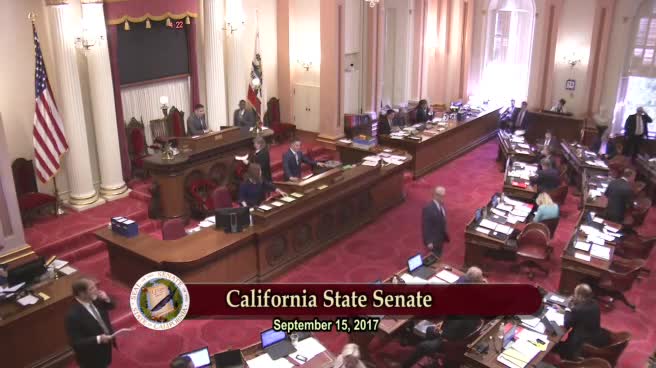 4MIN
Senate Floor
 13MIN
Assembly Floor
 5MIN
Assembly Floor
 3MIN
Assembly Standing Committee on Appropriations
 25MIN
Senate Floor
 48MIN
Senate Standing Committee on Appropriations
 2MIN
Senate Standing Committee on Appropriations
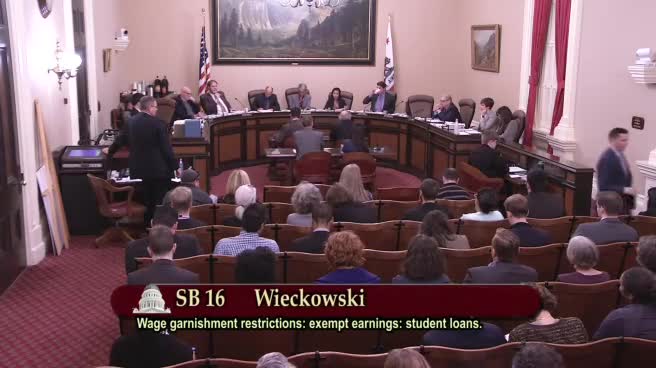 31MIN









