SB 204: Domestic violence: protective orders.
- Session Year: 2017-2018
- House: Senate
- Latest Version Date: 2017-07-21
Existing law provides for the issuance and enforcement of protective orders in cases involving domestic violence. Existing law provides for a Uniform Interstate Enforcement of Domestic Violence Protection Orders Act, which authorizes the enforcement of a valid foreign protection order in a tribunal of this state under certain conditions. Existing law establishes a Domestic Violence Restraining Order System for purposes of registering protection orders, as specified, which is administered by the Department of Justice.
This bill would enact the Uniform Recognition and Enforcement of Canadian Domestic Violence Protection Orders Act, which would authorize the enforcement of a valid Canadian domestic violence protection order in a tribunal of this state under certain conditions. The bill would prescribe the criteria for a determination of the validity of a protection order under these provisions, as specified, and would authorize the registration of such a protection order in the Domestic Violence Restraining Order System. The bill would require a law enforcement officer of this state to enforce a protection order under these provisions upon determining that there is probable cause to believe that a valid protection order exists and has been violated.
By imposing new duties on law enforcement agencies, this bill would create a state-mandated local program.
The California Constitution requires the state to reimburse local agencies and school districts for certain costs mandated by the state. Statutory provisions establish procedures for making that reimbursement.
This bill would provide that, if the Commission on State Mandates determines that the bill contains costs mandated by the state, reimbursement for those costs shall be made pursuant to the statutory provisions noted above.
This part may be cited as the Uniform Recognition and Enforcement of Canadian Domestic Violence Protection Orders Act.
6451.In this part:
(a)Canadian domestic violence protection order means a judgment or part of a judgment or order issued in English in a civil proceeding by a court of Canada under law of the issuing jurisdiction that relates to domestic violence and prohibits a respondent from doing any of the following:
(1)Being in physical proximity to a protected individual or following a protected individual.
(2)Directly or indirectly contacting or communicating with a protected individual or other individual described in the order.
(3)Being within a certain distance of a specified place or location associated with a protected individual.
(4)Molesting, annoying, harassing, or engaging in threatening conduct directed at a protected individual.
(b)Domestic protection order means an injunction or other order issued by a tribunal that relates to domestic or family violence laws to prevent an individual from engaging in violent or threatening acts against, harassment of, direct or indirect contact or communication with, or being in physical proximity to, another individual.
(c)Issuing court means the court that issues a Canadian domestic violence protection order.
(d)Law enforcement officer means an individual authorized by law of this state to enforce a domestic protection order.
(e)Person means an individual, estate, business or nonprofit entity, public corporation, government or governmental subdivision, agency, or instrumentality, or other legal entity.
(f)Protected individual means an individual protected by a Canadian domestic violence protection order.
(g)Record means information that is inscribed on a tangible medium or that is stored in an electronic or other medium and is retrievable in perceivable form.
(h)Respondent means an individual against whom a Canadian domestic violence protection order is issued.
(i)State means a state of the United States, the District of Columbia, Puerto Rico, the United States Virgin Islands, or any territory or insular possession subject to the jurisdiction of the United States. The term includes a federally recognized Indian tribe.
(j)Tribunal means a court, agency, or other entity authorized by law to establish, enforce, or modify a domestic protection order.
6452.(a)If a law enforcement officer determines under subdivision (b) or (c) that there is probable cause to believe a valid Canadian domestic violence protection order exists and the order has been violated, the officer shall enforce the terms of the Canadian domestic violence protection order as if the terms were in an order of a tribunal of this state. Presentation to a law enforcement officer of a certified copy of a Canadian domestic violence protection order is not required for enforcement.
(b)Presentation to a law enforcement officer of a record of a Canadian domestic violence protection order that identifies both a protected individual and a respondent and on its face is in effect constitutes probable cause to believe that a valid order exists.
(c)If a record of a Canadian domestic violence protection order is not presented as provided in subdivision (b), a law enforcement officer may consider other information in determining whether there is probable cause to believe that a valid Canadian domestic violence protection order exists.
(d)If a law enforcement officer determines that an otherwise valid Canadian domestic violence protection order cannot be enforced because the respondent has not been notified of or served with the order, the officer shall notify the protected individual that the officer will make reasonable efforts to contact the respondent, consistent with the safety of the protected individual. After notice to the protected individual and consistent with the safety of the individual, the officer shall make a reasonable effort to inform the respondent of the order, notify the respondent of the terms of the order, provide a record of the order, if available, to the respondent, and allow the respondent a reasonable opportunity to comply with the order before the officer enforces the order. Verbal notice of the terms of the order is sufficient for purposes of this subdivision.
(e)If a law enforcement officer determines that an individual is a protected individual, the officer shall inform the individual of available local victim services.
6453.(a)A tribunal of this state may issue an order enforcing or refusing to enforce a Canadian domestic violence protection order on application of any of the following:
(1)A protected party or other person authorized by law of this state other than this part to seek enforcement of a domestic protection order.
(2)A respondent.
(b)In a proceeding under subdivision (a), the tribunal of this state shall follow the procedures of this state for enforcement of a domestic protection order. An order entered under this section is limited to the enforcement of the terms of the Canadian domestic violence protection order as described in subdivision (a) of Section 6451.
(c)A Canadian domestic violence protection order is enforceable under this section if all of the following apply:
(1)The order identifies a protected individual and a respondent.
(2)The order is valid and in effect.
(3)The issuing court had jurisdiction over the parties and the subject matter under law applicable in the issuing court.
(4)The order was issued after either of the following:
(A)The respondent was given reasonable notice and had an opportunity to be heard before the court issued the order.
(B)In the case of an ex parte order, the respondent was given reasonable notice and had or will have an opportunity to be heard within a reasonable time after the order was issued, in a manner consistent with the right of the respondent to due process.
(d)A Canadian domestic violence protection order valid on its face is prima facie evidence of its enforceability under this section.
(e)A claim that a Canadian domestic violence protection order does not comply with subdivision (c) is an affirmative defense in a proceeding seeking enforcement of the order. If the tribunal of this state determines that the order is not enforceable, the tribunal of this state shall issue an order that the Canadian domestic violence protection order is not enforceable under this section and Section 6452 and may not be registered under Section 6454.
(f)This section applies to enforcement of a provision of a Canadian domestic violence protection order against a party to the order in which each party is a protected individual and respondent only if both of the following apply:
(1)The party seeking enforcement of the order filed a pleading requesting the order from the issuing court.
(2)The court made detailed findings of fact indicating that both parties acted as a primary aggressor and that neither party acted primarily in self-defense.
6454.(a)An individual may register a Canadian domestic violence protection order in this state. To register the order, the individual must present a certified copy of the order to a court of this state to be entered into the Domestic Violence Restraining Order System established under Section 6380, pursuant to procedures set forth in Section 6404.
(b)A fee may not be charged for the registration of a Canadian domestic violence protection order under this section.
(c)Registration in this state or filing under law of this state other than this part of a Canadian domestic violence protection order is not required for its enforcement under this part.
6455.(a)There shall be no civil liability on the part of, and no cause of action for false arrest or false imprisonment against, a law enforcement officer who makes an arrest pursuant to a Canadian domestic violence protection order that is regular upon its face, if the law enforcement officer, in making the arrest, acts in good faith and has reasonable cause to believe that the person against whom the order is issued has notice of the order and has committed an act in violation of the order.
(b)Nothing in this section shall be deemed to exonerate a law enforcement officer from liability for the unreasonable use of force in the enforcement of the order. The immunities afforded by this section shall not affect the availability of any other immunity that may apply, including, but not limited to, Sections 820.2 and 820.4 of the Government Code.
6456.An individual who seeks a remedy under this part may seek other legal or equitable remedies.
6457.If there is more than one order issued and one of the orders is an emergency protective order that has precedence in enforcement pursuant to paragraph (1) of subdivision (c) of Section 136.2 of the Penal Code, the law enforcement officer shall enforce the emergency protective order. If there is more than one order issued, none of the orders issued is an emergency protective order that has precedence in enforcement, and one of the orders issued is a no-contact order, as described in Section 6320, the law enforcement officer shall enforce the no-contact order. If there is more than one civil order regarding the same parties and neither an emergency protective order that has precedence in enforcement nor a no-contact order has been issued, the law enforcement officer shall enforce the order that was issued last. If there are both civil and criminal orders regarding the same parties and neither an emergency protective order that has precedence in enforcement nor a no-contact order has been issued, the law enforcement officer shall enforce the criminal order issued last.
6458.This part modifies, limits, or supersedes the federal Electronic Signatures in Global and National Commerce Act (15 U.S.C. Sec. 7001 et seq.), but does not modify, limit, or supersede Section 101(c) of that act (15 U.S.C. Sec. 7001(c)), or authorize electronic delivery of any of the notices described in Section 103(b) of that act (15 U.S.C. Sec. 7003(b)).
6459.This part applies to a Canadian domestic violence protection order issued before, on, or after January 1, 2018, and to a continuing action for enforcement of a Canadian domestic violence protection order commenced before, on, or after January 1, 2018. A request for enforcement of a Canadian domestic violence protection order made on or after January 1, 2018, for a violation of the order occurring before, on, or after January 1, 2018, is governed by this part.
6460.If any provision of this part or its application to any person or circumstance is held invalid, the invalidity does not affect other provisions or applications of this part that can be given effect without the invalid provision or application, and to this end the provisions of this part are severable.
SEC. 2.If the Commission on State Mandates determines that this act contains costs mandated by the state, reimbursement to local agencies and school districts for those costs shall be made pursuant to Part 7 (commencing with Section 17500) of Division 4 of Title 2 of the Government Code.
This part may be cited as the Uniform Recognition and Enforcement of Canadian Domestic Violence Protection Orders Act.
6451.In this part:
(a)Canadian domestic violence protection order means a judgment or part of a judgment or order issued in a civil proceeding by a court of Canada under law of the issuing jurisdiction that relates to domestic violence and prohibits a respondent from doing any of the following:
(1)Being in physical proximity to a protected individual or following a protected individual.
(2)Directly or indirectly contacting or communicating with a protected individual or other individual described in the order.
(3)Being within a certain distance of a specified place or location associated with a protected individual.
(4)Molesting, annoying, harassing, or engaging in threatening conduct directed at a protected individual.
(b)Domestic protection order means an injunction or other order issued by a tribunal that relates to domestic or family violence laws to prevent an individual from engaging in violent or threatening acts against, harassment of, direct or indirect contact or communication with, or being in physical proximity to, another individual.
(c)Issuing court means the court that issues a Canadian domestic violence protection order.
(d)Law enforcement officer means an individual authorized by law of this state other than this part to enforce a domestic protection order.
(e)Person means an individual, estate, business or nonprofit entity, public corporation, government or governmental subdivision, agency, or instrumentality, or other legal entity.
(f)Protected individual means an individual protected by a Canadian domestic violence protection order.
(g)Record means information that is inscribed on a tangible medium or that is stored in an electronic or other medium and is retrievable in perceivable form.
(h)Respondent means an individual against whom a Canadian domestic violence protection order is issued.
(i)State means a state of the United States, the District of Columbia, Puerto Rico, the United States Virgin Islands, or any territory or insular possession subject to the jurisdiction of the United States. The term includes a federally recognized Indian tribe.
(j)Tribunal means a court, agency, or other entity authorized by law of this state other than this part to establish, enforce, or modify a domestic protection order.
6452.(a)If a law enforcement officer determines under subdivision (b) or (c) that there is probable cause to believe a valid Canadian domestic violence protection order exists and the order has been violated, the officer shall enforce the terms of the Canadian domestic violence protection order as if the terms were in an order of a tribunal. tribunal of this state. Presentation to a law enforcement officer of a certified copy of a Canadian domestic violence protection order is not required for enforcement.
(b)Presentation to a law enforcement officer of a record of a Canadian domestic violence protection order that identifies both a protected individual and a respondent and on its face is in effect constitutes probable cause to believe that a valid order exists.
(c)If a record of a Canadian domestic violence protection order is not presented as provided in subdivision (b), a law enforcement officer may consider other information in determining whether there is probable cause to believe that a valid Canadian domestic violence protection order exists.
(d)If a law enforcement officer determines that an otherwise valid Canadian domestic violence protection order cannot be enforced because the respondent has not been notified of or served with the order, the officer shall notify the protected individual that the officer will make reasonable efforts to contact the respondent, consistent with the safety of the protected individual. After notice to the protected individual and consistent with the safety of the individual, the officer shall make a reasonable effort to inform the respondent of the order, notify the respondent of the terms of the order, provide a record of the order, if available, to the respondent, and allow the respondent a reasonable opportunity to comply with the order before the officer enforces the order. Verbal notice of the terms of the order is sufficient for purposes of this subdivision.
(e)If a law enforcement officer determines that an individual is a protected individual, the officer shall inform the individual of available local victim services.
6453.(a)A tribunal of this state may issue an order enforcing or refusing to enforce a Canadian domestic violence protection order on application of either any of the following:
(1)A protected party or other person authorized by law of this state other than this part to seek enforcement of a domestic protection order.
(2)A respondent.
(b)In a proceeding under subdivision (a), the tribunal of this state shall follow the procedures of this state for enforcement of a domestic protection order. An order entered under this section is limited to the enforcement of the terms of the Canadian domestic violence protection order as described in subdivision (a) of Section 6451.
(c)A Canadian domestic violence protection order is enforceable under this section if all of the following apply:
(1)The order identifies a protected individual and a respondent.
(2)The order is valid and in effect.
(3)The issuing court had jurisdiction over the parties and the subject matter under law applicable in the issuing court.
(4)The order was issued after either of the following:
(A)The respondent was given reasonable notice and had an opportunity to be heard before the court issued the order.
(B)In the case of an ex parte order, the respondent was given reasonable notice and had or will have an opportunity to be heard within a reasonable time after the order was issued, in a manner consistent with the right of the respondent to due process.
(d)A Canadian domestic violence protection order valid on its face is prima facie evidence of its enforceability under this section.
(e)A claim that a Canadian domestic violence protection order does not comply with subdivision (c) is an affirmative defense in a proceeding seeking enforcement of the order. If the tribunal of this state determines that the order is not enforceable, the tribunal of this state shall issue an order that the Canadian domestic violence protection order is not enforceable under this section and Section 6452 and may not be registered under Section 6454.
(f)This section applies to enforcement of a provision of a Canadian domestic violence protection order against a party to the order in which each party is a protected individual and respondent only if both of the following apply:
(1)The party seeking enforcement of the order filed a pleading requesting the order from the issuing court.
(2)The court made specific findings that entitled the party to the enforcement sought. detailed findings of fact indicating that both parties acted as a primary aggressor and that neither party acted primarily in self-defense.
6454.(a)An individual may register a Canadian domestic violence protection order in this state. To register the order, the individual must present a certified copy of the order to a court of this state to be entered into the Domestic Violence Restraining Order System established under Section 6380, pursuant to procedures set forth in Section 6404.
(b)A fee may not be charged for the registration of a Canadian domestic violence protection order under this section.
(c)Registration in this state or filing under law of this state other than this part of a Canadian domestic violence protection order is not required for its enforcement under this part.
6455.(a)There shall be no civil liability on the part of, and no cause of action for false arrest or false imprisonment against, a law enforcement officer who makes an arrest pursuant to a Canadian domestic violence protection order that is regular upon its face, if the law enforcement officer, in making the arrest, acts in good faith and has reasonable cause to believe that the person against whom the order is issued has notice of the order and has committed an act in violation of the order.
(b)If there is more than one order issued and one of the orders is an emergency protective order that has precedence in enforcement pursuant to paragraph (1) of subdivision (c) of Section 136.2 of the Penal Code, the law enforcement officer shall enforce the emergency protective order. If there is more than one order issued, none of the orders issued is an emergency protective order that has precedence in enforcement, and one of the orders issued is a no-contact order, as described in Section 6320, the law enforcement officer shall enforce the no-contact order. If there is more than one civil order regarding the same parties and neither an emergency protective order that has precedence in enforcement nor a no-contact order has been issued, the law enforcement officer shall enforce the order that was issued last. If there are both civil and criminal orders regarding the same parties and neither an emergency protective order that has precedence in enforcement nor a no-contact order has been issued, the law enforcement officer shall enforce the criminal order issued last.(c)(b)Nothing in this section shall be deemed to exonerate a law enforcement officer from liability for the unreasonable use of force in the enforcement of the order. The immunities afforded by this section shall not affect the availability of any other immunity that may apply, including, but not limited to, Sections 820.2 and 820.4 of the Government Code.
6456.An individual who seeks a remedy under this part may seek other legal or equitable remedies.
6457. In applying and construing this uniform act, consideration must be given to the need to promote uniformity of the law with respect to its subject matter among states that enact it.6457.If there is more than one order issued and one of the orders is an emergency protective order that has precedence in enforcement pursuant to paragraph (1) of subdivision (c) of Section 136.2 of the Penal Code, the law enforcement officer shall enforce the emergency protective order. If there is more than one order issued, none of the orders issued is an emergency protective order that has precedence in enforcement, and one of the orders issued is a no-contact order, as described in Section 6320, the law enforcement officer shall enforce the no-contact order. If there is more than one civil order regarding the same parties and neither an emergency protective order that has precedence in enforcement nor a no-contact order has been issued, the law enforcement officer shall enforce the order that was issued last. If there are both civil and criminal orders regarding the same parties and neither an emergency protective order that has precedence in enforcement nor a no-contact order has been issued, the law enforcement officer shall enforce the criminal order issued last.
6458.This part modifies, limits, or supersedes the federal Electronic Signatures in Global and National Commerce Act (15 U.S.C. Sec. 7001 et seq.), but does not modify, limit, or supersede Section 101(c) of that act (15 U.S.C. Sec. 7001(c)), or authorize electronic delivery of any of the notices described in Section 103(b) of that act (15 U.S.C. Sec. 7003(b)).
6459.This part applies to a Canadian domestic violence protection order issued before, on, or after January 1, 2018, and to a continuing action for enforcement of a Canadian domestic violence protection order commenced before, on, or after January 1, 2018. A request for enforcement of a Canadian domestic violence protection order made on or after January 1, 2018, for a violation of the order occurring before, on, or after January 1, 2018, is governed by this part.
6460.If any provision of this part or its application to any person or circumstance is held invalid, the invalidity does not affect other provisions or applications of this part that can be given effect without the invalid provision or application, and to this end the provisions of this part are severable.
SEC. 2.If the Commission on State Mandates determines that this act contains costs mandated by the state, reimbursement to local agencies and school districts for those costs shall be made pursuant to Part 7 (commencing with Section 17500) of Division 4 of Title 2 of the Government Code.
This part may be cited as the Uniform Recognition and Enforcement of Canadian Domestic Violence Protection Orders Act.
6451.In this part:
(a)Canadian domestic violence protection order means a judgment or part of a judgment or order issued in a civil proceeding by a court of Canada under law of the issuing jurisdiction that relates to domestic violence and prohibits a respondent from doing any of the following:
(1)Being in physical proximity to a protected individual or following a protected individual.
(2)Directly or indirectly contacting or communicating with a protected individual or other individual described in the order.
(3)Being within a certain distance of a specified place or location associated with a protected individual.
(4)Molesting, annoying, harassing, or engaging in threatening conduct directed at a protected individual.
(b)Domestic protection order means an injunction or other order issued by a tribunal that relates to domestic or family violence laws to prevent an individual from engaging in violent or threatening acts against, harassment of, direct or indirect contact or communication with, or being in physical proximity to, another individual.
(c)Issuing court means the court that issues a Canadian domestic violence protection order.
(d)Law enforcement officer means an individual authorized by law of this state other than this part to enforce a domestic protection order.
(e)Person means an individual, estate, business or nonprofit entity, public corporation, government or governmental subdivision, agency, or instrumentality, or other legal entity.
(f)Protected individual means an individual protected by a Canadian domestic violence protection order.
(g)Record means information that is inscribed on a tangible medium or that is stored in an electronic or other medium and is retrievable in perceivable form.
(h)Respondent means an individual against whom a Canadian domestic violence protection order is issued.
(i)State means a state of the United States, the District of Columbia, Puerto Rico, the United States Virgin Islands, or any territory or insular possession subject to the jurisdiction of the United States. The term includes a federally recognized Indian tribe.
(j)Tribunal means a court, agency, or other entity authorized by law of this state other than this part to establish, enforce, or modify a domestic protection order.
6452.(a)If a law enforcement officer determines under subdivision (b) or (c) that there is probable cause to believe a valid Canadian domestic violence protection order exists and the order has been violated, the officer shall enforce the terms of the Canadian domestic violence protection order as if the terms were in an order of a tribunal. Presentation to a law enforcement officer of a certified copy of a Canadian domestic violence protection order is not required for enforcement.
(b)Presentation to a law enforcement officer of a record of a Canadian domestic violence protection order that identifies both a protected individual and a respondent and on its face is in effect constitutes probable cause to believe that a valid order exists.
(c)If a record of a Canadian domestic violence protection order is not presented as provided in subdivision (b), a law enforcement officer may consider other information in determining whether there is probable cause to believe that a valid Canadian domestic violence protection order exists.
(d)If a law enforcement officer determines that an otherwise valid Canadian domestic violence protection order cannot be enforced because the respondent has not been notified of or served with the order, the officer shall notify the protected individual that the officer will make reasonable efforts to contact the respondent, consistent with the safety of the protected individual. After notice to the protected individual and consistent with the safety of the individual, the officer shall make a reasonable effort to inform the respondent of the order, notify the respondent of the terms of the order, provide a record of the order, if available, to the respondent, and allow the respondent a reasonable opportunity to comply with the order before the officer enforces the order. Verbal notice of the terms of the order is sufficient for purposes of this subdivision.
(e)If a law enforcement officer determines that an individual is a protected individual, the officer shall inform the individual of available local victim services.
6453.(a)A tribunal may issue an order enforcing or refusing to enforce a Canadian domestic violence protection order on application of either of the following:
(1)A person authorized by law of this state other than this part to seek enforcement of a domestic protection order.
(2)A respondent.
(b)In a proceeding under subdivision (a), the tribunal shall follow the procedures of this state for enforcement of a domestic protection order. An order entered under this section is limited to the enforcement of the terms of the Canadian domestic violence protection order as described in subdivision (a) of Section 6451.
(c)A Canadian domestic violence protection order is enforceable under this section if all of the following apply:
(1)The order identifies a protected individual and a respondent.
(2)The order is valid and in effect.
(3)The issuing court had jurisdiction over the parties and the subject matter under law applicable in the issuing court.
(4)The order was issued after either of the following:
(A)The respondent was given reasonable notice and had an opportunity to be heard before the court issued the order.
(B)In the case of an ex parte order, the respondent was given reasonable notice and had or will have an opportunity to be heard within a reasonable time after the order was issued, in a manner consistent with the right of the respondent to due process.
(d)A Canadian domestic violence protection order valid on its face is prima facie evidence of its enforceability under this section.
(e)A claim that a Canadian domestic violence protection order does not comply with subdivision (c) is an affirmative defense in a proceeding seeking enforcement of the order. If the tribunal determines that the order is not enforceable, the tribunal shall issue an order that the Canadian domestic violence protection order is not enforceable under this section and Section 6452 and may not be registered under Section 6454.
(f)This section applies to enforcement of a provision of a Canadian domestic violence protection order against a party to the order in which each party is a protected individual and respondent only if both of the following apply:
(1)The party seeking enforcement of the order filed a pleading requesting the order from the issuing court.
(2)The court made specific findings that entitled the party to the enforcement sought.
6454.(a)An individual may register a Canadian domestic violence protection order in this state. To register the order, the individual must present a certified copy of the order to a court of this state to be entered into the Domestic Violence Restraining Order System established under Section 6380, pursuant to procedures set forth in Section 6404.
(b)A fee may not be charged for the registration of a Canadian domestic violence protection order under this section.
(c)Registration in this state or filing under law of this state other than this part of a Canadian domestic violence protection order is not required for its enforcement under this part.
6455.The state, state agency, local governmental agency, law enforcement officer, prosecuting attorney, clerk of court, and state or local governmental official acting in an official capacity are immune from civil and criminal liability for an act or omission arising out of the registration or enforcement of a Canadian domestic violence protection order or the detention or arrest of an alleged violator of a Canadian domestic violence protection order if the act or omission was a good faith effort to comply with this part.6455.(a)There shall be no civil liability on the part of, and no cause of action for false arrest or false imprisonment against, a law enforcement officer who makes an arrest pursuant to a Canadian domestic violence protection order that is regular upon its face, if the law enforcement officer, in making the arrest, acts in good faith and has reasonable cause to believe that the person against whom the order is issued has notice of the order and has committed an act in violation of the order.
(b)If there is more than one order issued and one of the orders is an emergency protective order that has precedence in enforcement pursuant to paragraph (1) of subdivision (c) of Section 136.2 of the Penal Code, the law enforcement officer shall enforce the emergency protective order. If there is more than one order issued, none of the orders issued is an emergency protective order that has precedence in enforcement, and one of the orders issued is a no-contact order, as described in Section 6320, the law enforcement officer shall enforce the no-contact order. If there is more than one civil order regarding the same parties and neither an emergency protective order that has precedence in enforcement nor a no-contact order has been issued, the law enforcement officer shall enforce the order that was issued last. If there are both civil and criminal orders regarding the same parties and neither an emergency protective order that has precedence in enforcement nor a no-contact order has been issued, the law enforcement officer shall enforce the criminal order issued last.
(c)Nothing in this section shall be deemed to exonerate a law enforcement officer from liability for the unreasonable use of force in the enforcement of the order. The immunities afforded by this section shall not affect the availability of any other immunity that may apply, including, but not limited to, Sections 820.2 and 820.4 of the Government Code.
6456.An individual who seeks a remedy under this part may seek other legal or equitable remedies.
6457.In applying and construing this uniform act, consideration must be given to the need to promote uniformity of the law with respect to its subject matter among states that enact it.
6458.This part modifies, limits, or supersedes the federal Electronic Signatures in Global and National Commerce Act (15 U.S.C. Sec. 7001 et seq.), but does not modify, limit, or supersede Section 101(c) of that act (15 U.S.C. Sec. 7001(c)), or authorize electronic delivery of any of the notices described in Section 103(b) of that act (15 U.S.C. Sec. 7003(b)).
6459.This part applies to a Canadian domestic violence protection order issued before, on, or after January 1, 2018, and to a continuing action for enforcement of a Canadian domestic violence protection order commenced before, on, or after January 1, 2018. A request for enforcement of a Canadian domestic violence protection order made on or after January 1, 2018, for a violation of the order occurring before, on, or after January 1, 2018, is governed by this part.
6460.If any provision of this part or its application to any person or circumstance is held invalid, the invalidity does not affect other provisions or applications of this part that can be given effect without the invalid provision or application, and to this end the provisions of this part are severable.
SEC. 2.If the Commission on State Mandates determines that this act contains costs mandated by the state, reimbursement to local agencies and school districts for those costs shall be made pursuant to Part 7 (commencing with Section 17500) of Division 4 of Title 2 of the Government Code.
This part may be cited as the Uniform Recognition and Enforcement of Canadian Domestic Violence Protection Orders Act.
6451.In this part:
(a)Canadian domestic violence protection order means a judgment or part of a judgment or order issued in a civil proceeding by a court of Canada under law of the issuing jurisdiction that relates to domestic violence and prohibits a respondent from doing any of the following:
(1)Being in physical proximity to a protected individual or following a protected individual.
(2)Directly or indirectly contacting or communicating with a protected individual or other individual described in the order.
(3)Being within a certain distance of a specified place or location associated with a protected individual.
(4)Molesting, annoying, harassing, or engaging in threatening conduct directed at a protected individual.
(b)Domestic protection order means an injunction or other order issued by a tribunal that relates to domestic or family violence laws to prevent an individual from engaging in violent or threatening acts against, harassment of, direct or indirect contact or communication with, or being in physical proximity to, another individual.
(c)Issuing court means the court that issues a Canadian domestic violence protection order.
(d)Law enforcement officer means an individual authorized by law of this state other than this part to enforce a domestic protection order.
(e)Person means an individual, estate, business or nonprofit entity, public corporation, government or governmental subdivision, agency, or instrumentality, or other legal entity.
(f)Protected individual means an individual protected by a Canadian domestic violence protection order.
(g)Record means information that is inscribed on a tangible medium or that is stored in an electronic or other medium and is retrievable in perceivable form.
(h)Respondent means an individual against whom a Canadian domestic violence protection order is issued.
(i)State means a state of the United States, the District of Columbia, Puerto Rico, the United States Virgin Islands, or any territory or insular possession subject to the jurisdiction of the United States. The term includes a federally recognized Indian tribe.
(j)Tribunal means a court, agency, or other entity authorized by law of this state other than this part to establish, enforce, or modify a domestic protection order.
6452.(a)If a law enforcement officer determines under subdivision (b) or (c) that there is probable cause to believe a valid Canadian domestic violence protection order exists and the order has been violated, the officer shall enforce the terms of the Canadian domestic violence protection order as if the terms were in an order of a tribunal. Presentation to a law enforcement officer of a certified copy of a Canadian domestic violence protection order is not required for enforcement.
(b)Presentation to a law enforcement officer of a record of a Canadian domestic violence protection order that identifies both a protected individual and a respondent and on its face is in effect constitutes probable cause to believe that a valid order exists.
(c)If a record of a Canadian domestic violence protection order is not presented as provided in subdivision (b), a law enforcement officer may consider other information in determining whether there is probable cause to believe that a valid Canadian domestic violence protection order exists.
(d)If a law enforcement officer determines that an otherwise valid Canadian domestic violence protection order cannot be enforced because the respondent has not been notified of or served with the order, the officer shall notify the protected individual that the officer will make reasonable efforts to contact the respondent, consistent with the safety of the protected individual. After notice to the protected individual and consistent with the safety of the individual, the officer shall make a reasonable effort to inform the respondent of the order, notify the respondent of the terms of the order, provide a record of the order, if available, to the respondent, and allow the respondent a reasonable opportunity to comply with the order before the officer enforces the order.
(e)If a law enforcement officer determines that an individual is a protected individual, the officer shall inform the individual of available local victim services.
6453.(a)A tribunal may issue an order enforcing or refusing to enforce a Canadian domestic violence protection order on application of either of the following:
(1)A person authorized by law of this state other than this part to seek enforcement of a domestic protection order.
(2)A respondent.
(b)In a proceeding under subdivision (a), the tribunal shall follow the procedures of this state for enforcement of a domestic protection order. An order entered under this section is limited to the enforcement of the terms of the Canadian domestic violence protection order as described in subdivision (a) of Section 6451.
(c)A Canadian domestic violence protection order is enforceable under this section if all of the following apply:
(1)The order identifies a protected individual and a respondent.
(2)The order is valid and in effect.
(3)The issuing court had jurisdiction over the parties and the subject matter under law applicable in the issuing court.
(4)The order was issued after either of the following:
(A)The respondent was given reasonable notice and had an opportunity to be heard before the court issued the order.
(B)In the case of an ex parte order, the respondent was given reasonable notice and had or will have an opportunity to be heard within a reasonable time after the order was issued, in a manner consistent with the right of the respondent to due process.
(d)A Canadian domestic violence protection order valid on its face is prima facie evidence of its enforceability under this section.
(e)A claim that a Canadian domestic violence protection order does not comply with subdivision (c) is an affirmative defense in a proceeding seeking enforcement of the order. If the tribunal determines that the order is not enforceable, the tribunal shall issue an order that the Canadian domestic violence protection order is not enforceable under this section and Section 6452 and may not be registered under Section 6454.
(f)This section applies to enforcement of a provision of a Canadian domestic violence protection order against a party to the order in which each party is a protected individual and respondent only if both of the following apply:
(1)The party seeking enforcement of the order filed a pleading requesting the order from the issuing court.
(2)The court made specific findings that entitled the party to the enforcement sought.
6454.(a)An individual may register a Canadian domestic violence protection order in this state. To register the order, the individual must present a certified copy of the order to a court of this state to be entered into the Domestic Violence Restraining Order System established under Section 6380, pursuant to procedures set forth in Section 6404.
(b)A fee may not be charged for the registration of a Canadian domestic violence protection order under this section.
(c)Registration in this state or filing under law of this state other than this part of a Canadian domestic violence protection order is not required for its enforcement under this part.
6455.The state, state agency, local governmental agency, law enforcement officer, prosecuting attorney, clerk of court, and state or local governmental official acting in an official capacity are immune from civil and criminal liability for an act or omission arising out of the registration or enforcement of a Canadian domestic violence protection order or the detention or arrest of an alleged violator of a Canadian domestic violence protection order if the act or omission was a good faith effort to comply with this part.
6456.An individual who seeks a remedy under this part may seek other legal or equitable remedies.
6457.In applying and construing this uniform act, consideration must be given to the need to promote uniformity of the law with respect to its subject matter among states that enact it.
6458.This part modifies, limits, or supersedes the federal Electronic Signatures in Global and National Commerce Act (15 U.S.C. Sec. 7001 et seq.), but does not modify, limit, or supersede Section 101(c) of that act (15 U.S.C. Sec. 7001(c)), or authorize electronic delivery of any of the notices described in Section 103(b) of that act (15 U.S.C. Sec. 7003(b)).
6459.This part applies to a Canadian domestic violence protection order issued before, on, or after January 1, 2018, and to a continuing action for enforcement of a Canadian domestic violence protection order commenced before, on, or after January 1, 2018. A request for enforcement of a Canadian domestic violence protection order made on or after January 1, 2018, for a violation of the order occurring before, on, or after January 1, 2018, is governed by this part.
6460.If any provision of this part or its application to any person or circumstance is held invalid, the invalidity does not affect other provisions or applications of this part that can be given effect without the invalid provision or application, and to this end the provisions of this part are severable.
SEC. 2.If the Commission on State Mandates determines that this act contains costs mandated by the state, reimbursement to local agencies and school districts for those costs shall be made pursuant to Part 7 (commencing with Section 17500) of Division 4 of Title 2 of the Government Code.
|
Date
|
Status
|
|---|---|
| Jul 21, 2017 | Chaptered by Secretary of State. Chapter 98, Statutes of 2017. |
| Jul 21, 2017 | Approved by the Governor. |
| Jul 13, 2017 | Enrolled and presented to the Governor at 10 a.m. |
| Jul 10, 2017 | Assembly amendments concurred in. (Ayes 40. Noes 0.) Ordered to engrossing and enrolling. |
| Jul 6, 2017 | In Senate. Concurrence in Assembly amendments pending. |
| Jul 6, 2017 | Read third time. Passed. Ordered to the Senate. |
| Jun 29, 2017 | Read second time. Ordered to consent calendar. |
| Jun 28, 2017 | From committee: Do pass. Ordered to consent calendar. (Ayes 14. Noes 0.) (June 28). |
| Jun 20, 2017 | From committee with author's amendments. Read second time and amended. Re-referred to Com. on APPR. |
| Jun 13, 2017 | From committee: Do pass and re-refer to Com. on APPR. (Ayes 11. Noes 0.) (June 13). Re-referred to Com. on APPR. |
| Jun 8, 2017 | From committee with author's amendments. Read second time and amended. Re-referred to Com. on JUD. |
| Jun 5, 2017 | Referred to Com. on JUD. |
| May 26, 2017 | In Assembly. Read first time. Held at Desk. |
| May 26, 2017 | Read third time. Passed. (Ayes 37. Noes 0.) Ordered to the Assembly. |
| May 23, 2017 | Read second time. Ordered to consent calendar. |
| May 22, 2017 | From committee: Be ordered to second reading pursuant to Senate Rule 28.8 and ordered to consent calendar. |
| May 16, 2017 | Set for hearing May 22. |
| May 11, 2017 | May 15 hearing postponed by committee. |
| May 4, 2017 | Set for hearing May 15. |
| Apr 26, 2017 | From committee: Do pass and re-refer to Com. on APPR. with recommendation: To consent calendar. (Ayes 7. Noes 0. Page 851.) (April 25). Re-referred to Com. on APPR. |
| Apr 17, 2017 | From committee with author's amendments. Read second time and amended. Re-referred to Com. on JUD. |
| Apr 13, 2017 | Set for hearing April 25. |
| Feb 9, 2017 | Referred to Com. on JUD. |
| Feb 1, 2017 | From printer. May be acted upon on or after March 3. |
| Jan 31, 2017 | Introduced. Read first time. To Com. on RLS. for assignment. To print. |
|
Date
|
Description
|
Location
|
Votes
|
|
|---|---|---|---|---|
| Jul 10, 2017 | Unfinished Business SB204 Dodd et al. Concurrence | Senate Floor |
Passed |
|
| Jul 6, 2017 | SB 204 Dodd Consent Calendar Second Day Regular Session | Assembly Floor |
Passed |
|
| Jun 28, 2017 | Do pass. To Consent Calendar. | Assembly Standing Committee on Appropriations |
Passed |
|
| Jun 13, 2017 | Do pass and be re-referred to the Committee on [Appropriations] | Assembly Standing Committee on Judiciary |
Passed |
|
| May 26, 2017 | Consent Calendar 2nd SB204 Dodd et al. | Senate Floor |
Passed |
|
| Apr 25, 2017 | Do pass, but first be re-referred to the Committee on [Appropriations] with the recommendation: To Consent Calendar | Senate Standing Committee on Judiciary |
Passed |
This list shows positions taken on this bill by organizations on the date displayed, which is linked to the original source.
Positions by individuals are not included.
|
Organization
|
Position
|
Date
|
|---|---|---|
| California Partnership To End Domestic Violence | ** Support | Jul 7, 2017 |
| uniform law commission | ** Support | Jul 7, 2017 |
Office of Senate Floor Analyses (916) 651-1520 Fax: (916) 327-4478 | SB |
UNFINISHED BUSINESS
Bill No: SB 204
:
SENATE JUDICIARY COMMITTEE: 7-0, 4/25/17
AYES: Jackson, Moorlach, Anderson, Hertzberg, Monning, Stern, Wieckowski
SENATE APPROPRIATIONS COMMITTEE: Senate Rule 28.8
SENATE FLOOR: 37-0, 5/26/17 (Consent)
AYES: Allen, Anderson, Atkins, Bates, Beall, Bradford, Cannella, De León, Dodd, Fuller, Gaines, Galgiani, Glazer, Hernandez, Hertzberg, Hill, Hueso, Jackson, Leyva, McGuire, Mendoza, Mitchell, Monning, Moorlach, Newman, Nguyen, Nielsen, Pan, Portantino, Roth, Skinner, Stern, Stone, Vidak, Wieckowski, Wiener, Wilk
NO VOTE RECORDED: Berryhill, Lara, Morrell
ASSEMBLY FLOOR: 74-0, 7/6/17 (Consent) - See last page for vote
SOURCE: Uniform Law Commission
DIGEST:
This bill enacts the Uniform Recognition and Enforcement of Canadian Domestic Violence Protection Orders Act, which authorizes the enforcement of a valid Canadian domestic violence protection order in a tribunal of this state under certain conditions. This bill prescribes the criteria for a determination of the validity of a protection order under these provisions, as specified, and authorizes the registration of such a protection order in the Domestic Violence Restraining Order System. This bill requires a law enforcement officer of this state to enforce a protection order under these provisions upon determining that there is probable cause to believe that a valid protection order exists and has been violated.
Assembly Amendments
add a requirement that the “Canadian domestic violence protection order” be issued in English.
Existing law:
- Establishes the Domestic Violence Prevention Act (DVPA), and authorizes a court to issue a domestic violence protective order enjoining a party from molesting, attacking, striking, stalking, threatening, sexually assaulting, battering, harassing, telephoning, destroying personal property, and other specified behaviors. (Fam. Code Sec. 6200 et seq.)
- Provides that the purpose of the DVPA is to prevent acts of domestic violence, abuse, and sexual abuse and to provide for a separation of the persons involved in the domestic violence for a period sufficient to enable these persons to seek a resolution to the causes of the violence. (Fam. Code Sec. 6220.)
- Provides that the court shall hold a hearing on a request for a domestic violence protective order within 20 days of issuing a temporary restraining order, or if good cause appears to the court, 25 days from that date. (Fam. Code Sec. 242.) Existing law provides that the court shall hold a hearing on a request for a civil harassment, workplace violence, or postsecondary school site violence prevention order within 15 days of issuing a temporary restraining order, or if good cause appears to the court, 21 days from that date. (Civ. Proc. Code Secs. 527.6(d), 527.8(f), 527.85(e).)
- Requires that information from protective orders be transmitted to the Department of Justice for entry into its California Law Enforcement Telecommunications System (CLETS) database. Existing law requires the court, in domestic violence prevention proceedings, to transmit a copy of the orders to law enforcement for it to enter into the database or to enter the order on its own. (Fam. Code Sec. 6380(a).)
- Provides that, under federal law, domestic violence protection orders issued by the court of one State, Indian tribe, or territory, shall be accorded full faith and credit by the court of another State, Indian tribe, or territory and be enforced by the court and law enforcement personnel of the other State, Indian tribal government or Territory as if it were the order of the enforcing State or tribe. (18 U.S.C. Sec. 2265(a).)
- Provides that, under the Uniform Interstate Enforcement of Domestic Violence Protection Orders Act, a person authorized by the law of this state to seek enforcement of a protection order may seek enforcement of a valid foreign protection order in a tribunal of this state. (Fam. Code Sec. 6402(a).)
- Provides for a tribunal to enforce the terms of a foreign order, including terms that provide relief to a tribunal of this state that would otherwise lack power to provide. The tribunal shall enforce the order, whether the order was obtained by independent action or in another proceeding. (Fam. Code Sec. 6402(a).)
- Provides that in a proceeding to enforce a foreign protection order, the tribunal shall follow the procedures of this state for the enforcement of protection orders. (Fam. Code Sec. 6402(a).)
- Prohibits a tribunal of this state from enforcing a foreign protection order issued by a tribunal of a state that does not recognize the standing of a protected individual to seek enforcement of the order. (Fam. Code Sec. 6402(b).)
- Provides for a tribunal of this state to enforce the provisions of a valid foreign protection order which govern custody and visitation, if the order was issued in accordance with the jurisdictional requirements governing the issuance of a custody and visitation orders in the issuing state. (Fam. Code Sec. 6402(c).)
This bill:
- Defines “Canadian domestic violence protection order” as a judgment or part of a judgment or order issued in English in a civil proceeding by a court of Canada under law of the issuing jurisdiction that relates to domestic violence and prohibits a respondent from doing any of the following:
- being in physical proximity to a protected individual or following a protected individual;
- directly or indirectly contacting or communicating with a protected individual or other individual described in the order;
- being within a certain distance of a specified place or location associated with a protected individual; and/or
- molesting, annoying, harassing, or engaging in threatening conduct directed at a protected individual.
- Defines “domestic protection order” as meaning an injunction or other order issued by a tribunal that relates to domestic or family violence laws to prevent an individual from engaging in violent or threatening acts against, harassment of, direct or indirect contact or communication with, or being in physical proximity to, another individual.
- Provides for a law enforcement officer to enforce the terms of a Canadian domestic violence order as if the terms were in an order of a tribunal, if the law enforcement officer has probable cause to believe a valid Canadian domestic violence protection order exists and the order has been violated.
- Provides for the law enforcement officer to make a probable cause determination based on the following:
- presentation to a law enforcement officer of a record of a Canadian domestic violence protection order that identifies both the protected individual and a respondent and on its face is in effect probable cause to believe that a valid order exists; or
- if a record of Canadian domestic violence protection order is not presented, a law enforcement officer may consider other information in determining whether there is probable cause to believe that a valid Canadian domestic violence protection order exists.
- Provides for a law enforcement officer who determines that an otherwise valid Canadian domestic violence order cannot be enforced because the respondent has not been notified of or serviced with the order, the officer shall notify the protected individual that the officer will make reasonable efforts to contact the respondent, consistent with the safety of the protected individual. After notice to the protected individual and consistent with the safety of the individual, the officer shall make reasonable effort to inform the respondent of the order, notify the respondent of the terms of the order, provide a record of the order, if available, to the respondent, and allow the respondent a reasonable opportunity to comply with the order before the officer enforces the order.
- Allows a tribunal to issue an order enforcing or refusing to enforce a Canadian domestic violence protection order based upon the procedures of this state for enforcement of a domestic protection order on application of either of the following:
- a person authorized by law of this state other than this part to seek enforcement of a domestic protection order; or
- a respondent.
- Provides for the enforcement of a Canadian domestic violence protection order, limited to the enforcement of the terms of the order, if all of the following apply:
- the order identifies a protected individual and a respondent;
- the order is valid and in effect;
- the issuing court had jurisdiction over the parties and the subject matter under law applicable in the issuing court; and
- the order was issued after either of the following:
- the respondent was given reasonable notice and had an opportunity to be heard before the court issued the order; or
- in the case of an ex parte order, the respondent was given reasonable notice and had or will have an opportunity to be heard within a reasonable time after the order was issued, in a manner consistent with the right of the respondent to due process.
- Provides for a Canadian domestic violence protection order valid on its face to be prima facie evidence of its enforceability.
- Provides that there shall be no civil liability on the part of, and no cause of action for the false arrest or false imprisonment against, a peace officer who makes an arrest pursuant to a foreign protection order that is regular upon its face, if the peace officer, in making the arrest, acts in good faith and has reasonable cause to believe that the person against whom the order is issued has notice of the order and has committed an act in violation of the order.
Comments
Purpose. In 2011, the Uniform Law Conference of Canada approved the Uniform Enforcement of Canadian Judgments and Decrees Act, which provides for the recognition of foreign protection orders, including those of the United States. In drafting the Uniform Recognition and Enforcement of Canadian Domestic-Violence Protection Orders Act, the Uniform Law Commission (ULC) sought to accord similar recognition to protection orders from Canada by providing a uniform procedure for the cross-border enforcement and recognition of Canadian domestic violence protection orders.
Existing methods of enforcement for domestic violence protection orders. Orders issued by a California court are allowed to be entered into CLETS. (Fam. Code Sec. 6380.) This allows a law enforcement officer to check the system and see if a valid protection order exists when responding to a call potentially involving domestic violence. Under the Interstate Act, a victim may bring their domestic violence order to a California court to seek enforcement. A tribunal of this state may enforce the provisions of a valid foreign protection order, which govern custody and visitation, if the order was issued in accordance with the jurisdictional requirements governing the issuance of a custody and visitation order in the issuing state. (Fam. Code Sec. 6402(c).) This approval allows the order to be entered into CLETS, increasing the ease of enforceability.
This bill extends the provisions allowing law enforcement and a tribunal of this state to enforce a Canadian domestic violence protection order. According to the author, the primary goal of this bill is to ensure the protection of victims in emergency situations. The gold standard in enabling this protection is reported to be the entering of protection orders into CLETS. This enables law enforcement to know a valid order exists and the terms of that order before they arrive on the scene of the potentially violent emergency situation. By not requiring foreign orders be entered into CLETS to be enforceable, both this bill and the Interstate Act may, result in delay to law enforcement’s ability to adequately respond to victims needs in these situations. However, allowing the enforcement of these orders when a law enforcement officer has probable cause to believe such a valid order exists, likely provides law enforcement with an extra tool for protecting victims of domestic violence in California whether they are from Texas or Canada. Senate Judiciary Committee staff notes, that if enacted, this bill may open the door for further legislation to include other countries.
Comity v. Full Faith and Credit. Typically, full faith and credit is constitutionally required to be given to judgments and orders of other states, while judgments and orders of foreign country tribunals may be recognized by California’s courts under the principles of comity.
Under the Violence Against Women Act, states are required to accord full faith and credit to domestic violence protection orders issued by the court of another state, Indian tribe, or territory, allowing them to be enforced by the court and law enforcement personnel of the other state as if it were the order of the enforcing state or tribe. (18 U.S.C. Sec. 2265(a).) California clarified how these foreign protection orders would be enforced by adopting the Interstate Domestic Violence Protection Act. By adopting this bill, California may be affording Canadian protection orders the full faith and credit normally reserved for other states. It’s unclear whether Canada’s due process requirements for these protection orders meet the due process requirements of California’s courts for issuing similar orders.
Of note, this bill does not extend recognition to protection orders issued by Canada’s criminal courts. It is unclear whether civil or criminal courts issue the majority of Canada’s domestic violence protection orders. This may result in some victims of domestic violence not being served or protected by this bill. The ULC reports to having only included protection orders issued by civil courts because of the due process and other concerns raised by enforcing protection orders issued by a foreign county’s criminal court system. The ULC, sponsor, writes in support of this extension, stating:
Reflecting the friendship between the United States and Canada, citizens move freely between the two countries, freedom that in certain limited circumstances can work against victims of domestic violence. Canada has granted recognition to protection orders of the United States in the Uniform Enforcement of Canadian Judgments and Decrees Act. By this act, California and other enacting states accord similar recognition to protection orders from Canada.
FISCAL EFFECT: Appropriation: Fiscal Com.: Local:
According to the Assembly Appropriations Committee, this bill has minor and absorbable costs to the Department of Justice to include additional orders in the Domestic Violence Restraining Order System. As well as, minor potentially reimbursable local costs for local law enforcement agencies to enforce Canadian domestic violence protective orders.
Uniform Law Commission (source)
California Partnership to End Domestic Violence
None received
ASSEMBLY FLOOR: 74-0, 7/6/17
AYES: Acosta, Aguiar-Curry, Travis Allen, Arambula, Baker, Berman, Bigelow, Bloom, Bonta, Brough, Burke, Caballero, Cervantes, Chau, Chávez, Chen, Chiu, Choi, Chu, Cooley, Cooper, Cunningham, Dahle, Daly, Eggman, Flora, Fong, Frazier, Friedman, Gallagher, Cristina Garcia, Eduardo Garcia, Gipson, Gloria, Gomez, Gonzalez Fletcher, Grayson, Harper, Holden, Irwin, Jones-Sawyer, Kalra, Kiley, Levine, Limón, Low, Maienschein, Mathis, Mayes, Medina, Melendez, Mullin, Muratsuchi, Nazarian, Obernolte, O'Donnell, Patterson, Quirk, Quirk-Silva, Reyes, Ridley-Thomas, Rodriguez, Rubio, Salas, Santiago, Steinorth, Mark Stone, Thurmond, Ting, Voepel, Waldron, Weber, Wood, Rendon
NO VOTE RECORDED: Bocanegra, Calderon, Dababneh, Gray, Lackey, McCarty
Prepared by: Marisa Shea, Nichole Rapier / JUD. / (916) 651-4113
7/7/17 12:39:26
**** END ****
Date of Hearing: June 28, 2017
ASSEMBLY COMMITTEE ON APPROPRIATIONS
Lorena Gonzalez Fletcher, Chair
SBPCA Bill Id:SB 204
Author:(Dodd) – As Amended Ver:June 20, 2017
Policy Committee: | Judiciary | Vote: | 11 - 0 |
|
| ||
|
|
Urgency: No State Mandated Local Program: Yes Reimbursable: Yes
SUMMARY:
This bill provides that California law enforcement officers will enforce Canadian domestic violence restraining orders if the orders meet certain criteria, including that the order is written in English. This bill is based on a recommendation by the Uniform Law Commission.
FISCAL EFFECT:
- Minor and absorbable costs to the Department of Justice to include additional orders in the Domestic Violence Restraining Order System.
- Minor potentially reimbursable local costs for local law enforcement agencies to enforce Canadian domestic violence protective orders.
COMMENTS:
Background and Purpose. As required by federal law, California recognizes and enforces domestic violence protective orders from other states. Canada does the same for domestic violence protective orders established by U.S. courts under the Uniform Enforcement of Canadian Judgments and Decrees Act. This bill will ensure that California reciprocates in the treatment of domestic violence restraining orders, recognizing orders from Canada, similar to the way that Canada recognizes such orders from California courts. This bill is based on a recommendation from the Uniform Law Commission and specifies that California courts and law enforcement officers will enforce Canadian domestic violence protective orders that meet specified requirements.
Analysis Prepared by: Jessica Peters / APPR. / (916) 319-2081
Date of Hearing: June 13, 2017
ASSEMBLY COMMITTEE ON JUDICIARY
Mark Stone, Chair
SBPCA Bill Id:SB 204
Author:(Dodd) – As Amended Ver:June 8, 2017
SENATE VOTE: 37-0
SUBJECT: Domestic violence: Canadian protective orders
KEY ISSUE: IN ORDER TO BETTER PROTECT VICTIMS OF DOMESTIC VIOLENCE, SHOULD CANADIAN DOMESTIC VIOLENCE PROTECTIVE ORDERS BE ENFORCEABLE IN CALIFORNIA, SUBJECT TO CERTAIN RESTRICTIONS, SIMILARLY TO HOW ORDERS FROM OTHER STATES ARE ENFORCED?
SYNOPSIS
As required by federal law, California recognizes and enforces domestic violence protective orders from other states. Canada does the same for domestic violence protective orders established by U.S. courts. This bill, sponsored by the Uniform Law Commission and supported by California Partnership to End Domestic Violence, enacts the Uniform Law Commission's Uniform Recognition and Enforcement of Canadian Domestic Violence Protection Order Act (the Act), which requires California courts and law enforcement officers to enforce Canadian domestic violence protective orders that meet specified requirements. There is no known opposition to this bill.
While providing for the enforcement of Canadian domestic violence protective orders, the Act is limited in a few key ways. First, the Act only recognizes and enforces civil protective orders and not criminal protective orders. Second, unlike the Uniform Interstate Enforcement of Domestic-Violence Protection Orders Act, this Act only recognizes orders issued by Canadian courts and not administrative orders issued by government agencies or other Canadian entities. Third, the Act limits recognition and enforcement to the protective provisions in a court order. The bill also provides a number of due process protections to the parties to ensure that it is appropriate for California to enforce a Canadian order.
SUMMARY: Enacts the Uniform Recognition and Enforcement of Canadian Domestic Violence Protection Order Act. Specifically, this bill:
- Requires a law enforcement officer to enforce the terms of a Canadian domestic violence order, as defined, as if the terms were in a California order, provided the law enforcement officer has probable cause to believe a valid Canadian domestic violence protection order exists and the order has been violated.
- Provides that the law enforcement officer shall make a probable cause determination under 1), above. Presentation to the law enforcement officer of a record of a Canadian domestic violence protection order that identifies both a protected individual and a respondent and on its face is in effect constitutes probable cause to believe that a valid order exists. If a record of Canadian domestic violence protection order is not presented, the law enforcement officer may consider other information in determining whether there is probable cause to believe that a valid Canadian domestic violence protection order exists.
- Defines a “Canadian domestic violence protection order” as a judgment or order issued in a civil proceeding by a court of Canada that relates to domestic violence and prohibits a respondent from doing any of the following:
- Being in physical proximity to a protected individual or following a protected individual;
- Directly or indirectly contacting or communicating with a protected individual or other individual described in the order;
- Being within a certain distance of a specified place or location associated with a protected individual; or
- Molesting, annoying, harassing, or engaging in threatening conduct directed at a protected individual.
- Requires the law enforcement officer, if he or she determines that an otherwise valid Canadian domestic violence order cannot be enforced because the respondent has not been notified of or serviced with the order, to notify the protected individual that the officer will make reasonable efforts to contact the respondent, consistent with the safety of the protected individual and then requires the officer to make a reasonable effort to inform the respondent of the order, and allow the respondent a reasonable opportunity to comply with the order before the officer enforces the order.
- Requires a law enforcement officer to inform an individual protected under a Canadian domestic violence protection order of available local victim services.
- Allows a California tribunal to issue an order enforcing or refusing to enforce a Canadian domestic violence protection order based on an application from the protected party, the respondent, or any person authorized to seek enforcement of the order. Requires that a Canadian order is only enforceable under these provisions if certain due process requirements are met, including that the respondent was given reasonable notice and had an opportunity to be heard before the court that issued the order, or, in the case of an ex parte order, the respondent was given reasonable notice and had or will have an opportunity to be heard within a reasonable time after the order was issued. Provides that only the protections in 3), above are enforceable. Provides that a Canadian domestic violence protection order that is valid on its face is prima facie evidence of its enforceability.
- Provides that a Canadian mutual domestic violence protection order is enforceable only if both of the following apply:
- The party seeking enforcement of the order filed a pleading requesting the order from the issuing court; and
- The court made detailed findings of fact indicating that both parties acted as a primary aggressor and that neither party acted primarily in self-defense.
- Allows an individual to register a Canadian domestic violence protection order in California, but registration is not necessary to enforce the order.
- Provides that there is no civil liability for false arrest or imprisonment against a law enforcement officer who makes an arrest pursuant to a Canadian protection order that is regular upon its face, provided the officer acts in good faith. Provides, however, that nothing in this act exonerates a law enforcement officer from liability for the unreasonable use of force in the enforcement of the order.
- Provides that the existing hierarchy for the enforcement of protection orders in California, if there is more than one order, applies to Canadian protection orders.
- Does not prevent an individual from seeking other legal or equitable remedies.
EXISTING LAW:
- Establishes the Domestic Violence Prevention Act, and authorizes a court to issue a domestic violence protective order enjoining a party from molesting, attacking, striking, stalking, threatening, sexually assaulting, battering, harassing, telephoning, destroying personal property, and other specified behaviors. (Family Code Section 6200 et seq. Unless stated otherwise, all further statutory references are to that code.)
- Provides, under the federal Violence Against Women Act and the Uniform Interstate Enforcement of Domestic Violence Protection Orders Act enacted in California, that domestic violence protection orders issued by the court of a state, Indian tribe, or territory be accorded full faith and credit by the courts of other states, tribes, or territories and enforced by the court and law enforcement personnel of other states, tribal governments, or territories as if they were the order of the enforcing entity. (18 U.S.C. Section 2265 (a); Section 6400 et seq.)
- Prohibits a court from issuing a mutual restraining order, unless: a) both parties personally appear and present written evidence of abuse; and b) the court makes detailed findings indicating that both parties acted primarily as aggressors and that neither party acted primarily in self-defense. Requires the court, when determining if both parties acted as primary aggressors, to consider the provisions regarding dominant aggressors in the Penal Code, as provided. (Section 6305.)
- When there are multiple protective or restraining orders regarding the same parties, provides an enforcement hierarchy: a) emergency protective order; b) non-contact order; c) most recent criminal protective order; and d) most recent civil protective order. This enforcement hierarchy also applies to the Uniform Interstate Enforcement of Domestic Violence Protection Orders Act. (Sections 6383, 6405; Penal Code Section 136.2 (c).)
FISCAL EFFECT: As currently in print this bill is keyed fiscal.
COMMENTS: As required by federal law, California recognizes and enforces domestic violence protective orders from other states. Canada does the same for domestic violence protective orders established by U.S. courts under the Uniform Enforcement of Canadian Judgments and Decrees Act. This bill enacts the Uniform Law Commission's Uniform Recognition and Enforcement of Canadian Domestic Violence Protection Order Act (the Act), which requires California courts and law enforcement officers to enforce Canadian domestic violence protective orders that meet specified requirements.
Distinction Between Full, Faith & Credit Given to Other States and Comity Given to Other Countries: The U.S. Constitution requires that each state give full, faith and credit to the public acts, records and judicial proceedings of every other state and territory. (U.S. Constitution, Article IV, Section 1.) Thus a judgment in one state can be fully enforced in any other state.
Judgments from other countries are governed by comity: "No law has any effect, of its own force, beyond the limits of the sovereignty from which its authority is derived. The extent to which the law of one nation, as put in force within its territory, whether by executive order, by legislative act, or by judicial decree, shall be allowed to operate within the dominion of another nation, depends upon what our greatest jurists have been content to call 'the comity of nations.'" (Hilton v. Guyot (1895) 159 U.S. 113, 163.) Comity is "neither a matter of absolute obligation, on the one hand, nor of mere courtesy and good will, on the other." (Id. at 163-64.)
California Provides Full, Faith and Credit to Protective Orders From Other States: As required by the Violence Against Women Act (VAWA), a domestic violence protection order “issued by the court of one State, Indian tribe, or territory, shall be accorded full faith and credit by the court of another State, Indian tribe, or territory and be enforced by the court and law enforcement personnel of the other State, Indian tribal government or Territory as if it were the order of the enforcing State or tribe.” (18 U.S.C. Section 2265.) In 2001, AB 731 (Wayne), Chap. 816, Stats. 2001, enacted the Uniform Interstate Enforcement of Domestic Violence Protection Orders Act in California. That act provided specific details on how California must enforce domestic violence protection orders issued by another state. Prior to the enactment of AB 731, California law required any valid domestic violence protection order issued by a court of another state, tribe, or military tribunal be accorded full faith and credit by the courts of this state, and its terms enforced in the manner and to the extent of a protection order issued in this state. The enactment of the Uniform Interstate Enforcement of Domestic Violence Protection Orders Act clarified exactly how these orders are to be accorded full faith and credit by California courts, while also providing uniformity across state lines in how these orders are enforced.
Uniform Law Commission's Uniform Recognition and Enforcement of Canadian Domestic Violence Protection Order Act. The Uniform Recognition and Enforcement of Canadian Domestic Violence Protection Order Act (the Act) was completed by the Uniform Law Commission in 2015. As its title suggests, it provides uniform rules for the recognition and enforcement of Canadian domestic violence orders across the United States. According to the Uniform Law Commission, the Act draws upon both the Uniform Interstate Enforcement of Domestic-Violence Protection Orders Act and Canada's Uniform Enforcement of Canadian Judgments and Decrees Act, which provides for the recognition of foreign protection orders – including those of the United States – unless the foreign state of origin has been expressly excluded from the provisions of that act. The Act in this bill accords similar recognition to protective orders from Canada.
Since its completion by the Uniform Law Commission in 2015, the Act has been enacted in Delaware, Nevada, and North Dakota. In addition to California, the Act is also now being considered in Rhode Island.
Basic Requirements for Enforcement of Canadian Orders Under this Bill: While providing for the enforcement of Canadian domestic violence protective orders, the Act is limited in a few key ways. First, the Act only recognizes and enforces civil protective orders and not criminal protective orders. This reduces the difficulties inherent in enforcing criminal orders of another jurisdiction. Second, unlike the Uniform Interstate Enforcement of Domestic-Violence Protection Orders Act, this Act only recognizes orders issued by Canadian courts and not administrative orders issued by government agencies or other Canadian entities. Third, the Act limits recognition and enforcement to the protective provisions in the court order. In particular, the Act allows for enforcement of provisions that prohibit the restricted party from:
- Being in physical proximity to a protected individual or following a protected individual;
- Directly or indirectly contacting or communicating with a protected individual or other individual described in the order;
- Being within a certain distance of a specified place or location associated with a protected individual; and/or
- Molesting, annoying, harassing, or engaging in threatening conduct directed at a protected individual.
Protective orders in California may contain additional provisions beyond the protective provisions, such as parentage, custody and visitation, and support orders. (See Sections 6323 and 6341.) Protective orders from other states likewise can include other provisions and, in fact, California is required to enforce some of those provisions, such as custody and visitation orders if appropriately issued, under the Uniform Interstate Enforcement of Domestic-Violence Protection Orders Act. (See Section 6402 (c).) This Act, by contrast, limits enforcement to the protective provisions set out above. This appropriately focuses law enforcement on separating the parties subject to the Canadian order and helping keep the protected party safe, without requiring enforcement of other non-protective provisions of a Canadian order.
The bill also provides a number of due process protections to ensure that it is appropriate for California to enforce a Canadian order. First, a law enforcement officer can only enforce a Canadian protective order if he or she has probable cause to believe the Canadian order exists. Second, if the officer determines that the restrained party under an otherwise valid Canadian domestic violence order has not been notified of, or served with, the order, the officer must tell the protected party that he or she will make reasonable efforts to contact the restrained party, consistent with the safety of the protected party, and then must make a reasonable effort to inform the restrained party of the order, and allow the restrained party a reasonable opportunity to comply with the order before the officer enforces the order.
Additionally, in order to protect the due process rights of the restrained party, if a party seeks a California order enforcing -- or refusing to enforce -- the Canadian protective order, the Canadian order can only be enforceable if certain due process requirements are met, including that the respondent was given reasonable notice and had an opportunity to be heard before the court that issued the order, or, in the case of an ex parte order, the respondent was given reasonable notice and had or will have an opportunity to be heard within a reasonable time after the order was issued. These provisions help ensure that the parties to the order had been accorded due process protections in the Canadian court.
Bill Contains California Specific Provision Regarding Mutual Restraining Orders and Hierarchy of Enforceability when Multiple Orders Exist: Victims’ advocates have long had concerns about mutual protective orders – domestic violence restraining orders that restrict both parties – and report that these orders are often based on misconceptions about domestic violence, and encourage society to trivialize abuse or consider abuse too minor to determine the identity of the “real” abuser. (Joan Zorza, What is Wrong with Mutual Orders of Protection?, Family and Intimate Partner Violence Quarterly, Vol. 1 No. 2 (Fall 2008).) In addition, mutual restraining orders can reduce batterer accountability by holding both the victim and the batterer equally responsible for the violence. The California Partnership to End Domestic Violence, which supports the bill, had succinctly summed up its concerns: "Mutual restraining orders have been found to be extremely problematic, sending contradictory signals as to who is responsible for the abuse and empowering the abuser while disempowering the survivor."
As a result, California limits mutual restraining orders to those situations where (1) both parties appear before the court and present written evidence of abuse to the court; and (2) the court makes detailed findings that both parties acted as primary aggressors and that neither acted primarily in self-defense. (Section 6305.) The Uniform Law Commission's version of the Act placed some restrictions on the enforcement of mutual restraining orders to ensure that these orders are not used to the detriment of the protected party, but those restrictions were not as limiting as under California law. This bill departs slightly from the Uniform Law Commission's version of the Act by requiring that a mutual restraining order will only be enforced if, in addition to requiring that the party seeking to enforce the order in California filed a pleading in the Canada case requesting the protective order, the court made detailed findings of fact indicating that both parties acted as a primary aggressor and that neither party acted primarily in self-defense. This should help protect victims of domestic violence from enforcement of unwarranted mutual restraining orders.
The bill also adds California specific language regarding which order to enforce when there are multiple protective orders. California law makes clear that, when there are multiple protective orders regarding the same parties, there is a specific enforcement hierarchy, which is first an emergency protective order, then a non-contact order; then the most recent criminal protective order; and lastly the most recent civil protective order. (Sections 6383; Penal Code Section 136.2 (c).) This enforcement hierarchy also applies to the Uniform Interstate Enforcement of Domestic Violence Protection Orders Act. (Section 6405.) This bill appropriately provides that the same hierarchy applies if there are multiple Canadian protective orders.
Immunity Provision in the Act Consistent with Other Statutory Immunity Provisions: As a matter of policy, the Legislature is generally reluctant to immunize the acts of public employees and public agencies, except in narrow circumstances. When an individual or agency enjoys broad immunity from civil liability, it can be relieved of the responsibility to act with an appropriate level of care in the conduct of its activities. Immunity provisions also can force injured parties to absorb losses for which they are not responsible.
This bill provides immunity for false arrest or imprisonment against a law enforcement officer who makes an arrest pursuant to a Canadian protection order that is regular upon its face, provided the officer acts in good faith. This immunity is limited in scope and consistent with the existing immunity provided to law enforcement under the Uniform Interstate Enforcement of Domestic-Violence Protection Orders Act. (Section 6405.) Moreover, the Act specifically states that nothing in it exonerates a law enforcement officer from liability for the unreasonable use of force in the enforcement of an order. Thus, the immunity in this bill is limited, reasonable under the circumstances, and consistent with existing law.
ARGUMENTS IN SUPPORT: Writing in support, the California Partnership to End Domestic Violence state: "This bill follows the guidelines of the Uniform Law Commission and allows California to recognize and enforce Canadian domestic violence protective orders. This bill will protect victims of domestic violence as they cross international and state lines, reflecting the ability of citizens to move freely between the United States and Canada."
REGISTERED SUPPORT / OPPOSITION:
Support
Uniform Law Commission (sponsor)
California Partnership to End Domestic Violence
Opposition
None on file
Analysis Prepared by: Leora Gershenzon / JUD. / (916) 319-2334
Office of Senate Floor Analyses (916) 651-1520 Fax: (916) 327-4478 | SB |
CONSENT
Bill No: SB 204
:
SENATE JUDICIARY COMMITTEE: 7-0, 4/25/17
AYES: Jackson, Moorlach, Anderson, Hertzberg, Monning, Stern, Wieckowski
SENATE APPROPRIATIONS COMMITTEE: Senate Rule 28.8
SOURCE: Uniform Law Commission
DIGEST:
This bill enacts the Uniform Recognition and Enforcement of Canadian Domestic Violence Protection Orders Act, which authorizes the enforcement of a valid Canadian domestic violence protection order in a tribunal of this state under certain conditions. This bill prescribes the criteria for a determination of the validity of a protection order under these provisions, as specified, and authorizes the registration of such a protection order in the Domestic Violence Restraining Order System. This bill requires a law enforcement officer of this state to enforce a protection order under these provisions upon determining that there is probable cause to believe that a valid protection order exists and has been violated.
Existing law:
- Establishes the Domestic Violence Prevention Act (DVPA), and authorizes a court to issue a domestic violence protective order enjoining a party from molesting, attacking, striking, stalking, threatening, sexually assaulting, battering, harassing, telephoning, destroying personal property, and other specified behaviors. (Fam. Code Sec. 6200 et seq.)
- Provides that the purpose of the DVPA is to prevent acts of domestic violence, abuse, and sexual abuse and to provide for a separation of the persons involved in the domestic violence for a period sufficient to enable these persons to seek a resolution to the causes of the violence. (Fam. Code Sec. 6220.)
- Provides that the court shall hold a hearing on a request for a domestic violence protective order within 20 days of issuing a temporary restraining order, or if good cause appears to the court, 25 days from that date. (Fam. Code Sec. 242.) Existing law provides that the court shall hold a hearing on a request for a civil harassment, workplace violence, or postsecondary school site violence prevention order within 15 days of issuing a temporary restraining order, or if good cause appears to the court, 21 days from that date. (Civ. Proc. Code Secs. 527.6(d), 527.8(f), 527.85(e).)
- Requires that information from protective orders be transmitted to the Department of Justice for entry into its California Law Enforcement Telecommunications System (CLETS) database. Existing law requires the court, in domestic violence prevention proceedings, to transmit a copy of the orders to law enforcement for it to enter into the database or to enter the order on its own. (Fam. Code Sec. 6380(a).)
- Provides that, under federal law, domestic violence protection orders issued by the court of one State, Indian tribe, or territory, shall be accorded full faith and credit by the court of another State, Indian tribe, or territory and be enforced by the court and law enforcement personnel of the other State, Indian tribal government or Territory as if it were the order of the enforcing State or tribe. (18 U.S.C. Sec. 2265(a).)
- Provides that, under the Uniform Interstate Enforcement of Domestic Violence Protection Orders Act, a person authorized by the law of this state to seek enforcement of a protection order may seek enforcement of a valid foreign protection order in a tribunal of this state. (Fam. Code Sec. 6402(a).)
- Provides for a tribunal to enforce the terms of a foreign order, including terms that provide relief that a tribunal of this state would otherwise lack power to provide. The tribunal shall enforce the order, whether the order was obtained by independent action or in another proceeding. (Fam. Code Sec. 6402(a).)
- Provides that in a proceeding to enforce a foreign protection order, the tribunal shall follow the procedures of this state for the enforcement of protection orders. (Fam. Code Sec. 6402(a).)
- Prohibits a tribunal of this state from enforcing a foreign protection order issued by a tribunal of a state that does not recognize the standing of a protected individual to seek enforcement of the order. (Fam. Code Sec. 6402(b).)
- Provides for a tribunal of this state to enforce the provisions of a valid foreign protection order which govern custody and visitation, if the order was issued in accordance with the jurisdictional requirements governing the issuance of a custody and visitation orders in the issuing state. (Fam. Code Sec. 6402(c).)
This bill:
- Defines “Canadian domestic violence protection order” as a judgment or part of a judgment or order issued in a civil proceeding by a court of Canada under law of the issuing jurisdiction that relates to domestic violence and prohibits a respondent from doing any of the following:
- being in physical proximity to a protected individual or following a protected individual;
- directly or indirectly contacting or communicating with a protected individual or other individual described in the order;
- being within a certain distance of a specified place or location associated with a protected individual; and/or
- molesting, annoying, harassing, or engaging in threatening conduct directed at a protected individual.
- Defines “domestic protection order” as meaning an injunction or other order issued by a tribunal that relates to domestic or family violence laws to prevent an individual from engaging in violent or threatening acts against, harassment of, direct or indirect contact or communication with, or being in physical proximity to, another individual.
- Provides for a law enforcement officer to enforce the terms of a Canadian domestic violence order as if the terms were in an order of a tribunal, if the law enforcement officer has probable cause to believe a valid Canadian domestic violence protection order exists and the order has been violated.
- Provides for the law enforcement officer to make a probable cause determination based on the following:
- presentation to a law enforcement officer of a record of a Canadian domestic violence protection order that identifies both the protected individual and a respondent and on its face is in effect probable cause to believe that a valid order exists; or
- if a record of Canadian domestic violence protection order is not presented, a law enforcement officer may consider other information in determining whether there is probable cause to believe that a valid Canadian domestic violence protection order exists.
- Provides for a law enforcement officer who determines that an otherwise valid Canadian domestic violence order cannot be enforced because the respondent has not been notified of or serviced with the order, the officer shall notify the protected individual that the officer will make reasonable efforts to contact the respondent, consistent with the safety of the protected individual. After notice to the protected individual and consistent with the safety of the individual, the officer shall make reasonable effort to inform the respondent of the order, notify the respondent of the terms of the order, provide a record of the order, if available, to the respondent, and allow the respondent a reasonable opportunity to comply with the order before the officer enforces the order.
- Allows a tribunal to issue an order enforcing or refusing to enforce a Canadian domestic violence protection order based upon the procedures of this state for enforcement of a domestic protection order on application of either of the following:
- a person authorized by law of this state other than this part to seek enforcement of a domestic protection order; or
- a respondent.
- Provides for the enforcement of a Canadian domestic violence protection order, limited to the enforcement of the terms of the order, if all of the following apply:
- the order identifies a protected individual and a respondent;
- the order is valid and in effect;
- the issuing court had jurisdiction over the parties and the subject matter under law applicable in the issuing court; and
- the order was issued after either of the following:
- the respondent was given reasonable notice and had an opportunity to be heard before the court issued the order; or
- in the case of an ex parte order, the respondent was given reasonable notice and had or will have an opportunity to be heard within a reasonable time after the order was issued, in a manner consistent with the right of the respondent to due process.
- Provides for a Canadian domestic violence protection order valid on its face to be prima facie evidence of its enforceability.
- Provides that there shall be no civil liability on the part of, and no cause of action for the false arrest or false imprisonment against, a peace officer who makes an arrest pursuant to a foreign protection order that is regular upon its face, if the peace officer, in making the arrest, acts in good faith and has reasonable cause to believe that the person against whom the order is issued has notice of the order and has committed an act in violation of the order.
Comments
Purpose. In 2011, the Uniform Law Conference of Canada approved the Uniform Enforcement of Canadian Judgments and Decrees Act, which provides for the recognition of foreign protection orders, including those of the United States. In drafting the Uniform Recognition and Enforcement of Canadian Domestic-Violence Protection Orders Act, the Uniform Law Commission (ULC) sought to accord similar recognition to protection orders from Canada by providing a uniform procedure for the cross-border enforcement and recognition of Canadian domestic violence protection orders.
Existing methods of enforcement for domestic violence protection orders. Orders issued by a California court are allowed to be entered into CLETS. (Fam. Code Sec. 6380.) This allows a law enforcement officer to check the system and see if a valid protection order exists when responding to a call potentially involving domestic violence. Under the Interstate Act, a victim may bring their domestic violence order to a California court to seek enforcement. A tribunal of this state may enforce the provisions of a valid foreign protection order, which govern custody and visitation, if the order was issued in accordance with the jurisdictional requirements governing the issuance of a custody and visitation order in the issuing state. (Fam. Code Sec. 6402(c).) This approval allows the order to be entered into CLETS, increasing the ease of enforceability.
This bill extends the provisions allowing law enforcement and a tribunal of this state to enforce a Canadian domestic violence protection order. According to the author, the primary goal of this bill is to ensure the protection of victims in emergency situations. The gold standard in enabling this protection is reported to be the entering of protection orders into CLETS. This enables law enforcement to know a valid order exists and the terms of that order before they arrive on the scene of the potentially violent emergency situation. By not requiring foreign orders be entered into CLETS to be enforceable, both this bill and the Interstate Act may, result in delay to law enforcement’s ability to adequately respond to victims needs in these situations. However, allowing the enforcement of these orders when a law enforcement officer has probable cause to believe such a valid order exists, likely provides law enforcement with an extra tool for protecting victims of domestic violence in California whether they are from Texas or Canada. Senate Judiciary Committee staff notes, that if enacted, this bill may open the door for further legislation to include other countries.
Comity v. Full Faith and Credit. Typically, full faith and credit is constitutionally required to be given to judgments and orders of other states, while judgments and orders of foreign country tribunals may be recognized by California’s courts under the principles of comity.
Comity, as described by the Ninth Circuit in Wilson v. Marchington (9th Cir. 1997) 127 F.3d 805, 809-810, “‘is neither a matter of absolute obligation, on the one hand, nor of mere courtesy and good will, upon the other.’ As a general policy, ‘comity should be withheld only when its acceptance could be contrary or prejudicial to the nation called upon to give it effect.’ At its core, comity involves a balancing of interests. ‘It is the recognition which one nation allows within its territory to the legislative, executive or judicial acts of another nation, having due regard both to international duty and convenience, and to the rights of its own citizens, or of other persons who are under the protection of its laws.’ Although the status of Indian tribes as ‘dependent domestic nations’ presents some unique circumstances, comity still affords the best general analytical framework for recognizing tribal judgments” (internal citations omitted). The Ninth Circuit also made clear in Wilson that “Comity does not require that a tribe utilize judicial procedures identical to those used in the United States Courts.” (Id. at 811).
Under the Violence Against Women Act, states are required to accord full faith and credit to domestic violence protection orders issued by the court of another state, Indian tribe, or territory, allowing them to be enforced by the court and law enforcement personnel of the other state as if it were the order of the enforcing state or tribe. (18 U.S.C. Sec. 2265(a).) California clarified how these foreign protection orders would be enforced by adopting the Interstate Domestic Violence Protection Act. By adopting this bill, California may be affording Canadian protection orders the full faith and credit normally reserved for other states. Its unclear whether Canada’s due process requirements for these protection orders meets the due process requirements of California’s courts for issuing similar orders.
Of note, this bill does not extend recognition to protection orders issued by Canada’s criminal courts. It is unclear whether civil or criminal courts issue the majority of Canada’s domestic violence protection orders. This may result in some victims of domestic violence not being served or protected by this bill. The ULC reports to having only included protection orders issued by civil courts because of the due process and other concerns raised by enforcing protection orders issued by a foreign county’s criminal court system. The ULC, sponsor, writes in support of this extension, stating:
Reflecting the friendship between the United States and Canada, citizens move freely between the two countries, freedom that in certain limited circumstances can work against victims of domestic violence. Canada has granted recognition to protection orders of the United States in the Uniform Enforcement of Canadian Judgments and Decrees Act. By this act, California and other enacting states accord similar recognition to protection orders from Canada.
FISCAL EFFECT: Appropriation: Fiscal Com.: Local:
Uniform Law Commission (source)
California Partnership to End Domestic Violence
OPPOSITION: (Verified 5/22/17)
None received
Prepared by: Marisa Shea, Nichole Rapier / JUD. / (916) 651-4113
5/25/17 9:46:41
**** END ****
Senator Hannah-Beth Jackson, Chair
2017-2018 Regular Session
Bill No: SB 204 (Author:Dodd)
Version: April 17, 2017
Hearing Date: April 25, 2017
Fiscal: Yes
Urgency: No
Consultant: MS
SUBJECT
Domestic violence: protective orders
DESCRIPTION
This bill would enact the Uniform Recognition and Enforcement of Canadian Domestic Violence Protection Orders Act, which would authorize the enforcement of a valid Canadian domestic violence protection order in a tribunal of this state under certain conditions. This bill would prescribe the criteria for a determination of the validity of a protection order under these provisions, as specified, and would authorize the registration of such a protection order in the Domestic Violence Restraining Order System. The bill would require a law enforcement officer of this state to enforce a protection order under these provisions upon determining that there is probable cause to believe that a valid protection order exists and has been violated.
BACKGROUND
The Violence Against Women Act (VAWA) requires that any protection order “issued by the court of one State, Indian tribe, or territory, shall be accorded full faith and credit by the court of another State, Indian tribe, or territory and be enforced by the court and law enforcement personnel of the other State, Indian tribal government or Territory as if it were the order of the enforcing State or tribe.” (18 U.S.C. Sec. 2265(a).) In 2001, AB 731 (Wayne, Ch. 816, Stats. 2001) enacted the Uniform Interstate Enforcement of Domestic Violence Protection Orders Act in California. This act clarified California’s enforcement of domestic violence protection orders issued by another state. Prior to the enactment of AB 731, California law, via Family Code Section 6380.5, required any valid domestic violence protection order issued by a court of another state, tribe, or military tribunal be accorded “full faith and credit” by the courts of this state, and its terms enforced in the manner and to the extent of a protection order issued in this state. The enactment of the Uniform Interstate Enforcement of Domestic Violence Protection Orders Act flushed out how these orders would be accorded full faith and credit by California courts, while also ensuring some uniformity across state lines in how these orders are enforced.
This bill would adopt the Uniform Recognition and Enforcement of Canadian Domestic Violence Protection Orders Act, which would authorize the enforcement of a valid Canadian domestic violence protection order in a tribunal of this state under certain conditions. This would provide similar recognition to Canadian domestic violence protection orders as are currently afforded to domestic violence protection orders issued in another state.
CHANGES TO EXISTING LAW
Existing law establishes the Domestic Violence Prevention Act (DVPA), and authorizes a court to issue a domestic violence protective order enjoining a party from molesting, attacking, striking, stalking, threatening, sexually assaulting, battering, harassing, telephoning, destroying personal property, and other specified behaviors. (Fam. Code Sec. 6200 et seq.)
Existing law provides that the purpose of the DVPA is to prevent acts of domestic violence, abuse, and sexual abuse and to provide for a separation of the persons involved in the domestic violence for a period sufficient to enable these persons to seek a resolution to the causes of the violence. (Fam. Code Sec. 6220.)
Existing law provides that the court shall hold a hearing on a request for a domestic violence protective order within 20 days of issuing a temporary restraining order, or if good cause appears to the court, 25 days from that date. (Fam. Code Sec. 242.) Existing law provides that the court shall hold a hearing on a request for a civil harassment, workplace violence, or postsecondary school site violence prevention order within 15 days of issuing a temporary restraining order, or if good cause appears to the court, 21 days from that date. (Civ. Proc. Code Secs. 527.6(d), 527.8(f), 527.85(e).)
Existing law requires that information from protective orders be transmitted to the Department of Justice for entry into its California Law Enforcement Telecommunications System (CLETS) database. Existing law requires the court, in domestic violence prevention proceedings, to transmit a copy of the orders to law enforcement for it to enter into the database or to enter the order on its own. (Fam. Code Sec.
6380(a).)
Existing federal law provides for domestic violence protection orders issued by the court of one State, Indian tribe, or territory, shall be accorded full faith and credit by the court of another State, Indian tribe, or territory and be enforced by the court and law enforcement personnel of the other State, Indian tribal government or Territory as if it were the order of the enforcing State or tribe. (18 U.S.C. Sec. 2265(a).)
Existing federal law prohibits, under the federal Violence Against Women Act, a restraining order from being issued against a party who has petitioned for a restraining order against a spouse or intimate partner to full faith and credit if either:
- no cross or counter petition was filed seeking such a protection order; or
- a cross or counter petition had been filed but the court did not make specific findings that each party was entitled to such an order. (18 U.S.C. Section 2265(c).)
Existing law, the Uniform Interstate Enforcement of Domestic Violence Protection Orders Act, defines the following terms for use within the act:
- “foreign protection order” means a protection order issued by a tribunal of another state;
- “issuing state” means the state whose tribunal issues a protection order;
- “mutual foreign protection order” means a foreign protection order that includes provisions in favor of both the protected individual seeking enforcement of the order and the respondent;
- “protected individual” means an individual protected by a protected order;
- “protection order” means an injunction or other order, issued by a tribunal under the domestic violence, family violence, or antistalking laws of the issuing state, to prevent an individual from engaging in violent or threatening acts against, harassment of, contact or communication with, or physical proximity to, another individual;
- “respondent” means the individual against home enforcement of a protection order is sought;
- “state” means a state of the United States, the District of Columbia, Puerto Rico, the United States Virgin Islands, or any territory or insular possession subject to the jurisdiction of the United States. The term includes an Indian tribe or band, any branch of the United State military, that has jurisdiction to issue protection orders; and
- “tribunal” means a court, agency, or other entity authorized by law to issue or modify a protection order. (Fam. Code Sec. 6401.)
Existing law provides for a person authorized by the law of this state to seek enforcement of a protection order may seek enforcement of a valid foreign protection order in a tribunal of this state. (Fam. Code Sec. 6402(a).)
Existing law provides for a tribunal to enforce the terms of a foreign order, including terms that provide relief to a tribunal of this state would otherwise lack power to provide. The tribunal shall enforce the order, whether the order was obtained by independent action or in another proceeding. (Fam. Code Sec. 6402(a).)
Existing law provides that in a proceeding to enforce a foreign protection order, the tribunal shall follow the procedures of this state for the enforcement of protection orders. (Fam. Code Sec. 6402(a).)
Existing law prohibits a tribunal of this state from enforcing a foreign protection order issued by a tribunal of a state that does not recognize the standing of a protected individual to seek enforcement of the order. ((Fam. Code Sec. 6402(b).)
Existing law provides for a tribunal of this state to enforce the provisions of a valid foreign protection order which govern custody and visitation, if the order was issued in accordance with the jurisdictional requirements governing the issuance of a custody and visitation orders in the issuing state. (Fam. Code Sec. 6402(c).)
Existing law finds a foreign protection order valid if it meets all of the following criteria:
- identifies the protected individual and the respondent;
- is currently in effect;
- was issued by a tribunal that had jurisdiction over the parties and subject matter under the law of the issuing state; and
- was issued after the respondent was given reasonable notice and had an opportunity to be heard before the tribunal issued the order or, in the case of an order ex parte, the respondent was given notice and has had or will have an opportunity to be heard within a reasonable time after the order was issued, in a manner consistent with the rights of the respondent to due process. (Fam. Code Sec. 6402(d).)
Existing law provides that a foreign protection order valid on its face is a prima facie evidence of its validity, and finds absence of any criteria for the validty of a foreign protection order to be an affirmative defense in an action seeking enforcement of the order. (Fam. Code Sec. 6402(e)-(f).)
Existing law provides for a tribunal of this state to enforce provisions of a mutual foreign protection order which favor a respondent only if both of the following are true:
- the respondent filed a written pleading seeking a protection order from the tribunal of the issuing state; and
- the tribunal of the issuing state made specific findings in favor of the respondent. (Fam. Code Sec. 6402(g).)
Existing law provides for a law enforcement officer of this state to enforce a foreign protection order as if it were the order a tribunal of this state upon determining that there is probable cause to believe that a valid protection order exists and that the order has been violated. Presentation of a protection order, in a tangible or electronic form, that identifies both the protected individual and the respondent and, on its face, is currently in effect, constitutes probable cause to believe a foreign protection order exists. (Fam. Code Sec. 6403(a).)
Existing law provides that if the foreign protection order is not presented, a law enforcement officer of this state may consider other information in determining whether there is probable cause to believe that a valid foreign protection order exists. (Fam. Code Sec. 6403(b).)
Existing law provides for a law enforcement officer of this state to inform a respondent of an order, if the law enforcement officer determines that an otherwise valid foreign protection order cannot be enforced because the respondent has not been notified or served with the order. The officer shall make a reasonable effort to serve the order upon the respondent, and allow the respondent a reasonable opportunity to comply with the order before enforcing the order. For purposes of this section, verbal notice is sufficient. (Fam. Code Sec. 6403(c).)
Existing law provides that the registration or filing of an order in this state is not required for the enforcement of a valid foreign protection order pursuant to this part. (Fam. Code Sec. 6403(d).)
Existing law provides for the registration of any foreign protection order upon the request of the person in possession of the order so that it may be entered in the Domestic Violence Restraining Order System established under Section 6380 of the Family Code. This required the Judicial Council to adopt rules of court that do the following:
- set forth the process whereby a person in possession of a foreign protection order may voluntarily register the order with a court of this state for entry into the Domestic Violence Restraining Order System; and
- require the sealing of foreign protection orders and provide access only to law enforcement, the person who registered the order upon written request with proof of identification, the defense after arraignment on criminal charges involving an alleged violation of the order, or upon further order of the court. (Fam. Code Sec. 6404(a).)
Existing law prohibits the charging of a fee for the registration of a foreign protection order. (Fam. Code Sec. 6404(b).)
Existing law provides that there shall be no civil liability on the part of, and no cause of action for the false arrest or false imprisonment against, a peace officer who makes an arrest pursuant to a foreign protection order that is regular upon its face, if the peace officer, in making the arrest acts in good faith and has reasonable cause to believe that the person against whom the order is issued has notice of the order and has committed an act in violation of the order. (Fam. Code Sec. 6405(a).)
Existing law provides a hierarchy for the enforcement of protection orders if there is more than one order issued. The orders shall be enforced pursuant to the following:
- if one of the orders is an emergency protective order that has precedence in enforcement pursuant to paragraph (1) of subdivision (c) of Section 136.2 of the Penal Code;
- if none of the orders issued is an emergency protective order, and one of the orders is a no-contact order as described in Section 6320 of the Family Code, the peace officer shall enforce the no-contact order;
- if there is neither an emergency protective order nor a no-contact order, but there are both civil and criminal orders regarding the same parties, the peace officer shall enforce the criminal order that was issued last;
- if there are only civil orders, the peace officer shall enforce the civil order that was issued last. (Fam. Code Sec. 6405(b).)
Existing law provides that nothing in this section shall be deemed to exonerate a peace officer from liability for the unreasonable use of force in the enforcement of an order. The immunities afforded by this section shall not affect the availability of any other immunity that may apply, including, but not limited to, Sections 820.2 and 820.4 of the Government Code. (Fam. Code Sec. 6405(c).)
Existing law provides that protected individual who utilizes the enforcement of a foreign protection order is not precluded from pursuing other legal or equitable remedies against the respondent. (Fam. Code Sec. 6406.)
This bill would define “Canadian domestic violence protection order” as a judgment or part of a judgment or order issued in a civil proceeding by a court of Canada under law of the issuing jurisdiction that relates to domestic violence and prohibits a respondent from doing any of the following:
- being in physical proximity to a protected individual or following a protected individual;
- directly or indirectly contacting or communicating with a protected individual or other individual described in the order;
- being within a certain distance of a specified place or location associated with a protected individual; and/or
- molesting, annoying, harassing, or engaging in threatening conduct directed at a protected individual.
This bill would define “domestic protection order” as meaning an injunction or other order issued by a tribunal that relates to domestic or family violence laws to prevent an individual from engaging in violent or threatening acts against, harassment of, direct or indirect contact or communication with, or being in physical proximity to, another individual.
This bill would provide for a law enforcement officer to enforce the terms of a Canadian domestic violence order as if the terms were in an order of a tribunal, if the law enforcement officer has probable cause to believe a valid Canadian domestic violence protection order exists and the order has been violated.
This bill would provide for the law enforcement officer to make a probable cause determination based on the following:
- presentation to a law enforcement officer of a record of a Canadian domestic violence protection order that identifies both the protected individual and a respondent and on its face is in effect probable cause to believe that a valid order exists; or
- if a record of Canadian domestic violence protection order is not presented, a law enforcement officer may consider other information in determining whether there is probable cause to believe that a valid Canadian domestic violence protection order exists.
This bill would provide for a law enforcement officer who determines that an otherwise valid Canadian domestic violence order cannot be enforced because the respondent has not been notified of or serviced with the order, the officer shall notify the protected individual that the officer will make reasonable efforts to contact the respondent, consistent with the safety of the protected individual. After notice to the protected individual and consistent with the safety of the individual, the officer shall make reasonable effort to inform the respondent of the order, notify the respondent of the terms of the order, provide a record of the order, if available, to the respondent, and allow the respondent a reasonable opportunity to comply with the order before the officer enforces the order.
This bill would provide for a law enforcement officer to inform the individual of available local victim services, should the law enforcement officer determine that an individual is a protected individual.
This bill would allow a tribunal to issue an order enforcing or refusing to enforce a Canadian domestic violence protection order based upon the procedures of this state for enforcement of a domestic protection order on application of either of the following:
- a person authorized by law of this state other than this part to seek enforcement of a domestic protection order; or
- a respondent.
This bill would provide for the enforcement of a Canadian domestic violence protection order, limited to the enforcement of the terms of the order, if all of the following apply:
- the order identifies a protected individual and a respondent;
- the order is valid and in effect;
- the issuing court had jurisdiction over the parties and the subject matter under law applicable in the issuing court; and
- the order was issued after either of the following:
- the respondent was given reasonable notice and had an opportunity to be heard before the court issued the order; or
- in the case of an ex parte order, the respondent was given reasonable notice and had or will have an opportunity to be heard within a reasonable time after the order was issued, in a manner consistent with the right of the respondent to due process.
This bill would provide for a Canadian domestic violence protection order valid on its face to be prima facie evidence of its enforceability.
This bill would provide for a claim that a Canadian domestic violence protection order does not meet the requirements of this section is an affirmative defense in a proceeding seeking enforcement of the order. If the tribunal determines that the order is not enforceable, the tribunal would be required to issue an order that the Canadian domestic violence protection order is not enforceable under this section and Section 6452 and not be registered under Section 6454.
This bill would apply to enforcement of a Canadian domestic mutual violence protect order if both of the following apply:
- the party seeking enforcement of the order filed a pleading requesting the order from the issuing court; and
- the court made specific findings that entitled the party to the enforcement sought.
This bill would provide for an individual to register a Canadian domestic violence protection order in this state. To register the order, the individual must present a certified copy of the order to a court of this state to be entered into the Domestic Violence Restraining Order System established under Section 6380, pursuant to procedures set forth in Section 6404. The registering of a Canadian domestic violence protection order is not required for it to be enforceable in this state and no fee may be charged for the registration.
This bill would provide that there shall be no civil liability on the part of, and no cause of action for the false arrest or false imprisonment against, a peace officer who makes an arrest pursuant to a foreign protection order that is regular upon its face, if the peace officer, in making the arrest, acts in good faith and has reasonable cause to believe that the person against whom the order is issued has notice of the order and has committed an act in violation of the order.
This bill would provide a hierarchy for the enforcement of protection orders if there is more than one order issued. The orders shall be enforced pursuant to the following:
- if one of the orders is an emergency protective order that has precedence in enforcement pursuant to paragraph (1) of subdivision (c) of Section 136.2 of the Penal Code;
- if none of the orders issued is an emergency protective order, and one of the orders is a no-contact order as described in Section 6320 of the Family Code, the peace officer shall enforce the no-contact order;
- if there is neither an emergency protective order nor a no-contact order, but there are both civil and criminal orders regarding the same parties, the peace officer shall enforce the criminal order that was issued last;
- if there are only civil orders, the peace officer shall enforce the civil order that was issued last.
This bill would provide that nothing in this section shall be deemed to exonerate a peace officer from liability for the unreasonable use of force in the enforcement of an order. The immunities afforded by this section shall not affect the availability of any other immunity that may apply, including, but not limited to, Sections 820.2 and 820.4 of the Government Code.
This bill would apply to a Canadian domestic violence protection order issued before, on, or after January 1, 2018, and to a continuing action for enforcement of a Canadian domestic violence protection order commenced before, on, or after January 1, 2018. A request for enforcement of a Canadian domestic violence protection order made on or after January 1, 2018, for a violation of the order occurring before, on, or after January 1, 2018, is governed by this part.
This bill would not prevent an individual from seeking other legal or equitable remedies.
This bill would make statements relating to the uniformity of this act and holds that if any provision or its application is held invalid, the invalidity does not affect other provisions or applications.
COMMENT
- Stated need for this bill
According to the author:
In 2011, the Uniform Law Conference of Canada (ULCC) approved the Uniform Enforcement of Canadian Judgments and Decrees Act (UECJDA), which provides for the recognition of foreign protection orders, including those of the United States. In drafting the Uniform Recognition and Enforcement of Canadian Domestic-Violence Protection Orders Act, the Uniform Law Commission (ULC) sought to accord similar recognition to protection orders from Canada by providing a uniform procedure for the cross-border enforcement and recognition of Canadian domestic violence protection orders.
The Uniform Recognition and Enforcement of Canadian Domestic-Violence Protection Orders Act provides for the enforcement of domestic violence protection orders issued by Canadian courts. Reflecting the friendship between the United States and Canada, citizens move freely between the two countries, freedom that in certain limited circumstances can work against victims of domestic violence. Canada has granted recognition to protection orders of the United States and other countries in the Uniform Enforcement of Canadian Judgments and Decrees Act. By this act, enacting states accord similar recognition to protection orders from Canada.
Writing in support, the California Partnership to End Domestic Violence states:
The Uniform Law Commission (ULC) is a national organization that provides states with non-partisan legislative ideas to help bring clarity and stability to state law. In 2015, the Uniform Law Commission approved the Uniform Recognition and Enforcement of Canadian Domestic Violence Protective Orders, which provided for state recognition of Canadian orders. The Violence Against Women Act, enacted in 1994, requires states to grant full faith and credit to the protective orders of other states. Under current law, California can enforce an international order or judgment in many situations including the Uniform Foreign Money Judgments Recognition Act, the Uniform Interstate Family Support Act, and the Uniform Foreign Money Claims Act.
This bill follows the guidelines of the Uniform Law Commission and allows California to recognize and enforce Canadian domestic violence protective orders. This bill will protect victims of domestic violence as they cross international and state lines, reflecting the ability of citizens to move freely between the United States and Canada.
- Comity v. Full Faith and Credit
Typically, full faith and credit is constitutionally required to be given to judgments and orders of other states, while judgments and orders of foreign country tribunals may be recognized by California’s courts under the principles of comity.
Comity, as described by the Ninth Circuit in Wilson v. Marchington (9th Cir. 1997) 127 F.3d 805, 809-810, “‘is neither a matter of absolute obligation, on the one hand, nor of mere courtesy and good will, upon the other.’ As a general policy, ‘comity should be withheld only when its acceptance could be contrary or prejudicial to the nation called upon to give it effect.’ At its core, comity involves a balancing of interests. ‘It is the recognition which one nation allows within its territory to the legislative, executive or judicial acts of another nation, having due regard both to international duty and convenience, and to the rights of its own citizens, or of other persons who are under the protection of its laws.’ Although the status of Indian tribes as ‘dependent domestic nations’ presents some unique circumstances, comity still affords the best general analytical framework for recognizing tribal judgments” (internal citations omitted). The Ninth Circuit also made clear in Wilson that “Comity does not require that a tribe utilize judicial procedures identical to those used in the United States Courts.” (Id. at 811).
Under, VAWA states are required to accord full faith and credit to domestic violence protection orders issued by the court of another state, Indian tribe, or territory, allowing them to be enforced by the court and law enforcement personnel of the other state as if it were the order of the enforcing state or tribe. (18 U.S.C. Sec. 2265(a).) California clarified how these foreign protection orders would be enforced by adopting the Interstate Domestic Violence Protection Act. By adopting this bill, California may be affording Canadian protection orders the full faith and credit normally reserved for other states. Its unclear whether Canada’s due process requirements for these protection orders meets the due process requirements of California’s courts for issuing similar orders.
Of note, this bill does not extend recognition to protection orders issued by Canada’s criminal courts. It is unclear whether civil or criminal courts issue the majority of Canada’s domestic violence protection orders. This may result in some victims of domestic violence not being served or protected by this legislation. The Uniform Law Commission reports to having only included protection orders issued by civil courts because of the due process and other concerns raised by enforcing protection orders issued by a foreign county’s criminal court system. The Uniform Law Commission, sponsor, writes in support of this extension, stating:
Reflecting the friendship between the United States and Canada, citizens move freely between the two countries, freedom that in certain limited circumstances can work against victims of domestic violence. Canada has granted recognition to protection orders of the United States in the Uniform Enforcement of Canadian Judgments and Decrees Act. By this act, California and other enacting states accord similar recognition to protection orders from Canada.
- Existing methods of enforcement for domestic violence protection orders
Existing law allows for the domestic violence protection order of another state to be enforced in California if a law enforcement officer of this state enforces a foreign protection order as if it were the order of a tribunal of this state upon determining that there is probable cause to believe that a valid protection order exists and that the order has been violated. Presentation of a protection order, in a tangible or electronic form, that identifies both the protected individual and the respondent and, on its face, is currently in effect constitutes probable cause to believe the other state’s protection order exists. (Fam. Code Sec. 6403(a).)
Orders issued by a California court are allowed to be entered into the California Law Enforcement Telecommunications System (CLETS). (Fam. Code Sec. 6380.) This allows a law enforcement officer to check the system and see if a valid protection order exists when responding to a call potentially involving domestic violence. Under the Interstate Act, a victim may bring their domestic violence order to a California court to seek enforcement. A tribunal of this state may enforce the provisions of a valid foreign protection order, which govern custody and visitation, if the order was issued in accordance with the jurisdictional requirements governing the issuance of a custody and visitation order in the issuing state. (Fam. Code Sec. 6402(c).) This approval allows the order to be entered into CLETS, increasing the ease of enforceability.
This bill would extend the provisions allowing law enforcement and a tribunal of this state to enforce a Canadian domestic violence protection order. According to the author, the primary goal of this legislation is to ensure the protection of victims in emergency situations. The gold standard in enabling this protection is reported to be the entering of protection orders into CLETS. This enables law enforcement to know a valid order exists and the terms of that order before they arrive on the scene of the potentially violent emergency situation. By not requiring foreign orders be entered into CLETS to be enforceable, both this bill and the interstate act may, result in delay to law enforcement’s ability to adequately respond to victims needs in these situations. However, allowing the enforcement of these orders when a law enforcement officer has probable cause to believe such a valid order exists, likely provides law enforcement with an extra tool for protecting victims of domestic violence in California whether they are from Texas or Canada. Staff notes, that if enacted, this bill may open the door for further legislation to include other countries.
- Immunity Provision
As a matter of policy, the Legislature has generally been reluctant to further immunize the acts of public employees and public agencies, except in narrow circumstances. Immunity from liability disincentivizes careful planning and acting on the part of governmental actors. When an agency enjoys immunity from civil liability, it is relieved of the responsibility to act with due regard and an appropriate level of care in the conduct of its activities. Immunity provisions are also disfavored because they preclude parties from recovering when they are injured, and force injured parties to absorb losses for which they are not responsible.
Recent author’s amendments have narrowed the immunity provision to be in line with existing law for immunity provided to law enforcement officers regarding the enforcement of interstate protection orders. This limits immunity to narrow circumstances, enabling law enforcement to act in these limited circumstances where they have probable cause to believe a valid Canadian domestic violence protection order exists. Without such a provision, law enforcement might be hesitant to act on such orders for fear of liability. Thus, this narrow immunity provision appears essential to enabling law enforcement to act in a way that meets the goals of this legislation.
Support: California Partnership to End Domestic Violence
Opposition: None Known
HISTORY
Source: Uniform Law Commission
Related Pending Legislation: None Known
Prior Legislation: AB 731 (Wayne, Ch. 816, Stats. 2001) See background.
**************
Discussed in Hearing
View Older Hearings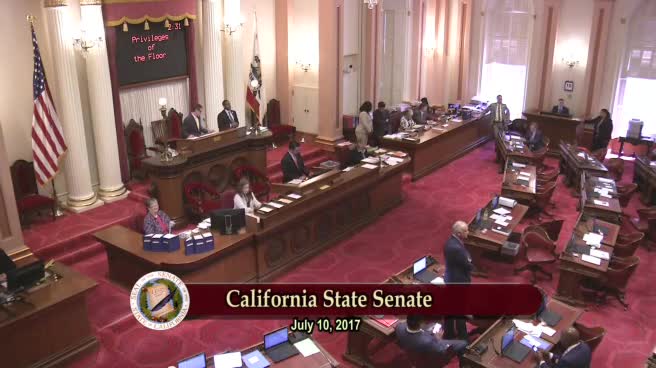
Bill Author

Bill Co-Author(s):
