SB 219: Long-term care facilities: rights of residents.
- Session Year: 2017-2018
- House: Senate
- Latest Version Date: 2017-10-04
Existing law provides for the licensure and regulation by the State Department of Public Health of health facilities, including skilled nursing facilities and intermediate care facilities. A violation of these provisions is a crime. Existing law, the Long-Term Care, Health, Safety, and Security Act of 1973, imposes various requirements on long-term health care facilities, as defined, and prescribes the civil penalties assessed for a violation of those requirements.
Existing law, the California Residential Care Facilities for the Elderly Act, provides for the licensure and regulation of residential care facilities for the elderly by the State Department of Social Services. Under existing law, a person who violates the act, or who willfully or repeatedly violates any rule or regulation adopted under the act, is guilty of a misdemeanor. Existing law also provides for civil penalties for a violation of the act.
Existing law, the California Fair Employment and Housing Act, makes it unlawful to discriminate against any person in any housing accommodation on the basis of, among others, sex, gender, gender identity, gender expression, or sexual orientation.
This bill would enact the Lesbian, Gay, Bisexual, and Transgender Long-Term Care Facility Residents Bill of Rights. Among other things, the bill would make it unlawful, except as specified, for any long-term care facility to take specified actions wholly or partially on the basis of a persons actual or perceived sexual orientation, gender identity, gender expression, or human immunodeficiency virus (HIV) status, including, among others, willfully and repeatedly failing to use a residents preferred name or pronouns after being clearly informed of the preferred name or pronouns, or denying admission to a long-term care facility, transferring or refusing to transfer a resident within a facility or to another facility, or discharging or evicting a resident from a facility. The bill would also provide certain protections to all residents of long-term care facilities during, among other things, physical examinations or treatments, relating to bodily privacy. The bill would define long-term care facility for purposes of these provisions to include skilled nursing facilities, intermediate care facilities, and residential care facilities for the elderly. The bill would also, among other things, require each facility to post a specified notice regarding discrimination alongside its current nondiscrimination policy in all places and on all materials where the nondiscrimination policy is posted. The bill would require a violation of these provisions to be treated as a violation under the Long-Term Care, Health, Safety, and Security Act of 1973, the California Residential Care Facilities for the Elderly Act, or specified provisions providing for the licensure and regulation of health facilities, which may include the imposition of civil penalties. By expanding the definition of existing crimes, the bill would impose a state-mandated local program.
The California Constitution requires the state to reimburse local agencies and school districts for certain costs mandated by the state. Statutory provisions establish procedures for making that reimbursement.
This bill would provide that no reimbursement is required by this act for a specified reason.
Existing law provides for the licensure and regulation by the State Department of Public Health of health facilities, including skilled nursing facilities and intermediate care facilities. A violation of these provisions is a crime. Existing law, the Long-Term Care, Health, Safety, and Security Act of 1973, imposes various requirements on long-term health care facilities, as defined, and prescribes the civil penalties assessed for a violation of those requirements.
Existing law, the California Residential Care Facilities for the Elderly Act, provides for the licensure and regulation of residential care facilities for the elderly by the State Department of Social Services. Under existing law, a person who violates the act, or who willfully or repeatedly violates any rule or regulation adopted under the act, is guilty of a misdemeanor. Existing law also provides for civil penalties for a violation of the act.
Existing law, the California Fair Employment and Housing Act, makes it unlawful to discriminate against any person in any housing accommodation on the basis of, among others, sex, gender, gender identity, gender expression, or sexual orientation.
This bill would enact the Lesbian, Gay, Bisexual, and Transgender Long-Term Care Facility Residents Residents Bill of Rights. Among other things, the bill would make it unlawful, except as specified, for any long-term care facility to take specified actions wholly or partially on the basis of a persons actual or perceived sexual orientation, gender identity, gender expression, or human immunodeficiency virus (HIV) status, including, among others, willfully and repeatedly failing to use a residents preferred name or pronouns after being clearly informed of the preferred name or pronouns, or denying admission to a long-term care facility, transferring or refusing to transfer a resident within a facility or to another facility, or discharging or evicting a resident from a facility. The bill would also provide certain protections to all residents of long-term care facilities during, among other things, physical examinations or treatments, relating to bodily privacy. The bill would define long-term care facility for purposes of these provisions to include skilled nursing facilities, intermediate care facilities, and residential care facilities for the elderly. The bill would also, among other things, require each facility to post a specified notice regarding discrimination alongside its current nondiscrimination policy in all places and on all materials where the nondiscrimination policy is posted. The bill would require a violation of these provisions to be treated as a violation under the Long-Term Care, Health, Safety, and Security Act of 1973, the California Residential Care Facilities for the Elderly Act, or specified provisions providing for the licensure and regulation of health facilities, which may include the imposition of civil penalties. By expanding the definition of existing crimes, the bill would impose a state-mandated local program.
The California Constitution requires the state to reimburse local agencies and school districts for certain costs mandated by the state. Statutory provisions establish procedures for making that reimbursement.
This bill would provide that no reimbursement is required by this act for a specified reason.
Existing law provides for the licensure and regulation by the State Department of Public Health of health facilities, including skilled nursing facilities and intermediate care facilities. A violation of these provisions is a crime. Existing law, the Long-Term Care, Health, Safety, and Security Act of 1973, imposes various requirements on long-term health care facilities, as defined, and prescribes the civil penalties assessed for a violation of those requirements.
Existing law, the California Residential Care Facilities for the Elderly Act, provides for the licensure and regulation of residential care facilities for the elderly by the State Department of Social Services. Under existing law, a person who violates the act, or who willfully or repeatedly violates any rule or regulation adopted under the act, is guilty of a misdemeanor. Existing law also provides for civil penalties for a violation of the act.
Existing law, the California Fair Employment and Housing Act, makes it unlawful to discriminate against any person in any housing accommodation on the basis of, among others, sex, gender, gender identity, gender expression, or sexual orientation.
This bill would enact the Lesbian, Gay, Bisexual, and Transgender Long-Term Care Facility Residents Bill of Rights. Among other things, the bill would make it unlawful, except as specified, for any long-term care facility to take specified actions wholly or partially on the basis of a persons actual or perceived sexual orientation, gender identity, gender expression, or human immunodeficiency virus (HIV) status, including, among others, willfully and repeatedly failing to use a residents preferred name or pronouns after being clearly informed of the preferred name or pronouns, or denying admission to a long-term care facility, transferring or refusing to transfer a resident within a facility or to another facility, or discharging or evicting a resident from a facility. The bill would also provide certain protections to all residents of long-term care facilities during, among other things, physical examinations or treatments, relating to bodily privacy. The bill would define long-term care facility for purposes of these provisions to include skilled nursing facilities, intermediate care facilities, and residential care facilities for the elderly. The bill would also, among other things, require each facility to post a specified notice regarding discrimination alongside its current nondiscrimination policy in all places and on all materials where the nondiscrimination policy is posted. The bill would require a violation of these provisions to be treated as a violation under the Long-Term Care, Health, Safety, and Security Act of 1973, the California Residential Care Facilities for the Elderly Act, or specified provisions providing for the licensure and regulation of health facilities, which may include the imposition of civil penalties. By expanding the definition of existing crimes, the bill would impose a state-mandated local program.
The California Constitution requires the state to reimburse local agencies and school districts for certain costs mandated by the state. Statutory provisions establish procedures for making that reimbursement.
This bill would provide that no reimbursement is required by this act for a specified reason.
Existing law provides for the licensure and regulation by the State Department of Public Health of health facilities, including skilled nursing facilities and intermediate care facilities. A violation of these provisions is a crime. Existing law, the Long-Term Care, Health, Safety, and Security Act of 1973, imposes various requirements on long-term health care facilities, as defined, and prescribes the civil penalties assessed for a violation of those requirements.
Existing law, the California Residential Care Facilities for the Elderly Act, provides for the licensure and regulation of residential care facilities for the elderly by the State Department of Social Services. Under existing law, a person who violates the act, or who willfully or repeatedly violates any rule or regulation adopted under the act, is guilty of a misdemeanor. Existing law also provides for civil penalties for a violation of the act.
Existing law, the California Fair Employment and Housing Act, makes it unlawful to discriminate against any person in any housing accommodation on the basis of, among others, sex, gender, gender identity, gender expression, or sexual orientation.
This bill would enact the Lesbian, Gay, Bisexual, and Transgender Long-Term Care Facility Residents Bill of Rights. Among other things, the bill would make it unlawful, except as specified, for any long-term care facility to take specified actions wholly or partially on the basis of a persons actual or perceived sexual orientation, gender identity, gender expression, or human immunodeficiency virus (HIV) status, including, among others, willfully and repeatedly failing to use a residents preferred name or pronouns after being clearly informed of the preferred name and pronouns and or pronouns, or denying admission to a long-term care facility, transferring or refusing to transfer a resident within a facility or to another facility, or discharging or evicting a resident from a facility. The bill would also provide certain protections to all residents of long-term care facilities during, among others, other things, physical examinations or treatments, relating to bodily privacy. The bill would define long-term care facility for purposes of these provisions to include skilled nursing facilities, intermediate care facilities, and residential care facilities for the elderly. The bill would also, among other things, require each facility to post a specified notice regarding discrimination alongside its current nondiscrimination policy in all places and on all materials where the nondiscrimination policy is posted. The bill would require a violation of these provisions to be treated as a violation under the Long-Term Care, Health, Safety, and Security Act of 1973, the California Residential Care Facilities for the Elderly Act, or specified provisions providing for the licensure and regulation of health facilities, which may include the imposition of civil penalties. By expanding the definition of existing crimes, the bill would impose a state-mandated local program.
The California Constitution requires the state to reimburse local agencies and school districts for certain costs mandated by the state. Statutory provisions establish procedures for making that reimbursement.
This bill would provide that no reimbursement is required by this act for a specified reason.
Existing law provides for the licensure and regulation by the State Department of Public Health of health facilities, including skilled nursing facilities and intermediate care facilities. A violation of these provisions is a crime. Existing law, the Long-Term Care, Health, Safety, and Security Act of 1973, imposes various requirements on long-term health care facilities, as defined, and prescribes the civil penalties assessed for a violation of those requirements.
Existing law, the California Residential Care Facilities for the Elderly Act, provides for the licensure and regulation of residential care facilities for the elderly by the State Department of Social Services. Under existing law, a person who violates the act, or who willfully or repeatedly violates any rule or regulation adopted under the act, is guilty of a misdemeanor. Existing law also provides for civil penalties for a violation of the act.
Existing law, the California Fair Employment and Housing Act, makes it unlawful to discriminate against any person in any housing accommodation on the basis of, among others, sex, gender, gender identity, gender expression, or sexual orientation.
This bill would enact the Lesbian, Gay, Bisexual, and Transgender Long-Term Care Facility Residents Bill of Rights. Among other things, the bill would make it unlawful, except as specified, for any long-term care facility to take specified actions wholly or partially on the basis of a persons actual or perceived sexual orientation, gender identity, gender expression, or human immunodeficiency virus (HIV) status, including, among others, willfully and repeatedly failing to use a residents preferred name or pronoun pronouns after being clearly informed of the preferred name and pronoun pronouns and denying admission to a long-term care facility, transferring or refusing to transfer a resident within a facility or to another facility, or discharging or evicting a resident from a facility. The bill would also provide certain protections to all residents of long-term care facilities during, among others, physical examinations or treatments, relating to bodily privacy. The bill would define long-term care facility for purposes of these provisions to include skilled nursing facilities, intermediate care facilities, and residential care facilities for the elderly. The bill would also, among other things, require each facility to post a specified notice regarding discrimination alongside its current nondiscrimination policy in all places and on all materials where the nondiscrimination policy is posted. The bill would require a violation of these provisions to be treated as a violation under the Long-Term Care, Health, Safety, and Security Act of 1973, the California Residential Care Facilities for the Elderly Act, or specified provisions providing for the licensure and regulation of health facilities, which may include the imposition of civil penalties. The bill would prohibit a violation of these provisions from serving as the basis of a cause of action against a healthcare professional acting within the scope of his or her licensure and would prohibit the healthcare professional from being subject to civil, administrative, disciplinary, or medical staff action, sanction, penalty, or liability for loss, injury, or damage caused by his or her act or failure to act when that act or failure to act is reasonably necessary for the care, health, or safety of the resident. By expanding the definition of existing crimes, the bill would impose a state-mandated local program.
The California Constitution requires the state to reimburse local agencies and school districts for certain costs mandated by the state. Statutory provisions establish procedures for making that reimbursement.
This bill would provide that no reimbursement is required by this act for a specified reason.
Existing law provides for the licensure and regulation by the State Department of Public Health of health facilities, including skilled nursing facilities and intermediate care facilities. A violation of these provisions is a crime. Existing law, the Long-Term Care, Health, Safety, and Security Act of 1973, imposes various requirements on long-term health care facilities, as defined, and prescribes the civil penalties assessed for a violation of those requirements.
Existing law, the California Residential Care Facilities for the Elderly Act, provides for the licensure and regulation of residential care facilities for the elderly by the State Department of Social Services. Under existing law, a person who violates the act, or who willfully or repeatedly violates any rule or regulation adopted under the act, is guilty of a misdemeanor. Existing law also provides for civil penalties for a violation of the act.
Existing law, the California Fair Employment and Housing Act, makes it unlawful to discriminate against any person in any housing accommodation on the basis of, among others, sex, gender, gender identity, gender expression, or sexual orientation.
This bill would enact the Lesbian, Gay, Bisexual, and Transgender Long-Term Care Facility Residents Bill of Rights. Among other things, the bill would make it unlawful, except as specified, for any long-term care facility to take specified actions wholly or partially on the basis of a persons actual or perceived sexual orientation, gender identity, gender expression, or human immunodeficiency virus (HIV) status, including, among others, willfully and repeatedly failing to use a residents preferred name or pronoun after being clearly informed of the preferred name and pronoun and denying admission to a long-term care facility, transferring or refusing to transfer a resident within a facility or to another facility, or discharging or evicting a resident from a facility. The bill would also provide certain protections to all residents of long-term care facilities during, among others, physical examinations or treatments, relating to bodily privacy. The bill would define long-term care facility for purposes of these provisions to include skilled nursing facilities, intermediate care facilities, and residential care facilities for the elderly. The bill would also, among other things, require each facility to post a specified notice regarding discrimination alongside its current nondiscrimination policy in all places and on all materials where the nondiscrimination policy is posted. The bill would require a violation of these provisions to be treated as a violation under the Long-Term Care, Health, Safety, and Security Act of 1973, the California Residential Care Facilities for the Elderly Act, or specified provisions providing for the licensure and regulation of health facilities, which may include the imposition of civil penalties. The bill would prohibit a violation of these provisions from serving as the basis of a cause of action against a healthcare professional acting within the scope of his or her licensure and would prohibit the healthcare professional from being subject to civil, administrative, disciplinary, or medical staff action, sanction, penalty, or liability for loss, injury, or damage caused by his or her act or failure to act when that act or failure to act is reasonably necessary for the care, health, or safety of the resident. By expanding the definition of existing crimes, the bill would impose a state-mandated local program.
The California Constitution requires the state to reimburse local agencies and school districts for certain costs mandated by the state. Statutory provisions establish procedures for making that reimbursement.
This bill would provide that no reimbursement is required by this act for a specified reason.
Existing law provides for the licensure and regulation by the State Department of Public Health of health facilities, including skilled nursing facilities and intermediate care facilities. A violation of these provisions is a crime. Existing law, the Long-Term Care, Health, Safety, and Security Act of 1973, imposes various requirements on long-term health care facilities, as defined, and prescribes the civil penalties assessed for a violation of those requirements.
Existing law, the California Residential Care Facilities for the Elderly Act, provides for the licensure and regulation of residential care facilities for the elderly by the State Department of Social Services. Under existing law, a person who violates the act, or who willfully or repeatedly violates any rule or regulation adopted under the act, is guilty of a misdemeanor. Existing law also provides for civil penalties for a violation of the act.
Existing law, the California Fair Employment and Housing Act, makes it unlawful to discriminate against any person in any housing accommodation on the basis of, among others, sex, gender, gender identity, gender expression, or sexual orientation.
This bill would enact the Lesbian, Gay, Bisexual, and Transgender Long-Term Care Facility Residents Bill of Rights. Among other things, the bill would make it unlawful, except as specified, for any long-term care facility to take specified actions wholly or partially on the basis of a persons actual or perceived sexual orientation, gender identity, gender expression, or human immunodeficiency virus (HIV) status, including, among others, refusing willfully and repeatedly failing to use a residents preferred name or pronoun after being clearly informed of the preferred name and pronoun and denying admission to a long-term care facility, transferring or refusing to transfer a resident within a facility or to another facility, or discharging or evicting a resident from a facility. The bill would also provide certain protections to all residents of long-term care facilities during, among others, physical examinations or treatments, relating to bodily privacy. The bill would define long-term care facility for purposes of these provisions to include skilled nursing facilities, intermediate care facilities, and residential care facilities for the elderly. The bill would also, among other things, require each facility to post a specified notice regarding discrimination alongside its current nondiscrimination policy in all places and on all materials where the nondiscrimination policy is posted. The bill would require a violation of these provisions to be treated as a violation under the Long-Term Care, Health, Safety, and Security Act of 1973, the California Residential Care Facilities for the Elderly Act, or specified provisions providing for the licensure and regulation of health facilities, which may include the imposition of civil penalties or the authority to bring a civil action for a violation thereof. penalties. The bill would prohibit a violation of these provisions from serving as the basis of a cause of action against a healthcare professional acting within the scope of his or her licensure and would prohibit the healthcare professional from being subject to civil, administrative, disciplinary, or medical staff action, sanction, penalty, or liability for loss, injury, or damage caused by his or her act or failure to act when that act or failure to act is reasonably necessary for the care, health, or safety of the resident. By expanding the definition of existing crimes, the bill would impose a state-mandated local program.
The California Constitution requires the state to reimburse local agencies and school districts for certain costs mandated by the state. Statutory provisions establish procedures for making that reimbursement.
This bill would provide that no reimbursement is required by this act for a specified reason.
Existing law provides for the licensure and regulation by the State Department of Public Health of health facilities, including skilled nursing facilities and intermediate care facilities. A violation of these provisions is a crime. Existing law, the Long-Term Care, Health, Safety, and Security Act of 1973, imposes various requirements on long-term health care facilities, as defined, and prescribes the civil penalties assessed for a violation of those requirements.
Existing law, the California Residential Care Facilities for the Elderly Act, provides for the licensure and regulation of residential care facilities for the elderly by the State Department of Social Services. Under existing law, a person who violates the act, or who willfully or repeatedly violates any rule or regulation adopted under the act, is guilty of a misdemeanor. Existing law also provides for civil penalties for a violation of the act.
Existing law, the California Fair Employment and Housing Act, makes it unlawful to discriminate against any person in any housing accommodation on the basis of, among others, sex, gender, gender identity, gender expression, or sexual orientation.
This bill would enact the Lesbian, Gay, Bisexual, and Transgender Long-Term Care Facility Residents Bill of Rights. Among other things, the bill would make it unlawful, except as specified, for any long-term care facility to take specified actions wholly or partially on the basis of a persons actual or perceived sexual orientation, gender identity, gender expression, or human immunodeficiency virus (HIV) status, including, among others, refusing to use a residents preferred name or pronoun and denying admission to a long-term care facility, transferring or refusing to transfer a resident within a facility or to another facility, or discharging or evicting a resident from a facility. The bill would also provide certain protections to all residents of long-term care facilities during, among others, physical examinations or treatments, relating to bodily privacy. The bill would define long-term care facility for purposes of these provisions to include skilled nursing facilities, intermediate care facilities, and residential care facilities for the elderly. The bill would also, among other things, require each facility to post a specified notice regarding discrimination alongside its current nondiscrimination policy in all places and on all materials where the nondiscrimination policy is posted. The bill would require a violation of these provisions to be treated as a violation under the Long-Term Care, Health, Safety, and Security Act of 1973, the California Residential Care Facilities for the Elderly Act, or specified provisions providing for the licensure and regulation of health facilities, which may include the imposition of civil penalties or the authority to bring a civil action for a violation thereof. By expanding the definition of existing crimes, the bill would impose a state-mandated local program.
The California Constitution requires the state to reimburse local agencies and school districts for certain costs mandated by the state. Statutory provisions establish procedures for making that reimbursement.
This bill would provide that no reimbursement is required by this act for a specified reason.
Existing law provides for the licensure and regulation by the State Department of Public Health of health facilities, including skilled nursing facilities and intermediate care facilities. A violation of these provisions is a crime. Existing law, the Long-Term Care, Health, Safety, and Security Act of 1973, imposes various requirements on long-term health care facilities, as defined, and prescribes the civil penalties assessed for a violation of those requirements.
Existing law, the California Residential Care Facilities for the Elderly Act, provides for the licensure and regulation of residential care facilities for the elderly by the State Department of Social Services. Under existing law, a person who violates the act, or who willfully or repeatedly violates any rule or regulation adopted under the act, is guilty of a misdemeanor. Existing law also provides for civil penalties for a violation of the act.
Existing law, the California Fair Employment and Housing Act, makes it unlawful to discriminate against any person in any housing accommodation on the basis of, among others, sex, gender, gender identity, gender expression, or sexual orientation.
This bill would make it unlawful, except as specified, for any long-term care facility to take specified actions wholly or partially on the basis of a persons actual or perceived sexual orientation, gender identity, gender expression, or human immunodeficiency virus (HIV) status, including, among others, refusing to use a residents preferred name or pronoun and denying admission to a long-term care facility, transferring or refusing to transfer a resident within a facility or to another facility, or discharging or evicting a resident from a facility. The bill would define long-term care facility for purposes of these provisions to include skilled nursing facilities, intermediate care facilities, and residential care facilities for the elderly. The bill would also, among other things, require each facility to post a specified notice regarding discrimination alongside its current nondiscrimination policy in all places and on all materials where the nondiscrimination policy is posted. The bill would require a violation of these provisions to be treated as a violation under the Long-Term Care, Health, Safety, and Security Act of 1973, the California Residential Care Facilities for the Elderly Act, or specified provisions providing for the licensure and regulation of health facilities. facilities, which may include the imposition of civil penalties or the authority to bring a civil action for a violation thereof. By expanding the definition of existing crimes, this the bill would impose a state-mandated local program.
The California Constitution requires the state to reimburse local agencies and school districts for certain costs mandated by the state. Statutory provisions establish procedures for making that reimbursement.
This bill would provide that no reimbursement is required by this act for a specified reason.
Existing law provides for the licensure and regulation by the State Department of Public Health of health facilities, including skilled nursing facilities and intermediate care facilities. A violation of these provisions is a crime. Existing law, the Long-Term Care, Health, Safety, and Security Act of 1973, imposes various requirements on long-term health care facilities, as defined, and prescribes the civil penalties assessed for a violation of those requirements.
Existing law, the California Residential Care Facilities for the Elderly Act, provides for the licensure and regulation of residential care facilities for the elderly by the State Department of Social Services. Under existing law, a person who violates the act, or who willfully or repeatedly violates any rule or regulation adopted under the act, is guilty of a misdemeanor.
Existing law, the California Fair Employment and Housing Act, makes it unlawful to discriminate against any person in any housing accommodation on the basis of, among others, sex, gender, gender identity, gender expression, or sexual orientation.
This bill would make it unlawful, except as specified, for any long-term care facility to take specified actions wholly or partially on the basis of a persons actual or perceived sexual orientation, gender identity, gender expression, or human immunodeficiency virus (HIV) status, including, among others, refusing to use a residents preferred name or pronoun and denying admission to a long-term care facility, transferring or refusing to transfer a resident within a facility or to another facility, or discharging or evicting or involuntarily discharging a resident from a facility. The bill would define long-term care facility for purposes of these provisions to include skilled nursing facilities, intermediate care facilities, and residential care facilities for the elderly. The bill would also, among other things, require each facility to post a specified notice regarding discrimination alongside its current nondiscrimination policy in all places and on all materials where the nondiscrimination policy is posted. The bill would require a violation of these provisions to be treated as a violation under the Long-Term Care, Health, Safety, and Security Act of 1973, the California Residential Care Facilities for the Elderly Act, or specified provisions providing for the licensure and regulation of health facilities. By expanding the definition of existing crimes, this bill would impose a state-mandated local program.
The California Constitution requires the state to reimburse local agencies and school districts for certain costs mandated by the state. Statutory provisions establish procedures for making that reimbursement.
This bill would provide that no reimbursement is required by this act for a specified reason.
Existing law provides for the licensure and regulation by the State Department of Public Health of health facilities, including skilled nursing facilities and intermediate care facilities. A violation of these provisions is a crime. Existing law, the Long-Term Care, Health, Safety, and Security Act of 1973, imposes various requirements on long-term health care facilities, as defined, and prescribes the civil penalties assessed for a violation of those requirements.
Existing law, the California Residential Care Facilities for the Elderly Act, provides for the licensure and regulation of residential care facilities for the elderly by the State Department of Social Services. Under existing law, a person who violates the act, or who willfully or repeatedly violates any rule or regulation adopted under the act, is guilty of a misdemeanor.
Existing law, the California Fair Employment and Housing Act, makes it unlawful to discriminate against any person in any housing accommodation on the basis of, among others, sex, gender, gender identity, gender expression, or sexual orientation.
This bill would make it unlawful, except as specified, for any long-term care facility to take specified actions wholly or partially on the basis of a persons actual or perceived sexual orientation, gender identity, gender expression, or human immunodeficiency virus (HIV) status, including, among others, refusing to use a residents preferred name or pronoun and denying admission to a long-term care facility, transferring or refusing to transfer a resident within a facility or to another facility, or evicting or involuntarily discharging a resident from a facility. The bill would define long-term care facility for purposes of these provisions to include skilled nursing facilities, intermediate care facilities, and residential care facilities for the elderly. The bill would also, among other things, require each facility to post a specified notice regarding discrimination alongside its current nondiscrimination policy in all places and on all materials where the nondiscrimination policy is posted. The bill would require a violation of these provisions to be treated as a violation under the Long-Term Care, Health, Safety, and Security Act of 1973, the California Residential Care Facilities for the Elderly Act, or specified provisions providing for the licensure and regulation of health facilities. By expanding the definition of existing crimes, this bill would impose a state-mandated local program.
The California Constitution requires the state to reimburse local agencies and school districts for certain costs mandated by the state. Statutory provisions establish procedures for making that reimbursement.
This bill would provide that no reimbursement is required by this act for a specified reason.
The Legislature finds and declares all of the following:
(a)In 2006, the California Legislature found that lifelong experiences of marginalization place lesbian, gay, bisexual, and transgender (LGBT) seniors at high risk for isolation, poverty, homelessness, and premature institutionalization. Moreover, many LGBT seniors are members of multiple underrepresented groups, and as a result, are doubly marginalized. Due to these factors, many LGBT seniors avoid accessing elder programs and services, even when their health, safety, and security depend on it.
(b)Recent studies confirm the states findings and provide evidence that LGBT seniors experience discrimination, including in long-term care facilities where residents are particularly vulnerable because they must rely on others for necessary care and services, and may no longer enjoy the privacy of having their own home or even their own room.
(c)According to Stories from the Field: LGBT Older Adults in Long-Term Care Facilities, a 2011 study published by the National Senior Citizens Law Center, these issues have gone unaddressed. In that study, 43 percent of respondents reported personally witnessing or experiencing instances of mistreatment of LGBT seniors in a long-term care facility, including all of the following: being refused admission or readmission, being abruptly discharged, verbal or physical harassment from staff, staff refusal to accept medical power of attorney from the residents spouse or partner, discriminatory restrictions on visitation, and staff refusal to refer to a transgender resident by his or her preferred name or pronoun. Eighty-one percent of respondents believed that other residents would discriminate against an LGBT elder in a long-term care facility, 89 percent of respondents believed that staff would discriminate against an LGBT elder in a long-term care facility, and 53 percent believed that staff discrimination would rise to the level of abuse or neglect. Though this was a national report, it included instances of severe discrimination within California.
(d)Even more recently, in 2013, the San Francisco LGBT Aging Policy Task Force commissioned a report by Professor Karen Fredriksen-Goldsen of the University of Washington, Addressing the Needs of LGBT Older Adults in San Francisco: Recommendations for the Future, based on information collected from over 600 LGBT seniors residing in San Francisco, including nearly 140 LGBT seniors of color. This report found that nearly 60 percent of the study participants lived alone, and of the 15 percent of the study participants who had children, 60 percent reported that these children would not be available to assist them. Many reported poor physical and mental health with nearly one-third of all respondents reported poor general health, close to one-half reported having one or more disabilities, and one-third of male participants reported that they were living with human immunodeficiency virus (HIV) or acquired immune deficiency syndrome (AIDS). These results indicate that, as compared to seniors in San Francisco generally, LGBT seniors have a heightened need for care, but often lack family support networks available to non-LGBT seniors. Further, LGBT seniors fear of accessing services is justified. Nearly one-half of the participants in the San Francisco study reported experiencing discrimination in the prior 12 months because of their sexual orientation or gender identity.
(e)While state and local laws already prohibit discrimination in public accommodations on the basis of actual or perceived sexual orientation, gender identity, gender expression, and HIV status, the promise of these laws has not yet been fully actualized in long-term care facilities. The purpose of this act is to accelerate the process of freeing LGBT residents and patients from discrimination, both by specifying prohibited discriminatory acts in the long-term care setting and by providing additional information and remedies to ensure that LGBT residents know their rights and have the means to vindicate them.
SEC. 2.Section 1338.4 is added to the Health and Safety Code, to read:1338.4.(a)In addition to other training required by this article and other federal and state laws, a skilled nursing facility or intermediate care facility shall provide existing employees and new hires access to the online learning tool, Building Respect for LGBT Older Adults, which is available on the National Resource Center on LGBT Aging Internet Web site (www.lgbtagingcenter.org).
(b)This section shall remain in effect only until January 1, 2019, and as of that date is repealed.
SEC. 3.Chapter 2.45 (commencing with Section 1439.50) is added to Division 2 of the Health and Safety Code, to read:2.45.Lesbian, Gay, Bisexual, and Transgender Long-Term Care Facility Residents Bill of Rights1439.50.For the purposes of this chapter, the following definitions shall apply:
(a)Gender expression has the same meaning as defined in Section 51 of the Civil Code.
(b)Gender identity means a persons identity based on the individuals stated gender identity, without regard to whether the self-identified gender accords with the individuals physical appearance, surgical history, genitalia, legal sex, sex assigned at birth, or name and sex, as it appears in medical records, and without regard to any contrary statement by any other person, including a family member, conservator, or legal representative. An individual who lacks the present ability to communicate his or her gender identity shall retain the gender identity most recently expressed by that individual.
(c)Gender-nonconforming means a person whose gender expression does not conform to stereotypical expectations of how a man or woman should appear or act.
(d)LGBT means lesbian, gay, bisexual, or transgender.
(e)Long-term care facility or facility includes facilities listed in Section 1418 of this code and subdivision (b) of Section 9701 of the Welfare and Institutions Code.
(f)Long-term care facility staff or facility staff means all individuals employed by or contracted directly with the facility.
(g)Resident means a resident or patient of a long-term care facility.
(h)Transgender means a person whose gender identity differs from the persons assigned or presumed sex at birth.
(i)Transition means to undergo a process by which a person changes physical sex characteristics or gender expression to match the persons inner sense of being male or female. This process may include, among other things, a name change, a change in preferred pronouns, and a change in social gender expression, as indicated by hairstyle, clothing, and restroom use. Transition may or may not include hormone use and surgery.
1439.51.(a)Except as provided in subdivision (b), it shall be unlawful for a long-term care facility or facility staff to take any of the following actions wholly or partially on the basis of a persons actual or perceived sexual orientation, gender identity, gender expression, or human immunodeficiency virus (HIV) status:
(1)Deny admission to a long-term care facility, transfer or refuse to transfer a resident within a facility or to another facility, or discharge or evict a resident from a facility.
(2)Deny a request by residents to share a room.
(3)Where rooms are assigned by gender, assigning, reassigning, or refusing to assign a room to a transgender resident other than in accordance with the transgender residents gender identity, unless at the transgender residents request.
(4)Prohibit a resident from using, or harass a resident who seeks to use or does use, a restroom available to other persons of the same gender identity, regardless of whether the resident is making a gender transition or appears to be gender-nonconforming. Harassment includes, but is not limited to, requiring a resident to show identity documents in order to gain entrance to a restroom available to other persons of the same gender identity.
(5)Willfully and repeatedly fail to use a residents preferred name or pronouns after being clearly informed of the preferred name or pronouns.
(6)Deny a resident the right to wear or be dressed in clothing, accessories, or cosmetics that are permitted for any other resident.
(7)Restrict a residents right to associate with other residents or with visitors, including the right to consensual sexual relations, unless the restriction is uniformly applied to all residents in a nondiscriminatory manner. This section does not preclude a facility from banning or restricting sexual relations, as long as the ban or restriction is applied uniformly and in a nondiscriminatory manner.
(8)Deny or restrict medical or nonmedical care that is appropriate to a residents organs and bodily needs, or provide medical or nonmedical care in a manner that, to a similarly situated reasonable person, unduly demeans the residents dignity or causes avoidable discomfort.
(b)This section shall not apply to the extent that it is incompatible with any professionally reasonable clinical judgment.
(c)Each facility shall post the following notice alongside its current nondiscrimination policy in all places and on all materials where that policy is posted:
[Name of facility] does not discriminate and does not permit discrimination, including, but not limited to, bullying, abuse, or harassment, on the basis of actual or perceived sexual orientation, gender identity, gender expression, or HIV status, or based on association with another individual on account of that individuals actual or perceived sexual orientation, gender identity, gender expression, or HIV status. You may file a complaint with the Office of the State Long-Term Care Ombudsman [provide contact information] if you believe that you have experienced this kind of discrimination.
1439.52.
A facility shall employ procedures for recordkeeping, including, but not limited to, records generated at the time of admission, that include the gender identity, correct name, as indicated by the resident, and pronoun of each resident, as indicated by the resident.
1439.53.(a)Long-term care facilities shall protect personally identifiable information regarding residents sexual orientation, whether a resident is transgender, a residents transition history, and HIV status from unauthorized disclosure, as required by the federal Health Insurance Portability and Accountability Act of 1996 (42 U.S.C. Sec. 300gg), if applicable, the Confidentiality of Medical Information Act (Part 2.6 (commencing with Section 56) of Division 1 of the Civil Code), if applicable, regulations promulgated thereunder, if applicable, and any other applicable provision of federal or state law. A facility shall take any steps reasonably necessary to minimize the likelihood of inadvertent or incidental disclosure of that information to other residents, visitors, or facility staff, except to the minimum extent necessary for facility staff to perform their duties.
(b)Long-term care facility staff not directly involved in providing direct care to a resident, including, but not limited to, a transgender or gender-nonconforming resident, shall not be present during physical examination or the provision of personal care to that resident if the resident is partially or fully unclothed without the express permission of that resident, or his or her legally authorized representative or responsible party. A facility shall use doors, curtains, screens, or other effective visual barriers to provide bodily privacy for all residents, including, but not limited to, transgender or gender-nonconforming residents, whenever they are partially or fully unclothed. In addition, all residents, including, but not limited to, LGBT residents, shall be informed of and have the right to refuse to be examined, observed, or treated by any facility staff when the primary purpose is educational or informational rather than therapeutic, or for resident appraisal or reappraisal, and that refusal shall not diminish the residents access to care for the primary purpose of diagnosis or treatment.
1439.54.A violation of this chapter shall be treated as a violation under Chapter 2 (commencing with Section 1250), Chapter 2.4 (commencing with Section 1417), or Chapter 3.2 (commencing with Section 1569).
SEC. 4.Section 1569.318 is added to the Health and Safety Code, to read:1569.318.Every residential care facility for the elderly shall abide by the provisions of the Lesbian, Gay, Bisexual, and Transgender Long-Term Care Facility Residents Bill of Rights (Chapter 2.45 (commencing with Section 1439.50)).
SEC. 5.No reimbursement is required by this act pursuant to Section 6 of Article XIIIB of the California Constitution because the only costs that may be incurred by a local agency or school district will be incurred because this act creates a new crime or infraction, eliminates a crime or infraction, or changes the penalty for a crime or infraction, within the meaning of Section 17556 of the Government Code, or changes the definition of a crime within the meaning of Section 6 of Article XIIIB of the California Constitution.
The Legislature finds and declares all of the following:
(a)In 2006, the California Legislature found that lifelong experiences of marginalization place lesbian, gay, bisexual, and transgender (LGBT) seniors at high risk for isolation, poverty, homelessness, and premature institutionalization. Moreover, many LGBT seniors are members of multiple underrepresented groups, and as a result, are doubly marginalized. Due to these factors, many LGBT seniors avoid accessing elder programs and services, even when their health, safety, and security depend on it.
(b)Recent studies confirm the states findings and provide evidence that LGBT seniors experience discrimination, including in long-term care facilities where residents are particularly vulnerable because they must rely on others for necessary care and services, and may no longer enjoy the privacy of having their own home or even their own room.
(c)According to Stories from the Field: LGBT Older Adults in Long-Term Care Facilities, a 2011 study published by the National Senior Citizens Law Center, these issues have gone unaddressed. In that study, 43 percent of respondents reported personally witnessing or experiencing instances of mistreatment of LGBT seniors in a long-term care facility, including all of the following: being refused admission or readmission, being abruptly discharged, verbal or physical harassment from staff, staff refusal to accept medical power of attorney from the residents spouse or partner, discriminatory restrictions on visitation, and staff refusal to refer to a transgender resident by his or her preferred name or pronoun. Eighty-one percent of respondents believed that other residents would discriminate against an LGBT elder in a long-term care facility, 89 percent of respondents believed that staff would discriminate against an LGBT elder in a long-term care facility, and 53 percent believed that staff discrimination would rise to the level of abuse or neglect. Though this was a national report, it included instances of severe discrimination within California.
(d)Even more recently, in 2013, the San Francisco LGBT Aging Policy Task Force commissioned a report by Professor Karen Fredriksen-Goldsen of the University of Washington, Addressing the Needs of LGBT Older Adults in San Francisco: Recommendations for the Future, based on information collected from over 600 LGBT seniors residing in San Francisco, including nearly 140 LGBT seniors of color. This report found that nearly 60 percent of the study participants lived alone, and of the 15 percent of the study participants who had children, 60 percent reported that these children would not be available to assist them. Many reported poor physical and mental health with nearly one-third of all respondents reported poor general health, close to one-half reported having one or more disabilities, and one-third of male participants reported that they were living with human immunodeficiency virus (HIV) or acquired immune deficiency syndrome (AIDS). These results indicate that, as compared to seniors in San Francisco generally, LGBT seniors have a heightened need for care, but often lack family support networks available to non-LGBT seniors. Further, LGBT seniors fear of accessing services is justified. Nearly one-half of the participants in the San Francisco study reported experiencing discrimination in the prior 12 months because of their sexual orientation or gender identity.
(e)While state and local laws already prohibit discrimination in public accommodations on the basis of actual or perceived sexual orientation, gender identity, gender expression, and HIV status, the promise of these laws has not yet been fully actualized in long-term care facilities. The purpose of this act is to accelerate the process of freeing LGBT residents and patients from discrimination, both by specifying prohibited discriminatory acts in the long-term care setting and by providing additional information and remedies to ensure that LGBT residents know their rights and have the means to vindicate them.
SEC. 2.Section 1338.4 is added to the Health and Safety Code, to read:1338.4.(a)In addition to other training required by this article and other federal and state laws, a skilled nursing facility or intermediate care facility shall provide existing employees and new hires access to the online learning tool, Building Respect for LGBT Older Adults, which is available on the National Resource Center on LGBT Aging Internet Web site (www.lgbtagingcenter.org).
(b)This section shall remain in effect only until January 1, 2019, and as of that date is repealed.
SEC. 3.Chapter 2.45 (commencing with Section 1439.50) is added to Division 2 of the Health and Safety Code, to read:2.45.Lesbian, Gay, Bisexual, and Transgender Long-Term Care Facility Residents Residents Bill of Rights1439.50.For the purposes of this chapter, the following definitions shall apply:
(a)Gender expression has the same meaning as defined in Section 51 of the Civil Code.
(b)Gender identity means a persons identity based on the individuals stated gender identity, without regard to whether the self-identified gender accords with the individuals physical appearance, surgical history, genitalia, legal sex, sex assigned at birth, or name and sex, as it appears in medical records, and without regard to any contrary statement by any other person, including a family member, conservator, or legal representative. An individual who lacks the present ability to communicate his or her gender identity shall retain the gender identity most recently expressed by that individual.
(c)Gender-nonconforming means a person whose gender expression does not conform to stereotypical expectations of how a man or woman should appear or act.
(d)LGBT means lesbian, gay, bisexual, or transgender.
(e)Long-term care facility or facility includes facilities listed in Section 1418 of this code and subdivision (b) of Section 9701 of the Welfare and Institutions Code.
(f)Long-term care facility staff or facility staff means all individuals employed by or contracted directly with the facility.
(g)Resident means a resident or patient of a long-term care facility.
(h)Transgender means a person whose gender identity differs from the persons assigned or presumed sex at birth.
(i)Transition means to undergo a process by which a person changes physical sex characteristics or gender expression to match the persons inner sense of being male or female. This process may include, among other things, a name change, a change in preferred pronouns, and a change in social gender expression, as indicated by hairstyle, clothing, and restroom use. Transition may or may not include hormone use and surgery.
1439.51.(a)Except as provided in subdivision (b), it shall be unlawful for a long-term care facility or facility staff to take any of the following actions wholly or partially on the basis of a persons actual or perceived sexual orientation, gender identity, gender expression, or human immunodeficiency virus (HIV) status:
(1)Deny admission to a long-term care facility, transfer or refuse to transfer a resident within a facility or to another facility, or discharge or evict a resident from a facility.
(2)Deny a request by residents to share a room.
(3)Where rooms are assigned by gender, assigning, reassigning, or refusing to assign a room to a transgender resident other than in accordance with the transgender residents gender identity, unless at the transgender residents request.
(4)Prohibit a resident from using, or harass a resident who seeks to use or does use, a restroom available to other persons of the same gender identity, regardless of whether the resident is making a gender transition or appears to be gender-nonconforming. Harassment includes, but is not limited to, requiring a resident to show identity documents in order to gain entrance to a restroom available to other persons of the same gender identity.
(5)Willfully and repeatedly fail to use a residents preferred name or pronouns after being clearly informed of the preferred name or pronouns.
(6)Deny a resident the right to wear or be dressed in clothing, accessories, or cosmetics that are permitted for any other resident.
(7)Restrict a residents right to associate with other residents or with visitors, including the right to consensual sexual relations, unless the restriction is uniformly applied to all residents in a nondiscriminatory manner. This section does not preclude a facility from banning or restricting sexual relations, as long as the ban or restriction is applied uniformly and in a nondiscriminatory manner.
(8)Deny or restrict medical or nonmedical care that is appropriate to a residents organs and bodily needs, or provide medical or nonmedical care in a manner that, to a similarly situated reasonable person, unduly demeans the residents dignity or causes avoidable discomfort.
(b)This section shall not apply to the extent that it is incompatible with any professionally reasonable clinical judgment.
(c)Each facility shall post the following notice alongside its current nondiscrimination policy in all places and on all materials where that policy is posted:
[Name of facility] does not discriminate and does not permit discrimination, including, but not limited to, bullying, abuse, or harassment, on the basis of actual or perceived sexual orientation, gender identity, gender expression, or HIV status, or based on association with another individual on account of that individuals actual or perceived sexual orientation, gender identity, gender expression, or HIV status. You may file a complaint with the Office of the State Long-Term Care Ombudsman [provide contact information] if you believe that you have experienced this kind of discrimination.
1439.52.
A facility shall employ procedures for recordkeeping, including, but not limited to, records generated at the time of admission, that include the gender identity, correct name, as indicated by the resident, and pronoun of each resident, as indicated by the resident.
1439.53.(a)Long-term care facilities shall protect personally identifiable information regarding residents sexual orientation, whether a resident is transgender, a residents transition history, and HIV status from unauthorized disclosure, as required by the federal Health Insurance Portability and Accountability Act of 1996 (42 U.S.C. Sec. 300gg), if applicable, the Confidentiality of Medical Information Act (Part 2.6 (commencing with Section 56) of Division 1 of the Civil Code), if applicable, regulations promulgated thereunder, if applicable, and any other applicable provision of federal or state law. A facility shall take any steps reasonably necessary to minimize the likelihood of inadvertent or incidental disclosure of that information to other residents, visitors, or facility staff, except to the minimum extent necessary for facility staff to perform their duties.
(b)Long-term care facility staff not directly involved in providing direct care to a resident, including, but not limited to, a transgender or gender-nonconforming resident, shall not be present during physical examination or the provision of personal care to that resident if the resident is partially or fully unclothed without the express permission of that resident, or his or her legally authorized representative and or responsible party. A facility shall use doors, curtains, screens, or other effective visual barriers to provide bodily privacy for all residents, including, but not limited to, transgender or gender-nonconforming residents, whenever they are partially or fully unclothed. In addition, all residents, including, but not limited to, LGBT residents, shall be informed of and have the right to refuse to be examined, observed, or treated by any facility staff when the primary purpose is educational or informational rather than therapeutic, or for resident appraisal or reappraisal, and that refusal shall not diminish the residents access to care for the primary purpose of diagnosis or treatment.
1439.54.A violation of this chapter shall be treated as a violation under Chapter 2 (commencing with Section 1250), Chapter 2.4 (commencing with Section 1417), or Chapter 3.2 (commencing with Section 1569).
SEC. 4.Section 1569.318 is added to the Health and Safety Code, to read:1569.318.Every residential care facility for the elderly shall abide by the provisions of the Lesbian, Gay, Bisexual, and Transgender Long-Term Care Facility Residents Residents Bill of Rights (Chapter 2.45 (commencing with Section 1439.50)).
SEC. 5.No reimbursement is required by this act pursuant to Section 6 of Article XIIIB of the California Constitution because the only costs that may be incurred by a local agency or school district will be incurred because this act creates a new crime or infraction, eliminates a crime or infraction, or changes the penalty for a crime or infraction, within the meaning of Section 17556 of the Government Code, or changes the definition of a crime within the meaning of Section 6 of Article XIIIB of the California Constitution.
The Legislature finds and declares all of the following:
(a)In 2006, the California Legislature found that lifelong experiences of marginalization place lesbian, gay, bisexual, and transgender (LGBT) seniors at high risk for isolation, poverty, homelessness, and premature institutionalization. Moreover, many LGBT seniors are members of multiple underrepresented groups, and as a result, are doubly marginalized. Due to these factors, many LGBT seniors avoid accessing elder programs and services, even when their health, safety, and security depend on it.
(b)Recent studies confirm the states findings and provide evidence that LGBT seniors experience discrimination, including in long-term care facilities where residents are particularly vulnerable because they must rely on others for necessary care and services, and may no longer enjoy the privacy of having their own home or even their own room.
(c)According to Stories from the Field: LGBT Older Adults in Long-Term Care Facilities, a 2011 study published by the National Senior Citizens Law Center, these issues have gone unaddressed. In that study, 43 percent of respondents reported personally witnessing or experiencing instances of mistreatment of LGBT seniors in a long-term care facility, including all of the following: being refused admission or readmission, being abruptly discharged, verbal or physical harassment from staff, staff refusal to accept medical power of attorney from the residents spouse or partner, discriminatory restrictions on visitation, and staff refusal to refer to a transgender resident by his or her preferred name or pronoun. Eighty-one percent of respondents believed that other residents would discriminate against an LGBT elder in a long-term care facility, 89 percent of respondents believed that staff would discriminate against an LGBT elder in a long-term care facility, and 53 percent believed that staff discrimination would rise to the level of abuse or neglect. Though this was a national report, it included instances of severe discrimination within California.
(d)Even more recently, in 2013, the San Francisco LGBT Aging Policy Task Force commissioned a report by Professor Karen Fredriksen-Goldsen of the University of Washington, Addressing the Needs of LGBT Older Adults in San Francisco: Recommendations for the Future, based on information collected from over 600 LGBT seniors residing in San Francisco, including nearly 140 LGBT seniors of color. This report found that nearly 60 percent of the study participants lived alone, and of the 15 percent of the study participants who had children, 60 percent reported that these children would not be available to assist them. Many reported poor physical and mental health with nearly one-third of all respondents reported poor general health, close to one-half reported having one or more disabilities, and one-third of male participants reported that they were living with human immunodeficiency virus (HIV) or acquired immune deficiency syndrome (AIDS). These results indicate that, as compared to seniors in San Francisco generally, LGBT seniors have a heightened need for care, but often lack family support networks available to non-LGBT seniors. Further, LGBT seniors fear of accessing services is justified. Nearly one-half of the participants in the San Francisco study reported experiencing discrimination in the prior 12 months because of their sexual orientation or gender identity.
(e)While state and local laws already prohibit discrimination in public accommodations on the basis of actual or perceived sexual orientation, gender identity, gender expression, and HIV status, the promise of these laws has not yet been fully actualized in long-term care facilities. The purpose of this act is to accelerate the process of freeing LGBT residents and patients from discrimination, both by specifying prohibited discriminatory acts in the long-term care setting and by providing additional information and remedies to ensure that LGBT residents know their rights and have the means to vindicate them.
SEC. 2.Section 1338.4 is added to the Health and Safety Code, to read:1338.4.(a)In addition to other training required by this article and other federal and state laws, a skilled nursing facility or intermediate care facility shall provide existing employees and new hires access to the online learning tool, Building Respect for LGBT Older Adults, which is available on the National Resource Center on LGBT Aging Internet Web site (www.lgbtagingcenter.org).
(b)This section shall remain in effect only until January 1, 2019, and as of that date is repealed.
SEC. 3.Chapter 2.45 (commencing with Section 1439.50) is added to Division 2 of the Health and Safety Code, to read:2.45.Lesbian, Gay, Bisexual, and Transgender Long-Term Care Facility Residents Bill of Rights1439.50.For the purposes of this chapter, the following definitions shall apply:
(a)Gender expression has the same meaning as defined in Section 51 of the Civil Code.
(b)Gender identity means a persons identity based on the individuals stated gender identity, without regard to whether the self-identified gender accords with the individuals physical appearance, surgical history, genitalia, legal sex, sex assigned at birth, or name and sex, as it appears in medical records, and without regard to any contrary statement by any other person, including a family member, conservator, or legal representative. An individual who lacks the present ability to communicate his or her gender identity shall retain the gender identity most recently expressed by that individual.
(c)Gender-nonconforming means a person whose gender expression does not conform to stereotypical expectations of how a man or woman should appear or act.
(d)LGBT means lesbian, gay, bisexual, or transgender.
(e)Long-term care facility or facility has the same meaning as in includes facilities listed in Section 1418 of this code and subdivision (b) of Section 9701 of the Welfare and Institutions Code, and includes intermediate care facilities. Code.
(f)Long-term care facility staff or facility staff means all individuals employed by or contracted directly with the facility.
(g)Resident means a resident or patient of a long-term care facility.
(h)Transgender means a person whose gender identity differs from the persons assigned or presumed sex at birth.
(i)Transition means to undergo a process by which a person changes his or her physical sex characteristics or gender expression to match his or her the persons inner sense of being male or female. This process may include, among other things, a name change, a change in preferred pronouns, and a change in social gender expression, as indicated by hairstyle, clothing, and restroom use. Transition may or may not include hormone use and surgery.
1439.51.(a)Except as provided in subdivision (b), it shall be unlawful for a long-term care facility or facility staff to take any of the following actions wholly or partially on the basis of a persons actual or perceived sexual orientation, gender identity, gender expression, or human immunodeficiency virus (HIV) status:
(1)Deny admission to a long-term care facility, transfer or refuse to transfer a resident within a facility or to another facility, or discharge or evict a resident from a facility.
(2)Deny a request by residents to share a room.
(3)Where rooms are assigned by gender, assigning, reassigning, or refusing to assign a room to a transgender resident other than in accordance with the transgender residents gender identity, unless at the transgender residents request.
(4)Prohibit a resident from using, or harass a resident who seeks to use or does use, a restroom available to other persons of the same gender identity, regardless of whether the resident is making a gender transition or appears to be gender-nonconforming. Harassment includes, but is not limited to, requiring a resident to show identity documents in order to gain entrance to a restroom available to other persons of the same gender identity.
(5)Willfully and repeatedly fail to use a residents preferred name or pronouns after being clearly informed of the preferred name or pronouns.
(6)Deny a resident the right to wear or be dressed in clothing, accessories, or cosmetics that are permitted for any other resident.
(7)Restrict a residents right to associate with other residents or with visitors, including the right to consensual sexual relations, unless the restriction is uniformly applied to all residents in a nondiscriminatory manner. This section does not preclude a facility from banning or restricting sexual relations, as long as the ban or restriction is applied uniformly and in a nondiscriminatory manner.
(8)Deny or restrict medical or nonmedical care that is appropriate to a residents organs and bodily needs, or provide medical or nonmedical care in a manner that, to a similarly situated reasonable person, unduly demeans the residents dignity or causes avoidable discomfort.
(b)This section shall not apply to the extent that it is incompatible with any professionally reasonable clinical judgment.
(c)Each facility shall post the following notice alongside its current nondiscrimination policy in all places and on all materials where that policy is posted:
[Name of facility] does not discriminate and does not permit discrimination, including, but not limited to, bullying, abuse, or harassment, on the basis of actual or perceived sexual orientation, gender identity, gender expression, or HIV status, or based on association with another individual on account of that individuals actual or perceived sexual orientation, gender identity, gender expression, or HIV status. You may file a complaint with the Office of the State Long-Term Care Ombudsman [provide contact information] if you believe that you have experienced this kind of discrimination.
1439.52.
A facility shall employ procedures for recordkeeping, including, but not limited to, records generated at the time of admission, that include the gender identity, correct name, as indicated by the resident, and pronoun of each resident, as indicated by the resident.
1439.53.(a)Long-term care facilities shall protect personally identifiable information regarding residents sexual orientation, whether a resident is transgender, a residents transition history, and HIV status from unauthorized disclosure, as required by the federal Health Insurance Portability and Accountability Act of 1996 (42 U.S.C. Sec. 300gg), if applicable, the Confidentiality of Medical Information Act (Part 2.6 (commencing with Section 56) of Division 1 of the Civil Code), if applicable, regulations promulgated thereunder, if applicable, and any other applicable provision of federal or state law. A facility shall take any steps as reasonably necessary to minimize the likelihood of inadvertent or incidental disclosure of that information to other residents, visitors, or facility staff, except to the minimum extent necessary for facility staff to perform their duties.
(b)Long-term care facility staff not directly involved in providing direct care to a resident, including, but not limited to, a transgender or gender-nonconforming resident, shall not be present during physical examination or the provision of personal care to that resident if the resident is partially or fully unclothed without the express permission of that resident, or his or her legally authorized representative and responsible party. A facility shall use doors, curtains, screens, or other effective visual barriers to provide bodily privacy for all residents, including, but not limited to, transgender or gender-nonconforming residents, whenever they are partially or fully unclothed. In addition, all residents, including, but not limited to, LGBT residents, shall be informed of and have the right to refuse to be examined, observed, or treated by any facility staff when the primary purpose is educational or informational rather than therapeutic, or for resident appraisal or reappraisal, and that refusal shall not diminish the residents access to care for the primary purpose of diagnosis or treatment.
1439.54.A violation of this chapter shall be treated as a violation under Chapter 2 (commencing with Section 1250), Chapter 2.4 (commencing with Section 1417), or Chapter 3.2 (commencing with Section 1569).
SEC. 4.Section 1569.318 is added to the Health and Safety Code, to read:1569.318.Every residential care facility for the elderly shall abide by the provisions of the Lesbian, Gay, Bisexual, and Transgender Long-Term Care Facility Residents Bill of Rights (Chapter 2.45 (commencing with Section 1439.50)).
SEC. 4.SEC. 5.No reimbursement is required by this act pursuant to Section 6 of Article XIIIB of the California Constitution because the only costs that may be incurred by a local agency or school district will be incurred because this act creates a new crime or infraction, eliminates a crime or infraction, or changes the penalty for a crime or infraction, within the meaning of Section 17556 of the Government Code, or changes the definition of a crime within the meaning of Section 6 of Article XIIIB of the California Constitution.
The Legislature finds and declares all of the following:
(a)In 2006, the California Legislature found that lifelong experiences of marginalization place lesbian, gay, bisexual, and transgender (LGBT) seniors at high risk for isolation, poverty, homelessness, and premature institutionalization. Moreover, many LGBT seniors are members of multiple underrepresented groups, and as a result, are doubly marginalized. Due to these factors, many LGBT seniors avoid accessing elder programs and services, even when their health, safety, and security depend on it.
(b)Recent studies confirm the states findings and provide evidence that LGBT seniors experience discrimination, including in long-term care facilities where residents are particularly vulnerable because they must rely on others for necessary care and services, and may no longer enjoy the privacy of having their own home or even their own room.
(c)According to Stories from the Field: LGBT Older Adults in Long-Term Care Facilities, a 2011 study published by the National Senior Citizens Law Center, these issues have gone unaddressed. In that study, 43 percent of respondents reported personally witnessing or experiencing instances of mistreatment of LGBT seniors in a long-term care facility, including all of the following: being refused admission or readmission, being abruptly discharged, verbal or physical harassment from staff, staff refusal to accept medical power of attorney from the residents spouse or partner, discriminatory restrictions on visitation, and staff refusal to refer to a transgender resident by his or her preferred name or pronoun. Eighty-one percent of respondents believed that other residents would discriminate against an LGBT elder in a long-term care facility, 89 percent of respondents believed that staff would discriminate against an LGBT elder in a long-term care facility, and 53 percent believed that staff discrimination would rise to the level of abuse or neglect. Though this was a national report, it included instances of severe discrimination within California.
(d)Even more recently, in 2013, the San Francisco LGBT Aging Policy Task Force commissioned a report by Professor Karen Fredriksen-Goldsen of the University of Washington, Addressing the Needs of LGBT Older Adults in San Francisco: Recommendations for the Future, based on information collected from over 600 LGBT seniors residing in San Francisco, including nearly 140 LGBT seniors of color. This report found that nearly 60 percent of the study participants lived alone, and of the 15 percent of the study participants who had children, 60 percent reported that these children would not be available to assist them. Many reported poor physical and mental health with nearly one-third of all respondents reported poor general health, close to one-half reported having one or more disabilities, and one-third of male participants reported that they were living with human immunodeficiency virus (HIV) or acquired immune deficiency syndrome (AIDS). These results indicate that, as compared to seniors in San Francisco generally, LGBT seniors have a heightened need for care, but often lack family support networks available to non-LGBT seniors. Further, LGBT seniors fear of accessing services is justified. Nearly one-half of the participants in the San Francisco study reported experiencing discrimination in the prior 12 months because of their sexual orientation or gender identity.
(e)While state and local laws already prohibit discrimination in public accommodations on the basis of actual or perceived sexual orientation, gender identity, gender expression, and HIV status, the promise of these laws has not yet been fully actualized in long-term care facilities. The purpose of this act is to accelerate the process of freeing LGBT residents and patients from discrimination, both by specifying prohibited discriminatory acts in the long-term care setting and by providing additional information and remedies to ensure that LGBT residents know their rights and have the means to vindicate them.
SEC. 2.Section 1338.4 is added to the Health and Safety Code, to read:1338.4.(a)In addition to other training required by this article and other federal and state laws, a skilled nursing facility or intermediate care facility shall provide existing employees and new hires access to the online learning tool, Building Respect for LGBT Older Adults, which is available on the National Resource Center on LGBT Aging Internet Web site (www.lgbtagingcenter.org).
(b)This section shall remain in effect only until January 1, 2019, and as of that date is repealed.
SEC. 3.Chapter 2.45 (commencing with Section 1439.50) is added to Division 2 of the Health and Safety Code, to read:2.45.Lesbian, Gay, Bisexual, and Transgender Long-Term Care Facility Residents Bill of Rights1439.50.For the purposes of this chapter, the following definitions shall apply:
(a)Gender expression has the same meaning as defined in Section 51 of the Civil Code.
(b)Gender identity means a persons identity based on the individuals stated gender identity, without regard to whether the self-identified gender accords with the individuals physical appearance, surgical history, genitalia, legal sex, sex assigned at birth, or name and sex, as it appears in medical records, and without regard to any contrary statement by any other person, including a family member, conservator, or legal representative. An individual who lacks the present ability to communicate his or her gender identity shall retain the gender identity most recently expressed by that individual.
(c)Gender-nonconforming means a person whose gender expression does not conform to stereotypical expectations of how a man or woman should appear or act.
(d)LGBT means lesbian, gay, bisexual, or transgender.
(e)Long-term care facility or facility has the same meaning as in Section 9701 of the Welfare and Institutions Code, and includes intermediate care facilities.
(f)Long-term care facility staff or facility staff means all individuals employed by or contracted directly with the facility.
(g)Resident means a resident or patient of a long-term care facility.
(h)Transgender means a person whose gender identity differs from the persons assigned or presumed sex at birth.
(i)Transition means to undergo a process by which a person changes his or her physical sex characteristics or gender expression to match his or her inner sense of being male or female. This process may include, among other things, a name change, a change in preferred pronouns, and a change in social gender expression, as indicated by hairstyle, clothing, and restroom use. Transition may or may not include hormone use and surgery.
1439.51.(a)Except as provided in subdivision (b), it shall be unlawful for a long-term care facility or facility staff to take any of the following actions wholly or partially on the basis of a persons actual or perceived sexual orientation, gender identity, gender expression, or human immunodeficiency virus (HIV) status:
(1)Deny admission to a long-term care facility, transfer or refuse to transfer a resident within a facility or to another facility, or discharge or evict a resident from a facility.
(2)Deny a request by residents to share a room.
(3)Where rooms are assigned by gender, assigning, reassigning, or refusing to assign a room to a transgender resident other than in accordance with the transgender residents gender identity, unless at the transgender residents request.
(4)Prohibit a resident from using, or harass a resident who seeks to use or does use, a restroom available to other persons of the same gender identity, regardless of whether the resident is making a gender transition or appears to be gender-nonconforming. Harassment includes, but is not limited to, requiring a resident to show identity documents in order to gain entrance to a restroom available to other persons of the same gender identity.
(5)Willfully and repeatedly fail to use a residents preferred name or pronouns after being clearly informed of the preferred name or pronouns.
(6)Deny a resident the right to wear or be dressed in clothing, accessories, or cosmetics that are permitted for any other resident.
(7)Restrict a residents right to associate with other residents or with visitors, including the right to consensual sexual relations, unless the restriction is uniformly applied to all residents in a nondiscriminatory manner. This section does not preclude a facility from banning or restricting sexual relations, as long as the ban or restriction is applied uniformly and in a nondiscriminatory manner.
(8)Deny or restrict medical or nonmedical care that is appropriate to a residents organs and bodily needs, or provide medical or nonmedical care in a manner that, to a similarly situated reasonable person, unduly demeans the residents dignity or causes avoidable discomfort.
(b)This section shall not apply to the extent that it is incompatible with any professionally reasonable clinical judgment.
(c)Each facility shall post the following notice alongside its current nondiscrimination policy in all places and on all materials where that policy is posted:
[Name of facility] does not discriminate and does not permit discrimination, including, but not limited to, bullying, abuse, or harassment, on the basis of actual or perceived sexual orientation, gender identity, gender expression, or HIV status, or based on association with another individual on account of that individuals actual or perceived sexual orientation, gender identity, gender expression, or HIV status. You may file a complaint with the Office of the State Long-Term Care Ombudsman [provide contact information] if you believe that you have experienced this kind of discrimination.
1439.52.
A facility shall employ procedures for recordkeeping, including, but not limited to, records generated at the time of admission, that include the gender identity, correct name, as indicated by the resident, and pronoun of each resident, as indicated by the resident.
1439.53.(a)Long-term care facilities shall protect personally identifiable information regarding residents sexual orientation, whether a resident is transgender, a residents transition history, and HIV status from unauthorized disclosure, as required by the federal Health Insurance Portability and Accountability Act of 1996 (42 U.S.C. Sec. 300gg), if applicable, the Confidentiality of Medical Information Act (Part 2.6 (commencing with Section 56) of Division 1 of the Civil Code), if applicable, regulations promulgated thereunder, and, if applicable, and any other applicable provision of federal or state law. A facility shall take any steps as reasonably necessary to minimize the likelihood of inadvertent or incidental disclosure of that information to other residents, visitors, or facility staff, except to the minimum extent necessary for facility staff to perform their duties.
(b)Long-term care facility staff not directly involved in providing direct care to a resident, including, but not limited to, a transgender or gender-nonconforming resident, shall not be present during physical examination or the provision of personal care to that resident if the resident is partially or fully unclothed without the express permission of that resident, or his or her legally authorized representative and responsible party. A facility shall use doors, curtains, screens, or other effective visual barriers to provide bodily privacy for all residents, including, but not limited to, transgender or gender-nonconforming residents, whenever they are partially or fully unclothed. In addition, all residents, including, but not limited to, LGBT residents, shall be informed of and have the right to refuse to be examined, observed, or treated by any facility staff when the primary purpose is educational or informational rather than therapeutic, or for resident appraisal or reappraisal, and that refusal shall not diminish the residents access to care for the primary purpose of diagnosis or treatment.
1439.54.A violation of this chapter shall be treated as a violation under Chapter 2 (commencing with Section 1250), Chapter 2.4 (commencing with Section 1417), or Chapter 3.2 (commencing with Section 1569).
SEC. 4.No reimbursement is required by this act pursuant to Section 6 of Article XIIIB of the California Constitution because the only costs that may be incurred by a local agency or school district will be incurred because this act creates a new crime or infraction, eliminates a crime or infraction, or changes the penalty for a crime or infraction, within the meaning of Section 17556 of the Government Code, or changes the definition of a crime within the meaning of Section 6 of Article XIIIB of the California Constitution.
The Legislature finds and declares all of the following:
(a)In 2006, the California Legislature found that lifelong experiences of marginalization place lesbian, gay, bisexual, and transgender (LGBT) seniors at high risk for isolation, poverty, homelessness, and premature institutionalization. Moreover, many LGBT seniors are members of multiple underrepresented groups, and as a result, are doubly marginalized. Due to these factors, many LGBT seniors avoid accessing elder programs and services, even when their health, safety, and security depend on it.
(b)Recent studies confirm the states findings and provide evidence that LGBT seniors experience discrimination, including in long-term care facilities where residents are particularly vulnerable because they must rely on others for necessary care and services, and may no longer enjoy the privacy of having their own home or even their own room.
(c)According to Stories from the Field: LGBT Older Adults in Long-Term Care Facilities, a 2011 study published by the National Senior Citizens Law Center, these issues have gone unaddressed. In that study, 43 percent of respondents reported personally witnessing or experiencing instances of mistreatment of LGBT seniors in a long-term care facility, including all of the following: being refused admission or readmission, being abruptly discharged, verbal or physical harassment from staff, staff refusal to accept medical power of attorney from the residents spouse or partner, discriminatory restrictions on visitation, and staff refusal to refer to a transgender resident by his or her preferred name or pronoun. Eighty-one percent of respondents believed that other residents would discriminate against an LGBT elder in a long-term care facility, 89 percent of respondents believed that staff would discriminate against an LGBT elder in a long-term care facility, and 53 percent believed that staff discrimination would rise to the level of abuse or neglect. Though this was a national report, it included instances of severe discrimination within California.
(d)Even more recently, in 2013, the San Francisco LGBT Aging Policy Task Force commissioned a report by Professor Karen Fredriksen-Goldsen of the University of Washington, Addressing the Needs of LGBT Older Adults in San Francisco: Recommendations for the Future, based on information collected from over 600 LGBT seniors residing in San Francisco, including nearly 140 LGBT seniors of color. This report found that nearly 60 percent of the study participants lived alone, and of the 15 percent of the study participants who had children, 60 percent reported that these children would not be available to assist them. Many reported poor physical and mental health with nearly one-third of all respondents reported poor general health, close to one-half reported having one or more disabilities, and one-third of male participants reported that they were living with human immunodeficiency virus (HIV) or acquired immune deficiency syndrome (AIDS). These results indicate that, as compared to seniors in San Francisco generally, LGBT seniors have a heightened need for care, but often lack family support networks available to non-LGBT seniors. Further, LGBT seniors fear of accessing services is justified. Nearly one-half of the participants in the San Francisco study reported experiencing discrimination in the prior 12 months because of their sexual orientation or gender identity.
(e)While state and local laws already prohibit discrimination in public accommodations on the basis of actual or perceived sexual orientation, gender identity, gender expression, and HIV status, the promise of these laws has not yet been fully actualized in long-term care facilities. The purpose of this act is to accelerate the process of freeing LGBT residents and patients from discrimination, both by specifying prohibited discriminatory acts in the long-term care setting and by providing additional information and remedies to ensure that LGBT residents know their rights and have the means to vindicate them.
SEC. 2.Section 1338.4 is added to the Health and Safety Code, to read:1338.4.(a)In addition to other training required by this article and other federal and state laws, a skilled nursing facility or intermediate care facility shall provide existing employees and new hires access to the online learning tool, Building Respect for LGBT Older Adults, which is available on the National Resource Center on LGBT Aging Internet Web site (www.lgbtagingcenter.org).
(b)This section shall remain in effect only until January 1, 2019, and as of that date is repealed.
SEC. 3.Chapter 2.45 (commencing with Section 1439.50) is added to Division 2 of the Health and Safety Code, to read:2.45.Lesbian, Gay, Bisexual, and Transgender Long-Term Care Facility Residents Bill of Rights1439.50.For the purposes of this chapter, the following definitions shall apply:
(a)Gender expression has the same meaning as defined in Section 51 of the Civil Code.
(b)Gender identity means a persons identity based on the individuals stated gender identity, without regard to whether the self-identified gender accords with the individuals physical appearance, surgical history, genitalia, legal sex, sex assigned at birth, or name and sex, as it appears in medical records, and without regard to any contrary statement by any other person, including a family member, conservator, or legal representative. An individual who lacks the present ability to communicate his or her gender identity shall retain the gender identity most recently expressed by that individual.
(c)Gender-nonconforming means a person whose gender expression does not conform to stereotypical expectations of how a man or woman should appear or act.
(d)LGBT means lesbian, gay, bisexual, or transgender.
(e)Long-term care facility or facility has the same meaning as in Section 9701 of the Welfare and Institutions Code, and includes intermediate care facilities.
(f)Long-term care facility staff or facility staff means all individuals employed by or contracted directly with the facility.
(g)Resident means a resident or patient of a long-term care facility.
(h)Transgender means a person whose gender identity differs from the persons assigned or presumed sex at birth.
(i)Transition means to undergo a process by which a person changes his or her physical sex characteristics or gender expression to match his or her inner sense of being male or female. This process may include, among other things, a name change, a change in preferred pronouns, and a change in social gender expression, as indicated by hairstyle, clothing, and restroom use. Transition may or may not include hormone use and surgery.
1439.51.(a)Except as provided in subdivision (b), it shall be unlawful for a long-term care facility or facility staff to take any of the following actions wholly or partially on the basis of a persons actual or perceived sexual orientation, gender identity, gender expression, or human immunodeficiency virus (HIV) status:
(1)Deny admission to a long-term care facility, transfer or refuse to transfer a resident within a facility or to another facility, or discharge or evict a resident from a facility.
(2)Deny a request by residents to share a room.
(3)Where rooms are assigned by gender, assign or refuse assigning, reassigning, or refusing to assign a room to a transgender resident other than in accordance with the transgender residents gender identity, unless at the transgender residents request.
(4)Involuntarily reassign a resident to a different room based on any persons complaints or concerns about that residents gender identity or gender expression, unless no other option is available.(5)(4)Prohibit a resident from using, or harass a resident who seeks to use or does use, a restroom available to other persons of the same gender identity, regardless of whether the resident is making a gender transition or appears to be gender-nonconforming. Harassment includes, but is not limited to, requiring a resident to show identity documents in order to gain entrance to a restroom available to other persons of the same gender identity.
(6)(5)Willfully and repeatedly fail to use a residents preferred name or pronouns after being clearly informed of the preferred name or pronoun. pronouns.
(7)(6)Deny a resident the right to wear or be dressed in clothing, accessories, or cosmetics that are permitted for any other resident.
(8)(7)Restrict a residents right to associate with other residents or with visitors, including the right to consensual sexual relations, unless the restriction is uniformly applied to all residents in a nondiscriminatory manner. This section does not preclude a facility from banning or restricting sexual relations, as long as the ban or restriction is applied uniformly and in a nondiscriminatory manner.
(9)(8)Deny or restrict medical or nonmedical care that is appropriate to a residents organs and bodily needs, or provide medical or nonmedical care in a manner that, to a similarly situated reasonable person, unduly demeans the residents dignity or causes avoidable discomfort.
(b)This section shall not apply to the extent that it is incompatible with any professionally reasonable clinical judgment.
(c)Each facility shall post the following notice alongside its current nondiscrimination policy in all places and on all materials where that policy is posted:
[Name of facility] does not discriminate and does not permit discrimination, including, but not limited to, bullying, abuse, or harassment, on the basis of actual or perceived sexual orientation, gender identity, gender expression, or HIV status, or based on association with another individual on account of that individuals actual or perceived sexual orientation, gender identity, gender expression, or HIV status. You may file a complaint with the Office of the State Long-Term Care Ombudsman [provide contact information] if you believe that you have experienced this kind of discrimination.
1439.52.
A facility shall employ procedures for recordkeeping, including, but not limited to, records generated at the time of admission, that include the gender identity, correct name, as indicated by the resident, and pronoun of each resident, as indicated by the resident.
1439.53.(a)Long-term care facilities shall protect personally identifiable information regarding residents sexual orientation, whether a resident is transgender, a residents transition history, and HIV status from unauthorized disclosure, as required by the federal Health Insurance Portability and Accountability Act of 1996 (42 U.S.C. Sec. 300gg), if applicable, the Confidentiality of Medical Information Act (Part 2.6 (commencing with Section 56) of Division 1 of the Civil Code), if applicable, regulations promulgated thereunder, and and, if applicable, any other applicable provision of federal or state law. A facility shall take any steps as reasonably necessary to minimize the likelihood of inadvertent or incidental disclosure of that information to other residents, visitors, or facility staff, except to the minimum extent necessary for facility staff to perform their duties.
(b)Long-term care facility staff not directly involved in providing direct care to a resident, including, but not limited to, a transgender or gender-nonconforming resident, shall not be present during physical examination or the provision of personal care to that resident if the resident is partially or fully unclothed without the express permission of that resident, or his or her legally authorized representative and responsible party. A facility shall use doors, curtains, screens, or other effective visual barriers to provide bodily privacy for all residents, including, but not limited to, transgender or gender-nonconforming residents, whenever they are partially or fully unclothed. In addition, all residents, including, but not limited to, LGBT residents, shall be informed of and have the right to refuse to be examined, observed, or treated by any facility staff when the primary purpose is educational or informational rather than therapeutic, or for resident appraisal or reappraisal, and that refusal shall not diminish the residents access to care for the primary purpose of diagnosis or treatment.
1439.54.(a)A violation of this chapter shall be treated as a violation under Chapter 2 (commencing with Section 1250), Chapter 2.4 (commencing with Section 1417), or Chapter 3.2 (commencing with Section 1569).
(b)Notwithstanding any other law, an alleged violation of this chapter shall not serve as the basis for a cause of action against a healthcare professional acting within the scope of his or her licensure and the healthcare professional shall not be subject to civil, administrative, disciplinary, or medical staff action, sanction, penalty, or liability for any loss, injury, or damage caused by the healthcare professionals failure to act pursuant to this chapter when the act or failure to act is reasonably necessary for the care, health, or safety of the resident.SEC. 4.No reimbursement is required by this act pursuant to Section 6 of Article XIIIB of the California Constitution because the only costs that may be incurred by a local agency or school district will be incurred because this act creates a new crime or infraction, eliminates a crime or infraction, or changes the penalty for a crime or infraction, within the meaning of Section 17556 of the Government Code, or changes the definition of a crime within the meaning of Section 6 of Article XIIIB of the California Constitution.
The Legislature finds and declares all of the following:
(a)In 2006, the California Legislature found that lifelong experiences of marginalization place lesbian, gay, bisexual, and transgender (LGBT) seniors at high risk for isolation, poverty, homelessness, and premature institutionalization. Moreover, many LGBT seniors are members of multiple underrepresented groups, and as a result, are doubly marginalized. Due to these factors, many LGBT seniors avoid accessing elder programs and services, even when their health, safety, and security depend on it.
(b)Recent studies confirm the states findings and provide evidence that LGBT seniors experience discrimination, including in long-term care facilities where residents are particularly vulnerable because they must rely on others for necessary care and services, and may no longer enjoy the privacy of having their own home or even their own room.
(c)According to Stories from the Field: LGBT Older Adults in Long-Term Care Facilities, a 2011 study published by the National Senior Citizens Law Center, these issues have gone unaddressed. In that study, 43 percent of respondents reported personally witnessing or experiencing instances of mistreatment of LGBT seniors in a long-term care facility, including all of the following: being refused admission or readmission, being abruptly discharged, verbal or physical harassment from staff, staff refusal to accept medical power of attorney from the residents spouse or partner, discriminatory restrictions on visitation, and staff refusal to refer to a transgender resident by his or her preferred name or pronoun. Eighty-one percent of respondents believed that other residents would discriminate against an LGBT elder in a long-term care facility, 89 percent of respondents believed that staff would discriminate against an LGBT elder in a long-term care facility, and 53 percent believed that staff discrimination would rise to the level of abuse or neglect. Though this was a national report, it included instances of severe discrimination within California.
(d)Even more recently, in 2013, the San Francisco LGBT Aging Policy Task Force commissioned a report by Professor Karen Fredriksen-Goldsen of the University of Washington, Addressing the Needs of LGBT Older Adults in San Francisco: Recommendations for the Future, based on information collected from over 600 LGBT seniors residing in San Francisco, including nearly 140 LGBT seniors of color. This report found that nearly 60 percent of the study participants lived alone, and of the 15 percent of the study participants who had children, 60 percent reported that these children would not be available to assist them. Many reported poor physical and mental health with nearly one-third of all respondents reported poor general health, close to one-half reported having one or more disabilities, and one-third of male participants reported that they were living with human immunodeficiency virus (HIV) or acquired immune deficiency syndrome (AIDS). These results indicate that, as compared to seniors in San Francisco generally, LGBT seniors have a heightened need for care, but often lack family support networks available to non-LGBT seniors. Further, LGBT seniors fear of accessing services is justified. Nearly one-half of the participants in the San Francisco study reported experiencing discrimination in the prior 12 months because of their sexual orientation or gender identity.
(e)While state and local laws already prohibit discrimination in public accommodations on the basis of actual or perceived sexual orientation, gender identity, gender expression, and HIV status, the promise of these laws has not yet been fully actualized in long-term care facilities. The purpose of this act is to accelerate the process of freeing LGBT residents and patients from discrimination, both by specifying prohibited discriminatory acts in the long-term care setting and by providing additional information and remedies to ensure that LGBT residents know their rights and have the means to vindicate them.
SEC. 2.Section 1338.4 is added to the Health and Safety Code, to read:1338.4.(a)In addition to other training required by this article and other federal and state laws, a skilled nursing facility or intermediate care facility shall provide existing employees and new hires access to the online learning tool, Building Respect for LGBT Older Adults, which is available on the National Resource Center on LGBT Aging Internet Web site (www.lgbtagingcenter.org).
(b)This section shall remain in effect only until January 1, 2019, and as of that date is repealed.
SEC. 3.Chapter 2.45 (commencing with Section 1439.50) is added to Division 2 of the Health and Safety Code, to read:2.45.Lesbian, Gay, Bisexual, and Transgender Long-Term Care Facility Residents Bill of Rights1439.50.For the purposes of this chapter, the following definitions shall apply:
(a)Gender expression has the same meaning as defined in Section 51 of the Civil Code.
(b)Gender identity means a persons identity based on the individuals stated gender identity, without regard to whether the self-identified gender accords with the individuals physical appearance, surgical history, genitalia, legal sex, sex assigned at birth, or name and sex, as it appears in medical records, and without regard to any contrary statement by any other person, including a family member, conservator, or legal representative. An individual who lacks the present ability to communicate his or her gender identity shall retain the gender identity most recently expressed by that individual.
(c)Gender-nonconforming means a person whose gender expression does not conform to stereotypical expectations of how a man or woman should appear or act.
(d)LGBT means lesbian, gay, bisexual, or transgender.
(e)Long-term care facility or facility has the same meaning as in Section 9701 of the Welfare and Institutions Code, and includes intermediate care facilities.
(f)Long-term care facility staff or facility staff means all individuals employed by or contracted directly with the facility.
(g)Resident means a resident or patient of a long-term care facility.
(h)Transgender means a person whose gender identity differs from the persons assigned or presumed sex at birth.
(i)Transition means to undergo a process by which a person changes his or her physical sex characteristics or gender expression to match his or her inner sense of being male or female. This process may include, among other things, a name change, a change in preferred pronouns, and a change in social gender expression, as indicated by hairstyle, clothing, and restroom use. Transition may or may not include hormone use and surgery.
1439.51.(a)Except as provided in subdivision (b), it shall be unlawful for a long-term care facility or facility staff to take any of the following actions on the basis of a persons actual or perceived sexual orientation, gender identity, gender expression, or human immunodeficiency virus (HIV) status:
(1)Deny admission to a long-term care facility, transfer or refuse to transfer a resident within a facility or to another facility, or discharge or evict a resident from a facility.
(2)Deny a request by residents to share a room.
(3)Where rooms are assigned by gender, assign or refuse to assign a room to a transgender resident other than in accordance with the transgender residents gender identity, unless at the transgender residents request.
(4)Involuntarily reassign a resident to a different room based on any persons complaints or concerns about that residents gender identity or gender expression, unless no other option is available.
(5)Prohibit a resident from using, or harass a resident who seeks to use or does use, a restroom available to other persons of the same gender identity, regardless of whether the resident is making a gender transition or appears to be gender-nonconforming. Harassment includes, but is not limited to, requiring a resident to show identity documents in order to gain entrance to a restroom available to other persons of the same gender identity.
(6)Willfully and repeatedly fail to use a residents preferred name or pronouns after being clearly informed of the preferred name or pronoun.
(7)Deny a resident the right to wear or be dressed in clothing, accessories, or cosmetics that are permitted for any other resident.
(8)Restrict a residents right to associate with other residents or with visitors, including the right to consensual sexual relations, unless the restriction is uniformly applied to all residents in a nondiscriminatory manner. This section does not preclude a facility from banning or restricting sexual relations, as long as the ban or restriction is applied uniformly and in a nondiscriminatory manner.
(9)Deny or restrict medical or nonmedical care that is appropriate to a residents organs and bodily needs, or provide medical or nonmedical care in a manner that, to a similarly situated reasonable person, unduly demeans the residents dignity or causes avoidable discomfort.
(b)This section shall not apply to the extent that it is incompatible with any professionally reasonable clinical judgment.
(c)Each facility shall post the following notice alongside its current nondiscrimination policy in all places and on all materials where that policy is posted:
[Name of facility] does not discriminate and does not permit discrimination, including, but not limited to, bullying, abuse, or harassment, on the basis of actual or perceived sexual orientation, gender identity, gender expression, or HIV status, or based on association with another individual on account of that individuals actual or perceived sexual orientation, gender identity, gender expression, or HIV status. You may file a complaint with the Office of the State Long-Term Care Ombudsman [provide contact information] if you believe that you have experienced this kind of discrimination.
1439.52.
A facility shall employ procedures for recordkeeping, including, but not limited to, records generated at the time of admission, that include the gender identity, correct name, as indicated by the resident, and pronoun of each resident, as indicated by the resident.
1439.53.(a)Long-term care facilities shall protect personally identifiable information regarding residents sexual orientation, whether a resident is transgender, a residents transition history, and HIV status from unauthorized disclosure, as required by the federal Health Insurance Portability and Accountability Act of 1996 (42 U.S.C. Sec. 300gg), if applicable, the Confidentiality of Medical Information Act (Part 2.6 (commencing with Section 56) of Division 1 of the Civil Code), if applicable, regulations promulgated thereunder, and any other applicable provision of federal or state law. A facility shall take any steps as reasonably necessary to minimize the likelihood of inadvertent or incidental disclosure of that information to other residents, visitors, or facility staff, except to the minimum extent necessary for facility staff to perform their duties.
(b)Long-term care facility staff not directly involved in providing direct care to a resident, including, but not limited to, a transgender or gender-nonconforming resident, shall not be present during physical examination or the provision of personal care to that resident if the resident is partially or fully unclothed without the express permission of that resident, or his or her legally authorized representative and responsible party. A facility shall use doors, curtains, screens, or other effective visual barriers to provide bodily privacy for all residents, including, but not limited to, transgender or gender-nonconforming residents, whenever they are partially or fully unclothed. In addition, all residents, including, but not limited to, LGBT residents, shall be informed of and have the right to refuse to be examined, observed, or treated by any facility staff when the primary purpose is educational or informational rather than therapeutic, or for resident appraisal or reappraisal, and that refusal shall not diminish the residents access to care for the primary purpose of diagnosis or treatment.
1439.54.(a)A current or former resident or patient of a skilled nursing facility or intermediate care facility may seek any remedy provided under subdivision (b) of Section 1430. (b)1439.54.(a)A violation of this chapter shall be treated as a violation under Chapter 2 (commencing with Section 1250), Chapter 2.4 (commencing with Section 1417), or Chapter 3.2 (commencing with Section 1569).
(c)(b)Notwithstanding any other law, an alleged violation of this chapter shall not serve as the basis for a cause of action against a healthcare professional acting within the scope of his or her licensure and the healthcare professional shall not be subject to civil, administrative, disciplinary, or medical staff action, sanction, penalty, or liability for any loss, injury, or damage caused by the healthcare professionals failure to act pursuant to this chapter when the act or failure to act is reasonably necessary for the care, health, or safety of the resident.
SEC. 4.No reimbursement is required by this act pursuant to Section 6 of Article XIIIB of the California Constitution because the only costs that may be incurred by a local agency or school district will be incurred because this act creates a new crime or infraction, eliminates a crime or infraction, or changes the penalty for a crime or infraction, within the meaning of Section 17556 of the Government Code, or changes the definition of a crime within the meaning of Section 6 of Article XIIIB of the California Constitution.
The Legislature finds and declares all of the following:
(a)In 2006, the California Legislature found that lifelong experiences of marginalization place lesbian, gay, bisexual, and transgender (LGBT) seniors at high risk for isolation, poverty, homelessness, and premature institutionalization. Moreover, many LGBT seniors are members of multiple underrepresented groups, and as a result, are doubly marginalized. Due to these factors, many LGBT seniors avoid accessing elder programs and services, even when their health, safety, and security depend on it.
(b)Recent studies confirm the states findings and provide evidence that LGBT seniors experience discrimination, including in long-term care facilities where residents are particularly vulnerable because they must rely on others for necessary care and services, and may no longer enjoy the privacy of having their own home or even their own room.
(c)According to Stories from the Field: LGBT Older Adults in Long-Term Care Facilities, a 2011 study published by the National Senior Citizens Law Center, these issues have gone unaddressed. In that study, 43 percent of respondents reported personally witnessing or experiencing instances of mistreatment of LGBT seniors in a long-term care facility, including all of the following: being refused admission or readmission, being abruptly discharged, verbal or physical harassment from staff, staff refusal to accept medical power of attorney from the residents spouse or partner, discriminatory restrictions on visitation, and staff refusal to refer to a transgender resident by his or her preferred name or pronoun. Eighty-one percent of respondents believed that other residents would discriminate against an LGBT elder in a long-term care facility, 89 percent of respondents believed that staff would discriminate against an LGBT elder in a long-term care facility, and 53 percent believed that staff discrimination would rise to the level of abuse or neglect. Though this was a national report, it included instances of severe discrimination within California.
(d)Even more recently, in 2013, the San Francisco LGBT Aging Policy Task Force commissioned a report by Professor Karen Fredriksen-Goldsen of the University of Washington, Addressing the Needs of LGBT Older Adults in San Francisco: Recommendations for the Future, based on information collected from over 600 LGBT seniors residing in San Francisco, including nearly 140 LGBT seniors of color. This report found that nearly 60 percent of the study participants lived alone, and of the 15 percent of the study participants who had children, 60 percent reported that these children would not be available to assist them. Many reported poor physical and mental health with nearly one-third of all respondents reported poor general health, close to one-half reported having one or more disabilities, and one-third of male participants reported that they were living with human immunodeficiency virus (HIV) or acquired immune deficiency syndrome (AIDS). These results indicate that, as compared to seniors in San Francisco generally, LGBT seniors have a heightened need for care, but often lack family support networks available to non-LGBT seniors. Further, LGBT seniors fear of accessing services is justified. Nearly one-half of the participants in the San Francisco study reported experiencing discrimination in the prior 12 months because of their sexual orientation or gender identity.
(e)While state and local laws already prohibit discrimination in public accommodations on the basis of actual or perceived sexual orientation, gender identity, gender expression, and HIV status, the promise of these laws has not yet been fully actualized in long-term care facilities. The purpose of this act is to accelerate the process of freeing LGBT residents and patients from discrimination, both by specifying prohibited discriminatory acts in the long-term care setting and by providing additional information and remedies to ensure that LGBT residents know their rights and have the means to vindicate them.
SEC. 2.Section 1338.4 is added to the Health and Safety Code, to read:1338.4.(a)In addition to other training required by this article and other federal and state laws, a skilled nursing facility or intermediate care facility shall provide existing employees and new hires access to the online learning tool, Building Respect for LGBT Older Adults, which is available on the National Resource Center on LGBT Aging Internet Web site (www.lgbtagingcenter.org).
(b)This section shall remain in effect only until January 1, 2019, and as of that date is repealed.
SEC. 2.SEC. 3.Chapter 2.45 (commencing with Section 1439.50) is added to Division 2 of the Health and Safety Code, to read:2.45.Lesbian, Gay, Bisexual, and Transgender Long-Term Care Facility Residents Bill of Rights1439.50.For the purposes of this chapter, the following definitions shall apply:
(a)Gender expression has the same meaning as defined in Section 51 of the Civil Code.
(b)Gender identity means a persons identity based on the individuals stated gender identity, without regard to whether the self-identified gender accords with the individuals physical appearance, surgical history, genitalia, legal sex, sex assigned at birth, or name and sex, as it appears in medical records, and without regard to any contrary statement by any other person, including a family member, conservator, or legal representative. An individual who lacks the present ability to communicate his or her gender identity shall retain the gender identity used most recently expressed by that individual prior to losing his or her expressive capacity. individual.
(c)Gender-nonconforming means a person whose gender expression does not conform to stereotypical expectations of how a man or woman should appear or act.
(d)LGBT means lesbian, gay, bisexual, or transgender.
(e)Long-term care facility or facility has the same meaning as in Section 9701 of the Welfare and Institutions Code, and includes intermediate care facilities.
(f)Long-term care facility staff or facility staff means all directors, medical personnel, administrators, employees, independent contractors, and others who provide services or care to residents of a long-term care facility on facility premises and on behalf of, or with the permission of, individuals employed by or contracted directly with the facility.
(g)Resident means a resident or patient of a long-term care facility.
(h)Transgender means a person whose gender identity differs from the persons assigned or presumed sex at birth.
(i)Transition means to undergo a process by which a person changes his or her physical sex characteristics or gender expression to match his or her inner sense of being male or female. This process may include, among other things, a name change, a change in preferred pronouns, and a change in social gender expression, as indicated by hairstyle, clothing, and restroom use. Transition may or may not include hormone use and surgery.
1439.51.(a)Except as provided in subdivision (b), it shall be unlawful for a long-term care facility or facility staff to take any of the following actions wholly or partially on the basis of a persons actual or perceived sexual orientation, gender identity, gender expression, or human immunodeficiency virus (HIV) status:
(1)Deny admission to a long-term care facility, transfer or refuse to transfer a resident within a facility or to another facility, or discharge or evict a resident from a facility.
(2)Deny a request by residents to share a room.
(3)Where rooms are assigned by gender, assign or refuse to assign a room to a transgender resident other than in accordance with the transgender residents gender identity, unless at the transgender residents request.
(4)Involuntarily reassign a resident to a different room based on any persons complaints or concerns about that residents gender identity or gender expression. expression, unless no other option is available.
(5)Prohibit a resident from using, or harass a resident who seeks to use or does use, a restroom available to other persons of the same gender identity, regardless of whether the resident is making a gender transition or appears to be gender-nonconforming. Harassment includes, but is not limited to, requiring a resident to show identity documents in order to gain entrance to a restroom available to other persons of the same gender identity.
(6)Refuse to use a residents preferred name or pronoun, as indicated by the resident.(6)Willfully and repeatedly fail to use a residents preferred name or pronouns after being clearly informed of the preferred name or pronoun.
(7)Deny a resident the right to wear or be dressed in clothing, accessories, or cosmetics that are permitted for any other resident.
(8)Restrict a residents right to associate with other residents, including the right to sexual intimacy.(9)Deny a residents right to receive or restrict a residents right to associate with visitors of his or her choice, including the right to sexual intimacy.(8)Restrict a residents right to associate with other residents or with visitors, including the right to consensual sexual relations, unless the restriction is uniformly applied to all residents in a nondiscriminatory manner. This section does not preclude a facility from banning or restricting sexual relations, as long as the ban or restriction is applied uniformly and in a nondiscriminatory manner.
(10)(9)Deny or restrict medical or nonmedical care that is appropriate to a residents organs and bodily needs, or provide medical or nonmedical care in a manner that that, to a similarly situated reasonable person, unduly demeans the residents dignity or causes avoidable discomfort.
(b)This section shall not apply to the extent that it is incompatible with any professionally reasonable clinical judgment that is based on articulable facts of clinical significance. judgment.
(c)Each facility shall post the following notice alongside its current nondiscrimination policy in all places and on all materials where that policy is posted:
[Name of facility] does not discriminate and does not permit discrimination, including, but not limited to, bullying, abuse, or harassment, on the basis of actual or perceived sexual orientation, gender identity, gender expression, or HIV status, or based on association with another individual on account of that individuals actual or perceived sexual orientation, gender identity, gender expression, or HIV status. You may file a complaint with the Office of the State Long-Term Care Ombudsman [provide contact information] if you believe that you have experienced this kind of discrimination.
1439.52.
A facility shall employ procedures for recordkeeping, including, but not limited to, records generated at the time of admission, that include the gender identity, correct name, as indicated by the resident, and pronoun of each resident, as indicated by the resident.
1439.53.(a)Long-term care facilities shall protect personally identifiable information regarding residents sexual orientation, whether a resident is transgender, a residents transition history, and HIV status from unauthorized disclosure, as required by the federal Health Insurance Portability and Accountability Act of 1996 (42 U.S.C. Sec. 300gg), if applicable, the Confidentiality of Medical Information Act (Part 2.6 (commencing with Section 56) of Division 1 of the Civil Code), if applicable, regulations promulgated thereunder, and any other applicable provision of federal or state law. A facility shall take any steps as reasonably necessary to minimize the likelihood of inadvertent or incidental disclosure of that information to other residents, visitors, or facility staff, except to the minimum extent necessary for facility staff to perform their duties.
(b) Long-term care facility staff not directly involved in providing personal or medical direct care to a resident, including, but not limited to, a transgender or gender-nonconforming resident, shall not be present during case discussions, physical examination, treatment, physical examination or the provision of personal care to that resident if the resident is partially or fully unclothed without the express permission of that resident, or his or her legally authorized representative and responsible party. A facility shall use doors, curtains, screens, or other effective visual barriers to provide bodily privacy for all residents, including, but not limited to, transgender or gender-nonconforming residents, whenever they are partially or fully unclothed. In addition, all residents, including, but not limited to, LGBT residents, shall be informed of and have the right to refuse to be examined, observed, or treated by any facility staff when the primary purpose is educational or informational rather than therapeutic, or for resident appraisal or reappraisal, and that refusal shall not diminish the residents access to care for the primary purpose of diagnosis or treatment.
1439.54.(a)A current or former resident or patient of a skilled nursing facility or intermediate care facility may seek any remedy provided under subdivision (b) of Section 1430.
(b)A current or former resident of a residential care facility for the elderly may seek any remedy provided under Section 1569.493. (c)(b)A violation of this chapter shall be treated as a violation under Chapter 2 (commencing with Section 1250), Chapter 2.4 (commencing with Section 1417), or Chapter 3.2 (commencing with Section 1569).
(c)Notwithstanding any other law, an alleged violation of this chapter shall not serve as the basis for a cause of action against a healthcare professional acting within the scope of his or her licensure and the healthcare professional shall not be subject to civil, administrative, disciplinary, or medical staff action, sanction, penalty, or liability for any loss, injury, or damage caused by the healthcare professionals failure to act pursuant to this chapter when the act or failure to act is reasonably necessary for the care, health, or safety of the resident.
SEC. 3.Section 1569.493 is added to the Health and Safety Code, to read:1569.493.(a)A current or former resident of a residential care facility for the elderly may bring a civil action against the licensee of a facility who violates any rights of the resident or patient as provided for in Chapter 2.45 (commencing with Section 1439.50). The suit shall be brought in a court of competent jurisdiction. The licensee shall be liable for the acts of the licensees employees. The licensee shall be liable for up to five hundred dollars ($500), and for costs and attorney fees, and may be enjoined from permitting the violation to continue. An agreement by a resident or patient of a residential care facility for the elderly to waive his or her rights to sue pursuant to this subdivision shall be void as contrary to public policy.(b)The remedies specified in this section shall be in addition to any other remedy provided by law.SEC. 4.No reimbursement is required by this act pursuant to Section 6 of Article XIIIB of the California Constitution because the only costs that may be incurred by a local agency or school district will be incurred because this act creates a new crime or infraction, eliminates a crime or infraction, or changes the penalty for a crime or infraction, within the meaning of Section 17556 of the Government Code, or changes the definition of a crime within the meaning of Section 6 of Article XIIIB of the California Constitution.
The Legislature finds and declares all of the following:
(a)In 2006, the California Legislature found that lifelong experiences of marginalization place lesbian, gay, bisexual, and transgender (LGBT) seniors at high risk for isolation, poverty, homelessness, and premature institutionalization. Moreover, many LGBT seniors are members of multiple underrepresented groups, and as a result, are doubly marginalized. Due to these factors, many LGBT seniors avoid accessing elder programs and services, even when their health, safety, and security depend on it.
(b)Recent studies confirm the states findings and provide evidence that LGBT seniors experience discrimination, including in long-term care facilities where residents are particularly vulnerable because they must rely on others for necessary care and services, and may no longer enjoy the privacy of having their own home or even their own room.
(c)According to Stories from the Field: LGBT Older Adults in Long-Term Care Facilities, a 2011 study published by the National Senior Citizens Law Center, these issues have gone unaddressed. In that study, 43 percent of respondents reported personally witnessing or experiencing instances of mistreatment of LGBT seniors in a long-term care facility, including all of the following: being refused admission or readmission, being abruptly discharged, verbal or physical harassment from staff, staff refusal to accept medical power of attorney from the residents spouse or partner, discriminatory restrictions on visitation, and staff refusal to refer to a transgender resident by his or her preferred name or pronoun. Eighty-one percent of respondents believed that other residents would discriminate against an LGBT elder in a long-term care facility, 89 percent of respondents believed that staff would discriminate against an LGBT elder in a long-term care facility, and 53 percent believed that staff discrimination would rise to the level of abuse or neglect. Though this was a national report, it included instances of severe discrimination within California.
(d)Even more recently, in 2013, the San Francisco LGBT Aging Policy Task Force commissioned a report by Professor Karen Fredriksen-Goldsen of the University of Washington, Addressing the Needs of LGBT Older Adults in San Francisco: Recommendations for the Future, based on information collected from over 600 LGBT seniors residing in San Francisco, including nearly 140 LGBT seniors of color. This report found that nearly 60 percent of the study participants lived alone, and of the 15 percent of the study participants who had children, 60 percent reported that these children would not be available to assist them. Many reported poor physical and mental health with nearly one-third of all respondents reported poor general health, close to one-half reported having one or more disabilities, and one-third of male participants reported that they were living with human immunodeficiency virus (HIV) or acquired immune deficiency syndrome (AIDS). These results indicate that, as compared to seniors in San Francisco generally, LGBT seniors have a heightened need for care, but often lack family support networks available to non-LGBT seniors. Further, LGBT seniors fear of accessing services is justified. Nearly one-half of the participants in the San Francisco study reported experiencing discrimination in the prior 12 months because of their sexual orientation or gender identity.
(e)While state and local laws already prohibit discrimination in public accommodations on the basis of actual or perceived sexual orientation, gender identity, gender expression, and HIV status, the promise of these laws has not yet been fully actualized in long-term care facilities. The purpose of this act is to accelerate the process of freeing LGBT residents and patients from discrimination, both by specifying prohibited discriminatory acts in the long-term care setting and by providing additional information and remedies to ensure that LGBT residents know their rights and have the means to vindicate them.
SEC. 2.Chapter 2.45 (commencing with Section 1439.50) is added to Division 2 of the Health and Safety Code, to read:2.45.Lesbian, Gay, Bisexual, and Transgender Long-Term Care Facility Residents Bill of Rights1439.50.For the purposes of this chapter, the following definitions shall apply:
(a)Gender expression has the same meaning as defined in Section 51 of the Civil Code.
(b)Gender identity means a persons identity based on the individuals stated gender identity, without regard to whether the self-identified gender accords with the individuals physical appearance, surgical history, genitalia, legal sex, sex assigned at birth, or name and sex, as it appears in medical records, and without regard to any contrary statement by any other person, including a family member, conservator, or legal representative. An individual who lacks the present ability to communicate his or her gender identity shall retain the gender identity used by that individual prior to losing his or her expressive capacity.
(c)Gender-nonconforming means a person whose gender expression does not conform to stereotypical expectations of how a man or woman should appear or act.
(d)LGBT means lesbian, gay, bisexual, or transgender.
(e)Long-term care facility or facility has the same meaning as in Section 9701 of the Welfare and Institutions Code, and includes intermediate care facilities.
(f)Long-term care facility staff or facility staff means all directors, medical personnel, administrators, employees, independent contractors, and others who provide services or care to residents of a long-term care facility on facility premises and on behalf of, or with the permission of, the facility.
(g)Resident means a resident or patient of a long-term care facility.
(h)Transgender means a person whose gender identity differs from the persons assigned or presumed sex at birth.
(i)Transition means to undergo a process by which a person changes his or her physical sex characteristics or gender expression to match his or her inner sense of being male or female. This process may include, among other things, a name change, a change in preferred pronouns, and a change in social gender expression, as indicated by hairstyle, clothing, and restroom use. Transition may or may not include hormone use and surgery.
1439.51.(a)Except as provided in subdivision (b), it shall be unlawful for a long-term care facility or facility staff to take any of the following actions wholly or partially on the basis of a persons actual or perceived sexual orientation, gender identity, gender expression, or human immunodeficiency virus (HIV) status:
(1)Deny admission to a long-term care facility, transfer or refuse to transfer a resident within a facility or to another facility, or discharge or evict a resident from a facility.
(2)Deny a request by residents to share a room.
(3)Where rooms are assigned by gender, assign or refuse to assign a room to a transgender resident other than in accordance with the transgender residents gender identity, unless at the transgender residents request.
(4)Involuntarily reassign a resident to a different room based on any persons complaints or concerns about that residents gender identity or gender expression.
(5)Prohibit a resident from using, or harass a resident who seeks to use or does use, a restroom available to other persons of the same gender identity, regardless of whether the resident is making a gender transition or appears to be gender-nonconforming. Harassment includes, but is not limited to, requiring a resident to show identity documents in order to gain entrance to a restroom available to other persons of the same gender identity.
(6)Refuse to use a residents preferred name or pronoun, as indicated by the resident.
(7)Deny a resident the right to wear or be dressed in clothing, accessories, or cosmetics that are permitted for any other resident.
(8)Restrict a residents right to associate with other residents, including the right to sexual intimacy.
(9)Deny a residents right to receive or restrict a residents right to associate with visitors of his or her choice, including the right to sexual intimacy.
(10)Deny or restrict medical or nonmedical care that is appropriate to a residents organs and bodily needs, or provide medical or nonmedical care in a manner that demeans the residents dignity or causes avoidable discomfort.
(b)This section shall not apply to the extent that it is incompatible with any professionally reasonable clinical judgment that is based on articulable facts of clinical significance.
(c)Each facility shall post the following notice alongside its current nondiscrimination policy in all places and on all materials where that policy is posted:
[Name of facility] does not discriminate and does not permit discrimination, including, but not limited to, bullying, abuse, or harassment, on the basis of actual or perceived sexual orientation, gender identity, gender expression, or HIV status, or based on association with another individual on account of that individuals actual or perceived sexual orientation, gender identity, gender expression, or HIV status. You may file a complaint with the Office of the State Long-Term Care Ombudsman [provide contact information] if you believe that you have experienced this kind of discrimination.
1439.52.
A facility shall employ procedures for recordkeeping, including, but not limited to, records generated at the time of admission, that include the gender identity, correct name, as indicated by the resident, and pronoun of each resident, as indicated by the resident.
1439.53.(a)Long-term care facilities shall protect personally identifiable information regarding residents sexual orientation, whether a resident is transgender, a residents transition history, and HIV status from unauthorized disclosure, as required by the federal Health Insurance Portability and Accountability Act of 1996 (42 U.S.C. Sec. 300gg), the Confidentiality of Medical Information Act (Part 2.6 (commencing with Section 56) of Division 1 of the Civil Code), regulations promulgated thereunder, and any other applicable provision of federal or state law. A facility shall take any steps as reasonably necessary to minimize the likelihood of inadvertent or incidental disclosure of that information to other residents, visitors, or facility staff, except to the minimum extent necessary for facility staff to perform their duties.
(b) Long-term care facility staff not directly involved in providing personal or medical care to a resident, including, but not limited to, a transgender or gender-nonconforming resident resident, shall not be present during case discussions, physical examination, treatment, or the provision of personal care to that resident without the express permission of that resident, or his or her legally authorized representative and responsible party. A facility shall use doors, curtains, screens, or other effective visual barriers to provide bodily privacy for all residents, including, but not limited to, transgender or gender-nonconforming residents residents, whenever they are partially or fully unclothed. In addition, LGBT residents all residents, including, but not limited to, LGBT residents, shall be informed of and have the right to refuse to be examined, observed, or treated by any facility staff when the primary purpose is educational or informational rather than therapeutic, and that refusal shall not diminish the residents access to care for the primary purpose of diagnosis or treatment.
1439.54.(a)A current or former resident or patient of a skilled nursing facility or intermediate care facility may seek any remedy provided under subdivision (b) of Section 1430.
(b)A current or former resident of a residential care facility for the elderly may seek any remedy provided under Section 1569.493.
(c)A violation of this chapter shall be treated as a violation under Chapter 2 (commencing with Section 1250), Chapter 2.4 (commencing with Section 1417), or Chapter 3.2 (commencing with Section 1569).
SEC. 3.Section 1569.493 is added to the Health and Safety Code, to read:1569.493.(a)A current or former resident of a residential care facility for the elderly may bring a civil action against the licensee of a facility who violates any rights of the resident or patient as provided for in Chapter 2.45 (commencing with Section 1439.50). The suit shall be brought in a court of competent jurisdiction. The licensee shall be liable for the acts of the licensees employees. The licensee shall be liable for up to five hundred dollars ($500), and for costs and attorney fees, and may be enjoined from permitting the violation to continue. An agreement by a resident or patient of a residential care facility for the elderly to waive his or her rights to sue pursuant to this subdivision shall be void as contrary to public policy.
(b)The remedies specified in this section shall be in addition to any other remedy provided by law.
SEC. 4.No reimbursement is required by this act pursuant to Section 6 of Article XIIIB of the California Constitution because the only costs that may be incurred by a local agency or school district will be incurred because this act creates a new crime or infraction, eliminates a crime or infraction, or changes the penalty for a crime or infraction, within the meaning of Section 17556 of the Government Code, or changes the definition of a crime within the meaning of Section 6 of Article XIIIB of the California Constitution.
The Legislature finds and declares all of the following:
(a)In 2006, the California Legislature found that lifelong experiences of marginalization place lesbian, gay, bisexual, and transgender (LGBT) seniors at high risk for isolation, poverty, homelessness, and premature institutionalization. Moreover, many LGBT seniors are members of multiple underrepresented groups, and as a result, are doubly marginalized. Due to these factors, many LGBT seniors avoid accessing elder programs and services, even when their health, safety, and security depend on it.
(b)Recent studies confirm the states findings and provide evidence that LGBT seniors experience discrimination, including in long-term care facilities where residents are particularly vulnerable because they must rely on others for necessary care and services, and may no longer enjoy the privacy of having their own home or even their own room.
(c)According to Stories from the Field: LGBT Older Adults in Long-Term Care Facilities, a 2011 study published by the National Senior Citizens Law Center, these issues have gone unaddressed. In that study, 43 percent of respondents reported personally witnessing or experiencing instances of mistreatment of LGBT seniors in a long-term care facility, including all of the following: being refused admission or readmission, being abruptly discharged, verbal or physical harassment from staff, staff refusal to accept medical power of attorney from the residents spouse or partner, discriminatory restrictions on visitation, and staff refusal to refer to a transgender resident by his or her preferred name or pronoun. Eighty-one percent of respondents believed that other residents would discriminate against an LGBT elder in a long-term care facility, 89 percent of respondents believed that staff would discriminate against an LGBT elder in a long-term care facility, and 53 percent believed that staff discrimination would rise to the level of abuse or neglect. Though this was a national report, it included instances of severe discrimination within California.
(d)Even more recently, in 2013, the San Francisco LGBT Aging Policy Task Force commissioned a report by Professor Karen Fredriksen-Goldsen of the University of Washington, Addressing the Needs of LGBT Older Adults in San Francisco: Recommendations for the Future, based on information collected from over 600 LGBT seniors residing in San Francisco, including nearly 140 LGBT seniors of color. This report found that nearly 60 percent of the study participants lived alone, and of the 15 percent of the study participants who had children, 60 percent reported that these children would not be available to assist them. Many reported poor physical and mental health with nearly one-third of all respondents reported poor general health, close to one-half reported having one or more disabilities, and one-third of male participants reported that they were living with human immunodeficiency virus (HIV) or acquired immune deficiency syndrome (AIDS). These results indicate that, as compared to seniors in San Francisco generally, LGBT seniors have a heightened need for care, but often lack family support networks available to non-LGBT seniors. Further, LGBT seniors fear of accessing services is justified. Nearly one-half of the participants in the San Francisco study reported experiencing discrimination in the prior 12 months because of their sexual orientation or gender identity.
(e)While state and local laws already prohibit discrimination in public accommodations on the basis of actual or perceived sexual orientation, gender identity, gender expression, and HIV status, the promise of these laws has not yet been fully actualized in long-term care facilities. The purpose of this act is to accelerate the process of freeing LGBT residents and patients from discrimination, both by specifying prohibited discriminatory acts in the long-term care setting and by providing additional information and remedies to ensure that LGBT residents know their rights and have the means to vindicate them.
SEC. 2.Chapter 2.45 (commencing with Section 1439.50) is added to Division 2 of the Health and Safety Code, to read:2.45.Lesbian, Gay, Bisexual, and Transgender Long-Term Care Facility Residents Bill of Rights1439.50.For the purposes of this chapter, the following definitions shall apply:
(a)Gender expression has the same meaning as defined in Section 51 of the Civil Code.
(b)Gender identity means a persons identity based on the individuals stated gender identity, without regard to whether the self-identified gender accords with the individuals physical appearance, surgical history, genitalia, legal sex, sex assigned at birth, or name and sex, as it appears in medical records, and without regard to any contrary statement by any other person, including a family member, conservator, or legal representative. An individual who lacks the present ability to communicate his or her gender identity shall retain the gender identity used by that individual prior to losing his or her expressive capacity.
(c)Gender-nonconforming means a person whose gender expression does not conform to stereotypical expectations of how a man or woman should appear or act.
(d)LGBT means lesbian, gay, bisexual, or transgender.
(e)Long-term care facility or facility has the same meaning as in Section 9701 of the Welfare and Institutions Code, and includes intermediate care facilities.
(f)Long-term care facility staff or facility staff means all directors, medical personnel, administrators, employees, independent contractors, and others who provide services or care to residents of a long-term care facility on facility premises and on behalf of, or with the permission of, the facility.
(g)Resident means a resident or patient of a long-term care facility.
(h)Transgender means a person whose gender identity differs from the persons assigned or presumed sex at birth.
(i)Transition means to undergo a process by which a person changes his or her physical sex characteristics or gender expression to match his or her inner sense of being male or female. This process may include, among other things, a name change, a change in preferred pronouns, and a change in social gender expression, as indicated by hairstyle, clothing, and restroom use. Transition may or may not include hormone use and surgery.
1439.51.(a)Except as provided in subdivision (b), it shall be unlawful for a long-term care facility or facility staff to take any of the following actions wholly or partially on the basis of a persons actual or perceived sexual orientation, gender identity, gender expression, or human immunodeficiency virus (HIV) status:
(1)Deny admission to a long-term care facility, transfer or refuse to transfer a resident within a facility or to another facility, or discharge or evict a resident from a facility.
(2)Deny a request by residents to share a room.
(3)Where rooms are assigned by gender, assign or refuse to assign a room to a transgender resident other than in accordance with the transgender residents gender identity, unless at the transgender residents request.
(4)Involuntarily reassign a resident to a different room based on any persons complaints or concerns about that residents gender identity or gender expression.
(5)Prohibit a resident from using, or harass a resident who seeks to use or does use, a restroom available to other persons of the same gender identity, regardless of whether the resident is making a gender transition or appears to be gender-nonconforming. Harassment includes, but is not limited to, requiring a resident to show identity documents in order to gain entrance to a restroom available to other persons of the same gender identity.
(6)Refuse to use a residents preferred name or pronoun, as indicated by the resident.
(7)Deny a resident the right to wear or be dressed in clothing, accessories, or cosmetics that are permitted for any other resident.
(8)Restrict a residents right to associate with other residents, including the right to sexual intimacy.
(9)Deny a residents right to receive or restrict a residents right to associate with visitors of his or her choice, including the right to sexual intimacy.
(10)Deny or restrict medical or nonmedical care that is appropriate to a residents organs and bodily needs, or provide medical or nonmedical care in a manner that demeans the residents dignity or causes avoidable discomfort.
(b)This section shall not apply to the extent that it is incompatible with any professionally reasonable clinical judgment that is based on articulable facts of clinical significance.
(c)Each facility shall post the following notice alongside its current nondiscrimination policy in all places and on all materials where that policy is posted:
[Name of facility] does not discriminate and does not permit discrimination, including, but not limited to, bullying, abuse, or harassment, on the basis of actual or perceived sexual orientation, gender identity, gender expression, or HIV status, or based on association with another individual on account of that individuals actual or perceived sexual orientation, gender identity, gender expression, or HIV status. You may file a complaint with the Office of the State Long-Term Care Ombudsman [provide contact information] if you believe that you have experienced this kind of discrimination.
1439.52.
A facility shall employ procedures for recordkeeping, including, but not limited to, records generated at the time of admission, that include the gender identity, correct name, as indicated by the resident, and pronoun of each resident, as indicated by the resident.
1439.53.(a)Long-term care facilities shall protect personally identifiable information regarding residents sexual orientation, whether a resident is transgender, a residents transition history, and HIV status from unauthorized disclosure, as required by the federal Health Insurance Portability and Accountability Act of 1996 (42 U.S.C. Sec. 300gg), the Confidentiality of Medical Information Act (Part 2.6 (commencing with Section 56) of Division 1 of the Civil Code), regulations promulgated thereunder, and any other applicable provision of federal or state law. A facility shall take any steps as reasonably necessary to minimize the likelihood of inadvertent or incidental disclosure of that information to other residents, visitors, or facility staff, except to the minimum extent necessary for facility staff to perform their duties.
(b) Long-term care facility staff not directly involved in providing personal or medical care to a transgender or gender-nonconforming resident shall not be present during case discussions, physical examination, treatment, or the provision of personal care to that resident without the express permission of that resident, or his or her legally authorized representative and responsible party. A facility shall use doors, curtains, screens, or other effective visual barriers to provide bodily privacy for transgender or gender-nonconforming residents whenever they are partially or fully unclothed. In addition, LGBT residents shall be informed of and have the right to refuse to be examined, observed, or treated by any facility staff when the primary purpose is educational or informational rather than therapeutic, and that refusal shall not diminish the residents access to care for the primary purpose of diagnosis or treatment.
1439.54.(a)A current or former resident or patient of a skilled nursing facility or intermediate care facility may seek any remedy provided under subdivision (b) of Section 1430.
(b)Operation of a facility in violation of this chapter shall be an act of unfair competition and an unfair business practice within the meaning of Chapter 5 (commencing with Section 17200) of Part 2 of Division 7 of the Business and Professions Code and a current or former resident of a residential care facility for the elderly may seek any remedy provided pursuant to those provisions.(b)A current or former resident of a residential care facility for the elderly may seek any remedy provided under Section 1569.493.
(c)A violation of this chapter shall be treated as a violation under Chapter 2 (commencing with Section 1250), Chapter 2.4 (commencing with Section 1417), or Chapter 3.2 (commencing with Section 1569).
SEC. 3.Section 1569.493 is added to the Health and Safety Code, to read:1569.493.(a)A current or former resident of a residential care facility for the elderly may bring a civil action against the licensee of a facility who violates any rights of the resident or patient as provided for in Chapter 2.45 (commencing with Section 1439.50). The suit shall be brought in a court of competent jurisdiction. The licensee shall be liable for the acts of the licensees employees. The licensee shall be liable for up to five hundred dollars ($500), and for costs and attorney fees, and may be enjoined from permitting the violation to continue. An agreement by a resident or patient of a residential care facility for the elderly to waive his or her rights to sue pursuant to this subdivision shall be void as contrary to public policy.
(b)The remedies specified in this section shall be in addition to any other remedy provided by law.
SEC. 3.SEC. 4.No reimbursement is required by this act pursuant to Section 6 of Article XIIIB of the California Constitution because the only costs that may be incurred by a local agency or school district will be incurred because this act creates a new crime or infraction, eliminates a crime or infraction, or changes the penalty for a crime or infraction, within the meaning of Section 17556 of the Government Code, or changes the definition of a crime within the meaning of Section 6 of Article XIIIB of the California Constitution.
The Legislature finds and declares all of the following:
(a)In 2006, the California Legislature found that lifelong experiences of marginalization place lesbian, gay, bisexual, and transgender (LGBT) seniors at high risk for isolation, poverty, homelessness, and premature institutionalization. Moreover, many LGBT seniors are members of multiple underrepresented groups, and as a result, are doubly marginalized. Due to these factors, many LGBT seniors avoid accessing elder programs and services, even when their health, safety, and security depend on it.
(b)Recent studies confirm the states findings and provide evidence that LGBT seniors experience discrimination, including in long-term care facilities where residents are particularly vulnerable because they must rely on others for necessary care and services, and may no longer enjoy the privacy of having their own home or even their own room.
(c)According to Stories from the Field: LGBT Older Adults in Long-Term Care Facilities, a 2011 study published by the National Senior Citizens Law Center, these issues have gone unaddressed. In that study, 43 percent of respondents reported personally witnessing or experiencing instances of mistreatment of LGBT seniors in a long-term care facility, including all of the following: being refused admission or readmission, being abruptly discharged, verbal or physical harassment from staff, staff refusal to accept medical power of attorney from the residents spouse or partner, discriminatory restrictions on visitation, and staff refusal to refer to a transgender resident by his or her preferred name or pronoun. Eighty-one percent of respondents believed that other residents would discriminate against an LGBT elder in a long-term care facility, 89 percent of respondents believed that staff would discriminate against an LGBT elder in a long-term care facility, and 53 percent believed that staff discrimination would rise to the level of abuse or neglect. Though this was a national report, it included instances of severe discrimination within California.
(d)Even more recently, in 2013, the San Francisco LGBT Aging Policy Task Force commissioned a report by Professor Karen Fredriksen-Goldsen of the University of Washington, Addressing the Needs of LGBT Older Adults in San Francisco: Recommendations for the Future, based on information collected from over 600 LGBT seniors residing in San Francisco, including nearly 140 LGBT seniors of color. This report found that nearly 60 percent of the study participants lived alone, and of the 15 percent living with of the study participants who had children, 60 percent reported that these children would not be available to assist them. Many reported poor physical and mental health with nearly one-third of all respondents reported poor general health, close to one-half reported having one or more disabilities, and one-third of male participants reported that they were living with human immunodeficiency virus (HIV) or acquired immune deficiency syndrome (AIDS). These results indicate that, as compared to seniors in San Francisco generally, LGBT seniors have a heightened need for care, but often lack family support networks available to non-LGBT seniors. Further, LGBT seniors fear of accessing services is justified. Nearly one-half of the participants in the San Francisco study reported experiencing discrimination in the prior 12 months because of their sexual orientation or gender identity.
(e)While state and local laws already prohibit discrimination in public accommodations on the basis of actual or perceived sexual orientation, gender identity, gender expression, and HIV status, the promise of these laws has not yet been fully actualized in long-term care facilities. The purpose of this act is to accelerate the process of freeing LGBT residents and patients from discrimination, both by specifying prohibited discriminatory acts in the long-term care setting and by providing additional information and remedies to ensure that LGBT residents know their rights and have the means to vindicate them.
SEC. 2.Chapter 2.45 (commencing with Section 1439.50) is added to Division 2 of the Health and Safety Code, to read:2.45.Lesbian, Gay, Bisexual, and Transgender Long-Term Care Facility Residents Bill of Rights1439.50.For the purposes of this chapter, the following definitions shall apply:
(a)Gender expression has the same meaning as defined in Section 51 of the Civil Code.
(b)Gender identity means a persons identity based on the individuals stated gender identity, without regard to whether the self-identified gender accords with the individuals physical appearance, surgical history, genitalia, legal sex, sex assigned at birth, or name and sex, as it appears in medical records, and without regard to any contrary statement by any other person, including a family member, conservator, or legal representative. An individual who lacks the present ability to communicate his or her gender identity shall retain the gender identity used by that individual prior to losing his or her expressive capacity.
(c)Gender-nonconforming means a person whose gender expression does not conform to stereotypical expectations of how a man or woman should appear or act.
(d)LGBT means lesbian, gay, bisexual, or transgender.
(e)Long-term care facility or facility has the same meaning as in Section 9701 of the Welfare and Institutions Code, and includes intermediate care facilities.
(f)Long-term care facility staff or facility staff means all directors, medical personnel, administrators, employees, independent contractors, and others who provide services or care to residents of a long-term care facility on facility premises and on behalf of of, or with the permission of of, the facility.
(g)Resident means a resident or patient of a long-term care facility.
(h)Transgender means a person whose gender identity differs from the persons assigned or presumed sex at birth.
(i)Transition means to undergo a process by which a person changes his or her physical sex characteristics or gender expression to match his or her inner sense of being male or female. This process may include, among other things, a name change, a change in preferred pronouns, and a change in social gender expression, as indicated by hairstyle, clothing, and restroom use. Transition may or may not include hormone use and surgery.
1439.51.(a)Except as provided in subdivision (b), it shall be unlawful for a long-term care facility or facility staff to take any of the following actions wholly or partially on the basis of a persons actual or perceived sexual orientation, gender identity, gender expression, or human immunodeficiency virus (HIV) status:
(1)Deny admission to a long-term care facility, transfer or refuse to transfer a resident within a facility or to another facility, or discharge or evict or involuntarily discharge a resident from a facility.
(2)Deny a request by two residents to share a room.
(3)Where rooms are assigned by gender, assign or refuse to assign a room to a transgender resident other than in accordance with the transgender residents gender identity, unless at the transgender residents request.
(4)Involuntarily reassign a resident to a different room based on any persons complaints or concerns about that residents gender identity or gender expression.
(5)Prohibit a resident from using, or harass a resident who seeks to use or does use, a restroom available to other persons of the same gender identity, regardless of whether the resident is making a gender transition or appears to be gender-nonconforming. Harassment includes, but is not limited to, requiring a resident to show identity documents in order to gain entrance to a restroom available to other persons of the same gender identity.
(6)Refuse to use a residents preferred name or pronoun, as indicated by the resident.
(7)Deny a resident the right to wear or be dressed in clothing, accessories, or cosmetics that are permitted for any other resident.
(8)Restrict a residents right to associate with other residents, including the right to sexual intimacy.
(9)Deny a residents right to receive or restrict a residents right to associate with visitors of his or her choice, including the right to sexual intimacy.
(10)Deny or restrict medical or nonmedical care that is appropriate to a residents organs and bodily needs, or provide medical or nonmedical care in a manner that demeans the residents dignity or causes avoidable discomfort.
(b)This section shall not apply to the extent that it is incompatible with any professionally reasonable clinical judgment that is based on articulable facts of clinical significance.
(c)Each facility shall post the following notice alongside its current nondiscrimination policy in all places and on all materials where that policy is posted:
[Name of facility] does not discriminate and does not permit discrimination, including, but not limited to, bullying, abuse, or harassment, on the basis of actual or perceived sexual orientation, gender identity, gender expression, or HIV status, or based on association with another individual on account of that individuals actual or perceived sexual orientation, gender identity, gender expression, or HIV status. You may file a complaint with the Office of the State Long-Term Care Ombudsman [provide contact information] if you believe that you have experienced this kind of discrimination.
1439.52.
A facility shall employ procedures for recordkeeping, including, but not limited to, records generated at the time of admission, that include the gender identity, correct name, as indicated by the resident, and pronoun of each resident, as indicated by the resident.
1439.53.(a)Long-term care facilities shall protect personally identifiable information regarding residents sexual orientation, whether a resident is transgender, a residents transition history, and HIV status from unauthorized disclosure, as required by the federal Health Insurance Portability and Accountability Act of 1996 (42 U.S.C. Sec. 300gg), the Confidential Confidentiality of Medical Information Act (Part 2.6 (commencing with Section 56) of Division 1 of the Civil Code), regulations promulgated thereunder, and any other applicable provision of federal or state law. A facility shall take any steps as reasonably necessary to minimize the likelihood of inadvertent or incidental disclosure of that information to other residents, visitors, or facility staff, except to the minimum extent necessary for facility staff to perform their duties.
(b)Persons Long-term care facility staff not directly involved in providing personal or medical care to a transgender or gender-nonconforming resident shall not be present during case discussions, physical examination, treatment, or the provision of personal care to that resident without the express permission of that resident. resident, or his or her legally authorized representative and responsible party. A facility shall use doors, curtains, screens, or other effective visual barriers to provide bodily privacy for transgender or gender-nonconforming residents whenever they are partially or fully unclothed. In addition, LGBT residents shall be informed of and have the right to refuse to be examined, observed, or treated by any facility staff when the primary purpose is educational or informational rather than therapeutic, and that refusal shall not diminish the residents access to care for the primary purpose of diagnosis or treatment.
1439.54.(a)A current or former resident or patient of a skilled nursing facility or intermediate care facility may seek any remedy provided under subdivision (b) of Section 1430.
(b)Operation of a facility in violation of this chapter shall be an act of unfair competition and an unfair business practice within the meaning of Chapter 5 (commencing with Section 17200) of Part 2 of Division 7 of the Business and Professions Code and a current or former resident of a residential care facility for the elderly may seek any remedy provided pursuant to those provisions.
(c)A violation of this chapter shall be treated as a violation under Chapter 2 (commencing with Section 1250), Chapter 2.4 (commencing with Section 1417), or Chapter 3.2 (commencing with Section 1569).
SEC. 3.No reimbursement is required by this act pursuant to Section 6 of Article XIIIB of the California Constitution because the only costs that may be incurred by a local agency or school district will be incurred because this act creates a new crime or infraction, eliminates a crime or infraction, or changes the penalty for a crime or infraction, within the meaning of Section 17556 of the Government Code, or changes the definition of a crime within the meaning of Section 6 of Article XIIIB of the California Constitution.
The Legislature finds and declares all of the following:
(a)In 2006, the California Legislature found that lifelong experiences of marginalization place lesbian, gay, bisexual, and transgender (LGBT) seniors at high risk for isolation, poverty, homelessness, and premature institutionalization. Moreover, many LGBT seniors are members of multiple underrepresented groups, and as a result, are doubly marginalized. Due to these factors, many LGBT seniors avoid accessing elder programs and services, even when their health, safety, and security depend on it.
(b)Recent studies confirm the states findings and provide evidence that LGBT seniors experience discrimination, including in long-term care facilities where residents are particularly vulnerable because they must rely on others for necessary care and services, and may no longer enjoy the privacy of having their own home or even their own room.
(c)According to Stories from the Field: LGBT Older Adults in Long-Term Care Facilities, a 2011 study published by the National Senior Citizens Law Center, these issues have gone unaddressed. In that study, 43 percent of respondents reported personally witnessing or experiencing instances of mistreatment of LGBT seniors in a long-term care facility, including all of the following: being refused admission or readmission, being abruptly discharged, verbal or physical harassment from staff, staff refusal to accept medical power of attorney from the residents spouse or partner, discriminatory restrictions on visitation, and staff refusal to refer to a transgender resident by his or her preferred name or pronoun. Eighty-one percent of respondents believed that other residents would discriminate against an LGBT elder in a long-term care facility, 89 percent of respondents believed that staff would discriminate against an LGBT elder in a long-term care facility, and 53 percent believed that staff discrimination would rise to the level of abuse or neglect. Though this was a national report, it included instances of severe discrimination within California.
(d)Even more recently, in 2013, the San Francisco LGBT Aging Policy Task Force commissioned a report by Professor Karen Fredriksen-Goldsen of the University of Washington, Addressing the Needs of LGBT Older Adults in San Francisco: Recommendations for the Future, based on information collected from over 600 LGBT seniors residing in San Francisco, including nearly 140 LGBT seniors of color. This report found that nearly 60 percent of the study participants lived alone, and of the 15 percent living with children, 60 percent reported that these children would not be available to assist them. Many reported poor physical and mental health with nearly one-third of all respondents reported poor general health, close to one-half reported having one or more disabilities, and one-third of male participants reported that they were living with human immunodeficiency virus (HIV) or acquired immune deficiency syndrome (AIDS). These results indicate that, as compared to seniors in San Francisco generally, LGBT seniors have a heightened need for care, but often lack family support networks available to non-LGBT seniors. Further, LGBT seniors fear of accessing services is justified. Nearly one-half of the participants in the San Francisco study reported experiencing discrimination in the prior 12 months because of their sexual orientation or gender identity.
(e)While state and local laws already prohibit discrimination in public accommodations on the basis of actual or perceived sexual orientation, gender identity, gender expression, and HIV status, the promise of these laws has not yet been fully actualized in long-term care facilities. The purpose of this act is to accelerate the process of freeing LGBT residents and patients from discrimination, both by specifying prohibited discriminatory acts in the long-term care setting and by providing additional information and remedies to ensure that LGBT residents know their rights and have the means to vindicate them.
SEC. 2.Chapter 2.45 (commencing with Section 1439.50) is added to Division 2 of the Health and Safety Code, to read:2.45.Lesbian, Gay, Bisexual, and Transgender Long-Term Care Facility Residents Bill of Rights1439.50.For the purposes of this chapter, the following definitions shall apply:
(a)Gender expression has the same meaning as defined in Section 51 of the Civil Code.
(b)Gender identity means a persons identity based on the individuals stated gender identity, without regard to whether the self-identified gender accords with the individuals physical appearance, surgical history, genitalia, legal sex, sex assigned at birth, or name and sex, as it appears in medical records, and without regard to any contrary statement by any other person, including a family member, conservator, or legal representative. An individual who lacks the present ability to communicate his or her gender identity shall retain the gender identity used by that individual prior to losing his or her expressive capacity.
(c)Gender-nonconforming means a person whose gender expression does not conform to stereotypical expectations of how a man or woman should appear or act.
(d)LGBT means lesbian, gay, bisexual, or transgender.
(e)Long-term care facility or facility has the same meaning as in Section 9701 of the Welfare and Institutions Code, and includes intermediate care facilities.
(f)Long-term care facility staff or facility staff means all directors, medical personnel, administrators, employees, independent contractors, and others who provide services or care to residents of a long-term care facility on facility premises and on behalf of or with the permission of the facility.
(g)Resident means a resident or patient of a long-term care facility.
(h)Transgender means a person whose gender identity differs from the persons assigned or presumed sex at birth.
(i)Transition means to undergo a process by which a person changes his or her physical sex characteristics or gender expression to match his or her inner sense of being male or female. This process may include, among other things, a name change, a change in preferred pronouns, and a change in social gender expression, as indicated by hairstyle, clothing, and restroom use. Transition may or may not include hormone use and surgery.
1439.51.(a)Except as provided in subdivision (b), it shall be unlawful for a long-term care facility or facility staff to take any of the following actions wholly or partially on the basis of a persons actual or perceived sexual orientation, gender identity, gender expression, or human immunodeficiency virus (HIV) status:
(1)Deny admission to a long-term care facility, transfer or refuse to transfer a resident within a facility or to another facility, or evict or involuntarily discharge a resident from a facility.
(2)Deny a request by two residents to share a room.
(3)Where rooms are assigned by gender, assign or refuse to assign a room to a transgender resident other than in accordance with the transgender residents gender identity, unless at the transgender residents request.
(4)Involuntarily reassign a resident to a different room based on any persons complaints or concerns about that residents gender identity or gender expression.
(5)Prohibit a resident from using, or harass a resident who seeks to use or does use, a restroom available to other persons of the same gender identity, regardless of whether the resident is making a gender transition or appears to be gender-nonconforming. Harassment includes, but is not limited to, requiring a resident to show identity documents in order to gain entrance to a restroom available to other persons of the same gender identity.
(6)Refuse to use a residents preferred name or pronoun, as indicated by the resident.
(7)Deny a resident the right to wear or be dressed in clothing, accessories, or cosmetics that are permitted for any other resident.
(8)Restrict a residents right to associate with other residents, including the right to sexual intimacy.
(9)Deny a residents right to receive or restrict a residents right to associate with visitors of his or her choice, including the right to sexual intimacy.
(10)Deny or restrict medical or nonmedical care that is appropriate to a residents organs and bodily needs, or provide medical or nonmedical care in a manner that demeans the residents dignity or causes avoidable discomfort.
(b)This section shall not apply to the extent that it is incompatible with any professionally reasonable clinical judgment that is based on articulable facts of clinical significance.
(c)Each facility shall post the following notice alongside its current nondiscrimination policy in all places and on all materials where that policy is posted:
[Name of facility] does not discriminate and does not permit discrimination, including, but not limited to, bullying, abuse, or harassment, on the basis of actual or perceived sexual orientation, gender identity, gender expression, or HIV status, or based on association with another individual on account of that individuals actual or perceived sexual orientation, gender identity, gender expression, or HIV status. You may file a complaint with the Office of the State Long-Term Care Ombudsman [provide contact information] if you believe that you have experienced this kind of discrimination.
1439.52.
A facility shall employ procedures for recordkeeping, including, but not limited to, records generated at the time of admission, that include the gender identity, correct name, as indicated by the resident, and pronoun of each resident, as indicated by the resident.
1439.53.(a)Long-term care facilities shall protect personally identifiable information regarding residents sexual orientation, whether a resident is transgender, a residents transition history, and HIV status from unauthorized disclosure, as required by the federal Health Insurance Portability and Accountability Act of 1996 (42 U.S.C. Sec. 300gg), the Confidential Medical Information Act (Part 2.6 (commencing with Section 56) of Division 1 of the Civil Code), regulations promulgated thereunder, and any other applicable provision of federal or state law. A facility shall take any steps as reasonably necessary to minimize the likelihood of inadvertent or incidental disclosure of that information to other residents, visitors, or facility staff, except to the minimum extent necessary for facility staff to perform their duties.
(b)Persons not directly involved in providing personal or medical care to a transgender or gender-nonconforming resident shall not be present during case discussions, physical examination, treatment, or the provision of personal care to that resident without the express permission of that resident. A facility shall use doors, curtains, screens, or other effective visual barriers to provide bodily privacy for transgender or gender-nonconforming residents whenever they are partially or fully unclothed. In addition, LGBT residents shall be informed of and have the right to refuse to be examined, observed, or treated by any facility staff when the primary purpose is educational or informational rather than therapeutic, and that refusal shall not diminish the residents access to care for the primary purpose of diagnosis or treatment.
1439.54.(a)A current or former resident or patient of a skilled nursing facility or intermediate care facility may seek any remedy provided under subdivision (b) of Section 1430.
(b)Operation of a facility in violation of this chapter shall be an act of unfair competition and an unfair business practice within the meaning of Chapter 5 (commencing with Section 17200) of Part 2 of Division 7 of the Business and Professions Code and a current or former resident of a residential care facility for the elderly may seek any remedy provided pursuant to those provisions.
(c)A violation of this chapter shall be treated as a violation under Chapter 2 (commencing with Section 1250), Chapter 2.4 (commencing with Section 1417), or Chapter 3.2 (commencing with Section 1569).
SEC. 3.No reimbursement is required by this act pursuant to Section 6 of Article XIIIB of the California Constitution because the only costs that may be incurred by a local agency or school district will be incurred because this act creates a new crime or infraction, eliminates a crime or infraction, or changes the penalty for a crime or infraction, within the meaning of Section 17556 of the Government Code, or changes the definition of a crime within the meaning of Section 6 of Article XIIIB of the California Constitution.
|
Date
|
Status
|
|---|---|
| Oct 4, 2017 | Chaptered by Secretary of State. Chapter 483, Statutes of 2017. |
| Oct 4, 2017 | Approved by the Governor. |
| Sep 19, 2017 | Enrolled and presented to the Governor at 4 p.m. |
| Sep 13, 2017 | Assembly amendments concurred in. (Ayes 26. Noes 12.) Ordered to engrossing and enrolling. |
| Sep 13, 2017 | In Senate. Concurrence in Assembly amendments pending. |
| Sep 12, 2017 | Read third time. Passed. Ordered to the Senate. |
| Sep 8, 2017 | Read third time and amended. |
| Sep 5, 2017 | Read second time. Ordered to third reading. |
| Sep 1, 2017 | From committee: Do pass. (Ayes 11. Noes 5.) (September 1). |
| Aug 23, 2017 | August 23 set for first hearing. Placed on suspense file. |
| Aug 21, 2017 | From committee with author's amendments. Read second time and amended. Re-referred to Com. on APPR. |
| Jul 12, 2017 | Read second time and amended. Re-referred to Com. on APPR. |
| Jul 11, 2017 | From committee: Do pass as amended and re-refer to Com. on APPR. (Ayes 9. Noes 0.) (July 11). |
| Jul 5, 2017 | From committee with author's amendments. Read second time and amended. Re-referred to Com. on JUD. |
| Jun 22, 2017 | Read second time and amended. Re-referred to Com. on JUD. |
| Jun 21, 2017 | From committee: Do pass as amended and re-refer to Com. on JUD. (Ayes 5. Noes 0.) (June 20). |
| Jun 15, 2017 | Referred to Coms. on AGING & L.T.C. and JUD. |
| Jun 1, 2017 | In Assembly. Read first time. Held at Desk. |
| May 31, 2017 | Read third time. Passed. (Ayes 26. Noes 12. Page 1315.) Ordered to the Assembly. |
| May 26, 2017 | Read second time and amended. Ordered to third reading. |
| May 25, 2017 | From committee: Do pass as amended. (Ayes 5. Noes 2. Page 1179.) (May 25). |
| May 19, 2017 | Set for hearing May 25. |
| May 15, 2017 | May 15 hearing: Placed on APPR. suspense file. |
| May 5, 2017 | Set for hearing May 15. |
| May 3, 2017 | Read second time and amended. Re-referred to Com. on APPR. |
| May 2, 2017 | From committee: Do pass as amended and re-refer to Com. on APPR. (Ayes 5. Noes 2. Page 851.) (April 25). |
| Apr 20, 2017 | Set for hearing April 25. |
| Apr 19, 2017 | April 18 hearing postponed by committee. |
| Apr 6, 2017 | From committee with author's amendments. Read second time and amended. Re-referred to Com. on JUD. |
| Mar 30, 2017 | Set for hearing April 18. |
| Mar 28, 2017 | From committee: Do pass and re-refer to Com. on JUD. (Ayes 3. Noes 1.) (March 28). Re-referred to Com. on JUD. |
| Mar 21, 2017 | From committee with author's amendments. Read second time and amended. Re-referred to Com. on HUMAN S. |
| Feb 28, 2017 | Set for hearing March 28. |
| Feb 9, 2017 | Referred to Coms. on HUMAN S. and JUD. |
| Feb 2, 2017 | From printer. May be acted upon on or after March 4. |
| Feb 1, 2017 | Introduced. Read first time. To Com. on RLS. for assignment. To print. |
|
Date
|
Description
|
Location
|
Votes
|
|
|---|---|---|---|---|
| Sep 13, 2017 | Unfinished Business SB219 Wiener et al. Concurrence | Senate Floor |
Passed |
|
| Sep 12, 2017 | SB 219 Wiener Senate Third Reading By CHIU | Assembly Floor |
Passed |
|
| Sep 1, 2017 | Do pass. | Assembly Standing Committee on Appropriations |
Passed |
|
| Jul 11, 2017 | Do pass as amended and be re-referred to the Committee on [Appropriations] | Assembly Standing Committee on Judiciary |
Passed |
|
| Jun 20, 2017 | Do pass as amended and be re-referred to the Committee on [Judiciary] | Assembly Standing Committee on Aging and Long-Term Care |
Passed |
|
| May 31, 2017 | Senate 3rd Reading SB219 Wiener et al. | Senate Floor |
Passed |
|
| May 25, 2017 | Do pass as amended | Senate Standing Committee on Appropriations |
Passed |
|
| May 15, 2017 | Placed on suspense file | Senate Standing Committee on Appropriations |
Passed |
|
| Apr 25, 2017 | Do pass as amended, but first amend, and re-refer to the Committee on [Appropriations] | Senate Standing Committee on Judiciary |
Passed |
|
| Mar 28, 2017 | Do pass, but first be re-referred to the Committee on [Judiciary] | Senate Standing Committee on Human Services |
Passed |
This list shows positions taken on this bill by organizations on the date displayed, which is linked to the original source.
Positions by individuals are not included.
|
Organization
|
Position
|
Date
|
|---|---|---|
| AARP California | ** Support | Sep 13, 2017 |
| alzheimer's orange county | ** Support | Sep 13, 2017 |
| American Civil Liberties Union | ** Support | Sep 13, 2017 |
| APLA Health | ** Support | Sep 13, 2017 |
| CA LGBT Health and Human Services Network | * Support | Apr 25, 2017 |
| California Advocates for Nursing Home Reform | ** Support | Sep 13, 2017 |
| California Assisted Living Association | * Support | Jul 11, 2017 |
| California Association Of Health Facilities | ** Against | Sep 13, 2017 |
| California Association of Public Authorities | ** Support | Sep 13, 2017 |
| California Association Of Public Authorities For Ihss | ** Support | Jul 7, 2017 |
| California Catholic Conference | ** Against | Jul 7, 2017 |
| California Commission on Aging | ** Support | Sep 13, 2017 |
| California Family Council | ** Against | Jul 7, 2017 |
| California Family Counsel | ** Against | Sep 13, 2017 |
| California Hospital Association | * Neutral | Jul 11, 2017 |
| California Labor Federation | ** Support | Sep 13, 2017 |
| California Retired Teachers Association | ** Support | Sep 13, 2017 |
| California Right to Life Committee, Inc. | ** Against | Sep 13, 2017 |
| California Senior Leaders Alliance | * Support | Apr 25, 2017 |
| California State Long Term Care Ombudsman | * Support | Apr 25, 2017 |
| Capitol Resource Institute | ** Against | Sep 13, 2017 |
| City of San Francisco Human Rights Commission | ** Support | Sep 13, 2017 |
| City of West Hollywood | ** Support | Sep 13, 2017 |
| Civic Justice Institute Center | * Against | Jul 11, 2017 |
| Consumer Attorneys Of California | ** Support | Sep 13, 2017 |
| County Welfare Directors Association of California | ** Support | Sep 13, 2017 |
| Equality California | ** Support | Sep 13, 2017 |
| Equity California | ** Support | Mar 27, 2017 |
| FORGE Transgender Aging Network | ** Support | Sep 13, 2017 |
| If Amended | ** Support | Jun 21, 2017 |
| Justice in Aging | ** Support | Sep 13, 2017 |
| leadingage - oppose unless amended | ** Against | Jun 21, 2017 |
| Los Angeles LGBT Center | ** Support | Sep 13, 2017 |
| National Association Of Social Workers, California Chapter | ** Support | Sep 13, 2017 |
| National Center for Lesbian Rights | ** Support | Sep 13, 2017 |
| National Center for Transgender Equality | ** Support | Sep 13, 2017 |
| national center for transgender equity | ** Support | Jul 7, 2017 |
| Open House | * Support | Apr 25, 2017 |
| Pacific Justice Institute | ** Against | Sep 13, 2017 |
| Professional Fiduciary Association Of California | ** Support | Sep 13, 2017 |
| san francisco human rights commission | ** Support | Jul 7, 2017 |
| The Civil Justice Association Of California | ** Against | Sep 13, 2017 |
| The Consumer Federation of California | ** Support | Sep 13, 2017 |
| The Source LGBT + Center | ** Support | Sep 13, 2017 |
| Transgender Law Center | ** Support | Sep 13, 2017 |
| western center on law and poverty | ** Support | Sep 13, 2017 |
| Women'S Liberation Front | ** Against | Sep 13, 2017 |
Office of Senate Floor Analyses (916) 651-1520 Fax: (916) 327-4478 | SB |
UNFINISHED BUSINESS
Bill No: SB 219
:
SENATE HUMAN SERVICES COMMITTEE: 3-1, 3/28/17
AYES: Wiener, Glazer, Newman
NOES: Nguyen
NO VOTE RECORDED: Berryhill
SENATE JUDICIARY COMMITTEE: 5-2, 4/25/17
AYES: Jackson, Hertzberg, Monning, Stern, Wieckowski
NOES: Moorlach, Anderson
SENATE APPROPRIATIONS COMMITTEE: 5-2, 5/25/17
AYES: Lara, Beall, Bradford, Hill, Wiener
NOES: Bates, Nielsen
SENATE FLOOR: 26-12, 5/31/17
AYES: Allen, Atkins, Beall, Bradford, De León, Dodd, Galgiani, Glazer, Hernandez, Hertzberg, Hill, Hueso, Jackson, Lara, Leyva, McGuire, Mendoza, Mitchell, Monning, Newman, Pan, Roth, Skinner, Stern, Wieckowski, Wiener
NOES: Anderson, Bates, Berryhill, Fuller, Gaines, Moorlach, Morrell, Nguyen, Nielsen, Stone, Vidak, Wilk
NO VOTE RECORDED: Cannella, Portantino
ASSEMBLY FLOOR: 55-19, 9/12/17 - See last page for vote
DIGEST:
This bill enacts the Lesbian, Gay, Bisexual and Transgender (LGBT) Long-Term Care Facility Residents’ Bill of Rights and makes it unlawful for any long-term care facility, as defined, to take specified actions on the basis of a person’s actual or perceived sexual orientation, gender identity, gender expression, or human immunodeficiency virus (HIV) status.
Assembly Amendments:
- Delete language that made it unlawful for a long-term care facility or facility staff to involuntarily reassign a resident to a different room based on any person’s complaints or concerns about that resident’s gender identity or gender expression, unless no other option is available.
- Delete language that permitted a current or former resident or patient of a skilled nursing facility or intermediate care facility to bring any remedy under current law.
- Delete language protecting a healthcare professional from being be subject to certain punitive actions based on the healthcare professional’s action or inaction that would be in violation of this bill, as specified.
- Require that every Residential Care Facilities for the Elderly to abide by the provisions of the LGBT Long-Term Care Facility Residents’ Bill of Rights.
- Make other technical changes.
Existing law:
- Prohibits, generally, business establishments from arbitrary discrimination on the basis of certain personal characteristics. Provides that all persons in California are free and equal, and regardless of a person’s sex, race, color, religion, ancestry, national origin, disability, medical condition, genetic information, marital status, or sexual orientation, everyone is entitled to the full and equal accommodations, advantages, facilities, privileges, or services in all business establishments, and provides civil remedies for violations of its provisions.
- Makes it unlawful to discriminate against any person in any housing accommodation on the basis of, among others, sex, gender, gender identity, gender expression, or sexual orientation, via the California Fair Employment and Housing Act.
- Provides for the licensure and regulation by the State Department of Public Health (DPH) of health facilities, including skilled nursing facilities (SNFs) and intermediate care facilities (ICFs) and makes a violation of these provisions is a crime.
- Establishes the California Community Care Facilities Act, which provides regulatory structure for coordinated and comprehensive statewide system of care for people who are mentally ill, developmentally and physically disabled, and children and adults who require care or services provided by licensed community care facilities.
- Provides for the licensure and regulation of Residential Care Facilities for the Elderly (RCFE) by the California Department of Social Services (CDSS) via the RCFE Act and provides that a person who violates the RCFE Act, or who willfully or repeatedly violates any rule or regulation adopted under the act, is guilty of a misdemeanor.
- Establishes the RCFE Resident’s Bill of Rights and requires that a list of specified rights be posted at each RCFE.
- Prohibits an RCFE from discriminating against a person seeking admission or a resident based on sex, race, color, religion, national origin, marital status, registered domestic partner status, ancestry, actual or perceived sexual orientation, or actual or perceived gender identity.
- Requires, under the Skilled Nursing and Intermediate Care Facility Patients’ Bill of Rights, written policies about patients’ rights be available to the patient, to any guardian, next of kin, sponsoring agency or representative payee, to the public, and that such policies and procedures ensure patients have specified rights.
- Defines “long-term care facility” to mean any nursing or SNF, as specified, including distinct parts of facilities that are required to comply with licensure requirements for SNFs and any RCFE, as specified.
- Defines “long-term health care facility” to mean any facility licensed, as specified, including SNFs, ICFs, congregate living health facility, nursing facility, among others.
- Authorizes a current or former resident or patient of a SNF or ICF to bring a civil action against the licensee of the facility who violates any rights of the resident or patient as set forth in the Patient’s Bill of Rights or any other right provided for by federal or state law or regulation.
- Provides that any person who violates the RCFE Act, or who willfully or repeatedly violates any rule or regulation adopted under this chapter, is guilty of a misdemeanor and upon conviction thereof shall be punished by a fine not to exceed $1,000, imprisonment in a county jail for a period not to exceed one year, or by both the fine and imprisonment.
This bill:
- Enacts the LGBT Long-Term Care Facility Residents’ Bill of Rights.
- States legislative findings that, among other things, LGBT seniors experience discrimination in long-term care facilities where residents are particularly vulnerable because they must rely on others for necessary care and may have limited privacy.
- Requires SNFs and ICFs, until January 1, 2019, to provide existing employees and new hires specified training.
- Defines gender expression, gender identity, gender-non-conforming, LGBT and long-term care facility, facility staff, resident, transgender, and transition.
- Defines “long-term care facility” or “facility” to include facilities listed in existing law.
- Makes it unlawful, except to the extent that they are incompatible with any professionally reasonable clinical judgment, for a long-term care facility or staff to take any specified actions, including deny admission, transfer or refuse to transfer and discharge a resident, based wholly or partially on a person’s actual or perceived sexual orientation, gender identity, gender expression, or HIV status.
- Requires each facility to post, alongside its existing nondiscrimination policy, a notice stating that the facility does not discriminate on the basis of an individual’s actual or perceived sexual orientation, gender identity, gender expression, or HIV status, as provided; and providing information about making a complaint with the Long-Term Care Ombudsman.
- Requires a facility to employ procedures for recordkeeping that include the gender identity, correct name, as indicated by the resident, and pronoun of each resident, as indicated by the resident.
- Requires a long-term care facility to protect personally identifiable information regarding a resident's sexual orientation, whether a resident is transgender, a resident's transition history, and HIV status from unauthorized disclosure, as required by federal or state law. Requires facilities to take any steps reasonably necessary to minimize the likelihood of inadvertent or incidental disclosure of that information to other residents, visitors, or facility staff, except to the minimum extent necessary for facility staff to perform their duties.
- Prohibits long-term care facility staff not directly involved in providing direct care to a resident, including a transgender or gender-nonconforming resident, from being present during physical examination or the provision of personal care to that resident if the resident is partially or fully unclothed without the express permission of that resident, or his or her legally authorized representative. Requires a facility to use doors, curtains, screens, or other effective visual barriers to provide bodily privacy for all residents, including transgender or gender-nonconforming residents, whenever they are partially or fully unclothed.
- Requires that all residents, including LGBT residents, be informed of and have the right to refuse to be examined, observed, or treated by any facility staff when the primary purpose is educational or informational rather than therapeutic, or for resident appraisal or reappraisal, and that such refusal may not diminish the resident’s access to care for the primary purpose of diagnosis or treatment.
- Provides that a violation of provisions in the bill is to be treated as a violation under the Long-Term Care, Health, Safety, and Security Act of 1973, the RCFE Act, or specified provisions providing for the licensure and regulation of health facilities.
- Requires every RCFE to abide by the provision of the LGBT Long-Term Care Facility resident’s Bill of Rights.
Comments
This bill seeks to protect the rights of LGBT seniors in long-term care facilities — both skilled nursing and assisted living — and to prevent those facilities from discriminating against them. This bill creates the LGBT Long-Term Care Facility Residents’ Bill of Rights and requires that those rights be publically posted. In particular, this bill makes it unlawful, for a long-term care facility or staff to take any specified actions based on a person’s actual or perceived sexual orientation, gender identity, gender expression, or HIV status.
Unique Needs of California’s Senior LGBT Population
According to the author, “Empirical evidence shows that discrimination against LGBT people is a serious problem in California’s long-term care facilities. Existing law should protect LGBT residents of long-term care facilities, but confusion about these protections leaves already vulnerable nursing home residents at serious risk of discrimination and abuse. The risk of discrimination and abuse seems even higher for transgender and gender nonconforming residents. The lack of clarity also leaves facility staff vulnerable to liability for failing to take appropriate steps to protect residents.” The author provides the following as evidence for the need for this bill.
In 2013, the San Francisco LGBT Aging Policy Task Force commissioned a report looking at the needs of older LGBT adults in San Francisco. This report found that nearly 60 percent of the study participants lived alone, that of the 15 percent of those that had children, 60 percent believed their children would not be available to assist them. Many of those surveyed reported poor physical and mental health. Just under half of all respondents reporting they were living with one or more disabilities, and one-third of male respondents reporting they were living with HIV or AIDS.
In a 2011 study published by the National Senior Citizens Law Center, 81 percent of respondents believed that other residents would discriminate against an LGBT elder in a long-term care facility and 89 percent believed staff would discriminate against them. Furthermore, 53 percent feared staff discrimination would rise to the level of abuse or neglect. Forty-three percent of the respondents reported personally witnessing or experiencing instances of mistreatment of LGBT seniors in a long-term care facility. These instances of mistreatment included being refused admission, abrupt discharges, verbal or physical harassment from staff, discriminatory restrictions on visitation, and staff refusing to refer to a transgender resident by their preferred name or pronoun.
Regulation of Long-Term Care Facilities and Enforcement of Bills Protections
Licensed long-term care facilities generally fall into one of three categories: RCFEs, SNFs or ICFs. RCFEs are non-medical facilities, but SNFs and ICFs provide each provide different levels of health care. While all three can serve elderly clients, each facility type operates under different laws and requirements.
Previous versions of this bill contained a private right of action, allowing current and former residents of long-term care facilities to seek specified damages and attorneys' fees for any violations of the bill’s provisions. The private right of action has since been removed from the bill, thus limiting enforcement of these rights to what is already enforceable under existing law, as well as civil and criminal penalties by a facility's licensing entity – the CDSS for RCFEs and the DPH for SNFs and ICFs.
Related/Prior Legislation
AB 2171 (Wieckowski, Chapter 702, Statutes of 2014) established the RCFE Residents Bill of Rights.
AB 887 (Atkins, Chapter 719, Statutes of 2011) added gender identity and gender expression throughout both the Unruh Act and Fair Employment and Housing Act.
AB 1400 (Laird, Chapter 420, Statutes of 2005) added marital status and sexual orientation to the list of protected characteristics within the Civil Rights Act.
SB 1729 (Migden, Chapter 550, Statutes of 2008) required specified healthcare professionals working in SNFs or congregate living health facilities to participate in a training program focused on preventing and eliminating discrimination based on sexual orientation and gender identity.
FISCAL EFFECT: Appropriation: Fiscal Com.: Local:
According to the Assembly Appropriations Committee:
- Enforcement costs to DPH and CDSS are expected to be minor and absorbable.
- Potentially significant costs to the Department of Health Care Services for increased Medi-Cal payments to SNFs. As provided in statute, administrative costs incurred by the facilities are reflected in cost reports provided to the state, which are then used as the basis for facility-specific and cost-based Medi-Cal SNF rates. Facilities estimate this bill will result in costs, largely for staff training, of about $2 million total funds in the first year (GF/federal), which would initially be passed on to the state in the form of an add-on to SNF rates. Actual costs would depend upon costs incurred by facilities. To the extent ongoing training had a continued cost impact, it would likely be lower than the initial year estimate and would be built into SNF rates for each facility on an annual basis.
Equality California (source)
AARP California
Alzheimer’s Orange County
American Civil Liberties Union
APLA Health
California Advocates for Nursing Home Reform
California Association of Public Authorities
California Commission on Aging
California Labor Federation
California Retired Teachers Association
City of San Francisco Human Rights Commission
City of West Hollywood
Consumer Attorneys of California
County Welfare Directors Association of California
FORGE Transgender Aging Network
Justice in Aging
Los Angeles LGBT Center
National Association of Social Workers, California Chapter
National Center for Lesbian Rights
National Center for Transgender Equality
Professional Fiduciary Association of California
The America Federation of State, County and Municipal Employees
The Consumer Federation of California
The Source LGBT + Center
Transgender Law Center
Western Center on Law and Poverty
OPPOSITION: (Verified 9/12/17)
California Association of Health Facilities
California Family Counsel
California Right to Life Committee, Inc.
Capitol Resource Institute
Pacific Justice Institute
The Civil Justice Association of California
Women’s Liberation Front
ARGUMENTS IN SUPPORT: Equality California states "This bill is needed to affirm the protections that LGBT older adults can already rely on under California law and provide specific guidance to facilities and staff on caring for their residents regardless of sexual orientation or gender identity. SB 219 will ensure that LGBT older adults can advocate for their rights and dignity by specifically prohibiting discrimination in admissions, transfer, eviction, room assignment, and visitation."
ARGUMENTS IN OPPOSITION: The California Right to Life Committee (CRLC) writes the following in opposition to this bill, “SB 219 dismisses the true importance of medical care and treatment for all senior citizens by focusing on one group. Thus, it is presenting this one group of senior as victims of prejudice and spotlighting them in order to heighten acceptance of their condition or lifestyle. CRLC suggest that it would seem more appropriate to include all resident living in elder care or long term care facilities in a Bill of Rights.”
ASSEMBLY FLOOR: 55-19, 9/12/17
AYES: Aguiar-Curry, Arambula, Baker, Berman, Bloom, Bocanegra, Bonta, Burke, Caballero, Calderon, Cervantes, Chau, Chen, Chiu, Chu, Cooper, Dababneh, Daly, Eggman, Frazier, Friedman, Cristina Garcia, Eduardo Garcia, Gipson, Gloria, Gonzalez Fletcher, Gray, Holden, Irwin, Jones-Sawyer, Kalra, Levine, Limón, Low, Maienschein, Mayes, Medina, Mullin, Muratsuchi, Nazarian, O'Donnell, Quirk, Quirk-Silva, Reyes, Ridley-Thomas, Rodriguez, Rubio, Salas, Santiago, Mark Stone, Thurmond, Ting, Weber, Wood, Rendon
NOES: Acosta, Travis Allen, Bigelow, Brough, Chávez, Choi, Cunningham, Dahle, Fong, Gallagher, Harper, Kiley, Lackey, Mathis, Melendez, Obernolte, Patterson, Voepel, Waldron
NO VOTE RECORDED: Cooley, Flora, Grayson, McCarty, Steinorth
9/13/17 10:19:25
**** END ****
SENATE THIRD READING
STR Bill Id:SB 219
Author:(Wiener)
As Amended Ver:September 8, 2017
Majority vote
SENATE VOTE: 26-12
Committee | Votes | Ayes | Noes |
Aging | 5-0 | Kalra, Caballero, Gipson, Gloria, Mark Stone |
|
Judiciary | 9-0 | Mark Stone, Chau, Chiu, Cristina Garcia, Holden, Kalra, Maienschein, Reyes, Ting |
|
Appropriations | 11-5 | Gonzalez Fletcher, Bloom, Bocanegra, Bonta, Calderon, Chau, Eggman, Friedman, Eduardo Garcia, Jones-Sawyer, Reyes | Bigelow, Brough, Fong, Gallagher, Obernolte |
SUMMARY: This bill enacts the Lesbian, Gay, Bisexual and Transgender (LGBT) Long-Term Care Facility Resident's Bill of Rights and makes it unlawful for any long-term care facility to take specified actions on the basis of a person's actual or perceived sexual orientation, gender identity, gender expression, or human immunodeficiency virus (HIV) status.
Specifically, this bill:
- Minor, technical amendments replaced "Resident's" with Residents'.
- Makes it unlawful, except as provided, for a long-term care facility or facility staff to take any of the following actions wholly or partially on the basis of a person's actual or perceived sexual orientation, gender identity, gender expression, or HIV status:
- Deny admission to a long-term care facility, transfer or refuse to transfer a resident within a facility or to another facility, or discharge or evict a resident from a facility.
- Deny a request by residents to share a room.
- Where rooms are assigned by gender, assigning, reassigning or refusing to assign a room to a transgender resident other than in accordance with the transgender resident's gender identity, unless at the transgender resident’s request.
- Prohibit a resident from using, or harass a resident who seeks to use or does use, a restroom available to other persons of the same gender identity, regardless of whether the resident is making a gender transition or appears to be gender-nonconforming. Harassment includes, but is not limited to, requiring a resident to show identity documents in order to gain entrance to a restroom available to other persons of the same gender identity.
- Willfully and repeatedly fail to use a resident's preferred name or pronouns after being clearly informed of the preferred name or pronouns.
- Deny a resident the right to wear or be dressed in clothing, accessories, or cosmetics that are permitted for any other resident.
- Restrict a resident's right to associate with other residents or with visitors, including the right to consensual sexual relations, unless the restriction is uniformly applied to all residents in a nondiscriminatory manner. However, a facility is not precluded from banning or restricting sexual relations, as long as the ban or restriction is applied uniformly and in a nondiscriminatory manner.
- Deny or restrict medical or nonmedical care that is appropriate to a resident's organs and bodily needs, or provide medical or nonmedical care in a manner that to a similarly situated reasonable person unduly demeans the resident's dignity or causes avoidable discomfort.
- Provides that this section shall not apply to the extent that it is incompatible with any professionally reasonable clinical judgment.
- Requires each facility to post a nondiscriminatory notice regarding an individual's actual or perceived sexual orientation, gender identity, gender expression, or HIV status.
- Requires a facility to employ procedures for recordkeeping, including, but not limited to, records generated at the time of admission, that include the gender identity, correct name, as indicated by the resident, and pronoun of each resident, as indicated by the resident.
- Requires long-term care facilities to protect personally identifiable information regarding residents' sexual orientation, whether a resident is transgender, a resident's transition history, and HIV status from unauthorized disclosure.
- Requires facilities to take any steps as reasonably necessary to minimize the likelihood of inadvertent or incidental disclosure of that information to other residents, visitors, or facility staff, except to the minimum extent necessary for facility staff to perform their duties.
- Prohibits long-term care facility staff not directly involved in providing direct care to a resident, including, but not limited to, a transgender or gender-nonconforming resident, from being present during physical examination or the provision of personal care to that resident if the resident is partially or fully unclothed without the express permission of that resident, or his or her legally authorized representative and responsible party.
- Requires facilities to use doors, curtains, screens, or other effective visual barriers to provide bodily privacy for all residents, including but not limited to, transgender or gender-nonconforming residents, whenever they are partially or fully unclothed.
- Requires all residents, including, but not limited to, LGBT residents, to be informed of and have the right to refuse to be examined, observed, or treated by any facility staff when the primary purpose is educational or informational rather than therapeutic, or for resident appraisal or reappraisal, and that refusal shall not diminish the resident's access to care for the primary purpose of diagnosis or treatment.
- Requires that a violation of provisions in the bill to be treated as a violation under the Long-Term Care, Health, Safety, and Security Act of 1973, the California RCFE Act, or specified provisions providing for the licensure and regulation of health facilities.
- Requires a Skilled Nursing Facility (SNF) or an Intermediate Care Facility (ICF) to provide existing employees and new hires access to the online learning tool, "Building Respect for LGBT Older Adults." Repeals this requirement effective January 1, 2019.
EXISTING LAW:
- Makes it unlawful to discriminate against any person in any housing accommodation on the basis of, among others, sex, gender, gender identity, gender expression, or sexual orientation, via the California Fair Employment and Housing Act.
- California Department of Public Health (CDPH) provides for the licensure and regulation of health facilities, including skilled nursing facilities (SNF) and intermediate care facilities (ICF) and makes a violation of these provisions a crime.
- Requires medical staff, as defined, working in SNFs or congregate living health facilities to participate in a training that focuses on preventing and eliminating discrimination based on sexual orientation and gender identity.
- Establishes the California Community Care Facilities Act, which provides regulatory structure for coordinated and comprehensive statewide system of care for people, who are mentally ill, developmentally and physically disabled, and children and adults who require care or services provided by licensed community care facilities.
- Provides for the licensure and regulation of Residential Care Facilities for the Elderly (RCFE) by the California Department of Social Services via the RCFE Act and provides that a person who violates the RCFE Act, or who willfully or repeatedly violates any rule or regulation adopted under the act, is guilty of a misdemeanor.
- Establishes the RCFE Resident's Bill of Rights and requires that a list of specified rights be posted at each RCFE.
- Prohibits an RCFE from discriminating against a person seeking admission or a resident based on sex, race, color, religion, national origin, marital status, registered domestic partner status, ancestry, actual or perceived sexual orientation, or actual or perceived gender identity.
- Requires RCFE caregivers and administrators to receive training that includes cultural competency and sensitivity in issues relating to the underserved, aging, lesbian, gay, bisexual, and transgender community.
- Requires RCFEs to provide or post a list of personal rights as defined in California Code of Regulations.
- Establishes the Patient’s Bill of Rights, which requires written policies to be available to the patient, to any guardian, next of kin, sponsoring agency or representative payee to the public and that such policies and procedures ensure patients have specified rights.
FISCAL EFFECT: According to the Assembly Appropriations Committee:
- Enforcement costs to CDPH and Department of Social Services (DSS) are expected to be minor and absorbable.
- Potentially significant costs to the Department of Health Care Services (DHCS) for increased Medi-Cal payments to skilled nursing facilities (SNFs). As provided in statute, administrative costs incurred by the facilities are reflected in cost reports provided to the state, which are then used as the basis for facility-specific and cost-based Medi-Cal SNF rates. Facilities estimate this bill will result in costs, largely for staff training, of about $2 million total funds in the first year (GF/federal), which would initially be passed on to the state in the form of an add-on to SNF rates. Actual costs would depend upon costs incurred by facilities. To the extent ongoing training had a continued cost impact, it would likely be lower than the initial year estimate and would be built into SNF rates for each facility on an annual basis.
COMMENTS:
According to the author, "SB 219 would help protect LGBT seniors in long-term care facilities from discrimination, and will make these seniors more aware of their rights. LGBT seniors have a heightened need for care provided by long-term care facilities, and often lack traditional family support networks available to non-LGBT seniors….
"While California has sought to protect the rights and dignity of its LGBT senior population, the State has not detailed specific actions deemed discriminatory nor made residents fully aware of their rights in order to hold long-term care facilities more accountable."
Long-Term Care Facilities: Licensed long-term care facilities generally fall into one of three categories: RCFEs, SNFs or ICFs. RCFEs are non-medical facilities, but SNFs and ICFs each provide different levels of health care. While all three can serve elderly clients, each facility type operates under different laws and requirements.
Unique Needs of California's Senior LGBT Population: In 2013, the San Francisco LGBT Aging Policy Task Force commissioned a report by Professor Karen Fredriksen-Goldsen looking at the needs of older LGBT adults in San Francisco. This report found that nearly 60% of the study participants lived alone, and, that of the 15% of those that had children, 60% believed their children would not be available to assist them. Many of those surveyed reported poor physical and mental health. Just under half of all respondents reporting they were living with one or more disabilities, and one-third of male respondents reporting they were living with HIV or AIDS. These findings indicate that many LGBT seniors have a heightened need for care when compared to seniors in San Francisco generally, but often lack the family support networks available to non-LGBT seniors. This suggests California's LGBT seniors may rely more heavily on long-term care or face fewer options for assistance.
In a 2011 study published by the National Senior Citizens Law Center, 81% of respondents believed that other residents would discriminate against an LGBT elder in a long-term care facility and 89% believed staff would discriminate against them. Furthermore, 53% feared staff discrimination would rise to the level of abuse or neglect. Nearly half of the participants in the San Francisco study reported experiencing discrimination during the prior 12 months because of their sexual orientation or gender identity.
Forty-three percent of the respondents to the National Senior Citizens Law Center study reported personally witnessing or experiencing instances of mistreatment of LGBT seniors in a long-term care facility. These instances of mistreatment included being refused admission, abrupt discharges, verbal or physical harassment from staff, discriminatory restrictions on visitation, and staff refusing to refer to a transgender resident by their preferred name or pronoun.
Argument in Support: Equality California sates "This bill is needed to affirm the protections that LGBT older adults can already rely on under California law and provide specific guidance to facilities and staff on caring for their residents regardless of sexual orientation or gender identity. SB 219 will ensure that LGBT older adults can advocate for their rights and dignity by specifically prohibiting discrimination in admissions, transfer, eviction, room assignment, and visitation."
Argument in Opposition: The California Catholic Conference, Inc. states, "SB 219 directly encroaches upon the religious liberty rights of individuals, constitutionally offered by the First Amendment. The bill specifically aims to provide added protections for LGBT seniors who are living in long-term care facilities in our state but would simultaneously ignore the needs and wishes of non-LGBT seniors."
Analysis Prepared by: Barry Brewer / AGING & L.T.C. / (916) 319-3990 FN: 0002092
SENATE THIRD READING
STR Bill Id:SB 219
Author:(Wiener)
As Amended Ver:August 21, 2017
Majority vote
SENATE VOTE: 26-12
Committee | Votes | Ayes | Noes |
Aging | 5-0 | Kalra, Caballero, Gipson, Gloria, Mark Stone | |
Judiciary | 9-0 | Mark Stone, Chau, Chiu, Cristina Garcia, Holden, Kalra, Maienschein, Reyes, Ting | |
Appropriations | 11-5 | Gonzalez Fletcher, Bloom, Bocanegra, Bonta, Calderon, Chau, Eggman, Friedman, Eduardo Garcia, Jones-Sawyer, Reyes | Bigelow, Brough, Fong, Gallagher, Obernolte |
SUMMARY: This bill enacts the Lesbian, Gay, Bisexual and Transgender (LGBT) Long-Term Care Facility Resident's Bill of Rights and makes it unlawful for any long-term care facility to take specified actions on the basis of a person's actual or perceived sexual orientation, gender identity, gender expression, or human immunodeficiency virus (HIV) status.
Specifically, this bill:
- Makes it unlawful, except as provided, for a long-term care facility or facility staff to take any of the following actions wholly or partially on the basis of a person's actual or perceived sexual orientation, gender identity, gender expression, or HIV status:
- Deny admission to a long-term care facility, transfer or refuse to transfer a resident within a facility or to another facility, or discharge or evict a resident from a facility.
- Deny a request by residents to share a room.
- Where rooms are assigned by gender, assigning, reassigning or refusing to assign a room to a transgender resident other than in accordance with the transgender resident's gender identity, unless at the transgender resident’s request.
- Prohibit a resident from using, or harass a resident who seeks to use or does use, a restroom available to other persons of the same gender identity, regardless of whether the resident is making a gender transition or appears to be gender-nonconforming. Harassment includes, but is not limited to, requiring a resident to show identity documents in order to gain entrance to a restroom available to other persons of the same gender identity.
- Willfully and repeatedly fail to use a resident's preferred name or pronouns after being clearly informed of the preferred name or pronouns.
- Deny a resident the right to wear or be dressed in clothing, accessories, or cosmetics that are permitted for any other resident.
- Restrict a resident's right to associate with other residents or with visitors, including the right to consensual sexual relations, unless the restriction is uniformly applied to all residents in a nondiscriminatory manner. However, a facility is not precluded from banning or restricting sexual relations, as long as the ban or restriction is applied uniformly and in a nondiscriminatory manner.
- Deny or restrict medical or nonmedical care that is appropriate to a resident's organs and bodily needs, or provide medical or nonmedical care in a manner that to a similarly situated reasonable person unduly demeans the resident's dignity or causes avoidable discomfort.
- Provides that this section shall not apply to the extent that it is incompatible with any professionally reasonable clinical judgment.
- Requires each facility to post a nondiscriminatory notice regarding an individual's actual or perceived sexual orientation, gender identity, gender expression, or HIV status.
- Requires a facility to employ procedures for recordkeeping, including, but not limited to, records generated at the time of admission, that include the gender identity, correct name, as indicated by the resident, and pronoun of each resident, as indicated by the resident.
- Requires long-term care facilities to protect personally identifiable information regarding residents' sexual orientation, whether a resident is transgender, a resident's transition history, and HIV status from unauthorized disclosure.
- Requires facilities to take any steps as reasonably necessary to minimize the likelihood of inadvertent or incidental disclosure of that information to other residents, visitors, or facility staff, except to the minimum extent necessary for facility staff to perform their duties.
- Prohibits long-term care facility staff not directly involved in providing direct care to a resident, including, but not limited to, a transgender or gender-nonconforming resident, from being present during physical examination or the provision of personal care to that resident if the resident is partially or fully unclothed without the express permission of that resident, or his or her legally authorized representative and responsible party.
- Requires facilities to use doors, curtains, screens, or other effective visual barriers to provide bodily privacy for all residents, including but not limited to, transgender or gender-nonconforming residents, whenever they are partially or fully unclothed.
- Requires all residents, including, but not limited to, LGBT residents, to be informed of and have the right to refuse to be examined, observed, or treated by any facility staff when the primary purpose is educational or informational rather than therapeutic, or for resident appraisal or reappraisal, and that refusal shall not diminish the resident’s access to care for the primary purpose of diagnosis or treatment.
- Requires that a violation of provisions in the bill to be treated as a violation under the Long-Term Care, Health, Safety, and Security Act of 1973, the California RCFE Act, or specified provisions providing for the licensure and regulation of health facilities.
- Requires a Skilled Nursing Facility (SNF) or an Intermediate Care Facility (ICF) to provide existing employees and new hires access to the online learning tool, "Building Respect for LGBT Older Adults." Repeals this requirement effective January 1, 2019.
EXISTING LAW:
- Makes it unlawful to discriminate against any person in any housing accommodation on the basis of, among others, sex, gender, gender identity, gender expression, or sexual orientation, via the California Fair Employment and Housing Act.
- California Department of Public Health (CDPH) provides for the licensure and regulation of health facilities, including skilled nursing facilities (SNF) and intermediate care facilities (ICF) and makes a violation of these provisions a crime.
- Requires medical staff, as defined, working in SNFs or congregate living health facilities to participate in a training that focuses on preventing and eliminating discrimination based on sexual orientation and gender identity.
- Establishes the California Community Care Facilities Act, which provides regulatory structure for coordinated and comprehensive statewide system of care for people, who are mentally ill, developmentally and physically disabled, and children and adults who require care or services provided by licensed community care facilities.
- Provides for the licensure and regulation of Residential Care Facilities for the Elderly (RCFE) by the California Department of Social Services via the RCFE Act and provides that a person who violates the RCFE Act, or who willfully or repeatedly violates any rule or regulation adopted under the act, is guilty of a misdemeanor.
- Establishes the RCFE Resident's Bill of Rights and requires that a list of specified rights be posted at each RCFE.
- Prohibits an RCFE from discriminating against a person seeking admission or a resident based on sex, race, color, religion, national origin, marital status, registered domestic partner status, ancestry, actual or perceived sexual orientation, or actual or perceived gender identity.
- Requires RCFE caregivers and administrators to receive training that includes cultural competency and sensitivity in issues relating to the underserved, aging, lesbian, gay, bisexual, and transgender community.
- Requires RCFEs to provide or post a list of personal rights as defined in California Code of Regulations.
- Establishes the Patient’s Bill of Rights, which requires written policies to be available to the patient, to any guardian, next of kin, sponsoring agency or representative payee to the public and that such policies and procedures ensure patients have specified rights.
FISCAL EFFECT: According to the Assembly Appropriations Committee:
- Enforcement costs to CDPH and Department of Social Services (DSS) are expected to be minor and absorbable.
- Potentially significant costs to the Department of Health Care Services (DHCS) for increased Medi-Cal payments to skilled nursing facilities (SNFs). As provided in statute, administrative costs incurred by the facilities are reflected in cost reports provided to the state, which are then used as the basis for facility-specific and cost-based Medi-Cal SNF rates. Facilities estimate this bill will result in costs, largely for staff training, of about $2 million total funds in the first year (GF/federal), which would initially be passed on to the state in the form of an add-on to SNF rates. Actual costs would depend upon costs incurred by facilities. To the extent ongoing training had a continued cost impact, it would likely be lower than the initial year estimate and would be built into SNF rates for each facility on an annual basis.
COMMENTS:
According to the author, "SB 219 would help protect LGBT seniors in long-term care facilities from discrimination, and will make these seniors more aware of their rights. LGBT seniors have a heightened need for care provided by long-term care facilities, and often lack traditional family support networks available to non-LGBT seniors….
"While California has sought to protect the rights and dignity of its LGBT senior population, the State has not detailed specific actions deemed discriminatory nor made residents fully aware of their rights in order to hold long-term care facilities more accountable."
Long-Term Care Facilities: Licensed long-term care facilities generally fall into one of three categories: RCFEs, SNFs or ICFs. RCFEs are non-medical facilities, but SNFs and ICFs each provide different levels of health care. While all three can serve elderly clients, each facility type operates under different laws and requirements.
Unique Needs of California's Senior LGBT Population: In 2013, the San Francisco LGBT Aging Policy Task Force commissioned a report by Professor Karen Fredriksen-Goldsen looking at the needs of older LGBT adults in San Francisco. This report found that nearly 60% of the study participants lived alone, and, that of the 15% of those that had children, 60% believed their children would not be available to assist them. Many of those surveyed reported poor physical and mental health. Just under half of all respondents reporting they were living with one or more disabilities, and one-third of male respondents reporting they were living with HIV or AIDS. These findings indicate that many LGBT seniors have a heightened need for care when compared to seniors in San Francisco generally, but often lack the family support networks available to non-LGBT seniors. This suggests California's LGBT seniors may rely more heavily on long-term care or face fewer options for assistance.
In a 2011 study published by the National Senior Citizens Law Center, 81% of respondents believed that other residents would discriminate against an LGBT elder in a long-term care facility and 89% believed staff would discriminate against them. Furthermore, 53% feared staff discrimination would rise to the level of abuse or neglect. Nearly half of the participants in the San Francisco study reported experiencing discrimination during the prior 12 months because of their sexual orientation or gender identity.
Forty-three percent of the respondents to the National Senior Citizens Law Center study reported personally witnessing or experiencing instances of mistreatment of LGBT seniors in a long-term care facility. These instances of mistreatment included being refused admission, abrupt discharges, verbal or physical harassment from staff, discriminatory restrictions on visitation, and staff refusing to refer to a transgender resident by their preferred name or pronoun.
Argument in Support: Equality California sates "This bill is needed to affirm the protections that LGBT older adults can already rely on under California law and provide specific guidance to facilities and staff on caring for their residents regardless of sexual orientation or gender identity. SB 219 will ensure that LGBT older adults can advocate for their rights and dignity by specifically prohibiting discrimination in admissions, transfer, eviction, room assignment, and visitation."
Argument in Opposition: The California Hospital Association (CHA) states, "In California, the Unruh Civil Rights Act specifically outlaws discrimination based on sex, race, color, religion, ancestry, national origin, age, disability, medical condition, marital status, or sexual orientation, and applies to all businesses including hospitals and SNFs. The Act defines "sex" to include a person's gender, gender identity and gender expression.
"SNFs must also demonstrate compliance with specific federal requirements established by the Centers for Medicare and Medicaid Services (CMS) in order to maintain certification as a provider of services reimbursed by Medicare and/or Medi-Cal. CMS recently reformed the requirements for long-term care facilities, including updating of language governing resident rights. The current requirements became effective November 28, 2016, and include a requirement that a facility must recognize each resident’s individuality and protect and promote the rights of the resident. Additional language also prohibits restriction of visitors based on gender identity, sexual orientation or disability.
"CHA believes that SB 219 is unnecessary and duplicative of current law."
Analysis Prepared by: Barry Brewer / AGING & L.T.C. / (916) 319-3990 FN: 0001719
Date of Hearing: August 23, 2017
ASSEMBLY COMMITTEE ON APPROPRIATIONS
Lorena Gonzalez Fletcher, Chair
SBPCA Bill Id:SB 219
Author:(Wiener) – As Amended Ver:August 21, 2017
Policy Committee: | Aging and Long Term Care | Vote: | 5 - 0 |
Judiciary | 9 - 0 |
Urgency: No State Mandated Local Program: Yes Reimbursable: No
SUMMARY:
This bill establishes nondiscrimination protections for residents in long-term care facilities, including skilled nursing facilities (SNFs) and assisted living facilities, among other facilities. Specifically, this bill:
- Requires facilities to post and abide by nondiscrimination policies, which prohibit a facility to take specified actions on the basis of a resident's actual or perceived sexual orientation, gender identity, gender expression, or human immunodeficiency virus (HIV) status.
- Requires facilities to document the specified gender-related information of each resident, to protect sensitive information from disclosure, and to provide bodily privacy for dressing.
- Allows the Department of Social Services (DSS) and the California Department of Public Health (CDPH) to enforce its provisions through existing oversight mechanisms.
FISCAL EFFECT:
- Enforcement costs to CDPH and DSS are expected to be minor and absorbable.
- Potentially significant costs to the Department of Health Care Services (DHCS) for increased Medi-Cal payments to skilled nursing facilities (SNFs). As provided in statute, administrative costs incurred by the facilities are reflected in cost reports provided to the state, which are then used as the basis for facility-specific and cost-based Medi-Cal SNF rates. Facilities estimate this bill will result in costs, largely for staff training, of about $2 million total funds in the first year (GF/federal), which would initially be passed on to the state in the form of an add-on to SNF rates. Actual costs would depend upon costs incurred by facilities. To the extent ongoing training had a continued cost impact, it would likely be lower than the initial year estimate and would be built into SNF rates for each facility on an annual basis.
COMMENTS:
- Purpose. Studies show the unique needs of California’s senior lesbian, gay, bisexual and transgender (LGBT) population make them more likely to rely on long-term care facilities, while they face greater risk of discrimination. This bill seeks to protect the rights of LGBT seniors in long-term care facilities and to prevent those facilities from discriminating against them.
- Background. LGBT seniors are less likely to have children and other family support networks to help them as they age. A recent survey shows LGBT seniors are highly likely to perceive that staff and residents would discriminate against LGBT residents and against them personally. National Senior Citizens Law Center has documented mistreatment against LGBT seniors based on factors related to sexual orientation and gender identity, including refusal of admission, abrupt discharges, verbal or physical harassment from staff, discriminatory restrictions on visitation, and staff refusing to refer to transgender residents by their preferred name or pronoun. Supporters explain the perception and reality of discrimination against LGBT residents compounds the challenges faced by these seniors, many of whom are already vulnerable due to ill health. This bill establishes statewide standards to prohibit specified forms of discrimination in long-term care facilities, based on studies documenting discrimination. A similar local ordinance passed in San Francisco in 2015.
- Support. This bill is sponsored by Equality California and supported by a broad coalition of senior, LGBT, labor and civil liberties groups, and government organizations, who are concerned that LGBT individuals, and particularly transgender individuals are especially likely to experience discrimination and harassment in long-term care facilities.
- Opposition. The bill is opposed by the California Catholic Conference, California Family Council, the California Right to Life Committee, and the Pacific Justice Institute – Center for Public Policy who are concerned that the bill does not exempt religious institutions that provide long-term care, does not allow for the nuances associated with levels of care needed by seniors, and focuses on just one group of residents and not on other groups who might also suffer from discrimination.
Analysis Prepared by: Lisa Murawski / APPR. / (916) 319-2081
Date of Hearing: July 11, 2017
ASSEMBLY COMMITTEE ON JUDICIARY
Mark Stone, Chair
SBPCA Bill Id:SB 219
Author:(Wiener) – As Amended Ver:July 5, 2017
As Proposed to be Amended
SENATE VOTE: 26-12
SUBJECT: Long-term care facilities: rights of residents
KEY ISSUE: Should the lgbt long-term care facility resident's bill of rights be enacted to BETTER PROTECT against discrimination and HARASSMENT oF lgbt residents of skilled nursing and residential care facilities?
SYNOPSIS
Studies show that LGBT seniors have a heightened need for care when compared to seniors generally, but often lack the family support networks that non-LGBT seniors may have. As a result, LGBT seniors may need to rely more on long-term care facilities than other seniors, but unfortunately are more likely to face discrimination due to their sexual orientation or gender identity. This bill seeks to protect the rights of LGBT seniors in long-term care facilities — including skilled nursing and assisted living facilities — and to prevent those facilities from discriminating against them. Among other things, this bill prohibits discrimination based on a person’s actual or perceived sexual orientation, gender identity, gender expression, or HIV status in admissions, transfer, eviction, room assignment, and visitation. The bill also requires that residents be permitted to use the bathroom of their gender identity, and called by their preferred name and pronoun. It will also help provide greater privacy for LGBT residents by preventing facility staff not directly providing personal or medical care to a resident, including a transgender or gender-nonconforming resident, from being present during a physical examination or the provision of personal care to that resident without the express permission of the resident, and by requiring facilities to use doors, curtains, and other barriers to provide privacy for residents whenever they are partially or fully unclothed.
This bill is sponsored by Equality California and supported by a broad coalition of senior, LGBT, labor and civil liberties groups, and government organizations, who are concerned that LGBT individuals and particularly transgender individuals are especially likely to experience discrimination and harassment in long-term care facilities. This bill, they believe, clearly sets forth specific, prohibited discriminatory acts, increases awareness by facilities, staff, and residents about LGBT rights, and should help LGBT individuals receive the dignity and respect they deserve in these facilities. The bill is opposed by the California Catholic Conference, California Family Council, the California Right to Life Committee, and the Pacific Justice Institute – Center for Public Policy who are concerned that the bill does not exempt religious institutions that provide long-term care, does not allow for the nuances associated with levels of care needed by seniors, and focuses on just one group of residents and not other groups who might also suffer from discrimination.
SUMMARY: Enacts the Lesbian, Gay, Bisexual and Transgender Long-Term Care Facility Resident’s Bill of Rights. Specifically, this bill:
- Makes it unlawful, except as provided, for a long-term care facility or staff to take any of the following actions based wholly or partially on a person’s actual or perceived sexual orientation, gender identity, gender expression, or HIV status:
- Deny admission to a long-term care facility, defined to include intermediate care facilities, transfer or refuse to transfer a resident within a facility or to another facility, or discharge or evict a resident from a facility.
- Deny a request by residents to share a room.
- Where rooms are assigned by gender, assign, reassign, or refuse to assign a room to a transgender resident other than in accordance with the transgender resident’s gender identity, unless at the transgender resident’s request.
- Prohibit a resident from using, or harass a resident who seeks to use or does use, a restroom available to other persons of the same gender identity, regardless of whether the resident is making a gender transition or appears to be gender-nonconforming. Harassment includes requiring a resident to show identity documents in order to gain entrance to a restroom available to other persons of the same gender identity.
- Willfully and repeatedly fail to use a resident’s preferred name or pronouns after being clearly informed of the preferred name or pronouns.
- Deny a resident the right to wear or be dressed in clothing, accessories, or cosmetics that are permitted for any other resident.
- Restrict a resident’s right to associate with other residents or with visitors, including the right to consensual sexual relations, unless the restriction is uniformly applied to all residents in a nondiscriminatory manner. A facility is not precluded from banning or restricting sexual relations, as long as the ban or restriction is applied uniformly and in a nondiscriminatory manner.
- Deny or restrict medical or nonmedical care that is appropriate to a resident’s organs and bodily needs, or provide medical or nonmedical care in a manner that to a similarly situated reasonable person unduly demeans the resident’s dignity or causes avoidable discomfort.
- Provides that the requirements in 1) do not apply to the extent that they are incompatible with any professionally reasonable clinical judgment.
- Requires each facility to post, alongside its existing nondiscrimination policy, a notice: (a) stating that the facility does not discriminate on the basis of an individual’s actual or perceived sexual orientation, gender identity, gender expression, or HIV status, as provided; and (b) providing information about making a complaint with the Long-Term Care Ombudsman.
- Requires a facility to employ procedures for recordkeeping that include the gender identity, correct name, as indicated by the resident, and pronoun of each resident, as indicated by the resident.
- Requires a long-term care facility to protect personally identifiable information regarding a resident's sexual orientation, whether a resident is transgender, a resident's transition history, and HIV status from unauthorized disclosure, as required by federal or state law. Requires facilities to take any steps as reasonably necessary to minimize the likelihood of inadvertent or incidental disclosure of that information to other residents, visitors, or facility staff, except to the minimum extent necessary for facility staff to perform their duties.
- Prohibits long-term care facility staff not directly involved in providing direct care to a resident, including a transgender or gender-nonconforming resident, from being present during physical examination or the provision of personal care to that resident if the resident is partially or fully unclothed without the express permission of that resident, or his or her legally authorized representative. Requires a facility to use doors, curtains, screens, or other effective visual barriers to provide bodily privacy for all residents, including transgender or gender-nonconforming residents, whenever they are partially or fully unclothed.
- Requires that all residents, including LGBT residents, be informed of and have the right to refuse to be examined, observed, or treated by any facility staff when the primary purpose is educational or informational rather than therapeutic, or for resident appraisal or reappraisal, and that such refusal may not diminish the resident’s access to care for the primary purpose of diagnosis or treatment.
- Provides that a violation of provisions in the bill is to be treated as a violation under the Long-Term Care, Health, Safety, and Security Act of 1973, the California Residential Care Facilities for the Elderly Act, or specified provisions providing for the licensure and regulation of health facilities.
- Requires skilled nursing facilities and intermediate care facilities, until January 1, 2019, to provide existing employees and new hires access to the online learning tool, “Building Respect for LGBT Older Adults.”
- Defines, among others, the terms gender expression, gender identity, gender-nonconforming, transgender, and transition, as provided.
- States legislative findings that, among other things, LGBT seniors experience discrimination in long-term care facilities where residents are particularly vulnerable because they must rely on others for necessary care and may have limited privacy.
EXISTING LAW:
- Generally prohibits, under the Unruh Civil Rights Act (Unruh Act), business establishments from arbitrary discrimination on the basis of certain personal characteristics. Specifically, the Unruh Act provides that all persons in California are free and equal, and regardless of a person’s sex, race, color, religion, ancestry, national origin, disability, medical condition, genetic information, marital status, or sexual orientation, everyone is entitled to the full and equal accommodations, advantages, facilities, privileges, or services in all business establishments, and provides civil remedies for violations of its provisions. (Civil Code Section 51.)
- Prohibits, under the Fair Employment and Housing Act (FEHA) discrimination in housing and employment on the basis of race, religious creed, color, national origin, ancestry, physical disability, mental disability, medical condition, genetic information, marital status, sex, gender, gender identity, gender expression, age, sexual orientation, or military and veteran status. (Government Code Section 12920 et seq.)
- Requires, under the Skilled Nursing and Intermediate Care Facility Patients’ Bill of Rights, written policies about patients’ rights be available to the patient, to any guardian, next of kin, sponsoring agency or representative payee, to the public, and that such policies and procedures ensure patients have specified rights. (Health & Safety Code Section 1599 et seq.)
- Provides for the licensure and regulation of health facilities by the Department of Public Health, including skilled nursing facilities (SNF) and intermediate care facilities (ICF). Makes a violation of these licensure requirements and regulations a crime. (Health & Safety Code Section 1250 et seq.)
- Requires medical staff, as defined, working in SNFs or congregate living health facilities to participate in training that focuses on preventing and eliminating discrimination based on sexual orientation and gender identity, as defined. (Health & Safety Code Section 1257.5.)
- Authorizes a current or former resident or patient of a SNF or ICF to bring a civil action against the licensee of the facility who violates any rights of the resident or patient as set forth in the Patient’s Bill of Rights or any other right provided for by federal or state law or regulation. The SNF or ICF licensee is liable for acts of its employees. The SNF or ICF licensee is liable for up to $500, costs for attorney fees, and may be enjoined from permitting the violation to continue. (Health & Safety Code Section 1430 (b).)
- Establishes the California Residential Care Facility for the Elderly (RCFE) Act, which requires facilities that provide personal care and supervision, protective supervision or health related services for persons 60 years of age or older who voluntarily choose to reside in that facility to be licensed by the Department of Social Services. In establishing the RCFE Act, the Legislature finds and declares that a separate licensing category is necessary for a humane approach in meeting the housing, social and care needs of older persons within homelike environments. (Health & Safety Code Section 1569 et seq.)
- Provides that any person who violates the RCFE Act, or who willfully or repeatedly violates any rule or regulation adopted under this chapter, is guilty of a misdemeanor and upon conviction thereof shall be punished by a fine not to exceed $1,000, imprisonment in a county jail for a period not to exceed one year, or by both the fine and imprisonment. (Health & Safety Code Section 1569.40.)
- Establishes the RCFE Resident’s Bill of Rights and requires that a list of specified rights be posted at each RCFE. (Health & Safety Code Section 1569.261 et seq.)
- Prohibits an RCFE from discriminating against a person seeking admission to an RCFE or a resident based on sex, race, color, religion, national origin, marital status, registered domestic partner status, ancestry, actual or perceived sexual orientation, or actual or perceived gender identity. (Health & Safety Code Section 1569.269 (b).)
- Requires RCFE caregivers and administrators receive training that includes cultural competency and sensitivity in issues relating to the underserved, aging, lesbian, gay, bisexual, and transgender community. (Health & Safety Code Sections 1569.616 (c)(1)(J), 1569.625 (c)(9).)
FISCAL EFFECT: As currently in print this bill is keyed fiscal.
COMMENTS: This bill seeks to protect the rights of LGBT seniors in long-term care facilities — both skilled nursing and assisted living — and to prevent those facilities from discriminating against them. In support of the bill, the author writes:
LGBT Seniors are disproportionally vulnerable to marginalization, isolation, homelessness, poverty, and premature institutionalization. While California has sought to protect the rights and dignity of its LGBT senior population, the State has not detailed specific actions deemed discriminatory or made residents fully aware of their rights in order to hold long-term care facilities more accountable. . . .
SB 219 would make it clear that it is prohibited for any long- term care facility to take specific discriminatory actions, such as refusing to use a resident’s preferred name or pronoun, denying admission to a long-term care facility, transferring or refusing to transfer a resident within a facility or to another facility, or evicting or involuntarily discharging a resident from a facility.
The author provides examples of specific instances of discrimination experienced by LGBT seniors in facilities in California and across the nation, ranging from bullying and name calling to abusive treatment to refusal to admit based on sexual orientation or HIV status.
Unique Needs of California’s Senior LGBT Population Likely to Result in Greater Reliance on Long-Term Care Facilities, But with Greater Risk of Discrimination: The San Francisco LGBT Aging Policy Task Force commissioned a report on the needs of older LGBT adults in San Francisco. The report found that nearly 60 percent of the study participants lived alone, that only 15 percent of them had children, and, of that 15 percent, 60 percent believed their children would not be available to assist them. Many of those surveyed also reported poor physical and mental health, with one-third of all respondents reporting poor general health, just under half of all respondents reporting one or more disabilities, and one-third of male respondents reporting they were living with HIV or AIDS. According to the report, these findings indicate that many LGBT seniors have a heightened need for care when compared to seniors generally, but often lack the family support networks available to many non-LGBT seniors. As a result, LGBT seniors face fewer options for assistance and may rely more heavily on long-term care. (Karen Fredriksen-Goldsen, et el., Addressing the Needs of LGBT Older Adults in San Francisco: Recommendations for the Future (Institute for Multigenerational Health, University of Washington 2013).)
Despite this increased need for support and services, LGBT seniors fear accessing needed services because of the likelihood of discrimination. A 2011 study published by the National Senior Citizens Law Center found that 81 percent of respondents believed that other residents would discriminate against an LGBT resident in a long-term care facility and 89 percent believed staff would discriminate against them. And while 53 percent feared staff discrimination would rise to the level of abuse or neglect, a much more disturbing 43 percent of respondents reported personally witnessing or experiencing mistreatment of LGBT seniors by long-term care facilities. (National Senior Citizens Law Center, LGBT Older Adults in Long-Term Care Facilities: Stories from the Field 8 (2011).) These instances of mistreatment included being refused admission, abrupt discharges, verbal or physical harassment from staff, discriminatory restrictions on visitation, and staff refusing to refer to transgender residents by their preferred name or pronoun. (Ibid. at 9.)
Background on Discrimination Protection Under the Unruh Act. Civil Code Section 51, the Unruh Civil Rights Act, is considered one of the cornerstones of antidiscrimination law in California, and specifically prohibits business establishments from denying equal accommodations and services on the basis of sex, race, color, religion, ancestry, national origin, disability, medical condition, genetic information, marital status, or sexual orientation. The true scope of protection under the Unruh Act is actually even more broad than these categories because the California Supreme Court has consistently interpreted the Unruh Act in an expansive way, holding that it is meant to cover all arbitrary and intentional discrimination by business establishments.
In a landmark 1970 case, the Court held that the Unruh Act forbids a business establishment that is generally open to the public from arbitrarily excluding a prospective customer. (In re Cox (1970) 3 Cal.3d 205.) In a detailed analysis of the Unruh Act, the Court determined the “past judicial interpretation of the act, and the history of legislative action that extended the statutes’ scope, indicate that identification of particular bases of discrimination - color, race, religion, ancestry, and national origin . . . is illustrative rather than restrictive. Although the legislation has been invoked primarily by persons alleging discrimination on racial grounds, its language and its history compel the conclusion that the Legislature intended to prohibit all arbitrary discrimination by business establishments.” (Id. at 216 (emphasis added.)
In recent years, the Legislature has enacted several bills amending the Unruh Act to expressly cover new classifications. Of particular relevance for this bill, in 2005, AB 1400 (Laird), Chap. 420, Stats. 2005, added marital status and sexual orientation to the list of protected characteristics. In 2011, AB 887 (Atkins), Chap. 719, Stats. 2011, was enacted to expressly add gender identity and gender expression throughout both the Unruh Act and FEHA.
LGBT Bill of Rights Seeks to Protect Long-Term Care Residents from Discrimination and Harassment. This bill creates the LGBT Long-Term Care Facility Resident’s Bill of Rights and requires that those rights be publically posted. In particular, the bill makes it unlawful, for a long-term care facility or staff to take any of the following actions based on a person’s actual or perceived sexual orientation, gender identity, gender expression, or HIV status:
- Deny admission to a long-term care facility, or refuse to transfer a resident within a facility or to another facility, or discharge or evict a resident from a facility.
- Deny a request by residents to share a room.
- Where rooms are assigned by gender, assign, re-assign, or refuse to assign a room to a transgender resident other than in accordance with the transgender resident’s gender identity.
- Prohibit a resident from using, or harass a resident who seeks to use or does use, a restroom available to other persons of the same gender identity.
- Willfully and repeatedly fail to use a resident’s preferred name or pronouns after being clearly informed of the preferred name or pronouns.
- Deny a resident the right to wear clothing, accessories, or cosmetics that are permitted for any other resident.
- Restrict a resident’s right to associate with other residents or with visitors, including the right to consensual sexual relations, unless the restriction is uniformly applied to all residents in a nondiscriminatory manner.
- Deny or restrict medical or nonmedical care that is appropriate to a resident’s organs and bodily needs, or provide medical or nonmedical care in a manner that to a similarly situated reasonable person unduly demeans the resident’s dignity or causes avoidable discomfort.
However, these requirements do not apply to the extent that they are incompatible with any professionally reasonable clinical judgment. This ensures that medical requirements are paramount, though it is unclear what clinical judgment would require, for example, that a resident's preferred name and pronoun not be used or that a particular bathroom be used.
Bill Provides Important Privacy Protections to Long-Term Care Residents: In addition to the rights discussed above, this bill provides enhanced privacy protections for residents in California’s long-term care facilities. First, long-term care facilities must protect from unauthorized disclosure personally identifiable information regarding a resident's sexual orientation, whether a resident is transgender, a resident's transition history, and HIV status. These facilities must take reasonably necessary steps to minimize the likelihood of inadvertent or incidental disclosure of that information to other residents, visitors, or facility staff, except to the minimum extent necessary for facility staff to perform their duties. Second, long-term care facility staff not directly involved in providing care to a resident, including a transgender or gender-nonconforming resident, are prohibited from being present during a physical examination or the provision of personal care to that resident without the express permission of that resident or their representative. Third, the facility must use doors, curtains, screens, or other visual barriers to provide bodily privacy for all residents, particularly transgender or gender-nonconforming residents, whenever they are partially or fully unclothed. These additional provisions in the Bill of Rights should help protect the privacy and dignity of all long-term care residents, but most particularly LGBT residents.
Enforcement of Bill’s Protections Now Limited: Previous versions of this bill contained a private right of action, allowing current and former residents of long-term care facilities to seek specified damages and attorneys' fees for any violations of the bill’s provisions. The private right of action has since been removed from the bill, thus limiting enforcement of these rights to what is already enforceable under existing law, particularly the Unruh Act, as well as civil and criminal penalties by a facility's licensing entity – the Department of Social Services for RCFEs and the Department of Public Health for SNFs and ICFs. However, enforcement by the licensing entity may be of limited value for the resident who has suffered from harm because the licensing entity may choose not to pursue any enforcement action, and, even if it does, the injured resident will not be compensated for the injury.
Technical Author's Amendment: The latest version of the bill contains an error in the reference of the term "if applicable," and the author proposes an amendment to correct that reference. The following amendment, from page 9, lines 3-16 of the bill, makes that technical change:
Section 1439.53 (a) Long-term care facilities shall protect personally identifiable information regarding residents’ sexual orientation, whether a resident is transgender, a resident’s transition history, and HIV status from unauthorized disclosure, as required by the federal Health Insurance Portability and Accountability Act of 1996 (42 U.S.C. Sec. 300gg), if applicable, the Confidentiality of Medical Information Act (Part 2.6 (commencing with Section 56) of Division 1 of the Civil Code), if applicable, regulations promulgated thereunder, and and, if applicable, and any other applicable provision of federal or state law. A facility shall take any steps as reasonably necessary to minimize the likelihood of inadvertent or incidental disclosure of that information to other residents, visitors, or facility staff, except to the minimum extent necessary for facility staff to perform their duties.
ARGUMENTS IN SUPPORT: Supporters write that while “California provides some of the strongest protections in the nation to lesbian, gay, bisexual, and transgender people, there is a gap when it comes to long-term care.” This bill fills that gap.
In particular, the California Commission on Aging writes:
LGBT individuals frequently face discrimination and feel ostracized in residential care settings. Many long-term care residents have felt forced back into the “closet” by the lack of acceptance after living openly in the community for years. SB 219 establishes the same bright line that should be the standard for treatment of any minority group in this setting. By outlining these individuals’ right to live openly and without prejudice from the facility operators or staff, SB 219 will help to restore the dignity and respect these individuals deserve.
The American Civil Liberties Union of California adds:
Within the LGBT community, seniors are more likely to be single, live alone, lack biological family members, and rely on an aging community of “family of choice.” As a result, LGBT seniors are more likely to need residential care and less likely to have family advocates to help ensure they are cared for with respect and dignity. Transgender seniors are especially likely to rely on long-term, residential care and are particularly vulnerable to harassment and discrimination. Numerous studies have revealed that most LGBT seniors and their families believe that when moving into a residential care facility, a senior must go back in the closet to receive fair treatment and avoid discrimination and harassment from both staff and other residents.
Every senior should have the right to equitable and humane housing without fear of discrimination and harassment. While existing California law already broadly prohibits discrimination against LGBT people, the Bill of Rights legislation will ensure proper treatment of LGBT seniors in long-term care facilities by increasing awareness of rights, [and] identifying specific prohibited discriminatory acts . . . .
ARGUMENTS IN OPPOSITION: The California Family Council and the Pacific Justice Institute – Center for Public Policy oppose the bill because it does not exempt religious institutions from its requirements. The California Family Council writes that "the state has no right to force individual people of faith or religious organizations to violate their First Amendment freedoms under the guise of protecting others from discrimination."
Pacific Justice Institute – Center for Public Policy also objects to having to use specific pronouns or names to call a resident of a facility and believes that being forced to use a pronoun or name to which they object is impermissible compelled speech and violates freedom of speech.
The California Catholic Conference opposes the bill not only because it “encroaches upon the religious liberty rights of individuals,” but also because the Conference believes that care providers “must be allowed final authority and discretion in order to address the nuances associated with the complex realities and varying levels of need presented by seniors” in long-term care facilities.
The California Right to Life Committee opposes the bill because it focuses on just one group of residents of long-term care facilities and not other groups – such as Jews or Muslims or people with cancer – who may themselves be subject to prejudice or bias.
REGISTERED SUPPORT / OPPOSITION:
Support
Equality California (sponsor)
AARP California
Alzheimer's Orange County
American Civil Liberties Union of California
APLA Health
California Advocates for Nursing Home Reform
California Assisted Living Association
California Association of Public Authorities for IHSS
California Commission on Aging
California Labor Federation
California Retired Teachers Association
City of West Hollywood
Consumer Attorneys of California
County Welfare Directors Association of California
FORGE Transgender Aging Network
Justice in Aging
Los Angeles LGBT Center
National Association of Social Workers, California Chapter
National Center for Lesbian Rights
National Center for Transgender Equity
San Francisco Human Rights Commission
Transgender Law Center
Western Center on Law and Poverty
Opposition
California Catholic Conference
California Family Council
California Right to Life Committee
Pacific Justice Institute – Center for Public Policy
Analysis Prepared by: Leora Gershenzon / JUD. / (916) 319-2334
Date of Hearing: June 20, 2017
ASSEMBLY COMMITTEE ON AGING AND LONG-TERM CARE
Ash Kalra, Chair
SBPCA Bill Id:SB 219
Author:(Wiener) – As Amended Ver:May 26, 2017
SENATE VOTE: 26-12
SUBJECT: Long-term care facilities: rights of residents.
SUMMARY: This bill enacts the Lesbian, Gay, Bisexual and Transgender Long-Term Care Facility Resident’s Bill of Rights and makes it unlawful for any long-term care facility to take specified actions on the basis of a person’s actual or perceived sexual orientation, gender identity, gender expression, or human immunodeficiency virus (HIV) status.
Specifically, this bill:
- Makes it unlawful, except as provided, for a long-term care facility or facility staff to take any of the following actions on the basis of a person’s actual or perceived sexual orientation, gender identity, gender expression, or HIV status:
- Deny admission to a long-term care facility, transfer or refuse to transfer a resident within a facility or to another facility, or discharge or evict a resident from a facility.
- Deny a request by residents to share a room.
- Where rooms are assigned by gender, assign or refuse to assign a room to a transgender resident other than in accordance with the transgender resident’s gender identity, unless at the transgender resident’s request.
- Involuntarily reassign a resident to a different room based on any person’s complaints or concerns about that resident’s gender identity or gender expression, unless no other option is available.
- Prohibit a resident from using, or harass a resident who seeks to use or does use, a restroom available to other persons of the same gender identity, regardless of whether the resident is making a gender transition or appears to be gender-nonconforming. Harassment includes, but is not limited to, requiring a resident to show identity documents in order to gain entrance to a restroom available to other persons of the same gender identity.
- Willfully and repeatedly fail to use a resident’s preferred name or pronouns after being clearly informed of the preferred name or pronoun.
- Deny a resident the right to wear or be dressed in clothing, accessories, or cosmetics that are permitted for any other resident.
- Restrict a resident’s right to associate with other residents or with visitors, including the right to consensual sexual relations, unless the restriction is uniformly applied to all residents in a nondiscriminatory manner. However, a facility is not precluded from banning or restricting sexual relations, as long as the ban or restriction is applied uniformly and in a nondiscriminatory manner.
- Deny or restrict medical or nonmedical care that is appropriate to a resident’s organs and bodily needs, or provide medical or nonmedical care in a manner that to a similarly situated reasonable person unduly demeans the resident’s dignity or causes avoidable discomfort.
- Provides that this section shall not apply to the extent that it is incompatible with any professionally reasonable clinical judgment.
- Requires each facility to post a nondiscriminatory notice regarding an individual’s actual or perceived sexual orientation, gender identity, gender expression, or HIV status.
- Requires a facility to employ procedures for recordkeeping, including, but not limited to, records generated at the time of admission, that include the gender identity, correct name, as indicated by the resident, and pronoun of each resident, as indicated by the resident.
- Requires long-term care facilities to protect personally identifiable information regarding residents’ sexual orientation, whether a resident is transgender, a resident’s transition history, and HIV status from unauthorized disclosure.
- Requires facilities to take any steps as reasonably necessary to minimize the likelihood of inadvertent or incidental disclosure of that information to other residents, visitors, or facility staff, except to the minimum extent necessary for facility staff to perform their duties.
- Prohibits long-term care facility staff not directly involved in providing direct care to a resident, including, but not limited to, a transgender or gender-nonconforming resident, from being present during physical examination or the provision of personal care to that resident if the resident is partially or fully unclothed without the express permission of that resident, or his or her legally authorized representative and responsible party.
- Requires facilities to use doors, curtains, screens, or other effective visual barriers to provide bodily privacy for all residents, including but not limited to, transgender or gender-nonconforming residents, whenever they are partially or fully unclothed.
- Requires all residents, including, but not limited to, LGBT residents, to be informed of and have the right to refuse to be examined, observed, or treated by any facility staff when the primary purpose is educational or informational rather than therapeutic, or for resident appraisal or reappraisal, and that refusal shall not diminish the resident’s access to care for the primary purpose of diagnosis or treatment.
- Requires that a violation of provisions in the bill to be treated as a violation under the Long-Term Care, Health, Safety, and Security Act of 1973, the California RCFE Act, or specified provisions providing for the licensure and regulation of health facilities.
- Provides that, notwithstanding any other law, an alleged violation of this chapter shall not serve as the basis for a cause of action against a healthcare professional acting within the scope of his or her licensure and the healthcare professional shall not be subject to civil, administrative, disciplinary, or medical staff action, sanction, penalty, or liability for any loss, injury, or damage caused by the healthcare professional’s failure to act pursuant to this chapter when the act or failure to act is reasonably necessary for the care, health or safety of the resident.
- Requires a Skilled Nursing Facility (SNF) or an Intermediate Care Facility (ICF) to provide existing employees and new hires access to the online learning tool, “Building Respect for LGBT Older Adults.” Repeals this requirement effective January 1, 2019.
EXISTING LAW:
- Makes it unlawful to discriminate against any person in any housing accommodation on the basis of, among others, sex, gender, gender identity, gender expression, or sexual orientation, via the California Fair Employment and Housing Act.
- California Department of Public Health provides for the licensure and regulation of health facilities, including skilled nursing facilities (SNF) and intermediate care facilities (ICF) and makes a violation of these provisions a crime.
- Requires medical staff, as defined, working in SNFs or congregate living health facilities to participate in a training that focuses on preventing and eliminating discrimination based on sexual orientation and gender identity.
- Establishes the California Community Care Facilities Act, which provides regulatory structure for coordinated and comprehensive statewide system of care for people, who are mentally ill, developmentally and physically disabled, and children and adults who require care or services provided by licensed community care facilities.
- Provides for the licensure and regulation of Residential Care Facilities for the Elderly (RCFE) by the California Department of Social Services via the RCFE Act and provides that a person who violates the RCFE Act, or who willfully or repeatedly violates any rule or regulation adopted under the act, is guilty of a misdemeanor.
- Establishes the RCFE Resident’s Bill of Rights and requires that a list of specified rights be posted at each RCFE.
- Prohibits an RCFE from discriminating against a person seeking admission or a resident based on sex, race, color, religion, national origin, marital status, registered domestic partner status, ancestry, actual or perceived sexual orientation, or actual or perceived gender identity.
- Requires RCFE caregivers and administrators to receive training that includes cultural competency and sensitivity in issues relating to the underserved, aging, lesbian, gay, bisexual, and transgender community.
- Requires RCFEs to provide or post a list of personal rights as defined in California Code of Regulations.
- Establishes the Patient’s Bill of Rights, which requires written policies to be available to the patient, to any guardian, next of kin, sponsoring agency or representative payee to the public and that such policies and procedures ensure patients have specified rights.
FISCAL EFFECT: According to the Senate Appropriations Committee:
- No significant licensing costs are anticipated by the Department of Public Health, which licenses skilled nursing facilities. The Department anticipates that any additional licensing activity or enforcement due to complaints received under the bill would be minor.
- No significant licensing costs are anticipated by the Department of Social Services, which licenses residential care facilities for the elderly. The Department anticipates that any additional licensing activity or enforcement due to complaints received under the bill would be minor.
COMMENTS:
According to the author, “SB 219 would help protect LGBT seniors in long-term care facilities from discrimination, and will make these seniors more aware of their rights. LGBT seniors have a heightened need for care provided by long-term care facilities, and often lack traditional family support networks available to non-LGBT seniors….
“While California has sought to protect the rights and dignity of its LGBT senior population, the State has not detailed specific actions deemed discriminatory nor made residents fully aware of their rights in order to hold long-term care facilities more accountable.”
Long-Term Care Facilities: Licensed long-term care facilities generally fall into one of three categories: RCFEs, SNFs or ICFs. RCFEs are non-medical facilities, but SNFs and ICFs each provide different levels of health care. While all three can serve elderly clients, each facility type operates under different laws and requirements.
Unique Needs of California’s Senior LGBT Population: In 2013, the San Francisco LGBT Aging Policy Task Force commissioned a report by Professor Karen Fredriksen-Goldsen looking at the needs of older LGBT adults in San Francisco. This report found that nearly 60 percent of the study participants lived alone, and, that of the 15 percent of those that had children, 60 percent believed their children would not be available to assist them. Many of those surveyed reported poor physical and mental health. Just under half of all respondents reporting they were living with one or more disabilities, and one-third of male respondents reporting they were living with HIV or AIDS. These findings indicate that many LGBT seniors have a heightened need for care when compared to seniors in San Francisco generally, but often lack the family support networks available to non-LGBT seniors. This suggests California’s LGBT seniors may rely more heavily on long-term care or face fewer options for assistance.
In a 2011 study published by the National Senior Citizens Law Center, 81 percent of respondents believed that other residents would discriminate against an LGBT elder in a long-term care facility and 89 percent believed staff would discriminate against them. Furthermore, 53 percent feared staff discrimination would rise to the level of abuse or neglect. Nearly half of the participants in the San Francisco study reported experiencing discrimination during the prior 12 months because of their sexual orientation or gender identity.
Forty-three percent of the respondents to the National Senior Citizens Law Center study reported personally witnessing or experiencing instances of mistreatment of LGBT seniors in a long-term care facility. These instances of mistreatment included being refused admission, abrupt discharges, verbal or physical harassment from staff, discriminatory restrictions on visitation, and staff refusing to refer to a transgender resident by their preferred name or pronoun.
Argument in Support: Equality California sates “This bill is needed to affirm the protections that LGBT older adults can already rely on under California law and provide specific guidance to facilities and staff on caring for their residents regardless of sexual orientation or gender identity. SB 219 will ensure that LGBT older adults can advocate for their rights and dignity by specifically prohibiting discrimination in admissions, transfer, eviction, room assignment, and visitation.”
Argument in Opposition: The California Hospital Association (CHA) states, “In California, the Unruh Civil Rights Act specifically outlaws discrimination based on sex, race, color, religion, ancestry, national origin, age, disability, medical condition, marital status, or sexual orientation, and applies to all businesses including hospitals and SNFs. The Act defines “sex” to include a person’s gender, gender identity and gender expression.
“SNFs must also demonstrate compliance with specific federal requirements established by the Centers for Medicare and Medicaid Services (CMS) in order to maintain certification as a provider of services reimbursed by Medicare and/or Medi-Cal. CMS recently reformed the requirements for long-term care facilities, including updating of language governing resident rights. The current requirements became effective November 28, 2016, and include a requirement that a facility must recognize each resident’s individuality and protect and promote the rights of the resident. Additional language also prohibits restriction of visitors based on gender identity, sexual orientation or disability.
“CHA believes that SB 219 is unnecessary and duplicative of current law. CHA respectfully asks for your “NO” vote on SB 219.”
REGISTERED SUPPORT / OPPOSITION:
Support
Equality California (EQCA) – Sponsor
AARP
Alzheimer’s Orange County
American Civil Liberties Union of California
APLA Health
California Advocates for nursing Home Reform (CANHR)
California Assisted Living Association (CALA) – Support if Amended
California Association of Public Authorities (CAPA)
California Commission on Aging
California Labor Federation
California Retired Teachers Association (CalRTA)
City of West Hollywood
Consumer Attorneys of California
County Welfare Directors Association of California (CWDA)
Forge Transgender Aging Network
Justice in Aging
Los Angeles LGBT Center
National Association of Social Workers, California Chapter (NASW-CA)
National Center for Lesbian Rights
National Center for Transgender Equality
The Source LGBT + Center
Transgender Law Center
Western Center on Law and Poverty
Opposition
California Association of Health Facilities’ (CAHF)
California Hospital Association (CHA)
California Right to Life Committee, Inc.
Capitol Resource Institute
Civil Justice Association of California (CJAC)
LeadingAge – Oppose Unless Amended
Pacific Justice Institute-Center for Public Policy
Analysis Prepared by: Barry Brewer / AGING & L.T.C. / (916) 319-3990
Office of Senate Floor Analyses (916) 651-1520 Fax: (916) 327-4478 | SB |
THIRD READING
Bill No: SB 219
:
SENATE HUMAN SERVICES COMMITTEE: 3-1, 3/28/17
AYES: Wiener, Glazer, Newman
NOES: Nguyen
NO VOTE RECORDED: Berryhill
SENATE JUDICIARY COMMITTEE: 5-2, 4/25/17
AYES: Jackson, Hertzberg, Monning, Stern, Wieckowski
NOES: Moorlach, Anderson
SENATE APPROPRIATIONS COMMITTEE: 5-2, 5/25/17
AYES: Lara, Beall, Bradford, Hill, Wiener
NOES: Bates, Nielsen
DIGEST:
This bill enacts the Lesbian, Gay, Bisexual and Transgender Long-Term Care Facility Resident’s Bill of Rights and makes it unlawful for any long-term care facility, as defined, to take specified actions on the basis of a person’s actual or perceived sexual orientation, gender identity, gender expression, or human immunodeficiency virus (HIV) status.
Existing law:
- Makes it unlawful to discriminate against any person in any housing accommodation on the basis of, among others, sex, gender, gender identity, gender expression, or sexual orientation, via the California Fair Employment and Housing Act. (GOV 12900, et seq.)
- Provides for the licensure and regulation by the state Department of Public Health of health facilities, including skilled nursing facilities (SNF) and intermediate care facilities (ICF) and makes a violation of these provisions is a crime. (HSC 1250, et seq.)
- Requires medical staff, as defined, working in SNFs or congregate living health facilities to participate in a training that focuses on preventing and eliminating discrimination based on sexual orientation and gender identity, as defined. (HSC 1257.5)
- Establishes the California Community Care Facilities Act, which provides regulatory structure for coordinated and comprehensive statewide system of care for people, who are mentally ill, developmentally and physically disabled, and children and adults who require care or services provided by licensed community care facilities. (HSC 1500 et seq.)
- Provides for the licensure and regulation of Residential Care Facilities for the Elderly (RCFE) by the California Department of Social Services via the RCFE Act and provides that a person who violates the RCFE Act, or who willfully or repeatedly violates any rule or regulation adopted under the act, is guilty of a misdemeanor. (HSC 1569, et seq.)
- Establishes the RCFE Resident’s Bill of Rights and requires that a list of specified rights be posted at each RCFE. (HSC 1569.261, et seq.)
- Prohibits an RCFE from discriminating against a person seeking admission or a resident based on sex, race, color, religion, national origin, marital status, registered domestic partner status, ancestry, actual or perceived sexual orientation, or actual or perceived gender identity. (HSC 1569.269 (b))
- Requires RCFE caregivers and administrators to receive training that includes cultural competency and sensitivity in issues relating to the underserved, aging, lesbian, gay, bisexual, and transgender community. (HSC 1569.616(c)(1)(J); HSC 15690.625(c)(9))
- Requires RCFEs to provide or post a list of personal rights as defined in California Code of Regulations. (CCR Title 22, section 87468)
- Establishes the Patient’s Bill of Rights, which requires written policies to be available to the patient, to any guardian, next of kin, sponsoring agency or representative payee to the public and that such policies and procedures ensure patients have specified rights. (HSC 1599, et seq.)(CCR, Title 22, section 72527)
This bill:
- Makes a series of legislative findings and declarations regarding marginalization of senior citizens in the LGBT (Lesbian, Gay, Bisexual and Transgender) community, including that state and local laws already prohibit discrimination in public accommodations on the basis of actual or perceived sexual orientation, gender identity, gender expression, and HIV status, and that the promise of these laws has not yet been fully actualized in long-term care facilities.
- States that the purpose of this act is to accelerate the process of freeing LGBT residents and patients from discrimination, both by specifying prohibited discriminatory acts in the long-term care setting and by providing additional information and remedies to ensure that LGBT residents know their rights and have the means to vindicate them.
- Requires an SNF or an ICF to provide existing employees and new hires access to the online learning tool, “Building Respect for LGBT Older Adults.” Repeals this requirement effective January 1, 2019.
- Defines gender expression, gender identity, gender-non-conforming, LGBT and long-term care facility, facility staff, resident, transgender, and transition.
- Makes it unlawful, except as provided, for a long-term care facility or facility staff to take any of the following actions on the basis of a person’s actual or perceived sexual orientation, gender identity, gender expression, or HIV status:
- Deny admission to a long-term care facility, transfer or refuse to transfer a resident within a facility or to another facility, or discharge or evict a resident from a facility.
- Deny a request by residents to share a room.
- Where rooms are assigned by gender, assign or refuse to assign a room to a transgender resident other than in accordance with the transgender resident’s gender identity, unless at the transgender resident’s request.
- Involuntarily reassign a resident to a different room based on any person’s complaints or concerns about that resident’s gender identity or gender expression, unless no other option is available.
- Prohibit a resident from using, or harass a resident who seeks to use or does use, a restroom available to other persons of the same gender identity, regardless of whether the resident is making a gender transition or appears to be gender-nonconforming. Harassment includes, but is not limited to, requiring a resident to show identity documents in order to gain entrance to a restroom available to other persons of the same gender identity.
- Willfully and repeatedly fail to use a resident’s preferred name or pronouns after being clearly informed of the preferred name or pronoun.
- Deny a resident the right to wear or be dressed in clothing, accessories, or cosmetics that are permitted for any other resident.
- Restrict a resident’s right to associate with other residents or with visitors, including the right to consensual sexual relations, unless the restriction is uniformly applied to all residents in a nondiscriminatory manner. However, a facility is not precluded from banning or restricting sexual relations, as long as the ban or restriction is applied uniformly and in a nondiscriminatory manner.
- Deny or restrict medical or nonmedical care that is appropriate to a resident’s organs and bodily needs, or provide medical or nonmedical care in a manner that to a similarly situated reasonable person unduly demeans the resident’s dignity or causes avoidable discomfort.
- Provides that this section shall not apply to the extent that it is incompatible with any professionally reasonable clinical judgment.
- Requires each facility to post a nondiscriminatory notice regarding an individual’s actual or perceived sexual orientation, gender identity, gender expression, or HIV status, as specified.
- Requires a facility to employ procedures for recordkeeping, including, but not limited to, records generated at the time of admission, that include the gender identity, correct name, as indicated by the resident, and pronoun of each resident, as indicated by the resident.
- Requires long-term care facilities to protect personally identifiable information regarding residents’ sexual orientation, whether a resident is transgender, a resident’s transition history, and HIV status from unauthorized disclosure, as specified.
- Requires facilities to take any steps as reasonably necessary to minimize the likelihood of inadvertent or incidental disclosure of that information to other residents, visitors, or facility staff, except to the minimum extent necessary for facility staff to perform their duties.
- Prohibits long-term care facility staff not directly involved in providing direct care to a resident, including, but not limited to, a transgender or gender-nonconforming resident, from being present during physical examination or the provision of personal care to that resident if the resident is partially or fully unclothed without the express permission of that resident, or his or her legally authorized representative and responsible party.
- Requires facilities to use doors, curtains, screens, or other effective visual barriers to provide bodily privacy for all residents, including but not limited to, transgender or gender-nonconforming residents, whenever they are partially or fully unclothed.
- Requires all residents, including, but not limited to, LGBT residents, to be informed of and have the right to refuse to be examined, observed, or treated by any facility staff when the primary purpose is educational or informational rather than therapeutic, or for resident appraisal or reappraisal, and that refusal shall not diminish the resident’s access to care for the primary purpose of diagnosis or treatment.
- Requires that a violation of provisions in the bill to be treated as a violation under the Long-Term Care, Health, Safety, and Security Act of 1973, the California RCFE Act, or specified provisions providing for the licensure and regulation of health facilities.
- Provides that, notwithstanding any other law, an alleged violation of this chapter shall not serve as the basis for a cause of action against a healthcare professional acting within the scope of his or her licensure and the healthcare professional shall not be subject to civil, administrative, disciplinary, or medical staff action, sanction, penalty, or liability for any loss, injury, or damage caused by the healthcare professional’s failure to act pursuant to this chapter when the act or failure to act is reasonably necessary for the care, health or safety of the resident.
Background
According to the author, “Empirical evidence shows that discrimination against LGBT people is a serious problem in California’s long-term care facilities. Existing law should protect LGBT residents of long-term care facilities, but confusion about these protections leaves already vulnerable nursing home residents at serious risk of discrimination and abuse. The risk of discrimination and abuse seems even higher for transgender and gender nonconforming residents. The lack of clarity also leaves facility staff vulnerable to liability for failing to take appropriate steps to protect residents. SB 219 removes the uncertainty and clarifies the contours of California civil rights law as it applies to LGBT residents of long-term care facilities. It makes it easy for facilities to understand their role in ensuring protections for their residents, and it gives families and advocates a vital tool to help protect some of the most underserved and isolated LGBT people in our state.”
Long-Term Care Facilities
Licensed long-term care facilities generally fall into one of three categories: RCFEs, SNFs or ICFs. RCFEs are non-medical facilities, but SNFs and ICFs provide each provide different levels of health care. While all three can serve elderly clients, each facility type operates under different laws and requirements.
Unique Needs of California’s Senior LGBT Population
In 2013, the San Francisco LGBT Aging Policy Task Force commissioned a report by Professor Karen Fredriksen-Goldsen looking at the needs of older LGBT adults in San Francisco. This report found that nearly 60 percent of the study participants lived alone, that of the 15 percent of those that had children, 60 percent believed their children would not be available to assist them. Many of those surveyed reported poor physical and mental health. Just under half of all respondents reporting they were living with one or more disabilities, and one-third of male respondents reporting they were living with HIV or AIDS. These findings indicate that many LGBT seniors have a heightened need for care when compared to seniors in San Francisco generally, but often lack the family support networks available to non-LGBT seniors. This suggests California’s LGBT seniors may rely more heavily on long-term care or face fewer options for assistance.
Despite this potentially increased need, LGBT seniors fear accessing needed services because of fear of discrimination. In a 2011 study published by the National Senior Citizens Law Center, 81 percent of respondents believed that other residents would discriminate against an LGBT elder in a long-term care facility and 89 percent believed staff would discriminate against them. Furthermore, 53 percent feared staff discrimination would rise to the level of abuse or neglect. Nearly half of the participants in the San Francisco study reported experiencing discrimination during the prior 12 months because of their sexual orientation or gender identity.
Forty-three percent of the respondents to the National Senior Citizens Law Center study reported personally witnessing or experiencing instances of mistreatment of LGBT seniors in a long-term care facility. These instances of mistreatment included being refused admission, abrupt discharges, verbal or physical harassment from staff, discriminatory restrictions on visitation, and staff refusing to refer to a transgender resident by their preferred name or pronoun.
Recent changes in law reflect legislative interest in providing enhanced protections for residents of long-term care facilities generally, and the LGBT community specifically, some of which are listed below:
- SB 1729 (Migden, Chapter 550, Statutes of 2008) required medical staff, as defined, working in SNFs or congregate living health facilities to participate in a training that focuses on preventing and eliminating discrimination based on sexual orientation and gender identity, as defined.
- In 2014, a broad package of bills, referred to as the Residential Care Facilities for the Elderly Reform Act of 2014, went through the legislative process in response to growing concern regarding the oversight of and care provided by RCFEs. As part of this reform effort, AB 2171 (Wieckowski, Chapter 702, Statutes of 2014) established a bill of rights for residents of RCFEs in order to strengthen a resident’s right to make choices about his or her care, treatment, and daily life in the facility.
- RCFE administrators and caregivers are now required to receive training on cultural competency and sensitivity in issues relating to the underserved, aging, lesbian, gay, bisexual, and transgender community in RCFEs.
- The federal Centers for Medicare & Medicaid Services recently adopted rules and regulations that lay out the requirements that long-term care facilities must meet to participate in Medicare and Medicaid programs. Included among those rules are requirements governing resident rights, such as a requirement that facilities must recognize each resident’s individuality and protect and promote the rights of the resident. Additional language also prohibits restriction of visitors based on gender identity, sexual orientation or disability. However, provisions of SB 219 are more robust than those in the CMS rules and regulations and the CMS rules regulations only apply to SNFs and long-term care facilities that are considered medical facilities, thus leaving out RCFEs and other assisted living facilities.
Comments
Previous versions of this bill provided enhanced civil actions for violation of the act. Those provisions have been removed from the bill. As it currently reads, violations of the LGBT Long-Term Care Facility Resident's Bill of Rights would be treated the same as violation of laws or regulations that currently apply to long-term care facilities. The bill now also provides that an alleged violation of the chapter shall not serve as the basis for a cause of action against a healthcare professional who acted within the scope of his or her license when the act for failure to act is reasonably necessary for the care, health or safety of the resident.
Additionally, earlier versions of the bill provided privacy protections that were viewed as exclusive to LGBT residents. The bill now provides those protections to all residents.
The author has also made a number of amendments to address concerns raised by interested parties, including, but not limited to, narrowing the definition of "staff" and allowing involuntary room reassignment if "no other option is available."
Related/Prior Legislation
AB 2171 (Wieckowski, Chapter 702, Statutes of 2014) established the RCFE Residents Bill of Rights.
AB 1570 (Chesbro, Chapter 698, Statutes of 2014) expanded RCFE caregiver training to include cultural competency and sensitivity in issues relating to the underserved, aging, lesbian, gay, bisexual, and transgender community, among other things.
AB 663 (Gomez, Chapter 675, Statutes of 2013) expanded RCFE administrator training to include cultural competency and sensitivity in issues relating to the underserved, aging, lesbian, gay, bisexual, and transgender community, among other things.
FISCAL EFFECT: Appropriation: Fiscal Com.: Local:
According to the Senate Appropriations Committee:
- No significant licensing costs are anticipated by the Department of Public Health, which licenses SNFs. The Department anticipates that any additional licensing activity or enforcement due to complaints received under the bill would be minor.
- No significant licensing costs are anticipated by the Department of Social Services, which licenses RCFEs. The Department anticipates that any additional licensing activity or enforcement due to complaints received under the bill would be minor.
Equality California (source)
AARP California
AFSCME
Alzheimer’s Orange County
American Civil Liberties Union
APLA Health
California Advocates for Nursing Home Reform
California Association of Public Authorities
California Commission on Aging
California Labor Federation
California Retired Teachers Association
City of San Francisco Human Rights Commission
City of West Hollywood
Consumer Attorneys of California
Consumer Federation of California
County Welfare Directors Association of California
FORGE Transgender Aging Network
Justice in Aging
Los Angeles LGBT Center
National Association of Social Workers, California Chapter
National Center for Lesbian Rights
National Center for Transgender Equality
The Source LGBT + Center
Transgender Law Center
Western Center on Law and Poverty
OPPOSITION: (Verified 5/26/17)
California Association of Health Facilities
California Family Counsel
California Hospital Association
California Right to Life Committee, Inc.
Capitol Resource Institute
Civil Justice Association of California
Pacific Justice Institute
ARGUMENTS IN SUPPORT: Equality California, the sponsor of SB 219 writes, “California already provides some of the strongest civil rights protections in the nation to LGBT people in all aspects of their lives, including housing and public accommodations. This bill is needed to affirm the protections that LGBT older adults can already rely on under California law and provide specific guidance to facilities and staff on caring for their residents regardless of sexual orientation or gender identity. SB 219 will ensure that LGBT older adults can advocate for their rights and dignity by specifically prohibiting discrimination in admissions, transfer, eviction, room assignment, and visitation.”
ARGUMENTS IN OPPOSITION: The California Association of Health Facilities is opposed to this bill. Writing in opposition, they cite the Unruh Civil Rights Act and CMS rules and state “SB 219 is unnecessary; creates potential discriminatory conduct to other residents in our facilities; and contains harmful civil liability provision in addition to current regulatory enforcement.” However, the civil liability provisions were removed from this bill on May 26, 2017, which occurred after the letter of opposition was received.
5/30/17 9:27:28
**** END ****
SENATE COMMITTEE ON
Senator Ricardo Lara, Chair
2017 - 2018 Regular Session
SB 219 (Wiener) - Long-term care facilities: rights of residents
Version: | Policy Vote: |
Urgency: | Mandate: |
Hearing Date: | Consultant: |
*********** ANALYSIS ADDENDUM – SUSPENSE FILE ***********
The following information is revised to reflect amendments
adopted by the committee on May 25, 2017
Bill Summary:
SB 219 would make it unlawful for any long-term care facility to take specified actions based on a person’s actual or perceived sexual orientation, gender identity, gender expression, or HIV status.
Fiscal Impact:
- No significant licensing costs are anticipated by the Department of Public Health, which licenses skilled nursing facilities. The Department anticipates that any additional licensing activity or enforcement due to complaints received under the bill would be minor.
- No significant licensing costs are anticipated by the Department of Social Services, which licenses residential care facilities for the elderly. The Department anticipates that any additional licensing activity or enforcement due to complaints received under the bill would be minor.
Author Amendments:
to make several clarifying changes.
Committee Amendments:
delete the authority for a current or former resident to bring a civil action for violations of the requirements of the bill.
-- END --
SENATE COMMITTEE ON APPROPRIATIONS
Senator Ricardo Lara, Chair
2017 - 2018 Regular Session
SB 219 (Wiener) - Long-term care facilities: rights of residents
Version: May 3, 2017 | Policy Vote: HUMAN S. 3 - 1, JUD. 5 - 2 |
Urgency: No | Mandate: Yes |
Hearing Date: May 15, 2017 | Consultant: Brendan McCarthy |
This bill meets the criteria for referral to the Suspense File.
Bill Summary:
SB 219 would make it unlawful for any long-term care facility to take specified actions based on a person’s actual or perceived sexual orientation, gender identity, gender expression, or HIV status.
Fiscal Impact:
- Increased court costs, likely in the tens of thousands per year, due to additional civil actions authorized in the bill (General Fund). The bill authorizes individuals to bring civil actions against licensed facilities for violating the requirements of the bill. There are roughly 235,000 licensed beds in skilled nursing facilities and residential care facilities for the elderly in the state. If even one out of every 10,000 residents in those facilities were to bring a civil action under the bill, the annual court costs would be about $70,000 per year.
- No significant licensing costs are anticipated by the Department of Public Health, which licenses skilled nursing facilities. The Department anticipates that any additional licensing activity or enforcement due to complaints received under the bill would be minor.
- No significant licensing costs are anticipated by the Department of Social Services, which licenses residential care facilities for the elderly. The Department anticipates that any additional licensing activity or enforcement due to complaints received under the bill would be minor.
Background:
Under current law, it is unlawful to discriminate against any person in any housing accommodation on the basis of sex, gender, gender identity, gender expression, or sexual identity.
Under current law, the Department of Public Health licenses and regulates skilled nursing facilities. The Department of Social Services licenses and regulates residential care facilities for the elderly.
Proposed Law:
SB 219 would make it unlawful for any long-term care facility to take specified actions based on a person’s actual or perceived sexual orientation, gender identity, gender expression, or HIV status.
Specific provisions of the bill would:
- Prohibit a long-term care facility or facility staff to take specified actions wholly or partially on the basis of a person’s actual or perceived sexual orientation, gender identity, gender expression, or HIV status;
- Require each facility to post a specified notice;
- Require facilities to employ recordkeeping procedures that include the gender identity, correct name as indicated by the resident, and appropriate pronoun as indicated by the resident;
- Require facilities to protect personally identifiable information;
- Limit the presence of facility staff, when not directly involved in providing care, during patient case discussions, examinations, treatment, or provision of personal care;
- Require facilities to take certain steps to provide resident privacy;
- Authorize a current or former resident to seek remedies for violations of the requirements of the bill as is currently provided in law;
- Authorize a current or former resident to bring a civil action against a facility for violations of the requirements of the bill.
Staff Comments:
The extent to which there would be additional civil action filings in court under the bill is unknown. To some extent, residents in skilled nursing facilities and residential facilities for the elderly are already given some protection against discrimination due to sexual orientation or gender identity. However, the broader and more specific protections in this bill are likely to result in some level of increased legal action by residents who have been discriminated against. As noted above, if even a very small proportion of long-term care facility residents file civil actions, court costs could be substantial.
The only costs that may be incurred by a local agency relate to crimes and infractions. Under the California Constitution, such costs are not reimbursable by the state.
-- END --
Senator Hannah-Beth Jackson, Chair
2017-2018 Regular Session
Bill No: SB 219 (Author:Wiener)
Version: April 6, 2017
Hearing Date: April 25, 2017
Fiscal: Yes
Urgency: No
Consultant: MS
SUBJECT
Lesbian, Gay, Bisexual, and Transgender Long-Term Care Facility Resident’s Bill of Rights
DESCRIPTION
As amended by this Committee, this bill would create additional privacy protections for all long-term care facility residents. Specifically, this bill would provide that long-term care facility staff not directly involved in providing personal or medical care to residents shall not be present during case discussions, physical examination, treatment, or the provision of personal care to the resident without the express permission of that resident, or his or her legally authorized representative and responsible party. Moreover, this bill would provide that a facility shall use doors, curtains, screens, or other effective visual barriers to provide bodily privacy to all residents whenever they are partially or fully unclothed. This bill would also provide that long-term care facilities inform residents that they have the right to refuse to be examined, observed, or treated by any facility staff when the primary purpose is education or information rather than therapeutic.
This bill makes a number of legislative findings and declarations related to the vulnerability of California’s lesbian, gay, bisexual, and transgender (LGBT) seniors and the risks they face because of this. In response to these findings, this bill would make it unlawful, except as specified, for any long-term care facility to take specified actions wholly or partially on the basis of a person’s actual or perceived sexual orientation, gender identity, gender expression, or human immunodeficiency virus (HIV), including, among others, refusing to use a resident’s preferred name or pronoun, denying admission to a long-term care facility, transferring or refusing to transfer a resident within a facility or to another facility, or evicting or involuntarily discharging a resident from a facility. The bill would define long-term care facility for the purposes of these provisions as including skilled nursing facilities, intermediate care facilities, and residential care facilities for the elderly (RCFE).
The bill would also, among other things, require each facility to post a specified notice regarding discrimination alongside its current nondiscrimination policy in all places and on all materials where the existing nondiscrimination policy is posted. The bill would require a violation of these provisions to be treated as a violation under the Long-Term Care, Health, Safety, and Security Act of 1973, the California Residential Care Facilities for the Elderly Act, or specified provisions providing for the licensure and regulation of health facilities, which may include the imposition of civil penalties or the authority to bring a civil action for violation thereof.
BACKGROUND
In 2014, a broad package of bills, referred to as the Residential Care Facilities for the Elderly Reform Act of 2014, went through the legislative process in response to growing concern regarding the oversight of and care provided by RCFEs. As part of this reform effort, AB 2171 (Wieckowski, Ch. 702, Stats. 2014) established a bill of rights for residents of RCFEs in order to strengthen a resident’s right to make choices about his or her care, treatment, and daily life in the facility.
This bill builds upon these reforms by focusing on the needs of a particularly vulnerable community. By ensuring LGBT seniors are aware of their rights, as relates to their perceived or actual gender identity, sexual orientation, gender expression, or HIV status, this bill works to strengthen this vulnerable population’s right to make choices about their care, treatment, and daily life in the facility.
CHANGES TO EXISTING LAW
Existing law, the California Fair Employment and Housing Act, makes it unlawful to discriminate against any person in any housing accommodation on the basis of, among other things, sex, gender, gender identity, gender expression, or sexual orientation. (Gov. Code Sec. 12900 et seq.)
Existing law, the Patients’ Bill of Rights, requires written policies about patients’ rights be available to the patient, to any guardian, next of kin, sponsoring agency or representative payee, to the public, and that such policies and procedures ensure patients have specified rights. (Health & Saf. Code Sec. 1599 et seq.)
Existing law provides for the licensure and regulation by the State Department of Public Health (DPH) of health facilities, including skilled nursing facilities (SNF) and intermediate care facilities (ICF). Existing law makes a violation of these licensure requirements and regulations a crime. (Health & Saf. Code Sec. 1250 et seq.)
Existing law requires medical staff, as defined, working in SNFs or congregate living health facilities to participate in training that focuses on preventing and eliminating discrimination based on sexual orientation and gender identity, as defined. (Health & Saf. Code Sec. 1257.5.)
Existing law authorizes a current or former resident or patient of an SNF or ICF to bring a civil action against the licensee of the facility who violates any rights of the resident or patient as set forth in the Patient’s Bill of Rights or any other right provided for by federal or state law or regulation. The SNF or ICF licensee is liable for acts of its employees. The SNF or ICF licensee is liable for up to $500, costs for attorney fees, and may be enjoined from permitting the violation to continue. (Health & Saf. Code Sec. 1430(b).)
Existing law, the California Community Care Facilities Act, provides a regulatory structure for a coordinated and comprehensive statewide systems of care for people who are mentally ill, developmentally disabled, physically disabled, or for some other reason require care or services provided by licensed community care facilities. (Health & Saf. Code Sec. 1500 et seq.)
Existing law, the Residential Care Facilities for the Elderly Act, provides for the licensure and regulation of Residential Care Facilities for the Elderly (RCFE) by the California Department of Social Services (CDSS). (Health & Saf. Code Sec. 1569 et seq.)
Existing law provides that any person who violates the RCFE Act, or who willfully or repeatedly violates any rule or regulation adopted under this chapter, is guilty of a misdemeanor and upon conviction thereof shall be punished by a fine not to exceed $1,000 imprisonment in a county jail for a period not to exceed one year, or by both the fine and imprisonment. (Health & Saf. Code Sec. 1569.40.)
Existing law establishes the RCFE Resident’s Bill of Rights and requires that a list of specified rights be posted at each RCFE. (Health & Saf. Code Sec. 1569.261 et seq.)
Existing law prohibits an RCFE from discriminating against a person seeking admission to an RCFE or a resident based on sex, race, color, religion, national origin, marital status, registered domestic partner status, ancestry, actual or perceived sexual orientation, or actual or perceived gender identity. (Health & Saf. Code Sec. 1569.269(b).)
Existing law requires RCFE caregivers and administrators receive training that includes cultural competency and sensitivity in issues relating to the underserved, aging, lesbian, gay, bisexual, and transgender community. (Health & Saf. Code Sec. 1569.616(c)(1)(J); Health & Saf. Code Sec. 1569.625(c)(9).)
Existing law requires RCFEs to provide or post a list of personal rights as defined in the California Code of Regulations. (Cal. Code Regs. tit. 22, Sec. 87468.)
Existing law defines unfair competition to mean and include any unlawful, unfair or fraudulent business act or practice, and unfair, deceptive, untrue or misleading advertising as specified. (Bus. & Prof. Code Sec. 17200.)
Existing law provides that any person who engages, has engaged, or proposes to engage in unfair competition shall be liable for a civil penalty not to exceed $2,500 for each violation, as specified. (Bus. & Prof. Code Sec. 17206.)
Existing law provides that, in addition to any liability for a civil penalty, a person who perpetrates a violation of law that is an act of unfair competition against one or more senior citizens or disabled persons may be liable for a civil penalty not to exceed $2,500 for each violation, as specified. (Bus. & Prof. Code Sec. 17206.1.)
Existing law prohibits false and misleading advertising and makes any violation of this prohibition a misdemeanor punishable by imprisonment in the county jail not exceeding six months, or by a fine not exceeding $2,500, or by some combination of imprisonment and fine. (Bus. & Prof. Code Sec. 17500.)
This bill would make a series of Legislative findings and declarations regarding marginalization of senior citizens in the LGBT community, including that state and local laws already prohibit the discrimination in public accommodations on the basis of actual or perceived sexual orientation, gender identity, gender expression, and HIV status, and that the promise of these laws has not yet been fully actualized in long-term care facilities.
This bill would make a Legislative finding: that LGBT seniors have a heightened need for care, but often lack the family support networks available to non-LGBT seniors, and nearly one-half of the participants in a San Francisco study reported experiencing discrimination in the prior 12 months because of their sexual orientation or gender identity.
This bill would state that the purpose of this act is to accelerate the process of freeing LGBT residents and patients from discrimination, both by specifying prohibited discriminatory acts in the long-term care setting and by providing additional information and remedies to ensure that LGBT residents know their rights and have the means to vindicate them.
This bill would define gender expression, gender identity, gender-non-conforming, LGBT and long-term care facility, facility staff, resident, transgender, and transition for the purpose of this act.
This bill would make it unlawful, except as provided, for a long term care facility or facility staff to take any of the following actions wholly or partially on the basis of a person’s actual or perceived sexual orientation, gender identity, gender expression, or HIV status:
- deny admission to a long-term care facility, transfer or refuse to transfer a resident within a facility or to another facility, or discharge or evict a resident from a facility;
- deny a request by residents to share a room;
- where rooms are assigned by gender, assign or refuse to assign a room to a transgender resident other than in accordance with the transgender resident’s gender identity, unless at the transgender resident’s request;
- involuntarily reassign a resident to a different room based on any person’s complaints or concerns about that resident’s gender identity or gender expression;
- prohibit a resident from using, or harass a resident who seeks to use or does use, a restroom available to other persons of the same gender identity, regardless of whether the resident is making a gender transition or appears to be gender-nonconforming. Harassment includes, but is not limited to, requiring a resident to show identity documents in order to gain entrance to a restroom available to other persons of the same gender identity;
- refuse to use a resident’s preferred name or pronoun, as indicated by the resident;
- deny a resident the right to wear or be dressed in clothing, accessories, or cosmetics that are permitted for any other resident;
- restrict a resident’s right to associate with other residents, including the right to sexual intimacy;
- deny a resident’s right to receive or restrict a resident’s right to associate with visitors of his or her choice, including the right to sexual intimacy; and/or
- deny or restrict medical or nonmedical care that is appropriate to a resident’s organs and bodily needs, or provide medical or nonmedical care in a manner that demeans the resident’s dignity or causes avoidable discomfort.
This bill would require each facility to post an additional nondiscriminatory notice regarding an individual’s actual or perceived sexual orientation, gender identity, gender expression, or HIV status alongside the current nondiscrimination policy in all places and on all materials where the current nondiscrimination policy is posted.
This bill would require a facility to employ procedures for recordkeeping, including, but not limited to, records generated at the time of admission, that include the gender identity, correct name, as indicated by the resident, and pronoun of each resident, as indicated by the resident.
This bill would require long-term care facilities to protect personally identifiable information regarding residents’ sexual orientation, whether a resident is transgender, a resident’s transition history, and HIV status from unauthorized disclosure, as required by the federal Health Insurance Portability and Accountability Act of 1996, the Confidentiality of Medical Information Act, regulations promulgated thereunder, and any other applicable provision of federal or state law, as specified.
This bill would require facilities to take any steps as reasonably necessary to minimize the likelihood of inadvertent or incidental disclosure of that information to other residents, visitors, or facility staff, except to the minimum extent necessary for facility staff to perform their duties.
This bill would prohibit long-term care facility staff, not directly involved in providing personal or medical care to a transgender or gender-nonconforming resident, to be present during case discussions, physical examination, treatment, or the provision of personal care to that resident without the express permission of that resident, or their legally authorized representative and responsible party.
This bill would require facilities to use doors, curtains, screens, or other effective visual barriers to provide bodily privacy for transgender or gender-non-conforming residents whenever they are partially or fully unclothed.
This bill would require LGBT residents to be informed of and have the right to refuse to be examined, observed, or treated by any facility staff when the primary purpose is educational or informational rather than therapeutic, and be informed that that refusal shall not diminish the resident’s access to care for the primary purpose of diagnosis or treatment.
This bill would permit a current or former resident or patient of an SNF or ICF to seek any remedy provided under subdivision (b) of Section 1430 of the Health and Safety Code.
This bill would provide for a current or former resident of an RCFE to bring a civil action against the licensee of the facility who violates any rights of the resident or patient as provided for in this Bill of Rights. The suit must be brought in a court of competent jurisdiction. The licensee shall be liable for up to $500, for costs and attorney’s fees, and may be enjoined from permitting the violation to continue. The licensee would be liable for the acts of the licensee’s employees.
COMMENT
- Stated need for the bill
According to the author:
Empirical evidence shows that discrimination against LGBT people is a serious problem in California’s long-term care facilities. Existing law should protect LGBT residents of long-term care facilities, but confusion about these protections leaves already vulnerable nursing home residents at serious risk of discrimination and abuse. The risk of discrimination and abuse seems even higher for transgender and gender nonconforming residents. The lack of clarity also leaves facility staff vulnerable to liability for failing to take appropriate steps to protect residents.
SB 219 removes the uncertainty and clarifies the contours of California civil rights law as it applies to LGBT residents of long-term care facilities. It makes it easy for facilities to understand their role in ensuring protections for their residents, and it gives families and advocates a vital tool to help protect some of the most underserved and isolated LGBT people in our state.
In support, the American Civil Liberties Union of California writes:
Within the LGBT community, seniors are more likely to be single, live alone, lack biological family members, and rely on an aging community of “family of choice.” As a result, LGBT seniors are more likely to need residential care and less likely to have family advocates to help ensure they are cared for with respect and dignity. Transgender seniors are especially likely to rely on long-term, residential care and are particularly vulnerable to harassment and discrimination. Every senior should have the right to equitable and humane housing without fear of discrimination and harassment. While existing California law already broadly prohibits discrimination against LGBT people, the Bill of Rights legislation will ensure proper treatment of LGBT seniors in long-term care facilities by increasing awareness of rights, identifying specific prohibited discriminatory acts, and providing a cause of action for violations of these rights.
- Unique needs of California’s senior LGBT population
In 2013, the San Francisco LGBT Aging Policy Task Force commissioned a report by Professor Karen Fredriksen-Goldsen looking at the needs of older LGBT adults in San Francisco. This report found that nearly 60 percent of the study participants lived alone, that only 15 percent of them had children and of that 15 percent, 60 percent believed their children would not be available to assist them. Many of those surveyed additionally reported poor physical and mental health, with one-third of all respondents reporting poor general health, just under half of all respondents reporting one or more disabilities, and one-third of male respondents reporting they were living with HIV or AIDS. These findings indicate that many LGBT seniors have a heightened need for care when compared to seniors in San Francisco generally, but often lack the family support networks available to non-LGBT seniors. This suggests California’s LGBT seniors may rely more heavily on long-term care or face fewer options for assistance. (Karen Fredriksen-Goldsen, et el., Addressing the Needs of LGBT Older Adults in San Francisco: Recommendations for the Future (2013).)
Despite this potentially increased need, LGBT seniors fear accessing needed services because of fear of discrimination. In a 2011 study published by the National Senior Citizens Law Center, 81 percent of respondents believed that other residents would discriminate against an LGBT elder in a long-term care facility and 89 percent believed staff would discriminate against them. Furthermore, 53 percent feared staff discrimination would rise to the level of abuse or neglect. (National Senior Citizens Law Center, LGBT Older Adults in Long-Term Care Facilities: Stories from the Field (2011).) These fears appear justified seeing as nearly half of the participants in the San Francisco study reported experiencing discrimination during the prior 12 months because of their sexual orientation or gender identity. (Karen Fredriksen-Goldsen, et el., Addressing the Needs of LGBT Older Adults in San Francisco: Recommendations for the Future (2013).) Whereas 43 percent of the respondents to the National Senior Citizens Law Center study reported personally witnessing or experiencing instances of mistreatment of LGBT seniors in a long-term care facility. These instances of mistreatment included being refused admission, abrupt discharges, verbal or physical harassment from staff, discriminatory restrictions on visitation, and staff refusing to refer to a transgender resident by their preferred name or pronoun. (National Senior Citizens Law Center, LGBT Older Adults in Long-Term Care Facilities: Stories from the Field (2011).)
Writing in support, the California Advocates for Nursing Home Reform (CANHR) states “[w]hile California provides some of the strongest protections in the nation to lesbian, gay, bisexual, and transgender people, there is a gap when it comes to long-term care. These facilities need clearer guidance to properly care for LGBT residents and patients. AB 219 is an important step in ensuring that LGBT seniors and people with disabilities – and transgender people, in particular – can receive care in a fully respectful and dignified manner.”
- Potential for discrimination in health facilities
In 2008, SB 1729 (Midgen, Ch. 550, Stats. 2008) was enacted, to require medical staff working in SNFs or congregate living health facilities to participate in a training that focuses on preventing and eliminating discrimination based on sexual orientation and gender identity. The regulations needed to fully implement this statute have not yet been adopted by the California Department of Public Health (CDPH). CDPH has recently issued for comment the final draft regulations resulting from this legislation, and facilities will be required to demonstrate compliance with these regulations, once finalized, by July 1, 2018. Therefore, 10 years after this legislation was enacted to provide training for preventing and eliminating discrimination against a vulnerable population, SNFs and congregate living health facilities will be required to show compliance.
Beyond the application of the LGBT Resident Bill of Rights to these facilities, this bill includes provisions that address concerns related to potential discrimination or harassment stemming from medical care provided to LGBT residents in long-term care settings. Specifically, this bill includes requirements that these facilities protect personally identifiable information regarding residents’ sexual orientation, whether a resident is transgender, possible transition history, and HIV status from unauthorized disclosure. Furthermore, this bill would require that staff that are not directly involved in providing personal or medical care to transgender or gender-nonconforming residents not be present during case discussions, physical examinations, treatment or provision of personal care to that resident, without the resident’s express permission. These facilities will also be required to ensure doors, curtains, screens or other visual barriers provide bodily privacy for these residents when medical or personal care is being provided. LGBT residents must also be informed that they have the right to refuse to be examined, observed or treated by any staff when the primary purpose of such treatment is educational or informational.
In support, APLA Health writes “APLA Health is very concerned that some long-term care facilities are denying admission to a long-term care facility to people living with HIV, transferring residents to other facilities, or evicting or involuntarily discharging a resident from a facility because of their status as HIV-positive or transgender. SB 219 would prohibit long-term care facilities from taking certain discriminatory actions against individuals on the basis of a person’s sexual orientation, gender identity, gender expression, or HIV status.”
- Enforcement of the provisions in this bill
This bill would allow a current or former resident or patient of an SNF or ICF to seek any remedy provided under subdivision (b) of Section 1430 of the Health and Safety Code for a violation of this Bill of Rights. Subdivision (b) of Section 1430 of the Health and Safety Code allows a current or former resident or patient of an SNF or ICF to bring a civil action against the licensee of a facility who violates any of the rights of the resident or patient as set forth in the Patients’ Bill of Rights in Section 72527 of Title 22 of the California Code of Regulations, or any other right provided for by federal or state law or regulation. The licensee shall be liable for up to $500, for costs and attorney’s fees, and may be enjoined from permitting the violation to continue. The licensee shall also be liable for the acts of the licensee’s employees. Additionally, any agreement by a resident or patient of these facilities to waive their rights to sue pursuant to this code section shall be void as contrary to public policy. Thus, this bill allows current and former residents of an SNF or ICF to utilize an existing private right of action to enforce violations of this Bill of Rights.
This bill would also create a new private right of action for residents of RCFEs by adding Section 1569.493 to the Health and Safety Code. This section essentially extends the existing private right of action for current or former residents of an SNF or ICF to a current or former resident of RCFE. It would allow for a current or former resident of an RCFE to bring a civil action against the licensee of a facility who violates any rights of the resident or patient as provided for under this Bill of Rights. The licensee would be liable for up to $500 dollars, for costs and attorney’s fees, and may be enjoined from permitting the violation to continue. The licensee would be liable for the acts of the licensee’s employees and any agreement by a resident waiving these rights to sue would be deemed void as contrary to public policy. Existing law does not provide residents of an RCFE with the same rights to sue as existing law provides to residents of an SNF or an ICF. This bill would create a new private right of action to allow residents of an RCFE to enforce the new rights granted to them under this Bill of Rights in the same way residents of an SNF or ICF may enforce their rights under this Bill of Rights.
In opposition, LeadingAge California writes:
While we strongly support the rights of, and respect for our LGBT residents, we are troubled that this legislation allows for a private enforcement action outside of the state’s current regulatory process. Regulatory enforcement mechanisms outlined in the California Residential Care Facility for the Elderly Act (HSC 1569) were recently increased to ensure that discriminatory practices are strongly discouraged, and that communities are held accountable for respecting the rights of all residents. We are primarily concerned that the additional civil liability penalties set forth in this bill will only increase litigation and liability insurance premiums for our members, which will only increase the cost of providing services to seniors in the community.
In response to this opposition, the Author’s office states that they believe this expansion of the private right of action is necessary to ensure this vulnerable population has the ability to enforce the protections granted to them by this bill.
- Privacy Protections
Along with clarifying the proper treatment of California’s LGBT seniors to afford them the same dignity existing law and regulation provides for other long-term care residents, this bill provides some new protections regarding the privacy that must be afforded to residents by California’s long term care facilities. Specifically, the bill proposes to prevent long-term care facility staff not directly involved in providing personal or medical care to a transgender or gender-nonconforming resident from being present during case discussions, physical examination, treatment or the provision of personal care to that resident without the express permission of that resident, or their legally authorized representative and responsible party. The bill would require a facility to use doors, curtains, screens, and other effective visual barrier to provide bodily privacy for transgender or gender-nonconforming residents whenever they are partially or fully unclothed, and require LGBT residents be informed of and have the right to refuse to be examined, observed, or treated by any facility staff when the primary purpose is education or information rather than therapeutic.
These provisions seem to provide an improvement in the care received at long-term care facilities that would benefit all residents. Therefore, this Committee proposes the following amendments to apply the improvements to everyone:
Proposed amendments:
On page 8, line 2 after “to” insert:
“a resident, including but not limited to,”
On page 8, line 27 after “for” insert:
“all residents, including but not limited to, a”
On page 9, line 29 after “In addition,” insert:
“all residents, including but not limited to,”
- Potential for duplicity
In opposition, the California Hospital Association (CHA) writes:
CHA believes this bill is unnecessary, as existing state law and federal regulations already provide clear and sufficient protection of these rights, including the rights of individuals to take legal action when their rights have been violated.
CHA highlights the role the Unruh Civil Rights Act and federal regulations, established by the Centers for Medicare and Medicaid Services (CMS), play in protecting the rights of residents at SNFs in regard to some of the same rights raised by this bill. In particular, CHA points to the rules and regulations issued by CMS, that took effect in November of 2016, because they highlight a long list of resident rights. These rights include a resident’s right to receive visitors of their choosing, a right to be treated with respect and dignity, a right to make choices about aspects of their life in the facility, among others. CHA points out that SNFs have to be found in compliance with these regulations in order to continue to receive reimbursement for services by Medicare and/or Medical.
However, Committee staff notes that the provisions of this bill are more robust than those in the CMS rules and regulations. Moreover, those rules and regulations only apply to SNFs and long-term care facilities that are considered medical facilities, thus leaving out RCFEs and other assisted living facilities. California often times goes beyond the federal government in spelling out the treatment of its vulnerable populations. This Bill of Rights reflects a more comprehensive set of rights for California’s transgender and gender nonconforming seniors with an enforcement mechanism.
- Opposition stemming from concerns for religious freedom
Some opposition to this bill has raised concerns regarding the impact of this bill on the religious freedom of RCFEs, SNFs, and ICFs. They are particularly concerned for the rights of those long-term care facilities that are run by religious organizations.
In response to these concerns, Equality California, the sponsor, writes:
Protecting freedom of religion is an important value under the U.S. Constitution and California law. However, freedom of religion does not permit service providers to impose their religious beliefs on others or deny fair treatment to residents in long-term care facilities. Facilities should not be able to avoid providing care to people who need it based on who they are; all older adults deserve to be treated with dignity and respect. Treating all residents in long-term care facilities with dignity and respect is already required under existing law, and does not impinge on religious freedom.
Support: American Civil Liberties Union of California; American Federation of State County and Municipal Employees, AFL-CIO; APLA Health; California Advocates for Nursing Home Reform; California Labor Federation; California Retired Teachers Association; City of West Hollywood; Consumer Federation of California; County Welfare Directors Association of California; Justice in Aging; National Association of Social Workers; National Center for Lesbian Rights; National Center for Transgender Equality; National Health Law Program; San Francisco Human Rights Commission; Transgender Law Center; Western Center on Law and Poverty
Opposition: California Association of Health Facilities; California Catholic Conference, Inc.; California Family Council; California Hospital Association; Capitol Resource Institute; LeadingAge California; Pacific Justice Institute Center for Public Policy
HISTORY
Source: Equality California
Related Pending Legislation: None Known
Prior Legislation: AB 2171 (Wieckowski, Ch. 702, Stats. 2014) see Background.
Prior Vote: Senate Human Services Committee (Ayes 3, Noes 1)
**************
SENATE COMMITTEE ON HUMAN SERVICES
Senator Wiener, Chair
2017 - 2018 Regular
Bill No: SB 219
Author: | Wiener | ||
Version: | March 21, 2017 | Hearing Date: | March 28, 2017 |
Urgency: | No | Fiscal: | Yes |
Consultant: | Taryn Smith | ||
Subject: Lesbian, Gay, Bisexual, and Transgender Long-Term Care Facility Resident’s Bill of Rights
SUMMARY
The Lesbian, Gay, Bisexual and Transgender (LGBT) Long-Term Care Facility Resident’s Bill of Rights would make it unlawful for any long-term care facility, as defined, to take specified actions on the basis of a person’s actual or perceived sexual orientation, gender identity, gender expression, or human immunodeficiency virus (HIV) status. The bill would require a violation of its provisions to be treated as a violation of specified provisions of laws.
ABSTRACT
Existing law:
- Makes it unlawful to discriminate against any person in any housing accommodation on the basis of, among others, sex, gender, gender identity, gender expression, or sexual orientation, via the California Fair Employment and Housing Act. (GOV 12900, et seq.)
- Provides for the licensure and regulation by the state Department of Public Health (DPH) of health facilities, including skilled nursing facilities (SNF) and intermediate care facilities (ICF) and makes a violation of these provisions is a crime. (HSC 1250, et seq.)
- Requires medical staff, as defined, working in SNFs or congregate living health facilities to participate in a training that focuses on preventing and eliminating discrimination based on sexual orientation and gender identity, as defined. (HSC 1257.5)
- Authorizes a current or former resident or patient of a SNF or ICF to bring a civil action against the licensee of the facility who violates any rights of the resident or patient as set forth in the Patient’s Bill of Rights or any other right provided for by federal or state law or regulation. Makes the SNF or ICF licensee liable for acts of its employees. Further makes the licensee liable for up to five hundred dollars ($500), and for costs and attorney fees. (HSC 1430 (b))
- Establishes the California Community Care Facilities Act, which provides regulatory structure for coordinated and comprehensive statewide system of care for people, who are mentally ill, developmentally and physically disabled, and children and adults who require care or services provided by licensed community care facilities. (HSC 1500 et seq.)
- Provides for the licensure and regulation of Residential Care Facilities for the Elderly (RCFE) by the California Department of Social Services (CDSS) via the RCFE Act and provides that a person who violates the RCFE Act, or who willfully or repeatedly violates any rule or regulation adopted under the act, is guilty of a misdemeanor. (HSC 1569, et seq.)
- Establishes the RCFE Resident’s Bill of Rights and requires that a list of specified rights be posted at each RCFE. (HSC 1569.261, et seq.)
- Prohibits an RCFE from discriminating against a person seeking admission or a resident based on sex, race, color, religion, national origin, marital status, registered domestic partner status, ancestry, actual or perceived sexual orientation, or actual or perceived gender identity. (HSC 1569.269 (b))
- Requires RCFE caregivers and administrators to receive training that includes cultural competency and sensitivity in issues relating to the underserved, aging, lesbian, gay, bisexual, and transgender community. (HSC 1569.616(c)(1)(J); HSC 15690.625(c)(9))
- Requires RCFEs to provide or post a list of personal rights as defined in California Code of Regulations. (CCR Title 22, section 87468)
- Establishes the Patient’s Bill of Rights, which requires written policies to be available to the patient, to any guardian, next of kin, sponsoring agency or representative payee to the public and that such policies and procedures ensure patients have specified rights. (HSC 1599, et seq.)(CCR, Title 22, section 72527)
- Defines unfair competition to mean and include any unlawful, unfair or fraudulent business act or practice and unfair, deceptive, untrue or misleading advertising, as specified. (BPC 17200)
- Provides that any person who engages, has engaged, or proposes to engage in unfair competition shall be liable for a civil penalty not to exceed $2,500 for each violation, as specified. (BPC 17206)
- Provides that, in addition to any liability for a civil penalty, a person who violates perpetrate a violation of law that is an act of unfair competition against one or more senior citizens or disabled persons may be liable for a civil penalty not to exceed $2,500 for each violation. (BPC 17206.1)
- Prohibits false and misleading advertising and makes any violation of the provisions of a misdemeanor punishable by imprisonment in the county jail not exceeding six months, or by a fine not exceeding two thousand five hundred dollars ($2,500), or by both. (BPC 17500)
This bill:
- Makes a series of Legislative findings and declarations regarding marginalization of senior citizens in the LGBT community, including that state and local laws already prohibit discrimination in public accommodations on the basis of actual or perceived sexual orientation, gender identity, gender expression, and HIV status, and that the promise of these laws has not yet been fully actualized in long-term care facilities.
- Makes a Legislative finding that LGBT seniors have a heightened need for care, but often lack family support networks available to non-LGBT seniors. Nearly one-half of the participants in the San Francisco study reported experiencing discrimination in the prior 12 months because of their sexual orientation or gender identity.
- States that the purpose of this act is to accelerate the process of freeing LGBT residents and patients from discrimination, both by specifying prohibited discriminatory acts in the long-term care setting and by providing additional information and remedies to ensure that LGBT residents know their rights and have the means to vindicate them.
- Defines gender expression, gender identity, gender-non-conforming, LGBT and long-term care facility, facility staff, resident, transgender, and transition.
- Makes it unlawful, except as provided, for a long-term care facility or facility staff to take any of the following actions wholly or partially on the basis of a person’s actual or perceived sexual orientation, gender identity, gender expression, or HIV status:
- Deny admission to a long-term care facility, transfer or refuse to transfer a resident within a facility or to another facility, or discharge or evict a resident from a facility.
- Deny a request by residents to share a room.
- Where rooms are assigned by gender, assign or refuse to assign a room to a transgender resident other than in accordance with the transgender resident’s gender identity, unless at the transgender resident’s request.
- Involuntarily reassign a resident to a different room based on any person’s complaints or concerns about that resident’s gender identity or gender expression.
- Prohibit a resident from using, or harass a resident who seeks to use or does use, a restroom available to other persons of the same gender identity, regardless of whether the resident is making a gender transition or appears to be gender-nonconforming. Harassment includes, but is not limited to, requiring a resident to show identity documents in order to gain entrance to a restroom available to other persons of the same gender identity.
- Refuse to use a resident’s preferred name or pronoun, as indicated by the resident.
- Deny a resident the right to wear or be dressed in clothing, accessories, or cosmetics that are permitted for any other resident.
- Restrict a resident’s right to associate with other residents, including the right to sexual intimacy.
- Deny a resident’s right to receive or restrict a resident’s right to associate with visitors of his or her choice, including the right to sexual intimacy.
- Deny or restrict medical or nonmedical care that is appropriate to a resident’s organs and bodily needs, or provide medical or nonmedical care in a manner that demeans the resident’s dignity or causes avoidable discomfort.
- Requires each facility to post an additional nondiscriminatory notice regarding an individual’s actual or perceived sexual orientation, gender identity, gender expression, or HIV status alongside the current nondiscrimination policy in all places and on all materials where that policy is posted.
- Requires a facility to employ procedures for recordkeeping, including, but not limited to, records generated at the time of admission, that include the gender identity, correct name, as indicated by the resident, and pronoun of each resident, as indicated by the resident.
- Requires long-term care facilities to protect personally identifiable information regarding residents’ sexual orientation, whether a resident is transgender, a resident’s transition history, and HIV status from unauthorized disclosure, as required by the federal Health Insurance Portability and Accountability Act of 1996, the Confidentiality of Medical Information Act, regulations promulgated thereunder, and any other applicable provision of federal or state law, as specified.
- Requires facilities to take any steps as reasonably necessary to minimize the likelihood of inadvertent or incidental disclosure of that information to other residents, visitors, or facility staff, except to the minimum extent necessary for facility staff to perform their duties.
- Prohibits long-term care facility staff not directly involved in providing personal or medical care to a transgender or gender-nonconforming resident to be present during case discussions, physical examination, treatment, or the provision of personal care to that resident without the express permission of that resident, or his or her legally authorized representative and responsible party.
- Requires facilities to use doors, curtains, screens, or other effective visual barriers to provide bodily privacy for transgender or gender-nonconforming residents whenever they are partially or fully unclothed.
- Requires LGBT residents to be informed of and have the right to refuse to be examined, observed, or treated by any facility staff when the primary purpose is educational or informational rather than therapeutic, and that refusal shall not diminish the resident’s access to care for the primary purpose of diagnosis or treatment.
- Permits a current or former resident or patient of a skilled nursing facility or intermediate care facility to seek any remedy provided under existing law.
- Provides that operation of a facility in violation of this chapter shall be an act of unfair competition and an unfair business practice, as defined, and a current or former resident of an RCFE may seek any remedy provided pursuant to those provisions.
- Requires that a violation of provisions in the bill to be treated as a violation under the Long-Term Care, Health, Safety, and Security Act of 1973, the California RCFE Act, or specified provisions providing for the licensure and regulation of health facilities.
FISCAL IMPACT
This bill has not yet been analyzed by a fiscal committee.
BACKGROUND AND DISCUSSION
Purpose of the bill:
According to the author, LGBT seniors are disproportionally vulnerable to marginalization, isolation, homelessness, poverty, and premature institutionalization. While California has sought to protect the rights and dignity of its LGBT senior population, the state has not detailed specific actions deemed discriminatory nor made residents fully aware of their rights in order to hold long-term care facilities more accountable, per the author. SB 219 furthers previous efforts to protect LGBT seniors from discrimination by increasing awareness of rights, detailing specific prohibited acts, and imposing consequences for violations, according to the author.
SB 219 would make it clear that is prohibited for any long-term care facility to take specific discriminatory actions, such as refusing to use a resident’s preferred name or pronoun, denying admission to a long-term care facility, transferring or refusing to transfer a resident within a facility or to another facility, or discharging or evicting a resident from a facility, on the basis of a person’s actual or perceived sexual orientation, gender, gender identity, gender expression, or HIV status, per the author. SB 219 also requires long-term care facilities to post a notice regarding such forms of discrimination alongside their current nondiscrimination policies.
Regulation of Long-Term Care Facilities
RCFEs are regulated by the Community Care Licensing Division (CCLD), which is the regulatory and enforcement program within CDSS. RCFEs are sometimes called assisted living or board and care facilities. They are non-medical facilities that provide a level of care that includes assistance with activities of daily living, such as room, meals, housekeeping, supervision, storage and distribution of medication and personal care assistance with basic activities like hygiene, dressing, eating and bathing. RCFEs are intended for people who are 60 years of age and older and who are unable to live by themselves but do not need 24-hour nursing care.
CDSS has the authority to issue administrative penalties to RCFEs found to be in violation of applicable laws and regulations. Penalties range from $100 per day to over $15,000, depending on severity and frequency of the violation(s).
SNFs are regulated by the Department of Public Health (DPH). A SNF is a health facility or a distinct part of a hospital which provides continuous skilled nursing care and supportive care to patients whose primary need is for availability of skilled nursing care on an extended basis. A SNF provides 24-hour inpatient care and, at a minimum, includes physician, skilled nursing, dietary, pharmaceutical services and an activity program.
ICFs are also regulated by DPH. An ICF is a health facility, or a distinct part of a hospital or SNF that provides inpatient care to patients who have need for skilled nursing supervision and need supportive care, but who do not require continuous nursing care.
DPH has the authority to issue administrative penalties to its licensed facilities, including SNFs and ICFs, when the facilities are found to be out of compliance with applicable laws and regulations. Fines can range from $100 to $100,000, depending on the severity of the violation.
Recently Enhance Protections in Long-Term Care Facilities
Recent changes in law reflect legislative interest in providing enhanced protections for residents of long-term care facilities generally, and the LGBT community specifically.
In 2014 the RCFE Residents Bill of Rights was passed and signed into law. This bill codifies a series of residents’ rights that include, but are not limited to, being treated with dignity, being granted personal privacy, and confidential treatment of personal information. The RCFE Resident’s Bill of Rights also requires RCFEs to post a notice of the rights provided in the bill.
CDSS has promulgated regulations that require RCFEs to provide and/or post another list of personal rights, some of which may duplicate the rights outlined in the RCFE Resident’s Bill of Rights.
However, neither of the notices include statement that a licensed RCFE shall not discriminate against a person seeking admission or a resident based on sex, race, color, religion, national origin, marital status, registered domestic partner status, ancestry, actual or perceived sexual orientation, or actual or perceived gender identity.
RCFE administrators and caregivers are required to receive training on cultural competency and sensitivity in issues relating to the underserved, aging, lesbian, gay, bisexual, and transgender community in RCFEs.
Legislation passed in 2008, SB 1729 (Migden, Chapter 550, Statutes of 2008), required medical staff, as defined, working in SNFs or congregate living health facilities to participate in a training that focuses on preventing and eliminating discrimination based on sexual orientation and gender identity, as defined. However, regulations to fully implement this bill have not yet been adopted.
The federal Centers for Medicare & Medicaid Services recently adopted rules and regulations that lay out the requirements that long-term care facilities must meet to participate in Medicare and Medicaid programs. Included among those rules are requirements governing resident rights, such as a requirement that facilities must recognize each resident’s individuality and protect and promote the rights of the resident. Additional language also prohibits restriction of visitors based on gender identity, sexual orientation or disability.
San Francisco Efforts to Protect Elderly in LGBT Community
The San Francisco LGBT Aging Policy Task Force issued “Addressing the Needs of LGBT Older Adults in San Francisco: Recommendations for the Future” in 2013. According to the report, LGBT seniors have a heightened need for care, but often lack family support networks available to non-LGBT seniors. Nearly one-half of the participants in the study reported experiencing discrimination in the prior 12 months because of their sexual orientation or gender identity.
The City of San Francisco passed a local ordinance in 2015 detailing specific discriminatory actions banned in long-term care facilities and requiring long-term care facilities to designate an LGBT liaison that undergoes periodic training.
Related legislation:
AB 2231 (Calderon, Chapter 823, Statutes of 2016) revised the civil penalties to licensed community care facilities, including RCFEs.
AB 1387 (Chu, Chapter 486, Statutes of 2015) revised the appeals process for civil penalties.
AB 1467 (Bloom, 2015) would have introduced a system of civil penalties that would be tiered based on facility capacity and contained other provisions substantially similar to this bill. It was held in the Assembly Human Services Committee.
AB 2171 (Wieckowski, Chapter 702, Statutes of 2014) Established the RCFE Residents Bill of Rights.
AB 2236 (Maienschein Chapter 813, Statutes of 2014) increased monetary civil penalties assessed for violations that resulted in the death, serious bodily injury, or physical abuse of a person receiving care in various CDSS-licensed facilities.
AB 1570 (Chesbro, Chapter 698, Statutes of 2014) expanded RCFE caregiver training to include cultural competency and sensitivity in issues relating to the underserved, aging, lesbian, gay, bisexual, and transgender community, among other things.
AB 663 (Gomez, Chapter 675, Statutes of 2013) expanded RCFE administrator training to include cultural competency and sensitivity in issues relating to the underserved, aging, lesbian, gay, bisexual, and transgender community, among other things.
SB 1729 (Migden, Chapter 550, Statutes of 2008) required medical staff, as defined working in SNFs or congregate living health facilities to participate in a training that focuses on preventing and eliminating discrimination based on sexual orientation and gender identity, as defined.
COMMENTS
There is opposition to this bill, which is generally focused on the private right of action for violation of the LGBT Long-Term Care Facility Resident’s Bill of Rights. Those legal issues will be addressed in the Senate Judiciary Committee, should the bill pass out of this committee.
POSITIONS
Support:
Equity California (Sponsor)
Alzheimer’s Orange County
American Civil Liberties Union
California Advocates for Nursing Home Reform
City of San Francisco Human Rights Commission
Consumer Attorneys of California
FORGE Transgender Aging Network
Justice in Aging
Los Angeles LGBT Center
National Association of Social Workers, California Chapter
National Center for Lesbian Rights
National Center for Lesbian Rights
National Center for Transgender Equality
The America Federation of State, County and Municipal Employees
The Consumer Federation of California
The Source LGBT + Center
Transgender Law Center
Western Center on Law and Poverty
Oppose:
California Association of Health Facilities
California Hospital Association
California Right to Life Committee, Inc.
Capitol Resource Institute
Leading Age California
-- END --
Discussed in Hearing
 2MIN
Senate Floor
 1MIN
Assembly Floor
 36SEC
Assembly Floor
 1H
Assembly Standing Committee on Appropriations
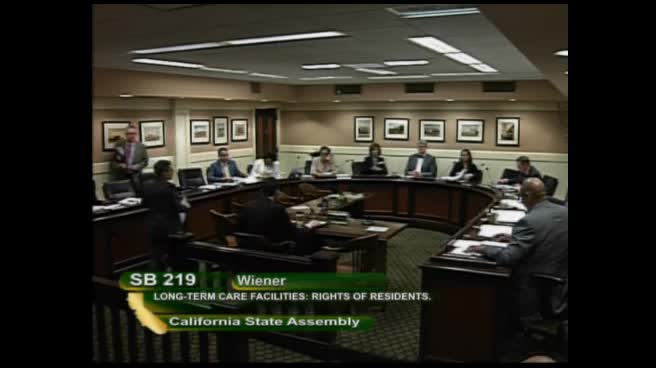 19MIN
Assembly Standing Committee on Judiciary
 22MIN
Assembly Standing Committee on Aging and Long-Term Care
 5MIN
Senate Floor
 48MIN
Senate Standing Committee on Appropriations
Bill Author





