SB 298: Enforcement of money judgments: exemptions.
- Session Year: 2017-2018
- House: Senate
- Latest Version Date: 2018-08-24
Existing law authorizes a judgment creditor to levy upon the property of a judgment debtor to satisfy a judgment, and authorizes the judgment debtor to claim that certain property is exempt from the levy by following a specified procedure. Existing law authorizes a claimant to assert an exemption by filing a claim of exemption with the levying officer within 10 days after the date the notice of levy on the property claimed to be exempt is served on the judgment debtor.
This bill would authorize a claimant to file a claim of exemption with the levying officer either in person or by mail and would specify that the period for filing the claim is 15 days if the judgment debtor is personally served with a notice of levy on the property claimed to be exempt, and 20 days if the claimant is served with notice by mail. The bill would deem the filing by mail complete on the date the claim is postmarked if the mailing is assigned a tracking number. If the mailing is not assigned a tracking number, the bill would deem the filing by mail complete on the date the claim is received by the levying officer.
With certain enumerated exceptions, this bill would exempt from a levy money in a judgment debtors deposit account in an amount equal to or less than $2,000. $1,200. The bill would require a levy against a judgment debtors deposit account to include a description of these requirements.
This bill would require the Judicial Council to prepare and make available amend or adopt necessary forms. This bill would also require the Judicial Council to, every 3 years, adjust the amount of the exemption described above based on the change in the annual California Consumer Price Index for All Urban Consumers, as specified. specified, and it would make additional conforming changes.
These provisions of the bill would become operative on September 1, 2019.
Existing law authorizes a judgment creditor to levy upon the property of a judgment debtor to satisfy a judgment, and authorizes the judgment debtor to claim that certain property is exempt from the levy by following a specified procedure. Existing law authorizes a claimant to assert an exemption by filing a claim of exemption with the levying officer within 10 days after the date the notice of levy on the property claimed to be exempt is served on the judgment debtor.
This bill would authorize a claimant to file a claim of exemption with the levying officer either in person or by mail and would specify that the period for filing the claim is 15 days if the judgment debtor is personally served with a notice of levy on the property claimed to be exempt, and 20 days if the claimant is served with notice by mail. The bill would deem the filing by mail complete on the date the claim is postmarked if the mailing is assigned a tracking number. If the mailing is not assigned a tracking number, the bill would deem the filing by mail complete on the date the claim is received by the levying officer.
ThisWith certain enumerated exceptions, this bill would exempt from a levy money in a judgment debtors deposit account in an amount equal to or less than $2,000, unless the levy would satisfy a judgment for wages owed, child support, or spousal support. $2,000. The bill would require a levy against a judgment debtors deposit account to include a description of these requirements.
This bill would require the Judicial Council to prepare and make available necessary forms. This bill would also require the Judicial Council to, every 3 years, adjust the amount of the exemption described above based on the change in the annual California Consumer Price Index for All Urban Consumers, as specified.
These provisions of the bill would become operative on September 1, 2019.
This bill would also clarify that the portion of a judgment debtors deposit account that the judgment debtor proves necessary for the support of a judgment or the judgment debtors family supported in whole or in part by a judgment is exempt from a levy.Existing law authorizes a judgment creditor to levy upon the property of a judgment debtor to satisfy a judgment, and authorizes the judgment debtor to claim that certain property is exempt from the levy by following a specified procedure. Existing law authorizes a claimant to assert an exemption by filing a claim of exemption with the levying officer within 10 days after the date the notice of levy on the property claimed to be exempt is served on the judgment debtor.
This bill would authorize a claimant to file a claim of exemption with the levying officer either in person or by mail and would specify that the period for filing the claim is 15 days if the judgment debtor is personally served with a notice of levy on the property claimed to be exempt, and 20 days if the claimant is served with notice by mail. The bill would deem the filing by mail complete on the date the claim is postmarked if the mailing is assigned a tracking number. If the mailing is not assigned a tracking number, the bill would deem the filing by mail complete on the date the claim is received by the levying officer.
This bill would exempt from a levy money in a judgment debtors deposit account in an amount equal to or less than $2,250, $2,000, unless the levy would satisfy a judgment for wages owed, child support, or spousal support. The bill would require a levy against a judgment debtors deposit account to include a description of these requirements.
This bill would require the Judicial Council to prepare and make available necessary forms. This bill would also require the Judicial Council to, every 3 years, adjust the amount of the exemption described above based on the change in the annual California Consumer Price Index for All Urban Consumers, as specified.
This These provisions of the bill would become operative on September 1, 2018. 2019.
This bill would also clarify that the portion of a judgment debtors deposit account that the judgment debtor proves necessary for the support of a judgment or the judgment debtors family supported in whole or in part by a judgment is exempt from a levy.
Existing law authorizes a judgment creditor to levy upon the property of a judgment debtor to satisfy a judgment, and authorizes the judgment debtor to claim that certain property is exempt from the levy by following a specified procedure. Existing law authorizes a claimant to assert an exemption by filing a claim of exemption with the levying officer within 10 days after the date the notice of levy on the property claimed to be exempt is served on the judgment debtor.
This bill would authorize a claimant to file a claim of exemption with the levying officer either in person or by mail and would specify that the period for filing the claim is 15 days if the judgment debtor is personally served with a notice of levy on the property claimed to be exempt, and 20 days if the claimant is served with notice by mail. The bill would deem the filing by mail complete on the date the claim is postmarked if the mailing is assigned a tracking number. If the mailing is not assigned a tracking number, the bill would deem the filing by mail complete on the date the claim is received by the levying officer.
This bill would exempt from a levy money in a judgment debtors deposit account in an amount equal to or less than the greater of $4,800 or the state minimum wage multiplied by 320, $2,250, unless the levy would satisfy a judgment for wages owed, child support, or spousal support. The bill would require a levy against a judgment debtors deposit account to include a description of these requirements.
This bill would require the Judicial Council to prepare and make available necessary forms. This bill would also require the Judicial Council to, every 3 years, adjust the amount of the exemption described above based on the change in the annual California Consumer Price Index for All Urban Consumers, as specified.
This bill would become operative on September 1, 2018.
Existing law authorizes a judgment creditor to levy upon the property of a judgment debtor to satisfy a judgment, and authorizes the judgment debtor to claim that certain property is exempt from the levy by following a specified procedure. Existing law authorizes a claimant to assert an exemption by filing a claim of exemption with the levying officer within 10 days after the date the notice of levy on the property claimed to be exempt is served on the judgment debtor.
This bill would authorize a claimant to file a claim of exemption with the levying officer either in person or by mail. The bill mail and would specify that the period for filing the claim is 15 days if the judgment debtor is personally served with a notice of levy on the property claimed to be exempt, and 20 days if the claimant is served with notice by mail. The bill would deem the filing by mail complete on the date the claim is postmarked if the mailing is assigned a tracking number. If the mailing is not assigned a tracking number, the bill would deem the filing by mail complete on the date the claim is received by the levying officer.
This bill would exempt from a levy money in a judgment debtors deposit account in an amount equal to or less than the greater of $4,800 or the state minimum wage multiplied by 320, unless the levy would satisfy a judgment for wages owed, child support, or spousal support. The bill would require a levy against a judgment debtors deposit account to include a description of these requirements.
This bill would become operative on September 1, 2018.
Existing law authorizes a judgment creditor to levy upon the property of a judgment debtor to satisfy a judgment, and authorizes the judgment debtor to claim that certain property is exempt from the levy by following a specified procedure. Existing law authorizes a claimant to assert an exemption by filing a claim of exemption with the levying officer within 10 days after the date the notice of levy on the property claimed to be exempt is served on the judgment debtor.
This bill would authorize a claimant to file a claim of exemption with the levying officer either in person or by mail. The bill would specify that the period for filing the claim is 15 days if the judgment debtor is personally served with a notice of levy on the property claimed to be exempt, and 20 days if the claimant is served with notice by mail. The bill would deem the filing by mail complete on the date the claim is postmarked if the mailing is assigned a tracking number. If the mailing is not assigned a tracking number, the bill would deem the filing by mail complete on the date the claim is received by the levying officer.
This bill would exempt from a levy money in a judgment debtors deposit account in an amount equal to or less than the greater of $4,800 or the state minimum wage multiplied by 320, unless the levy would satisfy a judgment for wages owed, child support, or spousal support judgment. support. The bill would require a levy against a judgment debtors deposit account to include a description of these requirements.
Existing law authorizes a judgment creditor to levy upon the property of a judgment debtor to satisfy a judgment, and authorizes the judgment debtor to claim that certain property is exempt from the levy by following a specified procedure. Existing law authorizes a claimant to assert an exemption by filing a claim of exemption with the levying officer within 10 days after the date the notice of levy on the property claimed to be exempt is served on the judgment debtor.
This bill would authorize a claimant to file a claim of exemption with the levying officer either in person or by mail. The bill would specify that the period for filing the claim is 15 days if the judgment debtor is personally served with a notice of levy on the property claimed to be exempt, and 20 days if the claimant is served with notice by mail. The bill would deem the filing by mail complete on the date the claim is postmarked if the mailing is assigned a tracking number. If the mailing is not assigned a tracking number, the bill would deem the filing by mail complete on the date the claim is received by the levying officer.
This bill would exempt from a levy money in a judgment debtors deposit account in an amount equal to or less than the greater of $4,800 or the state minimum wage multiplied by 320, unless the levy would satisfy a child or spousal support judgment. The bill would require a levy against a judgment debtors deposit account to include a description of these requirements.
Existing law authorizes a party to an action who asserts a real property claim to record a notice of pendency of action in which that real property claim is alleged pursuant to certain procedures. Under existing law, those procedures apply to an action pending in any United States District Court in the same manner that they apply to an action pending in state court.This bill would make a nonsubstantive change to the latter provision.Existing law authorizes a party to an action who asserts a real property claim to record a notice of pendency of action in which that real property claim is alleged pursuant to certain procedures. Under existing law, those procedures apply to an action pending in any United States District Court in the same manner that they apply to an action pending in state court.
This bill would make a nonsubstantive change to the latter provision.
The writ of execution shall require the levying officer to whom it is directed to enforce the money judgment and shall include the following information:
(a)The date of issuance of the writ.
(b)The title of the court where in which the judgment is entered and the cause and number of the action.
(c)Whether the judgment is for wages owed, child support, or spousal support. This paragraph shall become operative on September 1, 2019.
(c)(d)The name and address of the judgment creditor and the name and last known address of the judgment debtor. If the judgment debtor is other than a natural person, the type of legal entity shall be stated.
(d)(e)The date of the entry of the judgment and of any subsequent renewals and where entered in the records of the court.
(e)(f)The total amount of the money judgment as entered or renewed, together with costs thereafter added to the judgment pursuant to Section 685.090 and the accrued interest on the judgment from the date of entry or renewal of the judgment to the date of issuance of the writ, reduced by any partial satisfactions and by any amounts no longer enforceable.
(f)(g)The amount required to satisfy the money judgment on the date the writ is issued.
(g)(h)The amount of interest accruing daily on the principal amount of the judgment from the date the writ is issued.
(h)(i)Whether any person has requested notice of sale under the judgment and, if so, the name and mailing address of that person.
(i)(j)The sum of the fees and costs added to the judgment pursuant to Section 6103.5 or 68511.3 Article 6 (commencing with Section 68630) of Chapter 2 of Title 8 of the Government Code, and which is in addition to the amount owing to the judgment creditor on the judgment.
(j)(k)Whether the writ of execution includes any additional names of the judgment debtor pursuant to an affidavit of identity, as defined in Section 680.135.
(k)(l)A statement indicating whether the case is limited or unlimited.
SEC. 2.Section 699.540 of the Code of Civil Procedure is amended to read:699.540.The notice of levy required by Article 4 (commencing with Section 700.010) shall inform the person notified of all of the following:
(a)The capacity in which the person is notified.
(b)The property that is levied upon.
(c)The persons rights under the levy, including the all of the following:
(1)The right to claim an exemption pursuant to Chapter 4 (commencing with Section 703.010) and the 703.010).
(2)The right to make a third-party claim pursuant to Division 4 (commencing with Section 720.010).
(3)The right to, and the limitations of, the automatic exemption (commencing with Section 704.220). This paragraph shall become operative on September 1, 2019.
(d)The persons duties under the levy.
(e)All names listed in the writ of execution pursuant to an affidavit of identity, as defined in Section 680.135, if any.
SECTION 1.SEC. 3.Section 703.520 of the Code of Civil Procedure is amended to read:703.520.(a)The claimant may make a claim of exemption by filing with the levying officer a claim of exemption together with a copy thereof. The claim shall be made within 10 days after the date the notice of levy on the property claimed to be exempt was served on the judgment debtor.
(b)The claim of exemption shall be executed under oath and shall include all of the following:
(1)The name of the claimant and the mailing address where service of a notice of opposition to the claim may be made upon the claimant.
(2)The name and last known address of the judgment debtor if the claimant is not the judgment debtor.
(3)A description of the property claimed to be exempt. If an exemption is claimed pursuant to Section 704.010 or 704.060, the claimant shall describe all other property of the same type, including exempt proceeds of property of the same type, owned by the judgment debtor alone or in combination with others on the date of levy and identify the property, whether or not levied upon, to which the exemption is to be applied. If an exemption is claimed pursuant to subdivision (b) of Section 704.100, the claimant shall state the nature and amount of all other property of the same type owned by the judgment debtor or the spouse of the judgment debtor alone or in combination with others on the date of levy.
(4)A financial statement if required by Section 703.530.
(5)A citation of the provision of this chapter or other statute upon which the claim is based.
(6)A statement of the facts necessary to support the claim.
(c)This section shall become inoperative on September 1, 2019, and, as of January 1, 2020, is repealed, unless a later enacted statute, that becomes operative on or before January 1, 2020, deletes or extends the dates on which it becomes inoperative and is repealed.
SEC. 2.SEC. 4.Section 703.520 is added to the Code of Civil Procedure, to read:703.520.(a)The claimant may make a claim of exemption by filing with the levying officer, either in person or by mail, a claim of exemption together with a copy of the claim. If the claimant is personally served, the claim shall be made within 15 days after the date the notice of levy on the property claimed to be exempt is served on the judgment debtor. If the claimant is served by mail, the claim shall be made within 20 days after the date the notice of levy on the property claimed to be exempt is served on the judgment debtor. If the claim is filed by mail and assigned a tracking number by the United States Postal Service or another common carrier, the filing shall be deemed complete on the date the claim is postmarked. If the claim is filed by mail and not assigned a tracking number, the filing shall be deemed complete on the date the claim is received by the levying officer.
(b)The claim of exemption shall be executed under oath and shall include all of the following:
(1)The name of the claimant and the mailing address where service of a notice of opposition to the claim may be made upon the claimant.
(2)The name and last known address of the judgment debtor if the claimant is not the judgment debtor.
(3)A description of the property claimed to be exempt. If an exemption is claimed pursuant to Section 704.010 or 704.060, the claimant shall describe all other property of the same type, including exempt proceeds of the property of the same type, owned by the judgment debtor alone or in combination with others on the date of levy and identify the property, whether or not levied upon, to which the exemption is to be applied. If an exemption is claimed pursuant to subdivision (b) of Section 704.100, the claimant shall state the nature and amount of all other property of the same type owned by the judgment debtor or the spouse of the judgment debtor alone or in combination with others on the date of levy.
(4)A financial statement if required by Section 703.530.
(5)A citation of the provision of this chapter or other statute upon which the claim is based.
(6)A statement of the facts necessary to support the claim.
(c)This section shall become operative on September 1, 2019.
SEC. 3.SEC. 5.Section 704.220 is added to the Code of Civil Procedure, to read:704.220.(a)Money in the judgment debtors deposit account in an amount equal to or less than two one thousand two hundred dollars ($2,000) ($1,200) is exempt without making a claim.
(b)Subdivision (a) does not preclude or reduce a judgment debtors right to any other exemption provided by state or federal law.
(c)Subdivision (a) does not apply to money levied upon to satisfy any of the following:
(1)A levy to satisfy a judgment for wages owed, child support, or spousal support. For purposes of this paragraph, wages owed includes damages and penalties.
(2)A provision of the Public Resources Code, Revenue and Taxation Code, or Unemployment Insurance Code.
(3)A warrant or notice of levy issued by the state, or any department or agency thereof, for the collection of a liability.
(d)A levy against a judgment debtors deposit account shall include a written description of the requirements of this section.
(e)The exemption applies per debtor, not per account. If a judgment debtor holds an interest in multiple accounts, the judgment creditor or judgment debtor may file an ex parte application in the superior court in which the judgment was entered for a hearing to establish how and to which account the exemption should be applied. This subdivision does not create a cause of action against a judgment creditor who executes a levy pursuant to the courts determination.
(f)Subdivision (e) of Section 700.140 applies to a financial institution acting under this section.
(g)The Judicial Council shall prepare and make available amend or adopt all forms necessary to implement this section. The forms shall clearly delineate the amount of funds exempt from levy by a financial institution, including funds exempted by this section.
(h)On April 1, 2023, and at each three-year interval ending on April 1 thereafter, the dollar amount of the exemption provided in subdivision (a) in effect immediately before that date shall be adjusted as provided in subdivision (i).
(i)The Judicial Council shall determine the amount of the adjustment based on the change in the annual California Consumer Price Index for All Urban Consumers, published by the Department of Industrial Relations, Division of Labor Statistics, for the most recent three-year period ending on the December 31 preceding the adjustment, with each adjusted amount rounded to the nearest twenty-five dollars ($25).
(j)This section shall become operative on September 1, 2019.
(a)The claimant may make a claim of exemption by filing with the levying officer a claim of exemption together with a copy thereof. The claim shall be made within 10 days after the date the notice of levy on the property claimed to be exempt was served on the judgment debtor.
(b)The claim of exemption shall be executed under oath and shall include all of the following:
(1)The name of the claimant and the mailing address where service of a notice of opposition to the claim may be made upon the claimant.
(2)The name and last known address of the judgment debtor if the claimant is not the judgment debtor.
(3)A description of the property claimed to be exempt. If an exemption is claimed pursuant to Section 704.010 or 704.060, the claimant shall describe all other property of the same type, including exempt proceeds of property of the same type, owned by the judgment debtor alone or in combination with others on the date of levy and identify the property, whether or not levied upon, to which the exemption is to be applied. If an exemption is claimed pursuant to subdivision (b) of Section 704.100, the claimant shall state the nature and amount of all other property of the same type owned by the judgment debtor or the spouse of the judgment debtor alone or in combination with others on the date of levy.
(4)A financial statement if required by Section 703.530.
(5)A citation of the provision of this chapter or other statute upon which the claim is based.
(6)A statement of the facts necessary to support the claim.
(c)This section shall become inoperative on September 1, 2019, and, as of January 1, 2020, is repealed, unless a later enacted statute, that becomes operative on or before January 1, 2020, deletes or extends the dates on which it becomes inoperative and is repealed.
SEC. 2.Section 703.520 is added to the Code of Civil Procedure, to read:703.520.(a)The claimant may make a claim of exemption by filing with the levying officer, either in person or by mail, a claim of exemption together with a copy of the claim. If the claimant is personally served, the claim shall be made within 15 days after the date the notice of levy on the property claimed to be exempt is served on the judgment debtor. If the claimant is served by mail, the claim shall be made within 20 days after the date the notice of levy on the property claimed to be exempt is served on the judgment debtor. If the claim is filed by mail and assigned a tracking number by the United States Postal Service or another common carrier, the filing shall be deemed complete on the date the claim is postmarked. If the claim is filed by mail and not assigned a tracking number, the filing shall be deemed complete on the date the claim is received by the levying officer.
(b)The claim of exemption shall be executed under oath and shall include all of the following:
(1)The name of the claimant and the mailing address where service of a notice of opposition to the claim may be made upon the claimant.
(2)The name and last known address of the judgment debtor if the claimant is not the judgment debtor.
(3)A description of the property claimed to be exempt. If an exemption is claimed pursuant to Section 704.010 or 704.060, the claimant shall describe all other property of the same type, including exempt proceeds of the property of the same type, owned by the judgment debtor alone or in combination with others on the date of levy and identify the property, whether or not levied upon, to which the exemption is to be applied. If an exemption is claimed pursuant to subdivision (b) of Section 704.100, the claimant shall state the nature and amount of all other property of the same type owned by the judgment debtor or the spouse of the judgment debtor alone or in combination with others on the date of levy.
(4)A financial statement if required by Section 703.530.
(5)A citation of the provision of this chapter or other statute upon which the claim is based.
(6)A statement of the facts necessary to support the claim.
(c)This section shall become operative on September 1, 2019.
SEC. 3.Section 704.220 is added to the Code of Civil Procedure, to read:704.220.(a)Money in the judgment debtors deposit account in an amount equal to or less than two thousand dollars ($2,000) is exempt without making a claim.
(b)Subdivision (a) does not preclude or reduce a judgment debtors right to any other exemption provided by state or federal law.
(c)Subdivision (a) does not apply to a money levied upon to satisfy any of the following:
(1)A levy to satisfy a judgment for wages owed, child support, or spousal support.
(2)A provision of the Public Resources Code, Revenue and Taxation Code, or Unemployment Insurance Code.
(3)A warrant or notice of levy issued by the state, or any department or agency thereof, for the collection of a liability.
(d)A levy against a judgment debtors deposit account shall include a written description of the requirements of this section.
(e)The exemption applies per debtor, not per account. If a judgment debtor holds an interest in multiple accounts, the judgment creditor or judgment debtor may file an ex parte application in the superior court in which the judgment was entered for a hearing to establish how and to which account the exemption should be applied. This subdivision does not create a cause of action against a judgment creditor who executes a levy pursuant to the courts determination.
(f)Subdivision (e) of Section 700.140 applies to a financial institution acting under this section.
(g)The Judicial Council shall prepare and make available all forms necessary to implement this section. The forms shall clearly delineate the amount of funds exempt from levy by a financial institution, including funds exempted by this section.
(h)On April 1, 2023, and at each three-year interval ending on April 1 thereafter, the dollar amount of the exemption provided in subdivision (a) in effect immediately before that date shall be adjusted as provided in subdivision (i).
(i)The Judicial Council shall determine the amount of the adjustment based on the change in the annual California Consumer Price Index for All Urban Consumers, published by the Department of Industrial Relations, Division of Labor Statistics, for the most recent three-year period ending on the December 31 preceding the adjustment, with each adjusted amount rounded to the nearest twenty-five dollars ($25).
(j)This section shall become operative on September 1, 2019.
SEC. 4.Section 704.230 is added to the Code of Civil Procedure, to read:704.230.The portion of the judgment debtors deposit account that the judgment debtor proves is necessary for the support of the judgment debtor or the judgment debtors family supported in whole or in part by the judgment debtor is exempt from levy.(a)The claimant may make a claim of exemption by filing with the levying officer a claim of exemption together with a copy thereof. The claim shall be made within 10 days after the date the notice of levy on the property claimed to be exempt was served on the judgment debtor.
(b)The claim of exemption shall be executed under oath and shall include all of the following:
(1)The name of the claimant and the mailing address where service of a notice of opposition to the claim may be made upon the claimant.
(2)The name and last known address of the judgment debtor if the claimant is not the judgment debtor.
(3)A description of the property claimed to be exempt. If an exemption is claimed pursuant to Section 704.010 or 704.060, the claimant shall describe all other property of the same type (including type, including exempt proceeds of property of the same type) type, owned by the judgment debtor alone or in combination with others on the date of levy and identify the property, whether or not levied upon, to which the exemption is to be applied. If an exemption is claimed pursuant to subdivision (b) of Section 704.100, the claimant shall state the nature and amount of all other property of the same type owned by the judgment debtor or the spouse of the judgment debtor alone or in combination with others on the date of levy.
(4)A financial statement if required by Section 703.530.
(5)A citation of the provision of this chapter or other statute upon which the claim is based.
(6)A statement of the facts necessary to support the claim.
(c)This section shall become inoperative on September 1, 2018, 2019, and, as of January 1, 2019, 2020, is repealed, unless a later enacted statute, that becomes operative on or before January 1, 2019, 2020, deletes or extends the dates on which it becomes inoperative and is repealed.
SEC. 2.Section 703.520 is added to the Code of Civil Procedure, to read:703.520.(a)The claimant may make a claim of exemption by filing with the levying officer, either in person or by mail, a claim of exemption together with a copy of the claim. If the claimant is personally served, the claim shall be made within 15 days after the date the notice of levy on the property claimed to be exempt is served on the judgment debtor. If the claimant is served by mail, the claim shall be made within 20 days after the date the notice of levy on the property claimed to be exempt is served on the judgment debtor. If the claim is filed by mail and assigned a tracking number by the United States Postal Service or another common carrier, the filing shall be deemed complete on the date the claim is postmarked. If the claim is filed by mail and not assigned a tracking number, the filing shall be deemed complete on the date the claim is received by the levying officer.
(b)The claim of exemption shall be executed under oath and shall include all of the following:
(1)The name of the claimant and the mailing address where service of a notice of opposition to the claim may be made upon the claimant.
(2)The name and last known address of the judgment debtor if the claimant is not the judgment debtor.
(3)A description of the property claimed to be exempt. If an exemption is claimed pursuant to Section 704.010 or 704.060, the claimant shall describe all other property of the same type, including exempt proceeds of the property of the same type, owned by the judgment debtor alone or in combination with others on the date of levy and identify the property, whether or not levied upon, to which the exemption is to be applied. If an exemption is claimed pursuant to subdivision (b) of Section 704.100, the claimant shall state the nature and amount of all other property of the same type owned by the judgment debtor or the spouse of the judgment debtor alone or in combination with others on the date of levy.
(4)A financial statement if required by Section 703.530.
(5)A citation of the provision of this chapter or other statute upon which the claim is based.
(6)A statement of the facts necessary to support the claim.
(c)This section shall become operative on September 1, 2018. 2019.
SEC. 3.Section 704.220 is added to the Code of Civil Procedure, to read:704.220.(a)Money in the judgment debtors deposit account in an amount equal to or less than two thousand two hundred fifty dollars ($2,250) two thousand dollars ($2,000) is exempt without making a claim.
(b)Subdivision (a) does not preclude or reduce a judgment debtors right to any other exemption provided by state or federal law.
(c)Subdivision (a) does not apply to a levy to satisfy a judgment for wages owed, child support, or spousal support.
(d)A levy against a judgment debtors deposit account shall include a written description of the requirements of this section.
(e)The exemption applies per debtor, not per account. If a judgment debtor holds an interest in multiple accounts, the judgment creditor or judgment debtor may file an ex parte application in the superior court in which the judgment was entered for a hearing to establish how and to which account the exemption should be applied. This subdivision does not create a cause of action against a judgment creditor who executes a levy pursuant to the courts determination.
(f)Subdivision (e) of Section 700.140 applies to a financial institution acting under this section.
(g)The Judicial Council shall prepare and make available all forms necessary to implement this section. The forms shall clearly delineate the amount of funds exempt from levy by a financial institution, including funds exempted by this section.
(h)On April 1, 2022, 2023, and at each three-year interval ending on April 1 thereafter, the dollar amount of the exemption provided in subdivision (a) in effect immediately before that date shall be adjusted as provided in subdivision (i).
(i)The Judicial Council shall determine the amount of the adjustment based on the change in the annual California Consumer Price Index for All Urban Consumers, published by the Department of Industrial Relations, Division of Labor Statistics, for the most recent three-year period ending on the December 31 preceding the adjustment, with each adjusted amount rounded to the nearest twenty-five dollars ($25).
(j)This section shall become operative on September 1, 2018. 2019.
SEC. 4.Section 704.230 is added to the Code of Civil Procedure, to read:704.230.The portion of the judgment debtors deposit account that the judgment debtor proves is necessary for the support of the judgment debtor or the judgment debtors family supported in whole or in part by the judgment debtor is exempt from levy.
(a)The claimant may make a claim of exemption by filing with the levying officer a claim of exemption together with a copy thereof. The claim shall be made within 10 days after the date the notice of levy on the property claimed to be exempt was served on the judgment debtor.
(b)The claim of exemption shall be executed under oath and shall include all of the following:
(1)The name of the claimant and the mailing address where service of a notice of opposition to the claim may be made upon the claimant.
(2)The name and last known address of the judgment debtor if the claimant is not the judgment debtor.
(3)A description of the property claimed to be exempt. If an exemption is claimed pursuant to Section 704.010 or 704.060, the claimant shall describe all other property of the same type (including exempt proceeds of property of the same type) owned by the judgment debtor alone or in combination with others on the date of levy and identify the property, whether or not levied upon, to which the exemption is to be applied. If an exemption is claimed pursuant to subdivision (b) of Section 704.100, the claimant shall state the nature and amount of all other property of the same type owned by the judgment debtor or the spouse of the judgment debtor alone or in combination with others on the date of levy.
(4)A financial statement if required by Section 703.530.
(5)A citation of the provision of this chapter or other statute upon which the claim is based.
(6)A statement of the facts necessary to support the claim.
(c)This section shall become inoperative on September 1, 2018, and, as of January 1, 2019, is repealed, unless a later enacted statute, that becomes operative on or before January 1, 2019, deletes or extends the dates on which it becomes inoperative and is repealed.
SEC. 2.Section 703.520 is added to the Code of Civil Procedure, to read:703.520.(a)The claimant may make a claim of exemption by filing with the levying officer, either in person or by mail, a claim of exemption together with a copy of the claim. If the claimant is personally served, the claim shall be made within 15 days after the date the notice of levy on the property claimed to be exempt is served on the judgment debtor. If the claimant is served by mail, the claim shall be made within 20 days after the date the notice of levy on the property claimed to be exempt is served on the judgment debtor. If the claim is filed by mail and assigned a tracking number by the United States Postal Service or another common carrier, the filing shall be deemed complete on the date the claim is postmarked. If the claim is filed by mail and not assigned a tracking number, the filing shall be deemed complete on the date the claim is received by the levying officer.
(b)The claim of exemption shall be executed under oath and shall include all of the following:
(1)The name of the claimant and the mailing address where service of a notice of opposition to the claim may be made upon the claimant.
(2)The name and last known address of the judgment debtor if the claimant is not the judgment debtor.
(3)A description of the property claimed to be exempt. If an exemption is claimed pursuant to Section 704.010 or 704.060, the claimant shall describe all other property of the same type, including exempt proceeds of the property of the same type, owned by the judgment debtor alone or in combination with others on the date of levy and identify the property, whether or not levied upon, to which the exemption is to be applied. If an exemption is claimed pursuant to subdivision (b) of Section 704.100, the claimant shall state the nature and amount of all other property of the same type owned by the judgment debtor or the spouse of the judgment debtor alone or in combination with others on the date of levy.
(4)A financial statement if required by Section 703.530.
(5)A citation of the provision of this chapter or other statute upon which the claim is based.
(6)A statement of the facts necessary to support the claim.
(c)This section shall become operative on September 1, 2018.
SEC. 3.Section 704.220 is added to the Code of Civil Procedure, to read:704.220.(a)Money in the judgment debtors deposit account in an amount equal to or less than the greater of four two thousand eight two hundred fifty dollars ($4,800) or the state minimum wage multiplied by 320 ($2,250) is exempt without making a claim.
(b)Subdivision (a) does not preclude or reduce a judgment debtors right to any other exemption provided by state or federal law.
(c)Subdivision (a) does not apply to a levy to satisfy a judgment for wages owed, child support, or spousal support.
(d)A levy against a judgment debtors deposit account shall include a written description of the requirements of this section.
(e)The exemption applies per debtor, not per account. If a judgment debtor holds an interest in multiple accounts, the judgment creditor or judgment debtor may file an ex parte application in the superior court in which the judgment was entered for a hearing to establish how and to which account the exemption should be applied. This subdivision does not create a cause of action against a judgment creditor who executes a levy pursuant to the courts determination.
(f)Subdivision (e) of Section 700.140 applies to a financial institution acting under this section.
(g)The Judicial Council shall prepare and make available all forms necessary to implement this section. The forms shall clearly delineate the amount of funds exempt from levy by a financial institution, including funds exempted by this section.
(h)On April 1, 2022, and at each three-year interval ending on April 1 thereafter, the dollar amount of the exemption provided in subdivision (a) in effect immediately before that date shall be adjusted as provided in subdivision (i).
(i)The Judicial Council shall determine the amount of the adjustment based on the change in the annual California Consumer Price Index for All Urban Consumers, published by the Department of Industrial Relations, Division of Labor Statistics, for the most recent three-year period ending on the December 31 preceding the adjustment, with each adjusted amount rounded to the nearest twenty-five dollars ($25).
(f)
(j)This section shall become operative on September 1, 2018.
(a)The claimant may make a claim of exemption by filing with the levying officer, either in person or by mail, a claim of exemption together with a copy of the claim. If the claimant is personally served, the thereof. The claim shall be made within 15 10 days after the date the notice of levy on the property claimed to be exempt is was served on the judgment debtor. If the claimant is served by mail, the claim shall be made within 20 days after the date the notice of levy on the property claimed to be exempt is served on the judgment debtor. If the claim is filed by mail and assigned a tracking number by the United States Postal Service or another common carrier, the filing shall be deemed complete on the date the claim is postmarked. If the claim is filed by mail and not assigned a tracking number, the filing shall be deemed complete on the date the claim is received by the levying officer.
(b)The claim of exemption shall be executed under oath and shall include all of the following:
(1)The name of the claimant and the mailing address where service of a notice of opposition to the claim may be made upon the claimant.
(2)The name and last known address of the judgment debtor if the claimant is not the judgment debtor.
(3)A description of the property claimed to be exempt. If an exemption is claimed pursuant to Section 704.010 or 704.060, the claimant shall describe all other property of the same type, including type (including exempt proceeds of property of the same type, type) owned by the judgment debtor alone or in combination with others on the date of levy and identify the property, whether or not levied upon, to which the exemption is to be applied. If an exemption is claimed pursuant to subdivision (b) of Section 704.100, the claimant shall state the nature and amount of all other property of the same type owned by the judgment debtor or the spouse of the judgment debtor alone or in combination with others on the date of levy.
(4)A financial statement if required by Section 703.530.
(5)A citation of the provision of this chapter or other statute upon which the claim is based.
(6)A statement of the facts necessary to support the claim.
(c)This section shall become inoperative on September 1, 2018, and, as of January 1, 2019, is repealed, unless a later enacted statute, that becomes operative on or before January 1, 2019, deletes or extends the dates on which it becomes inoperative and is repealed.
SEC. 2.Section 703.520 is added to the Code of Civil Procedure, to read:703.520.(a)The claimant may make a claim of exemption by filing with the levying officer, either in person or by mail, a claim of exemption together with a copy of the claim. If the claimant is personally served, the claim shall be made within 15 days after the date the notice of levy on the property claimed to be exempt is served on the judgment debtor. If the claimant is served by mail, the claim shall be made within 20 days after the date the notice of levy on the property claimed to be exempt is served on the judgment debtor. If the claim is filed by mail and assigned a tracking number by the United States Postal Service or another common carrier, the filing shall be deemed complete on the date the claim is postmarked. If the claim is filed by mail and not assigned a tracking number, the filing shall be deemed complete on the date the claim is received by the levying officer.
(b)The claim of exemption shall be executed under oath and shall include all of the following:
(1)The name of the claimant and the mailing address where service of a notice of opposition to the claim may be made upon the claimant.
(2)The name and last known address of the judgment debtor if the claimant is not the judgment debtor.
(3)A description of the property claimed to be exempt. If an exemption is claimed pursuant to Section 704.010 or 704.060, the claimant shall describe all other property of the same type, including exempt proceeds of the property of the same type, owned by the judgment debtor alone or in combination with others on the date of levy and identify the property, whether or not levied upon, to which the exemption is to be applied. If an exemption is claimed pursuant to subdivision (b) of Section 704.100, the claimant shall state the nature and amount of all other property of the same type owned by the judgment debtor or the spouse of the judgment debtor alone or in combination with others on the date of levy.
(4)A financial statement if required by Section 703.530.
(5)A citation of the provision of this chapter or other statute upon which the claim is based.
(6)A statement of the facts necessary to support the claim.
(c)This section shall become operative on September 1, 2018.
SEC. 2.SEC. 3.Section 704.220 is added to the Code of Civil Procedure, to read:704.220.(a)Money in the judgment debtors deposit account in an amount equal to or less than the greater of four thousand eight hundred dollars ($4,800) or the state minimum wage multiplied by 320 is exempt without making a claim.
(b)Subdivision (a) does not preclude or reduce a judgment debtors right to any other exemption provided by state or federal law.
(c)Subdivision (a) does not apply to a levy to satisfy a judgment for wages owed, child support, or spousal support.
(d)A levy against a judgment debtors deposit account shall include a written description of the requirements of this section.
(e)The exemption applies per debtor, not per account. If a judgment debtor holds an interest in multiple accounts, the judgment creditor or judgment debtor may file an ex parte application in the superior court in which the judgment was entered for a hearing to establish how and to which account the exemption should be applied.
(f)This section shall become operative on September 1, 2018.
(a)The claimant may make a claim of exemption by filing with the levying officer, either in person or by mail, a claim of exemption together with a copy of the claim. If the claimant is personally served, the claim shall be made within 15 days after the date the notice of levy on the property claimed to be exempt is served on the judgment debtor. If the claimant is served by mail, the claim shall be made within 20 days after the date the notice of levy on the property claimed to be exempt is served on the judgment debtor. If the claim is filed by mail and assigned a tracking number by the United States Postal Service or another common carrier, the filing shall be deemed complete on the date the claim is postmarked. If the claim is filed by mail and not assigned a tracking number, the filing shall be deemed complete on the date the claim is received by the levying officer.
(b)The claim of exemption shall be executed under oath and shall include all of the following:
(1)The name of the claimant and the mailing address where service of a notice of opposition to the claim may be made upon the claimant.
(2)The name and last known address of the judgment debtor if the claimant is not the judgment debtor.
(3)A description of the property claimed to be exempt. If an exemption is claimed pursuant to Section 704.010 or 704.060, the claimant shall describe all other property of the same type, including exempt proceeds of property of the same type, owned by the judgment debtor alone or in combination with others on the date of levy and identify the property, whether or not levied upon, to which the exemption is to be applied. If an exemption is claimed pursuant to subdivision (b) of Section 704.100, the claimant shall state the nature and amount of all other property of the same type owned by the judgment debtor or the spouse of the judgment debtor alone or in combination with others on the date of levy.
(4)A financial statement if required by Section 703.530.
(5)A citation of the provision of this chapter or other statute upon which the claim is based.
(6)A statement of the facts necessary to support the claim.
SEC. 2.Section 704.220 is added to the Code of Civil Procedure, to read:704.220.(a)Money in the judgment debtors deposit account in an amount equal to or less than the greater of four thousand eight hundred dollars ($4,800) or the state minimum wage multiplied by 320 is exempt without making a claim.
(b)Subdivision (a) does not preclude or reduce a judgment debtors right to any other exemption provided by state or federal law.
(c)Subdivision (a) does not apply to a levy to satisfy a judgment for wages owed, child support, or spousal support judgment. support.
(d)A levy against a judgment debtors deposit account shall include a written description of the requirements of this section.
(e)The exemption applies per debtor, not per account. If a judgment debtor holds an interest in multiple accounts, the judgment creditor or judgment debtor may file an ex parte application in the superior court in which the judgment was entered for a hearing to establish how and to which account the exemption should be applied.
(a)The claimant may make a claim of exemption by filing with the levying officer, either in person or by mail, a claim of exemption together with a copy thereof. The of the claim. If the claimant is personally served, the claim shall be made within 10 15 days after the date the notice of levy on the property claimed to be exempt was is served on the judgment debtor. If the claimant is served by mail, the claim shall be made within 20 days after the date the notice of levy on the property claimed to be exempt is served on the judgment debtor. If the claim is filed by mail and assigned a tracking number by the United States Postal Service or another common carrier, the filing shall be deemed complete on the date the claim is postmarked. If the claim is filed by mail and not assigned a tracking number, the filing shall be deemed complete on the date the claim is received by the levying officer.
(b)The claim of exemption shall be executed under oath and shall include all of the following:
(1)The name of the claimant and the mailing address where service of a notice of opposition to the claim may be made upon the claimant.
(2)The name and last known address of the judgment debtor if the claimant is not the judgment debtor.
(3)A description of the property claimed to be exempt. If an exemption is claimed pursuant to Section 704.010 or 704.060, the claimant shall describe all other property of the same type (including type, including exempt proceeds of property of the same type) type, owned by the judgment debtor alone or in combination with others on the date of levy and identify the property, whether or not levied upon, to which the exemption is to be applied. If an exemption is claimed pursuant to subdivision (b) of Section 704.100, the claimant shall state the nature and amount of all other property of the same type owned by the judgment debtor or the spouse of the judgment debtor alone or in combination with others on the date of levy.
(4)A financial statement if required by Section 703.530.
(5)A citation of the provision of this chapter or other statute upon which the claim is based.
(6)A statement of the facts necessary to support the claim.
SEC. 2.Section 704.220 is added to the Code of Civil Procedure, to read:704.220.(a)Money in the judgment debtors deposit account in an amount equal to or less than the greater of four thousand eight hundred dollars ($4,800) or the state minimum wage multiplied by 320 is exempt without making a claim.
(b)Subdivision (a) does not preclude or reduce a judgment debtors right to any other exemption provided by state or federal law.
(c)Subdivision (a) does not apply to a levy to satisfy a child or spousal support judgment.
(d)A levy against a judgment debtors deposit account shall include a written description of the requirements of this section.
SECTION 1.Section 405.5 of the Code of Civil Procedure is amended to read:405.5.This title applies to an action pending in any United States District Court in the same manner that it applies to an action pending in a court of this state.This title applies to an action pending in any United States District Court in the same manner that it applies to an action pending in the courts a court of this state.
|
Date
|
Status
|
|---|---|
| Aug 30, 2018 | Read third time. Refused passage. |
| Aug 24, 2018 | Read third time and amended. |
| Aug 16, 2018 | Read second time. Ordered to third reading. |
| Aug 15, 2018 | From committee: Do pass. (Ayes 12. Noes 5.) (August 15). |
| Aug 6, 2018 | From committee with author's amendments. Read second time and amended. Re-referred to Com. on APPR. |
| Jun 25, 2018 | Re-referred to Com. on APPR. pursuant to Joint Rule 10.5. |
| Jun 21, 2018 | Reconsideration granted. |
| Sep 16, 2017 | Read third time. Refused passage. (Ayes 28. Noes 29. Page 3563.) |
| Sep 8, 2017 | Read third time and amended. |
| Jul 3, 2017 | Read second time. Ordered to third reading. |
| Jun 29, 2017 | Read second time and amended. Ordered to second reading. |
| Jun 28, 2017 | From committee: Do pass as amended. (Ayes 6. Noes 3.) (June 27). |
| Jun 15, 2017 | Referred to Com. on JUD. |
| May 23, 2017 | In Assembly. Read first time. Held at Desk. |
| May 22, 2017 | Read third time. Passed. (Ayes 22. Noes 12. Page 1142.) Ordered to the Assembly. |
| May 9, 2017 | Read second time and amended. Ordered to third reading. |
| May 8, 2017 | From committee: Do pass as amended. (Ayes 4. Noes 2. Page 945.) (May 2). |
| Apr 13, 2017 | Set for hearing May 2. |
| Mar 29, 2017 | Re-referred to Com. on JUD. |
| Mar 22, 2017 | From committee with author's amendments. Read second time and amended. Re-referred to Com. on RLS. |
| Feb 23, 2017 | Referred to Com. on RLS. |
| Feb 14, 2017 | From printer. May be acted upon on or after March 16. |
| Feb 13, 2017 | Introduced. Read first time. To Com. on RLS. for assignment. To print. |
|
Date
|
Description
|
Location
|
Votes
|
|
|---|---|---|---|---|
| Aug 30, 2018 | SB 298 Wieckowski Senate Third Reading By WEBER | Assembly Floor |
Failed |
|
| Aug 15, 2018 | Do pass. | Assembly Standing Committee on Appropriations |
Passed |
|
| Sep 16, 2017 | SB 298 Wieckowski Senate Third Reading By WEBER | Assembly Floor |
Failed |
|
| Jun 27, 2017 | Do pass as amended. | Assembly Standing Committee on Judiciary |
Passed |
|
| May 22, 2017 | Senate 3rd Reading SB298 Wieckowski | Senate Floor |
Passed |
|
| May 2, 2017 | Do pass as amended | Senate Standing Committee on Judiciary |
Passed |
This list shows positions taken on this bill by organizations on the date displayed, which is linked to the original source.
Positions by individuals are not included.
|
Organization
|
Position
|
Date
|
|---|---|---|
| AFSCME Local 3930 | ** Support | Jun 25, 2017 |
| Asian Law Alliance | ** Support | Jun 25, 2017 |
| Bet Tzedek | ** Support | Jun 25, 2017 |
| California Association Of Collectors | * Against | Aug 15, 2018 |
| California Bankers Association | * Against | Aug 15, 2018 |
| California Community Banking Network | * Against | Aug 15, 2018 |
| California Credit Union League | ** Against | Jun 25, 2017 |
| California Financial Services Association | ** Against | Jun 25, 2017 |
| California Reinvestment Coalition | ** Support | Jun 25, 2017 |
| California School Employees Association | ** Support | Jun 25, 2017 |
| Central California Legal Services | ** Support | Jun 25, 2017 |
| Collect California Low Income Consumer Coalition | * Support | Aug 15, 2018 |
| Consumers Union | ** Support | Jun 25, 2017 |
| Courage Campaign | ** Support | Jun 25, 2017 |
| dr. prasad krishnamurthy, j.d. ph.d. | ** Support | Jun 25, 2017 |
| Earn | ** Support | Jun 25, 2017 |
| East Bay Community Law Center | ** Support | Jun 25, 2017 |
| Encore Capital Group | * Against | Aug 15, 2018 |
| Health Access | * Support | Aug 15, 2018 |
| Housing and Economic Rights Advocates | ** Support | Jun 25, 2017 |
| Law Foundation of Silicon Valley | ** Support | Jun 25, 2017 |
| Legal Aid Association Of California | ** Support | Jun 25, 2017 |
| Legal Aid Society of San Bernardino | ** Support | Jun 25, 2017 |
| Maternal and Child Health Access | ** Support | Jun 25, 2017 |
| mission access fund | ** Support | Jun 25, 2017 |
| Mission Asset Fund | ** Support | May 9, 2017 |
| Mission Economic Development Agency | ** Support | Jun 25, 2017 |
| One individual | ** Support | May 9, 2017 |
| Project Inform | ** Support | Jun 25, 2017 |
| Public Counsel | ** Support | Jun 25, 2017 |
| Public Law Center | ** Support | Jun 25, 2017 |
| Receivables Management Association | * Against | Aug 15, 2018 |
| Riverside Legal Aid | ** Support | Jun 25, 2017 |
| San Francisco Office of Financial Empowerment | ** Support | Jun 25, 2017 |
| SEIU | ** Support | Jun 25, 2017 |
| Substitute Teacher | * Support | May 2, 2017 |
| The Western Center on Law and Poverty | * Support | Aug 15, 2018 |
| United Farm Workers | ** Support | Jun 25, 2017 |
| United Way | ** Support | Jun 25, 2017 |
| United Way of Kern County | ** Support | Jun 25, 2017 |
| uscb, inc. | ** Against | Jun 25, 2017 |
| Watsonville Law Center | ** Support | Jun 25, 2017 |
| Worksafe | ** Support | Jun 25, 2017 |
SENATE THIRD READING
STR Bill Id:SB 298
Author:(Wieckowski)
As Amended Ver:August 24, 2018
Majority vote
SENATE VOTE: 22-12
Committee | Votes | Ayes | Noes |
Judiciary | 6-3 | Mark Stone, Chau, Chiu, Kalra, Reyes, Ting | Cunningham, Kiley, Maienschein |
Appropriations | 12-5 | Gonzalez Fletcher, Bloom, Bonta, Calderon, Carrillo, Chau, Eggman, Friedman, Eduardo Garcia, Nazarian, Quirk, Reyes | Bigelow, Brough, Fong, Gallagher, Obernolte |
SUMMARY: Automatically exempts an amount up to $1,200 from being levied from a debtor's bank account to satisfy creditors seeking to recover a judgment debt. Specifically, this bill:
- Exempts from levy from the judgment debtor's deposit account an amount equal to or less than $1,200. Further provides that this amount is exempt without requiring the judgment debtor to make a claim for exemption.
- Clarifies that the exemption in 1) applies per debtor, not per account. Provides that if a judgment debtor holds an interest in multiple accounts, the judgment creditor or judgment debtor may file an ex parte application in the superior court in which the judgment was entered for a hearing to establish how and to which account the exemption should be applied. Further clarifies that this provision does not create a cause of action against a judgment creditor who executes a levy pursuant to the court's determination.
- Provides the exemption in 1) does not preclude or reduce a judgment debtor's right to any other exemption provided by state or federal law.
- Provides that the exemption in 1) does not apply to any of the following:
- A levy to satisfy a judgment for wages owed (including damages and penalties), child support, or spousal support.
- A provision of the Public Resources Code, Revenue and Taxation Code, or Unemployment Insurance Code.
- A warrant or notice of levy issued by the state, or any department or agency thereof, for the collection of a liability.
- Requires the writ of execution, beginning September 1, 2019, to state whether the judgment is for wages owed, child support, or spousal support.
- Requires the notice of levy, beginning September 1, 2019, to inform the person notified of the right to, and the limitations of, the automatic exemption enacted by this bill.
- Requires any levy against a judgment debtor's deposit account to include a written description of the requirements of this bill, as specified.
- Clarifies that the debtor may make a claim of exemption by filing a claim of exemption with the levying officer either in person or by mail.
- Provides that if the claimant is personally served with the notice of levy, the claim shall be made within 15 days (rather than 10 days) after the date the notice of levy is served on the judgment debtor.
- Provides that if the claimant is served with the notice of levy by mail, then the claim shall be made within 20 days after the date the notice of levy on the property claimed to be exempt is served on the judgment debtor. If the claim is filed by mail and assigned a tracking number by the United States (U.S.) Postal Service or another common carrier, the filing shall be deemed complete on the date the claim is postmarked; however, if the claim is filed by mail and not assigned a tracking number, the filing shall be deemed complete on the date the claim is received by the levying officer.
- Establishes that existing law, Code of Civil Procedure (CCP) Section 700.140, applies to a financial institution executing a bank levy under this bill, in order to shield the institution from any liability for nonpayment of a check drawn against the account or other specified actions taken during the time the execution lien is in effect.
- Requires the Judicial Council to amend or adopt all forms necessary to implement this bill, and requires such forms to clearly delineate the amount of funds exempt from levy by a financial institution, including funds exempted by this bill.
- Requires the Judicial Council, on April 1, 2023, and at each three-year interval ending on April 1 thereafter, to determine and adjust the amount of the above exemption, based on the change in the annual California Consumer Price Index for All Urban Consumers for the most recent three-year period ending on December 31 preceding the adjustment, with each adjusted amount rounded to the nearest twenty-five dollars.
- Establishes a delayed implementation date of September 1, 2019 for these provisions.
FISCAL EFFECT: According to the Assembly Appropriations Committee, Judicial Council anticipates minor costs to prepare and make available forms and to periodically adjust the levy amount.
COMMENTS: According to the Western Center on Law and Poverty (WCLP) and the California Low-Income Consumer Coalition (CLICC), co-sponsors of this legislation, many low-income debtors in Californians live one precarious step away from a "catastrophic downward financial spiral" that may be triggered by having up to 100% of the money in their bank account seized by creditors as the result of a bank levy. They contend that the current claim of exemption process, in which a debtor may try to convince the court that certain funds are exempt under law and ought to be returned, is problematic because it leaves people with no way to pay for their rent, food, medicine, transportation, and other life necessities until the claim can be considered by the court. To address this reported problem, this bill would automatically exempt an amount up to $1,200 from being levied from a debtor's bank account, except as provided. It should be noted that nothing in this bill acts to discharge any part of the underlying debt.
Background about the bank levying process to collect debt. After a creditor goes to court and obtains a judgment against a debtor for repayment of an unpaid debt, the creditor has a number of different options for how to collect payment of the debt, including, among other things, wage garnishment, placement of a lien on real property, or the levy of a bank account. A creditor who wants to use a bank levy to satisfy a debt fills out a writ of execution, files it with the court, and then brings the writ to the local sheriff (a.k.a. the "levying officer) for execution. The writ of execution instructs the bank to freeze the money in the account and notify the account holder that the money will be removed from the account and conveyed to the creditor to satisfy part or all of the debt. Under current state law, up to 100% of the money in the account can be seized by the sheriff to pay the debt (although federal regulations may make a certain amount of money exempt from levy, depending on the source of the funds). In theory, the account holder has time after receiving the notice of levy to respond to the court and request that some portion of the money be unfrozen and left in the account, based on certain legal justifications, for daily living expenses. This request is known as a "claim of exemption," and under current law, the debtor whose account is being levied must file a claim of exemption within ten days of receiving the notice of levy, or risk having no funds exempted, even when it is clear that some funds would qualify as exempt once they were evaluated by the court. According to the author, however, service of the notice of levy is often effected after the levy has occurred, and the money has been released to the creditor. By the time the debtor files a claim of exemption, the funds may already be out of the possession of the levying officer and cannot immediately be returned to the debtor.
This bill establishes a threshold amount of $1,200 per debtor to be protected from bank levy. Current state law allows up to 100% of a debtor's bank account to be levied to repay a judgment debt. Proponents of the bill argue that this can have devastating effects on low-income people and threatens to destabilize their lives and compromise their ability to retain housing and funds for basic life necessities In addition, proponents note that this is inconsistent with laws in many other states that provide statutory protections from levy for household funds in bank accounts (ranging in amount from $300 in Arizona and Pennsylvania, to $10,000 in Mississippi and Tennessee), and is inconsistent with California's own laws on wage garnishment, which caps at 25% the percentage of a person's wages that may be garnished to collect on a judgment. For low-wage workers, the percentage that may be taken through wage garnishment is even lower.
Accordingly, this bill would automatically exempt up to $1,200 from being levied from a debtor's bank account to satisfy a judgment debt. This amendment represents a 75% decrease in the exemption amount, as compared to the amount of $4,800 in the version of the bill that was approved by the Senate. The bill is still opposed by the California Association of Collectors (CAC) and the California Bankers Association, among others. They reiterate that bank levies have long been recognized as a proper means, after a judgment has been issued, to legitimately collect debt; and that generally speaking, creditors rely on the bank levy process after other efforts to collect or negotiate a payment plan have failed. They contend that the majority of successful bank levies are for far less than $4,800, and that this new cash exemption, when coupled with other available exemptions, will render bank levies unavailable. (At the time opponents made this argument, however, the amount exempted by the bill was $4,800. It subsequently has been lowered by amendment three times, to its current threshold of $1,200.)
The bill provides that the $1,200 exemption does not apply to any provision of the Public Resources Code, Revenue and Taxation Code, or Unemployment Insurance Code, nor to any warrant or notice of levy issued by the state, or any department or agency thereof, for the collection of a liability. This bill continues to exempt a levy to satisfy a judgment for wages owed (including damages or penalties), child support, or spousal support.
This bill reverses current practice by making the exemption from levy automatic, without requiring the debtor to make a claim. As previously described, existing law authorizes a judgment debtor to file a claim of exemption with the levying officer within 10 days after service of the notice of bank levy in order to assert any claim of exemption for the funds in the bank account being levied. This bill, however, reverses current practice by making the proposed exemption automatic without requiring the debtor to make a claim or subsequently demonstrate that the funds are, in fact, exempt.
Opponents contend that this bill is unnecessary because the current claim of exemption process already provides necessary protections for debtors who truly cannot afford to pay a judgment, and existing law already provides ample types of exemptions, including necessaries of life, that are intended to ensure that low-income debtors will have money for food, rent, and other basic living costs. They prefer the current court-supervised process to determine what funds should be exempt, rather than automatically making $1,200 of a debtor's bank account automatically exempt without some burden of proof upon the debtor to justify the need for exemption. For these reasons, they contend that the bill eliminates existing due process rights for creditors.
Proponents believe that the current claim of exemption process is fraught with problems for low-income debtors facing the prospect of potentially having the entire balance of their bank account seized through a bank levy and turned over to creditors. They explain: "Because California does not protect any amount of funds in a bank account from levy, courts must engage in a fact-intensive review of a judgment debtor's expenses and income in order to determine whether levied funds should be returned by the creditor. Even if the judgment debtor prevails at this hearing and the court issues an order determining the claim of exemption in the debtor's favor, the order must be processed by the levying officer before funds are returned to the debtor. Processing an order can take weeks or months [and] in the meantime, despite having been judged in need of the funds, the debtor continues to suffer." In addition, legal aid organizations supporting this bill contend that the exemption process is difficult for many low-income people whom they serve, particularly those with disabilities or who are limited English-proficient.
Liability protections for financial institutions. The bill specifically provides that the exemption applies per debtor, not per account, and permit either the judgment creditor or judgment debtor to file an ex parte application in court for a hearing to establish how and to which account the exemption should be applied, if a judgment debtor holds an interest in multiple accounts. These provisions are intended to ensure that so-called "wealthy debtors" are not able to shelter more than $1,200 in total by harboring multiple bank accounts and claiming the exemption for each account. The bill establishes additional protections from liability for financial institutions seeking to execute a levy in compliance with this act. First, the bill specifies that no cause of action is created against a judgment creditor who executes a levy pursuant to a court's determination of how to apply the exemption to a particular debtor that holds an interest in multiple accounts, as specified. In addition, the bill provides that existing law, CCP Section 700.140, applies to a financial institution executing a bank levy under this bill, in order to shield the institution from any liability for actions covered by CCP Section 700.140 taken during the time the execution lien is in effect (for example, nonpayment of a check against the deposit account, or refusal to pay a withdrawal from the deposit account, as specified.)
This bill extends the time that a debtor may make a claim of exemption. Existing law requires a debtor to make a claim for exemption within 10 days after the date the notice of levy is served on the judgment debtor, and deems the claim to be filed when actually received by the levying officer. While 10 days may seem like adequate time to file the claim of exemption, proponents contend that it is often completely inadequate when, as is reportedly often the case, the debtor does not receive the notice of levy until after the levy has occurred. If the levying officer has not received the claim by the 10-day mark, the levied funds are released to the creditor and can no longer be retrieved through the claim of exemption process. As the sponsors points out, service of notice on the judgment debtor by mail (the preferred method of creditors) simply takes time, as does filling out an accurate claim of exemption and mailing it back to the levying officer in time to be received--all within a period of 10 days. Accordingly, this bill briefly extends the allotted time for a debtor to make a claim of exemption. Specifically, the bill provides that if the claimant is personally served with the notice of levy, the claim shall be made within 15 days (rather than 10 days) after the date the notice of levy is served on the judgment debtor. If the claimant is served with the notice of levy by mail, then the claim shall be made within 20 days (rather than 10 days) after the date the notice is mailed.
Judicial Council role. This bill requires the Judicial Council, on April 1, 2023, and at each three-year interval ending on April 1 thereafter, to determine and adjust the amount of the above exemption, based on the change in the annual California Consumer Price Index for All Urban Consumers for the most recent three-year period ending on December 31 preceding the adjustment. In addition, the bill requires the Judicial Council to amend or adopt all forms necessary to implement this bill, and require such forms to clearly delineate the amount of funds exempt from levy by a financial institution, including funds exempted by this bill. Recent amendments specify additional information to be stated on the writ of execution and the notice of levy for the benefit of the recipient. This bill has an effective date of September 1, 2019, in order to provide the Judicial Council more time to update relevant forms used by debtors, creditors, and levying officers.
Analysis Prepared by: Anthony Lew / JUD. / (916) 319-2334 FN: 0004793
SENATE THIRD READING
STR Bill Id:SB 298
Author:(Wieckowski)
As Amended Ver:August 6, 2018
Majority vote
SENATE VOTE: 22-12
Committee | Votes | Ayes | Noes | |
Judiciary | 6-3 | Mark Stone, Chau, Chiu, Kalra, Reyes, Ting | Cunningham, Kiley, Maienschein | |
Appropriations | 12-5 | Gonzalez Fletcher, Bloom, Bonta, Calderon, Carrillo, Chau, Eggman, Friedman, Eduardo Garcia, Nazarian, Quirk, Reyes | Bigelow, Brough, Fong, Gallagher, Obernolte | |
SUMMARY: Automatically exempts an amount up to $2,000 from being levied from a debtor's bank account to satisfy creditors seeking to recover a judgment debt. Specifically, this bill:
- Exempts from levy from the judgment debtor's deposit account an amount equal to or less than $2,000. Further provides that this amount is exempt without requiring the judgment debtor to make a claim for exemption.
- Clarifies that the exemption in 1) applies per debtor, not per account. Provides that if a judgment debtor holds an interest in multiple accounts, the judgment creditor or judgment debtor may file an ex parte application in the superior court in which the judgment was entered for a hearing to establish how and to which account the exemption should be applied. Further clarifies that this provision does not create a cause of action against a judgment creditor who executes a levy pursuant to the court's determination.
- Provides the exemption in 1) does not preclude or reduce a judgment debtor's right to any other exemption provided by state or federal law.
- Provides that the exemption in 1) does not apply to any of the following:
- A levy to satisfy a judgment for wages owed, child support, or spousal support.
- A provision of the Public Resources Code, Revenue and Taxation Code, or Unemployment Insurance Code.
- A warrant or notice of levy issued by the state, or any department or agency thereof, for the collection of a liability.
- Requires any levy against a judgment debtor's deposit account to include a written description of the requirements of this bill, as specified.
- Clarifies that the debtor may make a claim of exemption by filing a claim of exemption with the levying officer either in person or by mail.
- Provides that if the claimant is personally served with the notice of levy, the claim shall be made within 15 days (rather than 10 days) after the date the notice of levy is served on the judgment debtor.
- Provides that if the claimant is served with the notice of levy by mail, then the claim shall be made within 20 days after the date the notice of levy on the property claimed to be exempt is served on the judgment debtor. If the claim is filed by mail and assigned a tracking number by the United States (U.S.) Postal Service or another common carrier, the filing shall be deemed complete on the date the claim is postmarked; however, if the claim is filed by mail and not assigned a tracking number, the filing shall be deemed complete on the date the claim is received by the levying officer.
- Establishes that existing law, Code of Civil Procedure (CCP) Section 700.140, applies to a financial institution executing a bank levy under this bill, in order to shield the institution from any liability for nonpayment of a check drawn against the account or other specified actions taken during the time the execution lien is in effect.
- Requires the Judicial Council to prepare and make available all forms necessary to implement this bill, and requires such forms to clearly delineate the amount of funds exempt from levy by a financial institution, including funds exempted by this bill.
- Requires the Judicial Council, on April 1, 2023, and at each three-year interval ending on April 1 thereafter, to determine and adjust the amount of the above exemption, based on the change in the annual California Consumer Price Index for All Urban Consumers for the most recent three-year period ending on December 31 preceding the adjustment, with each adjusted amount rounded to the nearest twenty-five dollars.
- Establishes a delayed implementation date of September 1, 2019 for these provisions.
FISCAL EFFECT: According to the Assembly Appropriations Committee, Judicial Council anticipates minor costs to prepare and make available forms and to periodically adjust the levy amount.
COMMENTS: According to the Western Center on Law and Poverty (WCLP) and the California Low-Income Consumer Coalition (CLICC), co-sponsors of this legislation, many low-income debtors in Californians live one precarious step away from a "catastrophic downward financial spiral" that may be triggered by having up to 100% of the money in their bank account seized by creditors as the result of a bank levy. They contend that the current claim of exemption process, in which a debtor may try to convince the court that certain funds are exempt under law and ought to be returned, is problematic because it leaves people with no way to pay for their rent, food, medicine, transportation, and other life necessities until the claim can be considered by the court. To address this reported problem, this bill would automatically exempt an amount up to $2,000 from being levied from a debtor's bank account, except as provided. It should be noted that nothing in this bill acts to discharge any part of the underlying debt.
Background about the bank levying process to collect debt. After a creditor goes to court and obtains a judgment against a debtor for repayment of an unpaid debt, the creditor has a number of different options for how to collect payment of the debt, including, among other things, wage garnishment, placement of a lien on real property, or the levy of a bank account. A creditor who wants to use a bank levy to satisfy a debt fills out a writ of execution, files it with the court, and then brings the writ to the local sheriff (a.k.a. the "levying officer) for execution. The writ of execution instructs the bank to freeze the money in the account and notify the account holder that the money will be removed from the account and conveyed to the creditor to satisfy part or all of the debt. Under current state law, up to 100% of the money in the account can be seized by the sheriff to pay the debt (although federal regulations may make a certain amount of money exempt from levy, depending on the source of the funds). In theory, the account holder has time after receiving the notice of levy to respond to the court and request that some portion of the money be unfrozen and left in the account, based on certain legal justifications, for daily living expenses. This request is known as a "claim of exemption," and under current law, the debtor whose account is being levied must file a claim of exemption within ten days of receiving the notice of levy, or risk having no funds exempted, even when it is clear that some funds would qualify as exempt once they were evaluated by the court. According to the author, however, service of the notice of levy is often effected after the levy has occurred, and the money has been released to the creditor. By the time the debtor files a claim of exemption, the funds may already be out of the possession of the levying officer and cannot immediately be returned to the debtor.
This bill establishes a threshold amount of $2,000 per debtor to be protected from bank levy. Current state law allows up to 100% of a debtor's bank account to be levied to repay a judgment debt. Proponents of the bill argue that this can have devastating effects on low-income people and threatens to destabilize their lives and compromise their ability to retain housing and funds for basic life necessities In addition, proponents note that this is inconsistent with laws in many other states that provide statutory protections from levy for household funds in bank accounts (ranging in amount from $300 in Arizona and Pennsylvania, to $10,000 in Mississippi and Tennessee), and is inconsistent with California's own laws on wage garnishment, which caps at 25% the percentage of a person's wages that may be garnished to collect on a judgment. For low-wage workers, the percentage that may be taken through wage garnishment is even lower.
Accordingly, this bill would automatically exempt up to $2,000 from being levied from a debtor's bank account to satisfy a judgment debt. This amendment represents a 58% decrease in the exemption amount, as compared to the amount of $4,800 in the version of the bill that was approved by the Senate. According to WCLP, by comparison the asset limit for eligibility for the federal Supplemental Nutrition Assistance Program (SNAP) is a mere $2,250, which is 12% higher than the amount exempted under this bill. WCLP states: "The federal government has recognized that people need savings in order to have any chance of escaping poverty, and has determined that this is the baseline amount that recipients of government food benefits should be allowed to have. This amount has been set in federal statute for over a decade."
Recent amendments to the bill provide that the $2000 exemption does not apply to any provision of the Public Resources Code, Revenue and Taxation Code, or Unemployment Insurance Code, nor to any warrant or notice of levy issued by the state, or any department or agency thereof, for the collection of a liability. This bill continues to exempt a levy to satisfy a judgment for wages owed, child support, or spousal support.
The bill is still opposed by the California Association of Collectors (CAC) and the California Bankers Association, among others. They reiterate that bank levies have long been recognized as a proper means, after a judgment has been issued, to legitimately collect debt; and that generally speaking, creditors rely on the bank levy process after other efforts to collect or negotiate a payment plan have failed. They contend that the majority of successful bank levies are for far less than $4,800, and that this new cash exemption, when coupled with other available exemptions, will render bank levies unavailable. (At the time opponents made this argument, however, the amount exempted by the bill was $4,800. It subsequently has been lowered by amendment twice, to its current threshold of $2,000.)
This bill reverses current practice by making the exemption from levy automatic, without requiring the debtor to make a claim. As previously described, existing law authorizes a judgment debtor to file a claim of exemption with the levying officer within 10 days after service of the notice of bank levy in order to assert any claim of exemption for the funds in the bank account being levied. This bill, however, reverses current practice by making the proposed exemption automatic without requiring the debtor to make a claim or subsequently demonstrate that the funds are, in fact, exempt.
Opponents contend that this bill is unnecessary because the current claim of exemption process already provides necessary protections for debtors who truly cannot afford to pay a judgment, and existing law already provides ample types of exemptions, including necessaries of life, that are intended to ensure that low-income debtors will have money for food, rent, and other basic living costs. They prefer the current court-supervised process to determine what funds should be exempt, rather than automatically making $2,000 of a debtor's bank account automatically exempt without some burden of proof upon the debtor to justify the need for exemption. For these reasons, they contend that the bill eliminates existing due process rights for creditors.
Proponents believe that the current claim of exemption process is fraught with problems for low-income debtors facing the prospect of potentially having the entire balance of their bank account seized through a bank levy and turned over to creditors. They explain: "Because California does not protect any amount of funds in a bank account from levy, courts must engage in a fact-intensive review of a judgment debtor's expenses and income in order to determine whether levied funds should be returned by the creditor. Even if the judgment debtor prevails at this hearing and the court issues an order determining the claim of exemption in the debtor's favor, the order must be processed by the levying officer before funds are returned to the debtor. Processing an order can take weeks or months [and] in the meantime, despite having been judged in need of the funds, the debtor continues to suffer." In addition, legal aid organizations supporting this bill contend that the exemption process is difficult for many low-income people whom they serve, particularly those with disabilities or who are limited English-proficient.
Liability protections for financial institutions. The bill specifically provides that the exemption applies per debtor, not per account, and permit either the judgment creditor or judgment debtor to file an ex parte application in court for a hearing to establish how and to which account the exemption should be applied, if a judgment debtor holds an interest in multiple accounts. These provisions are intended to ensure that so-called "wealthy debtors" are not able to shelter more than $2,000 in total by harboring multiple bank accounts and claiming the exemption for each account. Recent amendments to the bill establish additional protections from liability for financial institutions seeking to execute a levy in compliance with this act. First, the bill specifies that no cause of action is created against a judgment creditor who executes a levy pursuant to a court's determination of how to apply the exemption to a particular debtor that holds an interest in multiple accounts, as specified. In addition, the bill provides that existing law, CCP Section 700.140, applies to a financial institution executing a bank levy under this bill, in order to shield the institution from any liability for actions covered by CCP Section 700.140 taken during the time the execution lien is in effect (for example, nonpayment of a check against the deposit account, or refusal to pay a withdrawal from the deposit account, as specified.)
This bill extends the time that a debtor may make a claim of exemption. Existing law requires a debtor to make a claim for exemption within 10 days after the date the notice of levy is served on the judgment debtor, and deems the claim to be filed when actually received by the levying officer. While 10 days may seem like adequate time to file the claim of exemption, proponents contend that it is often completely inadequate when, as is reportedly often the case, the debtor does not receive the notice of levy until after the levy has occurred. If the levying officer has not received the claim by the 10-day mark, the levied funds are released to the creditor and can no longer be retrieved through the claim of exemption process. As the sponsors points out, service of notice on the judgment debtor by mail (the preferred method of creditors) simply takes time, as does filling out an accurate claim of exemption and mailing it back to the levying officer in time to be received--all within a period of 10 days. Accordingly, this bill briefly extends the allotted time for a debtor to make a claim of exemption. Specifically, the bill provides that if the claimant is personally served with the notice of levy, the claim shall be made within 15 days (rather than 10 days) after the date the notice of levy is served on the judgment debtor. If the claimant is served with the notice of levy by mail, then the claim shall be made within 20 days (rather than 10 days) after the date the notice is mailed.
Judicial Council responsibilities. This bill implements a mechanism for regular determination and adjustment of the exemption amount by the Judicial Council every three years, beginning in 2023. More specifically, the bill requires the Judicial Council, on April 1, 2023, and at each three-year interval ending on April 1 thereafter, to determine and adjust the amount of the above exemption, based on the change in the annual California Consumer Price Index for All Urban Consumers for the most recent three-year period ending on December 31 preceding the adjustment. In addition, the bill requires the Judicial Council to prepare and make available all forms necessary to implement this bill, and require such forms to clearly delineate the amount of funds exempt from levy by a financial institution, including funds exempted by this bill. The bill has an effective date of September 1, 2019, in order to provide the Judicial Council more time to update relevant forms used by debtors, creditors, and levying officers.
Analysis Prepared by: Anthony Lew / JUD. / (916) 319-2334 FN: 0004003 FN:
Date of Hearing: August 15, 2018
ASSEMBLY COMMITTEE ON APPROPRIATIONS
Lorena Gonzalez Fletcher, Chair
SBPCA Bill Id:SB 298
Author:(Wieckowski) – As Amended Ver:August 6, 2018
Policy Committee: | Judiciary | Vote: | 6 - 3 |
|
| ||
|
|
Urgency: No State Mandated Local Program: No Reimbursable: No
SUMMARY:
This bill exempts from levy up to $2,000 in any bank account, or bank accounts, of a debtor. The exemption does not apply to money levies to satisfy a judgement for wages owed, child support, or spousal support; a provision of the Public Resources Code, Revenue and Taxation Code, or Unemployment Insurance Code; and a warrant or levy issued by the state for the collection of liability.
The bill also extends the period of time—from 10 days of the date the debtor is served to 15 days or 20 days, depending upon the method by which the debtor is served—a debtor may make a claim of exemption from a levy for a debt.
The bill makes certain requirements of Judicial Council, including that the council prepare and make available forms, which delineate the amount of funds exempt from levy per this bill, and periodically adjust the dollar amount of the $2,000 based on the change in the annual California Consumer Price Index for All Urban Consumers.
FISCAL EFFECT:
Judicial Council anticipates minor costs to prepare and make available forms and to periodically adjust the levy amount.
COMMENTS:
- Purpose. The author intends this bill to exempt from levy a debtor’s last $2,000 in any bank account or accounts, without the debtor first receiving approval from court. According to the Western Center on Law and Poverty (WCLP) and the California Low-Income Consumer Coalition (CLICC) (sponsors):
California law recognizes this problem [the destabilizing effects of money seizure] and tries to address it through the claim of exemption process, in which a debtor may try to convince the court that levied funds are “necessary for the support of the judgment debtor and the spouse and dependents of the judgment debtor” and therefore, ought to be returned. However, the exemption process is fraught with problems and delays, forcing many households to stave off disaster by selecting which bill would be least-disastrous to default on, or by incurring more debt at exorbitant interest rates, or in some cases, declaring bankruptcy…Whatever their debt situation, low-income families need dependable access to bank accounts in order to maintain stability in their lives, whether to handle regular expenses like rent, or unexpected expenses stemming from illness or job loss.
- Background. A creditor who has obtained from court a judgement against a debtor has a number of options to recover the debt. On such option is a levy against a bank account.
Existing law provides a process by which a debtor may seek exemption for certain assets from levy. However, the process involves a legal process, which the author and sponsors contend is onerous to the debtor. This bill is to provide an automatic exemption from levy the last $2,000 in a debtors bank accounts.
Bill opponents—representing financial institutions and debt collectors—object, contending creditors use bank levies as a “last resort.” These opponents contend “creditors give consumers many opportunities to resolve their past due account or submit a dispute” and “it may take years for a creditor to exhaust all options before resorting to a bank levy.”
Analysis Prepared by: Jay Dickenson / APPR. / (916) 319-2081
SENATE THIRD READING
STR Bill Id:SB 298
Author:(Wieckowski)
As Amended Ver:June 21, 2018
Majority vote
SENATE VOTE: 22-12
Committee | Votes | Ayes | Noes |
Judiciary | 6-3 | Mark Stone, Chau, Chiu, Kalra, Reyes, Ting | Cunningham, Kiley, Maienschein |
SUMMARY: Automatically exempts an amount up to $2,000 from being levied from a debtor's bank account to satisfy creditors seeking to recover a judgment debt. Specifically, this bill:
- Exempts from levy from the judgment debtor's deposit account an amount equal to or less than $2,000. Further provides that this amount is exempt without requiring the judgment debtor to make a claim for exemption.
- Clarifies that the above exemption applies per debtor, not per account. Provides that if a judgment debtor holds an interest in multiple accounts, the judgment creditor or judgment debtor may file an ex parte application in the superior court in which the judgment was entered for a hearing to establish how and to which account the exemption should be applied. Further clarifies that this provision does not create a cause of action against a judgment creditor who executes a levy pursuant to the court's determination.
- Provides the exemption in 1) does not preclude or reduce a judgment debtor's right to any other exemption provided by state or federal law, and furthermore does not apply to a levy to satisfy a judgment for wages owed, child support, or spousal support.
- Clarifies that the portion of the judgment debtor's deposit account that the judgment debtor proves is necessary for the support of the judgment debtor or his or her family supported in whole or in part by the judgment debtor is exempt from levy.
- Requires any levy against a judgment debtor's deposit account to include a written description of the requirements of this bill, as specified.
- Clarifies that the debtor may make a claim of exemption by filing a claim of exemption with the levying officer either in person or by mail.
- Provides that if the claimant is personally served with the notice of levy, the claim shall be made within 15 days (rather than 10 days) after the date the notice of levy is served on the judgment debtor.
- Provides that if the claimant is served with the notice of levy by mail, then the claim shall be made within 20 days after the date the notice of levy on the property claimed to be exempt is served on the judgment debtor. If the claim is filed by mail and assigned a tracking number by the United States (U.S.) Postal Service or another common carrier, the filing shall be deemed complete on the date the claim is postmarked; however, if the claim is filed by mail and not assigned a tracking number, the filing shall be deemed complete on the date the claim is received by the levying officer.
- Establishes that existing law, Code of Civil Procedure (CCP) Section 700.140, applies to a financial institution executing a bank levy under this bill, in order to shield the institution from any liability for nonpayment of a check drawn against the account or other specified actions taken during the time the execution lien is in effect.
- Requires the Judicial Council to prepare and make available all forms necessary to implement this bill, and requires such forms to clearly delineate the amount of funds exempt from levy by a financial institution, including funds exempted by this bill.
- Requires the Judicial Council, on April 1, 2023, and at each three-year interval ending on April 1 thereafter, to determine and adjust the amount of the above exemption, based on the change in the annual California Consumer Price Index for All Urban Consumers for the most recent three-year period ending on December 31 preceding the adjustment, with each adjusted amount rounded to the nearest twenty-five dollars.
- Establishes a delayed implementation date of September 1, 2019 for these provisions.
FISCAL EFFECT: None
COMMENTS: According to the Western Center on Law and Poverty (WCLP) and the California Low-Income Consumer Coalition (CLICC), co-sponsors of this legislation, many low-income debtors in Californians live one precarious step away from a "catastrophic downward financial spiral" that may be triggered by having up to 100% of the money in their bank account seized by creditors as the result of a bank levy. They contend that the current claim of exemption process, in which a debtor may try to convince the court that certain funds are exempt under law and ought to be returned, is problematic because it leaves people with no way to pay for their rent, food, medicine, transportation, and other life necessities until the claim can be considered by the court. To address this reported problem, this bill would automatically exempt an amount up to $2,000 from being levied from a debtor's bank account. It should be noted that nothing in this bill acts to discharge any part of the underlying debt.
Background about the bank levying process to collect debt. After a creditor goes to court and obtains a judgment against a debtor for repayment of an unpaid debt, the creditor has a number of different options for how to collect payment of the debt, including, among other things, wage garnishment, placement of a lien on real property, or the levy of a bank account. A creditor who wants to use a bank levy to satisfy a debt fills out a writ of execution, files it with the court, and then brings the writ to the local sheriff (a.k.a. the "levying officer) for execution. The writ of execution instructs the bank to freeze the money in the account and notify the account holder that the money will be removed from the account and conveyed to the creditor to satisfy part or all of the debt. Under current state law, up to 100% of the money in the account can be seized by the sheriff to pay the debt (although federal regulations may make a certain amount of money exempt from levy, depending on the source of the funds). In theory, the account holder has time after receiving the notice of levy to respond to the court and request that some portion of the money be unfrozen and left in the account, based on certain legal justifications, for daily living expenses. This request is known as a "claim of exemption," and under current law, the debtor whose account is being levied must file a claim of exemption within ten days of receiving the notice of levy, or risk having no funds exempted, even when it is clear that some funds would qualify as exempt once they were evaluated by the court. According to the author, however, service of the notice of levy is often effected after the levy has occurred, and the money has been released to the creditor. By the time the debtor files a claim of exemption, the funds may already be out of the possession of the levying officer and cannot immediately be returned to the debtor.
This bill establishes a threshold amount of $2,000 per debtor to be protected from bank levy. Current state law allows up to 100% of a debtor's bank account to be levied to repay a judgment debt. Proponents of the bill argue that this can have devastating effects on low-income people and threatens to destabilize their lives and compromise their ability to retain housing and funds for basic life necessities In addition, proponents note that this is inconsistent with laws in many other states that provide statutory protections from levy for household funds in bank accounts (ranging in amount from $300 in Arizona and Pennsylvania, to $10,000 in Mississippi and Tennessee), and is inconsistent with California's own laws on wage garnishment, which caps at 25% the percentage of a person's wages that may be garnished to collect on a judgment. For low-wage workers, the percentage that may be taken through wage garnishment is even lower.
Accordingly, as recently amended, this bill would automatically exempt up to $2,000 from being levied from a debtor's bank account to satisfy a judgment debt. This amendment represents a 58% decrease in the exemption amount, as compared to the amount of $4,800 in the version of the bill that was approved by the Senate. According to WCLP, by comparison the asset limit for eligibility for the federal Supplemental Nutrition Assistance Program (SNAP) is a mere $2,250, which is 12% higher than the amount exempted under this bill. WCLP states: "The federal government has recognized that people need savings in order to have any chance of escaping poverty, and has determined that this is the baseline amount that recipients of government food benefits should be allowed to have. This amount has been set in federal statute for over a decade." Recent amendments also clarify that the portion of the judgment debtor's deposit account that she proves is necessary for her own support or that of her family supported in whole or in part by the judgment debtor is exempt from levy.
The bill is still opposed by the California Association of Collectors (CAC) and the California Bankers Association, among others. They reiterate that bank levies have long been recognized as a proper means, after a judgment has been issued, to legitimately collect debt; and that generally speaking, creditors rely on the bank levy process after other efforts to collect or negotiate a payment plan have failed. They contend that the majority of successful bank levies are for far less than $4,800, and that this new cash exemption, when coupled with other available exemptions, will render bank levies unavailable. (At the time opponents made this argument, however, the amount exempted by the bill was $4,800. It subsequently has been lowered by amendment twice, to its current threshold of $2,000.) Encore Capital Group, a prominent debt collection firm based in San Diego, also opposes this bill on the basis that restricting bank levies is actually bad for consumers because bank levies are the most consumer-friendly option of the available post-judgment tools for collection. As a result, Encore contends it and other similar companies will have to turn to other, more costly and less-friendly options like wage garnishment or debtors' examinations.
This bill reverses current practice by making the exemption from levy automatic, without requiring the debtor to make a claim. As previously described, existing law authorizes a judgment debtor to file a claim of exemption with the levying officer within 10 days after service of the notice of bank levy in order to assert any claim of exemption for the funds in the bank account being levied. This bill, however, reverses current practice by making the proposed exemption automatic without requiring the debtor to make a claim or subsequently demonstrate that the funds are, in fact, exempt.
Opponents contend that this bill is unnecessary because the current claim of exemption process already provides necessary protections for debtors who truly cannot afford to pay a judgment, and existing law already provides ample types of exemptions, including necessaries of life, that are intended to ensure that low-income debtors will have money for food, rent, and other basic living costs. They prefer the current court-supervised process to determine what funds should be exempt, rather than automatically making $2,000 of a debtor's bank account automatically exempt without some burden of proof upon the debtor to justify the need for exemption. For these reasons, they contend that the bill eliminates existing due process rights for creditors.
Proponents believe that the current claim of exemption process is fraught with problems for low-income debtors facing the prospect of potentially having the entire balance of their bank account seized through a bank levy and turned over to creditors. They explain: "Debtors able to file timely claims of exemption still regularly find themselves without access to frozen funds for months while their claims and any resulting court orders are processed. Because California does not protect any amount of funds in a bank account from levy, courts must engage in a fact-intensive review of a judgment debtor's expenses and income in order to determine whether levied funds should be returned by the creditor. Even if the judgment debtor prevails at this hearing and the court issues an order determining the claim of exemption in the debtor's favor, the order must be processed by the levying officer before funds are returned to the debtor. Processing an order can take weeks or months [and] in the meantime, despite having been judged in need of the funds, the debtor continues to suffer." In addition, legal aid organizations supporting this bill contend that the exemption process is difficult for many low-income people whom they serve, particularly those with disabilities or who are limited English-proficient.
Liability protections for financial institutions. The bill specifically provides that the exemption applies per debtor, not per account, and permit either the judgment creditor or judgment debtor to file an ex parte application in court for a hearing to establish how and to which account the exemption should be applied, if a judgment debtor holds an interest in multiple accounts. These provisions are intended to ensure that so-called "wealthy debtors" are not able to shelter more than $2,000 in total by harboring multiple bank accounts and claiming the exemption for each account. Recent amendments to the bill establish additional protections from liability for financial institutions seeking to execute a levy in compliance with this act. First, the bill specifies that no cause of action is created against a judgment creditor who executes a levy pursuant to a court's determination of how to apply the exemption to a particular debtor that holds an interest in multiple accounts, as specified. In addition, the bill provides that existing law, CCP Section 700.140, applies to a financial institution executing a bank levy under this bill, in order to shield the institution from any liability for actions covered by CCP Section 700.140 taken during the time the execution lien is in effect (for example, nonpayment of a check against the deposit account, or refusal to pay a withdrawal from the deposit account, as specified.)
This bill extends the time that a debtor may make a claim of exemption. Existing law requires a debtor to make a claim for exemption within 10 days after the date the notice of levy is served on the judgment debtor, and deems the claim to be filed when actually received by the levying officer. While 10 days may seem like adequate time to file the claim of exemption, proponents contend that it is often completely inadequate when, as is reportedly often the case, the debtor does not receive the notice of levy until after the levy has occurred. If the levying officer has not received the claim by the 10-day mark, the levied funds are released to the creditor and can no longer be retrieved through the claim of exemption process. As the sponsors points out, service of notice on the judgment debtor by mail (the preferred method of creditors) simply takes time, as does filling out an accurate claim of exemption and mailing it back to the levying officer in time to be received--all within a period of 10 days. Accordingly, this bill briefly extends the allotted time for a debtor to make a claim of exemption. Specifically, the bill provides that if the claimant is personally served with the notice of levy, the claim shall be made within 15 days (rather than 10 days) after the date the notice of levy is served on the judgment debtor. If the claimant is served with the notice of levy by mail, then the claim shall be made within 20 days (rather than 10 days) after the date the notice is mailed.
Judicial Council responsibilities. As recently amended, the bill implements a mechanism for regular determination and adjustment of the exemption amount by the Judicial Council every three years, beginning in 2023. More specifically, the bill requires the Judicial Council, on April 1, 2023, and at each three-year interval ending on April 1 thereafter, to determine and adjust the amount of the above exemption, based on the change in the annual California Consumer Price Index for All Urban Consumers for the most recent three-year period ending on December 31 preceding the adjustment. In addition, recent amendments require the Judicial Council to prepare and make available all forms necessary to implement this bill, and require such forms to clearly delineate the amount of funds exempt from levy by a financial institution, including funds exempted by this bill. As recently amended, the bill has an effective date of September 1, 2019, in order to provide the Judicial Council more time to update relevant forms used by debtors, creditors, and levying officers.
Analysis Prepared by: Anthony Lew / JUD. / (916) 319-2334 FN: 0003534
SENATE THIRD READING
STR Bill Id:SB 298
Author:(Wieckowski)
As Amended Ver:September 8, 2017
Majority vote
SENATE VOTE: 22-12
Committee | Votes | Ayes | Noes |
Judiciary | 6-3 | Mark Stone, Chau, Chiu, Kalra, Reyes, Ting | Cunningham, Kiley, Maienschein |
SUMMARY: Automatically exempts an amount up to $2,250 from being levied from a debtor's bank account to satisfy creditors seeking to recover a judgment debt. Specifically, this bill:
- Exempts from levy from the judgment debtor's deposit account an amount equal to or less than $2,250. Further provides that this amount is exempt without requiring the judgment debtor to make a claim for exemption.
- Clarifies that the above exemption applies per debtor, not per account. Provides that if a judgment debtor holds an interest in multiple accounts, the judgment creditor or judgment debtor may file an ex parte application in the superior court in which the judgment was entered for a hearing to establish how and to which account the exemption should be applied. Further clarifies that this provision does not create a cause of action against a judgment creditor who executes a levy pursuant to the court's determination.
- Provides the exemption in 1) does not preclude or reduce a judgment debtor's right to any other exemption provided by state or federal law, and furthermore does not apply to a levy to satisfy a judgment for wages owed, child support, or spousal support.
- Requires any levy against a judgment debtor's deposit account to include a written description of the requirements of this bill, as specified.
- Clarifies that the debtor may make a claim of exemption by filing a claim of exemption with the levying officer either in person or by mail.
- Provides that if the claimant is personally served with the notice of levy, the claim shall be made within 15 days (rather than 10 days) after the date the notice of levy is served on the judgment debtor.
- Provides that if the claimant is served with the notice of levy by mail, then the claim shall be made within 20 days after the date the notice of levy on the property claimed to be exempt is served on the judgment debtor. If the claim is filed by mail and assigned a tracking number by the United States (U.S.) Postal Service or another common carrier, the filing shall be deemed complete on the date the claim is postmarked; however, if the claim is filed by mail and not assigned a tracking number, the filing shall be deemed complete on the date the claim is received by the levying officer.
- Establishes that existing law, Code of Civil Procedure (CCP) Section 700.140, applies to a financial institution executing a bank levy under this bill, in order to shield the institution from any liability for nonpayment of a check drawn against the account or other specified actions taken during the time the execution lien is in effect.
- Requires the Judicial Council to prepare and make available all forms necessary to implement this bill, and requires such forms to clearly delineate the amount of funds exempt from levy by a financial institution, including funds exempted by this bill.
- Requires the Judicial Council, on April 1, 2022, and at each three-year interval ending on April 1 thereafter, to determine and adjust the amount of the above exemption, based on the change in the annual California Consumer Price Index for All Urban Consumers for the most recent three-year period ending on December 31 preceding the adjustment, with each adjusted amount rounded to the nearest twenty-five dollars.
- Establishes a delayed implementation date of September 1, 2018 for these provisions.
FISCAL EFFECT: None
COMMENTS: According to the Western Center on Law and Poverty (WCLP) and the California Low-Income Consumer Coalition (CLICC), co-sponsors of this legislation, many low-income debtors in Californians live one precarious step away from a "catastrophic downward financial spiral" that may be triggered by having up to 100% of the money in their bank account seized by creditors as the result of a bank levy. They contend that the current claim of exemption process, in which a debtor may try to convince the court that certain funds are exempt under law and ought to be returned, is problematic because it leaves people with no way to pay for their rent, food, medicine, transportation, and other life necessities until the claim can be considered by the court. To address this reported problem, this bill would automatically exempt an amount up to $2,250 from being levied from a debtor's bank account. It should be noted that nothing in this bill acts to discharge any part of the underlying debt.
Background about the bank levying process to collect debt. After a creditor goes to court and obtains a judgment against a debtor for repayment of an unpaid debt, the creditor has a number of different options for how to collect payment of the debt, including, among other things, wage garnishment, placement of a lien on real property, or the levy of a bank account. A creditor who wants to use a bank levy to satisfy a debt fills out a writ of execution, files it with the court, and then brings the writ to the local sheriff (a.k.a. the "levying officer) for execution. The writ of execution instructs the bank to freeze the money in the account and notify the account holder that the money will be removed from the account and conveyed to the creditor to satisfy part or all of the debt. Under current state law, up to 100% of the money in the account can be seized by the sheriff to pay the debt (although federal regulations may make a certain amount of money exempt from levy, depending on the source of the funds). In theory, the account holder has time after receiving the notice of levy to respond to the court and request that some portion of the money be unfrozen and left in the account, based on certain legal justifications, for daily living expenses. This request is known as a "claim of exemption," and under current law, the debtor whose account is being levied must file a claim of exemption within ten days of receiving the notice of levy, or risk having no funds exempted, even when it is clear that some funds would qualify as exempt once they were evaluated by the court. According to the author, however, service of the notice of levy is often effected after the levy has occurred, and the money has been released to the creditor. By the time the debtor files a claim of exemption, the funds may already be out of the possession of the levying officer and cannot immediately be returned to the debtor.
This bill establishes a threshold amount of $2,250 per debtor to be protected from bank levy. Current state law allows up to 100% of a debtor's bank account to be levied to repay a judgment debt. Proponents of the bill argue that this can have devastating effects on low-income people and threatens to destabilize their lives and compromise their ability to retain housing and funds for basic life necessities In addition, proponents note that this is inconsistent with laws in many other states that provide statutory protections from levy for household funds in bank accounts (ranging in amount from $300 in Arizona and Pennsylvania, to $10,000 in Mississippi and Tennessee), and is inconsistent with California's own laws on wage garnishment, which caps at 25% the percentage of a person's wages that may be garnished to collect on a judgment. For low-wage workers, the percentage that may be taken through wage garnishment is even lower.
Accordingly, as recently amended, this bill would automatically exempt up to $2,250 from being levied from a debtor's bank account to satisfy a judgment debt. This amendment represents a 53% decrease in the exemption amount, which was set at $4,800 in the previous version of the bill. According to WCLP, the revised exemption amount of $2250 equals the asset limit for eligibility for the federal Supplemental Nutrition Assistance Program (SNAP). WCLP states: "The federal government has recognized that people need savings in order to have any chance of escaping poverty, and has determined that this is the baseline amount that recipients of government food benefits should be allowed to have. This amount has been set in federal statute for over a decade. To allow debt collectors to levy below this amount is not only cruel, but foolhardy, as it would allow California law to consign people to poverty and, thus, more likely to depend on the assistance of the government to meet their basic needs."
With adoption of the most recent set of amendments, the California Credit Union League has reportedly removed its opposition to the bill and is neutral. However, the bill is still opposed by the California Association of Collectors (CAC) and the California Bankers Association, among others. They reiterate that bank levies have long been recognized as a proper means, after a judgment has been issued, to legitimately collect debt; and that generally speaking, creditors rely on the bank levy process after other efforts to collect or negotiate a payment plan have failed. They contend that the majority of successful bank levies are for far less than $4,800 (the amount exempted under the previous version of the bill), and that this new cash exemption, when coupled with other available exemptions, will render bank levies unavailable. Encore Capital Group, a prominent debt collection firm based in San Diego, also opposes this bill on the basis that restricting bank levies is actually bad for consumers because bank levies are the most consumer-friendly option of the available post-judgment tools for collection. As a result, companies like Encore will have to turn to other, more costly and less-friendly options like wage garnishment or debtors' examinations.
This bill reverses current practice by making the exemption from levy automatic, without requiring the debtor to make a claim. As previously described, existing law authorizes a judgment debtor to file a claim of exemption with the levying officer within 10 days after service of the notice of bank levy in order to assert any claim of exemption for the funds in the bank account being levied. This bill, however, reverses current practice by making the proposed exemption automatic without requiring the debtor to make a claim or subsequently demonstrate that the funds are, in fact, exempt.
Opponents contend that this bill is unnecessary because the current claim of exemption process already provides necessary protections for debtors who truly cannot afford to pay a judgment, and existing law already provides ample types of exemptions, including necessaries of life, that are intended to ensure that low-income debtors will have money for food, rent, and other basic living costs. They prefer the current court-supervised process to determine what funds should be exempt, rather than automatically making $2,250 of a debtor's bank account automatically exempt without some burden of proof upon the debtor to justify the need for exemption. For these reasons, they contend that the bill eliminates existing due process rights for creditors.
Proponents believe that the current claim of exemption process is fraught with problems for low-income debtors facing the prospect of potentially having the entire balance of their bank account seized through a bank levy and turned over to creditors. They explain: "Debtors able to file timely claims of exemption still regularly find themselves without access to frozen funds for months while their claims and any resulting court orders are processed. Because California does not protect any amount of funds in a bank account from levy, courts must engage in a fact-intensive review of a judgment debtor's expenses and income in order to determine whether levied funds should be returned by the creditor. Even if the judgment debtor prevails at this hearing and the court issues an order determining the claim of exemption in the debtor's favor, the order must be processed by the levying officer before funds are returned to the debtor. Processing an order can take weeks or months [and] in the meantime, despite having been judged in need of the funds, the debtor continues to suffer." In addition, legal aid organizations supporting this bill contend that the exemption process is difficult for many low-income people whom they serve, particularly those with disabilities or who are limited English-proficient.
Liability protections for financial institutions. The bill specifically provides that the exemption applies per debtor, not per account, and permit either the judgment creditor or judgment debtor to file an ex parte application in court for a hearing to establish how and to which account the exemption should be applied, if a judgment debtor holds an interest in multiple accounts. These provisions are intended to ensure that so-called "wealthy debtors" are not able to shelter more than $2,250 in total by harboring multiple bank accounts and claiming the exemption for each account. Recent amendments to the bill establish additional protections from liability for financial institutions seeking to execute a levy in compliance with this act. First, the bill specifies that no cause of action is created against a judgment creditor who executes a levy pursuant to a court’s determination of how to apply the exemption to a particular debtor that holds an interest in multiple accounts, as specified. In addition, the bill provides that existing law, CCP Section 700.140, applies to a financial institution executing a bank levy under this bill, in order to shield the institution from any liability for actions covered by Section 700.140 taken during the time the execution lien is in effect (for example, nonpayment of a check against the deposit account, or refusal to pay a withdrawal from the deposit account, as specified.)
This bill extends the time that a debtor may make a claim of exemption. Existing law requires a debtor to make a claim for exemption within 10 days after the date the notice of levy is served on the judgment debtor, and deems the claim to be filed when actually received by the levying officer. While 10 days may seem like adequate time to file the claim of exemption, proponents contend that it is often completely inadequate when, as is reportedly often the case, the debtor does not receive the notice of levy until after the levy has occurred. If the levying officer has not received the claim by the 10-day mark, the levied funds are released to the creditor and can no longer be retrieved through the claim of exemption process. As the sponsors points out, service of notice on the judgment debtor by mail (the preferred method of creditors) simply takes time, as does filling out an accurate claim of exemption and mailing it back to the levying officer in time to be received--all within a period of 10 days. Accordingly, this bill briefly extends the allotted time for a debtor to make a claim of exemption. Specifically, the bill provides that if the claimant is personally served with the notice of levy, the claim shall be made within 15 days (rather than 10 days) after the date the notice of levy is served on the judgment debtor. If the claimant is served with the notice of levy by mail, then the claim shall be made within 20 days (rather than 10 days) after the date the notice is mailed.
Judicial Council responsibilities. As recently amended, the bill implements a mechanism for regular determination and adjustment of the exemption amount by the Judicial Council every three years, beginning in 2022. More specifically, the bill requires the Judicial Council, on April 1, 2022, and at each three-year interval ending on April 1 thereafter, to determine and adjust the amount of the above exemption, based on the change in the annual California Consumer Price Index for All Urban Consumers for the most recent three-year period ending on December 31 preceding the adjustment. In addition, recent amendments require the Judicial Council to prepare and make available all forms necessary to implement this bill, and require such forms to clearly delineate the amount of funds exempt from levy by a financial institution, including funds exempted by this bill. The bill has an effective date of September 1, 2018, in order to provide the Judicial Council more time to update relevant forms used by debtors, creditors, and levying officers.
Analysis Prepared by: Anthony Lew / JUD. / (916) 319-2334 FN: 0002153
SENATE THIRD READING
STR Bill Id:
Author:()
As Amended Ver:
Majority vote
SENATE VOTE: 22-12
Committee | Votes | Ayes | Noes |
Judiciary | 6-3 | Mark Stone, Chau, Chiu, Kalra, Reyes, Ting | Cunningham, Kiley, Maienschein |
SUMMARY: Automatically exempts an amount up to $4800 (i.e. approximately eight weeks of earnings at a minimum wage rate of $15 per hour) from being levied from a debtor's bank account to satisfy creditors seeking to recover a judgment debt. Specifically, this bill:
- Exempts from levy from the judgment debtor's deposit account an amount equal to or less than the state minimum wage multiplied by 320, or $4,800, whichever is greater. Further provides that this amount is exempt without requiring the judgment debtor to make a claim for exemption.
- Clarifies that the above exemption applies per debtor, not per account. Provides that if a judgment debtor holds an interest in multiple accounts, the judgment creditor or judgment debtor may file an ex parte application in the superior court in which the judgment was entered for a hearing to establish how and to which account the exemption should be applied.
- Provides the exemption in 1) does not preclude or reduce a judgment debtor's right to any other exemption provided by state or federal law, and furthermore does not apply to a levy to satisfy a judgment for wages owed, child support, or spousal support.
- Requires any levy against a judgment debtor's deposit account to include a written description of the requirements of this bill, as specified.
- Clarifies that the debtor may make a claim of exemption by filing a claim of exemption with the levying officer either in person or by mail.
- Provides that if the claimant is personally served with the notice of levy, the claim shall be made within 15 days (rather than 10 days) after the date the notice of levy is served on the judgment debtor.
- Provides that if the claimant is served with the notice of levy by mail, then the claim shall be made within 20 days after the date the notice of levy on the property claimed to be exempt is served on the judgment debtor. If the claim is filed by mail and assigned a tracking number by the United States (U.S.) Postal Service or another common carrier, the filing shall be deemed complete on the date the claim is postmarked; however, if the claim is filed by mail and not assigned a tracking number, the filing shall be deemed complete on the date the claim is received by the levying officer.
- Establishes a delayed implementation date of September 1, 2018 for these provisions.
FISCAL EFFECT: None
COMMENTS: According to the Western Center on Law and Poverty (WCLP) and the California Low-Income Consumer Coalition (CLICC), co-sponsors of this legislation, many low-income debtors in Californians live one precarious step away from a "catastrophic downward financial spiral" that may be triggered by having up to 100% of the money in their bank account seized by creditors as the result of a bank levy. They contend that the current claim of exemption process, in which a debtor may try to convince the court that certain funds are exempt under law and ought to be returned, is problematic because it leaves people with no way to pay for their rent, food, medicine, transportation, and other life necessities until the claim can be considered by the court. To address this reported problem, this bill would automatically exempt an amount up to $4800 (i.e. approximately eight weeks of earnings at a minimum wage rate of $15 per hour) from being levied from a debtor's bank account. Nothing in this bill acts to discharge any part of the underlying debt. As recently amended, these provisions will not become effective until September 1, 2018, in order to provide the Judicial Council more time to update relevant forms used by debtors, creditors, and levying officers.
Background about the bank levying process to collect debt. After a creditor goes to court and obtains a judgment against a debtor for repayment of an unpaid debt, the creditor has a number of different options for how to collect payment of the debt, including, among other things, wage garnishment, placement of a lien on real property, or the levy of a bank account. A creditor who wants to use a bank levy to satisfy a debt fills out a writ of execution, files it with the court, and then brings the writ to the local sheriff (a.k.a. the "levying officer) for execution. The writ of execution instructs the bank to freeze the money in the account and notify the account holder that the money will be removed from the account and conveyed to the creditor to satisfy part or all of the debt. Under current state law, up to 100% of the money in the account can be seized by the sheriff to pay the debt (although federal regulations may make a certain amount of money exempt from levy, depending on the source of the funds). In theory, the account holder has time after receiving the notice of levy to respond to the court and request that some portion of the money be unfrozen and left in the account, based on certain legal justifications, for daily living expenses. This request is known as a "claim of exemption," and under current law, the debtor whose account is being levied must file a claim of exemption within ten days of receiving the notice of levy, or risk having no funds exempted, even when it is clear that some funds would qualify as exempt once they were evaluated by the court. According to the author, however, service of the notice of levy is often effected after the levy has occurred, and the money has been released to the creditor. By the time the debtor files a claim of exemption, the funds may already be out of the possession of the levying officer and cannot immediately be returned to the debtor.
This bill establishes a threshold amount of $4800 per debtor to be protected from bank levy. Current state law allows up to 100% of a debtor's bank account to be levied to repay a judgment debt. Proponents of the bill argue that this can have devastating effects on low-income people and threatens to destabilize their lives and compromise their ability to retain housing and funds for basic life necessities In addition, proponents note that this is inconsistent with laws in many other states that provide statutory protections from levy for household funds in bank accounts (ranging in amount from $300 in Arizona and Pennsylvania, to $10,000 in Mississippi and Tennessee), and is inconsistent with California's own laws on wage garnishment, which caps at 25% the percentage of a person's wages that may be garnished to collect on a judgment. For low-wage workers, the percentage that may be taken through wage garnishment is even lower.
Accordingly, this bill would automatically exempt up to $4800 from being levied from a debtor's bank account to satisfy a judgment debt. Assuming a worker earns the state minimum hourly wage of $15/hour and works 40 hours per week ($15/hour times 40 hours/week = $600/week), then $4800 is equivalent to roughly two months (eight weeks) of earnings for a minimum-wage worker. Putting this into context, the sponsors state: "Financial advisors typically recommend that households save at least three months' of their earnings for unexpected emergencies such as job loss and illness. SB 298 would stop short of this goal, but still allow Californians to safeguard two months' earnings at the forthcoming state minimum wage of $15/hour from levy. This level of protection is essential because California has one of the highest costs of living in the U.S., and when taking into account housing costs, the nation's highest poverty rate overall."
The bill is strongly opposed by the California Association of Collectors (CAC), the California Bankers Association, and the California Credit Union League, among others. They reiterate that bank levies have long been recognized as a proper means, after a judgment has been issued, to legitimately collect debt; and that generally speaking, creditors rely on the bank levy process after other efforts to collect or negotiate a payment plan have failed. They contend that the majority of successful bank levies are for far less than $4,800, and that this new cash exemption, when coupled with other available exemptions, will render bank levies unavailable. Encore Capital Group, a prominent debt collection firm based in San Diego, also opposes this bill on the basis that restricting bank levies is actually bad for consumers because bank levies are the most consumer-friendly option of the available post-judgment tools for collection. As a result, companies like Encore will have to turn to other, more costly and less-friendly options like wage garnishment or debtors' examinations.
Proponents dispute the characterization that bank levies are "consumer-friendly" simply because interest does not accrue in the same manner as wage garnishment. They argue this bill is needed precisely because unlike the limits on wage garnishment, nothing in current law automatically protects the same worker from having his entire paycheck seized when done through a bank levy. In the long run, preventing financial hardship for workers actually increases the likelihood of them being able to pay off debt quicker and eventually exit the debt trap.
This bill reverses current practice by making the exemption from levy automatic, without requiring the debtor to make a claim. As previously described, existing law authorizes a judgment debtor to file a claim of exemption with the levying officer within 10 days after service of the notice of bank levy in order to assert any claim of exemption for the funds in the bank account being levied. This bill, however, reverses current practice by making the proposed $4,800 exemption automatic without requiring the debtor to make a claim or subsequently demonstrate that the funds are, in fact, exempt.
Opponents contend that this bill is unnecessary because the current claim of exemption process already provides necessary protections for debtors who truly cannot afford to pay a judgment, and existing law already provides ample types of exemptions, including necessaries of life, that are intended to ensure that low-income debtors will have money for food, rent, and other basic living costs. They prefer the current court-supervised process to determine what funds should be exempt, rather than automatically making $4,800 of a debtor's bank account automatically exempt without some burden of proof upon the debtor to justify the need for exemption. For these reasons, they contend that the bill eliminates existing due process rights for creditors.
Proponents believe that the current claim of exemption process is fraught with problems for low-income debtors facing the prospect of potentially having the entire balance of their bank account seized through a bank levy and turned over to creditors. They explain: "Debtors able to file timely claims of exemption still regularly find themselves without access to frozen funds for months while their claims and any resulting court orders are processed. Because California does not protect any amount of funds in a bank account from levy, courts must engage in a fact-intensive review of a judgment debtor's expenses and income in order to determine whether levied funds should be returned by the creditor. Even if the judgment debtor prevails at this hearing and the court issues an order determining the claim of exemption in the debtor's favor, the order must be processed by the levying officer before funds are returned to the debtor. Processing an order can take weeks or months [and] in the meantime, despite having been judged in need of the funds, the debtor continues to suffer." In addition, legal aid organizations supporting this bill contend that the exemption process is difficult for many low-income people whom they serve, particularly those with disabilities or who are limited English-proficient.
Enforcing the $4800 exemption on a per-debtor basis and the "wealthy debtor" argument. The bill specifically provides that the exemption applies per debtor, not per account, and permit either the judgment creditor or judgment debtor to file an ex parte application in court for a hearing to establish how and to which account the exemption should be applied, if a judgment debtor holds an interest in multiple accounts. These provisions are intended to ensure that so-called "wealthy debtors" are not able to shelter more than $4,800 total by harboring multiple bank accounts and claiming the exemption for each account. Nevertheless, opponents of the bill contend that "[e]nforcement of such a limitation is an impossibility. Wealthy debtors can still spread their assets to other bank accounts as creditors are simply unaware of how many bank accounts a consumer may have, and banks do not disclose the account balance during a bank levy – they are only told what portion of the levy was accepted."
With respect to the contention that enforcement of an automatic exemption would be impossible as a practical matter, proponents note that at least two states, Massachusetts and Nevada, already have laws establishing automatic exemptions on bank levies. National banking institutions that oppose this bill operate in virtually every state, so presumably those banks have developed practices and policies to comply with the automatic exemption laws in those states.
With respect to "wealthy debtors," proponents point out that owners of real estate, automobiles, life insurance policies, and even artwork benefit from exemptions protecting such property from enforcement of judgment under current law. They note that a so-called wealthy debtor could take advantage of laws that allow him to deposit up to $18,000 per year in 401k and 403b retirement accounts which are exempt from levy even as they grow in value. These types of property are more likely to be owned by middle-class or wealthy individuals, and not low-income debtors. Supporters contend the law should do a better job of protecting the kinds of property that low-income households are more likely to have—in this case, money saved in a deposit account—and enact more progressive rather than regressive exemptions.
This bill extends the time that a debtor may make a claim of exemption. Existing law requires a debtor to make a claim for exemption within 10 days after the date the notice of levy is served on the judgment debtor, and deems the claim to be filed when actually received by the levying officer. While 10 days may seem like adequate time to file the claim of exemption, proponents contend that it is often completely inadequate when, as is reportedly often the case, the debtor does not receive the notice of levy until after the levy has occurred. If the levying officer has not received the claim by the 10-day mark, the levied funds are released to the creditor and can no longer be retrieved through the claim of exemption process. As the sponsors points out, service of notice on the judgment debtor by mail (the preferred method of creditors) simply takes time, as does filling out an accurate claim of exemption and mailing it back to the levying officer in time to be received--all within a period of 10 days.
Accordingly, this bill briefly extends the allotted time for a debtor to make a claim of exemption. Specifically, the bill provides that if the claimant is personally served with the notice of levy, the claim shall be made within 15 days (rather than 10 days) after the date the notice of levy is served on the judgment debtor. If the claimant is served with the notice of levy by mail, then the claim shall be made within 20 days (rather than 10 days) after the date the notice is mailed.
Establishing an automatic exemption from bank levy may remove an obstacle to banking for some low-income workers. According to the author, there are many workers for whom the threat of seizure by bank levy is a deterrent to maintaining a bank account. By removing the prospect of having the entirety of one's bank account seized through a bank levy overnight, proponents contend this bill would remove that obstacle and may in fact benefit the banking industry by encouraging more low-income households to use traditional banking services. According to California Rural Legal Assistance, Inc., many farmworkers avoid traditional banking and instead rely on check-cashing services and money orders, and more dangerously, resort to hiding cash in their homes and on their persons. They contend this bill will lead more farmworkers to use conventional banking services, reducing both the risk that they will be unable to make ends meet, and the danger that they will become crime victims.
Analysis Prepared by: Anthony Lew / JUD. / (916) 319-2334 FN: 0001089
Date of Hearing:
ASSEMBLY COMMITTEE ON
, Chair
SBPCA Bill Id:
Author:() – As Ver:
As Proposed to be Amended
SENATE VOTE:
SUBJECT:
KEY ISSUE: IN ORDER TO PROTECT LOW-INCOME DEBTORS AND THEIR FAMILIES FROM the POTENTIALLY DESTABILIZING EFFECTS OF BANK LEVies AND TO INCENTIVIZE MORE SUCH HOUSEHOLDS TO USE TRADITIONAL BANKING SERVICES, should THE LEGISLATURE AUTOMATICALLY EXEMPT UP TO $4,800 IN A BANK ACCOUNT FROM LEVY, ON A PER DEBTOR BASIS, WITHOUT the debtor NEEDing TO FILE A CLAIM FOR EXEMPTION?
SYNOPSIS
According to the author, while 16 other states provide statutory protection from levy for varying sums of money in a bank account, current California law allows creditors to seize up to 100% of a debtor's bank account to pay off a judgment debt—with dire consequences for low-income debtors. Accordingly, this bill seeks to automatically exempt up to $4800 (i.e. approximately eight weeks of earnings at a minimum wage rate of $15 per hour) from being levied from a debtor's bank account to repay a creditor. This reverses the dynamic of the claim of exemption process in current law, which requires a judgment debtor to file a claim of exemption with the levying officer within 10 days after service of the notice of bank levy if she wishes to assert any claim of exemption and preserve the funds for her use.
The Western Center on Law and Poverty (WCLP) and the California Low-Income Consumer Coalition (CLICC), two of the co-sponsors of this legislation, report client stories gathered by legal aid providers that suggest the seizure of most or all funds in a low-income debtor's bank account is, at a minimum, destabilizing for the debtor's family, and in the worst case scenario, financially devastating. Such a levy can trigger a downward financial spiral that deepens the cycle of poverty. These harsh and potentially ruinous outcomes are facilitated by the fact that even debtors who are able to file a timely claim of exemption still regularly find themselves without access to the frozen funds for months, while their claims and any resulting court orders are contemplated and decided. Proponents of the bill, including consumer advocates, organized labor groups, and legal aid providers, among others, strongly believe that the automatic exemption rule is needed to protect low-income debtors from suffering harms attributable to difficulties in navigating the current exemption process—usually without legal assistance and without much time to complete the necessary paperwork with care. In addition to the automatic exemption, the bill briefly extends the allotted time for a debtor to make a claim of exemption of other funds under the current process.
The bill is strongly opposed by the California Association of Collectors (CAC), the California Bankers Association, and the California Credit Union League, among others. They reiterate that bank levies have long been recognized as a proper post-judgment means of collecting legitimately owed debt; and that generally speaking, creditors rely on the bank levy process after other efforts to collect or negotiate a payment plan have failed. With a proposed $4,800 exemption, they contend this bill will effectively eliminate bank levies as a tool for collecting debt in California because most successful bank levies are for far less than that amount. Opponents also contend that this bill is unnecessary because the current claim of exemption process already provides necessary protections for debtors who truly cannot afford to pay a judgment, and existing law already provides ample types of exemptions, including necessaries of life, that are intended to ensure that low-income debtors will have money for food, rent, and other basic living costs. They prefer the current court-supervised process to determine what funds should be exempt, rather than an automatic $4,800 exemption of the funds in a debtor's bank account. Because the debtor no longer has the burden of proof to justify the need for an exemption of the first $4,800 in the bank account, opponents characterize this bill as discarding the existing due process rights for creditors. Finally, the only proposed amendments to the bill establish a delayed implementation date of September 1, 2018, in order to provide Judicial Council more time to update court forms associated with bank levies and the claim of exemption process.
SUMMARY: Automatically exempts an amount up to $4800 (i.e. approximately eight weeks of earnings at a minimum wage rate of $15 per hour) from being levied from a debtor's bank account to satisfy creditors seeking to recover a judgment debt. Specifically, this bill:
- Exempts from levy from the judgment debtor’s deposit account an amount equal to or less than the state minimum wage multiplied by 320, or four thousand eight-hundred dollars ($4,800), whichever is greater. Further provides that this amount is exempt without requiring the judgment debtor to make a claim for exemption.
- Clarifies that the above exemption applies per debtor, not per account. Provides that if a judgment debtor holds an interest in multiple accounts, the judgment creditor or judgment debtor may file an ex parte application in the superior court in which the judgment was entered for a hearing to establish how and to which account the exemption should be applied.
- Provides the exemption in 1) does not preclude or reduce a judgment debtor’s right to any other exemption provided by state or federal law, and furthermore does not apply to a levy to satisfy a judgment for wages owed, child support, or spousal support.
- Requires any levy against a judgment debtor’s deposit account to include a written description of the requirements of this bill, as specified.
- Clarifies that the debtor may make a claim of exemption by filing a claim of exemption with the levying officer either in person or by mail.
- Provides that if the claimant is personally served with the notice of levy, the claim shall be made within 15 days (rather than 10 days) after the date the notice of levy is served on the judgment debtor.
- Provides that if the claimant is served with the notice of levy by mail, then the claim shall be made within 20 days after the date the notice of levy on the property claimed to be exempt is served on the judgment debtor. If the claim is filed by mail and assigned a tracking number by the United States Postal Service or another common carrier, the filing shall be deemed complete on the date the claim is postmarked; however, if the claim is filed by mail and not assigned a tracking number, the filing shall be deemed complete on the date the claim is received by the levying officer.
EXISTING LAW:
- Authorizes a judgment creditor to levy upon the property of a judgment debtor to satisfy a judgment. (Code of Civil Procedure (CCP) Section 695.010. All further references are to this code unless otherwise noted.)
- Permits a judgment creditor who wants to use a bank levy as a means to satisfy a judgment to fill out a writ of execution, file it with the court, and then bring the writ to the sheriff (also known as "levying officer") for execution. (Section 700.140 (a).)
- Provides that the execution lien that arises upon service of a writ of execution and notice of levy reaches only amounts in a deposit account at the time of service on the financial institution, including the amount of any deposit not yet finally collected unless the deposit is returned unpaid to the financial institution. (In other words, without any limitation, as much as 100% of the money in the account can be seized by the sheriff and conveyed to the creditor to pay the debt.) (Section 700.140 (b).)
- Permits an account holder to claim that certain property is exempt from levy by filing a claim of exemption with the levying officer within 10 days after the date the notice of levy is served on the account holder. (Section 703.520 (a).)
- Provides for an additional five days to file the claim of exemption, if notice of the levy is served on the account holder by mail. (Section 684.120 (b).)
- Provides that, if a claim of exemption is filed, the judgment creditor shall be notified and has 10 days from that time to file an objection. (Sections 703.540 and 703.550.)
- Provides for a hearing within 30 days in the event that a judgment creditor objects to an account holder’s claim of exemption. (Section 703.570.)
- Exempts from wage garnishment, with certain categorical exceptions, the portion of a judgment debtor's earnings which the judgment debtor proves is necessary for the support of the judgment debtor or his or her family supported in whole or in part by the judgment debtor (i.e. "necessaries of life.") (Section 706.051.)
FISCAL EFFECT: As currently in print this bill is keyed non-fiscal.
COMMENTS: According to the Western Center on Law and Poverty (WCLP) and the California Low-Income Consumer Coalition (CLICC), co-sponsors of this legislation, many low-income debtors in Californians live one precarious step away from a "catastrophic downward financial spiral" that may be triggered by having up to 100% of the money in their bank account seized by creditors as the result of a bank levy. To address this reported problem, this bill would automatically exempt an amount up to $4800 (i.e. approximately eight weeks of earnings at a minimum wage rate of $15 per hour) from being levied from a debtor's bank account. Nothing in this bill acts to discharge any part of the underlying debt.
Need for the bill. According to the bill’s co-sponsors, WCLP and CLICC, sixteen other states provide statutory protection from levy for varying amounts of money in a bank account, but current California law allows creditors to seize up to 100% of the contents of a debtor's bank account in order to pay off a judgment debt—with dire consequences for many low-income Californians. Explaining the need for the bill, they state the following:
These bank seizures happen with little or no warning. They leave people with no way to pay for their rent, food, medicine, transportation, and other life necessities both in the month when they occur, and for months thereafter. Oftentimes, individuals do not owe the debts for which their accounts are levied in the first place due to identity theft or mistaken identity, or else they have a valid reason to contest the amount of debt being claimed. In other cases, while debtors may owe the debts for which their accounts are being levied, the destabilizing effects—job loss, unfilled prescriptions, auto repossession, hunger, and even eviction—of having so much money seized at one time create social harms that outweigh any benefit to creditors. Debtors’ employers, entities with whom debtors do business (including landlords, grocery stores, and pharmacies), and other lenders whom debtors are unable to repay are also indirectly harmed by bank levies.
California law recognizes this problem and tries to address it through the claim of exemption process, in which a debtor may try to convince the court that levied funds are “necessary for the support of the judgment debtor and the spouse and dependents of the judgment debtor” and therefore, ought to be returned. However, the exemption process is fraught with problems and delays, forcing many households to stave off disaster by selecting which bill would be least-disastrous to default on, or by incurring more debt at exorbitant interest rates, or in some cases, declaring bankruptcy. The cycle of poverty is thereby deepened.
Whatever their debt situation, low-income families need dependable access to bank accounts in order to maintain stability in their lives, whether to handle regular expenses like rent, or unexpected expenses stemming from illness or job loss. Debtors are also in far better position to repay their debts if they are housed, healthy, fed, and employed. If enacted, SB 298 would bring these goals within reach for many households. [SB 298] is a precisely-drawn bill, founded on evidence, and addressing a serious public policy issue keeping many low-income Californians trapped in poverty.
Legal aid organizations often are contacted by low-income clients who have had their bank accounts levied or their wages garnished, and who seek assistance with what to do next. Public Counsel provides the following account of one of their clients that they contend illustrates the strong need for this bill:
As an example of the devastating effects bank levies can have, Public Counsel is currently working with an unemployed client subject to a levy that cleared out the entire balance of $9,100 from his bank account. The money was taken three days after the client suffered an injury so severe that he was unable to work or look for work. The money levied was all he had to pay for the basic necessities of life. The client did not understand the exemption process but luckily contacted Public Counsel on the last possible day to file a claim. After a hearing some weeks later, the court ordered the bulk of the money be restored to his account; the client is still awaiting the return of these funds. In the period between the levy and the date of this later, now almost 10 weeks, the client has fallen into an increasingly dire financial situation: he is three months behind on this rent, has a negative balance on his bank account compounded by associated charges, and has had to borrow what little money he can from friends just so he can eat. SB 298 would prevent this type of financially crippling situation.
Background about the bank levying process to collect debt. After a creditor goes to court and obtains a judgment against a debtor for repayment of an unpaid debt, the creditor has a number of different options for how to collect payment of the debt, including wage garnishment (also known as "earnings withholding"), placement of a lien on real property, or finally—the focus of this bill—levy of a bank account.
A creditor who wants to use a bank levy to satisfy a debt fills out a writ of execution, files it with the court, and then brings the writ to the local sheriff (a.k.a. the "levying officer) for execution. The writ of execution instructs the bank to freeze the money in the account and notify the account holder that the money will be removed from the account and conveyed to the creditor to satisfy part or all of the debt. Under current state law, up to100% of the money in the account can be seized by the sheriff to pay the debt (although federal regulations may make a certain amount of money exempt from levy, depending on the source of the funds). In theory, the account holder has time after receiving the notice of levy to respond to the court and request that some portion of the money be unfrozen and left in the account, based on certain legal justifications, for daily living expenses. This request is known as a “claim of exemption,” and under current law, the debtor whose account is being levied must file a claim of exemption within ten days of receiving the notice of levy, or risk having no funds exempted, even when it is clear that some funds would qualify as exempt once they were evaluated by the court. According to the author, however, service of the notice of levy is often effected after the levy has occurred, and the money has been released to the creditor. So even if the debtor files a claim of exemption, the funds are out of the possession of the levying officer and cannot be returned to the debtor.
East Bay Community Law Center (EBCLC), the third co-sponsor of the bill, conducted research to estimate how many bank levies are conducted in California each year. EBCLC reports that earlier this year, they submitted Public Records Act requests to all 58 County Sheriffs’ Departments in California. Their requests sought documents relating to the number of writs of execution for bank levies served during the period from January 1, 2014 to December 31, 2016. Sheriff Departments in 45 counties (including the largest, Los Angeles County) responded with data showing that they collectively served 174,634 bank levies during this three-year period. Extrapolations of this data statewide (adjusting for the disproportionate number of levies filed in Los Angeles County) led them to a final estimate of approximately 331,220 levies served in California during this time period.
This bill establishes a threshold amount of $4800 per debtor to be protected from bank levy. As described above, current state law allows up to 100% of a debtor's bank account to be levied to repay a judgment debt. Proponents of the bill argue that this can have devastating effects on low-income people and threatens to destabilize their lives and compromise their ability to retain housing and funds for basic life necessities In addition, proponents note that this is inconsistent with laws in many other states that provide statutory protections from levy for household funds in bank accounts (ranging in amount from $300 in Arizona and Pennsylvania, to $10,000 in Mississippi and Tennessee), and is inconsistent with California's own laws on wage garnishment, which caps at 25% the percentage of a person's wages that may be garnished to collect on a judgment. For low-wage workers, the percentage that may be taken through wage garnishment is even lower.
Accordingly, this bill would automatically exempt up to $4800 from being levied from a debtor's bank account to satisfy a judgment debt. To be more specific, the bill provides an exemption for an amount equal to or less than the state minimum wage multiplied by 320, or four thousand eight-hundred dollars ($4,800), whichever is greater. Assuming a worker earns the state minimum hourly wage of $15/hour and works 40 hours per week ($15/hour times 40 hours/week = $600/week), then $4800 is equivalent to roughly two months (8 weeks) of earnings for a minimum-wage worker. Putting this into context, WCLP states:
Financial advisors typically recommend that households save at least three months’ of their earnings for unexpected emergencies such as job loss and illness. SB 298 would stop short of this goal, but still allow Californians to safeguard two months’ earnings at the forthcoming state minimum wage of $15/hour from levy. This level of protection is essential because California has one of the highest costs of living in the United States, and when taking into account housing costs, the nation’s highest poverty rate overall.
The bill is strongly opposed by the California Association of Collectors (CAC), the California Bankers Association, and the California Credit Union League, among others. They reiterate that bank levies have long been recognized as a proper means, after a judgment has been issued, to legitimately collect debt; and that generally speaking, creditors rely on the bank levy process after other efforts to collect or negotiate a payment plan have failed. With a proposed $4,800 exemption, they contend this bill will effectively eliminate bank levies as a tool for collecting debt in California. CAC states:
Currently, 75% of a consumer’s paid earnings are exempt and additional exemptions are available for “necessaries of life.” This already greatly reduces the funds available for bank levies. This bill adds an exemption for the first $4,800 in cash in every deposit account owned by a consumer. The vast majority of successful bank levies are for far less than $4,800. This new cash exemption, when coupled with the exemption for 75% of a consumer’s paid earnings and the numerous other available exemptions, will render bank levies unavailable.
Encore Capital Group, a prominent debt collection firm based in San Diego, also opposes this bill on the basis that restricting bank levies is actually bad for consumers because bank levies are the most consumer-friendly option of the available post-judgment tools for collection. Encore explains:
With a bank levy, the consumer doesn’t incur any fees or interest – they pay the judgment amount, and no more. Our average bank levy amount is typically under $1,500 (often as low as $500). Unfortunately, with its astronomical $4,800 exemption, SB 298 is in effect eliminating the ability of judgment creditors to use bank levies to collect a judgment. Without bank levies as an option, wage garnishments will be the next option for creditors, but unfortunately, will cost the consumer hundreds of dollars each year in fees and interest. Unlike the fee-free and interest-free bank levy, wage garnishments tack on hundreds per year in additional costs to consumers. Specifically, wage garnishments cost consumers an additional $24/month in sheriff’s fees, and 10% statutory interest under CA state law. And while Encore does not charge any interest, we are the exception. For a consumer, wage garnishment is a costly alternative to a bank levy, easily turning a $500 debt into $700 or $800.
Proponents dispute the characterization that bank levies are "consumer-friendly" simply because interest does not accrue in the same manner as wage garnishment. While it is indisputable that a consumer will pay more in the long run through interest and fees when wage garnishment is drawn out over a longer period of time, current law protecting at least 75% of a person's paycheck from being garnished to satisfy a debt benefits protects consumers from sudden financial catastrophe. As proponents note, this bill is needed precisely because nothing in current law automatically protects the same worker from having his entire paycheck seized by levy from the person's bank account—a prospect that does not seem particularly "consumer-friendly", nor preferable to being able to maintain some savings for emergencies and daily necessities. Proponents further contend that when workers are not undermined by high wage garnishments or losing their entire account balance to a bank levy, they are less likely to file for bankruptcy or to rely on high-cost and predatory payday lending entities. In the long run, preventing financial hardship for workers actually increases the likelihood of them being able to pay off debt quicker and eventually exit the debt trap.
Proponents also refute the contention that consumers face no added fees associated with bank levies. While a debt collector like Encore Capital may not charge any additional fee for a levy, evidence received by the Committee indicates that some major banks charge the consumer a significant "processing fee" when a levy is executed on the consumer's account. Legal aid organizations have passed along several examples of their clients’ redacted bank statements that itemize levy processing fees of $75, $100, and $125 for remitting funds to a levying officer. (The one example of a levy processing fee imposed by a credit union, by contrast, was for $25). This processing fee is apparently paid to the bank and deducted from the balance before funds are remitted to the levying officer.
Enforcing the $4800 exemption on a per-debtor basis and the "wealthy debtor" argument. Recent amendments to the bill clarify that the exemption applies per debtor, not per account, and permit either the judgment creditor or judgment debtor to file an ex parte application in court for a hearing to establish how and to which account the exemption should be applied, if a judgment debtor holds an interest in multiple accounts. These provisions are intended to ensure that so-called "wealthy debtors" are not able to shelter more than $4,800 total by harboring multiple bank accounts and claiming the exemption for each account. Nevertheless, opponents of the bill contend that the bill enables exactly that kind of loophole. Encore Capital explains:
By expanding the current exemptions to allow for a blanket protection of the first $4,800 in an account, this bill would allow wealthy debtors to shelter their money from judgment creditors by maintaining a balance below $4,800 in multiple bank accounts. Senator Wieckowski amended the bill to limit the $4,800 exemption to be per debtor, not per account, but this is an empty promise because enforcement of such a limitation is an impossibility. Wealthy debtors can still spread their assets to other bank accounts as creditors are simply unaware of how many bank accounts a consumer may have, and banks do not disclose the account balance during a bank levy -- they are only told what portion of the levy was accepted. As a result, this bill would only serve to protect wealthy consumers who want to avoid paying back their valid debt obligations.
With respect to "wealthy debtors," proponents point out that owners of real estate, automobiles, life insurance policies, and even artwork currently benefit from exemptions from enforcement of judgment under current California law. They note that a so-called wealthy debtor could take advantage of laws that allow him to deposit up to $18,000 per year in 401k and 403b retirement accounts which are exempt from levy even as they grow in value. These types of property are more likely to be owned by middle-class or wealthy individuals, and not low-income debtors. With these other options being available, it becomes less likely that a wealthy debtor would elect to shield large sums of money from his creditors in sums of $4,800 or less across multiple bank accounts. Conversely, supporters contend the law should do a better job of protecting the kinds of property that poorer households are more likely to have—in this case, money saved in a deposit account—and enact more progressive rather than regressive exemptions.
With respect to the contention that enforcement of an automatic exemption would be impossible as a practical matter, Committee staff notes that at least two states, Massachusetts and Nevada, already have laws establishing automatic exemptions on bank levies. National banking institutions that oppose this bill have branches located or operating in virtually every state, so presumably those banks have developed practices and policies for how to comply with the automatic exemption laws in those states.
This bill reverses current practice by making the exemption from levy automatic, without requiring the debtor to make a claim. As previously described, existing law authorizes a judgment debtor to file a claim of exemption with the levying officer within 10 days after service of the notice of bank levy in order to assert any claim of exemption for the funds in the bank account being levied. Opponents of the bill note that besides the notice of levy, consumers must also be served with (among other things) the writ of execution, the forms needed to make an exemption claim and to provide a financial statement, and the list of available state and federal exemptions. According to CAC, the list of exemptions available to consumers includes 75% percent of a consumer’s paid earnings, necessaries of life, Social Security benefits, public and private retirement benefits, unemployment compensation and disability benefits, workers’ compensation benefits, public assistance and welfare, and personal injury damages.
If the consumer claims an exemption, the creditor must timely object to the exemption claim or the levy will be released. If the creditor objects to the exemption claim, the issue of the exemption claim is set for a hearing before the Court, which will then determine the merits of the exemption claim. This bill, however, reverses current practice by making the proposed $4,800 exemption automatic without requiring the debtor to make a claim or subsequently demonstrate that the funds are, in fact, exempt.
Opponents contend that this bill is unnecessary because the current claim of exemption process already provides necessary protections for debtors who truly cannot afford to pay a judgment, and existing law already provides ample types of exemptions, including necessaries of life, that are intended to ensure that low-income debtors will have money for food, rent, and other basic living costs. They prefer the current court-supervised process to determine what funds should be exempt, rather than automatically making $4,800 of a debtor's bank account automatically exempt without some burden of proof upon the debtor to justify the need for exemption. For these reasons, they contend that the bill eliminates existing due process rights for creditors.
Proponents believe that the current claim of exemption process is "fraught with problems" for low-income debtors facing the prospect of potentially having the entire balance of their bank account seized through a bank levy and turned over to creditors. They explain:
Debtors able to file timely claims of exemption still regularly find themselves without access to frozen funds for months while their claims and any resulting court orders are processed. After a claim of exemption is filed, judgment creditors are mailed notice and given an additional 10 days to respond. Judgment creditors typically oppose claims of exemption, and it can take weeks or months for the court to hold a hearing on a contested claim. Because California does not protect any amount of funds in a bank account from levy, courts must engage in a fact-intensive review of a judgment debtor’s expenses and income in order to determine whether levied funds should be returned by the creditor. Even if the judgment debtor prevails at this hearing and the court issues an order determining the claim of exemption in the debtor’s favor, the order must be processed by the levying officer before funds are returned to the debtor. Processing an order can take weeks or months [and] in the meantime, despite having been judged in need of the funds, the debtor continues to suffer.
In addition, legal aid organizations supporting this bill contend that the exemption process is difficult for many low-income people whom they serve, particularly those with disabilities or for whom English is not their first language. WCLP describes the exemption forms, particularly the Financial Statement (Judicial Council Form EJ-165), as being "detailed and intricate, requiring substantial financial documentation as back up in case of a contested court hearing." They highlight that most judgment debtors face short statutory deadlines to respond and have no legal counsel to help them fill out the necessary forms to properly file a claim of exemption. For these reasons, the author and proponents strongly believe that an automatic exemption, one that no longer requires the debtor to file a claim, is the best solution to address the shortcomings of the current process.
Committee staff notes that under the current claim of exemption process, it may takes weeks or months for a court to hear and decide a contested claim of exemption, which creates a lag time during which either the debtor or the creditor must bear the temporary burden of being deprived of the funds at issue. Under the current system, the financial burden is borne by the judgment debtor until the date of the hearing on the merits of the claim. The previous client example shared by Public Counsel (and other client accounts not recounted here for reasons of space) highlights the dire consequences that can result when this burden is placed, even temporarily, upon poor debtors who are at the same time being deprived of perhaps their only safety net. Even if the court eventually concluded the funds were exempt and must be returned to the debtor, proponents contend that the burden of being deprived of those funds in the interim may thrust the debtor deeper towards an inescapable cycle of poverty. This bill reflects the proponents' strong conviction that the policy shift signaled by an automatic exemption is warranted because, under the current process, the debtor in financial distress is almost certainly less likely to be able to bear the burden than the creditor, particularly in cases where the entire balance of the debtor's account has been seized at once. Furthermore, the automatic exemption ensures that some amount of money will continue to be available to the debtor even if he does not successfully make further claims of exemption for other funds under the specified process.
This bill extends the time that a debtor may make a claim of exemption. Existing law, CCP Section 703.520(a), requires a debtor to make a claim for exemption within 10 days after the date the notice of levy is served on the judgment debtor. Under CCP Section 681.040, the claim is deemed filed when actually received by the levying officer. While 10 days may seem like adequate time to file the claim of exemption, proponents contend that it is often completely inadequate when, as is reportedly often the case, the debtor does not receive the notice of levy until after the levy has occurred. If the levying officer has not received the claim by the 10-day mark, the levied funds are released to the creditor and can no longer be retrieved through the claim of exemption process. As the sponsors points out, service of notice on the judgment debtor by mail (the preferred method of creditors) simply takes time, as does filling out an accurate claim of exemption and mailing it back to the levying officer in time to be received--all within a period of 10 days. (They note that personal service of the claim on the levying officer, while theoretically possible, is too expensive for most low-income debtors located in a different county from where the levy occurred, or who live in large counties.)
Accordingly, this bill briefly extends the allotted time for a debtor to make a claim of exemption. Specifically, the bill provides that if the claimant is personally served with the notice of levy, the claim shall be made within 15 days (rather than 10 days) after the date the notice of levy is served on the judgment debtor. If the claimant is served with the notice of levy by mail, then the claim shall be made within 20 days (again, rather than 10 days) after the date the notice is mailed.
Establishing an automatic exemption from bank levy may remove an obstacle to banking for some low-income workers. According to the author, there are many workers for whom the threat of seizure by bank levy is a deterrent to maintaining a bank account. By removing the prospect of having the entirety of one's bank account seized through a bank levy overnight, proponents contend this bill would remove that obstacle and may have the benefit of encouraging more low-income households to use traditional banking services. According to the sponsors:
21.4% of households earning less than $15,000 and 15.1% of households earning $15,000-$30,000 in California—i.e., the households most vulnerable to financial shocks—lack bank accounts. [citation omitted.] One reason: many have been the victims of bank levies, in which all or most of the money in their accounts is seized by creditors. As a consequence, they fall short in paying for monthly necessities, and out of fear of repeating the experience, often abandon the banking system altogether.
In response to a request from the Legislature for comment on this issue, California Rural Legal Assistance, Inc. provided this assessment of the impact the bill may have upon banking practices in the farmworker community:
Many tens of thousands of seasonal farmworkers, who regularly go without work for months at a time, must save whatever money they can from their earnings in order to survive the offseason (in employment.) It is critical that these workers be able to deposit the earnings in a bank. Unfortunately, every year, California sheriffs serve tens of thousands of levy orders on financial institutions to satisfy creditors. People whose assets are frozen or seized as a result of these orders are unable to pay for rent, food, and medicine, and so are at high risk of homelessness, hunger and illness. This drives them into the arms of high-interest lenders, further reinforcing the cycle of debt and poverty among agricultural workers. Further, after experiencing the harm of a single bank levy, many workers choose not to use conventional banking services anymore. They instead rely on check-cashing services and money orders, and more dangerously, resort to hiding cash in their homes and on their persons. This fact is well-known in farmworker communities; as a result, farmworker families are often the victims of home invasions.
By safeguarding a minimum dollar amount per individual, SB 298 should lead more farmworkers to use conventional banking services, reducing both the risk that they will be unable to make ends meet, and the danger that they will become crime victims. In our view, the bill will promote both financial stability and safety for farmworker families, our most vulnerable population.
Proposed amendment to delay implementation until September 1, 2018. After consultation with the Judicial Council, the author proposes to amend the bill to delay operation of these provisions until September 1, 2018. The delayed implementation date is intended to give the Council more time to update relevant forms used by debtors, creditors, and levying officers in the levying process and the claim of exemption process.
Related pending legislation: SB 16 (Wieckowski) seeks to reduce the maximum amount that a creditor may garnish from the wages of a debtor for a judgment based on private student loan debt. Under the revised formula, the maximum amount that could be garnished is lowered from 25 percent of the debtor's disposable income to just 15 percent, unless the debtor is a low-wage worker in which case the amount may be calculated to be lower. The bill is currently on Assembly Third Reading, awaiting a vote on the Floor.
Prior related legislation: SB 501 (Wieckowski), Ch. 800, Stats. 2015, established the current wage garnishment formula in California for consumer and student debt. The bill, as of July 1, 2016, reduces the maximum amount of disposable earnings subject to wage garnishment to the lesser of either 25 percent of the individual's disposable earnings for that week, or 50 percent of the amount by which the individual's disposable earnings for that week exceed 40 times the state minimum hourly wage.
AB 1775 (Wieckowski), Ch. 474, Stats. 2012, codified the definition of “disposable earnings” under the federal Consumer Credit Protection Act and the maximum amount of weekly wage garnishment of 25 percent of the individual’s disposable earnings. AB 1775 also capped the weekly wage garnishment amount at 40 times the state minimum hourly wage.
AB 1388 (Wieckowski), Ch.694, Stats. 2011, allows a court to grant a judgment debtor's claim of exemption from wage garnishment in cases where the underlying debt was incurred for medical care or hospital services rendered to the judgment debtor or his or her family.
AB 1321 (Wieckowski) of 2011 would have allowed a debtor to obtain a temporary stay on wage garnishment for the period between the filing of a claim of exemption and the hearing date for the court to enter judgment on the claim. That bill died in Assembly Appropriations.
REGISTERED SUPPORT / OPPOSITION:
Support
California Low Income Consumer Coalition (co-sponsor)
East Bay Community Law Center (co-sponsor)
Western Center of Law & Poverty (co-sponsor)
Asian Law Alliance
Bet Tzedek
California Reinvestment Coalition
California School Employees Association
Central California Legal Services
Consumers Union
Courage Campaign
Dr. Prasad Krishnamurthy, J.D. Ph.D.
EARN
Health Access
Housing and Economic Rights Advocates
Law Foundation of Silicon Valley
Legal Aid Association of California
Legal Aid Society of San Bernardino
Maternal and Child Health Access
Mission Access Fund
Mission Economic Development Agency
Project Inform
Public Counsel
Public Law Center
Riverside Legal Aid
San Francisco Office of Financial Empowerment
SEIU
UDW/AFSCME Local 3930
United Farm Workers
United Way
United Way of Kern County
Watsonville Law Center
Worksafe
Opposition
California Association of Collectors
California Bankers Association
California Community Banking Network
California Credit Union League
California Financial Services Association
Encore Capital Group
Receivables Management Association
USCB, Inc.
Analysis Prepared by:
Office of Senate Floor Analyses (916) 651-1520 Fax: (916) 327-4478 | SB |
THIRD READING
Bill No: SB 298
:
SENATE JUDICIARY COMMITTEE: 4-2, 5/2/17
AYES: Jackson, Monning, Stern, Wieckowski
NOES: Moorlach, Anderson
NO VOTE RECORDED: Hertzberg
DIGEST:
This bill extends and clarifies a deposit account holder’s timeline for filing a claim of exemption when a judgment creditor seeks to extract money from the account through a levy. This bill also establishes an automatic exemption from bank account levies, with specified exceptions, of no more than $4,800, or 320 times the state minimum wage, whichever is greater.
Existing law:
- Authorizes a judgment creditor to levy upon the property of a judgment debtor to satisfy a judgment. (Code Civ. Proc. Sec. 695.010.)
- Permits a judgment creditor who wants to use a bank levy as a means to satisfy a judgment to fill out a writ of execution, file it with the court, and then bring the writ to the sheriff for execution. The person whose bank account is levied has her account frozen and as much as all of the money in the account can be seized by the sheriff and passed to the creditor to pay the debt. (Code Civ. Proc. Sec. 700.140.)
- Allows an account holder to claim that certain property is exempt from levy by filing a claim of exemption with the levying officer within 10 days after the date the notice of levy is served on the account holder. (Code Civ. Proc. Sec. 703.520.)
- Provides for an additional five days to file the claim of exemption, if notice of the levy is served on the account holder by mail. (Code Civ. Proc. Sec. 684.120(b).)
- Provides that, if a claim of exemption is filed, the judgment creditor shall be notified and has 10 days from that time to file an objection. (Code Civ. Proc. Secs. 703.540 and 703.550.)
- Provides for a hearing within 30 days in the event that a judgment creditor objects to an account holder’s claim of exemption. (Code Civ. Proc. Sec. 703.570.)
This bill:
- Gives an account holder the following deadlines to file a claim of exemption: 15 days from personal service of the notice of levy, or 20 days from the date the notice of levy was deposited in the mail, if service of the notice is accomplished by mail.
- Declares that a claim of exemption is filed on the date mailed if it is assigned a tracking number; and otherwise, on the date received by the levying officer.
- Establishes an automatic, one-per-debtor exemption for all funds in an account under the greater of $4,800 or 320 times the state minimum wage. The account holder would not receive this automatic exemption when the judgment is based on wages, spousal, or child support owed.
When someone fails to make payments on a debt, the person or company to whom the money is owed (hereafter “the creditor”) may seek a judgment from the courts for the amount unpaid plus fees and interest. This judgment, by itself, is just a piece of paper. With a judgment in hand, however, the creditor can proceed with a number of different tools for collecting the money owed: placing a lien on real property, seizing personal property, or garnishing wages, for example. Another tool is to levy on a bank account.
When a court approves a levy on someone’s bank account, it instructs the bank to freeze the money in that account and notifies the account holder that the creditor is about to remove money from the account to satisfy some or all of a debt owed. In theory at least, the bank account holder then has time to respond to the court, asking for some or all of the money to be unfrozen and left in the account based on certain legal justifications. A request like this is known as a “claim of exemption.” Under current law, the person who is about to have their money taken from their account has 10 days to file such a claim of exemption. Current law does not specify how the time of filing is calculated.
This bill makes two changes to this system. First, this bill extends and clarifies the timelines regarding filing a claim of exemption. Bank account holders under threat of levy would have 15 days to file a claim of exemption if they are notified of the impending levy in person, and 20 days if the notice is mailed to them. A claim of exemption would be deemed filed on the date it is mailed if it is assigned a tracking number; and otherwise, on the date the claim of exemption is received by the levying officer. Second, this bill creates an automatic exemption of not more than $4,800, or 320 times the state minimum wage, whichever is greater. In essence, this ensures a minimum balance that people can keep in their accounts, if they have it, in order to pay for necessities of life.
Comments
Examples of the problem the bill is intended to address
Two California legal aid agencies provided client stories that they believe illustrate the need for the bill:
Public Counsel is currently working with an unemployed client subject to a levy that cleared out the entire balance of $9,100 from his bank account. The money was taken three days after the client suffered an injury so severe that he was unable to work or look for work. The money levied was all he had to pay for the basic necessities of life. The client did not understand the exemption process but luckily contacted Public Counsel on the last possible day to file a claim. After a hearing some weeks later, the court ordered the bulk of the money be restored to his account; the client is still awaiting the return of these funds. In the period between the levy and the date of this letter, now almost 10 weeks, the client has fallen into an increasingly dire financial situation: he is three months behind on this rent, has a negative balance on his bank account compounded by associated charges, and has had to borrow what little money he can from friends just so he can eat. SB 298 would prevent this type of financially crippling situation.
---------
The [Public Law Center] client is a survivor of domestic violence. She is a single mom of three children, ages 10, 8 and 2. She has a restraining order against her ex-husband and has no contact with him. The original lawsuit was served on her previous address, which is where her ex-husband still lives. The first time she heard of the lawsuit was when her bank account was levied.
The creditor took all of the money in her bank account, $1,175. That money came from her wages as a Lyft driver and her tax refund. The money in her bank account was the only money she had. She was planning to use it to buy food, diapers and gas, and to pay for childcare. Her youngest child ran out of diapers while her account was frozen, and she had to buy the cheapest brand she could find, which gave her child a rash. The client did file a claim of exemption with the sheriff, but she had to go to Los Angeles to do so. She only had $10 to her name, and parking cost more than that. Luckily the parking attendant took pity on her and allowed her to park for $10. Over the next few days, she was lucky again, by receiving a big tip from a passenger, a gift card from a member of her church and a loan through her social worker. A hearing is now set to determine whether or not the client is credible, as the creditor has argued she is not.
If the client’s claim of exemption is denied, she will be unable to pay her rent. She and her children will have to move to a shelter. Seizing this client’s $1,175 will cause four people, including three children, to become homeless.
The significance of making the exemption automatic
There are, as both the proponents and opponents of this bill agree, a number of existing exemptions from bank levy that, if claimed successfully, do eventually provide the same protection against financial calamity that this bill’s minimum balance exemption aims to achieve. The real crux and point of contention is, therefore, the fact that this bill makes the exemptions apply automatically, without the need for the debtor to be notified of the levy and without the need for the debtor to file a claim of exemption. The minimum balance is simply protected against bank levy.
From the proponents’ point of view, the automatic nature of the exemption is essential for two reasons. First, as a practical matter, account holders frequently do not have the ability, through no fault of their own, to file a claim of exemption. Sometimes the account holder does not have notice of the levy; sometimes they do not have sufficient time to file claims of exemption; and sometimes the process is just too complicated to navigate. Second, even if the account holder does manage to file the claim of exemption successfully, the account holder’s account balance is frozen for the time it takes the courts to process the exemption, which can be weeks.
By making a certain minimum balance automatically exempt from bank levy, SB 298 eliminates these problems.
Rationale for extending and clarifying the timeline for filing claims of exemption
According to the proponents of this bill, the current lack of clarity about when and how someone can file for a claim of exemption prevents the law from serving its purpose. They assert that while a notice of levy must be served on the debtor, in practice, the debtor often only gets the notice after the levy has occurred and the money has been released to the creditor. At that point, even if the debtor files a claim of exemption, the funds are out of the levying officer’s hands and cannot be returned to the debtor, no matter how legally legitimate or morally compelling the debtor’s need to retain the funds.
For its proponents, this bill’s brief extension of the time that a debtor has to file his or her exemption would help to alleviate this problem. Moreover, by clarifying how the deadline interacts with mailing, the bill would reduce confusion.
In contrast, USCB, America, Inc. asserts that it deals regularly with claims of exemption and “debtors do not seem to have a problem getting them filed within the current 10-day period.”
FISCAL EFFECT: Appropriation: Fiscal Com.: Local:
Asian Law Alliance
Bet Tzedek Legal Services
EARN
East Bay Community Law Center
California Low-Income Consumer Coalition
California Reinvestment Coalition
Consumers Union
Housing & Economic Rights Advocates
Law Foundation of Silicon Valley
Legal Aid Association of California
Legal Aid Society of San Bernardino
Mission Asset Fund
Mission Economic Development Agency
Project Inform
Public Counsel
Public Law Center
Riverside Legal Aid
San Francisco Office of Financial Empowerment
SEIU California
United Domestic Workers of America – AFSCME Local 3930/AFL-CIO
United Way California Capital Region Assets & Opportunity Network
United Way of Kern County
Western Center on Law & Poverty
Worksafe
One individual
California Association of Collectors
California Bankers Association
California Credit Union League
Encore Capital Group
California Financial Services Association
Receivable Management Association
USCB America
ARGUMENTS IN SUPPORT: In support, Riverside Legal Aid writes:
Every year, California sheriffs serve tens of thousands of levy orders on financial institutions. People whose assets are frozen or seized as a result of these orders are at high risk of homelessness, loss of child custody, hunger, illness, unemployment, and auto repossession.
While California law provides debtors the right to file claims of exemption to seek return of seized funds, there are at least three problems with the current claim process. First, a lack of clarity in statutory timelines often results in consumers receiving notices of levy too late to timely file claims. SB 298 would clarify those timelines. Second, debtors often find themselves without access to frozen funds for months while claims and any resulting court orders are processed. By ensuring that consumers with financial hardship have continuous access to essential funds, SB 298 will alleviate burdens on the public safety net, families, and employers. Third, the exemption process can be daunting for the average person, particularly those with disabilities or limited English proficiency. By allowing debtors more time to file claims and automatically safeguarding a minimum dollar amount per consumer, SB 298 will lower the procedural hurdles that low-income Californians must clear to obtain these vital protections.
ARGUMENTS IN OPPOSITION: Arguably, any time it becomes more difficult to recover money loaned, creditors will become more reticent to lend in the first place. That could mean reduced access to credit or higher interest rates, perhaps particularly for low-income individuals and households. As Encore Capital Group puts it: “this legislation would render courts’ valid judgments virtually meaningless and create a troubling decline in the availability of affordable credit for California consumers.”
Opponents of this bill further assert that existing procedures and exemptions are sufficient to protect debtors. The California Association of Collectors points to
nine specific existing exemptions that they believe sufficiently protect consumers from economic catastrophe due to bank levy:
- 75 percent of a consumer’s paid earnings;
- necessaries of life;
- Social Security benefits;
- public retirement benefits;
- private retirement benefits;
- unemployment compensation and disability benefits;
- workers’ compensation benefits;
- public assistance and welfare; and
- personal injury damages.
The proponents of this bill do not dispute that these exemptions are theoretically available to protect debtors. Rather, they respond that as a practical matter, the process for claiming these exemptions is so cumbersome, and legal assistance so inaccessible, that few debtors can actually utilize the exemptions. Moreover, even when a debtor does everything right, it can still take several weeks before the debtor has access to their funds, with potentially devastating consequences like homelessness and hunger in the meantime. Since, unlike the existing exemptions, the minimal balance exemption proposed by this bill would be automatic, it would bypass these problems.
5/9/17 16:30:28
**** END ****
Senator Hannah-Beth Jackson, Chair
2017-2018 Regular Session
Bill No: SB 298 (Author:Wieckowski)
Version: March 22, 2017
Hearing Date: May 2, 2017
Fiscal: No
Urgency: No
Consultant: TSG
SUBJECT
Enforcement of money judgments: exemptions
DESCRIPTION
This bill would extend and clarify a deposit account holder’s timeline for filing a claim of exemption when a judgment creditor seeks to extract money from the account through a levy. This bill would also establish an automatic exemption from bank account levies, with specified exceptions, of no more than $4,800, or 320 times the state minimum wage, whichever is greater.
BACKGROUND
When someone fails to make payments on a debt, the person or company to whom the money is owed (hereafter “the creditor”) may seek a judgment from the courts for the amount unpaid plus fees and interest. This judgment, by itself, is just a piece of paper. With a judgment in hand, however, the creditor can proceed with a number of different tools for collecting the money owed: placing a lien on real property, seizing personal property, or garnishing wages, for example. Another tool is to levy on a bank account.
When a court approves a levy on someone’s bank account, it[1] instructs the bank to freeze the money in that account and notifies the account holder that the creditor is about to remove money from the account to satisfy some or all of a debt owed. In theory at least, the bank account holder then has time to respond to the court, asking for some or all of the money to be unfrozen and left in the account based on certain legal justifications. A request like this is known as a “claim of exemption.” Under current law, the person who is about to have their money taken from their account has 10 days to file such a claim of exemption. Current law does not specify how the time of filing is calculated.
This bill would make two changes to this system. First, this bill would extend and clarify the timelines regarding filing a claim of exemption. Bank account holders under threat of levy would have 15 days to file a claim of exemption if they are notified of the impending levy in person, and 20 days if the notice is mailed to them. A claim of exemption would be deemed filed on the date it is mailed if it is assigned a tracking number; and otherwise, on the date the claim of exemption is received by the levying officer.
Second, this bill would create an automatic exemption of not more than $4,800, or 320 times the state minimum wage, whichever is greater. In essence, this ensures a minimum balance that people can keep in their accounts, if they have it, in order to pay for necessities of life.
[Committee Staff Note: This analysis reflects amendments to be taken in Committee. Please refer to Comment 3, below, for details on those amendments.]
CHANGES TO EXISTING LAW
Existing law authorizes a judgment creditor to levy upon the property of a judgment debtor to satisfy a judgment. (Code Civ. Proc. Sec. 695.010.)
Existing law permits a judgment creditor who wants to use a bank levy as a means to satisfy a judgment to fill out a writ of execution, file it with the court, and then bring the writ to the sheriff for execution. The person whose bank account is levied has her account frozen and as much as all of the money in the account can be seized by the sheriff and passed to the creditor to pay the debt. (Code Civ. Proc. Sec. 700.140.)
Existing law allows an account holder to claim that certain property is exempt from levy by filing a claim of exemption with the levying officer within 10 days after the date the notice of levy is served on the account holder. (Code Civ. Proc. Sec. 703.520.)
Existing law provides for an additional five days to file the claim of exemption, if notice of the levy is served on the account holder by mail. (Code Civ. Proc. Sec. 684.120(b).)
Existing law provides that, if a claim of exemption is filed, the judgment creditor shall be notified and has 10 days from that time to file an objection. (Code Civ. Proc. Secs. 703.540 and 703.550.)
Existing law provides for a hearing within 30 days in the event that a judgment creditor objects to an account holder’s claim of exemption. (Code Civ. Proc. Sec. 703.570.)
This bill would give an account holder the following deadlines to file a claim of exemption: 15 days from personal service of the notice of levy, or 20 days from the date the notice of levy was deposited in the mail, if service of the notice is accomplished by mail.
This bill would declare that a claim of exemption is filed on the date mailed if it is assigned a tracking number; and otherwise, on the date received by the levying officer.
This bill would establish an automatic exemption for all funds in an account under the greater of $4,800 or 320 times the state minimum wage. An account holder would not receive this automatic exemption when the judgment is based on wages, spousal, or child support owed.
COMMENT
1. Stated need for the bill
According to the author:
Workers who owe debts but who need their paychecks just to survive and pay existing obligations are refraining from depositing their paychecks in a bank account for fear of exposing themselves to a 100% seizure of their funds. Current bank levy laws have resulted in a subset of Californians who would like to use a bank account but remain unbanked. Being unbanked harms low-income Californians in many ways: (i) it results in their paying excessive charges for check-cashing services, money orders, and other expensive financial services, hindering their ability to build assets and escape poverty; (ii) it leaves them vulnerable to crime, as they are forced to hide cash on their persons, in their vehicles, and in their homes, and often leads them to spend this money rather than have it stolen; and (iii) it forces them into high-interest borrowing when faced with emergency expenses, as they are unable to maintain reserves in bank accounts.
SB 298 seeks to bring some level of parity between protections afforded debtors subject to a wage garnishment and protections afforded debtors subject to a bank levy.
SB 298 ensures that a debtor who needs to file a claim of exemption has adequate time to do so. The bill also clarifies both when the clock starts ticking for a debtor to file her claim of exemption and when the claim is deemed complete, depending on method of service.
In support, Riverside Legal Aid writes:
Every year, California sheriffs serve tens of thousands of levy orders on financial institutions. People whose assets are frozen or seized as a result of these orders are at high risk of homelessness, loss of child custody, hunger, illness, unemployment, and auto repossession.
While California law provides debtors the right to file claims of exemption to seek return of seized funds, there are at least three problems with the current claim process. First, a lack of clarity in statutory timelines often results in consumers receiving notices of levy too late to timely file claims. SB 298 would clarify those timelines. Second, debtors often find themselves without access to frozen funds for months while claims and any resulting court orders are processed. By ensuring that consumers with financial hardship have continuous access to essential funds, SB 298 will alleviate burdens on the public safety net, families, and employers. Third, the exemption process can be daunting for the average person, particularly those with disabilities or limited English proficiency. By allowing debtors more time to file claims and automatically safeguarding a minimum dollar amount per consumer, SB 298 will lower the procedural hurdles that low-income Californians must clear to obtain these vital protections.
In further support, Professor Prasad Krishnamurthy of U.C. Berkeley Law School writes:
California law provides some protection against creditor judgments for the kinds of property typically owned by middle class households. It should do no less for the property of poorer households. In fact, California’s current set of exemptions are unnecessarily regressive. Owners of real estate, automobiles, life insurance policies, and even artwork currently benefit from exemptions from enforcement of judgment under California law. For example, the California Homestead Act creates an exemption of no less than $75,000 for a debtor’s equity in his or her residence. In contrast, a household whose only asset is the money in its deposit account receives no exemption….
It is important to recognize that such exemptions are distinct from forgiveness. Exemptions do not decrease the amount that debtors owe their creditors. Exemptions provide debtors protection against a future repayment schedule that would result in undue financial hardship. Exemptions can lengthen the period of repayment, but lenders in California are also entitled to post-judgment interest to compensate them for this delay.
2. Expressed concerns about the bill
- The multiple account problem
Several opponents of the bill expressed concern that the bill would allow wealthy debtors to shelter money from collection by keeping it in multiple accounts. For example, Encore Capital Group writes:
[A] judgment debtor would be able to spread $19,000 across 4 bank accounts without being subject to a bank levy. This bill would only serve to protect wealthy consumers who want to avoid paying back their valid debt obligations.
In response to this concern, the bill’s author will be offering amendments in Committee that limit the automatic exemption to a single account per debtor. (See Comment 3, below, for details about the amendment.)
- Existing protections are sufficient
Opponents of this bill further assert that existing procedures and exemptions are sufficient to protect debtors. As the California Credit Union League writes:
Current law has numerous consumer protections to make sure a debtor has enough money for basic necessities. Currently, in order for a creditor to levy a bank account, a creditor must have a valid judgment from court. A debtor can file a claim of exemption to protect certain types of funds. Exempt funds are governed by CCP section 704.080 if the account contains deposits of public benefits or social security benefits. Different amounts are automatically exempt without serving a claim of exemption, CCP sections 704.080(b)(1)-(4). In addition, a claim of exemption can be served to exempt excess public or social security benefits in the account.
For deposit accounts that do not receive benefits of public or social security benefits, the account holder can serve a claim of exemption under CCP section 703.520. Funds in the account can be exempt if they are “necessary for the support of the judgment debtor and the spouse and dependents of the judgment debtor.”
The California Association of Collectors points to nine specific existing exemptions that they believe sufficiently protect consumers from economic catastrophe due to bank levy:
- 75 percent of a consumer’s paid earnings;
- necessaries of life;
- Social Security benefits;
- public retirement benefits;
- private retirement benefits;
- unemployment compensation and disability benefits;
- workers’ compensation benefits;
- public assistance and welfare; and
- personal injury damages.
The proponents of this bill do not dispute that these exemptions are theoretically available to protect debtors. Rather, they respond that as a practical matter, the process for claiming these exemptions is so cumbersome, and legal assistance so inaccessible, that few debtors can actually utilize the exemptions. Moreover, even when a debtor does everything right, it can still take several weeks before the debtor has access to their funds, with potentially devastating consequences like homelessness and hunger in the meantime. Since, unlike the existing exemptions, the minimal balance exemption proposed by this bill would be automatic, it would bypass these problems. (See Comment 5, below, for a discussion of the impact of making the exemption automatic.)
3. Amendments
The author offers the following amendments to be taken in Committee:
Amendment 1
On page 3, in line 24, after “satisfy a” insert:
judgment for: wages owed,
Amendment 2
On page 3, in line 24, after “child” insert:
support,
Amendment 3
On page 3, in line 25, strike “judgment”
Amendment 4
On page 3, after line 27 insert:
(e) The exemption shall apply per debtor, not per account. If a judgment debtor holds an interest in multiple accounts, the judgment creditor or the judgment debtor may file an ex parte application in the superior court in which the judgment was entered for a hearing to establish how and to which account the exemption should be applied.
4. Examples of the problem the bill is intended to address
Two California legal aid agencies provided client stories that they believe illustrate the need for the bill:
Public Counsel is currently working with an unemployed client subject to a levy that cleared out the entire balance of $9,100 from his bank account. The money was taken three days after the client suffered an injury so severe that he was unable to work or look for work. The money levied was all he had to pay for the basic necessities of life. The client did not understand the exemption process but luckily contacted Public Counsel on the last possible day to file a claim. After a hearing some weeks later, the court ordered the bulk of the money be restored to his account; the client is still awaiting the return of these funds. In the period between the levy and the date of this letter, now almost 10 weeks, the client has fallen into an increasingly dire financial situation: he is three months behind on this rent, has a negative balance on his bank account compounded by associated charges, and has had to borrow what little money he can from friends just so he can eat. SB 298 would prevent this type of financially crippling situation.
---------
The [Public Law Center] client is a survivor of domestic violence. She is a single mom of three children, ages 10, 8 and 2. She has a restraining order against her ex-husband and has no contact with him. The original lawsuit was served on her previous address, which is where her ex-husband still lives. The first time she heard of the lawsuit was when her bank account was levied.
The creditor took all of the money in her bank account, $1,175. That money came from her wages as a Lyft driver and her tax refund. The money in her bank account was the only money she had. She was planning to use it to buy food, diapers and gas, and to pay for childcare. Her youngest child ran out of diapers while her account was frozen, and she had to buy the cheapest brand she could find, which gave her child a rash. The client did file a claim of exemption with the sheriff, but she had to go to Los Angeles to do so. She only had $10 to her name, and parking cost more than that. Luckily the parking attendant took pity on her and allowed her to park for $10. Over the next few days, she was lucky again, by receiving a big tip from a passenger, a gift card from a member of her church and a loan through her social worker. A hearing is now set to determine whether or not the client is credible, as the creditor has argued she is not.
If the client’s claim of exemption is denied, she will be unable to pay her rent. She and her children will have to move to a shelter. Seizing this client’s $1,175 will cause four people, including three children, to become homeless.
5. The significance of making the exemption automatic
There are, as both the proponents and opponents of this bill agree, a number of existing exemptions from bank levy that, if claimed successfully, do eventually provide the same protection against financial calamity that this bill’s minimum balance exemption aims to achieve. The real crux and point of contention is, therefore, the fact that this bill makes the exemptions apply automatically, without the need for the debtor to be notified of the levy and without the need for the debtor to file a claim of exemption. The minimum balance is simply protected against bank levy.
From the proponents’ point of view, the automatic nature of the exemption is essential for two reasons. First, as a practical matter, account holders frequently do not have the ability, through no fault of their own, to file a claim of exemption. Sometimes the account holder does not have notice of the levy; sometimes they do not have sufficient time to file claims of exemption; and sometimes the process is just too complicated to navigate. Second, even if the account holder does manage to file the claim of exemption successfully, the account holder’s account balance is frozen for the time it takes the courts to process the exemption, which can be weeks. In their joint letter supporting the bill, the Western Center on Law and Poverty and the California Low-Income Consumer Coalition explains this problem in detail:
Under current law, a judgment creditor seeking to levy a bank account must provide a writ of execution to a levying officer. Code Civ. Proc. Sec. 699.530. The levying officer is required to provide notice of the levy, along with the document to file a claim of exemption, to the judgment debtor, either in person or by mail [a]t the time of levy… or promptly thereafter.” Code Civ. Proc. Sec. 700.010(a). (Mail is always used. Advocates for low income consumers who support this bill are unaware of any instance in which a judgment debtor has been personally served with a notice of levy.) In the meantime, levied funds are seized from the judgment debtor’s bank account and held by the levying officer. Delays in mailed notice mean that debtors only receive notice of a levy days after it has occurred, sometimes after the deadline to file a claim of exemption. In cases where the judgment creditor does not have a current address for the judgment debtor, she may never receive notice of the levy or the forms to file a claim of exemption. In either case, whether notice is delayed or received, the judgment debtor generally finds out about the levy only when she tries to withdraw funds or bounces a check… For low-income debtors, who likely need the levied funds immediately to pay rent, grocery, or pharmacy bills, or bus fares, the harm of delayed or non-existent notice is immediate.
Even for a judgment debtor lucky enough to receive timely notice of a bank levy, the current process for obtaining a claim of exemption is fraught with problems:
1. A lack of clarity in statutory timelines often results in consumers receiving notices of levy too late to timely file claims….
2. Debtors able to file timely claims of exemption still regularly find themselves without access to frozen fund for months while their claims and any resulting court orders are processed….
3. The exemption process can be daunting for the average person, particularly those with disabilities or limited English proficiency… [a]nd most judgment debtors have little time (because of statutory notice deadlines and no legal counsel to help them fill out the forms.
By making a certain minimum balance automatically exempt from bank levy, SB 298 would eliminate these problems.
The bill’s proponents also assert that making the minimum balance exemption automatic might alleviate pressure on the courts as an additional benefit. As it stands, most California debtors would easily qualify for the existing exemptions, but they still have to go through the lengthy court process to do so. By making a minimum exemption available automatically, without the necessity for the court process, fewer debtors would need to file in court for exemptions, reducing the associated burden on the courts. According to the East Bay Community Law Center:
The bill will also conserve courts’ resources by reducing the number of necessary claim of exemption hearings. Because, should the bill pass, a minimum of $4,800 per consumer would be automatically protected, the bill would eliminate the need for many low-income people to seek hardship exemptions. With California’s median rent currently topping $2,400, with averages even higher in Los Angeles and the Bay Area, Californians with current checking account funds of $4,800 or less are likely to succeed in proving financial hardship. Therefore, S.B. 298 reduces inconvenience to and expenditures by the courts and by consumers without substantially decreasing the amount available to creditors. By giving consumers more time to file any necessary claims, furthermore, S.B. 298 improves the courts’ efficiency by avoiding the need for remedial action, which arises when assets are seized erroneously.
The opponents of the bill agree that the court will no longer be involved in determining the exemption, but they argue that this eliminates some of the creditors’ due process rights.[2] According to the California Association of Collectors:
Under existing law, a consumer needs to claim an exemption and demonstrate that the funds are exempt. When an exemption claim is made, the court determines the amount, if any, that may be levied. This bill makes the exemption automatic. No claim of exemption is needed. The court is no longer involved and the consumer has no burden of proof.
More generally, the opponents of the bill assert that permitting a minimum automatic exemption from bank levies will effectively eliminate the use of bank levies, since “[t]he vast majority of successful bank levies are for far less than $4,800.”
6. Comparison to bank levy law in other states
According to a review conducted by the proponents of the bill, unlike California, sixteen other states currently provide exemptions from levy for household funds in bank accounts. On the high end, Mississippi and Tennessee protect $10,000. On the low end, Arizona and Pennsylvania protect just $300. In Massachusetts and Nevada, the exemption applies automatically, as it would under this bill. In the remaining fourteen states, the account holder must affirmatively apply for the exemption.
7. Establishing consistency with wage garnishment law
Wage garnishment is another avenue through which a judgment creditor can force a judgment debtor to pay the money owed. When a court orders someone’s wages garnished, it instructs the employer of the person who owes the money to withhold a portion of the debtor’s pay and to redirect those funds to payment of the debt. So that the debtor can still pay for at least the basic necessities of life, however, state and federal laws impose certain limits on the amount of pay that can be garnished.
Under current law, no more than 25 percent of a person’s wages can be garnished for the purpose of collecting on a private student loan. The percentage is even lower for low-wage workers. (Code Civ. Proc. Sec. 706.050(a).) The idea is to protect enough of a worker’s wages to allow that person to pay for the basic necessities of life even as the worker pays off the debt.
As a practical matter, however, while a creditor who wants to use a wage garnishment to satisfy a debt cannot take more than 25 percent of a worker’s paycheck, there is nothing under current law that automatically protects that same worker from having her entire paycheck seized from her bank account with a bank levy. A worker can seek an exemption for account deposits corresponding to up to 75 percent of the worker’s wages, but to do so, the worker must know about and successfully navigate the legal process for asserting such an exemption. For this bill’s proponents, one of its virtues would be to close this loophole, since at least a minimal amount of the worker’s wages, once deposited into a bank account, would be safe from levy, thus ensuring the continued availability of those funds to pay for basic necessities.
8. Rationale for extending and clarifying the timeline for filing claims of exemption
According to the proponents of this bill, the current lack of clarity about when and how someone can file for a claim of exemption prevents the law from serving its purpose. They assert that while a notice of levy must be served on the debtor, in practice, the debtor often only gets the notice after the levy has occurred and the money has been released to the creditor. At that point, even if the debtor files a claim of exemption, the funds are out of the levying officer’s hands and cannot be returned to the debtor, no matter how legally legitimate or morally compelling the debtor’s need to retain the funds.
As the Western Center on Law & Poverty and the California Low-Income Consumer Coalition explain:
Under current law, “The claim [must] be made within 10 days after the date the notice of levy on the property claimed to be exempt was served on the judgment debtor.” Code Civ. Proc. Sec. 703.520(a). The claim is deemed filed when actually received by the levying officer. Code Civ. Proc. Sec. 681.040. If the levying officer does not receive the claim by the 10-day mark, the officer releases the levied funds to the judgment creditor and the funds can no longer be retrieved through the claim of exemption process. Service of notice on the judgment debtor by mail takes time. Filling out an accurate claim of exemption takes time. Mailing the claim of exemption back to the levying officer takes time. (Personal service of a claim of exemption on the levying officer, while theoretically possible, is too expensive for most low-income debtors located in a different county from where the levy took place or who live in geographically-large counties.)
For its proponents, this bill’s brief extension of the time that a debtor has to file his or her exemption would help to alleviate this problem. Moreover, by clarifying how the deadline interacts with mailing, the bill would reduce confusion.
In contrast, USCB, America, Inc. asserts that it deals regularly with claims of exemption and “debtors do not seem to have a problem getting them filed within the current 10-day period.”
9. Discouraging lending?
Arguably, any time it becomes more difficult to recover money loaned, creditors will become more reticent to lend in the first place. That could mean reduced access to credit or higher interest rates, perhaps particularly for low-income individuals and households. As Encore Capital Group puts it: “this legislation would render courts’ valid judgments virtually meaningless and create a troubling decline in the availability of affordable credit for California consumers.”
Yet, unless the amount of the judgment is low enough that it can be satisfied with a single levy on an account, the concern that creditors will be unable to recover their money may be short-sighted. Arguably, it is just as likely that wiping out everything in a debtor’s bank account will push the debtor into the alternative financial services sector, into bankruptcy, or into the sort of abject poverty from which they cannot recover sufficiently to pay off their debts in full ever. Any of those scenarios leaves the creditor holding the bag. Thus, having and using the power to drain a debtor’s bank account completely may be penny-wise but pound foolish. As the Rutter Group California Practice Guide on Enforcing Judgments and Debts states: “Perhaps the most serious drawback to execution is that it is a highly intrusive procedure that may prompt the debtor to file for bankruptcy.”[3]
10. Data on the size and demographics of the “unbanked” or “underbanked” population
The proponents of this bill assert that one of the virtues of enacting it would be to reduce the number of households that are “unbanked” or “underbanked.”
An “underbanked household,” as defined by a 2015 Federal Deposit Insurance Corporation (FDIC) study of the issue, is a household that has an account at an insured institution but also obtains financial services and products outside of the banking system. In an “unbanked” household, no one has a checking or savings account.[4]
The FDIC survey found that approximately 9.0 million U.S. households, made up of 15.6 million adults and 7.6 million children are unbanked, while another 51.1 million adults and 16.3 million children are underbanked. The impact is disproportionate, as well: unbanked and underbanked rates were higher among lower-income households, less-educated households, younger households, black and Hispanic households, and working-age disabled households.
The proponents of this bill assert that, under existing law, people with judgments outstanding against them are afraid to keep money – even minimal amounts of money – in traditional bank accounts, for fear it will all disappear in a levy. People in this position are driven to alternative financial institutions that many consumer advocates describe as predatory at worst and insufficient at best.
If this theory is correct, then this bill would allow at least some of California’s unbanked and underbanked households to migrate back to traditional banks. Those with outstanding judgments would be able to rely on keeping at least a minimal amount in their accounts on which to survive.
Support: Bet Tzedek Legal Services; EARN; East Bay Community Law Center; California Low-Income Consumer Coalition; California Reinvestment Coalition; Consumers Union; Prasad Krishnamurthy, U.C. Berkeley Professor of Law; Law Foundation of Silicon Valley; Legal Aid Association of California; Legal Aid Society of San Bernardino; Mission Asset Fund; Mission Economic Development Agency; Public Counsel; Public Law Center; Riverside Legal Aid; San Francisco Office of Financial Empowerment; SEIU California; United Domestic Workers of America – AFSCME Local 3930/AFL-CIO; United Way California Capital Regoin Assets & Opportunity Network; United Way of Kern County; Western Center on Law & Poverty; Worksafe
Opposition: California Association of Collectors; California Bankers Association; California Credit Union League; Encore Capital Group; California Financial Services Association; Receivable Management Association; USCB America
HISTORY
Source: Author
Related Pending Legislation: SB 16 (Wieckowski, 2017) would limit to 15 percent the maximum wage garnishment that could be taken from a worker’s paycheck to collect on a judgment arising from a private student loan. SB 16 passed the Senate and is pending referral in the Assembly.
Prior Legislation:
SB 501 (Wieckowski, Chapter 800, Statutes of 2015) established for low-income workers a sliding scale formula that gradually increases the percentage of a judgment debtor’s paycheck that can be garnished, up to the 25 percent cap.
AB 1775 (Wieckowski, Chapter 474, Statutes of 2012) prohibited wage garnishment on anyone earning less than 40 times the minimum wage per week.
AB 1388 (Wieckowski, Chapter 694, Statutes of 2011) permitted judgment debtors to obtain exemptions from wage garnishments for basic support of themselves or their families even when the underlying debt arose from obtaining “necessaries of life,” including medical services. Previously, such exemptions had not been available.
**************
In practice, it is the levying officer, usually the corresponding county sheriff, that handles these procedures, rather than the court itself. ↑
Due process rights generally protect the party being deprived of property, not the party seeking to take the property away. ↑
The Rutter Group, California Practice Guide: Enforcing Judgments and Debts, Sec. 6:310 (2016). ↑
FDIC National Survey of Unbanked and Underbanked Households (2015) Federal Deposit Insurance Corporation, p. 1 <https://www.fdic.gov/householdsurvey/2015/2015report.pdf> (as of Apr. 22, 2017). ↑
Discussed in Hearing
 4MIN
Assembly Floor
 59SEC
Assembly Floor
 6MIN
Assembly Standing Committee on Appropriations
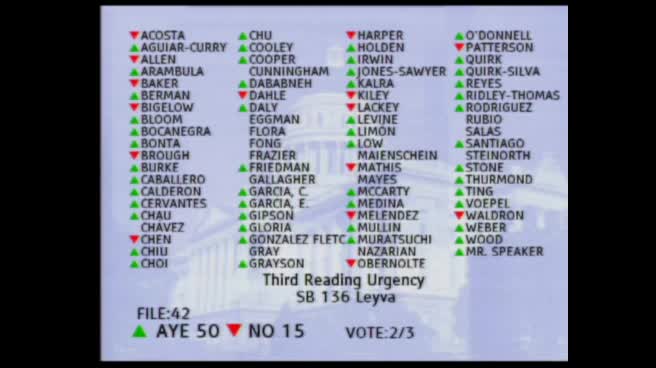 8MIN
Assembly Floor
 2MIN
Assembly Floor
 41MIN
Assembly Standing Committee on Judiciary
 3MIN
Senate Floor
 28MIN
Senate Standing Committee on Judiciary
Bill Author
Bill Co-Author(s):