SB 3: Veterans and Affordable Housing Bond Act of 2018.
- Session Year: 2017-2018
- House: Senate
- Latest Version Date: 2017-09-29
Under existing law, there are programs providing assistance for, among other things, emergency housing, multifamily housing, farmworker housing, home ownership for very low and low-income households, and downpayment assistance for first-time home buyers. Existing law also authorizes the issuance of bonds in specified amounts pursuant to the State General Obligation Bond Law and requires that proceeds from the sale of these bonds be used to finance various existing housing programs, capital outlay related to infill development, brownfield cleanup that promotes infill development, and housing-related parks. Existing law, the Veterans Bond Act of 2008, authorized, for purposes of financing a specified program for farm, home, and mobilehome purchase assistance for veterans, the issuance, pursuant to the State General Obligation Bond Law, of bonds in the amount of $900,000,000.
This bill would enact the Veterans and Affordable Housing Bond Act of 2018, which, if adopted, would authorize the issuance of bonds in the amount of $4,000,000,000 pursuant to the State General Obligation Bond Law. Of the proceeds from the sale of these bonds, $3,000,000,000 would be used to finance various existing housing programs, as well as infill infrastructure financing and affordable housing matching grant programs, as provided, and $1,000,000,000 would be used to provide additional funding for the above-described program for farm, home, and mobilehome purchase assistance for veterans, as provided.
This bill would provide for submission of the bond act to the voters at the November 6, 2018, statewide general election in accordance with specified law.
This bill would declare that it is to take effect immediately as an urgency statute.
Under existing law, there are programs providing assistance for, among other things, emergency housing, multifamily housing, farmworker housing, home ownership for very low and low-income households, and downpayment assistance for first-time home buyers. Existing law also authorizes the issuance of bonds in specified amounts pursuant to the State General Obligation Bond Law and requires that proceeds from the sale of these bonds be used to finance various existing housing programs, capital outlay related to infill development, brownfield cleanup that promotes infill development, and housing-related parks. Existing law, the Veterans Bond Act of 2008, authorized, for purposes of financing a specified program for farm, home, and mobilehome purchase assistance for veterans, the issuance, pursuant to the State General Obligation Bond Law, of bonds in the amount of $900,000,000.
This bill would enact the Veterans and Affordable Housing Bond Act of 2018, which, if adopted, would authorize the issuance of bonds in the amount of $3,000,000,000 $4,000,000,000 pursuant to the State General Obligation Bond Law. Proceeds Of the proceeds from the sale of these bonds bonds, $3,000,000,000 would be used to finance various existing housing programs, as well as infill infrastructure financing and affordable housing matching grant programs, as provided. provided, and $1,000,000,000 would be used to provide additional funding for the above-described program for farm, home, and mobilehome purchase assistance for veterans, as provided.
This bill would provide for submission of the bond act to the voters at the November 6, 2018, statewide general election in accordance with specified law.
This bill would declare that it is to take effect immediately as an urgency statute.
Under existing law, there are programs providing assistance for, among other things, emergency housing, multifamily housing, farmworker housing, home ownership for very low and low-income households, and downpayment assistance for first-time home buyers. Existing law also authorizes the issuance of bonds in specified amounts pursuant to the State General Obligation Bond Law and requires that proceeds from the sale of these bonds be used to finance various existing housing programs, capital outlay related to infill development, brownfield cleanup that promotes infill development, and housing-related parks.
This bill would enact the Affordable Housing Bond Act of 2018, which, if adopted, would authorize the issuance of bonds in the amount of $3,000,000,000 pursuant to the State General Obligation Bond Law. Proceeds from the sale of these bonds would be used to finance various existing housing programs, as well as infill infrastructure financing and affordable housing matching grant programs, as provided.
This bill would provide for submission of the bond act to the voters at the November 6, 2018, statewide general election in accordance with specified law.
This bill would declare that it is to take effect immediately as an urgency statute.
This act shall be known, and may be cited, as the Veterans and Affordable Housing Bond Act of 2018.
SEC. 2.The Legislature finds and declares all of the following:
(a)California is experiencing an extreme housing shortage with 2.2 million extremely low income and very low income renter households competing for only 664,000 affordable rental homes. This leaves more than 1.54 million of Californias lowest income households without access to affordable housing.
(b)While homelessness across the United States is in an overall decline, homelessness in California is rising. In 2015, California had 115,738 homeless people, which accounted for 21 percent of the nations homeless population. This is an increase of 1.6 percent from the prior year. California also had the highest rate of unsheltered people, at 64 percent or 73,699 people; the largest numbers of unaccompanied homeless children and youth, at 10,416 people or 28 percent of the national total; the largest number of veterans experiencing homelessness, at 11,311 or 24 percent of the national homeless veteran population; and the second largest number of people in families with chronic patterns of homelessness, at 22,582 or 11 percent of the states homeless family population.
(c)It is essential to continue funding, which is soon to expire, for housing programs that are necessary to address the housing needs of the large number of veterans and their families living in California.
(d)California is home to 21 of the 30 most expensive rental housing markets in the country, which has had a disproportionate impact on the middle class and the working poor. California requires the third highest wage in the country to afford housing, behind Hawaii and Washington, D.C. The fair market rent, which indicates the amount of money that a given property would require if it were open for leasing, for a two-bedroom apartment is $1,386. To afford this level of rent and utilities, without paying more than 30 percent of income on housing, a household must earn an hourly housing wage of $26.65 per hour. This means that a person earning minimum wage must work an average of three jobs to pay the rent for a two-bedroom unit. In some areas of the state, these numbers are even higher.
(e)Low-income families are forced to spend more and more of their income on rent, which leaves little else for other basic necessities. Many renters must postpone or forgo home ownership, live in more crowded housing, commute further to work, or, in some cases, choose to live and work elsewhere.
(f)California has seen a significant reduction of state funding in recent years. The funds from Proposition 46 of 2002 and Proposition 1C of 2006, totaling nearly $5 billion for a variety of affordable housing programs, have been expended. Combined with the loss of redevelopment funds, $1.5 billion of annual state investment dedicated to housing has been lost, leaving several critical housing programs unfunded.
(g)High housing costs and the shortage of housing stock in California directly affect the future health of Californias economy and, given the staggering numbers indicated above, bold action is necessary. Investment in existing and successful housing programs to expand the states housing stock should benefit Californias homeless and low-income earners, as well as some of the states most vulnerable populations, including foster and at-risk youth, persons with developmental and physical disabilities, farmworkers, the elderly, single parents with children, and survivors of domestic violence. Investments should also be made in housing for Medi-Cal recipients served through a countys Section 1115 Waiver Whole Person Care Pilot program and family day care providers.
(h)Investment in housing creates jobs and provides local benefits. The estimated one-year impacts of building 100 rental apartments in a typical local area include $11.7 million in local income, $2.2 million in taxes and other revenue for local governments, and 161 local jobs or 1.62 jobs per apartment. The additional annually recurring impacts of building 100 rental apartments in a typical local area include $2.6 million in local income, $503,000 in taxes and other revenue for local governments, and 44 local jobs or .44 jobs per apartment.
(i)California has 109 federally recognized tribes and 723,000 residents with Native American ancestry, the largest number of tribes and residents in the United States. Due to historic dislocation and lack of housing choices, most do not live on tribal lands and those who do live in severely substandard, overcrowded homes lacking quality water and sewer services at rates greater than the general population.
SEC. 3.Part 16 (commencing with Section 54000) is added to Division 31 of the Health and Safety Code, to read:16.Veterans and Affordable Housing Bond Act of 20181.General Provisions54000.Together with Article 5z (commencing with Section 998.600) of Chapter 6 of Division 4 of the Military and Veterans Code, this part shall be known, and may be cited, as the Veterans and Affordable Housing Bond Act of 2018.
54002.As used in this part, the following terms have the following meanings:
(a)Board means the Department of Housing and Community Development for programs administered by the department, and the California Housing Finance Agency for programs administered by the agency.
(b)Committee means the Housing Finance Committee created pursuant to Section 53524 and continued in existence pursuant to Sections 53548 and 54014.
(c)Fund means the Affordable Housing Bond Act Trust Fund of 2018 created pursuant to Section 54006.
54004.This part shall only become operative upon adoption by the voters at the November 6, 2018, statewide general election.
2.Affordable Housing Bond Act Trust Fund of 2018 and Program54006.The Affordable Housing Bond Act Trust Fund of 2018 is hereby created within the State Treasury. It is the intent of the Legislature that the proceeds of bonds (exclusive of refunding bonds issued pursuant to Section 54026) be deposited in the fund and used to fund the housing-related programs described in this chapter. The proceeds of bonds issued and sold pursuant to this part for the purposes specified in this chapter shall be allocated in the following manner:
(a)One billion five hundred million dollars ($1,500,000,000) to be deposited in the Housing Rehabilitation Loan Fund established pursuant to Section 50661. The moneys in the fund shall be used for the Multifamily Housing Program authorized by Chapter 6.7 (commencing with Section 50675) of Part 2, to be expended to assist in the new construction, rehabilitation, and preservation of permanent and transitional rental housing for persons with incomes of up to 60 percent of the area median income (AMI). These funds may also be used to provide technical assistance pursuant to Section 54007.
(b)One hundred fifty million dollars ($150,000,000) to be deposited into the Transit-Oriented Development Implementation Fund, established pursuant to Section 53561, for expenditure, upon appropriation by the Legislature, pursuant to the Transit-Oriented Development Implementation Program authorized by Part 13 (commencing with Section 53560) to provide local assistance to cities, counties, cities and counties, transit agencies, and developers for the purpose of developing or facilitating the development of higher density uses within close proximity to transit stations that will increase public transit ridership. These funds may also be expended for any authorized purpose of this program and for state incentive programs, including loans and grants, within the department. Any funds not encumbered for the purposes of this subdivision by November 6, 2028, shall revert for general use in the Multifamily Housing Program authorized by Chapter 6.7 (commencing with Section 50675) of Part 2, unless the Department of Housing and Community Development determines that funds should revert sooner due to diminished demand.
(c)Three hundred million dollars ($300,000,000) to be deposited in the Regional Planning, Housing, and Infill Incentive Account, which is hereby created within the fund. Moneys in the account shall be available, upon appropriation by the Legislature, pursuant to the Infill Incentive Grant Program of 2007 established by Section 53545.13 for infill incentive grants to assist in the new construction and rehabilitation of infrastructure that supports high-density affordable and mixed-income housing in locations designated as infill, including, but not limited to, any of the following:
(1)Park creation, development, or rehabilitation to encourage infill development.
(2)Water, sewer, or other public infrastructure costs associated with infill development.
(3)Transportation improvements related to infill development projects.
(4)Traffic mitigation.
These funds may also be expended for any authorized purpose of this program. Any funds not encumbered for the purposes of this subdivision by November 6, 2028, shall revert for general use in the Multifamily Housing Program authorized by Chapter 6.7 (commencing with Section 50675) of Part 2, unless the Department of Housing and Community Development determines that funds should revert sooner due to diminished demand.
(d)One hundred fifty million dollars ($150,000,000) to be transferred to the Self-Help Housing Fund established pursuant to Section 50697.1. Notwithstanding Section 13340 of the Government Code and Section 50697.1, these funds are hereby continuously appropriated to the Department of Housing and Community Development without regard to fiscal years, which funds shall be transferred by the department to the California Housing Finance Agency for purposes of the home purchase assistance program established pursuant to Chapter 6.8 (commencing with Section 51341) of Part 3.
(e)Three hundred million dollars ($300,000,000) to be deposited in the Joe Serna, Jr. Farmworker Housing Grant Fund, established pursuant to Section 50517.5, to fund grants or loans, or both, for local public entities, nonprofit corporations, limited liability companies, and limited partnerships, for the construction or rehabilitation of housing for agricultural employees and their families or for the acquisition of manufactured housing as part of a program to address and remedy the impacts of current and potential displacement of farmworker families from existing labor camps, mobilehome parks, or other housing. These funds may also be expended for any authorized purpose of this program. These funds may also be used to provide technical assistance pursuant to Section 54007. Any funds not encumbered for the purposes of this subdivision by November 6, 2028, shall revert for general use in the Multifamily Housing Program authorized by Chapter 6.7 (commencing with Section 50675) of Part 2, unless the Department of Housing and Community Development determines that funds should revert sooner due to diminished demand.
(f)Three hundred million dollars ($300,000,000) to be deposited in the Affordable Housing Innovation Fund established pursuant to subparagraph (F) of paragraph (1) of subdivision (a) of Section 53545. Moneys in the fund shall be available, upon appropriation by the Legislature, pursuant to the Local Housing Trust Fund Matching Grant Program established by Section 50842.2 to fund competitive grants or loans to local housing trust funds that develop, own, lend, or invest in affordable housing and used to create pilot programs to demonstrate innovative, cost-saving approaches to creating or preserving affordable housing. Local housing trust funds shall be derived on an ongoing basis from private contribution or governmental sources that are not otherwise restricted in use for housing programs. These funds may also be expended for any authorized purpose of this program. Any funds not encumbered for the purposes of this subdivision by November 6, 2028, shall revert for general use in the Multifamily Housing Program authorized by Chapter 6.7 (commencing with Section 50675) of Part 2, unless the Department of Housing and Community Development determines that funds should revert sooner due to diminished demand.
(g)Three hundred million dollars ($300,000,000) to be deposited in the Self-Help Housing Fund established pursuant to Section 50697.1. The moneys in the fund shall be available for the CalHome Program authorized by Chapter 6 (commencing with Section 50650) of Part 2, to provide direct, forgivable loans to assist development projects involving multiple home ownership units, including single-family subdivisions, for self-help mortgage assistance programs, and for manufactured homes. These funds may also be expended for any authorized purpose of this program. At least thirty million dollars ($30,000,000) of the amount deposited in the Self-Help Housing Fund shall be used to provide grants or forgivable loans to assist in the rehabilitation or replacement, or both, of existing mobilehomes located in a mobilehome or manufactured home community. These funds may also be used to provide technical assistance pursuant to Section 54007. Any funds not encumbered for the purposes of this subdivision by November 6, 2028, shall revert for general use in the Multifamily Housing Program authorized by Chapter 6.7 (commencing with Section 50675) of Part 2, unless the Department of Housing and Community Development determines that funds should revert sooner due to diminished demand.
54007.(a)(1)Notwithstanding any other provision of this part, the Department of Housing and Community Development may provide technical assistance to eligible counties and eligible cities, or developers of affordable housing within eligible counties and eligible cities, to facilitate the construction of housing for the target populations for the following programs funded pursuant to this part:
(A)The Multifamily Housing Program (Chapter 6.7 (commencing with Section 50675) of Part 2).
(B)The Joe Serna, Jr. Farmworker Housing Grant Program (Chapter 3.2 (commencing with Section 50515.2) of Part 2).
(C)The CalHome Program (Chapter 6 (commencing with Section 50650) of Part 2).
(2)Technical assistance pursuant to this section shall be provided using the bond proceeds allocated pursuant to Section 54006 to the program for which the technical assistance is provided.
(3)The Department of Housing and Community Development shall not provide more than three hundred sixty thousand dollars ($360,000) total in technical assistance pursuant to this section, and an eligible county or eligible city shall not receive more than thirty thousand dollars ($30,000) in technical assistance annually.
(b)For purposes of this section, the following definitions shall apply:
(1)Eligible city means a city that is located within a county with a population of 150,000 residents or fewer.
(2)Eligible county means a county with a population of 150,000 residents or fewer.
(3)Technical assistance includes engineering assistance and environmental review related to an affordable housing project and reimbursement of administrative costs related to developing a grant proposal.
54008.(a)The Legislature may, from time to time, amend any law related to programs to which funds are, or have been, allocated pursuant to this chapter for the purposes of improving the efficiency and effectiveness of those programs or to further the goals of those programs.
(b)The Legislature may amend this chapter to reallocate the proceeds of bonds issued and sold pursuant to this part among the programs to which funds are to be allocated pursuant to this chapter as necessary to effectively promote the development of affordable housing in this state.
54009.Programs funded with bond proceeds shall, when allocating financial support, give preference to projects that are public works for purposes of Chapter 1 (commencing with Section 1720) of Part 7 of Division 2 of the Labor Code and other projects on which all construction workers will be paid at least the general prevailing rate of per diem wages as determined by the Director of Industrial Relations.
3.Fiscal Provisions54010.Bonds in the total amount of three billion dollars ($3,000,000,000), exclusive of refunding bonds issued pursuant to Section 54026, or so much thereof as is necessary as determined by the committee, are hereby authorized to be issued and sold for carrying out the purposes expressed in this part and to reimburse the General Obligation Bond Expense Revolving Fund pursuant to Section 16724.5 of the Government Code. All bonds herein authorized which have been duly issued, sold, and delivered as provided herein shall constitute valid and binding general obligations of the state, and the full faith and credit of the state is hereby pledged for the punctual payment of both principal of and interest on those bonds when due.
54012.The bonds authorized by this part shall be prepared, executed, issued, sold, paid, and redeemed as provided in the State General Obligation Bond Law (Chapter 4 (commencing with Section 16720) of Part 3 of Division 4 of Title 2 of the Government Code), except subdivisions (a) and (b) of Section 16727 of the Government Code, and all of the provisions of that law as amended from time to time apply to the bonds and to this part, except as provided in Section 54028, and are hereby incorporated in this part as though set forth in full in this part.
54014.(a)Solely for the purpose of authorizing the issuance and sale, pursuant to the State General Obligation Bond Law, of the bonds authorized by this part, the committee is continued in existence. For the purposes of this part, the Housing Finance Committee is the committee as that term is used in the State General Obligation Bond Law.
(b)The Department of Housing and Community Development may adopt guidelines establishing requirements for administration of its financing programs. The guidelines shall not constitute rules, regulations, orders, or standards of general application and are not subject to Chapter 3.5 (commencing with Section 11340) of Part 1 of Division 3 of Title 2 of the Government Code.
(c)For the purposes of the State General Obligation Bond Law, the Department of Housing and Community Development is designated the board for programs administered by the department, and the California Housing Finance Agency is the board for programs administered by the agency.
54016.Upon request of the board stating that funds are needed for purposes of this part, the committee shall determine whether or not it is necessary or desirable to issue bonds, and, if so, the amount of bonds to be issued and sold. Successive issues of bonds may be authorized and sold to carry out those actions progressively, and are not required to be sold at any one time. Bonds may bear interest subject to federal income tax.
54018.There shall be collected annually, in the same manner and at the same time as other state revenue is collected, a sum of money in addition to the ordinary revenues of the state, sufficient to pay the principal of, and interest on, the bonds each year. It is the duty of all officers charged by law with any duty in regard to the collections of state revenues to do or perform each and every act which is necessary to collect that additional sum.
54020.Notwithstanding Section 13340 of the Government Code, there is hereby appropriated from the General Fund in the State Treasury, for the purposes of this part, an amount that will equal the total of both of the following:
(a)The sum annually necessary to pay the principal of, and interest on, bonds issued and sold pursuant to this part, as the principal and interest become due and payable.
(b)The sum which is necessary to carry out Section 54024, appropriated without regard to fiscal years.
54022.The board may request the Pooled Money Investment Board to make a loan from the Pooled Money Investment Account, in accordance with Section 16312 of the Government Code, for purposes of this part. The amount of the request shall not exceed the amount of the unsold bonds that the committee has, by resolution, authorized to be sold, excluding any refunding bonds authorized pursuant to Section 54026, for purposes of this part, less any amount loaned pursuant to this section and not yet repaid and any amount withdrawn from the General Fund pursuant to Section 54024 and not yet returned to the General Fund. The board shall execute any documents as required by the Pooled Money Investment Board to obtain and repay the loan. Any amount loaned shall be deposited in the fund to be allocated in accordance with this part.
54024.For purposes of carrying out this part, the Director of Finance may, by executive order, authorize the withdrawal from the General Fund of any amount or amounts not to exceed the amount of the unsold bonds that the committee has, by resolution, authorized to be sold, excluding any refunding bonds authorized pursuant to Section 54026, for purposes of this part, less any amount loaned pursuant to Section 54022 and not yet repaid and any amount withdrawn from the General Fund pursuant to this section and not yet returned to the General Fund. Any amounts withdrawn shall be deposited in the fund to be allocated in accordance with this part. Any moneys made available under this section shall be returned to the General Fund, plus the interest that the amounts would have earned in the Pooled Money Investment Account, from moneys received from the sale of bonds which would otherwise be deposited in that fund.
54026.The bonds may be refunded in accordance with Article 6 (commencing with Section 16780) of Chapter 4 of Part 3 of Division 4 of Title 2 of the Government Code. Approval by the electors of this act shall constitute approval of any refunding bonds issued to refund bonds issued pursuant to this part, including any prior issued refunding bonds. Any bond refunded with the proceeds of a refunding bond as authorized by this section may be legally defeased to the extent permitted by law in the manner and to the extent set forth in the resolution, as amended from time to time, authorizing that refunded bond.
54028.Notwithstanding any provisions in the State General Obligation Bond Law, the maturity date of any bonds authorized by this part shall not be later than 35 years from the date of each such bond. The maturity of each series shall be calculated from the date of issuance of each bond.
54030.The Legislature hereby finds and declares that, inasmuch as the proceeds from the sale of bonds authorized by this part are not proceeds of taxes as that term is used in Article XIIIB of the California Constitution, the disbursement of these proceeds is not subject to the limitations imposed by that article.
54032.Notwithstanding any provision of the State General Obligation Bond Law with regard to the proceeds from the sale of bonds authorized by this part that are subject to investment under Article 4 (commencing with Section 16470) of Chapter 3 of Part 2 of Division 4 of Title 2 of the Government Code, the Treasurer may maintain a separate account for investment earnings, may order the payment of those earnings to comply with any rebate requirement applicable under federal law, and may otherwise direct the use and investment of those proceeds so as to maintain the tax-exempt status of tax-exempt bonds and to obtain any other advantage under federal law on behalf of the funds of this state.
54034.All moneys derived from premiums and accrued interest on bonds sold pursuant to this part shall be transferred to the General Fund as a credit to expenditures for bond interest; provided, however, that amounts derived from premiums may be reserved and used to pay the costs of bond issuance prior to transfer to the General Fund.
SEC. 4.Article 5z (commencing with Section 998.600) is added to Chapter 6 of Division 4 of the Military and Veterans Code, to read:5z.The Veterans and Affordable Housing Bond Act of 2018998.600.Together with Part 16 (commencing with Section 54000) of Division 31 of the Health and Safety Code, this article shall be known and may be cited as the Veterans and Affordable Housing Bond Act of 2018.
998.601.(a)The State General Obligation Bond Law (Chapter 4 (commencing with Section 16720) of Part 3 of Division 4 of Title 2 of the Government Code), as amended from time to time, except as otherwise provided herein, is adopted for the purpose of the issuance, sale, and repayment of, and otherwise providing with respect to, the bonds authorized to be issued by this article, and the provisions of that law are included in this article as though set out in full in this article. All references in this article to herein refer both to this article and that law.
(b)For purposes of the State General Obligation Bond Law, the Department of Veterans Affairs is designated the board.
998.602.As used herein, the following terms have the following meanings:
(a)Board means the Department of Veterans Affairs.
(b)Bond means a veterans bond, a state general obligation bond, issued pursuant to this article adopting the provisions of the State General Obligation Bond Law.
(c)Bond act means this article authorizing the issuance of state general obligation bonds and adopting the State General Obligation Bond Law by reference.
(d)Committee means the Veterans Finance Committee of 1943, established by Section 991.
(e)Fund means the Veterans Farm and Home Building Fund of 1943, established by Section 988.
(f)Payment Fund means the Veterans Bonds Payment Fund established by Section 988.6.
998.603.For the purpose of creating a fund to provide farm and home aid for veterans in accordance with the Veterans Farm and Home Purchase Act of 1974 (Article 3.1 (commencing with Section 987.50)), and of all acts amendatory thereof and supplemental thereto, the committee may create a debt or debts, liability or liabilities, of the State of California, in the aggregate amount of not more than one billion dollars ($1,000,000,000), exclusive of refunding bonds, in the manner provided herein.
998.604.(a)All bonds authorized by this article, when duly sold and delivered as provided herein, constitute valid and legally binding general obligations of the State of California, and the full faith and credit of the State of California is hereby pledged for the punctual payment of both principal and interest thereof.
(b)There shall be collected annually, in the same manner and at the same time as other state revenue is collected, a sum of money, in addition to the ordinary revenues of the state, sufficient to pay the principal of, and interest on, these bonds as provided herein, and all officers required by law to perform any duty in regard to the collection of state revenues shall collect this additional sum.
(c)On the dates on which funds are to be remitted pursuant to Section 16676 of the Government Code for the payment of debt service on the bonds in each fiscal year, there shall be transferred to the Payment Fund to pay the debt service all of the money in the fund, not in excess of the amount of debt service then due and payable. If the money transferred on the remittance dates is less than debt service then due and payable, the balance remaining unpaid shall be transferred to the General Fund out of the fund as soon as it shall become available, together with interest thereon from the remittance date until paid, at the same rate of interest as borne by the bonds, compounded semiannually. Notwithstanding any other provision of law to the contrary, this subdivision shall apply to all veterans farm and home purchase bond acts pursuant to this chapter. This subdivision does not grant any lien on the fund, the Payment Fund, or the moneys therein to the holders of any bonds issued under this article. For the purposes of this subdivision, debt service means the principal (whether due at maturity, by redemption, or acceleration), premium, if any, or interest payable on any date with respect to any series of bonds. This subdivision shall not apply, however, in the case of any debt service that is payable from the proceeds of any refunding bonds.
998.605.There is hereby appropriated from the General Fund, for purposes of this article, a sum of money that will equal both of the following:
(a)That sum annually necessary to pay the principal of, and the interest on, the bonds issued and sold as provided herein, as that principal and interest become due and payable.
(b)That sum necessary to carry out Section 998.606, appropriated without regard to fiscal years.
998.606.For the purposes of this article, the Director of Finance may, by executive order, authorize the withdrawal from the General Fund of a sum of money not to exceed the amount of the unsold bonds which have been authorized by the committee to be sold pursuant to this article. Any sums withdrawn shall be deposited in the fund. All moneys made available under this section to the board shall be returned by the board to the General Fund, plus the interest that the amounts would have earned in the Pooled Money Investment Account, from the sale of bonds for the purpose of carrying out this article.
998.607.The board may request the Pooled Money Investment Board to make a loan from the Pooled Money Investment Account, in accordance with Section 16312 of the Government Code, for the purposes of carrying out this article. The amount of the request shall not exceed the amount of unsold bonds which the committee has, by resolution, authorized to be sold for the purpose of carrying out this article. The board shall execute whatever documents are required by the Pooled Money Investment Board to obtain and repay the loan. Any amounts loaned shall be deposited in the fund to be allocated by the board in accordance with this article.
998.608.Upon request of the board, supported by a statement of its plans and projects approved by the Governor, the committee shall determine whether to issue any bonds authorized under this article in order to carry out the boards plans and projects, and, if so, the amount of bonds to be issued and sold. Successive issues of bonds may be authorized and sold to carry out these plans and projects progressively, and it is not necessary that all of the bonds be issued or sold at any one time.
998.609.(a)As long as any bonds authorized under this article are outstanding, the Secretary of Veterans Affairs shall, at the close of each fiscal year, require a survey of the financial condition of the Division of Farm and Home Purchases, together with a projection of the divisions operations, to be made by an independent public accountant of recognized standing. The results of each survey and projection shall be reported in writing by the public accountant to the Secretary of Veterans Affairs, the California Veterans Board, the appropriate policy committees dealing with veterans affairs in the Senate and the Assembly, and the committee.
(b)The Division of Farm and Home Purchases shall reimburse the public accountant for these services out of any money that the division may have available on deposit with the Treasurer.
998.610.(a)The committee may authorize the Treasurer to sell all or any part of the bonds authorized by this article at the time or times established by the Treasurer.
(b)Whenever the committee deems it necessary for an effective sale of the bonds, the committee may authorize the Treasurer to sell any issue of bonds at less than their par value, notwithstanding Section 16754 of the Government Code. However, the discount on the bonds shall not exceed 3 percent of the par value thereof.
998.611.Out of the first money realized from the sale of bonds as provided herein, there shall be redeposited in the General Obligation Bond Expense Revolving Fund, established by Section 16724.5 of the Government Code, the amount of all expenditures made for the purposes specified in that section, and this money may be used for the same purpose and repaid in the same manner whenever additional bond sales are made.
998.612.Any bonds issued and sold pursuant to this article may be refunded in accordance with Article 6 (commencing with Section 16780) of Chapter 4 of Part 3 of Division 4 of Title 2 of the Government Code. The approval of the voters for the issuance of bonds under this article includes approval for the issuance of bonds issued to refund bonds originally issued or any previously issued refunding bonds.
998.613.Notwithstanding any provision of the bond act, if the Treasurer sells bonds under this article for which bond counsel has issued an opinion to the effect that the interest on the bonds is excludable from gross income for purposes of federal income tax, subject to any conditions which may be designated, the Treasurer may establish separate accounts for the investment of bond proceeds and for the earnings on those proceeds, and may use those proceeds or earnings to pay any rebate, penalty, or other payment required by federal law or take any other action with respect to the investment and use of bond proceeds required or permitted under federal law necessary to maintain the tax-exempt status of the bonds or to obtain any other advantage under federal law on behalf of the funds of this state.
998.614.The Legislature hereby finds and declares that, inasmuch as the proceeds from the sale of bonds authorized by this article are not proceeds of taxes as that term is used in Article XIIIB of the California Constitution, the disbursement of these proceeds is not subject to the limitations imposed by Article XIIIB.
SEC. 5.Sections 3 and 4 of this act shall become operative upon the adoption by the voters of the Veterans and Affordable Housing Bond Act of 2018.
SEC. 6.Sections 3 and 4 of this act shall be submitted by the Secretary of State to the voters as a single measure, the Veterans and Affordable Housing Bond Act of 2018, at the November 6, 2018, statewide general election.
SEC. 7.This act is an urgency statute necessary for the immediate preservation of the public peace, health, or safety within the meaning of Article IV of the Constitution and shall go into immediate effect. The facts constituting the necessity are:
In order to maximize the time available for the analysis and preparation of the proposed issuance of bonds pursuant to Sections 3 and 4 of this act, it is necessary that this act take effect immediately.
This act shall be known, and may be cited, as the Veterans and Affordable Housing Bond Act of 2018.
SECTION 1.SEC. 2.The Legislature finds and declares all of the following:
(a)California is experiencing an extreme housing shortage with 2.2 million extremely low income and very low income renter households competing for only 664,000 affordable rental homes. This leaves more than 1.54 million of Californias lowest income households without access to affordable housing.
(b)While homelessness across the United States is in an overall decline, homelessness in California is rising. In 2015, California had 115,738 homeless people, which accounted for 21 percent of the nations homeless population. This is an increase of 1.6 percent from the prior year. California also had the highest rate of unsheltered people, at 64 percent or 73,699 people; the largest numbers of unaccompanied homeless children and youth, at 10,416 people or 28 percent of the national total; the largest number of veterans experiencing homelessness, at 11,311 or 24 percent of the national homeless veteran population; and the second largest number of people in families with chronic patterns of homelessness, at 22,582 or 11 percent of the states homeless family population.
(c)It is essential to continue funding, which is soon to expire, for housing programs that are necessary to address the housing needs of the large number of veterans and their families living in California.
(c)(d)California is home to 21 of the 30 most expensive rental housing markets in the country, which has had a disproportionate impact on the middle class and the working poor. California requires the third highest wage in the country to afford housing, behind Hawaii and Washington, D.C. The fair market rent, which indicates the amount of money that a given property would require if it were open for leasing, for a two-bedroom apartment is $1,386. To afford this level of rent and utilities, without paying more than 30 percent of income on housing, a household must earn an hourly housing wage of $26.65 per hour. This means that a person earning minimum wage must work an average of three jobs to pay the rent for a two-bedroom unit. In some areas of the state, these numbers are even higher.
(d)(e)Low-income families are forced to spend more and more of their income on rent, which leaves little else for other basic necessities. Many renters must postpone or forgo home ownership, live in more crowded housing, commute further to work, or, in some cases, choose to live and work elsewhere.
(e)(f)California has seen a significant reduction of state funding in recent years. The funds from Proposition 46 of 2002 and Proposition 1C of 2006, totaling nearly $5 billion for a variety of affordable housing programs, have been expended. Combined with the loss of redevelopment funds, $1.5 billion of annual state investment dedicated to housing has been lost, leaving several critical housing programs unfunded.
(f)(g)High housing costs and the shortage of housing stock in California directly affect the future health of Californias economy and, given the staggering numbers indicated above, bold action is necessary. Investment in existing and successful housing programs to expand the states housing stock should benefit Californias homeless and low-income earners, as well as some of the states most vulnerable populations, including foster and at-risk youth, persons with developmental and physical disabilities, farmworkers, the elderly, single parents with children, and survivors of domestic violence. Investments should also be made in housing for Medi-Cal recipients served through a countys Section 1115 Waiver Whole Person Care Pilot program and family day care providers.
(g)(h)Investment in housing creates jobs and provides local benefits. The estimated one-year impacts of building 100 rental apartments in a typical local area include $11.7 million in local income, $2.2 million in taxes and other revenue for local governments, and 161 local jobs or 1.62 jobs per apartment. The additional annually recurring impacts of building 100 rental apartments in a typical local area include $2.6 million in local income, $503,000 in taxes and other revenue for local governments, and 44 local jobs or .44 jobs per apartment.
(h)(i)California has 109 federally recognized tribes and 723,000 residents with Native American ancestry, the largest number of tribes and residents in the United States. Due to historic dislocation and lack of housing choices, most do not live on tribal lands and those who do live in severely substandard, overcrowded homes lacking quality water and sewer services at rates greater than the general population.
SEC. 2.SEC. 3.Part 16 (commencing with Section 54000) is added to Division 31 of the Health and Safety Code, to read:16.Veterans and Affordable Housing Bond Act of 20181.General Provisions54000.This Together with Article 5z (commencing with Section 998.600) of Chapter 6 of Division 4 of the Military and Veterans Code, this part shall be known, and may be cited, as the Veterans and Affordable Housing Bond Act of 2018.
54002.As used in this part, the following terms have the following meanings:
(a)Board means the Department of Housing and Community Development for programs administered by the department, and the California Housing Finance Agency for programs administered by the agency.
(b)Committee means the Housing Finance Committee created pursuant to Section 53524 and continued in existence pursuant to Sections 53548 and 54014.
(c)Fund means the Affordable Housing Bond Act Trust Fund of 2018 created pursuant to Section 54006.
54004.This part shall only become operative upon adoption by the voters at the November 6, 2018, statewide general election.
2.Affordable Housing Bond Act Trust Fund of 2018 and Program54006.The Affordable Housing Bond Act Trust Fund of 2018 is hereby created within the State Treasury. It is the intent of the Legislature that the proceeds of bonds (exclusive of refunding bonds issued pursuant to Section 54026) be deposited in the fund shall be and used to fund the housing-related programs described in this chapter. The proceeds of bonds issued and sold pursuant to this part for the purposes specified in this chapter shall be allocated in the following manner:
(a)One billion five hundred million dollars ($1,500,000,000) to be deposited in the Multifamily Housing Account, which is hereby created in the fund. Upon appropriation by the Legislature, the moneys in the account may be appropriated Housing Rehabilitation Loan Fund established pursuant to Section 50661. The moneys in the fund shall be used for the Multifamily Housing Program authorized by Chapter 6.7 (commencing with Section 50675) of Part 2, to be expended to assist in the new construction, rehabilitation, and preservation of permanent and transitional rental housing for persons with incomes of up to 60 percent of the area median income (AMI). These funds may also be used to provide technical assistance pursuant to Section 54007.
(b)Six hundred million dollars ($600,000,000) to be deposited in the Transit-Oriented Development and Infill Infrastructure Account, which is hereby created within the fund. The moneys in the account shall be used for the following purposes:(1)Two hundred million dollars ($200,000,000)(b)One hundred fifty million dollars ($150,000,000) to be deposited into the Transit-Oriented Development Implementation Fund, established pursuant to Section 53561, for expenditure, upon appropriation by the Legislature, pursuant to the Transit-Oriented Development Implementation Program authorized by Part 13 (commencing with Section 53560) to provide local assistance to cities, counties, cities and counties, transit agencies, and developers for the purpose of developing or facilitating the development of higher density uses within close proximity to transit stations that will increase public transit ridership. These funds may also be expended for any authorized purpose of this program. program and for state incentive programs, including loans and grants, within the department. Any funds not encumbered for the purposes of this subdivision by November 6, 2028, shall revert for general use in the Multifamily Housing Program authorized by Chapter 6.7 (commencing with Section 50675) of Part 2, unless the Department of Housing and Community Development determines that funds should revert sooner due to diminished demand.
(2)(c)Three hundred million dollars ($300,000,000) to be deposited in the Regional Planning, Housing, and Infill Incentive Account, which is hereby created within the fund. Moneys in the account shall be available, upon appropriation by the Legislature, pursuant to the Infill Incentive Grant Program of 2007 established by Section 53545.13 for infill incentive grants to assist in the new construction and rehabilitation of infrastructure that supports high-density affordable and mixed-income housing in locations designated as infill, including, but not limited to, any of the following:
(A)(1)Park creation, development, or rehabilitation to encourage infill development.
(B)(2)Water, sewer, or other public infrastructure costs associated with infill development.
(C)(3)Transportation improvements related to infill development projects.
(D)(4)Traffic mitigation.
These funds may also be expended for any authorized purpose of this program. Any funds not encumbered for the purposes of this subdivision by November 6, 2028, shall revert for general use in the Multifamily Housing Program authorized by Chapter 6.7 (commencing with Section 50675) of Part 2, unless the Department of Housing and Community Development determines that funds should revert sooner due to diminished demand.
(3)One hundred million dollars ($100,000,000) to be deposited into the Building Equity and Growth in Neighborhoods (BEGIN) Program Fund, established pursuant to Section 50860, for expenditure, upon appropriation by the Legislature, pursuant to the BEGIN Program authorized by Chapter 14.5 (commencing with Section 50860) of Part 2 to make grants to qualifying cities, counties, or cities and counties that shall be used for downpayment assistance to qualifying first-time home buyers or low- and moderate-income buyers purchasing newly constructed homes in a BEGIN project. These funds may also be expended for any authorized purpose of this program.(c)Six hundred million dollars ($600,000,000) to be deposited in the Special Populations Housing Account, which is hereby created within the fund. The moneys in the account shall be used for the following purposes:(d)One hundred fifty million dollars ($150,000,000) to be transferred to the Self-Help Housing Fund established pursuant to Section 50697.1. Notwithstanding Section 13340 of the Government Code and Section 50697.1, these funds are hereby continuously appropriated to the Department of Housing and Community Development without regard to fiscal years, which funds shall be transferred by the department to the California Housing Finance Agency for purposes of the home purchase assistance program established pursuant to Chapter 6.8 (commencing with Section 51341) of Part 3.
(1)(e)Three hundred million dollars ($300,000,000) to be deposited in the Joe Serna, Jr. Farmworker Housing Grant Fund, established pursuant to Section 50517.5, for expenditure, upon appropriation by the Legislature, to fund grants or loans, or both, for local public entities, nonprofit corporations, limited liability companies, and limited partnerships, for the construction or rehabilitation of housing for agricultural employees and their families or for the acquisition of manufactured housing as part of a program to address and remedy the impacts of current and potential displacement of farmworker families from existing labor camps, mobilehome parks, or other housing. These funds may also be expended for any authorized purpose of this program. These funds may also be used to provide technical assistance pursuant to Section 54007. Any funds not encumbered for the purposes of this subdivision by November 6, 2028, shall revert for general use in the Multifamily Housing Program authorized by Chapter 6.7 (commencing with Section 50675) of Part 2, unless the Department of Housing and Community Development determines that funds should revert sooner due to diminished demand.
(2)(f)Three hundred million dollars ($300,000,000) to be deposited in the Affordable Housing Innovation Fund, which is hereby created within the fund. Fund established pursuant to subparagraph (F) of paragraph (1) of subdivision (a) of Section 53545. Moneys in the account fund shall be available, upon appropriation by the Legislature, pursuant to the Local Housing Trust Fund Matching Grant Program established by Section 50842.2 to fund competitive grants or loans to local housing trust funds that develop, own, lend, or invest in affordable housing and used to create pilot programs to demonstrate innovative, cost-saving approaches to creating or preserving affordable housing. Local housing trust funds shall be derived on an ongoing basis from private contribution or governmental sources that are not otherwise restricted in use for housing programs. These funds may also be expended for any authorized purpose of this program. Any funds not encumbered for the purposes of this subdivision by November 6, 2028, shall revert for general use in the Multifamily Housing Program authorized by Chapter 6.7 (commencing with Section 50675) of Part 2, unless the Department of Housing and Community Development determines that funds should revert sooner due to diminished demand.
(d)(g)Three hundred million dollars ($300,000,000) to be deposited in the Self-Help Housing Fund, which is hereby created within the fund. Fund established pursuant to Section 50697.1. The moneys in the account shall be, upon appropriation by the Legislature, fund shall be available for the CalHome Program authorized by Chapter 6 (commencing with Section 50650) of Part 2, to provide direct, forgivable loans to assist development projects involving multiple home ownership units, including single-family subdivisions, for self-help mortgage assistance programs, and for manufactured homes. These funds may also be expended for any authorized purpose of this program. At least thirty million dollars ($30,000,000) of the amount deposited in the Self-Help Housing Fund shall be used to provide grants or forgivable loans to assist in the rehabilitation or replacement, or both, of existing mobilehomes located in a mobilehome or manufactured home community. These funds may also be used to provide technical assistance pursuant to Section 54007. Any funds not encumbered for the purposes of this subdivision by November 6, 2028, shall revert for general use in the Multifamily Housing Program authorized by Chapter 6.7 (commencing with Section 50675) of Part 2, unless the Department of Housing and Community Development determines that funds should revert sooner due to diminished demand.
54007.(a)(1)Notwithstanding any other provision of this part, the Department of Housing and Community Development may provide technical assistance to eligible counties and eligible cities, or developers of affordable housing within eligible counties and eligible cities, to facilitate the construction of housing for the target populations for the following programs funded pursuant to this part:
(A)The Multifamily Housing Program (Chapter 6.7 (commencing with Section 50675) of Part 2).
(B)The Joe Serna, Jr. Farmworker Housing Grant Program (Chapter 3.2 (commencing with Section 50515.2) of Part 2).
(C)The CalHome Program (Chapter 6 (commencing with Section 50650) of Part 2).
(2)Technical assistance pursuant to this section shall be provided using the bond proceeds allocated pursuant to Section 54006 to the program for which the technical assistance is provided.
(3)The Department of Housing and Community Development shall not provide more than three hundred sixty thousand dollars ($360,000) total in technical assistance pursuant to this section, and an eligible county or eligible city shall not receive more than thirty thousand dollars ($30,000) in technical assistance annually.
(b)For purposes of this section, the following definitions shall apply:
(1)Eligible city means a city that is located within a county with a population of 150,000 residents or fewer.
(2)Eligible county means a county with a population of 150,000 residents or fewer.
(3)Technical assistance includes engineering assistance and environmental review related to an affordable housing project and reimbursement of administrative costs related to developing a grant proposal.
54008.(a)The Legislature may, from time to time, amend any law related to programs to which funds are, or have been, allocated pursuant to this chapter for the purposes of improving the efficiency and effectiveness of those programs or to further the goals of those programs.
(b)The Legislature may amend this chapter to reallocate the proceeds of bonds issued and sold pursuant to this part among the programs to which funds are to be allocated pursuant to this chapter as necessary to effectively promote the development of affordable housing in this state.
54009.Programs funded with bond proceeds shall, when allocating financial support, give preference to projects that are public works for purposes of Chapter 1 (commencing with Section 1720) of Part 7 of Division 2 of the Labor Code and other projects on which all construction workers will be paid at least the general prevailing rate of per diem wages as determined by the Director of Industrial Relations.
3.Fiscal Provisions54010.Bonds in the total amount of three billion dollars ($3,000,000,000), exclusive of refunding bonds issued pursuant to Section 54026, or so much thereof as is necessary as determined by the committee, are hereby authorized to be issued and sold for carrying out the purposes expressed in this part and to reimburse the General Obligation Bond Expense Revolving Fund pursuant to Section 16724.5 of the Government Code. All bonds herein authorized which have been duly issued, sold, and delivered as provided herein shall constitute valid and binding general obligations of the state, and the full faith and credit of the state is hereby pledged for the punctual payment of both principal of and interest on those bonds when due.
54012.The bonds authorized by this part shall be prepared, executed, issued, sold, paid, and redeemed as provided in the State General Obligation Bond Law (Chapter 4 (commencing with Section 16720) of Part 3 of Division 4 of Title 2 of the Government Code), except subdivisions (a) and (b) of Section 16727 of the Government Code to the extent that those provisions are inconsistent with this part, Code, and all of the provisions of that law as amended from time to time apply to the bonds and to this part, except as provided in Section 54028, and are hereby incorporated in this part as though set forth in full in this part.
54014.(a)Solely for the purpose of authorizing the issuance and sale, pursuant to the State General Obligation Bond Law, of the bonds authorized by this part, the committee is continued in existence. For the purposes of this part, the Housing Finance Committee is the committee as that term is used in the State General Obligation Bond Law.
(b)The committee Department of Housing and Community Development may adopt guidelines establishing requirements for administration of its financing programs to the extent necessary to protect the validity of, and tax exemption for, interest on the bonds. programs. The guidelines shall not constitute rules, regulations, orders, or standards of general application and are not subject to Chapter 3.5 (commencing with Section 11340) of Part 1 of Division 3 of Title 2 of the Government Code.
(c)For the purposes of the State General Obligation Bond Law, the Department of Housing and Community Development is designated the board for programs administered by the department, and the California Housing Finance Agency is the board for programs administered by the agency.
54016.Upon request of the board stating that funds are needed for purposes of this part, the committee shall determine whether or not it is necessary or desirable to issue bonds authorized pursuant to this part in order to carry out the actions specified in Section 54006, bonds, and, if so, the amount of bonds to be issued and sold. Successive issues of bonds may be authorized and sold to carry out those actions progressively, and are not required to be sold at any one time. Bonds may bear interest subject to federal income tax.
54018.There shall be collected annually, in the same manner and at the same time as other state revenue is collected, a sum of money in addition to the ordinary revenues of the state, sufficient to pay the principal of, and interest on, the bonds each year. It is the duty of all officers charged by law with any duty in regard to the collections of state revenues to do or perform each and every act which is necessary to collect that additional sum.
54020.Notwithstanding Section 13340 of the Government Code, there is hereby appropriated from the General Fund in the State Treasury, for the purposes of this part, an amount that will equal the total of both of the following:
(a)The sum annually necessary to pay the principal of, and interest on, bonds issued and sold pursuant to this part, as the principal and interest become due and payable.
(b)The sum which is necessary to carry out Section 54024, appropriated without regard to fiscal years.
54022.The board may request the Pooled Money Investment Board to make a loan from the Pooled Money Investment Account, in accordance with Section 16312 of the Government Code, for purposes of this part. The amount of the request shall not exceed the amount of the unsold bonds that the committee has, by resolution, authorized to be sold, excluding any refunding bonds authorized pursuant to Section 54026, for purposes of this part, less any amount withdrawn pursuant to Section 54024. loaned pursuant to this section and not yet repaid and any amount withdrawn from the General Fund pursuant to Section 54024 and not yet returned to the General Fund. The board shall execute any documents as required by the Pooled Money Investment Board to obtain and repay the loan. Any amount loaned shall be deposited in the fund to be allocated in accordance with this part.
54024.For purposes of carrying out this part, the Director of Finance may, by executive order, authorize the withdrawal from the General Fund of any amount or amounts not to exceed the amount of the unsold bonds that the committee has, by resolution, authorized to be sold, excluding any refunding bonds authorized pursuant to Section 54026, for purposes of this part, less any amount withdrawn pursuant to Section 54022. loaned pursuant to Section 54022 and not yet repaid and any amount withdrawn from the General Fund pursuant to this section and not yet returned to the General Fund. Any amounts withdrawn shall be deposited in the fund to be allocated in accordance with this part. Any moneys made available under this section shall be returned to the General Fund, plus the interest that the amounts would have earned in the Pooled Money Investment Account, from moneys received from the sale of bonds which would otherwise be deposited in that fund.
54026.The bonds may be refunded in accordance with Article 6 (commencing with Section 16780) of Chapter 4 of Part 3 of Division 4 of Title 2 of the Government Code. Approval by the electors of this act shall constitute approval of any refunding bonds issued to refund bonds issued pursuant to this part, including any prior issued refunding bonds. Any bond refunded with the proceeds of a refunding bond as authorized by this section may be legally defeased to the extent permitted by law in the manner and to the extent set forth in the resolution, as amended from time to time, authorizing that refunded bond.
54028.Notwithstanding any provisions in the State General Obligation Bond Law, the maturity date of any bonds authorized by this part shall not be later than 35 years from the date of each such bond. The maturity of each series shall be calculated from the date of each series. issuance of each bond.
54030.The Legislature hereby finds and declares that, inasmuch as the proceeds from the sale of bonds authorized by this part are not proceeds of taxes as that term is used in Article XIIIB of the California Constitution, the disbursement of these proceeds is not subject to the limitations imposed by that article.
54032.Notwithstanding any provision of the State General Obligation Bond Law with regard to the proceeds from the sale of bonds authorized by this part that are subject to investment under Article 4 (commencing with Section 16470) of Chapter 3 of Part 2 of Division 4 of Title 2 of the Government Code, the Treasurer may maintain a separate account for investment earnings, may order the payment of those earnings to comply with any rebate requirement applicable under federal law, and may otherwise direct the use and investment of those proceeds so as to maintain the tax-exempt status of tax-exempt bonds and to obtain any other advantage under federal law on behalf of the funds of this state.
54034.All moneys derived from premiums and accrued interest on bonds sold pursuant to this part shall be transferred to the General Fund as a credit to expenditures for bond interest; provided, however, that amounts derived from premiums may be reserved and used to pay the costs of bond issuance of the related bonds prior to transfer to the General Fund.
SEC. 4.Article 5z (commencing with Section 998.600) is added to Chapter 6 of Division 4 of the Military and Veterans Code, to read:5z.The Veterans and Affordable Housing Bond Act of 2018998.600.Together with Part 16 (commencing with Section 54000) of Division 31 of the Health and Safety Code, this article shall be known and may be cited as the Veterans and Affordable Housing Bond Act of 2018.
998.601.(a)The State General Obligation Bond Law (Chapter 4 (commencing with Section 16720) of Part 3 of Division 4 of Title 2 of the Government Code), as amended from time to time, except as otherwise provided herein, is adopted for the purpose of the issuance, sale, and repayment of, and otherwise providing with respect to, the bonds authorized to be issued by this article, and the provisions of that law are included in this article as though set out in full in this article. All references in this article to herein refer both to this article and that law.
(b)For purposes of the State General Obligation Bond Law, the Department of Veterans Affairs is designated the board.
998.602.As used herein, the following terms have the following meanings:
(a)Board means the Department of Veterans Affairs.
(b)Bond means a veterans bond, a state general obligation bond, issued pursuant to this article adopting the provisions of the State General Obligation Bond Law.
(c)Bond act means this article authorizing the issuance of state general obligation bonds and adopting the State General Obligation Bond Law by reference.
(d)Committee means the Veterans Finance Committee of 1943, established by Section 991.
(e)Fund means the Veterans Farm and Home Building Fund of 1943, established by Section 988.
(f)Payment Fund means the Veterans Bonds Payment Fund established by Section 988.6.
998.603.For the purpose of creating a fund to provide farm and home aid for veterans in accordance with the Veterans Farm and Home Purchase Act of 1974 (Article 3.1 (commencing with Section 987.50)), and of all acts amendatory thereof and supplemental thereto, the committee may create a debt or debts, liability or liabilities, of the State of California, in the aggregate amount of not more than one billion dollars ($1,000,000,000), exclusive of refunding bonds, in the manner provided herein.
998.604.(a)All bonds authorized by this article, when duly sold and delivered as provided herein, constitute valid and legally binding general obligations of the State of California, and the full faith and credit of the State of California is hereby pledged for the punctual payment of both principal and interest thereof.
(b)There shall be collected annually, in the same manner and at the same time as other state revenue is collected, a sum of money, in addition to the ordinary revenues of the state, sufficient to pay the principal of, and interest on, these bonds as provided herein, and all officers required by law to perform any duty in regard to the collection of state revenues shall collect this additional sum.
(c)On the dates on which funds are to be remitted pursuant to Section 16676 of the Government Code for the payment of debt service on the bonds in each fiscal year, there shall be transferred to the Payment Fund to pay the debt service all of the money in the fund, not in excess of the amount of debt service then due and payable. If the money transferred on the remittance dates is less than debt service then due and payable, the balance remaining unpaid shall be transferred to the General Fund out of the fund as soon as it shall become available, together with interest thereon from the remittance date until paid, at the same rate of interest as borne by the bonds, compounded semiannually. Notwithstanding any other provision of law to the contrary, this subdivision shall apply to all veterans farm and home purchase bond acts pursuant to this chapter. This subdivision does not grant any lien on the fund, the Payment Fund, or the moneys therein to the holders of any bonds issued under this article. For the purposes of this subdivision, debt service means the principal (whether due at maturity, by redemption, or acceleration), premium, if any, or interest payable on any date with respect to any series of bonds. This subdivision shall not apply, however, in the case of any debt service that is payable from the proceeds of any refunding bonds.
998.605.There is hereby appropriated from the General Fund, for purposes of this article, a sum of money that will equal both of the following:
(a)That sum annually necessary to pay the principal of, and the interest on, the bonds issued and sold as provided herein, as that principal and interest become due and payable.
(b)That sum necessary to carry out Section 998.606, appropriated without regard to fiscal years.
998.606.For the purposes of this article, the Director of Finance may, by executive order, authorize the withdrawal from the General Fund of a sum of money not to exceed the amount of the unsold bonds which have been authorized by the committee to be sold pursuant to this article. Any sums withdrawn shall be deposited in the fund. All moneys made available under this section to the board shall be returned by the board to the General Fund, plus the interest that the amounts would have earned in the Pooled Money Investment Account, from the sale of bonds for the purpose of carrying out this article.
998.607.The board may request the Pooled Money Investment Board to make a loan from the Pooled Money Investment Account, in accordance with Section 16312 of the Government Code, for the purposes of carrying out this article. The amount of the request shall not exceed the amount of unsold bonds which the committee has, by resolution, authorized to be sold for the purpose of carrying out this article. The board shall execute whatever documents are required by the Pooled Money Investment Board to obtain and repay the loan. Any amounts loaned shall be deposited in the fund to be allocated by the board in accordance with this article.
998.608.Upon request of the board, supported by a statement of its plans and projects approved by the Governor, the committee shall determine whether to issue any bonds authorized under this article in order to carry out the boards plans and projects, and, if so, the amount of bonds to be issued and sold. Successive issues of bonds may be authorized and sold to carry out these plans and projects progressively, and it is not necessary that all of the bonds be issued or sold at any one time.
998.609.(a)As long as any bonds authorized under this article are outstanding, the Secretary of Veterans Affairs shall, at the close of each fiscal year, require a survey of the financial condition of the Division of Farm and Home Purchases, together with a projection of the divisions operations, to be made by an independent public accountant of recognized standing. The results of each survey and projection shall be reported in writing by the public accountant to the Secretary of Veterans Affairs, the California Veterans Board, the appropriate policy committees dealing with veterans affairs in the Senate and the Assembly, and the committee.
(b)The Division of Farm and Home Purchases shall reimburse the public accountant for these services out of any money that the division may have available on deposit with the Treasurer.
998.610.(a)The committee may authorize the Treasurer to sell all or any part of the bonds authorized by this article at the time or times established by the Treasurer.
(b)Whenever the committee deems it necessary for an effective sale of the bonds, the committee may authorize the Treasurer to sell any issue of bonds at less than their par value, notwithstanding Section 16754 of the Government Code. However, the discount on the bonds shall not exceed 3 percent of the par value thereof.
998.611.Out of the first money realized from the sale of bonds as provided herein, there shall be redeposited in the General Obligation Bond Expense Revolving Fund, established by Section 16724.5 of the Government Code, the amount of all expenditures made for the purposes specified in that section, and this money may be used for the same purpose and repaid in the same manner whenever additional bond sales are made.
998.612.Any bonds issued and sold pursuant to this article may be refunded in accordance with Article 6 (commencing with Section 16780) of Chapter 4 of Part 3 of Division 4 of Title 2 of the Government Code. The approval of the voters for the issuance of bonds under this article includes approval for the issuance of bonds issued to refund bonds originally issued or any previously issued refunding bonds.
998.613.Notwithstanding any provision of the bond act, if the Treasurer sells bonds under this article for which bond counsel has issued an opinion to the effect that the interest on the bonds is excludable from gross income for purposes of federal income tax, subject to any conditions which may be designated, the Treasurer may establish separate accounts for the investment of bond proceeds and for the earnings on those proceeds, and may use those proceeds or earnings to pay any rebate, penalty, or other payment required by federal law or take any other action with respect to the investment and use of bond proceeds required or permitted under federal law necessary to maintain the tax-exempt status of the bonds or to obtain any other advantage under federal law on behalf of the funds of this state.
998.614.The Legislature hereby finds and declares that, inasmuch as the proceeds from the sale of bonds authorized by this article are not proceeds of taxes as that term is used in Article XIIIB of the California Constitution, the disbursement of these proceeds is not subject to the limitations imposed by Article XIIIB.
SEC. 3.SEC. 5.Section 2 Sections 3 and 4 of this act shall become operative upon the adoption by the voters of the Veterans and Affordable Housing Bond Act of 2018.
SEC. 4.SEC. 6.Section 2 Sections 3 and 4 of this act shall be submitted by the Secretary of State to the voters as a single measure, the Veterans and Affordable Housing Bond Act of 2018, at the November 6, 2018, statewide general election.
SEC. 5.SEC. 7.This act is an urgency statute necessary for the immediate preservation of the public peace, health, or safety within the meaning of Article IV of the Constitution and shall go into immediate effect. The facts constituting the necessity are:
In order to maximize the time available for the analysis and preparation of the bond act proposed by Section 2 proposed issuance of bonds pursuant to Sections 3 and 4 of this act, it is necessary that this act take effect immediately.
REVISIONS: HeadingLine 2.The Legislature finds and declares all of the following:
(a)California is experiencing an extreme housing shortage with 2.2 million extremely low income and very low income renter households competing for only 664,000 affordable rental homes. This leaves more than 1.54 million of Californias lowest income households without access to affordable housing.
(b)While homelessness across the United States is in an overall decline, homelessness in California is rising. In 2015, California had 115,738 homeless people, which accounted for 21 percent of the nations homeless population. This is an increase of 1.6 percent from the prior year. California also had the highest rate of unsheltered people, at 64 percent or 73,699 people; the largest numbers of unaccompanied homeless children and youth, at 10,416 people or 28 percent of the national total; the largest number of veterans experiencing homelessness, at 11,311 or 24 percent of the national homeless veteran population; and the second largest number of people in families with chronic patterns of homelessness, at 22,582 or 11 percent of the states homeless family population.
(c)California is home to 21 of the 30 most expensive rental housing markets in the country, which has had a disproportionate impact on the middle class and the working poor. California requires the third highest wage in the country to afford housing, behind Hawaii and Washington, D.C. The fair market rent, which indicates the amount of money that a given property would require if it were open for leasing, for a two-bedroom apartment is $1,386. To afford this level of rent and utilities, without paying more than 30 percent of income on housing, a household must earn an hourly housing wage of $26.65 per hour. This means that a person earning minimum wage must work an average of three jobs to pay the rent for a two-bedroom unit. In some areas of the state, these numbers are even higher.
(d)Low-income families are forced to spend more and more of their income on rent, which leaves little else for other basic necessities. Many renters must postpone or forgo home ownership, live in more crowded housing, commute further to work, or, in some cases, choose to live and work elsewhere.
(e)California has seen a significant reduction of state funding in recent years. The funds from Proposition 46 of 2002 and Proposition 1C of 2006, totaling nearly $5 billion for a variety of affordable housing programs, have been expended. Combined with the loss of redevelopment funds, $1.5 billion of annual state investment dedicated to housing has been lost, leaving several critical housing programs unfunded.
(f)High housing costs and the shortage of housing stock in California directly affect the future health of Californias economy and, given the staggering numbers indicated above, bold action is necessary. Investment in existing and successful housing programs to expand the states housing stock should benefit Californias homeless and low-income earners, as well as some of the states most vulnerable populations, including foster and at-risk youth, persons with developmental and physical disabilities, farmworkers, the elderly, single parents with children, and survivors of domestic violence. Investments should also be made in housing for Medi-Cal recipients served through a countys Section 1115 Waiver Whole Person Care Pilot program and family day care providers.
(g)Investment in housing creates jobs and provides local benefits. The estimated one-year impacts of building 100 rental apartments in a typical local area include $11.7 million in local income, $2.2 million in taxes and other revenue for local governments, and 161 local jobs or 1.62 jobs per apartment. The additional annually recurring impacts of building 100 rental apartments in a typical local area include $2.6 million in local income, $503,000 in taxes and other revenue for local governments, and 44 local jobs or .44 jobs per apartment.
(h)California has 109 federally recognized tribes and 723,000 residents with Native American ancestry, the largest number of tribes and residents in the United States. Due to historic dislocation and lack of housing choices, most do not live on tribal lands and those who do live in severely substandard, overcrowded homes lacking quality water and sewer services at rates greater than the general population.
SEC. 2.Part 16 (commencing with Section 54000) is added to Division 31 of the Health and Safety Code, to read:16.Affordable Housing Bond Act of 20181.General Provisions54000.This part shall be known, and may be cited, as the Affordable Housing Bond Act of 2018.
54002.As used in this part, the following terms have the following meanings:
(a)Board means the Department of Housing and Community Development for programs administered by the department, and the California Housing Finance Agency for programs administered by the agency.
(b)Committee means the Housing Finance Committee created pursuant to Section 53524 and continued in existence pursuant to Sections 53548 and 54014.
(c)Fund means the Affordable Housing Bond Act Trust Fund of 2018 created pursuant to Section 54006.
54004.This part shall only become operative upon adoption by the voters at the November 6, 2018, statewide general election.
2.Affordable Housing Bond Act Trust Fund of 2018 and Program54006.The Affordable Housing Bond Act Trust Fund of 2018 is hereby created within the State Treasury. It is the intent of the Legislature that the proceeds of bonds deposited in the fund shall be used to fund the housing-related programs described in this chapter. The proceeds of bonds issued and sold pursuant to this part for the purposes specified in this chapter shall be allocated in the following manner:
(a)One billion five hundred million dollars ($1,500,000,000) to be deposited in the Multifamily Housing Account, which is hereby created in the fund. Upon appropriation by the Legislature, the moneys in the account may be appropriated for the Multifamily Housing Program authorized by Chapter 6.7 (commencing with Section 50675) of Part 2, to be expended to assist in the new construction, rehabilitation, and preservation of permanent and transitional rental housing for persons with incomes of up to 60 percent of the area median income (AMI). These funds may also be used to provide technical assistance pursuant to Section 54007.
(b)Six hundred million dollars ($600,000,000) to be deposited in the Transit-Oriented Development and Infill Infrastructure Account, which is hereby created within the fund. The moneys in the account shall be used for the following purposes:
(1)Two hundred million dollars ($200,000,000) to be deposited into the Transit-Oriented Development Implementation Fund, established pursuant to Section 53561, for expenditure, upon appropriation by the Legislature, pursuant to the Transit-Oriented Development Implementation Program authorized by Part 13 (commencing with Section 53560) to provide local assistance to cities, counties, cities and counties, transit agencies, and developers for the purpose of developing or facilitating the development of higher density uses within close proximity to transit stations that will increase public transit ridership. These funds may also be expended for any authorized purpose of this program.
(2)Three hundred million dollars ($300,000,000) to be deposited in the Infill Infrastructure Financing Account, Regional Planning, Housing, and Infill Incentive Account, which is hereby created within the fund. Moneys in the account shall be available, upon appropriation by the Legislature, pursuant to the Infill Incentive Grant Program of 2007 established by Section 53545.13 for infill incentive grants to assist in the new construction and rehabilitation of infrastructure that supports high-density affordable and mixed-income housing in locations designated as infill, including, but not limited to, any of the following:
(A)Park creation, development, or rehabilitation to encourage infill development.
(B)Water, sewer, or other public infrastructure costs associated with infill development.
(C)Transportation improvements related to infill development projects.
(D)Traffic mitigation.
These funds may also be expended for any authorized purpose of this program.
(3)One hundred million dollars ($100,000,000) to be deposited into the Building Equity and Growth in Neighborhoods (BEGIN) Program Fund, established pursuant to Section 50860, for expenditure, upon appropriation by the Legislature, pursuant to the BEGIN Program authorized by Chapter 14.5 (commencing with Section 50860) of Part 2 to make grants to qualifying cities, counties, or cities and counties that shall be used for downpayment assistance to qualifying first-time home buyers or low- and moderate-income buyers purchasing newly constructed homes in a BEGIN project. These funds may also be expended for any authorized purpose of this program.
(c)Six hundred million dollars ($600,000,000) to be deposited in the Special Populations Housing Account, which is hereby created within the fund. The moneys in the account shall be used for the following purposes:
(1)Three hundred million dollars ($300,000,000) to be deposited in the Joe Serna, Jr. Farmworker Housing Grant Fund, established pursuant to Section 50517.5, for expenditure, upon appropriation by the Legislature, to fund grants or loans, or both, for local public entities, nonprofit corporations, limited liability companies, and limited partnerships, for the construction or rehabilitation of housing for agricultural employees and their families or for the acquisition of manufactured housing as part of a program to address and remedy the impacts of current and potential displacement of farmworker families from existing labor camps, mobilehome parks, or other housing. These funds may also be expended for any authorized purpose of this program. These funds may also be used to provide technical assistance pursuant to Section 54007.
(2)Three hundred million dollars ($300,000,000) to be deposited in the Local Housing Trust Fund Matching Grant Program Account, Affordable Housing Innovation Fund, which is hereby created within the fund. Moneys in the account shall be available, upon appropriation by the Legislature, pursuant to the Local Housing Trust Fund Matching Grant Program established by Section 50842.2 to fund competitive grants or loans to local housing trust funds that develop, own, lend, or invest in affordable housing and used to create pilot programs to demonstrate innovative, cost-saving approaches to creating or preserving affordable housing. Local housing trust funds shall be derived on an ongoing basis from private contribution or governmental sources that are not otherwise restricted in use for housing programs. These funds may also be expended for any authorized purpose of this program.
(d)Three hundred million dollars ($300,000,000) to be deposited in the Home Ownership Development Account, Self-Help Housing Fund, which is hereby created within the fund. The moneys in the account shall be, upon appropriation by the Legislature, available for the CalHome Program authorized by Chapter 6 (commencing with Section 50650) of Part 2, to provide direct, forgivable loans to assist development projects involving multiple home ownership units, including single-family subdivisions, for self-help mortgage assistance programs, and for manufactured homes. These funds may also be expended for any authorized purpose of this program. At least thirty million dollars ($30,000,000) of the amount deposited in the Self-Help Housing Fund shall be used to provide grants or forgivable loans to assist in the rehabilitation or replacement, or both, of existing mobilehomes located in a mobilehome or manufactured home community. These funds may also be used to provide technical assistance pursuant to Section 54007.
54007.(a)(1)Notwithstanding any other provision of this part, the Department of Housing and Community Development may provide technical assistance to eligible counties and eligible cities, or developers of affordable housing within eligible counties and eligible cities, to facilitate the construction of housing for the target populations for the following programs funded pursuant to this part:
(A)The Multifamily Housing Program (Chapter 6.7 (commencing with Section 50675) of Part 2).
(B)The Joe Serna, Jr. Farmworker Housing Grant Program (Chapter 3.2 (commencing with Section 50515.2) of Part 2).
(C)The CalHome Program (Chapter 6 (commencing with Section 50650) of Part 2).
(2)Technical assistance pursuant to this section shall be provided using the bond proceeds allocated pursuant to Section 54006 to the program for which the technical assistance is provided.
(3)The Department of Housing and Community Development shall not provide more than three hundred sixty thousand dollars ($360,000) total in technical assistance pursuant to this section, and an eligible county or eligible city shall not receive more than thirty thousand dollars ($30,000) in technical assistance annually.
(b)For purposes of this section, the following definitions shall apply:
(1)Eligible city means a city that is located within a county with a population of 150,000 residents or fewer.
(2)Eligible county means a county with a population of 150,000 residents or fewer.
(3)Technical assistance includes engineering assistance and environmental review related to an affordable housing project and reimbursement of administrative costs related to developing a grant proposal.
54008.(a)The Legislature may, from time to time, amend any law related to programs to which funds are, or have been, allocated pursuant to this chapter for the purposes of improving the efficiency and effectiveness of those programs or to further the goals of those programs.
(b)The Legislature may amend this chapter to reallocate the proceeds of bonds issued and sold pursuant to this part among the programs to which funds are to be allocated pursuant to this chapter as necessary to effectively promote the development of affordable housing in this state.
54009.Programs funded with bond proceeds shall, when allocating financial support, give preference to projects that are public works for purposes of Chapter 1 (commencing with Section 1720) of Part 7 of Division 2 of the Labor Code and other projects on which all construction workers will be paid at least the general prevailing rate of per diem wages as determined by the Director of Industrial Relations.
3.Fiscal Provisions54010.Bonds in the total amount of three billion dollars ($3,000,000,000), exclusive of refunding bonds issued pursuant to Section 54026, or so much thereof as is necessary as determined by the committee, are hereby authorized to be issued and sold for carrying out the purposes expressed in this part and to reimburse the General Obligation Bond Expense Revolving Fund pursuant to Section 16724.5 of the Government Code. All bonds herein authorized which have been duly issued, sold, and delivered as provided herein shall constitute valid and binding general obligations of the state, and the full faith and credit of the state is hereby pledged for the punctual payment of both principal of and interest on those bonds when due.
54012.The bonds authorized by this part shall be prepared, executed, issued, sold, paid, and redeemed as provided in the State General Obligation Bond Law (Chapter 4 (commencing with Section 16720) of Part 3 of Division 4 of Title 2 of the Government Code), except subdivisions (a) and (b) of Section 16727 of the Government Code to the extent that those provisions are inconsistent with this part, and all of the provisions of that law as amended from time to time apply to the bonds and to this part, except as provided in Section 54028, and are hereby incorporated in this part as though set forth in full in this part.
54014.(a)Solely for the purpose of authorizing the issuance and sale, pursuant to the State General Obligation Bond Law, of the bonds authorized by this part, the committee is continued in existence. For the purposes of this part, the Housing Finance Committee is the committee as that term is used in the State General Obligation Bond Law.
(b)The committee may adopt guidelines establishing requirements for administration of its financing programs to the extent necessary to protect the validity of, and tax exemption for, interest on the bonds. The guidelines shall not constitute rules, regulations, orders, or standards of general application and are not subject to Chapter 3.5 (commencing with Section 11340) of Part 1 of Division 3 of Title 2 of the Government Code.
(c)For the purposes of the State General Obligation Bond Law, the Department of Housing and Community Development is designated the board for programs administered by the department, and the California Housing Finance Agency is the board for programs administered by the agency.
54016.Upon request of the board stating that funds are needed for purposes of this part, the committee shall determine whether or not it is necessary or desirable to issue bonds authorized pursuant to this part in order to carry out the actions specified in Section 54006, and, if so, the amount of bonds to be issued and sold. Successive issues of bonds may be authorized and sold to carry out those actions progressively, and are not required to be sold at any one time. Bonds may bear interest subject to federal income tax.
54018.There shall be collected annually, in the same manner and at the same time as other state revenue is collected, a sum of money in addition to the ordinary revenues of the state, sufficient to pay the principal of, and interest on, the bonds each year. It is the duty of all officers charged by law with any duty in regard to the collections of state revenues to do or perform each and every act which is necessary to collect that additional sum.
54020.Notwithstanding Section 13340 of the Government Code, there is hereby appropriated from the General Fund in the State Treasury, for the purposes of this part, an amount that will equal the total of both of the following:
(a)The sum annually necessary to pay the principal of, and interest on, bonds issued and sold pursuant to this part, as the principal and interest become due and payable.
(b)The sum which is necessary to carry out Section 54024, appropriated without regard to fiscal years.
54022.The board may request the Pooled Money Investment Board to make a loan from the Pooled Money Investment Account, in accordance with Section 16312 of the Government Code, for purposes of this part. The amount of the request shall not exceed the amount of the unsold bonds that the committee has, by resolution, authorized to be sold, excluding any refunding bonds authorized pursuant to Section 54026, for purposes of this part, less any amount withdrawn pursuant to Section 54024. The board shall execute any documents as required by the Pooled Money Investment Board to obtain and repay the loan. Any amount loaned shall be deposited in the fund to be allocated in accordance with this part.
54024.For purposes of carrying out this part, the Director of Finance may, by executive order, authorize the withdrawal from the General Fund of any amount or amounts not to exceed the amount of the unsold bonds that the committee has, by resolution, authorized to be sold, excluding any refunding bonds authorized pursuant to Section 54026, for purposes of this part, less any amount withdrawn pursuant to Section 54022. Any amounts withdrawn shall be deposited in the fund to be allocated in accordance with this part. Any moneys made available under this section shall be returned to the General Fund, plus the interest that the amounts would have earned in the Pooled Money Investment Account, from moneys received from the sale of bonds which would otherwise be deposited in that fund.
54026.The bonds may be refunded in accordance with Article 6 (commencing with Section 16780) of Chapter 4 of Part 3 of Division 4 of Title 2 of the Government Code. Approval by the electors of this act shall constitute approval of any refunding bonds issued to refund bonds issued pursuant to this part, including any prior issued refunding bonds. Any bond refunded with the proceeds of a refunding bond as authorized by this section may be legally defeased to the extent permitted by law in the manner and to the extent set forth in the resolution, as amended from time to time, authorizing that refunded bond.
54028.Notwithstanding any provisions in the State General Obligation Bond Law, the maturity date of any bonds authorized by this part shall not be later than 35 years from the date of each such bond. The maturity of each series shall be calculated from the date of each series.
54030.The Legislature hereby finds and declares that, inasmuch as the proceeds from the sale of bonds authorized by this part are not proceeds of taxes as that term is used in Article XIII B of the California Constitution, the disbursement of these proceeds is not subject to the limitations imposed by that article.
54032.Notwithstanding any provision of the State General Obligation Bond Law with regard to the proceeds from the sale of bonds authorized by this part that are subject to investment under Article 4 (commencing with Section 16470) of Chapter 3 of Part 2 of Division 4 of Title 2 of the Government Code, the Treasurer may maintain a separate account for investment earnings, may order the payment of those earnings to comply with any rebate requirement applicable under federal law, and may otherwise direct the use and investment of those proceeds so as to maintain the tax-exempt status of tax-exempt bonds and to obtain any other advantage under federal law on behalf of the funds of this state.
54034.All moneys derived from premiums and accrued interest on bonds sold pursuant to this part shall be transferred to the General Fund as a credit to expenditures for bond interest; provided, however, that amounts derived from premiums may be reserved and used to pay the costs of issuance of the related bonds prior to transfer to the General Fund.
SEC. 3.Section 2 of this act shall become operative upon the adoption by the voters of the Affordable Housing Bond Act of 2018.
SEC. 4.Section 2 of this act shall be submitted by the Secretary of State to the voters at the November 6, 2018, statewide general election.
SEC. 5.This act is an urgency statute necessary for the immediate preservation of the public peace, health, or safety within the meaning of Article IV of the Constitution and shall go into immediate effect. The facts constituting the necessity are:
In order to maximize the time available for the analysis and preparation of the bond act proposed by Section 2 of this act, it is necessary that this act take effect immediately.
The Legislature finds and declares all of the following:
(a)California is experiencing an extreme housing shortage with 2.2 million extremely low income and very low income renter households competing for only 664,000 affordable rental homes. This leaves more than 1.54 million of Californias lowest income households without access to affordable housing.
(b)While homelessness across the United States is in an overall decline, homelessness in California is rising. In 2015, California had 115,738 homeless people, which accounted for 21 percent of the nations homeless population. This is an increase of 1.6 percent from the prior year. California also had the highest rate of unsheltered people, at 64 percent or 73,699 people; the largest numbers of unaccompanied homeless children and youth, at 10,416 people or 28 percent of the national total; the largest number of veterans experiencing homelessness, at 11,311 or 24 percent of the national homeless veteran population; and the second largest number of people in families with chronic patterns of homelessness, at 22,582 or 11 percent of the states homeless family population.
(c)California is home to 21 of the 30 most expensive rental housing markets in the country, which has had a disproportionate impact on the middle class and the working poor. California requires the third highest wage in the country to afford housing, behind Hawaii and Washington, D.C. The fair market rent, which indicates the amount of money that a given property would require if it were open for leasing, for a two-bedroom apartment is $1,386. To afford this level of rent and utilities, without paying more than 30 percent of income on housing, a household must earn an hourly housing wage of $26.65 per hour. This means that a person earning minimum wage must work an average of three jobs to pay the rent for a two-bedroom unit. In some areas of the state, these numbers are even higher.
(d)Low-income families are forced to spend more and more of their income on rent, which leaves little else for other basic necessities. Many renters must postpone or forgo home ownership, live in more crowded housing, commute further to work, or, in some cases, choose to live and work elsewhere.
(e)California has seen a significant reduction of state funding in recent years. The funds from Proposition 46 of 2002 and Proposition 1C of 2006, totaling nearly $5 billion for a variety of affordable housing programs, have been expended. Combined with the loss of redevelopment funds, $1.5 billion of annual state investment dedicated to housing has been lost, leaving several critical housing programs unfunded.
(f)High housing costs and the shortage of housing stock in California directly affect the future health of Californias economy and, given the staggering numbers indicated above, bold action is necessary. Investment in existing and successful housing programs to expand the states housing stock should benefit Californias homeless and low-income earners, as well as some of the states most vulnerable populations, including foster and at-risk youth, persons with developmental and physical disabilities, farmworkers, the elderly, single parents with children, and survivors of domestic violence. Investments should also be made in housing for Medi-Cal recipients served through a countys Section 1115 Waiver Whole Person Care Pilot program and family day care providers.
(g)Investment in housing creates jobs and provides local benefits. The estimated one-year impacts of building 100 rental apartments in a typical local area include $11.7 million in local income, $2.2 million in taxes and other revenue for local governments, and 161 local jobs or 1.62 jobs per apartment. The additional annually recurring impacts of building 100 rental apartments in a typical local area include $2.6 million in local income, $503,000 in taxes and other revenue for local governments, and 44 local jobs or .44 jobs per apartment.
(h)California has 109 federally recognized tribes and 723,000 residents with Native American ancestry, the largest number of tribes and residents in the United States. Due to historic dislocation and lack of housing choices, most do not live on tribal lands and those who do live in severely substandard, overcrowded homes lacking quality water and sewer services at rates greater than the general population.
SEC. 2.Part 16 (commencing with Section 54000) is added to Division 31 of the Health and Safety Code, to read:16.Affordable Housing Bond Act of 20181.General Provisions54000.This part shall be known, and may be cited, as the Affordable Housing Bond Act of 2018.
54002.As used in this part, the following terms have the following meanings:
(a)Board means the Department of Housing and Community Development for programs administered by the department, and the California Housing Finance Agency for programs administered by the agency.
(b)Committee means the Housing Finance Committee created pursuant to Section 53524 and continued in existence pursuant to Sections 53548 and 54014.
(c)Fund means the Affordable Housing Bond Act Trust Fund of 2018 created pursuant to Section 54006.
54004.This part shall only become operative upon adoption by the voters at the November 6, 2018, statewide general election.
2.Affordable Housing Bond Act Trust Fund of 2018 and Program54006.The Affordable Housing Bond Act Trust Fund of 2018 is hereby created within the State Treasury. It is the intent of the Legislature that the proceeds of bonds deposited in the fund shall be used to fund the housing-related programs described in this chapter. The proceeds of bonds issued and sold pursuant to this part for the purposes specified in this chapter shall be allocated in the following manner:
(a)One billion five hundred million dollars ($1,500,000,000) to be deposited in the Multifamily Housing Account, which is hereby created in the fund. Upon appropriation by the Legislature, the moneys in the account may be appropriated for the Multifamily Housing Program authorized by Chapter 6.7 (commencing with Section 50675) of Part 2, to be expended to assist in the new construction, rehabilitation, and preservation of permanent and transitional rental housing for persons with incomes of up to 60 percent of the area median income (AMI). These funds may also be used to provide technical assistance pursuant to Section 54007.
(b)Six hundred million dollars ($600,000,000) to be deposited in the Transit-Oriented Development and Infill Infrastructure Account, which is hereby created within the fund. The moneys in the account shall be used for the following purposes:
(1)Two hundred million dollars ($200,000,000) to be deposited into the Transit-Oriented Development Implementation Fund, established pursuant to Section 53561, for expenditure, upon appropriation by the Legislature, pursuant to the Transit-Oriented Development Implementation Program authorized by Part 13 (commencing with Section 53560) to provide local assistance to cities, counties, cities and counties, transit agencies, and developers for the purpose of developing or facilitating the development of higher density uses within close proximity to transit stations that will increase public transit ridership. These funds may also be expended for any authorized purpose of this program.
(2)Three hundred million dollars ($300,000,000) to be deposited in the Infill Infrastructure Financing Account, which is hereby created within the fund. Moneys in the account shall be available, upon appropriation by the Legislature, pursuant to the Infill Incentive Grant Program of 2007 established by Section 53545.13 for infill incentive grants to assist in the new construction and rehabilitation of infrastructure that supports high-density affordable and mixed-income housing in locations designated as infill, including, but not limited to, any of the following:
(A)Park creation, development, or rehabilitation to encourage infill development.
(B)Water, sewer, or other public infrastructure costs associated with infill development.
(C)Transportation improvements related to infill development projects.
(D)Traffic mitigation.
These funds may also be expended for any authorized purpose of this program.
(3)One hundred million dollars ($100,000,000) to be deposited into the Building Equity and Growth in Neighborhoods (BEGIN) Program Fund, established pursuant to Section 50860, for expenditure, upon appropriation by the Legislature, pursuant to the BEGIN Program authorized by Chapter 14.5 (commencing with Section 50860) of Part 2 to make grants to qualifying cities, counties, or cities and counties that shall be used for downpayment assistance to qualifying first-time home buyers or low- and moderate-income buyers purchasing newly constructed homes in a BEGIN project. These funds may also be expended for any authorized purpose of this program.
(c)Six hundred million dollars ($600,000,000) to be deposited in the Special Populations Housing Account, which is hereby created within the fund. The moneys in the account shall be used for the following purposes:
(1)Three hundred million dollars ($300,000,000) to be deposited in the Joe Serna, Jr. Farmworker Housing Grant Fund, established pursuant to Section 50517.5, for expenditure, upon appropriation by the Legislature, to fund grants or loans, or both, for local public entities, nonprofit corporations, limited liability companies, and limited partnerships, for the construction or rehabilitation of housing for agricultural employees and their families or for the acquisition of manufactured housing as part of a program to address and remedy the impacts of current and potential displacement of farmworker families from existing labor camps, mobilehome parks, or other housing. These funds may also be expended for any authorized purpose of this program. These funds may also be used to provide technical assistance pursuant to Section 54007.
(2)Three hundred million dollars ($300,000,000) to be deposited in the Local Housing Trust Fund Matching Grant Program Account, which is hereby created within the fund. Moneys in the account shall be available, upon appropriation by the Legislature, pursuant to the Local Housing Trust Fund Matching Grant Program established by Section 50842.2 to fund competitive grants or loans to local housing trust funds that develop, own, lend, or invest in affordable housing and used to create pilot programs to demonstrate innovative, cost-saving approaches to creating or preserving affordable housing. Local housing trust funds shall be derived on an ongoing basis from private contribution or governmental sources that are not otherwise restricted in use for housing programs. These funds may also be expended for any authorized purpose of this program.
(d)Three hundred million dollars ($300,000,000) to be deposited in the Home Ownership Development Account, which is hereby created within the fund. The moneys in the account shall be, upon appropriation by the Legislature, available for the CalHome Program authorized by Chapter 6 (commencing with Section 50650) of Part 2, to provide direct, forgivable loans to assist development projects involving multiple home ownership units, including single-family subdivisions, for self-help mortgage assistance programs, and for manufactured homes. These funds may also be expended for any authorized purpose of this program. These funds may also be used to provide technical assistance pursuant to Section 54007.
54007.(a)(1)Notwithstanding any other provision of this part, the Department of Housing and Community Development may provide technical assistance to eligible counties and eligible cities, or developers of affordable housing within eligible counties and eligible cities, to facilitate the construction of housing for the target populations for the following programs funded pursuant to this part:
(A)The Multifamily Housing Program (Chapter 6.7 (commencing with Section 50675) of Part 2).
(B)The Joe Serna, Jr. Farmworker Housing Grant Program (Chapter 3.2 (commencing with Section 50515.2) of Part 2).
(C)The CalHome Program (Chapter 6 (commencing with Section 50650) of Part 2).
(2)Technical assistance pursuant to this section shall be provided using the bond proceeds allocated pursuant to Section 54006 to the program for which the technical assistance is provided.
(3)The Department of Housing and Community Development shall not provide more than three hundred sixty thousand dollars ($360,000) total in technical assistance pursuant to this section, and an eligible county or eligible city shall not receive more than thirty thousand dollars ($30,000) in technical assistance annually.
(b)For purposes of this section, the following definitions shall apply:
(1)Eligible city means a city that is located within a county with a population of 150,000 residents or fewer.
(2)Eligible county means a county with a population of 150,000 residents or fewer.
(3)Technical assistance includes engineering assistance and environmental review related to an affordable housing project and reimbursement of administrative costs related to developing a grant proposal.
54008.(a)The Legislature may, from time to time, amend any law related to programs to which funds are, or have been, allocated pursuant to this chapter for the purposes of improving the efficiency and effectiveness of those programs or to further the goals of those programs.
(b)The Legislature may amend this chapter to reallocate the proceeds of bonds issued and sold pursuant to this part among the programs to which funds are to be allocated pursuant to this chapter as necessary to effectively promote the development of affordable housing in this state.
54009.Programs funded with bond proceeds shall, when allocating financial support, give preference to projects that are public work works for purposes of Chapter 1 (commencing with Section 1720) of Part 7 of Division 2 of the Labor Code and other projects on which all construction workers will be paid at least the general prevailing rate of per diem wages as determined by the Director of Industrial Relations.
3.Fiscal Provisions54010.Bonds in the total amount of three billion dollars ($3,000,000,000), exclusive of refunding bonds issued pursuant to Section 54026, or so much thereof as is necessary as determined by the committee, are hereby authorized to be issued and sold for carrying out the purposes expressed in this part and to reimburse the General Obligation Bond Expense Revolving Fund pursuant to Section 16724.5 of the Government Code. All bonds herein authorized which have been duly issued, sold, and delivered as provided herein shall constitute valid and binding general obligations of the state, and the full faith and credit of the state is hereby pledged for the punctual payment of both principal of and interest on those bonds when due.
54012.The bonds authorized by this part shall be prepared, executed, issued, sold, paid, and redeemed as provided in the State General Obligation Bond Law (Chapter 4 (commencing with Section 16720) of Part 3 of Division 4 of Title 2 of the Government Code), except subdivisions (a) and (b) of Section 16727 of the Government Code to the extent that those provisions are inconsistent with this part, and all of the provisions of that law as amended from time to time apply to the bonds and to this part, except as provided in Section 54028, and are hereby incorporated in this part as though set forth in full in this part.
54014.(a)Solely for the purpose of authorizing the issuance and sale, pursuant to the State General Obligation Bond Law, of the bonds authorized by this part, the committee is continued in existence. For the purposes of this part, the Housing Finance Committee is the committee as that term is used in the State General Obligation Bond Law.
(b)The committee may adopt guidelines establishing requirements for administration of its financing programs to the extent necessary to protect the validity of, and tax exemption for, interest on the bonds. The guidelines shall not constitute rules, regulations, orders, or standards of general application and are not subject to Chapter 3.5 (commencing with Section 11340) of Part 1 of Division 3 of Title 2 of the Government Code.
(c)For the purposes of the State General Obligation Bond Law, the Department of Housing and Community Development is designated the board for programs administered by the department, and the California Housing Finance Agency is the board for programs administered by the agency.
54016.Upon request of the board stating that funds are needed for purposes of this part, the committee shall determine whether or not it is necessary or desirable to issue bonds authorized pursuant to this part in order to carry out the actions specified in Section 54006, and, if so, the amount of bonds to be issued and sold. Successive issues of bonds may be authorized and sold to carry out those actions progressively, and are not required to be sold at any one time. Bonds may bear interest subject to federal income tax.
54018.There shall be collected annually, in the same manner and at the same time as other state revenue is collected, a sum of money in addition to the ordinary revenues of the state, sufficient to pay the principal of, and interest on, the bonds each year. It is the duty of all officers charged by law with any duty in regard to the collections of state revenues to do or perform each and every act which is necessary to collect that additional sum.
54020.Notwithstanding Section 13340 of the Government Code, there is hereby appropriated from the General Fund in the State Treasury, for the purposes of this part, an amount that will equal the total of both of the following:
(a)The sum annually necessary to pay the principal of, and interest on, bonds issued and sold pursuant to this part, as the principal and interest become due and payable.
(b)The sum which is necessary to carry out Section 54024, appropriated without regard to fiscal years.
54022.The board may request the Pooled Money Investment Board to make a loan from the Pooled Money Investment Account, in accordance with Section 16312 of the Government Code, for purposes of this part. The amount of the request shall not exceed the amount of the unsold bonds that the committee has, by resolution, authorized to be sold, excluding any refunding bonds authorized pursuant to Section 54026, for purposes of this part, less any amount withdrawn pursuant to Section 54024. The board shall execute any documents as required by the Pooled Money Investment Board to obtain and repay the loan. Any amount loaned shall be deposited in the fund to be allocated in accordance with this part.
54024.For purposes of carrying out this part, the Director of Finance may, by executive order, authorize the withdrawal from the General Fund of any amount or amounts not to exceed the amount of the unsold bonds that the committee has, by resolution, authorized to be sold, excluding any refunding bonds authorized pursuant to Section 54026, for purposes of this part, less any amount withdrawn pursuant to Section 54022. Any amounts withdrawn shall be deposited in the fund to be allocated in accordance with this part. Any moneys made available under this section shall be returned to the General Fund, plus the interest that the amounts would have earned in the Pooled Money Investment Account, from moneys received from the sale of bonds which would otherwise be deposited in that fund.
54026.The bonds may be refunded in accordance with Article 6 (commencing with Section 16780) of Chapter 4 of Part 3 of Division 4 of Title 2 of the Government Code. Approval by the electors of this act shall constitute approval of any refunding bonds issued to refund bonds issued pursuant to this part, including any prior issued refunding bonds. Any bond refunded with the proceeds of a refunding bond as authorized by this section may be legally defeased to the extent permitted by law in the manner and to the extent set forth in the resolution, as amended from time to time, authorizing that refunded bond.
54028.Notwithstanding any provisions in the State General Obligation Bond Law, the maturity date of any bonds authorized by this part shall not be later than 35 years from the date of each such bond. The maturity of each series shall be calculated from the date of each series.
54030.The Legislature hereby finds and declares that, inasmuch as the proceeds from the sale of bonds authorized by this part are not proceeds of taxes as that term is used in Article XIII B of the California Constitution, the disbursement of these proceeds is not subject to the limitations imposed by that article.
54032.Notwithstanding any provision of the State General Obligation Bond Law with regard to the proceeds from the sale of bonds authorized by this part that are subject to investment under Article 4 (commencing with Section 16470) of Chapter 3 of Part 2 of Division 4 of Title 2 of the Government Code, the Treasurer may maintain a separate account for investment earnings, may order the payment of those earnings to comply with any rebate requirement applicable under federal law, and may otherwise direct the use and investment of those proceeds so as to maintain the tax-exempt status of tax-exempt bonds and to obtain any other advantage under federal law on behalf of the funds of this state.
54034.All moneys derived from premiums and accrued interest on bonds sold pursuant to this part shall be transferred to the General Fund as a credit to expenditures for bond interest; provided, however, that amounts derived from premiums may be reserved and used to pay the costs of issuance of the related bonds prior to transfer to the General Fund.
SEC. 3.Section 2 of this act shall become operative upon the adoption by the voters of the Affordable Housing Bond Act of 2018.
SEC. 4.Section 2 of this act shall be submitted by the Secretary of State to the voters at the November 6, 2018, statewide general election.
SEC. 5.This act is an urgency statute necessary for the immediate preservation of the public peace, health, or safety within the meaning of Article IV of the Constitution and shall go into immediate effect. The facts constituting the necessity are:
In order to maximize the time available for the analysis and preparation of the bond act proposed by Section 2 of this act, it is necessary that this act take effect immediately.
The Legislature finds and declares all of the following:
(a)California is experiencing an extreme housing shortage with 2.2 million extremely low income and very low income renter households competing for only 664,000 affordable rental homes. This leaves more than 1.54 million of Californias lowest income households without access to affordable housing.
(b)While homelessness across the United States is in an overall decline, homelessness in California is rising. In 2015, California had 115,738 homeless people, which accounted for 21 percent of the nations homeless population. This is an increase of 1.6 percent from the prior year. California also had the highest rate of unsheltered people, at 64 percent or 73,699 people; the largest numbers of unaccompanied homeless children and youth, at 10,416 people or 28 percent of the national total; the largest number of veterans experiencing homelessness, at 11,311 or 24 percent of the national homeless veteran population; and the second largest number of people in families with chronic patterns of homelessness, at 22,582 or 11 percent of the states homeless family population.
(c)California is home to 21 of the 30 most expensive rental housing markets in the country, which has had a disproportionate impact on the middle class and the working poor. California requires the third highest wage in the country to afford housing, behind Hawaii and Washington, D.C. The fair market rent, which indicates the amount of money that a given property would require if it were open for leasing, for a two-bedroom apartment is $1,386. To afford this level of rent and utilities, without paying more than 30 percent of income on housing, a household must earn an hourly housing wage of $26.65 per hour. This means that a person earning minimum wage must work an average of three jobs to pay the rent for a two-bedroom unit. In some areas of the state, these numbers are even higher.
(d)Low-income families are forced to spend more and more of their income on rent, which leaves little else for other basic necessities. Many renters must postpone or forgo home ownership, live in more crowded housing, commute further to work, or, in some cases, choose to live and work elsewhere.
(e)California has seen a significant reduction of state funding in recent years. The funds from Proposition 46 of 2002 and Proposition 1C of 2006, totaling nearly $5 billion for a variety of affordable housing programs, have been expended. Combined with the loss of redevelopment funds, $1.5 billion of annual state investment dedicated to housing has been lost, leaving several critical housing programs unfunded.
(f)High housing costs and the shortage of housing stock in California directly affect the future health of Californias economy and, given the staggering numbers indicated above, bold action is necessary. Investment in existing and successful housing programs to expand the states housing stock should benefit Californias homeless and low-income earners, as well as some of the states most vulnerable populations, including foster and at-risk youth, persons with developmental and physical disabilities, farmworkers, the elderly, single parents with children, and survivors of domestic violence. Investments should also be made in housing for Medi-Cal recipients served through a countys Section 1115 Waiver Whole Person Care Pilot program and family day care providers.
(g)Investment in housing creates jobs and provides local benefits. The estimated one-year impacts of building 100 rental apartments in a typical local area include $11.7 million in local income, $2.2 million in taxes and other revenue for local governments, and 161 local jobs or 1.62 jobs per apartment. The additional annually recurring impacts of building 100 rental apartments in a typical local area include $2.6 million in local income, $503,000 in taxes and other revenue for local governments, and 44 local jobs or .44 jobs per apartment.
(h)California has 109 federally recognized tribes and 723,000 residents with Native American ancestry, the largest number of tribes and residents in the United States. Due to historic dislocation and lack of housing choices, most do not live on tribal lands and those who do live in severely substandard, overcrowded homes lacking quality water and sewer services at rates greater than the general population.
SEC. 2.Part 16 (commencing with Section 54000) is added to Division 31 of the Health and Safety Code, to read:16.Affordable Housing Bond Act of 20181.General Provisions54000.This part shall be known, and may be cited, as the Affordable Housing Bond Act of 2018.
54002.As used in this part, the following terms have the following meanings:
(a)Board means the Department of Housing and Community Development for programs administered by the department, and the California Housing Finance Agency for programs administered by the agency.
(b)Committee means the Housing Finance Committee created pursuant to Section 53524 and continued in existence pursuant to Sections 53548 and 54014.
(c)Fund means the Affordable Housing Bond Act Trust Fund of 2018 created pursuant to Section 54006.
54004.This part shall only become operative upon adoption by the voters at the November 6, 2018, statewide general election.
2.Affordable Housing Bond Act Trust Fund of 2018 and Program54006.The Affordable Housing Bond Act Trust Fund of 2018 is hereby created within the State Treasury. It is the intent of the Legislature that the proceeds of bonds deposited in the fund shall be used to fund the housing-related programs described in this chapter. The proceeds of bonds issued and sold pursuant to this part for the purposes specified in this chapter shall be allocated in the following manner:
(a)One billion five hundred million dollars ($1,500,000,000) to be deposited in the Multifamily Housing Account, which is hereby created in the fund. Upon appropriation by the Legislature, the moneys in the account may be appropriated for the Multifamily Housing Program authorized by Chapter 6.7 (commencing with Section 50675) of Part 2, to be expended to assist in the new construction, rehabilitation, and preservation of permanent and transitional rental housing for persons with incomes of up to 60 percent of the area median income (AMI).
(b)Six hundred million dollars ($600,000,000) to be deposited in the Transit-Oriented Development and Infill Infrastructure Account, which is hereby created within the fund. The moneys in the account shall be used for the following purposes:
(1)Two hundred million dollars ($200,000,000) to be deposited into the Transit-Oriented Development Implementation Fund, established pursuant to Section 53561, for expenditure, upon appropriation by the Legislature, pursuant to the Transit-Oriented Development Implementation Program authorized by Part 13 (commencing with Section 53560) to provide local assistance to cities, counties, cities and counties, transit agencies, and developers for the purpose of developing or facilitating the development of higher density uses within close proximity to transit stations that will increase public transit ridership. These funds may also be expended for any authorized purpose of this program.
(2)Three hundred million dollars ($300,000,000) to be deposited in the Infill Infrastructure Financing Account, which is hereby created within the fund. Moneys in the account shall be available, upon appropriation by the Legislature, pursuant to the Infill Incentive Grant Program of 2007 established by Section 53545.13 for infill incentive grants to assist in the new construction and rehabilitation of infrastructure that supports high-density affordable and mixed-income housing in locations designated as infill, including, but not limited to, any of the following:
(A)Park creation, development, or rehabilitation to encourage infill development.
(B)Water, sewer, or other public infrastructure costs associated with infill development.
(C)Transportation improvements related to infill development projects.
(D)Traffic mitigation.
These funds may also be expended for any authorized purpose of this program.
(3)One hundred million dollars ($100,000,000) to be deposited into the Building Equity and Growth in Neighborhoods (BEGIN) Program Fund, established pursuant to Section 50860, for expenditure, upon appropriation by the Legislature, pursuant to the BEGIN Program authorized by Chapter 14.5 (commencing with Section 50860) of Part 2 to make grants to qualifying cities, counties, or cities and counties that shall be used for downpayment assistance to qualifying first-time home buyers or low- and moderate-income buyers purchasing newly constructed homes in a BEGIN project. These funds may also be expended for any authorized purpose of this program.
(c)Six hundred million dollars ($600,000,000) to be deposited in the Special Populations Housing Account, which is hereby created within the fund. The moneys in the account shall be used for the following purposes:
(1)Three hundred million dollars ($300,000,000) to be deposited in the Joe Serna, Jr. Farmworker Housing Grant Fund, established pursuant to Section 50517.5, for expenditure, upon appropriation by the Legislature, to fund grants or loans, or both, for local public entities, nonprofit corporations, limited liability companies, and limited partnerships, for the construction or rehabilitation of housing for agricultural employees and their families or for the acquisition of manufactured housing as part of a program to address and remedy the impacts of current and potential displacement of farmworker families from existing labor camps, mobilehome parks, or other housing. These funds may also be expended for any authorized purpose of this program.
(2)Three hundred million dollars ($300,000,000) to be deposited in the Local Housing Trust Fund Matching Grant Program Account, which is hereby created within the fund. Moneys in the account shall be available, upon appropriation by the Legislature, pursuant to the Local Housing Trust Fund Matching Grant Program established by Section 50842.2 to fund competitive grants or loans to local housing trust funds that develop, own, lend, or invest in affordable housing and used to create pilot programs to demonstrate innovative, cost-saving approaches to creating or preserving affordable housing. Local housing trust funds shall be derived on an ongoing basis from private contribution or governmental sources that are not otherwise restricted in use for housing programs. These funds may also be expended for any authorized purpose of this program.
(d)Three hundred million dollars ($300,000,000) to be deposited in the Home Ownership Development Account, which is hereby created within the fund. The moneys in the account shall be, upon appropriation by the Legislature, available for the CalHome Program authorized by Chapter 6 (commencing with Section 50650) of Part 2, to provide direct, forgivable loans to assist development projects involving multiple home ownership units, including single-family subdivisions, for self-help mortgage assistance programs, and for manufactured homes. These funds may also be expended for any authorized purpose of this program.
54008.(a)The Legislature may, from time to time, amend any law related to programs to which funds are, or have been, allocated pursuant to this chapter for the purposes of improving the efficiency and effectiveness of those programs or to further the goals of those programs.
(b)The Legislature may amend this chapter to reallocate the proceeds of bonds issued and sold pursuant to this part among the programs to which funds are to be allocated pursuant to this chapter as necessary to effectively promote the development of affordable housing in this state.
54009.Programs funded with bond proceeds shall, when allocating financial support, give preference to projects that are public work for purposes of Chapter 1 (commencing with Section 1720) of Part 7 of Division 2 of the Labor Code and other projects on which all construction workers will be paid at least the general prevailing rate of per diem wages as determined by the Director of Industrial Relations.
3.Fiscal Provisions54010.Bonds in the total amount of three billion dollars ($3,000,000,000), exclusive of refunding bonds issued pursuant to Section 54026, or so much thereof as is necessary as determined by the committee, are hereby authorized to be issued and sold for carrying out the purposes expressed in this part and to reimburse the General Obligation Bond Expense Revolving Fund pursuant to Section 16724.5 of the Government Code. All bonds herein authorized which have been duly issued, sold, and delivered as provided herein shall constitute valid and binding general obligations of the state, and the full faith and credit of the state is hereby pledged for the punctual payment of both principal of and interest on those bonds when due.
54012.The bonds authorized by this part shall be prepared, executed, issued, sold, paid, and redeemed as provided in the State General Obligation Bond Law (Chapter 4 (commencing with Section 16720) of Part 3 of Division 4 of Title 2 of the Government Code), except subdivisions (a) and (b) of Section 16727 of the Government Code to the extent that those provisions are inconsistent with this part, and all of the provisions of that law as amended from time to time apply to the bonds and to this part, except as provided in Section 54028, and are hereby incorporated in this part as though set forth in full in this part.
54014.(a)Solely for the purpose of authorizing the issuance and sale, pursuant to the State General Obligation Bond Law, of the bonds authorized by this part, the committee is continued in existence. For the purposes of this part, the Housing Finance Committee is the committee as that term is used in the State General Obligation Bond Law.
(b)The committee may adopt guidelines establishing requirements for administration of its financing programs to the extent necessary to protect the validity of, and tax exemption for, interest on the bonds. The guidelines shall not constitute rules, regulations, orders, or standards of general application and are not subject to Chapter 3.5 (commencing with Section 11340) of Part 1 of Division 3 of Title 2 of the Government Code.
(c)For the purposes of the State General Obligation Bond Law, the Department of Housing and Community Development is designated the board for programs administered by the department, and the California Housing Finance Agency is the board for programs administered by the agency.
54016.Upon request of the board stating that funds are needed for purposes of this part, the committee shall determine whether or not it is necessary or desirable to issue bonds authorized pursuant to this part in order to carry out the actions specified in Section 54006, and, if so, the amount of bonds to be issued and sold. Successive issues of bonds may be authorized and sold to carry out those actions progressively, and are not required to be sold at any one time. Bonds may bear interest subject to federal income tax.
54018.There shall be collected annually, in the same manner and at the same time as other state revenue is collected, a sum of money in addition to the ordinary revenues of the state, sufficient to pay the principal of, and interest on, the bonds each year. It is the duty of all officers charged by law with any duty in regard to the collections of state revenues to do or perform each and every act which is necessary to collect that additional sum.
54020.Notwithstanding Section 13340 of the Government Code, there is hereby appropriated from the General Fund in the State Treasury, for the purposes of this part, an amount that will equal the total of both of the following:
(a)The sum annually necessary to pay the principal of, and interest on, bonds issued and sold pursuant to this part, as the principal and interest become due and payable.
(b)The sum which is necessary to carry out Section 54024, appropriated without regard to fiscal years.
54022.The board may request the Pooled Money Investment Board to make a loan from the Pooled Money Investment Account, in accordance with Section 16312 of the Government Code, for purposes of this part. The amount of the request shall not exceed the amount of the unsold bonds that the committee has, by resolution, authorized to be sold, excluding any refunding bonds authorized pursuant to Section 54026, for purposes of this part, less any amount withdrawn pursuant to Section 54024. The board shall execute any documents as required by the Pooled Money Investment Board to obtain and repay the loan. Any amount loaned shall be deposited in the fund to be allocated in accordance with this part.
54024.For purposes of carrying out this part, the Director of Finance may, by executive order, authorize the withdrawal from the General Fund of any amount or amounts not to exceed the amount of the unsold bonds that the committee has, by resolution, authorized to be sold, excluding any refunding bonds authorized pursuant to Section 54026, for purposes of this part, less any amount withdrawn pursuant to Section 54022. Any amounts withdrawn shall be deposited in the fund to be allocated in accordance with this part. Any moneys made available under this section shall be returned to the General Fund, plus the interest that the amounts would have earned in the Pooled Money Investment Account, from moneys received from the sale of bonds which would otherwise be deposited in that fund.
54026.The bonds may be refunded in accordance with Article 6 (commencing with Section 16780) of Chapter 4 of Part 3 of Division 4 of Title 2 of the Government Code. Approval by the electors of this act shall constitute approval of any refunding bonds issued to refund bonds issued pursuant to this part, including any prior issued refunding bonds. Any bond refunded with the proceeds of a refunding bond as authorized by this section may be legally defeased to the extent permitted by law in the manner and to the extent set forth in the resolution, as amended from time to time, authorizing that refunded bond.
54028.Notwithstanding any provisions in the State General Obligation Bond Law, the maturity date of any bonds authorized by this part shall not be later than 35 years from the date of each such bond. The maturity of each series shall be calculated from the date of each series.
54030.The Legislature hereby finds and declares that, inasmuch as the proceeds from the sale of bonds authorized by this part are not proceeds of taxes as that term is used in Article XIII B of the California Constitution, the disbursement of these proceeds is not subject to the limitations imposed by that article.
54032.Notwithstanding any provision of the State General Obligation Bond Law with regard to the proceeds from the sale of bonds authorized by this part that are subject to investment under Article 4 (commencing with Section 16470) of Chapter 3 of Part 2 of Division 4 of Title 2 of the Government Code, the Treasurer may maintain a separate account for investment earnings, may order the payment of those earnings to comply with any rebate requirement applicable under federal law, and may otherwise direct the use and investment of those proceeds so as to maintain the tax-exempt status of tax-exempt bonds and to obtain any other advantage under federal law on behalf of the funds of this state.
54034.All moneys derived from premiums and accrued interest on bonds sold pursuant to this part shall be transferred to the General Fund as a credit to expenditures for bond interest; provided, however, that amounts derived from premiums may be reserved and used to pay the costs of issuance of the related bonds prior to transfer to the General Fund.
SEC. 3.Section 2 of this act shall become operative upon the adoption by the voters of the Affordable Housing Bond Act of 2018.
SEC. 4.Section 2 of this act shall be submitted by the Secretary of State to the voters at the November 6, 2018, statewide general election.
SEC. 5.This act is an urgency statute necessary for the immediate preservation of the public peace, health, or safety within the meaning of Article IV of the Constitution and shall go into immediate effect. The facts constituting the necessity are:
In order to maximize the time available for the analysis and preparation of the bond act proposed by Section 2 of this act, it is necessary that this act take effect immediately.
The Legislature finds and declares all of the following:
(a)California is experiencing an extreme housing shortage with 2.2 million extremely low income and very low income renter households competing for only 664,000 affordable rental homes. This leaves more than 1.54 million of Californias lowest income households without access to affordable housing.
(b)While homelessness across the United States is in an overall decline, homelessness in California is rising. In 2015, California had 115,738 homeless people, which accounted for 21 percent of the nations homeless population. This is an increase of 1.6 percent from the prior year. California also had the highest rate of unsheltered people, at 64 percent or 73,699 people; the largest numbers of unaccompanied homeless children and youth, at 10,416 people or 28 percent of the national total; the largest number of veterans experiencing homelessness, at 11,311 or 24 percent of the national homeless veteran population; and the second largest number of people in families with chronic patterns of homelessness, at 22,582 or 11 percent of the states homeless family population.
(c)California is home to 21 of the 30 most expensive rental housing markets in the country, which has had a disproportionate impact on the middle class and the working poor. California requires the third highest wage in the country to afford housing, behind Hawaii and Washington, D.C. The fair market rent, which indicates the amount of money that a given property would require if it were open for leasing, for a two-bedroom apartment is $1,386. To afford this level of rent and utilities, without paying more than 30 percent of income on housing, a household must earn an hourly housing wage of $26.65 per hour. This means that a person earning minimum wage must work an average of three jobs to pay the rent for a two-bedroom unit. In some areas of the state, these numbers are even higher.
(d)Low-income families are forced to spend more and more of their income on rent, which leaves little else for other basic necessities. Many renters must postpone or forgo home ownership, live in more crowded housing, commute further to work, or, in some cases, choose to live and work elsewhere.
(e)California has seen a significant reduction of state funding in recent years. The funds from Proposition 46 of 2002 and Proposition 1C of 2006, totaling nearly $5 billion for a variety of affordable housing programs, have been expended. Combined with the loss of redevelopment funds, $1.5 billion of annual state investment dedicated to housing has been lost, leaving several critical housing programs unfunded.
(f)High housing costs and the shortage of housing stock in California directly affect the future health of Californias economy and, given the staggering numbers indicated above, bold action is necessary. Investment in existing and successful housing programs to expand the states housing stock should benefit Californias homeless and low-income earners, as well as some of the states most vulnerable populations, including foster and at-risk youth, persons with developmental and physical disabilities, farmworkers, the elderly, single parents with children, and survivors of domestic violence. Investments should also be made in housing for Medi-Cal recipients served through a countys Section 1115 Waiver Whole Person Care Pilot program and family day care providers.
(g)Investment in housing creates jobs and provides local benefits. The estimated one-year impacts of building 100 rental apartments in a typical local area include $11.7 million in local income, $2.2 million in taxes and other revenue for local governments, and 161 local jobs or 1.62 jobs per apartment. The additional annually recurring impacts of building 100 rental apartments in a typical local area include $2.6 million in local income, $503,000 in taxes and other revenue for local governments, and 44 local jobs or .44 jobs per apartment.
SEC. 2.Part 16 (commencing with Section 54000) is added to Division 31 of the Health and Safety Code, to read:16.Affordable Housing Bond Act of 20181.General Provisions54000.This part shall be known, and may be cited, as the Affordable Housing Bond Act of 2018.
54002.As used in this part, the following terms have the following meanings:
(a)Board means the Department of Housing and Community Development for programs administered by the department, and the California Housing Finance Agency for programs administered by the agency.
(b)Committee means the Housing Finance Committee created pursuant to Section 53524 and continued in existence pursuant to Sections 53548 and 54014.
(c)Fund means the Affordable Housing Bond Act Trust Fund of 2018 created pursuant to Section 54006.
54004.This part shall only become operative upon adoption by the voters at the November 6, 2018, statewide general election.
2.Affordable Housing Bond Act Trust Fund of 2018 and Program54006.The Affordable Housing Bond Act Trust Fund of 2018 is hereby created within the State Treasury. It is the intent of the Legislature that the proceeds of bonds deposited in the fund shall be used to fund the housing-related programs described in this chapter. The proceeds of bonds issued and sold pursuant to this part for the purposes specified in this chapter shall be allocated in the following manner:
(a)One billion five hundred million dollars ($1,500,000,000) to be deposited in the Multifamily Housing Account, which is hereby created in the fund. Upon appropriation by the Legislature, the moneys in the account may be appropriated for the Multifamily Housing Program authorized by Chapter 6.7 (commencing with Section 50675) of Part 2, to be expended to assist in the new construction, rehabilitation, and preservation of permanent and transitional rental housing for persons with incomes of up to 60 percent of the area median income (AMI).
(b)Six hundred million dollars ($600,000,000) to be deposited in the Transit-Oriented Development and Infill Infrastructure Account, which is hereby created within the fund. The moneys in the account shall be used for the following purposes:
(1)Two hundred million dollars ($200,000,000) to be deposited into the Transit-Oriented Development Implementation Fund, established pursuant to Section 53561, for expenditure, upon appropriation by the Legislature, pursuant to the Transit-Oriented Development Implementation Program authorized by Part 13 (commencing with Section 53560) to provide local assistance to cities, counties, cities and counties, transit agencies, and developers for the purpose of developing or facilitating the development of higher density uses within close proximity to transit stations that will increase public transit ridership. These funds may also be expended for any authorized purpose of this program.
(2)Three hundred million dollars ($300,000,000) to be deposited in the Infill Infrastructure Financing Account, which is hereby created within the fund. Moneys in the account shall be available, upon appropriation by the Legislature, pursuant to the Infill Incentive Grant Program of 2007 established by Section 53545.13 for infill incentive grants to assist in the new construction and rehabilitation of infrastructure that supports high-density affordable and mixed-income housing in locations designated as infill, including, but not limited to, any of the following:
(A)Park creation, development, or rehabilitation to encourage infill development.
(B)Water, sewer, or other public infrastructure costs associated with infill development.
(C)Transportation improvements related to infill development projects.
(D)Traffic mitigation.
These funds may also be expended for any authorized purpose of this program.
(3)One hundred million dollars ($100,000,000) to be deposited into the Building Equity and Growth in Neighborhoods (BEGIN) Program Fund, established pursuant to Section 50860, for expenditure, upon appropriation by the Legislature, pursuant to the BEGIN Program authorized by Chapter 14.5 (commencing with Section 50860) of Part 2 to make grants to qualifying cities, counties, or cities and counties that shall be used for downpayment assistance to qualifying first-time home buyers or low- and moderate-income buyers purchasing newly constructed homes in a BEGIN project. These funds may also be expended for any authorized purpose of this program.
(c)Six hundred million dollars ($600,000,000) to be deposited in the Special Populations Housing Account, which is hereby created within the fund. The moneys in the account shall be used for the following purposes:
(1)Three hundred million dollars ($300,000,000) to be deposited in the Joe Serna, Jr. Farmworker Housing Grant Fund, established pursuant to Section 50517.5, for expenditure, upon appropriation by the Legislature, to fund grants or loans, or both, for local public entities, nonprofit corporations, limited liability companies, and limited partnerships, for the construction or rehabilitation of housing for agricultural employees and their families or for the acquisition of manufactured housing as part of a program to address and remedy the impacts of current and potential displacement of farmworker families from existing labor camps, mobilehome parks, or other housing. These funds may also be expended for any authorized purpose of this program.
(2)Three hundred million dollars ($300,000,000) to be deposited in the Local Housing Trust Matching Grant Program Account, which is hereby created within the fund. Moneys in the account shall be available, upon appropriation by the Legislature, pursuant to the Local Housing Trust Fund Matching Grant Program established by Section 50842.2 to fund competitive grants or loans to local housing trust funds that develop, own, lend, or invest in affordable housing and used to create pilot programs to demonstrate innovative, cost-saving approaches to creating or preserving affordable housing. Local housing trust funds shall be derived on an ongoing basis from private contribution or governmental sources that are not otherwise restricted in use for housing programs. These funds may also be expended for any authorized purpose of this program.
(d)Three hundred million dollars ($300,000,000) to be deposited in the Home Ownership Development Account, which is hereby created within the fund. The moneys in the account shall be, upon appropriation by the Legislature, available for the CalHome Program authorized by Chapter 6 (commencing with Section 50650) of Part 2, to provide direct, forgivable loans to assist development projects involving multiple home ownership units, including single-family subdivisions, for self-help mortgage assistance programs, and for manufactured homes. These funds may also be expended for any authorized purpose of this program.
54008.(a)The Legislature may, from time to time, amend any law related to programs to which funds are, or have been, allocated pursuant to this chapter for the purposes of improving the efficiency and effectiveness of those programs or to further the goals of those programs.
(b)The Legislature may amend this chapter to reallocate the proceeds of bonds issued and sold pursuant to this part among the programs to which funds are to be allocated pursuant to this chapter as necessary to effectively promote the development of affordable housing in this state.
3.Fiscal Provisions54010.Bonds in the total amount of three billion dollars ($3,000,000,000), exclusive of refunding bonds issued pursuant to Section 54026, or so much thereof as is necessary as determined by the committee, are hereby authorized to be issued and sold for carrying out the purposes expressed in this part and to reimburse the General Obligation Bond Expense Revolving Fund pursuant to Section 16724.5 of the Government Code. All bonds herein authorized which have been duly issued, sold, and delivered as provided herein shall constitute valid and binding general obligations of the state, and the full faith and credit of the state is hereby pledged for the punctual payment of both principal of and interest on those bonds when due.
54012.The bonds authorized by this part shall be prepared, executed, issued, sold, paid, and redeemed as provided in the State General Obligation Bond Law (Chapter 4 (commencing with Section 16720) of Part 3 of Division 4 of Title 2 of the Government Code), except subdivisions (a) and (b) of Section 16727 of the Government Code to the extent that those provisions are inconsistent with this part, and all of the provisions of that law as amended from time to time apply to the bonds and to this part, except as provided in Section 54028, and are hereby incorporated in this part as though set forth in full in this part.
54014.(a)Solely for the purpose of authorizing the issuance and sale, pursuant to the State General Obligation Bond Law, of the bonds authorized by this part, the committee is continued in existence. For the purposes of this part, the Housing Finance Committee is the committee as that term is used in the State General Obligation Bond Law.
(b)The committee may adopt guidelines establishing requirements for administration of its financing programs to the extent necessary to protect the validity of, and tax exemption for, interest on the bonds. The guidelines shall not constitute rules, regulations, orders, or standards of general application and are not subject to Chapter 3.5 (commencing with Section 11340) of Part 1 of Division 3 of Title 2 of the Government Code.
(c)For the purposes of the State General Obligation Bond Law, the Department of Housing and Community Development is designated the board for programs administered by the department, and the California Housing Finance Agency is the board for programs administered by the agency.
54016.Upon request of the board stating that funds are needed for purposes of this part, the committee shall determine whether or not it is necessary or desirable to issue bonds authorized pursuant to this part in order to carry out the actions specified in Section 54006, and, if so, the amount of bonds to be issued and sold. Successive issues of bonds may be authorized and sold to carry out those actions progressively, and are not required to be sold at any one time. Bonds may bear interest subject to federal income tax.
54018.There shall be collected annually, in the same manner and at the same time as other state revenue is collected, a sum of money in addition to the ordinary revenues of the state, sufficient to pay the principal of, and interest on, the bonds each year. It is the duty of all officers charged by law with any duty in regard to the collections of state revenues to do or perform each and every act which is necessary to collect that additional sum.
54020.Notwithstanding Section 13340 of the Government Code, there is hereby appropriated from the General Fund in the State Treasury, for the purposes of this part, an amount that will equal the total of both of the following:
(a)The sum annually necessary to pay the principal of, and interest on, bonds issued and sold pursuant to this part, as the principal and interest become due and payable.
(b)The sum which is necessary to carry out Section 54024, appropriated without regard to fiscal years.
54022.The board may request the Pooled Money Investment Board to make a loan from the Pooled Money Investment Account, in accordance with Section 16312 of the Government Code, for purposes of this part. The amount of the request shall not exceed the amount of the unsold bonds that the committee has, by resolution, authorized to be sold, excluding any refunding bonds authorized pursuant to Section 54026, for purposes of this part, less any amount withdrawn pursuant to Section 54024. The board shall execute any documents as required by the Pooled Money Investment Board to obtain and repay the loan. Any amount loaned shall be deposited in the fund to be allocated in accordance with this part.
54024.For purposes of carrying out this part, the Director of Finance may, by executive order, authorize the withdrawal from the General Fund of any amount or amounts not to exceed the amount of the unsold bonds that the committee has, by resolution, authorized to be sold, excluding any refunding bonds authorized pursuant to Section 54026, for purposes of this part, less any amount withdrawn pursuant to Section 54022. Any amounts withdrawn shall be deposited in the fund to be allocated in accordance with this part. Any moneys made available under this section shall be returned to the General Fund, plus the interest that the amounts would have earned in the Pooled Money Investment Account, from moneys received from the sale of bonds which would otherwise be deposited in that fund.
54026.The bonds may be refunded in accordance with Article 6 (commencing with Section 16780) of Chapter 4 of Part 3 of Division 4 of Title 2 of the Government Code. Approval by the electors of this act shall constitute approval of any refunding bonds issued to refund bonds issued pursuant to this part, including any prior issued refunding bonds. Any bond refunded with the proceeds of a refunding bond as authorized by this section may be legally defeased to the extent permitted by law in the manner and to the extent set forth in the resolution, as amended from time to time, authorizing that refunded bond.
54028.Notwithstanding any provisions in the State General Obligation Bond Law, the maturity date of any bonds authorized by this part shall not be later than 35 years from the date of each such bond. The maturity of each series shall be calculated from the date of each series.
54030.The Legislature hereby finds and declares that, inasmuch as the proceeds from the sale of bonds authorized by this part are not proceeds of taxes as that term is used in Article XIII B of the California Constitution, the disbursement of these proceeds is not subject to the limitations imposed by that article.
54032.Notwithstanding any provision of the State General Obligation Bond Law with regard to the proceeds from the sale of bonds authorized by this part that are subject to investment under Article 4 (commencing with Section 16470) of Chapter 3 of Part 2 of Division 4 of Title 2 of the Government Code, the Treasurer may maintain a separate account for investment earnings, may order the payment of those earnings to comply with any rebate requirement applicable under federal law, and may otherwise direct the use and investment of those proceeds so as to maintain the tax-exempt status of tax-exempt bonds and to obtain any other advantage under federal law on behalf of the funds of this state.
54034.All moneys derived from premiums and accrued interest on bonds sold pursuant to this part shall be transferred to the General Fund as a credit to expenditures for bond interest; provided, however, that amounts derived from premiums may be reserved and used to pay the costs of issuance of the related bonds prior to transfer to the General Fund.
SEC. 3.Section 2 of this act shall become operative upon the adoption by the voters of the Affordable Housing Bond Act of 2018.
SEC. 4.Section 2 of this act shall be submitted by the Secretary of State to the voters at the November 6, 2018, statewide general election.
SEC. 5.This act is an urgency statute necessary for the immediate preservation of the public peace, health, or safety within the meaning of Article IV of the Constitution and shall go into immediate effect. The facts constituting the necessity are:
In order to maximize the time available for the analysis and preparation of the bond act proposed by Section 2 of this act, it is necessary that this act take effect immediately.
HeadingLine 2.|
Date
|
Status
|
|---|---|
| Sep 29, 2017 | Chaptered by Secretary of State. Chapter 365, Statutes of 2017. |
| Sep 29, 2017 | Approved by the Governor. |
| Sep 21, 2017 | Enrolled and presented to the Governor at 5:30 p.m. |
| Sep 15, 2017 | Assembly amendments concurred in. (Ayes 30. Noes 8. Page 2958.) Ordered to engrossing and enrolling. |
| Sep 15, 2017 | Assembly amendments concurred in. (Ayes 30. Noes 8.) Ordered to engrossing and enrolling. |
| Sep 15, 2017 | In Senate. Concurrence in Assembly amendments pending. |
| Sep 14, 2017 | Read third time. Urgency clause adopted. Passed. (Ayes 56. Noes 21. Page 3416.) Ordered to the Senate. |
| Sep 14, 2017 | Read third time. Urgency clause adopted. Passed. Ordered to the Senate. |
| Sep 12, 2017 | Coauthors revised. |
| Aug 31, 2017 | Assembly Rule 96 suspended. |
| Aug 31, 2017 | Coauthors revised. |
| Aug 29, 2017 | From committee with author's amendments. Read second time and amended. Re-referred to Com. on RLS. |
| Jul 12, 2017 | From committee: Do pass and re-refer to Com. on RLS. (Ayes 5. Noes 1.) (July 12). Re-referred to Com. on RLS. |
| Jul 3, 2017 | From committee with author's amendments. Read second time and amended. Re-referred to Com. on H. & C.D. |
| Jun 15, 2017 | Referred to Com. on H. & C.D. |
| Jun 1, 2017 | In Assembly. Read first time. Held at Desk. |
| Jun 1, 2017 | Read third time. Urgency clause adopted. Passed. (Ayes 30. Noes 9. Page 1398.) Ordered to the Assembly. |
| May 26, 2017 | Read second time. Ordered to third reading. |
| May 25, 2017 | From committee: Do pass. (Ayes 5. Noes 2. Page 1175.) (May 25). |
| May 19, 2017 | Set for hearing May 25. |
| Apr 3, 2017 | April 3 hearing: Placed on APPR. suspense file. |
| Mar 28, 2017 | From committee with author's amendments. Read second time and amended. Re-referred to Com. on APPR. |
| Mar 24, 2017 | Set for hearing April 3. |
| Mar 22, 2017 | From committee: Do pass and re-refer to Com. on APPR. (Ayes 5. Noes 2. Page 444.) (March 22). Re-referred to Com. on APPR. |
| Mar 14, 2017 | From committee with author's amendments. Read second time and amended. Re-referred to Com. on GOV. & F. |
| Mar 7, 2017 | Set for hearing March 22. |
| Mar 1, 2017 | From committee: Do pass and re-refer to Com. on GOV. & F. (Ayes 10. Noes 2. Page 288.) (February 28). Re-referred to Com. on GOV. & F. |
| Feb 22, 2017 | Set for hearing February 28. |
| Jan 12, 2017 | Referred to Coms. on T. & H. and GOV. & F. |
| Dec 6, 2016 | From printer. May be acted upon on or after January 5. |
| Dec 5, 2016 | Introduced. Read first time. To Com. on RLS. for assignment. To print. |
|
Date
|
Description
|
Location
|
Votes
|
|
|---|---|---|---|---|
| Sep 15, 2017 | Unfinished Business SB3 Beall et al. Urgency Clause Concurrence | Senate Floor |
Passed |
|
| Sep 14, 2017 | SB 3 Beall Third Reading Urgency By GLORIA | Assembly Floor |
Passed |
|
| Jul 12, 2017 | Do pass and be re-referred to the Committee on [Rules] | Assembly Standing Committee on Housing and Community Development |
Passed |
|
| Jun 1, 2017 | Senate 3rd Reading SB3 Beall et al. Urgency Clause | Senate Floor |
Passed |
|
| May 25, 2017 | Do pass | Senate Standing Committee on Appropriations |
Passed |
|
| Apr 3, 2017 | Placed on suspense file | Senate Standing Committee on Appropriations |
Passed |
|
| Mar 22, 2017 | Do pass, but first be re-referred to the Committee on [Appropriations] | Senate Standing Committee on Governance and Finance |
Passed |
|
| Feb 28, 2017 | Do pass, but first be re-referred to the Committee on [Governance and Finance] | Senate Standing Committee on Transportation and Housing |
Passed |
This list shows positions taken on this bill by organizations on the date displayed, which is linked to the original source.
Positions by individuals are not included.
|
Organization
|
Position
|
Date
|
|---|---|---|
| Affordable Housing Network of Santa Clara County | ** Support | Sep 15, 2017 |
| Affordable Housing Now- Santa Cruz County | ** Support | Sep 15, 2017 |
| Alameda County Board of Supervisors | ** Support | Jul 10, 2017 |
| Alameda County Transportation Commission | ** Support | Jul 10, 2017 |
| Alameda Transportation Commission | * Support | Feb 28, 2017 |
| American G.I. Forum of California | ** Support | Sep 15, 2017 |
| American Legion-Department of California | ** Support | Sep 15, 2017 |
| American Planning Association - California Chapter | ** Support | Sep 15, 2017 |
| AMVETS - Department of California | ** Support | Sep 15, 2017 |
| ASPIRANET | ** Support | Sep 15, 2017 |
| Association Of Bay Area Governments | ** Support | Sep 15, 2017 |
| Association Of Regional Center Agencies | ** Support | Sep 15, 2017 |
| Bay Area Council | ** Support | Sep 15, 2017 |
| Bay Area Rapid Transit (BART) | * Support | Feb 28, 2017 |
| Big Pine Paiute Tribe of the Owens Valley | ** Support | Sep 15, 2017 |
| BRIDGE Housing | ** Support | Sep 15, 2017 |
| California Alliance For Retired Americans | ** Support | Sep 15, 2017 |
| California Apartment Association | ** Support | Sep 15, 2017 |
| California Association for Coordinated Transportation | ** Support | Sep 15, 2017 |
| California Association Of Council Of Governments | ** Support | Sep 15, 2017 |
| California Association Of County Veterans Service Officers | ** Support | Sep 15, 2017 |
| California Bicycle Coalition | ** Support | Sep 15, 2017 |
| California Building Industry Association | ** Support | Sep 15, 2017 |
| California Catholic Conference | ** Support | Sep 15, 2017 |
| California Coalition For Rural Housing | ** Support | Sep 15, 2017 |
| California Coalition For Youth | ** Support | Sep 15, 2017 |
| California Collaborative for Long Term Services and Supports | ** Support | Sep 15, 2017 |
| California Commission on Aging | ** Support | Sep 15, 2017 |
| California Federation Of Teachers | ** Support | Sep 15, 2017 |
| California Housing Consortium | ** Support | Sep 15, 2017 |
| California Housing Partnership Corporation | ** Support | Sep 15, 2017 |
| California League Of Conservation Voters | ** Support | Sep 15, 2017 |
| California PACE Association | ** Support | Sep 15, 2017 |
| California Programs for the All-inclusive Care for the Elderly | * Support | Mar 22, 2017 |
| California Rice Commission | ** Support | Sep 15, 2017 |
| California Rural Legal Assistance Foundation | ** Support | Sep 15, 2017 |
| California School Employees Association | ** Support | Sep 15, 2017 |
| California State Association Of Counties | ** Support | Sep 15, 2017 |
| California State Commanders Veterans Council | ** Support | Sep 15, 2017 |
| Center for Sustainable Neighborhoods | ** Support | Sep 15, 2017 |
| Central City Association Of Los Angeles | ** Support | Sep 15, 2017 |
| cher-ae heights indian community of the trinidad rancheria | ** Support | Sep 15, 2017 |
| Cities Association of Santa Clara County | ** Support | Sep 15, 2017 |
| City and County of San Francisco | ** Support | Sep 15, 2017 |
| City of Alameda | ** Support | Sep 15, 2017 |
| City of American Canyon | ** Support | Sep 15, 2017 |
| City of Belmont | ** Support | Sep 15, 2017 |
| City of Berkeley | ** Support | Sep 15, 2017 |
| City Of Carpenteria | ** Support | Sep 15, 2017 |
| City of Carpinteria | ** Support | Jul 10, 2017 |
| City of Concord | ** Support | Sep 15, 2017 |
| City Of Cupertino | ** Support | Sep 15, 2017 |
| City Of Daly City | ** Support | Sep 15, 2017 |
| City of Duarte | ** Support | Sep 15, 2017 |
| City of East Palo Alto | ** Support | Sep 15, 2017 |
| City of Fort Bragg | ** Support | Sep 15, 2017 |
| City of Fremont | ** Support | Sep 15, 2017 |
| City of Glendale | ** Support | Sep 15, 2017 |
| City of Goleta | ** Support | Sep 15, 2017 |
| City Of Hayward | ** Support | Sep 15, 2017 |
| City of Indio | ** Support | Sep 15, 2017 |
| City of Lake Elsinore | ** Support | Sep 15, 2017 |
| City of Lakeport | ** Support | Sep 15, 2017 |
| City of Lakewood | ** Support | Sep 15, 2017 |
| City Of Los Angeles | ** Support | Sep 15, 2017 |
| City Of Merced | ** Support | Sep 15, 2017 |
| City of Mill Valley | ** Support | Sep 15, 2017 |
| City of Moorpark | ** Support | Sep 15, 2017 |
| City of Mountain View | ** Support | Sep 15, 2017 |
| city of mountain view city of napa | ** Support | Jul 10, 2017 |
| City of Napa | ** Support | Sep 15, 2017 |
| City of Petaluma | ** Support | Sep 15, 2017 |
| City Of Sacramento | ** Support | Sep 15, 2017 |
| City Of Salinas | ** Support | Sep 15, 2017 |
| City of San Jose | ** Support | Sep 15, 2017 |
| City Of San Mateo | ** Support | Sep 15, 2017 |
| City of San Rafael | ** Support | Sep 15, 2017 |
| City of Santa Monica | ** Support | Sep 15, 2017 |
| City of Santa Rosa | ** Support | Sep 15, 2017 |
| City of Sunnyvale | ** Support | Sep 15, 2017 |
| City of Thousand Oaks | ** Support | Sep 15, 2017 |
| City Of Tustin | ** Support | Sep 15, 2017 |
| City of Union City | ** Support | Sep 15, 2017 |
| City Of Vallejo | ** Support | Sep 15, 2017 |
| City of Walnut Creek | ** Support | Sep 15, 2017 |
| City of West Hollywood | ** Support | Sep 15, 2017 |
| Common Sense Kids Action | ** Support | Sep 15, 2017 |
| Community Economics Inc. | ** Support | Sep 15, 2017 |
| Community Housing Partnership | ** Support | Sep 15, 2017 |
| Corporation For Supportive Housing | ** Support | Sep 15, 2017 |
| Council of Community Housing Organizations | ** Support | Sep 15, 2017 |
| Council of Infill Builders | ** Support | Sep 15, 2017 |
| County of Santa Clara | ** Support | Jul 10, 2017 |
| devine and gong, inc. | ** Support | Sep 15, 2017 |
| Disability Rights California | ** Support | Sep 15, 2017 |
| EAH Housing | ** Support | Sep 15, 2017 |
| East Bay Asian Local Development Corporation | ** Support | Jul 10, 2017 |
| East Bay Developmental Disabilities Legislative Coalition | ** Support | Sep 15, 2017 |
| East Bay Local Asian Development Corporation | ** Support | Sep 15, 2017 |
| Eden Housing | ** Support | Sep 15, 2017 |
| ElderFocus | ** Support | Sep 15, 2017 |
| Enterprise Community Partners | ** Support | Sep 15, 2017 |
| ** Support | Sep 15, 2017 | |
| First Community Housing | ** Support | Sep 15, 2017 |
| Greater Coachella Valley Chamber of Commerce | ** Support | Sep 15, 2017 |
| Greenbelt Alliance | ** Support | Sep 15, 2017 |
| Habitat For Humanity | ** Support | Sep 15, 2017 |
| Homeless Veterans Emergency Housing Facility | ** Support | Sep 15, 2017 |
| Housing Authority of the County of Santa Clara | ** Support | Sep 15, 2017 |
| Housing California | ** Support | Sep 15, 2017 |
| Howard Jarvis Taxpayers Association | ** Against | Sep 15, 2017 |
| Individuals | ** Support | Jul 10, 2017 |
| Jewish Public Affairs Committee Of California | ** Support | Sep 15, 2017 |
| Leading Age California | ** Support | Sep 15, 2017 |
| League Of California Cities | ** Support | Sep 15, 2017 |
| League Of Women Voters Of California | ** Support | Sep 15, 2017 |
| Local Government Commission | ** Support | Sep 15, 2017 |
| Marin County Council of Mayors and Councilmembers | ** Support | Sep 15, 2017 |
| Mayor Eric Garcetti, City of Los Angeles | ** Support | Sep 15, 2017 |
| Mayor Libby Schaaf, City of Oakland | ** Support | Sep 15, 2017 |
| mayor miguel pulido, city of santa ana | ** Support | Sep 15, 2017 |
| mayor robert garcia, city of long beach | ** Support | Sep 15, 2017 |
| mayor sam t. liccardo, city of san jose | ** Support | Sep 15, 2017 |
| mental health of america of california | ** Support | Sep 15, 2017 |
| Mercy Housing | ** Support | Sep 15, 2017 |
| Metropolitan Transportation Commission | ** Support | Sep 15, 2017 |
| National Association of Social Workers | ** Support | May 31, 2017 |
| National Association of Social Workers - California Chapter | ** Support | Sep 15, 2017 |
| National Federation Of Independent Business | ** Against | Sep 15, 2017 |
| Natural Resources Defense Council | ** Support | Sep 15, 2017 |
| Nevada California Indian Housing Association | ** Support | Sep 15, 2017 |
| NextGen California | ** Support | Sep 15, 2017 |
| Non Profit Housing Association of Northern California | * Support | Feb 28, 2017 |
| Non-Profit Housing Association of Northern California | ** Support | Sep 15, 2017 |
| North Bay Leadership Council | ** Support | Sep 15, 2017 |
| Northern Circle Indian Housing Authority | ** Support | Sep 15, 2017 |
| Planning And Conservation League | ** Support | Sep 15, 2017 |
| Promise Energy | ** Support | Sep 15, 2017 |
| Public Advocates | ** Support | Sep 15, 2017 |
| Redwood Valley Little River Band of Pomo Indians | ** Support | Sep 15, 2017 |
| Resources for Community Development | ** Support | Sep 15, 2017 |
| richmond neighborhood housing services | ** Support | Sep 15, 2017 |
| rise together | ** Support | Sep 15, 2017 |
| Sacramento Council Of Governments | ** Support | Sep 15, 2017 |
| Sacramento Housing Alliance | ** Support | Sep 15, 2017 |
| San Diego Housing Federation | ** Support | Sep 15, 2017 |
| San Francisco Bay Area Rapid Transit District | ** Support | Sep 15, 2017 |
| San Francisco Chamber of Commerce | ** Support | Sep 15, 2017 |
| San Francisco Council of Community Housing Organizations | * Support | Feb 28, 2017 |
| San Francisco Housing Action Coalition | ** Support | Sep 15, 2017 |
| San Joaquin Valley Housing Collaborative | ** Support | Sep 15, 2017 |
| San Luis Obispo Housing Trust Fund | ** Support | May 31, 2017 |
| San Mateo County Board of Supervisors | ** Support | Sep 15, 2017 |
| San Pasqual Band of Mission Indians | ** Support | Sep 15, 2017 |
| Santa Clara County Board of Supervisors | ** Support | Sep 15, 2017 |
| santa clara county valley water district | ** Support | Sep 15, 2017 |
| Santa Clara Open Space Authority | ** Support | Sep 15, 2017 |
| Santa Clara Valley Water District | ** Support | Jul 10, 2017 |
| Satellite Affordable Housing Associates | ** Support | Sep 15, 2017 |
| Seifel Consulting | ** Support | Sep 15, 2017 |
| Self Help Enterprises | ** Support | Sep 15, 2017 |
| Senate for Sustainable Neighborhoods | * Support | Feb 28, 2017 |
| siefel consulting | ** Support | Jul 10, 2017 |
| Sierra Business Council | ** Support | Sep 15, 2017 |
| Silicon Valley Leadership Group | ** Support | Sep 15, 2017 |
| small business for affordable housing in petaluma | ** Support | Sep 15, 2017 |
| Sonoma County Board of Supervisors | ** Support | Sep 15, 2017 |
| Southern California Association Of Governments | ** Support | Sep 15, 2017 |
| Southern California Association of Nonprofit Housing | ** Support | Sep 15, 2017 |
| SPUR | ** Support | Sep 15, 2017 |
| State Building and Construction Trades Council, AFL-CIO | ** Support | Sep 15, 2017 |
| SV@Home | ** Support | Sep 15, 2017 |
| Tenants Together | ** Support | Sep 15, 2017 |
| The Arc and United Cerebral Palsy Collaboration | ** Support | Sep 15, 2017 |
| The John Stewart Company | ** Support | Sep 15, 2017 |
| The Pacific Companies | ** Support | Sep 15, 2017 |
| Town of Danville | ** Support | Sep 15, 2017 |
| Town Of Mammoth Lakes | ** Support | Sep 15, 2017 |
| Transform | ** Support | Sep 15, 2017 |
| tule river indian housing authority | ** Support | Sep 15, 2017 |
| united ag | ** Support | Sep 15, 2017 |
| United Ways Of California | ** Support | Sep 15, 2017 |
| VALLEY INDUSTRY AND COMMERCE ASSOCIATION | ** Against | Sep 15, 2017 |
| Ventura Council of Governments | ** Support | Sep 15, 2017 |
| Vietnam Veterans of America - California State Council | ** Support | Sep 15, 2017 |
| western center on law and poverty | ** Support | Sep 15, 2017 |
| Western Manufactured Housing Communities Association | ** Support | Sep 15, 2017 |
| Yimby Action | ** Support | Sep 15, 2017 |
Office of Senate Floor Analyses (916) 651-1520 Fax: (916) 327-4478 | SB |
UNFINISHED BUSINESS
Bill No: SB 3
:
SENATE TRANS. & HOUSING COMMITTEE: 10-2, 2/28/17
AYES: Beall, Cannella, Allen, Atkins, McGuire, Mendoza, Roth, Skinner, Wieckowski, Wiener
NOES: Gaines, Morrell
NO VOTE RECORDED: Bates
SENATE GOVERNANCE & FIN. COMMITTEE: 5-2, 3/22/17
AYES: McGuire, Beall, Hernandez, Hertzberg, Lara
NOES: Nguyen, Moorlach
SENATE APPROPRIATIONS COMMITTEE: 5-2, 5/25/17
AYES: Lara, Beall, Bradford, Hill, Wiener
NOES: Bates, Nielsen
SENATE FLOOR: 30-9, 6/1/17
AYES: Allen, Atkins, Beall, Bradford, Cannella, De León, Dodd, Galgiani, Glazer, Hernandez, Hertzberg, Hill, Hueso, Jackson, Lara, Leyva, McGuire, Mendoza, Mitchell, Monning, Newman, Nguyen, Pan, Portantino, Roth, Skinner, Stern, Wieckowski, Wiener, Wilk
NOES: Anderson, Bates, Berryhill, Fuller, Gaines, Moorlach, Morrell, Nielsen, Stone
NO VOTE RECORDED: Vidak
ASSEMBLY FLOOR: 56-21, 9/14/17 - See last page for vote
DIGEST:
This bill enacts the Veterans and Affordable Housing Bond Act of 2018 and authorizes the issuance of $4 billion in general obligation (GO) bonds for affordable housing programs and a veteran’s home ownership program, subject to approval by the voters in the November 6, 2018 election.
Assembly Amendments
:
- Increase the bond authorization by $1 billion for the Department of Veteran Affairs (CalVet) Home Loan Program, for a total bond authorization of $4 billion.
- Shift $100 million from the BEGIN Program to California Housing Finance Agency (CalHFA) to be used for home purchase assistance.
- Shift $50 million from Transit Oriented Development to CalHFA .
- Permit funds that are not encumbered by November 6, 2028 to revert to the Multifamily Housing Program.
ANALYSIS: Existing law establishes a number of housing assistance programs for affordable housing.
This bill authorizes the issuance of $4 billion in GO Bonds, subject to approval by the voters in the November 6, 2018 general election, for the following affordable housing purposes:
- Multi-family Rental Housing —$1.5 billion to the existing Multifamily Housing Program.
- Transit Oriented Development Rental Housing—$0.15 billion to the existing Transit-Oriented Development Implementation Program
- Infill Incentive Grant Program -- $0.3 billion.
- Joe Serna, Jr. Farmworker Housing Grant Fund —$0.3 billion
- Local Housing Trust Fund Matching Grant Program -- $0.3 billion.
- CalHome Program —$0.3 billion
- Self-Help Housing Fund -- $0.15 billion.
- CalVet Home Loan Program -- $1.0 billion
Comments
- California’s Housing Crisis. California’s housing crisis is illustrated in many ways. In March 2015, the Legislative Analyst’s Office reported that an average California home costs $440,000, almost two-and-a-half times the national average. California’s average monthly rent is 50% higher than the rest of the country. It is therefore unfortunately not surprising that the majority of California renters pay more than 30% of their income towards rent, and more than 1.5 million households pay more than half of their incomes towards rent.[1] A recent analysis by the McKinsey Global Institute estimates that California’s housing shortage costs California’s economy hundreds of billions of dollars in economic activity every year, with high housing costs crowding out other consumption, lost opportunities in the construction industry, and increasing homelessness.[2]
State funding for housing is down significantly in recent years. Proposition 46 of 2002 provided $2.1 billion for a variety of affordable housing programs, and Proposition 1C of 2006 provided an additional $2.85 billion. Both Proposition 46 and Proposition 1C provided roughly four to five years of funding, and the state’s Department of Housing and Community Development (HCD) has awarded just about all of these funds. California also recently lost tax increment as a funding stream for affordable housing with the dissolution of redevelopment agencies. With the loss of redevelopment and expenditure of the last voter-approved housing bonds, $1.5 billion of annual state investment dedicated to housing has been eliminated.
A recent report by HCD highlights the depths of the resulting housing shortage, showing that statewide for very low-, and extremely low- households, California is short about 1.5 million rental units.[3] That same report showed that for above moderate-income levels, there was a sufficient number of rental housing, at least on a statewide average basis, indicating that the focus should be on the poorest households. In a March 2016 informational hearing, the Senate Transportation and Housing Committee heard that California’s 2.2 million extremely low-income and very low-income renter households are competing for only 664,000 affordable rental units.
- Program Descriptions. This bill proposes new funding for several existing programs, which are described below along with the funding proposed in this bill.
- Multifamily Housing Program ($1.5 billion) — The Multifamily Housing Program assists the new construction, rehabilitation, and preservation of permanent and transitional rental housing for lower income households through loans to local governments and non- and for-profit developers. Funds are for incomes up to 60% of area median income.
- Transit-Oriented Development Implementation Program ($0.15 billion) —Provides low-interest loans as gap financing for rental housing developments that include affordable units, and as mortgage assistance for homeownership developments. Grants to cities, counties, and transit agencies are for the provision of the infrastructure necessary for the development of higher density uses within close proximity to a transit station and loans for the planning and development of affordable housing within one-quarter mile of a transit station.
- Infill Infrastructure Financing Grants ($0.3 billion) — Assists in the new construction and rehabilitation of infrastructure that supports higher density affordable and mixed-income housing in locations designated as infill, such as water and sewer extensions.
- Joe Serna, Jr. Farmworker Housing Grant Program ($0.3 billion) — Finances the new construction, rehabilitation, and acquisition of owner-occupied and rental units for agricultural workers, with a priority for lower income households.
- Local Housing Trust Matching Grant Program ($0.3 billion) — Provides matching grants to local governments and non-profits that raise money for affordable housing.
- CalHome ($0.3 billion) — Provides grants to local public agencies and nonprofit developers to assist individual households through deferred-payment loans. The funds would provide direct, forgivable loans to assist development projects involving multiple ownership units, including single-family subdivisions. This money would also be available to self-help mortgage assistance programs and manufactured homes.
- Self-Help Housing Fund ($0.15 billion) –—Provides down payment assistance for first-time low- and moderate-income homebuyers where project affordability has been improved through regulatory incentives.
- CalVet Home Loan Program ($1.0 billion) – Assists veterans in purchasing homes and farms.
- Leverage. According to the author, investing in affordable housing will save Californians money. Citing a study performed by the research department of the Northern California Carpenters Regional Council in collaboration with the California Housing Partnership, the author notes that for every $.70 of state investment, California can leverage $3 in federal tax credits and bonds. Taken together with an additional $10.5 billion in leveraged federal funding, this bond bill will result in nearly 50,000 new and refurbished housing units, 137,000 jobs, more than $8.5 billion in labor income, $23.4 billion in economic activity, and more than $1.0 billion in additional local and state taxes and fee revenue. (This calculation was based on the prior version of the bill, which was a $3 billion bond. The current version of this bill is a $4 billion bond.)
- CalVet Loan Program. This program is funded primarily by veterans' bonds, a type of tax-exempt GO bond. However, the program is fully self-supporting and does not impose any cost to the General Fund. Further, the bonds backing the program are more like revenue bonds in that they are repaid by CalVet loan holders through the payment of principal and interest on their loans.
Since 1921, California voters have approved 23 bonds for the program, and more than 423,000 veterans have been provided loans since the program's inception. CalVet offers at or below market interest rate loans, with low- or no-down payment requirements. There are also no lender fees other than a one-percent origination fee. Loans are reviewed by underwriters who approve loans that make sense for applicants. CalVet loans carry unparalleled fire, flood, earthquake and hazard insurance, for low deductibles. CalVet loans are serviced by the department, not by bank loan officers.
The use of CalVet loans declined sharply during the Great Recession, largely attributable to the decline in overall home sales. In addition, pressure from the Federal Reserve to keep private-sector interest rates low made CalVet loans less competitive. Due to CalVet's restructured debt, interest rates are now at or below market rates for 30 year fixed rate loans and their use is increasing. However, existing bond authority is running out. The most recent bond, 2008's Proposition 12, authorized $900 million in bonding authority. At the current rate of lending, CalVet will exhaust the remaining bond authority by the fall of 2018.
- Making Choices. As with all GO bonds, the bond repayment comes from the general fund. Therefore, approving this bond means there will be less general fund monies available for other state purposes.
FISCAL EFFECT: Appropriation: Fiscal Com.: Local:
Unknown with latest amendments.
Affordable Housing Network of Santa Clara County
Affordable Housing NOW- Santa Cruz County
Alameda County Board of Supervisors
Alameda County Transportation Commission
American G.I. Forum of California
American Legion-Department of California
American Planning Association – California Chapter
AMVETS – Department of California
Aspiranet
Association of Bay Area Governments
Association of Regional Center Agencies
Bay Area Council
Big Pine Paiute Tribe of the Owens Valley
Bridge Housing
California Alliance for Retired Americans
California Apartment Association
California Association for Coordinated Transportation
California Association of Council of Governments
California Association of County Veterans Service Officers
California Bicycle Coalition
California Building Industry Association
California Catholic Conference
California Coalition for Rural Housing
California Coalition for Youth
California Collaborative for Long Term Services and Supports
California Commission on Aging
California Federation of Teachers
California Housing Consortium
California Housing Partnership Corporation
California League of Conservation Voters
California PACE Association
California Rice Commission
California Rural Legal Assistance Foundation
California School Employees Association
California State Association of Counties
California State Commanders Veterans Council
Center for Sustainable Neighborhoods
Central City Association of Los Angeles
Cher-Ae Heights Indian Community of the Trinidad Rancheria
Cities Association of Santa Clara County
City and County of San Francisco
City of Alameda
City of American Canyon
City of Belmont
City of Berkeley
City of Carpenteria
City of Concord
City of Cupertino
City of Daly City
City of Duarte
City of East Palo Alto
City of Fort Bragg
City of Fremont
City of Glendale
City of Goleta
City of Hayward
City of Indio
City of Lake Elsinore
City of Lakeport
City of Lakewood
City of Los Angeles
City of Merced
City of Mill Valley
City of Moorpark
City of Mountain View
City of Napa
City of Petaluma
City of Sacramento
City of Salinas
City of San Jose
City of San Mateo
City of San Rafael
City of Santa Monica
City of Santa Rosa
City of Sunnyvale
City of Thousand Oaks
City of Tustin
City of Union City
City of Vallejo
City of Walnut Creek
City of West Hollywood
Common Sense Kids Action
Community Economics Inc.
Community Housing Partnership
Corporation for Supportive Housing
Council of Community Housing Organizations
Council of Infill Builders
Devine and Gong, Inc.
Disability Rights California
EAH Housing
East Bay Developmental Disabilities Legislative Coalition
East Bay Local Asian Development Corporation
Eden Housing
ElderFocus
Enterprise Community Partners
First Community Housing
Greater Coachella Valley Chamber of Commerce
Greenbelt Alliance
Habitat for Humanity
Homeless Veterans Emergency Housing Facility
Housing Authority of the County of Santa Clara
Housing California
Jewish Public Affairs Committee of California
Leading Age California
League of California Cities
League of Women Voters of California
Local Government Commission
Los Angeles County Division of the League of California Cities
Marin County Council of Mayors and Councilmembers
Mayor Edwin M Lee, City and County of San Francisco
Mayor Eric Garcetti, City of Los Angeles
Mayor Libby Schaaf, City of Oakland
Mayor Miguel Pulido, City of Santa Ana
Mayor Robert Garcia, City of Long Beach
Mayor Sam T. Liccardo, City of San Jose
Mental Health of America of California
Mercy Housing
Metropolitan Transportation Commission
Military Officers Association of America – California Council of Chapters
National Association of Social Workers – California Chapter
Natural Resources Defense Council
Nevada California Indian Housing Association
NextGen California
Non-Profit Housing Association of Northern California
North Bay Leadership Council
Northern Circle Indian Housing Authority
Planning and Conservation League
Promise Energy
Public Advocates
Redwood Valley Little River Band of Pomo Indians
Resources for Community Development
Richmond Neighborhood Housing Services
Rise Together
Sacramento Council of Governments
Sacramento Housing Alliance
San Diego Housing Federation
San Francisco Bay Area Rapid Transit District
San Francisco Chamber of Commerce
San Francisco Housing Action Coalition
San Joaquin Valley Housing Collaborative
San Mateo County Board of Supervisors
San Pasqual Band of Mission Indians
Santa Clara County Board of Supervisors
Santa Clara County Valley Water District
Santa Clara Open Space Authority
Satellite Affordable Housing Associates
Seifel Consulting
Self Help Enterprises
Sierra Business Council
Silicon Valley Leadership Group
Small Business for Affordable Housing in Petaluma
Sonoma County Board of Supervisors
Southern California Association of Governments
Southern California Association of Nonprofit Housing
SPUR
State Building and Construction Trades Council, AFL-CIO
SV@Home
Tenants Together
The Arc and United Cerebral Palsy Collaboration
The John Stewart Company
The Pacific Companies
Town of Danville
Town of Mammoth Lakes
TransForm
Tule River Indian Housing Authority
United Ag
United Ways of California
Ventura Council of Governments
Vietnam Veterans of America – California State Council
Western Center on Law and Poverty
Western Manufactured Housing Communities Association
YIMBY Action
OPPOSITION: (Verified 9/14/17)
Howard Jarvis Taxpayers Association
National Federation of Independent Business
Valley Industry and Commerce Association
ASSEMBLY FLOOR: 56-21, 9/14/17
AYES: Aguiar-Curry, Arambula, Baker, Berman, Bloom, Bocanegra, Bonta, Burke, Caballero, Calderon, Cervantes, Chau, Chiu, Chu, Cooley, Cooper, Dababneh, Daly, Eggman, Frazier, Friedman, Cristina Garcia, Eduardo Garcia, Gipson, Gloria, Gonzalez Fletcher, Gray, Grayson, Holden, Irwin, Jones-Sawyer, Kalra, Levine, Limón, Low, Maienschein, McCarty, Medina, Mullin, Muratsuchi, Nazarian, O'Donnell, Quirk, Quirk-Silva, Reyes, Ridley-Thomas, Rodriguez, Rubio, Salas, Santiago, Mark Stone, Thurmond, Ting, Weber, Wood, Rendon
NOES: Travis Allen, Bigelow, Brough, Chávez, Chen, Choi, Cunningham, Dahle, Fong, Gallagher, Harper, Kiley, Lackey, Mathis, Mayes, Melendez, Obernolte, Patterson, Steinorth, Voepel, Waldron
NO VOTE RECORDED: Acosta, Flora
California’s Housing Future: Challenges and Opportunities (Public Draft) – California Department of Housing and Community Development, January 2017. ↑
A Tool Kit to Close California’s Housing Gap: 3.5 Million Homes by 2025 – McKinsey Global Institute, October 2016. ↑
California’s Housing Future: Challenges and Opportunities (Public Draft) – op cit. Extremely low income households earn less than 30% of the area median income (AMI); very low income households earn between 30%-50% of AMI. ↑
SENATE THIRD READING
STR Bill Id:SB 3
Author:(Beall)
As Amended Ver:August 29, 2017
2/3 vote. Urgency
SENATE VOTE: 30-9
Committee | Votes | Ayes | Noes |
Housing | 5-1 | Chiu, Bocanegra, Chau, Kalra, Limón | Lackey |
SUMMARY: Enacts the Veterans and Affordable Housing Bond Act of 2018 and authorizes the issuance of $4 billion in general obligation (GO) bonds for affordable housing, subject to approval by the voters, in the November 6, 2018 election. Specifically, this bill:
- Includes legislative findings and declarations.
- Authorizes the issuance of $3 billion in GO bonds, subject to approval by the voters for the following affordable housing purposes:
- $1.5 billion to the existing Multifamily Housing Program (MHP) to assist in the construction, rehabilitation, and preservation of permanent and transitional rental housing for persons with incomes of up to 60% of the area median income;
- $150 million for transit-oriented development, upon appropriation by the Legislature, pursuant to the existing Transit-Oriented Development Implementation Program and for state incentive programs, including loans and grants, within the department. Any funds not encumbered by November 6, 2028, shall revert for general use in MHP unless the Department of Housing and Community Development (HCD) determines that funds should revert sooner due to diminished demand;
- $300 million to the Regional Planning, Housing, and Infill Incentive Account for infill infrastructure financing grants, upon appropriation by the Legislature, for new construction and rehabilitation of infrastructure that supports high-density affordable and mixed-income housing in locations designated as infill. Any funds not encumbered by November 6, 2028, shall revert for general use in MHP unless HCD determines that funds should revert sooner due to diminished demand. Funds can be used for:
- Park creation, development or rehabilitation to encourage infill development;
- Water, sewer, or other public infrastructure costs associated with infill development;
- Transportation improvements related to infill development projects; and
- Traffic mitigation.
- $150 million, continuously appropriated, to the existing Home Purchase Assistance Program to assist low- and moderate-income homebuyers to qualify for the purchase of owner-occupied homes.
- $300 million, continuously appropriated, for farmworker housing pursuant to the existing Joe Serna, Jr. Farmworker Housing Grant Fund. Any funds not encumbered by November 6, 2028, shall revert for general use in MHP unless HCD determines that funds should revert sooner due to diminished demand;
- $300 million for matching grants to the Local Housing Trust Matching Grant Program, upon appropriation by the Legislature. Any funds not encumbered by November 6, 2028, shall revert for general use in MHP unless HCD determines that funds should revert sooner due to diminished demand;
- $300 million deposited into the Self-Help Housing Fund to provide direct, forgivable loans for mortgage assistance of which $30,000 shall be used to provide grants or forgivable loans to assist in the rehabilitation or replacement of existing mobilehomes. Any funds not encumbered by November 6, 2028, shall revert for general use in MHP unless HCD determines that funds should revert sooner due to diminished demand; and
- Allows HCD to provide technical assistance to eligible counties and eligible cities, or developers of affordable housing to facilitate the construction of housing for the target population for programs funded by the Multifamily Housing Program, Joe Serna Jr. Farmworker Housing Program, and the CalHome Program.
- Allows HCD to use no more than $360,000 total for technical assistance and to provide no more than $30,000 to one county or city.
- Authorizes the Legislature to amend the programs to which funds are or have been allocated by this bond act, to improve the efficiency and effectiveness or to further the goals of the programs.
- Includes the following definitions:
- "Board" means the Department of Housing and Community Development for programs administered by the department and the California Housing Finance Agency for programs administered by the agency;
- "Committee" means the Housing Finance Committee;
- "Fund" means the Affordable Housing Bond Act Trust Fund of 2018;
- "Eligible city" means a city that is located within a county with a population of 150,000 residents or fewer;
- "Eligible county" means a county with a population of 150,000 residents or fewer; and
- "Technical assistance" includes engineering assistance and environmental review related to an affordable housing project and reimbursement of administrative costs related to developing a grant proposal.
- Authorizes the committee upon a request by the board to determine whether or not it is necessary and desirable to issue bonds, upon a request by the board, and if so the bonds will be issued and sold.
- Authorizes the board to request the Pooled Money Investment Board to make a loan from the Pooled Money Investment Account to support the bond.
- Authorizes the issuance of $1 billion in GO bonds, subject to approval by the voters, for the purpose of providing farm and home aid for veterans in accordance with the Veterans' Farm and Home Purchase Act of 1974.
- Includes the following definitions:
- "Board" means the Department of Veterans Affairs;
- "Bond" means a veterans' bond, a state GO bond, issued pursuant to this article adopting the provisions of the State General Obligation Bond Law;
- "Bond act" means this article authorizing the issuance of state GO bonds and adopting the State General Obligation Bond Law by reference;
- "Committee" means the Veterans Finance Committee of 1943;
- "Fund" means the Veterans' Farm and Home Building Fund of 1943; and
- "Payment Fund" means the Veterans' Bonds Payment Fund.
- Appropriates, from the General Fund, a sum of money that will equal both of the following:
- That sum annually necessary to pay the principal of, and the interest on, the bonds issued and sold as provided herein, as that principal and interest become due and payable; and
- That sum necessary to carry out Military and Veterans Code Section 998.606, appropriated without regard to fiscal years.
- Authorizes the Director of Finance to, by executive order, withdraw from the General Fund of a sum of money not to exceed the amount of the unsold bonds which have been authorized by the committee to be sold.
- Authorizes the committee upon a request by the board to determine whether or not it is necessary and desirable to issue bonds, upon a request by the board, and if so the bonds will be issued and sold.
- Authorizes the board to request the Pooled Money Investment Board to make a loan from the Pooled Money Investment Account to support the bond.
- Provides that as long as any bonds authorized under this article are outstanding, the Secretary of Veterans Affairs shall, at the close of each fiscal year, require a survey of the financial condition of the Division of Farm and Home Purchases, together with a projection of the division's operations, to be made by an independent public accountant of recognized standing. The results of each survey and projection shall be reported in writing by the public accountant to the Secretary of Veterans Affairs, the California Veterans Board, the appropriate policy committees dealing with veterans affairs in the Senate and the Assembly, and the committee.
- Requires the Division of Farm and Home Purchases to reimburse the public accountant for these services out of any money that the division may have available on deposit with the Treasurer.
- Provides that the committee may authorize the Treasurer to sell all or any part of the bonds at the time or times established by the Treasurer.
- Authorizes the Treasurer, whenever the committee deems it necessary for an effective sale of the bonds, to sell any issue of bonds at less than their par value, but not to exceed 3% of the par value.
- Makes legislative findings and declarations that, inasmuch as the proceeds from the sale of bonds authorized by this article are not "proceeds of taxes" as that term is used in the California Constitution Article XIII B, the disbursement of these proceeds is not subject to the limitations imposed by Article XIII B.
- Includes an urgency clause.
FISCAL EFFECT: Unknown.
COMMENTS:
Background: California has reduced its funding for the creation of affordable homes by 79%, from approximately $1.7 billion a year to nearly nothing. According to the California Housing Consortium, California has a shortfall of 1.5 million affordable units for extremely- low and very-low income renter households. The Public Policy Institute of California reports that 32% of mortgaged homeowners and 47% of renters spend more than one-third of their total household income on housing and that while California has 12% of the nation's population, it has 20% of the nation's homeless.
Voter-approved bonds have been an important source of funding to support the creation of affordable housing. Proposition 46 of 2002 and Proposition 1C of 2006 together provided $4.95 billion for affordable housing. These funds financed the construction, rehabilitation, and preservation of 57,220 affordable apartments, including 2,500 supportive homes for people experiencing homelessness, and over 11,600 shelter spaces. In addition, these funds have helped 57,290 families become or remain homeowners. Nearly all of these funds have been awarded.
In 1945, the Legislature authorized local governments to create redevelopment agencies (RDAs) to address urban blight in local communities. RDAs were formed by a city or county that would declare an area blighted and in need of urban renewal. After this declaration, most of the growth in property tax revenue from the "project area" was distributed to the city or county's RDA as "tax increment revenues" instead of being distributed as general purpose revenues to other local agencies serving the area. By 2008, redevelopment was redirecting 12% of property taxes statewide away from schools and other local taxing entities and into community development and affordable housing. In fiscal year 2009-10, RDAs collectively deposited $1.075 billion of property tax increment revenues into their low and moderate-income housing funds.
In 2011, facing a severe budget shortfall, the Governor proposed eliminating RDAs in order to deliver more property taxes to other local agencies. Ultimately, the Legislature approved and the Governor signed two measures, AB 26 X1 (Blumenfield), Chapter 5, Statutes of 2011-12 First Extraordinary Session, and AB 27 X1 (Blumenfield), Chapter 6, Statutes of 2011-12 First Extraordinary Session, that together dissolved RDAs as they existed at the time and created a voluntary redevelopment program on a smaller scale. In response, the California Redevelopment Association (CRA) and the League of California Cities, along with other parties, filed suit challenging the two measures. The Supreme Court denied the petition for peremptory writ of mandate with respect to AB 26 X1. However, the Court did grant the petition with respect to AB 27 X1. As a result, all RDAs were required to dissolve as of February 1, 2012.
Programs funded by the proposed bond: According to the author, the proposed $3 billion affordable housing bond will have many economic benefits resulting from the construction of housing, including $11.7 million in local income, $2.2 million in taxes and other revenue for local governments, and 161 local jobs. These figures come from an April 2015 analysis by the National Association of Home Builders and are based on national averages.
This bill proposes $3 billion in GO bonds to provide new funding for several existing programs, which are described below, along with the funding proposed in this bill.
- Multifamily Housing Program: The Multifamily Housing Program assists with the new construction, rehabilitation, and preservation of permanent and transitional rental housing for lower income households through loans to local governments and non- and for-profit developers. Funds are for incomes up to 60% of area median income.
- Transit-Oriented Development Implementation Program: Under the program, low-interest loans are available as gap financing for rental housing developments that include affordable units, and as mortgage assistance for homeownership developments. Grants to cities, counties, and transit agencies are for the provision of the infrastructure necessary for the development of higher density uses within close proximity to a transit station and loans for the planning and development of affordable housing within one-quarter mile of a transit station.
- Infill Infrastructure Financing Grants: This program assists in the new construction and rehabilitation of infrastructure that supports higher density affordable and mixed-income housing in locations designated as infill, such as water and sewer extensions.
- Home Purchase Assistance Program: This program assists low- and moderate-income homebuyers to qualify for the purchase of owner-occupied homes.
- Joe Serna, Jr. Farmworker Housing Grant Program: This program finances the new construction, rehabilitation, and acquisition of owner-occupied and rental units for agricultural workers, with a priority for lower income households.
- Local Housing Trust Matching Grant Program: This provides matching grants to local governments and non-profits that raise money for affordable housing.
- CalHome: This program provides grants to local public agencies and nonprofit developers to assist individual households through deferred-payment loans. The funds would provide direct, forgivable loans to assist development projects involving multiple ownership units, including single-family subdivisions. This money would also be available to self-help mortgage assistance programs and manufactured homes.
CalVet Home Loan Program: This bill also proposes $1 billion in GO bonds to provide new funding for the CalVet Home Loan Program. Established by the Farm and Home Purchase Act of 1921, the CalVet Home Loan Program provides loans to veterans for the purchase of single-family homes, farms, units in cooperative developments, and mobile homes. It also provides home improvement, construction, and conditional commitment (rehabilitation) loans. The program is funded primarily by veterans' bonds, a type of tax-exempt GO bond. The program is fully self-supporting and does not impose any cost to the General Fund. Further, the bonds backing the program are more like revenue bonds in that they are repaid by CalVet loan holders through the payment of principal and interest on their loans.
Since 1921, California voters have approved 26 bonds for the program, and more than 423,000 veterans have been provided loans since the program's inception. CalVet offers at or below market interest rate loans, with low- or no-down payment requirements. There are also no lender fees other than a one-percent origination fee. Loans are reviewed by underwriters who approve loans that make sense for applicants. CalVet loans carry unparalleled fire, flood, earthquake and hazard insurance, for low deductibles. CalVet loans are serviced by the department, not by bank loan officers.
The use of CalVet loans declined sharply during the Great Recession, largely attributable to the decline in overall home sales. In addition, pressure from the Federal Reserve to keep private-sector interest rates low made CalVet loans less competitive. Due to CalVet's restructured debt, interest rates are now at or below market rates for 30 year fixed rate loans and their use is increasing. However, existing bond authority is running out. The most recent bond, 2008's Proposition 12, authorized $900 million in bonding authority. At the current rate of lending, CalVet will exhaust the remaining bond authority by the fall of 2018.
Analysis Prepared by: Lisa Engel / H. & C.D. / (916) 319-2085 FN: 0001598
Date of Hearing: July 12, 2017
ASSEMBLY COMMITTEE ON HOUSING AND COMMUNITY DEVELOPMENT
David Chiu, Chair
SBPCA Bill Id:SB 3
Author:(Beall) – As Amended Ver:July 3, 2017
SENATE VOTE: 30-9
SUBJECT: Affordable Housing Bond Act of 2018
SUMMARY: Authorizes the issuance of $3 billion in general obligation (GO) bonds for affordable housing construction, subject to approval by the voters, in the November 6, 2018 election. Specifically, this bill:
- Includes legislative findings and declarations.
- Authorizes the issuance of $3 billion in GO bonds, subject to approval by the voters for the following affordable housing purposes:
- $1.5 billion to the existing Multifamily Housing Program (MHP) to assist in the construction, rehabilitation, and preservation of permanent and transitional rental housing for persons with incomes of up to 60% of the area median income;
- $200 million for transit-oriented development, upon appropriation by the Legislature, pursuant to the existing Transit-Oriented Development Implementation Program;
- $300 million to the Regional Planning, Housing, and Infill Incentive Account for infill infrastructure financing grants, upon appropriation by the Legislature, for new construction and rehabilitation of infrastructure that supports high-density affordable and mixed-income housing in locations designated as infill. Funds can be used for:
- Park creation, development or rehabilitation to encourage infill development;
- Water, sewer, or other public infrastructure costs associated with infill development;
- Transportation improvements related to infill development projects; and
- Traffic mitigation.
- $300 million, continuously appropriated, for farmworker housing pursuant to the existing Joe Serna, Jr. Farmworker Housing Grant Fund;
- $300 million for matching grants to the Local Housing Trust Matching Grant Program, upon appropriation by the Legislature; and
- $300 million deposited into the Self-Help Housing Fund to provide direct, forgivable loans for mortgage assistance of which $30,000 shall be used to provide grants or forgivable loans to assist in the rehabilitation or replacement of existing mobilehomes.
- $100 million to the Building Equity and Growth in Neighborhood Program (BEGIN) for grants to qualifying cities, counties, or cities and counties for down payment assistance to qualifying first-time home buyers or low- and moderate-income home buyers purchasing newly constructed homes in a BEGIN project.
- Allows HCD to provide technical assistance to eligible counties and eligible cities, or developers of affordable housing to facilitate the construction of housing for the target population for programs funded by the Multifamily Housing Program, Joe Serna Jr. Farmworker Housing Program, and the CalHome Program.
- Allows HCD to use no more than $360,000 total for technical assistance and to provide no more than $30,000 to one county or city.
- Authorizes the Legislature to amend the programs to which funds are or have been allocated by this bond act, to improve the efficiency and effectiveness or to further the goals of the programs.
- Includes the following definitions:
- "Board" means the Department of Housing and Community Development for programs administered by the department and the California Housing Finance Agency for programs administered by the agency;
- "Committee" means the Housing Finance Committee;
- "Fund" means the Affordable Housing Bond Act Trust Fund of 2018;
- "Eligible city" means a city that is located within a county with a population of 150,000 residents or fewer;
- "Eligible county" means a county with a population of 150,000 residents or fewer; and
- "Technical assistance" includes engineering assistance and environmental review related to an affordable housing project and reimbursement of administrative costs related to developing a grant proposal.
- Authorizes the committee upon a request by the board to determine whether or not it is necessary and desirable to issue bonds, upon a request by the board, and if so the bonds will be issued and sold.
- Authorizes the board to request the Pooled Money Investment Board to make a loan from the Pooled Money Investment Account to support the bond.
- Includes an urgency clause.
FISCAL EFFECT: Unknown.
COMMENTS:
Background: California has reduced its funding for the creation of affordable homes by 79%, from approximately $1.7 billion a year to nearly nothing. According to the California Housing Consortium, California has a shortfall of 1.5 million affordable units for extremely- low and very-low income renter households. The Public Policy Institute of California reports that 32% of mortgaged homeowners and 47% of renters spend more than one-third of their total household income on housing and that while California has 12% of the nation’s population, it has 20% of the nation’s homeless.
Voter-approved bonds have been an important source of funding to support the creation of affordable housing. Proposition 46 of 2002 and Proposition 1C of 2006 together provided $4.95 billion for affordable housing. These funds financed the construction, rehabilitation, and preservation of 57,220 affordable apartments, including 2,500 supportive homes for people experiencing homelessness, and over 11,600 shelter spaces. In addition, these funds have helped 57,290 families become or remain homeowners. Nearly all of these funds have been awarded.
In 1945, the Legislature authorized local governments to create redevelopment agencies (RDAs) to address urban blight in local communities. RDAs were formed by a city or county that would declare an area blighted and in need of urban renewal. After this declaration, most of the growth in property tax revenue from the “project area” was distributed to the city or county’s RDA as “tax increment revenues” instead of being distributed as general purpose revenues to other local agencies serving the area. By 2008, redevelopment was redirecting 12% of property taxes statewide away from schools and other local taxing entities and into community development and affordable housing. In fiscal year 2009-10, RDAs collectively deposited $1.075 billion of property tax increment revenues into their low and moderate-income housing funds.
In 2011, facing a severe budget shortfall, the Governor proposed eliminating RDAs in order to deliver more property taxes to other local agencies. Ultimately, the Legislature approved and the Governor signed two measures, AB 26 X1 (Blumenfield), Chapter 5, Statutes of 2011-12 First Extraordinary Session, and AB 27 X1 (Blumenfield), Chapter 6, Statutes of 2011-12 First Extraordinary Session, that together dissolved RDAs as they existed at the time and created a voluntary redevelopment program on a smaller scale. In response, the California Redevelopment Association (CRA) and the League of California Cities, along with other parties, filed suit challenging the two measures. The Supreme Court denied the petition for peremptory writ of mandate with respect to AB 26 X1. However, the Court did grant the petition with respect to AB 27 X1. As a result, all RDAs were required to dissolve as of February 1, 2012.
Programs funded by the proposed bond: According to the author, the proposed $3 billion bond will have many economic benefits resulting from the construction of housing, including $11.7 million in local income, $2.2 million in taxes and other revenue for local governments, and 161 local jobs. These figures come from an April 2015 analysis by the National Association of Home Builders and are based on national averages.
This bill proposes $3 billion in GO bonds to provide new funding for several existing programs, which are described below, along with the funding proposed in this bill.
- Multifamily Housing Program: The Multifamily Housing Program assists with the new construction, rehabilitation, and preservation of permanent and transitional rental housing for lower income households through loans to local governments and non- and for-profit developers. Funds are for incomes up to 60% of area median income.
- Transit-Oriented Development Implementation Program: Under the program, low-interest loans are available as gap financing for rental housing developments that include affordable units, and as mortgage assistance for homeownership developments. Grants to cities, counties, and transit agencies are for the provision of the infrastructure necessary for the development of higher density uses within close proximity to a transit station and loans for the planning and development of affordable housing within one-quarter mile of a transit station.
- Infill Infrastructure Financing Grants: This program assists in the new construction and rehabilitation of infrastructure that supports higher density affordable and mixed-income housing in locations designated as infill, such as water and sewer extensions.
- Joe Serna, Jr. Farmworker Housing Grant Program: This program finances the new construction, rehabilitation, and acquisition of owner-occupied and rental units for agricultural workers, with a priority for lower income households.
- Local Housing Trust Matching Grant Program: This provides matching grants to local governments and non-profits that raise money for affordable housing.
- CalHome: This program provides grants to local public agencies and nonprofit developers to assist individual households through deferred-payment loans. The funds would provide direct, forgivable loans to assist development projects involving multiple ownership units, including single-family subdivisions. This money would also be available to self-help mortgage assistance programs and manufactured homes.
- BEGIN Program: This program provides grants to cities and counties to make deferred-payment, second mortgage loans to qualified buyers of new homes, in projects where the affordability has been enhanced through local regulatory incentives or barrier reductions.
Overlap with Cap and Trade funding: One of the programs funded by the proposed bond, the Transit-Oriented Development Implementation Program was created prior to the creation of the Affordable Housing and Sustainable Communities (AHSC) program which funds affordable housing in transit-oriented developments to support the state's goals of greenhouse gas reduction.
Jobs Housing Balance Program/Workforce Housing Reward Program: The Jobs Housing Balance Program was created by AB 2864 (Torlakson), Chapter 80, Statues of 2000 and funded by the with General Fund. The program was later revised with the passage of Proposition 46, the Housing and Emergency Shelter Trust Fund Act of 2002. The program provided rewards to local governments for approving increased numbers of housing permits. The grant amounts for production increases were determined as a per-unit incentive weighted for high, median and low employment demand areas. The program was later changed into the Workforce Housing Reward Program. The committee may wish to consider if this program or something similar should be included in the bond to incentivize the construction of housing near job centers.
MyHOME Program: The California Housing Finance Agency operates the MyHome Program which provides down payment assistance to first-time homebuyers up to 6% of the home value. A down payment is secured against the property and when the home is sold it is repaid to the program. The program can provide down payments to individuals that make up to 120% of the area median income (AMI) and 140% of AMI in high cost areas. The committee may wish to consider if this program should be included in the bond.
Reporting Requirement: This bill does not include a requirement to report back to the Legislature on how the funds authorized by the bond are spent, including the number of units created, households served, and leveraging of other funding sources. The committee may wish to consider including a reporting requirement in the bond.
REGISTERED SUPPORT / OPPOSITION:
Support
Affordable Housing Network of Santa Clara County
Alameda County Board of Supervisors
Alameda County Transportation Commission
American Planning Association
Association of Regional Center Agencies
Bridge Housing
California Alliance for Retired Americans
California Apartment Association
California Bicycle Coalition
California Building Industry Association
California Coalition for Rural Housing
California Coalition for Youth
California Commission on Aging
California Federation of Teachers
California Housing Consortium
California Housing Partnership Corporation
California PACE Association
California Rural Legal Assistance Foundation
California State Association of Counties
Central City Association of Los Angeles
Cities Association of Santa Clara County
City and County of San Francisco
City of Alameda
City of American Canyon
City of Belmont
City of Berkeley
City of Carpinteria
City of Concord
City of Daly City
City of Duarte
City of East Palo Alto
City of Fort Bragg
City of Fremont
City of Glendale
City of Goleta
City of Hayward
City of Indio
City of Lake Elsinore
City of Lakeport
City of Lakewood
City of Los Angeles
City of Mill Valley
City of Mountain View
City of Napa
City of Petaluma
City of Sacramento
City of San Jose
City of San Mateo
City of San Rafael
City of Santa Monica
City of Santa Rosa
City of Sunnyvale
City of Thousand Oaks
City of Union City
City of Vallejo
City of Walnut Creek
City of West Hollywood
Community Economics, Inc.
Community Housing Partnership
Corporation for Supportive Housing
Council of Community Housing Organizations
County of Santa Clara
Devine and Gong, Inc.
Disability Rights California
EAH Housing
East Bay Asian Local Development Corporation
East Bay Developmental Disabilities Legislative Coalition
Eden Housing
ElderFocus
Enterprise Community Partners
First Community Housing
Greenbelt Alliance
Habitat for Humanity
Housing Authority of the County of Santa Clara
Housing California
Jewish Public Affairs Committee of California
John Stewart Company
Leading Age California
League of California Cities
League of Women Voters of California
Local Government Commission
Los Angeles County Division of the League of California Cities
Marin County Council of Mayors and Councilmembers
Mayor Edwin M. Lee, City and County of San Francisco
Mayor Eric Garcetti, City of Los Angeles
Mayor Libby Schaaf, City of Oakland
Mayor Miguel Pulido, City of Santa Ana
Mayor Robert Garcia, City of Long Beach
Mayor Sam T. Liccardo, City of San Jose
Mercy Housing Management Group
Metropolitan Transportation Commission
National Association of Social Workers, California Chapter
Non-Profit Housing Association of Northern California
North Bay Leadership Council
Northern Circle Indian Housing Authority
Resources for Community Development
Richmond Neighborhood Housing Services
Rise Together
Sacramento Housing Alliance
San Francisco Bay Area Rapid Transit District
San Mateo County Board of Supervisors
Santa Clara County Board of Supervisors
Santa Clara Valley Water District
Satellite Affordable Housing Associates
Self-Help Enterprises
Siefel Consulting
Silicon Valley Leadership Group
Small Business for Affordable Housing in Petaluma
Sonoma County Board of Supervisors
Southern California Association of Nonprofit Housing
State Building and Construction Trades Council
SV@Home
The Arc
The Greater Coachella Valley Chamber of Commerce
Town of Danville
TransForm
United Cerebral Palsy California
United Ways of California
Western Center on Law and Poverty
Individuals (1)
Opposition
Howard Jarvis Taxpayers Association
Analysis Prepared by: Lisa Engel / H. & C.D. / (916) 319-2085
Office of Senate Floor Analyses (916) 651-1520 Fax: (916) 327-4478 | SB |
THIRD READING
Bill No: SB 3
:
SENATE TRANS. & HOUSING COMMITTEE: 10-2, 2/28/17
AYES: Beall, Cannella, Allen, Atkins, McGuire, Mendoza, Roth, Skinner, Wieckowski, Wiener
NOES: Gaines, Morrell
NO VOTE RECORDED: Bates
SENATE GOVERNANCE & FIN. COMMITTEE: 5-2, 3/22/17
AYES: McGuire, Beall, Hernandez, Hertzberg, Lara
NOES: Nguyen, Moorlach
SENATE APPROPRIATIONS COMMITTEE: 5-2, 5/25/17
AYES: Lara, Beall, Bradford, Hill, Wiener
NOES: Bates, Nielsen
DIGEST:
This bill authorizes the issuance of $3 billion in General Obligation bonds for affordable housing, subject to voter approval in the November 2018 election.
ANALYSIS: Existing law establishes a number of housing assistance programs for affordable housing.
This bill authorizes the issuance of $3 billion in General Obligation Bonds, subject to approval by voters in the November 6, 2018 general election, for the following affordable housing purposes:
- Multi-family Rental Housing —$1.5 billion to the existing Multifamily Housing Program to assist in the construction, rehabilitation, and preservation of permanent and transitional rental housing for persons with incomes of up to 60% of the area median income
- Transit Oriented Development Rental Housing—$0.2 billion to the existing Transit-Oriented Development Implementation Program and $0.3 billion the Infill Incentive Grant program of 2007.
- Special Populations —$0.3 billion to the existing Joe Serna, Jr. Farmworker Housing Grant Fund and $0.3 billion to the existing Local Housing Trust Fund Matching Grant Program.
- Homeownership —$0.3 billion to the existing CalHome Program and $0.1 billion the existing Building Equity and Growth in Neighborhoods Program.
Comments
- California’s Housing Crisis. California’s housing crisis is illustrated in many ways. In March 2015, the Legislative Analyst’s Office reported that an average California home costs $440,000, almost two-and-a-half times the national average. California’s average monthly rent is 50% higher than the rest of the country. It is therefore unfortunately not surprising that the majority of California renters pay more than 30% of their income towards rent, and more than 1.5 million households pay more than half of their incomes towards rent.[1] A recent analysis by the McKinsey Global Institute estimates that California’s housing shortage costs California’s economy hundreds of billions of dollars in economic activity every year, with high housing costs crowding out other consumption, lost opportunities in the construction industry, and increasing homelessness.[2]
State funding for housing is down significantly in recent years. Proposition 46 of 2002 provided $2.1 billion for a variety of affordable housing programs, and Proposition 1C of 2006 provided an additional $2.85 billion. Both Proposition 46 and Proposition 1C provided roughly four to five years of funding, and the state’s Department of Housing and Community Development (HCD) has awarded just about all of these funds. California also recently lost tax increment as a funding stream for affordable housing with the dissolution of redevelopment agencies. With the loss of redevelopment and expenditure of the last voter-approved housing bonds, $1.5 billion of annual state investment dedicated to housing has been eliminated.
A recent report by HCD highlights the depths of the resulting housing shortage, showing that statewide for very low-, and extremely low- households, California is short about 1.5 million rental units.[3] That same report showed that for low-, moderate-, and above moderate-income levels, there was a sufficient number of rental housing, at least on a statewide average basis, indicating that the focus should be on the poorest households. In a March 2016 informational hearing, the Senate Transportation and Housing Committee heard that California’s 2.2 million extremely low-income and very low-income renter households are competing for only 664,000 affordable rental units.
- Program Descriptions. This bill proposes new funding for several existing programs, which are described below along with the funding proposed in this bill. These programs all received funding under Prop 1C.
- Multifamily Housing Program ($1.5 billion) — The Multifamily Housing Program assists the new construction, rehabilitation, and preservation of permanent and transitional rental housing for lower income households through loans to local governments and non- and for-profit developers. Funds are for incomes up to 60% of area median income.
- Transit-Oriented Development Implementation Program ($0.2 billion) —under the program, low-interest loans are available as gap financing for rental housing developments that include affordable units, and as mortgage assistance for homeownership developments. Grants to cities, counties, and transit agencies are for the provision of the infrastructure necessary for the development of higher density uses within close proximity to a transit station and loans for the planning and development of affordable housing within one-quarter mile of a transit station.
- Infill Infrastructure Financing Grants ($0.3 billion) — this program assists in the new construction and rehabilitation of infrastructure that supports higher density affordable and mixed-income housing in locations designated as infill, such as water and sewer extensions.
- Joe Serna, Jr. Farmworker Housing Grant Program ($0.3 billion) — this program finances the new construction, rehabilitation, and acquisition of owner-occupied and rental units for agricultural workers, with a priority for lower income households.
- Local Housing Trust Matching Grant Program ($0.3 billion) — this provides matching grants to local governments and non-profits that raise money for affordable housing.
- CalHome ($0.3 billion) — this program provides grants to local public agencies and nonprofit developers to assist individual households through deferred-payment loans. The funds would provide direct, forgivable loans to assist development projects involving multiple ownership units, including single-family subdivisions. This money would also be available to self-help mortgage assistance programs and manufactured homes.
- Building Equity and Growth in Neighborhoods program ($0.1 billion) –—this program provides down payment assistance for first-time low- and moderate-income homebuyers where project affordability has been improved through regulatory incentives.
- Results from Prior Affordable Housing Bonds. In November 2006, California voters approved Proposition 1C, the $2.85 billion Housing and Emergency Shelter Trust Fund Act of 2006, by a 58%/42% margin. Proposition 1C provided $1.5 billion for affordable housing, $0.85 billion for infill incentives, $0.2 billion for housing related parks in urban, suburban and rural areas, and $0.3 billion for the provision of infrastructure necessary for transit-oriented development. According to HCD, as of 2016, Proposition1C resulted in 92,000 housing units and 3,000 shelter spaces, with $250 million remaining to be spent. In 2002, the public approved Proposition 46, which provided $2.1 billion for affordable housing programs, resulting in 91,000 housing units. This bill is expected to provide a proportionate number of housing units.
- Leverage. According to the author, investing in affordable housing will save Californians money. Citing a study performed by the research department of the Northern California Carpenters Regional Council in collaboration with the California Housing Partnership, the author notes that for every $.70 of state investment, California can leverage $3 in federal tax credits and bonds. Taken together with an additional $10.5 billion in leveraged federal funding, this bond bill will result in nearly 50,000 new and refurbished housing units, 137,000 jobs, more than $8.5 billion in labor income, $23.4 billion in economic activity, and more than $1.0 billion in additional local and state taxes and fee revenue.
- Making Choices. As with all General Obligation bonds, the bond repayment comes from the general fund. Therefore, approving this bond means there will be less general fund monies available for other state purposes.
- Looks Familiar. The author had a substantially similar bill ($3 billion affordable housing bond) last session, SB 879. That bill was approved by the Senate but failed on the Assembly floor.
FISCAL EFFECT: Appropriation: Fiscal Com.: Local:
According to the Senate Appropriations Committee:
- Bond costs: Total principal and interest costs of approximately $5.14 billion to pay off the bonds ($3 billion in principal and $2.14 billion in interest), with average annual debt service payments of $171 million (General Fund), when all bonds are sold, and assuming a 30-year maturity and an interest rate of 3.9% (the rate secured by the State Treasurer for new 30-year bonds at the most recent sale). If interest rates increase to 5% in the near future, annual debt service would be approximately $195 million (General Fund) and total principal and interest costs over the repayment period would be approximately $5.86 billion.
- Administrative costs: The HCD and the California Housing Finance Agency would incur significant increased staffing and operations costs to administer the various housing programs funded by this Bond Act (Affordable Housing Bond Act Trust Fund of 2018). The measure authorizes up to 5% of bond proceeds, or up to $150 million in total, to be used for administrative purposes. HCD indicates that actual administrative costs would likely exceed this cap, which could create additional General Fund cost pressures to the extent those additional resources are approved in future budget acts..
- Ballot costs: One-time costs in the range of $414,000 to $552,000 to the Secretary of State for printing and mailing costs to place the measure on the ballot in the November, 2018 statewide election. (General Fund)
Affordable Housing Network of Santa Clara County
Alameda County Transportation Commission
American Planning Association – California Chapter
Association of Regional Center Agencies
Berkeley City Council
BRIDGE Housing
California Apartment Association
California Bicycle Coalition
California Building Industry Association
California Coalition for Rural Housing
California Collaborative for Long Term Services and Supports
California Commission on Aging
California Rural Legal Assistance Foundation
California Housing Partnership Corporation
California Housing Consortium
California PACE Association
California State Association of Counties
Cities Association of Santa Clara County
Cities of Alameda, American Canyon, Belmont, Carpenteria, Concord, Daly City, Duarte, East Palo Alto, Fort Bragg, Fremont, Glendale, Goleta, Hayward, Indio, Lake Elsinore, Lakeport, Los Angeles, Mill Valley , Mountain View, Napa, Petaluma, Sacramento , San Jose, San Mateo, San Rafael, Santa Monica, Santa Rosa, Sunnyvale, Thousand Oaks, Union City, Walnut Creek, West Hollywood
Community Housing Partnership
Corporation for Supportive Housing
Council of Community Housing Organizations
Devine and Gong, Inc.
Disability Rights California
EAH Housing
East Bay Developmental Disabilities Legislative Coalition
East Bay Local Asian Development Corporation
Eden Housing
ElderFocus
Enterprise Community Partners
First Community Housing
Greater Coachella Valley Chamber of Commerce
Greenbelt Alliance
Habitat for Humanity
Housing Authority of the County of Santa Clara
Housing California
League of California Cities
League of Women Voters of California
Leading Age California
Local Government Commission
Los Angeles County Division of the League of California Cities
Marin County Council of Mayors and Councilmembers
Mayor Edwin M Lee, City and County of San Francisco
Mayor Eric Garcetti, City of Los Angeles
Mayor Libby Schaaf, City of Oakland
Mayor Miguel Pulido, City of Santa Ana
Mayor Robert Garcia, City of Long Beach
Mayor Sam T. Liccardo, City of San Jose
Mental Health of America of California
Mercy Housing
Metropolitan Transportation Commission
National Association of Social Workers
Non-Profit Housing Association of Northern California
North Bay Leadership Council
Northern Circle Indian Housing Authority
Richmond Neighborhood Housing Services
Rise Together
Resources for Community Development
Sacramento Housing Alliance
San Francisco Bay Area Rapid Transit District
San Luis Obispo Housing Trust Fund
Santa Clara County Board of Supervisors
Santa Clara County Valley Water District
Satellite Affordable Housing Associates
Siefel Consulting
Silicon Valley Leadership Group
Southern California Association of Nonprofit Housing
State Building and Construction Trades Council, AFL-CIO
SV@Home
The Arc and United Cerebral Palsy Collaboration
The John Stewart Company
Town of Danville
TransForm
United Ways of California
Western Center on Law and Poverty
OPPOSITION: (Verified 5/25/17)
Howard Jarvis Taxpayers Association
5/31/17 13:38:57
**** END ****
California’s Housing Future: Challenges and Opportunities (Public Draft) – California Department of Housing and Community Development, January 2017. ↑
A Tool Kit to Close California’s Housing Gap: 3.5 Million Homes by 2025 – McKinsey Global Institute, October 2016. ↑
California’s Housing Future: Challenges and Opportunities (Public Draft) – op cit. Extremely low income households earn less than 30% of the area median income (AMI); very low income households earn between 30%-50% of AMI. ↑
SENATE COMMITTEE ON APPROPRIATIONS
Senator Ricardo Lara, Chair
2017 - 2018 Regular Session
SB 3 (Beall) - Affordable Housing Bond Act of 2018
Version: March 28, 2017 | Policy Vote: T & H 10 - 2, GOV & F 5 - 2 |
Urgency: Yes | Mandate: No |
Hearing Date: April 3, 2017 | Consultant: Mark McKenzie |
This bill meets the criteria for referral to the Suspense File.
Bill Summary:
SB 3, an urgency measure, would enact the Affordable Housing Bond Act of 2018, which authorizes the sale of $3 billion in general obligation bonds, upon approval by voters at the November 6, 2018 statewide general election.
Fiscal Impact:
- Bond costs: Total principal and interest costs of approximately $5.14 billion to pay off the bonds ($3 billion in principal and $2.14 billion in interest), with average annual debt service payments of $171 million (General Fund), when all bonds are sold, and assuming a 30-year maturity and an interest rate of 3.9% (the rate secured by the Treasurer for new 30-year bonds at the most recent sale). If interest rates increase to 5% in the near future, annual debt service would be approximately $195 million (General Fund) and total principal and interest costs over the repayment period would be approximately $5.86 billion.
- Administrative costs: The Department of Housing and Community Development (HCD) and the California Housing Finance Agency (CHFA) would incur significant increased staffing and operations costs to administer the various housing programs funded by this Bond Act (Affordable Housing Bond Act Trust Fund of 2018). The measure authorizes up to 5% of bond proceeds, or up to $150 million in total, to be used for administrative purposes. HCD indicates that actual administrative costs would likely exceed this cap, which could create additional General Fund cost pressures to the extent those additional resources are approved in future budget acts. See staff comments.
- Ballot costs: One-time costs in the range of $414,000 to $552,000 to the Secretary of State (SOS) for printing and mailing costs to place the measure on the ballot in the November, 2018 statewide election. (General Fund)
Background:
Existing law, as enacted by SB 1227 (Burton), Chapter 26/2002, establishes the Housing and Emergency Shelter Trust Fund Act of 2002, authorizing the sale of $2.1 billion in general obligation bonds for various affordable housing programs, upon approval by the voters. Subsequently, the 2002 Act was approved by the voters as Proposition 46 in the November, 2002 general election. According to HCD, Proposition 46 assisted in the construction of 91,000 units of housing, including 10,000 shelter spaces.
Existing law, as enacted by SB 1689 (Perata), Chapter 27/2006, establishes the Housing and Emergency Shelter Trust Fund Act of 2006, authorizing the sale of $2.85 billion in general obligation bonds for various affordable housing programs, upon approval by the voters. Subsequently, the 2006 Act was approved by the voters as Proposition 1C at the November, 2006 general election. HCD indicates that 92,000 housing units and 3,000 shelter spaces have been constructed with Proposition 1C bond funds. According to the Governor’s bond accountability website, approximately $279,000 in Proposition 1C funds remain uncommitted.
In the 2009-10 fiscal year, $1.075 billion of redevelopment property tax increment revenues were set aside for affordable housing. As part of a General Fund solution in the 2011-12 budget, however, ABx1 26 (Blumenfield) was enacted to eliminate redevelopment agencies and the associated tax increment revenues that had been a significant and ongoing source of affordable housing funds.
Proposed Law:
SB 3, an urgency measure, enacts the Affordable Housing Bond Act of 2018, which places a $3 billion general obligation bond on the November 6, 2018 general election ballot. The measure creates the Affordable Housing Bond Act Trust Fund of 2018 (Fund), and states the Legislature’s intent that all bond proceeds be deposited in the Fund. The bill allocates funds from the Fund to the following accounts, when the bonds are issued and sold:
- $1.5 billion to the Multifamily Housing Account, which the bill creates within the Fund. Upon appropriation by the Legislature, these funds would be available for use in the existing Multifamily Housing Program to construct, rehabilitate, and preserve permanent and transitional housing for persons with incomes of up to 60% of the area median income.
- $600 million to the Transit-Oriented Development and Infill Infrastructure Account, which the bill creates within the Fund, for the following purposes:
- $200 million for deposit into the Transit-Oriented Development Implementation Fund, upon appropriation by the Legislature, for purposes specified in the existing Transit-Oriented Development Implementation Program.
- $300 million for deposit into the Infill Infrastructure Financing Account, which the bill creates within the Fund, upon appropriation by the Legislature, for infill incentive grants to assist in the new construction or rehabilitation of infrastructure that supports high-density affordable and mixed-income housing in locations designated as infill, pursuant to the Infill Incentive Grant Program of 2007.
- $100 million for deposit into the existing Building Equity and Growth in Neighborhoods (BEGIN) Program Fund, upon appropriation by the Legislature, to make grants to qualifying local agencies to provide downpayment assistance for use by qualifying first-time homebuyers or low- and moderate-income buyers purchasing newly constructed homes.
- $600 million to the Special Populations Housing Account, which the bill creates within the Fund. The bill then allocates funds from the Account as follows:
- $300 million for deposit into the existing Joe Serna, Jr. Farmworker Housing Grant Fund. Upon appropriation by the Legislature, these funds would be used for grants and/or loans to specified entities for construction and rehabilitation of housing for agricultural employees and their families, or for the acquisition of manufactured housing for specified purposes.
- $300 million for deposit into the Local Housing Trust Fund Matching Grant Program Account, which the bill creates within the Fund. Upon appropriation by the Legislature, these funds would be available to provide matching grants to local public agencies and nonprofit organizations that raise money for affordable housing, as specified by existing statute.
- $300 million to the Home Ownership Development Account, which the bill creates within the Fund. Upon appropriation by the Legislature, these funds would be available for the existing CalHome Program to provide direct, forgivable loans to assist development projects involving multiple ownership units, including single-family subdivisions, for self-help mortgage assistance programs, and for manufactured homes.
The bill also authorizes HCD to provide technical assistance for eligible cities or counties, or affordable housing developers within eligible jurisdictions, to facilitate the construction of housing for targeted populations through the Multifamily Housing Program, the Joe Serna Jr, Farmworker Housing Grant Program, and the CalHome Program, as specified. HCD may only provide a maximum of $360,000 in total technical assistance, and an eligible city or county may not receive more than $30,000 in technical assistance in a given year.
The measure only takes effect if enacted by voters at the November 6, 2018 statewide general election, makes legislative findings and declarations supporting its provisions, and contains an urgency clause giving the measure immediate effect if enacted.
Related Legislation:
SB 3 (Atkins), an urgency measure that is also scheduled for hearing in this Committee, would impose a fee of $75 on the recording of real estate documents (up to a maximum of $225 per transaction), except those recorded in connection with a property transfer, as specified, and dedicate revenues for affordable housing purposes, upon appropriation by the Legislature.
SB 879 (Beall), which failed to advance from the Assembly Floor last year, would have authorized the sale of $3 billion in general obligation bonds for affordable housing purposes, upon approval by the voters at the November 6, 2016 general election.
Three other general obligation bond proposals have been introduced in the Senate this year:
- SB 5 (De Leon), The California Drought, Water, Parks, Climate, Coastal Protection, and Outdoor Access for All Act of 2018.
- SB 4 (Mendoza), The Goods Movement and Clean Trucks Bond Act.
- SB 483 (Glazer), The Higher Education Facilities Bond Act of 2018.
Staff Comments:
The State Treasurer recently sold nearly $2.8 billion in general obligation bonds (including refinancing $2.28 billion in existing bond debt), and indicated that the sale was a success, considering recent interest rate increases. The yield on new 30-year bonds sold on March 9, 2017 was 3.9%. The estimates noted above assume equivalent rates, but also note the difference in debt service costs if the rate rose to historical averages of 5%.
HCD estimates a need for six PY of new staff and $1.2 million in 2018-19, 49 PY of staff and $10 million in 2019-20, and 91 PY of staff and approximately $19.6 million in 2020-21 and ongoing to administer the programs funded with the proceeds of this Bond Act. Staff notes that this level of funding would exceed the 5% cap on using the bond proceeds for administrative purposes. Any decisions related to position authority and other operations costs would occur as part of the annual budget process.
SOS indicates that printing and mailing costs associated with placing a measure on the statewide ballot are approximately $69,000 per page, depending on the length of the ballot. The fiscal estimates noted above reflect the addition of 6-8 pages in the Voter Information Guide. Actual costs would depend upon the length of the title and summary, analysis by the Legislative Analyst’s Office, proponent and opponent arguments, and text of the proposal. Staff notes that Proposition 1C took up 8 pages in the 2006 Voter Information Guide.
-- END --
SENATE COMMITTEE ON GOVERNANCE AND FINANCE
Senator Mike McGuire, Chair
2017 - 2018 Regular
Bill No: | SB 3 | Hearing Date: | 3/22/17 |
Author: | Beall | Tax Levy: | No |
Version: | 3/14/17 | Fiscal: | Yes |
Consultant: | Grinnell | ||
Affordable Housing Bond Act of 2018
Enacts the Affordable Housing Bond Act of 2018, which places a $3 billion bond before voters in the November 2018 ballot to fund affordable housing purposes.
Background
When public agencies issue bonds, they borrow money from investors, who provide cash in exchange for the agencies’ commitment to repay the principal amount of the bond plus interest. Bonds are usually either revenue bonds, which repay investors out of revenue generated from the project the agency buys with bond proceeds, or general obligation bonds, which the public agency pays out of general revenues and are guaranteed by its full faith and credit.
Section One of Article XVI of the California Constitution and the state’s General Obligation Bond Law guide the issuance of the state’s general obligation debt. The Constitution allows the Legislature to place general obligation bonds on the ballot for specific purposes with a two-thirds vote of the Assembly and Senate. Voters also can place bonds on the ballot by initiative, as they have for parks, water projects, high-speed rail, and stem cell research, among others. Either way, general obligation bonds must be ratified by majority vote of the state’s electorate. Unlike local general obligation bonds, approval by the state’s electorate doesn’t automatically trigger an increased tax to repay the bond. The Constitution commits the state to repay investors from general revenues above all other claims, except payments to public education. California voters approved $38.4 billion of general obligation bonds between 1974 and 1999, and approximately $112 billion since 2000.
Bond acts have standard provisions that authorize the State Treasurer to sell a specified amount of bonds, and generally include several uniform provisions that:
- Establish the state’s obligation to repay them, and pledge its full faith and credit to repayment,
- Set forth issuance procedures, and link the bond act to the state’s General Obligation Bond Law,
- Create a finance committee with specified membership, chaired by the State Treasurer,
- Charge the committee to determine whether it is “necessary or desirable” to issue the bonds, and
- Add other mechanisms necessary for the State Treasurer and the Department of Finance to implement the bond act, including allowing the board to request a loan from the Pooled Money Investment Board to advance funds for bond-funded programs prior to the bond sale, among others.
In bond acts, the Legislature generally:
- Sets forth categories of projects eligible for bond funds, such as library construction or school facility modernization,
- Chooses an administrative agency to award the funds, such as the State Librarian or the State Allocation Board,
- Details the criteria to guide the administrative agency’s funding in each category,
- Enacts enforcement and audit provisions, and
- Provides for an election to approve the bond act.
Should the voters approve the bond act, the Legislature then appropriates funds to the chosen agencies to fund projects consistent with the criteria, generally as part of the Budget Act. The Department of Finance then surveys agencies to determine the need for bond funds based on a project’s readiness, and then asks the State Treasurer to sell bonds in a specified amount. After the bond sale, the Department of Finance determines which bond acts and agencies receive bond proceeds.
In 2006, voters enacted the Housing and Emergency Shelter Trust Fund Act, which authorized the sale of $2.85 billion in general obligation bonds for various housing projects (Proposition 1C), on top of $2.1 billion in general obligation bonds approved in 2002 (Proposition 46). According to the State Treasurer, less than $800,000 in Proposition 1C and 46 bonds have not yet been issued. The Governor’s bond accountability website (www.bondaccountability.ca.gov) indicates that only $278,939 of Proposition 1C funds remain uncommitted. With these bond funds almost exhausted, and the demise of redevelopment funding, the author wants the state to issue general obligation bonds to fund affordable housing projects in the state.
Proposed Law
Senate Bill 3 enacts the Affordable Housing Bond Act of 2018, which places a $3 billion bond on the November, 2018 general election ballot. The measure creates the Affordable Housing Bond Act Trust Fund of 2018 and states the Legislature’s intent that all bond proceeds be deposited in the Fund. The bill allocates funds from the Fund to the following accounts:
- $1.5 billion to the multifamily housing account, to be continuously appropriated to the Multifamily Housing Program to construct, rehabilitate, and preserve traditional and rental housing for persons with incomes of up to 60% of the area median income.
- $600 million to the Transit-Oriented Development and Infill Infrastructure Account, which the bill creates within the Fund. The bill then allocates funds from the Account in the following ways:
- $200 million to the Transit-Oriented Development Implementation Fund pursuant to the Transit-Oriented Development Implementation Program.
- $300 million to the Infill Infrastructure Financing Account, which the bill creates within the Fund, for the Legislature to appropriate pursuant to the Infill Incentive Grant Program, a competitive grant program established to support selected capital improvement projects that promote the development of a qualifying infill project or infill area.
- $100 million for deposit into the Building Equity and Growth in Neighborhoods Program Fund to make grants to local agencies used for down payment assistance to qualifying first-time homebuyers or low and moderate-income buyers purchasing newly constructed homes.
- $600 million to the Special Populations Housing Account, which the bill creates within the Fund. The bill then allocates funds from the Account in the following ways:
- $300 million for the Joe Serna, Jr. Farmworker Housing Grant Fund.
- $300 million to the Local Housing Trust Fund Matching Grant Program Account, which the bill creates, for the Legislature to appropriate to provide matching grants to local public agencies and nonprofit organizations that raise money for affordable housing.
- $300 million to the Home Ownership Development Account, which the bill creates within the Fund, and continuously appropriates to the CalHome Program to provide direct, forgivable loans to assist development projects involving multiple ownership units, including single-family subdivisions, self-help mortgage assistance programs, and manufactured homes.
SB 3 also allows the Legislature to amend any of the above allocations, or any of the laws guiding those programs, to improve the efficiency and effectiveness of those programs. Programs funded with bond proceeds must give preference when allocating financial support to those that meet the definition of “project” in the Labor Code.
SB 3 utilizes the same finance committee as Proposition 1C, comprised of the State Treasurer as chair, the Director of Finance; the Secretary of Business, Consumer Services, and Housing, the Director of Housing and Community Development (HCD); and the Executive Director of the California Housing Finance Agency, or their designated representatives. The bill charges the Committee with the same duties to authorize the issuance and sale of SB 3’s bonds. The measure also incorporates standard provisions in general obligation bond law, either explicitly or by reference, with some modifications.
The measure takes effect if enacted by voters at the November 6, 2018, statewide general election, makes legislative findings and declarations supporting its provisions, and contains an urgency clause giving the measure immediate effect if enacted.
State Revenue Impact
No estimate.
Comments
1. Purpose of the bill. According to the author, “California is home to 21 of the 30 most expensive rental housing markets in the country, which has had a disproportionate impact on the middle class and the working poor. A person earning minimum wage must work three jobs on average to pay the rent for a two-bedroom unit. Housing units affordable to low-income earners, if available, are often in serious states of disrepair. California also faces a housing shortage: 2.2 million extremely low-income and very low-income renter households are competing for only 664,000 affordable rental homes. This leaves more than 1.54 million of California’s lowest income households without access to housing. As a result, low-income families are forced to spend more and more of their income on rent, which leaves little else for other basic necessities. Many renters must postpone or forego homeownership, live in more crowded housing, commute further to work, or, in some cases, choose to live and work elsewhere. California has seen a significant reduction of state funding in recent years. The funds from Proposition 46 of 2002 and Proposition 1C in 2006 -- totaling nearly $5 billion for a variety of affordable housing programs -- have been expended. Combined with the loss of redevelopment funds, $1.5 billion of annual state investment dedicated to housing has been lost, leaving several critical housing programs unfunded. Furthermore, California should expect significant funding cuts and even the elimination of some housing programs funded by the federal government. This bill seeks to provide $3 billion through a statewide housing bond to fund existing critical and successful affordable housing programs in California.”
2. Sixteen tons. Setting the right amount of state general obligation debt is difficult; both the State Treasurer and the Legislative Analyst’s Office state that there’s no correct amount. Instead, experts suggest that states should look at three criteria: affordability, comparability, and optimality:[1]
California currently has $73.4 billion of general obligation and $9.6 billion of lease revenue debt outstanding, which is affordable. The Governor’s 2017 Five-Year Infrastructure Plan states that the Debt Service Ratio, or the ratio between debt service and general fund revenues, as 6.48% in 2016-17 and 6.54% in 2017-18. The State Treasurer calculates a debt service ratio of 5.24% in 2016-17 and 5.01% in 2017-18; the percentages differ because the State Treasurer accounts for offsets of federal government subsidies or transfers from special funds. Annual expenditures on debt service have grown from $2.9 billion in 2000-01 to $7.7 billion in 2016-17. Additionally, 95% of outstanding debt is fixed rate, and the state holds no interest rate swaps or other derivatives. While debt service percentages are reasonable, every dollar spent on debt service reduces the funding that is available for other priorities, and debt service is one of the fastest growing state costs in recent years, according to the Plan. The Plan proposes only $338 million in new general obligation bonds.
California’s comparability to other states is less favorable, but improving. The State Treasurer’s 2016 Debt Affordability Report, issued last October, contains the following chart:
Debt Ratios Of 10 Most Populous States, Ranked By Ratio Of Debt To Personal Income | ||||
State | Moody’s/ S&P/ | Debt to personal income(b) | Debt per capita(b) | Debt as a % |
Texas | Aaa/AAA/AAA | 0.9% | $383 | .54% |
North Carolina | Aaa/AAA/AAA | 1.8% | $721 | 1.5% |
Michigan | Aa1/AA-/AA | 1.8% | $719 | 1.8% |
Florida | Aa1/AAA/AAA | 2.5% | $1,038 | 2.51% |
Pennsylvania | Aa3/AA-/AA- | 2.5% | $1,172 | 2.28% |
Ohio | Aa1/AA+/AA+ | 2.6% | $1,091 | 2.20% |
Georgia | Aaa/AAA/AAA | 2.7% | $1,029 | 2.21% |
California | Aa3/AA-/AA- | 4.7% | $2,323 | 3.94% |
Illinois | Baa2/BBB+/BBB+ | 5.2% | $2,522 | 4.41% |
New York | Aa1/AA+/AA+ | 5.4% | $3,021 | 4.29% |
Moody’s Median All States | 2.5% | $1,025 | 2.21% | |
Median For The 10 Most Populous States | 2.55% | $1,065 | 2.5% | |
(a) Moody’s, Standard & Poor’s, and Fitch Ratings as of August, 2016 (b) Figures as reported by Moody’s in its 2016 State Debt Medians Report released June 2016. As of calendar year end 2014. (c) State GDP numbers have a one-year lag. | ||||
Determining optimality or whether government is investing in the quantity and quality of public capital desired by residents, and financing the appropriate share with debt, is more difficult. LAO recommends that the Legislature consider the Five-Year Infrastructure Plan as a starting point to developing a coordinated approach to infrastructure funding, and establish a committee to focus on statewide infrastructure. This question is especially difficult for affordable housing, as a broad consensus does not exist regarding the causes of the current lack of affordable housing, and, if subsidies are necessary, who should pay for them and in what form. Public funding exists in the form of tax-exempt mortgage revenue and general obligation bonds, and Low-Income Housing Tax Credits, among others. Some local agencies adopted policies that place the obligation on market rate housing developers through exactions, in-lieu fees, and inclusionary zoning policies.
3. The good news. Ratings issued from the three major credit ratings agencies often inform investors and the public regarding the state’s creditworthiness, and assess any investment risk from investing in California general obligation bonds. Ratings agencies Fitch, Standard and Poor’s, and Moody’s praise California’s deep and diverse economy, recent balanced and on-time budgets, reduced budget deficits, and improving reserves and liquidity. However, the agencies also state that California faces challenges: a highly volatile revenue system, constitutionally-imposed governance restrictions, lack of significant reserves, high housing costs that threaten economic growth, minimal prefunding of retiree health care benefits, and a large backlog of maintenance and infrastructure needs, among others. Once considered an outlier, the difference between California bonds and other states as measured by the benchmark 30-year Municipal Market Data Index has tightened from a high of more than 150 basis points at the end of 2009 to around 10 basis points at the end of June 2016. State Treasurer John Chiang states that this improvement reflects investors’ increasing confidence in the state’s credit relative to other highly-rated states and the reduced supply of the state’s bonds offered in the market. On March 9th, the State Treasurer sold almost $2.8 billion in bonds: new borrowing accounted for $513.2 million, while refunding of existing bonds at lower interest rates totaled $2.279 billion, creating about $295 million in present value savings to taxpayers and $406 million in debt service nominal savings over the remaining lives of the bonds. With interest rates climbing recently, the State Treasurer stated that the sale was a success, with an overall true interest cost was 3.56 percent, and yields ranging from 0.6 percent for the 2017 bonds to 3.9 percent for the 2046 bonds.
4. The bad news. California has a distinct problem: of the $144 billion in general obligation bonds that voters have authorized, more than $39 billion hasn’t been issued yet. The state still hasn’t issued more than $14 billion in transportation and resources bonds, almost $9 billion to fund high speed rail, plus $7.3 billion from AB 1471’s water bond, and $7.5 billion more education bonds (Proposition 51, 2016). While the state has made great progress reducing the amount of unauthorized bonds in recent years, many bond-funded projects have not yet received required approvals. While the state issued $7.3 billion in general obligation bonds in 2015-16, $4.9 billion refunded existing bonds to achieve interest rate savings. As a result, even if the Legislature enacts and the voters approve this measure, many of its purposes may have to wait several years for funding as projects funded by previously authorized bonds get up and running.
5. Tax exemption. Ever since the inception of the federal income tax, the federal government has subsidized the cost of state and local agency-issued debt by excluding interest income from tax; the State does the same (Article XIII, Section 26). The tax exemption lowers the cost of capital for government agencies seeking to finance public improvements. However, federal law requires bond proceeds to be used for a public purpose for the tax exemption to apply, namely that less than 10% of the proceeds are used directly or indirectly by a non-governmental entity; or less than 10% of the bond proceeds are secured directly or indirectly by property used in a trade or business. States may still issue tax-exempt bonds not meeting these requirements, known as “qualified private activity bonds,” under specified circumstances. The Internal Revenue Service applies additional rules: issuers must file informational returns, use proceeds within a specified period following the sale, and comply with arbitrage restrictions, among others. However, municipal bond experts warn that the federal government may be reconsidering allowing this interest exemption: former President Obama proposed limiting the exclusion for higher-income individuals, and most observers believe that the current Congress may pursue broad tax reform which may include ending the exemption.
6. Economic Impact. In collaboration with the California Housing Partnership, the research department of the Northern California Carpenters Regional Council (NCCRC) analyzed the economic impacts of the proposed bond. Taken together with and additional $10.5 billion in leveraged funding, NCCRC estimates the impacts of the state’s investment of $3 billion over the 5-year bond implementation period are summarized below:
- Nearly 50,000 new and rehabilitated housing units
- 137,000 jobs
- More than $8.5 billion in labor income
- $23.4 billion in economic activity
- More than $1 billion in additional local and state taxes & fee revenue
The state’s directly funded expenditures alone would result in a total economic impact of more than $5 billion, nearly 1.6 times the amount authorized by the bond and produce almost 30,000 jobs, totaling $1.9 billion in labor income in every region of the state. However, these estimates do not account for the opportunity cost of the economic effects for the spending that would not take place, or the taxes that would have to be raised, but for SB 3’s increase in debt service. Additionally, no other study has verified the NCCRC estimate.
7. Urgency. As an urgency statute, SB 3 must be approved by 2/3 vote of each house of the Legislature. Regular legislation takes effect on the January 1 following its passage, but urgency bills take effect as soon as they're passed, signed, and chaptered.
8. Related Legislation. SB 3 follows last year’s affordable housing bond proposal, SB 879 (Beall), which was approved by the Senate, but did not advance from the Assembly Floor. Additionally, three other general obligation bond proposals have been introduced in the Senate:
- The California Drought, Water, Parks, Climate, Coastal Protection, and Outdoor Access for All Act of 2018 (SB 5, De Leon),
- The Goods Movement and Clean Trucks Bond Act (SB 4, Mendoza),
- The Higher Education Facilities Bond Act of 2018 (SB 483, Glazer)
9. Incoming! On March 1st, the Committee on Transportation and Housing approved SB 3 by a vote of ten to two. The Committee is hearing the bill as the Committee of second reference.
Support and Opposition
(3/17/17)
Support: Alameda County Transportation Commission; California Apartment Association; California Bicycle Coalition; California Building Industry Association; California Coalition for Rural Housing; California Commission on Aging; California Rural Legal Assistance Foundation;
California Housing Partnership Corporation; California Housing Consortium; California State
Association of Counties; Cities Association of Santa Clara County; City of American Canyon;
City of Belmont; City of Carpenteria; City of Concord; City of Cupertino; City of Daly City; City of East Palo Alto; City of Fort Bragg; City of Fremont; City of Glendale; City of Goleta; City of Hayward; City of Indio; City of Lakeport; City of Los Angeles; City of Mill Valley; City of Mountain View; City of Napa; City of Petaluma; City of Sacramento; City of San Jose; City of San Mateo; City of San Rafael; City of Santa Monica; City of Santa Rosa; City of Sunnyvale; City of Thousand Oaks; City of Union City; City of Walnut Creek; City of West Hollywood; Community Housing Partnership; Corporation for Supportive Housing; Council of Community Housing Organizations; Devine and Gong, Inc.; EAH Housing; East Bay Developmental Disabilities Legislative Coalition; East Bay Local Asian Development Corporation; Eden Housing; ElderFocus; Enterprise Community Partners; Habitat for Humanity; Housing California; the John Stewart Company; League of California Cities; League of Women Voters of California; Leading Age California; Los Angeles County Division of the League of California Cities; Marin County Council of Mayors and Councilmembers; Mercy Housing; Metropolitan Transportation Commission; National Association of Social Workers; Non-Profit Housing Association of Northern California; North Bay Leadership Council; Resources for Community Development; San Francisco Bay Area Rapid Transit District; San Luis Obispo Housing Trust Fund; Santa Clara County Board of Supervisors; Satellite Affordable Housing Associates; Siefel Consulting; Silicon Valley Leadership Group; Southern California Association of Nonprofit Housing; SV@Home; State Building and Construction Trades Council; Town of Danville; TransForm; United Ways of California; Western Center on Law and Poverty.
Opposition: Howard Jarvis Taxpayers Association
-- END --
Robert Wassmer and Ronald Fisher “Debt Burdens of California State and Local Governments: Past, Present and Future.” As requested and supported by the California Debt and Investment Advisory Commission. July 2011. ↑
SENATE COMMITTEE ON TRANSPORTATION AND HOUSING
Senator Jim Beall, Chair
2017 - 2018 Regular
Bill No: SB 3 Hearing Date: 2/28/2017
Author: | Beall | ||
Version: | 12/5/2016 | ||
Urgency: | Yes | Fiscal: | Yes |
Consultant: | Randy Chinn | ||
SUBJECT: Affordable Housing Bond Act of 2018.
DIGEST: This bill authorizes the issuance of $3 billion in General Obligation bonds for affordable housing, subject to voter approval.
ANALYSIS:
Existing law establishes a number of housing assistance programs for affordable housing.
This bill:
Authorizes the issuance of $3 billion in General Obligation Bonds, subject to approval by voters in the November 6, 2018 general election, for the following affordable housing purposes:
- Multi-family Rental Housing —$1.5 billion to the existing Multifamily Housing Program to assist in the construction, rehabilitation, and preservation of permanent and transitional rental housing for persons with incomes of up to 60% of the area median income
- Transit Oriented Development Rental Housing—$0.2 billion to the existing Transit-Oriented Development Implementation Program and $0.3 billion the Infill Incentive Grant program of 2007.
- Special Populations —$0.3 billion to the existing Joe Serna, Jr. Farmworker Housing Grant Fund and $0.3 billion to the existing Local Housing Trust Fund Matching Grant Program.
- Homeownership —$0.3 billion to the existing CalHome Program and $0.1 billion the existing Building Equity and Growth in Neighborhoods Program.
COMMENTS:
- Author’s Statement. California is facing a housing crisis. California is home to 21 of the 30 most expensive rental housing markets in the country, which has had a disproportionate impact on the middle class and the working poor. A person earning minimum wage must work three jobs on average to pay the rent for a two-bedroom unit. Additionally, units affordable to low-income earners, if available, are often in serious states of disrepair. California also faces a housing shortage: 2.2 million extremely low-income and very low-income renter households are competing for only 664,000 affordable rental homes. Further, California has seen a reduction $1.5 billion of annual state investment dedicated to housing in recent years.
As demonstrated through Prop 46 and Prop 1C and the 183,000 units they created, this bond will have a real and lasting impact on the housing shortage and match recent local efforts to fund housing through the passage of local housing bonds by providing $3 billion through a statewide housing general obligation bond to fund existing and successful affordable housing programs in California. The programs in this bond specifically fund the construction, rehabilitation, and preservation of housing for those at risk of or currently experiencing homelessness and low-income earners, as well as create more homeownership opportunities for low- and moderate-income earners. Investing in affordable housing will save Californians money. For every $.70 of state investment, California can leverage $3 in federal tax credits and bonds. Taken together with an additional $11 billion in leveraged federal funding, this bond bill will result in: 147,000 jobs, more than $9 billion in labor income, and $24.5 billion in economic activity, and $1.1 billion in additional local and state taxes & fee revenue.
- Housing a Problem. California’s housing crisis is illustrated in many ways. In March 2015 the Legislative Analyst’s Office (LAO) reported that an average California home costs $440,000, almost two-and-a-half times the national average. California’s average monthly rent is 50% higher than the rest of the county. It is therefore unfortunately not surprising that the majority of California renters pay more than 30% of their income towards rent, and more than 1.5 million households pay more than half of their incomes towards rent.[1] A recent analysis by the McKinsey Global Institute estimates that California’s housing shortage costs California’s economy hundreds of billions of dollars in economic activity every year, with high housing costs crowding out other consumption, lost opportunities in the construction industry, and increasing homelessness.[2]
California has seen a significant reduction of funding at the state level in recent years. Proposition 46 of 2002 provided $2.1 billion for a variety of affordable housing programs, and Proposition 1C of 2006 provided an additional $2.85 billion. Both Proposition 46 and Proposition 1C provided roughly 4-5 years of funding, and the state’s Department of Housing and Community Development (HCD) has awarded just about all of these funds. California also recently lost tax increment as a funding stream for affordable housing with the dissolution of redevelopment agencies. With the loss of redevelopment and expenditure of the last voter-approved housing bonds, $1.5 billion of annual state investment dedicated to housing has been eliminated.
A recent report by the California Department of Housing and Community Development highlighted the depths of the resulting housing shortage, showing that statewide for very low-, and extremely low- households, California is short about 1.5 million rental units.[3] That same report showed that for low-, moderate-, and above moderate-income levels, there was a sufficient number of rental housing, at least on a statewide average basis, indicating that the focus should be on the poorest households. In a March 2016 informational hearing, this committee heard that California’s 2.2 million extremely low-income and very low-income renter households are competing for only 664,000 affordable rental units.
- Program Descriptions. This bill proposes new funding for several existing programs, which are described below along with the funding proposed in this bill. These programs all received funding under Prop 1C.
- Multifamily Housing Program ($1.5 billion) — The Multifamily Housing Program assists the new construction, rehabilitation, and preservation of permanent and transitional rental housing for lower income households through loans to local governments and non- and for-profit developers. Funds are for incomes up to 60% of area median income.
- Transit-Oriented Development Implementation Program ($0.2 billion) —under the program, low-interest loans are available as gap financing for rental housing developments that include affordable units, and as mortgage assistance for homeownership developments. Grants to cities, counties, and transit agencies are for the provision of the infrastructure necessary for the development of higher density uses within close proximity to a transit station and loans for the planning and development of affordable housing within one-quarter mile of a transit station.
- Infill Infrastructure Financing Grants ($0.3 billion) — this program assists in the new construction and rehabilitation of infrastructure that supports higher density affordable and mixed-income housing in locations designated as infill, such as water and sewer extensions.
- Joe Serna, Jr. Farmworker Housing Grant Program ($0.3 billion) — this program finances the new construction, rehabilitation, and acquisition of owner-occupied and rental units for agricultural workers, with a priority for lower income households.
- Local Housing Trust Matching Grant Program ($0.3 billion) — this provides matching grants to local governments and non-profits that raise money for affordable housing.
- CalHome ($0.3 billion) — this program provides grants to local public agencies and nonprofit developers to assist individual households through deferred-payment loans. The funds would provide direct, forgivable loans to assist development projects involving multiple ownership units, including single-family subdivisions. This money would also be available to self-help mortgage assistance programs and manufactured homes.
- Building Equity and Growth in Neighborhoods program ($0.1 billion) –—this program provides down payment assistance for first-time low- and moderate-income homebuyers where project affordability has been improved through regulatory incentives.
- Results from Prior Affordable Housing Bonds. In November 2006, California voters approved Proposition 1C, the $2.85 billion Housing and Emergency Shelter Trust Fund Act of 2006, by a 58%/42% margin. Proposition 1C provided $1.5 billion for affordable housing, $0.85 billion for infill incentives, $0.2 billion for housing related parks in urban, suburban and rural areas, and $0.3 billion for the provision of infrastructure necessary for transit-oriented development. According to HCD, as of 2016 Proposition1C resulted in 92,000 housing units and 3,000 shelter spaces, with $250 million remaining to be spent. In 2002 the public approved Proposition 46, which provided $2.1 billion for affordable housing programs, resulting in 91,000 housing units. This bill is expected to provide a proportionate number of housing units.
- Making Choices. As with all General Obligation bonds, the bond repayment comes from the general fund. Therefore, approving this bond means there will be less general fund monies available for other state purposes.
- Double Referral. This bill has been doubled-referred to the Governance and Finance Committee.
Related Legislation:
SB 2 (Atkins) — provides a sustainable funding source for affordable housing programs. This bill is pending hearing in the Senate Transportation and Housing Committee.
SB 35 (Weiner) — creates a streamlined, ministerial approval process for infill developments in localities that have failed to meet their regional housing needs assessment numbers. This bill is pending hearing in the Senate Transportation and Housing Committee.
SB 879 (Beall) — authorized the issuance of $3 billion in General Obligation bonds for affordable housing. This bill failed on the Assembly floor.
FISCAL EFFECT: Appropriation: Fiscal Com.: Local:
POSITIONS: (Communicated to the committee before noon on Wednesday,
February 22, 2017.)
SUPPORT:
California Building Industry Association
California Coalition for Rural Housing
California Commission on Aging
California Rural Legal Assistance Foundation
California Housing Partnership Corporation
California Housing Consortium
City of Belmont
City of Concord
City of Daly City
City of Fort Bragg
City of Fremont
City of Goleta
City of Hayward
City of Indio
City of Lakeport
City of Los Angeles
City of Mountain View
City of Napa
City of Petaluma
City of Sacramento
City of San Jose
City of San Mateo
City of San Rafael
City of Santa Monica
City of Santa Rosa
City of Sunnyvale
City of Thousand Oaks
City of Union City
City of Walnut Creek
City of West Hollywood
Community Housing Partnership
East Bay Local Asian Development Corporation
Housing California
The John Stewart Company
League of California Cities
Mercy Housing
Metropolitan Transportation Commission
Non-Profit Housing Association of Northern California
San Luis Obispo Housing Trust Fund
Southern California Association of Nonprofit Housing
Town of Danville
TransForm
Western Center on Law and Poverty
OPPOSITION:
None received.
-- END --
California’s Housing Future: Challenges and Opportunities (Public Draft) – California Department of Housing and Community Development, January 2017. ↑
A Tool Kit to Close California’s Housing Gap: 3.5 Million Homes by 2025 – McKinsey Global Institute, October 2016. ↑
California’s Housing Future: Challenges and Opportunities (Public Draft) – op cit. Extremely low income households earn less than 30% of the area median income (AMI); very low income households earn between 30%-50% of AMI. ↑
Discussed in Hearing
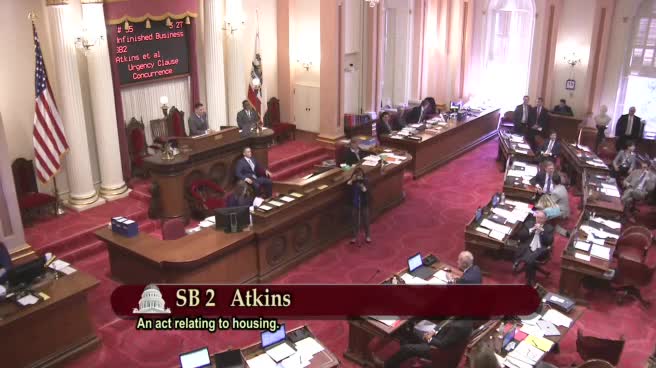 14MIN
Senate Floor
 26MIN
Assembly Floor
 19MIN
Assembly Standing Committee on Housing and Community Development
 17MIN
Senate Floor
 48MIN
Senate Standing Committee on Appropriations
 4MIN
Senate Standing Committee on Appropriations
 20MIN
Senate Standing Committee on Governance and Finance
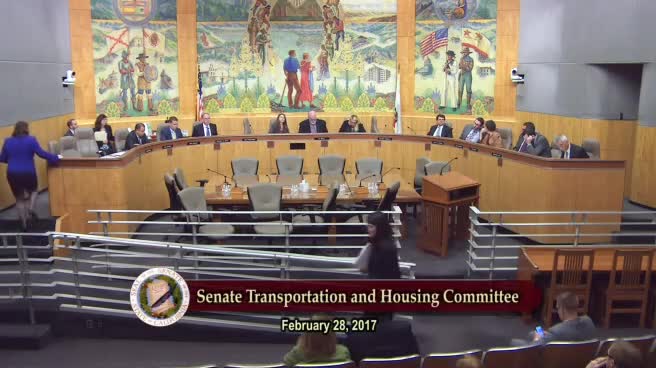 10MIN
Senate Standing Committee on Transportation and Housing
Bill Author

Bill Co-Author(s):